




 Inglés (pdf)
 Articulo en XML
 Referencias del artículo
 Traducción automática
 Enviar articulo por email
 Citado por SciELO
  Similares en
SciELO
Similares en
SciELO 
 Permalink
Introduction
The World Bank Group (2023) declared 2023 the year of inequality, as in most crises, the poorest countries are the most affected. In Latin America and the Caribbean, while most countries saw a decline in poverty, Bolivia recorded an increase: between 2021 and 2023, its poverty rate rose from 15.2% to 16.0%. Additionally, the vulnerable population in Bolivia grew by 0.4 percentage points, while the middle class shrank by 0.7 percentage points during the same period (World Bank Group, 2024). Inequality has many causes and effects, one of the most recurrent being education. Rising educational inequalities are documented worldwide, and studies show parental inputs and beliefs play a key role in shaping children's skills. These beliefs differ across socioeconomic groups, and changing them could help reduce gaps in children's skills and educational inequality (List, 2021). Identifying these beliefs-both individually and within social groups-is the first step toward change.
During the presidency of Evo Morales (2006-2019), basic education was prioritized, leading to significant progress in the fight against illiteracy and the expansion of primary education. Indigenous peoples still have fewer opportunities to access higher education compared to their non- Indigenous counterparts. Public expenditure on education increased substantially, rising from 2.4% of GDP in the early 1990s to between 6.0% and 7.5% since 2006, reaching 8.9% in 2018 (Bertelsmann Stiftung, 2018).
In the thesis of Cronembold (2012), a study was conducted with children aged 7 to 9 on the "g" factor of intelligence (Raven's Progressive Matrices, special scale). The results indicated a significant difference between public and private schools in Bolivia, as the scores obtained by students in public schools were lower than those of students in private schools.
A study on school infrastructure further indicates that access to basic educational services-such as water, electricity, and sanitation-varies considerably between public schools in rural areas and urban schools, which are often private and better equipped (Bojanic et al., 2025). Despite the government's relatively high investment in education-representing 7.29% of the GDP and 16.84% of total national expenditure in 2014-inequalities persist in how these resources are distributed, with rural public schools still facing substantial deficits in infrastructure and quality (Education Profiles, 2024).
We examine this in Samaipata, Bolivia, often called "Samai-trampa"1 for its ability to captivate visitors. This is a small agricultural community with residents from diverse backgrounds, making it an ideal field site to study factors influencing parental educational preferences across social groups. Since parents can freely choose schools, we believe their preferences strongly shape children's educational opportunities. It is needed to answer the question: What are the impor-ant factors influencing parents' choice of school for children across various social groups in Samai ata, Bolivia?
For this research, it is relevant to understand the concept of parental educational choice and get a sense of how these choices look around the world. Shiferaw and Kenea (2024) define parental educational choice as "[...] a concept that allows parents to have the freedom to choose the best educational option for their children. It recognizes that not all schools are created equal and that different educational approaches may work better for different students" (p. 21).
According to Maddaus (1990), parental choices often prioritize children's academic performance. However, research shows that low-income families focus more on logistical issues, while high-income families value educational quality (Rohde et al., 2019).
In his study of Saudi Arabia, Alsauidi (2016) found that one of the most important factors for parental educational choice is academic performance. Further, research from the 1990s and onwards has presented different dominant criteria for parental educational choice. Among these are academic quality, school environment, security, location, cost, and children's preferences (Maddaus, 1990). In South Africa, research on middle-class families found security, children's well-being, discipline, and academic curriculum to be crucial factors (Blake & Mestry, 2020).
However, universal claims on educational choices remain debated. Both Alsauidi (2016) and Blake & Mestry (2020) emphasize that school choice depends on the unique social and cultural contexts of each nation.
Thus, the parental educational choices analyzed in our research are specific to Samaipata's cultural setting, though some trends may be universal. Beyond identifying key factors influencing school choice in Samaipata, we also examine how these choices vary across social groups, using Bourdieu's concepts of capital and social fields.
Bourdieu
Bourdieu claims that the social world is a relational space, constituted of autonomous social fields. Social fields are a way to understand and create sub-spaces within the global space. Each social field responds to rules of functioning, which define the relation between the social groups existing in the field (Hilgers & Mangez, 2014). The theory of social fields and groups becomes a method to understand social dynamics. However, all methods require tools for observation processing. As our tool, we adopt Bourdieu's concept of capital:"[...] accumulated labor [...] which, when appropriated on a private, i.e., exclusive, basis by agents or groups of agents, enables them to appropriate social energy in the form of reified or living labor" (Bourdieu, 2002, p. 280). According to this perspective, capital extends far beyond financial wealth, and it includes non-material assets that contribute to social status, power, and success.
Bourdieu distinguishes three forms of capital: economic, cultural, and social. Economic capital includes financial resources like money, property, and assets. Cultural capital consists of non-financial resources such as knowledge, education, skills, and cultural tastes. Social capital refers to resources accessed through social networks, including connections, trust, and support. To Bourdieu, everything is relational; what matters most is not the capital itself, but its relationships (Hilgers & Mangez, 2014).
These forms of capital affect social groups differently. Bourdieu states that "Any capital, whatever the form it assumes, exerts symbolic violence as soon as it is recognized [...] and imposes itself as an authority calling for recognition" (Bourdieu, 2013, p. 298). Symbolic violence transforms capital into something more, shaping reputation and recognition (Bourdieu, 2002). Symbolic capital reflects the value assigned to individuals or groups based on economic, cultural, and social capital (Hilgers & Mangez, 2014).
We analyze our data through capitals and their relational effects, identifying patterns in economic, cultural, and social preferencesshaped by social factors.
Methodology
Following Hastrup (2015), it conducted fieldwork to understand complex realities. Using a mixed-methods approach, we integrated qualitative and quantitative data to enhance reliability through triangulation (Frederiksen, 2015).
Quantitative methodology
For quantitative data, a conjoint experiment, a survey, and a drawing assignment were conducted. The conjoint experiment tested how school attributes influenced parental choice. Stantcheva (2023) describes it as a factorial experiment where participants choose between hypothetical scenarios. We applied this by presenting school profiles to parents in Samaipata.
Each profile had five attributes defined by one of two possible levels, as detailed in Table 1.
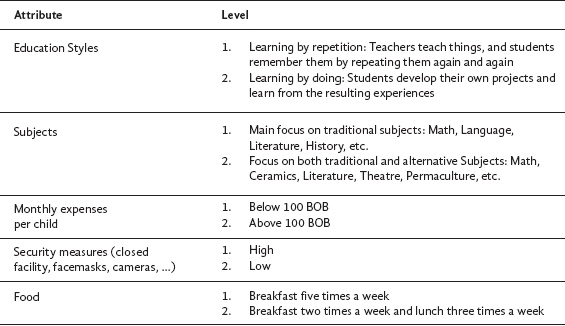
We created 32 hypothetical school profiles by randomizing attribute levels. Participants selected between two profiles in three rounds, generating 352 observations from 61 participants. We analyzed the data using Stata and collected demographic information through a brief survey, enabling subgroup analysis. To address external validity concerns in conjoint experiments (Stantcheva, 2023), we supplemented statistical results with interviews comparing findings to real experiences.
Additionally, we conducted a visual content analysis of 92 children's drawings (first to sixth grade) to assess school preferences, following Rose (2010) for objective interpretation. This method allowed us to compare parental choices with children's perspectives, uncovering additional factors in school selection. The categorization and coding process provided deeper insights into the educational preferences of parents and children in Samaipata.
Ethics
Acknowledging positionality is crucial. As most of the researchers were foreigners, there were limitations such as potential biases or misunderstandings when collecting information. Also, some participants misjudged the purpose of our research. This was particularly notable when we conducted the drawing assignment, where some children thought that we would implement what they drew. It was made clear to participants that the project had no financial support from the city and was solely for academic purposes. Additionally, potential biases were considered in the results analysis section. Another concern was whether our perceived influence biased responses, as participants might have expected positive changes.
Additionally, some respondents struggled with literacy in the conjoint experiment, making comprehension difficult. Future research should offer alternative presentation methods for inclusivity. These ethical concerns were considered in our report, as they could impact findings.
Results
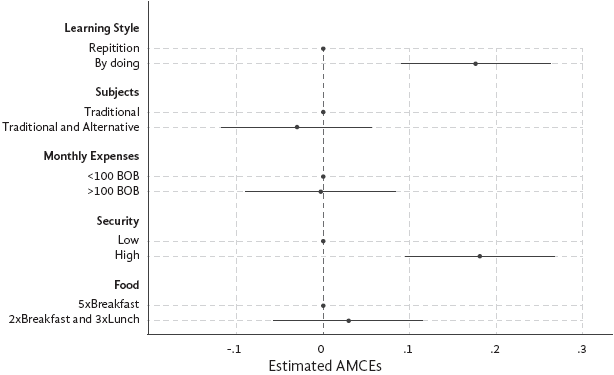
The next section combines and analyzes qualitative and quantitative results, structured around the five attributes from our conjoint experiment. By merging the statistical preferences for each factor (see Graph 1) with qualitative insights, we seek to identify the factors influencing parental educational choice in Samaipata.
Educational Style
Previous studies by Maddaus (1990) and Alsauidi (2016) highlight academic quality and educational style as crucial for parents, which was evident in the research in Samaipata, leading us to include educational style in our experiment. Public schools used a teacher-led approach with participation through note-taking and reading, while private schools focused on multiple intelligences and project-based learning, such as the food project at Wawitas Creando.
The experiment showed that parents are 17.67 percentage points (pp) more likely to choose a school with a "learning by doing" style over "learning by repetition", with significance at the 1% level. This preference could be due to the perceived authoritarian nature of repetition, as reflected in critiques of public schools. Initially, we thought public-school parents would prefer repetition, but our observations and results showed that the reality of public schools was more participatory, which could explain the preference for "learning by doing".
Overall, both quantitative and qualitative findings show that educational style is an important factor in parental school choice in Samaipata.
Subjects
We examined parental preferences for subjects, as academic quality is a key factor in school choice (Maddaus, 1990). Schools in Samaipata offer either only traditional subjects (math, languages, history) or both traditional and alternative subjects (permaculture, theatre, ceramics). Public schools provide only traditional subjects, while private schools offer both, making this an important attribute in our experiment.
Our findings show that parents are 3.09 pp less likely to choose a school offering both traditional and alternative subjects over one with only traditional subjects. This reflects the actual enrollment patterns in Samaipata, where more children attend schools with only traditional subjects. Many parents seemed skeptical of alternative subjects, viewing them as unfamiliar and unproven, whereas traditional subjects are seen as reliable. However, some parents, especially those in private schools, valued alternative subjects for fostering creativity and motivation, as one mother noted about her child's enthusiasm for permaculture.
While subjects influence school choice in Samaipata, this factor is less significant than educational style. The weaker quantitative result can be explained by qualitative findings, where a smaller group of parents viewed alternative subjects as beneficial.
Monthly Expenses
In Samaipata, public schools are free but require a small monthly fee of under 100 BOB, while private schools charge over 100 BOB. This difference led us to include monthly expenses in our experiment.
Our results show parents are only 0.27 pp less likely to choose a school with fees above 100 BOB. Some prefer cheaper schools to avoid unnecessary costs, while others associate higher fees with better education. This near-indifference reflects opposing perspectives.
Field research revealed that schools adjust fees to support families. Juan de la Cruz charges 25 BOB per child but caps fees at 50 BOB for larger families. Private schools also offer financial flexibility. Flor de Montaña allows reduced fees in exchange for maintenance work.
Overall, while cost influences school choice, its impact is smaller than expected, likely due to schools' financial adaptability.
Security
Our findings show that parents are 18.11 pp more likely to choose a school with high security measures (e.g., cameras, fences) over one with low security. However, perspectives on security differ between public and private schools. Public schools view security positively, implementing enclosures, cameras, and COVID-19 regulations. In contrast, private schools associate security with a loss of freedom, leading to fewer safety measures. For instance, some private school staff and parents criticized face masks, questioning their impact on children's social interactions.
The results suggest that most respondents, with children in public schools, favor high security, though some opposed strict measures. Overall, security influences school choice in Samaipata, with public school parents preferring high security and private school parents favoring fewer restrictions.
Food
Previous research (Maddaus, 1990) shows that educational choices depend on societal context. In Samaipata, food is a key factor, unlike in most studies. Our field research found that only two of five schools provide food, with parents paying a fee. The public primary school Juan de la Cruz offers breakfast three times and lunch twice a week, emphasizing its necessity for some students. Other schools either provide no food or have long lunch breaks.
To explore this, we included food as an attribute in our experiment, comparing schools offering only breakfast versus a mix of breakfast and lunch. Parents were 2.89 pp more likely to choose mixed food options, though results lacked significance. Discussions revealed mixed opinions, with some seeing lunch as essential, while others preferred children to eat at home. Many also noted that their children preferred breakfast.
Although our quantitative results are weak, qualitative data suggest that food influences school choices in Samaipata.
Social Group analysis
Earlier studies from Alsauidi (2016) and Blake & Mestry (2020) emphasize that educational choices are influenced by the unique contexts of social settings. In this section, we aim to uncover distinctions among social groups and analyse the presence of Bourdieu's three forms of capital within these groups. The analysis is segmented into three subsections based on gender, income, and origin, concluding with a depiction of the social field of parents in Samaipata in terms of cultural, social, and economic capitals (Graph 5).
Groups based on Gender
Our first social groups are based on gender (65% women, 35% men), which may affect representativeness. However, key differences emerge in education style, security, and food preferences.
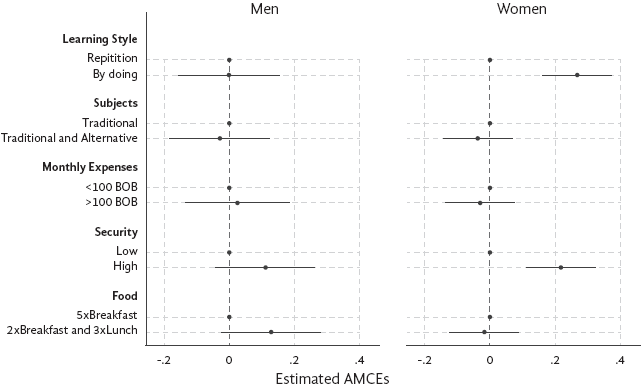
Our quantitative findings show that women strongly prefer the learning-by-doing approach, while men appear indifferent. The result for women is statistically significant at the 1% level, whereas for men, it is insignificant.
In food preferences, women are 1.88 pp less likely to choose schools offering both meals, while men are 12.82 pp more likely.
Groups based on Income
Our second group category is based on income with low-, medium-, and high-income groups. Out of the 352 observations, 116 are based on answers of respondents with low income, 188 on answers of respondents with middle income, and 48 on answers of respondents with high income. Here, the attribute of monthly expenses is particularly interesting to analyse (Graph 3)
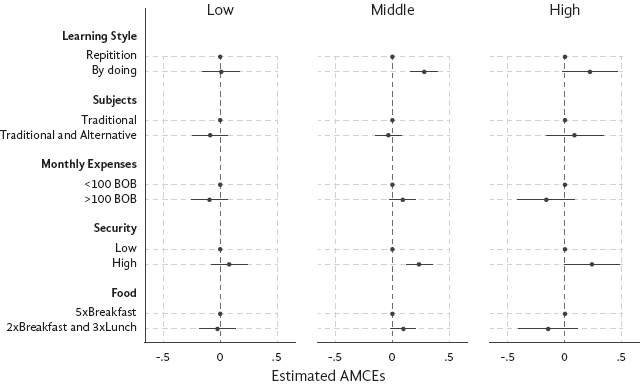
Regarding monthly expenses, income groups show distinct preferences: low- and high-income families favor schools costing under 100 BOB, while middle-income families prefer those above 100 BOB. This aligns with the arguments in Section 5.3. Low- and high-income groups prioritize cost-effectiveness, avoiding unnecessary premiums for similar education, whereas the middle-income group associates higher costs with better quality.
Those willing to pay over 100 BOB may be exchanging economic capital for cultural capital, investing in perceived educational quality. Another explanation lies in symbolic capital: higher tuition can signal wealth and reflect a desire for social recognition. Middle-income families may use economic capital to enhance their status, while high-income families, already possessing symbolic capital, do not need such investment. Low-income families, lacking sufficient economic capital, cannot afford the more expensive school.
Groups based on Place of Origin
Our final social group category is based on place of origin, divided into parents from Samaipata, from Bolivia (excluding Samaipata), and from outside Bolivia. Among 352 responses, 186 are from Samaipata, 142 from other parts of Bolivia, and 18 from outside the country. As in previous sections, this imbalance may limit comparability, but notable differences still emerge, particularly in educational style, monthly expenses, subjects, and security (Graph 4).
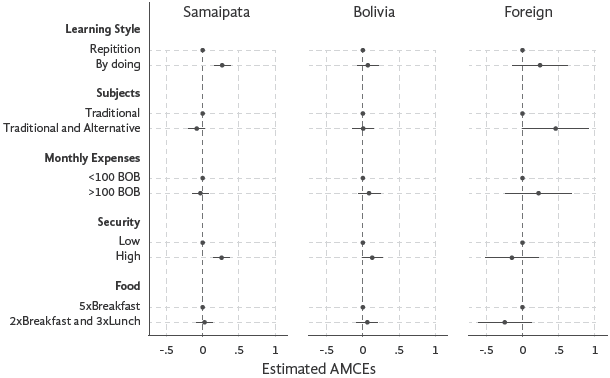
Across all subgroups, parents prefer learning by doing, with the strongest preference among Samaipata parents, who are 26.67 pp more likely to choose it over repetition. This suggests that cultural capital shapes their educational preferences.
Regarding expenses, parents from outside Samaipata are more likely to pay more for education. Most children in public schools are from Samaipata or nearby, while private schools mainly enroll children from families abroad. This suggests that non-local parents prioritize cultural capital, while Samaipata parents also consider economic capital (cf. Section 6.2).
Subject preferences also differ. Samaipata parents are 8.45 pp less likely to choose schools offering both traditional and alternative subjects, while parents of the rest of Bolivia show little preference. In contrast, parents from outside Bolivia are 46.2 pp more likely to favor such schools, reflecting social capital, as they tend to follow their social group's educational choices, reinforcing symbolic capital and school separation.
Security preferences vary as well. Samaipata and Bolivian parents prefer high-security schools, whereas parents from outside Bolivia, who mostly choose private schools, are less likely to do so, as they see strict security as limiting children's development.
Despite small differences, parents from outside Bolivia often diverge from local parents, likely due to differing cultural capital. While Samaipata's unique setting may create shared values among residents, quantitative findings suggest cultural differences still influence school preferences.
Section Summary
Graph 5 is a cross-field representation of our identified social groups within the social field.
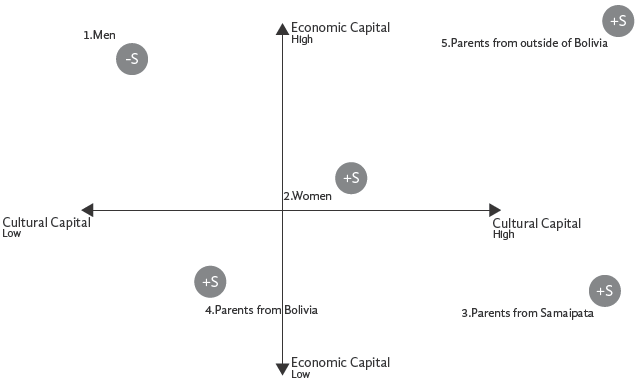
The graph shows that men in Samaipata attain a relatively low social and cultural capital, while they have a high economic capital. However, women in Samaipata attain a higher social capital than men, while they have a medium cultural capital and economic capital. Looking at places of origin, parents from Samaipata (3) tend to have a lower economic capital, while they obtain a high social and cultural capital. This is similar to parents from Bolivia (4), although these parents have a medium-level cultural capital. Lastly, parents from outside Bolivia (5) have high economic, social, and cultural capital.
Children's aspirations
The final survey question addressed parents' aspirations for their children, with most choosing continued education (75.4%) or other (14.7%). Among the latter, 66.6% emphasized allowing children to define their own goals. This highlights both the value Samaipata parents place on education and their respect for children's autonomy. While it's unclear if aspirations influence school choices or vice versa, this finding led us to include children's perspectives through a drawing assignment.
Analysing the attributes depicted in the drawings, we found five more recurring attributes representing the children's wishes in addition to the attributes valued by parents. The results of the drawing assignment can be seen below.

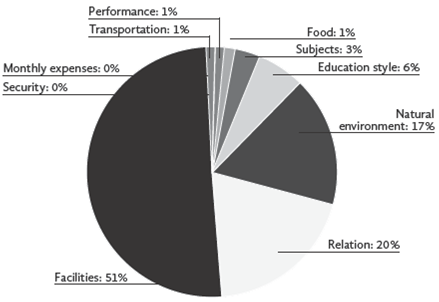
Based on this data, children show far less interest in food, security, monthly expenses, education style, and subjects than parents do when it comes to their ideal schools. Instead, physical context, such as facilities and natural environment, becomes the most essential attribute. Relations are another essential attribute for children, which we did not identify as important for parents. However, through our social group analysis, we identified social capital as prominent for all social groups except for one. The children's emphasis on relations further supports this and solidifies social capital in the social field of Samaipata as highly dominant and symbolic.
Taken together, although we see some similarities between the children's and parents' prioritization of attributes, the differences are more prominent. Thus, we conclude that the aspirations of the children are not an important factor influencing parental educational choice in Samaipata.
Discussion
The findings of this research align partially with existing literature on parental educational choice while revealing contextual specificities unique to Samaipata. Maddaus (1990) and Alsauidi (2016) emphasized that academic performance and educational quality are central to parents' school choices. Consistent with these studies, our results show that educational style-particularly learning by doing-was the most influential factor among Samaipata parents. However, unlike pre-vious research where parents valued academic rigor as a sign of quality, in Samaipata, the preference for participatory methods seems to stem from parents' perception that these approaches foster social interaction and personal development, aspects highly valued in the community.
Similarly, the strong significance of security as a determining factor in our conjoint experiment resonates with Blake and Mestry's (2020) study in South Africa, where safety and discipline were decisive for middle-class families. In Samaipata, security holds symbolic value across social groups, especially among public-school parents, who perceive physical protection and order as indicators of institutional quality.
Contrary to Cronembold's (2012) findings, which reported lower cognitive performance in students from public schools compared to private ones, our results suggest that parents' preferences are not solely driven by perceived academic outcomes. While families recognize differences in infrastructure and resources between public and private institutions (Bojanic et al., 2025), many still prioritize relational, cultural, and emotional factors, particularly the sense of community and trust that public schools provide.
Regarding economic factors, monthly expenses had a limited influence on parental decisions, contrasting with international literature (Rohde et al., 2019; Alsauidi, 2016), which highlights cost as a major determinant. This divergence can be explained by Samaipata's local practices of financial flexibility-such as fee reductions or voluntary work-which mitigate the role of economic capital in educational choice.
The results also reinforce Bourdieu's (2002; 2013) theoretical framework: social and cultural capital were more decisive than economic capital in shaping school preferences. The high symbolic value attributed to social networks-manifested through collective activities like mingas and parental cooperation-suggests that education functions as a space for reinforcing social recognition rather than merely pursuing economic advancement. The prominence of women's social capital supports this view, indicating that parental decisions are embedded in local social dynamics where relationships and community trust play a central role.
Finally, while Shiferaw and Kenea (2024) argued that school choice reflects universal parental concerns about fit and quality, our findings confirm Blake and Mestry's (2020) and Alsauidi's (2016) position that cultural context significantly shapes educational preferences. In Samaipata, education is not only a means of mobility but also of belonging-a way to reproduce and negotiate symbolic capital within a tight-knit social field.
Conclusion
Bourdieu's concept of social capital provides a useful lens for understanding these findings, as it refers to resources gained through social networks, trust, and community support (Bourdieu, 2013). The fieldwork revealed the strong role of social connections in both public and private schools, seen in activities like mingas (parent-teacher gatherings) and collective decision-making on schoolbooks. Women's stronger social capital within these communities may explain their more unified preference for educational styles, whereas men, with weaker social ties, show more varied opinions, leading to less significant results. Analyzing these results through Bourdieu's lens highlights how social capital contributes to status, power, and success (Bourdieu, 2013). If women in school communities possess more social capital than men, they may value their children developing strong social skills. Education becomes a means not only to accumulate cultural and economic capital but also to enhance social capital. This may explain their preference for learning-by-doing approaches, which foster social skill development.
Regarding security, both genders prefer high-security schools, with women showing a slightly stronger inclination. From a cultural capital perspective, cultural capital shaped by upbringing and education may explain this (Bourdieu, 2013). Women, often socialized to take more precautions, might project these concerns onto school choices. Men, having different cultural capital, may not prioritize security to the same extent.
Applying Bourdieu, men prioritize economic capital, favoring school meals for financial benefits. While this was expected for both genders, the trend is stronger in men. Women balance cultural and economic capital, preferring schools serving only breakfast as it aligns with their caregiving role, while also recognizing that providing lunch themselves is costlier. Men's lower involvement in caregiving explains their stronger preference for lunch-providing schools.
This research set out to investigate which factors influence parental educational choice in Samaipata, Bolivia. We also examined how these factors vary in importance across social groups. By employing a mixed-methods approach, we gathered qualitative and quantitative data through interviews, participant observations, a conjoint experiment, and drawings made by children.
First, we found that parents are more likely to choose a school offering learning by doing rather than learning by repetition. Secondly, we found that parents prefer high over low security. Even though education style and security are the most important factors, food, subjects, and monthly expenses were also relevant, but to a lesser extent. This correlates with previous research stating that parents prioritize both education style (quality of instruction) and security over other attributes.
When distinguishing between gender (including men and women), income levels (including high, medium, and low-income earners), and place of origin (including parents from Samaipata, Bolivia, and outside Bolivia), we found that factors differed in prominence between social groups.
Applying Bourdieu's concepts of capital and social field in the analysis of these groups, we discovered how economic, social, and cultural dynamics influence parental educational choices. By mapping the social fields of parents in Samaipata, we observed a high presence of social capital among all social groups except men. This indicates that social capital in the parental social field of Samaipata holds high symbolic capital and is significant for parental recognition and acknowledgment.
Lastly, we also considered children's preferences regarding educational choices. While some similarities emerged between children's and parents' prioritization of attributes, differences were more prominent. Thus, children's aspirations are not a significant factor influencing parental educational choices in Samaipata.
This research is strongly rooted in its contextual setting, making it difficult to generalize the findings to a universal population. Rather than applying these findings to other contexts, future research should focus on replicating similar studies in different settings.

