




 Inglés (pdf)
 Articulo en XML
 Referencias del artículo

 Traducción automática
 Enviar articulo por email
 Citado por SciELO
 Similares en
SciELO
 uBio

 Permalink

Introducción
The Correndera Pipit (Anthus correndera) is considered a polytypic species (Clements et al. 2024,Remsen et al. 2025) with five recognized subspecies defined based on differences in plumage and geographic distribution or geographic isolation: (1) A. c. calcaratus in the High Andes of South America, from Lima, Junín, Cuzco and Puno (Perú), western and central Bolivia, to Jujuy, northwest Argentina; (2) A. c. catamarcae from Antofagasta, northern Chile, through southeastern Perú, southwestern Bolivia and northwest Argentina (Catamarca); (3) A. c. correndera from southern Paraguay, northeastern Argentina (Córdoba, Mendoza, Neuquén), Uruguay and southeastern Brazil (Rio Grande do Sul); (4) A. c. chilensis from coast to 1,250 m from Atacama, northern Chile to Isla Grande, and south and western Santa Cruz, Argentina (Fjeldså & Krabbe 1990,Tyler 2004,Norambuena et al. 2018); and (5) A. c. grayi restricted to the Malvinas Islands (Tyler 2004,Norambuena et al. 2018). In Bolivia, A. correndera occurred in the La Paz, Oruro, Potosí, Cochabamba and Chuquisaca departments, between 2,550-4,400 m. It is considered rare and local in semi- desertic to locally semi-humid Puna grassland and Polylepis woodland in the Altiplano and upper east Andean slope, Prepuna and valleys of the Bolivian-Tucuman Forest, often at or near bogs and lake shores; primarily in sparsely vegetated areas with short grass (Herzog et al. 2016). The objective of this work is to document the first record of Anthus correndera in the Tarija Department, Bolivia, describing a new lowest altitudinal record for the species, as well as some aspects of its habitat and natural history.
The Correndera Pipit was registered 23 March 2019 por OM in the Iñiguazu locality (63°53'W, 21°47'S; 1,710 m), Carapari Municipality, Gran Chaco Province, 12.5 km southeast of Itaú, Tarija Department (Fig. 1). An adult individual was observed walking on the ground of a meadow (pampa) with low pastures and grasslands in seasonally flooded fields with swamps and lagoons in the summer season. Other birds associated with seasonal water bodies with low waters included Southern Lapwig (Vanellus chilensis), Black-necked Stilt (Himantopus mexicanus), Puna Ibis (Plegadis ridgwagi), Buff-necked Ibis (Theristicus caudatus), Whistling Heron (Syrigma sibilatrix), Wattlet Jacana (Jacana jacana) and some boreal migratory birds such as Pectoral Sandpiper (Calidris melanotos), and a raptor, the Burrowing Owl (Athene cunicularia). There was no interaction between the observed individual and the bird species mentioned, because the Correndera Pipit foraged in semi-high areas with dry grasslands far from waterlogged areas. The species was considered a seasonal visitor (as well as most of the waterbirds that accompanied it, including the boreal migrant) due to the marked presence of extensive areas of seasonally flooded pampas with tall grasslands as a suitable habitat.
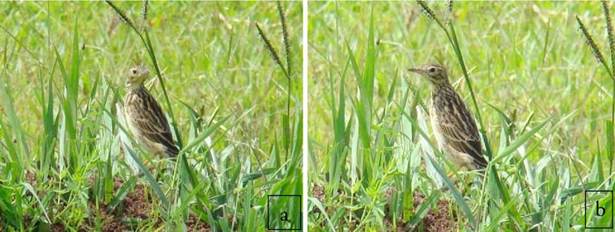
Figure 1. Two aspects of the Correndera Pipit (Anthus correndera) recorded in Iñiguazu, Gran Chaco Province, Tarija Department, Bolivia (Photos: Omar Martínez).
The vegetation of Iñiguazu corresponds to the Bolivian- Tucuman Forest with extensive pampas and meadows in plains with grasslands (Fig. 2a) surrounded by montane forests (Fig. 2b) with tree species such as cedro (Cedrela fissilis), timboy (Enterolobium contortisiliquum), quina (Myroxylon peruiferum), perilla (Phyllosthyllon rhamnoides), palo blanco (Calycophyllum multiflorum), palo lanza (Patagonula americana), tipa (Tipuana tipu), urundel (Astronium urundeuva) and laurel blanco (Nectandra sp.) (Navarro 2002). The habitat of A. correndera is widely described in Tyler (2004) and Herzog et al. (2016). The type of microhabitat varies according to latitude, but A. correndera prefers wet meadows with adjacent areas partially or completely flooded dominated by tall grasses (70-130 cm high) and plants such as Juncus spp. or Ranunculus repens (Andors & Vuillleumier 1995,Raimilla et al. 2012b,Norambuena et al. 2017,Echevarria & Martínez 2018), as is the case of the study site in Iñiguazu (Fig. 2a).
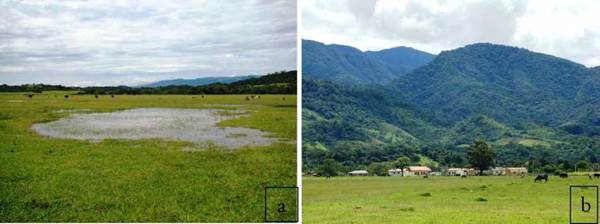
Figure 2. Two panoramic views of the habitat: (a) extensive seasonally flooded pampas where Anthus correndera was recorded, and (b) slopes of montane forest (Bolivian-Tucuman Forest) in surroundings (Photos: Omar Martínez).
The species was recognized mainly because it is the only motacillid that has noticeable prominent white stripes along the dorsal scapulars (Fjeldså & Krabbe 1990,de la Peña & Rumboll 1998,Schulenberg et al. 2010,Herzog et al. 2016). The individual observed in the field noticeably displayed a pair of prominent white bars on dorsal scapulars, while it circled around a few times in its position (Fig. 2a and 2b). The bird also displayed the typical erect posture of the body and the elongated neck (Fig. 2a) like in the plates of the guides of de la Peña & Rumboll (1998) and Herzog et al. (2016), and a photo in de la Peña (2025). The observed individual also showed a flattened head, relatively long bill, notorious white eyebrows and well- pronounced wings of white (Fjeldså & Krabbe 1990) that differentiates it from the Short-billed Pipit (Anthus furcatus) with which it is usually confused. This latter has a round head, a short bill and a chubby body like a common passerine. It is also confused with Hellmayr’s Pipit (Anthus hellmayri), but these lacks malar lines and marked eyelids. Its eyebrow is not showy, and the headset area is not stained, which generates a pale face appearance. This situation contrasts with the facial pattern of A. correndera, which has a marked white superciliary, ocular line and notorious malar, with well-delineated black auricular area (Jaramillo 2014,Herzog et al. 2016, Fig. 1a-b). Another differential characteristic between both species are the breast and flanks, highly striated in A. correndera and finely marked in A. hellmayri. Dorsally, in A. correndera two marked transversal white stripes are observed, which contrast with the dark brown and striated black color. These strips are absent in A. hellmayri (Raimilla et al. 2012a). Finally, A. correndera can also be confused with the Yellowish Pipit (A. chii), mainly due to the whitish plumage patterns on the neck and facial areas, but A. correndera has a noticeable white supercilium, whereas in A. chii the supercilium is “dirty” white or yellowish, but narrow and diffuse (Herzog et al. 2016). Additionally, A. correndera has a longer neck, the edges of the primary coverts are prominently white, has a larger body size (13.5 cm), paler underparts, and a more upright posture (Fig. 1b). In contrast, A. chii has a smaller body size (11.5 cm), white wing edges on the coverts, but very faint, lower parts that are yellowish-white, and a more crouched posture with a short neck.
Actually, there were no known records of A. correndera in the Tarija Department. The present record of A. correndera is the first for this department and marks a range extension for the species of about 150 km to south-eastern of the country, from the only known record in Chuquisaca (Fig. 3, Herzog et al. 2016) and 193,5 km southeast of Tupiza, Potosí (Fig. 3, Herzog et al. 2016,eBird 2025), and is also considered the lowest altitudinal record for the species (1,710 m) relative to what was previously known (2,550 m in Bolivia; Herzog et al. 2016), which is within the known range for the species at the southern end of its distribution. This is supported by the fact that in areas such as north- central Argentina migration between lowlands and the Andes could explain the presence of some individuals assigned to the calcaratus subspecies that appear genetically closer to lowland individuals (Norambuena et al. 2018,2021). In Argentina, A. correndera is considered a regional migratory species and can travel from low altitudes to areas of the Puna (2,000 m) with pastures in open fields always close to wetlands in bogs and swamps (Echevarría & Martínez 2018).
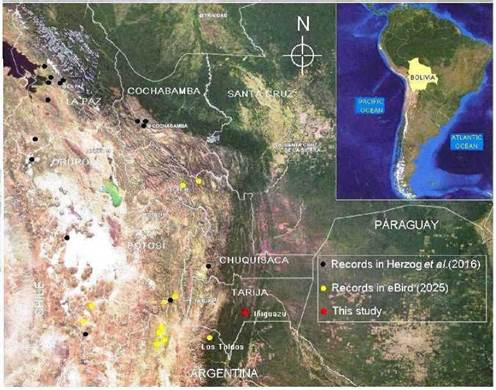
Figure 3. Records of Anthus correndera in Bolivia and northern Argentina. Black points in Herzog et al. (2016), yellow points in eBird (2025), red points in this study.
The closest records of the species to Iñiguazu (this study) included in eBird (2025) are shown in table 1 and figure 3. None of the three Bolivian sites (Tupiza, Chataquilla, and Presto) reported in eBird (2025) are found in habitats similar to the one described in this study. They are localities located in inter-Andean dry valleys and the Prepuna. Our record in Iñiguazu is the first one in an extensive seasonally flooded pampas surrounded by the Bolivian Tucumanian forest.
Table 1. Records of Anthus carrendera in eBird (2025) for Bolivia and Argentina closest to that of Iñiguazu in the Tarija Department (this study). Legend: * = Observed (O), Photo (P), Tape recorded (T).
| Departament/ Province | Locality | Altitude (m) | # of individuals | Date | Evidence* |
|---|---|---|---|---|---|
| Bolivia | |||||
| Potosí | Tupiza | 2,850 | 1 | 3 November 1994 | O, T |
| Chuquisaca | Presto | 2,465 | 1 | 11 May 2024 | O |
| Chuquisaca | Chataquilla-Camino del Inca | 2,790 | 1 | 12 August 2024 | O |
| Argentina | |||||
| Salta | Los Toldos-Santa Victoria | 1,624 | 1 | 15 October 2019 | O |
| Jujuy | Vado Pasajes-Yavi | 3,516 | 2 | 22 September 2022 | O, T |
| Jujuy | Cieneguillas, Río Santa Catalina | 3,680 | 1 | 22 September 2023 | O |
In Argentina, A. correndera can reach a height of 2,000 m (Echevarría & Martínez 2018), as shown by the record of A. correndera in Los Toldos at 1,624 m (Fig. 3, Table 1, eBird 2025), which is within the known range for the species at the southern extreme of its distribution. It is possible that the species spreads in other grasslands or extensive pampas of the region of the Serranía Iñiguazu to the north in the Itau Valley, as well as in the Salinas Valley to the west of Iñiguazu, whose continuity of vegetation and extensive pastures with seasonally flooded pampas in a matrix of Bolivian Tucuman Forest is typical of the region (Martínez et al. 2022). In addition, in certain areas of the plateau of the Serranía Aguaragüe (northeastern Iñiguazu), such as Sanandita or further in Camatindi, there are extensive grasslands above the mountain forest (Martínez et al. 2011), which would appear as available habitat for the species. Similarly, to the south of Iñiguazu is the Serranía Alto Las Cañas, that continues in north progression to the Serranía San Telmo (Argentina) and to the north end of the latter, in Los Toldos - Santa Victoria, the only record of the species (Fig. 3, eBird 2025) in a habitat similar to that found in this study. In conclusion, the regional importance of this record is highlighted, both at the departmental level and for the Tucumano-Bolivian forest ecoregion, something that had already been suggested as probable in Herzog et al. (2016).

