




 Inglés (pdf)
 Articulo en XML
 Referencias del artículo

 Traducción automática
 Enviar articulo por email
 Citado por SciELO
 Similares en
SciELO
 uBio

 Permalink

Introducción
How organisms respond to environmental conditions often creates patterns across different spatial and temporal scales (Adrian et al. 2012). Metabolic processes in plant species, such as transpiration and photosynthesis, exhibit both long and short-term temporal patterns (Lu et al. 2019). Although the mechanisms that shape these patterns were analyzed, there are gaps in our understanding of the influence of environmental variables, leaf traits and cultivation systems on shaping these patterns (Gómez-Yarce et al. 2020). By studying it, we can better understand the ecophysiological responses of cultivated tree species to different environmental conditions.
Environmental variables such as temperature and relative air humidity are the most critical environmental variables influencing physiological plant responses (Grossiord et al. 2020) in natural and cultivated ecosystems. For example, short (temperature) and long (canopy cover) environmental variables could be modified in cultivation systems (e.g., Agroforestry systems) that consequently could influence the expression of functional leaf traits and physiological processes (Saavedra et al. 2020).
In plants, physiological processes are regulated by the expression of functional leaf traits (Medlyn et al. 2017). For instance, stomatal responses to changes in vapor pressure deficit (VPD) are influenced by air temperature and are the main regulators of daily transpiration rate (Grossiord et al. 2020). Similarly, leaf area (LA) and specific leaf area (SLA) are associated with the amount of photosynthetically active radiation (PAR) that leaves can intercept (Puglielli et al. 2017) and the CO2 uptake rate per leaf area (Righetti et al. 2007) which are the main drivers of photosynthesis.
Despite all this information, the ecophysiological response patterns of cultivated trees over a daily period and their variation between cultivation systems remain unclear (Gómez-Yarce et al. 2020). This study aims to investigate how do physiological processes and environmental conditions change during a 24-hour period in two different cultivation systems? And which variables influence transpiration and CO2 uptake rates? We hypothesize that in agroforestry systems, physiological responses such as transpiration and photosynthesis rates to environmental conditions will be lower and less variable than monocultures.
Study area
Fieldwork was conducted in November 2022 and 2023 at the Sara Ana Research and Training Center in La Paz, Bolivia. The Sara Ana Center is located in the Alto Beni region (15°27’36” S - 67°28’17” W, 450 m) at the bottom of the Bolivian Andes. In 2008, a long-term trial of different cocoa cultivation systems was established in a completely randomized block design with four repetitions of six cultivation systems: Organic monoculture (OM), Conventional monoculture (CM), Organic agroforestry (OA), Conventional agroforestry (CA) and Successional agroforestry (SA) (Armengot et al. 2016). (For more details see Figure 1 in Saavedra et al. 2020). Data were collected in the Organic monoculture (OM) and Successional agroforestry (SA). These two cultivation systems were similar in the density of planted trees, equivalent to 625 trees per hectare (4 x 4 density). They differ in the presence of a high density of trees occupying the middle and upper strata, with 602 trees per hectare. Agroforestry systems are characterized by fruiting trees such as: Theobroma grandiflorum (Copuazú), Garcinia gardneriana (Achachairu), Averrhoa carambola (Carambila), Nitrogen fixers like: Erythrina fusca (Ceibo) and Inga spp. (Pacay) and timber species, Stryphnodendron purpureum (Toco colorado), Swietenia macrophyla (Mara) and Centrolobium microchaete (Huasicucho) (Saj et al. 2025).
Methods
Data collection
To collect data, we selected two trees of the TSH 565 variety in each of the organic monoculture (OM) and successional agroforestry (SA) cultivation systems per year. From each tree, we selected one mature and healthy leaf from the top crown of the tree. Takin care not to detach from the plant, we placed the selected leaf inside a 3 L plastic container with infrared wireless sensors synchronized by bluetooth to a portable datalogger (SPARK LX, Pasco Scientific 2022) for real-time data recording (Saavedra et al. 2020). We recorded temperature, air humidity, CO2 uptake, and transpiration data for five minutes per leaf. Data collection was conducted simultaneously in both cultivation systems and different leaves were used for recording data on physiological processes and environmental variables every hour for 24 hours.
Microenvironmental variables
We used a weather wireless sensor (PS-3209, Pasco Scientific 2022) to record ambient temperature (°C) and relative air humidity (%) to illustrate the microclimate conditions in each cultivation system. Both variables were recorded before the weather sensor was placed in the plastic container. We averaged the data collected over five minutes to obtain a value for each variable at the leaf level. The same procedure was used for the physiological process.
Leaf gas exchange measurements
We measured the absolute air humidity (g/cm3) to estimate the net amount of water vapor produced at a specific temperature as an indicator of transpiration rate with a wireless sensor (PS-3209, Pasco Scientific 2022) (Pipitsunthonsan et al. 2018). The CO2 uptake was measured simultaneously, using a CO2 wireless sensor (PS-3208, Pasco Scientific 2022) calibrated to 400 ppm. To determine the transpiration and CO2 uptake rate we divided the data by the leaf area (in cm2) and multiplied the result by 3600 seconds.
Leaf area measure
Those leaves where transpiration and CO2 uptake rates measured were collected and transported to laboratory to estimate the leaf area (LA, cm2). The leaves were processed each day after the physiological data was recorded in field. We used the method of Perez-Harguindeguy et al. (2016) to measure the leaves. The leaves were dehydrated in an electric dryer for two days at the Herbario Nacional de Bolivia (LPB). Subsequently, we scanned the dried leaves to estimate the leaf area and obtained digital photos processed with Image J software.
Statistical analysis
For data analysis que applied Linear Mixed Models (LMMs) because data do not follow normality and independence. In separate models, we tested the effect of microenvironmental variables (temperature and relative air humidity), leaf area and cultivation systems as fixed factors on transpiration and CO2 uptake rates. We included hour as a random variable. In both models, we started with a full model. After that, we created reduced models by simplifying the full model using the Dredge function. We compared models with the corrected Akaikes’s Information Criterion (AICc) (Symonds & Moussalli 2011). All the reduced models, whose ΔAICc was less than 2, were considered the best. We carried out statistical analyses with the R software version 3.6.0 (R Core Team 2019).
Results
We found that environmental variables (i.e., temperature and relative air humidity) and leaf area shaped the daily patterns of transpiration and CO2 uptake (Fig. 1). Temperature and relative air humidity followed opposite bell-shaped patterns throughout the day. The highest temperature and relative air humidity occurred between 11:00 and 13:00 h in both cultivation systems (Figure 1a, b).
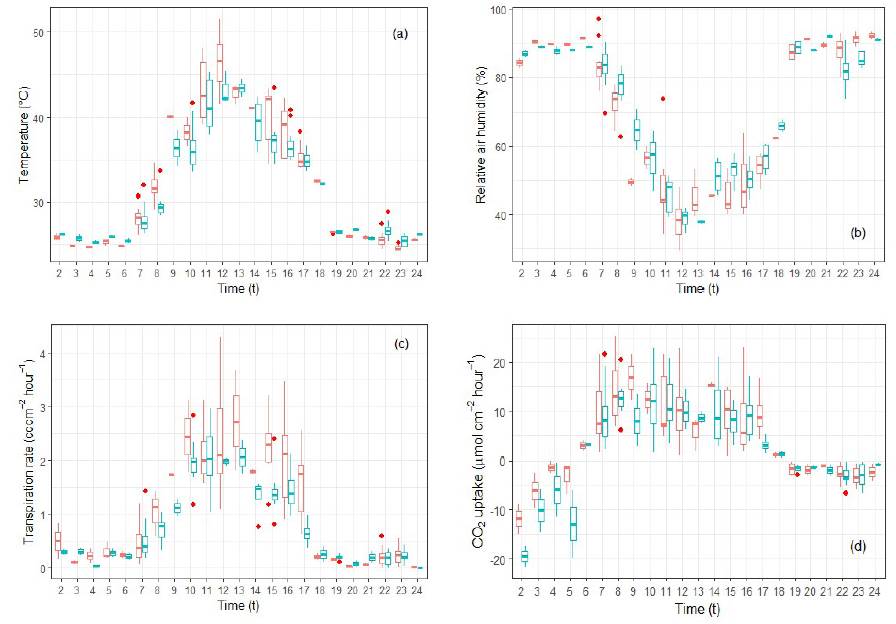
Figure 1. Daily patterns of (a) temperature (°C), (b) relative air humidity (%), (c) transpiration (cc/cm2/hour) and (d) CO2 uptake (umol/cm2/hour) are compared between cultivation systems. In boxplots dark horizontal lines are median, boxes indicate 25th and 75th percentiles and whiskers show data variability. Boxplots in red correspond to cocoa monoculture and blue light denote agroforestry system. The red dots represent outliers.
We discover that transpiration rate along the day followed a bell-shaped pattern with a peak between 10:00 to 14:00 h in both cultivation systems (Figure 1c). Transpiration rate declined rapidly until 17:00 h. The best model results show that temperature, relative air humidity and leaf area were the main factors determining transpiration rate values (Table 1a). When comparing cultivation systems, the transpiration rate along the day was higher in monocultures than in agroforestry systems (Table 2a, Figure 1c).
Table 1. Model comparison for testing effects of explanatory variables on (a) Transpiration and (b) CO2 uptake. Hours were included as random effects in the models. We considered models with a ΔAIC less than 2.
| Response variable ~ predictor variables | df | AICc | ΔAIC | Weight |
|---|---|---|---|---|
| a) Transpiration rate | ||||
| Transpiration ~ leaf area + temperature + relative air humidity + cultivation systems | 7 | 328.3 | 0.00 | 0.881 |
| Transpiration ~ hour (null model) | 3 | 439.8 | 111.51 | 0.000 |
| b) CO2 uptake rate | ||||
| CO2 uptake ~ leaf area + cultivation systems | 5 | 1569.8 | 0.00 | 0.360 |
| CO2 uptake ~ leaf area | 4 | 1571.3 | 1.52 | 0.168 |
| CO2 uptake ~ leaf area + relative air humidity + cultivation systems | 6 | 1571.7 | 1.89 | 0.140 |
| CO2 uptake ~ leaf area + cultivation system + temperature | 6 | 1571.8 | 2.00 | 0.133 |
| CO2 uptake ~ hour (null model) | 3 | 1592.4 | 22.60 | 0.000 |
We observed that there was no clear peak for CO2 uptake. Higher values of CO2 uptake were recorded at 9:00 and slowly declined until 17:00 h in both cultivation systems (Figure 1d). CO2 uptake was mainly influenced by leaf area (Table 1b) and showed partial differences between monoculture and agroforestry systems (Table 2b) with a clear tendency showing slightly higher CO2 uptake rates in monocultures than agroforestry systems (Table 2b, Figure 1d).
Table 2. Results from the best linear mixed model for (a) Transpiration (AICc= 327.9) and (b) CO2 uptake (AICc= 1569.8). Hours were included as random effects in the models. Significant values are highlighted in bold.
| Estimate | Std. Error | t-value | P(>|t|) | |
|---|---|---|---|---|
| a) Transpiration rate | ||||
| Intercept | 1.5828 | 1.0830 | 1.461 | 0.145 |
| Leaf area | -0.003 | 0.0005 | -5.197 | <0.001 |
| Temperature | 0.0512 | 0.0188 | 2.725 | 0.007 |
| Relative air humidity | -0.0209 | 0.0069 | -3.031 | 0.002 |
| Cultivation system | -0.2222 | 0.0569 | -3.904 | <0.001 |
| b) CO2 uptake rate | ||||
| Intercept | 11.0503 | 2.2170 | 4.984 | <0.001 |
| Leaf area | 0.0323 | 0.0063 | -5.080 | <0.001 |
| Cultivation system | -1.1312 | 0.5931 | -1.907 | 0.05 |
Discussion
Our study provides insights into how cocoa (Theobroma cacao) modulates daily patterns of transpiration and CO2 uptake in response to environmental conditions, leaf traits and cultivation systems. By linking physiological responses to cultivation systems our findings enhance our comprehension of plant-environmental interactions in a changing climate. Currently, the physiological responses of cultivated trees to environmental stress have received significant attention, because of the rising temperatures and drought conditions across the cocoa belt production as a result of climate change (Schroth et al. 2016). However, there is limited information about the factors that influence daily patterns of transpiration and CO2 uptake rates as well as their variability between different cocoa cultivation systems, such as agroforestry and monoculture. The findings of this study contribute to improving our understanding of daily patterns that could be essential for assessing water use efficiency, cultivation practices and the productivity of cocoa trees.
Temperature and relative air humidity patterns
We found that temperature was lower in agroforestry than in monoculture systems, while relative air humidity was higher in agroforestry. Previous studies by Hebbar et al. (2020) have also observed similar patterns in open-top chambers. The negative correlation between temperature and air humidity may explain this opposite pattern (Pipitsunthonsan et al. 2018) and the shade created by canopy cover species such as Theobroma grandiflorum (Copuazú), Garcinia gardneriana (Achachairu), Erythrina fusca (Ceibo), Inga spp. (Pacay) and Stryphnodendron purpureum (Toco colorado) in agroforestry systems could account for the differences between cultivation systems (Niether et al. 2018).
Micronvironmental drivers of transpiration pattern
Our data further confirm that the long exposure of cacao trees to solar radiation in monoculture systems, increase temperature and consequently transpiration rate (Saavedra et al. 2020), supporting a positive relationship between these variables. Kirschbaum (2004) observed that with the increase of temperature values, vapor pressure deficit of the air may also increase, with a consequent increase in the transpiration rate. By contrast, the canopy-induced shading in agroforestry systems, reduce solar radiation and temperature (Niether et al. 2020,Suárez-Salazar et al. 2018,2021), reducing the transpiration rate and its variability throughout the day. This lower variability suggests that agroforestry systems could be acting as a buffer against extreme environmental conditions, such as high temperatures and low relative air humidity, due to the effects of climate change. Previous studies have reported the contribution of agroforestry systems to reduce transpirations rates of cocoa (Saavedra et al. 2020) suggesting that water use efficiency of cocoa trees could be better managed in agroforestry systems.
CO2 uptake patterns
The absence of a clear peak could be explained by other factors related with photosynthesis regulation. For instance, CO2 uptake is regulated by environmental factors such as solar irradiance and photosynthetically active radiation (PAR) (Jaimez et al. 2008;Suárez-Salazar et al. 2018), functional leaf traits such as the opening and closing of stomata (Buckley 2019), and biochemical and genetic pathways that regulate the function of stomata and the activation of photosynthetic proteins (Eberhard et al. 2008). The similar pattern between cultivation systems could be explained by the compensation between the shade provided by companion trees in agroforestry systems (Ávila-Lovera et al. 2021) and the light saturation point of CO2 uptake that induces photoinhibition (Verryckt et al. 2020) in monocultures. We trust that these two factors could drive a similar pattern between cultivation systems; however, more studies are needed to disentangle the main drivers of CO2 uptake.
Our findings enhance our understanding of the biotic and abiotic factors that influence daily transpiration and CO2 uptake patterns and how cultivation systems might change these patterns. This information could be valuable for future research and applications related to cocoa growth, yield, and environmental challenges such as drought and heat waves. Additionally, it supports numerous studies that highlight the importance of agroforestry systems as a successful approach to climate change adaptation.
Conclusions
Temporal variability of environmental variables and physiological process show a bell-shape pattern with a peak near midday. Transpiration rate is influenced by environmental variables and functional leaf traits. CO2 uptake is specially driven by functional leaf traits. Our findings suggest that agroforestry systems can buffer the impact of abiotic stress over the ecophysiological responses of cocoa trees.

