<?xml version="1.0" encoding="ISO-8859-1"?><article xmlns:mml="http://www.w3.org/1998/Math/MathML" xmlns:xlink="http://www.w3.org/1999/xlink" xmlns:xsi="http://www.w3.org/2001/XMLSchema-instance">
<front>
<journal-meta>
<journal-id>2518-4431</journal-id>
<journal-title><![CDATA[Investigación & Desarrollo]]></journal-title>
<abbrev-journal-title><![CDATA[Inv. y Des.]]></abbrev-journal-title>
<issn>2518-4431</issn>
<publisher>
<publisher-name><![CDATA[UNIVERSIDAD PRIVADA BOLIVIANA]]></publisher-name>
</publisher>
</journal-meta>
<article-meta>
<article-id>S2518-44312014000200003</article-id>
<title-group>
<article-title xml:lang="en"><![CDATA[TERMS OF TRADE AND NON TRADITIONAL EXPORTS: A MICROECONOMETRIC ANALYSIS]]></article-title>
<article-title xml:lang="es"><![CDATA[TÉRMINOS DE INTERCAMBIO Y EXPORTACIONES NO TRADICIONALES: UN ANÁLISIS MICROECONOMÉTRICO]]></article-title>
</title-group>
<contrib-group>
<contrib contrib-type="author">
<name>
<surname><![CDATA[Aparicio]]></surname>
<given-names><![CDATA[Ruth Marcela]]></given-names>
</name>
<xref ref-type="aff" rid="A01"/>
</contrib>
</contrib-group>
<aff id="A01">
<institution><![CDATA[,Universidad Privada Boliviana  ]]></institution>
<addr-line><![CDATA[ ]]></addr-line>
</aff>
<pub-date pub-type="pub">
<day>00</day>
<month>00</month>
<year>2014</year>
</pub-date>
<pub-date pub-type="epub">
<day>00</day>
<month>00</month>
<year>2014</year>
</pub-date>
<volume>2</volume>
<numero>14</numero>
<fpage>26</fpage>
<lpage>41</lpage>
<copyright-statement/>
<copyright-year/>
<self-uri xlink:href="http://www.scielo.org.bo/scielo.php?script=sci_arttext&amp;pid=S2518-44312014000200003&amp;lng=en&amp;nrm=iso"></self-uri><self-uri xlink:href="http://www.scielo.org.bo/scielo.php?script=sci_abstract&amp;pid=S2518-44312014000200003&amp;lng=en&amp;nrm=iso"></self-uri><self-uri xlink:href="http://www.scielo.org.bo/scielo.php?script=sci_pdf&amp;pid=S2518-44312014000200003&amp;lng=en&amp;nrm=iso"></self-uri><abstract abstract-type="short" xml:lang="en"><p><![CDATA[Since 2004 some economies in Latin America, including Bolivia, have experienced an improvement in their terms of trade. In this research we investigate the causal effect of this improvement on nontraditional exports. We focus on before and after the increase in terms of trade and analyze how this improvement affects export performance. To identify this causal effect we rely on dynamic analysis and we use four different microeconometric techniques: Difference in differences, Kernel propensity score matching, difference in differences combined with propensity score matching, and synthetic control method. Each one of these improves estimation of the counterfactual outcome. Thus, this paper reviews the theory of these impact evaluation methodologies and also analyzes the way in which the theory has developed toward a more systematic methodology to construct the counterfactual. Our estimation results show that nontraditional exports would have increased if these countries had not had improvements in their terms of trade.]]></p></abstract>
<abstract abstract-type="short" xml:lang="es"><p><![CDATA[Desde 2004 algunos países en Latino America han experimentado una mejora en sus términos de intercambio. En esta investigación estudiamos el efecto causal de una mejora en los términos de intercambio sobre las exportaciones no tradicionales. Nos concentramos en el antes y en el después del incremento de los términos de intercambio y analizamos como esta mejora afecta a las exportaciones. Para identificar el efecto causal realizamos análisis dinámico y utilizamos cuatro diferentes técnicas microeconométricas: Diferencia en diferencias, apareamiento por índice de propensión a participar (PSM), diferencia en diferencias combinado con apareamiento y el método de control sintético. Cada una de estas metodologías mejora la estimación del resultado contrafactual, por lo que este trabajo revisa la teoría de estas metodologías de evaluación de impacto y analiza la forma en que la teoría ha desarrollado hacia una forma más sistemática en la construcción del contrafactual. Nuestras estimaciones muestran que las exportaciones no tradicionales se habrían incrementado si no hubiera existido una mejora en los términos de intercambio.]]></p></abstract>
<kwd-group>
<kwd lng="en"><![CDATA[Mejoramiento en los Términos de Intercambio]]></kwd>
<kwd lng="en"><![CDATA[Exportaciones no Tradicionales]]></kwd>
<kwd lng="en"><![CDATA[Diferencia en Diferencias]]></kwd>
<kwd lng="es"><![CDATA[Apareamiento por Índice de Propensión a participar (PSM)]]></kwd>
<kwd lng="es"><![CDATA[Diferencia en Diferencias Combinado con Apareamiento]]></kwd>
<kwd lng="es"><![CDATA[Método de Control Sintético]]></kwd>
<kwd lng="es"><![CDATA[Países Latinoamericanos]]></kwd>
<kwd lng="en"><![CDATA[Improvement in Terms of Trade]]></kwd>
<kwd lng="en"><![CDATA[Nontraditional Exports]]></kwd>
<kwd lng="en"><![CDATA[Difference in Differences]]></kwd>
<kwd lng="en"><![CDATA[Propensity Score Matching-Difference in Differences]]></kwd>
<kwd lng="en"><![CDATA[Synthetic Control Method]]></kwd>
<kwd lng="en"><![CDATA[Latin American Countries]]></kwd>
</kwd-group>
</article-meta>
</front><body><![CDATA[ <p align=right><font size="2" face="Verdana, Arial, Helvetica, sans-serif"><b>&nbsp;ART&Iacute;CULOS - &Eacute;CONOM&Iacute;A Y EMPRESA</b></font></p>     <p align=right>&nbsp;</p>     <p align=center><font size="4" face="Verdana, Arial, Helvetica, sans-serif"><b>TERMS OF TRADE AND NON TRADITIONAL EXPORTS: A MICROECONOMETRIC ANALYSIS</b></font></p>     <p align=center><font size="2" face="Verdana, Arial, Helvetica, sans-serif"><b>&nbsp;</b></font></p>     <p align=center><font size="3" face="Verdana, Arial, Helvetica, sans-serif"><b>TÉRMINOS DE INTERCAMBIO Y EXPORTACIONES NO TRADICIONALES: UN ANÁLISIS MICROECONOMÉTRICO</b></font></p>     <p align=center>&nbsp;</p>     <p align=center><font size="2" face="Verdana, Arial, Helvetica, sans-serif"><b>&nbsp;</b></font></p>     <p align=center><font size="2" face="Verdana, Arial, Helvetica, sans-serif"><b>Ruth Marcela Aparicio</b></font></p>     <p align=center><font size="2" face="Verdana, Arial, Helvetica, sans-serif">Doctorado en Economía y Administración de Empresas </font>    <br> <font size="2" face="Verdana, Arial, Helvetica, sans-serif"><i>Universidad Privada Boliviana</i></font>    ]]></body>
<body><![CDATA[<br> <font size="2" face="Verdana, Arial, Helvetica, sans-serif"><a href="mailto:marcelaparicio@hotmail.com">marcelaparicio@hotmail.com</a></font></p>     <p align=center><font size="2" face="Verdana, Arial, Helvetica, sans-serif"><a name="_GoBack">(Recibido el 01 de septiembre 2014, aceptado para publicación el 13 de noviembre 2014)</a></font></p>     <p align=center>&nbsp;</p>     <p align=center>&nbsp;</p> <hr noshade>     <p align="justify"><font size="2" face="Verdana, Arial, Helvetica, sans-serif"><b>ABSTRACT</b></font><font size="2" face="Verdana, Arial, Helvetica, sans-serif"><b>&nbsp;</b></font></p>     <p align="justify"><font size="2" face="Verdana, Arial, Helvetica, sans-serif">Since 2004 some economies in Latin   America, including Bolivia, have experienced an improvement in their terms of   trade.  In this research we investigate the causal effect of this improvement   on nontraditional exports. We focus on before and after the increase in terms   of trade and analyze how this improvement affects export performance. To   identify this causal effect we rely on dynamic analysis and we use four   different microeconometric techniques: Difference in differences, Kernel   propensity score matching, difference in differences combined with propensity   score matching, and synthetic control method.  Each one of these improves   estimation of  the counterfactual outcome. Thus, this paper reviews the theory   of these  impact evaluation methodologies and also analyzes the way in which   the theory has developed toward a more systematic  methodology to construct the   counterfactual. Our estimation results show that nontraditional exports would   have increased if these countries had not had improvements in their terms of trade.</font></p>     <p align="justify"><font size="2" face="Verdana, Arial, Helvetica, sans-serif"><b>Palabras Clave</b>: Mejoramiento   en los T&eacute;rminos de Intercambio, Exportaciones no Tradicionales, Diferencia en Diferencias,   Apareamiento por &Iacute;ndice de Propensi&oacute;n a participar (PSM), Diferencia en Diferencias Combinado con Apareamiento, M&eacute;todo de Control Sint&eacute;tico, Pa&iacute;ses Latinoamericanos.</font></p> <hr noshade>     <p align="justify"><font size="2" face="Verdana, Arial, Helvetica, sans-serif"><b>RESUMEN</b></font><font size="2" face="Verdana, Arial, Helvetica, sans-serif"><b>&nbsp;</b></font></p>     <p align="justify"><font size="2" face="Verdana, Arial, Helvetica, sans-serif">Desde 2004 algunos pa&iacute;ses   en Latino America han experimentado una mejora en sus términos de intercambio.    En esta investigación estudiamos el efecto causal de una mejora en los términos   de intercambio sobre las exportaciones no tradicionales. Nos concentramos en el   antes y en el despu&eacute;s del incremento de los términos de intercambio y   analizamos como esta mejora afecta a las exportaciones. Para identificar el   efecto causal realizamos análisis dinámico y  utilizamos cuatro diferentes   técnicas microeconométricas: Diferencia en diferencias, apareamiento   por índice de propensión a participar (PSM), diferencia en diferencias combinado   con apareamiento y el método de control sintético. Cada una de estas   metodologías mejora la estimación del resultado contrafactual, por lo que este   trabajo revisa la teoría  de estas metodologías de evaluación de impacto y   analiza la forma en que la teoría ha desarrollado hacia una forma más   sistemática en la construcción del contrafactual. Nuestras estimaciones muestran   que las exportaciones no tradicionales se habrían incrementado si no hubiera existido una mejora en los términos de intercambio.</font></p>     <p align="justify"><font size="2" face="Verdana, Arial, Helvetica, sans-serif"><b>Keywords</b>: Improvement in   Terms of Trade, Nontraditional Exports, Difference in Differences, Propensity   Score Matching-Difference in Differences, Synthetic Control Method, Latin American Countries.</font></p> <hr noshade>     ]]></body>
<body><![CDATA[<p align="justify">&nbsp;</p>     <p align="justify">&nbsp;</p>     <p align="justify"><font size="3" face="Verdana, Arial, Helvetica, sans-serif"><b>1.&nbsp;&nbsp;&nbsp;&nbsp; INTRODUCTION</b></font><font size="2" face="Verdana, Arial, Helvetica, sans-serif"><b>&nbsp;</b></font></p>     <p align="justify"><font size="2" face="Verdana, Arial, Helvetica, sans-serif">Since 2004   several Latin American countries are facing a significant and almost   continuous growth in prices of raw materials, especially minerals and oil, and as   a consequence, a sudden increase in export earnings. While this represents an   important macroeconomic gain for these economies, it may also cause the   permanent reduction of other tradable export industries. Krugman[23] points out   that if these export inflows have a sufficiently long duration, the loss inthe   export industries will be permanent. In the case of Bolivia, for example,   before the improvement in terms of trade, 50% of total exports were nontraditional   exports. As a consequence of higher commodity export prices, today 80% of total   exports are gas and minerals with scarce value added, leaving the country higher   exposed to international prices shocks. The problem arises when the nontraditional   export sector has disappeared and a fall occurs   in international prices of commodities that leaves the country worse than before.</font></p>     <p align="justify"><font size="2" face="Verdana, Arial, Helvetica, sans-serif">The Dutch disease   establishes a potential negative effect on competitiveness due to   an appreciation of the real exchange rate, which in turns results in an increase   in the relative price of other goods traded in the international market, hurting   the international competitiveness of nontraditional exports. This research aims   to study the causal effect of the improvement in terms of trade (ITT) on nontraditional exports.</font></p>     <p align="justify"><font size="2" face="Verdana, Arial, Helvetica, sans-serif">From an   empirical point of view, however, there are not studies about the size and significance   of the effects of the improvement of terms of trade on exports. To measure this   causal effect, this paper uses comparative case studies, which establish that   the effect of an event on some outcome can be obtained comparing the evolution   of outcome between the unit exposed to the event(treated unit) and the group of   units that are similarto the exposed unit but that were not affected by the event   (control group). Since the counterfactual does not exist, because we cannot   observe nontraditional export levelsin the absence of ITT,in order to get more   reliable estimationwe apply four different microeconometric methodologies: Difference   in differences will identify the causal effect (DD). Kernel propensity score   matching, which incorporates the role of &quot;common support&quot;, will   provide the right control group to build the counterfactual. Kernel propensity   score matching combined with difference in differences (PSM-DD), as suggested   by Blundell and Costa Dias, [6]will estimate the causal effect within the region   of common support. Finally, synthetic control method (SCM) will construct a   synthetic control unit.  Each oneof these methodologies will provide an   alternative approach to constructing counterfactualand will allow us to control   for observable and unobservable characteristics time invariantand time variant.   Then, a second purpose of this paper is to compare how robust are the estimates; how   they change or improve with each methodology and how the counterfactual is constructed in each methodology.</font></p>     <p align="justify"><font size="2" face="Verdana, Arial, Helvetica, sans-serif">In order to make   sure that countries are not very different from each other, this paper is   limited to study the impact of more favorable terms of trade on nontraditional   exports in Latin American countries who share a common language, geographic proximity, and legal origin.<a href="#_ftn1" name="_ftnref1" title="">[1]</a></font></p>     <p align="justify"><font size="2" face="Verdana, Arial, Helvetica, sans-serif">Since 2004   resource rich Latin American countries like Argentina, Brazil, Chile, Colombia,   Peru, Ecuador, Venezuela, Cuba, and Bolivia have experienced improvements in   their terms of trade. From these, the ones that facea great increase in world   prices are Venezuela, Bolivia, and Chile exporting oil and minerals. On the   other hand, there are other countries like Mexico, Dominican Republic, Guatemala,   Honduras, Nicaragua, Panama, El Salvador, Costa Rica, Paraguay, Uruguay, and Haiti that have not had any improvement. </font></p>     <p align="justify"><font size="2" face="Verdana, Arial, Helvetica, sans-serif">In this   research, we focus on those countries that facea great increase in world prices   of oil and minerals: Venezuela, Chile and Bolivia. However, since we need to   reproduce nontraditional export levels of a counterfactual country that would   have been observed in the absence of ITT we exclude from our &quot;treated   countries&quot; Chile because it is a country that has adopted an aggressive   export promotion program to increase total exports. We concentrate in Bolivia   and Venezuela as receiving the 'treatment&quot; that is facing important improvements in terms of trade.  </font></p>     <p align="justify"><font size="2" face="Verdana, Arial, Helvetica, sans-serif">We use nontraditional   export data, per capita constant gross domestic product (GDP), inflation, openness   to trade, depreciation and capital formation from these countries. The analysisis for the period of 1995 to 2010.</font></p>     ]]></body>
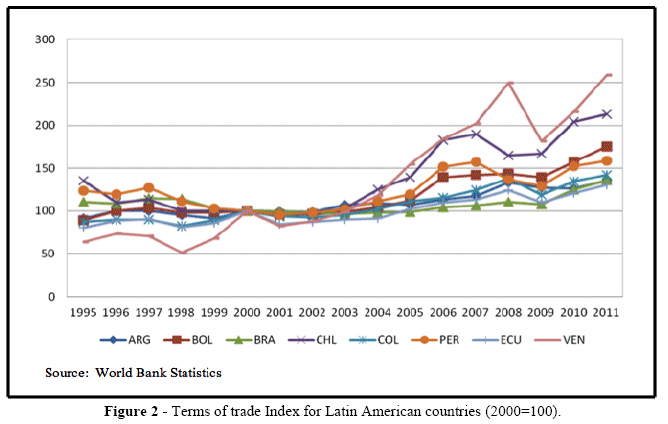
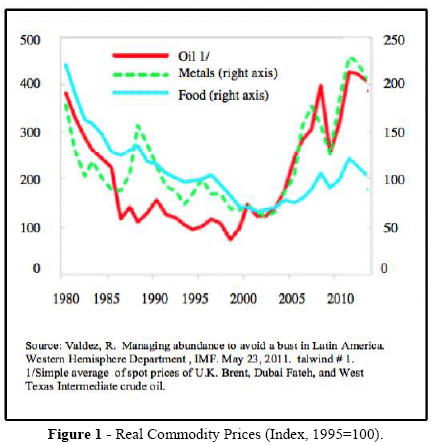
<body><![CDATA[<p align="justify"><font size="2" face="Verdana, Arial, Helvetica, sans-serif">The performance of   world commodity prices and terms of trade in Latin American Countries is   presented in section 2. The theory about the Dutch Disease is in section 3.   A   review of the main studies on international trade applying these microeconometric   techniques is presented in section 4. A description of the data is in section   5.  We estimate the effects of improvement in terms of trade using first a   difference-in-differences approach. This empirical methodology, the model and   the results are explained in section 6.The definition of an appropriate control   group becomes crucial, thus we present the methodology and the results of Kernel   propensity score matching and propensity score matching combined with DD which   will allow us to improve the selection of the control group in section 7. Then,   we use synthetic control method to build a synthetic control region,   which reproduces the main characteristics of each country before the improvement   in terms of trade. The methodology and the results are reported and discussed in section 8 while section 9 summarizes and concludes.</font></p>     <p align="justify">&nbsp;</p>     <p align="justify"><font size="3" face="Verdana, Arial, Helvetica, sans-serif"><b>2. WORLD COMMODITY PRICES AND TERMS OF TRADE IN LATIN AMERICAN COUNTRIES.</b></font></p>     <p align="justify"><font size="2" face="Verdana, Arial, Helvetica, sans-serif">Latin American countries rich in   resources have always been exposed to commodity price shocks.   In <a href="#f1">Figure 1</a> we   observe that while in period 1980-2000 these shocks were moderate, during the   years of 2000, world commodity prices have increased significantly.  The real   price of commodities has been growing in recent years.  Since 2004, there has   been an almost permanent rise, and although, a sharp declination in 2009, because of the global financial crisis, commodity prices are increasing again.</font></p>     <p align="justify"><a name="f1"></a></p>     <p align="center"><img src="/img/revistas/riyd/v2n14/a03_figure_01.gif" width="435" height="445"></p>     <p align="justify"><font size="2" face="Verdana, Arial, Helvetica, sans-serif">Different world   events have pressed up commodity world prices. The main one has to do with the   strong growth of several countries in Asia, especially China, which with an   annual growth mean of 10% during the 2000's, has increased the world demand for   commodities. Also, the world is facing an increasing scarcity of raw   materials.  This figure also shows a greater increase in prices of oil and   metals and a moderate increase in food prices.  This situation is reflected in   significant increases in terms of trade of some Latin American countries over the last years.</font></p>     <p align="justify"><font size="2" face="Verdana, Arial, Helvetica, sans-serif">We observe in <a href="#f2">Figure   2</a> the terms of trade index for eight Latin American countries: Venezuela,   Chile, Bolivia, Cuba, Brazil, Argentina, Peru, Colombia, and Ecuador. These   countries show increases in terms of trade. However, Venezuela exporting oil,   Chile copper, and Bolivia gas and minerals face increases of 150%, 110 %, and   70% in their terms of trade respectively. The other countries show lower average increases at the end of 2011.</font></p>     <p align="justify"><a name="f2"></a></p>     <p align="center"><img src="/img/revistas/riyd/v2n14/a03_figure_02.gif" width="668" height="424"></p>     ]]></body>
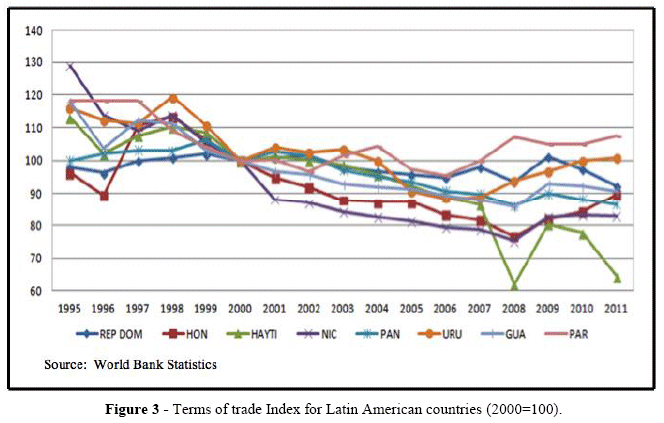
<body><![CDATA[<p align=justify><font size="2" face="Verdana, Arial, Helvetica, sans-serif">On the other   hand, in <a href="#f3">Figure 3</a> we observe other Latin American countries: Mexico, Dominican   Republic, El Salvador, Costa Rica, Panama, Honduras, Haiti, Nicaragua,   Guatemala, Paraguay, and Uruguay, which over the same period have not   experienced any improvement in their terms of trade or have faced a decrease in terms of trade.</font></p>     <p align="justify"><a name="f3"></a></p>     <p align="center"><img src="/img/revistas/riyd/v2n14/a03_figure_03.gif" width="664" height="423"></p>     <p align=justify>&nbsp;</p>     <p align="justify"><font size="3" face="Verdana, Arial, Helvetica, sans-serif"><b>2.&nbsp;&nbsp;&nbsp;&nbsp; THEORETICAL FRAMEWORK</b></font><font size="2" face="Verdana, Arial, Helvetica, sans-serif"><b>&nbsp;</b></font></p>     <p align="justify"><font size="2" face="Verdana, Arial, Helvetica, sans-serif">&quot;`The Dutch   disease&quot; studies the effects of natural resource discoveries that result   in a boom in the energetic export sector or shocks like an increase in the   price of a country's export, an increase in capital inflow, foreign aid, or   remittances that produce an appreciation of the real exchange rate, factor   reallocation and deindustrialization [25]. In this paper we focus on the effect   of the increase of international prices of natural resources on other tradable export industries.</font></p>     <p align="justify"><font size="2" face="Verdana, Arial, Helvetica, sans-serif"> During the   1960's, Netherlands faces the discovery of reserves of oil and gas. The flow of   export earnings in the economy leads to the   real appreciation of the domestic currency, which cause a decline in exports of   other goods. Corden [15] and Corden and Neary [16] present a specific factor   model to analyze the effects of the boom in the energetic sector: The resource   movement effect and the spending effect. The first one studies the movement of   productive factors among sectors. Since capital is sector specific, only labor,   the mobile factor goes to the booming sector, due to a higher marginal   productivity of capital employed in this industry. Labor moves from the   manufactured and the services sectors to the energy sector producing a decline   in output of both sectors. This is called the direct deindustrialization effect   and, as a result, there is a change in relative prices and a real appreciation of the currency.<a href="#_ftn2" name="_ftnref2" title="">[2]</a></font></p>     <p align="justify"><font size="2" face="Verdana, Arial, Helvetica, sans-serif">The increase in   the flow of export earnings produces the spending effect, which leads to an   increase in demand for traded and non-traded goods. In the traded market, this   excess of demand will produce an increase of manufacture imports. However,   since supply of services cannot increase, the adjustment in this market comes   through an increase in prices of services producing a new real appreciation. As   a consequence, output of services increase as labor goes from the manufactured   sector producing a new decline in the output of this sector: indirect deindustrialization effect.</font></p>     <p align="justify"><font size="2" face="Verdana, Arial, Helvetica, sans-serif">Buiter and   Purvis [10], Enders and Herberg [18], Edwards and Aoki [17] and Van Wijnbergen   [34] show that the benefits from a sudden growth of the export sector are   partially counteracted by a reduction of other industries in the economy. Bruno   and Sachs [9] use a model of dynamic perfect foresight equilibrium and find   that the net effect of the energy sector is to reduce long run production of other tradable goods.</font></p>     <p align="justify"><font size="2" face="Verdana, Arial, Helvetica, sans-serif">The persistent   overvaluation of the economy results in a loss of competitiveness reducing the   other tradable industries exports. According to Krugman [23], when a country   discovers tradable natural resources, such as oil, it normally experiences real   appreciation of its exchange rate and thus a crowding out of its other tradable   sectors. He presents a model to show that for a flow of export earnings of   sufficiently long duration, all of the industries moved abroad<a href="#_ftn3" name="_ftnref3" title="">[3]</a> will remain abroad even   when the flow of export earnings ends, producing a permanent loss of the manufacturing sectors (including exports).</font></p>     ]]></body>
<body><![CDATA[<p align="justify"><font size="2" face="Verdana, Arial, Helvetica, sans-serif">In recent   research, Magud and Sosa [25] review over sixty papers to document potential   adverse effects of Dutch Disease on long-term growth. They find evidence that   shocks that trigger foreign exchange inflows lead to an appreciation of the   real exchange rate generate factor reallocation, and reduce manufacturing   output and net exports. In over 90%of the cases, Dutch Disease shocks generate   factor reallocation and a decrease in the relative productivity of the tradable sector, and in about 75% of the cases exports are reduced.</font></p>     <p align="justify">&nbsp;</p>     <p align="justify"><font size="3" face="Verdana, Arial, Helvetica, sans-serif"><b>4. EMPIRICAL STUDIES APPLYING THESE MICROECONOMETRIC METHODOLOGIES IN INTERNATIONAL TRADE.</b></font><font size="2" face="Verdana, Arial, Helvetica, sans-serif"><b>&nbsp;</b></font></p>     <p align="justify"><font size="2" face="Verdana, Arial, Helvetica, sans-serif">Carl and Kruger [14]   use difference in differences to study the causal effect of minimum wage   increase on employment. They analyze the effect of a wage increase in New   Jersey but not in Pennsylvania and compare employment in the fast food industry   before and after the change in both states. They find no evidence that the rise in the minimum wage reduce employment.</font></p>     <p align="justify"><font size="2" face="Verdana, Arial, Helvetica, sans-serif">There have been a few studies in   international trade that use difference in differences methodology. Among the most   important: Slaughter [27] that analyzes whether trade liberalizations   contribute to percapita income convergence across countries. He focuses on four   multilateral trade liberalizations and compares the convergence patterns among   liberalizing countries and randomly chosen control countries before and after liberalization.</font></p>     <p align="justify"><font size="2" face="Verdana, Arial, Helvetica, sans-serif">Pavcnik [28] identifies the impact of   trade liberalization on plant productivity in the case of Chile using   difference in differences and finds that trade liberalization enhances plant productivity.</font></p>     <p align="justify"><font size="2" face="Verdana, Arial, Helvetica, sans-serif">Giavazzi and Tabellini [19] study   empirically the effects of economic and political liberalizations on economic   performance, on macroeconomic policy, and on structural policies. They find   important evidence of the feedback and interaction effects between the two   kinds of reforms and also those countries, which first liberalize and then   become democracies do much better than countries that pursue the opposite   sequence. Girma, Greenaway and Kneller [20]find a causal effect between exports   and productivity increase using, for the first time, difference in differences with propensity score matching.</font></p>     <p align="justify"><font size="2" face="Verdana, Arial, Helvetica, sans-serif">Abadie [3] uses   synthetic control methods to evaluate the effects of the 2011 Uruguayan   economic reform on foreign direct investment flows. Peluffo[29]analyzes the effect   of an increased competition due to the creation of the Southern Common Market   (MERCOSUR) on productivity, employment and wages for the Uruguayan   manufacturing sector. She finds that increased trade liberalization seems to improve total factor productivity, reduce employment, and increase wages.</font></p>     <p align="justify">&nbsp;</p>     <p align="justify"><font size="3" face="Verdana, Arial, Helvetica, sans-serif"><b>5.  DATA</b></font></p>     ]]></body>
<body><![CDATA[<p align="justify"><font size="2" face="Verdana, Arial, Helvetica, sans-serif">The sample   consists of yearly data for twenty Latin American countries for the period of   1995 to 2010. Given that improvement in terms of trade occurs in 2004 we have a   pre-intervention period of ten years and a post-intervention period of six   years. The data collected for this research includes nontraditional export   values, the outcome variable, calculated from The World Trade Organization as total exports minus exports of minerals and fuels per each country.</font></p>     <p align="justify"><font size="2" face="Verdana, Arial, Helvetica, sans-serif">The set of   predictors are given by per capita GDP at constant prices, investment rate as a   percentage of GDP, inflation, and openness to trade, which is constructed as   the sum of export and import rates as percentage of GDP.  These series are   obtained from World Bank database.  Depreciation rate<a href="#_ftn4" name="_ftnref4" title="">[4]</a> is constructed as a growth rate of exchange rate series taken from Penn Tables.</font></p>     <p align="justify"><font size="2" face="Verdana, Arial, Helvetica, sans-serif">Nontraditional exports and constant per capita GDP are measured in logarithm forms.</font></p>     <p align="justify">&nbsp;</p>     <p align="justify"><font size="3" face="Verdana, Arial, Helvetica, sans-serif"><b>6. DIFFERENCE IN DIFFERENCES: METHODOLOGY AND RESULTS  </b></font></p>     <p align="justify"><font size="2" face="Verdana, Arial, Helvetica, sans-serif"><b>6.1 A concept of Difference in Differences</b></font></p>     <p align="justify"><font size="2" face="Verdana, Arial, Helvetica, sans-serif">DD is an ex post impact evaluation   technique. The DD estimator measures the impact of an event or intervention by   the difference between participants and nonparticipants in the before-after   difference in outcomes. The important issue is to find a   &quot;counterfactual&quot; defined as the situation a participant would have   experienced had he not been exposed to the intervention. The counterfactual is the outcome in the absence of the event[24].</font></p>     <p align="justify"><font size="2" face="Verdana, Arial, Helvetica, sans-serif">We observe outcomes of this event or   intervention. The impact of an event can be measured by comparing actual and   counterfactual outcomes but the counterfactual is not observed. According to   Meyer (1995) when there is a group, for the time period before and after the   event, that has not received the treatment but experiences some or all of the   other influences that affect the treatment group; we can use this group as the   untreated control group. The treatment effect is measured by taking the   difference in outcomes between treated and control groups before and after the   event or intervention. In doing so, it is important to choose a control group   very similar to the treated group except in the event. Therefore, the ones who   experience the event would have similar outcomes to those in the comparison group in the absence of the event.</font></p>     <p align="justify"><font size="2" face="Verdana, Arial, Helvetica, sans-serif">In this research, we estimate the causal   effect of the improvement of terms of trade on nontraditional exports.  The   improvement in terms of trade generates treatment and control groups, where Bolivia   and Venezuela are the  &quot;treated countries&quot; which have been exposed to   an improvement in terms of trade.  The other eleven countries that have not faced   such an improvement become the group of control countries. Then, we estimate   the causal effect of &quot;the treatment&quot; on nontraditional exports. We   compare the nontraditional exports performance in the treated countries before   and after the treatment with the nontraditional exports performance of the   control group over the same period of time. The DD estimator will measure the   change in nontraditional exports before and after the ITT experienced by   treated countries and compares it to the change in nontraditional exports before and after the ITT of the control group.</font></p>     <p align="justify"><font size="2" face="Verdana, Arial, Helvetica, sans-serif">In the model we have two periods. We   denote the dummy variable After &#1108;{0, 1}, where After = 0 is the period before the intervention and After = 1 is the after period.</font></p>     ]]></body>
<body><![CDATA[<p align="justify"><font size="2" face="Verdana, Arial, Helvetica, sans-serif">Let DID<sub>it</sub> &#1108;{0, 1} a   binary variable of weather country i experiences an improvement in terms of   trade at period t. If DID<sub>it</sub> = 1 denotes treatment and DID<sub>it</sub> = 0 denotes untreatment.</font></p>     <p align="justify"><font size="2" face="Verdana, Arial, Helvetica, sans-serif">The outcome is the change in nontraditional   exports defined as: Y<sub>it</sub>. We denote <img src="/img/revistas/riyd/v2n14/a03/image004.png" width=14 height=18 align="absmiddle"> and <img src="/img/revistas/riyd/v2n14/a03/image005.png" width=15 height=18 align="absmiddle">as the respective outcomes of the treatment and control groups in time t.</font></p>     <p align="justify"><font size="2" face="Verdana, Arial, Helvetica, sans-serif">Cameron and Trivedi [13] establish that difference in differences will estimate the average impact as follows:</font></p>     <p align=center><img src="/img/revistas/riyd/v2n14/a03_ecuacion_01.gif" width="742" height="38"></p>     <p align="justify"><font size="2" face="Verdana, Arial, Helvetica, sans-serif">The causal effect of the improvement in   terms of trade for country is defined as the change in nontraditional exports   over period one if ITT occurred, less the change in nontraditional exports over the same period of time if ITT had not occurred.</font></p>     <p align="justify"><font size="2" face="Verdana, Arial, Helvetica, sans-serif">The key assumption in DD is that   temporal effects in treated and control countries are the same in the absence   of ITT. Which means that both groups share common trends and the temporal   evolution of nontraditional exports in both groups is the same. Once ITT occurs, the treated countries departure from the common trend.</font></p>     <p align="justify"><font size="2" face="Verdana, Arial, Helvetica, sans-serif">One important advantage of DD is that   allows for the effects of observed and unobserved characteristics on the outcome   as long as they are constant in time. However, this methodology lacks a systematic approach to find similar comparison groups to treated countries.</font></p>     <p align="justify"><font size="2" face="Verdana, Arial, Helvetica, sans-serif"><b>6.2 The model</b></font></p>     <p align="justify"><font size="2" face="Verdana, Arial, Helvetica, sans-serif">In a regression framework, the difference in differences model takes the form:</font></p>     <p align=center><img src="/img/revistas/riyd/v2n14/a03_ecuacion_02.gif" width="748" height="32"></p>     ]]></body>
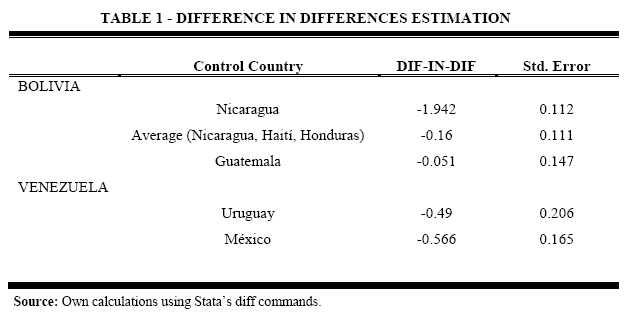
<body><![CDATA[<p align="justify"><font size="2" face="Verdana, Arial, Helvetica, sans-serif">where the OLS estimate of <img src="/img/revistas/riyd/v2n14/a03/image014.png" width=13 height=18 align="absmiddle"> is identical to the DD estimate.<a href="#_ftn5" name="_ftnref5" title="">[5]</a></font></p>     <p align="justify"><font size="2" face="Verdana, Arial, Helvetica, sans-serif">The dependent variable is the natural   log of nontraditional exports, where the subscript i refers to Bolivia and Venezuela and t refers to the year.</font></p>     <p align="justify"><font size="2" face="Verdana, Arial, Helvetica, sans-serif">&quot;After&quot; is the binary time   variable that takes the value of one for all the years since the improvement in   terms of trade in 2004.  &quot;DID&quot; is a binary estational variable that   takes the value of one for all the countries that experienced an increase in   terms of trade. &quot;Inter&quot; represents the interaction term of these two   dummies variables showing the average treatment effect of the improvement in terms of trade on nontraditional exports and <img src="/img/revistas/riyd/v2n14/a03/image015.png" width=6 height=18 align="absbottom"> is an unobserved error term.</font></p>     <p align="justify"><font size="2" face="Verdana, Arial, Helvetica, sans-serif">We include in the model the set of control   variables X<sub>it:  </sub>per capita GDP, depreciation, inflation, investment and openness as a share of GDP.</font></p>     <p align=center><img src="/img/revistas/riyd/v2n14/a03_ecuacion_03.gif" width="743" height="32"></p>     <p align="justify"><font size="2" face="Verdana, Arial, Helvetica, sans-serif"><b>6.3 Results from Difference in Differences estimation</b></font><font size="2" face="Verdana, Arial, Helvetica, sans-serif"><b>&nbsp;</b></font></p>     <p align="justify"><font size="2" face="Verdana, Arial, Helvetica, sans-serif">To construct the counterfactual we need   to choose a control group very similar to Bolivia and Venezuela except in the   treatment such that the ones who experienced improvement in terms of trade   would have similar outcomes to those in the comparison group in the absence of   treatment. <a href="#t1">Table 1</a> shows Difference in Differences estimators for Bolivia and   Venezuela.  We experiment with different assumptions for the construction of the control group to test the robustness of our results.</font></p>     <p align=justify><a name="t1"></a></p>     <p align=center><img src="/img/revistas/riyd/v2n14/a03_table_01.gif" width="630" height="312"></p>     <p align="justify"><font size="2" face="Verdana, Arial, Helvetica, sans-serif">In the first row we use Nicaragua as the   control country for Bolivia, which has the nearest constant per capita GDP in 1995. </font></p>     ]]></body>
<body><![CDATA[<p align="justify"><font size="2" face="Verdana, Arial, Helvetica, sans-serif">In the second row we use an average of   three countries as control group of Bolivia: Nicaragua, Haiti and Honduras,   which have the closest constant per capita GDP.  In the third row we present Guatemala as control group.<a href="#_ftn6" name="_ftnref6" title="">[6]</a></font></p>     <p align="justify"><font size="2" face="Verdana, Arial, Helvetica, sans-serif">In three cases the estimates identify a   negative effect using clustered standard errors, showing that an improvement in terms of trade decreases non-traditional exports by as much as 2%. </font></p>     <p align="justify"><font size="2" face="Verdana, Arial, Helvetica, sans-serif">To construct the counterfactual for   Venezuela we use the criteria of countries with the nearest constant GDP per capita: Uruguay and Mexico. DD estimators are again negative.</font></p>     <p align="justify"><font size="2" face="Verdana, Arial, Helvetica, sans-serif">To check the validity of our results we   need to make sure treated and control countries share a common trend. That is,   we are interested to compare countries with the same values of covariates.  We   apply t test at period zero and shows the means of variables for each pair of   treated and control groups.  Means are presented for each country along with   the t statistic for the null hypothesis that the means are equal in the two   countries in the pretreatment period, which is before 2004. The results show   that average logexp for Nicaragua and Bolivia are similar.  However, the other   variables GDP per capita, inflation, capital formation, openness and   depreciation for each pair of countries have a p-value less than .05 so we   reject the null hypothesis in favor of the alternative hypothesis.  Thus, each   pair of countries is not similar and as a consequence these countries do not share a common trend. </font></p>     <p align="justify"><font size="2" face="Verdana, Arial, Helvetica, sans-serif">Thus, it is not   feasible to estimate an unbiased DD estimator.   We conclude that there is not   a systematic way to find similarities between treated and control group. Most   of the time, the selection of control groups becomes very discretional and, as   a consequence, unreliable to construct a good counterfactual.  This is the most important weakness of Difference in Differences.</font></p>     <p align="justify">&nbsp;</p>     <p align="justify"><font size="3" face="Verdana, Arial, Helvetica, sans-serif"><b>7.  PROPENSITY SCORE MATCHING: METHODOLOGY AND RESULTS </b></font></p>     <p align="justify"><font size="2" face="Verdana, Arial, Helvetica, sans-serif"><b>7.1 Propensity Score Matching, Average treatment on the treated (ATT) and the PSM-DID estimators</b></font></p>     <p align="justify"><font size="2" face="Verdana, Arial, Helvetica, sans-serif">Rubin [30] and Rosenbaum and Rubin [31]   introduce experimental work on matching techniques. Propensity Score Matching   is an alternative approach to estimate causal treatment effects and to constructing   a counterfactual. According to Khandker<i> et al</i>.[24] the purpose of PSM is   to build a counterfactual similar enough to treated countries on the basis of   sufficient observable characteristics such that any two countries with the same   values of these characteristics will present no systematic differences in their   reactions to the treatment. Then, if each country subject to treatment can be   matched with a country with the same matching variables that has not undergone   the treatment, the impact of the event on a country of that type can be determined. </font></p>     <p align="justify"><font size="2" face="Verdana, Arial, Helvetica, sans-serif">This matching is done using propensity   score which is the probability of being part of the treatment group. We can   match countries with similar propensity score from treatment and control groups. </font></p>     ]]></body>
<body><![CDATA[<p align="justify"><font size="2" face="Verdana, Arial, Helvetica, sans-serif">Once we have constructed the   counterfactual, we are able to estimate the &quot;Average treatment effect on   the treated&quot; (ATT) which compares the average outcomes of treated and   untreated groups and explicitly measures the effects on those who experience   the event or intervention.  Cameron and Trivedi [13] estimate ATT with the following equation:</font></p>     <p align=center><img src="/img/revistas/riyd/v2n14/a03_ecuacion_04.gif" width="748" height="31"></p>     <p align="justify"><font size="2" face="Verdana, Arial, Helvetica, sans-serif">Given that the counterfactual mean for   those being treated is not observed we use the mean outcome of untreated   individuals: E[Y(0)|DID=0].  However, this introduces a &quot;Self-selection   bias&quot;<a href="#_ftn7" name="_ftnref7" title="">[7]</a>,   since participants and non-participants usually differs even in the absence of treatment.</font></p>     <p align="justify"><font size="2" face="Verdana, Arial, Helvetica, sans-serif">To   solve this selection problem and make meaningful comparisons between the   outcomes of this two groups, ATT requires two assumptions. The first one is the   conditional independence assumption that points out that given a set of   observable characteristics of X, the outcomes are independent of treatment. That is:</font></p>     <p align=center><img src="/img/revistas/riyd/v2n14/a03_ecuacion_05.gif" width="740" height="31"></p>     <p align="justify"><font size="2" face="Verdana, Arial, Helvetica, sans-serif">This means that   once we control the effects of regressors X, some of which may be related to   DID, treatment and outcomes are independent. Conditional independence ensures   that if the control participants were treated, their outcome, once conditioned   on observable characteristics, would not differ from the expected values of outcomes of treated participants.</font></p>     <p align="justify"><font size="2" face="Verdana, Arial, Helvetica, sans-serif">The   second assumption is the overlap or common support condition that establishes that </font></p>     <p align=center><img src="/img/revistas/riyd/v2n14/a03_ecuacion_06.gif" width="745" height="28"></p>     <p align="justify"><font size="2" face="Verdana, Arial, Helvetica, sans-serif">This condition ensures that treatment   observations have comparison observations “nearby” in the propensity score   distribution.    The common support makes sure that any combination of the characteristics observed in the treated group can be observed among the control group. </font></p>     <p align="justify"><font size="2" face="Verdana, Arial, Helvetica, sans-serif">Once,   Conditional Independence and Common support assumptions hold, Caliendoand   Kopeinig [11],define the propensity score matching estimator for ATT as:</font></p>     ]]></body>


<body><![CDATA[<p align=center><img src="/img/revistas/riyd/v2n14/a03_ecuacion_07.gif" width="742" height="29"></p>     <p align="justify"><font size="2" face="Verdana, Arial, Helvetica, sans-serif">The mean difference in outcomes between   treated and control groups over the common support appropriately weighted by   the propensity score distribution of participants. Kernel propensity score   matching will use weighted averages of all control countries with respect to the region of common support.</font></p>     <p align="justify"><font size="2" face="Verdana, Arial, Helvetica, sans-serif">More explicitly, according to Heckman,   Ichimura and Todd [22], the Treatment effect on the treated within the common support will be measured as: </font></p>     <p align=center><img src="/img/revistas/riyd/v2n14/a03_ecuacion_08.gif" width="745" height="41"></p>     <p align="justify"><font size="2" face="Verdana, Arial, Helvetica, sans-serif">where N is the number of participants   and w(i,j) is the weight used to aggregate outcomes for matched nonparticipants j.</font></p>     <p align="justify"><font size="2" face="Verdana, Arial, Helvetica, sans-serif">Once PSM has constructed the appropriate   control group, we combine propensity score matching with difference in   differences as suggested by Blundell and Costas Dias [8], to estimate   Difference in Differences only for those countries that are matched using the following equation:</font></p>     <p align=center><img src="/img/revistas/riyd/v2n14/a03_ecuacion_09.gif" width="740" height="40"></p>     <p align="justify"><font size="2" face="Verdana, Arial, Helvetica, sans-serif">Where w(i; j) is   the weight calculated by kernel PSM given to the j<sup>th</sup> countries in   control group and matched to the i<sup>th</sup> countries in the treatment group.   The estimates are more robust because we can control for observable and   unobservable variables as long as they are time invariant and we can keep   comparison between the treated and control groups making common trends more reliable.</font><font size="2" face="Verdana, Arial, Helvetica, sans-serif"><b>&nbsp;</b></font></p>     <p align="justify"><font size="2" face="Verdana, Arial, Helvetica, sans-serif"><b>7.2 Results from ATT-PSM and Kernel PSM-DD estimations</b></font></p>     <p align="justify"><font size="2" face="Verdana, Arial, Helvetica, sans-serif">To reduce the bias and improve the   construction of the counterfactual we use matching techniques. Since the change   in nontraditional exports experienced by countries with ITT had they not faced   an improvement in terms of trade is unobservable, we construct the   counterfactual. We use countries that have similar observable characteristics   in period t but did not experienced ITT. Since our objective is to build a   counterfactual similar enough to Bolivia and Venezuela prior to ITT, we choose    a set of predictors on basis of two principles: First, a set of macroeconomic   variables that describe the level, size and structure of economic development   among countries and second, a set of key variables that play an important role   on competitiveness. Among the first, we use constant GDP per capita, which will   control for population, investment and openness to trade both as a percentage of GDP. Among the second, we use depreciation and inflation.<a href="#_ftn8" name="_ftnref8" title="">[8]</a></font></p>     ]]></body>

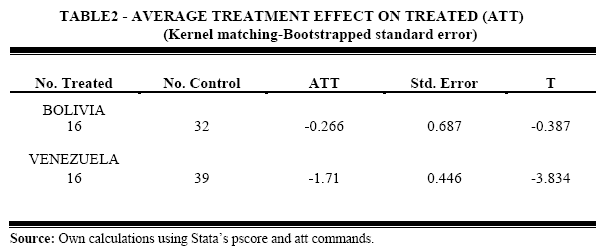
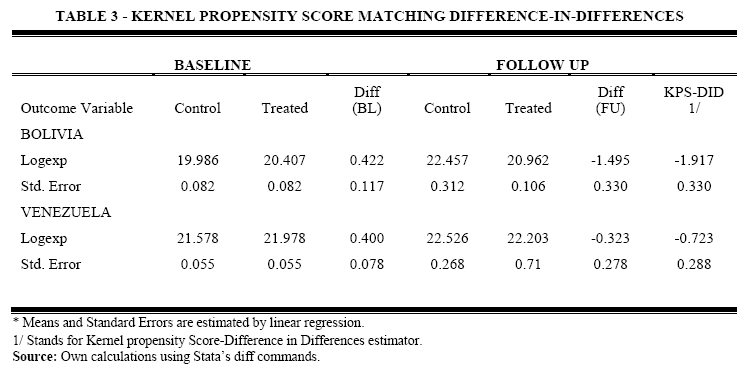
<body><![CDATA[<p align="justify"><font size="2" face="Verdana, Arial, Helvetica, sans-serif">Propensity score matching will construct   the right control group to pair Bolivia and Venezuela with similar countries on   basis of these observable characteristics. Propensity score matching is the   probability of receiving a given treatment conditional on some characteristics of countries before ITT.</font></p>     <p align="justify"><font size="2" face="Verdana, Arial, Helvetica, sans-serif">In the case of Bolivia, to identify this   probability we use a probit regression and estimate the propensity score  in   the  region of common support  which is  [.01169411, .96840028]. In this area   of common support we can match countries with similar propensity scores from   treated and control groups. The final number of blocks is six, which ensures   the mean propensity score is not different for treated and control groups on   each block. We also test for balancing property of the propensity score in each   variable in each block applying two sample <i>t tests</i> with equal variances   to ensure that each variable is balanced in each block. The balancing property   is satisfied.  Matching has succeeded in identifying an appropriate control group.</font></p>     <p align="justify"><font size="2" face="Verdana, Arial, Helvetica, sans-serif">In the case of Venezuela, we estimate   the propensity score with probit regression. The region of common support is   [.07290333, .86376964]. The final number of blocks is five. This number of   blocks ensures that the mean propensity score is not different for treated and   control groups in each block. According to Caliendo and Kopeinig[11] the common   support condition is more important for kernel matching.  Since we have   determined the region of common support for both countries we are ready to estimate ATT.</font></p>     <p align="justify"><font size="2" face="Verdana, Arial, Helvetica, sans-serif">We estimate now   the Average Treatment effect on the treated (ATT) with Kernel matching method and bootstrap standard errors, <a href="#t2">Table 2</a>.</font></p>     <p align="justify"><a name="t2"></a></p>     <p align="center"><img src="/img/revistas/riyd/v2n14/a03_table_02.gif" width="604" height="249"></p>     <p align="justify"><font size="2" face="Verdana, Arial, Helvetica, sans-serif">ATT estimates   show a negative impact of ITT on nontraditional exports for Bolivia and   Venezuela.  However, the &quot;t statistic&quot; for Bolivia is not significant;   we cannot reject the null hypothesis that the impact is equal to zero.  The   &quot;t statistic&quot; for Venezuela is statistically significant showing a negative impact of 1.71%.</font></p>     <p align="justify"><font size="2" face="Verdana, Arial, Helvetica, sans-serif">ATT estimates   are still bias because do not control for unobservable omitted time invariant   effects. We now combine Kernel PSM and DD estimator. Since Kernel PSM has   constructed a counterfactual taking into account only those control countries   that are in the area of common support with Bolivia and Venezuela, we use this   counterfactual and we apply Difference in Differences. The KPS-DD estimator is more reliable. </font><font size="2" face="Verdana, Arial, Helvetica, sans-serif"><b>&nbsp;</b></font></p>     <p align="justify"><font size="2" face="Verdana, Arial, Helvetica, sans-serif">The KPS-DD estimator for Bolivia is   -1.917 with a standard error of 0.33 and the KPS-DD for Venezuela is -0.723   with a standard error of 0.288, showing a negative effect of improvement in   terms of trade on nontraditional exports, <a href="#t3">Table 3</a>. However, this methodology fails to show how the counterfactual is formed.</font></p>     <p align="justify"><a name="t3"></a></p>     ]]></body>
<body><![CDATA[<p align="center"><img src="/img/revistas/riyd/v2n14/a03_table_03.gif" width="748" height="368"></p>     <p align="center">&nbsp;</p>     <p align="justify"><font size="3" face="Verdana, Arial, Helvetica, sans-serif"><b>8. THE SYNTHETIC CONTROL METHOD: METHODOLOGY AND RESULTS</b></font></p>     <p align="justify"><font size="2" face="Verdana, Arial, Helvetica, sans-serif"><b>8.1 The synthetic control method</b></font></p>     <p align="justify"><font size="2" face="Verdana, Arial, Helvetica, sans-serif">Abadie and Gardeazabal [1] propose a   synthetic control method to study the effects of the terrorist conflict in the   Basque Country using other Spain regions as comparison group. They provide a   systematic way to choose comparison groups and to reduce discretion in the   selection of the control group.  They consider that a combination of unaffected   units provide a more appropriate comparison than any single unaffected unit   alone. They construct a &quot;synthetic control&quot; defined as a weighted   average of unaffected units chosen to resemble the pre-characteristics of the affected unit before the treatment or intervention.<a href="#_ftn9" name="_ftnref9" title="">[9]</a></font></p>     <p align="justify"><font size="2" face="Verdana, Arial, Helvetica, sans-serif">The synthetic control can be represented by a set of weights attached to the unaffected units:</font></p>     <p align=center><img src="/img/revistas/riyd/v2n14/a03_ecuacion_10.gif" width="744" height="34"></p>     <p align=center><img src="/img/revistas/riyd/v2n14/a03_ecuacion_11.gif" width="744" height="30"></p>     <p align="justify"><font size="2" face="Verdana, Arial, Helvetica, sans-serif">Where <img src="/img/revistas/riyd/v2n14/a03/image030.png" width=16 height=18 align="absmiddle"> for t &gt; T<sub>0</sub> is the   counterfactual outcome that shows how the outcome would have evolved in the affected country in the absence of intervention.</font></p>     <p align="justify"><font size="2" face="Verdana, Arial, Helvetica, sans-serif">Given a set of   weights w<sub>i</sub>, the treatment effect of country i in period t is given by the synthetic control estimator:</font></p>     ]]></body>
<body><![CDATA[<p align=center><img src="/img/revistas/riyd/v2n14/a03_ecuacion_12.gif" width="743" height="27"></p>     <p align="justify"><font size="2" face="Verdana, Arial, Helvetica, sans-serif">where <img src="/img/revistas/riyd/v2n14/a03/image032.png" width=14 height=19 align="absmiddle"> is the outcome of country i in   period t in the presence of treatment. Since this is observed, SCM reduces to a   method that estimates <img src="/img/revistas/riyd/v2n14/a03/image033.png" width=15 height=19 align="absbottom">, which is given by a common factor model:</font></p>     <p align=center><img src="/img/revistas/riyd/v2n14/a03_ecuacion_13.gif" width="742" height="33"></p>     <p align="justify"><font size="2" face="Verdana, Arial, Helvetica, sans-serif">Abadie, Diamond, and Hainmueller [2] propose to choose a set of weights:</font></p>     <p align=center><img src="/img/revistas/riyd/v2n14/a03_ecuacion_14.gif" width="740" height="32"></p>     <p align="justify"><font size="2" face="Verdana, Arial, Helvetica, sans-serif">that minimizes:</font></p>     <p align=center><img src="/img/revistas/riyd/v2n14/a03_ecuacion_15.gif" width="742" height="32"></p>     <p align="justify"><font size="2" face="Verdana, Arial, Helvetica, sans-serif">where the weights <i>v</i><sub>1</sub>,....,<i>v</i><sub>k</sub>   show the relative importance of the synthetic control reproducing the values of the predictors <i>X</i><sub>11</sub>,...,<i>X</i><sub>k1.</sub></font></p>     <p align="justify"><font size="2" face="Verdana, Arial, Helvetica, sans-serif">According to   Abadie <i>et al</i>. [2] the synthetic control method has attractive features:   makes explicit, first, the relative contribution of each control unit to the   counterfactual; second, the similarities between the treated group and the synthetic   control in terms of preintervention outcomes.  Third, it extends DD framework   allowing that the effects of unobserved variables on the outcome vary with time.</font></p>     <p align="justify"><font size="2" face="Verdana, Arial, Helvetica, sans-serif"><b>8.2 Results from Synthetic Control Method estimation</b></font></p>     ]]></body>
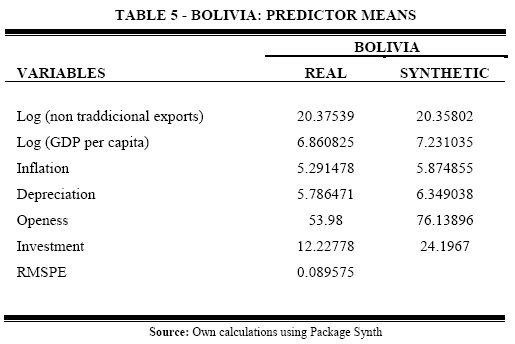
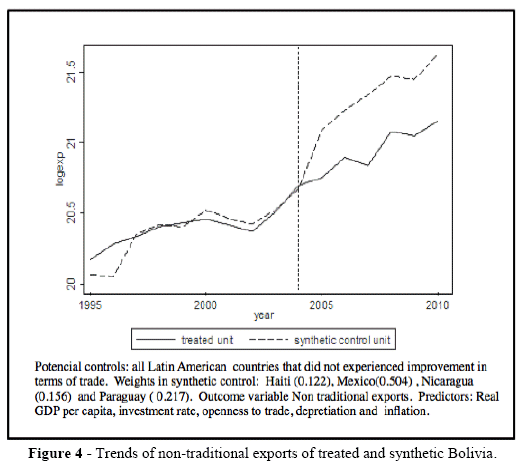
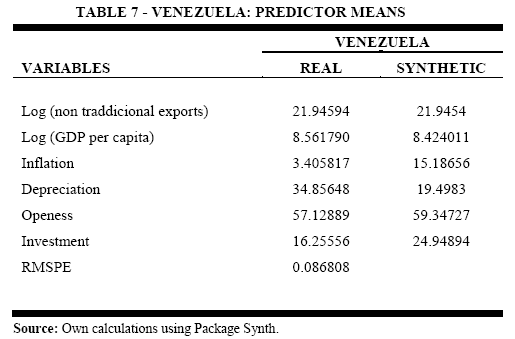
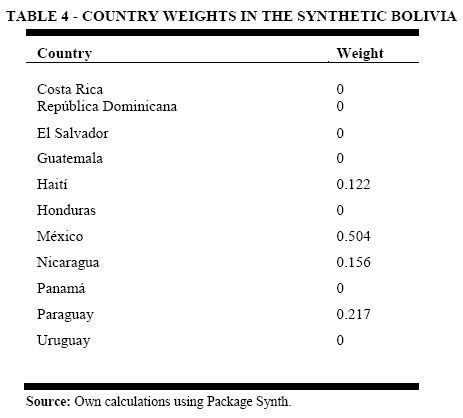
<body><![CDATA[<p align="justify"><font size="2" face="Verdana, Arial, Helvetica, sans-serif">First, we construct a synthetic Bolivia   as a combination of other Latin American Countries that reproduce the values of   economic predictors for Bolivia before improvement in terms of trade, in order   to replicate nontraditional exports trends that Bolivia would have had in the   absence of ITT.  <a href="#t4">Table 4</a> shows that synthetic Bolivia is a weighted average of   Mexico, Paraguay, Nicaragua, and Haiti.  All other countries of the control group have zero weights.</font></p>     <p align="justify"><a name="t4"></a></p>     <p align="center"><img src="/img/revistas/riyd/v2n14/a03_table_04.gif" width="463" height="418"></p>     <p align="justify"><font size="2" face="Verdana, Arial, Helvetica, sans-serif"><a href="#t5">Table 5</a> shows that Synthetic Bolivia   approximates the characteristics of Bolivia prior 2004. Synthetic Bolivia is   very similar to the actual Bolivia in terms of nontraditional exports, GDP per   capita, inflation and depreciation.  However, Synthetic Bolivia cannot   replicate accurately openness and investment share.  According to Abadie et al.[2],   the root mean square predictor error (RMSPE) measures the magnitude of the gap   in the outcome variable of each country between each country and its synthetic   counterpart. The lower the RMSPE the better the fit between real and synthetic   Bolivia. In this case RMSPE = 0.089 shows a good fit between real and synthetic Bolivia prior to the improvement in terms of trade.</font></p>     <p align=justify><a name="t5"></a></p>     <p align=center><img src="/img/revistas/riyd/v2n14/a03_table_05.gif" width="515" height="344"></p>     <p align="justify"><font size="2" face="Verdana, Arial, Helvetica, sans-serif">The effect of   ITT will be measured by comparing the actual and counterfactual trends in   nontraditional exports of Bolivia. <a href="#f4">Figure 4</a> shows the nontraditional exports   trajectory of real and synthetic Bolivia. Synthetic Bolivia reproduces the   pre-2004 nontraditional exports trend for Bolivia before the improvement in   terms of trade. This close fit is reflected in the RMSPE. The effect of   improvement in terms of trade on nontraditional exports is immediate. Nontraditional   exports of Synthetic Bolivia are higher than the actual Bolivia showing an important negative effect ITT on exports until the end of 2010.</font></p>     <p align="justify"><a name="f4"></a></p>     <p align="center"><img src="/img/revistas/riyd/v2n14/a03_figure_04.gif" width="528" height="468"></p>     <p align="justify"><font size="2" face="Verdana, Arial, Helvetica, sans-serif"><a href="#t6">Table 6</a> shows synthetic Venezuela as a   weighted average of Uruguay, Honduras, Panama, and Nicaragua. <a href="#t7">Table 7</a> shows   that Synthetic Venezuela approximates well some characteristics Venezuela prior   2004 like nontraditional exports, constant GDP <i>per capita</i>, investment   and openness.  However Synthetic Venezuela cannot replicate the values for   inflation and depreciation.  Mainly, due to Venezuela’s inflation process since   2006, this has affected the exchange rate growth.  The RMSPE= 0.086 shows a small gap between real and synthetic Venezuela.</font></p>     ]]></body>
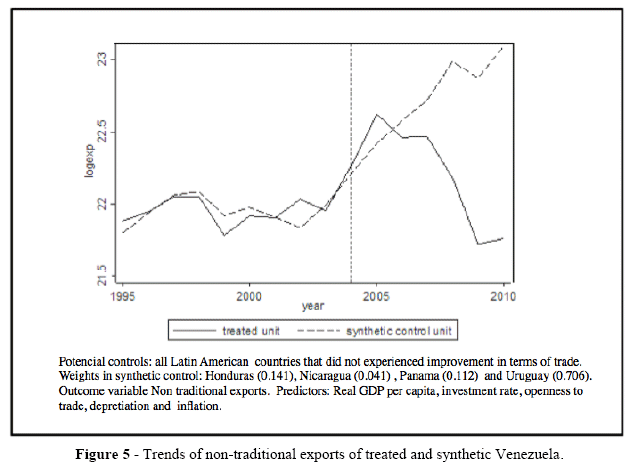
<body><![CDATA[<p align="justify"><a name="t6"></a></p>     <p align="center"><img src="/img/revistas/riyd/v2n14/a03_table_06.gif" width="497" height="385"></p>     <p align="center">&nbsp;</p>     <p align="center"><a name="t7"></a></p>     <p align="center"><img src="/img/revistas/riyd/v2n14/a03_table_07.gif" width="515" height="339"></p>     <p align="justify"><font size="2" face="Verdana, Arial, Helvetica, sans-serif">The effect of ITT will be measured by   comparing the actual and counterfactual trends in nontraditional exports of   Venezuela. <a href="#f5">Figure 5</a> shows that Synthetic Venezuela reproduces the pre-2004   nontraditional exports trend for Venezuela before the improvement in terms of   trade. The effect of ITT on nontraditional exports is immediate. Nontraditional   exports of Synthetic Venezuela are higher than real Venezuela revealing an important negative effect ITT on exports until the end of 2010.</font></p>     <p align="justify"><a name="f5"></a></p>     <p align="center"><img src="/img/revistas/riyd/v2n14/a03_figure_05.gif" width="636" height="465"></p>     <p align="justify"><font size="3" face="Verdana, Arial, Helvetica, sans-serif"><b>9. CONCLUSIONS</b></font></p>     <p align="justify"><font size="2" face="Verdana, Arial, Helvetica, sans-serif">In this research we   analyze empirically the causal effect of improvement in terms of trade on nontraditional   exports. We find that  nontraditional exports present a reduction after Bolivia and Venezuela experienced an improvement in their terms of trade. This   conclusion is robust to the use of  fourmicroeconometric methodologies. </font></p>     ]]></body>
<body><![CDATA[<p align="justify"><font size="2" face="Verdana, Arial, Helvetica, sans-serif">We also contrast these methodologies and   we find that each one contributes to a more systematic construction of   counterfactual. Difference in Differences estimates the causal effect in a   right way when the counterfactual is similar enough to the treated unit.    However, this is not always the case because the definition of counterfactual   is discretional.   Kernel propensity Score Matching succeeds in identifying the   right control group in the region of common support. When we apply   DD combined   with propensity score matching we are able to find weighted averages of all   control countries as match with respect to the region of common support.  However we cannot find these weights.</font></p>     <p align="justify"><font size="2" face="Verdana, Arial, Helvetica, sans-serif">Synthetic control method provides a more   systematic mechanism to construct comparison countries, and is able to bring   the list of countries that form the control group. Thus, it can be used as a complement to the other microeconometric techniques.</font></p>     <p align="justify"><font size="2" face="Verdana, Arial, Helvetica, sans-serif">Difference in Differences alone or   combined with Kernel propensity score matching can  control for unobservable   effects as long as they are constant.  Synthetic Control Method extends DD framework   allowing that the effects of unobserved variables on the outcome vary with   time. Thus, SCM improves estimations controlling for unobserved time invariant and time variant.</font></p>     <p align="justify"><font size="2" face="Verdana, Arial, Helvetica, sans-serif">When it is not feasible to get unbiased   estimators with DD, ATT, and KPSM-DD because we cannot comply with strong assumptions   of common trends and conditional independence, Synthetic control method still   can bring a good estimation.  Moreover, estimations in SCM are more significant than in the other three methodologies. </font></p>     <p align="justify"><font size="2" face="Verdana, Arial, Helvetica, sans-serif">The most important empirical finding of   this paper is that nontraditional exports of Bolivia and Venezuela would have   increased if these countries had not experienced improvement in their terms of   trade. The size and significance of the result are statistically significant and   confirms what the theory says about the effect of improvement in terms of trade on nontraditional exports.</font></p>     <p align="justify"><font size="2" face="Verdana, Arial, Helvetica, sans-serif"><b>&nbsp;</b></font></p>     <p align="justify"><font size="3" face="Verdana, Arial, Helvetica, sans-serif"><b>10. REFERENCES</b></font><font size="2" face="Verdana, Arial, Helvetica, sans-serif"><b>&nbsp;</b></font></p>     <p align="justify"><font size="2" face="Verdana, Arial, Helvetica, sans-serif">[1] A. Abadie and J.Gardeazabal. “The   Economic Costs of Confict: A Case Study of the Basque Country.” The <i>American Economic Review</i>,vol. 93, no. 1,pp113-132, 2003.</font></p>     <p align="justify"><font size="2" face="Verdana, Arial, Helvetica, sans-serif">[2] A. Abadie et al.“Synthetic   Control Methods for Comparative Case Studies: Estimating the Effect of   California's Tabacco Control Program.”<i>Journal of the American Statistical Association</i>,vol. 105, no. 490, pp 493-505, 2010.</font></p>     <!-- ref --><p align="justify"><font size="2" face="Verdana, Arial, Helvetica, sans-serif">[3] A. Abadie. Using Synthetic   Controls to Evaluate an International Strategic Positioning Program in Uruguay: Feasibility, Data Requirements, and Methodological Aspects. Draft. 2011.</font>&nbsp;&nbsp;&nbsp;&nbsp;&nbsp;&nbsp;&nbsp;&nbsp;[&#160;<a href="javascript:void(0);" onclick="javascript: window.open('/scielo.php?script=sci_nlinks&ref=957187&pid=S2518-4431201400020000300003&lng=','','width=640,height=500,resizable=yes,scrollbars=1,menubar=yes,');">Links</a>&#160;]<!-- end-ref --><p align="justify"><font size="2" face="Verdana, Arial, Helvetica, sans-serif">[4] O. Blanchard. <i>Macroeconomía</i>. Primera Edición. España:Prentice Hall,1997.</font></p>     <p align="justify"><font size="2" face="Verdana, Arial, Helvetica, sans-serif">[5] BID. Curso de Evaluacion de   Impacto de Proyectos. Ministerio de Economîa de la Provincia de Buenos Aires, Argentina. 21 y 22 de abril de 2010.</font></p>     <p align="justify"><font size="2" face="Verdana, Arial, Helvetica, sans-serif">[6] A. Billmeier and T.   Nannicini. Trade Openness and Growth: Pursuing Empirical Glasnost. Middle East and Central Asia Department. IMF Working Paper, vol. 7­­­, no. 156, 2007.</font></p>     <p align="justify"><font size="2" face="Verdana, Arial, Helvetica, sans-serif">[7] R. Blundell and M. Costa   Dias.“Evaluation Methods for Non-Experimental Data.”<i> Fiscal Studies</i>, vol. 21, no. 4,pp 427-468, 2000.</font></p>     <p align="justify"><font size="2" face="Verdana, Arial, Helvetica, sans-serif">[8] R. Blundell and M. Costa   Dias. Alternative Approaches to Evaluation in Empirical Microeconomics, University College London and Institute for Fiscal Studies, 2008.</font></p>     <p align="justify"><font size="2" face="Verdana, Arial, Helvetica, sans-serif">[9] M. Bruno and J. Sachs.“Energy   and Resource Allocation: A dynamic model of the Dutch Disease.”<i> Review of Economic Studies XLIX</i>, pp.845-859, 1982.</font></p>     <p align="justify"><font size="2" face="Verdana, Arial, Helvetica, sans-serif">[10] W. Buiter and D. Purtvis. “Oil,   Desinflation and Export Competitiveness. A model of the Dutch Disease.”  National Bureau of Economic Research.  Working Paper 592,1980.</font></p>     <p align="justify"><font size="2" face="Verdana, Arial, Helvetica, sans-serif">[11] M. Caliendo and S. Kopeinig.<i> Some   Practical Guidance for the Implementation of Propensity Score Matching.</i>   Discussion papers Series. Forschungs Institut zur Zukunft der Arbeit, Institute for the Study of Labor, 2005.</font></p>     <p align="justify"><font size="2" face="Verdana, Arial, Helvetica, sans-serif">[12] C. Cameron  and P. Trivedi. <i>Microeconometrics Using Stata</i>. Texas: Stata Press, 2009.</font></p>     <p align="justify"><font size="2" face="Verdana, Arial, Helvetica, sans-serif">[13] C. Cameron and P. Trivedi.<i> Microeconometrics: Methods and Applications</i>, 1st ed., New York:Cambridge University Press, 2005.</font></p>     ]]></body>
<body><![CDATA[<p align="justify"><font size="2" face="Verdana, Arial, Helvetica, sans-serif">[14] D. Card and A. Krueger.“MinimumWages   and Employment: A Case Study of the Fast-Food Industry in New Jersey and Pennsylvania.”<i>American Economic Review</i>, vol.84, pp 772-93, 1994.</font></p>     <p align="justify"><font size="2" face="Verdana, Arial, Helvetica, sans-serif">[15] M.Corden. “Booming Sector   and Dutch Desease economics: survey and consolidation.” <i>Oxford Economic Paper,</i>vol. 36, no. 3, pp 356, 1982.</font></p>     <p align="justify"><font size="2" face="Verdana, Arial, Helvetica, sans-serif"> [16] M. Corden and P. Neary.“Booming   Sector and De-Industrialization in a Small Open Economy.”<i>The Economic Journal</i>, vol. 92, no. 368, pp. 825-848, 1982.</font></p>     <p align="justify"><font size="2" face="Verdana, Arial, Helvetica, sans-serif">[17] S. Edward and M. Aoki.“<i>Oil   </i>export boom and Dutch disease: A dynamic analysis.” <i>Resources and Energy, Elsevier</i>,vol. 5, pp 219-242, 1983.</font></p>     <p align="justify"><font size="2" face="Verdana, Arial, Helvetica, sans-serif">[18] K. Enders and H. Herberg.“The   Dutch Disease: Causes, Consequences, Cures and Calmatives.”<i>Weltwirtschaftliches Archiv Bd</i>. 119 H.3, pp 473-497, 1983.</font></p>     <p align="justify"><font size="2" face="Verdana, Arial, Helvetica, sans-serif">[19] F. Giavazzi and G.   Tabellini. &quot;Economic and Political Liberalizations.&quot; NBER Working Papers Series. Working Paper 10657, 2004.</font></p>     <p align="justify"><font size="2" face="Verdana, Arial, Helvetica, sans-serif">[20] S. Girma et al. “Export   market exit and performance dynamics: a causality analysis of matched firms<i>.</i>”<i>  Economics letters</i>, vol. 80,pp 181-187, 2003.</font></p>     <p align="justify"><font size="2" face="Verdana, Arial, Helvetica, sans-serif">[21] J. Hainmueller and A. Diamond. Package Synth.  Software, htm.  Harvard University, 2013.</font></p>     <p align="justify"><font size="2" face="Verdana, Arial, Helvetica, sans-serif">[22] J. Heckman et al. “Matching   as an Econometric Evaluation Estimator<i>.</i>”<i>Review of Economic Studies</i>, vol. 65, pp. 261-294, 1998.</font></p>     <p align="justify"><font size="2" face="Verdana, Arial, Helvetica, sans-serif">[23] P. Krugman. “The narrow   moving ban, the dutch disease, and the competitive consequences of   Mrs.Thatcher. Notes on Trade in the Presence of Dynamic Scale Economies.”<i>Journal of Development Economics</i>, vol. 27, pp.41-55, 1987.</font></p>     ]]></body>
<body><![CDATA[<p align="justify"><font size="2" face="Verdana, Arial, Helvetica, sans-serif">[24] S. Khandker et al. <i>Handbook   on impact evaluation:Quantitative methods and practices. </i> Washington: World Bank,2010.</font></p>     <p align="justify"><font size="2" face="Verdana, Arial, Helvetica, sans-serif"> [25] N. Magud and S. Sosa.“When   and Why Worry About Real Exchange Rate Appreciation? The Missing Link between Dutch Disease and Growth.”IMF Working Paper, vol. 10, no. 271, 2010.</font></p>     <p align="justify"><font size="2" face="Verdana, Arial, Helvetica, sans-serif">[26] B. D. Meyer. “Natural and   quasi-experiments in economics<i>.</i>”<i>  Journal of Business &amp; Economic Statistics</i>, vol. 13, no. 2, pp. 151, 1995.</font></p>     <!-- ref --><p align="justify"><font size="2" face="Verdana, Arial, Helvetica, sans-serif"> [27] M. Slaughter. “International   Trade and Per Capita Income Convergence: A  Difference-in-Differences Analysis<i>.</i>”<i>NBER. Working Papers Series</i>. Working Paper 6457, 1998.</font>&nbsp;&nbsp;&nbsp;&nbsp;&nbsp;&nbsp;&nbsp;&nbsp;[&#160;<a href="javascript:void(0);" onclick="javascript: window.open('/scielo.php?script=sci_nlinks&ref=957211&pid=S2518-4431201400020000300027&lng=','','width=640,height=500,resizable=yes,scrollbars=1,menubar=yes,');">Links</a>&#160;]<!-- end-ref --><!-- ref --><p align="justify"><font size="2" face="Verdana, Arial, Helvetica, sans-serif">[28] N. Pavcnik.“Trade   liberalization, exit and productivity improvements: Evidence from Chilean plants.”<i>NBER. Working Papers Series</i>. Working Paper 7852, 2000.</font>&nbsp;&nbsp;&nbsp;&nbsp;&nbsp;&nbsp;&nbsp;&nbsp;[&#160;<a href="javascript:void(0);" onclick="javascript: window.open('/scielo.php?script=sci_nlinks&ref=957212&pid=S2518-4431201400020000300028&lng=','','width=640,height=500,resizable=yes,scrollbars=1,menubar=yes,');">Links</a>&#160;]<!-- end-ref --><p align="justify"><font size="2" face="Verdana, Arial, Helvetica, sans-serif">[29] A<i>.</i> Peluffo.“Apertura   Comercial, productividad, empleo y salarios: Un Analisis de Diferencia en   Diferencias.” Universidad de la Republica, Facultad de Ciencias Economicas y de Administracion, Instituto de Economia, Uruguay, 2012.</font></p>     <p align="justify"><font size="2" face="Verdana, Arial, Helvetica, sans-serif">[30] D. Rubin.“Estimating causal   effects of treatments in randomized and nonrandomized studies.”<i>Journal of Educational Psychology</i>,vol. 66, no.  5, pp. 688-701, 1974.</font></p>     <p align="justify"><font size="2" face="Verdana, Arial, Helvetica, sans-serif">[31] P. Rosenbaum andD. Rubin. The   central rol of the propensity score in observational studies for causal<i> effects</i>. <i>Biometrika</i>,  vol. 70, no. 1,pp. 44-55, 1983.</font></p>     <!-- ref --><p align="justify"><font size="2" face="Verdana, Arial, Helvetica, sans-serif">[32] R. Valdez.<i>Managing   abundance to avoid a bust in Latin America. Western Hemisphere Department</i>.  International Monetary Fund, 2011.</font>&nbsp;&nbsp;&nbsp;&nbsp;&nbsp;&nbsp;&nbsp;&nbsp;[&#160;<a href="javascript:void(0);" onclick="javascript: window.open('/scielo.php?script=sci_nlinks&ref=957216&pid=S2518-4431201400020000300032&lng=','','width=640,height=500,resizable=yes,scrollbars=1,menubar=yes,');">Links</a>&#160;]<!-- end-ref --><!-- ref --><p align="justify"><font size="2" face="Verdana, Arial, Helvetica, sans-serif">[33] J. Villa.“Simplifying the   estimation of Difference in Differences treatment effects with Stata.” Brooks World Poverty Institute,University of Manchester, 2012.</font>&nbsp;&nbsp;&nbsp;&nbsp;&nbsp;&nbsp;&nbsp;&nbsp;[&#160;<a href="javascript:void(0);" onclick="javascript: window.open('/scielo.php?script=sci_nlinks&ref=957217&pid=S2518-4431201400020000300033&lng=','','width=640,height=500,resizable=yes,scrollbars=1,menubar=yes,');">Links</a>&#160;]<!-- end-ref --><p align="justify"><font size="2" face="Verdana, Arial, Helvetica, sans-serif">[34]   S. Wijnbergen. “The Dutch disease: A disease after all<i>?</i>.”<i>The Economic Journal</i>, vol. 94, no. 373, pp 41-55, 1984.</font></p> <hr align=JUSTIFY size=1 width="33%">       <p><font size="3"><b><font face="Verdana, Arial, Helvetica, sans-serif">NOTAS</font></b></font></p>     <p align="justify"><font size="2" face="Verdana, Arial, Helvetica, sans-serif"><a href="#_ftnref1" name="_ftn1" title="">[1]</a>According to Billmeier and Nannicini [6] these variables are region-specific.</font></p>           <p align="justify"><font size="2" face="Verdana, Arial, Helvetica, sans-serif"><a href="#_ftnref2" name="_ftn2" title="">[2]</a>For     Corden [15] and Corden and Neary [16] real exchange rate is a relative price of     traded goods in terms of non-traded goods. Once deindustrialization effect     occurs, there is also a movement of labor out of the service sector which leads     to a fall in the output of services. The authors assume that income elasticity     of demand for services is zero. Hence, at the initial real exchange rate, the     resource movement effect leads to excess demand for services, therefore, there must be a real appreciation to restore equilibrium.</font></p>           <p align="justify"><font size="2" face="Verdana, Arial, Helvetica, sans-serif"><a href="#_ftnref3" name="_ftn3" title="">[3]</a>Krugman[23]     presents a model of dynamic comparative advantage.  He considers   that Dutch     Disease treats income earned in the natural resource sector much as if it were     a pure transfer payment from abroad.  He proves that a larger transfer will     raise the recipient's relative wages, which will be enough to offset its productivity advantage so that some industries will move abroad.</font></p>           <p align="justify"><font size="2" face="Verdana, Arial, Helvetica, sans-serif"><a href="#_ftnref4" name="_ftn4" title="">[4]</a>Blanchard     [4] points out that a depreciation of domestic currency is a reduction of its     price expressed in terms of foreign currency. When domestic currency depreciates, the nominal exchange rate increases.</font></p>           <p align="justify"><font size="2" face="Verdana, Arial, Helvetica, sans-serif"><a href="#_ftnref5" name="_ftn5" title="">[5]</a>Cameron     and Trivedi [13] point out that this equation for the treated group in the pre-intervention period is:</font></p>     <p align="justify"><font size="2" face="Verdana, Arial, Helvetica, sans-serif"><img width=12 height=13 src="/img/revistas/riyd/v2n14/a03/image042.png"> = <img width=10 height=13 src="/img/revistas/riyd/v2n14/a03/image043.png"> +  <img width=10 height=13 src="/img/revistas/riyd/v2n14/a03/image044.png"> +<img width=12 height=13 src="/img/revistas/riyd/v2n14/a03/image045.png"> while in the post intervention   will become:  <img src="/img/revistas/riyd/v2n14/a03/image046.png" width=12 height=13 align="absbottom"> = <img width=10 height=13 src="/img/revistas/riyd/v2n14/a03/image043.png"> + <img width=10 height=13 src="/img/revistas/riyd/v2n14/a03/image047.png"> + <img width=10 height=13 src="/img/revistas/riyd/v2n14/a03/image044.png"> + <img width=10 height=13 src="/img/revistas/riyd/v2n14/a03/image048.png">+<img width=12 height=13 src="/img/revistas/riyd/v2n14/a03/image049.png"><sub>.  </sub>Therefore the impact effect is: <img src="/img/revistas/riyd/v2n14/a03/image050.png" width=37 height=13 align="absmiddle"> = <img src="/img/revistas/riyd/v2n14/a03/image047.png" width=10 height=13 align="absmiddle"> +  <img width=10 height=13 src="/img/revistas/riyd/v2n14/a03/image048.png"> +<img width=12 height=13 src="/img/revistas/riyd/v2n14/a03/image049.png">  -<img width=12 height=13 src="/img/revistas/riyd/v2n14/a03/image045.png"></font></p>     <p align="justify"><font size="2" face="Verdana, Arial, Helvetica, sans-serif">For   the untreated group the pre-intervention equation is: <img width=12 height=13 src="/img/revistas/riyd/v2n14/a03/image051.png"> = <img width=10 height=13 src="/img/revistas/riyd/v2n14/a03/image043.png"> + <img width=12 height=13 src="/img/revistas/riyd/v2n14/a03/image052.png"> and  for the post intervention period:</font></p>     <p align="center"><font size="2" face="Verdana, Arial, Helvetica, sans-serif"><img width=12 height=13 src="/img/revistas/riyd/v2n14/a03/image053.png"> = <img width=10 height=13 src="/img/revistas/riyd/v2n14/a03/image043.png"> + <img width=10 height=13 src="/img/revistas/riyd/v2n14/a03/image047.png"> +<sub>.</sub><img width=12 height=13 src="/img/revistas/riyd/v2n14/a03/image054.png">.  Then  <img width=12 height=13 src="/img/revistas/riyd/v2n14/a03/image053.png">  -<img width=12 height=13 src="/img/revistas/riyd/v2n14/a03/image051.png"> =<img width=10 height=13 src="/img/revistas/riyd/v2n14/a03/image047.png"> +<img width=12 height=13 src="/img/revistas/riyd/v2n14/a03/image049.png">  -<img width=12 height=13 src="/img/revistas/riyd/v2n14/a03/image045.png">.</font></p>     ]]></body>
<body><![CDATA[<p align="justify"><font size="2" face="Verdana, Arial, Helvetica, sans-serif">Taking the difference between treated and untreated groups:<img width=43 height=13 src="/img/revistas/riyd/v2n14/a03/image055.png">) - <img width=16 height=13 src="/img/revistas/riyd/v2n14/a03/image056.png">  -<img width=12 height=13 src="/img/revistas/riyd/v2n14/a03/image051.png">) = <img width=10 height=13 src="/img/revistas/riyd/v2n14/a03/image048.png"> +<img width=19 height=13 src="/img/revistas/riyd/v2n14/a03/image057.png">  -<img width=16 height=13 src="/img/revistas/riyd/v2n14/a03/image058.png"> - <img width=19 height=13 src="/img/revistas/riyd/v2n14/a03/image057.png">  -<img width=16 height=13 src="/img/revistas/riyd/v2n14/a03/image058.png"><sub>.</sub></font></p>     <p align="justify"><font size="2" face="Verdana, Arial, Helvetica, sans-serif">Assuming that E [<img width=19 height=13 src="/img/revistas/riyd/v2n14/a03/image057.png">  -<img width=16 height=13 src="/img/revistas/riyd/v2n14/a03/image058.png"> - <img width=19 height=13 src="/img/revistas/riyd/v2n14/a03/image057.png">  -<img width=20 height=13 src="/img/revistas/riyd/v2n14/a03/image059.png"> = 0 we get an unbiased estimate <img width=10 height=13 src="/img/revistas/riyd/v2n14/a03/image048.png"> identical to the DD estimate.</font></p>           <p align="justify"><font size="2" face="Verdana, Arial, Helvetica, sans-serif"><a href="#_ftnref6" name="_ftn6" title="">[6]</a>Billmeier     and Nannicini [6] establish that the control country for Bolivia is Guatemala for period 1981-90.</font></p>           <p align="justify"><font size="2" face="Verdana, Arial, Helvetica, sans-serif"><a href="#_ftnref7" name="_ftn7" title="">[7]</a>We     observe that: E[Y(1)|DID=1] - E[Y(0)|DID=0] = ATT +     E[Y(0)|DID=1]-E[Y(0)|DID=0].  The difference between the left had side     of this equation and ATT is called the &quot;Self-selection bias&quot;.  ATT is only identified if E[Y(0)|DID=1]-E[Y(0)|DID=0] =0.</font></p>           <p align="justify"><font size="2" face="Verdana, Arial, Helvetica, sans-serif"><a href="#_ftnref8" name="_ftn8" title="">[8]</a>Blanchard     [4] defines the real exchange rate, an indicator of the competitiveness, as the     relative price of foreign goods in terms of domestic goods.  It is measured     by:  <img width=5 height=13 src="/img/revistas/riyd/v2n14/a03/image060.png"> = E * P*/ P.  Where E is the     nominal exchange rate, P*stands for foreign prices and P represents domestic     prices. A depreciation of domestic currency, holding all other variables     constant, will improve competitiveness.  On the other hand, an increase in domestic prices will deteriorate competitiveness.</font></p>           <p align="justify"><font size="2" face="Verdana, Arial, Helvetica, sans-serif"><a href="#_ftnref9" name="_ftn9" title="">[9]</a>According     to Abadie and Gardeazabal [1], this approach is related to statistical matching methods. </font></p>     <p align="justify">&nbsp;</p>      ]]></body><back>
<ref-list>
<ref id="B1">
<label>1</label><nlm-citation citation-type="journal">
<person-group person-group-type="author">
<name>
<surname><![CDATA[Abadie]]></surname>
<given-names><![CDATA[A.]]></given-names>
</name>
<name>
<surname><![CDATA[Gardeazabal]]></surname>
<given-names><![CDATA[J.]]></given-names>
</name>
</person-group>
<article-title xml:lang="en"><![CDATA[The Economic Costs of Confict: A Case Study of the Basque Country]]></article-title>
<source><![CDATA[The American Economic Review]]></source>
<year>2003</year>
<volume>93</volume>
<numero>1</numero>
<issue>1</issue>
<page-range>113-132</page-range></nlm-citation>
</ref>
<ref id="B2">
<label>2</label><nlm-citation citation-type="journal">
<person-group person-group-type="author">
<name>
<surname><![CDATA[Abadie]]></surname>
<given-names><![CDATA[A.]]></given-names>
</name>
</person-group>
<article-title xml:lang="en"><![CDATA[Synthetic Control Methods for Comparative Case Studies: Estimating the Effect of California's Tabacco Control Program]]></article-title>
<source><![CDATA[Journal of the American Statistical Association]]></source>
<year>2010</year>
<volume>105</volume>
<numero>490</numero>
<issue>490</issue>
<page-range>493-505</page-range></nlm-citation>
</ref>
<ref id="B3">
<label>3</label><nlm-citation citation-type="">
<person-group person-group-type="author">
<name>
<surname><![CDATA[Abadie]]></surname>
<given-names><![CDATA[A.]]></given-names>
</name>
</person-group>
<source><![CDATA[Using Synthetic Controls to Evaluate an International Strategic Positioning Program in Uruguay: Feasibility, Data Requirements, and Methodological Aspects]]></source>
<year>2011</year>
</nlm-citation>
</ref>
<ref id="B4">
<label>4</label><nlm-citation citation-type="book">
<person-group person-group-type="author">
<name>
<surname><![CDATA[Blanchard]]></surname>
<given-names><![CDATA[O.]]></given-names>
</name>
</person-group>
<source><![CDATA[Macroeconomía]]></source>
<year>1997</year>
<edition>1</edition>
<publisher-name><![CDATA[Prentice Hall]]></publisher-name>
</nlm-citation>
</ref>
<ref id="B5">
<label>5</label><nlm-citation citation-type="confpro">
<source><![CDATA[]]></source>
<year></year>
<conf-name><![CDATA[ Curso de Evaluacion de Impacto de Proyectos]]></conf-name>
<conf-date>21 y 22 de abril de 2010</conf-date>
<conf-loc> </conf-loc>
</nlm-citation>
</ref>
<ref id="B6">
<label>6</label><nlm-citation citation-type="journal">
<person-group person-group-type="author">
<name>
<surname><![CDATA[Billmeier]]></surname>
<given-names><![CDATA[A.]]></given-names>
</name>
<name>
<surname><![CDATA[Nannicini]]></surname>
<given-names><![CDATA[T.]]></given-names>
</name>
</person-group>
<article-title xml:lang="en"><![CDATA[Trade Openness and Growth: Pursuing Empirical Glasnost]]></article-title>
<source><![CDATA[Middle East and Central Asia Department. IMF Working Paper]]></source>
<year>2007</year>
<volume>7</volume>
<numero>156</numero>
<issue>156</issue>
</nlm-citation>
</ref>
<ref id="B7">
<label>7</label><nlm-citation citation-type="journal">
<person-group person-group-type="author">
<name>
<surname><![CDATA[Blundell]]></surname>
<given-names><![CDATA[R.]]></given-names>
</name>
<name>
<surname><![CDATA[Costa Dias]]></surname>
<given-names><![CDATA[M.]]></given-names>
</name>
</person-group>
<article-title xml:lang="en"><![CDATA[Evaluation Methods for Non-Experimental Data]]></article-title>
<source><![CDATA[Fiscal Studies]]></source>
<year>2000</year>
<volume>21</volume>
<numero>4</numero>
<issue>4</issue>
<page-range>427-468</page-range></nlm-citation>
</ref>
<ref id="B8">
<label>8</label><nlm-citation citation-type="book">
<person-group person-group-type="author">
<name>
<surname><![CDATA[Blundell]]></surname>
<given-names><![CDATA[R.]]></given-names>
</name>
<name>
<surname><![CDATA[Costa Dias]]></surname>
<given-names><![CDATA[M.]]></given-names>
</name>
</person-group>
<source><![CDATA[Alternative Approaches to Evaluation in Empirical Microeconomics]]></source>
<year>2008</year>
<publisher-name><![CDATA[University College London and Institute for Fiscal Studies]]></publisher-name>
</nlm-citation>
</ref>
<ref id="B9">
<label>9</label><nlm-citation citation-type="journal">
<person-group person-group-type="author">
<name>
<surname><![CDATA[Bruno]]></surname>
<given-names><![CDATA[M.]]></given-names>
</name>
<name>
<surname><![CDATA[Sachs]]></surname>
<given-names><![CDATA[J.]]></given-names>
</name>
</person-group>
<article-title xml:lang="en"><![CDATA[Energy and Resource Allocation: A dynamic model of the Dutch Disease]]></article-title>
<source><![CDATA[Review of Economic Studies]]></source>
<year>1982</year>
<volume>XLIX</volume>
<page-range>845-859</page-range></nlm-citation>
</ref>
<ref id="B10">
<label>10</label><nlm-citation citation-type="journal">
<person-group person-group-type="author">
<name>
<surname><![CDATA[Buiter]]></surname>
<given-names><![CDATA[W.]]></given-names>
</name>
<name>
<surname><![CDATA[Purtvis]]></surname>
<given-names><![CDATA[D.]]></given-names>
</name>
</person-group>
<article-title xml:lang="en"><![CDATA[Oil, Desinflation and Export Competitiveness. A model of the Dutch Disease]]></article-title>
<source><![CDATA[National Bureau of Economic Research. Working Paper]]></source>
<year>1980</year>
<numero>592</numero>
<issue>592</issue>
</nlm-citation>
</ref>
<ref id="B11">
<label>11</label><nlm-citation citation-type="journal">
<person-group person-group-type="author">
<name>
<surname><![CDATA[Caliendo]]></surname>
<given-names><![CDATA[M.]]></given-names>
</name>
<name>
<surname><![CDATA[Kopeinig]]></surname>
<given-names><![CDATA[S.]]></given-names>
</name>
</person-group>
<article-title xml:lang="en"><![CDATA[Some Practical Guidance for the Implementation of Propensity Score Matching]]></article-title>
<source><![CDATA[Discussion papers Series.]]></source>
<year>2005</year>
</nlm-citation>
</ref>
<ref id="B12">
<label>12</label><nlm-citation citation-type="book">
<person-group person-group-type="author">
<name>
<surname><![CDATA[Cameron]]></surname>
<given-names><![CDATA[C.]]></given-names>
</name>
<name>
<surname><![CDATA[Trivedi]]></surname>
<given-names><![CDATA[P.]]></given-names>
</name>
</person-group>
<source><![CDATA[Microeconometrics Using Stata]]></source>
<year>2009</year>
<publisher-loc><![CDATA[Texas ]]></publisher-loc>
<publisher-name><![CDATA[Stata Press]]></publisher-name>
</nlm-citation>
</ref>
<ref id="B13">
<label>13</label><nlm-citation citation-type="book">
<person-group person-group-type="author">
<name>
<surname><![CDATA[Cameron]]></surname>
<given-names><![CDATA[C.]]></given-names>
</name>
<name>
<surname><![CDATA[Trivedi]]></surname>
<given-names><![CDATA[P.]]></given-names>
</name>
</person-group>
<source><![CDATA[Microeconometrics: Methods and Applications]]></source>
<year>2005</year>
<edition>1</edition>
<publisher-loc><![CDATA[New York ]]></publisher-loc>
<publisher-name><![CDATA[Cambridge University Press]]></publisher-name>
</nlm-citation>
</ref>
<ref id="B14">
<label>14</label><nlm-citation citation-type="journal">
<person-group person-group-type="author">
<name>
<surname><![CDATA[Card]]></surname>
<given-names><![CDATA[D.]]></given-names>
</name>
<name>
<surname><![CDATA[Krueger]]></surname>
<given-names><![CDATA[A.]]></given-names>
</name>
</person-group>
<article-title xml:lang="en"><![CDATA[MinimumWages and Employment: A Case Study of the Fast-Food Industry in New Jersey and Pennsylvania]]></article-title>
<source><![CDATA[American Economic Review]]></source>
<year>1994</year>
<volume>84</volume>
<page-range>772-93</page-range></nlm-citation>
</ref>
<ref id="B15">
<label>15</label><nlm-citation citation-type="journal">
<person-group person-group-type="author">
<name>
<surname><![CDATA[Corden]]></surname>
<given-names><![CDATA[M.]]></given-names>
</name>
</person-group>
<article-title xml:lang="en"><![CDATA[Booming Sector and Dutch Desease economics: survey and consolidation]]></article-title>
<source><![CDATA[Oxford Economic Paper]]></source>
<year>1982</year>
<volume>36</volume>
<numero>3</numero>
<issue>3</issue>
<page-range>356</page-range></nlm-citation>
</ref>
<ref id="B16">
<label>16</label><nlm-citation citation-type="journal">
<person-group person-group-type="author">
<name>
<surname><![CDATA[Corden]]></surname>
<given-names><![CDATA[M.]]></given-names>
</name>
<name>
<surname><![CDATA[Neary]]></surname>
<given-names><![CDATA[P.]]></given-names>
</name>
</person-group>
<article-title xml:lang="en"><![CDATA[Booming Sector and De-Industrialization in a Small Open Economy]]></article-title>
<source><![CDATA[The Economic Journal]]></source>
<year>1982</year>
<volume>92</volume>
<numero>368</numero>
<issue>368</issue>
<page-range>825-848</page-range></nlm-citation>
</ref>
<ref id="B17">
<label>17</label><nlm-citation citation-type="journal">
<person-group person-group-type="author">
<name>
<surname><![CDATA[Edward]]></surname>
<given-names><![CDATA[S.]]></given-names>
</name>
<name>
<surname><![CDATA[Aoki]]></surname>
<given-names><![CDATA[M.]]></given-names>
</name>
</person-group>
<article-title xml:lang="en"><![CDATA[Oil export boom and Dutch disease: A dynamic analysis]]></article-title>
<source><![CDATA[Resources and Energy]]></source>
<year>1983</year>
<volume>5</volume>
<page-range>219-242</page-range><publisher-name><![CDATA[Elsevier]]></publisher-name>
</nlm-citation>
</ref>
<ref id="B18">
<label>18</label><nlm-citation citation-type="journal">
<person-group person-group-type="author">
<name>
<surname><![CDATA[Enders]]></surname>
<given-names><![CDATA[K.]]></given-names>
</name>
<name>
<surname><![CDATA[Herberg]]></surname>
<given-names><![CDATA[H.]]></given-names>
</name>
</person-group>
<article-title xml:lang="en"><![CDATA[The Dutch Disease: Causes, Consequences, Cures and Calmatives]]></article-title>
<source><![CDATA[Weltwirtschaftliches Archiv]]></source>
<year>1983</year>
<volume>119</volume>
<numero>3</numero>
<issue>3</issue>
<page-range>473-497</page-range></nlm-citation>
</ref>
<ref id="B19">
<label>19</label><nlm-citation citation-type="journal">
<person-group person-group-type="author">
<name>
<surname><![CDATA[Giavazzi]]></surname>
<given-names><![CDATA[F.]]></given-names>
</name>
<name>
<surname><![CDATA[Tabellini]]></surname>
<given-names><![CDATA[G.]]></given-names>
</name>
</person-group>
<article-title xml:lang="en"><![CDATA[Economic and Political Liberalizations]]></article-title>
<source><![CDATA[NBER Working Papers Series]]></source>
<year>2004</year>
<numero>10657</numero>
<issue>10657</issue>
</nlm-citation>
</ref>
<ref id="B20">
<label>20</label><nlm-citation citation-type="journal">
<person-group person-group-type="author">
<name>
<surname><![CDATA[Girma]]></surname>
<given-names><![CDATA[S.]]></given-names>
</name>
</person-group>
<article-title xml:lang="en"><![CDATA[Export market exit and performance dynamics: a causality analysis of matched firms]]></article-title>
<source><![CDATA[Economics letters]]></source>
<year>2003</year>
<volume>80</volume>
<page-range>181-187</page-range></nlm-citation>
</ref>
<ref id="B21">
<label>21</label><nlm-citation citation-type="book">
<person-group person-group-type="author">
<name>
<surname><![CDATA[Hainmueller]]></surname>
<given-names><![CDATA[J.]]></given-names>
</name>
<name>
<surname><![CDATA[Diamond]]></surname>
<given-names><![CDATA[A.]]></given-names>
</name>
</person-group>
<source><![CDATA[Package Synth. Software]]></source>
<year>2013</year>
<publisher-name><![CDATA[Harvard University]]></publisher-name>
</nlm-citation>
</ref>
<ref id="B22">
<label>22</label><nlm-citation citation-type="journal">
<person-group person-group-type="author">
<name>
<surname><![CDATA[Heckman]]></surname>
<given-names><![CDATA[J.]]></given-names>
</name>
</person-group>
<article-title xml:lang="en"><![CDATA[Matching as an Econometric Evaluation Estimator]]></article-title>
<source><![CDATA[Review of Economic Studies]]></source>
<year>1998</year>
<volume>65</volume>
<page-range>261-294</page-range></nlm-citation>
</ref>
<ref id="B23">
<label>23</label><nlm-citation citation-type="journal">
<person-group person-group-type="author">
<name>
<surname><![CDATA[Krugman]]></surname>
<given-names><![CDATA[P.]]></given-names>
</name>
</person-group>
<article-title xml:lang="en"><![CDATA[The narrow moving ban, the dutch disease, and the competitive consequences of Mrs.Thatcher. Notes on Trade in the Presence of Dynamic Scale Economies]]></article-title>
<source><![CDATA[Journal of Development Economics]]></source>
<year>1987</year>
<volume>27</volume>
<page-range>41-55</page-range></nlm-citation>
</ref>
<ref id="B24">
<label>24</label><nlm-citation citation-type="book">
<person-group person-group-type="author">
<name>
<surname><![CDATA[Khandker]]></surname>
<given-names><![CDATA[S.]]></given-names>
</name>
</person-group>
<source><![CDATA[Handbook on impact evaluation:Quantitative methods and practices]]></source>
<year>2010</year>
<publisher-loc><![CDATA[Washington ]]></publisher-loc>
<publisher-name><![CDATA[World Bank]]></publisher-name>
</nlm-citation>
</ref>
<ref id="B25">
<label>25</label><nlm-citation citation-type="journal">
<person-group person-group-type="author">
<name>
<surname><![CDATA[Magud]]></surname>
<given-names><![CDATA[N.]]></given-names>
</name>
<name>
<surname><![CDATA[Sosa]]></surname>
<given-names><![CDATA[S.]]></given-names>
</name>
</person-group>
<article-title xml:lang="en"><![CDATA[When and Why Worry About Real Exchange Rate Appreciation? The Missing Link between Dutch Disease and Growth]]></article-title>
<source><![CDATA[IMF Working Paper]]></source>
<year>2010</year>
<volume>10</volume>
<numero>271</numero>
<issue>271</issue>
</nlm-citation>
</ref>
<ref id="B26">
<label>26</label><nlm-citation citation-type="journal">
<person-group person-group-type="author">
<name>
<surname><![CDATA[Meyer]]></surname>
<given-names><![CDATA[B.D.]]></given-names>
</name>
</person-group>
<article-title xml:lang="en"><![CDATA[Natural and quasi-experiments in economics]]></article-title>
<source><![CDATA[Journal of Business & Economic Statistics]]></source>
<year>1995</year>
<volume>13</volume>
<numero>2</numero>
<issue>2</issue>
<page-range>151</page-range></nlm-citation>
</ref>
<ref id="B27">
<label>27</label><nlm-citation citation-type="journal">
<person-group person-group-type="author">
<name>
<surname><![CDATA[Slaughter]]></surname>
<given-names><![CDATA[M.]]></given-names>
</name>
</person-group>
<article-title xml:lang="en"><![CDATA[International Trade and Per Capita Income Convergence: A Difference-in-Differences Analysis]]></article-title>
<source><![CDATA[NBER. Working Papers Series. Working Paper]]></source>
<year>1998</year>
<numero>6457</numero>
<issue>6457</issue>
</nlm-citation>
</ref>
<ref id="B28">
<label>28</label><nlm-citation citation-type="journal">
<person-group person-group-type="author">
<name>
<surname><![CDATA[Pavcnik]]></surname>
<given-names><![CDATA[N.]]></given-names>
</name>
</person-group>
<article-title xml:lang="en"><![CDATA[Trade liberalization, exit and productivity improvements: Evidence from Chilean plants]]></article-title>
<source><![CDATA[NBER. Working Papers Series. Working Paper]]></source>
<year>2000</year>
<numero>7852</numero>
<issue>7852</issue>
</nlm-citation>
</ref>
<ref id="B29">
<label>29</label><nlm-citation citation-type="book">
<person-group person-group-type="author">
<name>
<surname><![CDATA[Peluffo]]></surname>
<given-names><![CDATA[A.]]></given-names>
</name>
</person-group>
<source><![CDATA[Apertura Comercial, productividad, empleo y salarios: Un Analisis de Diferencia en Diferencias]]></source>
<year>2012</year>
<publisher-name><![CDATA[Universidad de la Republica, Facultad de Ciencias Economicas y de Administración, Instituto de Economia]]></publisher-name>
</nlm-citation>
</ref>
<ref id="B30">
<label>30</label><nlm-citation citation-type="journal">
<person-group person-group-type="author">
<name>
<surname><![CDATA[Rubin]]></surname>
<given-names><![CDATA[D.]]></given-names>
</name>
</person-group>
<article-title xml:lang="en"><![CDATA[Estimating causal effects of treatments in randomized and nonrandomized studies]]></article-title>
<source><![CDATA[Journal of Educational Psychology]]></source>
<year>1974</year>
<volume>66</volume>
<numero>5</numero>
<issue>5</issue>
<page-range>688-701</page-range></nlm-citation>
</ref>
<ref id="B31">
<label>31</label><nlm-citation citation-type="journal">
<person-group person-group-type="author">
<name>
<surname><![CDATA[Rosenbaum]]></surname>
<given-names><![CDATA[P.]]></given-names>
</name>
<name>
<surname><![CDATA[Rubin]]></surname>
<given-names><![CDATA[D.]]></given-names>
</name>
</person-group>
<article-title xml:lang="en"><![CDATA[The central rol of the propensity score in observational studies for causal effects]]></article-title>
<source><![CDATA[Biometrika]]></source>
<year>1983</year>
<volume>70</volume>
<numero>1</numero>
<issue>1</issue>
<page-range>44-55</page-range></nlm-citation>
</ref>
<ref id="B32">
<label>32</label><nlm-citation citation-type="book">
<person-group person-group-type="author">
<name>
<surname><![CDATA[Valdez]]></surname>
<given-names><![CDATA[R.]]></given-names>
</name>
</person-group>
<source><![CDATA[Managing abundance to avoid a bust in Latin America]]></source>
<year>2011</year>
<publisher-name><![CDATA[Western Hemisphere Department. International Monetary Fund]]></publisher-name>
</nlm-citation>
</ref>
<ref id="B33">
<label>33</label><nlm-citation citation-type="book">
<person-group person-group-type="author">
<name>
<surname><![CDATA[Villa]]></surname>
<given-names><![CDATA[J.]]></given-names>
</name>
</person-group>
<source><![CDATA[Simplifying the estimation of Difference in Differences treatment effects with Stata]]></source>
<year>2012</year>
<publisher-name><![CDATA[Brooks World Poverty Institute,University of Manchester]]></publisher-name>
</nlm-citation>
</ref>
<ref id="B34">
<label>34</label><nlm-citation citation-type="journal">
<person-group person-group-type="author">
<name>
<surname><![CDATA[Wijnbergen]]></surname>
<given-names><![CDATA[S.]]></given-names>
</name>
</person-group>
<article-title xml:lang="en"><![CDATA[The Dutch disease: A disease after all?]]></article-title>
<source><![CDATA[The Economic Journal]]></source>
<year>1984</year>
<volume>94</volume>
<numero>373</numero>
<issue>373</issue>
<page-range>41-55</page-range></nlm-citation>
</ref>
</ref-list>
</back>
</article>