<?xml version="1.0" encoding="ISO-8859-1"?><article xmlns:mml="http://www.w3.org/1998/Math/MathML" xmlns:xlink="http://www.w3.org/1999/xlink" xmlns:xsi="http://www.w3.org/2001/XMLSchema-instance">
<front>
<journal-meta>
<journal-id>2616-7964</journal-id>
<journal-title><![CDATA[Horizontes Revista de Investigación en Ciencias de la Educación]]></journal-title>
<abbrev-journal-title><![CDATA[Horizontes Rev. Inv. Cs. Edu.]]></abbrev-journal-title>
<issn>2616-7964</issn>
<publisher>
<publisher-name><![CDATA[CET-BOLIVIA]]></publisher-name>
</publisher>
</journal-meta>
<article-meta>
<article-id>S2616-79642020000400006</article-id>
<title-group>
<article-title xml:lang="en"><![CDATA[The effects of using American idioms in the development of the speaking skill in L2 students]]></article-title>
<article-title xml:lang="es"><![CDATA[Los efectos del uso de modismos estadounidenses en el desarrollo de la habilidad de hablar en estudiantes de L2]]></article-title>
<article-title xml:lang="pt"><![CDATA[Os efeitos do uso de expressões idiomáticas americanas no desenvolvimento da habilidade de fala em alunos L2]]></article-title>
</title-group>
<contrib-group>
<contrib contrib-type="author">
<name>
<surname><![CDATA[Barriga Fray]]></surname>
<given-names><![CDATA[Johanna Isabel]]></given-names>
</name>
<xref ref-type="aff" rid="A01"/>
</contrib>
<contrib contrib-type="author">
<name>
<surname><![CDATA[McCandless]]></surname>
<given-names><![CDATA[Michael John]]></given-names>
</name>
<xref ref-type="aff" rid="A02"/>
</contrib>
</contrib-group>
<aff id="A01">
<institution><![CDATA[,Pontificia Universidad Católica del Ecuador  ]]></institution>
<addr-line><![CDATA[ ]]></addr-line>
</aff>
<aff id="A02">
<institution><![CDATA[,Pontificia Universidad Católica del Ecuador  ]]></institution>
<addr-line><![CDATA[ ]]></addr-line>
</aff>
<pub-date pub-type="pub">
<day>00</day>
<month>12</month>
<year>2020</year>
</pub-date>
<pub-date pub-type="epub">
<day>00</day>
<month>12</month>
<year>2020</year>
</pub-date>
<volume>4</volume>
<numero>16</numero>
<fpage>432</fpage>
<lpage>438</lpage>
<copyright-statement/>
<copyright-year/>
<self-uri xlink:href="http://www.scielo.org.bo/scielo.php?script=sci_arttext&amp;pid=S2616-79642020000400006&amp;lng=en&amp;nrm=iso"></self-uri><self-uri xlink:href="http://www.scielo.org.bo/scielo.php?script=sci_abstract&amp;pid=S2616-79642020000400006&amp;lng=en&amp;nrm=iso"></self-uri><self-uri xlink:href="http://www.scielo.org.bo/scielo.php?script=sci_pdf&amp;pid=S2616-79642020000400006&amp;lng=en&amp;nrm=iso"></self-uri><abstract abstract-type="short" xml:lang="es"><p><![CDATA[Resumen There are thousands of non-native English speakers around the world. The use of a wide variety of dialects, registers, and other characteristics of language such as idiomatic expressions can cause lots of misunderstandings in people when they interact among one another. For that reason, American Idioms have to be taken into account as a crucial part in the development of English Language competence. It is a necessity that non-native speakers of English become aware and proficient in using English idiomatic expressions. However, many English learners, especially most of Ecuadorians, lack the competence to use them properly. This paper aims to show the effects of using American idioms in the development of speaking skills by L2 learners. Thereby, this research was carried out in a university in Ecuador with a population of 30 students. Quasi-experimental research was applied where one group was exposed to the language that native English speakers usually use. In addition, fleld research was carried out through instruments such as an observation checklist Finally, the data analysis showed that those L2 students exposed to American idioms had subsequently increased their speaking skill.]]></p></abstract>
<abstract abstract-type="short" xml:lang="en"><p><![CDATA[Abstract Hay miles de hablantes no nativos de inglés en todo el mundo. El uso de una amplia variedad de dialectos, registros y otras características del lenguaje, como las expresiones idiomaticas, puede causar muchos malentendidos en las personas cuando interactúan entre sí. Por esa razón, los modismos americanos deben tenerse en cuenta como una parte crucial en el desarrollo de la competencia en el idioma inglés. Es una necesidad que los hablantes no nativos de inglés se vuelvan conscientes y sean competentes en el uso de expresiones idiomaticas en inglés. Sin embargo, muchos estudiantes de inglés, especialmente la mayoría de los ecuatorianos, carecen de la competencia para usarlos correctamente. Este artículo tiene como objetivo mostrar los efectos del uso de modismos estadounidenses en el desarrollo de las habilidades del habla por parte de los estudiantes de una segunda lengua. De esta manera, esta investigación se llevó a cabo en una universidad de Ecuador con una población de 30 estudiantes. Se aplicó una investigación cuasiexperimental en la que un grupo estuvo expuesto al idioma que suelen utilizar los hablantes nativos de inglés. Además, La investigación de campo se llevó a cabo a través de instrumentos como una guía de observación. Finalmente, el análisis de datos mostró que los estudiantes de L2 expuestos a modismos estadounidenses habían aumentado posteriormente su habilidad para comunicarse de manera oral.]]></p></abstract>
<abstract abstract-type="short" xml:lang="pt"><p><![CDATA[Resumo Existem milhares de felantes não nativos de inglês em todo o mundo. O uso de urna ampia variedade de dialetos, registros e outras características da linguagem, como expressões idiomáticas, pode causar muitos mal-entendidos ñas pessoas quando elas interagem entre si. Por essa razão, American Idioms deve ser levado em consideração como urna parte crucial no desenvolvimento da competência da língua inglesa. É urna necessidade que felantes não nativos de inglês se tornem cientes e proficientes no uso de expressões idiomáticas em inglês. No entanto, muitos alunos de inglês, especialmente a maioria dos equatorianos, não têm competência para usá-los adequadamente. Este artigo tem como objetivo mostrar os efeitos do uso de expressoes idiomáticas americanas no desenvolvimento da felá de alunos de L2. Desse modo, esta pesquisa foi realizada em urna universidade do Equador com urna população de 30 alunos. Urna pesquisa quase experimental foi aplicada onde um grupo foi exposto ao idioma que os felantes nativos de inglês costumam usar. Além disso, a pesquisa de campo foi realizada por meio de instrumentos como o checklist de observação. Por flm, a análise dos dados mostrou que os alunos L2 expostos a expressões idiomáticas americanas aumentaram posteriormente sua habilidade de fela.]]></p></abstract>
<kwd-group>
<kwd lng="es"><![CDATA[English learners]]></kwd>
<kwd lng="es"><![CDATA[idioms]]></kwd>
<kwd lng="es"><![CDATA[language]]></kwd>
<kwd lng="es"><![CDATA[speaking skills]]></kwd>
<kwd lng="en"><![CDATA[Estudiantes de inglés]]></kwd>
<kwd lng="en"><![CDATA[idiomaticas]]></kwd>
<kwd lng="en"><![CDATA[lenguaje]]></kwd>
<kwd lng="en"><![CDATA[destreza del habla expresiones]]></kwd>
<kwd lng="pt"><![CDATA[Aprendizes de inglês]]></kwd>
<kwd lng="pt"><![CDATA[expressões idiomáticas]]></kwd>
<kwd lng="pt"><![CDATA[língua]]></kwd>
<kwd lng="pt"><![CDATA[Habilidades de fala]]></kwd>
</kwd-group>
</article-meta>
</front><body><![CDATA[ <p align="right"><font face="Verdana, Arial, Helvetica, sans-serif" size="2"><a href="https://doi.org/10.33996/revistahorizontes.v4i16.126" target="_blank">https://doi.org/10.33996/revistahorizontes.v4i16.126</a></font>    <br> <font size="2" face="Verdana, Arial, Helvetica, sans-serif"><strong>INVESTIGACIONES</strong></font></p>     <p align="right">&nbsp;</p>     <p align="center"><font face="Verdana, Arial, Helvetica, sans-serif" size="4"><b>The effects of using American idioms in the development     <br> of the speaking skill in L2 students</b></font></p>     <p align="center">&nbsp;</p>     <p align="center"><font face="Verdana, Arial, Helvetica, sans-serif" size="2"><strong><font size="3">Los efectos del uso de modismos estadounidenses en el desarrollo     <br> de la habilidad de</font></strong></font> <font size="3"><strong><font face="Verdana, Arial, Helvetica, sans-serif">hablar en estudiantes de L2</font></strong></font></p>     <p align="center">&nbsp;</p>     <p align="center"><font size="3"><strong><font face="Verdana, Arial, Helvetica, sans-serif">Os efeitos do uso de express&otilde;es idiom&aacute;ticas americanas no desenvolvimento    ]]></body>
<body><![CDATA[<br>  da habilidade</font> <font face="Verdana, Arial, Helvetica, sans-serif">de fala em alunos L2</font></strong></font></p>     <p align="center">&nbsp;</p>     <p align="center">&nbsp;</p>     <p align="center"><font face="Verdana, Arial, Helvetica, sans-serif" size="2"><b>Johanna Isabel Barriga Fray</b><sup><strong>1</strong><a href="" target="_self" onClick="javascript: w = window.open('https://orcid.org/0000-0001-7995-6475','','width=640,height=500,resizable=yes,scrollbars=1,menubar=yes,');"><img src="/img/revistas/hrce/v4n16/id_orcid.png" width="16" height="16" border="0"></a></sup>, <b>Michael John McCandless</b><sup><strong>2</strong><a href="" target="_self" onClick="javascript: w = window.open('https://orcid.org/0000-0002-6904-1973','','width=640,height=500,resizable=yes,scrollbars=1,menubar=yes,');"><img src="/img/revistas/hrce/v4n16/id_orcid.png" width="16" height="16" border="0"></a></sup></font>    <br> <font face="Verdana, Arial, Helvetica, sans-serif" size="2"><sup>1</sup> Pontificia Universidad Cat&oacute;lica del Ecuador Sede Ambato    <br> Ecuador <a href="mailto:johanna.i.barriga.f@pucesa.edu.ec">johanna.i.barriga.f@pucesa.edu.ec</a></font>    <br> <font face="Verdana, Arial, Helvetica, sans-serif" size="2"><sup>2 </sup>Pontificia Universidad Cat&oacute;lica del Ecuador Sede Ambato     <br> Ecuador <a href="mailto:mmccandless@pucesa.edu.ec">mmccandless@pucesa.edu.ec</a></font>    <br> <font face="Verdana, Arial, Helvetica, sans-serif" size="2"><strong>Recibido</strong> 03 de diciembre 2020 | <strong>Arbitrado y aceptado</strong> 18 de diciembre 2020 | <strong>Publicado</strong> en diciembre 2020</font></p>     <p align="justify">&nbsp;</p>     ]]></body>
<body><![CDATA[<p align="justify">&nbsp;</p> <hr>     <p align="justify"><font face="Verdana, Arial, Helvetica, sans-serif" size="2"><b>Resumen</b></font></p>     <p align="justify"><font face="Verdana, Arial, Helvetica, sans-serif" size="2">There are thousands of non-native English speakers around the world. The use of a wide variety of dialects, registers, and other characteristics of language such as idiomatic expressions can cause lots of misunderstandings in people when they interact among one another. For that reason, American Idioms have to be taken into account as a crucial part in the development of English Language competence. It is a necessity that non-native speakers of English become aware and proficient in using English idiomatic expressions. However, many English learners, especially most of Ecuadorians, lack the competence to use them properly. This paper aims to show the effects of using American idioms in the development of speaking skills by L2 learners. Thereby, this research was carried out in a university in Ecuador with a population of 30 students. Quasi-experimental research was applied where one group was exposed to the language that native English speakers usually use. In addition, fleld research was carried out through instruments such as an observation checklist Finally, the data analysis showed that those L2 students exposed to American idioms had subsequently increased their speaking skill.</font></p>     <p align="justify"><font face="Verdana, Arial, Helvetica, sans-serif" size="2"><b>Palabras clave: </b>English learners; idioms; language; speaking skills</font></p> <hr>     <p align="justify"><font face="Verdana, Arial, Helvetica, sans-serif" size="2"><b>Abstract</b></font></p>     <p align="justify"><font face="Verdana, Arial, Helvetica, sans-serif" size="2">Hay miles de hablantes no nativos de inglés en todo el mundo. El uso de una amplia variedad de dialectos, registros y otras características del lenguaje, como las expresiones idiomaticas, puede causar muchos malentendidos en las personas cuando interactúan entre sí. Por esa razón, los modismos americanos deben tenerse en cuenta como una parte crucial en el desarrollo de la competencia en el idioma inglés. Es una necesidad que los hablantes no nativos de inglés se vuelvan conscientes y sean competentes en el uso de expresiones idiomaticas en inglés. Sin embargo, muchos estudiantes de inglés, especialmente la mayoría de los ecuatorianos, carecen de la competencia para usarlos correctamente. Este artículo tiene como objetivo mostrar los efectos del uso de modismos estadounidenses en el desarrollo de las habilidades del habla por parte de los estudiantes de una segunda lengua. De esta manera, esta investigación se llevó a cabo en una universidad de Ecuador con una población de 30 estudiantes. Se aplicó una investigación cuasiexperimental en la que un grupo estuvo expuesto al idioma que suelen utilizar los hablantes nativos de inglés. Además, La investigación de campo se llevó a cabo a través de instrumentos como una guía de observación. Finalmente, el análisis de datos mostró que los estudiantes de L2 expuestos a modismos estadounidenses habían aumentado posteriormente su habilidad para comunicarse de manera oral.</font></p>     <p align="justify"><font face="Verdana, Arial, Helvetica, sans-serif" size="2"><b>Keywords:    </b>Estudiantes    de   inglés; idiomaticas; lenguaje; destreza del habla</font> <font face="Verdana, Arial, Helvetica, sans-serif" size="2">expresiones</font></p> <hr>     <p align="justify"><font face="Verdana, Arial, Helvetica, sans-serif" size="2"><b>Resumo</b></font></p>     <p align="justify"><font face="Verdana, Arial, Helvetica, sans-serif" size="2">Existem milhares de felantes n&atilde;o nativos de ingl&ecirc;s em todo o mundo. O uso de urna ampia variedade de dialetos, registros e outras características da linguagem, como express&otilde;es idiomáticas, pode causar muitos mal-entendidos ñas pessoas quando elas interagem entre si. Por essa raz&atilde;o, American Idioms deve ser levado em considera&ccedil;&atilde;o como urna parte crucial no desenvolvimento da compet&ecirc;ncia da língua inglesa. É urna necessidade que felantes n&atilde;o nativos de ingl&ecirc;s se tornem cientes e proficientes no uso de express&otilde;es idiomáticas em ingl&ecirc;s. No entanto, muitos alunos de ingl&ecirc;s, especialmente a maioria dos equatorianos, n&atilde;o t&ecirc;m compet&ecirc;ncia para usá-los adequadamente. Este artigo tem como objetivo mostrar os efeitos do uso de expressoes idiomáticas americanas no desenvolvimento da felá de alunos de L2. Desse modo, esta pesquisa foi realizada em urna universidade do Equador com urna popula&ccedil;&atilde;o de 30 alunos. Urna pesquisa quase experimental foi aplicada onde um grupo foi exposto ao idioma que os felantes nativos de ingl&ecirc;s costumam usar. Além disso, a pesquisa de campo foi realizada por meio de instrumentos como o checklist de observa&ccedil;&atilde;o. Por flm, a análise dos dados mostrou que os alunos L2 expostos a express&otilde;es idiomáticas americanas aumentaram posteriormente sua habilidade de fela.</font></p>     <p align="justify"><font face="Verdana, Arial, Helvetica, sans-serif" size="2"><b>Palavras-chave: </b>Aprendizes de ingl&ecirc;s; express&otilde;es idiomáticas; língua; Habilidades de fala</font></p> <hr>     ]]></body>
<body><![CDATA[<p align="justify">&nbsp;</p>     <p align="justify">&nbsp;</p>     <p align="justify"><font face="Verdana, Arial, Helvetica, sans-serif" size="3"><b>INTRODUCCIÓN</b></font></p>     <p align="justify"><font face="Verdana, Arial, Helvetica, sans-serif" size="2">Latin America, as a región, is below the world average in the English First English Proficiency Index (EF EPI) in all age groups(Cronquist &amp; Fiszbein, 2017), which indicates a clear deficiency in the acquisition of the English language.</font></p>     <p align="justify"><font face="Verdana, Arial, Helvetica, sans-serif" size="2">In Ecuador, for example, the standards that should be reached according to the Common European Framework of Reference for Languages (CEFR), are stül below the levéis established. According to reports by the EF EPI, in 2015 Ecuador was in position 38 among 70 countries. However, in 2019 we ranked 81st out of 100 countries, with Ecuador being the worst country in Latin America since it ranked 19th out of 19 countries according to EF EPI.</font></p>     <p align="justify"><font face="Verdana, Arial, Helvetica, sans-serif" size="2">Actually, second language learners in Ecuador have a deep lack of formal and informal vocabulary, due in part to the low motivation at the moment to learn English since they do not find it attractive or useful to learn any other language in addition to their native Spanish.</font></p>     <p align="justify"><font face="Verdana, Arial, Helvetica, sans-serif" size="2">Nevertheless, it is also evident that a language will certainly undergo variations over the years, variations that are related to the age and the social conditions where every individual grows up. This relationship among people and the social surroundings where they live cause a broad list of informal expressions that no longer follow any specific linguistic pattern. In other words, these sociolinguistic variations may obstruct non-native speakers or learners from acquiring a second language effectively.</font></p>     <p align="justify"><font face="Verdana, Arial, Helvetica, sans-serif" size="2">This research has emerged with the essential aim to boost speaking skills of non-native speakers of English through the use of idiomatic expressions that are often used in everyday situations.</font></p>     <p align="justify"><font face="Verdana, Arial, Helvetica, sans-serif" size="2">According to Ambrose (2003), understanding the lexicón of English demands more than knowing the denotative meaning of words. It requires its speakers to have connotative word comprehension and understanding of figurative language, and idioms fall into this final category.</font></p>     <p align="justify"><font face="Verdana, Arial, Helvetica, sans-serif" size="2">Nonetheless, the interest to analyze this phenomenon has only increased in the last few years. Therefore, this research proposes a scientific problem: How can the use of American idioms enhance the development of speaking skills in second language learners?</font></p>     ]]></body>
<body><![CDATA[<p align="justify"><font face="Verdana, Arial, Helvetica, sans-serif" size="2"><strong>Importance of the problem</strong></font></p>     <p align="justify"><font face="Verdana, Arial, Helvetica, sans-serif" size="2">The current investigation shows that idioms constitute as an important chunk of the language that comprehends a wide variety of informal and creative expressions that play a crucial role within specific social groups. The use of idioms tries to strengthen social identity with the intention to encourage a sense of familiarity. Because of its various objectives, idioms can be useful in different extents such as sociolinguistics, and education.</font></p>     <p align="justify"><font face="Verdana, Arial, Helvetica, sans-serif" size="2">Nevertheless, the study of idioms is often forgotten and misjudged mostly because the casualness of its expressions makes researchers think it does not deserve a deep investigation. Its worth mentioning that I have noticed that non-native learners struggle at the moment of dealing with informal lexes no matter the situation, such as at the moment to keep a conversation with foreigners, when watching series or movies in English, and even at the time to listen to music. Subsequently, the communication among speakers is beyond question locked due to the dispute that these sociolinguist distinctions produce.</font></p>     <p align="justify"><font face="Verdana, Arial, Helvetica, sans-serif" size="2">The lack of instructor competence in the use of informal phrases, which contributes to a total misunderstanding of the language, is possibly among some of the limits that restrict learners to communicate, listen, understand and use idioms. For this reason, the main aim of this research is to establish how the students of third level improves their speaking skill after using idioms.</font></p>     <p align="justify"><font face="Verdana, Arial, Helvetica, sans-serif" size="2">(Oakhill, 2016) stated that in Detroit, the use of idiomatic expressions was almost the same in higher status institutions and lower status institutions. By using these informal phrases, both males and females in the lower-status community seemed to interact However, males used these only with other males in the higher-status group, while females did not seem to use them at all. It can also be said that during</font> <font face="Verdana, Arial, Helvetica, sans-serif" size="2">adolescence, the use of idioms is established.</font></p>     <p align="justify"><font face="Verdana, Arial, Helvetica, sans-serif" size="2">Although there are groups that share a specific way of speaking, it is the educational background and the social context that certainly affect any language (Booij, 2007). Therefore, there is a tendency to use words that are rarely used by those who have completed their primary and secondary education if we compare individuáis who dropped school at an early age.</font></p>     <p align="justify"><font face="Verdana, Arial, Helvetica, sans-serif" size="2">Individuáis who have common valúes, characteristics and attitudes with the intention of differentiating from others may use the expressions described above. These terms can be seen as describing teenagers who want to demónstrate their sovereignty. These groups can feel that they speak an authentic and original language through idiomatic expressions. The new attractive&quot; types were replaced by terms such as stunning, handsome, good-looking or hunk. (Liu, 2017)</font></p>     <p align="justify"><font face="Verdana, Arial, Helvetica, sans-serif" size="2">The study of the relationship between language and culture is discussed by sociolinguistics. We all know that nobody in every case talks in the same way. We understand that in the speech of certain people in society, certain uses of language such as idioms may be found. We also know that while people live in the same place, what distinguishes their way of speaking is their education and economic status. These differences can in fact, be used to suggest membership in various social classes. (Alamri, 2018)</font></p>     <p align="justify"><font face="Verdana, Arial, Helvetica, sans-serif" size="2">For this reason, the influence of American idioms on the development of speaking skills in L2 students from the third level of Lingüistic Competences Coordination, School of Education, Humanities and Technologies at UNACH, located in the city of Riobamba, during the term April-September 2020 is intended to be seen in this report</font></p>     <p align="justify"><font face="Verdana, Arial, Helvetica, sans-serif" size="2">It was important to establish a strategy to achieve the goals specified in order to undertake the present research, as any study applies scientific measures that lead to a better understanding of facts.</font></p>     ]]></body>
<body><![CDATA[<p align="justify"><font face="Verdana, Arial, Helvetica, sans-serif" size="2">According to Gutiérrez (1996) and in order to present a consistent view of the issue, a qualitative and quantitative approach were used and a mixed model reflects a higher range of interaction between a qualitative and quantitative approach. During the entire process, or at least some of its phases, both of them should be combined. These two methods require good control, plus a versatile mindset</font></p>     <p align="justify"><font face="Verdana, Arial, Helvetica, sans-serif" size="2">Additionally, it was a bibliographic investigation as many references were consulted such as: textbooks, legal and authorized documents that support the conceptual framework and the statistics.</font></p>     <p align="justify"><font face="Verdana, Arial, Helvetica, sans-serif" size="2">It was a quasi-experimental study, according to the goals and characteristics of this study, because it began with a conceptual investigation of real facts along with the creation of strategies based on the experience obtained by teaching staff in the área of sociolinguistics.</font></p>     <p align="justify">&nbsp;</p>     <p align="justify"><font face="Verdana, Arial, Helvetica, sans-serif" size="3"><b>METHODOLOGY</b></font></p>     <p align="justify"><font face="Verdana, Arial, Helvetica, sans-serif" size="2">The current investigation was intended to measure the effects on comprehension and use that result from the explicit teaching of American idioms to L2 students. The research was based on the quasi-experimental category, because it permited to do an observation before and after the application of idiomatic expressions, this enabled to include instruments of data collection.</font></p>     <p align="justify"><font face="Verdana, Arial, Helvetica, sans-serif" size="2">After the observation was done, the improvement or the effects of American idioms on second language learners at Unach were described, thus, the researcher used an explicative-descriptive research.</font></p>     <p align="justify"><font face="Verdana, Arial, Helvetica, sans-serif" size="2">Additionally, a field study was applied since it occurred where the events took place,</font> <font face="Verdana, Arial, Helvetica, sans-serif" size="2">that is to say, at the third level students in the Lingüistic Competences Coordination, Faculty of Education at Universidad Nacional de Chimborazo, located in the city of Riobamba, Ecuador during the period April - September 2020. Henee, this research was carried out in the educational field.</font></p>     <p align="justify"><font face="Verdana, Arial, Helvetica, sans-serif" size="2"><b>Population</b></font></p>     <p align="justify"><font face="Verdana, Arial, Helvetica, sans-serif" size="2">In this study according to the established objectives, the third level students in the Lingüistic Competences Coordination, Faculty of Education at UNACH were considered.</font></p>     ]]></body>
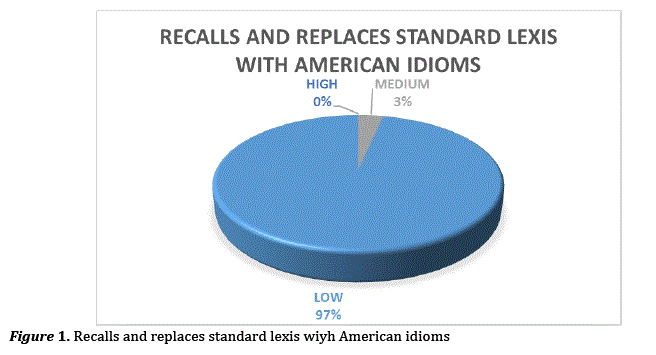
<body><![CDATA[<p align="justify"><font face="Verdana, Arial, Helvetica, sans-serif" size="2"><b>Sample</b></font></p>     <p align="justify"><font face="Verdana, Arial, Helvetica, sans-serif" size="2">A sample was not necessary since all the participante were part of the study in order to reach real results.</font></p>     <p align="justify"><font face="Verdana, Arial, Helvetica, sans-serif" size="2"><b>Research Method</b></font></p>     <p align="justify"><font face="Verdana, Arial, Helvetica, sans-serif" size="2">Also, the researcher applied the Hypothetic - Deductive method. This method constituted itself as the proper mechanism to be applied in the process because of the researcher began from the problem, then its observation, the theoretical framework was analyzed and finally the conclusions were presented.</font></p>     <p align="justify"><font face="Verdana, Arial, Helvetica, sans-serif" size="2"><b>Techniques and instruments to collect data</b></font></p>     <p align="justify"><font face="Verdana, Arial, Helvetica, sans-serif" size="2">It is important to mention that the observation technique was used, because it appreciates the incidence of the application of the American idioms on second language learners. So, the intrument used was an observation checklist at the beginning and at the end of the study.</font></p>     <p align="justify">&nbsp;</p>     <p align="justify"><font face="Verdana, Arial, Helvetica, sans-serif" size="3"><b>RESULTS</b></font></p>     <p align="justify"><font face="Verdana, Arial, Helvetica, sans-serif" size="2">As the objective of this research was to measure the effects on comprehension and use that result from the explicit teaching of</font> <font face="Verdana, Arial, Helvetica, sans-serif" size="2">American idioms to L2 students, the data was obtained through observation guides at the beginning and at the end of the investigation which were applied in the third level students in the Lingüistic Competences Coordination, Faculty of Education at Universidad Nacional de Chimborazo, Ecuador during the period April - September 2020, this process helped to measure the effects that American idioms have on second language learners.</font></p>     <p align="justify"><font face="Verdana, Arial, Helvetica, sans-serif" size="2">The study confirmed that after the application of American idioms in the class, the students were skilled to include these</font> <font face="Verdana, Arial, Helvetica, sans-serif" size="2">new terms when they interacted with others. In pair work, for example, students could have a short conversation, but this time they shared information using these new terms, contrary to the beginning research, where students said that in their primary and secondary education the students were only taught English as a second language with a traditional textbook that never included an informal expression. <a href="#f1">Figure 1</a> below shows the findings prior to the application of the American idioms.</font></p>     ]]></body>
<body><![CDATA[<p align="center"><a name="f1"></a><img src="/img/revistas/hrce/v4n16/a06_figura01.gif" width="656" height="355"></p>     <p align="justify"><font face="Verdana, Arial, Helvetica, sans-serif" size="2"><b>Analysis</b></font></p>     <p align="justify"><font face="Verdana, Arial, Helvetica, sans-serif" size="2">It can be found that 29 out of 30 students in a pair work exercise could not remember and substitute standard terms with idiomatic expressions before the application of American idioms just a single student who was able to do it</font></p>     <p align="justify"><font face="Verdana, Arial, Helvetica, sans-serif" size="2"><strong>Interpretation</strong></font></p>     <p align="justify"><font face="Verdana, Arial, Helvetica, sans-serif" size="2">It can be said that the identification and substitution of standard terms by idioms are difficult. It is also clear that students have no</font> <font face="Verdana, Arial, Helvetica, sans-serif" size="2">power over informal phrases that obstruct communication and hinder learning.</font></p>     <p align="justify"><font face="Verdana, Arial, Helvetica, sans-serif" size="2">On the other hand, the observation checklist aimed at third-level students from the Lingüistic Competences Coordination at the UNACH School of Education located in Riobamba, after the application of American idioms, term April - September 2020 showed that these students were able to use and understand idiomatic expressions used in various tasks as shown in <a href="#f2">figure 2</a> below.</font></p>     <p align="center"><a name="f2"></a><img src="/img/revistas/hrce/v4n16/a06_figura02.gif" width="665" height="351"></p>     <p align="justify"><font face="Verdana, Arial, Helvetica, sans-serif" size="2"><b>Analysis</b></font></p>     <p align="justify"><font face="Verdana, Arial, Helvetica, sans-serif" size="2">It can be noted that the total population was able to replace terms they know with idiomatic expressions due to the application of American idioms in the class.</font></p>     <p align="justify"><font face="Verdana, Arial, Helvetica, sans-serif" size="2"><strong>Interpretation</strong></font></p>     ]]></body>
<body><![CDATA[<p align="justify"><font face="Verdana, Arial, Helvetica, sans-serif" size="2">The students have clearly gained basic knowledge and comprehension of idiomatic expressions to be implemented in future situations.</font></p>     <p align="justify"><font face="Verdana, Arial, Helvetica, sans-serif" size="2"><b>Discussion</b></font></p>     <p align="justify"><font face="Verdana, Arial, Helvetica, sans-serif" size="2">These findings have helped us to enrich the learning experience of students from various sociolinguistic backgrounds (Holmes, 2013).</font></p>     <p align="justify"><font face="Verdana, Arial, Helvetica, sans-serif" size="2">First of all, to do this, it was found that idiomatic expressions are an integral part of the language that comprises a wide variety of specific expressions that take an active part in a certain social community. (Aimin, 2013) To foster a sense of informality, the use of American idioms is intended to strengthen social identity. It is possible to apply idioms in various áreas of expertise because of their different áreas.</font></p>     <p align="justify"><font face="Verdana, Arial, Helvetica, sans-serif" size="2">According to Vasiljevic (2011), in the field of EFL, idiomatic language has been a neglected área of vocabulary instruction. Although nobody doubts the advantages of studying idioms or teaching them, teachers have been at a loss for several years as to how to help their students develop idiomatic expressions.</font></p>     <p align="justify"><font face="Verdana, Arial, Helvetica, sans-serif" size="2">This research wül be seen as a creative and avant-garde proposal with a strong social and educational effect, and as a tool to support that wül eventually enhance the teaching and learning process of English as a second language.</font></p>     <p align="justify">&nbsp;</p>     <p align="justify"><font face="Verdana, Arial, Helvetica, sans-serif" size="3"><b>CONCLUSIONS</b></font></p>     <p align="justify"><font face="Verdana, Arial, Helvetica, sans-serif" size="2">Some conclusions have been formulated on the basis ofthe results obtained during the entire phase ofthe currentstudy.</font></p>     <p align="justify"><font face="Verdana, Arial, Helvetica, sans-serif" size="2">The focus in education is on moving away from the learning of language to one of communicative competence. This concéntrate on communicative competence and language's social function has led to a concern about linguistic suitability rather than precisión (Guduru, 2012).</font></p>     ]]></body>
<body><![CDATA[<p align="justify"><font face="Verdana, Arial, Helvetica, sans-serif" size="2">It was possible to verify that the incorporation and use of American idioms had an important effect on the acquisition of a second language, with a substantial increase in the learners' oral production.</font></p>     <p align="justify"><font face="Verdana, Arial, Helvetica, sans-serif" size="2">The interaction and sociolingüistic comprehension of the English language of third-level UNACH students has been dramatically improved by the implementation of clear and brief meanings, since they provided the meaning of non-traditional terms in the múltiple activities indicated in the study, taking into account that 29 out of 30 students were able to recall and substitute basic lexis for American idioms.</font></p>     <p align="justify">&nbsp;</p>     <p align="justify"><font face="Verdana, Arial, Helvetica, sans-serif" size="3"><b>REFERENCES</b></font></p>     <!-- ref --><p align="justify"><font face="Verdana, Arial, Helvetica, sans-serif" size="2">Aimin, L. (2013). The study of second language acquisition under socio-cultural theory. American Journal of Educational Research</font>&nbsp;&nbsp;&nbsp;&nbsp;&nbsp;&nbsp;&nbsp;&nbsp;[&#160;<a href="javascript:void(0);" onclick="javascript: window.open('/scielo.php?script=sci_nlinks&ref=1309460&pid=S2616-7964202000040000600001&lng=','','width=640,height=500,resizable=yes,scrollbars=1,menubar=yes,');">Links</a>&#160;]<!-- end-ref --><!-- ref --><p align="justify"><font face="Verdana, Arial, Helvetica, sans-serif" size="2">Alamri, W. A. (2018). Communicative Language Teaching: Possible Alternative Approaches to CLT and Teaching Contexts. English Language Teaching, 11(10), 132. <a href="https://doi.org/10.5539/elt.v11n10p132" target="_blank">https://doi.org/10.5539/elt.v11n10p132</a></font>&nbsp;&nbsp;&nbsp;&nbsp;&nbsp;&nbsp;&nbsp;&nbsp;[&#160;<a href="javascript:void(0);" onclick="javascript: window.open('/scielo.php?script=sci_nlinks&ref=1309461&pid=S2616-7964202000040000600002&lng=','','width=640,height=500,resizable=yes,scrollbars=1,menubar=yes,');">Links</a>&#160;]<!-- end-ref --><!-- ref --><p align="justify"><font face="Verdana, Arial, Helvetica, sans-serif" size="2">Ambrose, J. (2003). Why Idioms Are Important for English. 180-182</font>&nbsp;&nbsp;&nbsp;&nbsp;&nbsp;&nbsp;&nbsp;&nbsp;[&#160;<a href="javascript:void(0);" onclick="javascript: window.open('/scielo.php?script=sci_nlinks&ref=1309462&pid=S2616-7964202000040000600003&lng=','','width=640,height=500,resizable=yes,scrollbars=1,menubar=yes,');">Links</a>&#160;]<!-- end-ref --><!-- ref --><p align="justify"><font face="Verdana, Arial, Helvetica, sans-serif" size="2">Booij, G. (2007). The Grammar of Words: An Introduction   to   Linguistic   Morphology.</font> <font face="Verdana, Arial, Helvetica, sans-serif" size="2">Oxford    University   Press,   2nd   Edition. Retrieved from <a href="https://n9.cl/me0fz" target="_blank">https://n9.cl/me0fz</a></font>&nbsp;&nbsp;&nbsp;&nbsp;&nbsp;&nbsp;&nbsp;&nbsp;[&#160;<a href="javascript:void(0);" onclick="javascript: window.open('/scielo.php?script=sci_nlinks&ref=1309463&pid=S2616-7964202000040000600004&lng=','','width=640,height=500,resizable=yes,scrollbars=1,menubar=yes,');">Links</a>&#160;]<!-- end-ref --><!-- ref --><p align="justify"><font face="Verdana, Arial, Helvetica, sans-serif" size="2">Cronquist,   K.,   &amp;   Fiszbein,   A.   (2017).   El aprendizaje del inglés en América Latina. El Aprendizaje  Del Inglés En Amércica Latina, 1-88.        Retrieved        from <a href="https://www.thedialogue.org/wp-content/uploads/2017/09/El-aprendizaje-del-inglés-en-América-Latina-1.pdf" target="_blank">https://www.thedialogue.org/wp-content/uploads/2017/09/El-aprendizaje-del-inglés-en-América-Latina-1.pdf</a></font>&nbsp;&nbsp;&nbsp;&nbsp;&nbsp;&nbsp;&nbsp;&nbsp;[&#160;<a href="javascript:void(0);" onclick="javascript: window.open('/scielo.php?script=sci_nlinks&ref=1309464&pid=S2616-7964202000040000600005&lng=','','width=640,height=500,resizable=yes,scrollbars=1,menubar=yes,');">Links</a>&#160;]<!-- end-ref --><!-- ref --><p align="justify"><font face="Verdana, Arial, Helvetica, sans-serif" size="2">Guduru, R. (2012). Learning Academic Idioms Some Useful Techniques for Beginner Learners. Language in India, 12(2), 484-494</font>&nbsp;&nbsp;&nbsp;&nbsp;&nbsp;&nbsp;&nbsp;&nbsp;[&#160;<a href="javascript:void(0);" onclick="javascript: window.open('/scielo.php?script=sci_nlinks&ref=1309465&pid=S2616-7964202000040000600006&lng=','','width=640,height=500,resizable=yes,scrollbars=1,menubar=yes,');">Links</a>&#160;]<!-- end-ref --><!-- ref --><p align="justify"><font face="Verdana, Arial, Helvetica, sans-serif" size="2">Gutiérrez, L. (1996). Paradigmas Cuantitativo y Cualitativo en la Investigación socio-educativa: Proyección y Reflexiones. Paradigma, 14</font>&nbsp;&nbsp;&nbsp;&nbsp;&nbsp;&nbsp;&nbsp;&nbsp;[&#160;<a href="javascript:void(0);" onclick="javascript: window.open('/scielo.php?script=sci_nlinks&ref=1309466&pid=S2616-7964202000040000600007&lng=','','width=640,height=500,resizable=yes,scrollbars=1,menubar=yes,');">Links</a>&#160;]<!-- end-ref --><!-- ref --><p align="justify"><font face="Verdana, Arial, Helvetica, sans-serif" size="2">Holmes, J. (2013). An introduction to sociolinguistics. Routledge</font>&nbsp;&nbsp;&nbsp;&nbsp;&nbsp;&nbsp;&nbsp;&nbsp;[&#160;<a href="javascript:void(0);" onclick="javascript: window.open('/scielo.php?script=sci_nlinks&ref=1309467&pid=S2616-7964202000040000600008&lng=','','width=640,height=500,resizable=yes,scrollbars=1,menubar=yes,');">Links</a>&#160;]<!-- end-ref --><!-- ref --><p align="justify"><font face="Verdana, Arial, Helvetica, sans-serif" size="2">Liu, D. (2017). Idioms: Description, comprehension, acquisition, and pedagogy. Routledge, 208</font>&nbsp;&nbsp;&nbsp;&nbsp;&nbsp;&nbsp;&nbsp;&nbsp;[&#160;<a href="javascript:void(0);" onclick="javascript: window.open('/scielo.php?script=sci_nlinks&ref=1309468&pid=S2616-7964202000040000600009&lng=','','width=640,height=500,resizable=yes,scrollbars=1,menubar=yes,');">Links</a>&#160;]<!-- end-ref --><!-- ref --><p align="justify"><font face="Verdana, Arial, Helvetica, sans-serif" size="2">Oakhill, J. (2016). Understanding of idiomatic expressions in context in skilled and less-skilled comprehenders: Online processing and interpretation. Scientific Studies of Reading, 34</font>&nbsp;&nbsp;&nbsp;&nbsp;&nbsp;&nbsp;&nbsp;&nbsp;[&#160;<a href="javascript:void(0);" onclick="javascript: window.open('/scielo.php?script=sci_nlinks&ref=1309469&pid=S2616-7964202000040000600010&lng=','','width=640,height=500,resizable=yes,scrollbars=1,menubar=yes,');">Links</a>&#160;]<!-- end-ref --><!-- ref --><p align="justify"><font face="Verdana, Arial, Helvetica, sans-serif" size="2">Vasüjevic, Z. (2011). Using conceptual metaphors and Ll definitions in teaching idioms to non-native speakers. Journal of Asia TEFL, 8, N&deg;3</font><font face="Verdana, Arial, Helvetica, sans-serif" size="2"></font>&nbsp;&nbsp;&nbsp;&nbsp;&nbsp;&nbsp;&nbsp;&nbsp;[&#160;<a href="javascript:void(0);" onclick="javascript: window.open('/scielo.php?script=sci_nlinks&ref=1309470&pid=S2616-7964202000040000600011&lng=','','width=640,height=500,resizable=yes,scrollbars=1,menubar=yes,');">Links</a>&#160;]<!-- end-ref --><p align="justify">&nbsp;</p>     <p align="justify">&nbsp;</p>      ]]></body><back>
<ref-list>
<ref id="B1">
<nlm-citation citation-type="book">
<person-group person-group-type="author">
<name>
<surname><![CDATA[Aimin]]></surname>
<given-names><![CDATA[L]]></given-names>
</name>
</person-group>
<source><![CDATA[The study of second language acquisition under socio-cultural theory]]></source>
<year>2013</year>
<publisher-name><![CDATA[American Journal of Educational Research]]></publisher-name>
</nlm-citation>
</ref>
<ref id="B2">
<nlm-citation citation-type="journal">
<person-group person-group-type="author">
<name>
<surname><![CDATA[Alamri]]></surname>
<given-names><![CDATA[W. A]]></given-names>
</name>
</person-group>
<article-title xml:lang="en"><![CDATA[Communicative Language Teaching: Possible Alternative Approaches to CLT and Teaching Contexts]]></article-title>
<source><![CDATA[English Language Teaching]]></source>
<year>2018</year>
<volume>11</volume>
<numero>10</numero>
<issue>10</issue>
<page-range>132</page-range></nlm-citation>
</ref>
<ref id="B3">
<nlm-citation citation-type="">
<person-group person-group-type="author">
<name>
<surname><![CDATA[Ambrose]]></surname>
<given-names><![CDATA[J]]></given-names>
</name>
</person-group>
<source><![CDATA[Why Idioms Are Important for English]]></source>
<year>2003</year>
<page-range>180-182</page-range></nlm-citation>
</ref>
<ref id="B4">
<nlm-citation citation-type="book">
<person-group person-group-type="author">
<name>
<surname><![CDATA[Booij]]></surname>
<given-names><![CDATA[G]]></given-names>
</name>
</person-group>
<source><![CDATA[The Grammar of Words: An Introduction to Linguistic Morphology]]></source>
<year>2007</year>
<edition>2nd Edition</edition>
<publisher-name><![CDATA[Oxford University Press]]></publisher-name>
</nlm-citation>
</ref>
<ref id="B5">
<nlm-citation citation-type="">
<person-group person-group-type="author">
<name>
<surname><![CDATA[Cronquist]]></surname>
<given-names><![CDATA[K]]></given-names>
</name>
<name>
<surname><![CDATA[Fiszbein]]></surname>
<given-names><![CDATA[A]]></given-names>
</name>
</person-group>
<source><![CDATA[El aprendizaje del inglés en América Latina]]></source>
<year>2017</year>
<page-range>1-88</page-range></nlm-citation>
</ref>
<ref id="B6">
<nlm-citation citation-type="journal">
<person-group person-group-type="author">
<name>
<surname><![CDATA[Guduru]]></surname>
<given-names><![CDATA[R]]></given-names>
</name>
</person-group>
<article-title xml:lang="es"><![CDATA[Learning Academic Idioms Some Useful Techniques for Beginner Learners]]></article-title>
<source><![CDATA[Language in India]]></source>
<year>2012</year>
<volume>12</volume>
<numero>2</numero>
<issue>2</issue>
<page-range>484-494</page-range></nlm-citation>
</ref>
<ref id="B7">
<nlm-citation citation-type="journal">
<person-group person-group-type="author">
<name>
<surname><![CDATA[Gutiérrez]]></surname>
<given-names><![CDATA[L]]></given-names>
</name>
</person-group>
<article-title xml:lang="es"><![CDATA[Paradigmas Cuantitativo y Cualitativo en la Investigación socio-educativa: Proyección y Reflexiones]]></article-title>
<source><![CDATA[Paradigma]]></source>
<year>1996</year>
<numero>14</numero>
<issue>14</issue>
</nlm-citation>
</ref>
<ref id="B8">
<nlm-citation citation-type="book">
<person-group person-group-type="author">
<name>
<surname><![CDATA[Holmes]]></surname>
<given-names><![CDATA[J]]></given-names>
</name>
</person-group>
<source><![CDATA[An introduction to sociolinguistics]]></source>
<year>2013</year>
<publisher-name><![CDATA[Routledge]]></publisher-name>
</nlm-citation>
</ref>
<ref id="B9">
<nlm-citation citation-type="journal">
<person-group person-group-type="author">
<name>
<surname><![CDATA[Liu]]></surname>
<given-names><![CDATA[D]]></given-names>
</name>
</person-group>
<article-title xml:lang="en"><![CDATA[Idioms: Description, comprehension, acquisition, and pedagogy]]></article-title>
<source><![CDATA[Routledge]]></source>
<year>2017</year>
<page-range>208</page-range></nlm-citation>
</ref>
<ref id="B10">
<nlm-citation citation-type="journal">
<person-group person-group-type="author">
<name>
<surname><![CDATA[Oakhill]]></surname>
<given-names><![CDATA[J]]></given-names>
</name>
</person-group>
<article-title xml:lang="en"><![CDATA[Understanding of idiomatic expressions in context in skilled and less-skilled comprehenders: Online processing and interpretation]]></article-title>
<source><![CDATA[Scientific Studies of Reading]]></source>
<year>2016</year>
<numero>34</numero>
<issue>34</issue>
</nlm-citation>
</ref>
<ref id="B11">
<nlm-citation citation-type="journal">
<person-group person-group-type="author">
<name>
<surname><![CDATA[Vasüjevic]]></surname>
<given-names><![CDATA[Z]]></given-names>
</name>
</person-group>
<article-title xml:lang="en"><![CDATA[Using conceptual metaphors and Ll definitions in teaching idioms to non-native speakers]]></article-title>
<source><![CDATA[Journal of Asia TEFL]]></source>
<year>2011</year>
<numero>8</numero>
<issue>8</issue>
<page-range>3</page-range></nlm-citation>
</ref>
</ref-list>
</back>
</article>