<?xml version="1.0" encoding="ISO-8859-1"?><article xmlns:mml="http://www.w3.org/1998/Math/MathML" xmlns:xlink="http://www.w3.org/1999/xlink" xmlns:xsi="http://www.w3.org/2001/XMLSchema-instance">
<front>
<journal-meta>
<journal-id>2519-5352</journal-id>
<journal-title><![CDATA[Revista de Medio Ambiente y Mineria]]></journal-title>
<abbrev-journal-title><![CDATA[REV. MAMYM]]></abbrev-journal-title>
<issn>2519-5352</issn>
<publisher>
<publisher-name><![CDATA[EDITORIAL UNIVERSITARIA de la Universidad Técnica de Oruro.]]></publisher-name>
</publisher>
</journal-meta>
<article-meta>
<article-id>S2519-53522019000100002</article-id>
<title-group>
<article-title xml:lang="es"><![CDATA[Assessment of blasts environmental sustainability in open pit mining - Case study in small and large Brazilian mines]]></article-title>
<article-title xml:lang="en"><![CDATA[Evaluación de la sostenibilidad ambiental de explotaciones en minería a cielo abierto - Estudio de caso en minas brasileñas grandes y pequeñas]]></article-title>
</title-group>
<contrib-group>
<contrib contrib-type="author">
<name>
<surname><![CDATA[Navarro Torres]]></surname>
<given-names><![CDATA[Vidal Félix]]></given-names>
</name>
<xref ref-type="aff" rid="A01"/>
</contrib>
<contrib contrib-type="author">
<name>
<surname><![CDATA[Médici de Eston]]></surname>
<given-names><![CDATA[Sergio]]></given-names>
</name>
<xref ref-type="aff" rid="A02"/>
</contrib>
<contrib contrib-type="author">
<name>
<surname><![CDATA[Siguemasa Iramina]]></surname>
<given-names><![CDATA[Wilson]]></given-names>
</name>
<xref ref-type="aff" rid="A03"/>
</contrib>
<contrib contrib-type="author">
<name>
<surname><![CDATA[Canaan Silveira]]></surname>
<given-names><![CDATA[Leandro Geraldo]]></given-names>
</name>
<xref ref-type="aff" rid="A04"/>
</contrib>
<contrib contrib-type="author">
<name>
<surname><![CDATA[Rodrigues Costa]]></surname>
<given-names><![CDATA[João Henrique]]></given-names>
</name>
<xref ref-type="aff" rid="A05"/>
</contrib>
</contrib-group>
<aff id="A01">
<institution><![CDATA[,Vale Institute of Technology  ]]></institution>
<addr-line><![CDATA[Belo Horizonte Minas Gerais]]></addr-line>
<country>Brazil</country>
</aff>
<aff id="A02">
<institution><![CDATA[,São Paulo University  ]]></institution>
<addr-line><![CDATA[ ]]></addr-line>
</aff>
<aff id="A03">
<institution><![CDATA[,São Paulo University  ]]></institution>
<addr-line><![CDATA[ ]]></addr-line>
</aff>
<aff id="A04">
<institution><![CDATA[,Vale Institute of Technology  ]]></institution>
<addr-line><![CDATA[ ]]></addr-line>
</aff>
<aff id="A05">
<institution><![CDATA[,Vale Institute of Technology  ]]></institution>
<addr-line><![CDATA[Belo Horizonte Minas Gerais]]></addr-line>
<country>Brazil</country>
</aff>
<pub-date pub-type="pub">
<day>00</day>
<month>06</month>
<year>2019</year>
</pub-date>
<pub-date pub-type="epub">
<day>00</day>
<month>06</month>
<year>2019</year>
</pub-date>
<volume>4</volume>
<numero>1</numero>
<fpage>18</fpage>
<lpage>26</lpage>
<copyright-statement/>
<copyright-year/>
<self-uri xlink:href="http://www.scielo.org.bo/scielo.php?script=sci_arttext&amp;pid=S2519-53522019000100002&amp;lng=en&amp;nrm=iso"></self-uri><self-uri xlink:href="http://www.scielo.org.bo/scielo.php?script=sci_abstract&amp;pid=S2519-53522019000100002&amp;lng=en&amp;nrm=iso"></self-uri><self-uri xlink:href="http://www.scielo.org.bo/scielo.php?script=sci_pdf&amp;pid=S2519-53522019000100002&amp;lng=en&amp;nrm=iso"></self-uri><abstract abstract-type="short" xml:lang="en"><p><![CDATA[Abstract Assessment of blasts environmental sustainability in open pit mining deals with the development and application of an innovative mathematical model for environmental sustainability evaluation based on characteristics and quality standards of several parameters of the main four environmental components (atmosphere, lithosphere, hydrosphere and biosphere). Due to the great complexity of environmental parameters in open pit mining, the developed mathematical model was validated for only ground vibration and airblast in small and large Brazilian open pit mines. In both cases, the research focuses are human discomfort and structural damage.]]></p></abstract>
<abstract abstract-type="short" xml:lang="es"><p><![CDATA[Resumen La evaluación de la sostenibilidad ambiental de explotaciones en la minería a cielo abierto se ocupa del desarrollo y la aplicación de un modelo matemático innovador para la evaluación de la sostenibilidad ambiental basada en las características y estándares de calidad de varios parámetros de los cuatro componentes ambientales principales (atmósfera, litosfera, hidrosfera y biosfera). Debido a la gran complejidad de los parámetros ambientales en la minería a cielo abierto, el modelo matemático desarrollado fue validado solo para la vibración del suelo y el chorro de aire en minas a cielo abierto brasileñas grandes y pequeñas. En ambos casos, los focos de investigación son la incomodidad humana y el daño estructural.]]></p></abstract>
<kwd-group>
<kwd lng="en"><![CDATA[Environmental Sustainability]]></kwd>
<kwd lng="en"><![CDATA[blasts]]></kwd>
<kwd lng="en"><![CDATA[mathematical model]]></kwd>
<kwd lng="en"><![CDATA[open pit mining]]></kwd>
<kwd lng="es"><![CDATA[sostenibilidad ambiental]]></kwd>
<kwd lng="es"><![CDATA[explosiones]]></kwd>
<kwd lng="es"><![CDATA[modelo matemático]]></kwd>
<kwd lng="es"><![CDATA[minería a cielo abierto]]></kwd>
</kwd-group>
</article-meta>
</front><body><![CDATA[ <p align="right"><font color="#000000" size="2" face="Verdana, Arial, Helvetica, sans-serif"><b>ART&Iacute;CULOS </b></font></p>     <p align="center">&nbsp;</p>     <p align="center"><b><font color="#000000" size="4" face="Verdana, Arial, Helvetica, sans-serif">Assessment of blasts environmental sustainability in open pit mining -     <br> Case study in small and large Brazilian mines</font></b></p>     <p align="center">&nbsp;</p>     <p align="center"><font color="#000000" size="3" face="Verdana, Arial, Helvetica, sans-serif"><b>Evaluaci&oacute;n de la sostenibilidad ambiental de explotaciones en miner&iacute;a     <br> a cielo abierto - Estudio de caso en minas brasile&ntilde;as grandes y peque&ntilde;as</b></font></p>     <p align="center">&nbsp;</p>     <p align="center">&nbsp;</p>     <p align="center"><font color="#000000" size="2" face="Verdana, Arial, Helvetica, sans-serif"><b>Vidal F&eacute;lix Navarro Torres<sup>a</sup> Sergio M&eacute;dici de Eston<sup>b</sup> Wilson Siguemasa Iramina<sup>c</sup> Leandro Geraldo Canaan</b></font> <b><font color="#000000" size="2" face="Verdana, Arial, Helvetica, sans-serif">Silveira<sup>d</sup> João Henrique Rodrigues Costa<sup>e</sup></font></b>    ]]></body>
<body><![CDATA[<br> <font color="#000000" size="2" face="Verdana, Arial, Helvetica, sans-serif"><sup>a</sup> Vale Institute of Technology, Belo Horizonte, Minas Gerais, Brazil, <a href="mailto:vidal.torres@itv.org">vidal.torres@itv.org</a>    <br></font> <font color="#000000" size="2" face="Verdana, Arial, Helvetica, sans-serif"><sup>b</sup> São Paulo University, <a href="mailto:smeston@usp.br">smeston@usp.br</a>     <br> <sup>c</sup> São Paulo University, <a href="mailto:wilson.iramina@poli.usp.br">wilson.iramina@poli.usp.br</a>    <br></font> <font color="#000000" size="2" face="Verdana, Arial, Helvetica, sans-serif"><sup>d</sup> Vale Institute of Technology, Belo Horizonte, Minas Gerais, Brazil, <a href="mailto:leandro.silveira@itv.org">leandro.silveira@itv.org</a>    <br></font> <font color="#000000" size="2" face="Verdana, Arial, Helvetica, sans-serif"><sup>e</sup> Vale Institute of Technology, Belo Horizonte, Minas Gerais, Brazil, <a href="mailto:joao.costa@pq.itv.org">joao.costa@pq.itv.org</a>    <br></font> <font color="#000000" size="2" face="Verdana, Arial, Helvetica, sans-serif"><b>Recibido:</b> 13-02-2019 <b>Aceptado:</b> 08-03-2019</font></p>     <p align="center">&nbsp;</p>     <p align="center">&nbsp;</p> <hr>     <p align="justify"><font color="#000000" size="2" face="Verdana, Arial, Helvetica, sans-serif"><b>Abstract</b></font></p>     <p align="justify"><font color="#000000" size="2" face="Verdana, Arial, Helvetica, sans-serif">Assessment of blasts environmental sustainability in open pit mining deals with the development and application of an innovative mathematical model for environmental sustainability evaluation based on characteristics and quality standards of several parameters of the main four environmental components (atmosphere, lithosphere, hydrosphere and biosphere). Due to the great complexity of environmental parameters in open pit mining, the developed mathematical model was validated for only ground vibration and airblast in small and large Brazilian open pit mines. In both cases, the research focuses are human discomfort and structural damage.</font></p>     ]]></body>
<body><![CDATA[<p align="justify"><font color="#000000" size="2" face="Verdana, Arial, Helvetica, sans-serif"><b>Keywords.</b> Environmental Sustainability, blasts, mathematical model, open pit mining.</font></p> <hr>     <p align="justify"><font color="#000000" size="2" face="Verdana, Arial, Helvetica, sans-serif"><b>Resumen</b></font></p>     <p align="justify"><font color="#000000" size="2" face="Verdana, Arial, Helvetica, sans-serif">La evaluaci&oacute;n de la sostenibilidad ambiental de explotaciones en la miner&iacute;a a cielo abierto se ocupa del desarrollo y la aplicaci&oacute;n de un modelo matem&aacute;tico innovador para la evaluaci&oacute;n de la sostenibilidad ambiental basada en las caracter&iacute;sticas y est&aacute;ndares de calidad de varios par&aacute;metros de los cuatro componentes ambientales principales (atm&oacute;sfera, litosfera, hidrosfera y biosfera). Debido a la gran complejidad de los par&aacute;metros ambientales en la miner&iacute;a a cielo abierto, el modelo matem&aacute;tico desarrollado fue validado solo para la vibraci&oacute;n del suelo y el chorro de aire en minas a cielo abierto brasileñas grandes y pequeñas. En ambos casos, los focos de investigaci&oacute;n son la incomodidad humana y el daño estructural.</font></p>     <p align="justify"><font color="#000000" size="2" face="Verdana, Arial, Helvetica, sans-serif"><b>Palabras clave. </b>sostenibilidad ambiental, explosiones, modelo matem&aacute;tico, miner&iacute;a a cielo abierto.</font></p> <hr>     <p align="justify">&nbsp;</p>     <p align="justify">&nbsp;</p>     <p align="justify"><font color="#000000" size="3" face="Verdana, Arial, Helvetica, sans-serif"><b>1.     Introduction</b></font></p>     <p align="justify"><font color="#000000" size="2" face="Verdana, Arial, Helvetica, sans-serif">Sustainable development is defined as the one that meets the needs of current generations without comprising the ability of future ages to achieve their own necessities (WCED, 1987). Furthermore, sustainability can be comprehended as every piece of action in order to follow the sustainable development and it is known fact that this concept must include at least three pillars, environmental, social and economic (Navarro Torres, V. F.; Gama, C. D., 2005). Whenthe issue comes to mining activities, especially in open pit mining, the attention is focused on environmental impact   related   to   the   ore   exploitation   and</font> <font color="#000000" size="2" face="Verdana, Arial, Helvetica, sans-serif">increasing concern with sustainability in this sector has been noticed.</font></p>     <p align="justify"><font color="#000000" size="2" face="Verdana, Arial, Helvetica, sans-serif">The exploitation of ore resources in open pit mines as well as in quarries frequently involves rock blasting operations. Nevertheless, according to Dinis da Gama (1998), only 5 to 15% of the energy released by blasts is used effectively to fragment rock. It means that the largest part is transferred to the surrounding environment in form of side effects, likely to cause significant structural damage and human discomfort, which consist the most common cause of concerns and protests by affected people in the neighbourhood of these works.</font></p>     <p align="justify"><font color="#000000" size="2" face="Verdana, Arial, Helvetica, sans-serif">A thoroughly literature review has shown some scientific work has been performed aiming</font> <font color="#000000" size="2" face="Verdana, Arial, Helvetica, sans-serif">quantify sustainabi lity, highlighting those ones from Yale Center for Environmental Law and Policy and the Center for International Earth Science Information Network, Columbia University between 1999 and 2005, which has monitored 21 sustainability indices, including present and past levels of pollution, for instance (ESI, 2005). However, there are not any papers related to quantification of environmental sustainability in open pit mining.</font></p>     ]]></body>
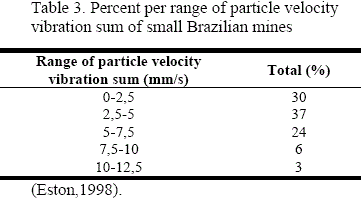
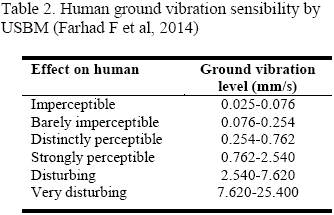
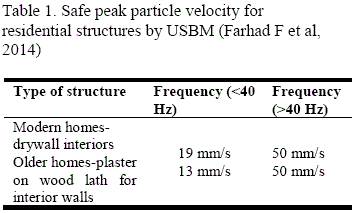
<body><![CDATA[<p align="justify"><font color="#000000" size="2" face="Verdana, Arial, Helvetica, sans-serif">Recent researches on this topic correspond to those applied in underground mines (Dinis da Gama C., Navarro Torres V.F. et al, 2012, Navarro Torres. V.F. et al., 2009). Hence, a mathematical model to quantify sustainability in open pit mining is extremely significant.</font></p>     <p align="justify">&nbsp;</p>     <p align="justify"><font color="#000000" size="3" face="Verdana, Arial, Helvetica, sans-serif"><b>2.    Characterization of environmental impact in open pit mining</b></font></p>     <p align="justify"><font color="#000000" size="2" face="Verdana, Arial, Helvetica, sans-serif">Open pit mining operations handle large volumes of ore and waste. As a result, during this process, there are risks of environmental impact on: atmosphere, underground and surficial water, rock mass and soil, biodiversity as well as the human being. Rock excavation modifies natural slopes, consequently altering its natural state of tensions. In its turn, use of explosives may cause ground vibration and air blast in the surrounding areas to blasts. Recent studies carried out in a city nearby an open pit mine, in Brazil, has shown that gases pollutants and respirable suspended particles generated by diesel oil emissions affects the respiratory system of people (Braga et al., 2007). Another environmental impact is the leaching that occurs when the water gets in touch with exploitation fronts or even with waste dumps and hence lead pollutants to rivers, lakes and aquifers.</font></p>     <p align="justify"><font color="#000000" size="2" face="Verdana, Arial, Helvetica, sans-serif">Particle velocity vibration and frequency are the most used parameters in order to assess the side effects of rock blasts. According to Kahndelwal, M; Shing T.N (2006), frequency plays a key role in vibration analysis, because the response of the buildings nearby the seismic wave's propagation zones depends on ground vibration frequency.</font></p>     <p align="justify"><font color="#000000" size="2" face="Verdana, Arial, Helvetica, sans-serif">Particularly, ground vibration might cause damage in buildings, whereby the safe peak rticle velocity for residential structures according to USBM is function of frequency (<a href="#t1">Table 1</a>).</font></p>     <p align="center"><a name="t1"></a><img src="/img/revistas/mamym/v4n1/a02_figura01.gif" width="355" height="213"></p>     <p align="justify"><font color="#000000" size="2" face="Verdana, Arial, Helvetica, sans-serif">Human vibration sensibility depends on peak particle velocity level, vibration frequency, event duration and frequency of event. For values approximately below 2 Hz, the body acts as a unit mass. For sitting position, the first resonance is occurs between 4 and 6 Hz. On the other hand, for the standing one, resonance peaks occurs about 6 and 12 Hz. The USBM has suggested a human vibration sensibility basis of particle velocity (<a href="#t2">Table 2</a>).</font></p>     <p align="center"><a name="t2"></a><img src="/img/revistas/mamym/v4n1/a02_figura02.gif" width="334" height="215"></p>     <p align="justify"><font color="#000000" size="2" face="Verdana, Arial, Helvetica, sans-serif">Eston (1998) carried out 133 measurements of primary and secondary blasts during 6 years, using engineering seismographs, in small Brazilian mines aiming at a behaviour analysis of ranges of particle velocity vibration and the frequencies as illustrated in <a href="#t3">Table 3</a> and <a href="#f2">Fig.2</a>. Note that the majority of the vibration records are inferior to 5 mm/s and the frequency is less than 50 Hz.</font></p>     ]]></body>
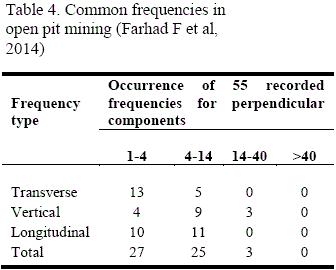
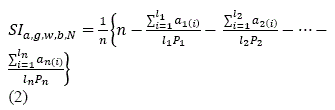
<body><![CDATA[<p align="center"><a name="t3"></a><img src="/img/revistas/mamym/v4n1/a02_figura03.gif" width="363" height="199"></p>     <p align="justify"><font color="#000000" size="2" face="Verdana, Arial, Helvetica, sans-serif">In most cases of rock blasts in medium and large-scale open pit mining, the occurrence of frequencies are observed as shown in <a href="#t4">Table 4</a>.</font></p>     <p align="center"><a name="t4"></a><img src="/img/revistas/mamym/v4n1/a02_figura04.gif" width="336" height="270"></p>     <p align="center">&nbsp;</p>     <p align="justify"><font color="#000000" size="3" face="Verdana, Arial, Helvetica, sans-serif"><b>3.   Mathematical modelling of sustainability in open pit mines</b></font></p>     <p align="justify"><font color="#000000" size="2" face="Verdana, Arial, Helvetica, sans-serif">The environmental sustainability in open pit mining is based on main environmental components and it can be expressed by the Environmental sustainability index <i>(ESI<sub>0</sub>), </i>as follows:</font></p>     <p align="center"><a name="e1"></a><img src="/img/revistas/mamym/v4n1/a02_figura05.gif" width="329" height="57"></p>     <p align="justify"><font color="#000000" size="2" face="Verdana, Arial, Helvetica, sans-serif">Where: <i>N </i>is the number of possible environmental components, <i>SI<sub><font size="3" face="Times New Roman, Times, serif">a</font></sub> </i>is the atmosphere sustainability index, <i>SI<sub>g</sub> </i>is the geotechnical sustainability index, <i>SI<sub><font size="3" face="Times New Roman, Times, serif">w</font></sub> </i>is the water sustainability index (surface and underground), <i>SI<sub><font size="3" face="Times New Roman, Times, serif">b</font></sub> </i>is the biological sustainability index, related to animals and plants and <i>SI<sub><font size="3" face="Times New Roman, Times, serif">N</font></sub> </i>is any other possible component.</font></p>     <p align="justify"><font color="#000000" size="2" face="Verdana, Arial, Helvetica, sans-serif">All the sustainability indices of open pit mining will be calculated by a single equation, as follows:</font></p>     <p align="center"><font color="#000000" size="2" face="Verdana, Arial, Helvetica, sans-serif"><a name="e2"></a><img src="/img/revistas/mamym/v4n1/a02_figura06.gif" width="335" height="110"></font></p>     ]]></body>
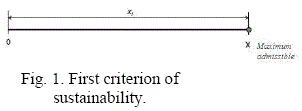
<body><![CDATA[<p align="justify"><font color="#000000" size="2" face="Verdana, Arial, Helvetica, sans-serif">Where: n is the number of pollutants, <i><font size="3" face="Times New Roman, Times, serif">l</font><sub>1</sub></i>, <i><font size="3" face="Times New Roman, Times, serif">l</font><sub>2</sub></i>,....,<i><font size="3" face="Times New Roman, Times, serif">l</font><sub>n</sub></i> are the numbers of </font><font color="#000000" size="2" face="Verdana, Arial, Helvetica, sans-serif">evaluation/measurement locations, <i><font size="3" face="Times New Roman, Times, serif">&alpha;</font><sub>1</sub></i>, <i><font size="3" face="Times New Roman, Times, serif">&alpha;</font><sub>2</sub></i>,....<i><font size="3" face="Times New Roman, Times, serif">&alpha;</font><sub>n </sub></i> are the environmental parameters on evaluation and <i><font size="3" face="Times New Roman, Times, serif">P</font><sub>1</sub></i>, <i><font size="3" face="Times New Roman, Times, serif">P</font><sub>2</sub></i>,.....<i><font size="3" face="Times New Roman, Times, serif">P</font><sub>n </sub></i>are the admissibility standards.</font></p>     <p align="justify"><font color="#000000" size="2" face="Verdana, Arial, Helvetica, sans-serif">A careful analysis of the environmental parameters in open pit mining has allowed a characterization of three groups, regarding their environmental effects and admissibility standards.</font></p>     <p align="justify"><font color="#000000" size="2" face="Verdana, Arial, Helvetica, sans-serif">Based on these three groups of environmental parameters, considering Y as a minimum acceptable standard, X as a maximum permissible standard and x<sub>i</sub> as the local condition of environmental parameters on assessment, it was developed mathematical expressions to calculate the sustainability index (SI) according to three criteria, taking into account a scale of 0 to one 1.</font></p>     <blockquote>       <p align="justify"><font color="#000000" size="2" face="Verdana, Arial, Helvetica, sans-serif">a) When x<sub>i</sub> &lt; X;</font></p>       <p align="justify"><font color="#000000" size="2" face="Verdana, Arial, Helvetica, sans-serif">b) When x<sub>i</sub> &gt; Y and;</font></p>       <p align="justify"><font color="#000000" size="2" face="Verdana, Arial, Helvetica, sans-serif">c) When Y &lt; x<sub>i</sub> &lt; X</font></p> </blockquote>     <p align="justify"><font color="#000000" size="2" face="Verdana, Arial, Helvetica, sans-serif">The specifics cases of ground vibration and airblast correspond to first criterion (<a href="#f3">Fig. 3</a>), which means x<sub>i</sub> &lt; X and their general equation is as follows:</font></p>     <p align="center"><a name="e3"></a><img src="/img/revistas/mamym/v4n1/a02_figura07.gif" width="320" height="55"></p>     <p align="justify"><font color="#000000" size="2" face="Verdana, Arial, Helvetica, sans-serif">Conditions:</font></p>     ]]></body>
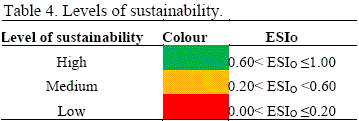
<body><![CDATA[<blockquote>       <p align="justify"><font color="#000000" size="2" face="Verdana, Arial, Helvetica, sans-serif">a) If x<sub>i</sub>=X or x<sub>i</sub>&gt;X, so SI<sub>1</sub>=0;</font></p>       <p align="justify"><font color="#000000" size="2" face="Verdana, Arial, Helvetica, sans-serif">b) If x<sub>i</sub>=0, so SI<sub>1</sub>=1</font></p> </blockquote>     <p align="center"><a name="f1"></a><img src="/img/revistas/mamym/v4n1/a02_figura08.gif" width="302" height="111"></p>     <p align="justify"><font color="#000000" size="2" face="Verdana, Arial, Helvetica, sans-serif">Moreover,   it   can   be   adopted   levels   of sustainability as presented in <a href="#t4">Table 4</a>.</font></p>     <p align="center"><a name="t4"></a><img src="/img/revistas/mamym/v4n1/a02_figura09.gif" width="359" height="121"></p>     <p align="center">&nbsp;</p>     <p align="justify"><font color="#000000" size="3" face="Verdana, Arial, Helvetica, sans-serif"><b>4.   Case studies </b>- <b>model validation for ground vibration and airblast.</b></font></p>     <p align="justify"><font color="#000000" size="2" face="Verdana, Arial, Helvetica, sans-serif">4.1. Small mine</font></p>     <p align="justify"><font color="#000000" size="2" face="Verdana, Arial, Helvetica, sans-serif">4.1.1. Description of the area</font></p>     ]]></body>
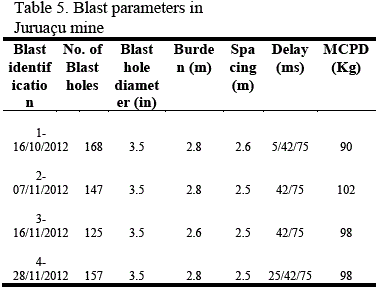
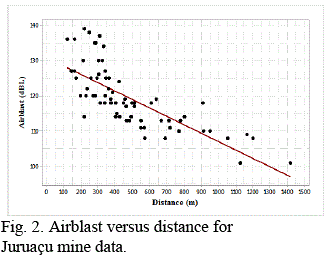
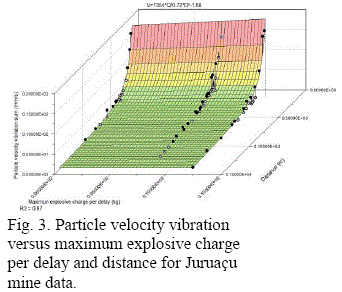
<body><![CDATA[<p align="justify"><font color="#000000" size="2" face="Verdana, Arial, Helvetica, sans-serif">The Juruaçu open pit mine is located in Perus, state of São Paulo, Brazil, 30 km distance from </font><font color="#000000" size="2" face="Verdana, Arial, Helvetica, sans-serif">the homonym capital. Its mining activity consists of sand and rock exploitation and then further processing to civil construction. It is carried out detonations of explosives charges to fragment granitic rock, which is transported by conveyor belts to successive stages of grinding, until reach the specified size. The annual average production rounds 1.8 Mt and the waste withdrawal is 180.000 m<sup>3</sup>.</font></p>     <p align="justify"><font color="#000000" size="2" face="Verdana, Arial, Helvetica, sans-serif">The mine is located in crystalline terrains of the São Roque Group, in the geomorphological province of Atlantic plateau, subdivision ridge of São Roque Zone (IPT, 1981). This group is mainly compounded of clastic sediments, predominantly clayey nature, metamorphosed into phyllites. Besides, it can be observed outcrops of conglomeratic metasediments, amphibolites, limestone and abundantly intrusive granites (Coutinho, 1972). The Atlantic plateau mainly consists of crystalline rocks, Precambrian and Cambro-Ordovician, cut by covers of sedimentary basins of São Paulo and Taubat&eacute; and by intrusive basic rocks and alkaline Mesozoic-Tertiary (IPT, 1981). The ridge of São Roque comprises an extensive mountainous area of diverse lithology ranging from low-grade metamorphic to migmatic and gneissic rocks with granitic intrusions.</font></p>     <p align="justify"><font color="#000000" size="2" face="Verdana, Arial, Helvetica, sans-serif">Moreover, rounded top hills with restricted ridges and slopes with straight profiles, sometimes abrupt, characterize the relief of Juruaçu area. Drainage is high density with restricted interior alluvial plains, closed valleys with dendritic pattern (IPT, 1981).</font></p>     <p align="justify"><font color="#000000" size="2" face="Verdana, Arial, Helvetica, sans-serif">4.1.2. Monitoring of ground vibration and airblast.</font></p>     <p align="justify"><font color="#000000" size="2" face="Verdana, Arial, Helvetica, sans-serif">It was carried out the monitoring of 4 blasts in distinct days and it was installed 20 engineering seismographs at several points surrounding to the detonation of explosive charges area in order to record particle velocity vibration (mm/s) and airblast (dBL). The equipment was from GEOSONICS&reg;, fifteen SSU 3000EZ + model with the following serial numbers: SN 8894, SN8895, SN 8896, SN8897, SN 8947, SN8849, SN 8950, SN 8951, SN 8952, SN 8953, SN 8954, 8955 SN, SN 8956, SN 8957 and five SSU 3000LC model with serial numbers SN3700, SN 3702, SN3706, SN 3707, SN 3708. Furthermore, they were set for a trigger of 0.18 to 0.5 mm / s and temporal window of 5 s. The main blast parameters can be seen in <a href="#t5">Table 5</a>.</font></p>     <p align="center"><a name="t5"></a><img src="/img/revistas/mamym/v4n1/a02_figura10.gif" width="377" height="289"></p>     <p align="justify"><font color="#000000" size="2" face="Verdana, Arial, Helvetica, sans-serif">4.1.3.        Recorded database and propagation law of vibration</font></p>     <p align="justify"><font color="#000000" size="2" face="Verdana, Arial, Helvetica, sans-serif">All 71-recorded data of airblast in the measurement points were plotted in function of its distance from the respective source and presented in <a href="#f5">Fig. 5</a>. It is noticeable that the major airblast values occurs on short distances and lessen when the space between the measure and the blast becomes larger, for a R squared of 0.57.</font></p>     <p align="center"><a name="f2"></a><img src="/img/revistas/mamym/v4n1/a02_figura11.gif" width="327" height="257"></p>     <p align="justify"><font color="#000000" size="2" face="Verdana, Arial, Helvetica, sans-serif">Several authors (Dinis da Gama, 1998; Holmberg, 2000) recognized that the most utilized equation in science in order to describe the behaviour of seismic waves in the ground, generated by blast is the following:</font></p>     ]]></body>
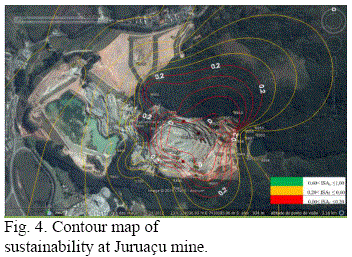
<body><![CDATA[<p align="center"><a name="e4"></a><img src="/img/revistas/mamym/v4n1/a02_figura12.gif" width="317" height="47"></p>     <p align="justify"><font color="#000000" size="2" face="Verdana, Arial, Helvetica, sans-serif">Where: <i><font size="3" face="Times New Roman, Times, serif">v</font> </i>is the particle velocity vibration sum (mm/s), <i>Q </i>is the maximun explosive charge per delay (Kg), <i>D </i>is the distance between the blast and measurement points and <i><font size="3" face="Times New Roman, Times, serif">a, b, c</font> </i>are the constants of locations and particularities of the blast.</font></p>     <p align="justify"><font color="#000000" size="2" face="Verdana, Arial, Helvetica, sans-serif">From this equation it can be obtained a chart of iso-velocities of vibration (an accurate map of vibration generated by kriging interpolation between known points), once that recorded data of vibration would be available to attain this relation and thus recalculate the vibration velocity. In this way, as depicted in <a href="#f6">Fig. 6</a>, it was used the statistic software LABFit&reg; to plot all data of particle vibration velocity recorded, together with maximum explosive charge per delay and the distance.</font></p>     <p align="center"><a name="f3"></a><img src="/img/revistas/mamym/v4n1/a02_figura13.gif" width="342" height="292"></p>     <p align="justify"><font color="#000000" size="2" face="Verdana, Arial, Helvetica, sans-serif">The statistical data processing has allowed obtaining the propagation law of vibration, for a correlation of 0.87, as expressed:</font></p>     <p align="center"><a name="e5"></a><img src="/img/revistas/mamym/v4n1/a02_figura14.gif" width="317" height="43"></p>     <p align="justify"><font color="#000000" size="2" face="Verdana, Arial, Helvetica, sans-serif">The constants value is quite similar to those descripted by various authors and organized by Navarro Torres VF &amp; Bernardo P (2004), thus ensuring more trust on this parameters and hence constituting a powerful tool to recalculate the vibration velocity and then calculate the sustainability indices.</font></p>     <p align="justify"><font color="#000000" size="2" face="Verdana, Arial, Helvetica, sans-serif">4.1.4.         Environmental sustainability index</font></p>     <p align="justify"><font color="#000000" size="2" face="Verdana, Arial, Helvetica, sans-serif">There are not any Brazilian official standards of human comfort whereby it was applied the standard CETESB D7.013 (2015) from the state of São Paulo, Brazil, (mine location), maximum limit of 4.2 m/s. Using (2), the particular equation to calculate the geotechnical sustainability index in any point due to ground vibration is:</font></p>     <p align="center"><a name="e6"></a><img src="/img/revistas/mamym/v4n1/a02_figura15.gif" width="323" height="35"></p>     ]]></body>
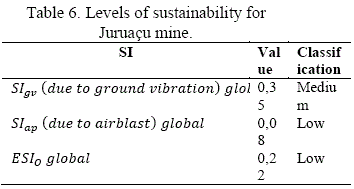
<body><![CDATA[<p align="justify"><font color="#000000" size="2" face="Verdana, Arial, Helvetica, sans-serif">Where:  <i><font size="3" face="Times New Roman, Times, serif">v</font></i> is the particle vibration velocity sum (mm/s).</font></p>     <p align="justify"><font color="#000000" size="2" face="Verdana, Arial, Helvetica, sans-serif">By its turn, it was also applied (2) to calculate the atmospheric sustainability index due to airblast, regarding CETESB D7.013, maximum value of 128 dBL, as follows:</font></p>     <p align="center"><a name="e7"></a><img src="/img/revistas/mamym/v4n1/a02_figura16.gif" width="319" height="44"></p>     <p align="justify"><font color="#000000" size="2" face="Verdana, Arial, Helvetica, sans-serif">Where: <font size="3" face="Times New Roman, Times, serif"><i>p</i></font> is the airblast (dBL).</font></p>     <p align="justify"><font color="#000000" size="2" face="Verdana, Arial, Helvetica, sans-serif">From any point and its respective <i>SI<sub>gv </sub></i>and <i>SI<sub>ap</sub>, </i>it can be generated a contour map of environmental sustainability, using the software Surfer&reg;, as depicted in <a href="#f7">Fig. 7</a>. Note that, in areas closer to the community, the mine operates with an Environmental sustainability index of round 0.5, which we considerate a medium level of sustainability. The worst values, less or equal to 0.2, occurs inside and around the pit, which is explicated by the highest levels of vibration and airblast due to the short distance between measurement points and source.</font></p>     <p align="center"><a name="f4"></a><img src="/img/revistas/mamym/v4n1/a02_figura17.gif" width="352" height="257"></p>     <p align="justify"><font color="#000000" size="2" face="Verdana, Arial, Helvetica, sans-serif">Moreover, this mine sustainability can be evaluated as a whole by the calculus of Environmental sustainability index <i>(ESI<sub>0</sub>) </i>using (1) and (2), as presented in <a href="#t6">Table 6</a>.</font></p>     <p align="center"><a name="t6"></a><img src="/img/revistas/mamym/v4n1/a02_figura18.gif" width="354" height="189"></p>     <p align="justify"><font color="#000000" size="2" face="Verdana, Arial, Helvetica, sans-serif">4.2. Large scale mine</font></p>     <p align="justify"><font color="#000000" size="2" face="Verdana, Arial, Helvetica, sans-serif">4.2.1. Description</font></p>     ]]></body>
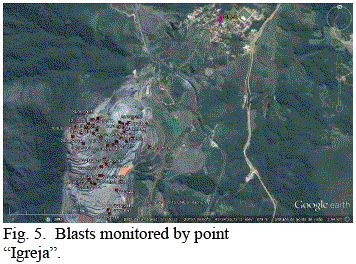
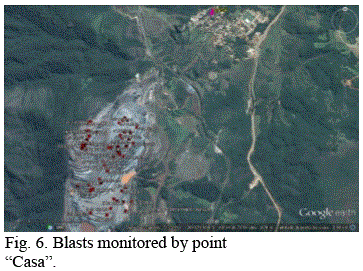
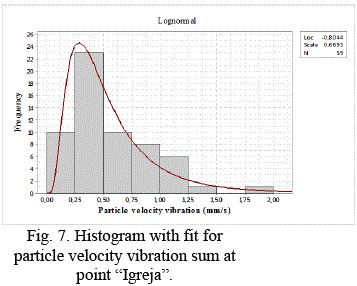
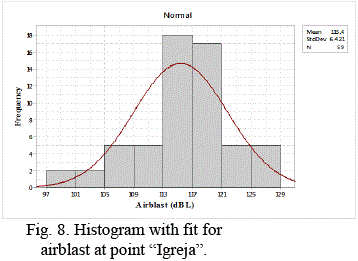
<body><![CDATA[<p align="justify"><font color="#000000" size="2" face="Verdana, Arial, Helvetica, sans-serif">Fazendão is an open pit mine located in Mariana, state of Minas Gerais, Brazil, 140 km of</font> <font color="#000000" size="2" face="Verdana, Arial, Helvetica, sans-serif">distance from its capital, Belo Horizonte. It is property of VALE.S.A., withinthe &quot;Quadril&aacute;tero Ferr&iacute;fero&quot;, an area of intense iron mining activity, which consists its work. The Quadril&aacute;tero Ferr&iacute;fero is considered as one of the most important mineral provinces in the world, comprising important deposits of iron, as well as gold and manganese. The large iron ore reserves are found in metamorphic Precambrian rocks of Paleoproterozoic Cauê Formation, offering great economic interest due to its grade and extent.</font></p>     <p align="justify"><font color="#000000" size="2" face="Verdana, Arial, Helvetica, sans-serif">4.2.2. Monitoring of ground vibration an airblast</font></p>     <p align="justify"><font color="#000000" size="2" face="Verdana, Arial, Helvetica, sans-serif">As the main objective of this study was to validate the model, it was used the data base relative to the monitoring carried out by Sequência Engenharia Projetos e Meio Ambiente Ltda (2014; 2015). In order to record ground vibration and airblast it was used 6 Instantel Inc. seismographs model: MiniMate DS-077 S&eacute;rie II, MiniMate Plus, MiniMate Pro4 e MicroMate, with the following serial numbers: 4499, 5935, BE 17764, BE17765, MP 12698 and UM 6308. They were located in two points, called &quot;Igreja&quot; and &quot;Casa&quot; in the community surrounding to the mine so as to register the parameters related to its respective monitored blasts, as depicted in Fig. <a href="#f9">9</a> and <a href="#f10">10</a>. Furthermore, they were set for a trigger of 0.51 mm/s and temporal window of 5 s. Blast parameters or even blast design were not informed.</font></p>     <p align="center"><a name="f5"></a><img src="/img/revistas/mamym/v4n1/a02_figura19.gif" width="356" height="264"></p>     <p align="center"><a name="f6"></a><img src="/img/revistas/mamym/v4n1/a02_figura20.gif" width="363" height="271"></p>     <p align="justify"><font color="#000000" size="2" face="Verdana, Arial, Helvetica, sans-serif">4.2.3.        Recorded data base and statistical data treatment.</font></p>     <p align="justify"><font color="#000000" size="2" face="Verdana, Arial, Helvetica, sans-serif">It was not possible to obtain the propagation law of vibration due to the great number of measurements in only two points, therefore it has become necessary a statistical data treatment, using in this case the software Minitab&reg;, in order to obtain the most representative value of particle velocity vibration and airblast for the evaluation locals to apply in the model. <a href="#f11">Fig. 11</a> presents the histogram with fit, regarding the identified distribution, for particle velocity vibration at the point &quot;Igreja&quot;.</font></p>     <p align="center"><a name="f7"></a><img src="/img/revistas/mamym/v4n1/a02_figura21.gif" width="357" height="286"></p>     <p align="justify"><font color="#000000" size="2" face="Verdana, Arial, Helvetica, sans-serif">Fig. 12 represents the histogram with fit, regarding the identified distribution, for airblast at the point &quot;Igreja&quot;. We have noticed that Weibull distributions have shown bigger p -value than the Normal distribution, however we have assumed the second one, supported by the Central limit theorem, which states that the majority of random phenomena could be approximate to normal distributions, when the randomness of a physical phenomenon is the</font> <font color="#000000" size="2" face="Verdana, Arial, Helvetica, sans-serif">accumulation of small additive random effects (SOONG, 2004).</font></p>     <p align="center"><a name="f8"></a><img src="/img/revistas/mamym/v4n1/a02_figura22.gif" width="358" height="261"></p>     ]]></body>
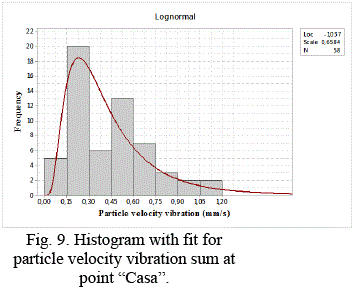
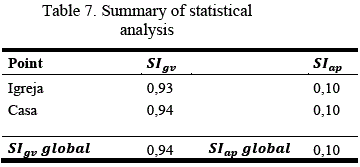
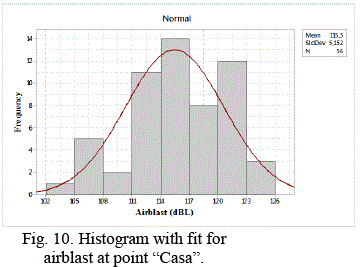
<body><![CDATA[<p align="justify"><font color="#000000" size="2" face="Verdana, Arial, Helvetica, sans-serif">Once again, Fig. 13 and 14 represents the histogram with fit for particle vibration velocity and airblast, but this time for the point &quot;Casa&quot;. The interpretation was based on Central limit theorem. <a href="#t7">Table 7</a> summarizes the statistical analysis, showing the expectancy for the mean value for all data set.</font></p>     <p align="center"><a name="f9"></a><img src="/img/revistas/mamym/v4n1/a02_figura23.gif" width="354" height="289"></p>     <p align="center"><a name="t7"></a><img src="/img/revistas/mamym/v4n1/a02_figura24.gif" width="360" height="167"></p>     <p align="center"><a name="f10"></a><img src="/img/revistas/mamym/v4n1/a02_figura25.gif" width="360" height="267"></p>     <p align="justify"><font color="#000000" size="2" face="Verdana, Arial, Helvetica, sans-serif">4.2.4.         Environmental sustainability index</font></p>     <p align="justify"><font color="#000000" size="2" face="Verdana, Arial, Helvetica, sans-serif">1. Aiming calculate the geotechnical sustainability index due to ground vibration, <i>(SI<sub>gv</sub>) </i>it was applied the standard CETESB D7.013 from the state of São Paulo, Brazil, maximum limit of 4.2 m/s for human comfort. Additionally, if we evaluate the structural damage, applying the American standard, USBM (RI 8507), for instance, which establish the maximum limit of 13 mm/s for dominating frequencies below 40 Hz in old buildings the particular equation from (2) results a <i>SI<sub>gv</sub>, </i>as follows:</font></p>     <p align="center"><a name="e8"></a><img src="/img/revistas/mamym/v4n1/a02_figura26.gif" width="338" height="49"></p>     <p align="justify"><font color="#000000" size="2" face="Verdana, Arial, Helvetica, sans-serif">Where:<i><font size="3" face="Times New Roman, Times, serif"> v</font> </i>is the particle vibration velocity sum (mm/s)</font></p>     <p align="justify"><font color="#000000" size="2" face="Verdana, Arial, Helvetica, sans-serif">In its turn, it was also applied (2) to calculate the atmospheric sustainability index due to airblast, regarding CETESB D7.013, maximum value of 128 dBL, as follows:</font></p>     <p align="center"><a name="e9"></a><img src="/img/revistas/mamym/v4n1/a02_figura27.gif" width="338" height="47"></p>     ]]></body>
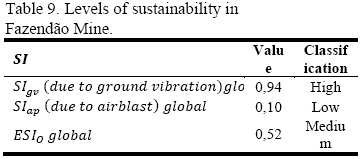
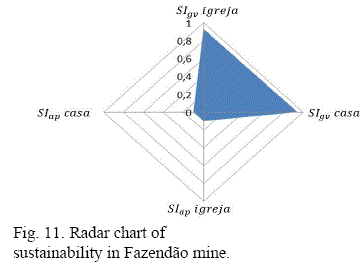
<body><![CDATA[<p align="justify"><font color="#000000" size="2" face="Verdana, Arial, Helvetica, sans-serif">Where: p is the airblast (dBL).</font></p>     <p align="justify"><font color="#000000" size="2" face="Verdana, Arial, Helvetica, sans-serif">Table 8 and <a href="#t9">9</a> presents the results from (5) and (4) for the measurement points and the global value of Environmental sustainability index from (1) with its classification, respectively.</font></p>     <p align="center"><a name="t9"></a><img src="/img/revistas/mamym/v4n1/a02_figura28.gif" width="360" height="159"></p>     <p align="justify"><font color="#000000" size="2" face="Verdana, Arial, Helvetica, sans-serif">In order to provide a better view of how does the Sustainability indices vary, it was built a radar chart as depicted in Fig. 15.</font></p>     <p align="center"><a name="f11"></a><img src="/img/revistas/mamym/v4n1/a02_figura29.gif" width="362" height="262"></p>     <p align="center">&nbsp;</p>     <p align="justify"><font color="#000000" size="3" face="Verdana, Arial, Helvetica, sans-serif"><b>5.    Conclusions</b></font></p>     <p align="justify"><font color="#000000" size="2" face="Verdana, Arial, Helvetica, sans-serif">The developed mathematical model quantifies environmental sustainability in open pit mining through the Environmental sustainability Index expressed in the scale 0 to 1, where values close to zero reflect the proximity to the permissible value. On the other hand, indices near to one can be interpreted as an absence of pollutant.</font></p>     <p align="justify"><font color="#000000" size="2" face="Verdana, Arial, Helvetica, sans-serif">The model validation for two parameters (ground vibration and airblast), in small and large scale mines, shows its great potential in the assessment and management of environmental sustainability in open pit mines.</font></p>     <p align="justify"><font color="#000000" size="2" face="Verdana, Arial, Helvetica, sans-serif">To ensure a properly assessment of sustainability in Fazendão Mine, it would be necessary a major number of measurements points. Nevertheless, once that our aim was to validate the model, the database was sufficient.</font></p>     ]]></body>
<body><![CDATA[<p align="justify">&nbsp;</p>     <p align="justify"><font color="#000000" size="3" face="Verdana, Arial, Helvetica, sans-serif"><b>2. Acknowledgments</b></font></p>     <p align="justify"><font color="#000000" size="2" face="Verdana, Arial, Helvetica, sans-serif">Authors would like to thank Vale Institute of Technology for support this research project. Thanks, are also due to the Vale- Fazendão Mine for providing the necessary data. In addition,</font> <font color="#000000" size="2" face="Verdana, Arial, Helvetica, sans-serif">authors would also like to express their deep-felt gratitude to USP - Universidade de São Paulo for the partnership and availability during the scientific work.</font></p>     <p align="justify">&nbsp;</p>     <p align="justify"><font color="#000000" size="3" face="Verdana, Arial, Helvetica, sans-serif"><b>3. References</b></font></p>     <!-- ref --><p align="justify"><font color="#000000" size="2" face="Verdana, Arial, Helvetica, sans-serif">1. 2005  Environmental  Sustainabilty  Index (ESI) (2005). New Haven, Conn.: Yale Center for Environmental Law &amp; Policy. 2005.</font>&nbsp;&nbsp;&nbsp;&nbsp;&nbsp;&nbsp;&nbsp;&nbsp;[&#160;<a href="javascript:void(0);" onclick="javascript: window.open('/scielo.php?script=sci_nlinks&ref=1227211&pid=S2519-5352201900010000200001&lng=','','width=640,height=500,resizable=yes,scrollbars=1,menubar=yes,');">Links</a>&#160;]<!-- end-ref --><!-- ref --><p align="justify"><font color="#000000" size="2" face="Verdana, Arial, Helvetica, sans-serif">2. Braga, A. L. F; Pereira, L. A. P; Proc&oacute;pio, M.; Andr&eacute;, P.A Saldiva, P. H. Associação entre poluição atmosf&eacute;rica e doenças respirat&oacute;rias e cardiovasculares na cidade de Itabira, Minas Gerais, Brasil. Rio de Janeiro: Cad. Sa&uacute;de P&uacute;blica, <i>Sup </i>4:S570-S578,2007. 9 p.</font>&nbsp;&nbsp;&nbsp;&nbsp;&nbsp;&nbsp;&nbsp;&nbsp;[&#160;<a href="javascript:void(0);" onclick="javascript: window.open('/scielo.php?script=sci_nlinks&ref=1227212&pid=S2519-5352201900010000200002&lng=','','width=640,height=500,resizable=yes,scrollbars=1,menubar=yes,');">Links</a>&#160;]<!-- end-ref --><!-- ref --><p align="justify"><font color="#000000" size="2" face="Verdana, Arial, Helvetica, sans-serif">3. Dinis da Gama, C. &quot;Ru&iacute;dos e Vibrações Ligados    à    Utilização    dos    Explosivos    e Equipamentos&quot;. <i>Comunicações do 1&ordm; Seminario de Auditorias Ambientais Internas. Divisão de Minas  e Pedreiras do Instituto  Geol&oacute;gico  e Mineiro de Portugal. </i>1998.</font>&nbsp;&nbsp;&nbsp;&nbsp;&nbsp;&nbsp;&nbsp;&nbsp;[&#160;<a href="javascript:void(0);" onclick="javascript: window.open('/scielo.php?script=sci_nlinks&ref=1227213&pid=S2519-5352201900010000200003&lng=','','width=640,height=500,resizable=yes,scrollbars=1,menubar=yes,');">Links</a>&#160;]<!-- end-ref --><!-- ref --><p align="justify"><font color="#000000" size="2" face="Verdana, Arial, Helvetica, sans-serif">4. Dinis da Gama C, Navarro Torres VF and Verissimo AC. Scienfific Final Report WP 6: Environmental Assessment of UCG and CO2 Storage, European Project, 2012, 23p.</font>&nbsp;&nbsp;&nbsp;&nbsp;&nbsp;&nbsp;&nbsp;&nbsp;[&#160;<a href="javascript:void(0);" onclick="javascript: window.open('/scielo.php?script=sci_nlinks&ref=1227214&pid=S2519-5352201900010000200004&lng=','','width=640,height=500,resizable=yes,scrollbars=1,menubar=yes,');">Links</a>&#160;]<!-- end-ref --><!-- ref --><p align="justify"><font color="#000000" size="2" face="Verdana, Arial, Helvetica, sans-serif">5. Coutinho,    J.M.V. Petrologia    do    pr&eacute;-cambriano de São Paulo e arredores. <i>Boletim IG- USO, v.3. </i>São Paulo. 1972, p 5-99.</font>&nbsp;&nbsp;&nbsp;&nbsp;&nbsp;&nbsp;&nbsp;&nbsp;[&#160;<a href="javascript:void(0);" onclick="javascript: window.open('/scielo.php?script=sci_nlinks&ref=1227215&pid=S2519-5352201900010000200005&lng=','','width=640,height=500,resizable=yes,scrollbars=1,menubar=yes,');">Links</a>&#160;]<!-- end-ref --><!-- ref --><p align="justify"><font color="#000000" size="2" face="Verdana, Arial, Helvetica, sans-serif">6. Farhad F, Mohammad Ali EF and Hamid M. Simultaneous   investigation   of blast   induced ground vibration and airblast effects on safety level of structures and human in surface blasting. International Journal of Mining Science and Technology 24 (2014) 663-669 p.</font>&nbsp;&nbsp;&nbsp;&nbsp;&nbsp;&nbsp;&nbsp;&nbsp;[&#160;<a href="javascript:void(0);" onclick="javascript: window.open('/scielo.php?script=sci_nlinks&ref=1227216&pid=S2519-5352201900010000200006&lng=','','width=640,height=500,resizable=yes,scrollbars=1,menubar=yes,');">Links</a>&#160;]<!-- end-ref --><!-- ref --><p align="justify"><font color="#000000" size="2" face="Verdana, Arial, Helvetica, sans-serif">7. Holmberg,   R.   -  Explosives  and  Blasting Technique.   Proc.   1st World   Conference  on Explosives     &amp;     Blasting     Techniques. A.</font> <font color="#000000" size="2" face="Verdana, Arial, Helvetica, sans-serif">Balkema, Rotterdam. 2000</font>&nbsp;&nbsp;&nbsp;&nbsp;&nbsp;&nbsp;&nbsp;&nbsp;[&#160;<a href="javascript:void(0);" onclick="javascript: window.open('/scielo.php?script=sci_nlinks&ref=1227217&pid=S2519-5352201900010000200007&lng=','','width=640,height=500,resizable=yes,scrollbars=1,menubar=yes,');">Links</a>&#160;]<!-- end-ref --><!-- ref --><p align="justify"><font color="#000000" size="2" face="Verdana, Arial, Helvetica, sans-serif">8. Eston, S. M. Uma an&aacute;lise dos n&iacute;veis de vibração associados a detonações. São Paulo: Escola Polit&eacute;cnica da Universidade de São Paulo. Doctoral thesis. 1998. p 101-103.</font>&nbsp;&nbsp;&nbsp;&nbsp;&nbsp;&nbsp;&nbsp;&nbsp;[&#160;<a href="javascript:void(0);" onclick="javascript: window.open('/scielo.php?script=sci_nlinks&ref=1227218&pid=S2519-5352201900010000200008&lng=','','width=640,height=500,resizable=yes,scrollbars=1,menubar=yes,');">Links</a>&#160;]<!-- end-ref --><!-- ref --><p align="justify"><font color="#000000" size="2" face="Verdana, Arial, Helvetica, sans-serif">9. Instituto de Pesquisas Tecnol&oacute;gicas do Estado de São Paulo - IPT. Mapa Geomorfol&oacute;gico   do   Estado   de   São  Paulo.</font> <font color="#000000" size="2" face="Verdana, Arial, Helvetica, sans-serif">Escala 1: 1000.000. São Paulo. 2 V. Publication IPTN&ordm; 1.183, 1981.</font>&nbsp;&nbsp;&nbsp;&nbsp;&nbsp;&nbsp;&nbsp;&nbsp;[&#160;<a href="javascript:void(0);" onclick="javascript: window.open('/scielo.php?script=sci_nlinks&ref=1227219&pid=S2519-5352201900010000200009&lng=','','width=640,height=500,resizable=yes,scrollbars=1,menubar=yes,');">Links</a>&#160;]<!-- end-ref --><!-- ref --><p align="justify"><font color="#000000" size="2" face="Verdana, Arial, Helvetica, sans-serif">10. Kahndelwal, M.; Shing TN. Prediction of blast induced ground vibrations and frequency in opencast mine: a neural network approach. JSound Vib. 2006. 289 p.</font>&nbsp;&nbsp;&nbsp;&nbsp;&nbsp;&nbsp;&nbsp;&nbsp;[&#160;<a href="javascript:void(0);" onclick="javascript: window.open('/scielo.php?script=sci_nlinks&ref=1227220&pid=S2519-5352201900010000200010&lng=','','width=640,height=500,resizable=yes,scrollbars=1,menubar=yes,');">Links</a>&#160;]<!-- end-ref --><!-- ref --><p align="justify"><font color="#000000" size="2" face="Verdana, Arial, Helvetica, sans-serif">11. Navarro Torres V.F; Bernardo P. <i>El &quot;Blastware III&quot; e &quot;Mlinreg.bas&quot; como herramientas para la prevenci&oacute;n y control ambiental de vibraciones en voladuras. </i>V Simposium Internacional de Tecnolog&iacute;a de la Informaci&oacute;n Aplicada a la Miner&iacute;a 14 - 17 de setembro, Lima-Per&uacute;. 2004. 20 p.</font>&nbsp;&nbsp;&nbsp;&nbsp;&nbsp;&nbsp;&nbsp;&nbsp;[&#160;<a href="javascript:void(0);" onclick="javascript: window.open('/scielo.php?script=sci_nlinks&ref=1227221&pid=S2519-5352201900010000200011&lng=','','width=640,height=500,resizable=yes,scrollbars=1,menubar=yes,');">Links</a>&#160;]<!-- end-ref --><!-- ref --><p align="justify"><font color="#000000" size="2" face="Verdana, Arial, Helvetica, sans-serif">12. Navarro Torres, V. F.; Dinis Da Gama, C. Engenharia ambiental subterrânea e aplicações. Rio de Janeiro: CETEM/CYTED,</font> <font color="#000000" size="2" face="Verdana, Arial, Helvetica, sans-serif">2005. 550 p.</font>&nbsp;&nbsp;&nbsp;&nbsp;&nbsp;&nbsp;&nbsp;&nbsp;[&#160;<a href="javascript:void(0);" onclick="javascript: window.open('/scielo.php?script=sci_nlinks&ref=1227222&pid=S2519-5352201900010000200012&lng=','','width=640,height=500,resizable=yes,scrollbars=1,menubar=yes,');">Links</a>&#160;]<!-- end-ref --><!-- ref --><p align="justify"><font color="#000000" size="2" face="Verdana, Arial, Helvetica, sans-serif">13. Navarro Torres, V.F.; Dinis Da Gama, C. Environmental sustainability index of geotechnical works. Geotechnical National Congress. Lisboa, 2009, 10pp.</font>&nbsp;&nbsp;&nbsp;&nbsp;&nbsp;&nbsp;&nbsp;&nbsp;[&#160;<a href="javascript:void(0);" onclick="javascript: window.open('/scielo.php?script=sci_nlinks&ref=1227223&pid=S2519-5352201900010000200013&lng=','','width=640,height=500,resizable=yes,scrollbars=1,menubar=yes,');">Links</a>&#160;]<!-- end-ref --><!-- ref --><p align="justify"><font color="#000000" size="2" face="Verdana, Arial, Helvetica, sans-serif">14. Soong, T.T. Fundamentals of Probability and Statistics for Engineers. State University of New York at Buffalo, Buffalo., New York. USA. 2004,p 199.</font>&nbsp;&nbsp;&nbsp;&nbsp;&nbsp;&nbsp;&nbsp;&nbsp;[&#160;<a href="javascript:void(0);" onclick="javascript: window.open('/scielo.php?script=sci_nlinks&ref=1227224&pid=S2519-5352201900010000200014&lng=','','width=640,height=500,resizable=yes,scrollbars=1,menubar=yes,');">Links</a>&#160;]<!-- end-ref --><!-- ref --><p align="justify"><font color="#000000" size="2" face="Verdana, Arial, Helvetica, sans-serif">15. Sequência Engenharia Projetos E Meio Ambiente Ltda. Relat&oacute;rio de monitoramento sismogr&aacute;fico. Mina de Fazendão. 2014. 232 p.</font>&nbsp;&nbsp;&nbsp;&nbsp;&nbsp;&nbsp;&nbsp;&nbsp;[&#160;<a href="javascript:void(0);" onclick="javascript: window.open('/scielo.php?script=sci_nlinks&ref=1227225&pid=S2519-5352201900010000200015&lng=','','width=640,height=500,resizable=yes,scrollbars=1,menubar=yes,');">Links</a>&#160;]<!-- end-ref --><!-- ref --><p align="justify"><font color="#000000" size="2" face="Verdana, Arial, Helvetica, sans-serif">16. Sequência Engenharia Projetos E Meio Ambiente Ltda. Relat&oacute;rio de monitoramento sismogr&aacute;fico. Mina de Fazendão. 2015. 208 p</font>&nbsp;&nbsp;&nbsp;&nbsp;&nbsp;&nbsp;&nbsp;&nbsp;[&#160;<a href="javascript:void(0);" onclick="javascript: window.open('/scielo.php?script=sci_nlinks&ref=1227226&pid=S2519-5352201900010000200016&lng=','','width=640,height=500,resizable=yes,scrollbars=1,menubar=yes,');">Links</a>&#160;]<!-- end-ref --><!-- ref --><p align="justify"><font color="#000000" size="2" face="Verdana, Arial, Helvetica, sans-serif">17. WCED (World Commission on Environment and   Development).   Our   Common   Future.</font> <font color="#000000" size="2" face="Verdana, Arial, Helvetica, sans-serif">Oxford: Oxford University Press, 1987. 300 p.</font>&nbsp;&nbsp;&nbsp;&nbsp;&nbsp;&nbsp;&nbsp;&nbsp;[&#160;<a href="javascript:void(0);" onclick="javascript: window.open('/scielo.php?script=sci_nlinks&ref=1227227&pid=S2519-5352201900010000200017&lng=','','width=640,height=500,resizable=yes,scrollbars=1,menubar=yes,');">Links</a>&#160;]<!-- end-ref --><p align="justify">&nbsp;</p>     <p align="justify">&nbsp;</p>      ]]></body><back>
<ref-list>
<ref id="B1">
<label>1</label><nlm-citation citation-type="book">
<collab>Environmental Sustainabilty Index</collab>
<source><![CDATA[]]></source>
<year>2005</year>
<publisher-loc><![CDATA[New Haven^eConn. Conn.]]></publisher-loc>
<publisher-name><![CDATA[Yale Center for Environmental Law & Policy]]></publisher-name>
</nlm-citation>
</ref>
<ref id="B2">
<label>2</label><nlm-citation citation-type="book">
<person-group person-group-type="author">
<name>
<surname><![CDATA[Braga]]></surname>
<given-names><![CDATA[A. L. F]]></given-names>
</name>
<name>
<surname><![CDATA[Pereira]]></surname>
<given-names><![CDATA[L. A. P]]></given-names>
</name>
<name>
<surname><![CDATA[Procópio]]></surname>
<given-names><![CDATA[M.]]></given-names>
</name>
<name>
<surname><![CDATA[André]]></surname>
<given-names><![CDATA[P.A]]></given-names>
</name>
<name>
<surname><![CDATA[Saldiva]]></surname>
<given-names><![CDATA[P. H.]]></given-names>
</name>
</person-group>
<source><![CDATA[Associação entre poluição atmosférica e doenças respiratórias e cardiovasculares na cidade de Itabira, Minas Gerais, Brasil]]></source>
<year>2007</year>
<page-range>9</page-range><publisher-loc><![CDATA[Rio de Janeiro ]]></publisher-loc>
<publisher-name><![CDATA[Cad. Saúde Pública]]></publisher-name>
</nlm-citation>
</ref>
<ref id="B3">
<label>3</label><nlm-citation citation-type="confpro">
<person-group person-group-type="author">
<name>
<surname><![CDATA[Dinis da Gama]]></surname>
<given-names><![CDATA[C.]]></given-names>
</name>
</person-group>
<source><![CDATA[Ruídos e Vibrações Ligados à Utilização dos Explosivos e Equipamentos]]></source>
<year>1998</year>
<conf-name><![CDATA[ Comunicações do 1º Seminario de Auditorias Ambientais Internas]]></conf-name>
<conf-loc> </conf-loc>
</nlm-citation>
</ref>
<ref id="B4">
<label>4</label><nlm-citation citation-type="">
<person-group person-group-type="author">
<name>
<surname><![CDATA[Dinis da Gama]]></surname>
<given-names><![CDATA[C]]></given-names>
</name>
<name>
<surname><![CDATA[Navarro Torres]]></surname>
<given-names><![CDATA[VF]]></given-names>
</name>
<name>
<surname><![CDATA[Verissimo]]></surname>
<given-names><![CDATA[AC]]></given-names>
</name>
</person-group>
<source><![CDATA[Scienfific Final Report WP 6: Environmental Assessment of UCG and CO2 Storage]]></source>
<year>2012</year>
<page-range>23</page-range></nlm-citation>
</ref>
<ref id="B5">
<label>5</label><nlm-citation citation-type="journal">
<person-group person-group-type="author">
<name>
<surname><![CDATA[Coutinho]]></surname>
<given-names><![CDATA[J.M.V.]]></given-names>
</name>
</person-group>
<article-title xml:lang="pt"><![CDATA[Petrologia do pré-cambriano de São Paulo e arredores]]></article-title>
<source><![CDATA[Boletim IG- USO]]></source>
<year>1972</year>
<volume>3</volume>
<page-range>5-99</page-range><publisher-loc><![CDATA[São Paulo ]]></publisher-loc>
</nlm-citation>
</ref>
<ref id="B6">
<label>6</label><nlm-citation citation-type="journal">
<person-group person-group-type="author">
<name>
<surname><![CDATA[Farhad]]></surname>
<given-names><![CDATA[F]]></given-names>
</name>
<name>
<surname><![CDATA[Mohammad Ali]]></surname>
<given-names><![CDATA[EF]]></given-names>
</name>
<name>
<surname><![CDATA[Hamid]]></surname>
<given-names><![CDATA[M.]]></given-names>
</name>
</person-group>
<article-title xml:lang="en"><![CDATA[Simultaneous investigation of blast induced ground vibration and airblast effects on safety level of structures and human in surface blasting]]></article-title>
<source><![CDATA[International Journal of Mining Science and Technology]]></source>
<year>2014</year>
<numero>24</numero>
<issue>24</issue>
<page-range>663-669</page-range></nlm-citation>
</ref>
<ref id="B7">
<label>7</label><nlm-citation citation-type="">
<person-group person-group-type="author">
<name>
<surname><![CDATA[Holmberg]]></surname>
<given-names><![CDATA[R.]]></given-names>
</name>
</person-group>
<source><![CDATA[Explosives and Blasting Technique: Proc. 1st World Conference on Explosives & Blasting Techniques]]></source>
<year>2000</year>
<publisher-loc><![CDATA[Rotterdam ]]></publisher-loc>
</nlm-citation>
</ref>
<ref id="B8">
<label>8</label><nlm-citation citation-type="">
<person-group person-group-type="author">
<name>
<surname><![CDATA[Eston]]></surname>
<given-names><![CDATA[S. M.]]></given-names>
</name>
</person-group>
<source><![CDATA[Uma análise dos níveis de vibração associados a detonações]]></source>
<year></year>
<page-range>101-103</page-range></nlm-citation>
</ref>
<ref id="B9">
<label>9</label><nlm-citation citation-type="">
<collab>Instituto de Pesquisas Tecnológicas do Estado de São Paulo - IPT</collab>
<source><![CDATA[Mapa Geomorfológico do Estado de São Paulo]]></source>
<year>1981</year>
</nlm-citation>
</ref>
<ref id="B10">
<label>10</label><nlm-citation citation-type="">
<person-group person-group-type="author">
<name>
<surname><![CDATA[Kahndelwal]]></surname>
<given-names><![CDATA[M.]]></given-names>
</name>
<name>
<surname><![CDATA[Shing]]></surname>
<given-names><![CDATA[TN]]></given-names>
</name>
</person-group>
<source><![CDATA[Prediction of blast induced ground vibrations and frequency in opencast mine: a neural network approach]]></source>
<year>2006</year>
<page-range>289</page-range></nlm-citation>
</ref>
<ref id="B11">
<label>11</label><nlm-citation citation-type="confpro">
<person-group person-group-type="author">
<name>
<surname><![CDATA[Navarro Torres]]></surname>
<given-names><![CDATA[V.F]]></given-names>
</name>
<name>
<surname><![CDATA[Bernardo]]></surname>
<given-names><![CDATA[P.]]></given-names>
</name>
</person-group>
<source><![CDATA[El "Blastware III" e "Mlinreg.bas" como herramientas para la prevención y control ambiental de vibraciones en voladuras]]></source>
<year></year>
<conf-name><![CDATA[ V Simposium Internacional de Tecnología de la Información Aplicada a la Minería]]></conf-name>
<conf-date>setembro</conf-date>
<conf-loc>Lima </conf-loc>
<page-range>20</page-range></nlm-citation>
</ref>
<ref id="B12">
<label>12</label><nlm-citation citation-type="book">
<person-group person-group-type="author">
<name>
<surname><![CDATA[Navarro Torres]]></surname>
</name>
<name>
<surname><![CDATA[Dinis Da Gama]]></surname>
<given-names><![CDATA[C.]]></given-names>
</name>
</person-group>
<source><![CDATA[Engenharia ambiental subterrânea e aplicações]]></source>
<year>2005</year>
<page-range>550</page-range><publisher-loc><![CDATA[Rio de Janeiro ]]></publisher-loc>
<publisher-name><![CDATA[CETEM/CYTED]]></publisher-name>
</nlm-citation>
</ref>
<ref id="B13">
<label>13</label><nlm-citation citation-type="confpro">
<person-group person-group-type="author">
<name>
<surname><![CDATA[Navarro Torres]]></surname>
<given-names><![CDATA[V.F.]]></given-names>
</name>
<name>
<surname><![CDATA[Dinis Da Gama]]></surname>
<given-names><![CDATA[C.]]></given-names>
</name>
</person-group>
<source><![CDATA[Environmental sustainability index of geotechnical works]]></source>
<year></year>
<conf-name><![CDATA[ Geotechnical National Congress]]></conf-name>
<conf-date>2009</conf-date>
<conf-loc>Lisboa </conf-loc>
<page-range>10</page-range></nlm-citation>
</ref>
<ref id="B14">
<label>14</label><nlm-citation citation-type="book">
<person-group person-group-type="author">
<name>
<surname><![CDATA[Soong]]></surname>
<given-names><![CDATA[T.T.]]></given-names>
</name>
</person-group>
<source><![CDATA[Fundamentals of Probability and Statistics for Engineers]]></source>
<year>2004</year>
<page-range>199</page-range><publisher-loc><![CDATA[Buffalo^eNew York New York]]></publisher-loc>
<publisher-name><![CDATA[State University of New York at Buffalo]]></publisher-name>
</nlm-citation>
</ref>
<ref id="B15">
<label>15</label><nlm-citation citation-type="book">
<collab>Sequência Engenharia Projetos E Meio Ambiente Ltda</collab>
<source><![CDATA[Relatório de monitoramento sismográfico]]></source>
<year>2014</year>
<page-range>232</page-range><publisher-name><![CDATA[Mina de Fazendão]]></publisher-name>
</nlm-citation>
</ref>
<ref id="B16">
<label>16</label><nlm-citation citation-type="book">
<collab>Sequência Engenharia Projetos E Meio Ambiente Ltda</collab>
<source><![CDATA[Relatório de monitoramento sismográfico]]></source>
<year>2015</year>
<page-range>208</page-range><publisher-name><![CDATA[Mina de Fazendão]]></publisher-name>
</nlm-citation>
</ref>
<ref id="B17">
<label>17</label><nlm-citation citation-type="book">
<collab>World Commission on Environment and Development</collab>
<source><![CDATA[Our Common Future]]></source>
<year>1987</year>
<page-range>300</page-range><publisher-loc><![CDATA[Oxford ]]></publisher-loc>
<publisher-name><![CDATA[Oxford University Press]]></publisher-name>
</nlm-citation>
</ref>
</ref-list>
</back>
</article>