<?xml version="1.0" encoding="ISO-8859-1"?><article xmlns:mml="http://www.w3.org/1998/Math/MathML" xmlns:xlink="http://www.w3.org/1999/xlink" xmlns:xsi="http://www.w3.org/2001/XMLSchema-instance">
<front>
<journal-meta>
<journal-id>2519-5352</journal-id>
<journal-title><![CDATA[Revista de Medio Ambiente y Mineria]]></journal-title>
<abbrev-journal-title><![CDATA[REV. MAMYM]]></abbrev-journal-title>
<issn>2519-5352</issn>
<publisher>
<publisher-name><![CDATA[EDITORIAL UNIVERSITARIA de la Universidad Técnica de Oruro.]]></publisher-name>
</publisher>
</journal-meta>
<article-meta>
<article-id>S2519-53522018000200006</article-id>
<title-group>
<article-title xml:lang="en"><![CDATA[Radio Frequency Identification (RFID) technology applied in underground mining]]></article-title>
<article-title xml:lang="es"><![CDATA[Tecnología de Identificación por Radio Frecuencia (RFID) aplicada en minería subterránea]]></article-title>
</title-group>
<contrib-group>
<contrib contrib-type="author">
<name>
<surname><![CDATA[Ferreira Centeno]]></surname>
<given-names><![CDATA[Juan Pablo]]></given-names>
</name>
<xref ref-type="aff" rid="A01"/>
</contrib>
<contrib contrib-type="author">
<name>
<surname><![CDATA[Navarro Torres]]></surname>
<given-names><![CDATA[Vidal Félix]]></given-names>
</name>
<xref ref-type="aff" rid="A02"/>
</contrib>
<contrib contrib-type="author">
<name>
<surname><![CDATA[Silveira]]></surname>
<given-names><![CDATA[Leandro]]></given-names>
</name>
<xref ref-type="aff" rid="A03"/>
</contrib>
</contrib-group>
<aff id="A01">
<institution><![CDATA[,Secretaría de Minería de Córdoba  ]]></institution>
<addr-line><![CDATA[Córdoba ]]></addr-line>
<country>Argentina</country>
</aff>
<aff id="A02">
<institution><![CDATA[,Vale Institute of Technology Belo Horizonte Minas Gerais]]></institution>
<addr-line><![CDATA[ ]]></addr-line>
<country>Brazil</country>
</aff>
<aff id="A03">
<institution><![CDATA[,Vale Institute of Technology Belo Horizonte Minas Gerais]]></institution>
<addr-line><![CDATA[ ]]></addr-line>
<country>Brazil</country>
</aff>
<pub-date pub-type="pub">
<day>00</day>
<month>00</month>
<year>2018</year>
</pub-date>
<pub-date pub-type="epub">
<day>00</day>
<month>00</month>
<year>2018</year>
</pub-date>
<numero>5</numero>
<fpage>59</fpage>
<lpage>67</lpage>
<copyright-statement/>
<copyright-year/>
<self-uri xlink:href="http://www.scielo.org.bo/scielo.php?script=sci_arttext&amp;pid=S2519-53522018000200006&amp;lng=en&amp;nrm=iso"></self-uri><self-uri xlink:href="http://www.scielo.org.bo/scielo.php?script=sci_abstract&amp;pid=S2519-53522018000200006&amp;lng=en&amp;nrm=iso"></self-uri><self-uri xlink:href="http://www.scielo.org.bo/scielo.php?script=sci_pdf&amp;pid=S2519-53522018000200006&amp;lng=en&amp;nrm=iso"></self-uri><abstract abstract-type="short" xml:lang="en"><p><![CDATA[Abstract The developments of applied RFID technology overcome all supposedly insurmountable obstacles and limits because it allows monitoring everything that moves in the mine. These features make it possible to apply such technology for the comprehensive safety plan of the underground mine. For instance, this research paper presents "online" RFID technology applied to a full safety system for underground mines exploited by any mining method. This technology allows the identification of each worker, their functions and localization in the mine. On the other hand, it is applicable to the identification of the underground mine equipment and their movement, thus permitting to control productivity and safety.]]></p></abstract>
<abstract abstract-type="short" xml:lang="en"><p><![CDATA[Resumen El desarrollo de la tecnología RFID aplicada supera todos los obstáculos y límites que son supuestamente insuperables, porque permite monitorear todo lo que se mueve en la mina. Esta particularidad hace posible aplicar tal tecnología para el plan de seguridad integral de la mina subterránea. En ese sentido este trabajo de investigación presenta la tecnología RFID "online" aplicada para un sistema de seguridad completo para minas subterráneas explotadas por cualquier método minero. Esta tecnología permite la identificación de cada uno de los trabajadores, de sus funciones y su localización en la mina. Por otro lado, es aplicable para la identificación de los equipos de la mina subterránea y su movimiento, permitiendo por lo tanto controlar la productividad y la seguridad.]]></p></abstract>
<kwd-group>
<kwd lng="en"><![CDATA[Security]]></kwd>
<kwd lng="en"><![CDATA[underground mine]]></kwd>
<kwd lng="en"><![CDATA[RFID]]></kwd>
<kwd lng="en"><![CDATA[identification]]></kwd>
<kwd lng="en"><![CDATA[radio frequency]]></kwd>
<kwd lng="es"><![CDATA[Seguridad]]></kwd>
<kwd lng="es"><![CDATA[mina subterránea]]></kwd>
<kwd lng="es"><![CDATA[RFID]]></kwd>
<kwd lng="es"><![CDATA[identificación]]></kwd>
<kwd lng="es"><![CDATA[radio frecuencia.]]></kwd>
</kwd-group>
</article-meta>
</front><body><![CDATA[ <p align=right><font color="#000000" size="2" face="Verdana"><b>ART&Iacute;CULOS</b></font></p>     <p align=center>&nbsp;</p>     <p align=center><b><font size="4" face="Verdana">Radio Frequency Identification (RFID) technology applied in underground mining</font></b></p>     <p align=center>&nbsp;</p>     <p align=center><b><font size="3" face="Verdana">Tecnolog&iacute;a de Identificaci&oacute;n por Radio Frecuencia (RFID) aplicada en miner&iacute;a subterr&aacute;nea</font></b></p>     <p align=center>&nbsp;</p>     <p align=center>&nbsp;</p>     <p align=center><b><font size="2" face="Verdana">Juan Pablo Ferreira Centeno <i><sup>a</sup></i>, Vidal F&eacute;lix Navarro Torres <i><sup>b</sup>   </i>&amp; Leandro Silveira <i><sup>c</sup></i></font></b>    <br>   <font size="2" face="Verdana"><i><sup>a </sup>Secretar&iacute;a de Miner&iacute;a de C&oacute;rdoba, C&oacute;rdoba, Argentina, <a href="mailto:jp.ferreiracenteno@gmail.com">jp.ferreiracenteno@gmail.com</a></i></font>    <br> <font size="2" face="Verdana"><i><sup>b </sup>Vale   Institute of Technology, Belo Horizonte, Minas Gerais, Brazil,<a href="mailto:vidal.torres@itv.org">vidal.torres@itv.org</a></i></font>    ]]></body>
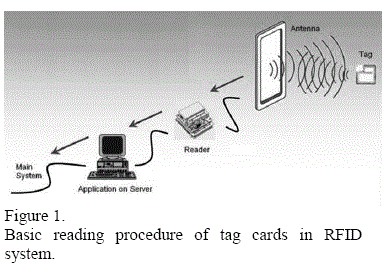
<body><![CDATA[<br> <font size="2" face="Verdana"><i><sup>c </sup>Vale Institute of Technology, Belo Horizonte, Minas Gerais, Brazil, Leandro.<a href="mailto:silveira@itv.org">silveira@itv.org</a></i></font></p>     <p align=center>&nbsp;</p>     <p align=center>&nbsp;</p> <hr> <font size="2" face="Verdana"><b>Abstract</b></font>     <p align="justify"><font size="2" face="Verdana">The developments of applied RFID technology overcome all supposedly insurmountable obstacles and limits because it allows monitoring everything that moves in the mine. These features make it possible to apply  such technology for the comprehensive safety plan of the underground mine. For  instance, this research paper presents &quot;online&quot; RFID technology  applied to a full safety system for underground mines exploited by any mining   method. This technology allows the identification of each worker, their  functions and localization in the mine. On the other hand, it is applicable to  the identification of the underground mine equipment and their movement, thus permitting to control productivity and safety.</font></p>     <p align="justify"><font size="2" face="Verdana"><i><b>Keywords</b></i><b>:</b> Security, underground mine; RFID; identification; radio frequency.</font></p> <hr>     <p align="justify"><font size="2" face="Verdana"><b>Resumen</b></font></p>     <p align="justify"><font size="2" face="Verdana">El desarrollo de la tecnolog&iacute;a RFID aplicada supera todos los obst&aacute;culos y l&iacute;mites que son supuestamente insuperables, porque permite monitorear todo lo que se mueve en la mina. Esta   particularidad hace posible aplicar tal tecnolog&iacute;a para el plan de seguridad integral de la mina subterr&aacute;nea. En ese sentido este trabajo de investigaci&oacute;n presenta la tecnolog&iacute;a RFID &quot;online&quot; aplicada para un sistema de seguridad completo para minas subterr&aacute;neas explotadas por cualquier m&eacute;todo minero.  Esta tecnolog&iacute;a permite la identificaci&oacute;n de cada uno de los trabajadores, de sus funciones y su localizaci&oacute;n en la mina. Por otro lado, es aplicable para la identificaci&oacute;n de los equipos de la mina subterr&aacute;nea y su movimiento, permitiendo por lo tanto controlar la productividad y la seguridad.</font></p>     <p align="justify"><font size="2" face="Verdana"><i><b>Palabras clave</b></i><b>:</b> Seguridad; mina subterr&aacute;nea; RFID; identificaci&oacute;n, radio frecuencia.</font></p> <hr>     <p align="justify">&nbsp;</p>     <p align="justify">&nbsp;</p>     ]]></body>
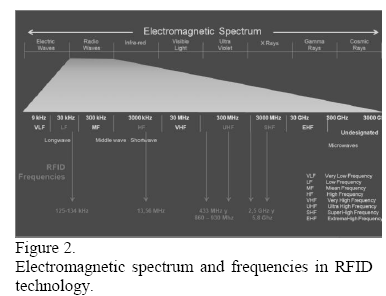
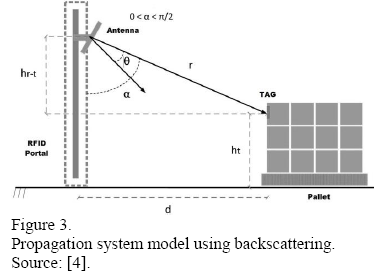
<body><![CDATA[<p align="justify"><font size="3" face="Verdana"><b>1 Introduction</b></font></p>     <p align="justify">&nbsp;</p>     <p align="justify"><font size="2" face="Verdana">The radio frequency identification (RFID) is the technology to automatically capture and  identify information stored in electronic cards called tags, within the range   of the RFID reader.  This information stored in tags memory is transmitted by radio without physical or visual contact.</font></p>     <p align="justify"><font size="2" face="Verdana">The   principal feature of this identification system is to provide an important added value because the RFID chip can store a lot of information [1].</font></p>     <p align="justify"><font size="2" face="Verdana">When the tags are linked to a RFID reader antenna range, this unit emits a signal to the tag in order to get the information of the card. Generally this information consists exclusively in an identification code (Fig. 1).</font></p>     <p align="justify"><font size="2" face="Verdana">The keys of the technology are that the information recovery is carried out by radio  frequency and no physical or visual contact is required. Nevertheless, in most  cases the range of a reader is quite short so both elements of the RFID system, card and reader, must be close to each other.</font></p>     <p align="center"><img src="/img/revistas/mamym/n5/a06_figura01.gif" width="391" height="272"></p>     <p align="justify"><font size="2" face="Verdana">The radio  wave spectrum permits the use of a wide range of frequencies (Fig. 2), each one  of them can be used to improve results, for instance increase the reading  range, minimize distortions induced by high humidity media, reduce signal propagation errors in metallic ore bodies etc.</font></p>     <p align="center"><img src="/img/revistas/mamym/n5/a06_figura02.gif" width="386" height="296"></p>     <p align="justify"><font size="2" face="Verdana">Fig. 3   shows schematically a RFID propagation system model using backscattering. It is possible to see the antenna and a lower level object with the TAG [1-3].</font></p>     ]]></body>
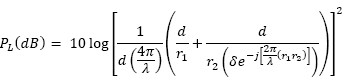
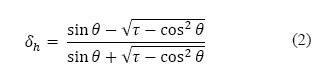
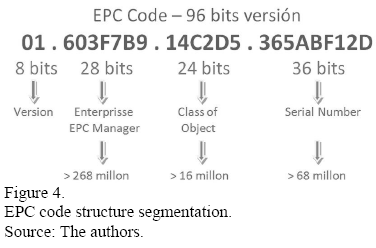
<body><![CDATA[<p align="center"><img src="/img/revistas/mamym/n5/a06_figura03.gif" width="374" height="276"></p>     <p align="justify"><font size="2" face="Verdana">The eq. (1) [5] is used to calculate the loss expressed in decibels for this two ray models.</font></p>     <p align="center"><img src="/img/revistas/mamym/n5/a06_figura04.gif" width="351" height="82"></p>     <p align="justify"><font size="2" face="Verdana">Where   <i>d</i> is the distance between reader and TAG and &lambda; is the wavelength of the signal. The &delta; parameter is related to wave polarization effects and, for a horizontally positioned antenna, is expressed by [6]:</font></p>     <p align="center"><img src="/img/revistas/mamym/n5/a06_figura05.gif" width="318" height="79"></p>     <p align="justify"><font size="2" face="Verdana">Same way it is possible to express the value of &delta;  for a TAG antenna vertically positioned.</font></p>     <p align="justify"><font size="2" face="Verdana">Where<i> </i>&theta; is the incidence angle, <i>h<sub>t</sub></i> is the height of the reader antenna and <i>hr</i> is the TAG height.</font></p>     <p align="justify"><font size="2" face="Verdana">The parameter &tau; depends on the relative permissivity,<i> </i>&epsilon;, the reflector material conductivity, <i>&micro;</i>, and also on the operation frequency, <i>f</i>. It is expressed by eq. (4) [5].</font></p>     <p align="center"><img src="/img/revistas/mamym/n5/a06_figura07.gif" width="296" height="52"></p>     <p align="justify"><font size="2" face="Verdana">Finally <i>r<sub>1</sub></i> and <i>r<sub>2</sub></i> are the length of the radio wave reflected routes; r<sub>1</sub> is the distance between the transmission antenna and the reflection point and <i>r<sub>2</sub></i>   is the one between the reflection point and the reception antenna. They are calculated by:</font></p>     ]]></body>
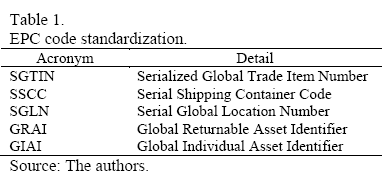
<body><![CDATA[<p align="center"><img src="/img/revistas/mamym/n5/a06_figura08.gif" width="326" height="74"></p>     <p align="justify"><font size="3" face="Verdana"><b>2 RFID Technology</b></font></p>     <p align="justify"><font size="2" face="Verdana"><b><i>2.1 Identification using RFID</i></b></font></p>     <p align="justify"><font size="2" face="Verdana">This technology followed the same way of the bar code.  After heterogeneous beginnings follows the standardization in the form of EPC (Electronic Product Code). This code has a design structured based on 96 bits, segmented in 4 fields. (Heading, producer identification, product identification and serial identification) [2,7,8].</font></p>     <p align="justify"><font size="2" face="Verdana">This quantity of digits allows a quite large number of combinations (Fig. 4).</font></p>     <p align="center"><img src="/img/revistas/mamym/n5/a06_figura09.gif" width="376" height="248"></p>     <p align="justify"><font size="2" face="Verdana">The standardization implies that it is necessary to define certain number of identification internal structures to satisfy different requirements (Table 1).</font></p>     <p align="center"><img src="/img/revistas/mamym/n5/a06_figura10.gif" width="383" height="180"></p>     <p align="justify">&nbsp;</p>     <p align="justify"><font size="2" face="Verdana"><b><i>2.2 Components and electronic cards (TAG) types</i></b></font></p>     ]]></body>
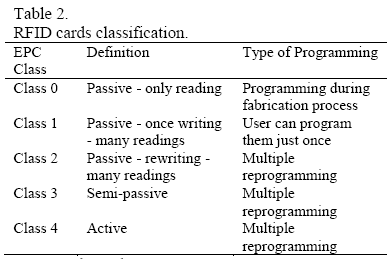
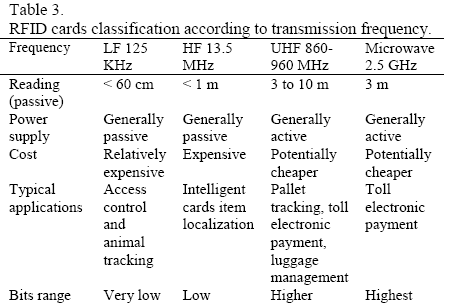
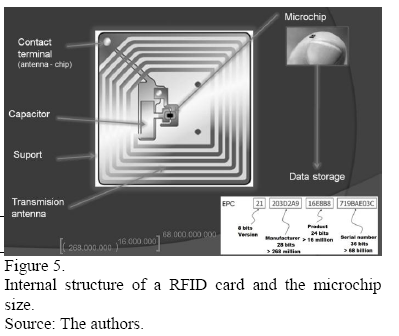
<body><![CDATA[<p align="justify"><font size="2" face="Verdana">This technology is classified as   AutoID (Auto Identification). A RFID card is a small gadget that can be  attached to an object, an animal or to person’s clothes. Contains antennas to receive and answer requisitions by radiofrequency emitted from a RFID transmitter receiver.</font></p>     <p align="justify"><font size="2" face="Verdana">Taking into account the power supply, it is possible to classify cards into 3 types: passive, active and semi passive.</font></p>     <p align="justify"><font size="2" face="Verdana">The cards can also be classified by the different kind of programming you can do, and the transmitting wave band (Tables 2-3).</font></p>     <p align="center"><img src="/img/revistas/mamym/n5/a06_figura11.gif" width="387" height="259"></p>     <p align="center"><img src="/img/revistas/mamym/n5/a06_figura12.gif" width="449" height="307"></p>     <p align="justify"><font size="2" face="Verdana"><b><i>2.3 Selecting a TAG</i></b></font></p>     <p align="justify"><font size="2" face="Verdana">It is necessary to consider the  storage capacity of a TAG. At the beginning the capacity was 64 bits. Nowadays  the standard is 96 bits but is expectable the use of 128 or 256 bits cards in next years.</font></p>     <p align="justify"><font size="2" face="Verdana">The internal tag structure is composed by microchip, antenna ship, capacitor, support, and transmission  antenna. The antenna mounted on a base involves the capacitor for that provide  power energy for data reading on the chip and  these are transmitted as a radio signal and also show the size of the memory microchip (Fig. 5) [9].</font></p>     <p align="center"><img src="/img/revistas/mamym/n5/a06_figura13.gif" width="399" height="336"></p>     <p align="justify"><font size="2" face="Verdana">Probably it would be necessary to  use different cards for each point, equipment or people. Table 4 illustrates some particularities of active and passive TAGs [1,3,10].</font></p>     ]]></body>
<body><![CDATA[<p align="center"><img src="/img/revistas/mamym/n5/a06_figura14.gif" width="398" height="419"></p>     <p align="justify"><font size="2" face="Verdana">For TAG selection the most important parameters to consider are as follows:</font></p> <ul>       <li><font size="2" face="Verdana" align="justify"> TAG adhesion;</font></li>       <li><font size="2" face="Verdana" align="justify"> Passive or active functioning;</font></li>       <li><font size="2" face="Verdana" align="justify"> TAG reader range;</font></li>       <li><font size="2" face="Verdana" align="justify"> Size and weight;</font></li>       <li><font size="2" face="Verdana" align="justify"> Transmission velocity;</font></li>       <li><font size="2" face="Verdana" align="justify"> Orientation sensibility;</font></li>       <li><font size="2" face="Verdana" align="justify"> Kill/Disable (In habilitation);</font></li>       <li><font size="2" face="Verdana" align="justify"> Write Once;</font></li>       ]]></body>
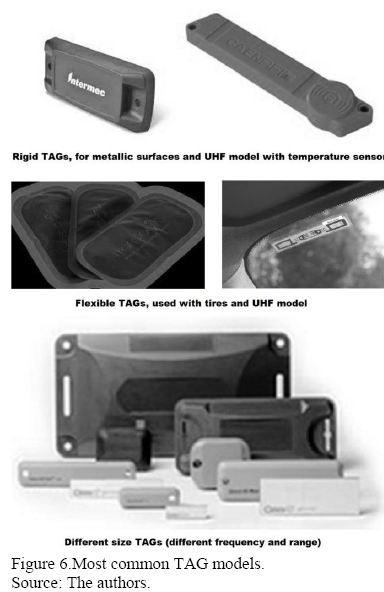
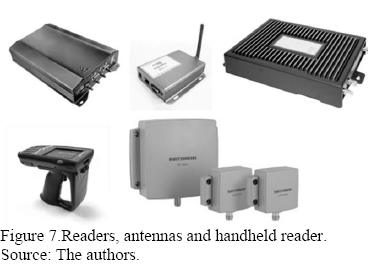
<body><![CDATA[<li><font size="2" face="Verdana" align="justify"> Write Any;</font></li>       <li><font size="2" face="Verdana" align="justify"> Anti-collision;</font></li>       <li><font size="2" face="Verdana" align="justify"> Security and encryption;</font></li>       <li><font size="2" face="Verdana" align="justify">Supported standards.</font></li>     </ul>     <p align="justify"><font size="2" face="Verdana">The most common TAGS are rigid and flexible (Fig. 6).</font></p>     <p align="center"><img src="/img/revistas/mamym/n5/a06_figura15.gif" width="384" height="592"></p>     <p align="justify"><font size="2" face="Verdana"><b><i>2.4 Readers and antennas</i></b></font></p>     <p align="justify"><font size="2" face="Verdana">Readers call transceivers in  electronic field and them act as identification station signal request  transmitted to the TAGs and getting the answer to the requests. A reader needs one or more antennas to communicate with TAGs (Fig. 7).</font></p>     <p align="justify"><font size="2" face="Verdana">Estes  acts as station identification request signals transmitted to the TAGs and getting the answers to these requests.</font></p>     ]]></body>
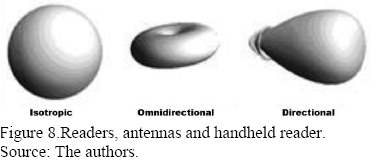
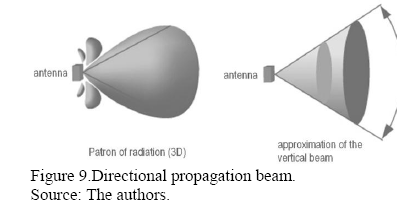
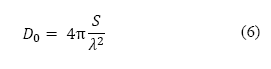
<body><![CDATA[<p align="center"><img src="/img/revistas/mamym/n5/a06_figura16.gif" width="368" height="268"></p>     <p align="justify"><font size="2" face="Verdana">The selection of the antennas is not a minor issue, depending on the location of the same sector should opt for   the method of radiation from them. These methods are classified into isotropic radiation, omnidirectional and directive.  In underground mines most people has  selected the directive radiation type, using robust readers that permit the use in hostile environments (Fig. 8).</font></p>     <p align="center"><img src="/img/revistas/mamym/n5/a06_figura17.gif" width="376" height="164"></p>     <p align="justify"><font size="2" face="Verdana">One of the most important  features of the radiation standard is the hability to energy oriented, which  provides more power in a reading direction. When gain increasing in such antenna, the radiation angle of the signal decreases. It must be balanced in this election coverage radius of the antenna and the maximum reading distance.</font></p>       <p align="justify"><font size="2" face="Verdana">The most important feature of the directive radiation standard is the possibility to energy direct in diverse direction (Fig. 9) [1,8,11].</font></p>     <p align="center"><img src="/img/revistas/mamym/n5/a06_figura18.gif" width="403" height="207"></p>     <p align="justify"><font size="2" face="Verdana">The directivity D<sub>O</sub> for this antenna calculates by eq. (6), where <i>S</i> is the area and <i>&lambda;</i> is the wavelength.</font></p>     <p align="center"><img src="/img/revistas/mamym/n5/a06_figura19.gif" width="271" height="69"></p>     <p align="justify"><font size="2" face="Verdana"><b><i>2.5 Middleware</i></b></font></p>     <p align="justify"><font size="2" face="Verdana">Readers works simultaneously and  so are the readings of all over the objects using RFID cards within their range  and this information must be transmitted to companies’ information systems. These facts lead to the essential use of an element that controls these readings.</font></p>     ]]></body>
<body><![CDATA[<p align="justify"><font size="2" face="Verdana">This element is the middleware  which is an informatics platform that permits to contextualize each one of cards   and control them, using some criteria. This way, the TAG receipted signal is  transmitted once and not hundreds of times from a same reading point. So the  middleware administrates data and avoids collisions. This element permits to  administrate the answering velocity that some events needs and associate those TAGs with an optimal emission frequency [3, 7]. </font></p>     <p align="justify"><font size="2" face="Verdana">In the middleware equipment  selection, it is very important to consider the following conditions for de RFID platform: </font></p> <ul>       <li><font size="2" face="Verdana" align="justify">To control every type of RFID device;</font></li>       <li><font size="2" face="Verdana" align="justify"> To capture data of the velocity and efficacy; </font></li>       <li><font size="2" face="Verdana" align="justify"> To real time control TAG locations;</font></li>       <li><font size="2" face="Verdana" align="justify"> To centrally control every internal or external RFID data sources;</font></li>       <li><font size="2" face="Verdana" align="justify"> To secure data coherency;</font></li>       <li><font size="2" face="Verdana" align="justify"> Send information to devices when necessary (Record a Chip).</font></li>       <li><font size="2" face="Verdana" align="justify"> To permit wireless RFID net service. </font></li>       <li><font size="2" face="Verdana" align="justify">The goal of this service is to centralize every facility as security, data, telephony and video.</font></li>     ]]></body>
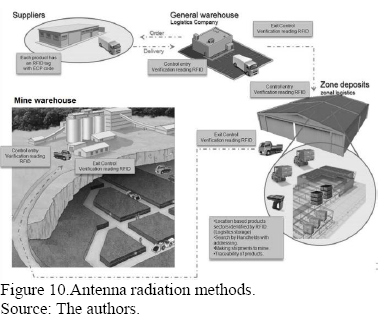
<body><![CDATA[</ul>     <p align="justify"><font size="2" face="Verdana">This wireless technology reduces costs and permits to accelerate the implementation of new underground sectors, also allowing to know the exact real time localization of all workers, equipment and device whose monitoring is necessary [3,7].</font></p>     <p align="justify">&nbsp;</p>     <p align="justify"><font size="3" face="Verdana"><b>3 Possibilities of RFID technology application in underground mining</b></font></p>     <p align="justify"><font size="2" face="Verdana"><b><i>3.1 Supplies logistic distribution</i></b></font></p>     <p align="justify"><font size="2" face="Verdana">It is possible to incorporate the RFID technology in the logistics distribution network of underground mining operations in two different ways:</font></p> <ul>       <li><font size="2" face="Verdana" align="justify">     Open circuit: the mining operation reuses the same TAG of the provider to track the products inside the mine (Fig. 10).</font></li>       <li><font size="2" face="Verdana" align="justify">     Closed circuit: the mining company put new TAGs on the products that are going to be distributed in the mine environment.</font></li>     </ul>     <p><font size="2" face="Verdana" align="justify">In open circuit supplies logistics distribution, the supplies labeled by the provider are received at general warehouse and from this building they are going to be distributed to areal warehouses. Later on it is possible to further redistribute the labeled supplies to other surface or underground warehouses [8,9,10,12].</font></p>     ]]></body>
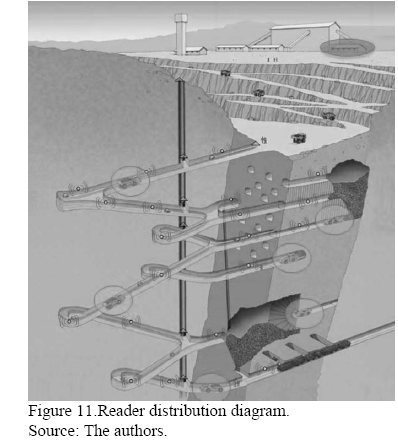
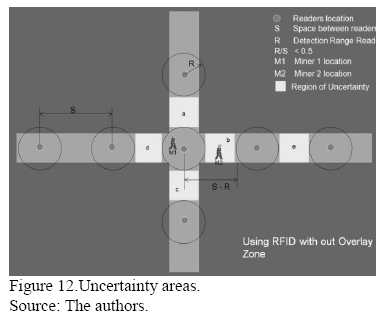
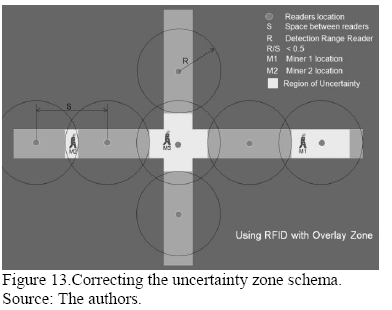
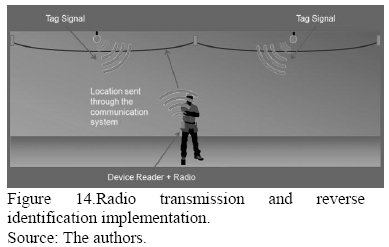
<body><![CDATA[<p align="center"><img src="/img/revistas/mamym/n5/a06_figura20.gif" width="386" height="320"></p>     <p align="justify"><font size="2" face="Verdana"><b><i>3.2 People localization in underground mine</i></b></font></p>     <p align="justify"><font size="2" face="Verdana">For mining  safety, it is very important to know the exact location of each worker. At the  same time it is also important to know exactly where the rescue and first aid teams are. </font></p>     <p align="justify"><font size="2" face="Verdana">The main entrance as well as the level entrances must have strategically located readers to ensure the process. Generally the readers are located at the lifts doors. In Fig. 11 they are indicated by triangles.</font></p>     <p align="center"><img src="/img/revistas/mamym/n5/a06_figura21.gif" width="398" height="446"></p>     <p align="justify"><font size="2" face="Verdana">In drifts or ramps of underground mine the antennas are located based in the range and the spacing of readers. The goal is to decrease the personal location uncertainty areas. Fig. 12 shows a miner M1 detected using intersection drifts. If this worker moves in one the four possible directions nobody could say where he is until his TAG is read in other location provided with reader. So, in this case, considering the initial position of miner M1 there are four uncertainty zones: a, b, c and d.</font></p>     <p align="center"><img src="/img/revistas/mamym/n5/a06_figura22.gif" width="379" height="319"></p>     <p align="justify"><font size="2" face="Verdana">On the other hand Fig. 13 shows that changing the antenna position permits to reduce the uncertainty areas. So, it is not necessary to reduce the uncertainty areas to a near zero value. Structural ore body studies allow to determinate some low risk uncertainty zones.</font></p>     <p align="justify"><font size="2" face="Verdana">It is also possible to improve the accuracy of reader positioning by combining reverse identification process with radio transmissions. The method is very simple indeed. Active TAGs are installed along the drifts ceiling and this permits to increase the range and the spacing between them, providing the signal overlapping. In this case the miner carries the antenna, which includes a radio [13, 14].</font></p>     <p align="center"><img src="/img/revistas/mamym/n5/a06_figura23.gif" width="392" height="310"></p>     ]]></body>
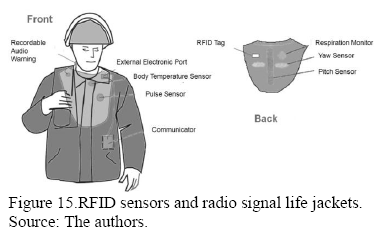
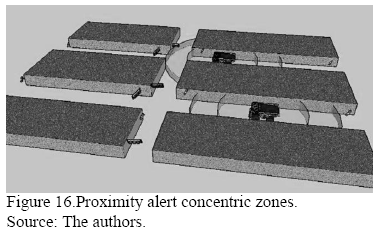
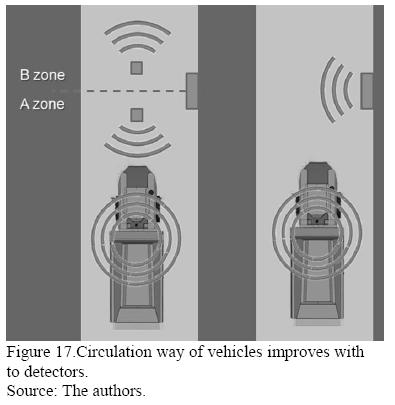
<body><![CDATA[<p align="justify"><font size="2" face="Verdana">There is a software in the device that calculates the distance to the active ceiling TAG doing 5 emissions per second and transmits the exact location through the communication system (Fig. 14).</font></p>     <p align="center"><img src="/img/revistas/mamym/n5/a06_figura24.gif" width="389" height="247"></p>     <p align="justify"><font size="2" face="Verdana"><b><i>3.3 Evacuation and rescue ID and tracking</i></b></font></p>     <p align="justify"><font size="2" face="Verdana">In underground mining accidents, it is essential to know the exact location of   each worker and also to know where the rescue and first aid teams are. Thanks  to the maps generated by software it is possible to immediately activate alarms  and to implement evacuation protocols,  to monitor and guide rescue teams, do  the same with workers and conduct them to safe places or operating lifts, to  stop truck traffic and to stop works affected directly or indirectly by the accident.</font></p>     <p align="justify"><font size="2" face="Verdana">The members of rescue teams would wear last generation security jackets that use RFID TAG linked to a number of sensors and which also have external radio connection (Fig. 15).</font></p>     <p align="center"><img src="/img/revistas/mamym/n5/a06_figura25.gif" width="375" height="235"></p>     <p align="justify"><font size="2" face="Verdana"><b><i>3.4 Detection areas</i></b></font></p>     <p align="justify"><font size="2" face="Verdana">The proximity monitor warns the vehicle driver about workers and other equipment in his proximity. To do this, it is necessary to put a TAG and an antenna on the vehicle, which will work as a radar system, informing the driver to avoid  collision or unsafe situations. The reader on the vehicle has a computer that  warns about the proximity of people and equipment by emitting sound and light.</font></p>     <p align="justify"><font size="2" face="Verdana">Boundaries  of safety zones can be adjusted using algorithms that evaluate the intensity of the received signal, generating, for example a growing level sound (Fig. 16). Proximity   monitor system requires a RFID wireless net and the suitable software. This software could use algorithms to adjust the range of detection zones, generally between 10 and 300 m.</font></p>     <p align="center"><img src="/img/revistas/mamym/n5/a06_figura26.gif" width="377" height="234"></p>     ]]></body>
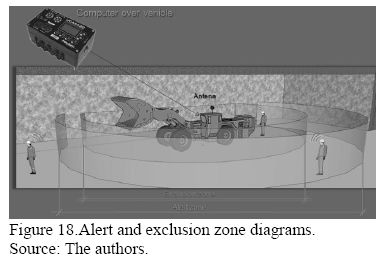
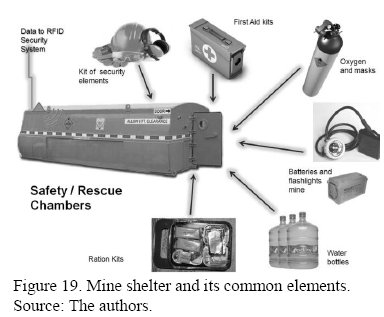
<body><![CDATA[<p align="justify"><font size="2" face="Verdana">The algorithm must provide the maximum security level and reliability and also consider the operator comfort. The system must have a non-invasive low level alert at the moment people or equipment come within a particular fixe range of alarm or restriction. The driver must have the possibility to disable the alert, but the incident must be registered in central safety system.</font></p>     <p align="justify"><font size="2" face="Verdana">The  combined Wi-Fi RFID applications have been tested in underground mining industry with success. One of the most remarkable are the Wi-Fi signals propagation around corners that generate “virtual visibility” environment on crossing galleries uncompromising the traffic there. In addition to this warning system on the vehicle, you can manage to posters LED for to display alerts and traffic regulates in underground environment. The precise location of the vehicle can be adjusted based on how the antennas are installed.</font></p>     <p align="center"><img src="/img/revistas/mamym/n5/a06_figura27.gif" width="395" height="405"></p>     <p align="justify"><font size="2" face="Verdana">The system depicted in the right side of Fig. 17 has an antenna which can detect the moving equipment, but cannot identify its movement direction. The left side of the same figure shows that a system consisting of two ceiling detectors can provide enough data to process this information, allowing to determine the direction of the movement [3,7,10,13,14].</font></p>     <p align="justify"><font size="2" face="Verdana"><b><i>3.5 Exclusion areas</i></b></font></p>     <p align="justify"><font size="2" face="Verdana">The exclusion zone subsystem can function as an autonomous component or totally integrated to the central safety system. The same system can be adapted to reduce the risk to workers who have no authorization to be near certain equipment (Fig. 18) [14].</font></p>     <p align="center"><img src="/img/revistas/mamym/n5/a06_figura28.gif" width="380" height="259"></p>     <p align="justify"><font size="2" face="Verdana">Different kind of sounds can identify people within alert or exclusion zones, and simultaneously recognize the arrival of additional equipment.</font></p>     <p align="justify"><font size="2" face="Verdana"><b><i>3.6 Underground safety rescue chambers</i></b></font></p>     <p align="justify"><font size="2" face="Verdana">It is not necessary to inspect a mine safety shelter if all the standard elements inside have a TAG.</font></p>     ]]></body>
<body><![CDATA[<p align="justify"><font size="2" face="Verdana">An antenna  in the shelter permits to read the identification cards and to verify not only the existence of those elements, but also their condition (Fig. 19).</font></p>     <p align="justify"><font size="2" face="Verdana">With the  knowledge of the safety and survival elements contained in the shelter, it is possible to know how much people can be there and for how much time.</font></p>     <p align="center"><img src="/img/revistas/mamym/n5/a06_figura29.gif" width="384" height="317"></p>     <p align="justify"><font size="2" face="Verdana"><b><i>3.7 Integral safety system in underground mining</i></b></font></p>     <p align="justify"><font size="2" face="Verdana" align="justify">A system like this must be constituted by different subsystems:</font></p> <ul>    <li><font size="2" face="Verdana" align="justify">  Supplies acquisition and distribution;</font></li>       <li><font size="2" face="Verdana" align="justify">     Personal registry and tracking;</font></li>       <li><font size="2" face="Verdana" align="justify">     Security: must include operational restricted areas, shelter locations etc;</font></li>       <li><font size="2" face="Verdana" align="justify">     Equipment registry and tracking: must include equipment particular restriction areas, nearby authorized personal etc;</font></li>       <li><font size="2" face="Verdana" align="justify">     Equipment collision control: includes the restricted area administration module;</font></li>       ]]></body>
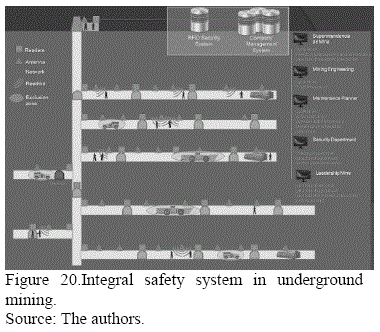
<body><![CDATA[<li><font size="2" face="Verdana" align="justify">     Equipment maintenance;</font></li>       <li><font size="2" face="Verdana" align="justify">     Transport and traffic regulation: includes the traffic lights and LED signal module;</font></li>       <li><font size="2" face="Verdana" align="justify">     Assignment and monitoring rescue team;</font></li>       <li><font size="2" face="Verdana" align="justify">     Communication and VOIP telephony;</font></li>       <li><font size="2" face="Verdana" align="justify">     Video.</font></li>     </ul>     <p align="justify"><font size="2" face="Verdana">Implementing and adapt every subsystem requires a multidisciplinary team that at least must   be integrated by: mining engineers, geologists, logistic engineers, safety and rescue experts, informatics, communication engineers, accountants and lawyers. </font></p>     <p align="justify"><font size="2" face="Verdana">Fig. 20 shows schematically the monitoring and the tracking possibility of workers, equipment, shelters etc., and their impact on the routine of underground mining [15].</font></p>     <p align="center"><font size="2" face="Verdana"><img src="/img/revistas/mamym/n5/a06_figura30.gif" width="380" height="332"></font></p>     <p align="justify"><font size="2" face="Verdana">This multidisciplinary challenge, should become a research  project consortium to define minimum safety standards in underground environment using RFID.</font></p>     ]]></body>
<body><![CDATA[<p align="justify">&nbsp;</p>     <p align="justify"><font size="3" face="Verdana"><b>4  Conclusions</b></font></p>     <p align="justify"><font size="2" face="Verdana">The RFIDS technology applies in underground mines is very innovative and have great potential to contribute for safety problems solutions.</font></p>     <p align="justify"><font size="2" face="Verdana">It is possible to develop such kind of project with norms and protocols of extreme safety standards using the technology presented here.</font></p>     <p align="justify"><font size="2" face="Verdana">The cost of RFID elements is lower.</font></p>     <p align="justify"><font size="2" face="Verdana">The RFID technology will be contribute to proactive and in real time operational and safety management in underground mining.</font></p>     <p align="justify"><font size="2" face="Verdana">  </font></p>     <p align="justify"><font size="3" face="Verdana"><b>Acknowledgements</b></font></p>     <p align="justify">&nbsp;</p>     <p align="justify"><font size="2" face="Verdana">The authors would like to thank CYTED for financial support to the Underground Environment and Sustainability of Underground Environment Program and to the Sustainability Ibero-American Research Network. They are also grateful to Vale Institute of Technology – Mining for its institutional support.</font></p>     ]]></body>
<body><![CDATA[<p align="justify">&nbsp;</p>     <p align="justify"><font size="3" face="Verdana"><b>References</b></font></p>      <p align="justify"><font size="2" face="Verdana">[1] Glover, B &amp; Bhatt,H. RFID essentials, Sebastopol, CA, USA, O'Reilly, 2006.</font></p>     <p align="justify"><font size="2" face="Verdana">[2] Qiao, Y., Chen, S. &amp; Tao, L. RFID as an infrastructure, New York, NY, USA, Springer, 2013.</font></p>     <p align="justify"><font size="2" face="Verdana">[3] Thornton, F., Haines,   B., Das, A., Bhargava, H., Campbell, A. &amp; Kleinschmidt, J. RFID security, Rockland, MA, USA, Syngress, 2006.</font></p>     <p align="justify"><font size="2" face="Verdana">[4]  Goes, A. A.  Modelo de propagacao emp&iacute;rico para sistemas RFID passivo. PhD Dissertation, Faculdade   de Engenharia El&eacute;trica e Computacao, Universidade Estadual de Campinas, Campinas, SP, Brasil, 2014.</font></p>     <p align="justify"><font size="2" face="Verdana">[5] Siwiak, K. &amp;  Bahreini, Y. Radiowave propagation and antennas for personal communications, Norwood, MA, USA, Artech House, 2007.</font></p>     <p align="justify"><font size="2" face="Verdana">[6] Saunders, S. &amp; Zavala, A. Antennas and propagation for wireless communication systems, Chichester, England, John Wiley &amp; Sons, 2007.</font></p>     <p align="justify"><font size="2" face="Verdana">[7] RFID World Canada. Innovative UHF Gen 2 RFID reader/writer [online], 2010. [date of reference June 2nd of 2015]. Available at: &lt; <a href="http://www.rfidworld.ca/innovative-uhf-gen-2-rfid-readerwriter/50" target="_blank">http://www.rfidworld.ca/innovative-uhf-gen-2-rfid-readerwriter/50 </a></font></p>     <p align="justify"><font size="2" face="Verdana">[8] Hunt, V., Puglia, A. &amp; Puglia, M. RFID: a guide to radio frequency identification, Hoboken, NJ, USA, Wiley-InterScience, 2007.</font></p>     ]]></body>
<body><![CDATA[<p align="justify"><font size="2" face="Verdana">[9] RFID World Canada. Long-range active RFID interrogator handles many tags simultaneously [online], 2011. [date of reference June 2nd of 2015]. Available at: <a href="http://www.rfidworld.ca/long-range-active-rfid-interrogator-handles-many-tags-simultaneously/562" target="_blank">http://www.rfidworld.ca/long-range-active-rfid-interrogator-handles-many-tags-simultaneously/562</a> </font></p>     <p align="justify"><font size="2" face="Verdana">[10]   Atilano, R. H. Identificaci&oacute;n de veh&iacute;culos empleando RFID-EPC,  Saarbr&uuml;cken, Alemania, OmniScriptum / Editorial Acad&eacute;mica Espa&ntilde;ola, 2012.</font></p>     <p align="justify"><font size="2" face="Verdana">[11]  Ripoll, J. V.  H. Dise&ntilde;o de antenas UHF para aplicaciones RFID, Engineering Thesis, Barcelona,   Espa&ntilde;a, Escola T&eacute;cnica Superior d'Enginyeria, Universitat Autònoma de Barcelona, 2009.</font></p>     <p align="justify"><font size="2" face="Verdana">[12]   RFID   World Canada. New RFID solution decreases maintenance times on Boeing airplanes [online], 2011. [date of reference June 2nd of 2015]. Available at: <a href="http://www.rfidworld.ca/new-rfid-solution-decreases-maintenance-times-on-boeing-airplanes/249" target="_blank">http://www.rfidworld.ca/new-rfid-solution-decreases-maintenance-times-on-boeing-airplanes/249</a></font></p>     <p align="justify"><font size="2" face="Verdana">[13] Mine Safety and Health Administration (MSHA) – <a href="www.msha.gov" target="_blank">www.msha.gov</a></font></p>     <p align="justify"><font size="2" face="Verdana">[14]   National Institute for Occupational Safety and Health (NIOSH) – <a href="www.cdc.gov/NIOSH/" target="_blank">www.cdc.gov/NIOSH/</a></font></p>     <p align="justify"><font size="2" face="Verdana">[15]   Navarro Torres, V. F., Dinis da Gama, C. &amp; Villas Boas, R., Engenharia ambiental subterr&aacute;nea e aplicaccoes, Rio de Janeiro: CETEM / CNPq / CYTED, 2005.</font></p>     <p align="justify">&nbsp;</p>     <p align="justify">&nbsp;</p>      ]]></body>
</article>