<?xml version="1.0" encoding="ISO-8859-1"?><article xmlns:mml="http://www.w3.org/1998/Math/MathML" xmlns:xlink="http://www.w3.org/1999/xlink" xmlns:xsi="http://www.w3.org/2001/XMLSchema-instance">
<front>
<journal-meta>
<journal-id>2518-8283</journal-id>
<journal-title><![CDATA[Educación Superior]]></journal-title>
<abbrev-journal-title><![CDATA[Edu. Sup. Rev. Cient. Cepies]]></abbrev-journal-title>
<issn>2518-8283</issn>
<publisher>
<publisher-name><![CDATA[Centro Psicopedagógico y de Investigación  en Educación Superior CEPIES-UMSA]]></publisher-name>
</publisher>
</journal-meta>
<article-meta>
<article-id>S2518-82832021000200008</article-id>
<title-group>
<article-title xml:lang="en"><![CDATA[A bibliometric analysis of the adoption and use of e-learning in higher education]]></article-title>
<article-title xml:lang="es"><![CDATA[Un análisis bibliométrico sobre el uso y la adopción de la educación en línea en la enseñanza superior]]></article-title>
</title-group>
<contrib-group>
<contrib contrib-type="author">
<name>
<surname><![CDATA[Ortega Azurduy]]></surname>
<given-names><![CDATA[Martin]]></given-names>
</name>
<xref ref-type="aff" rid="A01"/>
</contrib>
</contrib-group>
<aff id="A01">
<institution><![CDATA[,International School of Business  ]]></institution>
<addr-line><![CDATA[ ]]></addr-line>
</aff>
<pub-date pub-type="pub">
<day>00</day>
<month>09</month>
<year>2021</year>
</pub-date>
<pub-date pub-type="epub">
<day>00</day>
<month>09</month>
<year>2021</year>
</pub-date>
<volume>8</volume>
<numero>2</numero>
<fpage>49</fpage>
<lpage>66</lpage>
<copyright-statement/>
<copyright-year/>
<self-uri xlink:href="http://www.scielo.org.bo/scielo.php?script=sci_arttext&amp;pid=S2518-82832021000200008&amp;lng=en&amp;nrm=iso"></self-uri><self-uri xlink:href="http://www.scielo.org.bo/scielo.php?script=sci_abstract&amp;pid=S2518-82832021000200008&amp;lng=en&amp;nrm=iso"></self-uri><self-uri xlink:href="http://www.scielo.org.bo/scielo.php?script=sci_pdf&amp;pid=S2518-82832021000200008&amp;lng=en&amp;nrm=iso"></self-uri><abstract abstract-type="short" xml:lang="en"><p><![CDATA[Abstract This bibliometric analysis identifies and presents the articles that have given shape to the current research trends on the adoption and use of e-learning in higher education using structural equation modeling. Metadata for scholarly work was obtained from The Lens database, and network visualization was produced with VOSviewer. This study includes 414 articles published between 2006 and 2021. The results consider four thematic clusters, a list of the 10 most cited articles, a word cloud for fields of study, and two network visualization maps (citation and keywords). As the first bibliometric paper that addresses articles using structural equation modeling techniques, the main contribution of this paper is to quantitatively synthesize the large quantity of bibliometric metadata obtained and present the state, structure, and trends in the study of the adoption and use of e-learning in higher education. Specifically, this paper will introduce the most influential authors and papers, key themes, current and future areas of research. In conclusion, this paper should serve as a resource for future research, as well as, to be an example of how to carry out a basic bibliometric analysis.]]></p></abstract>
<abstract abstract-type="short" xml:lang="es"><p><![CDATA[Resumen Este análisis bibliométrico identifica y presenta los artículos que han dado forma a las tendencias actuales en la investigación de la adopción y el uso del e-learning en la educación superior utilizando modelos de ecuaciones estructurales. Los metadatos para este trabajo académico se obtuvieron de la base de datos The Lens, y la visualización de redes se produjo con VOSviewer. Un total de 414 artículos publicados entre 2006 y 2021 se incluyen en este estudio. Los resultados de este estudio incluyen: cuatro grupos temáticos, una lista de los 10 artículos más citados, una nube de palabras para áreas de estudio, dos mapas de visualización de redes (citas y palabras clave). Siendo el primer trabajo bibliométrico que aborda específicamente artículos que usan técnicas de modelos de ecuaciones estructurales, la principal contribución de este trabajo es sintetizar cuantitativamente la gran cantidad de metadatos bibliométricos obtenidos y presentar el estado, la estructura y las tendencias en el estudio de la adopción y el uso del e-learning en la educación superior. Específicamente, este trabajo introducirá los trabajos y autores más influyentes, temas centrales, y áreas de investigación actual y futura. En conclusión, este trabajo debe servir como un recurso para futuras investigaciones, así como, para ser un ejemplo sobre cómo llevar a cabo un análisis bibliométrico básico.]]></p></abstract>
<kwd-group>
<kwd lng="en"><![CDATA[Bibliometric Analysis]]></kwd>
<kwd lng="en"><![CDATA[E-learning]]></kwd>
<kwd lng="en"><![CDATA[Structural Equation Modelling]]></kwd>
<kwd lng="en"><![CDATA[Higher Education]]></kwd>
<kwd lng="es"><![CDATA[Análisis Bibliométrico]]></kwd>
<kwd lng="es"><![CDATA[Educación en Línea]]></kwd>
<kwd lng="es"><![CDATA[Modelos de Ecuaciones Estructurales]]></kwd>
<kwd lng="es"><![CDATA[Educación Superior]]></kwd>
</kwd-group>
</article-meta>
</front><body><![CDATA[ <p align="right"><font size="2" face="Verdana, Arial, Helvetica, sans-serif"><strong>ART&Iacute;CULOS CIENT&Iacute;FICOS</strong></font></p>     <p align="right">&nbsp;</p>     <p align="center"><strong><font size="4" face="Verdana, Arial, Helvetica, sans-serif">A  bibliometric analysis of the adoption and use of e-learning     <br> in higher education</font></strong></p>     <p align="center">&nbsp;</p>     <p align=center><strong><font size="3" face="Verdana, Arial, Helvetica, sans-serif">Un análisis bibliométrico sobre el uso y la adopción de la educación     <br> en línea en la enseñanza superior</font></strong><font size="3" face="Verdana, Arial, Helvetica, sans-serif"></font></p>     <p align=center>&nbsp;</p>     <p align=center>&nbsp;</p>     <p align="center"><font size="2" face="Verdana, Arial, Helvetica, sans-serif"><strong>Ortega Azurduy, Martin</strong></font>    ]]></body>
<body><![CDATA[<br>   <font size="2" face="Verdana, Arial, Helvetica, sans-serif">Lecturer in Management and Research Methods</font> <font size="2" face="Verdana, Arial, Helvetica, sans-serif">Banking Academy of Vietnam - International     <br> School of Business <a href="mailto:martin.doctorate@gmail.com">martin.doctorate@gmail.com</a></font> <font size="2" face="Verdana, Arial, Helvetica, sans-serif">Hanoi, Vietnam</font>    <br> <font size="2" face="Verdana, Arial, Helvetica, sans-serif"><strong>Fecha de Recepci&oacute;n:</strong> 9 de agosto de 2021</font> <font size="2" face="Verdana, Arial, Helvetica, sans-serif">&nbsp;&nbsp;&nbsp;&nbsp;<strong>Fecha de Aprobaci&oacute;n:</strong> 9 de septiembre de 2021 en reuni&oacute;n de Comit&eacute; Editorial</font></p>      <p align="left">&nbsp;</p>     <p align="left">&nbsp;</p> <hr>     <p align="left"><font size="2" face="Verdana, Arial, Helvetica, sans-serif"><b>Abstract</b></font></p>     <p align="justify"><font size="2" face="Verdana, Arial, Helvetica, sans-serif">This bibliometric analysis identifies and presents the articles that have given shape to the current research trends on the adoption and use of e-learning in higher education using structural equation modeling. Metadata for scholarly work was obtained from The Lens database, and network visualization was produced with VOSviewer. This study includes 414 articles published between 2006 and 2021. The results consider four thematic clusters, a list of the 10 most cited articles, a word cloud for fields of study, and two network visualization maps (citation and keywords).  As the first bibliometric paper that addresses articles using structural equation modeling techniques, the main contribution of this paper is to quantitatively synthesize the large quantity of bibliometric metadata obtained and present the state, structure, and trends in the study of the adoption and use of e-learning in higher education. Specifically, this paper will introduce the most influential authors and papers, key themes, current and future areas of research. In conclusion, this paper should serve as a resource for future research, as well as, to be an example of how to carry out a basic bibliometric analysis.</font></p>      <p align="justify"><font size="2" face="Verdana, Arial, Helvetica, sans-serif"><b>Keywords:</b> Bibliometric Analysis, E-learning, Structural Equation Modelling, Higher Education.</font></p>  <hr>     <p align="justify"><font size="2" face="Verdana, Arial, Helvetica, sans-serif"><b>Resumen</b></font></p>      <p align="justify"><font size="2" face="Verdana, Arial, Helvetica, sans-serif">Este análisis bibliométrico identifica y presenta los artículos que han dado forma a las tendencias actuales en la investigación de la adopción y el uso del e-learning en la educación superior utilizando modelos de ecuaciones estructurales. Los metadatos para este trabajo académico se obtuvieron de la base de datos The Lens, y la visualización de redes se produjo con VOSviewer. Un total de 414 artículos publicados entre 2006 y 2021 se incluyen en este estudio. Los resultados de este estudio incluyen: cuatro grupos temáticos, una lista de los 10 artículos más citados, una nube de palabras para áreas de estudio, dos mapas de visualización de redes (citas y palabras clave). Siendo el primer trabajo bibliométrico que aborda específicamente artículos que usan técnicas de modelos de ecuaciones estructurales, la principal contribución de este trabajo es sintetizar cuantitativamente la gran cantidad de metadatos bibliométricos obtenidos y presentar el estado, la estructura y las tendencias en el estudio de la adopción y el uso del e-learning en la educación superior. Específicamente, este trabajo introducirá los trabajos y autores más influyentes, temas centrales, y áreas de investigación actual y futura. En conclusión, este trabajo debe servir como un recurso para futuras investigaciones, así como, para ser un ejemplo sobre cómo llevar a cabo un análisis bibliométrico básico.</font></p>      ]]></body>
<body><![CDATA[<p align="justify"><font size="2" face="Verdana, Arial, Helvetica, sans-serif"><b>Palabras Clave:</b> Análisis Bibliométrico, Educación en Línea, Modelos de Ecuaciones Estructurales, Educación Superior.</font></p>  <hr>     <p align="justify">&nbsp;</p>     <p align="justify">&nbsp;</p>     <p align="justify"><font size="3" face="Verdana, Arial, Helvetica, sans-serif"><b>1. Introduction</b></font></p>     <p align="justify"><font size="2" face="Verdana, Arial, Helvetica, sans-serif">UNESCO&rsquo;s report &ldquo;COVID-19: reopening and reimagining universities&rdquo; (UNESCO, 2021) on the imprint of the pandemics in higher education highlights the enabling role e-learning had on tertiary education by aiding Universities and Colleges to switch to remote teaching and learning across the globe. Concern for the development and adoption of online learning ranks high among the trends and challenges universities worldwide face today, namely: a trend towards &ldquo;increased online/ distance/hybrid learning,&rdquo; and concern for the need to build up support for &ldquo;teacher training in online/distance learning,&rdquo; &ldquo;improvement in the infrastructure and availability of devices for online/distance learning&rdquo; and &ldquo;guidelines/tools/ teaching-learning materials to develop online/ distance learning&rdquo; (pp. 25–26).</font></p>      <p align="justify"><font size="2" face="Verdana, Arial, Helvetica, sans-serif">Therefore, there is still an increased urgency to gain an understanding of how and when the need for e-learning in higher education, its intention to use, its use, and adoption occur. The goal of this article is to present the outcomes of a bibliometric study systematically carried out by making use of The Lens, an online platform that aggregates and links scholarly produced work and scientific patents. For this study, the author is specifically interested in reviewing bibliography corresponding to quantitative research studies using structural equation modeling (SEM) techniques for data analysis.</font></p>      <p align="justify"><font size="2" face="Verdana, Arial, Helvetica, sans-serif">SEM is a statistical approach for testing hypotheses that allows for a number of sophisticated, specific, flexible, and complex techniques for research design and data analysis conducive to going from model specification, to estimation, to an evaluation of fitting data, to model manipulation or re-specification, to end up on an interpretation of the indexes obtained and their meaning as outcomes of research. (Hoyle, 1995, pp. 1–15)</font></p>      <p align="justify"><font size="2" face="Verdana, Arial, Helvetica, sans-serif">A bibliometric analysis is a scientific methodology assisted by computers, broadly used in academia for mapping out the state of the art in any given field; its main characteristic is to identify trends over a period in a given topic (Han et al., 2020, p. 2). To do this, a large number of metadata that covers all the scientific publications relating to the topic is used to identify relations among authors, articles, or citations. This is done in a quantitative analysis making use of advanced statistics to portray patterns extracted from that metadata. It is different from a systematic literature review or a meta-analysis in the sense that it does not review in a qualitative manner the contents of the articles, but it does so in a quantitative way, meaning that a statistical software is used to quantify the metadata and the results are shown in the form of visualization maps, statistics, and charts.</font></p>      <p align="justify"><font size="2" face="Verdana, Arial, Helvetica, sans-serif">Proprietary large databases such as Scopus or the Web of Science are commonly used to do a bibliometric analysis and represent a large investment for researchers, especially those in the global South. However, there are more databases of much easier access, user friendly and free. This paper will use one of them, Lens.org. </font></p>      <p align="justify"><font size="2" face="Verdana, Arial, Helvetica, sans-serif">This paper will answer specifically the following research questions: (RQ1) who are the most influential authors in the study of the adoption and use of e-learning in higher education using a structural equation modeling statistical approach in their research?  (RQ2) what are the most important thematic areas in this area of knowledge? (RQ3) what are the future or potential areas for research in the field?</font></p>      ]]></body>
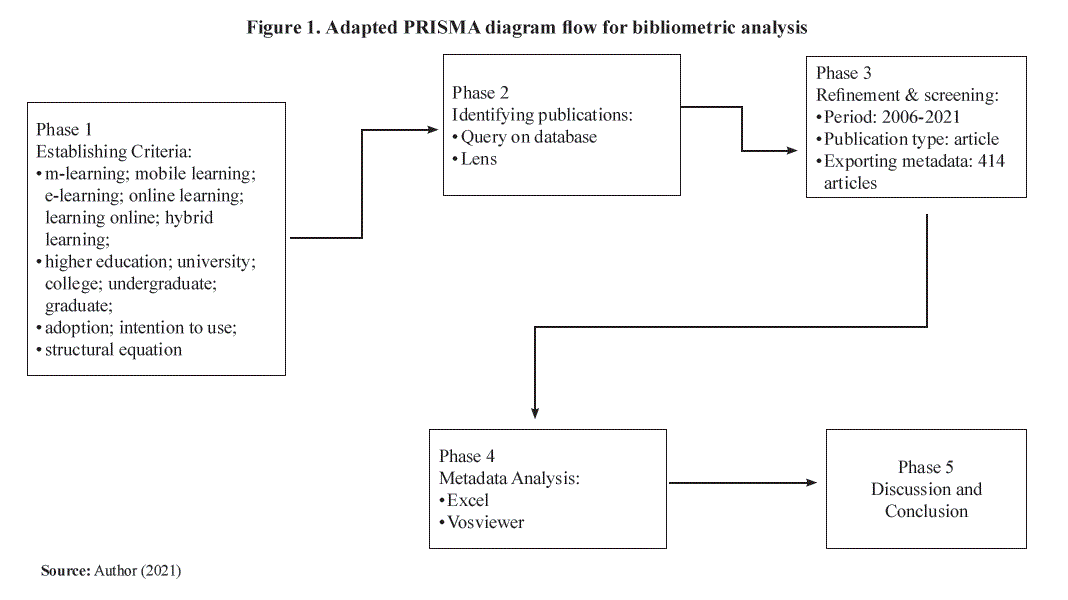
<body><![CDATA[<p align="justify">&nbsp;</p>      <p align="justify"><font size="3" face="Verdana, Arial, Helvetica, sans-serif"><b>2. Materials and methods</b></font></p>      <p align="justify"><font size="2" face="Verdana, Arial, Helvetica, sans-serif"><b>Method and data source</b></font></p>      <p align="justify"><font size="2" face="Verdana, Arial, Helvetica, sans-serif">By using metadata extracted from The Lens, this bibliometric study concentrates on published articles dealing with the use and adoption of e-learning in higher education and adopting structural equation modeling for their quantitative analysis.</font></p>      <p align="justify"><font size="2" face="Verdana, Arial, Helvetica, sans-serif">The Lens is a lesser-known aggregator of metadata in a field dominated by behemoths like Scopus and Web of Science; it offers a comprehensive database and is extremely user-friendly. A large number of publishers and data partners have afforded The Lens to index more than 236+ million scholarly works (dissertations, reports, articles, etc.) and 3.5+ million patents (Lens.org, 2021).</font></p>      <p align="justify"><font size="2" face="Verdana, Arial, Helvetica, sans-serif"><b>Searching and extracting the articles</b></font></p>      <p align="justify"><font size="2" face="Verdana, Arial, Helvetica, sans-serif">This study was carried out in July and August of 2021. It was divided in four phases (<a href="#f1">Figure 1</a>): The first, doing preliminary qualitative research and generating a number of keywords to use on the next phase; by making use of The Lens, the second phase started by formulating a number of queries to select the most appropriate articles for the bibliometric study and the final query entered to the database was as follows:</font></p>      <blockquote>       <blockquote>         <p align="justify"><font size="2" face="Verdana, Arial, Helvetica, sans-serif">Abstract:       ( ( m-learning OR ( &ldquo;mobile learning&rdquo; OR ( &ldquo;blended learning&rdquo; OR ( e-learning       OR ( elearning OR ( &ldquo;online learning&rdquo; OR ( &ldquo;learning online&rdquo; OR &ldquo;hybrid       learning&rdquo; ) ) ) ) ) ) ) AND ( &ldquo;higher education&rdquo; OR ( university OR ( college       OR ( undergraduate OR graduate ) ) ) ) ) AND ( ( use OR ( adoption OR       &ldquo;intention to use&rdquo; ) ) AND ( &ldquo;structural equation&rdquo; ) )</font></p>   </blockquote> </blockquote>     ]]></body>
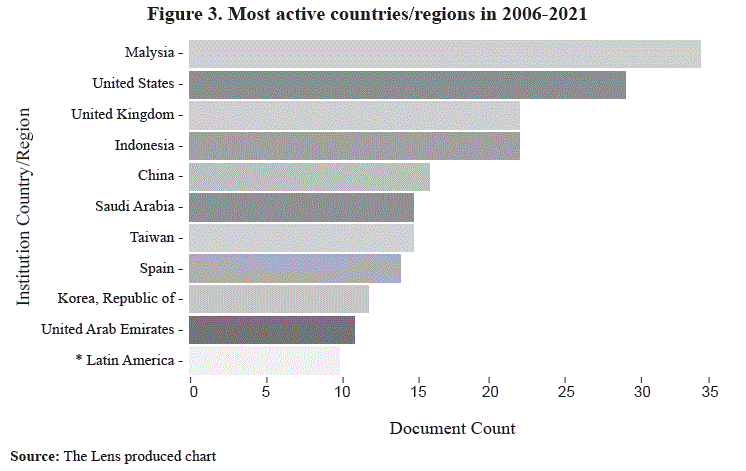
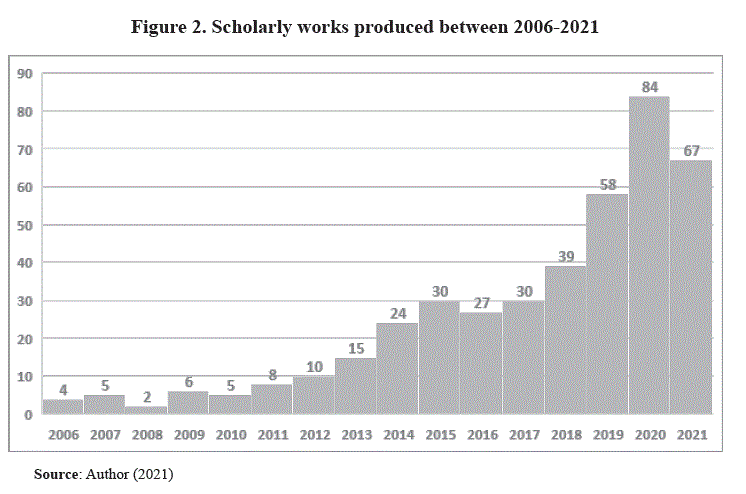
<body><![CDATA[<p align="justify"><font size="2" face="Verdana, Arial, Helvetica, sans-serif">Further filters were introduced to refine the results. It was established a timeframe &ldquo;year published&rdquo; to focus on the period 2006 to 2021 and a second filter &ldquo;publication type&rdquo; for selecting journal articles only. The final run for this query resulted in 414 scholarly works selected. In the third phase, the researcher extracted the metadata from The Lens database and manually reviewed one by one all the 414 articles&rsquo; abstracts to find unrelated or non- relevant articles, but none were found and the whole set was accepted for the next phase with the oldest article dating from 2006 and the latest one published on July 15th, 2021. In the fourth phase, Excel and VOSviewer were used for a more complex bibliometric analysis. </font></p>      <p align="center"><font size="2" face="Verdana, Arial, Helvetica, sans-serif"><br clear=all>   </font><a name="f1"></a><img src="/img/revistas/escepies/v8n2/a08_figura01.gif" width="718" height="460"></p>     <p align=center><a name="t1"></a><img src="/img/revistas/escepies/v8n2/a08_figura02.gif" width="715" height="675"></p>     <p align="justify">&nbsp;</p>     <p align="justify"><font size="3" face="Verdana, Arial, Helvetica, sans-serif"><b>3. Analysis of data</b></font></p>     <p align="justify"><font size="2" face="Verdana, Arial, Helvetica, sans-serif"><b>Descriptive analysis</b></font></p>     <p align="justify"><font size="2" face="Verdana, Arial, Helvetica, sans-serif">As it can be observed in <a href="#f2">Figure 2</a>, there   is a flourishing interest among academics for using Structural Equation   Modeling to research on the use and adoption of e-learning in higher education,   with 20.3% of the work published in 2020 and 16.2% in 2021 due to the increasing interest on E-learning as a consequence of the COVID pandemics. </font></p>     <p align="center"><a name="f2"></a><img src="/img/revistas/escepies/v8n2/a08_figura03.gif" width="746" height="494"></p>      <p align="justify"><font size="2" face="Verdana, Arial, Helvetica, sans-serif"><b>Geographic distribution</b></font></p>      <p align="justify"><font size="2" face="Verdana, Arial, Helvetica, sans-serif">Most of the academic production of research in e-learning in higher education comes from Malaysia (34), the US (29), the UK (22), and Indonesia (22). China (16), Saudi Arabia (15), Taiwan (15) have also achieved high scientific productivity in the period 2006-2021. On the other hand, Latin America as an aggregate appears at the bottom of the chart with a combined count of 10 articles originating from Brazil (5), Mexico (4), and Chile (1) (<a href="#f3">Figure 3</a>). </font></p>      ]]></body>
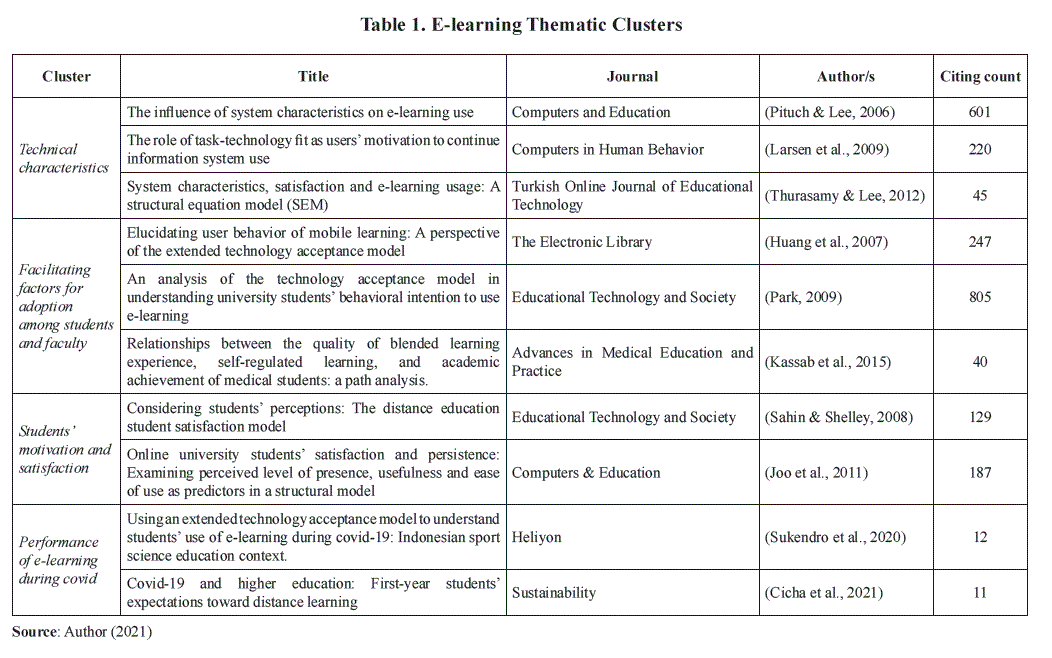
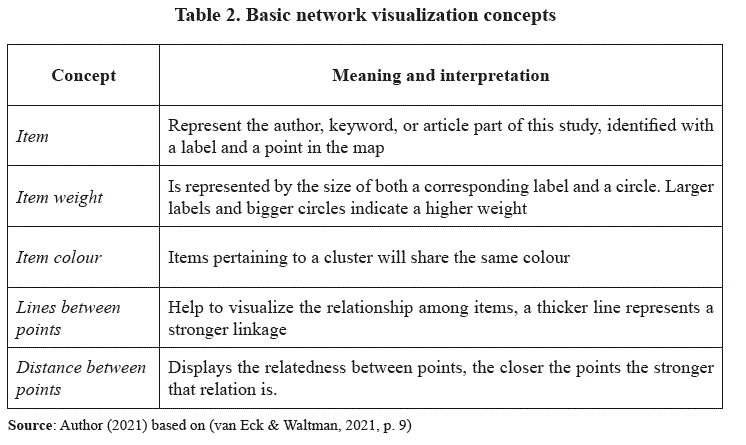
<body><![CDATA[<p align="center"><a name="f3"></a><img src="/img/revistas/escepies/v8n2/a08_figura04.gif" width="746" height="471"></p>      <p align="justify"><font size="2" face="Verdana, Arial, Helvetica, sans-serif"><b>Thematic clusters</b></font></p>      <p align="justify"><font size="2" face="Verdana, Arial, Helvetica, sans-serif">Research on e-learning use and adoption can be divided into four clusters, the first one with a strong concentration on the technical characteristics of an e-learning system; a second cluster directed towards studying the factors facilitating its adoption among students and faculty; a third one reviewing students&rsquo; motivation and satisfaction; and, a fourth cluster on the use and performance of e-learning in times of COVID. In <a href="#t1">Table 1</a>, representative articles for the 4 clusters are presented further here below, in this article.</font></p>      <p align="justify"><font size="2" face="Verdana, Arial, Helvetica, sans-serif">On the initial analysis, four thematic clusters were identified: technical characteristics, facilitating factors for adoption among students and faculty, student&rsquo;s motivation and satisfaction, and the performance of e-learning during COVID (<a href="#t1">Table 1</a>).</font></p>      <p align="justify"><font size="2" face="Verdana, Arial, Helvetica, sans-serif">In the first cluster, the researchers consider specific technical characteristics for the system used, such as system functionality, system interactivity, and system response among college students in Taiwan (Pituch &amp; Lee, 2006); task-technology fit in the IS continuance intention of Norwegian university&rsquo;s faculty (Larsen et al., 2009); and, information quality and system quality on the continuance intention of undergraduate in Malaysia (Thurasamy &amp; Lee, 2012).</font></p>      <p align="justify"><font size="2" face="Verdana, Arial, Helvetica, sans-serif">Articles in the second cluster extend original technology acceptance models to education identifying facilitating factors for the adoption of technologies in higher education, for example, perceived mobility value for mobile learning among students in Taiwan (Huang et al., 2007); e-learning self-efficacy, e-learning attitude and system accessibility in the Korean students&rsquo; intention to use e-learning (Park, 2009); and self- regulated learning, quality of blended learning experience of a Moodle-based virtual learning environment (VLE) among medical students in Bahrain (Kassab et al., 2015). </font></p>      <p align="justify"><font size="2" face="Verdana, Arial, Helvetica, sans-serif">Student&rsquo;s motivation and satisfaction are central topics in the third cluster, where certain attributes such as flexibility and computer expertise in the satisfaction of Turkish students with distance education tools (Sahin &amp; Shelley, 2008); teaching, social and cognitive presence on the student&rsquo;s satisfaction in a Korean online university (Joo et al., 2011); and, the effect of post-adoption expectations and satisfaction on the continuance intention of e-learning among Iranian students (Tiyar &amp; Khoshsima, 2015).</font></p>      <p align="justify"><font size="2" face="Verdana, Arial, Helvetica, sans-serif">Finally, the fourth cluster is formed by articles dealing with the COVID effect on e-learning in higher education in different local contexts around the world, including predicting the use of e-learning Indonesian sport science students (Sukendro et al., 2020), the effect of inequalities in access and use among underrepresented minorities (URM) and non-URM in the USA (Kim et al., 2020);  and, the expectations of Polish undergraduate students in the switch to online learning (Cicha et al., 2021).</font></p>      <p align="justify"><font size="2" face="Verdana, Arial, Helvetica, sans-serif">In the next section of the bibliometric study, three types of analysis will be carried out: citation analysis, keyword analysis, and word cloud analysis. A network map will be exhibited to visualize the different connections among the individual items and the nodes. In order to interpret the network visualization, there are a number of concepts to be familiar with and these are shown in <a href="#t2">Table 2</a>. </font></p>      <p align="center"><a name="t2"></a><img src="/img/revistas/escepies/v8n2/a08_figura05.gif" width="746" height="445"></p>     ]]></body>
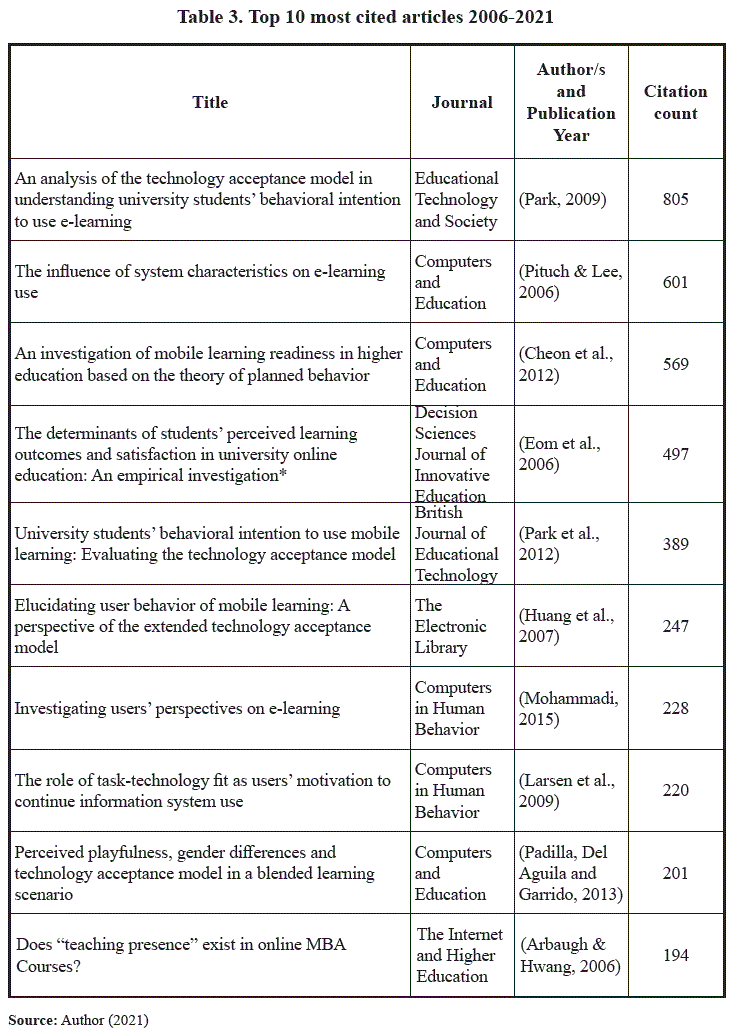
<body><![CDATA[<p align="justify"><font size="2" face="Verdana, Arial, Helvetica, sans-serif"><b>Citation Analysis</b></font></p>      <p align="justify"><font size="2" face="Verdana, Arial, Helvetica, sans-serif">This section of the study categorises articles by the number of articles that have cited a given piece of scholarly work. Citations are highly representative for impact, as the most cited works exercise a strong influence on the scope and form the foundation for future research. On <a href="#t3">Table 3</a>, 10 of the most referenced articles in the period 2006-2021 are shown ordered by the total number of articles that have cited a particular work (citation count). </font></p>      <p align="center"><a name="t3"></a><img src="/img/revistas/escepies/v8n2/a08_figura06.gif" width="746" height="1031"></p>      <p align="justify"><font size="2" face="Verdana, Arial, Helvetica, sans-serif"><a href="#t4">Table 4</a> exhibits the most cited articles originating from Latin America. Among all articles included in the study, 10 articles correspond to authors from Mexican, Brazilian and Chilean institutions, among them: University of Guadalajara-MX (3), Pontifical Catholic University of Rio de Janeiro-BR (2), University of São Paulo-BR (2), and Catholic University of the North-CH (1). </font></p>      <p align="center"><a name="t4"></a><img src="/img/revistas/escepies/v8n2/a08_figura07.gif" width="737" height="497"></p>      <p align="justify"><font size="2" face="Verdana, Arial, Helvetica, sans-serif"><a href="#f4">Figure 4</a> presents a network visualization map for citation where only papers with 20 or more citations have been included. As it can be observed from <a href="#f4">Figure 4</a> and <a href="#t3">Table 3</a>, the most cited paper by Prof Sung Young Park (2009) from Konkuk University works as a central node (green cluster) on the network visualization map. In his paper, Prof. Park studies the effect of &ldquo;e-learning self-efficacy, subjective norm, system accessibility, perceived usefulness, perceived ease of use and attitude on the behavioral intention to use e-learning,&rdquo; using a structural equation model (SEM) based on the Technology Acceptance Model (TAM). This paper is key to establish TAM as a theoretical basis to research the adoption of e-learning. A second node (blue cluster), establishes the Theory of Planned Behavior (TPB) as a tool for researching students&rsquo; perceptions, namely the effect of &ldquo;attitude, subjective norm, and behavioral control&rdquo; on the intention to adopt mobile learning (Park et al., 2012). The Green and Blue clusters stem both from papers written by the same author. A third cluster (Orange) has its origin in the work of Keenan (2006); the paper departs from TAM and explores a system&rsquo;s characteristics as determinants for the use of an e-learning system. </font></p>      <p align="center"><a name="f4"></a><img src="/img/revistas/escepies/v8n2/a08_figura08.gif" width="737" height="497"></p>      <p align="justify"><font size="2" face="Verdana, Arial, Helvetica, sans-serif"><b>Keyword analysis</b></font></p>      <p align="justify"><font size="2" face="Verdana, Arial, Helvetica, sans-serif">In the keyword analysis section, the most frequently used keywords are visualized, 78 items were taken into account for the map. Ten clusters were identified based on their co- occurrence (<a href="#f5">Figure 5</a>). Based on their size and centrality, some of the most commonly used keywords are &ldquo;e-learning,&rdquo; &ldquo;online learning,&rdquo; &ldquo;mobile learning,&rdquo; &ldquo;blended learning,&rdquo; and &ldquo;machine learning&rdquo; that represent the different ways in which academics have clustered their research in connection with the enabling technology. The appearance of &ldquo;COVID-19,&rdquo; amongst the most frequent keywords, signals the effect the global pandemics are having on online learning in higher education worldwide. Further &ldquo;COVID-19,&rdquo; &ldquo;e-learning&rdquo; and &ldquo;technology acceptance model&rdquo; are representative of the green cluster which points to the current scope of research in this field due to the pandemics. </font></p>     <p align="center"><a name="f5"></a><img src="/img/revistas/escepies/v8n2/a08_figura09.gif" width="737" height="709"></p>     ]]></body>
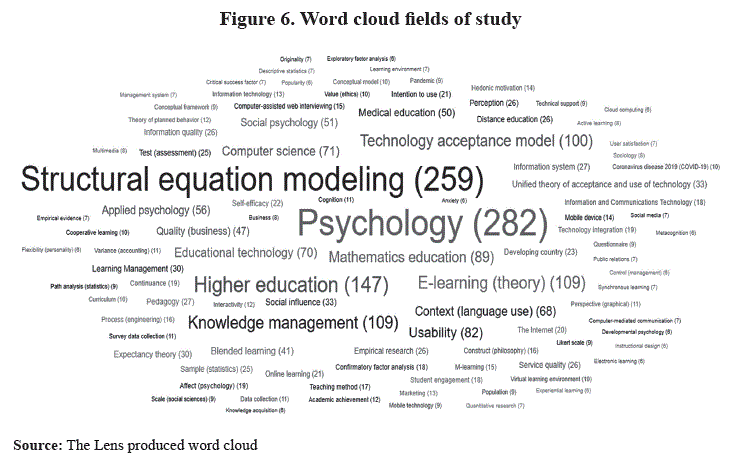
<body><![CDATA[<p align="justify"><font size="2" face="Verdana, Arial, Helvetica, sans-serif"><b>Fields of study analysis</b></font></p>      <p align="justify"><font size="2" face="Verdana, Arial, Helvetica, sans-serif">This part of the analysis is done using a word cloud (<a href="#f6">Figure 6</a>) for the fields of study provided by The Lens, showing the most representative terms for all accessible text in a given article. Microsoft Academic uses machine learning to compute the fields of study by analyzing the complete (or available) string of text in an article. Word cloud is a visual representation where the importance of a field is evident by the font size which corresponds to the number in parentheses (frequency count). Psychology (282), structural equation modeling (259), higher education (147), e-learning (theory) (109), knowledge management (109), and technology acceptance model (100) are the most significant fields among the 414 articles in this study. The fields of study word cloud are convergent and complementary to the keyword analysis. SEM appears as a node for the violet cluster and as the second (structural equation model 259) most frequent keyword. Continuance, expectation, behavior, and satisfaction are psychological aspects (psychology 282) in the adoption and use of e-learning.</font></p>     <p align="center"><a name="f6"></a><img src="/img/revistas/escepies/v8n2/a08_figura10.gif" width="734" height="458"></p>     <p align="justify">&nbsp;</p>     <p align="justify"><font size="3" face="Verdana, Arial, Helvetica, sans-serif"><b>4. Discussion</b></font></p>     <p align="justify"><font size="2" face="Verdana, Arial, Helvetica, sans-serif"><b>Most influential authors (RQ1)</b></font></p>      <p align="justify"><font size="2" face="Verdana, Arial, Helvetica, sans-serif">The 3 most cited articles (Cheon et al., 2012; Park, 2009; Pituch &amp; Lee, 2006) with over 500 citations each indicate the importance this topic has in the research agenda with an average citation per year rate of 63, 67, and 40 respectively. The proximity in the bibliometric citation network analysis between Pituch &amp; Lee (2006) and Park (2009) both indicate how connected they are as a sort of core for the network.</font></p>      <p align="justify"><font size="2" face="Verdana, Arial, Helvetica, sans-serif">A comparison between the most influential articles at the global level, those in LatinAmerica, and the geographical distribution show that the study of the adoption and use of e-learning using structural equation modelling techniques has not yet thriven, which represents a gap and an opportunity for researchers in higher education.</font></p>      <p align="justify"><font size="2" face="Verdana, Arial, Helvetica, sans-serif"><b>Most important thematic areas (RQ2)</b></font></p>      <p align="justify"><font size="2" face="Verdana, Arial, Helvetica, sans-serif">The keywords network gives a quick overview of the many sub-topics that have been studied in the context of e-learning in higher education using structural equation modeling, a rather novel quantitative approach that is receiving growing interest among practitioners as unveiled in the field of study analysis. The broad use of the technology acceptance model (TAM) (Mohammadi, 2015; Park, 2009; Sukendro et al., 2020) and the unified theory of acceptance and use of technology (UTAUT) (Abu-Al-Aish &amp; Love, 2013; Briz-Ponce et al., 2017) in the study of e-learning adoption became evident through the word cloud and network visualization.</font></p>      ]]></body>
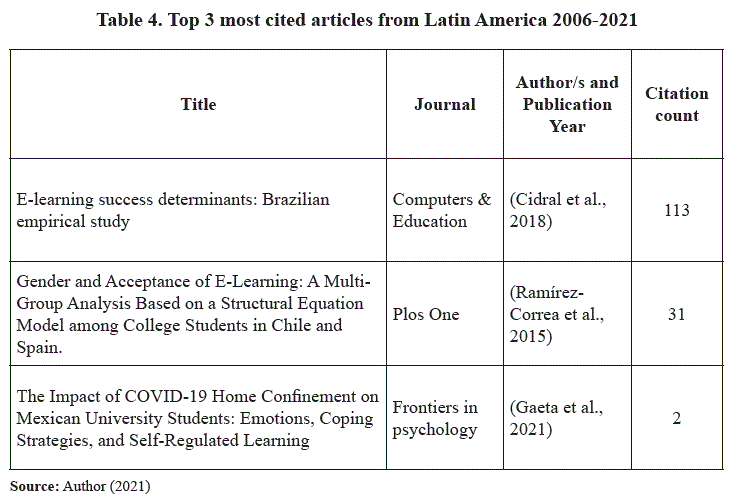
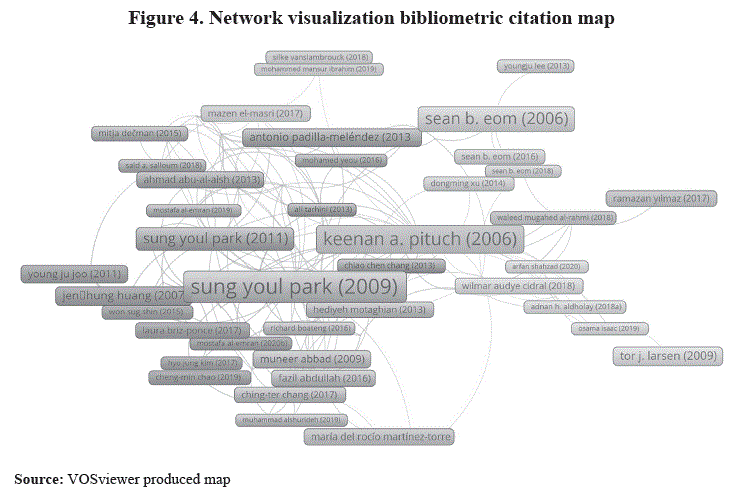
<body><![CDATA[<p align="justify"><font size="2" face="Verdana, Arial, Helvetica, sans-serif">Contrasting these results with the thematic clusters, it can be observed a transition in the scope of research from technology-oriented research founded on the use of TAM and UTAUT as a framework, to searching for understanding the more education-related facilitating factors, to student-centric research on their motivations and satisfaction, to assessing the adoption and performance of e-learning in a very specific yet paradigm-changing event such as the global COVID pandemics. </font></p>      <p align="justify"><font size="2" face="Verdana, Arial, Helvetica, sans-serif"><b>Future or potential areas for research (RQ3)</b></font></p>     <p align="justify"><font size="2" face="Verdana, Arial, Helvetica, sans-serif">The COVID-19 effect is observed among   the current trends (Akour et al., 2021; Cicha et al., 2021; Rizun &amp; Strzelecki,   2020; Shahzad et al., 2021; Sukendro et al., 2020) and is likely to push our   understanding of the facilitators for the (intention to) use e-learning in   higher education with an emphasis on particular aspects of the human psyche,   with concepts such as enjoyment, computer anxiety, satisfaction, and perceived self-efficacy.</font></p>     <p align="justify"><font size="2" face="Verdana, Arial, Helvetica, sans-serif">The transition in the research scope -mentioned earlier above- points towards the need to devise and test newer models of technology adoption specific for higher education. These models will be greatly influenced by the experiences lived and the research carried out during the course of the global pandemics and the resulting lessons learned.</font></p>      <p align="justify"><font size="2" face="Verdana, Arial, Helvetica, sans-serif"><b>Opportunities and limitations with the Lens</b></font></p>      <p align="justify"><font size="2" face="Verdana, Arial, Helvetica, sans-serif">Limitations of this study should be discussed, and a limitation of this research relies on the number of articles that are accessible through The Lens. Even though, counting with over 236+ million scholarly works metadata through the platform and considering the large overlapping among different platforms, there is still a number of works that are only available on other platforms such as Scopus or Web of Science. A second limitation involved the reduced number of keywords metadata that was available through The Lens for the selected articles, an aspect that was solved by using &ldquo;fields of study&rdquo; which is produced by Microsoft Academic through machine learning parsing of accessible text strings (metadata + articles) and available from The Lens.</font></p>      <p align="justify"><font size="2" face="Verdana, Arial, Helvetica, sans-serif">Despite this limitation of The Lens, the current partnerships with publishers and other metadata providers such as ORCID, Crossref, PubMed, Core, Microsoft Academic, and the Initiative for Open Abstracts make it possible for The Lens to continuously grow their database. Furthermore, with over 236M scholarly works metadata -as a point of comparison Clarivate WOS holds 182M records (Clarivate, 2021)-, and many more becoming available due to the trend among publishers to switch to an open- access model and making more of their metadata freely available, The Lens is an excellent tool for bibliometric studies.</font></p>      <p align="justify">&nbsp;</p>      <p align="justify"><font size="3" face="Verdana, Arial, Helvetica, sans-serif"><b>5. Conclusions</b></font></p>      <p align="justify"><font size="2" face="Verdana, Arial, Helvetica, sans-serif">To conclude, the specific goal of this article to systematically carry out a bibliometric study making use of The Lens platform was achieved and presented in the results section. Furthermore, the most influential authors were identified (RQ1), key thematic areas were presented and reviewed (RQ2), and potential areas for future research were introduced (RQ3).</font></p>      ]]></body>
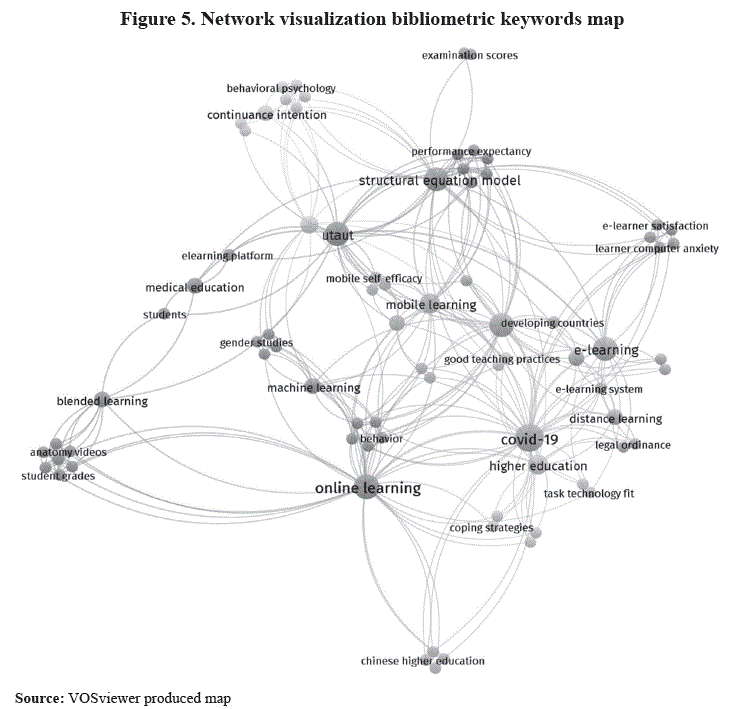
<body><![CDATA[<p align="justify"><font size="2" face="Verdana, Arial, Helvetica, sans-serif">Future research and novice researchers in the adoption and use of e-learning will benefit from this bibliometric study, particularly because by synthesizing a large amount of metadata it identifies the most influential works in this field (RQ1), it maps the current research trends that may be a good starting point for their own research (RQ2), and it helps them to visualize the connections between different authors and their research, as well as, helping them to provide a foundation for their new research (RQ3).</font></p>      <p align="justify"><font size="2" face="Verdana, Arial, Helvetica, sans-serif">During the pandemics, the research has concentrated on the performance of e-learning as an enabler for distance learning in higher education. There is an increased interest in understanding the impact of psychological aspects, as drivers and facilitators, on the students&rsquo; and lecturers&rsquo; adoption of e-learning. Research is building upon traditional theories of technology and innovation diffusion theories such as the theory of planned behavior (TPB) (Cheon et al., 2012), technology acceptance model (TAM) (Park, 2009), and the unified theory of acceptance and use of technology (UTAUT) (Briz-Ponce et al., 2017). Introducing pedagogical and psychological aspects resulting in constructs more focused on the teaching-learning paradigm central in higher education and moving from studies on technical characteristics (Pituch &amp; Lee, 2006; Thurasamy &amp; Lee, 2012) to research on user characteristics (Joo et al., 2011; Kassab et al., 2015).</font></p>      <p align="justify">&nbsp;</p>      <p align="justify"><font size="3" face="Verdana, Arial, Helvetica, sans-serif"><b>Bibliography</b></font></p>      <p align="justify"><font size="2" face="Verdana, Arial, Helvetica, sans-serif">Abu-Al-Aish, A., &amp; Love, S. (2013). Factors influencing students&rsquo; acceptance of m-learning: An investigation in higher education. International Review of Research in Open and Distance Learning, 14(5), 82–107. <a href="https://doi.org/10.19173/irrodl.v14i5.1631" target="_blank">https://doi.org/10.19173/irrodl.v14i5.1631</a></font></p>      <p align="justify"><font size="2" face="Verdana, Arial, Helvetica, sans-serif">Akour, I., Alshurideh, M., Al Kurdi, B., Al Ali, A., &amp; Salloum, S. (2021). Using machine learning algorithms to predict people&rsquo;s intention to use mobile learning platforms during the COVID-19 pandemic: Machine learning approach. JMIR Medical Education, 7(1). <a href="https://doi.org/10.2196/24032" target="_blank">https://doi.org/10.2196/24032</a></font></p>      <p align="justify"><font size="2" face="Verdana, Arial, Helvetica, sans-serif">Arbaugh, J. B., &amp; Hwang, A. (2006). Does &ldquo;teaching presence&rdquo; exist in online MBA courses? Internet and Higher Education, 9(1), 9–21. <a href="https://doi.org/10.1016/j.iheduc.2005.12.001" target="_blank">https://doi.org/10.1016/j.iheduc.2005.12.001</a></font></p>      <p align="justify"><font size="2" face="Verdana, Arial, Helvetica, sans-serif">Briz-Ponce, L., Pereira, A., Carvalho, L., Juanes-Méndez, J. A., &amp; García-Peñalvo, F. J. (2017). Learning with mobile technologies – Students&rsquo; behavior. Computers in Human Behavior, 72, 612–620. <a href="https://doi.org/10.1016/j.chb.2016.05.027" target="_blank">https://doi.org/10.1016/j.chb.2016.05.027</a></font></p>      <!-- ref --><p align="justify"><font size="2" face="Verdana, Arial, Helvetica, sans-serif">Cheon, J., Lee, S., Crooks, S. M., &amp;   Song, J. (2012). An investigation of mobile learning readiness in higher education based on the theory of planned behavior. Computers and Education, 59(3), 1054–1064. <a href="https://doi.org/10.1016/j.compedu.2012.04.015" target="_blank">https://doi.org/10.1016/j.compedu.2012.04.015</a></font>&nbsp;&nbsp;&nbsp;&nbsp;&nbsp;&nbsp;&nbsp;&nbsp;[&#160;<a href="javascript:void(0);" onclick="javascript: window.open('/scielo.php?script=sci_nlinks&ref=1130906&pid=S2518-8283202100020000800005&lng=','','width=640,height=500,resizable=yes,scrollbars=1,menubar=yes,');">Links</a>&#160;]<!-- end-ref --><p align="justify"><font size="2" face="Verdana, Arial, Helvetica, sans-serif">Cicha, K., Rizun, M., Rutecka, P., &amp; Strzelecki, A. (2021). Covid-19 and higher education: First-year students&rsquo; expectations toward distance learning. Sustainability (Switzerland), 13(4), 1–20. <a href="https://doi.org/10.3390/su13041889" target="_blank">https://doi.org/10.3390/su13041889</a></font></p>      ]]></body>
<body><![CDATA[<!-- ref --><p align="justify"><font size="2" face="Verdana, Arial, Helvetica, sans-serif">Cidral, W. A., Oliveira, T., Di Felice, M., &amp; Aparicio, M. (2018). E-learning success determinants: Brazilian empirical study. Computers and Education, 122, 273–290. <a href="https://doi.org/10.1016/j.compedu.2017.12.001" target="_blank">https://doi.org/10.1016/j.compedu.2017.12.001</a></font>&nbsp;&nbsp;&nbsp;&nbsp;&nbsp;&nbsp;&nbsp;&nbsp;[&#160;<a href="javascript:void(0);" onclick="javascript: window.open('/scielo.php?script=sci_nlinks&ref=1130908&pid=S2518-8283202100020000800007&lng=','','width=640,height=500,resizable=yes,scrollbars=1,menubar=yes,');">Links</a>&#160;]<!-- end-ref --><!-- ref --><p align="justify"><font size="2" face="Verdana, Arial, Helvetica, sans-serif">Clarivate. (2021). Web of Science platform: Web of Science: Summary of Coverage. <a href="https://clarivate.libguides.com/webofscienceplatform/coverage." target="_blank">https://clarivate.libguides.com/webofscienceplatform/coverage.    &nbsp;&nbsp;&nbsp;&nbsp;&nbsp;&nbsp;&nbsp;&nbsp;[&#160;<a href="javascript:void(0);" onclick="javascript: window.open('/scielo.php?script=sci_nlinks&ref=1130909&pid=S2518-8283202100020000800008&lng=','','width=640,height=500,resizable=yes,scrollbars=1,menubar=yes,');">Links</a>&#160;]<!-- end-ref --></a></font></p>      <p align="justify"><font size="2" face="Verdana, Arial, Helvetica, sans-serif">Eom, S. B., Wen, H. J., &amp; Ashill, N. (2006). The Determinants of Students&rsquo; Perceived Learning Outcomes and Satisfaction in University Online Education: An Empirical Investigation. Decision Sciences Journal of Innovative Education, 4(2), 215–235. <a href="https://doi.org/10.1111/j.1540-4609.2006.00114.x" target="_blank">https://doi.org/10.1111/j.1540-4609.2006.00114.x</a></font></p>      <!-- ref --><p align="justify"><font size="2" face="Verdana, Arial, Helvetica, sans-serif">Gaeta, M. L., Gaeta, L., &amp;   Rodriguez, M. del S. (2021). The Impact of COVID-19 Home Confinement on Mexican University Students: Emotions, Coping Strategies, and Self-Regulated Learning. Frontiers in Psychology, 12. <a href="https://doi.org/10.3389/fpsyg.2021.642823" target="_blank">https://doi.org/10.3389/fpsyg.2021.642823</a></font>&nbsp;&nbsp;&nbsp;&nbsp;&nbsp;&nbsp;&nbsp;&nbsp;[&#160;<a href="javascript:void(0);" onclick="javascript: window.open('/scielo.php?script=sci_nlinks&ref=1130912&pid=S2518-8283202100020000800010&lng=','','width=640,height=500,resizable=yes,scrollbars=1,menubar=yes,');">Links</a>&#160;]<!-- end-ref --><!-- ref --><p align="justify"><font size="2" face="Verdana, Arial, Helvetica, sans-serif">Han, J., Kang, H.-J., Kim, M., &amp; Kwon, G. H. (2020). Mapping the intellectual structure of research on surgery with mixed reality: Bibliometric network analysis (2000–2019). Journal of Biomedical Informatics, 109. <a href="https://doi.org/10.1016/j.jbi.2020.103516">https://doi.org/10.1016/j.jbi.2020.103516</a></font>&nbsp;&nbsp;&nbsp;&nbsp;&nbsp;&nbsp;&nbsp;&nbsp;[&#160;<a href="javascript:void(0);" onclick="javascript: window.open('/scielo.php?script=sci_nlinks&ref=1130913&pid=S2518-8283202100020000800011&lng=','','width=640,height=500,resizable=yes,scrollbars=1,menubar=yes,');">Links</a>&#160;]<!-- end-ref --><!-- ref --><p align="justify"><font size="2" face="Verdana, Arial, Helvetica, sans-serif">Hoyle, R. H. (Ed.). (1995). Structural Equation Modeling: Concepts, Issues and Applications. SAGE Publications.    &nbsp;&nbsp;&nbsp;&nbsp;&nbsp;&nbsp;&nbsp;&nbsp;[&#160;<a href="javascript:void(0);" onclick="javascript: window.open('/scielo.php?script=sci_nlinks&ref=1130914&pid=S2518-8283202100020000800012&lng=','','width=640,height=500,resizable=yes,scrollbars=1,menubar=yes,');">Links</a>&#160;]<!-- end-ref --></font></p>      <!-- ref --><p align="justify"><font size="2" face="Verdana, Arial, Helvetica, sans-serif">Huang, J. H., Lin, Y. R., &amp; Chuang, S. T. (2007). Elucidating user behavior of mobile learning: A perspective of the extended technology acceptance model. Electronic Library, 25(5), 585–598. <a href="https://doi.org/10.1108/02640470710829569" target="_blank">https://doi.org/10.1108/02640470710829569</a></font>&nbsp;&nbsp;&nbsp;&nbsp;&nbsp;&nbsp;&nbsp;&nbsp;[&#160;<a href="javascript:void(0);" onclick="javascript: window.open('/scielo.php?script=sci_nlinks&ref=1130916&pid=S2518-8283202100020000800013&lng=','','width=640,height=500,resizable=yes,scrollbars=1,menubar=yes,');">Links</a>&#160;]<!-- end-ref --><p align="justify"><font size="2" face="Verdana, Arial, Helvetica, sans-serif">Joo, Y. J., Lim, K. Y., &amp; Kim, E. K. (2011). Online university students&rsquo; satisfaction and persistence: Examining perceived level of presence, usefulness and ease of use as predictors in a structural model. Computers and Education, 57(2), 1654–1664. <a href="https://doi.org/10.1016/j.compedu.2011.02.008" target="_blank">https://doi.org/10.1016/j.compedu.2011.02.008</a></font></p>      ]]></body>
<body><![CDATA[<!-- ref --><p align="justify"><font size="2" face="Verdana, Arial, Helvetica, sans-serif">Kassab, S. E., Al-Shafei, A. I., Salem, A. H., &amp; Otoom, S. (2015). Relationships between the quality of blended learning experience, self-regulated learning, and academic achievement of medical students: A path analysis. Advances in Medical Education and Practice, 6, 27–34. <a href="https://doi.org/10.2147/AMEP.S75830" target="_blank"> https://doi.org/10.2147/AMEP.S75830</a></font>&nbsp;&nbsp;&nbsp;&nbsp;&nbsp;&nbsp;&nbsp;&nbsp;[&#160;<a href="javascript:void(0);" onclick="javascript: window.open('/scielo.php?script=sci_nlinks&ref=1130918&pid=S2518-8283202100020000800015&lng=','','width=640,height=500,resizable=yes,scrollbars=1,menubar=yes,');">Links</a>&#160;]<!-- end-ref --><p align="justify"><font size="2" face="Verdana, Arial, Helvetica, sans-serif">Kim, S., Rosenblith, S., Chang, Y., &amp; Pollack, S. (2020). Will ICMT access and use support URM students&rsquo; online learning in the (Post) covid-19 era? Sustainability (Switzerland), 12(20), 1–14. <a href="https://doi.org/10.3390/su12208433" target="_blank">https://doi.org/10.3390/su12208433</a></font></p>      <p align="justify"><font size="2" face="Verdana, Arial, Helvetica, sans-serif">Larsen, T. J., Sørebø, A. M., &amp; Sørebø, Ø. (2009). The role of task-technology fit as users&rsquo; motivation to continue information system use. Computers in Human Behavior, 25(3), 778–784. <a href="https://doi.org/10.1016/j.chb.2009.02.006" target="_blank">https://doi.org/10.1016/j.chb.2009.02.006</a></font></p>      <!-- ref --><p align="justify"><font size="2" face="Verdana, Arial, Helvetica, sans-serif">Lens.org. (2021). About The Lens. <a href="https://about.lens.org/." target="_blank">https://about.lens.org/</a></font>&nbsp;&nbsp;&nbsp;&nbsp;&nbsp;&nbsp;&nbsp;&nbsp;[&#160;<a href="javascript:void(0);" onclick="javascript: window.open('/scielo.php?script=sci_nlinks&ref=1130921&pid=S2518-8283202100020000800018&lng=','','width=640,height=500,resizable=yes,scrollbars=1,menubar=yes,');">Links</a>&#160;]<!-- end-ref --><p align="justify"><font size="2" face="Verdana, Arial, Helvetica, sans-serif">Mohammadi, H. (2015). Investigating users&rsquo; perspectives on e-learning: An integration of TAM and IS success model. Computers in Human Behavior, 45, 359–374. <a href="https://doi.org/10.1016/j.chb.2014.07.044" target="_blank">https://doi.org/10.1016/j.chb.2014.07.044</a></font></p>      <!-- ref --><p align="justify"><font size="2" face="Verdana, Arial, Helvetica, sans-serif">Padilla-Meléndez, A., Del Aguila-Obra, A. R., &amp; Garrido-Moreno, A. (2013). Perceived playfulness, gender differences and technology acceptance model in a blended learning scenario. Computers and Education, 63, 306–317. <a href="https://doi.org/10.1016/j.compedu.2012.12.014" target="_blank">https://doi.org/10.1016/j.compedu.2012.12.014</a></font>&nbsp;&nbsp;&nbsp;&nbsp;&nbsp;&nbsp;&nbsp;&nbsp;[&#160;<a href="javascript:void(0);" onclick="javascript: window.open('/scielo.php?script=sci_nlinks&ref=1130923&pid=S2518-8283202100020000800020&lng=','','width=640,height=500,resizable=yes,scrollbars=1,menubar=yes,');">Links</a>&#160;]<!-- end-ref --><p align="justify"><font size="2" face="Verdana, Arial, Helvetica, sans-serif">Park, S. Y. (2009). An analysis of the technology acceptance model in understanding University students&rsquo; behavioral intention to use e-Learning. Educational Technology and Society, 12(3), 150–162.</font></p>      <p align="justify"><font size="2" face="Verdana, Arial, Helvetica, sans-serif">Park, S. Y., Nam, M. W., &amp; Cha, S. B. (2012). University students&rsquo; behavioral intention to use mobile learning: Evaluating the technology acceptance model. British Journal of Educational Technology, 43(4), 592–605. <a href="https://doi.org/10.1111/j.1467-8535.2011.01229.x" target="_blank">https://doi.org/10.1111/j.1467-8535.2011.01229.x</a></font></p>      <!-- ref --><p align="justify"><font size="2" face="Verdana, Arial, Helvetica, sans-serif">Pituch, K. A., &amp; Lee, Y. K. (2006). The influence of system characteristics on e-learning use. Computers and Education, 47(2), 222–244. <a href="https://doi.org/10.1016/j.compedu.2004.10.007" target="_blank">https://doi.org/10.1016/j.compedu.2004.10.007</a></font>&nbsp;&nbsp;&nbsp;&nbsp;&nbsp;&nbsp;&nbsp;&nbsp;[&#160;<a href="javascript:void(0);" onclick="javascript: window.open('/scielo.php?script=sci_nlinks&ref=1130926&pid=S2518-8283202100020000800023&lng=','','width=640,height=500,resizable=yes,scrollbars=1,menubar=yes,');">Links</a>&#160;]<!-- end-ref --><!-- ref --><p align="justify"><font size="2" face="Verdana, Arial, Helvetica, sans-serif">Ramírez-Correa, P. E., Arenas-Gaitán, J., &amp; Rondán-Cataluña, F. J. (2015). Gender and Acceptance of E-Learning: A Multi-Group Analysis Based on a Structural Equation Model among College Students in Chile and Spain. PLOS ONE, 10(10), e0140460. <a href="https://doi.org/10.1371/journal.pone.0140460" target="_blank">https://doi.org/10.1371/journal.pone.0140460</a></font>&nbsp;&nbsp;&nbsp;&nbsp;&nbsp;&nbsp;&nbsp;&nbsp;[&#160;<a href="javascript:void(0);" onclick="javascript: window.open('/scielo.php?script=sci_nlinks&ref=1130927&pid=S2518-8283202100020000800024&lng=','','width=640,height=500,resizable=yes,scrollbars=1,menubar=yes,');">Links</a>&#160;]<!-- end-ref --><p align="justify"><font size="2" face="Verdana, Arial, Helvetica, sans-serif">Rizun, M., &amp; Strzelecki, A. (2020). Students&rsquo; acceptance of the covid-19 impact on shifting higher education to distance learning in Poland. International Journal of Environmental Research and Public Health, 17(18), 1–19. <a href="https://doi.org/10.3390/ijerph17186468" target="_blank">https://doi.org/10.3390/ijerph17186468</a></font></p>      <p align="justify"><font size="2" face="Verdana, Arial, Helvetica, sans-serif">Sahin, I., &amp; Shelley, M. (2008). Considering students&rsquo; perceptions: The distance education student satisfaction model. Educational Technology and Society, 11(3), 216–223.</font></p>      <!-- ref --><p align="justify"><font size="2" face="Verdana, Arial, Helvetica, sans-serif">Shahzad, A., Hassan, R., Aremu, A. Y., Hussain, A., &amp; Lodhi, R. N. (2021). Effects of COVID-19 in E-learning on higher education institution students: the group comparison between male and female. Quality and Quantity, 55(3), 805–826. <a href="https://doi.org/10.1007/s11135-020-01028-z" target="_blank">https://doi.org/10.1007/s11135-020-01028-z</a></font>&nbsp;&nbsp;&nbsp;&nbsp;&nbsp;&nbsp;&nbsp;&nbsp;[&#160;<a href="javascript:void(0);" onclick="javascript: window.open('/scielo.php?script=sci_nlinks&ref=1130930&pid=S2518-8283202100020000800027&lng=','','width=640,height=500,resizable=yes,scrollbars=1,menubar=yes,');">Links</a>&#160;]<!-- end-ref --><p align="justify"><font size="2" face="Verdana, Arial, Helvetica, sans-serif">Sukendro, S., Habibi, A., Khaeruddin, K., Indrayana, B., Syahruddin, S., Makadada, F. A., &amp; Hakim, H. (2020). Using an extended Technology Acceptance Model to understand students&rsquo; use of e-learning during Covid-19: Indonesian sport science education context. Heliyon, 6(11). <a href="https://doi.org/10.1016/j.heliyon.2020.e05410" target="_blank">https://doi.org/10.1016/j.heliyon.2020.e05410</a></font></p>      <!-- ref --><p align="justify"><font size="2" face="Verdana, Arial, Helvetica, sans-serif">Thurasamy, R., &amp; Lee, J. (2012). System Characteristics, Satisfaction and E-Learning Usage: A Structural Equation Model (SEM). Turkish Online Journal of Educational Technology, 11(2), 196–206.    &nbsp;&nbsp;&nbsp;&nbsp;&nbsp;&nbsp;&nbsp;&nbsp;[&#160;<a href="javascript:void(0);" onclick="javascript: window.open('/scielo.php?script=sci_nlinks&ref=1130932&pid=S2518-8283202100020000800029&lng=','','width=640,height=500,resizable=yes,scrollbars=1,menubar=yes,');">Links</a>&#160;]<!-- end-ref --></font></p>      <p align="justify"><font size="2" face="Verdana, Arial, Helvetica, sans-serif">Tiyar, F. R., &amp; Khoshsima, H. (2015). Understanding students&rsquo; satisfaction and continuance intention of e-learning: Application of expectation–confirmation model. World Journal on Educational Technology: Current Issues, 7(3), 157–166. <a href="https://doi.org/10.18844/wjet.v7i3.203" target="_blank">https://doi.org/10.18844/wjet.v7i3.203</a></font></p>      <!-- ref --><p align="justify"><font size="2" face="Verdana, Arial, Helvetica, sans-serif">UNESCO. (2021). COVID-19: reopening and reimagining universities, survey on higher education through the UNESCO National Commissions.  <a href="https://unesdoc.unesco.org/ark:/48223/pf0000378174" target="_blank">https://unesdoc.unesco.org/ark:/48223/pf0000378174</a></font>&nbsp;&nbsp;&nbsp;&nbsp;&nbsp;&nbsp;&nbsp;&nbsp;[&#160;<a href="javascript:void(0);" onclick="javascript: window.open('/scielo.php?script=sci_nlinks&ref=1130935&pid=S2518-8283202100020000800031&lng=','','width=640,height=500,resizable=yes,scrollbars=1,menubar=yes,');">Links</a>&#160;]<!-- end-ref --><!-- ref --><p align="justify"><font size="2" face="Verdana, Arial, Helvetica, sans-serif">van Eck, N. J., &amp; Waltman, L. (2021). Manual for VOSviewer version 1 .6.17. Leiden University.    &nbsp;&nbsp;&nbsp;&nbsp;&nbsp;&nbsp;&nbsp;&nbsp;[&#160;<a href="javascript:void(0);" onclick="javascript: window.open('/scielo.php?script=sci_nlinks&ref=1130936&pid=S2518-8283202100020000800032&lng=','','width=640,height=500,resizable=yes,scrollbars=1,menubar=yes,');">Links</a>&#160;]<!-- end-ref --></font><font size="2" face="Verdana, Arial, Helvetica, sans-serif"></font></p>     ]]></body>
<body><![CDATA[<p align="justify">&nbsp;</p>     <p align="justify">&nbsp;</p>      ]]></body><back>
<ref-list>
<ref id="B1">
<nlm-citation citation-type="journal">
<person-group person-group-type="author">
<name>
<surname><![CDATA[Abu-Al-Aish]]></surname>
<given-names><![CDATA[A]]></given-names>
</name>
<name>
<surname><![CDATA[Love]]></surname>
<given-names><![CDATA[S]]></given-names>
</name>
</person-group>
<article-title xml:lang="en"><![CDATA[Factors influencing students’ acceptance of m-learning: An investigation in higher education]]></article-title>
<source><![CDATA[International Review of Research in Open and Distance Learning]]></source>
<year>2013</year>
<volume>14</volume>
<numero>5</numero>
<issue>5</issue>
<page-range>82-107</page-range></nlm-citation>
</ref>
<ref id="B2">
<nlm-citation citation-type="journal">
<person-group person-group-type="author">
<name>
<surname><![CDATA[Akour]]></surname>
<given-names><![CDATA[I]]></given-names>
</name>
<name>
<surname><![CDATA[Alshurideh]]></surname>
<given-names><![CDATA[M]]></given-names>
</name>
<name>
<surname><![CDATA[Al Kurdi]]></surname>
<given-names><![CDATA[B]]></given-names>
</name>
<name>
<surname><![CDATA[Al Ali]]></surname>
<given-names><![CDATA[A]]></given-names>
</name>
<name>
<surname><![CDATA[Salloum]]></surname>
<given-names><![CDATA[S]]></given-names>
</name>
</person-group>
<article-title xml:lang="en"><![CDATA[Using machine learning algorithms to predict people’s intention to use mobile learning platforms during the COVID-19 pandemic: Machine learning approach]]></article-title>
<source><![CDATA[JMIR Medical Education]]></source>
<year>2021</year>
<volume>7</volume>
<numero>1</numero>
<issue>1</issue>
</nlm-citation>
</ref>
<ref id="B3">
<nlm-citation citation-type="journal">
<person-group person-group-type="author">
<name>
<surname><![CDATA[Arbaugh]]></surname>
<given-names><![CDATA[J. B.]]></given-names>
</name>
<name>
<surname><![CDATA[Hwang]]></surname>
<given-names><![CDATA[A.]]></given-names>
</name>
</person-group>
<article-title xml:lang="en"><![CDATA[Does “teaching presence” exist in online MBA courses?]]></article-title>
<source><![CDATA[Internet and Higher Education]]></source>
<year>2006</year>
<volume>9</volume>
<numero>1</numero>
<issue>1</issue>
<page-range>9-21</page-range></nlm-citation>
</ref>
<ref id="B4">
<nlm-citation citation-type="journal">
<person-group person-group-type="author">
<name>
<surname><![CDATA[Briz-Ponce]]></surname>
<given-names><![CDATA[L]]></given-names>
</name>
<name>
<surname><![CDATA[Pereira]]></surname>
<given-names><![CDATA[A]]></given-names>
</name>
<name>
<surname><![CDATA[Carvalho]]></surname>
<given-names><![CDATA[L]]></given-names>
</name>
<name>
<surname><![CDATA[Juanes-Méndez]]></surname>
<given-names><![CDATA[J. A.]]></given-names>
</name>
<name>
<surname><![CDATA[García-Peñalvo]]></surname>
<given-names><![CDATA[F. J.]]></given-names>
</name>
</person-group>
<article-title xml:lang="en"><![CDATA[Learning with mobile technologies - Students’ behavior]]></article-title>
<source><![CDATA[Computers in Human Behavior]]></source>
<year>2017</year>
<numero>72</numero>
<issue>72</issue>
<page-range>612-620</page-range></nlm-citation>
</ref>
<ref id="B5">
<nlm-citation citation-type="journal">
<person-group person-group-type="author">
<name>
<surname><![CDATA[Cheon]]></surname>
<given-names><![CDATA[J]]></given-names>
</name>
<name>
<surname><![CDATA[Lee]]></surname>
<given-names><![CDATA[S]]></given-names>
</name>
<name>
<surname><![CDATA[Crooks]]></surname>
<given-names><![CDATA[S]]></given-names>
</name>
<name>
<surname><![CDATA[Song]]></surname>
<given-names><![CDATA[J]]></given-names>
</name>
</person-group>
<article-title xml:lang="en"><![CDATA[An investigation of mobile learning readiness in higher education based on the theory of planned behavior]]></article-title>
<source><![CDATA[Computers and Education]]></source>
<year>2012</year>
<volume>59</volume>
<numero>3</numero>
<issue>3</issue>
<page-range>1054-1064</page-range></nlm-citation>
</ref>
<ref id="B6">
<nlm-citation citation-type="journal">
<person-group person-group-type="author">
<name>
<surname><![CDATA[Cicha]]></surname>
<given-names><![CDATA[K]]></given-names>
</name>
<name>
<surname><![CDATA[Rizun]]></surname>
<given-names><![CDATA[M]]></given-names>
</name>
<name>
<surname><![CDATA[Rutecka]]></surname>
<given-names><![CDATA[P]]></given-names>
</name>
<name>
<surname><![CDATA[Strzelecki]]></surname>
<given-names><![CDATA[A]]></given-names>
</name>
</person-group>
<article-title xml:lang="en"><![CDATA[Covid-19 and higher education: First-year students’ expectations toward distance learning]]></article-title>
<source><![CDATA[Sustainability]]></source>
<year>2021</year>
<volume>13</volume>
<numero>4</numero>
<issue>4</issue>
<page-range>1-20</page-range></nlm-citation>
</ref>
<ref id="B7">
<nlm-citation citation-type="journal">
<person-group person-group-type="author">
<name>
<surname><![CDATA[Cidral]]></surname>
<given-names><![CDATA[W. A.]]></given-names>
</name>
<name>
<surname><![CDATA[Oliveira]]></surname>
<given-names><![CDATA[T.]]></given-names>
</name>
<name>
<surname><![CDATA[Di Felice]]></surname>
<given-names><![CDATA[M]]></given-names>
</name>
<name>
<surname><![CDATA[Aparicio]]></surname>
<given-names><![CDATA[M]]></given-names>
</name>
</person-group>
<article-title xml:lang="en"><![CDATA[E-learning success determinants: Brazilian empirical study]]></article-title>
<source><![CDATA[Computers and Education]]></source>
<year>2018</year>
<numero>122</numero>
<issue>122</issue>
<page-range>273-290</page-range></nlm-citation>
</ref>
<ref id="B8">
<nlm-citation citation-type="">
<collab>Clarivate</collab>
<source><![CDATA[Web of Science platform: Web of Science: Summary of Coverage]]></source>
<year>2021</year>
</nlm-citation>
</ref>
<ref id="B9">
<nlm-citation citation-type="journal">
<person-group person-group-type="author">
<name>
<surname><![CDATA[Eom]]></surname>
<given-names><![CDATA[S. B.]]></given-names>
</name>
<name>
<surname><![CDATA[Wen]]></surname>
<given-names><![CDATA[H. J.]]></given-names>
</name>
<name>
<surname><![CDATA[Ashill]]></surname>
<given-names><![CDATA[N.]]></given-names>
</name>
</person-group>
<article-title xml:lang="en"><![CDATA[The Determinants of Students’ Perceived Learning Outcomes and Satisfaction in University Online Education: An Empirical Investigation]]></article-title>
<source><![CDATA[Decision Sciences Journal of Innovative Education]]></source>
<year>2006</year>
<volume>4</volume>
<numero>2</numero>
<issue>2</issue>
<page-range>215-235</page-range></nlm-citation>
</ref>
<ref id="B10">
<nlm-citation citation-type="journal">
<person-group person-group-type="author">
<name>
<surname><![CDATA[Gaeta]]></surname>
<given-names><![CDATA[M. L.]]></given-names>
</name>
<name>
<surname><![CDATA[Gaeta]]></surname>
<given-names><![CDATA[L]]></given-names>
</name>
<name>
<surname><![CDATA[Rodriguez]]></surname>
<given-names><![CDATA[M. del S.]]></given-names>
</name>
</person-group>
<article-title xml:lang="en"><![CDATA[The Impact of COVID-19 Home Confinement on Mexican University Students: Emotions, Coping Strategies, and Self-Regulated Learning]]></article-title>
<source><![CDATA[Frontiers in Psychology]]></source>
<year>2021</year>
<numero>12</numero>
<issue>12</issue>
</nlm-citation>
</ref>
<ref id="B11">
<nlm-citation citation-type="journal">
<person-group person-group-type="author">
<name>
<surname><![CDATA[Han]]></surname>
<given-names><![CDATA[J]]></given-names>
</name>
<name>
<surname><![CDATA[Kang]]></surname>
<given-names><![CDATA[H.-J]]></given-names>
</name>
<name>
<surname><![CDATA[Kim]]></surname>
<given-names><![CDATA[M]]></given-names>
</name>
<name>
<surname><![CDATA[Kwon]]></surname>
<given-names><![CDATA[G. H]]></given-names>
</name>
</person-group>
<article-title xml:lang="en"><![CDATA[Mapping the intellectual structure of research on surgery with mixed reality: Bibliometric network analysis (2000-2019)]]></article-title>
<source><![CDATA[Journal of Biomedical Informatics]]></source>
<year>2020</year>
<numero>109</numero>
<issue>109</issue>
</nlm-citation>
</ref>
<ref id="B12">
<nlm-citation citation-type="book">
<person-group person-group-type="author">
<name>
<surname><![CDATA[Hoyle]]></surname>
<given-names><![CDATA[R. H.]]></given-names>
</name>
</person-group>
<source><![CDATA[Structural Equation Modeling: Concepts, Issues and Applications]]></source>
<year>1995</year>
<publisher-name><![CDATA[SAGE Publications]]></publisher-name>
</nlm-citation>
</ref>
<ref id="B13">
<nlm-citation citation-type="journal">
<person-group person-group-type="author">
<name>
<surname><![CDATA[Huang]]></surname>
<given-names><![CDATA[J. H]]></given-names>
</name>
<name>
<surname><![CDATA[Lin]]></surname>
<given-names><![CDATA[Y. R]]></given-names>
</name>
<name>
<surname><![CDATA[S. T]]></surname>
<given-names><![CDATA[Chuang]]></given-names>
</name>
</person-group>
<article-title xml:lang="en"><![CDATA[Elucidating user behavior of mobile learning: A perspective of the extended technology acceptance model]]></article-title>
<source><![CDATA[Electronic Library]]></source>
<year>2007</year>
<volume>25</volume>
<numero>5</numero>
<issue>5</issue>
<page-range>585-598</page-range></nlm-citation>
</ref>
<ref id="B14">
<nlm-citation citation-type="journal">
<person-group person-group-type="author">
<name>
<surname><![CDATA[Joo]]></surname>
<given-names><![CDATA[Y. J]]></given-names>
</name>
<name>
<surname><![CDATA[Lim]]></surname>
<given-names><![CDATA[K. Y]]></given-names>
</name>
<name>
<surname><![CDATA[Kim]]></surname>
<given-names><![CDATA[E. K]]></given-names>
</name>
</person-group>
<article-title xml:lang="en"><![CDATA[Online university students’ satisfaction and persistence: Examining perceived level of presence, usefulness and ease of use as predictors in a structural model]]></article-title>
<source><![CDATA[Computers and Education]]></source>
<year>2011</year>
<volume>57</volume>
<numero>2</numero>
<issue>2</issue>
<page-range>1654-1664</page-range></nlm-citation>
</ref>
<ref id="B15">
<nlm-citation citation-type="journal">
<person-group person-group-type="author">
<name>
<surname><![CDATA[Kassab]]></surname>
<given-names><![CDATA[S. E]]></given-names>
</name>
<name>
<surname><![CDATA[Al-Shafei]]></surname>
<given-names><![CDATA[A. I.]]></given-names>
</name>
<name>
<surname><![CDATA[Salem]]></surname>
<given-names><![CDATA[A. H.]]></given-names>
</name>
<name>
<surname><![CDATA[Otoom]]></surname>
<given-names><![CDATA[S]]></given-names>
</name>
</person-group>
<article-title xml:lang="en"><![CDATA[Relationships between the quality of blended learning experience, self-regulated learning, and academic achievement of medical students: A path analysis]]></article-title>
<source><![CDATA[Advances in Medical Education and Practice]]></source>
<year>2015</year>
<numero>6</numero>
<issue>6</issue>
<page-range>27-34</page-range></nlm-citation>
</ref>
<ref id="B16">
<nlm-citation citation-type="journal">
<person-group person-group-type="author">
<name>
<surname><![CDATA[Kim]]></surname>
<given-names><![CDATA[S]]></given-names>
</name>
<name>
<surname><![CDATA[Rosenblith]]></surname>
<given-names><![CDATA[S]]></given-names>
</name>
<name>
<surname><![CDATA[Chang]]></surname>
<given-names><![CDATA[Y]]></given-names>
</name>
<name>
<surname><![CDATA[Pollack]]></surname>
<given-names><![CDATA[S]]></given-names>
</name>
</person-group>
<article-title xml:lang="en"><![CDATA[Will ICMT access and use support URM students’ online learning in the (Post) covid-19 era?]]></article-title>
<source><![CDATA[Sustainability]]></source>
<year>2020</year>
<volume>12</volume>
<numero>20</numero>
<issue>20</issue>
<page-range>1-14</page-range></nlm-citation>
</ref>
<ref id="B17">
<nlm-citation citation-type="journal">
<person-group person-group-type="author">
<name>
<surname><![CDATA[Larsen]]></surname>
<given-names><![CDATA[T. J.]]></given-names>
</name>
<name>
<surname><![CDATA[Sørebø]]></surname>
<given-names><![CDATA[A. M.]]></given-names>
</name>
<name>
<surname><![CDATA[Sørebø]]></surname>
<given-names><![CDATA[Ø]]></given-names>
</name>
</person-group>
<article-title xml:lang="en"><![CDATA[The role of task-technology fit as users’ motivation to continue information system use]]></article-title>
<source><![CDATA[Computers in Human Behavior]]></source>
<year>2009</year>
<volume>25</volume>
<numero>3</numero>
<issue>3</issue>
<page-range>778-784</page-range></nlm-citation>
</ref>
<ref id="B18">
<nlm-citation citation-type="">
<collab>Lens</collab>
<source><![CDATA[About The Lens]]></source>
<year>2021</year>
</nlm-citation>
</ref>
<ref id="B19">
<nlm-citation citation-type="journal">
<person-group person-group-type="author">
<name>
<surname><![CDATA[Mohammadi]]></surname>
<given-names><![CDATA[H]]></given-names>
</name>
</person-group>
<article-title xml:lang="en"><![CDATA[Investigating users’ perspectives on e-learning: An integration of TAM and IS success model]]></article-title>
<source><![CDATA[Computers in Human Behavior]]></source>
<year>2015</year>
<numero>45</numero>
<issue>45</issue>
<page-range>359-374</page-range></nlm-citation>
</ref>
<ref id="B20">
<nlm-citation citation-type="journal">
<person-group person-group-type="author">
<name>
<surname><![CDATA[Padilla-Meléndez]]></surname>
<given-names><![CDATA[A]]></given-names>
</name>
<name>
<surname><![CDATA[Del Aguila-Obra]]></surname>
<given-names><![CDATA[A. R]]></given-names>
</name>
<name>
<surname><![CDATA[Garrido-Moreno]]></surname>
<given-names><![CDATA[A]]></given-names>
</name>
</person-group>
<article-title xml:lang="en"><![CDATA[Perceived playfulness, gender differences and technology acceptance model in a blended learning scenario]]></article-title>
<source><![CDATA[Computers and Education]]></source>
<year>2013</year>
<numero>63</numero>
<issue>63</issue>
<page-range>306-317</page-range></nlm-citation>
</ref>
<ref id="B21">
<nlm-citation citation-type="journal">
<person-group person-group-type="author">
<name>
<surname><![CDATA[Park]]></surname>
<given-names><![CDATA[S. Y.]]></given-names>
</name>
</person-group>
<article-title xml:lang="en"><![CDATA[An analysis of the technology acceptance model in understanding University students’ behavioral intention to use e-Learning]]></article-title>
<source><![CDATA[Educational Technology and Society]]></source>
<year>2009</year>
<volume>12</volume>
<numero>3</numero>
<issue>3</issue>
<page-range>150-162</page-range></nlm-citation>
</ref>
<ref id="B22">
<nlm-citation citation-type="journal">
<person-group person-group-type="author">
<name>
<surname><![CDATA[Park]]></surname>
<given-names><![CDATA[S. Y]]></given-names>
</name>
<name>
<surname><![CDATA[Nam]]></surname>
<given-names><![CDATA[M. W.]]></given-names>
</name>
<name>
<surname><![CDATA[Cha]]></surname>
<given-names><![CDATA[S. B.]]></given-names>
</name>
</person-group>
<article-title xml:lang="en"><![CDATA[University students’ behavioral intention to use mobile learning: Evaluating the technology acceptance model]]></article-title>
<source><![CDATA[British Journal of Educational Technology]]></source>
<year>2012</year>
<volume>43</volume>
<numero>4</numero>
<issue>4</issue>
<page-range>592-605</page-range></nlm-citation>
</ref>
<ref id="B23">
<nlm-citation citation-type="journal">
<person-group person-group-type="author">
<name>
<surname><![CDATA[Pituch]]></surname>
<given-names><![CDATA[K. A.]]></given-names>
</name>
<name>
<surname><![CDATA[Lee]]></surname>
<given-names><![CDATA[Y. K.]]></given-names>
</name>
</person-group>
<article-title xml:lang="en"><![CDATA[The influence of system characteristics on e-learning use]]></article-title>
<source><![CDATA[Computers and Education]]></source>
<year>2006</year>
<volume>47</volume>
<numero>2</numero>
<issue>2</issue>
<page-range>222-244</page-range></nlm-citation>
</ref>
<ref id="B24">
<nlm-citation citation-type="journal">
<person-group person-group-type="author">
<name>
<surname><![CDATA[Ramírez-Correa]]></surname>
<given-names><![CDATA[P. E.]]></given-names>
</name>
<name>
<surname><![CDATA[Arenas-Gaitán]]></surname>
<given-names><![CDATA[J]]></given-names>
</name>
<name>
<surname><![CDATA[Rondán-Cataluña]]></surname>
<given-names><![CDATA[F. J.]]></given-names>
</name>
</person-group>
<article-title xml:lang="en"><![CDATA[Gender and Acceptance of E-Learning: A Multi-Group Analysis Based on a Structural Equation Model among College Students in Chile and Spain]]></article-title>
<source><![CDATA[PLOS ONE]]></source>
<year>2015</year>
<volume>10</volume>
<numero>10</numero>
<issue>10</issue>
</nlm-citation>
</ref>
<ref id="B25">
<nlm-citation citation-type="journal">
<person-group person-group-type="author">
<name>
<surname><![CDATA[Rizun]]></surname>
<given-names><![CDATA[M]]></given-names>
</name>
<name>
<surname><![CDATA[Strzelecki]]></surname>
<given-names><![CDATA[A]]></given-names>
</name>
</person-group>
<article-title xml:lang="en"><![CDATA[Students’ acceptance of the covid-19 impact on shifting higher education to distance learning in Poland]]></article-title>
<source><![CDATA[International Journal of Environmental Research and Public Health]]></source>
<year>2020</year>
<volume>17</volume>
<numero>18</numero>
<issue>18</issue>
<page-range>1-19</page-range></nlm-citation>
</ref>
<ref id="B26">
<nlm-citation citation-type="journal">
<person-group person-group-type="author">
<name>
<surname><![CDATA[Sahin]]></surname>
<given-names><![CDATA[I.]]></given-names>
</name>
<name>
<surname><![CDATA[Shelley]]></surname>
<given-names><![CDATA[M]]></given-names>
</name>
</person-group>
<article-title xml:lang="en"><![CDATA[Considering students’ perceptions: The distance education student satisfaction model]]></article-title>
<source><![CDATA[Educational Technology and Society]]></source>
<year>2008</year>
<volume>11</volume>
<numero>3</numero>
<issue>3</issue>
<page-range>216-223</page-range></nlm-citation>
</ref>
<ref id="B27">
<nlm-citation citation-type="journal">
<person-group person-group-type="author">
<name>
<surname><![CDATA[Shahzad]]></surname>
<given-names><![CDATA[A]]></given-names>
</name>
<name>
<surname><![CDATA[Hassan]]></surname>
<given-names><![CDATA[R]]></given-names>
</name>
<name>
<surname><![CDATA[Aremu]]></surname>
<given-names><![CDATA[A. Y.]]></given-names>
</name>
<name>
<surname><![CDATA[Hussain]]></surname>
<given-names><![CDATA[A]]></given-names>
</name>
<name>
<surname><![CDATA[Lodhi]]></surname>
<given-names><![CDATA[R. N.]]></given-names>
</name>
</person-group>
<article-title xml:lang="en"><![CDATA[Effects of COVID-19 in E-learning on higher education institution students: the group comparison between male and female]]></article-title>
<source><![CDATA[Quality and Quantity]]></source>
<year>2021</year>
<volume>55</volume>
<numero>3</numero>
<issue>3</issue>
<page-range>805-826</page-range></nlm-citation>
</ref>
<ref id="B28">
<nlm-citation citation-type="journal">
<person-group person-group-type="author">
<name>
<surname><![CDATA[Sukendro]]></surname>
<given-names><![CDATA[S]]></given-names>
</name>
<name>
<surname><![CDATA[Habibi]]></surname>
<given-names><![CDATA[A]]></given-names>
</name>
<name>
<surname><![CDATA[Khaeruddin]]></surname>
<given-names><![CDATA[K]]></given-names>
</name>
<name>
<surname><![CDATA[Indrayana]]></surname>
<given-names><![CDATA[B]]></given-names>
</name>
<name>
<surname><![CDATA[Syahruddin]]></surname>
<given-names><![CDATA[S]]></given-names>
</name>
<name>
<surname><![CDATA[Makadada]]></surname>
<given-names><![CDATA[F. A.]]></given-names>
</name>
<name>
<surname><![CDATA[Hakim]]></surname>
<given-names><![CDATA[H]]></given-names>
</name>
</person-group>
<article-title xml:lang="en"><![CDATA[Using an extended Technology Acceptance Model to understand students’ use of e-learning during Covid-19: Indonesian sport science education contex]]></article-title>
<source><![CDATA[Heliyon]]></source>
<year>2020</year>
<volume>6</volume>
<numero>11</numero>
<issue>11</issue>
</nlm-citation>
</ref>
<ref id="B29">
<nlm-citation citation-type="journal">
<person-group person-group-type="author">
<name>
<surname><![CDATA[Thurasamy]]></surname>
<given-names><![CDATA[R]]></given-names>
</name>
<name>
<surname><![CDATA[Lee]]></surname>
<given-names><![CDATA[J]]></given-names>
</name>
</person-group>
<article-title xml:lang="en"><![CDATA[System Characteristics, Satisfaction and E-Learning Usage: A Structural Equation Model (SEM)]]></article-title>
<source><![CDATA[Turkish Online Journal of Educational Technology]]></source>
<year>2012</year>
<volume>11</volume>
<numero>2</numero>
<issue>2</issue>
<page-range>196-206</page-range></nlm-citation>
</ref>
<ref id="B30">
<nlm-citation citation-type="journal">
<person-group person-group-type="author">
<name>
<surname><![CDATA[Tiyar]]></surname>
<given-names><![CDATA[F. R.]]></given-names>
</name>
<name>
<surname><![CDATA[Khoshsima]]></surname>
<given-names><![CDATA[H]]></given-names>
</name>
</person-group>
<article-title xml:lang="en"><![CDATA[Understanding students’ satisfaction and continuance intention of e-learning: Application of expectation-confirmation model]]></article-title>
<source><![CDATA[World Journal on Educational Technology]]></source>
<year>2015</year>
<volume>7</volume>
<numero>3</numero>
<issue>3</issue>
<page-range>157-166</page-range></nlm-citation>
</ref>
<ref id="B31">
<nlm-citation citation-type="">
<collab>UNESCO</collab>
<source><![CDATA[COVID-19: reopening and reimagining universities, survey on higher education through the UNESCO National Commissions]]></source>
<year>2021</year>
</nlm-citation>
</ref>
<ref id="B32">
<nlm-citation citation-type="book">
<person-group person-group-type="author">
<name>
<surname><![CDATA[van Eck]]></surname>
<given-names><![CDATA[N. J.]]></given-names>
</name>
<name>
<surname><![CDATA[Waltman]]></surname>
<given-names><![CDATA[L]]></given-names>
</name>
</person-group>
<source><![CDATA[Manual for VOSviewer version 1 .6.17]]></source>
<year>2021</year>
<publisher-name><![CDATA[Leiden University]]></publisher-name>
</nlm-citation>
</ref>
</ref-list>
</back>
</article>