<?xml version="1.0" encoding="ISO-8859-1"?><article xmlns:mml="http://www.w3.org/1998/Math/MathML" xmlns:xlink="http://www.w3.org/1999/xlink" xmlns:xsi="http://www.w3.org/2001/XMLSchema-instance">
<front>
<journal-meta>
<journal-id>2518-4431</journal-id>
<journal-title><![CDATA[Investigación & Desarrollo]]></journal-title>
<abbrev-journal-title><![CDATA[Inv. y Des.]]></abbrev-journal-title>
<issn>2518-4431</issn>
<publisher>
<publisher-name><![CDATA[UNIVERSIDAD PRIVADA BOLIVIANA]]></publisher-name>
</publisher>
</journal-meta>
<article-meta>
<article-id>S2518-44312021000100002</article-id>
<title-group>
<article-title xml:lang="en"><![CDATA[PLANNING AND SIMULATION FOR RADIO ACCESS NETWORKS ON &#8220;SMALL CELLS&#8221; TECHNOLOGY FOR HETEROGENEOUS ENVIRONMENTS]]></article-title>
<article-title xml:lang="es"><![CDATA[PLANIFICACIÓN Y SIMULACIÓN DE REDES DE ACCESO RADIO CON TECNOLOGÍA &#8220;SMALL CELLS&#8221; PARA ENTORNOS HETEROGÉNEOS]]></article-title>
</title-group>
<contrib-group>
<contrib contrib-type="author">
<name>
<surname><![CDATA[Jaimes-Illanes]]></surname>
<given-names><![CDATA[Gabriel]]></given-names>
</name>
<xref ref-type="aff" rid="A01"/>
</contrib>
</contrib-group>
<aff id="A01">
<institution><![CDATA[,Universidad Privada Boliviana Laboratorio de Radiocomunicaciones (LRC) ]]></institution>
<addr-line><![CDATA[ ]]></addr-line>
</aff>
<pub-date pub-type="pub">
<day>00</day>
<month>00</month>
<year>2021</year>
</pub-date>
<pub-date pub-type="epub">
<day>00</day>
<month>00</month>
<year>2021</year>
</pub-date>
<volume>21</volume>
<numero>1</numero>
<fpage>17</fpage>
<lpage>36</lpage>
<copyright-statement/>
<copyright-year/>
<self-uri xlink:href="http://www.scielo.org.bo/scielo.php?script=sci_arttext&amp;pid=S2518-44312021000100002&amp;lng=en&amp;nrm=iso"></self-uri><self-uri xlink:href="http://www.scielo.org.bo/scielo.php?script=sci_abstract&amp;pid=S2518-44312021000100002&amp;lng=en&amp;nrm=iso"></self-uri><self-uri xlink:href="http://www.scielo.org.bo/scielo.php?script=sci_pdf&amp;pid=S2518-44312021000100002&amp;lng=en&amp;nrm=iso"></self-uri><abstract abstract-type="short" xml:lang="en"><p><![CDATA[The document presents the planning and simulation of UMTS and LTE mobile telecommunications network by the use of Small Cells technology in heterogeneous environments solutions for real foray operators in Cochabamba to achieve efficiency in resource usage in a state of high traffic load of voice and data, and therefore achieve better utilities. The methodology is based on analytical development, planning, and simulation which take place in the first instance with the collection of information. In the following steps, the project requirements were identified, a vendor technical specifications comparison was made, and the Small Cell networks were designed by radio access network planning, cell distribution and dimensioning, transportation cadasters definition, technical equipment parametrization, and frequency plan determination. Finally a procedure of simulation for coverage predictions and design validation was made. It is concluded that the project is feasible and complies with technical requirements for land survey, services demand on voice and data, coverage for indoor or outdoor environments, mobility and transport users, parameters performance on RSCP, RSRP, RSRQ signal-to-noise ratio, capacity of users, specific scenario solutions and economic benefits on deployments.]]></p></abstract>
<abstract abstract-type="short" xml:lang="es"><p><![CDATA[El documento presenta la planificación y simulación de redes de telecomunicaciones móviles UMTS y LTE mediante el uso de tecnología Small Cell en entornos heterogéneos para proponer soluciones a operadores de incursión real en escenarios de Cochabamba para lograr eficiencia en el uso de recursos de radio frecuencia un estado de alta carga de tráfico de voz y datos, y de esta manera lograr mejores utilidades. La metodología se basa en un desarrollo analítico, diseño e implementación que tiene lugar en primera instancia en la recolección de información. En los siguientes pasos, se identificaron los requisitos del proyecto, se compararon las especificaciones técnicas de los proveedores y se diseñaron las redes con tecnología Small Cell. Se procedió a realizar una etapa de simulación y finalmente un paso de validación. Se concluyó que el proyecto es factible donde se cumplen requisitos de levantamiento territorial, servicios de voz y datos, cobertura de ambientes indoor u outdoor, mejora en gestión de usuarios de movilidad y transporte, y mejoramiento en desempeño de parámetros RSCP, RSRP, RSRQ, relación señal a ruido, capacidad de usuarios, soluciones específicas y beneficios económicos en escenarios de despliegue.]]></p></abstract>
<kwd-group>
<kwd lng="en"><![CDATA[Wireless Mobile Telecommunication Systems]]></kwd>
<kwd lng="en"><![CDATA[LTE]]></kwd>
<kwd lng="en"><![CDATA[UMTS]]></kwd>
<kwd lng="en"><![CDATA[Small Cells]]></kwd>
<kwd lng="en"><![CDATA[Indoor]]></kwd>
<kwd lng="en"><![CDATA[Outdoor]]></kwd>
<kwd lng="en"><![CDATA[RSCP]]></kwd>
<kwd lng="en"><![CDATA[RSRP]]></kwd>
<kwd lng="en"><![CDATA[RSRQ]]></kwd>
<kwd lng="en"><![CDATA[Capacity]]></kwd>
<kwd lng="en"><![CDATA[Coverage]]></kwd>
<kwd lng="es"><![CDATA[Sistemas Inalámbricos de Telecomunicaciones Móviles]]></kwd>
<kwd lng="es"><![CDATA[LTE]]></kwd>
<kwd lng="es"><![CDATA[UMTS]]></kwd>
<kwd lng="es"><![CDATA[Small Cells]]></kwd>
<kwd lng="es"><![CDATA[RSCP]]></kwd>
<kwd lng="es"><![CDATA[RSRP]]></kwd>
<kwd lng="es"><![CDATA[RSRQ]]></kwd>
<kwd lng="es"><![CDATA[Capacidad]]></kwd>
<kwd lng="es"><![CDATA[Cobertura]]></kwd>
</kwd-group>
</article-meta>
</front><body><![CDATA[ <p><font color="#800000" size="2" face="Verdana, Arial, Helvetica, sans-serif"><b>DOI:</b> 10.23881/idupbo.021.1-2i</font></p>     <p align="right"><font size="2" face="Verdana, Arial, Helvetica, sans-serif"><b>ART&Iacute;CULOS - INGENIER&Iacute;AS</b></font></p>     <p align="right">&nbsp;</p>     <p align=center><font size="4" face="Verdana, Arial, Helvetica, sans-serif"><b>PLANNING AND SIMULATION FOR   RADIO ACCESS NETWORKS ON &ldquo;SMALL CELLS&rdquo; TECHNOLOGY FOR HETEROGENEOUS   ENVIRONMENTS</b></font></p>     <p align=center><font size="2" face="Verdana, Arial, Helvetica, sans-serif"><b>&nbsp;</b></font></p>     <p align=center><font size="3" face="Verdana, Arial, Helvetica, sans-serif"><b>PLANIFICACI&Oacute;N Y SIMULACI&Oacute;N DE REDES DE ACCESO RADIO   CON TECNOLOG&Iacute;A &ldquo;SMALL CELLS&rdquo; PARA ENTORNOS HETEROG&Eacute;NEOS</b></font></p>     <p align=center>&nbsp;</p>     <p align=center><font size="2" face="Verdana, Arial, Helvetica, sans-serif"><b>&nbsp;</b></font></p>     <p align=center><font size="2" face="Verdana, Arial, Helvetica, sans-serif"><b>Gabriel Jaimes-Illanes </b></font></p>     <p align=center><font size="2" face="Verdana, Arial, Helvetica, sans-serif"><i>Laboratorio de Radiocomunicaciones</i> (LRC) </font>    ]]></body>
<body><![CDATA[<br> <font size="2" face="Verdana, Arial, Helvetica, sans-serif"><i>Universidad Privada Boliviana</i></font>    <br> <font size="2" face="Verdana, Arial, Helvetica, sans-serif"><a href="mailto:gustavosiles@upb.edu">gabrieljaimes@upb.edu</a></font></p>     <p align=center><font size="2" face="Verdana, Arial, Helvetica, sans-serif">(Recibido el 24 de febrero 2021, aceptado para   publicaci&oacute;n el 15 de julio 2021)</font></p>     <p align=center>&nbsp;</p>     <p align=center>&nbsp;</p> <hr noshade>     <p><font size="2" face="Verdana, Arial, Helvetica, sans-serif"><b>ABSTRACT&nbsp;</b></font></p>     <p align="justify"><font size="2" face="Verdana, Arial, Helvetica, sans-serif">The document presents the   planning and simulation of UMTS and LTE mobile telecommunications network by   the use of Small Cells technology in heterogeneous environments solutions for   real foray operators in Cochabamba to achieve efficiency in resource usage in a   state of high traffic load of voice and data, and therefore achieve better   utilities. The methodology is based on analytical development, planning, and   simulation which take place in the first instance with the collection of   information. In the following steps, the project requirements were identified,   a vendor technical specifications comparison was made, and the Small Cell   networks were designed by radio access network planning, cell distribution and   dimensioning, transportation cadasters definition, technical equipment   parametrization, and frequency plan determination. Finally a procedure of   simulation for coverage predictions and design validation was made. It is   concluded that the project is feasible and complies with technical requirements   for land survey, services demand on voice and data, coverage for indoor or   outdoor environments, mobility and transport users, parameters performance on   RSCP, RSRP, RSRQ signal-to-noise ratio, capacity of users, specific scenario   solutions and economic benefits on deployments.<b>&nbsp;</b></font></p>     <p align="justify"><font size="2" face="Verdana, Arial, Helvetica, sans-serif"><b>Keywords: </b>Wireless   Mobile Telecommunication Systems, LTE, UMTS, Small Cells, Indoor, Outdoor,   RSCP, RSRP, RSRQ, Capacity, Coverage.</font></p> <hr align="JUSTIFY" noshade>     <p align="justify"><font size="2" face="Verdana, Arial, Helvetica, sans-serif"><b>RESUMEN</b></font></p>     <p align="justify"><font size="2" face="Verdana, Arial, Helvetica, sans-serif">El documento presenta la planificaci&oacute;n y   simulaci&oacute;n de redes de telecomunicaciones m&oacute;viles UMTS y LTE mediante el uso de   tecnolog&iacute;a Small Cell en entornos heterog&eacute;neos para proponer soluciones a   operadores de incursi&oacute;n real en escenarios de Cochabamba para lograr eficiencia   en el uso de recursos de radio frecuencia un estado de alta carga de tr&aacute;fico de   voz y datos, y de esta manera lograr mejores utilidades. La metodolog&iacute;a se basa   en un desarrollo anal&iacute;tico, dise&ntilde;o e implementaci&oacute;n que tiene lugar en primera   instancia en la recolecci&oacute;n de informaci&oacute;n. En los siguientes pasos, se   identificaron los requisitos del proyecto, se compararon las especificaciones   t&eacute;cnicas de los proveedores y se dise&ntilde;aron las redes con tecnolog&iacute;a Small Cell.   Se procedi&oacute; a realizar una etapa de simulaci&oacute;n y finalmente un paso de   validaci&oacute;n. Se concluy&oacute; que el proyecto es factible donde se cumplen requisitos   de levantamiento territorial, servicios de voz y datos, cobertura de ambientes   indoor u outdoor, mejora en gesti&oacute;n de usuarios de movilidad y transporte, y   mejoramiento en desempe&ntilde;o de par&aacute;metros RSCP, RSRP, RSRQ, relaci&oacute;n se&ntilde;al a   ruido, capacidad de usuarios, soluciones espec&iacute;ficas y beneficios econ&oacute;micos en   escenarios de despliegue.</font></p>     ]]></body>
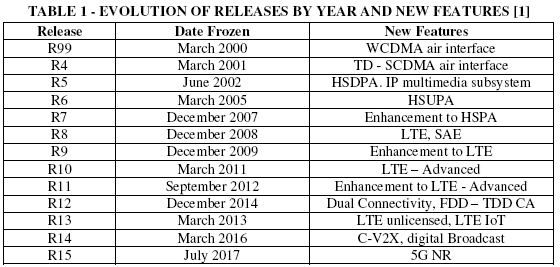
<body><![CDATA[<p align="justify"><font size="2" face="Verdana, Arial, Helvetica, sans-serif"><b>Palabras   Clave: </b>Sistemas   Inal&aacute;mbricos de Telecomunicaciones M&oacute;viles, LTE, UMTS, Small Cells, RSCP, RSRP,   RSRQ, Capacidad, Cobertura. </font></p> <hr align="JUSTIFY" noshade>     <p align="justify">&nbsp;</p>     <p align="justify">&nbsp;</p>     <p align="justify"><font size="3" face="Verdana, Arial, Helvetica, sans-serif"><b>1.&nbsp;&nbsp; INTRODUCTION</b></font><font size="2" face="Verdana, Arial, Helvetica, sans-serif"><b>&nbsp;</b></font></p>     <p align="justify"><font size="2" face="Verdana, Arial, Helvetica, sans-serif">The influence of small cells as new   technological trending in the planning and dimensioning for operator&rsquo;s mobile   networks leads to the need to optimize scenarios of high demand for services   such as the growth for multimedia applications in voice and data, congestion of   users with smartphones and tablets, growth of interfering structures, as well   as a focus on global network through the improvement of end user interfaces.   Heterogeneous environments allow the use of various technologies for user access to the   network through different systems and protocols. In this case, for different   access technologies supported by small cells, which allows communication in a   homogeneous way with different interfaces existing nowadays. The technology   considers other features such as network adaptability, technological   convergence and network element scalability<a href="#_ftn1" name="_ftnref1" title=""><sup><sup>[1]</sup></sup></a>. Small Cells are a key ingredient of   integrated Heterogeneous Networks (HetNets). Small cell development,   implementation and optimization will effectively address the growing demand   from people who use mobile broadband and voice services in early future, to   provide resources for indoor and outdoor environments<a href="#_ftn2" name="_ftnref2" title=""><sup><sup>[2]</sup></sup></a>.</font></p>     <p align="justify"><font size="2" face="Verdana, Arial, Helvetica, sans-serif">The efficient management of mobile   communication networks resources corresponds to the good dimensioning of the network's   spectrum, capacity, coverage and handling of interference, for the new   technologies in the transmission of voice and data. This is a requirement for   actual environments on operation for provision of services, and novel   implementations that are important for different sectors of society. Moreover,   Cochabamba is a city in process of development, with diverse scenarios for the   application of new technologies and management schemes for telecommunications   operators. In the next few years will exist new hopes to confront open   standards such as Long Term Evolution Advanced (LTE - A)<a href="#_ftn3" name="_ftnref3" title=""><sup><sup>[3]</sup></sup></a> and 5G New Radio (NR)<a href="#_ftn4" name="_ftnref4" title=""><sup><sup>[4]</sup></sup></a> on the way for urban and rural   deployments, reduction of business operating costs, optimization of   mobile network resources, and removal of obstacles to   small cells deployments. The mis-optimized   management of resources, in a situation with a high volume of voice and data   traffic in today&rsquo;s mobile networks, causes a direct relationship with the loss   of operator profits by congested networks, a   situation that occurs with the actual implemented capacity of a cell and bad   use of network resources. Therefore, it is convenient to carry out a study,   design and technology application suitable for confrontation of the feasibility   in a new technology. The Small Cells solutions for the network design by the   operators can satisfy the diverse requirements   of the systems wireless telecommunications [12]. Since Small Cells technology provides adequate   heterogeneous solutions for in-door and out-door<a href="#_ftn5" name="_ftnref5" title=""><sup><sup>[5]</sup></sup></a> environments to the growth of urban   infrastructure in the city of Cochabamba, the contribution of the project was   provided for the analysis of the different parameters of network quality of   service in the access network nodes when using Small Cells for its operation,   the use relevant in third and fourth generation technologies (3G and 4G),   validation through network simulators, equipment quantification and projection   of change to new technological trends at regional scenarios. In the present document the different procedures and technical   vision of the project scope is developed. </font></p>     <p align="justify"><font size="2" face="Verdana, Arial, Helvetica, sans-serif">In the first chapter an introduction to   the technology, global trending and critical application for &rdquo;Small Cells&rdquo;   scenarios are developed for   contextualization of theory background; For the   second chapter the methodology and design procedure is described, focused on   radio access network segment and key performance indicators;&nbsp; The third chapter   makes a detailed description of the selected scenarios for &ldquo;Small Cells&rdquo;   solution deployments on consideration of cell distribution, cadasters and   polygons definition; On chapter four it is shown the ink budget and coverage   prediction results as part of the simulation planning methodology, making an   analysis and evaluation of the performance on the solutions; Finally on chapter   five, specific technical and deployment conclusions are determined for the   results obtained in the project.</font></p>     <p align="justify"><font size="2" face="Verdana, Arial, Helvetica, sans-serif"><b>1.1.&nbsp;&nbsp; MOBILE GENERATIONS</b></font></p>     <p align="justify"><font size="2" face="Verdana, Arial, Helvetica, sans-serif">Through different improvements in wireless   mobile communication systems, it was possible to develop technological trends   based on mobile technologies to adapt into deployment changes. In this context, according to the definition of the   International Telecommunications Union (ITU), 4G techniques are the setoff of   modern technologies in the world of wireless broadband communications: the   International Mobile Telecommunications - Advanced (IMT - Advanced) is   considered as 4G and International Mobile Telecommunications - 2020 (IMT -   2020) is considered as 5G. [5]</font></p>     <p align="justify"><a name="t1"></a></p>     ]]></body>
<body><![CDATA[<p align="center"><img src="/img/revistas/riyd/v21n1/a02_table_01.gif" width="560" height="267"></p>     <p align=justify><font size="2" face="Verdana, Arial, Helvetica, sans-serif">a)<b>&nbsp;1<sup>th</sup> Generation (1G):</b> The first mobile communication   systems were analog and service-oriented for voice. Systems such as Advance   Mobile Phone System (AMPS) and Cellular Digital Packet Data (CDPD) they were   widely used in America; For example, Nippon Telephone and Telegraph (NTT), in   the countries Asia and Nordic Mobile Telephones (NMT) and Total Access   Communication Systems (TACS) in other parts of the world. The 800 and 900 MHz   bands were used, with a bandwidth of 40 MHz, the frequencies between 869- 894   MHz for transmissions from base station to mobiles and frequencies between 824   - 849 MHz for transmissions from mobiles to base station in AMPS and TACS technologies using multiplication by division of time [7].</font></p>     <p align="justify"><font size="2" face="Verdana, Arial, Helvetica, sans-serif">b)<b>&nbsp;2<sup>nd</sup> Generation (2G):</b> The second generation   networks were developed based on digital signaling of bands of narrow frequencies.   By offering fully digital services, 2G technologies acquired popularity around   the world. Improvements such as increased voice quality, capacity, and   efficiency spectral and multiplexing were key factors for the evolution of   mobile networks. With the advance, other services emerged such as a   considerable degree of easy access to the WEB, digital voice and the handling   of Short Message Service (SMS). Among the different technologies and their   variants of second generation networks are:</font></p>     <blockquote>       <p align="justify"><font size="2" face="Verdana, Arial, Helvetica, sans-serif">&#9642;&nbsp; Global System for Mobile     Communications (GSM)</font></p>       <p align="justify"><font size="2" face="Verdana, Arial, Helvetica, sans-serif">&#9642;&nbsp; Code Division Multiple Access     (CDMA)</font></p>       <p align="justify"><font size="2" face="Verdana, Arial, Helvetica, sans-serif">&#9642;&nbsp; Time Division Multiple Access     (TDMA)</font></p>       <p align="justify"><font size="2" face="Verdana, Arial, Helvetica, sans-serif">&#9642;&nbsp; EDGE &ndash; 2.75 G [3].</font></p> </blockquote>     <p align="justify"><font size="2" face="Verdana, Arial, Helvetica, sans-serif">c)<b>&nbsp;3<sup>rd</sup> Generation (3G):</b> The third generation of   wireless communication systems focuses on the process of globalization of   mobile communication. There is a predominance of the Internet and data   broadband. The International Telecommunication Union (ITU) began the process of   defining the standard for the third generation systems, known as International   Mobile Telecommunications 2000 (IMT-2000). In Europe, the European   Telecommunications Standard Institute (ETSI) was responsible for the process   standardization of UMTS [10]. The standardized technologies in 3G are:</font></p>     <blockquote>       ]]></body>
<body><![CDATA[<p align="justify"><font size="2" face="Verdana, Arial, Helvetica, sans-serif">&#9642;&nbsp;&nbsp; UMTS Wideband CDMA (WCDMA),     with downlink, speeds up to 1.92 Mbps.</font></p>       <p align="justify"><font size="2" face="Verdana, Arial, Helvetica, sans-serif">&#9642;&nbsp;&nbsp; High Speed Downlink Packet     Access (HSDPA) pushed the 14 Mbps downlink.</font></p>       <p align="justify"><font size="2" face="Verdana, Arial, Helvetica, sans-serif">&#9642;&nbsp;&nbsp; LTE Evolved UMTS Terrestrial     Radio Access (E-UTRA) with peak speeds of 100 Mbps.</font></p> </blockquote>     <p align="justify"><font size="2" face="Verdana, Arial, Helvetica, sans-serif">International Mobile   Telecommunications-2000 (IMT-2000) is on behalf of the International   Telecommunications Union (ITU) for 3G. GSM proponents present Universal Mobile   Telecommunications System (UMTS), an evolution of the same as the path to   IMT-2000 [28]. Alternate schemes are developed in the United States, Japan, and   Korea. Each scheme implies typically multiple radio transmission techniques in   order to handle the evolution of 2G.To move into this &quot;unified&quot; 3G   system, users will probably need a phone so quintuple capable of operating in   an 800/900 MHz band, a 1.7 to 1.9 GHz band and a 2.5 bandit 2.69 GHz [7].</font></p>     <p align="justify"><font size="2" face="Verdana, Arial, Helvetica, sans-serif">d)<b> 4<sup>th</sup> Generation (4G):</b> According to the definition of   the International Telecommunications Union (ITU), 4G techniques are the set of   modern technologies in the world of wireless broadband communications: the   International Mobile Telecommunications - Advanced (IMT - Advanced) considered   as 4G. IMT-Advanced systems support high mobility applications, broadband   multimedia services and a wide range of data speeds according to the demands of   users and services in multiple user environments. The set of different   technologies that make up 3G is called IMT- 2000. The term IMT refers to the   set of IMT-Advanced and IMT &ndash; 2000 [29]. On December 62010, at the ITU World Radiocommunication   Seminar 2010 (WRS - 10), in Geneva, it was defined that only two technologies   are accepted to compose IMT-Advanced [2]:</font></p>     <blockquote>       <p align="justify"><font size="2" face="Verdana, Arial, Helvetica, sans-serif">&#9642; LTE-Advanced (LTE Release 10     &amp; beyond)</font></p>       <p align="justify"><font size="2" face="Verdana, Arial, Helvetica, sans-serif">&#9642; Mobile WiMAX 2.0 (802.16m,     WirelessMAN-Advanced)</font></p> </blockquote>     <p align="justify"><font size="2" face="Verdana, Arial, Helvetica, sans-serif">e)<b>&nbsp;5<sup>th</sup> Generation (5G):</b> The 5G System is the principal   focus of 3GPP Release 15. Release 15 profiles the 5G system Phase 1, while the   5G system profiles Phase 2 which is going to be defined in Release 16. The   specification of Phase 1 has involved all the 3GPP Working Groups.&nbsp; The 5G   requirements have been identified in terms of new services and markets, the   principal milestones describe different types of requirements for different 5G usage   such as Enhanced Mobile Broadband (eMBB): the new requirements are identified   for data-rates, traffic/connection density, user mobility, etc. Many   deployments, capacity and coverage scenarios are considered, driving different   service areas, some examples are indoor/outdoor, urban and rural areas, office   and home, local and wide areas connectivity; Ultra Reliable and Low Latency   Communications (URLLC): where many scenarios demand the consideration of very   low latency and very high communications service availability.&nbsp; Moreover, these   last milestones are conducted by implementation functionalities and features.   Therefore, of these factors depend directly on the 5G framework, in   consideration of affection in actual scenarios this can be reduced by suitable   interconnections between the 5G system core of the 5G network, for example, to   allow local hosting of the services [27]; Massive Internet of Things (mIoT).   The current technology standardized as formal 5G as part of IMT &ndash; 2020 is:</font></p>     <blockquote>       ]]></body>
<body><![CDATA[<p align="justify"><font size="2" face="Verdana, Arial, Helvetica, sans-serif">&#9642;&nbsp; 5G NR (New Radio)</font></p> </blockquote>     <p align="justify"><font size="2" face="Verdana, Arial, Helvetica, sans-serif"><b>1.2.&nbsp;&nbsp; RADIO ACCESS NETWORK DOMAIN   METRICS</b></font></p>     <p align="justify"><font size="2" face="Verdana, Arial, Helvetica, sans-serif">In reference to interoperability, RF<a href="#_ftn6" name="_ftnref6" title=""><sup><sup>[6]</sup></sup></a> resource management, the development of network maintenance and optimization,   it is possible to consider different quantitative and qualitative domains that   allow evaluating the technical performance of the network [8].</font></p>     <p align="justify"><font size="2" face="Verdana, Arial, Helvetica, sans-serif"><b>a) Capacity</b> is defined as the degree of   number of users connected to a network of telecommunications, capable of   guaranteeing a level of availability of services. It also refers to resources   of a system, to perform a certain task. In a more specific context,   the capacity implies the number of users capable of experiencing a level of   quality.</font></p>     <p align="justify"><font size="2" face="Verdana, Arial, Helvetica, sans-serif"><b>b) Quality of Service (QoS)</b> is the description or   measurement of the general performance of a service, to quantitatively measure   the quality of the service; several related aspects of the network service, such   as packet loss, bit rate, throughput, delay, availability and fluctuation.</font></p>     <p align="justify"><font size="2" face="Verdana, Arial, Helvetica, sans-serif"><b>c) Coverage</b><b></b> refers to the geographic area   in which a service or application is available. It is usually applied to radio   communications, but can also be used in cable services. Transmitting stations   and telecommunications companies generate coverage maps that indicate to the   user the area in which they offer their services [9].</font></p>     <p align="justify"><font size="2" face="Verdana, Arial, Helvetica, sans-serif"><b>d) Key Performance Indicators </b>for the analysis and   quantifiable study of the performance of 3G and 4G networks, the Key   Performance Indicator (KPI's)<a href="#_ftn7" name="_ftnref7" title=""><sup><sup>[7]</sup></sup></a>, which are representative metrics for   the success of activities or procedures in an organization. Some of the KPIs that are   considered for network planning and optimization are:</font></p>     <blockquote>       <p align="justify"><font size="2" face="Verdana, Arial, Helvetica, sans-serif">&#9642; RSSI     (received signal strength indicator): measures the total average received     power.</font></p>       <p align="justify"><font size="2" face="Verdana, Arial, Helvetica, sans-serif">&#9642; RSCP     (received signal code power): it is the power measured by a receiver in a     physical communication channel, referring to 3G.</font></p>       ]]></body>
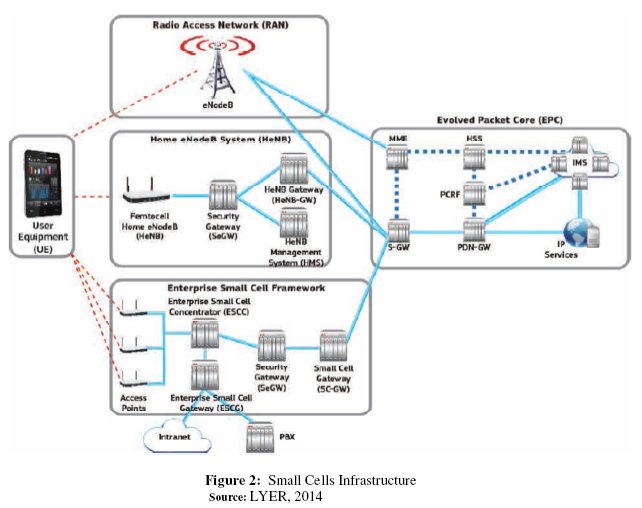
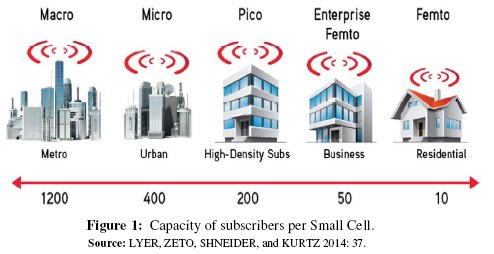
<body><![CDATA[<p align="justify"><font size="2" face="Verdana, Arial, Helvetica, sans-serif">&#9642; RSRP     (reference signal received power): it is the power reference average according     to a bandwidth, referring to LTE.</font></p> </blockquote>     <p align="justify"><font size="2" face="Verdana, Arial, Helvetica, sans-serif"><a name="_heading=h.gjdgxs"></a><b>1.3.&nbsp;&nbsp; SMALL   CELLS</b></font></p>     <p align="justify"><font size="2" face="Verdana, Arial, Helvetica, sans-serif">Small Cells is a general term for   low-power radio access nodes that are used both on spectrums with or without a   license. They have a coverage range that varies from 10 meters to several   hundred meters, compared to the tens of kilometers served by microcells as   shown below, <a href="#f1">Figure 1</a>. The elements Included in this category are femtocells,   picocells, microcells, and metro cells [25].</font></p>     <p align=justify><a name="f1" id="f1"></a></p>     <p align=center><img src="/img/revistas/riyd/v21n1/a02_figure_01.jpg" width="494" height="254"></p>     <p align="justify"><font size="2" face="Verdana, Arial, Helvetica, sans-serif">a)<b> HetNets</b> use a combination of devices   and technologies that work together to enable mobile voice service and   broadband access. Voice communication and data transmission are key factors for   income. As consumption continues to grow, operators are looking for new   strategies to face the challenge of improving the quality of experience or   Quality of Experience (QoE). At a high level, HetNets represent a strategic   evolution of the mobile access network in which operators increase macrocell   capacity relative to demand [20]. HetNets deploy the network closer to the   customer, the lowest cost location and the access nodes of low power indoors   and outdoors, on street lights, roadsides and   inside corporate buildings. Therefore, to facilitate HetNets deployments,   infrastructure providers choose to integrate interfaces of 3G, LTE and Wi-Fi   technologies inside small cells. Groups of the Third Generation Partnership   Project (3GPP) are working to overcome implementation hurdles and maximize the   technology of HetNet [23].</font></p>     <p align="justify"><font size="2" face="Verdana, Arial, Helvetica, sans-serif">b)<b> Small Cell Architecture</b></font></p>     <p align="justify"><font size="2" face="Verdana, Arial, Helvetica, sans-serif">The architecture of Small Cell   technology is shown below, <a href="#f2">Figure 2</a>:</font></p>     <p align="justify"><a name="f2"></a></p>     <p align="center"><img src="/img/revistas/riyd/v21n1/a02_figure_02.jpg" width="642" height="508"></p>     ]]></body>
<body><![CDATA[<p align="justify"><font size="2" face="Verdana, Arial, Helvetica, sans-serif">The eNodeB includes both the antenna and   the radio controller which were separate entities in the pre-LTE technologies.   The eNodeBs communicate with the EPC, with the MME and the SGW. The MME manages   the mobility of the EU between cells, while the SGW handles the transmission   and reception of data.</font></p>     <p align="justify"><font size="2" face="Verdana, Arial, Helvetica, sans-serif">c)<b> Stations and radio bases of   small cells</b> provide enhanced mobile broadband service [33] in several ways:</font></p>     <blockquote>       <p align="justify"><font size="2" face="Verdana, Arial, Helvetica, sans-serif">&#9642; Serve for     smaller and closer areas to end users. This provides better-quality and more     connections with higher bandwidth and lower latency.</font></p>       <p align="justify"><font size="2" face="Verdana, Arial, Helvetica, sans-serif">&#9642; They allow     the available spectrum to be reused many times, although with the concern by     the interference of macrocells and other Small Cells. Peak performance of     picocells and microcells is the same as macrocells, since both use the same     bandwidth of radio.</font></p>       <p align="justify"><font size="2" face="Verdana, Arial, Helvetica, sans-serif">&#9642; Provide     coverage in areas poorly served by macrocells due to the placement of the     construction, distance and interference.</font></p> </blockquote>     <p align="justify"><a name="t2"></a></p>     <p align="center"><img src="/img/revistas/riyd/v21n1/a02_table_02.gif" width="699" height="117"></p>     <p align="center">&nbsp;</p>     <p align="justify"><font size="3" face="Verdana, Arial, Helvetica, sans-serif"><b>2.&nbsp;&nbsp; METHODOLOGY OF DESIGN AND   PLANNING</b></font><font size="2" face="Verdana, Arial, Helvetica, sans-serif"><b>&nbsp;</b></font></p>     ]]></body>
<body><![CDATA[<p align="justify"><font size="2" face="Verdana, Arial, Helvetica, sans-serif">This section seeks to carry out an   analysis of Small Cells technology for the city of Cochabamba on the different   public urban areas, through indoor or outdoor solutions. By taking as a study subject the   population of Cochabamba, who can select for the services offered by mobile   operators, sectoral polygons are defined taking into account design parameters   according to specific solution.</font></p>     <p align="justify"><font size="2" face="Verdana, Arial, Helvetica, sans-serif"><b>2.1.&nbsp;&nbsp; DESIGN REQUIREMENTS</b></font></p>     <p align="justify"><font size="2" face="Verdana, Arial, Helvetica, sans-serif">For the design of the Small Cell network, it was seek to   study the following considerations in force in the city from Cochabamba: Land   survey of the area, by coverage and its form of spread; High voice and data   traffic, to improve service to large numbers of users; Indoor or outdoor   environment, due to the type of solution, planning and equipment to be   implemented; Public availability scenarios, to improve the quality of user   experience; Previous deployments, due to the compatibility of resources in the   network; Backhaul, due to the interconnection of network elements; Macrocells,   for the downloading of traffic and connection with other cells [26]; Mobility   and transport of users, due to the reliability of the user's connection;   Availability of technology, due to the improvement of the quality of service of   the network.</font></p>     <p align="justify"><font size="2" face="Verdana, Arial, Helvetica, sans-serif">Since design considerations are supported   by quantifiable technical parameters and information of the solution, from the   perspective of the network and user, it is decided to use:</font></p>     <p align="justify"><font size="2" face="Verdana, Arial, Helvetica, sans-serif">a) To improve network quality of   service [5] using the following indicators: RSCP, RSRP, RSRQ, and Signal to   Noise ratio.</font></p>     <p align="justify"><font size="2" face="Verdana, Arial, Helvetica, sans-serif">b) To improve the quality of user   experience using the following indicators: availability, areas of coverage,   cell distribution, terrain survey maps, and buildings.</font></p>     <p align="justify"><font size="2" face="Verdana, Arial, Helvetica, sans-serif"><b>2.2.&nbsp;&nbsp; RADIO ACCESS PLANNING </b></font></p>     <p align="justify"><font size="2" face="Verdana, Arial, Helvetica, sans-serif">The planning methodology of this project   is based on Small Cell technology, respectively to the 3G &amp; 4G architecture   - WCDMA and LTE, predominant in the operators of the city of Cochabamba [11].</font></p>     <p align="justify"><font size="2" face="Verdana, Arial, Helvetica, sans-serif">The pre-planning stage is an analysis of   the areas in the city of Cochabamba considering:</font></p>     <p align="justify"><font size="2" face="Verdana, Arial, Helvetica, sans-serif">a) <b>Traffic demand:</b> by satisfying   the situations and moments in which the user presents a high rate of   traffic in calls and data, an improvement in the quality of service of the   network is provided.</font></p>     ]]></body>
<body><![CDATA[<p align="justify"><font size="2" face="Verdana, Arial, Helvetica, sans-serif">b) <b>Description of services:</b> with a   tendency to use data rather than calls, the user requires specific services to   your environment.</font></p>     <p align="justify"><font size="2" face="Verdana, Arial, Helvetica, sans-serif">c) <b>Definition of technologies:</b> the   performance of a solution must be based on the satisfaction of the user   requirements, with different types of technologies, some of which are presented   more efficiently for the solution.</font></p>     <p align="justify"><font size="2" face="Verdana, Arial, Helvetica, sans-serif">d) <b>Definition of frequencies:</b> each   country defines a frequency distribution plan according to its environment; the   operation of the equipment must be in accordance with this plan and performance   of the operators.</font></p>     <p align="justify"><font size="2" face="Verdana, Arial, Helvetica, sans-serif">e) <b>Classification of Small Cells:</b>  each area presents a different environment for a design. The diversity of   solutions Small Cell allows the implementation of network elements based on   considerations and parameters of this technology.</font></p>     <p align="justify"><font size="2" face="Verdana, Arial, Helvetica, sans-serif">The design stage is based on the following   points:</font></p>     <p align="justify"><font size="2" face="Verdana, Arial, Helvetica, sans-serif">f) <b>Availability:</b> basically the   operators seek to implement sites in areas where there is demand for services   and, therefore, satisfy a group of users; however, planning and sizing a   network presents capacity limitations. For this purpose, it is necessary   to implement Small Cells technology for areas where   it is allowed to increase the capacity of traffic through specific solutions   [15].</font></p>     <p align="justify"><font size="2" face="Verdana, Arial, Helvetica, sans-serif">g) <b>Coverage:</b> the physical range of   the signal in a device is not presented in a homogeneous way; the Small Cells   technology is efficient when providing a wide range of solutions. To give good   coverage, it is necessary to make various considerations such as:</font></p>     <blockquote>       <p align="justify"><font size="2" face="Verdana, Arial, Helvetica, sans-serif">&#9642; Natural     environment type and signal propagation </font>    <br>     <font size="2" face="Verdana, Arial, Helvetica, sans-serif">&#9642; Structures     and buildings</font>    ]]></body>
<body><![CDATA[<br>     <font size="2" face="Verdana, Arial, Helvetica, sans-serif">&#9642; Transmitting     power of the transmitter</font>    <br>     <font size="2" face="Verdana, Arial, Helvetica, sans-serif">&#9642; Floor     height, tilt or vertical inclination and azimuth or horizontal orientation of     the transmitter</font>    <br>     <font size="2" face="Verdana, Arial, Helvetica, sans-serif">&#9642; Interferences     and signal attenuations</font>    <br>     <font size="2" face="Verdana, Arial, Helvetica, sans-serif">&#9642; Technical     parameters of the transmitter, equipment and technology</font>    <br>     <font size="2" face="Verdana, Arial, Helvetica, sans-serif">&#9642; Reason for     the high demand for services</font>    <br>     <font size="2" face="Verdana, Arial, Helvetica, sans-serif">&#9642; Human     activities in the area</font>    <br>     <font size="2" face="Verdana, Arial, Helvetica, sans-serif">&#9642; Type of     installation and form of operation and maintenance of the equipment</font></p> </blockquote>     <p align="justify"><font size="2" face="Verdana, Arial, Helvetica, sans-serif">h) <b>Frequency plan:</b> the solution   must be legal and in accordance with the requirements set out for these of the   electromagnetic spectrum in the country. The type of frequency to be used affects directly the performance of the equipment for the solution;   therefore, the assignment and Transmitter configuration should be optimal for   your operation [13].</font></p>     <p align="justify"><font size="2" face="Verdana, Arial, Helvetica, sans-serif">i) <b>Type of   application:</b> the solution is structurally specific to the urban environment, activities of the area   and function; therefore, it can present harmony and functionality with the   environment and, at the same time, meet user needs.</font></p>     <p align="justify"><font size="2" face="Verdana, Arial, Helvetica, sans-serif">The application stage considers:</font></p>     ]]></body>
<body><![CDATA[<p align="justify"><font size="2" face="Verdana, Arial, Helvetica, sans-serif">j) <b>Sizing of   the network:</b> to validate the project, it is necessary to consider the   feasibility economics of the same; counting and listing the network allows the   definition of the type of equipment to be used   for this purpose [14].</font></p>     <p align="justify"><font size="2" face="Verdana, Arial, Helvetica, sans-serif">k) <b>Comparison of manufacturers:</b>  there is a great diversity of technologies. When choosing a solution, must   consider the efficiency of the equipment, compatibility with current operators,   their types of applications, the cost of the equipment and performance in the   environment.</font></p>     <p align="justify"><font size="2" face="Verdana, Arial, Helvetica, sans-serif">l) <b>Small Cells   parameterization:</b> the correct operation of a technology depends on the adequate   configuration of the different technical parameters of the equipment as well as   its planning background.</font></p>     <p align="justify"><font size="2" face="Verdana, Arial, Helvetica, sans-serif"><b>2.3.&nbsp;&nbsp; FREQUENCY PLAN</b></font></p>     <p align="justify"><font size="2" face="Verdana, Arial, Helvetica, sans-serif">According to the different telecommunications   operators, the scalable technology for LTE (in the process of implementation)   operates on the AWS<a href="#_ftn8" name="_ftnref8" title=""><sup><sup>[8]</sup></sup></a> band at 2100 MHz [22]. Likewise, the   frequency bands in 1900 MHz for 3G technology in at least two operators, which   is why defines to use this band for the future compatibility of the solution   with the Cochabamba environment [11]:</font></p>     <p align="justify"><font size="2" face="Verdana, Arial, Helvetica, sans-serif">a) For LTE-A:</font></p>     <blockquote>       <p align="justify"><font size="2" face="Verdana, Arial, Helvetica, sans-serif">&#9642; Requested     band: 2100 [MHz]</font></p>       <p align="justify"><font size="2" face="Verdana, Arial, Helvetica, sans-serif">&#9642; Bandwidth     of each carrier: 10 - 20 [MHz]</font></p>       <p align="justify"><font size="2" face="Verdana, Arial, Helvetica, sans-serif">&#9642; Available     carrier capacity: 2 carriers</font></p> </blockquote>     ]]></body>
<body><![CDATA[<p align="justify"><font size="2" face="Verdana, Arial, Helvetica, sans-serif">b) For UMTS- HSPA<a href="#_ftn9" name="_ftnref9" title=""><sup><sup>[9]</sup></sup></a>:</font></p>     <blockquote>       <p align="justify"><font size="2" face="Verdana, Arial, Helvetica, sans-serif">&#9642; Requested     band: 1900 [MHz]</font></p>       <p align="justify"><font size="2" face="Verdana, Arial, Helvetica, sans-serif">&#9642; Bandwidth     of each carrier: 5 [MHz]</font></p>       <p align="justify"><font size="2" face="Verdana, Arial, Helvetica, sans-serif">&#9642; Available     carrier capacity: 4 carriers</font></p> </blockquote>     <p align="justify"><font size="2" face="Verdana, Arial, Helvetica, sans-serif"><b>2.4.&nbsp;&nbsp; MANUFACTURERS COMPARISON</b></font></p>     <p align="justify"><font size="2" face="Verdana, Arial, Helvetica, sans-serif">The products for Small Cell solutions that   the different manufacturers offer are more detailed when the moment to approve a   Roll - Out tender or deployment of the solution. However, based on case   studies, applications, and technical   information the manufacturer Ericsson has a portfolio of Small Cell technology   with a set of network elements well organized and developed.&nbsp; The quality and   performance of this manufacturer is very good due to its constant evolution and   performance of technology in other scenarios; is robust due to the variety of   technologies to be used, is scalable to new technological trends, presents   operational safety and compatibility in the market. It has a user capacity   according to the required application. </font></p>     <p align="justify"><font size="2" face="Verdana, Arial, Helvetica, sans-serif">The coverage is varied with respect to the   standardization of Small Cell technology and has very good solutions at indoor   and outdoor level. Its installation is simple, state-of-the-art and with   evolving scalability<a href="#_ftn10" name="_ftnref10" title=""><sup><sup>[10]</sup></sup></a>. It is the first technology to be   considered by several operators in different countries. The manufacturer Huawei   has a portfolio of Small Cell technology with a set of network elements quite   varied and organized. The quality and performance of this manufacturer is good   in outdoor environments, in which the technology is not exactly standardized;   however this manufacturer presents indoor solutions oriented to the market of   companies and institutions. It also has a capacity to use according to the   required application. Coverage functions are presented with simplicity in its corresponding   equipment installation and scalability of mobile technologies evolutions.   Mobile service is the first technology to be considered by operators especially   in Asian countries [16]; without dependency on specific solutions, there are still general preferences for   Ericsson in this region. The manufacturer Nokia Siemens Networks has a   portfolio of Small Cell technology with a set of specific and organized network   elements. The quality and performance of this manufacturer are very good, with   an orientation to the use of solutions indoor, and does not present a diversity   of equipment. The teams present harmony and functionality in the work environment, the final comparison is detailed below. It   has a user capacity according to the required application. It is not considered   as the best Small Cell technology, below Ericsson and Huawei, but shown with   perspectives of evolution by the performance of the technology in normal   networks.</font></p>     <p align=justify><a name="t3"></a></p>     <p align=center><img src="/img/revistas/riyd/v21n1/a02_table_03.gif" width="710" height="438"></p>     ]]></body>
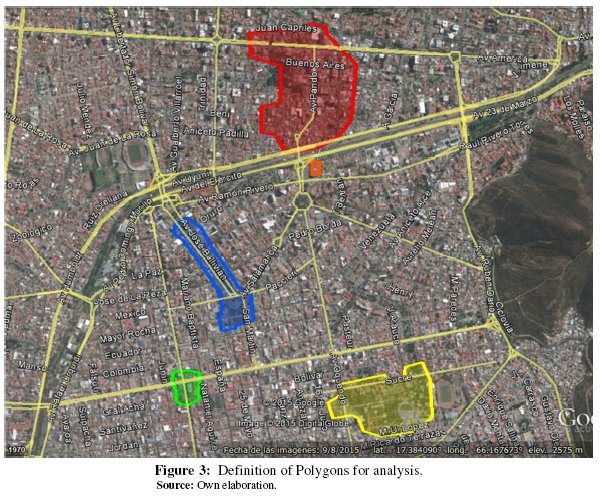
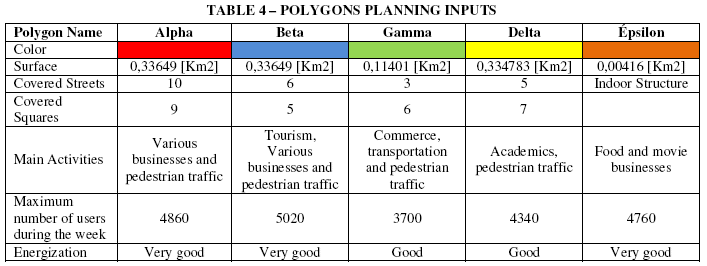
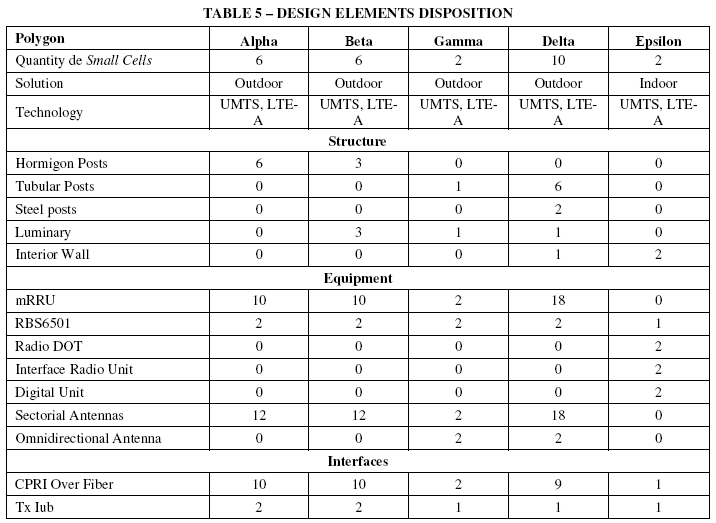
<body><![CDATA[<p align="justify">&nbsp;</p>     <p align="justify"><font size="3" face="Verdana, Arial, Helvetica, sans-serif"><b>3.&nbsp;&nbsp; DESCRIPTION&nbsp; OF PLANNING &ldquo;SMALL   CELLS &rdquo;SCENARIOS</b></font></p>     <p align="justify"><font size="2" face="Verdana, Arial, Helvetica, sans-serif">The project is limited to the areas with   the highest urban concentration in the city of Cochabamba, that is, high data   and call traffic and adequate implementation conditions. It is determined to provide Small   Cell coverage and services to the following areas defined by polygons in <a href="#f3">Figure 3</a>.</font></p>     <p align="justify"><a name="f3"></a></p>     <p align="center"><img src="/img/revistas/riyd/v21n1/a02_figure_03.jpg" width="601" height="496"></p>     <p align="justify"><font size="2" face="Verdana, Arial, Helvetica, sans-serif">The chosen scenarios allow considering the   diversity of Small Cells technology applications; likewise, growth in the use   of technology is expected for Cochabamba. In <a href="#t4">Table 4</a> some relevant data is   shown.</font></p>     <p align="justify"><a name="t4"></a></p>     <p align="center"><img src="/img/revistas/riyd/v21n1/a02_table_04.gif" width="707" height="266"></p>     <p align="justify"><font size="2" face="Verdana, Arial, Helvetica, sans-serif"><b>3.1.&nbsp;&nbsp; ARRANGEMENT OF ELEMENTS</b></font></p>     <p align="justify"><font size="2" face="Verdana, Arial, Helvetica, sans-serif">The design for each polygon considers an   arrangement of network elements on consideration to the scenarios and   requirements of each appropriate solution for your application, as shown below,   <a href="#t5">Table 5</a>:</font></p>     ]]></body>
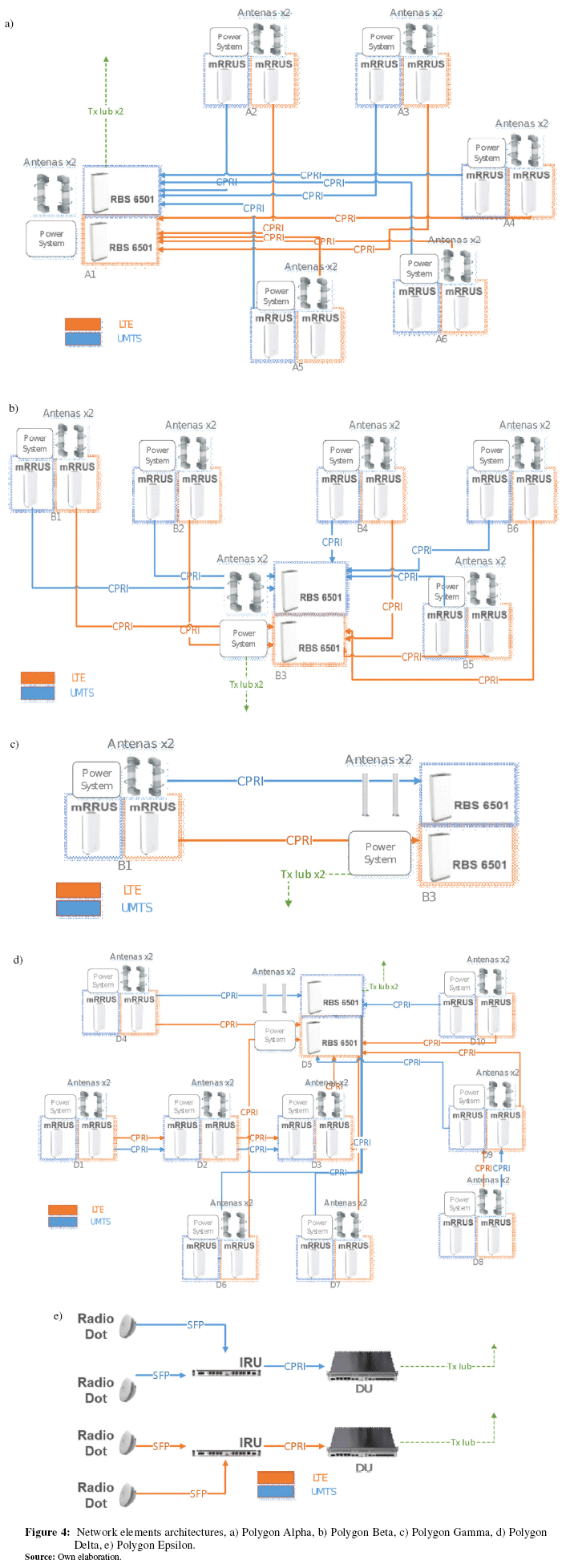
<body><![CDATA[<p align="justify"><a name="t5"></a></p>     <p align="center"><img src="/img/revistas/riyd/v21n1/a02_table_05.gif" width="716" height="523"></p>     <p align="justify"><font size="2" face="Verdana, Arial, Helvetica, sans-serif"><b>3.2.&nbsp;&nbsp; NETWORKS ARCHITECTURES</b></font></p>     <p align="justify"><font size="2" face="Verdana, Arial, Helvetica, sans-serif">Since each polygon has its own conditions   for a good operation of the Small Cells network, an equipment configuration was   defined between the mRRU's, RBS 6501's, Radio Dot's, IRU's and DU's, based on   functional case studies and manufacturer recommendations [5]; therefore, it was   decided establish a predominance for the star topology referring to each RBS   6501 and mRRU for each polygon. The network element architecture for each   polygon is shown below, <a href="#f4">Figure 4</a>:</font></p>     <p align="justify"><a name="f4"></a></p>     <p align="center"><img src="/img/revistas/riyd/v21n1/a02_figure_04.gif" width="721" height="1956"></p>     <p align="justify"><font size="2" face="Verdana, Arial, Helvetica, sans-serif"><b>3.3.&nbsp;&nbsp; CELL DISTRIBUTION</b></font></p>     <p align="justify"><font size="2" face="Verdana, Arial, Helvetica, sans-serif">For the distribution of cells, a previous   analysis of the topology was made for elements and structures that compose and   critical areas for emplacement of Small Cells, with respect to the design   requirements and planning scenarios explained above. The design for each   polygon was different, finding a diversity of Small Cells applications and type   solutions for the city of Cochabamba. Also, planning for each cell was   parameterized for each cell according to the best possible performance of each   sector for the Small Cells [6]. <a href="#f5">Figure 5</a> shows an overview of each environment:</font></p>     <p align="justify"><font size="2" face="Verdana, Arial, Helvetica, sans-serif"><b>a) For polygon &alpha;, <a href="#f5">Figure 5a</a>):</b> A1: It is the entrance to the   Boulevard, with a large concentration of people on weekends, a variety of   business and cultural activity. A2: On Beni Street, with a great concentration   of food businesses, high traffic of people; is a residential area. A3:   Intersection of avenues, near the Sim&oacute;n I. Pati&ntilde;o center and the UPAL   University, with great concentration of students, high automotive traffic and pedestrian   traffic. A4: In the parking lot of the IC Norte Supermarket, with great traffic   of people and traffic, automotive,   intersection of avenues and business environment. A5: On Pando Avenue, with a   diversity of businesses, automotive traffic, pedestrian traffic and activity   labor. A6: On Melchor Urquidi Avenue, near the intersection of the America   Avenue, residential area, various businesses and pedestrian traffic. </font></p>     <p align="justify"><font size="2" face="Verdana, Arial, Helvetica, sans-serif"><b>b) For the polygon &beta;, <a href="#f5">Figure 5b</a>):</b> B1: Close to the Bolivian   American Center, with pedestrian traffic, high level of private vehicular   traffic and public; on Plaza Col&oacute;n, at the intersection of 25 de Mayo and   Venezuela streets. B2: In the center of Plaza Col&oacute;n, with omnidirectional   coverage, high level of pedestrian traffic all day, social and cultural   activities. B3: At the southern entrance of El Prado, close to influential   businesses such as Globos and Dumbo, area of work activity, with high   pedestrian traffic, various businesses, social and cultural activities. B4: On   Chuquisaca Street, with coverage to the pedestrian area of El Prado and nearby   businesses; high pedestrian traffic, structure area for work purposes and   various businesses. B5: In front of the Comteco building on La Paz Street,   intersection of avenues, covering the area of El Prado, high pedestrian   traffic, social and cultural activities. B6: On Oruro Street, it covers a large   area of El Prado, close to the main square; high traffic pedestrian,   residential area and various businesses. </font></p>     ]]></body>
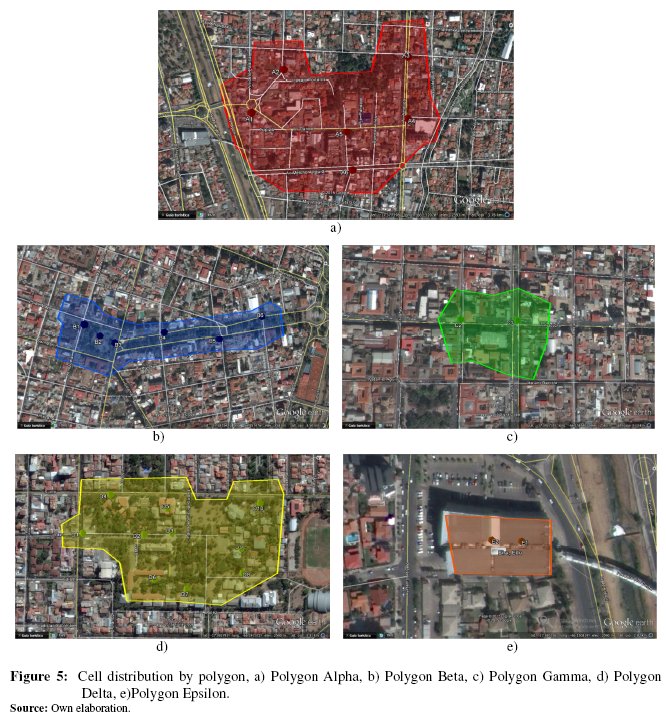
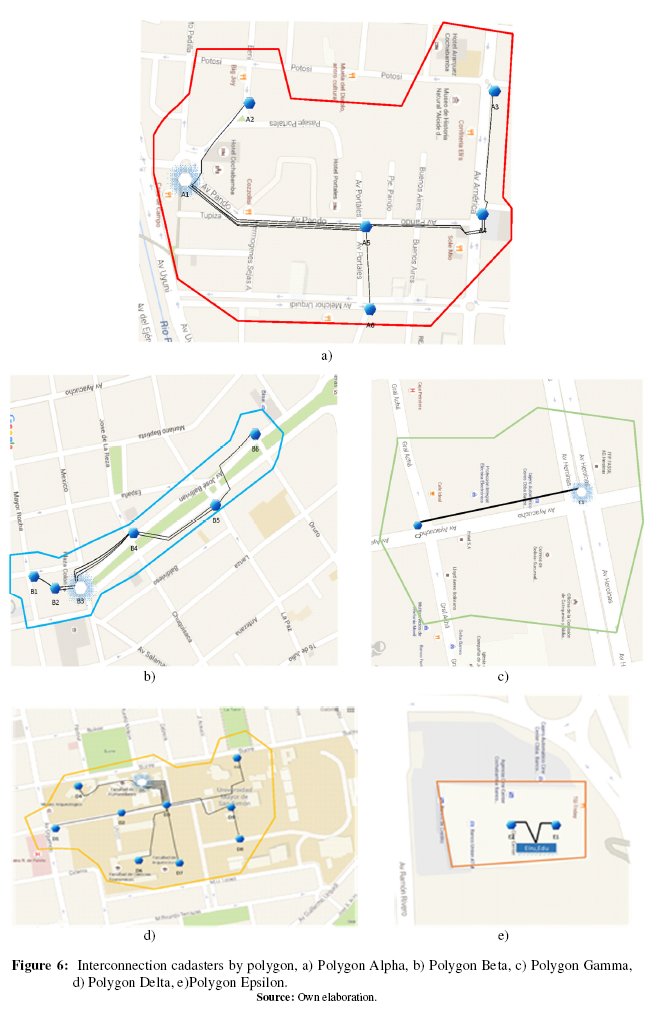
<body><![CDATA[<p align="justify"><font size="2" face="Verdana, Arial, Helvetica, sans-serif"><b>c) For the polygon &gamma;, <a href="#f5">Figure 5c</a>): </b>C1: It is the intersection of   Ayacucho and Heroines avenues; high pedestrian traffic area, with various   business activities throughout the day, vehicular traffic zone, and meeting   point and reference. Omnidirectional coverage, buildings for work and business   purposes. City center. C2: It is the intersection of General Ach&aacute; Street and   Ayacucho Avenue, with high pedestrian traffic, with various businesses. Close to influential companies. Exit of the passage of   the mail. </font></p>     <p align="justify"><font size="2" face="Verdana, Arial, Helvetica, sans-serif"><b>d) For the polygon &delta;, <a href="#f5">Figure 5d</a>):</b> D1: On Oquendo Avenue, high   pedestrian traffic of students, academic activities. Entrance to the   Universidad Mayor de San Sim&oacute;n. Various businesses. D2: On the university   pedestrian walkway, high student traffic throughout the day, activities   academic and social. D3: End of the pedestrian walkway, intersection of   different student campuses, near the multi building academic and IESE. Green   environments. D4: Entrance to the campus of the Faculty of Legal and Political   Sciences, central courtyard, exit to the street Sucre, great student traffic   and academic activities. D5: It is the central courtyard of the Faculty of   Humanities and Educational Sciences; high traffic of students and activities.   Omnidirectional coverage. D6: It is the central courtyard of the Faculty of   Economic Sciences with a large size. Study environments and green areas. High   level of student traffic. Between classroom buildings and administration.   Academic activities. D7: It is the entrance of the Faculty of Architecture, a   large green area, and a   diversity of academic activities. High pedestrian traffic.D8: In front of the laboratory   classrooms and the parking lot. High pedestrian traffic. Entrance to the   complex sports college. D9: In front of the Faculty of Technology, in front of   the administrative building. Diversity of classrooms and environments to   study. High traffic of students and administrators.   D10: On Sucre Street is the entrance to the Faculty of Technology. Green areas   and open environments study. Close to the main auditorium. Great concentration   of students. </font></p>     <p align="justify"><font size="2" face="Verdana, Arial, Helvetica, sans-serif"><b>e) For the polygon &epsilon;, <a href="#f5">Figure 5e</a>):</b> E1: First floor of the Center   cinema, it has a diversity of businesses and a high traffic of people   throughout the day. Omnidirectional coverage in the food court. E1: Second   floor of the Cinema Center, it is an environment of waiting and meals before   the cinemas. High-level of traffic of people throughout the day.   Omnidirectional coverage.</font></p>     <p align="justify"><a name="f5"></a></p>     <p align="center"><img src="/img/revistas/riyd/v21n1/a02_figure_05.jpg" width="666" height="716"></p>     <p align="justify"><font size="2" face="Verdana, Arial, Helvetica, sans-serif"><b>3.4.&nbsp;&nbsp; INTERCONNECTION CADASTRES</b></font></p>     <p align="justify"><font size="2" face="Verdana, Arial, Helvetica, sans-serif">The interconnection transport   networks in each polygon were defined based on the optimal operation of the   elements of the network, the planning carried   out, the security, the loss of gain by cables and connectors, in addition to   the saving resources. The existing interfaces in the design are:</font></p>     <blockquote>       <p align="justify"><font size="2" face="Verdana, Arial, Helvetica, sans-serif">&#9642; mRRU &ndash; mRRU<a href="#_ftn11" name="_ftnref11" title=""><sup><sup>[11]</sup></sup></a></font>    <br>     <font size="2" face="Verdana, Arial, Helvetica, sans-serif">&#9642; mRRU - BTS     6501</font>    ]]></body>
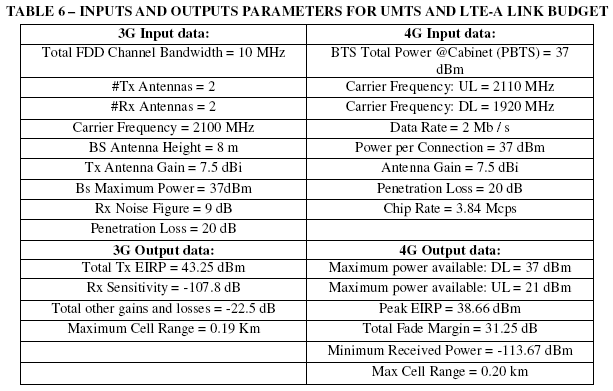
<body><![CDATA[<br>     <font size="2" face="Verdana, Arial, Helvetica, sans-serif">&#9642; DOT &ndash; IRU</font></p> </blockquote>     <p align="justify"><font size="2" face="Verdana, Arial, Helvetica, sans-serif">Optical fiber with SFP LX-1310 nm type   cable was used for each interface, with significant attenuation starting at   10[Km] of line deployment, which is used by operators in Cochabamba. <a href="#f6">Figure 6</a>  shows the cadaster of interconnections of the polygons. </font></p>     <p align=justify><a name="f6"></a></p>     <p align=center><img src="/img/revistas/riyd/v21n1/a02_figure_06.jpg" width="668" height="1016"></p>     <p align="justify">&nbsp;</p>     <p align="justify"><font size="3" face="Verdana, Arial, Helvetica, sans-serif"><b>4.&nbsp;&nbsp; RESULTS</b></font><font size="2" face="Verdana, Arial, Helvetica, sans-serif"><b>&nbsp;</b></font></p>     <p align="justify"><font size="2" face="Verdana, Arial, Helvetica, sans-serif"><b>4.1.&nbsp;&nbsp; LINK BUDGET</b></font><font size="2" face="Verdana, Arial, Helvetica, sans-serif"><b>&nbsp;</b></font></p>     <p align="justify"><font size="2" face="Verdana, Arial, Helvetica, sans-serif">Small Cell's traffic calculation by sector   considers several technical planning parameters, moreover the information is   provided only by the manufacturer once the equipment purchase was made. A   traffic calculation tool for macro cells was used, compatible with the   technology design Small Cell, with which parameters were configured considering   the information from the manufacturer Ericsson, applications of the medium and   case studies [4].</font></p>     <p align="justify"><font size="2" face="Verdana, Arial, Helvetica, sans-serif">The link calculation in UMTS and LTE for   the link by transmitter, receiver by Small Cell for Uplink and Downlink has   default calculation values. However, the following input and output parameters   were considered, <a href="#t6">Table 6</a>:</font></p>     <p align="justify"><a name="t6"></a></p>     ]]></body>
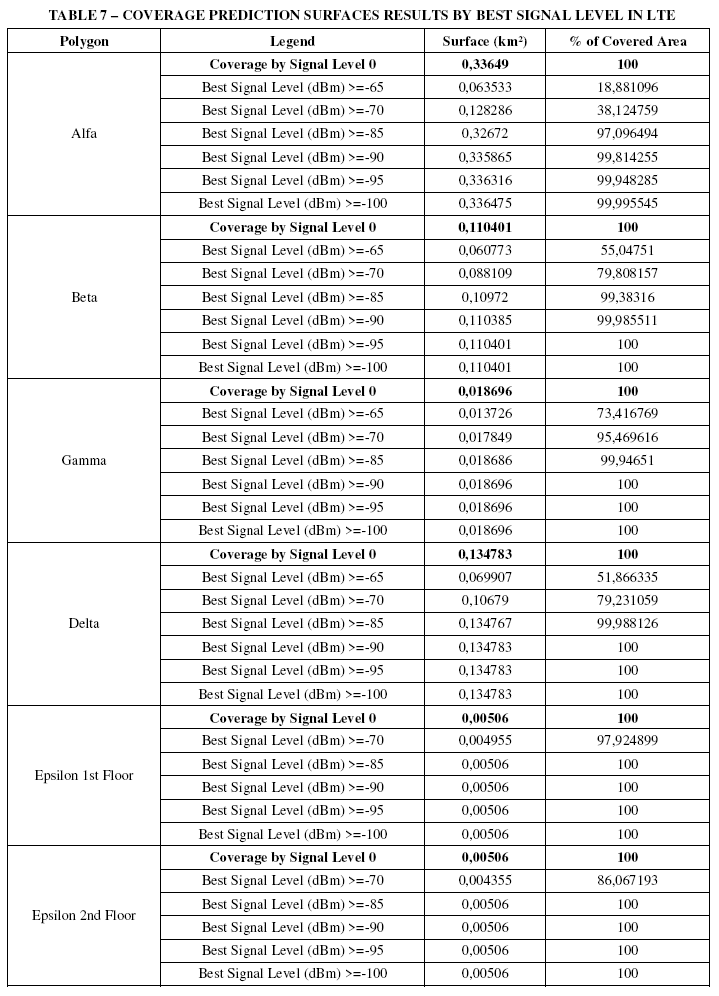
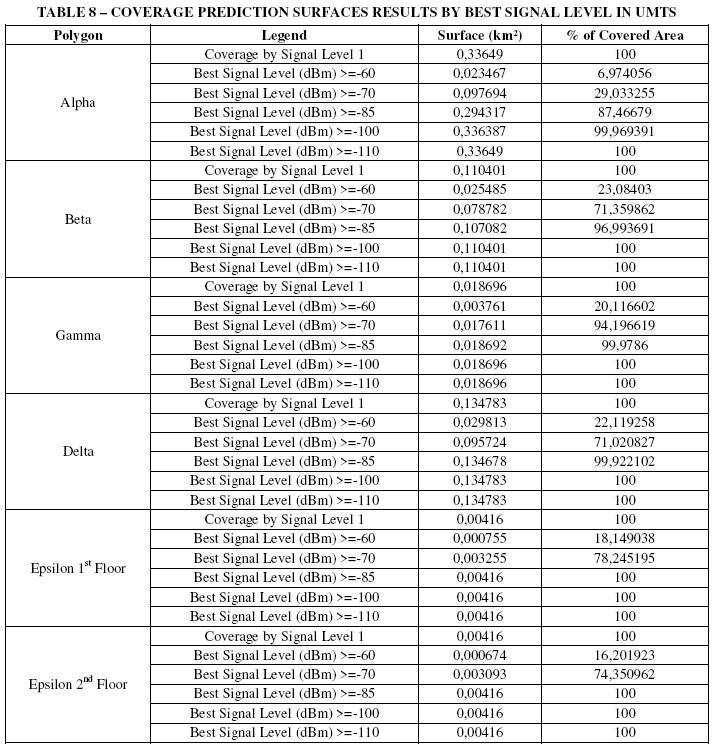
<body><![CDATA[<p align="center"><img src="/img/revistas/riyd/v21n1/a02_table_06.gif" width="613" height="391"><font size="2" face="Verdana, Arial, Helvetica, sans-serif"><b>&nbsp;</b></font></p>     <p align="justify"><font size="2" face="Verdana, Arial, Helvetica, sans-serif"><b>4.2.&nbsp;&nbsp; SIMULATION PROCEDURE</b></font><font size="2" face="Verdana, Arial, Helvetica, sans-serif"><b>&nbsp;</b></font></p>     <p align="justify"><font size="2" face="Verdana, Arial, Helvetica, sans-serif">Through a previous parameterization of   each cell and site for the different planned Small Cells, it was possible to import   the information regarding the required format. A project was created based on   the technology standards 3GPP and the DTM map of Cochabamba was imported. For   the parameterization of cells, the following were considered aspects: The tool   requires engineering parameters such as position coordinates, transmission   power, azimuth, tilt, propagation model, frequency bands, technologies and   equipment. Since the frequency bands are 2100 MHz in LTE -A and 1900 [MHz] in   UMTS, equipment was used compatible and   suitable for modeling Small Cells, their Kathrein type antennas, as well as   Omni-directional antennas with limited coverage. A   computing polygon adequate to the required coverage was considered. High   resolution was used for coverage predictions [10]. Atoll allows to create   projects based on current technologies, which consider a set of configurations,   equipment, predictions and simulations to be developed; UMTS and LTE - A were   chosen. After the DTM height map was imported, sites with default settings were   added. Each site is configured with name, longitude, latitude, altitude, pole   heights and support type. We proceeded to the creation and configuration of   each transmitter corresponding to each Small Cell; the following values:   Antenna height, Gain and Electric tilt (default); Frequency band; Vertical and   horizontal radiation pattern; Max and pilot power; and Propagation model and   resolution.&nbsp; A coverage prediction was configured based on the signal level   received by the user. According to the link calculation performed previously.</font></p>     <p align="justify"><font size="2" face="Verdana, Arial, Helvetica, sans-serif"><b>4.3.&nbsp;&nbsp; COVERAGE PREDICTIONS</b></font></p>     <p align="justify"><font size="2" face="Verdana, Arial, Helvetica, sans-serif">Through the computational polygons it was   possible to analyze the coverage for the different planned polygons. Took carried out a   prediction of the signal level received by the user based on the obtained DTM   maps; subsequently performed a feedback of the predictions to adjust technical   parameters of the Small Cells and re-simulate. In the same way, the software allowed to make reports of the percentage of surface covered in the   polygon of computation at different levels defined in the legend. This   indicator refers to the environment of the cells. It should be noted that the coverage of epsilon polygon is   more uniform because it is an indoor solution [19]. Below is the reports shown <a href="#t7">Table 7</a>:</font></p>     <p align="justify"><font size="2" face="Verdana, Arial, Helvetica, sans-serif">a) LTE - A technology:</font></p>     <p align="justify"><a name="t7"></a></p>     <p align="center"><img src="/img/revistas/riyd/v21n1/a02_table_07.gif" width="719" height="996"></p>     <p align="justify"><font size="2" face="Verdana, Arial, Helvetica, sans-serif">UMTS   technology:</font></p>     <p align="justify"><a name="t8"></a></p>     ]]></body>
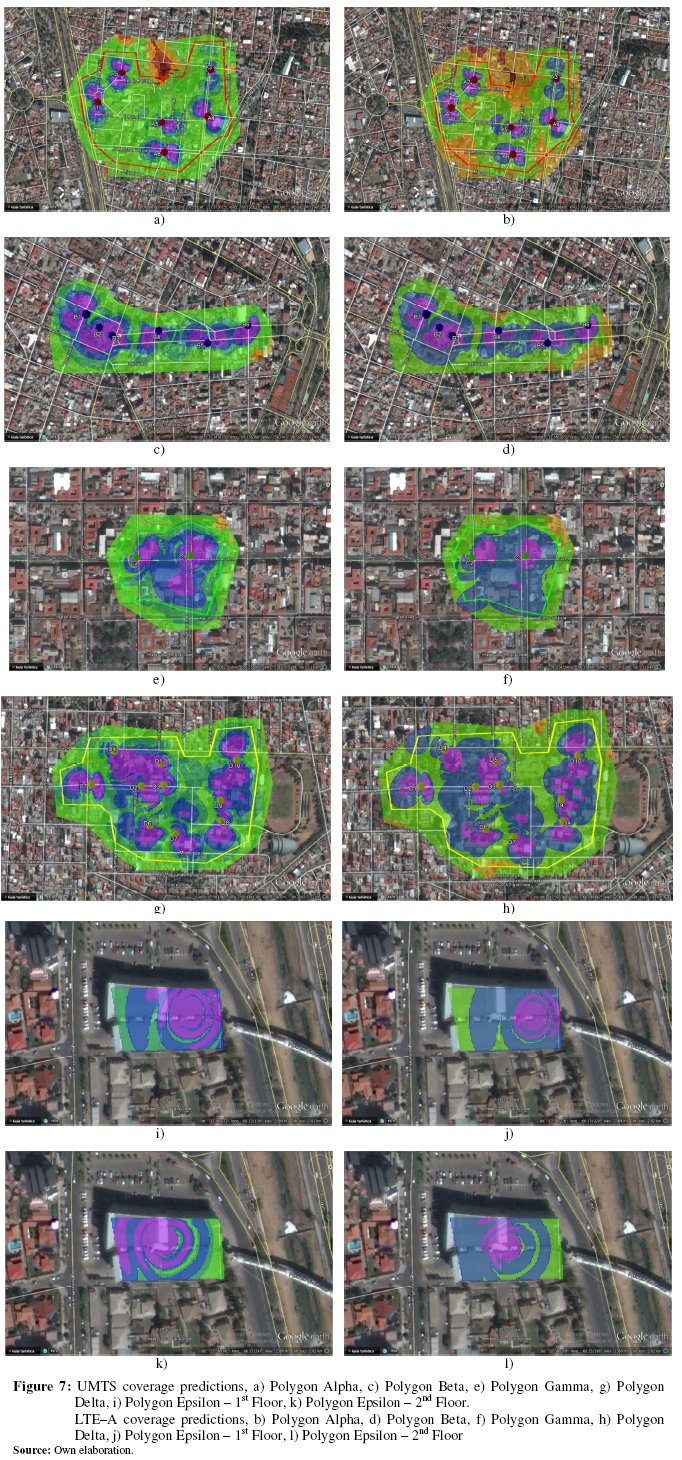
<body><![CDATA[<p align="center"><img src="/img/revistas/riyd/v21n1/a02_table_08.gif" width="718" height="748"></p>     <p align="justify"><font size="2" face="Verdana, Arial, Helvetica, sans-serif">The equipment was configured from the parametrization   of antennas designed in the program. Therefore, a parameterization of tilts and   azimuths was made for avoiding co-channel interference. Predictions require a   high resolution elevation map for more accurate results with the propagation model<a href="#_ftn12" name="_ftnref12" title=""><sup><sup>[12]</sup></sup></a>, as well as being owned by some operators in Cochabamba. The alpha polygon   presents localized coverage requirements as shown in <a href="#f7">Figure 7</a>.</font></p>     <p align="justify"><a name="f7"></a></p>     <p align="center"><img src="/img/revistas/riyd/v21n1/a02_figure_07.jpg" width="682" height="1460"></p>     <p align="justify"><font size="2" face="Verdana, Arial, Helvetica, sans-serif">As it has an open area between buildings,   the beta polygon presents very good coverage. The gamma polygon is of a small   area with good coverage. The delta polygon has several Small Cells with good   coverage for each faculty of the university. The epsilon polygon has good   coverage being a closed environment. The most important received signal values   to consider reaching optimal percentages.</font></p>     <p align="justify">&nbsp;</p>     <p align="justify"><font size="3" face="Verdana, Arial, Helvetica, sans-serif"><b>5.&nbsp;&nbsp;CONCLUSIONS</b></font><font size="2" face="Verdana, Arial, Helvetica, sans-serif"><b>&nbsp;</b></font></p>     <p align="justify"><font size="2" face="Verdana, Arial, Helvetica, sans-serif">It is concluded that the application of   Small Cell technology in heterogeneous environments for the city of Cochabamba   is efficient by improving the use of radio frequency resources, user capacity   and received signal levels in the polygons defined, which was validated by the   simulation tools used. Also improvement of controlled coverage is achieved for   all the surfaces and finally the economic feasibility of the solutions. It is   determined that, within the alpha, beta, gamma, delta and epsilon polygon, there   are percentages greater than 97.1% RSRP and 87.5% RSCP in outdoor solutions and   greater than 97.9% RSRP and 86.1% RSCP in indoor solutions for all polygons   defined. In the studies of the characteristics of Small Cells carried out,   there are exponential growth projections in the implementation of this   technology around the world, especially in consideration for future   5G deployments. The importance of portfolios of manufacturers of this   technology is for the non-standardized technical performance specification that   are presented in a varied way by each vendor, with different approaches and   applications, three of which are the most predominant and diverse for outdoor   and indoor solutions in Latin America, therefore part of operator roles is the   selection and technology evaluation for specific deployment scenarios. Small   Cells is compatible with most cell phone technologies<a href="#_ftn13" name="_ftnref13" title=""><sup><sup>[13]</sup></sup></a> and also for future 5G dense urban scenarios. For the planning methodology,   parameters, considerations and quality indicators of the performance of UMTS   and LTE were a critical part of the development of analysis models performed   for high data volume environments. </font></p>     <p align="justify"><font size="2" face="Verdana, Arial, Helvetica, sans-serif"><b>&nbsp;</b></font></p>     <p align="justify"><font size="3" face="Verdana, Arial, Helvetica, sans-serif"><b>ACKNOWLEDGMENT</b></font><font size="2" face="Verdana, Arial, Helvetica, sans-serif"><b>&nbsp;</b></font></p>     ]]></body>
<body><![CDATA[<p align="justify"><font size="2" face="Verdana, Arial, Helvetica, sans-serif">The author thanks the technical support   provided by Dr. Gustavo Siles, Director of the Radio Communications Laboratory   (LRC). To Dr. Omar Ormachea, Head of the Electronic and Telecommunications   Engineering degree for the synergies and collaborative support in the   publication. Also the academic collaboration and engineering evaluation by Eng.   Denis Sanchez during the development of the article in terms of planning by   using this new technology. Finally, the institutional and collaborative support   of the teaching staff and logistics organizations of the Universidad Privada   Boliviana (UPB) regional Cochabamba, Bolivia.</font></p>     <p align="justify"><font size="2" face="Verdana, Arial, Helvetica, sans-serif"><b>&nbsp;</b></font></p>     <p align="justify"><font size="3" face="Verdana, Arial, Helvetica, sans-serif"><b>REFERENCES</b></font><font size="2" face="Verdana, Arial, Helvetica, sans-serif"><b>&nbsp;</b></font></p>     <p align="justify"><font size="2" face="Verdana, Arial, Helvetica, sans-serif">[1]   A. Osseiran, &ldquo;5G Mobile and Wireless Communications Technology&rdquo;. Cambridge,   2016. Chapter 1,2,4,9.</font></p>     <p align="justify"><font size="2" face="Verdana, Arial, Helvetica, sans-serif">[2]   K.Wong, &ldquo;Fundamentals of Wireless Communication Engineering Technologies&rdquo;.   Wiley, 2012. Chapter 2, 3, 9.</font></p>     <!-- ref --><p align="justify"><font size="2" face="Verdana, Arial, Helvetica, sans-serif">[3]   R. Lyer, Small Cells, Big Challenge: A Definitive Guide to Designing and   Deploying Hetnets, Independent Publishing Platform, 2014.</font>&nbsp;&nbsp;&nbsp;&nbsp;&nbsp;&nbsp;&nbsp;&nbsp;[&#160;<a href="javascript:void(0);" onclick="javascript: window.open('/scielo.php?script=sci_nlinks&ref=980491&pid=S2518-4431202100010000200003&lng=','','width=640,height=500,resizable=yes,scrollbars=1,menubar=yes,');">Links</a>&#160;]<!-- end-ref --><p align="justify"><font size="2" face="Verdana, Arial, Helvetica, sans-serif">[4]   Y. Zhi, &ldquo;Modeling and Analysis of Two-Tier HetNets With Cognitive Small Cells&rdquo;,   IEEE Access, 2017.</font></p>     <p align="justify"><font size="2" face="Verdana, Arial, Helvetica, sans-serif">[5]   G. Ghatak, &ldquo;Small Cell Deployment Along Roads: Coverage Analysis and   Slice-Aware RAT Selection&rdquo;, IEEE Transactions on Communications &ndash; Journal   Article, 2019.</font></p>     <p align="justify"><font size="2" face="Verdana, Arial, Helvetica, sans-serif">[6]   T. Omar, &ldquo;Fault-Tolerant Small Cells Locations Planning in 4G/5G Heterogeneous   Wireless Networks&rdquo;, IEEE Journal Article, 2017.</font></p>     <p align="justify"><font size="2" face="Verdana, Arial, Helvetica, sans-serif">[7] J. M.   Huidobro Moya, &ldquo;Comunicaciones M&oacute;viles Sistemas GSM, UMTS y LTE&rdquo;, 2013. Chapter 4, 5.</font></p>     ]]></body>
<body><![CDATA[<p align="justify"><font size="2" face="Verdana, Arial, Helvetica, sans-serif">[8]   Y. Akaiwa, &ldquo;Introduction to Digital Mobile Communication&rdquo;, Wiley. 2015. Chapter   3.</font></p>     <p align="justify"><font size="2" face="Verdana, Arial, Helvetica, sans-serif">[9]   T. L. Sarkar. &ldquo;The Physics and Mathematics of Electromagnetic Wave Propagation   in Cellular Wireless Communication&rdquo;. Wiley, IEEE press.2018. Chapter 2.</font></p>     <p align="justify"><font size="2" face="Verdana, Arial, Helvetica, sans-serif">[10]   G. L. Stuber,&ldquo;Principles of Mobile Communication. Fourth Edition&rdquo;. Springer,   2017.Chapter 4.</font></p>     <p align="justify"><font size="2" face="Verdana, Arial, Helvetica, sans-serif">[11]   International Telecommunications Union (ITU), &ldquo;Connectivity challenges and   opportunities &ndash; Bolivia. Landlocked   developing countries (LLDCs) in the Americas region&rdquo;. 2016.</font></p>     <p align="justify"><font size="2" face="Verdana, Arial, Helvetica, sans-serif">[12] J.J.   Murillo, &ldquo;Fundamentos de Radiaci&oacute;n y Radiocomunicaci&oacute;n &ndash; 2da Edici&oacute;n&rdquo;. Dep.   Teor&iacute;a de la Se&ntilde;al y Comunicaciones Escuela T&eacute;cnica Superior de Ingenier&iacute;a,   Universidad de Sevilla.2016</font></p>     <p align="justify"><font size="2" face="Verdana, Arial, Helvetica, sans-serif">[13]   International Telecommunications Union (ITU). Rec. UIT-R M.1224. Recomendaci&oacute;n   UIT-R m.1224</font></p>     <p align="justify"><font size="2" face="Verdana, Arial, Helvetica, sans-serif">Vocabulario de t&eacute;rminos de las   telecomunicaciones m&oacute;viles internacionales-2000 (IMT-2000), 1997.</font></p>     <p align="justify"><font size="2" face="Verdana, Arial, Helvetica, sans-serif">[14]   S. Chen, Z. Zeng, and C. Guo, &lsquo;&lsquo;Exploiting polarization for system capacity   maximization in ultra-dense small cell networks,&rsquo;&rsquo; IEEE Access, vol. 5, pp.   17059&ndash;17069, Aug. 2017.</font></p>     <p align="justify"><font size="2" face="Verdana, Arial, Helvetica, sans-serif">[15]   &lsquo;&lsquo;Deployment strategies for heterogeneous networks,&rsquo;&rsquo; Nokia Netw., Espoo,   Finland, White Paper, May 2015. </font></p>     <p align="justify"><font size="2" face="Verdana, Arial, Helvetica, sans-serif">[16]   &lsquo;&lsquo;Ultra-dense network,&rsquo;&rsquo; Nokia Netw., Espoo, Finland, White Paper, Mar. 2016.</font></p>     ]]></body>
<body><![CDATA[<p align="justify"><font size="2" face="Verdana, Arial, Helvetica, sans-serif">[17]   J. Park, S.-L. Kim, and J. Zander, &lsquo;&lsquo;Tractable resource management with uplink   decoupled millimeter-wave overlay in ultra-dense cellular networks,&rsquo;&rsquo; IEEE   Trans. Wireless Commun., vol. 15.. 2016.</font></p>     <p align="justify"><font size="2" face="Verdana, Arial, Helvetica, sans-serif">[18]   D. L&oacute;pez-P&eacute;rez, M. Ding, H. Claussen, and A. H. Jafari, &lsquo;&lsquo;Towards 1 Gbps/UE in   cellular systems: Understanding ultra-dense small cell deployments,&rsquo;&rsquo; IEEE   Commun. Surveys 2015.</font></p>     <p align="justify"><font size="2" face="Verdana, Arial, Helvetica, sans-serif">[19]   M. Kamel,&lsquo;&lsquo;Performance analysis of multiple association in ultra-dense   networks,&rsquo;&rsquo; IEEE Trans. Commun.2017.</font></p>     <p align="justify"><font size="2" face="Verdana, Arial, Helvetica, sans-serif">[20]   &lsquo;&lsquo;Neighborhood small cells for hyper-dense deployments: Taking HetNets to the   next level,&rsquo;&rsquo; Qualcomm Res., Qualcomm Incorp., San Diego, CA, USA.</font></p>     <p align="justify"><font size="2" face="Verdana, Arial, Helvetica, sans-serif">[21]   Small Cell Forum, &ldquo;Urban Small Cells in the real world &ndash; Document 098.05.01&rdquo;. 2014.</font></p>     <p align="justify"><font size="2" face="Verdana, Arial, Helvetica, sans-serif">[22] Ministerio   de Obras P&uacute;blicas, Servicios y Vivienda, &ldquo;Plan Nacional de Frecuencias&rdquo; R.M. 294, 2012.</font></p>     <!-- ref --><p align="justify"><font size="2" face="Verdana, Arial, Helvetica, sans-serif">[23]   TSG RAN; Evolved Universal Terrestrial Radio Access (E-UTRA); Small Cell   Enhancements for E-UTRA and E-UTRAN-Physical Layer Aspects v12.1.0. 2013.</font>&nbsp;&nbsp;&nbsp;&nbsp;&nbsp;&nbsp;&nbsp;&nbsp;[&#160;<a href="javascript:void(0);" onclick="javascript: window.open('/scielo.php?script=sci_nlinks&ref=980512&pid=S2518-4431202100010000200023&lng=','','width=640,height=500,resizable=yes,scrollbars=1,menubar=yes,');">Links</a>&#160;]<!-- end-ref --><p align="justify"><font size="2" face="Verdana, Arial, Helvetica, sans-serif">[24]   &lsquo;&lsquo;Small cells &amp; UltraSON,&rsquo;&rsquo; Qualcomm Res., Qualcomm Incorp., San Diego, CA,   USA, White Paper, 2014. </font></p>     <p align="justify"><font size="2" face="Verdana, Arial, Helvetica, sans-serif">[25]   &lsquo;&lsquo;Jump start your small cell equipment design,&rsquo;&rsquo; ServiceProvider, Freescale,   Austin, TX, USA, White Paper BRSMALLCELLS REV 2, 2014. </font></p>     <p align="justify"><font size="2" face="Verdana, Arial, Helvetica, sans-serif">[26]   O. Galinina, A. Pyattaev, S. Andreev, M. Dohler, and Y. Koucheryavy, &lsquo;&lsquo;5G   multi-RAT LTE-WiFi ultra-dense small cells: Performance dynamics, architecture,   and trends,&rsquo;&rsquo; IEEE J.2015.</font></p>     ]]></body>
<body><![CDATA[<p align="justify"><font size="2" face="Verdana, Arial, Helvetica, sans-serif">[27]   H. Kim, H. Wang, S. Lim, and D. Hong, &lsquo;&lsquo;On the impact of outdated channel   information on the capacity of secondary user in spectrum sharing   environments,&rsquo;&rsquo; 2012.</font></p>     <!-- ref --><p align="justify"><font size="2" face="Verdana, Arial, Helvetica, sans-serif">[28]   TSG RAN; Evolved Universal Terrestrial Radio Access (E-UTRA); User Equipment   (UE) Radio Transmission and Reception, 2014.</font>&nbsp;&nbsp;&nbsp;&nbsp;&nbsp;&nbsp;&nbsp;&nbsp;[&#160;<a href="javascript:void(0);" onclick="javascript: window.open('/scielo.php?script=sci_nlinks&ref=980517&pid=S2518-4431202100010000200028&lng=','','width=640,height=500,resizable=yes,scrollbars=1,menubar=yes,');">Links</a>&#160;]<!-- end-ref --><p align="justify"><font size="2" face="Verdana, Arial, Helvetica, sans-serif">[29]   P. Mu&ntilde;oz, I. de la Bandera, R. Barco, F. Ruiz, M. Toril, and S. Luna-Ram&iacute;rez,   &lsquo;&lsquo;Estimation of link-layer quality parameters in a system level LTE   simulator,&rsquo;&rsquo; 2010.</font></p>     <!-- ref --><p align="justify"><font size="2" face="Verdana, Arial, Helvetica, sans-serif">[30] ITU-R, <i>Radio   Regulations 2016.</i>URL:<a href="https://www.itu.int/pub/R-REG-RR-2016" target="_blank"> https://www.itu.int/pub/R-REG-RR-2016</a>. &Uacute;ltimo acceso: Mayo 2021.</font>&nbsp;&nbsp;&nbsp;&nbsp;&nbsp;&nbsp;&nbsp;&nbsp;[&#160;<a href="javascript:void(0);" onclick="javascript: window.open('/scielo.php?script=sci_nlinks&ref=980519&pid=S2518-4431202100010000200030&lng=','','width=640,height=500,resizable=yes,scrollbars=1,menubar=yes,');">Links</a>&#160;]<!-- end-ref --><p align="justify"><font size="2" face="Verdana, Arial, Helvetica, sans-serif">[31] <i>Frequency   check</i>.&nbsp; URL:<a href="https://www.frequencycheck.com/countries/bolivia" target="_blank"> https://www.frequencycheck.com/countries/bolivia</a> &Uacute;ltimo acceso: Mayo 2021..</font></p>     <p align="justify"><font size="2" face="Verdana, Arial, Helvetica, sans-serif">[32] Ley N&ordm;   829, &ldquo;Ley de adecuaci&oacute;n para operadores de radiodifusi&oacute;n&rdquo;. 2016.</font></p>     <p align="justify"><font size="2" face="Verdana, Arial, Helvetica, sans-serif">[33] Ley N&ordm;   164, &ldquo;Ley General de Telecomunicaciones, Tecnolog&iacute;as De Informaci&oacute;n y   Comunicaci&oacute;n&rdquo;, 08 de agosto, 2011.</font></p>     <p align="justify">&nbsp;</p> <hr align=JUSTIFY size=1 width="33%">     <p align="justify"><font size="2" face="Verdana, Arial, Helvetica, sans-serif"><a href="#_ftnref1" name="_ftn1" title=""><sup><sup>[1]</sup></sup></a> QUALCOMM has profiled, such as   the case of Small Cells features, different scenarios for research groups on   expectations of Heterogeneous environments for diverse genres of Radio Access   Cells. [24]</font></p>     <p align="justify"><font size="2" face="Verdana, Arial, Helvetica, sans-serif"><a href="#_ftnref2" name="_ftn2" title=""><sup><sup>[2]</sup></sup></a> Described by LYER, ZETO,   SHNEIDER, and&nbsp; KURTZ, 2014 [3]</font></p>     ]]></body>
<body><![CDATA[<p align="justify"><font size="2" face="Verdana, Arial, Helvetica, sans-serif"><a href="#_ftnref3" name="_ftn3" title=""><sup><sup>[3]</sup></sup></a> Long Term Evolution (LTE)   Advance, as well as WiMAX V2, is currently considered 4th Generation   Standardized Technologies for International Telecommunications Union (ITU). [1]</font></p>     <p align="justify"><font size="2" face="Verdana, Arial, Helvetica, sans-serif"><a href="#_ftnref4" name="_ftn4" title=""><sup><sup>[4]</sup></sup></a> Release 15, presented the first   version of 5G New Radio Technology as Phase I, since 2018.[14]</font></p>     <p align="justify"><font size="2" face="Verdana, Arial, Helvetica, sans-serif"><a href="#_ftnref5" name="_ftn5" title=""><sup><sup>[5]</sup></sup></a> Currently different scenarios   for mobile radio Access technologies are considered for In &ndash; Door scenarios   such as Halls, buildings, theatres and museums. Otherwise Out-Door scenarios   are useful for non-macro solutions such as academic campus, enterprise lands   and small business.</font></p>     <p align="justify"><font size="2" face="Verdana, Arial, Helvetica, sans-serif"><a href="#_ftnref6" name="_ftn6" title=""><sup><sup>[6]</sup></sup></a> Radio Frequencies (RF), which   correspond from 30 KHz to 300 GHz.[10]</font></p>     <p align="justify"><font size="2" face="Verdana, Arial, Helvetica, sans-serif"><a href="#_ftnref7" name="_ftn7" title=""><sup><sup>[7]</sup></sup></a> Mobile communications industry   uses performance indicators management machines, proper from vendors and   manufacturers that correspond to the monitoring, evaluation and optimization of the network for   radio resources.</font></p>     <p align="justify"><font size="2" face="Verdana, Arial, Helvetica, sans-serif"><a href="#_ftnref8" name="_ftn8" title=""><sup><sup>[8]</sup></sup></a> Currently AWS Frequency bands,   which correspond for 700 [MHz] and 2.1 [GHz], are used for profiles   of LTE frequency assignment bands in different   countries for South America. [17][30]</font></p>     <p align="justify"><font size="2" face="Verdana, Arial, Helvetica, sans-serif"><a href="#_ftnref9" name="_ftn9" title=""><sup><sup>[9]</sup></sup></a> HSPA technology is a natural convergence   technology for UMTS, with improvements on throughput, spectral efficiency and   air interface protocols that correspond to the   following HSDPA, HSDPA and HSPA+, on consideration of other variations such as   WCDMA, in the case of Asia, as 3.75 G. This provides the milestones for   following LTE and 4G technology, LTE &ndash; Advanced.</font></p>     <p align="justify"><font size="2" face="Verdana, Arial, Helvetica, sans-serif"><a href="#_ftnref10" name="_ftn10" title=""><sup><sup>[10]</sup></sup></a> In reference to   Release 10, and recently for Release 15, scalability   of networks is considered for Non-Stand-Alone   (NSA solution on consideration of AWS band in LTE-A and NR technologies [18].</font></p>     <p align="justify"><font size="2" face="Verdana, Arial, Helvetica, sans-serif"><a href="#_ftnref11" name="_ftn11" title=""><sup><sup>[11]</sup></sup></a> Ericsson products for mRRU. BTS   6501 and Radio DOT consider CPRI interfaces standardized by vendor.</font></p>     <p align="justify"><font size="2" face="Verdana, Arial, Helvetica, sans-serif"><a href="#_ftnref12" name="_ftn12" title=""><sup><sup>[12]</sup></sup></a> ATOLL simulation allows   importing different propagation models based on solutions and real scenarios   that are parametrized on demand. As the case of COST &ndash; HASTA, OKUMURA HATA,   Standard Propagation Model and ITU profiled propagation models. These scenarios   are analyzed on frequency plan variation that corresponds for reference and   comprehensive predictions on coverage.</font></p>     ]]></body>
<body><![CDATA[<p align="justify"><font size="2" face="Verdana, Arial, Helvetica, sans-serif"><a href="#_ftnref13" name="_ftn13" title=""><sup><sup>[13]</sup></sup></a> Enhanced Mobile Broadband (eMMB)   milestone for 5G implementation considers a relevant reduction on antenna coverage pattern (x4) for   New Radio RAN network. In consequence,   increment of urban cells density will be a suitable scenario for Small Cells   technology on new SA and NSA scenarios for 5G.</font></p>     <p align="justify">&nbsp;</p>      ]]></body><back>
<ref-list>
<ref id="B1">
<label>1</label><nlm-citation citation-type="">
<person-group person-group-type="author">
<name>
<surname><![CDATA[Osseiran]]></surname>
<given-names><![CDATA[A.]]></given-names>
</name>
</person-group>
<source><![CDATA[5G Mobile and Wireless Communications Technology]]></source>
<year>2016</year>
<publisher-loc><![CDATA[Cambridge ]]></publisher-loc>
</nlm-citation>
</ref>
<ref id="B2">
<label>2</label><nlm-citation citation-type="book">
<person-group person-group-type="author">
<name>
<surname><![CDATA[Wong]]></surname>
<given-names><![CDATA[K.]]></given-names>
</name>
</person-group>
<source><![CDATA[Fundamentals of Wireless Communication Engineering Technologies]]></source>
<year>2012</year>
<publisher-name><![CDATA[Wiley]]></publisher-name>
</nlm-citation>
</ref>
<ref id="B3">
<label>3</label><nlm-citation citation-type="book">
<person-group person-group-type="author">
<name>
<surname><![CDATA[Lyer]]></surname>
<given-names><![CDATA[R.]]></given-names>
</name>
</person-group>
<source><![CDATA[Small Cells, Big Challenge: A Definitive Guide to Designing and Deploying Hetnets]]></source>
<year>2014</year>
<publisher-name><![CDATA[Independent Publishing Platform]]></publisher-name>
</nlm-citation>
</ref>
<ref id="B4">
<label>4</label><nlm-citation citation-type="journal">
<person-group person-group-type="author">
<name>
<surname><![CDATA[Zhi]]></surname>
<given-names><![CDATA[Y.]]></given-names>
</name>
</person-group>
<article-title xml:lang="en"><![CDATA[Modeling and Analysis of Two-Tier HetNets With Cognitive Small Cells]]></article-title>
<source><![CDATA[IEEE Access]]></source>
<year>2017</year>
</nlm-citation>
</ref>
<ref id="B5">
<label>5</label><nlm-citation citation-type="journal">
<person-group person-group-type="author">
<name>
<surname><![CDATA[Ghatak]]></surname>
<given-names><![CDATA[G.]]></given-names>
</name>
</person-group>
<article-title xml:lang="en"><![CDATA[Small Cell Deployment Along Roads: Coverage Analysis and Slice-Aware RAT Selection]]></article-title>
<source><![CDATA[IEEE Transactions on Communications - Journal Article]]></source>
<year>2019</year>
</nlm-citation>
</ref>
<ref id="B6">
<label>6</label><nlm-citation citation-type="journal">
<person-group person-group-type="author">
<name>
<surname><![CDATA[Omar]]></surname>
<given-names><![CDATA[T.]]></given-names>
</name>
</person-group>
<article-title xml:lang="en"><![CDATA[Fault-Tolerant Small Cells Locations Planning in 4G/5G Heterogeneous Wireless Networks]]></article-title>
<source><![CDATA[IEEE Journal Article]]></source>
<year>2017</year>
</nlm-citation>
</ref>
<ref id="B7">
<label>7</label><nlm-citation citation-type="">
<person-group person-group-type="author">
<name>
<surname><![CDATA[Huidobro Moya]]></surname>
<given-names><![CDATA[J.M.]]></given-names>
</name>
</person-group>
<source><![CDATA[Comunicaciones Móviles Sistemas GSM, UMTS y LTE]]></source>
<year>2013</year>
</nlm-citation>
</ref>
<ref id="B8">
<label>8</label><nlm-citation citation-type="book">
<person-group person-group-type="author">
<name>
<surname><![CDATA[Akaiwa]]></surname>
<given-names><![CDATA[Y.]]></given-names>
</name>
</person-group>
<source><![CDATA[Introduction to Digital Mobile Communication]]></source>
<year>2015</year>
<publisher-name><![CDATA[Wiley]]></publisher-name>
</nlm-citation>
</ref>
<ref id="B9">
<label>9</label><nlm-citation citation-type="book">
<person-group person-group-type="author">
<name>
<surname><![CDATA[Sarkar]]></surname>
<given-names><![CDATA[T.L.]]></given-names>
</name>
</person-group>
<source><![CDATA[The Physics and Mathematics of Electromagnetic Wave Propagation in Cellular Wireless Communication]]></source>
<year>2018</year>
<publisher-name><![CDATA[Wiley, IEEE press]]></publisher-name>
</nlm-citation>
</ref>
<ref id="B10">
<label>10</label><nlm-citation citation-type="book">
<person-group person-group-type="author">
<name>
<surname><![CDATA[Stuber]]></surname>
<given-names><![CDATA[G.L.]]></given-names>
</name>
</person-group>
<source><![CDATA[Principles of Mobile Communication]]></source>
<year>2017</year>
<edition>4</edition>
<publisher-name><![CDATA[Springer]]></publisher-name>
</nlm-citation>
</ref>
<ref id="B11">
<label>11</label><nlm-citation citation-type="">
<collab>International Telecommunications Union (ITU)</collab>
<source><![CDATA[Connectivity challenges and opportunities - Bolivia. Landlocked developing countries (LLDCs) in the Americas region]]></source>
<year>2016</year>
</nlm-citation>
</ref>
<ref id="B12">
<label>12</label><nlm-citation citation-type="book">
<person-group person-group-type="author">
<name>
<surname><![CDATA[Murillo]]></surname>
<given-names><![CDATA[J.J.]]></given-names>
</name>
</person-group>
<source><![CDATA[Fundamentos de Radiación y Radiocomunicación]]></source>
<year>2016</year>
<edition>2</edition>
<publisher-name><![CDATA[Dep. Teoría de la Señal y Comunicaciones Escuela Técnica Superior de Ingeniería, Universidad de Sevilla]]></publisher-name>
</nlm-citation>
</ref>
<ref id="B13">
<label>13</label><nlm-citation citation-type="">
<collab>International Telecommunications Union (ITU)</collab>
<source><![CDATA[Rec. UIT-R M.1224. Recomendación UIT-R m.1224 Vocabulario de términos de las telecomunicaciones móviles internacionales-2000 (IMT-2000)]]></source>
<year>1997</year>
</nlm-citation>
</ref>
<ref id="B14">
<label>14</label><nlm-citation citation-type="journal">
<person-group person-group-type="author">
<name>
<surname><![CDATA[Chen]]></surname>
<given-names><![CDATA[S.]]></given-names>
</name>
<name>
<surname><![CDATA[Zeng]]></surname>
<given-names><![CDATA[Z.]]></given-names>
</name>
<name>
<surname><![CDATA[Guo]]></surname>
<given-names><![CDATA[C.]]></given-names>
</name>
</person-group>
<article-title xml:lang="en"><![CDATA[Exploiting polarization for system capacity maximization in ultra-dense small cell networks]]></article-title>
<source><![CDATA[IEEE Access]]></source>
<year>Aug.</year>
<month> 2</month>
<day>01</day>
<volume>5</volume>
<page-range>17059-17069</page-range></nlm-citation>
</ref>
<ref id="B15">
<label>15</label><nlm-citation citation-type="book">
<collab>x</collab>
<source><![CDATA[Deployment strategies for heterogeneous networks. Nokia Netw]]></source>
<year>May </year>
<month>20</month>
<day>15</day>
<publisher-name><![CDATA[Espoo, Finland]]></publisher-name>
</nlm-citation>
</ref>
<ref id="B16">
<label>16</label><nlm-citation citation-type="">
<collab>x</collab>
<source><![CDATA[Ultra-dense network. Nokia Netw]]></source>
<year>Mar.</year>
<month> 2</month>
<day>01</day>
<publisher-loc><![CDATA[Espoo, Finland ]]></publisher-loc>
</nlm-citation>
</ref>
<ref id="B17">
<label>17</label><nlm-citation citation-type="journal">
<person-group person-group-type="author">
<name>
<surname><![CDATA[Park]]></surname>
<given-names><![CDATA[J.]]></given-names>
</name>
<name>
<surname><![CDATA[Kim]]></surname>
<given-names><![CDATA[S.-L.]]></given-names>
</name>
<name>
<surname><![CDATA[Zander]]></surname>
<given-names><![CDATA[J.]]></given-names>
</name>
</person-group>
<article-title xml:lang="en"><![CDATA[Tractable resource management with uplink decoupled millimeter-wave overlay in ultra-dense cellular networks]]></article-title>
<source><![CDATA[IEEE Trans. Wireless Commun]]></source>
<year>2016</year>
<volume>15</volume>
</nlm-citation>
</ref>
<ref id="B18">
<label>18</label><nlm-citation citation-type="journal">
<person-group person-group-type="author">
<name>
<surname><![CDATA[López-Pérez]]></surname>
<given-names><![CDATA[D.]]></given-names>
</name>
<name>
<surname><![CDATA[Ding]]></surname>
<given-names><![CDATA[M.]]></given-names>
</name>
<name>
<surname><![CDATA[Claussen]]></surname>
<given-names><![CDATA[H.]]></given-names>
</name>
<name>
<surname><![CDATA[Jafari]]></surname>
<given-names><![CDATA[A.H.]]></given-names>
</name>
</person-group>
<article-title xml:lang="en"><![CDATA[Towards 1 Gbps/UE in cellular systems: Understanding ultra-dense small cell deployments]]></article-title>
<source><![CDATA[IEEE Commun. Surveys]]></source>
<year>2015</year>
</nlm-citation>
</ref>
<ref id="B19">
<label>19</label><nlm-citation citation-type="journal">
<person-group person-group-type="author">
<name>
<surname><![CDATA[Kamel]]></surname>
<given-names><![CDATA[M.]]></given-names>
</name>
</person-group>
<article-title xml:lang="en"><![CDATA[Performance analysis of multiple association in ultra-dense networks]]></article-title>
<source><![CDATA[IEEE Trans. Commun.]]></source>
<year>2017</year>
</nlm-citation>
</ref>
<ref id="B20">
<label>20</label><nlm-citation citation-type="book">
<collab>Qualcomm Res</collab>
<source><![CDATA[Neighborhood small cells for hyper-dense deployments: Taking HetNets to the next level]]></source>
<year></year>
<publisher-loc><![CDATA[San Diego, CA, USA ]]></publisher-loc>
<publisher-name><![CDATA[Qualcomm Incorp.]]></publisher-name>
</nlm-citation>
</ref>
<ref id="B21">
<label>21</label><nlm-citation citation-type="">
<collab>Small Cell Forum</collab>
<source><![CDATA[Urban Small Cells in the real world - Document 098.05.01]]></source>
<year>2014</year>
</nlm-citation>
</ref>
<ref id="B22">
<label>22</label><nlm-citation citation-type="">
<collab>Ministerio de Obras Públicas, Servicios y Vivienda</collab>
<source><![CDATA[&#8220;Plan Nacional de Frecuencias&#8221; R.M. 294]]></source>
<year>2012</year>
</nlm-citation>
</ref>
<ref id="B23">
<label>23</label><nlm-citation citation-type="">
<collab>TSG RAN</collab>
<source><![CDATA[Evolved Universal Terrestrial Radio Access (E-UTRA); Small Cell Enhancements for E-UTRA and E-UTRAN-Physical Layer Aspects v12.1.0]]></source>
<year>2013</year>
</nlm-citation>
</ref>
<ref id="B24">
<label>24</label><nlm-citation citation-type="book">
<collab>Qualcomm Res.</collab>
<source><![CDATA[Small cells & UltraSON]]></source>
<year>2014</year>
<publisher-loc><![CDATA[San Diego, CA, USA ]]></publisher-loc>
<publisher-name><![CDATA[Qualcomm Incorp.]]></publisher-name>
</nlm-citation>
</ref>
<ref id="B25">
<label>25</label><nlm-citation citation-type="">
<collab>x</collab>
<source><![CDATA[Jump start your small cell equipment design, ServiceProvider, Freescale]]></source>
<year>2014</year>
<publisher-loc><![CDATA[Austin, TX, USA ]]></publisher-loc>
</nlm-citation>
</ref>
<ref id="B26">
<label>26</label><nlm-citation citation-type="journal">
<person-group person-group-type="author">
<name>
<surname><![CDATA[Galinina]]></surname>
<given-names><![CDATA[O.]]></given-names>
</name>
<name>
<surname><![CDATA[Pyattaev]]></surname>
<given-names><![CDATA[A.]]></given-names>
</name>
<name>
<surname><![CDATA[Andreev]]></surname>
<given-names><![CDATA[S.]]></given-names>
</name>
<name>
<surname><![CDATA[Dohler]]></surname>
<given-names><![CDATA[M.]]></given-names>
</name>
<name>
<surname><![CDATA[Koucheryavy]]></surname>
<given-names><![CDATA[Y.]]></given-names>
</name>
</person-group>
<article-title xml:lang="en"><![CDATA[5G multi-RAT LTE-WiFi ultra-dense small cells: Performance dynamics, architecture, and trends]]></article-title>
<source><![CDATA[IEEE J]]></source>
<year>2015</year>
</nlm-citation>
</ref>
<ref id="B27">
<label>27</label><nlm-citation citation-type="">
<person-group person-group-type="author">
<name>
<surname><![CDATA[Kim]]></surname>
<given-names><![CDATA[H.]]></given-names>
</name>
<name>
<surname><![CDATA[Wang]]></surname>
<given-names><![CDATA[H.]]></given-names>
</name>
<name>
<surname><![CDATA[Lim]]></surname>
<given-names><![CDATA[S.]]></given-names>
</name>
<name>
<surname><![CDATA[Hong]]></surname>
<given-names><![CDATA[D.]]></given-names>
</name>
</person-group>
<source><![CDATA[On the impact of outdated channel information on the capacity of secondary user in spectrum sharing environments]]></source>
<year>2012</year>
</nlm-citation>
</ref>
<ref id="B28">
<label>28</label><nlm-citation citation-type="">
<collab>TSG RAN</collab>
<source><![CDATA[Evolved Universal Terrestrial Radio Access (E-UTRA); User Equipment (UE) Radio Transmission and Reception]]></source>
<year>2014</year>
</nlm-citation>
</ref>
<ref id="B29">
<label>29</label><nlm-citation citation-type="">
<person-group person-group-type="author">
<name>
<surname><![CDATA[Muñoz]]></surname>
<given-names><![CDATA[P.]]></given-names>
</name>
<name>
<surname><![CDATA[de la Bandera]]></surname>
<given-names><![CDATA[I.]]></given-names>
</name>
<name>
<surname><![CDATA[Barco]]></surname>
<given-names><![CDATA[R.]]></given-names>
</name>
<name>
<surname><![CDATA[Ruiz]]></surname>
<given-names><![CDATA[F.]]></given-names>
</name>
<name>
<surname><![CDATA[Toril]]></surname>
<given-names><![CDATA[M.]]></given-names>
</name>
<name>
<surname><![CDATA[Luna-Ramírez]]></surname>
<given-names><![CDATA[S.]]></given-names>
</name>
</person-group>
<source><![CDATA[Estimation of link-layer quality parameters in a system level LTE simulator]]></source>
<year>2010</year>
</nlm-citation>
</ref>
<ref id="B30">
<label>30</label><nlm-citation citation-type="">
<collab>ITU-R</collab>
<source><![CDATA[Radio Regulations 2016]]></source>
<year></year>
</nlm-citation>
</ref>
<ref id="B31">
<label>31</label><nlm-citation citation-type="">
<collab>x</collab>
<source><![CDATA[Frequency check]]></source>
<year></year>
</nlm-citation>
</ref>
<ref id="B32">
<label>32</label><nlm-citation citation-type="">
<collab>x</collab>
<source><![CDATA[Ley Nº 829, &#8220;Ley de adecuación para operadores de radiodifusión&#8221;]]></source>
<year>2016</year>
</nlm-citation>
</ref>
<ref id="B33">
<label>33</label><nlm-citation citation-type="">
<collab>x</collab>
<source><![CDATA[Ley Nº 164, &#8220;Ley General de Telecomunicaciones, Tecnologías De Información y Comunicación&#8221;]]></source>
<year>08 d</year>
<month>e </month>
<day>ag</day>
</nlm-citation>
</ref>
</ref-list>
</back>
</article>