<?xml version="1.0" encoding="ISO-8859-1"?><article xmlns:mml="http://www.w3.org/1998/Math/MathML" xmlns:xlink="http://www.w3.org/1999/xlink" xmlns:xsi="http://www.w3.org/2001/XMLSchema-instance">
<front>
<journal-meta>
<journal-id>2518-4431</journal-id>
<journal-title><![CDATA[Investigación & Desarrollo]]></journal-title>
<abbrev-journal-title><![CDATA[Inv. y Des.]]></abbrev-journal-title>
<issn>2518-4431</issn>
<publisher>
<publisher-name><![CDATA[UNIVERSIDAD PRIVADA BOLIVIANA]]></publisher-name>
</publisher>
</journal-meta>
<article-meta>
<article-id>S2518-44312020000100006</article-id>
<title-group>
<article-title xml:lang="en"><![CDATA[GROUNDWATER MODELING IN THE COCHABAMBA VALLEY USING MODFLOW]]></article-title>
<article-title xml:lang="es"><![CDATA[MODELACIÓN DE AGUAS SUBTERRÁNEAS DEL VALLE DE COCHABAMBA UTILIZANDO MODFLOW]]></article-title>
</title-group>
<contrib-group>
<contrib contrib-type="author">
<name>
<surname><![CDATA[Saavedra]]></surname>
<given-names><![CDATA[Jenny T.]]></given-names>
</name>
<xref ref-type="aff" rid="A01"/>
</contrib>
<contrib contrib-type="author">
<name>
<surname><![CDATA[Rosales]]></surname>
<given-names><![CDATA[Laura A.]]></given-names>
</name>
<xref ref-type="aff" rid="A01"/>
</contrib>
<contrib contrib-type="author">
<name>
<surname><![CDATA[Saavedra]]></surname>
<given-names><![CDATA[Oliver C.]]></given-names>
</name>
<xref ref-type="aff" rid="A01"/>
</contrib>
</contrib-group>
<aff id="A01">
<institution><![CDATA[,Universidad Privada Bolivia Centro de Investigaciones en Ingeniería Civil y Ambiental ]]></institution>
<addr-line><![CDATA[ ]]></addr-line>
</aff>
<pub-date pub-type="pub">
<day>00</day>
<month>00</month>
<year>2020</year>
</pub-date>
<pub-date pub-type="epub">
<day>00</day>
<month>00</month>
<year>2020</year>
</pub-date>
<volume>20</volume>
<numero>1</numero>
<fpage>81</fpage>
<lpage>88</lpage>
<copyright-statement/>
<copyright-year/>
<self-uri xlink:href="http://www.scielo.org.bo/scielo.php?script=sci_arttext&amp;pid=S2518-44312020000100006&amp;lng=en&amp;nrm=iso"></self-uri><self-uri xlink:href="http://www.scielo.org.bo/scielo.php?script=sci_abstract&amp;pid=S2518-44312020000100006&amp;lng=en&amp;nrm=iso"></self-uri><self-uri xlink:href="http://www.scielo.org.bo/scielo.php?script=sci_pdf&amp;pid=S2518-44312020000100006&amp;lng=en&amp;nrm=iso"></self-uri><abstract abstract-type="short" xml:lang="en"><p><![CDATA[In the Cochabamba metropolitan area, 65% of water for human consumption comes from groundwater extracted from the west side of the Central Valley. There has been an intense exploitation in the area with growth of operating wells. The objective of this study is to update and extend well monitoring, and improve understanding of groundwater flow through a hydrogeological model. The study area is an attractive region for groundwater exploitation due to the presence of an alluvial fan to the north that encourages the recharge of the aquifer. The MODFLOW computer package has been used for the modeling, using hydrogeology data of precipitation, temperature, evapotranspiration, stratigraphic profiles, and piezometric levels. As for latter, measurement campaigns were carried out at identified wells within the study area. The study area is made up of unconfined aquifers with high piezometric levels. The results of the calculated heads against the observed ones in the calibration process, gave a correlation coefficient of 0.76 and a root mean square (RMS) of 6.2 m. The model was simulated at steady state, showing a balance without evidence of exploitation, with an input of 77 m³ to the system. The main flow direction is from north to south with evident changes in direction due to the presence of rivers. The average level of the water table is 4.9 m below the surface in the southern zone and 130 m below the surface in the northern zone. The water balance generated by the model presents an input to the system of river infiltration and recharge. The output of the system is mainly due to evapotranspiration.]]></p></abstract>
<abstract abstract-type="short" xml:lang="es"><p><![CDATA[En la zona metropolitana de Cochabamba, el 65% de agua para el consumo humano proviene de las aguas subterráneas extraídas principalmente del lado oeste del Valle Central. Se ha notado una explotación intensa en la zona con un crecimiento del número de pozos en operación. Por ello el objeto de este estudio es aumentar el monitoreo de pozos y mejorar el conocimiento sobre el flujo subterráneo por medio de la configuración de un modelo hidrogeológico. El área de estudio es una zona atractiva para la explotación de aguas subterráneas por la presencia de un abanico aluvial al norte que favorece la recarga del acuífero. Se ha empleado el paquete computacional MODFLOW para la modelación utilizando datos de hidrogeología, precipitación, temperatura, evapotranspiración, perfiles estratigráficos y niveles piezométricos. Para este último se realizaron campañas de mediciones en los pozos identificados en la zona de estudio. En la calibración de parámetros, los niveles de agua simulados comparados con los observados en campo dieron un coeficiente de correlación de 0.76 y una raíz media cuadrática (RMS) de 6.2 m. El modelo fue usado en estado estacionario mostrando en equilibrio sin evidencias de sobreexplotación, con un aporte positivo de 77 m³ al sistema. La dirección principal de flujo se confirmó que es de norte a sur con cambios evidentes en la dirección por la presencia de los ríos y operación de pozos. El nivel promedio de la capa freática es de 4.9 m debajo de la superficie en la zona sur y de 130 m debajo de la superficie en la zona norte. El balance hídrico generado por el modelo presenta un aporte al sistema por la infiltración de los ríos y recarga. La salida del sistema es realizada principalmente por la evapotranspiración.]]></p></abstract>
<kwd-group>
<kwd lng="en"><![CDATA[Groundwater]]></kwd>
<kwd lng="en"><![CDATA[Hydrogeological Model]]></kwd>
<kwd lng="en"><![CDATA[Groundwater Flow]]></kwd>
<kwd lng="en"><![CDATA[Cochabamba]]></kwd>
<kwd lng="en"><![CDATA[MODFLOW]]></kwd>
<kwd lng="es"><![CDATA[Aguas Subterráneas]]></kwd>
<kwd lng="es"><![CDATA[Modelo Hidrogeológico]]></kwd>
<kwd lng="es"><![CDATA[Flujo Subterráneo]]></kwd>
<kwd lng="es"><![CDATA[Cochabamba]]></kwd>
<kwd lng="es"><![CDATA[MODFLOW]]></kwd>
</kwd-group>
</article-meta>
</front><body><![CDATA[ <p align=justify><font color="#800000" size="2" face="Verdana, Arial, Helvetica, sans-serif"><b>DOI:</b> 10.23881/idupbo.020.1-6i</font></p>     <p align=right><font size="2" face="Verdana, Arial, Helvetica, sans-serif"><b>ART&Iacute;CULOS - INGENIER&Iacute;AS &nbsp;&nbsp;</b></font></p>     <p align=center>&nbsp;</p>     <p align=center><font size="4" face="Verdana, Arial, Helvetica, sans-serif"><b>GROUNDWATER MODELING IN   THE COCHABAMBA VALLEY USING MODFLOW </b></font></p>     <p align=center><font size="2" face="Verdana, Arial, Helvetica, sans-serif"><b>&nbsp;</b></font></p>     <p align=center><font size="3" face="Verdana, Arial, Helvetica, sans-serif"><b>MODELACI&Oacute;N DE AGUAS   SUBTERR&Aacute;NEAS DEL VALLE DE COCHABAMBA UTILIZANDO MODFLOW</b></font></p>     <p align=center>&nbsp;</p>     <p align=center><font size="2" face="Verdana, Arial, Helvetica, sans-serif"><b>&nbsp;</b></font></p>     <p align=center><font size="2" face="Verdana, Arial, Helvetica, sans-serif"><b>Jenny T. Saavedra, Laura   A. Rosales, Oliver C. Saavedra</b></font></p>     <p align=center><font size="2" face="Verdana, Arial, Helvetica, sans-serif"><i>Centro de Investigaciones   en Ingenier&iacute;a Civil y Ambiental </i>(CIICA) </font>    ]]></body>
<body><![CDATA[<br>   <font size="2" face="Verdana, Arial, Helvetica, sans-serif"><i>Universidad Privada   Bolivia</i></font></p>     <p align=center><font size="2" face="Verdana, Arial, Helvetica, sans-serif"><a href="mailto:oliversaavedra@upb.edu">oliversaavedra@upb.edu</a></font></p>     <p align=center><font size="2" face="Verdana, Arial, Helvetica, sans-serif">(Recibido el 30 de mayo 2020, aceptado para   publicaci&oacute;n el 22 de junio 2020)</font></p>     <p align=center>&nbsp;</p>     <p align=justify>&nbsp;</p> <hr align="JUSTIFY" noshade>     <p align="justify"><font size="2" face="Verdana, Arial, Helvetica, sans-serif"><b>ABSTRACT</b></font><font size="2" face="Verdana, Arial, Helvetica, sans-serif"><b>&nbsp;</b></font></p>     <p align="justify"><font size="2" face="Verdana, Arial, Helvetica, sans-serif">In the Cochabamba metropolitan area, 65%   of water for human consumption comes from groundwater extracted from the west   side of the Central Valley. There has been an intense exploitation in the area   with growth of operating wells. The objective of this study is to update and   extend well monitoring, and improve understanding of groundwater flow through a   hydrogeological model. The study area is an attractive region for groundwater   exploitation due to the presence of an alluvial fan to the north that encourages   the recharge of the aquifer. The MODFLOW computer package has been used for the   modeling, using hydrogeology data of precipitation, temperature,   evapotranspiration, stratigraphic profiles, and piezometric levels. As for   latter, measurement campaigns were carried out at identified wells within the   study area. The study area is made up of unconfined aquifers with high piezometric   levels. The results of the calculated heads against the observed ones in the   calibration process, gave a correlation coefficient of 0.76 and a root mean   square (RMS) of 6.2 m. The model was simulated at steady state, showing a   balance without evidence of exploitation, with an input of 77 m<sup>3</sup> to   the system. The main flow direction is from north to south with evident changes   in direction due to the presence of rivers. The average level of the water   table is 4.9 m below the surface in the southern zone and 130 m below the   surface in the northern zone. The water balance generated by the model presents   an input to the system of river infiltration and recharge. The output of the   system is mainly due to evapotranspiration. </font></p>     <p align="justify"><font size="2" face="Verdana, Arial, Helvetica, sans-serif"><b>Key words: </b>Groundwater, Hydrogeological   Model, Groundwater Flow, Cochabamba, MODFLOW.</font></p> <hr align="JUSTIFY" noshade>     <p align="justify"><font size="2" face="Verdana, Arial, Helvetica, sans-serif"><b>RESUMEN</b></font></p>     <p align="justify"><font size="2" face="Verdana, Arial, Helvetica, sans-serif">En la zona metropolitana de Cochabamba, el   65% de agua para el consumo humano proviene de las aguas subterr&aacute;neas extra&iacute;das   principalmente del lado oeste del Valle Central. Se ha notado una explotaci&oacute;n   intensa en la zona con un crecimiento del n&uacute;mero de pozos en operaci&oacute;n. Por   ello el objeto de este estudio es aumentar el monitoreo de pozos y mejorar el   conocimiento sobre el flujo subterr&aacute;neo por medio de la configuraci&oacute;n de un   modelo hidrogeol&oacute;gico. El &aacute;rea de estudio es una zona atractiva para la   explotaci&oacute;n de aguas subterr&aacute;neas por la presencia de un abanico aluvial al   norte que favorece la recarga del acu&iacute;fero. Se ha empleado el paquete   computacional MODFLOW para la modelaci&oacute;n utilizando datos de hidrogeolog&iacute;a,   precipitaci&oacute;n, temperatura, evapotranspiraci&oacute;n, perfiles estratigr&aacute;ficos y   niveles piezom&eacute;tricos. Para este &uacute;ltimo se realizaron campa&ntilde;as de mediciones en   los pozos identificados en la zona de estudio. En la calibraci&oacute;n de par&aacute;metros,   los niveles de agua simulados comparados con los observados en campo dieron un   coeficiente de correlaci&oacute;n de 0.76 y una ra&iacute;z media cuadr&aacute;tica (RMS) de 6.2 m.   El modelo fue usado en estado estacionario mostrando en equilibrio sin   evidencias de sobreexplotaci&oacute;n, con un aporte positivo de 77 m<sup>3 </sup>al   sistema. La direcci&oacute;n principal de flujo se confirm&oacute; que es de norte a sur con   cambios evidentes en la direcci&oacute;n por la presencia de los r&iacute;os y operaci&oacute;n de   pozos. El nivel promedio de la capa fre&aacute;tica es de 4.9 m debajo de la   superficie en la zona sur y de 130 m debajo de la superficie en la zona norte.   El balance h&iacute;drico &nbsp;generado por el modelo presenta un aporte al sistema por la   infiltraci&oacute;n de los r&iacute;os y recarga. La salida del sistema es realizada   principalmente por la evapotranspiraci&oacute;n. </font><font size="2" face="Verdana, Arial, Helvetica, sans-serif">&nbsp; </font></p>     ]]></body>
<body><![CDATA[<p align="justify"><font size="2" face="Verdana, Arial, Helvetica, sans-serif"><b>Palabras Clave: </b>Aguas Subterr&aacute;neas,   Modelo Hidrogeol&oacute;gico, Flujo Subterr&aacute;neo, Cochabamba, MODFLOW.</font></p> <hr align="JUSTIFY" noshade>     <p align="justify">&nbsp;</p>     <p align="justify">&nbsp;</p>     <p align="justify"><font size="2" face="Georgia, Times New Roman, Times, serif"><b><font size="3">&nbsp;</font></b></font><font size="3" face="Verdana, Arial, Helvetica, sans-serif"><b>1. INTRODUCTION</b></font></p>     <p align="justify"><font size="2" face="Verdana, Arial, Helvetica, sans-serif">Water consumption in the metropolitan area   of Cochabamba comes from surface and groundwater sources, where surface water   is difficult to obtain during dry season, so groundwater is the principal way   of supply. Around 65% of water consumption comes from groundwater extracted   from the west side of the Central Valley [1]. </font></p>     <p align="justify"><font size="2" face="Verdana, Arial, Helvetica, sans-serif">Currently,   there are institutions in charge of groundwater exploitation that provide drinking   water services. However, private landowners and community-based-owners that   manage these resources according to their needs, ignoring if they affect   neighbors, carry out most of the exploitation. The lack of water supply   services and proper sanitation affects quality of drinking water, which causes   critical illness in rural and urban areas [2]. In rural areas, agricultural   production is limited by the lack of water for irrigation, causing a massive   migration from rural areas to urban areas, causing an increase in population at   cities [3]</font></p>     <p align="justify"><font size="2" face="Verdana, Arial, Helvetica, sans-serif">Population   growth in metropolitan area of Cochabamba has contributed to a higher demand of   drinking water, water for agriculture and industry, overexploiting the   resources resulting in water supply shortages [2], causing an increase in   piezometric levels and the number of existing wells. Therefore, groundwater   extraction is growing for irrigation, since there are attractive unconfined   aquifers in the region [4]. For this reason, carrying out controls on the   proper groundwater exploitation is essential, to avoid falling water tables,   soil erosion and aquifers contamination [5]. Moreover, it is crucial to avoid   intensive overexploitation, reduction of extraction flows, increased drilling   depths of wells and possible land collapses [6]. </font></p>     <p align="justify"><font size="2" face="Verdana, Arial, Helvetica, sans-serif">Based   on this issue, it is necessary to carry out campaigns to monitor piezometric   levels and to set-up a hydrogeological model to analyze the groundwater   behavior and subsequently the possibility of generating predictions to evaluate   extraction flows and decrease of piezometric levels.</font></p>     <p align="justify"><font size="2" face="Verdana, Arial, Helvetica, sans-serif">In the   Central Valley of Cochabamba, hydrogeological studies were made during last   decades [7]. In this studies the hydraulic characteristics, aquifers yield,   water quality, and its suitability for different uses were developed. However,   these studies are carried out at whole Valley scale. Therefore, Vinto and   Quillacollo, located on the west side of the Central Valley, are chosen as a   study area, which is suitable for infiltration and recharge on the north due to   a high alluvial activity, and high groundwater extraction on the south. It was   collected meteorological data, from which precipitation and temperature data   from 2015 to 2018 were used and geological maps in order to have a better   understanding of the structure of the study area.</font></p>     <p align="justify"><font size="2" face="Verdana, Arial, Helvetica, sans-serif">Therefore, due to the great interest of   this area in groundwater exploitation, the objective of this study is to   monitor water table and set-up a hydrogeological model using Visual MODFLOW   Flex to improve groundwater flow knowledge.</font></p>     ]]></body>
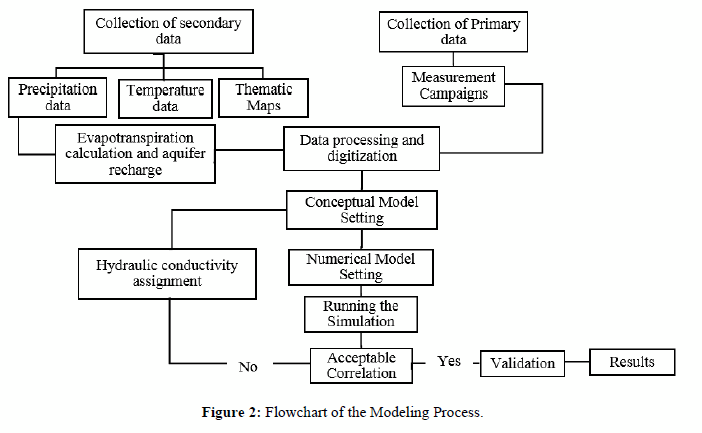
<body><![CDATA[<p align="justify">&nbsp;</p>     <p align="justify"><font size="3" face="Verdana, Arial, Helvetica, sans-serif"><b>2. STUDY   AREA</b></font></p>     <p align="justify"><font size="2" face="Verdana, Arial, Helvetica, sans-serif">The study zone has an approximate area of 31 km<sup>2</sup>,   located in the west of the metropolitan area of Cochabamba, in the   municipalities of Vinto and Quillacollo. Its natural limits are: The Cordillera   del Tunari to the north, Pairumani River to the west and Tacata River to the   east, as can be seen in <a href="#f1">Figure 1</a>. The elevation varies from 3,134 to 2,558   meters above sea level.</font></p>     <p align="center"><font size="2" face="Verdana, Arial, Helvetica, sans-serif"><a name="f1"></a><img src="/img/revistas/riyd/v20n1/n06_figura_01.jpg" width="735" height="454"></font></p>     <p align="justify"><font size="2" face="Verdana, Arial, Helvetica, sans-serif">The dominant vegetation is   grass and shrubs, located in the northern region; in the central part there is   the presence of crops. Approximately 65% of the study area is agriculture and   floriculture [8].</font></p>     <p align="justify"><font size="2" face="Verdana, Arial, Helvetica, sans-serif">The study area comprises an   alluvial zone formed by thick sediments in the northern area, while in the   south it presents finer sediments of clay and silts. As for its geology, it is   made up of Cenozoic and Paleozoic deposits that give rise to a large part of   the infiltration in the northern sector, since the mountain ranges of the   Tunari range present coarse-grained material, where the quaternary formations   store underground water [7]. The study area, being located at the foot of the   Tunari mountain range, has the characteristic of being a high recharge zone in   the north and a discharge zone in the south area. </font></p>     <p align="justify"><font size="2" face="Verdana, Arial, Helvetica, sans-serif"><b>&nbsp;</b></font></p>     <p align="justify"><font size="3" face="Verdana, Arial, Helvetica, sans-serif"><b>3. METHODOLOGY</b></font><font size="2" face="Verdana, Arial, Helvetica, sans-serif"><b>&nbsp;</b></font></p>     <p align="justify"><font size="2" face="Verdana, Arial, Helvetica, sans-serif">Primary and secondary data collection was   performed. Secondary data were collected from rain gauges, hydrogeological   maps, digital elevation models, and well profiles that were references to   define stratigraphic layers. As for the primary information, measurement   campaigns were carried out in the months of March, April, August and September   of 2019. It was possible to obtain the static and dynamic levels at selected wells   using a water level meter. </font></p>     <p align="justify"><font size="2" face="Verdana, Arial, Helvetica, sans-serif">For the calibration, model parameters were   adjusted by comparing the measured water levels against the simulated heads until   acceptable correlation was reached. The model performance was validated fixing   parameter values during the second measurement campaign in the area. <a href="#f2">Figure 2</a> shows   the outline of the model set-up process.</font></p>     ]]></body>
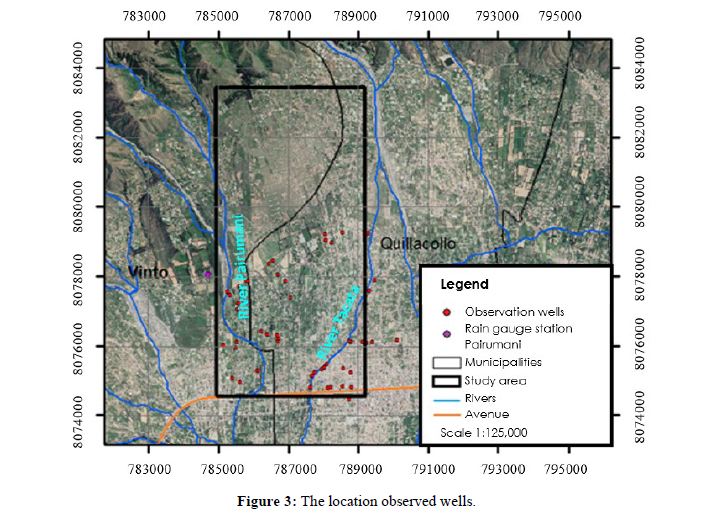
<body><![CDATA[<p align="center"><a name="f2"></a><img src="/img/revistas/riyd/v20n1/n06_figura_02.gif" width="702" height="433"></p>     <p align="justify"><font size="2" face="Verdana, Arial, Helvetica, sans-serif"><b>3.1 Meteorological   Data</b></font></p>     <p align="justify"><font size="2" face="Verdana, Arial, Helvetica, sans-serif">The   rainfall information from Pairumani station (2015 to 2018) was used. The   average annual precipitation was found out 642 mm and the average monthly   precipitation was estimated as 54 mm. The average annual temperature of was   calculated as 20 &ordm;C.</font></p>     <p align="justify"><font size="2" face="Verdana, Arial, Helvetica, sans-serif"><b>3.1.1 Recharge</b></font></p>     <p align="justify"><font size="2" face="Verdana, Arial, Helvetica, sans-serif">The   aquifers are recharged mainly by rainfall infiltration, infiltration of   irrigation and percolation. The total recharge rate was estimated between 15 to   20% of the precipitation [7]. In this sense, the recharge was taken as 62   mm/year. </font></p>     <p align="justify"><font size="2" face="Verdana, Arial, Helvetica, sans-serif"><b>3.1.2 Evapotranspiration</b></font></p>     <p align="justify"><font size="2" face="Verdana, Arial, Helvetica, sans-serif">The   evapotranspiration was estimated using the Coutagne formula [9]   as 530 mm / year, while literature reported an actual evapotranspiration of   approximately 490 mm/year [7]. </font></p>     <p align="justify"><font size="2" face="Verdana, Arial, Helvetica, sans-serif"><b>3.2 Monitoring   Campaigns</b></font></p>     <p align="justify"><font size="2" face="Verdana, Arial, Helvetica, sans-serif">The   measurement campaigns were divided into two stages carried out in 2019: during   rainy season from March to April and the second one in the dry season, August-September.   The location of monitored wells is presented in <a href="#f3">Figure 3</a>.</font></p>     <p align=center><a name="f3"></a><img src="/img/revistas/riyd/v20n1/n06_figura_03.jpg" width="714" height="519"></p>     ]]></body>
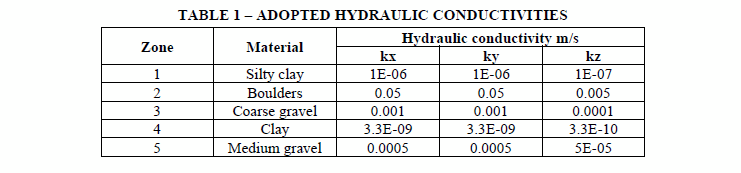
<body><![CDATA[<p align="justify"><font size="2" face="Verdana, Arial, Helvetica, sans-serif"><b>3.3 Model   Set-up with Visual MODFLOW</b></font></p>     <p align="justify"><font size="2" face="Verdana, Arial, Helvetica, sans-serif"><b>3.3.1 Structure   definition</b></font></p>     <p align="justify"><font size="2" face="Verdana, Arial, Helvetica, sans-serif">Stratigraphy   was analyzed from available wells&rsquo; profiles collected during the measurement   campaigns. <a href="#f4">Figure 4</a> shows the topography and a cross section of the study area.</font></p>     <p align=center><a name="f4"></a><img src="/img/revistas/riyd/v20n1/n06_figura_04.jpg" width="718" height="507"></p>     <p align="justify"><font size="2" face="Verdana, Arial, Helvetica, sans-serif"><b>3.3.2 Properties   of the Area</b></font></p>     <p align="justify"><font size="2" face="Verdana, Arial, Helvetica, sans-serif">A for the set-up, evapotranspiration of 530   mm/year, root depth of 1.5 m, aquifer recharge of 62 mm/year, physical   characteristics of rivers that cross the area and information on soil types   were used. </font></p>     <p align="justify"><font size="2" face="Verdana, Arial, Helvetica, sans-serif"><b>3.3.2.1 Hydraulic   conductivity</b></font></p>     <p align="justify"><font size="2" face="Verdana, Arial, Helvetica, sans-serif">The conceptual model   requires the assignment of hydraulic conductivity for each geological unit (Kx,   Ky, Kz). These were found as the most sensitive parameters. Subsoil materials   were identified based on stratigraphic profiles in technical reports. <a href="#t1">Table 1</a> shows the used conductivities.</font></p>     <p align="center"><font size="2" face="Verdana, Arial, Helvetica, sans-serif"><a name="t1"></a><img src="/img/revistas/riyd/v20n1/n06_tabla_01.gif" width="741" height="173"></font></p>     <p align="justify"><font size="2" face="Verdana, Arial, Helvetica, sans-serif"><b>3.3.3 Observation   wells</b></font></p>     ]]></body>
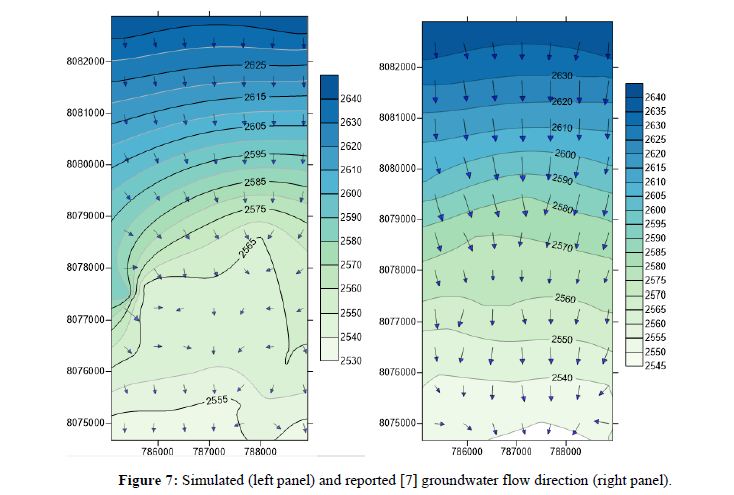
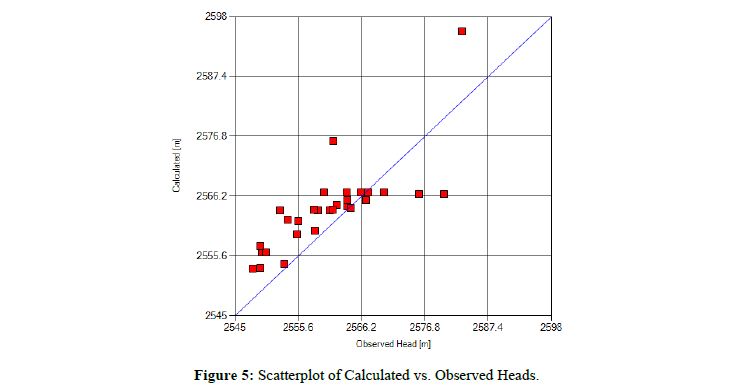
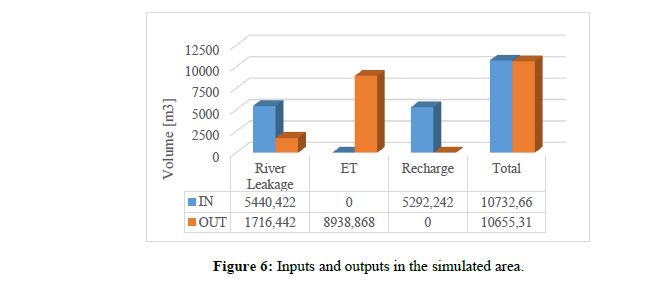
<body><![CDATA[<p align="justify"><font size="2" face="Verdana, Arial, Helvetica, sans-serif">In total 29 wells were used at calibration   stage, where the average depth of the wells was found 95 m. The static levels   of the monitored wells in the discharge area reached an average depth of 5 m   below the surface; a maximum depth of the level was recorded at 40 m. Artesian wells were cataloged in the   central area of the discharge zone.</font></p>     <p align="justify">&nbsp;</p>     <p align="justify"><font size="3" face="Verdana, Arial, Helvetica, sans-serif"><b>4. RESULTS</b></font><font size="2" face="Verdana, Arial, Helvetica, sans-serif"><b>&nbsp;</b></font></p>     <p align="justify"><font size="2" face="Verdana, Arial, Helvetica, sans-serif"><b>4.1 Calibration</b></font></p>     <p align="justify"><font size="2" face="Verdana, Arial, Helvetica, sans-serif">Different   combinations of hydraulic conductivities were made according to the identified material   to calibrate de model. During this process, the obtained results through the   root mean square (RMS), correlation coefficient and results of the water   balance were checked.</font></p>     <p align="justify"><font size="2" face="Verdana, Arial, Helvetica, sans-serif">The   best adjustment of the hydraulic conductivity was presented in <a href="#t1">Table 1</a>. The comparison   between simulated and observed levels is shown in <a href="#f5">Figure 5</a>. The best   combination found because it presents a RMS of 6.20 m, where the maximum error reached   15.50 m and a minimum of 0.21 m. The correlation coefficient was 0.76, showing   greater variability in the wells near the Pairumani River.</font></p>     <p align="center"><a name="f5"></a><img src="/img/revistas/riyd/v20n1/n06_figura_05.jpg" width="731" height="391"><font size="2" face="Verdana, Arial, Helvetica, sans-serif"><b>&nbsp;</b></font></p>     <p align="justify"><font size="2" face="Verdana, Arial, Helvetica, sans-serif">Within   the analysis of the water balance, the input and output values were found   close, 10732 and 10655 m<sup>3</sup> respectively, with a positive difference   indicating 77 m<sup>3</sup> of recharge, as seen in <a href="#f6">Figure 6</a>.</font></p>     <p align="center"><a name="f6"></a><img src="/img/revistas/riyd/v20n1/n06_figura_06.jpg" width="666" height="282"><font size="2" face="Verdana, Arial, Helvetica, sans-serif"><b>&nbsp;</b></font></p>     <p align="justify"><font size="2" face="Verdana, Arial, Helvetica, sans-serif">The water balance identified the main   source of output is duet to evapotranspiration, typical of a semi-arid region.   Even so, a large recharge is generated in the northern area due to presence of   alluvial fans that encourage water infiltration. The water levels were found consistent   the data collected. The model shows an average static level of 5 m below the   surface in the discharge area. In the recharge area the water level is at a depth   of 130 m below the surface, which reduces moving south. A high influence of   rivers on the heads was found. <a href="#f7">Figure 7</a> shows the simulated heads and the   reported heads [7], where main flow direction is consistent north-south. The difference   is due to the influence of the rivers and wells of extraction in the model.</font></p>     ]]></body>
<body><![CDATA[<p align="center"><a name="f7"></a><img src="/img/revistas/riyd/v20n1/n06_figura_07.jpg" width="734" height="495"></p>     <p align="justify"><font size="2" face="Verdana, Arial, Helvetica, sans-serif"><b>4.2 Validation</b></font></p>     <p align="justify"><font size="2" face="Verdana, Arial, Helvetica, sans-serif">As for validation, the static levels of   seven wells measured between the months of August and September in 2019 were   selected, showing a correlation coefficient of 0.76 and RMS of 6.81 m. At   validation stage, a similar correlation coefficient as the calibration was   found, with slight difference is RMS.</font></p>     <p align="justify">&nbsp;</p>     <p align="justify"><font size="3" face="Verdana, Arial, Helvetica, sans-serif"><b>5. CONCLUSIONS </b></font></p>     <p align="justify"><font size="2" face="Verdana, Arial, Helvetica, sans-serif">The   study area is located in the west part of the Central Valley, in Vinto and   Quillacollo. To the north, there is the presence of an alluvial fan made up of   coarse sediments which gradually become finer towards the south. This allows a   high recharge rates occurring. Therefore, the study area is of great importance   for groundwater exploitation. This zone is characterized by unconfined aquifers   with fluctuating water table.</font></p>     <p align="justify"><font size="2" face="Verdana, Arial, Helvetica, sans-serif">The required   input data by the model was collected from previous reports and water level   monitoring campaigns. Most of the observed wells are located in the southern   zone. Subsoil material was identified from stratigraphic profiles, such as   silty clay, boulders, coarse gravel, clay and medium gravel. </font></p>     <p align="justify"><font size="2" face="Verdana, Arial, Helvetica, sans-serif">The   model was set-up using Visual MODFLOW Flex. During the calibration process, it   was found out hydraulic conductivity as the most sensitive parameter. Once   model parameters were calibrated, an acceptable correlation coefficient of 0.76   and RMS (m) of 6.2 was accomplished. The validation process was carried in a   different period and RMS of 6.81m was found out. </font></p>     <p align="justify"><font size="2" face="Verdana, Arial, Helvetica, sans-serif">The water balance reported by the model,   showed river infiltration and recharge as main inputs. The main output was   identified by evapotranspiration process.&nbsp; High potential evaporation is   reported in the study area since it is semi-arid region. The model identified   precisely a groundwater flow that moves from north to south, influenced by   rivers and operating wells. The water balance showed an additional contribution   to the system of 77 m<sup>3</sup>. </font></p>     <p align="justify">&nbsp;</p>     ]]></body>
<body><![CDATA[<p align="justify"><font size="3" face="Verdana, Arial, Helvetica, sans-serif"><b>6. REFERENCES&nbsp; </b></font></p>     <p align="justify"><font size="2" face="Verdana, Arial, Helvetica, sans-serif">[1] Servicio Departamental de Cuencas   (SDC), Direcci&oacute;n de Planificaci&oacute;n y Gesti&oacute;n Integral del Agua (DGIA),   &quot;PLAN DIRECTOR DE LA CUENCA DEL R&Iacute;O ROCHA: &ldquo;Estado de Situaci&oacute;n y   Propuesta de Lineamientos,&quot; 2015. </font></p>     <!-- ref --><p align="justify"><font size="2" face="Verdana, Arial, Helvetica, sans-serif">[2] US Army Corps of Engineers, WATER RESOURCES   ASSESSMENT OF BOLIVIA, 2014. </font>&nbsp;&nbsp;&nbsp;&nbsp;&nbsp;&nbsp;&nbsp;&nbsp;[&#160;<a href="javascript:void(0);" onclick="javascript: window.open('/scielo.php?script=sci_nlinks&ref=974614&pid=S2518-4431202000010000600002&lng=','','width=640,height=500,resizable=yes,scrollbars=1,menubar=yes,');">Links</a>&#160;]<!-- end-ref --><!-- ref --><p align="justify"><font size="2" face="Verdana, Arial, Helvetica, sans-serif">[3] BGR, CABAS Project,   &quot;Improvement of the Ability of the Bolivian Geological Survey to Explore   for Groundwater Resources,&quot; Bundesanstalt f&uuml;r Geowissenschaften und   Rohstoffe (BGR), 2000. [Online]. Available: <a href="https://www.geozentrum-hannover.de/EN/Themen/Wasser/Projekte/abgeschlossen/TZ/Bolivia/cabas_fb_01_en.html" target="_blank">https://www.geozentrum-hannover.de/EN/Themen/Wasser/Projekte/abgeschlossen/TZ/Bolivia/cabas_fb_01_en.html</a>.   [Accessed 06 06 2020].</font>&nbsp;&nbsp;&nbsp;&nbsp;&nbsp;&nbsp;&nbsp;&nbsp;[&#160;<a href="javascript:void(0);" onclick="javascript: window.open('/scielo.php?script=sci_nlinks&ref=974615&pid=S2518-4431202000010000600003&lng=','','width=640,height=500,resizable=yes,scrollbars=1,menubar=yes,');">Links</a>&#160;]<!-- end-ref --><p align="justify"><font size="2" face="Verdana, Arial, Helvetica, sans-serif">[4] A. Heijstek, &quot;Groundwater   use in the High Valley of Cochabamba, Bolivia, BSc Thesis, Wageningen   University, the Netherlands,&quot; <i>University of Calgary's Digital     Repository, </i>2014. </font></p>     <!-- ref --><p align="justify"><font size="2" face="Verdana, Arial, Helvetica, sans-serif">[5] E. Custodio, &quot;Explotaci&oacute;n racional de las aguas   subterr&aacute;neas,&quot; Catalua, Barcelona, 1996. </font>&nbsp;&nbsp;&nbsp;&nbsp;&nbsp;&nbsp;&nbsp;&nbsp;[&#160;<a href="javascript:void(0);" onclick="javascript: window.open('/scielo.php?script=sci_nlinks&ref=974617&pid=S2518-4431202000010000600005&lng=','','width=640,height=500,resizable=yes,scrollbars=1,menubar=yes,');">Links</a>&#160;]<!-- end-ref --><p align="justify"><font size="2" face="Verdana, Arial, Helvetica, sans-serif">[6] A. Mayta and A. Duran,   &quot;Sobre-explotacion de aguas subterraneas en Punata: Causas y   Efecto,&quot; Cochabamba, Bolivia, 2015.</font></p>     <p align="justify"><font size="2" face="Verdana, Arial, Helvetica, sans-serif">[7] S. Renner and C. Velasco, &quot;Geolog&iacute;a e   Hidrogeologia del Valle Central de Cochabamba,&quot; <i>34, </i>p. 109, 2000. </font></p>     <!-- ref --><p align="justify"><font size="2" face="Verdana, Arial, Helvetica, sans-serif">[8] G. A. D. d. Cochabamba,   &quot;Gobernacion Departamental de Cochabamba,&quot; [Online]. Available: <a href="http://www.gobernaciondecochabamba.bo/article/es_BO/Cochabamba/Municipios/Quillacollo/811/?F42714424176ZSDIY0=_" target="_blank">http://www.gobernaciondecochabamba.bo/article/es_BO/Cochabamba/Municipios/Quillacollo/811/?F42714424176ZSDIY0=_</a>.   [Accessed   29 Marzo 2019].</font>&nbsp;&nbsp;&nbsp;&nbsp;&nbsp;&nbsp;&nbsp;&nbsp;[&#160;<a href="javascript:void(0);" onclick="javascript: window.open('/scielo.php?script=sci_nlinks&ref=974620&pid=S2518-4431202000010000600008&lng=','','width=640,height=500,resizable=yes,scrollbars=1,menubar=yes,');">Links</a>&#160;]<!-- end-ref --><!-- ref --><p align="justify"><font size="2" face="Verdana, Arial, Helvetica, sans-serif">[9] J. Sanchez, &quot;Hidrogeolog&iacute;a.usal,&quot;   Dpto. Geologia   Univ. Salamanca, [Online]. Available: <a href="http://hidrologia.usal.es/temas/Evapotransp.pdf" target="_blank">http://hidrologia.usal.es/temas/Evapotransp.pdf</a>.</font>&nbsp;&nbsp;&nbsp;&nbsp;&nbsp;&nbsp;&nbsp;&nbsp;[&#160;<a href="javascript:void(0);" onclick="javascript: window.open('/scielo.php?script=sci_nlinks&ref=974621&pid=S2518-4431202000010000600009&lng=','','width=640,height=500,resizable=yes,scrollbars=1,menubar=yes,');">Links</a>&#160;]<!-- end-ref --><p align="justify">&nbsp;</p>      ]]></body><back>
<ref-list>
<ref id="B1">
<label>1</label><nlm-citation citation-type="">
<collab>Servicio Departamental de Cuencas (SDC)</collab>
<collab>Dirección de Planificación y Gestión Integral del Agua (DGIA)</collab>
<source><![CDATA[PLAN DIRECTOR DE LA CUENCA DEL RÍO ROCHA: &#8220;Estado de Situación y Propuesta de Lineamientos"]]></source>
<year>2015</year>
</nlm-citation>
</ref>
<ref id="B2">
<label>2</label><nlm-citation citation-type="">
<collab>US Army Corps of Engineers</collab>
<source><![CDATA[WATER RESOURCES ASSESSMENT OF BOLIVIA]]></source>
<year>2014</year>
</nlm-citation>
</ref>
<ref id="B3">
<label>3</label><nlm-citation citation-type="book">
<collab>BGR, CABAS Project</collab>
<source><![CDATA[Improvement of the Ability of the Bolivian Geological Survey to Explore for Groundwater Resources]]></source>
<year>2000</year>
<publisher-name><![CDATA[Bundesanstalt für Geowissenschaften und Rohstoffe (BGR)]]></publisher-name>
</nlm-citation>
</ref>
<ref id="B4">
<label>4</label><nlm-citation citation-type="">
<person-group person-group-type="author">
<name>
<surname><![CDATA[Heijstek]]></surname>
<given-names><![CDATA[A.]]></given-names>
</name>
</person-group>
<source><![CDATA[Groundwater use in the High Valley of Cochabamba, Bolivia]]></source>
<year>2014</year>
</nlm-citation>
</ref>
<ref id="B5">
<label>5</label><nlm-citation citation-type="">
<person-group person-group-type="author">
<name>
<surname><![CDATA[Custodio]]></surname>
<given-names><![CDATA[E.]]></given-names>
</name>
</person-group>
<source><![CDATA[Explotación racional de las aguas subterráneas]]></source>
<year>1996</year>
<publisher-loc><![CDATA[Cataluña, Barcelona ]]></publisher-loc>
</nlm-citation>
</ref>
<ref id="B6">
<label>6</label><nlm-citation citation-type="">
<person-group person-group-type="author">
<name>
<surname><![CDATA[Mayta]]></surname>
<given-names><![CDATA[A.]]></given-names>
</name>
<name>
<surname><![CDATA[Duran]]></surname>
<given-names><![CDATA[A.]]></given-names>
</name>
</person-group>
<source><![CDATA[Sobre-explotacion de aguas subterraneas en Punata: Causas y Efecto]]></source>
<year>2015</year>
<publisher-loc><![CDATA[Cochabamba, Bolivia ]]></publisher-loc>
</nlm-citation>
</ref>
<ref id="B7">
<label>7</label><nlm-citation citation-type="">
<person-group person-group-type="author">
<name>
<surname><![CDATA[Renner]]></surname>
<given-names><![CDATA[S.]]></given-names>
</name>
<name>
<surname><![CDATA[Velasco]]></surname>
<given-names><![CDATA[C.]]></given-names>
</name>
</person-group>
<source><![CDATA[Geología e Hidrogeologia del Valle Central de Cochabamba]]></source>
<year>2000</year>
<page-range>109</page-range></nlm-citation>
</ref>
<ref id="B8">
<label>8</label><nlm-citation citation-type="">
<collab>G.A.D.d. Cochabamba</collab>
<source><![CDATA[Gobernacion Departamental de Cochabamba]]></source>
<year></year>
</nlm-citation>
</ref>
<ref id="B9">
<label>9</label><nlm-citation citation-type="book">
<person-group person-group-type="author">
<name>
<surname><![CDATA[Sanchez]]></surname>
<given-names><![CDATA[J.]]></given-names>
</name>
</person-group>
<source><![CDATA[Hidrogeología. usal]]></source>
<year></year>
<publisher-name><![CDATA[Dpto. Geologia Univ. Salamanca]]></publisher-name>
</nlm-citation>
</ref>
</ref-list>
</back>
</article>