<?xml version="1.0" encoding="ISO-8859-1"?><article xmlns:mml="http://www.w3.org/1998/Math/MathML" xmlns:xlink="http://www.w3.org/1999/xlink" xmlns:xsi="http://www.w3.org/2001/XMLSchema-instance">
<front>
<journal-meta>
<journal-id>2518-4431</journal-id>
<journal-title><![CDATA[Investigación & Desarrollo]]></journal-title>
<abbrev-journal-title><![CDATA[Inv. y Des.]]></abbrev-journal-title>
<issn>2518-4431</issn>
<publisher>
<publisher-name><![CDATA[UNIVERSIDAD PRIVADA BOLIVIANA]]></publisher-name>
</publisher>
</journal-meta>
<article-meta>
<article-id>S2518-44312020000100001</article-id>
<title-group>
<article-title xml:lang="en"><![CDATA[NATURAL COLORANTS FROM ZONGO VALLEY (BOLIVIA) AND THEIR TEXTILE APPLICATIONS]]></article-title>
<article-title xml:lang="es"><![CDATA[COLORANTES NATURALES DEL VALLE DE ZONGO (BOLIVIA) Y SUS APLICACIONES TEXTILES]]></article-title>
</title-group>
<contrib-group>
<contrib contrib-type="author">
<name>
<surname><![CDATA[Ibáñez-Calero]]></surname>
<given-names><![CDATA[Sandra L.]]></given-names>
</name>
<xref ref-type="aff" rid="A01"/>
</contrib>
<contrib contrib-type="author">
<name>
<surname><![CDATA[Loayza Afonso]]></surname>
<given-names><![CDATA[Kelly E.]]></given-names>
</name>
<xref ref-type="aff" rid="A01"/>
</contrib>
</contrib-group>
<aff id="A01">
<institution><![CDATA[,Universidad Privada Boliviana Centro de Investigaciones Fitoquímicas ]]></institution>
<addr-line><![CDATA[ ]]></addr-line>
</aff>
<pub-date pub-type="pub">
<day>00</day>
<month>00</month>
<year>2020</year>
</pub-date>
<pub-date pub-type="epub">
<day>00</day>
<month>00</month>
<year>2020</year>
</pub-date>
<volume>20</volume>
<numero>1</numero>
<fpage>5</fpage>
<lpage>22</lpage>
<copyright-statement/>
<copyright-year/>
<self-uri xlink:href="http://www.scielo.org.bo/scielo.php?script=sci_arttext&amp;pid=S2518-44312020000100001&amp;lng=en&amp;nrm=iso"></self-uri><self-uri xlink:href="http://www.scielo.org.bo/scielo.php?script=sci_abstract&amp;pid=S2518-44312020000100001&amp;lng=en&amp;nrm=iso"></self-uri><self-uri xlink:href="http://www.scielo.org.bo/scielo.php?script=sci_pdf&amp;pid=S2518-44312020000100001&amp;lng=en&amp;nrm=iso"></self-uri><abstract abstract-type="short" xml:lang="en"><p><![CDATA[Three plants collected at the Zongo Valley were evaluated for textile dyeing applications. The species selected were extracted following acidic and basic procedures to obtain colored samples, that were submitted to direct and indirect (with mordents) dyeing techniques. In all experiments the need of a mordant was observed and the type of chemical mordant was identified. In each work, the strength of the fabric&#8217;s dye with the natural colorant was evaluated using a series of washing, rinsing, drying, ironing and exposure to sun light protocols. It was found that the acidic extract of Brachyotum microdon (flowers) needs Al2(SO4)3 to dye the fabric with a red cabernet tone, while the basic extract fixes the fabric with a brown color with FeCl3 and green with FeSO4. The acid extract of the stems of Souroubea fragilis dyed the fabric with a light orange color when Al2(SO4)3 was used as a mordent, while the basic extract provided brown tones thanks to CuSO4 or FeSO4. Finally, the acidic extract of Fuchsia boliviana (flowers and fruits) gave a pale rose and a green tinting with Al2(SO4)3 and FeCl3, respectively. The basic extract of this plant provided a green dyeing with CuSO4 and orange shading with FeCl3. Different types of fabrics were evaluated, and the best dyeing results were observed with cotton. All the extracts studied presented antioxidant and photoprotector activities. The acidic extract of Brachyotum microdon (flowers) showed 82.5% of inhibition at 10µg/ml against DPPH and it absorbed the harmful UV B radiation. The acidic extract of Fuchsia boliviana (flowers and fruits) gave an 86.7% of inhibition at 10µg/ml against DPPH and it also absorbed the damaging UV B radiation. Finally, the acidic extract of Souroubea fragilis (stems) presented 92.1% of inhibition at 100µg/ml against DPPH and it absorbed both UV-B and UV-A radiations.]]></p></abstract>
<abstract abstract-type="short" xml:lang="es"><p><![CDATA[Tres plantas colectadas en el Valle de Zongo fueron evaluadas para aplicaciones textiles. Las especies seleccionadas fueron extraídas siguiendo procedimientos ácidos y básicos para obtener muestras coloridas, que fueron sometidas a técnicas de tinción directa e indirecta (con mordientes). En todos los experimentos, la necesidad de mordiente fue observada y el tipo de mordiente químico fue identificado. En cada trabajo, el poder de la tinción del colorante natural en la tela fue evaluado usando una serie de protocolos de lavado, enjuague, secado, planchado y exposición a la luz solar. Se encontró que el extracto ácido de Brachyotum microdon (flores) necesita Al2(SO4)3 para teñir la tela con un tono rojo cabernet, mientras que el extracto básico fija la tela de color café con FeCl3 y verde con FeSO4. El extracto ácido de los tallos de Souroubea fragilis tiñe la tela con un color naranja claro cuando se utiliza Al2(SO4)3 como mordiente, mientras que el extracto básico proporciona un tono café gracias a CuSO4 o FeSO4. Finalmente, el extracto ácido de Fuchsia boliviana (flores y frutos) dio tinciones rosa pálido y verde con Al2(SO4)3 and FeCl3; respectivamente. El extracto básico de esta planta proporcionó un teñido verde con CuSO4 y una tonalidad naranja con FeCl3. Diferentes tipos de telas fueron evaluadas y los mejores resultados de teñido se observaron con algodón. Todos los extractos estudiados presentaron actividades antioxidantes y fotoprotectoras. El extracto ácido de Brachyotum microdon (flores) mostró 82.5% de inhibición a 10µg/ml contra DPPH y absorbió la dañina radiación UV B. El extracto acídico de Fuchsia boliviana (flores y frutos) dio una inhibición de 86.7% a 10µg/ml contra DPPH y también absorbió la nociva radiación UV B. Finalmente, el extracto ácido de Souroubea fragilis (tallos) presentó 92.1% de inhibición a 100µg/ml contra DPPH y absorbió ambas radiaciones UV-A y UV-B.]]></p></abstract>
<kwd-group>
<kwd lng="en"><![CDATA[Zongo Valley]]></kwd>
<kwd lng="en"><![CDATA[Souroubea fragilis]]></kwd>
<kwd lng="en"><![CDATA[Brachyotum microdon]]></kwd>
<kwd lng="en"><![CDATA[Fuchsia boliviana]]></kwd>
<kwd lng="en"><![CDATA[Dyes]]></kwd>
<kwd lng="en"><![CDATA[Mordents]]></kwd>
<kwd lng="en"><![CDATA[Antioxidant Activity]]></kwd>
<kwd lng="en"><![CDATA[DPPH]]></kwd>
<kwd lng="en"><![CDATA[Photo-protector Property]]></kwd>
<kwd lng="en"><![CDATA[UV-A and/or UV-B Absorptions]]></kwd>
<kwd lng="es"><![CDATA[Valle de Zongo]]></kwd>
<kwd lng="es"><![CDATA[Souroubea fragilis]]></kwd>
<kwd lng="es"><![CDATA[Brachyotum microdon]]></kwd>
<kwd lng="es"><![CDATA[Fuchsia boliviana]]></kwd>
<kwd lng="es"><![CDATA[Tintes]]></kwd>
<kwd lng="es"><![CDATA[Mordientes]]></kwd>
<kwd lng="es"><![CDATA[Actividad Antioxidante]]></kwd>
<kwd lng="es"><![CDATA[DPPH]]></kwd>
<kwd lng="es"><![CDATA[Propiedad Fotoprotectora]]></kwd>
<kwd lng="es"><![CDATA[Absorciones UV-A y/o UV-B]]></kwd>
</kwd-group>
</article-meta>
</front><body><![CDATA[ <p align=left><font color="#800000" size="2" face="Verdana, Arial, Helvetica, sans-serif"><b>DOI:</b> 10.23881/idupbo.020.1-1i</font></p>     <p align=right><font size="2" face="Verdana, Arial, Helvetica, sans-serif"><b>ART&Iacute;CULOS - INGENIER&Iacute;AS</b></font></p>     <p align=right>&nbsp;</p>     <p align=center><font size="4" face="Verdana, Arial, Helvetica, sans-serif"><b>NATURAL COLORANTS FROM ZONGO VALLEY   (BOLIVIA) AND THEIR TEXTILE APPLICATIONS</b></font></p>     <p align=center><font size="2" face="Verdana, Arial, Helvetica, sans-serif"><b>&nbsp;</b></font></p>     <p align=center><font size="3" face="Verdana, Arial, Helvetica, sans-serif"><b>COLORANTES NATURALES DEL VALLE DE   ZONGO (BOLIVIA) Y SUS APLICACIONES TEXTILES</b></font></p>     <p align=center>&nbsp;</p>     <p align=center><font size="2" face="Verdana, Arial, Helvetica, sans-serif"><b>&nbsp;</b></font></p>     <p align=center><font size="2" face="Verdana, Arial, Helvetica, sans-serif"><b>Sandra L. Ib&aacute;&ntilde;ez-Calero, Kelly E.   Loayza Afonso</b></font></p>     <p align=center><font size="2" face="Verdana, Arial, Helvetica, sans-serif"><i>Centro de Investigaciones   Fitoqu&iacute;micas</i> (CIF) </font>    ]]></body>
<body><![CDATA[<br>   <font size="2" face="Verdana, Arial, Helvetica, sans-serif"><i>Universidad Privada Boliviana </i></font></p>     <p align=center><font size="2" face="Verdana, Arial, Helvetica, sans-serif">(Recibido el 27 de mayo 2020, aceptado para   publicaci&oacute;n el 25 de junio 2020)</font></p>     <p align=center>&nbsp;</p>     <p align=center>&nbsp;</p> <hr noshade>     <p align="justify"><font size="2" face="Verdana, Arial, Helvetica, sans-serif"><b>ABSTRACT</b></font></p>     <p align="justify"><font size="2" face="Verdana, Arial, Helvetica, sans-serif">Three plants collected at the Zongo Valley   were evaluated for textile dyeing applications. The species selected were   extracted following acidic and basic procedures to obtain colored samples, that   were submitted to direct and indirect (with mordents) dyeing techniques. In all   experiments the need of a mordant was observed and the type of chemical mordant   was identified. In each work, the strength of the fabric&rsquo;s dye with the natural   colorant was evaluated using a series of washing, rinsing, drying, ironing and   exposure to sun light protocols. It was found that the acidic extract of <a name="_Hlk37342557"></a><a name="_Hlk35969150"><i>Brachyotum microdon </i>(flowers</a>)   needs <a name="_Hlk35969181">Al<sub>2</sub>(SO<sub>4</sub>)<sub>3 </sub>to </a>dye   the fabric with a red cabernet tone, while the basic extract fixes the fabric   with a brown color with <a name="_Hlk35969240">FeCl<sub>3</sub> and </a>green   with <a name="_Hlk35969256">FeSO<sub>4</sub>. The </a>acid extract of the stems   of <a name="_Hlk35969281"><i>Souroubea fragilis</i> dyed </a>the fabric with a   light orange color when <a name="_Hlk35969328">Al<sub>2</sub>(SO<sub>4</sub>)<sub>3 </sub>was </a>used as a mordent, while the basic extract provided brown tones   thanks to <a name="_Hlk35969389">CuSO<sub>4 </sub>or FeSO<sub>4</sub>. Finally</a>,   the acidic extract of <a name="_Hlk35969418"><i>Fuchsia boliviana </i>(flowers     and fruits) gave </a>a pale rose and a green tinting with <a name="_Hlk35969453">Al<sub>2</sub>(SO<sub>4</sub>)<sub>3 </sub>and FeCl<sub>3</sub>, </a>respectively. The basic extract of this plant   provided a green dyeing with <a name="_Hlk35969498">CuSO<sub>4 </sub>and </a>orange   shading with <a name="_Hlk35969527">FeCl<sub>3</sub>. Different </a>types of   fabrics were evaluated, and the best dyeing results were observed with cotton.   All the extracts studied presented antioxidant and photoprotector activities.   The acidic extract of <a name="_Hlk35969689"><i>Brachyotum microdon </i>(flowers</a>)   showed 82.5% of inhibition at 10&micro;g/ml against DPPH and it absorbed the harmful   UV B radiation. The acidic extract of <a name="_Hlk35969769"><i>Fuchsia     boliviana </i>(flowers and fruits) </a>gave an 86.7% of inhibition at 10&micro;g/ml   against DPPH and it also absorbed the damaging UV B radiation. Finally, the   acidic extract of <a name="_Hlk35969926"><i>Souroubea fragilis</i> (stems) </a>presented   92.1% of inhibition at <a name="_Hlk35969960">100&micro;g/ml </a>against DPPH and it absorbed   both UV-B and UV-A radiations.</font><font size="2" face="Verdana, Arial, Helvetica, sans-serif"><b>&nbsp;</b></font></p>     <p align="justify"><font size="2" face="Verdana, Arial, Helvetica, sans-serif"><b>Keywords: </b>Zongo Valley, <i>Souroubea   fragilis</i>, <i>Brachyotum microdon</i>, <i>Fuchsia boliviana,</i> Dyes, Mordents,   Antioxidant Activity, DPPH, Photo-protector Property, UV-A and/or UV-B Absorptions. </font></p> <hr noshade>     <p align="justify"><font size="2" face="Verdana, Arial, Helvetica, sans-serif"><b>RESUMEN</b></font><font size="2" face="Verdana, Arial, Helvetica, sans-serif"><b>&nbsp;</b></font></p>     <p align="justify"><font size="2" face="Verdana, Arial, Helvetica, sans-serif">Tres plantas colectadas en el Valle de   Zongo fueron evaluadas para aplicaciones textiles. Las especies seleccionadas   fueron extra&iacute;das   siguiendo procedimientos &aacute;cidos y b&aacute;sicos para obtener muestras coloridas, que   fueron sometidas a t&eacute;cnicas de tinci&oacute;n directa e indirecta (con mordientes). En   todos los experimentos, la necesidad de mordiente fue observada y el tipo de   mordiente qu&iacute;mico fue identificado. En cada trabajo, el poder de la tinci&oacute;n del   colorante natural en la tela fue evaluado usando una serie de protocolos de   lavado, enjuague, secado, planchado y exposici&oacute;n a la luz solar. Se encontr&oacute;   que el extracto &aacute;cido de <i>Brachyotum microdon </i>(flores) necesita Al<sub>2</sub>(SO<sub>4</sub>)<sub>3 </sub>para te&ntilde;ir la tela con un tono rojo cabernet, mientras que el extracto   b&aacute;sico fija la tela de color caf&eacute; con FeCl<sub>3</sub> y verde con FeSO<sub>4</sub>.   El extracto &aacute;cido de los tallos de <i>Souroubea fragilis</i> ti&ntilde;e la tela con   un color naranja claro cuando se utiliza Al<sub>2</sub>(SO<sub>4</sub>)<sub>3 </sub>como   mordiente, mientras que el extracto b&aacute;sico proporciona un tono caf&eacute; gracias a   CuSO<sub>4 </sub>o FeSO<sub>4</sub>. Finalmente, el extracto &aacute;cido de <i>Fuchsia     boliviana </i>(flores y frutos) dio tinciones rosa p&aacute;lido y verde con Al<sub>2</sub>(SO<sub>4</sub>)<sub>3 </sub>and FeCl<sub>3</sub>; respectivamente. El extracto b&aacute;sico de esta planta   proporcion&oacute; un te&ntilde;ido verde con CuSO<sub>4</sub> y una tonalidad naranja con   FeCl<sub>3</sub>. Diferentes tipos de telas fueron evaluadas y los mejores resultados   de te&ntilde;ido se observaron con algod&oacute;n. Todos los extractos estudiados presentaron   actividades antioxidantes y fotoprotectoras. El extracto &aacute;cido de <i>Brachyotum     microdon </i>(flores) mostr&oacute; 82.5% de inhibici&oacute;n a 10&micro;g/ml contra DPPH y absorbi&oacute;   la da&ntilde;ina radiaci&oacute;n UV B. El extracto ac&iacute;dico de <i>Fuchsia boliviana </i>(flores   y frutos) dio una inhibici&oacute;n de 86.7% a 10&micro;g/ml contra DPPH y tambi&eacute;n absorbi&oacute;   la nociva radiaci&oacute;n UV B. Finalmente, el extracto &aacute;cido de <i>Souroubea     fragilis</i> (tallos) present&oacute; 92.1% de inhibici&oacute;n a 100&micro;g/ml contra DPPH y absorbi&oacute;   ambas radiaciones UV-A y UV-B.</font><font size="2" face="Verdana, Arial, Helvetica, sans-serif"><b>&nbsp;</b></font></p>     <p align="justify"><font size="2" face="Verdana, Arial, Helvetica, sans-serif"><b>Palabras Clave: </b>Valle de Zongo, <i>Souroubea   fragilis</i>, <i>Brachyotum microdon</i>, <i>Fuchsia boliviana,</i> Tintes,   Mordientes, Actividad Antioxidante, DPPH, Propiedad Fotoprotectora, Absorciones   UV-A y/o UV-B. </font></p> <hr noshade>     ]]></body>
<body><![CDATA[<p align="justify">&nbsp;</p>     <p align="justify">&nbsp;</p>     <p align="justify"><font size="2" face="Verdana, Arial, Helvetica, sans-serif"><b><font size="3">1. INTRODUCTION</font></b></font><font size="3" face="Verdana, Arial, Helvetica, sans-serif"><b>&nbsp;</b></font></p>     <p align="justify"><font size="2" face="Verdana, Arial, Helvetica, sans-serif">The   use of natural dyes has again resurfaced in the   industry due to the toxicity found in their synthetic derivatives [1],   [2]. Worldwide, an important campaign has emerged to support nature as a fountain   of colorants and dyes. The production sources vary from the vegetal, animal, and   insect kingdoms to soils and microorganisms [3]. Several natural dyes have been   studied and evaluated for their coloring properties but also for their possible   antioxidant, photoprotector and/or nutraceutical applications [4],   [5].</font></p>     <p align="justify"><font size="2" face="Verdana, Arial, Helvetica, sans-serif">In   Bolivia, a country rich in vegetal and animal biodiversity, only some species   have been used as natural colorants following traditional extraction and dyeing   techniques. Among these species, only a few have been scientifically reported   or evaluated [6]. Among the species used to color fabrics, we highlight thola (<i>Baccharis     dracunculifolia</i>), nogal (<i>Juglans regia</i>), achiote (<i>Bixa orellana</i>),   mole (<i>Schinus molle</i>), eucalyptus (<i>Eucalyptus</i> sp.), chillca (<i>Baccharis</i> sp.) and kewi&ntilde;a (<i>Polylepis</i> sp.) [7]. There are different techniques to   extract natural colorants from plants and the applications in dyeing of fabrics   are also assorted. Aqueous, alcoholic, basic and acidic extractions as well as   those with vegetal oils were reported. The selection of the extraction   technique depends on the type of metabolite responsible for the dyeing   property. To fix the dye in the fabric, there are the direct methods (where the   dye is directly boiled with the fabric) and the indirect ones (where mordants   are used to fix the color in the substrate) [8]. </font></p>     <p align="justify"><font size="2" face="Verdana, Arial, Helvetica, sans-serif">Bolivia has different ecosystems each of   them characterized by a specific weather, altitude and soil type. One region in   Bolivia that has many ecosystems is the Zongo valley, situated at the northeast   of La Paz city. This valley starts at the high Andean prairie at 4800 m.a.s.l.   and it extends to the humid tropical region called Yungas at 800 m.a.s.l. [9],   [10]. It has been reported that 109 vegetal families and 158 species exist in   the Zongo Valley [9]. </font></p>     <p align="justify"><font size="2" face="Verdana, Arial, Helvetica, sans-serif">This significant plant biodiversity has   captured our attention to evaluate and validate their possible attributes as   colorants, antioxidants and/or photo protectors [11], [12]. We have evaluated   the antioxidant and photoprotector activities of 15 plants with possible dyeing   properties. The vegetal species selected for the preliminary dyeing studies were   chosen based on colored organs, biological properties (antioxidant and/or   photoprotector activities), preliminary dyeing tests, and the amount of the collected   plant.&nbsp; Among the species collected, <a name="_Hlk36561400"><i>Fuchsia     boliviana</i>, <i>Brachyotum microdon</i>, <i>Souroubea fragilis</i>,</a> <i>Monnina       bridgesii</i> and <i>Rubus floribundus</i> caught our attention due to their   biological and coloring properties. In this publication we submit the   preliminary dyeing studies on fabrics of <i>Fuchsia boliviana</i>, <i>Brachyotum     microdon</i> and <i>Souroubea fragilis</i>. It has been reported that these   three species present phenolic compounds, tannins and anthraquinones. In   addition, <i>Brachyotum microdon</i> has anthocyanines; while <i>Fuchsia boliviana</i> has isoflavones<a name="_Hlk36565266">. <i>Fuchsia boliviana</i> has an </a>important   photoprotector activity since their flowers and fruits absorb both UV   radiations (UV-B and UV-A) at 50 ppm, while their leaves absorb the harmful UV   B radiation at 100ppm. The leaves of <i>Souroubea fragilis</i> attract both   UV-B and UV-A radiations at 50ppm, while their steams and fruits absorb the UV   B radiation at 100ppm [11]. For the antioxidant activity, using the DPPH assay,   it has been reported that <i>Fuchsia boliviana</i> is the most active specie.   At 10&micro;g/ml, the leaves of <i>Fuchsia boliviana</i> present a 93.2% of   inhibition, while their flowers and fruits have 86.7% at the same concentration. <i>Brachyotum microdon</i> is another interesting antioxidant specie since   their flowers reported a DPPH assay of 82.5% of inhibition at 10&micro;g/ml. The   control used in all the DPPH assays was ascorbic acid that shown 90% of   inhibition at 10&micro;g/ml [12].</font></p>     <p align="justify">&nbsp;</p>     <p align="justify"><font size="3" face="Verdana, Arial, Helvetica, sans-serif"><b>2. EXPERIMENTAL   WORK</b></font><font size="2" face="Verdana, Arial, Helvetica, sans-serif"><b>&nbsp;</b></font></p>     <p align="justify"><font size="2" face="Verdana, Arial, Helvetica, sans-serif"><b>2.1 General&nbsp;</b></font></p>     ]]></body>
<body><![CDATA[<p align="justify"><font size="2" face="Verdana, Arial, Helvetica, sans-serif">Ultraviolet studies were done on UV/VIS   spectrophotometer Biochrom, model Libra S12 and on Spectro quant Phano 300. &nbsp;To   dry the aqueous extracts, a Biobase BK-FD 18P freeze dryer machine was used. All   supports and reagents used in this work were obtained from Merck and Sigma.</font></p>     <p align="justify"><font size="2" face="Verdana, Arial, Helvetica, sans-serif"><a name="_Hlk37252329"><b>2.2 Collection of   plant species</b></a><b>&nbsp;</b></font></p>     <p align="justify"><font size="2" face="Verdana, Arial, Helvetica, sans-serif">Plant species were collected in the Zongo   Valley on November 2017. The collection started near the Zongo Dam at altitude   4715 m.a.s.l. (68&deg;05&rsquo;02&rsquo;&rsquo; longitude and 16&deg;15&rsquo;02&rsquo;&rsquo; latitude) and ended near the   Huaji Hydroelectric Power Station at 941 m.a.s.l. (67&deg;55&rsquo;04&rsquo;&rsquo; longitude and   16&deg;00&rsquo;05&rsquo;&rsquo; latitude). All species were identified, and their bouchers were deposited   in the Bolivian National Herbarium, La Paz.</font></p>     <p align="justify"><font size="2" face="Verdana, Arial, Helvetica, sans-serif"><a name="_Hlk37341582"><b>2.3 Extracts   preparation</b></a><b>&nbsp;</b></font></p>     <p align="justify"><font size="2" face="Verdana, Arial, Helvetica, sans-serif">The species collected were air-dried at   room temperature, in a dry place protected from solar radiation. The dried   specimens were separated into their different organs, grinded, weighed and the   important organ (based on previous works) was Soxhlet extracted following an   acidic and a basic procedure. For the acidic extract a solution of   ethanol-water (70%) with 0.6g of citric acid was used. For the basic extract   0.5N of NaOH was employed. The vegetal material submitted to the Soxhlet   extraction was around 20g. After 5 hours of extraction, the colored extract was   filtered and used to dye different types of fabrics ranging from cotton, crepe,   velvet, chiffon and linen. For each dyeing process, approximately 30 ml of   extract and 10 x 4.5 cm of clean fabric was used.</font></p>     <p align="justify"><font size="2" face="Verdana, Arial, Helvetica, sans-serif"><b>2.4 Direct   dyeing using cotton fabric</b></font></p>     <p align="justify"><font size="2" face="Verdana, Arial, Helvetica, sans-serif">For the direct dyeing, the fabric was   boiled directly in the colored extract. The boiling process lasted 30 minutes   and then, the fabric was soaked in the colorant for 24 hours. After the dyeing,   the fabric was rinsed with water an submitted to the dyeing control procedures.</font></p>     <p align="justify"><font size="2" face="Verdana, Arial, Helvetica, sans-serif"><b>2.5 Indirect   dyeing using cotton fabric</b></font></p>     <p align="justify"><font size="2" face="Verdana, Arial, Helvetica, sans-serif">For the indirect dyeing, the fabric was   first exposed to a mordent for 30 minutes, rinsed and then boiled in the   colored extract following the protocol presented in the previous section.&nbsp; The   chemical mordents used to fix the dye in the fabric were: Al<sub>2</sub>(SO<sub>4</sub>)<sub>3</sub>,   FeCl<sub>3</sub>, FeSO<sub>4</sub> and CuSO<sub>4</sub>. For each fabric, 150   ml of a 20% mordent solution was used.</font></p>     <p align="justify"><font size="2" face="Verdana, Arial, Helvetica, sans-serif"><b>2.6 Dyeing   control procedures</b></font></p>     ]]></body>
<body><![CDATA[<p align="justify"><font size="2" face="Verdana, Arial, Helvetica, sans-serif">For each tinted fabric (directly or   indirectly done), a series of procedures were followed to verify the efficiency   of the dyeing technique. The control procedures executed and the order pursued for   the direct dyeing are submitted below. After each protocol, the fabric was   dried at room temperature. </font></p> <ul>       <li><font size="2" face="Verdana, Arial, Helvetica, sans-serif" align="justify"> the     fabric is rinsed with water</font></li>       <li><font size="2" face="Verdana, Arial, Helvetica, sans-serif">the     fabric is washed and rubbed with water</font></li>       <li><font size="2" face="Verdana, Arial, Helvetica, sans-serif">the     fabric is washed with a detergent and then it is rinsed. In both cases, rubbing     the fabric was avoided</font></li>       <li><font size="2" face="Verdana, Arial, Helvetica, sans-serif">the     fabric is washed with a detergent and then it is rinsed. In both cases the     fabric was rubbed</font></li>     </ul>     <p align="justify"><font size="2" face="Verdana, Arial, Helvetica, sans-serif">The control procedures executed and the   order pursued for the indirect dyeing is presented below. After each protocol,   if indicated otherwise, the fabric is rinsed and dried at room temperature.</font></p> <ul>       <li><font size="2" face="Verdana, Arial, Helvetica, sans-serif" align="justify"> the     fabric is rinsed with water</font></li>       <li><font size="2" face="Verdana, Arial, Helvetica, sans-serif">the     fabric is washed with a detergent avoiding rubbing it</font></li>       <li><font size="2" face="Verdana, Arial, Helvetica, sans-serif">the     fabric is washed with a detergent avoiding rubbing it. Repeat this procedure     twice</font></li>       ]]></body>
<body><![CDATA[<li><font size="2" face="Verdana, Arial, Helvetica, sans-serif">the     fabric is washed with a detergent while rubbing it. Repeat this procedure twice</font></li>       <li><font size="2" face="Verdana, Arial, Helvetica, sans-serif">the     fabric is rinsed with water, dried and ironed. Repeat the procedure for four     days</font></li>       <li><font size="2" face="Verdana, Arial, Helvetica, sans-serif">the     fabric is washed with a detergent while rubbing it. After drying, the fabric is     ironed. Repeat the procedure for four days</font></li>       <li><font size="2" face="Verdana, Arial, Helvetica, sans-serif">the     fabric is washed with a detergent while rubbing it. After drying, the fabric is     ironed and exposed to sun light for four weeks. The fabric is examined weekly</font></li>     </ul>     <p align="justify"><font size="2" face="Verdana, Arial, Helvetica, sans-serif"><b>2.7 Indirect   dyeing using different fabrics&nbsp;</b></font></p>     <p align="justify"><font size="2" face="Verdana, Arial, Helvetica, sans-serif">For the indirect dyeing using other   fabrics than cotton, the followed protocol was that described in section 2.5   (Indirect dyeing using cotton fabric).&nbsp; The fabrics used in this study were crepe,   velvet, chiffon and linen. The chemical mordents, used to fix the dye in the   fabric selected, were chosen based on each samples&rsquo; result in the indirect   dyeing of cotton experiments and on its respective control assays. The   concentration of each mordent used was 20% in water.</font></p>     <p align="justify"><font size="2" face="Verdana, Arial, Helvetica, sans-serif"><b>2.8 Spectroscopic   studies&nbsp;</b></font></p>     <p align="justify"><font size="2" face="Verdana, Arial, Helvetica, sans-serif">For each of the colored extracts, used in   the dyeing techniques, a spectroscopic study was done to analyze its dyeing, antioxidant   and/or photoprotector regions.</font></p>     <p align="justify"><font size="2" face="Verdana, Arial, Helvetica, sans-serif"><b>&nbsp;</b></font></p>     ]]></body>
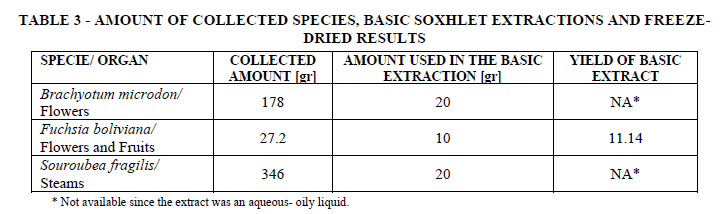
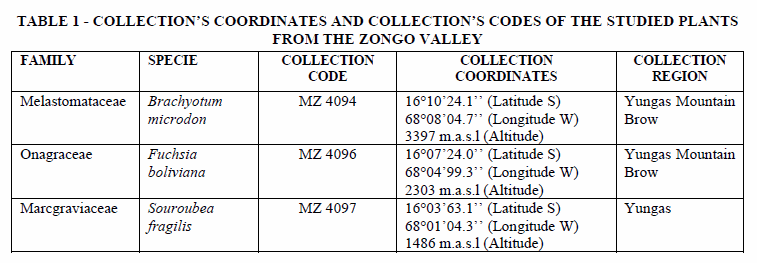
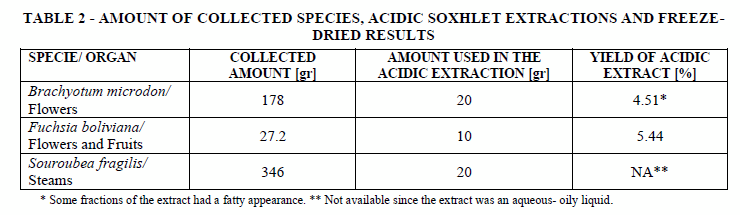
<body><![CDATA[<p align="justify"><font size="3" face="Verdana, Arial, Helvetica, sans-serif"><b>3. RESULTS   AND DISCUSSION </b></font><font size="2" face="Verdana, Arial, Helvetica, sans-serif"><b>&nbsp;</b></font></p>     <p align="justify"><font size="2" face="Verdana, Arial, Helvetica, sans-serif"><b>3.1 Collection   of plant species </b></font><font size="2" face="Verdana, Arial, Helvetica, sans-serif"><b>&nbsp;</b></font></p>     <p align="justify"><font size="2" face="Verdana, Arial, Helvetica, sans-serif">Three vegetal species were collected in   the Zongo valley on November 2017 and belong to 3 different families. Two of   them, <i>Brachyotum microdon </i>(Melastomataceae) and <i>Fuchsia boliviana </i>(Onagraceae)   were collected at the Yungas Mountain Brow; while, <i>Souroubea fragilis</i> (Marcgraviaceae)   was collected in the Yungas region. <a href="#f1">Figure #1</a> presents the photographs of the   collected species and <a href="#t1">Table #1</a> shows the collection&rsquo;s coordinates and the   collection&rsquo;s codes. The mentioned species were collected based on their   antioxidant and/or photoprotector activities and because of their preliminary   dyeing properties evaluated on paper and cardboard.</font></p>     <p align=center><a name="f1"></a><img src="/img/revistas/riyd/v20n1/n01_figura_01.jpg" width="735" height="280"></p>     <p align=center>&nbsp;</p>     <p align=center><a name="t1"></a><img src="/img/revistas/riyd/v20n1/n01_tabla_01.gif" width="757" height="263"></p>     <p align="justify"><font size="2" face="Verdana, Arial, Helvetica, sans-serif"><b>3.2 Extracts   preparation</b></font></p>     <p align="justify"><font size="2" face="Verdana, Arial, Helvetica, sans-serif">The flowers of <i>Brachyotum microdon</i> (batches of 20 g) were Soxhlet extracted following the acid and basic   protocols. The resulting acidic extract had a red cabernet tone while the basic   one had a dark brown color. The acidic and basic extraction of the flowers of <i>Fuchsia     boliviana</i> (10 g for each extraction) gave a pale rose color and a dark   brown tint; respectively. Finally, the steams of <i>Souroubea fragilis</i> (lots of 20 g) provided a light orange acidic extract and a burgundy wine like   tone following the basic treatment. All the extracts obtained were submitted to   freeze dry to obtain their yields. <a href="#t2">Table 2</a> presents the amount of the collected   species, the amount processed in the acidic extraction and the yield obtained   after freeze-drying. <a href="#t3">Table 3</a> presents the same parameters shown in <a href="#t2">Table 2</a> but   referred to the basic extraction.</font></p>     <p align=center><a name="t2"></a><img src="/img/revistas/riyd/v20n1/n01_tabla_02.gif" width="740" height="215"></p>     <p align=center>&nbsp;</p>     ]]></body>
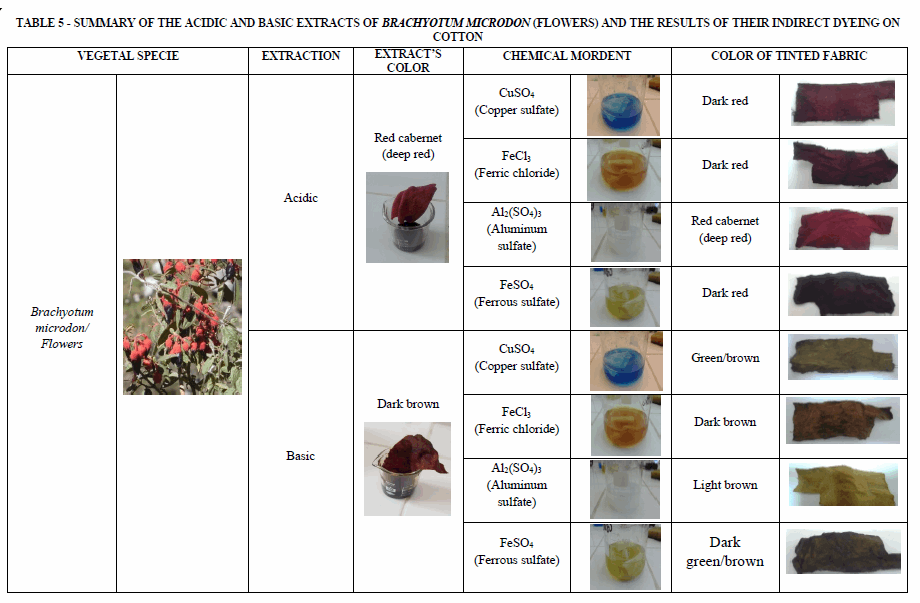
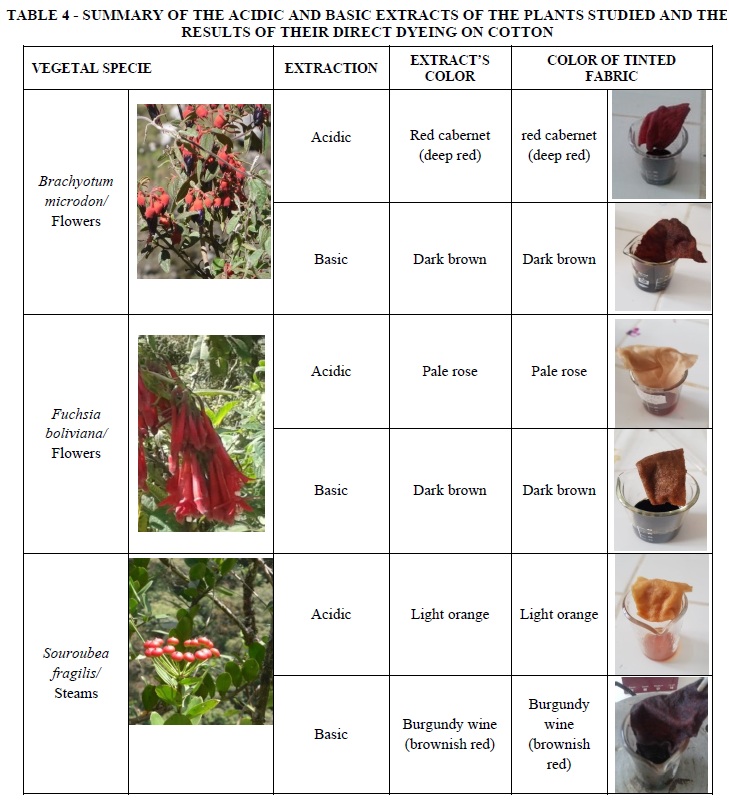
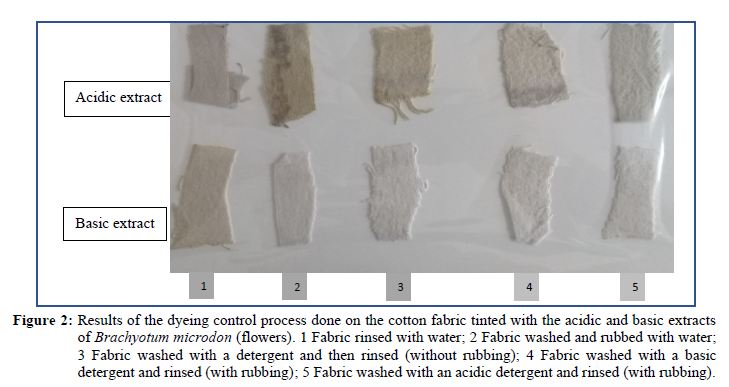
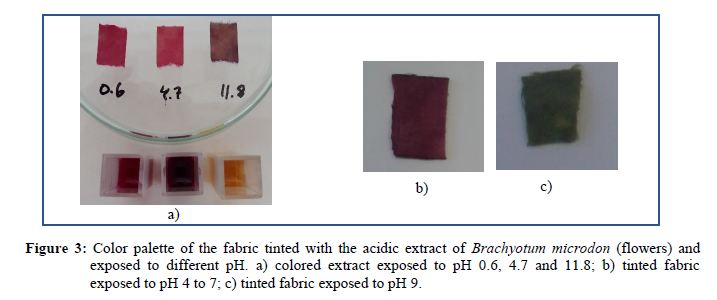
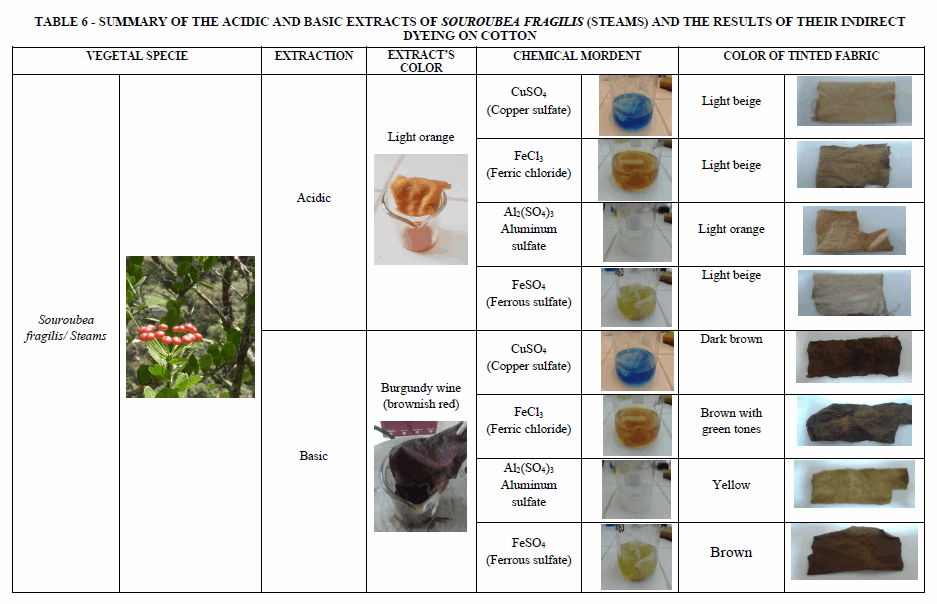
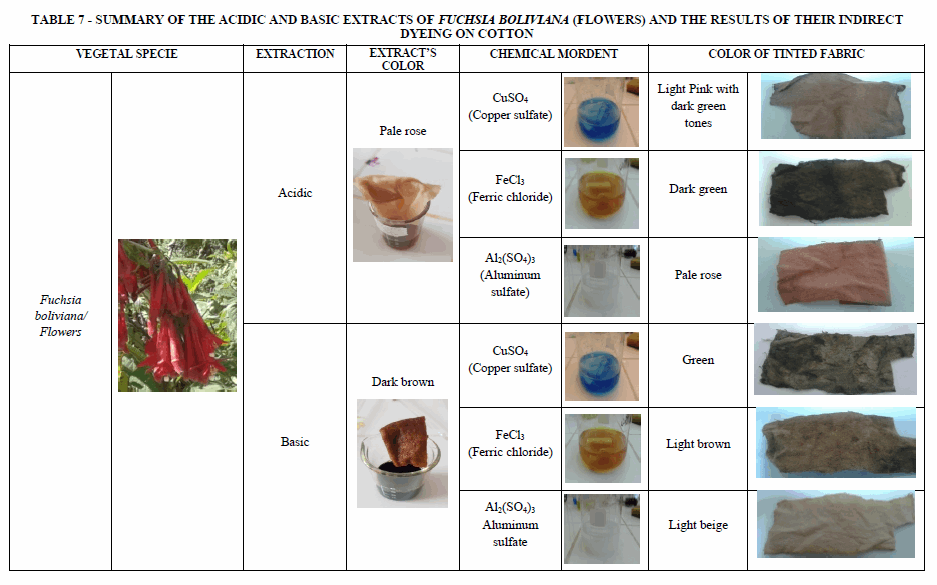
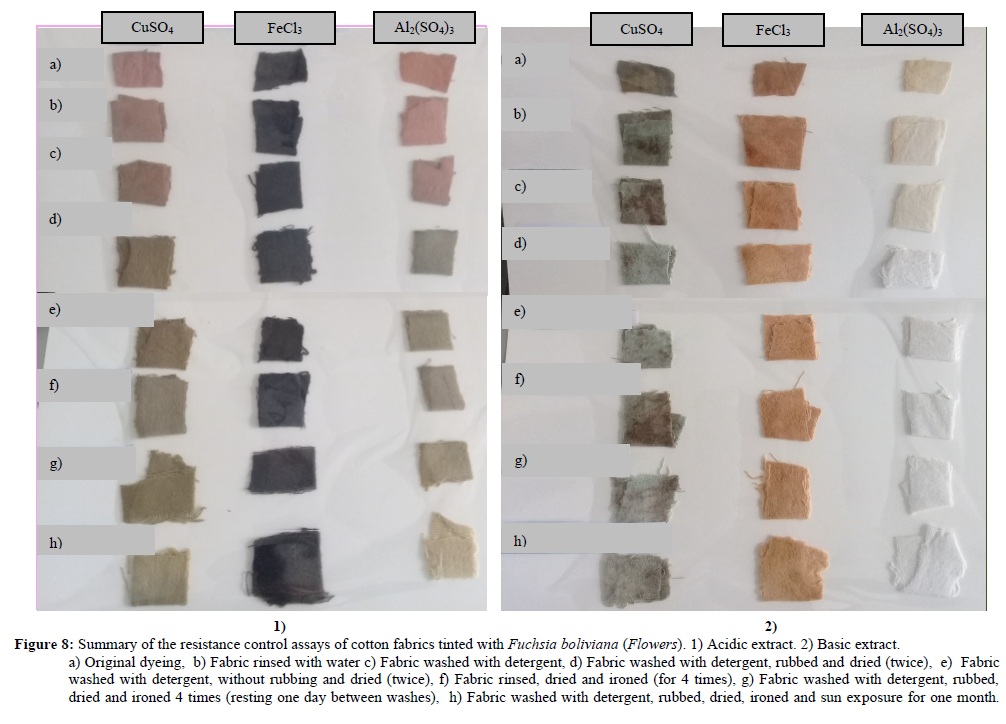
<body><![CDATA[<p align=center><a name="t3"></a><img src="/img/revistas/riyd/v20n1/n01_tabla_03.gif" width="722" height="214"></p>     <p align=justify><font size="2" face="Verdana, Arial, Helvetica, sans-serif"><b>3.3 Direct   dyeing</b></font></p>     <p align="justify"><font size="2" face="Verdana, Arial, Helvetica, sans-serif">For the preliminary direct dyeing assays, cotton   was selected as the substrate because it has been reported as the fabric that   better absorbs natural colorants. All the natural extracts obtained perfectly   tinted this fabric as it can be seen in <a href="#t4">Table 4</a>; however, none of them went   through the dyeing control procedures. <a href="#t4">Table 4</a> presents a summary of the direct   dyeing technique of the acidic and basic extracts of the three studied species.</font></p>     <p align="center"><a name="t4"></a><img src="/img/revistas/riyd/v20n1/n01_tabla_04.jpg" width="729" height="808"></p>     <p align="justify"><font size="2" face="Verdana, Arial, Helvetica, sans-serif"><a href="#f2">Figure 2</a> shows the results of the dyeing   control process done on the cotton fabric tinted with the acidic and basic   extracts of <i>Brachyotum microdon</i> (flowers). In this figure we can see   that the natural color transferred to the fabric was vanished in all protocols.&nbsp;   In addition, it is important to remark that the acidic extract of <i>Brachyotum     microdon</i> (flowers) presented an interesting color palette depending on the   pH worked. This palette goes from a red cabernet tone from pH 4 to 7 to a   turquoise and green color from pH 9 to 14 as it can be seen in <a href="#f3">Figure 3</a>.</font></p>     <p align=center><a name="f2"></a><img src="/img/revistas/riyd/v20n1/n01_figura_02.jpg" width="729" height="387"></p>     <p align=center>&nbsp;</p>     <p align=center><a name="f3"></a><img src="/img/revistas/riyd/v20n1/n01_figura_03.jpg" width="717" height="300"></p>     <p align="justify"><font size="2" face="Verdana, Arial, Helvetica, sans-serif"><b>3.4 Indirect   dyeing</b></font></p>     <p align="justify"><font size="2" face="Verdana, Arial, Helvetica, sans-serif">For   the preliminary indirect dyeing assays, cotton was also selected as the   substrate to better absorb the natural colorants. In most of the indirect   dyeing, the natural colorant was nicely transferred to the fabric previously   treated with the mordent. <a href="#t5">Tables 5</a> to <a href="#t7">7</a> present the summary of the indirect   dyeing techniques of the acidic and basic extracts of each specie studied. In <a href="#t5">Table     5</a>, it can be seen that the original acidic extract color of <i>Brachyotum       microdon</i> (red cabernet or deep red) is perfectly obtained with aluminum   sulfate while the dark brown tint of its basic extract can be successfully attained   when ferric chloride is used as a mordent. &nbsp;For <i>Souroubea fragilis</i>, shown   in <a href="#t6">Table 6</a>, the light orange color of its acidic extract can be nicely accomplished   with aluminum sulfate; unfortunately, its burgundy wine tone given by the basic   extract, was not obtained with neither of the mordents used.&nbsp; Finally, in <a href="#t7">Table     7</a>, the results of the indirect dyeing of <i>Fuchsia boliviana</i> can be   observed. The pale pink tone reached with the acidic extract was well achieved with   aluminum sulfate; however, the dark brown color of its basic extract could not   be reproduced with the mordents used. It is important to highlight that only 3   mordents were used with Fuchsia&rsquo;s extracts because we did not have enough vegetal   sample for the essays.</font></p>     ]]></body>
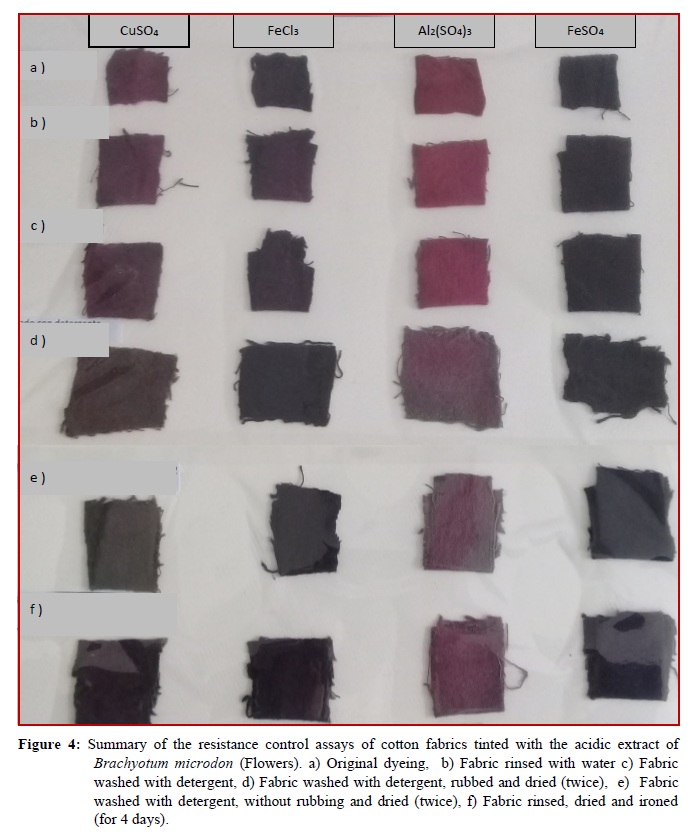
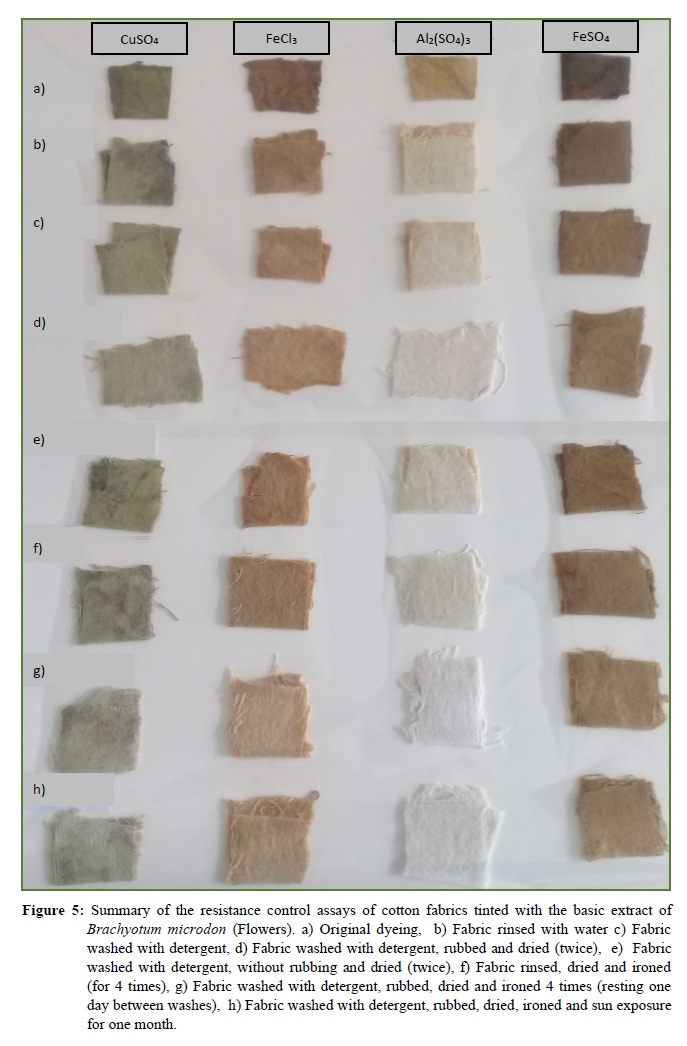
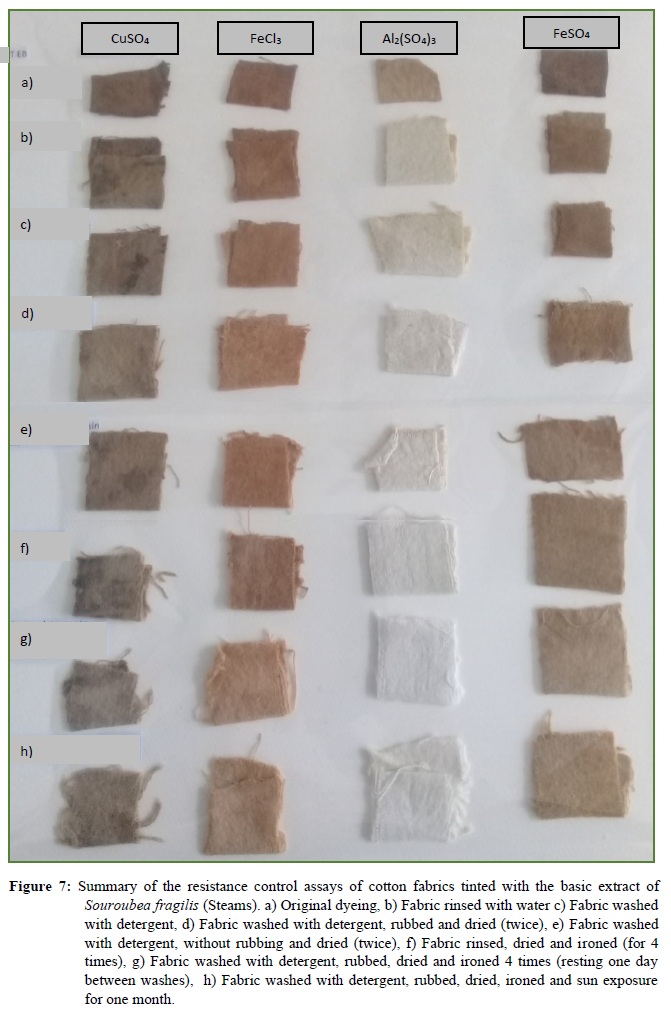
<body><![CDATA[<p align="center"><a name="t5"></a><img src="/img/revistas/riyd/v20n1/n01_tabla_05.gif" width="920" height="603"></p>     <p align="center">&nbsp;</p>     <p align="center"><a name="t6"></a><img src="/img/revistas/riyd/v20n1/n01_tabla_06.gif" width="937" height="604"></p>     <p align="center">&nbsp;</p>     <p align="center"><a name="t7"></a><img src="/img/revistas/riyd/v20n1/n01_tabla_07.gif" width="937" height="585"></p>     <p align="justify"><font size="2" face="Verdana, Arial, Helvetica, sans-serif">Each of the tinted fabrics obtained was   submitted to resistance control assays to study the dyeing strength and   durability. <a href="#f4">Figures 4</a> through <a href="#f8">8</a> show the results of these controls. As it can   be seen in <a href="#f4">Figures # 4</a> and <a href="#f5"># 5</a> for <i>Brachyotum microdon</i>, the mordents   that best dye the fabric which remains colored after the control tests are Al<sub>2</sub>(SO<sub>4</sub>)<sub>3</sub> and FeSO<sub>4</sub> for the acidic and basic extracts, respectively. For <i>Souroubea     fragilis</i>, the best mordents for the acidic extract are CuSO<sub>4 </sub>and   Al<sub>2</sub>(SO<sub>4</sub>)<sub>3</sub>, while for the basic extract all   mordents worked nicely except for Al<sub>2</sub>(SO<sub>4</sub>)<sub>3</sub>.   Finally, for <i>Fuchsia boliviana</i> none of the mordents used reproduced the   original extract colors after the dyeing controls; however, nice tones (dark   blue, dark green and orange) were obtained and maintained with CuSO<sub>4 </sub>and   FeCl<sub>3</sub>.</font></p>     <p align=center><a name="f4"></a><img src="/img/revistas/riyd/v20n1/n01_figura_04.jpg" width="696" height="838"></p>     <p align=center>&nbsp;</p>     <p align=center><a name="f5"></a><img src="/img/revistas/riyd/v20n1/n01_figura_05.jpg" width="687" height="1046"></p>     <p align=center>&nbsp;</p>     ]]></body>
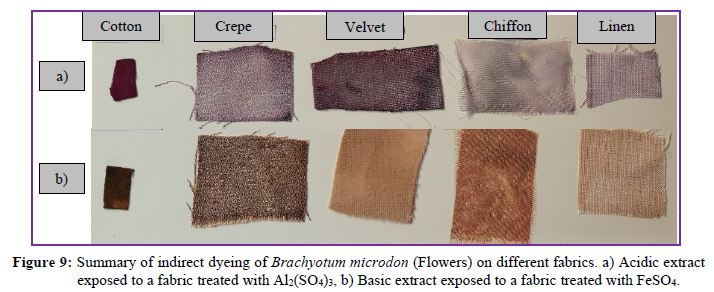
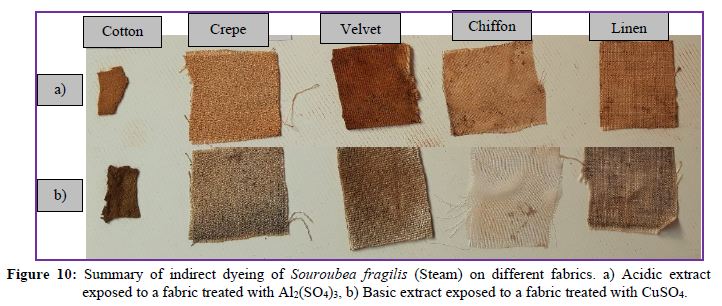
<body><![CDATA[<p align=center><a name="f6"></a><img src="/img/revistas/riyd/v20n1/n01_figura_06.jpg" width="693" height="997"></p>     <p align=center>&nbsp;</p>     <p align=center><a name="f7"></a><img src="/img/revistas/riyd/v20n1/n01_figura_07.jpg" width="671" height="1014"></p>     <p align=center>&nbsp;</p>     <p align=center><a name="f8"></a><img src="/img/revistas/riyd/v20n1/n01_figura_08.jpg" width="1006" height="724"></p>     <p align=justify><font size="2" face="Verdana, Arial, Helvetica, sans-serif"><b>3.5 Indirect   dyeing using different fabrics</b></font></p>     <p align="justify"><font size="2" face="Verdana, Arial, Helvetica, sans-serif">Based on the results of the indirect   dyeing experiments and their control assays, it was concluded that for the acidic   extract of <i>Brachyotum microdon</i>, Al<sub>2</sub>(SO<sub>4</sub>)<sub>3</sub> should be used while the selection for the basic extract was FeSO<sub>4</sub>.   For <a name="_Hlk44062141"><i>Souroubea fragilis</i>, the </a>mordents used were   Al<sub>2</sub>(SO<sub>4</sub>)<sub>3</sub> for the acidic solution while CuSO<sub>4</sub> for the basic one. Finally,<a name="_Hlk44060224"> for <i>Fuchsia boliviana</i> only the basic extract, with FeCl<sub>3</sub>, was evaluated because the acidic     extract was consumed in the previous tests.</a> <a href="#f9">Figure # 9</a> presents the dyeing   results of the acidic and basic extracts of <i>Brachyotum microdon</i>, <a href="#f10">Figure     # 10</a> shows those for <i>Souroubea fragilis</i> and the results for the basic   extract of <i>Fuchsia boliviana</i> are displayed in <a href="#f11">Figure # 11</a>. In all   colored fabrics the tones obtained are not as strong as those obtained with the   cotton textile. Among the tested fabrics, linen, crepe and velvet presented the   best color resolutions. All the fabrics exposed to the acid extract of <i>Brachyotum     microdon </i>presented a light purple coloration, while the fabrics exposed to   the other vegetal extracts presented copper colored tones.</font></p>     <p align="center"><a name="f9" id="f9"></a><img src="/img/revistas/riyd/v20n1/n01_figura_09.jpg" width="714" height="292"></p>     <p align="center">&nbsp;</p>     <p align="center"><a name="f10"></a><img src="/img/revistas/riyd/v20n1/n01_figura_10.jpg" width="722" height="306"></p>     ]]></body>
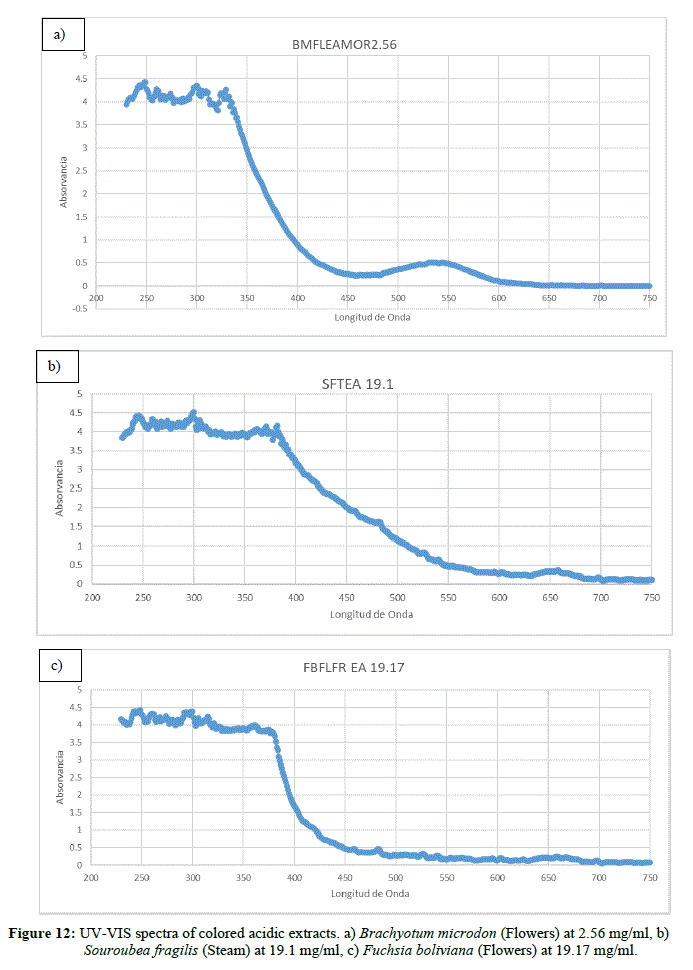
<body><![CDATA[<p align="center">&nbsp;</p>     <p align="center"><a name="f11"></a><img src="/img/revistas/riyd/v20n1/n01_figura_11.jpg" width="681" height="238"></p>     <p align="justify"><font size="2" face="Verdana, Arial, Helvetica, sans-serif"><b>3.6 Spectroscopic   studies</b></font></p>     <p align="justify"><font size="2" face="Verdana, Arial, Helvetica, sans-serif">Each of the colored extracts, used in the   dyeing techniques, was submitted to a spectroscopic study to analyze its color,   antioxidant and/or photoprotector regions. <a href="#f12">Figure 12</a> presents the spectra of the   acidic colored samples. </font></p>     <p align="center"><a name="f12"></a><img src="/img/revistas/riyd/v20n1/n01_figura_12.gif" width="693" height="970"></p>     <p align="justify"><font size="2" face="Verdana, Arial, Helvetica, sans-serif">In all spectra, the presence of the color   absorption regions is evident. The maximum absorption for <i>Brachyotum     microdon</i> is found between 470 -560 nm and for both <i>Souroubea fragilis</i> and <i>Fuchsia boliviana</i> it is between 460- 480 nm. These absorptions are   consistent with the natural color of the extracted organ and the tone of the   organic extract. For <i>Brachyotum microdon</i>, the purple/violet color of its   flowers has an absorption range between 500- 550 nm and the red cabernet (deep   red) color of its acidic extract is between 470- 500 nm. Both absorptions are   present in the spectra and provide the colors observed and explained above. For <i>Souroubea fragilis</i> and <i>Fuchsia boliviana</i>, the absorbed   wavelengths revealed a range of colors starting in orange and ending in red.&nbsp;   This color range is consistent with the orange color of <i>Souroubea fragilis</i> &lsquo;s steams and its acidic extract. The same analogy can be found between the red   flowers of <i>Fuchsia boliviana</i> and its pale pink acidic extract. </font></p>     <p align="justify"><font size="2" face="Verdana, Arial, Helvetica, sans-serif">In the studied spectra the absorptions of   some active metabolites are also visible. The main absorption feature of   phenolic and tannin compounds is found at 280 nm and depending on the type of   phenolic compound other absorptions are characteristic. For instance, for the   galloylated flavanols an additional absorption at 350 nm is observed, for   anthocyanins the band at 520nm is characteristic for red color substances,   hydroxycinnamic acids have an additional absorption at 320 nm and flavonols   present another band around 360 nm.&nbsp; The UV-Vis spectra of anthraquinones show   4 bands in the wavelength range of 220-250 nm and one absorption band close to   400 nm. In all the spectra studied, the stronger bands for phenolic compounds,   tannins and anthraquinones are observed. In addition, it is important to   highlighting the presence of flavonols in <i>Souroubea fragilis</i> and <i>Fuchsia     boliviana</i> with an additional band at 360 nm and anthocyanins in <i>Brachyotum       microdon</i> with a complementary absorption band at 520 nm.</font></p>     <p align="justify">&nbsp;</p>     <p align="justify"><font size="3" face="Verdana, Arial, Helvetica, sans-serif"><b>4. CONCLUSION</b></font><font size="2" face="Verdana, Arial, Helvetica, sans-serif"><b>&nbsp;</b></font></p>     <p align="justify"><font size="2" face="Verdana, Arial, Helvetica, sans-serif"><i>Brachyotum microdon</i>, <i>Fuchsia   boliviana </i>and <i>Souroubea fragilis </i>were   collected in   the Zongo Valley to study their dyeing properties. The acid and basic extracts   of the analyzed species required the use of mordents to fix the dye into the   cotton fabric. To obtain the dark red color of the acidic extract of <i>Brachyotum     microdon</i>, Al<sub>2</sub>(SO<sub>4</sub>)<sub>3</sub> was the recommended   mordent; while for the basic extract, with a dark brown tone, FeSO<sub>4</sub> gave the best dyeing results. Al<sub>2</sub>(SO<sub>4</sub>)<sub>3</sub> was   also the chosen mordent to dye the fabric with the light orange tone of the   acidic extract of <i>Souroubea fragilis</i>; while, CuSO<sub>4</sub> reproduced   the dark brown tone of its basic extract. Finally, FeCl<sub>3</sub> provided   the best finishing and colors for the dyeing techniques with <i>Fuchsia     boliviana</i>. The same mordents were used to dye other fabrics with the   natural colorants and among the fabrics tested, linen, crepe and velvet   presented the best color resolutions. All the fabrics exposed to the acid   extract of <i>Brachyotum microdon </i>presented a light purple coloration,   while the fabrics exposed to the other vegetal extracts presented copper like   colored tones. The spectroscopic studies on the acidic extracts presented   absorptions consistent with their natural organs (flowers, fruits or steams)   and extracts colors. In addition, the spectra presented absorptions for   anthraquinones and phenolic compounds, some of them responsible for the   species&rsquo; antioxidant and photoprotector activities. To our knowledge, this is   the first time that dyeing studies on <i>Brachyotum microdon</i>, <i>Fuchsia     boliviana </i>and <i>Souroubea fragilis</i> are reported.</font></p>     ]]></body>
<body><![CDATA[<p align="justify">&nbsp;</p>     <p align="justify"><font size="3" face="Verdana, Arial, Helvetica, sans-serif"><b>5.</b> <b>REFERENCES</b></font></p>     <p align="justify"><font size="2" face="Verdana, Arial, Helvetica, sans-serif">[1] J. L. Belmonte, I. J. Arroyo, M. A. V&aacute;zquez, D. Cruz   and E. Pe&ntilde;a, &quot;Colorantes Artificiales en Alimentos,&quot; <i>Revista     Naturaleza y Tecnolog&iacute;a Universidad de Guanajuato, </i>vol. 10, pp. 24- 38,   2016. </font></p>     <p align="justify"><font size="2" face="Verdana, Arial, Helvetica, sans-serif">[2] V. Paz, Estudio Comparativo en el Uso de Colorantes   Naturales y Sint&eacute;ticos en Alimentos, desde el Punto de Vista Funcional y   Toxicol&oacute;gico. Tesis de licenciatura en Ciencias de los Alimentos, Valdivia:   Universidad Austral de Chile, 2004. </font></p>     <p align="justify"><font size="2" face="Verdana, Arial, Helvetica, sans-serif">[3] M. Shahid, S. Islam and F. Mohammad, &quot;Recent   Advancements in Natural Dye Applications: A Review,&quot; <i>Journal of     Cleaner Production, </i>vol. 53, pp. 310-331, 2013. </font></p>     <p align="justify"><font size="2" face="Verdana, Arial, Helvetica, sans-serif">[4] A. F. Vinha, F. Rodrigues, M. A. Nunes and M. B. P.   P. Oliveira, Polyphenols: Properties, Recovery, and Applications, Austria:   Woodhead Publishing, 2018. </font></p>     <p align="justify"><font size="2" face="Verdana, Arial, Helvetica, sans-serif">[5] H. Y. Leong, P. L. Show, M. H. Lim, C. W. Ooi and T.   C. Ling, &quot;Natural Red Pigments from Plants and their Health Benefits: A   Review,&quot; <i>Food Reviews International, </i>vol. 34, pp. 463-482, 2018. </font></p>     <p align="justify"><font size="2" face="Verdana, Arial, Helvetica, sans-serif">[6] N. A. Arias Rocha, Tintes Naturales de Origen   Vegetal para Uso en el Te&ntilde;ido de Hilo de Fibra Natural. Tesis de Licenciatura   en Ingenier&iacute;a Industrial, La Paz: Universidad Mayor de San &Aacute;ndres, 2017. </font></p>     <!-- ref --><p align="justify"><font size="2" face="Verdana, Arial, Helvetica, sans-serif">[7] A. Textil, &quot;Procesos de Te&ntilde;ido Ancestrales y   Ecol&oacute;gicos,&quot; Chile, 2010, <a href="http://esartetextil. blogspot.com /2010/10/procesos-de-tenido-ancestrales-y.html" target="_blank">http://esartetextil. blogspot.com     /2010/10/procesos-de-tenido-ancestrales-y.html</a>.</font>&nbsp;&nbsp;&nbsp;&nbsp;&nbsp;&nbsp;&nbsp;&nbsp;[&#160;<a href="javascript:void(0);" onclick="javascript: window.open('/scielo.php?script=sci_nlinks&ref=975128&pid=S2518-4431202000010000100007&lng=','','width=640,height=500,resizable=yes,scrollbars=1,menubar=yes,');">Links</a>&#160;]<!-- end-ref --><p align="justify"><font size="2" face="Verdana, Arial, Helvetica, sans-serif">[8] M. Yusuf, M. Shabbir and F. Mohammad, &quot;Natural   Colorants: Historical, Processing and Sustainable Prospects,&quot; <i>Natural     Products and Bioprospecting, </i>vol. 7, no. 1, p. 123&ndash;145, 2017. </font></p>     ]]></body>
<body><![CDATA[<p align="justify"><font size="2" face="Verdana, Arial, Helvetica, sans-serif">[9] T. Ortu&ntilde;o, Estudio Palinol&oacute;gico en un Gradiente   Altitudinal en el Valle de Zongo. La Paz- Bolivia. Tesis de Licenciatura en   Biolog&iacute;a, La Paz: Universidad Mayor de San &Aacute;ndres, 2000. </font></p>     <!-- ref --><p align="justify"><font size="2" face="Verdana, Arial, Helvetica, sans-serif">[10] M. Baudoin, Historia Natural de un Valle de los   Andes, La Paz, La Paz: Instituto de Ecolog&iacute;a-Universidad Mayor de San &Aacute;ndres,   1991. </font>&nbsp;&nbsp;&nbsp;&nbsp;&nbsp;&nbsp;&nbsp;&nbsp;[&#160;<a href="javascript:void(0);" onclick="javascript: window.open('/scielo.php?script=sci_nlinks&ref=975131&pid=S2518-4431202000010000100010&lng=','','width=640,height=500,resizable=yes,scrollbars=1,menubar=yes,');">Links</a>&#160;]<!-- end-ref --><p align="justify"><font size="2" face="Verdana, Arial, Helvetica, sans-serif">[11] S. L. Ib&aacute;&ntilde;ez-Calero, K. E. Loayza, E. L. Yapu, J.   Lizarazu, R. Zeballos and T. Solares, &quot;A Screening of Natural Colorants   with Probable Antioxidant and/or Photo-Protector Activities,&quot; <i>Investigaci&oacute;n     y Desarrollo, </i>vol. 16, no. 1, pp. 5-24, 2016. </font></p>     <p align="justify"><font size="2" face="Verdana, Arial, Helvetica, sans-serif">[12] S. L. Ib&aacute;&ntilde;ez-Calero and K. E. Loayza, &quot;A   Screening for Antioxidant Species with Photo-protector Activities at the   Zongo Valley (Bolivia),&quot; <i>Investigaci&oacute;n y Desarrollo, </i>vol. 19, no.   1, pp. 25-42, 2019. </font></p>     <p align="justify">&nbsp;</p>      ]]></body><back>
<ref-list>
<ref id="B1">
<label>1</label><nlm-citation citation-type="journal">
<person-group person-group-type="author">
<name>
<surname><![CDATA[Belmonte]]></surname>
<given-names><![CDATA[J.L.]]></given-names>
</name>
<name>
<surname><![CDATA[Arroyo]]></surname>
<given-names><![CDATA[I.J.]]></given-names>
</name>
<name>
<surname><![CDATA[Vázquez]]></surname>
<given-names><![CDATA[M.A.]]></given-names>
</name>
<name>
<surname><![CDATA[Cruz]]></surname>
<given-names><![CDATA[D.]]></given-names>
</name>
<name>
<surname><![CDATA[Peña]]></surname>
<given-names><![CDATA[E.]]></given-names>
</name>
</person-group>
<article-title xml:lang="es"><![CDATA[Colorantes Artificiales en Alimentos]]></article-title>
<source><![CDATA[Revista Naturaleza y Tecnología Universidad de Guanajuato]]></source>
<year>2016</year>
<volume>10</volume>
<page-range>24-38</page-range></nlm-citation>
</ref>
<ref id="B2">
<label>2</label><nlm-citation citation-type="">
<person-group person-group-type="author">
<name>
<surname><![CDATA[Paz]]></surname>
<given-names><![CDATA[V.]]></given-names>
</name>
</person-group>
<source><![CDATA[Estudio Comparativo en el Uso de Colorantes Naturales y Sintéticos en Alimentos, desde el Punto de Vista Funcional y Toxicológico]]></source>
<year>2004</year>
</nlm-citation>
</ref>
<ref id="B3">
<label>3</label><nlm-citation citation-type="journal">
<person-group person-group-type="author">
<name>
<surname><![CDATA[Shahid]]></surname>
<given-names><![CDATA[M.]]></given-names>
</name>
<name>
<surname><![CDATA[Islam]]></surname>
<given-names><![CDATA[S.]]></given-names>
</name>
<name>
<surname><![CDATA[Mohammad]]></surname>
<given-names><![CDATA[F.]]></given-names>
</name>
</person-group>
<article-title xml:lang="en"><![CDATA[Recent Advancements in Natural Dye Applications: A Review]]></article-title>
<source><![CDATA[Journal of Cleaner Production]]></source>
<year>2013</year>
<volume>53</volume>
<page-range>310-331</page-range></nlm-citation>
</ref>
<ref id="B4">
<label>4</label><nlm-citation citation-type="book">
<person-group person-group-type="author">
<name>
<surname><![CDATA[Vinha]]></surname>
<given-names><![CDATA[A.F.]]></given-names>
</name>
<name>
<surname><![CDATA[Rodrigues]]></surname>
<given-names><![CDATA[F.]]></given-names>
</name>
<name>
<surname><![CDATA[Nunes]]></surname>
<given-names><![CDATA[M.A.]]></given-names>
</name>
<name>
<surname><![CDATA[Oliveira]]></surname>
<given-names><![CDATA[M.B.P.P.]]></given-names>
</name>
</person-group>
<source><![CDATA[Polyphenols: Properties, Recovery, and Applications]]></source>
<year>2018</year>
<publisher-loc><![CDATA[Austria ]]></publisher-loc>
<publisher-name><![CDATA[Woodhead Publishing]]></publisher-name>
</nlm-citation>
</ref>
<ref id="B5">
<label>5</label><nlm-citation citation-type="journal">
<person-group person-group-type="author">
<name>
<surname><![CDATA[Leong]]></surname>
<given-names><![CDATA[H.Y.]]></given-names>
</name>
<name>
<surname><![CDATA[Show]]></surname>
<given-names><![CDATA[P.L.]]></given-names>
</name>
<name>
<surname><![CDATA[Lim]]></surname>
<given-names><![CDATA[M.H.]]></given-names>
</name>
<name>
<surname><![CDATA[Ooi]]></surname>
<given-names><![CDATA[C.W.]]></given-names>
</name>
<name>
<surname><![CDATA[Ling]]></surname>
<given-names><![CDATA[T.C.]]></given-names>
</name>
</person-group>
<article-title xml:lang="en"><![CDATA[Natural Red Pigments from Plants and their Health Benefits: A Review]]></article-title>
<source><![CDATA[Food Reviews International]]></source>
<year>2018</year>
<volume>34</volume>
<page-range>463-482</page-range></nlm-citation>
</ref>
<ref id="B6">
<label>6</label><nlm-citation citation-type="">
<person-group person-group-type="author">
<name>
<surname><![CDATA[Arias Rocha]]></surname>
<given-names><![CDATA[N.A.]]></given-names>
</name>
</person-group>
<source><![CDATA[Tintes Naturales de Origen Vegetal para Uso en el Teñido de Hilo de Fibra Natural]]></source>
<year>2017</year>
</nlm-citation>
</ref>
<ref id="B7">
<label>7</label><nlm-citation citation-type="">
<collab>A. Textil</collab>
<source><![CDATA[Procesos de Teñido Ancestrales y Ecológicos]]></source>
<year>2010</year>
<publisher-loc><![CDATA[Chile ]]></publisher-loc>
</nlm-citation>
</ref>
<ref id="B8">
<label>8</label><nlm-citation citation-type="journal">
<person-group person-group-type="author">
<name>
<surname><![CDATA[Yusuf]]></surname>
<given-names><![CDATA[M.]]></given-names>
</name>
<name>
<surname><![CDATA[Shabbir]]></surname>
<given-names><![CDATA[M.]]></given-names>
</name>
<name>
<surname><![CDATA[Mohammad]]></surname>
<given-names><![CDATA[F.]]></given-names>
</name>
</person-group>
<article-title xml:lang="en"><![CDATA[Natural Colorants: Historical, Processing and Sustainable Prospects]]></article-title>
<source><![CDATA[Natural Products and Bioprospecting]]></source>
<year>2017</year>
<volume>7</volume>
<numero>1</numero>
<issue>1</issue>
<page-range>123-145</page-range></nlm-citation>
</ref>
<ref id="B9">
<label>9</label><nlm-citation citation-type="">
<person-group person-group-type="author">
<name>
<surname><![CDATA[Ortuño]]></surname>
<given-names><![CDATA[T.]]></given-names>
</name>
</person-group>
<source><![CDATA[Estudio Palinológico en un Gradiente Altitudinal en el Valle de Zongo. La Paz- Bolivia]]></source>
<year>2000</year>
</nlm-citation>
</ref>
<ref id="B10">
<label>10</label><nlm-citation citation-type="book">
<person-group person-group-type="author">
<name>
<surname><![CDATA[Baudoin]]></surname>
<given-names><![CDATA[M.]]></given-names>
</name>
</person-group>
<source><![CDATA[Historia Natural de un Valle de los Andes, La Paz]]></source>
<year>1991</year>
<publisher-loc><![CDATA[La Paz ]]></publisher-loc>
<publisher-name><![CDATA[Instituto de Ecología-Universidad Mayor de San Ándres]]></publisher-name>
</nlm-citation>
</ref>
<ref id="B11">
<label>11</label><nlm-citation citation-type="journal">
<person-group person-group-type="author">
<name>
<surname><![CDATA[Ibáñez-Calero]]></surname>
<given-names><![CDATA[S.L.]]></given-names>
</name>
<name>
<surname><![CDATA[Loayza]]></surname>
<given-names><![CDATA[K.E.]]></given-names>
</name>
<name>
<surname><![CDATA[Yapu]]></surname>
<given-names><![CDATA[E.L.]]></given-names>
</name>
<name>
<surname><![CDATA[Lizarazu]]></surname>
<given-names><![CDATA[J.]]></given-names>
</name>
<name>
<surname><![CDATA[Zeballos]]></surname>
<given-names><![CDATA[R.]]></given-names>
</name>
<name>
<surname><![CDATA[Solares]]></surname>
<given-names><![CDATA[T.]]></given-names>
</name>
</person-group>
<article-title xml:lang="en"><![CDATA[A Screening of Natural Colorants with Probable Antioxidant and/or Photo-Protector Activities]]></article-title>
<source><![CDATA[Investigación y Desarrollo]]></source>
<year>2016</year>
<volume>16</volume>
<numero>1</numero>
<issue>1</issue>
<page-range>5-24</page-range></nlm-citation>
</ref>
<ref id="B12">
<label>12</label><nlm-citation citation-type="journal">
<person-group person-group-type="author">
<name>
<surname><![CDATA[Ibáñez-Calero]]></surname>
<given-names><![CDATA[S.L.]]></given-names>
</name>
<name>
<surname><![CDATA[Loayza]]></surname>
<given-names><![CDATA[K.E.]]></given-names>
</name>
</person-group>
<article-title xml:lang="en"><![CDATA[A Screening for Antioxidant Species with Photo-protector Activities at the Zongo Valley (Bolivia)]]></article-title>
<source><![CDATA[Investigación y Desarrollo]]></source>
<year>2019</year>
<volume>19</volume>
<numero>1</numero>
<issue>1</issue>
<page-range>25-42</page-range></nlm-citation>
</ref>
</ref-list>
</back>
</article>