<?xml version="1.0" encoding="ISO-8859-1"?><article xmlns:mml="http://www.w3.org/1998/Math/MathML" xmlns:xlink="http://www.w3.org/1999/xlink" xmlns:xsi="http://www.w3.org/2001/XMLSchema-instance">
<front>
<journal-meta>
<journal-id>2518-4431</journal-id>
<journal-title><![CDATA[Investigación & Desarrollo]]></journal-title>
<abbrev-journal-title><![CDATA[Inv. y Des.]]></abbrev-journal-title>
<issn>2518-4431</issn>
<publisher>
<publisher-name><![CDATA[UNIVERSIDAD PRIVADA BOLIVIANA]]></publisher-name>
</publisher>
</journal-meta>
<article-meta>
<article-id>S2518-44312019000100006</article-id>
<title-group>
<article-title xml:lang="en"><![CDATA[DESIGNING AND DEVELOPMENT OF A DYNAMIC VIBRATION BALANCING MACHINE FOR INDUSTRIAL APPLICATIONS]]></article-title>
<article-title xml:lang="es"><![CDATA[DISEÑO Y DESARROLLO DE UNA MÁQUINA DE BALANCEO DINÁMICO DE VIBRACIONES PARA APLICACIONES INDUSTRIALES]]></article-title>
</title-group>
<contrib-group>
<contrib contrib-type="author">
<name>
<surname><![CDATA[Burgos Alconz]]></surname>
<given-names><![CDATA[Swith Claude]]></given-names>
</name>
<xref ref-type="aff" rid="A01"/>
</contrib>
<contrib contrib-type="author">
<name>
<surname><![CDATA[Zurita V.]]></surname>
<given-names><![CDATA[Grover]]></given-names>
</name>
<xref ref-type="aff" rid="A01"/>
</contrib>
</contrib-group>
<aff id="A01">
<institution><![CDATA[,Universidad Privada Boliviana Laboratorio de Innovación Tecnológica Industrial y Robótica (LITIR) ]]></institution>
<addr-line><![CDATA[Cochabamba ]]></addr-line>
<country>Bolivia</country>
</aff>
<pub-date pub-type="pub">
<day>00</day>
<month>00</month>
<year>2019</year>
</pub-date>
<pub-date pub-type="epub">
<day>00</day>
<month>00</month>
<year>2019</year>
</pub-date>
<volume>19</volume>
<numero>1</numero>
<fpage>73</fpage>
<lpage>93</lpage>
<copyright-statement/>
<copyright-year/>
<self-uri xlink:href="http://www.scielo.org.bo/scielo.php?script=sci_arttext&amp;pid=S2518-44312019000100006&amp;lng=en&amp;nrm=iso"></self-uri><self-uri xlink:href="http://www.scielo.org.bo/scielo.php?script=sci_abstract&amp;pid=S2518-44312019000100006&amp;lng=en&amp;nrm=iso"></self-uri><self-uri xlink:href="http://www.scielo.org.bo/scielo.php?script=sci_pdf&amp;pid=S2518-44312019000100006&amp;lng=en&amp;nrm=iso"></self-uri><abstract abstract-type="short" xml:lang="en"><p><![CDATA[There is a steadily growing demand for reliable, versatile measurement rotor balancing system which can be used to determine the machine unbalances behavior. The effect of these causes are the increase of vibration amplitudes, causing damage to elements of the machines, mainly in the bearings, reduce useful life time, and increase fatigue failure in machines. The industry requires that machines have to operate continuously, efficient maintenance philosophy, and reduce down time. Therefore, this research work has the main objective to design and develop a low cost rotor balancing measurement system for industrial applications. This research study was based on the ISO 1940-1 standard. The Solidworks software was used for the designing, structural stress, and modal analysis. It was also carried out and extensive numerical analysis with Finite Element Method (FEM), of the developed measurement system, in order to identify the structure resonance frequencies to avoid with the induction motor rotation frequency. For the simplicity, precision and robustness, the single plane four runs method for rotor balancing was selected. Finally, it was developed a rotor balancing measurement system. It showed the ability, and potential to use the developed equipment in industrial environment. Moreover, it has been shown that the measurement and the applied analysis method have worked accurate for unbalance detection and reduction of vibration levels from G13 to G2.]]></p></abstract>
<abstract abstract-type="short" xml:lang="es"><p><![CDATA[Existe una creciente demanda de un sistema de balanceo de rotores de medición fiable y versátil que se pueda utilizar para determinar el comportamiento de desequilibrio de los equipos. El efecto del desbalanceo causa el aumento de las amplitudes de vibración, generando daños a los elementos de las máquinas, principalmente en los rodamientos, reduce la vida útil, y aumenta la falla de fatiga en las máquinas. La industria requiere que las máquinas operen continuamente, la filosofía es de un mantenimiento eficiente y pueda reducirse el tiempo de inactividad de los equipos. Por tanto, este trabajo de investigación tiene el objetivo principal de diseñar y desarrollar un sistema de medición de desbalanceo de rotores de bajo costo, mediante análisis vibracional para aplicaciones industriales. El desarrollo del sistema de medición se basa en la normativa de ISO 1940-1. El análisis de resistencia de materiales y el análisis dinámico de análisis de modos fue realizado en el software Solidworks. El estudio de las características dinámicas del equipo desarrollado, se pudo determinar con análisis modal, con el fin de identificar las frecuencias de resonancia de la estructura diseñada, esto para evitar la frecuencia de rotación del motor de inducción. En base a la bibliografía estudiada, el método de análisis para identificar la masa de desbalance y distancia, fue realizado con análisis vibracional y el método de cuatro corridas de plano único para el equilibrio del rotor. Finalmente, se desarrolló un sistema de medición de desbalance de rotores, de precisión y con potencial para utilizar el equipo en el entorno industrial. Se ha demostrado que las mediciones de análisis vibracional y el método de detección de desbalanceo, han funcionado con precisión para la detección de desequilibrios y la reducción de los niveles de vibración de G13 a G2.]]></p></abstract>
<kwd-group>
<kwd lng="en"><![CDATA[Rotor]]></kwd>
<kwd lng="en"><![CDATA[Balancing]]></kwd>
<kwd lng="en"><![CDATA[Vibration analysis]]></kwd>
<kwd lng="en"><![CDATA[Solidworks]]></kwd>
<kwd lng="en"><![CDATA[FEM]]></kwd>
<kwd lng="en"><![CDATA[Modal Analysis]]></kwd>
<kwd lng="en"><![CDATA[ISO 1940-1]]></kwd>
<kwd lng="es"><![CDATA[Rotor]]></kwd>
<kwd lng="es"><![CDATA[Desequilibrio]]></kwd>
<kwd lng="es"><![CDATA[Análisis Vibracional]]></kwd>
<kwd lng="es"><![CDATA[Solidworks]]></kwd>
<kwd lng="es"><![CDATA[FEM]]></kwd>
<kwd lng="es"><![CDATA[Análisis Modal]]></kwd>
<kwd lng="es"><![CDATA[ISO 1940-1]]></kwd>
</kwd-group>
</article-meta>
</front><body><![CDATA[ <p align=left><font color="#800000" size="2" face="Verdana, Arial, Helvetica, sans-serif"><b>DOI:</b> 10.23881/idupbo.019.1-5i</font></p>     <p align=right><font size="2" face="Verdana, Arial, Helvetica, sans-serif"><b><b>ART&Iacute;CULOS &ndash; INGENIER&Iacute;AS</b></b></font></p>     <p align=center><font size="2" face="Verdana, Arial, Helvetica, sans-serif"><b>&nbsp;</b></font></p>     <p align=center><font size="4" face="Verdana, Arial, Helvetica, sans-serif"><b>DESIGNING AND DEVELOPMENT OF A DYNAMIC   VIBRATION BALANCING MACHINE FOR INDUSTRIAL APPLICATIONS</b></font></p>     <p align=center><font size="2" face="Verdana, Arial, Helvetica, sans-serif"><b>&nbsp;</b></font></p>     <p align=center><font size="3" face="Verdana, Arial, Helvetica, sans-serif"><b>DISE&Ntilde;O Y DESARROLLO DE UNA M&Aacute;QUINA DE BALANCEO   DIN&Aacute;MICO DE VIBRACIONES PARA APLICACIONES INDUSTRIALES</b></font></p>     <p align=center><font size="2" face="Verdana, Arial, Helvetica, sans-serif"><b>&nbsp;</b></font></p>     <p align=center>&nbsp;</p>     <p align=center><font size="2" face="Verdana, Arial, Helvetica, sans-serif"><b>Swith Claude Burgos Alconz and Grover Zurita   V.</b></font></p>     <p align=center><font size="2" face="Verdana, Arial, Helvetica, sans-serif">Laboratorio de Innovaci&oacute;n Tecnol&oacute;gica   Industrial y Rob&oacute;tica (LITIR) </font>    ]]></body>
<body><![CDATA[<br>   <font size="2" face="Verdana, Arial, Helvetica, sans-serif">Universidad Privada Boliviana </font>    <br>   <font size="2" face="Verdana, Arial, Helvetica, sans-serif">Cochabamba-Bolivia </font>    <br>   <font size="2" face="Verdana, Arial, Helvetica, sans-serif"><a href="mailto:grzurita@upb.edu">grzurita@upb.edu</a></font></p>     <p align=center><font size="2" face="Verdana, Arial, Helvetica, sans-serif">(Recibido el 05 junio 2019,   aceptado para publicaci&oacute;n el 28 junio 2019)</font></p>     <p>&nbsp;</p>     <p>&nbsp;</p> <hr noshade>     <p><font size="2" face="Verdana, Arial, Helvetica, sans-serif"><b>ABSTRACT</b></font></p>     <p align="justify"><font size="2" face="Verdana, Arial, Helvetica, sans-serif">There is a steadily growing demand for reliable,   versatile measurement rotor balancing system which can be used to determine the   machine unbalances behavior. The effect of these causes are the increase of   vibration amplitudes, causing damage to elements of the machines, mainly in the   bearings, reduce useful life time, and increase fatigue failure in machines.   The industry requires that machines have to operate continuously, efficient   maintenance philosophy, and reduce down time. Therefore, this research work has   the main objective to design and develop a low cost rotor balancing measurement   system for industrial applications. This research study was based on the ISO   1940-1 standard. The Solidworks software was used for the designing, structural   stress, and modal analysis. It was also carried out and extensive numerical   analysis with Finite Element Method (FEM), of the developed measurement system,   in order to identify the structure resonance frequencies to avoid with the   induction motor rotation frequency. For the simplicity, precision and   robustness, the single plane four runs method for rotor balancing was selected.   Finally, it was developed a rotor balancing measurement system. It showed the   ability, and potential to use the developed equipment in industrial   environment. Moreover, it has been shown that the measurement and the applied   analysis method have worked accurate for unbalance detection and reduction of   vibration levels from G13 to G2.</font></p>     <p align="justify"><font size="2" face="Verdana, Arial, Helvetica, sans-serif"><b>Keywords:</b> Rotor, Balancing, Vibration   analysis, Solidworks, FEM, Modal Analysis, ISO 1940-1. </font></p> <hr align="JUSTIFY" noshade>     <p align="justify"><font size="2" face="Verdana, Arial, Helvetica, sans-serif"><b>RESUMEN</b></font></p>     ]]></body>
<body><![CDATA[<p align="justify"><font size="2" face="Verdana, Arial, Helvetica, sans-serif">Existe una creciente demanda de un sistema de balanceo de rotores de   medici&oacute;n fiable y vers&aacute;til que se pueda utilizar para determinar el   comportamiento de desequilibrio de los equipos. El efecto del desbalanceo causa   el aumento de las amplitudes de vibraci&oacute;n, generando da&ntilde;os a los elementos de   las m&aacute;quinas, principalmente en los rodamientos, reduce la vida &uacute;til, y aumenta   la falla de fatiga en las m&aacute;quinas. La industria requiere que las m&aacute;quinas   operen continuamente, la filosof&iacute;a es de un mantenimiento eficiente y pueda   reducirse el tiempo de inactividad de los equipos. Por tanto, este trabajo de   investigaci&oacute;n tiene el objetivo principal de dise&ntilde;ar y desarrollar un sistema   de medici&oacute;n de desbalanceo de rotores de bajo costo, mediante an&aacute;lisis   vibracional para aplicaciones industriales. El desarrollo del sistema de   medici&oacute;n se basa en la normativa de ISO 1940-1. El an&aacute;lisis de resistencia de   materiales y el an&aacute;lisis din&aacute;mico de an&aacute;lisis de modos fue realizado en el software   Solidworks. El estudio de las caracter&iacute;sticas din&aacute;micas del equipo   desarrollado, se pudo determinar con an&aacute;lisis modal, con el fin de identificar   las frecuencias de resonancia de la estructura dise&ntilde;ada, esto para evitar la   frecuencia de rotaci&oacute;n del motor de inducci&oacute;n. En base a la bibliograf&iacute;a   estudiada, el m&eacute;todo de an&aacute;lisis para identificar la masa de desbalance y   distancia, fue realizado con an&aacute;lisis vibracional y el m&eacute;todo de cuatro   corridas de plano &uacute;nico para el equilibrio del rotor. Finalmente, se desarroll&oacute;   un sistema de medici&oacute;n de desbalance de rotores, de precisi&oacute;n y con potencial   para utilizar el equipo en el entorno industrial. Se ha demostrado que las   mediciones de an&aacute;lisis vibracional y el m&eacute;todo de detecci&oacute;n de desbalanceo, han   funcionado con precisi&oacute;n para la detecci&oacute;n de desequilibrios y la reducci&oacute;n de   los niveles de vibraci&oacute;n de G13 a G2.</font></p>     <p align="justify"><font size="2" face="Verdana, Arial, Helvetica, sans-serif"><b>Palabras Clave:</b> Rotor, Desequilibrio, An&aacute;lisis Vibracional,   Solidworks, FEM, An&aacute;lisis Modal, ISO 1940-1. </font></p> <hr align="JUSTIFY" noshade>     <p align="justify">&nbsp;</p>     <p align="justify">&nbsp;</p>     <p align=justify><font size="3" face="Verdana, Arial, Helvetica, sans-serif"><a name="_Toc6924111"><b>1.&nbsp;&nbsp;&nbsp;&nbsp; INTRODUCTION </b></a></font></p>     <p align="justify"><font size="2" face="Verdana, Arial, Helvetica, sans-serif">The unbalance is consider the most common source of vibration in   machine components [1], [2].   It could cause for excessive bearings loadings, which reduce useful life time,   and increase fatigue failure of machines. In modern machines, the unbalance   factor is quite important for designing and maintenance health monitoring. Based on the aforementioned, there is a need   to have industrial equipment in continuous operation, and the best way to   increase the machines life time are through its adequate alignment and   precision balancing methods. If the machine is balanced and aligned correctly,   and if all the resonance problems are corrected, then it is likely that the   machine will operate for a significantly longer time period, before failures   occurs[3],   [4].   Any type of failure mode can lead to a functional failure and therefore to   economic losses. Therefore, in order to secure an efficient working machines   process [5],[6],[7],   in recent years have been applying efficiently, the conditions maintenance   approach.</font></p>     <p align="justify"><font size="2" face="Verdana, Arial, Helvetica, sans-serif">The literature review showed that the most common faults in rotating   machines are due to misaligned axes and unbalanced rotors (2). Therefore, in   this context, the development of balancing machines for industrial applications   is of mayor significance. Due to the characteristics of this research project,   the literature survey covers two main parts: a) Design and development of rotor   balancing systems, and b) Rotor balancing quantification techniques. </font></p>     <p align="justify"><font size="2" face="Verdana, Arial, Helvetica, sans-serif">S. Sweedney <i>et al</i>., in 2005 [8]   redesigned the rotor balancing system to reduce the unbalance phenomena. It was   obtained by changing a lighter disk and shorter rotor shaft to increase the   rigidly of the system. D. Han in 2006 [9],   developed a model balancing for non-isotropic rotor system. The idea was to   develop a generalized modal analysis from an unbalance model response to obtain   new model parameters to be use partly, to quantify the unbalances, and partly   to reduce it. L. T. Hongwei <i>et al</i>., in 2011[10], their research work was based on vibration signals analysis and   filtering techniques. They developed an online process for dynamic balancing   system for spindle and grinding in CNC machines.</font></p>     <p align="justify"><font size="2" face="Verdana, Arial, Helvetica, sans-serif">A laser device was implemented to perform rotor balancing by, M.   Stoesslein <i>et al</i>., in 2016. It works by the laser removing materials in   automatic and controlled form. A structure surface vibration signals values   were used to activate removing materials. A. Wanq <i>et al</i>., in 2017 [10],&nbsp; applied a four order non-homogeneous partial differential equation   set to unbalance responses, damping bearing coefficients and rotor unbalance.   It was also proposed a novel measurement Point Vector Method to determine rotor   unbalance under operating. A high speed balance approach was developed for   turbo machinery by G. Bin in 2018. The rotating speed of a rotor is hardly constant   in practice due to angular speed &#64258;uctuation, which affects the balancing   accuracy of the rotor. In this paper, the effect of angular speed &#64258;uctuation on   vibration responses of the unbalanced rotor is analyzed quantitatively. Then, a   vibration signal correction method based on zoom synchro&rsquo;s squeezing transform   (ZST) and tacho less order tracking was proposed. The instantaneous angular   speed (IAS) of the rotor is extracted by the ZST &#64257;rstly and then used to   calculate the instantaneous phase. The vibration signal is further resampled in   angular domain to reduce the effect of angular speed &#64258;uctuation. The signal   obtained in angular domain is transformed into order domain using discrete   Fourier transform (DFT) to estimate the amplitude and phase of the vibration   signal. Simulated and experimental results show that the proposed method can   successfully correct the amplitude and phase of the vibration signal due to   angular speed &#64258;uctuation. The Coefficient Balance Method (CBM) was used to   identify the shaft balancing values. The multi plane coefficients with varying   speeds are based on steady state response from the Finite Element Method (FEM).</font></p>     <p align="justify"><font size="2" face="Verdana, Arial, Helvetica, sans-serif">H. Cao, <i>et al</i>., in 2018 [11], studied the vibration signal corrections of an unbalanced rotor as a   result of speed fluctuations. First, it was defined the speed fluctuations and   it was reduced the effects of the rotors fluctuations, by using the Zoom   Synchrosqueezing Transform (ZST). A self-sensing piezoelectric actuator was   used for unbalance detection in rotor systems, by R. Ambur, <i>et al</i>., in   2018 [12]. In this research, the tests were performed the unbalance rotor faults   were detected by using a parameter optimization method, which was also   calculated the location, phase and unbalance magnitude. The final analysis was   performed in laboratory test bench, and the developed method could be used both   for control action and fault detection. It was also described included a   numerical simulation of the manufactured prototype and it was also performed a   dynamical structure analysis by modal analysis.</font></p>     ]]></body>
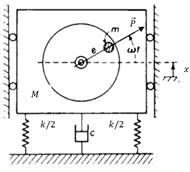
<body><![CDATA[<p align="justify"><font size="2" face="Verdana, Arial, Helvetica, sans-serif">The literature review reveals that an extensive research   has been performed; partly study the development and designing of rotor   balancing system and the use of different measurement techniques to detect the   unbalance severity. However, it can be stated it has still a place to research   in this field partly, to give a systematic framework for rotor unbalance   quality measurements. Therefore,   the main objective of this research work was to design and developed a low cost   dynamic rotor balancing machine. It`s recommend the condition based-maintenance   (MBC), which is a maintenance program to collect data continuously and perform   the maintenance decisions [13], [14], [15], [16], [17].</font></p>     <p align="justify">&nbsp;</p>     <p align="justify"><font size="3" face="Verdana, Arial, Helvetica, sans-serif"><b>2.&nbsp;&nbsp;&nbsp;&nbsp; THEORETICAL BACKGROUND: ROTOR BALANCING   THEORY, STRUCTURE STRESS ANALYSIS AND MODAL ANALYSIS </b></font><font size="2" face="Verdana, Arial, Helvetica, sans-serif"><b>&nbsp;</b></font></p>     <p align="justify"><font size="2" face="Verdana, Arial, Helvetica, sans-serif"><b>2.1 Rotor Balancing Theory</b></font></p>     <p align="justify"><font size="2" face="Verdana, Arial, Helvetica, sans-serif">The unbalance is defined as, the condition that exists in   a rotor when vibratory forces are imparted to its bearings as a result of the   existence of centrifugal forces. The presence of imbalance causes a centrifugal   force which is proportional to the square of the rotational speed or angular   frequency. The following equation sustains the above.</font></p>     <p align="center"><img src="/img/revistas/riyd/v19n1/a06_ecuation_01.gif" width="743" height="27"></p>     <p align=justify><font size="2" face="Verdana, Arial, Helvetica, sans-serif">where <img width=9 height=14 src="/img/revistas/riyd/v19n1/a06_image002.gif">&nbsp;is the centrifugal force in newton <img src="/img/revistas/riyd/v19n1/a06_image003.gif" width=18 height=12 align="absmiddle">, <i>m</i> is the unbalance mass, <i>e</i> is the distance between the central shaft rotation with the unbalance mass, and <img width=10 height=6 src="/img/revistas/riyd/v19n1/a06_image004.gif">&nbsp;is the rotor angular velocity. </font></p>     <p align="justify"><font size="2" face="Verdana, Arial, Helvetica, sans-serif"><a href="#f1">Figure 1</a> shows a   typical mass-spring system, restricted for vertical movements &quot;<i>x</i>&quot;   and excited by a rotating machine that is unbalanced. The unbalance is   represented by a mass (<i>m</i>) that causes an eccentricity, and an unbalance   force in the radial direction.</font></p>     <p align=center><font size="2" face="Verdana, Arial, Helvetica, sans-serif"><a name="f1"></a><img width=190 height=172 id="Imagen 12" src="/img/revistas/riyd/v19n1/a06_image005.gif"></font></p>     <p align=center><font size="2" face="Verdana, Arial, Helvetica, sans-serif"><b>Figure 1: </b>Spring &ndash;mass system with unbalance mass (m)[18].</font></p>     ]]></body>
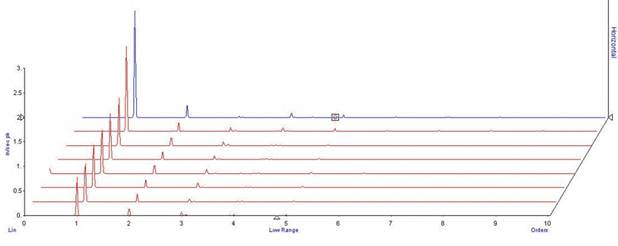
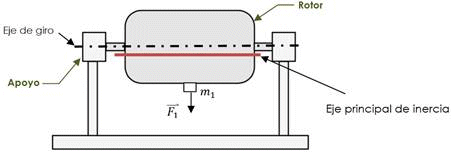
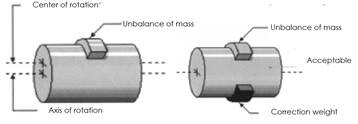
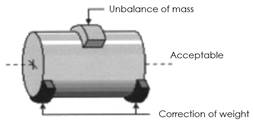
<body><![CDATA[<p align="justify"><font size="2" face="Verdana, Arial, Helvetica, sans-serif">The distribution   mass of a rotor is checked and, if necessary, adjusted to predict that the   residual unbalance or vibration of the bearings and/or the force in the   bearings at a frequency corresponding to the speed service are within the   specified limits [5]. By reading the above   definition it can be implied that there is a maximum allowable unbalance for   each rotating component, see even the IS0 1940-1 for details. The maximum   admissible unbalance can vary for different operating conditions [6]. To balance a rotor,   it is necessary to apply a distribution of forces in such a way as to   counteract the sum of the centrifugal forces resulting from the unbalance of   each plane.</font></p>     <p align="justify"><font size="2" face="Verdana, Arial, Helvetica, sans-serif">The rotor balancing can be performed in two ways, which   are, &quot;in-situ&quot; and &quot;in workshop&quot;. The first one refers to   performing the balancing in the field <i>i.e</i>. balancing the rotating   machine in its working place. The second alternative, refers to removing the   rotor from the working place and taking it to a test bench [7]. Each aforementioned method form has its   advantages/disadvantages, the technique to be applied will depend mainly on the   size of the rotor, the access for taking measurements, safety to the personnel   and adjacent machines that could cause noise when taking readings.</font></p>     <p align="justify"><font size="2" face="Verdana, Arial, Helvetica, sans-serif"><a href="#f2">Figure 2</a> illustrates a high peak (vibration amplitude) of   about the first order at the rotation frequency of the rotor. It is said that   the rotor is unbalanced if the obtained vibration amplitudes are above the   permitted threshold, see even the ISO 1940-1 for details. The general idea is   to reduce considerably the vibration peaks at the frequency of rotation in   order to avoid unbalance of a rotor   [8].   The rotor unbalance increment is not linear but   increases proportionally to the square of the angular velocity. </font></p>     <p align=center><font size="2" face="Verdana, Arial, Helvetica, sans-serif">.<img width=618 height=246 id="Imagen 23" src="/img/revistas/riyd/v19n1/a06_image006.gif"></font></p>     <p align=center><font size="2" face="Verdana, Arial, Helvetica, sans-serif"><a name="_Toc6924281"><b>Figure 2: </b></a>Waterfall   spectrums with frequency orders with increasing content of unbalances[19].</font></p>     <p align="justify"><font size="2" face="Verdana, Arial, Helvetica, sans-serif">There are four types of rotor balancing methods: a) Single plane   balance method, b) Couple par, c) Quasi- static and d) Dynamical unbalance   (Multiple plane balance). Based on the literature review, it was defined to   develop in our research work the single plane balanced method. The 95% of the   unbalance machines can be handled by the aforementioned method (9). It can be   introduced a general idea how it works. <a href="#f3">Figure 3</a>  shows a rotor in two supports and an unbalance mass causing the main axis of   inertia to move away from the principal axis of rotation. </font></p>     <p align=center><font size="2" face="Verdana, Arial, Helvetica, sans-serif"><a name="f3"></a><img width=451 height=154 id="Imagen 111" src="/img/revistas/riyd/v19n1/a06_image007.gif"></font></p>     <p align=center><font size="2" face="Verdana, Arial, Helvetica, sans-serif"><a name="_Toc6924284"><b>Figure 3: </b></a>Rotor with additional mass and two main supports.</font></p>     <p align="justify"><font size="2" face="Verdana, Arial, Helvetica, sans-serif">In <a href="#f3">Figure 3</a> F<sub>1</sub> is the centrifugal force and <i>m<sub>1</sub></i> is the unbalance mass. When the unbalanced mass is   in a singular plane, as in the case of a fan rotor (thin), the resulting   unbalance is a radial force (F<sub>1</sub>). <a href="#f4">Figure 4</a> shows how the unbalance   can be corrected by placing a correction mass in the opposite direction to the   unbalance.</font></p> <a name="f4"></a> <table width="600" border="0" align="center">   <tr>     <td>    <p align="center"><font size="2" face="Verdana, Arial, Helvetica, sans-serif"><img width=358 height=124 id="Imagen 115" src="/img/revistas/riyd/v19n1/a06_image008.gif"></font></p>         ]]></body>
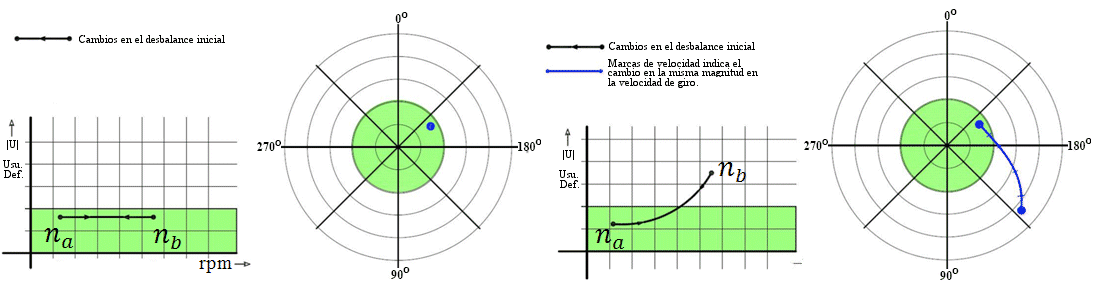
<body><![CDATA[<p align="center"><font size="2" face="Verdana, Arial, Helvetica, sans-serif"><b>a)</b></font></p></td>     <td>    <p align="center"><font size="2" face="Verdana, Arial, Helvetica, sans-serif"><img width=253 height=124 id="Imagen 118" src="/img/revistas/riyd/v19n1/a06_image009.gif"><b>&nbsp;b)</b></font></p>     </td>   </tr> </table>     <p align=center><font size="2" face="Verdana, Arial, Helvetica, sans-serif"><a name="_Toc6924285"><b>Figure 4:</b></a> a) Rotor with unbalance mass, b)   Rotor with correction mass [20].</font></p>     <p align="justify"><font size="2" face="Verdana, Arial, Helvetica, sans-serif">In IRD   Mechanalysis [21], defined the criteria for choosing the   number of correction planes in rigid rotors. They observed that balancing in a   single plane method is usually sufficient for rotors with length (L)   /Diameter(D) and the ratio of less than 0.5 and speed range up to 1000 rpm. </font></p>     <p align="justify"><font size="2" face="Verdana, Arial, Helvetica, sans-serif"><a href="#f5">Figure 5a)</a> shows increasing speeds doesn`t changed the   unbalanced in a rigid rotor. The unbalance will remain approximately constant   when the rotor is working at its operating speed [22]. The unbalance is both constant in the Cartesian and the   polar plane, respectively </font></p>     <p align="center"><a name="f5"></a><img src="/img/revistas/riyd/v19n1/a06_figura_05a.gif" width="1095" height="285">      <p align=center><font size="2" face="Verdana, Arial, Helvetica, sans-serif"><b>Figure 5: </b>Behavior of a changing speed rotor, a) Rigid rotor and b)   flexible rotor.</font></p>     <p align="justify"><font size="2" face="Verdana, Arial, Helvetica, sans-serif">In <a href="#f5">Figure 5</a> n<sub>a </sub>is the low rotating speed, and n<sub>b</sub> is the operational speed. <a href="#f5">Figure 5 b)</a> illustrates the behavior of a flexible   rotor. It can be seen that the   rotor unbalance changes values with increasing speed [22].</font></p>     <p align="justify"><font size="2" face="Verdana, Arial, Helvetica, sans-serif"><b>2.2 Structure Stress Analysis and Dynamical Modal   analysis</b></font></p>     <p align="justify"><font size="2" face="Verdana, Arial, Helvetica, sans-serif">The developed rotor balancing measurement system was analyzed by the   Finite Element Method (FEM), based on the Von Misses Equation. The solid works   software (Dynamic module) was applied for the stress and the modal analysis.   The general Von Misses equation is [23]:</font></p>     ]]></body>
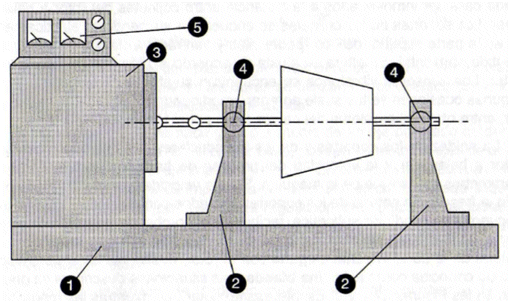
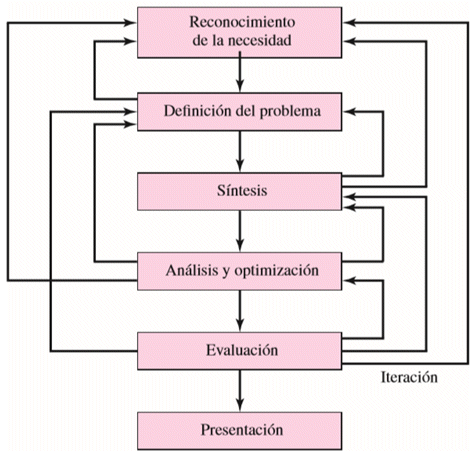
<body><![CDATA[<p align="center"><font size="2" face="Verdana, Arial, Helvetica, sans-serif"><img src="/img/revistas/riyd/v19n1/a06_ecuation_02.gif" width="741" height="39"></font></p>     <p align="justify">&nbsp;</p>     <p align=justify><font size="3" face="Verdana, Arial, Helvetica, sans-serif"><b>3.&nbsp;&nbsp;&nbsp;&nbsp; DESIGN AND CONSTRUCTION OF THE ROTOR BALANCING   MACHINE </b></font></p>     <p align="justify"><font size="2" face="Verdana, Arial, Helvetica, sans-serif"><a href="#f6">Figure 6</a> shows a typical balancing machine where the unit of   measurement and the element (rotor) to be analyzed is on a bench. There are   bearing supports that are suspended on the pedestal and it has the possibility   to move horizontally, and their heights are adjusted according to the rotor   diameter axis. </font></p>     <p align="justify"><font size="2" face="Verdana, Arial, Helvetica, sans-serif">Vibratory dampers are added to avoid resonance in the structure.   Vibration sensors are attached to the supports for data vibration recording.   The universal machines refer to horizontal axis machines and the single-purpose   balancing machines can be vertical and horizontal according to the task to be   fulfilled.</font></p> <a name="f6"></a> <table width="600" border="0" align="center">   <tr>     <td colspan="2">    <p align=center><font size="2" face="Verdana, Arial, Helvetica, sans-serif"><img width=508 height=301 src="/img/revistas/riyd/v19n1/a06_image025.gif"></font></p>     </td>   </tr>   <tr>     <td width="72" valign="top"><font size="2" face="Verdana, Arial, Helvetica, sans-serif"><b>Figure 6:</b></font></td>     <td width="518" valign="top"><font size="2" face="Verdana, Arial, Helvetica, sans-serif">Overview of a universal balancing machine. 1)     Base or bench, 2) Pedestals, 3) Drive, 4) Sensors, 5) Measurement units (3).</font></td>   </tr> </table>     <p align="justify"><font size="2" face="Verdana, Arial, Helvetica, sans-serif">To be systematic and optimize the designing and manufacturing process   of the rotor balancing measurement system all the process was based on [23], and sketched as shown in <a href="#f7">Figure 7</a>. It starts with the requirement   needs and identification of the problem. The project had to synthesis,   structuring the tasks to perform. After many iterations, it ends with the   presentation of the plans to satisfy the need. Depending on the nature of the   design task, some phases of design may be repeated during the life of the   product, from conception to completion [14]. </font></p>     <p align=center><font size="2" face="Verdana, Arial, Helvetica, sans-serif"><a name="f7"></a><img width=475 height=455 src="/img/revistas/riyd/v19n1/a06_image026.gif"></font></p>     <p align=center><font size="2" face="Verdana, Arial, Helvetica, sans-serif"><a name="_Toc6924297"><b>Figure 7: </b></a>Design process phases <a name="_Toc6924136"></a>[14].</font></p>     <p align="justify"><font size="2" face="Verdana, Arial, Helvetica, sans-serif"><b>3.1 Relevant Balancing Aspects </b></font></p>     ]]></body>
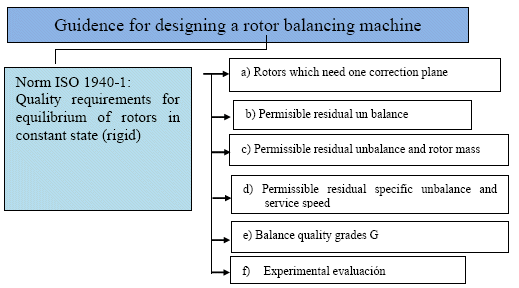
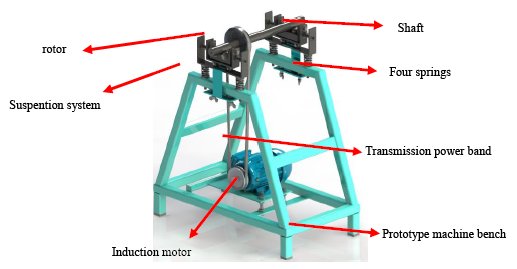
<body><![CDATA[<p align="justify"><font size="2" face="Verdana, Arial, Helvetica, sans-serif">Balancing is a process by which the mass distribution of a rotor is   monitored. It is necessary to ensure that the unbalance of the machine is   within specified limits. Rotor unbalance can be caused by manufacturing,   design, material, and assembly faults. Every rotor has an individual unbalance   distribution along its length and diameter. For the completeness of this paper,   it will be highlighted the ISO 1940-1, with important details about designing   and construction of the rotor balancing measurement system, <a href="#f8">Figure 8</a>  illustrates an overview of the designing procedure: a) Rotors with one   correction plane method, b) Permissible residual unbalance, c) Permissible   residual unbalance and rotor mass, d) Permissible residual specific unbalance   and service speed, e) Balance quality grades G, d) Experimental evaluation.</font></p>     <p align="center"><a name="f8"></a><img src="/img/revistas/riyd/v19n1/a06_figure_08.gif" width="519" height="288">     <p align=center><font size="2" face="Verdana, Arial, Helvetica, sans-serif"><b>Figure 8: </b>Overview of the rotor balancing designing procedure.</font><font size="2" face="Verdana, Arial, Helvetica, sans-serif"><b>&nbsp;</b></font></p>     <p align="justify"><font size="2" face="Verdana, Arial, Helvetica, sans-serif"><b>&nbsp;</b></font></p>     <p align=justify><font size="3" face="Verdana, Arial, Helvetica, sans-serif"><b>4.&nbsp;&nbsp;&nbsp;&nbsp; ROTOR BALANCING DESIGN,   PROTOTYPE CONSTRUCTION AND TECHNICAL REQUIREMENTS</b></font></p>     <p align="justify"><font size="2" face="Verdana, Arial, Helvetica, sans-serif">This section includes several elements, such as: technical   requirements, description and machine design. It was also included the   structure stress and modal analysis. <a href="#f9">Figure 9</a> denotes the overall overview of   the designed and developed machine components. </font></p>     <p align="center"><a name="f9"></a><img src="/img/revistas/riyd/v19n1/a06_figure_09.jpg" width="517" height="269"></p>     <p align=center><font size="2" face="Verdana, Arial, Helvetica, sans-serif"><a name="_Toc6924308"><b>Figure 9: </b></a>Designed rotor balancing   machine, drawing in Solidworks.</font></p>     <p align=justify><font size="2" face="Verdana, Arial, Helvetica, sans-serif"><b>4.1 Technical Requirements</b></font></p>     <p align="justify"><font size="2" face="Verdana, Arial, Helvetica, sans-serif">Based on the literature review. The   single four run balanced plane method was selected for our research project.   The 95% of the machine component can be balanced by the aforementioned method. The method requirements have to fulfill, the ratio   of the rotor Length(L) and rotor diameter (D) had to be less than 5, and the   rotation speed is not more than 1000 rpm. </font></p>     ]]></body>
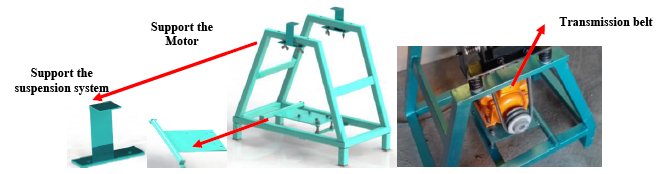
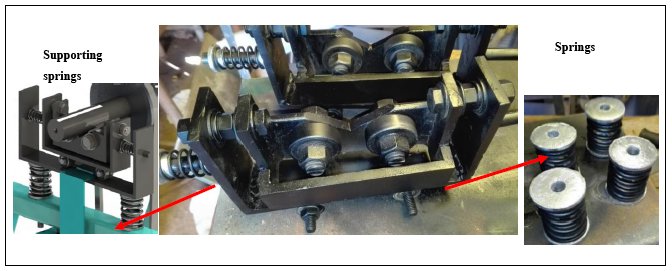
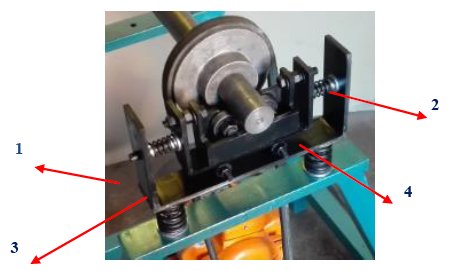
<body><![CDATA[<p align="justify"><font size="2" face="Verdana, Arial, Helvetica, sans-serif"><b>4.2 Prototype Machine Bench </b></font></p>     <p align="justify"><font size="2" face="Verdana, Arial, Helvetica, sans-serif"><a href="#f10">Figure 10</a> shows the designed machine bench, which has a variable   vertical support that regulates the vertical position of the suspension system.   Moreover, it was performed a theoretical structural analysis to determine, the   structure resonances don&rsquo;t coincide with the shaft, rotor and/or suspension   system. </font></p>     <p align="justify"><font size="2" face="Verdana, Arial, Helvetica, sans-serif">The bench is the structure   in charge of supporting the suspension components, shaft and the rotor in the   upper part. The lower part has a mechanism, a platform to support the induction   motor. It also supports an induction motor of 1Hp of 20 Kg. This mechanism   consists of tensioning the belt with the motor's own weight by means of a   pendulum movement of the platform. It contains also an adjustable steel frame   for vertical positioning of the suspension system.</font></p>     <p align="center"><a name="f10"></a><img src="/img/revistas/riyd/v19n1/a06_figure_10.jpg" width="662" height="174"></p>     <p align=center><font size="2" face="Verdana, Arial, Helvetica, sans-serif"><b>Figure 10:</b> Designed bench machine, drawing in Solidworks.</font></p>     <p align=left><font size="2" face="Verdana, Arial, Helvetica, sans-serif"><b>4.3 The Suspension System</b></font></p>     <p align="justify"><font size="2" face="Verdana, Arial, Helvetica, sans-serif"><a href="#f11">Figure 11</a> shows the suspension system. It can be seen the supporting   shaft and rotor with three degrees of freedom: horizontal, vertical and   pendulum in the axial direction. The characteristic of this system is that it   can isolate or at least reduce the external vibrations phenomena.</font></p>     <p align="center"><a name="f11"></a><img src="/img/revistas/riyd/v19n1/a06_figure_11.jpg" width="672" height="271"></p>     <p align=center><font size="2" face="Verdana, Arial, Helvetica, sans-serif"><a name="_Toc6924309"><b>Figure 11: </b></a>Suspension prototype for rotor   balancing measurement system.</font></p>     <p align="justify"><font size="2" face="Verdana, Arial, Helvetica, sans-serif"><b>4.4 Shaft Designing System and Power   Transmission</b></font></p>     ]]></body>
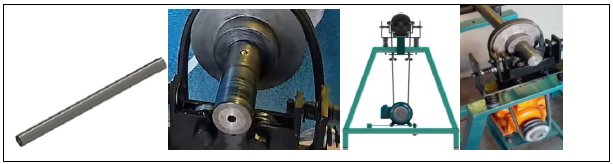
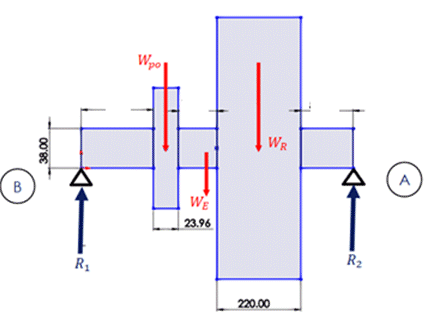
<body><![CDATA[<p align="justify"><font size="2" face="Verdana, Arial, Helvetica, sans-serif">Due to a large majority of industrial centrifugal fan rotors do not   have their own shaft. It should be designed accurately as possible, see even     <a href="#f12">Figure 12</a>. The shaft designing can be seen in section 5, with the FEM and modal   analysis. It was also included the power transmission based on ISO 1940-1.</font></p>     <p align="center"><a name="f12"></a><img src="/img/revistas/riyd/v19n1/a06_figure_12.jpg" width="613" height="164"></p>     <p align=center><font size="2" face="Verdana, Arial, Helvetica, sans-serif"><b>Figure 12: </b>Shaft connected for balancing.</font></p>     <p align=center>&nbsp;</p>     <p align=justify><font size="3" face="Verdana, Arial, Helvetica, sans-serif"><b>5.&nbsp;&nbsp;&nbsp;&nbsp; STRUCTURE STRESS AND MODAL ANALYSIS OF THE SYSTEM SHAFT, MACHINE BENCH, AND   SUSPENSION SYSTEM </b></font><font size="2" face="Verdana, Arial, Helvetica, sans-serif"><b>&nbsp;</b></font></p>     <p align="justify"><font size="2" face="Verdana, Arial, Helvetica, sans-serif">This section describes the formulation adopted   for the numerical simulation of the shaft, machine bench, transmission power,   and the suspension system. The developed rotor balancing system was also   carried out on a theoretical modal analysis.</font></p>     <p align="justify"><font size="2" face="Verdana, Arial, Helvetica, sans-serif"><b>5.1 Shaft Structure Stress Analysis</b></font></p>     <p align="justify"><font size="2" face="Verdana, Arial, Helvetica, sans-serif">The most common used shaft is the &Oslash;38H6/K6   with 60 kg mass, which was selected for the project. H stands for tolerance   value of the place to be assembled the shaft. &Oslash;38 is the nominal shaft   diameter, K is the shaft precision tolerance. In order to see it, if the   selected shaft was appropriate for the characteristics of the project a structure stress analysis was applied,   starting to calculate the external forces applying on the shaft, see <a href="#f13">Figure 13</a>  for details. </font></p>     <p align=center><font size="2" face="Verdana, Arial, Helvetica, sans-serif"><a name="f13"></a><img width=429 height=321 src="/img/revistas/riyd/v19n1/a06_image064.gif"></font></p>     <p align=center><font size="2" face="Verdana, Arial, Helvetica, sans-serif"><b>Figure   13: </b>The system initial   reaction forces.</font></p>     ]]></body>
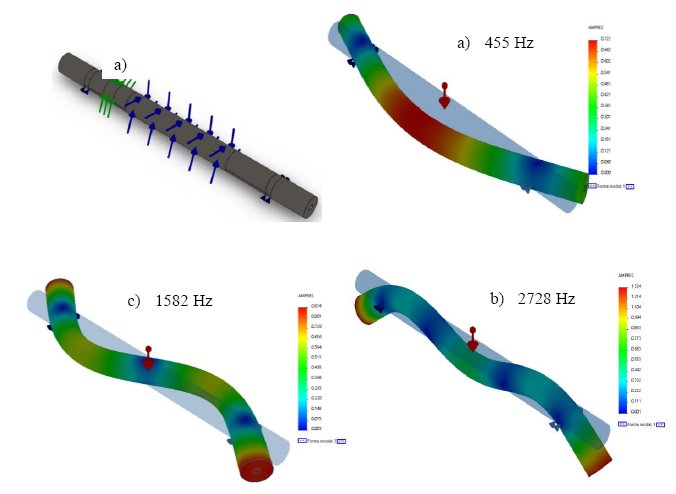
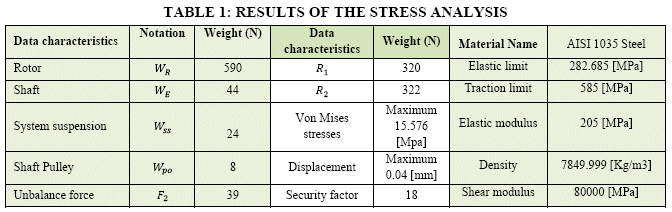
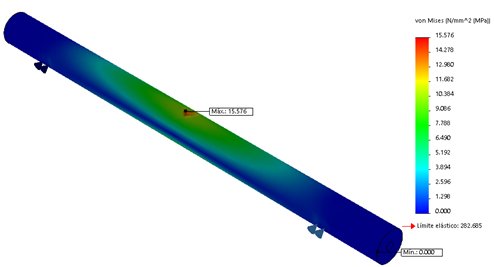
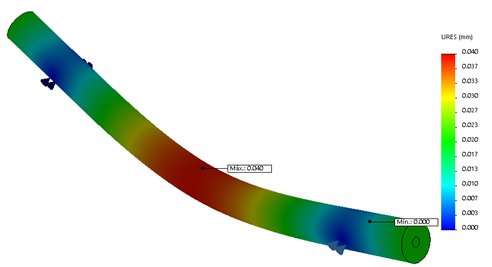
<body><![CDATA[<p align="justify"><font size="2" face="Verdana, Arial, Helvetica, sans-serif">The second Newton Law gives the following   force equation: </font></p>     <p align=center><img src="/img/revistas/riyd/v19n1/a06_ecuation_03.gif" width="742" height="31"></p>     <p align="justify"><font size="2" face="Verdana, Arial, Helvetica, sans-serif">Where <img src="/img/revistas/riyd/v19n1/a06_image066.gif" width=53 height=12 align="absmiddle"> are the reaction forces in the supports A and B. <img src="/img/revistas/riyd/v19n1/a06_image067.gif" width=16 height=12 align="absmiddle">&nbsp;is the rotor weight, <img src="/img/revistas/riyd/v19n1/a06_image068.gif" width=16 height=12 align="absmiddle">&nbsp;is shaft weight and <img src="/img/revistas/riyd/v19n1/a06_image069.gif" width=20 height=14 align="absmiddle">&nbsp;is the pulley weight. The readers can see details in <a href="#t1">Table 1</a>, the obtained results of the reactions forces, the   results of the stress numerical analysis. <a href="#t1">Table 1</a> summaries the calculate   forces and gives the references values to compare.</font></p>     <p align="center"><a name="t1"></a><img src="/img/revistas/riyd/v19n1/a06_table_01.gif" width="672" height="212"></p>     <p align="justify"><font size="2" face="Verdana, Arial, Helvetica, sans-serif"><a href="#f14">Figure 14</a> denotes the static stress analysis.     <a href="#f14">Figure 14a)</a> shows the maximum intensity in the central part with 15.57 Mpa, and   the critical force is about 588 N. These values can be compared with the   reference value of the AISI 1035 steel, showing that the shaft tension values   will be in the region of the elastic part. The <img width=63 height=9 src="/img/revistas/riyd/v19n1/a06_image077.gif">&nbsp;is 205 Mpa, giving the security ratio factor of 14. <a href="#f14">Figure 14b)</a> illustrates a maximum   displacement of 0.04 mm, due to the applied force of 588 N. It means the selected   shaft will be operating in the safe region. </font></p>     <p align="justify">&nbsp;</p>     <p align=center><font size="2" face="Verdana, Arial, Helvetica, sans-serif"><a name="f14"></a><img width=363 height=199 id="Imagen 29" src="/img/revistas/riyd/v19n1/a06_image078.jpg"><img width=388 height=205 id="Imagen 14" src="/img/revistas/riyd/v19n1/a06_image079.jpg"></font></p>     <p align="center">&nbsp;</p>     <p align=center><font size="2" face="Verdana, Arial, Helvetica, sans-serif"><b>Figure   14:</b> a) The shaft stress   analysis and b) 3D model and finite element results for the shaft displacement.</font></p>     <p align="justify"><font size="2" face="Verdana, Arial, Helvetica, sans-serif">The structural dynamic analysis can be seen in     <a href="#f15">Figure 15</a>. <a href="#f15">Figure 15a)</a> illustrates the external torsional forces on the shaft,   due to the transmission torque of the induction motor. It is coupled the shaft   by a power transmission system. The initial weight condition was about 60 kg.   The motor rotation frequency was 24 [Hz] (1400 [RPM]). The shaft natural   frequency must be above the 24 Hz, in order to avoid resonances phenomena. In   our case, see even <a href="#f15">Figure 15</a>, the shaft natural resonances, according the   results of the numerical analysis were above 455, 1582, and 2728 Hz, respectively.   It indicates that the shaft will never resonate with the motor&rsquo;s natural   rotating frequency.</font></p>     ]]></body>

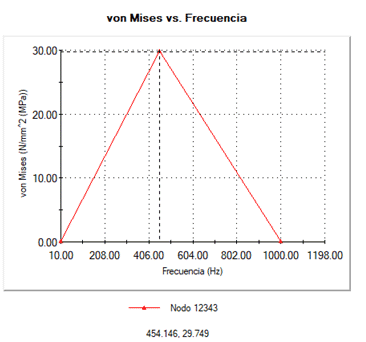
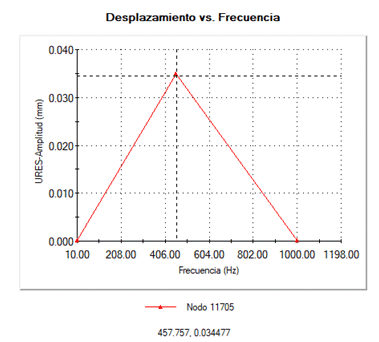
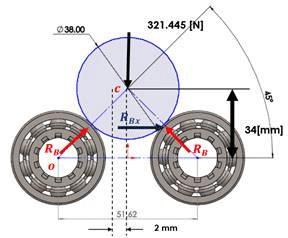
<body><![CDATA[<p align="center"><a name="f15"></a><img src="/img/revistas/riyd/v19n1/a06_figure_15.jpg" width="676" height="494"><font size="2" face="Verdana, Arial, Helvetica, sans-serif"><b>&nbsp;</b></font></p>     <p align=center><font size="2" face="Verdana, Arial, Helvetica, sans-serif"><b>Figure 15: </b>Modal analysis results.</font></p>     <p align="justify"><font size="2" face="Verdana, Arial, Helvetica, sans-serif"><a href="#f16">Figure 16</a> shows the shaft&rsquo;s resonance frequency around 455 Hz will have   a structural stress of 29 M.pa which unlike the static is higher, but is still   below the yield strength limit of the material. And it has a maximum   displacement of 0.034 mm.</font></p>     <p align="center"><font size="2" face="Verdana, Arial, Helvetica, sans-serif"><b><img width=366 height=342 src="/img/revistas/riyd/v19n1/a06_image088.gif"></b><img width=379 height=342 src="/img/revistas/riyd/v19n1/a06_image089.gif"></font></p>     <p align=center><font size="2" face="Verdana, Arial, Helvetica, sans-serif"><a name="_Toc6924345"><b>Figure 16: </b></a>Von Misses stresses and   displacement of the shaft first mode.</font><font size="2" face="Verdana, Arial, Helvetica, sans-serif"><b>&nbsp;</b></font></p>     <p align="justify"><font size="2" face="Verdana, Arial, Helvetica, sans-serif"><b>5.2 The System Suspension&rsquo;s Stress Structure Analysis </b></font><font size="2" face="Verdana, Arial, Helvetica, sans-serif"><b>&nbsp;</b></font></p>     <p align="justify"><font size="2" face="Verdana, Arial, Helvetica, sans-serif">First, it was carried out the calculation of the reaction forces on the   rolling bearings. <a href="#f17">Figure 17</a> shows a free body diagram with reactions forces and   the displacement to be calculated due to the unbalances forces. </font></p>     <p align=center><font size="2" face="Verdana, Arial, Helvetica, sans-serif"><a name="f17"></a><img width=23 height=10 src="/img/revistas/riyd/v19n1/a06_image090.gif"><img width=32 height=10 src="/img/revistas/riyd/v19n1/a06_image091.gif">&nbsp;<img width=288 height=238 id="Imagen 121" src="/img/revistas/riyd/v19n1/a06_image092.gif"><a name="_Toc6924346"></a></font></p>     <p align=center><font size="2" face="Verdana, Arial, Helvetica, sans-serif"><b>Figure   17: </b>Free   body diagram of the reactions forces.</font></p>     <p align="justify"><font size="2" face="Verdana, Arial, Helvetica, sans-serif">The main suspension system in <a href="#f18">Figure 18</a> is isolated from the suspension   system with supporting springs. This is because, it has to support the object   to measure and reduce the influence of external forces.</font></p>     ]]></body>
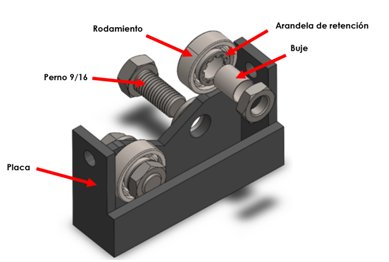
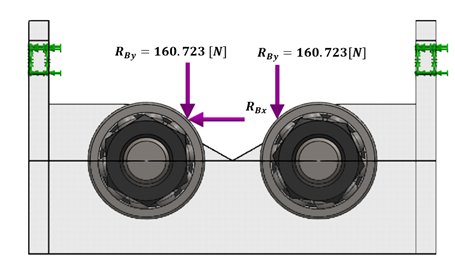
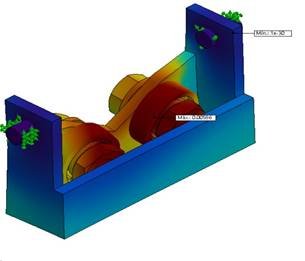
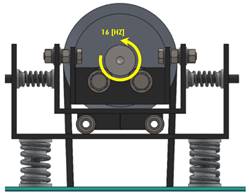
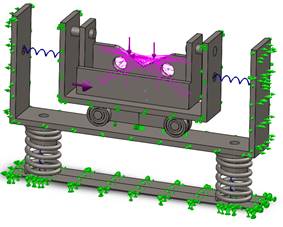
<body><![CDATA[<p align="justify">&nbsp;</p>     <p align=center><font size="2" face="Verdana, Arial, Helvetica, sans-serif"><a name="f18"></a><img width=389 height=262 id="Imagen 134" src="/img/revistas/riyd/v19n1/a06_image093.jpg"><img width=455 height=262 id="Imagen 145" src="/img/revistas/riyd/v19n1/a06_image094.jpg"></font></p>     <p align=center><font size="2" face="Verdana, Arial, Helvetica, sans-serif"><a name="_Toc6924347"><b>Figure 18</b></a>: a) Suspension main system, and b) Free   body diagram with resulting forces.</font></p>     <p align="justify"><font size="2" face="Verdana, Arial, Helvetica, sans-serif">The bearings reaction forces and the horizontal   displacement of 2 mm were determined to assume to generate the unbalance force.   The obtained calculated unbalance forces were R<sub>Bx</sub><img width=41 height=9 src="/img/revistas/riyd/v19n1/a06_image095.gif">, and <img src="/img/revistas/riyd/v19n1/a06_image096.gif" width=74 height=14 align="absmiddle">. </font></p>     <p align="justify"><font size="2" face="Verdana, Arial, Helvetica, sans-serif">The second static Finite Element Method was carried out on the   suspension system. It can be seen <a href="#f19">Figure 19</a>; the maximum stress concentration   is given in the bearing cage with a value of 50 Mpa. The stress value is below   the yield limit of the bearing material of 620 MPa. The safety factor value is about   2. The maximum displacement occurs when the reference mass is mounted with a   value of 0.00586 mm. It can also be stressed out that the main suspension   system will not fail. </font></p>     <p align=center><font size="2" face="Verdana, Arial, Helvetica, sans-serif"><a name="f19"></a><img width=264 height=232 src="/img/revistas/riyd/v19n1/a06_image097.jpg"><img width=305 height=261 src="/img/revistas/riyd/v19n1/a06_image098.jpg"></font></p>     <p align=center><font size="2" face="Verdana, Arial, Helvetica, sans-serif"><b>Figure 19:</b> Main suspension system.</font></p>     <p align="justify"><font size="2" face="Verdana, Arial, Helvetica, sans-serif">Taking into account the mass of unbalance, we have the force R<sub>Bx</sub> = 40 N, causing a randomly vibration amplitudes, due to that force a   displacement of 2 mm in the horizontal direction is obtained. As a result of   that, any component will come into resonance with the axis. </font></p>     <p align=center><font size="2" face="Verdana, Arial, Helvetica, sans-serif"><a name="f20"></a><img width=249 height=194 id="Imagen 162" src="/img/revistas/riyd/v19n1/a06_image099.jpg"><img width=283 height=227 id="Imagen 3" src="/img/revistas/riyd/v19n1/a06_image100.jpg"></font></p>     <p align=center><font size="2" face="Verdana, Arial, Helvetica, sans-serif"><b>Figure 20:</b> A) Suspension system front view, b) Overall view of   the suspension system.</font></p>     ]]></body>
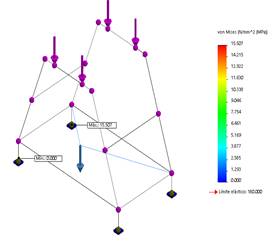
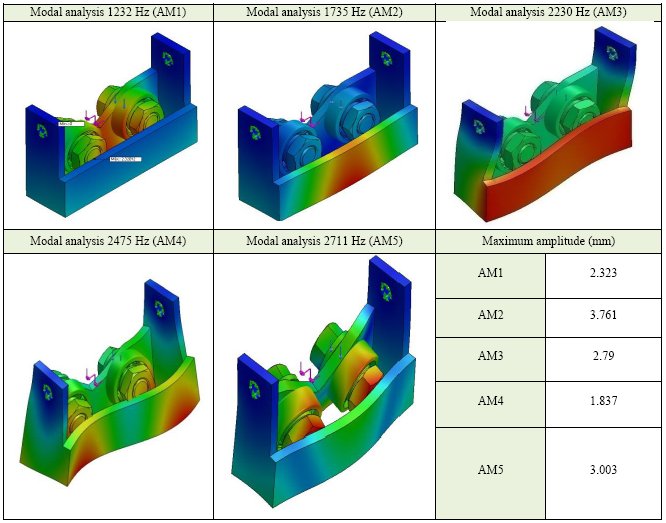
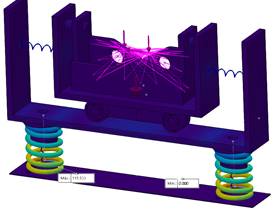
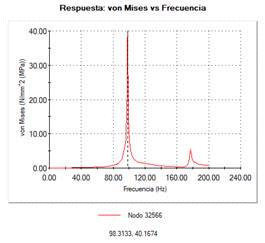
<body><![CDATA[<p align="justify"><font size="2" face="Verdana, Arial, Helvetica, sans-serif">The dynamical stress analysis was performed, as input speed with 16 Hz.   Firstly, <a href="#f21">Figure 21</a> illustrates the stress analysis with the first five resonance   modes: 1232, 1735, 2230, 2475 and 2711 Hz, respectively. It can also be   stressed out that there is no risk for any resonance phenomena can happen   between the rotating speed and the main suspension system.</font></p>     <p align="justify"><font size="2" face="Verdana, Arial, Helvetica, sans-serif">Finally, it was performed the entire suspension structure stress system   analysis, see <a href="#f22">Figure 22 a)</a> for details. The resonance obtained frequencies are 84, 97, 177, 287, and 290 Hz,   respectively. <a href="#f22">Figure 22b)</a> denotes the maximum stress value of 40 Mpa at   frequency of 98 Hz, which is related to the second resonance of the system. The   obtained value is lower of the reference value, which does not exceed the   elastic limit of the material of 180 Mpa. The resonant frequencies are quite   high, indicating that any resonance phenomena can happen in the developed suspension   system. </font></p>     <p align="justify"><font size="2" face="Verdana, Arial, Helvetica, sans-serif">To complete this entire section of suspension system analysis the   following is concluded: All the analysis is for a rotor mass of critical   conditions of 60 Kg, the suspension system will not fail when working at its   operating frequency of 17 Hz. The rotating speed is lower than the structure   resonance frequency. It is one requirement of the ISO 1940-1. </font></p>     <p align="center"><a name="f21"></a><img src="/img/revistas/riyd/v19n1/a06_figure_21.jpg" width="666" height="523"></p>     <p align=center><font size="2" face="Verdana, Arial, Helvetica, sans-serif"><b>Figure 21:</b> The first five resonance mode responses of   the main suspension system.</font></p>     <p align="center">&nbsp;</p>     <p align=center><font size="2" face="Verdana, Arial, Helvetica, sans-serif"><a name="f22"></a><img width=280 height=210 id="Imagen 17" src="/img/revistas/riyd/v19n1/a06_image106.jpg"><img width=265 height=243 src="/img/revistas/riyd/v19n1/a06_image107.gif"></font></p>     <p align=center><font size="2" face="Verdana, Arial, Helvetica, sans-serif"><a name="_Toc6924358"><b>Figure 22: </b></a>a) Overall stress analysis of   the suspension system and b) the highest stress tension in the structure.</font></p>     <p align=justify><font size="2" face="Verdana, Arial, Helvetica, sans-serif"><b>5.3 Structure Machine Bench Stress Analysis </b></font></p>     <p align="justify"><font size="2" face="Verdana, Arial, Helvetica, sans-serif">This section contains an   extensive study of the structure bench stress analysis. <a href="#f23">Figure 23</a> shows the   force applied in the structure with the analysis of the induction motor&rsquo;s   weight, rotor   loads, shaft, suspension system and pulley. The sum gives a total weight of 665   N, this load is divided by four supporting points on the bench, in which there   is a force of 166 N at each point, as it can be seen in <a href="#f23">Figure 23</a>.</font></p>     ]]></body>
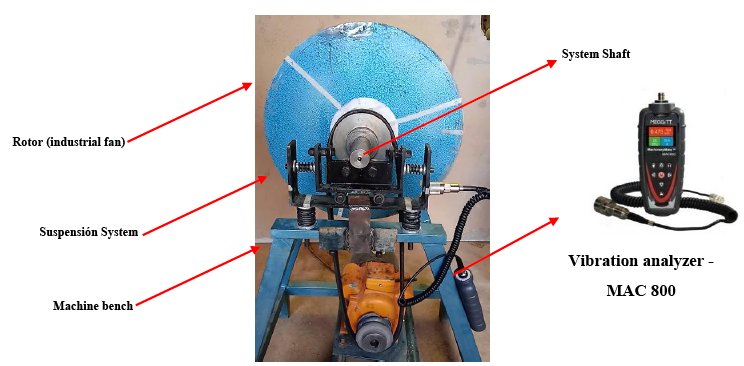
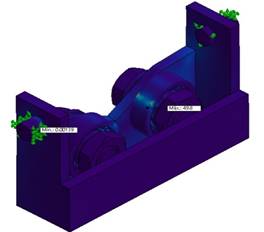
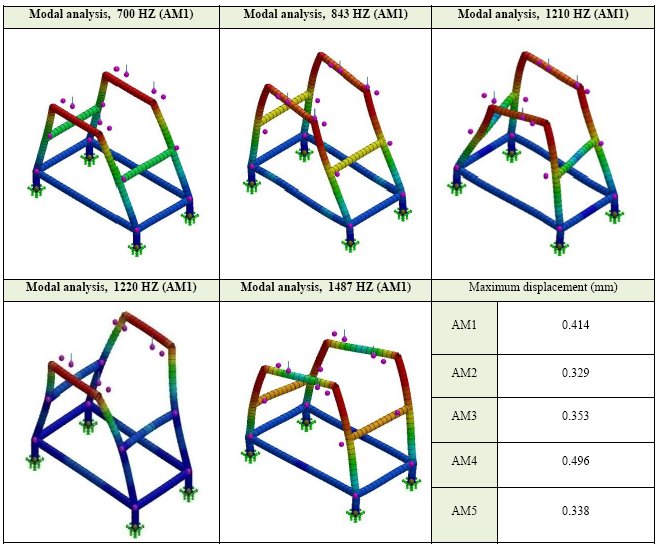
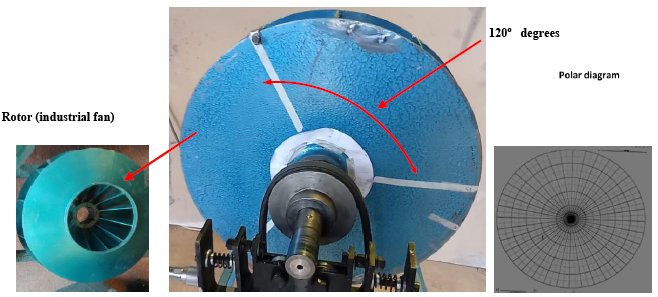
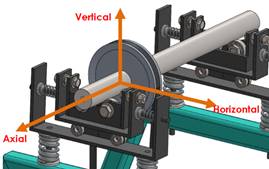
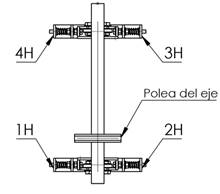
<body><![CDATA[<p align=center><font size="2" face="Verdana, Arial, Helvetica, sans-serif"><b><a name="f23"></a><img width=272 height=245 src="/img/revistas/riyd/v19n1/a06_image108.jpg"></b></font></p>     <p align=center><font size="2" face="Verdana, Arial, Helvetica, sans-serif"><b>Figure 23:</b> 3D numerical analysis of the machine bench structure.</font></p>     <p align="justify"><font size="2" face="Verdana, Arial, Helvetica, sans-serif"><a name="_Toc6924254">The obtained results of the numerical analysis shown, as   maximum tension of 15.5 N/mm<sup>2</sup>. It gives a factor security of 130. </a><a name="_Toc6924255"></a>In <a href="#f24">Figure 24</a> illustrates the results of the numerical modal   analysis of the bench structure. It shows the first five representative results   of the stress analysis. It was shown before, in a previous result in <a href="#f15">figure 15</a>,   that the natural frequency of the shaft was around 455 Hz and the first   resonance in the machine bench is about 700 Hz. It means that we are above the shaft   resonance frequency and the rotating shaft frequency about 17 Hz, which means   that machine bench structure will not vibrate due the resonance phenomena of   the shaft. </font></p>     <p align="center"><a name="f24"></a><img src="/img/revistas/riyd/v19n1/a06_figure_24.jpg" width="659" height="548"></p>     <p align="center"><font size="2" face="Verdana, Arial, Helvetica, sans-serif"><b>Figure   24: </b>Summarize   modal analysis results of the bench machine.</font></p>     <p align=justify><font size="2" face="Verdana, Arial, Helvetica, sans-serif"><b>&nbsp;</b></font></p>     <p align=justify><font size="3" face="Verdana, Arial, Helvetica, sans-serif"><b>6.&nbsp;&nbsp;&nbsp;&nbsp; MEASUREMENT SET-UP   AND ANALYSIS PROCEDURE</b></font></p>     <p align="justify"><font size="2" face="Verdana, Arial, Helvetica, sans-serif">This section contains the measurement set-up and the analysis procedure   for the developed measurement system. <a href="#f25">Figure 25</a> shows and overview of the   structure bench, suspension system, induction motor, shaft, and a rotor(fan).</font></p>     <p align="justify"><font size="2" face="Verdana, Arial, Helvetica, sans-serif">The applied method for the rotor balancing was the single plane   balancing with four-runs method (25). The above method is used for machines   that operates below the critical speed an L/D ratio than 0.5. L means the   length of the rotor, and D is the rotor diameter. The rotating speed has to   below 1000 rpm.</font></p>     <p align="justify"><font size="2" face="Verdana, Arial, Helvetica, sans-serif">So, the four-runs method was used to balance the single   plane rotor, using one vibration data channel. This method uses only the   vibration signals to balance a rotor. There is no need for a tacho signal to   measure rotor angle values. <a href="#f26">Figure 26</a> illustrates the suspension system with   four vibration measurement points to calibrate the equipment, in order to   obtain similar vibration amplitudes by adjusting the strength of the springs.   <a href="#f27">Figure 27</a> denotes the three measurement points at 0<sup> o</sup>, 120<sup> o</sup> and 240<sup>o </sup>at the rotor, with the reference mass to start the rotor   balancing process.</font></p>     ]]></body>
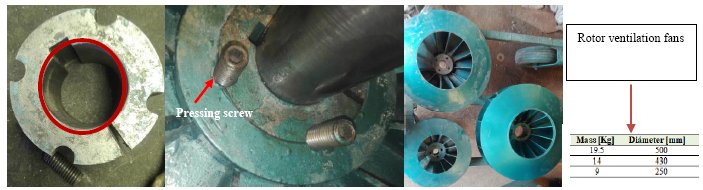
<body><![CDATA[<p align="center"><a name="f25"></a><img src="/img/revistas/riyd/v19n1/a06_figure_25.jpg" width="744" height="366"><font size="2" face="Verdana, Arial, Helvetica, sans-serif"><b>&nbsp;</b></font></p>     <p align="center"><font size="2" face="Verdana, Arial, Helvetica, sans-serif"><a name="_Toc8545311"><b>Figure 25:</b></a> Overview   of the structure bench, suspension system, induction motor, shaft, and a rotor   (fan).</font></p>     <p align="center"><font size="2" face="Verdana, Arial, Helvetica, sans-serif"><b>&nbsp;</b></font></p>     <p align="center"><font size="2" face="Verdana, Arial, Helvetica, sans-serif"><b><a name="f26"></a><img src="/img/revistas/riyd/v19n1/a06_figure_26.jpg" width="454" height="271"></b></font></p>     <p align=center><font size="2" face="Verdana, Arial, Helvetica, sans-serif"><b>Figure   26: </b>System   suspension with the four vibration measurement points.</font></p>     <p align=center>&nbsp;</p>     <p align=center><a name="f27"></a><img src="/img/revistas/riyd/v19n1/a06_figure_27.jpg" width="658" height="297"></p>     <p align=center><font size="2" face="Verdana, Arial, Helvetica, sans-serif"><b>Figure 27: </b>Three measurement points at 0<sup> o</sup>, 120<sup> o</sup> and 240<sup>o </sup>at the rotor.</font></p>     <p align="justify"><font size="2" face="Verdana, Arial, Helvetica, sans-serif"><a href="#f28">Figure 28</a> shows the rotor ventilation fans and the adjusting system   with the pressing screw</font></p>     <p align="center"><a name="f28"></a><img src="/img/revistas/riyd/v19n1/a06_figure_28.jpg" width="703" height="190"></p>     ]]></body>
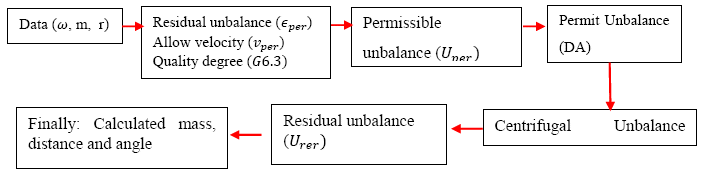
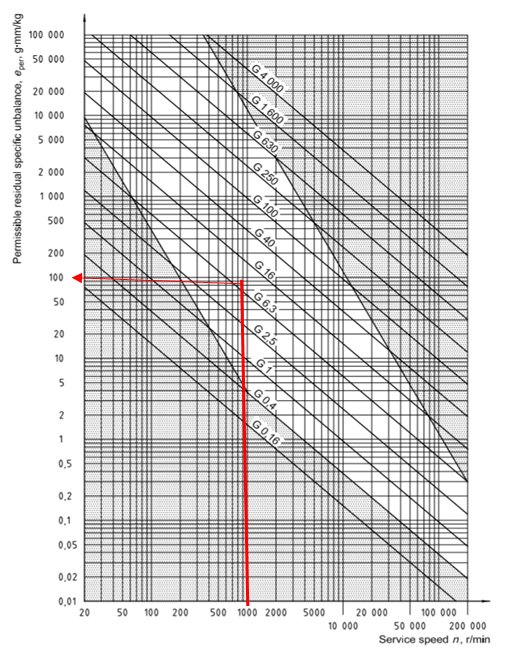
<body><![CDATA[<p align=center><font size="2" face="Verdana, Arial, Helvetica, sans-serif"><b>Figure   28: </b>The   rotor ventilation fans and the adjusting system with the pressing screw.</font></p>     <p align="justify">&nbsp;</p>     <p align=justify><font size="3" face="Verdana, Arial, Helvetica, sans-serif"><b>7.&nbsp;&nbsp;&nbsp;&nbsp; ANALYSIS AND   RESULTS OF THE ROTOR BALANCING SYSTEM: A CASE STUDY</b></font></p>     <p align="justify"><font size="2" face="Verdana, Arial, Helvetica, sans-serif">Initially, the rotor balancing equipment is carried out by a   calibration procedure. That is, to measure at four points in horizontal   positions, see the <a href="#f29">Figure 29</a>. All tests must be calculated according to ISO   1940-1. <a href="#f29">Figure 29a)</a> shows a diagram to facilitate the location of measurement   points to collect data. The idea is to obtain similar vibration amplitude in   all four measurement points; by adjusting the vertical springs stiffness until similar   vibration values are obtained. Once the machine has been calibrated with the   shaft, the rotor can start the balancing procedure.</font></p>     <p align="center"><font size="2" face="Verdana, Arial, Helvetica, sans-serif"><a name="f29"></a><img width=269 height=169 src="/img/revistas/riyd/v19n1/a06_image151.jpg"><b><img width=220 height=194 src="/img/revistas/riyd/v19n1/a06_image152.gif">&nbsp;&nbsp;&nbsp;&nbsp;&nbsp;&nbsp;&nbsp;&nbsp;&nbsp;&nbsp;&nbsp;&nbsp;&nbsp;&nbsp; </b></font></p>     <p align=center><font size="2" face="Verdana, Arial, Helvetica, sans-serif"><b>Figure 29:</b> Rotor balancing measurement points (1H, 2H, 3H, and   4H).</font></p>     <p align="justify"><font size="2" face="Verdana, Arial, Helvetica, sans-serif">To perform the rotor balance analysis, it can be performed   in the following procedure:</font></p>     <p align="center"><a name="f30"></a><img src="/img/revistas/riyd/v19n1/a06_figure_30.gif" width="703" height="172"></p>     <p align="center"><font size="2" face="Verdana, Arial, Helvetica, sans-serif"><b>Figure 30:</b> Flowchart for calculating the   rotor balancing procedure.</font></p>     <p align="justify"><font size="2" face="Verdana, Arial, Helvetica, sans-serif">The input data was, <img src="/img/revistas/riyd/v19n1/a06_image154.gif" width=315 height=22 align="absmiddle">. Initially, it has to be   define the permissible residual specific unbalance (<img src="/img/revistas/riyd/v19n1/a06_image155.gif" width=22 height=11 align="absmiddle">), which is the micron   displacement of the main axis of inertia to the axis of rotation. This can be   obtained from <a href="#f31">Figure 31</a>, by applying the speed of 1000 rpm and the quality   criterion of G6.3, which gives <img src="/img/revistas/riyd/v19n1/a06_image156.gif" width=93 height=14 align="absmiddle">. The permissible residual specific unbalance is <img src="/img/revistas/riyd/v19n1/a06_image157.gif" width=76 height=14 align="absmiddle">. The recommended degree of balancing quality for fan rotors is G6.3,   this data determines the specific residual imbalance (specific unbalance   quantity). The result obtained helps to find the permissible residual unbalance.</font></p>     ]]></body>
<body><![CDATA[<p align=center><img src="/img/revistas/riyd/v19n1/a06_ecuation_04.gif" width="743" height="37"></p>     <p align=center><a name="f31"></a><img src="/img/revistas/riyd/v19n1/a06_figure_31.jpg" width="510" height="650"></p>     <p align=center><font size="2" face="Verdana, Arial, Helvetica, sans-serif"><b>Figure   31:</b> Diagram for detection of the permissible residual   specific unbalance.</font></p>     <p align=center>&nbsp;</p>     <p align=center><img src="/img/revistas/riyd/v19n1/a06_ecuation_05.gif" width="732" height="24"></p>     <p align="justify"><font size="2" face="Verdana, Arial, Helvetica, sans-serif">The Admissible Unbalance (AU), refers the amount of mass that may be   causing unbalance in the rotor. The AU value indicates the unbalance mass   somewhere in the rotor. Let initiates with the balancing of a rotor mass of   M=19.5 kg. The Admissible Unbalance will be:</font></p>     <p align=center><img src="/img/revistas/riyd/v19n1/a06_ecuation_06.gif" width="743" height="35"></p>     <p align="justify"><font size="2" face="Verdana, Arial, Helvetica, sans-serif">The permissible unbalance value <img src="/img/revistas/riyd/v19n1/a06_image164.gif" width=40 height=14 align="absmiddle">&nbsp;<img src="/img/revistas/riyd/v19n1/a06_image165.gif" width=219 height=14 align="absmiddle">&nbsp;gr</font></p>     <p align="justify"><font size="2" face="Verdana, Arial, Helvetica, sans-serif">The centrifugal force will be:</font></p>     <p align="center"><img src="/img/revistas/riyd/v19n1/a06_ecuation_07.gif" width="740" height="28"></p>     ]]></body>
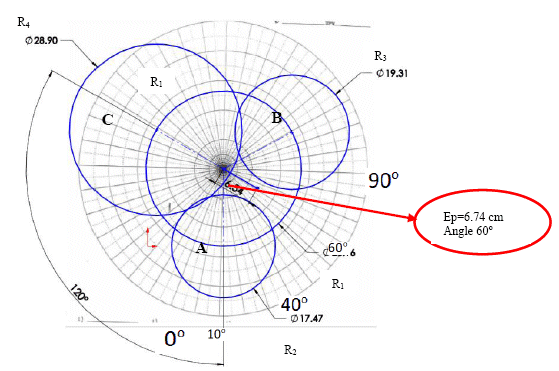
<body><![CDATA[<p align="justify"><font size="2" face="Verdana, Arial, Helvetica, sans-serif">And the test mass (<img src="/img/revistas/riyd/v19n1/a06_image167.gif" width=28 height=13 align="absmiddle">will be:</font></p>     <p align="center"><img src="/img/revistas/riyd/v19n1/a06_ecuation_08.gif" width="738" height="34"></p>     <p align="justify"><font size="2" face="Verdana, Arial, Helvetica, sans-serif">where g is the gravitational acceleration, 9.81 m/s2, M is the rotor   mass and r the rotor radio, and k=2 is the factor recommended by &ldquo;IRD Mech-analysis&rdquo; [21]. The test mass will be <img src="/img/revistas/riyd/v19n1/a06_image169.gif" width=101 height=13 align="absmiddle">.</font></p>     <p align="justify"><font size="2" face="Verdana, Arial, Helvetica, sans-serif">The four-run rotor balancing single method has the   following measurement procedure (ISO 1940-1):</font></p>     <blockquote>       <p align="justify"><font size="2" face="Verdana, Arial, Helvetica, sans-serif">a) Throughout the first run, the     reference vibration signal is recorded in four vibration measurement points at     1H, 2H, 3H and 4H, see <a href="#f26">Figure 26</a> and <a href="#f29">29</a>.&nbsp; These vibration measurements are     performed in order have almost the same vibration amplitudes. If it necessary,     the suspension systems&rsquo; springs can be adjusted to get the right values.</font></p>       <p align="justify"><font size="2" face="Verdana, Arial, Helvetica, sans-serif">b) Measured the vibration values with three locations (0<sup>o</sup>, 120<sup>o</sup> and 240<sup>o</sup>) on the rotor is attach the trial weight, respectively. It     has to be drawn four circles in the polar plane, see even the drawn in <a href="#f32">Figure       32</a>. It can be seen the r, r<sub>1</sub>, r<sub>2</sub>, r<sub>3</sub> are the     radios. The first circle is due to the reference signal; the radio is the     amplitude times 2. The circles can be generated also with r<sub>1</sub>, r<sub>2</sub>,     and r<sub>4</sub>.</font></p>       <p align="justify"><font size="2" face="Verdana, Arial, Helvetica, sans-serif">c) To calculate the amount of mass and location     in degrees, the correction mass can be determined by a polar diagram or     mathematically by the software &ldquo;Adash&rdquo;. It has to be included in the analysis     the weight value.</font></p>       <p align="justify"><font size="2" face="Verdana, Arial, Helvetica, sans-serif">d) Finally, it was calculated the distance and     the degree of the weight to be adjust, in order to reduce the unbalance of the     system. Determine the point where the circles r,     r<sub>1</sub>,r<sub>2</sub> r<sub>3</sub> are     crossed and draw a vector E<sub>p </sub>from the center until it cuts with the     three circles. The vector indicates the angular position of the correction     mass, see <a href="#f32">Figure 32</a>.</font></p> </blockquote>     <p align="center"><a name="f32"></a><img src="/img/revistas/riyd/v19n1/a06_figure_32.gif" width="559" height="371"></p>     ]]></body>
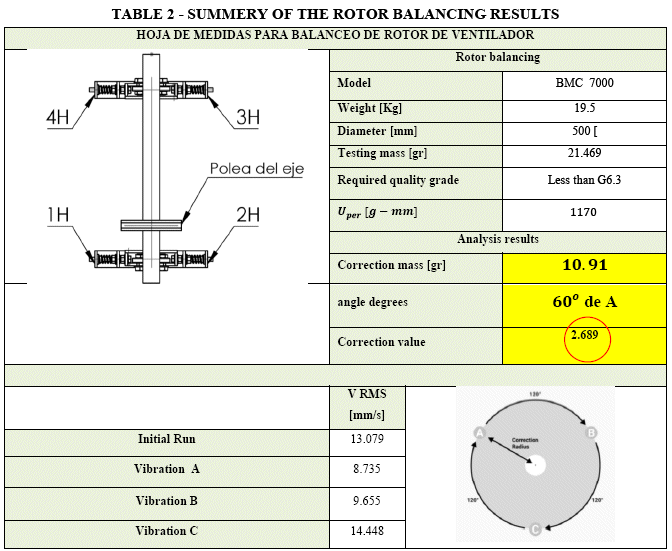
<body><![CDATA[<p align=center><font size="2" face="Verdana, Arial, Helvetica, sans-serif"><a name="_Toc6924375"><b>Figure 32</b></a><b>: </b>The polar plane defines the place   and the direction of the mass in the rotor.</font></p>     <p align="justify"><font size="2" face="Verdana, Arial, Helvetica, sans-serif">The obtained values were with the first run 13.079 mm/s without test   mass. At 120<sup>o</sup> degrees was placed the test mass at Vibration A and   the obtained value was 8.735mm/s. Vibration B is 9.655, and Vibration C were   14.448 mm/s, respectively. After collecting the 4 vibration readings we proceed   to calculate the correction mass and its direction. </font></p>     <p align="justify"><font size="2" face="Verdana, Arial, Helvetica, sans-serif">After drawing the circles in the polar diagram, taking as a diameter   twice the measured vibration amplitude, a line is placed in a middle region   that form the four circles, as shown in <a href="#f32">Figure 32</a>. Giving a value of 6.54 cm now   the data is replaced in equation (9). </font></p>     <p align=center><img src="/img/revistas/riyd/v19n1/a06_ecuation_09.gif" width="740" height="35"></p>     <p align="justify"><font size="2" face="Verdana, Arial, Helvetica, sans-serif">where <img src="/img/revistas/riyd/v19n1/a06_image188.gif" width=17 height=9 align="absmiddle">&nbsp;is the correction mass, <img src="/img/revistas/riyd/v19n1/a06_image189.gif" width=11 height=12 align="absmiddle">&nbsp;is velocity reference with 6.54 mm/s, and the mass <img src="/img/revistas/riyd/v19n1/a06_image190.gif" width=75 height=12 align="absmiddle">&nbsp;gr, and IR=13.079 mm/s. The obtain value of m<sub>c</sub>=41.85 gr at 60<sup>o</sup> from A. </font><font size="2" face="Verdana, Arial, Helvetica, sans-serif"><b>&nbsp;</b></font></p>     <p align="justify"><font size="2" face="Verdana, Arial, Helvetica, sans-serif">According the ISO 1940-1, the residual unbalance <img src="/img/revistas/riyd/v19n1/a06_image191.gif" width=23 height=12 align="absmiddle">, has to be higher than the permissible unbalance <img src="/img/revistas/riyd/v19n1/a06_image192.gif" width=24 height=14 align="absmiddle">. Let`s control it. </font></p>     <p align="center"><img src="/img/revistas/riyd/v19n1/a06_ecuation_10.gif" width="740" height="58"></p>     <p align="justify"><font size="2" face="Verdana, Arial, Helvetica, sans-serif">Where the <img width=8 height=9 src="/img/revistas/riyd/v19n1/a06_image195.gif">&nbsp;is the calculated distance by the polar plane. As a result, the rotor is still unbalanced because <img width=23 height=12 src="/img/revistas/riyd/v19n1/a06_image196.gif"> &gt; <img width=24 height=14 src="/img/revistas/riyd/v19n1/a06_image192.gif">&nbsp;for a rotor with the characteristics of the mass is 19.5 Kg and 500 mm   rotor diameter. Both the correction mass and the location are correct, however,   in order to reduce the <img width=23 height=12 src="/img/revistas/riyd/v19n1/a06_image191.gif">, the mass has to be moved a radius further from the axis, according   ISO 1940-1. For ease when placing the correction mass in the rotor, take the   maximum radius of R=250 mm.</font></p>     <p align="center"><img src="/img/revistas/riyd/v19n1/a06_ecuation_11.gif" width="741" height="40"></p>     <p align="justify"><font size="2" face="Verdana, Arial, Helvetica, sans-serif">By replacing data with the correct mass and new position:</font></p>     ]]></body>

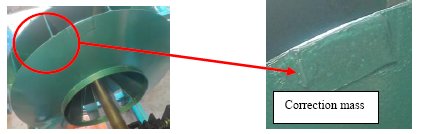
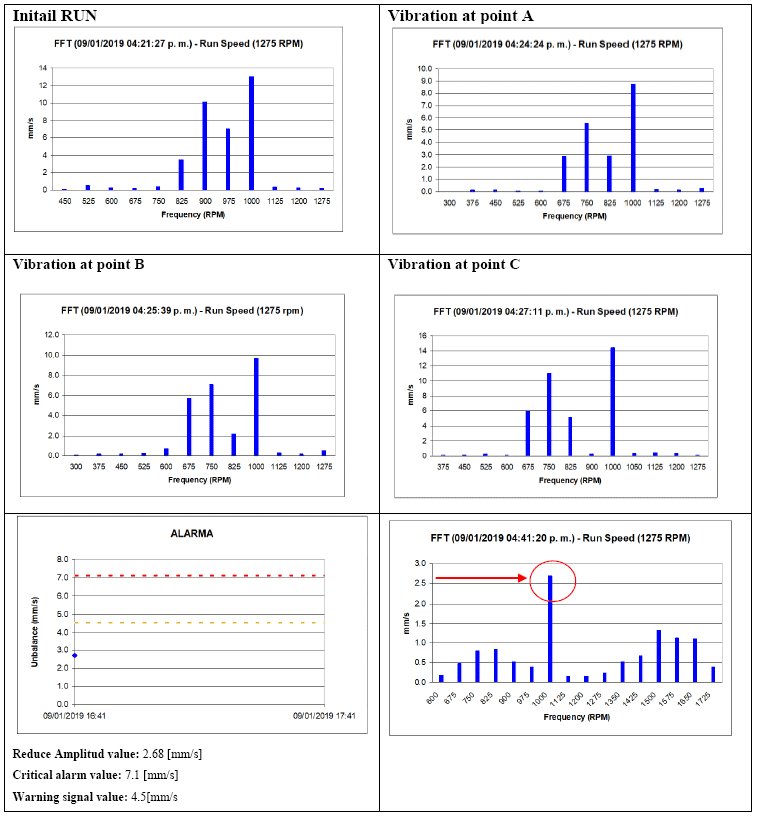
<body><![CDATA[<p align="center"><img src="/img/revistas/riyd/v19n1/a06_ecuation_11_1.gif" width="377" height="30"></p>     <p align="justify"><font size="2" face="Verdana, Arial, Helvetica, sans-serif">The correction mass of 10.91 gr and 60<sup>o</sup> from position A was   welded in the rotor. <a href="#f33">Figure 33</a> shows the correction mass in the rotor of 19.5   Kg.</font></p>     <p align=center><a name="f33"></a><img src="/img/revistas/riyd/v19n1/a06_figure_33.jpg" width="424" height="134"></p>     <p align=center><font size="2" face="Verdana, Arial, Helvetica, sans-serif"><b>Figure 33:</b> Location of the correction mass and angle.</font></p>     <p align="justify"><font size="2" face="Verdana, Arial, Helvetica, sans-serif"><a href="#t2">Table 2</a> shows the summery of the analysis results. It can be pointed   out that the requirement was of G6.3, however   the obtained results with the developed rotor balancing measurement system was   about G2.6, see even <a href="#t2">Table 2</a>. </font></p>     <p align="center"><a name="t2"></a><img src="/img/revistas/riyd/v19n1/a06_table_02.gif" width="672" height="551"></p>     <p align="justify"><font size="2" face="Verdana, Arial, Helvetica, sans-serif">To validate the obtained results of the developed rotor balancing   system. The measured vibration signal was used as input data in a standard   vibration measurement instrument, &ldquo;MAC 200&rdquo;. This generates a report to be observed   how the vibration amplitudes decreases below the ISO 1940-1. In our case was   the reference value G13 and it was obtained G2.8, see <a href="#t2">Table 2</a>. In <a href="#f34">Figure 34</a>  shows the obtained results from the standard analysis instrument, the first   four vibration measurements have higher amplitudes, however. After the   balancing procedure, it was obtained vibration reduction down to 2.6 mm/s,   which means quality grade of G2.6 based on ISO 1940-1.</font></p>     <p align="center"><a name="f34"></a><img src="/img/revistas/riyd/v19n1/a06_figure_34.gif" width="758" height="820"></p>     <p align=center><font size="2" face="Verdana, Arial, Helvetica, sans-serif"><b>Figure 34:</b> Rotor balancing report according the standard   vibration analysis instrument, &ldquo;MAC 800&rdquo;.</font></p>     <p align="justify">&nbsp;</p>     ]]></body>
<body><![CDATA[<p align=justify><font size="3" face="Verdana, Arial, Helvetica, sans-serif"><b>8.&nbsp;&nbsp;&nbsp;&nbsp;&nbsp;&nbsp; DISCUSSIONS</b></font></p>     <p align="justify"><font size="2" face="Verdana, Arial, Helvetica, sans-serif">Mass unbalance in a rotating system usually produces unwanted   centrifugal forces that reduces the life span of mechanical elements. To   minimize the harmful effects of unbalance, the rotor balancing is frequently   considering to be upfront technique that is carried out in guidance with the   instruction specified by the balancing machine manufacturer.</font></p>     <p align="justify"><font size="2" face="Verdana, Arial, Helvetica, sans-serif">Before balancing procedure, there is some attention that should be   addressed. The situation can appear looks like rotor unbalance; however, there   are several cases that can appear similar case for example: Soft foot, cracked   shaft, excessive bearing clearance, shaft misalignment, bent shaft. Therefore,   the rule of thumb is to properly diagnose the cause of mechanical behavior   before starting with the balancing procedure.</font></p>     <p align="justify"><font size="2" face="Verdana, Arial, Helvetica, sans-serif">Finally, the cost of the developed rotor balancing system, comparing   standard alternatives with the same accuracy and precision, was about 87% less   in price.</font><font size="2" face="Verdana, Arial, Helvetica, sans-serif"><b>&nbsp;</b></font></p>     <p align="justify"><font size="2" face="Verdana, Arial, Helvetica, sans-serif"><b>&nbsp;</b></font></p>     <p align=justify><font size="3" face="Verdana, Arial, Helvetica, sans-serif"><b>9.&nbsp;&nbsp;&nbsp;&nbsp; CONCLUSIONS</b></font><font size="2" face="Verdana, Arial, Helvetica, sans-serif"><b>&nbsp;</b></font></p>     <p align="justify"><font size="2" face="Verdana, Arial, Helvetica, sans-serif">There is a steadily growing demand for reliable,   versatile measurement rotor balancing system which can be used to determine the   machine parts unbalances. The effect of these causes are the increase of   vibration amplitudes, causing damage to elements of the machines, mainly in the   bearings, reduce useful life time, and increase fatigue failure in machines.   The industry requires that machines have to operate continuously, efficient   maintenance philosophy, and reduce the down time. Therefore, this research work   has the main objective to design and develop a low-cost rotor balancing measurement   system for industrial applications. </font></p>     <p align="justify"><font size="2" face="Verdana, Arial, Helvetica, sans-serif">Based on the literature review was selected the   four-run single plane method for the simplicity and it fulfills the   requirements. The designing and prototype manufacturing was applied according   ISO 1940-1.</font></p>     <p align="justify"><font size="2" face="Verdana, Arial, Helvetica, sans-serif">For the designing, the structural stress analysis and the   modal analysis was used The Solidworks software. It was carried out and   extensive numerical analysis with FEM, of the developed measurement system, in   order to identify the structure resonance frequencies to avoid with the   induction motor rotation speed. </font></p>     <p align="justify"><font size="2" face="Verdana, Arial, Helvetica, sans-serif">The cost of the developed rotor balancing system,   comparing standard alternatives with the same precision requirements, was about   87% less in price.</font></p>     ]]></body>
<body><![CDATA[<p align="justify"><font size="2" face="Verdana, Arial, Helvetica, sans-serif">Finally, it was developed a rotor balancing   measurement system. It showed the ability, and potential to use the developed   equipment in industrial environment. Moreover, it has been shown that the   vibration analysis measurements and the applied analysis method has worked   accurate for unbalance detection and reduction of vibration levels from G6.2 to   G2.8.</font></p>     <p align="justify">&nbsp;</p>     <p align=justify><font size="3" face="Verdana, Arial, Helvetica, sans-serif"><b>10. ACKNOWLEDGEMENT</b></font></p>     <p align="justify"><font size="2" face="Verdana, Arial, Helvetica, sans-serif">The authors want to thank UPB for their financial support for the   execution of this research project.</font><font size="2" face="Verdana, Arial, Helvetica, sans-serif"><b>&nbsp;</b></font></p>     <p align="justify"><font size="2" face="Verdana, Arial, Helvetica, sans-serif"><b>&nbsp;</b></font></p>     <p align=justify><font size="3" face="Verdana, Arial, Helvetica, sans-serif"><b>11.&nbsp;&nbsp;&nbsp; REFERENCES</b></font></p>     <!-- ref --><p align="justify"><font size="2" face="Verdana, Arial, Helvetica, sans-serif">[1] J. Taylor.   Vibration-Analysis-Handbook-. Thomsson 2004, vol 2, ISBN-10: 0964051729,   ISBN-13:978-0964051720.</font>&nbsp;&nbsp;&nbsp;&nbsp;&nbsp;&nbsp;&nbsp;&nbsp;[&#160;<a href="javascript:void(0);" onclick="javascript: window.open('/scielo.php?script=sci_nlinks&ref=970554&pid=S2518-4431201900010000600001&lng=','','width=640,height=500,resizable=yes,scrollbars=1,menubar=yes,');">Links</a>&#160;]<!-- end-ref --><p align="justify"><font size="2" face="Verdana, Arial, Helvetica, sans-serif">[2] J. Thonson.Theory-of-Vibration-with-application-5th.   McGraw-Hill. 2001.</font></p>     <p align="justify"><font size="2" face="Verdana, Arial, Helvetica, sans-serif">[3] Fan Hongwei,   Jing Minqing, y Liu Heng, Program design of an online dynamic balancing system   for grinding-wheel and spindle, <i>2011 IEEE International Conference on     Computer Science and Automation Engineering</i>, Shanghai, China, 2011, pp.   173-177.</font></p>     <p align="justify"><font size="2" face="Verdana, Arial, Helvetica, sans-serif">[4] JYOTIK~1. <a href="http://irdbalancing.com/assets/balance_quality_requirements_of_rigid_rotors.pdf" target="_blank">http://irdbalancing.com/assets/balance_quality_requirements_of_rigid_rotors.pdf</a> PDF.</font></p>     ]]></body>
<body><![CDATA[<p align="justify"><font size="2" face="Verdana, Arial, Helvetica, sans-serif">[5] PhD Thesis On   condition Based Maintenance.pdf.</font></p>     <p align="justify"><font size="2" face="Verdana, Arial, Helvetica, sans-serif">[6] Robert Bond   Randall-Vibration-based Condition Monitoring_ Industrial, Automotive and   Aerospace Applications-Wiley (2011).pdf.</font></p>     <p align="justify"><font size="2" face="Verdana, Arial, Helvetica, sans-serif">[7] A. Prajapati, J.   Bechtel, y S. Ganesan. Condition   based maintenance: a survey, <i>Journal of Quality in Maintenance Engineering</i>,   vol. 18, n.<sup>o</sup> 4, pp. 384-400, oct. 2012.</font></p>     <p align="justify"><font size="2" face="Verdana, Arial, Helvetica, sans-serif">[8] S. K. Sweeney   y K. J. Fisher. Reduction of Rotating Imbalance Measurement Variation Resulting   From Test Apparatus Redesign, en <i>Innovations in Engineering Education:     Mechanical Engineering Education, Mechanical Engineering/Mechanical Engineering     Technology Department Heads</i>, Orlando, Florida, USA, 2005, vol. 2005, pp.   427-434.</font></p>     <p align="justify"><font size="2" face="Verdana, Arial, Helvetica, sans-serif">[9] D.-J. Han,   Generalized modal balancing for non-isotropic rotor systems, <i>Mechanical     Systems and Signal Processing</i>, vol. 21, n.<sup>o</sup> 5, pp. 2137-2160,   jul. 2007.</font></p>     <p align="justify"><font size="2" face="Verdana, Arial, Helvetica, sans-serif">[10] A. Wang, X.   Cheng, G. Meng, Y. Xia, L. Wo, y Z. Wang. Dynamic analysis and numerical   experiments for balancing of the continuous single-disc and single-span   rotor-bearing system, <i>Mechanical Systems and Signal Processing</i>, vol. 86,   pp. 151-176, mar. 2017.</font></p>     <p align="justify"><font size="2" face="Verdana, Arial, Helvetica, sans-serif">[11] H. Cao, D. He,   S. Xi, y X. Chen. Vibration signal correction of unbalanced rotor due to angular   speed fluctuation. <i>Mechanical Systems and Signal Processing</i>, vol. 107,   pp. 202-220, jul. 2018.</font></p>     <p align="justify"><font size="2" face="Verdana, Arial, Helvetica, sans-serif">[12] R. Ambur y S.   Rinderknecht. Unbalance detection in rotor systems with active bearings using   self-sensing piezoelectric actuators. <i>Mechanical Systems and Signal     Processing</i>, vol. 102, pp. 72-86, mar. 2018.</font></p>     <p align="justify"><font size="2" face="Verdana, Arial, Helvetica, sans-serif">[13] A. K. S.   Jardine, D. Lin, y D. Banjevic. A   review on machinery diagnostics and prognostics implementing condition-based   maintenance. <i>Mechanical Systems and Signal Processing</i>, vol. 20, n.<sup>o</sup> 7, pp. 1483-1510, oct. 2006.</font></p>     <p align="justify"><font size="2" face="Verdana, Arial, Helvetica, sans-serif">[14] S. Khan y T. Yairi. A review on the application of deep learning   in system health management, <i>Mechanical Systems and Signal Processing</i>,   vol. 107, pp. 241-265, jul. 2018.</font></p>     ]]></body>
<body><![CDATA[<p align="justify"><font size="2" face="Verdana, Arial, Helvetica, sans-serif">[15] Robert Bond   Randall-Vibration-based Condition Monitoring_ Industrial, Automotive and   Aerospace Applications-Wiley (2011).pdf.</font></p>     <p align="justify"><font size="2" face="Verdana, Arial, Helvetica, sans-serif">[16] J. Veldman, W.   Klingenberg, y H. Wortmann. Managing condition&#8208;based maintenance technology: A   multiple case study in the process industry. <i>Journal of Quality in     Maintenance Engineering</i>, vol. 17, n.<sup>o</sup> 1, pp. 40-62, mar. 2011.</font></p>     <p align="justify"><font size="2" face="Verdana, Arial, Helvetica, sans-serif">[17] J. Baek. An   intelligent condition&#8208;based maintenance scheduling model. <i>International     Journal of Quality &amp; Reliability Management</i>, vol. 24, n.<sup>o</sup> 3,   pp. 312-327, mar. 2007.</font></p>     <p align="justify"><font size="2" face="Verdana, Arial, Helvetica, sans-serif">[18] William T.   Thomson , Marie Dillon Dahleh, <i>Theory of Vibration with Applications</i>,   5th ed. Prentice Hall, 1998.</font></p>     <!-- ref --><p align="justify"><font size="2" face="Verdana, Arial, Helvetica, sans-serif">[19] Jason Tranter, <i>Capacitaci&oacute;n en Vibraci&oacute;n Categor&iacute;a I , Manual del Curso</i>, Mobius   Institute. </font>&nbsp;&nbsp;&nbsp;&nbsp;&nbsp;&nbsp;&nbsp;&nbsp;[&#160;<a href="javascript:void(0);" onclick="javascript: window.open('/scielo.php?script=sci_nlinks&ref=970572&pid=S2518-4431201900010000600015&lng=','','width=640,height=500,resizable=yes,scrollbars=1,menubar=yes,');">Links</a>&#160;]<!-- end-ref --><p align="justify"><font size="2" face="Verdana, Arial, Helvetica, sans-serif">[20] Robert B   Mcmillan, <i>Rotating Machinery: Practical Solutions to Unbalance and     Misalignment</i>. The fairmont Press, INC, Libum, Geogia, 2004.</font></p>     <!-- ref --><p align="justify"><font size="2" face="Verdana, Arial, Helvetica, sans-serif">[21] IRD   Mechanalysis, <i>IRD Mechanalysis, Vibration Technology - 1, Student Workbook</i>.   Columbus, Ohio, 1988.</font>&nbsp;&nbsp;&nbsp;&nbsp;&nbsp;&nbsp;&nbsp;&nbsp;[&#160;<a href="javascript:void(0);" onclick="javascript: window.open('/scielo.php?script=sci_nlinks&ref=970574&pid=S2518-4431201900010000600017&lng=','','width=640,height=500,resizable=yes,scrollbars=1,menubar=yes,');">Links</a>&#160;]<!-- end-ref --><p align="justify"><font size="2" face="Verdana, Arial, Helvetica, sans-serif">[22] Herbert Kruger   C.A. Fuentes de Errores comunes Durante el Balanceo&raquo;, Colombia.</font></p>     <p align="justify"><font size="2" face="Verdana, Arial, Helvetica, sans-serif">[23] Richard G.   Budynas y J. Keith Nisbett, <i>Dise&ntilde;o en ingenier&iacute;a mec&aacute;nica de Shigley</i>,   Octava. McGraw-Hill.</font></p>     <p align="justify"><font size="2" face="Verdana, Arial, Helvetica, sans-serif">[24] Bruel &amp;   Kjaer. Static and Dynamic Balancing of Rigid Rotors.</font></p>     ]]></body>
<body><![CDATA[<!-- ref --><p align="justify"><font size="2" face="Verdana, Arial, Helvetica, sans-serif">[25] Jason Tranter, <i>Capacitaci&oacute;n en Vibraci&oacute;n Categor&iacute;a III , Manual del Curso</i>, Mobius   Institute. </font>&nbsp;&nbsp;&nbsp;&nbsp;&nbsp;&nbsp;&nbsp;&nbsp;[&#160;<a href="javascript:void(0);" onclick="javascript: window.open('/scielo.php?script=sci_nlinks&ref=970578&pid=S2518-4431201900010000600021&lng=','','width=640,height=500,resizable=yes,scrollbars=1,menubar=yes,');">Links</a>&#160;]<!-- end-ref --><p align="justify">&nbsp;</p>      ]]></body><back>
<ref-list>
<ref id="B1">
<label>1</label><nlm-citation citation-type="">
<person-group person-group-type="author">
<name>
<surname><![CDATA[Taylor]]></surname>
<given-names><![CDATA[J.]]></given-names>
</name>
</person-group>
<source><![CDATA[Vibration-Analysis-Handbook-Thomsson]]></source>
<year>2004</year>
<volume>2</volume>
</nlm-citation>
</ref>
<ref id="B2">
<label>2</label><nlm-citation citation-type="book">
<person-group person-group-type="author">
<name>
<surname><![CDATA[Thonson]]></surname>
<given-names><![CDATA[J.]]></given-names>
</name>
</person-group>
<source><![CDATA[Theory-of-Vibration-with-application]]></source>
<year>2001</year>
<edition>5</edition>
<publisher-name><![CDATA[McGraw-Hill]]></publisher-name>
</nlm-citation>
</ref>
<ref id="B3">
<label>3</label><nlm-citation citation-type="confpro">
<person-group person-group-type="author">
<name>
<surname><![CDATA[Hongwei]]></surname>
<given-names><![CDATA[Fan]]></given-names>
</name>
<name>
<surname><![CDATA[Minqing]]></surname>
<given-names><![CDATA[Jing]]></given-names>
</name>
<name>
<surname><![CDATA[Heng]]></surname>
<given-names><![CDATA[Liu]]></given-names>
</name>
</person-group>
<source><![CDATA[Program design of an online dynamic balancing system for grinding-wheel and spindle]]></source>
<year>2011</year>
<conf-name><![CDATA[ 2011 IEEE International Conference on Computer Science and Automation Engineering]]></conf-name>
<conf-loc> </conf-loc>
<page-range>173-177</page-range><publisher-loc><![CDATA[Shanghai, China ]]></publisher-loc>
</nlm-citation>
</ref>
<ref id="B4">
<label>7</label><nlm-citation citation-type="journal">
<person-group person-group-type="author">
<name>
<surname><![CDATA[Prajapati]]></surname>
<given-names><![CDATA[A.]]></given-names>
</name>
<name>
<surname><![CDATA[Bechtel]]></surname>
<given-names><![CDATA[J.]]></given-names>
</name>
<name>
<surname><![CDATA[Ganesan]]></surname>
<given-names><![CDATA[S.]]></given-names>
</name>
</person-group>
<article-title xml:lang="en"><![CDATA[Condition based maintenance: a survey]]></article-title>
<source><![CDATA[Journal of Quality in Maintenance Engineering]]></source>
<year>oct.</year>
<month> 2</month>
<day>01</day>
<volume>18</volume>
<numero>4</numero>
<issue>4</issue>
<page-range>384-400</page-range></nlm-citation>
</ref>
<ref id="B5">
<label>8</label><nlm-citation citation-type="journal">
<person-group person-group-type="author">
<name>
<surname><![CDATA[Sweeney]]></surname>
<given-names><![CDATA[S.K.]]></given-names>
</name>
<name>
<surname><![CDATA[Fisher]]></surname>
<given-names><![CDATA[K.J.]]></given-names>
</name>
</person-group>
<article-title xml:lang="en"><![CDATA[Reduction of Rotating Imbalance Measurement Variation Resulting From Test Apparatus Redesign]]></article-title>
<source><![CDATA[Innovations in Engineering Education: Mechanical Engineering Education, Mechanical Engineering]]></source>
<year>2005</year>
<volume>2005</volume>
<page-range>427-434</page-range><publisher-loc><![CDATA[Orlando, Florida ]]></publisher-loc>
<publisher-name><![CDATA[Mechanical Engineering Technology Department Heads]]></publisher-name>
</nlm-citation>
</ref>
<ref id="B6">
<label>9</label><nlm-citation citation-type="journal">
<person-group person-group-type="author">
<name>
<surname><![CDATA[Han]]></surname>
<given-names><![CDATA[D.-J.]]></given-names>
</name>
</person-group>
<article-title xml:lang="en"><![CDATA[Generalized modal balancing for non-isotropic rotor systems]]></article-title>
<source><![CDATA[Mechanical Systems and Signal Processing]]></source>
<year>jul.</year>
<month> 2</month>
<day>00</day>
<volume>21</volume>
<numero>5</numero>
<issue>5</issue>
<page-range>2137-2160</page-range></nlm-citation>
</ref>
<ref id="B7">
<label>10</label><nlm-citation citation-type="journal">
<person-group person-group-type="author">
<name>
<surname><![CDATA[Wang]]></surname>
<given-names><![CDATA[A.]]></given-names>
</name>
<name>
<surname><![CDATA[Cheng]]></surname>
<given-names><![CDATA[X.]]></given-names>
</name>
<name>
<surname><![CDATA[Meng]]></surname>
<given-names><![CDATA[G.]]></given-names>
</name>
<name>
<surname><![CDATA[Xia]]></surname>
<given-names><![CDATA[Y.]]></given-names>
</name>
<name>
<surname><![CDATA[Wo]]></surname>
<given-names><![CDATA[L.]]></given-names>
</name>
<name>
<surname><![CDATA[Wang]]></surname>
<given-names><![CDATA[Z.]]></given-names>
</name>
</person-group>
<article-title xml:lang="en"><![CDATA[Dynamic analysis and numerical experiments for balancing of the continuous single-disc and single-span rotor-bearing system]]></article-title>
<source><![CDATA[Mechanical Systems and Signal Processing]]></source>
<year>mar.</year>
<month> 2</month>
<day>01</day>
<volume>86</volume>
<page-range>151-176</page-range></nlm-citation>
</ref>
<ref id="B8">
<label>11</label><nlm-citation citation-type="journal">
<person-group person-group-type="author">
<name>
<surname><![CDATA[Cao]]></surname>
<given-names><![CDATA[H.]]></given-names>
</name>
<name>
<surname><![CDATA[He]]></surname>
<given-names><![CDATA[D.]]></given-names>
</name>
<name>
<surname><![CDATA[Xi]]></surname>
<given-names><![CDATA[S.]]></given-names>
</name>
<name>
<surname><![CDATA[Chen]]></surname>
<given-names><![CDATA[X.]]></given-names>
</name>
</person-group>
<article-title xml:lang="en"><![CDATA[Vibration signal correction of unbalanced rotor due to angular speed fluctuation]]></article-title>
<source><![CDATA[Mechanical Systems and Signal Processing]]></source>
<year>jul.</year>
<month> 2</month>
<day>01</day>
<volume>107</volume>
<page-range>202-220</page-range></nlm-citation>
</ref>
<ref id="B9">
<label>12</label><nlm-citation citation-type="journal">
<person-group person-group-type="author">
<name>
<surname><![CDATA[Ambur]]></surname>
<given-names><![CDATA[R.]]></given-names>
</name>
<name>
<surname><![CDATA[Rinderknecht]]></surname>
<given-names><![CDATA[S.]]></given-names>
</name>
</person-group>
<article-title xml:lang="en"><![CDATA[Unbalance detection in rotor systems with active bearings using self-sensing piezoelectric actuators]]></article-title>
<source><![CDATA[Mechanical Systems and Signal Processing]]></source>
<year>mar.</year>
<month> 2</month>
<day>01</day>
<volume>102</volume>
<page-range>72-86</page-range></nlm-citation>
</ref>
<ref id="B10">
<label>13</label><nlm-citation citation-type="journal">
<person-group person-group-type="author">
<name>
<surname><![CDATA[Jardine]]></surname>
<given-names><![CDATA[A.K.S.]]></given-names>
</name>
<name>
<surname><![CDATA[Lin]]></surname>
<given-names><![CDATA[D.]]></given-names>
</name>
<name>
<surname><![CDATA[Banjevic]]></surname>
<given-names><![CDATA[D.]]></given-names>
</name>
</person-group>
<article-title xml:lang="en"><![CDATA[A review on machinery diagnostics and prognostics implementing condition-based maintenance]]></article-title>
<source><![CDATA[Mechanical Systems and Signal Processing]]></source>
<year>oct.</year>
<month> 2</month>
<day>00</day>
<volume>20</volume>
<numero>7</numero>
<issue>7</issue>
<page-range>1483-1510</page-range></nlm-citation>
</ref>
<ref id="B11">
<label>14</label><nlm-citation citation-type="journal">
<person-group person-group-type="author">
<name>
<surname><![CDATA[Khan]]></surname>
<given-names><![CDATA[S.]]></given-names>
</name>
<name>
<surname><![CDATA[Yairi]]></surname>
<given-names><![CDATA[T.]]></given-names>
</name>
</person-group>
<article-title xml:lang="en"><![CDATA[A review on the application of deep learning in system health management]]></article-title>
<source><![CDATA[Mechanical Systems and Signal Processing]]></source>
<year>jul.</year>
<month> 2</month>
<day>01</day>
<volume>107</volume>
<page-range>241-265</page-range></nlm-citation>
</ref>
<ref id="B12">
<label>16</label><nlm-citation citation-type="journal">
<person-group person-group-type="author">
<name>
<surname><![CDATA[Veldman]]></surname>
<given-names><![CDATA[J.]]></given-names>
</name>
<name>
<surname><![CDATA[Klingenberg]]></surname>
<given-names><![CDATA[W.]]></given-names>
</name>
<name>
<surname><![CDATA[Wortmann]]></surname>
<given-names><![CDATA[H.]]></given-names>
</name>
</person-group>
<article-title xml:lang="en"><![CDATA[Managing condition&#8208;based maintenance technology: A multiple case study in the process industry]]></article-title>
<source><![CDATA[Journal of Quality in Maintenance Engineering]]></source>
<year>mar.</year>
<month> 2</month>
<day>01</day>
<volume>17</volume>
<numero>1</numero>
<issue>1</issue>
<page-range>40-62</page-range></nlm-citation>
</ref>
<ref id="B13">
<label>17</label><nlm-citation citation-type="journal">
<person-group person-group-type="author">
<name>
<surname><![CDATA[Baek]]></surname>
<given-names><![CDATA[J.]]></given-names>
</name>
</person-group>
<article-title xml:lang="en"><![CDATA[An intelligent condition&#8208;based maintenance scheduling model]]></article-title>
<source><![CDATA[International Journal of Quality & Reliability Management]]></source>
<year>mar.</year>
<month> 2</month>
<day>00</day>
<volume>24</volume>
<numero>3</numero>
<issue>3</issue>
<page-range>312-327</page-range></nlm-citation>
</ref>
<ref id="B14">
<label>18</label><nlm-citation citation-type="book">
<person-group person-group-type="author">
<name>
<surname><![CDATA[Thomson]]></surname>
<given-names><![CDATA[William T.]]></given-names>
</name>
<name>
<surname><![CDATA[Dillon Dahleh]]></surname>
<given-names><![CDATA[Marie]]></given-names>
</name>
</person-group>
<source><![CDATA[Theory of Vibration with Applications]]></source>
<year>1998</year>
<edition>5</edition>
<publisher-name><![CDATA[Prentice Hall]]></publisher-name>
</nlm-citation>
</ref>
<ref id="B15">
<label>19</label><nlm-citation citation-type="book">
<person-group person-group-type="author">
<name>
<surname><![CDATA[Tranter]]></surname>
<given-names><![CDATA[Jason]]></given-names>
</name>
</person-group>
<source><![CDATA[Capacitación en Vibración Categoría I, Manual del Curso]]></source>
<year></year>
<publisher-name><![CDATA[Mobius Institute]]></publisher-name>
</nlm-citation>
</ref>
<ref id="B16">
<label>20</label><nlm-citation citation-type="book">
<person-group person-group-type="author">
<name>
<surname><![CDATA[Mcmillan]]></surname>
<given-names><![CDATA[Robert B.]]></given-names>
</name>
</person-group>
<source><![CDATA[Rotating Machinery: Practical Solutions to Unbalance and Misalignment]]></source>
<year>2004</year>
<publisher-loc><![CDATA[Libum, Geogia ]]></publisher-loc>
<publisher-name><![CDATA[The fairmont Press, INC]]></publisher-name>
</nlm-citation>
</ref>
<ref id="B17">
<label>21</label><nlm-citation citation-type="book">
<collab>IRD Mechanalysis</collab>
<source><![CDATA[IRD Mechanalysis, Vibration Technology - 1, Student Workbook]]></source>
<year>1988</year>
<publisher-loc><![CDATA[Ohio ]]></publisher-loc>
<publisher-name><![CDATA[Columbus]]></publisher-name>
</nlm-citation>
</ref>
<ref id="B18">
<label>22</label><nlm-citation citation-type="">
<person-group person-group-type="author">
<name>
<surname><![CDATA[Herbert Kruger]]></surname>
<given-names><![CDATA[C.A.]]></given-names>
</name>
</person-group>
<source><![CDATA[Fuentes de Errores comunes Durante el Balanceo]]></source>
<year></year>
<publisher-loc><![CDATA[Colombia ]]></publisher-loc>
</nlm-citation>
</ref>
<ref id="B19">
<label>23</label><nlm-citation citation-type="book">
<person-group person-group-type="author">
<name>
<surname><![CDATA[Budynas]]></surname>
<given-names><![CDATA[Richard G.]]></given-names>
</name>
<name>
<surname><![CDATA[Keith Nisbett]]></surname>
<given-names><![CDATA[J.]]></given-names>
</name>
</person-group>
<source><![CDATA[Diseño en ingeniería mecánica de Shigley]]></source>
<year></year>
<edition>8</edition>
<publisher-name><![CDATA[McGraw-Hill]]></publisher-name>
</nlm-citation>
</ref>
<ref id="B20">
<label>24</label><nlm-citation citation-type="book">
<person-group person-group-type="author">
<name>
<surname><![CDATA[MacCamhaoil]]></surname>
<given-names><![CDATA[Macdara]]></given-names>
</name>
</person-group>
<source><![CDATA[Static and Dynamic Balancing of Rigid Rotors]]></source>
<year></year>
<publisher-name><![CDATA[Bruel & Kjaer]]></publisher-name>
</nlm-citation>
</ref>
<ref id="B21">
<label>25</label><nlm-citation citation-type="book">
<person-group person-group-type="author">
<name>
<surname><![CDATA[Tranter]]></surname>
<given-names><![CDATA[Jason]]></given-names>
</name>
</person-group>
<source><![CDATA[Capacitación en Vibración Categoría III, Manual del Curso]]></source>
<year></year>
<publisher-name><![CDATA[Mobius Institute]]></publisher-name>
</nlm-citation>
</ref>
</ref-list>
</back>
</article>