
<?xml version="1.0" encoding="ISO-8859-1"?><article xmlns:mml="http://www.w3.org/1998/Math/MathML" xmlns:xlink="http://www.w3.org/1999/xlink" xmlns:xsi="http://www.w3.org/2001/XMLSchema-instance">
<front>
<journal-meta>
<journal-id>2518-4431</journal-id>
<journal-title><![CDATA[Investigación & Desarrollo]]></journal-title>
<abbrev-journal-title><![CDATA[Inv. y Des.]]></abbrev-journal-title>
<issn>2518-4431</issn>
<publisher>
<publisher-name><![CDATA[UNIVERSIDAD PRIVADA BOLIVIANA]]></publisher-name>
</publisher>
</journal-meta>
<article-meta>
<article-id>S2518-44312019000100005</article-id>
<title-group>
<article-title xml:lang="en"><![CDATA[DOMESTIC WASTEWATER TREATED BY ANAEROBIC BAFFLED REACTORS AND GRAVEL FILTERS AS A RESOURCE TO BE USED IN AGRICULTURE]]></article-title>
<article-title xml:lang="es"><![CDATA[AGUAS RESIDUALES DOMÉSTICAS TRATADAS CON REACTORES ANAERÓBICOS Y FILTROS DE GRAVA COMO RECURSO PARA SER USADAS EN AGRICULTURA]]></article-title>
</title-group>
<contrib-group>
<contrib contrib-type="author">
<name>
<surname><![CDATA[Echeverría]]></surname>
<given-names><![CDATA[Ivette]]></given-names>
</name>
<xref ref-type="aff" rid="A01"/>
</contrib>
<contrib contrib-type="author">
<name>
<surname><![CDATA[Machicado]]></surname>
<given-names><![CDATA[Laura]]></given-names>
</name>
<xref ref-type="aff" rid="A01"/>
</contrib>
<contrib contrib-type="author">
<name>
<surname><![CDATA[Saavedra]]></surname>
<given-names><![CDATA[Oliver]]></given-names>
</name>
<xref ref-type="aff" rid="A01"/>
</contrib>
<contrib contrib-type="author">
<name>
<surname><![CDATA[Escalera]]></surname>
<given-names><![CDATA[Ramiro]]></given-names>
</name>
<xref ref-type="aff" rid="A02"/>
</contrib>
<contrib contrib-type="author">
<name>
<surname><![CDATA[Heredia]]></surname>
<given-names><![CDATA[Gustavo]]></given-names>
</name>
<xref ref-type="aff" rid="A03"/>
</contrib>
<contrib contrib-type="author">
<name>
<surname><![CDATA[Montoya]]></surname>
<given-names><![CDATA[Renato]]></given-names>
</name>
<xref ref-type="aff" rid="A03"/>
</contrib>
</contrib-group>
<aff id="A01">
<institution><![CDATA[,Universidad Privada Boliviana Centro de Investigaciones en Ingeniería Civil y Ambiental (CIICA) ]]></institution>
<addr-line><![CDATA[Cochabamba ]]></addr-line>
<country>Bolivia</country>
</aff>
<aff id="A02">
<institution><![CDATA[,Universidad Privada Boliviana Centro de Investigaciones en Procesos Industriales (CIPI) ]]></institution>
<addr-line><![CDATA[Cochabamba ]]></addr-line>
<country>Bolivia</country>
</aff>
<aff id="A03">
<institution><![CDATA[,Fundación AguaTuya  ]]></institution>
<addr-line><![CDATA[Cochabamba ]]></addr-line>
<country>Bolivia</country>
</aff>
<pub-date pub-type="pub">
<day>00</day>
<month>00</month>
<year>2019</year>
</pub-date>
<pub-date pub-type="epub">
<day>00</day>
<month>00</month>
<year>2019</year>
</pub-date>
<volume>19</volume>
<numero>1</numero>
<fpage>63</fpage>
<lpage>72</lpage>
<copyright-statement/>
<copyright-year/>
<self-uri xlink:href="http://www.scielo.org.bo/scielo.php?script=sci_arttext&amp;pid=S2518-44312019000100005&amp;lng=en&amp;nrm=iso"></self-uri><self-uri xlink:href="http://www.scielo.org.bo/scielo.php?script=sci_abstract&amp;pid=S2518-44312019000100005&amp;lng=en&amp;nrm=iso"></self-uri><self-uri xlink:href="http://www.scielo.org.bo/scielo.php?script=sci_pdf&amp;pid=S2518-44312019000100005&amp;lng=en&amp;nrm=iso"></self-uri><abstract abstract-type="short" xml:lang="en"><p><![CDATA[Due to limited availability of clean water, treated wastewater is an important resource to reduce water demand through its reuse. In Bolivia, one of the most common practices is the use of wastewater for crop irrigation. Wastewater Treatment Plants (WWTP) must adequate their processes so their effluents are safe for irrigation and for the environment. The intermediate city of Tolata, located at 2720 meters above sea level operates a WWTP with a solids removal pretreatment followed by an Anaerobic Baffled Reactors (ABR) and series of horizontal and vertical gravel filters. The objective of this study is to evaluate its efficiency and determine the potential of the treated effluent for crop irrigation. To assess water quality parameters a series of monitoring campaigns were carried out from August to December 2018. The average concentrations found in the WWTP affluent are as follows: 396 ± 289 mg-BOD5/l, 795 ± 262 mg-COD/l, 361 ± 113 mg-TSS/l, 66.0 ± 38.9 mg-N-NH3/l, 11.8 ± 2.2 mg-P/l and 2.73 ± 1.13 m-S/cm for EC. The concentrations found in the effluent on average are: 18 ± 12 mg-BOD5/l, 95 ± 61 mg-COD/l, 18 ± 10 mg-TSS/l, 41.7±26.5mg-N-NH3/l, 8.3 ± 2.2 mg-P/l and 2.35 ± 0.75 m-S/cm for EC. The overall efficiencies of the WWTP obtained are: 95 % of BOD5, 88% of total COD, 95 % of TSS, 37% of N-NH3, and 30% of P. According to these results, it is advisable to restrict irrigation to tall stemmed crops, grass and fodder that have moderate tolerance to salinity and are not eaten raw or without further processing to reduce risks associated with health. In order to use the treated effluent for irrigation of vegetables or other products that are eaten raw, this WWTP needs to implement a disinfection process.]]></p></abstract>
<abstract abstract-type="short" xml:lang="es"><p><![CDATA[Debido a la limitada disponibilidad de agua limpia, las aguas residuales tratadas son un importante recurso para reducir la demanda de agua. En Bolivia, una de las prácticas más comunes es el uso de aguas residuales en el riego de cultivos. Las Plantas de Tratamiento de Aguas Residuales (PTAR) deben adecuar sus procesos para que sus efluentes sean seguros para riego y para el medioambiente. La ciudad intermedia de Tolata, ubicada a 2720 metros sobre el nivel del mar, opera una PTAR con un pre-tratamiento para la remoción de sólidos seguido de Reactores Anaeróbicos Compartimentados (RAC) y una serie de filtros de grava horizontal y vertical. El objetivo de este estudio es evaluar su eficiencia y determinar el potencial del efluente tratado para el riego de cultivos. Para determinar los parámetros de calidad del agua, se llevaron a cabo una serie de campañas de monitoreo desde Agosto hasta Diciembre de 2018. Se encontraron concentraciones en el afluente de la PTAR de 396 ± 289 mg-DBO5/l, 795 ± 262 mg-DQO/l, 361 ± 113 mg-SST/l, 66.0 ± 38.9 mg-N-NH3/l, 11.8 ± 2.2 mg-P/l y 2.73 ± 1.13 m-S/cm de CE. Las concentraciones halladas en el efluente en promedio son: 18 ± 12 mg-DBO5/l, 95 ± 61 mg-DQO/l, 18 ± 10 mg-SST/l, 41.7±26.5 mg-N-NH3/l, 8.3 ± 2.2 mg-P/l y 2.35 ± 0.75 mS/cm de CE. La eficiencia global de la PTAR obtenida fue: 95 % of DBO5, 88% de DQO total, 95 % de SST, 37% de N-NH3, y 30% para P. De acuerdo con estos resultados, es recomendable usar el agua tratada solo en el riego de cultivos de tallo alto, pasto y forraje que no son para consumo humano directo y que tengan moderada tolerancia a la salinidad para reducir riesgos asociados con la salud a la población. Para utilizar el efluente tratado en verduras y otros productos que se comen crudos, esta PTAR necesita implementar un proceso de desinfección.]]></p></abstract>
<kwd-group>
<kwd lng="en"><![CDATA[Anaerobic Baffled Reactor]]></kwd>
<kwd lng="en"><![CDATA[Wastewater]]></kwd>
<kwd lng="en"><![CDATA[Performance]]></kwd>
<kwd lng="en"><![CDATA[Reuse]]></kwd>
<kwd lng="en"><![CDATA[Irrigation]]></kwd>
<kwd lng="en"><![CDATA[Gravel Filters]]></kwd>
<kwd lng="en"><![CDATA[WWTP Evaluation]]></kwd>
<kwd lng="en"><![CDATA[Bolivia]]></kwd>
<kwd lng="en"><![CDATA[Sustainability]]></kwd>
<kwd lng="es"><![CDATA[Reactor Anaeróbico Compartimentado]]></kwd>
<kwd lng="es"><![CDATA[Agua Residual]]></kwd>
<kwd lng="es"><![CDATA[Desempeño]]></kwd>
<kwd lng="es"><![CDATA[Reúso, Riego]]></kwd>
<kwd lng="es"><![CDATA[Filtros de Grava]]></kwd>
<kwd lng="es"><![CDATA[Evaluación]]></kwd>
<kwd lng="es"><![CDATA[Bolivia]]></kwd>
<kwd lng="es"><![CDATA[Sostenibilidad]]></kwd>
</kwd-group>
</article-meta>
</front><body><![CDATA[ <p align=left><font color="#800000" size="2" face="Verdana, Arial, Helvetica, sans-serif"><b>DOI:</b> 10.23881/idupbo.019.1-4i</font></p>     <p align=right><font size="2" face="Verdana, Arial, Helvetica, sans-serif"><b><b>ART&Iacute;CULOS &ndash; INGENIER&Iacute;AS</b></b></font></p>     <p align=right>&nbsp;</p>     <p align=center><font size="4" face="Verdana, Arial, Helvetica, sans-serif"><b>DOMESTIC   WASTEWATER TREATED BY ANAEROBIC BAFFLED REACTORS AND GRAVEL FILTERS AS A   RESOURCE TO BE USED IN AGRICULTURE</b></font></p>     <p align=center><font size="2" face="Verdana, Arial, Helvetica, sans-serif"><b>&nbsp;</b></font></p>     <p align=center><font size="3" face="Verdana, Arial, Helvetica, sans-serif"><b>AGUAS   RESIDUALES DOM&Eacute;STICAS TRATADAS CON REACTORES ANAER&Oacute;BICOS Y FILTROS DE GRAVA   COMO RECURSO PARA SER USADAS EN AGRICULTURA</b></font></p>     <p align=center>&nbsp;</p>     <p align=center>&nbsp;</p>     <p align=center><font size="2" face="Verdana, Arial, Helvetica, sans-serif"><b>Ivette Echeverr&iacute;a<sup>a,c</sup> , Laura   Machicado<sup>a</sup>, Oliver Saavedra<sup>a</sup>, Ramiro Escalera<sup>b</sup>,   Gustavo Heredia<sup>c</sup> y Renato Montoya<sup>c</sup></b></font></p>     <p align=center><font size="2" face="Verdana, Arial, Helvetica, sans-serif"><sup>a</sup><i>Centro   de Investigaciones en Ingenier&iacute;a Civil y Ambiental </i>(CIICA)</font>    ]]></body>
<body><![CDATA[<br>   <font size="2" face="Verdana, Arial, Helvetica, sans-serif"><sup>b</sup><i>Centro   de Investigaciones en Procesos Industriales </i>(CIPI)</font>    <br>   <font size="2" face="Verdana, Arial, Helvetica, sans-serif"><i>Universidad Privada Boliviana</i></font>    <br>   <font size="2" face="Verdana, Arial, Helvetica, sans-serif"><sup>c</sup><i>Fundaci&oacute;n   AguaTuya </i></font>    <br>   <font size="2" face="Verdana, Arial, Helvetica, sans-serif"><i>Cochabamba, Bolivia </i></font>    <br>   <font size="2" face="Verdana, Arial, Helvetica, sans-serif"><a href="mailto:echeverria.ivette@upb.edu">echeverria.ivette@upb.edu</a></font></p>     <p align=center><font size="2" face="Verdana, Arial, Helvetica, sans-serif">&nbsp;(Recibido el 20 mayo 2019, aceptado para   publicaci&oacute;n el 24 junio 2019)</font></p>     <p align=center>&nbsp;</p>     <p align="justify">&nbsp;</p> <hr align="JUSTIFY" noshade>     <p align="justify"><font size="2" face="Verdana, Arial, Helvetica, sans-serif"><b>ABSTRACT&nbsp;</b></font></p>     <p align="justify"><font size="2" face="Verdana, Arial, Helvetica, sans-serif">Due to limited availability of clean water, treated wastewater is an   important resource to reduce water demand through its reuse. In Bolivia, one of   the most common practices is the use of wastewater for crop irrigation.   Wastewater Treatment Plants (WWTP) must adequate their processes so their   effluents are safe for irrigation and for the environment. The intermediate   city of Tolata, located at 2720 meters above sea level operates a WWTP with a   solids removal pretreatment followed by an Anaerobic Baffled Reactors (ABR) and   series of horizontal and vertical gravel filters. The objective of this study   is to evaluate its efficiency and determine the potential of the treated   effluent for crop irrigation. To assess water quality parameters a series of   monitoring campaigns were carried out from August to December 2018. The average   concentrations found in the WWTP affluent are as follows: 396 &plusmn; 289 mg-BOD<sub>5</sub>/l,   795 &plusmn; 262 mg-COD/l, 361 &plusmn; 113 mg-TSS/l, 66.0 &plusmn; 38.9 mg-N-NH<sub>3</sub>/l, 11.8   &plusmn; 2.2 mg-P/l and 2.73 &plusmn; 1.13 m-S/cm for EC. The concentrations found in the   effluent on average are: 18 &plusmn; 12 mg-BOD<sub>5</sub>/l, 95 &plusmn; 61 mg-COD/l, 18 &plusmn;   10 mg-TSS/l, 41.7&plusmn;26.5mg-N-NH<sub>3</sub>/l, 8.3 &plusmn; 2.2 mg-P/l and 2.35 &plusmn; 0.75   m-S/cm for EC. The overall efficiencies of the WWTP obtained are: 95 % of BOD<sub>5</sub>,   88% of total COD, 95 % of TSS, 37% of N-NH3, and 30% of P. According to these   results, it is advisable to restrict irrigation to tall stemmed crops, grass   and fodder that have moderate tolerance to salinity and are not eaten raw or   without further processing to reduce risks associated with health. In order to   use the treated effluent for irrigation of vegetables or other products that   are eaten raw, this WWTP needs to implement a disinfection process.<b>&nbsp;</b></font></p>     ]]></body>
<body><![CDATA[<p align="justify"><font size="2" face="Verdana, Arial, Helvetica, sans-serif"><b>Keywords: </b>Anaerobic Baffled Reactor, Wastewater, Performance,   Reuse, Irrigation, Gravel Filters, WWTP Evaluation, Bolivia, Sustainability. </font></p> <hr align="JUSTIFY" noshade>     <p align="justify"><font size="2" face="Verdana, Arial, Helvetica, sans-serif"><b>RESUMEN&nbsp;</b></font></p>     <p align="justify"><font size="2" face="Verdana, Arial, Helvetica, sans-serif">Debido a la limitada disponibilidad de agua limpia, las aguas   residuales tratadas son un importante recurso para reducir la demanda de agua.   En Bolivia, una de las pr&aacute;cticas m&aacute;s comunes es el uso de aguas residuales en   el riego de cultivos. Las Plantas de Tratamiento de Aguas Residuales (PTAR)   deben adecuar sus procesos para que sus efluentes sean seguros para riego y   para el medioambiente. La ciudad intermedia de Tolata, ubicada a 2720 metros   sobre el nivel del mar, opera una PTAR con un pre-tratamiento para la remoci&oacute;n   de s&oacute;lidos seguido de Reactores Anaer&oacute;bicos Compartimentados (RAC) y una serie   de filtros de grava horizontal y vertical. El objetivo de este estudio es   evaluar su eficiencia y determinar el potencial del efluente tratado para el   riego de cultivos. Para determinar los par&aacute;metros de calidad del agua, se   llevaron a cabo una serie de campa&ntilde;as de monitoreo desde Agosto hasta Diciembre   de 2018. Se encontraron concentraciones en el afluente de la PTAR de 396 &plusmn; 289   mg-DBO<sub>5</sub>/l, 795 &plusmn; 262 mg-DQO/l, 361 &plusmn; 113 mg-SST/l, 66.0 &plusmn; 38.9   mg-N-NH<sub>3</sub>/l, 11.8 &plusmn; 2.2 mg-P/l y 2.73 &plusmn; 1.13 m-S/cm de CE. Las concentraciones halladas en el efluente en   promedio son: 18 &plusmn; 12 mg-DBO<sub>5</sub>/l, 95 &plusmn; 61 mg-DQO/l, 18 &plusmn; 10 mg-SST/l,   41.7&plusmn;26.5 mg-N-NH<sub>3</sub>/l, 8.3 &plusmn; 2.2 mg-P/l y 2.35 &plusmn; 0.75 mS/cm de CE. La   eficiencia global de la PTAR obtenida fue: 95 % of DBO<sub>5</sub>, 88% de DQO total, 95 % de SST, 37% de N-NH3, y 30% para P. De acuerdo con estos resultados,   es recomendable usar el agua tratada solo en el riego de cultivos de tallo   alto, pasto y forraje que no son para consumo humano directo y que tengan   moderada tolerancia a la salinidad para reducir riesgos asociados con la salud   a la poblaci&oacute;n. Para utilizar el efluente tratado en verduras y otros productos   que se comen crudos, esta PTAR necesita implementar un proceso de desinfecci&oacute;n. </font></p>     <p align="justify"><font size="2" face="Verdana, Arial, Helvetica, sans-serif"><b>Palabras Clave: </b>Reactor Anaer&oacute;bico Compartimentado, Agua   Residual, Desempe&ntilde;o, Re&uacute;so, Riego, Filtros de Grava, Evaluaci&oacute;n, Bolivia,   Sostenibilidad.</font></p> <hr align="JUSTIFY" noshade>     <p align="justify"><font size="2" face="Verdana, Arial, Helvetica, sans-serif"><b>&nbsp;</b></font></p>     <p align="justify"><font size="2" face="Verdana, Arial, Helvetica, sans-serif"><b>&nbsp;</b></font></p>     <p align="justify"><font size="3" face="Verdana, Arial, Helvetica, sans-serif"><b>1.&nbsp;&nbsp;&nbsp;&nbsp; INTRODUCTION</b></font></p>     <p align="justify"><font size="2" face="Verdana, Arial, Helvetica, sans-serif">Water resources are under pressure in many   parts of the planet. The effects of global warming, unexpected floods and   droughts, have had a significant economic and environmental impact in the last   thirty years, restricting the availability of fresh water for urban development   and agriculture. Accelerated population growth, surface and underground water   pollution and changes in weather patterns at a global scale are forcing us to   pursue more innovative ways to optimize the use of water. In order to obtain the   water necessary for agriculture and industrial production we must therefore   resort to alternative sources, including wastewater. In a report, the UN   recognized the special situation that exists in poor countries, where only 8%   of those waters receive some treatment and insisted on the need to reduce   discharges and increase the treatment of wastewater to meet the growing needs   triggered by population growth. Currently, worldwide, it is estimated that   there are around 20 million hectares irrigated with wastewater (treated, raw or   mixed) [1].   The World Health Organization [2]   states that the reuse of wastewater should be addressed from different angles   that complement each other, in order to reduce public health risks, among which   we can mention: the treatment of domestic wastewater itself, the restriction of   crops, the use of irrigation application techniques that avoid the   contamination of products, the management of the times between the last   irrigation and the harvest, as a multiple-barrier approach. The reuse of   treated water for irrigation is a common practice in Bolivia, particularly in   areas with water deficit where this strategy is essential to guarantee   agricultural production. Recent studies have identified 105 population centers   where wastewater is reused for agriculture in Bolivia [3],   mainly in arid and semi-arid zones. In the Andean region, in the departments of   Oruro, Potos&iacute; and La Paz, main crops are potatoes,&nbsp; quinoa, beans, wheat and   barley, while in the sub-Andean region, the departments of Cochabamba,   Chuquisaca and Tarija mainly cultivate corn,   wheat, fruit trees, vegetables and fodder crops such as alfalfa, barley and   oats [4].   A great majority of nations use approximately 92% of the available water in   agricultural irrigation, where 56% goes to the production of food. In this   context, the future perspective is that by 2050, at least 50% of the water that   agriculture will require should come from wastewater and, ideally, it should be   treated water that meets the quality parameters required for reuse in   agriculture, according to the different regulations [5].   Wastewater treatment involves the use of appropriate technology for plant   design. Among these, anaerobic treatment technologies are widely used in our   context. Some researchers have investigated the   performance of anaerobic reactors combined with other treatment processes and   under different operating conditions [6]   finding that they are suitable for wastewater treatment under the perspective   of sustainable development. Among the preferred anaerobic processes, are the   so-called Upflow Anaerobic Sludge Blanket reactors (UASB). Some authors like   Saavedra <i>et. al</i> [7]   have found that in decentralized systems these processes operate effectively   even at low temperatures. Among these processes, the Anaerobic Baffled Reactors   (ABR) seem to be suitable for the treatment of domestic wastewater. ABRs were   developed for the first time by Bachmann <i>et. al</i> [8]   and are described as a series of UASB reactors where water is forced to flow   up, down and through a series of separate compartments with deflectors. Bacteria   inside the reactor tend to grow and settle out producing gas and moving   horizontally at a relatively slow rate. The wastewater can then come into   prolonged contact with the active biomass as it passes through the ABR, and an   effluent relatively low in biological solids is obtained [9].   Anaerobic reactors have advantages such as: simplicity in the design, use of   non-sophisticated equipment, high yields, low sludge production and low   operating expenditures [10]. The most significant advantage of the ABR is its ability to separate   acidogenesis and methanogenesis longitudinally down the reactor, which allows   different populations of bacteria to dominate each compartment. Acidification   predominates in the first compartment and methanogenesis dominates in the   subsequent compartments [11].</font></p>     <p align="justify"><font size="2" face="Verdana, Arial, Helvetica, sans-serif">Although the ABR have been widely used, they   alone are not able to meet effluent quality requirements, so their use requires   a combination with another treatment technologies. There are combinations of   anaerobic and aerobic processes in the literature, such as the aerobic ABR   biofilm reactor [12] and the anaerobic-aerobic stage of a modified ABR [13], among others. Some authors also have studied its performance combined   with other treatment processes such as hybrid constructed wetlands [14] and duckweed ponds [15] finding that the combination of processes significantly improves the   quality of the effluent in terms of organic matter and nutrients. Some   geometric ABR variations are also been studied, such as five identical   compartments [15] or nine identical compartments arranged in 3 parallel sets [16] that have proved to be efficient at treating wastewater. Even though there   are several studies about different configurations of wastewater treatment   processes that include ABR, these are still being proved under different   climatic conditions, especially under low temperatures. Moreover, some   geometric variations of ABR in which the number of compartments is the variable   are still being tested. </font></p>     <p align="justify">&nbsp;</p>     ]]></body>
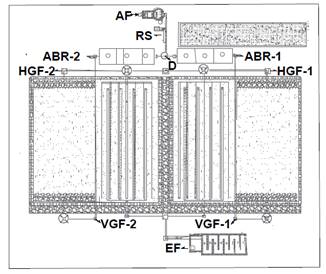
<body><![CDATA[<p align="justify"><font size="3" face="Verdana, Arial, Helvetica, sans-serif"><b>2.&nbsp;&nbsp;&nbsp;&nbsp; MATERIALS AND METHODS</b></font><font size="2" face="Verdana, Arial, Helvetica, sans-serif"><b>&nbsp;</b></font></p>     <p align="justify"><font size="2" face="Verdana, Arial, Helvetica, sans-serif"><b>2.1&nbsp;&nbsp;&nbsp;&nbsp;&nbsp; Description of the treatment   plant</b></font><font size="2" face="Verdana, Arial, Helvetica, sans-serif"><b>&nbsp;</b></font></p>     <p align="justify"><font size="2" face="Verdana, Arial, Helvetica, sans-serif"><b>2.1.1&nbsp;&nbsp;&nbsp;&nbsp;&nbsp; Location</b></font></p>     <p align="justify"><font size="2" face="Verdana, Arial, Helvetica, sans-serif">   Tolata city is located approximately 30 km south of the city of Cochabamba   (Bolivia). It has a population of 2705 inhabitants according to the Statistics   National Institute [17]. The wastewater treatment plant (WWTP) of Tolata is placed at an   altitude of 2720 meters above sea level. The average temperature is 16.5&ordm;C. The   hottest month of the year is November with an average temperature of 19.3 &deg;C   and the coldest month is July with an average temperature of 12.7 &deg;C. The   average annual rainfall is 457 mm. The economy of this area is based on   agriculture and farming. Its calcareous soil is ideal for the production of   prickly pear [18]. The WWTP was built by the AGUATUYA Foundation and, to date, the   operation and maintenance are carried out by them. </font></p>     <p align="justify"><font size="2" face="Verdana, Arial, Helvetica, sans-serif"><b>2.1.2&nbsp;&nbsp;&nbsp;&nbsp;&nbsp; Configuration of the wwtp</b></font><font size="2" face="Verdana, Arial, Helvetica, sans-serif"><b>&nbsp;</b></font></p>     <p align="justify"><font size="2" face="Verdana, Arial, Helvetica, sans-serif">This WWTP is made up of two treatment trains that function in parallel.   The whole process is designed to have a hydraulic retention time HRT of 31 h   from the influent to the effluent. The treatment plant shown in <a href="#f1">Figure 1</a>, has   been designed to treat a flow rate of 351.4 m<sup>3</sup>/d for a design period   of 20 years. </font></p>     <p align=center><font size="2" face="Verdana, Arial, Helvetica, sans-serif"><a name="f1"></a><img width=326 height=274 id="Imagen 6" src="/img/revistas/riyd/v19n1/a05_image001.jpg">    <br> <img width=432 height=76 id="Imagen 11" src="/img/revistas/riyd/v19n1/a05_image002.jpg"></font></p>     <p align=center><font size="2" face="Verdana, Arial, Helvetica, sans-serif"><img width=546 height=64 id="Imagen 10" src="/img/revistas/riyd/v19n1/a05_image003.gif"></font></p>     <p align=center><font size="2" face="Verdana, Arial, Helvetica, sans-serif"><b>Figure 1:</b> Configuration of Tolata&rsquo;s   WWTP.</font></p>     ]]></body>
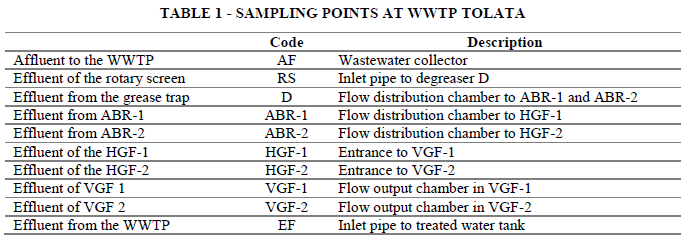
<body><![CDATA[<p align="justify"><font size="2" face="Verdana, Arial, Helvetica, sans-serif">The treatment train is composed of the following   processes: Wastewater enters a pumping   station equipped with a grid chamber placed before the pumping well where   larger solids are retained. The pumping station receives all wastewater coming   from the public sewer systems and then elevates the wastewater in the direction   of the rotating screen (RS). This station also works as an equalizer that   allows maintaining a uniform flow to be sent to the plant. However, the flow   that currently enters the WWTP is less than the average design flow, so the   pumping is intermittent. The RS filters solids with a size greater than 3 mm,   then the wastewater is conduced to a grease trap (D) where fatty material is   separated by natural flotation and then removed manually. The design retention   time of the degreasing chamber is 2 minutes. The primary treatment is carried   out in 2 ABRs in which organic matter is decomposed into simpler compounds   under anoxic conditions. The process generates sludge deposition in the bottom   of the ABR, where digested sludge can be extracted periodically through relief   valves. The ABRs are designed to have a retention time of 9 h. The walls and   their deflectors have been built with fiberglass reinforced polyester (FRP). </font></p>     <p align="justify"><font size="2" face="Verdana, Arial, Helvetica, sans-serif">Secondary treatment is carried out in a configuration   that combines horizontal-flow gravel filters (HGF) and vertical-flow gravel   filters (VGF). At the outlet of the ABR, collecting chambers are arranged to   direct the flow to two HGFs with a total area of &#8203;&#8203;approximately 509 m<sup>2</sup> (11 x 22.5 m each) and a depth of 0.8 m. The walls and bottom of the filter is   lined with high density polyethylene geomembrane. </font></p>     <p align="justify"><font size="2" face="Verdana, Arial, Helvetica, sans-serif">At the entrance area of &#8203;&#8203;the HGFs, the solid media is   composed of coarse gravel while in the treatment area there is gravel with a   mean porosity between 36 and 40%. The wastewater is conducted to the VGFs   through a perforated pipe installed at their entrance. The effluent from the   HFGs goes through an aeration chamber before entering the VGFs. These comprise   an approximate area of &#8203;&#8203;508 m<sup>2</sup> (11 x 22.5 m each) and are packed   with medium size gravel. The distribution of wastewater to the media is carried   out by sprinklers. The treated wastewater from both trains is collected in a   chamber; from there it is subsequently directed   to a chlorination chamber. The chlorination chamber is used only in emergency   situations in order to avoid the formation of toxic organochlorine compounds.</font></p>     <p align="justify"><font size="2" face="Verdana, Arial, Helvetica, sans-serif">The sludge accumulated at the bottom of the ABRs is   removed by means of a pump and deposited in the sludge drying area. The sludge   drying area is approximately 194.5 m<sup>2</sup> (8.5 x 22.8 m) with a depth of   0.15 m. Excess water in the drying area returns to the inlet of the plant.</font></p>     <p align="justify"><font size="2" face="Verdana, Arial, Helvetica, sans-serif"><b>2.1.3&nbsp;&nbsp;&nbsp;&nbsp;&nbsp; SAMPLING </b></font></p>     <p align="justify"><font size="2" face="Verdana, Arial, Helvetica, sans-serif">To evaluate the performance of the treatment plant,   composite samples (collected during 8-hour periods) were taken at 10 treatment   points which are described and codified in <a href="#t1">Table 1</a> (the   same codes, that refer the monitoring points, are observed in <a href="#f1">Figure 1</a>).   Six monitoring campaigns were carried out between August and December 2018. </font></p>     <p align="center"><font size="2" face="Verdana, Arial, Helvetica, sans-serif"><a name="t1"></a><img src="/img/revistas/riyd/v19n1/a05_table_01.png" width="690" height="241"></font></p>     <p align="justify"><font size="2" face="Verdana, Arial, Helvetica, sans-serif"><b>2.1.4&nbsp;&nbsp;&nbsp;&nbsp;&nbsp; MEASUREMENT OF PARAMETERS FOR WASTEWATER   CHARACTERIZATION</b></font></p>     <p align="justify"><font size="2" face="Verdana, Arial, Helvetica, sans-serif">  In this evaluation, on-site measurements were carried out using a multiparameter   HANNA HI 98136 for the following parameters: pH, temperature (T) and electrical   conductivity (EC). Biological oxygen demand (BOD) was determine by the   Center for Water and Environmental Sanitation (C.A.S.A-UMSS); total chemical   oxygen demand (CODTotal) and dissolved Chemical Oxygen Demand (CODdis),   nitrogen as amonia N-NH<sub>3</sub> and phosphorus P&nbsp; were measured using a   multiparameter photometer HANNA HI 83099; Total Solids TS and Total Suspended   Solids (TSS) were analized using gravimetric methods from the Standards Methods   for Examination of water and wastewater [19]. In addition, the flow rate was measured at the entrance to the   pumping station using the volumetric method.</font></p>     <p align="justify">&nbsp;</p>     ]]></body>
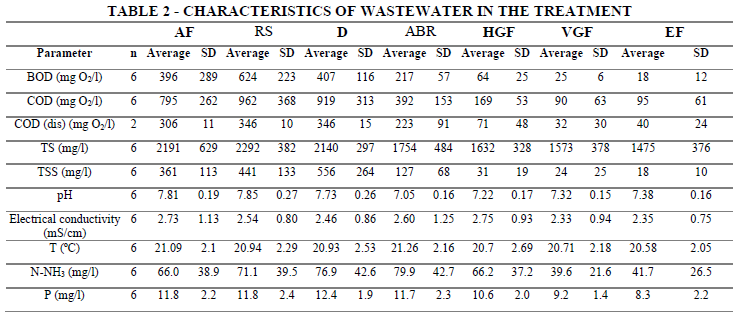
<body><![CDATA[<p align="justify"><font size="3" face="Verdana, Arial, Helvetica, sans-serif"><b>3.&nbsp;&nbsp;&nbsp;&nbsp; RESULTS AND DISCUSSION</b></font><font size="2" face="Verdana, Arial, Helvetica, sans-serif"><b>&nbsp;</b></font></p>     <p align="justify"><font size="2" face="Verdana, Arial, Helvetica, sans-serif"><b>3.1&nbsp;&nbsp;&nbsp;&nbsp;&nbsp; WASTEWATER CHARACTERISTICS</b></font></p>     <p align="justify"><font size="2" face="Verdana, Arial, Helvetica, sans-serif"><a href="#t2">Table 2</a> presents the average wastewater   characteristics and their standar deviations, measured at different treatment   points during six monitoring campaigns carried out from August to December   2018. Based on these results, a more detailed analysis is presented in the next   section for the following parameters: pH, EC, COD, TSS, N-NH<sub>3</sub>, P;   that were chosen to evaluate the potencial of treated wastewater for reuse in   irrigation.</font></p>     <p align="center"><a name="t2"></a><img src="/img/revistas/riyd/v19n1/a05_table_02.png" width="738" height="316"></p>     <p align="justify"><font size="2" face="Verdana, Arial, Helvetica, sans-serif">Wastewater coming from the Tolata&rsquo;s WWTP could be classified as   high-strength wastewater according to parameters established by Metcalf and Eddy [20]. The high concentration of parameters can be due   to low consumption of water in the area and the relatively short length of the   collection system in this type of decentralized wastewater sewer systems.</font></p>     <p align="justify"><font size="2" face="Verdana, Arial, Helvetica, sans-serif">The COD/BOD ratio calculated for the affluent during the sampling period is approximately 2.0. This value is compatible with the typical COD/BOD ratio range 1.5-2.0 established by Metcalf and Eddy [20] indicating that wastewater can be treated by biological processes. </font></p>     <p align="justify"><font size="2" face="Verdana, Arial, Helvetica, sans-serif"><b>3.2&nbsp;&nbsp;&nbsp;&nbsp;&nbsp; PERFORMANCE OF THE TREATMENT SYSTEM OF THE   WWTP AT TOLATA</b></font><font size="2" face="Verdana, Arial, Helvetica, sans-serif"><b>&nbsp;</b></font></p>     <p align="justify"><font size="2" face="Verdana, Arial, Helvetica, sans-serif">From the data presented in the <a href="#t2">Table 2</a>, we observe a considerable reduction in   concentration of all the parameters chosen for the characterization of the   WWTP. The removal efficiencies of the parameters were calculated from the   percentage difference between the values &#8203;&#8203;recorded at the influent and the   effluent of the Tolata&rsquo;s WWTP. The obtained overall efficiencies are: 95 % of   BOD<sub>5</sub>, 88% of total COD, 95 % of TSS, 37% of N-NH<sub>3</sub> and 30% of P. </font></p>     <p align="justify"><font size="2" face="Verdana, Arial, Helvetica, sans-serif">A set of parameters from <a href="#t2">Table 2</a> were selected   and they are described in the following section. These parameters were chosen   in order to evaluate whether the processes carried out in this WWTP are   adequate to obtain an effluent that can be re-used for crop irrigation.</font></p>     <p align="justify"><font size="2" face="Verdana, Arial, Helvetica, sans-serif"><b>3.2.1&nbsp;&nbsp;&nbsp;&nbsp;&nbsp; pH</b></font></p>     ]]></body>
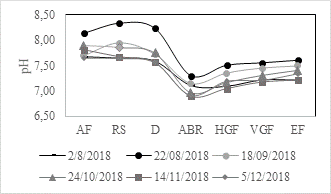
<body><![CDATA[<p align="justify"><font size="2" face="Verdana, Arial, Helvetica, sans-serif"><a href="#f2">Figure 2</a> shows the variation of the average pH values &#8203;&#8203;throughout the   treatment in the monitoring campaigns carried out between the months of August   and December 2018. </font></p>     <p align="justify">&nbsp;</p>     <p align=center><font size="2" face="Verdana, Arial, Helvetica, sans-serif"><a name="f2"></a><img width=331 height=194 id="Gr&aacute;fico 2" src="/img/revistas/riyd/v19n1/a05_image004.gif"></font></p>     <p align=center><font size="2" face="Verdana, Arial, Helvetica, sans-serif"><b>Figure 2</b>: pH variation throughout the   treatment. </font></p>     <p align="justify"><font size="2" face="Verdana, Arial, Helvetica, sans-serif">A decrease in pH values &#8203;&#8203;can be observed at the output of the ABR,   however these values are not less than 7.1, which indicates the correct   performance of the anaerobic reactor. In anaerobic compartmentalized reactors,   pH tends to fall because acidogenesis and acetogenesis occur in the first   compartments, resulting in methanogenesis in subsequent compartments [11]. The   pH is an index upon which irrigation water is quickly assessed for its   suitability. Normally, the pH of irrigation water ranges from 6.5 to 8.4. The   pH outside of the normal range might be suitable for irrigating, but has the   potential to cause an imbalance of nutrients or contain poisonous ions. The   biggest hazard related to an abnormal pH in water is its effect on irrigation   equipment. Exceptionally low pH in irrigation water can increase corrosion. On   the other hand, irrigation water containing high levels of alkalinity can lower   the efficiency of the trickle irrigation system [21]. Based on the results obtained during the monitoring, the pH value   found at the effluent indicates the suitability to reuse the treated effluent   in irrigation.</font></p>     <p align="justify"><font size="2" face="Verdana, Arial, Helvetica, sans-serif"><b>3.2.2&nbsp;&nbsp;&nbsp;&nbsp;&nbsp; ELECTRICAL CONDUCTIVITY</b></font><font size="2" face="Verdana, Arial, Helvetica, sans-serif"><b>&nbsp;</b></font></p>     <p align="justify"><font size="2" face="Verdana, Arial, Helvetica, sans-serif">Salinity has been considered as the most   important factor of water quality in agriculture because the high salinity in   the soil can create a hostile environment for the crop to absorb nutrients and   cause toxicity [2]. It is important and necessary to evaluate the concentration   of salts in wastewater because when it is applied for irrigation, in excess and   with a large amount of salts, it could cause   soil salinization gradually which leads to low productivity [5]. Electrical   Conductivity (EC) is an indirect measure of the content of dissolved salts in   wastewater. The average results of the EC measurements at Tolata&rsquo;s WWTP are   presented in <a href="#f3">Figure 3</a>.</font></p>     <p align=center><font size="2" face="Verdana, Arial, Helvetica, sans-serif"><a name="f3"></a><img width=480 height=288 id="Gr&aacute;fico 5" src="/img/revistas/riyd/v19n1/a05_image005.gif"></font></p>     <p align=center><font size="2" face="Verdana, Arial, Helvetica, sans-serif"><b>Figure 3</b>: Variation of Electrical conductivity   throughout the treatment.</font></p>     <p align="justify"><font size="2" face="Verdana, Arial, Helvetica, sans-serif">From <a href="#f3">Figure 3</a>, it is observed that there is   not a considerable variation in the concentration of dissolved salts throughout   the treatment; however, significant variations are observed in the average   values of the conductivity in the different monitoring campaigns. That may be   due to different sources of water supply for consumption that the population of   Tolata uses. The average value recorded during six monitoring campaigns for the   effluent is 2.35&plusmn;0.75 mS/cm. Ayers and Westcot [22] mention the guidelines to interpret the quality   of irrigation water that are very useful to select the appropriate crops based on the degrees of restriction that water   presents for its use. They established that if irrigation water has an EC of   &lt;0.7 mS/cm, almost all crops can be cultivated, except for those very   sensitive to salts. On the other hand, if the EC is in the range of 0.7 to 3.0   mS/cm, it is only recommended to cultivate those crops that have accepted to   moderate tolerance to salinity. The value for EC found in this study suggests that   the wastewater could be used only for irrigation of plants that have tolerance   to salinity; however, the microbiological quality is a parameter that must also   be considered for its use.</font></p>     ]]></body>
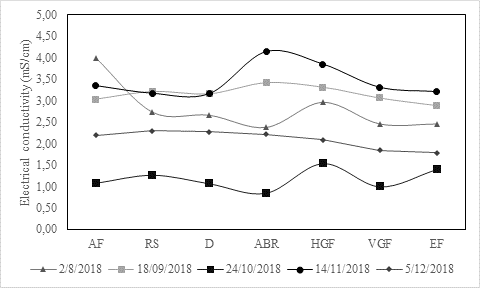
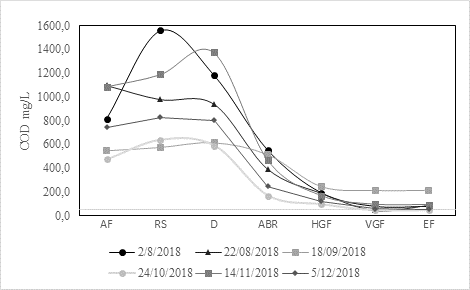
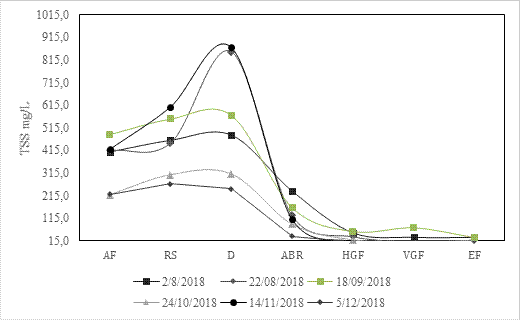
<body><![CDATA[<p align="justify"><font size="2" face="Verdana, Arial, Helvetica, sans-serif"><b>3.2.3&nbsp;&nbsp;&nbsp;&nbsp;&nbsp; </b>&nbsp;<b>COD</b></font><font size="2" face="Verdana, Arial, Helvetica, sans-serif"><b>&nbsp;</b></font></p>     <p align="justify"><font size="2" face="Verdana, Arial, Helvetica, sans-serif">An analysis of the COD was carried out to   determine the behavior of the removal of organic matter in each of the   processes throughout the treatment. <a href="#f4">Figure 4</a> shows the concentration of COD   throughout the treatment, reaching an average of 95 &plusmn; 61 mg O<sub>2</sub>/l for   the treated effluent.</font></p>     <p align=center><font size="2" face="Verdana, Arial, Helvetica, sans-serif"><a name="f4"></a><img width=470 height=290 id="Gr&aacute;fico 3" src="/img/revistas/riyd/v19n1/a05_image006.gif"></font></p>     <p align=center><font size="2" face="Verdana, Arial, Helvetica, sans-serif"><b>Figure 4:</b> Variation of COD concentration throughout the   treatment.</font></p>     <p align="justify"><font size="2" face="Verdana, Arial, Helvetica, sans-serif">As it is observed in <a href="#f4">Figure 4</a>, an accumulation of COD was found at the   outlet of the rotating screen and at the outlet of the grease trap, which may   be due to the dragging of solids by the action of suction of the pump from the   pump station to the rotating screen, and to the accumulation of suspended and   floating organic matter in the grease trap for lack of maintenance. Generally,   COD is used as a measure of organic matter, biodegradable and non-biodegradable.   Oxygen in water is consumed for decomposing organic matter to create an   anaerobic state. During the decomposition process, oxides in soil such as Fe<sub>2</sub>O<sub>3</sub>,   Mn<sub>2</sub>O<sub>5</sub> and sulfates consume oxygen to lower the   oxidation-reduction potential. In the end, the   generated iron, manganese and sulfide along with organic acids can disrupt the   crops to absorb nutrients [21]. There are very few guidelines that establish   standards for COD concentrations in wastewater for its use in irrigation.   However, some countries such as France has established that a concentration   below 60 mg/l-COD permits an unrestricted irrigation. On the other hand, Israel   and Italy has established a value below 100 mg-COD/l for water reuse in   irrigation [21]. Based on these parameters, it can be considered that the   effluent obtained in the Tolata&rsquo;s WWTP is suitable for reuse for crop   irrigation.</font></p>     <p align="justify"><font size="2" face="Verdana, Arial, Helvetica, sans-serif"><b>3.2.4&nbsp;&nbsp;&nbsp;&nbsp;&nbsp; Total Suspended Solids</b></font></p>     <p align="justify"><font size="2" face="Verdana, Arial, Helvetica, sans-serif">The variation of the concentration of TSS throughout the treatment it   is shown in <a href="#f5">Figure 5</a>. </font></p>     <p align=center><font size="2" face="Verdana, Arial, Helvetica, sans-serif"><a name="f5"></a><img width=520 height=320 id="Gr&aacute;fico 13" src="/img/revistas/riyd/v19n1/a05_image007.gif"></font></p>     <p align=center><font size="2" face="Verdana, Arial, Helvetica, sans-serif"><b>Figure 5</b>: Variation of TSS concentration throughout the   treatment.</font></p>     <p align="justify"><font size="2" face="Verdana, Arial, Helvetica, sans-serif">As it is observed from <a href="#f5">Figure 5</a>, there is a clear relationship with the   high values of COD recorded at the exit of the grease trap (<a href="#f4">Figure 4</a>) and the   high values of TSS registered at the same monitoring point (<a href="#f5">Figure 5</a>), which   verifies the accumulation of suspended and floating organic matter in the   grease trap that goes to the ABR which could eventually lead to an overload of   solids entering the ABR.</font></p>     ]]></body>
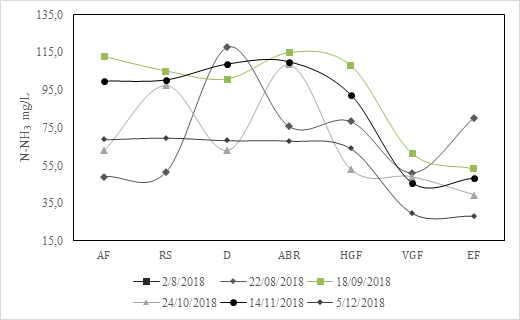
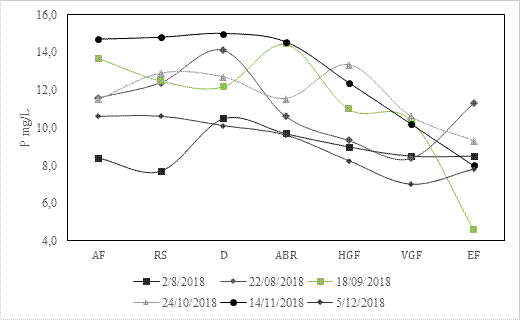
<body><![CDATA[<p align="justify"><font size="2" face="Verdana, Arial, Helvetica, sans-serif">The average concentration of TSS in the effluent does not exceed 30   mg/l. The United Nations Food and Agriculture Organization (FAO) has   established guidelines to interpret the quality of irrigation water, and they   consider degrees of restriction of use based on the concentration of total   suspended solids. Accordingly, when the concentration of TSS is less than 50   mg/l, there are no restrictions on its use for crop irrigation [23].</font></p>     <p align="justify"><font size="2" face="Verdana, Arial, Helvetica, sans-serif">The suspended solids contained in wastewaters can be retained by the   soil matrix when they are used in irrigation. This improves the physical and   chemical properties, structure and retention of nutrients, in addition to   promoting a greater biological activity that favors the mineralization of   elements such as nitrogen and phosphorus [24].</font></p>     <p align="justify"><font size="2" face="Verdana, Arial, Helvetica, sans-serif"><b>3.2.5&nbsp;&nbsp;&nbsp;&nbsp;&nbsp; Nutrients</b></font><font size="2" face="Verdana, Arial, Helvetica, sans-serif"><b>&nbsp;</b></font></p>     <p align="justify"><font size="2" face="Verdana, Arial, Helvetica, sans-serif">Anaerobic reactors do not remove nitrogen and phosphorus,   conversely, their concentrations may even increase in the soluble phase due to   the hydrolysis of solids. Nitrates and phosphates can stimulate eutrophication   when they are present in natural water courses; however, when the treated   effluent is intended to be used in the irrigation of crops, these nutrients   could be useful for the growth of the plant. In this paper, the content of the nitrogen   was measured in form of nitrogen coming from the ammonia nitrogen (N-NH<sub>3</sub>)   and the values found in different points of the treatment train are shown in   the <a href="#f6">Figure 6</a>. </font><font size="2" face="Verdana, Arial, Helvetica, sans-serif"><b>&nbsp;</b></font></p>     <p align=center><font size="2" face="Verdana, Arial, Helvetica, sans-serif"><a name="f6"></a><img width=520 height=320 id="Gr&aacute;fico 14" src="/img/revistas/riyd/v19n1/a05_image008.gif"></font></p>     <p align=center><font size="2" face="Verdana, Arial, Helvetica, sans-serif"><b>Figure 6</b>: Variation   of N-NH<sub>3 </sub>concentration throughout the treatment.</font></p>     <p align="justify"><font size="2" face="Verdana, Arial, Helvetica, sans-serif">It is evident that the most significant removal occurs in   the VGF stage. Water coming out of the HGF is distributed through a system of   perforated pipes with holes arranged longitudinally, towards the VGF where it   is sprinklered and infiltrated in the media favoring the partial aeration of   the water flow and achieving partial removal of nitrogen. The final treated   effluent contains a concentration of 41.7 &plusmn; 26.5 mg/l of N-NH<sub>3</sub>.   Taking this value as a reference it can be assumed that the concentration of   total organic nitrogen is even greater or at least equal in magnitude. The   Technical Guide for the Reuse of Wastewater in Agriculture [5] establishes that   a concentration greater than 30 mg/l of total nitrogen has severe limitations   for its use in irrigation considering the type of crop to be irrigated; however   no parameters are established for the concentrations of phosphates. On the other   hand, the dynamics of organic matter in the soil play an important role as its   decomposition allows the availability of nutrients for plants [25], so the contribution of organic matter   from wastewater is very appreciated by the agricultural producers. However, it   is important to consider the soil capacity for buffering, assimilation and   degradation of contaminants present in the residual water, in order not to   cause damage that deteriorates its quality.</font></p>     <p align="justify"><font size="2" face="Verdana, Arial, Helvetica, sans-serif">The content of phosphorus throughout the treatment was   also measured. The results are shown in <a href="#f7">Figure 7</a>.&nbsp; </font></p>     <p align=center><font size="2" face="Verdana, Arial, Helvetica, sans-serif"><a name="f7"></a><img width=520 height=320 id="Gr&aacute;fico 15" src="/img/revistas/riyd/v19n1/a05_image009.gif"></font></p>     <p align=center><font size="2" face="Verdana, Arial, Helvetica, sans-serif"><b>Figure 7</b>: Variation   of P concentration throughout the treatment.</font></p>     ]]></body>
<body><![CDATA[<p align="justify"><font size="2" face="Verdana, Arial, Helvetica, sans-serif">In the same way as in the case of nitrogen, a partial removal of P is   observed in the VGF stage, which is favored by the aeration suffered by the   water flow in the infiltration process to the filter bed. The average   concentration reached at the effluent is 8.3 &plusmn; 2.2 mg-P/l.</font></p>     <p align="justify">&nbsp;</p>     <p align="justify"><font size="3" face="Verdana, Arial, Helvetica, sans-serif"><b>4.&nbsp;&nbsp;&nbsp;&nbsp; CONCLUSIONS</b></font><font size="2" face="Verdana, Arial, Helvetica, sans-serif"><b>&nbsp;</b></font></p>     <p align="justify"><font size="2" face="Verdana, Arial, Helvetica, sans-serif">The anaerobic baffled reactor is a simple   technology that is effective when combined with horizontal and vertical gravel   filters. The concentrations found at the effluent of the Tolata&rsquo;s WWTP were:   18&plusmn;12 mg-BOD<sub>5</sub>/l, 95&plusmn;61 mg-COD/l, 18&plusmn; 10 mg-TSS/l, 41.7&plusmn;26.5 mg-N-NH<sub>3</sub>/l,   8.3&plusmn;2.2 mg-P/l and 2.35 &plusmn; 0.75 mS/cm for EC. The obtained overall efficiencies   of the WWTP were: 95 % of BOD<sub>5</sub>, 88% of total COD, 95 % of TSS, 37%   of N-NH<sub>3</sub> and 30%   of P. Comparing these results with some parameters established in guidelines to reuse wastewater for crop irrigation,   we found that the treated water has the potential to be used with some   restrictions on the choice of crops, favoring those which have a moderate   tolerance to salinity. Although the concentration of nutrients in the effluent   can favor the growth of the plant, it could cause contamination of groundwater   or eutrophication in lagoons or lakes if sufficient runoff is generated. On the   other hand, one of the main concerns related to the reuse of wastewater is the   salinization of agricultural land and the loss of infiltration; therefore, these issues should be analyzed in detail in order to   establish a proper irrigation management plan or strategy that should include   for instance: the restriction of some crops, the use of appropriate irrigation   techniques that avoid the contamination of products and   the management of the times between the last irrigation and the harvest. To   guarantee the safe use of wastewater due to the microbiological quality of the   same, since currently the WWTP does not carry out a disinfection process, it is   advisable to use the effluent only in the irrigation of high stem crops such as   fodder and other crops that are not eaten raw. Additionally, in the Bolivian   context, there is a need to establish water quality standards for the safe and   sustainable practice of wastewater reuse in agriculture. </font><font size="2" face="Verdana, Arial, Helvetica, sans-serif"><b>&nbsp;</b></font></p>     <p align="justify"><font size="2" face="Verdana, Arial, Helvetica, sans-serif"><b>&nbsp;</b></font></p>     <p align="justify"><font size="3" face="Verdana, Arial, Helvetica, sans-serif"><b>5.&nbsp;&nbsp;&nbsp;&nbsp; ACKNOWLEDGMENTS</b></font></p>     <p align="justify"><font size="2" face="Verdana, Arial, Helvetica, sans-serif">We wish to thank the great support from the team of engineers of   AGUATUYA foundation, Ariel Aldunate, Fabiola Fernandez and Fernando Garcia.</font></p>     <p align="justify"><font size="2" face="Verdana, Arial, Helvetica, sans-serif"><b>&nbsp;</b></font><font size="2" face="Verdana, Arial, Helvetica, sans-serif"><b>&nbsp;</b></font></p>     <p align="justify"><font size="3" face="Verdana, Arial, Helvetica, sans-serif"><b>6. REFERENCES</b></font></p>     <!-- ref --><p align="justify"><font size="2" face="Verdana, Arial, Helvetica, sans-serif">[1] Hamilton, A., Stagnitti, F.,   Premier, R., Boland, A.-M., Hale, G., 2006. Quantitative microbial risk   assessment models for consumption of raw vegetables irrigated with reclaimed   water. Appl. Environ. Microbiol.</font>&nbsp;&nbsp;&nbsp;&nbsp;&nbsp;&nbsp;&nbsp;&nbsp;[&#160;<a href="javascript:void(0);" onclick="javascript: window.open('/scielo.php?script=sci_nlinks&ref=971543&pid=S2518-4431201900010000500001&lng=','','width=640,height=500,resizable=yes,scrollbars=1,menubar=yes,');">Links</a>&#160;]<!-- end-ref --><p align="justify"><font size="2" face="Verdana, Arial, Helvetica, sans-serif">[2] WHO, 2006. Guidelines for   the safe use of wastewater, excreta and greywater.</font></p>     <p align="justify"><font size="2" face="Verdana, Arial, Helvetica, sans-serif">[3] MMyA, 2013a. Sistematizaci&oacute;n   sobre tratamiento y re&uacute;so de aguas residuales.</font></p>     <p align="justify"><font size="2" face="Verdana, Arial, Helvetica, sans-serif">[4] Moscoso, O., Romero,   A.M., 2002. Uso de las Aguas   Residuales tratadas en Riego. Caso de Estudio de Bolivia.</font></p>     <p align="justify"><font size="2" face="Verdana, Arial, Helvetica, sans-serif">[5] MMyA, 2013b. Gu&iacute;a t&eacute;cnica   para el re&uacute;so de aguas residuales en la agricultura. Estado Plurinacional de   Bolivia.</font></p>     <p align="justify"><font size="2" face="Verdana, Arial, Helvetica, sans-serif">[6] Gandarillas, V., Saavedra,   O., Escalera, R., Montoya, R., 2017. Revisi&oacute;n De Las Experiencias En El   Tratamiento De Aguas Residuales Dom&eacute;sticas Mediante Reactores UASB En   Cochabamba-Bolivia Comparadas Con Las De Latinoam&eacute;rica, India Y Europa.   Investig. &amp; Desarro. 1, 83&ndash;98. <a href="https://doi.org/10.23881/idupbo.017.1-7i" target="_blank">https://doi.org/10.23881/idupbo.017.1-7i</a></font></p>     <p align="justify"><font size="2" face="Verdana, Arial, Helvetica, sans-serif">[7] Saavedra, O., Escalera, R.,   Heredia, G., Montoya, R., Echeverria, I., Villarroel, A., Brito, L., 2018. Evaluation of a domestic wastewater treatment   plant at an intermediate city of Bolivia, in: Congreso Interamericano de   Ingenier&iacute;a Sanitaria y Ambiental. AIDIS. </font></p>     <p align="justify"><font size="2" face="Verdana, Arial, Helvetica, sans-serif">[8] Bachmann, A., Beard, V.L.,   McCarty, P.L., 1982. Comparison of Fixed-Film Reactors with a Modified Sludge   Blanket Reactor, in: Proceedings of the First International Conference of   fFxed-Film Biological Processes Vol II. pp. 1192&ndash;1211.</font></p>     <p align="justify"><font size="2" face="Verdana, Arial, Helvetica, sans-serif">[9] Bachmann, A., Beard, V.L.,   McCarty, P.L., 1985. Performance characteristics of the anaerobic baffled   reactor. Water Res. 19, 99&ndash;106. <a href="https://doi.org/10.1016/0043-1354(85)90330-6">https://doi.org/10.1016/0043-1354(85)90330-6</a></font></p>     <p align="justify"><font size="2" face="Verdana, Arial, Helvetica, sans-serif">[10] Sato, N., Okubo, T.,   Onodera, T., Ohashi, A., Harada, H., 2006. Prospects for a self-sustainable   sewage treatment system: A case study on full-scale UASB system in India&rsquo;s   Yamuna River Basin 80, 198&ndash;207. <a href="https://doi.org/10.1016/j.jenvman.2005.08.025" target="_blank">https://doi.org/10.1016/j.jenvman.2005.08.025</a></font></p>     <p align="justify"><font size="2" face="Verdana, Arial, Helvetica, sans-serif">[11] Barber, W., Stuckey, D.,   1998. The use of the Anaerobic Baffled Reactor (ABR) for wastewater treatment:   A Review. Water Res. 33, 1561&ndash;1578.</font></p>     ]]></body>
<body><![CDATA[<p align="justify"><font size="2" face="Verdana, Arial, Helvetica, sans-serif">[12] Bod&iacute;k, I., Kratochv&iacute;l, K.,   Ga&scaron;parikov&aacute;, E., Hutan, M., 2003. Nitrogen removal in an anaerobic baffled   filter reactor with aerobic post-treatment. Bioresour. Technol. 86, 79&ndash;84.   <a href="https://doi.org/10.1016/S0960-8524(02)00109-8" target="_blank">https://doi.org/10.1016/S0960-8524(02)00109-8</a></font></p>     <p align="justify"><font size="2" face="Verdana, Arial, Helvetica, sans-serif">[13] Barber, W.P., Stuckey, D.C.,   2000a. Nitrogen removal in a modified Anaerobic Baffled Reactor (ABR): 2,   Nitrification. Water Res. 34.</font></p>     <p align="justify"><font size="2" face="Verdana, Arial, Helvetica, sans-serif">[14] Singh, S., Haberl, R.,   Moog, O., Shrestha, R.R., Shrestha, P., Shrestha, R., 2009. Performance of an   anaerobic baffled reactor and hybrid constructed wetland treating high-strength   wastewater in Nepal-A model for DEWATS. Ecol. Eng. 35, 654&ndash;660.   <a href="https://doi.org/10.1016/j.ecoleng.2008.10.019" target="_blank">https://doi.org/10.1016/j.ecoleng.2008.10.019</a></font></p>     <p align=justify><font size="2" face="Verdana, Arial, Helvetica, sans-serif">[15]   Nasr, F.A., Doma, H.S., Nassar, H.F., 2009. Treatment of domestic wastewater using an anaerobic   baffled reactor followed by a duckweed pond for agricultural purposes.   Environmentalist 29, 270&ndash;279. <a href="https://doi.org/10.1007/s10669-008-9188-y" target="_blank">https://doi.org/10.1007/s10669-008-9188-y</a></font></p>     <p align="justify"><font size="2" face="Verdana, Arial, Helvetica, sans-serif">[16] Bodkhe, S.Y., 2009. A   modified anaerobic baffled reactor for municipal wastewater treatment. J. Environ. Manage. 90, 2488&ndash;2493.   <a href="https://doi.org/10.1016/j.jenvman.2009.01.007" target="_blank">https://doi.org/10.1016/j.jenvman.2009.01.007</a></font></p>     <p align="justify"><font size="2" face="Verdana, Arial, Helvetica, sans-serif">[17] INE, 2012. Censo de   Poblaci&oacute;n y Vivienda. Bolivia.</font></p>     <p align="justify"><font size="2" face="Verdana, Arial, Helvetica, sans-serif">[18] PDM, 2007. Plan de   desarrollo municipal Tolata.</font></p>     <p align="justify"><font size="2" face="Verdana, Arial, Helvetica, sans-serif">[19] APHA/AWWA/WEF, 1999.   Standard Methods for the Examination of Water and Wastewater.</font></p>     <p align="justify"><font size="2" face="Verdana, Arial, Helvetica, sans-serif">[20] Metcalf and Eddy, I., 2003.   Ingenier&iacute;a de aguas residuales, tratamiento, vertido y re-utilizaci&oacute;n, 4th ed. </font></p>     <!-- ref --><p align=justify><font size="2" face="Verdana, Arial, Helvetica, sans-serif">[21]   Jeong, H., Kim, H., Jang, T., 2016. Irrigation   water quality standards for indirect wastewater reuse in agriculture: A contribution   toward sustainable wastewater reuse in South Korea. Water (Switzerland) 8.   <a href="https://doi.org/10.3390/w8040169" target="_blank">https://doi.org/10.3390/w8040169</a></font>&nbsp;&nbsp;&nbsp;&nbsp;&nbsp;&nbsp;&nbsp;&nbsp;[&#160;<a href="javascript:void(0);" onclick="javascript: window.open('/scielo.php?script=sci_nlinks&ref=971563&pid=S2518-4431201900010000500021&lng=','','width=640,height=500,resizable=yes,scrollbars=1,menubar=yes,');">Links</a>&#160;]<!-- end-ref --><p align="justify"><font size="2" face="Verdana, Arial, Helvetica, sans-serif">[22] Ayers, R.S., Westcot, D.W.,   1987. La calidad del agua en la   agricultura.</font></p>     <!-- ref --><p align="justify"><font size="2" face="Verdana, Arial, Helvetica, sans-serif">[23] Rhoades, J.D., Merril,   S.D., 1976. Assessing the suitability of water for irrigation: Theoretical and   empirical approaches, FAO soils bulletin 31.</font>&nbsp;&nbsp;&nbsp;&nbsp;&nbsp;&nbsp;&nbsp;&nbsp;[&#160;<a href="javascript:void(0);" onclick="javascript: window.open('/scielo.php?script=sci_nlinks&ref=971565&pid=S2518-4431201900010000500023&lng=','','width=640,height=500,resizable=yes,scrollbars=1,menubar=yes,');">Links</a>&#160;]<!-- end-ref --><p align="justify"><font size="2" face="Verdana, Arial, Helvetica, sans-serif">[24] Mulvaney, R.L., 1996.   Nitrogen inorganic forms, in: Madison, W. (Ed.), Part 3. SSSA Book Ser. 5. Soil Sci. Soc. Am.</font></p>     <p align="justify"><font size="2" face="Verdana, Arial, Helvetica, sans-serif">[25] Raber, B., Kogel-Knabner,   I., 1995. Desorption of PAH   polycyclic aromatic hydrocarbons from soils under the influence of dissolved   organic substances.</font></p>     <p align="justify"><font size="2" face="Verdana, Arial, Helvetica, sans-serif"><b>&nbsp;</b></font></p>      ]]></body><back>
<ref-list>
<ref id="B1">
<label>1</label><nlm-citation citation-type="journal">
<person-group person-group-type="author">
<name>
<surname><![CDATA[Hamilton]]></surname>
<given-names><![CDATA[A.]]></given-names>
</name>
<name>
<surname><![CDATA[Stagnitti]]></surname>
<given-names><![CDATA[F.]]></given-names>
</name>
<name>
<surname><![CDATA[Premier]]></surname>
<given-names><![CDATA[R.]]></given-names>
</name>
<name>
<surname><![CDATA[Boland]]></surname>
<given-names><![CDATA[A.-M.]]></given-names>
</name>
<name>
<surname><![CDATA[Hale]]></surname>
<given-names><![CDATA[G.]]></given-names>
</name>
</person-group>
<article-title xml:lang="en"><![CDATA[Quantitative microbial risk assessment models for consumption of raw vegetables irrigated with reclaimed water]]></article-title>
<source><![CDATA[Appl. Environ. Microbiol.]]></source>
<year>2006</year>
</nlm-citation>
</ref>
<ref id="B2">
<label>2</label><nlm-citation citation-type="">
<collab>WHO</collab>
<source><![CDATA[Guidelines for the safe use of wastewater, excreta and greywater]]></source>
<year>2006</year>
</nlm-citation>
</ref>
<ref id="B3">
<label>3</label><nlm-citation citation-type="">
<collab>MMyA</collab>
<source><![CDATA[Sistematización sobre tratamiento y reúso de aguas residuales]]></source>
<year>2013</year>
</nlm-citation>
</ref>
<ref id="B4">
<label>4</label><nlm-citation citation-type="">
<person-group person-group-type="author">
<name>
<surname><![CDATA[Moscoso]]></surname>
<given-names><![CDATA[O.]]></given-names>
</name>
<name>
<surname><![CDATA[Romero]]></surname>
<given-names><![CDATA[A.M.]]></given-names>
</name>
</person-group>
<source><![CDATA[Uso de las Aguas Residuales tratadas en Riego. Caso de Estudio de Bolivia]]></source>
<year>2002</year>
</nlm-citation>
</ref>
<ref id="B5">
<label>5</label><nlm-citation citation-type="book">
<collab>MMyA</collab>
<source><![CDATA[Guía técnica para el reúso de aguas residuales en la agricultura]]></source>
<year>2013</year>
<publisher-name><![CDATA[Estado Plurinacional de Bolivia]]></publisher-name>
</nlm-citation>
</ref>
<ref id="B6">
<label>6</label><nlm-citation citation-type="journal">
<person-group person-group-type="author">
<name>
<surname><![CDATA[Gandarillas]]></surname>
<given-names><![CDATA[V.]]></given-names>
</name>
<name>
<surname><![CDATA[Saavedra]]></surname>
<given-names><![CDATA[O.]]></given-names>
</name>
<name>
<surname><![CDATA[Escalera]]></surname>
<given-names><![CDATA[R.]]></given-names>
</name>
<name>
<surname><![CDATA[Montoya]]></surname>
<given-names><![CDATA[R.]]></given-names>
</name>
</person-group>
<article-title xml:lang="es"><![CDATA[Revisión De Las Experiencias En El Tratamiento De Aguas Residuales Domésticas Mediante Reactores UASB En Cochabamba-Bolivia Comparadas Con Las De Latinoamérica, India Y Europa]]></article-title>
<source><![CDATA[Investig. & Desarro.]]></source>
<year>2017</year>
<volume>1</volume>
<page-range>83-98</page-range></nlm-citation>
</ref>
<ref id="B7">
<label>7</label><nlm-citation citation-type="confpro">
<person-group person-group-type="author">
<name>
<surname><![CDATA[Saavedra]]></surname>
<given-names><![CDATA[O.]]></given-names>
</name>
<name>
<surname><![CDATA[Escalera]]></surname>
<given-names><![CDATA[R.]]></given-names>
</name>
<name>
<surname><![CDATA[Heredia]]></surname>
<given-names><![CDATA[G.]]></given-names>
</name>
<name>
<surname><![CDATA[Montoya]]></surname>
<given-names><![CDATA[R.]]></given-names>
</name>
<name>
<surname><![CDATA[Echeverria]]></surname>
<given-names><![CDATA[I.]]></given-names>
</name>
<name>
<surname><![CDATA[A.]]></surname>
<given-names><![CDATA[Villarroel]]></given-names>
</name>
<name>
<surname><![CDATA[L.]]></surname>
<given-names><![CDATA[L.]]></given-names>
</name>
</person-group>
<source><![CDATA[Evaluation of a domestic wastewater treatment plant at an intermediate city of Bolivia]]></source>
<year>2018</year>
<conf-name><![CDATA[ Congreso Interamericano de Ingeniería Sanitaria y Ambiental]]></conf-name>
<conf-loc> </conf-loc>
<publisher-name><![CDATA[AIDIS]]></publisher-name>
</nlm-citation>
</ref>
<ref id="B8">
<label>8</label><nlm-citation citation-type="">
<person-group person-group-type="author">
<name>
<surname><![CDATA[Bachmann]]></surname>
<given-names><![CDATA[A.]]></given-names>
</name>
<name>
<surname><![CDATA[Beard]]></surname>
<given-names><![CDATA[V.L.]]></given-names>
</name>
<name>
<surname><![CDATA[McCarty]]></surname>
<given-names><![CDATA[P.L.]]></given-names>
</name>
</person-group>
<article-title xml:lang="en"><![CDATA[Comparison of Fixed-Film Reactors with a Modified Sludge Blanket Reactor]]></article-title>
<source><![CDATA[Proceedings of the First International Conference of fFxed-Film Biological Processes]]></source>
<year>1982</year>
<volume>II</volume>
<page-range>1192-1211</page-range></nlm-citation>
</ref>
<ref id="B9">
<label>9</label><nlm-citation citation-type="journal">
<person-group person-group-type="author">
<name>
<surname><![CDATA[Bachmann]]></surname>
<given-names><![CDATA[A.]]></given-names>
</name>
<name>
<surname><![CDATA[Beard]]></surname>
<given-names><![CDATA[V.L.]]></given-names>
</name>
<name>
<surname><![CDATA[McCarty]]></surname>
<given-names><![CDATA[P.L.]]></given-names>
</name>
</person-group>
<article-title xml:lang="en"><![CDATA[Performance characteristics of the anaerobic baffled reactor]]></article-title>
<source><![CDATA[Water Res.]]></source>
<year>1985</year>
<volume>19</volume>
<page-range>99-106</page-range></nlm-citation>
</ref>
<ref id="B10">
<label>10</label><nlm-citation citation-type="journal">
<person-group person-group-type="author">
<name>
<surname><![CDATA[Sato]]></surname>
<given-names><![CDATA[N.]]></given-names>
</name>
<name>
<surname><![CDATA[Okubo]]></surname>
<given-names><![CDATA[T.]]></given-names>
</name>
<name>
<surname><![CDATA[Onodera]]></surname>
<given-names><![CDATA[T.]]></given-names>
</name>
<name>
<surname><![CDATA[Ohashi]]></surname>
<given-names><![CDATA[A.]]></given-names>
</name>
<name>
<surname><![CDATA[Harada]]></surname>
<given-names><![CDATA[H.]]></given-names>
</name>
</person-group>
<article-title xml:lang="en"><![CDATA[Prospects for a self-sustainable sewage treatment system&#8239;: A case study on full-scale UASB system in India&#8217;s Yamuna River Basin]]></article-title>
<source><![CDATA[Journal of Environmental Management]]></source>
<year>2006</year>
<volume>80</volume>
<page-range>198-207</page-range></nlm-citation>
</ref>
<ref id="B11">
<label>11</label><nlm-citation citation-type="journal">
<person-group person-group-type="author">
<name>
<surname><![CDATA[Barber]]></surname>
<given-names><![CDATA[W.]]></given-names>
</name>
<name>
<surname><![CDATA[Stuckey]]></surname>
<given-names><![CDATA[D.]]></given-names>
</name>
</person-group>
<article-title xml:lang="en"><![CDATA[The use of the Anaerobic Baffled Reactor (ABR) for wastewater treatment: A Review]]></article-title>
<source><![CDATA[Water Res.]]></source>
<year>1998</year>
<volume>33</volume>
<page-range>1561-1578</page-range></nlm-citation>
</ref>
<ref id="B12">
<label>12</label><nlm-citation citation-type="journal">
<person-group person-group-type="author">
<name>
<surname><![CDATA[Bodík]]></surname>
<given-names><![CDATA[I.]]></given-names>
</name>
<name>
<surname><![CDATA[Kratochvíl]]></surname>
<given-names><![CDATA[K.]]></given-names>
</name>
<name>
<surname><![CDATA[Gapariková]]></surname>
<given-names><![CDATA[E.]]></given-names>
</name>
<name>
<surname><![CDATA[Hutan]]></surname>
<given-names><![CDATA[M.]]></given-names>
</name>
</person-group>
<article-title xml:lang="en"><![CDATA[Nitrogen removal in an anaerobic baffled filter reactor with aerobic post-treatment]]></article-title>
<source><![CDATA[Bioresour. Technol.]]></source>
<year>2003</year>
<volume>86</volume>
<page-range>79-84</page-range></nlm-citation>
</ref>
<ref id="B13">
<label>13</label><nlm-citation citation-type="journal">
<person-group person-group-type="author">
<name>
<surname><![CDATA[Barber]]></surname>
<given-names><![CDATA[W.P.]]></given-names>
</name>
<name>
<surname><![CDATA[Stuckey]]></surname>
<given-names><![CDATA[D.C.]]></given-names>
</name>
</person-group>
<article-title xml:lang="en"><![CDATA[Nitrogen removal in a modified Anaerobic Baffled Reactor (ABR): 2, Nitrification]]></article-title>
<source><![CDATA[Water Res.]]></source>
<year>2000</year>
<volume>34</volume>
</nlm-citation>
</ref>
<ref id="B14">
<label>14</label><nlm-citation citation-type="journal">
<person-group person-group-type="author">
<name>
<surname><![CDATA[Singh]]></surname>
<given-names><![CDATA[S.]]></given-names>
</name>
<name>
<surname><![CDATA[Haberl]]></surname>
<given-names><![CDATA[R.]]></given-names>
</name>
<name>
<surname><![CDATA[Moog]]></surname>
<given-names><![CDATA[O.]]></given-names>
</name>
<name>
<surname><![CDATA[Shrestha]]></surname>
<given-names><![CDATA[R.R.]]></given-names>
</name>
<name>
<surname><![CDATA[Shrestha]]></surname>
<given-names><![CDATA[P.]]></given-names>
</name>
<name>
<surname><![CDATA[Shrestha]]></surname>
<given-names><![CDATA[R.]]></given-names>
</name>
</person-group>
<article-title xml:lang="en"><![CDATA[Performance of an anaerobic baffled reactor and hybrid constructed wetland treating high-strength wastewater in Nepal-A model for DEWATS]]></article-title>
<source><![CDATA[Ecol. Eng.]]></source>
<year>2009</year>
<volume>35</volume>
<page-range>654-660</page-range></nlm-citation>
</ref>
<ref id="B15">
<label>15</label><nlm-citation citation-type="journal">
<person-group person-group-type="author">
<name>
<surname><![CDATA[Nasr]]></surname>
<given-names><![CDATA[F.A.]]></given-names>
</name>
<name>
<surname><![CDATA[Doma]]></surname>
<given-names><![CDATA[H.S.]]></given-names>
</name>
<name>
<surname><![CDATA[Nassar]]></surname>
<given-names><![CDATA[H.F.]]></given-names>
</name>
</person-group>
<article-title xml:lang="en"><![CDATA[Treatment of domestic wastewater using an anaerobic baffled reactor followed by a duckweed pond for agricultural purposes]]></article-title>
<source><![CDATA[Environmentalist]]></source>
<year>2009</year>
<volume>29</volume>
<page-range>270-279</page-range></nlm-citation>
</ref>
<ref id="B16">
<label>16</label><nlm-citation citation-type="journal">
<person-group person-group-type="author">
<name>
<surname><![CDATA[Bodkhe]]></surname>
<given-names><![CDATA[S.Y.]]></given-names>
</name>
</person-group>
<article-title xml:lang="en"><![CDATA[A modified anaerobic baffled reactor for municipal wastewater treatment]]></article-title>
<source><![CDATA[J. Environ. Manage.]]></source>
<year>2009</year>
<volume>90</volume>
<page-range>2488-2493</page-range></nlm-citation>
</ref>
<ref id="B17">
<label>17</label><nlm-citation citation-type="">
<collab>INE</collab>
<source><![CDATA[Censo de Población y Vivienda]]></source>
<year>2012</year>
<publisher-loc><![CDATA[Bolivia ]]></publisher-loc>
</nlm-citation>
</ref>
<ref id="B18">
<label>18</label><nlm-citation citation-type="">
<collab>PDM</collab>
<source><![CDATA[Plan de desarrollo municipal Tolata]]></source>
<year>2007</year>
</nlm-citation>
</ref>
<ref id="B19">
<label>19</label><nlm-citation citation-type="">
<collab>APHA/AWWA/WEF</collab>
<source><![CDATA[Standard Methods for the Examination of Water and Wastewater]]></source>
<year>1999</year>
</nlm-citation>
</ref>
<ref id="B20">
<label>20</label><nlm-citation citation-type="">
<person-group person-group-type="author">
<name>
<surname><![CDATA[Metcalf and Eddy]]></surname>
<given-names><![CDATA[I.]]></given-names>
</name>
</person-group>
<source><![CDATA[Ingeniería de aguas residuales, tratamiento, vertido y re-utilización]]></source>
<year>2003</year>
<edition>4</edition>
</nlm-citation>
</ref>
<ref id="B21">
<label>21</label><nlm-citation citation-type="journal">
<person-group person-group-type="author">
<name>
<surname><![CDATA[Jeong]]></surname>
<given-names><![CDATA[H.]]></given-names>
</name>
<name>
<surname><![CDATA[Kim]]></surname>
<given-names><![CDATA[H.]]></given-names>
</name>
<name>
<surname><![CDATA[Jang]]></surname>
<given-names><![CDATA[T.]]></given-names>
</name>
</person-group>
<article-title xml:lang="en"><![CDATA[Irrigation water quality standards for indirect wastewater reuse in agriculture: A contribution toward sustainable wastewater reuse in South Korea]]></article-title>
<source><![CDATA[Water (Switzerland)]]></source>
<year>2016</year>
<volume>8</volume>
</nlm-citation>
</ref>
<ref id="B22">
<label>22</label><nlm-citation citation-type="">
<person-group person-group-type="author">
<name>
<surname><![CDATA[Ayers]]></surname>
<given-names><![CDATA[R.S.]]></given-names>
</name>
<name>
<surname><![CDATA[D.W.]]></surname>
<given-names><![CDATA[D.W.]]></given-names>
</name>
</person-group>
<source><![CDATA[La calidad del agua en la agricultura]]></source>
<year>1987</year>
</nlm-citation>
</ref>
<ref id="B23">
<label>23</label><nlm-citation citation-type="journal">
<person-group person-group-type="author">
<name>
<surname><![CDATA[Rhoades]]></surname>
<given-names><![CDATA[J.D.]]></given-names>
</name>
<name>
<surname><![CDATA[Merril]]></surname>
<given-names><![CDATA[S.D.]]></given-names>
</name>
</person-group>
<article-title xml:lang="en"><![CDATA[Assessing the suitability of water for irrigation: Theoretical and empirical approaches]]></article-title>
<source><![CDATA[FAO soils bulletin]]></source>
<year>1976</year>
<numero>31</numero>
<issue>31</issue>
</nlm-citation>
</ref>
<ref id="B24">
<label>24</label><nlm-citation citation-type="book">
<person-group person-group-type="author">
<name>
<surname><![CDATA[Mulvaney]]></surname>
<given-names><![CDATA[R.L.]]></given-names>
</name>
</person-group>
<article-title xml:lang="en"><![CDATA[Nitrogen inorganic forms]]></article-title>
<person-group person-group-type="editor">
<name>
<surname><![CDATA[Madison]]></surname>
<given-names><![CDATA[W.]]></given-names>
</name>
</person-group>
<source><![CDATA[SSSA Book Ser]]></source>
<year>1996</year>
<publisher-name><![CDATA[Soil Sci. Soc. Am.]]></publisher-name>
</nlm-citation>
</ref>
<ref id="B25">
<label>25</label><nlm-citation citation-type="">
<person-group person-group-type="author">
<name>
<surname><![CDATA[Raber]]></surname>
<given-names><![CDATA[B.]]></given-names>
</name>
<name>
<surname><![CDATA[Kogel-Knabner]]></surname>
<given-names><![CDATA[I.]]></given-names>
</name>
</person-group>
<source><![CDATA[Desorption of PAH polycyclic aromatic hydrocarbons from soils under the influence of dissolved organic substances]]></source>
<year>1995</year>
</nlm-citation>
</ref>
</ref-list>
</back>
</article>