<?xml version="1.0" encoding="ISO-8859-1"?><article xmlns:mml="http://www.w3.org/1998/Math/MathML" xmlns:xlink="http://www.w3.org/1999/xlink" xmlns:xsi="http://www.w3.org/2001/XMLSchema-instance">
<front>
<journal-meta>
<journal-id>2518-4431</journal-id>
<journal-title><![CDATA[Investigación & Desarrollo]]></journal-title>
<abbrev-journal-title><![CDATA[Inv. y Des.]]></abbrev-journal-title>
<issn>2518-4431</issn>
<publisher>
<publisher-name><![CDATA[UNIVERSIDAD PRIVADA BOLIVIANA]]></publisher-name>
</publisher>
</journal-meta>
<article-meta>
<article-id>S2518-44312019000100003</article-id>
<title-group>
<article-title xml:lang="en"><![CDATA[A SCREENING FOR ANTIOXIDANT SPECIES WITH PHOTO-PROTECTOR ACTIVITIES AT THE ZONGO VALLEY (BOLIVIA)]]></article-title>
<article-title xml:lang="es"><![CDATA[BÚSQUEDA DE ESPECIES ANTIOXIDANTES CON ACTIVIDADES FOTOPROTECTORAS EN EL VALLE DE ZONGO (BOLIVIA)]]></article-title>
</title-group>
<contrib-group>
<contrib contrib-type="author">
<name>
<surname><![CDATA[Ibáñez-Calero]]></surname>
<given-names><![CDATA[Sandra L.]]></given-names>
</name>
<xref ref-type="aff" rid="A01"/>
</contrib>
<contrib contrib-type="author">
<name>
<surname><![CDATA[Loayza Afonso]]></surname>
<given-names><![CDATA[Kelly E.]]></given-names>
</name>
<xref ref-type="aff" rid="A01"/>
</contrib>
</contrib-group>
<aff id="A01">
<institution><![CDATA[,Universidad Privada Boliviana Centro de Investigaciones Fitoquímicas (CIF) ]]></institution>
<addr-line><![CDATA[ ]]></addr-line>
</aff>
<pub-date pub-type="pub">
<day>00</day>
<month>00</month>
<year>2019</year>
</pub-date>
<pub-date pub-type="epub">
<day>00</day>
<month>00</month>
<year>2019</year>
</pub-date>
<volume>19</volume>
<numero>1</numero>
<fpage>25</fpage>
<lpage>42</lpage>
<copyright-statement/>
<copyright-year/>
<self-uri xlink:href="http://www.scielo.org.bo/scielo.php?script=sci_arttext&amp;pid=S2518-44312019000100003&amp;lng=en&amp;nrm=iso"></self-uri><self-uri xlink:href="http://www.scielo.org.bo/scielo.php?script=sci_abstract&amp;pid=S2518-44312019000100003&amp;lng=en&amp;nrm=iso"></self-uri><self-uri xlink:href="http://www.scielo.org.bo/scielo.php?script=sci_pdf&amp;pid=S2518-44312019000100003&amp;lng=en&amp;nrm=iso"></self-uri><abstract abstract-type="short" xml:lang="en"><p><![CDATA[Eleven plants were collected at the Zongo Valley to evaluate their antioxidant and photo-protector properties. In this paper we report a strong correlation between high antioxidant activity and strong UV-A and/or UV-B absorptions. The most active species, tested at 10µg/ml with the DPPH assay, were Fuchsia boliviana (leaves), Baccharis pentlandii (flowers), Rubus floribundus (fruits), Fuchsia boliviana (flowers and fruits) and Brachyotum microdon (flowers). All the mentioned species have important UV- B and/or UV-A absorptions. This DPPH/UV technique could be used to preliminary screen vegetable samples and to select those with DPPH values above 83% and strong UV-A and/or UV-B absorptions. The chosen samples can then be evaluated with other more expensive in vitro assay (TEAC, ABTS or FRAP) to finally confirm their activities with the in vivo test. To our knowledge, this is the first time that the antioxidant properties of Distichia muscoides, Souroubea fragilis, Brachyotum microdon, Monnina bridgesii, Baccharis pentlandii, Thibaudia crenulata, Siphocampylus tupaeformis, Cobaea scandens, Fuchsia boliviana and Rubus floribundus are reported. In addition, this is the first time that Siphocampylus tupaeformis and Thibaudia crenulata are presented in a publication as well as the study of their photo-protector and antioxidant properties.]]></p></abstract>
<abstract abstract-type="short" xml:lang="es"><p><![CDATA[Once plantas fueron colectadas en el Valle de Zongo para evaluar sus propiedades antioxidantes y fotoprotectoras. En esta publicación presentamos una fuerte correlación entre una alta actividad antioxidantes y una fuerte absorción UV-A y/o UV-B. Las especies más activas, evaluadas a 10µg/ml con el ensayo DPPH, fueron Fuchsia boliviana (hojas), Baccharis pentlandii (flores), Rubus floribundus (frutas), Fuchsia boliviana (flores y frutas) y Brachyotum microdon (flores). Todas las especies mencionadas poseen importantes absorciones UV- B y/o UV- A. Esta técnica DPPH/UV puede ser usada para realizar un cernido preliminar de muestras vegetales y seleccionar aquellas con valores de DPPH superiores a 83% y fuertes absorciones UV-A y/o UV-B. Las muestras seleccionadas, luego pueden ser evaluadas con otro ensayo in vitro más costoso (TEAC, ABTS o FRAP) para finalmente confirmar sus actividades con el ensayo in vivo. A nuestro conocimiento, ésta es la primera vez que las actividades antioxidantes de Distichia muscoides, Souroubea fragilis, Brachyotum microdon, Monnina bridgesii, Baccharis pentlandii, Thibaudia crenulata, Siphocampylus tupaeformis, Cobaea scandens, Fuchsia boliviana y Rubus floribundus son reportadas. Adicionalmente, ésta es la primera vez que se presenta una publicación de Siphocampylus tupaeformis y Thibaudia crenulata, así como el estudio de sus propiedades fotoprotectoras y antioxidantes.]]></p></abstract>
<kwd-group>
<kwd lng="en"><![CDATA[Zongo Valley]]></kwd>
<kwd lng="en"><![CDATA[Antioxidant Activity]]></kwd>
<kwd lng="en"><![CDATA[Photo-Protector Property]]></kwd>
<kwd lng="en"><![CDATA[UV-A and/or UV-B Absorption]]></kwd>
<kwd lng="en"><![CDATA[Distichia muscoides]]></kwd>
<kwd lng="en"><![CDATA[Souroubea fragilis]]></kwd>
<kwd lng="en"><![CDATA[Brachyotum microdon]]></kwd>
<kwd lng="en"><![CDATA[Monnina bridgesii]]></kwd>
<kwd lng="en"><![CDATA[Baccharis pentlandii]]></kwd>
<kwd lng="en"><![CDATA[Thibaudia crenulata]]></kwd>
<kwd lng="en"><![CDATA[Siphocampylus tupaeformis]]></kwd>
<kwd lng="en"><![CDATA[Cobaea scandens]]></kwd>
<kwd lng="en"><![CDATA[Fuchsia boliviana]]></kwd>
<kwd lng="en"><![CDATA[Rumex acetocella and Rubus floribundus]]></kwd>
<kwd lng="es"><![CDATA[Valle De Zongo]]></kwd>
<kwd lng="es"><![CDATA[Actividad Antioxidante]]></kwd>
<kwd lng="es"><![CDATA[Propiedad Fotoprotectora]]></kwd>
<kwd lng="es"><![CDATA[Absorciones UV-A y/o UV-B]]></kwd>
<kwd lng="es"><![CDATA[Distichia Muscoides]]></kwd>
<kwd lng="es"><![CDATA[Souroubea Fragilis]]></kwd>
<kwd lng="es"><![CDATA[Brachyotum Microdon]]></kwd>
<kwd lng="es"><![CDATA[Monnina Bridgesii]]></kwd>
<kwd lng="es"><![CDATA[Baccharis Pentlandii]]></kwd>
<kwd lng="es"><![CDATA[Thibaudia Crenulata]]></kwd>
<kwd lng="es"><![CDATA[Siphocampylus Tupaeformis]]></kwd>
<kwd lng="es"><![CDATA[Cobaea Scandens]]></kwd>
<kwd lng="es"><![CDATA[Fuchsia Boliviana]]></kwd>
<kwd lng="es"><![CDATA[Rumex Acetocella Y Rubus Floribundus]]></kwd>
</kwd-group>
</article-meta>
</front><body><![CDATA[ <p align=left><font color="#800000" size="2" face="Verdana, Arial, Helvetica, sans-serif"><b>DOI:</b> 10.23881/idupbo.019.1-2i</font></p>     <p align=right><font size="2" face="Verdana, Arial, Helvetica, sans-serif"><b><b>ART&Iacute;CULOS &ndash; INGENIER&Iacute;AS</b></b></font></p>     <p align=right>&nbsp;</p>     <p align=center><font size="4" face="Verdana, Arial, Helvetica, sans-serif"><b>A SCREENING FOR ANTIOXIDANT SPECIES WITH   PHOTO-PROTECTOR ACTIVITIES AT THE ZONGO VALLEY (BOLIVIA) </b></font></p>     <p align=center><font size="2" face="Verdana, Arial, Helvetica, sans-serif"><b>&nbsp;</b></font></p>     <p align=center><font size="3" face="Verdana, Arial, Helvetica, sans-serif"><b>B&Uacute;SQUEDA DE ESPECIES ANTIOXIDANTES CON ACTIVIDADES   FOTOPROTECTORAS EN EL VALLE DE ZONGO (BOLIVIA)</b></font></p>     <p align=center>&nbsp;</p>     <p align=center><font size="2" face="Verdana, Arial, Helvetica, sans-serif"><b>&nbsp;</b></font></p>     <p align=center><font size="2" face="Verdana, Arial, Helvetica, sans-serif"><b>Sandra L. Ib&aacute;&ntilde;ez-Calero* y Kelly E. Loayza Afonso</b></font></p>     <p align=center><font size="2" face="Verdana, Arial, Helvetica, sans-serif">*<i>Centro de Investigaciones Fitoqu&iacute;micas </i>(CIF)    ]]></body>
<body><![CDATA[<br>   <i>Universidad Privada Boliviana</i>    <br>     <a href="mailto:sandraibanez@lp.upb.edu">sandraibanez@lp.upb.edu</a></font></p>     <p align=center><font size="2" face="Verdana, Arial, Helvetica, sans-serif">&nbsp;(Recibido el 23 mayo   2019, aceptado para publicaci&oacute;n el 21 junio 2019)</font></p>     <p align=center>&nbsp;</p>     <p>&nbsp;</p> <hr noshade>     <p><font size="2" face="Verdana, Arial, Helvetica, sans-serif"><b>ABSTRACT&nbsp;</b></font></p>     <p align="justify"><font size="2" face="Verdana, Arial, Helvetica, sans-serif">Eleven plants were collected at the Zongo Valley to evaluate their   antioxidant and photo-protector properties. In this paper we report a strong   correlation between high antioxidant activity and strong UV-A and/or UV-B   absorptions. The most active species, tested at 10&micro;g/ml with the DPPH assay,   were <i>Fuchsia boliviana (leaves), Baccharis pentlandii </i>(flowers),<i> Rubus floribundus </i>(fruits), <i>Fuchsia boliviana </i>(flowers and fruits)<i> and Brachyotum microdon </i>(flowers). All the mentioned species have important   UV- B and/or UV-A absorptions. This DPPH/UV technique could be used to   preliminary screen vegetable samples and to select those with DPPH values above   83% and strong UV-A and/or UV-B absorptions. The chosen samples can then be   evaluated with other more expensive <i>in vitro</i> assay (TEAC, ABTS or FRAP)   to finally confirm their activities with the <i>in vivo</i> test. To our   knowledge, this is the first time that the antioxidant properties of <i>Distichia     muscoides</i>, <i>Souroubea fragilis</i>, <i>Brachyotum microdon</i>, <i>Monnina       bridgesii</i>, <i>Baccharis pentlandii</i>, <i>Thibaudia crenulata</i>, <i>Siphocampylus         tupaeformis</i>, <i>Cobaea scandens</i>, <i>Fuchsia boliviana</i> and <i>Rubus           floribundus</i> are reported. In addition, this is the first time that <i>Siphocampylus             tupaeformis</i> and <i>Thibaudia crenulata</i> are presented in a publication <a name="_Hlk11925362">as well as the study of their photo-protector and               antioxidant properties.</a><b>&nbsp;</b></font></p>     <p align="justify"><font size="2" face="Verdana, Arial, Helvetica, sans-serif"><b>Keywords: </b>Zongo Valley, Antioxidant Activity,   Photo-Protector Property, UV-A and/or UV-B Absorption,<i> Distichia muscoides</i>, <i>Souroubea fragilis</i>, <i>Brachyotum microdon</i>, <i>Monnina bridgesii</i>, <i>Baccharis pentlandii</i>, <i>Thibaudia crenulata</i>, <i>Siphocampylus     tupaeformis</i>, <i>Cobaea scandens</i>, <i>Fuchsia boliviana, Rumex acetocella </i>and <i>Rubus floribundus</i>.</font></p> <hr align="JUSTIFY" noshade>     <p align="justify"><font size="2" face="Verdana, Arial, Helvetica, sans-serif"><b>RESUMEN&nbsp;</b></font></p>     <p align="justify"><font size="2" face="Verdana, Arial, Helvetica, sans-serif">Once   plantas fueron colectadas en el Valle de Zongo para evaluar sus propiedades   antioxidantes y fotoprotectoras. En esta publicaci&oacute;n presentamos una fuerte   correlaci&oacute;n entre una alta actividad antioxidantes y una fuerte absorci&oacute;n UV-A   y/o UV-B.&nbsp; Las especies m&aacute;s activas, evaluadas a 10&micro;g/ml con el ensayo DPPH,   fueron <i>Fuchsia boliviana </i>(hojas), <i>Baccharis pentlandii </i>(flores),<i> Rubus floribundus </i>(frutas), <i>Fuchsia boliviana </i>(flores y frutas) y<i> Brachyotum microdon </i>(flores). Todas las especies mencionadas poseen   importantes absorciones UV- B y/o UV- A. Esta t&eacute;cnica DPPH/UV puede ser usada   para realizar un cernido preliminar de muestras vegetales y seleccionar   aquellas con valores de DPPH superiores a 83% y fuertes absorciones UV-A y/o   UV-B. Las muestras seleccionadas, luego pueden ser evaluadas con otro ensayo <i>in     vitro</i> m&aacute;s costoso (TEAC, ABTS o FRAP) para finalmente confirmar sus   actividades con el ensayo <i>in vivo</i>. A nuestro conocimiento, &eacute;sta es la   primera vez que las actividades antioxidantes de <i>Distichia muscoides</i>, <i>Souroubea     fragilis</i>, <i>Brachyotum microdon</i>, <i>Monnina bridgesii</i>, <i>Baccharis       pentlandii</i>, <i>Thibaudia crenulata</i>, <i>Siphocampylus tupaeformis</i>, <i>Cobaea         scandens</i>, <i>Fuchsia boliviana</i> y <i>Rubus floribundus</i> son   reportadas. Adicionalmente, &eacute;sta es la primera vez que se presenta una   publicaci&oacute;n de <i>Siphocampylus tupaeformis</i> y <i>Thibaudia crenulata</i>,   as&iacute; como el estudio de sus propiedades fotoprotectoras y antioxidantes.<b>&nbsp;</b></font></p>     ]]></body>
<body><![CDATA[<p align="justify"><font size="2" face="Verdana, Arial, Helvetica, sans-serif"><b>Palabras Clave: </b>Valle De Zongo, Actividad Antioxidante, Propiedad   Fotoprotectora, Absorciones UV-A y/o UV-B, <i>Distichia Muscoides</i>, <i>Souroubea     Fragilis</i>, <i>Brachyotum Microdon</i>, <i>Monnina Bridgesii</i>, <i>Baccharis       Pentlandii</i>, <i>Thibaudia Crenulata</i>, <i>Siphocampylus Tupaeformis</i>, <i>Cobaea         Scandens</i>, <i>Fuchsia Boliviana, Rumex Acetocella </i>Y <i>Rubus Floribundus</i>.</font></p> <hr noshade>     <p>&nbsp;</p>     <p>&nbsp;</p>     <p align=left><font size="3" face="Verdana, Arial, Helvetica, sans-serif"><b>1.&nbsp;&nbsp;&nbsp;&nbsp; INTRODUCTION</b></font><font size="2" face="Verdana, Arial, Helvetica, sans-serif"><b>&nbsp;</b></font></p>     <p align="justify"><font size="2" face="Verdana, Arial, Helvetica, sans-serif">Cancer, cardiovascular disease, stroke, Alzheimer&rsquo;s disease,   Parkinson&rsquo;s disease, Huntington&rsquo;s disease, neural disord</font><font size="2" face="Verdana, Arial, Helvetica, sans-serif">ers, neurodegenerative   diseases, DNA damage, diabetes, arthritis, alcohol induced liver disease,   ulcerative colitis and atherosclerosis are illness that do not differentiate   countries, ages, income or medical coverage.&nbsp; Oxidative stress is suggested as   the main responsible of these pathologies [1], [2], [3]. Living beings have   very well-orchestrated oxidative processes that are vital to cells. In these   metabolic processes, a series of reactive molecules intervene e.g.   oxygenated/nitrogenated free radicals or neutral species. These reactive   molecules, generated in low concentrations and in normal cell functioning, are   involved in important regulatory processes (gene expression, cell proliferation   and apoptosis). When free radicals are generated in excess, the body&rsquo;s   antioxidant system is overwhelmed by these species which in turns oxidize and   damage essential biomolecules (cell proteins, membrane lipids, carbohydrates,   enzymes and DNA) triggering the illness mentioned above [4].   Natural antioxidants can be endogenous or exogenous molecules. The endogenous   ones are biosynthesized by the organisms and are classified as nonenzymatic   antioxidants (glutathione, coenzyme Q, bilirubin, alpha-lipoic acid,   metallothionein, l-carnitine, melatonin, albumin, uric acid, ferritin, and   antioxidant enzyme cofactors) or enzymatic antioxidants (superoxide dismutase,   glutathione peroxidase, glutathione reductase, catalase, thioredoxins,   peroxiredoxins and glucose-6-phosphate dehydrogenase). When the endogenous   compounds cannot counteract the excessively produced free radicals, it is   recommended to obtain antioxidants from foodstuffs, fruits or vegetables   (exogenous antioxidants). Among the antioxidants taken as a dietary or   preventive form from plants are <a name="_Hlk10107300">carotenoids, phenolic     acids, flavonoids, tocopherols, tannins, indole compounds, allyl sulfides,     vitamins D, A, E, K, C or ascorbic acid </a>[4], [3], [5]. Some of these   compounds (like vitamin C and E) are only found in plants therefore its   importance in the human diet.</font></p>     <p align="justify"><font size="2" face="Verdana, Arial, Helvetica, sans-serif">Antioxidants from plants are playing an important role in the search of   preventive and therapeutic compounds.&nbsp; Some antioxidant metabolites are present   in small amounts in plants as part of their redox homeostasis, but others are   produced - and in great amount- when the plant is under stress (high light   intensity, heat, drought, pathogen attacks and anoxic conditions). Among the   thousands of different types of secondary metabolites; <a name="_Hlk10107324">tetraterpenes,     carotenoids (belonging to the same family) and phenolic compounds show potent <i>in       vitro</i> and <i>in vivo</i> antioxidant activities </a>[6].</font></p>     <p align="justify"><font size="2" face="Verdana, Arial, Helvetica, sans-serif">There are several methods to study the antioxidant potential of plants   and their phytochemicals. With these methods plants are evaluated for their   ability to act as reducing agents, hydrogen donors, singlet oxygen quenchers or   metal chelators. Based on these methods, plants and phytochemicals can be   classified as primary antioxidants (chain-breaking) or secondary antioxidants   (preventive) [6]. Base on the type of inactivation mechanisms, antioxidants&rsquo;   reactions are classified into hydrogen atom transfer (HAT) and electron   transfer (ET).&nbsp; HAT- based methods measure the capacity of the antioxidant to   trap free radicals by hydrogen donation in order to form a stable molecule.   These methods are more relevant to the radical chain breaking antioxidant   capacity than the ET methods which measure the ability of an antioxidant to   transfer an electron and reduce or stabilize the molecule. Moreover, these   methods are classified as <i>in vitro</i> and <i>in vivo</i> assays. For the <i>in     vitro</i> assay, there are 10 HAT methods reported [5], [6],   [4], 5 ET assays [5], [6], [4], 3 assays that follow both HAT and ET   mechanisms, 2 assays related to the chelation power of antioxidants [4],   4 assays based on lipidic mechanistic description [4] and 15 other methods   based on chemiluminescence, fluorometry, amperometry, potentiometry or   chromatographic techniques where some of the previous reagents are used [5],   [4]. Among these <i>in vitro</i> methods we highlight those that follow two   types of inactivation mechanism (mixed HAT and SET): DPPH   (2,2-Diphenyl-1-picrylhydrazyl), <a name="_Hlk10107354">ABTS     ({2-2&rsquo;-azinobis-(3-ethyl-benzothiazoline-6-sulphomic acid)}) and TEAC (Trolox     Equivalent Antioxidant Capacity) assays.</a> DPPH assay is easy, effective and   it provides a rapid way to screen antioxidant samples; however, it is time   consuming. <a name="_Hlk10214261">ABTS is also a rapid test and it can be used     in different media (pH); nevertheless, it is quite expensive </a>[5].</font></p>     <p align="justify"><font size="2" face="Verdana, Arial, Helvetica, sans-serif">Bolivia, located in the center of South America, has different   ecosystems each of them having a specific climate, altitude and soil. A region   in Bolivia that has several ecosystems is the Zongo Valley, located at the   northwest of La Paz city. This valley starts at   the high Andean prairie at 4800 m.a.s.l. and it extends to the humid tropical   region called Yungas at 800 m.a.s.l. [7], [8]. It has been reported that 109   vegetal families and 158 species exist in the Zongo Valley [7].   This significant plant biodiversity has captured our attention to evaluate   their possible attributes as antioxidants. Some species in the Zongo Valley   were previously study to know their preliminary phytochemical composition&nbsp;[9], antiparasitic activities [10], [11] and photo-protector properties [9].   This publication will complete the information gathered for these species.</font><font size="2" face="Verdana, Arial, Helvetica, sans-serif"><b>&nbsp;</b></font></p>     <p align="justify">&nbsp;</p>     <p align=justify><font size="3" face="Verdana, Arial, Helvetica, sans-serif"><b>2.&nbsp;&nbsp;&nbsp;&nbsp; EXPERIMENTAL WORK</b></font><font size="2" face="Verdana, Arial, Helvetica, sans-serif"><b>&nbsp;</b></font></p>     ]]></body>
<body><![CDATA[<p align="justify"><font size="2" face="Verdana, Arial, Helvetica, sans-serif"><b>2.1.&nbsp;&nbsp;&nbsp; General</b></font><font size="2" face="Verdana, Arial, Helvetica, sans-serif"><b>&nbsp;</b></font></p>     <p align="justify"><font size="2" face="Verdana, Arial, Helvetica, sans-serif">Spectroscopic studies were done on UV/VIS spectrophotometer Biochrom,   model Libra S12. DPPH (2, 2-Diphenyl-1-picrylhydrazyl) was obtained from   Aldrich. All supports and reagents used were obtained from Merck and Sigma. </font></p>     <p align="justify"><font size="2" face="Verdana, Arial, Helvetica, sans-serif"><b>2.2.&nbsp;&nbsp;&nbsp; Collection of plant species</b></font></p>     <p align="justify"><font size="2" face="Verdana, Arial, Helvetica, sans-serif">Plant species were collected in the Zongo Valley on May 2016. The   collection started near the Zongo Dam at altitude 4715 m.a.s.l. (68&deg;05&rsquo;02&rsquo;&rsquo;   longitude and 16&deg;15&rsquo;02&rsquo;&rsquo; latitude) and ended near the Huaji Hydroelectric Power   Station at 941 m.a.s.l. (67&deg;55&rsquo;04&rsquo;&rsquo; longitude and 16&deg;00&rsquo;05&rsquo;&rsquo; latitude). All   species were identified and deposited in the Bolivian National Herbarium, La   Paz.</font></p>     <p align="justify"><font size="2" face="Verdana, Arial, Helvetica, sans-serif"><b>2.3.&nbsp;&nbsp;&nbsp; Extracts preparation</b></font></p>     <p align="justify"><font size="2" face="Verdana, Arial, Helvetica, sans-serif">The collected species were air-dried at room temperature, in a dry   place protected from solar radiation. The dried specimens were separated into   their different organs, grinded, weighed and extracted with petroleum ether   followed by ethanol 96%. The polar extracts were then submitted to the DPPH   antioxidant assay and to the UV studies.</font></p>     <p align="justify"><font size="2" face="Verdana, Arial, Helvetica, sans-serif"><b>2.4.&nbsp;&nbsp;&nbsp; DPPH antioxidant assay</b></font></p>     <p align="justify"><font size="2" face="Verdana, Arial, Helvetica, sans-serif">A solution of DPPH (2,2-Diphenyl-1-picrylhydrazyl) at 20mg/ml in   methanol was prepared. The solution, that has a deep purple color, must be   prepared to be used promptly and it must be protected from light because it is   very reactive and decomposes with time. The amount of prepared DPPH solution   depends on the number of samples to be evaluated. It is important to highlight   that the DPPH solution not used must be discarded. </font></p>     <p align="justify"><font size="2" face="Verdana, Arial, Helvetica, sans-serif">In order to evaluate the plant&rsquo;s antioxidant potential, methanolic   extracts from the ethanolic dried extracts were prepared at 3 concentrations:   100&micro;g/ml, 10&micro;g/ml and 1&micro;g/ml. To perform the assay, 1.5ml of DPPH solution is   mixed with 750&micro;L of each extract concentration. The mixed sample is incubated   at room temperature for 5 minutes and then its absorbance is read at 517nm. The   spectrophotometer is calibrated to zero with a methanol: water (2:1) sample. In   addition, for each study, the following targets were prepared: a reagent&rsquo;s   target with 1.5ml of DPPH and 750&micro;L of unionized water and a sample&rsquo;s target   with 750&micro;L of extract and 1.5ml of methanol. The discoloration capacity or the   free radical trapping capacity of the plant extract is calculated by the   following equation:</font></p>     <p align="center"><font size="2" face="Verdana, Arial, Helvetica, sans-serif"><img width=475 height=48 src="/img/revistas/riyd/v19n1/a03_ecuacion_00.gif"></font></p>     ]]></body>
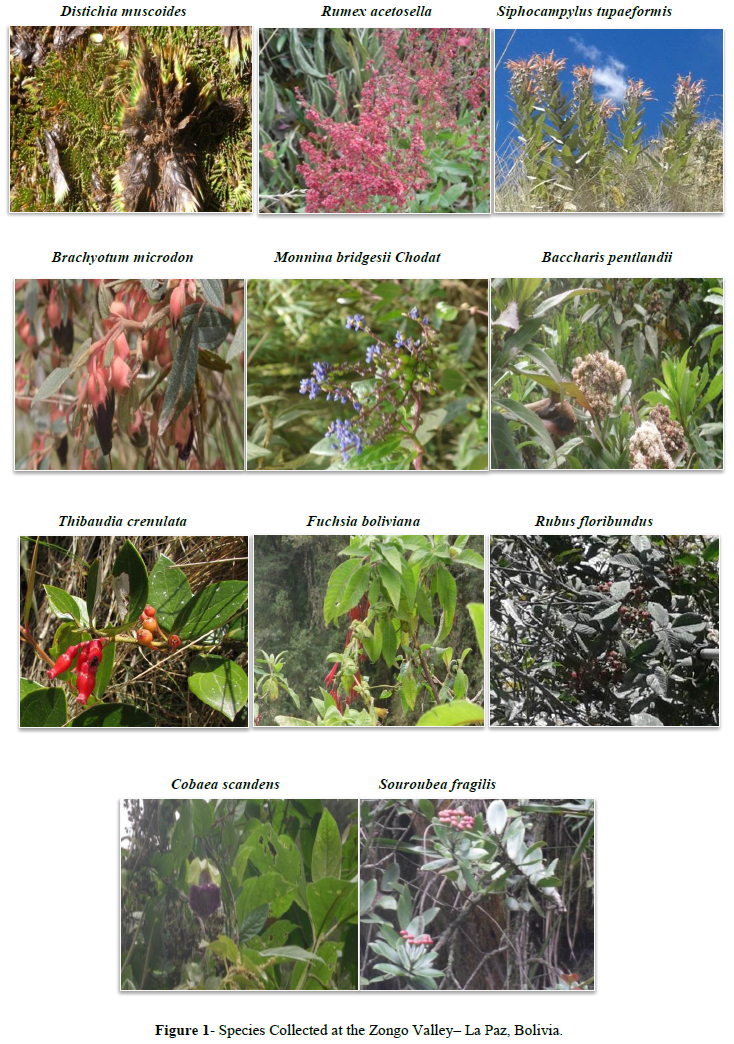
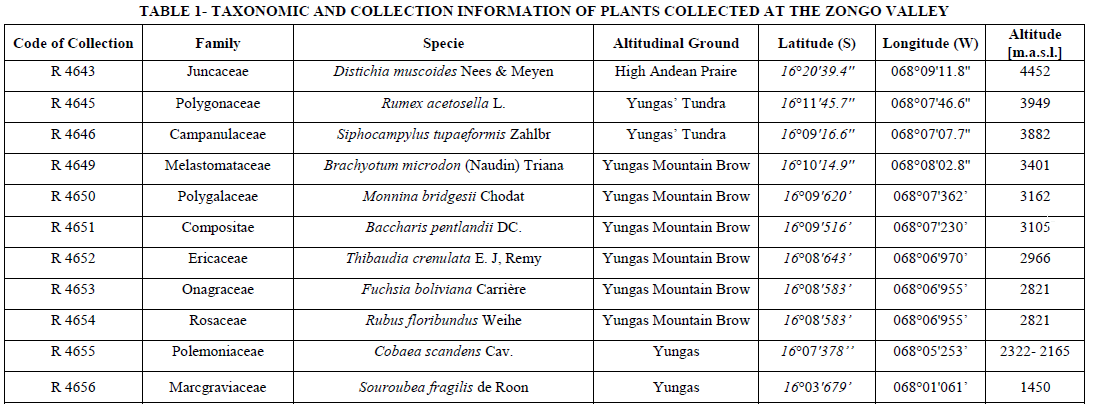
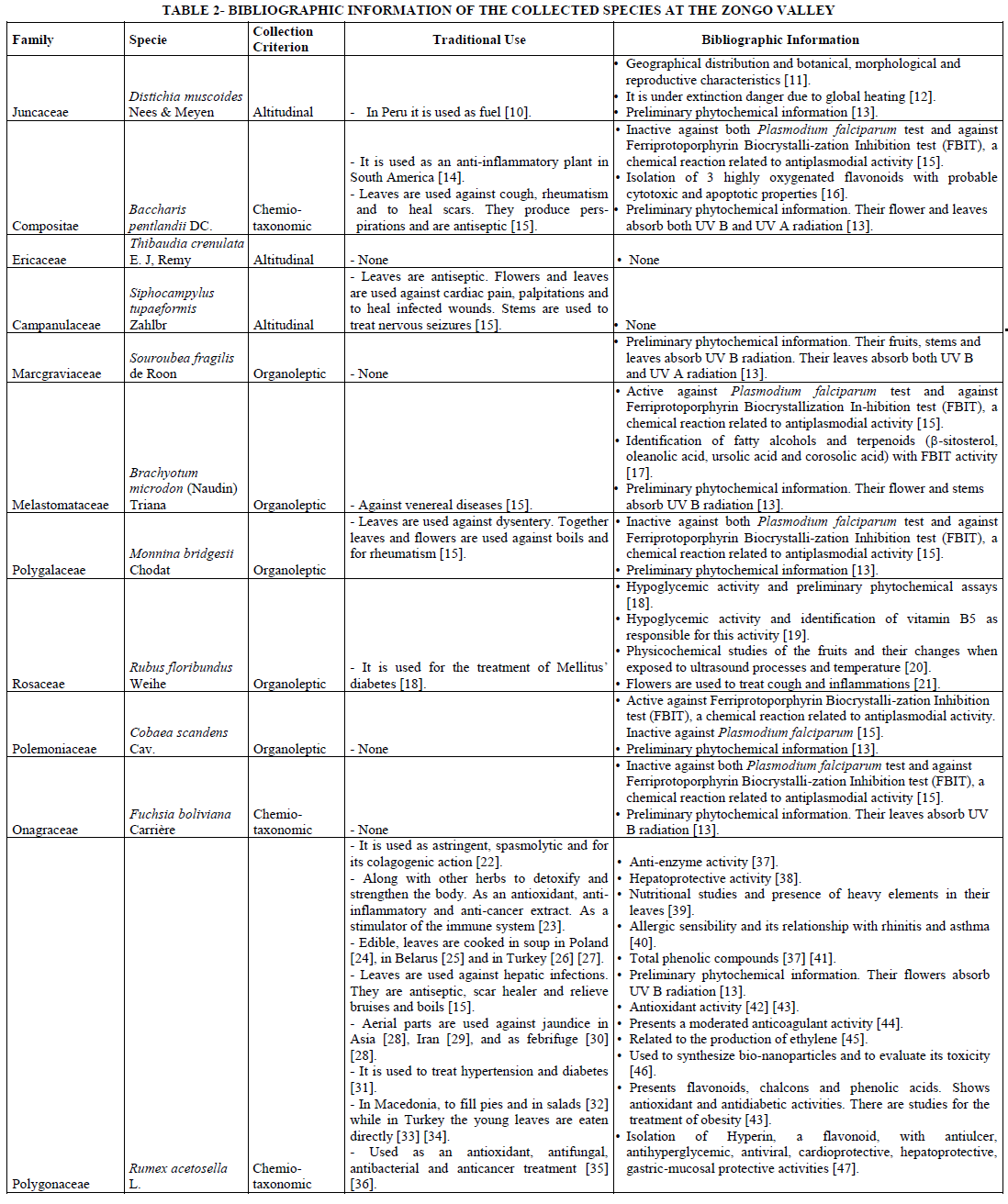
<body><![CDATA[<p align="justify"><font size="2" face="Verdana, Arial, Helvetica, sans-serif">A result value equal to 100 corresponds to the maximum free radical   trapping capacity and a value close to zero shows a reduced capacity [12].</font></p>     <p align="justify"><font size="2" face="Verdana, Arial, Helvetica, sans-serif"><b>2.5.&nbsp;&nbsp;&nbsp; Spectroscopic Study &ndash; UV absorptions</b></font></p>     <p align="justify"><font size="2" face="Verdana, Arial, Helvetica, sans-serif">For each ethereal or ethanolic dried extract, a series of sample   concentrations were prepared in solvent mixtures that range from petroleum   ether to methylene chloride - methanol to methanol - water. The concentrations   of the prepared samples were 100 ppm, 50 ppm or 25 ppm. The samples were   prepared at all concentrations depending on the collected amount of the plant   and their fractions&rsquo; yields. For each study, a target was run with the solvent   system used to dissolve the extract. The area below each absorption curve was   obtained from the curve&rsquo;s integration in the UV spectrum following the   equation:</font></p>     <p align=center><font size="2" face="Verdana, Arial, Helvetica, sans-serif"><img src="/img/revistas/riyd/v19n1/03_ecuacion_01.png" width="168" height="25"></font></p>     <p align="justify"><font size="2" face="Verdana, Arial, Helvetica, sans-serif">where </font><font size="2">&lambda;</font><font size="2" face="Verdana, Arial, Helvetica, sans-serif">: wavelength, in which 1&gt;2,&nbsp; <img width=8 height=11 src="/img/revistas/riyd/v19n1/a03_image003.gif">: average of studied absorbances.</font></p>     <p align="justify">&nbsp;</p>     <p align=justify><font size="3" face="Verdana, Arial, Helvetica, sans-serif"><b>3.&nbsp;&nbsp;&nbsp;&nbsp; RESULTS AND   DISCUSSION</b></font><font size="2" face="Verdana, Arial, Helvetica, sans-serif"><b>&nbsp;</b></font></p>     <p align="justify"><font size="2" face="Verdana, Arial, Helvetica, sans-serif"><b>3.1&nbsp;&nbsp;&nbsp; Collection of plant species</b></font></p>     <p align="justify"><font size="2" face="Verdana, Arial, Helvetica, sans-serif">The collected plants belong to eleven different species and families.   The species were collected at one of the following altitudinal stages in the   valley:&nbsp; High Andean prairie (from 4200 to 4800 m.a.s.l.), Yungas&rsquo; Tundra (from   3600 to 4200 m.a.s.l.), Yungas mountain brow (from 2800 to 3600 m.a.s.l.) and   Yungas (from 800 to 2800 m.a.s.l.) There is only one specimen belonging to the   High Andean prairie, two from the Yungas&rsquo; Tundra, six found in the Yungas   mountain brow and two appertain to the Yungas&rsquo; region. All collected species   present colorful organisms (flowers, fruits, leaves or aerial body).</font></p>     <p align="justify"><font size="2" face="Verdana, Arial, Helvetica, sans-serif">The eleven plants collected are shown in <a href="#f1">Figure 1</a> while <a href="#t1">Table 1</a> shows   the taxonomic information (family and specie) and the data acquired at the   collection site (altitudinal ground, coordinates and altitude) for each specie.     <a href="#t2">Table 2</a> presents a summary of the bibliographic information of each of the   collected specie as well as their traditional uses.&nbsp;</font></p>     ]]></body>
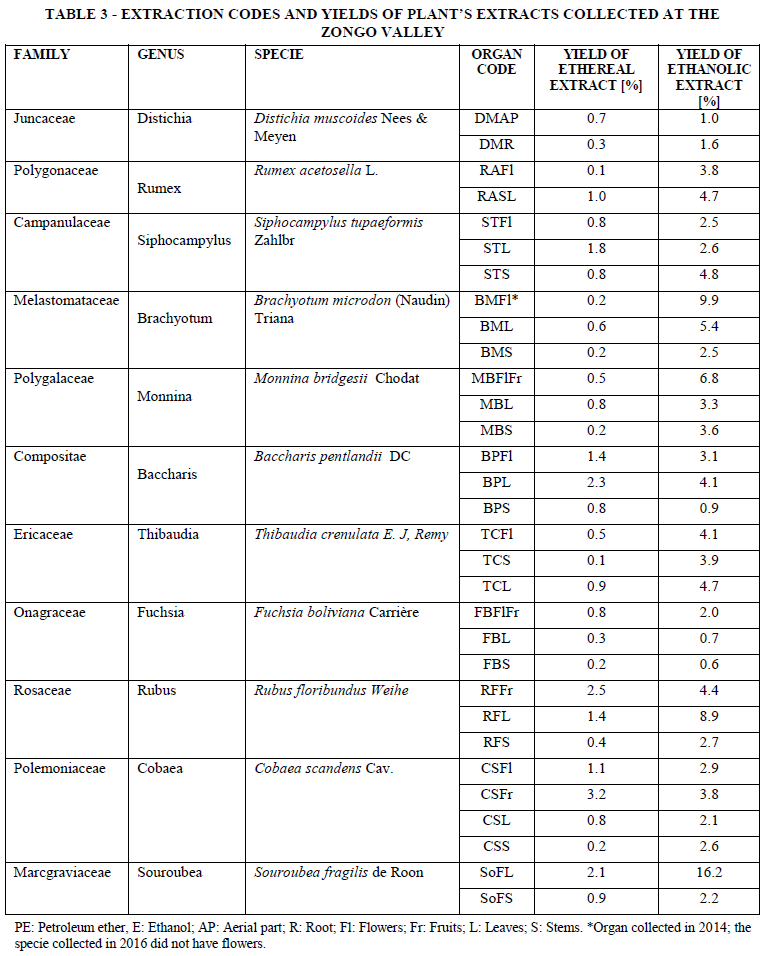
<body><![CDATA[<p align=justify><font size="2" face="Verdana, Arial, Helvetica, sans-serif"><b>3.2&nbsp;&nbsp;&nbsp; Extract preparation</b></font></p>     <p align="justify"><font size="2" face="Verdana, Arial, Helvetica, sans-serif">A total of sixty-two vegetal extracts were   obtained, thirty-one from the ethereal extraction and thirty-one with the   ethanolic procedure. <a href="#t3">Table 3</a> shows the summary of the extraction codes and the   yield of each organ&rsquo;s extract. It is important to highlight that for the   antioxidant assays only the ethanolic extract were tested since the ethereal   extracts were insoluble in the DPPH media. In addition, the tested extracts of <i>Brachyotum     microdon</i> flowers where those obtained in a previous collection (2014) since   in the collection trip for this publication (2016) we were unable to find this   plant with inflorescence.</font></p>     <p align="center"><a name="f1"></a><img src="/img/revistas/riyd/v19n1/03_figura_01.png" width="734" height="1044"></p>     <p align="center">&nbsp;</p>     <p align=center><a name="t1"></a><img src="/img/revistas/riyd/v19n1/a03_table_01.png" width="1093" height="408"></p>     <p align=center>&nbsp;</p>     <p align=center><a name="t2"></a><img src="/img/revistas/riyd/v19n1/a03_table_02.png" width="1098" height="1312"></p>     <p align=center>&nbsp;</p>     <p align=center><a name="t3"></a><img src="/img/revistas/riyd/v19n1/a03_table_03.png" width="767" height="956"></p>     <p align="justify"><font size="2" face="Verdana, Arial, Helvetica, sans-serif"><b>3.3 DPPH antioxidant assay</b></font></p>     ]]></body>
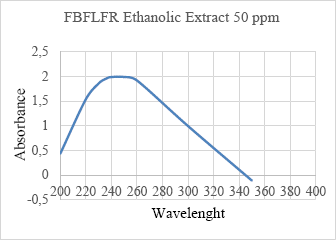
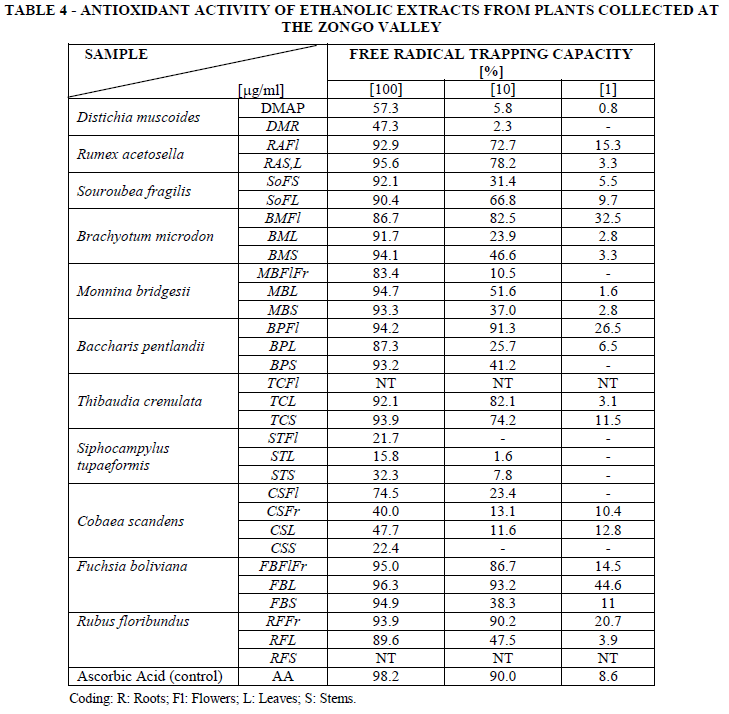
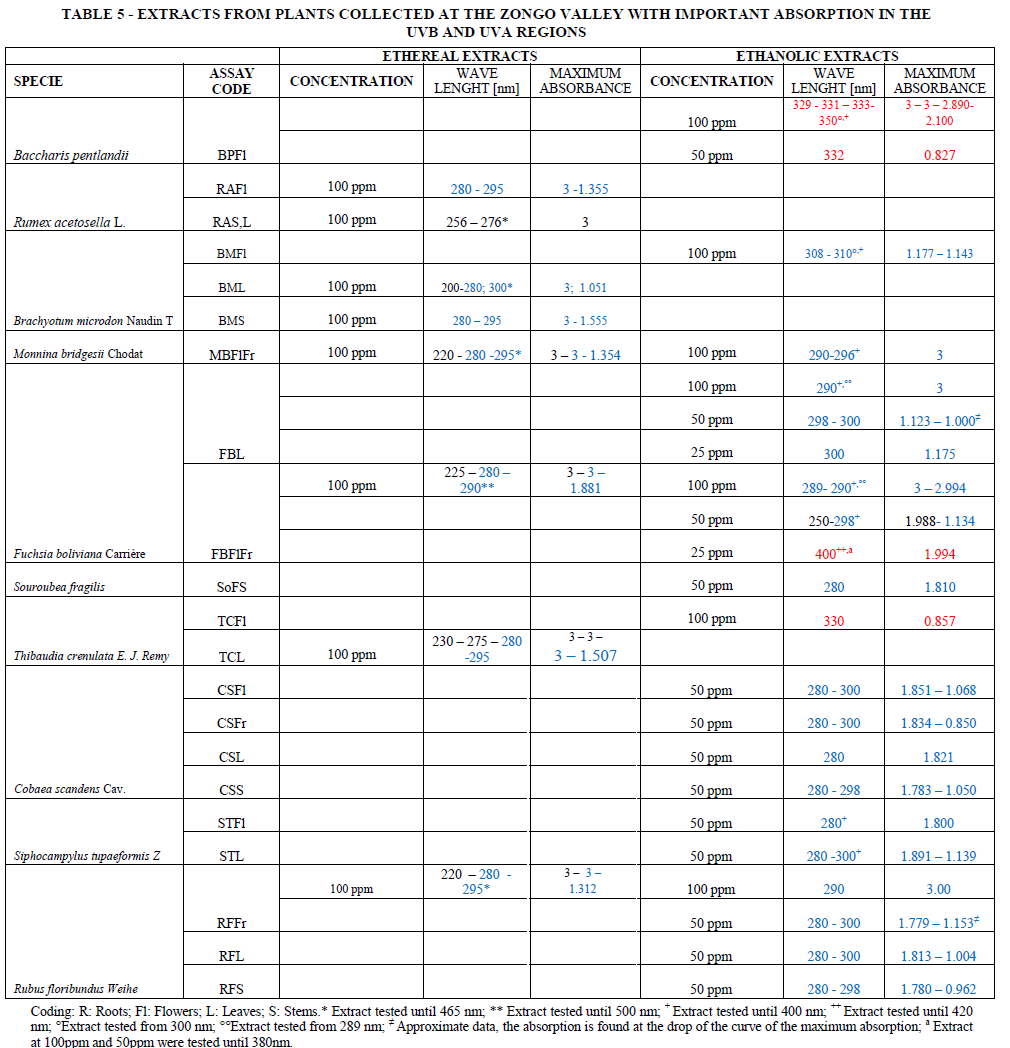
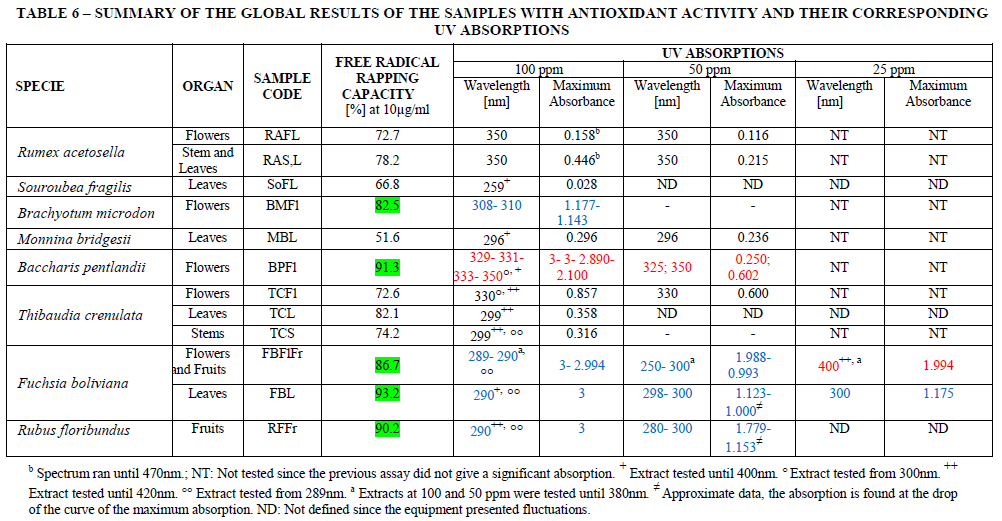
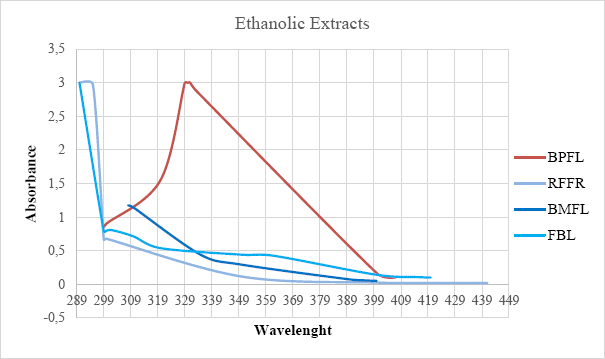
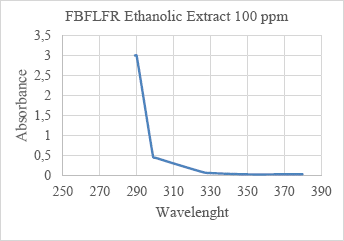
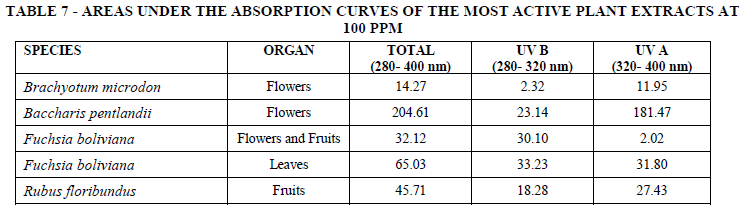
<body><![CDATA[<p align="justify"><font size="2" face="Verdana, Arial, Helvetica, sans-serif">The ethanolic extracts were evaluated with the DPPH test at 3   concentrations: 100, 10 and <a name="_Hlk8924109">1&micro;g/ml</a>. <a href="#t4">Table # 4</a> shows   the results of these antioxidant tests. As it can be seen, most of the extracts   present antioxidant activity at 100&micro;g/ml; however, the selection of interesting   samples must be done at lower concentrations as compared with the control   (ascorbic acid). Therefore, the extracts with interesting results (with   activities close to the control at 10&micro;g/ml) are: <i>Baccharis pentlandii</i> (flowers with 91.3% of free radicals trapping capacity), <i>Rubus floribundus</i> (fruits, 90.2%), <i>Fuchsia boliviana</i> (flowers and fruits, 86.7%), <i>Brachyotum     microdon</i> (flowers, 82.5%) and <i>Thibaudia crenulate</i> (leaves, 82.1%).   Nevertheless, <i>Fuchsia boliviana</i> (leaves) present a higher activity   (93.2%) compared to the control (ascorbic acid with 90.0%). These species could   have their minimum free radical trapping concentration between 10 and 1&micro;g/ml   presenting promising antioxidant activities.&nbsp; In addition, <i>Rumex acetosella</i>, <i>Thibaudia crenulate</i> and <i>Fuchsia boliviana</i> present good   antioxidant activities in various organs. Among these species, the genus <i>Baccharis</i> has reported important antioxidant activities which validates our assays and   presents this genus as a natural control for antioxidant tests [48], [49], [50], [51], [52], [53].</font></p>     <p align=justify><font size="2" face="Verdana, Arial, Helvetica, sans-serif"><b>3.4 Spectroscopic   studies</b></font><font size="2" face="Verdana, Arial, Helvetica, sans-serif"><b>&nbsp;</b></font></p>     <p align="justify"><font size="2" face="Verdana, Arial, Helvetica, sans-serif">It has been reported that HPLC and   spectrophotometric techniques (UV-Vis) are applied to monitor assays used to   analyze antioxidant capacities [4].   Based on this work, we have studied the absorption potential of the collected plants   and their photoprotective activities in the regions of 280 to 320nm (UV-B) and   between 320 to 400nm (UV-A). These spectroscopic studies were carried out using   a UV-VIS spectrophotometer and a wavelength window between 200 to 500 nm. <a href="#t5">Table   # 5</a> presents the samples that have important absorptions in the UV-A and UV-B   regions. Some samples were run at a smaller window than 200 to 500 nm and the   new window is specified in <a href="#t5">Table #5</a>. For exemplification purposes, the UV-B   absorptions are presented in blue while the UV-A ones are in red.</font></p>     <p align=justify><font size="2" face="Verdana, Arial, Helvetica, sans-serif"><a name="_Hlk10039895"><b>a.&nbsp;&nbsp;&nbsp;&nbsp; UV analysis for   ethereal extracts</b></a></font><font size="2" face="Verdana, Arial, Helvetica, sans-serif"><b>&nbsp;</b></font></p>     <p align="justify"><font size="2" face="Verdana, Arial, Helvetica, sans-serif">The 31 ethereal extracts were studied at 100 ppm in petroleum   ether-methylene chloride solvent mixtures.&nbsp;&nbsp; As shown in <a href="#t5">Table # 5</a>, the species   that present important UV-B absorptions are<i> Rumex acetosella</i> (flowers   and stems), <i>Brachyotum microdon</i> (leaves and stems), <i>Monnina bridgessi</i> (flowers/fruits), <i>Fuchsia boliviana</i> (flowers/fruits), <i>Thibaudia     crenulata </i>(leaves) and <i>Rubus floribundus</i> (fruits).</font></p>     <p align=justify><font size="2" face="Verdana, Arial, Helvetica, sans-serif"><b>b.&nbsp;&nbsp;&nbsp; UV analysis for   ethanolic extracts</b></font><font size="2" face="Verdana, Arial, Helvetica, sans-serif"><b>&nbsp;</b></font></p>     <p align="justify"><font size="2" face="Verdana, Arial, Helvetica, sans-serif">The 31 ethanolic extracts were studied at 100 ppm, some of the samples   were also tested at 50 and 25 ppm depending on the plant&rsquo;s collected amount.&nbsp;   As shown in <a href="#t5">Table # 5</a>, it is important to highlight <i>Fuchsia boliviana</i> (flowers/fruits) absorbing the UV-A and UV-B radiations. Other important   species are <i>Baccharis pentlandii</i> and <i>Thibaudia crenulata</i> whose   flowers absorb the dangerous UV-A radiation. The species that presents   interesting UV-B absorptions are: <i>Brachyotum microdon</i> (flowers), <i>Monnina     bridgessi</i> (flowers/fruits), <i>Siphocampylus tupaeformis</i> (flowers and   leaves), <i>Fuchsia boliviana</i> (leaves), <i>Souroubea fragilis</i> (stems), <i>Cobaea     scandens</i> (flowers, fruits, leaves and stems) and <i>Rubus floribundus</i> (fruits, leaves and stems). </font></p>     <p align="justify"><font size="2" face="Verdana, Arial, Helvetica, sans-serif"><b>3.5 Analysis of global results (Antioxidant activity and   Spectroscopic data)</b></font></p>     <p align="justify"><font size="2" face="Verdana, Arial, Helvetica, sans-serif">For comparative purposes, <a href="#t6">Table #6</a> presents a summary of the global   results of the samples with antioxidant activity and their corresponding UV   absorptions. As can be seen in this table, there is a strong correlation   between the antioxidant activity of a sample and its UV absorptions. Samples at   10&micro;g/ml with free radical trapping capacities above 83% present intense UV- A   or/and UV- B absorptions. In <a href="#t6">Table #6</a> and for exemplification purposes, DPPH   activities above 83% are highlighted in green, UV-B absorptions in blue and   UV-A absorptions in red. We can highlight the leaves of <i>Fuchsia boliviana</i> and the flowers of <i>Baccharis pentlandii</i> that present the highest DPPH   activity and the highest UV-B and UV-A absorptions, respectively. The fruits of <i>Rubus floribundus</i> are also important for having a DPPH activity above   90% and a high abortion (3.000) in the UV-B region. <a href="#f2">Figures #2</a> and <a href="#f3">#3</a> show the   absorption spectra of the active samples. In <a href="#f2">Figure #2</a> we can appreciate the   spectra of <i>Fuchsia boliviana</i> (leaves), <i>Baccharis pentlandii</i> (flowers), <i>Rubus floribundus</i> (fruits) and <i>Brachyotum microdon</i> (flowers) all run at 100 ppm.&nbsp;&nbsp;&nbsp; <a href="#f3">Figure #3</a> presents the UV absorptions of <i>Fuchsia     boliviana</i> (flowers and fruits) assessed at 100ppm and 50ppm. This specie   also has a very high DPPH value (91%) and strong absorptions in both UV-B and   UV-A regions. Finally, <a href="#t7">Table #7</a> presents the areas under the absorption curves   of the most active plant extracts at 100 ppm.</font></p>     <p align="center"><a name="t4"></a><img src="/img/revistas/riyd/v19n1/a03_table_04.png" width="729" height="714"></p>     ]]></body>
<body><![CDATA[<p align="center">&nbsp;</p>     <p align="center"><a name="t5"></a><img src="/img/revistas/riyd/v19n1/a03_table_05.png" width="1010" height="1048"></p>     <p align="center">&nbsp;</p>     <p align="center"><a name="t6"></a><img src="/img/revistas/riyd/v19n1/a03_table_06.png" width="1002" height="521"></p>     <p align="justify"><font size="2" face="Verdana, Arial, Helvetica, sans-serif"><b>&nbsp;</b></font></p>     <p align=center><font size="2" face="Verdana, Arial, Helvetica, sans-serif"><a name="f2"></a><img width=605 height=359 src="/img/revistas/riyd/v19n1/a03_figure_02.gif"></font></p>     <p align=center><font size="2" face="Verdana, Arial, Helvetica, sans-serif"><b>Figure 2</b>: UV spectra of the most active antioxidant samples run at 100ppm.</font></p>     <p align=center>&nbsp;</p> <font size="2" face="Verdana, Arial, Helvetica, sans-serif"><a name="f3"></a></font> <table width="600" border="0" align="center">   <tr>     <td valign="top">    <p><font size="2" face="Verdana, Arial, Helvetica, sans-serif"><img width=344 height=241 src="/img/revistas/riyd/v19n1/a03_figure_03.gif"></font></p>         <p><font size="2" face="Verdana, Arial, Helvetica, sans-serif">*Spectra run until 350nm.</font></p></td>     <td valign="top"><font size="2" face="Verdana, Arial, Helvetica, sans-serif"><img width=336 height=240 src="/img/revistas/riyd/v19n1/a03_figure_03_1.gif"></font></td>   </tr> </table>     ]]></body>
<body><![CDATA[<p align="center"><font size="2" face="Verdana, Arial, Helvetica, sans-serif">&nbsp;&nbsp;&nbsp;</font><font size="2" face="Verdana, Arial, Helvetica, sans-serif"><b>Figure 3</b>: UV spectra of <i>Fuchsia boliviana</i> (flowers and fruits) assessed at 100 and 50ppm*.</font></p>     <p align=center>&nbsp;</p>     <p align="center"><a name="t7"></a><img src="/img/revistas/riyd/v19n1/a03_table_07.png" width="741" height="212"></p>     <p align=justify>&nbsp;</p>     <p align=justify><font size="3" face="Verdana, Arial, Helvetica, sans-serif"><b>4.&nbsp;&nbsp;&nbsp;&nbsp; CONCLUSIONS</b></font></p>     <p align="justify"><font size="2" face="Verdana, Arial, Helvetica, sans-serif">Eleven plants were collected at the Zongo   valley that provided sixty two vegetal extracts, thirty one from the ethereal   extraction and thirty one with the ethanolic procedure.&nbsp; The ethanolic extracts   were essayed with the DPPH test in order to find antioxidant samples. In   addition, the UV absorptions of all extracts were also evaluated. Twelve   extracts showed free radical trapping capacity above 50% when tested at   10&micro;g/ml. The most active samples (activities above 83%) presented strong UV-B   (280- 320nnm) and/or UV-A (320- 400nm) absorptions. It is important to   highlight the leaves of <i>Fuchsia boliviana</i> with 93.2% in the DPPH assay   and with a strong absorption (3.000 A) in the UV-B region (290nm); the flowers   of <i>Baccharis pentlandii</i> (91.3% DPPH, 329-331nm/3A); the fruits of <i>Rubus     floribundus</i> (90.2% DPPH, 290nmn/3A); the flowers and fruits of <i>Fuchsia       boliviana</i> (86.7% DPPH, 289-291nm/3A; 400nm/2A) and the flowers of <i>Brachyotum         microdon</i> (82.5% DPPH, 308nm/1.2A). The ultraviolet absorptions of many of   the species submitted in this paper were previously reported [13].   Comparing the results from both publications we can define the best season to   collect the important species. For instance, <i>Brachyotum microdon</i> (flowers) should be collected in October (spring) while <i>Baccharis pentlandii</i> and <i>Fuchsia boliviana</i> in May (fall). Plants collected in the mentioned   season have higher UV-A and/or UV-B absorption. In addition, all the active   species present phenolic compounds, flavonoids, flavones and tannins in their   composition [13]. The antioxidant activities of these types of compounds were   previously presented in the work of Pisoschi et. al. [4]. Moreover, <i>Brachyotum     microdon</i> (flowers) also presents anthraquinones, anthocyanins, chalcones   and quinones while <i>Baccharis pentlandii</i> (flowers) and <i>Fuchsia     boliviana</i> (flowers and fruits) have chalcones and quinones. Finally, <i>Fucshia       boliviana</i> (flowers and fruits) also has anthraquinones and isoflavones [13]. These compounds could have biological activities since their molecular structures   are close to the active flavonoids and their biosynthetic pathways are those of   phenolic compounds (derived from shikimate) [54].</font></p>     <p align="justify"><font size="2" face="Verdana, Arial, Helvetica, sans-serif">Most of the plants have antioxidant compounds   as their main defense mechanisms; therefore, it is not surprising to find many   positive results in antioxidant evaluations in vitro [6]; however, if the   samples are evaluated at low concentrations (10 or 1&micro;g/ml) the most powerful   antioxidants can be detected. In this paper we report a strong correlation   between antioxidant activity evaluated by DPPH and UV absorptions. This DPPH/UV   technique could be used to preliminary screen vegetable samples and select   those with DPPH values above 83% and strong UV-A or UV-B absorptions. The   chosen samples, then can be evaluated with other more expensive in vitro assay   (TEAC, ABTS or FRAP) to finally confirm their activities with the in vivo   tests.</font></p>     <p align="justify"><font size="2" face="Verdana, Arial, Helvetica, sans-serif"><a name="_Hlk10724304">To our knowledge, this is the first time that   the antioxidant properties of <i>Distichia muscoides</i>, <i>Souroubea fragilis</i>, <i>Brachyotum microdon</i>, <i>Monnina bridgesii</i>, <i>Baccharis pentlandii</i>, <i>Thibaudia crenulata</i>, <i>Siphocampylus tupaeformis</i>, <i>Cobaea     scandens</i>, <i>Fuchsia boliviana</i> and <i>Rubus floribundus</i> are   reported. In addition, this is the first time that <i>Siphocampylus tupaeformis</i> and <i>Thibaudia cren</i></a><i>ulata</i> are presented in a publication.</font></p>     <p align="justify">&nbsp;</p>     <p align="justify"><font size="3" face="Verdana, Arial, Helvetica, sans-serif"><b>5.&nbsp;&nbsp;&nbsp;&nbsp; REFERENCES</b></font></p>     ]]></body>
<body><![CDATA[<p><font size="2" face="Verdana, Arial, Helvetica, sans-serif">[1] </font><font size="2" face="Verdana, Arial, Helvetica, sans-serif">R. Szymanska, P. Pospisil and J.   Kruk, &quot;Plant-Derived Antioxidants in Disease Prevention,&quot; <i>Oxidative     Medicine and Cellular Logevity , </i>no. Doi: <a href="http://doi.org/10.1155/2018/2068370" target="_blank">10.1155/2018/2068370</a>, 2018. </font></p>     <p><font size="2" face="Verdana, Arial, Helvetica, sans-serif">[2] </font><font size="2" face="Verdana, Arial, Helvetica, sans-serif">P. Rajendrana, N. Nandakumar, T.   Rengarajan, R. Palaniswamid, E. N. Gnanadhas, U. Lakshminarasaiah, J. Gopasb   and I. Nishigakia, &quot;Antioxidant and Human Diseases,&quot; <i>Clinica     Chimica Acta, </i>vol. 436, pp. 332-347, 2014. </font></p>     <p><font size="2" face="Verdana, Arial, Helvetica, sans-serif">[3] </font><font size="2" face="Verdana, Arial, Helvetica, sans-serif">K. Rahman, &quot;Studies on free   radicals, antioxidants, and cofactors,&quot; <i>Clin Interv Aging, , </i>vol.   2, p. 219&ndash;236, 2007. </font></p>     <p><font size="2" face="Verdana, Arial, Helvetica, sans-serif">[4] </font><font size="2" face="Verdana, Arial, Helvetica, sans-serif">A. M. Pisoschi, A. Pop, C.   Cimpeanu and G. Predoi, &quot;Antioxidant Capacity Determination in Plants   and Plant-Derived Products: A Review,&quot; <i>Oxid Med Cell Longev, </i>no.   Doi: <a href="http://doi.org/10.1155/2016/9130976" target="_blank">10.1155/2016/9130976</a>., 2016. </font></p>     <p><font size="2" face="Verdana, Arial, Helvetica, sans-serif">[5] </font><font size="2" face="Verdana, Arial, Helvetica, sans-serif">E. A. Shalaby and S. M. M.   Shanab, &quot;Antioxidant Compounds, Assays of Determination and Mode of   Action,&quot; <i>African Journal of Pharmacy and Pharmacology, </i>vol. 7,   pp. 528-539, 2013. </font></p>     <p><font size="2" face="Verdana, Arial, Helvetica, sans-serif">[6] </font><font size="2" face="Verdana, Arial, Helvetica, sans-serif">D. M. Kasote, S. S. Katyare, M.   V. Hegde and H. Bae, &quot;Significance of Antioxidant Potential of Plants   and its Relevance to Therapeutic Applications,&quot; <i>Int. J. Biol. Sci., </i>vol.   11, pp. 982- 991, 2015. </font></p>     <p><font size="2" face="Verdana, Arial, Helvetica, sans-serif">[7] </font><font size="2" face="Verdana, Arial, Helvetica, sans-serif">T. Ortu&ntilde;o, Estudio palinol&oacute;gico en un   gradiente altitudinal en el valle de Zongo. Tesis de   licenciatura en Biolog&iacute;a, La Paz- Bolivia: UMSA, 2000. </font></p>     <!-- ref --><p><font size="2" face="Verdana, Arial, Helvetica, sans-serif">[8] </font><font size="2" face="Verdana, Arial, Helvetica, sans-serif">M. Baudoin, Historia natural de un valle   de los Andes, La Paz: Instituto de Ecolog&iacute;a-UMSA, 1991. </font>&nbsp;&nbsp;&nbsp;&nbsp;&nbsp;&nbsp;&nbsp;&nbsp;[&#160;<a href="javascript:void(0);" onclick="javascript: window.open('/scielo.php?script=sci_nlinks&ref=971812&pid=S2518-4431201900010000300008&lng=','','width=640,height=500,resizable=yes,scrollbars=1,menubar=yes,');">Links</a>&#160;]<!-- end-ref --><p><font size="2" face="Verdana, Arial, Helvetica, sans-serif">[9] </font><font size="2" face="Verdana, Arial, Helvetica, sans-serif">M. Joyeaux, A. Lobstein, R. Anton   and F. Mortier, &quot;Comparative antilipoperoxidant, antinecrotic and   scavenging properties of terpenes and biflavones from Ginkgo and some   flavonoids,&quot; <i>Planta Med. , </i>vol. 61, pp. 126-129, 1995. </font></p>     <!-- ref --><p><font size="2" face="Verdana, Arial, Helvetica, sans-serif">[10] </font><font size="2" face="Verdana, Arial, Helvetica, sans-serif">H. Balslev, Flowering Plant.   Monocotyledons, Springer, 1998. </font>&nbsp;&nbsp;&nbsp;&nbsp;&nbsp;&nbsp;&nbsp;&nbsp;[&#160;<a href="javascript:void(0);" onclick="javascript: window.open('/scielo.php?script=sci_nlinks&ref=971814&pid=S2518-4431201900010000300010&lng=','','width=640,height=500,resizable=yes,scrollbars=1,menubar=yes,');">Links</a>&#160;]<!-- end-ref --><p><font size="2" face="Verdana, Arial, Helvetica, sans-serif">[11] </font><font size="2" face="Verdana, Arial, Helvetica, sans-serif">P. Gonz&aacute;les, M. Suni, R. Deanna, M. A.   Scaldaferro, E. Casta&ntilde;eda, D. W. Ramirez, N. Valencia and A. Cano,   &quot;Reproductive biology and cytogenetics of Distichia muscoides   (Juncaceae),&quot; <i>Bolet&iacute;n de la Sociedad Argentina de Bot&aacute;nica, </i>vol.   51, pp. 123-133, 2016. </font></p>     <p><font size="2" face="Verdana, Arial, Helvetica, sans-serif">[12] </font><font size="2" face="Verdana, Arial, Helvetica, sans-serif">S. Loza Herrera, R. I. Meneses and F.   Anthelme, &quot;Comunidades vegetales de los bofedales de la Cordillera Real   (Bolivia) bajo el calentamiento global / Plant communities of high-Andean   wetlands of the Cordillera Real (Bolivia) in the face of global   warming,&quot; <i>Ecolog&iacute;a en Bolivia, </i>vol. 50, pp. 39-56, 2015. </font></p>     <p><font size="2" face="Verdana, Arial, Helvetica, sans-serif">[13] </font><font size="2" face="Verdana, Arial, Helvetica, sans-serif">S. L. Ib&aacute;&ntilde;ez-Calero, K. E.   Loayza, E. L. Yapu, J. Lizarazu, R. Zeballos and T. Solares, &quot;A   Screening of Natural Colorants with probable antioxidant and/or   photo-protector activities,&quot; <i>Investigacion y Desarrollo, </i>vol. 16,   pp. 5-24, 2016. </font></p>     <p><font size="2" face="Verdana, Arial, Helvetica, sans-serif">[14] </font><font size="2" face="Verdana, Arial, Helvetica, sans-serif">M. Abad, A. Bessa, B. Ballarin,   O. Arag&oacute;n, E. Gonzales and P. Bermejo, &quot;Anti-inflammatory activity of   four Bolivian Baccharis species (Compositae),&quot; <i>J. Ethnopharmacol., </i>vol.   103, pp. 338-344, 2006. </font></p>     <p><font size="2" face="Verdana, Arial, Helvetica, sans-serif">[15] </font><font size="2" face="Verdana, Arial, Helvetica, sans-serif">S. L. Ib&aacute;&ntilde;ez-Calero, Application du test   d&rsquo;inhibition de la biocristallisation de l&acute;heme a la caracterisation de   composes antipaludiques isoles de la flore de Bolivie. Ph.D.   thesis, Toulouse- France: Universite Paul Sabatier, 2005. </font></p>     <p><font size="2" face="Verdana, Arial, Helvetica, sans-serif">[16] </font><font size="2" face="Verdana, Arial, Helvetica, sans-serif">S. Tarqui, Y. Flores and G.   Almanza, &quot;Polyoxygenated flavonoids from Baccharis pentlandii,&quot; <i>Revista     Boliviana de Qu&iacute;mica, </i>vol. 29, pp. 10- 14, 2012. </font></p>     <p><font size="2" face="Verdana, Arial, Helvetica, sans-serif">[17] </font><font size="2" face="Verdana, Arial, Helvetica, sans-serif">S. L. Ib&aacute;&ntilde;ez-Calero, V. Jullian,   S. C. d. M. L. R. Chevalley, J. Bravo, A. Gimenez and M. Sauvain,   &quot;Application of Ferriprotoporphyrin Biocrystallization Inhibition Test   to Find Antiplasmodial Compounds in the Flora of the Zongo Valley-   Bolivia,&quot; <i>Revista Boliviana de Qu&iacute;mica, </i>vol. 29, pp. 71-79, 2012. </font></p>     <p><font size="2" face="Verdana, Arial, Helvetica, sans-serif">[18] </font><font size="2" face="Verdana, Arial, Helvetica, sans-serif">F. R. P&eacute;rez Azahuanche, J. C. Guerrero   Hurtado, Z. M. Ortiz Rubio, F. Rodr&iacute;guez &Aacute;valos and G. Le&oacute;n Aponte,   &quot;An&aacute;lisis fitoqu&iacute;mico preliminar y evaluaci&oacute;n de la actividad   hipoglucemiante de Rubus loribundus Kunth (Rosaceae)   &quot;zarzamora&quot;,&quot; <i>Arnaldoa, </i>vol. 21, pp. 391- 401, 2014. </font></p>     <p><font size="2" face="Verdana, Arial, Helvetica, sans-serif">[19] </font><font size="2" face="Verdana, Arial, Helvetica, sans-serif">J. C. Guerrero Hurtado, G. Le&oacute;n Aponte,   F. R. P&eacute;rez Azahuanche, F. Rodr&iacute;guez &Aacute;valos and Z. M. Ortiz Rubio,   &quot;Aislamiento y caracterizaci&oacute;n estructural de los principios activos   hipoglucemiantes de Rubus floribundus Kunth (Rosaceae) &ldquo;zarzamora&quot;,&quot; <i>Arnaldoa, </i>vol. 22, pp. 381- 394, 2015. </font></p>     <p><font size="2" face="Verdana, Arial, Helvetica, sans-serif">[20] </font><font size="2" face="Verdana, Arial, Helvetica, sans-serif">C. V. P&eacute;rez Rodr&iacute;guez and F. R. P&eacute;rez   Azahuanche, &quot;La temperatura en las propiedades fisicoqu&iacute;micas, contenido   de vitamina C y recuento de mohos y levaduras del mesocarpio de &ldquo;zarzamora&rdquo;   Rubus floribundus kunth (Rosaceae),&quot; <i>Arnaldoa, </i>vol. 26, pp.   297-304, 2019. </font></p>     ]]></body>
<body><![CDATA[<p><font size="2" face="Verdana, Arial, Helvetica, sans-serif">[21] </font><font size="2" face="Verdana, Arial, Helvetica, sans-serif">I. H. Castillo Vera, Importancia   cultural de la flora silvestre utilizada por los pobladores del caser&iacute;o de   Cabrero en la microcuenca Quebrada Honda (Cajabamba, Cajamarca, Per&uacute;) TESIS   Para optar el Grado Acad&eacute;mico de Mag&iacute;ster en Bot&aacute;nica Tropical con menci&oacute;n en   Etnobot&aacute;nica, Lima-Peru: Universidad Nacional Mayor de San Marcos Universidad   del Per&uacute;, 2018. </font></p>     <p><font size="2" face="Verdana, Arial, Helvetica, sans-serif">[22] </font><font size="2" face="Verdana, Arial, Helvetica, sans-serif">M. Wegiera, H. Smolarz and   Bogucka-Kocka, &quot;Rumex L. species induce apoptosis in 1301, EOL-1 and H-9   cell lines,&quot; <i>A. Acta Pol Pharm., </i>vol. 69, pp. 487-499, 2012. </font></p>     <!-- ref --><p><font size="2" face="Verdana, Arial, Helvetica, sans-serif">[23] </font><font size="2" face="Verdana, Arial, Helvetica, sans-serif">N. C. Institute, &quot;PDQ Cancer   Information Summaries [Internet]. US. February 3, 2014.,&quot; US, USA, 2014.</font>&nbsp;&nbsp;&nbsp;&nbsp;&nbsp;&nbsp;&nbsp;&nbsp;[&#160;<a href="javascript:void(0);" onclick="javascript: window.open('/scielo.php?script=sci_nlinks&ref=971827&pid=S2518-4431201900010000300023&lng=','','width=640,height=500,resizable=yes,scrollbars=1,menubar=yes,');">Links</a>&#160;]<!-- end-ref --><p><font size="2" face="Verdana, Arial, Helvetica, sans-serif">[24] </font><font size="2" face="Verdana, Arial, Helvetica, sans-serif">&#321;. &#321;uczaj and W. Szyma&#324;ski,   &quot;Wild vascular plants gathered for consumption in the Polish   countryside: a review,&quot; <i>J Ethnobiol Ethnomed. , </i>vol. 15, pp.   3-17, 2007. </font></p>     <p><font size="2" face="Verdana, Arial, Helvetica, sans-serif">[25] </font><font size="2" face="Verdana, Arial, Helvetica, sans-serif">&#321;. &#321;uczaj, P. K&ouml;hler, E.   Piro&#380;nikow, M. Graniszewska, A. Pieroni and T. Gervasi, &quot;Wild edible   plants of Belarus: from Rostafi&#324;ski&rsquo;s questionnaire of 1883 to the   present,&quot; <i>J Ethnobiol Ethnomed, </i>no. doi: <a href="http://doi.org/10.1186/1746-4269-9-21" target="_blank">10.1186/1746-4269-9-21</a>,   2013. </font></p>     <p><font size="2" face="Verdana, Arial, Helvetica, sans-serif">[26] </font><font size="2" face="Verdana, Arial, Helvetica, sans-serif">S. K&uuml;lt&uuml;r, &quot;An ethnobotanical   study of K&#305;rklareli (Turkey),&quot; <i>Phytologia Balcanica, </i>vol. 14, p.   279 &ndash;289, 2008. </font></p>     <p><font size="2" face="Verdana, Arial, Helvetica, sans-serif">[27] </font><font size="2" face="Verdana, Arial, Helvetica, sans-serif">T. &Ouml;zen, &quot;Antioxidant   activity of wild edible plants in the Black Sea Region of Turkey,&quot; <i>Grasas     y aceites, </i>no. search.ebscohost.com. , 2010. </font></p>     <p><font size="2" face="Verdana, Arial, Helvetica, sans-serif">[28] </font><font size="2" face="Verdana, Arial, Helvetica, sans-serif">M. S. Amiri, M. R. Joharchi and   M. E. TaghavizadehYazdi, &quot;Ethno-Medicinal Plants Used to Cure Jaundice   by Traditional Healers of Mashhad, Iran,&quot; <i>Iranian Journal of     Pharmaceutical Research, </i>vol. 13, pp. 157-162, 2014. </font></p>     <p><font size="2" face="Verdana, Arial, Helvetica, sans-serif">[29] </font><font size="2" face="Verdana, Arial, Helvetica, sans-serif">D. Tewari, A. Mocan, E. D. Parvanov, A. N. Sah, S.   M. Nabavi, L. Huminiecki, Z. F. Ma, Y. Y. Lee, J. O. Horba&#324;czuk and A. G.   Atanasov, &quot;Ethnopharmacological Approaches for Therapy of Jaundice: Part   I,&quot; <i>Front Pharmacol., </i>no. doi: <a href="http://doi.org/10.3389/fphar.2017.0051" target="_blank">10.3389/fphar.2017.0051</a>, 2017. </font></p>     <p><font size="2" face="Verdana, Arial, Helvetica, sans-serif">[30] </font><font size="2" face="Verdana, Arial, Helvetica, sans-serif">M. S. Amiri, M. R. Joharchi and   M. E. TaghavizadehYazdi, &quot;Ethnobotanical investigation of traditional   medicinal plants commercialized in the markets of Mashhad, Iran,&quot; <i>Avicenna.     J Phytomed., </i>vol. 3, no. 3, p. 254&ndash;271, 2013. </font></p>     ]]></body>
<body><![CDATA[<p><font size="2" face="Verdana, Arial, Helvetica, sans-serif">[31] </font><font size="2" face="Verdana, Arial, Helvetica, sans-serif">W. Kipkore, B. Wanjohi, H. Rono   and G. Kigen, &quot;A study of the medicinal plants used by the Marakwet   Community in Kenya,&quot; <i>J. Ethnobiol. Ethnomed., </i>no. doi:   <a href="http://doi.org/10.1186/1746-4269-10-24" target="_blank">10.1186/1746-4269-10-24</a>, 2014. </font></p>     <p><font size="2" face="Verdana, Arial, Helvetica, sans-serif">[32] </font><font size="2" face="Verdana, Arial, Helvetica, sans-serif">A. Pieroni, B. Rexhepi, A.   Nedelcheva, A. Hajdari, B. Mustafa, V. Kolosova, K. Cianfaglione and C. L.   Quave, &quot;One century later: the folk botanical knowledge of the last   remaining Albanians of the upper Reka Valley, Mount Korab, Western   Macedonia,&quot; <i>J. Ethnobiol. Ethnomed., </i>no. doi:   <a href="http://doi.org/10.1186/1746-4269-9-22" target="_blank">10.1186/1746-4269-9-22</a>, 2013. </font></p>     <p><font size="2" face="Verdana, Arial, Helvetica, sans-serif">[33] </font><font size="2" face="Verdana, Arial, Helvetica, sans-serif">S. Ar&#305;, M. Temel, M. Karg&#305;o&#287;lu   and M. Konuk, &quot;Ethnobotanical survey of plants used in   Afyonkarahisar-Turkey,&quot; <i>J. Ethnobiol. Ethnomed., </i>no. doi:   <a href="http://doi.org/10.1186/s13002-015-0067-6" target="_blank">10.1186/s13002-015-0067-6</a>, 2015. </font></p>     <p><font size="2" face="Verdana, Arial, Helvetica, sans-serif">[34] </font><font size="2" face="Verdana, Arial, Helvetica, sans-serif">G. Tuttu, G. Abay and S.   Yildirimli, &quot;Some Wild Edible Plants of Tosya District (Kastamonu,   Turkey),&quot; <i>International Journal of Scientific and Technological     Research, </i>vol. 5, no. 3, pp. 129-135, 2019. </font></p>     <p><font size="2" face="Verdana, Arial, Helvetica, sans-serif">[35] </font><font size="2" face="Verdana, Arial, Helvetica, sans-serif">A. Vasas, O. Orb&aacute;n-Gyapai and J.   Hohmann, &quot;The genus Rumex: review of traditional uses, phytochemistry   and pharmacology,&quot; <i>J. Ethnopharmacol., </i>vol. 175, pp. 198- 228,   2015. </font></p>     <p><font size="2" face="Verdana, Arial, Helvetica, sans-serif">[36] </font><font size="2" face="Verdana, Arial, Helvetica, sans-serif">C. Lans, &quot;Do recent research   studies validate the medicinal plants used in British Columbia, Canada for   pet diseases and wild animals taken into temporary care?,&quot; <i>Journal of     Ethnopharmacology, </i>vol. 236, pp. 366-392, 2019. </font></p>     <p><font size="2" face="Verdana, Arial, Helvetica, sans-serif">[37] </font><font size="2" face="Verdana, Arial, Helvetica, sans-serif">D. Ahmed, Q. Mughal, S. Younas   and M. Ikram, &quot;Study of phenolic content and urease and alpha-amylase   inhibitory activities of methanolic extract of Rumex acetosella roots and its   sub-fractions in different solvents,&quot; <i>Pak. J. Pharm. Sci., </i>vol.   26, pp. 553-559, 2013, 2013. </font></p>     <p><font size="2" face="Verdana, Arial, Helvetica, sans-serif">[38] </font><font size="2" face="Verdana, Arial, Helvetica, sans-serif">N. Zarrin Sarhady, B. Ali   Mandegary, S. Fariba, M. Saeedeh and I. Maryam, &quot;Evaluation of the   hepatoprotective effects of Rumex acetosella on the carbon   tetrachloride-induced hepatotoxicity in rats,&quot; <i>Avicenna Journal of     Phytomedicine, </i>vol. 5, pp. 134-135, 2015. </font></p>     <p><font size="2" face="Verdana, Arial, Helvetica, sans-serif">[39] </font><font size="2" face="Verdana, Arial, Helvetica, sans-serif">S. Fatma Zerrin and C. Hale   Se&ccedil;ilmi&#351;, &quot;Determination of Heavy Metals and Nutrient Elements in Some   Medicinal Plants Used in Eski&#351;ehir,&quot; <i>Journal of Natural &amp; Applied     Sciences, </i>vol. 19, pp. 83-90, 2015. </font></p>     <p><font size="2" face="Verdana, Arial, Helvetica, sans-serif">[40] </font><font size="2" face="Verdana, Arial, Helvetica, sans-serif">O. Rodr&iacute;guez, R. C&eacute;lio, F. Aboukhair, A.   M. Laurrabaquio, I. O. Tinoco, H. U. Cuevas, M. A. Cruz Su&aacute;rez, M. A. Cruz   Marmolejo and M. C. Reyes, &quot;Prueba cut&aacute;nea con extractos alerg&eacute;nicos de   p&oacute;lenes y relaci&oacute;n con signos cl&iacute;nicos de rinitis al&eacute;rgica y asma bronquial   en Camag&uuml;ey, Cuba,&quot; <i>Revista Vacci Monitor (Vacunolog&iacute;a y Temas     Afines), </i>vol. 22, pp. 9-13, 2013. </font></p>     ]]></body>
<body><![CDATA[<p><font size="2" face="Verdana, Arial, Helvetica, sans-serif">[41] </font><font size="2" face="Verdana, Arial, Helvetica, sans-serif">L. Tejeda, Antioxidants in Andean   food and meals. PhD Thesis in Food Engineering, Lund: Lund University   Publications, 2013. </font></p>     <p><font size="2" face="Verdana, Arial, Helvetica, sans-serif">[42] </font><font size="2" face="Verdana, Arial, Helvetica, sans-serif">B. Zengin Kurt, I. Gazio&#287;lu, E.   Sevgi and F. S&ouml;nmez, &quot;Anticholinesterase, Antioxidant, Antiaflatoxigenic   Activities of Ten Edible Wild Plants from Ordu Area, Turkey, Iran,&quot; <i>J     Pharm Res., </i>vol. 17, no. 3, p. 1047&ndash;1056, 2018. </font></p>     <p><font size="2" face="Verdana, Arial, Helvetica, sans-serif">[43] </font><font size="2" face="Verdana, Arial, Helvetica, sans-serif">S. Sekhon-Loodu and H. P.   Rupasinghe, &quot;Evaluation of antioxidant, antidiabetic and antiobesity   potential of selected traditional medicinal plants,&quot; <i>Frontiers in     nutrition, </i>no. <a href="http://doi.org/10.3389/fnut.2019.00053" target="_blank">doi.org/10.3389/fnut.2019.00053</a>, 2019. </font></p>     <p><font size="2" face="Verdana, Arial, Helvetica, sans-serif">[44] </font><font size="2" face="Verdana, Arial, Helvetica, sans-serif">M. Alikhani Pour, S. Sardari, A. Eslamifar,   A. Azhar, M. Rezvani and M. Nazari, &quot;Cheminformatics-Based Anticoagulant   Study of Traditionally Used Medicinal Plants,&quot; <i>Iran Biomed. J. , </i>vol.   21, no. 6, p. 400&ndash;405, 2017. </font></p>     <p><font size="2" face="Verdana, Arial, Helvetica, sans-serif">[45] </font><font size="2" face="Verdana, Arial, Helvetica, sans-serif">M. Banga, E. J. Slaa, C. W. P. M.   Blom and L. A. C. J. Voesenek, &quot;Ethylene Biosynthesis and Accumulation   under Drained and Submerged Conditions (A Comparative Study of Two Rumex   Species),&quot; <i>Plant Physiol. , </i>vol. 112, no. 1, p. 229&ndash;237, 1996. </font></p>     <p><font size="2" face="Verdana, Arial, Helvetica, sans-serif">[46] </font><font size="2" face="Verdana, Arial, Helvetica, sans-serif">I. Khan, A. Bahuguna, M.   Krishnan, S. Shukla, H. Lee, S. Min, D. Kyu Choi, Y. Cho, V. K. Bajpai, Y.   Suk Huh and S. Chul Kang, &quot;The effect of biogenic manufactured silver   nanoparticles on human endothelial cells and zebrafish model,&quot; <i>Science     of the Total Environment, </i>vol. 679, p. 365&ndash;377, 2019. </font></p>     <p><font size="2" face="Verdana, Arial, Helvetica, sans-serif">[47] </font><font size="2" face="Verdana, Arial, Helvetica, sans-serif">N. Verma, A. Pratap Singh and C.   V. Rao, &quot;Antioxidant mediated ulcer healing potential of hyperin   isolated from flowers of rhododendron arboreum in experimental rat,&quot; <i>International     journal of pharmaceutical sciences and research, </i>vol. 10, no. 3, pp.   1524- 1533, 2019. </font></p>     <p><font size="2" face="Verdana, Arial, Helvetica, sans-serif">[48] </font><font size="2" face="Verdana, Arial, Helvetica, sans-serif">S. Q. De Oliveira, F. Dal-Pizzol,   J. C. F. Moreira, E. P. Schenkel and G. Gosmann, &quot;Antioxidant activity   of Baccharis spicata, Baccharis trimera and Baccharis usterii,&quot; <i>Acta     Farm. Bonaerense, </i>vol. 23, no. 3, pp. 365-368, 2004. </font></p>     <p><font size="2" face="Verdana, Arial, Helvetica, sans-serif">[49] </font><font size="2" face="Verdana, Arial, Helvetica, sans-serif">C. B. De Oliveira, L. N.   Comunello, A. Lunardelli, R. H. Amaral, M. G. S. Pires, G. L. Da Silva, V.   Manfredini, C. Regla Vargas, S. C. B. Gnoatto, J. R. De Oliveira and G.   Gosmann, &quot;Phenolic Enriched Extract of Baccharis trimera Presents   Anti-inflammatory and Antioxidant Activities,&quot; <i>Molecules, </i>vol.   17, no. 1, pp. 1113-1123, 2012. </font></p>     <p><font size="2" face="Verdana, Arial, Helvetica, sans-serif">[50] </font><font size="2" face="Verdana, Arial, Helvetica, sans-serif">S. Q. De Oliveira, F. Dal-Pizzol,   G. Gosmann, D. Guillaume, J. C. F. Moreira and E. P. Schenkel,   &quot;Antioxidant Activity of Baccharis articulata Extracts: Isolation of a   New Compound with Antioxidant Activity,&quot; <i>Free Radical Research, </i>vol.   37, no. 5, pp. 555-559, 2003. </font></p>     ]]></body>
<body><![CDATA[<p><font size="2" face="Verdana, Arial, Helvetica, sans-serif">[51] </font><font size="2" face="Verdana, Arial, Helvetica, sans-serif">B. Da Cruz P&aacute;dua, L. D. Silva, J.   V. Rossoni J&uacute;nior, J. L. Humberto, M. Martins Chaves, M. E. Silva, M. L.   Pedrosa and D. Caldeira Costa, &quot;Antioxidant properties of Baccharis   trimerain the neutrophils of Fisher rats,&quot; <i>Journal of     Ethnopharmacology, </i>vol. 129, no. 3, pp. 381-386, 2010. </font></p>     <p><font size="2" face="Verdana, Arial, Helvetica, sans-serif">[52] </font><font size="2" face="Verdana, Arial, Helvetica, sans-serif">M. J. Simirgiotis, C. Quispe, J.   B&oacute;rquez, A. Mocan and B. Sep&uacute;lveda, &quot;High resolution metabolite   fingerprinting of the resin of Baccharis tola Phil. from the Atacama Desert   and its antioxidant capacities,&quot; <i>Industrial Crops and Products, </i>vol.   94, pp. 368-375, 2016. </font></p>     <p><font size="2" face="Verdana, Arial, Helvetica, sans-serif">[53] </font><font size="2" face="Verdana, Arial, Helvetica, sans-serif">S. M. Sabir, M. L. Athayde, A. A.   Boligon and J. B. T. Rocha, &quot;Antioxidant activities and phenolic profile   of Baccharis trimera, a commonly used medicinal plant from Brazil,&quot; <i>South     African Journal of Botany, </i>vol. 113, pp. Pages 318-323, 2017. </font></p>     <p><font size="2" face="Verdana, Arial, Helvetica, sans-serif">[54] </font><font size="2" face="Verdana, Arial, Helvetica, sans-serif">J. Mann, Secondary Metabolism,   2nd edition, Oxford: Oxford Science Publications, 1992. </font></p>     <p align="justify">&nbsp;</p>      ]]></body><back>
<ref-list>
<ref id="B1">
<label>1</label><nlm-citation citation-type="journal">
<person-group person-group-type="author">
<name>
<surname><![CDATA[Szymanska]]></surname>
<given-names><![CDATA[R.]]></given-names>
</name>
<name>
<surname><![CDATA[Pospisil]]></surname>
<given-names><![CDATA[P.]]></given-names>
</name>
<name>
<surname><![CDATA[Kruk]]></surname>
<given-names><![CDATA[J.]]></given-names>
</name>
</person-group>
<article-title xml:lang="en"><![CDATA[Plant-Derived Antioxidants in Disease Prevention]]></article-title>
<source><![CDATA[Oxidative Medicine and Cellular Longevity]]></source>
<year>2018</year>
</nlm-citation>
</ref>
<ref id="B2">
<label>2</label><nlm-citation citation-type="journal">
<person-group person-group-type="author">
<name>
<surname><![CDATA[Rajendrana]]></surname>
<given-names><![CDATA[P.]]></given-names>
</name>
<name>
<surname><![CDATA[Nandakumar]]></surname>
<given-names><![CDATA[N.]]></given-names>
</name>
<name>
<surname><![CDATA[Rengarajan]]></surname>
<given-names><![CDATA[T.]]></given-names>
</name>
<name>
<surname><![CDATA[Palaniswamid]]></surname>
<given-names><![CDATA[R.]]></given-names>
</name>
<name>
<surname><![CDATA[Gnanadhas]]></surname>
<given-names><![CDATA[E.N.]]></given-names>
</name>
<name>
<surname><![CDATA[Lakshminarasaiah]]></surname>
<given-names><![CDATA[U.]]></given-names>
</name>
<name>
<surname><![CDATA[Gopasb]]></surname>
<given-names><![CDATA[J.]]></given-names>
</name>
<name>
<surname><![CDATA[Nishigakia]]></surname>
<given-names><![CDATA[I.]]></given-names>
</name>
</person-group>
<article-title xml:lang="en"><![CDATA[Antioxidant and Human Diseases]]></article-title>
<source><![CDATA[Clinica Chimica Acta]]></source>
<year>2014</year>
<volume>436</volume>
<page-range>332-347</page-range></nlm-citation>
</ref>
<ref id="B3">
<label>3</label><nlm-citation citation-type="journal">
<person-group person-group-type="author">
<name>
<surname><![CDATA[Rahman]]></surname>
<given-names><![CDATA[K.]]></given-names>
</name>
</person-group>
<article-title xml:lang="en"><![CDATA[Studies on free radicals, antioxidants, and cofactors]]></article-title>
<source><![CDATA[Clin Interv Aging]]></source>
<year>2007</year>
<volume>2</volume>
<page-range>219236</page-range></nlm-citation>
</ref>
<ref id="B4">
<label>4</label><nlm-citation citation-type="journal">
<person-group person-group-type="author">
<name>
<surname><![CDATA[Pisoschi]]></surname>
<given-names><![CDATA[A.M.]]></given-names>
</name>
<name>
<surname><![CDATA[Pop]]></surname>
<given-names><![CDATA[A.]]></given-names>
</name>
<name>
<surname><![CDATA[Cimpeanu]]></surname>
<given-names><![CDATA[C.]]></given-names>
</name>
<name>
<surname><![CDATA[Predoi]]></surname>
<given-names><![CDATA[G.]]></given-names>
</name>
</person-group>
<article-title xml:lang="en"><![CDATA[Antioxidant Capacity Determination in Plants and Plant-Derived Products: A Review]]></article-title>
<source><![CDATA[Oxid Med Cell Longev]]></source>
<year>2016</year>
</nlm-citation>
</ref>
<ref id="B5">
<label>5</label><nlm-citation citation-type="journal">
<person-group person-group-type="author">
<name>
<surname><![CDATA[Shalaby]]></surname>
<given-names><![CDATA[E.A.]]></given-names>
</name>
<name>
<surname><![CDATA[Shanab]]></surname>
<given-names><![CDATA[S.M.M.]]></given-names>
</name>
</person-group>
<article-title xml:lang="en"><![CDATA[Antioxidant Compounds, Assays of Determination and Mode of Action]]></article-title>
<source><![CDATA[African Journal of Pharmacy and Pharmacology]]></source>
<year>2013</year>
<volume>7</volume>
<page-range>528-539</page-range></nlm-citation>
</ref>
<ref id="B6">
<label>6</label><nlm-citation citation-type="journal">
<person-group person-group-type="author">
<name>
<surname><![CDATA[Kasote]]></surname>
<given-names><![CDATA[D.M.]]></given-names>
</name>
<name>
<surname><![CDATA[Katyare]]></surname>
<given-names><![CDATA[S.S.]]></given-names>
</name>
<name>
<surname><![CDATA[Hegde]]></surname>
<given-names><![CDATA[M.V.]]></given-names>
</name>
<name>
<surname><![CDATA[Bae]]></surname>
<given-names><![CDATA[H.]]></given-names>
</name>
</person-group>
<article-title xml:lang="en"><![CDATA[Significance of Antioxidant Potential of Plants and its Relevance to Therapeutic Applications]]></article-title>
<source><![CDATA[Int. J. Biol. Sci.]]></source>
<year>2015</year>
<volume>11</volume>
<page-range>982- 991</page-range></nlm-citation>
</ref>
<ref id="B7">
<label>7</label><nlm-citation citation-type="">
<person-group person-group-type="author">
<name>
<surname><![CDATA[Ortuño]]></surname>
<given-names><![CDATA[T.]]></given-names>
</name>
</person-group>
<source><![CDATA[Estudio palinológico en un gradiente altitudinal en el valle de Zongo]]></source>
<year>2000</year>
</nlm-citation>
</ref>
<ref id="B8">
<label>8</label><nlm-citation citation-type="book">
<person-group person-group-type="author">
<name>
<surname><![CDATA[Baudoin]]></surname>
<given-names><![CDATA[M.]]></given-names>
</name>
</person-group>
<source><![CDATA[Historia natural de un valle de los Andes]]></source>
<year>1991</year>
<publisher-loc><![CDATA[La Paz ]]></publisher-loc>
<publisher-name><![CDATA[Instituto de Ecología-UMSA]]></publisher-name>
</nlm-citation>
</ref>
<ref id="B9">
<label>9</label><nlm-citation citation-type="journal">
<person-group person-group-type="author">
<name>
<surname><![CDATA[Joyeaux]]></surname>
<given-names><![CDATA[M.]]></given-names>
</name>
<name>
<surname><![CDATA[Lobstein]]></surname>
<given-names><![CDATA[A.]]></given-names>
</name>
<name>
<surname><![CDATA[Anton]]></surname>
<given-names><![CDATA[R.]]></given-names>
</name>
<name>
<surname><![CDATA[Mortier]]></surname>
<given-names><![CDATA[F.]]></given-names>
</name>
</person-group>
<article-title xml:lang="en"><![CDATA[Comparative antilipoperoxidant, antinecrotic and scavenging properties of terpenes and biflavones from Ginkgo and some flavonoids]]></article-title>
<source><![CDATA[Planta Med.]]></source>
<year>1995</year>
<volume>61</volume>
<page-range>126-129</page-range></nlm-citation>
</ref>
<ref id="B10">
<label>10</label><nlm-citation citation-type="book">
<person-group person-group-type="author">
<name>
<surname><![CDATA[Balslev]]></surname>
<given-names><![CDATA[H.]]></given-names>
</name>
</person-group>
<source><![CDATA[Flowering Plant. Monocotyledons]]></source>
<year>1998</year>
<publisher-name><![CDATA[Springer]]></publisher-name>
</nlm-citation>
</ref>
<ref id="B11">
<label>11</label><nlm-citation citation-type="journal">
<person-group person-group-type="author">
<name>
<surname><![CDATA[Gonzáles]]></surname>
<given-names><![CDATA[P.]]></given-names>
</name>
<name>
<surname><![CDATA[Suni]]></surname>
<given-names><![CDATA[M.]]></given-names>
</name>
<name>
<surname><![CDATA[Deanna]]></surname>
<given-names><![CDATA[R.]]></given-names>
</name>
<name>
<surname><![CDATA[Scaldaferro]]></surname>
<given-names><![CDATA[M.A.]]></given-names>
</name>
<name>
<surname><![CDATA[Castañeda]]></surname>
<given-names><![CDATA[E.]]></given-names>
</name>
<name>
<surname><![CDATA[Ramirez]]></surname>
<given-names><![CDATA[D.W.]]></given-names>
</name>
<name>
<surname><![CDATA[Valencia]]></surname>
<given-names><![CDATA[N.]]></given-names>
</name>
<name>
<surname><![CDATA[Cano]]></surname>
<given-names><![CDATA[A.]]></given-names>
</name>
</person-group>
<article-title xml:lang="en"><![CDATA[Reproductive biology and cytogenetics of Distichia muscoides (Juncaceae)]]></article-title>
<source><![CDATA[Boletín de la Sociedad Argentina de Botánica]]></source>
<year>2016</year>
<volume>51</volume>
<page-range>123-133</page-range></nlm-citation>
</ref>
<ref id="B12">
<label>12</label><nlm-citation citation-type="journal">
<person-group person-group-type="author">
<name>
<surname><![CDATA[Loza Herrera]]></surname>
<given-names><![CDATA[S.]]></given-names>
</name>
<name>
<surname><![CDATA[Meneses]]></surname>
<given-names><![CDATA[R.I.]]></given-names>
</name>
<name>
<surname><![CDATA[Anthelme]]></surname>
<given-names><![CDATA[F.]]></given-names>
</name>
</person-group>
<article-title xml:lang="es"><![CDATA[Comunidades vegetales de los bofedales de la Cordillera Real (Bolivia) bajo el calentamiento global / Plant communities of high-Andean wetlands of the Cordillera Real (Bolivia) in the face of global warming]]></article-title>
<source><![CDATA[Ecología en Bolivia]]></source>
<year>2015</year>
<volume>50</volume>
<page-range>39-56</page-range></nlm-citation>
</ref>
<ref id="B13">
<label>13</label><nlm-citation citation-type="journal">
<person-group person-group-type="author">
<name>
<surname><![CDATA[Ibáñez-Calero]]></surname>
<given-names><![CDATA[S.L.]]></given-names>
</name>
<name>
<surname><![CDATA[Loayza]]></surname>
<given-names><![CDATA[K.E.]]></given-names>
</name>
<name>
<surname><![CDATA[Yapu]]></surname>
<given-names><![CDATA[E.L.]]></given-names>
</name>
<name>
<surname><![CDATA[Lizarazu]]></surname>
<given-names><![CDATA[J.]]></given-names>
</name>
<name>
<surname><![CDATA[Zeballos]]></surname>
<given-names><![CDATA[R.]]></given-names>
</name>
<name>
<surname><![CDATA[Solares]]></surname>
<given-names><![CDATA[T.]]></given-names>
</name>
</person-group>
<article-title xml:lang="en"><![CDATA[A Screening of Natural Colorants with probable antioxidant and/or photo-protector activities]]></article-title>
<source><![CDATA[Investigacion y Desarrollo]]></source>
<year>2016</year>
<volume>16</volume>
<page-range>5-24</page-range></nlm-citation>
</ref>
<ref id="B14">
<label>14</label><nlm-citation citation-type="journal">
<person-group person-group-type="author">
<name>
<surname><![CDATA[Abad]]></surname>
<given-names><![CDATA[M.]]></given-names>
</name>
<name>
<surname><![CDATA[Bessa]]></surname>
<given-names><![CDATA[A.]]></given-names>
</name>
<name>
<surname><![CDATA[Ballarin]]></surname>
<given-names><![CDATA[B.]]></given-names>
</name>
<name>
<surname><![CDATA[Aragón]]></surname>
<given-names><![CDATA[O.]]></given-names>
</name>
<name>
<surname><![CDATA[Gonzales]]></surname>
<given-names><![CDATA[E.]]></given-names>
</name>
<name>
<surname><![CDATA[Bermejo]]></surname>
<given-names><![CDATA[P.]]></given-names>
</name>
</person-group>
<article-title xml:lang="en"><![CDATA[Anti-inflammatory activity of four Bolivian Baccharis species (Compositae)]]></article-title>
<source><![CDATA[J. Ethnopharmacol.]]></source>
<year>2006</year>
<volume>103</volume>
<page-range>338-344</page-range></nlm-citation>
</ref>
<ref id="B15">
<label>15</label><nlm-citation citation-type="">
<person-group person-group-type="author">
<name>
<surname><![CDATA[Ibáñez-Calero]]></surname>
<given-names><![CDATA[S.L.]]></given-names>
</name>
</person-group>
<source><![CDATA[Application du test d&#8217;inhibition de la biocristallisation de l´heme a la caracterisation de composes antipaludiques isoles de la flore de Bolivie]]></source>
<year>2005</year>
</nlm-citation>
</ref>
<ref id="B16">
<label>16</label><nlm-citation citation-type="journal">
<person-group person-group-type="author">
<name>
<surname><![CDATA[Tarqui]]></surname>
<given-names><![CDATA[S.]]></given-names>
</name>
<name>
<surname><![CDATA[Flores]]></surname>
<given-names><![CDATA[Y.]]></given-names>
</name>
<name>
<surname><![CDATA[Almanza]]></surname>
<given-names><![CDATA[G.]]></given-names>
</name>
</person-group>
<article-title xml:lang="en"><![CDATA[Polyoxygenated flavonoids from Baccharis pentlandii]]></article-title>
<source><![CDATA[Revista Boliviana de Química]]></source>
<year>2012</year>
<volume>29</volume>
<page-range>10-14</page-range></nlm-citation>
</ref>
<ref id="B17">
<label>17</label><nlm-citation citation-type="journal">
<person-group person-group-type="author">
<name>
<surname><![CDATA[Ibáñez-Calero]]></surname>
<given-names><![CDATA[S.L.]]></given-names>
</name>
<name>
<surname><![CDATA[Jullian]]></surname>
<given-names><![CDATA[V.]]></given-names>
</name>
<name>
<surname><![CDATA[Chevalley]]></surname>
<given-names><![CDATA[S.C. d. M.L.R.]]></given-names>
</name>
<name>
<surname><![CDATA[Bravo]]></surname>
<given-names><![CDATA[J.]]></given-names>
</name>
<name>
<surname><![CDATA[Gimenez]]></surname>
<given-names><![CDATA[A.]]></given-names>
</name>
<name>
<surname><![CDATA[Sauvain]]></surname>
<given-names><![CDATA[M.]]></given-names>
</name>
</person-group>
<article-title xml:lang="en"><![CDATA[Application of Ferriprotoporphyrin Biocrystallization Inhibition Test to Find Antiplasmodial Compounds in the Flora of the Zongo Valley- Bolivia]]></article-title>
<source><![CDATA[Revista Boliviana de Química]]></source>
<year>2012</year>
<volume>29</volume>
<page-range>71-79</page-range></nlm-citation>
</ref>
<ref id="B18">
<label>18</label><nlm-citation citation-type="journal">
<person-group person-group-type="author">
<name>
<surname><![CDATA[Pérez Azahuanche]]></surname>
<given-names><![CDATA[F.R.]]></given-names>
</name>
<name>
<surname><![CDATA[Guerrero Hurtado]]></surname>
<given-names><![CDATA[J.C.]]></given-names>
</name>
<name>
<surname><![CDATA[Ortiz Rubio]]></surname>
<given-names><![CDATA[Z.M.]]></given-names>
</name>
<name>
<surname><![CDATA[Rodríguez Ávalos]]></surname>
<given-names><![CDATA[F.]]></given-names>
</name>
<name>
<surname><![CDATA[León Aponte]]></surname>
<given-names><![CDATA[G.]]></given-names>
</name>
</person-group>
<article-title xml:lang="es"><![CDATA[Análisis fitoquímico preliminar y evaluación de la actividad hipoglucemiante de Rubus loribundus Kunth (Rosaceae) "zarzamora"]]></article-title>
<source><![CDATA[Arnaldoa]]></source>
<year>2014</year>
<volume>21</volume>
<page-range>391-401</page-range></nlm-citation>
</ref>
<ref id="B19">
<label>19</label><nlm-citation citation-type="journal">
<person-group person-group-type="author">
<name>
<surname><![CDATA[Guerrero Hurtado]]></surname>
<given-names><![CDATA[J.C.]]></given-names>
</name>
<name>
<surname><![CDATA[León Aponte]]></surname>
<given-names><![CDATA[G.]]></given-names>
</name>
<name>
<surname><![CDATA[Pérez Azahuanche]]></surname>
<given-names><![CDATA[F.R.]]></given-names>
</name>
<name>
<surname><![CDATA[Rodríguez Ávalos]]></surname>
<given-names><![CDATA[F.]]></given-names>
</name>
<name>
<surname><![CDATA[Ortiz Rubio]]></surname>
<given-names><![CDATA[Z.M.]]></given-names>
</name>
</person-group>
<article-title xml:lang="es"><![CDATA[Aislamiento y caracterización estructural de los principios activos hipoglucemiantes de Rubus floribundus Kunth (Rosaceae) &#8220;zarzamora"]]></article-title>
<source><![CDATA[Arnaldoa]]></source>
<year>2015</year>
<volume>22</volume>
<page-range>381-394</page-range></nlm-citation>
</ref>
<ref id="B20">
<label>20</label><nlm-citation citation-type="journal">
<person-group person-group-type="author">
<name>
<surname><![CDATA[Pérez Rodríguez]]></surname>
<given-names><![CDATA[C.V.]]></given-names>
</name>
<name>
<surname><![CDATA[Pérez Azahuanche]]></surname>
<given-names><![CDATA[F.R.]]></given-names>
</name>
</person-group>
<article-title xml:lang="es"><![CDATA[La temperatura en las propiedades fisicoquímicas, contenido de vitamina C y recuento de mohos y levaduras del mesocarpio de &#8220;zarzamora&#8221; Rubus floribundus kunth (Rosaceae)]]></article-title>
<source><![CDATA[Arnaldoa]]></source>
<year>2019</year>
<volume>26</volume>
<page-range>297-304</page-range></nlm-citation>
</ref>
<ref id="B21">
<label>21</label><nlm-citation citation-type="">
<person-group person-group-type="author">
<name>
<surname><![CDATA[Castillo Vera]]></surname>
<given-names><![CDATA[I.H.]]></given-names>
</name>
</person-group>
<source><![CDATA[Importancia cultural de la flora silvestre utilizada por los pobladores del caserío de Cabrero en la microcuenca Quebrada Honda (Cajabamba, Cajamarca, Perú)]]></source>
<year>2018</year>
</nlm-citation>
</ref>
<ref id="B22">
<label>22</label><nlm-citation citation-type="journal">
<person-group person-group-type="author">
<name>
<surname><![CDATA[Wegiera]]></surname>
<given-names><![CDATA[M.]]></given-names>
</name>
<name>
<surname><![CDATA[Smolarz]]></surname>
<given-names><![CDATA[H.]]></given-names>
</name>
<name>
<surname><![CDATA[A]]></surname>
<given-names><![CDATA[Bogucka-Kocka]]></given-names>
</name>
</person-group>
<article-title xml:lang="en"><![CDATA[Rumex L. species induce apoptosis in 1301, EOL-1 and H-9 cell lines]]></article-title>
<source><![CDATA[A. Acta Pol Pharm.]]></source>
<year>2012</year>
<volume>69</volume>
<page-range>487-499</page-range></nlm-citation>
</ref>
<ref id="B23">
<label>23</label><nlm-citation citation-type="">
<collab>N. C.. Institute</collab>
<source><![CDATA[PDQ Cancer Information Summaries Internet]]></source>
<year>Febr</year>
<month>ua</month>
<day>ry</day>
<publisher-loc><![CDATA[US ]]></publisher-loc>
</nlm-citation>
</ref>
<ref id="B24">
<label>24</label><nlm-citation citation-type="journal">
<person-group person-group-type="author">
<name>
<surname><![CDATA[uczaj]]></surname>
<given-names><![CDATA[.]]></given-names>
</name>
<name>
<surname><![CDATA[Szymaski]]></surname>
<given-names><![CDATA[W.]]></given-names>
</name>
</person-group>
<article-title xml:lang="en"><![CDATA[Wild vascular plants gathered for consumption in the Polish countryside: a review]]></article-title>
<source><![CDATA[J Ethnobiol Ethnomed.]]></source>
<year>2007</year>
<volume>15</volume>
<page-range>3-17</page-range></nlm-citation>
</ref>
<ref id="B25">
<label>25</label><nlm-citation citation-type="journal">
<person-group person-group-type="author">
<name>
<surname><![CDATA[uczaj]]></surname>
<given-names><![CDATA[.]]></given-names>
</name>
<name>
<surname><![CDATA[Köhler]]></surname>
<given-names><![CDATA[P.]]></given-names>
</name>
<name>
<surname><![CDATA[Pironikow]]></surname>
<given-names><![CDATA[E.]]></given-names>
</name>
<name>
<surname><![CDATA[Graniszewska]]></surname>
<given-names><![CDATA[M.]]></given-names>
</name>
<name>
<surname><![CDATA[Pieroni]]></surname>
<given-names><![CDATA[A.]]></given-names>
</name>
<name>
<surname><![CDATA[Gervasi]]></surname>
<given-names><![CDATA[T.]]></given-names>
</name>
</person-group>
<article-title xml:lang="en"><![CDATA[Wild edible plants of Belarus: from Rostafi&#324;ski&#8217;s questionnaire of 1883 to the present]]></article-title>
<source><![CDATA[J Ethnobiol Ethnomed]]></source>
<year>2013</year>
</nlm-citation>
</ref>
<ref id="B26">
<label>26</label><nlm-citation citation-type="journal">
<person-group person-group-type="author">
<name>
<surname><![CDATA[Kültür]]></surname>
<given-names><![CDATA[S.]]></given-names>
</name>
</person-group>
<article-title xml:lang="en"><![CDATA[An ethnobotanical study of K&#305;rklareli (Turkey)]]></article-title>
<source><![CDATA[Phytologia Balcanica]]></source>
<year>2008</year>
<volume>14</volume>
<page-range>279289</page-range></nlm-citation>
</ref>
<ref id="B27">
<label>27</label><nlm-citation citation-type="journal">
<person-group person-group-type="author">
<name>
<surname><![CDATA[Özen]]></surname>
<given-names><![CDATA[T.]]></given-names>
</name>
</person-group>
<article-title xml:lang="en"><![CDATA[Antioxidant activity of wild edible plants in the Black Sea Region of Turkey]]></article-title>
<source><![CDATA[Grasas y aceites]]></source>
<year>2010</year>
</nlm-citation>
</ref>
<ref id="B28">
<label>28</label><nlm-citation citation-type="journal">
<person-group person-group-type="author">
<name>
<surname><![CDATA[Amiri]]></surname>
<given-names><![CDATA[M.S.]]></given-names>
</name>
<name>
<surname><![CDATA[Joharchi]]></surname>
<given-names><![CDATA[M.R.]]></given-names>
</name>
<name>
<surname><![CDATA[TaghavizadehYazdi]]></surname>
<given-names><![CDATA[M.E.]]></given-names>
</name>
</person-group>
<article-title xml:lang="en"><![CDATA[Ethno-Medicinal Plants Used to Cure Jaundice by Traditional Healers of Mashhad, Iran]]></article-title>
<source><![CDATA[Iranian Journal of Pharmaceutical Research]]></source>
<year>2014</year>
<volume>13</volume>
<page-range>157-162</page-range></nlm-citation>
</ref>
<ref id="B29">
<label>29</label><nlm-citation citation-type="journal">
<person-group person-group-type="author">
<name>
<surname><![CDATA[Tewari]]></surname>
<given-names><![CDATA[D.]]></given-names>
</name>
<name>
<surname><![CDATA[Mocan]]></surname>
<given-names><![CDATA[A.]]></given-names>
</name>
<name>
<surname><![CDATA[Parvanov]]></surname>
<given-names><![CDATA[E.D.]]></given-names>
</name>
<name>
<surname><![CDATA[Sah]]></surname>
<given-names><![CDATA[A.N.]]></given-names>
</name>
<name>
<surname><![CDATA[Nabavi]]></surname>
<given-names><![CDATA[S.M.]]></given-names>
</name>
<name>
<surname><![CDATA[Huminiecki]]></surname>
<given-names><![CDATA[L.]]></given-names>
</name>
<name>
<surname><![CDATA[Ma]]></surname>
<given-names><![CDATA[Z.F.]]></given-names>
</name>
<name>
<surname><![CDATA[Lee]]></surname>
<given-names><![CDATA[Y.Y.]]></given-names>
</name>
<name>
<surname><![CDATA[Horbaczuk]]></surname>
<given-names><![CDATA[J.O.]]></given-names>
</name>
<name>
<surname><![CDATA[Atanasov]]></surname>
<given-names><![CDATA[A.G.]]></given-names>
</name>
</person-group>
<article-title xml:lang="en"><![CDATA[Ethnopharmacological Approaches for Therapy of Jaundice: Part I]]></article-title>
<source><![CDATA[Front Pharmacol.]]></source>
<year>2017</year>
</nlm-citation>
</ref>
<ref id="B30">
<label>30</label><nlm-citation citation-type="journal">
<person-group person-group-type="author">
<name>
<surname><![CDATA[Amiri]]></surname>
<given-names><![CDATA[M.S.]]></given-names>
</name>
<name>
<surname><![CDATA[Joharchi]]></surname>
<given-names><![CDATA[M.R.]]></given-names>
</name>
<name>
<surname><![CDATA[TaghavizadehYazdi]]></surname>
<given-names><![CDATA[M.E.]]></given-names>
</name>
</person-group>
<article-title xml:lang="en"><![CDATA[Ethnobotanical investigation of traditional medicinal plants commercialized in the markets of Mashhad, Iran]]></article-title>
<source><![CDATA[Avicenna. J Phytomed.]]></source>
<year>2013</year>
<volume>3</volume>
<numero>3</numero>
<issue>3</issue>
<page-range>254271</page-range></nlm-citation>
</ref>
<ref id="B31">
<label>31</label><nlm-citation citation-type="journal">
<person-group person-group-type="author">
<name>
<surname><![CDATA[Kipkore]]></surname>
<given-names><![CDATA[W.]]></given-names>
</name>
<name>
<surname><![CDATA[Wanjohi]]></surname>
<given-names><![CDATA[B.]]></given-names>
</name>
<name>
<surname><![CDATA[Rono]]></surname>
<given-names><![CDATA[H.]]></given-names>
</name>
<name>
<surname><![CDATA[Kigen]]></surname>
<given-names><![CDATA[G.]]></given-names>
</name>
</person-group>
<article-title xml:lang="en"><![CDATA[A study of the medicinal plants used by the Marakwet Community in Kenya]]></article-title>
<source><![CDATA[J. Ethnobiol. Ethnomed.]]></source>
<year>2014</year>
</nlm-citation>
</ref>
<ref id="B32">
<label>32</label><nlm-citation citation-type="journal">
<person-group person-group-type="author">
<name>
<surname><![CDATA[Pieroni]]></surname>
<given-names><![CDATA[A.]]></given-names>
</name>
<name>
<surname><![CDATA[Rexhepi]]></surname>
<given-names><![CDATA[B.]]></given-names>
</name>
<name>
<surname><![CDATA[Nedelcheva]]></surname>
<given-names><![CDATA[A.]]></given-names>
</name>
<name>
<surname><![CDATA[Hajdari]]></surname>
<given-names><![CDATA[A.]]></given-names>
</name>
<name>
<surname><![CDATA[Mustafa]]></surname>
<given-names><![CDATA[B.]]></given-names>
</name>
<name>
<surname><![CDATA[Kolosova]]></surname>
<given-names><![CDATA[V.]]></given-names>
</name>
<name>
<surname><![CDATA[Cianfaglione]]></surname>
<given-names><![CDATA[K.]]></given-names>
</name>
<name>
<surname><![CDATA[Quave]]></surname>
<given-names><![CDATA[C.L.]]></given-names>
</name>
</person-group>
<article-title xml:lang="en"><![CDATA[One century later: the folk botanical knowledge of the last remaining Albanians of the upper Reka Valley, Mount Korab, Western Macedonia]]></article-title>
<source><![CDATA[J. Ethnobiol. Ethnomed.]]></source>
<year>2013</year>
</nlm-citation>
</ref>
<ref id="B33">
<label>33</label><nlm-citation citation-type="journal">
<person-group person-group-type="author">
<name>
<surname><![CDATA[Ar]]></surname>
<given-names><![CDATA[S.]]></given-names>
</name>
<name>
<surname><![CDATA[Temel]]></surname>
<given-names><![CDATA[M.]]></given-names>
</name>
<name>
<surname><![CDATA[Kargolu]]></surname>
<given-names><![CDATA[M.]]></given-names>
</name>
<name>
<surname><![CDATA[Konuk]]></surname>
<given-names><![CDATA[M.]]></given-names>
</name>
</person-group>
<article-title xml:lang="en"><![CDATA[Ethnobotanical survey of plants used in Afyonkarahisar-Turkey]]></article-title>
<source><![CDATA[J. Ethnobiol. Ethnomed.]]></source>
<year>2015</year>
</nlm-citation>
</ref>
<ref id="B34">
<label>34</label><nlm-citation citation-type="journal">
<person-group person-group-type="author">
<name>
<surname><![CDATA[Tuttu]]></surname>
<given-names><![CDATA[G.]]></given-names>
</name>
<name>
<surname><![CDATA[Abay]]></surname>
<given-names><![CDATA[G.]]></given-names>
</name>
<name>
<surname><![CDATA[Yildirimli]]></surname>
<given-names><![CDATA[S.]]></given-names>
</name>
</person-group>
<article-title xml:lang="en"><![CDATA[Some Wild Edible Plants of Tosya District (Kastamonu, Turkey)]]></article-title>
<source><![CDATA[International Journal of Scientific and Technological Research]]></source>
<year>2019</year>
<volume>5</volume>
<numero>3</numero>
<issue>3</issue>
<page-range>129-135</page-range></nlm-citation>
</ref>
<ref id="B35">
<label>35</label><nlm-citation citation-type="journal">
<person-group person-group-type="author">
<name>
<surname><![CDATA[Vasas]]></surname>
<given-names><![CDATA[A.]]></given-names>
</name>
<name>
<surname><![CDATA[Orbán-Gyapai]]></surname>
<given-names><![CDATA[O.]]></given-names>
</name>
<name>
<surname><![CDATA[Hohmann]]></surname>
<given-names><![CDATA[J.]]></given-names>
</name>
</person-group>
<article-title xml:lang="en"><![CDATA[The genus Rumex: review of traditional uses, phytochemistry and pharmacology]]></article-title>
<source><![CDATA[J. Ethnopharmacol.]]></source>
<year>2015</year>
<volume>175</volume>
<page-range>198-228</page-range></nlm-citation>
</ref>
<ref id="B36">
<label>36</label><nlm-citation citation-type="journal">
<person-group person-group-type="author">
<name>
<surname><![CDATA[Lans]]></surname>
<given-names><![CDATA[C.]]></given-names>
</name>
</person-group>
<article-title xml:lang="en"><![CDATA[Do recent research studies validate the medicinal plants used in British Columbia, Canada for pet diseases and wild animals taken into temporary care?]]></article-title>
<source><![CDATA[Journal of Ethnopharmacology]]></source>
<year>2019</year>
<volume>236</volume>
<page-range>366-392</page-range></nlm-citation>
</ref>
<ref id="B37">
<label>37</label><nlm-citation citation-type="journal">
<person-group person-group-type="author">
<name>
<surname><![CDATA[Ahmed]]></surname>
<given-names><![CDATA[D.]]></given-names>
</name>
<name>
<surname><![CDATA[Mughal]]></surname>
<given-names><![CDATA[Q.]]></given-names>
</name>
<name>
<surname><![CDATA[Younas]]></surname>
<given-names><![CDATA[S.]]></given-names>
</name>
<name>
<surname><![CDATA[Ikram]]></surname>
<given-names><![CDATA[M.]]></given-names>
</name>
</person-group>
<article-title xml:lang="en"><![CDATA[Study of phenolic content and urease and alpha-amylase inhibitory activities of methanolic extract of Rumex acetosella roots and its sub-fractions in different solvents]]></article-title>
<source><![CDATA[Pak. J. Pharm. Sci.]]></source>
<year>2013</year>
<volume>26</volume>
<page-range>553-559</page-range></nlm-citation>
</ref>
<ref id="B38">
<label>38</label><nlm-citation citation-type="journal">
<person-group person-group-type="author">
<name>
<surname><![CDATA[Zarrin Sarhady]]></surname>
<given-names><![CDATA[N.]]></given-names>
</name>
<name>
<surname><![CDATA[Ali Mandegary]]></surname>
<given-names><![CDATA[B.]]></given-names>
</name>
<name>
<surname><![CDATA[Fariba]]></surname>
<given-names><![CDATA[S.]]></given-names>
</name>
<name>
<surname><![CDATA[Saeedeh]]></surname>
<given-names><![CDATA[M.]]></given-names>
</name>
<name>
<surname><![CDATA[Maryam]]></surname>
<given-names><![CDATA[I.]]></given-names>
</name>
</person-group>
<article-title xml:lang="en"><![CDATA[Evaluation of the hepatoprotective effects of Rumex acetosella on the carbon tetrachloride-induced hepatotoxicity in rats]]></article-title>
<source><![CDATA[Avicenna Journal of Phytomedicine]]></source>
<year>2015</year>
<volume>5</volume>
<page-range>134-135</page-range></nlm-citation>
</ref>
<ref id="B39">
<label>39</label><nlm-citation citation-type="journal">
<person-group person-group-type="author">
<name>
<surname><![CDATA[Fatma Zerrin]]></surname>
<given-names><![CDATA[S.]]></given-names>
</name>
<name>
<surname><![CDATA[Hale Seçilmi]]></surname>
<given-names><![CDATA[C.]]></given-names>
</name>
</person-group>
<article-title xml:lang="en"><![CDATA[Determination of Heavy Metals and Nutrient Elements in Some Medicinal Plants Used in Eski&#351;ehir]]></article-title>
<source><![CDATA[Journal of Natural & Applied Sciences]]></source>
<year>2015</year>
<volume>19</volume>
<page-range>83-90</page-range></nlm-citation>
</ref>
<ref id="B40">
<label>40</label><nlm-citation citation-type="journal">
<person-group person-group-type="author">
<name>
<surname><![CDATA[Rodríguez]]></surname>
<given-names><![CDATA[O.]]></given-names>
</name>
<name>
<surname><![CDATA[Célio]]></surname>
<given-names><![CDATA[R.]]></given-names>
</name>
<name>
<surname><![CDATA[Aboukhair]]></surname>
<given-names><![CDATA[F.]]></given-names>
</name>
<name>
<surname><![CDATA[Laurrabaquio]]></surname>
<given-names><![CDATA[A.M.]]></given-names>
</name>
<name>
<surname><![CDATA[Tinoco]]></surname>
<given-names><![CDATA[I.O.]]></given-names>
</name>
<name>
<surname><![CDATA[Cuevas]]></surname>
<given-names><![CDATA[H.U.]]></given-names>
</name>
<name>
<surname><![CDATA[Cruz Suárez]]></surname>
<given-names><![CDATA[M.A.]]></given-names>
</name>
<name>
<surname><![CDATA[Cruz Marmolejo]]></surname>
<given-names><![CDATA[M.A.]]></given-names>
</name>
<name>
<surname><![CDATA[Reyes]]></surname>
<given-names><![CDATA[M.C.]]></given-names>
</name>
</person-group>
<article-title xml:lang="es"><![CDATA[Prueba cutánea con extractos alergénicos de pólenes y relación con signos clínicos de rinitis alérgica y asma bronquial en Camagüey, Cuba]]></article-title>
<source><![CDATA[Revista Vacci Monitor (Vacunología y Temas Afines)]]></source>
<year>2013</year>
<volume>22</volume>
<page-range>9-13</page-range></nlm-citation>
</ref>
<ref id="B41">
<label>41</label><nlm-citation citation-type="">
<person-group person-group-type="author">
<name>
<surname><![CDATA[Tejeda]]></surname>
<given-names><![CDATA[L.]]></given-names>
</name>
</person-group>
<source><![CDATA[Antioxidants in Andean food and meals]]></source>
<year>2013</year>
</nlm-citation>
</ref>
<ref id="B42">
<label>42</label><nlm-citation citation-type="journal">
<person-group person-group-type="author">
<name>
<surname><![CDATA[Zengin Kurt]]></surname>
<given-names><![CDATA[B.]]></given-names>
</name>
<name>
<surname><![CDATA[Gaziolu]]></surname>
<given-names><![CDATA[I.]]></given-names>
</name>
<name>
<surname><![CDATA[Sevgi]]></surname>
<given-names><![CDATA[E.]]></given-names>
</name>
<name>
<surname><![CDATA[Sönmez]]></surname>
<given-names><![CDATA[F.]]></given-names>
</name>
</person-group>
<article-title xml:lang="en"><![CDATA[Anticholinesterase, Antioxidant, Antiaflatoxigenic Activities of Ten Edible Wild Plants from Ordu Area, Turkey, Iran]]></article-title>
<source><![CDATA[J Pharm Res.]]></source>
<year>2018</year>
<volume>17</volume>
<numero>3</numero>
<issue>3</issue>
<page-range>10471056</page-range></nlm-citation>
</ref>
<ref id="B43">
<label>43</label><nlm-citation citation-type="journal">
<person-group person-group-type="author">
<name>
<surname><![CDATA[Sekhon-Loodu]]></surname>
<given-names><![CDATA[S.]]></given-names>
</name>
<name>
<surname><![CDATA[Rupasinghe]]></surname>
<given-names><![CDATA[H.P.]]></given-names>
</name>
</person-group>
<article-title xml:lang="en"><![CDATA[Evaluation of antioxidant, antidiabetic and antiobesity potential of selected traditional medicinal plants]]></article-title>
<source><![CDATA[Frontiers in nutrition]]></source>
<year>2019</year>
</nlm-citation>
</ref>
<ref id="B44">
<label>44</label><nlm-citation citation-type="journal">
<person-group person-group-type="author">
<name>
<surname><![CDATA[Alikhani Pour]]></surname>
<given-names><![CDATA[M.]]></given-names>
</name>
<name>
<surname><![CDATA[Sardari]]></surname>
<given-names><![CDATA[S.]]></given-names>
</name>
<name>
<surname><![CDATA[Eslamifar]]></surname>
<given-names><![CDATA[A.]]></given-names>
</name>
<name>
<surname><![CDATA[Azhar]]></surname>
<given-names><![CDATA[A.]]></given-names>
</name>
<name>
<surname><![CDATA[Rezvani]]></surname>
<given-names><![CDATA[M.]]></given-names>
</name>
<name>
<surname><![CDATA[Nazari]]></surname>
<given-names><![CDATA[M.]]></given-names>
</name>
</person-group>
<article-title xml:lang="en"><![CDATA[Cheminformatics-Based Anticoagulant Study of Traditionally Used Medicinal Plants]]></article-title>
<source><![CDATA[Iran Biomed. J.]]></source>
<year>2017</year>
<volume>21</volume>
<numero>6</numero>
<issue>6</issue>
<page-range>400405</page-range></nlm-citation>
</ref>
<ref id="B45">
<label>45</label><nlm-citation citation-type="journal">
<person-group person-group-type="author">
<name>
<surname><![CDATA[Banga]]></surname>
<given-names><![CDATA[M.]]></given-names>
</name>
<name>
<surname><![CDATA[Slaa]]></surname>
<given-names><![CDATA[E.J.]]></given-names>
</name>
<name>
<surname><![CDATA[Blom]]></surname>
<given-names><![CDATA[C.W.P.M.]]></given-names>
</name>
<name>
<surname><![CDATA[Voesenek]]></surname>
<given-names><![CDATA[L.A.C.J.]]></given-names>
</name>
</person-group>
<article-title xml:lang="en"><![CDATA[Ethylene Biosynthesis and Accumulation under Drained and Submerged Conditions (A Comparative Study of Two Rumex Species)]]></article-title>
<source><![CDATA[Plant Physiol.]]></source>
<year>1996</year>
<volume>112</volume>
<numero>1</numero>
<issue>1</issue>
<page-range>229237</page-range></nlm-citation>
</ref>
<ref id="B46">
<label>46</label><nlm-citation citation-type="journal">
<person-group person-group-type="author">
<name>
<surname><![CDATA[Khan]]></surname>
<given-names><![CDATA[I.]]></given-names>
</name>
<name>
<surname><![CDATA[Bahuguna]]></surname>
<given-names><![CDATA[A.]]></given-names>
</name>
<name>
<surname><![CDATA[Krishnan]]></surname>
<given-names><![CDATA[M.]]></given-names>
</name>
<name>
<surname><![CDATA[Shukla]]></surname>
<given-names><![CDATA[S.]]></given-names>
</name>
<name>
<surname><![CDATA[Lee]]></surname>
<given-names><![CDATA[H.]]></given-names>
</name>
<name>
<surname><![CDATA[Min]]></surname>
<given-names><![CDATA[S.]]></given-names>
</name>
<name>
<surname><![CDATA[Kyu Choi]]></surname>
<given-names><![CDATA[D.]]></given-names>
</name>
<name>
<surname><![CDATA[Cho]]></surname>
<given-names><![CDATA[Y.]]></given-names>
</name>
<name>
<surname><![CDATA[Bajpai]]></surname>
<given-names><![CDATA[V.K.]]></given-names>
</name>
<name>
<surname><![CDATA[Suk Huh]]></surname>
<given-names><![CDATA[Y.]]></given-names>
</name>
<name>
<surname><![CDATA[Chul Kang]]></surname>
<given-names><![CDATA[S.]]></given-names>
</name>
</person-group>
<article-title xml:lang="en"><![CDATA[The effect of biogenic manufactured silver nanoparticles on human endothelial cells and zebrafish model]]></article-title>
<source><![CDATA[Science of the Total Environment]]></source>
<year>2019</year>
<volume>679</volume>
<page-range>365377</page-range></nlm-citation>
</ref>
<ref id="B47">
<label>47</label><nlm-citation citation-type="journal">
<person-group person-group-type="author">
<name>
<surname><![CDATA[Verma]]></surname>
<given-names><![CDATA[N.]]></given-names>
</name>
<name>
<surname><![CDATA[Pratap Singh]]></surname>
<given-names><![CDATA[A.]]></given-names>
</name>
<name>
<surname><![CDATA[Rao]]></surname>
<given-names><![CDATA[C.V.]]></given-names>
</name>
</person-group>
<article-title xml:lang="en"><![CDATA[Antioxidant mediated ulcer healing potential of hyperin isolated from flowers of rhododendron arboreum in experimental rat]]></article-title>
<source><![CDATA[International journal of pharmaceutical sciences and research]]></source>
<year>2019</year>
<volume>10</volume>
<numero>3</numero>
<issue>3</issue>
<page-range>1524-1533</page-range></nlm-citation>
</ref>
<ref id="B48">
<label>48</label><nlm-citation citation-type="journal">
<person-group person-group-type="author">
<name>
<surname><![CDATA[De Oliveira]]></surname>
<given-names><![CDATA[S.Q.]]></given-names>
</name>
<name>
<surname><![CDATA[Dal-Pizzol]]></surname>
<given-names><![CDATA[F.]]></given-names>
</name>
<name>
<surname><![CDATA[Moreira]]></surname>
<given-names><![CDATA[J.C.F.]]></given-names>
</name>
<name>
<surname><![CDATA[Schenkel]]></surname>
<given-names><![CDATA[E.P.]]></given-names>
</name>
<name>
<surname><![CDATA[Gosmann]]></surname>
<given-names><![CDATA[G.]]></given-names>
</name>
</person-group>
<article-title xml:lang="en"><![CDATA[Antioxidant activity of Baccharis spicata, Baccharis trimera and Baccharis usterii]]></article-title>
<source><![CDATA[Acta Farm. Bonaerense]]></source>
<year>2004</year>
<volume>23</volume>
<numero>3</numero>
<issue>3</issue>
<page-range>365-368</page-range></nlm-citation>
</ref>
<ref id="B49">
<label>49</label><nlm-citation citation-type="journal">
<person-group person-group-type="author">
<name>
<surname><![CDATA[De Oliveira]]></surname>
<given-names><![CDATA[C.B.]]></given-names>
</name>
<name>
<surname><![CDATA[Comunello]]></surname>
<given-names><![CDATA[L.N.]]></given-names>
</name>
<name>
<surname><![CDATA[Lunardelli]]></surname>
<given-names><![CDATA[A.]]></given-names>
</name>
<name>
<surname><![CDATA[Amaral]]></surname>
<given-names><![CDATA[R.H.]]></given-names>
</name>
<name>
<surname><![CDATA[Pires]]></surname>
<given-names><![CDATA[M.G.S.]]></given-names>
</name>
<name>
<surname><![CDATA[Da Silva]]></surname>
<given-names><![CDATA[G.L.]]></given-names>
</name>
<name>
<surname><![CDATA[Manfredini]]></surname>
<given-names><![CDATA[V.]]></given-names>
</name>
<name>
<surname><![CDATA[Regla Vargas]]></surname>
<given-names><![CDATA[C.]]></given-names>
</name>
<name>
<surname><![CDATA[Gnoatto]]></surname>
<given-names><![CDATA[S.C.B.]]></given-names>
</name>
<name>
<surname><![CDATA[De Oliveira]]></surname>
<given-names><![CDATA[J.R.]]></given-names>
</name>
<name>
<surname><![CDATA[Gosmann]]></surname>
<given-names><![CDATA[G.]]></given-names>
</name>
</person-group>
<article-title xml:lang="en"><![CDATA[Phenolic Enriched Extract of Baccharis trimera Presents Anti-inflammatory and Antioxidant Activities]]></article-title>
<source><![CDATA[Molecules]]></source>
<year>2012</year>
<volume>17</volume>
<numero>1</numero>
<issue>1</issue>
<page-range>1113-1123</page-range></nlm-citation>
</ref>
<ref id="B50">
<label>50</label><nlm-citation citation-type="journal">
<person-group person-group-type="author">
<name>
<surname><![CDATA[De Oliveira]]></surname>
<given-names><![CDATA[S.Q.]]></given-names>
</name>
<name>
<surname><![CDATA[Dal-Pizzol]]></surname>
<given-names><![CDATA[F.]]></given-names>
</name>
<name>
<surname><![CDATA[Gosmann]]></surname>
<given-names><![CDATA[G.]]></given-names>
</name>
<name>
<surname><![CDATA[Guillaume]]></surname>
<given-names><![CDATA[D.]]></given-names>
</name>
<name>
<surname><![CDATA[Moreira]]></surname>
<given-names><![CDATA[J.C.F.]]></given-names>
</name>
<name>
<surname><![CDATA[Schenkel]]></surname>
<given-names><![CDATA[E.P.]]></given-names>
</name>
</person-group>
<article-title xml:lang="en"><![CDATA[Antioxidant Activity of Baccharis articulata Extracts: Isolation of a New Compound with Antioxidant Activity]]></article-title>
<source><![CDATA[Free Radical Research]]></source>
<year>2003</year>
<volume>37</volume>
<numero>5</numero>
<issue>5</issue>
<page-range>555-559</page-range></nlm-citation>
</ref>
<ref id="B51">
<label>51</label><nlm-citation citation-type="journal">
<person-group person-group-type="author">
<name>
<surname><![CDATA[Da Cruz Pádua]]></surname>
<given-names><![CDATA[B.]]></given-names>
</name>
<name>
<surname><![CDATA[Silva]]></surname>
<given-names><![CDATA[L.D.]]></given-names>
</name>
<name>
<surname><![CDATA[Rossoni Júnior]]></surname>
<given-names><![CDATA[J.V.]]></given-names>
</name>
<name>
<surname><![CDATA[Humberto]]></surname>
<given-names><![CDATA[J.L.]]></given-names>
</name>
<name>
<surname><![CDATA[Martins Chaves]]></surname>
<given-names><![CDATA[M.]]></given-names>
</name>
<name>
<surname><![CDATA[Silva]]></surname>
<given-names><![CDATA[M.E.]]></given-names>
</name>
<name>
<surname><![CDATA[Pedrosa]]></surname>
<given-names><![CDATA[M.L.]]></given-names>
</name>
<name>
<surname><![CDATA[Caldeira Costa]]></surname>
<given-names><![CDATA[D.]]></given-names>
</name>
</person-group>
<article-title xml:lang="en"><![CDATA[Antioxidant properties of Baccharis trimerain the neutrophils of Fisher rats]]></article-title>
<source><![CDATA[Journal of Ethnopharmacology]]></source>
<year>2010</year>
<volume>129</volume>
<numero>3</numero>
<issue>3</issue>
<page-range>381-386</page-range></nlm-citation>
</ref>
<ref id="B52">
<label>52</label><nlm-citation citation-type="journal">
<person-group person-group-type="author">
<name>
<surname><![CDATA[Simirgiotis]]></surname>
<given-names><![CDATA[M.J.]]></given-names>
</name>
<name>
<surname><![CDATA[Quispe]]></surname>
<given-names><![CDATA[C.]]></given-names>
</name>
<name>
<surname><![CDATA[Bórquez]]></surname>
<given-names><![CDATA[J.]]></given-names>
</name>
<name>
<surname><![CDATA[Mocan]]></surname>
<given-names><![CDATA[A.]]></given-names>
</name>
<name>
<surname><![CDATA[Sepúlveda]]></surname>
<given-names><![CDATA[B.]]></given-names>
</name>
</person-group>
<article-title xml:lang="en"><![CDATA[High resolution metabolite fingerprinting of the resin of Baccharis tola Phil. from the Atacama Desert and its antioxidant capacities]]></article-title>
<source><![CDATA[Industrial Crops and Products]]></source>
<year>2016</year>
<volume>94</volume>
<page-range>368-375</page-range></nlm-citation>
</ref>
<ref id="B53">
<label>53</label><nlm-citation citation-type="journal">
<person-group person-group-type="author">
<name>
<surname><![CDATA[Sabir]]></surname>
<given-names><![CDATA[S.M.]]></given-names>
</name>
<name>
<surname><![CDATA[Athayde]]></surname>
<given-names><![CDATA[M.L.]]></given-names>
</name>
<name>
<surname><![CDATA[Boligon]]></surname>
<given-names><![CDATA[A.A.]]></given-names>
</name>
<name>
<surname><![CDATA[Rocha]]></surname>
<given-names><![CDATA[J.B.T.]]></given-names>
</name>
</person-group>
<article-title xml:lang="en"><![CDATA[Antioxidant activities and phenolic profile of Baccharis trimera, a commonly used medicinal plant from Brazil]]></article-title>
<source><![CDATA[South African Journal of Botany]]></source>
<year>2017</year>
<volume>113</volume>
<page-range>318-323</page-range></nlm-citation>
</ref>
<ref id="B54">
<label>54</label><nlm-citation citation-type="book">
<person-group person-group-type="author">
<name>
<surname><![CDATA[Mann]]></surname>
<given-names><![CDATA[J.]]></given-names>
</name>
</person-group>
<source><![CDATA[Secondary Metabolism]]></source>
<year>1992</year>
<edition>2</edition>
<publisher-loc><![CDATA[Oxford ]]></publisher-loc>
<publisher-name><![CDATA[Oxford Science Publications]]></publisher-name>
</nlm-citation>
</ref>
</ref-list>
</back>
</article>