<?xml version="1.0" encoding="ISO-8859-1"?><article xmlns:mml="http://www.w3.org/1998/Math/MathML" xmlns:xlink="http://www.w3.org/1999/xlink" xmlns:xsi="http://www.w3.org/2001/XMLSchema-instance">
<front>
<journal-meta>
<journal-id>2518-4431</journal-id>
<journal-title><![CDATA[Investigación & Desarrollo]]></journal-title>
<abbrev-journal-title><![CDATA[Inv. y Des.]]></abbrev-journal-title>
<issn>2518-4431</issn>
<publisher>
<publisher-name><![CDATA[UNIVERSIDAD PRIVADA BOLIVIANA]]></publisher-name>
</publisher>
</journal-meta>
<article-meta>
<article-id>S2518-44312017000100009</article-id>
<title-group>
<article-title xml:lang="en"><![CDATA[VARIABLE STIFFNESS HAND PROSTHESIS: A SYSTEMATIC REVIEW]]></article-title>
<article-title xml:lang="es"><![CDATA[PRÓTESIS DE MANO DE RIGIDEZ VARIABLE: UNA REVISIÓN SISTEMÁTICA DEL ESTADO DEL ARTE]]></article-title>
</title-group>
<contrib-group>
<contrib contrib-type="author">
<name>
<surname><![CDATA[Tapia-Siles]]></surname>
<given-names><![CDATA[S. Cecilia]]></given-names>
</name>
<xref ref-type="aff" rid="A01"/>
</contrib>
<contrib contrib-type="author">
<name>
<surname><![CDATA[Urquidi-Gandarillas]]></surname>
<given-names><![CDATA[Oscar]]></given-names>
</name>
<xref ref-type="aff" rid="A02"/>
</contrib>
<contrib contrib-type="author">
<name>
<surname><![CDATA[Pakleppa]]></surname>
<given-names><![CDATA[Markus]]></given-names>
</name>
<xref ref-type="aff" rid="A03"/>
</contrib>
</contrib-group>
<aff id="A01">
<institution><![CDATA[,Universidad Privada Boliviana Centro de Investigación de Procesos Industriales ]]></institution>
<addr-line><![CDATA[ ]]></addr-line>
</aff>
<aff id="A02">
<institution><![CDATA[,Universidad Privada Boliviana Carrera de Ingeniería electromecánica ]]></institution>
<addr-line><![CDATA[ ]]></addr-line>
</aff>
<aff id="A03">
<institution><![CDATA[,University of Dundee Mechanical engineering department ]]></institution>
<addr-line><![CDATA[ ]]></addr-line>
</aff>
<pub-date pub-type="pub">
<day>00</day>
<month>00</month>
<year>2017</year>
</pub-date>
<pub-date pub-type="epub">
<day>00</day>
<month>00</month>
<year>2017</year>
</pub-date>
<volume>1</volume>
<numero>17</numero>
<fpage>99</fpage>
<lpage>108</lpage>
<copyright-statement/>
<copyright-year/>
<self-uri xlink:href="http://www.scielo.org.bo/scielo.php?script=sci_arttext&amp;pid=S2518-44312017000100009&amp;lng=en&amp;nrm=iso"></self-uri><self-uri xlink:href="http://www.scielo.org.bo/scielo.php?script=sci_abstract&amp;pid=S2518-44312017000100009&amp;lng=en&amp;nrm=iso"></self-uri><self-uri xlink:href="http://www.scielo.org.bo/scielo.php?script=sci_pdf&amp;pid=S2518-44312017000100009&amp;lng=en&amp;nrm=iso"></self-uri><abstract abstract-type="short" xml:lang="en"><p><![CDATA[Prosthetics is an important field in engineering due to the large number of amputees worldwide and the associated problems such as limited functionality of the state of the art. An important functionality of the human hand is its capability of adjusting the stiffness of the joints depending on the currently performed task. For the development of new technology it is important to understand the limitations of existing resources. As part of our efforts to develop a variable stiffness grasper for developing countries a systematic review was performed covering technology of body powered and myoelectric hand prosthesis. Focus of the review is readiness of prosthetic hands regarding their capability of controlling the stiffness of the end effector. Publications sourced through three different digital libraries were systematically reviewed on the basis of the PRISMA standard. We present a search strategy as well as the PRISMA assessment of the resulting records which covered 321 publications. The records were assessed and the results are presented for the ability of devices to control their joint stiffness. The review indicates that body powered prosthesis are preferred to myoelectric hands due to the reduced cost, the simplicity of use and because of their inherent ability to provide feedback to the user. Stiffness control was identified but has not been fully covered in the current state of the art. In addition we summarise the identified requirements on prosthetic hands as well as related information which can support the development of new prosthetics.]]></p></abstract>
<abstract abstract-type="short" xml:lang="es"><p><![CDATA[El estudio de prótesis es un campo importante en la ingeniería debido al gran número de amputados en todo el mundo y los problemas asociados. Entre estos problemas están las limitaciones en funcionalidad de las prótesis modernas. Una funcionalidad importante de la mano humana es su capacidad de ajustar la rigidez de las articulaciones dependiendo de la acción realizada. Es importante entender las limitaciones de los recursos existentes para poder proponer algún desarrollo tecnológico en el área. Como parte del trabajo para desarrollar una garra de rigidez variable para los países en desarrollo, se realizó una revisión sistemática de la tecnología que cubre las prótesis de mano mecánicas y mioeléctricas. El eje de esta monografía es la disponibilidad de prótesis de manos con respecto a su capacidad de controlar la rigidez del efector final. Se ha usado la metodología PRISMA para hacer una revisión sistemática de documentos obtenidos a través de tres bibliotecas digitales diferentes. Se presenta una estrategia de búsqueda, así como la evaluación PRISMA de los registros resultantes que abarcó 321 publicaciones. Se evaluaron los registros obtenidos y se presentan los resultados de la evaluación de la capacidad control de rigidez de los dispositivos. La revisión indica que las prótesis mecánicas son preferidas respecto a las manos mioeléctricas debido al coste reducido, la simplicidad de uso y sobre todo a su capacidad inherente para proporcionar retroalimentación al usuario. Se ha identificado el control de la rigidez en algunos registros, pero no se ha estudiado completamente en esta monografía. Finalmente, los requisitos del usuario para prótesis de manos han sido identificados, así como información sobre tecnología relacionada capaz de impulsar el desarrollo de nuevas prótesis que satisfagan estos requerimientos.]]></p></abstract>
<kwd-group>
<kwd lng="en"><![CDATA[Hand Prosthesis]]></kwd>
<kwd lng="en"><![CDATA[Prosthetics]]></kwd>
<kwd lng="en"><![CDATA[Variable Stiffness]]></kwd>
<kwd lng="en"><![CDATA[Compliant Joint]]></kwd>
<kwd lng="es"><![CDATA[Prótesis De Mano]]></kwd>
<kwd lng="es"><![CDATA[Rigidez Variable]]></kwd>
<kwd lng="es"><![CDATA[Articulación Flexible]]></kwd>
</kwd-group>
</article-meta>
</front><body><![CDATA[ <p align=left><font color="#800000" size="2" face="Verdana, Arial, Helvetica, sans-serif">http://dx.doi.org/10.23881/idupbo.017.1-8i</font></p>     <p align=right><font size="2" face="Verdana, Arial, Helvetica, sans-serif"><b><b>ART&Iacute;CULOS&ndash;INGENIER&Iacute;AS</b></b></font></p>     <p align=center><font size="2" face="Verdana, Arial, Helvetica, sans-serif"><b>&nbsp;</b></font></p>     <p align=center><font size="4" face="Verdana, Arial, Helvetica, sans-serif"><b>VARIABLE STIFFNESS HAND PROSTHESIS: A SYSTEMATIC REVIEW</b></font></p>      <p align=center><font size="2" face="Verdana, Arial, Helvetica, sans-serif"><b>&nbsp;</b></font></p>      <p align=center><font size="3" face="Verdana, Arial, Helvetica, sans-serif"><b>PRÓTESIS DE MANO DE RIGIDEZ VARIABLE: UNA REVISIÓN SISTEMÁTICA DEL ESTADO DEL ARTE</b></font></p>     <p align=center>&nbsp;</p>     <p align="center"><font size="2" face="Verdana, Arial, Helvetica, sans-serif"><b>&nbsp;</b></font></p>      <p align=center><font size="2" face="Verdana, Arial, Helvetica, sans-serif"><b>S. Cecilia Tapia-Siles<sup>a</sup>, Oscar Urquidi-Gandarillas<sup>b</sup> and Markus Pakleppa<sup>c</sup></b></font></p>      <p align=center><font size="2" face="Verdana, Arial, Helvetica, sans-serif"><i><sup>a</sup>Centro de Investigación de Procesos Industriales, Universidad Privada Boliviana,</i></font>    ]]></body>
<body><![CDATA[<br> <font size="2" face="Verdana, Arial, Helvetica, sans-serif"><i><sup>b</sup>Carrera de Ingeniería electromecánica, Universidad Privada Boliviana,</i></font>    <br> <font size="2" face="Verdana, Arial, Helvetica, sans-serif"><i><sup>c</sup> Mechanical engineering department, University of Dundee</i></font></p>      <p align=center><font size="2" face="Verdana, Arial, Helvetica, sans-serif"><a href="mailto:ceciliatapia@lp.upb.edu">ceciliatapia@lp.upb.edu</a></font></p>      <p align=center><font size="2" face="Verdana, Arial, Helvetica, sans-serif">(Recibido el 15 mayo 2017, aceptado para publicación el 13 de junio 2017)</font></p>     <p align=center>&nbsp;</p>     <p align=center>&nbsp;</p> <hr noshade>     <p align="justify"><font size="2" face="Verdana, Arial, Helvetica, sans-serif"><b>ABSTRACT</b></font><font size="2" face="Verdana, Arial, Helvetica, sans-serif"><b>&nbsp;</b></font></p>      <p align="justify"><font size="2" face="Verdana, Arial, Helvetica, sans-serif">Prosthetics is an important field in engineering due to the large number of amputees worldwide and the associated problems such as limited functionality of the state of the art. An important functionality of the human hand is its capability of adjusting the stiffness of the joints depending on the currently performed task. For the development of new technology it is important to understand the limitations of existing resources. As part of our efforts to develop a variable stiffness grasper for developing countries a systematic review was performed covering technology of body powered and myoelectric hand prosthesis. Focus of the review is readiness of prosthetic hands regarding their capability of controlling the stiffness of the end effector. Publications sourced through three different digital libraries were systematically reviewed on the basis of the PRISMA standard. We present a search strategy as well as the PRISMA assessment of the resulting records which covered 321 publications. The records were assessed and the results are presented for the ability of devices to control their joint stiffness. The review indicates that body powered prosthesis are preferred to myoelectric hands due to the reduced cost, the simplicity of use and because of their inherent ability to provide feedback to the user. Stiffness control was identified but has not been fully covered in the current state of the art. In addition we summarise the identified requirements on prosthetic hands as well as related information which can support the development of new prosthetics.</font><font size="2" face="Verdana, Arial, Helvetica, sans-serif"><b>&nbsp;</b></font></p>      <p align="justify"><font size="2" face="Verdana, Arial, Helvetica, sans-serif"><b>Keywords: </b>Hand Prosthesis, Prosthetics, Variable Stiffness, Compliant Joint.</font></p>  <hr noshade>     <p align="justify"><font size="2" face="Verdana, Arial, Helvetica, sans-serif"><b>RESUMEN</b></font></p>      ]]></body>
<body><![CDATA[<p align="justify"><font size="2" face="Verdana, Arial, Helvetica, sans-serif">El estudio de prótesis es un campo importante en la ingeniería debido al gran número de amputados en todo el mundo y los problemas asociados. Entre estos problemas están las limitaciones en funcionalidad de las prótesis modernas. Una funcionalidad importante de la mano humana es su capacidad de ajustar la rigidez de las articulaciones dependiendo de la acción realizada. Es importante entender las limitaciones de los recursos existentes para poder proponer algún desarrollo tecnológico en el área. Como parte del trabajo para desarrollar una garra de rigidez variable para los países en desarrollo, se realizó una revisión sistemática de la tecnología que cubre las prótesis de mano mecánicas y mioeléctricas. El eje de esta monografía es la disponibilidad de prótesis de manos con respecto a su capacidad de controlar la rigidez del efector final. Se ha usado la metodología PRISMA para hacer una revisión sistemática de documentos obtenidos a través de tres bibliotecas digitales diferentes. Se presenta una estrategia de búsqueda, así como la evaluación PRISMA de los registros resultantes que abarcó 321 publicaciones. Se evaluaron los registros obtenidos y se presentan los resultados de la evaluación de la capacidad control de rigidez de los dispositivos. La revisión indica que las prótesis mecánicas son preferidas  respecto a las manos mioeléctricas debido al coste reducido, la simplicidad de uso y sobre todo a su capacidad inherente para proporcionar retroalimentación al usuario. Se ha identificado el control de la rigidez en algunos registros, pero no se ha estudiado completamente en esta monografía. Finalmente, los requisitos del usuario para prótesis de manos han sido identificados, así como información sobre tecnología relacionada capaz de impulsar el desarrollo de nuevas prótesis que satisfagan estos requerimientos.</font></p>      <p align="justify"><font size="2" face="Verdana, Arial, Helvetica, sans-serif"><b>Palabras clave: </b>Prótesis De Mano, Rigidez Variable, Articulación Flexible.</font></p>  <hr noshade>     <p align="justify">&nbsp;</p>      <p align="justify">&nbsp;</p>      <p align="justify"><font size="3" face="Verdana, Arial, Helvetica, sans-serif"><b>1. INTRODUCTION</b></font></p>      <p align="justify"><font size="2" face="Verdana, Arial, Helvetica, sans-serif">The most recent national census of Bolivia (2012) revealed that there is a group of 340.000 handicapped people in the country [1]. Amongst them, 34 % have some sort of motor disability [2]. Although these are the official results of the Census, some programs on disability, such as the National Plan for Equality and Equalization of Opportunities (PNIEO), prefer to apply the 10% global average prevalence of disability established by the World Health Organization (WHO)[3].</font></p>      <p align="justify"><font size="2" face="Verdana, Arial, Helvetica, sans-serif">Worldwide prosthetics technology has evolved to the point of creating artificial limbs that have the same metabolic cost of the amputated limb [4], they can even induce the feeling of tactile feedback to the user [5].Although technology has evolved trying to restore the functionality of a lost limb, there is a large number of people abandoning their prosthetic upper limbs [6][7]. Modern hi-tech prosthesis are expensive and not necessarily cover basic functions required by the individual needs [8].There is a noticeable preference of body-powered prostheses over myoelectric prostheses due to cost, durability, ease of use, and direct force feedback [7][9].Grasping force control and finger stiffness is important for daily tasks, but is not necessarily taken care of in commercial devices, it comes as a result of position or velocity control [10].The ability of current upper limb prosthetic technology regarding their ability to regulate grasping stiffness is unclear. Therefore a systematic review was performed to determine the state of the art of variable stiffness applied to prosthetic hands or terminal devices. </font></p>      <p align="justify">&nbsp;</p>      <p align="justify"><font size="3" face="Verdana, Arial, Helvetica, sans-serif"><b>2. HAND PROSTHESIS OR TERMINAL DEVICES</b></font></p>      <p align="justify"><font size="2" face="Verdana, Arial, Helvetica, sans-serif">The human hand has 24 degrees of freedom, in a volume of 500 cc, or less, and a weight of less than 500 grams [11]. An artificial hand with that weight is perceived as heavy by the user. The weight of the prosthesis is causing pressure on a small skin area, causing discomfort and even damaging it.</font></p>      ]]></body>
<body><![CDATA[<p align="justify"><font size="2" face="Verdana, Arial, Helvetica, sans-serif">A prosthetic hand is the terminal device or the end effector of upper limb prostheses. In terms of actuation, it can be body powered or externally powered. In terms of morphology it can be a hand, a hook or a special terminal device or attachment for specific tasks, like sports devices or work tools.[9]The standard upper limb prosthesis is body powered. It is still similar in concept to the Ballif arm. The Ballif arm dates from 1812 and uses the principle of a shoulder or arm movement to control the terminal device[9].</font></p>      <p align="justify"><font size="2" face="Verdana, Arial, Helvetica, sans-serif">Body powered devices are generally operated by cables and springs. The cable, controlled by a harness on the shoulder and passed along the elbow, acts in one direction and the spring in the opposite direction. This means that a terminal device can be Normally Closed (NC; Voluntary Opening, VO) or Normally Open (NO; Voluntary Closing, VC). The VC device type is inspired by the human hand movements; it usually has a cam lock mechanism to keep it closed to avoid the continuous pull needed to hold an object. In contrast, the VO mechanism, is not as natural as the VC one, but requires an effort only to open it as the spring will exert the force on the object to be hold. Split hooks are usually VO, and tend to be preferred when functionality is more important over aesthetics. These are considered to be counterintuitive and so the force feedback can be confusing for the user.</font></p>      <p align="justify"><font size="2" face="Verdana, Arial, Helvetica, sans-serif">Externally powered prosthesis have been proposed in the late 1950’s to assist high level bilateral amputees [9]. They have evolved to become very sophisticated robotic devices, usually controlled by myoelectric signals and with a wide variety of feedback mechanisms.</font></p>      <p align="justify"><font size="2" face="Verdana, Arial, Helvetica, sans-serif">The scope of this review covers body powered as well as externally powered devices, but it will be focused on hands or terminal devices and related technology.</font></p>     <p align="justify"><font size="2" face="Verdana, Arial, Helvetica, sans-serif"><b>&nbsp;</b></font></p>     <p align="justify"><font size="3" face="Verdana, Arial, Helvetica, sans-serif"><b>3. METHODS</b></font></p>      <p align="justify"><font size="2" face="Verdana, Arial, Helvetica, sans-serif">The Preferred Reporting Items for Systematic Reviews and Meta-Analyses (PRISMA -P) method[12], has been chosen to conduct this review with an unbiased and organized approach. Technology Readiness Levels (TRLs) [13] have been used in order to assess the level of development of the devices found by the PRISMA-P methodology.</font></p>     <p align="justify"><font size="2" face="Verdana, Arial, Helvetica, sans-serif"><b>3.1 PRISMA –P methodology </b></font></p>     <p align="justify"><font size="2" face="Verdana, Arial, Helvetica, sans-serif">The PRISMA-P methodology proposes an evidence-based methodology for systematic reviews and meta-analyses. Although this system was initially proposed for health care reviews, it has been found very useful as a basis for reporting systematic reviews of technical research as well.</font></p>      <p align="justify"><font size="2" face="Verdana, Arial, Helvetica, sans-serif">The PRISMA methodology suggests the description of all the information sources and the presentation of the full electronic search strategy of at least one database, in order to make it repeatable for the reader. It also requires to state the process for selecting studies and to describe methods of data extraction from reports.</font></p>     ]]></body>
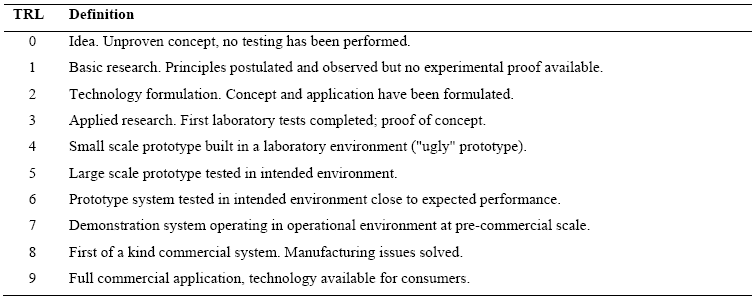
<body><![CDATA[<p align="justify"><font size="2" face="Verdana, Arial, Helvetica, sans-serif"><b>3.2 TRL assessment</b></font></p>     <p align="justify"><font size="2" face="Verdana, Arial, Helvetica, sans-serif">Technology Readiness Levels(TRLs) are a system used to identify the level of technological maturity of a device. </font></p>      <p align="justify"><font size="2" face="Verdana, Arial, Helvetica, sans-serif">The system was invented by NASA’s researcher Stan Sadin in 1974.It was formally defined by 7 levels of technology readiness in 1989. The present system uses a 9 level scale, where TRL1 indicates that an idea is being implemented in a practical application, based on observations of basic principles. The highest level (TRL9) identifies technology that has been fully incorporated into a larger system and is considered operational. [13]</font></p>      <p align="justify"><font size="2" face="Verdana, Arial, Helvetica, sans-serif">This system was meant to identify when a device was ready to be part of a real space mission. Nowadays, the system has proven to be so useful in different fields like the oil and gas industry and not only in aerospace applications. For example, the biggest EU Research and Innovation programme, Horizon 2020 (H2020), is using TRLs to specify the scope of activities in projects they fund. Although the concept for different fields is similar, the definitions of each level vary according to the applications, and therefore Horizon 2020 has added a TRL 0 that identifies an idea or unproven concept, where no test has been performed yet.</font></p>      <p align="justify"><font size="2" face="Verdana, Arial, Helvetica, sans-serif">The definitions used in this paper (see <a href="#t1">TABLE 1</a>) correspond to the definitions of the EU Research and Innovation programme Horizon 2020.</font></p>      <p align=center><font size="2" face="Verdana, Arial, Helvetica, sans-serif"><a name="t1" id="t1"><b>TABLE </b></a><b>1 - TRL DEFINITIONS USED IN THIS REVIEW</b></font>    <br> <img src="/img/revistas/riyd/v1n17/a09_tabla_01.gif" width="755" height="300"></p> <font size="2" face="Verdana, Arial, Helvetica, sans-serif"><b>3.3 Eligibility criteria</b></font>     <p align="justify"><font size="2" face="Verdana, Arial, Helvetica, sans-serif">The data and devices included in this article have been reported in scientific literature. They have been identified by searches in PubMed, IEEE Xplore and the ASME digital Library. The articles selected had to present work on prosthetic hands, prosthetic upper limbs, variable stiffness hands, reviews about these subjects and technology related to these devices.</font></p>     <p align="justify"><font size="2" face="Verdana, Arial, Helvetica, sans-serif"><b>3.4 Exclusion criteria: </b></font></p>     <p align="justify"><font size="2" face="Verdana, Arial, Helvetica, sans-serif">Amongst the papers retrieved some subjects that were irrelevant for this review had to be filtered. Some of the subjects excluded were:</font></p>      ]]></body>
<body><![CDATA[<blockquote>       <p align="justify"><font size="2" face="Verdana, Arial, Helvetica, sans-serif">&#9679;&nbsp;     Prosthetic lower limb</font></p>       <p align="justify"><font size="2" face="Verdana, Arial, Helvetica, sans-serif">&#9679;&nbsp;     Prosthetic larynx</font></p>       <p align="justify"><font size="2" face="Verdana, Arial, Helvetica, sans-serif">&#9679;&nbsp;     Electro stimulation of muscles</font></p>       <p align="justify"><font size="2" face="Verdana, Arial, Helvetica, sans-serif">&#9679;&nbsp;     Implants</font></p>       <p align="justify"><font size="2" face="Verdana, Arial, Helvetica, sans-serif">&#9679;&nbsp;     Models of prosthetic implants</font></p>       <p align="justify"><font size="2" face="Verdana, Arial, Helvetica, sans-serif">&#9679;&nbsp;     Neuroimplants</font></p>       <p align="justify"><font size="2" face="Verdana, Arial, Helvetica, sans-serif">&#9679;&nbsp;     Magnetorheological fluids</font></p>       <p align="justify"><font size="2" face="Verdana, Arial, Helvetica, sans-serif">&#9679;&nbsp;     Crown cementing for divers</font></p>       <p align="justify"><font size="2" face="Verdana, Arial, Helvetica, sans-serif">&#9679;&nbsp;     Rehabilitation</font></p>       ]]></body>
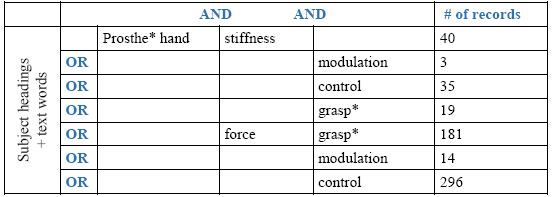
<body><![CDATA[<p align="justify"><font size="2" face="Verdana, Arial, Helvetica, sans-serif">&#9679;&nbsp;     Exoskeleton (assist devices)</font></p>       <p align="justify"><font size="2" face="Verdana, Arial, Helvetica, sans-serif">&#9679;&nbsp;     Biomechanical study of motion</font></p>       <p align="justify"><font size="2" face="Verdana, Arial, Helvetica, sans-serif">&#9679;&nbsp;   Haptics for augmented reality</font></p> </blockquote>     <p align="justify"><font size="2" face="Verdana, Arial, Helvetica, sans-serif"><b>3.5 Information   Sources</b></font></p>     <p align="justify"><font size="2" face="Verdana, Arial, Helvetica, sans-serif">Scientific article databases were used to perform a systematic search of selected terms. Main databases were identified in the medical field (PubMed) as well as the main engineering ones (IEEE Xplore, ASME digital Collection).</font></p>     <p align="justify"><b><font size="2" face="Verdana, Arial, Helvetica, sans-serif">3.6 Search   strategy</font></b></p>     <p align="justify"><font size="2" face="Verdana, Arial, Helvetica, sans-serif">The search strategy was defined according to the main question of this review: Is there any prosthetic hand with the ability to regulate grasping stiffness? The full search strategy is summarised in <a href="#t2">TABLE 2</a> for the IEEE Xplore database, including the number of records found in each search performed.</font></p>      <p align=center><font size="2" face="Verdana, Arial, Helvetica, sans-serif"><a name="t2" id="t2"><b>TABLE </b></a><b>2 - SEARCH STRATEGY AND RESULTING RECORDS (FOR IEEE XPLORE)    <br> </b></font><img src="/img/revistas/riyd/v1n17/a09_tabla_02.gif" width="552" height="197"></p>     <p align=center>&nbsp;</p>     ]]></body>
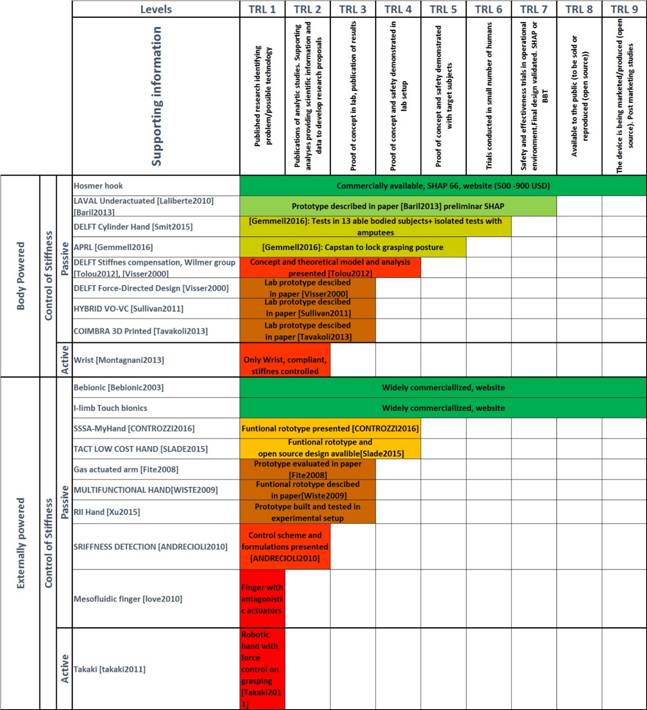
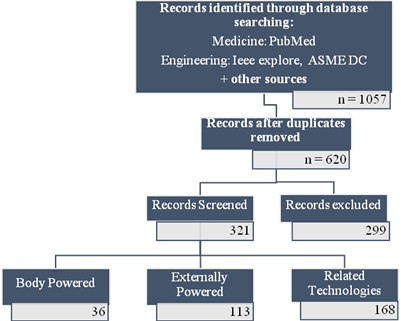
<body><![CDATA[<p align="justify"><font size="3" face="Verdana, Arial, Helvetica, sans-serif"><b>4. CLASSIFICATION OF RECORDS</b></font><font size="2" face="Verdana, Arial, Helvetica, sans-serif"><b>&nbsp;</b></font></p>      <p align="justify"><font size="2" face="Verdana, Arial, Helvetica, sans-serif">The records assessed were classified according to the technology used, as can be seen in <a href="#f1">Figure 1</a>.<a name="_GoBack"></a></font></p>      <p align="center"><font size="2" face="Verdana, Arial, Helvetica, sans-serif"><a name="f1"></a><img width=401 height=321 src="/img/revistas/riyd/v1n17/a09_image001.png" align=absmiddle hspace=19></font></p>      <p align=center><font size="2" face="Verdana, Arial, Helvetica, sans-serif"><b>Figure 1 -</b> Classification of records retrieved.</font></p>      <p align="justify"><font size="2" face="Verdana, Arial, Helvetica, sans-serif">The technology readiness assessment was performed only on the most relevant records. An extra classification level was introduced where each group, Body Powered and Externally Powered, was subdivided in passive or active control of the device stiffness. The TRL level reached by each device, as well as the supporting information used to classify it, can be seen in <a href="#t3">Table 3</a>.</font><font size="2" face="Verdana, Arial, Helvetica, sans-serif"><b>&nbsp;</b></font></p>      <p align=center><font size="2" face="Verdana, Arial, Helvetica, sans-serif"><b><a name="t3"></a>TABLE 3 - TECHNOLOGY READINESS LEVELS OF SELECTED RECORDS</b></font></p>      <p align="center"><font size="2" face="Verdana, Arial, Helvetica, sans-serif"><img border=0 width=647 height=710 id="Picture 8" src="/img/revistas/riyd/v1n17/a09_image002.jpg"></font></p>      <p align="justify"><font size="3" face="Verdana, Arial, Helvetica, sans-serif"><b>5. RESULTS</b></font></p>     <p align="justify"><font size="2" face="Verdana, Arial, Helvetica, sans-serif">Based on the previously introduced   methodology we retrieved a set of publications which we subsequently analysed   regarding their technical readiness in particular with a focus on variable   stiffness. In addition we review the available means of actuation in current   hand prostheses as well as their functionality.</font></p>     <p align="justify"><font size="2" face="Verdana, Arial, Helvetica, sans-serif">&#9679;&nbsp; Underactuation</font></p>      ]]></body>
<body><![CDATA[<p align="justify"><font size="2" face="Verdana, Arial, Helvetica, sans-serif">Underactuation is a desirable characteristic in a well-designed hand. Fewer actuators than degrees of freedom mean self-adaptability of fingers. In consequence underactuated grippers can have shape adaptation and therefore improved grasping capabilities as described in [14],[15]. </font></p>      <p align="justify"><font size="2" face="Verdana, Arial, Helvetica, sans-serif">A prosthetic hand with one externally powered actuator, could as well be body powered [16][17] as the degrees of actuation are low. Nevertheless, effective underactuated prosthetic gripper with shape adaptability and low complexity is still a challenge.[14]</font></p>     <p align="justify"><font size="2" face="Verdana, Arial, Helvetica, sans-serif">&#9679;&nbsp; Functionality</font></p>     <p align="justify"><font size="2" face="Verdana, Arial, Helvetica, sans-serif">The I-limb, from Touch Bionics (Livingston, United Kingdom), provides different grip profiles that can be activated by the user[18]. It also offers additional Bluetooth devices, so called grip chips, which can be attached to an object in order for it to be recognized automatically by the hand, which in turn automatically selects the adequate grip profile.</font></p>      <p align="justify"><font size="2" face="Verdana, Arial, Helvetica, sans-serif">The Bebionichands, developed by RSL Steeper (Leeds, United Kingdom) and recently purchased by OttoBock (Duderstadt, Germany), as well as the Michelangelo hand (OttoBock; Duderstadt, Germany) both show a natural movement and a set of different grasping and holding functions. The user has to learn the usage of these functions first, as their control requires the activation of specific muscles in a certain pattern [19].</font></p>      <p align="justify"><font size="2" face="Verdana, Arial, Helvetica, sans-serif">The Delft Cylinder hand is a hydraulically body powered hand. It provides a fully articulated hand at a low weight (273g). The hand has two grasp patterns, namely precision grip and power grip. It has an underactuated adaptive structure that requires one control signal [20][21]. As it is body-powered it provides the user with proprioceptive force and position feedback without additional sensors. </font></p>      <p align="justify"><font size="2" face="Verdana, Arial, Helvetica, sans-serif">Out of the 312 selected records a total of 113 publications focussed on mechatronic prosthesis. Most of the mechatronic devices are controlled by myoelectric signals. The “Multifunctional Hand” can be used with a multi-channel myoelectric interface. It represents a complex design with 16 joints and 5 independent actuators [30]. Amongst the myoelectric group, the “TACT HAND” is a low Cost 3D printed Myoelectric Hand. It is targeted at the low income population of developing countries, trying to achieve a performance comparable to hands “two orders of magnitude more expensive”. The open source design files are available online, and as it uses off-the-shelf electronic components and 3D printed parts it represents an affordable option anywhere the technology is available [31].</font></p>      <p align="justify"><font size="2" face="Verdana, Arial, Helvetica, sans-serif">The SSSY-MyHand works with only 3 electric motors. It is comparable to the human hand in weight and is capable of performing most grasps and gestures used every day [33].</font></p>     <p align="justify"><font size="2" face="Verdana, Arial, Helvetica, sans-serif">&#9679;&nbsp; Stiffness Control</font></p>     <p align="justify"><font size="2" face="Verdana, Arial, Helvetica, sans-serif">The control of the end effector stiffness has been identified as a need, unfortunately the problem is not yet solved by current devices [10]. The following section summarises the current state of the art and advancements regarding the implementation of stiffness control as well as related technologies.</font></p>      ]]></body>
<body><![CDATA[<p align="justify"><font size="2" face="Verdana, Arial, Helvetica, sans-serif">Body powered prosthesis provide inherently uncontrollable end effector stiffness due to the currently used prehensor spring. The body joint, which actuates the effector, can actively control the stiffness in one direction depending on the user input. The resulting stiffness of the end effector is therefore a combination of the prehensor spring stiffness and the current state of the body joint. In myoelectric prosthetic hands the stiffness is not user controlled, but is a function of the implemented end effector velocity control or force control, or a combination of both.[10]</font></p>      <p align="justify"><font size="2" face="Verdana, Arial, Helvetica, sans-serif">Low end effector stiffness has shown to improve the user’s perception of the object stiffness in body powered devices[10]. Therefore adaptive fingers with low stiffness have been used[22]for a prosthetic hand. The problem of added stiffness giving confusing feedback to the user has also been addressed by means of negative stiffness for glove stiffness compensation[23].</font></p>      <p align="justify"><font size="2" face="Verdana, Arial, Helvetica, sans-serif">Stiffness detection is important for adaptive force control. The benefits obtained would be improvements in system response and reduction in oscillatory behaviour [32].</font></p>      <p align="justify"><font size="2" face="Verdana, Arial, Helvetica, sans-serif">A passive compliant wrist has been introduced in [24]. The authors had observed that rigid wrists in prosthetic arms are the cause of strain injuries in the sound arm, because the users are leaving aside their rigid wrists prosthesis. The control of the stiffness, even if it is just switching from stiff to compliant, is shown to be fundamental in these cases.  Another solution to the rigid wrist problem is adding an extra actuator for the wrist activation [25].</font></p>      <p align="justify"><font size="2" face="Verdana, Arial, Helvetica, sans-serif">Although it is not addressed specifically as stiffness control, a gas powered arm with compliant hand joints: has been proposed in [26]. The passive means of switching between motion and force control without extra sensors or actuators has been proven to be a reliable mechanism [26].</font></p>      <p align="justify"><font size="2" face="Verdana, Arial, Helvetica, sans-serif">Underactuation and compliance are being exploited for grasping improvement, using the adaptability of the shape of the compliant hand. An underactuated five-fingerhand has been proposed and showed to be an effective techniqueto grasp small, circular and heavy objects. The forces of the action represent a human like force distribution. The simplicity of compliant Joints, in underactuated hands allow to have a design for single actuation source [27]. This means that it can be easily body powered or motor actuated. The COIMBRA 3D printed hand, presents compliant joints as well. It has a bio-inspired design, with soft fingers that can perform 23 of the 33 grasps that humans perform[29].</font></p>     <p align="justify"><b><font size="2" face="Verdana, Arial, Helvetica, sans-serif">a.&nbsp;&nbsp;&nbsp; Assessment of the current situation</font></b></p>     <p align="justify"><font size="2" face="Verdana, Arial, Helvetica, sans-serif">We found several bodies powered and externally powered devices in TRL 9, but none of them have an active method of controlling the stiffness of the fingers or the grasper.</font></p>      <p align="justify"><font size="2" face="Verdana, Arial, Helvetica, sans-serif">Technology of body powered devices seems to have been pushed aside by myoelectric devices. Nevertheless, it is important to highlight the needs of the end user of the device and the functional requirements identified in the works reviewed [7]–[9], [34]. One of the desired requirements on a prosthetic hand is the feedback to the user as this enables a higher degree of control over the hand. As part of this we saw various efforts to provide feedback with externally powered devices[35][36][37]. Nevertheless, body powered devices are still outperforming the externally powered ones in this aspect, as they give a natural feedback of the force applied, by the tension applied to the wires controlling it.</font></p>      <p align="justify"><font size="2" face="Verdana, Arial, Helvetica, sans-serif">In terms of weight, the situation has not changed much in the last years. In 1998 Doshi’s body powered hand [38] was 203 g. Today’s mechatronic devices are within a range of 350 to 615 g in commercial prostheses and 350 to 2,200 g in research-based hands[19]</font></p>      ]]></body>
<body><![CDATA[<p align=center><font size="2" face="Verdana, Arial, Helvetica, sans-serif"><a name="t4" id="t4"><b>&nbsp;</b></a><b>TABLE 4 - HIGHER TRL DEVICES AND THEIR FUNCTIONALITY</b></font>    <br> <img src="/img/revistas/riyd/v1n17/a09_tabla_04.gif" width="747" height="146"></p>  <font size="2" face="Verdana, Arial, Helvetica, sans-serif"><b>b.&nbsp;&nbsp;&nbsp; Identification of technology related to hand prosthesis</b></font>     <p align="justify"><font size="2" face="Verdana, Arial, Helvetica, sans-serif">Some records identified by this systematic search were not specifically reporting on hand prosthesis, but provided useful knowledge and methods which can benefit the development of these devices. The relevant information extracted from those records is presented in this section.</font></p>      <p align="justify"><font size="2" face="Verdana, Arial, Helvetica, sans-serif">It has been detected that the glove used in many anthropomorphic hands, adds some stiffness to the prosthesis. In that sense, when the device is body actuated, this stiffness gives a confusing feedback to the user. The University of Delft has proposed a negative stiffness mechanism in order to compensate for the parasitic glove stiffness [23]. They have proposed a body-actuated design by considering the desired finger force distribution as a starting point. Clamping of the object is one of the most important aspects. &quot;The way the hand moves to grasp an object should be such that it ends up in a good grip.&quot; [22]</font></p>      <p align="justify"><font size="2" face="Verdana, Arial, Helvetica, sans-serif">Normally open hands need a continuous tension to hold an object. The APRL hand, amongst others[39][40], has solved this issue by introducing a locking mechanism. It has a capstan to hold the grasping position on this NO hand[41].</font></p>      <p align="justify"><font size="2" face="Verdana, Arial, Helvetica, sans-serif">The HYBRID VO-VC hand, presents a mechanical design that allows the user to change the configuration of the hand from Voluntary Opening to Voluntary Closing. It has been observed that VO and VC need to be combined to augment the system capabilities for daily tasks and work related tasks [28].</font></p>      <p align="justify"><font size="2" face="Verdana, Arial, Helvetica, sans-serif">A nitinolrod is used to control the activation of the fingers in an underactuated hand [17]. It is not used as actuator but as a passive backbone because of its mechanical characteristics. The device uses only one motor for the actuation of the prosthesis.</font></p>      <p align="justify"><font size="2" face="Verdana, Arial, Helvetica, sans-serif">It has been identified that low stiffness in a prosthetic hand provides a straightforward feedback to the user depending on the grasped object stiffness. Takaki<i>et al</i>.[42] have developed a robotic hand that uses low force to identify an object and then switches to high force to grasp it. This is a functionality that could be implemented in hand prostheses.</font></p>      <p align="justify"><font size="2" face="Verdana, Arial, Helvetica, sans-serif">As mentioned before, the weight of the prosthesis is a very important characteristic. A way to distribute the weight or apply it to the rigid parts of the human body is Osseointegration. This is an invasive technique in which a titanium structure is attached to the bone to provide a mechanical interface. This way excessive pressure on the amputee’s skin can be avoided, but as it is a very invasive procedure it can carry complications. [43]</font></p>     <p align="justify"><b><font size="2" face="Verdana, Arial, Helvetica, sans-serif">c.&nbsp;&nbsp;&nbsp; Identified requirements</font></b></p>     ]]></body>

<body><![CDATA[<p align="justify"><font size="2" face="Verdana, Arial, Helvetica, sans-serif">Amongst the devices reviewed in this paper not a single device was identified that would completely meet the userrequirements.</font></p>      <p align="justify"><font size="2" face="Verdana, Arial, Helvetica, sans-serif">There are several works trying to identify the needs and wishes of the user [7], [8], [34]. Those studies highlight three important aspects: Cosmetics, comfort and control.</font></p>      <p align="justify"><font size="2" face="Verdana, Arial, Helvetica, sans-serif">Cosmetic requirements are met by the use of special gloves that give a natural look to anthropomorphic prosthesis (basically all of the devices classified under externally powered). Unfortunately, and although they are widely used, split hooks remain quite visually unnatural.</font></p>      <p align="justify"><font size="2" face="Verdana, Arial, Helvetica, sans-serif">Comfort requirements refer mainly to the weight and holding mechanism. In that sense, myoelectric devices rank lower than body actuated, as the harness used for the body actuated ones allows the redistribution of the weight and contact interface with the prosthesis. </font></p>      <p align="justify"><font size="2" face="Verdana, Arial, Helvetica, sans-serif">Control requirements are closely related to task specific needs of the user, depending on the individual application in daily life. </font></p>      <p align="justify"><font size="2" face="Verdana, Arial, Helvetica, sans-serif">These requirements have been expanded after an analysis of the main challenges faced by R&amp;D departments to the date. The challenges identified are: force control, grasping functionality, holding functionality, lightweight, ease of use, cost, maintenance, stiffness control, feedback and aesthetics. A classification of the highest TRL records, showing which challenges have been completed, is shown in <a href="#t4">Table 4</a>. </font></p>     <p align="justify">&nbsp;</p>     <p align="justify"><font size="3" face="Verdana, Arial, Helvetica, sans-serif"><b>6. CONCLUSIONS</b></font></p>     <p align="justify"><font size="2" face="Verdana, Arial, Helvetica, sans-serif">Body powered prosthesis are preferred to myoelectric devices due to their associated cost, simplicity of use but most of all, because they provide a natural feedback to the user [8].</font></p>      <p align="justify"><font size="2" face="Verdana, Arial, Helvetica, sans-serif">Stiffness control or at least regulation has been identified as a need but has not being fully covered, even disregarded [10].Stiffness of human fingers has been analysed by experiments which led into models [44]. This work can be beneficial for future work on variable stiffness end effectors.</font></p>      ]]></body>
<body><![CDATA[<p align="justify"><font size="2" face="Verdana, Arial, Helvetica, sans-serif">More work needs to be done on body powered prosthesis, as they seem to be the preferred ones in terms of functionality, cost and ease of use.</font></p>     <p align="justify">&nbsp;</p>     <p align="justify"><font size="3" face="Verdana, Arial, Helvetica, sans-serif"><b>7. ACKNOWLEDGEMENT</b></font></p>     <p align="justify"><font size="2" face="Verdana, Arial, Helvetica, sans-serif">This review has been done within the “Variable stiffness prosthetic grasper project”, funded by the Robotics and Automation Society (RAS) Special Interests Group on Humanitarian Technology (SIGHT) from The Institute of Electrical and Electronic Engineers (IEEE).</font></p>     <p align="justify">&nbsp;</p>     <p align="justify"><font size="3" face="Verdana, Arial, Helvetica, sans-serif"><b>8. REFERENCES</b></font></p>      <!-- ref --><p align="justify"><font size="2" face="Verdana, Arial, Helvetica, sans-serif">[1]    Instituto Nacional de Estadistica, “Resultados del CENSO 2012,” 2012.    &nbsp;&nbsp;&nbsp;&nbsp;&nbsp;&nbsp;&nbsp;&nbsp;[&#160;<a href="javascript:void(0);" onclick="javascript: window.open('/scielo.php?script=sci_nlinks&ref=965947&pid=S2518-4431201700010000900001&lng=','','width=640,height=500,resizable=yes,scrollbars=1,menubar=yes,');">Links</a>&#160;]<!-- end-ref --></font></p>      <!-- ref --><p align="justify"><font size="2" face="Verdana, Arial, Helvetica, sans-serif">[2]    M. de S. de Bolivia, “Sistema de Información del Programa de Registro Único Nacional de la Persona con Discapacidad - Misión Solidaria Moto Méndez,” 2010.    &nbsp;&nbsp;&nbsp;&nbsp;&nbsp;&nbsp;&nbsp;&nbsp;[&#160;<a href="javascript:void(0);" onclick="javascript: window.open('/scielo.php?script=sci_nlinks&ref=965949&pid=S2518-4431201700010000900002&lng=','','width=640,height=500,resizable=yes,scrollbars=1,menubar=yes,');">Links</a>&#160;]<!-- end-ref --></font></p>      ]]></body>
<body><![CDATA[<p align="justify"><font size="2" face="Verdana, Arial, Helvetica, sans-serif">[3]    E. P. de B. Ministero de Justicia, “Informe de la convencion sobre los derechos de las personas con discapacidad,” 2013.</font></p>      <p align="justify"><font size="2" face="Verdana, Arial, Helvetica, sans-serif">[4]    P. G. Weyand, M. W. Bundl, C. P. McGowan, A. Grabowski, M. B. Brown, R. Kram, and H. Herr, “The fastest runner on artificial legs: different limbs, similar function?,” <i>J. Appl. Physiol.</i>, vol. 107, no. 3, pp. 903–911, 2009.</font></p>      <p align="justify"><font size="2" face="Verdana, Arial, Helvetica, sans-serif">[5]    S. Raspopovic and E. Al, “Restoring Natural Sensory Feedback in Real-Time Bidirectional Hand Prostheses,” <i>Sci. Transl. Med.</i>, vol. 6, no. 222, p. 2/22ra19, 2014.</font></p>      <p align="justify"><font size="2" face="Verdana, Arial, Helvetica, sans-serif">[6]    E. A. Bidiss and T. T. Chau, “Upper limb prosthesis use and abandonment: A survey of the last 25 years,” <i>Prosthet. Orthot. Int.</i>, vol. 31, no. 3, pp. 236–257, 2007.</font></p>      <p align="justify"><font size="2" face="Verdana, Arial, Helvetica, sans-serif">[7]    E. Biddiss and T. Chau, “Upper-limb prosthetics: critical factors in device abandonment.,” <i>Am. J. Phys. Med. Rehabil.</i>, vol. 86, no. 12, pp. 977–987, Dec. 2007.</font></p>      <p align="justify"><font size="2" face="Verdana, Arial, Helvetica, sans-serif">[8]    E. Biddiss, D. Beaton, and T. Chau, “Consumer design priorities for upper limb prosthetics.,” <i>Disabil. Rehabil. Assist. Technol.</i>, vol. 2, no. 6, pp. 346–357, Nov. 2007.</font></p>      <p align="justify"><font size="2" face="Verdana, Arial, Helvetica, sans-serif">[9]    A. L. Muilenburg and M. A. LeBlanc, “Body-powered upper-limb components,” in <i>Comprehensive management of the upper-limb amputee</i>, Springer, 1989, pp. 28–38.</font></p>      <p align="justify"><font size="2" face="Verdana, Arial, Helvetica, sans-serif">[10]  A. Filatov and O. Celik, “Effects of body-powered prosthesis prehensor stiffness on performance in an object stiffness discrimination task,” <i>2015 IEEE World Haptics Conference (WHC)</i>. pp. 339–344, 2015.</font></p>      <p align="justify"><font size="2" face="Verdana, Arial, Helvetica, sans-serif">[11]  L. J. Love, R. F. Lind, and J. F. Jansen, “Mesofluidic actuation for articulated finger and hand prosthetics,” <i>2009 IEEE/RSJ International Conference on Intelligent Robots and Systems</i>. pp. 2586–2591, 2009.</font></p>      <p align="justify"><font size="2" face="Verdana, Arial, Helvetica, sans-serif">[12]  D. Moher, A. Liberati, J. Tetzlaff, D. G. Altman, and P. Group, “Preferred reporting items for systematic reviews and meta-analyses: the PRISMA statement,” <i>PLoS med</i>, vol. 6, no. 7, p. e1000097, 2009.</font></p>      ]]></body>
<body><![CDATA[<p align="justify"><font size="2" face="Verdana, Arial, Helvetica, sans-serif">[13]  ASDRE, “Technology Readiness Assessment ( TRA ) Guidance,” <i>US Dep. Defense, Assitant Secr. Def. Res. Eng.</i>, no. May, pp. 1–20, 2011.</font></p>      <p align="justify"><font size="2" face="Verdana, Arial, Helvetica, sans-serif">[14]  M. Baril, T. Laliberté, C. Gosselin, and F. Routhier, “On the Design of a Mechanically Programmable Underactuated Anthropomorphic Prosthetic Gripper,” <i>J. Mech. Des.</i>, vol. 135, no. 12, pp. 121008–121009, Oct. 2013.</font></p>      <p align="justify"><font size="2" face="Verdana, Arial, Helvetica, sans-serif">[15]  T. Laliberté, L. Birglen, and C. Gosselin, “Underactuation in robotic grasping hands,” <i>Mach. Intell. Robot. Control</i>, vol. 4, no. 3, pp. 1–11, 2002.</font></p>      <p align="justify"><font size="2" face="Verdana, Arial, Helvetica, sans-serif">[16]  T. Lalibert, M. Baril, F. Guay, and C. Gosselin, “Towards the design of a prosthetic underactuated hand,” 2010.</font></p>      <p align="justify"><font size="2" face="Verdana, Arial, Helvetica, sans-serif">[17]  K. Xu, H. Liu, Z. Liu, Y. Du, and X. Zhu, “A single-actuator prosthetic hand using a continuum differential mechanism,” <i>2015 IEEE International Conference on Robotics and Automation (ICRA)</i>. pp. 6457–6462, 2015.</font></p>      <p align="justify"><font size="2" face="Verdana, Arial, Helvetica, sans-serif">[18]  Touch Bionics, “No Title.” [Online]. Available: http://www.touchbionics.com/products/how-i-limb-works.</font></p>      <p align="justify"><font size="2" face="Verdana, Arial, Helvetica, sans-serif">[19]  J. T. Belter, J. L. Segil, A. M. Dollar, and R. F. Weir, “Mechanical design and performance specifications of anthropomorphic prosthetic hands: a review.,” <i>J. Rehabil. Res. Dev.</i>, vol. 50, no. 5, pp. 599–618, 2013.</font></p>      <p align="justify"><font size="2" face="Verdana, Arial, Helvetica, sans-serif">[20]  G. Smit, D. H. Plettenburg, and F. C. T. van der Helm, “The lightweight Delft Cylinder Hand: first multi-articulating hand that meets the basic user requirements.,” <i>IEEE Trans. Neural Syst. Rehabil. Eng.</i>, vol. 23, no. 3, pp. 431–440, May 2015.</font></p>      <p align="justify"><font size="2" face="Verdana, Arial, Helvetica, sans-serif">[21]  B. Peerdeman, G. Smit, S. Stramigioli, D. Plettenburg, and S. Misra, “Evaluation of pneumatic cylinder actuators for hand prostheses,” <i>2012 4th IEEE RAS &amp; EMBS International Conference on Biomedical Robotics and Biomechatronics (BioRob)</i>. pp. 1104–1109, 2012.</font></p>      <p align="justify"><font size="2" face="Verdana, Arial, Helvetica, sans-serif">[22]  H. de Visser and J. L. Herder, “Force-directed design of a voluntary closing hand prosthesis.,” <i>J. Rehabil. Res. Dev.</i>, vol. 37, no. 3, pp. 261–271, 2000.</font></p>      ]]></body>
<body><![CDATA[<p align="justify"><font size="2" face="Verdana, Arial, Helvetica, sans-serif">[23]  N. Tolou, G. Smit, A. A. Nikooyan, D. H. Plettenburg, and J. L. Herder, “Stiffness Compensation Mechanism for Body Powered Hand Prostheses with Cosmetic Covering,” <i>J. Med. Device.</i>, vol. 6, no. 1, pp. 11004–11005, Mar. 2012.</font></p>      <p align="justify"><font size="2" face="Verdana, Arial, Helvetica, sans-serif">[24]  F. Montagnani, M. Controzzi, and C. Cipriani, “Preliminary design and development of a two degrees of freedom passive compliant prosthetic wrist with switchable stiffness,” <i>2013 IEEE International Conference on Robotics and Biomimetics (ROBIO)</i>. pp. 310–315, 2013.</font></p>      <p align="justify"><font size="2" face="Verdana, Arial, Helvetica, sans-serif">[25]  E. Anderson, J. Moloughney, K. Ozerinsky, and R. Saleh, “Body powered anthropomorphic prosthetic hand with force feedback and auto-rotation regimes,” <i>2012 38th Annual Northeast Bioengineering Conference (NEBEC)</i>. pp. 33–34, 2012.</font></p>      <p align="justify"><font size="2" face="Verdana, Arial, Helvetica, sans-serif">[26]  K. B. Fite, T. J. Withrow, X. Shen, K. W. Wait, J. E. Mitchell, and M. Goldfarb, “A Gas-Actuated Anthropomorphic Prosthesis for Transhumeral Amputees,” <i>IEEE Transactions on Robotics</i>, vol. 24, no. 1. pp. 159–169, 2008.</font></p>      <p align="justify"><font size="2" face="Verdana, Arial, Helvetica, sans-serif">[27]  Y. Kamikawa and T. Maeno, “Underactuated five-finger prosthetic hand inspired by grasping force distribution of humans,” <i>2008 IEEE/RSJ International Conference on Intelligent Robots and Systems</i>. pp. 717–722, 2008.</font></p>      <p align="justify"><font size="2" face="Verdana, Arial, Helvetica, sans-serif">[28]  T. Sullivan and K. S. Teh, “Design and Fabrication of a Hybrid Body-Powered Prosthetic Hand With Voluntary Opening and Voluntary Closing Capabilities,” no. 54884. pp. 155–162, 2011.</font></p>      <p align="justify"><font size="2" face="Verdana, Arial, Helvetica, sans-serif">[29]  M. Tavakoli, J. Lourenço, and A. T. de Almeida, “3D printed endoskeleton with a soft skin for upper-limb body actuated prosthesis,” <i>2017 IEEE 5th Portuguese Meeting on Bioengineering (ENBENG)</i>. pp. 1–5, 2017.</font></p>      <p align="justify"><font size="2" face="Verdana, Arial, Helvetica, sans-serif">[30]  T. E. Wiste, S. A. Dalley, T. J. Withrow, and M. Goldfarb, “Design of a multifunctional anthropomorphic prosthetic hand with extrinsic actuation,” <i>2009 IEEE International Conference on Rehabilitation Robotics</i>. pp. 675–681, 2009.</font></p>      <p align="justify"><font size="2" face="Verdana, Arial, Helvetica, sans-serif">[31]  P. Slade, A. Akhtar, M. Nguyen, and T. Bretl, “Tact: Design and performance of an open-source, affordable, myoelectric prosthetic hand,” <i>2015 IEEE International Conference on Robotics and Automation (ICRA)</i>. pp. 6451–6456, 2015.</font></p>      <p align="justify"><font size="2" face="Verdana, Arial, Helvetica, sans-serif">[32]  R. Andrecioli and E. D. Engeberg, “Grasped object stiffness detection for adaptive force control of a prosthetic hand,” <i>2010 3rd IEEE RAS &amp; EMBS International Conference on Biomedical Robotics and Biomechatronics</i>. pp. 197–202, 2010.</font></p>      ]]></body>
<body><![CDATA[<p align="justify"><font size="2" face="Verdana, Arial, Helvetica, sans-serif">[33]  M. Controzzi, F. Clemente, D. Barone, A. Ghionzoli, and C. Cipriani, “The SSSA-MyHand: a dexterous lightweight myoelectric hand prosthesis.,” <i>IEEE Trans. Neural Syst. Rehabil. Eng.</i>, Jun. 2016.</font></p>      <p align="justify"><font size="2" face="Verdana, Arial, Helvetica, sans-serif">[34]  D. H. Plettenburg, “Basic requirements for upper extremity prostheses: the WILMER approach,” <i>Proceedings of the 20th Annual International Conference of the IEEE Engineering in Medicine and Biology Society. Vol.20 Biomedical Engineering Towards the Year 2000 and Beyond (Cat. No.98CH36286)</i>, vol. 5. pp. 2276–2281 vol.5, 1998.</font></p>      <p align="justify"><font size="2" face="Verdana, Arial, Helvetica, sans-serif">[35]  E. R. Mancipe-Toloza and S. A. Salinas, “Force control and haptic interface applied to prototype of myoelectric prosthetic hand,” <i>2015 Pan American Health Care Exchanges (PAHCE)</i>. pp. 1–5, 2015.</font></p>      <p align="justify"><font size="2" face="Verdana, Arial, Helvetica, sans-serif">[36]  H. J. B. Witteveen, F. Luft, J. S. Rietman, and P. H. Veltink, “Stiffness Feedback for Myoelectric Forearm Prostheses Using Vibrotactile Stimulation.,” <i>IEEE Trans. Neural Syst. Rehabil. Eng.</i>, vol. 22, no. 1, pp. 53–61, Jan. 2014.</font></p>      <p align="justify"><font size="2" face="Verdana, Arial, Helvetica, sans-serif">[37]  J. Gonzalez, H. Suzuki, N. Natsumi, M. Sekine, and W. Yu, “Auditory display as a prosthetic hand sensory feedback for reaching and grasping  tasks.,” <i>Conf. Proc.  ... Annu. Int. Conf. IEEE Eng. Med. Biol. Soc. IEEE Eng. Med. Biol. Soc. Annu. Conf.</i>, vol. 2012, pp. 1789–1792, 2012.</font></p>      <p align="justify"><font size="2" face="Verdana, Arial, Helvetica, sans-serif">[38]  R. Doshi, C. Yeh, and M. LeBlanc, “The design and development of a gloveless endoskeletal prosthetic hand.,” <i>J. Rehabil. Res. Dev.</i>, vol. 35, no. 4, pp. 388–395, Oct. 1998.</font></p>      <p align="justify"><font size="2" face="Verdana, Arial, Helvetica, sans-serif">[39]  R. Leeb, M. Gubler, M. Tavella, H. Miller, and J. d. R. Millán, “On the road to a neuroprosthetic hand: A novel hand grasp orthosis based on functional electrical stimulation,” <i>2010 Annual International Conference of the IEEE Engineering in Medicine and Biology</i>. pp. 146–149, 2010.</font></p>      <p align="justify"><font size="2" face="Verdana, Arial, Helvetica, sans-serif">[40]  K. D. Gemmell, M. T. Leddy, J. T. Belter, and A. M. Dollar, “Investigation of a passive capstan based grasp enhancement feature in a voluntary-closing prosthetic terminal device.,” <i>Conf. Proc.  ... Annu. Int. Conf. IEEE Eng. Med. Biol. Soc. IEEE Eng. Med. Biol. Soc. Annu. Conf.</i>, vol. 2016, pp. 5019–5025, Aug. 2016.</font></p>      <p align="justify"><font size="2" face="Verdana, Arial, Helvetica, sans-serif">[41]  K. D. Gemmell, M. T. Leddy, J. T. Belter, and A. M. Dollar, “Investigation of a passive capstan based grasp enhancement feature in a voluntary-closing prosthetic terminal device.,” <i>Conf. Proc.  ... Annu. Int. Conf. IEEE Eng. Med. Biol. Soc. IEEE Eng. Med. Biol. Soc. Annu. Conf.</i>, vol. 2016, pp. 5019–5025, Aug. 2016.</font></p>      <p align="justify"><font size="2" face="Verdana, Arial, Helvetica, sans-serif">[42]  T. Takaki and T. Omata, “High-Performance Anthropomorphic Robot Hand With Grasping-Force-Magnification Mechanism,” <i>IEEE/ASME Transactions on Mechatronics</i>, vol. 16, no. 3. pp. 583–591, 2011.</font></p>      ]]></body>
<body><![CDATA[<p align="justify"><font size="2" face="Verdana, Arial, Helvetica, sans-serif">[43]  J. Tillander, K. Hagberg, L. Hagberg, and R. Brånemark, “Osseointegrated Titanium Implants for Limb Prostheses Attachments: Infectious Complications,” <i>Clin. Orthop. Relat. Res.</i>, vol. 468, no. 10, pp. 2781–2788, 2010.</font></p>      <p align="justify"><font size="2" face="Verdana, Arial, Helvetica, sans-serif">[44]  A. E. Fiorilla, F. Nori, L. Masia, and G. Sandini, “Finger impedance evaluation by means of hand exoskeleton.,” <i>Ann. Biomed. Eng.</i>, vol. 39, no. 12, pp. 2945–2954, Dec. 2011.</font></p>      <p align="justify">&nbsp;</p>      ]]></body><back>
<ref-list>
<ref id="B1">
<label>1</label><nlm-citation citation-type="">
<collab>Instituto Nacional de Estadistica</collab>
<source><![CDATA[Resultados del CENSO 2012]]></source>
<year>2012</year>
</nlm-citation>
</ref>
<ref id="B2">
<label>2</label><nlm-citation citation-type="">
<collab>M. de S. de Bolivia</collab>
<source><![CDATA[Sistema de Información del Programa de Registro Único Nacional de la Persona con Discapacidad - Misión Solidaria Moto Méndez]]></source>
<year>2010</year>
</nlm-citation>
</ref>
<ref id="B3">
<label>3</label><nlm-citation citation-type="">
<collab>Estado Plurinacional de Bolivia - Ministero de Justicia</collab>
<source><![CDATA[Informe de la convencion sobre los derechos de las personas con discapacidad]]></source>
<year>2013</year>
</nlm-citation>
</ref>
<ref id="B4">
<label>4</label><nlm-citation citation-type="journal">
<person-group person-group-type="author">
<name>
<surname><![CDATA[Weyand]]></surname>
<given-names><![CDATA[P.G.]]></given-names>
</name>
<name>
<surname><![CDATA[Bundl]]></surname>
<given-names><![CDATA[M.W.]]></given-names>
</name>
<name>
<surname><![CDATA[McGowan]]></surname>
<given-names><![CDATA[C.P.]]></given-names>
</name>
<name>
<surname><![CDATA[Grabowski]]></surname>
<given-names><![CDATA[A.]]></given-names>
</name>
<name>
<surname><![CDATA[Brown]]></surname>
<given-names><![CDATA[M.B.]]></given-names>
</name>
<name>
<surname><![CDATA[Kram]]></surname>
<given-names><![CDATA[R.]]></given-names>
</name>
<name>
<surname><![CDATA[Herr]]></surname>
<given-names><![CDATA[H.]]></given-names>
</name>
</person-group>
<article-title xml:lang="en"><![CDATA[The fastest runner on artificial legs: different limbs, similar function?]]></article-title>
<source><![CDATA[J. Appl. Physiol.]]></source>
<year>2009</year>
<volume>107</volume>
<numero>3</numero>
<issue>3</issue>
<page-range>903-911</page-range></nlm-citation>
</ref>
<ref id="B5">
<label>5</label><nlm-citation citation-type="journal">
<person-group person-group-type="author">
<name>
<surname><![CDATA[Raspopovic]]></surname>
<given-names><![CDATA[S.]]></given-names>
</name>
<name>
<surname><![CDATA[Al]]></surname>
<given-names><![CDATA[E.]]></given-names>
</name>
</person-group>
<article-title xml:lang="en"><![CDATA[Restoring Natural Sensory Feedback in Real-Time Bidirectional Hand Prostheses]]></article-title>
<source><![CDATA[Sci. Transl. Med.]]></source>
<year>2014</year>
<volume>6</volume>
<numero>222</numero>
<issue>222</issue>
<page-range>2/22ra19</page-range></nlm-citation>
</ref>
<ref id="B6">
<label>6</label><nlm-citation citation-type="journal">
<person-group person-group-type="author">
<name>
<surname><![CDATA[Bidiss]]></surname>
<given-names><![CDATA[E.A.]]></given-names>
</name>
<name>
<surname><![CDATA[Chau]]></surname>
<given-names><![CDATA[T.T.]]></given-names>
</name>
</person-group>
<article-title xml:lang="en"><![CDATA[Upper limb prosthesis use and abandonment: A survey of the last 25 years]]></article-title>
<source><![CDATA[Prosthet. Orthot. Int.]]></source>
<year>2007</year>
<volume>31</volume>
<numero>3</numero>
<issue>3</issue>
<page-range>236-257</page-range></nlm-citation>
</ref>
<ref id="B7">
<label>7</label><nlm-citation citation-type="journal">
<person-group person-group-type="author">
<name>
<surname><![CDATA[Biddiss]]></surname>
<given-names><![CDATA[E.]]></given-names>
</name>
<name>
<surname><![CDATA[Chau]]></surname>
<given-names><![CDATA[T.]]></given-names>
</name>
</person-group>
<article-title xml:lang="en"><![CDATA[Upper-limb prosthetics: critical factors in device abandonment]]></article-title>
<source><![CDATA[Am. J. Phys. Med. Rehabil.]]></source>
<year>Dec.</year>
<month> 2</month>
<day>00</day>
<volume>86</volume>
<numero>12</numero>
<issue>12</issue>
<page-range>977-987</page-range></nlm-citation>
</ref>
<ref id="B8">
<label>8</label><nlm-citation citation-type="journal">
<person-group person-group-type="author">
<name>
<surname><![CDATA[Biddiss]]></surname>
<given-names><![CDATA[E.]]></given-names>
</name>
<name>
<surname><![CDATA[Beaton]]></surname>
<given-names><![CDATA[D.]]></given-names>
</name>
<name>
<surname><![CDATA[Chau]]></surname>
<given-names><![CDATA[T.]]></given-names>
</name>
</person-group>
<article-title xml:lang="en"><![CDATA[Consumer design priorities for upper limb prosthetics]]></article-title>
<source><![CDATA[Disabil. Rehabil. Assist. Technol.]]></source>
<year>Nov.</year>
<month> 2</month>
<day>00</day>
<volume>2</volume>
<numero>6</numero>
<issue>6</issue>
<page-range>346-357</page-range></nlm-citation>
</ref>
<ref id="B9">
<label>9</label><nlm-citation citation-type="">
<person-group person-group-type="author">
<name>
<surname><![CDATA[Muilenburg]]></surname>
<given-names><![CDATA[A.L.]]></given-names>
</name>
<name>
<surname><![CDATA[LeBlanc]]></surname>
<given-names><![CDATA[M.A.]]></given-names>
</name>
</person-group>
<article-title xml:lang="en"><![CDATA[Body-powered upper-limb components]]></article-title>
<source><![CDATA[Comprehensive management of the upper-limb amputee]]></source>
<year>1989</year>
<page-range>28-38</page-range><publisher-loc><![CDATA[Springer ]]></publisher-loc>
</nlm-citation>
</ref>
<ref id="B10">
<label>10</label><nlm-citation citation-type="confpro">
<person-group person-group-type="author">
<name>
<surname><![CDATA[Filatov]]></surname>
<given-names><![CDATA[A.]]></given-names>
</name>
<name>
<surname><![CDATA[Celik]]></surname>
<given-names><![CDATA[O.]]></given-names>
</name>
</person-group>
<source><![CDATA[Effects of body-powered prosthesis prehensor stiffness on performance in an object stiffness discrimination task]]></source>
<year>2015</year>
<conf-name><![CDATA[ 2015 IEEE World Haptics Conference (WHC)]]></conf-name>
<conf-loc> </conf-loc>
<page-range>339-344</page-range></nlm-citation>
</ref>
<ref id="B11">
<label>11</label><nlm-citation citation-type="confpro">
<person-group person-group-type="author">
<name>
<surname><![CDATA[Love]]></surname>
<given-names><![CDATA[L.J.]]></given-names>
</name>
<name>
<surname><![CDATA[Lind]]></surname>
<given-names><![CDATA[R.F.]]></given-names>
</name>
<name>
<surname><![CDATA[Jansen]]></surname>
<given-names><![CDATA[J.F.]]></given-names>
</name>
</person-group>
<source><![CDATA[Mesofluidic actuation for articulated finger and hand prosthetics]]></source>
<year>2009</year>
<conf-name><![CDATA[ 2009 IEEE/RSJ International Conference on Intelligent Robots and Systems]]></conf-name>
<conf-loc> </conf-loc>
<page-range>2586-2591</page-range></nlm-citation>
</ref>
<ref id="B12">
<label>12</label><nlm-citation citation-type="journal">
<person-group person-group-type="author">
<name>
<surname><![CDATA[Moher]]></surname>
<given-names><![CDATA[D.]]></given-names>
</name>
<name>
<surname><![CDATA[Liberati]]></surname>
<given-names><![CDATA[A.]]></given-names>
</name>
<name>
<surname><![CDATA[Tetzlaff]]></surname>
<given-names><![CDATA[J.]]></given-names>
</name>
<name>
<surname><![CDATA[Altman]]></surname>
<given-names><![CDATA[D.G.]]></given-names>
</name>
<name>
<surname><![CDATA[Group]]></surname>
<given-names><![CDATA[P.]]></given-names>
</name>
</person-group>
<article-title xml:lang="en"><![CDATA[Preferred reporting items for systematic reviews and meta-analyses: the PRISMA statement]]></article-title>
<source><![CDATA[PLoS med]]></source>
<year>2009</year>
<volume>6</volume>
<numero>7</numero>
<issue>7</issue>
<page-range>e1000097</page-range></nlm-citation>
</ref>
<ref id="B13">
<label>13</label><nlm-citation citation-type="">
<collab>ASDRE. Technology Readiness Assessment (TRA) Guidance</collab>
<source><![CDATA[US Dep. Defense, Assitant Secr. Def. Res. Eng.]]></source>
<year>2011</year>
</nlm-citation>
</ref>
<ref id="B14">
<label>14</label><nlm-citation citation-type="journal">
<person-group person-group-type="author">
<name>
<surname><![CDATA[Baril]]></surname>
<given-names><![CDATA[M.]]></given-names>
</name>
<name>
<surname><![CDATA[Laliberté]]></surname>
<given-names><![CDATA[T.]]></given-names>
</name>
<name>
<surname><![CDATA[Gosselin]]></surname>
<given-names><![CDATA[C.]]></given-names>
</name>
<name>
<surname><![CDATA[Routhier]]></surname>
<given-names><![CDATA[F.]]></given-names>
</name>
</person-group>
<article-title xml:lang="en"><![CDATA[On the Design of a Mechanically Programmable Underactuated Anthropomorphic Prosthetic Gripper]]></article-title>
<source><![CDATA[J. Mech. Des.]]></source>
<year>Oct.</year>
<month> 2</month>
<day>01</day>
<volume>135</volume>
<numero>12</numero>
<issue>12</issue>
<page-range>121008-121009</page-range></nlm-citation>
</ref>
<ref id="B15">
<label>15</label><nlm-citation citation-type="journal">
<person-group person-group-type="author">
<name>
<surname><![CDATA[Laliberté]]></surname>
<given-names><![CDATA[T.]]></given-names>
</name>
<name>
<surname><![CDATA[Birglen]]></surname>
<given-names><![CDATA[L.]]></given-names>
</name>
<name>
<surname><![CDATA[Gosselin]]></surname>
<given-names><![CDATA[C.]]></given-names>
</name>
</person-group>
<article-title xml:lang="en"><![CDATA[Underactuation in robotic grasping hands]]></article-title>
<source><![CDATA[Mach. Intell. Robot. Control]]></source>
<year>2002</year>
<volume>4</volume>
<numero>3</numero>
<issue>3</issue>
<page-range>1-11</page-range></nlm-citation>
</ref>
<ref id="B16">
<label>16</label><nlm-citation citation-type="">
<person-group person-group-type="author">
<name>
<surname><![CDATA[Lalibert]]></surname>
<given-names><![CDATA[T.]]></given-names>
</name>
<name>
<surname><![CDATA[Baril]]></surname>
<given-names><![CDATA[M.]]></given-names>
</name>
<name>
<surname><![CDATA[Guay]]></surname>
<given-names><![CDATA[F.]]></given-names>
</name>
<name>
<surname><![CDATA[Gosselin]]></surname>
<given-names><![CDATA[C.]]></given-names>
</name>
</person-group>
<source><![CDATA[Towards the design of a prosthetic underactuated hand]]></source>
<year>2010</year>
</nlm-citation>
</ref>
<ref id="B17">
<label>17</label><nlm-citation citation-type="confpro">
<person-group person-group-type="author">
<name>
<surname><![CDATA[Xu]]></surname>
<given-names><![CDATA[K.]]></given-names>
</name>
<name>
<surname><![CDATA[Liu]]></surname>
<given-names><![CDATA[H.]]></given-names>
</name>
<name>
<surname><![CDATA[Liu]]></surname>
<given-names><![CDATA[Z.]]></given-names>
</name>
<name>
<surname><![CDATA[Du]]></surname>
<given-names><![CDATA[Y.]]></given-names>
</name>
<name>
<surname><![CDATA[Zhu]]></surname>
<given-names><![CDATA[X.]]></given-names>
</name>
</person-group>
<source><![CDATA[A single-actuator prosthetic hand using a continuum differential mechanism]]></source>
<year>2015</year>
<conf-name><![CDATA[ 2015 IEEE International Conference on Robotics and Automation (ICRA)]]></conf-name>
<conf-loc> </conf-loc>
<page-range>6457-6462</page-range></nlm-citation>
</ref>
<ref id="B18">
<label>18</label><nlm-citation citation-type="">
<collab>Touch Bionics</collab>
<source><![CDATA[]]></source>
<year></year>
</nlm-citation>
</ref>
<ref id="B19">
<label>19</label><nlm-citation citation-type="journal">
<person-group person-group-type="author">
<name>
<surname><![CDATA[Belter]]></surname>
<given-names><![CDATA[J.T.]]></given-names>
</name>
<name>
<surname><![CDATA[Segil]]></surname>
<given-names><![CDATA[J.L.]]></given-names>
</name>
<name>
<surname><![CDATA[Dollar]]></surname>
<given-names><![CDATA[A.M.]]></given-names>
</name>
<name>
<surname><![CDATA[Weir]]></surname>
<given-names><![CDATA[R.F.]]></given-names>
</name>
</person-group>
<article-title xml:lang="en"><![CDATA[Mechanical design and performance specifications of anthropomorphic prosthetic hands: a review]]></article-title>
<source><![CDATA[J. Rehabil. Res. Dev.]]></source>
<year>2013</year>
<volume>50</volume>
<numero>5</numero>
<issue>5</issue>
<page-range>599-618</page-range></nlm-citation>
</ref>
<ref id="B20">
<label>20</label><nlm-citation citation-type="journal">
<person-group person-group-type="author">
<name>
<surname><![CDATA[Smit]]></surname>
<given-names><![CDATA[G.]]></given-names>
</name>
<name>
<surname><![CDATA[Plettenburg]]></surname>
<given-names><![CDATA[D.H.]]></given-names>
</name>
<name>
<surname><![CDATA[van der Helm]]></surname>
<given-names><![CDATA[F.C.T.]]></given-names>
</name>
</person-group>
<article-title xml:lang="en"><![CDATA[The lightweight Delft Cylinder Hand: first multi-articulating hand that meets the basic user requirements]]></article-title>
<source><![CDATA[IEEE Trans. Neural Syst. Rehabil. Eng.]]></source>
<year>May </year>
<month>20</month>
<day>15</day>
<volume>23</volume>
<numero>3</numero>
<issue>3</issue>
<page-range>431-440</page-range></nlm-citation>
</ref>
<ref id="B21">
<label>21</label><nlm-citation citation-type="confpro">
<person-group person-group-type="author">
<name>
<surname><![CDATA[Peerdeman]]></surname>
<given-names><![CDATA[B.]]></given-names>
</name>
<name>
<surname><![CDATA[Smit]]></surname>
<given-names><![CDATA[G.]]></given-names>
</name>
<name>
<surname><![CDATA[Stramigioli]]></surname>
<given-names><![CDATA[S.]]></given-names>
</name>
<name>
<surname><![CDATA[Plettenburg]]></surname>
<given-names><![CDATA[D.]]></given-names>
</name>
<name>
<surname><![CDATA[Misra]]></surname>
<given-names><![CDATA[S.]]></given-names>
</name>
</person-group>
<source><![CDATA[Evaluation of pneumatic cylinder actuators for hand prostheses]]></source>
<year>2012</year>
<conf-name><![CDATA[ 2012 4th IEEE RAS & EMBS International Conference on Biomedical Robotics and Biomechatronics (BioRob)]]></conf-name>
<conf-loc> </conf-loc>
<page-range>1104-1109</page-range></nlm-citation>
</ref>
<ref id="B22">
<label>22</label><nlm-citation citation-type="journal">
<person-group person-group-type="author">
<name>
<surname><![CDATA[de Visser]]></surname>
<given-names><![CDATA[H.]]></given-names>
</name>
<name>
<surname><![CDATA[Herder]]></surname>
<given-names><![CDATA[J.L.]]></given-names>
</name>
</person-group>
<article-title xml:lang="en"><![CDATA[Force-directed design of a voluntary closing hand prosthesis]]></article-title>
<source><![CDATA[J. Rehabil. Res. Dev.]]></source>
<year>2000</year>
<volume>37</volume>
<numero>3</numero>
<issue>3</issue>
<page-range>261-271</page-range></nlm-citation>
</ref>
<ref id="B23">
<label>23</label><nlm-citation citation-type="journal">
<person-group person-group-type="author">
<name>
<surname><![CDATA[Tolou]]></surname>
<given-names><![CDATA[N.]]></given-names>
</name>
<name>
<surname><![CDATA[Smit]]></surname>
<given-names><![CDATA[G.]]></given-names>
</name>
<name>
<surname><![CDATA[Nikooyan]]></surname>
<given-names><![CDATA[A.A.]]></given-names>
</name>
<name>
<surname><![CDATA[Plettenburg]]></surname>
<given-names><![CDATA[D.H.]]></given-names>
</name>
<name>
<surname><![CDATA[Herder]]></surname>
<given-names><![CDATA[J.L.]]></given-names>
</name>
</person-group>
<article-title xml:lang="en"><![CDATA[Stiffness Compensation Mechanism for Body Powered Hand Prostheses with Cosmetic Covering]]></article-title>
<source><![CDATA[J. Med. Device.]]></source>
<year>Mar.</year>
<month> 2</month>
<day>01</day>
<volume>6</volume>
<numero>1</numero>
<issue>1</issue>
<page-range>11004-11005</page-range></nlm-citation>
</ref>
<ref id="B24">
<label>24</label><nlm-citation citation-type="confpro">
<person-group person-group-type="author">
<name>
<surname><![CDATA[Montagnani]]></surname>
<given-names><![CDATA[F.]]></given-names>
</name>
<name>
<surname><![CDATA[Controzzi]]></surname>
<given-names><![CDATA[M.]]></given-names>
</name>
<name>
<surname><![CDATA[Cipriani]]></surname>
<given-names><![CDATA[C.]]></given-names>
</name>
</person-group>
<source><![CDATA[Preliminary design and development of a two degrees of freedom passive compliant prosthetic wrist with switchable stiffness]]></source>
<year>2013</year>
<conf-name><![CDATA[ 2013 IEEE International Conference on Robotics and Biomimetics (ROBIO)]]></conf-name>
<conf-loc> </conf-loc>
<page-range>310-315</page-range></nlm-citation>
</ref>
<ref id="B25">
<label>25</label><nlm-citation citation-type="confpro">
<person-group person-group-type="author">
<name>
<surname><![CDATA[Anderson]]></surname>
<given-names><![CDATA[E.]]></given-names>
</name>
<name>
<surname><![CDATA[Moloughney]]></surname>
<given-names><![CDATA[J.]]></given-names>
</name>
<name>
<surname><![CDATA[Ozerinsky]]></surname>
<given-names><![CDATA[K.]]></given-names>
</name>
<name>
<surname><![CDATA[Saleh]]></surname>
<given-names><![CDATA[R.]]></given-names>
</name>
</person-group>
<source><![CDATA[Body powered anthropomorphic prosthetic hand with force feedback and auto-rotation regimes]]></source>
<year>2012</year>
<conf-name><![CDATA[ 2012 38th Annual Northeast Bioengineering Conference (NEBEC)]]></conf-name>
<conf-loc> </conf-loc>
<page-range>33-34</page-range></nlm-citation>
</ref>
<ref id="B26">
<label>26</label><nlm-citation citation-type="">
<person-group person-group-type="author">
<name>
<surname><![CDATA[Fite]]></surname>
<given-names><![CDATA[K.B.]]></given-names>
</name>
<name>
<surname><![CDATA[Withrow]]></surname>
<given-names><![CDATA[T.J.]]></given-names>
</name>
<name>
<surname><![CDATA[Shen]]></surname>
<given-names><![CDATA[X.]]></given-names>
</name>
<name>
<surname><![CDATA[Wait]]></surname>
<given-names><![CDATA[K.W.]]></given-names>
</name>
<name>
<surname><![CDATA[Mitchell]]></surname>
<given-names><![CDATA[J.E.]]></given-names>
</name>
<name>
<surname><![CDATA[Goldfarb]]></surname>
<given-names><![CDATA[M.]]></given-names>
</name>
</person-group>
<source><![CDATA[A Gas-Actuated Anthropomorphic Prosthesis for Transhumeral Amputees]]></source>
<year>2008</year>
<volume>24</volume>
<page-range>159-169</page-range></nlm-citation>
</ref>
<ref id="B27">
<label>27</label><nlm-citation citation-type="confpro">
<person-group person-group-type="author">
<name>
<surname><![CDATA[Kamikawa]]></surname>
<given-names><![CDATA[Y.]]></given-names>
</name>
<name>
<surname><![CDATA[Maeno]]></surname>
<given-names><![CDATA[T.]]></given-names>
</name>
</person-group>
<source><![CDATA[Underactuated five-finger prosthetic hand inspired by grasping force distribution of humans]]></source>
<year>2008</year>
<conf-name><![CDATA[ 2008 IEEE/RSJ International Conference on Intelligent Robots and Systems]]></conf-name>
<conf-loc> </conf-loc>
<page-range>717-722</page-range></nlm-citation>
</ref>
<ref id="B28">
<label>28</label><nlm-citation citation-type="">
<person-group person-group-type="author">
<name>
<surname><![CDATA[Sullivan]]></surname>
<given-names><![CDATA[T.]]></given-names>
</name>
<name>
<surname><![CDATA[Teh]]></surname>
<given-names><![CDATA[K.S.]]></given-names>
</name>
</person-group>
<source><![CDATA[Design and Fabrication of a Hybrid Body-Powered Prosthetic Hand With Voluntary Opening and Voluntary Closing Capabilities]]></source>
<year>2011</year>
<page-range>155-162</page-range></nlm-citation>
</ref>
<ref id="B29">
<label>29</label><nlm-citation citation-type="confpro">
<person-group person-group-type="author">
<name>
<surname><![CDATA[Tavakoli]]></surname>
<given-names><![CDATA[M.]]></given-names>
</name>
<name>
<surname><![CDATA[Lourenço]]></surname>
<given-names><![CDATA[J.]]></given-names>
</name>
<name>
<surname><![CDATA[de Almeida]]></surname>
<given-names><![CDATA[A.T.]]></given-names>
</name>
</person-group>
<source><![CDATA[3D printed endoskeleton with a soft skin for upper-limb body actuated prosthesis]]></source>
<year>2017</year>
<conf-name><![CDATA[ 2017 IEEE 5th Portuguese Meeting on Bioengineering (ENBENG)]]></conf-name>
<conf-loc> </conf-loc>
<page-range>1-5</page-range></nlm-citation>
</ref>
<ref id="B30">
<label>30</label><nlm-citation citation-type="confpro">
<person-group person-group-type="author">
<name>
<surname><![CDATA[Wiste]]></surname>
<given-names><![CDATA[T.E.]]></given-names>
</name>
<name>
<surname><![CDATA[Dalley]]></surname>
<given-names><![CDATA[S.A.]]></given-names>
</name>
<name>
<surname><![CDATA[Withrow]]></surname>
<given-names><![CDATA[T.J.]]></given-names>
</name>
<name>
<surname><![CDATA[Goldfarb]]></surname>
<given-names><![CDATA[M.]]></given-names>
</name>
</person-group>
<source><![CDATA[Design of a multifunctional anthropomorphic prosthetic hand with extrinsic actuation]]></source>
<year>2009</year>
<conf-name><![CDATA[ 2009 IEEE International Conference on Rehabilitation Robotics]]></conf-name>
<conf-loc> </conf-loc>
<page-range>675-681</page-range></nlm-citation>
</ref>
<ref id="B31">
<label>31</label><nlm-citation citation-type="confpro">
<person-group person-group-type="author">
<name>
<surname><![CDATA[Slade]]></surname>
<given-names><![CDATA[P.]]></given-names>
</name>
<name>
<surname><![CDATA[Akhtar]]></surname>
<given-names><![CDATA[A.]]></given-names>
</name>
<name>
<surname><![CDATA[Nguyen]]></surname>
<given-names><![CDATA[M.]]></given-names>
</name>
<name>
<surname><![CDATA[Bretl]]></surname>
<given-names><![CDATA[T.]]></given-names>
</name>
</person-group>
<source><![CDATA[Tact: Design and performance of an open-source, affordable, myoelectric prosthetic hand]]></source>
<year>2015</year>
<conf-name><![CDATA[ 2015 IEEE International Conference on Robotics and Automation (ICRA)]]></conf-name>
<conf-loc> </conf-loc>
<page-range>6451-6456</page-range></nlm-citation>
</ref>
<ref id="B32">
<label>32</label><nlm-citation citation-type="confpro">
<person-group person-group-type="author">
<name>
<surname><![CDATA[Andrecioli]]></surname>
<given-names><![CDATA[R.]]></given-names>
</name>
<name>
<surname><![CDATA[Engeberg]]></surname>
<given-names><![CDATA[E.D.]]></given-names>
</name>
</person-group>
<source><![CDATA[Grasped object stiffness detection for adaptive force control of a prosthetic hand]]></source>
<year>2010</year>
<conf-name><![CDATA[ 2010 3rd IEEE RAS & EMBS International Conference on Biomedical Robotics and Biomechatronics]]></conf-name>
<conf-loc> </conf-loc>
<page-range>197-202</page-range></nlm-citation>
</ref>
<ref id="B33">
<label>33</label><nlm-citation citation-type="journal">
<person-group person-group-type="author">
<name>
<surname><![CDATA[Controzzi]]></surname>
<given-names><![CDATA[M.]]></given-names>
</name>
<name>
<surname><![CDATA[Clemente]]></surname>
<given-names><![CDATA[F.]]></given-names>
</name>
<name>
<surname><![CDATA[Barone]]></surname>
<given-names><![CDATA[D.]]></given-names>
</name>
<name>
<surname><![CDATA[Ghionzoli]]></surname>
<given-names><![CDATA[A.]]></given-names>
</name>
<name>
<surname><![CDATA[Cipriani]]></surname>
<given-names><![CDATA[C.]]></given-names>
</name>
</person-group>
<article-title xml:lang="en"><![CDATA[The SSSA-MyHand: a dexterous lightweight myoelectric hand prosthesis]]></article-title>
<source><![CDATA[IEEE Trans. Neural Syst. Rehabil. Eng.]]></source>
<year>Jun.</year>
<month> 2</month>
<day>01</day>
</nlm-citation>
</ref>
<ref id="B34">
<label>34</label><nlm-citation citation-type="confpro">
<person-group person-group-type="author">
<name>
<surname><![CDATA[Plettenburg]]></surname>
<given-names><![CDATA[D.H.]]></given-names>
</name>
</person-group>
<source><![CDATA[Basic requirements for upper extremity prostheses: the WILMER approach]]></source>
<year>1998</year>
<conf-name><![CDATA[ 20th Annual International Conference of the IEEE Engineering in Medicine and Biology Society]]></conf-name>
<conf-loc> </conf-loc>
</nlm-citation>
</ref>
<ref id="B35">
<label>35</label><nlm-citation citation-type="journal">
<person-group person-group-type="author">
<name>
<surname><![CDATA[Mancipe-Toloza]]></surname>
<given-names><![CDATA[E.R.]]></given-names>
</name>
<name>
<surname><![CDATA[Salinas]]></surname>
<given-names><![CDATA[S.A.]]></given-names>
</name>
</person-group>
<article-title xml:lang="en"><![CDATA[Force control and haptic interface applied to prototype of myoelectric prosthetic hand]]></article-title>
<source><![CDATA[2015 Pan American Health Care Exchanges (PAHCE)]]></source>
<year>2015</year>
<page-range>1-5</page-range></nlm-citation>
</ref>
<ref id="B36">
<label>36</label><nlm-citation citation-type="journal">
<person-group person-group-type="author">
<name>
<surname><![CDATA[Witteveen]]></surname>
<given-names><![CDATA[H.J.B.]]></given-names>
</name>
<name>
<surname><![CDATA[Luft]]></surname>
<given-names><![CDATA[F.]]></given-names>
</name>
<name>
<surname><![CDATA[Rietman]]></surname>
<given-names><![CDATA[J.S.]]></given-names>
</name>
<name>
<surname><![CDATA[Veltink]]></surname>
<given-names><![CDATA[P.H.]]></given-names>
</name>
</person-group>
<article-title xml:lang="en"><![CDATA[Stiffness Feedback for Myoelectric Forearm Prostheses Using Vibrotactile Stimulation]]></article-title>
<source><![CDATA[IEEE Trans. Neural Syst. Rehabil. Eng.]]></source>
<year>Jan.</year>
<month> 2</month>
<day>01</day>
<volume>22</volume>
<numero>1</numero>
<issue>1</issue>
<page-range>53-61</page-range></nlm-citation>
</ref>
<ref id="B37">
<label>37</label><nlm-citation citation-type="journal">
<person-group person-group-type="author">
<name>
<surname><![CDATA[Gonzalez]]></surname>
<given-names><![CDATA[J.]]></given-names>
</name>
<name>
<surname><![CDATA[Suzuki]]></surname>
<given-names><![CDATA[H.]]></given-names>
</name>
<name>
<surname><![CDATA[Natsumi]]></surname>
<given-names><![CDATA[N.]]></given-names>
</name>
<name>
<surname><![CDATA[Sekine]]></surname>
<given-names><![CDATA[M.]]></given-names>
</name>
<name>
<surname><![CDATA[Yu]]></surname>
<given-names><![CDATA[W.]]></given-names>
</name>
</person-group>
<article-title xml:lang="en"><![CDATA[Auditory display as a prosthetic hand sensory feedback for reaching and grasping tasks]]></article-title>
<source><![CDATA[Conf. Proc.Annu. Int. Conf. IEEE Eng. Med. Biol. Soc. IEEE Eng. Med. Biol. Soc. Annu. Conf.]]></source>
<year>2012</year>
<volume>2012</volume>
<page-range>1789-1792</page-range></nlm-citation>
</ref>
<ref id="B38">
<label>38</label><nlm-citation citation-type="journal">
<person-group person-group-type="author">
<name>
<surname><![CDATA[Doshi]]></surname>
<given-names><![CDATA[R.]]></given-names>
</name>
<name>
<surname><![CDATA[Yeh]]></surname>
<given-names><![CDATA[C.]]></given-names>
</name>
<name>
<surname><![CDATA[LeBlanc]]></surname>
<given-names><![CDATA[M.]]></given-names>
</name>
</person-group>
<article-title xml:lang="en"><![CDATA[The design and development of a gloveless endoskeletal prosthetic hand]]></article-title>
<source><![CDATA[J. Rehabil. Res. Dev.]]></source>
<year>Oct.</year>
<month> 1</month>
<day>99</day>
<volume>35</volume>
<numero>4</numero>
<issue>4</issue>
<page-range>388-395</page-range></nlm-citation>
</ref>
<ref id="B39">
<label>39</label><nlm-citation citation-type="confpro">
<person-group person-group-type="author">
<name>
<surname><![CDATA[Leeb]]></surname>
<given-names><![CDATA[R.]]></given-names>
</name>
<name>
<surname><![CDATA[Gubler]]></surname>
<given-names><![CDATA[M.]]></given-names>
</name>
<name>
<surname><![CDATA[Tavella]]></surname>
<given-names><![CDATA[M.]]></given-names>
</name>
<name>
<surname><![CDATA[Miller]]></surname>
<given-names><![CDATA[H.]]></given-names>
</name>
<name>
<surname><![CDATA[Millán]]></surname>
<given-names><![CDATA[J. d. R.]]></given-names>
</name>
</person-group>
<source><![CDATA[On the road to a neuroprosthetic hand: A novel hand grasp orthosis based on functional electrical stimulation]]></source>
<year>2010</year>
<conf-name><![CDATA[ 2010 Annual International Conference of the IEEE Engineering in Medicine and Biology]]></conf-name>
<conf-loc> </conf-loc>
<page-range>146-149</page-range></nlm-citation>
</ref>
<ref id="B40">
<label>40</label><nlm-citation citation-type="journal">
<person-group person-group-type="author">
<name>
<surname><![CDATA[Gemmell]]></surname>
<given-names><![CDATA[K.D.]]></given-names>
</name>
<name>
<surname><![CDATA[Leddy]]></surname>
<given-names><![CDATA[M.T.]]></given-names>
</name>
<name>
<surname><![CDATA[Belter]]></surname>
<given-names><![CDATA[J.T.]]></given-names>
</name>
<name>
<surname><![CDATA[Dollar]]></surname>
<given-names><![CDATA[A.M.]]></given-names>
</name>
</person-group>
<article-title xml:lang="en"><![CDATA[Investigation of a passive capstan based grasp enhancement feature in a voluntary-closing prosthetic terminal device]]></article-title>
<source><![CDATA[Conf. Proc. ... Annu. Int. Conf. IEEE Eng. Med. Biol. Soc. IEEE Eng. Med. Biol. Soc. Annu. Conf.]]></source>
<year>Aug.</year>
<month> 2</month>
<day>01</day>
<volume>2016</volume>
<page-range>5019-5025</page-range></nlm-citation>
</ref>
<ref id="B41">
<label>41</label><nlm-citation citation-type="journal">
<person-group person-group-type="author">
<name>
<surname><![CDATA[Gemmell]]></surname>
<given-names><![CDATA[K.D.]]></given-names>
</name>
<name>
<surname><![CDATA[Leddy]]></surname>
<given-names><![CDATA[M.T.]]></given-names>
</name>
<name>
<surname><![CDATA[Belter]]></surname>
<given-names><![CDATA[J.T.]]></given-names>
</name>
<name>
<surname><![CDATA[Dollar]]></surname>
<given-names><![CDATA[A.M.]]></given-names>
</name>
</person-group>
<article-title xml:lang="en"><![CDATA[Investigation of a passive capstan based grasp enhancement feature in a voluntary-closing prosthetic terminal device]]></article-title>
<source><![CDATA[Conf. Proc. ... Annu. Int. Conf. IEEE Eng. Med. Biol. Soc. IEEE Eng. Med. Biol. Soc. Annu. Conf.]]></source>
<year>Aug.</year>
<month> 2</month>
<day>01</day>
<volume>2016</volume>
<page-range>5019-5025</page-range></nlm-citation>
</ref>
<ref id="B42">
<label>42</label><nlm-citation citation-type="journal">
<person-group person-group-type="author">
<name>
<surname><![CDATA[Takaki]]></surname>
<given-names><![CDATA[T.]]></given-names>
</name>
<name>
<surname><![CDATA[Omata]]></surname>
<given-names><![CDATA[T.]]></given-names>
</name>
</person-group>
<article-title xml:lang="en"><![CDATA[High-Performance Anthropomorphic Robot Hand With Grasping-Force-Magnification Mechanism]]></article-title>
<source><![CDATA[IEEE/ASME Transactions on Mechatronics]]></source>
<year>2011</year>
<volume>16</volume>
<numero>3</numero>
<issue>3</issue>
<page-range>583-591</page-range></nlm-citation>
</ref>
<ref id="B43">
<label>43</label><nlm-citation citation-type="journal">
<person-group person-group-type="author">
<name>
<surname><![CDATA[Tillander]]></surname>
<given-names><![CDATA[J.]]></given-names>
</name>
<name>
<surname><![CDATA[Hagberg]]></surname>
<given-names><![CDATA[K.]]></given-names>
</name>
<name>
<surname><![CDATA[Hagberg]]></surname>
<given-names><![CDATA[L.]]></given-names>
</name>
<name>
<surname><![CDATA[Brånemark]]></surname>
<given-names><![CDATA[R.]]></given-names>
</name>
</person-group>
<article-title xml:lang="en"><![CDATA[Osseointegrated Titanium Implants for Limb Prostheses Attachments: Infectious Complications]]></article-title>
<source><![CDATA[Clin. Orthop. Relat. Res.]]></source>
<year>2010</year>
<volume>468</volume>
<numero>10</numero>
<issue>10</issue>
<page-range>2781-2788</page-range></nlm-citation>
</ref>
<ref id="B44">
<label>44</label><nlm-citation citation-type="journal">
<person-group person-group-type="author">
<name>
<surname><![CDATA[Fiorilla]]></surname>
<given-names><![CDATA[A.E.]]></given-names>
</name>
<name>
<surname><![CDATA[Nori]]></surname>
<given-names><![CDATA[F.]]></given-names>
</name>
<name>
<surname><![CDATA[Masia]]></surname>
<given-names><![CDATA[L.]]></given-names>
</name>
<name>
<surname><![CDATA[Sandini]]></surname>
<given-names><![CDATA[G.]]></given-names>
</name>
</person-group>
<article-title xml:lang="en"><![CDATA[Finger impedance evaluation by means of hand exoskeleton]]></article-title>
<source><![CDATA[Ann. Biomed. Eng.]]></source>
<year>Dec.</year>
<month> 2</month>
<day>01</day>
<volume>39</volume>
<numero>12</numero>
<issue>12</issue>
<page-range>2945-2954</page-range></nlm-citation>
</ref>
</ref-list>
</back>
</article>