<?xml version="1.0" encoding="ISO-8859-1"?><article xmlns:mml="http://www.w3.org/1998/Math/MathML" xmlns:xlink="http://www.w3.org/1999/xlink" xmlns:xsi="http://www.w3.org/2001/XMLSchema-instance">
<front>
<journal-meta>
<journal-id>2518-4431</journal-id>
<journal-title><![CDATA[Investigación & Desarrollo]]></journal-title>
<abbrev-journal-title><![CDATA[Inv. y Des.]]></abbrev-journal-title>
<issn>2518-4431</issn>
<publisher>
<publisher-name><![CDATA[UNIVERSIDAD PRIVADA BOLIVIANA]]></publisher-name>
</publisher>
</journal-meta>
<article-meta>
<article-id>S2518-44312017000100006</article-id>
<title-group>
<article-title xml:lang="en"><![CDATA[EVALUATION OF LANDFILL BIOGAS POTENTIAL IN BOLIVIA TO PRODUCE ELECTRICITY]]></article-title>
<article-title xml:lang="es"><![CDATA[EVALUACIÓN DEL POTENCIAL DE BIOGAS DE RELLENOS SANITARIOS EN BOLIVIA PARA PRODUCIR ELECTRICIDAD]]></article-title>
</title-group>
<contrib-group>
<contrib contrib-type="author">
<name>
<surname><![CDATA[Vargas Bautista]]></surname>
<given-names><![CDATA[Juan Pablo]]></given-names>
</name>
<xref ref-type="aff" rid="A01"/>
</contrib>
<contrib contrib-type="author">
<name>
<surname><![CDATA[Calvimontes]]></surname>
<given-names><![CDATA[Jorge]]></given-names>
</name>
<xref ref-type="aff" rid="A01"/>
</contrib>
</contrib-group>
<aff id="A01">
<institution><![CDATA[,Universidad Privada Boliviana Centro de Investigaciones Ópticas y Energías(CIOE) ]]></institution>
<addr-line><![CDATA[ ]]></addr-line>
</aff>
<pub-date pub-type="pub">
<day>00</day>
<month>00</month>
<year>2017</year>
</pub-date>
<pub-date pub-type="epub">
<day>00</day>
<month>00</month>
<year>2017</year>
</pub-date>
<volume>1</volume>
<numero>17</numero>
<fpage>55</fpage>
<lpage>62</lpage>
<copyright-statement/>
<copyright-year/>
<self-uri xlink:href="http://www.scielo.org.bo/scielo.php?script=sci_arttext&amp;pid=S2518-44312017000100006&amp;lng=en&amp;nrm=iso"></self-uri><self-uri xlink:href="http://www.scielo.org.bo/scielo.php?script=sci_abstract&amp;pid=S2518-44312017000100006&amp;lng=en&amp;nrm=iso"></self-uri><self-uri xlink:href="http://www.scielo.org.bo/scielo.php?script=sci_pdf&amp;pid=S2518-44312017000100006&amp;lng=en&amp;nrm=iso"></self-uri><abstract abstract-type="short" xml:lang="en"><p><![CDATA[The potential to produce electricity using landfill biogas in Bolivia was studied in this article. There important locations (Santa Cruz, La Paz and Cochabamba) and their solid waste disposal characteristics were considered. LandGem first-order degradation model was used to quantify the biogas production from the landfill. Recommend values of k and Lo available in the open literature were used since in Bolivia there are few landfills and no specific data are available (humidity, nutrients, pH, temperature, etc.). An average of 55.2% of the total solid waste in Bolivia is organic waste that can be used in landfills. The results showed that Santa Cruz can produce more landfill biogas than La Paz and Cochabamba. Using the methane obtained from the landfill biogas in reciprocating combustion engines, it was found that Santa Cruz can produce more electricity (265 GWh) than La Paz (175 GWh) and Cochabamba (110.4 GWh). The current electricity price in Bolivia (35 U$D/MWh) was used to evaluate the prefeasibility of the project, representing an average income of 281,061.0 U$D/y for Santa Cruz and 161,000.0 U$D/y for La Paz and Cochabamba, respectively. However, the economic analysis showed that IRR of 6.2%can be achieved for Santa Cruz and 7.9% for La Paz and Cochabamba, respectively, also higher payback periods were obtained (more than 9 years). La Paz and Cochabamba had the higher IRR and less payback period since only one reciprocating engine was chosen to cover the largest period of methane production while Santa Cruz used two. The economic indicators can be improved if international electricity prices are applied. The results presented in this article could provide valuable information to the solid waste management industry, policy makers and investors.]]></p></abstract>
<abstract abstract-type="short" xml:lang="es"><p><![CDATA[En el presente artículo se estudió el potencial de producción de electricidad con biogás de rellenos sanitarios en Bolivia. Se consideraron las ciudades más importantes (Santa Cruz, La Paz y Cochabamba) y sus características de eliminación de residuos sólidos. Se utilizó el modelo de degradación LandGem de primer orden para cuantificar la producción de biogás del relleno sanitario. Se usaron valores recomendados de k y Lo disponibles en la literatura abierta ya que en Bolivia hay pocos rellenos sanitarios y no hay datos específicos sobre la característica del desecho (humedad, nutrientes, pH, temperatura, etc.). Un promedio de 55.2% del total de desechos sólidos en Bolivia son residuos orgánicos que se pueden usar en rellenos sanitarios. Los resultados mostraron que Santa Cruz puede producir más biogás en vertederos que La Paz y Cochabamba. Usando el metano obtenido del biogás de relleno sanitario en motores de combustión interna, se encontró que Santa Cruz puede producir más electricidad (265 GWh) que La Paz (175 GWh) y Cochabamba (110.4 GWh). Se utilizó el valor actual de la electricidad en Bolivia (35 U$D/MWh) para evaluar la factibilidad del proyecto, lo cual representó un ingreso promedio de 281,061.0 U$D/año para Santa Cruz y 161,000.0 U$D/año para La Paz y Cochabamba. Sin embargo, el análisis económico mostró que un TIR de 6.2% se puede lograr para Santa Cruz y 7.9% para La Paz y Cochabamba respectivamente, también se obtuvieron mayores períodos de recuperación (más de 9 años). La Paz y Cochabamba tuvieron la TIR más alta y menos periodo de recuperación de la inversión, ya que sólo se eligió un motor de combustión interna para cubrir el período más largo de producción de metano, mientras que Santa Cruz utilizó dos. Los indicadores económicos pueden mejorarse si se aplican los precios internacionales de electricidad. Los resultados presentados en este artículo podrían proporcionar información valiosa a la industria de gestión de residuos sólidos, a los encargados de formular políticas y a los inversionistas.]]></p></abstract>
<kwd-group>
<kwd lng="en"><![CDATA[Landfill Biogas]]></kwd>
<kwd lng="en"><![CDATA[Solid Waste Management]]></kwd>
<kwd lng="en"><![CDATA[Alternative Power Generation]]></kwd>
<kwd lng="en"><![CDATA[Bolivia]]></kwd>
<kwd lng="es"><![CDATA[Rellenos Sanitarios]]></kwd>
<kwd lng="es"><![CDATA[Manejo de Residuos Sólidos]]></kwd>
<kwd lng="es"><![CDATA[Generación Alternativa de Electricidad]]></kwd>
<kwd lng="es"><![CDATA[Bolivia]]></kwd>
</kwd-group>
</article-meta>
</front><body><![CDATA[ <p align=left><font color="#800000" size="2" face="Verdana, Arial, Helvetica, sans-serif">http://dx.doi.org/10.23881/idupbo.017.1-5i</font></p>     <p align=right><font size="2" face="Verdana, Arial, Helvetica, sans-serif"><b><b>ART&Iacute;CULOS&ndash;INGENIER&Iacute;AS</b></b></font></p>     <p align=right>&nbsp;</p>     <p align=center><font size="4" face="Verdana, Arial, Helvetica, sans-serif"><b>EVALUATION OF LANDFILL BIOGAS POTENTIAL IN BOLIVIA TO PRODUCE ELECTRICITY</b></font></p>     <p align=center><font size="2" face="Verdana, Arial, Helvetica, sans-serif"><b>&nbsp;</b></font></p>     <p align=center><font size="3" face="Verdana, Arial, Helvetica, sans-serif"><b>EVALUACIÓN DEL POTENCIAL DE BIOGAS DE RELLENOS SANITARIOS EN BOLIVIA PARA PRODUCIR ELECTRICIDAD</b></font></p>     <p align=center>&nbsp;</p>     <p align=center><font size="2" face="Verdana, Arial, Helvetica, sans-serif"><b>&nbsp;</b></font></p>     <p align=center><font size="2" face="Verdana, Arial, Helvetica, sans-serif"><b>Juan Pablo Vargas Bautista and Jorge Calvimontes</b></font></p>      <p align=center><font size="2" face="Verdana, Arial, Helvetica, sans-serif"><i>Centro de Investigaciones Ópticas y Energías</i>(CIOE)</font>    ]]></body>
<body><![CDATA[<br> <font size="2" face="Verdana, Arial, Helvetica, sans-serif"><i>Universidad Privada Boliviana</i></font></p>      <p align=center><font size="2" face="Verdana, Arial, Helvetica, sans-serif"><a href="mailto:jpvargas@upb.edu">jpvargas@upb.edu</a></font></p>      <p align=center><font size="2" face="Verdana, Arial, Helvetica, sans-serif">(Recibido el 14 mayo 2017, aceptado para publicación el 23 junio 2017)</font></p>     <p align=center>&nbsp;</p>     <p align=center>&nbsp;</p> <hr noshade>     <p align=left><font size="2" face="Verdana, Arial, Helvetica, sans-serif"><b>ABSTRACT</b></font></p>     <p align="justify"><font size="2" face="Verdana, Arial, Helvetica, sans-serif">The potential to produce electricity using landfill biogas in Bolivia was studied in this article. There important locations (Santa Cruz, La Paz and Cochabamba) and their solid waste disposal characteristics were considered. LandGem first–order degradation model was used to quantify the biogas production from the landfill. Recommend values of <i>k</i> and <i>Lo </i>available in the open literature were used since in Bolivia there are few landfills and no specific data are available (humidity, nutrients, pH, temperature, etc.). An average of 55.2% of the total solid waste in Bolivia is organic waste that can be used in landfills. The results showed that Santa Cruz can produce more landfill biogas than La Paz and Cochabamba. Using the methane obtained from the landfill biogas in reciprocating combustion engines, it was found that Santa Cruz can produce more electricity (265 GWh) than La Paz (175 GWh) and Cochabamba (110.4 GWh). The current electricity price in Bolivia (35 U$D/MWh) was used to evaluate the prefeasibility of the project, representing an average income of 281,061.0 U$D/y for Santa Cruz and 161,000.0 U$D/y for La Paz and Cochabamba, respectively. However, the economic analysis showed that IRR of 6.2%can be achieved for Santa Cruz and 7.9% for La Paz and Cochabamba, respectively, also higher payback periods were obtained (more than 9 years). La Paz and Cochabamba had the higher IRR and less payback period since only one reciprocating engine was chosen to cover the largest period of methane production while Santa Cruz used two. The economic indicators can be improved if international electricity prices are applied. The results presented in this article could provide valuable information to the solid waste management industry, policy makers and investors.</font></p>     <p align="justify"><font size="2" face="Verdana, Arial, Helvetica, sans-serif"><b>Keywords:</b> Landfill Biogas, Solid Waste Management, Alternative Power Generation, Bolivia.</font></p> <hr noshade>     <p align="justify"><font size="2" face="Verdana, Arial, Helvetica, sans-serif"><b>RESUMEN</b> </font><font size="2"></font> </p>     <p align="justify"><font size="2" face="Verdana, Arial, Helvetica, sans-serif">En el presente artículo se estudió el potencial de producción de electricidad con biogás de rellenos sanitarios en Bolivia. Se consideraron las ciudades más importantes (Santa Cruz, La Paz y Cochabamba) y sus características de eliminación de residuos sólidos. Se utilizó el modelo de degradación LandGem de primer orden para cuantificar la producción de biogás del relleno sanitario. Se usaron valores recomendados de <i>k</i> y <i>Lo</i> disponibles en la literatura abierta ya que en Bolivia hay pocos rellenos sanitarios y no hay datos específicos sobre la característica del desecho (humedad, nutrientes, pH, temperatura, etc.). Un promedio de 55.2% del total de desechos sólidos en Bolivia son residuos orgánicos que se pueden usar en rellenos sanitarios. Los resultados mostraron que Santa Cruz puede producir más biogás en vertederos que La Paz y Cochabamba. Usando el metano obtenido del biogás de relleno sanitario en motores de combustión interna, se encontró que Santa Cruz puede producir más electricidad (265 GWh) que La Paz (175 GWh) y Cochabamba (110.4 GWh). Se utilizó el valor actual de la electricidad en Bolivia (35 U$D/MWh) para evaluar la factibilidad del proyecto, lo cual representó un ingreso promedio de 281,061.0 U$D/año para Santa Cruz y 161,000.0 U$D/año para La Paz y Cochabamba. Sin embargo, el análisis económico mostró que un TIR de 6.2% se puede lograr para Santa Cruz y 7.9% para La Paz y Cochabamba respectivamente, también se obtuvieron mayores períodos de recuperación (más de 9 años). La Paz y Cochabamba tuvieron la TIR más alta y menos periodo de recuperación de la inversión, ya que sólo se eligió un motor de combustión interna para cubrir el período más largo de producción de metano, mientras que Santa Cruz utilizó dos. Los indicadores económicos pueden mejorarse si se aplican los precios internacionales de electricidad. Los resultados presentados en este artículo podrían proporcionar información valiosa a la industria de gestión de residuos sólidos, a los encargados de formular políticas y a los inversionistas.</font><font face="Verdana, Arial, Helvetica, sans-serif"><b>&nbsp;</b></font></p>     ]]></body>
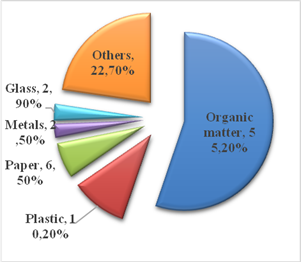
<body><![CDATA[<p><font size="2"><font face="Verdana, Arial, Helvetica, sans-serif"><b>Palabras clave:</b> Rellenos Sanitarios, Manejo de Residuos Sólidos, Generación Alternativa de Electricidad, Bolivia.</font></font></p> <hr noshade>     <p>&nbsp;</p>     <p>&nbsp;</p>     <p><font size="3" face="Verdana, Arial, Helvetica, sans-serif"><b>1. INTRODUCTION </b></font></p>     <p align="justify"><font size="2" face="Verdana, Arial, Helvetica, sans-serif">A landfill is a placed were all the waste from a region (city, municipality, county, among others) is disposal. Landfill biogas can be produced using organic waste from foodstuff (fruits, vegetables, greases, among others), yard grass, yard trimming, wood, straws and any other organic matter.  Microbial anaerobic digestion occurs in the organic waste and depending of the environment, disposal and organic composition, biogas is generated. Landfill biogas is compound mainly of methane CH<sub>4</sub>(60% approximately) and carbon dioxide CO<sub>2</sub>(40% approximately) [1]. The composition of the biogas is affected by the composition of the waste, landfill characteristics, local weather conditions and waste treatment, mainly.</font></p>      <p align="justify"><font size="2" face="Verdana, Arial, Helvetica, sans-serif">The biogas that is generated in the landfill can be used to generate electricity using generators of internal combustion, also can be used as a fuel for water heaters. In this way, not only useful energy can be obtained from the landfill but also contaminants can be reduced as leachate contamination of surface and groundwater, and the release of greenhouse gases (GHG) to the atmosphere[2]. </font></p>      <p align="justify"><font size="2" face="Verdana, Arial, Helvetica, sans-serif">There are several projects worldwide that reports the feasibility of use landfill biogas to generate electricity instead of only incinerate the biogas [3-5]. The studies show the potential of electricity generation using landfill biogas models under specific conditions where two main parameters such us the methane generation potential (Lo) and the methane generation rate (k) are estimated for each case. These two parameters cannot be generalized and vary depending on the landfill characteristics.</font></p>      <p align="justify"><font size="2" face="Verdana, Arial, Helvetica, sans-serif">No information exists in the open literature about the prefeasibility of electricity generation plants using landfill biogas in Bolivia, so this article will be focus on estimate the potential generation of landfill biogas to produce electricity, the reduction of GHG gases and its feasibility. Besides, in Bolivia there are only 3.1% of landfills, the rest are open dumping [6].These landfills burn up the biogas (methane and carbon dioxide) that is generated [7].</font></p>      <p align="justify"><font size="2" face="Verdana, Arial, Helvetica, sans-serif">According to the Department of Environment, in Bolivia around 5470 t of solid waste are generated every day, equivalent to 1.99 million tons of solid waste per year from which 87.9% is generated in the urban area and the remaining 12.1% is generated in the rural area. The average generation per capita in Bolivia is of 0.5 kg of solid waste per day. The states that produce more solid waste are Santa Cruz (30.6%), La Paz (27.4%), and Cochabamba (17.2%). The average composition of the solid waste is showed in     <a href="#f1">Figure 1</a>, as it can observe, only 55.2% is organic matter from the solid waste that can be used in the landfill to produce biogas [6]. </font></p>      <p align=center><font size="2" face="Verdana, Arial, Helvetica, sans-serif"><a name="f1"></a><img border=0 width=301 height=262 id="Gráfico 4" src="/img/revistas/riyd/v1n17/a06_image001.png"></font></p>      ]]></body>
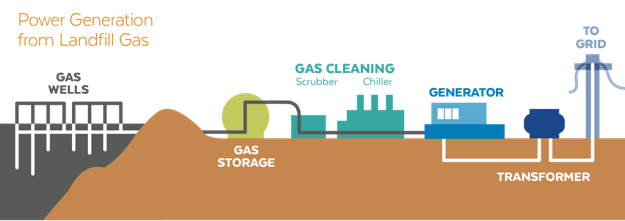
<body><![CDATA[<p align="center"><font size="2" face="Verdana, Arial, Helvetica, sans-serif"><a name="_Ref482454106"></a><a name="_Ref482203561"><b>Figure 1</b></a> - Average composition of the solid waste in Bolivia[6].</font></p>      <p align="justify"><font size="2" face="Verdana, Arial, Helvetica, sans-serif">In this article the solid municipal waste from Santa Cruz, La Paz and Cochabamba will be studied. First a description of a power generation plant using landfill biogas will be described to understand the necessary equipment to generate electricity. Then the model and the most important parameters to evaluate the landfill biogas and methane generation will be introduced. Finally, the estimation of the electrical generation using methane from the landfill and a simple economic analysis will be presented to estimate the feasibility of the project.</font></p>     <p align="justify">&nbsp;</p>     <p align="justify"><font size="3" face="Verdana, Arial, Helvetica, sans-serif"><b>2. DESCRIPTION OF THE POWER GENERATION USING LANDFILL BIOGAS </b></font></p>     <p align="justify"><font size="2" face="Verdana, Arial, Helvetica, sans-serif"><a href="#f2">Figure 2</a> shows the main components of a power generation from landfill biogas, as it can see the biogas is extracted from the landfill through a series of pipes then is storage and processed in order to use the biogas as a fuel in a reciprocating combustion engine which drives generators to produce electricity. The generated electricity is sent to a transformer to rectify the KVA according to the electric grid demand. It is important to mention that the combustion engine needs an exhaust chimney for the combustion gases and a cooling tower to chill the water that goes to the reciprocating engine[8-9].</font></p>      <p align=center><font size="2" face="Verdana, Arial, Helvetica, sans-serif"><a name="f2"></a><img border=0 width=625 height=221 id="Imagen 5" src="/img/revistas/riyd/v1n17/a06_image002.png" alt="Image result for DESCRIPTION OF THE POWER GENERATION USING LANDFILL BIOGAS"></font></p>      <p align="center"><font size="2" face="Verdana, Arial, Helvetica, sans-serif"><a name="_Ref482264240"><b>Figure 2 -</b></a>Scheme of a power generation using landfill biogas [10].</font></p>      <p align="justify"><font size="2" face="Verdana, Arial, Helvetica, sans-serif">There are works that explain in detail all the process (collection field, collection piping, storage, filtration, among others) to obtain the biogas from the landfill to use it as a fuel to generate electricity [1, 2, 5, 8, 11, 12].</font></p>     <p align="justify">&nbsp;</p>     <p align="justify"><font size="3" face="Verdana, Arial, Helvetica, sans-serif"><b>3. MATHEMATICAL MODEL TO PREDICT LANDFILL BIOGAS AND ELECTRICITY   GENERATION </b></font></p>     ]]></body>
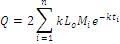
<body><![CDATA[<p align="justify"><font size="2" face="Verdana, Arial, Helvetica, sans-serif">Landfill methane models are tools used to predict methane generation over time from a mass of waste in the landfill. These models have advantages in terms of low cost and relatively rapid results compared to other alternatives such as installation of test wells in the landfill to recover and measure the biogas [13].</font></p>      <p align="justify"><font size="2" face="Verdana, Arial, Helvetica, sans-serif">Thanks to landfill gas models, it is possible to size the gas collection system, evaluate and project the available energy, size equipment, estimate costs, and evaluate the life time and feasibility of the landfill biogas. </font></p>      <p align="justify"><font size="2" face="Verdana, Arial, Helvetica, sans-serif"><a name="OLE_LINK2"></a><a name="OLE_LINK1">Most widely accepted and used models are the first-order kinetic models</a> [14]. These empirical models are adapted to specific landfills where the amount of waste, the gas formation potential, and effect of the age on the gas formation are the most important variables. Reinhart <i>et al</i>. analyze the different models to predict landfill biogas generation, as a conclusion they found that model parameters are highly dependent on moisture conditions and capture efficiency which are values difficult to quantify since more data from full-scale landfills are needed[14]. They found that U.S EPA LandGem model appears to fit the data of wet landfills. The Intergovernmental Panel on Climate Change (IPCC) outline the First Order Decay (FOD) methods to predict the methane generation from solid waste disposal sites, however, this method was not well adopted due to some key parameters dependent on country-specific conditions, and currently there are not enough data available to give reliable default values[15]. The empirical models are available in the open literature and open software [16-19].</font></p>      <p align="justify"><font size="2" face="Verdana, Arial, Helvetica, sans-serif">In this article, the LandGem first-order degradation model was used to quantify the biogas production from the landfill, as seen in Equation 1.</font></p>  <table border=0 align="center" cellpadding=0 cellspacing=0>   <tr>     <td width=347 valign=top>         <p><font size="2" face="Verdana, Arial, Helvetica, sans-serif"><img   width=120 height=44 src="/img/revistas/riyd/v1n17/a06_image003.png"></font></p>  </td>     <td width=302>         <p align=right><font size="2" face="Verdana, Arial, Helvetica, sans-serif"><a name="_Ref482389915">(1)</a></font></p>  </td>   </tr> </table>     <p align="justify"><font size="2" face="Verdana, Arial, Helvetica, sans-serif">Where:</font></p>      <blockquote>       <p align="justify"><font size="2" face="Verdana, Arial, Helvetica, sans-serif"><i>Q… </i>is total     landfill biogas emission rate per year, m<sup>3</sup>/y     <br>     <i>n… </i>is the number of years of waste placement    ]]></body>
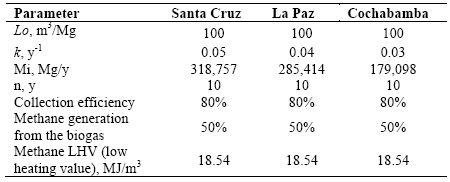
<body><![CDATA[<br>     <i>k …</i> is the landfill gas generation rate constant, y<sup>-1</sup>    <br>     <i>Mi …</i> is the mass in mega grams of the solid waste section placed in year     <i>i, </i>Mg    <br>     <i>L</i>0… is the methane generation potential, m<sup>3</sup>/Mg</font>    <br>     <font size="2" face="Verdana, Arial, Helvetica, sans-serif"><i>ti ……</i>is the age of the waste section placed in year <i>i</i>,     y</font></p> </blockquote>     <p align="justify"><font size="2" face="Verdana, Arial, Helvetica, sans-serif">Parameter <i>k</i> is selected in function of the humidity, nutrients, pH and temperature, when no information of these factors are available, the main factor is the rain precipitation of the place [16, 17], the typical range is between 0.01 to 1.Parameter <i>Lo</i>is a function of the organic content of the residual waste mainly, the value of Lo varies from 56 to 198 m<sup>3</sup> per ton or mega gram of solid waste [16, 17].  </font></p>      <p align="justify"><font size="2" face="Verdana, Arial, Helvetica, sans-serif"><a href="#t1">Table 1</a> shows the values that were used to estimate the landfill biogas and methane generation for the urban areas of Santa Cruz, La Paz and Cochabamba. Default and recommended parameters of <i>k</i> and <i>Lo</i> also were used in the absence of in-situ specific data,[16, 20, 21]. Slowly decay rates were considered since no data on types of organic waste are available in the open literature for Bolivian landfills[6], [18]. The mass of solid organic waste in the landfill is considered from data in section 1 and <a href="#f1">Figure 1</a>. Details of the location and weather conditions from Santa Cruz, La Paz and Cochabamba can be seen in reference [6] and [8]. A conservative value of 50% is considered for the methane obtained from the landfill biogas.</font></p>      <p align=center><font size="2" face="Verdana, Arial, Helvetica, sans-serif"><a name="t1" id="t1"><b>TABLE 1 - PARAMETERS TO EVALUATE THE LANDFILL BIOGAS AND METHANE GENERATION</b></a></font></p>     <p align=center><img src="/img/revistas/riyd/v1n17/a06_tabla_01.gif" width="450" height="182"></p>     <p align=justify><font size="3" face="Verdana, Arial, Helvetica, sans-serif"><b>4. RESULTS AND DISCUSSION</b></font></p>     <p align="justify"><font size="2" face="Verdana, Arial, Helvetica, sans-serif"><a href="#f3">Figure 3</a> shows the methane obtained from the landfill using Equation 1 and considering the data of 0. The year 2017 was assumed as the started year of the landfill. As it can be observed, the city of Santa Cruz can generate more methane from the landfill biogas than La Paz and Cochabamba due to more solid waste is available and higher value of <i>k</i> is assumed, based on that in Santa Cruz have higher decomposable waste environment than La Paz and Cochabamba [6], [14]. The maximum value for the three cases is obtained in 2028 where the landfill is closed and no more solid waste is placed, after that the generation of methane starts to reduce.</font></p>      ]]></body>
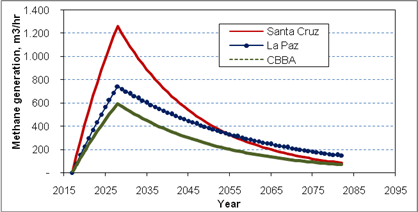
<body><![CDATA[<p align=center><font size="2" face="Verdana, Arial, Helvetica, sans-serif"><a name="f3"></a><img border=0 width=418 height=212 id="Gráfico 2" src="/img/revistas/riyd/v1n17/a06_image004.png"></font></p>      <p align="center"><font size="2" face="Verdana, Arial, Helvetica, sans-serif"><a name="_Ref482460447"><b>Figure 3 -</b></a>Methane generation obtained from the landfill.</font></p>      <p align="justify"><font size="2" face="Verdana, Arial, Helvetica, sans-serif">To estimate the electricity generation that can be obtained using the methane in a reciprocating combustion engine generator, the following equation was used:</font></p>  <table border=0 align="center" cellpadding=0 cellspacing=0>   <tr>     <td width=366 valign=top>         <p align=center><font size="2" face="Verdana, Arial, Helvetica, sans-serif"><img   width=113 height=18 src="/img/revistas/riyd/v1n17/a06_image005.png"></font></p>  </td>     <td width=272>         <p align=right><font size="2" face="Verdana, Arial, Helvetica, sans-serif">(2)</font></p>  </td>   </tr> </table>     <p align="justify"><font size="2" face="Verdana, Arial, Helvetica, sans-serif">where:</font></p>      <blockquote>       <p align="justify"><font size="2" face="Verdana, Arial, Helvetica, sans-serif"><i>E.E.… </i>is the electrical energy generated, GWh/y     <br>     <img width=9 height=17 src="/img/revistas/riyd/v1n17/a06_image006.png"><i>… </i>is     the volumetric flow of methane     CH<sub>4</sub>, m<sup>3</sup>/y    <br>     <i>LHV</i>… is the low heating value of methane CH<sub>4</sub>, GJ/m<sup>3</sup>    ]]></body>
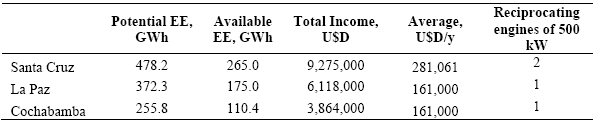
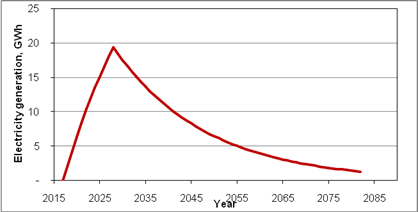
<body><![CDATA[<br>     <img width=7 height=16 src="/img/revistas/riyd/v1n17/a06_image007.png"><i>…</i>     is the efficiency of the reciprocating combustion engine generator</font></p> </blockquote>     <p align=center><font size="2" face="Verdana, Arial, Helvetica, sans-serif"><a name="f4"></a><img border=0 width=418 height=212 id="Gráfico 3" src="/img/revistas/riyd/v1n17/a06_image008.png"></font></p>      <p align="center"><font size="2" face="Verdana, Arial, Helvetica, sans-serif"><a name="_Ref482463966"><b>Figure 4 -</b></a>Annual electricity potential generation.</font></p>      <p align="justify"><font size="2" face="Verdana, Arial, Helvetica, sans-serif">The annual electricity generation using methane from the landfill as a fuel in the reciprocating combustion engine generator is shown in <a href="#f4">Figure 4</a>. The results were obtained using the data of <a href="#t1">Table 1</a>, <a href="#f3">Figure 3</a> and the Equation 2. A typical efficiency of a combustion engine of 34% was used [22], the altitude of the landfill was not considered for this evaluation. As it was expected, Santa Cruz can produce more electricity than La Paz and Cochabamba since more methane as a fuel is available. However, technical limitations do not allow using all the available methane in reciprocating combustion engine generators to produce electricity since it is not practical to put different capacities of combustion engines along the year to recover all the available methane. For example, <a href="#f5">Figure 5</a> shows the electricity that can be obtained in Santa Cruz using 2 reciprocating engines of 500 kW each one. Under this strategy, 10 GWh can be generated each year from 2022 to 2042 after that year, there is no enough methane to supply to the two reciprocating engines and only one will continue operating producing 5 GWh of electricity from 2042 to 2055. That means, from all the potential electricity that can be obtained in Santa Cruz (478 GWh) using the methane from the landfill, only 265 GWh (55.4%) can be available to use it. An average of 8.03 GWh per year could be delivered from 2022 to 2055.Considering the electricity price in Bolivia for generators of 35 U$D/MWh [23] a total income of 9.27 million U$D can be obtained in 33 years, which means an average income of 281,061 U$D per year.</font></p>      <p align=center><font size="2" face="Verdana, Arial, Helvetica, sans-serif"><a name="f5"></a><img border=0 width=418 height=212 id="Gráfico 33" src="/img/revistas/riyd/v1n17/a06_image011.png"></font></p>      <p align="center"><font size="2" face="Verdana, Arial, Helvetica, sans-serif"><a name="_Ref482465655"><b>Figure 5 -</b></a>Available electricity generation in Santa Cruz.</font></p>      <p align="justify"><font size="2" face="Verdana, Arial, Helvetica, sans-serif">Following the same procedure for La Paz and Cochabamba, <a href="#t2">Table 2</a> shows the potential electrical energy that can be generated using the methane obtained from the landfill, the available energy when reciprocating combustion engines are used, the total income obtained from the sales of the available electricity, and the average income per year that it can be obtained in the period that the electricity is available. For La Paz 175 GWh of electricity can be generated from 2021 to 2059 using one reciprocating engine of 500 kW, for Cochabamba 110 GWh of electricity can be generated from 2022 to 2046. As it can be observed, the results show that Santa Cruz has higher values than La Paz and Cochabamba for all the parameters presented in <a href="#t2">Table 2</a>. Cochabamba and La Paz have similar average income of 161,000 U$D/y, 42.7% less than Santa Cruz due to the less available energy is obtained and only one reciprocating engine is used. The electricity price of 35 U$D/MWh is the same for the three cases.</font></p>     <p align=center><font size="2" face="Verdana, Arial, Helvetica, sans-serif"><a name="t2" id="t2"><b>TABLE 2 - SUMMARY OF RESULTS</b></a></font></p>     <p align=center><img src="/img/revistas/riyd/v1n17/a06_tabla_02.gif" width="599" height="124"></p>     <p align="justify"><font size="2" face="Verdana, Arial, Helvetica, sans-serif">Considering an investment cost of 2,000 U$D/kW and O&amp;M cost of 13 U$D/MWh for the reciprocating combustion engine system [19], [21], and cycle life of 20 years, <a href="#t3">Table 3</a> presents a simple economic evaluation [24] to estimate the feasibility of the electricity generation using methane as a fuel from the landfill biogas. The cost of voltage transformers, electrical substations, and maintenance costs of the landfill, inflation and taxes were not considered in this analysis and only has to be used as a reference. </font></p>      ]]></body>
<body><![CDATA[<p align=center><font size="2" face="Verdana, Arial, Helvetica, sans-serif"><a name="t3" id="t3"><b>TABLE 3 - RESULTS OF THE SIMPLE ECONOMIC ANALYSIS OF THE RECOVER     <br> LANDFILL BIOGAS TO PRODUCE ELECTRICITY</b></a></font></p>     <p align=center><img src="/img/revistas/riyd/v1n17/a06_tabla_03.gif" width="612" height="108"></p>     <p align="justify"><font size="2" face="Verdana, Arial, Helvetica, sans-serif">The results show that Cochabamba and La Paz have higher internal rate of return (IRR) and smaller payback period than Santa Cruz due to only one reciprocating engine was chosen to cover the largest period of methane production while Santa Cruz used two. Although the internal rates of return are positives for the three cases, these values could not be attractive for investors. However, more exhaustive and rigorous analysis has to be performed in order to obtain reliable values.</font></p>     <p align="justify">&nbsp;</p>     <p align="justify"><font size="3" face="Verdana, Arial, Helvetica, sans-serif"><b>5. CONCLUSIONS </b></font></p>     <p align="justify"><font size="2" face="Verdana, Arial, Helvetica, sans-serif">In this article the evaluation of landfill biogas potential in Bolivia is performed in order to estimate the electricity that can be generated if the methane obtained from the Biogas is used as a fuel in a reciprocating combustion engine. The LandGem model and the available data of the solid waste characteristics of the most important cities in Bolivia (Santa Cruz, La Paz and Cochabamba) were used to quantify the potential methane generation obtained from the landfill. The results shown that Santa Cruz can produce more methane than La Paz and Cochabamba (see <a href="#f3">Figure 3</a>).</font></p>      <p align="justify"><font size="2" face="Verdana, Arial, Helvetica, sans-serif">Santa Cruz could generate 265 GWh of electricity using the methane in reciprocating combustion engine while </font> <font size="2" face="Verdana, Arial, Helvetica, sans-serif">La Paz and Cochabamba   could generate 215 and 110 GWh of electricity respectively (see <a href="#t2">Table 2</a>). This   represent an average income for 281,061.0 U$D/y for Santa Cruz and 161,000.0 U$D/y   for La Paz and Cochabamba, respectively (see <a href="#t2">Table 2</a>). Considering a commercial   electricity price in Bolivia of 35 U$D/MWh [23], the economic analysis showed   that IRR of 6.2% can be achieved for Santa Cruz and 7.9% for La Paz and   Cochabamba, respectively, also higher payback periods were obtained (more than   9 years), see <a href="#t3">Table 3</a>. Cochabamba and La Paz had the higher IRR and less   payback period since only one reciprocating   engine was chosen to cover the largest period of methane production while Santa   Cruz used two. It seems that the low price of electricity in Bolivia is one of   the main factors to obtain low IRR and high paybacks, for example, if an   international electricity price of 70 U$D/MWh is considered, higher IRR are   obtained (at least 20%) and less payback periods are achieved (around 4 years)   for the three study cases. More exhaustive and rigorous economic analysis has   to be performed in order to obtain reliable values.</font></p>     <p align="justify"><font size="2" face="Verdana, Arial, Helvetica, sans-serif">A sensitivity analysis and an optimization of the capacities of the reciprocating combustion engine can be performed as a future work to determine the optimum number of generators and to identify important variables that affect the technical and economic feasibility of the project. Also environmental analyses can be added to the study to identify the GHG reduction using the methane to produce electricity instead of releasing to the atmosphere.</font></p>      <p align="justify"><font size="2" face="Verdana, Arial, Helvetica, sans-serif">Other models to predict the generation of landfill biogas as IPCC can be used; also in situ data from the landfills have to be obtained for better prediction of methane efficiency capture and production especially for the <i>k</i> and <i>Lo</i> parameters.</font></p>      ]]></body>

<body><![CDATA[<p align="justify"><font size="2" face="Verdana, Arial, Helvetica, sans-serif">Better policies, incentives and regulations are still needed in Bolivia like more competitive electricity prices, regulations to incentive the installation of landfills, among others. </font></p>      <p align="justify"><font size="2" face="Verdana, Arial, Helvetica, sans-serif">The results presented in this article could provide valuable information to the solid waste management industry, policy makers and investors.</font></p>     <p align="justify">&nbsp;</p>     <p align="justify"><font size="3" face="Verdana, Arial, Helvetica, sans-serif"><b>6. ACKNOLEDGMENT </b></font></p>      <p align="justify"><font size="2" face="Verdana, Arial, Helvetica, sans-serif">The authors want to express their acknowledgment to the Research Department of UPB for the economic support, to Dra. Carla Quiroga for her technical support and recommendations.</font></p>      <p align="justify">&nbsp;</p>      <p align="justify"><font size="3" face="Verdana, Arial, Helvetica, sans-serif"><b>7. BIBLIOGRAPHY </b></font></p>     <p align="justify"><font size="2" face="Verdana, Arial, Helvetica, sans-serif">[1] ESMAP- The World Bank , Handbook for the     Preparation of Landfill Gas to Energy Projects in Latin America and the Caribbean, Ontario: Conestoga-Rovers &amp; Associates, 2004. </font></p>     <p align="justify"><font size="2" face="Verdana, Arial, Helvetica, sans-serif">[2] T. Al Seadi, D. Rutz, P. Heinz , M.   K&ouml;ttner, T. Finsterwalder, S. Volk and R. Janssen, Biogas Handbook, Esbjerg,   Denmark: University of Southern Denmark Esbjerg, 2008. </font></p>     <p align="justify"><font size="2" face="Verdana, Arial, Helvetica, sans-serif">[3] R. Borzychowski, K. Csontos , M. A.   Gonz&aacute;lez and L. Rojas-Sol&oacute;rzano , &quot;Pre-feasibility Study of Landfill   Biogas for Electricity in Colombia,&quot; in <i>International Conference on     Renewable Energies and Power Quality</i>, Santiago de Compostela, 2012. </font></p>     ]]></body>
<body><![CDATA[<p align="justify"><font size="2" face="Verdana, Arial, Helvetica, sans-serif">[4] Q. Aguilar-Virgen, P. Taboada-Gonz&aacute;lez,   S. Ojeda-Ben&iacute;tez and S. Cruz-Sotelo, &quot;Power generation with biogas from   municipal solid waste: Prediction of gas generation with in situ   parameters,&quot; <i>Renewable and Sustainable Energy Reviews, </i>vol. 30,   pp. 412-419, 2014. </font></p>     <p align="justify"><font size="2" face="Verdana, Arial, Helvetica, sans-serif">[5] H. Xiaoli, Y. Hongxing and Z. Guoqiang,   &quot;Trigeneration: A new way for landfill gas utilization and its   feasibility in Hong Kong,&quot; <i>Energy Policy, </i>vol. 36, pp.   3662-3673, 2008. </font></p>     <p align="justify"><font size="2" face="Verdana, Arial, Helvetica, sans-serif">[6] Direcci&oacute;n General de Gesti&oacute;n Integral de   Residuos S&oacute;lidos, &quot;Diagn&oacute;stico de la Gesti&oacute;n de Residuos S&oacute;lidos en   Bolivia/2010,&quot; MMAyA/VAPSB/DGGIRS, La Paz, Bolivia, 2011.</font></p>     <!-- ref --><p align="justify"><font size="2" face="Verdana, Arial, Helvetica, sans-serif">[7] Ministerio de Medio Ambiente y Agua,   &quot;Diagn&oacute;stico de la Gesti&oacute;n de Residuos S&oacute;lidos en el Departamento de La   Paz,&quot; La Paz, Bolivia, 2011.    &nbsp;&nbsp;&nbsp;&nbsp;&nbsp;&nbsp;&nbsp;&nbsp;[&#160;<a href="javascript:void(0);" onclick="javascript: window.open('/scielo.php?script=sci_nlinks&ref=964348&pid=S2518-4431201700010000600007&lng=','','width=640,height=500,resizable=yes,scrollbars=1,menubar=yes,');">Links</a>&#160;]<!-- end-ref --></font></p>     <p align="justify"><font size="2" face="Verdana, Arial, Helvetica, sans-serif">[8] EPA, Global Methane Inittiative - US,   &quot;Landfill Gas Energy Utilization Technologies,&quot; in <i>International     Best Practices Guide for LFGE Projects</i>, 2012, pp. 33-50.</font></p>     <!-- ref --><p align="justify"><font size="2" face="Verdana, Arial, Helvetica, sans-serif">[9] Gerencia de Energ&iacute;as Renovables del   Instituto de Investigaciones El&eacute;ctricas, &quot;Generaci&oacute;n de electricidad   mediante residuos s&oacute;lidos urbanos,&quot; CFE, Mexico, 2012.    &nbsp;&nbsp;&nbsp;&nbsp;&nbsp;&nbsp;&nbsp;&nbsp;[&#160;<a href="javascript:void(0);" onclick="javascript: window.open('/scielo.php?script=sci_nlinks&ref=964351&pid=S2518-4431201700010000600009&lng=','','width=640,height=500,resizable=yes,scrollbars=1,menubar=yes,');">Links</a>&#160;]<!-- end-ref --></font></p>     <!-- ref --><p align="justify"><font size="2" face="Verdana, Arial, Helvetica, sans-serif">[10] Bordna M&oacute;na Company, &quot;Landfill   Gas,&quot; [Online]. Available:   http://www.bordnamona.ie/journey/business-transformations/landfill-gas/. [Accessed 10 May 2017].    &nbsp;&nbsp;&nbsp;&nbsp;&nbsp;&nbsp;&nbsp;&nbsp;[&#160;<a href="javascript:void(0);" onclick="javascript: window.open('/scielo.php?script=sci_nlinks&ref=964353&pid=S2518-4431201700010000600010&lng=','','width=640,height=500,resizable=yes,scrollbars=1,menubar=yes,');">Links</a>&#160;]<!-- end-ref --></font></p>     ]]></body>
<body><![CDATA[<!-- ref --><p align="justify"><font size="2" face="Verdana, Arial, Helvetica, sans-serif">[11] World Bank, &quot;Mexico - Methane Gas   Capture And Use At A Landfill - Demonstration Project,&quot; 2007. [Online].   Available:   <a href="http://documents.worldbank.org/curated/en/426001474627865844/Mexico-Methane-Gas-Capture-And-Use-At-A-Landfill-Demonstration-Project" target="_blank">http://documents.worldbank.org/curated/en/426001474627865844/Mexico-Methane-Gas-Capture-And-Use-At-A-Landfill-Demonstration-Project</a>.   [Accessed 10 May 2017].    &nbsp;&nbsp;&nbsp;&nbsp;&nbsp;&nbsp;&nbsp;&nbsp;[&#160;<a href="javascript:void(0);" onclick="javascript: window.open('/scielo.php?script=sci_nlinks&ref=964355&pid=S2518-4431201700010000600011&lng=','','width=640,height=500,resizable=yes,scrollbars=1,menubar=yes,');">Links</a>&#160;]<!-- end-ref --></font></p>     <!-- ref --><p align="justify"><font size="2" face="Verdana, Arial, Helvetica, sans-serif">[12] Incremi, &quot;Estudio de Factibilidad   para el Aprovechamiento del Metano en el Relleno Sanitario Municipal de   Saltillo, Coahuila,&quot; Mexico, 2010.    &nbsp;&nbsp;&nbsp;&nbsp;&nbsp;&nbsp;&nbsp;&nbsp;[&#160;<a href="javascript:void(0);" onclick="javascript: window.open('/scielo.php?script=sci_nlinks&ref=964357&pid=S2518-4431201700010000600012&lng=','','width=640,height=500,resizable=yes,scrollbars=1,menubar=yes,');">Links</a>&#160;]<!-- end-ref --></font></p>     <p align="justify"><font size="2" face="Verdana, Arial, Helvetica, sans-serif">[13] SCS Engineers, &quot;Comparison of Models   for Predicting Landfill Methane Recover,&quot; California, USA, 1997.</font></p>     <!-- ref --><p align="justify"><font size="2" face="Verdana, Arial, Helvetica, sans-serif">[14] D. R. Reinhart and A. A. Faour,   &quot;First-Order Kinetic Gas Generation Model Parameters for Wet   Landfills,&quot; U.S. Environmental Protection Agency, Washington, 2005.    &nbsp;&nbsp;&nbsp;&nbsp;&nbsp;&nbsp;&nbsp;&nbsp;[&#160;<a href="javascript:void(0);" onclick="javascript: window.open('/scielo.php?script=sci_nlinks&ref=964360&pid=S2518-4431201700010000600014&lng=','','width=640,height=500,resizable=yes,scrollbars=1,menubar=yes,');">Links</a>&#160;]<!-- end-ref --></font></p>     <!-- ref --><p align="justify"><font size="2" face="Verdana, Arial, Helvetica, sans-serif">[15] Intergovernmental Panel on Climate Change   - IPCC, &quot;Waste,    &nbsp;&nbsp;&nbsp;&nbsp;&nbsp;&nbsp;&nbsp;&nbsp;[&#160;<a href="javascript:void(0);" onclick="javascript: window.open('/scielo.php?script=sci_nlinks&ref=964362&pid=S2518-4431201700010000600015&lng=','','width=640,height=500,resizable=yes,scrollbars=1,menubar=yes,');">Links</a>&#160;]<!-- end-ref --><!-- ref -->&quot; in <i>2006 IPCC Guidelines for National Greenhouse     Gas Inventories</i>, 2006, pp. 1-32.    &nbsp;&nbsp;&nbsp;&nbsp;&nbsp;&nbsp;&nbsp;&nbsp;[&#160;<a href="javascript:void(0);" onclick="javascript: window.open('/scielo.php?script=sci_nlinks&ref=964363&pid=S2518-4431201700010000600016&lng=','','width=640,height=500,resizable=yes,scrollbars=1,menubar=yes,');">Links</a>&#160;]<!-- end-ref --></font></p>     ]]></body>
<body><![CDATA[<!-- ref --><p align="justify"><font size="2" face="Verdana, Arial, Helvetica, sans-serif">[16] Landfill Methane Outreach Program,   &quot;Landfill Gas Modeling,    &nbsp;&nbsp;&nbsp;&nbsp;&nbsp;&nbsp;&nbsp;&nbsp;[&#160;<a href="javascript:void(0);" onclick="javascript: window.open('/scielo.php?script=sci_nlinks&ref=964365&pid=S2518-4431201700010000600017&lng=','','width=640,height=500,resizable=yes,scrollbars=1,menubar=yes,');">Links</a>&#160;]<!-- end-ref --><!-- ref -->&quot; in <i>Handbook, LFG Energy Project     Development</i>, 2016, pp. 1-6.    &nbsp;&nbsp;&nbsp;&nbsp;&nbsp;&nbsp;&nbsp;&nbsp;[&#160;<a href="javascript:void(0);" onclick="javascript: window.open('/scielo.php?script=sci_nlinks&ref=964366&pid=S2518-4431201700010000600018&lng=','','width=640,height=500,resizable=yes,scrollbars=1,menubar=yes,');">Links</a>&#160;]<!-- end-ref --></font></p>     <!-- ref --><p align="justify"><font size="2" face="Verdana, Arial, Helvetica, sans-serif">[17] US EPA, &quot;International Landfill Gas   Models,&quot; Landfill Methane Outreach Program, 2009. [Online]. Available:   <a href="http://epaglobalmethane-stage.icfwebservices.com/lmop/international/mexicano.html" target="_blank">http://epaglobalmethane-stage.icfwebservices.com/lmop/international/mexicano.html</a>.   [Accessed 10 May 2017].    &nbsp;&nbsp;&nbsp;&nbsp;&nbsp;&nbsp;&nbsp;&nbsp;[&#160;<a href="javascript:void(0);" onclick="javascript: window.open('/scielo.php?script=sci_nlinks&ref=964368&pid=S2518-4431201700010000600019&lng=','','width=640,height=500,resizable=yes,scrollbars=1,menubar=yes,');">Links</a>&#160;]<!-- end-ref --></font></p>     <!-- ref --><p align="justify"><font size="2" face="Verdana, Arial, Helvetica, sans-serif">[18] IPCC Guidelines for National Greenhouse   Gas Inventories, &quot;IPCC Waste Model (MS Excel),&quot; 2006. [Online].   Available:   <a href="http://www.ipcc-nggip.iges.or.jp/public/2006gl/pdf/5_Volume5/IPCC_Waste_Model.xls" target="_blank">www.ipcc-nggip.iges.or.jp/public/2006gl/pdf/5_Volume5/IPCC_Waste_Model.xls</a>.   [Accessed 2 May 2017].    &nbsp;&nbsp;&nbsp;&nbsp;&nbsp;&nbsp;&nbsp;&nbsp;[&#160;<a href="javascript:void(0);" onclick="javascript: window.open('/scielo.php?script=sci_nlinks&ref=964370&pid=S2518-4431201700010000600020&lng=','','width=640,height=500,resizable=yes,scrollbars=1,menubar=yes,');">Links</a>&#160;]<!-- end-ref --></font></p>     <!-- ref --><p align="justify"><font size="2" face="Verdana, Arial, Helvetica, sans-serif">[19] Natural Resources Canada,   &quot;RETScreen,&quot; [Online]. Available:   <a href="http://www.nrcan.gc.ca/energy/software-tools/7465" target="_blank">http://www.nrcan.gc.ca/energy/software-tools/7465</a>. [Accessed 2 May 2017].    &nbsp;&nbsp;&nbsp;&nbsp;&nbsp;&nbsp;&nbsp;&nbsp;[&#160;<a href="javascript:void(0);" onclick="javascript: window.open('/scielo.php?script=sci_nlinks&ref=964372&pid=S2518-4431201700010000600021&lng=','','width=640,height=500,resizable=yes,scrollbars=1,menubar=yes,');">Links</a>&#160;]<!-- end-ref --></font></p>     <!-- ref --><p align="justify"><font size="2" face="Verdana, Arial, Helvetica, sans-serif">[20] U.S. Environmental Protection Agency,   &quot;First-Order Kinetic Gas Generation Model Parameters for Wet   Landfills,&quot; Washington, 2005.    &nbsp;&nbsp;&nbsp;&nbsp;&nbsp;&nbsp;&nbsp;&nbsp;[&#160;<a href="javascript:void(0);" onclick="javascript: window.open('/scielo.php?script=sci_nlinks&ref=964374&pid=S2518-4431201700010000600022&lng=','','width=640,height=500,resizable=yes,scrollbars=1,menubar=yes,');">Links</a>&#160;]<!-- end-ref --></font></p>     <p align="justify"><font size="2" face="Verdana, Arial, Helvetica, sans-serif">[21] V. Inglezakis, L. Rojas-Sol&oacute;rzano, J.   Kim, A. Aitbekova, A. Ismailova, G. Shorakyzy and A. Kystauova, &quot;Comparison   between Landfill Gas and Waste Incineration for Power Generation in Astana,   Kazakhstan,&quot; <i>Waste Management and Research, </i>vol. 33, no. 5, pp.   486-494, 2015. </font></p>     <p align="justify"><font size="2" face="Verdana, Arial, Helvetica, sans-serif">[22] M. Lopez, &quot;Equipment Considerations   for Landfill Gas Generator Sets: Total Cost of Ownership,&quot; in <i>15th     Annual LMOP Conference and Project Expo</i>, Baltimore, 2012. </font></p>     <!-- ref --><p align="justify"><font size="2" face="Verdana, Arial, Helvetica, sans-serif">[23] Ministerio de Energ&iacute;as, &quot;Comit&eacute;   Nacional de Despacho de Carga,&quot; [Online]. Available: <a href="http://www.cndc.bo" target="_blank">http://www.cndc.bo</a>.   [Accessed 8 May 2017].    &nbsp;&nbsp;&nbsp;&nbsp;&nbsp;&nbsp;&nbsp;&nbsp;[&#160;<a href="javascript:void(0);" onclick="javascript: window.open('/scielo.php?script=sci_nlinks&ref=964378&pid=S2518-4431201700010000600025&lng=','','width=640,height=500,resizable=yes,scrollbars=1,menubar=yes,');">Links</a>&#160;]<!-- end-ref --></font></p>     <p align="justify"><font size="2" face="Verdana, Arial, Helvetica, sans-serif">[24] K. Renganathan Sharma, Fundamentals of   Engineering Economics, San Diego CA, USA: Cognella, 2011. </font></p>     <p align="justify"></p>      <p align=justify>&nbsp;</p>      ]]></body><back>
<ref-list>
<ref id="B1">
<label>1</label><nlm-citation citation-type="book">
<collab>ESMAP-The World Bank</collab>
<source><![CDATA[Handbook for the Preparation of Landfill Gas to Energy Projects in Latin America and the Caribbean]]></source>
<year>2004</year>
<publisher-loc><![CDATA[Ontario ]]></publisher-loc>
<publisher-name><![CDATA[Conestoga-Rovers & Associates]]></publisher-name>
</nlm-citation>
</ref>
<ref id="B2">
<label>2</label><nlm-citation citation-type="book">
<person-group person-group-type="author">
<name>
<surname><![CDATA[Al Seadi]]></surname>
<given-names><![CDATA[T.]]></given-names>
</name>
<name>
<surname><![CDATA[Rutz]]></surname>
<given-names><![CDATA[D.]]></given-names>
</name>
<name>
<surname><![CDATA[Heinz]]></surname>
<given-names><![CDATA[P.]]></given-names>
</name>
<name>
<surname><![CDATA[Köttner]]></surname>
<given-names><![CDATA[M.]]></given-names>
</name>
<name>
<surname><![CDATA[Finsterwalder]]></surname>
<given-names><![CDATA[T.]]></given-names>
</name>
<name>
<surname><![CDATA[Volk]]></surname>
<given-names><![CDATA[S.]]></given-names>
</name>
<name>
<surname><![CDATA[Janssen]]></surname>
<given-names><![CDATA[R.]]></given-names>
</name>
</person-group>
<source><![CDATA[Biogas Handbook]]></source>
<year>2008</year>
<publisher-loc><![CDATA[Esbjerg ]]></publisher-loc>
<publisher-name><![CDATA[University of Southern Denmark Esbjerg]]></publisher-name>
</nlm-citation>
</ref>
<ref id="B3">
<label>3</label><nlm-citation citation-type="confpro">
<person-group person-group-type="author">
<name>
<surname><![CDATA[Borzychowski]]></surname>
<given-names><![CDATA[R.]]></given-names>
</name>
<name>
<surname><![CDATA[Csontos]]></surname>
<given-names><![CDATA[K.]]></given-names>
</name>
<name>
<surname><![CDATA[González]]></surname>
<given-names><![CDATA[M.A.]]></given-names>
</name>
<name>
<surname><![CDATA[Rojas-Solórzano]]></surname>
<given-names><![CDATA[L.]]></given-names>
</name>
</person-group>
<source><![CDATA[Pre-feasibility Study of Landfill Biogas for Electricity in Colombia]]></source>
<year>2012</year>
<conf-name><![CDATA[ International Conference on Renewable Energies and Power Quality]]></conf-name>
<conf-loc> </conf-loc>
<publisher-loc><![CDATA[Santiago de Compostela ]]></publisher-loc>
</nlm-citation>
</ref>
<ref id="B4">
<label>4</label><nlm-citation citation-type="journal">
<person-group person-group-type="author">
<name>
<surname><![CDATA[Aguilar-Virgen]]></surname>
<given-names><![CDATA[Q.]]></given-names>
</name>
<name>
<surname><![CDATA[Taboada-González]]></surname>
<given-names><![CDATA[P.]]></given-names>
</name>
<name>
<surname><![CDATA[Ojeda-Benítez]]></surname>
<given-names><![CDATA[S.]]></given-names>
</name>
<name>
<surname><![CDATA[Cruz-Sotelo]]></surname>
<given-names><![CDATA[S.]]></given-names>
</name>
</person-group>
<article-title xml:lang="en"><![CDATA[Power generation with biogas from municipal solid waste: Prediction of gas generation with in situ parameters]]></article-title>
<source><![CDATA[Renewable and Sustainable Energy Reviews]]></source>
<year>2014</year>
<volume>30</volume>
<page-range>412-419</page-range></nlm-citation>
</ref>
<ref id="B5">
<label>5</label><nlm-citation citation-type="journal">
<person-group person-group-type="author">
<name>
<surname><![CDATA[Xiaoli]]></surname>
<given-names><![CDATA[H.]]></given-names>
</name>
<name>
<surname><![CDATA[Hongxing]]></surname>
<given-names><![CDATA[Y.]]></given-names>
</name>
<name>
<surname><![CDATA[Guoqiang]]></surname>
<given-names><![CDATA[Z.]]></given-names>
</name>
</person-group>
<article-title xml:lang="en"><![CDATA[Trigeneration: A new way for landfill gas utilization and its feasibility in Hong Kong]]></article-title>
<source><![CDATA[Energy Policy]]></source>
<year>2008</year>
<volume>36</volume>
<page-range>3662-3673</page-range></nlm-citation>
</ref>
<ref id="B6">
<label>6</label><nlm-citation citation-type="book">
<collab>Dirección General de Gestión Integral de Residuos Sólidos</collab>
<source><![CDATA[Diagnóstico de la Gestión de Residuos Sólidos en Bolivia/2010]]></source>
<year>2011</year>
<publisher-loc><![CDATA[La Paz ]]></publisher-loc>
<publisher-name><![CDATA[MMAyA/VAPSB/DGGIRS]]></publisher-name>
</nlm-citation>
</ref>
<ref id="B7">
<label>7</label><nlm-citation citation-type="">
<collab>Ministerio de Medio Ambiente y Agua</collab>
<source><![CDATA[Diagnóstico de la Gestión de Residuos Sólidos en el Departamento de La Paz]]></source>
<year>2011</year>
<publisher-loc><![CDATA[La Paz ]]></publisher-loc>
</nlm-citation>
</ref>
<ref id="B8">
<label>8</label><nlm-citation citation-type="">
<collab>EPA, Global Methane Inittiative-US</collab>
<article-title xml:lang="en"><![CDATA[Landfill Gas Energy Utilization Technologies]]></article-title>
<source><![CDATA[International Best Practices Guide for LFGE Projects]]></source>
<year>2012</year>
<page-range>33-50</page-range></nlm-citation>
</ref>
<ref id="B9">
<label>9</label><nlm-citation citation-type="book">
<collab>Gerencia de Energías Renovables del Instituto de Investigaciones Eléctricas</collab>
<source><![CDATA[Generación de electricidad mediante residuos sólidos urbanos]]></source>
<year>2012</year>
<publisher-loc><![CDATA[Mexico ]]></publisher-loc>
<publisher-name><![CDATA[CFE]]></publisher-name>
</nlm-citation>
</ref>
<ref id="B10">
<label>10</label><nlm-citation citation-type="">
<collab>Bordna Móna Company</collab>
<source><![CDATA[Landfill Gas]]></source>
<year></year>
</nlm-citation>
</ref>
<ref id="B11">
<label>11</label><nlm-citation citation-type="">
<collab>World Bank</collab>
<source><![CDATA[Mexico - Methane Gas Capture And Use At A Landfill - Demonstration Project]]></source>
<year>2007</year>
</nlm-citation>
</ref>
<ref id="B12">
<label>12</label><nlm-citation citation-type="">
<collab>Incremi</collab>
<source><![CDATA[Estudio de Factibilidad para el Aprovechamiento del Metano en el Relleno Sanitario Municipal de Saltillo, Coahuila]]></source>
<year>2010</year>
<publisher-loc><![CDATA[Mexico ]]></publisher-loc>
</nlm-citation>
</ref>
<ref id="B13">
<label>13</label><nlm-citation citation-type="">
<collab>SCS Engineers</collab>
<source><![CDATA[Comparison of Models for Predicting Landfill Methane Recover]]></source>
<year>1997</year>
<publisher-loc><![CDATA[California ]]></publisher-loc>
</nlm-citation>
</ref>
<ref id="B14">
<label>14</label><nlm-citation citation-type="book">
<person-group person-group-type="author">
<name>
<surname><![CDATA[Reinhart]]></surname>
<given-names><![CDATA[D. R.]]></given-names>
</name>
<name>
<surname><![CDATA[Faour]]></surname>
<given-names><![CDATA[A. A.]]></given-names>
</name>
</person-group>
<source><![CDATA[First-Order Kinetic Gas Generation Model Parameters for Wet Landfills]]></source>
<year>2005</year>
<publisher-loc><![CDATA[Washington ]]></publisher-loc>
<publisher-name><![CDATA[U.S. Environmental Protection Agency]]></publisher-name>
</nlm-citation>
</ref>
<ref id="B15">
<label>15</label><nlm-citation citation-type="">
<collab>Intergovernmental Panel on Climate Change - IPCC</collab>
<article-title xml:lang="en"><![CDATA[Waste]]></article-title>
<source><![CDATA[]]></source>
<year></year>
</nlm-citation>
</ref>
<ref id="B16">
<nlm-citation citation-type="">
<source><![CDATA[2006 IPCC Guidelines for National Greenhouse Gas Inventories]]></source>
<year>2006</year>
<page-range>1-32</page-range></nlm-citation>
</ref>
<ref id="B17">
<label>16</label><nlm-citation citation-type="">
<collab>Landfill Methane Outreach Program</collab>
<article-title xml:lang="en"><![CDATA[Landfill Gas Modeling]]></article-title>
<source><![CDATA[]]></source>
<year></year>
</nlm-citation>
</ref>
<ref id="B18">
<nlm-citation citation-type="">
<source><![CDATA[Handbook, LFG Energy Project Development]]></source>
<year>2016</year>
<page-range>1-6</page-range></nlm-citation>
</ref>
<ref id="B19">
<label>17</label><nlm-citation citation-type="book">
<collab>US EPA</collab>
<source><![CDATA[International Landfill Gas Models]]></source>
<year>2009</year>
<publisher-name><![CDATA[Landfill Methane Outreach Program]]></publisher-name>
</nlm-citation>
</ref>
<ref id="B20">
<label>18</label><nlm-citation citation-type="">
<collab>IPCC Guidelines for National Greenhouse Gas Inventories</collab>
<source><![CDATA[IPCC Waste Model (MS Excel)]]></source>
<year>2006</year>
</nlm-citation>
</ref>
<ref id="B21">
<label>19</label><nlm-citation citation-type="">
<collab>Natural Resources Canada</collab>
<source><![CDATA[RETScreen]]></source>
<year></year>
</nlm-citation>
</ref>
<ref id="B22">
<label>20</label><nlm-citation citation-type="">
<collab>U.S. Environmental Protection Agency</collab>
<source><![CDATA[First-Order Kinetic Gas Generation Model Parameters for Wet Landfills]]></source>
<year>2005</year>
<publisher-loc><![CDATA[Washington ]]></publisher-loc>
</nlm-citation>
</ref>
<ref id="B23">
<label>21</label><nlm-citation citation-type="journal">
<person-group person-group-type="author">
<name>
<surname><![CDATA[Inglezakis]]></surname>
<given-names><![CDATA[V.]]></given-names>
</name>
<name>
<surname><![CDATA[Rojas-Solórzano]]></surname>
<given-names><![CDATA[L.]]></given-names>
</name>
<name>
<surname><![CDATA[Kim]]></surname>
<given-names><![CDATA[J.]]></given-names>
</name>
<name>
<surname><![CDATA[Aitbekova]]></surname>
<given-names><![CDATA[A.]]></given-names>
</name>
<name>
<surname><![CDATA[Ismailova]]></surname>
<given-names><![CDATA[A.]]></given-names>
</name>
<name>
<surname><![CDATA[Shorakyzy]]></surname>
<given-names><![CDATA[G.]]></given-names>
</name>
<name>
<surname><![CDATA[Kystauova]]></surname>
<given-names><![CDATA[A.]]></given-names>
</name>
</person-group>
<article-title xml:lang="en"><![CDATA[Comparison between Landfill Gas and Waste Incineration for Power Generation in Astana, Kazakhstan]]></article-title>
<source><![CDATA[Waste Management and Research]]></source>
<year>2015</year>
<volume>33</volume>
<numero>5</numero>
<issue>5</issue>
<page-range>486-494</page-range></nlm-citation>
</ref>
<ref id="B24">
<label>22</label><nlm-citation citation-type="confpro">
<person-group person-group-type="author">
<name>
<surname><![CDATA[Lopez]]></surname>
<given-names><![CDATA[M.]]></given-names>
</name>
</person-group>
<source><![CDATA[Equipment Considerations for Landfill Gas Generator Sets: Total Cost of Ownership]]></source>
<year>2012</year>
<conf-name><![CDATA[ 15th Annual LMOP Conference and Project Expo]]></conf-name>
<conf-loc> </conf-loc>
<publisher-loc><![CDATA[Baltimore ]]></publisher-loc>
</nlm-citation>
</ref>
<ref id="B25">
<label>23</label><nlm-citation citation-type="">
<collab>Ministerio de Energías</collab>
<source><![CDATA[Comité Nacional de Despacho de Carga]]></source>
<year></year>
</nlm-citation>
</ref>
<ref id="B26">
<label>24</label><nlm-citation citation-type="book">
<person-group person-group-type="author">
<name>
<surname><![CDATA[Renganathan Sharma]]></surname>
<given-names><![CDATA[K.]]></given-names>
</name>
</person-group>
<source><![CDATA[Fundamentals of Engineering Economics]]></source>
<year>2011</year>
<publisher-loc><![CDATA[San Diego^eCA CA]]></publisher-loc>
<publisher-name><![CDATA[Cognella]]></publisher-name>
</nlm-citation>
</ref>
</ref-list>
</back>
</article>