<?xml version="1.0" encoding="ISO-8859-1"?><article xmlns:mml="http://www.w3.org/1998/Math/MathML" xmlns:xlink="http://www.w3.org/1999/xlink" xmlns:xsi="http://www.w3.org/2001/XMLSchema-instance">
<front>
<journal-meta>
<journal-id>2518-4431</journal-id>
<journal-title><![CDATA[Investigación & Desarrollo]]></journal-title>
<abbrev-journal-title><![CDATA[Inv. y Des.]]></abbrev-journal-title>
<issn>2518-4431</issn>
<publisher>
<publisher-name><![CDATA[UNIVERSIDAD PRIVADA BOLIVIANA]]></publisher-name>
</publisher>
</journal-meta>
<article-meta>
<article-id>S2518-44312016000200002</article-id>
<title-group>
<article-title xml:lang="es"><![CDATA[DECENTRALIZED AID AND DEMOCRACY]]></article-title>
<article-title xml:lang="en"><![CDATA[AYUDA DESCENTRALIZADA Y DEMOCRACIA]]></article-title>
</title-group>
<contrib-group>
<contrib contrib-type="author">
<name>
<surname><![CDATA[Morales Belpaire]]></surname>
<given-names><![CDATA[Joaquín]]></given-names>
</name>
<xref ref-type="aff" rid="A01"/>
</contrib>
</contrib-group>
<aff id="A01">
<institution><![CDATA[,Universidad Privada Boliviana  ]]></institution>
<addr-line><![CDATA[ ]]></addr-line>
</aff>
<pub-date pub-type="pub">
<day>00</day>
<month>00</month>
<year>2016</year>
</pub-date>
<pub-date pub-type="epub">
<day>00</day>
<month>00</month>
<year>2016</year>
</pub-date>
<volume>2</volume>
<numero>16</numero>
<fpage>5</fpage>
<lpage>17</lpage>
<copyright-statement/>
<copyright-year/>
<self-uri xlink:href="http://www.scielo.org.bo/scielo.php?script=sci_arttext&amp;pid=S2518-44312016000200002&amp;lng=en&amp;nrm=iso"></self-uri><self-uri xlink:href="http://www.scielo.org.bo/scielo.php?script=sci_abstract&amp;pid=S2518-44312016000200002&amp;lng=en&amp;nrm=iso"></self-uri><self-uri xlink:href="http://www.scielo.org.bo/scielo.php?script=sci_pdf&amp;pid=S2518-44312016000200002&amp;lng=en&amp;nrm=iso"></self-uri><abstract abstract-type="short" xml:lang="en"><p><![CDATA[This paper uses a model of vote over public finances to show that when nongovernmental organisations deliver development aid, beneficiaries have incentives to reduce electoral support for state-led redistribution. As a result, NGOs can crowd out governmental spending, turning private aid into a negative externality for the poor who do not directly benefit from it. I model the choice of a representative NGO, which faces a trade-off between targeting beneficiaries with higher needs, and reducing costs. I characterize the conditions under which this targeting affects the size of the externality and describe how it affects the welfare of beneficiaries and non-beneficiaries.]]></p></abstract>
<abstract abstract-type="short" xml:lang="es"><p><![CDATA[Este artículo usa un modelo de voto sobre finanzas públicas para mostrar que cuando organizaciones no-gubernamentales otorgan ayuda al desarrollo, los beneficiarios tienen incentivos para reducir su apoyo a la redistribución estatal. Esto resulta en que las ONGs pueden provocar un efecto-expulsión del gasto público, convirtiendo la ayuda privada en una externalidad negativa para los pobres que no se benefician directamente de esta. La investigación modeliza la decisión de una ONG representativa, la cual enfrenta una disyuntiva entre focalizarse entre pocos beneficiarios con muchas necesidades, o reducir costos dirigiéndose a beneficiarios con menos necesidades. En esta investigación, caracterizo las condiciones bajo las cuales esta focalización afecta la magnitud de la externalidad y describe de qué manera afecta el bienestar de beneficiarios y no-beneficiarios.]]></p></abstract>
<kwd-group>
<kwd lng="en"><![CDATA[Private Development Assistance]]></kwd>
<kwd lng="en"><![CDATA[Democracy]]></kwd>
<kwd lng="en"><![CDATA[Governance]]></kwd>
<kwd lng="en"><![CDATA[NGOs]]></kwd>
<kwd lng="en"><![CDATA[Nonprofits]]></kwd>
<kwd lng="en"><![CDATA[Foreign Aid]]></kwd>
<kwd lng="en"><![CDATA[Taxation]]></kwd>
<kwd lng="en"><![CDATA[Public Goods]]></kwd>
<kwd lng="es"><![CDATA[Ayuda Privada al Desarrollo]]></kwd>
<kwd lng="es"><![CDATA[Democracia]]></kwd>
<kwd lng="es"><![CDATA[Gobernabilidad]]></kwd>
<kwd lng="es"><![CDATA[ONGs]]></kwd>
<kwd lng="es"><![CDATA[Organizaciones sin Fines de Lucro]]></kwd>
<kwd lng="es"><![CDATA[Fiscalidad]]></kwd>
<kwd lng="es"><![CDATA[Bienes Públicos]]></kwd>
</kwd-group>
</article-meta>
</front><body><![CDATA[  <font color="#800000" size="2" face="Verdana, Arial, Helvetica, sans-serif">http://dx.doi.org/10.23881/idupbo.016.2-1e</font></p>     <p align=right><font size="2" face="Verdana, Arial, Helvetica, sans-serif"><b>ART&Iacute;CULOS - &Eacute;CONOM&Iacute;A Y EMPRESA</b></font></p>     <p align=right>&nbsp;</p>     <p align=center><font size="4" face="Verdana, Arial, Helvetica, sans-serif"><b>DECENTRALIZED AID AND DEMOCRACY</b></font></p>     <p align=center><font size="2" face="Verdana, Arial, Helvetica, sans-serif"><b>&nbsp;</b></font></p>     <p align=center><font size="3" face="Verdana, Arial, Helvetica, sans-serif"><b>AYUDA DESCENTRALIZADA Y DEMOCRACIA</b></font></p>     <p align=center>&nbsp;</p>     <p align=center>&nbsp;</p>     <p align=center><font size="2" face="Verdana, Arial, Helvetica, sans-serif"><b>Joaquín Morales Belpaire</b></font></p>      <p align=center><font size="2" face="Verdana, Arial, Helvetica, sans-serif"><i>Universidad Privada Boliviana</i></font></p>      ]]></body>
<body><![CDATA[<p align=center><font size="2" face="Verdana, Arial, Helvetica, sans-serif"><a href="mailto:joaquinmorales@lp.upb.edu">joaquinmorales@lp.upb.edu</a></font></p>      <p align=center><font size="2" face="Verdana, Arial, Helvetica, sans-serif">(Recibido el 04 noviembre 2016, aceptado para publicación el 16 de diciembre 2016)</font></p>     <p align=center>&nbsp;</p>     <p align=center>&nbsp;</p> <hr noshade>     <p><font size="2" face="Verdana, Arial, Helvetica, sans-serif"><b>ABSTRACT</b></font><font size="2" face="Verdana, Arial, Helvetica, sans-serif"><b>&nbsp;</b></font></p>      <p align="justify"><font size="2" face="Verdana, Arial, Helvetica, sans-serif">This paper uses a model of vote over public finances to show that when nongovernmental organisations deliver development aid, beneficiaries have incentives to reduce electoral support for state-led redistribution. As a result, NGOs can crowd out governmental spending, turning private aid into a negative externality for the poor who do not directly benefit from it. I model the choice of a representative NGO, which faces a trade-off between targeting beneficiaries with higher needs, and reducing costs. I characterize the conditions under which this targeting affects the size of the externality and describe how it affects the welfare of beneficiaries and non-beneficiaries.</font><font size="2" face="Verdana, Arial, Helvetica, sans-serif"><b>&nbsp;</b></font></p>      <p align="justify"><font size="2" face="Verdana, Arial, Helvetica, sans-serif"><b>Keywords:</b> Private Development Assistance, Democracy, Governance, NGOs, Nonprofits, Foreign Aid, Taxation, Public Goods.</font></p>  <hr noshade>     <p align="justify"><font size="2" face="Verdana, Arial, Helvetica, sans-serif"><b>RESUMEN </b></font><font size="2" face="Verdana, Arial, Helvetica, sans-serif"><b>&nbsp;</b></font></p>      <p align="justify"><font size="2" face="Verdana, Arial, Helvetica, sans-serif">Este artículo usa un modelo de voto sobre finanzas públicas para mostrar que cuando organizaciones no-gubernamentales otorgan ayuda al desarrollo, los beneficiarios tienen incentivos para reducir su apoyo a la redistribución estatal. Esto resulta en que las ONGs pueden provocar un efecto-expulsión del gasto público, convirtiendo la ayuda privada en una externalidad negativa para los pobres que no se benefician directamente de esta. La investigación modeliza la decisión de una ONG representativa, la cual enfrenta una disyuntiva entre focalizarse entre pocos beneficiarios con muchas necesidades, o reducir costos dirigiéndose a beneficiarios con menos necesidades. En esta investigación, caracterizo las condiciones bajo las cuales esta focalización afecta la magnitud de la externalidad y describe de qué manera afecta el bienestar de beneficiarios y no-beneficiarios.</font></p>      <p align="justify"><font size="2" face="Verdana, Arial, Helvetica, sans-serif"><b>Palabras clave:</b> Ayuda Privada al Desarrollo, Democracia, Gobernabilidad, ONGs, Organizaciones sin Fines de Lucro, Fiscalidad, Bienes Públicos. </font></p>  <hr noshade>     ]]></body>
<body><![CDATA[<p align="justify">&nbsp;</p>     <p align="justify">&nbsp;</p>     <p align="justify"><font size="3" face="Verdana, Arial, Helvetica, sans-serif"><b>1. INTRODUCTION</b></font></p>     <p align="justify"><font size="2" face="Verdana, Arial, Helvetica, sans-serif">International NGOs, foundations, philanthropies, and other private nonprofits play an increasingly important role in the new landscape of foreign development assistance. Worthington and Pipa[1] estimate that in 2008, private aid reached $us.49 billion, around a third of total aid disbursed by member states of the OECD. Donor countries have substantially outsourced their development assistance to NGOs: from negligible amounts in the mid-eighties, today 15% of all official aid is channelled through NGOs[2]. </font></p>      <p align="justify"><font size="2" face="Verdana, Arial, Helvetica, sans-serif">The privatization of aid has been severely understudied by economists (a few exceptions are Yoncheva and Masud[3]; Dreher<i>et al.</i>[4], Koch [5]). On the contrary, scholars from other disciplines, including sociology and the political sciences, have produced an abundant literature on the political repercussions of nongovernmental aid (Arellano-López and Petras[6], Petras[7], Lorgen[8], Mercer[9]). These authors claim that NGOs promoted the disengagement of the state in emerging democracies by encroaching on the prerogatives of the State. This literature asserts that when external private actors provide social services, they undermine the accountability of the State towards its citizens.  </font></p>      <p align="justify"><font size="2" face="Verdana, Arial, Helvetica, sans-serif">Many emerging markets deal with the issue of consolidating democracy while struggling with persisting pockets of poverty. As these countries become on average richer, they also turn less eligible to benefit from bilateral or multilateral aid. However, because they still struggle with inequality and large impoverished sectors of society, many nongovernmental organizations are willing to cater to the poor, sometimes acting as surrogates of the state. India is the prime example of an emerging market and a consolidated democracy in which NGOs are overwhelmingly present at all levels of society. Brazil, South Africa, and other poor-to-middle income democracies are no different. It is worth exploring how does the private provision of aid affect the role of the government in democracies.       </font></p>      <p align="justify"><font size="2" face="Verdana, Arial, Helvetica, sans-serif">I build upon Anthony Downs [10] model of vote over public finances to show that private aid can reduce electoral support for redistribution. When NGOs provide services substitutable to those provided by the government, any voter benefiting from a project would favour a low taxation-low expenditure policy platform. Voters have incentives to do so because while foreign donors finance NGOs, national taxes finance governmental services. Therefore, for a similar service a citizen can afford to pay fewer taxes. By skewing the distribution of preferred policies toward a smaller government, private aid pulls the median voter away from poor non-beneficiaries. As a result, the preferred policies of poor non-beneficiaries become more distant from the new equilibrium policy: private aid turns into a negative externality for the poor and into a positive externality for the rich. </font></p>      <p align="justify"><font size="2" face="Verdana, Arial, Helvetica, sans-serif">This externality is independent from assumptions on corrupt authorities, devious NGO managers, or geopolitical interests. Instead, aid provided by NGOs can have undesirable effects even in the absence of institutional dysfunctions. Modelling emerging democracies as endowed with perfect institutional environments is unrealistic, but it leads us to the important conclusion that good institutions are not enough to guarantee the efficiency of NGO-delivered aid. Additional institutional imperfections would mostly reinforce the validity of the main findings. </font></p>      <p align="justify"><font size="2" face="Verdana, Arial, Helvetica, sans-serif">The crucial assumption driving the results of the model is that, contrary to the state, the NGO is not accountable to all society. In words, it is institutionally and politically easier for the NGO to target specific sectors of the population, while the state in bounded by the fact that it is accountable to all taxpayers. If non-recipients of a project feel that the state has unfairly allocated resources to other groups, they can punish politicians either at the pooling stations, in the streets, or by refusing to pay taxes. However, if an NGO allocates a project to some group, there is not much that non-recipients can do to punish the organization.        </font></p>      <p align="justify"><font size="2" face="Verdana, Arial, Helvetica, sans-serif">The model contributes to the debate over the private provision of aid. It theoretically quantifies the effects of a private and non-coordinated project on governmental expenditures and taxation. Because NGO targets a specific fraction of the population, it can choose between prioritizing the size of its project, and targeting would-be beneficiaries with higher needs.  The underlying assumption is that reaching the poor is costlier, due to access costs to remote locations, saliency of needs, hostile environments, etc.   </font></p>      ]]></body>
<body><![CDATA[<p align="justify"><font size="2" face="Verdana, Arial, Helvetica, sans-serif">For instance, an education NGO could decide to implement alphabetization programmes. To obtain the same result in terms of beneficiaries reached and quality of alphabetization, the NGO endure higher costs by targeting isolated native communities than by targeting the urban middle classes, which have already some formal instruction. This type of trade-off will be determinant in understanding how different types of projects affect the governmental provision of public goods.  </font></p>      <p align="justify"><font size="2" face="Verdana, Arial, Helvetica, sans-serif">The main findings of the paper are: </font></p>      <blockquote>       <p align="justify"><font size="2" face="Verdana, Arial, Helvetica, sans-serif">i. private     aid crowds out governmental expenditures, harming poor non-recipients most;</font></p>       <p align="justify"><font size="2" face="Verdana, Arial, Helvetica, sans-serif">ii. targeting     poorer beneficiaries mitigates the effect of this externality on poor     non-beneficiaries; and</font></p>       <p align="justify"><font size="2" face="Verdana, Arial, Helvetica, sans-serif">iii. autilitarian     social welfare function is maximized by targeting poorer-than-average     individuals when aid resources are limited.</font></p> </blockquote>     <p align="justify"><font size="2" face="Verdana, Arial, Helvetica, sans-serif">The rest of the paper unfolds as follows: section 2 positions this paper in the relevant literature; section 3 sets up the model, which is solved in section 4; section 5 analyses welfare implications; and section 6 concludes.  </font></p>      <p align="justify">&nbsp;</p>      <p align="justify"><font size="3" face="Verdana, Arial, Helvetica, sans-serif"><b>2. LITERATURE REVIEW</b></font></p>      <p align="justify"><font size="2" face="Verdana, Arial, Helvetica, sans-serif">Surprisingly few studies on aid efficiency categorize outcomes by type of development assistance, private or official. Empirical evidence on the topic suffers from chronic data unavailability (Kharas, [11]). Databases contain information either at the donor country level (Dreher<i>et al</i>.[12]), or are estimated based on governmental subsidies granted to NGOs (Yontcheva and Masoud[3], Yoncheva and Nancy[13]), keeping private donations unaccounted. This is troublesome because official founding to <u>NGOs</u> is but a small fraction of the overall budget of these agencies, and there is large variation in the origins of founds across organizations and donor countries (Navarra, [14]). These limitations hamper the empirical assessments concerning the effectiveness of private aid.</font></p>      ]]></body>
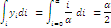
<body><![CDATA[<p align="justify"><font size="2" face="Verdana, Arial, Helvetica, sans-serif">Theoretical analysis of the private provision of public goods has been more fruitful. Drawing back from the literature of <u>nonprofits</u> based on transaction cost theories (Hansmann[15], Rose-Ackerman[16], Weisbrod[17]), this literature has recently been updated to include elements of behavioural economics(Andeoni and Payne[18], Scharf[19] and applications to development economics  (Besley and Ghatak[20],[21], Aldashev and Verdier[22]). The present paper adds to this last strand of literature by looking at the political repercussions of projects financed by private aid. By doing so, it should help bridge the gap between the effects of aid at the project level and its consequences at the country level. Indeed, while project evaluation techniques become increasingly sophisticated (Banerjee and Duflo, [23]), our knowledge of the overall impact of micro-projects at the macro level remains limited (Mosley,[24]; Deaton[25]).</font></p>      <p align="justify"><font size="2" face="Verdana, Arial, Helvetica, sans-serif">Political economy models have been the predominant tool to address the repercussions of official development assistance at the state level (Svensson[26], Acemoglu<i>et al.</i>[27], Platteau<i>et al.</i>[28]). Few of them address directly the question of private aid. Azam and Laffont[29]model <u>NGOs</u> founded by the local elite in a dysfunctional democracy. By contrast, the present paper explores <u>NGOs</u> founded by foreign donors, and operating in countries endowed with sound institutions. The setting in this paper allows addressing the question of the privatization of international aid, and of the inefficiencies arising even when institutional dysfunctions are absent. </font></p>      <p align="justify"><font size="2" face="Verdana, Arial, Helvetica, sans-serif">This paper hopes to provide <u>microfoundations</u> explaining some of the paradoxical results found in the empirical literature on overall aid effectiveness. Good institutions have been deemed as a necessary condition to have aid affect growth (Burnside and Dollar,[30]; Collierand Dollar [31]. However, foreign aid has been found to deteriorate governance (Rajan and Subramanian [32][33], Djankov<i>et al.</i>[34]), and to aggravate inequalities (Layton and Fuller [35], Herzer and Nunnenkamp[36]). In countries with good institutions, we have that aid fosters growth but also widens inequality.  In particular, Bjornkov[37]finds that if a recipient country is a democracy, then aid increases inequality. All these results are consistent with the model presented here. However, one must be cautious that the empirical studies look at aid in general, and not at aid provided specifically by NGOs. We do not know what type of aid, official or private, is at the origin of this divergence between efficiency and fairness. Koch <i>et al.</i>[38] find that <u>NGOs</u> typically follow official aid; because of this positive correlation, we cannot rule out that indeed private aid hampers fairness.</font></p>      <p align="justify">&nbsp;</p>      <p align="justify"><font size="3" face="Verdana, Arial, Helvetica, sans-serif"><b>3. SET UP OF THE MODEL</b></font></p>      <p align="justify"><font size="2" face="Verdana, Arial, Helvetica, sans-serif"><b>3.1. The Basic Model of Vote over Public Finances</b></font></p>      <p align="justify"><font size="2" face="Verdana, Arial, Helvetica, sans-serif">The model builds on the framework proposed by Anthony Downs [10]. Consider a continuum of voters indexed<img width=5 height=17 src="/img/revistas/riyd/v2n16/a02/image001.png" align="absmiddle">, each of whom detains income <img width=11 height=17 src="/img/revistas/riyd/v2n16/a02/image002.png" align="absmiddle">. Incomes are distributed according to a uniform distribution function with support <img src="/img/revistas/riyd/v2n16/a02/image003.png" width=27 height=17 align="absbottom">.</font></p>      <p align="justify"><font size="2" face="Verdana, Arial, Helvetica, sans-serif">Any voter values private consumption, <img src="/img/revistas/riyd/v2n16/a02/image004.png" width=7 height=17 align="absbottom">, and a public good, <img src="/img/revistas/riyd/v2n16/a02/image005.png" width=9 height=17 align="absbottom">. Their pay-off function is</font></p>     <p align="center"><font size="2" face="Verdana, Arial, Helvetica, sans-serif"><img src="/img/revistas/riyd/v2n16/a01_ecuacion_01.gif" width="737" height="49"></font></p>     <p align="justify"><font size="2" face="Verdana, Arial, Helvetica, sans-serif">In it, welfare increases linearly with private consumption, and increases in the level of the public good, but with diminishing marginal returns<a href="#_ftn1" name="_ftnref1" title="">[1]</a>. </font></p>      ]]></body>
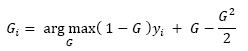
<body><![CDATA[<p align="justify"><font size="2" face="Verdana, Arial, Helvetica, sans-serif">The public good is financed through a flat tax <img src="/img/revistas/riyd/v2n16/a02/image007.png" width=6 height=17 align="absmiddle"> on income such that <img src="/img/revistas/riyd/v2n16/a02/image008.png" width=96 height=20 align="absmiddle">. After taxation, agent <img src="/img/revistas/riyd/v2n16/a02/image001.png" width=5 height=17 align="absbottom"> has disposable income <img src="/img/revistas/riyd/v2n16/a02/image009.png" width=52 height=17 align="absbottom"> which she devotes to private consumption. Any citizen <img src="/img/revistas/riyd/v2n16/a02/image001.png" width=5 height=17 align="absbottom"> chooses her preferred policy, denoted <img src="/img/revistas/riyd/v2n16/a02/image010.png" width=12 height=17 align="absbottom">, such that</font></p>     <p align="center"><img src="/img/revistas/riyd/v2n16/a01_ecuacion_01_.gif" width="248" height="51"></p>     <p align="justify"><font size="2" face="Verdana, Arial, Helvetica, sans-serif">The preferred policy of <img src="/img/revistas/riyd/v2n16/a02/image001.png" width=5 height=17 align="absbottom"> is</font></p>     <p align="center"><font size="2" face="Verdana, Arial, Helvetica, sans-serif"><img src="/img/revistas/riyd/v2n16/a01_ecuacion_02.gif" width="737" height="31"></font></p>     <p align="justify"><font size="2" face="Verdana, Arial, Helvetica, sans-serif">Poor voters will prefer a higher level of public good and therefore higher taxation. Given the tax rate is flat, poor agents gain more from high taxation levels, as it forces rich agents to contribute proportionally more to the public good. The monotonous relation between income share and preferred policies allows us to draw a uniform distribution of preferred policies <img src="/img/revistas/riyd/v2n16/a02/image005.png" width=9 height=17 align="absmiddle"> with support <img src="/img/revistas/riyd/v2n16/a02/image003.png" width=27 height=17 align="absmiddle">. Denote the associated cumulative distribution function is <img src="/img/revistas/riyd/v2n16/a02/image013.png" width=61 height=17 align="absmiddle"> with support <img src="/img/revistas/riyd/v2n16/a02/image003.png" width=27 height=17 align="absmiddle">. Following Persson and Tabellini[39], if politicians care only about getting elected, and citizens only care about public finances, then the median voter theorem predicts that the outcome policy is</font></p>      <p align="center"><img src="/img/revistas/riyd/v2n16/a01_ecuacion_03.gif" width="736" height="47"></p>     <p align="justify"><font size="2" face="Verdana, Arial, Helvetica, sans-serif">in which <img src="/img/revistas/riyd/v2n16/a02/image015.png" width=12 height=17 align="absmiddle"> is the income of the median voter. For any agent poorer than the median voter, the provision of public good by the state is insufficient. Agents richer than the median consider that there is too much taxation.</font></p>      <p align="justify"><font size="2" face="Verdana, Arial, Helvetica, sans-serif"><b>3.2. Nongovernmental Organizations</b></font></p>      <p align="justify"><font size="2" face="Verdana, Arial, Helvetica, sans-serif">Introduce an NGO to the model, or equivalently, a cohesive NGO sector. Formally speaking, the NGO provides a local public good, denoted <img src="/img/revistas/riyd/v2n16/a02/image016.png" width=8 height=17 align="absmiddle">, to a targeted fraction <img width=8 height=17 src="/img/revistas/riyd/v2n16/a02/image017.png"align="absmiddle"> of the population. The NGO is averse to poverty, so that targeting richer agents reduces its utility. The programme of the NGO is</font></p>      <p align="center"><img src="/img/revistas/riyd/v2n16/a01_ecuacion_04.gif" width="736" height="59"></p>     ]]></body>
<body><![CDATA[<p align="justify"><font size="2" face="Verdana, Arial, Helvetica, sans-serif">where <img width=48 height=17 src="/img/revistas/riyd/v2n16/a02/image019.png"align="absmiddle"> denotes aversion to poverty. For now, assume that <img width=7 height=17 src="/img/revistas/riyd/v2n16/a02/image020.png"align="absmiddle"> is exogenous. The payoff of the NGO is larger if it reaches more beneficiaries (<img width=8 height=17 src="/img/revistas/riyd/v2n16/a02/image017.png"align="absmiddle">) and if the level of the public good is higher (<img width=8 height=17 src="/img/revistas/riyd/v2n16/a02/image016.png"align="absmiddle">). <img width=12 height=17 src="/img/revistas/riyd/v2n16/a02/image021.png"align="absmiddle">represents the income of a typical targeted beneficiary, such that targeting richer individuals decreases its utility. Since <img width=37 height=17 src="/img/revistas/riyd/v2n16/a02/image022.png" align="absmiddle">, an increase in parameter <img width=7 height=17 src="/img/revistas/riyd/v2n16/a02/image020.png" align="absmiddle"> increases the exponent over <img width=12 height=17 src="/img/revistas/riyd/v2n16/a02/image021.png" align="absmiddle">, and therefore raises the disutility from targeting richer individuals. It follows that <img width=7 height=17 src="/img/revistas/riyd/v2n16/a02/image020.png" align="absmiddle"> measures aversion to poverty. The NGO finances its project with budget <img width=7 height=17 src="/img/revistas/riyd/v2n16/a02/image023.png" align="absmiddle">, which allows it to finance a larger project <img width=8 height=17 src="/img/revistas/riyd/v2n16/a02/image016.png" align="absmiddle"> and to reach more beneficiaries <img width=8 height=17 src="/img/revistas/riyd/v2n16/a02/image017.png" align="absmiddle">. I assume that the cost of these endeavours increases as the NGO targets poorer individuals. Indeed, poorer individuals might be harder to reach, for example if most of them live in remote locations, or if their needs are more salient. Notice that if this assumption does not hold, then the NGO trivially targets only the poorest due to poverty aversion. The solution of this program is</font></p>      <p align="center"><img src="/img/revistas/riyd/v2n16/a01_ecuacion_05.gif" width="735" height="91"></p>     <p align="justify"><font size="2" face="Verdana, Arial, Helvetica, sans-serif"><b><i>Proof:</i></b></font></p>      <blockquote>       <p align="justify"><font size="2" face="Verdana, Arial, Helvetica, sans-serif"><i>After     log-linearization of the objective function, the associated lagrangian is</i></font></p>       <p align="center"><img src="/img/revistas/riyd/v2n16/a01_ecuacion_05_.gif" width="475" height="53"></p>       <p align="justify"><font size="2" face="Verdana, Arial, Helvetica, sans-serif"><i>First     order conditions are:</i></font></p>       <p align="center"><img src="/img/revistas/riyd/v2n16/a01_ecuacion_05__.gif" width="726" height="158"><font size="2" face="Verdana, Arial, Helvetica, sans-serif"><i>&nbsp;</i></font></p>       <p align="justify"><font size="2" face="Verdana, Arial, Helvetica, sans-serif"><i>(5a)     and (5b) yield </i><img width=34 height=17 src="/img/revistas/riyd/v2n16/a02/image031.png" align="absmiddle"><i>.       Replacing </i><img width=7 height=17 src="/img/revistas/riyd/v2n16/a02/image032.png" align="absmiddle"><i> in         (5c) from either (5a) or (5b) one obtains</i></font></p>       <p align="center"><img src="/img/revistas/riyd/v2n16/a01_ecuacion_05___.gif" width="119" height="51"><font size="2" face="Verdana, Arial, Helvetica, sans-serif"><i>&nbsp;</i></font></p>       ]]></body>
<body><![CDATA[<p align="justify"><font size="2" face="Verdana, Arial, Helvetica, sans-serif"><i>which     states that </i><img width=62 height=17 src="/img/revistas/riyd/v2n16/a02/image034.png" align="absmiddle"><i>. Replacing </i><img width=12 height=17 src="/img/revistas/riyd/v2n16/a02/image021.png" align="absmiddle"><i> in the budget       constraint </i><img width=98 height=26 src="/img/revistas/riyd/v2n16/a02/image035.png" align="absmiddle"><i> and using </i><img width=37 height=17 src="/img/revistas/riyd/v2n16/a02/image036.png" align="absmiddle"><i>yields the desired         result.</i></font></p> </blockquote>     <p align="justify"><font size="2" face="Verdana, Arial, Helvetica, sans-serif">The first condition in (5) states that poverty-averse NGOs target poorer individuals. This comes at the cost of reducing the level of the public good provided as well as the number of beneficiaries reached, as stated in the following conditions. I impose the restriction that <img width=32 height=17 src="/img/revistas/riyd/v2n16/a02/image037.png" align="absmiddle"> to avoid corner solutions; it should be noted however that because national income is <img width=7 height=17 src="/img/revistas/riyd/v2n16/a02/image038.png" align="absmiddle">, this restriction is not too demanding. A larger budget allows the NGO to invest more in both reach and depth of the project. The typical beneficiary of the NGO is the agent with preferred policy</font></p>      <p align="center"><img src="/img/revistas/riyd/v2n16/a01_ecuacion_05____.gif" width="58" height="27"></p>      <p align="justify"><font size="2" face="Verdana, Arial, Helvetica, sans-serif">Dropping the asterisks to alleviate notation, vector <img width=44 height=17 src="/img/revistas/riyd/v2n16/a02/image040.png" align="absmiddle"> represents the characteristics of the project. A fraction <img width=8 height=17 src="/img/revistas/riyd/v2n16/a02/image017.png" align="absmiddle"> of the population is a continuum of beneficiaries lying in the neighbourhood of targeted beneficiary <img width=7 height=17 src="/img/revistas/riyd/v2n16/a02/image020.png" align="absmiddle">. Identify the poorest amongst all beneficiaries with <img width=9 height=19 src="/img/revistas/riyd/v2n16/a02/image041.png" align="absmiddle"> and the richest with <img width=9 height=18 src="/img/revistas/riyd/v2n16/a02/image042.png" align="absmiddle">, which are their respective preferred policies. Then <img width=62 height=20 src="/img/revistas/riyd/v2n16/a02/image043.png" align="absmiddle">. Any agent within this interval is a beneficiary: she gets access to <img width=8 height=17 src="/img/revistas/riyd/v2n16/a02/image016.png" align="absmiddle">, additionally to the public good <img width=9 height=17 src="/img/revistas/riyd/v2n16/a02/image005.png" align="absmiddle"> provided by the state. To obtain a well-behaved solution, assume the following: </font></p>      <p align="justify"><font size="2" face="Verdana, Arial, Helvetica, sans-serif"><b>Allocation Rule</b>: For any given program vector <img width=44 height=17 src="/img/revistas/riyd/v2n16/a02/image040.png" align="absmiddle"> there is an allocation rule such that:</font></p>     <p align="center"><img src="/img/revistas/riyd/v2n16/a01_ecuacion_06.gif" width="730" height="32"></p>     <p align="justify"><font size="2" face="Verdana, Arial, Helvetica, sans-serif">This assumption prevents the NGO from targeting beneficiaries out of the domain. We now turn to characterize the equilibrium following the introduction of this project.</font></p>      <p align="justify">&nbsp;</p>      <p align="justify"><font size="3" face="Verdana, Arial, Helvetica, sans-serif"><b>4. ELECTORAL OUTCOMES AT EQUILIBRIUM</b></font></p>      <p align="justify"><font size="2" face="Verdana, Arial, Helvetica, sans-serif">The timing of the model is as follows:  project <img width=32 height=17 src="/img/revistas/riyd/v2n16/a02/image045.png" align="absmiddle"> is implemented; beneficiaries update their preferred policy platform; and elections take place. The updated preferred policy for any voter is</font></p>     ]]></body>
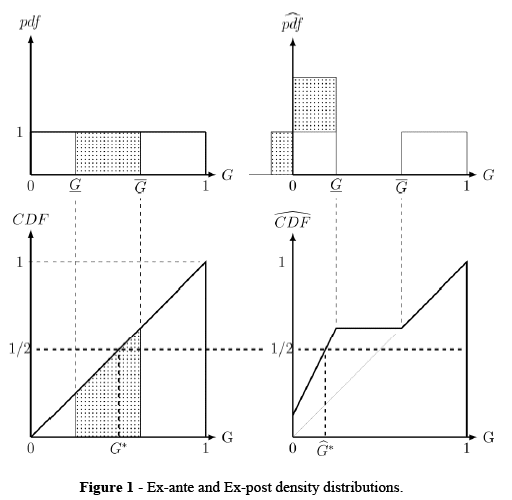
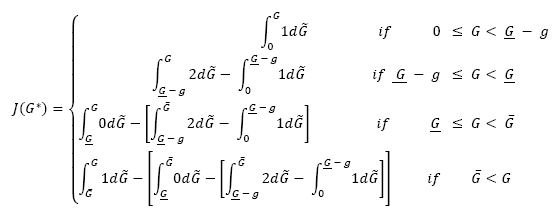
<body><![CDATA[<p align="center"><font size="2" face="Verdana, Arial, Helvetica, sans-serif"><img src="/img/revistas/riyd/v2n16/a01_ecuacion_06_.gif" width="328" height="46"></font></p>     <p align="justify"><font size="2" face="Verdana, Arial, Helvetica, sans-serif">in which <img width=8 height=17 src="/img/revistas/riyd/v2n16/a02/image047.png" align="absmiddle"> is an indicator variable valued one if the voter is a beneficiary of the project. The ex-post preferred policy of voter <img width=5 height=17 src="/img/revistas/riyd/v2n16/a02/image001.png" align="absmiddle">, designated with a circumflex accent throughout this paper, is</font></p>     <p align="center"><img src="/img/revistas/riyd/v2n16/a01_ecuacion_07.gif" width="735" height="38"></p>     <p align="justify"><font size="2" face="Verdana, Arial, Helvetica, sans-serif">The mass of voters with political preferences distributed over the segment <img width=32 height=20 src="/img/revistas/riyd/v2n16/a02/image049.png" align="absmiddle">  shifts to the left (directionally) by a distance <img width=8 height=17 src="/img/revistas/riyd/v2n16/a02/image016.png" align="absmiddle">, as <a href="#f1">Figure 1</a> displays. Denote <img width=29 height=17 src="/img/revistas/riyd/v2n16/a02/image050.png" align="absmiddle"> the ex-post cumulative distribution function (CDF), which can be expressed in terms of <img width=9 height=17 src="/img/revistas/riyd/v2n16/a02/image005.png" align="absmiddle">.  </font></p>     <p align="justify"><a name="f1"></a></p>     <p align="center"><img src="/img/revistas/riyd/v2n16/a01_figure_01.gif" width="512" height="500"></p>     <p align="justify"><font size="2" face="Verdana, Arial, Helvetica, sans-serif"><b><i>Proposition 1 (Preferred Policies Ex-post):   </i></b></font></p>      <blockquote>       <p align="justify"><font size="2" face="Verdana, Arial, Helvetica, sans-serif"><i>Equality     </i><img width=67 height=17 src="/img/revistas/riyd/v2n16/a02/image051.png" align="absmiddle"><i> defines       the ex-post median voter </i><img width=9 height=18 src="/img/revistas/riyd/v2n16/a02/image052.png" align="absmiddle"><i>,         in which </i></font></p>       <p align="center"><i><font size="2" face="Verdana, Arial, Helvetica, sans-serif"><img src="/img/revistas/riyd/v2n16/a01_ecuacion_08.gif" width="732" height="126"></font></i></p>       ]]></body>
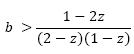
<body><![CDATA[<p align="justify"><font size="2" face="Verdana, Arial, Helvetica, sans-serif"><i>is     a piecewise differentiable, continuous and monotonically increasing function in     </i><img width=9 height=17 src="/img/revistas/riyd/v2n16/a02/image005.png" align="absmiddle"><i>,       such that </i><img width=52 height=17 src="/img/revistas/riyd/v2n16/a02/image054.png" align="absmiddle"><i>.         By the allocation rule described above, the three points at which the         distribution changes slope are:</i></font></p>       <p align="center"><img src="/img/revistas/riyd/v2n16/a01_ecuacion_09.gif" width="738" height="114"></p> </blockquote>     <p align=justify>&nbsp;</p>      <p align="justify"><font size="2" face="Verdana, Arial, Helvetica, sans-serif"><b>Proof:</b></font></p>      <blockquote>       <p align="justify"><font size="2" face="Verdana, Arial, Helvetica, sans-serif"><i>By     the assumption of uniformity, the k pdf is </i><img width=7 height=17 src="/img/revistas/riyd/v2n16/a02/image038.png" align="absmiddle"><i> on       support </i><img width=27 height=17 src="/img/revistas/riyd/v2n16/a02/image003.png" align="absmiddle"><i>.         We can construct each piece of the </i><img width=56 height=17 src="/img/revistas/riyd/v2n16/a02/image056.png" align="absmiddle"><i> CDF           as follows:</i></font></p>       <p align="center"><img src="/img/revistas/riyd/v2n16/a01_ecuacion_09_.gif" width="557" height="220"></p>       <p align="justify"><font size="2" face="Verdana, Arial, Helvetica, sans-serif"><i>Solving     these integrals and replacing the values at the points at which the     distribution changes slope yields the desired result.</i></font></p> </blockquote>     <p align="justify"><font size="2" face="Verdana, Arial, Helvetica, sans-serif">The lower right quadrant in <a href="#f1">Figure 1</a> depicts function <img width=25 height=17 src="/img/revistas/riyd/v2n16/a02/image058.png" align="absmiddle">. The <i>ex-ante</i> cumulative distribution function is first order stochastically dominant with respect to the <i>ex-post</i> CDF of preferred policies. The median preferred level of public spending partially reduces except in three regimes described in what follows<a href="#_ftn2" name="_ftnref2" title="">[2]</a>.</font></p>     <p align=justify><font size="2" face="Verdana, Arial, Helvetica, sans-serif">If the intercept is such that that if <img width=47 height=24 src="/img/revistas/riyd/v2n16/a02/image060.png" align="absmiddle">, then there is full disruption of government expenditure (as opposed to partial reduction). This happens when</font></p>     ]]></body>
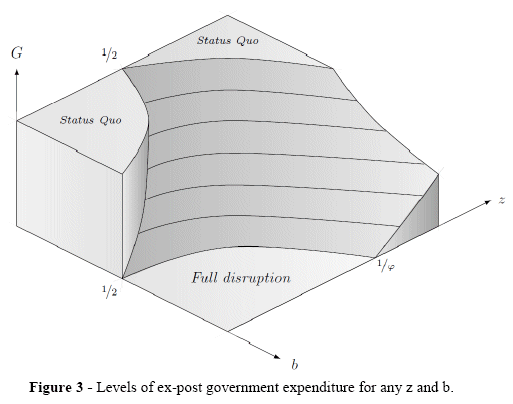
<body><![CDATA[<p align=center><img src="/img/revistas/riyd/v2n16/a01_ecuacion_10.gif" width="732" height="45"></p>     <p align="justify"><font size="2" face="Verdana, Arial, Helvetica, sans-serif">full disruption results from a very large aid budget and low poverty aversion. The project of the NGO does not change electoral outcomes in two cases: when all beneficiaries are richer than the ex-ante median (<img width=32 height=24 src="/img/revistas/riyd/v2n16/a02/image062.png" align="absmiddle">), and when beneficiaries are poor but do not shift beyond the ex-ante median (<img width=56 height=24 src="/img/revistas/riyd/v2n16/a02/image063.png" align="absmiddle">). These Status Quo regimes happen when </font></p>      <p align="center"><img src="/img/revistas/riyd/v2n16/a01_ecuacion_11.gif" width="732" height="53"></p>     <p align="justify"><font size="2" face="Verdana, Arial, Helvetica, sans-serif">or</font></p>     <p align="center"><img src="/img/revistas/riyd/v2n16/a01_ecuacion_12.gif" width="731" height="43"></p>     <p align="justify">&nbsp;</p>      <p align="justify"><font size="2" face="Verdana, Arial, Helvetica, sans-serif">There is no political impact when the budget is low, and when poverty aversion is either very small or very high.</font></p>      <p align="justify"><font size="2" face="Verdana, Arial, Helvetica, sans-serif">When conditions (10) to (12) are violated, there is a partial reduction of public spending. Define as isoelectoral curves the set of combinations of <img width=7 height=17 src="/img/revistas/riyd/v2n16/a02/image023.png" align="absmiddle"> and <img width=7 height=17 src="/img/revistas/riyd/v2n16/a02/image020.png" align="absmiddle"> such that the same electoral outcome <img width=9 height=18 src="/img/revistas/riyd/v2n16/a02/image052.png" align="absmiddle"> is obtained at equilibrium. These are defined by <img width=48 height=24 src="/img/revistas/riyd/v2n16/a02/image066.png" align="absmiddle"> when <img width=86 height=18 src="/img/revistas/riyd/v2n16/a02/image067.png" align="absmiddle">. They can be expressed as</font></p>     <p align="center"><img src="/img/revistas/riyd/v2n16/a01_ecuacion_13.gif" width="735" height="57"></p>     <p align="justify"><font size="2" face="Verdana, Arial, Helvetica, sans-serif">Remark that (10) and (12) are the limit cases of the partial reduction regime. These regimes are displayed in the <img width=30 height=17 src="/img/revistas/riyd/v2n16/a02/image069.png" align="absmiddle"> space in <a href="#f2">Figure 2</a>, in which <img width=9 height=17 src="/img/revistas/riyd/v2n16/a02/image070.png" align="absmiddle"> is the golden ratio. The arrow over the isoelectoral outcome curves indicates the direction in which the provision of public good by the state decreases. <a href="#f3">Figure 3</a> displays the levels of electoral outcomes for the different regimes. In the partial reduction regime, provision of the public good by the state decreases as the income of the NGO increases. However, when the NGO is more averse to poverty it mitigates this effect.     </font></p>      ]]></body>

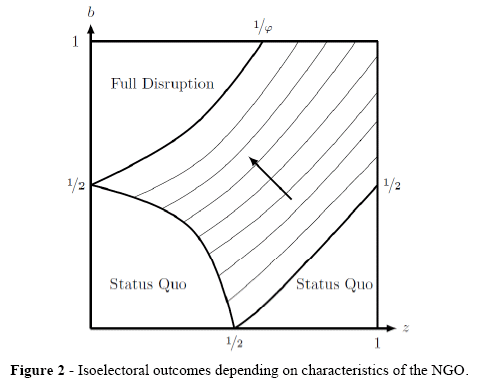
<body><![CDATA[<p align=justify><a name="f2"></a></p>     <p align=center><img src="/img/revistas/riyd/v2n16/a01_figure_02.gif" width="480" height="387"></p>     <p align=center>&nbsp;</p>     <p align=center><a name="f3"></a></p>     <p align=center><img src="/img/revistas/riyd/v2n16/a01_figure_03.gif" width="513" height="404"></p>     <p align="justify"><font size="2" face="Verdana, Arial, Helvetica, sans-serif"><b><i>Corollary 1 </i></b></font></p>      <blockquote>       <p align="justify"><font size="2" face="Verdana, Arial, Helvetica, sans-serif"><i>If     the NGO crowds out public expenditure, a larger NGO budget exacerbates the     effect, while aversion to poverty reduces the crowding out.</i></font></p> </blockquote>     <p align="justify"><font size="2" face="Verdana, Arial, Helvetica, sans-serif">By targeting poorer agents, the NGO reduces the crowding out effect by two means: first, it reduces the size of the shift because the projects are smaller due to accessibility costs; secondly, beneficiaries are more likely to remain to the right of the <i>ex-ante</i> median voter if they are poorer. Targeting the middle class is therefore conductive of a larger shift. </font></p>      <p align="justify"><font size="2" face="Verdana, Arial, Helvetica, sans-serif">An important remark at this point is that I assume that the project provided by the NGO is perfectly substitutable to the public good provided by the government. I claim that this is the correct specification when the NGO is operational. Advocacy NGOs will typically try to change the behaviours of the state in hopes of obtaining new rights for their beneficiaries [40]. The topic of advocacy NGOs is discussed in a companion paper (Morales and Serfilippi, [41] ). Instead, here we explore the issue of service provision when it `fills the gap' between the needs of the beneficiaries and what they receive from the state, which is a very salient issue [17][8].</font></p>      ]]></body>
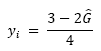
<body><![CDATA[<p align="justify"><font size="2" face="Verdana, Arial, Helvetica, sans-serif">Next section analyses how the shift in government expenditures generated by such `gap-filling' activities affects welfare at the individual, and at the aggregate level.    </font></p>      <p align="justify">&nbsp;</p>      <p align="justify"><font size="3" face="Verdana, Arial, Helvetica, sans-serif"><b>5. WELFARE IMPLICATIONS</b></font></p>      <p align="justify"><font size="2" face="Verdana, Arial, Helvetica, sans-serif">In this section, we analyse the effect of the shift on welfare, both at the individual and at the aggregate level. We do so by comparing the <i>ex-ante</i> to the <i>ex-post</i> equilibria. I use the utilitarian welfare function, which simply aggregates payoff functions. At the ex-ante level, it writes</font></p>     <p align="center"><img src="/img/revistas/riyd/v2n16/a01_ecuacion_14.gif" width="734" height="56"></p>     <p align="justify"><font size="2" face="Verdana, Arial, Helvetica, sans-serif">since <img width=11 height=17 src="/img/revistas/riyd/v2n16/a02/image002.png" align="absmiddle"> follows a uniform distribution<a href="#_ftn3" name="_ftnref3" title="">[3]</a>.</font></p>      <p align="justify"><font size="2" face="Verdana, Arial, Helvetica, sans-serif">The policy maximizing welfare is the equilibrium policy <img width=53 height=17 src="/img/revistas/riyd/v2n16/a02/image074.png" align="absmiddle">. This result obtains when the distribution is symmetrical around the mean, because mean and median coincide. The mean preferred policy maximizes welfare since it minimizes the sum of the distances between the individually preferred policies and the implemented outcome. Therefore, deviations from this equilibrium reduce welfare. The NGO brings the direct benefits from the project itself, while it creates the cost of deviating from the optimal government policy. We explore this trade-off in what follows.    </font></p>      <p align="justify"><font size="2" face="Verdana, Arial, Helvetica, sans-serif"><b>5.1. Individual Welfare</b></font></p>      <p align="justify"><font size="2" face="Verdana, Arial, Helvetica, sans-serif">Remark that at the ex-ante equilibrium <img width=37 height=24 src="/img/revistas/riyd/v2n16/a02/image075.png" align="absmiddle">. The payoff of voter <img width=5 height=17 src="/img/revistas/riyd/v2n16/a02/image001.png" align="absmiddle"> is by (14)</font></p>     <p align="center"><img src="/img/revistas/riyd/v2n16/a01_ecuacion_15.gif" width="737" height="55"></p>     ]]></body>
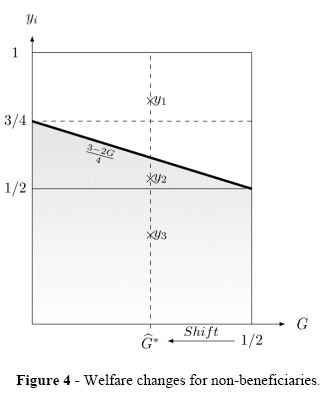
<body><![CDATA[<p align="justify"><font size="2" face="Verdana, Arial, Helvetica, sans-serif">If the project is to be beneficial to voter <img width=5 height=17 src="/img/revistas/riyd/v2n16/a02/image001.png" align="absmiddle">, this payoff must be smaller than</font></p>      <p align="center"><img src="/img/revistas/riyd/v2n16/a01_ecuacion_16.gif" width="736" height="50"></p>     <p align="justify"><font size="2" face="Verdana, Arial, Helvetica, sans-serif"><b><i>Proposition   2</i></b></font></p>     <p align="justify"><font size="2" face="Verdana, Arial, Helvetica, sans-serif"><i>If a project is implemented and it crowds out public expenditure, then</i></font></p>      <p align="justify"><font size="2" face="Verdana, Arial, Helvetica, sans-serif"><i>1. non-beneficiaries poorer than the median   are always made worse-off,</i></font></p>     <p align="justify"><font size="2" face="Verdana, Arial, Helvetica, sans-serif"><i>2. non-beneficiaries richer than the third   quartile are always made better-off, and</i></font></p>     <p align="justify"><font size="2" face="Verdana, Arial, Helvetica, sans-serif"><i>3. beneficiaries   are always made better-off. </i></font></p>     <p align="justify"><font size="2" face="Verdana, Arial, Helvetica, sans-serif">To see this, first consider the welfare of the non-beneficiaries by setting <img width=33 height=17 src="/img/revistas/riyd/v2n16/a02/image078.png" align="absmiddle">. We can trace a set of points of indifference in which (15) equals (16) for any <img width=5 height=17 src="/img/revistas/riyd/v2n16/a02/image001.png" align="absmiddle">. This yields the simple relation </font></p>      <p align="center"><img src="/img/revistas/riyd/v2n16/a01_ecuacion_16_.gif" width="101" height="51"></p>      <p align="justify"><font size="2" face="Verdana, Arial, Helvetica, sans-serif">Plotting this function in <a href="#f4">Figure 4</a> we define two sets: the set above the indifference line contains rich non-beneficiaries, for whom the project is a positive externality; the set below contains poor non-beneficiaries, for whom the project is a negative externality.</font></p>     ]]></body>
<body><![CDATA[<p align="justify"><a name="f4"></a></p>     <p align="center"><img src="/img/revistas/riyd/v2n16/a01_figure_04.gif" width="326" height="396"></p>     <p align="justify"><font size="2" face="Verdana, Arial, Helvetica, sans-serif">When the vertical distance between <img width=11 height=17 src="/img/revistas/riyd/v2n16/a02/image002.png" align="absmiddle"> and the line increase, utility reduces. In the graph, the individual with income <img width=13 height=17 src="/img/revistas/riyd/v2n16/a02/image080.png" align="absmiddle"> becomes closer to this line when there is a shift, while the distance of individual <img width=13 height=17 src="/img/revistas/riyd/v2n16/a02/image081.png" align="absmiddle"> increases. Any individual richer than <img width=34 height=24 src="/img/revistas/riyd/v2n16/a02/image082.png" align="absmiddle"> is unambiguously made better off, and the converse is true for any agent poorer than <img width=30 height=24 src="/img/revistas/riyd/v2n16/a02/image083.png" align="absmiddle">. For an individual with income <img width=96 height=17 src="/img/revistas/riyd/v2n16/a02/image084.png" align="absmiddle"> the effect is ambiguous; while initially she prefers less public spending, if the project leads to a shift that is too large (as represented in <a href="#f4">Figure 4</a>, she  prefers the ex-ante equilibrium.</font></p>      <p align="justify"><font size="2" face="Verdana, Arial, Helvetica, sans-serif">The shift exacerbates inequalities amongst non-beneficiaries. By corollary 1, poor non-beneficiaries welfare decreases in the budget of the NGO, but the effect is mitigated when aversion to poverty increases.        </font></p>      <p align="justify"><font size="2" face="Verdana, Arial, Helvetica, sans-serif">Turn now to the beneficiaries of the project. When the NGO implements it, beneficiaries gain from the project but lose from the externality. To see that the net effect is positive, consider the poorest among all agents, <img width=36 height=17 src="/img/revistas/riyd/v2n16/a02/image085.png" align="absmiddle">, who suffers most from the externality. She is better off with the project when</font></p>     <p align="center"><img src="/img/revistas/riyd/v2n16/a01_ecuacion_17.gif" width="736" height="76"></p>     <p align="justify"><font size="2" face="Verdana, Arial, Helvetica, sans-serif">since   we are in the increasing part of the quadratic function. By (3), (5) and (13), this condition is rearranged as</font></p>     <p align="center"><img src="/img/revistas/riyd/v2n16/a01_ecuacion_17_.gif" width="134" height="54"></p>     <p align="justify"><font size="2" face="Verdana, Arial, Helvetica, sans-serif">which   by (10) is respected when we are outside of the Status Quo case. In the Status   Quo case, (16) holds trivially.  Hence, even for the poorest beneficiary, the   negative externality cost does not surpass the direct benefits from the project.  </font></p>     <p align="justify"><font size="2" face="Verdana, Arial, Helvetica, sans-serif"><b>5.2. Aggregate Welfare</b></font></p>      ]]></body>
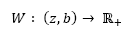
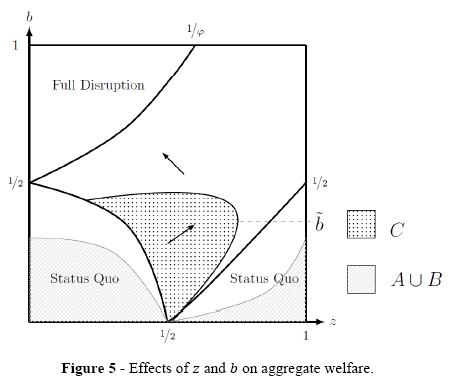
<body><![CDATA[<p align="justify"><font size="2" face="Verdana, Arial, Helvetica, sans-serif">Dropping the asterisk of <img width=14 height=18 src="/img/revistas/riyd/v2n16/a02/image090.png" align="absmiddle"> to alleviate notation, the sum of all payoff functions is</font></p>      <p align="center"><img src="/img/revistas/riyd/v2n16/a01_ecuacion_18.gif" width="736" height="61"></p>     <p align="center"><img src="/img/revistas/riyd/v2n16/a01_ecuacion_18_.gif" width="470" height="72"></p>     <p align="justify"><font size="2" face="Verdana, Arial, Helvetica, sans-serif">The first term is aggregate disposable income after taxation, the second term is the utility of the combined public good for the beneficiaries, and the third term is the utility of the state-provided public good for non-beneficiaries. In the case of the partial shift, equations (5) and (13) give the values of <img width=9 height=18 src="/img/revistas/riyd/v2n16/a02/image052.png" align="absmiddle"> and <img width=8 height=17 src="/img/revistas/riyd/v2n16/a02/image016.png" align="absmiddle"> depending on <img width=7 height=17 src="/img/revistas/riyd/v2n16/a02/image020.png" align="absmiddle">and <img width=7 height=17 src="/img/revistas/riyd/v2n16/a02/image023.png" align="absmiddle">. Therefore, we can write <img width=13 height=17 src="/img/revistas/riyd/v2n16/a02/image093.png" align="absmiddle"> as a function of parameters <img width=7 height=17 src="/img/revistas/riyd/v2n16/a02/image020.png" align="absmiddle">and <img width=7 height=17 src="/img/revistas/riyd/v2n16/a02/image023.png" align="absmiddle">,</font></p>      <p align="center"><img src="/img/revistas/riyd/v2n16/a01_ecuacion_18__.gif" width="126" height="36"></p>      <p align="justify"><font size="2" face="Verdana, Arial, Helvetica, sans-serif">The analytical form of this equation is unsuitable for interpretation<a href="#_ftn4" name="_ftnref4" title="">[4]</a>. Mathematical software allows us to plot three sets of interest in the <img width=33 height=17 src="/img/revistas/riyd/v2n16/a02/image095.png" align="absmiddle"> space:</font></p>     <p align="center"><font size="2" face="Verdana, Arial, Helvetica, sans-serif"><img src="/img/revistas/riyd/v2n16/a01_ecuacion_19.gif" width="734" height="71"></font></p>     <p align="justify"><font size="2" face="Verdana, Arial, Helvetica, sans-serif">The properties of these sets are: <img width=9 height=17 src="/img/revistas/riyd/v2n16/a02/image099.png" align="absmiddle"> determines values of <img width=30 height=17 src="/img/revistas/riyd/v2n16/a02/image100.png" align="absmiddle"> for which aggregate welfare is smaller than at the ex-ante equilibrium; <img width=9 height=17 src="/img/revistas/riyd/v2n16/a02/image101.png" align="absmiddle"> determines the region in which aggregate welfare decreases with the budget of the NGO; and <img width=9 height=17 src="/img/revistas/riyd/v2n16/a02/image102.png" align="absmiddle"> determines region for which aggregate welfare increases with aversion to poverty.</font></p>      <p align=justify><font size="2" face="Verdana, Arial, Helvetica, sans-serif"><a href="#f5">Figure 5</a> plots these three sets. Notice that <img width=138 height=17 src="/img/revistas/riyd/v2n16/a02/image106.png" align="absmiddle">, and are therefore empty, given that the partial shift defines <img width=43 height=17 src="/img/revistas/riyd/v2n16/a02/image107.png" align="absmiddle">. Set <img width=9 height=17 src="/img/revistas/riyd/v2n16/a02/image102.png" align="absmiddle"> is non-empty when <img width=7 height=17 src="/img/revistas/riyd/v2n16/a02/image023.png" align="absmiddle"> and <img width=7 height=17 src="/img/revistas/riyd/v2n16/a02/image020.png" align="absmiddle"> take “intermediary” values in the center of the graph. From any point in <img width=9 height=17 src="/img/revistas/riyd/v2n16/a02/image102.png" align="absmiddle">, an increase of <img width=7 height=17 src="/img/revistas/riyd/v2n16/a02/image020.png" align="absmiddle"> increases welfare until it reaches the north-eastern boundary of <img width=9 height=17 src="/img/revistas/riyd/v2n16/a02/image102.png" align="absmiddle">. This boundary defines the set of optimal <img width=7 height=17 src="/img/revistas/riyd/v2n16/a02/image020.png" align="absmiddle"> for any budget <img width=46 height=17 src="/img/revistas/riyd/v2n16/a02/image108.png" align="absmiddle">. When <img width=46 height=17 src="/img/revistas/riyd/v2n16/a02/image109.png" align="absmiddle">, aggregate welfare decreases in the degree of aversion to poverty. The arrows in the graph indicate the directions in which welfare increases following a marginal change of vector <img width=30 height=17 src="/img/revistas/riyd/v2n16/a02/image100.png" align="absmiddle">.  These observations allow for the following proposition:</font></p>     <p align=center><a name="f5"></a><img src="/img/revistas/riyd/v2n16/a01_figure_05.gif" width="453" height="381"></p>     ]]></body>
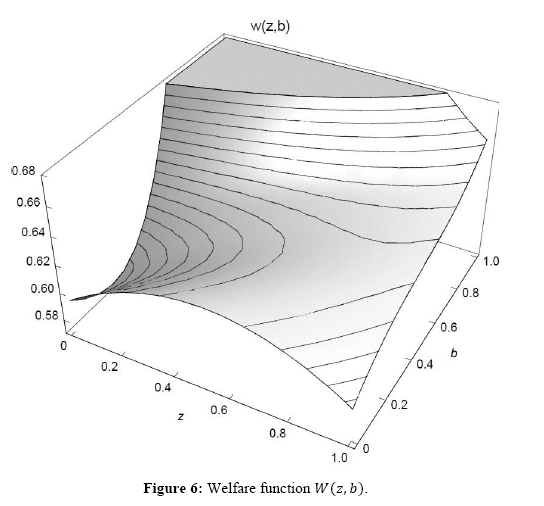
<body><![CDATA[<p align="justify"><font size="2" face="Verdana, Arial, Helvetica, sans-serif"><b>Proposition 3</b></font></p>      <p align="justify"><font size="2" face="Verdana, Arial, Helvetica, sans-serif"><i>If a project with characteristics </i><img width=30 height=17 src="/img/revistas/riyd/v2n16/a02/image100.png" align="absmiddle"><i> is implemented, then:</i></font></p>      <p align="justify"><font size="2" face="Verdana, Arial, Helvetica, sans-serif"><i>1. aggregate welfare is larger compared to the case in which there is no project (since </i><img width=9 height=17 src="/img/revistas/riyd/v2n16/a02/image099.png" align="absmiddle"><i> is empty);</i></font></p>      <p align="justify"><font size="2" face="Verdana, Arial, Helvetica, sans-serif"><i>2. aggregate welfare is monotonically increasing in </i><img width=7 height=17 src="/img/revistas/riyd/v2n16/a02/image023.png" align="absmiddle"><i> (since </i><img width=9 height=17 src="/img/revistas/riyd/v2n16/a02/image101.png" align="absmiddle"><i> is empty), </i></font></p>      <p align="justify"><font size="2" face="Verdana, Arial, Helvetica, sans-serif"><i>3. aggregate welfare increases in </i><img width=7 height=17 src="/img/revistas/riyd/v2n16/a02/image020.png" align="absmiddle"><i> for “intermediary” values of </i><img width=7 height=17 src="/img/revistas/riyd/v2n16/a02/image020.png" align="absmiddle"><i> up to the north-east boundary of </i><img width=9 height=17 src="/img/revistas/riyd/v2n16/a02/image102.png" align="absmiddle"><i>, and decreases afterwards. </i></font></p>      <p align="justify"><font size="2" face="Verdana, Arial, Helvetica, sans-serif"><a href="#f6">Figure 6</a> plots function <img width=43 height=17 src="/img/revistas/riyd/v2n16/a02/image107.png" align="absmiddle"> in the <img width=58 height=17 src="/img/revistas/riyd/v2n16/a02/image110.png" align="absmiddle"> space, allowing representing the magnitude of the effects. For low values of <img width=7 height=17 src="/img/revistas/riyd/v2n16/a02/image023.png" align="absmiddle">, if there is a shift, then targeting the poorer than the median (up to a point) is socially optimal even under a utilitarian welfare criterion. This is remarkable because, by if targeting the poorest increases costs, one would expect that utilitarianism would recommend adopting the cheapest alternative, irrespective of who is the beneficiary. Instead, targeting those poorer than the median mitigates the externality which results from the deviation of the ex-ante equilibrium.  </font></p>      <p align=justify><a name="f6"></a></p>     <p align=center><img src="/img/revistas/riyd/v2n16/a01_figure_06.gif" width="544" height="506"></p>     <p align=justify><font size="2" face="Verdana, Arial, Helvetica, sans-serif">From   this utilitarian perspective, an optimal targeting policy is, for a budget   below threshold <img width=42 height=18 src="/img/revistas/riyd/v2n16/a02/image113.png" align="absmiddle">, to target   increasingly poorer beneficiaries as aid money increases along the east   boundary of <img width=9 height=17 src="/img/revistas/riyd/v2n16/a02/image102.png" align="absmiddle"> in <a href="#f5">Figure 5</a>.   This threshold is unlikely to be crossed, as it would represent more than half   of national income (<img width=73 height=20 src="/img/revistas/riyd/v2n16/a02/image114.png" align="absmiddle">). However, if   it is the case, as aid money increases, targeting obtains two optima along the   north boundary of <img width=9 height=17 src="/img/revistas/riyd/v2n16/a02/image102.png" align="absmiddle">, and quickly collapses   to <img width=31 height=17 src="/img/revistas/riyd/v2n16/a02/image115.png" align="absmiddle"> when <img width=7 height=17 src="/img/revistas/riyd/v2n16/a02/image023.png" align="absmiddle"> is above set <img width=9 height=17 src="/img/revistas/riyd/v2n16/a02/image102.png" align="absmiddle">. At this point,   the cost of targeting the poorest completely surpasses the benefits from   mitigating the externality. After the threshold, objectives of efficiency and   fairness are opposed: programs maximizing aggregate welfare will also create   the largest externality, hurting poor non-beneficiaries the most.  </font></p>     <p align="justify"><font size="2" face="Verdana, Arial, Helvetica, sans-serif">The welfare and fairness implications reached throughout this section are all made explicit in terms of the degree of aversion to poverty <img width=7 height=17 src="/img/revistas/riyd/v2n16/a02/image020.png" align="absmiddle"> and the aid budget <img width=7 height=17 src="/img/revistas/riyd/v2n16/a02/image023.png" align="absmiddle">. When defining its vision, the NGO can choose <img width=7 height=17 src="/img/revistas/riyd/v2n16/a02/image020.png" align="absmiddle">, while donors can choose <img width=7 height=17 src="/img/revistas/riyd/v2n16/a02/image023.png" align="absmiddle">, both as a function of which social outcomes they consider most desirable.</font></p>      ]]></body>
<body><![CDATA[<p align="justify">&nbsp;</p>      <p align="justify"><font size="3" face="Verdana, Arial, Helvetica, sans-serif"><b>6. CONCLUSION</b></font></p>      <p align="justify"><font size="2" face="Verdana, Arial, Helvetica, sans-serif">This paper develops a model of vote over public finances interacted with the provision of public services by a foreign NGO. The NGO can reduce electoral support for state-provided public goods, because it delivers a project financed by external donors, while taxpayers finance the state-provided public good. The NGO can target sectors of the population, while the state is accountable to the entire population. It results that the crowding out of government expenditures translates into an externality for agents whom the NGO does not target. It follows that nongovernmental aid makes poor non-beneficiaries worse-off. </font></p>      <p align="justify"><font size="2" face="Verdana, Arial, Helvetica, sans-serif">In the model, a representative NGO trades-off between the size of the project it finances and who benefits form it, as I assume that the NGO wishes to cater to the poor, but that this is costlier than satisfying the needs of the wealthy. While aversion to poverty results in higher costs, it mitigates the crowding out effect. The additional cost of targeting the poorest are worth enduring as they lessen inequalities even for non-beneficiaries and, to a degree, increase aggregated welfare by diminishing the size of the externality. </font></p>      <p align="justify"><font size="2" face="Verdana, Arial, Helvetica, sans-serif">The model rests on deliberately simplifying assumptions to show that, even without institutional failures at the government level, non-governmental aid can harm the poor. It sheds light on the problem of lack of coordination between NGOs and government, and on the issues stemming from lack of ownership of aid by the recipient country. Recipient countries can overcome the crowding out problem if private aid is integrated in the electoral platform of the democratically elected government, so that there is no externality arising.                                       </font></p>      <p align="justify"><font size="2" face="Verdana, Arial, Helvetica, sans-serif">The optimistic view on the institutional arrangements make recommendations of this paper applicable to emerging democracies, which have an already consolidated voting system and free elections, although are still exposed to persistent poverty and inequalities. The model omits the advocacy role that NGOs often play, which affects attitudes of citizens beyond economic incentives only. This limitation highlights the importance of integrating the advocacy role of private foreign aid in the next generation of models on aid effectiveness.</font></p>      <p align="justify">&nbsp;</p>     <p align="justify"><font size="3" face="Verdana, Arial, Helvetica, sans-serif"><b>7. REFERENCES</b></font></p>     <p><font size="2" face="Verdana, Arial, Helvetica, sans-serif">[1] </font><font size="2" face="Verdana, Arial, Helvetica, sans-serif">S. Worthington and T.   Pipa.&quot;Private development assistance: the essentail role of INGOs&quot;, in H. Kharas, M. Koji, and J. Woojin, Brookings Institution Press, 2011. </font></p>     <!-- ref --><p><font size="2" face="Verdana, Arial, Helvetica, sans-serif">[2] </font><font size="2" face="Verdana, Arial, Helvetica, sans-serif">OCDE.&quot;How DAC members work with civil society   organisations: An overview 2011.&quot; 2011. </font>&nbsp;&nbsp;&nbsp;&nbsp;&nbsp;&nbsp;&nbsp;&nbsp;[&#160;<a href="javascript:void(0);" onclick="javascript: window.open('/scielo.php?script=sci_nlinks&ref=963381&pid=S2518-4431201600020000200002&lng=','','width=640,height=500,resizable=yes,scrollbars=1,menubar=yes,');">Links</a>&#160;]<!-- end-ref --><p><font size="2" face="Verdana, Arial, Helvetica, sans-serif">[3] </font><font size="2" face="Verdana, Arial, Helvetica, sans-serif">B. Yontcheva and N.   Masud.&quot;Does foreign aid reduce poverty? empirical evidence from,&quot; I<i>MF Working Papers</i> 05/100, International Monetary, 2005. </font></p>     <p><font size="2" face="Verdana, Arial, Helvetica, sans-serif">[4] </font><font size="2" face="Verdana, Arial, Helvetica, sans-serif">A. Dreher, F. Molders and P. Nunnenkamp. &quot;Are   NGOs the better donors? a case study,&quot;<i>KOF Working papers 07-180, KOF     Swiss Economic Institute,, </i>2007. </font></p>     <!-- ref --><p><font size="2" face="Verdana, Arial, Helvetica, sans-serif">[5] </font><font size="2" face="Verdana, Arial, Helvetica, sans-serif">D. Koch. &quot;Blind spots on the map of aid   allocations: Concentration and complementarity,&quot; 2007. </font>&nbsp;&nbsp;&nbsp;&nbsp;&nbsp;&nbsp;&nbsp;&nbsp;[&#160;<a href="javascript:void(0);" onclick="javascript: window.open('/scielo.php?script=sci_nlinks&ref=963384&pid=S2518-4431201600020000200005&lng=','','width=640,height=500,resizable=yes,scrollbars=1,menubar=yes,');">Links</a>&#160;]<!-- end-ref --><!-- ref --><p><font size="2" face="Verdana, Arial, Helvetica, sans-serif">[6] </font><font size="2" face="Verdana, Arial, Helvetica, sans-serif">S. Arellano-L&oacute;pez and J.F.   Petras. &quot;Non-governmental   organizations and poverty alleviation,&quot;<i>Development and Change, </i>1994. </font>&nbsp;&nbsp;&nbsp;&nbsp;&nbsp;&nbsp;&nbsp;&nbsp;[&#160;<a href="javascript:void(0);" onclick="javascript: window.open('/scielo.php?script=sci_nlinks&ref=963385&pid=S2518-4431201600020000200006&lng=','','width=640,height=500,resizable=yes,scrollbars=1,menubar=yes,');">Links</a>&#160;]<!-- end-ref --><p><font size="2" face="Verdana, Arial, Helvetica, sans-serif">[7] </font><font size="2" face="Verdana, Arial, Helvetica, sans-serif">J. Petras, &laquo;Imperialism and NGOs in Latin   America.,&raquo; <i>Monthly Review, </i>p. 49(07)., 1997. </font></p>     <!-- ref --><p><font size="2" face="Verdana, Arial, Helvetica, sans-serif">[8] </font><font size="2" face="Verdana, Arial, Helvetica, sans-serif">C. C. Lorgen. &quot;Dancing   with the state: the role of NGOs in health care and health policy,&quot;<i>Journal     of International Development</i>, 1998. </font>&nbsp;&nbsp;&nbsp;&nbsp;&nbsp;&nbsp;&nbsp;&nbsp;[&#160;<a href="javascript:void(0);" onclick="javascript: window.open('/scielo.php?script=sci_nlinks&ref=963387&pid=S2518-4431201600020000200008&lng=','','width=640,height=500,resizable=yes,scrollbars=1,menubar=yes,');">Links</a>&#160;]<!-- end-ref --><!-- ref --><p><font size="2" face="Verdana, Arial, Helvetica, sans-serif">[9] </font><font size="2" face="Verdana, Arial, Helvetica, sans-serif">C. Mercer, &quot;NGOs, civil society and   democratization: a critical review of the literature.,&quot; 2002. </font>&nbsp;&nbsp;&nbsp;&nbsp;&nbsp;&nbsp;&nbsp;&nbsp;[&#160;<a href="javascript:void(0);" onclick="javascript: window.open('/scielo.php?script=sci_nlinks&ref=963388&pid=S2518-4431201600020000200009&lng=','','width=640,height=500,resizable=yes,scrollbars=1,menubar=yes,');">Links</a>&#160;]<!-- end-ref --><p><font size="2" face="Verdana, Arial, Helvetica, sans-serif">[10] A. Downs.&quot;An economic theory of   democracy.&quot; New York: Harper and Row, 1957. </font></p>     <!-- ref --><p><font size="2" face="Verdana, Arial, Helvetica, sans-serif">[11] </font><font size="2" face="Verdana, Arial, Helvetica, sans-serif">H. Kharas. &quot;The new reality of aid.&quot;   Wolfensohn Center for Development, 2007.</font>&nbsp;&nbsp;&nbsp;&nbsp;&nbsp;&nbsp;&nbsp;&nbsp;[&#160;<a href="javascript:void(0);" onclick="javascript: window.open('/scielo.php?script=sci_nlinks&ref=963390&pid=S2518-4431201600020000200011&lng=','','width=640,height=500,resizable=yes,scrollbars=1,menubar=yes,');">Links</a>&#160;]<!-- end-ref --><p><font size="2" face="Verdana, Arial, Helvetica, sans-serif">[12] </font><font size="2" face="Verdana, Arial, Helvetica, sans-serif">A. Dreher, F. Molders and P. Nunnenkamp. &quot;Are   NGOs the better donors? a case study.&quot;<i>KOF Working papers 07-180</i>, <i>KOF     Swiss Economic Institute</i>, 2007.</font></p>     ]]></body>
<body><![CDATA[<p><font size="2" face="Verdana, Arial, Helvetica, sans-serif">[13] </font><font size="2" face="Verdana, Arial, Helvetica, sans-serif">B. Yontcheva and G. Nancy.   &quot;Does NGO aid go to the poor? empirical evidence from.&quot;<i>IMF     Working Papers </i>06/39, International Monetary Fund., 2006.</font></p>     <!-- ref --><p><font size="2" face="Verdana, Arial, Helvetica, sans-serif">[14] </font><font size="2" face="Verdana, Arial, Helvetica, sans-serif">C. Navarra. &quot;Economics of development NGOs: a   survey of existing datasets.&quot;<i>CRED</i>, 2013.</font>&nbsp;&nbsp;&nbsp;&nbsp;&nbsp;&nbsp;&nbsp;&nbsp;[&#160;<a href="javascript:void(0);" onclick="javascript: window.open('/scielo.php?script=sci_nlinks&ref=963393&pid=S2518-4431201600020000200014&lng=','','width=640,height=500,resizable=yes,scrollbars=1,menubar=yes,');">Links</a>&#160;]<!-- end-ref --><p><font size="2" face="Verdana, Arial, Helvetica, sans-serif">[15] </font><font size="2" face="Verdana, Arial, Helvetica, sans-serif">H. Hansmann. &quot;The role of nonpro.&quot;<i>The   Yale Law Journal, </i>vol. 89, n&ordm; 5, 1980. </font></p>     <!-- ref --><p><font size="2" face="Verdana, Arial, Helvetica, sans-serif">[16] </font><font size="2" face="Verdana, Arial, Helvetica, sans-serif">S. Rose-Ackerman. &quot;Do   government grants to charity reduce private donations?,&quot; <i>The     Economics of Nonprofit institutions</i>, Oxford University Press, 1986. </font>&nbsp;&nbsp;&nbsp;&nbsp;&nbsp;&nbsp;&nbsp;&nbsp;[&#160;<a href="javascript:void(0);" onclick="javascript: window.open('/scielo.php?script=sci_nlinks&ref=963395&pid=S2518-4431201600020000200016&lng=','','width=640,height=500,resizable=yes,scrollbars=1,menubar=yes,');">Links</a>&#160;]<!-- end-ref --><!-- ref --><p><font size="2" face="Verdana, Arial, Helvetica, sans-serif">[17] </font><font size="2" face="Verdana, Arial, Helvetica, sans-serif">B. Weisbrod. &quot;Toward a theory   of the voluntary nonpro,&quot; <i>The Economics of Nonprofit institutions</i>,   Oxford University Press, 1986. </font>&nbsp;&nbsp;&nbsp;&nbsp;&nbsp;&nbsp;&nbsp;&nbsp;[&#160;<a href="javascript:void(0);" onclick="javascript: window.open('/scielo.php?script=sci_nlinks&ref=963396&pid=S2518-4431201600020000200017&lng=','','width=640,height=500,resizable=yes,scrollbars=1,menubar=yes,');">Links</a>&#160;]<!-- end-ref --><!-- ref --><p><font size="2" face="Verdana, Arial, Helvetica, sans-serif">[18] </font><font size="2" face="Verdana, Arial, Helvetica, sans-serif">J. Andreoni and A.A. Payne.   &quot;Government Grants to Private Charities: Do They Crowd-Out Giving or   Fundraising?.&quot;<i>Public Economics, </i>2001. </font>&nbsp;&nbsp;&nbsp;&nbsp;&nbsp;&nbsp;&nbsp;&nbsp;[&#160;<a href="javascript:void(0);" onclick="javascript: window.open('/scielo.php?script=sci_nlinks&ref=963397&pid=S2518-4431201600020000200018&lng=','','width=640,height=500,resizable=yes,scrollbars=1,menubar=yes,');">Links</a>&#160;]<!-- end-ref --><p><font size="2" face="Verdana, Arial, Helvetica, sans-serif">[19] </font><font size="2" face="Verdana, Arial, Helvetica, sans-serif">K. Scharf, &laquo;Impure prosocial motivation in charity   provision: Warm-glow charities and implications for public funding,&raquo; <i>Journal     of Public Economics, </i>vol. 114, n&ordm; C, pp. 50-57, 2014. </font></p>     <p><font size="2" face="Verdana, Arial, Helvetica, sans-serif">[20] </font><font size="2" face="Verdana, Arial, Helvetica, sans-serif">T. Besley and M. Ghatak. &quot;Government   Versus Private Ownership Of Public Goods.&quot;<i>The Quarterly Journal of     Economics, </i>vol. 116, n&ordm; 4, pp. 1343-1372, 2001. </font></p>     <p><font size="2" face="Verdana, Arial, Helvetica, sans-serif">[21] </font><font size="2" face="Verdana, Arial, Helvetica, sans-serif">T. Besley and M. Ghatak. &quot;Competition   and incentives with motivated agents.&quot;<i>American Economic Review, </i>vol.   95, n&ordm; 3, pp. 616-636, 2005. </font></p>     <p><font size="2" face="Verdana, Arial, Helvetica, sans-serif">[22] </font><font size="2" face="Verdana, Arial, Helvetica, sans-serif">G. Aldashev and T. Verdier.   &quot;Goodwill bazaar: NGO competition and giving to development,&quot;<i>Journal     of Development Economics, </i>vol. 91, n&ordm; 1, pp. 48-63, 2010. </font></p>     ]]></body>
<body><![CDATA[<!-- ref --><p><font size="2" face="Verdana, Arial, Helvetica, sans-serif">[23] </font><font size="2" face="Verdana, Arial, Helvetica, sans-serif">A. Banerjee and E. Duflo.&quot;Poor   economics: A radical rethinking of the way to fight global poverty,&quot;<i>PublicAffairs</i>,   2011. </font>&nbsp;&nbsp;&nbsp;&nbsp;&nbsp;&nbsp;&nbsp;&nbsp;[&#160;<a href="javascript:void(0);" onclick="javascript: window.open('/scielo.php?script=sci_nlinks&ref=963402&pid=S2518-4431201600020000200023&lng=','','width=640,height=500,resizable=yes,scrollbars=1,menubar=yes,');">Links</a>&#160;]<!-- end-ref --><!-- ref --><p><font size="2" face="Verdana, Arial, Helvetica, sans-serif">[24] </font><font size="2" face="Verdana, Arial, Helvetica, sans-serif">A. S. Deaton. &quot;Instruments   of development: Randomization in the tropics, and the search for the elusive   keys to economic development.&quot;<i>National Bureau of Economic Research</i>,   2009.</font>&nbsp;&nbsp;&nbsp;&nbsp;&nbsp;&nbsp;&nbsp;&nbsp;[&#160;<a href="javascript:void(0);" onclick="javascript: window.open('/scielo.php?script=sci_nlinks&ref=963403&pid=S2518-4431201600020000200024&lng=','','width=640,height=500,resizable=yes,scrollbars=1,menubar=yes,');">Links</a>&#160;]<!-- end-ref --><p><font size="2" face="Verdana, Arial, Helvetica, sans-serif">[25] </font><font size="2" face="Verdana, Arial, Helvetica, sans-serif">P. Mosley. &quot;Aid-effectivenes: The micro-macro   paradox,&quot;<i>IDS Bulletin,, </i>vol. 17, n&ordm; 2, pp. 22-27, 1986. </font></p>     <p><font size="2" face="Verdana, Arial, Helvetica, sans-serif">[26] </font><font size="2" face="Verdana, Arial, Helvetica, sans-serif">J. Svensson. &quot;Foreign aid   and rent-seeking,&quot;<i>Journal of International Economics, </i>vol. 51, n&ordm;   2, pp. 437-461, 2000. </font></p>     <p><font size="2" face="Verdana, Arial, Helvetica, sans-serif">[27] D. Acemoglu,J.A. Robinson and T.   Verdier. &quot;Kleptocracy and divide-and-rule: A model of personal   rule.&quot;<i>National Bureau of Economic Research</i>, 2003.</font></p>     <p><font size="2" face="Verdana, Arial, Helvetica, sans-serif">[28] </font><font size="2" face="Verdana, Arial, Helvetica, sans-serif">J.P. Platteau, V. Somville and Z.   Wahhaj. &quot;Elite capture through information distortion: A theoretical   essay.&quot; Working Papers 1103, University of Namur, 2011.</font></p>     <p><font size="2" face="Verdana, Arial, Helvetica, sans-serif">[29] </font><font size="2" face="Verdana, Arial, Helvetica, sans-serif">J. P. Azam and Laffont.   &quot;Contracting for aid.&quot;<i>Journal of Development Economics, </i>vol.   70, n&ordm; 1, pp. 25-58, 2003. </font></p>     <p><font size="2" face="Verdana, Arial, Helvetica, sans-serif">[30] </font><font size="2" face="Verdana, Arial, Helvetica, sans-serif">C. Burnside and D. Dollar.   &quot;Aid, policies, and growth.&quot;<i>American Economic Review, </i>vol.   90, n&ordm; 4, pp. 847-868, 2000. </font></p>     <p><font size="2" face="Verdana, Arial, Helvetica, sans-serif">[31] </font><font size="2" face="Verdana, Arial, Helvetica, sans-serif">P. Collier and D. Dollar.   &quot;Development effectiveness: what have we learnt?.&quot;<i>Economic     journal, </i>vol. 114, n&ordm; 496, pp. 244-271, 2004. </font></p>     <p><font size="2" face="Verdana, Arial, Helvetica, sans-serif">[32] </font><font size="2" face="Verdana, Arial, Helvetica, sans-serif">R. Rajan and A. Subramanian. &quot;Does aid affect   governance?.&quot;<i>American Economic Review, </i>vol. 97, n&ordm; 2, pp.   322-327, 2007. </font></p>     ]]></body>
<body><![CDATA[<p><font size="2" face="Verdana, Arial, Helvetica, sans-serif">[33] R.G. Rajan and A. Subramanian.   &quot;Aid and growth: What does the cross-country evidence really show?.   &quot;<i>The Review of Economics and Statistics, </i>vol. 90, n&ordm; 5, pp.   643-665, 2008. </font></p>     <p><font size="2" face="Verdana, Arial, Helvetica, sans-serif">[34] </font><font size="2" face="Verdana, Arial, Helvetica, sans-serif">S. Djankov,J. Montalvo and M.   Reynal-Querol. &quot;The curse of aid,&quot;<i>Journal of Economic Growth, </i>vol.   13, n&ordm; 3, pp. 169-194, 2008. </font></p>     <p><font size="2" face="Verdana, Arial, Helvetica, sans-serif">[35] </font><font size="2" face="Verdana, Arial, Helvetica, sans-serif">T. Layton and J. Fuller. &quot;Aiding   inequality: A pooled time-series analysis of the effect of foreign aid on   income inequality,&quot;<i>Interamerican Development Bank Working Paper </i>No.   455, 2008.</font></p>     <p><font size="2" face="Verdana, Arial, Helvetica, sans-serif">[36] D. Herzer and P. Nunnenkamp.   &quot;The effect of foreign aid on income inequality: Evidence from panel   cointegration,&quot; Kiel working papers, Kiel Institute for the World   Economy., 2012.</font></p>     <p><font size="2" face="Verdana, Arial, Helvetica, sans-serif">[37] C. Bjornskov. &quot;Do elites   benefit from democracy and foreign aid in developing countries?,&quot;<i>Journal     of Development Economics, </i>vol. 92, n&ordm; 2, pp. 115-124, 2010. </font></p>     <p><font size="2" face="Verdana, Arial, Helvetica, sans-serif">[38] D.J. Koch, A. Dreher, P.   Nunnenkamp &nbsp;and R. Thiele. &quot;Keeping a low profile: What determines the   allocation of aid by non-governmental organizations?,&quot;<i>World     Development, </i>vol. 37, n&ordm; 5, pp. 902-918, 2009. </font></p>     <p><font size="2" face="Verdana, Arial, Helvetica, sans-serif">[39] </font><font size="2" face="Verdana, Arial, Helvetica, sans-serif">T. Persson and G. Tabellini. &quot;Political Economics:   Explaining Economic Policy,&quot; The MIT Press, 2002. </font></p>     <p><font size="2" face="Verdana, Arial, Helvetica, sans-serif">[40] </font><font size="2" face="Verdana, Arial, Helvetica, sans-serif">A. Bebbington,S. Hickey and D. C. E. Mitlin.&quot;Can NGOs Make a Difference?,&quot; Zed Books, 2008. </font></p>     <!-- ref --><p><font size="2" face="Verdana, Arial, Helvetica, sans-serif">[41] </font><font size="2" face="Verdana, Arial, Helvetica, sans-serif">J. Morales Belpaire and E. Serfilippi. &quot;NGOs   under autocracy,&quot;<i>CRED</i> Working Papers, 2014.</font>&nbsp;&nbsp;&nbsp;&nbsp;&nbsp;&nbsp;&nbsp;&nbsp;[&#160;<a href="javascript:void(0);" onclick="javascript: window.open('/scielo.php?script=sci_nlinks&ref=963420&pid=S2518-4431201600020000200041&lng=','','width=640,height=500,resizable=yes,scrollbars=1,menubar=yes,');">Links</a>&#160;]<!-- end-ref --><p>&nbsp;</p>     ]]></body>
<body><![CDATA[<p><font size="3"><b><font face="Verdana, Arial, Helvetica, sans-serif">NOTAS</font></b></font></p>     <p align="justify"><font size="2" face="Verdana, Arial, Helvetica, sans-serif"><a href="#_ftnref1" name="_ftn1" title="">[1]</a> In equilibrium, $G$ will never be in the decreasing part this functional form; monotonicity of <img width=7 height=13 src="/img/revistas/riyd/v2n16/a02/image116.png" align="absmiddle"> is preserved in the relevant domain. The quadratic form provides useful closed-form solutions.</font></p>        <p align="justify"><font size="2" face="Verdana, Arial, Helvetica, sans-serif"><a href="#_ftnref2" name="_ftn2" title="">[2]</a> The size of this shift depends on the assumption that state-provided and NGO-provided public goods are perfectly substitutable. It will be lesser if the two goods are increasingly complementary, for example if the utility function of beneficiaries is <img width=171 height=19 src="/img/revistas/riyd/v2n16/a02/image117.png" align="absmiddle"> in which <img width=7 height=13 src="/img/revistas/riyd/v2n16/a02/image118.png" align="absmiddle"> parameterizes the level of complementarity. The updated preferred policy of <img width=4 height=13 src="/img/revistas/riyd/v2n16/a02/image119.png" align="absmiddle"> is then <img width=100 height=13 src="/img/revistas/riyd/v2n16/a02/image120.png" align="absmiddle">. The distribution of preferences shifts less as <img width=7 height=13 src="/img/revistas/riyd/v2n16/a02/image118.png" align="absmiddle"> increases. If <img width=27 height=13 src="/img/revistas/riyd/v2n16/a02/image121.png" align="absmiddle">, preferences shift to the right (directionally). The project crowds-in public expenditure, but only if those richer than the median voter are beneficiaries, which is an anomalous circumstance</font></p>        <p align="justify"><font size="2" face="Verdana, Arial, Helvetica, sans-serif"><a href="#_ftnref3" name="_ftn3" title="">[3]</a> Given that incomes are uniformly distributed and ranked by <img width=4 height=13 src="/img/revistas/riyd/v2n16/a02/image119.png" align="absmiddle">, one can write <img width=38 height=13 src="/img/revistas/riyd/v2n16/a02/image122.png" align="absmiddle"> in which <img width=24 height=14 src="/img/revistas/riyd/v2n16/a02/image123.png" align="absmiddle"> is the support of <img width=4 height=13 src="/img/revistas/riyd/v2n16/a02/image119.png" align="absmiddle">. Then </font></p>      <p align="center"><font size="2" face="Verdana, Arial, Helvetica, sans-serif"><img width=111 height=28 src="/img/revistas/riyd/v2n16/a02/image124.png" align="absmiddle"></font></p>      <p align="justify"><font size="2" face="Verdana, Arial, Helvetica, sans-serif">Since <img width=47 height=15 src="/img/revistas/riyd/v2n16/a02/image125.png" align="absmiddle">, one obtains <img width=27 height=13 src="/img/revistas/riyd/v2n16/a02/image126.png" align="absmiddle">. Therefore, <img width=152 height=15 src="/img/revistas/riyd/v2n16/a02/image127.png" align="absmiddle">.</font></p>        <p align="justify"><font size="2" face="Verdana, Arial, Helvetica, sans-serif"><a href="#_ftnref4" name="_ftn4" title="">[4]</a> <img width=563 height=33 src="/img/revistas/riyd/v2n16/a02/image128.png" align="absmiddle"></font></p>     <p align="justify">&nbsp;</p>      ]]></body><back>

<ref-list>
<ref id="B1">
<label>1</label><nlm-citation citation-type="book">
<person-group person-group-type="author">
<name>
<surname><![CDATA[Worthington]]></surname>
<given-names><![CDATA[S.]]></given-names>
</name>
<name>
<surname><![CDATA[Pipa]]></surname>
<given-names><![CDATA[T.]]></given-names>
</name>
</person-group>
<article-title xml:lang="en"><![CDATA[Private development assistance: the essentail role of INGOs]]></article-title>
<person-group person-group-type="editor">
<name>
<surname><![CDATA[Kharas]]></surname>
<given-names><![CDATA[H.]]></given-names>
</name>
<name>
<surname><![CDATA[Koji]]></surname>
<given-names><![CDATA[M.]]></given-names>
</name>
<name>
<surname><![CDATA[Woojin]]></surname>
<given-names><![CDATA[J.]]></given-names>
</name>
</person-group>
<source><![CDATA[]]></source>
<year>2011</year>
<publisher-name><![CDATA[Brookings Institution Press]]></publisher-name>
</nlm-citation>
</ref>
<ref id="B2">
<label>2</label><nlm-citation citation-type="">
<collab>OCDE</collab>
<source><![CDATA[How DAC members work with civil society organisations: An overview 2011]]></source>
<year>2011</year>
</nlm-citation>
</ref>
<ref id="B3">
<label>3</label><nlm-citation citation-type="journal">
<person-group person-group-type="author">
<name>
<surname><![CDATA[Yontcheva]]></surname>
<given-names><![CDATA[B.]]></given-names>
</name>
<name>
<surname><![CDATA[Masud]]></surname>
<given-names><![CDATA[N.]]></given-names>
</name>
</person-group>
<article-title xml:lang="en"><![CDATA[Does foreign aid reduce poverty? empirical evidence from]]></article-title>
<source><![CDATA[IMF Working Papers]]></source>
<year>2005</year>
<numero>05/100</numero>
<issue>05/100</issue>
<publisher-name><![CDATA[International Monetary]]></publisher-name>
</nlm-citation>
</ref>
<ref id="B4">
<label>4</label><nlm-citation citation-type="journal">
<person-group person-group-type="author">
<name>
<surname><![CDATA[Dreher]]></surname>
<given-names><![CDATA[A.]]></given-names>
</name>
<name>
<surname><![CDATA[Molders]]></surname>
<given-names><![CDATA[F.]]></given-names>
</name>
<name>
<surname><![CDATA[Nunnenkamp]]></surname>
<given-names><![CDATA[P.]]></given-names>
</name>
</person-group>
<article-title xml:lang="en"><![CDATA[Are NGOs the better donors? a case study]]></article-title>
<source><![CDATA[KOF Working papers]]></source>
<year>2007</year>
<numero>07-180</numero>
<issue>07-180</issue>
<publisher-name><![CDATA[KOF Swiss Economic Institute]]></publisher-name>
</nlm-citation>
</ref>
<ref id="B5">
<label>5</label><nlm-citation citation-type="">
<person-group person-group-type="author">
<name>
<surname><![CDATA[Koch]]></surname>
<given-names><![CDATA[D.]]></given-names>
</name>
</person-group>
<source><![CDATA[Blind spots on the map of aid allocations: Concentration and complementarity]]></source>
<year>2007</year>
</nlm-citation>
</ref>
<ref id="B6">
<label>6</label><nlm-citation citation-type="journal">
<person-group person-group-type="author">
<name>
<surname><![CDATA[Arellano-López]]></surname>
<given-names><![CDATA[S.]]></given-names>
</name>
<name>
<surname><![CDATA[Petras]]></surname>
<given-names><![CDATA[J.F.]]></given-names>
</name>
</person-group>
<article-title xml:lang="en"><![CDATA[Non-governmental organizations and poverty alleviation]]></article-title>
<source><![CDATA[Development and Change]]></source>
<year>1994</year>
</nlm-citation>
</ref>
<ref id="B7">
<label>7</label><nlm-citation citation-type="journal">
<person-group person-group-type="author">
<name>
<surname><![CDATA[Petras]]></surname>
<given-names><![CDATA[J.]]></given-names>
</name>
</person-group>
<article-title xml:lang="en"><![CDATA[Imperialism and NGOs in Latin America]]></article-title>
<source><![CDATA[Monthly Review]]></source>
<year>1997</year>
<volume>49</volume>
<numero>07</numero>
<issue>07</issue>
</nlm-citation>
</ref>
<ref id="B8">
<label>8</label><nlm-citation citation-type="journal">
<person-group person-group-type="author">
<name>
<surname><![CDATA[Lorgen]]></surname>
<given-names><![CDATA[C.C.]]></given-names>
</name>
</person-group>
<article-title xml:lang="en"><![CDATA[Dancing with the state: the role of NGOs in health care and health policy]]></article-title>
<source><![CDATA[Journal of International Development]]></source>
<year>1998</year>
</nlm-citation>
</ref>
<ref id="B9">
<label>9</label><nlm-citation citation-type="">
<person-group person-group-type="author">
<name>
<surname><![CDATA[Mercer]]></surname>
<given-names><![CDATA[C.]]></given-names>
</name>
</person-group>
<source><![CDATA[NGOs, civil society and democratization: a critical review of the literature]]></source>
<year>2002</year>
</nlm-citation>
</ref>
<ref id="B10">
<label>10</label><nlm-citation citation-type="book">
<person-group person-group-type="author">
<name>
<surname><![CDATA[Downs]]></surname>
<given-names><![CDATA[A.]]></given-names>
</name>
</person-group>
<source><![CDATA[An economic theory of democracy]]></source>
<year>1957</year>
<publisher-loc><![CDATA[New York ]]></publisher-loc>
<publisher-name><![CDATA[Harper and Row]]></publisher-name>
</nlm-citation>
</ref>
<ref id="B11">
<label>11</label><nlm-citation citation-type="book">
<person-group person-group-type="author">
<name>
<surname><![CDATA[Kharas]]></surname>
<given-names><![CDATA[H.]]></given-names>
</name>
</person-group>
<source><![CDATA[The new reality of aid]]></source>
<year>2007</year>
<publisher-name><![CDATA[Wolfensohn Center for Development]]></publisher-name>
</nlm-citation>
</ref>
<ref id="B12">
<label>12</label><nlm-citation citation-type="journal">
<person-group person-group-type="author">
<name>
<surname><![CDATA[Dreher]]></surname>
<given-names><![CDATA[A.]]></given-names>
</name>
<name>
<surname><![CDATA[Molders]]></surname>
<given-names><![CDATA[F.]]></given-names>
</name>
<name>
<surname><![CDATA[Nunnenkamp]]></surname>
<given-names><![CDATA[P.]]></given-names>
</name>
</person-group>
<article-title xml:lang="en"><![CDATA[Are NGOs the better donors? a case study]]></article-title>
<source><![CDATA[KOF Working papers]]></source>
<year>2007</year>
<numero>07-180</numero>
<issue>07-180</issue>
<publisher-name><![CDATA[KOF Swiss Economic Institute]]></publisher-name>
</nlm-citation>
</ref>
<ref id="B13">
<label>13</label><nlm-citation citation-type="journal">
<person-group person-group-type="author">
<name>
<surname><![CDATA[Yontcheva]]></surname>
<given-names><![CDATA[B.]]></given-names>
</name>
<name>
<surname><![CDATA[Nancy]]></surname>
<given-names><![CDATA[G.]]></given-names>
</name>
</person-group>
<article-title xml:lang="en"><![CDATA[Does NGO aid go to the poor? empirical evidence from]]></article-title>
<source><![CDATA[IMF Working Papers]]></source>
<year>2006</year>
<numero>06/39</numero>
<issue>06/39</issue>
<publisher-name><![CDATA[International Monetary Fund]]></publisher-name>
</nlm-citation>
</ref>
<ref id="B14">
<label>14</label><nlm-citation citation-type="book">
<person-group person-group-type="author">
<name>
<surname><![CDATA[Navarra]]></surname>
<given-names><![CDATA[C.]]></given-names>
</name>
</person-group>
<source><![CDATA[Economics of development NGOs: a survey of existing datasets]]></source>
<year>2013</year>
<publisher-name><![CDATA[CRED]]></publisher-name>
</nlm-citation>
</ref>
<ref id="B15">
<label>15</label><nlm-citation citation-type="journal">
<person-group person-group-type="author">
<name>
<surname><![CDATA[Hansmann]]></surname>
<given-names><![CDATA[H.]]></given-names>
</name>
</person-group>
<article-title xml:lang="en"><![CDATA[The role of nonpro]]></article-title>
<source><![CDATA[The Yale Law Journal]]></source>
<year>1980</year>
<volume>89</volume>
<numero>5</numero>
<issue>5</issue>
</nlm-citation>
</ref>
<ref id="B16">
<label>16</label><nlm-citation citation-type="book">
<person-group person-group-type="author">
<name>
<surname><![CDATA[Rose-Ackerman]]></surname>
<given-names><![CDATA[S.]]></given-names>
</name>
</person-group>
<source><![CDATA[Do government grants to charity reduce private donations?]]></source>
<year>1986</year>
<publisher-name><![CDATA[The Economics of Nonprofit institutions, Oxford University Press]]></publisher-name>
</nlm-citation>
</ref>
<ref id="B17">
<label>17</label><nlm-citation citation-type="book">
<person-group person-group-type="author">
<name>
<surname><![CDATA[Weisbrod]]></surname>
<given-names><![CDATA[B.]]></given-names>
</name>
</person-group>
<source><![CDATA[Toward a theory of the voluntary nonpro]]></source>
<year>1986</year>
<publisher-name><![CDATA[The Economics of Nonprofit institutions, Oxford University Press]]></publisher-name>
</nlm-citation>
</ref>
<ref id="B18">
<label>18</label><nlm-citation citation-type="journal">
<person-group person-group-type="author">
<name>
<surname><![CDATA[Andreoni]]></surname>
<given-names><![CDATA[J.]]></given-names>
</name>
<name>
<surname><![CDATA[Payne]]></surname>
<given-names><![CDATA[A.A.]]></given-names>
</name>
</person-group>
<article-title xml:lang="en"><![CDATA[Government Grants to Private Charities: Do They Crowd-Out Giving or Fundraising?]]></article-title>
<source><![CDATA[Public Economics]]></source>
<year>2001</year>
</nlm-citation>
</ref>
<ref id="B19">
<label>19</label><nlm-citation citation-type="journal">
<person-group person-group-type="author">
<name>
<surname><![CDATA[Scharf]]></surname>
<given-names><![CDATA[K.]]></given-names>
</name>
</person-group>
<article-title xml:lang="en"><![CDATA[Impure prosocial motivation in charity provision: Warm-glow charities and implications for public funding]]></article-title>
<source><![CDATA[Journal of Public Economics]]></source>
<year>2014</year>
<volume>114©</volume>
<page-range>50-57</page-range></nlm-citation>
</ref>
<ref id="B20">
<label>20</label><nlm-citation citation-type="journal">
<person-group person-group-type="author">
<name>
<surname><![CDATA[Besley]]></surname>
<given-names><![CDATA[T.]]></given-names>
</name>
<name>
<surname><![CDATA[Ghatak]]></surname>
<given-names><![CDATA[M.]]></given-names>
</name>
</person-group>
<article-title xml:lang="en"><![CDATA[Government Versus Private Ownership Of Public Goods]]></article-title>
<source><![CDATA[The Quarterly Journal of Economics]]></source>
<year>2001</year>
<volume>116</volume>
<numero>4</numero>
<issue>4</issue>
<page-range>1343-1372</page-range></nlm-citation>
</ref>
<ref id="B21">
<label>21</label><nlm-citation citation-type="journal">
<person-group person-group-type="author">
<name>
<surname><![CDATA[Besley]]></surname>
<given-names><![CDATA[T.]]></given-names>
</name>
<name>
<surname><![CDATA[Ghatak]]></surname>
<given-names><![CDATA[M.]]></given-names>
</name>
</person-group>
<article-title xml:lang="en"><![CDATA[Competition and incentives with motivated agents]]></article-title>
<source><![CDATA[American Economic Review]]></source>
<year>2005</year>
<volume>95</volume>
<numero>3</numero>
<issue>3</issue>
<page-range>616-636</page-range></nlm-citation>
</ref>
<ref id="B22">
<label>22</label><nlm-citation citation-type="journal">
<person-group person-group-type="author">
<name>
<surname><![CDATA[Aldashev]]></surname>
<given-names><![CDATA[G.]]></given-names>
</name>
<name>
<surname><![CDATA[Verdier]]></surname>
<given-names><![CDATA[T.]]></given-names>
</name>
</person-group>
<article-title xml:lang="en"><![CDATA[Goodwill bazaar: NGO competition and giving to development]]></article-title>
<source><![CDATA[Journal of Development Economics]]></source>
<year>2010</year>
<volume>91</volume>
<numero>1</numero>
<issue>1</issue>
<page-range>48-63</page-range></nlm-citation>
</ref>
<ref id="B23">
<label>23</label><nlm-citation citation-type="journal">
<person-group person-group-type="author">
<name>
<surname><![CDATA[Banerjee]]></surname>
<given-names><![CDATA[A.]]></given-names>
</name>
<name>
<surname><![CDATA[Duflo]]></surname>
<given-names><![CDATA[E.]]></given-names>
</name>
</person-group>
<article-title xml:lang="en"><![CDATA[Poor economics: A radical rethinking of the way to fight global poverty]]></article-title>
<source><![CDATA[Public Affairs]]></source>
<year>2011</year>
</nlm-citation>
</ref>
<ref id="B24">
<label>24</label><nlm-citation citation-type="journal">
<person-group person-group-type="author">
<name>
<surname><![CDATA[Deaton]]></surname>
<given-names><![CDATA[A.S.]]></given-names>
</name>
</person-group>
<article-title xml:lang="en"><![CDATA[Instruments of development: Randomization in the tropics, and the search for the elusive keys to economic development]]></article-title>
<source><![CDATA[National Bureau of Economic Research]]></source>
<year>2009</year>
</nlm-citation>
</ref>
<ref id="B25">
<label>25</label><nlm-citation citation-type="journal">
<person-group person-group-type="author">
<name>
<surname><![CDATA[Mosley]]></surname>
<given-names><![CDATA[P.]]></given-names>
</name>
</person-group>
<article-title xml:lang="en"><![CDATA[Aid-effectivenes: The micro-macro paradox]]></article-title>
<source><![CDATA[IDS Bulletin]]></source>
<year>1986</year>
<volume>17</volume>
<numero>2</numero>
<issue>2</issue>
<page-range>22-27</page-range></nlm-citation>
</ref>
<ref id="B26">
<label>26</label><nlm-citation citation-type="journal">
<person-group person-group-type="author">
<name>
<surname><![CDATA[Svensson]]></surname>
<given-names><![CDATA[J.]]></given-names>
</name>
</person-group>
<article-title xml:lang="en"><![CDATA[Foreign aid and rent-seeking]]></article-title>
<source><![CDATA[Journal of International Economics]]></source>
<year>2000</year>
<volume>51</volume>
<numero>2</numero>
<issue>2</issue>
<page-range>437-461</page-range></nlm-citation>
</ref>
<ref id="B27">
<label>27</label><nlm-citation citation-type="journal">
<person-group person-group-type="author">
<name>
<surname><![CDATA[Acemoglu]]></surname>
<given-names><![CDATA[D.]]></given-names>
</name>
<name>
<surname><![CDATA[Robinson]]></surname>
<given-names><![CDATA[J.A.]]></given-names>
</name>
<name>
<surname><![CDATA[Verdier]]></surname>
<given-names><![CDATA[T.]]></given-names>
</name>
</person-group>
<article-title xml:lang="en"><![CDATA[Kleptocracy and[divide-and-rule: A model of personal rule]]></article-title>
<source><![CDATA[National Bureau of Economic Research]]></source>
<year>2003</year>
</nlm-citation>
</ref>
<ref id="B28">
<label>28</label><nlm-citation citation-type="journal">
<person-group person-group-type="author">
<name>
<surname><![CDATA[Platteau]]></surname>
<given-names><![CDATA[J.P.]]></given-names>
</name>
<name>
<surname><![CDATA[Somville]]></surname>
<given-names><![CDATA[V.]]></given-names>
</name>
<name>
<surname><![CDATA[Wahhaj]]></surname>
<given-names><![CDATA[Z.]]></given-names>
</name>
</person-group>
<article-title xml:lang="en"><![CDATA[Elite capture through information distortion: A theoretical essay]]></article-title>
<source><![CDATA[Working Papers]]></source>
<year>2011</year>
<numero>1103</numero>
<issue>1103</issue>
</nlm-citation>
</ref>
<ref id="B29">
<label>29</label><nlm-citation citation-type="journal">
<person-group person-group-type="author">
<name>
<surname><![CDATA[Azam]]></surname>
<given-names><![CDATA[J.P.]]></given-names>
</name>
<name>
<surname><![CDATA[Laffont]]></surname>
</name>
</person-group>
<article-title xml:lang="en"><![CDATA[Contracting for aid]]></article-title>
<source><![CDATA[Journal of Development Economics]]></source>
<year>2003</year>
<volume>70</volume>
<numero>1</numero>
<issue>1</issue>
<page-range>25-58</page-range></nlm-citation>
</ref>
<ref id="B30">
<label>30</label><nlm-citation citation-type="journal">
<person-group person-group-type="author">
<name>
<surname><![CDATA[Burnside]]></surname>
<given-names><![CDATA[C.]]></given-names>
</name>
<name>
<surname><![CDATA[Dollar]]></surname>
<given-names><![CDATA[D.]]></given-names>
</name>
</person-group>
<article-title xml:lang="en"><![CDATA[Aid, policies, and growth]]></article-title>
<source><![CDATA[American Economic Review]]></source>
<year>2000</year>
<volume>90</volume>
<numero>4</numero>
<issue>4</issue>
<page-range>847-868</page-range></nlm-citation>
</ref>
<ref id="B31">
<label>31</label><nlm-citation citation-type="journal">
<person-group person-group-type="author">
<name>
<surname><![CDATA[Collier]]></surname>
<given-names><![CDATA[P.]]></given-names>
</name>
<name>
<surname><![CDATA[Dollar]]></surname>
<given-names><![CDATA[D.]]></given-names>
</name>
</person-group>
<article-title xml:lang="en"><![CDATA[Development effectiveness: what have we learnt?]]></article-title>
<source><![CDATA[Economic journal]]></source>
<year>2004</year>
<volume>114</volume>
<numero>496</numero>
<issue>496</issue>
<page-range>244-271</page-range></nlm-citation>
</ref>
<ref id="B32">
<label>32</label><nlm-citation citation-type="journal">
<person-group person-group-type="author">
<name>
<surname><![CDATA[Rajan]]></surname>
<given-names><![CDATA[R.]]></given-names>
</name>
<name>
<surname><![CDATA[Subramanian]]></surname>
<given-names><![CDATA[A.]]></given-names>
</name>
</person-group>
<article-title xml:lang="en"><![CDATA[Does aid affect governance?]]></article-title>
<source><![CDATA[American Economic Review]]></source>
<year>2007</year>
<volume>97</volume>
<numero>2</numero>
<issue>2</issue>
<page-range>322-327</page-range></nlm-citation>
</ref>
<ref id="B33">
<label>33</label><nlm-citation citation-type="journal">
<person-group person-group-type="author">
<name>
<surname><![CDATA[Rajan]]></surname>
<given-names><![CDATA[R.G.]]></given-names>
</name>
<name>
<surname><![CDATA[Subramanian]]></surname>
<given-names><![CDATA[A.]]></given-names>
</name>
</person-group>
<article-title xml:lang="en"><![CDATA[Aid and growth: What does the cross-country evidence really show?]]></article-title>
<source><![CDATA[The Review of Economics and Statistics]]></source>
<year>2008</year>
<volume>90</volume>
<numero>5</numero>
<issue>5</issue>
<page-range>643-665</page-range></nlm-citation>
</ref>
<ref id="B34">
<label>34</label><nlm-citation citation-type="journal">
<person-group person-group-type="author">
<name>
<surname><![CDATA[Djankov]]></surname>
<given-names><![CDATA[S.]]></given-names>
</name>
<name>
<surname><![CDATA[Montalvo]]></surname>
<given-names><![CDATA[J.]]></given-names>
</name>
<name>
<surname><![CDATA[Reynal-Querol]]></surname>
<given-names><![CDATA[M.]]></given-names>
</name>
</person-group>
<article-title xml:lang="en"><![CDATA[The curse of aid]]></article-title>
<source><![CDATA[Journal of Economic Growth]]></source>
<year>2008</year>
<volume>13</volume>
<numero>3</numero>
<issue>3</issue>
<page-range>169-194</page-range></nlm-citation>
</ref>
<ref id="B35">
<label>35</label><nlm-citation citation-type="journal">
<person-group person-group-type="author">
<name>
<surname><![CDATA[Layton]]></surname>
<given-names><![CDATA[T.]]></given-names>
</name>
<name>
<surname><![CDATA[Fuller]]></surname>
<given-names><![CDATA[J.]]></given-names>
</name>
</person-group>
<article-title xml:lang="en"><![CDATA[Aiding inequality: A pooled time-series analysis of the effect of foreign aid on income inequality]]></article-title>
<source><![CDATA[Interamerican Development Bank Working Paper]]></source>
<year>2008</year>
<numero>455</numero>
<issue>455</issue>
</nlm-citation>
</ref>
<ref id="B36">
<label>36</label><nlm-citation citation-type="journal">
<person-group person-group-type="author">
<name>
<surname><![CDATA[Herzer]]></surname>
<given-names><![CDATA[D.]]></given-names>
</name>
<name>
<surname><![CDATA[Nunnenkamp]]></surname>
<given-names><![CDATA[P.]]></given-names>
</name>
</person-group>
<article-title xml:lang="en"><![CDATA[The effect of foreign aid on income inequality: Evidence from panel cointegration]]></article-title>
<source><![CDATA[Kiel working papers]]></source>
<year>2012</year>
<publisher-name><![CDATA[Kiel Institute for the World Economy]]></publisher-name>
</nlm-citation>
</ref>
<ref id="B37">
<label>37</label><nlm-citation citation-type="journal">
<person-group person-group-type="author">
<name>
<surname><![CDATA[Bjornskov]]></surname>
<given-names><![CDATA[C.]]></given-names>
</name>
</person-group>
<article-title xml:lang="en"><![CDATA[Do elites benefit from democracy and foreign aid in developing countries?]]></article-title>
<source><![CDATA[Journal of Development Economics]]></source>
<year>2010</year>
<volume>92</volume>
<numero>2</numero>
<issue>2</issue>
<page-range>115-124</page-range></nlm-citation>
</ref>
<ref id="B38">
<label>38</label><nlm-citation citation-type="journal">
<person-group person-group-type="author">
<name>
<surname><![CDATA[Koch]]></surname>
<given-names><![CDATA[D.J.]]></given-names>
</name>
<name>
<surname><![CDATA[Dreher]]></surname>
<given-names><![CDATA[A.]]></given-names>
</name>
<name>
<surname><![CDATA[Nunnenkamp]]></surname>
<given-names><![CDATA[P.]]></given-names>
</name>
<name>
<surname><![CDATA[Thiele]]></surname>
<given-names><![CDATA[R.]]></given-names>
</name>
</person-group>
<article-title xml:lang="en"><![CDATA[Keeping a low profile: What determines the allocation of aid by non-governmental organizations?]]></article-title>
<source><![CDATA[World Development]]></source>
<year>2009</year>
<volume>37</volume>
<numero>5</numero>
<issue>5</issue>
<page-range>902-918</page-range></nlm-citation>
</ref>
<ref id="B39">
<label>39</label><nlm-citation citation-type="book">
<person-group person-group-type="author">
<name>
<surname><![CDATA[Persson]]></surname>
<given-names><![CDATA[T.]]></given-names>
</name>
<name>
<surname><![CDATA[Tabellini]]></surname>
<given-names><![CDATA[G.]]></given-names>
</name>
</person-group>
<source><![CDATA[Political Economics: Explaining Economic Policy]]></source>
<year>2002</year>
<publisher-name><![CDATA[The MIT Press]]></publisher-name>
</nlm-citation>
</ref>
<ref id="B40">
<label>40</label><nlm-citation citation-type="book">
<person-group person-group-type="author">
<name>
<surname><![CDATA[Bebbington]]></surname>
<given-names><![CDATA[A.]]></given-names>
</name>
<name>
<surname><![CDATA[Hickey]]></surname>
<given-names><![CDATA[S.]]></given-names>
</name>
<name>
<surname><![CDATA[Mitlin]]></surname>
<given-names><![CDATA[D.C.E.]]></given-names>
</name>
</person-group>
<source><![CDATA[Can NGOs Make a Difference?]]></source>
<year>2008</year>
<publisher-name><![CDATA[Zed Books]]></publisher-name>
</nlm-citation>
</ref>
<ref id="B41">
<label>41</label><nlm-citation citation-type="journal">
<person-group person-group-type="author">
<name>
<surname><![CDATA[Morales Belpaire]]></surname>
<given-names><![CDATA[J.]]></given-names>
</name>
<name>
<surname><![CDATA[Serfilippi]]></surname>
<given-names><![CDATA[E.]]></given-names>
</name>
</person-group>
<article-title xml:lang="en"><![CDATA[NGOs under autocracy]]></article-title>
<source><![CDATA[CRED Working Papers]]></source>
<year>2014</year>
</nlm-citation>
</ref>
</ref-list>
</back>
</article>