<?xml version="1.0" encoding="ISO-8859-1"?><article xmlns:mml="http://www.w3.org/1998/Math/MathML" xmlns:xlink="http://www.w3.org/1999/xlink" xmlns:xsi="http://www.w3.org/2001/XMLSchema-instance">
<front>
<journal-meta>
<journal-id>2518-4431</journal-id>
<journal-title><![CDATA[Investigación & Desarrollo]]></journal-title>
<abbrev-journal-title><![CDATA[Inv. y Des.]]></abbrev-journal-title>
<issn>2518-4431</issn>
<publisher>
<publisher-name><![CDATA[UNIVERSIDAD PRIVADA BOLIVIANA]]></publisher-name>
</publisher>
</journal-meta>
<article-meta>
<article-id>S2518-44312016000100002</article-id>
<title-group>
<article-title xml:lang="en"><![CDATA[A SCREENING FOR NATURAL COLORANTS IN THE ZONGO VALLEY WITH PROBABLE ANTIOXIDANT AND/OR PHOTO-PROTECTOR ACTIVITIES]]></article-title>
<article-title xml:lang="es"><![CDATA[BÚSQUEDA DE COLORANTES NATURALES EN EL VALLE DE ZONGO CON POSIBLES PROPIEDADES ANTIOXIDANTES Y/O FOTOPROTECTORAS]]></article-title>
</title-group>
<contrib-group>
<contrib contrib-type="author">
<name>
<surname><![CDATA[Ibáñez-Calero]]></surname>
<given-names><![CDATA[Sandra L.]]></given-names>
</name>
<xref ref-type="aff" rid="A01"/>
</contrib>
<contrib contrib-type="author">
<name>
<surname><![CDATA[Loayza Afonso]]></surname>
<given-names><![CDATA[Kelly E.]]></given-names>
</name>
<xref ref-type="aff" rid="A01"/>
</contrib>
<contrib contrib-type="author">
<name>
<surname><![CDATA[Yapu Tapia]]></surname>
<given-names><![CDATA[Ebbe L.]]></given-names>
</name>
<xref ref-type="aff" rid="A01"/>
</contrib>
<contrib contrib-type="author">
<name>
<surname><![CDATA[Lizarazu]]></surname>
<given-names><![CDATA[Jessica]]></given-names>
</name>
<xref ref-type="aff" rid="A01"/>
</contrib>
<contrib contrib-type="author">
<name>
<surname><![CDATA[Zeballos Espinoza]]></surname>
<given-names><![CDATA[Rodrigo]]></given-names>
</name>
<xref ref-type="aff" rid="A01"/>
</contrib>
<contrib contrib-type="author">
<name>
<surname><![CDATA[Solares Gironda]]></surname>
<given-names><![CDATA[Teddy]]></given-names>
</name>
<xref ref-type="aff" rid="A01"/>
</contrib>
</contrib-group>
<aff id="A01">
<institution><![CDATA[,Universidad Privada Boliviana Centro de Investigaciones Fitoquímicas (CIF) ]]></institution>
<addr-line><![CDATA[ ]]></addr-line>
</aff>
<pub-date pub-type="pub">
<day>00</day>
<month>00</month>
<year>2016</year>
</pub-date>
<pub-date pub-type="epub">
<day>00</day>
<month>00</month>
<year>2016</year>
</pub-date>
<volume>1</volume>
<numero>16</numero>
<fpage>5</fpage>
<lpage>24</lpage>
<copyright-statement/>
<copyright-year/>
<self-uri xlink:href="http://www.scielo.org.bo/scielo.php?script=sci_arttext&amp;pid=S2518-44312016000100002&amp;lng=en&amp;nrm=iso"></self-uri><self-uri xlink:href="http://www.scielo.org.bo/scielo.php?script=sci_abstract&amp;pid=S2518-44312016000100002&amp;lng=en&amp;nrm=iso"></self-uri><self-uri xlink:href="http://www.scielo.org.bo/scielo.php?script=sci_pdf&amp;pid=S2518-44312016000100002&amp;lng=en&amp;nrm=iso"></self-uri><abstract abstract-type="short" xml:lang="en"><p><![CDATA[Eleven plants were collected in the Zongo Valley following an organoleptic and chimio-taxonomic criteria of collection to find species with colorant and photo-protector properties. Brachyotum microdon, Monnina bridgesii and Souroubea fragilis present promising colorant attributes. In addition,B. microdon, Rumex acetosella and Fuchsia boliviana show important absorptions in the UV-B region while S. fragilis, Orthaea boliviensis, Senecio floccosus and Baccharis pentlandiihave UV-A and UV-B absorptions. A series of phytochemical tests were performed to learn about the secondary metabolite profile in the collected species. This is the first work done and published for Souroubea fragilis, Orthaea boliviensis and Senecio floccosus.]]></p></abstract>
<abstract abstract-type="short" xml:lang="es"><p><![CDATA[Once plantas fueron colectadas en el Valle de Zongo siguiendo un criterio de colecta organoléptico y químio-taxonómico para encontrar especies con propiedades colorantes y fotoprotectoras. Brachyotum microdon, Monnina bridgesii y Souroubea fragilis presentan prometedores atributos como colorantes. Además, B. microdon, Rumex acetosella y Fuchsia boliviana muestran importantes absorciones en la región de UV-B mientras que S. fragilis, Orthaea boliviensis, Senecio floccosus y Baccharis pentlandii poseen absorciones en UV-A y UV-B. Una serie de ensayos fitoquímicos fueron realizados para conocer el perfil de metabolitos secundarios en las especies colectadas. Este es el primer trabajo realizado y publicado de Souroubea fragilis, Orthaea boliviensis y Senecio floccosus.]]></p></abstract>
<kwd-group>
<kwd lng="en"><![CDATA[Zongo Valley]]></kwd>
<kwd lng="en"><![CDATA[Photo-protector Properties]]></kwd>
<kwd lng="en"><![CDATA[UV Absorption]]></kwd>
<kwd lng="en"><![CDATA[Phytochemical Assays]]></kwd>
<kwd lng="en"><![CDATA[Colorants]]></kwd>
<kwd lng="en"><![CDATA[Brachyotum Microdon, Monnina Bridgesii, Orthaea Boliviensis, Senecio Floccosus and Souroubea Fragilis]]></kwd>
<kwd lng="es"><![CDATA[Valle de Zongo]]></kwd>
<kwd lng="es"><![CDATA[Propiedades Fotoprotectoras]]></kwd>
<kwd lng="es"><![CDATA[Absorción UV]]></kwd>
<kwd lng="es"><![CDATA[Ensayos Fitoquímicos]]></kwd>
<kwd lng="es"><![CDATA[Colorantes]]></kwd>
<kwd lng="es"><![CDATA[Brachyotum Microdon]]></kwd>
<kwd lng="es"><![CDATA[Monnina Bridgesii,Orthaea Boliviensis]]></kwd>
<kwd lng="es"><![CDATA[Senecio Floccosus y Souroubea Fragilis]]></kwd>
</kwd-group>
</article-meta>
</front><body><![CDATA[ <p align=right><font size="2" face="Verdana, Arial, Helvetica, sans-serif"><b>ART&Iacute;CULOS&ndash;INGENIER&Iacute;AS</b></font></p>     <p align=right>&nbsp;</p>     <p align=center><font size="4" face="Verdana, Arial, Helvetica, sans-serif"><b>A SCREENING FOR NATURAL COLORANTS IN THE   ZONGO VALLEY WITH PROBABLE ANTIOXIDANT AND/OR PHOTO-PROTECTOR ACTIVITIES</b></font></p>     <p align=center><font size="2" face="Verdana, Arial, Helvetica, sans-serif"><b>&nbsp;</b></font></p>     <p align=center><font size="3" face="Verdana, Arial, Helvetica, sans-serif"><b>BÚSQUEDA DE COLORANTES NATURALES EN EL VALLE DE ZONGO CON POSIBLES PROPIEDADES ANTIOXIDANTES Y/O FOTOPROTECTORAS</b></font></p>     <p align=center>&nbsp;</p>     <p align=center><font size="2" face="Verdana, Arial, Helvetica, sans-serif"><b>&nbsp;</b></font></p>     <p align=center><font size="2" face="Verdana, Arial, Helvetica, sans-serif"><b>Sandra L. Ibáñez-Calero, Kelly E. Loayza Afonso, Ebbe L. Yapu Tapia, Jessica Lizarazu, Rodrigo Zeballos Espinoza and Teddy Solares Gironda</b></font></p>      <p align=center><font size="2" face="Verdana, Arial, Helvetica, sans-serif"><i>Centro de Investigaciones Fitoquímicas</i> (CIF) </font>    <br> <font size="2" face="Verdana, Arial, Helvetica, sans-serif"><i>Universidad Privada Boliviana</i></font>    ]]></body>
<body><![CDATA[<br> <font size="2" face="Verdana, Arial, Helvetica, sans-serif"><a href="mailto:sandraibanez@lp.upb.edu">sandraibanez@lp.upb.edu</a></font></p>      <p align=center><font size="2" face="Verdana, Arial, Helvetica, sans-serif"><a name="_GoBack">(Recibido el 05 mayo 2016, aceptado para publicación el 05 de julio 2016)</a></font></p>     <p align=center>&nbsp;</p>     <p align=center>&nbsp;</p> <hr noshade>     <p align="justify"><font size="2" face="Verdana, Arial, Helvetica, sans-serif"><b>ABSTRACT</b></font><font size="2" face="Verdana, Arial, Helvetica, sans-serif"><b>&nbsp;</b></font></p>      <p align="justify"><font size="2" face="Verdana, Arial, Helvetica, sans-serif">Eleven plants were collected in the Zongo Valley following an organoleptic and chimio-taxonomic criteria of collection to find species with colorant and photo-protector properties. <i>Brachyotum microdon</i>, <i>Monnina bridgesii</i> and <i>Souroubea fragilis </i>present promising colorant attributes. In addition,<i>B. microdon</i>, <i>Rumex acetosella </i>and <i>Fuchsia boliviana</i> show important absorptions in the UV-B region while <i>S. fragilis</i>, <i>Orthaea boliviensis</i>, <i>Senecio floccosus</i> and <i>Baccharis pentlandii</i>have UV-A and UV-B absorptions. A series of phytochemical tests were performed to learn about the secondary metabolite profile in the collected species. This is the first work done and published for <i>Souroubea fragilis</i>, <i>Orthaea boliviensis</i> and <i>Senecio floccosus</i>.</font></p>     <p align="justify"><font size="2" face="Verdana, Arial, Helvetica, sans-serif"><b>Keywords:</b> Zongo Valley, Photo-protector Properties, UV Absorption, Phytochemical Assays, Colorants,<i> Brachyotum Microdon</i>, <i>Monnina Bridgesii</i>,<i> Orthaea Boliviensis</i>, <i>Senecio Floccosus</i> and&nbsp; <i>Souroubea Fragilis</i>.</font></p> <hr noshade>     <p align="justify"><font size="2" face="Verdana, Arial, Helvetica, sans-serif"><b>RESUMEN</b></font><font size="2" face="Verdana, Arial, Helvetica, sans-serif"><b>&nbsp;</b></font></p>      <p align="justify"><font size="2" face="Verdana, Arial, Helvetica, sans-serif">Once plantas fueron colectadas en el Valle de Zongo siguiendo un criterio de colecta organoléptico y químio-taxonómico para encontrar especies con propiedades colorantes y fotoprotectoras. <i>Brachyotum microdon</i>, <i>Monnina bridgesii</i> y <i>Souroubea fragilis </i>presentan prometedores atributos como colorantes. Además, <i>B. microdon</i>, <i>Rumex acetosella </i>y <i>Fuchsia boliviana</i> muestran importantes absorciones en la región de UV-B mientras que <i>S. fragilis</i>, <i>Orthaea boliviensis</i>, <i>Senecio floccosus</i> y <i>Baccharis pentlandii</i> poseen absorciones en UV-A y UV-B. Una serie de ensayos fitoquímicos fueron realizados para conocer el perfil de metabolitos secundarios en las especies colectadas. Este es el primer trabajo realizado y publicado de  <i>Souroubea fragilis</i>, <i>Orthaea boliviensis</i> y <i>Senecio floccosus</i></font></p>      <p align="justify"><font size="2" face="Verdana, Arial, Helvetica, sans-serif"><b>Palabras Clave:</b> Valle de Zongo, Propiedades Fotoprotectoras, Absorción UV, Ensayos Fitoquímicos, Colorantes, <i>Brachyotum Microdon</i>, <i>Monnina Bridgesii</i>,<i>Orthaea Boliviensis</i>, <i>Senecio Floccosus </i>y <i>Souroubea Fragilis</i>.</font></p>  <hr noshade>     ]]></body>
<body><![CDATA[<p align="justify">&nbsp;</p>      <p align="justify">&nbsp;</p>      <p align="justify"><font size="3" face="Verdana, Arial, Helvetica, sans-serif"><b>1.&nbsp;&nbsp;&nbsp;&nbsp; INTRODUCTION</b></font><font size="2" face="Verdana, Arial, Helvetica, sans-serif"><b>&nbsp;</b></font></p>      <p align="justify"><font size="2" face="Verdana, Arial, Helvetica, sans-serif">The “Green Wave” that captivates almost everybody has promoted the research and valorization of some natural products that are used as colorants and the validation of others with possible applications. The number of consumers who wish to eat food with colors coming from nature or people, who wish to have natural pigments in their lotions or cosmetics, increases every day.  If antioxidant and/ or photo-protector activities are detected in these natural colorants, the interest in their use will heighten further valorization of our natural resources. </font></p>      <p align="justify"><font size="2" face="Verdana, Arial, Helvetica, sans-serif">Nowadays, the study of natural antioxidants has an important scientific and economic impact. There are many publications of natural colorants with the mentioned activity. Among them, the work of Malenëcioiè[1]with soy beans of different colors, of Seveg [2] with chickpeas of distinct coloring and those of Muntana and Tunnop [3], [4] with rice of different pigmentation stand out. These studies concluded that the most colored species (black, brown, red) present higher antioxidant activity. In addition, it is also important to mention works that report compounds with known antioxidant activity like anthocyanins from purple broccoli[5] or lycopene from a variety of edible and non-edible species[6]. Among the latter species, one plant that stands out to be used in the cosmetic or textile industries is<i> Rumex acetocella </i>whose red pigment has antioxidant values [7].</font></p>      <p align="justify"><font size="2" face="Verdana, Arial, Helvetica, sans-serif">Natural colorants are environment friendly; therefore, many researches on this topic have been launched worldwide. Based on the fact that several pigments protect plants from the ultra violet harmful solar irradiation, like the red pigments found in raspberry and those blue from blueberry[8], several types of natural products have been monitored as possible photo-protectors. Among them we can highlight vegetal extracts from land and marine sources as well as silicates. Among the vegetal extracts there appear those from eucalyptus[9], from avocado, olive tree [8]and from marigold[10]. All these extracts present important protection values in the applied substrate. Among the marine extracts, <i>Ishige okamurae</i>&nbsp;alga stands out because it is specific for UV-B radiation [11]. Among the silicates, we can highlight ocean clay that is more innocuous than the majority of additives used in sunscreen lotions and creams [12].</font></p>      <p align="justify"><font size="2" face="Verdana, Arial, Helvetica, sans-serif">Bolivia, located in the center of South America, has different ecosystems each of them having a specific climate, altitude and soil. A region in Bolivia that has several ecosystems is the Zongo Valley, located in the northwesternside from the city of La Paz. This valley starts at the high Andean prairie at 4800 m.a.s.l. and it extends to the humid tropical region called Yungas at 800 m.a.s.l.[13], [14]. It has been reported that 109 vegetal families and 158 species exist in the Zongo Valley [13]. This significant plant bio-diversity has captured our attention to evaluate and validate their possible attributes as colorants and photo protectors. Among this wide diversity of plants, we have focused our research in species with colored organs (organoleptic approach) and species that contain polyphenols (chimio-taxonomic approach). Polyphenols, aside from being colored molecules, control the normal oxidation processes in living organisms. In addition, these compounds could be useful as antioxidant additives in case typical metabolic oxidations get out of control. The collected plants were submitted to preliminary phytochemical screenings in order to determine the types of compounds present in each specie. In addition, the ultraviolet absorption profile of each extract was obtained to determine the presence of compounds that could absorb UV-A and/or UV-B radiations. Both radiations, UV-A (320 nm - 400nm) and UV-B (280 nm -320nm), constitute part of the solar radiation that arrives to earth and are harmful to living beings because they trigger negative biological reactions in organisms. A screening of compounds that absorb these irradiations would increase their attributes as possible photo-protectors. In addition, thanks to the UV profile of the studied extracts, we can predict the presence of aromatic compounds (phenolics, flavonoids, anthraquinones) which absorb in the region of UV- A and UV-B radiations.</font></p>     <p align="justify"><font size="2" face="Verdana, Arial, Helvetica, sans-serif"><b>&nbsp;</b></font></p>     <p align="justify"><font size="3" face="Verdana, Arial, Helvetica, sans-serif"><b>2.&nbsp;&nbsp;&nbsp;&nbsp; EXPERIMENTAL WORK</b></font><font size="2" face="Verdana, Arial, Helvetica, sans-serif"><b>&nbsp;</b></font></p>      <p align="justify"><font size="2" face="Verdana, Arial, Helvetica, sans-serif"><b>2.1&nbsp;&nbsp;&nbsp;&nbsp;&nbsp; General</b></font></p>      ]]></body>
<body><![CDATA[<p align="justify"><font size="2" face="Verdana, Arial, Helvetica, sans-serif">Ultraviolet studies were done on UV/VIS spectrophotometer Biochrom, model Libra S12. All supports and reagents used in this work were obtained from Merck and Sigma. </font></p>      <p align="justify"><font size="2" face="Verdana, Arial, Helvetica, sans-serif"><b>2.2   Collection of plant species</b></font><font size="2" face="Verdana, Arial, Helvetica, sans-serif"><b>&nbsp;</b></font></p>      <p align="justify"><font size="2" face="Verdana, Arial, Helvetica, sans-serif">Plant species were collected in the Zongo Valley on October 2013. The collection started near the Zongo Dam at altitude 4715 m.a.s.l. (68°05’02’’ longitude and 16°15’02’’ latitude) and ended near the Huaji Hydroelectric Power Station at 941 m.a.s.l. (67°55’04’’ longitude and 16°00’05’’ latitude). All species were identify and deposited in the Bolivian National Herbarium, La Paz.</font></p>      <p align="justify"><font size="2" face="Verdana, Arial, Helvetica, sans-serif"><b>2.3&nbsp;&nbsp;&nbsp;&nbsp;&nbsp; Extracts preparation</b></font><font size="2" face="Verdana, Arial, Helvetica, sans-serif"><b>&nbsp;</b></font></p>      <p align="justify"><font size="2" face="Verdana, Arial, Helvetica, sans-serif">The collected species were air-dried at room temperature, in a dry place protected from the solar radiation. The dried specimens were separated into their different organs, grinded, weighed and extracted with petroleum ether followed by ethanol 96%. The dried extracts were weighed to obtain their yield and later submitted to a series of phytochemical tests to determine their secondary metabolites. The obtained polar and non-polar extracts were also prepared to acquire their UV profiles.</font></p>      <p align="justify"><font size="2" face="Verdana, Arial, Helvetica, sans-serif"><b>2.4&nbsp;&nbsp;&nbsp;&nbsp;&nbsp; Phytochemical study</b></font><font size="2" face="Verdana, Arial, Helvetica, sans-serif"><b>&nbsp;</b></font></p>      <p align="justify"><font size="2" face="Verdana, Arial, Helvetica, sans-serif">For the preliminary phytochemical test, the obtained extracts were submitted to the following assays:</font></p>      <blockquote>       <p align="justify"><font size="2" face="Verdana, Arial, Helvetica, sans-serif">&bull;&nbsp;&nbsp;&nbsp;&nbsp;&nbsp;&nbsp;     Methods     to determine the presence of phenolic compounds, flavonoids, flavones; flavonol     [15], [16]; isoflavones[17]</font></p>       <p align="justify"><font size="2" face="Verdana, Arial, Helvetica, sans-serif">&bull;&nbsp;&nbsp;&nbsp;&nbsp;&nbsp;&nbsp;     Method     to identify tannins [18]</font></p>       ]]></body>
<body><![CDATA[<p align="justify"><font size="2" face="Verdana, Arial, Helvetica, sans-serif">&bull;&nbsp;&nbsp;&nbsp;&nbsp;&nbsp;&nbsp;     Method     to identify anthocyanins and anthocyanidins [19]</font></p>       <p align="justify"><font size="2" face="Verdana, Arial, Helvetica, sans-serif">&bull;&nbsp;&nbsp;&nbsp;&nbsp;&nbsp;&nbsp;     Methods     to detect anthraquinones [17]; cumarines[15]; chalcones;quinones[20]</font></p>       <p align="justify"><font size="2" face="Verdana, Arial, Helvetica, sans-serif">&bull;&nbsp;&nbsp;&nbsp;&nbsp;&nbsp;&nbsp;     Methods     to detect steroids and/or triterpens [16]</font></p>       <p align="justify"><font size="2" face="Verdana, Arial, Helvetica, sans-serif">&bull;&nbsp;&nbsp;&nbsp;&nbsp;&nbsp;&nbsp;     Method     to determine carotenoids [21]</font></p> </blockquote>     <p align="justify"><font size="2" face="Verdana, Arial, Helvetica, sans-serif">The complete phytochemical study was performed on specie depending on the plant’s collected amount and their fractions’ yields. For the analysis of the chemical composition of each fraction, thin layer chromatographies were carried out in silicagel F<sub>254</sub> of ½ mm plates. Different solvent systems were tested until an adequate compounds separation was obtained. This information is useful togain an idea about the chemical complexity of each extract. </font></p>     <p align="justify"><font size="2" face="Verdana, Arial, Helvetica, sans-serif"><b>2.5&nbsp;&nbsp;&nbsp;&nbsp;&nbsp;Spectroscopic   Study – UV absorptions</b></font><font size="2" face="Verdana, Arial, Helvetica, sans-serif"><b>&nbsp;</b></font></p>     <p align="justify"><font size="2" face="Verdana, Arial, Helvetica, sans-serif">For each dried extract, a series of sample concentrations were prepared in solvent mixtures that range from petroleum ether-methylene chloride to methylene chloride-methanol. The concentrations of the prepared samples were 500 ppm, 200 ppm, 100 ppm or 50ppm. The samples were prepared at all concentrations depending on the plant’s collected amount and their fractions’ yields. For each study, atarget was ran with the solvent system used to dissolve the extract. The area below each absorption curve was obtained from the curve’s integration in the UV spectrum following the equation:</font></p>      <p align="center"><img src="/img/revistas/riyd/v1n16/a02_ecuacion_01.gif" width="155" height="30"></p>      <p align="justify"><font size="2" face="Verdana, Arial, Helvetica, sans-serif">where &lambda; is the wavelength, with 1&gt;2, and <img border=0 width=9 height=12 src="/img/revistas/riyd/v1n16/image003.gif"> the average of studied absorbance. </font></p>     <p align="justify">&nbsp;</p>     ]]></body>
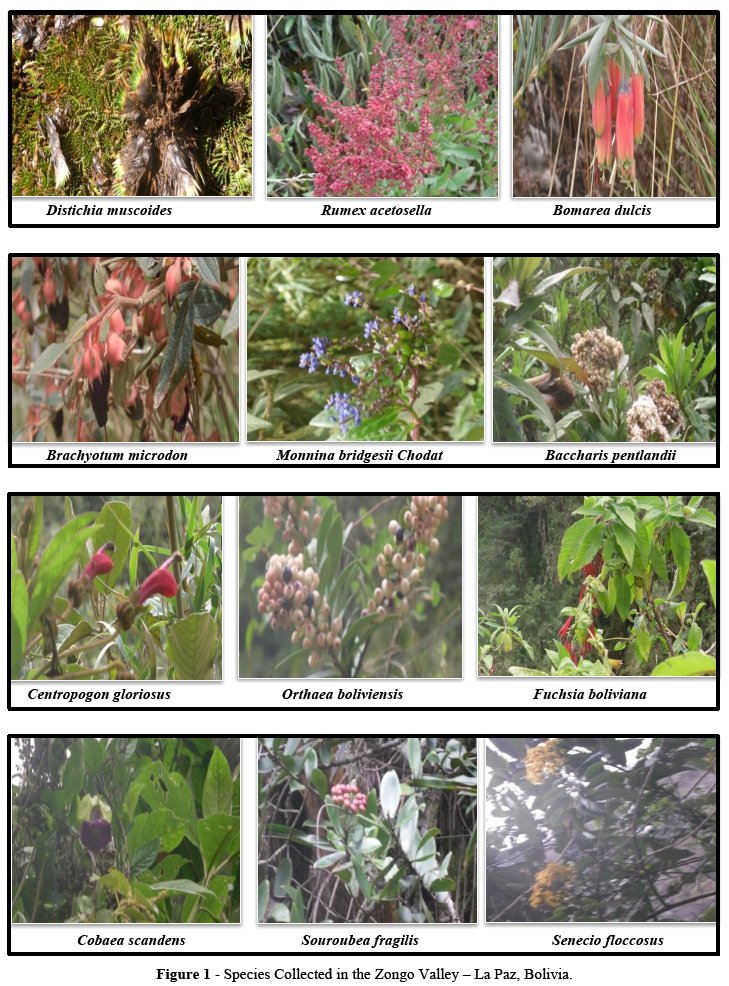
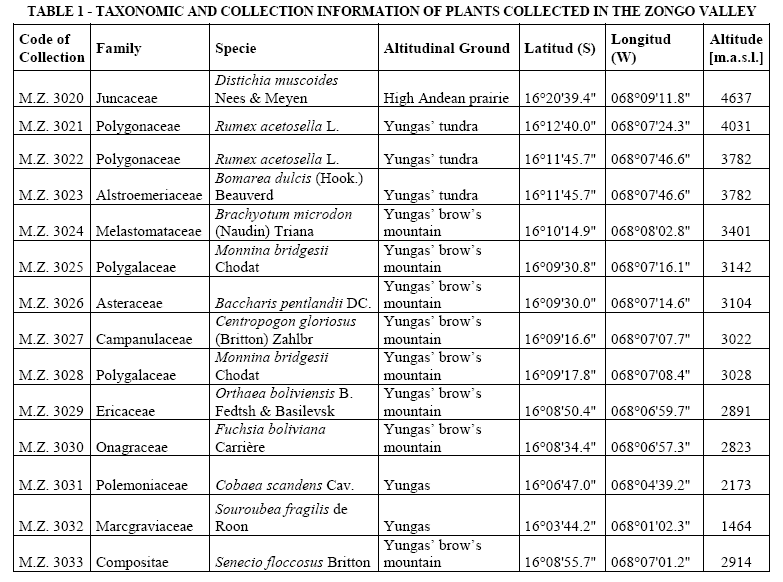
<body><![CDATA[<p align="justify"><font size="3" face="Verdana, Arial, Helvetica, sans-serif"><b>3.&nbsp;&nbsp;&nbsp;&nbsp; RESULTS AND   DISCUSSION</b></font><font size="2" face="Verdana, Arial, Helvetica, sans-serif"><b>&nbsp;</b></font></p>     <p align="justify"><font size="2" face="Verdana, Arial, Helvetica, sans-serif"><b>3.1 Collection of plant species</b></font><font size="2" face="Verdana, Arial, Helvetica, sans-serif"><b>&nbsp;</b></font></p>      <p align="justify"><font size="2" face="Verdana, Arial, Helvetica, sans-serif">The collected plants belong to twelve different species and to eleven distinct families. The species were collected at one of the following altitudinal stages in the valley: High Andean prairie (from 4200 to 4800 m.a.s.l.), Yungas’ Tundra (from 3600 to 4200 m.a.s.l.), Yungas’ brow’s mountain (from 2800 to 3600 m.a.s.l.) and Yungas (from 800 to 2800 m.a.s.l.) There is only one specimen belonging to the High Andean prairie, three from the Yungas’ Tundra, eight found in the Yungas’ brow’s mountain and two appertain to the Yungas’ region. All collected species present colorful organisms (flowers, fruits, leaves or aerial body), <a href="#f1">Figure 1</a>. </font></p>     <p align="justify"><a name="f3"></a></p>     <p align="center"><img src="/img/revistas/riyd/v1n16/a02_figura_01.jpg" width="729" height="986"></p>     <p align="justify"><font size="2" face="Verdana, Arial, Helvetica, sans-serif">It is relevant to highlight <i>Brachyotum microdon</i> and <i>Cobaea scandens</i> which have purple flowers and <i>Monnina bridgesii</i> for their blue flowers and fruits. These species were previously studied using a chemical reaction that mimics <i>Plasmodium falciparum</i>’s infection [7]. Only <i>Brachyotum microdon</i> inhibited the chemical infection. The compounds responsible for this activity were b-sitosterol, oleanolic acid, ursolic acid and corosolic acid [7].  In addition, Hultin <i>et al</i>. published the isolation of alkaloids from <i>Cobaea scandens</i>[22].</font></p>      <p align="justify"><font size="2" face="Verdana, Arial, Helvetica, sans-serif">The species collected under chemio-taxonomic criterion were <i>Rumex acetosella</i> and <i>Fuchsia boliviana</i>. <i>Rumex acetosella</i> contains gallic acid, a phenolic constituent [23], while <i>Fuchsia boliviana</i> has gallic acid as well as anthocyanins that are responsible for the flowers coloring [24]. It is important to emphasize that the presence of phenolic compounds is related to plant coloration and, in some cases, is responsible for biological activities. The species collected based on the chemio-taxonomic information found in their genus were <i>Fuchsia boliviana</i>, <i>Senecio floccosus</i>, <i>Monnina bridgesii </i>and <i>Baccharis pentlandii</i>. The genus <i>Fuchsia</i> contains a series of highly hydroxylated aromatic rings such as carotenoids, flavonoids, flavonols [25] and anthocyanins [25], [26]. The genus <i>Senecio</i> presents a series of phenolic compounds like quinones, acid phenols [27], and flavonoids [27] , [28], [29] which include splinter groups like flavonoid glycosides [30], flavones [31], flavonol glycosides [32] and flavonoid alkaloids [33]. Moreover, the <i>Monnina </i>genus reports flavonoids (like flavonol glycosides) [34] and xanthones [35]. Finally, species belonging to the genus <i>Baccharis</i> are well studied and present a large quantity and diversity of phenolic compounds responsible for the plant’s biological activities and pigmentation [36], [37], [38], [39].</font></p>      <p align="justify"><font size="2" face="Verdana, Arial, Helvetica, sans-serif"> The twelve plants that were collected are shown in <a href="#f1">Figure 1</a> while <a href="#t1">Table 1</a> presents the taxonomic information (family and specie) and the data acquired for each species at the collection (altitudinal ground, coordinates and altitude).</font></p>     <p align="justify"><a name="t1"></a></p>     <p align="center"><img src="/img/revistas/riyd/v1n16/a02_table_01.gif" width="783" height="582"></p>     ]]></body>
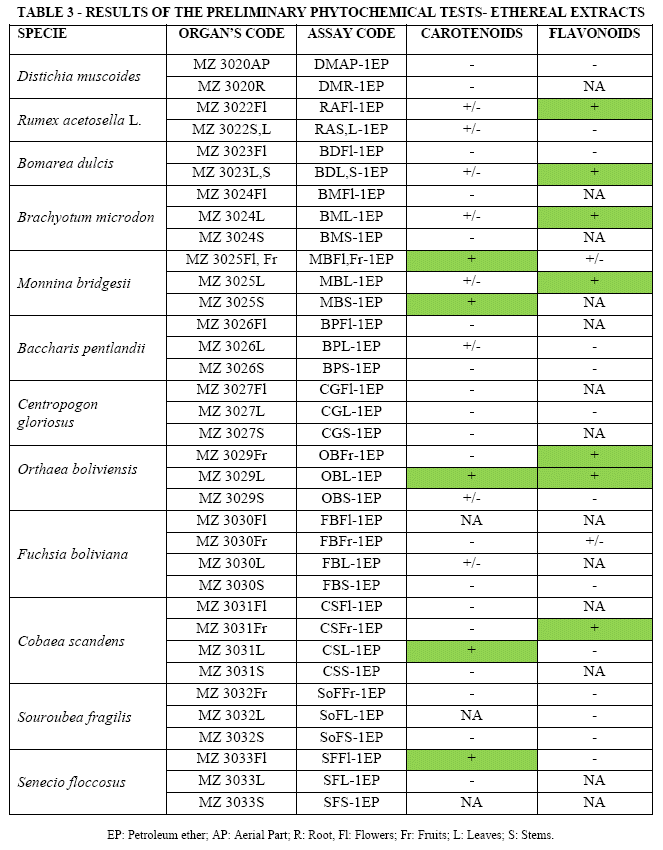
<body><![CDATA[<p align="justify"><font size="2" face="Verdana, Arial, Helvetica, sans-serif"><b>3.2&nbsp;&nbsp;&nbsp;&nbsp;&nbsp; Extracts   preparation</b></font></p>     <p align="justify"><font size="2" face="Verdana, Arial, Helvetica, sans-serif">A total of seventy vegetal extracts were obtained, thirty five from the ethereal extraction and thirty five with the ethanolic procedure. In some cases, the yields of the obtained extracts were low and a second extraction was required to increase the amount of material to perform all the chemical and spectroscopic studies. <a href="#T2">Table 2</a> presents the summary of the extraction codes and the yield of each organ’s extract.</font></p>     <p align="justify"><a name="t2"></a></p>     <p align="center"><img src="/img/revistas/riyd/v1n16/a02_table_02.gif" width="744" height="1006"></p>     <p align="justify"><font size="2" face="Verdana, Arial, Helvetica, sans-serif"><b>3.3&nbsp;&nbsp;&nbsp;&nbsp;&nbsp; Preliminary phytochemical tests</b></font></p>      <p align="justify"><font size="2" face="Verdana, Arial, Helvetica, sans-serif">The extracts were submitted to a series of chemical reactions to identify the compounds’ families. We performed two assays for the petroleum ether extracts while seven were ran for the ethanolic extracts. In each assay, between 50 to 100 mg of vegetal extract has been used or as indicated in the methodologies. </font></p>      <p align="justify"><font size="2" face="Verdana, Arial, Helvetica, sans-serif"><b>a.&nbsp;&nbsp;&nbsp;&nbsp; Preliminary tests for ethereal extracts</b></font><font size="2" face="Verdana, Arial, Helvetica, sans-serif"><b>&nbsp;</b></font></p>      <p align="justify"><font size="2" face="Verdana, Arial, Helvetica, sans-serif">From the obtained 35 ethereal extracts only 2 were not assayed. <a href="#t3">Table 3</a> displays the results for the detection of flavonoids and carotenoids in the petroleum ether extracts. In this table, a “ + ” sign exhibits the presence of flavonoids or carotenoids in the studied extracts. The symbol “ +/- ” points out uncertainty, since the result has a faint coloration or because the initial extract’s coloration has the color of the expected positive result. With only one test it is not convenient to claim the presence or absence of a metabolite. The symbol “ - ” shows a negative result. Finally, the notation NA (not available) shows that the test has not been performed due to the lack of extract</font><font size="2"></font></p>  <font size="2">     <p align="justify"><a name="t3"></a></p>     <p align="center"><img src="/img/revistas/riyd/v1n16/a02_table_03.gif" width="663" height="850"></p> </font>     ]]></body>
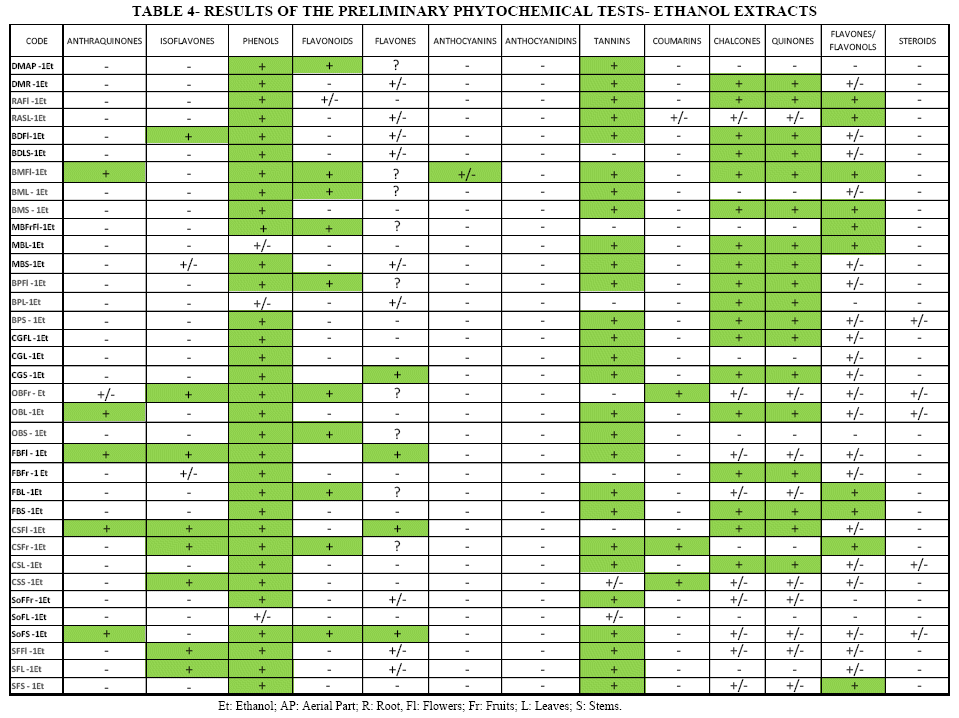
<body><![CDATA[<p align="justify"><font size="2" face="Verdana, Arial, Helvetica, sans-serif">Analyzing the results obtained from <a href="#t3">Table 3</a>, the most important specie is <i>Orthaea boliviensis </i>whose leaves have both metabolites and their fruits have flavonoids. Other interesting species are: <i>Monnina bridgesii </i>whose fruits, flowers and stems present carotenoids and their leaves have flavonoids. It is also important to emphasize the presence of carotenoids in <i>Cobaea scandens</i>’leaves and in the flowers of <i>Senecio floccosus</i>. Finally, the flowers of <i>Rumex acetosella, </i>those of <i>Brachyotum microdon</i>, the fruits of <i>Cobaea scandens</i> and the stems of <i>Bomarea dulcis</i> all have flavonoids.</font></p>      <p align="justify"><font size="2" face="Verdana, Arial, Helvetica, sans-serif"><b>b.&nbsp;&nbsp;&nbsp;&nbsp; Preliminary tests for alcoholic extracts</b></font><font size="2" face="Verdana, Arial, Helvetica, sans-serif"><b>&nbsp;</b></font></p>      <p align="justify"><font size="2" face="Verdana, Arial, Helvetica, sans-serif">Seven phytochemical tests were performed in the 35 ethanol extracts. These seven tests will cover 13 types of secondary metabolites, some of which are very specific. <a href="#t4">Table 4</a> displays the results of the detection of flavonoids, phenolic compounds, anthraquinones, isoflavones, anthocyanins, anthocyanidins, tannins, chalcones, coumarins, flavones, flavonols, quinones and sterols.</font></p>     <p align="justify"><a name="t4"></a></p>     <p align="center"><img src="/img/revistas/riyd/v1n16/a02_table_04.gif" width="959" height="718"></p>     <p align="justify"><font size="2" face="Verdana, Arial, Helvetica, sans-serif">In     <a href="#t4">table 4</a>, a “ + ” sign shows the presence of the evaluated secondary metabolite. The symbol  “+/- ” points out uncertainty, since the result has a solution with a faint coloration or precipitate or because the initial extract’s appearance is similar to the expected positive result. With only one test it is not convenient to claim the presence or absence of a metabolite. The symbol “ - ” implies a negative result.  The notation “ ? ” indicates that is not possible to evaluate the result of the test since the positive result, a yellow solution, is camouflaged or covered by the initial red color of the extract.</font></p>      <p align="justify"><font size="2" face="Verdana, Arial, Helvetica, sans-serif">Analyzing the obtained results from <a href="#t4">Table 4</a>, we highlight the following observations:</font></p>      <p align="justify"><font size="2" face="Verdana, Arial, Helvetica, sans-serif">&bull;&nbsp;&nbsp;&nbsp;&nbsp;&nbsp;&nbsp;&nbsp;&nbsp;   All assayed species present phenolic compounds. It is important to emphasize the results found in <i>Brachyotum microdon, Fuchsia boliviana </i>and<i> Senecio floccosus</i> whose blue solutions suggest the presence of a phenolic compound with a distinctive skeleton.</font></p>      <p align="justify"><font size="2" face="Verdana, Arial, Helvetica, sans-serif">&bull;&nbsp;&nbsp;&nbsp;&nbsp;&nbsp;&nbsp;&nbsp;&nbsp;   The species that have flavonoids are <i>Brachyotum microdon, Monnina bridgesii, Baccharis pentlandii, Orthaea boliviensis, Cobaea scanden, Distichia muscoide, Fuchsia boliviana </i>and<i> Souroubea fragilis</i>.</font></p>      <p align="justify"><font size="2" face="Verdana, Arial, Helvetica, sans-serif">&bull;&nbsp;&nbsp;&nbsp;&nbsp;&nbsp;&nbsp;&nbsp;&nbsp;   Among the flavonoids, the isoflavones stand out because they have a peculiar structural skeleton compared to the other molecules of this family. Among the studied species, <i>Bomarea dulcis, Orthaea boliviensis, Cobaea scanden, Fuchsia boliviana, </i>and<i> Senecio floccosus</i> gave positive results on the isoflavones test.</font></p>      ]]></body>
<body><![CDATA[<p align="justify"><font size="2" face="Verdana, Arial, Helvetica, sans-serif">&bull;&nbsp;&nbsp;&nbsp;&nbsp;&nbsp;&nbsp;&nbsp;&nbsp;   <i>Brachyotum microdon</i> is the only specie that presents anthocyanins. The presence of this molecule is confirmed with the positive results in the phenols and flavonoids tests. This last test detects the presence of the base skeleton of anthocyanins which is close to that found in reduced flavanes in the heterocycle ring.</font></p>      <p align="justify"><font size="2" face="Verdana, Arial, Helvetica, sans-serif">&bull;&nbsp;&nbsp;&nbsp;&nbsp;&nbsp;&nbsp;&nbsp;&nbsp;   The species that contain anthraquinones are <i>Brachyotum microdon, Orthaea boliviensis, Cobaea scandens</i>,<i> Fuchsia boliviana and Souroubea fragilis. </i>The positive results with the chalcones and/or quinones tests confirm the presence of anthraquinones in the studied plants.</font></p>      <p align="justify"><font size="2" face="Verdana, Arial, Helvetica, sans-serif"><b>3.4&nbsp;&nbsp;&nbsp;&nbsp;&nbsp; Spectroscopic studies</b></font><font size="2" face="Verdana, Arial, Helvetica, sans-serif"><b>&nbsp;</b></font></p>      <p align="justify"><font size="2" face="Verdana, Arial, Helvetica, sans-serif">To study the photo-protector potential of the plant extracts, spectroscopic studies were carried out using a UV-VIS spectrophotometer and a wave length window between 290 to 500 nm. The maximum absorbance’s wave length in each sample was registered for comparison purpose to UV-A and UB-B radiations.</font></p>      <p align="justify"><font size="2" face="Verdana, Arial, Helvetica, sans-serif"><b>a.&nbsp;&nbsp;&nbsp;&nbsp; UV analysis for ethereal extracts</b></font></p>      <p align="justify"><font size="2" face="Verdana, Arial, Helvetica, sans-serif">The 35 ethereal extracts were studied at 200 ppm in petroleum ether-methylene chloride solvent mixtures. Some samples were also ran at 500 and 100 ppm depending on the extracts amount. <a href="#T5">Table 5</a> presents the summary of the ethereal extracts’ ultraviolet absorptions. In this table, we observe that the flowers of <i>Senecio floccosus</i> present maximum absorbances at 290 nm (2.115) and 370 nm (3.001) corresponding to UV-B and UV-A regions, respectively.  Other species that have shown important absorptions in the UV-B region are <i>Distichia muscoides</i> and <i>Rumex acetosella</i>.</font></p>     <p align="justify"><a name="t5"></a></p>     <p align="center"><img src="/img/revistas/riyd/v1n16/a02_table_05.gif" width="795" height="1039"></p>     <p align="justify"><font size="2" face="Verdana, Arial, Helvetica, sans-serif"><b>b.&nbsp;&nbsp;&nbsp;&nbsp; UV analysis for ethanolic extracts</b></font><font size="2" face="Verdana, Arial, Helvetica, sans-serif"><b>&nbsp;</b></font></p>      <p align="justify"><font size="2" face="Verdana, Arial, Helvetica, sans-serif">Based on the work done in the ethereal fractions, we decided to evaluate the UV absorption properties of the ethanol extracts at 100 ppm. Some ethanolic extracts were also ran at 200 ppm to increase their maximum absorbance. <a href="#T6">Table 6</a> presents the summary of the ethanol extracts ultraviolet absorptions at 100 ppm.</font></p>      ]]></body>
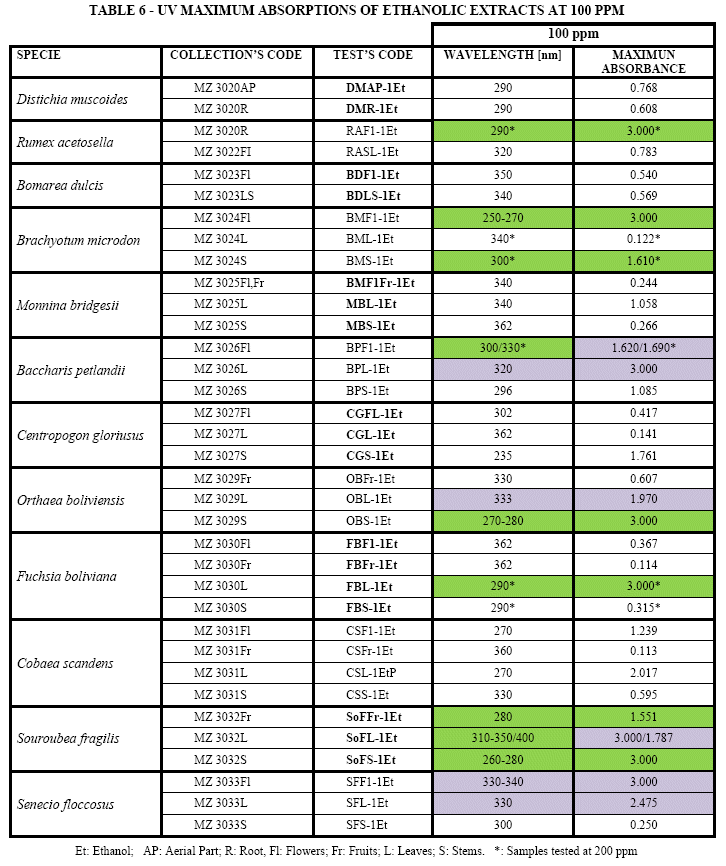
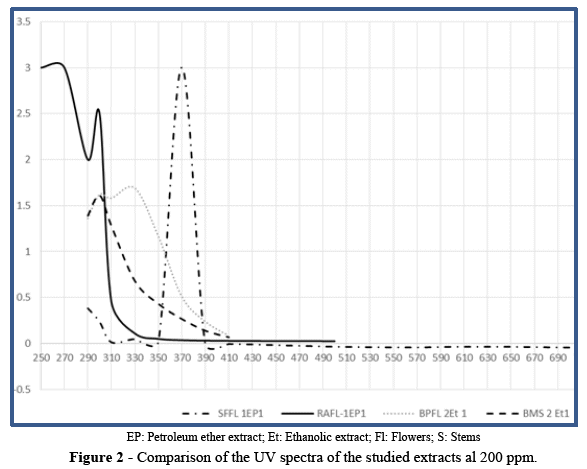
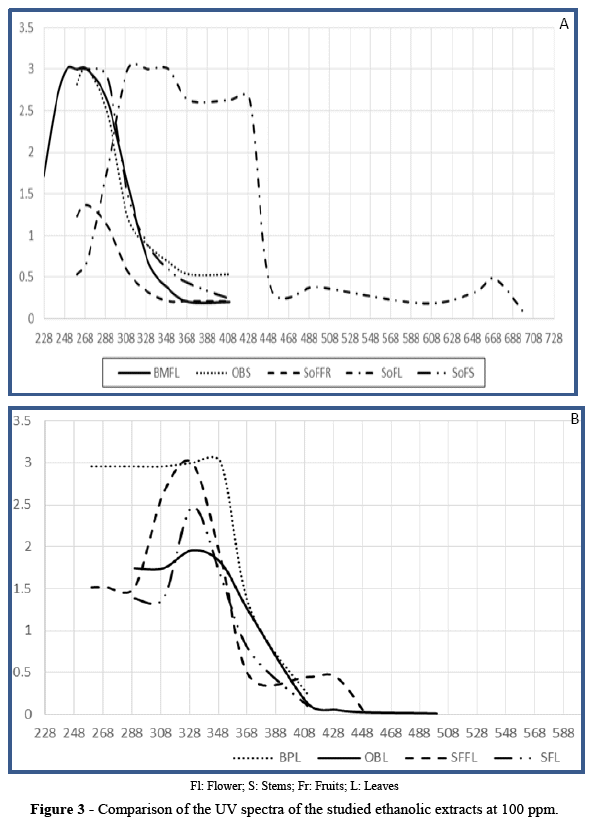
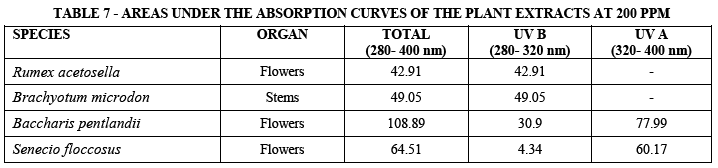
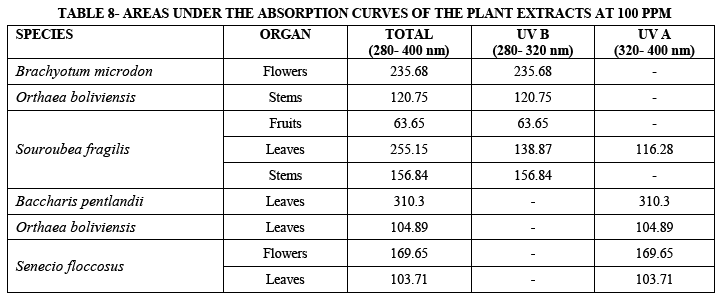
<body><![CDATA[<p align="justify"><a name="t6"></a></p>     <p align="center"><img src="/img/revistas/riyd/v1n16/a02_table_06.gif" width="726" height="866"></p>     <p align=justify><font size="2" face="Verdana, Arial, Helvetica, sans-serif">Analyzing the results obtained from <a href="#t6">Table 6</a>, we observed that the species with important absorbances in the region of UV-B are: the flowers of <i>Rumex acetosella</i>, the flowers and steams of <i>Brachyotum microdon</i> whose flowers have greater absorbance; the flowers of <i>Baccharis pentlandii</i>, the stems of <i>Orthaea boliviensis</i>; the leaves of <i>Fuchsia boliviana </i>and the three organs of the studied <i>Souroubea fragilis</i> whose leaves and stems have greater absorbances. The species that absorb near the region of UV-A are: the leaves and flowers of <i>Baccharis pentlandii</i>; the leaves of <i>Souroubea fragilis</i>; the flowers and leaves of <i>Senecio floccosus</i> and the leaves of <i>Orthaea boliviensis</i>. Of theseplants, the most promising species are the leaves of <i>Baccharis pentlandii</i> and the flowers of <i>Senecio floccosus</i> because their extracts absorb the dangerous UV-A radiation with a high absorbance (3.000 at 100 ppm). Among the analyzed plants we highlight the leaves of <i>S. fragilis</i> and the flowers of <i>B. pentlandii </i>because they present maximum absorbances in both studied wave lengths (UV-A and UV-B).</font></p>     <p align=justify><font size="2" face="Verdana, Arial, Helvetica, sans-serif"><a href="#f2">Figure   2</a> presents the absorption spectra of the important samples ran at 200 ppm. In   this figure, the flowers of <i>Rumex acetosella</i> and <i>Senecio floccosus</i>   stand out with the highest absorbances in the UV-B and UV-A regions, respectively.</font></p>     <p align=justify><a name="f2"></a></p>     <p align=center><img src="/img/revistas/riyd/v1n16/a02_figure_02.gif" width="587" height="469"></p>     <p align=justify><font size="2" face="Verdana, Arial, Helvetica, sans-serif">The absorption spectra of the important samples ran at 100 ppm is shown in <a href="#f3">Figure 3A-B</a>. In <a href="#f3">Figure 3</a> we can highlight the flowers of <i>Brachyotum microdon</i> absorbing at UV-B, the leaves of <i>Baccharis pentlandii</i> and the flowers of <i>Senecio floccosus </i>(both absorbing at UV-A), the stems of <i>Souroubea fragilis</i> and <i>Orthaea boliviensis</i> (both absorbing at UV-B) and the leaves of <i>Souroubea fragilis</i> absorbiong at both UV- B and UV-A regions.</font></p>      <p align="justify"><a name="f3"></a>     <p align="center"><img src="/img/revistas/riyd/v1n16/a02_figure_03.gif" width="592" height="827">     <p align="justify"><font size="2" face="Verdana, Arial, Helvetica, sans-serif"><a href="#t7">Tables 7</a> and <a href="#t8">8</a> show the areas under the absorption curves of the important extracts ran at 200 ppm and 100 ppm, respectively.</font></p>     ]]></body>
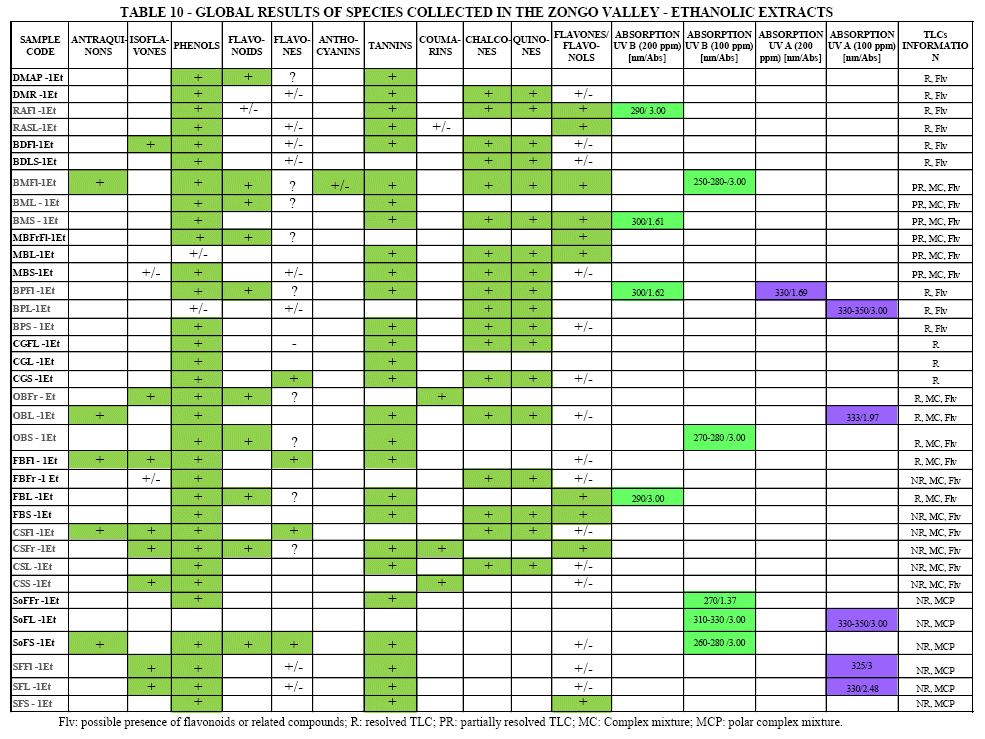
<body><![CDATA[<p align="justify"><a name="t7"></a></p>     <p align="center"><img src="/img/revistas/riyd/v1n16/a02_table_07.gif" width="718" height="168"></p>     <p align="center">&nbsp;</p>     <p align="center"><a name="t8"></a></p>     <p align="center"><img src="/img/revistas/riyd/v1n16/a02_table_08.gif" width="725" height="298"></p>     <p align="justify"><font size="2" face="Verdana, Arial, Helvetica, sans-serif"><b>3.5&nbsp;&nbsp;&nbsp;&nbsp;&nbsp; Analysis   of global results (Phytochemical tests, Chromatographic study, Spectroscopic   data)</b></font></p>     <p align="justify"><font size="2" face="Verdana, Arial, Helvetica, sans-serif">For comparative purposes, <a href="#t9">Table 9</a> presents a summary of the global results of the ethereal extracts of the plants collected in the Zongo Valley, while <a href="#t10">Table 10</a> shows those for the ethanolic extracts.</font></p>     <p align="justify"><a name="t9"></a></p>     <p align="center"><img src="/img/revistas/riyd/v1n16/a02_table_09.gif" width="731" height="992"></p>     <p align="center">&nbsp;</p>     ]]></body>
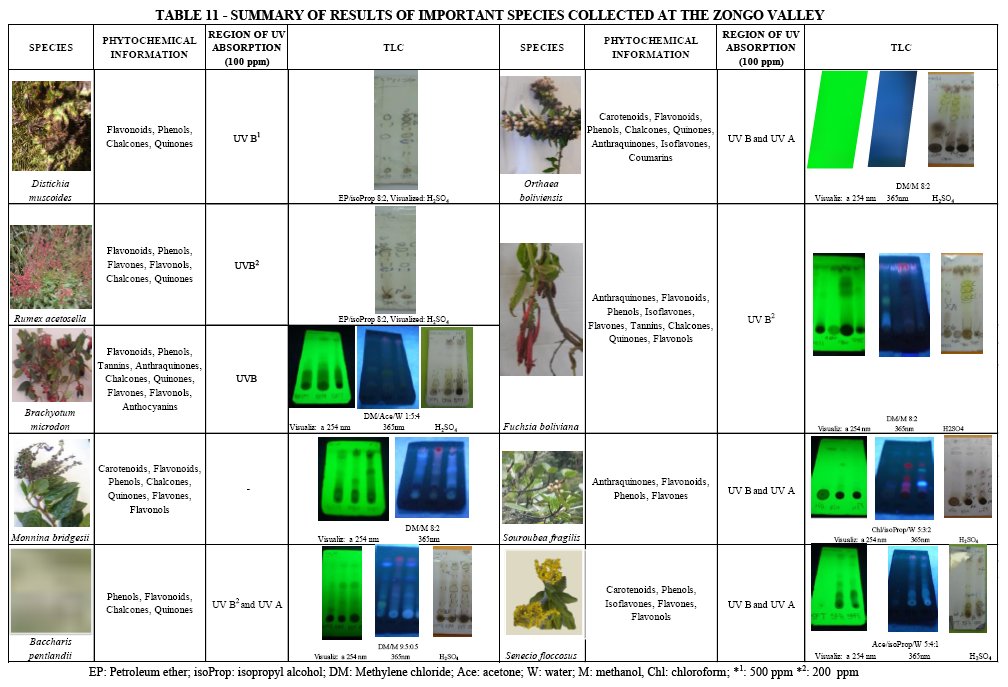
<body><![CDATA[<p align="center"><a name="t10"></a></p>     <p align="center"><img src="/img/revistas/riyd/v1n16/a02_table_10.gif" width="985" height="739"></p> <font size="2">     <p align="justify"><font face="Verdana, Arial, Helvetica, sans-serif">In     <a href="#t9">Tables 9</a> and <a href="#t10">10</a>, the UV-A and UV-B absorptions with maximum absorbance above   1.5 can be appreciated, as well as the TLC (Thin Layer Chromatography)   information of the relevant extracts and the phytochemical tests that gave   clear positive results. In some cases, the results that gave “ +/- ” or “ ? ” data were corroborated by a positive result in the flavonoid test or by TLC.</font></p> </font>     <p align="justify"><font size="2" face="Verdana, Arial, Helvetica, sans-serif">Analyzing     <a href="#t9">Table 9</a>, the most important species are: <i>Rumex acetosella</i> (flowers) that presents a UV-B absorption and has flavonoids and <i>Senecio floccosus</i> (flowers) that absorb at both UV-A and UV-B regions and has carotenoids.</font></p>      <p align="justify"><font size="2" face="Verdana, Arial, Helvetica, sans-serif">Analyzing     <a href="#t10">Table 10</a>, the most important species based on their UV-B absorption properties are:  <i>Rumex acetosella </i>(flowers), <i>Brachyotum microdon </i>(flowers and stems), <i>Baccharis pentlandii</i> (flowers), <i>Orthaea boliviensis </i>(stems), <i>Fuchsia boliviana </i>(leaves) and <i>Souroubeo fragilis </i>(fruits, leaves and stems).  Among the species that absorb in UV-A, we mention <i>Baccharis pentlandii</i> (flowers and leaves), <i>Orthaea boliviensis </i>(leaves), <i>Souroubea fragilis </i>(leaves) and <i>Senecio floccosus</i> (flowers and leaves). At this point, it is important to outline B<i>. pentlandii</i>, <i>O. boliviensis </i>and <i>S.  fragilis </i>since they absorb  both types of UV radiations (UV-A and UV-B). All species contain phenols and flavonoids that could be responsible for the registered absorbance. It is important to highlight<i> Brachyotum microdon</i> and <i>Orthaea boliviensis </i>because they have anthraquinones, molecules with orange coloration.</font></p>      <p align="justify"><font size="2" face="Verdana, Arial, Helvetica, sans-serif"><a href="#t11">Table 11</a> presents a summary of the important plants along with their phytochemical information, type of UV absorption, and TLC data. We include <i>Monnina bridgesii</i> in this table because their fruits have a blue colorant that tinted paper and cardboard.</font></p>     <p align="justify"><a name="t11"></a></p>     <p align="center"><img src="/img/revistas/riyd/v1n16/a02_table_11.jpg" width="1008" height="687"></p>     <p align="justify"><font size="2" face="Verdana, Arial, Helvetica, sans-serif">The plants presented in this work and were previously reported are <i>Brachyotum microdon</i>,<i> Monnina bridgesii, Rumex acetosella</i>, <i>Baccharis pentlandii</i>, <i>Fuchsia boliviana</i>,<i> Distichia muscoides</i>,<i> Cobaea scandens</i> and <i>Centropogon gloriosus</i>[40], [7]. In these publications, the plants’ activity against <i>Plasmodium falciparum</i>, <i>Leishmania</i> sps., <i>Trypanosoma cruzi</i> and their respond on the ferriprotophorphirine bio-crystallization inhibition test (FBIT) were evaluated. Among these plants <i>B. microdon</i> and <i>R. acetosella</i> inhibited the mentioned crystallization and showed activity against <i>P. falciparum</i>. While Monnina<i> bridgesii </i>had important IC<sub>50</sub> values against the tested <i>Leishmania</i> species. In addition, the <i>Rumex acetosella</i>’s antioxidant activity was previously published as well as the presence of phenolic compounds, flavonoids and anthocyanins [41], [23]. Flavonoids were also found in <i>B. pentlandii</i>[37] and in <i>F. boliviana</i>[42], this last plant also has anthocyanins [24], [42]. Finally, <i>Bomarea dulcis</i> has only one taxonomic publication [43].</font><font size="2"></font></p>  <font size="2">     <p align=justify>&nbsp;</p> </font>     ]]></body>
<body><![CDATA[<p align="justify"><font size="3" face="Verdana, Arial, Helvetica, sans-serif"><b>4.&nbsp;&nbsp;&nbsp;&nbsp; CONCLUSIONS</b></font></p>     <p align="justify"><font size="2" face="Verdana, Arial, Helvetica, sans-serif">Eleven plants were collected in the Zongo valley that could be used as colorants. Thirty five ethereal extracts and 35 ethanolic extracts were obtained and submitted to several assays to study their photo-protector potentials and their phytochemical composition.</font></p>      <p align="justify"><font size="2" face="Verdana, Arial, Helvetica, sans-serif">The species that presented stain properties because they dye paper or cardboardare: the flowers of <i>Brachyotum microdon </i>(purple), the fruits and flowers of <i>Monnina bridgesii</i> (blue) and the stems of <i>Souroubea fragilis</i>(brown).  Among these species, <i>Monnina bridgesii </i>tinted more easily the cellulose than the other plants. In addition, this plant has flavonoids and carotenoids that could present antioxidant properties. The flowers of <i>Brachyotum microdon </i>have anthocyanins that explain the color change, from purple to light blue, when the sample is exposed to different temperatures. Moreover, the flowers and stems of <i>B. microdon </i>have important UV-B absorptions and the presence of flavonoids shows a possible antioxidant property. Finally, this plant presents interesting molecules like anthraquinones and anthocyanins that could have biological and photo-protector activities, respectively. The entire plant of <i>Souroubea fragilis </i>presents important UV-B absorbtions; however, their leaves stand out since they also have compounds that absorb UV-A radiation. Something peculiar is that the preliminary phytochemical tests of the leaves of <i>S. fragilis</i>do not show the typical compounds for the mentioned absorption (anthocyanins, flavonoids, anthraquinones) which shows a molecule not covered in our screening. It should not be ruled out that conjugated tannins could beresponsible forthis property. Another interesting organ in <i>S. fragilis</i>is the stem whose resin gets oxidized to orange when it is exposed to air. This behavior is found in antioxidant compounds, which get oxidized avoiding other molecules to get so. This property could be confirmed with the presence of flavonoids, flavones, flavonols and/or anthraquinones. The TLCs of these three plants present several compounds with difficult resolution. Among the three studied plants, <i>S. fragilis</i> is the most interesting for its possible photo-protector and antioxidant activities, however further studies must be performed. </font></p>      <p align="justify"><font size="2" face="Verdana, Arial, Helvetica, sans-serif">Other species that could be further studied due to their photo-protector and possible antioxidant activities are: <i>Orthaea boliviensis</i>, <i>Senecio floccosus</i>,<i> Rumex acetosella</i>, <i>Baccharis pentlandii</i> and <i>Fuchsia boliviana</i>.</font></p>      <p align="justify"><font size="2" face="Verdana, Arial, Helvetica, sans-serif">To our knowledge, there are no publications for <i>Souroubea fragilis</i>, <i>Senecio floccosus </i>and <i>Orthaea boliviensis</i>being this work the first one done and published for these species. </font></p>      <p align="justify"><font size="2" face="Verdana, Arial, Helvetica, sans-serif">San Martin <i>et al.</i> have published studies of UV absorptions and phytochemical assays in <i>Baccharis genistelloides</i>[44]. This publication supports and validates our methods and results since in the studied Baccharis<i> pentlandii</i> we found the same absorption regions and phytochemical constituents asin the reported <i>Baccharis genistelloides</i>.</font></p>      <p align="justify"><font size="2" face="Verdana, Arial, Helvetica, sans-serif">The colorant properties as well as the antioxidant activities of the most important plants reported here (<i>Brachyotum microdon, Monnina bridgesii</i> and <i>Souroubea fragilis</i>) are now being studied in our research group.  With this work we encourage the evaluation, valorization, and further study of our natural resources with possible colorant, photo-protector and antioxidant activities.</font></p>      <p align="justify">&nbsp;</p>      <p align="justify"><font size="3" face="Verdana, Arial, Helvetica, sans-serif"><b>5.&nbsp;&nbsp;&nbsp;&nbsp; ACKNOWLEDGEMENT</b></font><font size="2" face="Verdana, Arial, Helvetica, sans-serif"><b>&nbsp;</b></font></p>      <p align="justify"><font size="2" face="Verdana, Arial, Helvetica, sans-serif">To Bolivian National Herbarium-La Paz  (HNB).</font></p>      ]]></body>
<body><![CDATA[<p align="justify">&nbsp;</p>      <p align="justify"><font size="3" face="Verdana, Arial, Helvetica, sans-serif"><b>6.&nbsp;&nbsp;&nbsp;&nbsp; REFERENCES</b></font></p>     <p align="justify"><font size="2" face="Verdana, Arial, Helvetica, sans-serif">[1]    D. Malen&euml;cio&egrave;, J. Jelena Cveji&eacute; and J. J. Miladinovi&eacute;, &quot;Polyphenol Content and Antioxidant Properties of Colored Soybean Seeds from Central Europe,&quot; J. Med. Food, vol. 15, pp. 89-95, 2012.    <br> </font></p>     <p align="justify"><font size="2" face="Verdana, Arial, Helvetica, sans-serif">[2]   A. Segev, H. Badani, Y. kapulnik, I. Shomer, M. Oren-Shamir and S. Galili, &quot;Determination of Polyphenols, Flavonoids and Antioxidant Capacity in Colored Chickpea (Cicer arietinum L.),&quot; J. Food Science, vol. 75, pp. 115-119, 2010.    <br>   </font></p>     <p align="justify"><font size="2" face="Verdana, Arial, Helvetica, sans-serif">[3] N. Muntana and S. Prasong, &quot;Study on Total Phenolic Contents and their Antioxidant Activities of Thai White, Red and Black Rice Bran Extracts,&quot; Pakistan Journal of Biological Sciences, vol. 13, pp. 170-174, 2010.    <br>   </font></p>     <p align="justify"><font size="2" face="Verdana, Arial, Helvetica, sans-serif">[4]   T. Laokuldilok, C. F. Shoemaker, S. Jongkaewwattana and V. Tulyathan, &quot;Antioxidants and Antioxidant Activity of Several Pigmented Rice Brans,&quot; J. Agric. Food Chem., vol. 59, pp. 193-199, 2011.    <br>   </font></p>     ]]></body>
<body><![CDATA[<p align="justify"><font size="2" face="Verdana, Arial, Helvetica, sans-serif">[5]   M. Rodr&iacute;guez-Hern&aacute;ndez, D. A. Moreno, M. Carvajal, C. Garc&iacute;a-Viguera and M. Mart&iacute;nez- Ballesta, &quot;Natural antioxidants in purple sprouting broccoli under Mediterranean climate,&quot; J. Food Science, vol. 0, pp. 1-6, 2012.    <br>   </font></p>     <p align="justify"><font size="2" face="Verdana, Arial, Helvetica, sans-serif">[6]   K.-W. Kong, H.-E. Khoo, K. N. Prasad, A. Ismail, C.-P. Tan and N. Rajab, &quot;Revealing the Power of the Natural Red Pigment Lycopene,&quot; Molecule, vol. 15, pp. 959-987, 2010.    <br>   </font></p>     <p align="justify"><font size="2" face="Verdana, Arial, Helvetica, sans-serif">[7]   S. L. Ib&aacute;&ntilde;ez-Calero, Application du test d&rsquo;inhibition de la biocristallisation de l&acute;heme a la caracterisation de composes antipaludiques isoles de la flore de Bolivie. Ph.D. thesis, Toulouse- France: Universite Paul Sabatier, 2005.    <br>   </font></p>     <p align="justify"><font size="2" face="Verdana, Arial, Helvetica, sans-serif">[8]   R. R. Korac and K. M. Khambholja, &quot;Potential of herbs in skin protection from ultraviolet radiation,&quot; Pharmacogn. Rev., vol. 5, pp. 164-173, 2011.    <br>   </font></p>     <p align="justify"><font size="2" face="Verdana, Arial, Helvetica, sans-serif">[9]   R. Mongkholrattanasita, J. Kry&scaron;t&#367;feka, J. Wienera and M. Vikov&aacute;, &quot;UV protection properties of silk fabric dyed with eucalyptus leaf extract,&quot; Journal of the Textile Institute , vol. 102, pp. 272-279, 2011.    <br>   </font></p>     ]]></body>
<body><![CDATA[<p align="justify"><font size="2" face="Verdana, Arial, Helvetica, sans-serif">[10]   S.-S. Sun and R.-C. Tang, &quot;Adsorption and UV Protection Properties of the Extract from Honeysuckle onto Wool,&quot; Ind. Eng. Chem. Res., vol. 50, pp. 4217-4224, 2011.    <br>   </font></p>     <p align="justify"><font size="2" face="Verdana, Arial, Helvetica, sans-serif">[11]   S.-J. Heo, S.-C. Ko, S.-M. Kang, S.-H. Cha, S.-H. Lee, D.-H. Kang, W.-K. Jung, A. Affan, C. Oh and Y.-J. Jeon, &quot;Inhibitory effect of diphlorethohydroxycarmalol on melanogenesis and its protective effect against UV-B radiation-induced cell damage,&quot; Food and Chemical Toxicology, vol. 48, no. 5, pp. 1355-1361, 2010.    <br>   </font></p>     <p align="justify"><font size="2" face="Verdana, Arial, Helvetica, sans-serif">[12]   H. Xing and T. Garland, &quot;United States Patent Application Publication 2012&quot;. United States Patent US2012/0107253 A1, 2012.    <br>   </font></p>     <p align="justify"><font size="2" face="Verdana, Arial, Helvetica, sans-serif">[13]   T. Ortu&ntilde;o, Estudio palinol&oacute;gico en un gradiente altitudinal en el valle de Zongo. La Paz- Bolivia. Tesis de licenciatura en Biolog&iacute;a, La Paz- Bolivia: UMSA, 2000.    <br>   </font></p>     <!-- ref --><p align="justify"><font size="2" face="Verdana, Arial, Helvetica, sans-serif">[14]   M. Baudoin, Historia natural de un valle de los Andes, La Paz, La Paz: Instituto de Ecolog&iacute;a-UMSA, 1991.    &nbsp;&nbsp;&nbsp;&nbsp;&nbsp;&nbsp;&nbsp;&nbsp;[&#160;<a href="javascript:void(0);" onclick="javascript: window.open('/scielo.php?script=sci_nlinks&ref=956352&pid=S2518-4431201600010000200014&lng=','','width=640,height=500,resizable=yes,scrollbars=1,menubar=yes,');">Links</a>&#160;]<!-- end-ref --><br>   </font></p>     ]]></body>
<body><![CDATA[<p align="justify"><font size="2" face="Verdana, Arial, Helvetica, sans-serif">[15]   E. Orante Morales, Tamizaje fitoqu&iacute;mico de la especie vegetal guatemateca Quararibea yunckeri Standley Subsp. izabalensis W. S. Alverson ex V&eacute;liz (Bombacaceae). Informe de Tesis, Guatemala: Universidad de San Carlos de Guatemala, 2008.    <br>   </font></p>     <p align="justify"><font size="2" face="Verdana, Arial, Helvetica, sans-serif">[16]   J. Ahuja, J. Suresh and A. Deep, &quot;Phytochemical screening of aerial parts of Artemisia parviflora,&quot; Der Pharmacia Lettre, vol. 3, no. 6, pp. 116-124, 2011.    <br>   </font></p>     <p align="justify"><font size="2" face="Verdana, Arial, Helvetica, sans-serif">[17]   R. L. Carvajal, U. Hata, N. Sierra and D. Rueda, &quot;An&aacute;lisis fitoqu&iacute;mico preliminar de hojas, tallos y semillas de C&uacute;pata,&quot; Revista Colombia Forestal, vol. 12, pp. 161-170, 2009.    <br>   </font></p>     <p align="justify"><font size="2" face="Verdana, Arial, Helvetica, sans-serif">[18]   A. Martinez, G. Valencia, M. Jim&eacute;nez, M. Mesa and E. Galeano, Manual de pr&aacute;cticas de laboratorio de farmacognosia y fitoqu&iacute;mica, Colombia: Universidad de Antioqu&iacute;a, 2008.    <br>   </font></p>     <p align="justify"><font size="2" face="Verdana, Arial, Helvetica, sans-serif">[19]   M. Aguiera, M. Beza and R. M. J. Chew, &quot;Propiedades funcionales de las antocianinas,&quot; Revista Biotecnia, vol. 8, no. 2, pp. 16-22, 2011.    <br>   </font></p>     ]]></body>
<body><![CDATA[<p align="justify"><font size="2" face="Verdana, Arial, Helvetica, sans-serif">[20]   J. Alarcon and C. Navarro, &quot;Determinaci&oacute;n de la presencia de algunos compuestos qu&iacute;micos por medios fitoqu&iacute;micos en cinco especies forrajeras,&quot; Revista Colombiana Foresta, vol. 3, no. 1, pp. 27-72, 2012.    <br>   </font></p>     <!-- ref --><p align="justify"><font size="2" face="Verdana, Arial, Helvetica, sans-serif">[21]   G. Schmeda, Ensayos biol&oacute;gicos en investigaci&oacute;n de productos naturales, Barcelona: Universitat de Barcelona, 1998.    &nbsp;&nbsp;&nbsp;&nbsp;&nbsp;&nbsp;&nbsp;&nbsp;[&#160;<a href="javascript:void(0);" onclick="javascript: window.open('/scielo.php?script=sci_nlinks&ref=956366&pid=S2518-4431201600010000200021&lng=','','width=640,height=500,resizable=yes,scrollbars=1,menubar=yes,');">Links</a>&#160;]<!-- end-ref --><br>   </font></p>     <p align="justify"><font size="2" face="Verdana, Arial, Helvetica, sans-serif">[22]   E. Hultin and K. Torssell, &quot;Alkaloid-screening of Swedish plants,&quot; Phytochemistry, vol. 4, pp. 425-433, 1965.    <br>   </font></p>     <p align="justify"><font size="2" face="Verdana, Arial, Helvetica, sans-serif">[23]   D. Ahmed, Q. M. Mughal, S. Younas and M. Ikram, &quot;Study of phenolic content and urease and alpha-amylase inhibitory activities of methanolic extract of Rumex acetosella roots and its sub-fractions in different solvents,&quot; Pak. J. Pharm. Sci., vol. 26, no. 3, pp. 553-559, 2013.    <br>   </font></p>     <p align="justify"><font size="2" face="Verdana, Arial, Helvetica, sans-serif">[24]   M. Jordheim, I. Skaar, H. Lunder and &Oslash;. Andersen, &quot;Anthocyanins from Fuchsia flowers,&quot; Nat. Prod. Commun., vol. 6, no. 1, pp. 35-40, 2011.    <br>   </font></p>     ]]></body>
<body><![CDATA[<p align="justify"><font size="2" face="Verdana, Arial, Helvetica, sans-serif">[25]   J. P. F. G. Helsper, C. H. Ric de Vos, F. M. Maas, H. H. Jonker, H. C. van den Broeck, W. Jordi and C. Pot, &quot;Response of selected antioxidants and pigments in tissues of Rosa hybrida and Fuchsia hybrida to supplemental UV-A exposure,&quot; Physiologia Plantarum, vol. 117, no. 2, pp. 171-178, 2003.    <br>   </font></p>     <p align="justify"><font size="2" face="Verdana, Arial, Helvetica, sans-serif">[26]   A. Ruiz, I. Hermos&iacute;n-Guti&eacute;rrez, C. Vergara, D. von Baer, M. Zapata, A. Hitschfeld, L. Obando and C. Mardones, &quot;Anthocyanin profiles in south Patagonian wild berries by HPLC-DAD-ESI-MS/MS,&quot; Food Research International, vol. 51, no. 2, pp. 706-713, 2013.    <br>   </font></p>     <p align="justify"><font size="2" face="Verdana, Arial, Helvetica, sans-serif">[27]   N. Mezache, S. Derbr&eacute;, S. Akkal, H. Laouer, D. S&eacute;raphin and P. Richomme, &quot;Fast counter current chromatography of n-butanolic fraction from Senecio giganteus (Asteraceae),&quot; Nat Prod Commun, vol. 4, no. 10, pp. 1357-1362, 2009.    <br> </font></p>     <p align="justify"><font size="2" face="Verdana, Arial, Helvetica, sans-serif">[28]   P. Chen, Y. Wang, L. Chen, W. Jiang, Y. Niu, Q. Shao, L. Gao, Q. Zhao, L. Yan and S. Wang, &quot;Comparison of the anti-inflammatory active constituents and hepatotoxic pyrrolizidine alkaloids in two Senecio plants and their preparations by LC-UV and LC-MS,&quot; J. Pharm. Biomed. Anal., vol. 115, pp. 260-271, 2015.    <br>   </font></p>     <p align="justify"><font size="2" face="Verdana, Arial, Helvetica, sans-serif">[29]   L. Hariprasath, J. Raman and R. Nanjian, &quot;Gastroprotective effect of Senecio candicans DC on experimental ulcer models,&quot; J. Ethnopharmacol., vol. 140, no. 1, pp. 145-150, 2012.    <br>   </font></p>     ]]></body>
<body><![CDATA[<p align="justify"><font size="2" face="Verdana, Arial, Helvetica, sans-serif">[30]   X. Yang, L. Yang, A. Xiong, D. Li and Z. Wang, &quot;Authentication of Senecio scandens and S. vulgaris based on the comprehensive secondary metabolic patterns gained by UPLC-DAD/ESI-MS,&quot; J. Pharm. Biomed. Anal., vol. 56, no. 2, pp. 165-172, 2011.</font></p>     <p align="justify"><font size="2" face="Verdana, Arial, Helvetica, sans-serif">[31]   X. Yang, A. Xiong, L. Yang, C. Wang and Z. Wang, &quot;Study on HPLC fingerprints of Senecio scandens and S. scandens,&quot; Zhongguo Zhong Yao Za Zhi, vol. 36, no. 6, pp. 725-728, 2011.    <br>   </font></p>     <p align="justify"><font size="2" face="Verdana, Arial, Helvetica, sans-serif">[32]   W. Hassan, A. Al-Gendy, H. Al-Youssef and A. El-Shazely, &quot;Chemical constituents and biological activities of Senecio aegyptius var. discoideus Boiss,&quot; Z. Naturforsch. C., vol. 67, no. 3-4, pp. 144-150, 2012.    <br>   </font></p>     <p align="justify"><font size="2" face="Verdana, Arial, Helvetica, sans-serif">[33]   N. Li, L. Shao, C.-F. Zhang and M. Zhang, &quot;Two new flavonoid alkaloids from Senecio argunensis,&quot; Journal of Asian Natural Products Research, vol. 10, no. 12, pp. 1143-1146, 2008.    <br>   </font></p>     <p align="justify"><font size="2" face="Verdana, Arial, Helvetica, sans-serif">[34]   L. H.B.K. Lepore, N. Malafronte, F. B. Condero, M. J. Gualtieri, S. Abdo, F. Dal Piaz and N. De Tommasi, &quot;Isolation and structural characterization of glycosides from an anti-angiogenic extract of Monnina obtusifolia,&quot; Fitoterapia, vol. 82, no. 2, pp. 178-183, 2011.    <br>   </font></p>     <p align="justify"><font size="2" face="Verdana, Arial, Helvetica, sans-serif">[35]   A. Bashir, M. Hamburger, L. Rahalison, M. Monod, M. P. Gupta, P. Solis and K. Hostettmann, &quot;Antifungal biphenyls from Monnina sylvatica.,&quot; Planta Med., vol. 57, pp. 192-193, 1991.    ]]></body>
<body><![CDATA[<br>   </font></p>     <p align="justify"><font size="2" face="Verdana, Arial, Helvetica, sans-serif">[36]   M. J. Abad, A. L. Bessa, B. Ballarin, O. Arag&oacute;n, E. Gonzales and P. Bermejo, &quot;Anti-inflammatory activity of four Bolivian Baccharis species (Compositae),&quot; J. Ethnopharmacol., vol. 103, no. 3, pp. 338-344, 2006.    <br>   </font></p>     <p align="justify"><font size="2" face="Verdana, Arial, Helvetica, sans-serif">[37]   S. Tarqui Tarqui, Y. Flores Segura and G. i. R. Almanza Vega, &quot;Polyoxygenated flavonoids from Baccharis pentlandii,&quot; Revista Boliviana de Qu&iacute;mica, vol. 29, no. 1, pp. 10-14, 2012.    <br>   </font></p>     <p align="justify"><font size="2" face="Verdana, Arial, Helvetica, sans-serif">[38]   Z. Escobara, Y. Flores, L. Tejeda, J. A. Alvarado, O. Sterner and G. R. Almanza, &quot;Phenolic compounds from Baccharis papillosa subsp. Papillosa,&quot; Revista Boliviana de Qu&iacute;mica, vol. 26, no. 2, pp. 111-117, 2009.    <br>   </font></p>     <p align="justify"><font size="2" face="Verdana, Arial, Helvetica, sans-serif">[39]   S. Mart&iacute;nez, P. Mollinedo, O. Mamani, G. Almanza and E. Terrazas, &quot;Estudio in vitro de la actividad antif&uacute;ngica de extractos vegetales del g&eacute;nero Baccharis sobre candida albicans,&quot; Revista Boliviana de Qu&iacute;mica, vol. 28, no. 1, pp. 35-40, 2011.    <br>   </font></p>     <p align="justify"><font size="2" face="Verdana, Arial, Helvetica, sans-serif">[40]   S. L. Ib&aacute;&ntilde;ez-Calero, G. Ruiz, R. de Michel and M. Sauvain, &quot;Evaluacion de la flora en el Valle de Zongo contra leishmania y chagas,&quot; Revista Boliviana de Qu&iacute;mica, vol. 26, no. 1, pp. 1-11, 2009.    ]]></body>
<body><![CDATA[<br>   </font></p>     <p align="justify"><font size="2" face="Verdana, Arial, Helvetica, sans-serif">[41]   T. &Ouml;zen, &quot;Antioxidant activity of wild edible plants in the Black Sea Region of Turkey,&quot; Grasas y Aceites, vol. 61, no. 1, pp. 86-94, 2010.    <br> </font></p>     <p align="justify"><font size="2" face="Verdana, Arial, Helvetica, sans-serif">[42]   C. A. Williams, J. H. Fronczyk and J. B. Harborne, &quot;Leaf flavonoid and other phenolic glycosides as indicators of parentage in six ornamental Fuchsia species and their hybrids,&quot; Phytochemistry , vol. 22, pp. 1953-1957, 1983.    <br>   </font></p>     <p align="justify"><font size="2" face="Verdana, Arial, Helvetica, sans-serif">[43]   R. E. Bone and K. Strange, &quot;Bomarea dulcis,&quot; Curtis's Botanical Magazine, vol. 29, no. 1, pp. 2-11, 2012.    <br>   </font></p>     <p align="justify"><font size="2" face="Verdana, Arial, Helvetica, sans-serif">[44] &Aacute;. J. San Martin, E. Villanueva, A. Tito Cruz, D. Flores, R. D. Gomez, G. R. Almanza and Y. R. Flores, &quot;Estudio fitoquimico y espectroscopico preliminar de cinco plantas medicinales de Carmen Pampa (Coroico) Bolivia,&quot; Revista Boliviana de Qu&iacute;mica, vol. 29, no. 2, pp. 119-127, 2012.</font></p>     <p align="justify">&nbsp;</p>      ]]></body><back>
<ref-list>
<ref id="B1">
<label>1</label><nlm-citation citation-type="journal">
<person-group person-group-type="author">
<name>
<surname><![CDATA[Malenëcioè]]></surname>
<given-names><![CDATA[D.]]></given-names>
</name>
<name>
<surname><![CDATA[Jelena Cvejié]]></surname>
<given-names><![CDATA[J.]]></given-names>
</name>
<name>
<surname><![CDATA[Miladinovié]]></surname>
<given-names><![CDATA[J.J.]]></given-names>
</name>
</person-group>
<article-title xml:lang="en"><![CDATA[Polyphenol Content and Antioxidant Properties of Colored Soybean Seeds from Central Europe]]></article-title>
<source><![CDATA[J. Med. Food]]></source>
<year>2012</year>
<volume>15</volume>
<page-range>89-95</page-range></nlm-citation>
</ref>
<ref id="B2">
<label>2</label><nlm-citation citation-type="journal">
<person-group person-group-type="author">
<name>
<surname><![CDATA[Segev]]></surname>
<given-names><![CDATA[A.]]></given-names>
</name>
<name>
<surname><![CDATA[Badani]]></surname>
<given-names><![CDATA[H.]]></given-names>
</name>
<name>
<surname><![CDATA[kapulnik]]></surname>
<given-names><![CDATA[Y.]]></given-names>
</name>
<name>
<surname><![CDATA[Shomer]]></surname>
<given-names><![CDATA[I.]]></given-names>
</name>
<name>
<surname><![CDATA[Oren-Shamir]]></surname>
<given-names><![CDATA[M.]]></given-names>
</name>
<name>
<surname><![CDATA[Galili]]></surname>
<given-names><![CDATA[S.]]></given-names>
</name>
</person-group>
<article-title xml:lang="en"><![CDATA[Determination of Polyphenols, Flavonoids and Antioxidant Capacity in Colored Chickpea (Cicer arietinum L.)]]></article-title>
<source><![CDATA[J. Food Science]]></source>
<year>2010</year>
<volume>75</volume>
<page-range>115-119</page-range></nlm-citation>
</ref>
<ref id="B3">
<label>3</label><nlm-citation citation-type="journal">
<person-group person-group-type="author">
<name>
<surname><![CDATA[Muntana]]></surname>
<given-names><![CDATA[N.]]></given-names>
</name>
<name>
<surname><![CDATA[Prasong]]></surname>
<given-names><![CDATA[S.]]></given-names>
</name>
</person-group>
<article-title xml:lang="en"><![CDATA[Study on Total Phenolic Contents and their Antioxidant Activities of Thai White, Red and Black Rice Bran Extracts]]></article-title>
<source><![CDATA[Pakistan Journal of Biological Sciences]]></source>
<year>2010</year>
<volume>13</volume>
<page-range>170-174</page-range></nlm-citation>
</ref>
<ref id="B4">
<label>4</label><nlm-citation citation-type="journal">
<person-group person-group-type="author">
<name>
<surname><![CDATA[Laokuldilok]]></surname>
<given-names><![CDATA[T.]]></given-names>
</name>
<name>
<surname><![CDATA[Shoemaker]]></surname>
<given-names><![CDATA[C.F.]]></given-names>
</name>
<name>
<surname><![CDATA[Jongkaewwattana]]></surname>
<given-names><![CDATA[S.]]></given-names>
</name>
<name>
<surname><![CDATA[Tulyathan]]></surname>
<given-names><![CDATA[V.]]></given-names>
</name>
</person-group>
<article-title xml:lang="en"><![CDATA[Antioxidants and Antioxidant Activity of Several Pigmented Rice Brans]]></article-title>
<source><![CDATA[J. Agric. Food Chem.]]></source>
<year>2011</year>
<volume>59</volume>
<page-range>193-199</page-range></nlm-citation>
</ref>
<ref id="B5">
<label>5</label><nlm-citation citation-type="journal">
<person-group person-group-type="author">
<name>
<surname><![CDATA[Rodríguez-Hernández]]></surname>
<given-names><![CDATA[M.]]></given-names>
</name>
<name>
<surname><![CDATA[Moreno]]></surname>
<given-names><![CDATA[D.A.]]></given-names>
</name>
<name>
<surname><![CDATA[Carvajal]]></surname>
<given-names><![CDATA[M.]]></given-names>
</name>
<name>
<surname><![CDATA[García-Viguera]]></surname>
<given-names><![CDATA[C.]]></given-names>
</name>
<name>
<surname><![CDATA[Martínez- Ballesta]]></surname>
<given-names><![CDATA[M.]]></given-names>
</name>
</person-group>
<article-title xml:lang="en"><![CDATA[Natural antioxidants in purple sprouting broccoli under Mediterranean climate]]></article-title>
<source><![CDATA[J. Food Science]]></source>
<year>2012</year>
<volume>0</volume>
<page-range>1-6</page-range></nlm-citation>
</ref>
<ref id="B6">
<label>6</label><nlm-citation citation-type="journal">
<person-group person-group-type="author">
<name>
<surname><![CDATA[Kong]]></surname>
<given-names><![CDATA[K.-W.]]></given-names>
</name>
<name>
<surname><![CDATA[Khoo]]></surname>
<given-names><![CDATA[H.-E.]]></given-names>
</name>
<name>
<surname><![CDATA[Prasad]]></surname>
<given-names><![CDATA[K.N.]]></given-names>
</name>
<name>
<surname><![CDATA[Ismail]]></surname>
<given-names><![CDATA[A.]]></given-names>
</name>
<name>
<surname><![CDATA[Tan]]></surname>
<given-names><![CDATA[C.-P.]]></given-names>
</name>
<name>
<surname><![CDATA[Rajab]]></surname>
<given-names><![CDATA[N.]]></given-names>
</name>
</person-group>
<article-title xml:lang="en"><![CDATA[Revealing the Power of the Natural Red Pigment Lycopene]]></article-title>
<source><![CDATA[Molecule]]></source>
<year>2010</year>
<volume>15</volume>
<page-range>959-987</page-range></nlm-citation>
</ref>
<ref id="B7">
<label>7</label><nlm-citation citation-type="">
<person-group person-group-type="author">
<name>
<surname><![CDATA[Ibáñez-Calero]]></surname>
<given-names><![CDATA[S.L.]]></given-names>
</name>
</person-group>
<source><![CDATA[Application du test d’inhibition de la biocristallisation de l´heme a la caracterisation de composes antipaludiques isoles de la flore de Bolivie]]></source>
<year>2005</year>
</nlm-citation>
</ref>
<ref id="B8">
<label>8</label><nlm-citation citation-type="journal">
<person-group person-group-type="author">
<name>
<surname><![CDATA[Korac]]></surname>
<given-names><![CDATA[R.R.]]></given-names>
</name>
<name>
<surname><![CDATA[Khambholja]]></surname>
<given-names><![CDATA[K.M.]]></given-names>
</name>
</person-group>
<article-title xml:lang="en"><![CDATA[Potential of herbs in skin protection from ultraviolet radiation]]></article-title>
<source><![CDATA[Pharmacogn. Rev.]]></source>
<year>2011</year>
<volume>5</volume>
<page-range>164-173</page-range></nlm-citation>
</ref>
<ref id="B9">
<label>9</label><nlm-citation citation-type="journal">
<person-group person-group-type="author">
<name>
<surname><![CDATA[Mongkholrattanasita]]></surname>
<given-names><![CDATA[R.]]></given-names>
</name>
<name>
<surname><![CDATA[Kryštfeka]]></surname>
<given-names><![CDATA[J.]]></given-names>
</name>
<name>
<surname><![CDATA[Wienera]]></surname>
<given-names><![CDATA[J.]]></given-names>
</name>
<name>
<surname><![CDATA[Viková]]></surname>
<given-names><![CDATA[M.]]></given-names>
</name>
</person-group>
<article-title xml:lang="en"><![CDATA[UV protection properties of silk fabric dyed with eucalyptus leaf extract]]></article-title>
<source><![CDATA[Journal of the Textile Institute]]></source>
<year>2011</year>
<volume>102</volume>
<page-range>272-279</page-range></nlm-citation>
</ref>
<ref id="B10">
<label>10</label><nlm-citation citation-type="journal">
<person-group person-group-type="author">
<name>
<surname><![CDATA[Sun]]></surname>
<given-names><![CDATA[S.-S.]]></given-names>
</name>
<name>
<surname><![CDATA[Tang]]></surname>
<given-names><![CDATA[R.-C.]]></given-names>
</name>
</person-group>
<article-title xml:lang="en"><![CDATA[Adsorption and UV Protection Properties of the Extract from Honeysuckle onto Wool]]></article-title>
<source><![CDATA[Ind. Eng. Chem. Res.]]></source>
<year>2011</year>
<volume>50</volume>
<page-range>4217-4224</page-range></nlm-citation>
</ref>
<ref id="B11">
<label>11</label><nlm-citation citation-type="journal">
<person-group person-group-type="author">
<name>
<surname><![CDATA[Heo]]></surname>
<given-names><![CDATA[S.-J.]]></given-names>
</name>
<name>
<surname><![CDATA[Ko]]></surname>
<given-names><![CDATA[S.-C.]]></given-names>
</name>
<name>
<surname><![CDATA[Kang]]></surname>
<given-names><![CDATA[S.-M.]]></given-names>
</name>
<name>
<surname><![CDATA[Cha]]></surname>
<given-names><![CDATA[S.-H.]]></given-names>
</name>
<name>
<surname><![CDATA[Lee]]></surname>
<given-names><![CDATA[S.-H.]]></given-names>
</name>
<name>
<surname><![CDATA[Kang]]></surname>
<given-names><![CDATA[D.-H.]]></given-names>
</name>
<name>
<surname><![CDATA[Jung]]></surname>
<given-names><![CDATA[W.-K.]]></given-names>
</name>
<name>
<surname><![CDATA[Affan]]></surname>
<given-names><![CDATA[A.]]></given-names>
</name>
<name>
<surname><![CDATA[Oh]]></surname>
<given-names><![CDATA[C.]]></given-names>
</name>
<name>
<surname><![CDATA[Jeon]]></surname>
<given-names><![CDATA[Y.-J.]]></given-names>
</name>
</person-group>
<article-title xml:lang="en"><![CDATA[Inhibitory effect of diphlorethohydroxycarmalol on melanogenesis and its protective effect against UV-B radiation-induced cell damage]]></article-title>
<source><![CDATA[Food and Chemical Toxicology]]></source>
<year>2010</year>
<volume>48</volume>
<numero>5</numero>
<issue>5</issue>
<page-range>1355-1361</page-range></nlm-citation>
</ref>
<ref id="B12">
<label>12</label><nlm-citation citation-type="">
<person-group person-group-type="author">
<name>
<surname><![CDATA[Xing]]></surname>
<given-names><![CDATA[H.]]></given-names>
</name>
<name>
<surname><![CDATA[Garland]]></surname>
<given-names><![CDATA[T.]]></given-names>
</name>
</person-group>
<source><![CDATA[United States Patent Application Publication 2012]]></source>
<year>2012</year>
</nlm-citation>
</ref>
<ref id="B13">
<label>13</label><nlm-citation citation-type="">
<person-group person-group-type="author">
<name>
<surname><![CDATA[Ortuño]]></surname>
<given-names><![CDATA[T.]]></given-names>
</name>
</person-group>
<source><![CDATA[Estudio palinológico en un gradiente altitudinal en el valle de Zongo]]></source>
<year>2000</year>
<publisher-loc><![CDATA[La Paz ]]></publisher-loc>
</nlm-citation>
</ref>
<ref id="B14">
<label>14</label><nlm-citation citation-type="book">
<person-group person-group-type="author">
<name>
<surname><![CDATA[Baudoin]]></surname>
<given-names><![CDATA[M.]]></given-names>
</name>
</person-group>
<source><![CDATA[Historia natural de un valle de los Andes, La Paz]]></source>
<year>1991</year>
<publisher-loc><![CDATA[La Paz ]]></publisher-loc>
<publisher-name><![CDATA[Instituto de Ecología-UMSA]]></publisher-name>
</nlm-citation>
</ref>
<ref id="B15">
<label>15</label><nlm-citation citation-type="">
<person-group person-group-type="author">
<name>
<surname><![CDATA[Orante Morales]]></surname>
<given-names><![CDATA[E.]]></given-names>
</name>
</person-group>
<source><![CDATA[Tamizaje fitoquímico de la especie vegetal guatemateca Quararibea yunckeri Standley Subsp. izabalensis W. S. Alverson ex Véliz (Bombacaceae)]]></source>
<year>2008</year>
</nlm-citation>
</ref>
<ref id="B16">
<label>16</label><nlm-citation citation-type="journal">
<person-group person-group-type="author">
<name>
<surname><![CDATA[Ahuja]]></surname>
<given-names><![CDATA[J.]]></given-names>
</name>
<name>
<surname><![CDATA[Suresh]]></surname>
<given-names><![CDATA[J.]]></given-names>
</name>
<name>
<surname><![CDATA[Deep]]></surname>
<given-names><![CDATA[A.]]></given-names>
</name>
</person-group>
<article-title xml:lang="en"><![CDATA[Phytochemical screening of aerial parts of Artemisia parviflora]]></article-title>
<source><![CDATA[Der Pharmacia Lettre]]></source>
<year>2011</year>
<volume>3</volume>
<numero>6</numero>
<issue>6</issue>
<page-range>116-124</page-range></nlm-citation>
</ref>
<ref id="B17">
<label>17</label><nlm-citation citation-type="journal">
<person-group person-group-type="author">
<name>
<surname><![CDATA[Carvajal]]></surname>
<given-names><![CDATA[R.L.]]></given-names>
</name>
<name>
<surname><![CDATA[Hata]]></surname>
<given-names><![CDATA[U.]]></given-names>
</name>
<name>
<surname><![CDATA[Sierra]]></surname>
<given-names><![CDATA[N.]]></given-names>
</name>
<name>
<surname><![CDATA[Rueda]]></surname>
<given-names><![CDATA[D.]]></given-names>
</name>
</person-group>
<article-title xml:lang="es"><![CDATA[Análisis fitoquímico preliminar de hojas, tallos y semillas de Cúpata]]></article-title>
<source><![CDATA[Revista Colombia Forestal]]></source>
<year>2009</year>
<volume>12</volume>
<page-range>161-170</page-range></nlm-citation>
</ref>
<ref id="B18">
<label>18</label><nlm-citation citation-type="book">
<person-group person-group-type="author">
<name>
<surname><![CDATA[Martinez]]></surname>
<given-names><![CDATA[A.]]></given-names>
</name>
<name>
<surname><![CDATA[Valencia]]></surname>
<given-names><![CDATA[G.]]></given-names>
</name>
<name>
<surname><![CDATA[Jiménez]]></surname>
<given-names><![CDATA[M.]]></given-names>
</name>
<name>
<surname><![CDATA[Mesa]]></surname>
<given-names><![CDATA[M.]]></given-names>
</name>
<name>
<surname><![CDATA[Galeano]]></surname>
<given-names><![CDATA[E.]]></given-names>
</name>
</person-group>
<source><![CDATA[Manual de prácticas de laboratorio de farmacognosia y fitoquímica]]></source>
<year>2008</year>
<publisher-name><![CDATA[Universidad de Antioquía]]></publisher-name>
</nlm-citation>
</ref>
<ref id="B19">
<label>19</label><nlm-citation citation-type="journal">
<person-group person-group-type="author">
<name>
<surname><![CDATA[Aguiera]]></surname>
<given-names><![CDATA[M.]]></given-names>
</name>
<name>
<surname><![CDATA[Beza]]></surname>
<given-names><![CDATA[M.]]></given-names>
</name>
<name>
<surname><![CDATA[Chew]]></surname>
<given-names><![CDATA[R.M.J.]]></given-names>
</name>
</person-group>
<article-title xml:lang="es"><![CDATA[Propiedades funcionales de las antocianinas]]></article-title>
<source><![CDATA[Revista Biotecnia]]></source>
<year>2011</year>
<volume>8</volume>
<numero>2</numero>
<issue>2</issue>
<page-range>16-22</page-range></nlm-citation>
</ref>
<ref id="B20">
<label>20</label><nlm-citation citation-type="journal">
<person-group person-group-type="author">
<name>
<surname><![CDATA[Alarcon]]></surname>
<given-names><![CDATA[J.]]></given-names>
</name>
<name>
<surname><![CDATA[Navarro]]></surname>
<given-names><![CDATA[C.]]></given-names>
</name>
</person-group>
<article-title xml:lang="es"><![CDATA[Determinación de la presencia de algunos compuestos químicos por medios fitoquímicos en cinco especies forrajeras]]></article-title>
<source><![CDATA[Revista Colombiana Foresta]]></source>
<year>2012</year>
<volume>3</volume>
<numero>1</numero>
<issue>1</issue>
<page-range>27-72</page-range></nlm-citation>
</ref>
<ref id="B21">
<label>21</label><nlm-citation citation-type="book">
<person-group person-group-type="author">
<name>
<surname><![CDATA[Schmeda]]></surname>
<given-names><![CDATA[G.]]></given-names>
</name>
</person-group>
<source><![CDATA[Ensayos biológicos en investigación de productos naturales]]></source>
<year>1998</year>
<publisher-loc><![CDATA[Barcelona ]]></publisher-loc>
<publisher-name><![CDATA[Universitat de Barcelona]]></publisher-name>
</nlm-citation>
</ref>
<ref id="B22">
<label>22</label><nlm-citation citation-type="journal">
<person-group person-group-type="author">
<name>
<surname><![CDATA[Hultin]]></surname>
<given-names><![CDATA[E.]]></given-names>
</name>
<name>
<surname><![CDATA[Torssell]]></surname>
<given-names><![CDATA[K.]]></given-names>
</name>
</person-group>
<article-title xml:lang="en"><![CDATA[Alkaloid-screening of Swedish plants]]></article-title>
<source><![CDATA[Phytochemistry]]></source>
<year>1965</year>
<volume>4</volume>
<page-range>425-433</page-range></nlm-citation>
</ref>
<ref id="B23">
<label>23</label><nlm-citation citation-type="journal">
<person-group person-group-type="author">
<name>
<surname><![CDATA[Ahmed]]></surname>
<given-names><![CDATA[D.]]></given-names>
</name>
<name>
<surname><![CDATA[Mughal]]></surname>
<given-names><![CDATA[Q.M.]]></given-names>
</name>
<name>
<surname><![CDATA[Younas]]></surname>
<given-names><![CDATA[S.]]></given-names>
</name>
<name>
<surname><![CDATA[Ikram]]></surname>
<given-names><![CDATA[M.]]></given-names>
</name>
</person-group>
<article-title xml:lang="en"><![CDATA[Study of phenolic content and urease and alpha-amylase inhibitory activities of methanolic extract of Rumex acetosella roots and its sub-fractions in different solvents]]></article-title>
<source><![CDATA[Pak. J. Pharm. Sci.]]></source>
<year>2013</year>
<volume>26</volume>
<numero>3</numero>
<issue>3</issue>
<page-range>553-559</page-range></nlm-citation>
</ref>
<ref id="B24">
<label>24</label><nlm-citation citation-type="journal">
<person-group person-group-type="author">
<name>
<surname><![CDATA[Jordheim]]></surname>
<given-names><![CDATA[M.]]></given-names>
</name>
<name>
<surname><![CDATA[Skaar]]></surname>
<given-names><![CDATA[I.]]></given-names>
</name>
<name>
<surname><![CDATA[Lunder]]></surname>
<given-names><![CDATA[H.]]></given-names>
</name>
<name>
<surname><![CDATA[Andersen]]></surname>
<given-names><![CDATA[Ø.]]></given-names>
</name>
</person-group>
<article-title xml:lang="en"><![CDATA[Anthocyanins from Fuchsia flowers]]></article-title>
<source><![CDATA[Nat. Prod. Commun.]]></source>
<year>2011</year>
<volume>6</volume>
<numero>1</numero>
<issue>1</issue>
<page-range>35-40</page-range></nlm-citation>
</ref>
<ref id="B25">
<label>25</label><nlm-citation citation-type="journal">
<person-group person-group-type="author">
<name>
<surname><![CDATA[Helsper]]></surname>
<given-names><![CDATA[J.P.F.G.]]></given-names>
</name>
<name>
<surname><![CDATA[Ric de Vos]]></surname>
<given-names><![CDATA[C.H.]]></given-names>
</name>
<name>
<surname><![CDATA[Maas]]></surname>
<given-names><![CDATA[F.M.]]></given-names>
</name>
<name>
<surname><![CDATA[Jonker]]></surname>
<given-names><![CDATA[H.H.]]></given-names>
</name>
<name>
<surname><![CDATA[van den Broeck]]></surname>
<given-names><![CDATA[H.C.]]></given-names>
</name>
<name>
<surname><![CDATA[Jordi]]></surname>
<given-names><![CDATA[W.]]></given-names>
</name>
<name>
<surname><![CDATA[Pot]]></surname>
<given-names><![CDATA[C.]]></given-names>
</name>
</person-group>
<article-title xml:lang="en"><![CDATA[Response of selected antioxidants and pigments in tissues of Rosa hybrida and Fuchsia hybrida to supplemental UV-A exposure]]></article-title>
<source><![CDATA[Physiologia Plantarum]]></source>
<year>2003</year>
<volume>117</volume>
<numero>2</numero>
<issue>2</issue>
<page-range>171-178</page-range></nlm-citation>
</ref>
<ref id="B26">
<label>26</label><nlm-citation citation-type="journal">
<person-group person-group-type="author">
<name>
<surname><![CDATA[Ruiz]]></surname>
<given-names><![CDATA[A.]]></given-names>
</name>
<name>
<surname><![CDATA[Hermosín-Gutiérrez]]></surname>
<given-names><![CDATA[I.]]></given-names>
</name>
<name>
<surname><![CDATA[Vergara]]></surname>
<given-names><![CDATA[C.]]></given-names>
</name>
<name>
<surname><![CDATA[von Baer]]></surname>
<given-names><![CDATA[D.]]></given-names>
</name>
<name>
<surname><![CDATA[Zapata]]></surname>
<given-names><![CDATA[M.]]></given-names>
</name>
<name>
<surname><![CDATA[Hitschfeld]]></surname>
<given-names><![CDATA[A.]]></given-names>
</name>
<name>
<surname><![CDATA[Obando]]></surname>
<given-names><![CDATA[L.]]></given-names>
</name>
<name>
<surname><![CDATA[Mardones]]></surname>
<given-names><![CDATA[C.]]></given-names>
</name>
</person-group>
<article-title xml:lang="en"><![CDATA[Anthocyanin profiles in south Patagonian wild berries by HPLC-DAD-ESI-MS/MS]]></article-title>
<source><![CDATA[Food Research International]]></source>
<year>2013</year>
<volume>51</volume>
<numero>2</numero>
<issue>2</issue>
<page-range>706-713</page-range></nlm-citation>
</ref>
<ref id="B27">
<label>27</label><nlm-citation citation-type="journal">
<person-group person-group-type="author">
<name>
<surname><![CDATA[Mezache]]></surname>
<given-names><![CDATA[N.]]></given-names>
</name>
<name>
<surname><![CDATA[Derbré]]></surname>
<given-names><![CDATA[S.]]></given-names>
</name>
<name>
<surname><![CDATA[Akkal]]></surname>
<given-names><![CDATA[S.]]></given-names>
</name>
<name>
<surname><![CDATA[Laouer]]></surname>
<given-names><![CDATA[H.]]></given-names>
</name>
<name>
<surname><![CDATA[Séraphin]]></surname>
<given-names><![CDATA[D.]]></given-names>
</name>
<name>
<surname><![CDATA[Richomme]]></surname>
<given-names><![CDATA[P.]]></given-names>
</name>
</person-group>
<article-title xml:lang="en"><![CDATA[Fast counter current chromatography of n-butanolic fraction from Senecio giganteus (Asteraceae)]]></article-title>
<source><![CDATA[Nat Prod Commun]]></source>
<year>2009</year>
<volume>4</volume>
<numero>10</numero>
<issue>10</issue>
<page-range>1357-1362</page-range></nlm-citation>
</ref>
<ref id="B28">
<label>28</label><nlm-citation citation-type="journal">
<person-group person-group-type="author">
<name>
<surname><![CDATA[Chen]]></surname>
<given-names><![CDATA[P.]]></given-names>
</name>
<name>
<surname><![CDATA[Wang]]></surname>
<given-names><![CDATA[Y.]]></given-names>
</name>
<name>
<surname><![CDATA[Chen]]></surname>
<given-names><![CDATA[L.]]></given-names>
</name>
<name>
<surname><![CDATA[Jiang]]></surname>
<given-names><![CDATA[W.]]></given-names>
</name>
<name>
<surname><![CDATA[Niu]]></surname>
<given-names><![CDATA[Y.]]></given-names>
</name>
<name>
<surname><![CDATA[Shao]]></surname>
<given-names><![CDATA[Q.]]></given-names>
</name>
<name>
<surname><![CDATA[Gao]]></surname>
<given-names><![CDATA[L.]]></given-names>
</name>
<name>
<surname><![CDATA[Zhao]]></surname>
<given-names><![CDATA[Q.]]></given-names>
</name>
<name>
<surname><![CDATA[Yan]]></surname>
<given-names><![CDATA[L.]]></given-names>
</name>
<name>
<surname><![CDATA[Wang]]></surname>
<given-names><![CDATA[S.]]></given-names>
</name>
</person-group>
<article-title xml:lang="en"><![CDATA[Comparison of the anti-inflammatory active constituents and hepatotoxic pyrrolizidine alkaloids in two Senecio plants and their preparations by LC-UV and LC-MS]]></article-title>
<source><![CDATA[J. Pharm. Biomed. Anal.]]></source>
<year>2015</year>
<volume>115</volume>
<page-range>260-271</page-range></nlm-citation>
</ref>
<ref id="B29">
<label>29</label><nlm-citation citation-type="journal">
<person-group person-group-type="author">
<name>
<surname><![CDATA[Hariprasath]]></surname>
<given-names><![CDATA[L.]]></given-names>
</name>
<name>
<surname><![CDATA[Raman]]></surname>
<given-names><![CDATA[J.]]></given-names>
</name>
<name>
<surname><![CDATA[Nanjian]]></surname>
<given-names><![CDATA[R.]]></given-names>
</name>
</person-group>
<article-title xml:lang="en"><![CDATA[Gastroprotective effect of Senecio candicans DC on experimental ulcer models]]></article-title>
<source><![CDATA[J. Ethnopharmacol.]]></source>
<year>2012</year>
<volume>140</volume>
<numero>1</numero>
<issue>1</issue>
<page-range>145-150</page-range></nlm-citation>
</ref>
<ref id="B30">
<label>30</label><nlm-citation citation-type="journal">
<person-group person-group-type="author">
<name>
<surname><![CDATA[Yang]]></surname>
<given-names><![CDATA[X.]]></given-names>
</name>
<name>
<surname><![CDATA[Yang]]></surname>
<given-names><![CDATA[L.]]></given-names>
</name>
<name>
<surname><![CDATA[Xiong]]></surname>
<given-names><![CDATA[A.]]></given-names>
</name>
<name>
<surname><![CDATA[Li]]></surname>
<given-names><![CDATA[D.]]></given-names>
</name>
<name>
<surname><![CDATA[Wang]]></surname>
<given-names><![CDATA[Z.]]></given-names>
</name>
</person-group>
<article-title xml:lang="en"><![CDATA[Authentication of Senecio scandens and S. vulgaris based on the comprehensive secondary metabolic patterns gained by UPLC-DAD/ESI-MS]]></article-title>
<source><![CDATA[J. Pharm. Biomed. Anal.]]></source>
<year>2011</year>
<volume>56</volume>
<numero>2</numero>
<issue>2</issue>
<page-range>165-172</page-range></nlm-citation>
</ref>
<ref id="B31">
<label>31</label><nlm-citation citation-type="journal">
<person-group person-group-type="author">
<name>
<surname><![CDATA[Yang]]></surname>
<given-names><![CDATA[X.]]></given-names>
</name>
<name>
<surname><![CDATA[Xiong]]></surname>
<given-names><![CDATA[A.]]></given-names>
</name>
<name>
<surname><![CDATA[Yang]]></surname>
<given-names><![CDATA[L.]]></given-names>
</name>
<name>
<surname><![CDATA[Wang]]></surname>
<given-names><![CDATA[C.]]></given-names>
</name>
<name>
<surname><![CDATA[Wang]]></surname>
<given-names><![CDATA[Z.]]></given-names>
</name>
</person-group>
<article-title xml:lang="en"><![CDATA[Study on HPLC fingerprints of Senecio scandens and S]]></article-title>
<source><![CDATA[scandens. Zhongguo Zhong Yao Za Zhi]]></source>
<year>2011</year>
<volume>36</volume>
<numero>6</numero>
<issue>6</issue>
<page-range>725-728</page-range></nlm-citation>
</ref>
<ref id="B32">
<label>32</label><nlm-citation citation-type="journal">
<person-group person-group-type="author">
<name>
<surname><![CDATA[Hassan]]></surname>
<given-names><![CDATA[W.]]></given-names>
</name>
<name>
<surname><![CDATA[Al-Gendy]]></surname>
<given-names><![CDATA[A.]]></given-names>
</name>
<name>
<surname><![CDATA[Al-Youssef]]></surname>
<given-names><![CDATA[H.]]></given-names>
</name>
<name>
<surname><![CDATA[El-Shazely]]></surname>
<given-names><![CDATA[A.]]></given-names>
</name>
</person-group>
<article-title xml:lang="en"><![CDATA[Chemical constituents and biological activities of Senecio aegyptius var]]></article-title>
<source><![CDATA[discoideus Boiss. Z. Naturforsch. C.]]></source>
<year>2012</year>
<volume>67</volume>
<numero>3-4</numero>
<issue>3-4</issue>
<page-range>144-150</page-range></nlm-citation>
</ref>
<ref id="B33">
<label>33</label><nlm-citation citation-type="journal">
<person-group person-group-type="author">
<name>
<surname><![CDATA[Li]]></surname>
<given-names><![CDATA[N.]]></given-names>
</name>
<name>
<surname><![CDATA[Shao]]></surname>
<given-names><![CDATA[L.]]></given-names>
</name>
<name>
<surname><![CDATA[Zhang]]></surname>
<given-names><![CDATA[C.-F.]]></given-names>
</name>
<name>
<surname><![CDATA[Zhang]]></surname>
<given-names><![CDATA[M.]]></given-names>
</name>
</person-group>
<article-title xml:lang="en"><![CDATA[Two new flavonoid alkaloids from Senecio argunensis]]></article-title>
<source><![CDATA[Journal of Asian Natural Products Research]]></source>
<year>2008</year>
<volume>10</volume>
<numero>12</numero>
<issue>12</issue>
<page-range>1143-1146</page-range></nlm-citation>
</ref>
<ref id="B34">
<label>34</label><nlm-citation citation-type="journal">
<person-group person-group-type="author">
<name>
<surname><![CDATA[Lepore]]></surname>
<given-names><![CDATA[L.H.B.K.]]></given-names>
</name>
<name>
<surname><![CDATA[Malafronte]]></surname>
<given-names><![CDATA[N.]]></given-names>
</name>
<name>
<surname><![CDATA[Condero]]></surname>
<given-names><![CDATA[F.B.]]></given-names>
</name>
<name>
<surname><![CDATA[Gualtieri]]></surname>
<given-names><![CDATA[M.J.]]></given-names>
</name>
<name>
<surname><![CDATA[Abdo]]></surname>
<given-names><![CDATA[S.]]></given-names>
</name>
<name>
<surname><![CDATA[Dal Piaz]]></surname>
<given-names><![CDATA[F.]]></given-names>
</name>
<name>
<surname><![CDATA[De Tommasi]]></surname>
<given-names><![CDATA[N.]]></given-names>
</name>
</person-group>
<article-title xml:lang="en"><![CDATA[Isolation and structural characterization of glycosides from an anti-angiogenic extract of Monnina obtusifolia]]></article-title>
<source><![CDATA[Fitoterapia]]></source>
<year>2011</year>
<volume>82</volume>
<numero>2</numero>
<issue>2</issue>
<page-range>178-183</page-range></nlm-citation>
</ref>
<ref id="B35">
<label>35</label><nlm-citation citation-type="journal">
<person-group person-group-type="author">
<name>
<surname><![CDATA[Bashir]]></surname>
<given-names><![CDATA[A.]]></given-names>
</name>
<name>
<surname><![CDATA[Hamburger]]></surname>
<given-names><![CDATA[M.]]></given-names>
</name>
<name>
<surname><![CDATA[Rahalison]]></surname>
<given-names><![CDATA[L.]]></given-names>
</name>
<name>
<surname><![CDATA[Monod]]></surname>
<given-names><![CDATA[M.]]></given-names>
</name>
<name>
<surname><![CDATA[Gupta]]></surname>
<given-names><![CDATA[M.P.]]></given-names>
</name>
<name>
<surname><![CDATA[Solis]]></surname>
<given-names><![CDATA[P.]]></given-names>
</name>
<name>
<surname><![CDATA[Hostettmann]]></surname>
<given-names><![CDATA[K.]]></given-names>
</name>
</person-group>
<article-title xml:lang="en"><![CDATA[Antifungal biphenyls from Monnina sylvatica]]></article-title>
<source><![CDATA[Planta Med.]]></source>
<year>1991</year>
<volume>57</volume>
<page-range>192-193</page-range></nlm-citation>
</ref>
<ref id="B36">
<label>36</label><nlm-citation citation-type="journal">
<person-group person-group-type="author">
<name>
<surname><![CDATA[Abad]]></surname>
<given-names><![CDATA[M.J.]]></given-names>
</name>
<name>
<surname><![CDATA[Bessa]]></surname>
<given-names><![CDATA[A.L.]]></given-names>
</name>
<name>
<surname><![CDATA[Ballarin]]></surname>
<given-names><![CDATA[B.]]></given-names>
</name>
<name>
<surname><![CDATA[Aragón]]></surname>
<given-names><![CDATA[O.]]></given-names>
</name>
<name>
<surname><![CDATA[Gonzales]]></surname>
<given-names><![CDATA[E.]]></given-names>
</name>
<name>
<surname><![CDATA[Bermejo]]></surname>
<given-names><![CDATA[P.]]></given-names>
</name>
</person-group>
<article-title xml:lang="en"><![CDATA[Anti-inflammatory activity of four Bolivian Baccharis species (Compositae)]]></article-title>
<source><![CDATA[J. Ethnopharmacol.]]></source>
<year>2006</year>
<volume>103</volume>
<numero>3</numero>
<issue>3</issue>
<page-range>338-344</page-range></nlm-citation>
</ref>
<ref id="B37">
<label>37</label><nlm-citation citation-type="journal">
<person-group person-group-type="author">
<name>
<surname><![CDATA[Tarqui Tarqui]]></surname>
<given-names><![CDATA[S.]]></given-names>
</name>
<name>
<surname><![CDATA[Flores Segura]]></surname>
<given-names><![CDATA[Y.]]></given-names>
</name>
<name>
<surname><![CDATA[Almanza Vega]]></surname>
<given-names><![CDATA[G.I.R.]]></given-names>
</name>
</person-group>
<article-title xml:lang="en"><![CDATA[Polyoxygenated flavonoids from Baccharis pentlandii]]></article-title>
<source><![CDATA[Revista Boliviana de Química]]></source>
<year>2012</year>
<volume>29</volume>
<numero>1</numero>
<issue>1</issue>
<page-range>10-14</page-range></nlm-citation>
</ref>
<ref id="B38">
<label>38</label><nlm-citation citation-type="journal">
<person-group person-group-type="author">
<name>
<surname><![CDATA[Escobara]]></surname>
<given-names><![CDATA[Z.]]></given-names>
</name>
<name>
<surname><![CDATA[Flores]]></surname>
<given-names><![CDATA[Y.]]></given-names>
</name>
<name>
<surname><![CDATA[Tejeda]]></surname>
<given-names><![CDATA[L.]]></given-names>
</name>
<name>
<surname><![CDATA[Alvarado]]></surname>
<given-names><![CDATA[J.A.]]></given-names>
</name>
<name>
<surname><![CDATA[Sterner]]></surname>
<given-names><![CDATA[O.]]></given-names>
</name>
<name>
<surname><![CDATA[Almanza]]></surname>
<given-names><![CDATA[G.R.]]></given-names>
</name>
</person-group>
<article-title xml:lang="en"><![CDATA[Phenolic compounds from Baccharis papillosa subsp. Papillosa]]></article-title>
<source><![CDATA[Revista Boliviana de Química]]></source>
<year>2009</year>
<volume>26</volume>
<numero>2</numero>
<issue>2</issue>
<page-range>111-117</page-range></nlm-citation>
</ref>
<ref id="B39">
<label>39</label><nlm-citation citation-type="journal">
<person-group person-group-type="author">
<name>
<surname><![CDATA[Martínez]]></surname>
<given-names><![CDATA[S.]]></given-names>
</name>
<name>
<surname><![CDATA[Mollinedo]]></surname>
<given-names><![CDATA[P.]]></given-names>
</name>
<name>
<surname><![CDATA[Mamani]]></surname>
<given-names><![CDATA[O.]]></given-names>
</name>
<name>
<surname><![CDATA[Almanza]]></surname>
<given-names><![CDATA[G.]]></given-names>
</name>
<name>
<surname><![CDATA[Terrazas]]></surname>
<given-names><![CDATA[E.]]></given-names>
</name>
</person-group>
<article-title xml:lang="es"><![CDATA[Estudio in vitro de la actividad antifúngica de extractos vegetales del género Baccharis sobre candida albicans]]></article-title>
<source><![CDATA[Revista Boliviana de Química]]></source>
<year>2011</year>
<volume>28</volume>
<numero>1</numero>
<issue>1</issue>
<page-range>35-40</page-range></nlm-citation>
</ref>
<ref id="B40">
<label>40</label><nlm-citation citation-type="journal">
<person-group person-group-type="author">
<name>
<surname><![CDATA[Ibáñez-Calero]]></surname>
<given-names><![CDATA[S.L.]]></given-names>
</name>
<name>
<surname><![CDATA[Ruiz]]></surname>
<given-names><![CDATA[G.]]></given-names>
</name>
<name>
<surname><![CDATA[de Michel]]></surname>
<given-names><![CDATA[R.]]></given-names>
</name>
<name>
<surname><![CDATA[Sauvain]]></surname>
<given-names><![CDATA[M.]]></given-names>
</name>
</person-group>
<article-title xml:lang="en"><![CDATA[Evaluacion de la flora en el Valle de Zongo contra leishmania y chagas]]></article-title>
<source><![CDATA[Revista Boliviana de Química]]></source>
<year>2009</year>
<volume>26</volume>
<numero>1</numero>
<issue>1</issue>
<page-range>1-11</page-range></nlm-citation>
</ref>
<ref id="B41">
<label>41</label><nlm-citation citation-type="journal">
<person-group person-group-type="author">
<name>
<surname><![CDATA[Özen]]></surname>
<given-names><![CDATA[T.]]></given-names>
</name>
</person-group>
<article-title xml:lang="en"><![CDATA[Antioxidant activity of wild edible plants in the Black Sea Region of Turkey]]></article-title>
<source><![CDATA[Grasas y Aceites]]></source>
<year>2010</year>
<volume>61</volume>
<numero>1</numero>
<issue>1</issue>
<page-range>86-94</page-range></nlm-citation>
</ref>
<ref id="B42">
<label>42</label><nlm-citation citation-type="journal">
<person-group person-group-type="author">
<name>
<surname><![CDATA[Williams]]></surname>
<given-names><![CDATA[C.A.]]></given-names>
</name>
<name>
<surname><![CDATA[Fronczyk]]></surname>
<given-names><![CDATA[J.H.]]></given-names>
</name>
<name>
<surname><![CDATA[Harborne]]></surname>
<given-names><![CDATA[J.B.]]></given-names>
</name>
</person-group>
<article-title xml:lang="en"><![CDATA[Leaf flavonoid and other phenolic glycosides as indicators of parentage in six ornamental Fuchsia species and their hybrids]]></article-title>
<source><![CDATA[Phytochemistry]]></source>
<year>1983</year>
<volume>22</volume>
<page-range>1953-1957</page-range></nlm-citation>
</ref>
<ref id="B43">
<label>43</label><nlm-citation citation-type="journal">
<person-group person-group-type="author">
<name>
<surname><![CDATA[Bone]]></surname>
<given-names><![CDATA[R.E.]]></given-names>
</name>
<name>
<surname><![CDATA[Strange]]></surname>
<given-names><![CDATA[K.]]></given-names>
</name>
</person-group>
<article-title xml:lang="en"><![CDATA[Bomarea dulcis]]></article-title>
<source><![CDATA[Curtis's Botanical Magazine]]></source>
<year>2012</year>
<volume>29</volume>
<numero>1</numero>
<issue>1</issue>
<page-range>2-11</page-range></nlm-citation>
</ref>
<ref id="B44">
<label>44</label><nlm-citation citation-type="journal">
<person-group person-group-type="author">
<name>
<surname><![CDATA[San Martin]]></surname>
<given-names><![CDATA[Á.J.]]></given-names>
</name>
<name>
<surname><![CDATA[Villanueva]]></surname>
<given-names><![CDATA[E.]]></given-names>
</name>
<name>
<surname><![CDATA[Tito Cruz]]></surname>
<given-names><![CDATA[A.]]></given-names>
</name>
<name>
<surname><![CDATA[Flores]]></surname>
<given-names><![CDATA[D.]]></given-names>
</name>
<name>
<surname><![CDATA[Gomez]]></surname>
<given-names><![CDATA[R.D.]]></given-names>
</name>
<name>
<surname><![CDATA[Almanza]]></surname>
<given-names><![CDATA[G.R.]]></given-names>
</name>
<name>
<surname><![CDATA[Flores]]></surname>
<given-names><![CDATA[Y.R.]]></given-names>
</name>
</person-group>
<article-title xml:lang="es"><![CDATA[Estudio fitoquimico y espectroscopico preliminar de cinco plantas medicinales de Carmen Pampa (Coroico) Bolivia]]></article-title>
<source><![CDATA[Revista Boliviana de Química]]></source>
<year>2012</year>
<volume>29</volume>
<numero>2</numero>
<issue>2</issue>
<page-range>119-127</page-range></nlm-citation>
</ref>
</ref-list>
</back>
</article>