<?xml version="1.0" encoding="ISO-8859-1"?><article xmlns:mml="http://www.w3.org/1998/Math/MathML" xmlns:xlink="http://www.w3.org/1999/xlink" xmlns:xsi="http://www.w3.org/2001/XMLSchema-instance">
<front>
<journal-meta>
<journal-id>2518-4431</journal-id>
<journal-title><![CDATA[Investigación & Desarrollo]]></journal-title>
<abbrev-journal-title><![CDATA[Inv. y Des.]]></abbrev-journal-title>
<issn>2518-4431</issn>
<publisher>
<publisher-name><![CDATA[UNIVERSIDAD PRIVADA BOLIVIANA]]></publisher-name>
</publisher>
</journal-meta>
<article-meta>
<article-id>S2518-44312014000200009</article-id>
<title-group>
<article-title xml:lang="es"><![CDATA[DEVELOPMENT IMPETUS FOR TESOL PRACTITIONERS: A REVIEW OF THE LITERATURE AND RECOMMENDATIONS FOR ANDRAGOGICAL FRAMEWORKS]]></article-title>
<article-title xml:lang="en"><![CDATA[IMPULSO PARA EL DESARROLLO DE PROFESIONALES TESOL: UNA REVISIÓN DE LA LITERATURA Y RECOMENDACIONES PARA MARCOS ANDRAGÓGICOS]]></article-title>
</title-group>
<contrib-group>
<contrib contrib-type="author">
<name>
<surname><![CDATA[Jones Richter]]></surname>
<given-names><![CDATA[Jesse]]></given-names>
</name>
</contrib>
</contrib-group>
<aff id="A">
<institution><![CDATA[,  ]]></institution>
<addr-line><![CDATA[ ]]></addr-line>
</aff>
<pub-date pub-type="pub">
<day>00</day>
<month>00</month>
<year>2014</year>
</pub-date>
<pub-date pub-type="epub">
<day>00</day>
<month>00</month>
<year>2014</year>
</pub-date>
<volume>2</volume>
<numero>14</numero>
<fpage>116</fpage>
<lpage>131</lpage>
<copyright-statement/>
<copyright-year/>
<self-uri xlink:href="http://www.scielo.org.bo/scielo.php?script=sci_arttext&amp;pid=S2518-44312014000200009&amp;lng=en&amp;nrm=iso"></self-uri><self-uri xlink:href="http://www.scielo.org.bo/scielo.php?script=sci_abstract&amp;pid=S2518-44312014000200009&amp;lng=en&amp;nrm=iso"></self-uri><self-uri xlink:href="http://www.scielo.org.bo/scielo.php?script=sci_pdf&amp;pid=S2518-44312014000200009&amp;lng=en&amp;nrm=iso"></self-uri><abstract abstract-type="short" xml:lang="en"><p><![CDATA[This review of the literature acknowledges and describes current states of training amongst professional members of the global English language learning industry. Particular attention is given to the design and implementation of professional development programs for English language instructors in order to inform the harvest of qualitative data from an Action Research project at Kyungpook National University in Daegu, South Korea. Three brief case studies of Jordan, Colombia and South Korea serve to ground research inquires across world regions. Findings suggest a need for stronger in-service professional development training programs, more culturally-responsive programmatic orientations, and more formalized training curricula. Finally, this paper articulates recommendations for developing an improved andragogical framework which may then be adopted across schools and cultures.]]></p></abstract>
<abstract abstract-type="short" xml:lang="es"><p><![CDATA[Esta revisión de la literatura reconoce y describe los estados actuales de la formación entre los miembros profesionales de la industria global de aprendizaje del idioma Inglés. Con especial atención en el diseño y ejecución de programas de desarrollo profesional para profesores de idiomas Inglés con el fin de informar sobre el producto de datos cualitativos de un proyecto de Investigación-Acción en la Universidad Nacional de Kyungpook en Daegu, Corea del Sur. Tres estudios de casos breves de Jordania, Colombia y Corea del Sur sirven para conectar a tierra a través de consultas de investigación en regiones del mundo. Los hallazgos sugieren la necesidad de programas más fuertes en el servicio profesional de formación de desarrollo, orientaciones programáticas culturalmente más sensibles, y programas de formación más formales. Por último, este documento articula recomendaciones para el desarrollo de un marcoandragógico mejorado, que luego puede ser adoptado a través de las escuelas y culturas.]]></p></abstract>
<kwd-group>
<kwd lng="en"><![CDATA[Professional Development]]></kwd>
<kwd lng="en"><![CDATA[English Language]]></kwd>
<kwd lng="en"><![CDATA[TESOL]]></kwd>
<kwd lng="en"><![CDATA[Action Research]]></kwd>
<kwd lng="en"><![CDATA[Pedagogy]]></kwd>
<kwd lng="en"><![CDATA[Andragogy]]></kwd>
<kwd lng="en"><![CDATA[South Korea]]></kwd>
<kwd lng="en"><![CDATA[Globalization]]></kwd>
<kwd lng="es"><![CDATA[Desarrollo Profesional]]></kwd>
<kwd lng="es"><![CDATA[Idioma Inglés]]></kwd>
<kwd lng="es"><![CDATA[TESOL]]></kwd>
<kwd lng="es"><![CDATA[Investigación-Acción]]></kwd>
<kwd lng="es"><![CDATA[Pedagogía]]></kwd>
<kwd lng="es"><![CDATA[Andrología]]></kwd>
<kwd lng="es"><![CDATA[Corea del Sur]]></kwd>
<kwd lng="es"><![CDATA[Globalización]]></kwd>
</kwd-group>
</article-meta>
</front><body><![CDATA[ <p align=right><font size="2" face="Verdana, Arial, Helvetica, sans-serif"><b>ART&Iacute;CULOS &ndash; INGENIER&Iacute;AS&nbsp;</b></font></p>     <p align=right>&nbsp;</p>     <p align=center><font size="4" face="Verdana, Arial, Helvetica, sans-serif"><b>DEVELOPMENT  IMPETUS FOR TESOL PRACTITIONERS: A REVIEW OF THE LITERATURE AND RECOMMENDATIONS FOR ANDRAGOGICAL FRAMEWORKS</b></font></p>     <p align=center>&nbsp;</p>     <p align=center><font size="3" face="Verdana, Arial, Helvetica, sans-serif"><b>IMPULSO PARA EL DESARROLLO DE PROFESIONALES TESOL: UNA REVISIÓN DE LA LITERATURA Y RECOMENDACIONES PARA MARCOS ANDRAGÓGICOS</b></font></p>     <p align=center>&nbsp;</p>     <p align=center>&nbsp;</p>     <p align=center><font size="2" face="Verdana, Arial, Helvetica, sans-serif"><b>Jesse Jones Richter</b><a href="#_ftn1" name="_ftnref1" title=""><b><b>[1]</b></b></a></font></p>     <p align=center><font size="2" face="Verdana, Arial, Helvetica, sans-serif"><a href="mailto:cdintl@outlook.com">cdintl@outlook.com</a></font></p>     <p align=center><font size="2" face="Verdana, Arial, Helvetica, sans-serif">(Recibido el 07 de septiembre 2014, aceptado para publicación el 03 de noviembre 2014)</font></p>     ]]></body>
<body><![CDATA[<p align=center>&nbsp;</p>     <p align=center>&nbsp;</p> <hr noshade>     <p align="justify"><font size="2" face="Verdana, Arial, Helvetica, sans-serif"><b>ABSTRACT</b></font></p>     <p align="justify"><font size="2" face="Verdana, Arial, Helvetica, sans-serif">This   review of the literature acknowledges and describes current states of training   amongst professional members of the global English language learning industry.   Particular attention is given to the design and implementation of professional   development programs for English language instructors in order to inform the   harvest of qualitative data from an Action Research project at Kyungpook   National University in Daegu, South Korea. Three brief case studies of Jordan,   Colombia and South Korea serve to ground research inquires across world   regions. Findings suggest a need for stronger in-service professional   development training programs, more culturally-responsive programmatic   orientations, and more formalized training curricula. Finally, this paper   articulates recommendations for developing an improved andragogical framework   which may then be adopted across schools and cultures. </font></p>     <p align="justify"><font size="2" face="Verdana, Arial, Helvetica, sans-serif"><b>Keywords:</b> Professional Development, English Language, TESOL, Action Research, Pedagogy, Andragogy, South Korea, Globalization</font></p> <hr noshade>     <p align="justify"><font size="2" face="Verdana, Arial, Helvetica, sans-serif"><b>RESUMEN</b></font></p>     <p align="justify"><font size="2" face="Verdana, Arial, Helvetica, sans-serif">Esta   revisión de la literatura reconoce y describe los estados actuales de la   formación entre los miembros profesionales de la industria global de   aprendizaje del idioma Inglés. Con especial atención en el diseño y ejecución   de programas de desarrollo profesional para profesores de idiomas Inglés con el   fin de informar sobre el producto de  datos cualitativos de un proyecto de Investigación-Acción   en la Universidad Nacional de Kyungpook en Daegu, Corea del Sur. Tres estudios   de casos breves de Jordania, Colombia y Corea del Sur sirven para conectar a   tierra a través de consultas de investigación en regiones del mundo. Los hallazgos   sugieren la necesidad de programas más fuertes en el servicio profesional de   formación de desarrollo, orientaciones programáticas culturalmente más   sensibles, y programas de formación más formales. Por último, este documento   articula recomendaciones para el desarrollo de un marcoandragógico mejorado, que luego puede ser adoptado a través de las escuelas y culturas.</font></p>     <p align="justify"><font size="2" face="Verdana, Arial, Helvetica, sans-serif"><b>Palabras Clave:</b> Desarrollo   Profesional, Idioma Inglés, TESOL, Investigación-Acción, Pedagogía, Andrología, Corea del Sur, Globalización.</font></p> <hr noshade>     <p align="justify">&nbsp;</p>     <p align="justify">&nbsp;</p>     ]]></body>
<body><![CDATA[<p align="justify"><font size="3" face="Verdana, Arial, Helvetica, sans-serif"><b>1.&nbsp;&nbsp;&nbsp;&nbsp; INTRODUCTION</b></font></p>     <p align=center><font size="2" face="Verdana, Arial, Helvetica, sans-serif"><i>A distinguishing   characteristic of the notion of teaching as profession is the centrality of career growth as an ongoing goal. </i>–Pennington [1, pp. 132]</font></p>     <p align="justify"><font size="2" face="Verdana, Arial, Helvetica, sans-serif">Studies   in language have never been more relevant. Local and global markets alike have   adopted English as their default medium for communication and commerce.   Language learning was once an academic novelty confined within the walls of   universities; today, trends in globalization have pushed English language   learning outside of these walls and into business departments, private   organizations and technical institutes. English language learning has become   its own seemingly limitless industryoperating actively in every region of the world. </font></p>     <p align="justify"><font size="2" face="Verdana, Arial, Helvetica, sans-serif">Lewis,     <i>et al</i>. [2] cites Chinese as the largest language family as measured by   the number of native speakers at 1.2 billion worldwide while Spanish falls in a   far-behind second place at 414 million speakers and English in a close third   place at 335 million. Hindi is represented by 260 million speakers and Arabic   is carried by 237 million. However, as measured by numbers of countries hosting   first-language users, English is perched on the top at 99 countries while Arabic   follows at 60, French comes in third at 51, and Chinese tails with 33 nations.   Of interesting note, the United Kingdom—the mother region of English and one of   the most developed regions in the world—is cited as having 13 living languages   currently; Papua New Guinea ranks highest in living language density and diversity   at 838; the United States falls in the middle at 215. This may suggest various   correlations between the a) age of a country, b) the socioeconomic development   of a country, and c) the linguistic diversity of a country, amongst other parameters. This is one point recommended for further research.</font></p>     <p align="justify"><font size="2" face="Verdana, Arial, Helvetica, sans-serif">In   response to the ongoing spread of English and its necessity for international   business processes, the global English language industry (GELI) has exploded.   Before the twentieth century, English language learning was largely confined as   mere academic interest or leisure activity, such as were studies in Latin and   Greek. Periods of conflict also stimulated the spread of English—the necessity   to communicate across language barriers during wartimes was realized as an   invaluable strategic advantage. Following the Industrial Revolution and the   development of other key technologies such as aviation, telecommunications,   and, eventually, the Internet, commerce across borders became increasingly   important for a world being born into a new era of international communication.   Literary texts were translated into English from the great European dialects;   organizations matured from regional and national scales to those at   international and multinational levels; the formal study and development of   International Business (IB) came to fruition. The evolution of international   bodies such as the Olympics, the United Nations, and the Norwegian Nobel   Institute were prime impetuses for the maintenance and perpetuation of the   English language. The TESOL International Association held its pilot meeting on   12 September 1963 and, half a century later, has now become one of the most   significant sanctioning organizations of English as a multi-functional,   cross-border tool in addition to sparking a new generation of academic journalism and international conferencing. </font></p>     <p align="justify">&nbsp;</p>     <p align="justify"><font size="3" face="Verdana, Arial, Helvetica, sans-serif"><a name="_Toc243907724"><b>2.&nbsp;&nbsp;&nbsp;&nbsp; THEORETICAL FRAMEWORK</b></a></font></p>     <p align="justify"><font size="2" face="Verdana, Arial, Helvetica, sans-serif">A   review of the literature illuminates the need for further development of   existing training programs [3], [4], [5], [6],[7],[8], as well as targeted,   culturally-responsive designs for future continuous professional development (CPD)   programs [7], [8]). Freeman [9] emphasizes the importance of context-based   (i.e. culturally-responsive) development: “How you do it, with whom, and for   what reasons, are all also shaped by where you do it” [9, pp. 28]. It has been   observed on part of the researcher that CPD programs may have either general characteristics   of rigor (i.e. standardized formatting) or a focus on a local population (i.e.   cultural responsiveness) but seldom are both elements available for practicing   instructors who wish (or are required) to improve their pedagogical skills. It   is further recognized that there are strong correlations between the quantity   and quality of teacher training programs and the subsequent ability of those teachers to manage common practitioner challenges [8], [10], [11], [12], [13],[14].</font></p>     <p align="justify">&nbsp;</p>     <p align="justify"><font size="3" face="Verdana, Arial, Helvetica, sans-serif"><a name="_Toc243907725"><b>3.&nbsp;&nbsp;&nbsp;&nbsp; INTERNATIONAL STANDARDS FOR INTERNATIONAL TEACHERS</b></a></font></p>     ]]></body>
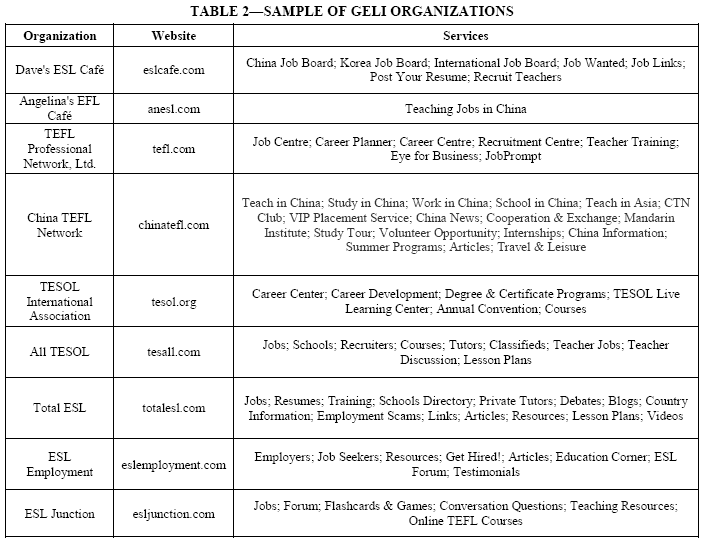
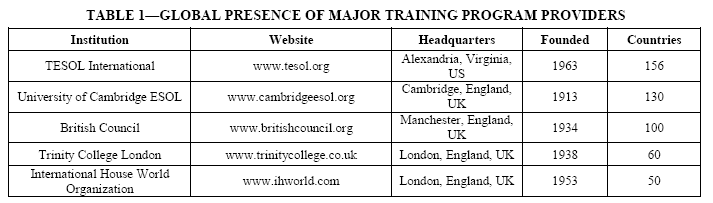
<body><![CDATA[<p align="justify"><font size="2" face="Verdana, Arial, Helvetica, sans-serif">As   with most professional training, certification or credentialing programs, there   exists certain appropriateness to also regulate the English language industry.   Since the inception of the industry around the middle of the twentieth century,   ELT organizations—in their many forms and unique business models—have only   recently been placed under inspection for some sort of minimum,   universally-recognized levels of content and quality. As with many emerging   international industries (e.g. new channels of import and export), such   phenomena are difficult to regulate in standardized, systemic fashions due to   their rapid growth and organizational complexities. Who has the authority to   regulate emerging international industries? What happens when the industry   spans both local (i.e. ESL training) and foreign (i.e. EFL training)   geographies? What about when that same industry includes a client base ranging   from casual populations (i.e. young schoolchildren who are learning English for   general communicational competence) to formal populations (i.e. business   practitioners who require the language skills to work globally)? Despite the inherent complexity of GELI, some benchmarks have been established. </font></p>     <p align="justify"><font size="2" face="Verdana, Arial, Helvetica, sans-serif">Arguably   the most prominent stewards of the English language, UK-based institutions have   set the stage for standard levels of quality and content for GELI training programs.   A quick survey of GELI job vacancy positions posted on industry platforms (<a href="#t2">Table   2</a>) indicates that most educational institutions seeking new faculty and   faculty-administrators (e.g. Directors of Study) require TEFL, TESOL, ESOL,   CELTA or even DELTA (being the highest recognized industry-specific credential)   certification. Of these options, only CELTA, DELTA, and ESOL are firmly regulated   (the former two by the University of Cambridge and the latter by Trinity   College London) while the acronym <i>TESOL</i> may be either regulated (as a   reference to the organization TESOL International, Inc.) or unregulated (as a   mere description of any GELI certification offered by a number of   organizations). Similarly, the acronym <i>TEFL</i> may be an organizational   reference (e.g. the TEFL Professional Network) or a certificate label. It is   important to note, moreover, that many accredited universities and colleges   also offer <i>TESOL </i>or <i>ESOL</i> certificate and degree programs.   Similarly, although slightly more generalized programmatically and amongst   practitioners, many institutions of higher education also offer master level   degree programs in applied linguistics; many GELI professionals commonly pass   through these channels. The least understood, most unarticulated, and   programmatically unstandardized acronyms are <i>TESOL</i> and <i>TEFL</i>.   These terms do not have single, universally recognized governing bodies and thus exists as unregulated, unofficial levels of certification. </font></p>     <p align="justify"><font size="2" face="Verdana, Arial, Helvetica, sans-serif">Although   these acronyms have become tangled and are commonly used interchangeably,   UK-based institutions have set the bar for an overall standard (albeit   unofficial) programmatic structure; such a program will: be a residency program   (as opposed to an online or correspondence program); require at least 120   contact (i.e. trainer-trainee) hours (or, commonly accepted, a minimum program   length of 4 weeks of full-time intensive training); include an authentic (i.e.   actual EFL students) teaching component, typically requiring exposure to at   least two levels of language learners; and include at least six hours of   observed teaching practice (OTP). These baseline criteria loosely mimic other   recognized programs depending on world region and employer. <a href="#t1">Table 1</a> lists major   GELI training providers according to their headquarters, longevity, and   international presence. It may be noteworthy that the only American institution represented is also the youngest and most internationally recognized. </font></p>     <p align="justify"><a name="t1"></a></p>     <p align="center"><img src="/img/revistas/riyd/v2n14/a08_table_01.gif" width="713" height="203"></p>     <p align="justify"><font size="3" face="Verdana, Arial, Helvetica, sans-serif"><b>4.&nbsp;&nbsp;&nbsp;&nbsp; GLOBALIZATION: TOWARDS A WORKING DEFINITION</b></font></p>     <p align="justify"><font size="2" face="Verdana, Arial, Helvetica, sans-serif">Globalization   is generally identified as the mechanism forcing the development of the English   language industry. The term <i>globalization</i> is widely used in business, as   well as everyday conversations. Commonly, <i>globalization</i> refers to   advancing trends in technology, communication, transportation, and   international business. However, a universal definition is elusive at best and   nonexistent for most practical applications; inevitable obfuscation complicates   these matters as an abstract <i>globalization</i> is awkwardly cited as a catch-all cause of certain phenomena and catch-all result of other phenomena. </font></p>     <p align="justify"><font size="2" face="Verdana, Arial, Helvetica, sans-serif">Many   researchers wearily avoid subscription to concise definitions of globalization;   each author tends to compartmentalize the term according to the niche   discipline of reference, and understandably so. “Globalisation is neither an   ideology nor a set of outcomes, but a process. […] Globalisation is simply the   logical extension of the tendency towards increasing specialisation and trade   that has been going on throughout human history” [15,pp. 2]. From this vantage,   it is clear to see that if we calibrate <i>globalization</i> according to human   history processes, it is indeed an age-old phenomena. “From an economic point   of view, I suggest to define globalization as the historical process of first   liberalization and then progressive integration of the formerly somewhat   isolated markets of capital, commodities and (with some delay and on a limited   scale) labor into a single world market” [16,pp. 12]. This economic definition   avoids the inherent relationships globalization has with other phenomena such   as politics, conflicts, science, and medicine, to name a few. Lastly, Thomas [17,   pp. 214] describes the phenomenon as “The breadth of contemporary scholarship   on globalization processes illustrates that there is no simple or single   picture of what constitutes globalization”. The term’s slippery nature is also   addressed: “The reason [that the term ‘globalisation’ is elusive is obvious. Globalization   needs to be viewed through different normative and theoretical lenses” [18,pp.   6]. The same authors continue to offer four differential definitions of the   phenomenon: globalization as a historical epoch; globalization as confluence of   economic phenomena; globalization as the hegemony of American values; and globalization   as technological and social revolution. Indeed, it is difficult to separate or   otherwise isolate the various components within the complex mélange of   globalization; linguistics is no exception. It is clear to see that some   languages emerge as dominants through distinct eras; it is similarly clear that   globalization may be partly defined according to those linguistic trends. For   purposes of this paper, the dominance of some languages over others in the   present world—namely Chinese, Arabic, Hindi, Spanish and English—is used, in   part, to define globalization as it relates to nearby phenomena such as business, politics, science, culture, and commerce.</font></p>     <p align="justify">&nbsp;</p>     <p align="justify"><font size="3" face="Verdana, Arial, Helvetica, sans-serif"><a name="_Toc243907727"><b>5.&nbsp;&nbsp;&nbsp;&nbsp; GLOBALIZATION AND LANGUAGE</b></a></font></p>     ]]></body>
<body><![CDATA[<p align="justify"><font size="2" face="Verdana, Arial, Helvetica, sans-serif">Globalization   and the use of English worldwide as phenomena are largely recognized as a real   situation despite criticism about its exact nature and reality [19], [20],[21].   However, it may be seen clearly that international trading systems grow with   time despite the exact interpretations of the terms <i>globalization</i> and <i>world     language</i>. The GELI market has expanded into most corners of the planet and   is largely dominated by well-established chain schools such as Berlitz, Kaplan,   Teach Away, and English First, as well as umbrella organizations such as the   Association of American Schools in South America and the China TEFL network.   UK-based organizations, such as the British Council and, to a lesser degree of   involvement, the British Broadcasting Corporation (BBC) significantly co-manage   the industry. Two well-established recruiters include Angelina’s ESL Café in   China and the UK-based International Education Group. Fee-free sites such as   Dave’s ESL Café, Total ESL, the TESOL International Association, and the TEFL   Professional Network serve as job posting clearinghouses and platforms for   employers and job-seekers to interface with each other. These and others are outlined in <a href="#t2">Table 2</a>. </font></p>     <p align="justify"><a name="t2"></a></p>     <p align="center"><img src="/img/revistas/riyd/v2n14/a08_table_02.gif" width="708" height="545"></p>     <p align="justify"><font size="2" face="Verdana, Arial, Helvetica, sans-serif">Universities   have developed English language training programs for soon-to-be teachers with   Cambridge University offering the most universally-recognized CELTA and DELTA   programs. Trinity College London offers the Cert ESOL (certificate) and Dip   ESOL (diploma) credentials, amongst other certifications. Due to their   historical presence and institutional reputations, only a few key entities   (TESOL International, Inc., the University of Cambridge ESOL Examinations   department, Trinity College London, the International House World Organization,   the and the British Council—refer to <a href="#t1">Table 1</a> which profiles these institutions) may be labeled as the founding institutions while the rest are descendants. </font></p>     <p align="justify"><font size="2" face="Verdana, Arial, Helvetica, sans-serif">Countless   smaller, unregulated institutions offer TEFL and TESOL certificates. These are   sometimes recognized by employers as being legitimate qualifications for   emerging teachers depending upon their rigor, structural similarity and content   compatibility compared to regulated programs (i.e. those offered by Cambridge and   Trinity). Illegitimate programs are offered through unrecognized organizations,   which are often independent and unregulated and thus the integrity of their   programs varies widely. A quick review of job vacancy postings on job boards   indicates that employers typically only accept recognized certifications; a   corollary to this is that employers seldom accept programs that were delivered   online. Services for English language learners have emerged as well; the IELTS   and TOEFL examinations—currently the only universally recognized   assessments—attempt to measure the relative level of fluency for students   seeking personal inquiry or admission to schools and jobs in English-speaking   institutions. In addition to all of these networking agencies, further iterations   of English language support organizations have become established in the EL   market. Australian-based companies such as the New South Wales College in   Sydney and Language Training Institute in Nambour offer a multitude of services   for instructors, curriculum developers, consultants and clients (language   learners) within the GELI market. Companies such as these operate internationally with small contracts and projects.</font></p>     <p align="justify">&nbsp;</p>     <p align="justify"><font size="3" face="Verdana, Arial, Helvetica, sans-serif"><a name="_Toc243907728"><b>6.&nbsp;&nbsp;&nbsp;&nbsp; TRAINING: PRE-SERVICE VERSUS IN-SERVICE</b></a></font></p>     <p align="justify"><font size="2" face="Verdana, Arial, Helvetica, sans-serif">The   various teacher training programs and certification processes mentioned above   are designed to serve prospective practitioners. Typically offering two, three,   or four main components—language awareness training, and/or language   acquisition theory, and/or instructional methods, and/or assessment strategies—these   short, intensive residency-based programs facilitate the transition into   classrooms for individuals who possess little or no previous experience or   training as language educators. A review of the literature, combined with   generalized online searches, reveals only one internationally recognized   in-service (professional development) courses for active practitioners which is   the ICELT from Cambridge. As an example, the need for more   culturally-responsive post-method teacher training in Colombia is reported in   Moncada [7]. In this paper, the Cambridge ICELT model is mentioned as being   sanctioned by the Ministry of Education’s <i>Colombia Bilingüe</i> program; yet   it is a generalized model that is often disregarded as a result of local   schools holding a preference for local, internally-developed CPD models.   In-service programs tend to be locally-developed, highly culturally and   geopolitically specific, yet often lacking sound pedagogical integrity compared   with more established efforts such as the internationally-recognized   pre-service programs. The central aim of this study is to address this issue:   what are the characteristics and programmatic components of a generalized, yet   culturally-responsive in-service training program for international English language professionals?</font></p>     <p align="justify">&nbsp;</p>     <p align="justify"><font size="3" face="Verdana, Arial, Helvetica, sans-serif"><a name="_Toc243907729"><b>7.&nbsp;&nbsp;&nbsp;&nbsp; EPISTEMOLOGY: IN-SERVICE PROGRAMS PAST AND PRESENT</b></a></font></p>     ]]></body>
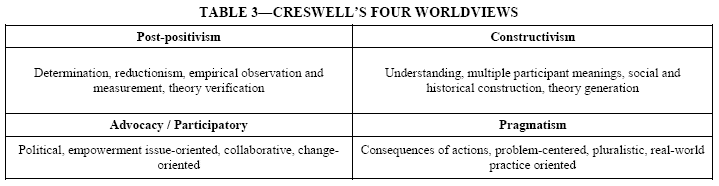
<body><![CDATA[<p align="justify"><font size="2" face="Verdana, Arial, Helvetica, sans-serif">Value   conceptions of in-service training programs have been different between   instructors and teachers; teacher-trainers seek reform and encourage teachers   to embrace training opportunities; teachers tend to be satisfied with the   programs, but lack motivation to attend [22]. Discussion about research from   the 1990s comes from the same report: EFL teachers were unprepared to deal with   culturally diverse classrooms; they did not find trainings to be helpful; they   reported that appropriate EFL practices are difficult to implement, even for trained EFL teachers.</font></p>     <p align="justify"><font size="2" face="Verdana, Arial, Helvetica, sans-serif">Preliminary   awareness of the philosophy of language learning theories is necessary. “All   TESOL preparatory programs must first expose pre-service teachers to the notion   that there are competing epistemological frameworks surrounding them. They need   to be able to read critically and identify these frameworks”, [23, pp. 446].   Brown [23]argues that a World English component should be part of TESOL   training, that training should come from more than just American or European   ideals, and that EFL teaching philosophies are influenced by who is perceived as being the <i>owner</i> of English. </font></p>     <blockquote>       <p align="justify"><font size="2" face="Verdana, Arial, Helvetica, sans-serif">Once     students begin to understand there are no neutral language learning theories,     language methodology theories, nor world English theories, it then becomes     possible for them to step into Pratt’s Contact Zone and learn from each of     these scholars and begin to identify their own <i>Weltanschauung</i>     (worldview). [23, pp. 447]</font></p> </blockquote>     <p align="justify"><font size="2" face="Verdana, Arial, Helvetica, sans-serif">This   is further grounded with Creswell’s [24] concepts of <i>worldview</i> and <i>paradigm</i> theory: that a worldview is “[…] a general orientation about the world and the   nature of research that a researcher holds” [24, pp. 6]. Unlike post-positivist   worldviews, which are theory-driven, Creswell’s [24] social constructivist   worldview positions the development of a theory within the context of an   experiential phenomena whereby the researcher makes co-observations along with   other members of a population. Creswell’s Four Worldviews are presented in <a href="#t3">Table 3</a>. </font></p>     <p align=justify><a name="t3"></a></p>     <p align=center><img src="/img/revistas/riyd/v2n14/a08_table_03.gif" width="719" height="186"></p>     <p align="justify"><font size="2" face="Verdana, Arial, Helvetica, sans-serif">It   is thus prudent for GELI professionals to consider the epistemological context   of their work and the implications of their pre-service and in-service training   upon those practices. Nonetheless, the backgrounds and experiences and   practitioners influences the development and delivery of curricula; “When   professional language educators who have been exposed to a wide variety of   perspectives participate in the assessment of the [classroom] material, it is more likely that world Englishes perspectives will be brought in” [23, pp. 447].</font></p>     <p align="justify"><font size="2" face="Verdana, Arial, Helvetica, sans-serif">Carter   [25] offers a teacher training program that emphasizes self-reflection as an   avenue to critically analyze how one’s inner beliefs affect their adoption of   attitudes about teaching. Trainees are required to keep a running journal.   Trainees generally dislike—or find little practical value—in the idea of having   to keep a journal at the start of a CPD course, but tend to like it afterwards.   “For the most part the teacher learners are not yet engaged in EFL teaching so   the journal reflections do no pertain as much to the act of teaching as to the   act of learning to be an EFL practitioner. Yet, the intimate link between   teaching and learning means that understanding one often provides clues to understanding   the other” [25, pp. 43]. This is an instance of a <i>purpose</i> of   professional development: it is a component of the transition between learner   and teacher such that when one does finally acquire the mindset of a   professional educator, a new character emerges. This character now becomes an   autonomous, self-driven individual who now is responsible not for the   transmission of knowledge, but for the co-creation of knowledge with students. </font></p>     <p align="justify"><font size="2" face="Verdana, Arial, Helvetica, sans-serif">Teacher   training programs have shifted from transmission-oriented to constructivist   approaches whereby teacher learners focus on what they know versus what they   actually do [22], [26], [27], [11]. Mackey [27]   distinguishes this as <i>method analysis</i> v. <i>teaching analysis</i>: what   is held as theory v. how the teachers actually deliver content to students.   This is intimately connected with the discussion about approaches (how students   learn; theory) relative to methods (how teachers teach; methodology).   Mangubbai, <i>et al.</i> [28] provides an example concerning communicative   approaches: the report concludes that teachers all around the world are   encouraged to use CLT for language instruction, yet imbalances may be observed   between what is discussed and what is done. Methods used in the study were   unconventional; instead of traditional observations and questionnaires,   teachers’ understandings of CLT were examined via interview (thus examining   what teachers think) and video-recordings (thus examining what teachers do).   Findings show that although many teachers had internalized CLT principles, their actual teaching methodologies varied greatly. </font></p>     ]]></body>
<body><![CDATA[<p align="justify"><font size="2" face="Verdana, Arial, Helvetica, sans-serif">Should   technical knowledge be valued over pedagogical skills? Another piece of the   picture emerges here: what might be an appropriate balance between theory and   practice within a pre-service or in-service program? Certainly, theory—rooted   in research—ought to legitimize the practice of skills. However, it might be   argued that spontaneous practice, that is, practice without modeling or input   which might bias the practice, could lead to the discovery and development of   new skills. From popular constructivist learning theory, it is known that human   knowledge acquisition often—or usually, depending on how we interpret the   results—stems from spontaneous experimentation. Within the domain of language   acquisition, it must be remembered that the historical and evolutionary   processes of language development in humans unfolded via experimentation rather than the implementation of pre-existing rules. </font></p>     <p align="justify"><font size="2" face="Verdana, Arial, Helvetica, sans-serif">This   inherently precarious nature of language learning has pedagogical implications.   For instance, Doughty and Williams [29] discusses the ongoing debate concerning   the utility of language versus its integrity as a medium: “There is no   de&#64257;nitive research upon which to base a choice of [form] over [meaning],   rather, it seems likely that both approaches are effective, depending upon the   classroom circumstances” [29, pp. 211]. The idea of <i>classroom circumstances</i>here   is an almost unfathomably difficult parameter to describe or measure; every new   classroom environment will inherently be unique from all others just as   snowflakes always claim their own identities. According to Sakurai [30], “The   more teachers believed that children could acquire the target language naturally,   the fewer form-focused utterances they produced in the classroom” [30, pp.   174]. Lin [31] found that focus-on-form (FoF) methods are effective for the   acquisition of both receptive and productive skills in specific target ranges,   such as with some grammar structures (i.e. simple past tense and articles,   which were the two targets studied). Gholami and Mustapha [32] argue that the   social context (i.e. that of the target language) is an indirect, yet   significant factor in L2 acquisition; the L2 is not used outside of the   classroom, and rarely within the classroom. Vygotskyian socio-constructivist   theory states that learners learn language best within social interactions (as via spontaneous experimentation as discussed previously).</font></p>     <p align="justify">&nbsp;</p>     <p align="justify"><font size="3" face="Verdana, Arial, Helvetica, sans-serif"><a name="_Toc243907730"><b>8.&nbsp;&nbsp;&nbsp;&nbsp; INSTRUCTIONAL  APPROACHES, METHODS AND TECHNIQUES</b></a></font></p>     <p align="justify"><font size="2" face="Verdana, Arial, Helvetica, sans-serif">Within   the realm of pedagogy, researchers and practitioners commonly use terms such as     <i>approaches</i>, <i>methods</i>, and <i>techniques</i> interchangeably. Lewis   [33], for example, defines <i>approach</i> as “an integrated set of theoretical   and practical beliefs, embodying both syllabus and method” [33, pp. 2].   Although this definition describes an inherent connection between theory   (syllabi) and methodology, a distinction exists in that we may ask, “How do   students learn?” followed by, “How do teachers teach?” In this paper, <i>approach</i>   refers us to the former question while <i>method</i> refers us to the latter.   In the end, a living piece of pedagogy will thus consider curricula from both perspectives: students’ and teachers’. </font></p>     <p align="justify"><font size="2" face="Verdana, Arial, Helvetica, sans-serif">Kumaravadivelu   [34] looked at trends in TESOL from 1990 to 2005. “Three perceptible shifts   [were identified]: (a) from communicative language teaching to task-based   language teaching, (b) from method-based pedagogy to post-method pedagogy, and   (c) from systemic discovery to critical discourse” [34, pp. 59]. The pre-1990   era is described as the <i>period of awareness</i> and the era after as the <i>period     of awakening</i>. Mackey [27] distinguishes between <i>methods analysis</i> and     <i>teaching analysis</i>: “Method analysis can be done by reviewing the   relevant literature, but teaching analysis can be done only by including a   study of classroom input and interaction. This article is about method analysis,   not teaching analysis” [27, pp. 60].“TBLT is considered more   psycholinguistically oriented compared to CLT, which is more sociolinguistically   oriented” [27, pp. 72]. Furthermore, “The crux of the problem facing TBLT is   how to make sure that learners focus their attention on grammatical forms while   expressing their intended meaning” [27, pp. 72]. Considering the 1960s era   context of the literature, it is clear to see a distinct movement towards <i>meaning</i>   in communication versus <i>form</i> and <i>structure</i>, both of which were   emphasized in previous eras of grammar translation and audio-lingual methodologies.</font></p>     <p align="justify">&nbsp;</p>     <p align="justify"><font size="3" face="Verdana, Arial, Helvetica, sans-serif"><a name="_Toc243907731"><b>9.&nbsp;&nbsp;&nbsp;&nbsp; PARADIGMS  IN ENGLISH LANGUAGE INSTRUCTION</b></a></font></p>     <p align="justify"><font size="2" face="Verdana, Arial, Helvetica, sans-serif">Communicative   language teaching has an almost half-century history in English language   pedagogy. Stemming primarily from Chomsky’s [35] suggestion that language is   more than an orchestration of grammar, CLT has been further refined and   described by subsequent findings from Hymes [36], Van Ek and Alexander [37],   and Wilkins [38]. A fundamental tenant of CLT is that language embodies communicational   functionality within social contexts; language is used as the currency of interpersonal interaction. </font></p>     <p align="justify"><font size="2" face="Verdana, Arial, Helvetica, sans-serif">In   order to fully realize the evolving nature of the industry, it becomes   necessary to examine this timeline with respect to other paradigms in GELI. The   grammar translation (GT) and audio-lingual (AL) approaches dominated GELI   between the last half of the 19<sup>th</sup> century and the first half of the   20<sup>th</sup>. The gradual accumulation of brain science and learning   theories—crystallized significantly by the work of John Dewey in the late 19<sup>th</sup> century—combined with shifts in cultural attitudes—such as the eventual   departure from faith in rote memorization and teacher-centered   classrooms—escorted GT and AL away from the spotlight. Newer, student-centered   classrooms and greater attention to function-based, rather than form-based,   instruction set the stage for CLT. It is important to note the transient nature   of SLA between the domains of theory and application; Ellis [39, pp. 183] defends SLA as being “still at heart an applied rather than a pure discipline”.</font></p>     ]]></body>
<body><![CDATA[<p align="justify"><font size="2" face="Verdana, Arial, Helvetica, sans-serif">Jarvis   and Atsilarat [40, pp. 2]propose a new context-based approach to language   instruction as a tactful alternative to CLT. “It is argued that although the   fundamental tenets of the approach have served the profession well, it is now   time to consider an emerging alternative paradigm in the form of a   context-based approach (C-bA). […] That the purpose of language is   communicative competence, and that communicative functions and notions set in   situations are an integral aspect of the equation, although once radical, seems   patently obvious to practitioners today”. This is supported by Bax[41] and is worthy of being watched as the most recent paradigmatic approach in GELI.</font></p>     <p align="justify">&nbsp;</p>     <p align="justify"><font size="3" face="Verdana, Arial, Helvetica, sans-serif"><a name="_Toc243907732"><b>10. TEACHING  THE TEACHERS</b></a></font></p>     <p align="justify"><font size="2" face="Verdana, Arial, Helvetica, sans-serif">Numerous   reports cite professional development as being the vehicle of choice for   improving several aspects of education including increased student achievement,   heightened academic standards, school development, solidified instructional   methods, developing professional learning communities, and facilitating   organizational development [22], [42], [43], [44], [45]. Professional   development specifically for GELI teachers has become prominent in recent   literature [46], [47], [7], [48], [49], [50], [51], [52] and has likely been   ameliorated, in part, by numerous studies from the previous decade describing significant   deficiencies in teacher training programs [53], [54], [55], [56], [57], [58], [59],   [60]. It is additionally recognized that teachers as professionals require   various processes of ongoing intellectual, experiential, and attitudinal growth   [61]. As professionals, teachers should constantly develop themselves. Stated   perhaps most eloquently by Igawa [62, pp. 432], “Teachers’ own growth is   necessary in order to cope with the ever-expanding knowledge base in subject   matter and pedagogy, rapidly changing social contexts of schooling, and   increasingly diversifying students’ needs. EFL teachers are not exempt from this professional responsibility”. </font></p>     <p align="justify"><font size="2" face="Verdana, Arial, Helvetica, sans-serif">Although   several internationally recognized training mechanisms exist such as the   Cambridge CELTA, Cambridge DELTA, and the Trinity ESOL certification courses,   in-service training mechanisms—specifically—tend to exist as smaller, local   frameworks specific to the institution where the teachers practice (e.g.   [3],[4], [7],[63]). One notable exception to this is the Cambridge ICELT, which is marketed as an in-service certification program. </font></p>     <p align="justify"><font size="2" face="Verdana, Arial, Helvetica, sans-serif">A   vast majority of EFL teachers in the international context are themselves   non-native speakers of English [64]. Due to local job-protection regulations   and relative human resource availability in many foreign countries, it is   common for EFL departments to be dominated by non-native English teachers   (NNET). It is also important to realize the vast differences between EFL and   ESL learning dynamics: that EFL environments see students in their home   environments without authentic exposure to socioeconomic, sociopolitical and   other culture-specific dynamics inherent to the environment of the target   language. Additionally, non-native speakers of English who assume EFL teaching   positions employ different pedagogical practices and thus affect student   learning in fashions distinct from those observed with native-speaking   instructors [64]. Most notably are the following differences: that local EFL   instructors (i.e. those who are of the same culture and nationality as their   students) rely heavily upon L1 to teach L2, whereas ESL environments are   typically characterized as having native-English speaking instructors who teach   L2 using L2. Additionally, learners in EFL environments typically lack   opportunity, urgency, or necessity to use English in authentic environments by   virtue of their sociocultural location (i.e. in their home country). ESL   students, however, enjoy many more opportunities to practice and utilize new   learning outside of the formal instructional environment of the classroom [65],[66].</font></p>     <p align="justify"><font size="2" face="Verdana, Arial, Helvetica, sans-serif">Teachers   are often encouraged to engage in continuous, systemic research efforts in   order to enhance their practices [26], [43]. Teachers are not always receptive   to new findings in research, and they seldom hold the skills necessary to   independently utilize academic literature [67]). Johnson and Golombek [68]   explain how teacher training is a constructivist process that allows teachers   to adjust their beliefs, attitudes and methodologies. Posit the authors; CPD   seminars should be highly participatory such that trainees are actively   involved in the digestion of existing theory and the simultaneous   re-articulation and creation of new knowledge. This is echoed in Lee [47]who   provides the impetus that CPD engagements are more than the sequestration of   theory from trainers to trainees; rather, authentic professional <i>development</i>   emerges as a gestalt via mutual exploration of otherwise fragmented theory,   knowledge and experience. Additionally, an all-too-often ignored phenomenon must be brought into light: </font></p>     <blockquote>       <p align="justify"><font size="2" face="Verdana, Arial, Helvetica, sans-serif">[University]     teachers or teacher educators give upfront presentations, followed by comments     or questions from the audience. Such a mode of CPD is built upon a simplistic     view that regards university-based teachers as knowers and givers, and     frontline teachers as passive recipients of knowledge. This polarization of     teacher and learner roles is problematic because university teachers are likely     to be less in touch with the realities of the classroom teachers’ work     contexts, and the feasibility of innovative ideas in real classroom contexts     may not be as thorough as that of practicing teachers. [47, pp. 31]</font></p> </blockquote>     <p align="justify"><font size="2" face="Verdana, Arial, Helvetica, sans-serif">Bhattacharya   [69] brings us back to the Theory of Andragogy, first described by Knowles [70],   to emphasize important differences between andragogy (adult learning theory)   and pedagogy (child learning theory). Key differences in assumptions are presented in <a href="#t4">Table 4</a>. </font></p>     ]]></body>
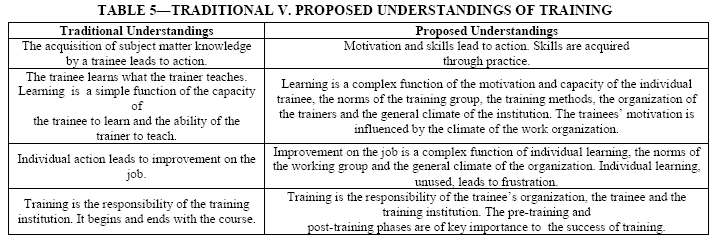
<body><![CDATA[<p align="justify"><a name="t4"></a></p>     <p align="center"><img src="/img/revistas/riyd/v2n14/a08_table_04.gif" width="698" height="124"></p>     <p align="justify"><font size="2" face="Verdana, Arial, Helvetica, sans-serif">Knowles   [70] references Lynton and Pareek [71] which summarizestraditional versus proposed understandings of training in <a href="#t5">Table 5</a>.</font></p>     <p align="justify"><a name="t5"></a></p>     <p align="center"><img src="/img/revistas/riyd/v2n14/a08_table_05.gif" width="716" height="243"></p>     <p align="justify"><font size="2" face="Verdana, Arial, Helvetica, sans-serif">Adult   learning theory must be embraced as part of the CPD model, which is sometimes   an uncomfortable transition from pedagogy in that teachers who teach other   teachers tend to employ their well-practiced pedagogical techniques. Timperley<i>et     al</i>. [72] in Lee [47] delineates various modes of CPD that fit comfortably within andragogical frameworks:</font></p>     <blockquote>       <p align="justify"><font size="2" face="Verdana, Arial, Helvetica, sans-serif">&bull;&nbsp; Listening/watching</font></p>       <p align="justify"><font size="2" face="Verdana, Arial, Helvetica, sans-serif">&bull;&nbsp; Being     observed/receiving feedback</font></p>       <p align="justify"><font size="2" face="Verdana, Arial, Helvetica, sans-serif">&bull;&nbsp; Engaging     with academic/professional readings</font></p>       ]]></body>
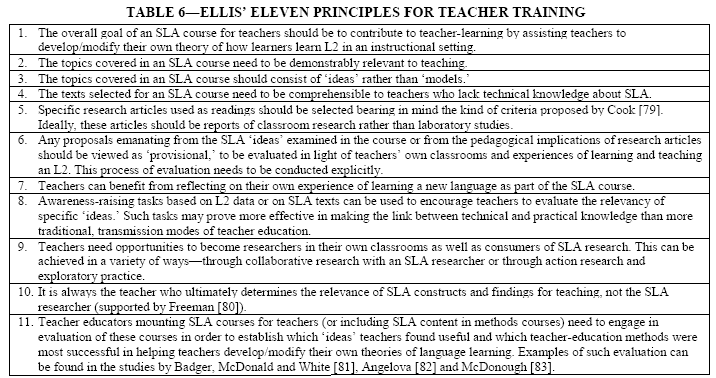
<body><![CDATA[<p align="justify"><font size="2" face="Verdana, Arial, Helvetica, sans-serif">&bull;&nbsp; Discussing     teaching with critical friends/experts</font></p>       <p align="justify"><font size="2" face="Verdana, Arial, Helvetica, sans-serif">&bull;&nbsp; Discussing     own theories of teaching</font></p> </blockquote>     <p align="justify"><font size="2" face="Verdana, Arial, Helvetica, sans-serif">Hayes   [73] and Sayre and Wetterlund [74] describe models commonly recognized as <i>cascade     training</i>. This approach to teacher training supposes that competent lead   teachers may be trained to teach other, perhaps lesser-experienced teachers, as   part of a CPD program. Hayes [73] supports assertions by Lee [47] and Johnson   and Golombek [68] in that teacher training may largely be seen as either a   transmission of existing knowledge or a [more preferred] picture of mutual   collaboration and the active production of new knowledge. Lee’s [47, pp. 33]   central research question adds context: “In what ways can EFL teachers’ active   participation as presenters in CPD seminars promote teacher learning? Teacher   learningrefers to the learning on the part of both the seminar participants and the teacher presenters”. </font></p>     <p align="justify"><font size="2" face="Verdana, Arial, Helvetica, sans-serif">Is   it possible to directly influence teachers’ perspectives of themselves through   CPD? Certainly it is plausible to imagine that any sort of even partially   successful professional development is likely to have a positive net effect on   one’s confidence and <i>perception</i> of aptitude; however, Karimi [46] found   evidence that CPD can have a measurable influence on self-efficacy and Sim [75]   reports evidence of increased levels of motivation, confidence and an influence   on professional identity, also following a CPD program. The quantitative   control group-based study in Karimi [46] was staged such that the experimental   population was given targeted CPD. Results of the study indicate that there was   a direct correlation between the CPD provided and the overall increase in   self-efficacy amongst the trainees as was measured using a <i>Teacher Sense of     Efficacy Scale</i> tool. It is thus suggested that there exists a more   fundamental psychological benefit associated with CPD than simply knowledge   creation and the accumulation of technical skill. Given that teachers will   naturally articulate their own methods based upon personal convictions, the   relationships between other puzzle pieces are not complex: pre-service,   in-service and CPD trainers influence the methods; local and federal policies   add influence; and lastly, classroom interactions with students further shape   those methods. In this sense, in addition to a top-down process of methods   formulation, a bottom-up influence is seen when students serve as a feedback loop. </font></p>     <p align="justify"><font size="2" face="Verdana, Arial, Helvetica, sans-serif">Foundational work for Lee’s [47]   assertion about teacher-student role switching through discussion about how EFL   teachers tend to perpetuate traditional pedagogical methods was established by   Lau [76]. Although the tendency of students to follow teachers’ prescribed   learning techniques is evident, it is prudent to also examine learners’   self-chosen learning techniques. A 2010 study by Shang[77] reveals a preference   amongst undergraduate level Taiwanese English-majors to employ metacognitive   reading comprehension techniques over compensation and cognitive techniques. It   is explained how the same learners tend to use lower-level, local   processes—such as frequent use of a bilingual dictionary and grammar   translation decoding—to evaluate challenging texts in the L2; this results in   low net comprehension and achievement. In what ways can more tactful pre- and   in-service teacher training target this inefficient and ineffective tendency amongst language learners? </font></p>     <p align="justify"><font size="2" face="Verdana, Arial, Helvetica, sans-serif">This phenomenon is further described inSheen   [78] which indicates that language learning on the part of students has not   necessarily experienced progress as a result of historical paradigm shifts in   the GELI world. Sheen [78] cites, for example, how the audio-lingual and   communicative (CLT) approaches have not fulfilled their initial promises, but   that they have repositioned attention on other pedagogical components such as   oral/aural teaching techniques. Shifting paradigms in this sense produces new   insights despite a general net shortcoming in expected progress. Educators   worldwide echo the same lamentation: <i>These students have been studying English for seven years but still cannot speak or understand!</i></font></p>     <p align="justify"><font size="2" face="Verdana, Arial, Helvetica, sans-serif">Examples of autonomous language learners   are not uncommon; these individuals typically have intrinsic motivators   different from those who seek the guidance of teachers, textbooks and classes.   Several precarious phenomena may be considered here: when motivation is   intrinsic, the natural inclination to learn is much more powerful, efficient,   and arguably effective; when intrinsic motivation is strong enough—and when   necessary resources are available—that individual may seek to relocate from an   L1 environment to a L2 setting (i.e. they move to a native speaking English   country) or surround themselves with L2 input in the L1 environment (i.e. they   seek authentic input, such as interaction native speakers and the active   pursuit of L2 texts), thus a bridge is built between EFL and ESL (i.e. learners   attempt to minimize exposure to their own L1 and maximize exposure to the L2).   Lastly, learning becomes active rather than passive: learners become <i>users</i>   of the L2 during authentic language transactions rather than passive <i>recipients</i> of the L2 in generic language transactions. </font></p>     <p align="justify"><font size="2" face="Verdana, Arial, Helvetica, sans-serif">Nonetheless, a vast majority of GELI is   engulfed in EFL environments. Students and teachers alike are confined to   classrooms and schools in L1 settings. Thus there is a great need to develop   the EFL world such that teachers and teacher trainers are better equipped to   use current, scientifically-sound, effective and efficient pedagogical and   andragogical techniques. A dangerous mistake is to only consider the   student-teacher relationship; the picture is a bit larger in that GELI   professionals must also consider the student-teacher-trainer relationship and   examine the down-flowing effects of teacher training on classroom-based student   learning. Eleven principles for guiding teacher training have been proposed by Ellis [39] and our listed in <a href="#t6">Table 6</a>. </font></p>     <p align="justify"><a name="t6"></a></p>     <p align="center"><img src="/img/revistas/riyd/v2n14/a08_table_06.gif" width="716" height="378"></p>     ]]></body>
<body><![CDATA[<p align="justify"><font size="2" face="Verdana, Arial, Helvetica, sans-serif">In some circles, teaching had   traditionally been regarded as an art, and that teachers are born, not made;   thus they require little training [22], [50]. Although some aspects   of this notion may be credible—such as one’s natural affinity towards working   in social environments, or with one’s inherent interpersonal communication   skills—the current state of GELI, including voices from the literature,   indicates that clearly devised training schemes are not only demanded by   employers and clients (i.e. students), but that they are necessary for effective and efficient language acquisition. </font></p>     <p align="justify">&nbsp;</p>     <p align="justify"><font size="3" face="Verdana, Arial, Helvetica, sans-serif"><a name="_Toc243907733"><b>11. THE  CASE OF COLOMBIA</b></a></font></p>     <p align="justify"><font size="2" face="Verdana, Arial, Helvetica, sans-serif">In   the last decade, Colombia entered <i>La Revolución Educativa</i>. Part   of this intentional revolution is <i>Colombia Bilingüe</i>. This nation hosts   an example of a government that is taking steps not only to improve educational   systems, but specifically to incrementally require citizens to learn English. Moncada   [7, pp. 310] asserts that <i>Colombia Bilingüe</i>, although sound in theory   with its adoption of internationally applauded CEFR, “[…] disregards the local   construction of knowledge on ELT”. The work also asserts that “[…] no documents   have been issued to support the benefits of using the CEFR over other professional   development models” [7, pp. 311] and explains that it would be irresponsible to   adopt any single language learning framework due to the complexities of nation   in terms of diversity of settings, achievement of standards, resources, teacher   preparation, student motivation and curricula. Some institutions, conversely,   actively strive to adopt and implement the CEFR (e.g., the Universidad de   Medellín in Colombia) (Administrator E. Ospina, personal communication, 16 November 2011). </font></p>     <p align="justify"><font size="2" face="Verdana, Arial, Helvetica, sans-serif">One   decade before—in the 1990s—an earlier English language learning push was made   with the development of the Colombian Framework for English (COFE) project [63].   This, however, was not embraced by the Colombian supporters of the CEFR and   co-developers (British Council and the Colombian Ministry of Education) of <i>Colombia Bilingüe</i> [7]. </font></p>     <p align="justify">&nbsp;</p>     <p align="justify"><font size="3" face="Verdana, Arial, Helvetica, sans-serif"><a name="_Toc243907734"><b>12. THE CASE OF JORDAN</b></a></font></p>     <p align="justify"><font size="2" face="Verdana, Arial, Helvetica, sans-serif">Al-Wreikat   and Abdullah’s 2010 [3] mixed-methods study utilized interviews from 798   Jordanian ELF teachers to examine the relationships between teachers’   in-service training courses and overall teaching techniques effectiveness. Two primary research questions were investigated: </font></p>     <blockquote>       <p align="justify"><font size="2" face="Verdana, Arial, Helvetica, sans-serif">(1) To what extent are the Jordanian EFL     teachers' in-service training courses techniques adequately organized to     upgrade EFL teachers’ performance?</font></p>       ]]></body>
<body><![CDATA[<p align="justify"><font size="2" face="Verdana, Arial, Helvetica, sans-serif">(2) What are the needs of EFL teachers in the     in-service training courses in Jordan in terms of teaching techniques?</font></p> </blockquote>     <p align="justify"><font size="2" face="Verdana, Arial, Helvetica, sans-serif">State   the authors, “The findings of the study, taking into account the teaching   techniques’ effectiveness in the in-service training courses and their impact   on EFL teachers’ performance, have revealed that EFL teachers’ in-service   training courses did not emphasize good and effective teaching technique” [3, pp.   18]. A few examples include: lack of emphases on pedagogical strategies such as   FoF, using multimedia technology, giving drills, brainstorming elicitation   technique, situational dialogues, drama technique, problem solving tasks, and text mapping. Specific qualitative findings from in-service courses include:</font></p>     <blockquote>       <p align="justify"><font size="2" face="Verdana, Arial, Helvetica, sans-serif">&bull;&nbsp; Implementation     of the different techniques was not discussed; the courses did not highlight     the implementation of drama techniques; feedback discussion between teachers     and trainers is neglected as a technique; situational dialogues were not     discussed in terms of their implementation in classroom situations.</font></p>       <p align="justify"><font size="2" face="Verdana, Arial, Helvetica, sans-serif">&bull;&nbsp; The     courses did not discuss the proper methods, which are in line with the new     adopted materials (from the Ministry of Education). The findings are consistent     with the responses of teachers to the questionnaire in terms of material     construction category.</font></p>       <p align="justify"><font size="2" face="Verdana, Arial, Helvetica, sans-serif">&bull;&nbsp; The     courses did not take into account the teachers’ educational levels.</font></p>       <p align="justify"><font size="2" face="Verdana, Arial, Helvetica, sans-serif">&bull;&nbsp; The     courses did not match different techniques with different materials; this is     consistent with the finding that in-service training courses did not match the     techniques with task demands. This, in turn, leads to a negative effect on the     teachers’ performance in explaining the related tasks. </font></p>       <p align="justify"><font size="2" face="Verdana, Arial, Helvetica, sans-serif">&bull;&nbsp; The     style of the textbook did not encourage self-learning, critical thinking, or     problem solving techniques in classrooms. [3, pp. 23-24]</font></p> </blockquote>     <p align="justify"><font size="2" face="Verdana, Arial, Helvetica, sans-serif">In   this situation, the Jordanian Ministry of Education implemented specific protocols   that were then neglected by trainers during in-service programs for the   teachers who reported the following as primary pedagogical and andragogical   values: importance of applying techniques for teaching in the four macro   language skills; drama techniques; feedback discussion between teachers and   trainers; situational dialogues in classroom situations; multimedia technology   and application; FoF techniques; selecting techniques that are scientifically   based; coordinating or matching strategies with task demands; problem solving   tasks; mind mapping; text mapping; self-report discussions; and debates.   Quantitative data collected during the study corroborated qualitative teacher reports. </font></p>     <p align="justify"><font size="2" face="Verdana, Arial, Helvetica, sans-serif">Many   Arab countries have experienced a pattern of neglect in their educational   systems, which has spurred international initiative programs—such as those   implemented by the United Nations Development Program—to help re-build schools   [84]. Along with this, “There is a need for a research that can evaluate EFL   teachers’ in-service training courses on teaching technique and their   effectiveness to clarify the relation between the effectiveness of teaching techniques and performance of EFL teachers” [3, pp. 18].</font></p>     ]]></body>
<body><![CDATA[<p align="justify"><font size="2" face="Verdana, Arial, Helvetica, sans-serif">Echoed   in their subsequent 2011 study [4], AL-Wreikat and Abdullah found that   in-service programs for government school EFL teachers in Jordan are not   properly organized in the sense that they advertise training in varied teaching   approaches, but fail to deliver this training. This is similar to a study from   the same authors earlier in 2010 [3]. The authors discuss the history of EFL   evolution over the last half a century: that English language teaching could be   an opportunity for economic growth. However, systemic instructional methods were   nonexistent until the 1960s, and finally in the mid-1980s the communicative   approach (CLT) was adopted. (The communicative approach was prompted by Chomsky   [35] and further developed by American psychoanalyst Robert Langs in the early   1970s.) Teachers in many parts of the world are still encouraged to use CLT for   language instruction [28]. CLT has been criticized, especially by the prominent   linguist Michael Swan, as being aloof to important learning contexts [85], [86];   similarly, CLT was described as failing to fulfill its promises in that it did   not manifest itself as an all-situation mechanism that professed to be both effective and efficient [78]. </font></p>     <p align="justify">&nbsp;</p>     <p align="justify"><font size="3" face="Verdana, Arial, Helvetica, sans-serif"><a name="_Toc243907735"><b>13. THE CASE OF KOREA</b></a></font></p>     <p align="justify"><font size="2" face="Verdana, Arial, Helvetica, sans-serif">Sim’s   2011 report [75] serves as a key piece of literature relevant to this   phenomenon. Korean English teachers were followed before, during and after an   in-service (INSET) program. The study aimed to track teachers’ practices and   perceptions as influenced by the INSET. It was found that an increase in   confidence allowed the teachers to pursue better career prospects and also   influenced their own senses of personal identity. Data also concluded that   “contextual differences between the INSET and real practice, the content of the   INSET, and lack of school support” [75, pp. viii] were the main barriers faced   by the teachers. Other long-term outcomes were identified: that a follow-up   program including mentorship, the ability to share resources, and an organized   peer support group would significantly assist the teachers. Suggestions of how INSET programs could be optimized include the following:</font></p>     <blockquote>       <p align="justify"><font size="2" face="Verdana, Arial, Helvetica, sans-serif">&bull;&nbsp; INSET     should provide ongoing support to promote developmental continuity after the     course. </font></p>       <p align="justify"><font size="2" face="Verdana, Arial, Helvetica, sans-serif">&bull;&nbsp; INSET     should consider teaching contexts sensitively, especially large classes and     limited materials. </font></p>       <p align="justify"><font size="2" face="Verdana, Arial, Helvetica, sans-serif">&bull;&nbsp; Trainees     should continue their professional development under their own initiative even     after the INSET course.</font></p> </blockquote>     <p align="justify"><font size="2" face="Verdana, Arial, Helvetica, sans-serif">These   findings stress the need for CPD above and beyond simple, one-time PD programs   either in a guided (i.e. with the support of trainers) or unguided (i.e. independent) fashion.</font></p>     <p align="justify"><font size="2" face="Verdana, Arial, Helvetica, sans-serif">Igawa   [62] shares insight from an international PD program held in 2007 in Tokyo.   Attendees included native and non-native speaking teachers working in Japan and Korea. Findings include the need for further development in the four areas of:</font></p>     ]]></body>
<body><![CDATA[<blockquote>       <p align="justify"><font size="2" face="Verdana, Arial, Helvetica, sans-serif">&bull;&nbsp; Teaching     skills and methods</font></p>       <p align="justify"><font size="2" face="Verdana, Arial, Helvetica, sans-serif">&bull;&nbsp; Language     improvement</font></p>       <p align="justify"><font size="2" face="Verdana, Arial, Helvetica, sans-serif">&bull;&nbsp; General     communication skills</font></p>       <p align="justify"><font size="2" face="Verdana, Arial, Helvetica, sans-serif">&bull;&nbsp; Motivation</font></p> </blockquote>     <p align="justify"><font size="2" face="Verdana, Arial, Helvetica, sans-serif">Igawa[62]   contextualizes these findings in light of the globalization of English and the   recent shift in paradigmatic approaches from grammar-translation methods to communicative methods in ELT:</font></p>     <blockquote>       <p align="justify"><font size="2" face="Verdana, Arial, Helvetica, sans-serif">These     challenges are all context-bound [9]: students, parents, school, curriculum,     syllabus, and society (i.e., structural and socio-cultural contexts [87]), and     yet many of them are shared by the EFL practitioners across national borders     [87, pp. 432].</font></p> </blockquote>     <p align="justify"><font size="2" face="Verdana, Arial, Helvetica, sans-serif">This   last statement about trends common across borders is insightful:   international-scale INSET programs are much less common than local programs,   and it is often difficult to compare or contrast these phenomena across such temporal and spatial boundaries.</font></p>     <p align="justify">&nbsp;</p>     ]]></body>
<body><![CDATA[<p align="justify"><font size="3" face="Verdana, Arial, Helvetica, sans-serif"><a name="_Toc243907736"><b>14. RATIONALE</b></a></font></p>     <p align="justify"><font size="2" face="Verdana, Arial, Helvetica, sans-serif">Action   research is seen as a family of practices and often begins with a question   about improving a situation or how the investigator may improve a practice [88].    Action research differs from other methods in that the investigator is directly   involved with the study population as the collective whole works towards an outcome that would not have been possible in the absence of either party.</font></p>     <p align="justify"><font size="2" face="Verdana, Arial, Helvetica, sans-serif">Action   research falls within the field of ethnography, which is distinguished as being   rooted in both sociology and anthropology [89]. The action research aspect of   this study works within the field of ethnography in that the researcher will   work with, and co-experience, an <i>in situ</i> environment and corresponding   phenomena with members of the study population in addition to observing and   studying that population. This provides a balance of both <i>emic</i> and <i>etic</i>   observation [53], [90], [91]. Data driven by action research will assume the   form of structured and semi-structure tools such as questionnaires and surveys   while ethnographic data will include field notes, photographs, and other   observational artifacts. The ethnographic-naturalistic [92] approach also   includes some structured components such as interviews, questionnaires, and   focus group activities [24], [93]). Lofland <i>et al</i>. [92] refers to this   conglomeration of terminology simply as <i>fieldstudies</i> due to the   intentional entrance of the investigator into a natural, existing social setting.</font></p>     <p align="justify">&nbsp;</p>     <p align="justify"><font size="3" face="Verdana, Arial, Helvetica, sans-serif"><b>15. DISCUSSION</b></font></p>     <p align="justify"><font size="2" face="Verdana, Arial, Helvetica, sans-serif">Literature   reviewed in this paper outlines a brief history of the TESOL industry with the   establishment of TESOL International in 1963. Since that time, an increasing   tone of organization and formality continues to characterize the field, thus   bringing it closer to the general state of traditional education in developed   societies in the sense that modern TESOL teachers have specialized training.   Technical and academic institutions have responded to this demand by developing   an array of pre-service programs. It is important to maintain a distinction   between <i>pre-service</i> and <i>in-service</i> training as they are often   discussed simultaneously under some magical umbrella of <i>teacher training</i>   or <i>professional development</i>. Furthermore, it is important to   differentiate between training programs, such as the CELTA, versus diagnostic   tools, such as the IELTS examination of English proficiency or the TKT, which attempts to measure pedagogical knowledge. </font></p>     <p align="justify"><font size="2" face="Verdana, Arial, Helvetica, sans-serif">A   wide variety of standardized, universally-recognized pre-service (e.g. CELTA,   TESOL and unregulated programs such as TEFL) and in-service (e.g. DELTA &amp;   ICELT) programs exist, but they tend to lack the level of detail and cultural   responsiveness necessary to be effective on local scales. Similarly—yet   conversely—a large number of in-service (CPD) courses and programs exist, but   they tend to be developed locally and have three common deficiencies: they lack   international recognition; they reach only small audiences; and they are often   developed by faculty and administrators who lack technical training and/or skill   in the development of such specialized curricula. The aim of the current study   is to investigate the possibility of developing a framework model that may decrease or eliminate the deficiencies identified on both sides. </font></p>     <p align="justify"><font size="2" face="Verdana, Arial, Helvetica, sans-serif">Continuing   trends in globalization also support the development of the TESOL industry and   the need for stronger in-service CPD models. As commerce moves between borders,   a common language is necessary for efficient trade; English has been the   long-standing and thus most likely candidate for this currency. Within nations,   when business people do not necessarily meet foreigners, they encounter English   in print and online media, as well as in typed, written, or verbal transactions   through distance technologies. Institutions have responded to this corporate   need for English: universities often offer executive English programs catering   to a non-student audience of working business people. In these cases, students   (i.e. working business people) are often required to have a functional level of   English proficiency before gaining admission to the executive program; the idea   is that the executive program model assumes that students will have had basic   exposure to the language and that a higher level of general and technical   English will be introduced. These curricula thus differ slightly in that they   rely heavily upon technical English, with Business English being the most   popular. Countless other varieties exist, such as English for Science; English   for Mathematics; English for Engineering; etc. Instructors of these courses   necessarily must have exposure to these lexicons and be familiar with the   business or technical skills at hand. Another important dimension exists in   executive programs, which is the emphasis on andragogy rather than pedagogy.   Andragogical methods may differ in some cultures according to variations in the   social science dimensions of power-distance, gender egalitarianism, etc. [94].   These specific nuances of TESOL instruction vary from culture to culture and   are thus important as part of a culturally-responsive in-service program for instructors. </font></p>     <p align="justify">&nbsp;</p>     <p align="justify"><font size="3" face="Verdana, Arial, Helvetica, sans-serif"><b>16. CONCLUSIONS</b></font></p>     ]]></body>
<body><![CDATA[<p align="justify"><font size="2" face="Verdana, Arial, Helvetica, sans-serif">This   paper analyzes the current state of the English language industry within the   context of globalization and identifies areas of need within teacher training   programs. Relevant literature calls for more robust professional development   programs in all world regions examined. Specifically, there is a need for   stronger <i>in-service</i> and <i>continuous</i> programming for faculty. Additionally,   it is observed that many recognized training programs are generalized and thus   lack cultural responsiveness. Several countries have adopted these generalized   programs but have found that they do not meet the needs of local faculty and   student populations. Programs which are intended to be culturally-responsive   are typically developed by non-experts and thus lack both effectiveness and external   recognition. The ultimate objective of this paper is to determine possibilities   of creating programmatic frameworks which are simultaneously robust, externally   recognized, and culturally responsive. Findings suggest that training programs   must be customized and delivered along appropriate timelines by professional   curriculum developers and faculty trainers.It is recommended that further   research looks closely at local populations and the effectiveness of current   training programs in order to determine appropriate developmental strategies according to faculty and student needs.</font></p>     <p align="justify">&nbsp;</p>     <p align="justify"><font size="3" face="Verdana, Arial, Helvetica, sans-serif"><b>17. ACKNOWLEDGEMENTS</b></font></p>     <p align="justify"><font size="2" face="Verdana, Arial, Helvetica, sans-serif">I   offer a special <i>thank you</i> to María Renée Marañón Cardozo for assistance in publishing this article.</font></p>     <p align="justify">&nbsp;</p>     <p align="justify"><font size="3" face="Verdana, Arial, Helvetica, sans-serif"><b>18. REFERENCES</b></font></p>     <p align="justify"><font size="2" face="Verdana, Arial, Helvetica, sans-serif">[1] M.C. Pennington.“A professional   development focus for the language teaching practicum,” in<i>Second language     teacher education.</i>J.C. Richards and D. Nunan, Ed. Cambridge: Cambridge University Press, 1990, pp. 132-151.</font></p>     <p align="justify"><font size="2" face="Verdana, Arial, Helvetica, sans-serif">[2] M.P. Lewis, G. F. Simons and C. D.   Fennig, Ed. <i>Ethnologue: languages of the World</i>,17<sup>th</sup> ed. Dallas: SIL International, 2014.</font></p>     <p align="justify"><font size="2" face="Verdana, Arial, Helvetica, sans-serif">[3] AL-Wreikat, Y.A.A.S. and Abdullah,   M.K.K.B. “An evaluation of Jordanian EFL teachers’ in-service training courses   teaching techniques effectiveness.”<i>English Language Teaching</i>, vol.3(4), 2010.</font></p>     <p align="justify"><font size="2" face="Verdana, Arial, Helvetica, sans-serif">[4] AL-Wreikat, Y.A.A.S. and Abdullah,   M.K.K.B. “Effectiveness of teaching approaches of in-service training courses   for EFL teachers in Jordanian schools.”<i>English Language Teaching</i>, vol.4(1), 2011.</font></p>     ]]></body>
<body><![CDATA[<p align="justify"><font size="2" face="Verdana, Arial, Helvetica, sans-serif">[5] A. González,C. Montoya and N. Sierra.“What   do EFL teachers seek in professional development programs? Voices   from teachers.”<i>Íkala, Revista de Lenguaje y Cultura</i>, vol.<b>7</b>(13), 2002.</font></p>     <p align="justify"><font size="2" face="Verdana, Arial, Helvetica, sans-serif">[6] A.A.L. Mendoza and R.B. Arandia.“Language   testing in Colombia: a call for more teacher education and teacher training in language assessment.”<i>Profile</i>, vol.11(2), pp. 55-70, 2009.</font></p>     <p align="justify"><font size="2" face="Verdana, Arial, Helvetica, sans-serif">[7] A.G. Moncada. “Professional   development of EFL teachers in Colombia: between colonial and local practices.”<i>Íkala, Revista de Lenguaje y Cultura</i>., vol. 12(18), 2007.</font></p>     <p align="justify"><font size="2" face="Verdana, Arial, Helvetica, sans-serif">[8] C.M. Yook.“Korean teachers' beliefs   about English language education and their impacts upon the Ministry of Education-initiated reforms.”Ph.D. thesis, Georgia State University, 2010.</font></p>     <p align="justify"><font size="2" face="Verdana, Arial, Helvetica, sans-serif">[9] D. Freeman. “Changing teaching:   insights into individual development in the context of schools,”in<i>Language     teaching: new insights for the language teacher</i>. C. Ward and W. Renandya, Ed. Singapore: SEMEO Regional Language Centre, 1999, pp. 28-46.</font></p>     <p align="justify"><font size="2" face="Verdana, Arial, Helvetica, sans-serif">[10] I. Lee. “Preparing pre-service   English teachers for reflective practice.”<i>ELT Journal</i>, vol.61(4), pp. 321—329, 2007.</font></p>     <p align="justify"><font size="2" face="Verdana, Arial, Helvetica, sans-serif">[11] S.J.A. Hammadou. “Identifying the   best foreign language teachers: teacher standards and professional portfolios.”<i>Modern Language Journal</i>, vol.88(3),pp. 390-402, 2004.</font></p>     <p align="justify"><font size="2" face="Verdana, Arial, Helvetica, sans-serif">[12] C. Sugrue.<i>Developing teachers and teaching practice</i>. Florence: Routledge, 2001.</font></p>     <p align="justify"><font size="2" face="Verdana, Arial, Helvetica, sans-serif">[13] C. Day. <i>Developing teachers: the challenges of lifelong learning</i>. Florence: Taylor, 1999.</font></p>     <p align="justify"><font size="2" face="Verdana, Arial, Helvetica, sans-serif">[14] A. Craft. <i>Continuing   professional development: a practical guide for teachers</i>. Florence: Routledge, 2000.</font></p>     ]]></body>
<body><![CDATA[<p align="justify"><font size="2" face="Verdana, Arial, Helvetica, sans-serif">[15] S. Eslake.“What is globalisation?”<i>Policy</i>, vol.16(4), pp. 61, 2000.</font></p>     <!-- ref --><p align="justify"><font size="2" face="Verdana, Arial, Helvetica, sans-serif">[16] G.W. Kolodko. “Globalization and   its impact on economic development.”Internet: www.<a href="http://dx.doi.org/10.2139/ssrn.961479" target="_blank">dx.doi.org/10.2139/ssrn.961479</a>).2006 [Nov. 3, 2014]. </font>&nbsp;&nbsp;&nbsp;&nbsp;&nbsp;&nbsp;&nbsp;&nbsp;[&#160;<a href="javascript:void(0);" onclick="javascript: window.open('/scielo.php?script=sci_nlinks&ref=960005&pid=S2518-4431201400020000900016&lng=','','width=640,height=500,resizable=yes,scrollbars=1,menubar=yes,');">Links</a>&#160;]<!-- end-ref --><p align="justify"><font size="2" face="Verdana, Arial, Helvetica, sans-serif">[17] M. Thomas.“Globalization   under fire.”<i>Labour/Le Travail: Journal of Canadian Labour Studies</i>, vol.55(1),p. 213-231, 2005.</font></p>     <p align="justify"><font size="2" face="Verdana, Arial, Helvetica, sans-serif">[18] R. Higgott and S. Reich.<i>Globalisation   and sites of conflict: towards definition and taxonomy</i>. Centre for the Study of Globalisation and Regionalisation.Working Paper No. 01/98, 1998.</font></p>     <p align="justify"><font size="2" face="Verdana, Arial, Helvetica, sans-serif">[19] S. Choi. <i>Reclaiming the English   language in postcolonial Malaysia: ethnicity, class, and the nostalgia for global citizenship</i>. University of Virginia Press, 2010.</font></p>     <!-- ref --><p align="justify"><font size="2" face="Verdana, Arial, Helvetica, sans-serif">[20] P. Ghemawat. <i>World 3.0: global   prosperity and how to achieve it</i>. Boston: Harvard Business Review Press, 2011.</font>&nbsp;&nbsp;&nbsp;&nbsp;&nbsp;&nbsp;&nbsp;&nbsp;[&#160;<a href="javascript:void(0);" onclick="javascript: window.open('/scielo.php?script=sci_nlinks&ref=960009&pid=S2518-4431201400020000900020&lng=','','width=640,height=500,resizable=yes,scrollbars=1,menubar=yes,');">Links</a>&#160;]<!-- end-ref --><!-- ref --><p align="justify"><font size="2" face="Verdana, Arial, Helvetica, sans-serif">[21] P. Ghemawat. <i>Redefining global strategy:   crossing borders in a world where differences still matter</i>. Boston: Harvard Business School Press, 2007.</font>&nbsp;&nbsp;&nbsp;&nbsp;&nbsp;&nbsp;&nbsp;&nbsp;[&#160;<a href="javascript:void(0);" onclick="javascript: window.open('/scielo.php?script=sci_nlinks&ref=960010&pid=S2518-4431201400020000900021&lng=','','width=640,height=500,resizable=yes,scrollbars=1,menubar=yes,');">Links</a>&#160;]<!-- end-ref --><p align="justify"><font size="2" face="Verdana, Arial, Helvetica, sans-serif">[22] P. Birjandi and A. D. Hesari.“Teachers’   perceptions of present and optimum status of the in-service EFL teacher preparation programs.”<i>English Language Teaching</i>, vol.3(4), 2010.</font></p>     <p align="justify"><font size="2" face="Verdana, Arial, Helvetica, sans-serif">[23] K. Brown. “Ideology and context:   world Englishes and EFL teacher training.”<i>World Englishes</i>, vol.21(3), pp. 445-448, 2002. </font></p>     <!-- ref --><p align="justify"><font size="2" face="Verdana, Arial, Helvetica, sans-serif">[24] J.W. Creswell. <i>Research design:   qualitative, quantitative, and mixed methods approaches</i>. 3<sup>rd</sup> ed. Thousand Oaks: Sage, 2009.</font>&nbsp;&nbsp;&nbsp;&nbsp;&nbsp;&nbsp;&nbsp;&nbsp;[&#160;<a href="javascript:void(0);" onclick="javascript: window.open('/scielo.php?script=sci_nlinks&ref=960013&pid=S2518-4431201400020000900024&lng=','','width=640,height=500,resizable=yes,scrollbars=1,menubar=yes,');">Links</a>&#160;]<!-- end-ref --><p align="justify"><font size="2" face="Verdana, Arial, Helvetica, sans-serif">[25] B.A. Carter. “Teacher-learners’   voices: not the same old song.”<i>Innovation in Language Learning and Teaching</i>, vol. 2(1), 2008.</font></p>     <p align="justify"><font size="2" face="Verdana, Arial, Helvetica, sans-serif">[26] M. Cochran-Smith and S.L. Lytle.“Beyond   uncertainty: taking an inquiry stance on practice,” in<i>Teachers caught in the     action: professional development that matters</i>. A. Lieberman and L. Miller, Ed. New York: Teachers College Press, 2001.</font></p>     <!-- ref --><p align="justify"><font size="2" face="Verdana, Arial, Helvetica, sans-serif">[27] W.F. Mackey. <i>Language teaching analysis</i>. Bloomington: Indiana University Press, 1965. </font>&nbsp;&nbsp;&nbsp;&nbsp;&nbsp;&nbsp;&nbsp;&nbsp;[&#160;<a href="javascript:void(0);" onclick="javascript: window.open('/scielo.php?script=sci_nlinks&ref=960016&pid=S2518-4431201400020000900027&lng=','','width=640,height=500,resizable=yes,scrollbars=1,menubar=yes,');">Links</a>&#160;]<!-- end-ref --><p align="justify"><font size="2" face="Verdana, Arial, Helvetica, sans-serif">[28] F. Mangubbai, P. Marland,A.   Dashwood and J.B. Son.“Similarities and differences in teachers' and   researchers' conceptions of communicative language teaching: does the use of an   educational model cast a better light?”<i>Language Teaching Research</i>, vol.9(1),pp. 51—86, 2005.</font></p>     <p align="justify"><font size="2" face="Verdana, Arial, Helvetica, sans-serif">[29] C. Doughty and J. Williams.“Pedagogical   choices in focus on form,” in<i>Focus on form in classroom second language     acquisition</i>.C. Doughtyand J. Williams, Ed. Cambridge: Cambridge University Press, 1998, pp. 197—261.</font></p>     <!-- ref --><p align="justify"><font size="2" face="Verdana, Arial, Helvetica, sans-serif">[30] S. Sakurai.     <i>Form-focused instruction in immersion classrooms: a case study of an English immersion school in Japan</i>. Ann Arbor: ProQuest, 2010.</font>&nbsp;&nbsp;&nbsp;&nbsp;&nbsp;&nbsp;&nbsp;&nbsp;[&#160;<a href="javascript:void(0);" onclick="javascript: window.open('/scielo.php?script=sci_nlinks&ref=960019&pid=S2518-4431201400020000900030&lng=','','width=640,height=500,resizable=yes,scrollbars=1,menubar=yes,');">Links</a>&#160;]<!-- end-ref --><!-- ref --><p align="justify"><font size="2" face="Verdana, Arial, Helvetica, sans-serif">[31] C.C. Lin. <i>The effectiveness of   the focus on form approach in an English-as-a-foreign-language context</i>.Ann Arbor: ProQuest, 2011.</font>&nbsp;&nbsp;&nbsp;&nbsp;&nbsp;&nbsp;&nbsp;&nbsp;[&#160;<a href="javascript:void(0);" onclick="javascript: window.open('/scielo.php?script=sci_nlinks&ref=960020&pid=S2518-4431201400020000900031&lng=','','width=640,height=500,resizable=yes,scrollbars=1,menubar=yes,');">Links</a>&#160;]<!-- end-ref --><p align="justify"><font size="2" face="Verdana, Arial, Helvetica, sans-serif">[32] R. Gholami,S.Z.A. Rahman and G.   Mustapha.“Social context as an indirect trigger in EFL contexts: issues and solutions.”<i>English Language Teaching</i>, vol. 5(3), 2012.</font></p>     <!-- ref --><p align="justify"><font size="2" face="Verdana, Arial, Helvetica, sans-serif">[33] M. Lewis. <i>The lexical approach</i>. London: LTP, 1993.</font>&nbsp;&nbsp;&nbsp;&nbsp;&nbsp;&nbsp;&nbsp;&nbsp;[&#160;<a href="javascript:void(0);" onclick="javascript: window.open('/scielo.php?script=sci_nlinks&ref=960022&pid=S2518-4431201400020000900033&lng=','','width=640,height=500,resizable=yes,scrollbars=1,menubar=yes,');">Links</a>&#160;]<!-- end-ref --><p align="justify"><font size="2" face="Verdana, Arial, Helvetica, sans-serif">[34] B. Kumaravadivelu. “TESOL methods: changing tracks, challenging trends.”<i>TESOL Quarterly</i>, vol. 40(1), 2006.</font></p>     ]]></body>
<body><![CDATA[<!-- ref --><p align="justify"><font size="2" face="Verdana, Arial, Helvetica, sans-serif">[35] N. Chomsky. <i>Aspects of the theory of syntax</i>. Cambridge: MIT Press, 1965.</font>&nbsp;&nbsp;&nbsp;&nbsp;&nbsp;&nbsp;&nbsp;&nbsp;[&#160;<a href="javascript:void(0);" onclick="javascript: window.open('/scielo.php?script=sci_nlinks&ref=960024&pid=S2518-4431201400020000900035&lng=','','width=640,height=500,resizable=yes,scrollbars=1,menubar=yes,');">Links</a>&#160;]<!-- end-ref --><p align="justify"><font size="2" face="Verdana, Arial, Helvetica, sans-serif">[36] D. Hymes. “On communicative competence,”in <i>The communicative approach to language teaching</i>.C.F.Brumfitand K. Johnson, Ed.Oxford: OUP, 1971, pp. 5—26. </font></p>     <p align="justify"><font size="2" face="Verdana, Arial, Helvetica, sans-serif">[37] J. VanEk and L. Alexander.<i>Threshold level English</i>. Oxford: Oxford University Press, 1975.</font></p>     <!-- ref --><p align="justify"><font size="2" face="Verdana, Arial, Helvetica, sans-serif">[38] D. Wilkins. <i>Notional syllabuses</i>. Oxford: Oxford University Press, 1976.</font>&nbsp;&nbsp;&nbsp;&nbsp;&nbsp;&nbsp;&nbsp;&nbsp;[&#160;<a href="javascript:void(0);" onclick="javascript: window.open('/scielo.php?script=sci_nlinks&ref=960027&pid=S2518-4431201400020000900038&lng=','','width=640,height=500,resizable=yes,scrollbars=1,menubar=yes,');">Links</a>&#160;]<!-- end-ref --><p align="justify"><font size="2" face="Verdana, Arial, Helvetica, sans-serif">[39] R. Ellis. “Corrective feedback and teacher development.”<i>L2 Journal</i>, vol.1(1), 2009.</font></p>     <p align="justify"><font size="2" face="Verdana, Arial, Helvetica, sans-serif">[40] H. Jarvis and S. Atsilarat, “Shifting   paradigms: from a communicative to a context-based approach.”<i>Asian EFL Journal</i>, vol.6(1), pp. 4-8, 2004.</font></p>     <p align="justify"><font size="2" face="Verdana, Arial, Helvetica, sans-serif">[41] S. Bax. “The end of CLT: a context approach to language teaching.”<i>ELT Journal</i>, vol.57(1), pp. 278-287, 2003.</font></p>     <p align="justify"><font size="2" face="Verdana, Arial, Helvetica, sans-serif">[42] T. Guskey. “Professional   development in education: in search of the optimal mix,”in<i>Professional     development in education: new paradigms and practices</i>. T.R. Guskey and M. Huberman, Ed.New York: Columbia University, 1995. </font></p>     <!-- ref --><p align="justify"><font size="2" face="Verdana, Arial, Helvetica, sans-serif">[43] K. Ji-Sun. <i>An examination of EFL   professional development in Korea: strategies for teacher learning</i>. Ann Arbor: ProQuest, 2008.</font>&nbsp;&nbsp;&nbsp;&nbsp;&nbsp;&nbsp;&nbsp;&nbsp;[&#160;<a href="javascript:void(0);" onclick="javascript: window.open('/scielo.php?script=sci_nlinks&ref=960032&pid=S2518-4431201400020000900043&lng=','','width=640,height=500,resizable=yes,scrollbars=1,menubar=yes,');">Links</a>&#160;]<!-- end-ref --><p align="justify"><font size="2" face="Verdana, Arial, Helvetica, sans-serif">[44] A. Lieberman. “Practices that   support teacher development: transforming conceptions of professional learning.”<i>Phi Delta Kappan</i>, vol.76(8), pp. 591—596, 1995.</font></p>     ]]></body>
<body><![CDATA[<p align="justify"><font size="2" face="Verdana, Arial, Helvetica, sans-serif">[45] D. Sparks and S. Hirsh. “Strengthening   professional development: a national strategy.”<i>Education Week</i>,vol. 19(37), pp. 42-45, 2000.</font></p>     <p align="justify"><font size="2" face="Verdana, Arial, Helvetica, sans-serif">[46] M.N. Karimi. “The effects of   professional development initiatives on EFL teachers’ degree of self-efficacy.”<i>Australian Journal of Teacher Education</i>, vol.36(6), 2011.</font></p>     <p align="justify"><font size="2" face="Verdana, Arial, Helvetica, sans-serif">[47] I. Lee. “Teachers as presenters at   continuing professional development seminars in the   English-as-a-foreign-language context: I find it more convincing.”<i>Australian Journal of Teacher Education</i>,vol. 36(2), 2011.</font></p>     <p align="justify"><font size="2" face="Verdana, Arial, Helvetica, sans-serif">[48] J. Richards and T. Farrell.<i>Professional   development for language teachers: strategies for teacher learning</i>. Cambridge: Cambridge University Press, 2005. </font></p>     <p align="justify"><font size="2" face="Verdana, Arial, Helvetica, sans-serif">[49] J. Richards. “The dilemma of   teacher education in second language teaching.” in<i>Second language teacher education</i>.J. Richards and D. Nunan, Ed. New York: Cambridge University Press, 1990. </font></p>     <p align="justify"><font size="2" face="Verdana, Arial, Helvetica, sans-serif">[50] R.A. Schulz.   “Foreign language teacher development: MLJ perspectives: 1916-1999.”<i>Modern Language Journal</i>, vol. 84(4),pp. 495-522, 2000.</font></p>     <p align="justify"><font size="2" face="Verdana, Arial, Helvetica, sans-serif">[51] S. Wichadee. “Professional   development: a path to success for EFL teachers.”<i>Contemporary Issues in Educational Research</i>, vol.4(5), 2011.</font></p>     <p align="justify"><font size="2" face="Verdana, Arial, Helvetica, sans-serif">[52] T. Wright. “Second language teacher   education: review of recent research on practice.”<i>Language Teaching</i>,vol. 43(3), pp. 259—296, 2010.</font></p>     <p align="justify"><font size="2" face="Verdana, Arial, Helvetica, sans-serif">[53] D. Freeman. “Teacher training,   development, and decision making: a model of teaching and related strategies   for language teacher education.”<i>TESOL Quarterly</i>, vol.23(1), pp. 27-45, 1989.</font></p>     <p align="justify"><font size="2" face="Verdana, Arial, Helvetica, sans-serif">[54] N. Clair. “Mainstream classroom teachers and ESL students.”<i>TESOL Quarterly</i>, vol.29(1), pp.189-196, 1995.</font></p>     ]]></body>
<body><![CDATA[<p align="justify"><font size="2" face="Verdana, Arial, Helvetica, sans-serif">[55] R. Constantino. “A study concerning   instruction of ESL students comparing all-English classroom teacher knowledge   and English as a second language teacher knowledge.”<i>Journal of Educational Issues of Language Minority Students</i>, vol.13(1),pp.37-57, 1994.</font></p>     <p align="justify"><font size="2" face="Verdana, Arial, Helvetica, sans-serif">[56] L. Harklau. “ESL versus mainstream classes:   contrasting L2 learning environments.”<i>TESOL Quarterly</i>, vol.28(1),pp.241-272, 1994.</font></p>     <p align="justify"><font size="2" face="Verdana, Arial, Helvetica, sans-serif">[57] J. Penfield. “ESL: the regular   classroom teachers’ perspective.”<i>TESOL Quarterly</i>, vol.21(1),pp.21-39, 1987.</font></p>     <p align="justify"><font size="2" face="Verdana, Arial, Helvetica, sans-serif">[58] E. Platt and S. Troudi.“Mary and   her teachers: a Grebo-speaking child’s place in the mainstream classroom.”<i>The Modern Language Journal</i>, vol.81(1),pp.28-49, 1997.</font></p>     <p align="justify"><font size="2" face="Verdana, Arial, Helvetica, sans-serif">[59] L. Stratham.   “Teacher training in the mainstream: issues for specialist and class/subject   teachers of bilingual learners.”<i>Multicultural Teaching</i>, vol.13(3), pp. 41-45, 1995.</font></p>     <p align="justify"><font size="2" face="Verdana, Arial, Helvetica, sans-serif">[60] M.W. Young. “English (as a second)   language arts teachers: the key to mainstreamed ESL student success.”<i>English Journal</i>, vol.1(1), pp.17—24, 1996.</font></p>     <p align="justify"><font size="2" face="Verdana, Arial, Helvetica, sans-serif">[61] D.L. Lange. “A blueprint for a   teacher development program.” in.<i>Second language teacher education</i>. Cambridge: Cambridge University Press, 1990, pp. 245—268. </font></p>     <!-- ref --><p align="justify"><font size="2" face="Verdana, Arial, Helvetica, sans-serif">[62] K. Igawa. “Professional development   needs of EFL teachers practicing in Japan and Korea.”Internet: <a href="http://www.shitennoji.ac.jp/ibu/images/toshokan/kiyo45-21.pdf" target="_blank">shitennoji.ac.jp/ibu/images/toshokan/kiyo45-21.pdf</a>), 2008 [Nov. 3, 2014).</font>&nbsp;&nbsp;&nbsp;&nbsp;&nbsp;&nbsp;&nbsp;&nbsp;[&#160;<a href="javascript:void(0);" onclick="javascript: window.open('/scielo.php?script=sci_nlinks&ref=960051&pid=S2518-4431201400020000900062&lng=','','width=640,height=500,resizable=yes,scrollbars=1,menubar=yes,');">Links</a>&#160;]<!-- end-ref --><p align="justify"><font size="2" face="Verdana, Arial, Helvetica, sans-serif">[63] C. Rubiano,   C. Frodden and G. Cardona.“The impact of the Colombian Framework for English   (COFE) project: insights from an insider.”<i>Íkala, Revista de Lenguaje y Cultura</i>, vol.5(9-10), pp. 38—43, 2000.</font></p>     <p align="justify"><font size="2" face="Verdana, Arial, Helvetica, sans-serif">[64] P. Serdiukov and O. Tarnopolsky. <i>EFL   teachers’ professional development: a concept, a model, and tools</i>. ERIC evaluative report, 1999.</font></p>     ]]></body>
<body><![CDATA[<p align="justify"><font size="2" face="Verdana, Arial, Helvetica, sans-serif">[65] P.B. Nayar. “ESL/EFL dichotomy   today: language politics or pragmatics?”<i>TESOL Quarterly</i>, vol.31(1), pp.9-37, 1997. </font></p>     <p align="justify"><font size="2" face="Verdana, Arial, Helvetica, sans-serif">[66] J. Richards, J. Platt and H. Weber.<i>Longman dictionary of applied linguistics</i>. Essex: Longman, 1985. </font></p>     <p align="justify"><font size="2" face="Verdana, Arial, Helvetica, sans-serif">[67] A. Paran. “Helping   learners to create and own literary meaning in the ELT classroom.”<i>Ideas</i>, vol.1(1), 1998.</font></p>     <p align="justify"><font size="2" face="Verdana, Arial, Helvetica, sans-serif">[68] K.E. Johnson and P.R. Golombek.<i>Teachers’   narrative inquiry as professional development</i>. Cambridge: Cambridge University Press, 2002. </font></p>     <!-- ref --><p align="justify"><font size="2" face="Verdana, Arial, Helvetica, sans-serif">[69] P. Bhattacharya.“How trainees learn:   its implications fair conducting training in India.” Ph.D. thesis, University of Manchester, England, 1982.</font>&nbsp;&nbsp;&nbsp;&nbsp;&nbsp;&nbsp;&nbsp;&nbsp;[&#160;<a href="javascript:void(0);" onclick="javascript: window.open('/scielo.php?script=sci_nlinks&ref=960058&pid=S2518-4431201400020000900069&lng=','','width=640,height=500,resizable=yes,scrollbars=1,menubar=yes,');">Links</a>&#160;]<!-- end-ref --><!-- ref --><p align="justify"><font size="2" face="Verdana, Arial, Helvetica, sans-serif">[70] M. Knowles. <i>The modern practice   of adult education: andragogy vs. pedagogy</i>. New York: Associated Press, 1978.</font>&nbsp;&nbsp;&nbsp;&nbsp;&nbsp;&nbsp;&nbsp;&nbsp;[&#160;<a href="javascript:void(0);" onclick="javascript: window.open('/scielo.php?script=sci_nlinks&ref=960059&pid=S2518-4431201400020000900070&lng=','','width=640,height=500,resizable=yes,scrollbars=1,menubar=yes,');">Links</a>&#160;]<!-- end-ref --><p align="justify"><font size="2" face="Verdana, Arial, Helvetica, sans-serif">[71] R.P. Lynton. andPareek, U. <i>Training for development</i>. Illinois: Dorsey Press, 1967.</font></p>     <p align="justify"><font size="2" face="Verdana, Arial, Helvetica, sans-serif">[72] H. Timperley. Wilson, A., Barrar,   H. and Fung, I. <i>Teacher professional learning and development: best evidence synthesis iteration</i>. New Zealand Ministry of Education, 2007.</font></p>     <p align="justify"><font size="2" face="Verdana, Arial, Helvetica, sans-serif">[73] D. Hayes. “Cascade training and   teachers’ professional development.”<i>ELT Journal</i>,vol. 54(2), pp. 135-145, 2000.</font></p>     <p align="justify"><font size="2" face="Verdana, Arial, Helvetica, sans-serif">[74] S. Sayre   and K. Wetterlund.“Pyramid power: a train-the-trainer model to increase teacher   usage of the ArtsConnectEd on-line resource.”Internet: www.<a href="http://www.archimuse.com/mw2002/papers/sayre/sayre.html" target="_blank">archimuse.com/mw2002/papers/sayre/sayre.html</a>, 2002 [Nov. 23, 2014].</font></p>     ]]></body>
<body><![CDATA[<p align="justify"><font size="2" face="Verdana, Arial, Helvetica, sans-serif">[75] J.Y. Sim. “The impact of in-service   teacher training: a case study of teachers' classroom practice and perception change.”Ph.D. thesis, University of Warwick Centre for Applied Linguistics, 2011.</font></p>     <p align="justify"><font size="2" face="Verdana, Arial, Helvetica, sans-serif">[76] K.L. Lau. “Implementing strategy   instruction in Chinese language classes: a school-based Chinese reading   strategy instruction program.”<i>Educational Research</i>, vol.48(2),pp. 195-209, 2006.</font></p>     <p align="justify"><font size="2" face="Verdana, Arial, Helvetica, sans-serif">[77] H.F. Shang.“Reading strategy use,   self-efficacy and EFL reading comprehension.”<i>The Asian EFL Journal Quarterly</i>, vol.12(2), 2010.</font></p>     <p align="justify"><font size="2" face="Verdana, Arial, Helvetica, sans-serif">[78]   R. Sheen. “A critical analysis of the advocacy of the task-based syllabus.”<i>TESOL Quarterly</i>, vol. 28(1),pp. 127-153, 1994.</font></p>     <p align="justify"><font size="2" face="Verdana, Arial, Helvetica, sans-serif">[79] V. Cook. “Using SLA research in   language teaching.”<i>International Journal of Applied Linguistics</i>, vol.9(2), pp. 267-284, 1999.</font></p>     <!-- ref --><p align="justify"><font size="2" face="Verdana, Arial, Helvetica, sans-serif">[80] D. Freeman. <i>Doing teacher research</i>. New York: Heinle&amp;Heinle, 1998.</font>&nbsp;&nbsp;&nbsp;&nbsp;&nbsp;&nbsp;&nbsp;&nbsp;[&#160;<a href="javascript:void(0);" onclick="javascript: window.open('/scielo.php?script=sci_nlinks&ref=960069&pid=S2518-4431201400020000900080&lng=','','width=640,height=500,resizable=yes,scrollbars=1,menubar=yes,');">Links</a>&#160;]<!-- end-ref --><p align="justify"><font size="2" face="Verdana, Arial, Helvetica, sans-serif">[81] M. Badger, M. McDonald and G. White.“Second   language acquisition courses and student teachers’ values.”<i>Academic Exchange Quarterly</i>, vol.5(3), 2001.</font></p>     <p align="justify"><font size="2" face="Verdana, Arial, Helvetica, sans-serif">[82] M. Angelova. “Using Bulgarian   mini-lessons in an SLA course to improve the KAL of American ESL teachers.”<i>Applied Linguistics and Teacher Education</i>, vol.4(1). N. Bartels, Ed.pp. 27—42, 2005.</font></p>     <p align="justify"><font size="2" face="Verdana, Arial, Helvetica, sans-serif">[83] K. McDonough.“Action research and   the professional development of graduate teaching assistants.”<i>The Modern Language Journal</i>, vol. 90(1),pp. 33-47, 2006.</font></p>     <p align="justify"><font size="2" face="Verdana, Arial, Helvetica, sans-serif">[84] Z.A. Samak. “An exploration of   Jordanian English language teachers’ attitudes, skills, and access as indicators   of information and communication technology integration in Jordan.”Ph.D. thesis, Florida State University, 2006.</font></p>     ]]></body>
<body><![CDATA[<p align="justify"><font size="2" face="Verdana, Arial, Helvetica, sans-serif">[85] M. Swan.“A   critical look at the communicative approach (1). “<i>ELT Journal</i>,vol. 39(1). 1985.</font></p>     <p align="justify"><font size="2" face="Verdana, Arial, Helvetica, sans-serif">[86] M. Swan.“A   critical look at the communicative approach (2).”<i>ELT Journal</i>, vol.39(2). 1985.</font></p>     <!-- ref --><p align="justify"><font size="2" face="Verdana, Arial, Helvetica, sans-serif">[87] C. Cornbleth.<i>Curriculum in context</i>. London: The Falmer Press, 1990.</font>&nbsp;&nbsp;&nbsp;&nbsp;&nbsp;&nbsp;&nbsp;&nbsp;[&#160;<a href="javascript:void(0);" onclick="javascript: window.open('/scielo.php?script=sci_nlinks&ref=960076&pid=S2518-4431201400020000900087&lng=','','width=640,height=500,resizable=yes,scrollbars=1,menubar=yes,');">Links</a>&#160;]<!-- end-ref --><p align="justify"><font size="2" face="Verdana, Arial, Helvetica, sans-serif">[88] P. Reason and H. Bradbury.<i>The   SAGE handbook of action research: participative inquiry and practice</i>,2<sup>nd</sup> ed. Thousand Oaks: SAGE, 2008. </font></p>     <!-- ref --><p align="justify"><font size="2" face="Verdana, Arial, Helvetica, sans-serif">[89] J. W. Creswell.<i>Qualitative   inquiry and research design: choosing among five traditions</i>. Thousand Oaks: Sage, 1998.</font>&nbsp;&nbsp;&nbsp;&nbsp;&nbsp;&nbsp;&nbsp;&nbsp;[&#160;<a href="javascript:void(0);" onclick="javascript: window.open('/scielo.php?script=sci_nlinks&ref=960078&pid=S2518-4431201400020000900089&lng=','','width=640,height=500,resizable=yes,scrollbars=1,menubar=yes,');">Links</a>&#160;]<!-- end-ref --><!-- ref --><p align="justify"><font size="2" face="Verdana, Arial, Helvetica, sans-serif">[90] S. B. Merriam.<i>Qualitative   research and case study applications in education</i>. San Francisco: Jossey-Bass Publishers, 1998.</font>&nbsp;&nbsp;&nbsp;&nbsp;&nbsp;&nbsp;&nbsp;&nbsp;[&#160;<a href="javascript:void(0);" onclick="javascript: window.open('/scielo.php?script=sci_nlinks&ref=960079&pid=S2518-4431201400020000900090&lng=','','width=640,height=500,resizable=yes,scrollbars=1,menubar=yes,');">Links</a>&#160;]<!-- end-ref --><p align="justify"><font size="2" face="Verdana, Arial, Helvetica, sans-serif">[91] J. M. Murphy.“Reflective teaching   in ELT,”in <i>Teaching English as a second orforeign language</i>,3th ed.M. Celce-Murcia, Ed.2001, pp. 499—515.</font></p>     <p align="justify"><font size="2" face="Verdana, Arial, Helvetica, sans-serif">[92] J. Lofland, D. Snow, L. Anderson   and L. H. Lofland.<i>Analyzing social settings: A guide to qualitative observation and analysis.</i> Belmont: Wadsworth, Cengage Learning, 2006. </font></p>     <p align="justify"><font size="2" face="Verdana, Arial, Helvetica, sans-serif">[93] E. Jacob. “Traditions of   qualitative research: a review.” <i>Review of Educational Research</i>,vol. <b>57</b>(1), pp. 1—50, 1987.</font></p>     <p align="justify"><font size="2" face="Verdana, Arial, Helvetica, sans-serif">[94] R. J. House, P.J. Hanges,M.   Javidan,P.W. Dorfman, and V. Gupta.<i>Culture, leadership, and organizations: the GLOBE study of 62 societies</i>. Thousand Oaks: Sage, 2004.</font></p>  <hr align=JUSTIFY size=1 width="33%">      ]]></body>
<body><![CDATA[<p><font size="3"><b><font face="Verdana, Arial, Helvetica, sans-serif">NOTAS</font></b></font></p>           <p align="justify"><font size="2" face="Verdana, Arial, Helvetica, sans-serif"><a href="#_ftnref1" name="_ftn1" title="">[1]</a>DM, MBA, M.Ed., TESOL &#9474; Independent Researcher </font></p>     <p align="justify">&nbsp;</p>      ]]></body><back>
<ref-list>
<ref id="B1">
<label>1</label><nlm-citation citation-type="book">
<person-group person-group-type="author">
<name>
<surname><![CDATA[Pennington]]></surname>
<given-names><![CDATA[M.C.]]></given-names>
</name>
</person-group>
<article-title xml:lang="en"><![CDATA[A professional development focus for the language teaching practicum]]></article-title>
<person-group person-group-type="editor">
<name>
<surname><![CDATA[D]]></surname>
<given-names><![CDATA[Richards,]]></given-names>
</name>
</person-group>
<source><![CDATA[Nunan]]></source>
<year>1990</year>
<page-range>132-151</page-range><publisher-loc><![CDATA[Second language teacher educationEd. Cambridge ]]></publisher-loc>
<publisher-name><![CDATA[Cambridge University Press]]></publisher-name>
</nlm-citation>
</ref>
<ref id="B2">
<label>2</label><nlm-citation citation-type="book">
<person-group person-group-type="author">
<name>
<surname><![CDATA[Lewis]]></surname>
<given-names><![CDATA[M.P.]]></given-names>
</name>
<name>
<surname><![CDATA[Simons]]></surname>
<given-names><![CDATA[G.F.]]></given-names>
</name>
<name>
<surname><![CDATA[Fennig]]></surname>
<given-names><![CDATA[C.D.]]></given-names>
</name>
</person-group>
<source><![CDATA[Ethnologue: languages of the World]]></source>
<year>2014</year>
<publisher-loc><![CDATA[Dallas ]]></publisher-loc>
<publisher-name><![CDATA[SIL International]]></publisher-name>
</nlm-citation>
</ref>
<ref id="B3">
<label>3</label><nlm-citation citation-type="journal">
<person-group person-group-type="author">
<name>
<surname><![CDATA[AL-Wreikat]]></surname>
<given-names><![CDATA[Y.A.A.S.]]></given-names>
</name>
<name>
<surname><![CDATA[Abdullah]]></surname>
<given-names><![CDATA[M.K.K.B]]></given-names>
</name>
</person-group>
<article-title xml:lang="en"><![CDATA[An evaluation of Jordanian EFL teachers’ in-service training courses teaching techniques effectiveness]]></article-title>
<source><![CDATA[English Language Teaching]]></source>
<year>2010</year>
<volume>3</volume>
<numero>4</numero>
<issue>4</issue>
</nlm-citation>
</ref>
<ref id="B4">
<label>4</label><nlm-citation citation-type="journal">
<person-group person-group-type="author">
<name>
<surname><![CDATA[AL-Wreikat]]></surname>
<given-names><![CDATA[Y.A.A.S.]]></given-names>
</name>
<name>
<surname><![CDATA[Abdullah]]></surname>
<given-names><![CDATA[M.K.K.B]]></given-names>
</name>
</person-group>
<article-title xml:lang="en"><![CDATA[Effectiveness of teaching approaches of in-service training courses for EFL teachers in Jordanian schools]]></article-title>
<source><![CDATA[English Language Teaching]]></source>
<year>2011</year>
<volume>4</volume>
<numero>1</numero>
<issue>1</issue>
</nlm-citation>
</ref>
<ref id="B5">
<label>5</label><nlm-citation citation-type="journal">
<person-group person-group-type="author">
<name>
<surname><![CDATA[González]]></surname>
<given-names><![CDATA[A.]]></given-names>
</name>
<name>
<surname><![CDATA[Montoya]]></surname>
<given-names><![CDATA[C.]]></given-names>
</name>
<name>
<surname><![CDATA[Sierra]]></surname>
<given-names><![CDATA[N.]]></given-names>
</name>
</person-group>
<article-title xml:lang="en"><![CDATA[What do EFL teachers seek in professional development programs? Voices from teachers]]></article-title>
<source><![CDATA[Íkala, Revista de Lenguaje y Cultura]]></source>
<year>2002</year>
<volume>7</volume>
<numero>13</numero>
<issue>13</issue>
</nlm-citation>
</ref>
<ref id="B6">
<label>6</label><nlm-citation citation-type="journal">
<person-group person-group-type="author">
<name>
<surname><![CDATA[Mendoza]]></surname>
<given-names><![CDATA[A.A.L.]]></given-names>
</name>
<name>
<surname><![CDATA[Arandia]]></surname>
<given-names><![CDATA[R.B.]]></given-names>
</name>
</person-group>
<article-title xml:lang="en"><![CDATA[Language testing in Colombia: a call for more teacher education and teacher training in language assessment]]></article-title>
<source><![CDATA[Profile]]></source>
<year>2009</year>
<volume>11</volume>
<numero>2</numero>
<issue>2</issue>
<page-range>55-70</page-range></nlm-citation>
</ref>
<ref id="B7">
<label>7</label><nlm-citation citation-type="journal">
<person-group person-group-type="author">
<name>
<surname><![CDATA[Moncada]]></surname>
<given-names><![CDATA[A.G.]]></given-names>
</name>
</person-group>
<article-title xml:lang="en"><![CDATA[Professional development of EFL teachers in Colombia: between colonial and local practices]]></article-title>
<source><![CDATA[Íkala, Revista de Lenguaje y Cultura]]></source>
<year>2007</year>
<volume>12</volume>
<numero>18</numero>
<issue>18</issue>
</nlm-citation>
</ref>
<ref id="B8">
<label>8</label><nlm-citation citation-type="">
<person-group person-group-type="author">
<name>
<surname><![CDATA[Yook]]></surname>
<given-names><![CDATA[C:M.]]></given-names>
</name>
</person-group>
<source><![CDATA[Korean teachers' beliefs about English language education and their impacts upon the Ministry of Education-initiated reforms]]></source>
<year>2010</year>
</nlm-citation>
</ref>
<ref id="B9">
<label>9</label><nlm-citation citation-type="book">
<person-group person-group-type="author">
<name>
<surname><![CDATA[Freeman]]></surname>
<given-names><![CDATA[D.]]></given-names>
</name>
</person-group>
<article-title xml:lang="en"><![CDATA[Changing teaching: insights into individual development in the context of schools]]></article-title>
<person-group person-group-type="editor">
<name>
<surname><![CDATA[C.]]></surname>
<given-names><![CDATA[Ward]]></given-names>
</name>
<name>
<surname><![CDATA[W.]]></surname>
<given-names><![CDATA[Renandya]]></given-names>
</name>
</person-group>
<source><![CDATA[Language teaching: new insights for the language teacher]]></source>
<year>1999</year>
<page-range>28-46</page-range><publisher-loc><![CDATA[Singapore ]]></publisher-loc>
<publisher-name><![CDATA[SEMEO Regional Language Centre]]></publisher-name>
</nlm-citation>
</ref>
<ref id="B10">
<label>10</label><nlm-citation citation-type="journal">
<person-group person-group-type="author">
<name>
<surname><![CDATA[S.]]></surname>
<given-names><![CDATA[Lee]]></given-names>
</name>
</person-group>
<article-title xml:lang="en"><![CDATA[Preparing pre-service English teachers for reflective practice]]></article-title>
<source><![CDATA[ELT Journal]]></source>
<year>2007</year>
<volume>61</volume>
<numero>4</numero>
<issue>4</issue>
<page-range>321-329</page-range></nlm-citation>
</ref>
<ref id="B11">
<label>11</label><nlm-citation citation-type="journal">
<person-group person-group-type="author">
<name>
<surname><![CDATA[S.J.A.]]></surname>
<given-names><![CDATA[Hammadou]]></given-names>
</name>
</person-group>
<article-title xml:lang="en"><![CDATA[Identifying the best foreign language teachers: teacher standards and professional portfolios]]></article-title>
<source><![CDATA[Modern Language Journal]]></source>
<year>2004</year>
<volume>88</volume>
<numero>3</numero>
<issue>3</issue>
<page-range>390-402</page-range></nlm-citation>
</ref>
<ref id="B12">
<label>12</label><nlm-citation citation-type="book">
<person-group person-group-type="author">
<name>
<surname><![CDATA[Sugrue]]></surname>
<given-names><![CDATA[C.]]></given-names>
</name>
</person-group>
<source><![CDATA[Developing teachers and teaching practice]]></source>
<year>2001</year>
<publisher-loc><![CDATA[Florence ]]></publisher-loc>
<publisher-name><![CDATA[Routledge]]></publisher-name>
</nlm-citation>
</ref>
<ref id="B13">
<label>13</label><nlm-citation citation-type="book">
<person-group person-group-type="author">
<name>
<surname><![CDATA[Day]]></surname>
<given-names><![CDATA[C.]]></given-names>
</name>
</person-group>
<source><![CDATA[Developing teachers: the challenges of lifelong learning]]></source>
<year>1999</year>
<publisher-loc><![CDATA[Florence ]]></publisher-loc>
<publisher-name><![CDATA[Taylor]]></publisher-name>
</nlm-citation>
</ref>
<ref id="B14">
<label>14</label><nlm-citation citation-type="book">
<person-group person-group-type="author">
<name>
<surname><![CDATA[Craft]]></surname>
<given-names><![CDATA[A.]]></given-names>
</name>
</person-group>
<source><![CDATA[Continuing professional development: a practical guide for teachers]]></source>
<year>2000</year>
<publisher-loc><![CDATA[Florence ]]></publisher-loc>
<publisher-name><![CDATA[Routledge]]></publisher-name>
</nlm-citation>
</ref>
<ref id="B15">
<label>15</label><nlm-citation citation-type="journal">
<person-group person-group-type="author">
<name>
<surname><![CDATA[Eslake]]></surname>
<given-names><![CDATA[S.]]></given-names>
</name>
</person-group>
<article-title xml:lang="en"><![CDATA[What is globalisation?]]></article-title>
<source><![CDATA[Policy]]></source>
<year>2000</year>
<volume>16</volume>
<numero>4</numero>
<issue>4</issue>
<page-range>61</page-range></nlm-citation>
</ref>
<ref id="B16">
<label>16</label><nlm-citation citation-type="">
<person-group person-group-type="author">
<name>
<surname><![CDATA[Kolodko]]></surname>
<given-names><![CDATA[G.W.]]></given-names>
</name>
</person-group>
<article-title xml:lang="en"><![CDATA[Globalization and its impact on economic development]]></article-title>
<source><![CDATA[]]></source>
<year>2006</year>
</nlm-citation>
</ref>
<ref id="B17">
<label>17</label><nlm-citation citation-type="journal">
<person-group person-group-type="author">
<name>
<surname><![CDATA[Thomas]]></surname>
<given-names><![CDATA[M.]]></given-names>
</name>
</person-group>
<article-title xml:lang="en"><![CDATA[Globalization under fire. Labour/Le Travail]]></article-title>
<source><![CDATA[Journal of Canadian Labour Studies]]></source>
<year>2005</year>
<volume>55</volume>
<numero>1</numero>
<issue>1</issue>
<page-range>213-231</page-range></nlm-citation>
</ref>
<ref id="B18">
<label>18</label><nlm-citation citation-type="journal">
<person-group person-group-type="author">
<name>
<surname><![CDATA[Higgott]]></surname>
<given-names><![CDATA[R.]]></given-names>
</name>
<name>
<surname><![CDATA[Reich]]></surname>
<given-names><![CDATA[S.]]></given-names>
</name>
</person-group>
<article-title xml:lang="en"><![CDATA[Globalisation and sites of conflict: towards definition and taxonomy]]></article-title>
<source><![CDATA[Centre for the Study of Globalisation and Regionalisation. Working Paper]]></source>
<year>1998</year>
<numero>01/98</numero>
<issue>01/98</issue>
</nlm-citation>
</ref>
<ref id="B19">
<label>19</label><nlm-citation citation-type="book">
<person-group person-group-type="author">
<name>
<surname><![CDATA[Choi]]></surname>
<given-names><![CDATA[S.]]></given-names>
</name>
</person-group>
<source><![CDATA[Reclaiming the English language in postcolonial Malaysia: ethnicity, class, and the nostalgia for global citizenship]]></source>
<year>2010</year>
<publisher-name><![CDATA[University of Virginia Press]]></publisher-name>
</nlm-citation>
</ref>
<ref id="B20">
<label>20</label><nlm-citation citation-type="book">
<person-group person-group-type="author">
<name>
<surname><![CDATA[Ghemawat]]></surname>
<given-names><![CDATA[P.]]></given-names>
</name>
</person-group>
<source><![CDATA[World 3.0: global prosperity and how to achieve it]]></source>
<year>2011</year>
<publisher-loc><![CDATA[Boston ]]></publisher-loc>
<publisher-name><![CDATA[Harvard Business Review Press]]></publisher-name>
</nlm-citation>
</ref>
<ref id="B21">
<label>21</label><nlm-citation citation-type="book">
<person-group person-group-type="author">
<name>
<surname><![CDATA[Ghemawat]]></surname>
<given-names><![CDATA[P.]]></given-names>
</name>
</person-group>
<source><![CDATA[Redefining global strategy: crossing borders in a world where differences still matter]]></source>
<year>2007</year>
<publisher-loc><![CDATA[Boston ]]></publisher-loc>
<publisher-name><![CDATA[Harvard Business School Press]]></publisher-name>
</nlm-citation>
</ref>
<ref id="B22">
<label>22</label><nlm-citation citation-type="journal">
<person-group person-group-type="author">
<name>
<surname><![CDATA[Birjandi]]></surname>
<given-names><![CDATA[P.]]></given-names>
</name>
<name>
<surname><![CDATA[Hesari]]></surname>
<given-names><![CDATA[A.D.]]></given-names>
</name>
</person-group>
<article-title xml:lang="en"><![CDATA[Teachers’ perceptions of present and optimum status of the in-service EFL teacher preparation programs]]></article-title>
<source><![CDATA[English Language Teaching]]></source>
<year>2010</year>
<volume>3</volume>
<numero>4</numero>
<issue>4</issue>
</nlm-citation>
</ref>
<ref id="B23">
<label>23</label><nlm-citation citation-type="journal">
<person-group person-group-type="author">
<name>
<surname><![CDATA[Brown]]></surname>
<given-names><![CDATA[K.]]></given-names>
</name>
</person-group>
<article-title xml:lang="en"><![CDATA[Ideology and context: world Englishes and EFL teacher training]]></article-title>
<source><![CDATA[World Englishes]]></source>
<year>2002</year>
<volume>21</volume>
<numero>3</numero>
<issue>3</issue>
<page-range>445-448</page-range></nlm-citation>
</ref>
<ref id="B24">
<label>24</label><nlm-citation citation-type="book">
<person-group person-group-type="author">
<name>
<surname><![CDATA[Creswell]]></surname>
<given-names><![CDATA[J.W.]]></given-names>
</name>
</person-group>
<source><![CDATA[Research design: qualitative, quantitative, and mixed methods approaches]]></source>
<year>2009</year>
<edition>3</edition>
<publisher-loc><![CDATA[Thousand Oaks ]]></publisher-loc>
<publisher-name><![CDATA[Sage]]></publisher-name>
</nlm-citation>
</ref>
<ref id="B25">
<label>25</label><nlm-citation citation-type="journal">
<person-group person-group-type="author">
<name>
<surname><![CDATA[Carter]]></surname>
<given-names><![CDATA[B.A.]]></given-names>
</name>
</person-group>
<article-title xml:lang="en"><![CDATA[Teacher-learners’ voices: not the same old song]]></article-title>
<source><![CDATA[Innovation in Language Learning and Teaching]]></source>
<year>2008</year>
<volume>2</volume>
<numero>1</numero>
<issue>1</issue>
</nlm-citation>
</ref>
<ref id="B26">
<label>26</label><nlm-citation citation-type="book">
<person-group person-group-type="author">
<name>
<surname><![CDATA[Cochran-Smith]]></surname>
<given-names><![CDATA[M.]]></given-names>
</name>
<name>
<surname><![CDATA[Lytle]]></surname>
<given-names><![CDATA[S.L.]]></given-names>
</name>
</person-group>
<article-title xml:lang="en"><![CDATA[Beyond uncertainty: taking an inquiry stance on practice]]></article-title>
<person-group person-group-type="editor">
<name>
<surname><![CDATA[Lieberman]]></surname>
<given-names><![CDATA[A.]]></given-names>
</name>
<name>
<surname><![CDATA[Miller]]></surname>
<given-names><![CDATA[L.]]></given-names>
</name>
</person-group>
<source><![CDATA[Teachers caught in the action: professional development that matters]]></source>
<year>2001</year>
<publisher-loc><![CDATA[New York ]]></publisher-loc>
<publisher-name><![CDATA[Teachers College Press]]></publisher-name>
</nlm-citation>
</ref>
<ref id="B27">
<label>27</label><nlm-citation citation-type="book">
<person-group person-group-type="author">
<name>
<surname><![CDATA[Mackey]]></surname>
<given-names><![CDATA[W.F.]]></given-names>
</name>
</person-group>
<source><![CDATA[Language teaching analysis]]></source>
<year>1965</year>
<publisher-loc><![CDATA[Bloomington ]]></publisher-loc>
<publisher-name><![CDATA[Indiana University Press]]></publisher-name>
</nlm-citation>
</ref>
<ref id="B28">
<label>28</label><nlm-citation citation-type="journal">
<person-group person-group-type="author">
<name>
<surname><![CDATA[Mangubbai]]></surname>
<given-names><![CDATA[F.]]></given-names>
</name>
<name>
<surname><![CDATA[Marland]]></surname>
<given-names><![CDATA[P.]]></given-names>
</name>
<name>
<surname><![CDATA[Dashwood]]></surname>
<given-names><![CDATA[A.]]></given-names>
</name>
<name>
<surname><![CDATA[Son]]></surname>
<given-names><![CDATA[J.B.]]></given-names>
</name>
</person-group>
<article-title xml:lang="en"><![CDATA[Similarities and differences in teachers' and researchers' conceptions of communicative language teaching: does the use of an educational model cast a better light?]]></article-title>
<source><![CDATA[Language Teaching Research]]></source>
<year>2005</year>
<volume>9</volume>
<numero>1</numero>
<issue>1</issue>
<page-range>51-86</page-range></nlm-citation>
</ref>
<ref id="B29">
<label>29</label><nlm-citation citation-type="book">
<person-group person-group-type="author">
<name>
<surname><![CDATA[Doughty]]></surname>
<given-names><![CDATA[C.]]></given-names>
</name>
<name>
<surname><![CDATA[Williams]]></surname>
<given-names><![CDATA[J.]]></given-names>
</name>
</person-group>
<article-title xml:lang="en"><![CDATA[Pedagogical choices in focus on form]]></article-title>
<person-group person-group-type="editor">
<name>
<surname><![CDATA[Doughty]]></surname>
<given-names><![CDATA[C.]]></given-names>
</name>
<name>
<surname><![CDATA[Williams]]></surname>
<given-names><![CDATA[J.]]></given-names>
</name>
</person-group>
<source><![CDATA[Focus on form in classroom second language acquisition]]></source>
<year>1998</year>
<page-range>197-261</page-range><publisher-loc><![CDATA[Cambridge ]]></publisher-loc>
<publisher-name><![CDATA[Cambridge University Press]]></publisher-name>
</nlm-citation>
</ref>
<ref id="B30">
<label>30</label><nlm-citation citation-type="book">
<person-group person-group-type="author">
<name>
<surname><![CDATA[Sakurai]]></surname>
<given-names><![CDATA[S.]]></given-names>
</name>
</person-group>
<source><![CDATA[Form-focused instruction in immersion classrooms: a case study of an English immersion school in Japan]]></source>
<year>2010</year>
<publisher-loc><![CDATA[Ann Arbor ]]></publisher-loc>
<publisher-name><![CDATA[ProQuest]]></publisher-name>
</nlm-citation>
</ref>
<ref id="B31">
<label>31</label><nlm-citation citation-type="book">
<person-group person-group-type="author">
<name>
<surname><![CDATA[Lin]]></surname>
<given-names><![CDATA[C.C.]]></given-names>
</name>
</person-group>
<source><![CDATA[The effectiveness of the focus on form approach in an English-as-a-foreign-language context]]></source>
<year>2011</year>
<publisher-loc><![CDATA[Ann Arbor ]]></publisher-loc>
<publisher-name><![CDATA[ProQuest]]></publisher-name>
</nlm-citation>
</ref>
<ref id="B32">
<label>32</label><nlm-citation citation-type="journal">
<person-group person-group-type="author">
<name>
<surname><![CDATA[Gholami]]></surname>
<given-names><![CDATA[R.]]></given-names>
</name>
<name>
<surname><![CDATA[Rahman]]></surname>
<given-names><![CDATA[S.Z.A.]]></given-names>
</name>
<name>
<surname><![CDATA[Mustapha]]></surname>
<given-names><![CDATA[G.]]></given-names>
</name>
</person-group>
<article-title xml:lang="en"><![CDATA[Social context as an indirect trigger in EFL contexts: issues and solutions]]></article-title>
<source><![CDATA[English Language Teaching]]></source>
<year>2012</year>
<volume>5</volume>
<numero>3</numero>
<issue>3</issue>
</nlm-citation>
</ref>
<ref id="B33">
<label>33</label><nlm-citation citation-type="book">
<person-group person-group-type="author">
<name>
<surname><![CDATA[Lewis]]></surname>
<given-names><![CDATA[M.]]></given-names>
</name>
</person-group>
<source><![CDATA[The lexical approach]]></source>
<year>1993</year>
<publisher-loc><![CDATA[London ]]></publisher-loc>
<publisher-name><![CDATA[LTP]]></publisher-name>
</nlm-citation>
</ref>
<ref id="B34">
<label>34</label><nlm-citation citation-type="journal">
<person-group person-group-type="author">
<name>
<surname><![CDATA[Kumaravadivelu]]></surname>
<given-names><![CDATA[B.]]></given-names>
</name>
</person-group>
<article-title xml:lang="en"><![CDATA[TESOL methods: changing tracks, challenging trends]]></article-title>
<source><![CDATA[TESOL Quarterly]]></source>
<year>2006</year>
<volume>40</volume>
<numero>1</numero>
<issue>1</issue>
</nlm-citation>
</ref>
<ref id="B35">
<label>35</label><nlm-citation citation-type="book">
<person-group person-group-type="author">
<name>
<surname><![CDATA[Chomsky]]></surname>
<given-names><![CDATA[N.]]></given-names>
</name>
</person-group>
<source><![CDATA[Aspects of the theory of syntax]]></source>
<year>1965</year>
<publisher-loc><![CDATA[Cambridge ]]></publisher-loc>
<publisher-name><![CDATA[MIT Press]]></publisher-name>
</nlm-citation>
</ref>
<ref id="B36">
<label>36</label><nlm-citation citation-type="book">
<person-group person-group-type="author">
<name>
<surname><![CDATA[Hymes]]></surname>
<given-names><![CDATA[D.]]></given-names>
</name>
</person-group>
<article-title xml:lang="en"><![CDATA[On communicative competence]]></article-title>
<person-group person-group-type="editor">
<name>
<surname><![CDATA[Brumfitand]]></surname>
<given-names><![CDATA[C.F.]]></given-names>
</name>
<name>
<surname><![CDATA[Johnson]]></surname>
<given-names><![CDATA[K.]]></given-names>
</name>
</person-group>
<source><![CDATA[The communicative approach to language teaching]]></source>
<year>1971</year>
<page-range>5-26</page-range><publisher-loc><![CDATA[Oxford ]]></publisher-loc>
<publisher-name><![CDATA[OUP]]></publisher-name>
</nlm-citation>
</ref>
<ref id="B37">
<label>37</label><nlm-citation citation-type="book">
<person-group person-group-type="author">
<name>
<surname><![CDATA[VanEk]]></surname>
<given-names><![CDATA[J.]]></given-names>
</name>
<name>
<surname><![CDATA[Alexander]]></surname>
<given-names><![CDATA[L.]]></given-names>
</name>
</person-group>
<source><![CDATA[Threshold level English]]></source>
<year>1975</year>
<publisher-loc><![CDATA[Oxford ]]></publisher-loc>
<publisher-name><![CDATA[Oxford University Press]]></publisher-name>
</nlm-citation>
</ref>
<ref id="B38">
<label>38</label><nlm-citation citation-type="book">
<person-group person-group-type="author">
<name>
<surname><![CDATA[Wilkins]]></surname>
<given-names><![CDATA[D.]]></given-names>
</name>
</person-group>
<source><![CDATA[Notional syllabuses]]></source>
<year>1976</year>
<publisher-loc><![CDATA[Oxford ]]></publisher-loc>
<publisher-name><![CDATA[Oxford University Press]]></publisher-name>
</nlm-citation>
</ref>
<ref id="B39">
<label>39</label><nlm-citation citation-type="journal">
<person-group person-group-type="author">
<name>
<surname><![CDATA[Ellis]]></surname>
<given-names><![CDATA[R.]]></given-names>
</name>
</person-group>
<article-title xml:lang="en"><![CDATA[Corrective feedback and teacher development]]></article-title>
<source><![CDATA[L2 Journal]]></source>
<year>2009</year>
<volume>1</volume>
<numero>1</numero>
<issue>1</issue>
</nlm-citation>
</ref>
<ref id="B40">
<label>40</label><nlm-citation citation-type="journal">
<person-group person-group-type="author">
<name>
<surname><![CDATA[Jarvis]]></surname>
<given-names><![CDATA[H.]]></given-names>
</name>
<name>
<surname><![CDATA[Atsilarat]]></surname>
<given-names><![CDATA[S.]]></given-names>
</name>
</person-group>
<article-title xml:lang="en"><![CDATA[Shifting paradigms: from a communicative to a context-based approach]]></article-title>
<source><![CDATA[Asian EFL Journal]]></source>
<year>2004</year>
<volume>6</volume>
<numero>1</numero>
<issue>1</issue>
<page-range>4-8</page-range></nlm-citation>
</ref>
<ref id="B41">
<label>41</label><nlm-citation citation-type="journal">
<person-group person-group-type="author">
<name>
<surname><![CDATA[Bax]]></surname>
<given-names><![CDATA[S.]]></given-names>
</name>
</person-group>
<article-title xml:lang="en"><![CDATA[The end of CLT: a context approach to language teaching]]></article-title>
<source><![CDATA[ELT Journal]]></source>
<year>2003</year>
<volume>57</volume>
<numero>1</numero>
<issue>1</issue>
<page-range>278-287</page-range></nlm-citation>
</ref>
<ref id="B42">
<label>42</label><nlm-citation citation-type="book">
<person-group person-group-type="author">
<name>
<surname><![CDATA[Guskey]]></surname>
<given-names><![CDATA[T.]]></given-names>
</name>
</person-group>
<article-title xml:lang="en"><![CDATA[Professional development in education: in search of the optimal mix]]></article-title>
<person-group person-group-type="editor">
<name>
<surname><![CDATA[Guskey]]></surname>
<given-names><![CDATA[T.R.]]></given-names>
</name>
<name>
<surname><![CDATA[Huberman]]></surname>
<given-names><![CDATA[M.]]></given-names>
</name>
</person-group>
<source><![CDATA[Professional development in education: new paradigms and practices]]></source>
<year>1995</year>
<publisher-loc><![CDATA[New York ]]></publisher-loc>
<publisher-name><![CDATA[Columbia University]]></publisher-name>
</nlm-citation>
</ref>
<ref id="B43">
<label>43</label><nlm-citation citation-type="book">
<person-group person-group-type="author">
<name>
<surname><![CDATA[Ji-Sun]]></surname>
<given-names><![CDATA[K.]]></given-names>
</name>
</person-group>
<source><![CDATA[An examination of EFL professional development in Korea: strategies for teacher learning]]></source>
<year>2008</year>
<publisher-loc><![CDATA[Ann Arbor ]]></publisher-loc>
<publisher-name><![CDATA[ProQuest]]></publisher-name>
</nlm-citation>
</ref>
<ref id="B44">
<label>44</label><nlm-citation citation-type="journal">
<person-group person-group-type="author">
<name>
<surname><![CDATA[Lieberman]]></surname>
<given-names><![CDATA[A.]]></given-names>
</name>
</person-group>
<article-title xml:lang="en"><![CDATA[Practices that support teacher development: transforming conceptions of professional learning]]></article-title>
<source><![CDATA[Phi Delta Kappan]]></source>
<year>1995</year>
<volume>76</volume>
<numero>8</numero>
<issue>8</issue>
<page-range>591-596</page-range></nlm-citation>
</ref>
<ref id="B45">
<label>45</label><nlm-citation citation-type="journal">
<person-group person-group-type="author">
<name>
<surname><![CDATA[Sparks]]></surname>
<given-names><![CDATA[D.]]></given-names>
</name>
<name>
<surname><![CDATA[Hirsh]]></surname>
<given-names><![CDATA[S.]]></given-names>
</name>
</person-group>
<article-title xml:lang="en"><![CDATA[Strengthening professional development: a national strategy]]></article-title>
<source><![CDATA[Education Week]]></source>
<year>2000</year>
<volume>19</volume>
<numero>37</numero>
<issue>37</issue>
<page-range>42-45</page-range></nlm-citation>
</ref>
<ref id="B46">
<label>46</label><nlm-citation citation-type="journal">
<person-group person-group-type="author">
<name>
<surname><![CDATA[Karimi]]></surname>
<given-names><![CDATA[M.N.]]></given-names>
</name>
</person-group>
<article-title xml:lang="en"><![CDATA[The effects of professional development initiatives on EFL teachers’ degree of self-efficacy]]></article-title>
<source><![CDATA[Australian Journal of Teacher Education]]></source>
<year>2011</year>
<volume>36</volume>
<numero>6</numero>
<issue>6</issue>
</nlm-citation>
</ref>
<ref id="B47">
<label>47</label><nlm-citation citation-type="journal">
<person-group person-group-type="author">
<name>
<surname><![CDATA[Lee]]></surname>
<given-names><![CDATA[I.]]></given-names>
</name>
</person-group>
<article-title xml:lang="en"><![CDATA[Teachers as presenters at continuing professional development seminars in the English-as-a-foreign-language context: I find it more convincing]]></article-title>
<source><![CDATA[Australian Journal of Teacher Education]]></source>
<year>2011</year>
<volume>36</volume>
<numero>2</numero>
<issue>2</issue>
</nlm-citation>
</ref>
<ref id="B48">
<label>48</label><nlm-citation citation-type="book">
<person-group person-group-type="author">
<name>
<surname><![CDATA[Richards]]></surname>
<given-names><![CDATA[J.]]></given-names>
</name>
<name>
<surname><![CDATA[Farrell]]></surname>
<given-names><![CDATA[T.]]></given-names>
</name>
</person-group>
<source><![CDATA[Professional development for language teachers: strategies for teacher learning]]></source>
<year>2005</year>
<publisher-loc><![CDATA[Cambridge ]]></publisher-loc>
<publisher-name><![CDATA[Cambridge University Press]]></publisher-name>
</nlm-citation>
</ref>
<ref id="B49">
<label>49</label><nlm-citation citation-type="book">
<person-group person-group-type="author">
<name>
<surname><![CDATA[Richards]]></surname>
<given-names><![CDATA[J.]]></given-names>
</name>
</person-group>
<article-title xml:lang="en"><![CDATA[The dilemma of teacher education in second language teaching]]></article-title>
<person-group person-group-type="editor">
<name>
<surname><![CDATA[Richards]]></surname>
<given-names><![CDATA[J.]]></given-names>
</name>
<name>
<surname><![CDATA[Nunan]]></surname>
<given-names><![CDATA[D.]]></given-names>
</name>
</person-group>
<source><![CDATA[Second language teacher education]]></source>
<year>1990</year>
<publisher-loc><![CDATA[New York ]]></publisher-loc>
<publisher-name><![CDATA[Cambridge University Press]]></publisher-name>
</nlm-citation>
</ref>
<ref id="B50">
<label>50</label><nlm-citation citation-type="journal">
<person-group person-group-type="author">
<name>
<surname><![CDATA[Schulz]]></surname>
<given-names><![CDATA[R.A.]]></given-names>
</name>
</person-group>
<article-title xml:lang="en"><![CDATA[Foreign language teacher development: MLJ perspectives: 1916-1999]]></article-title>
<source><![CDATA[Modern Language Journal]]></source>
<year>2000</year>
<volume>84</volume>
<numero>4</numero>
<issue>4</issue>
<page-range>495-522</page-range></nlm-citation>
</ref>
<ref id="B51">
<label>51</label><nlm-citation citation-type="journal">
<person-group person-group-type="author">
<name>
<surname><![CDATA[Wichadee]]></surname>
<given-names><![CDATA[S.]]></given-names>
</name>
</person-group>
<article-title xml:lang="en"><![CDATA[Professional development: a path to success for EFL teachers]]></article-title>
<source><![CDATA[Contemporary Issues in Educational Research]]></source>
<year>2011</year>
<volume>4</volume>
<numero>5</numero>
<issue>5</issue>
</nlm-citation>
</ref>
<ref id="B52">
<label>52</label><nlm-citation citation-type="journal">
<person-group person-group-type="author">
<name>
<surname><![CDATA[Wright]]></surname>
<given-names><![CDATA[T.]]></given-names>
</name>
</person-group>
<article-title xml:lang="en"><![CDATA[Second language teacher education: review of recent research on practice]]></article-title>
<source><![CDATA[Language Teaching]]></source>
<year>2010</year>
<volume>43</volume>
<numero>3</numero>
<issue>3</issue>
<page-range>259-296</page-range></nlm-citation>
</ref>
<ref id="B53">
<label>53</label><nlm-citation citation-type="journal">
<person-group person-group-type="author">
<name>
<surname><![CDATA[Freeman]]></surname>
<given-names><![CDATA[D.]]></given-names>
</name>
</person-group>
<article-title xml:lang="en"><![CDATA[Teacher training, development, and decision making: a model of teaching and related strategies for language teacher education]]></article-title>
<source><![CDATA[TESOL Quarterly]]></source>
<year>1989</year>
<volume>23</volume>
<numero>1</numero>
<issue>1</issue>
<page-range>27-45</page-range></nlm-citation>
</ref>
<ref id="B54">
<label>54</label><nlm-citation citation-type="journal">
<person-group person-group-type="author">
<name>
<surname><![CDATA[Clair]]></surname>
<given-names><![CDATA[N.]]></given-names>
</name>
</person-group>
<article-title xml:lang="en"><![CDATA[Mainstream classroom teachers and ESL students]]></article-title>
<source><![CDATA[TESOL Quarterly]]></source>
<year>1995</year>
<volume>29</volume>
<numero>1</numero>
<issue>1</issue>
<page-range>189-196</page-range></nlm-citation>
</ref>
<ref id="B55">
<label>55</label><nlm-citation citation-type="journal">
<person-group person-group-type="author">
<name>
<surname><![CDATA[Constantino]]></surname>
<given-names><![CDATA[R.]]></given-names>
</name>
</person-group>
<article-title xml:lang="en"><![CDATA[A study concerning instruction of ESL students comparing all-English classroom teacher knowledge and English as a second language teacher knowledge]]></article-title>
<source><![CDATA[Journal of Educational Issues of Language Minority Students]]></source>
<year>1994</year>
<volume>13</volume>
<numero>1</numero>
<issue>1</issue>
<page-range>37-57</page-range></nlm-citation>
</ref>
<ref id="B56">
<label>56</label><nlm-citation citation-type="journal">
<person-group person-group-type="author">
<name>
<surname><![CDATA[Harklau]]></surname>
<given-names><![CDATA[L.]]></given-names>
</name>
</person-group>
<article-title xml:lang="en"><![CDATA[ESL versus mainstream classes: contrasting L2 learning environments]]></article-title>
<source><![CDATA[TESOL Quarterly]]></source>
<year>1994</year>
<volume>28</volume>
<numero>1</numero>
<issue>1</issue>
<page-range>241-272</page-range></nlm-citation>
</ref>
<ref id="B57">
<label>57</label><nlm-citation citation-type="journal">
<person-group person-group-type="author">
<name>
<surname><![CDATA[Penfield]]></surname>
<given-names><![CDATA[J.]]></given-names>
</name>
</person-group>
<article-title xml:lang="en"><![CDATA[ESL: the regular classroom teachers’ perspective]]></article-title>
<source><![CDATA[TESOL Quarterly]]></source>
<year>1987</year>
<volume>21</volume>
<numero>1</numero>
<issue>1</issue>
<page-range>21-39</page-range></nlm-citation>
</ref>
<ref id="B58">
<label>58</label><nlm-citation citation-type="journal">
<person-group person-group-type="author">
<name>
<surname><![CDATA[Platt]]></surname>
<given-names><![CDATA[E.]]></given-names>
</name>
<name>
<surname><![CDATA[Troudi]]></surname>
<given-names><![CDATA[S.]]></given-names>
</name>
</person-group>
<article-title xml:lang="en"><![CDATA[Mary and her teachers: a Grebo-speaking child’s place in the mainstream classroom]]></article-title>
<source><![CDATA[The Modern Language Journal]]></source>
<year>1997</year>
<volume>81</volume>
<numero>1</numero>
<issue>1</issue>
<page-range>28-49</page-range></nlm-citation>
</ref>
<ref id="B59">
<label>59</label><nlm-citation citation-type="journal">
<person-group person-group-type="author">
<name>
<surname><![CDATA[Stratham]]></surname>
<given-names><![CDATA[L.]]></given-names>
</name>
</person-group>
<article-title xml:lang="en"><![CDATA[Teacher training in the mainstream: issues for specialist and class/subject teachers of bilingual learners]]></article-title>
<source><![CDATA[Multicultural Teaching]]></source>
<year>1995</year>
<volume>13</volume>
<numero>3</numero>
<issue>3</issue>
<page-range>41-45</page-range></nlm-citation>
</ref>
<ref id="B60">
<label>60</label><nlm-citation citation-type="journal">
<person-group person-group-type="author">
<name>
<surname><![CDATA[Young]]></surname>
<given-names><![CDATA[M.W.]]></given-names>
</name>
</person-group>
<article-title xml:lang="en"><![CDATA[English (as a second) language arts teachers: the key to mainstreamed ESL student success]]></article-title>
<source><![CDATA[English Journal]]></source>
<year>1996</year>
<volume>1</volume>
<numero>1</numero>
<issue>1</issue>
<page-range>17-24</page-range></nlm-citation>
</ref>
<ref id="B61">
<label>61</label><nlm-citation citation-type="book">
<person-group person-group-type="author">
<name>
<surname><![CDATA[Lange]]></surname>
<given-names><![CDATA[D.L.]]></given-names>
</name>
</person-group>
<article-title xml:lang="en"><![CDATA[A blueprint for a teacher development program]]></article-title>
<source><![CDATA[Second language teacher education]]></source>
<year>1990</year>
<page-range>245-268</page-range><publisher-loc><![CDATA[Cambridge ]]></publisher-loc>
<publisher-name><![CDATA[Cambridge University Press]]></publisher-name>
</nlm-citation>
</ref>
<ref id="B62">
<label>62</label><nlm-citation citation-type="">
<person-group person-group-type="author">
<name>
<surname><![CDATA[Igawa]]></surname>
<given-names><![CDATA[K.]]></given-names>
</name>
</person-group>
<source><![CDATA[Professional development needs of EFL teachers practicing in Japan and Korea]]></source>
<year></year>
</nlm-citation>
</ref>
<ref id="B63">
<label>63</label><nlm-citation citation-type="journal">
<person-group person-group-type="author">
<name>
<surname><![CDATA[Rubiano]]></surname>
<given-names><![CDATA[C.]]></given-names>
</name>
<name>
<surname><![CDATA[Frodden]]></surname>
<given-names><![CDATA[C.]]></given-names>
</name>
<name>
<surname><![CDATA[Cardona]]></surname>
<given-names><![CDATA[G.]]></given-names>
</name>
</person-group>
<article-title xml:lang="en"><![CDATA[The impact of the Colombian Framework for English (COFE) project: insights from an insider]]></article-title>
<source><![CDATA[Íkala, Revista de Lenguaje y Cultura]]></source>
<year>2000</year>
<volume>5</volume>
<numero>9-10</numero>
<issue>9-10</issue>
<page-range>38-43</page-range></nlm-citation>
</ref>
<ref id="B64">
<label>64</label><nlm-citation citation-type="">
<person-group person-group-type="author">
<name>
<surname><![CDATA[Serdiukov]]></surname>
<given-names><![CDATA[P.]]></given-names>
</name>
<name>
<surname><![CDATA[Tarnopolsky]]></surname>
<given-names><![CDATA[O.]]></given-names>
</name>
</person-group>
<source><![CDATA[EFL teachers’ professional development: a concept, a model, and tools]]></source>
<year>1999</year>
</nlm-citation>
</ref>
<ref id="B65">
<label>65</label><nlm-citation citation-type="journal">
<person-group person-group-type="author">
<name>
<surname><![CDATA[Nayar]]></surname>
<given-names><![CDATA[P.B.]]></given-names>
</name>
</person-group>
<article-title xml:lang="en"><![CDATA[ESL/EFL dichotomy today: language politics or pragmatics?]]></article-title>
<source><![CDATA[TESOL Quarterly]]></source>
<year>1997</year>
<volume>31</volume>
<numero>1</numero>
<issue>1</issue>
<page-range>9-37</page-range></nlm-citation>
</ref>
<ref id="B66">
<label>66</label><nlm-citation citation-type="book">
<person-group person-group-type="author">
<name>
<surname><![CDATA[Richards]]></surname>
<given-names><![CDATA[J.]]></given-names>
</name>
<name>
<surname><![CDATA[Platt]]></surname>
<given-names><![CDATA[J.]]></given-names>
</name>
<name>
<surname><![CDATA[Weber]]></surname>
<given-names><![CDATA[H.]]></given-names>
</name>
</person-group>
<source><![CDATA[Longman dictionary of applied linguistics]]></source>
<year>1985</year>
<publisher-loc><![CDATA[Essex ]]></publisher-loc>
<publisher-name><![CDATA[Longman]]></publisher-name>
</nlm-citation>
</ref>
<ref id="B67">
<label>67</label><nlm-citation citation-type="journal">
<person-group person-group-type="author">
<name>
<surname><![CDATA[Paran]]></surname>
<given-names><![CDATA[A.]]></given-names>
</name>
</person-group>
<article-title xml:lang="en"><![CDATA[Helping learners to create and own literary meaning in the ELT classroom]]></article-title>
<source><![CDATA[Ideas]]></source>
<year>1998</year>
<volume>1</volume>
<numero>1</numero>
<issue>1</issue>
</nlm-citation>
</ref>
<ref id="B68">
<label>68</label><nlm-citation citation-type="book">
<person-group person-group-type="author">
<name>
<surname><![CDATA[Johnson]]></surname>
<given-names><![CDATA[K.E.]]></given-names>
</name>
<name>
<surname><![CDATA[Golombek]]></surname>
<given-names><![CDATA[P.R.]]></given-names>
</name>
</person-group>
<source><![CDATA[Teachers’ narrative inquiry as professional development]]></source>
<year>2002</year>
<publisher-loc><![CDATA[Cambridge ]]></publisher-loc>
<publisher-name><![CDATA[Cambridge University Press]]></publisher-name>
</nlm-citation>
</ref>
<ref id="B69">
<label>69</label><nlm-citation citation-type="">
<person-group person-group-type="author">
<name>
<surname><![CDATA[Bhattacharya]]></surname>
<given-names><![CDATA[P.]]></given-names>
</name>
</person-group>
<source><![CDATA[How trainees learn: its implications fair conducting training in India]]></source>
<year>1982</year>
</nlm-citation>
</ref>
<ref id="B70">
<label>70</label><nlm-citation citation-type="book">
<person-group person-group-type="author">
<name>
<surname><![CDATA[Knowles]]></surname>
<given-names><![CDATA[M.]]></given-names>
</name>
</person-group>
<source><![CDATA[The modern practice of adult education: andragogy vs. pedagogy]]></source>
<year>1978</year>
<publisher-loc><![CDATA[New York ]]></publisher-loc>
<publisher-name><![CDATA[Associated Press]]></publisher-name>
</nlm-citation>
</ref>
<ref id="B71">
<label>71</label><nlm-citation citation-type="book">
<person-group person-group-type="author">
<name>
<surname><![CDATA[Lynton]]></surname>
<given-names><![CDATA[R.P.]]></given-names>
</name>
<name>
<surname><![CDATA[U]]></surname>
<given-names><![CDATA[Pareek]]></given-names>
</name>
</person-group>
<source><![CDATA[Training for development]]></source>
<year>1967</year>
<publisher-loc><![CDATA[Illinois ]]></publisher-loc>
<publisher-name><![CDATA[Dorsey Press]]></publisher-name>
</nlm-citation>
</ref>
<ref id="B72">
<label>72</label><nlm-citation citation-type="book">
<person-group person-group-type="author">
<name>
<surname><![CDATA[Timperley]]></surname>
<given-names><![CDATA[H.]]></given-names>
</name>
<name>
<surname><![CDATA[A.]]></surname>
<given-names><![CDATA[Wilson]]></given-names>
</name>
<name>
<surname><![CDATA[H.]]></surname>
<given-names><![CDATA[Barrar]]></given-names>
</name>
<name>
<surname><![CDATA[I]]></surname>
<given-names><![CDATA[Fung,]]></given-names>
</name>
</person-group>
<source><![CDATA[Teacher professional learning and development: best evidence synthesis iteration]]></source>
<year>2007</year>
<publisher-name><![CDATA[New Zealand Ministry of Education]]></publisher-name>
</nlm-citation>
</ref>
<ref id="B73">
<label>73</label><nlm-citation citation-type="journal">
<person-group person-group-type="author">
<name>
<surname><![CDATA[Hayes]]></surname>
<given-names><![CDATA[D.]]></given-names>
</name>
</person-group>
<article-title xml:lang="en"><![CDATA[Cascade training and teachers’ professional development]]></article-title>
<source><![CDATA[ELT Journal]]></source>
<year>2000</year>
<volume>54</volume>
<numero>2</numero>
<issue>2</issue>
<page-range>135-145</page-range></nlm-citation>
</ref>
<ref id="B74">
<label>74</label><nlm-citation citation-type="">
<person-group person-group-type="author">
<name>
<surname><![CDATA[Sayre]]></surname>
<given-names><![CDATA[S.]]></given-names>
</name>
<name>
<surname><![CDATA[Wetterlund]]></surname>
<given-names><![CDATA[K.]]></given-names>
</name>
</person-group>
<source><![CDATA[Pyramid power: a train-the-trainer model to increase teacher usage of the ArtsConnect]]></source>
<year>2002</year>
</nlm-citation>
</ref>
<ref id="B75">
<label>75</label><nlm-citation citation-type="">
<person-group person-group-type="author">
<name>
<surname><![CDATA[Sim]]></surname>
<given-names><![CDATA[J.Y.]]></given-names>
</name>
</person-group>
<source><![CDATA[The impact of in-service teacher training: a case study of teachers' classroom practice and perception change]]></source>
<year>2011</year>
</nlm-citation>
</ref>
<ref id="B76">
<label>76</label><nlm-citation citation-type="journal">
<person-group person-group-type="author">
<name>
<surname><![CDATA[Lau]]></surname>
<given-names><![CDATA[K.L.]]></given-names>
</name>
</person-group>
<article-title xml:lang="en"><![CDATA[Implementing strategy instruction in Chinese language classes: a school-based Chinese reading strategy instruction program]]></article-title>
<source><![CDATA[Educational Research]]></source>
<year>2006</year>
<volume>48</volume>
<numero>2</numero>
<issue>2</issue>
<page-range>195-209</page-range></nlm-citation>
</ref>
<ref id="B77">
<label>77</label><nlm-citation citation-type="journal">
<person-group person-group-type="author">
<name>
<surname><![CDATA[Shang]]></surname>
<given-names><![CDATA[H.F.]]></given-names>
</name>
</person-group>
<article-title xml:lang="en"><![CDATA[Reading strategy use, self-efficacy and EFL reading comprehension]]></article-title>
<source><![CDATA[The Asian EFL Journal Quarterly,]]></source>
<year>2010</year>
<volume>12</volume>
<numero>2</numero>
<issue>2</issue>
</nlm-citation>
</ref>
<ref id="B78">
<label>78</label><nlm-citation citation-type="journal">
<person-group person-group-type="author">
<name>
<surname><![CDATA[Sheen]]></surname>
<given-names><![CDATA[R.]]></given-names>
</name>
</person-group>
<article-title xml:lang="en"><![CDATA[A critical analysis of the advocacy of the task-based syllabus]]></article-title>
<source><![CDATA[TESOL Quarterly]]></source>
<year>1994</year>
<volume>28</volume>
<numero>1</numero>
<issue>1</issue>
<page-range>127-153</page-range></nlm-citation>
</ref>
<ref id="B79">
<label>79</label><nlm-citation citation-type="journal">
<person-group person-group-type="author">
<name>
<surname><![CDATA[Cook]]></surname>
<given-names><![CDATA[V.]]></given-names>
</name>
</person-group>
<article-title xml:lang="en"><![CDATA[Using SLA research in language teaching]]></article-title>
<source><![CDATA[International Journal of Applied Linguistics]]></source>
<year>1999</year>
<volume>9</volume>
<numero>2</numero>
<issue>2</issue>
<page-range>267-284</page-range></nlm-citation>
</ref>
<ref id="B80">
<label>80</label><nlm-citation citation-type="book">
<person-group person-group-type="author">
<name>
<surname><![CDATA[Freeman]]></surname>
<given-names><![CDATA[D.]]></given-names>
</name>
</person-group>
<source><![CDATA[Doing teacher research]]></source>
<year>1998</year>
<publisher-loc><![CDATA[New York ]]></publisher-loc>
<publisher-name><![CDATA[Heinle& Heinle]]></publisher-name>
</nlm-citation>
</ref>
<ref id="B81">
<label>81</label><nlm-citation citation-type="journal">
<person-group person-group-type="author">
<name>
<surname><![CDATA[Badger]]></surname>
<given-names><![CDATA[M.]]></given-names>
</name>
<name>
<surname><![CDATA[McDonald]]></surname>
<given-names><![CDATA[M.]]></given-names>
</name>
<name>
<surname><![CDATA[White]]></surname>
<given-names><![CDATA[G.]]></given-names>
</name>
</person-group>
<article-title xml:lang="en"><![CDATA[Second language acquisition courses and student teachers’ values]]></article-title>
<source><![CDATA[Academic Exchange Quarterly]]></source>
<year>2001</year>
<volume>5</volume>
<numero>3</numero>
<issue>3</issue>
</nlm-citation>
</ref>
<ref id="B82">
<label>82</label><nlm-citation citation-type="journal">
<person-group person-group-type="author">
<name>
<surname><![CDATA[Angelova]]></surname>
<given-names><![CDATA[M.]]></given-names>
</name>
</person-group>
<article-title xml:lang="en"><![CDATA[Using Bulgarian mini-lessons in an SLA course to improve the KAL of American ESL teachers]]></article-title>
<source><![CDATA[Applied Linguistics and Teacher Education,]]></source>
<year>2005</year>
<volume>4</volume>
<numero>1</numero>
<issue>1</issue>
<page-range>27-42</page-range></nlm-citation>
</ref>
<ref id="B83">
<label>83</label><nlm-citation citation-type="journal">
<person-group person-group-type="author">
<name>
<surname><![CDATA[McDonough]]></surname>
<given-names><![CDATA[K.]]></given-names>
</name>
</person-group>
<article-title xml:lang="en"><![CDATA[Action research and the professional development of graduate teaching assistants]]></article-title>
<source><![CDATA[The Modern Language Journal]]></source>
<year>2006</year>
<volume>90</volume>
<numero>1</numero>
<issue>1</issue>
<page-range>33-47</page-range></nlm-citation>
</ref>
<ref id="B84">
<label>84</label><nlm-citation citation-type="">
<person-group person-group-type="author">
<name>
<surname><![CDATA[Samak]]></surname>
<given-names><![CDATA[Z.A.]]></given-names>
</name>
</person-group>
<source><![CDATA[An exploration of Jordanian English language teachers’ attitudes, skills, and access as indicators of information and communication technology integration in Jordan]]></source>
<year>2006</year>
</nlm-citation>
</ref>
<ref id="B85">
<label>85</label><nlm-citation citation-type="journal">
<person-group person-group-type="author">
<name>
<surname><![CDATA[Swan]]></surname>
<given-names><![CDATA[M.]]></given-names>
</name>
</person-group>
<article-title xml:lang="en"><![CDATA[A critical look at the communicative approach (1)]]></article-title>
<source><![CDATA[ELT Journal]]></source>
<year>1985</year>
<volume>39</volume>
<numero>1</numero>
<issue>1</issue>
</nlm-citation>
</ref>
<ref id="B86">
<label>86</label><nlm-citation citation-type="journal">
<person-group person-group-type="author">
<name>
<surname><![CDATA[Swan]]></surname>
<given-names><![CDATA[M.]]></given-names>
</name>
</person-group>
<article-title xml:lang="en"><![CDATA[A critical look at the communicative approach (2)]]></article-title>
<source><![CDATA[ELT Journal]]></source>
<year>1985</year>
<volume>39</volume>
<numero>2</numero>
<issue>2</issue>
</nlm-citation>
</ref>
<ref id="B87">
<label>87</label><nlm-citation citation-type="book">
<person-group person-group-type="author">
<name>
<surname><![CDATA[Cornbleth]]></surname>
<given-names><![CDATA[C.]]></given-names>
</name>
</person-group>
<source><![CDATA[Curriculum in context]]></source>
<year>1990</year>
<publisher-loc><![CDATA[London ]]></publisher-loc>
<publisher-name><![CDATA[The Falmer Press]]></publisher-name>
</nlm-citation>
</ref>
<ref id="B88">
<label>88</label><nlm-citation citation-type="book">
<person-group person-group-type="author">
<name>
<surname><![CDATA[Reason]]></surname>
<given-names><![CDATA[P.]]></given-names>
</name>
<name>
<surname><![CDATA[Bradbury]]></surname>
<given-names><![CDATA[H.]]></given-names>
</name>
</person-group>
<source><![CDATA[The SAGE handbook of action research: participative inquiry and practice]]></source>
<year>2008</year>
<edition>2</edition>
<publisher-loc><![CDATA[Thousand Oaks ]]></publisher-loc>
<publisher-name><![CDATA[SAGE]]></publisher-name>
</nlm-citation>
</ref>
<ref id="B89">
<label>89</label><nlm-citation citation-type="book">
<person-group person-group-type="author">
<name>
<surname><![CDATA[Creswell]]></surname>
<given-names><![CDATA[J.W.]]></given-names>
</name>
</person-group>
<source><![CDATA[Qualitative inquiry and research design: choosing among five traditions]]></source>
<year>1998</year>
<publisher-loc><![CDATA[Thousand Oaks ]]></publisher-loc>
<publisher-name><![CDATA[Sage]]></publisher-name>
</nlm-citation>
</ref>
<ref id="B90">
<label>90</label><nlm-citation citation-type="book">
<person-group person-group-type="author">
<name>
<surname><![CDATA[Merriam]]></surname>
<given-names><![CDATA[S.B.]]></given-names>
</name>
</person-group>
<source><![CDATA[Qualitative research and case study applications in education]]></source>
<year>1998</year>
<publisher-loc><![CDATA[San Francisco ]]></publisher-loc>
<publisher-name><![CDATA[Jossey-Bass Publishers]]></publisher-name>
</nlm-citation>
</ref>
<ref id="B91">
<label>91</label><nlm-citation citation-type="">
<person-group person-group-type="author">
<name>
<surname><![CDATA[Murphy]]></surname>
<given-names><![CDATA[J.M.]]></given-names>
</name>
</person-group>
<article-title xml:lang="en"><![CDATA[Reflective teaching in ELT]]></article-title>
<person-group person-group-type="editor">
<name>
<surname><![CDATA[Celce-Murcia]]></surname>
<given-names><![CDATA[M.]]></given-names>
</name>
</person-group>
<source><![CDATA[Teaching English as a second or foreign language]]></source>
<year>2001</year>
<edition>3</edition>
<page-range>499-515</page-range></nlm-citation>
</ref>
<ref id="B92">
<label>92</label><nlm-citation citation-type="book">
<person-group person-group-type="author">
<name>
<surname><![CDATA[Lofland]]></surname>
<given-names><![CDATA[J.]]></given-names>
</name>
<name>
<surname><![CDATA[Snow]]></surname>
<given-names><![CDATA[D.]]></given-names>
</name>
<name>
<surname><![CDATA[Anderson]]></surname>
<given-names><![CDATA[L.]]></given-names>
</name>
<name>
<surname><![CDATA[Lofland]]></surname>
<given-names><![CDATA[L.H.]]></given-names>
</name>
</person-group>
<source><![CDATA[Analyzing social settings: A guide to qualitative observation and analysis]]></source>
<year>2006</year>
<publisher-loc><![CDATA[Belmont ]]></publisher-loc>
<publisher-name><![CDATA[Wadsworth, Cengage Learning]]></publisher-name>
</nlm-citation>
</ref>
<ref id="B93">
<label>93</label><nlm-citation citation-type="journal">
<person-group person-group-type="author">
<name>
<surname><![CDATA[Jacob]]></surname>
<given-names><![CDATA[E.]]></given-names>
</name>
</person-group>
<article-title xml:lang="en"><![CDATA[Traditions of qualitative research: a review]]></article-title>
<source><![CDATA[Review of Educational Research]]></source>
<year>1987</year>
<volume>57</volume>
<numero>1</numero>
<issue>1</issue>
<page-range>1-50</page-range></nlm-citation>
</ref>
<ref id="B94">
<label>94</label><nlm-citation citation-type="book">
<person-group person-group-type="author">
<name>
<surname><![CDATA[House]]></surname>
<given-names><![CDATA[R.J.]]></given-names>
</name>
<name>
<surname><![CDATA[Hanges]]></surname>
<given-names><![CDATA[P.J.]]></given-names>
</name>
<name>
<surname><![CDATA[Javidan]]></surname>
<given-names><![CDATA[M.]]></given-names>
</name>
<name>
<surname><![CDATA[Dorfman]]></surname>
<given-names><![CDATA[P.W.]]></given-names>
</name>
<name>
<surname><![CDATA[Gupta]]></surname>
<given-names><![CDATA[V.]]></given-names>
</name>
</person-group>
<source><![CDATA[Culture, leadership, and organizations: the GLOBE study of 62 societies]]></source>
<year>2004</year>
<publisher-loc><![CDATA[Thousand Oaks ]]></publisher-loc>
<publisher-name><![CDATA[Sage]]></publisher-name>
</nlm-citation>
</ref>
</ref-list>
</back>
</article>