<?xml version="1.0" encoding="ISO-8859-1"?><article xmlns:mml="http://www.w3.org/1998/Math/MathML" xmlns:xlink="http://www.w3.org/1999/xlink" xmlns:xsi="http://www.w3.org/2001/XMLSchema-instance">
<front>
<journal-meta>
<journal-id>2518-4431</journal-id>
<journal-title><![CDATA[Investigación & Desarrollo]]></journal-title>
<abbrev-journal-title><![CDATA[Inv. y Des.]]></abbrev-journal-title>
<issn>2518-4431</issn>
<publisher>
<publisher-name><![CDATA[UNIVERSIDAD PRIVADA BOLIVIANA]]></publisher-name>
</publisher>
</journal-meta>
<article-meta>
<article-id>S2518-44312014000100008</article-id>
<title-group>
<article-title xml:lang="en"><![CDATA[HEAT RECOVERY SYSTEM IN AN INDUSTRIAL FURNACE TO GENERATE AIR CONDITIONING THROUGH AN ABSORPTION CHILLER]]></article-title>
<article-title xml:lang="es"><![CDATA[SISTEMA DE RECUPERACIÓN DE CALOR EN UN HORNO INDUSTRIAL PARA GENERAR AIRE ACONDICIONADO A TRAVÉS DE UN “CHILLER” DE ABSORCIÓN]]></article-title>
</title-group>
<contrib-group>
<contrib contrib-type="author">
<name>
<surname><![CDATA[Vargas Bautista]]></surname>
<given-names><![CDATA[Juan Pablo]]></given-names>
</name>
<xref ref-type="aff" rid="A01"/>
</contrib>
</contrib-group>
<aff id="A01">
<institution><![CDATA[,Tecnológico de Monterrey, ITESM  ]]></institution>
<addr-line><![CDATA[Monterrey ]]></addr-line>
<country>México</country>
</aff>
<pub-date pub-type="pub">
<day>00</day>
<month>00</month>
<year>2014</year>
</pub-date>
<pub-date pub-type="epub">
<day>00</day>
<month>00</month>
<year>2014</year>
</pub-date>
<volume>1</volume>
<numero>14</numero>
<fpage>117</fpage>
<lpage>134</lpage>
<copyright-statement/>
<copyright-year/>
<self-uri xlink:href="http://www.scielo.org.bo/scielo.php?script=sci_arttext&amp;pid=S2518-44312014000100008&amp;lng=en&amp;nrm=iso"></self-uri><self-uri xlink:href="http://www.scielo.org.bo/scielo.php?script=sci_abstract&amp;pid=S2518-44312014000100008&amp;lng=en&amp;nrm=iso"></self-uri><self-uri xlink:href="http://www.scielo.org.bo/scielo.php?script=sci_pdf&amp;pid=S2518-44312014000100008&amp;lng=en&amp;nrm=iso"></self-uri><abstract abstract-type="short" xml:lang="en"><p><![CDATA[A case study of a Heat Recovery System is performed in an industrial furnace that uses natural gas to determine the absorption cooling capacity (LiBr - Water) that can be generated for air conditioning. The energy source will be the heat of the flue gas that is eliminated by the furnace stack. Thermodynamic and economic analysis of the entire system (heat recovery exchanger, absorption chiller, cooling tower, etc.) is performed. A methodology to evaluate the Heat Recovery potential of the industrial furnace will be shown, as well as the limitations that must be considered. This methodology also considers the favorable environmental impact that is available to perform a heat recovery project. The results show that under certain operational characteristics and conditions, the heat recovery system is technically and economically feasible (profitable).]]></p></abstract>
<abstract abstract-type="short" xml:lang="es"><p><![CDATA[Un caso de estudio de un sistema de recuperación de calor es realizado en un horno industrial que consume gas natural, para determinar la capacidad de refrigeración que puede ser generado para aire acondicionado utilizando un equipo de refrigeración por absorción (LiBr-Agua). Se utiliza los gases de combustión que salen de la chimenea como fuente primaria de energía. Un análisis termodinámico y económico de todos los equipos del sistema (recuperador de calor, “chiller” de absorción, torre de enfriamiento, etc.) es realizado. Se presenta una metodología para evaluar el potencial de recuperación de calor del horno industrial, así como también las limitaciones que deben ser consideradas. La metodología también considera el impacto ambiental favorable que se tiene del proyecto de recuperación de calor. Los resultados demuestran que bajo ciertas características de operación, el sistema de recuperación de calor es técnica y económicamente factible de realizar.]]></p></abstract>
<kwd-group>
<kwd lng="en"><![CDATA[Heat Recovery]]></kwd>
<kwd lng="en"><![CDATA[Absorption Chiller]]></kwd>
<kwd lng="en"><![CDATA[Air Conditioning]]></kwd>
<kwd lng="en"><![CDATA[Energy Savings]]></kwd>
<kwd lng="es"><![CDATA[Recuperación de Calor]]></kwd>
<kwd lng="es"><![CDATA[Chiller de Absorción]]></kwd>
<kwd lng="es"><![CDATA[Aire Acondicionado]]></kwd>
<kwd lng="es"><![CDATA[Ahorro de Energía]]></kwd>
</kwd-group>
</article-meta>
</front><body><![CDATA[ <p align=right><font size="2" face="Verdana, Arial, Helvetica, sans-serif"><b>ART&Iacute;CULOS  &ndash;INGENIER&Iacute;AS</b></font></p>     <p align=center>&nbsp;</p>     <p align=center><font size="4" face="Verdana, Arial, Helvetica, sans-serif"><b>HEAT RECOVERY SYSTEM IN AN INDUSTRIAL FURNACE TO GENERATE   AIR CONDITIONING THROUGH AN ABSORPTION CHILLER</b></font></p>     <p align=center>&nbsp;</p>     <p align=center><b><font size="3" face="Verdana, Arial, Helvetica, sans-serif">SISTEMA DE RECUPERACIÓN DE CALOR EN UN HORNO INDUSTRIAL PARA GENERAR AIRE ACONDICIONADO A TRAVÉS DE UN “CHILLER” DE ABSORCIÓN</font></b></p>     <p align=center>&nbsp;</p>     <p align=center>&nbsp;</p>     <p align=center><font size="2" face="Verdana, Arial, Helvetica, sans-serif"><b>Juan Pablo Vargas Bautista</b><a href="#_ftn1" name="_ftnref1" title=""><b><b>[1]</b></b></a></font></p>      <p align=center><font size="2" face="Verdana, Arial, Helvetica, sans-serif"><i>Tecnológico de Monterrey, ITESM, Campus Monterrey, México</i></font>    <br> <font size="2" face="Verdana, Arial, Helvetica, sans-serif"><a href="mailto:jpvargas@upb.edu">jpvargas@upb.edu</a></font></p>      ]]></body>
<body><![CDATA[<p align=center><font size="2" face="Verdana, Arial, Helvetica, sans-serif">(Recibido el 19 de febrero 2014, aceptado para publicación el 19 de marzo 2014)</font></p>     <p align=center>&nbsp;</p>     <p align=center>&nbsp;</p> <hr noshade>     <p align="justify"><font size="2" face="Verdana, Arial, Helvetica, sans-serif"><b>ABSTRACT<a name="_GoBack"></a></b></font></p>      <p align="justify"><font size="2" face="Verdana, Arial, Helvetica, sans-serif">A case study of a Heat Recovery System is performed in an industrial furnace that uses natural gas to determine the absorption cooling capacity (LiBr – Water) that can be generated for air conditioning. The energy source will be the heat of the flue gas that is eliminated by the furnace stack. Thermodynamic and economic analysis of the entire system (heat recovery exchanger, absorption chiller, cooling tower, etc.) is performed. A methodology to evaluate the Heat Recovery potential of the industrial furnace will be shown, as well as the limitations that must be considered.  This methodology also considers the favorable environmental impact that is available to perform a heat recovery project. The results show that under certain operational characteristics and conditions, the heat recovery system is technically and economically feasible (profitable).</font></p>     <p align="justify"><font size="2" face="Verdana, Arial, Helvetica, sans-serif"><b>Keywords: </b>Heat Recovery, Absorption Chiller, Air Conditioning, Energy Savings.</font></p> <hr noshade>     <p align="justify"><font size="2" face="Verdana, Arial, Helvetica, sans-serif"><b>RESUMEN</b></font></p>      <p align="justify"><font size="2" face="Verdana, Arial, Helvetica, sans-serif">Un caso de estudio de un sistema de recuperación de calor es realizado en un horno industrial que consume gas natural, para determinar la capacidad de refrigeración que puede ser generado para aire acondicionado utilizando un equipo de refrigeración por absorción (LiBr-Agua). Se utiliza los gases de combustión que salen de la chimenea como fuente primaria de energía. Un análisis termodinámico y económico de todos los equipos del sistema (recuperador de calor, “chiller” de absorción, torre de enfriamiento, etc.) es realizado. Se presenta una metodología para evaluar el potencial de recuperación de calor del horno industrial, así como también las limitaciones que deben ser consideradas. La metodología también considera el impacto ambiental favorable que se tiene del proyecto de recuperación de calor. Los resultados demuestran que bajo ciertas características de operación, el sistema de recuperación de calor es técnica y económicamente factible de realizar.</font></p>      <p align="justify"><font size="2" face="Verdana, Arial, Helvetica, sans-serif"><b>Palabras Clave:</b> Recuperación de Calor, Chiller de Absorción, Aire Acondicionado, Ahorro de Energía.</font></p>  <hr noshade>     <p>&nbsp;</p>     ]]></body>
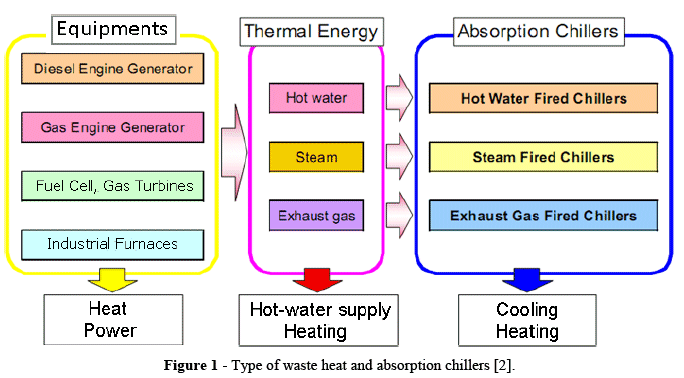
<body><![CDATA[<p>&nbsp;</p>     <p><font size="3" face="Verdana, Arial, Helvetica, sans-serif"><b>1.   INTRODUCTION</b></font></p>     <p align="justify"><font size="2" face="Verdana, Arial, Helvetica, sans-serif">Energy plays an important role in supporting our daily life, economic development and every human activity. Energy systems are complex as they involve various technical, economic, environmental, legal and political factors. Due to the limitation of fossil energy resources, the impact on the environment and the human health problems during the last decades, therehas been a growing interest on developing, modeling and optimization strategies for energy systems. In this challenging scenario, old technologies like absorption cycles have emerged as a promising alternative in cooling and refrigeration applications, as they use refrigerant with zero global warming potential that do not contribute to the ozone layer depletion. Moreover, another advantage of these systems is that they can use different forms of primary energy source such as fossil fuels, renewable energy sources, and also waste heat recovered from other thermal systems.</font></p>      <p align="justify"><font size="2" face="Verdana, Arial, Helvetica, sans-serif">Siderurgic industry has industrial furnaces that consume considerable amounts of natural gas to heat the iron slabs that enters to the furnace at atmospheric temperature to be heated at 1,250 °C and then they are sentto other process to be laminated; this kind of equipment has its own heat recovery that preheat the air before to enter to the combustion chamber, this heat recovery improves the efficiency of the equipment, but still the flue gases eliminated by the stack to the atmosphere have temperatures in the range of 250 to 400 °C that can be recoveredto generate a useful energy, not only for the process but also for other energy requirements in the plant, in this case to heat water in a heat exchanger and generate chilled water using an absorption chiller to supply air conditioning to the offices that are near the equipment.</font></p>      <p align="justify"><font size="2" face="Verdana, Arial, Helvetica, sans-serif">The objective of this project is to demonstrate that it is technically and economically feasible to build a heat recovery system to generate air conditioning through a Lithium Bromide – Water absorption chiller of single effect driven by hot water. The flue gases of the industrial furnace will be used as a primary energy source.</font></p>      <p align="justify"><font size="2" face="Verdana, Arial, Helvetica, sans-serif">Gebrelassie<i> et al.</i>[1] mention that absorption chillers have smaller COP (coefficient of performance) than conventional vapor compression cycles (5:1) for that reason absorption chillers require a higher number of units, which leads to higher investment costs. Hence, there is a clear need to develop strategies capable to optimize their design and operation from thermodynamic and economic points of view so they can become a real alternative to the standard compression system</font></p>      <p align="justify"><font size="2" face="Verdana, Arial, Helvetica, sans-serif"><a href="#f1">Figure 1</a> shows different equipment that can be used to recover the flue gases and generate hot and cold water for air conditioning.</font></p>      <p align=justify><a name="f1"></a></p>     <p align=center><img src="/img/revistas/riyd/v1n14/a08_figura_01.gif" width="684" height="378"></p>     <p align="justify"><font size="2" face="Verdana, Arial, Helvetica, sans-serif">When heat is recovered from a process, e.g. an industrial process or a power production process, it is generally obtained at temperature which is too low for immediate application in the same process. This heat may instead be cascaded to a second process with lower requirements or heat quality i.e. temperature, or upgraded by transformation e.g. using a heat pump.</font></p>      ]]></body>
<body><![CDATA[<p align="justify"><font size="2" face="Verdana, Arial, Helvetica, sans-serif">Important considerations used in this studyto evaluate a heat recovery project are:</font></p>      <blockquote>       <p align="justify"><font size="2" face="Verdana, Arial, Helvetica, sans-serif">&rarr;     Which are the waste     heat sources available?</font></p>       <p align="justify"><font size="2" face="Verdana, Arial, Helvetica, sans-serif">&rarr;     What amount of heat is     available?</font></p>       <p align="justify"><font size="2" face="Verdana, Arial, Helvetica, sans-serif">&rarr;     What is the temperature     of the available heat?</font></p>       <p align="justify"><font size="2" face="Verdana, Arial, Helvetica, sans-serif">&rarr;     What is it (substance)?</font></p>       <p align="justify"><font size="2" face="Verdana, Arial, Helvetica, sans-serif">&rarr;     Can it be recovered? </font></p>       <p align="justify"><font size="2" face="Verdana, Arial, Helvetica, sans-serif">&rarr;     Where it can be used     this heat?</font></p>       <p align="justify"><font size="2" face="Verdana, Arial, Helvetica, sans-serif">&rarr;     What amount of heat is     required and at what temperature?</font></p>       <p align="justify"><font size="2" face="Verdana, Arial, Helvetica, sans-serif">&rarr;     What portion of the     available heat can be used?</font></p>       ]]></body>
<body><![CDATA[<p align="justify"><font size="2" face="Verdana, Arial, Helvetica, sans-serif">&rarr;     When is it available?     (Continuous, batch mode)</font></p>       <p align="justify"><font size="2" face="Verdana, Arial, Helvetica, sans-serif">&rarr;     Is technical and     economical feasible recover the waste heat?</font></p>       <p align="justify"><font size="2" face="Verdana, Arial, Helvetica, sans-serif">&rarr;     What extra benefits can     be obtained? (energy savings, environment issue, efficiency improvement, etc)</font></p> </blockquote>     <p align="justify"><font size="2" face="Verdana, Arial, Helvetica, sans-serif"><b>&bull; State of the Art</b></font></p>      <p align="justify"><font size="2" face="Verdana, Arial, Helvetica, sans-serif">Exhaustive searches of heat recovery systems and absorption chillers application driven by waste flue gases have been made in order to find similar projects. There is work done in absorption chillers [2], [3], [4], in cogeneration [5], [9], [10], and trigeneration recovery systems [6], [7], [8], [11] that use absorption chillers bases on thermal analysis, economic analysis and exergy analysis. There are studies about absorption chillers technology [12], [13], [14].</font></p>      <p align="justify"><font size="2" face="Verdana, Arial, Helvetica, sans-serif">A literature survey shows that heat recovery systems have been analyzed as cogeneration and trigeneration systems based on gas turbines and/or combustion engine equipment. This article will focus on analyzing from a thermodynamic and economical point of view the combined production of heat water for air conditioning using the flue gas of an industrial furnace as a primary energy.</font></p>     <p align="justify">&nbsp;</p>     <p align="justify"><b><font size="3" face="Verdana, Arial, Helvetica, sans-serif">2. PROBLEM STATEMENT</font></b></p>     <p align="justify"><font size="2" face="Verdana, Arial, Helvetica, sans-serif">The problem is the waste of heat through the flue gases of an industrial furnace and the principal objective is recovering the heat and produces a useful energy. There are a lot of companies and industries of warm and tropical regions that experiment an increase in the electricity demand during the summer period and sometimes they exceed the limit of the supply capacity.</font></p>      <p align="justify"><font size="2" face="Verdana, Arial, Helvetica, sans-serif">The case of study was performed in Monterrey, Mexico in a well-known siderurgic industry company Ternium. The company needs 1,000 TR of refrigeration to cover the requirements of air conditioning for its offices; they use conventional vapor compressor and centrifugal chillers. The monthly cost for the electric energy is approximately 14,429 U$D considering an average COP = 3; 200 hr/month; 0.06 U$D/kWh. For calefaction the company uses boilers to heat the water and send it to the offices, the monthly cost for the fuel (natural gas) is approximately 21,600 U$D considering 12 U$D/MMBtu(11.37 U$D/GJ), 150 hr/month. The city of Monterrey has in average 9 months of warmth weather and 3 months of coolweather, which means a total energy cost of 194,661 U$D/year to cover the heating and cooling demand. This study will show under what conditions the project is thermodynamically and economically feasible. The study can be easily extrapolated to other geographical regions.</font></p>      ]]></body>
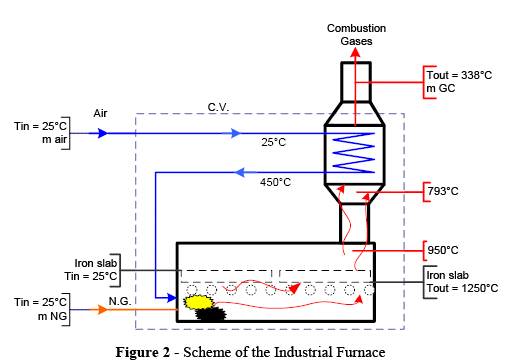
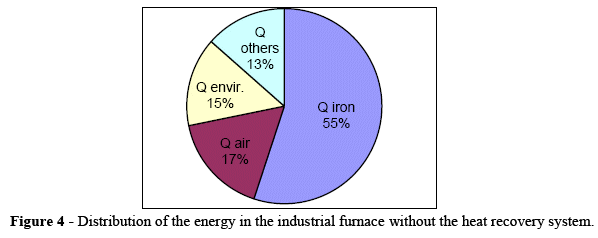
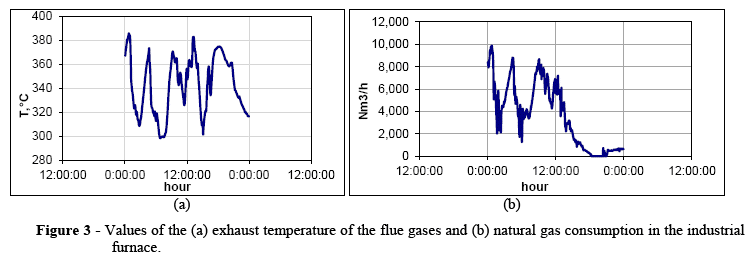
<body><![CDATA[<p align="justify"><font size="2" face="Verdana, Arial, Helvetica, sans-serif"><b>&bull; </b></font><font size="2" face="Verdana, Arial, Helvetica, sans-serif"><b>Description of the Industrial Furnace</b></font></p>      <p align="justify"><font size="2" face="Verdana, Arial, Helvetica, sans-serif"><a href="#f2">Figure 2</a> shows the industrial furnace that heats the iron slabs (6x1x0.25 meters). Iron slabs enter the furnace at atmospheric temperature (25 °C) and leave it at 1,250°C which is the ideal temperature to laminate the iron slabs. To reach that temperature the equipment consumes natural gas that is burned with preheated air and burn up in different points through the large of the furnace. The industrial furnace is programmed to work all year long with periodical maintenance without turning off the equipment. The major maintenance is done once a year and can take two weeks with the equipment switched off. The furnace has a SCADA monitoring system that allows obtaining the necessary data for the evaluation of the heat recovery system.</font></p>      <p align=justify><a name="f2"></a></p>     <p align=center><img src="/img/revistas/riyd/v1n14/a08_figura_02.gif" width="523" height="364"></p>     <p align="justify"><font size="2" face="Verdana, Arial, Helvetica, sans-serif"><a href="#f3">Figure 3</a> shows a graph of the temperature of the flue gases at the exit of the furnace and the natural gas consumption in a day; Ternium allowed to access the data base of the equipment to evaluate different parameters as natural gas consume, air consume, temperatures, excess air, etc. that allows to see the behavior of the equipment in different times of the year. </font></p>     <p align="justify"><a name="f3"></a></p>     <p align="center"><img src="/img/revistas/riyd/v1n14/a08_figura_03.gif" width="750" height="258"></p>     <p align="justify"><font size="2" face="Verdana, Arial, Helvetica, sans-serif"><a href="#f4">Figure 4</a> shows how the energy is distributed in the industrial furnace in a particular day; as it can be seen the iron slabs consume the 55% of the total energy that is produce in the combustion, 16.7% of the energy is recovered in the preheated air, 13.5% of the energy is lost in elements that are in the furnace (chimney walls, refrigerant water, transport mechanism, etc.), the remaining 14.7% is the energy that is sent into the environment through the chimney and so the opportunity area for this project.</font></p>     <p align="justify"><a name="f4"></a></p>     <p align="center"><img src="/img/revistas/riyd/v1n14/a08_figura_04.gif" width="598" height="238"></p>     ]]></body>
<body><![CDATA[<p align="center">&nbsp;</p>     <p align="left"><b><font size="3" face="Verdana, Arial, Helvetica, sans-serif">3. EVALUATION OF THE AVAILABLE HEAT OF THE   FLUE GAS</font></b></p>     <p align="justify"><font size="2" face="Verdana, Arial, Helvetica, sans-serif">In order to determine the flow, composition, heating value and available heat of the combustion gases, it is necessary considering the following data: (1) Flow, chemical composition and input temperature of natural gas, air and if it is the case the species that are participating in the combustion and process; (2) Output temperature of the combustion gases when the heat exchanger will be placed; (3) Operational data of the equipment throughout the day and if it is possible throughout the whole year.</font></p>      <p align="justify"><font size="2" face="Verdana, Arial, Helvetica, sans-serif">Is important to mention that the industrial furnace consumes small amounts of nitrogen N<sub>2</sub> to avoid the oxidation of the iron slabs in the furnace, this parameter is neglected since it does not have a large influence in the results.</font></p>      <p align="justify"></p>      <p align="justify"><font size="2" face="Verdana, Arial, Helvetica, sans-serif"><b>3.1. Chemical reaction of the combustion gases</b></font></p>      <p align="justify"><font size="2" face="Verdana, Arial, Helvetica, sans-serif">The industrial furnace uses natural gas mixed with preheated air to heat the iron slabs. Considering a natural gas volumetric composition of: 94.62% CH<sub>4</sub>, 3.19% C<sub>2</sub>H<sub>6</sub>, 0.89% C<sub>3</sub>H<sub>8</sub>, 1.3% CO<sub>2</sub>; and air volumetric composition of 21% O<sub>2</sub> and 79% N<sub>2</sub> with an excess air of 10%, the combustion equation for the complete combustion based on 1 kmol of fuelis:</font></p>      <p align=center><img src="/img/revistas/riyd/v1n14/a08_ecuacion_01.gif" width="747" height="34"></p>      <p align="justify"><font size="2" face="Verdana, Arial, Helvetica, sans-serif">The theoretical amount of air <i>a</i><sub>th</sub> (without excess air) with<i> r</i> = 0 is evaluated through a mass balance:</font></p>      <p align="center"><img src="/img/revistas/riyd/v1n14/a08_ecuacion_01_.gif" width="741" height="104"></p>      ]]></body>
<body><![CDATA[<p align="justify"><font size="2" face="Verdana, Arial, Helvetica, sans-serif">The amount of air is found with the following equation:</font></p>      <p align=center><img src="/img/revistas/riyd/v1n14/a08_ecuacion_02.gif" width="741" height="29"></p>      <p align="justify"><font size="2" face="Verdana, Arial, Helvetica, sans-serif">The <i>q, r, s, c</i> coefficients are obtained through the mass balance equation (1):</font></p>      <p align="center"><img src="/img/revistas/riyd/v1n14/a08_ecuacion_02_.gif" width="730" height="98"></p>      <p align="justify"><font size="2" face="Verdana, Arial, Helvetica, sans-serif">From this the volumetric composition of the combustion gases is:</font></p>      <p align="center"><img src="/img/revistas/riyd/v1n14/a08_ecuacion_02__.gif" width="736" height="57"></p>      <p align="justify"><font size="2" face="Verdana, Arial, Helvetica, sans-serif"><b>3.2. Heat reaction</b></font></p>      <p align="justify"><font size="2" face="Verdana, Arial, Helvetica, sans-serif">Considering the energy equation:</font></p>      <p align=center><img src="/img/revistas/riyd/v1n14/a08_ecuacion_03.gif" width="744" height="39"></p>      <p align="justify"><font size="2" face="Verdana, Arial, Helvetica, sans-serif">Neglecting potential and kinetic energy and considering a steady state:</font></p>      ]]></body>
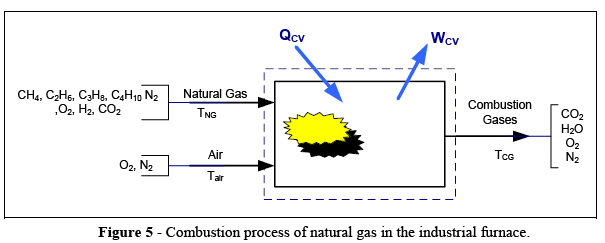
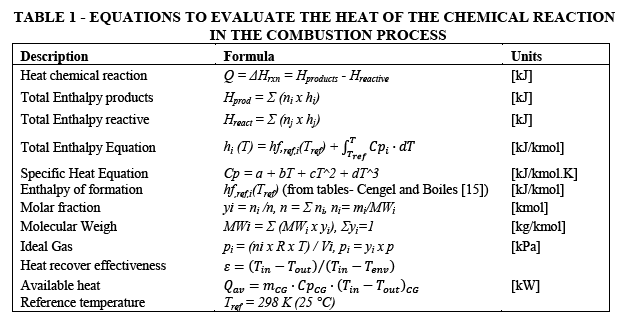
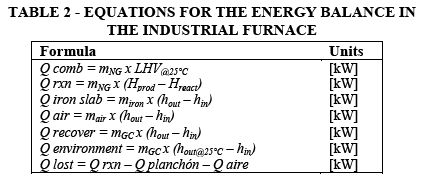
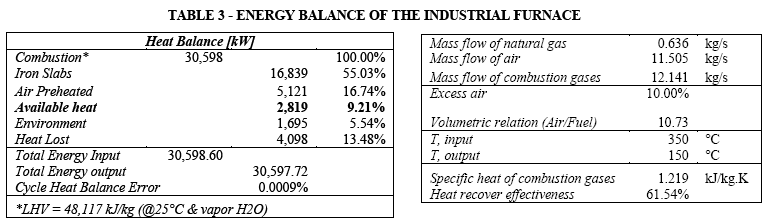
<body><![CDATA[<p align=center><img src="/img/revistas/riyd/v1n14/a08_ecuacion_04.gif" width="742" height="38"></p>     <p align=justify><font size="2" face="Verdana, Arial, Helvetica, sans-serif"><a href="#f5">Figure 5</a> shows the heat reaction in the   industrial furnace.</font></p>     <p align=justify><a name="f5"></a></p>     <p align=center><img src="/img/revistas/riyd/v1n14/a08_figura_05.gif" width="605" height="243"></p>     <p align="justify"><font size="2" face="Verdana, Arial, Helvetica, sans-serif">The industrial furnace only delivers heat for the iron slabs so <img src="/img/revistas/riyd/v1n14/image016.png" width=13 height=17 align="texttop"> is neglected. To evaluate the heat of the chemical reaction of the natural gas and the air (considering both as an ideal mixed of gases), the formulas of <a href="#t1">Table 1</a> are considered.</font></p>      <p align=justify><a name="t1"></a></p>     <p align=center><img src="/img/revistas/riyd/v1n14/a08_table_01.gif" width="622" height="323"></p>     <p align=justify><font size="2" face="Verdana, Arial, Helvetica, sans-serif">Using the composition of the combustion   gases, its final temperature can be calculated; this temperature has to be over   the condensation temperature to avoid acid liquid water that can easily corrode the   chimney structure, for this case anexhaust gases temperature limit of 150 °C is   going to be considered. <a href="#t2">Table 2</a> summarizes the equations needed to evaluate the   heat recovery potential.</font></p>     <p align="justify"><font size="2" face="Verdana, Arial, Helvetica, sans-serif"><b>3.3. Energy Balance in the industrial furnace</b></font></p>      <p align="justify"><font size="2" face="Verdana, Arial, Helvetica, sans-serif">The industrial furnace has an average flow of3,000 Nm<sup>3</sup>/hr per month, considering normal conditions (1 atm, 0°C) and equations of <a href="#t1">Table 1</a> and <a href="#t2">Table 2</a>.</font></p>     ]]></body>
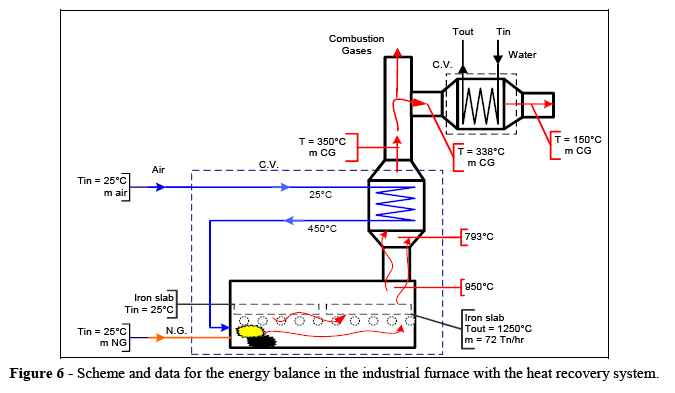
<body><![CDATA[<p align="justify"><a name="t2"></a></p>     <p align="center"><img src="/img/revistas/riyd/v1n14/a08_table_02.gif" width="429" height="181"></p>     <p align="justify"><font size="2" face="Verdana, Arial, Helvetica, sans-serif"><a href="#t3">Table 3</a> shows the results of the distribution of energy in the industrial furnace equipped with a heat recovery system; comparing these values with those of <a href="#f4">Figure 4</a> it is found that only 5.54% of the waste heat is evacuated to the environment instead of 14.72%, which means that 9.21% (2,819 kW) can be recover from the industrial furnace. </font></p>     <p align=justify><a name="t3"></a></p>     <p align=center><img src="/img/revistas/riyd/v1n14/a08_table_03.gif" width="769" height="223"></p>     <p align="justify"></p>      <p align="justify"><font size="2" face="Verdana, Arial, Helvetica, sans-serif"><a href="#f6">Figure 6</a> shows the values considered for the evaluation of the heat balance.</font></p>      <p align=justify><a name="f6"></a></p>     <p align=center><img src="/img/revistas/riyd/v1n14/a08_figura_06.gif" width="675" height="393"></p>     <p align=justify><font size="2" face="Verdana, Arial, Helvetica, sans-serif">The parameters needed   to evaluate the available heat may change over time, so it is necessary to know   the equipment behavior and the variables that affect the fluctuation of the   waste heat; the main variables of the waste heat identified for this project are   the temperature of the exhaust gases, the mass flow of the fuel and the excess   air for the combustion of the fuel. All these parameters are related to the   production demand of the iron slab.</font></p>     ]]></body>
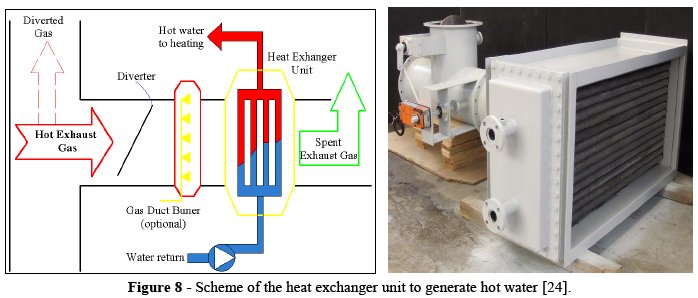
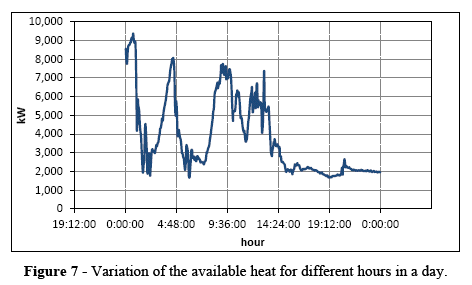
<body><![CDATA[<p align="justify"><font size="2" face="Verdana, Arial, Helvetica, sans-serif">Using equations to evaluate the available heat in <a href="#t1">Table 1</a> and considering an average heat capacity of the flue gases of Cp = 1.18 kJ/kg.K, it is shown in <a href="#f7">Figure 7</a> the estimated variation of the available heat considering the fluctuation of the main variables and a final temperature of the flue gases of 150°C. The horizontal line is the average of available energy in a day.</font></p>      <p align=justify><a name="f7"></a></p>     <p align=center><img src="/img/revistas/riyd/v1n14/a08_figura_07.gif" width="472" height="285"></p>     <p align=justify><font size="2" face="Verdana, Arial, Helvetica, sans-serif">One has to consider carefully this   situation when evaluating and designing the equipment for the project. For   example for air conditioning or calefaction, the engineer must know exactly   when the air conditioning (or calefaction) is needed and find out other process that need cool or hot water to make good use of all the available energy. </font></p>     <p align=justify>&nbsp;</p>     <p align=justify><b><font size="3" face="Verdana, Arial, Helvetica, sans-serif">4. BRIEF DESCRIPTION OF THE HEAT RECOVERY   SYSTEM </font></b></p>     <p align="justify"><font size="2" face="Verdana, Arial, Helvetica, sans-serif">With the available heat in the stack of the furnace it is possible to generate hot water, this fluid can be used in many applications, for example it can be used for calefaction, showers, dish cleaners, to preheat the water for boilers, etc. <a href="#f8">Figure 8</a> shows a system to recover the flue gases through a heat exchanger unit. Compact heat exchangers are used in this analysis to achieve large heat rates per unit volume, these kinds of heat exchangers are widely used particularly when one or both fluids are gases.</font></p>     <p align="justify"><a name="f8"></a></p>     <p align="center"><img src="/img/revistas/riyd/v1n14/a08_figura_08.jpg" width="698" height="298"></p>     <p align="justify"><font size="2" face="Verdana, Arial, Helvetica, sans-serif">The gas duct burner is optional equipment depending on heating requirements; the diverter is used to control the entrance of the flue gases through the heat exchanger and is related to the exit temperature of the requirements of hot water. The heat exchanger unit has to be designed considering important aspects like selection of tube materials, tube arrangement, pressure drop, fouling factor, fins, heat transfer coefficients, water quality, insulation, duct burner, etc.</font></p>      ]]></body>
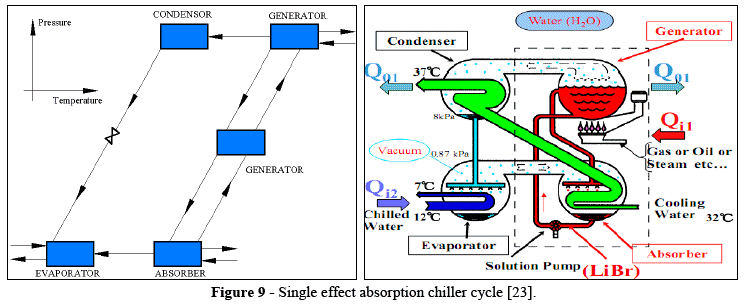
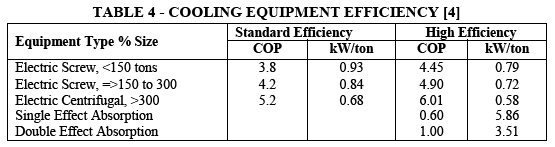
<body><![CDATA[<p align="justify"><font size="2" face="Verdana, Arial, Helvetica, sans-serif">There are works performed about the design of compact heat exchangers [17], [18], [19], [20] that use flue gases to generate hot water or steam, they are mostly known as HRSG (heat recovery steam gases). In this project hot water is required to supply the energy for the absorption chiller, for that reason only one heat exchanger (economizer) is going to be evaluated. It is important to know the efficiency of the heat exchanger that the manufacturer gives in the catalogue. Economic and technological aspect must be considered to select the best option for the project.   </font></p>     <p align="justify">&nbsp;</p>     <p align="justify"><b><font size="3" face="Verdana, Arial, Helvetica, sans-serif">5. BRIEF DESCRIPTION OF ABSORPTION CHILLERS</font></b></p>     <p align="justify"><font size="2" face="Verdana, Arial, Helvetica, sans-serif">Absorption chillers differ from the more prevalent compression chillers in that the cooling effect is driven by heat energy rather than mechanical energy. Absorption chiller can use not only fossil fuel but also the waste thermal energies (hot water, steam and exhaust gas) for cooling, using that waste thermal energy can improve overall efficiency rate and save energy.</font></p>      <p align="justify"><font size="2" face="Verdana, Arial, Helvetica, sans-serif"><a href="#f9">Figure 9</a> shows the absorption chiller cycle. The evaporator allows the refrigerant to evaporate and to be absorbed by the absorbent, a process that extracts heat from the room to be cooled. The combined fluids then go to the generator, which is heated by gas, steam or in this case, by hot water. The refrigerant separates from absorbent and goes to the condenser to be cooled back down to a liquid, while the absorbent return back to the absorber. The cooled refrigerant is released through an expansion valve into the evaporator, and the cycle repeats [3].</font></p>     <p align="justify"><a name="f9"></a></p>     <p align="center"><img src="/img/revistas/riyd/v1n14/a08_figura_09.gif" width="747" height="306"></p>     <p align="justify"><font size="2" face="Verdana, Arial, Helvetica, sans-serif">Commercial absorption chillers are either lithium bromide-water (LiBr/H<sub>2</sub>O) or ammonia-water equipment. In the LiBr/H<sub>2</sub>O system, lithium bromide is the absorber and water is the refrigerant. In the ammonia water system, water is the absorber and ammonia is the refrigerant. <a href="#t4">Table 4</a> shows typical values of COP(Cooling Capacity / Heat Input) for different equipment.</font></p>      <p align=justify><a name="t4" id="t4"></a></p>     <p align=center><img src="/img/revistas/riyd/v1n14/a08_table_04.gif" width="555" height="147"></p>     ]]></body>
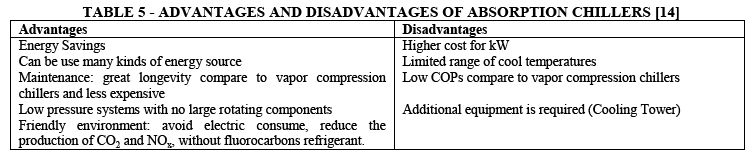
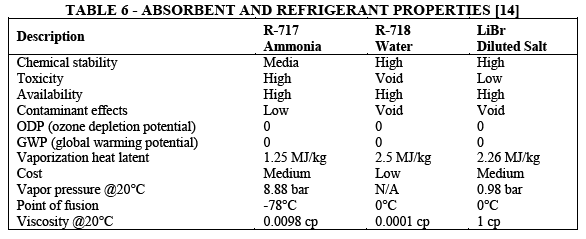
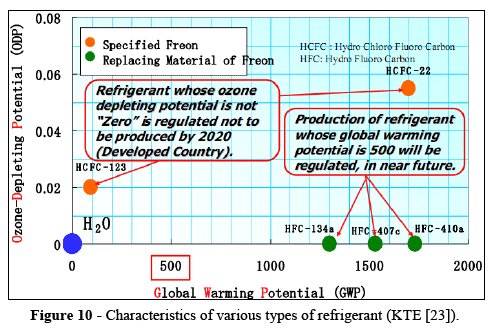
<body><![CDATA[<p align="justify"><font size="2" face="Verdana, Arial, Helvetica, sans-serif">The most widespread absorption chillers (driven by hot water or steam) manufactures are:  Yazaki Co. (Japan), York Co. (USA), Carrier (USA), Trane (USA), McQuay (USA), Kawazaki (Japan), Sanyo (Japan), Thermax (India). <a href="#t5">Table 5</a> shows the main advantages and disadvantages of absorption chillers compared to standard vapor compression chillers.</font></p>      <p align=justify><a name="t5"></a></p>     <p align=center><img src="/img/revistas/riyd/v1n14/a08_table_05.gif" width="751" height="158"></p>     <p align="justify"><font size="2" face="Verdana, Arial, Helvetica, sans-serif">In this article a Lithium Bromide – Water Absorption Chiller of single effect is used to generate chilled water for air conditioning. <a href="#t6">Table 6</a> shows the properties of the absorbent and refrigerant that are used in absorption chillers, as it can be seen they don’t have issues with environmental regulations (ODP and GWP).</font></p>      <p align=justify><a name="t6"></a></p>     <p align=center><img src="/img/revistas/riyd/v1n14/a08_table_06.gif" width="586" height="239"></p>     <p align="justify"><font size="2" face="Verdana, Arial, Helvetica, sans-serif"><a href="#f10">Figure 10</a> shows the ODP and GWP values for different refrigerants where water as a refrigerant doesn’t have an impact on these parameters. Kyoto and Montreal protocol are the organisms that deal and regulate these parameters.</font></p>      <p align=justify><a name="f10"></a></p>     <p align=center><img src="/img/revistas/riyd/v1n14/a08_figura_10.gif" width="495" height="332"></p>     <p align=center>&nbsp;</p>     ]]></body>
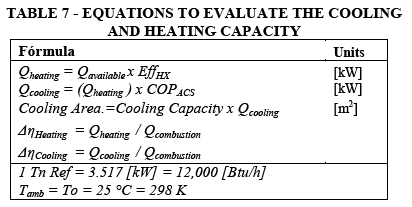
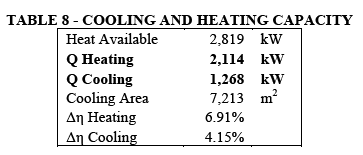
<body><![CDATA[<p align=justify><font size="3" face="Verdana, Arial, Helvetica, sans-serif"><b>6. EVALUATION OF THE COOLING AND HEATING   CAPACITY</b></font></p>     <p align="justify"><font size="2" face="Verdana, Arial, Helvetica, sans-serif">Knowing the available heat, it is possible evaluate the cooling and heating capacity using the equations in <a href="#t7">Table 7</a>.</font></p>      <p align=justify><a name="t7"></a></p>     <p align=center><img src="/img/revistas/riyd/v1n14/a08_table_07.gif" width="412" height="207"></p>     <p align="justify"><font size="2" face="Verdana, Arial, Helvetica, sans-serif">Considering the equations of <a href="#t7">Table 7</a>, it was calculated a constant average flow of natural gas of 3,000 Nm3/h, an efficiency of the heat recovery unit of 75% (worst scenario), a COP of the absorption chiller of 0.6 and a cooling capacity of 20 m<sup>2</sup>/TR (William [16]). The heating and cooling generation is shown in <a href="#t8">Table 8</a>. </font></p>      <p align=justify><a name="t8"></a></p>     <p align=center><img src="/img/revistas/riyd/v1n14/a08_table_08.gif" width="363" height="155"></p>     <p align="justify"><font size="2" face="Verdana, Arial, Helvetica, sans-serif">The results of <a href="#t8">Table 8</a> show that with 2,819 kW of available heat it is possible to generate 2,114 kW for heating and 1,268 kW (361 TR) for cooling. The global efficiency of the equipment based on the combustion energy increase 6.91 % when heating is used and 4.14% when cooling is used. The cooling capacity can covers an area of 7,213 m<sup>2</sup> considering a cooling capacity for offices of 20 m<sup>2</sup>/TR.</font></p>     <p align="justify">&nbsp;</p>     <p align="justify"><b><font size="3" face="Verdana, Arial, Helvetica, sans-serif">7.   DESCRIPTION OF THE HEAT   RECOVERY SYSTEM</font></b></p>     ]]></body>
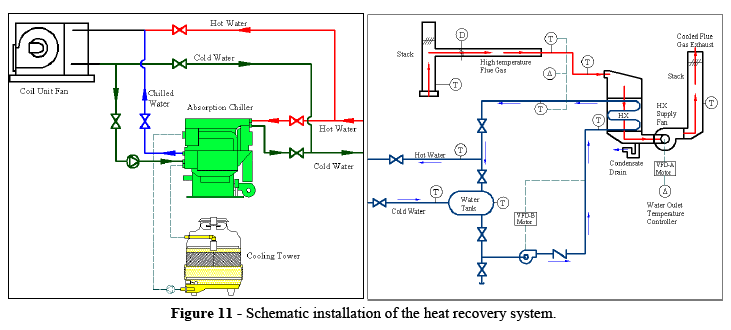
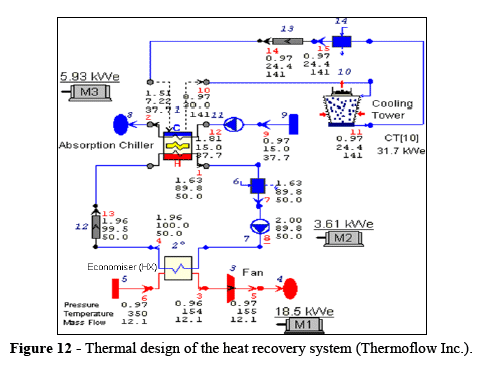
<body><![CDATA[<p align="justify"><font size="2" face="Verdana, Arial, Helvetica, sans-serif">To recover the flue gases that are eliminated by the stack, it is necessary to put a derivation duct that takes the flue gas throughout a heat exchanger (HX) commonly called “economizer” where gives its heat to the water that flows inside the tubes (Wipplinger et al.[17], Ganaphaty [18], Taylor [19], ESCOA [20]); the flue gases need a fan to make circulate the flow through the heat exchanger (pressure drop) and then be eliminated at the atmosphere. The economizer heat the water until reach the necessary temperature to feed the absorption chiller if is cooling or to feed the air handler if is heating.</font></p>      <p align="justify"><font size="2" face="Verdana, Arial, Helvetica, sans-serif"><a href="#f11">Figure 11</a> shows the scheme of the equipment and connections that are needed to accomplish the heat recovery system and it gives an idea of the necessary equipment for the project. With this configuration is possible to control the flow of the flue gases that is required to cover the heating or cooling demand.</font></p>      <p align="justify"><font size="2" face="Verdana, Arial, Helvetica, sans-serif">The heat exchanger has a purge to eliminate the possible flue gases condensates. The fan is placed after the heat exchanger where the temperature of the flue gases is low (150 °C) and is managed by a driver that controls the temperature of the flue gases and the hot water. It is recommended to install an expansion vessel to avoid over pressure in the line.</font></p>      <p align=justify><a name="f11"></a></p>     <p align=center><img src="/img/revistas/riyd/v1n14/a08_figura_11.gif" width="731" height="330"></p>     <p align=justify>&nbsp;</p>     <p align=justify><font size="3" face="Verdana, Arial, Helvetica, sans-serif"><b>8. THERMODYNAMIC ANALYSIS AND DESIGN OF THE   HEAT RECOVERY SYSTEM</b></font></p>     <p align="justify"><font size="2" face="Verdana, Arial, Helvetica, sans-serif">Once the heating and cooling capacities are obtained, the following step is the thermal analysis of the equipment that is needed for the project; this procedure allows knowing technical data for the selecting and designing of the heat recovery equipment.</font></p>      <p align="justify"><font size="2" face="Verdana, Arial, Helvetica, sans-serif">Thermoflex Lite V.17 student version is a thermodynamic software for the design and simulation of thermal power plants since 1987. <a href="#f12">Figure 12</a> shows the thermal design of the heat recovery system to produce chilled water for air conditioning; from the figure it can see the pressure, temperature, mass flow and electrical consumption of the different equipment. The electric consumption is also considered by the software.</font></p>      <p align=justify><a name="f12"></a>     ]]></body>
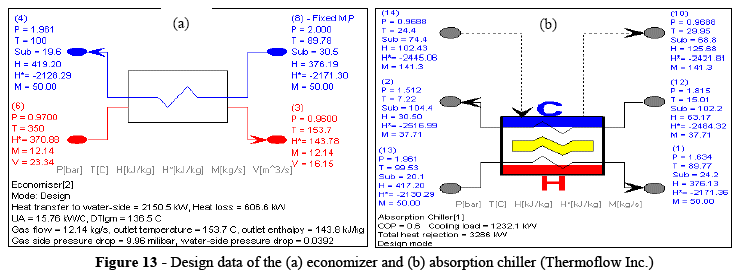
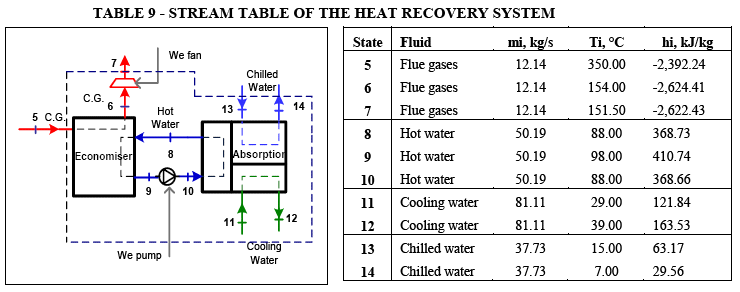
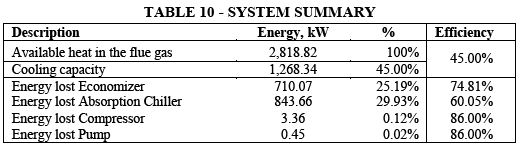
<body><![CDATA[<p align=center><img src="/img/revistas/riyd/v1n14/a08_figura_12.gif" width="488" height="365">     <p align="justify"><font size="2" face="Verdana, Arial, Helvetica, sans-serif"><a href="#f13">Figure 13</a> shows more data of an specific equipment, for example the heat transfer to the water side in the economizer is 2,150.5 kW (heating), and for the absorption chiller the cooling load is 1,232.1 kW (350 TR) with a COP of 0.6, the total heat rejection by the cooling tower is 3,286 kW.</font></p>      <p align="justify"><a name="f13"></a></p>     <p align="center"><img src="/img/revistas/riyd/v1n14/a08_figura_13.gif" width="745" height="274"></p>     <p align="justify"><font size="2" face="Verdana, Arial, Helvetica, sans-serif">The thermal analysis was also modeled in Microsoft Excel<sup>®</sup> with macros of Visual Basic<sup>®</sup> using the equations of <a href="#t1">Table 1</a>, <a href="#t2">2</a> and <a href="#t7">7</a>. <a href="#t9">Table 9</a> shows the properties of the fluids in each component. For example for the economizer the heat transfer to the flue gas side is 2,818 kW, the heat transfer to the water side is 2,108 kW. The efficiency for the economizer in this case is 74.81% (worst scenario).</font></p>      <p align="justify"><a name="t9"></a></p>     <p align="center"><img src="/img/revistas/riyd/v1n14/a08_table_09.gif" width="740" height="292"></p>     <div align="justify"></div>     <p align="justify"><font size="2" face="Verdana, Arial, Helvetica, sans-serif"><a href="#t10">Table 10</a> summarized the energy lost and efficiency of each component of the heat recovery system. Based on the available heat, the overall efficiency of the recovery system is 45% for cooling and 74.81% for heating.</font></p>      <p align=justify><a name="t10"></a></p>     ]]></body>
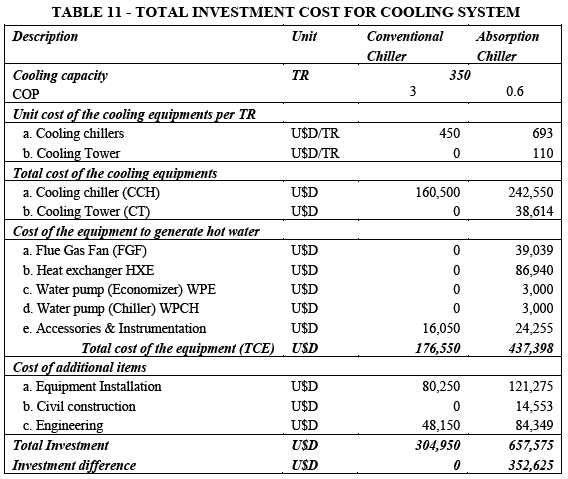
<body><![CDATA[<p align=center><img src="/img/revistas/riyd/v1n14/a08_table_10.gif" width="525" height="148"></p>     <p align=justify><font size="2" face="Verdana, Arial, Helvetica, sans-serif">The results show that the flue gases of the   industrial furnace can generate 350 TR which represents 1/3 of the total   cooling demand of the company. Now the next step is to verify if the project is economically attractive.</font></p>     <p align=justify>&nbsp;</p>     <p align=justify><b><font size="3" face="Verdana, Arial, Helvetica, sans-serif">9. ECONOMIC ANALYSIS OF THE HEAT RECOVERY   SYSTEM</font></b></p>     <p align="justify"><font size="2" face="Verdana, Arial, Helvetica, sans-serif">The economic analysis consists in determining the economic feasibility of the heat recovery system taking into account the cooling and heating availability(Ostwald and McLaren [21], Sullivan <i>et al.</i> [22]). The available cooling is evaluated considering conventional refrigeration (vapor compressor chiller) versus absorption chiller. The available heating is evaluated considering a boiler that consumes natural gas to heat the water versus an economizer that uses the flue gases to heat the water for calefaction.</font></p>      <p align="justify"><font size="2" face="Verdana, Arial, Helvetica, sans-serif">In both cases Investment cost and Operational cost must be evaluated. The costs of most equipment are estimated.</font></p>      <p align="justify"><font size="2" face="Verdana, Arial, Helvetica, sans-serif"><b>9.1. Cooling investment cost</b></font></p>      <p align="justify"><font size="2" face="Verdana, Arial, Helvetica, sans-serif">The cost of the equipment is based on the scheme of     <a href="#f11">Fig. 11</a>; the cost of the coil unit fan is not considered because the unit is already available and is common equipment in both options. <a href="#t11">Table 11</a> shows comparative cost of the equipment related to the cooling capacity and COP of the cooling equipment. The comparison is between 1 unit 350 TR absorption system hot water and 1 unit 350 TR conventional systems by electricity. The costs of additional items are estimation over TCE (total cost of equipment) and vary depending of the place of installation. The cost of the equipment also can vary depending on the local market and the availability of the equipment.</font></p>      <p align=justify><a name="t11"></a></p>     <p align=center><img src="/img/revistas/riyd/v1n14/a08_table_11.gif" width="568" height="479"></p>     ]]></body>
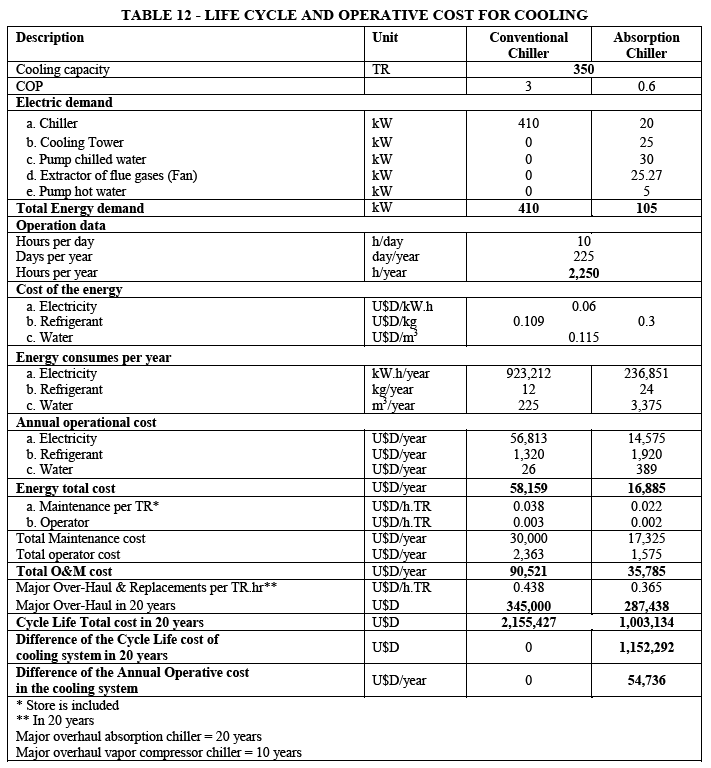
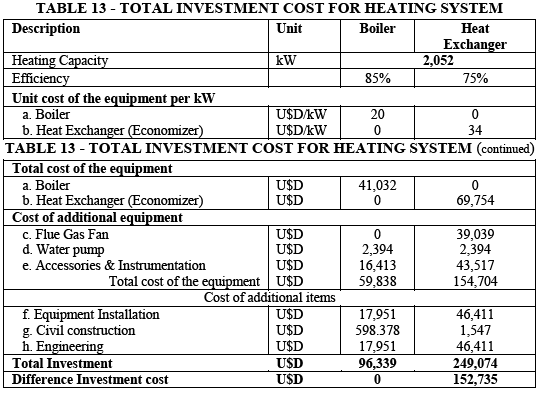
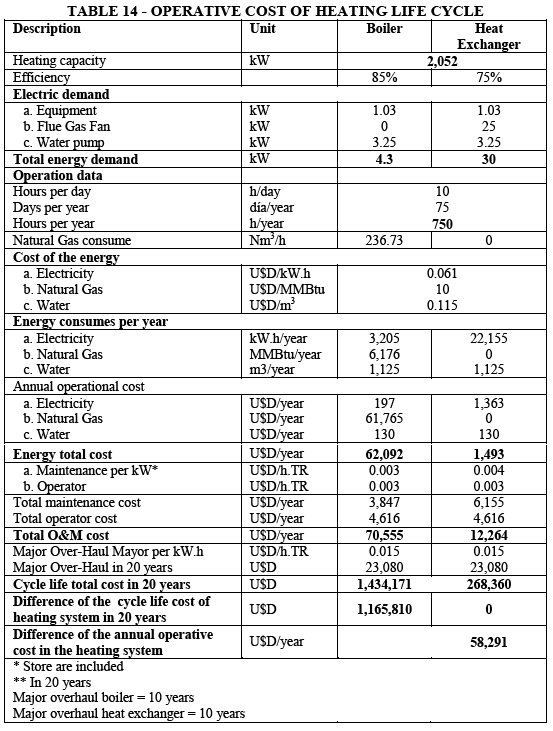
<body><![CDATA[<p align=justify><font size="2" face="Verdana, Arial, Helvetica, sans-serif">The absorption chiller unit is 1.5 times more   expensive than conventional chiller. The total investment cost is almost twice   more expensive than conventional chiller driven by electricity, the main   differences are the extra equipment needed by the absorption chiller (cooling   tower, heat exchanger and exhaust gases fan).</font></p>     <p align="justify"><font size="2" face="Verdana, Arial, Helvetica, sans-serif"><b>9.2. Life cycle and operational cost for cooling</b></font></p>      <p align="justify"><font size="2" face="Verdana, Arial, Helvetica, sans-serif">The operative and maintenance cost related to the cooling capacity and COP of the cooling equipment are presented in <a href="#t12">Table 12</a>.</font></p>     <p align="justify"><a name="t12"></a></p>     <p align="center"><img src="/img/revistas/riyd/v1n14/a08_table_12.gif" width="711" height="768"></p>     <p align="justify"><font size="2" face="Verdana, Arial, Helvetica, sans-serif">The operative cost for absorption chiller is 2.5 times less expensive than conventional chiller. The maintenance cost is expensive for conventional chiller due to its components are subjected to high pressure. The O&amp;M (operation and maintenance) and energy costs are estimated values for international markets; therefore these values must be considered carefully in order to have reliable values for the economic analysis.</font></p>      <p align="justify"><font size="2" face="Verdana, Arial, Helvetica, sans-serif">The savings generated by the heat recovery system for cooling is 54,736 U$D/year, the main difference is the electric energy cost, while the conventional chiller spends 56,813 U$D/year the heat recovery system with the absorption chiller spends only 14,575 U$D/year.</font></p>      <p align="justify"><font size="2" face="Verdana, Arial, Helvetica, sans-serif"><b>9.3. Heating investment cost </b></font></p>      <p align="justify"><font size="2" face="Verdana, Arial, Helvetica, sans-serif">The company uses a boiler to generate hot water for heating. The boiler consumes natural gas as a primary energy. To use the heat recovery system to generate hot water for heating, a heat exchanger is needed. <a href="#t13">Table 13</a> summarizes the investment cost as compares the cost of the boiler vs. the cost of the heat recovery system.</font></p>     <p align="justify"><a name="t13"></a></p>     ]]></body>
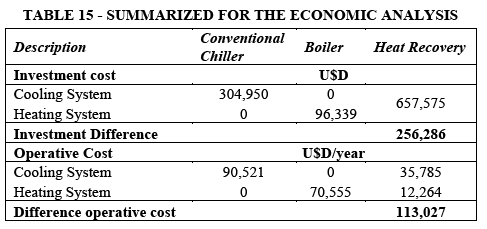
<body><![CDATA[<p align="center"><img src="/img/revistas/riyd/v1n14/a08_table_13.gif" width="542" height="394"></p>     <p align="justify"><font size="2" face="Verdana, Arial, Helvetica, sans-serif">As it can be seen in <a href="#t13">Table 13</a>, the heat exchanger system is almost 2.5 times more expensive than the boiler system due to extra equipment required to generate the hot water like the flue gas fan.</font></p>      <p align="justify"><font size="2" face="Verdana, Arial, Helvetica, sans-serif"><b>9.4. Life cycle and operational cost for heating</b></font></p>      <p align="justify"><font size="2" face="Verdana, Arial, Helvetica, sans-serif"><a href="#t14">Table 14</a> evaluates the life cycle and operational cost of both systems considering that for the heating system the boiler uses natural gas while the heat recovery system uses flue gases as a primary energy.</font></p>     <p align="justify"><a name="t14"></a></p>     <p align="center"><img src="/img/revistas/riyd/v1n14/a08_table_14.gif" width="553" height="731"></p>     <p align="justify"><font size="2" face="Verdana, Arial, Helvetica, sans-serif">Considering 75 days per year of operation of the heating system, the annual cost for natural gas is 72,216 U$D, which is almost 6 times more expensive than the heat recovery system. The savings in operational costs for the heat recovery system to generate calefaction are 58,291 U$D/year.</font></p>      <p align="justify"><font size="2" face="Verdana, Arial, Helvetica, sans-serif"><b>9.5. Results of the economic analysis</b></font></p>      <p align="justify"><font size="2" face="Verdana, Arial, Helvetica, sans-serif">The summarized results for the economic analysis are shown in <a href="#t15">Table 15</a> and take into account the results presented in <a href="#t11">Table 11</a> to <a href="#t14">14</a>. These values will be used to evaluate the feasibility of the project.</font></p>     <p align="justify"><a name="t15"></a></p>     ]]></body>
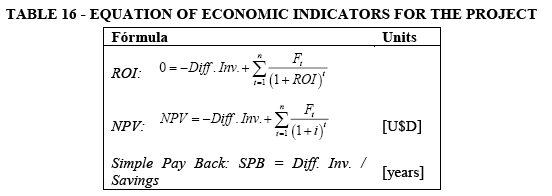
<body><![CDATA[<p align="center"><img src="/img/revistas/riyd/v1n14/a08_table_15.gif" width="487" height="229"></p>     <p align="justify"><font size="2" face="Verdana, Arial, Helvetica, sans-serif">The investment cost for the heat recovery system is 2.5 times more expensive than conventional systems when generating the same cooling and heating capacity.</font></p>      <p align="justify"><font size="2" face="Verdana, Arial, Helvetica, sans-serif">The annual operational cost for the company to cover the heating and cooling requirements using conventional systems (compressor chiller and boiler) is 161,076 U$D while using the heat recovery system the annual operational cost is 48,049 U$D, which is 3 times cheaper than the conventional operational cost. The annual savings for the heat recovery system is113,027 U$D.</font></p>      <p align="justify"><font size="2" face="Verdana, Arial, Helvetica, sans-serif">Considering one year of operation (300 days) it is important to notice that 75% of the time is for cooling and 25% is for heating (this can change depending on the place and meteorological weather analysis). The operational savings for cooling are 54,736 U$D/year for 225 days of operation per year. The operational saving for heating is 58,291 U$D/year for only 75 days of operation per year. This scenario is because of the cost of natural gas 10 U$D/MMBtu (0.03412 U$D/kW.h).</font></p>      <p align="justify"><font size="2" face="Verdana, Arial, Helvetica, sans-serif"><a href="#t16">Table 16</a> shows the equation used in this article to evaluate the economic feasibility of the project. The return on the investment (ROI) is an important indicator of the feasibility of the project; it shows the interest that can be obtained on the investment considering the operational cost and the cycle life of the project. The payback period is easy to understand and is widely adopted. The pay back determines how many years it takes to recover the invested capital. The net present value (NPV) compares the present worth of future revenue with initial capital investment at a pre-assigned interest rate [21], [22], [23].</font></p>      <p align=justify><a name="t16"></a></p>     <p align=center><img src="/img/revistas/riyd/v1n14/a08_table_16.gif" width="552" height="196"></p>     <p align=justify><font size="2" face="Verdana, Arial, Helvetica, sans-serif">Considering a period of 20 years, which is a typical   cycle life of these systems (providing good maintenance and operation), <a href="#t17">Table     17</a> shows the results of the economic analysis of the project. </font></p>     <p align=justify><a name="t17"></a></p>     <p align=center><img src="/img/revistas/riyd/v1n14/a08_table_17.gif" width="445" height="167"></p>     ]]></body>
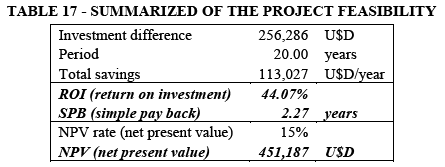
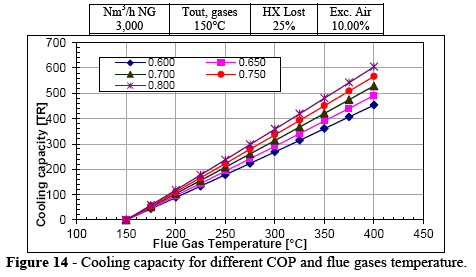
<body><![CDATA[<p align="justify"><font size="2" face="Verdana, Arial, Helvetica, sans-serif">The ROI has a value of 44.07% which is very attractive since a typical accepted value of ROI is 20%, besides the payback period is 2.27 years and considering an interest of 15% the project gives a positive net present value of 451,187 U$D.</font></p>      <p align="justify"><font size="2" face="Verdana, Arial, Helvetica, sans-serif">Once again, if the project is designed to cover only the cooling demand, which means 54,736 U$D/year of savings and  an investment difference of 352,625 (from <a href="#t15">Table 15</a>), the interest rate of return is just 14%, the payback period is 6.5 years and the net present value is negative (-10,011 U$D) considering an interest of 15%.</font></p>      <p align="justify"><font size="2" face="Verdana, Arial, Helvetica, sans-serif">For these analysis, parameters like depreciation, taxes and inflation are not considered since these parameters have to be evaluated depending of the fiscal and financial politics of each company and region.</font></p>     <p align="justify">&nbsp;</p>     <p align="justify"><b><font size="3" face="Verdana, Arial, Helvetica, sans-serif">10. RESULTS AND DISCUSSION</font></b></p>     <p align="justify"><font size="2" face="Verdana, Arial, Helvetica, sans-serif">Using a validated model developed in Microsoft Excel<sup>®</sup>, it is possible to get both thermal and economic sensitivity analysis of the project for many cases [24], [25], [26], [27], [28]. </font></p>      <p align="justify"><font size="2" face="Verdana, Arial, Helvetica, sans-serif"><b>10.1. Results of thermal sensitivity analysis</b></font></p>      <p align="justify"><font size="2" face="Verdana, Arial, Helvetica, sans-serif"><a href="#f14">Figure 14</a> shows the cooling capacity that can be obtained for different flue gases temperature at the stack of the furnace.  The small table indicates that the flow of natural gas and the excess air are constant parameters. The exit limit of the flue gas temperature is 150 °C.</font></p>     <p align="justify"><a name="f14"></a></p>     <p align="center"><img src="/img/revistas/riyd/v1n14/a08_figura_14.gif" width="476" height="277"></p>     ]]></body>
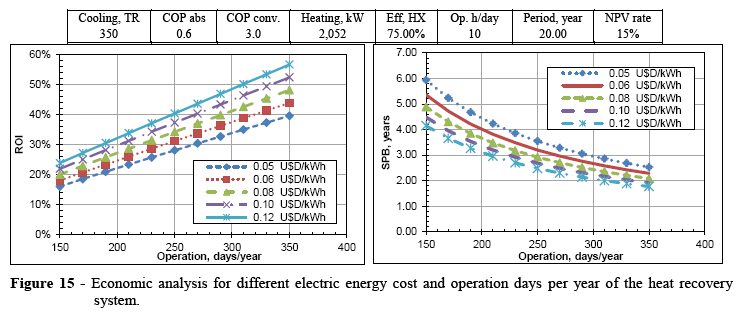
<body><![CDATA[<p align="justify"><font size="2" face="Verdana, Arial, Helvetica, sans-serif"><b>10.2. Results of economic sensitivity analysis</b></font></p>      <p align="justify"><font size="2" face="Verdana, Arial, Helvetica, sans-serif">As it can be seen from <a href="#f15">Figure 15</a>, the operation days per year of the new system and the savings obtained from the expenditure into electric energy determine the feasibility of the project.</font></p>     <p align="justify"><a name="f15"></a></p>     <p align="center"><img src="/img/revistas/riyd/v1n14/a08_figura_15.gif" width="738" height="315"></p>     <p align="justify"><font size="2" face="Verdana, Arial, Helvetica, sans-serif">Considering the values of <a href="#t17">table 17</a> and the minimum attractive rate of return of 20% the break even cost of electric energy would be 0.054 U$D/kW.h with at least 150 operation days per year.</font></p>     <p align="justify">&nbsp;</p>     <p align="justify"><b><font size="3" face="Verdana, Arial, Helvetica, sans-serif">11. CONCLUSIONS</font></b></p>     <p align="justify"><font size="2" face="Verdana, Arial, Helvetica, sans-serif">Industrial furnaces with flue gases temperature over 250 °C represent an opportunity area for heat recovery systems. Heat recovery systems can be used to generate hot and cool water to cover heating and air conditioning demands. A good evaluation and consideration of the heat availability must be done in order to have reliable values. Applying heat recovery systems in conjunction with industrial equipment requires some thought about overall operation and technical data. The equipment and operational costs must be evaluated carefully because they determine the feasibility of the project. </font></p>      <p align="justify"><font size="2" face="Verdana, Arial, Helvetica, sans-serif">In this paper it is shown that with data from industrial furnace and considering average values, it is possible to generate 350 TR for air conditioning and also to cover the heating demand all year long, but the period of major maintenance (2 weeks per year approximately) when hot and cool water cannot be provided. The economic analysis shows that with the market cost of the equipment, the actual cost of electricity and the technical data of absorption chillers available in the market compared with conventional chillers, the payback period is 2.32 years and a return on investment of 44% can be obtained.</font></p>      <p align="justify"><font size="2" face="Verdana, Arial, Helvetica, sans-serif">It is important to mention that the evaluated industrial furnace was not working to the design capacity which means that there is more heat available if the load of iron slabs increase; according to the catalog the industrial furnace can consume 12,000 Nm<sup>3</sup>/h of natural gas.</font></p>      ]]></body>
<body><![CDATA[<p align="justify"><font size="2" face="Verdana, Arial, Helvetica, sans-serif">The analysis presented shows the importance to realize both thermal and economic analysis of the heat recovery system to consider not only the improvement of the efficiency in the system but also the cost and benefit that can be obtained. With the rising cost of electricity and fossil fuels, maximizing the useful recovery of heat in the industries is more important than ever. </font></p>      <p align="justify"><font size="2" face="Verdana, Arial, Helvetica, sans-serif">Environment aspects can be considered since the project replaces conventional equipment that work with electricity and fossil fuels. Also absorption chiller technologies use refrigerant that are friendly with the atmosphere. These factors can be a plus for the project and for the image of the company.</font></p>     <p align="justify">&nbsp;</p>     <p align="justify"><b><font size="3" face="Verdana, Arial, Helvetica, sans-serif">12. ACKNOWLEDGEMENT</font></b></p>     <p align="justify"><font size="2" face="Verdana, Arial, Helvetica, sans-serif">Thanks to Ternium S.A. and Tecnológico de Monterrey.</font></p>     <p align="justify">&nbsp;</p>     <p align="justify"><b><font size="3" face="Verdana, Arial, Helvetica, sans-serif">13. REFERENCES </font></b></p>     <p align="justify"><font size="2" face="Verdana, Arial, Helvetica, sans-serif">[1] B. H.Gebrelassie et al.“Economic performance of an absorption cooling system under uncertainty.”<i>Applied Thermal Engineering</i>,vol. 29, pp. 3491-3500, 2009.</font></p>      <!-- ref --><p align="justify"><font size="2" face="Verdana, Arial, Helvetica, sans-serif">[2] M. Ishimatsu. “Advance Absorption Chillers: Utilization of various heat energies for air conditioning. 1<sup>st</sup> European”presented at Conference on Polygeneration, 2007.</font>&nbsp;&nbsp;&nbsp;&nbsp;&nbsp;&nbsp;&nbsp;&nbsp;[&#160;<a href="javascript:void(0);" onclick="javascript: window.open('/scielo.php?script=sci_nlinks&ref=954460&pid=S2518-4431201400010000800002&lng=','','width=640,height=500,resizable=yes,scrollbars=1,menubar=yes,');">Links</a>&#160;]<!-- end-ref --><!-- ref --><p align="justify"><font size="2" face="Verdana, Arial, Helvetica, sans-serif">[3] New Buildings Institute.“Absorption Chillers Guideline.”Internet:<a href="http://www.newbuildings.org" target="_blank">www.newbuildings.org</a> ,1998 [2009].</font>&nbsp;&nbsp;&nbsp;&nbsp;&nbsp;&nbsp;&nbsp;&nbsp;[&#160;<a href="javascript:void(0);" onclick="javascript: window.open('/scielo.php?script=sci_nlinks&ref=954461&pid=S2518-4431201400010000800003&lng=','','width=640,height=500,resizable=yes,scrollbars=1,menubar=yes,');">Links</a>&#160;]<!-- end-ref --><!-- ref --><p align="justify"><font size="2" face="Verdana, Arial, Helvetica, sans-serif">[4] ASHRAE 90.1R. Minimum Efficiency. Code Compliance Manual. U.S. DOE. 2000</font>&nbsp;&nbsp;&nbsp;&nbsp;&nbsp;&nbsp;&nbsp;&nbsp;[&#160;<a href="javascript:void(0);" onclick="javascript: window.open('/scielo.php?script=sci_nlinks&ref=954462&pid=S2518-4431201400010000800004&lng=','','width=640,height=500,resizable=yes,scrollbars=1,menubar=yes,');">Links</a>&#160;]<!-- end-ref --><p align="justify"><font size="2" face="Verdana, Arial, Helvetica, sans-serif">[5] P.Kalinowski et al. “Application of waste heat powered absorption refrigeration system to the LNG recovery process.” <i>International journal of refrigeration</i>, vol. 32, no. 4, pp. 687-694, 2009.</font></p>      <p align="justify"><font size="2" face="Verdana, Arial, Helvetica, sans-serif">[6] S. Man Lai and  H.Wai.“Integration of trigeneration system and thermal storage under demand uncertainties.”<i>Applied Energy Journal</i>, vol. 87, no. 9, pp. 2868-2880, 2009.</font></p>      <!-- ref --><p align="justify"><font size="2" face="Verdana, Arial, Helvetica, sans-serif">[7] L. Massagués et al. <i>Estudio comparativo de una instalación de trigeneración con microturbina de gas y un sistema convencional con bomba de calor en un complejo hotelero</i>. Universitat Rovirai Virgili, 2004.</font>&nbsp;&nbsp;&nbsp;&nbsp;&nbsp;&nbsp;&nbsp;&nbsp;[&#160;<a href="javascript:void(0);" onclick="javascript: window.open('/scielo.php?script=sci_nlinks&ref=954465&pid=S2518-4431201400010000800007&lng=','','width=640,height=500,resizable=yes,scrollbars=1,menubar=yes,');">Links</a>&#160;]<!-- end-ref --><p align="justify"><font size="2" face="Verdana, Arial, Helvetica, sans-serif">[8] A.Arteconi. “Distributed generation and trigeneration: Energy saving opportunities in Italian supermarket sector.”<i>Applied Thermal Engineering</i>, vol.29(8-9), pp. 1735-1743, 2009.</font></p>      <p align="justify"><font size="2" face="Verdana, Arial, Helvetica, sans-serif">[9] J.I.Yoon. “A study on the advanced performance of an absorption heater/chiller with a solution preheated using waste gas.”<i>Applied Thermal Engineering</i>, vol. 23, no. 6, pp. 757-767, 2003.</font></p>      <!-- ref --><p align="justify"><font size="2" face="Verdana, Arial, Helvetica, sans-serif">[10] European Commission for Energy. “Energy Savings CHCP plants in the Hotel Sector.”Internet: <a href="http://www.newbuildings.org" target="_blank">www.newbuildings.org</a>, 2001[2009].</font>&nbsp;&nbsp;&nbsp;&nbsp;&nbsp;&nbsp;&nbsp;&nbsp;[&#160;<a href="javascript:void(0);" onclick="javascript: window.open('/scielo.php?script=sci_nlinks&ref=954468&pid=S2518-4431201400010000800010&lng=','','width=640,height=500,resizable=yes,scrollbars=1,menubar=yes,');">Links</a>&#160;]<!-- end-ref --><!-- ref --><p align="justify"><font size="2" face="Verdana, Arial, Helvetica, sans-serif">[11] V. Patnaik.“Absorption technology as a sustainable energy solution in the United States.” Presented in 1<sup>st</sup> European Conference Polygeneration.Tarragona (Spain), 16-17 October 2007.</font>&nbsp;&nbsp;&nbsp;&nbsp;&nbsp;&nbsp;&nbsp;&nbsp;[&#160;<a href="javascript:void(0);" onclick="javascript: window.open('/scielo.php?script=sci_nlinks&ref=954469&pid=S2518-4431201400010000800011&lng=','','width=640,height=500,resizable=yes,scrollbars=1,menubar=yes,');">Links</a>&#160;]<!-- end-ref --><p align="justify"><font size="2" face="Verdana, Arial, Helvetica, sans-serif">[12] P. Srikhirin et al. “A review of absorption refrigeration technologies.”<i>Renewable and Sustainable Energy Reviews</i>, vol. 5, no. 4, pp. 343-372, 2001.</font></p>      <p align="justify"><font size="2" face="Verdana, Arial, Helvetica, sans-serif">[13] K.Goodheart.“Low Firing Temperature Absorption Chiller System.” Master Degree Thesis of University of Wisconsin, 2000.</font></p>      ]]></body>
<body><![CDATA[<!-- ref --><p align="justify"><font size="2" face="Verdana, Arial, Helvetica, sans-serif">[14] H.Kreith, et al. <i>Absorption Chillers and Heat Pumps</i>. CRS Press, 1996</font>&nbsp;&nbsp;&nbsp;&nbsp;&nbsp;&nbsp;&nbsp;&nbsp;[&#160;<a href="javascript:void(0);" onclick="javascript: window.open('/scielo.php?script=sci_nlinks&ref=954472&pid=S2518-4431201400010000800014&lng=','','width=640,height=500,resizable=yes,scrollbars=1,menubar=yes,');">Links</a>&#160;]<!-- end-ref --><p align="justify"><font size="2" face="Verdana, Arial, Helvetica, sans-serif">[15] Y. A. Cengel and  M.A.Boles.<i>Thermodynamics an Engineer Approach</i>. Table A.2, Fifth edition, McGraw Hill, 2006.</font></p>      <p align="justify"><font size="2" face="Verdana, Arial, Helvetica, sans-serif">[16] R.William.“Driving Absorption Chillers Using Heat Recovery.”<i>ASHRAE Journal</i>, vol. 46, no. 9,pp. S30-S36, 2004.</font></p>      <p align="justify"><font size="2" face="Verdana, Arial, Helvetica, sans-serif">[17] K.P.M. Wipplinger et al. “Stainless steel tube heat exchanger design for waste.”<i>Journal of Energy in Southern Africa</i>, vol. 17, no. 2, pp. 47-56, 2006.</font></p>      <p align="justify"><font size="2" face="Verdana, Arial, Helvetica, sans-serif">[18] V.Ganapathy.“Design and Evaluate Finned Tube Bundles,” in<i>Hydrocarbon Processing</i>, vol. 75, no. 9, pp. 103-112, 1996.</font></p>      <!-- ref --><p align="justify"><font size="2" face="Verdana, Arial, Helvetica, sans-serif">[19] C. Taylor. “Measurement of finned-tube heat exchanger performance.”Master Thesis, Georgia Institute Technology, 2004.</font>&nbsp;&nbsp;&nbsp;&nbsp;&nbsp;&nbsp;&nbsp;&nbsp;[&#160;<a href="javascript:void(0);" onclick="javascript: window.open('/scielo.php?script=sci_nlinks&ref=954477&pid=S2518-4431201400010000800019&lng=','','width=640,height=500,resizable=yes,scrollbars=1,menubar=yes,');">Links</a>&#160;]<!-- end-ref --><p align="justify"><font size="2" face="Verdana, Arial, Helvetica, sans-serif">[20] ESCOA Engineering Manual. “Fintube Technologies, Inc.”Internet: <a href="http://www.fintubetech.com" target="_blank">www.fintubetech.com</a> [2009].</font></p>      <p align="justify"><font size="2" face="Verdana, Arial, Helvetica, sans-serif">[21] P.F. Ostwald and T.S. McLaren.<i> Cost analysis and estimating for engineering and management</i>. New Jersey: Pearson education Inc<i>.</i>, 2004.</font></p>      <p align="justify"><font size="2" face="Verdana, Arial, Helvetica, sans-serif">[22] W.G. Sullivan et al.<i>Engineering Economy</i>. 12<sup>th</sup> edition, New Jersey: Pearson education Inc., 2003.</font></p>      <!-- ref --><p align="justify"><font size="2" face="Verdana, Arial, Helvetica, sans-serif">[23] Kawasaki Thermal Engineering. <i>Waste heat energy application for absorption chillers</i>. 3th International District Cooling Conference &amp; Trade Show, Dubai, 2008.</font>&nbsp;&nbsp;&nbsp;&nbsp;&nbsp;&nbsp;&nbsp;&nbsp;[&#160;<a href="javascript:void(0);" onclick="javascript: window.open('/scielo.php?script=sci_nlinks&ref=954481&pid=S2518-4431201400010000800023&lng=','','width=640,height=500,resizable=yes,scrollbars=1,menubar=yes,');">Links</a>&#160;]<!-- end-ref --><p align="justify"><font size="2" face="Verdana, Arial, Helvetica, sans-serif">[24] M.J. Moran and H.N. Shapiro. <i>Fundamentos de Termodinámica Técnica.</i>2<sup>th</sup>edition, Ed. Reverte, 2004. </font></p>      <p align="justify"><font size="2" face="Verdana, Arial, Helvetica, sans-serif">[25] Waste Heat Recovery. Internet: <a href="http://wasteheatrecovery.com/" target="_blank">http://wasteheatrecovery.com/</a>[2014].</font></p>      <p align="justify"><font size="2" face="Verdana, Arial, Helvetica, sans-serif">[26] F.J.Wang et al.“Economic feasibility of waste heat to power conversion.”<i>Applied Energy Journal</i>, vol. 84, no. 4, pp. 442-454, 2007.</font></p>      <p align="justify"><font size="2" face="Verdana, Arial, Helvetica, sans-serif">[27] S.<a href="http://www.sciencedirect.com/science/article/pii/S1359431112004395" target="_blank">Popli</a> et al.“Gas turbine efficiency enhancement using waste heat powered absorption chillers in the oil and gas industry.” <i>Applied Thermal Engineering</i>, vol. 50, no. 1, pp. 919-931, 2013.</font></p>      <p align="justify"><font size="2" face="Verdana, Arial, Helvetica, sans-serif">[28] A. <a href="http://www.sciencedirect.com/science/article/pii/S1359431111003267" target="_blank">Huicochea</a>. “Thermodynamic analysis of a trigeneration system consisting of a micro gas turbine and a double effect absorption chiller.” In <i>Energy</i>, vol. 67(16), pp. 548-556, 2014.</font></p>  <hr align=JUSTIFY size=1 width="33%">        <p>&nbsp;</p>     <p><font size="3"><b><font face="Verdana, Arial, Helvetica, sans-serif">NOTAS</font></b></font></p>     <p align=justify><font size="2" face="Verdana, Arial, Helvetica, sans-serif"><a href="#_ftnref1" name="_ftn1" title="">[1]</a>Author address: <i>Universidad Privada Boliviana – Centro de Investigaciones Ópticas y Energías </i>(CIOE)</font></p>     <p align=justify>&nbsp;</p>      ]]></body><back>
<ref-list>
<ref id="B1">
<label>1</label><nlm-citation citation-type="journal">
<person-group person-group-type="author">
<name>
<surname><![CDATA[Gebrelassie]]></surname>
<given-names><![CDATA[B.H.]]></given-names>
</name>
</person-group>
<article-title xml:lang="en"><![CDATA[Economic performance of an absorption cooling system under uncertainty]]></article-title>
<source><![CDATA[Applied Thermal Engineering]]></source>
<year>2009</year>
<volume>29</volume>
<page-range>3491-3500</page-range></nlm-citation>
</ref>
<ref id="B2">
<label>2</label><nlm-citation citation-type="confpro">
<person-group person-group-type="author">
<name>
<surname><![CDATA[Ishimatsu]]></surname>
<given-names><![CDATA[M.]]></given-names>
</name>
</person-group>
<source><![CDATA[Advance Absorption Chillers: Utilization of various heat energies for air conditioning 1st European]]></source>
<year>2007</year>
<conf-name><![CDATA[ Conference on Polygeneration]]></conf-name>
<conf-loc> </conf-loc>
</nlm-citation>
</ref>
<ref id="B3">
<label>3</label><nlm-citation citation-type="">
<collab>New Buildings Institute</collab>
<source><![CDATA[Absorption Chillers Guideline]]></source>
<year>1998</year>
<month> [</month>
<day>20</day>
</nlm-citation>
</ref>
<ref id="B4">
<label>4</label><nlm-citation citation-type="book">
<collab>ASHRAE 90.1R.</collab>
<source><![CDATA[Minimum Efficiency. Code Compliance Manual]]></source>
<year>2000</year>
<publisher-name><![CDATA[U.S. DOE]]></publisher-name>
</nlm-citation>
</ref>
<ref id="B5">
<label>5</label><nlm-citation citation-type="journal">
<person-group person-group-type="author">
<name>
<surname><![CDATA[Kalinowski]]></surname>
<given-names><![CDATA[P.]]></given-names>
</name>
</person-group>
<article-title xml:lang="en"><![CDATA[Application of waste heat powered absorption refrigeration system to the LNG recovery process]]></article-title>
<source><![CDATA[International journal of refrigeration]]></source>
<year>2009</year>
<volume>32</volume>
<numero>4</numero>
<issue>4</issue>
<page-range>687-694</page-range></nlm-citation>
</ref>
<ref id="B6">
<label>6</label><nlm-citation citation-type="journal">
<person-group person-group-type="author">
<name>
<surname><![CDATA[Man Lai]]></surname>
<given-names><![CDATA[S.]]></given-names>
</name>
<name>
<surname><![CDATA[Wai]]></surname>
<given-names><![CDATA[H.]]></given-names>
</name>
</person-group>
<article-title xml:lang="en"><![CDATA[Integration of trigeneration system and thermal storage under demand uncertainties]]></article-title>
<source><![CDATA[Applied Energy Journal]]></source>
<year>2009</year>
<volume>87</volume>
<numero>9</numero>
<issue>9</issue>
<page-range>2868-2880</page-range></nlm-citation>
</ref>
<ref id="B7">
<label>7</label><nlm-citation citation-type="book">
<person-group person-group-type="author">
<name>
<surname><![CDATA[Massagués]]></surname>
<given-names><![CDATA[L.]]></given-names>
</name>
</person-group>
<source><![CDATA[Estudio comparativo de una instalación de trigeneración con microturbina de gas y un sistema convencional con bomba de calor en un complejo hotelero]]></source>
<year>2004</year>
<publisher-name><![CDATA[Universitat Rovirai Virgili]]></publisher-name>
</nlm-citation>
</ref>
<ref id="B8">
<label>8</label><nlm-citation citation-type="journal">
<person-group person-group-type="author">
<name>
<surname><![CDATA[Arteconi]]></surname>
<given-names><![CDATA[A.]]></given-names>
</name>
</person-group>
<article-title xml:lang="en"><![CDATA[Distributed generation and trigeneration: Energy saving opportunities in Italian supermarket sector]]></article-title>
<source><![CDATA[Applied Thermal Engineering]]></source>
<year>2009</year>
<volume>29</volume>
<numero>8-9</numero>
<issue>8-9</issue>
<page-range>1735-1743</page-range></nlm-citation>
</ref>
<ref id="B9">
<label>9</label><nlm-citation citation-type="journal">
<person-group person-group-type="author">
<name>
<surname><![CDATA[Yoon]]></surname>
<given-names><![CDATA[J.I.]]></given-names>
</name>
</person-group>
<article-title xml:lang="en"><![CDATA[A study on the advanced performance of an absorption heater/chiller with a solution preheated using waste gas]]></article-title>
<source><![CDATA[Applied Thermal Engineering]]></source>
<year>2003</year>
<volume>23</volume>
<numero>6</numero>
<issue>6</issue>
<page-range>757-767</page-range></nlm-citation>
</ref>
<ref id="B10">
<label>10</label><nlm-citation citation-type="">
<collab>European Commission for Energy</collab>
<source><![CDATA[Energy Savings CHCP plants in the Hotel Sector]]></source>
<year>2001</year>
<month>[2</month>
<day>00</day>
</nlm-citation>
</ref>
<ref id="B11">
<label>11</label><nlm-citation citation-type="confpro">
<person-group person-group-type="author">
<name>
<surname><![CDATA[Patnaik]]></surname>
<given-names><![CDATA[V.]]></given-names>
</name>
</person-group>
<source><![CDATA[Absorption technology as a sustainable energy solution in the United States]]></source>
<year></year>
<conf-name><![CDATA[ 1st European Conference Polygeneration]]></conf-name>
<conf-date>16-17 October 2007</conf-date>
<conf-loc>Tarragona </conf-loc>
</nlm-citation>
</ref>
<ref id="B12">
<label>12</label><nlm-citation citation-type="journal">
<person-group person-group-type="author">
<name>
<surname><![CDATA[Srikhirin]]></surname>
<given-names><![CDATA[P.]]></given-names>
</name>
</person-group>
<article-title xml:lang="en"><![CDATA[A review of absorption refrigeration technologies]]></article-title>
<source><![CDATA[Renewable and Sustainable Energy Reviews]]></source>
<year>2001</year>
<volume>5</volume>
<numero>4</numero>
<issue>4</issue>
<page-range>343-372</page-range></nlm-citation>
</ref>
<ref id="B13">
<label>13</label><nlm-citation citation-type="">
<person-group person-group-type="author">
<name>
<surname><![CDATA[Goodheart]]></surname>
<given-names><![CDATA[K.]]></given-names>
</name>
</person-group>
<source><![CDATA[Low Firing Temperature Absorption Chiller System]]></source>
<year>2000</year>
</nlm-citation>
</ref>
<ref id="B14">
<label>14</label><nlm-citation citation-type="book">
<person-group person-group-type="author">
<name>
<surname><![CDATA[Kreith]]></surname>
<given-names><![CDATA[H.]]></given-names>
</name>
</person-group>
<source><![CDATA[Absorption Chillers and Heat Pumps]]></source>
<year>1996</year>
<publisher-name><![CDATA[CRS Press]]></publisher-name>
</nlm-citation>
</ref>
<ref id="B15">
<label>15</label><nlm-citation citation-type="book">
<person-group person-group-type="author">
<name>
<surname><![CDATA[Cengel]]></surname>
<given-names><![CDATA[Y.A.]]></given-names>
</name>
<name>
<surname><![CDATA[Boles]]></surname>
<given-names><![CDATA[M.A.]]></given-names>
</name>
</person-group>
<source><![CDATA[Thermodynamics an Engineer Approach]]></source>
<year>2006</year>
<edition>5</edition>
<publisher-name><![CDATA[McGraw Hill]]></publisher-name>
</nlm-citation>
</ref>
<ref id="B16">
<label>16</label><nlm-citation citation-type="journal">
<person-group person-group-type="author">
<name>
<surname><![CDATA[William]]></surname>
<given-names><![CDATA[R.]]></given-names>
</name>
</person-group>
<article-title xml:lang="en"><![CDATA[Driving Absorption Chillers Using Heat Recovery]]></article-title>
<source><![CDATA[ASHRAE Journal]]></source>
<year>2004</year>
<volume>46</volume>
<numero>9</numero>
<issue>9</issue>
<page-range>S30-S36</page-range></nlm-citation>
</ref>
<ref id="B17">
<label>17</label><nlm-citation citation-type="journal">
<person-group person-group-type="author">
<name>
<surname><![CDATA[Wipplinger]]></surname>
<given-names><![CDATA[K.P.M.]]></given-names>
</name>
</person-group>
<article-title xml:lang="en"><![CDATA[Stainless steel tube heat exchanger design for waste]]></article-title>
<source><![CDATA[Journal of Energy in Southern Africa]]></source>
<year>2006</year>
<volume>17</volume>
<numero>2</numero>
<issue>2</issue>
<page-range>47-56</page-range></nlm-citation>
</ref>
<ref id="B18">
<label>18</label><nlm-citation citation-type="journal">
<person-group person-group-type="author">
<name>
<surname><![CDATA[Ganapathy]]></surname>
<given-names><![CDATA[V.]]></given-names>
</name>
</person-group>
<article-title xml:lang="en"><![CDATA[Design and Evaluate Finned Tube Bundles]]></article-title>
<source><![CDATA[Hydrocarbon Processing]]></source>
<year>1996</year>
<volume>75</volume>
<numero>9</numero>
<issue>9</issue>
<page-range>103-112</page-range></nlm-citation>
</ref>
<ref id="B19">
<label>19</label><nlm-citation citation-type="">
<person-group person-group-type="author">
<name>
<surname><![CDATA[Taylor]]></surname>
<given-names><![CDATA[C.]]></given-names>
</name>
</person-group>
<source><![CDATA[Measurement of finned-tube heat exchanger performance]]></source>
<year>2004</year>
</nlm-citation>
</ref>
<ref id="B20">
<label>20</label><nlm-citation citation-type="book">
<collab>Fintube Technologies</collab>
<source><![CDATA[ESCOA Engineering Manual]]></source>
<year>[200</year>
<month>9]</month>
<publisher-name><![CDATA[Fintube Technologies Inc.]]></publisher-name>
</nlm-citation>
</ref>
<ref id="B21">
<label>21</label><nlm-citation citation-type="book">
<person-group person-group-type="author">
<name>
<surname><![CDATA[Ostwald]]></surname>
<given-names><![CDATA[P.F.]]></given-names>
</name>
<name>
<surname><![CDATA[McLaren]]></surname>
<given-names><![CDATA[T.S.]]></given-names>
</name>
</person-group>
<source><![CDATA[Cost analysis and estimating for engineering and management]]></source>
<year>2004</year>
<publisher-loc><![CDATA[New Jersey ]]></publisher-loc>
<publisher-name><![CDATA[Pearson education Inc.]]></publisher-name>
</nlm-citation>
</ref>
<ref id="B22">
<label>22</label><nlm-citation citation-type="book">
<person-group person-group-type="author">
<name>
<surname><![CDATA[Sullivan]]></surname>
<given-names><![CDATA[W.G.]]></given-names>
</name>
</person-group>
<source><![CDATA[Engineering Economy]]></source>
<year>2003</year>
<edition>12</edition>
<publisher-loc><![CDATA[New Jersey ]]></publisher-loc>
<publisher-name><![CDATA[Pearson education Inc.]]></publisher-name>
</nlm-citation>
</ref>
<ref id="B23">
<label>23</label><nlm-citation citation-type="confpro">
<collab>Kawasaki Thermal Engineering</collab>
<source><![CDATA[Waste heat energy application for absorption chillers]]></source>
<year>2008</year>
<conf-name><![CDATA[ 3th International District Cooling Conference & Trade Show]]></conf-name>
<conf-loc> </conf-loc>
<publisher-loc><![CDATA[Dubai ]]></publisher-loc>
</nlm-citation>
</ref>
<ref id="B24">
<label>24</label><nlm-citation citation-type="book">
<person-group person-group-type="author">
<name>
<surname><![CDATA[Moran]]></surname>
<given-names><![CDATA[M.J.]]></given-names>
</name>
<name>
<surname><![CDATA[Shapiro]]></surname>
<given-names><![CDATA[H.N.]]></given-names>
</name>
</person-group>
<source><![CDATA[Fundamentos de Termodinámica Técnica]]></source>
<year>2004</year>
<edition>2</edition>
<publisher-name><![CDATA[Reverte]]></publisher-name>
</nlm-citation>
</ref>
<ref id="B25">
<label>25</label><nlm-citation citation-type="">
<source><![CDATA[Waste Heat Recovery]]></source>
<year>[201</year>
<month>4]</month>
</nlm-citation>
</ref>
<ref id="B26">
<label>26</label><nlm-citation citation-type="journal">
<person-group person-group-type="author">
<name>
<surname><![CDATA[Wang]]></surname>
<given-names><![CDATA[F.J.]]></given-names>
</name>
</person-group>
<article-title xml:lang="en"><![CDATA[Economic feasibility of waste heat to power conversion]]></article-title>
<source><![CDATA[Applied Energy Journal]]></source>
<year>2007</year>
<volume>84</volume>
<numero>4</numero>
<issue>4</issue>
<page-range>442-454</page-range></nlm-citation>
</ref>
<ref id="B27">
<label>27</label><nlm-citation citation-type="journal">
<person-group person-group-type="author">
<name>
<surname><![CDATA[Popli]]></surname>
<given-names><![CDATA[S.]]></given-names>
</name>
</person-group>
<article-title xml:lang="en"><![CDATA[Gas turbine efficiency enhancement using waste heat powered absorption chillers in the oil and gas industry]]></article-title>
<source><![CDATA[Applied Thermal Engineering]]></source>
<year>2013</year>
<volume>50</volume>
<numero>1</numero>
<issue>1</issue>
<page-range>919-931</page-range></nlm-citation>
</ref>
<ref id="B28">
<label>28</label><nlm-citation citation-type="journal">
<person-group person-group-type="author">
<name>
<surname><![CDATA[Huicochea]]></surname>
<given-names><![CDATA[A.]]></given-names>
</name>
</person-group>
<article-title xml:lang="en"><![CDATA[Thermodynamic analysis of a trigeneration system consisting of a micro gas turbine and a double effect absorption chiller]]></article-title>
<source><![CDATA[Energy]]></source>
<year>2014</year>
<volume>67</volume>
<numero>16</numero>
<issue>16</issue>
<page-range>548-556</page-range></nlm-citation>
</ref>
</ref-list>
</back>
</article>