<?xml version="1.0" encoding="ISO-8859-1"?><article xmlns:mml="http://www.w3.org/1998/Math/MathML" xmlns:xlink="http://www.w3.org/1999/xlink" xmlns:xsi="http://www.w3.org/2001/XMLSchema-instance">
<front>
<journal-meta>
<journal-id>2415-0622</journal-id>
<journal-title><![CDATA[Economía Coyuntural]]></journal-title>
<abbrev-journal-title><![CDATA[Revista de coyuntura y perspectiva]]></abbrev-journal-title>
<issn>2415-0622</issn>
<publisher>
<publisher-name><![CDATA[Universidad Autónoma Gabriel René MorenoFacultad de Ciencias Económicas, Administrativas y FinancierasInstituto de Investigaciones Económicas y Sociales José Ortiz Mercado  IIESJOM]]></publisher-name>
</publisher>
</journal-meta>
<article-meta>
<article-id>S2415-06222020000400003</article-id>
<title-group>
<article-title xml:lang="es"><![CDATA[La situación de la mujer en el mercado laboral de los países en desarrollo islámicos y no islámicos (1995-2010)]]></article-title>
<article-title xml:lang="en"><![CDATA[The Status of Women in Labor Market of Islamic and Non-Islamic Developing Countries (1995-2010)]]></article-title>
</title-group>
<contrib-group>
<contrib contrib-type="author">
<name>
<surname><![CDATA[Karimi Moghari]]></surname>
<given-names><![CDATA[Zahra]]></given-names>
</name>
<xref ref-type="aff" rid="A01"/>
</contrib>
<contrib contrib-type="author">
<name>
<surname><![CDATA[Ebrahimi Faez]]></surname>
<given-names><![CDATA[Sahand]]></given-names>
</name>
<xref ref-type="aff" rid="A02"/>
</contrib>
<contrib contrib-type="author">
<name>
<surname><![CDATA[Jahantigh]]></surname>
<given-names><![CDATA[Elham]]></given-names>
</name>
<xref ref-type="aff" rid="A03"/>
</contrib>
</contrib-group>
<aff id="A01">
<institution><![CDATA[,University of Mazandaran  ]]></institution>
<addr-line><![CDATA[ ]]></addr-line>
</aff>
<aff id="A02">
<institution><![CDATA[,University of Mazandaran  ]]></institution>
<addr-line><![CDATA[ ]]></addr-line>
</aff>
<aff id="A03">
<institution><![CDATA[,University of Mazandaran  ]]></institution>
<addr-line><![CDATA[ ]]></addr-line>
</aff>
<pub-date pub-type="pub">
<day>00</day>
<month>12</month>
<year>2020</year>
</pub-date>
<pub-date pub-type="epub">
<day>00</day>
<month>12</month>
<year>2020</year>
</pub-date>
<volume>5</volume>
<numero>4</numero>
<fpage>3</fpage>
<lpage>24</lpage>
<copyright-statement/>
<copyright-year/>
<self-uri xlink:href="http://www.scielo.org.bo/scielo.php?script=sci_arttext&amp;pid=S2415-06222020000400003&amp;lng=en&amp;nrm=iso"></self-uri><self-uri xlink:href="http://www.scielo.org.bo/scielo.php?script=sci_abstract&amp;pid=S2415-06222020000400003&amp;lng=en&amp;nrm=iso"></self-uri><self-uri xlink:href="http://www.scielo.org.bo/scielo.php?script=sci_pdf&amp;pid=S2415-06222020000400003&amp;lng=en&amp;nrm=iso"></self-uri><abstract abstract-type="short" xml:lang="es"><p><![CDATA[Resumen Durante la historia de la humanidad, las mujeres siempre han tenido un papel importante en el desarrollo social, político y económico. Hoy en día, a pesar de que las actividades económicas se han expandido considerablemente, la proporción de mujeres en la fuerza laboral en muchos países en desarrollo sigue siendo muy baja. En los estudios de desarrollo, a veces esta pregunta plantea si la baja tasa de participación de las mujeres es el resultado de creencias religiosas y tradicionales. En este documento, tratamos de comparar la situación de las mujeres en el mercado laboral de los países islámicos y no islámicos seleccionando 16 países en desarrollo y también proporcionando una revisión estadística de las tasas de participación femenina en países seleccionados. Finalmente, utilizando el método de taxonomía numérica, hemos demostrado que los países con un mayor desarrollo económico experimentan una mejor situación laboral de las mujeres; y las diferencias religiosas no tienen una influencia significativa (y mucho menos negativa) en las tasas de participación de las mujeres.]]></p></abstract>
<abstract abstract-type="short" xml:lang="en"><p><![CDATA[Abstract During the history of mankind, women have always had a significant role in social, political and economic development. Nowadays, even though economic activities have expanded considerably, the share of women in labor force in many developing countries is still very low. In development studies, sometimes this question raises thatwhetherwomen's low participation rate is a result of religious and traditional beliefs. In this paper we tried to compare the status of women in the labor market of Islamic and Non-Islamic Countries by selecting 16 developing countries and also providing a statistical review of female participation rates in selected countries. Eventually, using numerical taxonomy method, we have shown that countries with a higher economic development, experience a better women's employment status; and religious differences have no significant (let alone negative) influence on women's participation rates.]]></p></abstract>
<kwd-group>
<kwd lng="es"><![CDATA[Mercado laboral]]></kwd>
<kwd lng="es"><![CDATA[empleo femenino]]></kwd>
<kwd lng="es"><![CDATA[países islámicos y no islámicos]]></kwd>
<kwd lng="es"><![CDATA[diferencia religiosa]]></kwd>
<kwd lng="en"><![CDATA[Labor Market]]></kwd>
<kwd lng="en"><![CDATA[Women Employment]]></kwd>
<kwd lng="en"><![CDATA[Islamic and Non-Islamic Countries]]></kwd>
<kwd lng="en"><![CDATA[Religious Difference]]></kwd>
</kwd-group>
</article-meta>
</front><body><![CDATA[ <p align="right"><font size="2" face="Verdana, Arial, Helvetica, sans-serif"><strong>ARTICLES</strong></font> <font size="2" face="Verdana, Arial, Helvetica, sans-serif"><strong>ACADEMICS</strong></font></p>     <p align="right">&nbsp;</p>     <p align="center"><font face="Verdana, Arial, Helvetica, sans-serif" size="2"><strong><font size="4">La situación de la mujer en el mercado</font></strong></font> <font size="4"><strong><font face="Verdana, Arial, Helvetica, sans-serif">laboral de los países en desarrollo    <br>  islámicos</font> <font face="Verdana, Arial, Helvetica, sans-serif">y no isl&aacute;micos (1995-2010)</font></strong></font></p>     <p align="center">&nbsp;</p>     <p align="center"><strong><font face="Verdana, Arial, Helvetica, sans-serif" size="3">The Status of Women in Labor Market of Islamic and Non-Islamic     <br> Developing Countries (1995-2010)</font></strong></p>     <p align="center">&nbsp;</p>     <p align="center">&nbsp;</p>     <p align="center"><strong><font face="Verdana, Arial, Helvetica, sans-serif" size="2">Zahra Karimi Moghari <sup><font size="3" face="Times New Roman, Times, serif">&lambda;</font></sup>, Sahand Ebrahimi Faez <i><sup><font size="3" face="Times New Roman, Times, serif">&pi;</font></sup></i>, Elham Jahantigh <sup><font size="3" face="Times New Roman, Times, serif">&alpha;</font></sup></font></strong><font face="Verdana, Arial, Helvetica, sans-serif" size="2"><sup><font size="3" face="Times New Roman, Times, serif"></font></sup></font>    ]]></body>
<body><![CDATA[<br>   <font face="Verdana, Arial, Helvetica, sans-serif" size="2"><sup><font size="3" face="Times New Roman, Times, serif">&lambda;</font></sup> Assistant Professor of Economics, University of Mazandaran. Email: <u> <a href="mailto:zakarimi@umz.ac.ir">zakarimi@umz.ac.ir</a></u>. <i><sup>    <br>   <font size="3" face="Times New Roman, Times, serif">&pi;</font></sup> </i>PhD of Economics, University of Mazandaran. Email: <a href="mailto:sahand.faez@gmail.com">sahand.faez@gmail.com</a>. <sup>    <br>   <font size="3" face="Times New Roman, Times, serif">&alpha;</font> </sup>M.A in Economics, University of Mazandaran. Email: <a href="mailto:jahantighelham@yahoo.com">jahantighelham@yahoo.com</a>.</font>    <br> <font face="Verdana, Arial, Helvetica, sans-serif" size="2"><strong>Recepci&oacute;n:  </strong>18/06/2020&nbsp; &nbsp; <strong>Aceptaci&oacute;n:</strong> 04/11/2020</font></p>     <p align="justify">&nbsp;</p>     <p align="justify">&nbsp;</p> <hr>     <p align="justify"><font face="Verdana, Arial, Helvetica, sans-serif" size="2"><strong>Resumen</strong></font></p>     <p align="justify"><font face="Verdana, Arial, Helvetica, sans-serif" size="2">Durante la historia de la humanidad, las mujeres siempre han tenido un papel importante en el desarrollo social, político y económico. Hoy en día, a pesar de que las actividades económicas se han expandido considerablemente, la proporción de mujeres  en la fuerza laboral en muchos países en desarrollo sigue siendo muy baja. En los estudios de desarrollo, a veces esta pregunta plantea si la baja tasa de participación de las mujeres es el resultado de creencias religiosas y tradicionales. En este documento, tratamos  de  comparar la situación de las  mujeres  en el mercado laboral de los países islámicos y no islámicos seleccionando 16 países en desarrollo y también proporcionando una revisión estadística de las tasas de participación femenina en países seleccionados. Finalmente, utilizando el método de taxonomía numérica, hemos demostrado que los países  con un mayor desarrollo  económico  experimentan una mejor situación laboral de las mujeres; y las diferencias religiosas no tienen una influencia   significativa   (y   mucho   menos   negativa)   en   las   tasas   de participación de las mujeres.</font></p>     <p align="justify"><font face="Verdana, Arial, Helvetica, sans-serif" size="2"><strong>Palabras clave:</strong> Mercado laboral, empleo femenino, países islámicos y no islámicos, diferencia religiosa.</font></p> <hr>     <p align="justify"><font face="Verdana, Arial, Helvetica, sans-serif" size="2"><strong>Abstract</strong></font></p>     ]]></body>
<body><![CDATA[<p align="justify"><font face="Verdana, Arial, Helvetica, sans-serif" size="2">During the history of mankind, women have always had a significant role in social, political and economic development. Nowadays, even though economic activities have expanded considerably, the share of </font><font face="Verdana, Arial, Helvetica, sans-serif" size="2">women in labor force in many developing countries is still very low. In development studies, sometimes this question raises thatwhetherwomen's low participation rate is a result of religious and traditional beliefs. In this paper we tried to compare the status of women in the labor market of Islamic and Non-Islamic Countries by selecting 16 developing countries and also providing a statistical review of female participation rates in selected countries. Eventually, using numerical taxonomy method, we have shown that countries with a higher economic development, experience a better women's employment status; and religious differences have no significant (let alone negative) influence on women's participation rates.</font></p>     <p align="justify"><font face="Verdana, Arial, Helvetica, sans-serif" size="2"> <strong>Keywords:</strong> Labor Market, Women Employment, Islamic and Non-Islamic Countries, Religious Difference.</font></p> <hr>     <p align="justify"><font face="Verdana, Arial, Helvetica, sans-serif" size="2"><strong>CLASIFICATION JEL:</strong> J2, J7, P5.</font></p> <hr>     <p align="justify">&nbsp;</p>     <p align="justify">&nbsp;</p>     <p align="justify"><font face="Verdana, Arial, Helvetica, sans-serif" size="3"><strong>INTRODUCTION</strong></font></p>     <p align="justify"><font face="Verdana, Arial, Helvetica, sans-serif" size="2">Considering the everyday increase in the literacy rate and the entrance rate of the universities, women have become a potential labor force which depriving them from equal opportunities in labor market not only means violation of their rights but also means a great damage to the process of economic and social development. Nevertheless, in some developing countries women's share in the labor market is very much lower than men. Some studies consider religious and traditional beliefs as the main reason for such a phenomenon (Boserup, 1970; Siraj, 1984; Clark et al, 1991; Bloom and Brender, 1993; Anker, 1997; Moghadam, 1999; Carr and Chen, 2004). Based on this approach, religious beliefs especially in Islamic countries, is an obstacle for women's participation in the labor market. In this paper, using the statistical reports of International Statistical References (ISR) such as International Labor Organization (ILO) and the World Bank (WB), we try to answer this question   that  whether  low   Female   Participation   Rate   (FPR)   in   some</font> <font face="Verdana, Arial, Helvetica, sans-serif" size="2">developing countries is a result of religious beliefs or it is due to the poor state of macroeconomic situation.</font></p>     <p align="justify"><font face="Verdana, Arial, Helvetica, sans-serif" size="2">This paper consists of 7 parts. In the second part, we present the theoretical debates and empirical studies aboutthe role of religion onwomen's status in the labor market. Part 3 is devoted to the image of women's status in labor market of selected Muslim and nun-Muslim developing countries. Then, using numerical taxonomy, we provide ranking for the chosen countries based on their economic conditions and the status ofwomen in the labor market.</font></p>     <p align="justify">&nbsp;</p>     <p align="justify"><strong><font face="Verdana, Arial, Helvetica, sans-serif" size="3">2. THEORETICAL DEBATES</font></strong></p>     ]]></body>
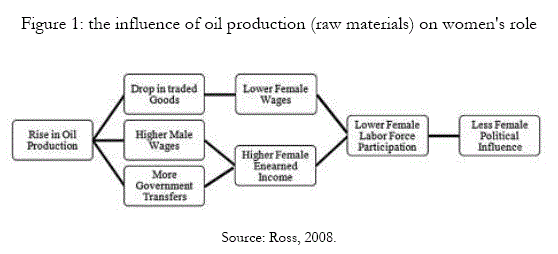
<body><![CDATA[<p align="justify"><font face="Verdana, Arial, Helvetica, sans-serif" size="2">Considering religion as one of the influential factors in economic and social problems has root in the integration of religious belief in different affairs. In short, religion is a suggestion for individual and collective choices that also includes participation in the labor market. In addition, religion has a specific concentration on women's status as a member of the community. The relationship between religion and women's employment is based on this fact that religion has a deep connection with the role of gender in the household (Foroutan, 2009).</font></p>     <p align="justify"><font face="Verdana, Arial, Helvetica, sans-serif" size="2">Even though there is ever-growing literature about effects of religion on economic and social behavior (Lutz, 1987; Kehrer, 1995, 1996, 1999 and 2004; Morgan et al, 2002; Dharmalingam and Morgan, 2004; McQuiilan, 2004; Foroutan, 2007and 2008b), the influence of religion on women's labor has rarely been studied (Lecher, 1995; Lehrer, 2004). Therefore, integrated and specified studies on the matter, possesses a great deal of importance. There are researches about determinants of low female participation rates (FPRs) in Islamic  Countries;  reasons   such  as  lower women's  human  capital  and</font> <font face="Verdana, Arial, Helvetica, sans-serif" size="2">limitations in some technical knowledge divided work places and women's special Islamic dress codes (having to wear &quot;hijab&quot;) and also prohibition of occupation of many so-called &quot;male jobs&quot; and interaction with unacquainted men have been mentioned as major obstacles to women's employment in Islamic countries (Boserup, 1970; Siraj, 1984; Clark et al, 1991; Bloom and Brender, 1993; Anker, 1997; Moghadam, 1999; Carr and Chen, 2004).</font></p>     <p align="justify"><font face="Verdana, Arial, Helvetica, sans-serif" size="2">Nevertheless, women's participation rates in some sectors of these countries have been significantly high. Socially acceptable jobs forwomen in Islamic Countries are mainly in groups such as teaching, nursing and house working. High proportion of unpaid family workers among women is the major cause of underestimation of the real women's activity rates; since it falls under the category of inactivity in many censuses (Omran and Roudi, 1993; Zurayk and Saadeh, 1995; Fargues, 2005).</font></p>     <p align="justify"><font face="Verdana, Arial, Helvetica, sans-serif" size="2">Some researchers consider the low FPRs in Islamic countries as a direct impact of religion (Gallagher and Searle, 1983; Lutz, 1987; Caldwell, 1986; Clark et al, 1991; Obermeyer, 1992; anker, 1998; Caldwell and Khuda, 2000; Casterline et al, 2001; Mishra, 2004). They believe that religious belief is the main reason behind lower FPR in the labor market.</font></p>     <p align="justify"><font face="Verdana, Arial, Helvetica, sans-serif" size="2">However, some researchers have a quite different point of view. They believe that Islam, on its own, puts no restriction on the operation of female labor force whatsoever (Weeks, 1988; Ross, 2008). They consider geographical conditions and historical understanding instead of religion (Ferdows, 1983; Ghallab, 1984; Ahmad, 1992). Some scholars argue that norms and traditions (Carens and Williams, 1996; Weeks, 1988), wrong interpretation of religion (Shariati, 1971; obermeyer, 1992; Fadel, 1997; Roy. 2002; Saeed, 2003) and social and economic development levels (Lucas, 1980;</font> <font face="Verdana, Arial, Helvetica, sans-serif" size="2">Chamie, 1981; Ahmad and Zuzicka, 1988; Omran and Rudi, 1993; Morgan et al, 2002; Jones, 2005) are the main reasons for low FPR in the labor market.</font></p>     <p align="justify"><font face="Verdana, Arial, Helvetica, sans-serif" size="2">Even though women in the Middle East, in comparison to other regions, have experienced less social-economic progress, but the main reason for differences in women's position is the economic structure of dependency to oil revenues in this region. Oil-Dependent Countries (ODCs), generally suffer from imperfections such as Dutch Disease and Resource Curse. High value of domestic currency, relatively cheap imported goods, and strong motives of the private sector to gain from the oil rent restrict productive investment and job generation. In such situations, adequate vacancies for women are limited (Ross, 2008). Relying on petroleum as the main source of revenue combined with less participation of women influences the gender relations as well. Inability of women to participate in non-agricultural labor force leads to less power of women in the family and society. It also has deep political effects: when fewer women are working outside the house, women would have fewer abilities to exchange information or overcome common obstacles; and also would have less incentive for gaining political positions (<a href="#f1">figure 1</a>).</font></p>     <p align="center"><a name="f1"></a><img src="/img/revistas/ec/v5n4/a03_figura01.gif" width="558" height="254"></p>     <p align="justify"><font face="Verdana, Arial, Helvetica, sans-serif" size="2"><b>2.1.    Literature Review</b></font></p>     <p align="justify"><font face="Verdana, Arial, Helvetica, sans-serif" size="2">The effects of religion on women's participation in the labor market have been a center of attention in some researches. Bainbridge and Hatch (1982) studied the correlation of religious values (estimated as the rate of church attending) and the rate of women in professional jobs (manager, bank clerk, lawyer, judge and physician), using the data from the census of 1930 and 1970 in 93 cities of the US. They found that religious beliefs have no correlation with female's job positions.</font></p>     <p align="justify"><font face="Verdana, Arial, Helvetica, sans-serif" size="2">Morgan and Scanzoni (1987) studied the incentives of 325 female students for entering the labor market and searching jobs considering their religious beliefs. Based on their findings, religious beliefs have negative impact on FPR. Hertel (1988) calculated the correlation between church attending rate and the female participation rate during 1972-85. The results of his study show that women with weaker religious belief have higher participation rates.</font></p>     ]]></body>
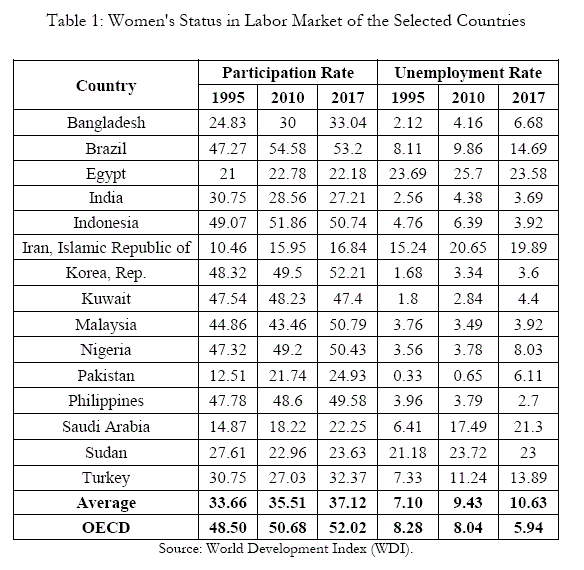
<body><![CDATA[<p align="justify"><font face="Verdana, Arial, Helvetica, sans-serif" size="2">Heaton (1994) argued that the participation rate of women with religious beliefs defending the traditional family roles is almost near the national average FPR. Foroutan (2006) in his paper &quot;Sociology of Religion and Gender&quot; studies the theoretical and empirical basis of the relationship between religion and gender differences, emphasizing the women's employment in Islamic countries. He shows that women's education and factors related to their family conditions —especially (nun) existence of infants and the age of the youngest child —in comparison to the effect of religion have much more important effects on women's employment. In fact, the Muslim women's participation rate is more under the influence of different social-cultural environments than their religious beliefs.</font></p>     <p align="justify"><font face="Verdana, Arial, Helvetica, sans-serif" size="2">Foroutan (2009), using a logistic model, studies the correlation between religion and women's employment to show whether religion merely leads to the gender inequalities in the labor market among Muslims and non-Muslims in the multicultural environment of Australia. His findings show that family structures and the households stock of human capital (especially education) has much stronger effects on female participation rates than religious differences.</font></p>     <p align="justify"><font face="Verdana, Arial, Helvetica, sans-serif" size="2">Most of the studies in Iran about the relationship between Islam and women's employment focus on the religious principles (feghh) and there are very few studies focusing on economic factors. Azarbayjani (2007) studies women's employment from an Islamic point of view. Based on verses of Quran (ayat) and the sayings (revayat), he emphasizes on women's right to participate in permitted (halal) activities. Bent Al Hoda Tajik (2012) studies the Quran's verses about women's employment and emphasizes that in Islam, earning money is permitted (halal) for women.</font></p>     <p align="justify">&nbsp;</p>     <p align="justify"><font face="Verdana, Arial, Helvetica, sans-serif" size="3"><b>3.   STATUS OF WOMEN IN MUSLIM AND NON-MUSLIM COUNTRIES</b></font></p>     <p align="justify"><font face="Verdana, Arial, Helvetica, sans-serif" size="2"><b>In </b>order to evaluate the impact of different religions on women's status in the labor market, key indicators of women's presence in the labor market are studied among 16 selected Muslim and Non-Muslim developing countries; and the average indexes are compared with OECD data as the benchmark of women's participation in the labor market in industrial countries.</font></p>     <p align="justify"><font face="Verdana, Arial, Helvetica, sans-serif" size="2">Non-Muslim countries in our study are Brazil, India and South Korea. Selected Islamic countries are Bangladesh, Egypt, Indonesia, Iran, Turkey, Kuwait, Malaysia, Nigeria, Pakistan, Philippine, Saudi Arabia, and Sudan. Among all these countries Islam is the major religion but even though they are Muslim countries, their women employment indices are quite different.</font></p>     <p align="justify"><font face="Verdana, Arial, Helvetica, sans-serif" size="2"><b>3.1.</b>&nbsp; &nbsp; &nbsp;<b>Female Participation Rate (FPR)</b></font></p>     <p align="justify"><font face="Verdana, Arial, Helvetica, sans-serif" size="2">During the period of 1995 — 2017 Iran and Saudi Arabia had the least average FPR in comparison with other nations. Moreover, in the three years reported in the table, Iran is always one of the third countries with the least Female Participation Rate. Pakistan is another country which is almost all the time, one of the three countries with the least FPR. On the other hand, the highest average FPR in the period belongs to Brazil and Indonesia after that.</font></p>     <p align="justify"><font face="Verdana, Arial, Helvetica, sans-serif" size="2">FPR in Indonesia, which is the most populated Islamic Country, is considerably high and almost as high as the OECD members. Furthermore, FPR in Pakistan during the studied period has increased very rapidly from 12.51 in 1995 to 21.74 percent in 2010 and kept increasing to 24.93 percent in 2017. The FPR in Malaysia (another Muslim country) is much higher than India and FPR in turkey is close to India. Comparing FPRs among our selected Islamic and Non-Islamic Countries explicitly shows no evidence or pattern of Islam being an obstacle in front of women's participation in the labor market.</font></p>     ]]></body>
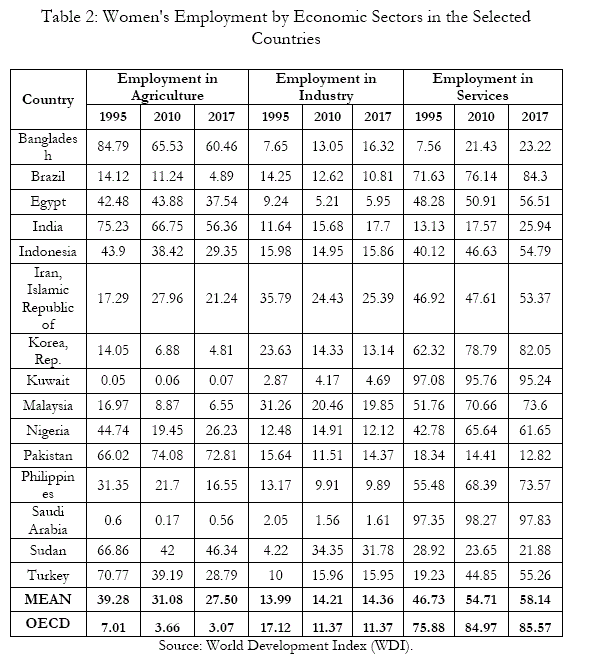
<body><![CDATA[<p align="justify"><font face="Verdana, Arial, Helvetica, sans-serif" size="2">While in Saudi Arabia, women's participation in the labor market has improved by reaching 22 percent in 2017. On the other hand, some countries such as Malaysia have experienced considerable increases in FPR. Finally, the evidence explicitly shows many countries with Muslim majority which have FPRs higher than the average for the OECD member nations.</font></p>     <p align="justify"><font face="Verdana, Arial, Helvetica, sans-serif" size="2"><b>3.2.</b>&nbsp; &nbsp; <b>Female Unemployment Rate</b></font></p>     <p align="justify"><font face="Verdana, Arial, Helvetica, sans-serif" size="2">In 2017, Philippines and Korea had the lowest female unemployment rates (less than 4 percent); while, Egypt and Sudan had the highest female unemployment rates (More than 20 percent) among the selected countries</font></p>     <p align="justify"><font face="Verdana, Arial, Helvetica, sans-serif" size="2">(<a href="#t1">Table 1</a>). Female unemployment rates in Bangladesh, India and Pakistan were lower and in Iran and Egypt were higher than the average value. During 1995-2017, the average female unemployment rate among the selected countries was higher than the OECD average.</font></p>     <p align="justify"><font face="Verdana, Arial, Helvetica, sans-serif" size="2">During This period, the average unemployment rate for Pakistan (a Muslim majority nation) is the least. Kuwait and Philippines are also among the 5 lowest average unemployment rates for women. This index as well as the FPR, shows little evidence that Islam is an obstacle in front of women's employment. As, women's unemployment rate decreased in Philippines as a country with a majority of Muslim population and increased in Brazil that is a non-Muslim country.</font></p>     <p align="center"><a name="t1"></a><img src="/img/revistas/ec/v5n4/a03_figura02.gif" width="584" height="570"></p>     <p align="justify"><font face="Verdana, Arial, Helvetica, sans-serif" size="2"><b>3.3.    Female Employment by Economic Sectors</b></font></p>     <p align="justify"><font face="Verdana, Arial, Helvetica, sans-serif" size="2"><b>3.3.1.</b>&nbsp;<b>Female Employment in Agriculture</b></font></p>     <p align="justify"><font face="Verdana, Arial, Helvetica, sans-serif" size="2">According to the data reported in <a href="#t2">table 2</a>, on average, 34 percent of the women in the countries under study were employed in agriculture. That being said, Pakistan, Bangladesh and India (two of which being Muslim majority nations) have pushed most of their female labor force into the agriculture sector. On the other hand, Kiewit and Saudi Arabia have close to no female employment in the agriculture sector.</font></p>     <p align="justify"><font face="Verdana, Arial, Helvetica, sans-serif" size="2">One key point regarding the matter is the changes in female employment in this sector in some countries. On one hand, the share of employment in agriculture has increased considerably. On the other hand, the share of employment in agriculture has decreased drastically and many women have left for employment in other sectors from 1995 till 2017.</font></p>     ]]></body>
<body><![CDATA[<p align="justify"><font face="Verdana, Arial, Helvetica, sans-serif" size="2"><b>3.3.2.</b>&nbsp;<b>Famele Employment in Industry</b></font></p>     <p align="justify"><font face="Verdana, Arial, Helvetica, sans-serif" size="2">Saudi Arabia and Kuwait had the lowest average rate of female employment in industries during 1995 — 2017; while, Iran and Malaysia had the highest average rate of female employment in this sector (<a href="#t2">Table 2</a>). It should be noted that most of the industrial jobs of women workers in Iran are related to handicrafts, especially carpets and women have a very low share of employment in manufacturing.</font></p>     <p align="justify"><font face="Verdana, Arial, Helvetica, sans-serif" size="2">The average ratio of female employment in industries in the selected developing countries was slightly higher than the OECD average. Sudan with</font> <font face="Verdana, Arial, Helvetica, sans-serif" size="2">a jump from 4.22 percent in 1995 to 31.78 percent in 2017 and Malaysia with a sharp drop from 31.26 percent in 1995 to 19.85 percent in 2017, had the most considerable changes in female employment in industries. Thanks to increasing production and industrial exports, especially in textile and clothing, Turkey has created various jobs for women in her industrial sector.</font></p>     <p align="justify"><font face="Verdana, Arial, Helvetica, sans-serif" size="2"><b>3.3.3. Famele Employment in Services</b></font></p>     <p align="justify"><font face="Verdana, Arial, Helvetica, sans-serif" size="2">Similar to the trend of changing pattern of jobs in the world, in most of the selected countries the ratio of women's employment in services has been increasing. For instance, in Turkey the proportion of female employment in the services raised about 36 percent during 1995 - 2017. This rate for Malaysia was more than 50 percent. In these two countries, the tourism industry had a significant growth which resulted in different job opportunities for men and women in activities such as hotel, restaurants, transportation and retail and whole sale. The growth in education, healthcare, banking... had also positive impact on the women's employment in services in most of the developing and industrial countries. Among the selected countries, Brazil, Saudi Arabia and Kuwait had the highest rate of female employment in services; while, Bangladesh, India and Pakistan had the lowest rate. Bangladesh, however, shows a sharp upward trend in female employment in services from 7.56 percent in 1995 to 23.22 percent in 2017.</font></p>     <p align="justify"><font face="Verdana, Arial, Helvetica, sans-serif" size="2">Between 1995 and 2017, the average ratio of female employment in services sector of the selected countries was much less than OECD members. Although the growth rate of female employment in services in Iran and Pakistan was not considerable, other countries show considerable jumps in employment in services such as Turkey.</font></p>     <p align="justify"><font face="Verdana, Arial, Helvetica, sans-serif" size="2">The status of women's activities and employment ratios in different economic sectors has had a somewhat similar pattern. In other words, the better the economic conditions of a country, the higher proportion of active women and higher share for women employment in industries and services. Among the selected countries that had an adequate employment condition for women and had also an acceptable economic situation Malaysia, Bangladesh and Kuwait are from the Islamic countries and Brazil and Korea are from Non-Islamic countries.</font></p>     <p align="center"><a name="t2"></a><img src="/img/revistas/ec/v5n4/a03_figura03.gif" width="589" height="661"></p>     <p align="justify"><font face="Verdana, Arial, Helvetica, sans-serif" size="2">In overall, among the selected Islamic countries, women's status in the labor market is consistent with the economic conditions of the country. Thus, it is safe to say that Islam has no direct negative influence on women's status in the labor market what so ever. Instead, it is the poor state of economic indices that results in inadequate female participation and employment indices.</font></p>     <p align="justify">&nbsp;</p>     ]]></body>
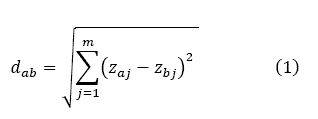
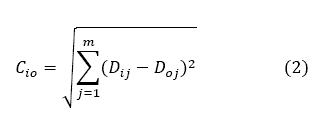
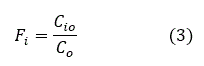
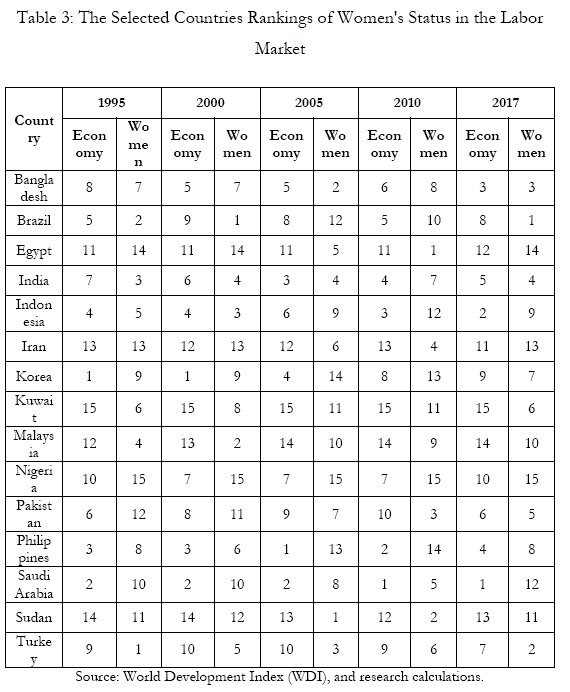
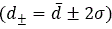
<body><![CDATA[<p align="justify"><font face="Verdana, Arial, Helvetica, sans-serif" size="3"><b>4.   RANKING SELECTED COUNTRIES</b></font></p>     <p align="justify"><font face="Verdana, Arial, Helvetica, sans-serif" size="2">For ranking the selected countries regarding to their economic conditions as well as based on their indices for female status in the labor market, we use numerical taxonomy. As it can be seen in <a href="#t1">tables 1</a> and <a href="#t2">2</a>, the countries with better economic conditions possess better ranking in female labor market indices too. Because of the diversity of labor market indices and economic indicators, numerical taxonomy is a compatible tool to rank the surveying countries and it would provide the possibility of comparison of the selected developing countries.</font></p>     <p align="justify"><font face="Verdana, Arial, Helvetica, sans-serif" size="2">In numerical taxonomy the data are ascending (the more the value the better the situation); so, unemployment rate must be reversed so that comparison for all the values have the same condition. The data are put in a matrix with the indices in columns and the countries in rows. All data are normalized,<sup>1</sup> and the distance matrix is estimated as follow:</font></p>     <p align="center"><img src="/img/revistas/ec/v5n4/a03_figura04.gif" width="318" height="119"></p>     <p align="justify"><font face="Verdana, Arial, Helvetica, sans-serif" size="2">Where d<sub>ab</sub> is the distance between the two points a and b and z<sub>aj</sub> and z<sub>bj</sub> are the standardized values of the two columns a and b.</font></p>     <p align="justify"><font face="Verdana, Arial, Helvetica, sans-serif" size="2">The result is a symmetric matrixwith the original diagonal of zero (d<sub>aa</sub>= 0). Then we estimate the upper and lower limits <img src="/img/revistas/ec/v5n4/a03_figura05.gif" width="84" height="17">. Each of the distances between these two limits are considered a homogenous value. Encountering any heterogeneous values, we normalize the distance matrix and take the maximum of each column as the ideal value. Afterwards using equation (2) we estimate the standardized distance matrix:</font></p>     <p align="center"><img src="/img/revistas/ec/v5n4/a03_figura06.gif" width="326" height="122"></p>     <p align="justify"><font face="Verdana, Arial, Helvetica, sans-serif" size="2">Where C<sub>io</sub> is the development ideal value, D<sub>oj</sub> is the ideal value of each country and D<sub>ij</sub> consists of the elements of development ideal values. Finally, in order to rank the countries we estimate the index of underdevelopment (equation 3):</font></p>     <p align="center"><img src="/img/revistas/ec/v5n4/a03_figura07.gif" width="204" height="66"></p>     <p align="justify"><font face="Verdana, Arial, Helvetica, sans-serif" size="2">C<sub>o</sub> is the lower limit.</font></p>     ]]></body>
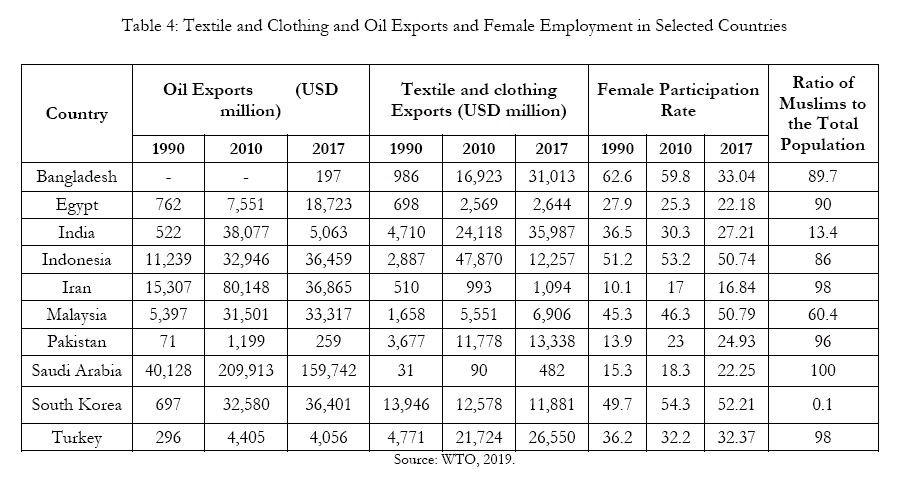
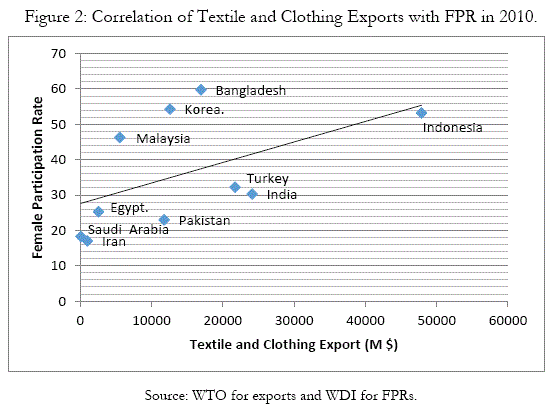
<body><![CDATA[<p align="justify"><font face="Verdana, Arial, Helvetica, sans-serif" size="2">The values of underdevelopment index are between zero and one and the lower values indicate the better performance.<sup>2</sup> The ranking of the selected countries based on a variety of female labor indices besides each country's economic indicators is shown in <a href="#t3">table 3</a>.</font></p>     <p align="justify"><font face="Verdana, Arial, Helvetica, sans-serif" size="2"><a href="#t3">Table 3</a> clearly shows that countries with poor economic conditions experience poor status of women in their labor market too. Sharp difference among Islamic countries regarding the status of women in the labor in dicates that religion is not the determining factor of women's presence in the labor market of Muslim countries. For instance, India and Pakistan (one Islamic and the other non — Islamic) have a relatively good economic performance as well as a somewhat female friendly labor market during 1995-2017.</font></p>     <p align="justify"><font face="Verdana, Arial, Helvetica, sans-serif" size="2">On the contrary, Nigeria has a low ranking both in economic conditions and the feminine side of the labor market. Although some countries such as Kuwait and Saudi Arabia achieved high ranks in economic conditions while having low ranks in female friendly conditions, their economy is mostly comprised of capital intensive industries and mostly relies on export of petroleum and oil. This was discussed in the theoretical debates.</font></p>     <p align="center"><a name="t3"></a><img src="/img/revistas/ec/v5n4/a03_figura08.gif" width="570" height="692"></p>     <p align="justify">&nbsp;</p>     <p align="justify"><strong><font face="Verdana, Arial, Helvetica, sans-serif" size="3">5.   TEXTILE AND CLOTHING EXPORTS</font></strong></p>     <p align="justify"><font face="Verdana, Arial, Helvetica, sans-serif" size="2">As it was shown in <a href="#t3">table 3</a> the highest female participation rates among the selected Islamic countries belongs to Indonesia, Malaysia and Bangladesh. During 1990-2017 the export of textile and clothing in these countries increased considerably. Although this rate in Pakistan is not high but in the study period there is an upward trend. Also in Pakistan the raise in export of textile and clothing from USD 3,677 million in 1990 to USD 11,778 million in 2010 and to 13,338 in 2017 had a great role in creating new jobs for women in the labor market. While, increasing oil exports could not provide such job opportunities for women.</font></p>     <p align="center"><img src="/img/revistas/ec/v5n4/a03_figura09.gif" width="901" height="479"></p>     <p align="justify"><font face="Verdana, Arial, Helvetica, sans-serif" size="2">In Iran and Saudi Arabia with low textile and clothing exports and high oil revenues, female participation rates were very low. Although Islam is the common religion in Turkey, Indonesia, Malaysia, Pakistan, Iran and Saudi Arabia, but in countries with high textile and clothing exports, have higher women's participation rates where in oil exporting countries lower job opportunities ended in low female participation rates. In fact, huge revenues from natural resources exports that generally leads to appreciation of domestic currency (Dutch Disease) and accelerating incentives for rent seeking activities in such countries have negative impact on labor intensive industries such as textile and clothing and destroy the competitiveness of tradable products and hence the oil rich and populated countries (Iran and Saudi Arabia) are faced with employment problems. <a href="#f2">Figure (2)</a> shows the correlation between textile and clothing exports and Female Participation Rate in the labor market of the selected developing countries.</font></p>     <p align="center"><a name="f2"></a><img src="/img/revistas/ec/v5n4/a03_figura10.gif" width="556" height="415"></p>     ]]></body>
<body><![CDATA[<p align="justify"><font face="Verdana, Arial, Helvetica, sans-serif" size="2">It is needless to say that the female participation rate is affected by various factors, such as the share of agriculture in GDP; but is the estimated regression line shows a direct positive relationship between textile and clothing exports and female employment (<a href="#f2">figure 2</a>). This direct relationship is caused by the high number and proportion of job opportunities for women in textile and clothing of most developing countries. In Iran and Saudi Arabia that have exports of textile and clothing are low, female participation rates are also less than the other selected countries. Therefore, the status of women in labor market is not similar in all Muslim countries and different economic conditions resulted in different positions for women in the labor market.</font></p>     <p align="justify">&nbsp;</p>     <p align="justify"><font face="Verdana, Arial, Helvetica, sans-serif" size="3"><strong>6.   COCLUSI&Oacute;N</strong></font></p>     <p align="justify"><font face="Verdana, Arial, Helvetica, sans-serif" size="2">In this paper we studied the status of women in the labor market among Islamic and non-Islamic countries analyzing the data regarding female participation rates and employment in economic sectors to determine whether the position of women in the labor market of Muslim countries is affected by Islam.</font></p>     <p align="justify"><font face="Verdana, Arial, Helvetica, sans-serif" size="2">Among the selected countries 11 were mainly Muslim and the restwere non- Muslim countries. By providing indicators of employment, participation and unemployment rates of women and macroeconomic variables for the selected countries we ranked these countries on the basis of their economic conditions and women's status in the labor market. The results of our study show that countries with better economic conditions, regardless of their main religion, have also better women's position in the labor market. Therefore, low female participation rates among some Muslim Countries are not the outcome of Islam but the economic structure of these countries prevented women's presence in the labor market.</font></p>     <p align="justify"><font face="Verdana, Arial, Helvetica, sans-serif" size="2">In countries with increasing exports of labor intensive commodities such as textile and clothing and tourism industry, various job opportunities opens up for women; while, in oil rich countries with uncompetitive labor intensive productions the possibility to find jobs for women is limited.</font></p>     <p align="justify">&nbsp;</p>     <p align="justify"><strong><font size="3" face="Verdana, Arial, Helvetica, sans-serif">NOTE</font></strong></p>     <p align="justify"><font size="2" face="Verdana, Arial, Helvetica, sans-serif"><sup>1</sup> Zi=(Xi-&mu;<sub>i</sub>)/&sigma;<sub>i</sub></font></p>     <p align="justify"><font size="2" face="Verdana, Arial, Helvetica, sans-serif"><sup>2</sup> For more info try Masoud et al (2009)</font></p>     ]]></body>
<body><![CDATA[<p align="justify">&nbsp;</p>     <p align="justify"><font face="Verdana, Arial, Helvetica, sans-serif" size="3"><strong>REFERENCES</strong></font></p>     <!-- ref --><p align="justify"><font face="Verdana, Arial, Helvetica, sans-serif" size="2">Ahmed, L. 1992. Women and Gender in Islam: Historical Roots of a Modern Debate, Yale University Press.</font>&nbsp;&nbsp;&nbsp;&nbsp;&nbsp;&nbsp;&nbsp;&nbsp;[&#160;<a href="javascript:void(0);" onclick="javascript: window.open('/scielo.php?script=sci_nlinks&ref=1272549&pid=S2415-0622202000040000300001&lng=','','width=640,height=500,resizable=yes,scrollbars=1,menubar=yes,');">Links</a>&#160;]<!-- end-ref --><!-- ref --><p align="justify"><font face="Verdana, Arial, Helvetica, sans-serif" size="2">Anker, R. 1997. Theories of occupational segregation by sex: an overview, International Labor Review, 136 (3): 1-14.</font>&nbsp;&nbsp;&nbsp;&nbsp;&nbsp;&nbsp;&nbsp;&nbsp;[&#160;<a href="javascript:void(0);" onclick="javascript: window.open('/scielo.php?script=sci_nlinks&ref=1272550&pid=S2415-0622202000040000300002&lng=','','width=640,height=500,resizable=yes,scrollbars=1,menubar=yes,');">Links</a>&#160;]<!-- end-ref --><!-- ref --><p align="justify"><font face="Verdana, Arial, Helvetica, sans-serif" size="2">Anker, R. 1998. Gender and Job: Sex Segregation of Occupations in the World, Geneva: International Labor Organization.</font>&nbsp;&nbsp;&nbsp;&nbsp;&nbsp;&nbsp;&nbsp;&nbsp;[&#160;<a href="javascript:void(0);" onclick="javascript: window.open('/scielo.php?script=sci_nlinks&ref=1272551&pid=S2415-0622202000040000300003&lng=','','width=640,height=500,resizable=yes,scrollbars=1,menubar=yes,');">Links</a>&#160;]<!-- end-ref --><!-- ref --><p align="justify"><font face="Verdana, Arial, Helvetica, sans-serif" size="2">Anker, R. and M. Anker. 1995. Measuring female labor force with emphasis on Egypt, Pp. 148- 176 in N. F. Khoury and V. M. Moghadam (eds.), Gender and Development in the Arab World, The United Nations University Press.</font>&nbsp;&nbsp;&nbsp;&nbsp;&nbsp;&nbsp;&nbsp;&nbsp;[&#160;<a href="javascript:void(0);" onclick="javascript: window.open('/scielo.php?script=sci_nlinks&ref=1272552&pid=S2415-0622202000040000300004&lng=','','width=640,height=500,resizable=yes,scrollbars=1,menubar=yes,');">Links</a>&#160;]<!-- end-ref --><!-- ref --><p align="justify"><font face="Verdana, Arial, Helvetica, sans-serif" size="2">Azarbayjani, M. 2007. Islam and Female Employment. Journal of Sociology and Social Science, 4:43-56.</font>&nbsp;&nbsp;&nbsp;&nbsp;&nbsp;&nbsp;&nbsp;&nbsp;[&#160;<a href="javascript:void(0);" onclick="javascript: window.open('/scielo.php?script=sci_nlinks&ref=1272553&pid=S2415-0622202000040000300005&lng=','','width=640,height=500,resizable=yes,scrollbars=1,menubar=yes,');">Links</a>&#160;]<!-- end-ref --><!-- ref --><p align="justify"><font face="Verdana, Arial, Helvetica, sans-serif" size="2">Bainbridge, William S. and L. R. Hatch. 1982. &quot;Women's Access to Elite Careers: In Search of a Religion Effect.&quot; Journal for the Scientific Study of Religion 21:242-55.</font>&nbsp;&nbsp;&nbsp;&nbsp;&nbsp;&nbsp;&nbsp;&nbsp;[&#160;<a href="javascript:void(0);" onclick="javascript: window.open('/scielo.php?script=sci_nlinks&ref=1272554&pid=S2415-0622202000040000300006&lng=','','width=640,height=500,resizable=yes,scrollbars=1,menubar=yes,');">Links</a>&#160;]<!-- end-ref --><!-- ref --><p align="justify"><font face="Verdana, Arial, Helvetica, sans-serif" size="2">Bloom, D. and A. Brender. 1993. Labor and the earning world economy, Population Bulletin, 48 (2): 1-32.</font>&nbsp;&nbsp;&nbsp;&nbsp;&nbsp;&nbsp;&nbsp;&nbsp;[&#160;<a href="javascript:void(0);" onclick="javascript: window.open('/scielo.php?script=sci_nlinks&ref=1272555&pid=S2415-0622202000040000300007&lng=','','width=640,height=500,resizable=yes,scrollbars=1,menubar=yes,');">Links</a>&#160;]<!-- end-ref --><!-- ref --><p align="justify"><font face="Verdana, Arial, Helvetica, sans-serif" size="2">Boserup, E. 1970. Women's Role in Economic Development, London: George Allen and Unwin Ltd.</font>&nbsp;&nbsp;&nbsp;&nbsp;&nbsp;&nbsp;&nbsp;&nbsp;[&#160;<a href="javascript:void(0);" onclick="javascript: window.open('/scielo.php?script=sci_nlinks&ref=1272556&pid=S2415-0622202000040000300008&lng=','','width=640,height=500,resizable=yes,scrollbars=1,menubar=yes,');">Links</a>&#160;]<!-- end-ref --><!-- ref --><p align="justify"><font face="Verdana, Arial, Helvetica, sans-serif" size="2">Caldwell, B. and Barkat-e- Khuda. 2000. The first generation to control family size: a microstudy of the causes of fertility decline in a rural area of Bangladesh, Studies in Family Planning, 31 (3): 239-251.</font>&nbsp;&nbsp;&nbsp;&nbsp;&nbsp;&nbsp;&nbsp;&nbsp;[&#160;<a href="javascript:void(0);" onclick="javascript: window.open('/scielo.php?script=sci_nlinks&ref=1272557&pid=S2415-0622202000040000300009&lng=','','width=640,height=500,resizable=yes,scrollbars=1,menubar=yes,');">Links</a>&#160;]<!-- end-ref --><!-- ref --><p align="justify"><font face="Verdana, Arial, Helvetica, sans-serif" size="2">Caldwell, J. C. 1986. Routes to low mortality in poor countries, Population and Development Review, 12 (2): 171-220.</font>&nbsp;&nbsp;&nbsp;&nbsp;&nbsp;&nbsp;&nbsp;&nbsp;[&#160;<a href="javascript:void(0);" onclick="javascript: window.open('/scielo.php?script=sci_nlinks&ref=1272558&pid=S2415-0622202000040000300010&lng=','','width=640,height=500,resizable=yes,scrollbars=1,menubar=yes,');">Links</a>&#160;]<!-- end-ref --><!-- ref --><p align="justify"><font face="Verdana, Arial, Helvetica, sans-serif" size="2">Carens, J. H. and M. Williams. 1996. Muslim minorities in liberal democracies: the politics of misrecognition, Pp. 157-186 in R. Baubock, A. Heller and A. R. Zolberg (eds), The Challenge of Diversity: Integration and Pluralism in Societies of Immigration&quot;, Avebury: Ashgate Publishing Limited.</font>&nbsp;&nbsp;&nbsp;&nbsp;&nbsp;&nbsp;&nbsp;&nbsp;[&#160;<a href="javascript:void(0);" onclick="javascript: window.open('/scielo.php?script=sci_nlinks&ref=1272559&pid=S2415-0622202000040000300011&lng=','','width=640,height=500,resizable=yes,scrollbars=1,menubar=yes,');">Links</a>&#160;]<!-- end-ref --><!-- ref --><p align="justify"><font face="Verdana, Arial, Helvetica, sans-serif" size="2">Carr, M. and M. Chen. 2004. Globalization, social exclusion and gender, International Labor Review, 143 (1-2): 129-160.</font>&nbsp;&nbsp;&nbsp;&nbsp;&nbsp;&nbsp;&nbsp;&nbsp;[&#160;<a href="javascript:void(0);" onclick="javascript: window.open('/scielo.php?script=sci_nlinks&ref=1272560&pid=S2415-0622202000040000300012&lng=','','width=640,height=500,resizable=yes,scrollbars=1,menubar=yes,');">Links</a>&#160;]<!-- end-ref --><!-- ref --><p align="justify"><font face="Verdana, Arial, Helvetica, sans-serif" size="2">Casterline, J. B. et al. 2001. Obstacles to contraceptive use in Pakistan: A Study m Punjab, Studies m Family Planning, 32 (2): 95-110.</font>&nbsp;&nbsp;&nbsp;&nbsp;&nbsp;&nbsp;&nbsp;&nbsp;[&#160;<a href="javascript:void(0);" onclick="javascript: window.open('/scielo.php?script=sci_nlinks&ref=1272561&pid=S2415-0622202000040000300013&lng=','','width=640,height=500,resizable=yes,scrollbars=1,menubar=yes,');">Links</a>&#160;]<!-- end-ref --><!-- ref --><p align="justify"><font face="Verdana, Arial, Helvetica, sans-serif" size="2">Chamie, J. 1981. Religion and Fertility: Arab Christian-Muslim Differentials, Cambridge: Cambridge University Press.</font>&nbsp;&nbsp;&nbsp;&nbsp;&nbsp;&nbsp;&nbsp;&nbsp;[&#160;<a href="javascript:void(0);" onclick="javascript: window.open('/scielo.php?script=sci_nlinks&ref=1272562&pid=S2415-0622202000040000300014&lng=','','width=640,height=500,resizable=yes,scrollbars=1,menubar=yes,');">Links</a>&#160;]<!-- end-ref --><!-- ref --><p align="justify"><font face="Verdana, Arial, Helvetica, sans-serif" size="2">Clark, R., T. W. Ramsbey and E. S. Adler. 1991. Culture, gender, and labor force participation: a cross-national study, Gender and Society, 5 (1): 47-66.</font>&nbsp;&nbsp;&nbsp;&nbsp;&nbsp;&nbsp;&nbsp;&nbsp;[&#160;<a href="javascript:void(0);" onclick="javascript: window.open('/scielo.php?script=sci_nlinks&ref=1272563&pid=S2415-0622202000040000300015&lng=','','width=640,height=500,resizable=yes,scrollbars=1,menubar=yes,');">Links</a>&#160;]<!-- end-ref --><!-- ref --><p align="justify"><font face="Verdana, Arial, Helvetica, sans-serif" size="2">Dharmalingam, A. and S. P. Morgan. 2004. Pervasive Muslim-Hindu fertility differences in India, Demography, 41 (3): 529-545.</font>&nbsp;&nbsp;&nbsp;&nbsp;&nbsp;&nbsp;&nbsp;&nbsp;[&#160;<a href="javascript:void(0);" onclick="javascript: window.open('/scielo.php?script=sci_nlinks&ref=1272564&pid=S2415-0622202000040000300016&lng=','','width=640,height=500,resizable=yes,scrollbars=1,menubar=yes,');">Links</a>&#160;]<!-- end-ref --><!-- ref --><p align="justify"><font face="Verdana, Arial, Helvetica, sans-serif" size="2">Fadel, M. 1997. Two women, one man: knowledge, power, and gender in Medieval Sunni legal thought, International Journal of Middle East Studies, 29 (2): 185-204.</font>&nbsp;&nbsp;&nbsp;&nbsp;&nbsp;&nbsp;&nbsp;&nbsp;[&#160;<a href="javascript:void(0);" onclick="javascript: window.open('/scielo.php?script=sci_nlinks&ref=1272565&pid=S2415-0622202000040000300017&lng=','','width=640,height=500,resizable=yes,scrollbars=1,menubar=yes,');">Links</a>&#160;]<!-- end-ref --><!-- ref --><p align="justify"><font face="Verdana, Arial, Helvetica, sans-serif" size="2">Fargues, P. 2005. Women in Arab countries: challenging the patriarchal system?, Reproductive Health Matters, 13 (25): 43-48.</font>&nbsp;&nbsp;&nbsp;&nbsp;&nbsp;&nbsp;&nbsp;&nbsp;[&#160;<a href="javascript:void(0);" onclick="javascript: window.open('/scielo.php?script=sci_nlinks&ref=1272566&pid=S2415-0622202000040000300018&lng=','','width=640,height=500,resizable=yes,scrollbars=1,menubar=yes,');">Links</a>&#160;]<!-- end-ref --><!-- ref --><p align="justify"><font face="Verdana, Arial, Helvetica, sans-serif" size="2">Ferdows, A. K. 1983. Women and Islamic Revolution, International Journal of Middle East Studies, 15 (2): 283-298.</font>&nbsp;&nbsp;&nbsp;&nbsp;&nbsp;&nbsp;&nbsp;&nbsp;[&#160;<a href="javascript:void(0);" onclick="javascript: window.open('/scielo.php?script=sci_nlinks&ref=1272567&pid=S2415-0622202000040000300019&lng=','','width=640,height=500,resizable=yes,scrollbars=1,menubar=yes,');">Links</a>&#160;]<!-- end-ref --><!-- ref --><p align="justify"><font face="Verdana, Arial, Helvetica, sans-serif" size="2">Foroutan, Y. 2009. Competing determinants of women's work: ethnicity, religion and culture. International Population Conference. Morocco.</font>&nbsp;&nbsp;&nbsp;&nbsp;&nbsp;&nbsp;&nbsp;&nbsp;[&#160;<a href="javascript:void(0);" onclick="javascript: window.open('/scielo.php?script=sci_nlinks&ref=1272568&pid=S2415-0622202000040000300020&lng=','','width=640,height=500,resizable=yes,scrollbars=1,menubar=yes,');">Links</a>&#160;]<!-- end-ref --><!-- ref --><p align="justify"><font face="Verdana, Arial, Helvetica, sans-serif" size="2">Foroutan, Y. 2008. Gender and religion: the status of women in the Muslim world, in P. B. Clarke and P. Beyer (eds.), The World's Religions: Continuities and Transformations, London: Routledge Publication.</font>&nbsp;&nbsp;&nbsp;&nbsp;&nbsp;&nbsp;&nbsp;&nbsp;[&#160;<a href="javascript:void(0);" onclick="javascript: window.open('/scielo.php?script=sci_nlinks&ref=1272569&pid=S2415-0622202000040000300021&lng=','','width=640,height=500,resizable=yes,scrollbars=1,menubar=yes,');">Links</a>&#160;]<!-- end-ref --><p align="justify"><font face="Verdana, Arial, Helvetica, sans-serif" size="2">-------.    2007. Determinants of Women's Employment Participation:</font> <font face="Verdana, Arial, Helvetica, sans-serif" size="2">Muslim/Non-Muslim Differentials in Australia. Unpublished PhD Thesis, Canberra: Demography &amp; Sociology Program, Research School of Social Sciences, The Australian National University.</font></p>     <p align="justify"><font face="Verdana, Arial, Helvetica, sans-serif" size="2">-------. 2006. Sociology of Religion and Gender: Theoretical and Empirical Study with Emphasis on Female Employment. Journal of Iran's Social Phenomena, 63:107-138.</font></p>     <!-- ref --><p align="justify"><font face="Verdana, Arial, Helvetica, sans-serif" size="2">Gallagher, E. and M. Searle. 1983. Women's health care: a study of Islamic society, Pp. 85-96 in J. Morgan (ed.), Third World Medicine and Social Change, Lunham Md: University Press of America.</font>&nbsp;&nbsp;&nbsp;&nbsp;&nbsp;&nbsp;&nbsp;&nbsp;[&#160;<a href="javascript:void(0);" onclick="javascript: window.open('/scielo.php?script=sci_nlinks&ref=1272572&pid=S2415-0622202000040000300022&lng=','','width=640,height=500,resizable=yes,scrollbars=1,menubar=yes,');">Links</a>&#160;]<!-- end-ref --><!-- ref --><p align="justify"><font face="Verdana, Arial, Helvetica, sans-serif" size="2">Ghallab, M. E-S. 1984. Population Theory and Policy in the Islamic World, Pp. 233-241 in J. I. Clark (ed.), Geography and Population: Approaches and Applications&quot;, Pergamon Press.</font>&nbsp;&nbsp;&nbsp;&nbsp;&nbsp;&nbsp;&nbsp;&nbsp;[&#160;<a href="javascript:void(0);" onclick="javascript: window.open('/scielo.php?script=sci_nlinks&ref=1272573&pid=S2415-0622202000040000300023&lng=','','width=640,height=500,resizable=yes,scrollbars=1,menubar=yes,');">Links</a>&#160;]<!-- end-ref --><!-- ref --><p align="justify"><font face="Verdana, Arial, Helvetica, sans-serif" size="2">Heaton, Tim B. 1994. &quot;Familial, Socio-Economic, and Religious Behavior: A Comparison of LDS and NonLDS Women.&quot; Dialogue 28:169-83.</font>&nbsp;&nbsp;&nbsp;&nbsp;&nbsp;&nbsp;&nbsp;&nbsp;[&#160;<a href="javascript:void(0);" onclick="javascript: window.open('/scielo.php?script=sci_nlinks&ref=1272574&pid=S2415-0622202000040000300024&lng=','','width=640,height=500,resizable=yes,scrollbars=1,menubar=yes,');">Links</a>&#160;]<!-- end-ref --><!-- ref --><p align="justify"><font face="Verdana, Arial, Helvetica, sans-serif" size="2">Hertel, B. R. 1988. &quot;Gender, Religious Identity, and Work Force Participation.&quot; Journal for the Scientific Study of Religion 27:574—92.</font>&nbsp;&nbsp;&nbsp;&nbsp;&nbsp;&nbsp;&nbsp;&nbsp;[&#160;<a href="javascript:void(0);" onclick="javascript: window.open('/scielo.php?script=sci_nlinks&ref=1272575&pid=S2415-0622202000040000300025&lng=','','width=640,height=500,resizable=yes,scrollbars=1,menubar=yes,');">Links</a>&#160;]<!-- end-ref --><!-- ref --><p align="justify"><font face="Verdana, Arial, Helvetica, sans-serif" size="2">Jones, G. 2005. &quot;A demographic perspective on the Muslim world&quot;, Working Paper No. 42, Singapore: National University of Singapore.</font>&nbsp;&nbsp;&nbsp;&nbsp;&nbsp;&nbsp;&nbsp;&nbsp;[&#160;<a href="javascript:void(0);" onclick="javascript: window.open('/scielo.php?script=sci_nlinks&ref=1272576&pid=S2415-0622202000040000300026&lng=','','width=640,height=500,resizable=yes,scrollbars=1,menubar=yes,');">Links</a>&#160;]<!-- end-ref --><!-- ref --><p align="justify"><font face="Verdana, Arial, Helvetica, sans-serif" size="2">Lecher, E. L. 1995. The role of husband's religion on the economic and demographic behavior of families, Journal for Scientific Study of Religion, 35 (2): 145-155.</font>&nbsp;&nbsp;&nbsp;&nbsp;&nbsp;&nbsp;&nbsp;&nbsp;[&#160;<a href="javascript:void(0);" onclick="javascript: window.open('/scielo.php?script=sci_nlinks&ref=1272577&pid=S2415-0622202000040000300027&lng=','','width=640,height=500,resizable=yes,scrollbars=1,menubar=yes,');">Links</a>&#160;]<!-- end-ref --><!-- ref --><p align="justify"><font face="Verdana, Arial, Helvetica, sans-serif" size="2">Lehrer, E. L. 1996. Religion as a determinant of marital fertility, Journal of Population Economics, 9 (2):173- 196.</font>&nbsp;&nbsp;&nbsp;&nbsp;&nbsp;&nbsp;&nbsp;&nbsp;[&#160;<a href="javascript:void(0);" onclick="javascript: window.open('/scielo.php?script=sci_nlinks&ref=1272578&pid=S2415-0622202000040000300028&lng=','','width=640,height=500,resizable=yes,scrollbars=1,menubar=yes,');">Links</a>&#160;]<!-- end-ref --><!-- ref --><p align="justify"><font face="Verdana, Arial, Helvetica, sans-serif" size="2">Lehrer, E. L. 1999. Married women's labor behavior in the 1990s: differences by life-cycle stage, Social Sciences Quarterly 80 (3):574-590.</font>&nbsp;&nbsp;&nbsp;&nbsp;&nbsp;&nbsp;&nbsp;&nbsp;[&#160;<a href="javascript:void(0);" onclick="javascript: window.open('/scielo.php?script=sci_nlinks&ref=1272579&pid=S2415-0622202000040000300029&lng=','','width=640,height=500,resizable=yes,scrollbars=1,menubar=yes,');">Links</a>&#160;]<!-- end-ref --><!-- ref --><p align="justify"><font face="Verdana, Arial, Helvetica, sans-serif" size="2">Lehrer, E. L. 2004. Religion as determinant of economic and demographic behavior in the United States, Population and Development Review 30</font> <font face="Verdana, Arial, Helvetica, sans-serif" size="2">(4): 707-726.</font>&nbsp;&nbsp;&nbsp;&nbsp;&nbsp;&nbsp;&nbsp;&nbsp;[&#160;<a href="javascript:void(0);" onclick="javascript: window.open('/scielo.php?script=sci_nlinks&ref=1272580&pid=S2415-0622202000040000300030&lng=','','width=640,height=500,resizable=yes,scrollbars=1,menubar=yes,');">Links</a>&#160;]<!-- end-ref --><!-- ref --><p align="justify"><font face="Verdana, Arial, Helvetica, sans-serif" size="2">Lucas, D. 1980. Fertility, Pp. 64-92 in D. Lucas et al (eds), Beginning Population Studies, Canberra: The Australian National University.</font>&nbsp;&nbsp;&nbsp;&nbsp;&nbsp;&nbsp;&nbsp;&nbsp;[&#160;<a href="javascript:void(0);" onclick="javascript: window.open('/scielo.php?script=sci_nlinks&ref=1272581&pid=S2415-0622202000040000300031&lng=','','width=640,height=500,resizable=yes,scrollbars=1,menubar=yes,');">Links</a>&#160;]<!-- end-ref --><!-- ref --><p align="justify"><font face="Verdana, Arial, Helvetica, sans-serif" size="2">Lutz, W. 1987. Culture, religion, and fertility: a global view, Genus, Vol. XLIII, No. 3-4, Pp. 15-34.</font>&nbsp;&nbsp;&nbsp;&nbsp;&nbsp;&nbsp;&nbsp;&nbsp;[&#160;<a href="javascript:void(0);" onclick="javascript: window.open('/scielo.php?script=sci_nlinks&ref=1272582&pid=S2415-0622202000040000300032&lng=','','width=640,height=500,resizable=yes,scrollbars=1,menubar=yes,');">Links</a>&#160;]<!-- end-ref --><!-- ref --><p align="justify"><font face="Verdana, Arial, Helvetica, sans-serif" size="2">Masoud, M. et al. 2009. Determining the Degree of Underdevelopment in Cities of Isfahan Using Numerical Taxonomy. Journal of city and local studies, 8:39-54.</font>&nbsp;&nbsp;&nbsp;&nbsp;&nbsp;&nbsp;&nbsp;&nbsp;[&#160;<a href="javascript:void(0);" onclick="javascript: window.open('/scielo.php?script=sci_nlinks&ref=1272583&pid=S2415-0622202000040000300033&lng=','','width=640,height=500,resizable=yes,scrollbars=1,menubar=yes,');">Links</a>&#160;]<!-- end-ref --><!-- ref --><p align="justify"><font face="Verdana, Arial, Helvetica, sans-serif" size="2">McQuiilan, K. 2004. When does religion influence fertility? Population and Development Review, 30 (1): 25-56.</font>&nbsp;&nbsp;&nbsp;&nbsp;&nbsp;&nbsp;&nbsp;&nbsp;[&#160;<a href="javascript:void(0);" onclick="javascript: window.open('/scielo.php?script=sci_nlinks&ref=1272584&pid=S2415-0622202000040000300034&lng=','','width=640,height=500,resizable=yes,scrollbars=1,menubar=yes,');">Links</a>&#160;]<!-- end-ref --><!-- ref --><p align="justify"><font face="Verdana, Arial, Helvetica, sans-serif" size="2">Mishra V. 2004. &quot;Muslim/non-Muslim differentials in fertility and family planning in India&quot;, East-West Center Working Paper, No. 112, Population and Health Series.</font>&nbsp;&nbsp;&nbsp;&nbsp;&nbsp;&nbsp;&nbsp;&nbsp;[&#160;<a href="javascript:void(0);" onclick="javascript: window.open('/scielo.php?script=sci_nlinks&ref=1272585&pid=S2415-0622202000040000300035&lng=','','width=640,height=500,resizable=yes,scrollbars=1,menubar=yes,');">Links</a>&#160;]<!-- end-ref --><!-- ref --><p align="justify"><font face="Verdana, Arial, Helvetica, sans-serif" size="2">Moghadam V. M. 1999. Gender and globalization: female labor and women's mobilization, Journal of World-System Research, V (2): 367-388.</font>&nbsp;&nbsp;&nbsp;&nbsp;&nbsp;&nbsp;&nbsp;&nbsp;[&#160;<a href="javascript:void(0);" onclick="javascript: window.open('/scielo.php?script=sci_nlinks&ref=1272586&pid=S2415-0622202000040000300036&lng=','','width=640,height=500,resizable=yes,scrollbars=1,menubar=yes,');">Links</a>&#160;]<!-- end-ref --><!-- ref --><p align="justify"><font face="Verdana, Arial, Helvetica, sans-serif" size="2">Morgan, M. Y. and J. Scanzoni. 1987. &quot;Religious Orientations and Women's Expected Continuity in the Labor Force.&quot; Journal of Marriage and the Family 49:367-79.</font>&nbsp;&nbsp;&nbsp;&nbsp;&nbsp;&nbsp;&nbsp;&nbsp;[&#160;<a href="javascript:void(0);" onclick="javascript: window.open('/scielo.php?script=sci_nlinks&ref=1272587&pid=S2415-0622202000040000300037&lng=','','width=640,height=500,resizable=yes,scrollbars=1,menubar=yes,');">Links</a>&#160;]<!-- end-ref --><!-- ref --><p align="justify"><font face="Verdana, Arial, Helvetica, sans-serif" size="2">Morgan, S. P. et al. 2002. Muslim and non-Muslim differences in female autonomy and fertility: evidence from four Asian countries, Population and Development Review, 28 (3): 515- 537.</font>&nbsp;&nbsp;&nbsp;&nbsp;&nbsp;&nbsp;&nbsp;&nbsp;[&#160;<a href="javascript:void(0);" onclick="javascript: window.open('/scielo.php?script=sci_nlinks&ref=1272588&pid=S2415-0622202000040000300038&lng=','','width=640,height=500,resizable=yes,scrollbars=1,menubar=yes,');">Links</a>&#160;]<!-- end-ref --><!-- ref --><p align="justify"><font face="Verdana, Arial, Helvetica, sans-serif" size="2">Obermeyer, C. M. 1992. Islam, women, and politics: the demography of Arab countries, Population and Development Review, 18 (1): 33-60.</font>&nbsp;&nbsp;&nbsp;&nbsp;&nbsp;&nbsp;&nbsp;&nbsp;[&#160;<a href="javascript:void(0);" onclick="javascript: window.open('/scielo.php?script=sci_nlinks&ref=1272589&pid=S2415-0622202000040000300039&lng=','','width=640,height=500,resizable=yes,scrollbars=1,menubar=yes,');">Links</a>&#160;]<!-- end-ref --><!-- ref --><p align="justify"><font face="Verdana, Arial, Helvetica, sans-serif" size="2">Omran, A. R. and F. Roudi. 1993. The Middle East population puzzle, Population Bulletin, 48 (1): 1-38.</font>&nbsp;&nbsp;&nbsp;&nbsp;&nbsp;&nbsp;&nbsp;&nbsp;[&#160;<a href="javascript:void(0);" onclick="javascript: window.open('/scielo.php?script=sci_nlinks&ref=1272590&pid=S2415-0622202000040000300040&lng=','','width=640,height=500,resizable=yes,scrollbars=1,menubar=yes,');">Links</a>&#160;]<!-- end-ref --><!-- ref --><p align="justify"><font face="Verdana, Arial, Helvetica, sans-serif" size="2">Ross, L. M. 2008. Oil, Islam, and Women. American Political Science Review, 102(1): 107-123.</font>&nbsp;&nbsp;&nbsp;&nbsp;&nbsp;&nbsp;&nbsp;&nbsp;[&#160;<a href="javascript:void(0);" onclick="javascript: window.open('/scielo.php?script=sci_nlinks&ref=1272591&pid=S2415-0622202000040000300041&lng=','','width=640,height=500,resizable=yes,scrollbars=1,menubar=yes,');">Links</a>&#160;]<!-- end-ref --><!-- ref --><p align="justify"><font face="Verdana, Arial, Helvetica, sans-serif" size="2">Roy, O. 2002. Globalised Islam: The Search for a New Ummah, London: Hurths &amp; Company.</font>&nbsp;&nbsp;&nbsp;&nbsp;&nbsp;&nbsp;&nbsp;&nbsp;[&#160;<a href="javascript:void(0);" onclick="javascript: window.open('/scielo.php?script=sci_nlinks&ref=1272592&pid=S2415-0622202000040000300042&lng=','','width=640,height=500,resizable=yes,scrollbars=1,menubar=yes,');">Links</a>&#160;]<!-- end-ref --><!-- ref --><p align="justify"><font face="Verdana, Arial, Helvetica, sans-serif" size="2">Saeed, A. 2003. Islam in Australia, NSW: Allen &amp; Unwin.</font>&nbsp;&nbsp;&nbsp;&nbsp;&nbsp;&nbsp;&nbsp;&nbsp;[&#160;<a href="javascript:void(0);" onclick="javascript: window.open('/scielo.php?script=sci_nlinks&ref=1272593&pid=S2415-0622202000040000300043&lng=','','width=640,height=500,resizable=yes,scrollbars=1,menubar=yes,');">Links</a>&#160;]<!-- end-ref --><!-- ref --><p align="justify"><font face="Verdana, Arial, Helvetica, sans-serif" size="2">Shariati, A. 1971. Fatemeh Fatemeh Ast (Fatemeh Is Fatemeh), Tehran: Hoseinieh Ershad Press [in Persian].</font>&nbsp;&nbsp;&nbsp;&nbsp;&nbsp;&nbsp;&nbsp;&nbsp;[&#160;<a href="javascript:void(0);" onclick="javascript: window.open('/scielo.php?script=sci_nlinks&ref=1272594&pid=S2415-0622202000040000300044&lng=','','width=640,height=500,resizable=yes,scrollbars=1,menubar=yes,');">Links</a>&#160;]<!-- end-ref --><!-- ref --><p align="justify"><font face="Verdana, Arial, Helvetica, sans-serif" size="2">Siraj, M. 1984. Islamic attitudes to female employment in industrializing economies: some notes from Malaysia, Pp. 163-173 in G. W. Jones (ed.), Women in the Urban and Industrial Workforce: Southeast and East Asia, Canberra: The Australian National University.</font>&nbsp;&nbsp;&nbsp;&nbsp;&nbsp;&nbsp;&nbsp;&nbsp;[&#160;<a href="javascript:void(0);" onclick="javascript: window.open('/scielo.php?script=sci_nlinks&ref=1272595&pid=S2415-0622202000040000300045&lng=','','width=640,height=500,resizable=yes,scrollbars=1,menubar=yes,');">Links</a>&#160;]<!-- end-ref --><!-- ref --><p align="justify"><font face="Verdana, Arial, Helvetica, sans-serif" size="2">Weeks, J. R. 1988. The demography of Islamic nations, Population Bulletin, The Population Reference Bureau, 43 (4): 5-53.</font>&nbsp;&nbsp;&nbsp;&nbsp;&nbsp;&nbsp;&nbsp;&nbsp;[&#160;<a href="javascript:void(0);" onclick="javascript: window.open('/scielo.php?script=sci_nlinks&ref=1272596&pid=S2415-0622202000040000300046&lng=','','width=640,height=500,resizable=yes,scrollbars=1,menubar=yes,');">Links</a>&#160;]<!-- end-ref --><!-- ref --><p align="justify"><font face="Verdana, Arial, Helvetica, sans-serif" size="2">Wright, E. O. (1996). Class Counts: Comparative Studies in Class Analysis. Cambridge, MA: Cambridge University Press.</font>&nbsp;&nbsp;&nbsp;&nbsp;&nbsp;&nbsp;&nbsp;&nbsp;[&#160;<a href="javascript:void(0);" onclick="javascript: window.open('/scielo.php?script=sci_nlinks&ref=1272597&pid=S2415-0622202000040000300047&lng=','','width=640,height=500,resizable=yes,scrollbars=1,menubar=yes,');">Links</a>&#160;]<!-- end-ref --><!-- ref --><p align="justify"><font face="Verdana, Arial, Helvetica, sans-serif" size="2">World Trade Organization (2013) International Trade Statistics, visited at: <A href=http://www.wto.org/english/thewto_e/minist_e/min05_e/brief_e/brief23_e.htm target="_blank">http://www.wto.org/english/thewto_e/minist_e/min05_e/brief_e/brief23_e.htm</A></font>&nbsp;&nbsp;&nbsp;&nbsp;&nbsp;&nbsp;&nbsp;&nbsp;[&#160;<a href="javascript:void(0);" onclick="javascript: window.open('/scielo.php?script=sci_nlinks&ref=1272598&pid=S2415-0622202000040000300048&lng=','','width=640,height=500,resizable=yes,scrollbars=1,menubar=yes,');">Links</a>&#160;]<!-- end-ref --><!-- ref --><p align="justify"><font face="Verdana, Arial, Helvetica, sans-serif" size="2">Zurayk, H. C. and F. Saadeh. 1995. Women as mobilizers of human resources in Arab countries, Pp. 35-48 in N. F. Khoury and V. M. Moghadam (eds), Gender and Development in the Arab World, The United Nations University Press.</font>&nbsp;&nbsp;&nbsp;&nbsp;&nbsp;&nbsp;&nbsp;&nbsp;[&#160;<a href="javascript:void(0);" onclick="javascript: window.open('/scielo.php?script=sci_nlinks&ref=1272599&pid=S2415-0622202000040000300049&lng=','','width=640,height=500,resizable=yes,scrollbars=1,menubar=yes,');">Links</a>&#160;]<!-- end-ref --><p align="justify">&nbsp;</p>     <p align="justify">&nbsp;</p>      ]]></body><back>
<ref-list>
<ref id="B1">
<nlm-citation citation-type="book">
<person-group person-group-type="author">
<name>
<surname><![CDATA[Ahmed]]></surname>
<given-names><![CDATA[L]]></given-names>
</name>
</person-group>
<source><![CDATA[Women and Gender in Islam: Historical Roots of a Modern Debate]]></source>
<year>1992</year>
<publisher-name><![CDATA[Yale University Press]]></publisher-name>
</nlm-citation>
</ref>
<ref id="B2">
<nlm-citation citation-type="journal">
<person-group person-group-type="author">
<name>
<surname><![CDATA[Anker]]></surname>
<given-names><![CDATA[R]]></given-names>
</name>
</person-group>
<article-title xml:lang="en"><![CDATA[Theories of occupational segregation by sex: an overview]]></article-title>
<source><![CDATA[International Labor Review]]></source>
<year>1997</year>
<volume>136</volume>
<numero>3</numero>
<issue>3</issue>
<page-range>1-14</page-range></nlm-citation>
</ref>
<ref id="B3">
<nlm-citation citation-type="book">
<person-group person-group-type="author">
<name>
<surname><![CDATA[Anker]]></surname>
<given-names><![CDATA[R]]></given-names>
</name>
</person-group>
<source><![CDATA[Gender and Job: Sex Segregation of Occupations in the World]]></source>
<year>1998</year>
<publisher-loc><![CDATA[Geneva ]]></publisher-loc>
<publisher-name><![CDATA[International Labor Organization]]></publisher-name>
</nlm-citation>
</ref>
<ref id="B4">
<nlm-citation citation-type="book">
<person-group person-group-type="author">
<name>
<surname><![CDATA[Anker]]></surname>
<given-names><![CDATA[R]]></given-names>
</name>
<name>
<surname><![CDATA[Anker]]></surname>
<given-names><![CDATA[M]]></given-names>
</name>
<name>
<surname><![CDATA[Khoury]]></surname>
<given-names><![CDATA[N. F]]></given-names>
</name>
<name>
<surname><![CDATA[Moghadam]]></surname>
<given-names><![CDATA[V. M]]></given-names>
</name>
</person-group>
<source><![CDATA[Gender and Development in the Arab World]]></source>
<year>1995</year>
<publisher-name><![CDATA[The United Nations University Press]]></publisher-name>
</nlm-citation>
</ref>
<ref id="B5">
<nlm-citation citation-type="journal">
<person-group person-group-type="author">
<name>
<surname><![CDATA[Azarbayjani]]></surname>
<given-names><![CDATA[M]]></given-names>
</name>
</person-group>
<article-title xml:lang="en"><![CDATA[Islam and Female Employment]]></article-title>
<source><![CDATA[Journal of Sociology and Social Science]]></source>
<year>2007</year>
<numero>4</numero>
<issue>4</issue>
<page-range>43-56</page-range></nlm-citation>
</ref>
<ref id="B6">
<nlm-citation citation-type="journal">
<person-group person-group-type="author">
<name>
<surname><![CDATA[Bainbridge, William]]></surname>
<given-names><![CDATA[S]]></given-names>
</name>
<name>
<surname><![CDATA[Hatch]]></surname>
<given-names><![CDATA[L. R.]]></given-names>
</name>
</person-group>
<article-title xml:lang="en"><![CDATA[Women's Access to Elite Careers: In Search of a Religion Effect]]></article-title>
<source><![CDATA[Journal for the Scientific Study of Religion]]></source>
<year>1982</year>
<volume>21</volume>
<page-range>242-55</page-range></nlm-citation>
</ref>
<ref id="B7">
<nlm-citation citation-type="journal">
<person-group person-group-type="author">
<name>
<surname><![CDATA[Bloom]]></surname>
<given-names><![CDATA[D]]></given-names>
</name>
<name>
<surname><![CDATA[Brender]]></surname>
<given-names><![CDATA[A]]></given-names>
</name>
</person-group>
<article-title xml:lang="en"><![CDATA[Labor and the earning world economy]]></article-title>
<source><![CDATA[Population Bulletin]]></source>
<year>1993</year>
<volume>48</volume>
<numero>2</numero>
<issue>2</issue>
<page-range>1-32</page-range></nlm-citation>
</ref>
<ref id="B8">
<nlm-citation citation-type="book">
<person-group person-group-type="author">
<name>
<surname><![CDATA[Boserup]]></surname>
<given-names><![CDATA[E]]></given-names>
</name>
</person-group>
<source><![CDATA[Women's Role in Economic Development]]></source>
<year>1970</year>
<publisher-name><![CDATA[George Allen and Unwin Ltd]]></publisher-name>
</nlm-citation>
</ref>
<ref id="B9">
<nlm-citation citation-type="journal">
<person-group person-group-type="author">
<name>
<surname><![CDATA[Caldwell]]></surname>
<given-names><![CDATA[B]]></given-names>
</name>
<name>
<surname><![CDATA[Barkat-e- Khuda]]></surname>
</name>
</person-group>
<article-title xml:lang="en"><![CDATA[The first generation to control family size: a microstudy of the causes of fertility decline in a rural area of Bangladesh]]></article-title>
<source><![CDATA[Studies in Family Planning]]></source>
<year>2000</year>
<volume>31</volume>
<numero>3</numero>
<issue>3</issue>
<page-range>239-251</page-range></nlm-citation>
</ref>
<ref id="B10">
<nlm-citation citation-type="journal">
<person-group person-group-type="author">
<name>
<surname><![CDATA[Caldwell]]></surname>
<given-names><![CDATA[J. C.]]></given-names>
</name>
</person-group>
<article-title xml:lang="en"><![CDATA[Routes to low mortality in poor countries]]></article-title>
<source><![CDATA[Population and Development Review]]></source>
<year>1986</year>
<volume>12</volume>
<numero>2</numero>
<issue>2</issue>
<page-range>171-220</page-range></nlm-citation>
</ref>
<ref id="B11">
<nlm-citation citation-type="book">
<person-group person-group-type="author">
<name>
<surname><![CDATA[Carens]]></surname>
<given-names><![CDATA[J. H]]></given-names>
</name>
<name>
<surname><![CDATA[Williams]]></surname>
<given-names><![CDATA[M]]></given-names>
</name>
<name>
<surname><![CDATA[Baubock]]></surname>
<given-names><![CDATA[R]]></given-names>
</name>
<name>
<surname><![CDATA[Heller]]></surname>
<given-names><![CDATA[A]]></given-names>
</name>
<name>
<surname><![CDATA[Zolberg]]></surname>
<given-names><![CDATA[A. R]]></given-names>
</name>
</person-group>
<source><![CDATA[The Challenge of Diversity: Integration and Pluralism in Societies of Immigration]]></source>
<year>1996</year>
<publisher-name><![CDATA[Ashgate Publishing Limited]]></publisher-name>
</nlm-citation>
</ref>
<ref id="B12">
<nlm-citation citation-type="journal">
<person-group person-group-type="author">
<name>
<surname><![CDATA[Carr]]></surname>
<given-names><![CDATA[M]]></given-names>
</name>
<name>
<surname><![CDATA[Chen]]></surname>
<given-names><![CDATA[M]]></given-names>
</name>
</person-group>
<article-title xml:lang="en"><![CDATA[Globalization, social exclusion and gender]]></article-title>
<source><![CDATA[International Labor Review]]></source>
<year>2004</year>
<volume>143</volume>
<numero>1-2</numero>
<issue>1-2</issue>
<page-range>129-160</page-range></nlm-citation>
</ref>
<ref id="B13">
<nlm-citation citation-type="journal">
<person-group person-group-type="author">
<name>
<surname><![CDATA[Casterline]]></surname>
<given-names><![CDATA[J. B]]></given-names>
</name>
</person-group>
<article-title xml:lang="en"><![CDATA[Obstacles to contraceptive use in Pakistan: A Study m Punjab]]></article-title>
<source><![CDATA[Studies m Family Planning]]></source>
<year>2001</year>
<volume>32</volume>
<numero>2</numero>
<issue>2</issue>
<page-range>95-110</page-range></nlm-citation>
</ref>
<ref id="B14">
<nlm-citation citation-type="book">
<person-group person-group-type="author">
<name>
<surname><![CDATA[Chamie]]></surname>
<given-names><![CDATA[J]]></given-names>
</name>
</person-group>
<source><![CDATA[Religion and Fertility: Arab Christian-Muslim Differentials]]></source>
<year>1981</year>
<publisher-name><![CDATA[Cambridge University Press]]></publisher-name>
</nlm-citation>
</ref>
<ref id="B15">
<nlm-citation citation-type="journal">
<person-group person-group-type="author">
<name>
<surname><![CDATA[Clark]]></surname>
<given-names><![CDATA[R]]></given-names>
</name>
<name>
<surname><![CDATA[T. W]]></surname>
<given-names><![CDATA[Ramsbey]]></given-names>
</name>
<name>
<surname><![CDATA[Adler]]></surname>
<given-names><![CDATA[E. S]]></given-names>
</name>
</person-group>
<article-title xml:lang="en"><![CDATA[Culture, gender, and labor force participation: a cross-national study]]></article-title>
<source><![CDATA[Gender and Society]]></source>
<year>1991</year>
<volume>5</volume>
<numero>1</numero>
<issue>1</issue>
<page-range>47-66</page-range></nlm-citation>
</ref>
<ref id="B16">
<nlm-citation citation-type="journal">
<person-group person-group-type="author">
<name>
<surname><![CDATA[Dharmalingam]]></surname>
<given-names><![CDATA[A]]></given-names>
</name>
<name>
<surname><![CDATA[Morgan]]></surname>
<given-names><![CDATA[S. P.]]></given-names>
</name>
</person-group>
<article-title xml:lang="en"><![CDATA[Pervasive Muslim-Hindu fertility differences in India]]></article-title>
<source><![CDATA[Demography]]></source>
<year>2004</year>
<volume>41</volume>
<numero>3</numero>
<issue>3</issue>
<page-range>529-545</page-range></nlm-citation>
</ref>
<ref id="B17">
<nlm-citation citation-type="journal">
<person-group person-group-type="author">
<name>
<surname><![CDATA[Fadel]]></surname>
<given-names><![CDATA[M]]></given-names>
</name>
</person-group>
<article-title xml:lang="en"><![CDATA[Two women, one man: knowledge, power, and gender in Medieval Sunni legal thought]]></article-title>
<source><![CDATA[International Journal of Middle East Studies]]></source>
<year>1997</year>
<volume>29</volume>
<numero>2</numero>
<issue>2</issue>
<page-range>185-204</page-range></nlm-citation>
</ref>
<ref id="B18">
<nlm-citation citation-type="journal">
<person-group person-group-type="author">
<name>
<surname><![CDATA[Fargues]]></surname>
<given-names><![CDATA[P]]></given-names>
</name>
</person-group>
<article-title xml:lang="en"><![CDATA[Women in Arab countries: challenging the patriarchal system?]]></article-title>
<source><![CDATA[Reproductive Health Matters]]></source>
<year>2005</year>
<volume>13</volume>
<numero>25</numero>
<issue>25</issue>
<page-range>43-48</page-range></nlm-citation>
</ref>
<ref id="B19">
<nlm-citation citation-type="journal">
<person-group person-group-type="author">
<name>
<surname><![CDATA[Ferdows]]></surname>
<given-names><![CDATA[A. K]]></given-names>
</name>
</person-group>
<article-title xml:lang="en"><![CDATA[Women and Islamic Revolution]]></article-title>
<source><![CDATA[International Journal of Middle East Studies]]></source>
<year>1983</year>
<volume>15</volume>
<numero>2</numero>
<issue>2</issue>
<page-range>283-298</page-range></nlm-citation>
</ref>
<ref id="B20">
<nlm-citation citation-type="book">
<person-group person-group-type="author">
<name>
<surname><![CDATA[Foroutan]]></surname>
<given-names><![CDATA[Y]]></given-names>
</name>
</person-group>
<source><![CDATA[Competing determinants of women's work: ethnicity, religion and culture]]></source>
<year>2009</year>
<publisher-name><![CDATA[International Population Conference. Morocco]]></publisher-name>
</nlm-citation>
</ref>
<ref id="B21">
<nlm-citation citation-type="book">
<person-group person-group-type="author">
<name>
<surname><![CDATA[Foroutan]]></surname>
<given-names><![CDATA[Y]]></given-names>
</name>
<name>
<surname><![CDATA[Clarke]]></surname>
<given-names><![CDATA[P. B]]></given-names>
</name>
<name>
<surname><![CDATA[Beyer]]></surname>
<given-names><![CDATA[P]]></given-names>
</name>
</person-group>
<source><![CDATA[The World's Religions: Continuities and Transformations]]></source>
<year>2008</year>
<publisher-name><![CDATA[Routledge Publication]]></publisher-name>
</nlm-citation>
</ref>
<ref id="B22">
<nlm-citation citation-type="book">
<person-group person-group-type="author">
<name>
<surname><![CDATA[Gallagher]]></surname>
<given-names><![CDATA[E]]></given-names>
</name>
<name>
<surname><![CDATA[Searle]]></surname>
<given-names><![CDATA[M]]></given-names>
</name>
<name>
<surname><![CDATA[Morgan]]></surname>
<given-names><![CDATA[J]]></given-names>
</name>
</person-group>
<source><![CDATA[Third World Medicine and Social Change]]></source>
<year>1983</year>
<publisher-name><![CDATA[University Press of America]]></publisher-name>
</nlm-citation>
</ref>
<ref id="B23">
<nlm-citation citation-type="book">
<person-group person-group-type="author">
<name>
<surname><![CDATA[Ghallab]]></surname>
<given-names><![CDATA[M. E-S]]></given-names>
</name>
<name>
<surname><![CDATA[Clark]]></surname>
<given-names><![CDATA[J. I]]></given-names>
</name>
</person-group>
<source><![CDATA[Geography and Population: Approaches and Applications]]></source>
<year>1984</year>
<publisher-name><![CDATA[Pergamon Press]]></publisher-name>
</nlm-citation>
</ref>
<ref id="B24">
<nlm-citation citation-type="journal">
<person-group person-group-type="author">
<name>
<surname><![CDATA[Heaton, Tim]]></surname>
<given-names><![CDATA[B]]></given-names>
</name>
</person-group>
<article-title xml:lang="en"><![CDATA[Familial, Socio-Economic, and Religious Behavior: A Comparison of LDS and NonLDS Women]]></article-title>
<source><![CDATA[Dialogue]]></source>
<year>1994</year>
<numero>28</numero>
<issue>28</issue>
<page-range>169-83</page-range></nlm-citation>
</ref>
<ref id="B25">
<nlm-citation citation-type="journal">
<person-group person-group-type="author">
<name>
<surname><![CDATA[Hertel]]></surname>
<given-names><![CDATA[B. R]]></given-names>
</name>
</person-group>
<article-title xml:lang="en"><![CDATA[Gender, Religious Identity, and Work Force Participation]]></article-title>
<source><![CDATA[Journal for the Scientific Study of Religion]]></source>
<year>1988</year>
<numero>27</numero>
<issue>27</issue>
<page-range>574-92</page-range></nlm-citation>
</ref>
<ref id="B26">
<nlm-citation citation-type="book">
<person-group person-group-type="author">
<name>
<surname><![CDATA[Jones]]></surname>
<given-names><![CDATA[G]]></given-names>
</name>
</person-group>
<source><![CDATA[A demographic perspective on the Muslim world]]></source>
<year>2005</year>
<publisher-name><![CDATA[National University of Singapore]]></publisher-name>
</nlm-citation>
</ref>
<ref id="B27">
<nlm-citation citation-type="journal">
<person-group person-group-type="author">
<name>
<surname><![CDATA[Lecher]]></surname>
<given-names><![CDATA[E. L.]]></given-names>
</name>
</person-group>
<article-title xml:lang="en"><![CDATA[The role of husband's religion on the economic and demographic behavior of families]]></article-title>
<source><![CDATA[Journal for Scientific Study of Religion]]></source>
<year>1995</year>
<volume>35</volume>
<numero>2</numero>
<issue>2</issue>
<page-range>145-155</page-range></nlm-citation>
</ref>
<ref id="B28">
<nlm-citation citation-type="journal">
<person-group person-group-type="author">
<name>
<surname><![CDATA[Lehrer]]></surname>
<given-names><![CDATA[E. L]]></given-names>
</name>
</person-group>
<article-title xml:lang="en"><![CDATA[Religion as a determinant of marital fertility]]></article-title>
<source><![CDATA[Journal of Population Economics]]></source>
<year>1996</year>
<volume>9</volume>
<numero>2</numero>
<issue>2</issue>
<page-range>173- 196</page-range></nlm-citation>
</ref>
<ref id="B29">
<nlm-citation citation-type="journal">
<person-group person-group-type="author">
<name>
<surname><![CDATA[Lehrer]]></surname>
<given-names><![CDATA[E. L]]></given-names>
</name>
</person-group>
<article-title xml:lang="en"><![CDATA[Married women's labor behavior in the 1990s: differences by life-cycle stage]]></article-title>
<source><![CDATA[Social Sciences Quarterly]]></source>
<year>1999</year>
<volume>80</volume>
<numero>3</numero>
<issue>3</issue>
<page-range>574-590</page-range></nlm-citation>
</ref>
<ref id="B30">
<nlm-citation citation-type="journal">
<person-group person-group-type="author">
<name>
<surname><![CDATA[Lehrer]]></surname>
<given-names><![CDATA[E. L]]></given-names>
</name>
</person-group>
<article-title xml:lang="en"><![CDATA[Religion as determinant of economic and demographic behavior in the United States]]></article-title>
<source><![CDATA[Population and Development Review]]></source>
<year>2004</year>
<volume>30</volume>
<numero>4</numero>
<issue>4</issue>
<page-range>707-726</page-range></nlm-citation>
</ref>
<ref id="B31">
<nlm-citation citation-type="book">
<person-group person-group-type="author">
<name>
<surname><![CDATA[Lucas]]></surname>
<given-names><![CDATA[D]]></given-names>
</name>
<name>
<surname><![CDATA[Lucas]]></surname>
<given-names><![CDATA[D]]></given-names>
</name>
</person-group>
<source><![CDATA[Beginning Population Studies]]></source>
<year>1980</year>
<publisher-name><![CDATA[The Australian National University]]></publisher-name>
</nlm-citation>
</ref>
<ref id="B32">
<nlm-citation citation-type="journal">
<person-group person-group-type="author">
<name>
<surname><![CDATA[Lutz]]></surname>
<given-names><![CDATA[W]]></given-names>
</name>
</person-group>
<article-title xml:lang="en"><![CDATA[Culture, religion, and fertility: a global view]]></article-title>
<source><![CDATA[Genus]]></source>
<year>1987</year>
<volume>3-4</volume>
<numero>XLIII</numero>
<issue>XLIII</issue>
<page-range>15-34</page-range></nlm-citation>
</ref>
<ref id="B33">
<nlm-citation citation-type="journal">
<person-group person-group-type="author">
<name>
<surname><![CDATA[Masoud]]></surname>
<given-names><![CDATA[M]]></given-names>
</name>
</person-group>
<article-title xml:lang="en"><![CDATA[Determining the Degree of Underdevelopment in Cities of Isfahan Using Numerical Taxonomy]]></article-title>
<source><![CDATA[Journal of city and local studies]]></source>
<year>2009</year>
<numero>8</numero>
<issue>8</issue>
<page-range>39-54</page-range></nlm-citation>
</ref>
<ref id="B34">
<nlm-citation citation-type="journal">
<person-group person-group-type="author">
<name>
<surname><![CDATA[McQuiilan]]></surname>
<given-names><![CDATA[K]]></given-names>
</name>
</person-group>
<article-title xml:lang="en"><![CDATA[When does religion influence fertility]]></article-title>
<source><![CDATA[Population and Development Review]]></source>
<year>2004</year>
<volume>30</volume>
<numero>1</numero>
<issue>1</issue>
<page-range>25-56</page-range></nlm-citation>
</ref>
<ref id="B35">
<nlm-citation citation-type="journal">
<person-group person-group-type="author">
<name>
<surname><![CDATA[Mishra]]></surname>
<given-names><![CDATA[V]]></given-names>
</name>
</person-group>
<article-title xml:lang="en"><![CDATA[Muslim/non-Muslim differentials in fertility and family planning in India]]></article-title>
<source><![CDATA[East-West Center Working Paper]]></source>
<year>2004</year>
<numero>112</numero>
<issue>112</issue>
<publisher-name><![CDATA[Population and Health Series]]></publisher-name>
</nlm-citation>
</ref>
<ref id="B36">
<nlm-citation citation-type="journal">
<person-group person-group-type="author">
<name>
<surname><![CDATA[Moghadam]]></surname>
<given-names><![CDATA[V. M]]></given-names>
</name>
</person-group>
<article-title xml:lang="en"><![CDATA[Gender and globalization: female labor and women's mobilization]]></article-title>
<source><![CDATA[Journal of World-System Research]]></source>
<year>1999</year>
<volume>V</volume>
<numero>2</numero>
<issue>2</issue>
<page-range>367-388</page-range></nlm-citation>
</ref>
<ref id="B37">
<nlm-citation citation-type="journal">
<person-group person-group-type="author">
<name>
<surname><![CDATA[Morgan]]></surname>
<given-names><![CDATA[M. Y]]></given-names>
</name>
<name>
<surname><![CDATA[Scanzoni]]></surname>
<given-names><![CDATA[J]]></given-names>
</name>
</person-group>
<article-title xml:lang="en"><![CDATA[Religious Orientations and Women's Expected Continuity in the Labor Force]]></article-title>
<source><![CDATA[Journal of Marriage and the Family]]></source>
<year>1987</year>
<numero>49</numero>
<issue>49</issue>
<page-range>367-79</page-range></nlm-citation>
</ref>
<ref id="B38">
<nlm-citation citation-type="journal">
<person-group person-group-type="author">
<name>
<surname><![CDATA[Morgan]]></surname>
<given-names><![CDATA[S. P]]></given-names>
</name>
</person-group>
<article-title xml:lang="en"><![CDATA[Muslim and non-Muslim differences in female autonomy and fertility: evidence from four Asian countries]]></article-title>
<source><![CDATA[Population and Development Review]]></source>
<year>2002</year>
<volume>28</volume>
<numero>3</numero>
<issue>3</issue>
<page-range>515- 537</page-range></nlm-citation>
</ref>
<ref id="B39">
<nlm-citation citation-type="journal">
<person-group person-group-type="author">
<name>
<surname><![CDATA[Obermeyer]]></surname>
<given-names><![CDATA[C. M]]></given-names>
</name>
</person-group>
<article-title xml:lang="en"><![CDATA[Islam, women, and politics: the demography of Arab countries]]></article-title>
<source><![CDATA[Population and Development Review]]></source>
<year>1992</year>
<volume>18</volume>
<numero>1</numero>
<issue>1</issue>
<page-range>33-60</page-range></nlm-citation>
</ref>
<ref id="B40">
<nlm-citation citation-type="journal">
<person-group person-group-type="author">
<name>
<surname><![CDATA[Omran]]></surname>
<given-names><![CDATA[A. R]]></given-names>
</name>
<name>
<surname><![CDATA[Roudi]]></surname>
<given-names><![CDATA[F]]></given-names>
</name>
</person-group>
<article-title xml:lang="en"><![CDATA[The Middle East population puzzle]]></article-title>
<source><![CDATA[Population Bulletin]]></source>
<year>1993</year>
<volume>48</volume>
<numero>1</numero>
<issue>1</issue>
<page-range>1-38</page-range></nlm-citation>
</ref>
<ref id="B41">
<nlm-citation citation-type="journal">
<person-group person-group-type="author">
<name>
<surname><![CDATA[Ross]]></surname>
<given-names><![CDATA[L. M]]></given-names>
</name>
</person-group>
<article-title xml:lang="en"><![CDATA[Oil, Islam, and Women]]></article-title>
<source><![CDATA[American Political Science Review]]></source>
<year>2008</year>
<volume>102</volume>
<numero>1</numero>
<issue>1</issue>
<page-range>107-123</page-range></nlm-citation>
</ref>
<ref id="B42">
<nlm-citation citation-type="book">
<person-group person-group-type="author">
<name>
<surname><![CDATA[Roy]]></surname>
<given-names><![CDATA[O]]></given-names>
</name>
</person-group>
<source><![CDATA[Globalised Islam]]></source>
<year>2002</year>
<publisher-name><![CDATA[Hurths & Company]]></publisher-name>
</nlm-citation>
</ref>
<ref id="B43">
<nlm-citation citation-type="book">
<person-group person-group-type="author">
<name>
<surname><![CDATA[Saeed]]></surname>
<given-names><![CDATA[A]]></given-names>
</name>
</person-group>
<source><![CDATA[Islam in Australia]]></source>
<year>2003</year>
<publisher-name><![CDATA[Allen & Unwin]]></publisher-name>
</nlm-citation>
</ref>
<ref id="B44">
<nlm-citation citation-type="book">
<person-group person-group-type="author">
<name>
<surname><![CDATA[Shariati]]></surname>
<given-names><![CDATA[A]]></given-names>
</name>
</person-group>
<source><![CDATA[Fatemeh Fatemeh Ast (Fatemeh Is Fatemeh), Tehran]]></source>
<year>1971</year>
<publisher-name><![CDATA[Hoseinieh Ershad Press]]></publisher-name>
</nlm-citation>
</ref>
<ref id="B45">
<nlm-citation citation-type="book">
<person-group person-group-type="author">
<name>
<surname><![CDATA[Siraj]]></surname>
<given-names><![CDATA[M]]></given-names>
</name>
<name>
<surname><![CDATA[Jones]]></surname>
<given-names><![CDATA[G. W.]]></given-names>
</name>
</person-group>
<source><![CDATA[Women in the Urban and Industrial Workforce: Southeast and East Asia]]></source>
<year>1984</year>
<publisher-name><![CDATA[The Australian National University]]></publisher-name>
</nlm-citation>
</ref>
<ref id="B46">
<nlm-citation citation-type="journal">
<person-group person-group-type="author">
<name>
<surname><![CDATA[Weeks]]></surname>
<given-names><![CDATA[J. R]]></given-names>
</name>
</person-group>
<article-title xml:lang="en"><![CDATA[The demography of Islamic nations, Population Bulletin]]></article-title>
<source><![CDATA[The Population Reference Bureau]]></source>
<year>1988</year>
<volume>43</volume>
<numero>4</numero>
<issue>4</issue>
<page-range>5-53</page-range></nlm-citation>
</ref>
<ref id="B47">
<nlm-citation citation-type="book">
<person-group person-group-type="author">
<name>
<surname><![CDATA[Wright]]></surname>
<given-names><![CDATA[E. O]]></given-names>
</name>
</person-group>
<source><![CDATA[Class Counts: Comparative Studies in Class Analysis]]></source>
<year>1996</year>
<publisher-loc><![CDATA[Cambridge ]]></publisher-loc>
<publisher-name><![CDATA[Cambridge University Press]]></publisher-name>
</nlm-citation>
</ref>
<ref id="B48">
<nlm-citation citation-type="">
<collab>World Trade Organization</collab>
<source><![CDATA[International Trade Statistics]]></source>
<year>2013</year>
</nlm-citation>
</ref>
<ref id="B49">
<nlm-citation citation-type="book">
<person-group person-group-type="author">
<name>
<surname><![CDATA[Zurayk]]></surname>
<given-names><![CDATA[H. C]]></given-names>
</name>
<name>
<surname><![CDATA[Saadeh]]></surname>
<given-names><![CDATA[F]]></given-names>
</name>
<name>
<surname><![CDATA[Khoury]]></surname>
<given-names><![CDATA[N. F.]]></given-names>
</name>
<name>
<surname><![CDATA[Moghadam]]></surname>
<given-names><![CDATA[V. M.]]></given-names>
</name>
</person-group>
<source><![CDATA[Gender and Development in the Arab World]]></source>
<year>1995</year>
<publisher-name><![CDATA[The United Nations University]]></publisher-name>
</nlm-citation>
</ref>
</ref-list>
</back>
</article>