<?xml version="1.0" encoding="ISO-8859-1"?><article xmlns:mml="http://www.w3.org/1998/Math/MathML" xmlns:xlink="http://www.w3.org/1999/xlink" xmlns:xsi="http://www.w3.org/2001/XMLSchema-instance">
<front>
<journal-meta>
<journal-id>2415-0622</journal-id>
<journal-title><![CDATA[Economía Coyuntural]]></journal-title>
<abbrev-journal-title><![CDATA[Revista de coyuntura y perspectiva]]></abbrev-journal-title>
<issn>2415-0622</issn>
<publisher>
<publisher-name><![CDATA[Universidad Autónoma Gabriel René MorenoFacultad de Ciencias Económicas, Administrativas y FinancierasInstituto de Investigaciones Económicas y Sociales José Ortiz Mercado  IIESJOM]]></publisher-name>
</publisher>
</journal-meta>
<article-meta>
<article-id>S2415-06222020000100004</article-id>
<title-group>
<article-title xml:lang="es"><![CDATA[Economía circular verde: Un análisis basado en la teoría de los recursos y las capacidades]]></article-title>
<article-title xml:lang="en"><![CDATA[Circular Green Economy: An Analysis Based on the Theory of Resources and Capabilities]]></article-title>
</title-group>
<contrib-group>
<contrib contrib-type="author">
<name>
<surname><![CDATA[Vargas Hernández]]></surname>
<given-names><![CDATA[José G]]></given-names>
</name>
<xref ref-type="aff" rid="A01"/>
</contrib>
<contrib contrib-type="author">
<name>
<surname><![CDATA[López Lemus]]></surname>
<given-names><![CDATA[Jorge Armando]]></given-names>
</name>
<xref ref-type="aff" rid="A02"/>
</contrib>
<contrib contrib-type="author">
<name>
<surname><![CDATA[Morales Medrano]]></surname>
<given-names><![CDATA[Marlene de Jesús]]></given-names>
</name>
<xref ref-type="aff" rid="A03"/>
</contrib>
</contrib-group>
<aff id="A01">
<institution><![CDATA[,University Center for Economic and Managerial Sciences University of Guadalajara ]]></institution>
<addr-line><![CDATA[ ]]></addr-line>
</aff>
<aff id="A02">
<institution><![CDATA[,University of Guanajuato  ]]></institution>
<addr-line><![CDATA[ ]]></addr-line>
</aff>
<aff id="A03">
<institution><![CDATA[,Universidad de Guadalajara  ]]></institution>
<addr-line><![CDATA[ ]]></addr-line>
</aff>
<pub-date pub-type="pub">
<day>00</day>
<month>03</month>
<year>2020</year>
</pub-date>
<pub-date pub-type="epub">
<day>00</day>
<month>03</month>
<year>2020</year>
</pub-date>
<volume>5</volume>
<numero>1</numero>
<fpage>38</fpage>
<lpage>70</lpage>
<copyright-statement/>
<copyright-year/>
<self-uri xlink:href="http://www.scielo.org.bo/scielo.php?script=sci_arttext&amp;pid=S2415-06222020000100004&amp;lng=en&amp;nrm=iso"></self-uri><self-uri xlink:href="http://www.scielo.org.bo/scielo.php?script=sci_abstract&amp;pid=S2415-06222020000100004&amp;lng=en&amp;nrm=iso"></self-uri><self-uri xlink:href="http://www.scielo.org.bo/scielo.php?script=sci_pdf&amp;pid=S2415-06222020000100004&amp;lng=en&amp;nrm=iso"></self-uri><abstract abstract-type="short" xml:lang="es"><p><![CDATA[Resumen El objetivo principal de la presente investigación fue analizar el modelo de la Economía Circular y Verde (ECV) desde el punto de vista de los recursos y capacidades de la organización. En cuanto al diseño y metodología: empleado en la presente investigación fue de tipo descriptivo y correlacional mediante el marco VRIO (Valor, rareza, inimitabilidad y organización). Los resultados obtenidos demuestran que la EC representa un factor escencial dentro de un plano operativo con un impacto social. Asimismo, al ser utilizado como un recurso interno de la empresa se converte en una ventaja competitiva a través de los recursos y capacidades. Los hallazgos son relevantes y de gran valor debido a que actualmente no hay suficientes investigaciones que estén enfocados en las variables analizadas sobre el sector empresarial.]]></p></abstract>
<abstract abstract-type="short" xml:lang="en"><p><![CDATA[Abstract The main objective of the present investigation was to analyze the model of the Circular and Green Economy (CGE) from the point of view of the resources and capacities of the organization. Regarding the design and methodology: used in this research was descriptive and correlational through the VRIO framework (Value, rarity, inimitability and organization). The results obtained show that CE represents an essential factor within an operational level with a social impact. Also, when used as an internal resource of the company, it becomes a competitive advantage through resources and capabilities. The findings are relevant and of great value because there are currently not enough investigations that are focused on the variables analyzed on the business sector.]]></p></abstract>
<kwd-group>
<kwd lng="es"><![CDATA[Economía Circular]]></kwd>
<kwd lng="es"><![CDATA[Recursos y Capacidades]]></kwd>
<kwd lng="es"><![CDATA[Análisis VRIO]]></kwd>
<kwd lng="es"><![CDATA[Estrategia]]></kwd>
<kwd lng="en"><![CDATA[Circular Economy]]></kwd>
<kwd lng="en"><![CDATA[Resources and Capacities]]></kwd>
<kwd lng="en"><![CDATA[VRIO Analysis]]></kwd>
<kwd lng="en"><![CDATA[Strategy]]></kwd>
</kwd-group>
</article-meta>
</front><body><![CDATA[ <p align=right><font size="2" face="Verdana, Arial, Helvetica, sans-serif"><strong>ARTICLE ACADEMIC</strong></font></p>     <p align=right>&nbsp;</p>     <p align=center><font size="4" face="Verdana, Arial, Helvetica, sans-serif"><b>Economía circular verde: Un   análisis basado en la teoría     <br>   de los recursos y las capacidades</b></font></p>     <p align=center>&nbsp;</p>     <p align=center><font size="3" face="Verdana, Arial, Helvetica, sans-serif"><b>Circular Green Economy: An Analysis Based on the     <br> Theory of Resources and Capabilities</b></font></p>     <p align=center>&nbsp;</p>     <p align=center>&nbsp;</p>     <p align=center><font size="2" face="Verdana, Arial, Helvetica, sans-serif"><strong>José G. Vargas Hernández<sup><font size="3" face="Times New Roman, Times, serif">&pi;</font></sup></strong></font><strong>, <font size="2" face="Verdana, Arial, Helvetica, sans-serif">Jorge Armando López Lemus<sup><font size="3" face="Times New Roman, Times, serif">&pi;</font></sup></font>, <font size="2" face="Verdana, Arial, Helvetica, sans-serif">Marlene de Jesús Morales Medrano<em><sup><font size="3" face="Times New Roman, Times, serif">&alpha;</font></sup></em></font></strong>    ]]></body>
<body><![CDATA[<br>   <font size="2" face="Verdana, Arial, Helvetica, sans-serif"><sup><font size="3" face="Times New Roman, Times, serif">&pi;</font></sup> Research professor. Department of Administration University Center for Economic and Managerial Sciences.     <br> University of Guadalajara.  Guadalajara, Jalisco.  Email: <a href="mailto:josevargas@cucea.udg.mx"><font color="#0000FF">josevargas@cucea.udg.mx</font></a>;     <br> <a href="mailto:jgvh0811@yahoo.com"><font color="#0000FF">jgvh0811@yahoo.com</font></a>; <a href="mailto:jvargas2006@gmail.com"><font color="#0000FF">jvargas2006@gmail.com</font></a></font>    <br> <font size="2" face="Verdana, Arial, Helvetica, sans-serif"><sup><font size="3" face="Times New Roman, Times, serif">&pi;</font></sup> Research professor. Department of Multidisciplinary Studies, University of Guanajuato.    <br>  Guanajuato, M&eacute;xico. Email: <a href="mailto:jorge.lemux@hotmail.com"><font color="#0000FF">jorge.lemux@hotmail.com</font></a> </font>    <br> <font size="2" face="Verdana, Arial, Helvetica, sans-serif"><sup><font size="3" face="Times New Roman, Times, serif">&alpha;</font></sup> Centro   Universitario de Ciencias Econ&oacute;micas Administrativas, Universidad de Guadalajara.     <br> Jalisco, M&eacute;xico. Email: <a href="mailto:mar.morales.medrano@gmail.com"><font color="#0000FF">mar.morales.medrano@gmail.com</font></a></font>    <br> <font size="2" face="Verdana, Arial, Helvetica, sans-serif"><strong>Recepci&oacute;n:</strong> 30/10/2019&nbsp;&nbsp;&nbsp;&nbsp;&nbsp;<strong>Aceptaci&oacute;n:</strong> 07/02/2020</font></p>      <p align="justify">&nbsp;</p>     <p align="justify">&nbsp;</p> <hr>     ]]></body>
<body><![CDATA[<p align="justify"><font size="2" face="Verdana, Arial, Helvetica, sans-serif"><b>Resumen</b></font></p>     <p align="justify"><font size="2" face="Verdana, Arial, Helvetica, sans-serif">El objetivo   principal de la presente investigación fue analizar el modelo de la   Economía Circular y Verde (ECV) desde el punto de vista de los recursos y   capacidades de la organización. En cuanto al diseño y metodología: empleado en   la presente investigación fue de tipo descriptivo y correlacional mediante el   marco VRIO (Valor, rareza, inimitabilidad y organización). Los   resultados obtenidos demuestran que la EC representa un factor   escencial dentro de un plano operativo con un impacto social. Asimismo, al ser   utilizado como un recurso interno de la empresa se converte en una ventaja   competitiva a través de los recursos y capacidades. Los hallazgos son   relevantes y de gran valor debido a que actualmente no hay suficientes   investigaciones que estén enfocados en las variables analizadas sobre el sector   empresarial. </font></p>     <p align="justify"><font size="2" face="Verdana, Arial, Helvetica, sans-serif"><b>Palabras clave:</b>   Economía Circular, Recursos y Capacidades, Análisis VRIO, Estrategia.</font></p>  <hr>     <p align="justify"><font size="2" face="Verdana, Arial, Helvetica, sans-serif"><b>Abstract</b></font></p>     <p align="justify"><font size="2" face="Verdana, Arial, Helvetica, sans-serif">The main   objective of the present investigation was to analyze the model of the Circular   and Green Economy (CGE) from the point of view of the resources and capacities   of the organization. Regarding the design and methodology: used in this   research was descriptive and correlational through the VRIO framework (Value,   rarity, inimitability and organization). The results obtained show that CE   represents an essential factor within an operational level with a social   impact. Also, when used as an internal resource of the company, it becomes a   competitive advantage through resources and capabilities. The findings are   relevant and of great value because there are currently not enough   investigations that are focused on the variables analyzed on the business   sector.</font></p>     <p align="justify"><font size="2" face="Verdana, Arial, Helvetica, sans-serif"><b>Keywords:</b> Circular Economy, Resources and Capacities, VRIO Analysis, Strategy.</font></p>      <p align="justify"><font size="2" face="Verdana, Arial, Helvetica, sans-serif"><b>Clasificación JEL:</b> D24, D21.</font></p>  <hr>     <p align="justify">&nbsp;</p>     <p align="justify">&nbsp;</p>     <p align="justify"><font size="3" face="Verdana, Arial, Helvetica, sans-serif"><b>Introducción</b></font></p>     ]]></body>
<body><![CDATA[<p align="justify"><font size="2" face="Verdana, Arial, Helvetica, sans-serif">In recent decades, the care of the planet has begun to appear on international political agendas as a matter of urgent concern, since we have begun to notice the consequences of the decisions taken by past generations to obtain economic benefits without worrying about the damage to the environment they caused (Brundtland, 1987; Cezarino, Liboni, Oliveira Stefanelli, Oliveira, &amp; Stocco, 2019). As such, it has been decided that it is time to worry and take measures to survive in a planet of limited resources with a population that does not stop growing.</font></p>      <p align="justify"><font size="2" face="Verdana, Arial, Helvetica, sans-serif">Beyond the individual responsibility, those who can make a noticeable change and chain reaction are the companies that, regardless of size or classification, are important actors in the global scope since they have an active role in the degradation or preservation of its environment close to social, economic and environmental level. Then, it can be considered that it is of vital importance that companies begin to have the main goal of achieving sustainability.</font></p>      <p align="justify"><font size="2" face="Verdana, Arial, Helvetica, sans-serif">That is why the Circular Economy (CE) represents an essential factor that arises from the reengineering of existing products or the creation of new products that are generated (U&#776;nal, Urbinati, &amp; Chiaroni, 2018). According to the Ellen MacArthur Foundation, an organization dedicated to the study and dissemination of the circular economy, the beginning of the concept as such has not been registered, but is the result of an evolution of several schools of thought such as Regenerative Design, economics of performance, industrial ecology, biomimetics, blue economy and natural capitalism.</font></p>      <p align="justify"><font size="2" face="Verdana, Arial, Helvetica, sans-serif">In this sense, regenerative design it is a school of thought that focuses on the theory of systems oriented to design processes. That is, the theory emphasizes the fact that existing processes are modified to improve, eliminate or adhere new sources of energy and / or materials (Morlet, et al., 2016). Therefore, the regenerative design has a base derived from the ecology of the systems that is responsible for providing a biokinetics in the ecosystems (Ballie &amp; Woods, 2018) with the aim of achieving an ecological economy system (Gleason Espíndola, Cordova, &amp; Casiano Flores, 2018) that is viable and closed for any industry (Liakos, et al., 2019). It also seeks to ensure that the resulting system does not generate waste, which is completely effective, to achieve this it is necessary to redesign the culture of human habitats (Heaven Grown, s.f.).</font></p>      <p align="justify"><font size="2" face="Verdana, Arial, Helvetica, sans-serif">According to the European Commission, the regenerative design will impact the processes at the social level through the generation of jobs, in economic competitiveness (Ecointeligencia, 2017), in the new distribution in the use of resources and waste. The CE promotes a performance economy in companies (Kumar, Sezersan, Garza-Reyes, Gonzalez, &amp; AL-Shboul, 2019) through four main objectives to extend the useful life of existing products, generate new products that are considered durable from their design, think of campaigns or activities for the prevention of waste and reuse of these (Bocken, De Pauw, Bakker, &amp; Van der Grinten, 2016; Ellen MacArthur Foundation, 2019). Therefore, the green circle economy is one of the essential sustainability factors in SMEs.</font></p>     <p align="justify">&nbsp;</p>     <p align="justify"><font size="3" face="Verdana, Arial, Helvetica, sans-serif"><b>2.&nbsp;&nbsp;Green economy, green growth and sustainable development</b></font></p>      <p align="justify"><font size="2" face="Verdana, Arial, Helvetica, sans-serif">The green economy concept is called the next oxymoron after sustainable development because they overlap each other (Green &amp; McCann, 2011). Conference on Sustainable Development (Rio+20) in 2012 agreed that in the context of sustainable development, the concept of green economy should be promoted. The&nbsp;transition&nbsp;to a green economy has economic and social justifications for public and private actors to contribute offering opportunities for investments and green procurement by providing new market-based incentives and mechanisms (Shimova, 2019; Popkova, Bogoviz, &amp; Ragulina, 2018). </font></p>      <p align="justify"><font size="2" face="Verdana, Arial, Helvetica, sans-serif">It is because the green economy prioritizes well-being for the present and for future generations and the efficiency of improved technology is not necessarily sufficient. Likewise, a green economy is essential for sustainable development (Popkova, Bogoviz, &amp; Ragulina, 2018; Shimova, 2019), improving social equity, human well-being, reducing ecological scarcity and environmental risks. Green economy supports sustainable development aimed to replace the social and environmental costs of the current economic model that is reaching limits in terms of greenhouse gas emissions, use of natural resources, water, land, forests (Barry, 2010).</font></p>      <p align="justify"><font size="2" face="Verdana, Arial, Helvetica, sans-serif">Green economy (GE) transformation and inclusive greener growth strategy initiatives are needed to pursue the economic and social benefits of sustainable development (Zsolnai, 2002) while reducing negative environmental, inequality and poverty impacts, sustainable management of natural resources, reduce greenhouse gas emissions, climate change, resilience to natural disasters, improve public services (Barry, 2010; Jones &amp; Wynn, 2019). Green economy and sustainable development strategies strengthen the resilience of communities and regions.</font></p>      ]]></body>
<body><![CDATA[<p align="justify"><font size="2" face="Verdana, Arial, Helvetica, sans-serif">In this sense, the GE supports sustainable development aimed at replacing the social and environmental costs (Gliedt &amp; Parker, 2007) of the current economic model that is reaching limits in terms of greenhouse gas emissions, use of natural resources, water, land, forests, etc. Initiatives are needed to pursue the economic and social benefits of sustainable development while reducing negative impacts on the environment, inequality and poverty, sustainable management of natural resources, greenhouse gas emissions, change climate, resistance to natural disasters, improvement of public services (Popkova, Bogoviz, &amp; Ragulina, 2018). GE and sustainable development strategies strengthen the resilience of communities and regions such as SMEs (B&#305;çakc&#305;o&#287;lu, Theoharakis, &amp; Tanyeri, 2019; Gliedt &amp; Parker, 2007) </font></p>      <p align="justify"><font size="2" face="Verdana, Arial, Helvetica, sans-serif">Green growth responds to critical emerging issues by facing the global challenge of environmental sustainability. However, the elements of the green economy concept are already integrated in strategic documents focused on achieving sustainable green growth, rather than merely achieving a green economy. Green growth is based upon the sustainable development strategies used to support the transition to green economy defined as the process of improving the economic, social and cultural and environmental well-being of future generations.</font></p>      <p align="justify"><font size="2" face="Verdana, Arial, Helvetica, sans-serif">Likewise, the GE promotes economic growth and development, ensures the natural assets that provide environmental resources and services for the benefit of humanity's well-being, focusing on synergies and compensation between sustainable environmental and economic development. The interactions between society and the environment drive change and the transformation of the green economy as an opportunity to achieve sustainable development and human well-being. It is worth seeking the green economy as an opportunity to prioritize well-being and sustainable development for the present and for future generations.</font></p>      <p align="justify"><font size="2" face="Verdana, Arial, Helvetica, sans-serif">According to Klingenberg and Kochanowski, (2015) GE is one of the tools used to achieve the sustainable (Shimova, 2019) development goals (SDGs) of eradicating poverty, hunger and food security, good health and wellness, education, gender equality and empowerment of women, water and sanitation, energy, economic growth, infrastructure, industrialization, inequality, cities, sustainable consumption and production, climate change, oceans, biodiversity, associations (Popkova, Bogoviz, &amp; Ragulina, 2018).The socio-ecological and SDG indicators of the green economy described go beyond GDP as a transformative concept to measure wellness (Ferguson 2014; Fioramonti 2014; Stiglitz et al. 2009). The visions of the green economy are relevant to the legitimacy and the global green economy under the SDGs.</font></p>      <p align="justify"><font size="2" face="Verdana, Arial, Helvetica, sans-serif">It should be noted that ecological sectors and industries (Shurrab, Hussain, &amp; Khan, 2019) have the potential to become engines of ecological  growth by reducing the use of fossil fuels as climate-resistant development. Some of the most relevant sectors for the green economy are agriculture (Sbicca, 2019), energy , water management, tourism, waste (Haldar, 2019). In this sense, green growth policies promote economic growth and environmental development by ensuring that natural resources provide environmental services for human wellness.</font></p>      <p align="justify"><font size="2" face="Verdana, Arial, Helvetica, sans-serif">Green economy is acritical component of sustainable development which implies a greening change in the social construct of all the economy sectors. Details about the scale of the greening of specific sectors of the green economy development and implementation are required to be explicitly for absolute decoupling. Rural and urban development programs are a vehicle for enabling the transition from traditional rural and urban economy to a rural and urban green economy. Locally led development programs and group actions can often respond more effectively to local needs in the transition to the green economy. Urban green brands are already developing focusing more on green growth and low carbon economy which may be stronger and attract greater interest. </font></p>      <p align="justify"><font size="2" face="Verdana, Arial, Helvetica, sans-serif">Green economy approaches offer economic opportunities of low carbon transitions under the framework of an agreement of a collective carbon finance goal (United Nations 2015). Resource and energy efficiency supports green products, services and low-carbon green economy as part of the transition to deliver economic, social and environmental benefits. Low carbon actions are part of a transition towards green economies can make the most of the resources available. The transition towards a green economy by investing and preserving the natural capital to generate growth, create jobs and eradicate poverty. A green job is defined as one that works with information, data, technologies, and materials, and requires specialized knowledge, training, skills, and experience for activities that minimize environmental impact.</font></p>      <p align="justify"><font size="2" face="Verdana, Arial, Helvetica, sans-serif">The green economy concept is mutually complementary between different dimensions of sustainable development and poverty eradication to enhance convergence through different approaches, among which are the internalization of externalities, systemic economic structure, reconciling social goals, policies and objectives and the macroeconomic framework of development strategy (UNDESA&nbsp;2010).&nbsp;</font></p>      <p align="justify"><font size="2" face="Verdana, Arial, Helvetica, sans-serif">The design of green economy to contribute to sustainable development is away from the dysfunctionalities of traditional mainstream economy and results in human well-being and equitable access to opportunities safeguarding economic and environmental economic integrity. Green economy contributes to sustainable development with different forms of implementation for different countries. Resource efficiency is a green economy process is supported by environmental awareness and technological green innovation, although the increase in consumption may occur when efficiency gains are lost leading to the so called Jevons paradox, which may be addressed by specific policies on fiscal mechanisms and education.</font></p>     <p align="justify">&nbsp;</p>     ]]></body>
<body><![CDATA[<p align="justify"><font size="3" face="Verdana, Arial, Helvetica, sans-serif"><b>3.&nbsp;&nbsp;Green economy principles</b></font></p>      <p align="justify"><font size="2" face="Verdana, Arial, Helvetica, sans-serif">Guiding principles of a Green Economy helping practitioners in the application of the green economy concept are sustaining that it is a means for sustainable development, is equitable, just and fair, creating green jobs, protects biodiversity and ecosystem services, provide green resources and efficient green energy within the ecological limits, delivers well-being, access to essential services, poverty reduction, livelihoods, social protection. The principles of a green economy that according to GEC deliver a sustainable, inclusive and participative green economy are:  sustainability, justice, dignity, healthy planet, inclusion, good governance and accountability, resilience, efficiency and sufficiency and generations.</font></p>      <p align="justify"><font size="2" face="Verdana, Arial, Helvetica, sans-serif">The sustainable development and green economy strategies and policies is a model based on the core principles of economic efficiency, equity, social inclusion, environmental sufficiency and accountability which requires dialogue among all the involved stakeholders and participative policy design.</font></p>      <p align="justify"><font size="2" face="Verdana, Arial, Helvetica, sans-serif">Also, these principles consider the measurement of green economy using appropriate metrics and indicators, internalizes externalities, improves governance and the rule of law being democratic, participatory, inclusive, transparent and accountable and more other principles. A good indicator of the relevance of green growth and economy for a specific society is to identify the number or share of population involved in any form, as employee, consumer, etc. </font></p>      <p align="justify"><font size="2" face="Verdana, Arial, Helvetica, sans-serif">Equitable green economy is linked to sustainable development supported by principles and informed by policy and market decisions. Green economy principles must be integrated in sustainable development programs and initiatives such as in pollution prevention and sustainable production and consumption. Green economy principles aimed to develop a fair and inclusive economy to provide a better quality of life are the sustainability, justice, dignity, healthy planet, inclusion, good governance and accountability, resilience, efficiency and sufficiency and generations principles (Green&nbsp;Economy&nbsp;Coalition&nbsp;2012).&nbsp;</font></p>      <p align="justify"><font size="2" face="Verdana, Arial, Helvetica, sans-serif">Green economy principles can be applied to urban sustainable development by coordinating some deliverables with other organizations and donors relating to methodologies, platforms, best practices and tools that contribute to poverty eradication (UNCSD, 2012).&nbsp;</font></p>      <p align="justify"><font size="2" face="Verdana, Arial, Helvetica, sans-serif">Green economy principles must be developed after engaging in discussion with the different stakeholders to meet the vision, priorities and needs of each sector. A set of green economy principles emerging from dialogue can serve as guidelines for making decisions which can be applied across sectors and institutions to operationalize a green economy. Social equity, ecological limits and community ownership are core principles for green economy.</font></p>     <p align="justify">&nbsp;</p>     <p align="justify"><font size="3" face="Verdana, Arial, Helvetica, sans-serif"><b>4.&nbsp;&nbsp;Transformational transition of green economy</b></font></p>      <p align="justify"><font size="2" face="Verdana, Arial, Helvetica, sans-serif">The transition towards green economy can solve the interconnected economic, social, and environmental crises. Green economy and transformation as enabling approaches are related to potentially create dynamic change (Pelling and Manuel Navarrete 2011; Pelling et al. 2014). Green economies integrate economic, social and environmental activities. The concept of green economy represents a transition for more environmentally friendly and resource-efficiency technologies to tackle environmental degradation by reducing carbon emissions and mitigating the effects of climate change (Jänicke 2012). </font></p>      ]]></body>
<body><![CDATA[<p align="justify"><font size="2" face="Verdana, Arial, Helvetica, sans-serif">Transition to green economies require that green activities and investments in the interlinkages between rural-urban areas can contribute to green economic growth. Public and private funding of green economy has to be scaled up at all institutional levels and sectors supporting sustainable and responsible green investments in green business and companies, clean technology, green investments, etc. A green company is defined as a company that produces goods and services designed to reduce their environmental impact.</font></p>      <p align="justify"><font size="2" face="Verdana, Arial, Helvetica, sans-serif">Green technologies should be developed with government financial support and subject to wider dissemination. Private investment flows in green technology should ensure that achieve full potential in spin-off benefits. Any percentage of global GDP invested to green economy sectors increase the growth, employment and reduce water, energy, etc. Public and private investments in green economy, promote revenue growth and employment from a rational use of natural and financial resources and energy efficiency that reduce carbon emissions and pollution and prevent loss of biodiversity and environmental services.</font></p>      <p align="justify"><font size="2" face="Verdana, Arial, Helvetica, sans-serif">Development programs structured according priorities supports transition to the green economy in practice although the term may not be explicitly used, planning authorities may use different approaches and measures. Design and implementation of rural and urban and urban development programs support the transition of business activities to the green economy and the environmental performance. Development programs can provide financial support to support the transition towards a green economy with impact in long-term business opportunities. Business can foster practices that contribute to the green economy transition.</font></p>      <p align="justify"><font size="2" face="Verdana, Arial, Helvetica, sans-serif">Equitable&nbsp;green&nbsp;economy&nbsp;is&nbsp;a&nbsp;transformation process in constant dynamic progression, although it has been questioned if green economy is equitable. One of the four green economy typologies is green transformation of economic growth through political interventions (Death 2015, 2216). Building on Ferguson’s typologies based on weak/strong green economy, the UNEP’s concept is more transformational providing enabling conditions for green economy transitions (UNEP 2011). Transformational green economy renders strong green economy and growth concepts deployed as organizing principles for climate change (Pelling et al. 2014).</font></p>      <p align="justify"><font size="2" face="Verdana, Arial, Helvetica, sans-serif">The term green economy comprises the application of some economic instruments which requires social, institutional and political contexts to harness economic activities in support of sustainable development goals. Design of development plans can contribute to the transition to the green economy activities such as mitigation of climate warming, sustainable water and waste management, sustainable infrastructure, ecosystems services and buildings, investment in natural resources and capital, renewable energy feedstocks and energy efficiency, green research, green tourism and eco-innovation, agricultural and forest land management, forestry and fisheries (bio economics) green manufacturing and supply chain green public procurement, etc. </font></p>      <p align="justify"><font size="2" face="Verdana, Arial, Helvetica, sans-serif">The transition to the green economy makes sure that agriculture and forestry are both economically and environmentally sustainable activities for the long-term. For example, the use of procurement policies for the greening of business. Green agriculture requires natural and physical capital assets, knowledge and financial investments and enhance the capacity building in efficient and sustainable management of soil fertility, water use, farm mechanization, crop and livestock diversification; etc. the analysis of investments measures benefits and costs of green economy and green energy policies taking into account capacity building, management, operation, research and development, expenditures in infrastructure, incentives, etc. </font></p>      <p align="justify"><font size="2" face="Verdana, Arial, Helvetica, sans-serif">Measures for business and farm diversification can support transition activities to green economy. The sectors considered to have green potential are energy renewable, water, waste/recycling, sustainable farming and forestry, fisheries, public transport, green buildings, tourism, health care, education and training (Rosenberg, Lotz-Sisitka, &amp; Ramsarup, 2018), green finances, etc. </font></p>      <p align="justify"><font size="2" face="Verdana, Arial, Helvetica, sans-serif">Greening the fishery sector requires strengthening the fisheries management and financing fishing activities to maintain sustainable stocks within biological limits limit the environmental impact. Assessment of the impact on the dynamics of the fishing and marine ecosystem and biodiversity using quantitative indicators for socio-economic factors is required for a more effective exploitation of fisheries.</font></p>      <p align="justify"><font size="2" face="Verdana, Arial, Helvetica, sans-serif">Greening the sector of forestry must be focused on reducing deforestation and increasing reforestation in accordance with economic and market mechanisms including payments for ecosystem services, certified benefit sharing and other schemes, community-based partnerships, sustainable forest management instruments aimed to carbon reduction, enhance protection of forests against fires and pollution, biodiversity and forest ecosystems, provision of environmental services, etc.</font></p>      <p align="justify"><font size="2" face="Verdana, Arial, Helvetica, sans-serif">Greening the industry and manufacturing sector implies design to extend the useful life of goods and recycling them to support the use of by-products and alternatives for substitution to achieve a circular economy with a close-loop manufacturing in eco-industrial parks.</font></p>      ]]></body>
<body><![CDATA[<p align="justify"><font size="2" face="Verdana, Arial, Helvetica, sans-serif">Greening the building sector requires a policy framework with instruments for development of sustainable building capacities and standards, cost-efficiency and incentives. Greening building requires investment and incentives for energy supply and renewable performance for sustainability of new and renovated buildings.</font></p>      <p align="justify"><font size="2" face="Verdana, Arial, Helvetica, sans-serif">Greening transport policies intend to integrate land use and transportation planning for more environmentally efficient modes shifting to non-motorized transport and improving vehicle and fuel technology, avoiding or reducing trips and using water and rail transport for freight. All these policies are aimed to reduce the negative environmental and social effects. A greening transport policy framework to enhance sustainability though greener and efficient roads includes a strategy focused on the cost of transport in terms of environmental damage to society and reducing noise pollution.</font></p>      <p align="justify"><font size="2" face="Verdana, Arial, Helvetica, sans-serif">Greening the tourism sector can be done by increasing the involvement of the local community in the tourism value chain and the interplay between internal factors and structural conditions. </font></p>      <p align="justify"><font size="2" face="Verdana, Arial, Helvetica, sans-serif">Greening the waste management sector requires decoupling waste from economic growth and addressing the challenges of increasing the recycle rate of electrical and electronic equipment or e-waste, turning bio mass waste into recovered energy and other valuable resources, reducing food waste in the food chain, etc. The treatment of waste in the whole cycle from waste generation to waste disposal, should emphasize recovery for reuse and recycling of waste materials. Strategy for the prevention of industrial waste are based on industrial symbiosis resulting of collaboration to facilitate the exchange of by-products, water, energy and other materials.</font></p>      <p align="justify"><font size="2" face="Verdana, Arial, Helvetica, sans-serif">Greening the water sector requires water management based on quality standards, to increase investments with better financial arrangements, to achieve a more efficient water supply, to improve the institutional arrangements and allocation systems, entitlements and use pf payments for ecosystem services.</font></p>      <p align="justify"><font size="2" face="Verdana, Arial, Helvetica, sans-serif">Green economy transition is relevant to all economic sectors and requires a change in their economic activities perspective. Green economic transformation should be supported by new institutional forms for organization and decision making supported by participation and collaboration structures between public, private and community agents and actors for sharing resources and knowledge in green economic activities. One of these economic transformations into green economy is the circular economy.</font></p>     <p align="justify">&nbsp;</p>     <p align="justify"><font size="3" face="Verdana, Arial, Helvetica, sans-serif"><b>5.&nbsp;&nbsp;Circular economy (CE)</b></font></p>      <p align="justify"><font size="2" face="Verdana, Arial, Helvetica, sans-serif">Since its creation, the Circular Economy has been defined in different ways, in order to make it more understandable and easy to transmit for its application. Here are three ways to define this concept:</font></p>      <p align="justify"><font size="2" face="Verdana, Arial, Helvetica, sans-serif">1)&nbsp;&nbsp;&nbsp;&nbsp;&nbsp; Claudia García Caicedo, in her publication Circular economy and its role in sustainable design and innovation, mentions that the Circular Economy aims to achieve product designs that reduce or completely eliminate waste, and also seeks to ensure that products are simple to dismantle-disassemble for reuse in new products. The CB is also responsible for defining business models that are exclusively dedicated to companies that apply the Circular Economy in their processes to achieve sustainable innovation and consequently feel economically motivated to recover their product after fulfilling its main function, use it again in manufacturing and repeating the cycle (Caceido García, 2017).</font></p>      ]]></body>
<body><![CDATA[<p align="justify"><font size="2" face="Verdana, Arial, Helvetica, sans-serif">2)&nbsp;&nbsp;&nbsp;&nbsp;&nbsp; Catalina Balboa and Manuel Domínguez, in their work Circular economy as a framework for ecodesign: the ECO-3 model, define CS as a &quot;philosophy of systems organization inspired by living beings, which pursued the change of an economy linear (produce, use and throw) increasingly difficult to implement due to the depletion of resources towards a circular and regenerative model, as occurs in nature and which also represents a great opportunity in the business world &quot;(Balboa &amp; Domínguez Somonte, 2014). The interesting thing in the definition of Balboa and Dominguez is that they mention it as a way to try to solve the problem of scarcity of resources.</font></p>      <p align="justify"><font size="2" face="Verdana, Arial, Helvetica, sans-serif">3)&nbsp;&nbsp;&nbsp;&nbsp;&nbsp;   The Ellen MacArthur Foundation mentions that the Circular Economy usually has other names related to the schools of thought on which it is based, and that were already mentioned above, for example: economy of the cradle to the cradle or economy of closed loop (Ellen MacArthur Foundation (2), 2019). It is important to mention that this foundation declares that the defenders of the theory do not consider the Circular Economy as part of an ecological movement, but as a form of improvement of the design.</font></p>     <p align="justify">&nbsp;</p>     <p align="justify"><font size="3" face="Verdana, Arial, Helvetica, sans-serif"><b>6.&nbsp;&nbsp;Conceptual background</b></font></p>      <p align="justify"><font size="2" face="Verdana, Arial, Helvetica, sans-serif"><b>Strategy</b></font></p>      <p align="justify"><font size="2" face="Verdana, Arial, Helvetica, sans-serif">To define the strategy, the present work was based on the works of Michael Eugene Porter. This author defines the strategy as a differentiator that is created by making choices about several options that in the end would generate a unique value combination. Based on the conclusion by Porter, what really defines a strategy are the activities to which it specializes, that is, decision making is conditioned by the company's interest in differentiating itself from the competition. If the above is not respected, competitive advantage would not work as a differentiator but as an idea of &#8203;&#8203;marketing (Porter, 1996).</font></p>      <p align="justify"><font size="2" face="Verdana, Arial, Helvetica, sans-serif">Porter talks about how a strategy can scale a company in the market, and become a strategic position. This position comes from three sources that sometimes work together:</font></p>      <p align="justify"><font size="2" face="Verdana, Arial, Helvetica, sans-serif">1)&nbsp;&nbsp;&nbsp;&nbsp;&nbsp; Positioning based on the variety of products or services that exist in the area. The companies that use this positioning are usually those that have a better possibility of producing some good or service due to certain special characteristics that only they handle in the process.</font></p>      <p align="justify"><font size="2" face="Verdana, Arial, Helvetica, sans-serif">2)&nbsp;&nbsp;&nbsp;&nbsp;&nbsp; Positioning based on needs, is one that is responsible for trying to meet the needs, or most of these, of a certain group of people. In a market there are many types of customers who request special products, which require certain characteristics in the good they want to buy, with different tastes or preferences, so they usually need guidance, support or very specific services.</font></p>      <p align="justify"><font size="2" face="Verdana, Arial, Helvetica, sans-serif">3)&nbsp;&nbsp;&nbsp;&nbsp;&nbsp; Positioning by customer segmentation according to the way to access them or positioning based on access. Normally, this type of positioning is determined by the position or geographic location in which the client of interest is located. It can also be determined by the dimension or some specific situation that would hinder or hinder easy access to the client.</font></p>      ]]></body>
<body><![CDATA[<p align="justify"><font size="2" face="Verdana, Arial, Helvetica, sans-serif">According to Porter, usually more threats come from sources outside the organization. When a strategy becomes part of a competitive advantage, it is likely to be threatened by changes in areas such as technology or the actions of competitors. It is mentioned that the event that can cause a certain strategy to fail is internal to the firm, and is mainly due to the underestimation of rival companies in the industry, poor planning, lack of information, or great ambition to grow without finalizing details.</font></p>      <p align="justify"><font size="2" face="Verdana, Arial, Helvetica, sans-serif"><b>Sustainability</b></font></p>      <p align="justify"><font size="2" face="Verdana, Arial, Helvetica, sans-serif">The term Sustainability does not have a precise definition by itself, it is a rather ambiguous term that derives from the word sustainable, an adjective that implies &quot;that can be maintained for a long time without exhausting resources or causing serious damage to the environment&quot; (RAE, 2017, page sp). We can also find that Sustainability comes from Latin etymologies such as sustenance, sustenance, sustentare, sustentavi, sustentatum, which mean: sustain, maintain in good condition, care, conserve, support, favor (Ecología UNAM, 2015). In practice, we define Sustainability as a process that aims to ensure the satisfaction of the needs of the current and future generations.</font></p>      <p align="justify"><font size="2" face="Verdana, Arial, Helvetica, sans-serif"><b>Competitive advantage</b></font></p>      <p align="justify"><font size="2" face="Verdana, Arial, Helvetica, sans-serif">Competitive advantage can be defined as the essential aspect that demonstrates the performance of markets that are competitive, over the years the focus on competitive advantage has been lost to focus on the diversification and growth of organizations (Porter, 2015). Porter declares that the source or origin of the competitive advantage is the value that the firm generates in its products or services to satisfy the clientele, in other words, it is considered as a plus that manages to surpass the competition, even when the rivals try reach the company that has an advantage of this kind. In Porter's book &quot;Competitive Strategy&quot; he describes three general strategies for achieving competitive advantage: cost leadership, differentiation and concentration. </font></p>      <p align="justify"><font size="2" face="Verdana, Arial, Helvetica, sans-serif"><b>Theoretical background</b></font></p>      <p align="justify"><font size="2" face="Verdana, Arial, Helvetica, sans-serif">The main objective of any firm is to generate high rates of return, in other words, obtain profits. Because of this, in the research work Sustainable Competitive Advantage: Combining Institutional and Resource-Based Views, Christine Oliver decided to create a hybrid model that would include the Approaches Based on Resources and Institutions, in this way the Model of the Advantage was born. Competitive Sustainable This author mentions that the reason why the resource-based approach is not only used is due to its limitations (Oliver, 1998):</font></p>      <blockquote>       <p align="justify"><font size="2" face="Verdana, Arial, Helvetica, sans-serif">1)&nbsp;&nbsp;&nbsp;&nbsp;&nbsp; Explain     the heterogeneity of companies through the properties of resources and the     markets of resources.</font></p>       <p align="justify"><font size="2" face="Verdana, Arial, Helvetica, sans-serif">2)&nbsp;&nbsp;&nbsp;&nbsp;&nbsp; Does not     worry about including the social context, which affects the decision making     about the use of resources.</font></p>       ]]></body>
<body><![CDATA[<p align="justify"><font size="2" face="Verdana, Arial, Helvetica, sans-serif">3)&nbsp;&nbsp;&nbsp;&nbsp;&nbsp; It does     not talk about how the selection of resources is made.</font></p> </blockquote>     <p align="justify"><font size="2" face="Verdana, Arial, Helvetica, sans-serif"> By including the Institutional Approach, we seek to complete the spaces left, in the social sphere, by the Resource-based Approach, so that the Institutional will contribute (Oliver, 1998):</font></p>      <blockquote>       <p align="justify"><font size="2" face="Verdana, Arial, Helvetica, sans-serif">1)&nbsp;&nbsp;&nbsp;&nbsp;&nbsp; A study     on how social influence affects decision making within a company.</font></p>       <p align="justify"><font size="2" face="Verdana, Arial, Helvetica, sans-serif">2)&nbsp;&nbsp;&nbsp;&nbsp;&nbsp; It will     show us the close relationship that exists between the selection of resources     and sustainable competitive advantage in relation to decision making.</font></p>       <p align="justify"><font size="2" face="Verdana, Arial, Helvetica, sans-serif">3)&nbsp;&nbsp;&nbsp;&nbsp;&nbsp; The     importance of having an &quot;institutional context&quot; in the three levels     of the company:</font></p>       <p align="justify"><font size="2" face="Verdana, Arial, Helvetica, sans-serif">a)&nbsp;&nbsp;&nbsp;&nbsp;&nbsp;&nbsp; Individual     level, are the normal and individual values.</font></p>       <p align="justify"><font size="2" face="Verdana, Arial, Helvetica, sans-serif">b)&nbsp;&nbsp;&nbsp;&nbsp;&nbsp; Company     level, are represented by the organizational culture and politics.</font></p>       <p align="justify"><font size="2" face="Verdana, Arial, Helvetica, sans-serif">c)&nbsp;&nbsp;&nbsp;&nbsp;&nbsp;&nbsp; Inter-company     level, as an example: public relations and its pressure on the market,     regulations and standards faced by firms.</font></p> </blockquote>     <p align="justify"><font size="2" face="Verdana, Arial, Helvetica, sans-serif">Oliver also inspected the general notions of the new hybrid approach of the Sustainable Competitive Advantage, which turned out to be the following:</font></p>      ]]></body>
<body><![CDATA[<blockquote>       <p align="justify"><font size="2" face="Verdana, Arial, Helvetica, sans-serif">1)&nbsp;&nbsp;&nbsp;&nbsp;&nbsp; The     model divides decision making into three levels, as does the institutional one:     Individual or managerial choice, company level, and inter-company.</font></p>       <p align="justify"><font size="2" face="Verdana, Arial, Helvetica, sans-serif">2)&nbsp;&nbsp;&nbsp;&nbsp;&nbsp; Includes     the way in which managers select resources and capacities, that is, the     decision of which resources and capacities to implement.</font></p>       <p align="justify"><font size="2" face="Verdana, Arial, Helvetica, sans-serif">3)&nbsp;&nbsp;&nbsp;&nbsp;&nbsp; Determines     that in order to create and apply strategies, resources and institutional     regulations must be taken into account.</font></p>       <p align="justify"><font size="2" face="Verdana, Arial, Helvetica, sans-serif">4)&nbsp;&nbsp;&nbsp;&nbsp;&nbsp;  It     defines what is a capacity, resources and its idea of sustainability of an     advantage that must be competitive.</font></p>       <p align="justify"><font size="2" face="Verdana, Arial, Helvetica, sans-serif">5)&nbsp;&nbsp;&nbsp;&nbsp;&nbsp; Its     analytical model consists of three determinants that assure us a sustainable     competitive advantage, if it is integrated in the right way: those based on     resources, such as managerial decisions; the selection of resources, the     heterogeneity of the company; the institutional determinants: rational /     individual regulation, institutional / business factors, and isomorphic     pressure / between companies.</font></p> </blockquote>     <p align="justify"><font size="2" face="Verdana, Arial, Helvetica, sans-serif">In relation to the selection of resources for its application, this new approach mentions that there are three cases in which it is more likely that a company is willing to acquire them or use the ones they have in reserve (Oliver, 1998):</font></p>      <blockquote>       <p align="justify"><font size="2" face="Verdana, Arial, Helvetica, sans-serif">1)&nbsp;&nbsp;&nbsp;&nbsp;&nbsp; When     resources are acquired that are not major for the company, in this way we     managers do not feel that they are risking their main activity.</font></p>       <p align="justify"><font size="2" face="Verdana, Arial, Helvetica, sans-serif">2)&nbsp;&nbsp;&nbsp;&nbsp;&nbsp; Companies     tend to be traditional, they are affected by their institutional part, so the     acquisition of resources must belong to the same item that the company manages.</font></p>       ]]></body>
<body><![CDATA[<p align="justify"><font size="2" face="Verdana, Arial, Helvetica, sans-serif">3)&nbsp;&nbsp;&nbsp;&nbsp;&nbsp; When a     resource of the company is no longer considered productive, it is time to     acquire new, since the organization does not feel so threatened by the change.     The opportunity cost will have less impact.</font></p>       <p align="justify"><font size="2" face="Verdana, Arial, Helvetica, sans-serif">4)&nbsp;&nbsp;&nbsp;&nbsp;&nbsp; The     accumulated resources should be periodically monitored to know what we have and     what we can use.</font></p>       <p align="justify"><font size="2" face="Verdana, Arial, Helvetica, sans-serif">5)&nbsp;&nbsp;&nbsp;&nbsp;&nbsp; The     training of the assets of the company helps them to know how to use potential     resources.</font></p>       <p align="justify"><font size="2" face="Verdana, Arial, Helvetica, sans-serif">6)&nbsp;&nbsp;&nbsp;&nbsp;&nbsp; From the     moment of hiring, people with attitudes that have a notion of the use of     resources for an optimal management should be chosen.</font></p> </blockquote>     <p align="justify"><font size="2" face="Verdana, Arial, Helvetica, sans-serif">From the point of view of the Institutions approach, there are certain assumptions that would allow achieving a sustainable competitive advantage, in relation to the use of valuable resources (Oliver, 1998):</font></p>      <blockquote>       <p align="justify"><font size="2" face="Verdana, Arial, Helvetica, sans-serif">1)&nbsp;&nbsp;&nbsp;&nbsp;&nbsp; The     acquisition of a valuable resource will be accepted by the company when it does     not violate the regulations or the corporate culture.</font></p>       <p align="justify"><font size="2" face="Verdana, Arial, Helvetica, sans-serif">2)&nbsp;&nbsp;&nbsp;&nbsp;&nbsp; The     acquisition will be accepted if senior management gives it political support.</font></p>       <p align="justify"><font size="2" face="Verdana, Arial, Helvetica, sans-serif">3)&nbsp;&nbsp;&nbsp;&nbsp;&nbsp; For     reasons of power struggle, certain valuable resources will be acquired if with     it the power of a decisive voter increases or strengthens its place in the     company.</font></p> </blockquote>     <p align="justify"><font size="2" face="Verdana, Arial, Helvetica, sans-serif">The creation of a model that unites the two approaches was necessary, since all approaches have deficiencies that tend to focus too much on production, resources or institutions and their regulations at different levels. This theory also shows concern for the factors that affect the individual as such and the impact that this would have on the decision-making process when selecting resources and applying them in the correct manner. The Focus of the Sustainable Competitive Advantage can be considered as an advance in the evolution of the strategies, since not only is oriented to obtain an objective, but also it is in charge of making known how to achieve it.</font></p>     ]]></body>
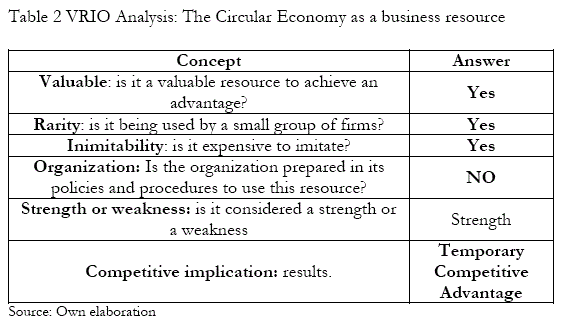
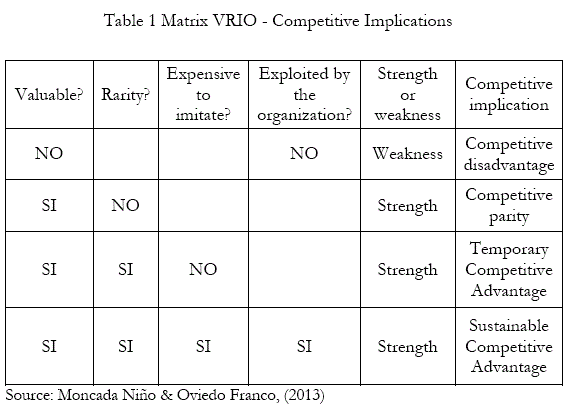
<body><![CDATA[<p align="justify">&nbsp;</p>     <p align="justify"><font size="3" face="Verdana, Arial, Helvetica, sans-serif"><b>7.&nbsp;&nbsp;Research methods</b></font></p>      <p align="justify"><font size="2" face="Verdana, Arial, Helvetica, sans-serif">Although the theoretical perspective that will be used in the present work is the theory of resources and capacities slightly influenced by the approach of the institutions, an analysis will be carried out through the VRIO Framework (Value, rarity, inimitability, and organization) to determine if The Circular Economy model could be considered as a viable resource as a competitive advantage that allows the company to achieve its objectives and position itself in the market, which would generate a competitive strategy.</font></p>     <p align="justify">&nbsp;</p>     <p align="justify"><font size="3" face="Verdana, Arial, Helvetica, sans-serif"><b>8.&nbsp;&nbsp;&nbsp;Analysis of results</b></font></p>      <p align="justify"><font size="2" face="Verdana, Arial, Helvetica, sans-serif">As already mentioned before, the tool that will be used to analyze the situation of the Circular Economy as a competitive resource within an organization, is through an internal analysis called Marco VRIO. First the analysis will be shown in the form of a table and after the explanation will be made by means of the answer to the four questions that this frame generates.</font></p>      <p align="justify"><font size="2" face="Verdana, Arial, Helvetica, sans-serif">To obtain the results, the research work matrix was used as a base: ICT as a source of competitive advantage in SMEs (Moncada Niño &amp; Oviedo Franco, 2013). The pertinent changes were made to be able to apply it in this specific case, shown below:</font></p>      <p align=center><img src="/img/revistas/ec/v5n1/a04_figura01.gif" width="572" height="415"></p>      <p align="justify"><font size="2" face="Verdana, Arial, Helvetica, sans-serif"><b>VRIO Analysis (Table)</b> </font></p>      <p align="center"><img src="/img/revistas/ec/v5n1/a04_figura02.gif" width="568" height="319"></p>      ]]></body>
<body><![CDATA[<p align="justify"><font size="2" face="Verdana, Arial, Helvetica, sans-serif"><b>VRIO Analysis (By concept)</b></font></p>      <p align="justify"><font size="2" face="Verdana, Arial, Helvetica, sans-serif">A Next, the explanation of the previous table, concept by concept, in addition to the specific interpretation to this particular case:</font></p>      <p align="justify"><font size="2" face="Verdana, Arial, Helvetica, sans-serif">Valuable: answer the following question: is it a valuable resource to gain an advantage? According to Álvaro Fernando Moncada Niño and Martha Lucía Oviedo Franco in their work, valuable resources are considered those that can be used as a response to external threats, and in turn, help take advantage of opportunities.&nbsp;&quot;The definition of the value of the resource or capacity is related to its possibility to exploit an opportunity or mitigate a threat in the market. If one of those two things is done, it can be considered as a strength of the company; otherwise, it is a weakness. When these are properly exploited, they generally lead to an increase in income or a decrease in costs or both &quot;(Moncada Niño &amp; Oviedo Franco, 2013, page 129).</font></p>      <p align="justify"><font size="2" face="Verdana, Arial, Helvetica, sans-serif">Due to the above, the Circular economy can be considered a valuable asset, by exploiting the opportunity to reduce costs and reduce the waste generated by the company through a reengineering of processes and design.</font></p>      <p align="justify"><font size="2" face="Verdana, Arial, Helvetica, sans-serif">The VRIO framework considers that resources must be rare, limited or unique, that is, very few companies are using it in their activities, otherwise the resource would not serve as a competitive advantage. If the rarity remains, and few companies manage to acquire it this would mean that the resource would remain scarce, which would give it the characteristic of sustainable competitive advantage (Moncada Niño &amp; Oviedo Franco, 2013). The Circular Economy is a scarce resource that has not been applied in a large number of companies due to its complexity, but it is very likely that this rarity is not held too long, because of the changes in the policies related to sustainability and its derivatives, so it is considered as a temporary competitive advantage.</font></p>      <p align="justify"><font size="2" face="Verdana, Arial, Helvetica, sans-serif">Inimitability: is it expensive to imitate? &quot;... resources are inimitable when the possibility for competitors to analyze and duplicate them makes their acquisition or acquisition costly or takes too long to replicate&quot; (Moncada Niño &amp; Oviedo Franco, 2013, page 129). This characteristic of the VRIO Framework is usually related to the previous two, since the cost of use or application directly affects the rarity and its value. The CE is considered an inimitable resource, because when applied it would be considered quite expensive, since the generation of totally new designs thinking about the reduction of waste is expensive at the beginning, not any company can achieve it.</font></p>      <p align="justify"><font size="2" face="Verdana, Arial, Helvetica, sans-serif">Organization: Is the organization prepared in its policies and procedures to use this resource? &quot;Relating to the fact that the company has certain organizational aspects, such as the organizational structure, processes and systems, as well as the business culture itself, to exploit the full competitive potential of its resources and capabilities. Therefore, the resources and capacities have to be exploited efficiently by the company &quot;(Moncada Niño &amp; Oviedo Franco, 2013, page 130).</font></p>      <p align="justify"><font size="2" face="Verdana, Arial, Helvetica, sans-serif">When referring to this characteristic, it is deduced that the companies are not prepared, in their great majority, to install and use the Circular Economy, due to the great complexity changes and improvements necessary for an optimal operation.</font></p>     <p align="justify">&nbsp;</p>     <p align="justify"><font size="3" face="Verdana, Arial, Helvetica, sans-serif"><b>9.&nbsp;&nbsp;&nbsp;Conclusions and recommendations</b></font></p>      ]]></body>
<body><![CDATA[<p align="justify"><font size="2" face="Verdana, Arial, Helvetica, sans-serif">At the beginning, it was mentioned that this document aims to determine if the Circular Economy is a resource with the aim of becoming a competitive advantage that will impact on the focus of resources and capabilities. In this specific case, it turns out that, if it has the majority of the features of the VRIO Framework that allow it to be a competitive advantage, but of a temporary nature, because in the Rarity it is considered that in the coming years the business political demands will change, forcing companies to look for ways to include this type of model, regardless of the cost.</font></p>      <p align="justify"><font size="2" face="Verdana, Arial, Helvetica, sans-serif">As a recommendation, it can be highlighted that organizations that wish to implement this model in their activities will need to have a good economic position. The initial costs of application are usually very high as a result of the changes that must be made from the root of the product: the design of this.</font></p>      <p align="justify"><font size="2" face="Verdana, Arial, Helvetica, sans-serif">According to the results obtained in the present investigation, the EC is considered as one of the main factors that SMEs should consider carrying out re-engineering in the products they develop as in those that they generate through the innovation they generate. In this sense, the results are focused on those proposed by Ünal, Urbinati and Chiaroni, 2018. </font></p>      <p align="justify"><font size="2" face="Verdana, Arial, Helvetica, sans-serif">Likewise, for the business sector, the EC turns out to be a competitive advantage that can be used for SMEs to develop a green economy through the EC, being a strategy that can position not only in national markets but also international markets. In conclusion, it was proved that the Circular Economy can be considered as a competitive advantage, but of a temporary nature according to the characteristics of the VRIO Framework.</font></p>     <p align="justify">&nbsp;</p>     <p align="justify"><font size="3" face="Verdana, Arial, Helvetica, sans-serif"><b>References</b></font></p>      <!-- ref --><p align="justify"><font size="2" face="Verdana, Arial, Helvetica, sans-serif">Alvial Muñoz, A. (Abril de 2015). Economía Azul: Una revisión en el marco de nuevas tendencias en Economía. Obtenido de Bioeconomía Argentina: <a href="http://www.bioeconomia.mincyt.gob.ar/wp-content/uploads/2014/12/1.-Econom%C3%ADa-azul-A.-Alvial.pdf" target="_blank"><font color="#0000FF">http://www.bioeconomia.mincyt.gob.ar/wp-content/uploads/2014/12/1.-Econom%C3%ADa-azul-A.-Alvial.pdf</font></a></font>&nbsp;&nbsp;&nbsp;&nbsp;&nbsp;&nbsp;&nbsp;&nbsp;[&#160;<a href="javascript:void(0);" onclick="javascript: window.open('/scielo.php?script=sci_nlinks&ref=1268414&pid=S2415-0622202000010000400001&lng=','','width=640,height=500,resizable=yes,scrollbars=1,menubar=yes,');">Links</a>&#160;]<!-- end-ref --><!-- ref --><p align="justify"><font size="2" face="Verdana, Arial, Helvetica, sans-serif">Balboa, C. H., &amp; Domínguez Somonte, M. (25 de Mayo de 2014). Economía circular como marco para el ecodiseño: el modelo ECO-3. Obtenido de Universidad Nacional de Educación a Distancia: <a href="https://www2.uned.es/egi/publicaciones/articulos/Economia_circular_como_marco_para_el_ecodiseno_el_modelo_ECO-3.pdf" target="_blank"><font color="#0000FF">https://www2.uned.es/egi/publicaciones/articulos/Economia_circular_como_marco_para_el_ecodiseno_el_modelo_ECO-3.pdf</font></a></font>&nbsp;&nbsp;&nbsp;&nbsp;&nbsp;&nbsp;&nbsp;&nbsp;[&#160;<a href="javascript:void(0);" onclick="javascript: window.open('/scielo.php?script=sci_nlinks&ref=1268415&pid=S2415-0622202000010000400002&lng=','','width=640,height=500,resizable=yes,scrollbars=1,menubar=yes,');">Links</a>&#160;]<!-- end-ref --><!-- ref --><p align="justify"><font size="2" face="Verdana, Arial, Helvetica, sans-serif">Ballie, J., &amp; Woods, M. (. (2018). Circular by Design: A Model for Engaging Fashion/Textile SMEs with Strategies for Designed Reuse. En R. Crocker, C. Saint, G. Chen, &amp; Y. (. Tong, Unmaking Waste in Production and Consumption: Towards the Circular Economy, (págs. pp. 103-121. Doi: 10.1108/978-1-78714-619-820181010). Emerald Publishing Limited.</font>&nbsp;&nbsp;&nbsp;&nbsp;&nbsp;&nbsp;&nbsp;&nbsp;[&#160;<a href="javascript:void(0);" onclick="javascript: window.open('/scielo.php?script=sci_nlinks&ref=1268416&pid=S2415-0622202000010000400003&lng=','','width=640,height=500,resizable=yes,scrollbars=1,menubar=yes,');">Links</a>&#160;]<!-- end-ref --><!-- ref --><p align="justify"><font size="2" face="Verdana, Arial, Helvetica, sans-serif">Barry, J. (2010). Chapter 6 Towards a model of green political economy: From ecological modernisation to economic security. En L. a. Leonard, Global Ecological Politics (Advances in Ecopolitics, Vol. 5) (págs. pp. 109-128. Doi: 10.1108/S2041-806X(2010)0000005010). Emerald Group Publishing Limited, Bingley.</font>&nbsp;&nbsp;&nbsp;&nbsp;&nbsp;&nbsp;&nbsp;&nbsp;[&#160;<a href="javascript:void(0);" onclick="javascript: window.open('/scielo.php?script=sci_nlinks&ref=1268417&pid=S2415-0622202000010000400004&lng=','','width=640,height=500,resizable=yes,scrollbars=1,menubar=yes,');">Links</a>&#160;]<!-- end-ref --><!-- ref --><p align="justify"><font size="2" face="Verdana, Arial, Helvetica, sans-serif">B&#305;çakc&#305;o&#287;lu, N., Theoharakis, V., &amp; Tanyeri, M. (2019). Green business strategy and export performance: An examination of boundary conditions from an emerging economy. International Marketing Review, Vol. 37 No. 1, pp. 56-75. Doi: 10.1108/IMR-11-2018-0317.</font>&nbsp;&nbsp;&nbsp;&nbsp;&nbsp;&nbsp;&nbsp;&nbsp;[&#160;<a href="javascript:void(0);" onclick="javascript: window.open('/scielo.php?script=sci_nlinks&ref=1268418&pid=S2415-0622202000010000400005&lng=','','width=640,height=500,resizable=yes,scrollbars=1,menubar=yes,');">Links</a>&#160;]<!-- end-ref --><!-- ref --><p align="justify"><font size="2" face="Verdana, Arial, Helvetica, sans-serif">Bocken, N., De Pauw, I., Bakker, C., &amp; Van der Grinten, B. (2016). Product design and business model strategies for a circular economy. Journal of Industrial and Production Engineering, Vol. 33 No. 5, pp. 308-320. Doi:10.1080/21681015.2016.1172124.</font>&nbsp;&nbsp;&nbsp;&nbsp;&nbsp;&nbsp;&nbsp;&nbsp;[&#160;<a href="javascript:void(0);" onclick="javascript: window.open('/scielo.php?script=sci_nlinks&ref=1268419&pid=S2415-0622202000010000400006&lng=','','width=640,height=500,resizable=yes,scrollbars=1,menubar=yes,');">Links</a>&#160;]<!-- end-ref --><!-- ref --><p align="justify"><font size="2" face="Verdana, Arial, Helvetica, sans-serif">Brundtland, G. H. (1987). Our Common Future. Obtenido de UN: : <a href="http://www.un-documents.net/our-common-future.pdf" target="_blank"><font color="#0000FF">http://www.un-documents.net/our-common-future.pdf</font></a></font>&nbsp;&nbsp;&nbsp;&nbsp;&nbsp;&nbsp;&nbsp;&nbsp;[&#160;<a href="javascript:void(0);" onclick="javascript: window.open('/scielo.php?script=sci_nlinks&ref=1268420&pid=S2415-0622202000010000400007&lng=','','width=640,height=500,resizable=yes,scrollbars=1,menubar=yes,');">Links</a>&#160;]<!-- end-ref --><!-- ref --><p align="justify"><font size="2" face="Verdana, Arial, Helvetica, sans-serif">Caceido García, C. L. (2017). Economí¬a circular y su papel en el diseño e innovación sustentable. Obtenido de  Libros Editorial UNIMAR: <a href="http://ojseditorialumariana.com/index.php/libroseditorialunimar/article/view/1154" target="_blank"><font color="#0000FF">http://ojseditorialumariana.com/index.php/libroseditorialunimar/article/view/1154</font></a></font>&nbsp;&nbsp;&nbsp;&nbsp;&nbsp;&nbsp;&nbsp;&nbsp;[&#160;<a href="javascript:void(0);" onclick="javascript: window.open('/scielo.php?script=sci_nlinks&ref=1268421&pid=S2415-0622202000010000400008&lng=','','width=640,height=500,resizable=yes,scrollbars=1,menubar=yes,');">Links</a>&#160;]<!-- end-ref --><!-- ref --><p align="justify"><font size="2" face="Verdana, Arial, Helvetica, sans-serif">Cezarino, L., Liboni, L., Oliveira Stefanelli, N., Oliveira, B., &amp; Stocco, L. (2019). Diving into emerging economies bottleneck: Industry 4.0 and implications for circular economy. Management Decision, Doi: 10.1108/MD-10-2018-1084.</font>&nbsp;&nbsp;&nbsp;&nbsp;&nbsp;&nbsp;&nbsp;&nbsp;[&#160;<a href="javascript:void(0);" onclick="javascript: window.open('/scielo.php?script=sci_nlinks&ref=1268422&pid=S2415-0622202000010000400009&lng=','','width=640,height=500,resizable=yes,scrollbars=1,menubar=yes,');">Links</a>&#160;]<!-- end-ref --><!-- ref --><p align="justify"><font size="2" face="Verdana, Arial, Helvetica, sans-serif">Ecointeligencia. (27 de Enero de 2017). ¿En qué consiste la Economía del Rendimiento? Recuperado el Mayo de 2019, de Ecointeligencia: <a href="https://www.ecointeligencia.com/2017/01/economia-rendimiento/" target="_blank"><font color="#0000FF">https://www.ecointeligencia.com/2017/01/economia-rendimiento/</font></a></font>&nbsp;&nbsp;&nbsp;&nbsp;&nbsp;&nbsp;&nbsp;&nbsp;[&#160;<a href="javascript:void(0);" onclick="javascript: window.open('/scielo.php?script=sci_nlinks&ref=1268423&pid=S2415-0622202000010000400010&lng=','','width=640,height=500,resizable=yes,scrollbars=1,menubar=yes,');">Links</a>&#160;]<!-- end-ref --><!-- ref --><p align="justify"><font size="2" face="Verdana, Arial, Helvetica, sans-serif">Ecología UNAM. (02 de Junio de 2015). Fundación UNAM. Obtenido de UNAM: <a href="http://www.fundacionunam.org.mx/ecologia/sostenibilidad-vs-sustentabilidad/" target="_blank"><font color="#0000FF">http://www.fundacionunam.org.mx/ecologia/sostenibilidad-vs-sustentabilidad/</font></a></font>&nbsp;&nbsp;&nbsp;&nbsp;&nbsp;&nbsp;&nbsp;&nbsp;[&#160;<a href="javascript:void(0);" onclick="javascript: window.open('/scielo.php?script=sci_nlinks&ref=1268424&pid=S2415-0622202000010000400011&lng=','','width=640,height=500,resizable=yes,scrollbars=1,menubar=yes,');">Links</a>&#160;]<!-- end-ref --><!-- ref --><p align="justify"><font size="2" face="Verdana, Arial, Helvetica, sans-serif">Ellen MacArthur Foundation (2). (2019). Economía Circular: Concepto. Recuperado el 10 de Mayo de 2019, de Ellen MacArthur Foundation: <a href="https://www.ellenmacarthurfoundation.org/es/economia-circular/concepto" target="_blank"><font color="#0000FF">https://www.ellenmacarthurfoundation.org/es/economia-circular/concepto</font></a></font>&nbsp;&nbsp;&nbsp;&nbsp;&nbsp;&nbsp;&nbsp;&nbsp;[&#160;<a href="javascript:void(0);" onclick="javascript: window.open('/scielo.php?script=sci_nlinks&ref=1268425&pid=S2415-0622202000010000400012&lng=','','width=640,height=500,resizable=yes,scrollbars=1,menubar=yes,');">Links</a>&#160;]<!-- end-ref --><!-- ref --><p align="justify"><font size="2" face="Verdana, Arial, Helvetica, sans-serif">Ellen MacArthur Foundation. (2019). Economía Circular: Escuelas de pensamiento. Recuperado el 16 de Mayo de 2019, de Ellen MacArthur Foundation: <a href="https://www.ellenmacarthurfoundation.org/es/economia-circular/escuelas-de-pensamiento" target="_blank"><font color="#0000FF">https://www.ellenmacarthurfoundation.org/es/economia-circular/escuelas-de-pensamiento</font></a></font>&nbsp;&nbsp;&nbsp;&nbsp;&nbsp;&nbsp;&nbsp;&nbsp;[&#160;<a href="javascript:void(0);" onclick="javascript: window.open('/scielo.php?script=sci_nlinks&ref=1268426&pid=S2415-0622202000010000400013&lng=','','width=640,height=500,resizable=yes,scrollbars=1,menubar=yes,');">Links</a>&#160;]<!-- end-ref --><!-- ref --><p align="justify"><font size="2" face="Verdana, Arial, Helvetica, sans-serif">Gleason Espíndola, J., Cordova, F., &amp; Casiano Flores, C. (2018). The importance of urban rainwater harvesting in circular economy: the case of Guadalajara city. Management Research Review, Vol. 41 No. 5, pp. 533-553. Doi: 10.1108/MRR-02-2018-0064.</font>&nbsp;&nbsp;&nbsp;&nbsp;&nbsp;&nbsp;&nbsp;&nbsp;[&#160;<a href="javascript:void(0);" onclick="javascript: window.open('/scielo.php?script=sci_nlinks&ref=1268427&pid=S2415-0622202000010000400014&lng=','','width=640,height=500,resizable=yes,scrollbars=1,menubar=yes,');">Links</a>&#160;]<!-- end-ref --><!-- ref --><p align="justify"><font size="2" face="Verdana, Arial, Helvetica, sans-serif">Gliedt, T., &amp; Parker, P. (2007). Green community entrepreneurship: creative destruction in the social economy. International Journal of Social Economics, Vol. 34 No. 8, pp. 538-553. Doi: 10.1108/03068290710763053.</font>&nbsp;&nbsp;&nbsp;&nbsp;&nbsp;&nbsp;&nbsp;&nbsp;[&#160;<a href="javascript:void(0);" onclick="javascript: window.open('/scielo.php?script=sci_nlinks&ref=1268428&pid=S2415-0622202000010000400015&lng=','','width=640,height=500,resizable=yes,scrollbars=1,menubar=yes,');">Links</a>&#160;]<!-- end-ref --><!-- ref --><p align="justify"><font size="2" face="Verdana, Arial, Helvetica, sans-serif">Green, D., &amp; McCann, J. (2011). Benchmarking a leadership model for the green economy. Benchmarking: An International Journal, Vol. 18 No. 3, 2011 pp. 445-465. Doi: 10.1108/14635771111137804.</font>&nbsp;&nbsp;&nbsp;&nbsp;&nbsp;&nbsp;&nbsp;&nbsp;[&#160;<a href="javascript:void(0);" onclick="javascript: window.open('/scielo.php?script=sci_nlinks&ref=1268429&pid=S2415-0622202000010000400016&lng=','','width=640,height=500,resizable=yes,scrollbars=1,menubar=yes,');">Links</a>&#160;]<!-- end-ref --><!-- ref --><p align="justify"><font size="2" face="Verdana, Arial, Helvetica, sans-serif">Gro Harlem Brundtland. (1987). Our Common Future. Obtenido de UN Documents: <a href="http://www.un-documents.net/our-common-future.pdf" target="_blank"><font color="#0000FF">http://www.un-documents.net/our-common-future.pdf</font></a></font>&nbsp;&nbsp;&nbsp;&nbsp;&nbsp;&nbsp;&nbsp;&nbsp;[&#160;<a href="javascript:void(0);" onclick="javascript: window.open('/scielo.php?script=sci_nlinks&ref=1268430&pid=S2415-0622202000010000400017&lng=','','width=640,height=500,resizable=yes,scrollbars=1,menubar=yes,');">Links</a>&#160;]<!-- end-ref --><!-- ref --><p align="justify"><font size="2" face="Verdana, Arial, Helvetica, sans-serif">Haldar, S. (2019). Green entrepreneurship in the renewable energy sector – a case study of Gujarat. Journal of Science and Technology Policy Management, Vol. 10 No. 1, pp. 234-250. doi: 10.1108/JSTPM-12-2017-0070.</font>&nbsp;&nbsp;&nbsp;&nbsp;&nbsp;&nbsp;&nbsp;&nbsp;[&#160;<a href="javascript:void(0);" onclick="javascript: window.open('/scielo.php?script=sci_nlinks&ref=1268431&pid=S2415-0622202000010000400018&lng=','','width=640,height=500,resizable=yes,scrollbars=1,menubar=yes,');">Links</a>&#160;]<!-- end-ref --><!-- ref --><p align="justify"><font size="2" face="Verdana, Arial, Helvetica, sans-serif">Hawken, P., Lovins, A., &amp; Lovins, L. (09 de Agosto de 2000). Natural Capitalism : Creating the Next Industrial Revolution. Obtenido de Research Gate: <a href="https://www.researchgate.net/publication/265074221_Natural_Capitalism" target="_blank"><font color="#0000FF">https://www.researchgate.net/publication/265074221_Natural_Capitalism</font></a></font>&nbsp;&nbsp;&nbsp;&nbsp;&nbsp;&nbsp;&nbsp;&nbsp;[&#160;<a href="javascript:void(0);" onclick="javascript: window.open('/scielo.php?script=sci_nlinks&ref=1268432&pid=S2415-0622202000010000400019&lng=','','width=640,height=500,resizable=yes,scrollbars=1,menubar=yes,');">Links</a>&#160;]<!-- end-ref --><!-- ref --><p align="justify"><font size="2" face="Verdana, Arial, Helvetica, sans-serif">Heaven Grown. (s.f.). Diseño Regenerativo. Recuperado el Mayo de 2019, de Heaven Grown: <a href="http://heavengrown.com/arquitectura-regenerativa/" target="_blank"><font color="#0000FF">http://heavengrown.com/arquitectura-regenerativa/</font></a></font>&nbsp;&nbsp;&nbsp;&nbsp;&nbsp;&nbsp;&nbsp;&nbsp;[&#160;<a href="javascript:void(0);" onclick="javascript: window.open('/scielo.php?script=sci_nlinks&ref=1268433&pid=S2415-0622202000010000400020&lng=','','width=640,height=500,resizable=yes,scrollbars=1,menubar=yes,');">Links</a>&#160;]<!-- end-ref --><!-- ref --><p align="justify"><font size="2" face="Verdana, Arial, Helvetica, sans-serif">Jones, P., &amp; Wynn, M. (2019). The circular economy, natural capital and resilience in tourism and hospitality. International Journal of Contemporary Hospitality Management, Vol. 31 No. 6, pp. 2544-2563. Doi: 10.1108/IJCHM-05-2018-0370.</font>&nbsp;&nbsp;&nbsp;&nbsp;&nbsp;&nbsp;&nbsp;&nbsp;[&#160;<a href="javascript:void(0);" onclick="javascript: window.open('/scielo.php?script=sci_nlinks&ref=1268434&pid=S2415-0622202000010000400021&lng=','','width=640,height=500,resizable=yes,scrollbars=1,menubar=yes,');">Links</a>&#160;]<!-- end-ref --><!-- ref --><p align="justify"><font size="2" face="Verdana, Arial, Helvetica, sans-serif">Kavinski, H., De Souza-Lima, J. E., Maciel-Lima, S. M., &amp; Floriani, D. (2010). La apropiación del discurso de la sustentabilidad por las organizaciones empresariales brasileñas. Cultura y representaciones sociales, 4(8), 34-69.</font>&nbsp;&nbsp;&nbsp;&nbsp;&nbsp;&nbsp;&nbsp;&nbsp;[&#160;<a href="javascript:void(0);" onclick="javascript: window.open('/scielo.php?script=sci_nlinks&ref=1268435&pid=S2415-0622202000010000400022&lng=','','width=640,height=500,resizable=yes,scrollbars=1,menubar=yes,');">Links</a>&#160;]<!-- end-ref --><!-- ref --><p align="justify"><font size="2" face="Verdana, Arial, Helvetica, sans-serif">Klingenberg, B., &amp; Kochanowski, S. (2015). Hiring for the green economy: Employer perspectives on sustainability in the business curriculum. Journal of Management Development, Vol. 34 No. 8, pp. 987-1003. Doi: 10.1108/JMD-06-2014-0058.</font>&nbsp;&nbsp;&nbsp;&nbsp;&nbsp;&nbsp;&nbsp;&nbsp;[&#160;<a href="javascript:void(0);" onclick="javascript: window.open('/scielo.php?script=sci_nlinks&ref=1268436&pid=S2415-0622202000010000400023&lng=','','width=640,height=500,resizable=yes,scrollbars=1,menubar=yes,');">Links</a>&#160;]<!-- end-ref --><!-- ref --><p align="justify"><font size="2" face="Verdana, Arial, Helvetica, sans-serif">Kumar, V., Sezersan, I., Garza-Reyes, J., Gonzalez, E., &amp; AL-Shboul, M. (2019). ircular economy in the manufacturing sector: benefits, opportunities and barriers. Management Decision, Vol. 57 No. 4, 2019 pp. 1067-1086. Doi: 10.1108/MD-09-2018-1070.</font>&nbsp;&nbsp;&nbsp;&nbsp;&nbsp;&nbsp;&nbsp;&nbsp;[&#160;<a href="javascript:void(0);" onclick="javascript: window.open('/scielo.php?script=sci_nlinks&ref=1268437&pid=S2415-0622202000010000400024&lng=','','width=640,height=500,resizable=yes,scrollbars=1,menubar=yes,');">Links</a>&#160;]<!-- end-ref --><!-- ref --><p align="justify"><font size="2" face="Verdana, Arial, Helvetica, sans-serif">Liakos, N., Kumar, V., Pongsakornrungsilp, S., Garza-Reyes, J., Gupta, B., &amp; Pongsakornrungsilp, P. (2019). Understanding circular economy awareness and practices in manufacturing firms. Journal of Enterprise Information Management, Vol. 32 No. 4, pp. 563-584. Doi: 10.1108/JEIM-02-2019-0058.</font>&nbsp;&nbsp;&nbsp;&nbsp;&nbsp;&nbsp;&nbsp;&nbsp;[&#160;<a href="javascript:void(0);" onclick="javascript: window.open('/scielo.php?script=sci_nlinks&ref=1268438&pid=S2415-0622202000010000400025&lng=','','width=640,height=500,resizable=yes,scrollbars=1,menubar=yes,');">Links</a>&#160;]<!-- end-ref --><!-- ref --><p align="justify"><font size="2" face="Verdana, Arial, Helvetica, sans-serif">McDonough, W., Braungart, M., &amp; Bollinger, A. (Septiembre de 2007). Cradle-to-cradle design: creating healthy emissions – a strategy for eco-effective product and system design. Obtenido de Science Direct: <a href="https://www.sciencedirect.com/science/article/pii/S0959652606002587" target="_blank"><font color="#0000FF">https://www.sciencedirect.com/science/article/pii/S0959652606002587</font></a></font>&nbsp;&nbsp;&nbsp;&nbsp;&nbsp;&nbsp;&nbsp;&nbsp;[&#160;<a href="javascript:void(0);" onclick="javascript: window.open('/scielo.php?script=sci_nlinks&ref=1268439&pid=S2415-0622202000010000400026&lng=','','width=640,height=500,resizable=yes,scrollbars=1,menubar=yes,');">Links</a>&#160;]<!-- end-ref --><!-- ref --><p align="justify"><font size="2" face="Verdana, Arial, Helvetica, sans-serif">Mejía Dugand , S. (18 de Agosto de 2010). La Ecología Industrial. Obtenido de El Colombiano: <a href="https://www.elcolombiano.com/historico/la_ecologia_industrial-HEEC_101107" target="_blank"><font color="#0000FF">https://www.elcolombiano.com/historico/la_ecologia_industrial-HEEC_101107</font></a></font>&nbsp;&nbsp;&nbsp;&nbsp;&nbsp;&nbsp;&nbsp;&nbsp;[&#160;<a href="javascript:void(0);" onclick="javascript: window.open('/scielo.php?script=sci_nlinks&ref=1268440&pid=S2415-0622202000010000400027&lng=','','width=640,height=500,resizable=yes,scrollbars=1,menubar=yes,');">Links</a>&#160;]<!-- end-ref --><!-- ref --><p align="justify"><font size="2" face="Verdana, Arial, Helvetica, sans-serif">Missé, A., Moreno, J. A., Vázquez Oteo, O., Escorsa, P., &amp; Casado Cañeque, F. (2015). Responsabilidad Social de la Empresa: ¿RSE o RIP? Obtenido de jstor: <a href="http://www.jstor.org/stable/26360524" target="_blank"><font color="#0000FF">http://www.jstor.org/stable/26360524</font></a></font>&nbsp;&nbsp;&nbsp;&nbsp;&nbsp;&nbsp;&nbsp;&nbsp;[&#160;<a href="javascript:void(0);" onclick="javascript: window.open('/scielo.php?script=sci_nlinks&ref=1268441&pid=S2415-0622202000010000400028&lng=','','width=640,height=500,resizable=yes,scrollbars=1,menubar=yes,');">Links</a>&#160;]<!-- end-ref --><!-- ref --><p align="justify"><font size="2" face="Verdana, Arial, Helvetica, sans-serif">Moncada Niño, Á. F., &amp; Oviedo Franco, M. L. (17 de Junio de 2013). Las TIC como fuente de ventaja competitiva en las PYMES. Sotavento M.B.A., 21, 126-134. Recuperado el Mayo de 2019, de Universidad Externado de Colombia: <a href="https://revistas.uexternado.edu.co/index.php/sotavento/article/view/3441/3128" target="_blank"><font color="#0000FF">https://revistas.uexternado.edu.co/index.php/sotavento/article/view/3441/3128</font></a></font>&nbsp;&nbsp;&nbsp;&nbsp;&nbsp;&nbsp;&nbsp;&nbsp;[&#160;<a href="javascript:void(0);" onclick="javascript: window.open('/scielo.php?script=sci_nlinks&ref=1268442&pid=S2415-0622202000010000400029&lng=','','width=640,height=500,resizable=yes,scrollbars=1,menubar=yes,');">Links</a>&#160;]<!-- end-ref --><!-- ref --><p align="justify"><font size="2" face="Verdana, Arial, Helvetica, sans-serif">Morlet, A., Ble&#769;riot, J., Opsomer, R., Linder, M., Henggeler, A., Bluhm, A., &amp; Carrera, A. (2016). Intelligent Assets: Unlocking the Circular Economy Potential. Ellen MacArthur Foundation. pp. 1-25.</font>&nbsp;&nbsp;&nbsp;&nbsp;&nbsp;&nbsp;&nbsp;&nbsp;[&#160;<a href="javascript:void(0);" onclick="javascript: window.open('/scielo.php?script=sci_nlinks&ref=1268443&pid=S2415-0622202000010000400030&lng=','','width=640,height=500,resizable=yes,scrollbars=1,menubar=yes,');">Links</a>&#160;]<!-- end-ref --><!-- ref --><p align="justify"><font size="2" face="Verdana, Arial, Helvetica, sans-serif">Oliver, C. (04 de Diciembre de 1998). Sustainable Competitive Advantage: Combining Institutional and Resource-Based Views. Recuperado el Mayo de 2019, de Strategic Management Journal: <a href="http://www.jstor.org/stable/3088134" target="_blank"><font color="#0000FF">http://www.jstor.org/stable/3088134</font></a></font>&nbsp;&nbsp;&nbsp;&nbsp;&nbsp;&nbsp;&nbsp;&nbsp;[&#160;<a href="javascript:void(0);" onclick="javascript: window.open('/scielo.php?script=sci_nlinks&ref=1268444&pid=S2415-0622202000010000400031&lng=','','width=640,height=500,resizable=yes,scrollbars=1,menubar=yes,');">Links</a>&#160;]<!-- end-ref --><!-- ref --><p align="justify"><font size="2" face="Verdana, Arial, Helvetica, sans-serif">Popkova, E., Bogoviz, A., &amp; Ragulina, J. (2018). Technological Parks, “Green Economy,” and Sustainable Development in Russia. En B. (. Sergi, Exploring the Future of Russia’s Economy and Markets (págs. pp. 143-159. Doi: 10.1108/978-1-78769-397-520181008). Emerald Publishing Limited.</font>&nbsp;&nbsp;&nbsp;&nbsp;&nbsp;&nbsp;&nbsp;&nbsp;[&#160;<a href="javascript:void(0);" onclick="javascript: window.open('/scielo.php?script=sci_nlinks&ref=1268445&pid=S2415-0622202000010000400032&lng=','','width=640,height=500,resizable=yes,scrollbars=1,menubar=yes,');">Links</a>&#160;]<!-- end-ref --><!-- ref --><p align="justify"><font size="2" face="Verdana, Arial, Helvetica, sans-serif">Porter, M. (Diciembre de 1996). ¿Qué es la estrategia? Recuperado el Mayo de 2019, de Harvard Business Review: <a href="https://s3.amazonaws.com/academia.edu.documents/37851742/4_Que_es_Estrategia.pdf?AWSAccessKeyId=AKIAIWOWYYGZ2Y53UL3A&Expires=1558381861&Signature=132Q27yedrcb1MADZWvjsnckcC8%3D&response-content-disposition=inline%3B%20filename%3DQue_es_la_estrategia.pdf" target="_blank"><font color="#0000FF">https://s3.amazonaws.com/academia.edu.documents/37851742/4_Que_es_Estrategia.pdf?AWSAccessKeyId=AKIAIWOWYYGZ2Y53UL3A&amp;Expires=1558381861&amp;Signature=132Q27yedrcb1MADZWvjsnckcC8%3D&amp;response-content-disposition=inline%3B%20filename%3DQue_es_la_estrategia.pdf</font></a></font>&nbsp;&nbsp;&nbsp;&nbsp;&nbsp;&nbsp;&nbsp;&nbsp;[&#160;<a href="javascript:void(0);" onclick="javascript: window.open('/scielo.php?script=sci_nlinks&ref=1268446&pid=S2415-0622202000010000400033&lng=','','width=640,height=500,resizable=yes,scrollbars=1,menubar=yes,');">Links</a>&#160;]<!-- end-ref --><!-- ref --><p align="justify"><font size="2" face="Verdana, Arial, Helvetica, sans-serif">Porter, M. (2015). Ventaja Competitiva: Creación y sostenimiento de un desempeño superior. Recuperado el Mayo de 2019, de Grupo Editorial Patria: <a href="https://books.google.com.mx/books?hl=es&lr=&id=wV4JDAAAQBAJ&oi=fnd&pg=PT3&dq=que+es+ventaja+competitiva&ots=mwvClbT58A&sig=O2eioD4ADfMxwU5PBfOy20qH-SA#v=onepage&q=que%20es%20ventaja%20competitiva&f=false" target="_blank"><font color="#0000FF">https://books.google.com.mx/books?hl=es&amp;lr=&amp;id=wV4JDAAAQBAJ&amp;oi=fnd&amp;pg=PT3&amp;dq=que+es+ventaja+competitiva&amp;ots=mwvClbT58A&amp;sig=O2eioD4ADfMxwU5PBfOy20qH-SA#v=onepage&amp;q=que%20es%20ventaja%20competitiva&amp;f=false</font></a></font>&nbsp;&nbsp;&nbsp;&nbsp;&nbsp;&nbsp;&nbsp;&nbsp;[&#160;<a href="javascript:void(0);" onclick="javascript: window.open('/scielo.php?script=sci_nlinks&ref=1268447&pid=S2415-0622202000010000400034&lng=','','width=640,height=500,resizable=yes,scrollbars=1,menubar=yes,');">Links</a>&#160;]<!-- end-ref --><!-- ref --><p align="justify"><font size="2" face="Verdana, Arial, Helvetica, sans-serif">Puentes-Poyatos, R., Yebra-Rodríguez, África, &amp; Guerrero, F. (2016). Responsabilidad Social Corporativa: El compromiso de la Universidad con los ciudadanos. Obtenido de Revista de Antropología Experimental: <a href="http://revistaselectronicas.ujaen.es/index.php/rae" target="_blank"><font color="#0000FF">http://revistaselectronicas.ujaen.es/index.php/rae</font></a></font>&nbsp;&nbsp;&nbsp;&nbsp;&nbsp;&nbsp;&nbsp;&nbsp;[&#160;<a href="javascript:void(0);" onclick="javascript: window.open('/scielo.php?script=sci_nlinks&ref=1268448&pid=S2415-0622202000010000400035&lng=','','width=640,height=500,resizable=yes,scrollbars=1,menubar=yes,');">Links</a>&#160;]<!-- end-ref --><!-- ref --><p align="justify"><font size="2" face="Verdana, Arial, Helvetica, sans-serif">RAE. (Diciembre de 2017). Real Academia Española. Obtenido de DLE: <a href="http://dle.rae.es/?w=diccionario" target="_blank"><font color="#0000FF">http://dle.rae.es/?w=diccionario</font></a></font>&nbsp;&nbsp;&nbsp;&nbsp;&nbsp;&nbsp;&nbsp;&nbsp;[&#160;<a href="javascript:void(0);" onclick="javascript: window.open('/scielo.php?script=sci_nlinks&ref=1268449&pid=S2415-0622202000010000400036&lng=','','width=640,height=500,resizable=yes,scrollbars=1,menubar=yes,');">Links</a>&#160;]<!-- end-ref --><!-- ref --><p align="justify"><font size="2" face="Verdana, Arial, Helvetica, sans-serif">Rosenberg, E., Lotz-Sisitka, H., &amp; Ramsarup, P. (2018). The green economy learning assessment South Africa: Lessons for higher education, skills and work-based learning. Higher Education, Skills and Work-Based Learning, Vol. 8 No. 3, pp. 243-258. Doi: 10.1108/HESWBL-03-2018-0041.</font>&nbsp;&nbsp;&nbsp;&nbsp;&nbsp;&nbsp;&nbsp;&nbsp;[&#160;<a href="javascript:void(0);" onclick="javascript: window.open('/scielo.php?script=sci_nlinks&ref=1268450&pid=S2415-0622202000010000400037&lng=','','width=640,height=500,resizable=yes,scrollbars=1,menubar=yes,');">Links</a>&#160;]<!-- end-ref --><!-- ref --><p align="justify"><font size="2" face="Verdana, Arial, Helvetica, sans-serif">Saavedra García, M. L., &amp; Saavedra García, M. E. (2014). La PYME como generadora de empleo en México. Revista Clío América, 153-172.</font>&nbsp;&nbsp;&nbsp;&nbsp;&nbsp;&nbsp;&nbsp;&nbsp;[&#160;<a href="javascript:void(0);" onclick="javascript: window.open('/scielo.php?script=sci_nlinks&ref=1268451&pid=S2415-0622202000010000400038&lng=','','width=640,height=500,resizable=yes,scrollbars=1,menubar=yes,');">Links</a>&#160;]<!-- end-ref --><!-- ref --><p align="justify"><font size="2" face="Verdana, Arial, Helvetica, sans-serif">Sbicca, J. (2019). Urban Agriculture, Revalorization, and Green Gentrification in Denver, Colorado. The Politics of Land (Research in Political Sociology, pp. 149-170. Doi: 10.1108/S0895-993520190000026011.</font>&nbsp;&nbsp;&nbsp;&nbsp;&nbsp;&nbsp;&nbsp;&nbsp;[&#160;<a href="javascript:void(0);" onclick="javascript: window.open('/scielo.php?script=sci_nlinks&ref=1268452&pid=S2415-0622202000010000400039&lng=','','width=640,height=500,resizable=yes,scrollbars=1,menubar=yes,');">Links</a>&#160;]<!-- end-ref --><!-- ref --><p align="justify"><font size="2" face="Verdana, Arial, Helvetica, sans-serif">Secretaria Internacional de la Carta de la Tierra. (2019). La Carta de la Tierra. Obtenido de <a href="http://cartadelatierra.org/descubra/la-carta-de-la-tierra/" target="_blank"><font color="#0000FF">http://cartadelatierra.org/descubra/la-carta-de-la-tierra/</font></a></font>&nbsp;&nbsp;&nbsp;&nbsp;&nbsp;&nbsp;&nbsp;&nbsp;[&#160;<a href="javascript:void(0);" onclick="javascript: window.open('/scielo.php?script=sci_nlinks&ref=1268453&pid=S2415-0622202000010000400040&lng=','','width=640,height=500,resizable=yes,scrollbars=1,menubar=yes,');">Links</a>&#160;]<!-- end-ref --><!-- ref --><p align="justify"><font size="2" face="Verdana, Arial, Helvetica, sans-serif">Shimova, O. (. (2019). Belarus on the Way to Sustainable Development: Circular Economy and Green Technologies. En B. (. Sergi, Modeling Economic Growth in Contemporary Belarus (Entrepreneurship and Global Economic Growth) (págs. pp. 89-106. Doi: 10.1108/978-1-83867-695-720191007). Emerald Publishing Limited,.</font>&nbsp;&nbsp;&nbsp;&nbsp;&nbsp;&nbsp;&nbsp;&nbsp;[&#160;<a href="javascript:void(0);" onclick="javascript: window.open('/scielo.php?script=sci_nlinks&ref=1268454&pid=S2415-0622202000010000400041&lng=','','width=640,height=500,resizable=yes,scrollbars=1,menubar=yes,');">Links</a>&#160;]<!-- end-ref --><!-- ref --><p align="justify"><font size="2" face="Verdana, Arial, Helvetica, sans-serif">Shurrab, J., Hussain, M., &amp; Khan, M. (2019). Green and sustainable practices in the construction industry: A confirmatory factor analysis approach. Engineering, Construction and Architectural Management, Vol. 26 No. 6, pp. 1063-1086. Doi: 10.1108/ECAM-02-2018-0056.</font>&nbsp;&nbsp;&nbsp;&nbsp;&nbsp;&nbsp;&nbsp;&nbsp;[&#160;<a href="javascript:void(0);" onclick="javascript: window.open('/scielo.php?script=sci_nlinks&ref=1268455&pid=S2415-0622202000010000400042&lng=','','width=640,height=500,resizable=yes,scrollbars=1,menubar=yes,');">Links</a>&#160;]<!-- end-ref --><!-- ref --><p align="justify"><font size="2" face="Verdana, Arial, Helvetica, sans-serif">UANL. (02 de Octubre de 2013). El desarrollo sustentable en México. Obtenido de Sustentabilidad: <a href="http://sds.uanl.mx/el-desarrollo-sustentable-en-mexico-3/" target="_blank"><font color="#0000FF">http://sds.uanl.mx/el-desarrollo-sustentable-en-mexico-3/</font></a></font>&nbsp;&nbsp;&nbsp;&nbsp;&nbsp;&nbsp;&nbsp;&nbsp;[&#160;<a href="javascript:void(0);" onclick="javascript: window.open('/scielo.php?script=sci_nlinks&ref=1268456&pid=S2415-0622202000010000400043&lng=','','width=640,height=500,resizable=yes,scrollbars=1,menubar=yes,');">Links</a>&#160;]<!-- end-ref --><!-- ref --><p align="justify"><font size="2" face="Verdana, Arial, Helvetica, sans-serif">U&#776;nal, E., Urbinati, A., &amp; Chiaroni, D. (2018). Managerial practices for designing circular economy business models. Journal of Manufacturing Technology Management, Doi: 10.1108/JMTM-02-2018-0061.</font>&nbsp;&nbsp;&nbsp;&nbsp;&nbsp;&nbsp;&nbsp;&nbsp;[&#160;<a href="javascript:void(0);" onclick="javascript: window.open('/scielo.php?script=sci_nlinks&ref=1268457&pid=S2415-0622202000010000400044&lng=','','width=640,height=500,resizable=yes,scrollbars=1,menubar=yes,');">Links</a>&#160;]<!-- end-ref --><!-- ref --><p align="justify"><font size="2" face="Verdana, Arial, Helvetica, sans-serif">UNAM. (02 de Junio de 2015). Ecología UNAM. Obtenido de Fundación UNAM: <a href="http://www.fundacionunam.org.mx/ecologia/sostenibilidad-vs-sustentabilidad/" target="_blank"><font color="#0000FF">http://www.fundacionunam.org.mx/ecologia/sostenibilidad-vs-sustentabilidad/</font></a></font>&nbsp;&nbsp;&nbsp;&nbsp;&nbsp;&nbsp;&nbsp;&nbsp;[&#160;<a href="javascript:void(0);" onclick="javascript: window.open('/scielo.php?script=sci_nlinks&ref=1268458&pid=S2415-0622202000010000400045&lng=','','width=640,height=500,resizable=yes,scrollbars=1,menubar=yes,');">Links</a>&#160;]<!-- end-ref --><!-- ref --><p align="justify"><font size="2" face="Verdana, Arial, Helvetica, sans-serif">Zsolnai, L. (2002). Green business or community economy? International Journal of Social Economics, Vol. 29 No. 8, pp. 652-662. Doi: 10.1108/03068290210434198.</font>&nbsp;&nbsp;&nbsp;&nbsp;&nbsp;&nbsp;&nbsp;&nbsp;[&#160;<a href="javascript:void(0);" onclick="javascript: window.open('/scielo.php?script=sci_nlinks&ref=1268459&pid=S2415-0622202000010000400046&lng=','','width=640,height=500,resizable=yes,scrollbars=1,menubar=yes,');">Links</a>&#160;]<!-- end-ref --><p align="justify"><font size="2" face="Verdana, Arial, Helvetica, sans-serif"><b>&nbsp;</b></font></p>     <p align="justify"><font size="3" face="Verdana, Arial, Helvetica, sans-serif"><b>Key terms and definitions</b></font></p>      <p align="justify"><font size="2" face="Verdana, Arial, Helvetica, sans-serif"><b>Circular economy:</b> The circular economy proposes an economic and productive model characterized by sustainability and saving of resources and energy sources in which goods are produced, consumed, recycled, produced and re-consumed, entering a life cycle. circular.</font></p>      <p align="justify"><font size="2" face="Verdana, Arial, Helvetica, sans-serif"><b>Green economy:</b> That which leads to the improvement of human well-being and social equality, while environmental risks and ecological scarcity are significantly reduced.</font></p>      <p align="justify"><font size="2" face="Verdana, Arial, Helvetica, sans-serif"><b>Green growth: </b>The one that promote economic growth and development while ensuring that natural assets continue to provide the environmental resources and services on which our well-being depends.</font></p>      <p align="justify"><font size="2" face="Verdana, Arial, Helvetica, sans-serif"><b>Resources and capabilities:</b> The theory of resources and capabilities states that organizations are different from each other based on the resources and capabilities they have at a given time, as well as the different characteristics of the same and that these resources and capabilities are not available to all companies in the same.</font></p>      <p align="justify"><font size="2" face="Verdana, Arial, Helvetica, sans-serif"><b>Strategic plan: </b>It is a document integrated in the business plan that includes the planning at the economic-financial, strategic and organizational level with which a company or organization has to address its objectives and achieve its future mission.</font></p>      <p align="justify"><font size="2" face="Verdana, Arial, Helvetica, sans-serif"><b>Sustainable development:</b> It is development that meets the needs of the present without compromising the ability of future generations to meet their own needs </font></p>      ]]></body>
<body><![CDATA[<p align="justify"><font size="2" face="Verdana, Arial, Helvetica, sans-serif"><b>Transformation:</b> The result of a process of change of form. It happens when one thing, fact or idea is converted into another.</font></p>      <p align="justify"><font size="2" face="Verdana, Arial, Helvetica, sans-serif"><b>Transition</b>: A <a href="https://dictionary.cambridge.org/es/diccionario/ingles/change" title=change target="_blank"><font color="#0000FF">change</font></a> from one <a href="https://dictionary.cambridge.org/es/diccionario/ingles/form" title=form target="_blank"><font color="#0000FF">form</font></a> or <a href="https://dictionary.cambridge.org/es/diccionario/ingles/type" title=type target="_blank"><font color="#0000FF">type</font></a> to another, or the <a href="https://dictionary.cambridge.org/es/diccionario/ingles/process" title=process target="_blank"><font color="#0000FF">process</font></a> by which this <a href="https://dictionary.cambridge.org/es/diccionario/ingles/happen" title=happens target="_blank"><font color="#0000FF">happens</font></a>.</font></p>      <p align="justify"><font size="2" face="Verdana, Arial, Helvetica, sans-serif"><b>VRIO Analysis:</b> VRIO analysis is an internal business analysis tool that is included in the theory of resources and responds to the four basic characteristics that a resource must meet to give the company a competitive advantage</font></p>     <p align="justify">&nbsp;</p>     <p align="justify">&nbsp;</p>      ]]></body><back>
<ref-list>
<ref id="B1">
<nlm-citation citation-type="">
<person-group person-group-type="author">
<name>
<surname><![CDATA[Alvial Muñoz]]></surname>
<given-names><![CDATA[A]]></given-names>
</name>
</person-group>
<source><![CDATA[Economía Azul: Una revisión en el marco de nuevas tendencias en Economía]]></source>
<year>Abri</year>
<month>l </month>
<day>de</day>
</nlm-citation>
</ref>
<ref id="B2">
<nlm-citation citation-type="">
<person-group person-group-type="author">
<name>
<surname><![CDATA[Balboa]]></surname>
<given-names><![CDATA[C. H]]></given-names>
</name>
<name>
<surname><![CDATA[Domínguez Somonte]]></surname>
<given-names><![CDATA[M]]></given-names>
</name>
</person-group>
<source><![CDATA[Economía circular como marco para el ecodiseño: el modelo ECO-3]]></source>
<year>25 d</year>
<month>e </month>
<day>Ma</day>
</nlm-citation>
</ref>
<ref id="B3">
<nlm-citation citation-type="book">
<person-group person-group-type="author">
<name>
<surname><![CDATA[Ballie]]></surname>
<given-names><![CDATA[J]]></given-names>
</name>
<name>
<surname><![CDATA[Woods]]></surname>
<given-names><![CDATA[M]]></given-names>
</name>
<name>
<surname><![CDATA[Crocke]]></surname>
<given-names><![CDATA[R]]></given-names>
</name>
<name>
<surname><![CDATA[Saint]]></surname>
<given-names><![CDATA[C]]></given-names>
</name>
<name>
<surname><![CDATA[Chen]]></surname>
<given-names><![CDATA[G]]></given-names>
</name>
<name>
<surname><![CDATA[Tong]]></surname>
</name>
</person-group>
<source><![CDATA[Unmaking Waste in Production and Consumption: Towards the Circular Economy]]></source>
<year>2018</year>
<page-range>103-121</page-range><publisher-name><![CDATA[Emerald Publishing Limited]]></publisher-name>
</nlm-citation>
</ref>
<ref id="B4">
<nlm-citation citation-type="book">
<person-group person-group-type="author">
<name>
<surname><![CDATA[Barry]]></surname>
<given-names><![CDATA[J]]></given-names>
</name>
<name>
<surname><![CDATA[Leonard]]></surname>
<given-names><![CDATA[L. a]]></given-names>
</name>
</person-group>
<source><![CDATA[Global Ecological Politics]]></source>
<year>2010</year>
<volume>5</volume>
<page-range>109-128</page-range><publisher-name><![CDATA[Emerald Group Publishing Limited]]></publisher-name>
</nlm-citation>
</ref>
<ref id="B5">
<nlm-citation citation-type="journal">
<person-group person-group-type="author">
<name>
<surname><![CDATA[Bçakcolu]]></surname>
<given-names><![CDATA[N]]></given-names>
</name>
<name>
<surname><![CDATA[Theoharakis]]></surname>
<given-names><![CDATA[V]]></given-names>
</name>
<name>
<surname><![CDATA[Tanyeri]]></surname>
<given-names><![CDATA[M]]></given-names>
</name>
</person-group>
<article-title xml:lang="en"><![CDATA[Green business strategy and export performance: An examination of boundary conditions from an emerging economy]]></article-title>
<source><![CDATA[International Marketing Review]]></source>
<year>2019</year>
<volume>37</volume>
<numero>1</numero>
<issue>1</issue>
<page-range>56-75</page-range></nlm-citation>
</ref>
<ref id="B6">
<nlm-citation citation-type="journal">
<person-group person-group-type="author">
<name>
<surname><![CDATA[Bocken]]></surname>
<given-names><![CDATA[N]]></given-names>
</name>
<name>
<surname><![CDATA[De Pauw]]></surname>
<given-names><![CDATA[I]]></given-names>
</name>
<name>
<surname><![CDATA[Bakker]]></surname>
<given-names><![CDATA[C]]></given-names>
</name>
<name>
<surname><![CDATA[Van der Grinten]]></surname>
<given-names><![CDATA[B]]></given-names>
</name>
</person-group>
<article-title xml:lang="en"><![CDATA[Product design and business model strategies for a circular economy]]></article-title>
<source><![CDATA[Journal of Industrial and Production Engineering]]></source>
<year>2016</year>
<volume>33</volume>
<numero>5</numero>
<issue>5</issue>
<page-range>308-320</page-range></nlm-citation>
</ref>
<ref id="B7">
<nlm-citation citation-type="">
<person-group person-group-type="author">
<name>
<surname><![CDATA[Brundtland]]></surname>
<given-names><![CDATA[G. H]]></given-names>
</name>
</person-group>
<source><![CDATA[Our Common Future]]></source>
<year>1987</year>
</nlm-citation>
</ref>
<ref id="B8">
<nlm-citation citation-type="book">
<person-group person-group-type="author">
<name>
<surname><![CDATA[Caceido García]]></surname>
<given-names><![CDATA[C. L]]></given-names>
</name>
</person-group>
<source><![CDATA[Economía circular y su papel en el diseño e innovación sustentable]]></source>
<year>2017</year>
<publisher-name><![CDATA[UNIMAR]]></publisher-name>
</nlm-citation>
</ref>
<ref id="B9">
<nlm-citation citation-type="">
<person-group person-group-type="author">
<name>
<surname><![CDATA[Cezarino]]></surname>
<given-names><![CDATA[L]]></given-names>
</name>
<name>
<surname><![CDATA[Liboni]]></surname>
<given-names><![CDATA[L]]></given-names>
</name>
<name>
<surname><![CDATA[Oliveira Stefanelli]]></surname>
<given-names><![CDATA[N]]></given-names>
</name>
<name>
<surname><![CDATA[Oliveira]]></surname>
<given-names><![CDATA[B]]></given-names>
</name>
<name>
<surname><![CDATA[Stocco]]></surname>
<given-names><![CDATA[L]]></given-names>
</name>
</person-group>
<source><![CDATA[Diving into emerging economies bottleneck: Industry 4.0 and implications for circular economy]]></source>
<year>2019</year>
</nlm-citation>
</ref>
<ref id="B10">
<nlm-citation citation-type="">
<collab>Ecointeligencia</collab>
<source><![CDATA[En qué consiste la Economía del Rendimiento]]></source>
<year>27 d</year>
<month>e </month>
<day>En</day>
</nlm-citation>
</ref>
<ref id="B11">
<nlm-citation citation-type="">
<collab>Ecología UNAM</collab>
<source><![CDATA[Fundación UNAM]]></source>
<year>02 d</year>
<month>e </month>
<day>Ju</day>
</nlm-citation>
</ref>
<ref id="B12">
<nlm-citation citation-type="book">
<collab>Ellen MacArthur Foundation</collab>
<source><![CDATA[Economía Circular: Concepto]]></source>
<year>2019</year>
<publisher-name><![CDATA[Ellen MacArthur Foundation]]></publisher-name>
</nlm-citation>
</ref>
<ref id="B13">
<nlm-citation citation-type="book">
<collab>Ellen MacArthur Foundation</collab>
<source><![CDATA[Economía Circular: Escuelas de pensamiento]]></source>
<year>2019</year>
<publisher-name><![CDATA[Ellen MacArthur Foundation]]></publisher-name>
</nlm-citation>
</ref>
<ref id="B14">
<nlm-citation citation-type="journal">
<person-group person-group-type="author">
<name>
<surname><![CDATA[Gleason Espíndola]]></surname>
<given-names><![CDATA[J]]></given-names>
</name>
<name>
<surname><![CDATA[Cordova]]></surname>
<given-names><![CDATA[F]]></given-names>
</name>
<name>
<surname><![CDATA[Casiano Flores]]></surname>
<given-names><![CDATA[C]]></given-names>
</name>
</person-group>
<article-title xml:lang="en"><![CDATA[The importance of urban rainwater harvesting in circular economy: the case of Guadalajara city]]></article-title>
<source><![CDATA[Management Research Review]]></source>
<year>2018</year>
<volume>41</volume>
<numero>5</numero>
<issue>5</issue>
<page-range>533-553</page-range></nlm-citation>
</ref>
<ref id="B15">
<nlm-citation citation-type="journal">
<person-group person-group-type="author">
<name>
<surname><![CDATA[Gliedt]]></surname>
<given-names><![CDATA[T]]></given-names>
</name>
<name>
<surname><![CDATA[Parker]]></surname>
<given-names><![CDATA[P]]></given-names>
</name>
</person-group>
<article-title xml:lang="en"><![CDATA[Green community entrepreneurship: creative destruction in the social economy]]></article-title>
<source><![CDATA[International Journal of Social Economics]]></source>
<year>2007</year>
<volume>34</volume>
<numero>8</numero>
<issue>8</issue>
<page-range>538-553</page-range></nlm-citation>
</ref>
<ref id="B16">
<nlm-citation citation-type="journal">
<person-group person-group-type="author">
<name>
<surname><![CDATA[Green]]></surname>
<given-names><![CDATA[D]]></given-names>
</name>
<name>
<surname><![CDATA[McCann]]></surname>
<given-names><![CDATA[J]]></given-names>
</name>
</person-group>
<article-title xml:lang="en"><![CDATA[Benchmarking a leadership model for the green economy. Benchmarking]]></article-title>
<source><![CDATA[International Journal]]></source>
<year>2011</year>
<volume>18</volume>
<numero>3</numero>
<issue>3</issue>
<page-range>445-465</page-range></nlm-citation>
</ref>
<ref id="B17">
<nlm-citation citation-type="">
<collab>Gro Harlem Brundtland</collab>
<source><![CDATA[Our Common Future]]></source>
<year>1987</year>
</nlm-citation>
</ref>
<ref id="B18">
<nlm-citation citation-type="journal">
<person-group person-group-type="author">
<name>
<surname><![CDATA[Halda]]></surname>
<given-names><![CDATA[S]]></given-names>
</name>
</person-group>
<article-title xml:lang="en"><![CDATA[Green entrepreneurship in the renewable energy sector - a case study of Gujarat]]></article-title>
<source><![CDATA[Journal of Science and Technology Policy Management]]></source>
<year>2019</year>
<volume>10</volume>
<numero>1</numero>
<issue>1</issue>
<page-range>234-250</page-range></nlm-citation>
</ref>
<ref id="B19">
<nlm-citation citation-type="">
<person-group person-group-type="author">
<name>
<surname><![CDATA[Hawken]]></surname>
<given-names><![CDATA[P]]></given-names>
</name>
<name>
<surname><![CDATA[Lovins]]></surname>
<given-names><![CDATA[A]]></given-names>
</name>
<name>
<surname><![CDATA[Lovins]]></surname>
<given-names><![CDATA[L]]></given-names>
</name>
</person-group>
<source><![CDATA[Natural Capitalism: Creating the Next Industrial Revolution]]></source>
<year>09 d</year>
<month>e </month>
<day>Ag</day>
</nlm-citation>
</ref>
<ref id="B20">
<nlm-citation citation-type="">
<person-group person-group-type="author">
<name>
<surname><![CDATA[Heaven Grown]]></surname>
</name>
</person-group>
<source><![CDATA[Diseño Regenerativo]]></source>
<year></year>
</nlm-citation>
</ref>
<ref id="B21">
<nlm-citation citation-type="journal">
<person-group person-group-type="author">
<name>
<surname><![CDATA[Jones]]></surname>
<given-names><![CDATA[P]]></given-names>
</name>
<name>
<surname><![CDATA[Wynn]]></surname>
<given-names><![CDATA[M]]></given-names>
</name>
</person-group>
<article-title xml:lang="en"><![CDATA[The circular economy, natural capital and resilience in tourism and hospitality]]></article-title>
<source><![CDATA[International Journal of Contemporary Hospitality Management]]></source>
<year>2019</year>
<volume>31</volume>
<numero>6</numero>
<issue>6</issue>
<page-range>2544-2563</page-range></nlm-citation>
</ref>
<ref id="B22">
<nlm-citation citation-type="journal">
<person-group person-group-type="author">
<name>
<surname><![CDATA[Kavinski]]></surname>
<given-names><![CDATA[H]]></given-names>
</name>
<name>
<surname><![CDATA[De Souza-Lima]]></surname>
<given-names><![CDATA[J. E]]></given-names>
</name>
<name>
<surname><![CDATA[Maciel-Lima]]></surname>
<given-names><![CDATA[S. M]]></given-names>
</name>
<name>
<surname><![CDATA[Floriani]]></surname>
<given-names><![CDATA[D]]></given-names>
</name>
</person-group>
<article-title xml:lang="es"><![CDATA[La apropiación del discurso de la sustentabilidad por las organizaciones empresariales brasileñas]]></article-title>
<source><![CDATA[Cultura y representaciones sociales]]></source>
<year>2010</year>
<volume>4</volume>
<numero>8</numero>
<issue>8</issue>
<page-range>34-69</page-range></nlm-citation>
</ref>
<ref id="B23">
<nlm-citation citation-type="journal">
<person-group person-group-type="author">
<name>
<surname><![CDATA[Klingenberg]]></surname>
<given-names><![CDATA[B]]></given-names>
</name>
<name>
<surname><![CDATA[Kochanowski]]></surname>
<given-names><![CDATA[S]]></given-names>
</name>
</person-group>
<article-title xml:lang="en"><![CDATA[Hiring for the green economy: Employer perspectives on sustainability in the business curriculum]]></article-title>
<source><![CDATA[Journal of Management Development]]></source>
<year>2015</year>
<volume>34</volume>
<numero>8</numero>
<issue>8</issue>
<page-range>987-1003</page-range></nlm-citation>
</ref>
<ref id="B24">
<nlm-citation citation-type="journal">
<person-group person-group-type="author">
<name>
<surname><![CDATA[Kumar]]></surname>
<given-names><![CDATA[V]]></given-names>
</name>
<name>
<surname><![CDATA[Sezersan]]></surname>
<given-names><![CDATA[I]]></given-names>
</name>
<name>
<surname><![CDATA[Garza-Reyes]]></surname>
<given-names><![CDATA[J]]></given-names>
</name>
<name>
<surname><![CDATA[Gonzalez]]></surname>
<given-names><![CDATA[E]]></given-names>
</name>
<name>
<surname><![CDATA[AL-Shboul]]></surname>
<given-names><![CDATA[M]]></given-names>
</name>
</person-group>
<article-title xml:lang="en"><![CDATA[ircular economy in the manufacturing sector: benefits, opportunities and barriers]]></article-title>
<source><![CDATA[Management Decision]]></source>
<year>2019</year>
<volume>57</volume>
<numero>4</numero>
<issue>4</issue>
<page-range>1067-1086</page-range></nlm-citation>
</ref>
<ref id="B25">
<nlm-citation citation-type="journal">
<person-group person-group-type="author">
<name>
<surname><![CDATA[Liakos]]></surname>
<given-names><![CDATA[N]]></given-names>
</name>
<name>
<surname><![CDATA[Kumar]]></surname>
<given-names><![CDATA[V]]></given-names>
</name>
<name>
<surname><![CDATA[Pongsakornrungsilp]]></surname>
<given-names><![CDATA[S]]></given-names>
</name>
<name>
<surname><![CDATA[Garza-Reyes]]></surname>
<given-names><![CDATA[J]]></given-names>
</name>
<name>
<surname><![CDATA[Gupta]]></surname>
<given-names><![CDATA[B]]></given-names>
</name>
<name>
<surname><![CDATA[Pongsakornrungsilp]]></surname>
<given-names><![CDATA[P]]></given-names>
</name>
</person-group>
<article-title xml:lang="en"><![CDATA[Understanding circular economy awareness and practices in manufacturing firms]]></article-title>
<source><![CDATA[Journal of Enterprise Information Management]]></source>
<year>2019</year>
<volume>32</volume>
<numero>4</numero>
<issue>4</issue>
<page-range>563-584</page-range></nlm-citation>
</ref>
<ref id="B26">
<nlm-citation citation-type="">
<person-group person-group-type="author">
<name>
<surname><![CDATA[McDonough]]></surname>
<given-names><![CDATA[W]]></given-names>
</name>
<name>
<surname><![CDATA[Braungart]]></surname>
<given-names><![CDATA[M]]></given-names>
</name>
<name>
<surname><![CDATA[Bollinger]]></surname>
<given-names><![CDATA[A]]></given-names>
</name>
</person-group>
<source><![CDATA[Cradle-to-cradle design: creating healthy emissions - a strategy for eco-effective product and system design]]></source>
<year>2007</year>
</nlm-citation>
</ref>
<ref id="B27">
<nlm-citation citation-type="">
<person-group person-group-type="author">
<name>
<surname><![CDATA[Mejía Dugand]]></surname>
<given-names><![CDATA[S]]></given-names>
</name>
</person-group>
<source><![CDATA[La Ecología Industrial]]></source>
<year>18 d</year>
<month>e </month>
<day>Ag</day>
</nlm-citation>
</ref>
<ref id="B28">
<nlm-citation citation-type="">
<person-group person-group-type="author">
<name>
<surname><![CDATA[Missé]]></surname>
<given-names><![CDATA[A]]></given-names>
</name>
<name>
<surname><![CDATA[Moreno]]></surname>
<given-names><![CDATA[J. A]]></given-names>
</name>
<name>
<surname><![CDATA[Vázquez Oteo]]></surname>
<given-names><![CDATA[O]]></given-names>
</name>
<name>
<surname><![CDATA[Escorsa]]></surname>
<given-names><![CDATA[P]]></given-names>
</name>
<name>
<surname><![CDATA[Casado Cañeque]]></surname>
<given-names><![CDATA[F]]></given-names>
</name>
</person-group>
<source><![CDATA[Responsabilidad Social de la Empresa: ¿RSE o RIP?]]></source>
<year>2015</year>
</nlm-citation>
</ref>
<ref id="B29">
<nlm-citation citation-type="">
<person-group person-group-type="author">
<name>
<surname><![CDATA[Moncada Niño]]></surname>
<given-names><![CDATA[Á. F]]></given-names>
</name>
<name>
<surname><![CDATA[Oviedo Franco]]></surname>
<given-names><![CDATA[M. L]]></given-names>
</name>
</person-group>
<source><![CDATA[Las TIC como fuente de ventaja competitiva en las PYMES]]></source>
<year>2013</year>
</nlm-citation>
</ref>
<ref id="B30">
<nlm-citation citation-type="book">
<person-group person-group-type="author">
<name>
<surname><![CDATA[Morlet]]></surname>
<given-names><![CDATA[A]]></given-names>
</name>
<name>
<surname><![CDATA[Bleriot]]></surname>
<given-names><![CDATA[J]]></given-names>
</name>
<name>
<surname><![CDATA[Opsomer]]></surname>
<given-names><![CDATA[R]]></given-names>
</name>
<name>
<surname><![CDATA[Linder]]></surname>
<given-names><![CDATA[M]]></given-names>
</name>
<name>
<surname><![CDATA[Henggeler]]></surname>
<given-names><![CDATA[A]]></given-names>
</name>
<name>
<surname><![CDATA[Bluhm]]></surname>
<given-names><![CDATA[A]]></given-names>
</name>
<name>
<surname><![CDATA[Carrera]]></surname>
<given-names><![CDATA[A]]></given-names>
</name>
</person-group>
<source><![CDATA[Intelligent Assets: Unlocking the Circular Economy Potential]]></source>
<year>2016</year>
<page-range>1-25</page-range><publisher-name><![CDATA[Ellen MacArthur Foundation]]></publisher-name>
</nlm-citation>
</ref>
<ref id="B31">
<nlm-citation citation-type="journal">
<person-group person-group-type="author">
<name>
<surname><![CDATA[Oliver]]></surname>
<given-names><![CDATA[C]]></given-names>
</name>
</person-group>
<article-title xml:lang="en"><![CDATA[Sustainable Competitive Advantage: Combining Institutional and Resource-Based Views]]></article-title>
<source><![CDATA[Strategic Management Journal]]></source>
<year>04 d</year>
<month>e </month>
<day>Di</day>
</nlm-citation>
</ref>
<ref id="B32">
<nlm-citation citation-type="">
<person-group person-group-type="author">
<name>
<surname><![CDATA[Popkova]]></surname>
<given-names><![CDATA[E]]></given-names>
</name>
<name>
<surname><![CDATA[Bogoviz]]></surname>
<given-names><![CDATA[A]]></given-names>
</name>
<name>
<surname><![CDATA[Ragulina]]></surname>
<given-names><![CDATA[J]]></given-names>
</name>
<name>
<surname><![CDATA[Sergi]]></surname>
</name>
</person-group>
<source><![CDATA[Exploring the Future of Russia’s Economy and Markets]]></source>
<year>2018</year>
<page-range>143-159</page-range></nlm-citation>
</ref>
<ref id="B33">
<nlm-citation citation-type="">
<person-group person-group-type="author">
<name>
<surname><![CDATA[Porter]]></surname>
<given-names><![CDATA[M]]></given-names>
</name>
</person-group>
<source><![CDATA[Qué es la estrategia]]></source>
<year>1996</year>
</nlm-citation>
</ref>
<ref id="B34">
<nlm-citation citation-type="">
<person-group person-group-type="author">
<name>
<surname><![CDATA[Porter]]></surname>
<given-names><![CDATA[M]]></given-names>
</name>
</person-group>
<source><![CDATA[Ventaja Competitiva: Creación y sostenimiento de un desempeño superior]]></source>
<year>2015</year>
</nlm-citation>
</ref>
<ref id="B35">
<nlm-citation citation-type="journal">
<person-group person-group-type="author">
<name>
<surname><![CDATA[Puentes-Poyatos]]></surname>
<given-names><![CDATA[R]]></given-names>
</name>
<name>
<surname><![CDATA[Yebra-Rodríguez]]></surname>
</name>
<name>
<surname><![CDATA[Guerrero]]></surname>
<given-names><![CDATA[F]]></given-names>
</name>
</person-group>
<article-title xml:lang="es"><![CDATA[Responsabilidad Social Corporativa: El compromiso de la Universidad con los ciudadanos]]></article-title>
<source><![CDATA[Revista de Antropología Experimental]]></source>
<year>2016</year>
</nlm-citation>
</ref>
<ref id="B36">
<nlm-citation citation-type="">
<collab>RAE</collab>
<source><![CDATA[Real Academia Española]]></source>
<year></year>
</nlm-citation>
</ref>
<ref id="B37">
<nlm-citation citation-type="journal">
<person-group person-group-type="author">
<name>
<surname><![CDATA[Rosenberg]]></surname>
<given-names><![CDATA[E]]></given-names>
</name>
<name>
<surname><![CDATA[Lotz-Sisitka]]></surname>
<given-names><![CDATA[H]]></given-names>
</name>
<name>
<surname><![CDATA[Ramsarup]]></surname>
<given-names><![CDATA[P]]></given-names>
</name>
</person-group>
<article-title xml:lang="en"><![CDATA[The green economy learning assessment South Africa: Lessons for higher education, skills and work-based learning]]></article-title>
<source><![CDATA[Higher Education, Skills and Work-Based Learning]]></source>
<year>2018</year>
<volume>8</volume>
<numero>3</numero>
<issue>3</issue>
<page-range>243-258</page-range></nlm-citation>
</ref>
<ref id="B38">
<nlm-citation citation-type="journal">
<person-group person-group-type="author">
<name>
<surname><![CDATA[Saavedra García]]></surname>
<given-names><![CDATA[M. L]]></given-names>
</name>
<name>
<surname><![CDATA[Saavedra García]]></surname>
<given-names><![CDATA[M. E]]></given-names>
</name>
</person-group>
<article-title xml:lang="es"><![CDATA[La PYME como generadora de empleo en México]]></article-title>
<source><![CDATA[Revista Clío América]]></source>
<year>2014</year>
<page-range>153-172</page-range></nlm-citation>
</ref>
<ref id="B39">
<nlm-citation citation-type="">
<person-group person-group-type="author">
<name>
<surname><![CDATA[Sbicca]]></surname>
<given-names><![CDATA[J]]></given-names>
</name>
</person-group>
<source><![CDATA[Urban Agriculture, Revalorization, and Green Gentrification in Denver, Colorado]]></source>
<year>2019</year>
</nlm-citation>
</ref>
<ref id="B40">
<nlm-citation citation-type="">
<collab>Secretaria Internacional de la Carta de la Tierra</collab>
<source><![CDATA[La Carta de la Tierra]]></source>
<year>2019</year>
</nlm-citation>
</ref>
<ref id="B41">
<nlm-citation citation-type="">
<person-group person-group-type="author">
<name>
<surname><![CDATA[Shimova]]></surname>
<given-names><![CDATA[O]]></given-names>
</name>
<name>
<surname><![CDATA[Sergi]]></surname>
</name>
</person-group>
<source><![CDATA[Modeling Economic Growth in Contemporary Belarus]]></source>
<year>2019</year>
<page-range>89-106</page-range></nlm-citation>
</ref>
<ref id="B42">
<nlm-citation citation-type="journal">
<person-group person-group-type="author">
<name>
<surname><![CDATA[Shurrab]]></surname>
<given-names><![CDATA[J]]></given-names>
</name>
<name>
<surname><![CDATA[Hussain]]></surname>
<given-names><![CDATA[M]]></given-names>
</name>
<name>
<surname><![CDATA[Khan]]></surname>
<given-names><![CDATA[M]]></given-names>
</name>
</person-group>
<article-title xml:lang="en"><![CDATA[Green and sustainable practices in the construction industry: A confirmatory factor analysis approach]]></article-title>
<source><![CDATA[Construction and Architectural Management]]></source>
<year>2019</year>
<volume>26</volume>
<numero>6</numero>
<issue>6</issue>
<page-range>1063-1086</page-range></nlm-citation>
</ref>
<ref id="B43">
<nlm-citation citation-type="">
<collab>UANL</collab>
<source><![CDATA[El desarrollo sustentable en México]]></source>
<year>02 d</year>
<month>e </month>
<day>Oc</day>
</nlm-citation>
</ref>
<ref id="B44">
<nlm-citation citation-type="journal">
<person-group person-group-type="author">
<name>
<surname><![CDATA[Unal]]></surname>
<given-names><![CDATA[E]]></given-names>
</name>
<name>
<surname><![CDATA[Urbinati]]></surname>
<given-names><![CDATA[A]]></given-names>
</name>
<name>
<surname><![CDATA[Chiaroni]]></surname>
<given-names><![CDATA[D]]></given-names>
</name>
</person-group>
<article-title xml:lang="en"><![CDATA[Managerial practices for designing circular economy business models]]></article-title>
<source><![CDATA[Journal of Manufacturing Technology Management]]></source>
<year>2018</year>
</nlm-citation>
</ref>
<ref id="B45">
<nlm-citation citation-type="">
<collab>UNAM</collab>
<source><![CDATA[Ecología UNAM]]></source>
<year>02 d</year>
<month>e </month>
<day>Ju</day>
</nlm-citation>
</ref>
<ref id="B46">
<nlm-citation citation-type="journal">
<person-group person-group-type="author">
<name>
<surname><![CDATA[Zsolnai]]></surname>
<given-names><![CDATA[L]]></given-names>
</name>
</person-group>
<article-title xml:lang="en"><![CDATA[Green business or community economy]]></article-title>
<source><![CDATA[International Journal of Social Economics]]></source>
<year>2002</year>
<volume>29</volume>
<numero>8</numero>
<issue>8</issue>
<page-range>652-662</page-range></nlm-citation>
</ref>
</ref-list>
</back>
</article>