<?xml version="1.0" encoding="ISO-8859-1"?><article xmlns:mml="http://www.w3.org/1998/Math/MathML" xmlns:xlink="http://www.w3.org/1999/xlink" xmlns:xsi="http://www.w3.org/2001/XMLSchema-instance">
<front>
<journal-meta>
<journal-id>2415-0622</journal-id>
<journal-title><![CDATA[Economía Coyuntural]]></journal-title>
<abbrev-journal-title><![CDATA[Revista de coyuntura y perspectiva]]></abbrev-journal-title>
<issn>2415-0622</issn>
<publisher>
<publisher-name><![CDATA[Universidad Autónoma Gabriel René MorenoFacultad de Ciencias Económicas, Administrativas y FinancierasInstituto de Investigaciones Económicas y Sociales José Ortiz Mercado  IIESJOM]]></publisher-name>
</publisher>
</journal-meta>
<article-meta>
<article-id>S2415-06222020000100003</article-id>
<title-group>
<article-title xml:lang="es"><![CDATA[Dinámicas socioeconómicas y migraciones: La experiencia Brasileña en los años 2000]]></article-title>
<article-title xml:lang="en"><![CDATA[Socioeconomic dynamics and migrations: The Brazilian experience in the 2000s]]></article-title>
</title-group>
<contrib-group>
<contrib contrib-type="author">
<name>
<surname><![CDATA[da Silva Filho]]></surname>
<given-names><![CDATA[Luís Abel]]></given-names>
</name>
<xref ref-type="aff" rid="A01"/>
</contrib>
<contrib contrib-type="author">
<name>
<surname><![CDATA[Gori Maia]]></surname>
<given-names><![CDATA[Alexandre]]></given-names>
</name>
<xref ref-type="aff" rid="A02"/>
</contrib>
</contrib-group>
<aff id="A01">
<institution><![CDATA[,Universidade Regional do Cariri - URCA  ]]></institution>
<addr-line><![CDATA[ ]]></addr-line>
</aff>
<aff id="A02">
<institution><![CDATA[,Universidade Estadual de Campinas - UNICAMP  ]]></institution>
<addr-line><![CDATA[ ]]></addr-line>
</aff>
<pub-date pub-type="pub">
<day>00</day>
<month>03</month>
<year>2020</year>
</pub-date>
<pub-date pub-type="epub">
<day>00</day>
<month>03</month>
<year>2020</year>
</pub-date>
<volume>5</volume>
<numero>1</numero>
<fpage>11</fpage>
<lpage>37</lpage>
<copyright-statement/>
<copyright-year/>
<self-uri xlink:href="http://www.scielo.org.bo/scielo.php?script=sci_arttext&amp;pid=S2415-06222020000100003&amp;lng=en&amp;nrm=iso"></self-uri><self-uri xlink:href="http://www.scielo.org.bo/scielo.php?script=sci_abstract&amp;pid=S2415-06222020000100003&amp;lng=en&amp;nrm=iso"></self-uri><self-uri xlink:href="http://www.scielo.org.bo/scielo.php?script=sci_pdf&amp;pid=S2415-06222020000100003&amp;lng=en&amp;nrm=iso"></self-uri><abstract abstract-type="short" xml:lang="es"><p><![CDATA[Resumen El objetivo de este artículo es analizar cómo los niveles de desarrollo socioeconómico brasileño afectaron los flujos migratorios registrados a niveles municipales. Se propone la hipótesis de que la dinámica socioeconómica redujo la heterogeneidad espacial en 2010 comparado con el año 2000. El tratamiento empírico se da a partir de la construcción de clusters municipales en las dimensiones de infraestructura, capital humano y mercado de trabajo. Los resultados muestran que la desigualdad entre las regiones Norte y Sur del país ha disminuido, así como mejoró casi todos los indicadores socioeconómicos en análisis.]]></p></abstract>
<abstract abstract-type="short" xml:lang="en"><p><![CDATA[Abstract This paper analyzes how the patterns of socio-economic development affected the migratory flows between municipalities in Brazil. The hypothesis is that the socio-economic dynamics reduced the spatial heterogeneity in 2010 compared to 2000. The empirical strategy is based on clusters of municipal development given by the dimensions of infrastructure, human capital and labor market structure. The results showed a declining inequality between the North and South regions, as well as improvements in most socioeconomic indicators under analysis.]]></p></abstract>
<kwd-group>
<kwd lng="es"><![CDATA[Brasil]]></kwd>
<kwd lng="es"><![CDATA[desarrollo socioeconómico]]></kwd>
<kwd lng="es"><![CDATA[migración]]></kwd>
<kwd lng="en"><![CDATA[Brazil]]></kwd>
<kwd lng="en"><![CDATA[socioeconomic development]]></kwd>
<kwd lng="en"><![CDATA[migration]]></kwd>
</kwd-group>
</article-meta>
</front><body><![CDATA[ <p align=right><font size="2" face="Verdana, Arial, Helvetica, sans-serif"><strong>ARTICLE ACADEMIC</strong></font></p>     <p align=right>&nbsp;</p>     <p align=center><font size="4" face="Verdana, Arial, Helvetica, sans-serif"><b>Dinámicas socioeconómicas y migraciones: La   experiencia     <br>   Brasileña en los años 2000</b></font></p>     <p align=center>&nbsp;</p>     <p align=center><font size="3" face="Verdana, Arial, Helvetica, sans-serif"><b>Socioeconomic dynamics and migrations: The     <br> Brazilian experience in the 2000s</b></font></p>     <p align=center>&nbsp;</p>     <p align=center>&nbsp;</p>     <p align=center><font size="2" face="Verdana, Arial, Helvetica, sans-serif"><strong>Luís Abel da Silva Filho<sup><font size="3" face="Times New Roman, Times, serif">&lambda;</font></sup></strong></font><strong>, <font size="2" face="Verdana, Arial, Helvetica, sans-serif">Alexandre Gori Maia<em><sup><font size="3" face="Times New Roman, Times, serif">&alpha;</font></sup></em></font></strong><font size="2" face="Verdana, Arial, Helvetica, sans-serif"></font>    ]]></body>
<body><![CDATA[<br>   <font size="2" face="Verdana, Arial, Helvetica, sans-serif"><sup><font size="3" face="Times New Roman, Times, serif">&lambda;</font></sup> Universidade Regional do Cariri - URCA, Crato, Cear&aacute;, Brasil, pa&iacute;s.     <br> E-mail: <a href="mailto:abeleconomia@hotmail.com"><font color="#0000FF">abeleconomia@hotmail.com</font>    <br> </a></font><font size="2" face="Verdana, Arial, Helvetica, sans-serif"><em><sup><font size="3" face="Times New Roman, Times, serif">&alpha;</font></sup></em> Universidade Estadual de Campinas - UNICAMP, Campinas, S&atilde;o   Paulo, Basil, pa&iacute;s.     <br>   E-mail: <a href="mailto:gori@eco.unicamp.br"><font color="#0000FF">gori@eco.unicamp.br</font></a></font>    <br>   <font size="2" face="Verdana, Arial, Helvetica, sans-serif"> <strong>Recepci&oacute;n:</strong> 26/11/2019&nbsp;&nbsp;&nbsp;&nbsp;&nbsp;&nbsp;&nbsp;<strong>Aceptaci&oacute;n:</strong> 04/02/2020</font></p>      <p align="justify">&nbsp;</p>     <p align="justify">&nbsp;</p> <hr>     <p align="justify"><font size="2" face="Verdana, Arial, Helvetica, sans-serif"><b>Resumen</b> </font></p>     <p align="justify"><font size="2" face="Verdana, Arial, Helvetica, sans-serif">El objetivo de   este artículo es analizar cómo los niveles de desarrollo socioeconómico   brasileño afectaron los flujos migratorios registrados a niveles municipales.   Se propone la hipótesis de que la dinámica socioeconómica redujo la   heterogeneidad espacial en 2010 comparado con el año 2000. El tratamiento   empírico se da a partir de la construcción de <i>clusters</i> municipales en   las dimensiones de infraestructura, capital humano y mercado de trabajo. Los   resultados muestran que la desigualdad entre las regiones Norte y Sur del país   ha disminuido, así como mejoró casi todos los indicadores socioeconómicos en   análisis.</font></p>     <p align="justify"><font size="2" face="Verdana, Arial, Helvetica, sans-serif"><b>Palabras clave: </b>Brasil; desarrollo socioeconómico; migración.</font></p>  <hr>     ]]></body>
<body><![CDATA[<p align="justify"><font size="2" face="Verdana, Arial, Helvetica, sans-serif"><b>Abstract</b></font></p>     <p align="justify"><font size="2" face="Verdana, Arial, Helvetica, sans-serif">This paper analyzes how   the patterns of socio-economic development affected the migratory flows between   municipalities in Brazil. The hypothesis is that the socio-economic dynamics   reduced the spatial heterogeneity in 2010 compared to 2000. The empirical   strategy is based on clusters of municipal development given by the dimensions   of infrastructure, human capital and labor market structure. The results showed   a declining inequality between the North and South regions, as well as   improvements in most socioeconomic indicators under analysis.</font></p>     <p align="justify"><font size="2" face="Verdana, Arial, Helvetica, sans-serif"><b>Keywords:</b> Brazil; socioeconomic development; migration.</font></p>      <p align="justify"><font size="2" face="Verdana, Arial, Helvetica, sans-serif"><b>Clasification JEL:</b> J0, J15, J6.</font></p>  <hr>     <p align="justify">&nbsp;</p>     <p align="justify">&nbsp;</p>     <p align="justify"><strong><font size="3" face="Verdana, Arial, Helvetica, sans-serif">Introduction</font></strong></p>     <p align="justify"><font size="2" face="Verdana, Arial, Helvetica, sans-serif">Regional socio-economic disparities are one of the main topics of regional studies (Perroux, 1955; Myrdal, 1956; Boudeville, 1973; Isard, 1962; Christaller, 1966; Richardson, 1973). The concentration of productive activities, their causes and consequences were and continue to be the object of study of regional science, mainly due to the continuity of socioeconomic disparities worldwide. In the Brazilian case, the substantial differences consolidated from the regional concentration of production make the country a vast geographic space with peculiar socioeconomic characteristics in its regions (Pacheco, 1999; Araujo, 2000; Diniz, 2001; Silva &amp; Silva Filho, 2017). These inequalities became a motive for State actions, based on the institutionalization of regional development policies, with a specific focus on reducing socioeconomic inequality, emphasizing the dynamization of industrial activities, especially in less developed regions (Guimarães Neto, 1997; Pacheco, 1999; Silva Filho <i>et al.,</i> 2017).</font></p>      <p align="justify"><font size="2" face="Verdana, Arial, Helvetica, sans-serif">These uneven characteristics in the economic sphere of the Brazilian regions have therefore prompted a high population movement from the poorest regions to the richest, the most economically, or the rising throughout the country's history (Martine &amp; Camargo, 1984; Lee, 1980).  In the context of the population dynamics, the displacement happened in several differentiated aspects. Given the need for establishment in other places, especially in the region of greater economic size, there were significant inflows of people destined to seek more stable socioeconomic conditions. Not only the Southeast, but other large Brazilian urban centers were taken by substantial amount of migrants mainly looking for job (Lobo &amp; Matos, 2011). These accelerated population flows, not followed by the supply of relative basic services, led for many years to the low rates of opportunity for the population, especially the national migrants, who were already living in the peripheries of large and medium-sized cities.</font></p>      <p align="justify"><font size="2" face="Verdana, Arial, Helvetica, sans-serif">The consequences of the intense migratory movement to large cities are often pointed out in the literature. A large number of papers look at the impacts of migration and affirm that such migration has accentuated regional inequalities¹ in the light of several aspects observed (Borjas, 1987; Santos Junior, 2002; Ramalho, 2005; Dustmann &amp; Glitz, 2011). However, it is pertinent to point out that migratory flows in the country are driven by the performance levels of the economy, for the most part: thus, migrants go where they have work. Migration selectivity tends to concentrate the population with dynamic individual characteristics in regions of greater economic development, increasing the regional income disparities (Ramalho, 2005). On the other hand, there are those who argue that the income acquired in the destination has a significant impact on the origin, due to the socioeconomic improvement of the families that receive a transfer of resources obtained by the work of the migrants in the places of destination (Cançado, 1999; Santos &amp; Ferreira, 2006).</font></p>      ]]></body>
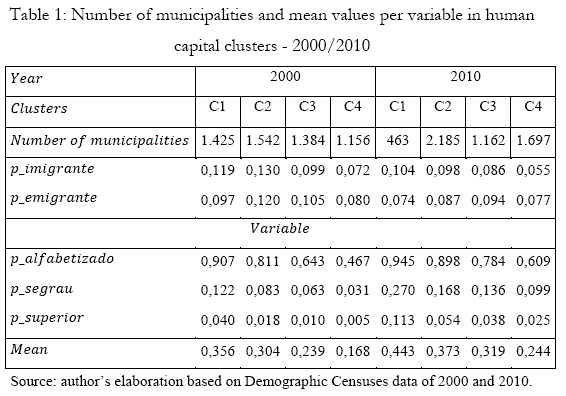
<body><![CDATA[<p align="justify"><font size="2" face="Verdana, Arial, Helvetica, sans-serif">In this sense, economic issues have an impact on the decision to migrate and consolidate the migratory movement guided by better income from the work of migrants at their destinations (Freguglia, 2007; Freguglia &amp; Menezes Filho, 2012; Silva <i>et al.,</i> 2016). It is pertinent to add that the socioeconomic insertion of the great majority of the migrants happens through work. The possibilities of bargaining for better conditions are limited to the possible returns of labor activities. However, other indicators of socioeconomic nature are omitted in the analyses. The coverage of socioeconomic indicators and the provision of basic services to the population have been little explored in the national literature, especially when considering new motivations in migratory decisions in recent years. </font></p>      <p align="justify"><font size="2" face="Verdana, Arial, Helvetica, sans-serif">On the other hand, according to Singer (1980), the aspects related to the decision to migrate are not only consolidated as a way of obtaining better monetary conditions. In many cases, migration is due to the &quot;expulsion&quot; of migrants. For many years, regions with problems related to low productive capacity or affected by climatic problems were potential factors for the displacement of workforce to other regions of the country (Martine &amp; Camargo, 1984; Camarano &amp; Abramovay, 1998). </font></p>      <p align="justify"><font size="2" face="Verdana, Arial, Helvetica, sans-serif">Considering the evasion factors most discussed in the literature that guide this paper, it is understood that the socioeconomic issues were the most influent, overlapping with the unobservable decisions of individual nature. The insertion conditions are most often relatively precarious. Circumstances that are related to the provision of basic services are independent of the individual actions in the initial condition of insertion of the migrants in the place of destination.</font></p>      <p align="justify"><font size="2" face="Verdana, Arial, Helvetica, sans-serif">Besides, it is plausible to emphasize that the migratory current of relatively poor origin related to destination - economically richer region - is intensified especially when considering the migratory flows observed in Brazil in the years of low economic performance (Ramalho, 2005; Netto Junior et al., 2008). There are also migratory flows and refluxes with reduced intensity in the contemporary dynamics, given the configurations in the local economies (Brito, 2006; Baeninger, 2012; Lima &amp; Braga, 2013). The regions/states/municipalities that expel are usually in relatively fragile economic conditions, with markedly precarious productive structures and low labor absorption capacity.</font></p>      <p align="justify"><font size="2" face="Verdana, Arial, Helvetica, sans-serif">In intermunicipality migrations, issues such as access to basic services of home infrastructure and the provision of other public services, such as education, can explain part of the migratory dynamics. Therefore, this study seeks to analyze the Brazilian migratory dynamics based on the socioeconomic and demographic conditions observed in the municipality scales. The relation between home infrastructure, human capital and the labor market on migration is observed. The municipalities are considered the units of analysis in this study.</font></p>      <p align="justify"><font size="2" face="Verdana, Arial, Helvetica, sans-serif">This paper is based on the central hypothesis that the Brazilian intermunicipality migratory dynamics is the result of a series of circumstantial factors (possibilities of better housing conditions) and individual characteristics (opportunities for professional qualification and chances of occupational insertion) in the destination of migrants.</font></p>      <p align="justify"><font size="2" face="Verdana, Arial, Helvetica, sans-serif">To reach the proposed objective, the paper is structured as follows: besides these initial considerations; the second section presents the methodological procedures developed in the analysis; in the third section, the Brazilian socioeconomic development is analyzed, based on the construction of multidimensional patterns of analysis; in the fourth section, the empirical results of the article are presented; in the fifth, the final considerations and the perspectives of new approaches are discussed.</font></p>      <p align="justify">&nbsp;</p>     <p align="justify"><font size="3" face="Verdana, Arial, Helvetica, sans-serif"><b>2.&nbsp;&nbsp;Methodological procedures</b></font></p>     <p align="justify"><font size="2" face="Verdana, Arial, Helvetica, sans-serif">The data used here come from the Demographic Censuses of Brazil. Sample micro-data are used and municipalities are considered as the minimum unit of analysis. Only those responsible for the households in the censuses of the two years under analysis were considered. Using the householder as the basis enables us to make a structural analysis of the migration and the conditions that the migrant family had at the origin and acquired at the destination. Only the fixed date migration were considered, according to the definition of demographic censuses in Brazil, that is: those who answered that they lived in another municipality in 1995 and in 2005 compose the data sample for the year 2000 and 2010, respectively. The objective is to draw a profile of migrations and the living conditions of migrants from the two temporal clipping.</font></p>      ]]></body>
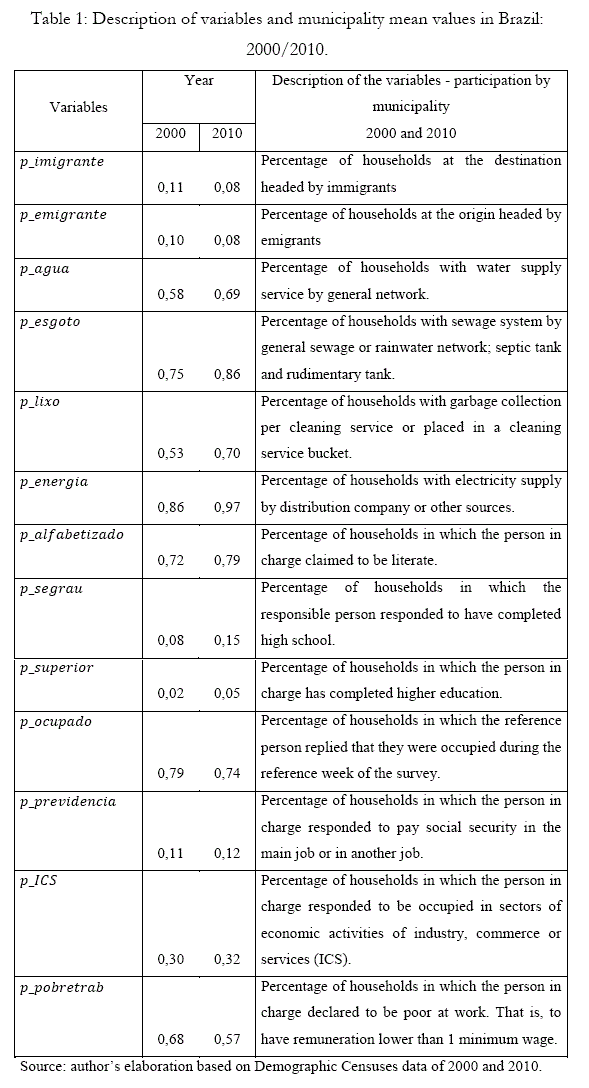
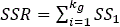
<body><![CDATA[<p align="justify"><font size="2" face="Verdana, Arial, Helvetica, sans-serif">The municipalities were equated and the sample is the universe, that is, 5,507 in 2000 and 2010. Although some municipalities have emancipated in the period, these were grouped so that they had historically comparable geographical units. The sample is made up of 9.448.548 heads of households in the year 2000; and 5.492.084 heads of households in 2010.</font></p>      <p align="justify"><font size="2" face="Verdana, Arial, Helvetica, sans-serif"><b>2.1.&nbsp;&nbsp;&nbsp;Grouping analysis by hierarchical <i>clusters </i></b></font></p>      <p align="justify"><font size="2" face="Verdana, Arial, Helvetica, sans-serif">In the first part of the paper, the pattern of Brazilian socioeconomic development is analyzed, based on the construction of three dimensions of analysis, namely: i) housing infrastructure: coverage of water supply services, garbage collection, sanitary sewage and electricity in households; ii) human capital: the participation of persons in charge of literate domiciles, with complete secondary education and with complete higher education by municipality; iii) labor market: participation of the person in charge of the occupied households, taxpayer of some official institute of social security in the main job or in another work; and engaged in industry, commerce or services; with less than a minimum wage (R$ 510 in 2010³). The aim is to verify how these dimensions of socioeconomic development are related to the percentage of immigrants and emigrants of the municipalities. <a href="#t1"><font color="#0000FF">Table 1</font></a> shows the complete list of variables as well as their mean values in 2000 and 2010.</font></p>      <p align=center><a name="t1"></a><img src="/img/revistas/ec/v5n1/a03_figura01.gif" width="589" height="1088"></p>      <p align="justify"><font size="2" face="Verdana, Arial, Helvetica, sans-serif">Based on Ward method, the hierarchical clustering instrument was applied, in order to classify Brazilian municipalities by the similarity (homogeneous municipalities) and the dissimilarities (heterogeneous municipalities) from the variables used<b>.</b></font></p>      <p align="justify"><font size="2" face="Verdana, Arial, Helvetica, sans-serif">Clustering or unsupervised classification occurs by grouping the individuals (municipalities) in such a way that the municipalities are homogeneous within the clusters and heterogeneous among the clusters. In this grouping, individuals with similar characteristics are classified, from the distance or statistical proximity of the variables between them (Theodoridis &amp; Koutroumbas, 1998; Jain et al., 1999; Mingoti, 2005). The aggregation criterion of Ward’s method is to maximize the variance between the groups and to minimize the variance within the groups, according to Mingoti (2005) and Maia (2006). The measure of total variability is given by: </font></p>      <p align="center"><img src="/img/revistas/ec/v5n1/a03_figura02.gif" width="561" height="91"></p>      <p align="justify"><font size="2" face="Verdana, Arial, Helvetica, sans-serif">Where, n<sub>i</sub> is defined as a number of elements belonging to a conglomerate C<sub>i</sub> in which it is in step <em>k</em> of a grouping process. The X<sub>ij</sub> is defined as the vector of observations in which the j’th sample element belongs to the i&rsquo;th conglomerate. Thus, <img src="/img/revistas/ec/v5n1/a03_figura03.gif" width="17" height="17"> is the centroid of conglomerate C<sub>i</sub>, where SS<sub>i</sub> corresponds to the sum of squares corresponding to conglomerate C<sub>i</sub>. In addition, as noted by Mingoti (2005), in step <em>k</em>, the sum of the total squares is defined as follows: <img src="/img/revistas/ec/v5n1/a03_figura04.gif" width="109" height="18">. It should be noted that <em>k<sub></sub></em><sub>g</sub> is defined by the sum of the number of clusters in step <em>k</em>.</font></p>      <p align="justify"><font size="2" face="Verdana, Arial, Helvetica, sans-serif">From this demonstration, Mingoti (2005) defines that the distance between the clusters to be formed, C<sub>1</sub> and C<sub>i</sub>, assumes the expression, namely:</font></p>      <p align="center"><img src="/img/revistas/ec/v5n1/a03_figura05.gif" width="544" height="48"></p>      ]]></body>

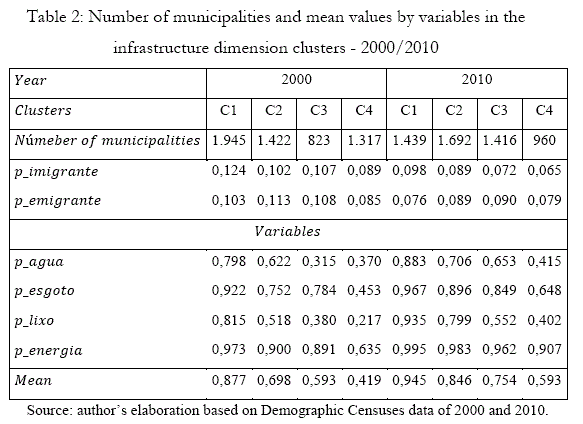
<body><![CDATA[<p align="justify"><font size="2" face="Verdana, Arial, Helvetica, sans-serif">Thus, the sum of the squares between clusters C<sub>1</sub>&nbsp;and C<sub>i</sub> are combined to minimize the distance in each of the steps of the clustering algorithm. With this, the most similar are grouped, that is, the municipalities that mostly resemble the combination of the variables used in each of the clusters.</font></p>      <p align="justify"><font size="2" face="Verdana, Arial, Helvetica, sans-serif">The choice of the number of clusters in this paper followed two criteria. The first is simplicity and analytical convenience. The definition of identical numbers of clusters for each dimension of analysis was attempted in order to facilitate the comparison of territorial inequalities. The second criterion is the ability of the clusters formed to explain the heterogeneity of the values in the territory. This was based on the results found by the semipartial R<sup>2</sup>, in which it is possible to follow the number of clusters indicated at each step from the variability within the groups, following the suggestion of Maia (2006). Initially, all information is dissimilar to each other and each one of them is part of a single cluster. At the end of the process, the dendogram built allowed to observe the number of clusters to be chosen, among which it was possible to define the total variability explained. Thus, the number of four clusters in each dimension was used as the criterion, based on the R² value on the total variability that each cluster is able to explain.</font></p>     <p align="justify">&nbsp;</p>     <p align="justify"><font size="3" face="Verdana, Arial, Helvetica, sans-serif"><b>3.&nbsp;&nbsp;Coverage of basic household services in Brazilian municipalities</b></font></p>      <p align="justify"><font size="2" face="Verdana, Arial, Helvetica, sans-serif">The main studies that discuss inequality in the world attribute part of it to the home infrastructure derived from circumstantial factors and that are exogenous to the individual actions (Atkinson, 1970; Dwokin, 1981; Arneson, 1989; Kranich, 1996). These are circumstantial problems that affect performance and corroborate the rise of inequality. Some of the studies attribute income inequality in part to the individual nature (effort) and partly to circumstantial issues (home infrastructure) (Barro <i>et al.,</i> 2009; Checchi &amp; Peragine, 2010, Figueiredo &amp; Ziegelmann, 2010; Figueiredo <i>et al</i>., 2012).</font></p>      <p align="justify"><font size="2" face="Verdana, Arial, Helvetica, sans-serif">The municipal <i>clusters</i> were formed by the hierarchical clustering method, grouping the Brazilian municipalities by the Ward method. Four <i>clusters</i> were selected that explain the total variability among municipalities in 70% in the first year and in 65% in the second year under analysis. That is, a high percentage of variability among municipalities explained by only four groups of analysis.</font></p>      <p align="justify"><font size="2" face="Verdana, Arial, Helvetica, sans-serif">In Brazil, as can be seen from the data in <a href="#t2"><font color="#0000FF">Table 2</font></a>, statistical information shows that the supply of basic services improves in all dimensions considered and in all clusters. The supply of garbage collection, sanitary sewage and water supply and electric power in households have higher means in 2010, when compared to the year 2000.</font></p>      <p align="justify"><font size="2" face="Verdana, Arial, Helvetica, sans-serif">The cluster with the best performance in the year 2000 grouped 1.945 municipalities. In 2010, the first cluster grouped 1.439 municipalities. The cluster that stood out with the lowest means of the variables grouped 1.317 municipalities in the first year and 960 in the last one.</font></p>      <p align="justify"><font size="2" face="Verdana, Arial, Helvetica, sans-serif">Cluster 1 has the highest percentage of immigrants in its municipalities. That is, in the municipalities of the first cluster, with the best means of the indicators selected, the largest percentage of immigrants (12,4%) is also concentrated. Besides, the municipalities that make up Cluster 4, with the lowest average indicators, have the lowest percentages of immigrant participation, on average, in 2000. In 2010, the trend continues: Clusters with the best indicators are those that concentrate, on average, the greater participation of immigrants.</font></p>      <p align="justify"><font size="2" face="Verdana, Arial, Helvetica, sans-serif">Thus, it is possible to associate indicators of socioeconomic development with the participation of immigrants in these municipalities. The data indicate that the best indicators are found in those municipalities with the largest participation of immigrants and the lowest number of emigrants in both years under observation. In addition, they are more associated to municipalities with population retention capacity. On the other hand, the municipalities grouped in clusters 2 and 3 have an average participation of immigrants and emigrants very close, characterizing municipalities with high turnover.</font></p>      ]]></body>
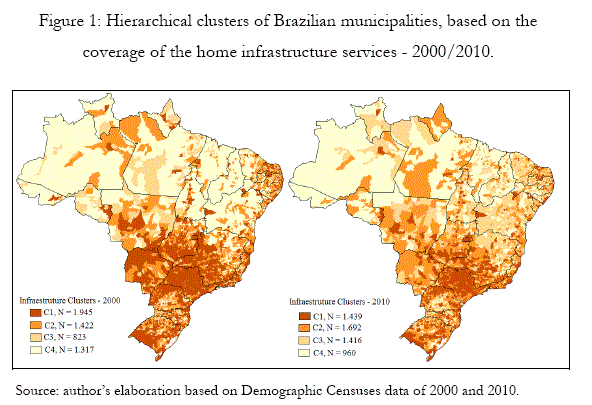
<body><![CDATA[<p align="center"><a name="t2"></a><img src="/img/revistas/ec/v5n1/a03_figura06.gif" width="583" height="424"></p>      <p align="justify"><font size="2" face="Verdana, Arial, Helvetica, sans-serif"><a href="#f1"><font color="#0000FF">Figure 1</font></a> shows the clustering of Brazilian municipalities, based on the use of four basic household infrastructure variables: access to water, electric power, sewage service, garbage collection. As can be seen, Census 2000 recorded information showing an agglomeration characterized by the high concentration of high service coverage in the southern regions of the country. Cluster 1 (with darker color) agglomerates the municipalities of the country with the highest indicators of coverage of basic services in the four variables analyzed.</font></p>      <p align="justify"><font size="2" face="Verdana, Arial, Helvetica, sans-serif">In this cluster, almost all of the state of São Paulo, the country's largest dynamic, economic and financial center, registered municipalities in the best relative position in that year. Municipalities in the Southeast, South and Midwest of the country were very close in offering basic services. On the other hand, the north of Minas Gerais resembles the Northeast and the North of the country, where few municipalities have been in cluster 1. It is possible to register in the south of the state of Bahia, in the west of Bahia and in the valley of the São Francisco, agribusiness development area and irrigated fruit trees, some municipalities with coverage similar to those found in the cities of the Brazilian Southeast/South. In the capitals of the states of the Northeast and in the cities with the greatest economic dynamics, clusters were also grouped in municipalities in a situation more favorable to the existence of an offer of home infrastructure services. In the North of the country, few municipalities remained in the first cluster, which corresponds to the best position in the hierarchical classification.</font></p>      <p align="justify"><font size="2" face="Verdana, Arial, Helvetica, sans-serif">In the year 2000, it is possible to observe that the municipalities of Piauí and Maranhão, above all, in addition to almost all of the Brazilian North, especially the states of Amazonas and Pará, are in cluster 4, which grouped the municipalities with the worst averages of coverage of basic services of home infrastructure, results convergent to those observed by Ferreira et al. (2012). Municipalities of two states in the Northeast and two in the North of Brazil were in a markedly lower situation in relation to those with higher rates of municipal household coverage in basic services.</font></p>      <p align="justify"><font size="2" face="Verdana, Arial, Helvetica, sans-serif">From the results, it is possible to highlight the strong differentiation between the North and the South of the country from the census information for the coverage of basic services of home infrastructure in the year 2000. The municipalities of the Southeast, South and Miwest presented close average coverage and were in clusters 1 and 2, as well as the municipalities of the Northeast and North of the country were mostly in clusters 3 and 4. The results converge with those of the literature that deal with this issue and ratify the hypothesis of regional inequality highlighted by access to basic opportunities.</font></p>      <p align=center><a name="f1"></a><img src="/img/revistas/ec/v5n1/a03_figura07.gif" width="592" height="405"></p>        <p align="justify"><font size="2" face="Verdana, Arial, Helvetica, sans-serif">Through the <font color="#0000FF" ><a href="#f1">Figure 1</a></font> (2010), it is possible observe that the concentration pattern persists in the municipalities located in the south of the country, although there has been an improvement in the coverage of services in several areas in the Northeast and North regions. In cluster 1 of the municipalities with the highest coverage of basic services, there is a strong concentration of municipalities on the Southeast/South and Midwest axis. Thus, the pattern of differentiation between North/Northeast and South for the indicators of this dimension is maintained, even though some municipalities in the North and Northeast have emerged with results similar to those observed in the areas of greater socioeconomic development in the country.</font></p>      <p align="justify"><font size="2" face="Verdana, Arial, Helvetica, sans-serif">The reduction of disparities, especially in access to home infrastructure services, is visible in the 2010 census records, as the averages of all clusters have increased from one period to the next. Electricity supply reached universal levels, and infrastructure services for water supply, garbage collection and sanitary sewage services were expanded. All the mean values of the clusters rose from 2000 to 2010 when the information in <a href="#t2"><font color="#0000FF">Table 2</font></a> was observed.</font></p>      <p align="justify"><font size="2" face="Verdana, Arial, Helvetica, sans-serif">In the access to home infrastructure services dimension, given by the coverage of basic services, the data reveal a slight improvement in <i>clusters</i> means.</font></p>     <p align="justify">&nbsp;</p>     ]]></body>
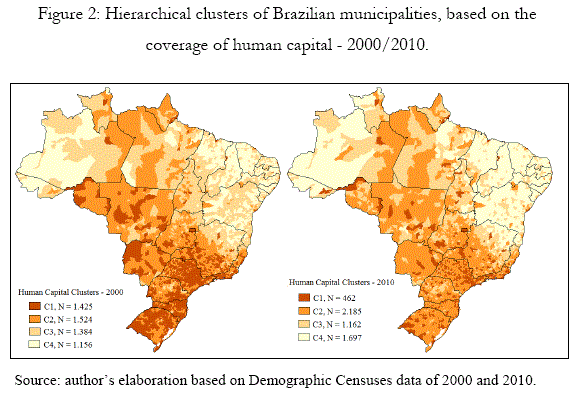
<body><![CDATA[<p align="justify"><font size="3" face="Verdana, Arial, Helvetica, sans-serif"><b>4.&nbsp;&nbsp;Distribution of human capital in Brazilian municipalities</b></font></p>      <p align="justify"><font size="2" face="Verdana, Arial, Helvetica, sans-serif">One of the main issues related to income inequality in the country was, for many years, attributed to the low level of human capital (Langoni, 1973; Reis &amp; Barros, 1991; Neri &amp; Thomas, 2000; Leme &amp; Wajnman, 2000). </font></p>      <p align="justify"><font size="2" face="Verdana, Arial, Helvetica, sans-serif">The markedly high educational inequality between regions is a relevant indicator of the regional concentration of socioeconomic development, since the rise of formal education in the country is responsible for a substantial portion of the increase in personal income at work (Reis &amp; Barros, 1991; Fernandes &amp; Menezes-Filho, 2000; Menezes-Filho, 2001; Fernandes &amp; Narita, 2001). Low coverage in access to basic and fundamental education was one of the main problems in the constitution of national human capital.</font></p>      <p align="justify"><font size="2" face="Verdana, Arial, Helvetica, sans-serif">As far as human capital is concerned, the data in <a href="#t3"><font color="#0000FF">Table 3</font></a> show that cluster averages improve roughly when the year 2010 is observed. To facilitate understanding together with the results of the previous topic (infrastructure), it was again selected four clusters of analyses. It should also be noted that the total variability of municipalities is explained in 88% in 2000 and 82% in 2010 by the choice of four clusters.</font></p>      <p align="justify"><font size="2" face="Verdana, Arial, Helvetica, sans-serif">In terms of literate participation, all clusters showed in 2010 an average superior than in 2000. The average number of people with complete high school was higher in 2010, as well as higher education, which shows the improvement in the country's educational indicators.</font></p>      <p align="justify"><font size="2" face="Verdana, Arial, Helvetica, sans-serif">In the human capital dimension, the highest percentages of immigrants, on average, are concentrated in the first two clusters, that is, those with the best educational indicators. In addition, clusters with the lowest indicators also have, on average, the smallest percentage of immigrants. It shows that municipalities with the best indicators tend to have the highest average rates of immigrant participation in both years. This result could partially reflect the migration of people in search of better possibilities for educational training.</font></p>      <p align=center><a name="t3"></a><img src="/img/revistas/ec/v5n1/a03_figura08.gif" width="566" height="396"></p>      <p align="justify"><font size="2" face="Verdana, Arial, Helvetica, sans-serif">According to the data in <a href="#f2"><font color="#0000FF">figure 2</font></a>, the human capital dimension, which is composed of the percentage of literate people with high school education and university degree, shows that regional differentiation was evident in the year 2000. The South and Southeast regions, to a greater extent, and the Midwest resembled this dimension of analysis. In the Northeast, only the state capitals and some municipalities in metropolitan areas have stood out in cluster 1. Besides, the north of Minas Gerais reproduces the pattern of the North and Northeast of Brazil in this dimension of analysis.</font></p>      <p align="justify"><font size="2" face="Verdana, Arial, Helvetica, sans-serif">Cluster 4 (of smaller means in the aforementioned dimension) agglomerates mainly municipalities of the Northeast and North regions of the country. Cluster 3 also has a strong proportion of municipalities in these two regions. That is, the municipalities of the poorest regions of the country are grouped in the clusters of lower performance in the human capital dimension (Santos &amp; Ferreira, 2006; Santos et al., 2001). Circumstantial issues such as the provision of educational services and insurance of the population's stay in basic education courses may be reflected in the low performance of local human capital in these regions.</font></p>      <p align=center><a name="f2"></a><img src="/img/revistas/ec/v5n1/a03_figura09.gif" width="578" height="393"></p>        ]]></body>
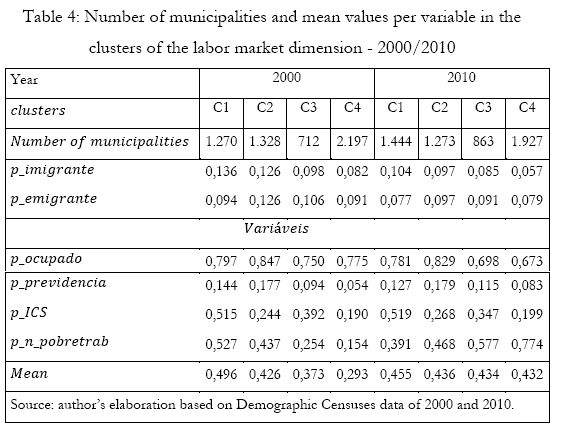
<body><![CDATA[<p align="justify"><font size="2" face="Verdana, Arial, Helvetica, sans-serif">As can be seen in <a href="#f2"><font color="#0000FF">figure 2</font></a>, the spatial pattern of clustering presents slight deconcentration, but still resembles that of year 2000. The territorial concentration of the best indicators of human capital remains, despite the improvement of the averages in the year 2010 in relation to 2000. The situation of municipalities is relatively more favorable from the point of view of the constitution and maintenance of human capital. This does not mean that an optimal standard for the formal education indicator in the country has been achieved. In addition, it can be seen from the map on the right that the municipalities with the best educational situation are concentrated in the South, Southeast and Midwest regions. Although cluster means improved, the proportion of this improvement occurs mostly in the more developed regions of the country. The maintenance of the North and Northeast in clusters 3 and 4 show that despite the improvement in educational indicators, these regions still distance themselves from the more developed regions. </font></p>      <p align="justify"><font size="2" face="Verdana, Arial, Helvetica, sans-serif">It is necessary to observe that cluster 2 maintains a pattern concentrated in the municipalities of the South, Southeast and Midwest. Moreover, even with the slight reduction of spatial polarization in southern areas, the municipalities of the North and Northeast are still concentrated in clusters 3 and 4. In cluster 2, only a few municipalities and the capitals of the northeastern and northern states are classified, including reducing the participation of those which were in cluster 3 in the year 2000 and losing space in this cluster in 2010.</font></p>      <p align="justify"><font size="2" face="Verdana, Arial, Helvetica, sans-serif">The means increased in all <i>clusters</i> in the three perspectives analyzed for the human capital dimension. It is possible that adult literacy programs, greater accessibility and permanence of children and young people in primary and secondary schools, as well as the process of interiorization of public universities and programs for the entry and stay of low-income youth in universities and colleges contributed to the observed result.</font></p>     <p align="justify">&nbsp;</p>     <p align="justify"><font size="3" face="Verdana, Arial, Helvetica, sans-serif"><b>5.&nbsp;&nbsp;Structure of the municipality labor market in Brazil</b></font></p>      <p align="justify"><font size="2" face="Verdana, Arial, Helvetica, sans-serif">On the transformations in the Brazilian labor market of the 2000s, a series of studies (Barros &amp; Galvão, 2002; Santos &amp; Moreira, 2006; Dedecca &amp; Rosandiski, 2006; Silva Filho, 2011; Silva Filho, 2016 ;) have pointed to a substantial improvement in the level of formality and in the relative earnings of wages. The Brazilian labor market showed a substantially better performance than in the 1990s, but the results were still timid in the context of the formalization of work and the quality of jobs offered (Silva Filho, 2011; Silva Filho, 2016).</font></p>      <p align="justify"><font size="2" face="Verdana, Arial, Helvetica, sans-serif">Before this, the data in <a href="#t4"><font color="#0000FF">Table 4</font></a> show the mean values recorded for each of the variables in each of the <i>clusters</i>. Once again, four <i>clusters</i> were selected to facilitate comparison with the other dimensions of analysis. It should be noted that the use of four <i>clusters</i> explained 64% of the total variability of municipalities in 2000 and 69% in 2010.</font></p>      <p align="justify"><font size="2" face="Verdana, Arial, Helvetica, sans-serif">As for the means recorded in clusters in the labor market dimension, the data in <a href="#t4"><font color="#0000FF">Table 4</font></a> show that the variable p_ocupado in all clusters of 2000 presented values higher than those registered in 2010. That is, the occupation (participation of persons occupied in relation to the population in the municipalities in each of the <i>clusters</i> presented a better performance in the year 2000 compared to 2010. Moreover, the mean values of the variable p_previdencia  are higher in <i>clusters</i> 2, 3 and 4 in 2010 than in 2000, ratifying the greater formalization in the Brazilian labor market (Silva Filho, 2016). Only in the first <i>cluster</i> the value of 2010 was lower than the one recorded in the year 2000.</font></p>      <p align="justify"><font size="2" face="Verdana, Arial, Helvetica, sans-serif">In this dimension of analysis, the p_ICS  variable also presented statistically equal mean values for <i>clusters </i>1, 2 and 4 in the two years. Only clusters 3 presented the highest mean in the year 2000, if the average recorded in 2010 was observed. Furthermore, the variable p_n_pobretrab (participation of non-poor in the work<sup>1</sup>) presented averages in 2010 lower than those registered in the year 2000. With this, it is possible to observe that the mean values registered in each of the <i>clusters</i> in 2010 are lower than those of the 2000s.</font></p>      <p align="justify"><font size="2" face="Verdana, Arial, Helvetica, sans-serif">It is important to be noted that the highest participation rates of immigrants are in clusters that have, on average, the best indicators. Thus, it is inferred that migration in Brazil has as one of the reasons the labor market. It is possible to register that the municipalities that retain population and are centers of attraction of immigrants are those with the highest mean values in the labor market dimensions. Besides, they recorded the lowest rates of emigration in the two years in question.</font></p>      ]]></body>
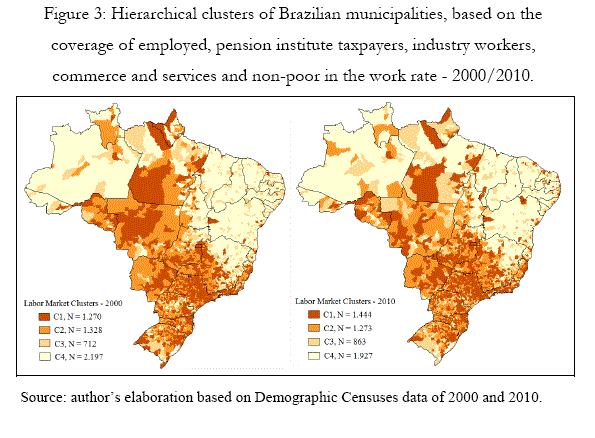
<body><![CDATA[<p align=center><a name="t4"></a><img src="/img/revistas/ec/v5n1/a03_figura10.gif" width="563" height="438"></p>      <p align="justify"><font size="2" face="Verdana, Arial, Helvetica, sans-serif">The data of to the years 2000 and 2010 relating to Brazilian municipality labor market dimension (<a href="#f3"><font color="#0000FF">figure 3</font></a>), present relatively similar patterns of municipality classification between the years. In the year 2000, 1.270 municipalities were grouped in <i>cluster</i> 1, the one with the best labor market performance in terms of occupation rate, social security contribution and execution of activities in the commerce and services industry sectors. In 2010, 1.444 municipalities were registered in the first cluster, the majority concentrated in the South, Southeast and Midwest states. That is, in the most economically dynamic regions of the country.</font></p>      <p align="justify"><font size="2" face="Verdana, Arial, Helvetica, sans-serif">It is observed in <i>cluster</i> 2, a greater agglomeration of the municipality in the Southeast/South and Midwest axis, following the same trend observed in <i>cluster</i> 1, with dispersion of a few municipalities off the territory, but in areas of relatively more dynamic economies. In <i>cluster</i> 2, few Northeastern municipalities stand out, with greater participation of municipalities in the North.</font></p>      <p align="justify"><font size="2" face="Verdana, Arial, Helvetica, sans-serif">In <i>clusters</i> 3 and 4 the municipalities of the North and Northeast of Brazil were concentrated. Besides the states of these two regions, municipalities in the north of Minas Gerais also have a relatively similar pattern to those of the above-mentioned regions in the year 2000. A few municipalities in Mato Grosso and Goiás were also classified in these <i>clusters.</i></font></p>      <p align=center><a name="f3"></a><img src="/img/revistas/ec/v5n1/a03_figura11.gif" width="595" height="438"></p>        <p align="justify"><font size="2" face="Verdana, Arial, Helvetica, sans-serif">In 2010, more municipalities were included in cluster 1, and the mean values of their variables decreased substantially from the first to the last year, rising from 0,56 to 0,45. However, cluster 2 also agglomerated a substantially high number of municipalities. The poor performance of the municipalities of the North and Northeast in the best clusters is remarkable in both years. But in spite of the low performance, in 2010 these regions present more municipalities in cluster 1, compared to year 2000.</font></p>      <p align="justify"><font size="2" face="Verdana, Arial, Helvetica, sans-serif">In clusters 3 and 4, municipalities are concentrated largely in the North and Northeast of the country in both years. That is to say, under the labor market aspect, there is a polarization in the distribution of opportunities by the municipalities of the economically most dynamic regions of the country, classified in the clusters that present the highest means of each of the variables that make up the dimension and, consequently, the best total clusters averages.</font></p>      <p align="justify"><font size="2" face="Verdana, Arial, Helvetica, sans-serif">The reduction of the polarization pattern of these municipalities is little visible. There are still substantial differences between the Brazilian regions in this aspect. Relative improvement in the indicators of the less developed regions of the country do not approach them in the other regions, even if the development of the labor market dimension still falls far short of the proposal of Brazilian inclusion in the ranking of developed countries in all regions. The North and Northeast are the most affected regions and their municipalities are concentrated in the clusters of the worst averages of this dimension of analysis.</font></p>     <p align="justify">&nbsp;</p>     <p align="justify"><font size="3" face="Verdana, Arial, Helvetica, sans-serif"><b>6.&nbsp;Municipality socioeconomic development in Brazil: a multidimensional approach</b></font></p>      ]]></body>
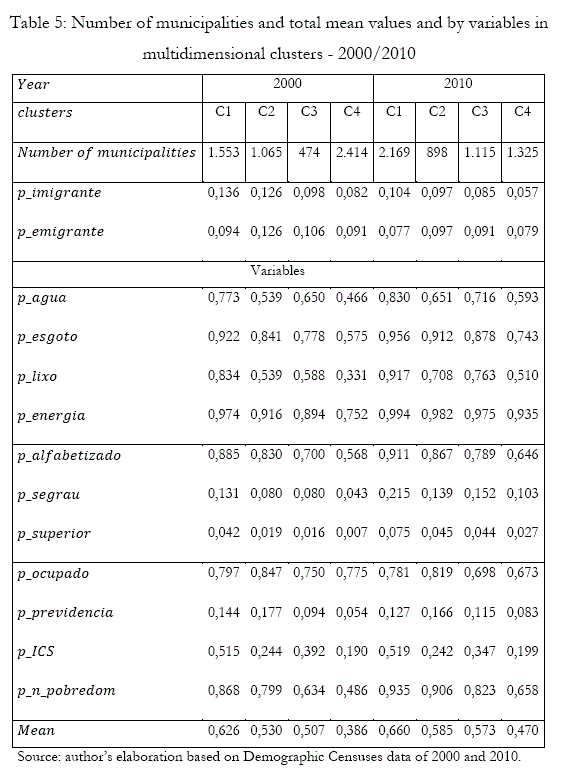
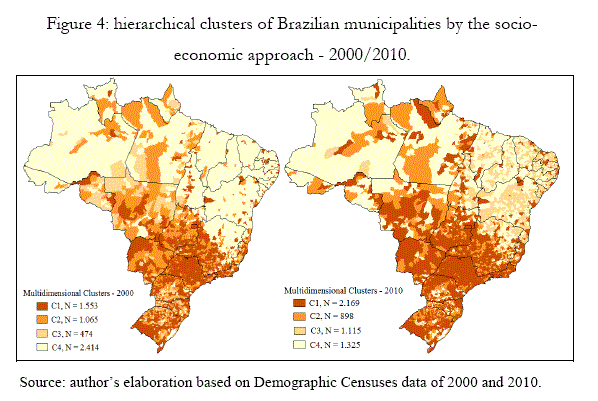
<body><![CDATA[<p align="justify"><font size="2" face="Verdana, Arial, Helvetica, sans-serif">Issues related to Brazilian socioeconomic development are dealt with in the literature from the point of view of inequalities in the process of concentration of the productive activities of the country (Araújo, 2000; Diniz, 2001; Silva Filho <i>et al.,</i> 2015). Issues of structural nature and industrial concentration on the Southeast/South axis have substantial relevance to explain the causes of socioeconomic inequalities (Diniz, 2001; Pacheco, 1999; Silva &amp; Silva Filho, 2017). However, the measurement of the level of socioeconomic inequality among the regions at municipality level is little explored in the national economic literature.</font></p>      <p align="justify"><font size="2" face="Verdana, Arial, Helvetica, sans-serif">The problems related to Brazilian economic development and underdevelopment have always been dealt with from the point of view of inequality arising from the industrialization process of the country and this would be one of the main causes of regional inequalities (Guimarães Neto, 1997, 1998; Pacheco, 1999; Araújo, 2000; Diniz, 2001; Furtado, 2007). Inequality of opportunity can be a cause and also a consequence of the lack of possibility of economic dynamism, as well as it may result from the inefficiency of actions in promoting the creation of opportunities (Figueiredo <i>et al.,</i> 2010).</font></p>      <p align="justify"><font size="2" face="Verdana, Arial, Helvetica, sans-serif">To analyze socioeconomic development in an integrated way, four clusters were defined based on all the indicators of previous sessions. The same number of groups of the previous analyses was maintained in order to be able to compare the spatial distribution and the explanatory power of these dimensions of analysis by looking at the figures of each of the dimensions. In     <a href="#t5"><font color="#0000FF">Table 5</font></a> are the mean values assumed by each of the variables and in each of the clusters in each year. The variability among the clusters in the year 2000 represented 60% of the total variability of the municipalities, and in 2010, it was of 58%.</font></p>      <p align="justify"><font size="2" face="Verdana, Arial, Helvetica, sans-serif">It is possible to notice that the mean values vary over the years and the clusters also present different behaviors from one year to the other, not being thus possible its comparison, being only possible to observe the mean values and the distribution of the municipalities in each one of the maps. The mean values of the size in the clusters in 2010 are higher than those registered in the year 2000, although some variables that make up some of the dimensions presented lower averages in 2010, especially those related to the structure of the labor market.</font></p>      <p align="justify"><font size="2" face="Verdana, Arial, Helvetica, sans-serif">It is also possible to highlight that, in both 2000 and 2010, cluster 1, which groups the municipalities with the best indicators, also had, on average, the highest percentages of immigrants, as well as the lower percentage of emigrants, suggesting that there is a relation between the socioeconomic development of municipalities and their migratory dynamics over the years. That is, the municipalities that contain the best socioeconomic indicators are also the ones that most retain immigrants and have the lowest rates of evasion in percentage terms.</font></p>      <p align=center><a name="t5"></a><img src="/img/revistas/ec/v5n1/a03_figura12.gif" width="563" height="777"></p>      <p align="justify"><font size="2" face="Verdana, Arial, Helvetica, sans-serif">With regard to the socioeconomic development of the Brazilian municipalities, from a multidimensional analysis, the data of <a href="#f4"><font color="#0000FF">figure 4</font></a> show that in the year 2000 there was a clear polarization in favor of the South and Southeast of Brazil. Socioeconomic development by the multiple dimensions of analysis agglomerated municipalities of the Southeast, South and Midwest in <i>cluster</i> 1, the one with the best level of socioeconomic development, with few municipalities in the North and Northeast that resembled those of the dynamic centers of the national economy.</font></p>      <p align="justify"><font size="2" face="Verdana, Arial, Helvetica, sans-serif">In addition, it is important to highlight that, in Cluster 2, the best median and mean municipalities of the multidimensional indicators were located around the municipalities of Cluster 1, the vast majority of them. Where it was a developed municipality, in its surroundings was a municipality equal to or close to its level of socioeconomic development. Furthermore, it is pertinent to highlight that the highest concentration of municipalities classified in the first <i>cluster</i> was located in the states of São Paulo and Rio Grande do Sul, results converging to other results found in the literature on the index of home infrastructure and equal opportunity that are also important indicators of municipality development (Dill &amp; Gonçalves, 2012; Ferreira <i>et al.,</i> 2012; Cavalcanti &amp; Ramos, 2014).</font></p>      <p align="justify"><font size="2" face="Verdana, Arial, Helvetica, sans-serif">At the other extreme, the municipalities of the North and Northeast of Brazil were located, in the majority, in Clusters 3 and 4, that is, those with the worst socioeconomic indicators. Northern Minas presented characteristics of its municipalities similar to those observed in the states of the Northeast and North. The municipalities of Piauí and Maranhão, as well as those of Amazonas, were mainly concentrated in cluster 4. </font></p>      <p align=center><a name="f4"></a><img src="/img/revistas/ec/v5n1/a03_figura13.gif" width="598" height="401"></p>        ]]></body>
<body><![CDATA[<p align="justify"><font size="2" face="Verdana, Arial, Helvetica, sans-serif">In 2010, changes in Brazil only slightly improved the levels of socioeconomic indicators, and it was not possible to identify a change in the pattern of polarization by the municipalities in the South and Southeast that existed in the year 2000. North/South asymmetry is maintained, since slight improvement occurred in all regions, but kept the gap between development and Brazil's economic underdevelopment virtually constant. There is a slight increase in the participation of municipalities in the North and Northeast, which became part of the first <i>cluster</i>. That is, the one with the best mean indicators and that concentrates the economically more dynamic municipalities of the country. The similarity matrix agglomerates municipalities from North to South of the country in the first cluster. Although most of the municipalities that make up <i>cluster</i> 1 are located in the South and Southeast of Brazil, it is possible to observe, in a minority, in all regions and states, municipalities that resemble those located in the most economically dynamic regions. </font></p>      <p align="justify"><font size="2" face="Verdana, Arial, Helvetica, sans-serif">Additionally, it can be seen that if the municipalities that make up the second <i>cluster</i> are also concentrated in the Southeast, South and Midwest regions, with few of them in the North and Northeast of Brazil. That is, the cluster of considerable position in the ranking of municipalities from the variables used is also concentrated in the dynamic, economic and financial center of the country.</font></p>      <p align="justify"><font size="2" face="Verdana, Arial, Helvetica, sans-serif">It is possible to infer from the right map of <a href="#f4">figure 4</a> that there was a slight reduction of the polarization of the territory in the indicators used here. As a result, municipalities located in other regions and in substantially poor states of the country have reached levels of socioeconomic indicators that are somewhat higher, on average, in 2010, but they are still relatively unlike those of the economically more developed regions. The slight reduction of regional socioeconomic disparities was not enough to reduce the asymmetries between the North and the South of the country (Dill &amp; Gonçalves 2012; Ferreira <i>et al.,</i> 2010).</font></p>     <p align="justify">&nbsp;</p>     <p align="justify"><font size="3" face="Verdana, Arial, Helvetica, sans-serif"><b>7.&nbsp;&nbsp;Final considerations</b></font></p>      <p align="justify"><font size="2" face="Verdana, Arial, Helvetica, sans-serif">This paper aimed to analyze the socioeconomic structure of the Brazilian municipalities in the years 2000 and 2010 and to observe if there is any relation with the municipality migratory dynamics. Demographic census data show that there was a slight improvement in the socioeconomic indicators of the country, when the first and the last year under analysis are compared. Moreover, there is a relation between socioeconomic development and migration, based on the sample data, in Brazilian municipalities, where the highest level of development of economic activities, such as agribusiness and intensive industrial activities, recorded a higher relative participation of migrants responsible for the household.</font></p>      <p align="justify"><font size="2" face="Verdana, Arial, Helvetica, sans-serif">With regard to home infrastructure related to basic services, the results show that between 2000 and 2010 there was a slight reduction in the differences between the North and the South of the country. Due to the hierarchical clustering used here, it was possible to cluster municipalities in all Brazilian regions, both in the best clusters and those with the worst indicators. The results in this dimension of analysis show a slight reduction of asymmetry and confirm the concentration of the best means of development indicators in the most dynamic regions of the country.</font></p>      <p align="justify"><font size="2" face="Verdana, Arial, Helvetica, sans-serif">In reference to the performance of the human capital indicators, it can be stated that there was substantial improvement throughout the Brazilian territory. In the year 2000, the asymmetry between North and South is clear, with low indicators for the first and the best indicators found in the municipalities of the South. In 2010, <i>cluster</i> analysis shows a slight reduction of regional disparities in this dimension. Additionally, the labor market also presents a substantial asymmetry between North and South in the economically more dynamic regions of the country in both years.</font></p>      <p align="justify"><font size="2" face="Verdana, Arial, Helvetica, sans-serif">In the Brazilian municipality socioeconomic development clusters, it is possible to perceive only a slight reduction in North/South asymmetry when the years 2000 and 2010 are observed. Despite this slight reduction, there are still substantial inequalities, especially when other indicators and other dimensions of analysis are observed. The slight improvement of the indicators occurs in a generalized way and the economically less developed regions raise, albeit slightly, their indicators, but they can not keep up with the indexes recorded in the most economically dynamic regions.</font></p>      <p align="justify"><font size="2" face="Verdana, Arial, Helvetica, sans-serif">By the three dimensions analyzed, as well as by the construction of multidimensional <i>clusters</i>, the relation between migration and socioeconomic development of the municipalities was evident. The municipalities that remained in the first cluster of each of the dimensions of analysis also had the highest averages of immigrants, relatively higher than those of emigrants. Besides, the municipalities of the worst <i>clusters</i> in each of the dimensions registered the lowest averages of the indicators and, consequently, of immigrants in both years. Thus, the results suggest that immigrants seek municipalities with the best indicators of socioeconomic development in the country and emigration records are proportionally higher in economically less developed municipalities.</font></p>      ]]></body>
<body><![CDATA[<p align="justify">&nbsp;</p>     <p align="justify"><strong><font size="3" face="Verdana, Arial, Helvetica, sans-serif">Note</font></strong></p>     <p align="justify"><font size="2" face="Verdana, Arial, Helvetica, sans-serif"><sup>1</sup> This variable was created from the variable p_pobretrab. The goal was to consider the highest average value as the best in each cluster. Thus, it was created from the use of the operator (1 - p_pobretrab). That is, the participation of the poor in the work was subtracted from a participation of non-poor in the work.</font></p>     <p align="justify">&nbsp;</p>     <p align="justify"><font size="3" face="Verdana, Arial, Helvetica, sans-serif"><b>Bibliography references</b></font></p>      <!-- ref --><p align="justify"><font size="2" face="Verdana, Arial, Helvetica, sans-serif">Araújo, T. B. (2000). Nordeste, Nordestes: que Nordeste? Ensaios sobre o Desenvolvimento Brasileiro: heranças e urgências, Rio de Janeiro, Brasil, Editora Fase, 2000.</font>&nbsp;&nbsp;&nbsp;&nbsp;&nbsp;&nbsp;&nbsp;&nbsp;[&#160;<a href="javascript:void(0);" onclick="javascript: window.open('/scielo.php?script=sci_nlinks&ref=1268159&pid=S2415-0622202000010000300001&lng=','','width=640,height=500,resizable=yes,scrollbars=1,menubar=yes,');">Links</a>&#160;]<!-- end-ref --><!-- ref --><p align="justify"><font size="2" face="Verdana, Arial, Helvetica, sans-serif">Borjas, G. (1987). Self-selection and the earnings of immigrants. American Economic Review, Volume 77, Nº 4, United States, American Economic Association, pp. 531-553, 1987. </font>&nbsp;&nbsp;&nbsp;&nbsp;&nbsp;&nbsp;&nbsp;&nbsp;[&#160;<a href="javascript:void(0);" onclick="javascript: window.open('/scielo.php?script=sci_nlinks&ref=1268160&pid=S2415-0622202000010000300002&lng=','','width=640,height=500,resizable=yes,scrollbars=1,menubar=yes,');">Links</a>&#160;]<!-- end-ref --><!-- ref --><p align="justify"><font size="2" face="Verdana, Arial, Helvetica, sans-serif">Boudeville, J. (1973). Os Espaços Econômicos. São Paulo; Brasil, Editora: Saber Atual, 1973.</font>&nbsp;&nbsp;&nbsp;&nbsp;&nbsp;&nbsp;&nbsp;&nbsp;[&#160;<a href="javascript:void(0);" onclick="javascript: window.open('/scielo.php?script=sci_nlinks&ref=1268161&pid=S2415-0622202000010000300003&lng=','','width=640,height=500,resizable=yes,scrollbars=1,menubar=yes,');">Links</a>&#160;]<!-- end-ref --><!-- ref --><p align="justify"><font size="2" face="Verdana, Arial, Helvetica, sans-serif">Brito, F. (2006). O deslocamento da população brasileira para as metrópoles, Estudos Avançados, v, 20, n, 57, São Paulo, Basil, – Universidade de São Paulo – SP, p,221-236, 2006.</font>&nbsp;&nbsp;&nbsp;&nbsp;&nbsp;&nbsp;&nbsp;&nbsp;[&#160;<a href="javascript:void(0);" onclick="javascript: window.open('/scielo.php?script=sci_nlinks&ref=1268162&pid=S2415-0622202000010000300004&lng=','','width=640,height=500,resizable=yes,scrollbars=1,menubar=yes,');">Links</a>&#160;]<!-- end-ref --><!-- ref --><p align="justify"><font size="2" face="Verdana, Arial, Helvetica, sans-serif">Camarano, A. A.; Abramovay, R. (1998). Êxodo rural, envelhecimento e masculinização no Brasil: panorama dos últimos cinquenta anos. Revista Brasileira de Estudos de População, Rio de Janeiro, Brasil, Associação Brasileira de Estudos da População, v. 15, n. 2, p. 45-66, jul./dez. 1998.</font>&nbsp;&nbsp;&nbsp;&nbsp;&nbsp;&nbsp;&nbsp;&nbsp;[&#160;<a href="javascript:void(0);" onclick="javascript: window.open('/scielo.php?script=sci_nlinks&ref=1268163&pid=S2415-0622202000010000300005&lng=','','width=640,height=500,resizable=yes,scrollbars=1,menubar=yes,');">Links</a>&#160;]<!-- end-ref --><!-- ref --><p align="justify"><font size="2" face="Verdana, Arial, Helvetica, sans-serif">Cançado, R. P. (1999). Migrações e Convergência no Brasil: 1960-91. Revista Brasileira de Estudos de População, Rio de Janeiro, Brasil, Associação Brasileira de Estudos da População, v. 53, nº 2: p. 211-236, abr./ jun. 1999.</font>&nbsp;&nbsp;&nbsp;&nbsp;&nbsp;&nbsp;&nbsp;&nbsp;[&#160;<a href="javascript:void(0);" onclick="javascript: window.open('/scielo.php?script=sci_nlinks&ref=1268164&pid=S2415-0622202000010000300006&lng=','','width=640,height=500,resizable=yes,scrollbars=1,menubar=yes,');">Links</a>&#160;]<!-- end-ref --><!-- ref --><p align="justify"><font size="2" face="Verdana, Arial, Helvetica, sans-serif">Christaller, W. (1996). Central places in southern Germany. Trad. by Carlishe W. Baskin. Englewood Cliffs, Germany, Editor: Prentice- Hall, 1996.</font>&nbsp;&nbsp;&nbsp;&nbsp;&nbsp;&nbsp;&nbsp;&nbsp;[&#160;<a href="javascript:void(0);" onclick="javascript: window.open('/scielo.php?script=sci_nlinks&ref=1268165&pid=S2415-0622202000010000300007&lng=','','width=640,height=500,resizable=yes,scrollbars=1,menubar=yes,');">Links</a>&#160;]<!-- end-ref --><!-- ref --><p align="justify"><font size="2" face="Verdana, Arial, Helvetica, sans-serif">Dedecca, C. S.; Rosandiski, E. N. (2006). Recuperação econômica e geração de empregos formais. Revista Parcerias Estratégicas – v. 11, Nº 22, Brasília, Brasil, Cento de Gestão e Estudos Estratégicos – CGEE, p. 169-190, 2006.</font>&nbsp;&nbsp;&nbsp;&nbsp;&nbsp;&nbsp;&nbsp;&nbsp;[&#160;<a href="javascript:void(0);" onclick="javascript: window.open('/scielo.php?script=sci_nlinks&ref=1268166&pid=S2415-0622202000010000300008&lng=','','width=640,height=500,resizable=yes,scrollbars=1,menubar=yes,');">Links</a>&#160;]<!-- end-ref --><!-- ref --><p align="justify"><font size="2" face="Verdana, Arial, Helvetica, sans-serif">Dill, H. C.; Gonçalves, F. de O. (2012). Igualdade de Oportunidades no Brasil entre 1999 e 2009: estimação e decomposição através do valor de Shapley. Pesquisa e Planejamento Econômico – PPE. vol. 42, n.2, Brasília, Brasil, Instituto de Pesquisa Econômica Aplicada – IPEA, p. 185-2010, 2012. </font>&nbsp;&nbsp;&nbsp;&nbsp;&nbsp;&nbsp;&nbsp;&nbsp;[&#160;<a href="javascript:void(0);" onclick="javascript: window.open('/scielo.php?script=sci_nlinks&ref=1268167&pid=S2415-0622202000010000300009&lng=','','width=640,height=500,resizable=yes,scrollbars=1,menubar=yes,');">Links</a>&#160;]<!-- end-ref --><!-- ref --><p align="justify"><font size="2" face="Verdana, Arial, Helvetica, sans-serif">Diniz, C. C. (2001). A Questão Regional e as Políticas Governamentais no Brasil, Texto para discussão, Nº 159, Belo Horizonte, Brasil, Centro de Desenvolvimento e Planejamento Regional – Universidade Federal de Minas Gerais – UFMG, CEDEPLAR/UFMG, 2001.</font>&nbsp;&nbsp;&nbsp;&nbsp;&nbsp;&nbsp;&nbsp;&nbsp;[&#160;<a href="javascript:void(0);" onclick="javascript: window.open('/scielo.php?script=sci_nlinks&ref=1268168&pid=S2415-0622202000010000300010&lng=','','width=640,height=500,resizable=yes,scrollbars=1,menubar=yes,');">Links</a>&#160;]<!-- end-ref --><!-- ref --><p align="justify"><font size="2" face="Verdana, Arial, Helvetica, sans-serif">Dustmann, C.; Glitz, A. (2011). Migration and education. Centre of Research and Analysis of Migration, Discussion Paper Series, n.5, Handbook of Education and Migration, Rio de Janeiro, Brasil, Editor: Elsevier, p. 327-439, 2011.</font>&nbsp;&nbsp;&nbsp;&nbsp;&nbsp;&nbsp;&nbsp;&nbsp;[&#160;<a href="javascript:void(0);" onclick="javascript: window.open('/scielo.php?script=sci_nlinks&ref=1268169&pid=S2415-0622202000010000300011&lng=','','width=640,height=500,resizable=yes,scrollbars=1,menubar=yes,');">Links</a>&#160;]<!-- end-ref --><!-- ref --><p align="justify"><font size="2" face="Verdana, Arial, Helvetica, sans-serif">Fernandes, R.; Menezes-Filho, N. A. (2000). A evolução da desigualdade de rendimentos no Brasil metropolitano entre 1983 e 1987, Estudos Econômicos, v, 30, nº 4, São Paulo, Brasil, Universidade de São Paulo – USP, p. 549-569, 2000.</font>&nbsp;&nbsp;&nbsp;&nbsp;&nbsp;&nbsp;&nbsp;&nbsp;[&#160;<a href="javascript:void(0);" onclick="javascript: window.open('/scielo.php?script=sci_nlinks&ref=1268170&pid=S2415-0622202000010000300012&lng=','','width=640,height=500,resizable=yes,scrollbars=1,menubar=yes,');">Links</a>&#160;]<!-- end-ref --><!-- ref --><p align="justify"><font size="2" face="Verdana, Arial, Helvetica, sans-serif">Fernandes, R.; Narita, R. D. T. (2001). Instrução superior e mercado de trabalho no Brasil. Revista Economia Aplicada, v, 5, n, 1, São Paulo, Brasil, Universidade de São Paulo – USP, p. 7-32, 2001.</font>&nbsp;&nbsp;&nbsp;&nbsp;&nbsp;&nbsp;&nbsp;&nbsp;[&#160;<a href="javascript:void(0);" onclick="javascript: window.open('/scielo.php?script=sci_nlinks&ref=1268171&pid=S2415-0622202000010000300013&lng=','','width=640,height=500,resizable=yes,scrollbars=1,menubar=yes,');">Links</a>&#160;]<!-- end-ref --><!-- ref --><p align="justify"><font size="2" face="Verdana, Arial, Helvetica, sans-serif">Figueiredo, E. A.; Ziegelmann, F. A. (2010). Estimation of opportunity inequality in Brazil using nonparametric local logistic regression, Journal of Development Studies, v, 46, nº 9. Reino Unido, Taylor &amp; Francys Group, p, 1,593-1,606, 2010.</font>&nbsp;&nbsp;&nbsp;&nbsp;&nbsp;&nbsp;&nbsp;&nbsp;[&#160;<a href="javascript:void(0);" onclick="javascript: window.open('/scielo.php?script=sci_nlinks&ref=1268172&pid=S2415-0622202000010000300014&lng=','','width=640,height=500,resizable=yes,scrollbars=1,menubar=yes,');">Links</a>&#160;]<!-- end-ref --><!-- ref --><p align="justify"><font size="2" face="Verdana, Arial, Helvetica, sans-serif">Figueiredo, E. A.; Silva, C. R. F.; Rego, H. de O. (2012). Desigualdade de oportunidades no Brasil: efeitos diretos e indiretos. Revista Economia Aplicada, v. 16, n. 2, São Paulo, Brasil, Universidade de São Paulo – USP, pp. 237-254, 2012.</font>&nbsp;&nbsp;&nbsp;&nbsp;&nbsp;&nbsp;&nbsp;&nbsp;[&#160;<a href="javascript:void(0);" onclick="javascript: window.open('/scielo.php?script=sci_nlinks&ref=1268173&pid=S2415-0622202000010000300015&lng=','','width=640,height=500,resizable=yes,scrollbars=1,menubar=yes,');">Links</a>&#160;]<!-- end-ref --><!-- ref --><p align="justify"><font size="2" face="Verdana, Arial, Helvetica, sans-serif">Freguglia, R.; Menezes Filho, N. A. (2012). Inter-regional wage differentials with individual heterogeneity: evidence from Brazil, Ann Regional Science, v. 49, nº 3, Germany, <a href="https://en.wikipedia.org/wiki/Holtzbrinck_Publishing_Group" title="Holtzbrinck Publishing Group" target="_blank"><font color="#0000FF">Holtzbrinck Publishing Group</font></a>, Springer Nature, pp. 17–34, 2012. </font>&nbsp;&nbsp;&nbsp;&nbsp;&nbsp;&nbsp;&nbsp;&nbsp;[&#160;<a href="javascript:void(0);" onclick="javascript: window.open('/scielo.php?script=sci_nlinks&ref=1268174&pid=S2415-0622202000010000300016&lng=','','width=640,height=500,resizable=yes,scrollbars=1,menubar=yes,');">Links</a>&#160;]<!-- end-ref --><!-- ref --><p align="justify"><font size="2" face="Verdana, Arial, Helvetica, sans-serif">Freguglia, R. (2007). Efeitos da migração sobre os salários no Brasil. Tese (Doutorado em Teoria Econômica) – Faculdade de Economia, Administração e Contabilidade, Universidade de São Paulo. São Paulo, Brasil, 2007.</font>&nbsp;&nbsp;&nbsp;&nbsp;&nbsp;&nbsp;&nbsp;&nbsp;[&#160;<a href="javascript:void(0);" onclick="javascript: window.open('/scielo.php?script=sci_nlinks&ref=1268175&pid=S2415-0622202000010000300017&lng=','','width=640,height=500,resizable=yes,scrollbars=1,menubar=yes,');">Links</a>&#160;]<!-- end-ref --><!-- ref --><p align="justify"><font size="2" face="Verdana, Arial, Helvetica, sans-serif">Guimarães Neto, L. (1997). Desigualdade e políticas regionais no Brasil: caminhos e descaminhos. Revista Planejamento e Políticas Públicas, v. 2, nº 15, Brasília, Brasil, Instituto de Pesquisa Econômica Aplicada – IPEA, 1997.</font>&nbsp;&nbsp;&nbsp;&nbsp;&nbsp;&nbsp;&nbsp;&nbsp;[&#160;<a href="javascript:void(0);" onclick="javascript: window.open('/scielo.php?script=sci_nlinks&ref=1268176&pid=S2415-0622202000010000300018&lng=','','width=640,height=500,resizable=yes,scrollbars=1,menubar=yes,');">Links</a>&#160;]<!-- end-ref --><!-- ref --><p align="justify"><font size="2" face="Verdana, Arial, Helvetica, sans-serif">Isard, W. (1962) Methods of Regional Analysis; an Introduction to Regional Science.Cambridge: Published jointly by the Technology Press of the Massachusetts Institute of Technology and Wiley, New York, 1962.</font>&nbsp;&nbsp;&nbsp;&nbsp;&nbsp;&nbsp;&nbsp;&nbsp;[&#160;<a href="javascript:void(0);" onclick="javascript: window.open('/scielo.php?script=sci_nlinks&ref=1268177&pid=S2415-0622202000010000300019&lng=','','width=640,height=500,resizable=yes,scrollbars=1,menubar=yes,');">Links</a>&#160;]<!-- end-ref --><!-- ref --><p align="justify"><font size="2" face="Verdana, Arial, Helvetica, sans-serif">Jain, A.; Murty, N.; Flynn, P. (1999). Data Clustering: A Review, ACM Computing Surveys nº 31, v. 3, Michigan, United States, Michigan State University,  pp. 264–322, 1999.</font>&nbsp;&nbsp;&nbsp;&nbsp;&nbsp;&nbsp;&nbsp;&nbsp;[&#160;<a href="javascript:void(0);" onclick="javascript: window.open('/scielo.php?script=sci_nlinks&ref=1268178&pid=S2415-0622202000010000300020&lng=','','width=640,height=500,resizable=yes,scrollbars=1,menubar=yes,');">Links</a>&#160;]<!-- end-ref --><!-- ref --><p align="justify"><font size="2" face="Verdana, Arial, Helvetica, sans-serif">Langoni, C. (1973). Distribuição de renda e desenvolvimento no Brasil, Rio de Janeiro, Brasil, Editora: Expressão e Cultura, 1973.</font>&nbsp;&nbsp;&nbsp;&nbsp;&nbsp;&nbsp;&nbsp;&nbsp;[&#160;<a href="javascript:void(0);" onclick="javascript: window.open('/scielo.php?script=sci_nlinks&ref=1268179&pid=S2415-0622202000010000300021&lng=','','width=640,height=500,resizable=yes,scrollbars=1,menubar=yes,');">Links</a>&#160;]<!-- end-ref --><!-- ref --><p align="justify"><font size="2" face="Verdana, Arial, Helvetica, sans-serif">Lee, E. (1980). Uma teoria sobre a migração, In: Moura, H, A, (org), Migração interna: textos selecionados, Fortaleza, Ceará, Brasil, Editora do Banco do Nordeste do Brasil S/A, 1980.</font>&nbsp;&nbsp;&nbsp;&nbsp;&nbsp;&nbsp;&nbsp;&nbsp;[&#160;<a href="javascript:void(0);" onclick="javascript: window.open('/scielo.php?script=sci_nlinks&ref=1268180&pid=S2415-0622202000010000300022&lng=','','width=640,height=500,resizable=yes,scrollbars=1,menubar=yes,');">Links</a>&#160;]<!-- end-ref --><!-- ref --><p align="justify"><font size="2" face="Verdana, Arial, Helvetica, sans-serif">Leme, M. C. da S.; Wajnman, S. (2000). Só estudar, só trabalhar, fazer ambas as coisas ou não fazer nenhuma delas? A decisão de alocação de tempo dos jovens brasileiros, Trabalho apresentado no XXI Encontro Brasileiro de Econometria, Belém, Pará, Brasil, 2000.</font>&nbsp;&nbsp;&nbsp;&nbsp;&nbsp;&nbsp;&nbsp;&nbsp;[&#160;<a href="javascript:void(0);" onclick="javascript: window.open('/scielo.php?script=sci_nlinks&ref=1268181&pid=S2415-0622202000010000300023&lng=','','width=640,height=500,resizable=yes,scrollbars=1,menubar=yes,');">Links</a>&#160;]<!-- end-ref --><!-- ref --><p align="justify"><font size="2" face="Verdana, Arial, Helvetica, sans-serif">Lima, E. E. C. de; Braga, F. G. (2013). Da rotatividade migratória à baixa migração: uma análise dos padrões da mobilidade populacional no Brasil de 1995-2000. Revista Brasileira de Estudos da População, v. 30, n. 1, Rio de Janeiro, Brasil, Associação Brasileira de Estudos da População – ABEP, p. 57-75, jan./jun. 2013.</font>&nbsp;&nbsp;&nbsp;&nbsp;&nbsp;&nbsp;&nbsp;&nbsp;[&#160;<a href="javascript:void(0);" onclick="javascript: window.open('/scielo.php?script=sci_nlinks&ref=1268182&pid=S2415-0622202000010000300024&lng=','','width=640,height=500,resizable=yes,scrollbars=1,menubar=yes,');">Links</a>&#160;]<!-- end-ref --><!-- ref --><p align="justify"><font size="2" face="Verdana, Arial, Helvetica, sans-serif">Lobo, C.; Matos, R. (2011). Migrações e a dispersão espacial da população nas Regiões de Influência das principais metrópoles brasileiras, Revista Brasileira de Estudos da População, v, 28, n, 1, Rio de Janeiro, Brasil, Associação Brasileira de Estudos da População – ABEP, pp. 81-101, jan,/jun, 2011.</font>&nbsp;&nbsp;&nbsp;&nbsp;&nbsp;&nbsp;&nbsp;&nbsp;[&#160;<a href="javascript:void(0);" onclick="javascript: window.open('/scielo.php?script=sci_nlinks&ref=1268183&pid=S2415-0622202000010000300025&lng=','','width=640,height=500,resizable=yes,scrollbars=1,menubar=yes,');">Links</a>&#160;]<!-- end-ref --><!-- ref --><p align="justify"><font size="2" face="Verdana, Arial, Helvetica, sans-serif">Maia, A. G. (2006). Distribuição de classes no Brasil: uma nova dimensão para a análise da estrutura social. Universidade Estadual de Campinas – UNICAMP, (Tese de Doutorado em Economia aplicada), Campinas, São Paulo, Brasil, Fundação Universidade Estadual de Campinas UNICAMP, 2006.</font>&nbsp;&nbsp;&nbsp;&nbsp;&nbsp;&nbsp;&nbsp;&nbsp;[&#160;<a href="javascript:void(0);" onclick="javascript: window.open('/scielo.php?script=sci_nlinks&ref=1268184&pid=S2415-0622202000010000300026&lng=','','width=640,height=500,resizable=yes,scrollbars=1,menubar=yes,');">Links</a>&#160;]<!-- end-ref --><!-- ref --><p align="justify"><font size="2" face="Verdana, Arial, Helvetica, sans-serif">Martine, G.; Camargo, L. (1984). Crescimento e distribuição da população brasileira: tendências recentes. Revista Brasileira de Estudos de População, Campinas, Associação Brasileira de Estudos da População - ABEP, v. 1, n. 2, p. 99-143, jan./dez. 1984. </font>&nbsp;&nbsp;&nbsp;&nbsp;&nbsp;&nbsp;&nbsp;&nbsp;[&#160;<a href="javascript:void(0);" onclick="javascript: window.open('/scielo.php?script=sci_nlinks&ref=1268185&pid=S2415-0622202000010000300027&lng=','','width=640,height=500,resizable=yes,scrollbars=1,menubar=yes,');">Links</a>&#160;]<!-- end-ref --><!-- ref --><p align="justify"><font size="2" face="Verdana, Arial, Helvetica, sans-serif">Menezes-Filho, N. A. (2001). Educação e desigualdade, In: Lisboa, M,, Menezes-Filho, N. A. (orgs,), Microeconomia e sociedade no Brasil, Rio de Janeiro, Brasil: EPGE, 2001.</font>&nbsp;&nbsp;&nbsp;&nbsp;&nbsp;&nbsp;&nbsp;&nbsp;[&#160;<a href="javascript:void(0);" onclick="javascript: window.open('/scielo.php?script=sci_nlinks&ref=1268186&pid=S2415-0622202000010000300028&lng=','','width=640,height=500,resizable=yes,scrollbars=1,menubar=yes,');">Links</a>&#160;]<!-- end-ref --><p align="justify"><font size="2" face="Verdana, Arial, Helvetica, sans-serif"><a href="http://lattes.cnpq.br/3274762673749139" target="_blank"><font color="#0000FF">Mingoti, S. A.</font></a> (2005). Análise de dados através de métodos de estatística multivariada: uma abordagem aplicada. Belo Horizonte, Brasil, Editora: UFMG, 297p. 2005. </font></p>      <!-- ref --><p align="justify"><font size="2" face="Verdana, Arial, Helvetica, sans-serif">Myrdal, G. (1956), “Economic theory and the underdeveloped regions”, London, 1956.</font>&nbsp;&nbsp;&nbsp;&nbsp;&nbsp;&nbsp;&nbsp;&nbsp;[&#160;<a href="javascript:void(0);" onclick="javascript: window.open('/scielo.php?script=sci_nlinks&ref=1268188&pid=S2415-0622202000010000300030&lng=','','width=640,height=500,resizable=yes,scrollbars=1,menubar=yes,');">Links</a>&#160;]<!-- end-ref --><!-- ref --><p align="justify"><font size="2" face="Verdana, Arial, Helvetica, sans-serif">Neri, M.; Thomas, M. (2000), The effects of idiosyncratic shocks to father’s income on child labor, school drop-outs and repetition rates in Brazil, Trabalho apresentado no XXI Encontro Brasileiro de Econometria, Belém, Brasil, 2000.</font>&nbsp;&nbsp;&nbsp;&nbsp;&nbsp;&nbsp;&nbsp;&nbsp;[&#160;<a href="javascript:void(0);" onclick="javascript: window.open('/scielo.php?script=sci_nlinks&ref=1268189&pid=S2415-0622202000010000300031&lng=','','width=640,height=500,resizable=yes,scrollbars=1,menubar=yes,');">Links</a>&#160;]<!-- end-ref --><!-- ref --><p align="justify"><font size="2" face="Verdana, Arial, Helvetica, sans-serif">Netto Júnior, J. L. da S.; Porto Junior, S. da S.; Figueirêdo, E. A. (2008). Migração e distribuição de capital humano no Brasil: mobilidade intergeracional educacional e intrageracional de renda, Revista Econômica do Nordeste, Fortaleza, v. 39, nº 4, Fortaleza, Brasil, Editora: Banco do Nordeste do Brasil – BNB, out-dez, 2008.</font>&nbsp;&nbsp;&nbsp;&nbsp;&nbsp;&nbsp;&nbsp;&nbsp;[&#160;<a href="javascript:void(0);" onclick="javascript: window.open('/scielo.php?script=sci_nlinks&ref=1268190&pid=S2415-0622202000010000300032&lng=','','width=640,height=500,resizable=yes,scrollbars=1,menubar=yes,');">Links</a>&#160;]<!-- end-ref --><!-- ref --><p align="justify"><font size="2" face="Verdana, Arial, Helvetica, sans-serif">Pacheco, C. A. (1999). Novos padrões de localização industrial? Tendências recentes. Texto para discussão, nº 0665, Brasília, Brasil, Instituto de Pesquisa Econômica Aplicada – IPEA, 1999.</font>&nbsp;&nbsp;&nbsp;&nbsp;&nbsp;&nbsp;&nbsp;&nbsp;[&#160;<a href="javascript:void(0);" onclick="javascript: window.open('/scielo.php?script=sci_nlinks&ref=1268191&pid=S2415-0622202000010000300033&lng=','','width=640,height=500,resizable=yes,scrollbars=1,menubar=yes,');">Links</a>&#160;]<!-- end-ref --><!-- ref --><p align="justify"><font size="2" face="Verdana, Arial, Helvetica, sans-serif">Perroux, F. (1955). Les Espaces Économiques. Économie Appliquée, v. 1, nº 3, Fance, Paris Editor: Presses Universitaires de Fance, p. 225-244, 1955.</font>&nbsp;&nbsp;&nbsp;&nbsp;&nbsp;&nbsp;&nbsp;&nbsp;[&#160;<a href="javascript:void(0);" onclick="javascript: window.open('/scielo.php?script=sci_nlinks&ref=1268192&pid=S2415-0622202000010000300034&lng=','','width=640,height=500,resizable=yes,scrollbars=1,menubar=yes,');">Links</a>&#160;]<!-- end-ref --><!-- ref --><p align="justify"><font size="2" face="Verdana, Arial, Helvetica, sans-serif">Richardson, H. (1973). Elementos de economia regional. Rio de Janeiro, Brasil, Editora: Zahar, 1973.</font>&nbsp;&nbsp;&nbsp;&nbsp;&nbsp;&nbsp;&nbsp;&nbsp;[&#160;<a href="javascript:void(0);" onclick="javascript: window.open('/scielo.php?script=sci_nlinks&ref=1268193&pid=S2415-0622202000010000300035&lng=','','width=640,height=500,resizable=yes,scrollbars=1,menubar=yes,');">Links</a>&#160;]<!-- end-ref --><!-- ref --><p align="justify"><font size="2" face="Verdana, Arial, Helvetica, sans-serif">Santos Junior, E. Rosa. (2002). Migração e seleção: o caso do Brasil. Escola de Pós-Graduação em Economia da Fundação Getúlio Vargas. (dissertação de Mestrado) Rio de Janeiro, Brasil, FGV, 2002. </font>&nbsp;&nbsp;&nbsp;&nbsp;&nbsp;&nbsp;&nbsp;&nbsp;[&#160;<a href="javascript:void(0);" onclick="javascript: window.open('/scielo.php?script=sci_nlinks&ref=1268194&pid=S2415-0622202000010000300036&lng=','','width=640,height=500,resizable=yes,scrollbars=1,menubar=yes,');">Links</a>&#160;]<!-- end-ref --><!-- ref --><p align="justify"><font size="2" face="Verdana, Arial, Helvetica, sans-serif">Santos, D. D. dos; Barros, R. P. de, Mendonça, R.; Quintaes, G. (2001). Determinantes do desempenho educacional do Brasil. Revista Pesquisa &amp; Planejamento Econômico, v. 31, n. 1, p. 1-42, 2001.</font>&nbsp;&nbsp;&nbsp;&nbsp;&nbsp;&nbsp;&nbsp;&nbsp;[&#160;<a href="javascript:void(0);" onclick="javascript: window.open('/scielo.php?script=sci_nlinks&ref=1268195&pid=S2415-0622202000010000300037&lng=','','width=640,height=500,resizable=yes,scrollbars=1,menubar=yes,');">Links</a>&#160;]<!-- end-ref --><!-- ref --><p align="justify"><font size="2" face="Verdana, Arial, Helvetica, sans-serif">Santos, L. M. dos; M., I. T. (2006). Condições do Mercado de Trabalho no setor de serviços no Nordeste. XV Encontro Nacional de Estudos Populacionais – ABEP. Caxambu – Brasil, associação Brasileira de Estudos da População, 2006.</font>&nbsp;&nbsp;&nbsp;&nbsp;&nbsp;&nbsp;&nbsp;&nbsp;[&#160;<a href="javascript:void(0);" onclick="javascript: window.open('/scielo.php?script=sci_nlinks&ref=1268196&pid=S2415-0622202000010000300038&lng=','','width=640,height=500,resizable=yes,scrollbars=1,menubar=yes,');">Links</a>&#160;]<!-- end-ref --><!-- ref --><p align="justify"><font size="2" face="Verdana, Arial, Helvetica, sans-serif">Silva Filho, L A.; Silva, F. J. F.; Queiroz, S. N. (2015). Nordeste industrial: a fragmentação territorial de uma região periférica. Revista Econômica do nordeste, v. Fortaleza, v. 46, n. 2, p. 9-24, abr. - jun., 2015.</font>&nbsp;&nbsp;&nbsp;&nbsp;&nbsp;&nbsp;&nbsp;&nbsp;[&#160;<a href="javascript:void(0);" onclick="javascript: window.open('/scielo.php?script=sci_nlinks&ref=1268197&pid=S2415-0622202000010000300039&lng=','','width=640,height=500,resizable=yes,scrollbars=1,menubar=yes,');">Links</a>&#160;]<!-- end-ref --><!-- ref --><p align="justify"><font size="2" face="Verdana, Arial, Helvetica, sans-serif">Silva Filho, L. A. (2011). Mercado de Trabalho e Estrutura Sócio-ocupacional: estudo comparativo entre as regiões metropolitanas de Fortaleza, Recife e Salvador – 2001-2008. Dissertação de Mestrado em Economia. Nata, Brasil – Universidade Federal do Rio Grande do Norte, 2011, 131 p.</font>&nbsp;&nbsp;&nbsp;&nbsp;&nbsp;&nbsp;&nbsp;&nbsp;[&#160;<a href="javascript:void(0);" onclick="javascript: window.open('/scielo.php?script=sci_nlinks&ref=1268198&pid=S2415-0622202000010000300040&lng=','','width=640,height=500,resizable=yes,scrollbars=1,menubar=yes,');">Links</a>&#160;]<!-- end-ref --><!-- ref --><p align="justify"><font size="2" face="Verdana, Arial, Helvetica, sans-serif">Silva Filho, L. A. (2016). Labour market and turnover in the industrial employment in the Brazilian Northeast region. Investigación Económica, vol. LXXV, núm. 295, Ciudad de México, México, <a href="http://www.economia.unam.mx/rev_invecon.html" target="_blank"><font color="#0000FF">Facultad de Economía de la Universidad Nacional Autónoma de México</font></a>, pp. 203-230.</font>&nbsp;&nbsp;&nbsp;&nbsp;&nbsp;&nbsp;&nbsp;&nbsp;[&#160;<a href="javascript:void(0);" onclick="javascript: window.open('/scielo.php?script=sci_nlinks&ref=1268199&pid=S2415-0622202000010000300041&lng=','','width=640,height=500,resizable=yes,scrollbars=1,menubar=yes,');">Links</a>&#160;]<!-- end-ref --><!-- ref --><p align="justify"><font size="2" face="Verdana, Arial, Helvetica, sans-serif">Silva, J. C. M.; Silva Filho, L. A. (2017) Panorama da Indústria nas Macrorregiões Brasileiras: Análise a Partir de Medidas Regionais e de Localização. Revista Portuguesa de Estudos Regionais, nº 45, v. 2, Lisboa, Portugal, Associação Portuguesa de Estudos Regionais – APDR, 2017.</font>&nbsp;&nbsp;&nbsp;&nbsp;&nbsp;&nbsp;&nbsp;&nbsp;[&#160;<a href="javascript:void(0);" onclick="javascript: window.open('/scielo.php?script=sci_nlinks&ref=1268200&pid=S2415-0622202000010000300042&lng=','','width=640,height=500,resizable=yes,scrollbars=1,menubar=yes,');">Links</a>&#160;]<!-- end-ref --><!-- ref --><p align="justify"><font size="2" face="Verdana, Arial, Helvetica, sans-serif">Theodoridis, S.; Koutroumbas, K. (1998). Pattern Recognition, San Diego United States, Editor: Academic Press, 1998.</font>&nbsp;&nbsp;&nbsp;&nbsp;&nbsp;&nbsp;&nbsp;&nbsp;[&#160;<a href="javascript:void(0);" onclick="javascript: window.open('/scielo.php?script=sci_nlinks&ref=1268201&pid=S2415-0622202000010000300043&lng=','','width=640,height=500,resizable=yes,scrollbars=1,menubar=yes,');">Links</a>&#160;]<!-- end-ref --><!-- ref --><p align="justify"><font size="2" face="Verdana, Arial, Helvetica, sans-serif">lesina, A., and La Ferrara, E., (2002). “Who trusts others?” Journal of Public Economics 85, 207-234. </font>&nbsp;&nbsp;&nbsp;&nbsp;&nbsp;&nbsp;&nbsp;&nbsp;[&#160;<a href="javascript:void(0);" onclick="javascript: window.open('/scielo.php?script=sci_nlinks&ref=1268202&pid=S2415-0622202000010000300044&lng=','','width=640,height=500,resizable=yes,scrollbars=1,menubar=yes,');">Links</a>&#160;]<!-- end-ref --><p align="justify">&nbsp;</p>     ]]></body>
<body><![CDATA[<p align="justify"><font size="3" face="Verdana, Arial, Helvetica, sans-serif"><b>Note</b></font></p>     <p align="justify"><font size="2" face="Verdana, Arial, Helvetica, sans-serif"><sup>1</sup>   This strand interprets that the workforce with higher productive characteristics migrates in search of work and this raises the disparities, since they raise the average level of performance in the places of destination, leaving the regions of origin with the less productive labor force.</font></p>      <p align="justify"><font size="2" face="Verdana, Arial, Helvetica, sans-serif"><sup>2</sup> &quot;Expulsion&quot; is understood as a phenomenon caused by socioeconomic circumstances in regions of low economic performance, not motivated by wars and / or political and religious persecution factors of a climatic nature, among others.</font></p>      <p align="justify"><font size="2" face="Verdana, Arial, Helvetica, sans-serif"><sup>3 </sup>All monetary variables (income) of this thesis are in Reals (Brazilian currency) of 2010.</font></p>     <p align="justify">&nbsp;</p>     <p align="justify">&nbsp;</p>      ]]></body><back>
<ref-list>
<ref id="B1">
<nlm-citation citation-type="book">
<person-group person-group-type="author">
<name>
<surname><![CDATA[Araújo]]></surname>
<given-names><![CDATA[T. B]]></given-names>
</name>
</person-group>
<source><![CDATA[Nordeste, Nordestes: que Nordeste]]></source>
<year>2000</year>
<publisher-loc><![CDATA[Rio de Janeiro ]]></publisher-loc>
<publisher-name><![CDATA[Editora Fase]]></publisher-name>
</nlm-citation>
</ref>
<ref id="B2">
<nlm-citation citation-type="book">
<person-group person-group-type="author">
<name>
<surname><![CDATA[Borjas]]></surname>
<given-names><![CDATA[G]]></given-names>
</name>
</person-group>
<source><![CDATA[Self-selection and the earnings of immigrants]]></source>
<year>1987</year>
<volume>77</volume>
<page-range>531-553</page-range><publisher-name><![CDATA[American Economic Review]]></publisher-name>
</nlm-citation>
</ref>
<ref id="B3">
<nlm-citation citation-type="book">
<person-group person-group-type="author">
<name>
<surname><![CDATA[Boudeville]]></surname>
<given-names><![CDATA[J]]></given-names>
</name>
</person-group>
<source><![CDATA[Os Espaços Econômicos]]></source>
<year>1973</year>
<publisher-loc><![CDATA[São Paulo ]]></publisher-loc>
<publisher-name><![CDATA[Saber Atual]]></publisher-name>
</nlm-citation>
</ref>
<ref id="B4">
<nlm-citation citation-type="journal">
<person-group person-group-type="author">
<name>
<surname><![CDATA[Brito]]></surname>
<given-names><![CDATA[F]]></given-names>
</name>
</person-group>
<article-title xml:lang="pt"><![CDATA[O deslocamento da população brasileira para as metrópoles]]></article-title>
<source><![CDATA[Estudos Avançados]]></source>
<year>2006</year>
<volume>20</volume>
<numero>57</numero>
<issue>57</issue>
<page-range>221-236</page-range><publisher-loc><![CDATA[São Paulo ]]></publisher-loc>
<publisher-name><![CDATA[Universidade de São Paulo - SP]]></publisher-name>
</nlm-citation>
</ref>
<ref id="B5">
<nlm-citation citation-type="journal">
<person-group person-group-type="author">
<name>
<surname><![CDATA[Camarano]]></surname>
<given-names><![CDATA[A. A.]]></given-names>
</name>
<name>
<surname><![CDATA[Abramovay]]></surname>
<given-names><![CDATA[R]]></given-names>
</name>
</person-group>
<article-title xml:lang="pt"><![CDATA[Êxodo rural, envelhecimento e masculinização no Brasil: panorama dos últimos cinquenta anos]]></article-title>
<source><![CDATA[Revista Brasileira de Estudos de População]]></source>
<year>1998</year>
<volume>15</volume>
<numero>2</numero>
<issue>2</issue>
<page-range>45-66</page-range><publisher-loc><![CDATA[Rio de Janeiro ]]></publisher-loc>
<publisher-name><![CDATA[Associação Brasileira de Estudos da População]]></publisher-name>
</nlm-citation>
</ref>
<ref id="B6">
<nlm-citation citation-type="journal">
<person-group person-group-type="author">
<name>
<surname><![CDATA[Cançado]]></surname>
<given-names><![CDATA[R. P.]]></given-names>
</name>
</person-group>
<article-title xml:lang="pt"><![CDATA[Migrações e Convergência no Brasil: 1960-91]]></article-title>
<source><![CDATA[Revista Brasileira de Estudos de População]]></source>
<year>1999</year>
<volume>53</volume>
<numero>2</numero>
<issue>2</issue>
<page-range>211-236</page-range><publisher-loc><![CDATA[Rio de Janeiro ]]></publisher-loc>
<publisher-name><![CDATA[Associação Brasileira de Estudos da População]]></publisher-name>
</nlm-citation>
</ref>
<ref id="B7">
<nlm-citation citation-type="book">
<person-group person-group-type="author">
<name>
<surname><![CDATA[Christaller]]></surname>
<given-names><![CDATA[W]]></given-names>
</name>
</person-group>
<source><![CDATA[Central places in southern Germany]]></source>
<year>1996</year>
<publisher-name><![CDATA[Prentice- Hall]]></publisher-name>
</nlm-citation>
</ref>
<ref id="B8">
<nlm-citation citation-type="journal">
<person-group person-group-type="author">
<name>
<surname><![CDATA[Dedecca]]></surname>
<given-names><![CDATA[C. S.]]></given-names>
</name>
<name>
<surname><![CDATA[Rosandiski]]></surname>
<given-names><![CDATA[E. N.]]></given-names>
</name>
</person-group>
<article-title xml:lang="pt"><![CDATA[Recuperação econômica e geração de empregos formais]]></article-title>
<source><![CDATA[Revista Parcerias Estratégicas]]></source>
<year>2006</year>
<volume>11</volume>
<numero>22</numero>
<issue>22</issue>
<page-range>169-190</page-range><publisher-loc><![CDATA[Brasília ]]></publisher-loc>
<publisher-name><![CDATA[Cento de Gestão e Estudos Estratégicos - CGEE]]></publisher-name>
</nlm-citation>
</ref>
<ref id="B9">
<nlm-citation citation-type="journal">
<person-group person-group-type="author">
<name>
<surname><![CDATA[Dill]]></surname>
<given-names><![CDATA[H. C]]></given-names>
</name>
<name>
<surname><![CDATA[Gonçalves]]></surname>
<given-names><![CDATA[F. de O]]></given-names>
</name>
</person-group>
<article-title xml:lang="pt"><![CDATA[Igualdade de Oportunidades no Brasil entre 1999 e 2009: estimação e decomposição através do valor de Shapley]]></article-title>
<source><![CDATA[Pesquisa e Planejamento Econômico - PPE]]></source>
<year>2012</year>
<volume>42</volume>
<numero>2</numero>
<issue>2</issue>
<page-range>185-2010</page-range><publisher-loc><![CDATA[Brasília ]]></publisher-loc>
<publisher-name><![CDATA[Instituto de Pesquisa Econômica Aplicada - IPEA]]></publisher-name>
</nlm-citation>
</ref>
<ref id="B10">
<nlm-citation citation-type="book">
<person-group person-group-type="author">
<name>
<surname><![CDATA[Diniz]]></surname>
<given-names><![CDATA[C. C.]]></given-names>
</name>
</person-group>
<source><![CDATA[A Questão Regional e as Políticas Governamentais no Brasil]]></source>
<year>2001</year>
<publisher-name><![CDATA[Universidade Federal de Minas Gerais - UFMG, CEDEPLAR/UFMG]]></publisher-name>
</nlm-citation>
</ref>
<ref id="B11">
<nlm-citation citation-type="book">
<person-group person-group-type="author">
<name>
<surname><![CDATA[Dustmann]]></surname>
<given-names><![CDATA[C]]></given-names>
</name>
<name>
<surname><![CDATA[Glitz]]></surname>
<given-names><![CDATA[A]]></given-names>
</name>
</person-group>
<source><![CDATA[Migration and education: Centre of Research and Analysis of Migration]]></source>
<year>2011</year>
<page-range>327-439</page-range><publisher-loc><![CDATA[Rio de Janeiro ]]></publisher-loc>
<publisher-name><![CDATA[Elsevier]]></publisher-name>
</nlm-citation>
</ref>
<ref id="B12">
<nlm-citation citation-type="journal">
<person-group person-group-type="author">
<name>
<surname><![CDATA[Fernandes]]></surname>
<given-names><![CDATA[R]]></given-names>
</name>
<name>
<surname><![CDATA[Menezes-Filho]]></surname>
<given-names><![CDATA[N. A]]></given-names>
</name>
</person-group>
<article-title xml:lang="pt"><![CDATA[A evolução da desigualdade de rendimentos no Brasil metropolitano entre 1983 e 1987]]></article-title>
<source><![CDATA[Estudos Econômicos]]></source>
<year>2000</year>
<volume>30</volume>
<numero>4</numero>
<issue>4</issue>
<page-range>549-569</page-range><publisher-loc><![CDATA[São Paulo ]]></publisher-loc>
<publisher-name><![CDATA[Universidade de São Paulo - USP]]></publisher-name>
</nlm-citation>
</ref>
<ref id="B13">
<nlm-citation citation-type="journal">
<person-group person-group-type="author">
<name>
<surname><![CDATA[Fernandes]]></surname>
<given-names><![CDATA[R]]></given-names>
</name>
<name>
<surname><![CDATA[Narita]]></surname>
<given-names><![CDATA[R. D. T]]></given-names>
</name>
</person-group>
<article-title xml:lang="pt"><![CDATA[Instrução superior e mercado de trabalho no Brasil]]></article-title>
<source><![CDATA[Revista Economia Aplicada]]></source>
<year>2001</year>
<volume>5</volume>
<numero>1</numero>
<issue>1</issue>
<page-range>7-32</page-range><publisher-loc><![CDATA[São Paulo ]]></publisher-loc>
<publisher-name><![CDATA[Universidade de São Paulo - USP]]></publisher-name>
</nlm-citation>
</ref>
<ref id="B14">
<nlm-citation citation-type="journal">
<person-group person-group-type="author">
<name>
<surname><![CDATA[Figueiredo]]></surname>
<given-names><![CDATA[E. A]]></given-names>
</name>
<name>
<surname><![CDATA[Ziegelmann]]></surname>
<given-names><![CDATA[F. A]]></given-names>
</name>
</person-group>
<article-title xml:lang="en"><![CDATA[Estimation of opportunity inequality in Brazil using nonparametric local logistic regression]]></article-title>
<source><![CDATA[Journal of Development Studies]]></source>
<year>2010</year>
<volume>46</volume>
<numero>9</numero>
<issue>9</issue>
<page-range>593-1</page-range><publisher-name><![CDATA[Taylor & Francys]]></publisher-name>
</nlm-citation>
</ref>
<ref id="B15">
<nlm-citation citation-type="journal">
<person-group person-group-type="author">
<name>
<surname><![CDATA[Figueiredo]]></surname>
<given-names><![CDATA[E. A]]></given-names>
</name>
<name>
<surname><![CDATA[Silva, C]]></surname>
<given-names><![CDATA[R. F]]></given-names>
</name>
<name>
<surname><![CDATA[Rego]]></surname>
<given-names><![CDATA[H]]></given-names>
</name>
</person-group>
<article-title xml:lang="pt"><![CDATA[Desigualdade de oportunidades no Brasil: efeitos diretos e indiretos]]></article-title>
<source><![CDATA[Revista Economia Aplicada]]></source>
<year>2012</year>
<volume>16</volume>
<numero>2</numero>
<issue>2</issue>
<page-range>237-254</page-range><publisher-loc><![CDATA[São Paulo ]]></publisher-loc>
<publisher-name><![CDATA[Universidade de São Paulo - USP]]></publisher-name>
</nlm-citation>
</ref>
<ref id="B16">
<nlm-citation citation-type="journal">
<person-group person-group-type="author">
<name>
<surname><![CDATA[Freguglia]]></surname>
<given-names><![CDATA[R]]></given-names>
</name>
<name>
<surname><![CDATA[Menezes Filho]]></surname>
<given-names><![CDATA[N. A]]></given-names>
</name>
</person-group>
<article-title xml:lang="en"><![CDATA[Inter-regional wage differentials with individual heterogeneity: evidence from Brazil]]></article-title>
<source><![CDATA[Ann Regional Science]]></source>
<year>2012</year>
<volume>49</volume>
<numero>3</numero>
<issue>3</issue>
<page-range>17-34</page-range><publisher-name><![CDATA[Holtzbrinck Publishing Group]]></publisher-name>
</nlm-citation>
</ref>
<ref id="B17">
<nlm-citation citation-type="">
<person-group person-group-type="author">
<name>
<surname><![CDATA[Freguglia]]></surname>
<given-names><![CDATA[R]]></given-names>
</name>
</person-group>
<source><![CDATA[Efeitos da migração sobre os salários no Brasil]]></source>
<year>2007</year>
</nlm-citation>
</ref>
<ref id="B18">
<nlm-citation citation-type="journal">
<person-group person-group-type="author">
<name>
<surname><![CDATA[Guimarães Neto]]></surname>
<given-names><![CDATA[L]]></given-names>
</name>
</person-group>
<article-title xml:lang="pt"><![CDATA[Desigualdade e políticas regionais no Brasil: caminhos e descaminhos]]></article-title>
<source><![CDATA[Revista Planejamento e Políticas Públicas]]></source>
<year>1997</year>
<volume>2</volume>
<numero>15</numero>
<issue>15</issue>
<publisher-loc><![CDATA[Brasília ]]></publisher-loc>
<publisher-name><![CDATA[Instituto de Pesquisa Econômica Aplicada - IPEA]]></publisher-name>
</nlm-citation>
</ref>
<ref id="B19">
<nlm-citation citation-type="book">
<person-group person-group-type="author">
<name>
<surname><![CDATA[Isard]]></surname>
<given-names><![CDATA[W]]></given-names>
</name>
</person-group>
<source><![CDATA[Methods of Regional Analysis: an Introduction to Regional Science.Cambridge]]></source>
<year>1962</year>
<publisher-loc><![CDATA[New York ]]></publisher-loc>
<publisher-name><![CDATA[Published jointly by the Technology Press of the Massachusetts Institute of Technology and Wiley]]></publisher-name>
</nlm-citation>
</ref>
<ref id="B20">
<nlm-citation citation-type="journal">
<person-group person-group-type="author">
<name>
<surname><![CDATA[Jain]]></surname>
<given-names><![CDATA[A]]></given-names>
</name>
<name>
<surname><![CDATA[Murty]]></surname>
<given-names><![CDATA[N]]></given-names>
</name>
<name>
<surname><![CDATA[Flynn]]></surname>
<given-names><![CDATA[P]]></given-names>
</name>
</person-group>
<article-title xml:lang="en"><![CDATA[Data Clustering: A Review]]></article-title>
<source><![CDATA[ACM Computing Surveys]]></source>
<year>1999</year>
<volume>3</volume>
<numero>31</numero>
<issue>31</issue>
<page-range>264-322</page-range></nlm-citation>
</ref>
<ref id="B21">
<nlm-citation citation-type="book">
<person-group person-group-type="author">
<name>
<surname><![CDATA[Langoni]]></surname>
<given-names><![CDATA[C]]></given-names>
</name>
</person-group>
<source><![CDATA[Distribuição de renda e desenvolvimento no Brasil]]></source>
<year>1973</year>
<publisher-loc><![CDATA[Rio de Janeiro ]]></publisher-loc>
<publisher-name><![CDATA[Expressão e Cultura]]></publisher-name>
</nlm-citation>
</ref>
<ref id="B22">
<nlm-citation citation-type="book">
<person-group person-group-type="author">
<name>
<surname><![CDATA[Lee]]></surname>
<given-names><![CDATA[E]]></given-names>
</name>
<name>
<surname><![CDATA[Moura]]></surname>
<given-names><![CDATA[H, A]]></given-names>
</name>
</person-group>
<source><![CDATA[Migração interna: textos selecionados]]></source>
<year>1980</year>
<publisher-loc><![CDATA[Ceará ]]></publisher-loc>
<publisher-name><![CDATA[Editora do Banco do Nordeste do Brasil S/A]]></publisher-name>
</nlm-citation>
</ref>
<ref id="B23">
<nlm-citation citation-type="">
<person-group person-group-type="author">
<name>
<surname><![CDATA[Leme, M]]></surname>
<given-names><![CDATA[C. da S]]></given-names>
</name>
<name>
<surname><![CDATA[Wajnman]]></surname>
<given-names><![CDATA[S]]></given-names>
</name>
</person-group>
<source><![CDATA[Só estudar, só trabalhar, fazer ambas as coisas ou não fazer nenhuma delas: A decisão de alocação de tempo dos jovens brasileiros]]></source>
<year>2000</year>
<publisher-loc><![CDATA[Pará ]]></publisher-loc>
</nlm-citation>
</ref>
<ref id="B24">
<nlm-citation citation-type="journal">
<person-group person-group-type="author">
<name>
<surname><![CDATA[Lima, E]]></surname>
<given-names><![CDATA[E. C. de]]></given-names>
</name>
<name>
<surname><![CDATA[Braga]]></surname>
<given-names><![CDATA[F. G]]></given-names>
</name>
</person-group>
<article-title xml:lang="pt"><![CDATA[Da rotatividade migratória à baixa migração: uma análise dos padrões da mobilidade populacional no Brasil de 1995-2000]]></article-title>
<source><![CDATA[Revista Brasileira de Estudos da População]]></source>
<year>2013</year>
<volume>30</volume>
<numero>1</numero>
<issue>1</issue>
<page-range>57-75</page-range><publisher-loc><![CDATA[Rio de Janeiro ]]></publisher-loc>
<publisher-name><![CDATA[Associação Brasileira de Estudos da População - ABEP]]></publisher-name>
</nlm-citation>
</ref>
<ref id="B25">
<nlm-citation citation-type="journal">
<person-group person-group-type="author">
<name>
<surname><![CDATA[Lobo]]></surname>
<given-names><![CDATA[C]]></given-names>
</name>
<name>
<surname><![CDATA[Matos]]></surname>
<given-names><![CDATA[R]]></given-names>
</name>
</person-group>
<article-title xml:lang="pt"><![CDATA[Migrações e a dispersão espacial da população nas Regiões de Influência das principais metrópoles brasileiras]]></article-title>
<source><![CDATA[Revista Brasileira de Estudos da População]]></source>
<year>2011</year>
<volume>28</volume>
<numero>1</numero>
<issue>1</issue>
<page-range>81-101</page-range><publisher-loc><![CDATA[Rio de Janeiro ]]></publisher-loc>
<publisher-name><![CDATA[Associação Brasileira de Estudos da População - ABEP]]></publisher-name>
</nlm-citation>
</ref>
<ref id="B26">
<nlm-citation citation-type="book">
<person-group person-group-type="author">
<name>
<surname><![CDATA[Maia]]></surname>
<given-names><![CDATA[A. G.]]></given-names>
</name>
</person-group>
<source><![CDATA[Distribuição de classes no Brasil: uma nova dimensão para a análise da estrutura social]]></source>
<year>2006</year>
<publisher-loc><![CDATA[Campinas ]]></publisher-loc>
<publisher-name><![CDATA[Universidade Estadual de Campinas - UNICAMP]]></publisher-name>
</nlm-citation>
</ref>
<ref id="B27">
<nlm-citation citation-type="journal">
<person-group person-group-type="author">
<name>
<surname><![CDATA[Martine]]></surname>
<given-names><![CDATA[G]]></given-names>
</name>
<name>
<surname><![CDATA[Camargo]]></surname>
<given-names><![CDATA[L]]></given-names>
</name>
</person-group>
<article-title xml:lang="pt"><![CDATA[Crescimento e distribuição da população brasileira: tendências recentes]]></article-title>
<source><![CDATA[Revista Brasileira de Estudos de População]]></source>
<year>1984</year>
<month>19</month>
<day>84</day>
<volume>1</volume>
<numero>2</numero>
<issue>2</issue>
<page-range>99-143</page-range><publisher-name><![CDATA[Associação Brasileira de Estudos da População - ABEP]]></publisher-name>
</nlm-citation>
</ref>
<ref id="B28">
<nlm-citation citation-type="book">
<person-group person-group-type="author">
<name>
<surname><![CDATA[Menezes-Filho]]></surname>
<given-names><![CDATA[N. A]]></given-names>
</name>
<name>
<surname><![CDATA[Lisboa]]></surname>
<given-names><![CDATA[M]]></given-names>
</name>
<name>
<surname><![CDATA[Menezes-Filho]]></surname>
<given-names><![CDATA[N. A]]></given-names>
</name>
</person-group>
<source><![CDATA[Microeconomia e sociedade no Brasil]]></source>
<year>2001</year>
<publisher-loc><![CDATA[Rio de Janeiro ]]></publisher-loc>
<publisher-name><![CDATA[EPGE]]></publisher-name>
</nlm-citation>
</ref>
<ref id="B29">
<nlm-citation citation-type="book">
<person-group person-group-type="author">
<name>
<surname><![CDATA[Migoti]]></surname>
<given-names><![CDATA[S. A.]]></given-names>
</name>
</person-group>
<source><![CDATA[Análise de dados através de métodos de estatística multivariada: uma abordagem aplicada]]></source>
<year>2005</year>
<page-range>297</page-range><publisher-loc><![CDATA[Belo Horizonte ]]></publisher-loc>
<publisher-name><![CDATA[UFMG]]></publisher-name>
</nlm-citation>
</ref>
<ref id="B30">
<nlm-citation citation-type="">
<person-group person-group-type="author">
<name>
<surname><![CDATA[Myrdal]]></surname>
<given-names><![CDATA[G]]></given-names>
</name>
</person-group>
<source><![CDATA[Economic theory and the underdeveloped regions]]></source>
<year>1956</year>
<publisher-loc><![CDATA[London ]]></publisher-loc>
</nlm-citation>
</ref>
<ref id="B31">
<nlm-citation citation-type="">
<person-group person-group-type="author">
<name>
<surname><![CDATA[Neri]]></surname>
<given-names><![CDATA[M]]></given-names>
</name>
<name>
<surname><![CDATA[Thomas]]></surname>
<given-names><![CDATA[M]]></given-names>
</name>
</person-group>
<source><![CDATA[The effects of idiosyncratic shocks to father’s income on child labor, school drop-outs and repetition rates in Brazil]]></source>
<year>2000</year>
<publisher-loc><![CDATA[Belém ]]></publisher-loc>
</nlm-citation>
</ref>
<ref id="B32">
<nlm-citation citation-type="journal">
<person-group person-group-type="author">
<name>
<surname><![CDATA[Netto Júnior]]></surname>
<given-names><![CDATA[J. L. da S]]></given-names>
</name>
<name>
<surname><![CDATA[Porto Junior]]></surname>
<given-names><![CDATA[S. da S]]></given-names>
</name>
<name>
<surname><![CDATA[Figueirêdo]]></surname>
<given-names><![CDATA[E. A]]></given-names>
</name>
</person-group>
<article-title xml:lang="pt"><![CDATA[Migração e distribuição de capital humano no Brasil: mobilidade intergeracional educacional e intrageracional de renda]]></article-title>
<source><![CDATA[Revista Econômica do Nordeste]]></source>
<year>2008</year>
<volume>39</volume>
<numero>4</numero>
<issue>4</issue>
<publisher-loc><![CDATA[Fortaleza ]]></publisher-loc>
<publisher-name><![CDATA[Banco do Nordeste do Brasil]]></publisher-name>
</nlm-citation>
</ref>
<ref id="B33">
<nlm-citation citation-type="book">
<person-group person-group-type="author">
<name>
<surname><![CDATA[Pacheco]]></surname>
<given-names><![CDATA[C. A]]></given-names>
</name>
</person-group>
<source><![CDATA[Novos padrões de localização industrial: Tendências recentes]]></source>
<year>1999</year>
<publisher-loc><![CDATA[Brasília ]]></publisher-loc>
<publisher-name><![CDATA[Instituto de Pesquisa Econômica Aplicada - IPEA]]></publisher-name>
</nlm-citation>
</ref>
<ref id="B34">
<nlm-citation citation-type="journal">
<person-group person-group-type="author">
<name>
<surname><![CDATA[Perroux]]></surname>
<given-names><![CDATA[F]]></given-names>
</name>
</person-group>
<article-title xml:lang="pt"><![CDATA[Les Espaces Économiques]]></article-title>
<source><![CDATA[Économie Appliquée]]></source>
<year>1955</year>
<volume>1</volume>
<numero>3</numero>
<issue>3</issue>
<page-range>225-244</page-range><publisher-loc><![CDATA[Fance ]]></publisher-loc>
<publisher-name><![CDATA[Presses Universitaires de Fance]]></publisher-name>
</nlm-citation>
</ref>
<ref id="B35">
<nlm-citation citation-type="book">
<person-group person-group-type="author">
<name>
<surname><![CDATA[Richardson]]></surname>
<given-names><![CDATA[H]]></given-names>
</name>
</person-group>
<source><![CDATA[Elementos de economia regional]]></source>
<year>1973</year>
<publisher-loc><![CDATA[Rio de Janeiro ]]></publisher-loc>
<publisher-name><![CDATA[Zahar]]></publisher-name>
</nlm-citation>
</ref>
<ref id="B36">
<nlm-citation citation-type="book">
<person-group person-group-type="author">
<name>
<surname><![CDATA[Santos Junior]]></surname>
<given-names><![CDATA[E. Rosa]]></given-names>
</name>
</person-group>
<source><![CDATA[Migração e seleção: o caso do Brasil]]></source>
<year>2002</year>
<publisher-loc><![CDATA[Rio de Janeiro ]]></publisher-loc>
<publisher-name><![CDATA[Escola de Pós-Graduação em Economia da Fundação Getúlio Vargas]]></publisher-name>
</nlm-citation>
</ref>
<ref id="B37">
<nlm-citation citation-type="journal">
<person-group person-group-type="author">
<name>
<surname><![CDATA[Santos, D]]></surname>
<given-names><![CDATA[D. dos]]></given-names>
</name>
<name>
<surname><![CDATA[Barros, R]]></surname>
<given-names><![CDATA[P. de]]></given-names>
</name>
<name>
<surname><![CDATA[Mendonça]]></surname>
<given-names><![CDATA[R]]></given-names>
</name>
<name>
<surname><![CDATA[Quintaes]]></surname>
<given-names><![CDATA[G]]></given-names>
</name>
</person-group>
<article-title xml:lang="pt"><![CDATA[Determinantes do desempenho educacional do Brasil]]></article-title>
<source><![CDATA[Revista Pesquisa & Planejamento Econômico]]></source>
<year>2001</year>
<month>20</month>
<day>01</day>
<volume>31</volume>
<numero>1</numero>
<issue>1</issue>
<page-range>1-42</page-range></nlm-citation>
</ref>
<ref id="B38">
<nlm-citation citation-type="book">
<person-group person-group-type="author">
<name>
<surname><![CDATA[Santos, L.]]></surname>
<given-names><![CDATA[M. dos]]></given-names>
</name>
</person-group>
<source><![CDATA[Condições do Mercado de Trabalho no setor de serviços no Nordeste: XV Encontro Nacional de Estudos Populacionais - ABEP]]></source>
<year>2006</year>
<publisher-loc><![CDATA[Caxambu ]]></publisher-loc>
<publisher-name><![CDATA[associação Brasileira de Estudos da População]]></publisher-name>
</nlm-citation>
</ref>
<ref id="B39">
<nlm-citation citation-type="">
<person-group person-group-type="author">
<name>
<surname><![CDATA[Silva Filho]]></surname>
<given-names><![CDATA[L A.]]></given-names>
</name>
<name>
<surname><![CDATA[Silva, F.]]></surname>
<given-names><![CDATA[J. F]]></given-names>
</name>
<name>
<surname><![CDATA[Queiroz]]></surname>
<given-names><![CDATA[S. N]]></given-names>
</name>
</person-group>
<article-title xml:lang="pt"><![CDATA[Nordeste industrial: a fragmentação territorial de uma região periférica]]></article-title>
<source><![CDATA[]]></source>
<year>2015</year>
<month>20</month>
<day>15</day>
<volume>46</volume>
<numero>2</numero>
<issue>2</issue>
<page-range>9-24</page-range></nlm-citation>
</ref>
<ref id="B40">
<nlm-citation citation-type="book">
<person-group person-group-type="author">
<name>
<surname><![CDATA[Silva Filho]]></surname>
<given-names><![CDATA[L. A]]></given-names>
</name>
</person-group>
<source><![CDATA[Mercado de Trabalho e Estrutura Sócio-ocupacional: estudo comparativo entre as regiões metropolitanas de Fortaleza, Recife e Salvador - 2001-2008]]></source>
<year>2011</year>
<page-range>131</page-range><publisher-loc><![CDATA[Nata ]]></publisher-loc>
<publisher-name><![CDATA[Universidade Federal do Rio Grande do Norte]]></publisher-name>
</nlm-citation>
</ref>
<ref id="B41">
<nlm-citation citation-type="book">
<person-group person-group-type="author">
<name>
<surname><![CDATA[Silva Filho]]></surname>
<given-names><![CDATA[L. A]]></given-names>
</name>
</person-group>
<article-title xml:lang="en"><![CDATA[Labour market and turnover in the industrial employment in the Brazilian Northeast region]]></article-title>
<source><![CDATA[]]></source>
<year>2016</year>
<volume>LXXV</volume>
<numero>295</numero>
<issue>295</issue>
<page-range>203-230</page-range><publisher-loc><![CDATA[Ciudad de México ]]></publisher-loc>
<publisher-name><![CDATA[Facultad de Economía de la Universidad Nacional Autónoma de México]]></publisher-name>
</nlm-citation>
</ref>
<ref id="B42">
<nlm-citation citation-type="journal">
<person-group person-group-type="author">
<name>
<surname><![CDATA[Silva, J]]></surname>
<given-names><![CDATA[C. M]]></given-names>
</name>
<name>
<surname><![CDATA[Silva Filho]]></surname>
<given-names><![CDATA[L. A]]></given-names>
</name>
</person-group>
<article-title xml:lang="pt"><![CDATA[Panorama da Indústria nas Macrorregiões Brasileiras: Análise a Partir de Medidas Regionais e de Localização]]></article-title>
<source><![CDATA[Revista Portuguesa de Estudos Regionais]]></source>
<year>2017</year>
<volume>2</volume>
<numero>45</numero>
<issue>45</issue>
<publisher-loc><![CDATA[Lisboa ]]></publisher-loc>
<publisher-name><![CDATA[Associação Portuguesa de Estudos Regionais - APDR]]></publisher-name>
</nlm-citation>
</ref>
<ref id="B43">
<nlm-citation citation-type="book">
<person-group person-group-type="author">
<name>
<surname><![CDATA[Theodoridis]]></surname>
<given-names><![CDATA[S]]></given-names>
</name>
<name>
<surname><![CDATA[Koutroumbas]]></surname>
<given-names><![CDATA[K]]></given-names>
</name>
</person-group>
<source><![CDATA[Pattern Recognition]]></source>
<year>1998</year>
<publisher-name><![CDATA[Academic Press]]></publisher-name>
</nlm-citation>
</ref>
<ref id="B44">
<nlm-citation citation-type="journal">
<person-group person-group-type="author">
<name>
<surname><![CDATA[lesina]]></surname>
<given-names><![CDATA[A]]></given-names>
</name>
<name>
<surname><![CDATA[La Ferrara]]></surname>
<given-names><![CDATA[E]]></given-names>
</name>
</person-group>
<article-title xml:lang="en"><![CDATA[Who trusts others]]></article-title>
<source><![CDATA[Journal of Public Economics]]></source>
<year>2002</year>
<numero>85</numero>
<issue>85</issue>
<page-range>207-234</page-range></nlm-citation>
</ref>
</ref-list>
</back>
</article>