<?xml version="1.0" encoding="ISO-8859-1"?><article xmlns:mml="http://www.w3.org/1998/Math/MathML" xmlns:xlink="http://www.w3.org/1999/xlink" xmlns:xsi="http://www.w3.org/2001/XMLSchema-instance">
<front>
<journal-meta>
<journal-id>2415-0622</journal-id>
<journal-title><![CDATA[Economía Coyuntural]]></journal-title>
<abbrev-journal-title><![CDATA[Revista de coyuntura y perspectivas]]></abbrev-journal-title>
<issn>2415-0622</issn>
<publisher>
<publisher-name><![CDATA[Universidad Autónoma Gabriel René MorenoFacultad de Ciencias Económicas, Administrativas y FinancierasInstituto de Investigaciones Económicas y Sociales José Ortiz Mercado  IIESJOM]]></publisher-name>
</publisher>
</journal-meta>
<article-meta>
<article-id>S2415-06222019000200003</article-id>
<title-group>
<article-title xml:lang="en"><![CDATA[Response to a financial crisis in Argentina: How to deal with wealth inequality]]></article-title>
<article-title xml:lang="es"><![CDATA[Respuestas a crisis financieras en Argentina: Como lidiar con la desigualdad]]></article-title>
</title-group>
<contrib-group>
<contrib contrib-type="author">
<name>
<surname><![CDATA[Herrera]]></surname>
<given-names><![CDATA[Pablo Matías]]></given-names>
</name>
<xref ref-type="aff" rid="A01"/>
</contrib>
<contrib contrib-type="author">
<name>
<surname><![CDATA[García Fronti]]></surname>
<given-names><![CDATA[Javier]]></given-names>
</name>
<xref ref-type="aff" rid="A02"/>
</contrib>
</contrib-group>
<aff id="A01">
<institution><![CDATA[,Universidad de Buenos Aires  ]]></institution>
<addr-line><![CDATA[ ]]></addr-line>
</aff>
<aff id="A02">
<institution><![CDATA[,Universidad de Buenos Aires  ]]></institution>
<addr-line><![CDATA[ ]]></addr-line>
</aff>
<pub-date pub-type="pub">
<day>00</day>
<month>06</month>
<year>2019</year>
</pub-date>
<pub-date pub-type="epub">
<day>00</day>
<month>06</month>
<year>2019</year>
</pub-date>
<volume>4</volume>
<numero>2</numero>
<fpage>3</fpage>
<lpage>18</lpage>
<copyright-statement/>
<copyright-year/>
<self-uri xlink:href="http://www.scielo.org.bo/scielo.php?script=sci_arttext&amp;pid=S2415-06222019000200003&amp;lng=en&amp;nrm=iso"></self-uri><self-uri xlink:href="http://www.scielo.org.bo/scielo.php?script=sci_abstract&amp;pid=S2415-06222019000200003&amp;lng=en&amp;nrm=iso"></self-uri><self-uri xlink:href="http://www.scielo.org.bo/scielo.php?script=sci_pdf&amp;pid=S2415-06222019000200003&amp;lng=en&amp;nrm=iso"></self-uri><abstract abstract-type="short" xml:lang="en"><p><![CDATA[Abstract Ten years from the last financial crisis, and 17 years from the most virulent one in the history of Argentina, its government insists on policies that spark exchange rate volatility in attempting to right macroeconomic imbalances. The effects of this volatility on inequality should not be ignored as, for the most part, structural reform must be socially sustainable as well as economically sustainable. This work analyses some aspects of the response of the government to the 2018 financial crisis in Argentina. To do this, this work is organized in three sections. The first section gives a general overview of the current crisis and the response of the government and its distributive effects. The second section analyses a model and extends it for the case of an economy with two sectors, one of which has access to the world market, the effects of changes in the exchange rate on inequality are analysed and calibrated for Argentina focusing on the parameter &#964;. Finally, some policy recommendations are proposed.]]></p></abstract>
<abstract abstract-type="short" xml:lang="es"><p><![CDATA[Resumen A 10 años de la última crisis financiera, y a 17 de la crisis económica más virulenta de Argentina, su gobierno insiste con políticas que generan volatilidad en el tipo de cambio con el objetivo de subsanar desbalances macroeconómicos. Las reformas estructurales deben ser sustentables tanto desde el punto de vista macroeconómico como social y, por lo tanto, los efectos de esta volatilidad sobre la desigualdad social no deben ser ignorados. Este trabajo analiza algunos aspectos de la respuesta oficial a la crisis financiera Argentina. Para llevar a cabo este objetivo, el trabajo se divide en tres partes. La primera parte expone un breve resumen de la crisis financiera actual, la respuesta del gobierno, y sus impactos distributivos. La segunda parte analiza un modelo de desigualdad y lo extiende al caso de una economía de dos sectores, uno de los cuáles tiene acceso al mercado mundial externo. Se analizan los efectos de cambios en el tipo de cambio sobre la desigualdad en esta economía y luego se calibra el modelo para el caso de Argentina. Finalmente, se exploran algunas recomendaciones de política.]]></p></abstract>
<kwd-group>
<kwd lng="en"><![CDATA[Financial crisis response]]></kwd>
<kwd lng="en"><![CDATA[wealth inequality]]></kwd>
<kwd lng="en"><![CDATA[tax structure]]></kwd>
<kwd lng="es"><![CDATA[Respuestas a crisis financieras]]></kwd>
<kwd lng="es"><![CDATA[desigualdad]]></kwd>
<kwd lng="es"><![CDATA[estructura impositiva]]></kwd>
</kwd-group>
</article-meta>
</front><body><![CDATA[ <p align=right><font size="2" face="Verdana, Arial, Helvetica, sans-serif"><strong>ARTICLE ACADEMIC</strong></font></p>     <p align=right>&nbsp;</p>     <p align=center><font size="4" face="Verdana, Arial, Helvetica, sans-serif"><b>Response to a financial crisis in Argentina: How to deal     <br> with wealth inequality</b></font></p>     <p align=center>&nbsp;</p>     <p align=center><font size="4" face="Verdana, Arial, Helvetica, sans-serif"><b><font size="3">Respuestas   a crisis financieras en Argentina: Como lidiar     <br> con la desigualdad</font></b></font></p>     <p align=center>&nbsp;</p>     <p align=center>&nbsp;</p>     <p align=center><font size="2" face="Verdana, Arial, Helvetica, sans-serif"><strong>Pablo Matías Herrera<sup>&rho; </sup></strong></font><strong>, <font size="2" face="Verdana, Arial, Helvetica, sans-serif">Javier García Fronti<sup>&pound;</sup></font></strong>    ]]></body>
<body><![CDATA[<br> <font size="2" face="Verdana, Arial, Helvetica, sans-serif"><sup>&rho;</sup> Universidad de Buenos Aires, Facultad de Ciencias Econ&oacute;micas, CIMBAGE (IADCOM), Ciudad     <br> Aut&oacute;noma de Buenos Aires, Argentina, <a href="mailto:pablomatiasherrera@gmail.com">pablomatiasherrera@gmail.com</a></font>    <br> <font size="2" face="Verdana, Arial, Helvetica, sans-serif"><font size="2" face="Verdana, Arial, Helvetica, sans-serif"><sup>&pound;</sup></font> Universidad de Buenos Aires, Facultad de Ciencias Econ&oacute;micas, CIMBAGE (IADCOM), Ciudad     <br> Aut&oacute;noma de Buenos Aires, Argentina, <a href="mailto:javier.garciafronti@economicas.uba.ar">javier.garciafronti@economicas.uba.ar</a></font>    <br> <font size="2" face="Verdana, Arial, Helvetica, sans-serif"><strong>Recepci&oacute;n:</strong>&nbsp; 02/01/2019&nbsp;&nbsp;&nbsp;&nbsp;&nbsp;&nbsp;&nbsp;<strong>Aceptaci&oacute;n:</strong> 19/03/2019</font></p>      <p align="justify">&nbsp;</p>     <p align="justify">&nbsp;</p> <hr>     <p align="justify"><font size="2" face="Verdana, Arial, Helvetica, sans-serif"><b>Abstract</b></font></p>     <p align="justify"><font size="2" face="Verdana, Arial, Helvetica, sans-serif">Ten years from the last financial crisis, and   17 years from the most virulent one in the history of Argentina, its government   insists on policies that spark exchange rate volatility in attempting to right   macroeconomic imbalances. The effects of this volatility on inequality should   not be ignored as, for the most part, structural reform must be socially   sustainable as well as economically sustainable. </font></p>     <p align="justify"><font size="2" face="Verdana, Arial, Helvetica, sans-serif">This   work analyses some aspects of the response of the government to the 2018   financial crisis in Argentina. To do this, this work is organized in three   sections. The first section gives a general overview of the current crisis and   the response of the government and its distributive effects. The second section   analyses a model and extends it for the case of an economy with two sectors,   one of which has access to the world market, the effects of changes in the   exchange rate on inequality are analysed and calibrated for Argentina focusing   on the parameter &#964;. Finally, some policy   recommendations are proposed.</font></p>     ]]></body>
<body><![CDATA[<p align="justify"><font size="2" face="Verdana, Arial, Helvetica, sans-serif"><b>Keywords:</b> Financial crisis response, wealth inequality, tax structure</font></p> <hr>     <p align="justify"><font size="2" face="Verdana, Arial, Helvetica, sans-serif"><b>Resumen</b></font></p>     <p align="justify"><font size="2" face="Verdana, Arial, Helvetica, sans-serif">A   10 a&ntilde;os de la &uacute;ltima crisis financiera, y a 17 de la crisis econ&oacute;mica m&aacute;s   virulenta de Argentina, su gobierno insiste con pol&iacute;ticas que generan   volatilidad en el tipo de cambio con el objetivo de subsanar desbalances   macroecon&oacute;micos. Las reformas estructurales deben ser sustentables tanto desde   el punto de vista macroecon&oacute;mico como social y, por lo tanto, los efectos de   esta volatilidad sobre la desigualdad social no deben ser ignorados.</font></p>     <p align="justify"><font size="2" face="Verdana, Arial, Helvetica, sans-serif">Este   trabajo analiza algunos aspectos de la respuesta oficial a la crisis financiera   Argentina. Para llevar a cabo este objetivo, el trabajo se divide en tres   partes. La primera parte expone un breve resumen de la crisis financiera   actual, la respuesta del gobierno, y sus impactos distributivos. La segunda   parte analiza un modelo de desigualdad y lo extiende al caso de una econom&iacute;a de   dos sectores, uno de los cu&aacute;les tiene acceso al mercado mundial externo. Se   analizan los efectos de cambios en el tipo de cambio sobre la desigualdad en   esta econom&iacute;a y luego se calibra el modelo para el caso de Argentina.   Finalmente, se exploran algunas recomendaciones de pol&iacute;tica.</font></p>     <p align="justify"><font size="2" face="Verdana, Arial, Helvetica, sans-serif"><b>Palabras clave: </b>Respuestas   a crisis financieras, desigualdad, estructura impositiva.</font></p> <hr>     <p align="justify"><font size="2" face="Verdana, Arial, Helvetica, sans-serif"><b>Clasification JEL:</b> H12, H23.</font></p>  <hr>     <p align="justify">&nbsp;</p>     <p align="justify">&nbsp;</p>     <p align="justify"><font size="3" face="Verdana, Arial, Helvetica, sans-serif"><strong>1.   Introduction</strong></font></p>     <p align="justify"><font size="2" face="Verdana, Arial, Helvetica, sans-serif">A parity with the dollar (called “<i>Convertibilidad</i>”) was established in Argentina during 1991, with good economic results during the first half of that decade. However, from 1997 onwards, this monetary policy has been accompanied by a deep economic recession. In 1999 Fernando de la Rúa assumes the presidency. Under his mandate, poverty increased up to 35.4 percent in October 2001. Despite government attempts to maintain the fixed exchange rate regime, external factors and high local interest rates, forced the resignation of the president in December 2001, see (García-Fronti, Miller, &amp; Zhang, 2002). Poverty continued to rise and reached 49.7 percent in May 2002.</font></p>      ]]></body>
<body><![CDATA[<p align="justify"><font size="2" face="Verdana, Arial, Helvetica, sans-serif">In May of 2003, Néstor Kirchner assumes the presidency. His tenure was characterized by favourable international economic conditions and policy measures aiming social welfare. Annual economic growth levels were, in average, of 8.5 percent, the poverty level was reduced to 26 percent. In December 2007, Cristina Fernández de Kirchner became president (Levitsky &amp; Murillo, 2008). The first of its mandates was characterized by an annual growth of 3.5 percent on average. However, her second term ended with macroeconomic imbalances, a weakened institutional framework and unreliable official statistics.</font></p>      <p align="justify"><font size="2" face="Verdana, Arial, Helvetica, sans-serif">With large fiscal deficits, foreign exchange controls, high inflation, low investment, price controls, regressive subsidies, trade restrictions and capital control, in December 2015, Mauricio Macri assumes the presidency. Among its first measures, he eliminated exchange controls and adopted a flexible exchange rate regime, initiating the process of realignment of the prices of public services and the reduction of subsidies. The Government also initiated structural reforms to strengthen the competitiveness of the economy and eliminate distortions in the private sector, including the reduction of export taxes and the relaxation of import controls. One important achievement was the recovery of public trust in official statistics. However, all these measures were carried out with the explicit purpose of attracting foreign capitals, without considering the negative impact to poverty reduction and income distribution.</font></p>      <p align="justify"><font size="2" face="Verdana, Arial, Helvetica, sans-serif">During the first years of the Macri government, external vulnerabilities have been increasing. Opening of imports and the appreciation of the peso, increased the current account deficit in 2016-2017. Fiscal year 2018 began with a severe drought that had a great impact on agricultural production and exports inside Argentina and with an international negative context marked by more restrictive global financial conditions due to a rise in US interest rates. In this context, in April, a group of investors unexpectedly withdrew thousands of millions of dollars, resulting in a large depreciation of the peso Moreover, investors expressed concern regarding the renewal of the Central Bank's short-term debt (LEBAC) and the increase in the sovereign risk premium.</font></p>      <p align="justify"><font size="2" face="Verdana, Arial, Helvetica, sans-serif">With the aim of restoring market confidence, the Argentine government requested financial assistance from the International Monetary Fund (IMF) and an agreement was reached in July. After a relatively quiet period, at the end of August, there was a new round of global financial turmoil, marked by the depreciation of the Turkish lira in three days. During the generalized depreciation of emerging market currencies, the Argentine peso was the most affected, accumulating a depreciation of 50 percent so far this year. In this context President Macri announced a stronger fiscal adjustment to reduce financing needs, aiming to restore investors’ confidence. The main announcement, considering that the export sector has obtained exceptional rents due to the depreciation of the peso, was the application of export taxes.</font></p>      <p align="justify"><font size="2" face="Verdana, Arial, Helvetica, sans-serif">Ten years after the last global financial crisis, the current Argentine government continues to resort to an orthodox formula to curb exchange rate volatility. To alleviate the social situation, the IMF asked to monitor the situation and encourage national authorities to design a protection strategy to cover vulnerable population. However, all these measures ignore the fact that, in our opinion, Argentina's main problem is inequality, therefore policies should aim for a serious redistribution of income, see (Lustig, Lopez-Calva, &amp; Ortiz-Juarez, 2012). The tax reform launched by the government, which includes a new export tax, is more of a tax package since it does not imply fundamental structural changes. </font></p>      <p align="justify"><font size="2" face="Verdana, Arial, Helvetica, sans-serif">This work proposes an analysis of some aspects of government response to the current financial crisis. Our working hypothesis is that the current wealth dynamic in Argentina tends to a more unequal wealth distribution, which should be countered by policy actions. We test this by the calibration of a formal model to empirical data. The following section presents a formal tool that allows us to explore how the government should respond to the crisis from a public welfare point of view. This tool is a two-sector economy where a mechanism of wealth transfer operates between individuals. In the third section, the proposed model is calibrated, and we simulate different scenarios for Argentina. Some preliminary proposals on how to respond to a financial crisis in the context of Argentina as a conclusion.</font></p>     <p align="justify">&nbsp;</p>     <p align="justify"><font size="3" face="Verdana, Arial, Helvetica, sans-serif"><strong>2. The Model</strong></font></p>      <p align="justify"><font size="2" face="Verdana, Arial, Helvetica, sans-serif">To understand some aspects of the macroeconomic context previously exposed, this section proposes a formal tool for policymakers that allows to understand different responses to financial crises, considering negative impacts on wealth distribution. Personal wealth has been studied by empirical works such as (Piketty, Saez, &amp; Zucman, 2017; Saez &amp; Zucman, 2016), and, from the theoretical point of view<sup>&dagger;</sup>, (Cagetti &amp; De Nardi, 2008; De Nardi, 2015). Moreover, there’s a more parsimonious econophysics literature, which sometimes take the form of networks models (Benisty, 2017; Liu &amp; Serota, 2018). Within this view we choose a framework which is the simplest framework that can reproduce a credible wealth distribution of an economy. </font></p>      <p align="justify"><font size="2" face="Verdana, Arial, Helvetica, sans-serif">The proposed tool is an extension of the model published by Berman, Peters and Adamou (Berman, Peters, &amp; Adamou, 2016). The authors model the wealth of an individual <img width=20 height=23 src="v4n2_a03_archivos/image001.png"> as a geometric Brownian motion with a correction that represents interaction between individuals of a given economy, and the stochastic differential equation which personal wealth must follow is given by (we have slightly changed the original notation):</font></p>      ]]></body>

<body><![CDATA[<p align="center"><img src="/img/revistas/ec/v4n2/a03_figura01.gif" width="379" height="33"></p>      <p align="justify"><font size="2" face="Verdana, Arial, Helvetica, sans-serif">The first term of Eq. (1) represents the instant variation on wealth under no taxation and the second term could be thought as a common pot from which everyone contributes according to wealth and receives according to the size of the pot (because both transferences are simultaneous, <em><font size="4" face="Times New Roman, Times, serif"><strong>&tau;</strong></font></em> is unconstrained). N is the size of the ensemble, E<sub>N</sub>[.] is the ensemble in average &micro;,&sigma; and <em><font size="4" face="Times New Roman, Times, serif"><strong>&tau;</strong></font></em>are real constants, and dB<sub>i</sub> is the increment of a simple Brownian motion.</font></p>      <p align="justify"><font size="2" face="Verdana, Arial, Helvetica, sans-serif">Different values for <em><font size="4" face="Times New Roman, Times, serif"><strong>&tau;</strong></font></em> implies different regimes for the dynamics of personal wealth. Positive values for <em><font size="4" face="Times New Roman, Times, serif"><strong>&tau;</strong></font></em> indicate progressive transferences of wealth (net transferences from individuals with wealth greater than E<sub>N</sub>[w] to everyone else), with the terminal distribution of wealth (T &rarr; &infin;) converging to an inverse gamma distribution, see (Berman, Peters, &amp; Adamou, 2017). </font></p>      <p align="justify"><font size="2" face="Verdana, Arial, Helvetica, sans-serif">The parameter <em><font size="4" face="Times New Roman, Times, serif"><strong>&tau;</strong></font></em> =  0 implies the traditional (Black &amp; Scholes, 1973). Under this regime, the time <em>t</em> distribution of wealth is lognormal with mean <em>&micro;t</em> and variance &sigma;<sup>2</sup>t (see, for example (Lin, 2006)). This regime implies that the wealth of any given individual is non-negative, and, unlike the first case, that no stationary distribution exists. In fact, the limit for T &rarr; &infin; of any given trajectory is 0, the difference between the behaviour of the ensemble and individual trajectories under the long-time limit is due to the non-ergodic nature of the model. Finally, for <em><font size="4" face="Times New Roman, Times, serif"><strong>&tau; &lt; </strong></font></em>0 we have regressive net transfer of wealth and, as was the case before, no stationary distribution. The difference with the previous regime is that individual wealth can be negative and typically is. </font></p>      <p align="justify"><font size="2" face="Verdana, Arial, Helvetica, sans-serif">The dynamics induced by different regimes are quite different and this makes the model very flexible, allowing to infer the general tendency of the economy by calibrating <em><font size="4" face="Times New Roman, Times, serif"><strong>&tau;</strong></font></em> to reproduce the empiric distribution of wealth and generating different scenarios via simulation (for any values of the parameters &micro;,&sigma; and <em><font size="4" face="Times New Roman, Times, serif"><strong>&tau;</strong></font></em>). Yet this model, as any other, has a space of application in which its assumptions are reasonable. We focus on two key assumptions. </font></p>      <p align="justify"><font size="2" face="Verdana, Arial, Helvetica, sans-serif">Firstly, the model assumes everyone has access to the same average rate of growth, &micro;. This is perfectly reasonable in economies with well-developed capital markets. However, in economies with a dual productive structure, where a small high productivity sector linked to the world market coexists with a large low-productivity sector associated with internal market, there are different values of &micro;. </font></p>     <p align="justify"><font size="2" face="Verdana, Arial, Helvetica, sans-serif">Secondly, it should be noted that <em><font size="4" face="Times New Roman, Times, serif">&tau;</font></em> is   a very high-level parameter, this is, it represents any and all interactions   between individuals, including although not restricted to those interactions   between the public and private sector, most notably those relations mediated by   the system of taxes and subsidies. In an economy with an important percentage   of its population outside the formal sector, or alternatively in economies.   Alternatively, the distinction between sectors could be merely temporary, large   fluctuations in the foreign exchange rate could trigger large changes in the   relative prices of an economy, and particularly, large fluctuations in return   on investment linked to the world and domestic markets. This effect could be   sufficiently lasting or large that the public sector decides to intervene. This   intervention would and should be asymmetric and, in this scenario, <em><font size="4" face="Times New Roman, Times, serif">&tau;</font></em> would   be too high level to reflect or properly model this intervention.</font></p>     <p align="justify"><font size="2" face="Verdana, Arial, Helvetica, sans-serif">With this in mind, this extension consider a partition of the population in two sectors N = N<sub>1</sub> + N<sub>2</sub> where individuals of sector 1 have access (permanent or temporary) to the average wealth growth rat &micro;<sub>1</sub>, while individuals of sector 2, have access to the rate &micro;<sub>2</sub> where &micro;<sub>1</sub> &ne; &micro;<sub>2</sub>, and suppose without loss of generality that &micro;<sub>1</sub><em><font size="4" face="Times New Roman, Times, serif"><strong>&lt;</strong></font></em> &micro;<sub>2</sub>. Subscript individuals from sector 1 as i = 1,2,...,N<sub>1</sub>, and individuals of sector 2 as j = N<sub>1</sub> + 1,...,N, the wealth of individuals (i,j) follows:</font></p>      <p align="center"><img src="/img/revistas/ec/v4n2/a03_figura02.gif" width="422" height="71"></p>     <p align="justify"><font size="2" face="Verdana, Arial, Helvetica, sans-serif">Where &micro;<sub>i</sub> is the average   ensemble growth rate for sector N<sub>i</sub> , and <em><font size="4" face="Times New Roman, Times, serif">&tau;</font><font size="2" face="Verdana, Arial, Helvetica, sans-serif"><sub>i</sub></font></em> is the wealth   transference rate for sector N<sub>i</sub>. Note that there ar   different distribution of wealth between sectors altogether and could be   transferences of wealth between sectors. This wealth dynamic implies that   everyone contributes to a common pot, according to wealth (at differential   rates) and receives according to the size of the pot. For example, values <em><font size="4" face="Times New Roman, Times, serif">&tau;</font><font size="2" face="Verdana, Arial, Helvetica, sans-serif"><sub>1  </sub></font></em>= <em><font size="4" face="Times New Roman, Times, serif">  &tau;</font><font size="2" face="Verdana, Arial, Helvetica, sans-serif"><sub>2  </sub></font></em>= <em><font size="4" face="Times New Roman, Times, serif">&tau;</font> &gt; </em>0 implies wealth   transference from sector 2 to 1, as well as from rich to poor.  As we will see   in the next section, for a range of values of <em><font size="4" face="Times New Roman, Times, serif">&tau;</font></em>the   resulting distribution is multimodal and might be reasonable to model two   economies that transfer wealth among each other. Next section studies different   regimes running simulation exercises.</font></p>     ]]></body>
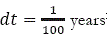
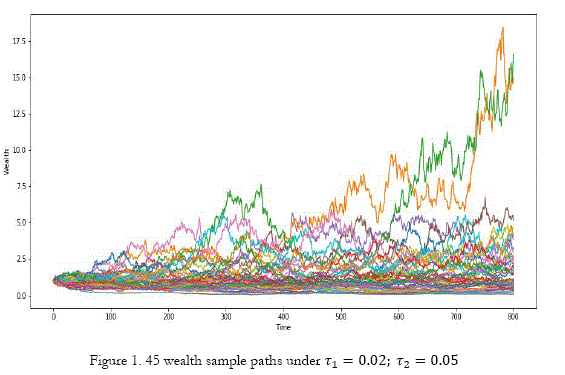
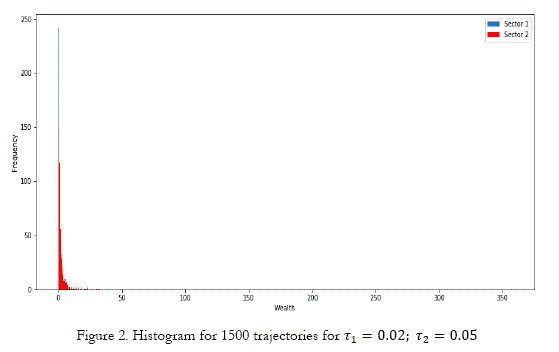
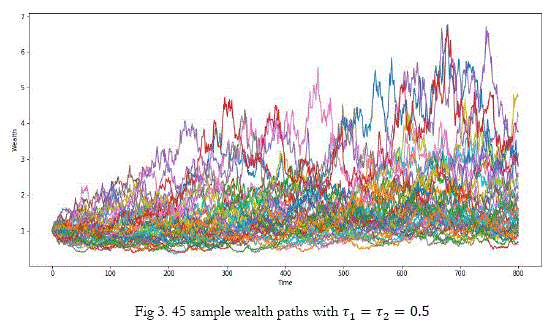
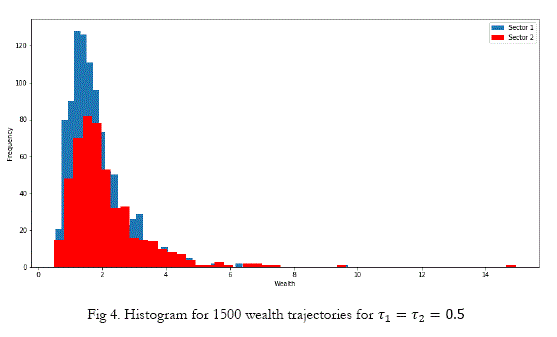
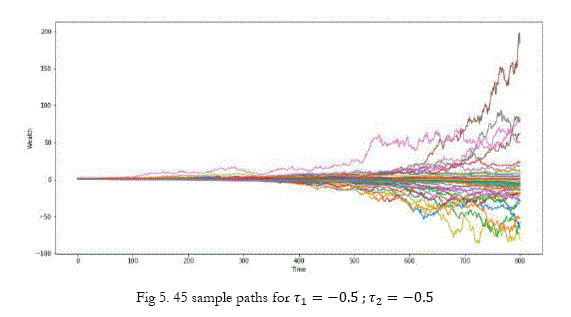
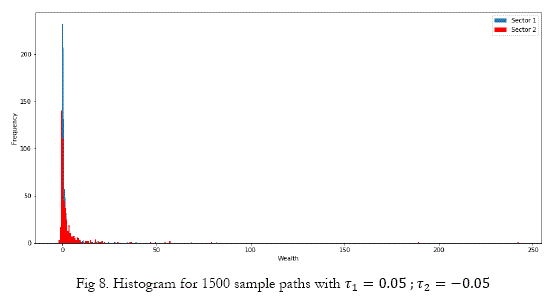
<body><![CDATA[<p align="justify">&nbsp;</p>     <p align="justify"><font size="3" face="Verdana, Arial, Helvetica, sans-serif"><strong>3. Simulation and Estimation</strong></font></p>      <p align="justify"><font size="2" face="Verdana, Arial, Helvetica, sans-serif">The model specification presents several regimes, some of which are useful to explore what could happen in an economy given (induced) changes in <em><font size="4" face="Times New Roman, Times, serif">&tau;</font><font size="2" face="Verdana, Arial, Helvetica, sans-serif"><sub>i</sub></font></em>, by the government. In this section we simulate scenarios, we estimate the values of (&micro;<sub>1</sub>, &micro;<sub>2</sub>, &sigma;) and we calibrate (<em><font size="4" face="Times New Roman, Times, serif">&tau;</font><font size="2" face="Verdana, Arial, Helvetica, sans-serif"><sub>1</sub></font></em>,<em><font size="4" face="Times New Roman, Times, serif">&tau;</font><font size="2" face="Verdana, Arial, Helvetica, sans-serif"><sub>2)</sub></font></em> to Argentina. The resulting wealth distribution resembles the empirical one in the best way possible given the constraints on the available data.</font></p>      <p align="justify"><font size="2" face="Verdana, Arial, Helvetica, sans-serif">For the simulations we take, unless otherwise specified, an economy with population size of N = 1500, of which N<em><font size="2" face="Verdana, Arial, Helvetica, sans-serif"><sub>1</sub></font></em> = 1000, initial time <em><font size="4" face="Times New Roman, Times, serif">t</font><font size="2" face="Verdana, Arial, Helvetica, sans-serif"><sub>0</sub></font></em>, terminal time T = 10 years, and time step <img src="/img/revistas/ec/v4n2/a03_figura03.gif" width="96" height="29">years<sup>&Dagger;</sup>. To simulate the system od stochastic differential equations given by (Eq. (2)) we use Euler-Maruyama numerical scheme (see, for example (Higham, 2001)). This means that we approximate (Eq. (2)) as:</font></p>     <p align="center"><img src="/img/revistas/ec/v4n2/a03_figura04.gif" width="599" height="77"></p>     <p align="justify"><font size="2" face="Verdana, Arial, Helvetica, sans-serif">As the parameters of interest are <em><font size="4" face="Times New Roman, Times, serif">&tau;</font><font size="2" face="Verdana, Arial, Helvetica, sans-serif"><sub>1</sub></font></em>,<em><font size="4" face="Times New Roman, Times, serif">&tau;</font><font size="2" face="Verdana, Arial, Helvetica, sans-serif"><sub>2</sub></font></em> we take them as variable and fix &micro;<em><font size="2" face="Verdana, Arial, Helvetica, sans-serif"><sub>1  </sub></font></em>= 0.05, &micro;<em><font size="2" face="Verdana, Arial, Helvetica, sans-serif"><sub>2</sub></font></em> = 0.1 and &sigma; = o.5 <sup>&sect;</sup>. For   each parameter we study five configurations, namely that <em><font size="4" face="Times New Roman, Times, serif">&tau;</font><font size="2" face="Verdana, Arial, Helvetica, sans-serif"><sub>i</sub></font></em> &gt; &micro;<em><font size="2" face="Verdana, Arial, Helvetica, sans-serif"><sub>i</sub></font></em>, &micro;<em><font size="2" face="Verdana, Arial, Helvetica, sans-serif"><sub>i</sub></font></em> &gt; <em><font size="4" face="Times New Roman, Times, serif">&tau;</font><font size="2" face="Verdana, Arial, Helvetica, sans-serif"><sub>i</sub></font></em>, &gt; 0, -&micro;<em><font size="2" face="Verdana, Arial, Helvetica, sans-serif"><sub>i</sub></font></em>  &lt; <em><font size="4" face="Times New Roman, Times, serif">&tau;</font><font size="2" face="Verdana, Arial, Helvetica, sans-serif"><sub>i </sub>&lt; </font></em><font size="2" face="Verdana, Arial, Helvetica, sans-serif">0</font>, -&micro;<em><font size="2" face="Verdana, Arial, Helvetica, sans-serif"><sub>i</sub></font></em> &gt;  <em><font size="4" face="Times New Roman, Times, serif">&tau;</font><font size="2" face="Verdana, Arial, Helvetica, sans-serif"><sub>i</sub></font></em> ,  and <em><font size="4" face="Times New Roman, Times, serif">&tau;</font><font size="2" face="Verdana, Arial, Helvetica, sans-serif"><sub>i</sub></font></em> = &micro;<em><font size="2" face="Verdana, Arial, Helvetica, sans-serif"><sub>i</sub></font></em>, which roughly   translates to <em><font size="4" face="Times New Roman, Times, serif">&tau;</font><font size="2" face="Verdana, Arial, Helvetica, sans-serif"><sub>i</sub></font></em> is positive, very   positive, negative, very negative, or equal to the ensemble growth rate. We   identify the same regimes as in (Berman   et al., 2016) (previously explained in section 2): (C1) both (<em><font size="4" face="Times New Roman, Times, serif">&tau;</font><font size="2" face="Verdana, Arial, Helvetica, sans-serif"><sub>1,</sub><em><font size="4" face="Times New Roman, Times, serif">&tau;</font><font size="2" face="Verdana, Arial, Helvetica, sans-serif"><sub>2</sub></font></em></font></em>) are positive (C2) are   both negative and (C3) the parameters change signs.</font></p>     <p align="justify"><font size="2" face="Verdana, Arial, Helvetica, sans-serif">Case 1 (C1) happens when both <em><font size="4" face="Times New Roman, Times, serif">&tau;</font><font size="2" face="Verdana, Arial, Helvetica, sans-serif"><sub>i</sub></font></em> &gt; 0. For small values of <em><font size="4" face="Times New Roman, Times, serif">&tau;</font><font size="2" face="Verdana, Arial, Helvetica, sans-serif"><sub>i</sub></font></em> (i.e. <em><font size="4" face="Times New Roman, Times, serif">&tau;</font><font size="2" face="Verdana, Arial, Helvetica, sans-serif"><sub>i</sub></font></em> <em><font size="2" face="Verdana, Arial, Helvetica, sans-serif">&lt;</font></em> &micro;<em><font size="2" face="Verdana, Arial, Helvetica, sans-serif"><sub>i</sub></font></em>) we have a dynamic like GBM. All wealth paths are non-negative with the occasional lucky trajectory growing much faster than the rest and pushing the ensemble average above most trajectories (<a href="#f1">figure 1</a>) which are concentrated near the zero. As expected the resulting distribution is (<a href="#f2">figure 2</a>) resembles both the inverse gamma (the stationary distribution in (Berman et al., 2016) under <em><font size="4" face="Times New Roman, Times, serif">&tau;</font></em> &gt; 0)  and lognormal (the distribution under<em><font size="4" face="Times New Roman, Times, serif"> &tau;</font><font size="2" face="Verdana, Arial, Helvetica, sans-serif"><sub>i</sub></font></em> = 0 ) distributions. Also, all outliers corresponding to a large terminal wealth belong to sector 2 even though <em><font size="4" face="Times New Roman, Times, serif">&tau;</font><font size="2" face="Verdana, Arial, Helvetica, sans-serif"><sub>2</sub></font></em> &gt; <em><font size="4" face="Times New Roman, Times, serif">&tau;</font><font size="2" face="Verdana, Arial, Helvetica, sans-serif"><sub>1</sub></font></em>.</font></p>     <p align="center"><a name="f1"></a><img src="/img/revistas/ec/v4n2/a03_figura05.gif" width="565" height="375"></p>     <p align="center"><a name="f2"></a><img src="/img/revistas/ec/v4n2/a03_figura06.gif" width="559" height="352"></p>     <p align="justify"><font size="2" face="Verdana, Arial, Helvetica, sans-serif">If <em><font size="4" face="Times New Roman, Times, serif">&tau;</font><font size="2" face="Verdana, Arial, Helvetica, sans-serif"><sub>i</sub></font></em> is greater than &micro;<em><font size="2" face="Verdana, Arial, Helvetica, sans-serif"><sub>i</sub></font></em>, while the majority of trajectories still have terminal wealth near zero, we have a much more even distribution of personal wealth trajectories (<a href="#f3">figure 3</a>). Maximum wealth is also much lower than in the former case ($16 vs. $350) and the corresponding histogram is in <a href="#f4">figure 4</a>. Moreover, very high wealth outliers belong to both sectors.</font></p>     ]]></body>

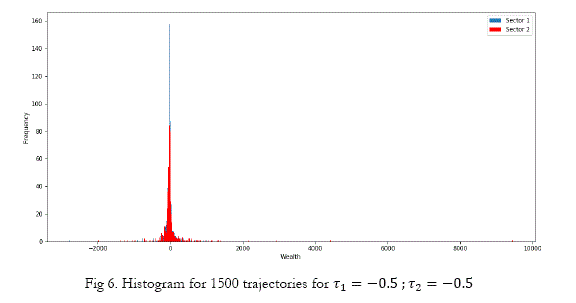
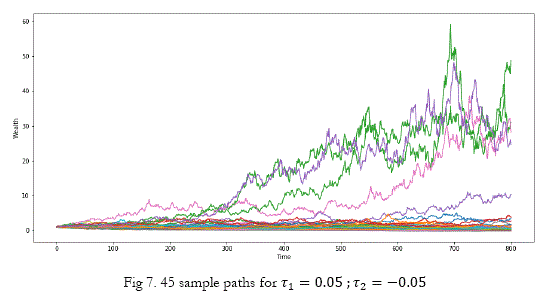
<body><![CDATA[<p align="center"><font size="2" face="Verdana, Arial, Helvetica, sans-serif"><a name="f3"></a><img src="/img/revistas/ec/v4n2/a03_figura07.gif" width="553" height="331"></font></p>     <p align="center"><a name="f4"></a><img src="/img/revistas/ec/v4n2/a03_figura08.gif" width="557" height="337"></p>     <p align="justify"><font size="2" face="Verdana, Arial, Helvetica, sans-serif">Between     <em><font size="4" face="Times New Roman, Times, serif">&tau;</font><font size="2" face="Verdana, Arial, Helvetica, sans-serif"><sub>i </sub>&lt; &micro;</font></em><em><font size="2" face="Verdana, Arial, Helvetica, sans-serif"><sub>i</sub></font></em>, and <em><font size="4" face="Times New Roman, Times, serif">&tau;</font><font size="2" face="Verdana, Arial, Helvetica, sans-serif"><sub>i </sub>&gt; </font></em> <em><font size="2" face="Verdana, Arial, Helvetica, sans-serif">&micro;</font></em><em><font size="2" face="Verdana, Arial, Helvetica, sans-serif"><sub>i</sub></font></em> we have 0 <em><font size="2" face="Verdana, Arial, Helvetica, sans-serif">&lt;</font></em> <em><font size="4" face="Times New Roman, Times, serif">&tau;</font><font size="2" face="Verdana, Arial, Helvetica, sans-serif"><sub>j</sub></font></em><font size="2" face="Verdana, Arial, Helvetica, sans-serif">&le;</font> <em><font size="2" face="Verdana, Arial, Helvetica, sans-serif">&micro;</font></em><em><font size="2" face="Verdana, Arial, Helvetica, sans-serif"><sub>j</sub></font></em>, <em><font size="4" face="Times New Roman, Times, serif">&tau;</font><font size="2" face="Verdana, Arial, Helvetica, sans-serif"><sub>k</sub>&ge;</font></em> <em><font size="2" face="Verdana, Arial, Helvetica, sans-serif">&micro;<sub>k</sub></font></em>, j &ne; k. The results for these cases are omitted for reasons of space, but the resulting wealth distribution lie within fig.2 and fig.4 where outliers for maximal wealth tend to belong to the sector with <em><font size="4" face="Times New Roman, Times, serif">&tau;</font><font size="2" face="Verdana, Arial, Helvetica, sans-serif"><sub>j</sub></font></em><font size="2" face="Verdana, Arial, Helvetica, sans-serif">&le;</font> <em><font size="2" face="Verdana, Arial, Helvetica, sans-serif">&micro;</font></em><em><font size="2" face="Verdana, Arial, Helvetica, sans-serif"><sub>j</sub></font></em>, this is, the sector that contributes proportionally a smaller fraction of its wealth to redistribution (and also receives less) so its dominated by “lucky” trajectories.</font></p>      <p align="justify"><font size="2" face="Verdana, Arial, Helvetica, sans-serif">Case 2 (C2) happens when <em><font size="4" face="Times New Roman, Times, serif">&tau;</font><font size="2" face="Verdana, Arial, Helvetica, sans-serif"><sub>i </sub>&lt;</font></em> 0. Now wealth trajectories can decrease without bound, and some trajectories do, while others increase without bound (<a href="#f5">figure 5</a>). The resulting distribution is symmetric centred around zero and very highly frequency around the mode (<a href="#f6">figure 6</a>), an experiment with increasing terminal time suggests that the limiting distribution (when excluding outliers) is degenerate. The distinction between |<em><font size="4" face="Times New Roman, Times, serif">&tau;</font><font size="2" face="Verdana, Arial, Helvetica, sans-serif"><sub>i </sub>|<em><font size="2" face="Verdana, Arial, Helvetica, sans-serif"> &gt; </font></em> <em><font size="2" face="Verdana, Arial, Helvetica, sans-serif">&micro;<sub>i</sub></font></em> </font></em> and |<em><font size="4" face="Times New Roman, Times, serif">&tau;</font><font size="2" face="Verdana, Arial, Helvetica, sans-serif"><sub>i </sub>|<em><font size="2" face="Verdana, Arial, Helvetica, sans-serif">&lt; &micro;<sub>i</sub></font></em></font></em> here is uninteresting.</font><font size="2" face="Verdana, Arial, Helvetica, sans-serif">}</font></p>     <p align="center"><font size="2" face="Verdana, Arial, Helvetica, sans-serif"><a name="f5"></a><img src="/img/revistas/ec/v4n2/a03_figura09.gif" width="571" height="317"></font></p>     <p align="center"><a name="f6"></a><img src="/img/revistas/ec/v4n2/a03_figura10.gif" width="576" height="303"></p>     <p align="justify"><font size="2" face="Verdana, Arial, Helvetica, sans-serif">Case 3 (C3) happens when <em><font size="4" face="Times New Roman, Times, serif">&tau;</font><font size="2" face="Verdana, Arial, Helvetica, sans-serif"><sub>i </sub></font></em>change signs and is the most versatile as its resulting dynamic lies between C1 and C2. For small absolute values of <em><font size="4" face="Times New Roman, Times, serif">&tau;</font><font size="2" face="Verdana, Arial, Helvetica, sans-serif"><sub>i </sub></font></em>we have some wealth paths going negative yet not without bound (<a href="#f7">figure 7</a> and <a href="#f8">figure 8</a>), which is interesting because it would not be reasonable to observe net personal wealth tending to -&infin; in a real world economy because of bankruptcy laws, but it would be to see a small fraction of individuals to have finite and small negative net worth because of debt outgrowing assets. A similar dynamic result from having 0 <em><font size="2" face="Verdana, Arial, Helvetica, sans-serif">&lt;</font></em> <em><font size="4" face="Times New Roman, Times, serif">&tau;</font><font size="2" face="Verdana, Arial, Helvetica, sans-serif"><sub>i </sub>&lt;</font></em> &micro;<em><font size="2" face="Verdana, Arial, Helvetica, sans-serif"><sub>i</sub></font></em>, <em><font size="4" face="Times New Roman, Times, serif">&tau;</font><font size="2" face="Verdana, Arial, Helvetica, sans-serif"><sub>j </sub>&lt;</font></em> -&micro;<em><font size="2" face="Verdana, Arial, Helvetica, sans-serif"><sub>j</sub></font></em>, but this is more similar to C2 in the sense that wealth can decrease without bound.</font></p>     <p align="center"><font size="2" face="Verdana, Arial, Helvetica, sans-serif"><a name="f7"></a><img src="/img/revistas/ec/v4n2/a03_figura11.gif" width="552" height="298"></font></p>     <p align="center"><a name="f8"></a><img src="/img/revistas/ec/v4n2/a03_figura12.gif" width="560" height="301"></p>     <p align="justify"><font size="2" face="Verdana, Arial, Helvetica, sans-serif">Once identified the regimes of the model we proceed to its calibration to Argentina. The dataset is composed of tax collection data from the local tax agency namely, the <i>Aministración federal de ingresos públicos</i> (AFIP) on a net worth tax named <i>bienes personales,</i> which distinguishes between domestic (sector 1) and external assets (sector 2). The periodicity of the data is annual and ranges from 2007 to 2016 fiscal years. For the estimation of the volatility parameter, &sigma;, we took the “Mercado de Valores de Buenos Aires” (MERVAL) index as indicative of the whole economy. Finally, the number for the population of adults each year come from the national statistics institute (Instituto nacional de estadística y censos).</font></p>      ]]></body>
<body><![CDATA[<p align="justify"><font size="2" face="Verdana, Arial, Helvetica, sans-serif">We follow the uncontroversial estimation strategy of parameters (&micro;<em><font size="2" face="Verdana, Arial, Helvetica, sans-serif"><sub>1</sub></font></em>,&micro;<em><font size="2" face="Verdana, Arial, Helvetica, sans-serif"><sub>2</sub></font></em>,&sigma;) as in (Berman et al., 2016) as explained next. We suppose that the average individual wealth grows exponentially at the same rate as the ensemble, i.e. sector<em><font size="2" face="Verdana, Arial, Helvetica, sans-serif"><sub>i</sub></font></em> = e<sup>&micro;<font size="1">i</font>(t-t<font size="1">0</font>)</sup></font>. <font size="2" face="Verdana, Arial, Helvetica, sans-serif">We estimate &micro;<em><sub>i</sub></em> via least squares linear regression on the natural logarithm of both sides of the equation. The &sigma; parameter is estimated as the standard deviation of historical log-returns on the MERVAL index (argentine stock index) for the last year (November 2017-18) and scale it appropriately. The point estimates of the parameters are &micro;<em><font size="2" face="Verdana, Arial, Helvetica, sans-serif"><sub>1</sub></font></em> = 0.27, &micro;<em><font size="2" face="Verdana, Arial, Helvetica, sans-serif"><sub>2 </sub></font></em>= 0.32, and &sigma; = 0.395.  This are reasonable values for the period considering the inflationary process as described in the first section. An important point is that &micro;<em><font size="2" face="Verdana, Arial, Helvetica, sans-serif"><sub>2 </sub></font></em><em><font size="2" face="Verdana, Arial, Helvetica, sans-serif"><em><font size="2" face="Verdana, Arial, Helvetica, sans-serif">&gt;</font></em></font></em> &micro;<em><font size="2" face="Verdana, Arial, Helvetica, sans-serif"><sub>1</sub></font></em>, also with the recent developments regarding the exchange rate of the peso, and lower domestic demand due to the current recession would increase this differential in average growth rates</font>.</font></p>     <p align="justify"><font size="2" face="Verdana, Arial, Helvetica, sans-serif">Finally for the policy parameters (<em><font size="4" face="Times New Roman, Times, serif">&tau;</font><font size="2" face="Verdana, Arial, Helvetica, sans-serif"><sub>1</sub></font></em>, <em><font size="4" face="Times New Roman, Times, serif">&tau;</font><font size="2" face="Verdana, Arial, Helvetica, sans-serif"><sub>2</sub></font></em>), they are calibrated   so as to minimize the squared difference between the observed wealth   distribution quantile (we take this to be the percentage of the adult   population that is reached by our chosen net worth tax, which is 6.7% on   average in our case) and the theoretical quantile produced by the model. We use   the algorithm presented in (Nelder   &amp; Mead, 1965) for the minimization, and rescale   observed wealth so that total observed wealth for t<font size="2" face="Verdana, Arial, Helvetica, sans-serif"><sub>0 </sub></font>= 2007  is equal to $1</font><font size="2" face="Verdana, Arial, Helvetica, sans-serif">.</font></p>     <p align="justify"><font size="2" face="Verdana, Arial, Helvetica, sans-serif">The optimization process produces the values of <em><font size="4" face="Times New Roman, Times, serif">&tau;</font><font size="2" face="Verdana, Arial, Helvetica, sans-serif"><sub>1</sub></font></em> = 0.16313025, and <em><font size="4" face="Times New Roman, Times, serif">&tau;</font><font size="2" face="Verdana, Arial, Helvetica, sans-serif"><sub>2 </sub></font></em>= -0.05111769 for the whole period. Given the constraints on the data, this value should be taken only as indicative of the real values, which are unknown. With this caveat in mind, this specification lies under C3 and its dynamics are like fig.7 (small positive <em><font size="4" face="Times New Roman, Times, serif">&tau;</font><font size="2" face="Verdana, Arial, Helvetica, sans-serif"><sub>1</sub></font></em> <em><font size="2" face="Verdana, Arial, Helvetica, sans-serif"><sub></sub></font></em><em><font size="2" face="Verdana, Arial, Helvetica, sans-serif">&lt;</font></em> 0.27, and small negative <em><font size="4" face="Times New Roman, Times, serif">&tau;</font><font size="2" face="Verdana, Arial, Helvetica, sans-serif"><sub>2</sub></font></em>). Therefore, a policy maker seeking to reduce wealth inequality would try to transition from the dynamics as given by C3 to those given by C1 by increasing <em><font size="4" face="Times New Roman, Times, serif">&tau;</font><font size="2" face="Verdana, Arial, Helvetica, sans-serif"><sub>2</sub></font></em>. </font></p>      <p align="justify"><font size="2" face="Verdana, Arial, Helvetica, sans-serif">This could take many forms, the most direct being tax policies. A direct tax on individual wealth is sure to decrease wealth inequality at an uncertain cost in future growth rates. A tax on very high wealth outliers from the external sector and a corresponding redistribution, perhaps within the same sector would also diminish inequality but make the external sector less appealing for business and so deter investors. Both a careful study of the determinants of <em><font size="4" face="Times New Roman, Times, serif">&tau;</font><font size="2" face="Verdana, Arial, Helvetica, sans-serif"><sub>i</sub></font></em>, together with awareness on the macroeconomic effects of changes in tax legislation is needed to give more concrete policy recommendations.</font></p>     <p align="justify">&nbsp;</p>     <p align="justify"><font size="3" face="Verdana, Arial, Helvetica, sans-serif"><strong>Conclusion(s)</strong></font></p>      <p align="justify"><font size="2" face="Verdana, Arial, Helvetica, sans-serif">Ten years after the last global financial crisis, the current argentine government continues to resort to orthodox formulas to deal with local financial crisis, ignoring income inequalities. This work analysed some aspects of Argentina's response to the current financial crisis. To do so, in the first section a summary of the macroeconomic and social context of the last years of the country was presented. It concluded that the tax reforms carried out by the last government do not imply substantive structural changes and that the only way to make the country viable is to make a project based on greater equality. In the second section a formal tool named RGBM was presented, followed by the proposal of an extension that include mechanisms of wealth transfer. In the third section, the proposed model was calibrated and the trend of the distribution of wealth was analysed based on the variation of wealth transfer rates.</font></p>      <p align="justify"><font size="2" face="Verdana, Arial, Helvetica, sans-serif">The calibration of the model for Argentina indicates that it is in CASE 3 (changes of signs) and its dynamics are like fig.7 (small positive<em><font size="4" face="Times New Roman, Times, serif">&tau;</font><font size="2" face="Verdana, Arial, Helvetica, sans-serif"><sub>1</sub></font></em> <em><font size="2" face="Verdana, Arial, Helvetica, sans-serif"><sub></sub></font></em><em><font size="2" face="Verdana, Arial, Helvetica, sans-serif">&lt;</font></em> 0.27, and small negative <em><font size="4" face="Times New Roman, Times, serif">&tau;</font><font size="2" face="Verdana, Arial, Helvetica, sans-serif"><sub>2</sub></font></em>). Therefore, to reduce wealth inequality, a policymaker must transform the dynamics from CASE 3 to CASE 1, by increasing <em><font size="4" face="Times New Roman, Times, serif">&tau;</font><font size="2" face="Verdana, Arial, Helvetica, sans-serif"><sub>2</sub></font></em>. This could be tax on very high wealth outliers (external sector). </font></p>      <p align="justify"><font size="2" face="Verdana, Arial, Helvetica, sans-serif">Some future lines of research include improving the estimation of the wealth distribution by considering alternative data sources, as well as a wider time window, complementing the simulation exercise with an analytical study of the statistical properties of the proposed model and the study of the determinants of wealth transfer rates.</font></p>      <p align="justify">&nbsp;</p>     ]]></body>
<body><![CDATA[<p align="justify"><font size="3"><strong><font face="Verdana, Arial, Helvetica, sans-serif">Notas</font></strong></font></p>     <p align="justify"><font size="2" face="Verdana, Arial, Helvetica, sans-serif"><sup>&dagger;</sup> The mainstream framework relies on general equilibrium with heterogenous agents (either infinitely-lived agents or in an overlapping generation context).</font></p>     <p align="justify"><font size="2" face="Verdana, Arial, Helvetica, sans-serif"><sup>&Dagger;</sup> The decision on the values   of N, and dt&nbsp;is motivated by its computational cost, the decision on T&nbsp;is motivated on a long, yet   relevant terminal time for a human adult population.</font></p>     <p align="justify"><font size="2" face="Verdana, Arial, Helvetica, sans-serif"><sup>&sect;</sup> This parameter values are   arbitrary and aim to clearly define the regimes given the values of N&nbsp;and T&nbsp;rather than being indicative   of any real world economy in particular.</font></p>     <p align="justify">&nbsp;</p>     <p align="justify"><font size="3" face="Verdana, Arial, Helvetica, sans-serif"><strong>References</strong></font></p>     <!-- ref --><p align="justify"><font size="2" face="Verdana, Arial, Helvetica, sans-serif">Benisty, H. (2017). Simple wealth distribution model causing inequality-induced crisis without external shocks. <i>Physical Review E</i>, <i>95</i>(5), 052307.</font>&nbsp;&nbsp;&nbsp;&nbsp;&nbsp;&nbsp;&nbsp;&nbsp;[&#160;<a href="javascript:void(0);" onclick="javascript: window.open('/scielo.php?script=sci_nlinks&ref=1276278&pid=S2415-0622201900020000300001&lng=','','width=640,height=500,resizable=yes,scrollbars=1,menubar=yes,');">Links</a>&#160;]<!-- end-ref --><!-- ref --><p align="justify"><font size="2" face="Verdana, Arial, Helvetica, sans-serif">Berman, Y., Peters, O., &amp; Adamou, A. (2016). Far from equilibrium: Wealth reallocation in the United States. <i>ArXiv Preprint ArXiv:1605.05631</i>.</font>&nbsp;&nbsp;&nbsp;&nbsp;&nbsp;&nbsp;&nbsp;&nbsp;[&#160;<a href="javascript:void(0);" onclick="javascript: window.open('/scielo.php?script=sci_nlinks&ref=1276279&pid=S2415-0622201900020000300002&lng=','','width=640,height=500,resizable=yes,scrollbars=1,menubar=yes,');">Links</a>&#160;]<!-- end-ref --><!-- ref --><p align="justify"><font size="2" face="Verdana, Arial, Helvetica, sans-serif">Berman, Y., Peters, O., &amp; Adamou, A. (2017). <i>An Empirical Test of the Ergodic Hypothesis: Wealth Distributions in the United States</i>.</font>&nbsp;&nbsp;&nbsp;&nbsp;&nbsp;&nbsp;&nbsp;&nbsp;[&#160;<a href="javascript:void(0);" onclick="javascript: window.open('/scielo.php?script=sci_nlinks&ref=1276280&pid=S2415-0622201900020000300003&lng=','','width=640,height=500,resizable=yes,scrollbars=1,menubar=yes,');">Links</a>&#160;]<!-- end-ref --><!-- ref --><p align="justify"><font size="2" face="Verdana, Arial, Helvetica, sans-serif">Black, F., &amp; Scholes, M. (1973). The Pricing of Options and Corporate Liabilities. <i>Journal of Political Economy</i>, <i>81</i>, 637–654.</font>&nbsp;&nbsp;&nbsp;&nbsp;&nbsp;&nbsp;&nbsp;&nbsp;[&#160;<a href="javascript:void(0);" onclick="javascript: window.open('/scielo.php?script=sci_nlinks&ref=1276281&pid=S2415-0622201900020000300004&lng=','','width=640,height=500,resizable=yes,scrollbars=1,menubar=yes,');">Links</a>&#160;]<!-- end-ref --><!-- ref --><p align="justify"><font size="2" face="Verdana, Arial, Helvetica, sans-serif">Cagetti, M., &amp; De Nardi, M. (2008). Wealth inequality: Data and models. <i>Macroeconomic Dynamics</i>, <i>12</i>(S2), 285–313.</font>&nbsp;&nbsp;&nbsp;&nbsp;&nbsp;&nbsp;&nbsp;&nbsp;[&#160;<a href="javascript:void(0);" onclick="javascript: window.open('/scielo.php?script=sci_nlinks&ref=1276282&pid=S2415-0622201900020000300005&lng=','','width=640,height=500,resizable=yes,scrollbars=1,menubar=yes,');">Links</a>&#160;]<!-- end-ref --><!-- ref --><p align="justify"><font size="2" face="Verdana, Arial, Helvetica, sans-serif">De Nardi, M. (2015). <i>Quantitative models of wealth inequality: A survey</i>. National Bureau of Economic Research.</font>&nbsp;&nbsp;&nbsp;&nbsp;&nbsp;&nbsp;&nbsp;&nbsp;[&#160;<a href="javascript:void(0);" onclick="javascript: window.open('/scielo.php?script=sci_nlinks&ref=1276283&pid=S2415-0622201900020000300006&lng=','','width=640,height=500,resizable=yes,scrollbars=1,menubar=yes,');">Links</a>&#160;]<!-- end-ref --><!-- ref --><p align="justify"><font size="2" face="Verdana, Arial, Helvetica, sans-serif">García-Fronti, J., Miller, M., &amp; Zhang, L. (2002). Sovereign default by Argentina:’slow motion train crash’or self-fulfilling crisis? <i>CEPR Discussion Paper</i>, <i>3399</i>, 1–17.</font>&nbsp;&nbsp;&nbsp;&nbsp;&nbsp;&nbsp;&nbsp;&nbsp;[&#160;<a href="javascript:void(0);" onclick="javascript: window.open('/scielo.php?script=sci_nlinks&ref=1276284&pid=S2415-0622201900020000300007&lng=','','width=640,height=500,resizable=yes,scrollbars=1,menubar=yes,');">Links</a>&#160;]<!-- end-ref --><!-- ref --><p align="justify"><font size="2" face="Verdana, Arial, Helvetica, sans-serif">Higham, D. J. (2001). An algorithmic introduction to numerical simulation of stochastic differential equations. <i>SIAM Review</i>, <i>43</i>(3), 525–546.</font>&nbsp;&nbsp;&nbsp;&nbsp;&nbsp;&nbsp;&nbsp;&nbsp;[&#160;<a href="javascript:void(0);" onclick="javascript: window.open('/scielo.php?script=sci_nlinks&ref=1276285&pid=S2415-0622201900020000300008&lng=','','width=640,height=500,resizable=yes,scrollbars=1,menubar=yes,');">Links</a>&#160;]<!-- end-ref --><!-- ref --><p align="justify"><font size="2" face="Verdana, Arial, Helvetica, sans-serif">Levitsky, S., &amp; Murillo, M. V. (2008). Argentina: From kirchner to kirchner. <i>Journal of Democracy</i>, <i>19</i>(2), 16–30.</font>&nbsp;&nbsp;&nbsp;&nbsp;&nbsp;&nbsp;&nbsp;&nbsp;[&#160;<a href="javascript:void(0);" onclick="javascript: window.open('/scielo.php?script=sci_nlinks&ref=1276286&pid=S2415-0622201900020000300009&lng=','','width=640,height=500,resizable=yes,scrollbars=1,menubar=yes,');">Links</a>&#160;]<!-- end-ref --><!-- ref --><p align="justify"><font size="2" face="Verdana, Arial, Helvetica, sans-serif">Lin, X. S. (2006). <i>Introductory stochastic analysis for finance and insurance</i> (Vol. 557). John Wiley &amp; Sons.</font>&nbsp;&nbsp;&nbsp;&nbsp;&nbsp;&nbsp;&nbsp;&nbsp;[&#160;<a href="javascript:void(0);" onclick="javascript: window.open('/scielo.php?script=sci_nlinks&ref=1276287&pid=S2415-0622201900020000300010&lng=','','width=640,height=500,resizable=yes,scrollbars=1,menubar=yes,');">Links</a>&#160;]<!-- end-ref --><!-- ref --><p align="justify"><font size="2" face="Verdana, Arial, Helvetica, sans-serif">Liu, Z., &amp; Serota, R. (2018). On absence of steady state in the Bouchaud–Mézard network model. <i>Physica A: Statistical Mechanics and Its Applications</i>, <i>491</i>, 391–398.</font>&nbsp;&nbsp;&nbsp;&nbsp;&nbsp;&nbsp;&nbsp;&nbsp;[&#160;<a href="javascript:void(0);" onclick="javascript: window.open('/scielo.php?script=sci_nlinks&ref=1276288&pid=S2415-0622201900020000300011&lng=','','width=640,height=500,resizable=yes,scrollbars=1,menubar=yes,');">Links</a>&#160;]<!-- end-ref --><!-- ref --><p align="justify"><font size="2" face="Verdana, Arial, Helvetica, sans-serif">Lustig, N., Lopez-Calva, L. F., &amp; Ortiz-Juarez, E. (2012). <i>Declining inequality in Latin America in the 2000s: the cases of Argentina, Brazil, and Mexico</i>. The World Bank.</font>&nbsp;&nbsp;&nbsp;&nbsp;&nbsp;&nbsp;&nbsp;&nbsp;[&#160;<a href="javascript:void(0);" onclick="javascript: window.open('/scielo.php?script=sci_nlinks&ref=1276289&pid=S2415-0622201900020000300012&lng=','','width=640,height=500,resizable=yes,scrollbars=1,menubar=yes,');">Links</a>&#160;]<!-- end-ref --><!-- ref --><p align="justify"><font size="2" face="Verdana, Arial, Helvetica, sans-serif">Nelder, J. A., &amp; Mead, R. (1965). A simplex method for function minimization. <i>The Computer Journal</i>, <i>7</i>(4), 308–313.</font>&nbsp;&nbsp;&nbsp;&nbsp;&nbsp;&nbsp;&nbsp;&nbsp;[&#160;<a href="javascript:void(0);" onclick="javascript: window.open('/scielo.php?script=sci_nlinks&ref=1276290&pid=S2415-0622201900020000300013&lng=','','width=640,height=500,resizable=yes,scrollbars=1,menubar=yes,');">Links</a>&#160;]<!-- end-ref --><!-- ref --><p align="justify"><font size="2" face="Verdana, Arial, Helvetica, sans-serif">Piketty, T., Saez, E., &amp; Zucman, G. (2017). Distributional national accounts: methods and estimates for the United States. <i>The Quarterly Journal of Economics</i>, <i>133</i>(2), 553–609.</font>&nbsp;&nbsp;&nbsp;&nbsp;&nbsp;&nbsp;&nbsp;&nbsp;[&#160;<a href="javascript:void(0);" onclick="javascript: window.open('/scielo.php?script=sci_nlinks&ref=1276291&pid=S2415-0622201900020000300014&lng=','','width=640,height=500,resizable=yes,scrollbars=1,menubar=yes,');">Links</a>&#160;]<!-- end-ref --><!-- ref --><p align="justify"><font size="2" face="Verdana, Arial, Helvetica, sans-serif">Saez, E., &amp; Zucman, G. (2016). Wealth inequality in the United States since 1913: Evidence from capitalized income tax data. <i>The Quarterly Journal of Economics</i>, <i>131</i>(2), 519–578.</font>&nbsp;&nbsp;&nbsp;&nbsp;&nbsp;&nbsp;&nbsp;&nbsp;[&#160;<a href="javascript:void(0);" onclick="javascript: window.open('/scielo.php?script=sci_nlinks&ref=1276292&pid=S2415-0622201900020000300015&lng=','','width=640,height=500,resizable=yes,scrollbars=1,menubar=yes,');">Links</a>&#160;]<!-- end-ref --><p align="justify">&nbsp;</p>     <p align="justify">&nbsp;</p>      ]]></body><back>
<ref-list>
<ref id="B1">
<nlm-citation citation-type="journal">
<person-group person-group-type="author">
<name>
<surname><![CDATA[Benisty]]></surname>
<given-names><![CDATA[H.]]></given-names>
</name>
</person-group>
<article-title xml:lang="en"><![CDATA[Simple wealth distribution model causing inequality-induced crisis without external shocks]]></article-title>
<source><![CDATA[Physical Review E]]></source>
<year>2017</year>
<volume>95</volume>
<numero>5</numero>
<issue>5</issue>
<page-range>052307</page-range></nlm-citation>
</ref>
<ref id="B2">
<nlm-citation citation-type="book">
<person-group person-group-type="author">
<name>
<surname><![CDATA[Berman]]></surname>
<given-names><![CDATA[Y.]]></given-names>
</name>
<name>
<surname><![CDATA[Peters]]></surname>
<given-names><![CDATA[O.]]></given-names>
</name>
<name>
<surname><![CDATA[Adamou]]></surname>
<given-names><![CDATA[A.]]></given-names>
</name>
</person-group>
<source><![CDATA[Far from equilibrium: Wealth reallocation in the United States]]></source>
<year>2016</year>
<page-range>1605.05631</page-range><publisher-name><![CDATA[ArXiv Preprint ArXiv]]></publisher-name>
</nlm-citation>
</ref>
<ref id="B3">
<nlm-citation citation-type="">
<person-group person-group-type="author">
<name>
<surname><![CDATA[Berman]]></surname>
<given-names><![CDATA[Y.]]></given-names>
</name>
<name>
<surname><![CDATA[Peters]]></surname>
<given-names><![CDATA[O.]]></given-names>
</name>
<name>
<surname><![CDATA[Adamou]]></surname>
<given-names><![CDATA[A.]]></given-names>
</name>
</person-group>
<source><![CDATA[An Empirical Test of the Ergodic Hypothesis: Wealth Distributions in the United States]]></source>
<year>2017</year>
</nlm-citation>
</ref>
<ref id="B4">
<nlm-citation citation-type="journal">
<person-group person-group-type="author">
<name>
<surname><![CDATA[Black]]></surname>
<given-names><![CDATA[F.]]></given-names>
</name>
<name>
<surname><![CDATA[Scholes]]></surname>
<given-names><![CDATA[M.]]></given-names>
</name>
</person-group>
<article-title xml:lang="en"><![CDATA[The Pricing of Options and Corporate Liabilities]]></article-title>
<source><![CDATA[Journal of Political Economy]]></source>
<year>1973</year>
<numero>81</numero>
<issue>81</issue>
<page-range>637-654</page-range></nlm-citation>
</ref>
<ref id="B5">
<nlm-citation citation-type="journal">
<person-group person-group-type="author">
<name>
<surname><![CDATA[Cagetti]]></surname>
<given-names><![CDATA[M.]]></given-names>
</name>
<name>
<surname><![CDATA[De Nardi]]></surname>
<given-names><![CDATA[M.]]></given-names>
</name>
</person-group>
<article-title xml:lang="en"><![CDATA[Wealth inequality: Data and models]]></article-title>
<source><![CDATA[Macroeconomic Dynamics]]></source>
<year>2008</year>
<volume>12</volume>
<numero>S2</numero>
<issue>S2</issue>
<page-range>285-313</page-range></nlm-citation>
</ref>
<ref id="B6">
<nlm-citation citation-type="book">
<person-group person-group-type="author">
<name>
<surname><![CDATA[De Nardi]]></surname>
<given-names><![CDATA[M.]]></given-names>
</name>
</person-group>
<source><![CDATA[Quantitative models of wealth inequality: A survey]]></source>
<year>2015</year>
<publisher-name><![CDATA[National Bureau of Economic Research]]></publisher-name>
</nlm-citation>
</ref>
<ref id="B7">
<nlm-citation citation-type="book">
<person-group person-group-type="author">
<name>
<surname><![CDATA[García-Fronti]]></surname>
<given-names><![CDATA[J.]]></given-names>
</name>
<name>
<surname><![CDATA[Miller]]></surname>
<given-names><![CDATA[M.]]></given-names>
</name>
<name>
<surname><![CDATA[Zhang]]></surname>
<given-names><![CDATA[L.]]></given-names>
</name>
</person-group>
<source><![CDATA[Sovereign default by Argentina: ’slow motion train crash’or self-fulfilling crisis?]]></source>
<year>2002</year>
<page-range>1-17</page-range><publisher-name><![CDATA[CEPR Discussion Paper]]></publisher-name>
</nlm-citation>
</ref>
<ref id="B8">
<nlm-citation citation-type="journal">
<person-group person-group-type="author">
<name>
<surname><![CDATA[Higham]]></surname>
<given-names><![CDATA[D. J.]]></given-names>
</name>
</person-group>
<article-title xml:lang="en"><![CDATA[An algorithmic introduction to numerical simulation of stochastic differential equations]]></article-title>
<source><![CDATA[SIAM Review]]></source>
<year>2001</year>
<volume>43</volume>
<numero>3</numero>
<issue>3</issue>
<page-range>525-546</page-range></nlm-citation>
</ref>
<ref id="B9">
<nlm-citation citation-type="journal">
<person-group person-group-type="author">
<name>
<surname><![CDATA[Levitsky]]></surname>
<given-names><![CDATA[S.]]></given-names>
</name>
<name>
<surname><![CDATA[Murillo]]></surname>
<given-names><![CDATA[M. V.]]></given-names>
</name>
</person-group>
<article-title xml:lang="en"><![CDATA[Argentina: From kirchner to kirchner]]></article-title>
<source><![CDATA[Journal of Democracy]]></source>
<year>2008</year>
<volume>19</volume>
<numero>2</numero>
<issue>2</issue>
<page-range>16-30</page-range></nlm-citation>
</ref>
<ref id="B10">
<nlm-citation citation-type="book">
<person-group person-group-type="author">
<name>
<surname><![CDATA[Lin]]></surname>
<given-names><![CDATA[X. S.]]></given-names>
</name>
</person-group>
<source><![CDATA[Introductory stochastic analysis for finance and insurance]]></source>
<year>2006</year>
<volume>557</volume>
<publisher-name><![CDATA[John Wiley & Sons]]></publisher-name>
</nlm-citation>
</ref>
<ref id="B11">
<nlm-citation citation-type="journal">
<person-group person-group-type="author">
<name>
<surname><![CDATA[Liu]]></surname>
<given-names><![CDATA[Z.]]></given-names>
</name>
<name>
<surname><![CDATA[Serota]]></surname>
<given-names><![CDATA[R.]]></given-names>
</name>
</person-group>
<article-title xml:lang="en"><![CDATA[On absence of steady state in the Bouchaud-Mézard network model]]></article-title>
<source><![CDATA[Physica A: Statistical Mechanics and Its Applications]]></source>
<year>2018</year>
<numero>491</numero>
<issue>491</issue>
<page-range>391-398</page-range></nlm-citation>
</ref>
<ref id="B12">
<nlm-citation citation-type="book">
<person-group person-group-type="author">
<name>
<surname><![CDATA[Lustig]]></surname>
<given-names><![CDATA[N.]]></given-names>
</name>
<name>
<surname><![CDATA[Lopez-Calva]]></surname>
<given-names><![CDATA[L. F.]]></given-names>
</name>
<name>
<surname><![CDATA[Ortiz-Juarez]]></surname>
<given-names><![CDATA[E.]]></given-names>
</name>
</person-group>
<source><![CDATA[Declining inequality in Latin America in the 2000s: the cases of Argentina, Brazil, and Mexico]]></source>
<year>2012</year>
<publisher-name><![CDATA[The World Bank]]></publisher-name>
</nlm-citation>
</ref>
<ref id="B13">
<nlm-citation citation-type="journal">
<person-group person-group-type="author">
<name>
<surname><![CDATA[Nelder]]></surname>
<given-names><![CDATA[J. A.]]></given-names>
</name>
<name>
<surname><![CDATA[Mead]]></surname>
<given-names><![CDATA[R.]]></given-names>
</name>
</person-group>
<article-title xml:lang="en"><![CDATA[A simplex method for function minimization]]></article-title>
<source><![CDATA[The Computer Journal]]></source>
<year>1965</year>
<volume>7</volume>
<numero>4</numero>
<issue>4</issue>
<page-range>308-313</page-range></nlm-citation>
</ref>
<ref id="B14">
<nlm-citation citation-type="journal">
<person-group person-group-type="author">
<name>
<surname><![CDATA[Piketty]]></surname>
<given-names><![CDATA[T.]]></given-names>
</name>
<name>
<surname><![CDATA[Saez]]></surname>
<given-names><![CDATA[E.]]></given-names>
</name>
<name>
<surname><![CDATA[Zucman]]></surname>
<given-names><![CDATA[G.]]></given-names>
</name>
</person-group>
<article-title xml:lang="en"><![CDATA[Distributional national accounts: methods and estimates for the United States]]></article-title>
<source><![CDATA[The Quarterly Journal of Economics]]></source>
<year>2017</year>
<volume>133</volume>
<numero>2</numero>
<issue>2</issue>
<page-range>553-609</page-range></nlm-citation>
</ref>
<ref id="B15">
<nlm-citation citation-type="journal">
<person-group person-group-type="author">
<name>
<surname><![CDATA[Saez]]></surname>
<given-names><![CDATA[E.]]></given-names>
</name>
<name>
<surname><![CDATA[Zucman]]></surname>
<given-names><![CDATA[G.]]></given-names>
</name>
</person-group>
<article-title xml:lang="en"><![CDATA[Wealth inequality in the United States since 1913: Evidence from capitalized income tax data]]></article-title>
<source><![CDATA[The Quarterly Journal of Economics]]></source>
<year>2016</year>
<volume>131</volume>
<numero>2</numero>
<issue>2</issue>
<page-range>519-578</page-range></nlm-citation>
</ref>
</ref-list>
</back>
</article>