<?xml version="1.0" encoding="ISO-8859-1"?><article xmlns:mml="http://www.w3.org/1998/Math/MathML" xmlns:xlink="http://www.w3.org/1999/xlink" xmlns:xsi="http://www.w3.org/2001/XMLSchema-instance">
<front>
<journal-meta>
<journal-id>2415-0622</journal-id>
<journal-title><![CDATA[Economía Coyuntural]]></journal-title>
<abbrev-journal-title><![CDATA[Revista de coyuntura y perspectivas]]></abbrev-journal-title>
<issn>2415-0622</issn>
<publisher>
<publisher-name><![CDATA[Universidad Autónoma Gabriel René MorenoFacultad de Ciencias Económicas, Administrativas y FinancierasInstituto de Investigaciones Económicas y Sociales José Ortiz Mercado  IIESJOM]]></publisher-name>
</publisher>
</journal-meta>
<article-meta>
<article-id>S2415-06222018000400004</article-id>
<title-group>
<article-title xml:lang="en"><![CDATA[Investment Constraints and Productivity Cycles in Bolivia]]></article-title>
<article-title xml:lang="es"><![CDATA[Restricciones a la Inversión y Ciclos de Productividad en Bolivia]]></article-title>
</title-group>
<contrib-group>
<contrib contrib-type="author">
<name>
<surname><![CDATA[Mendez-Guerra]]></surname>
<given-names><![CDATA[Carlos]]></given-names>
</name>
<xref ref-type="aff" rid="A01"/>
</contrib>
</contrib-group>
<aff id="A01">
<institution><![CDATA[,Nagoya University  ]]></institution>
<addr-line><![CDATA[ ]]></addr-line>
</aff>
<pub-date pub-type="pub">
<day>00</day>
<month>12</month>
<year>2018</year>
</pub-date>
<pub-date pub-type="epub">
<day>00</day>
<month>12</month>
<year>2018</year>
</pub-date>
<volume>3</volume>
<numero>4</numero>
<fpage>31</fpage>
<lpage>54</lpage>
<copyright-statement/>
<copyright-year/>
<self-uri xlink:href="http://www.scielo.org.bo/scielo.php?script=sci_arttext&amp;pid=S2415-06222018000400004&amp;lng=en&amp;nrm=iso"></self-uri><self-uri xlink:href="http://www.scielo.org.bo/scielo.php?script=sci_abstract&amp;pid=S2415-06222018000400004&amp;lng=en&amp;nrm=iso"></self-uri><self-uri xlink:href="http://www.scielo.org.bo/scielo.php?script=sci_pdf&amp;pid=S2415-06222018000400004&amp;lng=en&amp;nrm=iso"></self-uri><abstract abstract-type="short" xml:lang="en"><p><![CDATA[Abstract Bolivia has suffered from a series of investment constraints and negative productivity cycles in the last half-century. In this context, this article first presents suggestive empirical evidence that physical capital accumulation has been constrained by high volatility in investment per worker, low marginal product of capital, and high adjustment costs. Next, the article presents evidence about the cyclical behavior of Bolivia’s total factor productivity (TFP) during the 1980-2008 period. As expected, the cyclical dynamics of TFP are shaped by cyclical variables such as terms of trade and fluctuations in the real exchange. However, economic policy variables (such as macroeconomic stabilization and external debt management), institutional variables (such as democracy and civil rights) and initial conditions also appear to be significant when explaining the behavior of Bolivia’s TFP.]]></p></abstract>
<abstract abstract-type="short" xml:lang="es"><p><![CDATA[Resumen Bolivia ha sufrido una serie de restricciones a la inversión y ciclos negativos de productividad en el último medio siglo. En este contexto, este artículo primero presenta evidencia empírica que sugiere que la acumulación de capital físico ha sido restringida por la alta volatilidad de la inversión por trabajador, el bajo producto marginal del capital, y los altos costos de ajuste de la inversión. Seguidamente, el artículo presenta evidencia empírica sobre el comportamiento cíclico de la productividad total de factores (PTF) durante el periodo 1980-2008. Como se esperaba, la dinámica cíclica de la PTF ha sido afectada por variables cíclicas como ser las fluctuaciones en los términos de intercambio y el tipo de cambio real. Sin embargo, variables de política económica (como la estabilización macroeconómica y la administración de la deuda externa), variables institucionales (como la democracia y los derechos civiles), y las condiciones iniciales son también significativas al momento de explicar el comportamiento de la PTF en Bolivia.]]></p></abstract>
<kwd-group>
<kwd lng="en"><![CDATA[Investment]]></kwd>
<kwd lng="en"><![CDATA[productivity]]></kwd>
<kwd lng="en"><![CDATA[capital accumulation]]></kwd>
<kwd lng="en"><![CDATA[Bolivia]]></kwd>
<kwd lng="es"><![CDATA[Inversión]]></kwd>
<kwd lng="es"><![CDATA[productividad]]></kwd>
<kwd lng="es"><![CDATA[acumulación de capital]]></kwd>
<kwd lng="es"><![CDATA[Bolivia]]></kwd>
</kwd-group>
</article-meta>
</front><body><![CDATA[ <p align=right><font size="2" face="Verdana, Arial, Helvetica, sans-serif"><b>ARTICLE ACADEMIC</b></font></p>     <p align=right>&nbsp;</p>     <p align=center><font size="2" face="Verdana, Arial, Helvetica, sans-serif"><b><font size="4">Investment Constraints and Productivity Cycles     <br> </font></b></font><font size="4" face="Verdana, Arial, Helvetica, sans-serif"><b>in Bolivia</b></font></p>     <p align=center>&nbsp;</p>     <p align=center><font size="2" face="Verdana, Arial, Helvetica, sans-serif"><b><font size="3">Restricciones   a la Inversi&oacute;n y</font></b></font> <font size="3" face="Verdana, Arial, Helvetica, sans-serif"><b>Ciclos de Productividad     <br> en Bolivia</b></font><font size="3" face="Verdana, Arial, Helvetica, sans-serif"></font></p>     <p align=center>&nbsp;</p>     <p align=center>&nbsp;</p>     <p align=center><b><font size="2" face="Verdana, Arial, Helvetica, sans-serif">Carlos Mendez-Guerra<sup>&alpha;</sup></font></b>    ]]></body>
<body><![CDATA[<br>   <font size="2" face="Verdana, Arial, Helvetica, sans-serif"><sup><font size="3" face="Times New Roman, Times, serif">&alpha;</font></sup> Associate Professor, Graduate School of International Development, Nagoya University, Japan.     <br> Email: <a href="mailto:carlos@gsid.nagoya-u.ac.jp">carlos@gsid.nagoya-u.ac.jp</a> Website: <a href="https://carlos-mendez.rbind.io" target="_blank">https://carlos-mendez.rbind.io</a></font>    <br> <font size="2" face="Verdana, Arial, Helvetica, sans-serif"><b>Recepci&oacute;n:</b> 27/11/2018&nbsp;&nbsp;&nbsp; &nbsp;&nbsp;&nbsp;&nbsp;&nbsp;&nbsp;<b>Aceptaci&oacute;n:</b> 02/05/2019</font></p>      <p align="justify">&nbsp;</p>     <p align="justify">&nbsp;</p> <hr>     <p align="justify"><font size="2" face="Verdana, Arial, Helvetica, sans-serif"><b>Abstract</b></font></p>     <p align="justify"><font size="2" face="Verdana, Arial, Helvetica, sans-serif">Bolivia has suffered from a series of   investment constraints and negative productivity cycles in the last   half-century. In this context, this article first presents suggestive empirical   evidence that physical capital accumulation has been constrained by high   volatility in investment per worker, low marginal product of capital, and high   adjustment costs. Next, the article presents evidence about the cyclical   behavior of Bolivia&rsquo;s total factor productivity (TFP) during the 1980-2008   period. As expected, the cyclical dynamics of TFP are shaped by cyclical variables   such as terms of trade and fluctuations in the real exchange. However, economic   policy variables (such as macroeconomic stabilization and external debt   management), institutional variables (such as democracy and civil rights) and   initial conditions also appear to be significant when explaining the behavior   of Bolivia&rsquo;s TFP.</font></p>     <p align="justify"><font size="2" face="Verdana, Arial, Helvetica, sans-serif"><b>&nbsp;Keywords: </b>Investment, productivity, capital accumulation,   Bolivia.</font></p> <hr>     <p align="justify"><font size="2" face="Verdana, Arial, Helvetica, sans-serif"><b>Resumen</b></font></p>     <p align="justify"><font size="2" face="Verdana, Arial, Helvetica, sans-serif">Bolivia   ha sufrido una serie de restricciones a la inversi&oacute;n y ciclos negativos de   productividad en el &uacute;ltimo medio siglo. En este contexto, este art&iacute;culo primero   presenta evidencia emp&iacute;rica que sugiere que la acumulaci&oacute;n de capital f&iacute;sico ha   sido restringida por la alta volatilidad de la inversi&oacute;n por trabajador, el   bajo producto marginal del capital, y los altos costos de ajuste de la   inversi&oacute;n. Seguidamente, el art&iacute;culo presenta evidencia emp&iacute;rica sobre el   comportamiento c&iacute;clico de la productividad total de factores (PTF) durante el   periodo 1980-2008. Como se esperaba, la din&aacute;mica c&iacute;clica de la PTF ha sido   afectada por variables c&iacute;clicas como ser las fluctuaciones en los t&eacute;rminos de   intercambio y el tipo de cambio real. Sin embargo, variables de pol&iacute;tica   econ&oacute;mica (como la estabilizaci&oacute;n macroecon&oacute;mica y la administraci&oacute;n de la   deuda externa), variables institucionales (como la democracia y los derechos   civiles), y las condiciones iniciales son tambi&eacute;n significativas al momento de   explicar el comportamiento de la PTF en Bolivia.</font></p>     ]]></body>
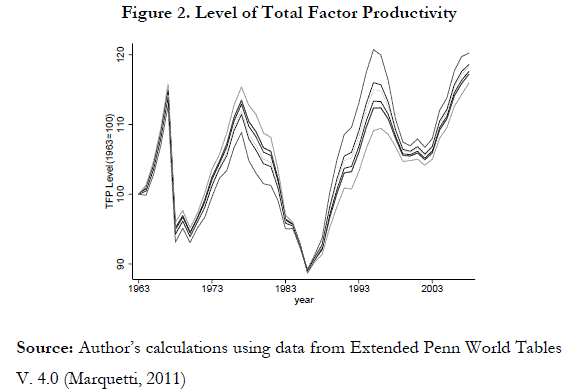
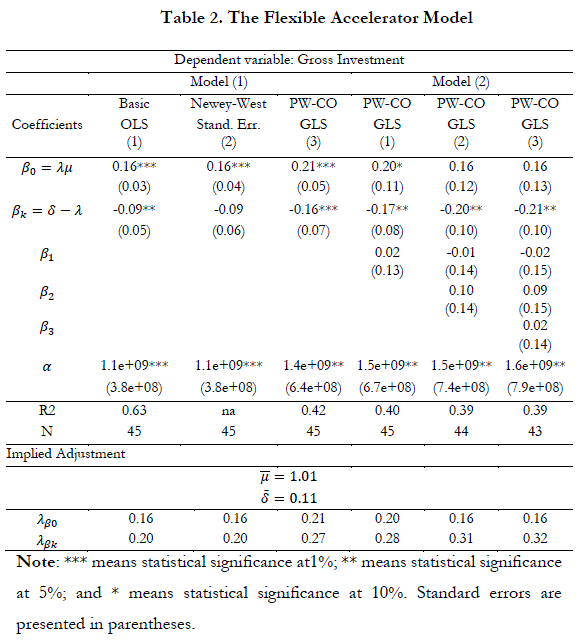
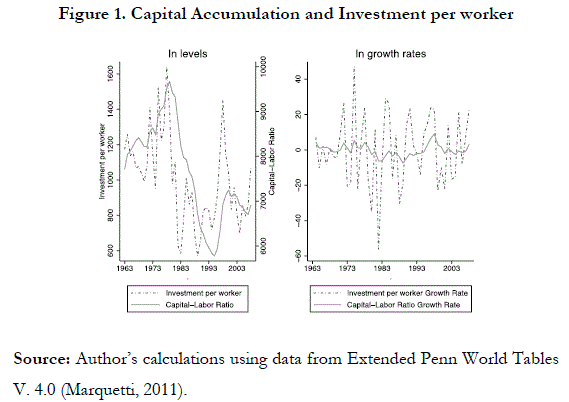
<body><![CDATA[<p align="justify"><font size="2" face="Verdana, Arial, Helvetica, sans-serif"><b>Palabras clave:</b> Inversi&oacute;n,   productividad, acumulaci&oacute;n de capital, Bolivia.</font></p> <hr>     <p align="justify"><font size="2" face="Verdana, Arial, Helvetica, sans-serif"><b><i>Clasificación JEL:</i></b> O40, 047.</font></p>  <hr>     <p align="justify">&nbsp;</p>     <p align="justify">&nbsp;</p>     <p align="justify"><font size="3" face="Verdana, Arial, Helvetica, sans-serif"><b>1. Introduction</b></font></p>     <p align="justify"><font size="2" face="Verdana, Arial, Helvetica, sans-serif">It is well known that physical capital accumulation and productivity improvements are two of the most proximate determinants of economic growth. In this context, much of the current research in development economics has to do with the underlying sources of capital accumulation and productivity growth. <a href="#f1">Figure 1</a> shows the behavior of physical capital accumulation and one of its underlying sources: investment. This figure suggests that physical capital accumulation appears to be constrained by largely unstable changes in investment. <a href="#f2">Figure 2</a> shows the behavior of the other proximate determinant of economic growth: total factor productivity (TFP). The figure emphasizes that—even in levels—productivity shows a clear cyclical behavior.</font></p>      <p align="center"><a name="f1"></a><img src="/img/revistas/ec/v3n4/a04_figura01.gif" width="569" height="402"></p>     <p align="center"><a name="f2"></a><img src="/img/revistas/ec/v3n4/a04_figura02.gif" width="576" height="390"></p>     <p align="justify"><font size="2" face="Verdana, Arial, Helvetica, sans-serif">Given these empirical regularities, this article aims to provide an answer to the following two questions:</font></p>      <p align="justify"><font size="2" face="Verdana, Arial, Helvetica, sans-serif">1.&nbsp;&nbsp;&nbsp;&nbsp;&nbsp;&nbsp;&nbsp;   What factors can help explain the capital accumulation constrains in Bolivia?</font><font size="2" face="Verdana, Arial, Helvetica, sans-serif"> </font></p>      ]]></body>
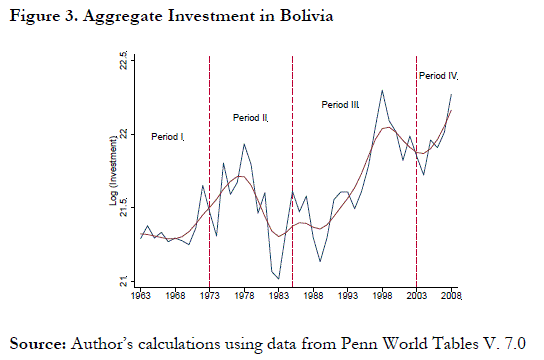
<body><![CDATA[<p align="justify"><font size="2" face="Verdana, Arial, Helvetica, sans-serif">2.&nbsp;&nbsp;&nbsp;&nbsp;&nbsp;&nbsp;&nbsp;   What factors can help explain the cyclical behavior of total factor productivity in Bolivia? </font></p>      <p align="justify"><font size="2" face="Verdana, Arial, Helvetica, sans-serif">The literature on the determinants of capital accumulation and investment constraints in Bolivia typically highlights how political instability, risk of expropiation, and economic crises are to a large extent responsible for high volatility of investment, low returns of capital, and lack of physical capital accumulation (Calvo, 2006; Jemio, 2008; Kehoe, Machicado, and Peres-Cajías, 2019). Furthermore, since fiscal policy in Bolivia is highly procyclical (Gonzáles-Zuazo and Molina-Fernández, 2017), the country has not been able to stabilize both the volatility of investment and the cyclicality of the overall economy (Lordemann, Rubín de Celis, and Villegas-Quino, 2011). Also, it has been previously documented that the investment environment in Bolivia is very sensitive to external shocks (Villegas-Quino et. al, 2011).</font></p>      <p align="justify"><font size="2" face="Verdana, Arial, Helvetica, sans-serif">The literature on the determinants of total factor productivity in Bolivia is relatively much more limited than that of investment. Most econometric studies have focused on the determinants of economic growth (Humerez and Dorado, 2009; Humerez, 2017; Mendieta and Martin, 2009; among others). One recent exception is the work of Machicado (2018). In this study, the author follows the econometric specification of Fuentes et al. (2006), and suggests that total factor productivity in Bolivia largely driven by the terms of trade, macroeconomic stability, in addition to other institutional, external and financial factors. </font></p>      <p align="justify"><font size="2" face="Verdana, Arial, Helvetica, sans-serif">In an attempt to contribute to these two literatures, the present article studies both the determinants of physical capital accumulation and total factor productivity. The former is studied primarily through the lens of a simple model </a>of investment, based accelerator principle with adjustment costs (Kopcke and Brauman, 2001); and the latter is studied through the lens of the econometric framework suggested by Fuentes et al. (2006).</font></p>      <p align="justify"><font size="2" face="Verdana, Arial, Helvetica, sans-serif">The overall results of these analysis suggest that, on the one hand, physical capital accumulation has been constrained by high volatility in investment per worker, low marginal product of capital, and high adjustment costs. On the other hand, the dynamics of total factor productivity (TFP) are largely shaped by cyclical variables such as terms of trade and fluctuations in the real exchange. However, economic policy variables (such as macroeconomic stabilization and external debt management), institutional variables (such as democracy and civil rights) and initial conditions also appear to be significant when explaining the behavior of Bolivia’s TFP. </font></p>      <p align="justify"><font size="2" face="Verdana, Arial, Helvetica, sans-serif">This article is organized as follows. Section 2 presents an econometric model of investment based on the accelerator principle and the role of adjustment costs. It also discusses some recent evidence on the low return to capital accumulation in Bolivia. Section 3 presents an econometric model that organizes the determinants of TFP into four categories: cyclical variables, macroeconomic policies, institutions, and initial conditions. Finally, Section 4 offers some concluding remarks. </font></p>      <p align="justify">&nbsp;</p>     <p align="justify"><b><font size="3" face="Verdana, Arial, Helvetica, sans-serif">2. The Constraints of Investment</font></b></p> <h2 align="justify"><font size="2" face="Verdana, Arial, Helvetica, sans-serif"><b>2.1. Some Stylized Facts: Volatility and Low Returns</b></font></h2>      <p align="justify"><font size="2" face="Verdana, Arial, Helvetica, sans-serif">An initial observation of investment data let us identify the volatility of aggregate investment and historical events where investment was booming. <a href="#f3">Figure 3</a> shows that in the beginning of the 1973-1984 period, investment grew rapidly. This increase is largely due to the international capital inflows that were associated with the oil shocks. In the second half of the 1985-2002 period, investment spiked again. This time, investment growth was led by a large privatization program that Bolivia implemented (Jemio, 2008). </font></p>      <p align="center"><a name="f3"></a><img src="/img/revistas/ec/v3n4/a04_figura03.gif" width="544" height="360"></p>     ]]></body>
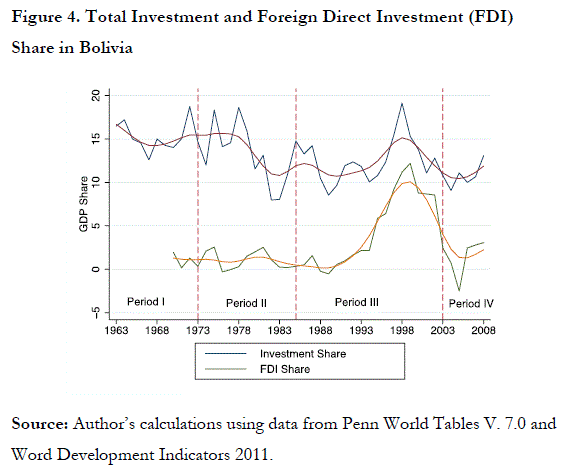
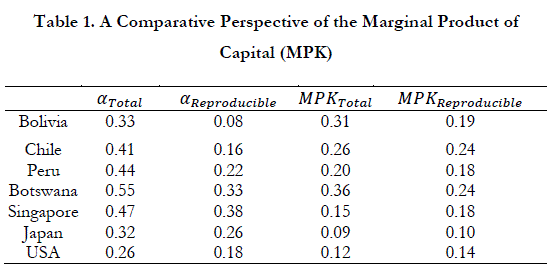
<body><![CDATA[<p align="justify"><font size="2" face="Verdana, Arial, Helvetica, sans-serif"><a href="#f4">Figure 4</a> shows that the long-run average of the investment   share in Bolivia has been around 13 percent. In the privatization period,   investment share raised to 19.12 percent driven, which was in turn largely   driven by a large increase Foreign Direct Investment (FDI). From an   international perspective, the average share of investment in Bolivia is low,   especially when compared with fast growing economies in Asia (Mendieta and   Martin, 2009). </font></p>     <p align="center"><a name="f4"></a><img src="/img/revistas/ec/v3n4/a04_figura04.gif" width="582" height="476"></p>     <p align="justify"><font size="2" face="Verdana, Arial, Helvetica, sans-serif"><b>Are there low returns to capital accumulation in   Bolivia?</b></font></p>     <p align="justify"><font size="2" face="Verdana, Arial, Helvetica, sans-serif">Theoretically, capital accumulation can be low because the marginal product of capital (MPK) is low. More intuitively, if the real return of investment is low, investors do not have incentives to invest. Motivated by this argument, Caselli and Feyrer (2007) present different estimates of the MPK for a large sample of countries. In their approach, the MPK can be recovered using data on total GDP, the value of the aggregate capital stock, and the share of physical capital income in total GDP. </font></p>      <p align="justify"><font size="2" face="Verdana, Arial, Helvetica, sans-serif">The model starts with a Cobb-Douglas production function featuring constant returns to scale and a competitive capital market. Under these two assumptions, the rental price of capital (P<sub>k</sub>) equals the marginal product of capital (MPK) in equilibrium, so that </font></p>      <p align="center"><img src="/img/revistas/ec/v3n4/a04_figura05.gif" width="347" height="68"></p>     <p align="justify"><font size="2" face="Verdana, Arial, Helvetica, sans-serif">where   Y is output (e.g., total GDP), K is the value of the stock of physical capital, and <font size="3" face="Times New Roman, Times, serif">&alpha;</font> is the elasticity of output with respect to capital, or equivantely—given the previous two assumptions—the share of national income that accrues to physical capital. In this equilibrium, a lower MPK could be driven by a lower capital share, a lower output-capital ratio, or both.</font></p>      <p align="justify"><font size="2" face="Verdana, Arial, Helvetica, sans-serif">Using commonly reported estimates of,Caselli and Feyrer </a>(2007) find that the MPK in the developing countries sample is more than double the size of that in developed countries sample. However, these differences disappear when land and other natural capital inputs are removed from the estimation of capital. By using a new World Bank’s dataset, Caselli and Feyrer (2007) separate natural capital from reproducible capital and suggests that many developing countries actually show lower marginal returns to reproducible capital accumulation. </font></p>      <p align="justify"><font size="2" face="Verdana, Arial, Helvetica, sans-serif">Based on the measurement approach of Caselli and Feyrer (2007), <a href="#t1">Table 1</a> presents the results for Bolivia in a comparative perspective with other developing and developed countries. Compared with other developing countries, Bolivia has a lower marginal return to capital accumulation. Moreover, the main factor that appears to be driving this result is its relatively low share of reproducible capital.</font></p>      <p align=center><a name="t1"></a><img src="/img/revistas/ec/v3n4/a04_figura06.gif" width="556" height="276"></p>     ]]></body>

<body><![CDATA[<p align=justify><font size="2" face="Verdana, Arial, Helvetica, sans-serif">Caselli and Feyrer (2007) also provide estimates of the MPK   in the context of a multi-sector model. The main advantage of this setting is   that it is possible to identify the effect of relative prices on the MPK. In   the Bolivian case, as in many other developing countries, the marginal return   to capital is even lower because the price of capital inputs is relatively   higher that of the final output. </font></p>     <p align="justify"><font size="2" face="Verdana, Arial, Helvetica, sans-serif">It is important to emphasize that values reported in <a href="#t1">Table 1</a> are constructed using data for the 2000-2005 period. Interestingly, during this period, Bolivia had initially suffered a financial crisis (1999-2001) and then benefited from a large boom of its exports (Kehoe et. al, 2019). Indeed, further research would be necessary to evaluate how the MPK reacts to changes along the business cycle of an economy.</font></p>      <p align="justify"><font size="2" face="Verdana, Arial, Helvetica, sans-serif">2. Modeling Investment: The Accelerator Principle with Adjustment Costs</font></p>      <p align="justify"><font size="2" face="Verdana, Arial, Helvetica, sans-serif">In the macroeconomics literature, the basic notion of the accelerator principle has to do with changes in aggregate output that lead to changes in demand for capital goods and, hence, lead to an acceleration in investment plans. Pigou (1929) and Harrod (1936), among the earliest proponents of this theory, emphasize the role of this principle in explaining aggregate fluctuations in economic activity. Chenery (1952) and (1954) provided further extensions to the theory, and in more recent years, a series of empirical studies have focused on comparing its predictions with those of other models of investment. For instance, seminal work of <a name="OLE_LINK17"></a><a name="OLE_LINK16">Kopcke and Brauman (2001), </a>highlights the good properties of the model and its relevance for relatively accurate forecasts of economic activity. These authors go further, and argue that even more modern macroeconomics employ some variant of the acceleration principle to explain aggregate investment. </font></p>      <p align="justify"><font size="2" face="Verdana, Arial, Helvetica, sans-serif">From a modeling perspective, the notion of the accelerator principle is that there is some optimal relationship between aggregate capital stock of the economy and GDP. In its simplest form,</font></p>     <p align="center"><font size="2" face="Verdana, Arial, Helvetica, sans-serif"><img src="/img/revistas/ec/v3n4/a04_figura07.gif" width="314" height="40"></font></p>     <p align="justify"><font size="2" face="Verdana, Arial, Helvetica, sans-serif">where K<sup>*</sup> is the optimal capital stock, Y is total output (e.g., real GDP), and &micro; is the <i>capital/output ratio</i>, which in this model is the accelerator parameter. According to Equation (1), when output is growing, then an increase in capital stock is required. In turn, this increase in the capital stock is defined as net investment:<sup>&sect;</sup></font></p>     <p align="center"><img src="/img/revistas/ec/v3n4/a04_figura08.gif" width="388" height="44"></p>     <p align="justify"><font size="2" face="Verdana, Arial, Helvetica, sans-serif">The flexible accelerator model is a generalization of previously described model. Originally proposed by Koyck (1954), the flexible accelerator is based on the principle of gradual capital adjustment. The most appealing feature of this model is that it does not require the capital stock to be always optimally adjusted. It allows for lags in the adjustment towards the optimal level of capital. This dynamic adjustment can be written as:</font></p>     <p align="center"><font size="2" face="Verdana, Arial, Helvetica, sans-serif"><img src="/img/revistas/ec/v3n4/a04_figura09.gif" width="400" height="35"></font></p>     ]]></body>
<body><![CDATA[<p align="justify"><font size="2" face="Verdana, Arial, Helvetica, sans-serif">where &lambda; denotes the partial adjustment coefficient. The key feature of this model is that the adjustment is not instantaneous. The speed of adjustment reflects both the uncertainty that firms face to make up the difference between K <sub>t-1</sub> and K *, and the fact that the supply of capital goods is not instantaneous. </font></p>      <p align="justify"><font size="2" face="Verdana, Arial, Helvetica, sans-serif">To empirically estimate the accelerator model of investment, let us start from the definition of the flexible accelerator model:</font></p>     <p align="center"><img src="/img/revistas/ec/v3n4/a04_figura10.gif" width="325" height="35"></p>     <p align="justify"><font size="2" face="Verdana, Arial, Helvetica, sans-serif">where I<sub>n</sub> is net investment, K is the stock of capital, K<sup>*</sup> is the optimal capital stock, and &lambda; is the adjustment coefficient. The basic acceleration principle K<sup>*</sup><sub>t</sub> = &micro;Y<sub>t</sub> is introduced in Equation 5 to obtain:</font></p>     <p align="center"><font size="2" face="Verdana, Arial, Helvetica, sans-serif"><img src="/img/revistas/ec/v3n4/a04_figura11.gif" width="345" height="18"></font></p>     <p align="justify"><font size="2" face="Verdana, Arial, Helvetica, sans-serif">If by definition net investment is expressed as I<sub>n</sub>=K<sub>t</sub> - K<sub>t-1</sub> and it is introduced into Equation 6 we obtain:</font></p>     <p align="center"><img src="/img/revistas/ec/v3n4/a04_figura12.gif" width="360" height="32"></p>     <p align="justify"><font size="2" face="Verdana, Arial, Helvetica, sans-serif">Next, assuming a constant depreciation rate &delta;, one can add replacement investment &delta;K<sub>t-1</sub> to both sides of Equation 7 and obtain the gross investment formulation:</font></p>     <p align="center"><img src="/img/revistas/ec/v3n4/a04_figura13.gif" width="366" height="39"></p>     <p align="justify"><font size="2" face="Verdana, Arial, Helvetica, sans-serif">which is the theoretical basis for the following econometric models:</font></p>     ]]></body>
<body><![CDATA[<p align="center"><img src="/img/revistas/ec/v3n4/a04_figura14.gif" width="440" height="29"></p>     <p align="center"><img src="/img/revistas/ec/v3n4/a04_figura15.gif" width="451" height="66"></p>     <p align="justify"><font size="2" face="Verdana, Arial, Helvetica, sans-serif">The most informative parameter from the models is &lambda;, which represents the adjustment costs of investment in the economy. In this study, this parameter is evaluated through the lens of three different regression frameworks. First, the standard framework of Ordinary Least Squares (OLS) is applied as an initial benchmark. Next, to take into account the problem of autocorrelation of the time series, two Generalized Least Squares (GLS) methods are implemented: the framework of Newey and West (1987) , and the framework of Prais and Winsten (1954)-Cochrane(1949).<sup>**</sup> <a href="#t2">Table 2</a> shows the estimates of the adjustment parameter for the two versions of the flexible accelerator model and the three estimation frameworks over the 1980-2008 period. </font></p>      <p align="justify"><font size="2" face="Verdana, Arial, Helvetica, sans-serif">The econometric results from Model 1 show that in the best scenario only a range between 21 and 28 percent of total gross investment is effectively transformed into physical capital. Moreover, from a dynamic perspective, Model 2 shows that the adjustment rate is slow. The implications of this flexible accelerator are important for understanding capital accumulation constrains. Since the adjustment factor &lambda; captures the institutional environment within which demand and supply of investment interact, low values of &lambda; tend be associated with several institutional frictions including heavy bureaucracy and corruption, which are commonly cited the economic growth studies about Bolivia (Mendieta and Martin, 2009).</font></p>      <p align=center><a name="t2"></a><img src="/img/revistas/ec/v3n4/a04_figura16.gif" width="583" height="641"></p>     <p align=justify>&nbsp;</p>     <p align=justify><font size="3" face="Verdana, Arial, Helvetica, sans-serif"><b>3. The Determinants of Cyclical Productivity</b></font></p> <h2 align="justify"><font size="3" face="Verdana, Arial, Helvetica, sans-serif"></font><font size="2" face="Verdana, Arial, Helvetica, sans-serif">3.1. Structural and Cyclical Variables</font></h2>      <p align="justify"><font size="2" face="Verdana, Arial, Helvetica, sans-serif">Bolivia has suffered from noticeable large productivity cycles in the last half century. Economic policies that introduce or eliminate distortions affect to the economy’s aggregate productivity.<sup>&dagger;&dagger; </sup>Therefore, one could argue that macroeconomics policies (such as macroeconomic stabilization policies or fiscal management policies) and the institutional environment (reflected in indicators such as civil liberties and democracy) are structural variables that directly affect the aggregate efficiency and productivity of the economy.</font></p>      <p align="justify"><font size="2" face="Verdana, Arial, Helvetica, sans-serif">The fact that total factor productivity (TFP) exhibits pro-cyclical patterns also suggests the inclusion of variables related to the economic cycle. For example, adverse macroeconomic shocks (such a sharp decrease in the terms of trade of an economy) can lead to a reduction in output that could also affect the aggregate efficiency of the economy. In the economic history of Bolivia, both the terms of trade and the real exchange-rate overvaluation are variables that are associated with the macroeconomic cycles of Bolivia, therefore one may want to include them as controls variables in the empirical analysis of TFP. </font></p>      <p align="justify"><font size="2" face="Verdana, Arial, Helvetica, sans-serif">The specification of the TFP equation includes the following variables and their expected sign: </font></p>      ]]></body>
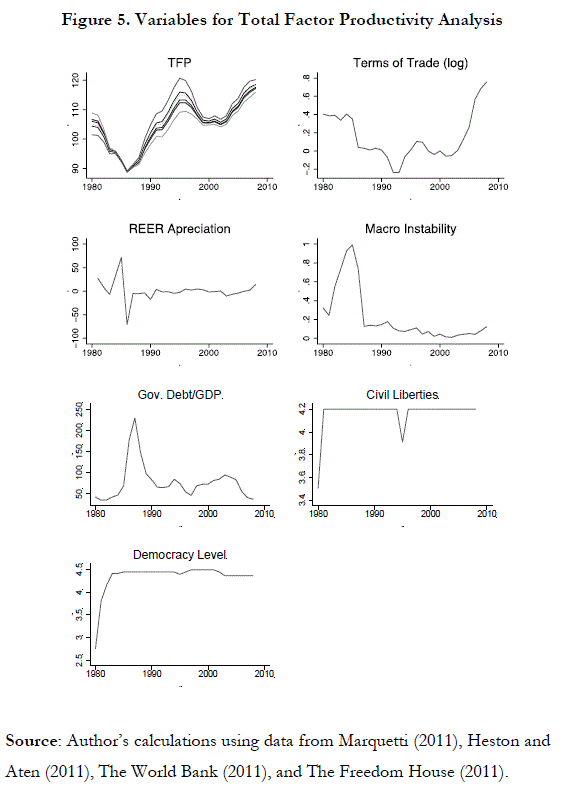
<body><![CDATA[<p align="justify"><font size="2" face="Verdana, Arial, Helvetica, sans-serif">&bull;&nbsp;&nbsp;&nbsp;Cyclical variables such as the terms of trade and the degree real exchange rate overvaluation are expected to show a positive sign and a negative sign respectively. </font></p>      <p align="justify"><font size="2" face="Verdana, Arial, Helvetica, sans-serif">&bull;&nbsp;&nbsp;&nbsp;Macroeconomic instability, measured as the inflation rate divided by one plus the inflation rate, is expected show a negative sign. </font></p>      <p align="justify"><font size="2" face="Verdana, Arial, Helvetica, sans-serif">&bull;&nbsp;&nbsp;&nbsp;Fiscal mismanagement, measured as the accumulation of excessive external debt (over 60 percent of GDP) by the central government, is expected to show a negative sign. </font></p>      <p align="justify"><font size="2" face="Verdana, Arial, Helvetica, sans-serif">&bull;&nbsp;&nbsp;&nbsp;Institutional variables, such as civil rights and democracy, are expected to show positive signs </font></p>      <p align="justify"><font size="2" face="Verdana, Arial, Helvetica, sans-serif">&bull;&nbsp;&nbsp;&nbsp;Initial conditions, measured as the lag of TFP, are expected show a positive sign. </font></p>     <p align="center"><a name="f5"></a><img src="/img/revistas/ec/v3n4/a04_figura17.gif" width="567" height="792"></p>     <p align="justify"><font size="2" face="Verdana, Arial, Helvetica, sans-serif">Other important variables, such as technological innovation and technological adoption, are excluded from this simple econometric exercise. Unfortunately, relatively long time series for these variables are unavailable for the Bolivian case. Although this exclusion severely limits the generalization of the empirical results, the econometric exercise presented here is still relevant as a first reference of comparison for further studies that include such new variables. </font></p>      <p align="justify"><font size="2" face="Verdana, Arial, Helvetica, sans-serif"><a href="#f5">Figure 5</a> depicts the evolution of previously described variables for the 1980-2008 period. The figure shows that the recent increase in the country’s terms of trade that started to took place in 2003. Also, it is worth mentioning that the noticeable sharp fluctuations in the real exchange rate of the mid 1980s are associated with the Bolivian hyperinflation crisis. The management of the exchange rate played a crucial role in the stabilization program that brought an end to the crisis. The macroeconomic instability index captures the 23,000 percent inflation rate that galloped the Bolivian economy in 1985. One of the common explanations for understanding the Bolivian hyperinflation is the accumulation (and monetization) of government debt. Finally, the institutional indexes are capturing the return to democracy of the country, which started in the beginning of 1980s. </font></p>  <h2 align="justify"><font size="2" face="Verdana, Arial, Helvetica, sans-serif">3.2. Modeling the Determinants of Productivity</font></h2>      <p align="justify"><font size="2" face="Verdana, Arial, Helvetica, sans-serif">The determinants of Total Factor Productivity (TFP) are studied through the lens of an Auto-Regressive Distributive Lag (ARDL) model. Using the Generalized Least Squares methods of Prais and Winsten (1954), and Cochrane (1949) to control for autocorrelation, six regression models are estimated. Three models use the capital share of 0.32 to build the TFP series, and the other three use a capital share of 0.68. The determinants of TFP are grouped into four categories: cyclical variables, policies, institutions and initial conditions. </font></p>      <p align="justify"><font size="2" face="Verdana, Arial, Helvetica, sans-serif">Regression analysis is performed for the boundaries of the TFP estimates. The TFP’s lower bound is constructed using 0.32 as the capital-share parameter. The upper bound is constructed using 0.68 as capital-share parameter. This upper-lower boundary approach allows us to control for extreme differences in the capital share, thus it provides a more robust perspective of the marginal effects of the explanatory variables. </font></p>      ]]></body>
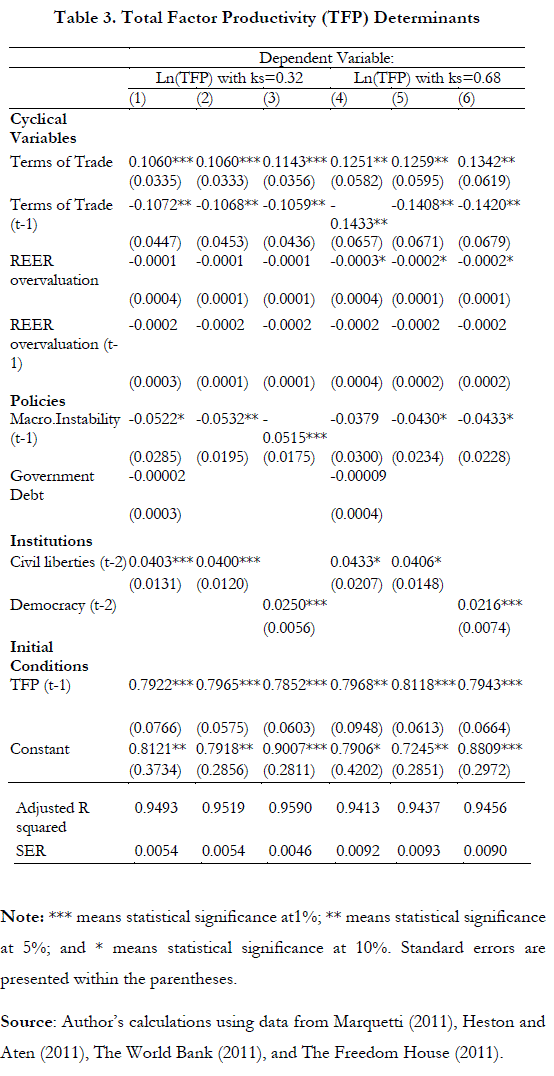
<body><![CDATA[<p align="justify"><font size="2" face="Verdana, Arial, Helvetica, sans-serif">Having TFP and exchange-rate overvaluation in the same regression can generate endogeneity problems due to reverse causality. It is possible to argue that the exchange rate overvaluation is an endogenous variable given that it responds to the evolution of productivity. Thus, in this econometric exercise, I use lagged variables as “instrumental” proxies for controlling endogeneity in the exchange rate and other potentially endogenous variables. </font></p>      <p align="justify"><font size="2" face="Verdana, Arial, Helvetica, sans-serif">Following the econometric implementation of Fuentes et. al (2006) the determinants TFP are estimated as follows: </font></p>     <p align="center"><img src="/img/revistas/ec/v3n4/a04_figura18.gif" width="423" height="31"></p>     <p align="justify"><font size="2" face="Verdana, Arial, Helvetica, sans-serif">where   L is a lag operator, &Omega;(L) and &theta;(L) are lag polynomials, and X is the vector of explanatory variables. Based on Hendry (1995), the estimation strategy of Equation 11 follows the general-to-particular approach. </font></p>      <p align="justify"><font size="2" face="Verdana, Arial, Helvetica, sans-serif"><a href="#t3">Table 3</a> shows the estimation results. First, the large and significant coefficient of the lag of TFP, suggests that productivity exhibits significant degree of inertia. Second, the effects of cyclical variables—particularly those of the terms of trade—are highly significant across all the specifications. Furthermore, it is interesting that the terms of trade variable have both a positive contemporaneous effect and a negative lagged effect. This result seems puzzling, but one plausible explanation is that in Bolivia there are recurrent examples of rent seeking behavior when additional export rents accrue to the central government. When an increasing number of interest groups continuously lobby and attempt to capture the newly generated rents from an export boom, the economy suffers reductions in aggregate efficiency and productivity (Laserna, 2004).  </font></p>      <p align="justify"><font size="2" face="Verdana, Arial, Helvetica, sans-serif">The policy variables also show their expected sign, however, the debt variable is not significant. To explain this result, Morales and Sachs (1988) suggest that the negative effect of debt on the economy was captured by its monetization and the inflation pressure it generated. Finally, in spite of their reduced variability, both institutional indicators are positive and significant. This result supports the notion that civil liberties and democracy are important to improve aggregate productivity, at least in the Bolivian case.</font></p>     <p align="center"><a name="t3"></a><img src="/img/revistas/ec/v3n4/a04_figura19.gif" width="554" height="1076"></p> <h1 align="justify">&nbsp;</h1> <h1 align="justify"><font size="3" face="Verdana, Arial, Helvetica, sans-serif">4. Concluding Remarks</font></h1>     <p align="justify"><font size="2" face="Verdana, Arial, Helvetica, sans-serif">Bolivia has suffered from a series of investment constraints and negative productivity cycles in the last half century. Investment is the engine of capital accumulation, but the Bolivian case shows that political instability, inflation problems, and uncertainty tend to generate a large degree volatility in the growth rate of investment. Volatile investment, however, is not the only source of low capital accumulation. By focusing on the 1980-2008 period, this article also emphasized two additional sources: high adjustment costs and low marginal product of capital. As discussed in the literature, high adjustment costs of investment tend to reflect a weak institutional environment. Particularly for the case of Bolivia, these institutional frictions include heavy bureaucracy and corruption (Mendieta and Martin, 2009). Based on analytical approach and empirical evidence of Caselli and Feyrer (2007), Bolivia’s low marginal product of capital can be explained in terms of the low share of reproducible capital, high relative price of capital with respect to output, and—consistent with the argument of Lucas (1990)—low stocks of complementary inputs such human capital and productivity. </font></p>      <p align="justify"><font size="2" face="Verdana, Arial, Helvetica, sans-serif">Also, over the 1980-2008 period, the evidence on the determinants of total factor productivity (TFP) suggests that not only cyclical variables (i.e., terms of trade and real exchange rate fluctuations) help explain the behavior of TFP, but also more structural variables such as macroeconomic policy and institutions. Besides a significant level of inertia, the positive cycles of TFP are associated with efficiency gains that arise from low and stable inflation, low government debt, and more participatory institutions (i.e., civil rights and democracy). When comparing these results with those of Machicado (2018), some commonalities are evident. Perhaps, the most important one is that in both studies, the terms of trade and macroeconomic stability are crucial for understanding the evolution of productivity in Bolivia. </font></p>      <p align="justify"><font size="2" face="Verdana, Arial, Helvetica, sans-serif">Finally, it is important to highlight that at least in the last years of the sample (the 2003-2008 period), noticeable improvements in the terms of trade of the country tend to dominate the behavior of TFP. Even in this favorable environment, a message of caution worth emphasizing. Although macroeconomic stability and democracy may have been attained, to achieve a more sustainable growth path in productivity, Bolivia still needs to reduce the downside risks of negative changes in its terms of trade.</font></p>     ]]></body>

<body><![CDATA[<p align="justify">&nbsp;</p>     <p align="justify"><font size="3" face="Verdana, Arial, Helvetica, sans-serif"><b>Notas</b></font></p>     <p align="justify"><font size="2" face="Verdana, Arial, Helvetica, sans-serif"><sup>&sect;</sup> More formally, the acceleration principle can also be derived from a cost-minimizing problem.</font></p>     <p align="justify"><font size="2" face="Verdana, Arial, Helvetica, sans-serif"><sup>** </sup>In the estimation tables this last method   is refereed as PW-CO (Prais Winsten and Cochran Orcutt).</font></p>     <p align="justify"><font size="2" face="Verdana, Arial, Helvetica, sans-serif"><sup>&dagger;&dagger; </sup>Using a more intuitive argument, perhaps,   Harberger (1998) considers positive variations in aggregate productivity as   overall cost reductions that are associated with aggregate efficiency gains or   technological changes.</font></p>     <p align="justify">&nbsp;</p> <h1 align="justify"><font size="3" face="Verdana, Arial, Helvetica, sans-serif">References</font></h1>      <!-- ref --><p align="justify"><font size="2" face="Verdana, Arial, Helvetica, sans-serif">Calvo, S. (2006). Applying the growth diagnostics approach: the case of Bolivia. The World Bank, Manuscript.</font>&nbsp;&nbsp;&nbsp;&nbsp;&nbsp;&nbsp;&nbsp;&nbsp;[&#160;<a href="javascript:void(0);" onclick="javascript: window.open('/scielo.php?script=sci_nlinks&ref=1265192&pid=S2415-0622201800040000400001&lng=','','width=640,height=500,resizable=yes,scrollbars=1,menubar=yes,');">Links</a>&#160;]<!-- end-ref --><!-- ref --><p align="justify"><font size="2" face="Verdana, Arial, Helvetica, sans-serif">Caselli, F. and Feyrer, J. (2007). The marginal product of capital. The Quarterly Journal of Economics, 122(2):535–568.</font>&nbsp;&nbsp;&nbsp;&nbsp;&nbsp;&nbsp;&nbsp;&nbsp;[&#160;<a href="javascript:void(0);" onclick="javascript: window.open('/scielo.php?script=sci_nlinks&ref=1265193&pid=S2415-0622201800040000400002&lng=','','width=640,height=500,resizable=yes,scrollbars=1,menubar=yes,');">Links</a>&#160;]<!-- end-ref --><!-- ref --><p align="justify"><font size="2" face="Verdana, Arial, Helvetica, sans-serif">Chenery, H. (1952). Overcapacity and the acceleration principle. Econometrica, 20(1):128.</font>&nbsp;&nbsp;&nbsp;&nbsp;&nbsp;&nbsp;&nbsp;&nbsp;[&#160;<a href="javascript:void(0);" onclick="javascript: window.open('/scielo.php?script=sci_nlinks&ref=1265194&pid=S2415-0622201800040000400003&lng=','','width=640,height=500,resizable=yes,scrollbars=1,menubar=yes,');">Links</a>&#160;]<!-- end-ref --><!-- ref --><p align="justify"><font size="2" face="Verdana, Arial, Helvetica, sans-serif">Cochrane, D.and Orcutt, G. (1949). Application of least squares regression to relationships containing auto-correlated error terms. Journal of the American Statistical Association, 44:32–61.</font>&nbsp;&nbsp;&nbsp;&nbsp;&nbsp;&nbsp;&nbsp;&nbsp;[&#160;<a href="javascript:void(0);" onclick="javascript: window.open('/scielo.php?script=sci_nlinks&ref=1265195&pid=S2415-0622201800040000400004&lng=','','width=640,height=500,resizable=yes,scrollbars=1,menubar=yes,');">Links</a>&#160;]<!-- end-ref --><!-- ref --><p align="justify"><font size="2" face="Verdana, Arial, Helvetica, sans-serif">Fuentes, R., Larra&#305;n, M., and Schmidt-Hebbel, K. (2006). Sources of growth and behavior of TFP in Chile. Cuadernos de Economia-Latin American Journal of Economics, 43(127):113–142.</font>&nbsp;&nbsp;&nbsp;&nbsp;&nbsp;&nbsp;&nbsp;&nbsp;[&#160;<a href="javascript:void(0);" onclick="javascript: window.open('/scielo.php?script=sci_nlinks&ref=1265196&pid=S2415-0622201800040000400005&lng=','','width=640,height=500,resizable=yes,scrollbars=1,menubar=yes,');">Links</a>&#160;]<!-- end-ref --><!-- ref --><p align="justify"><font size="2" face="Verdana, Arial, Helvetica, sans-serif">Gonzáles Zuazo, R., and Molina Fernández, J. M. (2017).</a> On Graduation from Fiscal Procyclicality: The case of Bolivia. Revista Latinoamericana de Desarrollo Economico, (27), 39-56.</font>&nbsp;&nbsp;&nbsp;&nbsp;&nbsp;&nbsp;&nbsp;&nbsp;[&#160;<a href="javascript:void(0);" onclick="javascript: window.open('/scielo.php?script=sci_nlinks&ref=1265197&pid=S2415-0622201800040000400006&lng=','','width=640,height=500,resizable=yes,scrollbars=1,menubar=yes,');">Links</a>&#160;]<!-- end-ref --><!-- ref --><p align="justify"><font size="2" face="Verdana, Arial, Helvetica, sans-serif">Harberger, A. C. (1998). A vision of the growth process. American Economic Review, 88(1):1–32.</font>&nbsp;&nbsp;&nbsp;&nbsp;&nbsp;&nbsp;&nbsp;&nbsp;[&#160;<a href="javascript:void(0);" onclick="javascript: window.open('/scielo.php?script=sci_nlinks&ref=1265198&pid=S2415-0622201800040000400007&lng=','','width=640,height=500,resizable=yes,scrollbars=1,menubar=yes,');">Links</a>&#160;]<!-- end-ref --><!-- ref --><p align="justify"><font size="2" face="Verdana, Arial, Helvetica, sans-serif">Harrod, R. (1936). The Trade Cycle. Oxford University Press, Oxford.</font>&nbsp;&nbsp;&nbsp;&nbsp;&nbsp;&nbsp;&nbsp;&nbsp;[&#160;<a href="javascript:void(0);" onclick="javascript: window.open('/scielo.php?script=sci_nlinks&ref=1265199&pid=S2415-0622201800040000400008&lng=','','width=640,height=500,resizable=yes,scrollbars=1,menubar=yes,');">Links</a>&#160;]<!-- end-ref --><!-- ref --><p align="justify"><font size="2" face="Verdana, Arial, Helvetica, sans-serif">Hendry, D., editor (1995). Dynamic Econometrics. Princeton University Press, New Yersey.</font>&nbsp;&nbsp;&nbsp;&nbsp;&nbsp;&nbsp;&nbsp;&nbsp;[&#160;<a href="javascript:void(0);" onclick="javascript: window.open('/scielo.php?script=sci_nlinks&ref=1265200&pid=S2415-0622201800040000400009&lng=','','width=640,height=500,resizable=yes,scrollbars=1,menubar=yes,');">Links</a>&#160;]<!-- end-ref --><!-- ref --><p align="justify"><font size="2" face="Verdana, Arial, Helvetica, sans-serif">Humerez, J. and Dorado, H. (2006) “Una Aproximación de los Determinantes del Crecimiento Económico en Bolivia 1960-2004,” Análisis Económico, (21): 1-39. UDAPE.</font>&nbsp;&nbsp;&nbsp;&nbsp;&nbsp;&nbsp;&nbsp;&nbsp;[&#160;<a href="javascript:void(0);" onclick="javascript: window.open('/scielo.php?script=sci_nlinks&ref=1265201&pid=S2415-0622201800040000400010&lng=','','width=640,height=500,resizable=yes,scrollbars=1,menubar=yes,');">Links</a>&#160;]<!-- end-ref --><!-- ref --><p align="justify"><font size="2" face="Verdana, Arial, Helvetica, sans-serif">Humerez, J. (2017). Determinantes del Crecimiento Económico, Pobreza y Desigualdad en Bolivia. Tesis Doctoral. Facultad de Ciencias Económicas y Financieras, Carrera de Economía, Instituto de Investigaciones Económicas. La Paz – Bolivia.</font>&nbsp;&nbsp;&nbsp;&nbsp;&nbsp;&nbsp;&nbsp;&nbsp;[&#160;<a href="javascript:void(0);" onclick="javascript: window.open('/scielo.php?script=sci_nlinks&ref=1265202&pid=S2415-0622201800040000400011&lng=','','width=640,height=500,resizable=yes,scrollbars=1,menubar=yes,');">Links</a>&#160;]<!-- end-ref --><!-- ref --><p align="justify"><font size="2" face="Verdana, Arial, Helvetica, sans-serif">Jemio, L. C. (2008). La inversión y el crecimiento en la economía boliviana. Documento de Trabajo No. 01/08, Instituto de Investigaciones Socioeconómicas, IISEC.</font>&nbsp;&nbsp;&nbsp;&nbsp;&nbsp;&nbsp;&nbsp;&nbsp;[&#160;<a href="javascript:void(0);" onclick="javascript: window.open('/scielo.php?script=sci_nlinks&ref=1265203&pid=S2415-0622201800040000400012&lng=','','width=640,height=500,resizable=yes,scrollbars=1,menubar=yes,');">Links</a>&#160;]<!-- end-ref --><!-- ref --><p align="justify"><font size="2" face="Verdana, Arial, Helvetica, sans-serif">Kehoe, T. J., Machicado, C. G., and Peres-Cajías, J. (2019). </a>The Monetary and Fiscal History of Bolivia, 1960–2017 (No. w25523). National Bureau of Economic Research.</font>&nbsp;&nbsp;&nbsp;&nbsp;&nbsp;&nbsp;&nbsp;&nbsp;[&#160;<a href="javascript:void(0);" onclick="javascript: window.open('/scielo.php?script=sci_nlinks&ref=1265204&pid=S2415-0622201800040000400013&lng=','','width=640,height=500,resizable=yes,scrollbars=1,menubar=yes,');">Links</a>&#160;]<!-- end-ref --><!-- ref --><p align="justify"><font size="2" face="Verdana, Arial, Helvetica, sans-serif">Kopcke, R. W. and Brauman, R. S. (2001). The performance of traditional macroeconomic models of businesses’ investment spending. New England Economic Review, pages 3–39.</font>&nbsp;&nbsp;&nbsp;&nbsp;&nbsp;&nbsp;&nbsp;&nbsp;[&#160;<a href="javascript:void(0);" onclick="javascript: window.open('/scielo.php?script=sci_nlinks&ref=1265205&pid=S2415-0622201800040000400014&lng=','','width=640,height=500,resizable=yes,scrollbars=1,menubar=yes,');">Links</a>&#160;]<!-- end-ref --><!-- ref --><p align="justify"><font size="2" face="Verdana, Arial, Helvetica, sans-serif">Koyck, L. (1954). Distributed Lags and Investment Analysis. North-Holland, Amsterdam. </font>&nbsp;&nbsp;&nbsp;&nbsp;&nbsp;&nbsp;&nbsp;&nbsp;[&#160;<a href="javascript:void(0);" onclick="javascript: window.open('/scielo.php?script=sci_nlinks&ref=1265206&pid=S2415-0622201800040000400015&lng=','','width=640,height=500,resizable=yes,scrollbars=1,menubar=yes,');">Links</a>&#160;]<!-- end-ref --><!-- ref --><p align="justify"><font size="2" face="Verdana, Arial, Helvetica, sans-serif">Laserna, R. (2004). Democracy under Entanglement (Translated from” La Democracia en el Chenko”, Spanish version). Fundacion Millenio.</font>&nbsp;&nbsp;&nbsp;&nbsp;&nbsp;&nbsp;&nbsp;&nbsp;[&#160;<a href="javascript:void(0);" onclick="javascript: window.open('/scielo.php?script=sci_nlinks&ref=1265207&pid=S2415-0622201800040000400016&lng=','','width=640,height=500,resizable=yes,scrollbars=1,menubar=yes,');">Links</a>&#160;]<!-- end-ref --><!-- ref --><p align="justify"><font size="2" face="Verdana, Arial, Helvetica, sans-serif">Lordemann, J. A., Rubín de Celis, R., &amp;   Villegas Quino, H. (2011). </a>El modelo de Goodwin. Ciclos económicos e inversión en Bolivia. Revista Latinoamericana de Desarrollo Económico, (15), 133-165.</font>&nbsp;&nbsp;&nbsp;&nbsp;&nbsp;&nbsp;&nbsp;&nbsp;[&#160;<a href="javascript:void(0);" onclick="javascript: window.open('/scielo.php?script=sci_nlinks&ref=1265208&pid=S2415-0622201800040000400017&lng=','','width=640,height=500,resizable=yes,scrollbars=1,menubar=yes,');">Links</a>&#160;]<!-- end-ref --><!-- ref --><p align="justify"><font size="2" face="Verdana, Arial, Helvetica, sans-serif">Lucas, R. (1990). Why doesn’t capital &#64258;ow from rich to poor countries? American Economic Review, 80(2):92–96.</font>&nbsp;&nbsp;&nbsp;&nbsp;&nbsp;&nbsp;&nbsp;&nbsp;[&#160;<a href="javascript:void(0);" onclick="javascript: window.open('/scielo.php?script=sci_nlinks&ref=1265209&pid=S2415-0622201800040000400018&lng=','','width=640,height=500,resizable=yes,scrollbars=1,menubar=yes,');">Links</a>&#160;]<!-- end-ref --><!-- ref --><p align="justify"><font size="2" face="Verdana, Arial, Helvetica, sans-serif">Machicado, G. (2018). De Las Causas Próximas A Las Causas Profundas Del Crecimiento Económico De Bolivia Entre 1950 Y 2015 Working paper No. 09/2018. Institute for Advanced Development Studies.</font>&nbsp;&nbsp;&nbsp;&nbsp;&nbsp;&nbsp;&nbsp;&nbsp;[&#160;<a href="javascript:void(0);" onclick="javascript: window.open('/scielo.php?script=sci_nlinks&ref=1265210&pid=S2415-0622201800040000400019&lng=','','width=640,height=500,resizable=yes,scrollbars=1,menubar=yes,');">Links</a>&#160;]<!-- end-ref --><!-- ref --><p align="justify"><font size="2" face="Verdana, Arial, Helvetica, sans-serif">Marquetti, A. (2011). Extended Penn world tables v. 4.0. <a href="https://sites.google.com/a/newschool.edu/duncan-foley-homepage/home/EPWT" target="_blank">https://sites.google.com/a/newschool.edu/duncan-foley-homepage/home/EPWT</a></font>&nbsp;&nbsp;&nbsp;&nbsp;&nbsp;&nbsp;&nbsp;&nbsp;[&#160;<a href="javascript:void(0);" onclick="javascript: window.open('/scielo.php?script=sci_nlinks&ref=1265211&pid=S2415-0622201800040000400020&lng=','','width=640,height=500,resizable=yes,scrollbars=1,menubar=yes,');">Links</a>&#160;]<!-- end-ref --><!-- ref --><p align="justify"><font size="2" face="Verdana, Arial, Helvetica, sans-serif">Mendieta, P. and Martin, D. (2009). En busca de los determinantes del crecimiento economico boliviano. Documentos de Trabajo, Banco Central de Bolivia.</font>&nbsp;&nbsp;&nbsp;&nbsp;&nbsp;&nbsp;&nbsp;&nbsp;[&#160;<a href="javascript:void(0);" onclick="javascript: window.open('/scielo.php?script=sci_nlinks&ref=1265212&pid=S2415-0622201800040000400021&lng=','','width=640,height=500,resizable=yes,scrollbars=1,menubar=yes,');">Links</a>&#160;]<!-- end-ref --><!-- ref --><p align="justify"><font size="2" face="Verdana, Arial, Helvetica, sans-serif">Morales, J. A. and Sachs, J. (1988). Bolivia’s economic crisis. NBER Working Papers 2620, National Bureau of Economic Research, Inc.</font>&nbsp;&nbsp;&nbsp;&nbsp;&nbsp;&nbsp;&nbsp;&nbsp;[&#160;<a href="javascript:void(0);" onclick="javascript: window.open('/scielo.php?script=sci_nlinks&ref=1265213&pid=S2415-0622201800040000400022&lng=','','width=640,height=500,resizable=yes,scrollbars=1,menubar=yes,');">Links</a>&#160;]<!-- end-ref --><!-- ref --><p align="justify"><font size="2" face="Verdana, Arial, Helvetica, sans-serif">Newey, W. K. and West, K. D. (1987). A simple, positive semi-de&#64257;nite, heteroskedasticity and autocorrelation consistent covariance matrix. </font>&nbsp;&nbsp;&nbsp;&nbsp;&nbsp;&nbsp;&nbsp;&nbsp;[&#160;<a href="javascript:void(0);" onclick="javascript: window.open('/scielo.php?script=sci_nlinks&ref=1265214&pid=S2415-0622201800040000400023&lng=','','width=640,height=500,resizable=yes,scrollbars=1,menubar=yes,');">Links</a>&#160;]<!-- end-ref --><!-- ref --><p align="justify"><font size="2" face="Verdana, Arial, Helvetica, sans-serif">Econometrica, 55(3):703–08. Pigou, A. (1929). Industrial Fluctuations. Macmillan, London.</font>&nbsp;&nbsp;&nbsp;&nbsp;&nbsp;&nbsp;&nbsp;&nbsp;[&#160;<a href="javascript:void(0);" onclick="javascript: window.open('/scielo.php?script=sci_nlinks&ref=1265215&pid=S2415-0622201800040000400024&lng=','','width=640,height=500,resizable=yes,scrollbars=1,menubar=yes,');">Links</a>&#160;]<!-- end-ref --><!-- ref --><p align="justify"><font size="2" face="Verdana, Arial, Helvetica, sans-serif">Prais, S. and Winsten, C. (1954). Trend estimators and serial correlation. Working Paper 383, Cowles Commission.</font>&nbsp;&nbsp;&nbsp;&nbsp;&nbsp;&nbsp;&nbsp;&nbsp;[&#160;<a href="javascript:void(0);" onclick="javascript: window.open('/scielo.php?script=sci_nlinks&ref=1265216&pid=S2415-0622201800040000400025&lng=','','width=640,height=500,resizable=yes,scrollbars=1,menubar=yes,');">Links</a>&#160;]<!-- end-ref --><!-- ref --><p align="justify"><font size="2" face="Verdana, Arial, Helvetica, sans-serif">Villegas Quino</a>, H., Rubín de Celis, R., and Aliaga Lordemann, J. (2011). Hodrick-Prescott, Goodwin y ciclos económicos en Bolivia. Revista Latinoamericana de Desarrollo Económico, (16), 29-38</font>&nbsp;&nbsp;&nbsp;&nbsp;&nbsp;&nbsp;&nbsp;&nbsp;[&#160;<a href="javascript:void(0);" onclick="javascript: window.open('/scielo.php?script=sci_nlinks&ref=1265217&pid=S2415-0622201800040000400026&lng=','','width=640,height=500,resizable=yes,scrollbars=1,menubar=yes,');">Links</a>&#160;]<!-- end-ref --><p align="justify">&nbsp;</p>     <p align="justify">&nbsp;</p>      ]]></body><back>
<ref-list>
<ref id="B1">
<nlm-citation citation-type="book">
<person-group person-group-type="author">
<name>
<surname><![CDATA[Calvo]]></surname>
<given-names><![CDATA[S.]]></given-names>
</name>
</person-group>
<source><![CDATA[Applying the growth diagnostics approach: the case of Bolivia]]></source>
<year>2006</year>
<publisher-name><![CDATA[The World Bank]]></publisher-name>
</nlm-citation>
</ref>
<ref id="B2">
<nlm-citation citation-type="journal">
<person-group person-group-type="author">
<name>
<surname><![CDATA[Caselli]]></surname>
<given-names><![CDATA[F.]]></given-names>
</name>
<name>
<surname><![CDATA[Feyrer]]></surname>
<given-names><![CDATA[J.]]></given-names>
</name>
</person-group>
<article-title xml:lang="en"><![CDATA[The marginal product of capital]]></article-title>
<source><![CDATA[The Quarterly Journal of Economics]]></source>
<year>2007</year>
<volume>122</volume>
<numero>2</numero>
<issue>2</issue>
<page-range>535-568</page-range></nlm-citation>
</ref>
<ref id="B3">
<nlm-citation citation-type="journal">
<person-group person-group-type="author">
<name>
<surname><![CDATA[Chenery]]></surname>
<given-names><![CDATA[H.]]></given-names>
</name>
</person-group>
<article-title xml:lang="en"><![CDATA[Overcapacity and the acceleration principle]]></article-title>
<source><![CDATA[Econometrica]]></source>
<year>1952</year>
<volume>20</volume>
<numero>1</numero>
<issue>1</issue>
<page-range>128</page-range></nlm-citation>
</ref>
<ref id="B4">
<nlm-citation citation-type="journal">
<person-group person-group-type="author">
<name>
<surname><![CDATA[Cochrane]]></surname>
<given-names><![CDATA[D]]></given-names>
</name>
<name>
<surname><![CDATA[Orcutt]]></surname>
<given-names><![CDATA[G.]]></given-names>
</name>
</person-group>
<article-title xml:lang="en"><![CDATA[Application of least squares regression to relationships containing auto-correlated error terms]]></article-title>
<source><![CDATA[Journal of the American Statistical Association]]></source>
<year>1949</year>
<numero>44</numero>
<issue>44</issue>
<page-range>32-61</page-range></nlm-citation>
</ref>
<ref id="B5">
<nlm-citation citation-type="journal">
<person-group person-group-type="author">
<name>
<surname><![CDATA[Fuentes]]></surname>
<given-names><![CDATA[R.]]></given-names>
</name>
<name>
<surname><![CDATA[Larran]]></surname>
<given-names><![CDATA[M.]]></given-names>
</name>
<name>
<surname><![CDATA[Schmidt-Hebbel]]></surname>
<given-names><![CDATA[K.]]></given-names>
</name>
</person-group>
<article-title xml:lang="en"><![CDATA[Sources of growth and behavior of TFP in Chile]]></article-title>
<source><![CDATA[Cuadernos de Economia-Latin American Journal of Economics]]></source>
<year>2006</year>
<volume>43</volume>
<numero>127</numero>
<issue>127</issue>
<page-range>113-142</page-range></nlm-citation>
</ref>
<ref id="B6">
<nlm-citation citation-type="journal">
<person-group person-group-type="author">
<name>
<surname><![CDATA[Gonzáles Zuazo]]></surname>
<given-names><![CDATA[R.]]></given-names>
</name>
<name>
<surname><![CDATA[Molina Fernández]]></surname>
<given-names><![CDATA[J. M.]]></given-names>
</name>
</person-group>
<article-title xml:lang="en"><![CDATA[On Graduation from Fiscal Procyclicality: The case of Bolivia]]></article-title>
<source><![CDATA[Revista Latinoamericana de Desarrollo Economico]]></source>
<year>2017</year>
<numero>27</numero>
<issue>27</issue>
<page-range>39-56</page-range></nlm-citation>
</ref>
<ref id="B7">
<nlm-citation citation-type="journal">
<person-group person-group-type="author">
<name>
<surname><![CDATA[Harberger]]></surname>
<given-names><![CDATA[A. C.]]></given-names>
</name>
</person-group>
<article-title xml:lang="en"><![CDATA[A vision of the growth process]]></article-title>
<source><![CDATA[American Economic Review]]></source>
<year>1998</year>
<volume>88</volume>
<numero>1</numero>
<issue>1</issue>
<page-range>1-32</page-range></nlm-citation>
</ref>
<ref id="B8">
<nlm-citation citation-type="book">
<person-group person-group-type="author">
<name>
<surname><![CDATA[Harrod]]></surname>
<given-names><![CDATA[R.]]></given-names>
</name>
</person-group>
<source><![CDATA[The Trade Cycle]]></source>
<year>1936</year>
<publisher-loc><![CDATA[Oxford ]]></publisher-loc>
<publisher-name><![CDATA[Oxford University Press]]></publisher-name>
</nlm-citation>
</ref>
<ref id="B9">
<nlm-citation citation-type="book">
<person-group person-group-type="author">
<name>
<surname><![CDATA[Hendry]]></surname>
<given-names><![CDATA[D.]]></given-names>
</name>
</person-group>
<source><![CDATA[Dynamic Econometrics]]></source>
<year>1995</year>
<publisher-loc><![CDATA[^eNew Yersey New Yersey]]></publisher-loc>
<publisher-name><![CDATA[Princeton University Press]]></publisher-name>
</nlm-citation>
</ref>
<ref id="B10">
<nlm-citation citation-type="journal">
<person-group person-group-type="author">
<name>
<surname><![CDATA[Humerez]]></surname>
<given-names><![CDATA[J.]]></given-names>
</name>
<name>
<surname><![CDATA[Dorado]]></surname>
<given-names><![CDATA[H.]]></given-names>
</name>
</person-group>
<article-title xml:lang="es"><![CDATA[Una Aproximación de los Determinantes del Crecimiento Económico en Bolivia 1960-2004]]></article-title>
<source><![CDATA[Análisis Económico]]></source>
<year>2006</year>
<numero>21</numero>
<issue>21</issue>
<page-range>1-39</page-range><publisher-name><![CDATA[UDAPE]]></publisher-name>
</nlm-citation>
</ref>
<ref id="B11">
<nlm-citation citation-type="">
<person-group person-group-type="author">
<name>
<surname><![CDATA[Humerez]]></surname>
<given-names><![CDATA[J.]]></given-names>
</name>
</person-group>
<source><![CDATA[Determinantes del Crecimiento Económico, Pobreza y Desigualdad en Bolivia]]></source>
<year>2017</year>
<publisher-loc><![CDATA[La Paz ]]></publisher-loc>
</nlm-citation>
</ref>
<ref id="B12">
<nlm-citation citation-type="book">
<person-group person-group-type="author">
<name>
<surname><![CDATA[Jemio]]></surname>
<given-names><![CDATA[L. C.]]></given-names>
</name>
</person-group>
<source><![CDATA[La inversión y el crecimiento en la economía boliviana]]></source>
<year>2008</year>
<publisher-name><![CDATA[Instituto de Investigaciones Socioeconómicas, IISEC]]></publisher-name>
</nlm-citation>
</ref>
<ref id="B13">
<nlm-citation citation-type="book">
<person-group person-group-type="author">
<name>
<surname><![CDATA[Kehoe]]></surname>
<given-names><![CDATA[T. J.]]></given-names>
</name>
<name>
<surname><![CDATA[Machicado]]></surname>
<given-names><![CDATA[C. G.]]></given-names>
</name>
<name>
<surname><![CDATA[Peres-Cajías]]></surname>
<given-names><![CDATA[J.]]></given-names>
</name>
</person-group>
<source><![CDATA[The Monetary and Fiscal History of Bolivia, 1960-2017 (No. w25523)]]></source>
<year>2019</year>
<publisher-name><![CDATA[National Bureau of Economic Research]]></publisher-name>
</nlm-citation>
</ref>
<ref id="B14">
<nlm-citation citation-type="book">
<person-group person-group-type="author">
<name>
<surname><![CDATA[Kopcke]]></surname>
<given-names><![CDATA[R. W.]]></given-names>
</name>
<name>
<surname><![CDATA[Brauman]]></surname>
<given-names><![CDATA[R. S.]]></given-names>
</name>
</person-group>
<source><![CDATA[The performance of traditional macroeconomic models of businesses’ investment spending]]></source>
<year>2001</year>
<page-range>3-39</page-range><publisher-name><![CDATA[New England Economic Review]]></publisher-name>
</nlm-citation>
</ref>
<ref id="B15">
<nlm-citation citation-type="">
<person-group person-group-type="author">
<name>
<surname><![CDATA[Koyck]]></surname>
<given-names><![CDATA[L.]]></given-names>
</name>
</person-group>
<source><![CDATA[Distributed Lags and Investment Analysis]]></source>
<year>1954</year>
</nlm-citation>
</ref>
<ref id="B16">
<nlm-citation citation-type="book">
<person-group person-group-type="author">
<name>
<surname><![CDATA[Laserna]]></surname>
<given-names><![CDATA[R.]]></given-names>
</name>
</person-group>
<source><![CDATA[Democracy under Entanglement (Translated from” La Democracia en el Chenko”, Spanish version)]]></source>
<year>2004</year>
<publisher-name><![CDATA[Fundacion Millenio]]></publisher-name>
</nlm-citation>
</ref>
<ref id="B17">
<nlm-citation citation-type="journal">
<person-group person-group-type="author">
<name>
<surname><![CDATA[Lordemann]]></surname>
<given-names><![CDATA[J. A.]]></given-names>
</name>
<name>
<surname><![CDATA[Rubín de Celis]]></surname>
<given-names><![CDATA[R.]]></given-names>
</name>
<name>
<surname><![CDATA[Villegas Quino]]></surname>
<given-names><![CDATA[H.]]></given-names>
</name>
</person-group>
<article-title xml:lang="es"><![CDATA[El modelo de Goodwin: Ciclos económicos e inversión en Bolivia]]></article-title>
<source><![CDATA[Revista Latinoamericana de Desarrollo Económico]]></source>
<year>2011</year>
<numero>15</numero>
<issue>15</issue>
<page-range>133-165</page-range></nlm-citation>
</ref>
<ref id="B18">
<nlm-citation citation-type="journal">
<person-group person-group-type="author">
<name>
<surname><![CDATA[Lucas]]></surname>
<given-names><![CDATA[R.]]></given-names>
</name>
</person-group>
<article-title xml:lang="en"><![CDATA[Why doesn’t capital &#64258;ow from rich to poor countries]]></article-title>
<source><![CDATA[American Economic Review]]></source>
<year>1990</year>
<volume>80</volume>
<numero>2</numero>
<issue>2</issue>
<page-range>92-96</page-range></nlm-citation>
</ref>
<ref id="B19">
<nlm-citation citation-type="book">
<person-group person-group-type="author">
<name>
<surname><![CDATA[Machicado]]></surname>
<given-names><![CDATA[G.]]></given-names>
</name>
</person-group>
<source><![CDATA[De Las Causas Próximas A Las Causas Profundas Del Crecimiento Económico De Bolivia Entre 1950 Y 2015]]></source>
<year>2018</year>
<publisher-name><![CDATA[Institute for Advanced Development Studies]]></publisher-name>
</nlm-citation>
</ref>
<ref id="B20">
<nlm-citation citation-type="">
<person-group person-group-type="author">
<name>
<surname><![CDATA[Marquetti]]></surname>
<given-names><![CDATA[A.]]></given-names>
</name>
</person-group>
<source><![CDATA[Extended Penn world tables v. 4.0]]></source>
<year>2011</year>
</nlm-citation>
</ref>
<ref id="B21">
<nlm-citation citation-type="book">
<person-group person-group-type="author">
<name>
<surname><![CDATA[Mendieta]]></surname>
<given-names><![CDATA[P.]]></given-names>
</name>
<name>
<surname><![CDATA[Martin]]></surname>
<given-names><![CDATA[D.]]></given-names>
</name>
</person-group>
<source><![CDATA[En busca de los determinantes del crecimiento economico boliviano]]></source>
<year>2009</year>
<publisher-name><![CDATA[Banco Central de Bolivia]]></publisher-name>
</nlm-citation>
</ref>
<ref id="B22">
<nlm-citation citation-type="book">
<person-group person-group-type="author">
<name>
<surname><![CDATA[Morales]]></surname>
<given-names><![CDATA[J. A.]]></given-names>
</name>
<name>
<surname><![CDATA[Sachs]]></surname>
<given-names><![CDATA[J.]]></given-names>
</name>
</person-group>
<source><![CDATA[Bolivia’s economic crisis]]></source>
<year>1988</year>
<publisher-name><![CDATA[NBER Working Papers 2620]]></publisher-name>
</nlm-citation>
</ref>
<ref id="B23">
<nlm-citation citation-type="">
<person-group person-group-type="author">
<name>
<surname><![CDATA[Newey]]></surname>
<given-names><![CDATA[W. K.]]></given-names>
</name>
<name>
<surname><![CDATA[West]]></surname>
<given-names><![CDATA[K. D.]]></given-names>
</name>
</person-group>
<article-title xml:lang="en"><![CDATA[A simple, positive semi-de&#64257;nite, heteroskedasticity and autocorrelation consistent covariance matrix]]></article-title>
<source><![CDATA[]]></source>
<year>1987</year>
</nlm-citation>
</ref>
<ref id="B24">
<nlm-citation citation-type="journal">
<person-group person-group-type="author">
<name>
<surname><![CDATA[Pigou]]></surname>
<given-names><![CDATA[A.]]></given-names>
</name>
</person-group>
<article-title xml:lang="en"><![CDATA[Industrial Fluctuations]]></article-title>
<source><![CDATA[Econometrica]]></source>
<year>1929</year>
<volume>55</volume>
<numero>3</numero>
<issue>3</issue>
<page-range>703-08</page-range></nlm-citation>
</ref>
<ref id="B25">
<nlm-citation citation-type="book">
<person-group person-group-type="author">
<name>
<surname><![CDATA[Prais]]></surname>
<given-names><![CDATA[S.]]></given-names>
</name>
<name>
<surname><![CDATA[Winsten]]></surname>
<given-names><![CDATA[C.]]></given-names>
</name>
</person-group>
<source><![CDATA[Trend estimators and serial correlation]]></source>
<year>1954</year>
<publisher-name><![CDATA[Working Paper]]></publisher-name>
</nlm-citation>
</ref>
<ref id="B26">
<nlm-citation citation-type="journal">
<person-group person-group-type="author">
<name>
<surname><![CDATA[Villegas Quino]]></surname>
<given-names><![CDATA[H.]]></given-names>
</name>
<name>
<surname><![CDATA[Rubín de Celis]]></surname>
<given-names><![CDATA[R.]]></given-names>
</name>
<name>
<surname><![CDATA[Aliaga Lordemann]]></surname>
<given-names><![CDATA[J.]]></given-names>
</name>
</person-group>
<article-title xml:lang="en"><![CDATA[Hodrick-Prescott, Goodwin y ciclos económicos en Bolivia]]></article-title>
<source><![CDATA[Revista Latinoamericana de Desarrollo Económico]]></source>
<year>2011</year>
<numero>16</numero>
<issue>16</issue>
<page-range>29-38</page-range></nlm-citation>
</ref>
</ref-list>
</back>
</article>