War and Peace: Fatherland and the Rise of a Spirit of Capitalism in Bolivia (1880-1884)
Guerra y paz: la madre patria y el surgimiento del espíritu capitalista en Bolivia (1880-1884)
Guillaume Tremblay*
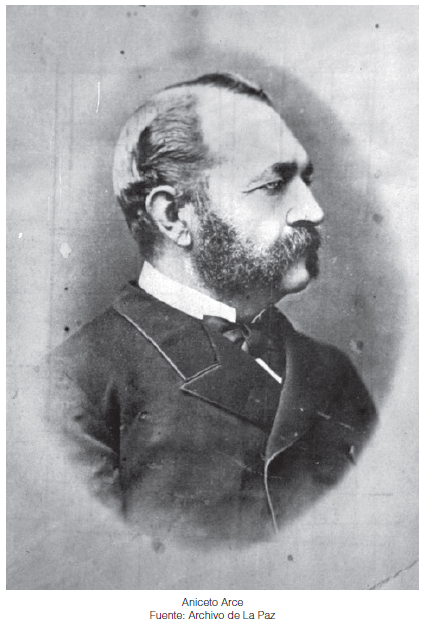
This article looks at the progressive intertwining of a capitalist spirit to the Bolivian state beginning in the 188Os. The emphasis is put on the raging patriotic debate that takes place within the political elite as the War of the Pacific -opposing Bolivia to Chile- rages on. Focusing on Aniceto Arce, then Vice-President and future President of the country, we show that the real stake of the debates is the growing importance of work, production and capital as the central values of the State.
Key words: Spirit of capitalism, State, patriotism, Aniceto Arce, War of the Pacific, war and peace.
Resumen
Este artículo analiza cómo un espíritu capitalista ha estado ligado al Estado boliviano desde la década de 1880. Se hace hincapié en el debate patriótico dentro de la élite política a medida que avanza la Guerra del Pacífico entre Bolivia y Chile. Centrándose en la persona de Aniceto Arce, entonces vicepresidente y futuro presidente del país, en el artículo se demuestra que el verdadero objeto de los debates era la creciente importancia del trabajo, de la producción y del capital como valores centrales del Estado.
Palabras clave: Espíritu del capitalismo, Estado, patriotismo, Aniceto Arce, Guerra del Pacífico, guerra y paz.
1. Introduction
In September 1883, Almanzor Prudencio, a man of letters from La Paz, publicly filed a formal accusation against Aniceto Arce:1 "me permito denunciar, como denuncio, el crímen de Lesa-Pátria, perpetrado por el Vice-Presidente de la República Boliviana Aniceto Arce, actual Presidente del Senado para mayor mengua y vergüenza de mi Pátria" (Prudencio, 1883). Equivalent to treason, the crime of "lesa-patria" was, at that time, an offense punishable by death. Prudencio's lengthy but flawed record suggests that Arce betrayed Bolivia's interests in favor of Chile's interests. The authorities, however, did not concretely follow up on his accusation. It nonetheless carried resentment regarding Arce, a sentiment that clearly lingered for some years within a fringe of the creole elite. Indeed, these men resented pacista standard-bearer Arce's position in favor of peace during the War of the Pacific2.
]]> The war generated a deep tension in Bolivian political spheres and divided the elite into two camps: one in favor of a full commitment to the armed conflict and the other campaigning to bring about peace as quickly as possible. In the long and acrimonious debate between the pro-peace and the pro-war camps, one major issue stood out more than any other: patriotism. A highly sensitive issue, patriotism overshadows many others that should also be of significant interest. When it does not outright dismiss them, it perverts their rationale to fit into its own framework. This is what happened with regards to the growing importance of capital in Bolivian political life and the transformation of the state based on the spirit of capitalism.The capitalist transformation of society appears more clearly than ever at the turn of the 1870s and 1880s with liberalism asserting itself as the idea at the center of Bolivia's economic policy3. The patriotic framing seems inescapable even when discussing the values associated with this economic transformation. In the evolving Bolivian society, questions regarding how society should be shaped will be debated under the blinding light of war.
Arce, being the capitalist community's leader, and more importantly still, its main representative within state power, is inevitably one of the main protagonists in this debate, both as a participant and as a topic for discussion. Indeed, Arce is the most passionate advocate for capital -its growth, its circulation- and therefore the most talkative member of the pacista camp. Furthermore, most of the time, it is Arce himself, as Huanchaca's majority shareholder (one of Bolivia's most profitable mining company), as an advocate for more economic relations with Chile, who is the target of accusations from the belligerent camp, and therefore a focal point of discussions.
This article looks at this particular dynamic that reveals the novel tensions developing between capitalism and the State in the last quarter of the nineteenth century in Bolivia. Focusing on the figure of Aniceto Arce, the future President of the Republic and the richest man in the country, it will show how the context of the War of the Pacific, which marks the beginning of the 1880s, makes it possible to observe how the spirit of capitalism and the republican state progressively merge in the public sphere. The debates unfolding within the creole political elite show that, under its patriotic veneer, the real debate is actually about the growing place of work, production, and capital as the State's core values.
The advent of a spirit of capitalism in societies is characterized by the development of ideas and devices that favor an individualized internalization of values that allow, at the level of society, the development of capitalism. In other words, it is the erection of a moral structure favorable to capital. What is particularly interesting with the context of the War of the Pacific in Bolivia is that it provides a window through which it is possible to observe this construction of a particular moral structure. Indeed, one of the main features of the debates going on in the political sphere at the time was a certain inability to detach the affect from rationality in taking a stand with regard to the management of the conflict -inside and outside the borders. Now, it is precisely this emotional portion, rendered manifest by the omnipresence of patriotism, that is significant, since the focal point of its expression begins gradually shifting from "fatherland" to "capital". What this article will show is that the meaning of patriotism's changes, mainly through the figure and the words of Aniceto Arce: it starts to be understood as the approach used to promote the development of the country, with development understood as the sum of actions promoting the growth of work, production, and capital. Thus, in this particular context, with Arce as its figurehead, capitalist development starts to display a moral aura, begins to be harnessed to a particular effect, one that binds each individual to the welfare of his or her fatherland.
2. Towards the 1880 Convention: Aniceto Arce, Mining Development and the War of the Pacific
In Bolivia, the capitalist transformation that characterizes nineteenth century's last decades can be best observed in the mining sector. Liberalization of the economy is epitomized by the changes in the modes of extraction, transformation and trade of silver, by far the most important ore to be mined in Bolivia until the last years of the century. In this regard, Aniceto Arce’s work in the mining industry clearly made him a pioneer in the economic revival of this sector in the late 1860s and 1870s4. With Arce, the mining sector frees itself from the pre-capitalist production modes and fully enters the realm of industrial capitalism.
As Antonio Mitre recalls, the mining industry is the area that has helped maintain a connection between Bolivia and the international market. From there, it can be argued that the mining sector "asume un papel decisivo, por cuanto liga el desarrollo del área a un proceso que se supone más amplio y universal: la expansión del capitalismo" (Langer, 1989). A closer look at Arce, allows us to deepen our understanding of the human articulation between capital and the State -Arce being highly emblematic of these two spheres, as the country's wealthiest man for the period and by reaching Bolivia's vice-presidency and then presidency in the 1880s.
Starting roughly in 1872, Bolivia's economy enters a phase called the "boom" (el auge). It is characterized by a steady decline in the international market value of silver and by a dramatic increase in silver production until the end of the century5. This phase marks the rise of a new generation of mining entrepreneurs who took control of the country's most important mines in the 1850s and 1860s. It is these people, first the Aramayo family, then Aniceto Arce and Gregorio Pacheco, who most clearly contributed to the capitalist modernization of the mining industry. They imposed the idea of export-led growth -although growth was not necessarily a result of increased exports. Through massive investments, this group introduced modern methods in order to solve specific problems of Bolivia's mining industry: new extraction techniques developed in collaboration with European engineers, new equipment also imported from Europe, development of export routes (railways) and administrative transformations (industry's vertical integration) to make mines ever more profitable (Mitre, 1981, p. 185). These investments and transformations led to significant profits, reinvested again in the industry to generate more profits. The logic of industrial capitalism was in progress.
]]> Due to the substantial capital required for the mining industry, the new oligarchs were unable to support the necessary investments all by themselves. Thus, they turned to loans to cover the required investments. Bolivia's economy, however, was not dynamic enough, so Bolivian mining companies had to resort to foreign capital. The example of Arce and the Huanchaca Company is highly significant here. By refounding his company in 1872 as a corporation (sociedad anónima) under the name of Compañía Huanchaca de Bolivia, Arce provided a major increase in capital allowing the necessary modernization of the company and a massive increase in production. This increase in production lead to a growth in the volume of exports, with profits increasing consequently.Requiring a massive capital influx, Arce turned to the National Bank of Bolivia (formed the previous year). He was, however, surprised and annoyed that the bank's entire capital was barely a fifth of the loan he wanted to obtain (Valencia Vega, 1982, p. 51). Faced with this situation, he decided to turn to foreign capital. Although he kept the majority of his company's shares, the new investments came mainly from Chilean shareholders with whom Arce had long-standing relationships.
With the War of the Pacific, Bolivia's economic dependence on foreign capital and interests (mainly Chilean) would burst into the open. In this context, two opposing camps emerge within Bolivia's public sphere: those wishing to defend first and foremost a form of fidelity to the fatherland and those wishing to defend and promote in priority economic interests. Ultimately, what happened was that "la oligarquía, que hasta ese momento había gobernado a través de las Cámaras [of commerce and deputies], tomó el control directo del gobierno y postuló que sus intereses de clase eran, de hecho, los intereses de la nación" (Mitre, 1981, p. 190).
Opposing Chile to a Peru-Bolivia alliance, the War of the Pacific broke out in February 18796. Bolivia, condemned to military slowness by its geography, poorly equipped and poorly managed, was quickly pushed aside. As early as April 1879, Bolivia had lost control of all its territories in the Atacama Desert; as early as May 1880, all of Bolivia's troops were repatriated to the capital in order to secure it. Followed a long wait, this war lasted until 1883 and proved to be a major disaster for Bolivia. The country lost its precious coastline and its ports of Cobija and Antofagasta which guaranteed access to the sea. The loss of its coast represented a heavy amputation for the State. Enclosing Bolivia, the coastline loss also costed the department of Litoral, a region extremely rich in a mining perspective, with enormous guano and nitrates deposits. In the end, Bolivia's defeat revealed the deep military weakness of the country, but would also result in the effective transition of military to civilian power from the 1880s.
If the war placed Bolivia in conflict with its Chilean neighbor, it also revealed tensions within national politics. The poor military leadership showed the creole elite its need to organize politically on other bases. Starting in 1880, when the war was not even over yet, began a transformation in the political exercise that initiated a transition to a civilian control of the State (Klein, 1969, chapter 2; Dunkerley, 1987, 2003, chapter 4).
How to put an end to the war? How to define peace once the conflict is over? These are the questions at the origin of the two main partisan orientations to emerge at this time. In 1883, under the aegis of Eliodoro Camacho (leader of the future Liberal Party), on one side, and Mariano Baptista (unavoidable figure of the conservative movement) on the other, began the deployment of these new civilian political forces, of these new"democratic"practices. Accompanying these changes, Bolivia adopted a new constitution in 1880. This constitution eventually crystallized some of the key principles behind the exercise of political life, including the absolute right to private property7.
3. The underlying assumptions of the 1880 Convention: a political battlefield
Beginning in the end of May, the 1880 Convention, an important political gathering tasked with establishing a new constitution for Bolivia, is the arena in which the two opposing sides —those in favor of the war with Chile and those against- assert themselves more explicitly. The debate started with the publication of a manifesto, supported by Arce, that presented the war as a political mistake on the part of the government (Valencia Vega, 1982, p. 62). Eventually, all debates will end up being framed by patriotism, but before that shift took place, the Convention had already given Arce the opportunity to express his views on politics and his vision for the Bolivian State. Indeed, the Convention also had the pressing task of appointing a new president and his vicepresidents —normal election procedures being suspended due to the war8. As a candidate, Arce took advantage of the platform to expose his beliefs.
Close supporters of Arce charged with introducing his candidacy, Agustin María Miranda, José Manuel Gallo and Juan G. Rua, wrote a letter in which they posit that "es tiempo de alejar del solio del poder todo cálculo impuro de conveniencias personalistas, i dignificar la magistratura, no sólo por el desprendimiento de su personal; sino por la limpieza de las manos, que se han de poner en la gerencia de la cosa pública" (Miranda, Gallo and Rua, 1880, p.2).
]]> By this seemingly defensive posture, to the extent that they seem to be ethically distancing the Huanchaca magnate from potential accusations of conflicts of interest related to his candidacy, they insist on honest management, but above all on disinterested governance. However, following the rationale of the industrialist's supporters, this disinterestedness -understood as the absence of a desire for selfish or nepotistic use of power— is ensured by the already established wealth of the candidate:estas cualidades vemos admirablemente combinadas en el conspicuo ciudadano Dr. Aniceto Arce. Su desprendimiento está comprobado por ese generoso desinterés, con que se ha prestado á las penosas tareas de la prefectura de este departamento, renunciado a favor del estado, la cifra del presupuesto asignado á este servicio. Su patriotismo resalta en el relieve de las frecuentes, generosas oblaciones de fuertes sumas destinadas á establecimientos, é instituciones de beneficencia pública (Miranda, Gallo, and Rua, 1880, p. 2).
They first demonstrate his detachment from the political exercise by bringing up the fact that he refuses the salary attached to it: it is useless to him because of his industrial wealth. More importantly, they remind readers that he uses this same fortune, amassed outside of the political circuits, through his minero experience, to benefit the State and the country.
This assertion leads to the understanding that an individual using his personal fortune to fund institutions that serve the common good is being patriotic. This logic is somewhat corrupted when the individual is, on the one hand, the richest man in the country, the capitalist par excellence, and, on the other hand, a candidate for the highest office of the State. Furthermore, in the context of nineteenth-century Bolivia, in which presidentialism tinged with "caudillesque" atavisms were still alive and well, the president tends to embody the State, the fatherland. We can therefore consider, by extension, that Arce's appointment as the country's president would signal a successful penetration of capitalist values into the core of the Bolivian State.
This reasoning, which at first glance may seem a bit convoluted, is reinforced by the rest of the nomination letter. Writing about Arce, the three men argue:
Los bienes de fortuna que posee, son una prenda de su desprendimiento; pues no necesita de la pingüe renta presidencial, para hacer cómoda, suntuosa i respetable su nueva posición. Cuenta con un ingreso cuantioso anual de sus propiedades inmuebles i labores argentíferas.
Asi que, en su elevación á la presidencia de la República, no vemos traslucirse ningún interés personal, que rebajar pueda la levantada altivez de su patriotismo; i mientras otros presidentes han derrochado los caudales públicos, el Sr. Arce, acaso, los pueda acrecer con cifras mas ó menos numerosas de su acostumbrada liberalidad (p. 3).
In addition to, ironically, implying the possibility of bribes, this passage explicitly introduces the idea that wealth makes a man incorruptible. From this follows that Arce is the most incorruptible man since he is the richest of them all. This notion, admittedly fallacious, allows us however to understand the positive aura that some give to Arce's wealth: he made a fortune through the capitalist modernization of the mining industry; this fortune leads to the detachment necessary to have a "clean" government. By extension, a capitalist fortune becomes a condition of good governance, and suggesting that Arce could increase the resources of the State through the use of his own financial resources implies that capitalism is directly beneficial to the state.
]]> These ideas, however, do not suffice to observe the spirit of capitalism becoming intertwined with the State. Indeed, they only barely touch upon what concretely binds capital and the State, shying away from directly formulating a project in which the State would commit to going down the route of a capitalist economy. It will however clearly be enunciated during the first weeks of the Convention, when the issues surrounding Bolivia's engagement in the war with Chile will be debated. These issues will be articulated with force, with Arce's nomination letter insisting right off the bat that, to him, immediate peace with Bolivia's neighbor is essential to the serenity of its destiny:La necesidad mas acentuada de la República es hoy el imperio del órden civil en todas las arterias de la vida pública. Sola á la sombra de una paz benéfica i bienhechora puede fecundar el campo de la libertad i dar frutos de progreso. La paz, como resorte de toda accion saludable: la paz en el poder, la paz en la obediencia, la paz en todas partes (p. 6).
Arce insists, through his representatives, on the need for peace as a precondition to meet the primary need of the Republic: civil order. Civil order is in line with the respect for institutions connected with the ideals of democracy and republicanism that begins to manifest themselves more strongly in Bolivia at the beginning of the 1880s. However, an additional component appears: this specific civil order engendered by peace is not an end in itself, but a means to achieve freedom and progress. To Arce, freedom and progress are synonymous with economic liberalism and capitalist industrial development.
4. An exile and a manifesto
Two camps did not form during the Convention: they had already sprung at the very beginning of the conflict in 1879, one in favor of pursuing the war, the other in favor of an immediate peace with Chile. However, the positions asserted themselves more vehemently when Bolivia's troops retreated to the interior of the country after being defeated in Alto de la Alianza on May 26, 1880, and that the debates turned acrimonious at the Convention and in the press. This change in tone culminated with Vice-President Arce being banished from Bolivia on March 11, 1881: the series of speeches and pamphlets published afterward bearwitness to the bitterness of the debate. This exile was justified, in the eyes of those who had ordered it, by the publication a few days earlier of a letter written by Arce on March 5, 1881 to his friend José Pol:
Nuestras locuras nos trajeron la Guerra, la pérdida del territorio, y todavía vencidos, estenuados e impotentes hacemos ridículas provocaciones parar atraer la zaña (sic) del enemigo; y todavía mas para alentar el comunismo. La única tabla de salvacion para Bolivia es la necesidad que tiene Chile de ponerla a su vanguardia para asegurar sus conquistas. Por eso mismo nuestra actitud debia ser silenciosa, Digna y de labor paciente. Esperan la solucion en la Convencion, creo que ella parirá mónstruos (citado en Calasanz Tapia, 1881b, p. 1).
The key passage in this letter is of course the one in which Arce seems to imply that the only solution for Bolivia is to submit to Chilean domination. The justification for the Vice-President's exile will be based solely on this sentence, taken out of context by many of his opponents.
]]> It is also the key passage because of the door it opens onto Arce’s political thinking. To him, the war completely undermines Bolivia, it weakens the country, deprives it of its resources, and oífers a pretense for certain parts of the government to levy odious taxes and to confíscate private goods. It therefore seems imperative to make peace with Chile —meaning that the Peruvian ally will not save the country from the predicament of war. These elements will become more explicit in light of the explanations provided in the manifesto published by Arce before he left the country. He writes:No he querido pues, la guerra, he anhelado la paz, porque tanto es el desperdicio de fuerzas, tan honda es la perturbacion que causa la guerra en todos los dominios de la existencia social, que aún supuesta una victoria, no compensa ella los estragos de ese cólera que sopla sobre las naciones, sembrando de cadáveres y ruinas el territorio por donde va (Arce, 1881, p. 6).
This passage illuminates how Arce develops his rationale along the lines of a pragmatic pacifism. His stance in favor of peace is not guided by moral principles, but rather by a cost/benefit ratio. To Arce, the price of war (waste of forces, disruption in all areas, etc.) was such that in no case could it be offset by the beneflts it could generate. The issue to him is not whether going to war is good or bad in and of itself, but rather whether the war harms or beneflts the country. Thus, Arce's reflection explicitly evades the question of victory or defeat. His stance is not based on Bolivia's chances for victory, but on the fact that war itself, as a lived experience, is harmful to the country.
In a certain sense, the position advocated by those in favor of war follows the same logic. For the pro-war camp, war is the expression of a patriotic gesture, the concrete implementation of a moral posture in which victory lies not in the results of the war, but in the bare act of fighting:
[I]nterrogad [...] a todos los demás [those whose economic interests are not related to Chile] si desean la paz con estas condiciones [territorial and commercial gains granted by Chile, betraying its ally Peru, and ending the alliance] ó la guerra con todo ese cortejo de horrores con que sabe hacerla Chile, y todos, sin que falte uno, nos contestarán unísonamente: la guerra! Hasta exhalar el último aliento! (Boado y Quiroga, 1881, pp. 5-6).
Thus, while war provides the framework for discussion, it is at the same time, in many ways, removed from the debate. The fact is that the chances of victory or defeat for Bolivia in the war do not factor into the thoughts expressed. Whether one of the two sides is right in determining whether war can be won or not is not a decisive condition for either side's posture, since both fall outside the framework governing the modalities of combat and of war in general.
On the one hand, the "patriotic" camp does not articulate its thought around defending the country, around the need to preserve the territory's integrity. It is not an action of materialized survival, but rather an ethical posture defending the country at all costs: "patria o muerte". The fatherland is understood in this context as preceding the territory, the people, existing even over and beyond them. On the other hand, the "capitalist" camp only considers the elements that fit into a logic of capitalistic accumulation. For Arce and the other pacistas, war is evaluated only as either a tool for or a limitation on commercial activity and growth. These two stances will be better understood by looking at Arce's speeches and his opponents' responses from the moment he published his manifesto.
The manifesto made plain that the future exile found his punishment to be unfair. Unjust in itself, because Arce did not consider that he had betrayed his fatherland in any way. He reminded his readers that, regardless of his position in favor of a speedy peace negotiated with Chile, he had always honestly complied with his government's requests to contribute to the war effort9. And he considered his situation all the more unjust when he reflected on the more favorable fate reserved for others who had "betrayed" the country:
]]>Perdon á los del 12 de marzo, indemnidad para los delitos de peculado, absolución plena á los culpables de ayer y á los perturbadores de hoy. Sí, pero, lejos de la pátria al [Arce] que la sirvió con fé, al que lloró sobre sus heridas y su sangre, maldiciendo esa guerra prematura y estéril, que ha sacado las fuentes del trabajo y aflojado los resortes de la industria, sacrificando honra y bolsa (Arce, 1881, p. 4).
Arce thus criticized the injustice of which he had fallen a victim but, more significantly for this analysis, he expressed for the first time specifically the reason he opposed the conflict. To him, war is sterile and has two unfortunate consequences: it distracts from work and it crushes industry. Work, production, capital, these are the main victims of the war in Arce’s mind. He also believes these same victims to be the pillars of the country's development:
Hombre de trabajo, quería para mi país, que se formasen elementos de industria, á la sombra de la paz.
Preocupado con esa idea, solo he pensado en abrir fuentes de producción y en llevar corrientes de actividad hasta las entrañas de las selvas, creyendo que la redención social solo es obra del trabajo (p. 6).
Remember, however, that Arce’s text is not a plea against his exile. He does not seek to overturn the judgment that drove him to leave Bolivia. Although reluctantly, Arce left the country, he was resigned to his fate. Rather than a call for clemency, therefore, his text is a manifesto, a public and solemn declaration of his political positions. It is not surprising, then, that his remarks quickly turned into a kind of exegesis of the project he had foreseen and that he still saw for Bolivia, a chronicle of his past and future achievements.
Viewed through this lens, what appears striking in the text is that peace is basically the necessary condition for the development of the three pillars mentioned above (work, production, capital). As he writes: "La paz es mi anhelo vivísimo; deseo ver que las industrias del pais crezcan con la sávia que ella dá abundosamente" (p. 9, emphasis in original). Or even more explicitly, in response to an article written by Nathaniel Aguirre, then Minister of War: "... no encuentro otro camino para la salvacion de Bolivia que el de la paz. La paz que nos permita consagrarnos a las labores fecundas del trabajo y al desarrollo de nuestras riquezas" (Quoted in Vaca Guzmán, 1881, p. 25).
5. The essence of the war vs. peace debate: through the patriotic filter
]]> This attitude in favor of work and industry was not of course restricted to Arce. The 1880 Convention and the discussions on the reform of the Mining Law and the Indigenous Communities Land Act10 demonstrated the widespread acceptance of structures promoting the development of industry and work-through, among other things, the expansion of private property. Thus, even Arce's fiercest opponents found these two notions valuable for the country. José Calasanz Tapia, a publisher and editor of El industrial, aligned closely with the future Liberal Party, wrote:Trabajo! Industria! Nada hai mas santo en efecto, pero sin los recursos de la política, sin las Vice-majestades, sin la captación de las fuerzas colectivas, porque todo eso es inversion del órden social, es exageracion de la autoridad, toca los límites del comunismo (Calasanz Tapia, 1881a, p. 3).
Arce was criticized not for promoting work and industry, or even Capital, but rather for the way he promoted them, for this development. And that's where we see the action of the patriotic filter.
Two elements intervened simultaneously. On the one hand, it was a direct criticism of governments in Bolivia and elsewhere for allowing the appropriation of important resources by domestic and foreign individuals (Calasanz Tapia, 1881a, p. 9). Thus, the power acquired by individuals through the appropriation of resources was seen as offensive. On the other hand, criticism was voiced regarding the dangers of the increasing importance of foreign interests in the country's economy. In the same way that fears and criticisms of a liberalized economy had been articulated in the 1840s and 1850s, there was concern about the role played by foreign countries —at the forefront of which stood Chile— in the national economy. But it was not so much individual appropriation in itself that was criticized; such a stance would be highly inconsistent with the laws newly voted in the 1880 Convention (first and foremost the implementation of the ley de ex-vinculación of October 1874 for the privatization of communal lands). It was rather -and this is where the patriotic filter and its rational inconsistencies comes into play- the fact that this appropriation could reach such levels that the power flowing from it could influence the destiny of the fatherland. Santiago Vaca Guzmán, a man of letters and founder of the newspaper La Patria, wrote accordingly:
Chile [...] encontró en el señor Arce un cooperador eficaz de sus propósitos, que le consagraba sus simpatías enjendradas de tiempo atrás; contaba con un millonário bastante rico para poner en juego el incentivo del dinero, y desgraciadamente poco escrupuloso para sostener una prédica que envolvía la ignominia (Vaca Guzmán, 1881, p. 6).
Vaca Guzmán thus suggested that Arce's pacifist position stemmed from his long-standing ties with Chilean interests and that the power of his fortune made him dangerous for the national cause since he would be quick to act in the interest of the enemy instead of that of his fatherland. Banishing him was therefore the bare minimum: "Si las ideas del señor Arce importaban una traición al honor, a los compromisos de la nacion, a la voluntad popular y al órden público inseguro, ¿cumpliría el Gobierno su deber alentando el desquicio con la impunidad?". Vaca Guzmán answered with a resounding "no" (p. 6).
In fact, to the opponents of Arce and the pacista position, there was no doubt that the desire to bring an end to the conflict fit into a mindset geared toward profit which amounted, in this case, to placing the interests of some individuals before those of the fatherland. For Nicasio Boado y Quiroga, a war advocate from Cochabamba, "Excepto unos quince ó veinte individuos de ese círculo pacista que ha vinculado su fortuna á los intereses de Guanchaca [sic] fuertemente comprometidos con asociaciones y capitales chilenos, el resto de la Nacion se mantiene viril y enérjico sobre la brecha" (Boado y Quiroga, 1881, p. 5). There would be only the few capitalists whose fortunes were linked to the Huanchaca Company and from there, to the destiny of the neighboring country, who advocated for peace; all the others "manly"wanted war. Pursuing along this line of thought, Vaca Guzmán asked the question: what can be expected from these "¿... hombres de capital [...] que esperaban se pronunciase cuanto ántes, con ignominia o sin ella la palabra paz, único medio de asegurar fortunas levantadas merced a la exuberancia de ese suelo cuya honra escusaban defender?" (p. 16).
These criticisms are formulated following a binary, Manichean logic: individual interests before fatherland, Capital rather than honor, peace instead of war. Though one can fathom where such criticism comes from, it seems inaccurate on some levels when viewed in the light of Arce’s general posture. There is no doubt that the war is hurting the company Huanchaca. In addition to the many Chilean investors in the company, Chile is also the main export channel for Bolivian mineral resources, especially with the loss of the province of Litoral at the very beginning of the war. Thus, without questioning the industrial interests of the main shareholder of Huanchaca and the important links of his company with Chile, it seems nonetheless that Arce had always sincerely wanted the development of the country. However, as I previously mentioned, for Arce, the development of the country is expressed by the development of structures allowing the growth of capital. Hence many, blinded by their patriotic fever, mistakenly viewed Arce as a promoter of Chilean interests while he was instead, more specifically, a promoter of capital's interests as a necessary condition for the development of the country.
]]> I argue that, in his manifesto, Arce proposes an alternative articulation of patriotism. In opposition to the war-as-patriotic-gesture stance, he sees the development of the country as an expression of patriotism:Cuando [veré] cruzar por nuestra desierta altiplanicie los rieles, acercando poblaciones y condensando los mútuos beneficios que brotan en las diversas zonas geográficas; cuando nuestras breñas, nuestras pendientes, nuestras agrestes soledades, nuestros caminos tortuosos, sean vencidos por la acción simultánea del capital y del trabajo, pro tejidos por la paz interna que es la vida de las instituciones, y por la externa, que es la de la nacionalidad y del comercio, entónces, habré alcanzado un dia de ventura para mi querido pais, suelo donde están mis hijos, mis recuerdos y mis afecciones (Arce, 1881, pp. 9-10).
This posture, however, had been noticed by some of Arce's opponents. One of the most clear-sighted criticism came from the pen of José Calasanz Tapia. While Calasanz Tapia sometimes gets entangled in his own patriotism, he nevertheless manages to grasp a large part of the transformations that are shaking Bolivia outside of the ongoing and specific context of war, and in which Arce is a central actor. To Calasanz Tapia, the "Partido de paz" and "Partido de guerra” are just formulas borrowed to designate the new political strands within the country -strands at the origin of the constitutional (conservative) and liberal parties that will develop in the following years. And these new trends are defined mainly by their ties to capitalist interests. Calasanz Tapia writes:
]]> In this long passage, Tapia raises many important points. First, he suggests that the economic interests of certain groups have replaced caudillismo as vectors of political action. As a result, it is suggested that the political use of the caudillos' characteristic violence is substituted by the corrupting power of money, or even that money is a more powerful tool than warfare. In other words, weapons have given way to checkbooks. In fact, Calasanz Tapia posits that the industrial influence on power is felt more strongly than ever. And this reality is not only evident in Bolivia, but also in Peru and in Chile. The power conferred by capital has allowed a handful of individuals around industrial circles to interfere with the highest levels of the state, thereby conditioning decision-making. While in Chile these industrial interests are responsible —at least in part— for launching the war, in Bolivia they would be the instigators of the position in favor of peace. What Tapia is suggesting, in fact, is the beginning in Bolivia of a more explicit imbrication than ever before between Capital and the State.La determinación de los partidos empieza a ser fruto, no ya de las afecciones personales a un caudillo, sino los intereses económicos de grupos mas o ménos importantes. [...]
Y no es que se haya extraviado el buen criterio hasta el punto de fraccionar y empeñar en lucha encarnizada el tradicional círculo de los buenos principios políticos. Es que se deslindan los intereses, [...]. Es un seguro síntoma ese acomodamiento de los resortes oficiales ante la presion creciente de la influencia industrial.
No es raro. En Chile venció sobre las timoratas y cuasi pacíficas ideas de su Jefe supremo, las belicosas [..] sugestiones del partido que intrigaba en el Gabinete y trabajaba en las "salitreras". Los primeros Vice-Presidentes del Perú y Bolivia, Canevaro y Arce, deben su posición al incremento de sus vastas empresas sobre huanos y minas de plata, respectivamente.
Y eso se ha realizado con una lógica admirable. Las grandes industrias chilenas, peruanas y bolivianas, han ganado las rejiones del poder, al mismo tiempo que el salitre, el huano y los metales han hecho la principal riqueza de cada país. La sola diferencia está en que unos gestores todavía siguen [sus objetivos] envueltos en las auras populares: Santa María sube a la presidencia de Chile; —mientras que otros lloran un destino: Arce como panes ácimos. Empero, el objeto mercantil, la idea vital, permanece idéntica; se llama lucro. [...]
Nuestras industrias no se nacionalizaron, y este es el mal. Todos los principales asientos mineros, especialmente el de Huanchaca, se ligaron a fuertes capitales chilenos, cuyos intereses, una vez secuestrados y dada la preponderancia de la minería, constituyen una formidable fuerza de resistencia a la guerra (pp. 1-3).
A cyclical logic is being instituted in Bolivia. While Capital allows access to State power, State power, itself, remodels its functions in accordance to capitalist aims, or, as Calasanz Tapia writes, profit. But according to the pamphlet's author, this is not in itself a problem. The problem is that these profits are individualized: they do not benefit the whole country, they do not serve the interests of the fatherland. In fact, Tapia is exposing the beginning of the process described elsewhere by Philip Corrigan and Derek Sayer (1985) in relation to England that "State formation itself is cultural revolution" (p. 3). Gabriel L'Écuyer (2013) summarizes their thesis, explaining that "the State, through the concrete action of individuals within its apparatus, will help to create a particular social order which is compatible with the material interests of the ruling class and makes the members of this class' vision of social reality legitima te and natural" (p. 180, my translation). What is happening during this period in Bolivia is the development of the spirit of capitalism combined with a new interweaving of capital in the State's core.
Notas
* PhD in History with a specialization in Latin American Studies from Université de Montréal.
Contacto: guillaume.tremblay.2@umontreal.qc.ca
1 Arce, a Creole of modest origins, studied law before embarking on a career in politics when he was elected representative for Tarija in 1850. Imprisoned and then exiled to a labor colony under Isidoro Belzu's government, he was able to escape and then quickly turned to the mining industry in which he made a fortune. Back in Bolivia, following a stay in Chile, he founded the Huanchaca company which, through sheer doggedness, made him the richest man in the country. Alongside his industrial career, Arce got back into the political arena and became Vice-President of the Republic in 1880, and, after a European exile, President of the country in 1888.
2 Startingin 1879, the War of Pacific pitted Bolivia, with Peru, against Chile. The conflict was mainly about the control of some Bolivian and Peruvian territories on the Pacific coast. Though the war carried on until 1884, the unofficial defeat of Bolivia occurred in 1880, leaving Peru alone to fight the common enemy. It was a hard defeat for the country that lost, among other things, its province of Litoral, rich in ores and Bolivia's only gateway to the ocean.The defeat, however, marked a major transformation in political life, with the emergence of political parties and the end of the military governance that had organized Bolivian political space since the independence. On this last point, see Irurozqui (2000) and Klein (1969), chapter 1.
3 The literature that deals directly or peripherally with the evolution of economic liberalism in Bolivia in the nineteenth century is abundant. See, among others: Antezana (1992); Irurozqui (1993); Klein (1993); Langer (1989); Larson (1998); Mendieta (2005); Mitre (1981); Platt (1982).
]]> 4 See Condarco Morales (2001), mostly chapter 3. See also Lora (1967) and Mitre (1981).5 The average annual production increases by about 380% between 1860 and 1899 (Klein, 2003, pp. 271-272).
6 It is surprising to note the weak historiographical interest aroused by the War of the Pacific from the Bolivian point of view. For avery detailed narrative, but devoid of analysis, see Fiorilo (1990). For a very classic military history see the very incomplete Farcau (2000); for a more recent and relevant book, see Sater (2007). Heraclio Bonilla (1980) discussed the War of the Pacific under a mainly economic and international relations perspective, but his study addresses only superficially the social and cultural ramifications of the event. For an approach that further addresses this conflict as a social fact affecting the structure of power and society, one must move to the Peruvian side of the border with the exchange between Bonilla and Florencia Mallon in Stern (1987). See also Mallon (1995).
7 On this topic, see Irurozqui (2000). For alternate analytical perspectives, see Tremblay (2017), chapters 2 and 3.
8 It must be admitted that before the actual transition to a civilian government of the country following the war, Bolivia was not particularly concerned to respect the rules of its electoral democracy. Of the country's first 24 presidents between independence in 1825 and the 1880 convention, only two came to power through formal general elections.
9 Arce writes: "Y bien, no obstante mis convicciones invariables al respecto, toda demanda del gobierno relativa a la erogación de fondos para sustentar ejércitos y llenar necesidades ordinarias y extraordinarias de servicio nacional, me ha encontrado dispuesto a ello; no he escaseado mi bolsa para dar pedidos que se hacían a nombre de la conveniencias del país" (p. 7).
10 Nataniel Aguirre, who then sits as President of the Convention, presents the new laws on land ownership: "las leyes que hemos dictado en favor de la desheredada raza indígena, traerán consigo una pacífica y fecunda transformación, coronamiento indispensable de la república democrática, abriendo al propio tiempo nuevas fuentes de producción de nuestra riqueza" (Redactor 2, p.936).
Recibido: febrero de 2019
Aceptado: abril de 2019
]]> References1. Antezana S., Alejandro (1992). Estructura agraria en el siglo XIX. Legislación agraria y transformación de la realidad rural de Bolivia. La Paz: Centro de Informacion para el Desarrollo. [ Links ]
2. Arce, Aniceto (1881). Manifesto del Vice-Presidente de la República Dr. Aniceto Arce, con motivo de la órden suprema de su destierro, expedida en 11 del corriente. Sucre: Tipografia del cruzado, 20 March 1881. [ Links ]
3. Boado y Quiroga, Nicasio. El manifiesto del señor Aniceto Arce y los documentos que le son relativos. Cochabamba: Imprenta de Arrazola (director: Jose Mariscal), 10 May 1881. Available on: Latin American Pamphlet Digital Collection, Harvard College Library, id.lib.harvard.edu/curiosity/latin-american-pamphlet-digital-collection/43-990090747060203941.
4. Bonilla, Heraclio (1980). Un siglo a la deriva: ensayos sobre el Perú, Bolivia y la guerra. Lima: Instituto de Estudios Peruanos. [ Links ]
5. Calasanz Tapia, Jose C. (1881a). Otra vez el señor Arce. La Paz: Imprenta de la Union Americana. Available on: Latin American Pamphlet Digital Collection, Harvard College Library, id.lib.harvard.edu/curiosity/latin-american-pamphlet-digital-collection/43-990090739630203941.
6. ---------- (1881b). Una carta del Doctor don Aniceto Arce. La Paz: Imprenta de la Union Americana. Available on: Latin American Pamphlet Digital Collection, Harvard College Library, id.lib.harvard.edu/curiosity/latin-american-pamphlet-digital-collection/43-990090740000203941. [ Links ]
7. Corrigan, Philip and Derek Sayer (1985). The Great Arch: English State Formation as Cultural Revolution. Cambridge: Basil Blackwell.
8. Dunkerley, James (2003 [1987]). Orígenes del poder militar. Bolivia 1879-1935. La Paz: Plural. [ Links ]
9. Farcau, Bruce W. (2000). The Ten Cents War: Chile, Peru, and Bolivia in the War of the Pacific, 1879-1884. Westport: Greenwood Press. [ Links ]
10. Fiorilo, Juan Pereira (1990). Bolivia: historia de su pasado económico. De la fundación a la guerra del salitre. Cochabamba y La Paz: Los Amigos del Libro. [ Links ]
11. Irurozqui Victoriano, Marta (1993). “Elites en litigio. La venta de tierras de comunidad en Bolivia, 1880-1899”. Institutos de Estudios Peruanos, Documento de trabajo No 54, Serie Historia No 9. Available on: http://repositorio.iep.org.pe/bitstream/IEP/860
12. ---------- (2000). “‘Democracia’ en el siglo XIX. Ideales y experimentaciones politicas: el caso boliviano (1880-1899)”. Revista de Indias, 60(219), 395-419. Available on: http://revistadeindias.revistas.csic.es/index.php/revistadeindias/article/view/512/579
13. Klein, Herbert S. (1969). Parties and Political Change in Bolivia, 1880-1952. London: Cambridge University Press, chapter 2. [ Links ]
14. ---------- (1993). Haciendas & ‘Ayllus’. Rural Society in the Bolivian Andes in the Eighteenth and Nineteenth Centuries. Stanford: Stanford University Press.
15. L’Ecuyer, Gabriel (2013). “Chapitre 5: Derek Sayer”, in: Jonathan Martineau (ed.) Marxisme anglo-saxon: figures contemporaines. De Perry Anderson à David McNally. Montreal: Lux.
16. Langer, Erick D. (1989). Economic Change and Rural Resistance in Southern Bolivia, 1880-1930. Stanford: Stanford University Press. [ Links ]
17. Larson, Brooke (1988). Cochabamba, 1550-1900. Colonialism and Agrarian Transformation in Bolivia. Durham and London: Duke University Press (1998, Expanded edition). [ Links ]
18. Lora, Guillermo (1967). “Arce y el capitalismo ingles”, in: Historia del movimiento obrero boliviano. tomo I. La Paz: Los Amigos del Libro.
19. Mallon, Florencia E. (1995). Peasant and Nation: The Making of Postcolonial Mexico and Peru. Berkeley: University of California Press. [ Links ]
20. Mendieta Parada, Pilar (2005). “En defensa del pacto tributario. Los indigenas bolivianos frente al proyecto liberal: s. XIX”. Revista Andina, (41), 131-154. Available on: http://revistaandinacbc.com/wp-content/uploads/2016/ra41/ra-41-2005-05.pdf
21. Miranda, Agustin Maria; Gallo, Jose Manuel and Rua, Juan G. (1880). Candidatura del Señor Doctor Aniceto Arce presentada á la Convención nacional de 1880. Sucre: Tipografia Colon-Arrendada, 10 May 1880. Available on: Latin American Pamphlet Digital Collection, Harvard College Library, id.lib.harvard.edu/curiosity/latin-american-pamphlet-digital-collection/43-990090731040203941.
22. Mitre, Antonio (1981). Los patriarcas de la plata. Estructura socioeconómica de la minería boliviana en el siglo XIX. Lima: Instituto de Estudios Peruanos. [ Links ]
23. Morales, Ramiro Condarco (2002 [1985]). Aniceto Arce. Artífice de la extensión de la revolución industrial en Bolivia. La Paz: Fondo Editorial de los Diputados. [ Links ]
24. Platt, Tristan (1982). Estado boliviano y ayllu andino. Tierra y tributo en el Norte de Potosí. Lima: Instituto de Estudios Peruanos. [ Links ]
25. Prudencio, Almanzor (1883). Acusación formulada contra Aniceto Arce. Conteniendo los primeros Documentos para la prueba. Sucre: Imprenta de Pedro Espana, 21 September 1883. Available on: Latin American Pamphlet Digital Collection, Harvard College Library, id.lib.harvard.edu/curiosity/latin-american-pamphlet-digital-collection/43-990090780080203941.
26. Redactor de la Convencion Nacional del año 1880 (1924). La Paz: Litografias e Imprentas Unidas.
27. Sater, William F. (2007). Andean tragedy: Fighting the War of the Pacific, 1879-1884. Lincoln: University of Nebraska Press. [ Links ]
28. Stern, Steve J. (ed.) (1987). Resistance, Rebellion, and Consciousness in the Andean Peasant World, 18th to 20th Centuries. Madison: University of Wisconsin Press.
29. Tremblay, Guillaume (2017). “Discours sur l’Etat de la nation. Pensee d’Etat, esprit du capitalisme et nationalisme dans la construction de la Bolivie, 1880-1905”, Doctoral dissertation, Montreal: Universite de Montreal.
]]>30. Vaca Guzman, Santiago (1881). El Doctor Arce y su rol en la Política Boliviana. Exámen de sus opiniones concernientes a la celebración de la Paz entre Bolivia y Chile. La Paz: Imprenta de la Union Americana. Available on: Latin American Pamphlet Digital Collection, Harvard College Library, id.lib.harvard.edu/curiosity/latin-american-pamphlet-digital-collection/43-990090738500203941. [ Links ]
31. Valencia Vega, Alipio (1982). Aniceto Arce. Una tentativa de burguesía renovada por la feudalidad. La Paz: Juventud. [ Links ]
]]>