<?xml version="1.0" encoding="ISO-8859-1"?><article xmlns:mml="http://www.w3.org/1998/Math/MathML" xmlns:xlink="http://www.w3.org/1999/xlink" xmlns:xsi="http://www.w3.org/2001/XMLSchema-instance">
<front>
<journal-meta>
<journal-id>2077-2161</journal-id>
<journal-title><![CDATA[Ajayu Órgano de Difusión Científica del Departamento de Psicología UCBSP]]></journal-title>
<abbrev-journal-title><![CDATA[Ajayu]]></abbrev-journal-title>
<issn>2077-2161</issn>
<publisher>
<publisher-name><![CDATA[Universidad Cátolica Boliviana "San Pablo"]]></publisher-name>
</publisher>
</journal-meta>
<article-meta>
<article-id>S2077-21612020000100003</article-id>
<title-group>
<article-title xml:lang="es"><![CDATA[ADAPTACIÓN AL ESPAÑOL Y ADAPTACIÓN DEL CUESTIONARIO DE EMPATÍA DE ZOLL Y ENZ'S EN NIÑOS BOLIVIANOS]]></article-title>
<article-title xml:lang="en"><![CDATA[SPANISH ADAPTATION AND VALIDATION OF THE ZOLL & ENZ´S EMPATHY QUESTIONNAIRE IN BOLIVIAN CHILDREN]]></article-title>
<article-title xml:lang="pt"><![CDATA[QUESTIONÁRIO DE EMPATIA EM CRIANÇAS BOLIVIANAS]]></article-title>
</title-group>
<contrib-group>
<contrib contrib-type="author">
<name>
<surname><![CDATA[Roth]]></surname>
<given-names><![CDATA[Eric]]></given-names>
</name>
<xref ref-type="aff" rid="A01"/>
</contrib>
</contrib-group>
<aff id="A01">
<institution><![CDATA[,Universidad Católica Boliviana 'San Pablo' Unidad de Investigación Experimental ]]></institution>
<addr-line><![CDATA[ ]]></addr-line>
</aff>
<pub-date pub-type="pub">
<day>00</day>
<month>03</month>
<year>2020</year>
</pub-date>
<pub-date pub-type="epub">
<day>00</day>
<month>03</month>
<year>2020</year>
</pub-date>
<volume>18</volume>
<numero>1</numero>
<fpage>52</fpage>
<lpage>77</lpage>
<copyright-statement/>
<copyright-year/>
<self-uri xlink:href="http://www.scielo.org.bo/scielo.php?script=sci_arttext&amp;pid=S2077-21612020000100003&amp;lng=en&amp;nrm=iso"></self-uri><self-uri xlink:href="http://www.scielo.org.bo/scielo.php?script=sci_abstract&amp;pid=S2077-21612020000100003&amp;lng=en&amp;nrm=iso"></self-uri><self-uri xlink:href="http://www.scielo.org.bo/scielo.php?script=sci_pdf&amp;pid=S2077-21612020000100003&amp;lng=en&amp;nrm=iso"></self-uri><abstract abstract-type="short" xml:lang="en"><p><![CDATA[The aim of the present paper is to adapt and validate the Empathy Questionnaire (EQ) designed by Zoll & Enz (2005), in a sample of Bolivian children, aged between 8 and 14 years. The original questionnaire was designed to measure both cognitive and affective empathy through 28 items in a five-point scale distributed in two factors. The EQ adapted and validated in Bolivia was reduced to 17 items, nine to measure the affective scale and 8 to assess the cognitive scale. With this structure, the instrument showed adequate values of reliability and factorial validity which leads us to confirm that the EQ is an adequate instrument to measure the empathy in this population. Likewise, the confirmatory factorial analysis also showed an adequate adjustment of the metric model with acceptable values of model fit, adequate parsimony and especially, a Root Mean Square Error of Approximation (RMSEA) that satisfies the minimum requirements of adjustment to the population covariance matrix.]]></p></abstract>
<abstract abstract-type="short" xml:lang="es"><p><![CDATA[El objetivo del presente trabajo es adaptar y validar el Cuestionario de Empatía (CE) diseñado por Zoll y Enz (2005), en una muestra de niños bolivianos de entre 8 y 14 años. El cuestionario original fue diseñado para medir empatía cognitiva y afectiva a través de 28 ítems en una escala de cinco puntos distribuidos en dos factores. El EQ adaptado y validado en Bolivia se redujo a 17 ítems, nueve para medir la escala afectiva y 8 para evaluar la escala cognitiva. Con esta estructura, el instrumento mostró valores adecuados de confiabilidad y validez factorial, lo que nos lleva a confirmar que el EQ es un instrumento adecuado para medir la empatía en esta población. Asimismo, el análisis factorial confirmatorio también mostró un ajuste adecuado del modelo métrico con valores aceptables de ajuste del modelo, parsimonia adecuada y, especialmente, un Error Cuadrático Medio de Aproximación (RMSEA) que satisface los requisitos mínimos de ajuste a la matriz de covarianza poblacional.]]></p></abstract>
<abstract abstract-type="short" xml:lang="pt"><p><![CDATA[O objetivo deste trabalho é adaptar e validar o Empathy Questionnaire (CE) elaborado por Zoll e Enz (2005), em uma amostra de crianças bolivianas entre 8 e 14 anos. O questionário original foi projetado para medir a empatia cognitiva e afetiva através de 28 itens em uma escala de cinco pontos distribuídos em dois fatores. O QE adaptado e validado na Bolívia foi reduzido para 17 itens, nove para medir a escala afetiva e 8 para avaliar a escala cognitiva. Com essa estrutura, o instrumento apresentou valores adequados de confiabilidade e validade fatorial, o que nos leva a confirmar que o EQ é um instrumento adequado para medir a empatia nessa população. Da mesma forma, a análise fatorial confirmatória também mostrou um ajuste adequado do modelo métrico com valores aceitáveis de ajuste do modelo, parcimônia adequada e, principalmente, um Erro de Abordagem do Quadrado Médio (RMSEA) que atende aos requisitos mínimos de ajuste da matriz de covariância populacional.]]></p></abstract>
<kwd-group>
<kwd lng="en"><![CDATA[Empathy Questionnaire]]></kwd>
<kwd lng="en"><![CDATA[adaptation]]></kwd>
<kwd lng="en"><![CDATA[validation]]></kwd>
<kwd lng="en"><![CDATA[Bolivian children]]></kwd>
<kwd lng="es"><![CDATA[Cuestionario de Empatía]]></kwd>
<kwd lng="es"><![CDATA[adaptación]]></kwd>
<kwd lng="es"><![CDATA[validación]]></kwd>
<kwd lng="es"><![CDATA[niños bolivianos]]></kwd>
<kwd lng="pt"><![CDATA[Questionário de empatia]]></kwd>
<kwd lng="pt"><![CDATA[adaptação]]></kwd>
<kwd lng="pt"><![CDATA[validação]]></kwd>
<kwd lng="pt"><![CDATA[crianças bolivianas]]></kwd>
</kwd-group>
</article-meta>
</front><body><![CDATA[ <p align=right><font size="2" face="Verdana, Arial, Helvetica, sans-serif"><b>ART&Iacute;CULO</b></font></p>     <p align=right>&nbsp;</p>     <p align="center"><font size="4" face="Verdana, Arial, Helvetica, sans-serif"><b>ADAPTACI&Oacute;N  AL ESPA&Ntilde;OL Y ADAPTACI&Oacute;N DEL CUESTIONARIO DE EMPAT&Iacute;A DE ZOLL Y ENZ'S EN NI&Ntilde;OS  BOLIVIANOS</b></font></p>     <p align="center">&nbsp;</p>     <p align=center><font size="2" face="Verdana, Arial, Helvetica, sans-serif"><b><font size="3">SPANISH   ADAPTATION AND VALIDATION OF THE ZOLL &amp; ENZ&acute;S EMPATHY QUESTIONNAIRE IN BOLIVIAN   CHILDREN</font></b></font></p>     <p align=center>&nbsp;</p>     <p align=center><font size="3" face="Verdana, Arial, Helvetica, sans-serif"><b>QUESTION&Aacute;RIO DE EMPATIA   EM CRIAN&Ccedil;AS BOLIVIANAS</b></font></p>     <p align=center>&nbsp;</p>     <p align=center>&nbsp;</p>     <p align=center><font size="2" face="Verdana, Arial, Helvetica, sans-serif"><b>Eric Roth<a href="#_ftn1" name="_ftnref1" title=""><b>[1]</b></a></b></font></p>     ]]></body>
<body><![CDATA[<p align=center><font size="2" face="Verdana, Arial, Helvetica, sans-serif">Unidad de Investigaci&oacute;n   Experimental UIE</font></p>     <p align=center><font size="2" face="Verdana, Arial, Helvetica, sans-serif">Universidad Cat&oacute;lica Boliviana &ldquo;San   Pablo&rdquo;</font></p>     <p align=center>&nbsp;</p>     <p align=center>&nbsp;</p> <hr noshade>     <p align="justify"><font size="2" face="Verdana, Arial, Helvetica, sans-serif"><b>ABSTRACT.</b></font></p>     <p align="justify"><font size="2" face="Verdana, Arial, Helvetica, sans-serif">The aim of the present paper is to adapt and validate   the Empathy Questionnaire (EQ) </font><font size="2" face="Verdana, Arial, Helvetica, sans-serif">designed by Zoll &amp; Enz (2005), in   a sample of Bolivian children, aged between 8 and 14 years. The original   questionnaire was designed to measure both cognitive and affective empathy   through 28 items in a five-point scale distributed in two factors. The EQ   adapted and validated in Bolivia was reduced to 17 items, nine to measure the affective   scale and 8 to assess the cognitive scale. With this structure, the instrument   showed adequate values of reliability and factorial validity which leads us to   confirm that the EQ is an adequate instrument to measure the empathy in this   population. Likewise, the confirmatory factorial analysis also showed an   adequate adjustment of the metric model with acceptable values of model fit,   adequate parsimony and especially, a Root Mean Square Error of Approximation   (RMSEA) that satisfies the minimum requirements of adjustment to the population   covariance matrix.</font></p>     <p align="justify"><font size="2" face="Verdana, Arial, Helvetica, sans-serif"><i><b>Key Words</b></i><b>:</b> Empathy Questionnaire, adaptation, validation, Bolivian children.</font></p> <hr noshade>     <p align="justify"><font size="2" face="Verdana, Arial, Helvetica, sans-serif"><b>RESUMEN.</b></font></p>     <p align="justify"><font size="2" face="Verdana, Arial, Helvetica, sans-serif">El objetivo del presente trabajo es   adaptar y validar el Cuestionario de Empat&iacute;a (CE) dise&ntilde;ado por Zoll y Enz   (2005), en una muestra de ni&ntilde;os bolivianos de entre 8 y 14 a&ntilde;os. El   cuestionario original fue dise&ntilde;ado para medir empat&iacute;a cognitiva y afectiva a   trav&eacute;s de 28 &iacute;tems en una escala de cinco puntos distribuidos en dos factores.   El EQ adaptado y validado en Bolivia se redujo a 17 &iacute;tems, nueve para medir la   escala afectiva y 8 para evaluar la escala cognitiva. Con esta estructura, el   instrumento mostr&oacute; valores adecuados de confiabilidad y validez factorial, lo   que nos lleva a confirmar que el EQ es un instrumento adecuado para medir la   empat&iacute;a en esta poblaci&oacute;n. Asimismo, el an&aacute;lisis factorial confirmatorio   tambi&eacute;n mostr&oacute; un ajuste adecuado del modelo m&eacute;trico con valores aceptables de   ajuste del modelo, parsimonia adecuada y, especialmente, un Error Cuadr&aacute;tico   Medio de Aproximaci&oacute;n (RMSEA) que satisface los requisitos m&iacute;nimos de ajuste a   la matriz de covarianza poblacional.</font></p>     <p align="justify"><font size="2" face="Verdana, Arial, Helvetica, sans-serif"><b><i>Palabras clave:</i></b> Cuestionario de Empat&iacute;a, adaptaci&oacute;n, validaci&oacute;n, ni&ntilde;os bolivianos.</font></p> <hr noshade>     ]]></body>
<body><![CDATA[<p align="justify"><font size="2" face="Verdana, Arial, Helvetica, sans-serif"><b>RESUMO</b></font></p>     <p align="justify"><font size="2" face="Verdana, Arial, Helvetica, sans-serif">O objetivo deste trabalho &eacute; adaptar e validar o Empathy Questionnaire (CE) elaborado por Zoll e Enz (2005), em uma amostra de crian&ccedil;as bolivianas entre 8 e 14 anos. O question&aacute;rio original foi projetado para medir a empatia cognitiva e afetiva atrav&eacute;s de 28 itens em uma escala de cinco pontos distribu&iacute;dos em dois fatores. O QE adaptado e validado na Bol&iacute;via foi reduzido para 17 itens, nove para medir a escala afetiva e 8 para avaliar a escala cognitiva. Com essa estrutura, o instrumento apresentou valores adequados de confiabilidade e validade fatorial, o que nos leva a confirmar que o EQ &eacute; um instrumento adequado para medir a empatia nessa popula&ccedil;&atilde;o. Da mesma forma, a an&aacute;lise fatorial confirmat&oacute;ria tamb&eacute;m mostrou um ajuste adequado do modelo m&eacute;trico com valores aceit&aacute;veis de ajuste do modelo, parcim&ocirc;nia adequada e, principalmente, um Erro de Abordagem do Quadrado M&eacute;dio (RMSEA) que atende aos requisitos m&iacute;nimos de ajuste da matriz de covari&acirc;ncia populacional.</font></p>     <p align="justify"><font size="2" face="Verdana, Arial, Helvetica, sans-serif"><b><i>Palavras-chave:</i></b> Question&aacute;rio de empatia, adapta&ccedil;&atilde;o, valida&ccedil;&atilde;o, crian&ccedil;as bolivianas.</font></p> <hr noshade>     <p align="justify">&nbsp;</p>     <p align="justify">&nbsp;</p>     <p align="justify"><font size="2" face="Verdana, Arial, Helvetica, sans-serif">Empathy   is not a unique concept with an invariable meaning. Different disciplines use   it to facilitate the understanding of some of its phenomena related to the   interpretation of one's own and others' affective states. Certain notions   related to the concept of empathy could have arisen more than a century ago   linked to the aesthetic expression when, for example, it was sought to explain   why the contemplation of an artistic masterpiece moves us so deeply to the   point of tear us or leaving us without breath, or when we try to explain the   commotion caused by the experience of desolation of a degraded ecosystem or the   loss of animal and plant species by human negligence. Both emotional expressions   explained with the same term are undoubtedly different but share the fact of   tempering the intimate fibers of certain people.</font></p>     <p align="justify"><font size="2" face="Verdana, Arial, Helvetica, sans-serif">From the point of   view of psychology, the notion of empathy has seen the light through the eyes   of the phenomenology of Theodor Lipps at the beginning of the last century.   Lipps, in the words of Sahavi &amp; Overgaard (2012) understood empathy as the   product of a projection of our own feelings, evoked by others; a kind of somato-sensory   imitation similar to emotional contagion. It would be an inter-subjective   experience, something like an &quot;iner seeing&quot; (or &quot;<i>einsehen</i>&quot;in   German), an &quot;<i>einf&uuml;hlung</i>&quot; or &quot;feeling into&quot; that   Titchener (1909) would later describe with the Greek term   &quot;in-pathos&quot;, empathy in English.</font></p>     <p align="justify"><font size="2" face="Verdana, Arial, Helvetica, sans-serif">More recently, but   also from the phenomenology point of view, De Vignemont &amp; Singer (2006),   emphasized the isomorphic property of empathy which means that the affective   states of the empathic observer and those of the other person are   topographically equivalent. In this way, the following requirements should be   met: It should imply an affective state of the observer, similar to that of the   other person. This state would be produced by direct observation by the   observer who notices the existence of the affective state in the other person,   and who also recognizes it as the source or origin of their emotional reaction.   According to Zahavi and Overgaard (2012) this proposal does not allow differentiating   empathy from other similar reactions such as sympathy and emotional contagion. These   authors also questioned the assumed isomorphism of empathy and criticized its   experiential nature with the argument that it is not possible to have access to   another person experience. Likewise they assume, with Bennet and Hacker (2003)   that the only evidence that can be obtained from the affective state of others   is through the inference that allows the observation of the behavior associated   to the expression of such affective state. The authors point out that we can   infer pain if we observe the other person taking analgesics or writhing in   pain. In the same way, we can assume that the person suffers a sorrow if we   observe some signs on his face (such as certain expressions accompanying   crying, for example) or body postures (such as those that usually accompany   feelings of helplessness), etc.</font></p>     <p align="justify"><font size="2" face="Verdana, Arial, Helvetica, sans-serif">On the other hand,   Batson (2012) defines empathy as &quot;empathic concern&quot;, implying that   this construct should be understood as an emotional response to the other&acute;s   suffering. Also, Batson's position emphasizes empathy as a means to understand   altruistic behavior in what he called &quot;the empathy-altruism   hypothesis&quot; (Batson, 2009). The author offers a definition of empathy   emphasizing what the construct is not: empathy is not knowing the feelings and   thoughts of others, it is not adopting the posture of another's neurological   response, it is not feeling what the other feels. Nor is feeling discomfort or   anguish when observing the suffering of the other, or imagine what one could   think or feel in the other's place. Empathy does not suppose, according to   Batson, to imagine what another feels or thinks and it is not a trait or   general disposition to feel what others feel. Empathy is the <i>concern</i> that leads to help the needy from an altruistic perspective after developing   empathic comprehension that allows understanding the affective state of the   other person (Echols &amp; Correll, 2012).</font></p>     <p align="justify"><font size="2" face="Verdana, Arial, Helvetica, sans-serif">Despite the   diversity of conceptions, various authors (Eisenberg et al 1994, Eisenberg,   Espinrad &amp; Sodowsky, 2006, Hoffman, 2000, Vaish &amp; Warneken, 2012) agree   on defining empathy as an affective   response that arises from the understanding of another's emotional state and   which is very similar to it. Hence, it would seem reasonable to understand   empathy from two dimensions: the cognitive and the affective dimensions. The   first one has to do with the series of operations related to the reading and   interpreting the complex expressive signals emerging from the person, from   their immediate context and its meaning, allowing obtaining a concrete   knowledge about the emotional state of the person. These operations are based   on the knowledge that the observer has of his/her own emotional reactions,   their determinants and consequences, as well as of the stimuli that predispose   and produce them. Cognitive empathy is therefore related to the taking of perspective,   understood as a series of inferences that the observer makes about the   emotional state of the other, putting himself in his place and making   inferences about his emotionality (Eisenberg et al., 1991) and imagining   himself in a different situation (Decety &amp; Sommerville, 2003).</font></p>     ]]></body>
<body><![CDATA[<p align="justify"><font size="2" face="Verdana, Arial, Helvetica, sans-serif">The affective   dimension of empathy would come out as a consequence of the cognitive   verification of affective signals that evoke similar emotional responses in the   observer and move him to behave in the same direction. </font></p>     <p align="justify"><font size="2" face="Verdana, Arial, Helvetica, sans-serif"><b>The measurement of   children's empathy. </b></font></p>     <p align="justify"><font size="2" face="Verdana, Arial, Helvetica, sans-serif">Miller   &amp; Eisenberg (1988), Zhou, Valiente &amp; Eisenberg (2003) described four   common methods of measuring affective and cognitive empathy in children. &nbsp;These   methods are the following:</font></p>     <p align="justify"><font size="2" face="Verdana, Arial, Helvetica, sans-serif">A   first group of instruments seeks to measure the perceptions and recognition of   the emotions expressed by children using stories, drawings or videos. The   problem with this modality is that the recognition of emotions by itself does   not allow us to measure the degree of understanding of the complex contextual   conditions of empathic emotion.</font></p>     <p align="justify"><font size="2" face="Verdana, Arial, Helvetica, sans-serif">Other   instruments use drawings or stories that would allow children to interpret the   emotional situation of other people. These are made known through self-reports   or interview formats. Here the problem lies in the simplicity of the stimuli   used in the instrument. Generally, the stimuli that they incorporate do not   allow us to recreate the true complexity of the scenario that arouses empathic   concern.</font></p>     <p align="justify"><font size="2" face="Verdana, Arial, Helvetica, sans-serif">In   the third place are the questionnaires or scales under the self-report modality   that are the most widespread means of measuring empathy. In this group of   measures, the biases and the expectations of both, the evaluator and the   evaluated, are the problems mostly reported as invalidation conditions. Likewise,   the insufficient development of the children language and their natural   difficulties of abstraction may play against the proper understanding of the   story or of the items that evaluate empathy. Similarly, such limitations hinder   the clarity and sharpness of their response.</font></p>     <p align="justify"><font size="2" face="Verdana, Arial, Helvetica, sans-serif">However, the paper and pencil self-assessment questionnaire is the   most widely disseminated data collection tool in empathy research, especially   where it is studied in relation to other relevant variables (Feshbach &amp;   Feshbach, 1969; Litvack-Miller, McDougall, &amp; Romney, 1997; Kestenbaum,   Farber, &amp; Stroufe, 1989; Eisenberg, Eisenbud, &amp; Fabes, 1993; Garton   &amp; Eyal Gringart, 2005). </font></p>     <p align="justify"><font size="2" face="Verdana, Arial, Helvetica, sans-serif">Finally,   a fourth group of instruments includes psychophysiological measures of the   emotional response. These measures, while solving some of the aforementioned   problems faced by the other mechanisms, are often not very sensitive to   discriminate, for example, between empathy, sympathy or other more subtle   expressions associated with finer cognitions. Its invasiveness and high cost   are also difficulties faced by this group of measures.</font></p>     <p align="justify"><font size="2" face="Verdana, Arial, Helvetica, sans-serif"><b>About the original version of Empathy Questionnaire (EQ)</b></font></p>     <p align="justify"><font size="2" face="Verdana, Arial, Helvetica, sans-serif">The purpose of   this research was to adapt and validate the EQ designed by Zoll &amp; Enz (2005)   for children, to measure this construct in a Bolivian sample.</font></p>     ]]></body>
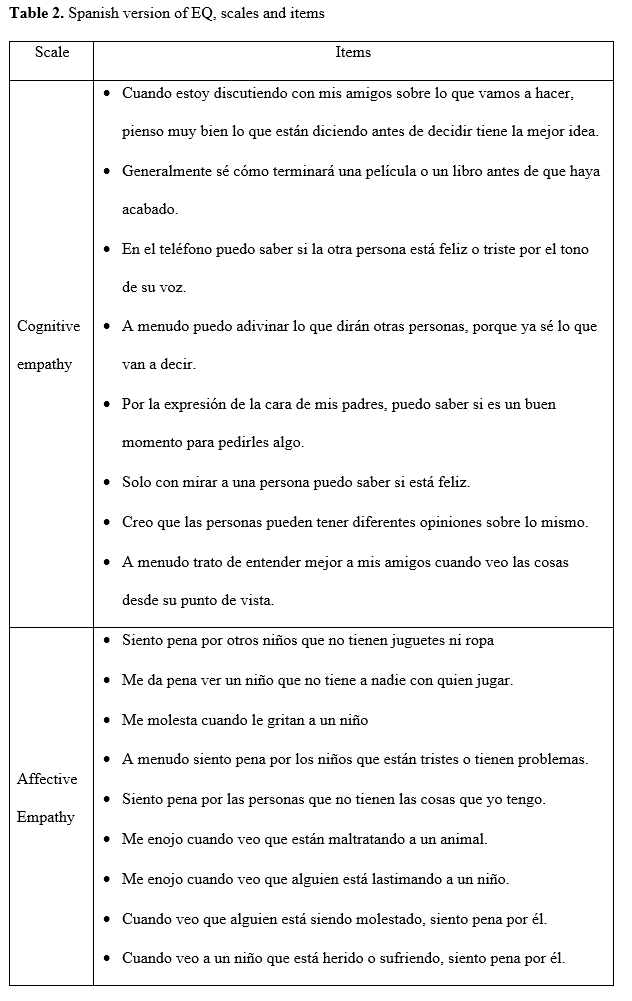
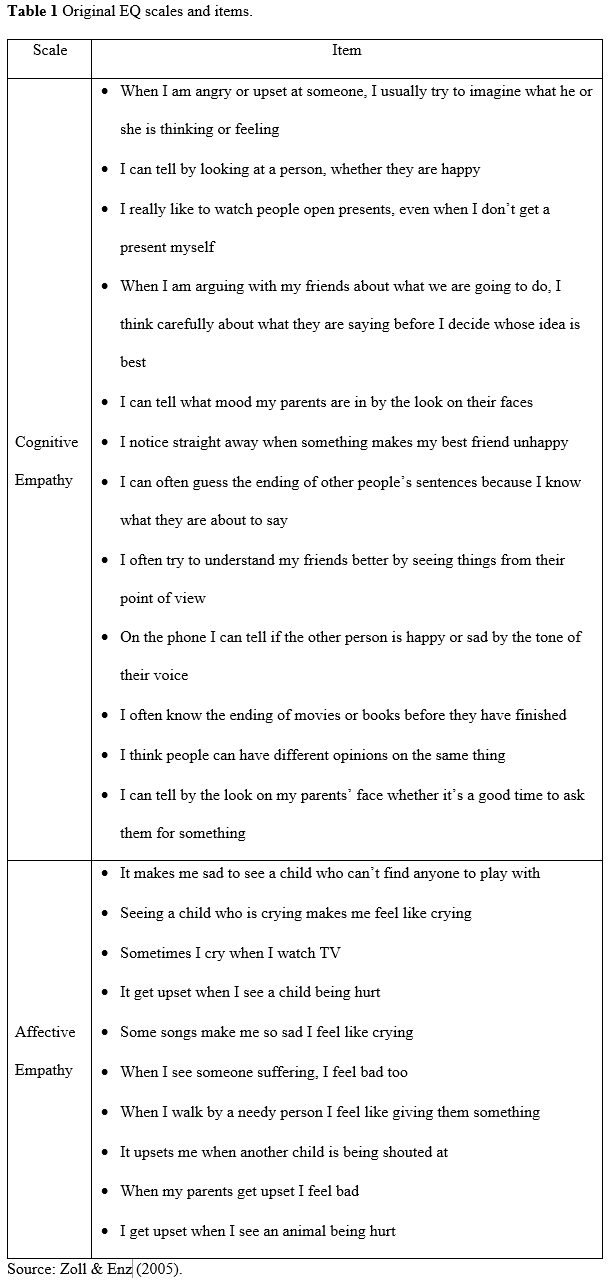
<body><![CDATA[<p align="justify"><font size="2" face="Verdana, Arial, Helvetica, sans-serif">The original   questionnaire was designed to measure both, cognitive and affective empathy   through 28 items in a five-point scale (from 1: &ldquo;I strongly agree&rdquo; to 5: &ldquo;I   strongly disagree&rdquo;). For the construction of this version, the authors reported   that of the chosen items, some were taken from other known instruments, while   others were specially designed for EQ. The instruments that served as the basis   for the construction of the EQ were: the Index of Empathy Measurement for Children   and Adolescents (Bryant, 1982), which in turn is a revision of the Mehrabian   &amp; Epstein's (1972) used for adults. We also took items from the E scale of   Leibetseder et al, (2001); and of the adaptation made by Garton and Gringart   (2005) of the Index of Interpersonal Reactivity (IRI) of Davis (1980, 1983).   Finally with validation purposes, EQ received six additional items from Eisenberg   &amp; Fabes (1998). The EQ data was collected from children of both sexes of United   Kingdom, Germany and Portugal (N = 623) with ages ranging from eight to   fourteen years (M = 9.90; SD = .92).</font></p>     <p align="justify"><font size="2" face="Verdana, Arial, Helvetica, sans-serif">The authors did   not report reliability or validity information concerning EQ. However, they   pointed out that no appreciable differences were found between the three   countries and that exploratory factor analysis suggested two factors (cognitive   empathy with 12 items and affective empathy with 10 items), both explaining   with 31.19% of the total accumulated variance. The exploratory analysis   discarded, in turn, all the items written negatively, so that the test counted   in its final version with only 22 items. <a href="#t3">Table 1</a> presents the structure of the   original EQ.</font></p>     <p align="center"><img src="/img/revistas/rap/v18n1/a03_table_01.gif" width="614" height="1284"></p>     <p align=right>&nbsp;</p><font size="3" face="Verdana, Arial, Helvetica, sans-serif"><b>Method</b></font></p>     <p align="justify"><font size="2" face="Verdana, Arial, Helvetica, sans-serif"><i>Participants</i>.   &nbsp;In the present adaptation, the authors tested the complete EQ (the 28 items   studied by Zoll &amp; Enz (2005). The instrument was first translated into   Spanish, back-translated into English for comparative purposes, and then   applied to a sample of 200 children aged between 8 and 14 years. The mean age   of the sample was 10.94 with a standard deviation of 1,929. Ninety-nine were   males (49.5%) and 101 females (50.5%). Before the final procedure of sample   selection, informed consent was obtained both from their parents and from the   staff of the participating school. The application of the EQ was carried out at   the school classrooms during the regular class periods. </font></p>     <p align="justify"><font size="2" face="Verdana, Arial, Helvetica, sans-serif">Before   applying the EQ, the researchers proceeded to test the linguistic and   grammatical structure of each item (wording) in order to verify that they were   understood by children in the sample. For this purpose, other children with   ages similar to those in the sample were invited to participate in focus groups   organized by age ranges. In each group, the children read the items on the   instrument and explained what they understood about each one. Sometimes they   also suggested alternative forms of expression that were more understandable to   them.</font></p>     <p align="justify"><font size="2" face="Verdana, Arial, Helvetica, sans-serif">Before   beginning the test at the classroom, the researchers offered the youngest   children a brief explanation on how they should respond the questionnaire,   providing some examples about the use of the response scale. The application of   the instrument began only when there was certainty that the children clearly understood   the response modality. When a child persisted in his response difficulties, he   was eliminated from the sample and replaced by another. The time of application   of the test lasted between 30 and 45 minutes, depending on the age of the   participants.</font></p>     <p align="justify"><font size="2" face="Verdana, Arial, Helvetica, sans-serif"><i>Adapted   instrument</i>. The preliminary test carried out with   the focus groups suggested the elimination of eleven items that were confusing   and difficulting the understanding by most of the children interviewed. The   result was a questionnaire with 17 items and two scales, 8 items for the   cognitive empathy scale and 9 items for the affective empathy scale; all were   written as positive expressions. Each item could be answered on a 5-point   scale, where 1 = totally disagree and 5 = totally agree.</font></p>     <p align="justify"><font size="2" face="Verdana, Arial, Helvetica, sans-serif">Below   is <a href="#t2">Table 2</a> with the list of items that were finally included for the adaptation   of the EQ.</font></p>     <p align="center"><a name="t2"></a><img src="/img/revistas/rap/v18n1/a03_table_02.gif" width="632" height="1001"></p>     ]]></body>
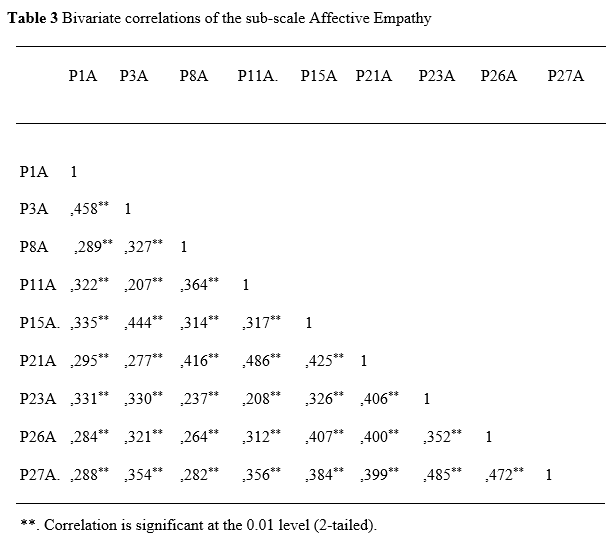
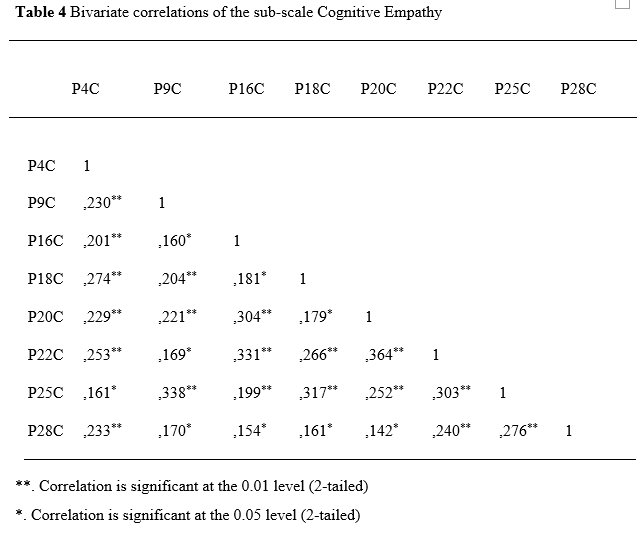
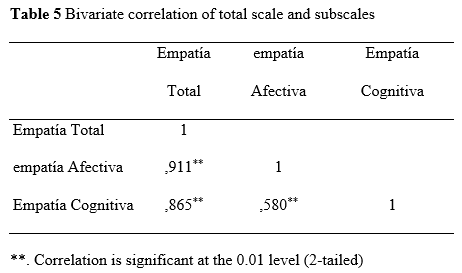
<body><![CDATA[<p align="center"></p>     <p align="justify"><font size="3" face="Verdana, Arial, Helvetica, sans-serif"><b>Results </b></font></p>     <p align="justify"><font size="2" face="Verdana, Arial, Helvetica, sans-serif"><i>Data   exploration. </i>The distribution exploration showed   value coincidences between the 5% trimmed mean and the median, slight negative   asymmetry (- .140), comparable M-Estimators (Huber = 104.96, Tukey = 105.12,   Hampel = 105.06, Andrew = 105.12), acceptable the kurtosis value (-.496) and a   good Kolmogorov-Smirnov&acute;s test of normality (.043, <i>p</i> = .200), indicating   a relatively normal distribution of EQ data.</font></p>     <p align="justify"><font size="2" face="Verdana, Arial, Helvetica, sans-serif"><i>Reliability   analysis</i>. For 17 items, a Cronbach's Alpha = .850   allowed to conclude an adequate reliability of the instrument. Likewise, the   inter-correlations corresponding to the total test and separately, to the two   sub-scales, corroborate the internal consistency of the EQ (see <a href="#t3">Tables 3</a>, <a href="#t4">4</a> and <a href="#t5">5</a>).</font></p>     <p align="center"><a name="t3"></a><img src="/img/revistas/rap/v18n1/a03_table_03.gif" width="612" height="540"></p>     <p align="center">&nbsp;</p>     <p align="center"><a name="t4"></a><img src="/img/revistas/rap/v18n1/a03_table_04.gif" width="643" height="533"></p>     <p align="center">&nbsp;</p>     <p align="center"><a name="t5"></a><img src="/img/revistas/rap/v18n1/a03_table_05.gif" width="462" height="273"></p>     <p align="justify"><font size="2" face="Verdana, Arial, Helvetica, sans-serif"><i>Exploratory   Factor Analysis</i><b>. </b>The   Empathy questionnaire (EQ) was first submitted to the Exploratory Factor   Analysis (EFA) on the basis of a bi-factorial structure, following the structural   approach of Zoll &amp; Enz (2005). The EFA was made with the Principal   Component Extraction Analysis technique (PCEA), seeking to obtain a maximum   variance from the set of variables with a minimum of components. Therefore, the   PCEA forced the consideration of only two components. The input indicators, the   KMO = .851 and the Bartlett Sphericity Test (&chi;<sup>2</sup> = 883.604, <i>p</i> = .000) confirmed the feasibility of the factorial analysis.</font></p>     ]]></body>
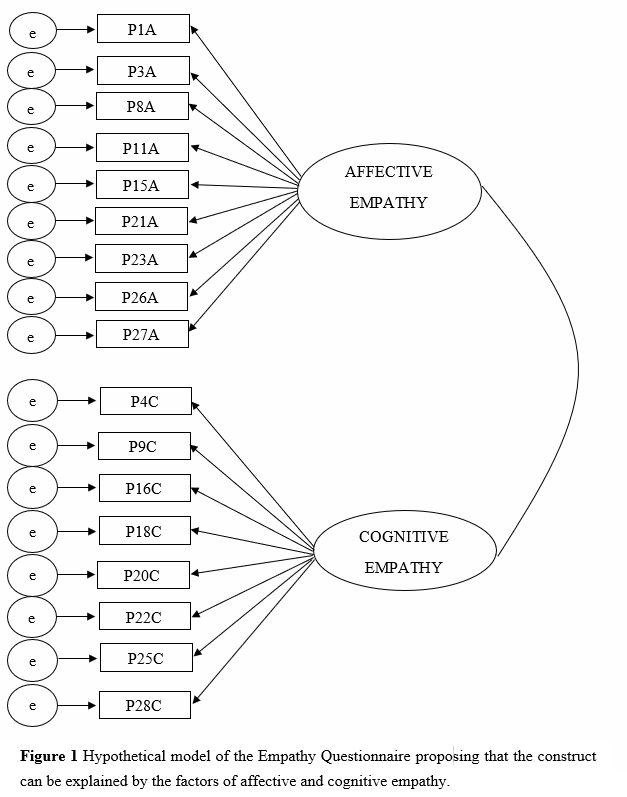
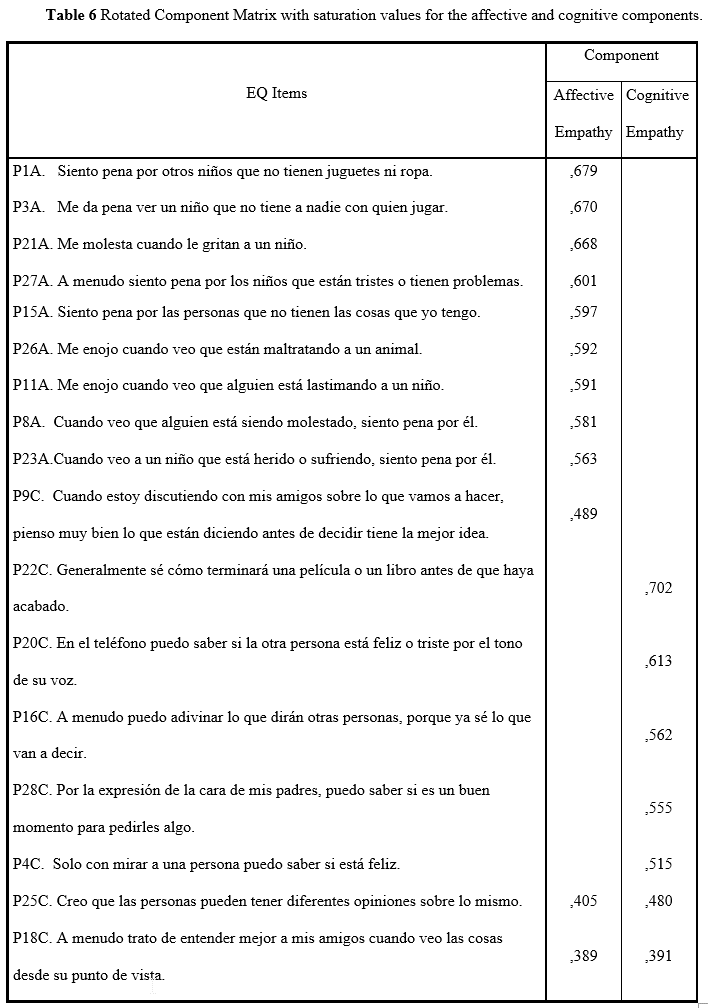
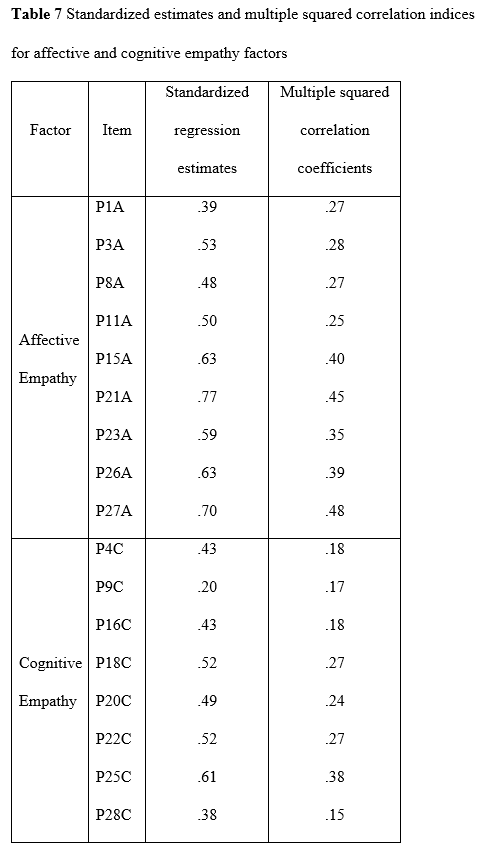
<body><![CDATA[<p align="justify"><font size="2" face="Verdana, Arial, Helvetica, sans-serif">The table of   communalities shows that with the exception of P4C and P9C, all the other items   in the questionnaire explain at least the 30% of the variance in both factors,   which confirms the presence of common elements in the instrument.</font></p>     <p align="justify"><font size="2" face="Verdana, Arial, Helvetica, sans-serif">The decision adopted   regarding the number of components involved in the analysis was confirmed by   the scree plot that highlights only two eigenvalues differentiated from the   rest. In this way, the analysis based on two components allowed to explaining   32.29 percent of the total variance contributed by the 17 items of the   questionnaire.</font></p>     <p align="justify"><font size="2" face="Verdana, Arial, Helvetica, sans-serif">The extraction of   the components was performed using the Varimax method with saturation indexes   greater than .563 for the items of the affective component and .391 for those   of the cognitive component. Note that only one item of the later is charged in   the affective component and another two do so in both components, although with   higher saturation values for the cognitive component (see <a href="#t6">Table 6</a>).</font></p>     <p align="center"><a name="t6"></a><img src="/img/revistas/rap/v18n1/a03_table_06.gif" width="717" height="1008"></p>     <p align="justify"><font size="2" face="Verdana, Arial, Helvetica, sans-serif"><i>Confirmatory   Factor Analysis</i>.&nbsp; The Confirmatory Factor Analysis   (CFA) of the Empathy Questionnaire (EQ) for children (Zoll &amp; Enz, 2005)   hypothesizes that the results obtained can be explained by two factors:   affective and cognitive empathy. The modeling, developed with the help of   IBM-AMOS (Byrne, 2010; Roth, 2012) assumes that the items measured by the   questionnaire load values other than zero. It also assumes that both factors   correlate positively.</font></p>     <p align="justify"><font size="2" face="Verdana, Arial, Helvetica, sans-serif">Unlike the   original proposal, the model included only the 17 items that passed the initial   comprehension test and that were included in the exploratory factor analysis.</font></p>     <p align="center"><img src="/img/revistas/rap/v18n1/a03_figura_01.gif" width="627" height="797"></p>     <p align="justify"><font size="2" face="Verdana, Arial, Helvetica, sans-serif">The final model   was able to successfully estimate all its parameters. Next <a href="#t7">Table 7</a> presents the   standardized regression estimates and the multiple squared correlation   coefficients.</font></p>     <p align="center"><a name="t7"></a><img src="/img/revistas/rap/v18n1/a03_table_07.gif" width="487" height="845"></p>     <p align="justify"><font size="2" face="Verdana, Arial, Helvetica, sans-serif">The standardized estimators show adequate   loads for both factors, with values equal to or greater than .39 for affective   empathy and .38 for cognitive empathy. Likewise, multiple squared correlation   values represent acceptable explained variances.</font></p>     ]]></body>
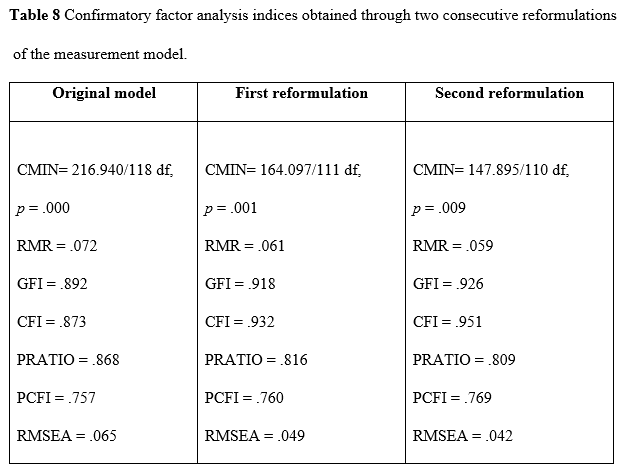
<body><![CDATA[<p align="justify"><font size="2" face="Verdana, Arial, Helvetica, sans-serif">The present model was adjusted through two   reformulations seeking an optimal fit. Below in <a href="#t8">Table 8</a> are the model fit   indices along the successive reformulations:</font></p>     <p align="center"><a name="t8"></a><img src="/img/revistas/rap/v18n1/a03_table_08.gif" width="629" height="469"></p>     <p align="justify"><font size="2" face="Verdana, Arial, Helvetica, sans-serif">Consequently, after two reformulations, we   have an acceptable final measurement model (despite the fact that CMIN   indicates the impossibility of rejecting the goodness of fit of the model)   supported by the RMR (Residual Average Square Root) that reported a value of   .059, and a GFI (Adjustment Goodness Index) with a value of .926, close to the   optimum of 1.0. Other fit indices (NFI = .838, RFI = .800, IFI = .953, TLI =   .940 and CFI = .951) also show an adequate adjustment of the metric model. With   regard to the parsimony of the model, the value of PRATIO = .809, reports a   relatively simple model. Likewise, the population approximation error RMSEA =   .042 satisfies the minimal requirements of fitting.</font></p>     <p align="justify"><font size="2" face="Verdana, Arial, Helvetica, sans-serif">In addition, for the final reformulated   model, the following indicators were obtained: a) Distance of Mahalanobis or   centroid distance (D2) that allowed to rule out the existence of atypical   values in the distribution, with the exception of observations 36, 39 and 46;   and b) HOELTER, that tells us that the results obtained are supported by the   size of the sample used in this validation (199, <i>p</i> &lt; .01).</font></p>     <p align="justify">&nbsp;</p>     <p align="justify"><font size="3" face="Verdana, Arial, Helvetica, sans-serif"><b>Discussion</b></font></p>     <p align="justify"><font size="2" face="Verdana, Arial, Helvetica, sans-serif">The purpose of   this research was to carry out the adaptation and validation of the Empathy   Questionnaire for children of Zoll &amp; Enz (2005) in a population of Bolivian   children, aged between 8 and 14 years. Reliability estimates as well as their   factorial validity allowed us to confirm that the EQ is an adequate instrument   to measure the empathy of this population through factors such as affective and   cognitive empathy. The instrument had to be adjusted eliminating 11 items and   making small grammatical adjustments in the writing of some of them. In the   EFA, the matrix of rotated components shows that, with the exception of item 9   corresponding to the cognitive component, all the items of the questionnaire saturated   well in their respective components. However, the correlations between the   affective and cognitive components of the questionnaire are satisfactory,   indicating that EQ is a consistent instrument. Finally, the confirmatory factor   analysis showed a relatively well-adjusted measurement model after two   reformulations, representing adequately, the underlying structure of the EQ.</font></p>     <p align="justify"><font size="2" face="Verdana, Arial, Helvetica, sans-serif">We can conclude   then, that the EQ is a simple and easy measure to be administered to young   children. However, the question remains as to whether the structural simplicity   of the EQ is capable of representing the true complexity of the empathy   construct, whose nature is clearly multidimensional. Some authors concerned   with the measurement of empathy (see Davis, 1980, 1983, Carey, Fox, &amp;   Spraggins, 1988, Lietz et al., 2011, Reniers, Corcoran, Drake, Shryane, &amp;   V&ouml;llm, 2011, among others), have suggested that the instruments that measure it   should reflect the multidimensionality of the construct incorporating a greater   number of factors in them. So, Chrysikou &amp; Thompson (2016) commenting on   the properties of the well-known Interpersonal Reactivity Index (IRI) (Davis,   1980), have suggested that in order to measure empathy, the perspective-taking should   be incorporated as a more specific component of cognitive empathy, and empathic   concern, as well as emotional distress as variations of affective empathy,   which implies incorporating more than two components in the factorial structure   of the instrument. Likewise,   these authors argued that in order to respond to the items that usually measure   affective empathy, it is necessary for the person to first use their own   cognitive resources to &quot;put themselves in the situation&quot;, causing   affective empathy to be confused or masked with the cognitive one. In this way,   a diminished cognitive response would reduce the response capacity of items   that try to measure affective empathy. In other words, when someone puts   himself in a specific situation, he/she may give a response that they know very   well it is emotionally appropriate without necessarily experiencing it. This   situation may reflect cognitive empathy but not necessarily affective empathy,   introducing a response bias that affects the reliability of the measurement. </font></p>     <p align="justify"><font size="2" face="Verdana, Arial, Helvetica, sans-serif">For some authors   (Derntl et al, 2010, Krause et al, 2012, Masten et al, 2010, Rameson et al,   2011, Thoma et al, 2011), the problem could be alleviated by the use of complementary   neurophysiological and behavioral measures. In any case, future studies on the   measurement of empathy should reconsider the complexity of the construct by   incorporating into its measurement procedures additional factors that account   for the multidimensionality of empathy.</font></p>     <p align="justify">&nbsp;</p>     ]]></body>
<body><![CDATA[<p align="justify"><font size="3" face="Verdana, Arial, Helvetica, sans-serif"><b>REFERENCES</b></font></p>     <p align="justify"><font size="2" face="Verdana, Arial, Helvetica, sans-serif">Batson, C.D. (2012). The empathy-altruism   hypothesis. Issues and implications. In J. Decety (Ed.), <i>Empathy. From bench     to bedside</i>, (pp 42-54). Cambridge: The MIT Press.</font></p>     <p align="justify"><font size="2" face="Verdana, Arial, Helvetica, sans-serif">Batson, C.D. (2009). These things called empathy.   Eight related but distinct phenomena. In J. Decety &amp; W. Ikes (Eds.). <i>The     social neuroscience of empathy</i>, (pp 3-15). Cambridge: The MIT Press.</font></p>     <!-- ref --><p align="justify"><font size="2" face="Verdana, Arial, Helvetica, sans-serif">Bennett, M.R.   &amp; Hacker, P.M.S. (2003). <i>Philosophical foundations of neuroscience.</i> Malden, MA: Blackwell Publishing.</font>&nbsp;&nbsp;&nbsp;&nbsp;&nbsp;&nbsp;&nbsp;&nbsp;[&#160;<a href="javascript:void(0);" onclick="javascript: window.open('/scielo.php?script=sci_nlinks&ref=755955&pid=S2077-2161202000010000300003&lng=','','width=640,height=500,resizable=yes,scrollbars=1,menubar=yes,');">Links</a>&#160;]<!-- end-ref --><!-- ref --><p align="justify"><font size="2" face="Verdana, Arial, Helvetica, sans-serif">Bryant, B. (1982). An Index of Empathy for   Children and Adolescents<i>, Child Development</i>, 53, 413-425.</font>&nbsp;&nbsp;&nbsp;&nbsp;&nbsp;&nbsp;&nbsp;&nbsp;[&#160;<a href="javascript:void(0);" onclick="javascript: window.open('/scielo.php?script=sci_nlinks&ref=755956&pid=S2077-2161202000010000300004&lng=','','width=640,height=500,resizable=yes,scrollbars=1,menubar=yes,');">Links</a>&#160;]<!-- end-ref --><!-- ref --><p align="justify"><font size="2" face="Verdana, Arial, Helvetica, sans-serif">Byrne, B.M. (2010). <i>Structural equation   modeling with AMOS. Basic concepts, applications and programming</i>. New York:   Routledge.</font>&nbsp;&nbsp;&nbsp;&nbsp;&nbsp;&nbsp;&nbsp;&nbsp;[&#160;<a href="javascript:void(0);" onclick="javascript: window.open('/scielo.php?script=sci_nlinks&ref=755957&pid=S2077-2161202000010000300005&lng=','','width=640,height=500,resizable=yes,scrollbars=1,menubar=yes,');">Links</a>&#160;]<!-- end-ref --><!-- ref --><p align="justify"><font size="2" face="Verdana, Arial, Helvetica, sans-serif">Carey, J. C., Fox, E. A., &amp; Spraggins,   E. F. (1988). Replication of structure findings regarding the Interpersonal   Reactivity Index. <i>Measurement and Evaluation in Counseling and Development</i>,   21, 102-105</font>&nbsp;&nbsp;&nbsp;&nbsp;&nbsp;&nbsp;&nbsp;&nbsp;[&#160;<a href="javascript:void(0);" onclick="javascript: window.open('/scielo.php?script=sci_nlinks&ref=755958&pid=S2077-2161202000010000300006&lng=','','width=640,height=500,resizable=yes,scrollbars=1,menubar=yes,');">Links</a>&#160;]<!-- end-ref --><p align="justify"><font size="2" face="Verdana, Arial, Helvetica, sans-serif">Chrysikou, E.G., &amp;Thompson, W.J. (2016).   Assessing Cognitive and Affective Empathy through the Interpersonal Reactivity   Index: An Argument against a two-factor model. <i>Assessment</i>, 23(6)   769&ndash;776. DOI: <a href="http://doi.org/10.1177/1073191115599055" target="_blank">10.1177/1073191115599055</a></font></p>     <!-- ref --><p align="justify"><font size="2" face="Verdana, Arial, Helvetica, sans-serif"><a href="https://www.ncbi.nlm.nih.gov/pubmed/?term=de%20Vignemont%20F%5BAuthor%5D&amp;cauthor=true&amp;cauthor_uid=16949331" target="_blank">De Vignemont F</a>.,<a href="https://www.ncbi.nlm.nih.gov/pubmed/?term=Singer%20T%5BAuthor%5D&amp;cauthor=true&amp;cauthor_uid=16949331" target="_blank">Singer, T</a>. (2006). The   empathic brain: how, when and why? <a href="https://www.ncbi.nlm.nih.gov/pubmed/16949331" title="Trends in cognitive sciences." target="_blank"><i>Trends in Cognitive Sciences,</i></a>10(10),   435-41<i>.</i></font>&nbsp;&nbsp;&nbsp;&nbsp;&nbsp;&nbsp;&nbsp;&nbsp;[&#160;<a href="javascript:void(0);" onclick="javascript: window.open('/scielo.php?script=sci_nlinks&ref=755960&pid=S2077-2161202000010000300008&lng=','','width=640,height=500,resizable=yes,scrollbars=1,menubar=yes,');">Links</a>&#160;]<!-- end-ref --><!-- ref --><p align="justify"><font size="2" face="Verdana, Arial, Helvetica, sans-serif">Davis, M. H. (1980). A multidimensional   approach to individual differences in empathy. <i>JSAS Catalog of Selected     Documents in Psychology</i>, 10, 85.</font>&nbsp;&nbsp;&nbsp;&nbsp;&nbsp;&nbsp;&nbsp;&nbsp;[&#160;<a href="javascript:void(0);" onclick="javascript: window.open('/scielo.php?script=sci_nlinks&ref=755961&pid=S2077-2161202000010000300009&lng=','','width=640,height=500,resizable=yes,scrollbars=1,menubar=yes,');">Links</a>&#160;]<!-- end-ref --><p align="justify"><font size="2" face="Verdana, Arial, Helvetica, sans-serif">Davis, M. H. (1983).   Measuring individual differences in empathy: Evidence for a multidimensional   approach. <i>Journal of Personality and Social Psychology</i>, 44, 113&ndash; 126.</font></p>     <p align="justify"><font size="2" face="Verdana, Arial, Helvetica, sans-serif">Decety, J., &amp; Sommerville, J. A.   (2003). Shared representations between self and other: A social cognitive   neuroscience view. <i>Trends in Cognitive Sciences</i>, 7, 527&ndash;533.</font></p>     <p align="justify"><font size="2" face="Verdana, Arial, Helvetica, sans-serif">Derntl, B., Finkelmeyer,   A., Eickhoff, S., Kellermann, T., Falkenberg, D. I., Schneider, F., &amp;   Habel, U. (2010). Multidimensional assessment of empathic abilities: Neural   correlates and gender differences. Psychoneuroendocrinology, 35, 67-82.   doi: <a href="http://doi.org/10.1016/j.psyneuen.2009.10.006" target="_blank">10.1016/j.psyneuen.2009.10.006</a></font></p>     <p align="justify"><font size="2" face="Verdana, Arial, Helvetica, sans-serif">Echols, E. &amp; Correll,   J. (2012). It is more than skin deep: Empathy and helping behavior across   social groups. In J. Decety (Ed), <i>Empathy. From bench to bedside</i>, (pp   55-71). Cambridge: The MIT Press.&nbsp; </font></p>     <p align="justify"><font size="2" face="Verdana, Arial, Helvetica, sans-serif">Eisenberg, N., &amp; Fabes, R. A. (1998).   Prosocial development. In N. Eisenberg (Ed.), W. Damon (Series Ed.), <i>Handbook     of child psychology</i>: Vol. 3. Social, emotional, and personality development   (5th ed., pp. 701-778). New York: Wiley.</font></p>     <!-- ref --><p align="justify"><font size="2" face="Verdana, Arial, Helvetica, sans-serif">Eisenberg, N., Fabes, R.A., Murphy, B,   Karbon, M., Maszk, P., Smith, M., O&acute;Boyle, C. &amp; Suh, K. (1994). The   relations on emotionality and regulation to dispositional and situational   empathy-related responding. <i>Journal of personality and Social Psychology</i>,   66, 776-797.</font>&nbsp;&nbsp;&nbsp;&nbsp;&nbsp;&nbsp;&nbsp;&nbsp;[&#160;<a href="javascript:void(0);" onclick="javascript: window.open('/scielo.php?script=sci_nlinks&ref=755967&pid=S2077-2161202000010000300015&lng=','','width=640,height=500,resizable=yes,scrollbars=1,menubar=yes,');">Links</a>&#160;]<!-- end-ref --><p align="justify"><font size="2" face="Verdana, Arial, Helvetica, sans-serif">Eisenberg, N., Espinrad, T.L. and   Sodowsky, A. (2006). Empathy-related responding in children. In M. Killen &amp;   J.G. Smetana (Eds.) <i>Handbook of Moral Development</i>, (pp 517-549). Mahwah   N.J: Lawrence Erlbaum Ass.</font></p>     <p align="justify"><font size="2" face="Verdana, Arial, Helvetica, sans-serif">Eisenberg, N., Shea, C.   L., Carlo, G., &amp; Knight, G. P. (1991). Empathy related responding and   cognition: A &ldquo;chicken and the egg&rdquo; dilemma. In W. Kurtines and J. Gewirtz   (Eds.), <i>Handbook of moral behavior and development</i>: Vol. 2. Research   (pp. 63&ndash;88). Hillsdale, NJ: Erlbaum.</font></p>     <!-- ref --><p align="justify"><font size="2" face="Verdana, Arial, Helvetica, sans-serif">Fabes, R. A.,   Eisenberg, N., &amp; Eisenbud, L. (1993).Behavioral and Physiological   Correlates of Children's Reactions to Others in Distress.<em>Developmental     Psychology</em>,<em>29</em>(4), 655-663.</font>&nbsp;&nbsp;&nbsp;&nbsp;&nbsp;&nbsp;&nbsp;&nbsp;[&#160;<a href="javascript:void(0);" onclick="javascript: window.open('/scielo.php?script=sci_nlinks&ref=755970&pid=S2077-2161202000010000300018&lng=','','width=640,height=500,resizable=yes,scrollbars=1,menubar=yes,');">Links</a>&#160;]<!-- end-ref --><!-- ref --><p align="justify"><font size="2" face="Verdana, Arial, Helvetica, sans-serif">Feshbach, N.   D., &amp; Feshbach, S. (1969). The relationship between empathy and aggression   in two age groups.<i> Developmental Psychology, 1</i>(2), 102-107. <a href="http://psycnet.apa.org/doi/10.1037/h0027016" target="_blank">http://dx.doi.org/10.1037/h0027016</a></font>&nbsp;&nbsp;&nbsp;&nbsp;&nbsp;&nbsp;&nbsp;&nbsp;[&#160;<a href="javascript:void(0);" onclick="javascript: window.open('/scielo.php?script=sci_nlinks&ref=755971&pid=S2077-2161202000010000300019&lng=','','width=640,height=500,resizable=yes,scrollbars=1,menubar=yes,');">Links</a>&#160;]<!-- end-ref --><!-- ref --><p align="justify"><font size="2" face="Verdana, Arial, Helvetica, sans-serif">Garton, A.F. &amp;   Gringart, E. (2005). The development of a scale to measure empathy in 8 and 9 year   old children. <i>Australian Journal of Education and Developmental Psychology</i>,   5, 17-25</font>&nbsp;&nbsp;&nbsp;&nbsp;&nbsp;&nbsp;&nbsp;&nbsp;[&#160;<a href="javascript:void(0);" onclick="javascript: window.open('/scielo.php?script=sci_nlinks&ref=755972&pid=S2077-2161202000010000300020&lng=','','width=640,height=500,resizable=yes,scrollbars=1,menubar=yes,');">Links</a>&#160;]<!-- end-ref --><!-- ref --><p align="justify"><font size="2" face="Verdana, Arial, Helvetica, sans-serif">Hoffman, M.L. (2000). <i>Empathy   and moral development: Implications for caring and justice</i>. Cambridge: Cambridge   University Press.</font>&nbsp;&nbsp;&nbsp;&nbsp;&nbsp;&nbsp;&nbsp;&nbsp;[&#160;<a href="javascript:void(0);" onclick="javascript: window.open('/scielo.php?script=sci_nlinks&ref=755973&pid=S2077-2161202000010000300021&lng=','','width=640,height=500,resizable=yes,scrollbars=1,menubar=yes,');">Links</a>&#160;]<!-- end-ref --><!-- ref --><p align="justify"><font size="2" face="Verdana, Arial, Helvetica, sans-serif"><a href="https://onlinelibrary.wiley.com/action/doSearch?ContribAuthorStored=Kestenbaum%2C+Roberta" target="_blank">Kestenbaum</a>,   R., <a href="https://onlinelibrary.wiley.com/action/doSearch?ContribAuthorStored=Farber%2C+Ellen+A" target="_blank">Farber</a>,   E.A., &amp;<a href="https://onlinelibrary.wiley.com/action/doSearch?ContribAuthorStored=Sroufe%2C+L+Alan" target="_blank"> Sroufe</a>,   L.A. (1989). Individual differences in empathy among preschoolers: Relation to   attachment history. <i>New Directions for Child and Adolescent Development, 44,     51-64.</i></font>&nbsp;&nbsp;&nbsp;&nbsp;&nbsp;&nbsp;&nbsp;&nbsp;[&#160;<a href="javascript:void(0);" onclick="javascript: window.open('/scielo.php?script=sci_nlinks&ref=755974&pid=S2077-2161202000010000300022&lng=','','width=640,height=500,resizable=yes,scrollbars=1,menubar=yes,');">Links</a>&#160;]<!-- end-ref --><p align="justify"><font size="2" face="Verdana, Arial, Helvetica, sans-serif">Krause, L., Enticott, P. G., Zangen, A.,   &amp; Fitzgerald, P. B. (2012). The role of medial prefrontal cortex in theory   of mind: A deep rTMS study. Behavioral Brain Research, 228, 87-90.   doi: <a href="http://doi.org/10.1016/j.bbr.2011.11.037" target="_blank">10.1016/j.bbr.2011.11.037</a>.</font></p>     <p align="justify"><font size="2" face="Verdana, Arial, Helvetica, sans-serif">Leibetseder, M., <a href="https://econtent.hogrefe.com/author/Laireiter%2C+Anton-Rupert" target="_blank">Laireiter</a>,   A.R., <a href="https://econtent.hogrefe.com/author/Riepler%2C+Alois" target="_blank">Riepler</a>, A.   &amp; <a href="https://econtent.hogrefe.com/author/K%C3%B6ller%2C+Thomas" target="_blank">K&ouml;ller</a>,   T. (2001). E-Skala: Fragebogen zur Erfassung von Empathie - Beschreibung und   psychometrische Eigenschaften. <i>Zeitschrift     f&uuml;r Differentielle und Diagnostische Psychologie</i> (2001), 22, 70- 85.Obtained from <a href="https://doi.org/10.1024/0170-1789.22.1.70" target="_blank">https://doi.org/10.1024//0170-1789.22.1.70</a>.</font></p>     <p align="justify"><font size="2" face="Verdana, Arial, Helvetica, sans-serif">Lietz, C. A., Gerdes, K. E., Sun, F.,   Geiger, J. M., Wagaman, M. A., &amp; Segal, E. A. (2011). The Empathy   Assessment Index (EAI): A confirmatory factor analysis of a multidimensional   model of empathy. <i>Journal of the Society for Social Work and Research</i>,   2, 104-124. doi: <a href="http://10.5243/jsswr.2011.6" target="_blank">10.5243/jsswr.2011.6</a></font></p>     <!-- ref --><p align="justify"><font size="2" face="Verdana, Arial, Helvetica, sans-serif"><a href="https://www.ncbi.nlm.nih.gov/pubmed/?term=Litvack-Miller%20W%5BAuthor%5D&amp;cauthor=true&amp;cauthor_uid=9259121" target="_blank">Litvack-Miller W</a>,<a href="https://www.ncbi.nlm.nih.gov/pubmed/?term=McDougall%20D%5BAuthor%5D&amp;cauthor=true&amp;cauthor_uid=9259121" target="_blank">McDougall D</a>,<a href="https://www.ncbi.nlm.nih.gov/pubmed/?term=Romney%20DM%5BAuthor%5D&amp;cauthor=true&amp;cauthor_uid=9259121" target="_blank">Romney DM</a> (1997). The structure of   empathy during middle childhood and its relationship to prosocial behavior. <a href="https://www.ncbi.nlm.nih.gov/pubmed/?term=Litvack-Miller%20W%5BAuthor%5D&amp;cauthor=true&amp;cauthor_uid=9259121" title="Genetic, social, and general psychology monographs." target="_blank"><i>Genetic, Social and General     Psychology Monographs</i></a>, 123(3):303-24.</font>&nbsp;&nbsp;&nbsp;&nbsp;&nbsp;&nbsp;&nbsp;&nbsp;[&#160;<a href="javascript:void(0);" onclick="javascript: window.open('/scielo.php?script=sci_nlinks&ref=755978&pid=S2077-2161202000010000300026&lng=','','width=640,height=500,resizable=yes,scrollbars=1,menubar=yes,');">Links</a>&#160;]<!-- end-ref --><p align="justify"><font size="2" face="Verdana, Arial, Helvetica, sans-serif">Masten, C. L.,   Eisenberger, N. I., Pfeifer, J. H., &amp; Dapretto, M. (2010). Witnessing peer   rejection during early adolescence: Neural correlates of empathy for   experiences of social exclusion. Social Neuroscience, 5, 496-507.   doi: <a href="http://doi.org/10.1080/17470919.2010.490673" target="_blank">10.1080/17470919.2010.490673</a></font></p>     <!-- ref --><p align="justify"><font size="2" face="Verdana, Arial, Helvetica, sans-serif">Mehrabian, A. &amp;   Epstein, N. (1972). A measure of emotional empathy<i>. Journal     of Personality</i>, 40(4), 525-543.</font>&nbsp;&nbsp;&nbsp;&nbsp;&nbsp;&nbsp;&nbsp;&nbsp;[&#160;<a href="javascript:void(0);" onclick="javascript: window.open('/scielo.php?script=sci_nlinks&ref=755980&pid=S2077-2161202000010000300028&lng=','','width=640,height=500,resizable=yes,scrollbars=1,menubar=yes,');">Links</a>&#160;]<!-- end-ref --><!-- ref --><p align="justify"><font size="2" face="Verdana, Arial, Helvetica, sans-serif">Miller, P.A. &amp;   Eisenberg, N. (1988). The relations of empathy to aggressive and   externalizing/antisocial behavior. <i>Psychological Bulletin</i>, 103, 324-344.Reniers,   R. L. E. P., Corcoran, R., Drake, R., Shryane, N. M., &amp; V&ouml;llm, B. A.   (2011). The QCAE: A questionnaire of cognitive and affective empathy. <i>Journal     of Personality Assessment</i>, 93, 84-95. doi: <a href="http://doi.org/10.1080/00223891.2010.528484" target="_blank">10.1080/00223891.2010.528484</a></font>&nbsp;&nbsp;&nbsp;&nbsp;&nbsp;&nbsp;&nbsp;&nbsp;[&#160;<a href="javascript:void(0);" onclick="javascript: window.open('/scielo.php?script=sci_nlinks&ref=755981&pid=S2077-2161202000010000300029&lng=','','width=640,height=500,resizable=yes,scrollbars=1,menubar=yes,');">Links</a>&#160;]<!-- end-ref --><!-- ref --><p align="justify"><font size="2" face="Verdana, Arial, Helvetica, sans-serif">Rameson, L. T., Morelli, S. A., &amp;   Lieberman, M. D. (2011). The neural correlates of empathy: Experience,   automaticity, and prosocial behavior. Journal of Cognitive   Neuroscience, 24, 235-245.</font>&nbsp;&nbsp;&nbsp;&nbsp;&nbsp;&nbsp;&nbsp;&nbsp;[&#160;<a href="javascript:void(0);" onclick="javascript: window.open('/scielo.php?script=sci_nlinks&ref=755982&pid=S2077-2161202000010000300031&lng=','','width=640,height=500,resizable=yes,scrollbars=1,menubar=yes,');">Links</a>&#160;]<!-- end-ref --><!-- ref --><p align="justify"><font size="2" face="Verdana, Arial, Helvetica, sans-serif">Roth, E. (2012). <i>An&aacute;lisis multivariado   en la investigaci&oacute;n psicol&oacute;gica. Modelado predictivo y causal con SPSS y AMOS</i>.   La Paz: SOIPA.</font>&nbsp;&nbsp;&nbsp;&nbsp;&nbsp;&nbsp;&nbsp;&nbsp;[&#160;<a href="javascript:void(0);" onclick="javascript: window.open('/scielo.php?script=sci_nlinks&ref=755983&pid=S2077-2161202000010000300032&lng=','','width=640,height=500,resizable=yes,scrollbars=1,menubar=yes,');">Links</a>&#160;]<!-- end-ref --><!-- ref --><p align="justify"><font size="2" face="Verdana, Arial, Helvetica, sans-serif">Titchener,   Edward B.(1909). <a href="http://bit.ly/2oiBSMn" target="_blank"><i>Lectures of the Experimental Psychology of Thought Processes</i></a>, New York, Macmillian, 1909.</font>&nbsp;&nbsp;&nbsp;&nbsp;&nbsp;&nbsp;&nbsp;&nbsp;[&#160;<a href="javascript:void(0);" onclick="javascript: window.open('/scielo.php?script=sci_nlinks&ref=755984&pid=S2077-2161202000010000300033&lng=','','width=640,height=500,resizable=yes,scrollbars=1,menubar=yes,');">Links</a>&#160;]<!-- end-ref --><p align="justify"><font size="2" face="Verdana, Arial, Helvetica, sans-serif">Thoma, P., Zalewski, I.,   von Reventlow, H. G., Norra, C., Juckel, G., &amp; Daum, I. (2011). Cognitive   and affective empathy in depression linked to executive control. Psychiatry   Research, 189, 373-378. doi: <a href="http://doi.org/10.1016/j.psychres.2011.07.030" target="_blank">10.1016/j.psychres.2011.07.030</a></font></p>     <p align="justify"><font size="2" face="Verdana, Arial, Helvetica, sans-serif">Vaish, A. &amp; Warneken,   F. (2012). Social-cognitive contributions to young children&acute;s empathic and   prosocial behavior. In J. Decety (Ed), <i>Empathy. From bench to bedside</i>, (pp   131- 146). Cambridge: The MIT Press.</font></p>     <p align="justify"><font size="2" face="Verdana, Arial, Helvetica, sans-serif">Zahavi,   D&amp; Overgaard, S(2012).Empathy   without isomorphism: A phenomenological account. In J. Decety   (ed.),<em>Empathy: From Bench to Bedside, (pp 3-20).</em>MIT Press,   Cambridge.</font></p>     <p align="justify"><font size="2" face="Verdana, Arial, Helvetica, sans-serif">Zhou, Q.,   Valiente, C., &amp; Eisenberg, N. (2003). Empathy and its measurement. In S. J.   Lopez &amp; C. R. Snyder (Eds.),<em>Positive psychological assessment: A     handbook of models and measures</em>(pp. 269-284). Washington, DC, US:   American Psychological Association. <a href="http://psycnet.apa.org/doi/10.1037/10612-017" target="_blank">http://dx.doi.org/10.1037/10612-017</a></font></p>     <!-- ref --><p align="justify"><font size="2" face="Verdana, Arial, Helvetica, sans-serif">Zoll, C.,   Enz, S. (2005).A   questionnaire to assess affective and cognitive empathy in children. <i>Journal     of Child Psychology</i>, 15,165-174. <a href="http://scholar.google.com/scholar_lookup?hl=en&amp;publication_year=2005&amp;pages=165-174&amp;author=C.+Zoll&amp;author=S.+Enz&amp;title=A+questionnaire+to+assess+affective+and+cognitive+empathy+in+children&amp;" target="_blank">Google Scholar</a>.</font>&nbsp;&nbsp;&nbsp;&nbsp;&nbsp;&nbsp;&nbsp;&nbsp;[&#160;<a href="javascript:void(0);" onclick="javascript: window.open('/scielo.php?script=sci_nlinks&ref=755989&pid=S2077-2161202000010000300038&lng=','','width=640,height=500,resizable=yes,scrollbars=1,menubar=yes,');">Links</a>&#160;]<!-- end-ref --><p align="justify">&nbsp;</p>     <p align="right"><font size="2" face="Verdana, Arial, Helvetica, sans-serif"><i>Recibido: 13 de noviembre del  2019</i>    ]]></body>
<body><![CDATA[<br>       <i>Aceptado: 14 de enero del 2020</i>    <br>       <i>SIN  CONFLICTOS DE INTER&Eacute;S</i> </font></p>     <p align="justify">&nbsp;</p> <hr align=JUSTIFY size=1 width="33%">     <p align="justify"><font size="2" face="Verdana, Arial, Helvetica, sans-serif"><a href="#_ftnref1" name="_ftn1" title="">[1]</a>&nbsp;<a href="mailto:eroth@ucb.edu.bo">eroth@ucb.edu.bo</a></font></p>     <p align="justify">&nbsp;</p>      ]]></body><back>
<ref-list>
<ref id="B1">
<nlm-citation citation-type="book">
<person-group person-group-type="author">
<name>
<surname><![CDATA[Batson]]></surname>
<given-names><![CDATA[C.D.]]></given-names>
</name>
</person-group>
<article-title xml:lang="en"><![CDATA[The empathy-altruism hypothesis. Issues and implications]]></article-title>
<person-group person-group-type="editor">
<name>
<surname><![CDATA[Decety]]></surname>
<given-names><![CDATA[J.]]></given-names>
</name>
</person-group>
<source><![CDATA[Empathy. From bench to bedside]]></source>
<year>2012</year>
<month>20</month>
<day>12</day>
<page-range>42-54</page-range><publisher-loc><![CDATA[Cambridge ]]></publisher-loc>
<publisher-name><![CDATA[The MIT Press]]></publisher-name>
</nlm-citation>
</ref>
<ref id="B2">
<nlm-citation citation-type="book">
<person-group person-group-type="author">
<name>
<surname><![CDATA[Batson]]></surname>
<given-names><![CDATA[C.D.]]></given-names>
</name>
</person-group>
<article-title xml:lang="en"><![CDATA[These things called empathy. Eight related but distinct phenomena]]></article-title>
<person-group person-group-type="editor">
<name>
<surname><![CDATA[Decety]]></surname>
<given-names><![CDATA[J.]]></given-names>
</name>
<name>
<surname><![CDATA[Ikes]]></surname>
<given-names><![CDATA[W.]]></given-names>
</name>
</person-group>
<source><![CDATA[The social neuroscience of empathy]]></source>
<year>2009</year>
<month>20</month>
<day>09</day>
<page-range>3-15</page-range><publisher-loc><![CDATA[Cambridge ]]></publisher-loc>
<publisher-name><![CDATA[The MIT Press]]></publisher-name>
</nlm-citation>
</ref>
<ref id="B3">
<nlm-citation citation-type="book">
<person-group person-group-type="author">
<name>
<surname><![CDATA[Bennett]]></surname>
<given-names><![CDATA[M.R.]]></given-names>
</name>
<name>
<surname><![CDATA[Hacker]]></surname>
<given-names><![CDATA[P.M.S.]]></given-names>
</name>
</person-group>
<source><![CDATA[Philosophical foundations of neuroscience]]></source>
<year>2003</year>
<publisher-loc><![CDATA[Malden, MA ]]></publisher-loc>
<publisher-name><![CDATA[Blackwell Publishing]]></publisher-name>
</nlm-citation>
</ref>
<ref id="B4">
<nlm-citation citation-type="journal">
<person-group person-group-type="author">
<name>
<surname><![CDATA[Bryant]]></surname>
<given-names><![CDATA[B.]]></given-names>
</name>
</person-group>
<article-title xml:lang="en"><![CDATA[An Index of Empathy for Children and Adolescents]]></article-title>
<source><![CDATA[Child Development]]></source>
<year>1982</year>
<volume>53</volume>
<page-range>413-425</page-range></nlm-citation>
</ref>
<ref id="B5">
<nlm-citation citation-type="book">
<person-group person-group-type="author">
<name>
<surname><![CDATA[Byrne]]></surname>
<given-names><![CDATA[B.M.]]></given-names>
</name>
</person-group>
<source><![CDATA[Structural equation modeling with AMOS. Basic concepts, applications and programming]]></source>
<year>2010</year>
<publisher-loc><![CDATA[New York ]]></publisher-loc>
<publisher-name><![CDATA[Routledge]]></publisher-name>
</nlm-citation>
</ref>
<ref id="B6">
<nlm-citation citation-type="journal">
<person-group person-group-type="author">
<name>
<surname><![CDATA[Carey]]></surname>
<given-names><![CDATA[J. C.]]></given-names>
</name>
<name>
<surname><![CDATA[Fox]]></surname>
<given-names><![CDATA[E. A.]]></given-names>
</name>
<name>
<surname><![CDATA[Spraggins]]></surname>
<given-names><![CDATA[E. F.]]></given-names>
</name>
</person-group>
<article-title xml:lang="en"><![CDATA[Replication of structure findings regarding the Interpersonal Reactivity Index]]></article-title>
<source><![CDATA[Measurement and Evaluation in Counseling and Development]]></source>
<year>1988</year>
<volume>21</volume>
<page-range>102-105</page-range></nlm-citation>
</ref>
<ref id="B7">
<nlm-citation citation-type="journal">
<person-group person-group-type="author">
<name>
<surname><![CDATA[Chrysikou]]></surname>
<given-names><![CDATA[E.G.]]></given-names>
</name>
<name>
<surname><![CDATA[Thompson]]></surname>
<given-names><![CDATA[W.J.]]></given-names>
</name>
</person-group>
<article-title xml:lang="en"><![CDATA[Assessing Cognitive and Affective Empathy through the Interpersonal Reactivity Index: An Argument against a two-factor model]]></article-title>
<source><![CDATA[Assessment]]></source>
<year>2016</year>
<volume>23</volume>
<numero>6</numero>
<issue>6</issue>
<page-range>769-776</page-range></nlm-citation>
</ref>
<ref id="B8">
<nlm-citation citation-type="journal">
<person-group person-group-type="author">
<name>
<surname><![CDATA[De Vignemont]]></surname>
<given-names><![CDATA[F.]]></given-names>
</name>
<name>
<surname><![CDATA[Singer]]></surname>
<given-names><![CDATA[T.]]></given-names>
</name>
</person-group>
<article-title xml:lang="en"><![CDATA[The empathic brain: how, when and why?]]></article-title>
<source><![CDATA[Trends in Cognitive Sciences]]></source>
<year>2006</year>
<volume>10</volume>
<numero>10</numero>
<issue>10</issue>
<page-range>435-41</page-range></nlm-citation>
</ref>
<ref id="B9">
<nlm-citation citation-type="journal">
<person-group person-group-type="author">
<name>
<surname><![CDATA[Davis]]></surname>
<given-names><![CDATA[M. H.]]></given-names>
</name>
</person-group>
<article-title xml:lang="en"><![CDATA[A multidimensional approach to individual differences in empathy]]></article-title>
<source><![CDATA[JSAS Catalog of Selected Documents in Psychology]]></source>
<year>1980</year>
<volume>10</volume>
<page-range>85</page-range></nlm-citation>
</ref>
<ref id="B10">
<nlm-citation citation-type="journal">
<person-group person-group-type="author">
<name>
<surname><![CDATA[Davis]]></surname>
<given-names><![CDATA[M. H.]]></given-names>
</name>
</person-group>
<article-title xml:lang="en"><![CDATA[Measuring individual differences in empathy: Evidence for a multidimensional approach]]></article-title>
<source><![CDATA[Journal of Personality and Social Psychology]]></source>
<year>1983</year>
<volume>44</volume>
<page-range>113- 126</page-range></nlm-citation>
</ref>
<ref id="B11">
<nlm-citation citation-type="journal">
<person-group person-group-type="author">
<name>
<surname><![CDATA[Decety]]></surname>
<given-names><![CDATA[J.]]></given-names>
</name>
<name>
<surname><![CDATA[Sommerville]]></surname>
<given-names><![CDATA[J. A.]]></given-names>
</name>
</person-group>
<article-title xml:lang="en"><![CDATA[Shared representations between self and other: A social cognitive neuroscience view]]></article-title>
<source><![CDATA[Trends in Cognitive Sciences]]></source>
<year>2003</year>
<volume>7</volume>
<page-range>527-533</page-range></nlm-citation>
</ref>
<ref id="B12">
<nlm-citation citation-type="journal">
<person-group person-group-type="author">
<name>
<surname><![CDATA[Derntl]]></surname>
<given-names><![CDATA[B.]]></given-names>
</name>
<name>
<surname><![CDATA[Finkelmeyer]]></surname>
<given-names><![CDATA[A.]]></given-names>
</name>
<name>
<surname><![CDATA[Eickhoff]]></surname>
<given-names><![CDATA[S.]]></given-names>
</name>
<name>
<surname><![CDATA[Kellermann]]></surname>
<given-names><![CDATA[T.]]></given-names>
</name>
<name>
<surname><![CDATA[Falkenberg]]></surname>
<given-names><![CDATA[D. I.]]></given-names>
</name>
<name>
<surname><![CDATA[Schneider]]></surname>
<given-names><![CDATA[F.]]></given-names>
</name>
<name>
<surname><![CDATA[Habel]]></surname>
<given-names><![CDATA[U.]]></given-names>
</name>
</person-group>
<article-title xml:lang="en"><![CDATA[Multidimensional assessment of empathic abilities: Neural correlates and gender differences]]></article-title>
<source><![CDATA[Psychoneuroendocrinology]]></source>
<year>2010</year>
<volume>35</volume>
<page-range>67-82</page-range></nlm-citation>
</ref>
<ref id="B13">
<nlm-citation citation-type="book">
<person-group person-group-type="author">
<name>
<surname><![CDATA[Echols]]></surname>
<given-names><![CDATA[E.]]></given-names>
</name>
<name>
<surname><![CDATA[Correll]]></surname>
<given-names><![CDATA[J.]]></given-names>
</name>
</person-group>
<article-title xml:lang="en"><![CDATA[It is more than skin deep: Empathy and helping behavior across social groups]]></article-title>
<person-group person-group-type="editor">
<name>
<surname><![CDATA[Decety]]></surname>
<given-names><![CDATA[J.]]></given-names>
</name>
</person-group>
<source><![CDATA[Empathy. From bench to bedside]]></source>
<year>2012</year>
<month>20</month>
<day>12</day>
<page-range>55-71</page-range><publisher-loc><![CDATA[Cambridge ]]></publisher-loc>
<publisher-name><![CDATA[The MIT Press]]></publisher-name>
</nlm-citation>
</ref>
<ref id="B14">
<nlm-citation citation-type="book">
<person-group person-group-type="author">
<name>
<surname><![CDATA[Eisenberg]]></surname>
<given-names><![CDATA[N.]]></given-names>
</name>
<name>
<surname><![CDATA[Fabes]]></surname>
<given-names><![CDATA[R. A.]]></given-names>
</name>
</person-group>
<article-title xml:lang="en"><![CDATA[Prosocial development]]></article-title>
<person-group person-group-type="editor">
<name>
<surname><![CDATA[Eisenberg]]></surname>
<given-names><![CDATA[N.]]></given-names>
</name>
<name>
<surname><![CDATA[Damon]]></surname>
<given-names><![CDATA[W.]]></given-names>
</name>
</person-group>
<source><![CDATA[Handbook of child psychology]]></source>
<year>1998</year>
<month>19</month>
<day>98</day>
<publisher-loc><![CDATA[New York ]]></publisher-loc>
<publisher-name><![CDATA[Wiley]]></publisher-name>
</nlm-citation>
</ref>
<ref id="B15">
<nlm-citation citation-type="journal">
<person-group person-group-type="author">
<name>
<surname><![CDATA[Eisenberg]]></surname>
<given-names><![CDATA[N.]]></given-names>
</name>
<name>
<surname><![CDATA[Fabes]]></surname>
<given-names><![CDATA[R.A.]]></given-names>
</name>
<name>
<surname><![CDATA[Murphy]]></surname>
<given-names><![CDATA[B]]></given-names>
</name>
<name>
<surname><![CDATA[Karbon]]></surname>
<given-names><![CDATA[M.]]></given-names>
</name>
<name>
<surname><![CDATA[Maszk]]></surname>
<given-names><![CDATA[P.]]></given-names>
</name>
<name>
<surname><![CDATA[Smith]]></surname>
<given-names><![CDATA[M.]]></given-names>
</name>
<name>
<surname><![CDATA[O´Boyle]]></surname>
<given-names><![CDATA[C.]]></given-names>
</name>
<name>
<surname><![CDATA[Suh]]></surname>
<given-names><![CDATA[K.]]></given-names>
</name>
</person-group>
<article-title xml:lang="en"><![CDATA[The relations on emotionality and regulation to dispositional and situational empathy-related responding]]></article-title>
<source><![CDATA[Journal of personality and Social Psychology]]></source>
<year>1994</year>
<volume>66</volume>
<page-range>776-797</page-range></nlm-citation>
</ref>
<ref id="B16">
<nlm-citation citation-type="book">
<person-group person-group-type="author">
<name>
<surname><![CDATA[Eisenberg]]></surname>
<given-names><![CDATA[N.]]></given-names>
</name>
<name>
<surname><![CDATA[Espinrad]]></surname>
<given-names><![CDATA[T.L.]]></given-names>
</name>
<name>
<surname><![CDATA[Sodowsky]]></surname>
<given-names><![CDATA[A.]]></given-names>
</name>
</person-group>
<article-title xml:lang="en"><![CDATA[Empathy-related responding in children]]></article-title>
<person-group person-group-type="editor">
<name>
<surname><![CDATA[Killen]]></surname>
<given-names><![CDATA[M.]]></given-names>
</name>
<name>
<surname><![CDATA[Smetana]]></surname>
<given-names><![CDATA[J.G.]]></given-names>
</name>
</person-group>
<source><![CDATA[Handbook of Moral Development]]></source>
<year>2006</year>
<month>20</month>
<day>06</day>
<page-range>517-549</page-range><publisher-loc><![CDATA[Mahwah N.J. ]]></publisher-loc>
<publisher-name><![CDATA[Lawrence Erlbaum Ass]]></publisher-name>
</nlm-citation>
</ref>
<ref id="B17">
<nlm-citation citation-type="book">
<person-group person-group-type="author">
<name>
<surname><![CDATA[Eisenberg]]></surname>
<given-names><![CDATA[N.]]></given-names>
</name>
<name>
<surname><![CDATA[Shea]]></surname>
<given-names><![CDATA[C. L.]]></given-names>
</name>
<name>
<surname><![CDATA[Carlo]]></surname>
<given-names><![CDATA[G.]]></given-names>
</name>
<name>
<surname><![CDATA[Knight]]></surname>
<given-names><![CDATA[G. P.]]></given-names>
</name>
</person-group>
<article-title xml:lang="en"><![CDATA[Empathy related responding and cognition: A “chicken and the egg” dilemma]]></article-title>
<person-group person-group-type="editor">
<name>
<surname><![CDATA[Kurtines]]></surname>
<given-names><![CDATA[W.]]></given-names>
</name>
<name>
<surname><![CDATA[Gewirtz]]></surname>
<given-names><![CDATA[J.]]></given-names>
</name>
</person-group>
<source><![CDATA[Handbook of moral behavior and development]]></source>
<year>1991</year>
<month>19</month>
<day>91</day>
<volume>2</volume>
<page-range>63-88</page-range><publisher-loc><![CDATA[Hillsdale, NJ ]]></publisher-loc>
<publisher-name><![CDATA[Erlbaum]]></publisher-name>
</nlm-citation>
</ref>
<ref id="B18">
<nlm-citation citation-type="journal">
<person-group person-group-type="author">
<name>
<surname><![CDATA[Fabes]]></surname>
<given-names><![CDATA[R. A.]]></given-names>
</name>
<name>
<surname><![CDATA[Eisenberg]]></surname>
<given-names><![CDATA[N.]]></given-names>
</name>
<name>
<surname><![CDATA[Eisenbud]]></surname>
<given-names><![CDATA[L.]]></given-names>
</name>
</person-group>
<article-title xml:lang="en"><![CDATA[Behavioral and Physiological Correlates of Children's Reactions to Others in Distress]]></article-title>
<source><![CDATA[Developmental Psychology]]></source>
<year>1993</year>
<volume>29</volume>
<numero>4</numero>
<issue>4</issue>
<page-range>655-663</page-range></nlm-citation>
</ref>
<ref id="B19">
<nlm-citation citation-type="journal">
<person-group person-group-type="author">
<name>
<surname><![CDATA[Feshbach]]></surname>
<given-names><![CDATA[N. D.]]></given-names>
</name>
<name>
<surname><![CDATA[Feshbach]]></surname>
<given-names><![CDATA[S.]]></given-names>
</name>
</person-group>
<article-title xml:lang="en"><![CDATA[The relationship between empathy and aggression in two age groups]]></article-title>
<source><![CDATA[Developmental Psychology]]></source>
<year>1969</year>
<volume>1</volume>
<numero>2</numero>
<issue>2</issue>
<page-range>102-107</page-range></nlm-citation>
</ref>
<ref id="B20">
<nlm-citation citation-type="journal">
<person-group person-group-type="author">
<name>
<surname><![CDATA[Garton]]></surname>
<given-names><![CDATA[A.F.]]></given-names>
</name>
<name>
<surname><![CDATA[Gringart]]></surname>
<given-names><![CDATA[E.]]></given-names>
</name>
</person-group>
<article-title xml:lang="en"><![CDATA[The development of a scale to measure empathy in 8 and 9 year old children]]></article-title>
<source><![CDATA[Australian Journal of Education and Developmental Psychology]]></source>
<year>2005</year>
<volume>5</volume>
<page-range>17-25</page-range></nlm-citation>
</ref>
<ref id="B21">
<nlm-citation citation-type="book">
<person-group person-group-type="author">
<name>
<surname><![CDATA[Hoffman]]></surname>
<given-names><![CDATA[M.L.]]></given-names>
</name>
</person-group>
<source><![CDATA[Empathy and moral development: Implications for caring and justice]]></source>
<year>2000</year>
<publisher-loc><![CDATA[Cambridge ]]></publisher-loc>
<publisher-name><![CDATA[Cambridge University Press]]></publisher-name>
</nlm-citation>
</ref>
<ref id="B22">
<nlm-citation citation-type="journal">
<person-group person-group-type="author">
<name>
<surname><![CDATA[Kestenbaum]]></surname>
<given-names><![CDATA[R.]]></given-names>
</name>
<name>
<surname><![CDATA[Farber]]></surname>
<given-names><![CDATA[E.A.]]></given-names>
</name>
<name>
<surname><![CDATA[Sroufe]]></surname>
<given-names><![CDATA[L.A.]]></given-names>
</name>
</person-group>
<article-title xml:lang="en"><![CDATA[Individual differences in empathy among preschoolers: Relation to attachment history]]></article-title>
<source><![CDATA[New Directions for Child and Adolescent Development]]></source>
<year>1989</year>
<volume>44</volume>
<page-range>51-64</page-range></nlm-citation>
</ref>
<ref id="B23">
<nlm-citation citation-type="journal">
<person-group person-group-type="author">
<name>
<surname><![CDATA[Krause]]></surname>
<given-names><![CDATA[L.]]></given-names>
</name>
<name>
<surname><![CDATA[Enticott]]></surname>
<given-names><![CDATA[P. G.]]></given-names>
</name>
<name>
<surname><![CDATA[Zangen]]></surname>
<given-names><![CDATA[A.]]></given-names>
</name>
<name>
<surname><![CDATA[Fitzgerald]]></surname>
<given-names><![CDATA[P. B.]]></given-names>
</name>
</person-group>
<article-title xml:lang="en"><![CDATA[The role of medial prefrontal cortex in theory of mind: A deep rTMS study]]></article-title>
<source><![CDATA[Behavioral Brain Research]]></source>
<year>2012</year>
<volume>228</volume>
<page-range>87-90</page-range></nlm-citation>
</ref>
<ref id="B24">
<nlm-citation citation-type="journal">
<person-group person-group-type="author">
<name>
<surname><![CDATA[Leibetseder]]></surname>
<given-names><![CDATA[M.]]></given-names>
</name>
<name>
<surname><![CDATA[Laireiter]]></surname>
<given-names><![CDATA[A.R.]]></given-names>
</name>
<name>
<surname><![CDATA[Riepler]]></surname>
<given-names><![CDATA[A.]]></given-names>
</name>
<name>
<surname><![CDATA[Köller]]></surname>
<given-names><![CDATA[T.]]></given-names>
</name>
</person-group>
<article-title xml:lang="en"><![CDATA[E-Skala: Fragebogen zur Erfassung von Empathie - Beschreibung und psychometrische Eigenschaften]]></article-title>
<source><![CDATA[Zeitschrift für Differentielle und Diagnostische Psychologie]]></source>
<year>2001</year>
<volume>22</volume>
<page-range>70- 85</page-range></nlm-citation>
</ref>
<ref id="B25">
<nlm-citation citation-type="journal">
<person-group person-group-type="author">
<name>
<surname><![CDATA[Lietz]]></surname>
<given-names><![CDATA[C. A.]]></given-names>
</name>
<name>
<surname><![CDATA[Gerdes]]></surname>
<given-names><![CDATA[K. E.]]></given-names>
</name>
<name>
<surname><![CDATA[Sun]]></surname>
<given-names><![CDATA[F.]]></given-names>
</name>
<name>
<surname><![CDATA[Geiger]]></surname>
<given-names><![CDATA[J. M.]]></given-names>
</name>
<name>
<surname><![CDATA[Wagaman]]></surname>
<given-names><![CDATA[M. A.]]></given-names>
</name>
<name>
<surname><![CDATA[Segal]]></surname>
<given-names><![CDATA[E. A.]]></given-names>
</name>
</person-group>
<article-title xml:lang="en"><![CDATA[The Empathy Assessment Index (EAI): A confirmatory factor analysis of a multidimensional model of empathy]]></article-title>
<source><![CDATA[Journal of the Society for Social Work and Research]]></source>
<year>2011</year>
<volume>2</volume>
<page-range>104-124</page-range></nlm-citation>
</ref>
<ref id="B26">
<nlm-citation citation-type="journal">
<person-group person-group-type="author">
<name>
<surname><![CDATA[Litvack-Miller]]></surname>
<given-names><![CDATA[W.]]></given-names>
</name>
<name>
<surname><![CDATA[McDougall]]></surname>
<given-names><![CDATA[D.]]></given-names>
</name>
<name>
<surname><![CDATA[Romney]]></surname>
<given-names><![CDATA[DM.]]></given-names>
</name>
</person-group>
<article-title xml:lang="en"><![CDATA[The structure of empathy during middle childhood and its relationship to prosocial behavior]]></article-title>
<source><![CDATA[Genetic, Social and General Psychology Monographs]]></source>
<year>1997</year>
<volume>123</volume>
<numero>3</numero>
<issue>3</issue>
<page-range>303-24</page-range></nlm-citation>
</ref>
<ref id="B27">
<nlm-citation citation-type="journal">
<person-group person-group-type="author">
<name>
<surname><![CDATA[Masten]]></surname>
<given-names><![CDATA[C. L.]]></given-names>
</name>
<name>
<surname><![CDATA[Eisenberger]]></surname>
<given-names><![CDATA[N. I.]]></given-names>
</name>
<name>
<surname><![CDATA[Pfeifer]]></surname>
<given-names><![CDATA[J. H.]]></given-names>
</name>
<name>
<surname><![CDATA[Dapretto]]></surname>
<given-names><![CDATA[M.]]></given-names>
</name>
</person-group>
<article-title xml:lang="en"><![CDATA[Witnessing peer rejection during early adolescence: Neural correlates of empathy for experiences of social exclusion]]></article-title>
<source><![CDATA[Social Neuroscience]]></source>
<year>2010</year>
<volume>5</volume>
<page-range>496-507</page-range></nlm-citation>
</ref>
<ref id="B28">
<nlm-citation citation-type="journal">
<person-group person-group-type="author">
<name>
<surname><![CDATA[Mehrabian]]></surname>
<given-names><![CDATA[A.]]></given-names>
</name>
<name>
<surname><![CDATA[Epstein]]></surname>
<given-names><![CDATA[N.]]></given-names>
</name>
</person-group>
<article-title xml:lang="en"><![CDATA[A measure of emotional empathy]]></article-title>
<source><![CDATA[Journal of Personality]]></source>
<year>1972</year>
<volume>40</volume>
<numero>4</numero>
<issue>4</issue>
<page-range>525-543</page-range></nlm-citation>
</ref>
<ref id="B29">
<nlm-citation citation-type="journal">
<person-group person-group-type="author">
<name>
<surname><![CDATA[Miller]]></surname>
<given-names><![CDATA[P.A.]]></given-names>
</name>
<name>
<surname><![CDATA[Eisenberg]]></surname>
<given-names><![CDATA[N.]]></given-names>
</name>
</person-group>
<article-title xml:lang="en"><![CDATA[The relations of empathy to aggressive and externalizing/antisocial behavior]]></article-title>
<source><![CDATA[Psychological Bulletin]]></source>
<year>1988</year>
<volume>103</volume>
<page-range>324-344</page-range></nlm-citation>
</ref>
<ref id="B30">
<nlm-citation citation-type="journal">
<person-group person-group-type="author">
<name>
<surname><![CDATA[Reniers]]></surname>
<given-names><![CDATA[R. L. E. P.]]></given-names>
</name>
<name>
<surname><![CDATA[Corcoran]]></surname>
<given-names><![CDATA[R.]]></given-names>
</name>
<name>
<surname><![CDATA[Drake]]></surname>
<given-names><![CDATA[R.]]></given-names>
</name>
<name>
<surname><![CDATA[Shryane]]></surname>
<given-names><![CDATA[N. M.]]></given-names>
</name>
<name>
<surname><![CDATA[Völlm]]></surname>
<given-names><![CDATA[B. A.]]></given-names>
</name>
</person-group>
<article-title xml:lang="en"><![CDATA[The QCAE: A questionnaire of cognitive and affective empathy]]></article-title>
<source><![CDATA[Journal of Personality Assessment]]></source>
<year>2011</year>
<volume>93</volume>
<page-range>84-95</page-range></nlm-citation>
</ref>
<ref id="B31">
<nlm-citation citation-type="journal">
<person-group person-group-type="author">
<name>
<surname><![CDATA[Rameson]]></surname>
<given-names><![CDATA[L. T.]]></given-names>
</name>
<name>
<surname><![CDATA[Morelli]]></surname>
<given-names><![CDATA[S. A.]]></given-names>
</name>
<name>
<surname><![CDATA[Lieberman]]></surname>
<given-names><![CDATA[M. D.]]></given-names>
</name>
</person-group>
<article-title xml:lang="en"><![CDATA[The neural correlates of empathy: Experience, automaticity, and prosocial behavior]]></article-title>
<source><![CDATA[Journal of Cognitive Neuroscience]]></source>
<year>2011</year>
<volume>24</volume>
<page-range>235-245</page-range></nlm-citation>
</ref>
<ref id="B32">
<nlm-citation citation-type="book">
<person-group person-group-type="author">
<name>
<surname><![CDATA[Roth]]></surname>
<given-names><![CDATA[E.]]></given-names>
</name>
</person-group>
<source><![CDATA[Análisis multivariado en la investigación psicológica. Modelado predictivo y causal con SPSS y AMOS]]></source>
<year>2012</year>
<publisher-loc><![CDATA[La Paz ]]></publisher-loc>
<publisher-name><![CDATA[SOIPA]]></publisher-name>
</nlm-citation>
</ref>
<ref id="B33">
<nlm-citation citation-type="book">
<person-group person-group-type="author">
<name>
<surname><![CDATA[Titchener]]></surname>
<given-names><![CDATA[Edward B.]]></given-names>
</name>
</person-group>
<source><![CDATA[Lectures of the Experimental Psychology of Thought Processes]]></source>
<year>1909</year>
<publisher-loc><![CDATA[New York ]]></publisher-loc>
<publisher-name><![CDATA[Macmillian]]></publisher-name>
</nlm-citation>
</ref>
<ref id="B34">
<nlm-citation citation-type="journal">
<person-group person-group-type="author">
<name>
<surname><![CDATA[Thoma]]></surname>
<given-names><![CDATA[P.]]></given-names>
</name>
<name>
<surname><![CDATA[Zalewski]]></surname>
<given-names><![CDATA[I.]]></given-names>
</name>
<name>
<surname><![CDATA[von Reventlow]]></surname>
<given-names><![CDATA[H. G.]]></given-names>
</name>
<name>
<surname><![CDATA[Norra]]></surname>
<given-names><![CDATA[C.]]></given-names>
</name>
<name>
<surname><![CDATA[Juckel]]></surname>
<given-names><![CDATA[G.]]></given-names>
</name>
<name>
<surname><![CDATA[Daum]]></surname>
<given-names><![CDATA[I.]]></given-names>
</name>
</person-group>
<article-title xml:lang="en"><![CDATA[Cognitive and affective empathy in depression linked to executive control]]></article-title>
<source><![CDATA[Psychiatry Research]]></source>
<year>2011</year>
<volume>189</volume>
<page-range>373-378</page-range></nlm-citation>
</ref>
<ref id="B35">
<nlm-citation citation-type="book">
<person-group person-group-type="author">
<name>
<surname><![CDATA[Vaish]]></surname>
<given-names><![CDATA[A.]]></given-names>
</name>
<name>
<surname><![CDATA[Warneken]]></surname>
<given-names><![CDATA[F.]]></given-names>
</name>
</person-group>
<article-title xml:lang="en"><![CDATA[Social-cognitive contributions to young children´s empathic and prosocial behavior]]></article-title>
<person-group person-group-type="editor">
<name>
<surname><![CDATA[Decety]]></surname>
<given-names><![CDATA[J.]]></given-names>
</name>
</person-group>
<source><![CDATA[Empathy. From bench to bedside]]></source>
<year>2012</year>
<month>20</month>
<day>12</day>
<page-range>131- 146</page-range><publisher-loc><![CDATA[Cambridge ]]></publisher-loc>
<publisher-name><![CDATA[The MIT Press]]></publisher-name>
</nlm-citation>
</ref>
<ref id="B36">
<nlm-citation citation-type="book">
<person-group person-group-type="author">
<name>
<surname><![CDATA[Zahavi]]></surname>
<given-names><![CDATA[D.]]></given-names>
</name>
<name>
<surname><![CDATA[Overgaard]]></surname>
<given-names><![CDATA[S.]]></given-names>
</name>
</person-group>
<article-title xml:lang="en"><![CDATA[Empathy without isomorphism: A phenomenological account]]></article-title>
<person-group person-group-type="editor">
<name>
<surname><![CDATA[Decety]]></surname>
<given-names><![CDATA[J.]]></given-names>
</name>
</person-group>
<source><![CDATA[Empathy. From bench to bedside]]></source>
<year>2012</year>
<month>20</month>
<day>12</day>
<page-range>3-20</page-range><publisher-loc><![CDATA[Cambridge ]]></publisher-loc>
<publisher-name><![CDATA[The MIT Press]]></publisher-name>
</nlm-citation>
</ref>
<ref id="B37">
<nlm-citation citation-type="book">
<person-group person-group-type="author">
<name>
<surname><![CDATA[Zhou]]></surname>
<given-names><![CDATA[Q.]]></given-names>
</name>
<name>
<surname><![CDATA[Valiente]]></surname>
<given-names><![CDATA[C.]]></given-names>
</name>
<name>
<surname><![CDATA[Eisenberg]]></surname>
<given-names><![CDATA[N.]]></given-names>
</name>
</person-group>
<article-title xml:lang="en"><![CDATA[Empathy and its measurement]]></article-title>
<person-group person-group-type="editor">
<name>
<surname><![CDATA[Lopez]]></surname>
<given-names><![CDATA[S. J.]]></given-names>
</name>
<name>
<surname><![CDATA[Snyder]]></surname>
<given-names><![CDATA[C. R.]]></given-names>
</name>
</person-group>
<source><![CDATA[Positive psychological assessment: A handbook of models and measures]]></source>
<year>2003</year>
<month>20</month>
<day>03</day>
<page-range>269-284</page-range><publisher-loc><![CDATA[Washington, DC, US ]]></publisher-loc>
<publisher-name><![CDATA[American Psychological Association]]></publisher-name>
</nlm-citation>
</ref>
<ref id="B38">
<nlm-citation citation-type="journal">
<person-group person-group-type="author">
<name>
<surname><![CDATA[Zoll]]></surname>
<given-names><![CDATA[C.]]></given-names>
</name>
<name>
<surname><![CDATA[Enz]]></surname>
<given-names><![CDATA[S.]]></given-names>
</name>
</person-group>
<article-title xml:lang="en"><![CDATA[A questionnaire to assess affective and cognitive empathy in children]]></article-title>
<source><![CDATA[Journal of Child]]></source>
<year>2005</year>
<volume>Psychology</volume>
<page-range>15,165-174</page-range></nlm-citation>
</ref>
</ref-list>
</back>
</article>