<?xml version="1.0" encoding="ISO-8859-1"?><article xmlns:mml="http://www.w3.org/1998/Math/MathML" xmlns:xlink="http://www.w3.org/1999/xlink" xmlns:xsi="http://www.w3.org/2001/XMLSchema-instance">
<front>
<journal-meta>
<journal-id>2074-4706</journal-id>
<journal-title><![CDATA[Revista Latinoamericana de Desarrollo Económico]]></journal-title>
<abbrev-journal-title><![CDATA[rlde]]></abbrev-journal-title>
<issn>2074-4706</issn>
<publisher>
<publisher-name><![CDATA[Universidad Católica Boliviana "San Pablo"]]></publisher-name>
</publisher>
</journal-meta>
<article-meta>
<article-id>S2074-47062015000100004</article-id>
<title-group>
<article-title xml:lang="es"><![CDATA[Institutional Changes and Cyclical Transition in the Fiscal Stance for Bolivia (2003-2011): Cambios institucionales y transición cíclica en la posición fiscal para Bolivia (2003-2011)]]></article-title>
</title-group>
<contrib-group>
<contrib contrib-type="author">
<name>
<surname><![CDATA[Banegas Rivero]]></surname>
<given-names><![CDATA[Roger Alejandro]]></given-names>
</name>
<xref ref-type="aff" rid="A01"/>
</contrib>
<contrib contrib-type="author">
<name>
<surname><![CDATA[González Vergara]]></surname>
<given-names><![CDATA[Reyna]]></given-names>
</name>
<xref ref-type="aff" rid="A01"/>
</contrib>
</contrib-group>
<aff id="A01">
<institution><![CDATA[,Universidad Autónoma del Estado de México  ]]></institution>
<addr-line><![CDATA[ ]]></addr-line>
</aff>
<pub-date pub-type="pub">
<day>00</day>
<month>05</month>
<year>2015</year>
</pub-date>
<pub-date pub-type="epub">
<day>00</day>
<month>05</month>
<year>2015</year>
</pub-date>
<numero>23</numero>
<fpage>67</fpage>
<lpage>95</lpage>
<copyright-statement/>
<copyright-year/>
<self-uri xlink:href="http://www.scielo.org.bo/scielo.php?script=sci_arttext&amp;pid=S2074-47062015000100004&amp;lng=en&amp;nrm=iso"></self-uri><self-uri xlink:href="http://www.scielo.org.bo/scielo.php?script=sci_abstract&amp;pid=S2074-47062015000100004&amp;lng=en&amp;nrm=iso"></self-uri><self-uri xlink:href="http://www.scielo.org.bo/scielo.php?script=sci_pdf&amp;pid=S2074-47062015000100004&amp;lng=en&amp;nrm=iso"></self-uri><abstract abstract-type="short" xml:lang="en"><p><![CDATA[In this paper the efficiency of fiscal role was evaluated in relation to institutional changes resulting from nationalization of hydrocarbons and cyclical transition changes in the fiscal stance for the Bolivian case, based on quarterly information: 2003-2011. The degree of sustainable fiscal stance (with and without oil) was a conclusive element to determine the efficiency of fiscal role, and in this case, a deficient result for the Bolivian case was founded by using filters for economic time series, cyclically adjusted fiscal balance (CAB) and the indicator of fiscal sustainability (IFS) developed by Croce and Hugo (2003).]]></p></abstract>
<abstract abstract-type="short" xml:lang="es"><p><![CDATA[En este documento se evaluó la eficiencia del rol fiscal relacionado con cambios institucionales derivados de la nacionalización de los hidrocarburos y la transición de los cambios cíclicos en la posición fiscal de Bolivia, con base en información trimestral: 2003-2011. El grado de posición fiscal sostenible (con y sin petróleo) fue un elemento concluyente para determinar la eficiencia del rol fiscal, cuyo resultado fue deficiente para el caso de Bolivia. Se emplearon filtros para series económicas, la metodología de balance fiscal cíclicamente ajustado (BCA) y el indicador de posición fiscal sostenible (PFS) de Croce y Hugo (2003).]]></p></abstract>
<kwd-group>
<kwd lng="en"><![CDATA[Efficiency of fiscal role]]></kwd>
<kwd lng="en"><![CDATA[institutional changes]]></kwd>
<kwd lng="en"><![CDATA[cyclical transition]]></kwd>
<kwd lng="en"><![CDATA[sustainable fiscal stance]]></kwd>
<kwd lng="es"><![CDATA[Eficiencia del rol fiscal]]></kwd>
<kwd lng="es"><![CDATA[cambios institucionales]]></kwd>
<kwd lng="es"><![CDATA[transición cíclica]]></kwd>
<kwd lng="es"><![CDATA[posición fiscal sostenible]]></kwd>
</kwd-group>
</article-meta>
</front><body><![CDATA[ <p align="right"><b><font size="2" face="Verdana, Arial, Helvetica, sans-serif">CIENTIFIC ARTICLE</font></b></p>     <p align="right">&nbsp;</p>     <p align="center"><font face="Verdana, Arial, Helvetica, sans-serif" size="4"><b>Institutional Changes and Cyclical Transition in the Fiscal Stance for Bolivia (2003-2011)</b></font></p>     <p align="center">&nbsp;</p>     <p align="center"><b><font face="Verdana, Arial, Helvetica, sans-serif" size="3">Cambios institucionales y transición cíclica en la posición fiscal para Bolivia (2003-2011)</font></b></p>     <p align="center">&nbsp;</p>     <p align="center">&nbsp;</p>     <p align="center"><b><font face="Verdana, Arial, Helvetica, sans-serif" size="2"><i>Roger Alejandro Banegas Rivero*, Reyna González Vergara </i>**</font></b></p>     <p align="center">&nbsp;</p>     <p align="center">&nbsp;</p> <hr noshade>     ]]></body>
<body><![CDATA[<p align="left"><font face="Verdana, Arial, Helvetica, sans-serif" size="2"><b>Abstract</b></font></p>     <p align="justify"><font face="Verdana, Arial, Helvetica, sans-serif" size="2">In this paper the efficiency of fiscal role was evaluated in relation to institutional changes resulting from nationalization of hydrocarbons and cyclical transition changes in the fiscal stance for the Bolivian case, based on quarterly information: 2003-2011. The degree of sustainable fiscal stance (with and without oil) was a conclusive element to determine the efficiency of fiscal role, and in this case, a deficient result for the Bolivian case was founded by using filters for economic time series, cyclically adjusted fiscal balance (CAB) and the indicator of fiscal sustainability (IFS) developed by Croce and Hugo (2003).</font></p>     <p align="justify"><font face="Verdana, Arial, Helvetica, sans-serif" size="2"><b>Keywords: </b>Efficiency of fiscal role, institutional changes, cyclical transition, sustainable fiscal stance.</font></p> <hr noshade>     <p align="justify"><b><font face="Verdana, Arial, Helvetica, sans-serif" size="2">Resumen</font></b></p>     <p align="justify"><font face="Verdana, Arial, Helvetica, sans-serif" size="2">En este documento se evaluó la eficiencia del rol fiscal relacionado con cambios institucionales derivados de la nacionalización de los hidrocarburos y la transición de los cambios cíclicos en la posición fiscal de Bolivia, con base en información trimestral: 2003-2011. El grado de posición fiscal sostenible (con y sin petróleo) fue un elemento concluyente para determinar la eficiencia del rol fiscal, cuyo resultado fue deficiente para el caso de Bolivia. Se emplearon filtros para series económicas, la metodología de balance fiscal cíclicamente ajustado (BCA) y el indicador de posición fiscal sostenible (PFS) de Croce y Hugo (2003).</font></p>     <p align="justify"><font face="Verdana, Arial, Helvetica, sans-serif" size="2"><b>Palabras claves: </b>Eficiencia del rol fiscal, cambios institucionales, transición cíclica, posición fiscal sostenible.</font></p>     <p align="justify"><font face="Verdana, Arial, Helvetica, sans-serif" size="2"><b>Classification/Clasificación JEL: </b>H21, E62,038, P37, Z18</font></p> <hr noshade>     <p align="justify">&nbsp;</p>     <p align="justify">&nbsp;</p>     <p align="justify"><font face="Verdana, Arial, Helvetica, sans-serif" size="3"><b>1.    Introduction</b></font></p>     ]]></body>
<body><![CDATA[<p align="justify"><font face="Verdana, Arial, Helvetica, sans-serif" size="2">Previous studies have considered the efficiency of government by linking public spending to certain socioeconomic indicators; in general, governments are efficient when directionality of publics pending is associated with higher welfare for society (education, health, employment, and other factors) (Guedes de Oliveira, 2008; Haunner and Kyobe, 2008).</font></p>     <p align="justify"><font face="Verdana, Arial, Helvetica, sans-serif" size="2">Other studies have evaluated the fiscal role by considering a positive and significant impact of public investment -and government institutional quality- on private investment and (Dhumale, 2000). Alternatively institutional transparency plays an important role on desired fiscal outcomes like non-oil primary balance respectively (Ossowski, Villafuerte, Medas &amp; Thomas, 2008).</font></p>     <p align="justify"><font face="Verdana, Arial, Helvetica, sans-serif" size="2">In this article, the efficiency of fiscal role is considered through formal and informal institutional changes and their implications on fiscal primary balance (with and without oil) and public debt, where issues have not been addressed previously The institutional changes can be classified in two types: formal and informal. A source of formal institutional change is attributed to the nationalization of hydrocarbons and oil industry As informal changes, factors that are not regulated, the administration of oil and non-oil fiscal revenues are considered (political orientation without formal regulation).</font></p>     <p align="justify"><font face="Verdana, Arial, Helvetica, sans-serif" size="2">The concept of a sustainable fiscal stance relates to a stable public debt and a non-oil primary balance that does not suffer a progressive deterioration (Wijnbergen and Budina, 2011). The literature related to the institutional fiscal role suggests that governments must keep a countercyclical orientation, especially in times of economic slowdown (Gurvich, Vakulenko and Krivenko, 2009).</font></p>     <p align="justify"><font face="Verdana, Arial, Helvetica, sans-serif" size="2">In times of price booms, governments tend to increase public spending and present less transparency in institutions related to the administration of fiscal resources (Devarajan, Minh Le, and Raballand, 2010). Consequently high transaction costs could emerge from misallocation of public revenues (Dhumale, 2000). Given this, the following research question is proposed: how is the efficiency of fiscal role linked in relation to institutional changes and cyclical transition balances?</font></p>     <p align="justify"><font face="Verdana, Arial, Helvetica, sans-serif" size="2">In order to response to the previous question, the main purpose of this paper is to evaluate the efficiency of the fiscal role from 2003 to 2011<sup>1</sup> by reaching three individual objectives: 1) to explain the implications of institutional changes in the fiscal stance related to a dependent economy on natural resources; 2) to explain the cyclical transition changes in the fiscal stance; 3) to determine the degree of fiscal sustainability (with and without oil revenue). It is considered the Keynesian and neoclassical stance to support the fiscal role. In order to explain the institutional changes, it is considered the institutional theory; and finally the new institutional economics is addressed to define the efficiency of fiscal role.</font></p>     <p align="justify"><font face="Verdana, Arial, Helvetica, sans-serif" size="2">This paper is organized in four sections: the first covers the theoretical framework, the second addresses the data and methodological issues, the third and fourth sections show the results, discussion and policy implications. At the end of the document, the main conclusions are offered.</font></p>     <p align="justify">&nbsp;</p>     <p align="justify"><font face="Verdana, Arial, Helvetica, sans-serif" size="3"><b>2.   Theoretical framework</b></font></p>     <p align="justify"><font face="Verdana, Arial, Helvetica, sans-serif" size="2"><b>2.1</b>. <b>Macroeconomic stances on fiscal role</b></font></p>     ]]></body>
<body><![CDATA[<p align="justify"><font face="Verdana, Arial, Helvetica, sans-serif" size="2">What type of fiscal orientation the government should follow? To do this, there are two philosophical stances: i) the Keynesian perspective suggests to follow an countercyclical orientation, especially for times of recession -government spending stimulates the aggregate demand- ; ii) the neoclassical stance suggests a neutral orientation -acyclic- under the assumption of no influence of public spending on economic activity (Kaminsky, 2009). For oil dependent economies, government achieves its fiscal role when fiscal policy is countercyclical to oil prices or, alternatively in a neutral position (Gurvich <i>et al, </i>2009).</font></p>     <p align="justify"><font face="Verdana, Arial, Helvetica, sans-serif" size="2">Empirical evidence suggests that developing economies -such as Latin American economies- have procyclical fiscal policies to fluctuations in the commodity prices, in terms of trade and economic activity (Kaminsky 2009; Frankel 2010). In contrast, developed economies exhibit a countercyclical fiscal policies, or at least neutral, based on unemployment transfers and bonds that are used during times of recession.</font></p>     <p align="justify"><font face="Verdana, Arial, Helvetica, sans-serif" size="2"><b>2.2. Cyclicality of fiscal policy</b></font></p>     <p align="justify"><font face="Verdana, Arial, Helvetica, sans-serif" size="2">Fiscal policy is procyclical when public spending and fiscal balances move in the same direction as the economy does. For oil dependent economies the procyclicality holds an inverse relationship between oil prices and non-oil primary balance -to higher prices there are higher non- oil deficits. Alternatively, a combination of surplus in overall balance and a deficit in non-oil primary balance indicates that public spending is being funded by oil revenues; therefore, fiscal policy is procyclical (Gurvich <i>et al, </i>2009).</font></p>     <p align="justify"><font face="Verdana, Arial, Helvetica, sans-serif" size="2">When assessing the cyclical movements of fiscal policy, it has been recommended that fiscal balance is not an appropriate measure to find the orientation of fiscal policy: revenues can be procyclical and public spending can be countercyclical, so net result may imply a mislead procyclical conclusion (Ilzetzki and Végh, 2008). The most advisable procedure is to analyze the cyclicality in the components of public spending (government consumption, transfers and capital spending) related to fluctuations such as output and export prices (Ilzetzki, 2006).</font></p>     <p align="justify"><font face="Verdana, Arial, Helvetica, sans-serif" size="2">An alternative measure to assess the cyclical movements of the fiscal policy consists in adjusting tax revenues and spending to fluctuations of oil prices and output gap, called the cyclically adjusted fiscal balance (Villafuerte, Lopez and Ossowski, 2011), which approach is addressed in this research, this specification captures the expansionary or contractionary fiscal policy and its orientation -procyclical, countercyclical or neutral.</font></p>     <p align="justify"><font face="Verdana, Arial, Helvetica, sans-serif" size="2">Some explanations about the origin of procyclical policies are based on three points: l) social pressures emerging from oil wealth accumulation (Dabla-Norris Allen, Zanna,</font> <font face="Verdana, Arial, Helvetica, sans-serif" size="2">Prakash, Kvintradze, Lledo and Gollwitzer, 2010), as public spending increases fiscal policy becomes procyclical (Talvi and Végh, 2005), 2) countries with capital scarcity and limited access to external debt market (van der Ploeg and Venables, 2009), 3) the absence of formal institutional rules -fiscal rules limit the opportunism of government in maximizing its own profit (Dabla-Norris <i>et al, </i>2010).</font></p>     <p align="justify"><font face="Verdana, Arial, Helvetica, sans-serif" size="2">The problem of procyclical policy originates in boom times, where public spending and unproductive public investment increases as permanent positive shocks, therefore, it does not have chance to return, no mattering if export prices could diminish substantively (Frankel, 2011; Medina, 2010).</font></p>     <p align="justify"><font face="Verdana, Arial, Helvetica, sans-serif" size="2"><b>2.3. Institutional changes and their implications for fiscal policy</b></font></p>     <p align="justify"><font face="Verdana, Arial, Helvetica, sans-serif" size="2">The quality of institutional rules is an explanatory factor in the orientation of fiscal policy, especially in the context of oil revenue administration by establishment of legislation in planning and executing public spending and/or setting tax rules under specific criteria (Ossowski <i>et al</i>, 2008).</font></p>     ]]></body>
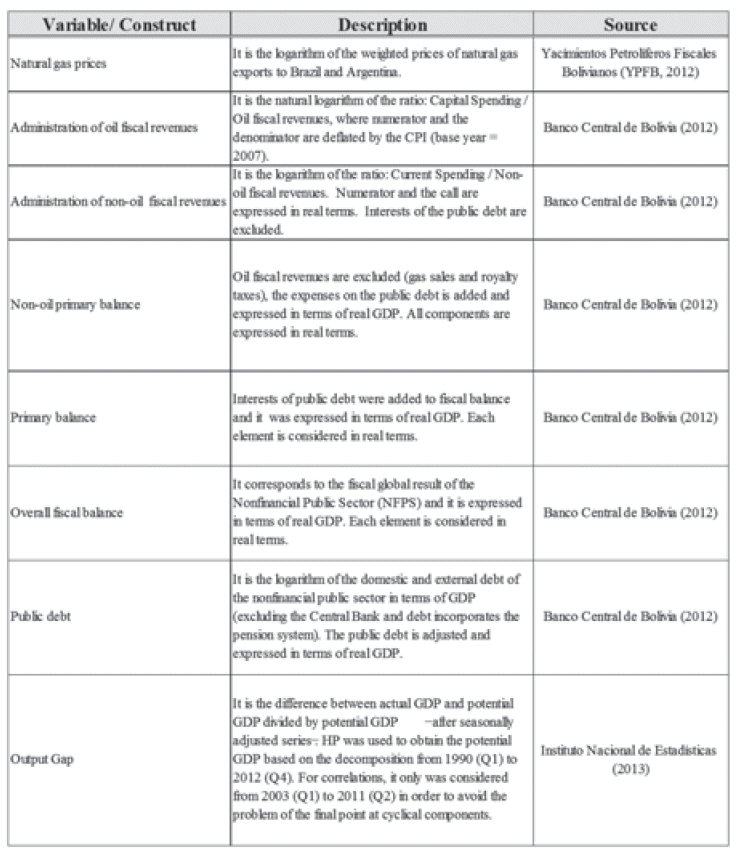
<body><![CDATA[<p align="justify"><font face="Verdana, Arial, Helvetica, sans-serif" size="2">Institutional changes and their implications on fiscal policy can be addressed from two theoretical perspectives: i) by setting rules and contracts that control the economic organization of government and improvement in public efficiency (problem of agents and principals, new economic institutionalism), ii) the institutional theory considers to impose coercive rules derived by policy decisions (normative isomorphism).</font></p>     <p align="justify"><font face="Verdana, Arial, Helvetica, sans-serif" size="2">To address the efficiency of fiscal role, from the perspective of the new institutional economics, institutional changes come from a new direction in the economic organization of the State, producing not only a change in the transaction costs of government but also in the economy as a whole. For example, institutions are efficient when they minimize their transaction costs (Williamson, 1996; Bachev, 2010). For oil dependent economies efficiency could be evaluated in the extent how oil revenues are channeled to public investment or redistributed to society (Olson, 1969).</font></p>     <p align="justify"><font face="Verdana, Arial, Helvetica, sans-serif" size="2">Applying institutional theory to the context of Bolivia, a formal change took place in 2006 related to the nationalization of hydrocarbons and oil industry Scott and Davis (2007) suggest two sources of influence in institutional changes; the first is based on formal changes</font> <font face="Verdana, Arial, Helvetica, sans-serif" size="2">(<i>e.g. </i>a nationalization); the second is related to informal factors -that are not regulated- as the case of oil and non-oil revenue administration.</font></p>     <p align="justify"><font face="Verdana, Arial, Helvetica, sans-serif" size="2">Additionally, as a theoretical inference, the efficiency of public expenditure is linked to fiscal stance when considering one final product derived from the cost of economic organization. The product is linked to two measures: a) the primary balance (with and without oil) and b) public debt. The administration of fiscal oil revenues is considered as the cost of economic organization -given their respective allocation of public investment and current spending (informal institutional changes).</font></p>     <p align="justify"><font face="Verdana, Arial, Helvetica, sans-serif" size="2">Moreover, considering the nationalization of hydrocarbons is possible to evaluate the efficiency of the fiscal role endogenously and <i>subsequently, </i>under the following assumptions: i) the administration of oil and non-oil fiscal revenues is not associated with a deterioration in the primary balance (with without oil), ii) the fiscal stance shows a countercyclical orientation (Keynesian approach) and/ or neutral orientation (neoclassical approach), iii) natural resource prices have not led to progressive participation in the cyclically adjusted fiscal balance; iv) the non-oil primary balance does not show evidence of unsustainable fiscal behavior.</font></p>     <p align="justify">&nbsp;</p>     <p align="justify"><font face="Verdana, Arial, Helvetica, sans-serif" size="3"><b>3.   Data and Methodology</b></font></p>     <p align="justify"><font face="Verdana, Arial, Helvetica, sans-serif" size="2"><b>3.1. Data</b></font></p>     <p align="justify"><font face="Verdana, Arial, Helvetica, sans-serif" size="2">The data is quarterly information covered from 2003 (q1) to 2011 (q2) for fluctuations and correlations<sup>2</sup>, it is also considered until last quarter of 2011 to estimate the cyclically adjusted fiscal balance for Bolivia.</font></p>     <p align="justify"><font face="Verdana, Arial, Helvetica, sans-serif" size="2">The main variables of interest are: i) the price of natural gas that represents a weighted average of reported energy export; ii) the administration of oil fiscal revenues that was a simple ratio of capital spending in terms of oil revenues, as a measure of public investment financed by monetary resources of natural gas, iii) the administration of non-oil fiscal revenues that was a simple ratio of current spending in terms of non-oil fiscal revenues -excluding interest on public debt-; iv) primary fiscal balance (with and without oil) expressed in terms of real GDP; v) public debt. The output gap was also considered (real GDP). <a href="#a1">Annex 1</a> gives a full description of the series employed.</font></p>     ]]></body>
<body><![CDATA[<p align="justify"><font face="Verdana, Arial, Helvetica, sans-serif" size="2"><b>3.2. Methodology</b></font></p>     <p align="justify"><font face="Verdana, Arial, Helvetica, sans-serif" size="2">a) Filters for economic series</font></p>     <p align="justify"><font face="Verdana, Arial, Helvetica, sans-serif" size="2">A preliminary approach consisted by using two statistical filters in order to obtain cyclical components of the mentioned series: Hodrick and Prescott (1997) [HP] and Christiano and Fitzgerald (2003) [CF]. The basic purpose was to assess the consistency of the results on stationary components (Kydland and Prescott, 1990). <a href="#a2">Annex 2</a> describes the methodological specifications of each technique considered.</font></p>     <p align="justify"><font face="Verdana, Arial, Helvetica, sans-serif" size="2">The first step was to deflate the series and apply the natural logarithm to the series considered (except the primary balance). Prior to the analysis, all the series were seasonally adjusted by moving average method, then the filters were applied. Finally correlations have been set in cyclical components.</font></p>     <p align="justify"><font face="Verdana, Arial, Helvetica, sans-serif" size="2">b) Cyclically adjusted fiscal balance (CAB)</font></p>     <p align="justify"><font face="Verdana, Arial, Helvetica, sans-serif" size="2">The cyclically adjusted fiscal balance (CAB) was the central methodology used to evaluate the fiscal policy orientation. The main proceeding was to estimate the effects of natural gas prices and economic activity on the overall fiscal balance by computing relevant elasticities on taxes and public spending.</font></p>     <p align="justify"><font face="Verdana, Arial, Helvetica, sans-serif" size="2">The basic definition of CAB methodology considers that overall fiscal balance is an integration of two components: cyclical and structural balance (Lozano and Toro, 2007):</font></p>     <p align="center"><img src="/img/revistas/rlde/n23/a04_ecuacion_01.gif" width="725" height="46"></p>     <p align="justify"><font face="Verdana, Arial, Helvetica, sans-serif" size="2">Then:</font></p>     <p align="center"><img src="/img/revistas/rlde/n23/a04_ecuacion_02.gif" width="723" height="45"></p>     ]]></body>
<body><![CDATA[<p align="justify"><font face="Verdana, Arial, Helvetica, sans-serif" size="2">Oil structural fiscal revenues</font></p>     <p align="justify"><font face="Verdana, Arial, Helvetica, sans-serif" size="2">The oil fiscal revenues (natural gas) are decomposed in two parts: oil domestic sales <i>ODS<sub>t</sub><sup>a</sup><sub></sub>, </i>that included the domestic market and the taxes collected by the oil and gas production; oil external sales <i>OES<sub>t</sub><sup>a</sup><sub></sub></i> linked to export markets:</font></p>     <p align="center"><img src="/img/revistas/rlde/n23/a04_ecuacion_03.gif" width="730" height="63"></p>     <p align="center"><img src="/img/revistas/rlde/n23/a04_ecuacion_04.gif" width="732" height="59"></p>     <p align="justify"><font face="Verdana, Arial, Helvetica, sans-serif" size="2">Where &#951; is the income elasticity of oil domestic sales in relation to real GDP; <i>Y<sub>t</sub><sup>P</sup><sub>-1</sub><sub></sub>/Y<sub>t</sub><sup>a</sup><sub>-1</sub></i> is the ratio of potential output in terms of observed output; &#952; is the sensitivity of oil external fiscal revenues in relation to the export prices of natural gas; it was also considered the equilibrium relative prices between potential prices (<i>P<sub>t</sub><sup>P</sup><sub>-1</sub></i>) and observed prices (<i>P<sub>t<sup>a</sup>-1</sub></i>)<i>.</i></font></p>     <p align="justify"><font face="Verdana, Arial, Helvetica, sans-serif" size="2">By (3) and (4), there were obtained the cyclicality of oil adjusted revenues: oil domestic sales <i>(ODS<sub>S</sub><sup>t</sup>) </i>and oil external sales <i>(OES<sub>S</sub><sup>t</sup>)</i></font></p>     <blockquote>       <p align="justify"><font face="Verdana, Arial, Helvetica, sans-serif" size="2"><i>Structural tax revenues</i></font></p> </blockquote>     <p align="justify"><font face="Verdana, Arial, Helvetica, sans-serif" size="2">Non-oil tax revenues were adjusted by the economic cycle in two parts: internal and custom taxes.<sup>3</sup></font></p>     <p align="center"><img src="/img/revistas/rlde/n23/a04_ecuacion_05.gif" width="734" height="63"></p>     ]]></body>
<body><![CDATA[<p align="justify"><font face="Verdana, Arial, Helvetica, sans-serif" size="2">Where:</font></p>     <p align="center"><img src="/img/revistas/rlde/n23/a04_ecuacion_06.gif" width="733" height="45"></p>     <p align="justify"><font face="Verdana, Arial, Helvetica, sans-serif" size="2">The elasticity of each tax revenue was the product of two elasticities: i) relative to its own tax base and ii) in relation to output.</font></p>     <blockquote>       <p align="justify"><font face="Verdana, Arial, Helvetica, sans-serif" size="2"><i>Structural spending</i></font></p> </blockquote>     <p align="justify"><font face="Verdana, Arial, Helvetica, sans-serif" size="2">For the Bolivian case, it was assumed that every type of expenditures was structural -given the absence of transfer and/or bonds of unemployment during time recessions.</font></p>     <p align="justify"><font face="Verdana, Arial, Helvetica, sans-serif" size="2">Primary balance was disaggregated (oil and non-oil) in cyclical and structural components:</font></p>     <p align="center"><img src="/img/revistas/rlde/n23/a04_ecuacion_07.gif" width="723" height="76"></p>     <p align="justify"><font face="Verdana, Arial, Helvetica, sans-serif" size="2">Then:</font></p>     <p align="center"><img src="/img/revistas/rlde/n23/a04_ecuacion_08.gif" width="721" height="78"></p>     ]]></body>
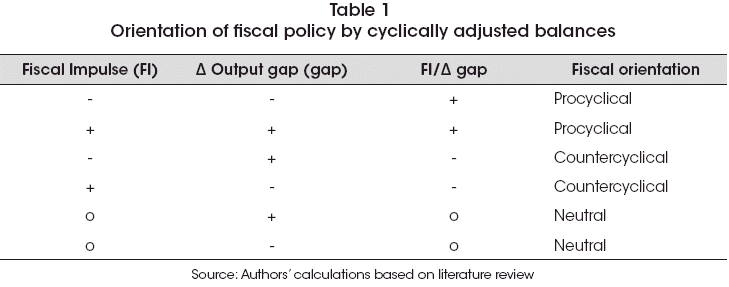
<body><![CDATA[<p align="justify"><font face="Verdana, Arial, Helvetica, sans-serif" size="2">The variation of cyclically adjusted non-oil primary balance <i>(CANOPE) </i>corresponds to fiscal impulse definition that captures the orientation of fiscal policy (Villafuerte <i>et al, </i>2011), therefore:</font></p>     <p align="center"><img src="/img/revistas/rlde/n23/a04_ecuacion_09.gif" width="731" height="41"></p>     <p align="justify"><font face="Verdana, Arial, Helvetica, sans-serif" size="2">The fiscal stance measured by cyclically adjusted non-oil primary balance may be expansive if &#916;<i>CANOPB</i><sub>t</sub> &lt; 0 or contractive if &#916;<i>CANOPB</i><sub>t</sub><i> &gt; </i>0.</font></p>     <p align="justify"><font face="Verdana, Arial, Helvetica, sans-serif" size="2">Additionally this methodology gives the possibility to determine the relationship between the business cycle and the orientation of fiscal policy by comparing the fiscal impulse and the change in output gap. The following table shows the relationship between fiscal impulse (FI) and output gap:</font></p>     <p align="center"><img src="/img/revistas/rlde/n23/a04_table_01.gif" width="729" height="287"></p>     <p align="justify"><font face="Verdana, Arial, Helvetica, sans-serif" size="2">The output gap is defined as actual GDP less potential GDP divided by potential GDP. The fiscal impulse is the change in non-oil primary balance in cyclically adjusted terms.</font></p>     <p align="justify"><font face="Verdana, Arial, Helvetica, sans-serif" size="2">It is noteworthy to show the limitations of the cyclically adjusted balance methodology focus on the sensitivity of the estimates with respect to output gap and the equilibrium of natural gas prices, therefore, deviations around the equilibrium conditions of medium and long term are the main methodological input and, at the same time, the core disadvantages (Girouard and Andre, 2006)</font></p>     <p align="justify"><font face="Verdana, Arial, Helvetica, sans-serif" size="2">c)  Evaluation of the Indicator of Fiscal Sustainability (IFS)</font></p>     <p align="justify"><font face="Verdana, Arial, Helvetica, sans-serif" size="2">Finally in this section one target ratio of primary balance is evaluated based on Indicator Fiscal Sustainability (IFS) proposed by Croce and Hugo (2003), taking the following aspects:</font></p>     <p align="justify"><font face="Verdana, Arial, Helvetica, sans-serif" size="2">Where:</font></p>     ]]></body>
<body><![CDATA[<p align="center"><img src="/img/revistas/rlde/n23/a04_ecuacion_10.gif" width="732" height="45"></p>     <p align="justify"><font face="Verdana, Arial, Helvetica, sans-serif" size="2">In (10), <i>b* </i>and &#946;* are formed, respectively in the primary balance and the discount fact that converges to the debt rule (<i>d</i>*) (Minimum value of public debt to real GDP over the period observed).</font></p>     <p align="justify"><font face="Verdana, Arial, Helvetica, sans-serif" size="2">For computation of &#946;*, it was considered the real interest rate on public debt (<i>r</i><sub>t</sub>) (See <a href="#a3">Annex 3</a>) and the rate of real output growth (<i>g</i><sub>t</sub>):</font></p>     <p align="center"><img src="/img/revistas/rlde/n23/a04_ecuacion_11.gif" width="727" height="67"></p>     <p align="justify"><font face="Verdana, Arial, Helvetica, sans-serif" size="2">Where &#946;<sub>t</sub> measures the spread between the real interest rate and the real growth rate observed in period <i>t.</i></font></p>     <p align="justify"><font face="Verdana, Arial, Helvetica, sans-serif" size="2">Based on the distribution of &#946;<sub>t</sub><i>, </i>two alternative discount factors were considered (&#946;*); i) a baseline scenario that is the simple average of observed distribution of &#946;<sub>t</sub>: ii) a scenario of greater volatility that corresponds to the maximum value of &#946;<sub>t</sub> over the period covered.<sup>4</sup> The </font><font face="Verdana, Arial, Helvetica, sans-serif" size="2">aim of these scenarios is to offer two types of fiscal rules according to different contexts of economic activity.</font></p>     <p align="justify"><font face="Verdana, Arial, Helvetica, sans-serif" size="2">Another factor of evaluation is &#955;<sub>t</sub>, that corresponds to reaction of primary balance (<i>b</i><sub>t</sub>) to primary balance target <i>(b*); </i>in the same way, public debt in the previous period (<i>d<sub>t-1</sub></i>) <i>is </i>related to debt concerning target (<i>d</i>*):</font></p>     <p align="center"><img src="/img/revistas/rlde/n23/a04_ecuacion_12.gif" width="727" height="62"></p>     <p align="justify"><font face="Verdana, Arial, Helvetica, sans-serif" size="2">The fiscal stance is sustainable when the difference between &#946;t &amp; &#955;t is less than the threshold of 1:</font></p>     <p align="center"><img src="/img/revistas/rlde/n23/a04_ecuacion_13.gif" width="729" height="62"></p>     ]]></body>
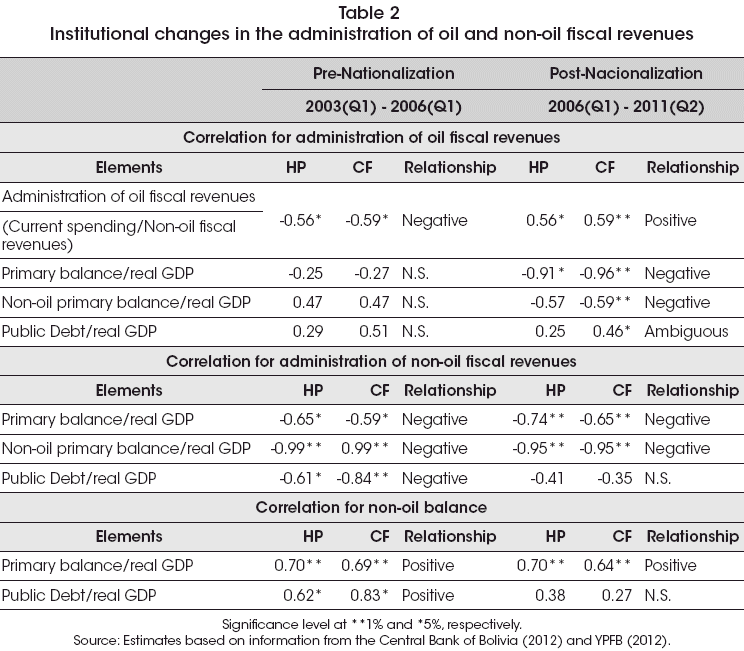
<body><![CDATA[<p align="center">&nbsp;</p>     <p align="justify"><font face="Verdana, Arial, Helvetica, sans-serif" size="3"><b>4.    Results</b></font></p>     <p align="justify"><font face="Verdana, Arial, Helvetica, sans-serif" size="2">a)  Formal institutional change and informal factors (post-nationalization)</font></p>     <p align="justify"><font face="Verdana, Arial, Helvetica, sans-serif" size="2">According to <a href="#t2">Table 2</a>, the nationalization of hydrocarbon led to increase a positive and significantly relation between capital and current spending in terms of oil and non-oil revenue. Moreover, the main change indicated a negative and significantly association between administration of oil fiscal revenues and primary balance -with and without oil.</font></p>     <p align="justify"><a name="t2"></a></p>     <p align="center"><img src="/img/revistas/rlde/n23/a04_table_02.gif" width="744" height="651"></p>     <p align="justify"><font face="Verdana, Arial, Helvetica, sans-serif" size="2">Finally prior to the nationalization of hydrocarbons, there was a strong link between the non-oil primary balance and public debt; during the post-nationalization, this relationship has weakened interpreted like a substitution in financing current spending: public debt was replaced with oil revenues.</font></p>     <p align="justify"><font face="Verdana, Arial, Helvetica, sans-serif" size="2">No evidence was found for the first condition on fiscal role efficiency that established no deterioration in non-oil primary balance by the administration of oil and non-oil fiscal revenues. The deterioration of non-oil primary balance was due to a positive association between administration of oil and non-oil revenue (informal institutional changes) derived since the nationalization of hydrocarbons (formal change). On the other hand, the administration of government debt showed a countercyclical behavior related to output gap and the natural gas prices when correlating the cyclical components of the series (positive aspect).<sup>6</sup></font></p>     <p align="justify"><font face="Verdana, Arial, Helvetica, sans-serif" size="2">b)  Cyclically adjusted fiscal balance (structural) </font></p>     <p align="justify"><font face="Verdana, Arial, Helvetica, sans-serif" size="2"><i>Elasticities of fiscal revenues</i></font></p>     ]]></body>
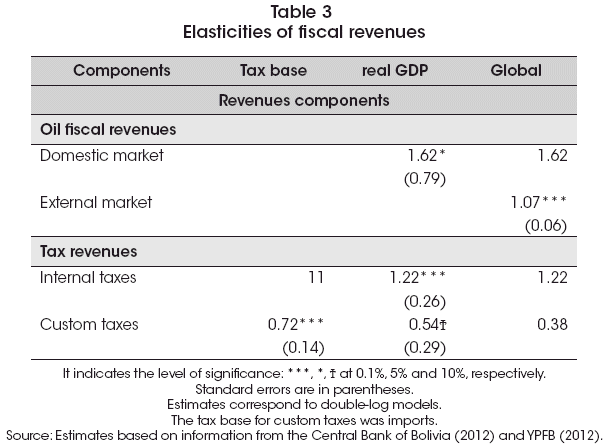
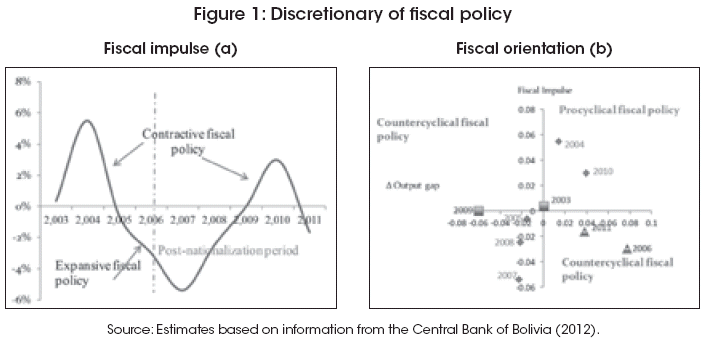
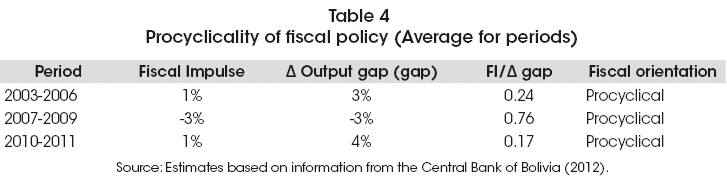
<body><![CDATA[<p align="justify"><font face="Verdana, Arial, Helvetica, sans-serif" size="2">Elasticities were estimated for fiscal revenues by adjusting every selected component to fluctuations of natural gas prices and economic activity (<a href="#t3">Table 3</a>).</font></p>     <p align="justify"><a name="t3"></a></p>     <p align="center"><img src="/img/revistas/rlde/n23/a04_table_03.gif" width="611" height="448"></p>     <p align="justify"><font face="Verdana, Arial, Helvetica, sans-serif" size="2">Elasticity of oil domestic market was very sensitive to real GDP. These findings were consistent with the estimates for developing economies such as Lozano and Toro (2007); therefore, domestic sales of natural gas and internal taxes were sensitive to changes in economic activity</font></p>     <p align="justify"><font face="Verdana, Arial, Helvetica, sans-serif" size="2">Additionally the elasticity between oil external revenues and export prices was close to unity which agrees with Marcel (2003) and it is often taken as assumptions in other studies (Zambrano and Aguilera, 2010). Consequently there is an automatic stabilizer in oil fiscal revenues derived from external price movements.</font></p>     <p align="justify"><font face="Verdana, Arial, Helvetica, sans-serif" size="2">In the case of custom taxes, this elasticity was inelastic with respect to its own base and related to real GDP, this finding may limit the participation of cyclical custom taxes on cyclically adjusted balance.</font></p>     <p align="justify"><font face="Verdana, Arial, Helvetica, sans-serif" size="2"><i>Discretionary of fiscal policy</i></font></p>     <p align="justify"><font face="Verdana, Arial, Helvetica, sans-serif" size="2">While rise of natural gas prices  (2004-2008), the fiscal policy of Bolivia was expansionary, during the global economic slowdown (2009) the role was neutral (<a href="#f1">Figure 1</a>).</font></p>     <p align="justify"><a name="f1"></a></p>     <p align="center"><img src="/img/revistas/rlde/n23/a04_figure_01.gif" width="703" height="342"></p>     ]]></body>
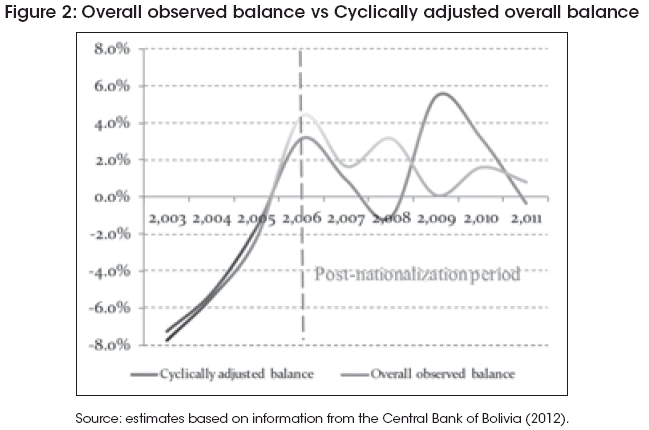
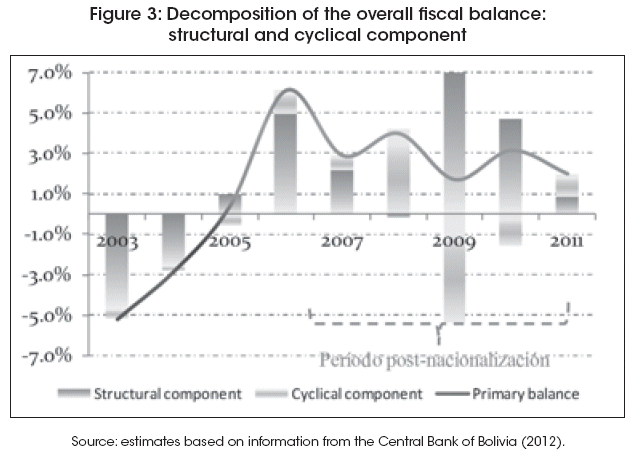
<body><![CDATA[<p align="justify"><font face="Verdana, Arial, Helvetica, sans-serif" size="2">During the period 2007-2009 (post-nationalization), it was shown the most procyclicality of fiscal policy: the ratio fiscal impulse (FI)/gap variation was close to 1. For the period 2010-2011, there was a less procyclical with tendency to neutrality orientation (the coefficient was close to zero).</font></p>     <p align="center"><img src="/img/revistas/rlde/n23/a04_table_04.gif" width="727" height="177"></p>     <p align="justify"><font face="Verdana, Arial, Helvetica, sans-serif" size="2"><i>Overall balance versus cyclically adjusted fiscal balance</i></font></p>     <p align="justify"><font face="Verdana, Arial, Helvetica, sans-serif" size="2">According to <a href="#f2">Figure 2</a>, it can be seen that before nationalization (2003-2005) there was no difference between the overall balance (observed) and the cyclically adjusted balance, suggesting two things: i) activity of natural gas generated less dependence on the fiscal stance, ii) economic activity and external prices were very close to its equilibrium and long-term levels.</font></p>     <p align="justify"><a name="f2"></a></p>     <p align="center"><img src="/img/revistas/rlde/n23/a04_figure_02.gif" width="649" height="430"></p>     <p align="justify"><font face="Verdana, Arial, Helvetica, sans-serif" size="2">The difference between the cyclically adjusted balance and observed balance is explained by three phases: i) favorable external context (2006-2008), economic activity and natural gas prices were above its equilibrium level, therefore, observed balances were greater than cyclically adjusted balances; ii) global recession (2009), even for 2010, natural gas prices and economic activity showed results below potential level: cyclically adjusted balance was greater than the observed balance; iii) a period for economic recuperation (2011) that reflects higher observed balance related to cyclical balance. The cyclically adjusted balance results for Bolivia, during the period 2005-2009, were consistent with the findings of Zambrano and Aguilera (2010).</font></p>     <p align="justify"><font face="Verdana, Arial, Helvetica, sans-serif" size="2">Consistent with previous results, the decomposition of cyclical adjusted balances (<a href="#f3">Figure 3</a>) showed that -before nationalization- the overall fiscal balance was basically composed by structural component. During the post-nationalization period, there was a positive impact of cyclical economic and external prices for the period 2006-2008, and a negative effect for 2009 (in some extent for 2010).</font></p>     <p align="justify"><a name="f3"></a></p>     <p align="center"><img src="/img/revistas/rlde/n23/a04_figure_03.gif" width="633" height="451"></p>     ]]></body>
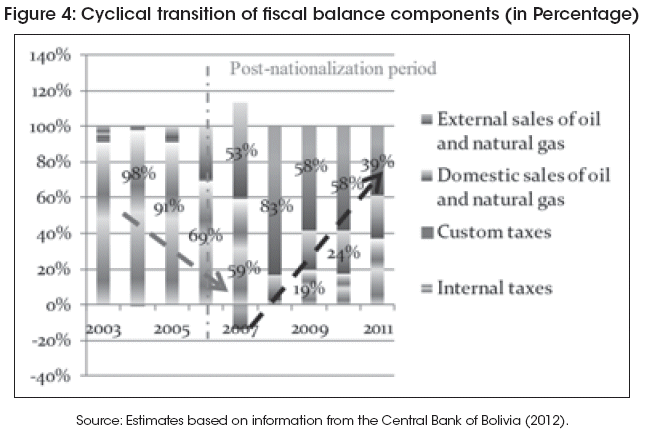
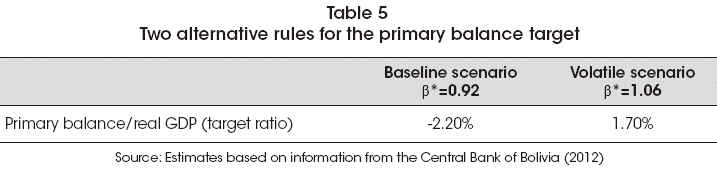
<body><![CDATA[<p align="justify"><font face="Verdana, Arial, Helvetica, sans-serif" size="2"><i>Transition of the cyclical components of the overall fiscal balance</i></font></p>     <p align="justify"><font face="Verdana, Arial, Helvetica, sans-serif" size="2">Finally, it was considered the cyclical transition of overall balance components (<a href="#f4">Figure 4</a>), where there were three important moments: i) a substantive decrease in the internal dependency of economic activity represented by internal taxes (decreased from 98 to about 20% of cyclical movements); ii) oil dependence begins with a greater participation from domestic gas market, especially for 2007 (50% of the cyclical movements); iii) consolidation of oil dependency to external markets (the strongest share was in 2008 over 80%).</font></p>     <p align="justify"><a name="f4"></a></p>     <p align="center"><img src="/img/revistas/rlde/n23/a04_figure_04.gif" width="646" height="433"></p>     <p align="justify"><font face="Verdana, Arial, Helvetica, sans-serif" size="2">The above findings suggest a deficient fiscal role based on progressive participation of natural gas sales (domestic and external gas market) by the cyclical component of overall fiscal balance.</font></p>     <p align="justify"><font face="Verdana, Arial, Helvetica, sans-serif" size="2">a)  Evaluation of sustainable fiscal position (PFS) for Bolivia</font></p>     <p align="justify"><font face="Verdana, Arial, Helvetica, sans-serif" size="2">In the previous section, it was evaluated the orientation of fiscal policy related to economic activity and natural gas prices, as well as the mechanism of cyclical transition changes in the overall fiscal balance. In this section, the purpose was to evaluate if the fiscal stance, measured by the primary balance (with and without oil), was sustainable based on the algorithm proposed by Croce and Hugo (2003).</font></p>     <p align="justify"><font face="Verdana, Arial, Helvetica, sans-serif" size="2">By two alternatives proposed, primary balances were estimated with two goals: a baseline scenario and in context of higher volatility and internal and external economic uncertainty (volatile scenario). Consequently volatile scenario demanded a higher primary balance target compared with baseline context, therefore, the alternative of uncertainty is more prudent and cautious (<a href="#t5">Table 5</a>).</font></p>     <p align="justify"><a name="t5"></a></p>     <p align="center"><img src="/img/revistas/rlde/n23/a04_table_05.gif" width="717" height="170"></p>     ]]></body>
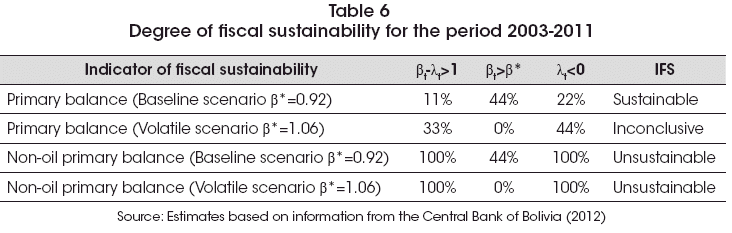
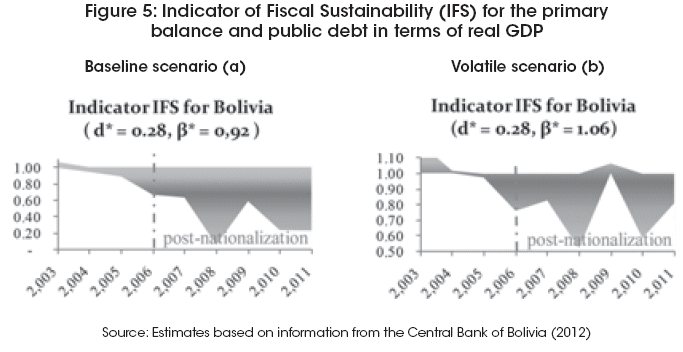
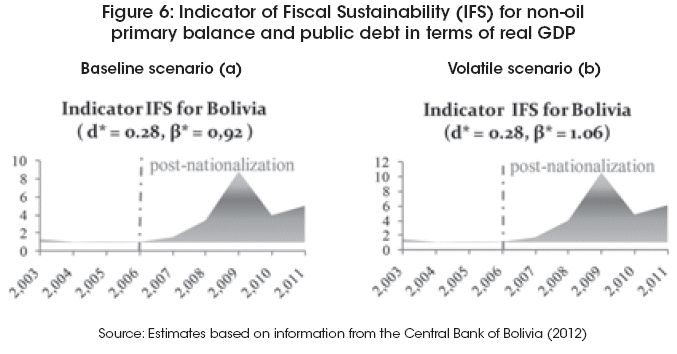
<body><![CDATA[<p align="justify"><font face="Verdana, Arial, Helvetica, sans-serif" size="2">The fiscal stance of Bolivia was sustainable for the baseline scenario and inconclusive for a volatile scenario (weak sustainability). However, when it was evaluated non-oil primary balance, it reflected an unsustainable fiscal stance for both contexts (<a href="#t6">Table 6</a>).</font></p>     <p align="justify"><a name="t6"></a></p>     <p align="center"><img src="/img/revistas/rlde/n23/a04_table_06.gif" width="732" height="233"></p>     <p align="justify"><font face="Verdana, Arial, Helvetica, sans-serif" size="2">Last results can be evaluated in dynamic context by considering each year of study The basic evaluation criteria establish not to cross the threshold of 1 in relation to attain sustainability In<a href="#f5"> Figure 5</a>, it has shown that primary balance improved after nationalization.</font></p>     <p align="justify"><a name="f5"></a></p>     <p align="center"><img src="/img/revistas/rlde/n23/a04_figure_05.gif" width="683" height="352"></p>     <p align="justify"><font face="Verdana, Arial, Helvetica, sans-serif" size="2">Conversely when considering non-oil primary balance, the fiscal stance was unsustainable (<a href="#f6">Figure 6</a>).</font></p>     <p align="justify"><a name="f6"></a></p>     <p align="center"><img src="/img/revistas/rlde/n23/a04_figure_06.gif" width="677" height="354"></p>     <p align="justify"><font face="Verdana, Arial, Helvetica, sans-serif" size="2">In sum, the fiscal stance of Bolivia, from 2003 to 2011, was unsustainable in an exponentially way, with more emphasis on post-nationalization period, the core argument sustains that non-oil primary balance is the main fiscal indicator for oil dependent economies (gas natural).</font></p>     ]]></body>
<body><![CDATA[<p align="justify">&nbsp;</p>     <p align="justify"><font face="Verdana, Arial, Helvetica, sans-serif" size="3"><b>5.   Discussion</b></font></p>     <p align="justify"><font face="Verdana, Arial, Helvetica, sans-serif" size="2">Institutions can be perceived and interpreted in endogenous way instead of causation effect, but this constitutes a liability for some econometricians based on the argument of modeling by exogenous variables (Frankel, 2010:15).</font></p>     <p align="justify"><font face="Verdana, Arial, Helvetica, sans-serif" size="2">In this article, the results showed that one formal institutional change led to new mechanisms for administration of oil and non-oil fiscal revenues. In the absence of fiscal rules, the new guidelines of government -in unregulated oil revenue administration- can get unwanted results. According to the new institutional economics, institutions are more efficient if governments improve selected results given the economic organization of the state. Applying the above definition to the fiscal stance, in the case of Bolivia, the management of public debt was adequate, consistent with the argument that a good fiscal role is to reduce the public debt during boom periods (Smidova, 2011). The rationale for maintaining low levels of public debt to GDP is centered on the possibility of greater scope for fiscal policy when there is any economic downturn (Mates, 2011).</font></p>     <p align="justify"><font face="Verdana, Arial, Helvetica, sans-serif" size="2">Regardless of the good direction of public debt, non-oil primary balance was unsustainable; the above findings coincided with Zambrano and Aguilera (2010) with respect to the</font> <font face="Verdana, Arial, Helvetica, sans-serif" size="2">fiscal sustainability of Bolivia. The progressive non-oil deficit can lead to severe structural adjustments in fiscal policy, and therefore it could affect negatively the macroeconomic prospective if this behavior is not reversed. Hart (2009) defined as irresponsible management of fiscal deficits when they are not attributed to the economic circumstances.</font></p>     <p align="justify"><font face="Verdana, Arial, Helvetica, sans-serif" size="2">Prior to the nationalization of hydrocarbons and oil industry there was an inverse relationship between the administration of oil and non-oil fiscal revenues (there was an adjustment between capital and current spending). For post-nationalization period, the relationship consisted in increase capital and current expenditure at the same time. Thus, the unsustainability of non-oil primary balance was not due to nationalization (formal institutional change) but in administration of oil and non-oil fiscal revenues (informal institutional changes).</font></p>     <p align="justify"><font face="Verdana, Arial, Helvetica, sans-serif" size="2">Main findings revealed procyclical movements to economic activity by applying cyclically adjusted fiscal balance methodology These results are consistent with evidence that developing countries have procyclical policies (Strawczynski and Zeira, 2011; Daude Melguizo and Neut, 2010; Ilzetzki and Végh, 2008), especially for countries that depend on commodity prices (Kaminsky 2009). According to the Keynesian stance, it would have expected in a countercyclical role. The neoclassical approach suggested a neutral stance, however, when the degree of substitution between public investment and private investment is strong, the fiscal stance should be countercyclical (Hathroubi and Rezgui, 2011). In general, there was no evidence for any positions mentioned before.</font></p>     <p align="justify"><font face="Verdana, Arial, Helvetica, sans-serif" size="2">The existence of informal rules on the discretion of the administration of oil and non-oil revenues leads to a deterioration in non-oil primary balance. Why do not governments implement restrictions on limiting public spending? Why not specific discretion over the administration of oil and non-oil fiscal revenues? The answer is related to maximization of their own interests (Cabrales and Hauk, 2011), resulting in inefficient institutions. From the perspective of agents and principals, the government acts as an agent to self opportunistic discretionary fiscal policy Consequently society (principal) has no control over the handling of oil resources.</font></p>     <p align="justify"><font face="Verdana, Arial, Helvetica, sans-serif" size="2"><b><i>Implications for policy</i></b></font></p>     <p align="justify"><font face="Verdana, Arial, Helvetica, sans-serif" size="2">The absence of formal fiscal rules leads to high transaction costs related to the economic organization of the state, in this case, as oil and non-oil fiscal revenues are managed. In the</font> <font face="Verdana, Arial, Helvetica, sans-serif" size="2">case of Bolivia, the management of public debt (countercyclical) was properly conducted; however, there was evidence of unsustainable non-oil primary balance.</font></p>     ]]></body>
<body><![CDATA[<p align="justify"><font face="Verdana, Arial, Helvetica, sans-serif" size="2">According to the indicator of fiscal sustainability (IFS), under the assumption of a volatile scenario -on the real interest rate and output growth- the primary balance limit was determined around 1.7% of real GDP, but it is also necessary to include classical escape clauses (for periods of contraction or slowdown). The generation of this surplus would converge to the minimization of public debt around the recent past, considering that already showed a period of global economic slowdown.</font></p>     <p align="justify"><font face="Verdana, Arial, Helvetica, sans-serif" size="2">Additionally there is a need to impose restrictions in the administration of non-oil fiscal revenue: current spending must limit to non-oil fiscal revenues; additionally it is necessary to establish specific regulatory purposes in the administration of oil fiscal revenues: l) investment public, 2) direct transfers to society 3) amortization of debt, 4) public savings. The fiscal rule based on limiting the public spending provides a better control of public resources because it is independent of any economic projection (Schick, 2010), while the imposition and enforcement of fiscal rules constitutes an additional fiscal role (Musgrave, 1997).</font></p>     <p align="justify"><font face="Verdana, Arial, Helvetica, sans-serif" size="2">The establishment of specific destinations for oil revenues allows for greater transparency of fiscal institutions, and in that way it is easy to control the performance of government (Dzialo, 2012). The proposed mechanisms will allow to obtain a sustainable fiscal stance in terms of primary balance (with and without oil) and public debt. Additionally, the establishment of rules related to public savings will mitigate the progressive involvement of fluctuations in natural gas prices in the cyclically adjusted balance.</font></p>     <p align="justify"><font face="Verdana, Arial, Helvetica, sans-serif" size="2">As consequence, the final solution focuses on the application of formal institutional rules that lead to public budget by formulation with and without oil considerations; in other words: convert informal to formal institutional changes.</font></p>     <p align="justify"><font face="Verdana, Arial, Helvetica, sans-serif" size="2"><b><i>Limitations and research agenda</i></b></font></p>     <p align="justify"><font face="Verdana, Arial, Helvetica, sans-serif" size="2">In this paper, it was evaluated efficiency elements related to the fiscal role, but did not assess causality Future research can be designed around the impact of institutional changes (from administration of oil and non-oil revenues) and the orientation of fiscal policy based on the level of fiscal sustainability. It also is mentioned that the reaction of fiscal policy can be in a non-linear way (Égert, 2010), aspect that was not addressed in this document.</font></p>     <p align="justify"><font face="Verdana, Arial, Helvetica, sans-serif" size="2">The indicator of fiscal sustainability (IFS) proposed by Croce and Hugo (2003) cannot capture the fiscal reaction derived from price shocks of a natural resource and how oil revenues are managed. Therefore, it is necessary to specify a methodology that enables to measure the responses of fiscal stance and its degrees of sustainability cases: a) strong, b) weak (inconclusive) and c) unsustainable.</font></p>     <p align="justify">&nbsp;</p>     <p align="justify"><font face="Verdana, Arial, Helvetica, sans-serif" size="3"><b>6.    Conclusions</b></font></p>     <p align="justify"><font face="Verdana, Arial, Helvetica, sans-serif" size="2">The purpose of this article was to evaluate the efficiency of fiscal role from the nationalization of hydrocarbons (formal institutional change) and administration of oil and non-oil fiscal revenues (informal institutional changes) in the case of Bolivia. To evaluate this efficiency was considered the new institutional economics perspective, considering the cost of economic organization as the mechanism of oil revenue management and in relation to capital and current spending. The final product of efficiency was the fiscal stance measured by primary balance (with and without oil) and public debt.</font></p>     ]]></body>
<body><![CDATA[<p align="justify"><font face="Verdana, Arial, Helvetica, sans-serif" size="2">The result was a poor fiscal role as oil and non-oil revenue administration were associated negatively with non-oil primary balance, although public debt was addressed in a countercyclical manner. This deficiency in fiscal role was based on four main points.</font></p>     <p align="justify"><font face="Verdana, Arial, Helvetica, sans-serif" size="2">First, there was deterioration in non-oil primary balance based on a positive relationship between the administration of oil and non-oil fiscal revenues: increased in capital and current spending.</font></p>     <p align="justify"><font face="Verdana, Arial, Helvetica, sans-serif" size="2">A second factor of deficiency was the procyclical orientation of fiscal policy to economic activity and natural gas prices by employing cyclically adjusted balance methodology. Two theoretical perspectives suggest different fiscal orientations: countercyclical policy during recessions (Keynesian stance) and neutral policy in each period of analysis (neoclassical stance).</font></p>     <p align="justify"><font face="Verdana, Arial, Helvetica, sans-serif" size="2">The third element of fiscal deficiency was associated with a progressive increase in the participation of cyclical fluctuations derived from natural gas prices on the overall balance cyclically adjusted. The cyclical transition meant less dependence from domestic economy (internal taxes) towards a greater relative contribution from external markets of natural gas.</font></p>     <p align="justify"><font face="Verdana, Arial, Helvetica, sans-serif" size="2">The fourth factor was based on unsustainability of non-oil primary balance from nationalization of hydrocarbons. By contrary a non-progressive deterioration of non-oil primary balance has indicated a conclusive element of sustainable fiscal stance.</font></p>     <p align="justify"><font face="Verdana, Arial, Helvetica, sans-serif" size="2">The suggestions for policies were made on how fiscal revenues should be administered by establishments of formal fiscal rules for budget formulation in order to achieve a sustainable fiscal stance.</font></p>     <p align="justify">&nbsp;</p>     <p align="right"><font face="Verdana, Arial, Helvetica, sans-serif" size="2"><i>Fecha de recepción: 27 de febrero de 2015</i></font></p>     <p align="right"><font face="Verdana, Arial, Helvetica, sans-serif" size="2"><i>Manejado por: ABCE</i></font></p>     <p align="right"><font face="Verdana, Arial, Helvetica, sans-serif" size="2"><i>Fecha de aceptación: 30 de abril de 2015</i></font></p>     ]]></body>
<body><![CDATA[<p align="right">&nbsp;</p>     <p><font size="3"><b><font face="Verdana, Arial, Helvetica, sans-serif">Notes</font></b></font></p>     <p align="justify"><font face="Verdana, Arial, Helvetica, sans-serif" size="2">* Universidad Aut&oacute;noma del Estado de M&eacute;xico. Contacto: <a href="mailto:aleconomista@gmail.com">aleconomista@gmail.co</a></font></p>     <p align="justify"><font face="Verdana, Arial, Helvetica, sans-serif" size="2">** Universidad Aut&oacute;noma del Estado de M&eacute;xico. Contacto: <a href="mailto:reyna_vg@yahoo.com">reyna_vg@yahoo.com</a></font></p>     <p align="justify"><font face="Verdana, Arial, Helvetica, sans-serif" size="2">1 This period is considered due to following reasons: 1) from 2003 the boom in commodities prices begins, even though this trend could be appreciated since 1999, the change in slope with greater intensity appeared from this period, 2) after mid-90's many oil producing countries took time to stabilize their public finances. By 2003, most countries were able to respond to price shooks (Villafuerte and Lopez, 2010, p. 4).</font></p>     <p align="justify"><font face="Verdana, Arial, Helvetica, sans-serif" size="2">2    It uses this period to avoid the problem of endpoint for the Hodrick and Prescott. Indeed series were used from 2000 until 2012 to obtain the cyclical components.</font></p>     <p align="justify"><font face="Verdana, Arial, Helvetica, sans-serif" size="2">3    For the Bolivian case, it was assumed that Other Non-Tax revenue and Mining royalties were not affected by the economic cycle.</font></p>     <p align="justify"><font face="Verdana, Arial, Helvetica, sans-serif" size="2">4 Croce and Hugo (2003:8) indicated that the expected value of &#946;* should constitute about 1 for mature economies; greater than 1 for economies with capital scarcity and high costs of financial intermediation; finally, much greater than 1 under contexts of economic volatility and political uncertainty. Additionally, it is presented the case of &#946;* &lt;1, when the real interest rate is lower than the actual growth rate.</font></p>     <p align="justify"><font face="Verdana, Arial, Helvetica, sans-serif" size="2">5 In the theoretical framework, there are mentioned three degrees of fiscal sustainability: a) strong grade, if the condition was observed more than 75% of the period, b) unsustainable grade, abiding by less than 25% of the period covered o) weak grade (inconclusive), if the rank was between 25 and 75% of the period.</font></p>     <p align="justify"><font face="Verdana, Arial, Helvetica, sans-serif" size="2"></font><font face="Verdana, Arial, Helvetica, sans-serif" size="2">6 The correlation was negative and significant between the cyclical components of government debt in relation to GDP and natural gas prices: -0.49 (Hodrick and Prescott-HP) and -0.54 (Christiano and Fitzgerald-CF) during the period: 2006 (Q2) - 2011 (Q2). Similarly, it was found a negative correlation between public debt and GDP the output gap:-0.35 (HP) and -0.48 (CF). In all cases, significance was below 5%.</font></p>     ]]></body>
<body><![CDATA[<p align="justify">&nbsp;</p>     <p align="justify"><font face="Verdana, Arial, Helvetica, sans-serif" size="3"><b>References</b></font></p>     <p align="justify"><font face="Verdana, Arial, Helvetica, sans-serif" size="2">1.  Bachev, H. (2010). Efficiency and Sustainability of Economic Organizations in Agri-business. <i>Institute of Agricultural Economics Sofia, Bulgaria, </i>October, 4 (1), 5-22.</font></p>     <p align="justify"><font face="Verdana, Arial, Helvetica, sans-serif" size="2">2.  Banco Central de Bolivia, B. (2012). <i>Información estadística del sector fiscal y la deuda pública. </i>Banco Central de Bolivia, Asesoría Principal de Política Económica. Información estadística proporcionada.</font></p>     <p align="justify"><font face="Verdana, Arial, Helvetica, sans-serif" size="2">3. Cabrales, A. &amp; Hauk, E. (2011). &quot;The quality of political institutions and the curse of natural resources&quot;. <i>The Economic Journal. </i>March, 58-88.</font></p>     <!-- ref --><p align="justify"><font face="Verdana, Arial, Helvetica, sans-serif" size="2">4. Christiano, L., &amp; Fitzgerald, T. (2003). &quot;The band-pass filter&quot;. <i>International Economic Review, </i>44 (2), 435-465.</font>&nbsp;&nbsp;&nbsp;&nbsp;&nbsp;&nbsp;&nbsp;&nbsp;[&#160;<a href="javascript:void(0);" onclick="javascript: window.open('/scielo.php?script=sci_nlinks&ref=524630&pid=S2074-4706201500010000400004&lng=','','width=640,height=500,resizable=yes,scrollbars=1,menubar=yes,');">Links</a>&#160;]<!-- end-ref --><!-- ref --><p align="justify"><font face="Verdana, Arial, Helvetica, sans-serif" size="2">5. Croce, E., &amp; Hugo J. (2003).<i>&quot;Assessing Fiscal Sustainability: A Cross-Country Comparison&quot;. </i>International Monetary Fund Institute.</font>&nbsp;&nbsp;&nbsp;&nbsp;&nbsp;&nbsp;&nbsp;&nbsp;[&#160;<a href="javascript:void(0);" onclick="javascript: window.open('/scielo.php?script=sci_nlinks&ref=524631&pid=S2074-4706201500010000400005&lng=','','width=640,height=500,resizable=yes,scrollbars=1,menubar=yes,');">Links</a>&#160;]<!-- end-ref --><p align="justify"><font face="Verdana, Arial, Helvetica, sans-serif" size="2">6. Dabla-Norris, E.; Allen, R.; Zanna, L.; Prakash, T; Kvintradze, E.; Lledo, V; Yackoviev, I. and Gollwitzer, S. (2010). <i>&quot;Budget Institutions and Fiscal Performance in Low-Income Countries&quot;. </i>International Monetary Fund, WP/10/80, IMF Working Paper.</font></p>     <p align="justify"><font face="Verdana, Arial, Helvetica, sans-serif" size="2">7. Daude, C, Melguizo, A. &amp;Neut, A. (2010). <i>Fiscal Policy in Latin America: Countercyclical and Sustainable at last?. </i>OECD Development Centre, Working Paper, N&deg; 291.</font></p>     <!-- ref --><p align="justify"><font face="Verdana, Arial, Helvetica, sans-serif" size="2">8. Devarajan, S., Minh Le, T. &amp; Raballand, G. (2010). &quot;Increasing Public Expenditure Efficiency in Oil-rich Economies&quot;. <i>Policy Research </i>Working Paper 5287, The World Bank, África Región, Chief Economist Office, April.</font>&nbsp;&nbsp;&nbsp;&nbsp;&nbsp;&nbsp;&nbsp;&nbsp;[&#160;<a href="javascript:void(0);" onclick="javascript: window.open('/scielo.php?script=sci_nlinks&ref=524634&pid=S2074-4706201500010000400008&lng=','','width=640,height=500,resizable=yes,scrollbars=1,menubar=yes,');">Links</a>&#160;]<!-- end-ref --><!-- ref --><p align="justify"><font face="Verdana, Arial, Helvetica, sans-serif" size="2">9. Dhumale,R. (2000).&quot;Public Investment in the Middle East and North Africa: Towards Fiscal Efficiency&quot;. <i>Development Policy Review, </i>18,307-324.</font>&nbsp;&nbsp;&nbsp;&nbsp;&nbsp;&nbsp;&nbsp;&nbsp;[&#160;<a href="javascript:void(0);" onclick="javascript: window.open('/scielo.php?script=sci_nlinks&ref=524635&pid=S2074-4706201500010000400009&lng=','','width=640,height=500,resizable=yes,scrollbars=1,menubar=yes,');">Links</a>&#160;]<!-- end-ref --><!-- ref --><p align="justify"><font face="Verdana, Arial, Helvetica, sans-serif" size="2">10. Dzialo, J. (2012). &quot;Fiscal Rule and Effective Fiscal Policy&quot;. <i>Comparative Economic Research </i>15(2), 65-78.</font>&nbsp;&nbsp;&nbsp;&nbsp;&nbsp;&nbsp;&nbsp;&nbsp;[&#160;<a href="javascript:void(0);" onclick="javascript: window.open('/scielo.php?script=sci_nlinks&ref=524636&pid=S2074-4706201500010000400010&lng=','','width=640,height=500,resizable=yes,scrollbars=1,menubar=yes,');">Links</a>&#160;]<!-- end-ref --><p align="justify"><font face="Verdana, Arial, Helvetica, sans-serif" size="2">11. Égert, B. (2010). <i>&quot;Fiscal Policy Reaction to the cycle in the OECD: Pro- or Counter-cyclical?&quot;. </i>OECD, Economic Department Working Paper N&deg; 763.</font></p>     <p align="justify"><font face="Verdana, Arial, Helvetica, sans-serif" size="2">12. Frankel, J. (2010). &quot;The Natural Resource Curse: A Survey&quot;. <i>NBER Working Paper Nº </i>15836,1-55.</font></p>     <p align="justify"><font face="Verdana, Arial, Helvetica, sans-serif" size="2">13.    --------- (2011). <i>&quot;How Can Commodity Exporters Make Fiscal and Monetary Policy Less</i></font> <font face="Verdana, Arial, Helvetica, sans-serif" size="2"><i>Procyclical?. </i>Harvard Kennedy School, RWP11-015, Faculty Research Working Paper Series.</font></p>     <!-- ref --><p align="justify"><font face="Verdana, Arial, Helvetica, sans-serif" size="2">14. Girouard, N. &amp; Andre, C. (2006). <i>&quot;Measuring Cyclically-Adjusted Budget Balances for OECD Countries&quot;. </i>Organization for Economic Co-Operation and Development (OECD), Economies Department (ECO).</font>&nbsp;&nbsp;&nbsp;&nbsp;&nbsp;&nbsp;&nbsp;&nbsp;[&#160;<a href="javascript:void(0);" onclick="javascript: window.open('/scielo.php?script=sci_nlinks&ref=524640&pid=S2074-4706201500010000400014&lng=','','width=640,height=500,resizable=yes,scrollbars=1,menubar=yes,');">Links</a>&#160;]<!-- end-ref --><!-- ref --><p align="justify"><font face="Verdana, Arial, Helvetica, sans-serif" size="2">15. Guedes de Oliveira, E (2008). <i>Empirical determinants of government efficiency </i>CEGE. 28, February</font>&nbsp;&nbsp;&nbsp;&nbsp;&nbsp;&nbsp;&nbsp;&nbsp;[&#160;<a href="javascript:void(0);" onclick="javascript: window.open('/scielo.php?script=sci_nlinks&ref=524641&pid=S2074-4706201500010000400015&lng=','','width=640,height=500,resizable=yes,scrollbars=1,menubar=yes,');">Links</a>&#160;]<!-- end-ref --><!-- ref --><p align="justify"><font face="Verdana, Arial, Helvetica, sans-serif" size="2">16. Gurvich, E, Vakulenko, E. &amp; Krivenko, P (2009). &quot;Cyclicality of Fiscal Policy in Oil-Producing Countries&quot;. <i>Problems of Economic Transition, </i>52 (1), 24-53.</font>&nbsp;&nbsp;&nbsp;&nbsp;&nbsp;&nbsp;&nbsp;&nbsp;[&#160;<a href="javascript:void(0);" onclick="javascript: window.open('/scielo.php?script=sci_nlinks&ref=524642&pid=S2074-4706201500010000400016&lng=','','width=640,height=500,resizable=yes,scrollbars=1,menubar=yes,');">Links</a>&#160;]<!-- end-ref --><!-- ref --><p align="justify"><font face="Verdana, Arial, Helvetica, sans-serif" size="2">17. Hart, N. (2009). &quot;Discretionay Fiscal Policy and Budget Déficits: An Ortodox Critique of Current Policy Debate&quot;. <i>The Economic and Labour Relations Review, </i>19 (2), 39-58.</font>&nbsp;&nbsp;&nbsp;&nbsp;&nbsp;&nbsp;&nbsp;&nbsp;[&#160;<a href="javascript:void(0);" onclick="javascript: window.open('/scielo.php?script=sci_nlinks&ref=524643&pid=S2074-4706201500010000400017&lng=','','width=640,height=500,resizable=yes,scrollbars=1,menubar=yes,');">Links</a>&#160;]<!-- end-ref --><!-- ref --><p align="justify"><font face="Verdana, Arial, Helvetica, sans-serif" size="2">18. Hathroubi, S. &amp; Rezgui, S. (2011). &quot;Fiscal Policy Cyclicality in Developing Countries: Case of Tunisia&quot;. <i>Interdisciplinary Journal of Contemporary Research in Business, </i>3 (5), 41-66<i>.</i></font>&nbsp;&nbsp;&nbsp;&nbsp;&nbsp;&nbsp;&nbsp;&nbsp;[&#160;<a href="javascript:void(0);" onclick="javascript: window.open('/scielo.php?script=sci_nlinks&ref=524644&pid=S2074-4706201500010000400018&lng=','','width=640,height=500,resizable=yes,scrollbars=1,menubar=yes,');">Links</a>&#160;]<!-- end-ref --><!-- ref --><p align="justify"><font face="Verdana, Arial, Helvetica, sans-serif" size="2">19. Haunner, D &amp; Kyobe, A. (2008). <i>&quot;Determinants of government efficiency&quot;. </i>IMF Working Paper 08/228.</font>&nbsp;&nbsp;&nbsp;&nbsp;&nbsp;&nbsp;&nbsp;&nbsp;[&#160;<a href="javascript:void(0);" onclick="javascript: window.open('/scielo.php?script=sci_nlinks&ref=524645&pid=S2074-4706201500010000400019&lng=','','width=640,height=500,resizable=yes,scrollbars=1,menubar=yes,');">Links</a>&#160;]<!-- end-ref --><!-- ref --><p align="justify"><font face="Verdana, Arial, Helvetica, sans-serif" size="2">20. Hodrick, R. &amp; Prescott, E.  (1997). &quot;Post-war Business Cycles: An Empirical Investigation&quot;. <i>Journal of Money Credit, and Banking, </i>29,1-16.</font>&nbsp;&nbsp;&nbsp;&nbsp;&nbsp;&nbsp;&nbsp;&nbsp;[&#160;<a href="javascript:void(0);" onclick="javascript: window.open('/scielo.php?script=sci_nlinks&ref=524646&pid=S2074-4706201500010000400020&lng=','','width=640,height=500,resizable=yes,scrollbars=1,menubar=yes,');">Links</a>&#160;]<!-- end-ref --><p align="justify"><font face="Verdana, Arial, Helvetica, sans-serif" size="2">21. Ilzetzki, E. (2006). <i>&quot;Rent seeing distortions and procyclicality&quot;. </i>Munich Personal RePEc Archive, Paper N&deg;. 11900, posted 10.</font></p>     <!-- ref --><p align="justify"><font face="Verdana, Arial, Helvetica, sans-serif" size="2">22. Ilzetzki, E. &amp; Végh, C. (2008). <i>&quot;Procyclical Fiscal Policy in Developing Countries: Truth or </i>Fiction?&quot;. Manuscript University of Maryland and NBER.</font>&nbsp;&nbsp;&nbsp;&nbsp;&nbsp;&nbsp;&nbsp;&nbsp;[&#160;<a href="javascript:void(0);" onclick="javascript: window.open('/scielo.php?script=sci_nlinks&ref=524648&pid=S2074-4706201500010000400022&lng=','','width=640,height=500,resizable=yes,scrollbars=1,menubar=yes,');">Links</a>&#160;]<!-- end-ref --><!-- ref --><p align="justify"><font face="Verdana, Arial, Helvetica, sans-serif" size="2">23. INE. (2013). <i>Instituto Nacional de Estadística. </i>Retrieved: 15 de enero de 2013, de <a href="http://www.ine.gob.bo" target="_blank">www.ine.gob.bo</a></font>&nbsp;&nbsp;&nbsp;&nbsp;&nbsp;&nbsp;&nbsp;&nbsp;[&#160;<a href="javascript:void(0);" onclick="javascript: window.open('/scielo.php?script=sci_nlinks&ref=524649&pid=S2074-4706201500010000400023&lng=','','width=640,height=500,resizable=yes,scrollbars=1,menubar=yes,');">Links</a>&#160;]<!-- end-ref --><!-- ref --><p align="justify"><font face="Verdana, Arial, Helvetica, sans-serif" size="2">24. Kaminsky, G. (2009). &quot;Terms of Trade Shocks and Fiscal Cycles&quot;. En: C. A. Reserve Bank of Australia and the Centre for Applied Macroeconomic Analysis (CAMA) (Australian National University (ed.), <i>Inflation in an Era of Relative Price Shocks. </i>Sydney 17-18,August.</font>&nbsp;&nbsp;&nbsp;&nbsp;&nbsp;&nbsp;&nbsp;&nbsp;[&#160;<a href="javascript:void(0);" onclick="javascript: window.open('/scielo.php?script=sci_nlinks&ref=524650&pid=S2074-4706201500010000400024&lng=','','width=640,height=500,resizable=yes,scrollbars=1,menubar=yes,');">Links</a>&#160;]<!-- end-ref --><!-- ref --><p align="justify"><font face="Verdana, Arial, Helvetica, sans-serif" size="2">25. Kydland, F. &amp; Prescott, E. (1990). &quot;Business Cycles: Real Facts and Monetary Myth&quot;. <i>Federal Reserve Bank of Minneapolis Quarterly Review, </i>14 (2), 3-18.</font>&nbsp;&nbsp;&nbsp;&nbsp;&nbsp;&nbsp;&nbsp;&nbsp;[&#160;<a href="javascript:void(0);" onclick="javascript: window.open('/scielo.php?script=sci_nlinks&ref=524651&pid=S2074-4706201500010000400025&lng=','','width=640,height=500,resizable=yes,scrollbars=1,menubar=yes,');">Links</a>&#160;]<!-- end-ref --><p align="justify"><font face="Verdana, Arial, Helvetica, sans-serif" size="2">26. Lozano, I. &amp; ToroJ. (2007). <i>&quot;Fiscal Policy Throughout the Cycle: The Colombian Experience&quot;. </i>Borradores de Economía, N&deg; 434.</font></p>     <!-- ref --><p align="justify"><font face="Verdana, Arial, Helvetica, sans-serif" size="2">27. Marcel, M. (2003). &quot;Balance estructural: la base de la nueva política fiscal chilena&quot;. Presentación del Gobierno de Chile. Ministerio de Hacienda. 27 de enero de 2003, Santiago de Chile.</font>&nbsp;&nbsp;&nbsp;&nbsp;&nbsp;&nbsp;&nbsp;&nbsp;[&#160;<a href="javascript:void(0);" onclick="javascript: window.open('/scielo.php?script=sci_nlinks&ref=524653&pid=S2074-4706201500010000400027&lng=','','width=640,height=500,resizable=yes,scrollbars=1,menubar=yes,');">Links</a>&#160;]<!-- end-ref --><!-- ref --><p align="justify"><font face="Verdana, Arial, Helvetica, sans-serif" size="2">28. Mates, N. (2011). &quot;Fiscal Policy: Lessons From the Global Crisis&quot;. <i>Croatian Economic Survey </i>13(1), 5-56.</font>&nbsp;&nbsp;&nbsp;&nbsp;&nbsp;&nbsp;&nbsp;&nbsp;[&#160;<a href="javascript:void(0);" onclick="javascript: window.open('/scielo.php?script=sci_nlinks&ref=524654&pid=S2074-4706201500010000400028&lng=','','width=640,height=500,resizable=yes,scrollbars=1,menubar=yes,');">Links</a>&#160;]<!-- end-ref --><!-- ref --><p align="justify"><font face="Verdana, Arial, Helvetica, sans-serif" size="2">29. Medina, L. (2010). &quot;The dynamic effects on commodity prices on fiscal performances in Latin America&quot;. <i>IMF, Working Paper 10/192.</i></font>&nbsp;&nbsp;&nbsp;&nbsp;&nbsp;&nbsp;&nbsp;&nbsp;[&#160;<a href="javascript:void(0);" onclick="javascript: window.open('/scielo.php?script=sci_nlinks&ref=524655&pid=S2074-4706201500010000400029&lng=','','width=640,height=500,resizable=yes,scrollbars=1,menubar=yes,');">Links</a>&#160;]<!-- end-ref --><!-- ref --><p align="justify"><font face="Verdana, Arial, Helvetica, sans-serif" size="2">30. Musgrave, R. (1997). &quot;Reconsidering the fiscal role of the government&quot;. <i>The American Economic Review, </i>87 (2), 156-159.</font>&nbsp;&nbsp;&nbsp;&nbsp;&nbsp;&nbsp;&nbsp;&nbsp;[&#160;<a href="javascript:void(0);" onclick="javascript: window.open('/scielo.php?script=sci_nlinks&ref=524656&pid=S2074-4706201500010000400030&lng=','','width=640,height=500,resizable=yes,scrollbars=1,menubar=yes,');">Links</a>&#160;]<!-- end-ref --><!-- ref --><p align="justify"><font face="Verdana, Arial, Helvetica, sans-serif" size="2">31. Olson, M. (1969). &quot;The Logic of Collective Actions: Public Goods and the Theory of Groups&quot;. <i>Cambridge: Harvard University Press.</i></font>&nbsp;&nbsp;&nbsp;&nbsp;&nbsp;&nbsp;&nbsp;&nbsp;[&#160;<a href="javascript:void(0);" onclick="javascript: window.open('/scielo.php?script=sci_nlinks&ref=524657&pid=S2074-4706201500010000400031&lng=','','width=640,height=500,resizable=yes,scrollbars=1,menubar=yes,');">Links</a>&#160;]<!-- end-ref --><p align="justify"><font face="Verdana, Arial, Helvetica, sans-serif" size="2">32. Ossowski, R., Villafuerte, M., Medas, P. &amp; Thomas, T. (2008). <i>Managing the Oil Revenue Boom: The Role of Fiscal Institutions&quot;. </i>IMF occasionaly paper N&ordm; 260.</font></p>     <!-- ref --><p align="justify"><font face="Verdana, Arial, Helvetica, sans-serif" size="2">33. Schick, A.  (2010). &quot;Post-Crisis Fiscal Rules:  Stabilizing Public Finance while Responding to Economic Aftershocks&quot;. <i>OECD Journal on Budgeting, </i>10(2), 35-51.</font>&nbsp;&nbsp;&nbsp;&nbsp;&nbsp;&nbsp;&nbsp;&nbsp;[&#160;<a href="javascript:void(0);" onclick="javascript: window.open('/scielo.php?script=sci_nlinks&ref=524659&pid=S2074-4706201500010000400033&lng=','','width=640,height=500,resizable=yes,scrollbars=1,menubar=yes,');">Links</a>&#160;]<!-- end-ref --><!-- ref --><p align="justify"><font face="Verdana, Arial, Helvetica, sans-serif" size="2">34. Scott, R., &amp; Davis, G. (2007). &quot;Organization of the environment&quot;. In: <i>Organizations and Organizing. Rational, natural, and open system perspectives. </i>Pearson-Prentice Hall: Upper Saddle River.</font>&nbsp;&nbsp;&nbsp;&nbsp;&nbsp;&nbsp;&nbsp;&nbsp;[&#160;<a href="javascript:void(0);" onclick="javascript: window.open('/scielo.php?script=sci_nlinks&ref=524660&pid=S2074-4706201500010000400034&lng=','','width=640,height=500,resizable=yes,scrollbars=1,menubar=yes,');">Links</a>&#160;]<!-- end-ref --><p align="justify"><font face="Verdana, Arial, Helvetica, sans-serif" size="2">35. Smidova, Z. (2011).&quot;<i>Public spending efficiency in the Czech Republic: Fiscal Policy framework and the main spending areas of pensions and healthcare&quot;. </i>OECD, Economic Department Working Paper N&deg; 922.</font></p>     <p align="justify"><font face="Verdana, Arial, Helvetica, sans-serif" size="2">36. Strawczynski, M. &amp; Zeira,J. (2011). <i>&quot;Procyclicality of fiscal policy in emerging countries: The Cycle is the Trend&quot;. </i>Banco Central de Chile, Working paper N&deg; 624, May</font></p>     <!-- ref --><p align="justify"><font face="Verdana, Arial, Helvetica, sans-serif" size="2">37. Talvi, E. &amp; Végh, C. (2005). &quot;Tax base variability and procyclical fiscal policy in developing countries&quot;. <i>Journal of Development Economics, </i>78,156-190.</font>&nbsp;&nbsp;&nbsp;&nbsp;&nbsp;&nbsp;&nbsp;&nbsp;[&#160;<a href="javascript:void(0);" onclick="javascript: window.open('/scielo.php?script=sci_nlinks&ref=524663&pid=S2074-4706201500010000400037&lng=','','width=640,height=500,resizable=yes,scrollbars=1,menubar=yes,');">Links</a>&#160;]<!-- end-ref --><p align="justify"><font face="Verdana, Arial, Helvetica, sans-serif" size="2">38. van der Ploeg, F. &amp; Poelhekke, S. (2008). &quot;Volatility and the Natural Resource Curse&quot;. <i>OxCarre Research Paper, Nº 2008-03,</i>1-30.</font></p>     ]]></body>
<body><![CDATA[<!-- ref --><p align="justify"><font face="Verdana, Arial, Helvetica, sans-serif" size="2">39. Villafuerte, M. &amp; Lopez, P (2010) &quot;Fiscal Policy in Oil Producing Countries during the Recent Price Cycle&quot;, IMF, Working Paper 10/28,1-41.</font>&nbsp;&nbsp;&nbsp;&nbsp;&nbsp;&nbsp;&nbsp;&nbsp;[&#160;<a href="javascript:void(0);" onclick="javascript: window.open('/scielo.php?script=sci_nlinks&ref=524665&pid=S2074-4706201500010000400039&lng=','','width=640,height=500,resizable=yes,scrollbars=1,menubar=yes,');">Links</a>&#160;]<!-- end-ref --><p align="justify"><font face="Verdana, Arial, Helvetica, sans-serif" size="2">40. Villafuerte, M., López, P &amp; Ossowski, R. (2011). &quot;Riding the Roller Coaster: Fiscal policies of non-non renewable resources exporters in Latin American and the Caribbean&quot;. Banco Central de Chile, Working paper N&deg; 609.</font></p>     <!-- ref --><p align="justify"><font face="Verdana, Arial, Helvetica, sans-serif" size="2">41. Wijnbergen, S. &amp; Budina, N. (2011). <i>&quot;Fiscal Sustainability Volatility and Oil Wealth: A Stochastic Analysis of Fiscal Spending Rules&quot;. </i>Timbergen Institute Discussion Paper TI 2011-068/2.</font>&nbsp;&nbsp;&nbsp;&nbsp;&nbsp;&nbsp;&nbsp;&nbsp;[&#160;<a href="javascript:void(0);" onclick="javascript: window.open('/scielo.php?script=sci_nlinks&ref=524667&pid=S2074-4706201500010000400041&lng=','','width=640,height=500,resizable=yes,scrollbars=1,menubar=yes,');">Links</a>&#160;]<!-- end-ref --><p align="justify"><font face="Verdana, Arial, Helvetica, sans-serif" size="2">42. Williamson, O. (l996). &quot;The Mechanisms of Governance&quot;. <i>Oxford University Press.</i></font></p>     <p align="justify"><font face="Verdana, Arial, Helvetica, sans-serif" size="2">43. Yacimientos Petrolíferos Fiscales Bolivianos. (2012). <i>&quot;Estadísticas de mercados de exportación&quot;. </i>Yacimientos Petrolíferos Fiscales Bolivianos., Gerencia Nacional de Planificación, Inversiones y Estudios. Información Estadística proporcionada.</font></p>     <p align="justify"><font face="Verdana, Arial, Helvetica, sans-serif" size="2">44. Zambrano, O. &amp; Aguilera, G. (2010). <i>&quot;Elementos de sostenibilidad fiscal en países ricos en hidrocarburos: el caso de Bolivia&quot;. </i>BID, documento de trabajo BID N&deg; IBD- WP - 286.</font></p>     <p align="justify">&nbsp;</p>     <p align="justify"><font face="Verdana, Arial, Helvetica, sans-serif" size="3"><b><a name="a1"></a>Annex 1: Description of variables and sources used</b></font></p>     <p align="center"><img src="/img/revistas/rlde/n23/a04_table_06_.gif" width="738" height="852"></p>     <p align="center">&nbsp;</p>     ]]></body>
<body><![CDATA[<p align="justify"><font face="Verdana, Arial, Helvetica, sans-serif" size="3"><b><a name="a2"></a>Annex 2: Filters used</b></font></p>     <p align="justify"><font face="Verdana, Arial, Helvetica, sans-serif" size="2"><b>Hodrick-Prescott (HP)</b></font></p>     <p align="justify"><font face="Verdana, Arial, Helvetica, sans-serif" size="2">The Hodrick and Prescott (1997) [HP] filter is a statistical method that decomposes the series in two components: long-term trend and irregular component. In applied macroeconomics, the first component is so often used to measure potential GDP (when the series analyzed is the GDP), the second component refers to cyclical fluctuations:</font></p>     <p align="center"><font face="Verdana, Arial, Helvetica, sans-serif" size="2">Observed Series = long-term term + cyclical fluctuations</font></p>     <p align="center"><img src="/img/revistas/rlde/n23/a04_x_ecuacion_01.gif" width="733" height="40"></p>     <p align="justify"><font face="Verdana, Arial, Helvetica, sans-serif" size="2">The formal presentation of this decomposition is performed on the analysis of U.S. economic cycles (Hodrick and Prescott, 1997). The technical specifications are based on calculating the long-term trend {</font><font size="2">&#964;</font><font face="Verdana, Arial, Helvetica, sans-serif" size="2"><sub>t</sub>} of time series {<i>y</i><sub>t</sub>} minimizing the variance of <i>y<sub>t</sub> </i>around </font><font size="2">&#964;</font><font face="Verdana, Arial, Helvetica, sans-serif" size="2"><sub>t</sub> subject to a penalty that constrains the second difference </font><font size="2">&#964;</font><font face="Verdana, Arial, Helvetica, sans-serif" size="2"><sub>t</sub>.</font></p>     <p align="center"><img src="/img/revistas/rlde/n23/a04_x_ecuacion_02.gif" width="730" height="45"></p>     <p align="justify"><font face="Verdana, Arial, Helvetica, sans-serif" size="2">The penalty parameter {&#955;} softens the long-term trend: while this parameter is larger {&#955; &rarr; &#8734;} the long-term trend {</font><font size="2">&#964;</font><font face="Verdana, Arial, Helvetica, sans-serif" size="2"><sub>t</sub>} becomes more linear. Hodrick and Prescott (1997) used the penalty of 1600 for quarterly data.</font></p>     <p align="justify"><font face="Verdana, Arial, Helvetica, sans-serif" size="2"><b>Cristiano Filter and Fitzgerald (CF)</b></font></p>     <p align="justify"><font face="Verdana, Arial, Helvetica, sans-serif" size="2">It was employed the filter developed by Christiano and Fitzgerald (2003) [CF] in its asymmetric sample or periodicities frequency bands (band-pass), under the assumption that series were non-stationary type. Unlike the symmetric version, this method does not require a specific number of lags that limit the application for series with small samples. CF filter allows the investigator to decompose the series in a number of irregular components that are mutually exclusive, and hence, the cycles are captured by periodicity bands.</font></p>     ]]></body>
<body><![CDATA[<p align="justify">&nbsp;</p>     <p align="justify"><font face="Verdana, Arial, Helvetica, sans-serif" size="3"><b><a name="a3"></a>Annex 3: Calculating the real interest rate for government debt</b></font></p>     <p align="justify"><font face="Verdana, Arial, Helvetica, sans-serif" size="2">To find real interest rate on public debt weighted, the criterion above is followed by Croce and Hugo (2003):</font></p>     <p align="justify"><font face="Verdana, Arial, Helvetica, sans-serif" size="2">It was considered the real interest rate on domestic debt <i>(r<sub>t</sub><sup>D</sup>) </i>that included the average cost of domestic interest (<i>i<sub>t</sub><sup>D</sup></i>) and the inflation rate (</font><font size="2"><i>&pi;</i></font><font face="Verdana, Arial, Helvetica, sans-serif" size="2"><i><sub>t</sub></i>)<i>:</i></font></p>     <p align="center"><img src="/img/revistas/rlde/n23/a04_x_ecuacion_03.gif" width="721" height="58"></p>     <p align="justify"><font face="Verdana, Arial, Helvetica, sans-serif" size="2">In the case of the real interest rate of external debt <i>r<sub>t</sub><sup>E</sup>, </i>the following elements were considered: the average cost of external financing (<i>i<sub>t</sub>*</i>)<i>, </i>the exchange rate <i>(e<sub>t</sub>) </i>and the inflation rate (</font><font size="2"><i>&pi;</i></font><font face="Verdana, Arial, Helvetica, sans-serif" size="2"><i><sub>t</sub></i>):</font></p>     <p align="center"><img src="/img/revistas/rlde/n23/a04_x_ecuacion_04.gif" width="721" height="63"></p>     <p align="justify"><font face="Verdana, Arial, Helvetica, sans-serif" size="2">Domestic borrowing was considered (<i>d<sub>t</sub><sup>D</sup></i>) and external debt (<i>d<sub>t</sub><sup>E</sup></i>)<i>, </i>both expressed in terms of GDP, and then, it was calculated the total debt <i>(dt). </i>Finally, it was found the average of real interest rate on public debt <i>(r<sub>t</sub>) </i>based on the weighting of each funding source and its respective cost:</font></p>     <p align="center"><img src="/img/revistas/rlde/n23/a04_x_ecuacion_04.gif" width="721" height="63"></p>     <p align="justify">&nbsp;</p>     ]]></body>
<body><![CDATA[ ]]></body><back>
<ref-list>
<ref id="B1">
<label>1</label><nlm-citation citation-type="journal">
<person-group person-group-type="author">
<name>
<surname><![CDATA[Bachev]]></surname>
<given-names><![CDATA[H.]]></given-names>
</name>
</person-group>
<article-title xml:lang="en"><![CDATA[Efficiency and Sustainability of Economic Organizations in Agri-business]]></article-title>
<source><![CDATA[Institute of Agricultural Economics Sofia]]></source>
<year>2010</year>
<volume>4</volume>
<numero>1</numero>
<issue>1</issue>
<page-range>5-22</page-range></nlm-citation>
</ref>
<ref id="B2">
<label>2</label><nlm-citation citation-type="book">
<collab>Banco Central de Bolivia</collab>
<source><![CDATA[Información estadística del sector fiscal y la deuda pública]]></source>
<year>2012</year>
<publisher-loc><![CDATA[La Paz ]]></publisher-loc>
<publisher-name><![CDATA[Banco Central de Bolivia, Asesoría Principal de Política Económica]]></publisher-name>
</nlm-citation>
</ref>
<ref id="B3">
<label>3</label><nlm-citation citation-type="journal">
<person-group person-group-type="author">
<name>
<surname><![CDATA[Cabrales]]></surname>
<given-names><![CDATA[A.]]></given-names>
</name>
<name>
<surname><![CDATA[Hauk]]></surname>
<given-names><![CDATA[E.]]></given-names>
</name>
</person-group>
<article-title xml:lang="en"><![CDATA[The quality of political institutions and the curse of natural resources]]></article-title>
<source><![CDATA[The Economic Journal]]></source>
<year>2011</year>
<page-range>58-88</page-range></nlm-citation>
</ref>
<ref id="B4">
<label>4</label><nlm-citation citation-type="journal">
<person-group person-group-type="author">
<name>
<surname><![CDATA[Christiano]]></surname>
<given-names><![CDATA[L.]]></given-names>
</name>
<name>
<surname><![CDATA[Fitzgerald]]></surname>
<given-names><![CDATA[T.]]></given-names>
</name>
</person-group>
<article-title xml:lang="en"><![CDATA[The band-pass filter]]></article-title>
<source><![CDATA[International Economic Review]]></source>
<year>2003</year>
<volume>44</volume>
<numero>2</numero>
<issue>2</issue>
<page-range>435-465</page-range></nlm-citation>
</ref>
<ref id="B5">
<label>5</label><nlm-citation citation-type="book">
<person-group person-group-type="author">
<name>
<surname><![CDATA[Croce]]></surname>
<given-names><![CDATA[E.]]></given-names>
</name>
<name>
<surname><![CDATA[Hugo]]></surname>
<given-names><![CDATA[J.]]></given-names>
</name>
</person-group>
<source><![CDATA[Assessing Fiscal Sustainability: A Cross-Country Comparison]]></source>
<year>2003</year>
<publisher-name><![CDATA[International Monetary Fund Institute]]></publisher-name>
</nlm-citation>
</ref>
<ref id="B6">
<label>6</label><nlm-citation citation-type="journal">
<person-group person-group-type="author">
<name>
<surname><![CDATA[Dabla-Norris]]></surname>
<given-names><![CDATA[E.]]></given-names>
</name>
<name>
<surname><![CDATA[Allen]]></surname>
<given-names><![CDATA[R.]]></given-names>
</name>
<name>
<surname><![CDATA[Zanna]]></surname>
<given-names><![CDATA[L.]]></given-names>
</name>
<name>
<surname><![CDATA[Prakash]]></surname>
<given-names><![CDATA[T.]]></given-names>
</name>
<name>
<surname><![CDATA[Kvintradze]]></surname>
<given-names><![CDATA[E.]]></given-names>
</name>
<name>
<surname><![CDATA[Lledo]]></surname>
<given-names><![CDATA[V.]]></given-names>
</name>
<name>
<surname><![CDATA[Yackoviev]]></surname>
<given-names><![CDATA[I.]]></given-names>
</name>
<name>
<surname><![CDATA[Gollwitzer]]></surname>
<given-names><![CDATA[S.]]></given-names>
</name>
</person-group>
<article-title xml:lang="en"><![CDATA[Budget Institutions and Fiscal Performance in Low-Income Countries]]></article-title>
<source><![CDATA[IMF Working Paper]]></source>
<year>2010</year>
<publisher-name><![CDATA[International Monetary Fund]]></publisher-name>
</nlm-citation>
</ref>
<ref id="B7">
<label>7</label><nlm-citation citation-type="journal">
<person-group person-group-type="author">
<name>
<surname><![CDATA[Daude]]></surname>
<given-names><![CDATA[C]]></given-names>
</name>
<name>
<surname><![CDATA[Melguizo]]></surname>
<given-names><![CDATA[A.]]></given-names>
</name>
<name>
<surname><![CDATA[Neut]]></surname>
<given-names><![CDATA[A.]]></given-names>
</name>
</person-group>
<article-title xml:lang="en"><![CDATA[Fiscal Policy in Latin America: Countercyclical and Sustainable at last?]]></article-title>
<source><![CDATA[Working Paper]]></source>
<year>2010</year>
<numero>291</numero>
<issue>291</issue>
<publisher-name><![CDATA[OECD Development Centre]]></publisher-name>
</nlm-citation>
</ref>
<ref id="B8">
<label>8</label><nlm-citation citation-type="journal">
<person-group person-group-type="author">
<name>
<surname><![CDATA[Devarajan]]></surname>
<given-names><![CDATA[S.]]></given-names>
</name>
<name>
<surname><![CDATA[Minh Le]]></surname>
<given-names><![CDATA[T.]]></given-names>
</name>
<name>
<surname><![CDATA[Raballand]]></surname>
<given-names><![CDATA[G.]]></given-names>
</name>
</person-group>
<article-title xml:lang="en"><![CDATA[Increasing Public Expenditure Efficiency in Oil-rich Economies]]></article-title>
<source><![CDATA[Policy Research Working Paper]]></source>
<year>2010</year>
<numero>5287</numero>
<issue>5287</issue>
<publisher-name><![CDATA[The World Bank, África Región, Chief Economist Office]]></publisher-name>
</nlm-citation>
</ref>
<ref id="B9">
<label>9</label><nlm-citation citation-type="journal">
<person-group person-group-type="author">
<name>
<surname><![CDATA[Dhumale]]></surname>
<given-names><![CDATA[R.]]></given-names>
</name>
</person-group>
<article-title xml:lang="en"><![CDATA[Public Investment in the Middle East and North Africa: Towards Fiscal Efficiency]]></article-title>
<source><![CDATA[Development Policy Review]]></source>
<year>2000</year>
<volume>18</volume>
<page-range>307-324</page-range></nlm-citation>
</ref>
<ref id="B10">
<label>10</label><nlm-citation citation-type="journal">
<person-group person-group-type="author">
<name>
<surname><![CDATA[Dzialo]]></surname>
<given-names><![CDATA[J.]]></given-names>
</name>
</person-group>
<article-title xml:lang="en"><![CDATA[Fiscal Rule and Effective Fiscal Policy]]></article-title>
<source><![CDATA[Comparative Economic Research]]></source>
<year>2012</year>
<volume>15</volume>
<numero>2</numero>
<issue>2</issue>
<page-range>65-78</page-range></nlm-citation>
</ref>
<ref id="B11">
<label>11</label><nlm-citation citation-type="journal">
<person-group person-group-type="author">
<name>
<surname><![CDATA[Égert]]></surname>
<given-names><![CDATA[B.]]></given-names>
</name>
</person-group>
<article-title xml:lang="en"><![CDATA[Fiscal Policy Reaction to the cycle in the OECD: Pro- or Counter-cyclical?]]></article-title>
<source><![CDATA[OECD, Economic Department Working Paper]]></source>
<year>2010</year>
<numero>763</numero>
<issue>763</issue>
</nlm-citation>
</ref>
<ref id="B12">
<label>12</label><nlm-citation citation-type="journal">
<person-group person-group-type="author">
<name>
<surname><![CDATA[Frankel]]></surname>
<given-names><![CDATA[J.]]></given-names>
</name>
</person-group>
<article-title xml:lang="en"><![CDATA[The Natural Resource Curse: A Survey]]></article-title>
<source><![CDATA[NBER Working Paper]]></source>
<year>2010</year>
<numero>15836</numero>
<issue>15836</issue>
<page-range>1-55</page-range></nlm-citation>
</ref>
<ref id="B13">
<label>13</label><nlm-citation citation-type="journal">
<person-group person-group-type="author">
<name>
<surname><![CDATA[x]]></surname>
<given-names><![CDATA[x]]></given-names>
</name>
</person-group>
<article-title xml:lang="en"><![CDATA[How Can Commodity Exporters Make Fiscal and Monetary Policy Less Procyclical?]]></article-title>
<source><![CDATA[Faculty Research Working Paper Series]]></source>
<year>2011</year>
<publisher-name><![CDATA[Harvard Kennedy School]]></publisher-name>
</nlm-citation>
</ref>
<ref id="B14">
<label>14</label><nlm-citation citation-type="book">
<person-group person-group-type="author">
<name>
<surname><![CDATA[Girouard]]></surname>
<given-names><![CDATA[N.]]></given-names>
</name>
<name>
<surname><![CDATA[Andre]]></surname>
<given-names><![CDATA[C.]]></given-names>
</name>
</person-group>
<source><![CDATA[Measuring Cyclically-Adjusted Budget Balances for OECD Countries]]></source>
<year>2006</year>
<publisher-name><![CDATA[Organization for Economic Co-Operation and Development (OECD)-Economies Department (ECO)]]></publisher-name>
</nlm-citation>
</ref>
<ref id="B15">
<label>15</label><nlm-citation citation-type="">
<person-group person-group-type="author">
<name>
<surname><![CDATA[Guedes de Oliveira]]></surname>
<given-names><![CDATA[E]]></given-names>
</name>
</person-group>
<source><![CDATA[Empirical determinants of government efficiency CEGE]]></source>
<year>2008</year>
</nlm-citation>
</ref>
<ref id="B16">
<label>16</label><nlm-citation citation-type="journal">
<person-group person-group-type="author">
<name>
<surname><![CDATA[Gurvich]]></surname>
<given-names><![CDATA[E]]></given-names>
</name>
<name>
<surname><![CDATA[Vakulenko]]></surname>
<given-names><![CDATA[E.]]></given-names>
</name>
<name>
<surname><![CDATA[Krivenko]]></surname>
<given-names><![CDATA[P.]]></given-names>
</name>
</person-group>
<article-title xml:lang="en"><![CDATA[Cyclicality of Fiscal Policy in Oil-Producing Countries]]></article-title>
<source><![CDATA[Problems of Economic Transition]]></source>
<year>2009</year>
<volume>52</volume>
<numero>1</numero>
<issue>1</issue>
<page-range>24-53</page-range></nlm-citation>
</ref>
<ref id="B17">
<label>17</label><nlm-citation citation-type="journal">
<person-group person-group-type="author">
<name>
<surname><![CDATA[Hart]]></surname>
<given-names><![CDATA[N.]]></given-names>
</name>
</person-group>
<article-title xml:lang="en"><![CDATA[Discretionay Fiscal Policy and Budget Déficits: An Ortodox Critique of Current Policy Debate]]></article-title>
<source><![CDATA[The Economic and Labour Relations Review]]></source>
<year>2009</year>
<volume>19</volume>
<numero>2</numero>
<issue>2</issue>
<page-range>39-58</page-range></nlm-citation>
</ref>
<ref id="B18">
<label>18</label><nlm-citation citation-type="journal">
<person-group person-group-type="author">
<name>
<surname><![CDATA[Hathroubi]]></surname>
<given-names><![CDATA[S.]]></given-names>
</name>
<name>
<surname><![CDATA[Rezgui]]></surname>
<given-names><![CDATA[S.]]></given-names>
</name>
</person-group>
<article-title xml:lang="en"><![CDATA[Fiscal Policy Cyclicality in Developing Countries: Case of Tunisia]]></article-title>
<source><![CDATA[Interdisciplinary Journal of Contemporary Research in Business]]></source>
<year>2011</year>
<volume>3</volume>
<numero>5</numero>
<issue>5</issue>
<page-range>41-66</page-range></nlm-citation>
</ref>
<ref id="B19">
<label>19</label><nlm-citation citation-type="journal">
<person-group person-group-type="author">
<name>
<surname><![CDATA[Haunner]]></surname>
<given-names><![CDATA[D.]]></given-names>
</name>
<name>
<surname><![CDATA[Kyobe]]></surname>
<given-names><![CDATA[A.]]></given-names>
</name>
</person-group>
<article-title xml:lang="en"><![CDATA[Determinants of government efficiency]]></article-title>
<source><![CDATA[IMF Working Paper]]></source>
<year>2008</year>
</nlm-citation>
</ref>
<ref id="B20">
<label>20</label><nlm-citation citation-type="journal">
<person-group person-group-type="author">
<name>
<surname><![CDATA[Hodrick]]></surname>
<given-names><![CDATA[R.]]></given-names>
</name>
<name>
<surname><![CDATA[Prescott]]></surname>
<given-names><![CDATA[E.]]></given-names>
</name>
</person-group>
<article-title xml:lang="en"><![CDATA[Post-war Business Cycles: An Empirical Investigation]]></article-title>
<source><![CDATA[Journal of Money Credit, and Banking]]></source>
<year>1997</year>
<volume>29</volume>
<page-range>1-16</page-range></nlm-citation>
</ref>
<ref id="B21">
<label>21</label><nlm-citation citation-type="journal">
<person-group person-group-type="author">
<name>
<surname><![CDATA[Ilzetzki]]></surname>
<given-names><![CDATA[E.]]></given-names>
</name>
</person-group>
<article-title xml:lang="en"><![CDATA[Rent seeing distortions and procyclicality]]></article-title>
<source><![CDATA[Munich Personal RePEc Archive, Paper]]></source>
<year>2006</year>
<numero>11900</numero>
<issue>11900</issue>
</nlm-citation>
</ref>
<ref id="B22">
<label>22</label><nlm-citation citation-type="">
<person-group person-group-type="author">
<name>
<surname><![CDATA[Ilzetzki]]></surname>
<given-names><![CDATA[E.]]></given-names>
</name>
<name>
<surname><![CDATA[Végh]]></surname>
<given-names><![CDATA[C.]]></given-names>
</name>
</person-group>
<source><![CDATA[Procyclical Fiscal Policy in Developing Countries: Truth or Fiction?]]></source>
<year>2008</year>
</nlm-citation>
</ref>
<ref id="B23">
<label>23</label><nlm-citation citation-type="">
<collab>INE</collab>
<source><![CDATA[Instituto Nacional de Estadística]]></source>
<year>2013</year>
</nlm-citation>
</ref>
<ref id="B24">
<label>24</label><nlm-citation citation-type="">
<person-group person-group-type="author">
<name>
<surname><![CDATA[Kaminsky]]></surname>
<given-names><![CDATA[G.]]></given-names>
</name>
</person-group>
<article-title xml:lang="en"><![CDATA[Terms of Trade Shocks and Fiscal Cycles]]></article-title>
<collab>C. A. Reserve Bank of Australia and the Centre for Applied Macroeconomic Analysis (CAMA)</collab>
<collab>Australian National University</collab>
<source><![CDATA[Inflation in an Era of Relative Price Shocks]]></source>
<year>2009</year>
<page-range>17-18</page-range><publisher-loc><![CDATA[Sydney ]]></publisher-loc>
</nlm-citation>
</ref>
<ref id="B25">
<label>25</label><nlm-citation citation-type="journal">
<person-group person-group-type="author">
<name>
<surname><![CDATA[Kydland]]></surname>
<given-names><![CDATA[F.]]></given-names>
</name>
<name>
<surname><![CDATA[Prescott]]></surname>
<given-names><![CDATA[E.]]></given-names>
</name>
</person-group>
<article-title xml:lang="en"><![CDATA[Business Cycles: Real Facts and Monetary Myth]]></article-title>
<source><![CDATA[Federal Reserve Bank of Minneapolis Quarterly Review]]></source>
<year>1990</year>
<volume>14</volume>
<numero>2</numero>
<issue>2</issue>
<page-range>3-18</page-range></nlm-citation>
</ref>
<ref id="B26">
<label>26</label><nlm-citation citation-type="journal">
<person-group person-group-type="author">
<name>
<surname><![CDATA[Lozano]]></surname>
<given-names><![CDATA[I.]]></given-names>
</name>
<name>
<surname><![CDATA[Toro]]></surname>
<given-names><![CDATA[J.]]></given-names>
</name>
</person-group>
<article-title xml:lang="en"><![CDATA[Fiscal Policy Throughout the Cycle: The Colombian Experience]]></article-title>
<source><![CDATA[Borradores de Economía]]></source>
<year>2007</year>
<numero>434</numero>
<issue>434</issue>
</nlm-citation>
</ref>
<ref id="B27">
<label>27</label><nlm-citation citation-type="">
<person-group person-group-type="author">
<name>
<surname><![CDATA[Marcel]]></surname>
<given-names><![CDATA[M.]]></given-names>
</name>
</person-group>
<source><![CDATA[Balance estructural: la base de la nueva política fiscal chilena"]]></source>
<year>2003</year>
<publisher-loc><![CDATA[Santiago de Chile ]]></publisher-loc>
</nlm-citation>
</ref>
<ref id="B28">
<label>28</label><nlm-citation citation-type="journal">
<person-group person-group-type="author">
<name>
<surname><![CDATA[Mates]]></surname>
<given-names><![CDATA[N.]]></given-names>
</name>
</person-group>
<article-title xml:lang="en"><![CDATA[Fiscal Policy: Lessons From the Global Crisis]]></article-title>
<source><![CDATA[Croatian Economic Survey]]></source>
<year>2011</year>
<volume>13</volume>
<numero>1</numero>
<issue>1</issue>
<page-range>5-56</page-range></nlm-citation>
</ref>
<ref id="B29">
<label>29</label><nlm-citation citation-type="journal">
<person-group person-group-type="author">
<name>
<surname><![CDATA[Medina]]></surname>
<given-names><![CDATA[L.]]></given-names>
</name>
</person-group>
<article-title xml:lang="en"><![CDATA[The dynamic effects on commodity prices on fiscal performances in Latin America]]></article-title>
<source><![CDATA[IMF Working Paper]]></source>
<year>2010</year>
</nlm-citation>
</ref>
<ref id="B30">
<label>30</label><nlm-citation citation-type="journal">
<person-group person-group-type="author">
<name>
<surname><![CDATA[Musgrave]]></surname>
<given-names><![CDATA[R.]]></given-names>
</name>
</person-group>
<article-title xml:lang="en"><![CDATA[Reconsidering the fiscal role of the government]]></article-title>
<source><![CDATA[The American Economic Review]]></source>
<year>1997</year>
<volume>87</volume>
<numero>2</numero>
<issue>2</issue>
<page-range>156-159</page-range></nlm-citation>
</ref>
<ref id="B31">
<label>31</label><nlm-citation citation-type="book">
<person-group person-group-type="author">
<name>
<surname><![CDATA[Olson]]></surname>
<given-names><![CDATA[M.]]></given-names>
</name>
</person-group>
<source><![CDATA[The Logic of Collective Actions: Public Goods and the Theory of Groups]]></source>
<year>1969</year>
<publisher-loc><![CDATA[Cambridge ]]></publisher-loc>
<publisher-name><![CDATA[Harvard University Press]]></publisher-name>
</nlm-citation>
</ref>
<ref id="B32">
<label>32</label><nlm-citation citation-type="journal">
<person-group person-group-type="author">
<name>
<surname><![CDATA[Ossowski]]></surname>
<given-names><![CDATA[R.]]></given-names>
</name>
<name>
<surname><![CDATA[Villafuerte]]></surname>
<given-names><![CDATA[M.]]></given-names>
</name>
<name>
<surname><![CDATA[Medas]]></surname>
<given-names><![CDATA[P.]]></given-names>
</name>
<name>
<surname><![CDATA[Thomas]]></surname>
<given-names><![CDATA[T.]]></given-names>
</name>
</person-group>
<article-title xml:lang="en"><![CDATA[Managing the Oil Revenue Boom: The Role of Fiscal Institutions]]></article-title>
<source><![CDATA[IMF occasionaly paper]]></source>
<year>2008</year>
<numero>260</numero>
<issue>260</issue>
</nlm-citation>
</ref>
<ref id="B33">
<label>33</label><nlm-citation citation-type="journal">
<person-group person-group-type="author">
<name>
<surname><![CDATA[Schick]]></surname>
<given-names><![CDATA[A.]]></given-names>
</name>
</person-group>
<article-title xml:lang="en"><![CDATA[Post-Crisis Fiscal Rules: Stabilizing Public Finance while Responding to Economic Aftershocks]]></article-title>
<source><![CDATA[OECD Journal on Budgeting]]></source>
<year>2010</year>
<volume>10</volume>
<numero>2</numero>
<issue>2</issue>
<page-range>35-51</page-range></nlm-citation>
</ref>
<ref id="B34">
<label>34</label><nlm-citation citation-type="book">
<person-group person-group-type="author">
<name>
<surname><![CDATA[Scott]]></surname>
<given-names><![CDATA[R.]]></given-names>
</name>
<name>
<surname><![CDATA[Davis]]></surname>
<given-names><![CDATA[G.]]></given-names>
</name>
</person-group>
<article-title xml:lang="en"><![CDATA[Organization of the environment]]></article-title>
<source><![CDATA[Organizations and Organizing. Rational, natural, and open system perspectives]]></source>
<year>2007</year>
<publisher-name><![CDATA[Pearson-Prentice Hall]]></publisher-name>
</nlm-citation>
</ref>
<ref id="B35">
<label>35</label><nlm-citation citation-type="journal">
<person-group person-group-type="author">
<name>
<surname><![CDATA[Smidova]]></surname>
<given-names><![CDATA[Z.]]></given-names>
</name>
</person-group>
<article-title xml:lang="en"><![CDATA[Public spending efficiency in the Czech Republic: Fiscal Policy framework and the main spending areas of pensions and healthcare]]></article-title>
<source><![CDATA[OECD Economic Department Working Paper]]></source>
<year>2011</year>
<numero>922</numero>
<issue>922</issue>
</nlm-citation>
</ref>
<ref id="B36">
<label>36</label><nlm-citation citation-type="journal">
<person-group person-group-type="author">
<name>
<surname><![CDATA[Strawczynski]]></surname>
<given-names><![CDATA[M.]]></given-names>
</name>
<name>
<surname><![CDATA[Zeira]]></surname>
<given-names><![CDATA[J.]]></given-names>
</name>
</person-group>
<article-title xml:lang="en"><![CDATA[Procyclicality of fiscal policy in emerging countries: The Cycle is the Trend]]></article-title>
<source><![CDATA[Banco Central de Chile Working paper]]></source>
<year>2011</year>
<numero>624</numero>
<issue>624</issue>
</nlm-citation>
</ref>
<ref id="B37">
<label>37</label><nlm-citation citation-type="journal">
<person-group person-group-type="author">
<name>
<surname><![CDATA[Talvi]]></surname>
<given-names><![CDATA[E.]]></given-names>
</name>
<name>
<surname><![CDATA[Végh]]></surname>
<given-names><![CDATA[C.]]></given-names>
</name>
</person-group>
<article-title xml:lang="en"><![CDATA[Tax base variability and procyclical fiscal policy in developing countries]]></article-title>
<source><![CDATA[Journal of Development Economics]]></source>
<year>2005</year>
<volume>78</volume>
<page-range>156-190</page-range></nlm-citation>
</ref>
<ref id="B38">
<label>38</label><nlm-citation citation-type="journal">
<person-group person-group-type="author">
<name>
<surname><![CDATA[van der Ploeg]]></surname>
<given-names><![CDATA[F.]]></given-names>
</name>
<name>
<surname><![CDATA[Poelhekke]]></surname>
<given-names><![CDATA[S.]]></given-names>
</name>
</person-group>
<article-title xml:lang="en"><![CDATA[Volatility and the Natural Resource Curse]]></article-title>
<source><![CDATA[OxCarre Research Paper]]></source>
<year>2008</year>
<numero>2008-03</numero>
<issue>2008-03</issue>
<page-range>1-30</page-range></nlm-citation>
</ref>
<ref id="B39">
<label>39</label><nlm-citation citation-type="journal">
<person-group person-group-type="author">
<name>
<surname><![CDATA[Villafuerte]]></surname>
<given-names><![CDATA[M.]]></given-names>
</name>
<name>
<surname><![CDATA[Lopez]]></surname>
<given-names><![CDATA[P.]]></given-names>
</name>
</person-group>
<article-title xml:lang="en"><![CDATA[Fiscal Policy in Oil Producing Countries during the Recent Price Cycle]]></article-title>
<source><![CDATA[IMF Working Paper]]></source>
<year>2010</year>
<page-range>1-41</page-range></nlm-citation>
</ref>
<ref id="B40">
<label>40</label><nlm-citation citation-type="journal">
<person-group person-group-type="author">
<name>
<surname><![CDATA[Villafuerte]]></surname>
<given-names><![CDATA[M.]]></given-names>
</name>
<name>
<surname><![CDATA[López]]></surname>
<given-names><![CDATA[P.]]></given-names>
</name>
<name>
<surname><![CDATA[Ossowski]]></surname>
<given-names><![CDATA[R.]]></given-names>
</name>
</person-group>
<article-title xml:lang="en"><![CDATA[Riding the Roller Coaster: Fiscal policies of non-non renewable resources exporters in Latin American and the Caribbean]]></article-title>
<source><![CDATA[Banco Central de Chile Working paper]]></source>
<year>2011</year>
<numero>609</numero>
<issue>609</issue>
</nlm-citation>
</ref>
<ref id="B41">
<label>41</label><nlm-citation citation-type="journal">
<person-group person-group-type="author">
<name>
<surname><![CDATA[Wijnbergen]]></surname>
<given-names><![CDATA[S.]]></given-names>
</name>
<name>
<surname><![CDATA[Budina]]></surname>
<given-names><![CDATA[N.]]></given-names>
</name>
</person-group>
<article-title xml:lang="en"><![CDATA[Fiscal Sustainability Volatility and Oil Wealth: A Stochastic Analysis of Fiscal Spending Rules]]></article-title>
<source><![CDATA[Timbergen Institute Discussion Paper]]></source>
<year>2011</year>
</nlm-citation>
</ref>
<ref id="B42">
<label>42</label><nlm-citation citation-type="book">
<person-group person-group-type="author">
<name>
<surname><![CDATA[Williamson]]></surname>
<given-names><![CDATA[O.]]></given-names>
</name>
</person-group>
<source><![CDATA[The Mechanisms of Governance]]></source>
<year>1996</year>
<publisher-name><![CDATA[Oxford University Press]]></publisher-name>
</nlm-citation>
</ref>
<ref id="B43">
<label>43</label><nlm-citation citation-type="book">
<collab>Yacimientos Petrolíferos Fiscales Bolivianos.</collab>
<source><![CDATA[Estadísticas de mercados de exportación]]></source>
<year>2012</year>
<publisher-name><![CDATA[Yacimientos Petrolíferos Fiscales Bolivianos-Gerencia Nacional de Planificación, Inversiones y Estudios]]></publisher-name>
</nlm-citation>
</ref>
<ref id="B44">
<label>44</label><nlm-citation citation-type="journal">
<person-group person-group-type="author">
<name>
<surname><![CDATA[Zambrano]]></surname>
<given-names><![CDATA[O.]]></given-names>
</name>
<name>
<surname><![CDATA[Aguilera]]></surname>
<given-names><![CDATA[G.]]></given-names>
</name>
</person-group>
<article-title xml:lang="es"><![CDATA[Elementos de sostenibilidad fiscal en países ricos en hidrocarburos: el caso de Bolivia]]></article-title>
<source><![CDATA[BID documento de trabajo]]></source>
<year>2010</year>
<numero>IBD-WP-286</numero>
<issue>IBD-WP-286</issue>
</nlm-citation>
</ref>
</ref-list>
</back>
</article>