<?xml version="1.0" encoding="ISO-8859-1"?><article xmlns:mml="http://www.w3.org/1998/Math/MathML" xmlns:xlink="http://www.w3.org/1999/xlink" xmlns:xsi="http://www.w3.org/2001/XMLSchema-instance">
<front>
<journal-meta>
<journal-id>2074-4706</journal-id>
<journal-title><![CDATA[Revista Latinoamericana de Desarrollo Económico]]></journal-title>
<abbrev-journal-title><![CDATA[rlde]]></abbrev-journal-title>
<issn>2074-4706</issn>
<publisher>
<publisher-name><![CDATA[Universidad Católica Boliviana "San Pablo"]]></publisher-name>
</publisher>
</journal-meta>
<article-meta>
<article-id>S2074-47062013000100003</article-id>
<title-group>
<article-title xml:lang="en"><![CDATA[Urban Population Knowledge of Climate Change in Costa Rica and Nicaragua]]></article-title>
<article-title xml:lang="es"><![CDATA[Conocimiento sobre cambio climático en poblaciones urbanas de Costa Rica y Nicaragua]]></article-title>
</title-group>
<contrib-group>
<contrib contrib-type="author">
<name>
<surname><![CDATA[Molina Murillo]]></surname>
<given-names><![CDATA[Sergio A.]]></given-names>
</name>
<xref ref-type="aff" rid="A01"/>
</contrib>
</contrib-group>
<aff id="A01">
<institution><![CDATA[,Center for Sustainable Development Studies The School for Field Studies Environmental Economics and Policy]]></institution>
<addr-line><![CDATA[Atenas Alajuela]]></addr-line>
<country>Costa Rica</country>
</aff>
<pub-date pub-type="pub">
<day>00</day>
<month>05</month>
<year>2013</year>
</pub-date>
<pub-date pub-type="epub">
<day>00</day>
<month>05</month>
<year>2013</year>
</pub-date>
<numero>19</numero>
<fpage>55</fpage>
<lpage>75</lpage>
<copyright-statement/>
<copyright-year/>
<self-uri xlink:href="http://www.scielo.org.bo/scielo.php?script=sci_arttext&amp;pid=S2074-47062013000100003&amp;lng=en&amp;nrm=iso"></self-uri><self-uri xlink:href="http://www.scielo.org.bo/scielo.php?script=sci_abstract&amp;pid=S2074-47062013000100003&amp;lng=en&amp;nrm=iso"></self-uri><self-uri xlink:href="http://www.scielo.org.bo/scielo.php?script=sci_pdf&amp;pid=S2074-47062013000100003&amp;lng=en&amp;nrm=iso"></self-uri><abstract abstract-type="short" xml:lang="en"><p><![CDATA[Most scenarios indicate that people in developing countries are more vulnerable and less capable of adapting to climate change. Since our public understanding of risk toward climate change in developing countries is limited, this article presents results from Costa Rica and Nicaragua, two countries which are socio-economically distinct, but which are expected to suffer similar extreme weather events. From october of 2008 until May 2010, a total of 1,047 respondents were surveyed in cities of both countries. The main results indicate that climate change is a widely known concept but other notions such as "carbon footprint" are foreign to most respondents. Despite the general concern with its negative consequences, respondents' foremost concern is linked to their socioeconomic situation, and how it will be impacted by climate change in such aspects as poverty and social security. The results presented here contribute to advance national and international policies aiming to support mitigation or adaptation strategies in developing countries.]]></p></abstract>
<abstract abstract-type="short" xml:lang="es"><p><![CDATA[La mayoría de los escenarios indican que las personas en los países en desarrollo son más vulnerables y menos capaces de adaptarse al cambio climático. Puesto que nuestra comprensión pública del riesgo frente al cambio climático en los países en desarrollo es limitada, en este artículo se presentan los resultados en Costa Rica y Nicaragua, dos países en los que se espera se produzcan fenómenos meteorológicos extremos, aunque países socio-económicamente distintos. Desde octubre del 2008 y hasta mayo del 2010, un total de 1.047 personas fueron entrevistadas en ciudades de ambos países. Los principales resultados indican que el cambio climático es un concepto ampliamente conocido, pero otras nociones tales como "huella de carbono" son ajenas a la mayoría. A pesar de la preocupación general por sus consecuencias negativas, la preocupación más importante de las personas está relacionada con su situación socioeconómica afectada por el cambio climático en aspectos tales como la pobreza y la seguridad social. Los resultados aquí presentados contribuyen a avanzar el desarrollo de políticas nacionales e internacionales destinadas a apoyar la mitigación y estrategias de adaptación en los países en desarrollo.]]></p></abstract>
<kwd-group>
<kwd lng="en"><![CDATA[Climate Change]]></kwd>
<kwd lng="en"><![CDATA[Central America]]></kwd>
<kwd lng="en"><![CDATA[Costa Rica]]></kwd>
<kwd lng="en"><![CDATA[Nicaragua]]></kwd>
<kwd lng="en"><![CDATA[public perception]]></kwd>
<kwd lng="en"><![CDATA[attitudes]]></kwd>
<kwd lng="en"><![CDATA[familiarity]]></kwd>
<kwd lng="en"><![CDATA[carbon footprint]]></kwd>
<kwd lng="en"><![CDATA[cities]]></kwd>
<kwd lng="en"><![CDATA[developing countries]]></kwd>
<kwd lng="es"><![CDATA[cambio climático]]></kwd>
<kwd lng="es"><![CDATA[Centroamérica]]></kwd>
<kwd lng="es"><![CDATA[Costa Rica]]></kwd>
<kwd lng="es"><![CDATA[Nicaragua]]></kwd>
<kwd lng="es"><![CDATA[percepción pública]]></kwd>
<kwd lng="es"><![CDATA[actitudes]]></kwd>
<kwd lng="es"><![CDATA[familiaridad]]></kwd>
<kwd lng="es"><![CDATA[huella de carbono]]></kwd>
<kwd lng="es"><![CDATA[ciudades]]></kwd>
<kwd lng="es"><![CDATA[países en desarrollo]]></kwd>
</kwd-group>
</article-meta>
</front><body><![CDATA[ <p align="right"><b><font face="Verdana" size="2">ART&Iacute;CULO CIENT&Iacute;FICO</font></b></p>     <p align="center">&nbsp;</p>     <p align="center"><b><font face="Verdana" size="4">Urban Population Knowledge of Climate Change in Costa Rica and Nicaragua</font></b></p>     <p align="center">&nbsp;</p>     <p align="center"><font face="Verdana" size="3"><b>Conocimiento sobre cambio climático en poblaciones urbanas de Costa Rica y Nicaragua</b></font></p>     <p align="center">&nbsp;</p>     <p align="center">&nbsp;</p>     <p align="center"><font face="Verdana" size="2"><i><b>Sergio A. Molina Murillo*</b></i></font></p>     <p align="center">&nbsp;</p>     <p align="center">&nbsp;</p> <hr noshade>     ]]></body>
<body><![CDATA[<p align="justify"><font face="Verdana" size="2"><b>Abstract</b></font></p>     <p align="justify"><font face="Verdana" size="2">Most scenarios indicate that people in developing countries are more vulnerable and less capable of adapting to climate change. Since our public understanding of risk toward climate change in developing countries is limited, this article presents results from Costa Rica and Nicaragua, two countries which are socio-economically distinct, but which are expected to suffer similar extreme weather events. From october of 2008 until May 2010, a total of 1,047 respondents were surveyed in cities of both countries. The main results indicate that climate change is a widely known concept but other notions such as &quot;carbon footprint&quot; are foreign to most respondents. Despite the general concern with its negative consequences, respondents' foremost concern is linked to their socioeconomic situation, and how it will be impacted by climate change in such aspects as poverty and social security. The results presented here contribute to advance national and international policies aiming to support mitigation or adaptation strategies in developing countries.</font></p>     <p align="justify"><font face="Verdana" size="2"><b>Keywords: </b>Climate Change; Central America; Costa Rica; Nicaragua; public perception; attitudes, familiarity, carbon footprint, cities, developing countries.</font></p> <hr noshade>     <p align="justify"><b><font face="Verdana" size="2">Resumen</font></b></p>     <p align="justify"><font face="Verdana" size="2">La mayoría de los escenarios indican que las personas en los países en desarrollo son más vulnerables y menos capaces de adaptarse al cambio climático. Puesto que nuestra comprensión pública del riesgo frente al cambio climático en los países en desarrollo es limitada, en este artículo se presentan los resultados en Costa Rica y Nicaragua, dos países en los que se espera se produzcan fenómenos meteorológicos extremos, aunque países socio-económicamente distintos. Desde octubre del 2008 y hasta mayo del 2010, un total de 1.047 personas fueron entrevistadas en ciudades de ambos países. Los principales resultados indican que el cambio climático es un concepto ampliamente conocido, pero otras nociones tales como &quot;huella de carbono&quot; son ajenas a la mayoría. A pesar de la preocupación general por sus consecuencias negativas, la preocupación más importante de las personas está relacionada con su situación socioeconómica afectada por el cambio climático en aspectos tales como la pobreza y la seguridad social. Los resultados aquí presentados contribuyen a avanzar el desarrollo de políticas nacionales e internacionales destinadas a apoyar la mitigación y estrategias de adaptación en los países en desarrollo.</font></p>     <p align="justify"><font face="Verdana" size="2"><b>Palabras clave: </b>cambio climático; Centroamérica; Costa Rica; Nicaragua; percepción pública; actitudes, familiaridad, huella de carbono, ciudades, países en desarrollo.</font></p>     <p align="justify"><font face="Verdana" size="2"><b>Classification / Clasificación JEL: </b>Q54,Q01, Q56, Q58</font></p> <hr noshade>     <p align="justify">&nbsp;</p>     <p align="justify">&nbsp;</p>     <p align="justify"><b><font face="Verdana" size="3">1.   Introduction</font></b></p>     ]]></body>
<body><![CDATA[<p align="justify"><font face="Verdana" size="2">Among the modern issues that the global community currently faces, climate change is considered one of the most important due to its threat to both nature and humans. Climate change is widely thought to be a result of anthropogenic greenhouse gas emissions, and therefore preliminary steps are underway to mitigate its ill-effects. Most scenarios indicate that people in developing countries or in poor areas are more vulnerable to the impacts, and less capable of adapting to the changes produced by climate change (IPCC, 2007). In this regard, the World Bank (2009) reported that approximately 75-80% of the potential damage from climate change will be suffered by developing countries. Despite this, most of the information and accumulated knowledge has been explored in developed countries. Most studies focused on the science and the impacts of climate change, although several studies have also been conducted on the public perceptions and knowledge of this phenomenon (e.g., Kempton, 1991; Leiserowitz, Smith &amp; Marlon, 2010; Semenza <i>et al., </i>2008). To better resist and prevent</font> <font face="Verdana" size="2">the impacts of climate change on developing countries, we need more information about the individual and collective understanding of the problem.</font></p>     <p align="justify"><font face="Verdana" size="2">Central America is likely to be hard hit by global climate change in the future. Changing climate patterns will affect biodiversity, composition and resilience of ecosystems, public health, and economic livelihoods. For example, food security in tropical Latin America is likely to be jeopardized by declining productivity of key crops and livestock (IPCC, 2007). As neighboring countries in Central America, Costa Rica and Nicaragua are expected to be similarly influenced by climate change (europAid, 2009). However, when disregarding geographic proximity, these two nations have very different backgrounds. While Costa Rica 's political, socioeconomic, and environmental development model has allowed it to emerge as one of the strongest and most stable economies in the Americas, Nicaragua remains as one of the poorest countries in the region, dealing with frequent governmental instability, lack of basic infrastructure, and widespread poverty. This may lead to variation in individuals' perceptions of global climate change.</font></p>     <p align="justify"><font face="Verdana" size="2">In this article I examined public awareness and concerns about global climate change of urban populations in the neighboring Central American countries of Costa Rica and Nicaragua. Are people from Costa Rica and Nicaragua familiar with the concept of climate change? if so, are they familiar with more in depth concepts such as ‘carbon footprint'? What kind of climate change impacts are they most concerned with? These are some of the questions explored in this paper. Given that Costa Rica has emerged as a global leader on the issues of environmental protection (e.g., biodiversity conservation, ecotourism, climate change policy) as part of its development strategy, and its development indicators are considerably higher than Nicaragua, I predicted that Costa Ricans will be more aware of the issue of climate change.</font></p>     <p align="justify"><font face="Verdana" size="2">The following section provides a theoretical review of the most relevant aspects pertaining to the importance of awareness on climate change as a way to minimize its impacts. Additionally, I characterize the two countries in order to provide the relevant context of the study. The methodological section explains the study design, data collection, and analysis processes. Following, I present and discuss the results based mostly on non-parametric analyses. Finally, conclusions and areas of future research are presented.</font></p>     <p align="justify">&nbsp;</p>     <p align="justify"><font face="Verdana" size="3"><b>2.   Theoretical context</b></font></p>     <p align="justify"><font face="Verdana" size="2"><b>2.1. The importance of public knowledge on climate change</b></font></p>     <p align="justify"><font face="Verdana" size="2">Public knowledge of climate change is important to analyze because it influences individual action and government policy (Leiserowitz, 2006). Adaptation strategies aimed to prepare and respond to the effects of climate change are palliative but necessary given the current situation. On the other hand, mitigation strategies are focused on reducing the amount of greenhouse gases (GHG) from the atmosphere in order to reduce its short- and long-term effects. Although prompt and economically feasible action has been strongly suggested (IPCC, 2007; Stern, 2007), there seems to be numerous technical, political, institutional, and psychological barriers.</font></p>     <p align="justify"><font face="Verdana" size="2">Given the extensive diffusion of information covering multiple aspects of climate change, one might argue that there is a worldwide 'knowledge spread'; however, some researchers argue that at the individual level, people lack a strong understanding of the causes and effects of the situation (Bord, O'Connor &amp; Fischer, 1998; Bostrom <i>et al., </i>1994). Each person forms their climate change perception and opinions not only by their exposure to information, but also on experiential factors and personal values (Leiserowitz, 2005), which in turn are influenced by multiple factors such as education, economic standing, weather patterns, or geographic location. Most of these factors are considered by several theories, each one seeking to explain behavioral change, such as the theory of planned behavior (Ajzen, 1991), the social cognitive theory (Bandura, 1986), and the trans-theoretical theory of behavioral change (Prochaska &amp; Velicer, 1997).</font></p>     <p align="justify"><font face="Verdana" size="2">Despite the vast accumulation of knowledge regarding the science of climate change, policy interventions still have not found optimal ways to overcome environmental numbness and self-interest in individuals, among multiple other individual barriers (e.g., Gifford, 2011). Among studies conducted in developed countries, results show that there is an almost universal awareness of climate change, but most people are unmotivated to take personal responsibility for climate change by significantly altering their lifestyles (e.g., Bord, O'Connor &amp; Fischer, 2000). Long before climate change gained importance, Hardin (1968) pointed out while considering public goods [such as the atmosphere], &quot;that ruin is the destination toward which all men rush, each pursuing his own best interest&quot;. He began his essay explaining that such problems cannot be solved by technical means, and that human values or moral ideas</font> <font face="Verdana" size="2">need to change. This problem has been further explored by Johnson and Levin (2009) and coined as the 'tragedy of cognition’ resulting from psychological biases.</font></p>     ]]></body>
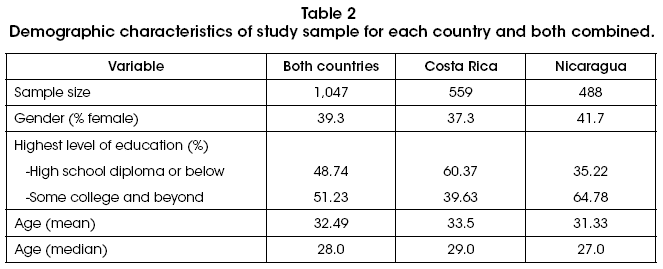
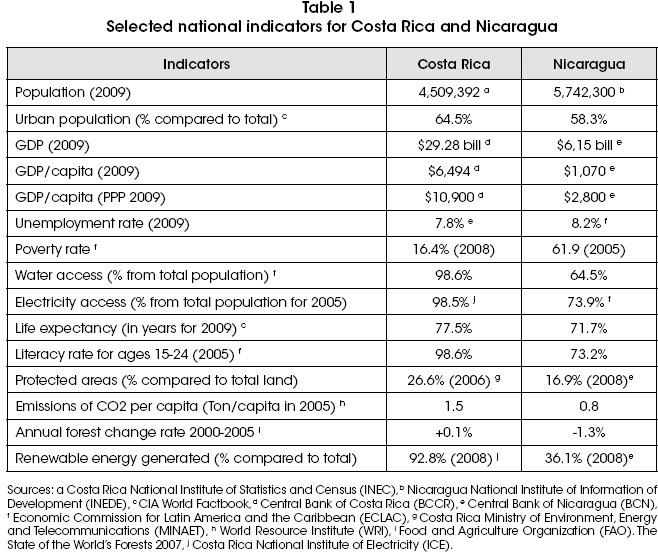
<body><![CDATA[<p align="justify"><font face="Verdana" size="2">Part of the reason why this occurs with global problems such as climate change, is based on the idea that people generally avoid tasks where they believe they cannot succeed. Stated in psychological terms, people sometimes do not act because they perceive that they have little behavioral control over the outcome (Bonniface &amp; Henley, 2008; Bandura, 1986). On the other hand, individuals can take advantage of public goods without contributing sufficiently to their creation, a problem known as the 'free-rider effect'. Given this problem, economists tend to be skeptical of altruistic behavior because selfish individuals can out-compete altruists by taking advantage of their generosity. Such negative effects could be minimized by the creation of opportunities for individual action in multiple areas of daily activity such as transportation, recycling, energy consumption, volunteering, or even paying more for carbon neutral products or carbon taxes. Nevertheless, authors such as Gowdy (2008) argued that successful policies need to consider more than just the rational decision model of individuals, and punishment of free riders is paramount for social cooperation.</font></p>     <p align="justify"><font face="Verdana" size="2"><b>2.2. The situation in Costa Rica and Nicaragua</b></font></p>     <p align="justify"><font face="Verdana" size="2">Climate change is a serious threat globally; however, it is especially dangerous to Central American countries like Costa Rica and Nicaragua that are likely to be hard hit by global climate change in the future. Central America is considered the most vulnerable region in the world (EuropeAid, 2009) due to the geographical location, which is subject to greater frequency and intensity of extreme weather events such as tropical storms. Furthermore, given that Central American countries are located on a strip of land between the Pacific Ocean and the Caribbean Sea, rising sea levels would make these areas highly susceptible to floods. These climate change effects are expected to impact ecosystems, public health, and economic livelihoods. In this regard, Jones and Thornton (2003) predicted a 10% loss in maize production by 2055 in Latin American and African countries due to increased temperature or changing precipitation, resulting in a loss of $2 billion each year. Furthermore, the World Bank (2009) predicts that 77 million people will be highly threatened by climate change in Latin America and the Caribbean by 2020.</font></p>     <p align="justify"><font face="Verdana" size="2">Despite the similarities that Costa Rica and Nicaragua share in terms of expected climate change impacts, both countries differ significantly in their historical socio-political,</font> <font face="Verdana" size="2">economic and institutional models. Since the time of social reformism in the 1940s, Costa Rica implemented a social security system, established a universal education and healthcare system, and abolished the army, allowing it to enjoy an extended period of social and political stability. Economically both countries used to depend mostly on the exportation of agricultural products (i.e., coffee, bananas, sugar cane, tobacco, cotton); however, since the early eighties Costa Rica has implemented a series of neoliberal policies resulting in an economic model that is characterized by a strong participation of non-traditional industries such as ecotourism, high technology, banking services, and others. Today Costa Rica is considered one the oldest democracies in the Americas, with high levels of education and health. In contrast, Nicaragua since its independence over two centuries ago, has been suffering with socioeconomic and political instability, mostly caused by civil wars, military invasions, frequent political turmoil, and natural disasters. After the Sandinista revolution overthrew four-decades of dictatorship, back in 1979, leaders tried to establish a socialist democratic nation; however, it was once again immersed in a civil war during the 1980s. Despite the switch in the early 1990s to a more neoliberal economic model, the emerging political leaders were found implicated in major financial scandals. Today, Sandinista leaders are back in power with a polarized nation and an uncertain future. Such a long history of events has resulted in Nicaragua's standing as the second poorest nation of the Americas after Haiti, with low economic, and social indicators (see <a href="#t1">Table 1</a>).</font></p>     <p align="justify"><a name="t1"></a></p>     <p align="center"><img src="/img/revistas/rlde/n19/a03_table_01.gif" width="658" height="552"></p>     <p align="center">&nbsp;</p>     <p align="justify"><font face="Verdana" size="3"><b>3.   Methodological approach</b></font></p>     <p align="justify"><font face="Verdana" size="2">A written survey was used to collect the information analyzed in this study. Adult respondents in cities were selected randomly by survey-takers in public areas (e.g., city, plazas, markets). Respondents were handed a clipboard with the questionnaire and it was answered individually at their own pace. An informed consent was provided at the beginning of the questionnaire assuring respondents their anonymity and describing how the data was intended to be used in the future. A total of 1,047 surveys were used in the final analysis (44 surveys were discarded due to incomplete information probably due to lack of cooperation or distraction). From October of 2008 until May 2010, data was collected in urban areas of Costa Rica and Nicaragua. A total of 488 questionnaires were collected in Costa Rica, in the cities of San José, Alajuela, Atenas, Heredia and Jacó. In Nicaragua, 559 questionnaires were collected in the cities of Managua, Granada, León, and Masaya. The survey questions addressed the level of familiarity with climate change, major causes and impacts perceived, and entities responsible for addressing the problem. Despite the educational level, other demographic variables were very similar among the groups sampled (see <a href="#t2">Table 2</a>). Once data was coded, it was audited by two other coders to minimize transcription errors. Aided with the statistical software JMP Pro10, I used logistical regressions to assess the level of familiarity between the two countries, controlling for demographic variations; I also performed contingency and other non-parametric analyses.</font></p>     <p align="justify"><a name="t2"></a></p>     ]]></body>
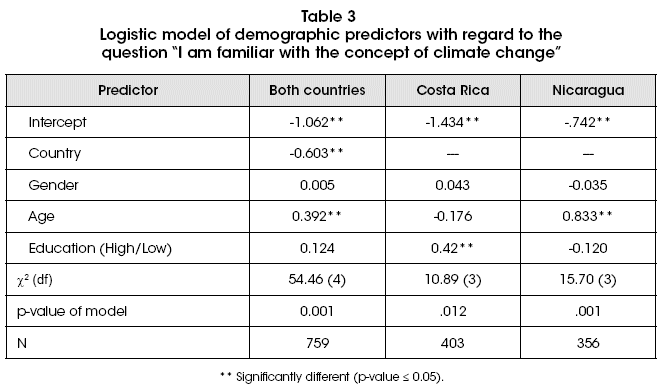
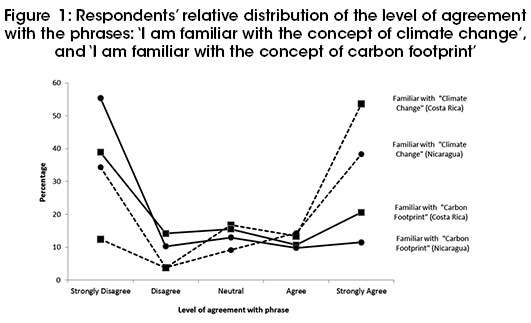
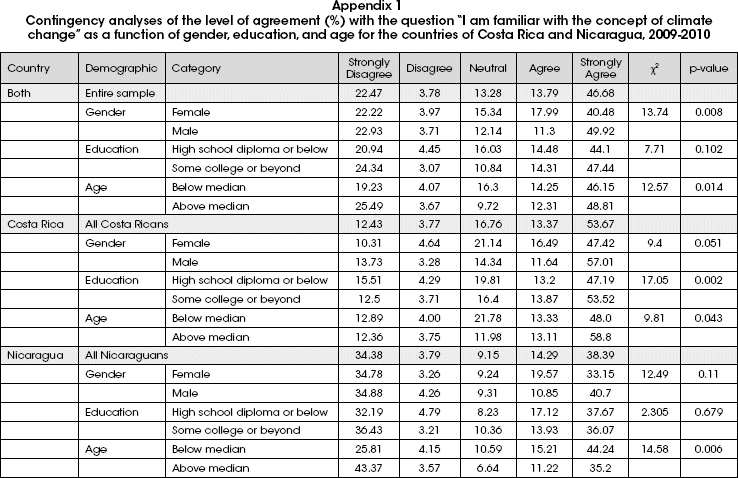
<body><![CDATA[<p align="center"><img src="/img/revistas/rlde/n19/a03_table_02.gif" width="663" height="269"></p>     <p align="center">&nbsp;</p>     <p align="justify"><font face="Verdana" size="3"><b>4.   Results</b></font></p>     <p align="justify"><font face="Verdana" size="2">In general, when urban populations from both countries were compared on their level of 'familiarity with climate change’, there is evidence of a significant difference (</font><font size="2">&chi;</font><font face="Verdana" size="2"><sup>2</sup>= 74.97, df=4, p-value=0.001). About 67% of Costa Ricans were familiar with the term, another 16.76% indicated they were neither familiar nor unfamiliar, and only 16.2% noted that they had low familiarity with the concept of climate change. In the case of Nicaraguans, about 9% declared neither familiar nor unfamiliar, and only about half of total respondents (52.68%) agreed to be familiar with the term. Furthermore, about twice as many Nicaraguans compared to Costa Ricans, indicated lower agreement with the statement &quot;I'm familiar with the concept of climate change&quot;. Specific contingent analysis results for each of the demographic variables could be seen in <a href="#a1">Appendix 1</a>.</font></p>     <p align="justify"><font face="Verdana" size="2">After controlling for several demographic variables, including gender, education and age, it was found that indeed Costa Ricans present higher levels of familiarity with the concept of climate change. As shown in <a href="#t3">Table 3</a>, when running a logistical regression including both countries, the country variable and age show as significant predictors at 95% confidence level. Costa Ricans with higher levels of education showed significantly higher levels of familiarity with the concept of climate change, and in the case of Nicaraguans, there is evidence that older people were more familiar with the concept than younger ones.</font></p>     <p align="justify"><a name="t3"></a></p>     <p align="center"><img src="/img/revistas/rlde/n19/a03_table_03.gif" width="661" height="388"></p>     <p align="justify"><font face="Verdana" size="2">Furthermore, the level of familiarity of respondents with the term 'climate change' was contrasted with the term ‘carbon footprint'. Results reveal that the majority of people from both countries are unfamiliar with the latter concept (see <a href="#f1">Figure 1</a>). It is interesting to note that about 60% of all respondents consider themselves familiar with the term 'climate change'; however, only about 27% consider themselves familiar with the term ‘carbon footprint'. The contingency analysis suggests that the level of familiarity with the term ‘carbon footprint' is significant in both countries (</font><font size="2">&chi;</font><font face="Verdana" size="2"><sup>2</sup>= 29.12, df=4, p-value= .001), with Nicaraguans being less knowledgeable with such term (i.e., 65.7% of Nicaraguans respondents compared with 53.1% of Costa Ricans).</font></p>     <p align="justify"><a name="f1"></a></p>     <p align="center"><img src="/img/revistas/rlde/n19/a03_figure_01.gif" width="531" height="323"></p>     ]]></body>
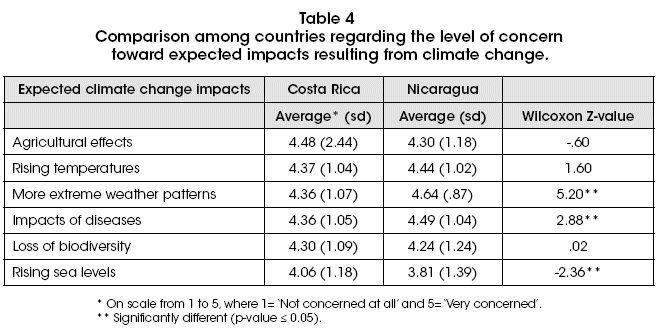
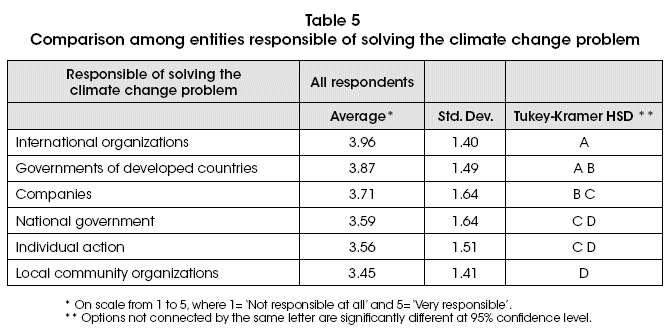
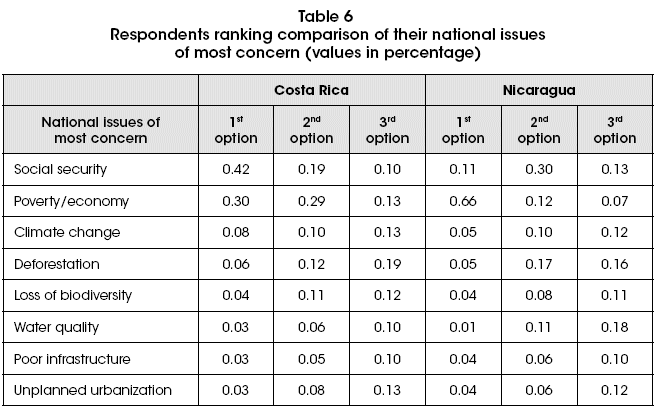
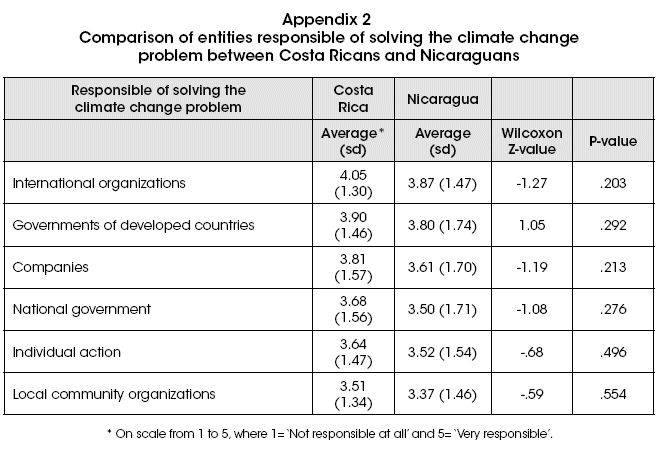
<body><![CDATA[<p align="justify"><font face="Verdana" size="2">In addition, respondents from both countries were compared on their level of concern toward several expected climate change impacts (see <a href="#t4">Table 4</a>). In general all respondents indicated a high level of concern, with scores close to 5 on a 1 to 5 scale, where 1= 'not concerned at all' and 5= 'Very concerned'. The highest level of concern by Costa Ricans was indicated toward potential agricultural impacts but was not significantly different than Nicaraguans (Wilcoxon Z-value= -.60, df=1, p-value= .549). Nicaraguans' highest concern was with more extreme weather patterns (4.64), and significantly higher than Costa Ricans (Wilcoxon Z-value= 5.20, df= 1, p-value= .001). The impact of diseases was also an impact that Nicaraguans were significantly more concerned about than Costa Ricans. For rising sea levels, the opposite was the case because Costa Ricans were more concerned. Rising temperatures in general and the impacts on biodiversity were impacts perceived similarly by respondents from both countries. When respondents were analyzed together, the first four options were rated significantly higher compared to the last two (i.e., loss of biodiversity and rising sea levels).</font></p>     <p align="justify"><a name="t4"></a></p>     <p align="center"><img src="/img/revistas/rlde/n19/a03_table_04.gif" width="660" height="329"></p>     <p align="justify"><font face="Verdana" size="2">Respondents also rated which entities or groups they considered most responsible for solving the problems caused by climate change. As shown in <a href="#a2">Appendix 2</a>, both Costa Ricans and Nicaraguans had similar perspective while considering this issue. Although all options were rated with high levels of responsibility, there is evidence supporting significant differences among them <i>(</i></font><font size="2">&chi;</font><font size="2" face="Verdana"><sup>2</sup><i>= </i>103.68, df= 5, p-value=.001). The Tukey-Kramer post-hoc analysis reveals that in general respondents rated international organizations, governments from developed countries, and companies, as those groups most responsible of finding solutions to solve the problems caused by climate change. These options were rated significantly higher compared to national governments, individual action, or local community organizations (see <a href="#t5">Table 5</a>).</font></p>     <p align="justify"><a name="t5"></a></p>     <p align="center"><img src="/img/revistas/rlde/n19/a03_table_05.gif" width="665" height="333"></p>     <p align="justify"><font face="Verdana" size="2">At the beginning of the questionnaire, respondents were also asked to rank their issues of most concern from their own country. As it is evident in <a href="#t6">Table 6</a>, social security and poverty were by far the national problems of most concern by both countries. Social security ranked as the problem of most concern by 42% of Costa Ricans, followed by 30% that ranked poverty as the problem of most concern. For Nicaraguans, poverty was considered the most pressing issue by <i>66% </i>of respondents, followed by 11% that considered social security as the most important issue. Interestingly enough, these problems were followed by climate change as their issue of most concern, though significantly lower. Climate change was closely followed by other environmentally related problems such deforestation, loss of biodiversity and water quality. Poor infrastructure and unplanned urban development were ranked last. Congruent patterns were found for second and third options.</font></p>     <p align="justify"><a name="t6"></a></p>     <p align="center"><img src="/img/revistas/rlde/n19/a03_table_06.gif" width="657" height="409"></p>     <p align="justify">&nbsp;</p>     ]]></body>
<body><![CDATA[<p align="justify"><font face="Verdana" size="3"><b>5.   Discussion</b></font></p>     <p align="justify"><font face="Verdana" size="2">Central America is considered an area of high risk if climate change continues. Nevertheless, there is little research in this area addressing public perceptions about this problem and its potential consequences. The results presented in this article reveal that indeed urban populations in Costa Rica and Nicaragua self-report to be familiar with the concept of climate change. Nevertheless, in a country by country comparison, results indicate that Costa Ricans are more familiar with climate change, thus, supporting the main hypothesis. There are several reasons why this might be the case. First, Costa Rica has a longer history of environmental legislation that can be traced to the mid-nineteenth century (Evans, 1999), and consolidated in the 1970s with the creation of the national Park system (Boza, 1993; Fournier-Origgi, 1991). At the time of their research, Holl <i>et al. </i>(1995) suggested that Costa Ricans are the &quot;front-runners&quot; in world-wide education concerning biodiversity and conservation. Second, Costa Ricans enjoy a higher environmental education level than Nicaraguans. This is due not only to higher governmental investments in education, but also to the direct connection of biodiversity protection with the economy, particularly the tourism industry, which has promoted the development of environmental education programs and campaigns from multiple non-governmental and private organizations. Third, Costa Rica supports an intensive national and international environmental research network, which allows it to be an active participant in international environmental negotiations. Specific to climate change, Costa Rica has developed a national strategy on climate change, and has been one of the first nations to declare its interest of becoming carbon neutral (ENCC, 2010).</font></p>     <p align="justify"><font face="Verdana" size="2">In addition to the general concept of climate change, respondents were examined on their level of familiarity with the more in-depth term 'carbon footprint'. Although this might be a concept of reasonable awareness by citizens from developed countries, one would not expect this to be the case in Central America. As it was also hypothesized, respondents in general were less familiar the aforementioned concept. Indeed, only about 27% of all respondents considered themselves familiar with the term ‘carbon footprint' and about 60% declared themselves unfamiliar. Although one doesn't have a point to compare with populations from developed countries, one would expect this familiarity to be higher given the potential higher accessibility to information either through formal education or mass media. In the U.S. for example, the Federal Trade Commission has been recently updating its guidelines for the use of environmental marketing claims to add such concepts as ‘carbon footprint' given its wide use in oral and written discourse. Multiple companies, including supermarket chains such as </font><font face="Verdana" size="2">Tesco in the U.K. Are already including labels on their products to inform consumers about the product’s carbon footprint. Unfortunately, and despite the higher interconnectedness among countries through globalization, there are minimal efforts in this direction focused toward citizens from developing economies.</font></p>     <p align="justify"><font face="Verdana" size="2">With regards to the potential impacts caused by climate change, results reveal that respondents from both countries are highly concerned with all impacts evaluated. This is actually encouraging to policy makers given that people might be more likely to follow or comply with national and local designed policies to mitigate and adapt against such negative consequences. Climate change impacts on agriculture were considered by Costa Ricans as their issue of most concern. Although the Costa Rican economy continues to transition from agricultural to a service and industrial economy, thousands of families are still directly dependent of this activity. I believe that given the connection of climate change with weather patterns and the fact that food is a primary human need, the situation makes this impact highly salient to respondents. For Nicaraguans, the climate change impact of highest concern was extreme weather patterns. Although Nicaragua is adjacent to Costa Rica, its limited infrastructure has made this country more vulnerable to tropical storms including devastating category-5 hurricanes such as Mitch in 1998 and Felix in 2007. Furthermore, Nicaraguans considered the impact of diseases as the second most important impact caused by climate change, significantly higher than Costa Ricans. This could be explained by the country's current poor access to health services. In the last produced rank of national health systems by the World Health organization (2000), Nicaragua was ranked 71<sup>st</sup>, significantly lower to Costa Rica or the U.S. ranked 36<sup>th</sup> and 37<sup>th</sup>respectively. It was also interesting to find that despite most predictions which warn about the disastrous impacts of sea level rise; this impact was rated last and significantly lower compared to all other impacts except for biodiversity loss, which was also rated as least important. These findings suggest that education or information diffusion among urban populations still has important challenges.</font></p>     <p align="justify"><font face="Verdana" size="2">According to Mitchell and Hulme (2000), countries such as Costa Rica and Nicaragua have much at stake with climate change. Costa Rica’s vulnerability sits at US$ 1,900 <i>per capita </i>per degree of warming and Nicaragua’s vulnerability is US$ 700 <i>per capita </i>per degree of warming; this represents approximately 17.5 and 25% of their national GDP per capita respectively. Despite this magnitude, climate change is still a low national concern by respondents from both countries which ranked it third and significantly lower compared to poverty and social security. Two thirds of Nicaraguans indicated poverty as their issue of</font> <font face="Verdana" size="2">most concern which is attributed to low <i>per capita </i>income and the fact that close to 50% of the population suffers from underemployment. In the case of Costa Rica, social security was ranked as the number one issue of concern which is actually consistent with results from the last national public surveys on public opinion (2009 and 2010) in which social security was ranked as the number one issue of most concern, even above the economy (poverty). While both governments contend with massive national debt (42 and 63% of Costa Rica and Nicaragua's GDP in 2009 according to the CIA World Factbook), the debt has differentially influenced government spending habits. Over time, spending on social programs has decreased in Costa Rica in order to reduce sustained high debt (Myers, 2001), while the Nicaraguan government has never invested as much in their social programs. Consequently, Costa Rican citizens maybe more alarmed by such cutbacks, and thus perceive these changes as a more pressing issue. Despite the undertakings to engage local companies and governmental agencies into the goal of becoming carbon neutral by 2021, Costa Rica's most significant financing sources will hopefully come from international negotiations such as REDD+ or debt-for-nature swaps. This is congruent with the views of those surveyed, which indicated that international organizations, governments from developed countries, and companies are those most responsible of the solutions of climate change impacts.</font></p>     <p align="justify">&nbsp;</p>     <p align="justify"><font face="Verdana" size="3"><b>6.   Conclusions</b></font></p>     <p align="justify"><font face="Verdana" size="2">The data analyzed provides support that urban Costa Ricans are more familiar with the concepts of &quot;climate change&quot; and &quot;carbon footprint&quot; compared to their counter parts in Nicaragua; although &quot;carbon footprint&quot; was foreign to the majority of respondents. It should be kept in mind, however, that even in developed nations where environmental-issue awareness is generally highest, climate change awareness is neither ubiquitous nor uncontested (Browne 2004; Leiserowitz, Smith &amp; Marlon, 2010). Furthermore, I concluded that in both countries social issues were prioritized over climate change concerns. While Costa Rica has a more progressive socioeconomic and environmental history than Nicaragua, both are in need of more climate change awareness, especially since the political and economic resources of these developing nations may not be adequate for the impending hardships climate change is likely to cause. Despite the efforts that both countries could make to address the impacts of climate change, national policies should depart from a public understanding of this problem and its complexities. This paper provides a contribution in this direction. Future investigation</font> <font face="Verdana" size="2">should aim to assess the individuals' attitudinal and behavioral aspects regarding self-efficacy or social norms in order to more suitably inform mitigation and adaptation policy strategies.</font></p>     <p align="justify">&nbsp;</p>     <p align="justify"><font face="Verdana" size="3"><b>7.   Acknowledgments</b></font></p>     ]]></body>
<body><![CDATA[<p align="justify"><font face="Verdana" size="2">I would like to thank all the school for field studies (SFS) Center for Sustainable Development Studies students from fall 2008 to spring 2010 who collaborated in the data collection process. I would further like to thank Amara Lauren, Rosy Cohane-Mann and the anonymous reviewers for their insightful comments and also proofreading the manuscript. I gratefully acknowledge the key financial and logistical support provided by The school for field studies (SFS) Center for Sustainable Development Studies in Atenas, Costa Rica.</font></p>     <p align="justify">&nbsp;</p>     <p align="right"><font face="Verdana" size="2"><i><b>Artículo recibido:</b> 29 de octubre de 2012 </i></font></p>     <p align="right"><font face="Verdana" size="2"><i><b>Aceptado:</b> 30 de enero de 2013</i></font></p>     <p><font size="3"><b><font face="Verdana, Arial, Helvetica, sans-serif">Notas</font></b></font></p>     <p align="justify"><font face="Verdana" size="2">* Resident Professor of Environmental Economics and Policy. The School for Field Studies, Center for Sustainable Development Studies. Apartado 150-4013 Atenas. Alajuela, Costa Rica. + (506) 2446 6960 Ext. 105. Contact: <a href="mailto:smolina@fieldstudies.org">smolina@fieldstudies.org</a></font></p>     <p align="left">&nbsp;</p>     <p align="left"><font face="Verdana" size="3"><b>References</b></font></p>     <!-- ref --><p align="justify"><font face="Verdana" size="2">1. Ajzen, I. (1991). The theory of planned behavior. <i>Organizational Behavior and Human Decision Processes, </i>50,179-211.</font>&nbsp;&nbsp;&nbsp;&nbsp;&nbsp;&nbsp;&nbsp;&nbsp;[&#160;<a href="javascript:void(0);" onclick="javascript: window.open('/scielo.php?script=sci_nlinks&ref=517953&pid=S2074-4706201300010000300001&lng=','','width=640,height=500,resizable=yes,scrollbars=1,menubar=yes,');">Links</a>&#160;]<!-- end-ref --><!-- ref --><p align="justify"><font face="Verdana" size="2">2. Bandura, A. (1986). Social foundations of thought and action: a social cognitive theory. Englewood Cliffs, N.J., Prentice-Hall.</font>&nbsp;&nbsp;&nbsp;&nbsp;&nbsp;&nbsp;&nbsp;&nbsp;[&#160;<a href="javascript:void(0);" onclick="javascript: window.open('/scielo.php?script=sci_nlinks&ref=517954&pid=S2074-4706201300010000300002&lng=','','width=640,height=500,resizable=yes,scrollbars=1,menubar=yes,');">Links</a>&#160;]<!-- end-ref --><p align="justify"><font face="Verdana" size="2">3. Bonniface, I. And Henley, N. (2008). A drop in the bucket: Collective efficacy perceptions and environmental behavior. <i>Australian Journal of Social Issues, </i>43(3), 345-360.</font></p>     <p align="justify"><font face="Verdana" size="2">4. Bord, R.J., O'Connor, R.E. and Fischer, A. (1998). Public Perceptions of Global Warming: United States and International Perspectives. <i>Climate Research, </i>11,75-84.</font></p>     <!-- ref --><p align="justify"><font face="Verdana" size="2">5. ------- (2000). In what sense does the public need to understand global climate</font> <font face="Verdana" size="2">change? <i>Public Understanding of Science, </i>9(3), 205-218.</font>&nbsp;&nbsp;&nbsp;&nbsp;&nbsp;&nbsp;&nbsp;&nbsp;[&#160;<a href="javascript:void(0);" onclick="javascript: window.open('/scielo.php?script=sci_nlinks&ref=517957&pid=S2074-4706201300010000300005&lng=','','width=640,height=500,resizable=yes,scrollbars=1,menubar=yes,');">Links</a>&#160;]<!-- end-ref --><p align="justify"><font face="Verdana" size="2">6. Bostrom, A., Granger, M., Fischhoff, B. and Read, D. (1994). What Do People Know About climate change?. <i>Risk Analysis, </i>14(6), 959-970.</font></p>     <!-- ref --><p align="justify"><font face="Verdana" size="2">7. Boza, M. (1993). Conservation in action: Past, present, and future of the national parks system in Costa Rica, <i>Conservation Biology, </i>7(2), 239-47.</font>&nbsp;&nbsp;&nbsp;&nbsp;&nbsp;&nbsp;&nbsp;&nbsp;[&#160;<a href="javascript:void(0);" onclick="javascript: window.open('/scielo.php?script=sci_nlinks&ref=517959&pid=S2074-4706201300010000300007&lng=','','width=640,height=500,resizable=yes,scrollbars=1,menubar=yes,');">Links</a>&#160;]<!-- end-ref --><!-- ref --><p align="justify"><font face="Verdana" size="2">8. Browne, J. (2004). Beyond Kyoto. <i>Foreign Affairs, </i>83(4), 20-32.</font>&nbsp;&nbsp;&nbsp;&nbsp;&nbsp;&nbsp;&nbsp;&nbsp;[&#160;<a href="javascript:void(0);" onclick="javascript: window.open('/scielo.php?script=sci_nlinks&ref=517960&pid=S2074-4706201300010000300008&lng=','','width=640,height=500,resizable=yes,scrollbars=1,menubar=yes,');">Links</a>&#160;]<!-- end-ref --><!-- ref --><p align="justify"><font face="Verdana" size="2">9. Charveriat, C. (2000). Natural Disasters in Latin America and the Caribbean: An overview of risk. Inter-American Development Bank working paper #434. Available at: <A href=http://www.iadb.org/res/publications/pubfiles/pubWP-434.pdf target="_blank">http://www.iadb.org/res/publications/pubfiles/pubWP-434.pdf</A></font>&nbsp;&nbsp;&nbsp;&nbsp;&nbsp;&nbsp;&nbsp;&nbsp;[&#160;<a href="javascript:void(0);" onclick="javascript: window.open('/scielo.php?script=sci_nlinks&ref=517961&pid=S2074-4706201300010000300009&lng=','','width=640,height=500,resizable=yes,scrollbars=1,menubar=yes,');">Links</a>&#160;]<!-- end-ref --><!-- ref --><p align="justify"><font face="Verdana" size="2">10. ENCC. (2010). Costa Rica's national strategy on climate change Homepage. Available at: <a href="http://www.encc.go.cr" target="_blank">www.encc.go.cr</a>.</font>&nbsp;&nbsp;&nbsp;&nbsp;&nbsp;&nbsp;&nbsp;&nbsp;[&#160;<a href="javascript:void(0);" onclick="javascript: window.open('/scielo.php?script=sci_nlinks&ref=517962&pid=S2074-4706201300010000300010&lng=','','width=640,height=500,resizable=yes,scrollbars=1,menubar=yes,');">Links</a>&#160;]<!-- end-ref --><!-- ref --><p align="justify"><font face="Verdana" size="2">11. EuropeAid. (2009). Climate change in Latin America. AGRIFOR Consult Group. </font><font face="Verdana" size="2"><a href="http://ec.europa.eu/europeaid/where/latin-america/regional-cooperation/documents/climate_change_in_latin_america_en.pdf" target="_blank">http://ec.europa.eu/europeaid/where/latin-america/regional-cooperation/documents/climate_change_in_latin_america_en.pdf</a></font>&nbsp;&nbsp;&nbsp;&nbsp;&nbsp;&nbsp;&nbsp;&nbsp;[&#160;<a href="javascript:void(0);" onclick="javascript: window.open('/scielo.php?script=sci_nlinks&ref=517963&pid=S2074-4706201300010000300011&lng=','','width=640,height=500,resizable=yes,scrollbars=1,menubar=yes,');">Links</a>&#160;]<!-- end-ref --><!-- ref --><p align="justify"><font face="Verdana" size="2">12. Evans, S. (1999). The Green Republic: A conservation History of Costa Rica. Austin, Texas: University of Texas Press.</font>&nbsp;&nbsp;&nbsp;&nbsp;&nbsp;&nbsp;&nbsp;&nbsp;[&#160;<a href="javascript:void(0);" onclick="javascript: window.open('/scielo.php?script=sci_nlinks&ref=517964&pid=S2074-4706201300010000300012&lng=','','width=640,height=500,resizable=yes,scrollbars=1,menubar=yes,');">Links</a>&#160;]<!-- end-ref --><!-- ref --><p align="justify"><font face="Verdana" size="2">13. Fournier-Origgi, L. (1991). Desarrollo y perspectivas del movimiento conservacionista costarricense. San Jose, Costa Rica. University of Costa Rica.</font>&nbsp;&nbsp;&nbsp;&nbsp;&nbsp;&nbsp;&nbsp;&nbsp;[&#160;<a href="javascript:void(0);" onclick="javascript: window.open('/scielo.php?script=sci_nlinks&ref=517965&pid=S2074-4706201300010000300013&lng=','','width=640,height=500,resizable=yes,scrollbars=1,menubar=yes,');">Links</a>&#160;]<!-- end-ref --><!-- ref --><p align="justify"><font face="Verdana" size="2">14.</font><font face="Verdana" size="2"></font><font face="Verdana" size="2"> Gifford, R. (2011). The dragons of inaction: Psychological barriers that limit climate change mitigation and adaptation. <i>American Psychologist, </i>66(4), 290-302.</font>&nbsp;&nbsp;&nbsp;&nbsp;&nbsp;&nbsp;&nbsp;&nbsp;[&#160;<a href="javascript:void(0);" onclick="javascript: window.open('/scielo.php?script=sci_nlinks&ref=517966&pid=S2074-4706201300010000300014&lng=','','width=640,height=500,resizable=yes,scrollbars=1,menubar=yes,');">Links</a>&#160;]<!-- end-ref --><!-- ref --><p align="justify"><font face="Verdana" size="2">15.</font><font face="Verdana" size="2"></font><font face="Verdana" size="2"> Gowdy, J.M. (2008). Behavioral economics and climate change policy. <i>Journal of Economic Behavior and Organization, </i>68,632-644.</font>&nbsp;&nbsp;&nbsp;&nbsp;&nbsp;&nbsp;&nbsp;&nbsp;[&#160;<a href="javascript:void(0);" onclick="javascript: window.open('/scielo.php?script=sci_nlinks&ref=517967&pid=S2074-4706201300010000300015&lng=','','width=640,height=500,resizable=yes,scrollbars=1,menubar=yes,');">Links</a>&#160;]<!-- end-ref --><p align="justify"><font face="Verdana" size="2">16. Hahn, R.W. and Stavins R.N. (1991). Economic incentives for environmental protection: integrating theory and practice. <i>CSIA Discussion Paper 91-15.</i></font></p>     <!-- ref --><p align="justify"><font face="Verdana" size="2">17. Hardin,G. (1968). The tragedy of the commons. <i>Science, </i>162(3859), 1243-1248.</font>&nbsp;&nbsp;&nbsp;&nbsp;&nbsp;&nbsp;&nbsp;&nbsp;[&#160;<a href="javascript:void(0);" onclick="javascript: window.open('/scielo.php?script=sci_nlinks&ref=517969&pid=S2074-4706201300010000300017&lng=','','width=640,height=500,resizable=yes,scrollbars=1,menubar=yes,');">Links</a>&#160;]<!-- end-ref --><p align="justify"><font face="Verdana" size="2">18. Holl, K.D., Daily,G.D., and Ehrlich, P.R. 1995. Knowledge and perceptions in Costa Rica regarding environment, population, and biodiversity. <i>Conservation Biology, </i>9(6), 1548-1558.</font></p>     <!-- ref --><p align="justify"><font face="Verdana" size="2">19. Intergovernmental Panel on Climate Change [IPCC] (2007). The Fourth Assessment Report (AR4): Climate Change 2007. <a href="http://www.ipcc.ch/ipccreports/assessmentsreports.htm" target="_blank">www.ipcc.ch/ipccreports/assessmentsreports.htm</a>.</font>&nbsp;&nbsp;&nbsp;&nbsp;&nbsp;&nbsp;&nbsp;&nbsp;[&#160;<a href="javascript:void(0);" onclick="javascript: window.open('/scielo.php?script=sci_nlinks&ref=517971&pid=S2074-4706201300010000300019&lng=','','width=640,height=500,resizable=yes,scrollbars=1,menubar=yes,');">Links</a>&#160;]<!-- end-ref --><p align="justify"><font face="Verdana" size="2">20. Johnson, D. and Levin, S. (2009). The tragedy of cognition: psychological biases and environmental inaction. <i>Current Science, </i>97(11), 1593-1603.</font></p>     <p align="justify"><font face="Verdana" size="2">21. Jones, P.G. and Thornton, P.K. (2003). The potential impacts of climate change on maize production in Africa and Latin America in 2055. <i>Global Environmental Change,</i></font> <font face="Verdana" size="2">13(1), 51-59.</font></p>     <!-- ref --><p align="justify"><font face="Verdana" size="2">22. Kempton,W. (1 99 1). Lay perspectives on global climate change. <i>Global Environmental Change, </i>1(3), 183-208.</font>&nbsp;&nbsp;&nbsp;&nbsp;&nbsp;&nbsp;&nbsp;&nbsp;[&#160;<a href="javascript:void(0);" onclick="javascript: window.open('/scielo.php?script=sci_nlinks&ref=517974&pid=S2074-4706201300010000300022&lng=','','width=640,height=500,resizable=yes,scrollbars=1,menubar=yes,');">Links</a>&#160;]<!-- end-ref --><!-- ref --><p align="justify"><font face="Verdana" size="2">23. Leiserowitz, A. (2005). American risk perceptions: is climate change dangerous? <i>Risk Analysis, </i>25(6), 1433-1442.</font>&nbsp;&nbsp;&nbsp;&nbsp;&nbsp;&nbsp;&nbsp;&nbsp;[&#160;<a href="javascript:void(0);" onclick="javascript: window.open('/scielo.php?script=sci_nlinks&ref=517975&pid=S2074-4706201300010000300023&lng=','','width=640,height=500,resizable=yes,scrollbars=1,menubar=yes,');">Links</a>&#160;]<!-- end-ref --><!-- ref --><p align="justify"><font face="Verdana" size="2">24. --------(2006). Climate change risk perception and policy preferences: The role of</font> <font face="Verdana" size="2">affect, imagery and values. <i>Climatic Change, </i>77,45-72</font>&nbsp;&nbsp;&nbsp;&nbsp;&nbsp;&nbsp;&nbsp;&nbsp;[&#160;<a href="javascript:void(0);" onclick="javascript: window.open('/scielo.php?script=sci_nlinks&ref=517976&pid=S2074-4706201300010000300024&lng=','','width=640,height=500,resizable=yes,scrollbars=1,menubar=yes,');">Links</a>&#160;]<!-- end-ref --><p align="justify"><font face="Verdana" size="2">25. Leiserowitz, A., Smith, N. and Marlon, J.R.  (2010). Americans' Knowledge of climate change. Yale university .New Haven, CT: Yale Project on climate change  communication. <a href="http://environment.yale.edu/climate/files/climatechangeKnowledge2010.pdf" target="_blank">http://environment.yale.edu/climate/files/climatechangeKnowledge2010.pdf</a></font></p>     <p align="justify"><font face="Verdana" size="2">26. Lindenberg, S. and Steg, L. (2007). Normative, gain and hedonic goal frames guiding environmental behavior. <i>Journal of Social Issues, </i>63 (1), 117-137.</font></p>     <!-- ref --><p align="justify"><font face="Verdana" size="2">27. Maddison, D. (2007). The perception of and adaptation to climate change in Africa. World Bank Policy research Working Paper, The World Bank.</font>&nbsp;&nbsp;&nbsp;&nbsp;&nbsp;&nbsp;&nbsp;&nbsp;[&#160;<a href="javascript:void(0);" onclick="javascript: window.open('/scielo.php?script=sci_nlinks&ref=517979&pid=S2074-4706201300010000300027&lng=','','width=640,height=500,resizable=yes,scrollbars=1,menubar=yes,');">Links</a>&#160;]<!-- end-ref --><p align="justify"><font face="Verdana" size="2">28. Mitchell, T D., and Hulme, M. (2000). A country-by-country analysis of past and future warming rates. Tyndall centre for climate change research. Working Paper no. 1. Norwich,U.K.,Available at: <a href="http://www.cru.uea.ac.uk/~timm/papers/tyn-wp1.pdf" target="_blank">http://www.cru.uea.ac.uk/~timm/papers/tyn-wp1.pdf</a></a></font></p>     <!-- ref --><p align="justify"><font face="Verdana" size="2">29. Myers, M.C. (2001). Economic development policy and the protected areas system in Costa Rica: A historical review and prospects for the future. <i>Vida Silvestre Neotropical, </i>10(1-2),3-19.</font>&nbsp;&nbsp;&nbsp;&nbsp;&nbsp;&nbsp;&nbsp;&nbsp;[&#160;<a href="javascript:void(0);" onclick="javascript: window.open('/scielo.php?script=sci_nlinks&ref=517981&pid=S2074-4706201300010000300029&lng=','','width=640,height=500,resizable=yes,scrollbars=1,menubar=yes,');">Links</a>&#160;]<!-- end-ref --><!-- ref --><p align="justify"><font face="Verdana" size="2">30. O'Connor, R. E., Bord, R. J., Fisher, A. (1999). Risk perceptions, general environmental beliefs, and willingness to address climate change. <i>Risk Analysis, </i>19(3), 461-471.</font>&nbsp;&nbsp;&nbsp;&nbsp;&nbsp;&nbsp;&nbsp;&nbsp;[&#160;<a href="javascript:void(0);" onclick="javascript: window.open('/scielo.php?script=sci_nlinks&ref=517982&pid=S2074-4706201300010000300030&lng=','','width=640,height=500,resizable=yes,scrollbars=1,menubar=yes,');">Links</a>&#160;]<!-- end-ref --><!-- ref --><p align="justify"><font face="Verdana" size="2">31. Prochaska J.O., Velicer, W.F. (1997). The transtheoretical model of health behavior change. <i>American Journal of Health Promotion, </i>12,38-48.</font>&nbsp;&nbsp;&nbsp;&nbsp;&nbsp;&nbsp;&nbsp;&nbsp;[&#160;<a href="javascript:void(0);" onclick="javascript: window.open('/scielo.php?script=sci_nlinks&ref=517983&pid=S2074-4706201300010000300031&lng=','','width=640,height=500,resizable=yes,scrollbars=1,menubar=yes,');">Links</a>&#160;]<!-- end-ref --><p align="justify"><font face="Verdana" size="2">32. S</font><font face="Verdana" size="2">emenza, J.C., Hall, D.E., Wilson, D.J., Bontempo, B.D., Sailor, D.J. and George, L.A. (2008). Public perception of climate change: Voluntary mitigation and barriers to behavior change. <i>American Journal of Preventive Medicine, </i>35(5), 479-487.</font></p>     ]]></body>
<body><![CDATA[<!-- ref --><p align="justify"><font face="Verdana" size="2">33. Stern, N. (2007). The economics of climate change. <i>New England Journal of Public Policy, </i>21 (2), 23-50.</font>&nbsp;&nbsp;&nbsp;&nbsp;&nbsp;&nbsp;&nbsp;&nbsp;[&#160;<a href="javascript:void(0);" onclick="javascript: window.open('/scielo.php?script=sci_nlinks&ref=517985&pid=S2074-4706201300010000300033&lng=','','width=640,height=500,resizable=yes,scrollbars=1,menubar=yes,');">Links</a>&#160;]<!-- end-ref --><!-- ref --><p align="justify"><font face="Verdana" size="2">34. World Bank. (2009). World Development report 2010: Development and climate change. Available at <a href="http://www.wb.org/wdr2010" target="_blank">www.wb.org/wdr2010</a></font>&nbsp;&nbsp;&nbsp;&nbsp;&nbsp;&nbsp;&nbsp;&nbsp;[&#160;<a href="javascript:void(0);" onclick="javascript: window.open('/scielo.php?script=sci_nlinks&ref=517986&pid=S2074-4706201300010000300034&lng=','','width=640,height=500,resizable=yes,scrollbars=1,menubar=yes,');">Links</a>&#160;]<!-- end-ref --><!-- ref --><p align="justify"><font face="Verdana" size="2">35. World Health Organization [WHO] (2000). The World Health Report 2000 - Health systems: improving performance. Available at: <a href="http://www.who.int/whr/2000/en/index.htm" target="_blank">http://www.who.int/whr/2000/en/index.htm</a></font>&nbsp;&nbsp;&nbsp;&nbsp;&nbsp;&nbsp;&nbsp;&nbsp;[&#160;<a href="javascript:void(0);" onclick="javascript: window.open('/scielo.php?script=sci_nlinks&ref=517987&pid=S2074-4706201300010000300035&lng=','','width=640,height=500,resizable=yes,scrollbars=1,menubar=yes,');">Links</a>&#160;]<!-- end-ref --><p align="justify">&nbsp;</p>     <p align="justify"><font face="Verdana" size="3"><b>Appendices</b></font></p>     <p align="justify"><a name="a1"></a></p>     <p align="center"><img src="/img/revistas/rlde/n19/a03_app_01.gif" width="738" height="478"></p>     <p align="center">&nbsp;</p>     <p align="center"><a name="a2"></a></p>     <p align="center"><img src="/img/revistas/rlde/n19/a03_app_02.gif" width="661" height="455"></p>     ]]></body>
<body><![CDATA[<p align="center">&nbsp;</p>      ]]></body><back>
<ref-list>
<ref id="B1">
<label>1</label><nlm-citation citation-type="journal">
<person-group person-group-type="author">
<name>
<surname><![CDATA[Ajzen]]></surname>
<given-names><![CDATA[I.]]></given-names>
</name>
</person-group>
<article-title xml:lang="en"><![CDATA[The theory of planned behavior]]></article-title>
<source><![CDATA[Organizational Behavior and Human Decision Processes]]></source>
<year>1991</year>
<numero>50</numero>
<issue>50</issue>
<page-range>179-211</page-range></nlm-citation>
</ref>
<ref id="B2">
<label>2</label><nlm-citation citation-type="book">
<person-group person-group-type="author">
<name>
<surname><![CDATA[Bandura]]></surname>
<given-names><![CDATA[A.]]></given-names>
</name>
</person-group>
<source><![CDATA[Social foundations of thought and action: a social cognitive theory]]></source>
<year>1986</year>
<publisher-loc><![CDATA[Englewood Cliffs^eN.J. N.J.]]></publisher-loc>
<publisher-name><![CDATA[Prentice-Hall]]></publisher-name>
</nlm-citation>
</ref>
<ref id="B3">
<label>3</label><nlm-citation citation-type="journal">
<person-group person-group-type="author">
<name>
<surname><![CDATA[Bonniface]]></surname>
<given-names><![CDATA[I.]]></given-names>
</name>
<name>
<surname><![CDATA[Henley]]></surname>
<given-names><![CDATA[N.]]></given-names>
</name>
</person-group>
<article-title xml:lang="en"><![CDATA[A drop in the bucket: Collective efficacy perceptions and environmental behavior]]></article-title>
<source><![CDATA[Australian Journal of Social Issues]]></source>
<year>2008</year>
<volume>43</volume>
<numero>3</numero>
<issue>3</issue>
<page-range>345-360</page-range></nlm-citation>
</ref>
<ref id="B4">
<label>4</label><nlm-citation citation-type="journal">
<person-group person-group-type="author">
<name>
<surname><![CDATA[Bord]]></surname>
<given-names><![CDATA[R.J.]]></given-names>
</name>
<name>
<surname><![CDATA[O'Connor]]></surname>
<given-names><![CDATA[R.E.]]></given-names>
</name>
<name>
<surname><![CDATA[Fischer]]></surname>
<given-names><![CDATA[A.]]></given-names>
</name>
</person-group>
<article-title xml:lang="en"><![CDATA[Public Perceptions of Global Warming: United States and International Perspectives]]></article-title>
<source><![CDATA[Climate Research]]></source>
<year>1998</year>
<numero>11</numero>
<issue>11</issue>
<page-range>75-84</page-range></nlm-citation>
</ref>
<ref id="B5">
<label>5</label><nlm-citation citation-type="journal">
<person-group person-group-type="author">
<name>
<surname><![CDATA[Bord]]></surname>
<given-names><![CDATA[R.J.]]></given-names>
</name>
</person-group>
<article-title xml:lang="en"><![CDATA[In what sense does the public need to understand global climate change?]]></article-title>
<source><![CDATA[Public Understanding of Science]]></source>
<year>2000</year>
<volume>9</volume>
<numero>3</numero>
<issue>3</issue>
<page-range>205-218</page-range></nlm-citation>
</ref>
<ref id="B6">
<label>6</label><nlm-citation citation-type="journal">
<person-group person-group-type="author">
<name>
<surname><![CDATA[Bostrom]]></surname>
<given-names><![CDATA[A.]]></given-names>
</name>
<name>
<surname><![CDATA[Granger]]></surname>
<given-names><![CDATA[M.]]></given-names>
</name>
<name>
<surname><![CDATA[Fischhoff]]></surname>
<given-names><![CDATA[B.]]></given-names>
</name>
<name>
<surname><![CDATA[Read]]></surname>
<given-names><![CDATA[D.]]></given-names>
</name>
</person-group>
<article-title xml:lang="en"><![CDATA[What Do People Know About climate change?]]></article-title>
<source><![CDATA[Risk Analysis]]></source>
<year>1994</year>
<volume>14</volume>
<numero>6</numero>
<issue>6</issue>
<page-range>959-970</page-range></nlm-citation>
</ref>
<ref id="B7">
<label>7</label><nlm-citation citation-type="journal">
<person-group person-group-type="author">
<name>
<surname><![CDATA[Boza]]></surname>
<given-names><![CDATA[M.]]></given-names>
</name>
</person-group>
<article-title xml:lang="en"><![CDATA[Conservation in action: Past, present, and future of the national parks system in Costa Rica]]></article-title>
<source><![CDATA[Conservation Biology]]></source>
<year>1993</year>
<volume>7</volume>
<numero>2</numero>
<issue>2</issue>
<page-range>239-47</page-range></nlm-citation>
</ref>
<ref id="B8">
<label>8</label><nlm-citation citation-type="journal">
<person-group person-group-type="author">
<name>
<surname><![CDATA[Browne]]></surname>
<given-names><![CDATA[J.]]></given-names>
</name>
</person-group>
<article-title xml:lang="en"><![CDATA[Beyond Kyoto]]></article-title>
<source><![CDATA[Foreign Affairs]]></source>
<year>2004</year>
<volume>83</volume>
<numero>4</numero>
<issue>4</issue>
<page-range>20-32</page-range></nlm-citation>
</ref>
<ref id="B9">
<label>9</label><nlm-citation citation-type="journal">
<person-group person-group-type="author">
<name>
<surname><![CDATA[Charveriat]]></surname>
<given-names><![CDATA[C.]]></given-names>
</name>
</person-group>
<article-title xml:lang="en"><![CDATA[Natural Disasters in Latin America and the Caribbean: An overview of risk]]></article-title>
<source><![CDATA[Inter-American Development Bank working paper]]></source>
<year>2000</year>
<numero>434</numero>
<issue>434</issue>
</nlm-citation>
</ref>
<ref id="B10">
<label>10</label><nlm-citation citation-type="">
<collab>ENCC</collab>
<source><![CDATA[Costa Rica's national strategy on climate change Homepage]]></source>
<year>2010</year>
</nlm-citation>
</ref>
<ref id="B11">
<label>11</label><nlm-citation citation-type="book">
<collab>EuropeAid</collab>
<source><![CDATA[Climate change in Latin America]]></source>
<year>2009</year>
<publisher-name><![CDATA[AGRIFOR Consult Group.]]></publisher-name>
</nlm-citation>
</ref>
<ref id="B12">
<label>12</label><nlm-citation citation-type="book">
<person-group person-group-type="author">
<name>
<surname><![CDATA[Evans]]></surname>
<given-names><![CDATA[S.]]></given-names>
</name>
</person-group>
<source><![CDATA[The Green Republic: A conservation History of Costa Rica]]></source>
<year>1999</year>
<publisher-loc><![CDATA[Austin^eTexas Texas]]></publisher-loc>
<publisher-name><![CDATA[University of Texas Press]]></publisher-name>
</nlm-citation>
</ref>
<ref id="B13">
<label>13</label><nlm-citation citation-type="book">
<person-group person-group-type="author">
<name>
<surname><![CDATA[Fournier-Origgi]]></surname>
<given-names><![CDATA[L.]]></given-names>
</name>
</person-group>
<source><![CDATA[Desarrollo y perspectivas del movimiento conservacionista costarricense]]></source>
<year>1991</year>
<publisher-loc><![CDATA[San Jose ]]></publisher-loc>
<publisher-name><![CDATA[University of Costa Rica]]></publisher-name>
</nlm-citation>
</ref>
<ref id="B14">
<label>14</label><nlm-citation citation-type="journal">
<person-group person-group-type="author">
<name>
<surname><![CDATA[Gifford]]></surname>
<given-names><![CDATA[R.]]></given-names>
</name>
</person-group>
<article-title xml:lang="en"><![CDATA[The dragons of inaction: Psychological barriers that limit climate change mitigation and adaptation]]></article-title>
<source><![CDATA[American Psychologist]]></source>
<year>2011</year>
<volume>66</volume>
<numero>4</numero>
<issue>4</issue>
<page-range>290-302</page-range></nlm-citation>
</ref>
<ref id="B15">
<label>15</label><nlm-citation citation-type="journal">
<person-group person-group-type="author">
<name>
<surname><![CDATA[Gowdy]]></surname>
<given-names><![CDATA[J.M.]]></given-names>
</name>
</person-group>
<article-title xml:lang="en"><![CDATA[Behavioral economics and climate change policy]]></article-title>
<source><![CDATA[Journal of Economic Behavior and Organization]]></source>
<year>2008</year>
<numero>68</numero>
<issue>68</issue>
<page-range>632-644</page-range></nlm-citation>
</ref>
<ref id="B16">
<label>16</label><nlm-citation citation-type="journal">
<person-group person-group-type="author">
<name>
<surname><![CDATA[Hahn]]></surname>
<given-names><![CDATA[R.W.]]></given-names>
</name>
<name>
<surname><![CDATA[Stavins]]></surname>
<given-names><![CDATA[R.N.]]></given-names>
</name>
</person-group>
<article-title xml:lang="en"><![CDATA[Economic incentives for environmental protection: integrating theory and practice]]></article-title>
<source><![CDATA[CSIA Discussion Paper]]></source>
<year>1991</year>
<numero>91</numero>
<issue>91</issue>
<page-range>15</page-range></nlm-citation>
</ref>
<ref id="B17">
<label>17</label><nlm-citation citation-type="journal">
<person-group person-group-type="author">
<name>
<surname><![CDATA[Hardin]]></surname>
<given-names><![CDATA[G.]]></given-names>
</name>
</person-group>
<article-title xml:lang="en"><![CDATA[The tragedy of the commons]]></article-title>
<source><![CDATA[Science]]></source>
<year>1968</year>
<volume>162</volume>
<numero>3859</numero>
<issue>3859</issue>
<page-range>1243-1248</page-range></nlm-citation>
</ref>
<ref id="B18">
<label>18</label><nlm-citation citation-type="journal">
<person-group person-group-type="author">
<name>
<surname><![CDATA[Holl]]></surname>
<given-names><![CDATA[K.D.]]></given-names>
</name>
<name>
<surname><![CDATA[Daily]]></surname>
<given-names><![CDATA[G.D.]]></given-names>
</name>
<name>
<surname><![CDATA[Ehrlich]]></surname>
<given-names><![CDATA[P.R.]]></given-names>
</name>
</person-group>
<article-title xml:lang="en"><![CDATA[Knowledge and perceptions in Costa Rica regarding environment, population, and biodiversity]]></article-title>
<source><![CDATA[Conservation Biology]]></source>
<year>1995</year>
<volume>9</volume>
<numero>6</numero>
<issue>6</issue>
<page-range>1548-1558</page-range></nlm-citation>
</ref>
<ref id="B19">
<label>19</label><nlm-citation citation-type="">
<collab>Intergovernmental Panel on Climate Change [IPCC]</collab>
<source><![CDATA[The Fourth Assessment Report (AR4): Climate Change 2007]]></source>
<year>2007</year>
</nlm-citation>
</ref>
<ref id="B20">
<label>20</label><nlm-citation citation-type="journal">
<person-group person-group-type="author">
<name>
<surname><![CDATA[Johnson]]></surname>
<given-names><![CDATA[D.]]></given-names>
</name>
<name>
<surname><![CDATA[Levin]]></surname>
<given-names><![CDATA[S.]]></given-names>
</name>
</person-group>
<article-title xml:lang="en"><![CDATA[The tragedy of cognition: psychological biases and environmental inaction]]></article-title>
<source><![CDATA[Current Science]]></source>
<year>2009</year>
<volume>97</volume>
<numero>11</numero>
<issue>11</issue>
<page-range>1593-1603</page-range></nlm-citation>
</ref>
<ref id="B21">
<label>21</label><nlm-citation citation-type="journal">
<person-group person-group-type="author">
<name>
<surname><![CDATA[Jones]]></surname>
<given-names><![CDATA[P.G.]]></given-names>
</name>
<name>
<surname><![CDATA[Thornton]]></surname>
<given-names><![CDATA[P.K.]]></given-names>
</name>
</person-group>
<article-title xml:lang="en"><![CDATA[The potential impacts of climate change on maize production in Africa and Latin America in 2055]]></article-title>
<source><![CDATA[Global Environmental Change]]></source>
<year>2003</year>
<volume>13</volume>
<numero>1</numero>
<issue>1</issue>
<page-range>51-59</page-range></nlm-citation>
</ref>
<ref id="B22">
<label>22</label><nlm-citation citation-type="journal">
<person-group person-group-type="author">
<name>
<surname><![CDATA[Kempton]]></surname>
<given-names><![CDATA[W.]]></given-names>
</name>
</person-group>
<article-title xml:lang="en"><![CDATA[Lay perspectives on global climate change]]></article-title>
<source><![CDATA[Global Environmental Change]]></source>
<year>1991</year>
<volume>1</volume>
<numero>3</numero>
<issue>3</issue>
<page-range>183-208</page-range></nlm-citation>
</ref>
<ref id="B23">
<label>23</label><nlm-citation citation-type="journal">
<person-group person-group-type="author">
<name>
<surname><![CDATA[Leiserowitz]]></surname>
<given-names><![CDATA[A.]]></given-names>
</name>
</person-group>
<article-title xml:lang="en"><![CDATA[American risk perceptions: is climate change dangerous?]]></article-title>
<source><![CDATA[Risk Analysis]]></source>
<year>2005</year>
<volume>25</volume>
<numero>6</numero>
<issue>6</issue>
<page-range>1433-1442</page-range></nlm-citation>
</ref>
<ref id="B24">
<label>24</label><nlm-citation citation-type="journal">
<person-group person-group-type="author">
<name>
<surname><![CDATA[Leiserowitz]]></surname>
<given-names><![CDATA[A.]]></given-names>
</name>
</person-group>
<article-title xml:lang="en"><![CDATA[Climate change risk perception and policy preferences: The role of affect, imagery and values]]></article-title>
<source><![CDATA[Climatic Change]]></source>
<year>2006</year>
<numero>77</numero>
<issue>77</issue>
<page-range>45-72</page-range></nlm-citation>
</ref>
<ref id="B25">
<label>25</label><nlm-citation citation-type="book">
<person-group person-group-type="author">
<name>
<surname><![CDATA[Leiserowitz]]></surname>
<given-names><![CDATA[A.]]></given-names>
</name>
<name>
<surname><![CDATA[Smith]]></surname>
<given-names><![CDATA[N.]]></given-names>
</name>
<name>
<surname><![CDATA[Marlon]]></surname>
<given-names><![CDATA[J.R.]]></given-names>
</name>
</person-group>
<source><![CDATA[Americans' Knowledge of climate change]]></source>
<year>2010</year>
<publisher-loc><![CDATA[New Haven^eCT CT]]></publisher-loc>
<publisher-name><![CDATA[Yale university]]></publisher-name>
</nlm-citation>
</ref>
<ref id="B26">
<label>26</label><nlm-citation citation-type="journal">
<person-group person-group-type="author">
<name>
<surname><![CDATA[Lindenberg]]></surname>
<given-names><![CDATA[S.]]></given-names>
</name>
<name>
<surname><![CDATA[Steg]]></surname>
<given-names><![CDATA[L.]]></given-names>
</name>
</person-group>
<article-title xml:lang="en"><![CDATA[Normative, gain and hedonic goal frames guiding environmental behavior]]></article-title>
<source><![CDATA[Journal of Social Issues]]></source>
<year>2007</year>
<volume>63</volume>
<numero>1</numero>
<issue>1</issue>
<page-range>117-137</page-range></nlm-citation>
</ref>
<ref id="B27">
<label>27</label><nlm-citation citation-type="journal">
<person-group person-group-type="author">
<name>
<surname><![CDATA[Maddison]]></surname>
<given-names><![CDATA[D.]]></given-names>
</name>
</person-group>
<article-title xml:lang="en"><![CDATA[The perception of and adaptation to climate change in Africa]]></article-title>
<source><![CDATA[World Bank Policy research Working Paper]]></source>
<year>2007</year>
<publisher-name><![CDATA[The World Bank]]></publisher-name>
</nlm-citation>
</ref>
<ref id="B28">
<label>28</label><nlm-citation citation-type="journal">
<person-group person-group-type="author">
<name>
<surname><![CDATA[Mitchell]]></surname>
<given-names><![CDATA[TD.]]></given-names>
</name>
<name>
<surname><![CDATA[Hulme]]></surname>
<given-names><![CDATA[M.]]></given-names>
</name>
</person-group>
<article-title xml:lang="en"><![CDATA[A country-by-country analysis of past and future warming rates_p Tyndall centre for climate change research]]></article-title>
<source><![CDATA[Working Paper]]></source>
<year>2000</year>
<numero>1</numero>
<issue>1</issue>
<publisher-loc><![CDATA[Norwich ]]></publisher-loc>
</nlm-citation>
</ref>
<ref id="B29">
<label>29</label><nlm-citation citation-type="journal">
<person-group person-group-type="author">
<name>
<surname><![CDATA[Myers]]></surname>
<given-names><![CDATA[M.C.]]></given-names>
</name>
</person-group>
<article-title xml:lang="en"><![CDATA[Economic development policy and the protected areas system in Costa Rica: A historical review and prospects for the future]]></article-title>
<source><![CDATA[Vida Silvestre Neotropical]]></source>
<year>2001</year>
<volume>10</volume>
<numero>1-2</numero>
<issue>1-2</issue>
<page-range>3-19</page-range></nlm-citation>
</ref>
<ref id="B30">
<label>30</label><nlm-citation citation-type="journal">
<person-group person-group-type="author">
<name>
<surname><![CDATA[O'Connor]]></surname>
<given-names><![CDATA[R.E.]]></given-names>
</name>
<name>
<surname><![CDATA[Bord]]></surname>
<given-names><![CDATA[R.J.]]></given-names>
</name>
<name>
<surname><![CDATA[Fisher]]></surname>
<given-names><![CDATA[A.]]></given-names>
</name>
</person-group>
<article-title xml:lang="en"><![CDATA[Risk perceptions, general environmental beliefs, and willingness to address climate change]]></article-title>
<source><![CDATA[Risk Analysis]]></source>
<year>1999</year>
<volume>19</volume>
<numero>3</numero>
<issue>3</issue>
<page-range>461-471</page-range></nlm-citation>
</ref>
<ref id="B31">
<label>31</label><nlm-citation citation-type="journal">
<person-group person-group-type="author">
<name>
<surname><![CDATA[Prochaska]]></surname>
<given-names><![CDATA[J.O.]]></given-names>
</name>
<name>
<surname><![CDATA[Velicer]]></surname>
<given-names><![CDATA[W.F.]]></given-names>
</name>
</person-group>
<article-title xml:lang="en"><![CDATA[The transtheoretical model of health behavior change]]></article-title>
<source><![CDATA[American Journal of Health Promotion]]></source>
<year>1997</year>
<numero>12</numero>
<issue>12</issue>
<page-range>38-48</page-range></nlm-citation>
</ref>
<ref id="B32">
<label>32</label><nlm-citation citation-type="journal">
<person-group person-group-type="author">
<name>
<surname><![CDATA[Semenza]]></surname>
<given-names><![CDATA[J.C.]]></given-names>
</name>
<name>
<surname><![CDATA[Hall]]></surname>
<given-names><![CDATA[D.E.]]></given-names>
</name>
<name>
<surname><![CDATA[Wilson]]></surname>
<given-names><![CDATA[D.J.]]></given-names>
</name>
<name>
<surname><![CDATA[Bontempo]]></surname>
<given-names><![CDATA[B.D.]]></given-names>
</name>
<name>
<surname><![CDATA[Sailor]]></surname>
<given-names><![CDATA[D.J.]]></given-names>
</name>
<name>
<surname><![CDATA[George]]></surname>
<given-names><![CDATA[L.A.]]></given-names>
</name>
</person-group>
<article-title xml:lang="en"><![CDATA[Public perception of climate change: Voluntary mitigation and barriers to behavior change]]></article-title>
<source><![CDATA[American Journal of Preventive Medicine]]></source>
<year>2008</year>
<volume>35</volume>
<numero>5</numero>
<issue>5</issue>
<page-range>479-487</page-range></nlm-citation>
</ref>
<ref id="B33">
<label>33</label><nlm-citation citation-type="journal">
<person-group person-group-type="author">
<name>
<surname><![CDATA[Stern]]></surname>
<given-names><![CDATA[N.]]></given-names>
</name>
</person-group>
<article-title xml:lang="en"><![CDATA[The economics of climate change]]></article-title>
<source><![CDATA[New England Journal of Public Policy]]></source>
<year>2007</year>
<volume>21</volume>
<numero>2</numero>
<issue>2</issue>
<page-range>23-50</page-range></nlm-citation>
</ref>
<ref id="B34">
<label>34</label><nlm-citation citation-type="">
<collab>World Bank</collab>
<source><![CDATA[World Development report 2010: Development and climate change]]></source>
<year>2009</year>
</nlm-citation>
</ref>
<ref id="B35">
<label>35</label><nlm-citation citation-type="">
<collab>World Health Organization [WHO]</collab>
<source><![CDATA[The World Health Report 2000 - Health systems: improving performance]]></source>
<year>2000</year>
</nlm-citation>
</ref>
</ref-list>
</back>
</article>