The impact of formality on firm profitability in Bolivia: an heterogeneous assessment
El impacto de la formalidad sobre las ganancias de las microempresas en Bolivia: análisis de la heterogeneidad
Darwin Ugarte Ontiveros *
Recent evidence suggests that formality improves micro-firms profits in Bolivia. This gain is only for firms with 2 to 5 workers, while smaller and larger firms would lose out by formalizing (McKenzie and Sakho, 2010). However, as much of the empirical literature on this topic, the estimations are based on strong assumptions about unobservables. If the returns to formality vary among firms and these variations influence selection into formality, traditional estimators are biased (Heckman and Vytlacil, 2007). In this paper we consider these elements to estimate the heterogeneous effects of formality on firm profits in Bolivia. We find remarkable heterogeneity in the returns to formality, from -3% to 6%. The group of firms with positive marginal effects from formality corresponds to those which are most likely to register. We also characterize the firms that likely benefit from having a formal status. These would correspond to large firms which work at big scales.
Keywords: Informal Sectors, Tax Registration, Heterogeneous treatment effects
Resumen:
Evidencia reciente sugiere que las ganancias de las microempresas en Bolivia mejoran si éstas son formales. Esto ocurre sólo cuando se trata de empresas que tienen entre 2 y 5 trabajadores, mientras que en el caso de las pequeñas y grandes microempresas ocurre lo contrario (McKenzie y Sakho, 2010). Sin embargo, como la mayor parte de la literatura empírica sobre este tema, las estimaciones están basadas en fuertes supuestos sobre las características no observadas. Si los beneficios de la formalidad varían entre firmas, y estas variaciones influyen la decisión de ser formal, los estimadores tradicionales están sesgados (Heckman y Vytlacil, 2007). En este artículo se consideran estos elementos para estimar los efectos heterogéneos de la formalidad sobre las ganancias de las microempresas en Bolivia. Se encuentra remarcable heterogeneidad en las ganancias de la formalidad, desde -3% a 6%. El grupo de empresas con positivos efectos marginales corresponde a aquellas microempresas con alta probabilidad de registrarse. También se caracteriza a las empresas que probablemente se benefician por obtener el carácter de formales. Éstas corresponderían a grandes empresas que trabajan a grandes escalas.
Palabras clave: Sector informal, Registro para pagar impuestos, Efectos de impacto heterogéneos.
Classification-clasificación JEL: O17, O12, D22, C21
1. Introduction
]]> Recent empirical findings on the micro-level impact of formality, such as Fajnzylber et al. (2009, 2011), de Vries (2010) and McKenzie and Sakho (2010), suggest that formality improves micro-firms performance in developing countries.This paper presents an empirical analysis of the impact of formality on firm profits by emphasizing the role of heterogeneity in returns and self-selection in the formality status choice. More specifically, in the estimation we focus on three aspects in particular. First, returns to having a formal status vary not only between those which register and those which do not register but also across firms with observed and unobserved characteristics in a certain population. Second, firms might self-select into formality based on their anticipated benefits and costs of becoming formal: thus firms which benefit the most from registering might be most likely to register and become formal. Third, firms with higher innate ability are also more likely to register and tend to have higher benefits. Therefore, following Heckman and Vytlacil (1999, 2001, 2007) and Heckman et al. (2006), estimations of the impact of a program without considering these aspects might produce far from straightforward results.
In this paper we illustrate these points through an empirical study of the impact of having the formal status on firms' profits in Bolivia, following the report of the World Bank (2008), a country with the highest level of informality in Latin America. According to a productive definition based on worker characteristics and firm size, this report states that 77% of employment in Bolivia is informal (considering workers in both urban and rural areas). An additional characteristic of the Bolivian informal sector remarked by the report is its heterogeneity since it attracts among others, successful entrepreneurs as well as those disadvantaged in the formal sector.
Understanding the heterogeneity and the effects of informality in a country with a large and heterogeneous informal sector is important. Finding evidence in favor of heterogeneous returns to formality and finding evidence supporting self-selection of firms into the formal sector based on anticipated profits might imply that policies designed to encourage business registration, like the SIMPLE program in Brazil or the simplified business entry regulation in Mexico, are not enough1: they could increase the number of formal firms but they might not necessarily result in improvements in profits for these firms. In addition, approximating and characterizing the group of firms with positive returns to formality may provide good information to understand the role of formality, i.e. when it is useful for firms, which may help in the design of more specific policies.
Broadly speaking, this paper contributes to a long literature concerning the economic effects of informality, see Loayza (1996), Schneider and Enste (2000), Maloney (2004), and Perry et al. (2007) for evidence at the macro level. More precisely this paper builds on an emerging literature focused on estimating the economic impact of informality on micro-level firms such as Fajnzylber et al. (2011) and de Vries (2011) in Brazil, Fajnzylber et al. (2009) in Mexico and McKenzie and Sakho (2010) in Bolivia. All of them suggest fruitful effects from having a formal status. However, in order to deal with ability bias, most of the empirical literature on this topic makes assumptions about the existence of unobserved characteristics or tries to control them through distributional assumptions, like Fajnzylber et al. (2009, 2011). Other authors use proxies for abilities together with some instruments to deal with selection into formality and thus identify the impact, like de Vries (2010) and McKenzie and Sakho (2010). Our approach addresses key implications of the theory in the estimation of treatment effects and improves existing evidence in several ways. When responses to choices vary among individuals and these variations influence the choices taken, the so called "essential heterogeneity" event, traditional methods to evaluate treatment effects make strong assumptions and might break down easily. As shown by Heckman and Vytlacil (2007): the sign of instrumental variables (IV) can be different from that of the true causal effect, matching simply rules out selection on unobservables and regression discontinuity can identify just local effects. In contrast with most of the empirical literature on this topic, we use an approach that doesn't assume that the formality choice is not influenced by the unobserved determinants of heterogeneity in profits. This approach allows to go further in the analysis of the effect of formality in the following ways: i) We can find whether the profits vary across firms considering both observables and unobservables, and ii) we can provide evidence on whether the firms decide their formality status as if they possess some knowledge of their idiosyncratic return to their decision. iii) We can estimate the impact of formality without restraining the effect just to those firms for whom the variation in the instrument affects their decision to register (as restricted by IV), and iv) we can approximate and characterize the group of firms for whom the formal status increases their profits.
Recently, McKenzie and Sakho (2010), in an IV framework, analyze the effect of formality in Bolivia using data from the World Bank sponsored survey of micro and small enterprises "Encuesta de productividad de empresas (2007). They find large effects of registering for taxes on the profits of firms for whom the choice to formalize is affected by their distance to the tax office. They also suggest that formality improves profits just for the middle-size firms, while it lowers profits for very small firms (who are too small to benefit) and for the larger firms (who are already able to reach a large customer base without formalizing). In this paper we use the sample of McKenzie and Sakho (2010) and provide new evidence by eluding assumptions about heterogeneity and unobservables. Our empirical work finds that: i) there is a remarkable heterogeneity in the returns to formality among micro-firms in Bolivia when considering unobservables. The estimated impact varies from around -3% to 6%; ii) firms self-select into formality based on their idiosyncratic return to their decision; iii) the group of firms with positive marginal effects from formality corresponds to those firms which are most likely to register, for the remaining firms the benefits are negative (though not significantly different from zero); and iv) the characteristics of the firms which might benefit from having a formal status are those of the firms which work at big scales: large number of paid workers, major capital, larger clients, etc.
The structure of the paper is as follows. Next section describes the data used, the characteristics of the sample and provides background information on the Bolivian informal sector. Section 3 explains the empirical strategy. Section 4 provides the empirical results. And section 5 concludes.
2. Data and sample characteristics
The data correspond to the sample used in McKenzie and Sakho (2010)2. This data comes from the World Bank sponsored Bolivian survey of micro and small enterprises "Encuesta de productividad de empresas (2007)". The sample includes 469 firms from the urban areas of the four largest cities in Bolivia (La Paz, El Alto, Santa Cruz and Cochabamba) and from the six top industries. The sample was stratified across cities and firm size and it is structured almost equally divided across cities as follows: grocery stores, restaurants and food sales constitute about 20% of the sample; transportation of passengers and cargo 20%; manufacturing of clothing from wool and cloth represent 15% of the sample; manufacturing of furniture from wood, 15% of the sample and manufacturing of clothing from camelid wool the remaining 10%. For more details about the data and sample characteristics, see McKenzie and Sakho (2010).
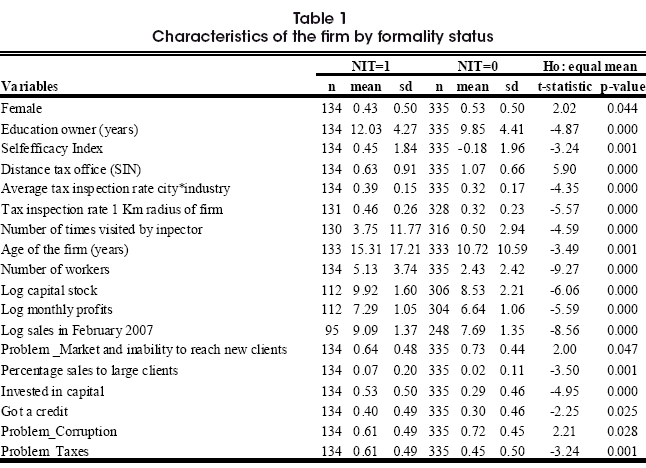
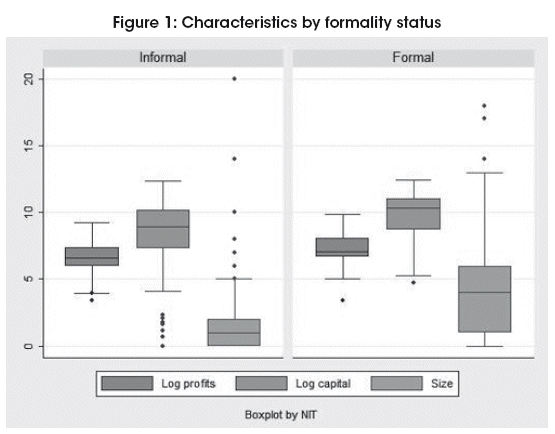
]]> To define formality, we follow McKenzie and Sakho (2010) and consider the concept that the firms themselves see as defining what it means to be formal: registering for a tax identification number (NIT). 29% of firms in the sample have a NIT.Table 1 presents summary statistics for some important variables divided by the formality status (having a NIT or not). We also provide p-values for the hypothesis of difference in means between these two categories of the variables. As can be seen there are statistically significant differences between the characteristics of micro-firms between the formal and informal sector. The mean monthlyprofit is 2451.84 Bolivians in the formal sector and 1324.7 Bolivians in the informal one. Capital is also larger for formal firms than for informal ones. The average number of paid workers is 4 workers in the formal and 2 workers in the informal. The average education of the owner is 12 years in the formal sector and 10 years in the informal sector. Figure 1 looks at the distribution of firms' characteristics by the level of formality. It highlights that informal firms are more dispersed in profits and capital than formal firms, but they are more concentrated at smaller values of size (number of workers) jointly with many extreme values. These characteristics may reflect the heterogeneity of the informal sector in Bolivia.
3. The empirical model
To estimate a model with heterogeneous profit returns to having a NIT, we consider the following relation:
]]>
Where i is a subscript for firms ( i = 1,2, ....n), ln Yi is the observed value of the outcome variable (profits in logarithmic form), α is the intercept, NITi is a dummy variable representing whether or not the firm i has a tax identification number (1 if yes; 0 if no), whereas the coefficient βi stands for heterogeneous impact effect of being formal, which varies among firms; Xi is a matrix of variables that influence firms profits, with γ as their coefficients; and ui is the residual term with E(ui) = 0. Note that the profits are a function of the characteristics observed by the researcher and the firm (NITi and Xi), and characteristics unobserved by the researcher ui but probably known by the firm.
The parameter of interest can be expressed as follows:3

Where βi varies across firms when there is observed heterogeneity (y1 ≠ y0 ), or when there is unobserved heterogeneity (ui1 ≠ ui0 ). Since these two components are different across firms, then βi is a random variable following certain distribution. The mean of βi given Xi i.e. the average treatment effect (ATE) is  i = E[βi | Xi] = E[Xi'(y1 - y0)].
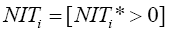
In order to see the role of the unobserved heterogeneity in the estimation process, the selection model into being formal can be specified as the following decision rule (see Heckman and Vytlacil, 1999): if the expected benefit of being formal is larger than the expected benefit the firm expects to obtain in case of remaining informal, then it will choose the formal status. That is, letting NITi* = Zi' λ-νi denote the difference in benefits between the two levels of formality, where Zi and νi are observed and unobserved factors determining formal status choice4, the selection rule is:
And the choice probability is given by:

Where Fv is the distribution of νi which is assumed to be continuous. Consequently the selection model is:
]]>
Where  represents the firms' unobservable heterogeneity which influences its formality decision. It is uniformily distributed [0,1] by construction, see Heckman and Vytlacil (1999). The decision of whether to get a NIT or not for a firm i thus is determined by the comparison ofthe observed heterogeneity P(Zi) with the unobserved heterogeneity . And the smaller, the more likely it is that the firm gets a NIT.
Heckman and Vytlacil (1999, 2001, 2007) and Heckman et al. (2006), show that in this framework it is possible to identify the impact of treatment by estimating the marginal treatment effects (MTE) via the local instrumental variables estimator (LIV). The MTE can be defined as the average gain to firms which are indifferent between being formal or informal given observed characteristics (Xi) and unobservable heterogeneity () :

Since = Fv(vi) i.e. unit uniform normalized, different values of correspond to different quantiles of νi. Thus, by tracing MTE over the values of it is possible to show how the impact of formality varies with different quantiles ofthe unobserved component ofthe formality choice. Hence, it is possible to determine the size and sign of the profit return to formal status for each firm, identified by the quantile ofthe unobserved component ofthe formality selection .
In this paper we consider three approaches to estimate MTE under essential heterogeneity.
i) The parametric approach of the MTE under the assumption of joint normality for the error terms (ui1, ui0, vi) N(0,Σ), ( Σ represents the variance and covariance matrix of the trivariate standard normal distribution).
ii) The semiparametric approach based on the local instrumental variable (LIV) which relies on the fact that the mean outcome Yi depends on the propensity score so that it serves as a local instrumental variable. Heckman and Vytlacil (1999, 2001, 2007) show that if we take the rate of change ofthe expected value ofthe outcome with respect to the probability of receiving treatment evaluated at a particular value of , conditional on Xi, the MTE can be identified:

iii) The semiparametric approach based on a local instrumental variable but allowing the utilization of local polynomials of order three to approximate the nonlinear structure of the propensity score in E[Y | X, P(Z)].
]]> 3.1. Specification of the modelThe specification of the model is similar to that ofMcKenzie and Sakho (2010), with a couple of minor changes5. We decided to hold this specification since it is a complete one and consistent with both the addition of new variables and the reduction of controls. Additional robust specification checkings corroborated this conclusion. The set of control variables included in the matrix X in equation (1) are the following: as firm owner controls we use age of the owner, a dummy stating his gender, a dummy for marital status, and a dummy for the use of indigenous language, and years of education of the owner. To control for owner’s ability we use years of mother's education, an entrepreneurial self-efficacy index constructed (by principal components) from ten questions intended to measure the self-assessed ability to perform certain tasks. And three dummies to account for the motivations of running a business: entering their activity to care family, for flexible hours and for business growth reasons. To control for family background, a dummy stating whether or not their father was a business owner is included. To control for wealth, a childhood poverty index constructed on questions related to mother’s education, questions about the type of floor their house had as a child and the frequency with which they didn't have enough to eat as a child. To control for firm characteristics we make use of the variables years of age of the firm, the log of the distance to city center, the average tax enforcement rates for the city*industry, the average tax enforcement rate for 1 km radius around the firm, the number of paid workers and the log of capital stock. It is also included in the specification industrial sector dummies and city dummies.
The logarithm of distance to the tax office is used as instrumental variable to predict firms' probability of attaining a formal status. This variable proxies the time and information costs of registering. To qualify as excluded restriction, this variable must explain formality status, and must affect profits only indirectly by affecting the likelihood of being formal. Note that control variables explaining location of the firm are present in the specification. The instrument is a significant predictor of formality choice (p=0.00), and the weak instrument F-test (13.4) satisfies the rule of thumb of Stock and Yogo (2005) making the instrument relevant for our purposes. While we cannot verify the orthogonality condition empirically, there are good reasons for assuming that the distance to the tax office is a valid instrument for our study, see McKenzie and Sakho (2010) for additional checkings of this instrument.
4. Results
The core analysis of our work involves three stages. In the first stage, we estimate the marginal treatment effects of formality on firms' profits. These estimations will allow us to identify the impact offormalityby considering firms' observed and unobserved characteristics which self-select them into formality based on heterogeneous returns. In addition, it will provide evidence on whether firms self select into a formal status or not based on idiosyncratic returns or not. In the second stage, based on the first stage results, we approximate (under some assumptions on the unobservables) the firms which are improving their profits from registering for taxes. Based on these approximations we inquire about the characteristics ofthe firms that benefit in terms of profits from getting formal and bring up a comparative analysis with respect to those firms which don't display benefits from formality. Finally, in the third stage, we inquire about the most feasible channel through which being formal might bring up benefits in terms ofprofits in a country like Bolivia: gaining new clients.
4.1. Firms' marginal treatment effects
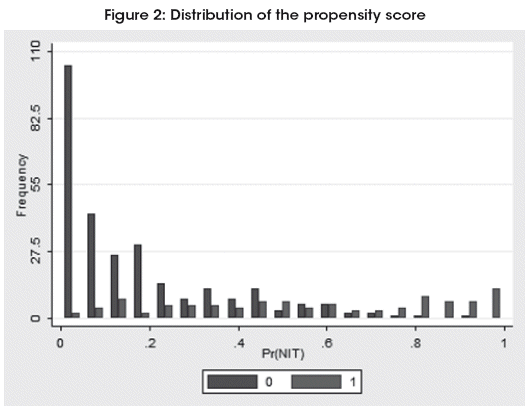
In order to obtain the MTEs, we begin with the estimation ofthe probability of being formal, P(Zi) as a function of all covariates and the instrument described in section 3.1. (a probit model is used). Figure 2 depicts the distribution ofthe predicted probability separately for firms which choose to be formal and those which choose to be informal. It also illustrates the common support, which is identified as the region where a positive density for both sub-samples is found and covers almost the full unit interval [0.03; 0.91]. Observations below or above these limits are trimmed so the analysis is restricted to the common support. Note that the identification of the MTE depends strongly on the support of the propensity score; see Heckman and Vytlacil (2001).
. Figure 3 plots the estimated MTEs as a function of the unobserved component in the formality choice equation (), along with their 90% confidence bands with standard errors estimated through 1000 bootstrap replicates. By using any of the three approaches described in section 3, the MTE declines as firms' unobserved heterogeneity increases. That is, for small values of , representing firms with latent characteristics that make them most likely to be formal, the MTE is significantly positive: they have higher marginal profit returns to having a formal status. Note that this effect corresponds to a small subpopulation of firms, as positive profits disappears for the middle and large values of uNIT (approx ≥ 0.2), where MTE takes negative values although it is not significantly different from zero. This implies that an important subpopulation of firms, those which don't have the characteristics to be most likely formal, have no returns to being formal. The magnitude of the heterogeneity in returns is considerable: marginal profits vary from 6% for low firms to -3% for high firms which would lose from getting the formal status.
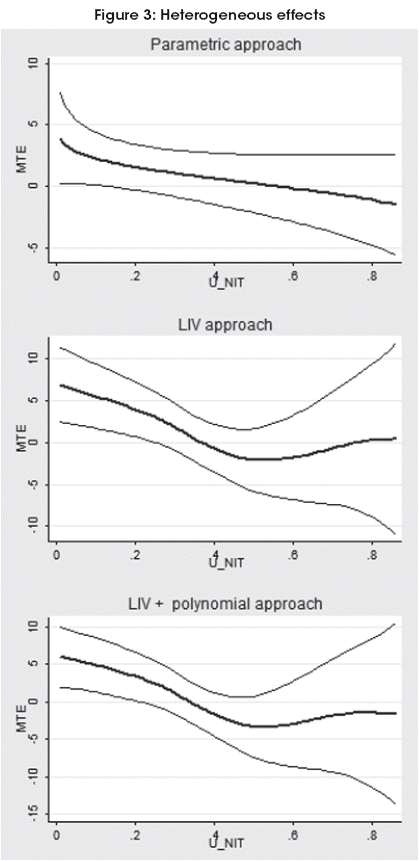
The negative slope of the MTE provides evidence that the benefits from formality are heterogeneous, and that firms self-select into formality based on them. Firms choose the formal status in which they have comparative advantage. That is, firms voluntarily choose, in function of observed and unobserved characteristics, to operate in the formal or the informal sector on the basis of rational calculations, by weighing the various (heterogeneous) costs and benefits associated with operating formally or informally. Taking into account this fact, we find that there is a subpopulation of firms that benefit from registering for taxes (approximately firms with a high propensity score) and a subpopulation of firms that might have negative profit effects for registering for taxes (approximately firms without a high propensity score). In next section we define the characteristics of these two groups to inquire what kind of firms may benefit from becoming formal and what kind of firms may not.
4.2. Who benefit from having a NIT ?
Analysis from last section suggests that firms with the smallest unobserved heterogeneity ( ≤ 0.2 approximately) improve their profits when registering for tax. Following Heckman and Vytlacil (2001), the MTE for values of close to zero is the average effect for firms with unobservable characteristics that make them the most inclined to participate in the program (NIT= 1). The MTE for values of close to one is the average treatment effect for individuals with unobserved characteristics that make them the least inclined to participate. By assumption, (which is unobserved for the researcher) is independent of the variables in X and Z used in the LIV analysis to estimate MTEs, so those with ≤ 0.2 don't differ in observables (X, Z) dimensions from those with > 0.2 . However, by assuming that unobserved factors induce selection into formality in the same direction that our observed variables, we can roughly identify the firms with MTE > 0 as those firms with observable characteristics that make them most likely to become formal, i.e. those firms with higher values of the propensity score. Thus, we can analyze the characteristics of the firms likely with positive profits compared to the firms likely without profits from formality.
Let W represent a vector of the characteristics explained below. In order to see how W varies with the propensity score, we first estimate the average of these characteristics at each decile of the propensity score: E[W | Pdecil]; last deciles would have to represent different behavior in W than remaining deciles to give account of dissimilar characteristics. We also estimate the average of W over higher values of the propensity score: E[W | 1(P ≥ φ) ] , where φ = 0.7, 0.8, and 0.9, respectively. Here categories with 1(P ≥ φ) would have to exhibit significant different values in W than their counterpart categories.
In this section we compare the following characteristics (W): In the three first rows of table 2 we describe basic firm characteristics like the size, capital and the level of monthly sales. Next, the characteristics that we consider are proxies for the expected benefits from formalization. Following Perry et al. (2007), the main advantages of formality are: i) The possibility of gaining new clients proxied by a dummy of whether the firm is facing or not problems about market size and about the inability to reach new customers, and the percentage of sales to large clients (more than 20 employees, multinationals and government). ii) The possibility of expanding operations proxied by a dummy stating if the firm expects to stay in the same activity in 5 years, a variable stating the number of paid workers the firm expects to hire in 5 years and a dummy of whether the firm invested in capital. iii) The possibility of improving access to credits, proxied by a dummy of whether the firm obtained a credit or not and a dummy stating if obtaining a credit is an obstacle for the firms growth. iv) The possibility of using contract enforcement mechanisms, proxied by a dummy of whether the inability to enforce contracts is a problem for the firm. And, v) the possibility to comply with law and avoid the risk of being punished proxied by variables measuring enforcement such as the number of visits by government inspectors and the proportion of tax receipts issued. A dummy for whether firms consider corruption as an obstacle for their growth is also considered.
]]>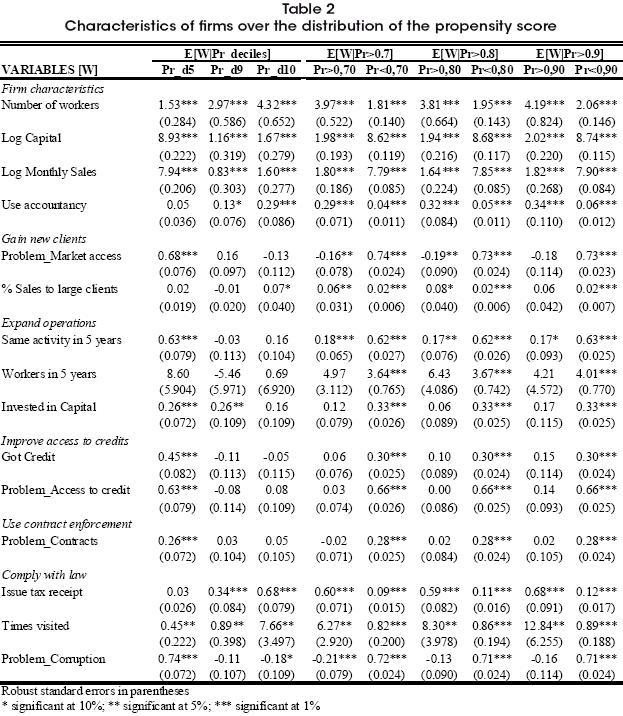
Table 2 presents the results of OLS regressions and robust standard errors of the characteristics W on the measures of the propensity score. Columns 1 to 3 presents the coefficients of a regression of W on ten categories containing the deciles of the propensity score. Just the coefficients for the highest deciles of the propensity score are displayed; remaining deciles are not reported to save space. The decile containing the median is the base category which is presented in column one and corresponds to the following values of the propensity score6: [Prd5 : 0.17 ≤ P(Zi) ≥ 0.26]. Columns 4 to 9 display the coefficients for the dummies representing the continuum of higher values of the propensity score. In columns 4 and 5 the coefficients correspond to a regression of W on the dummy 1[P(Zi) ≥ 0.7], the interpretation in column 4 is thus obviously as the additional increase in the mean of W for having values of P(Z) larger than 0.7 instead of lower than 0.7 (the base category). In column 5, the coefficient of [P(Zi)< 0.7] belongs to the base category and corresponds to the mean value of W when the propensity score is lower than 0.7; same interpretation applies to the coefficients on columns 6 to 9.
As can be seen, table 2 shows that firms with higher values of the propensity score display also significantly greater average capital stock, larger average size in terms of the number of paid workers, larger level of monthly sales, and they are also more efficient in their management considering the proportion of firms which use business accountancy. These results might suggest that the firms which likely are benefitting from having a NIT are those which work at big scales with a performance close to that of an entrepreneur. In addition, the proxies used to describe the benefit coming from market size show that firms with higher values of the propensity score are also firms with fewer problems about market size and about the possibility to reach new customers, and with larger percentage of sales to larger clients. These results suggest that those firms which likely benefit from having a NIT have better performance in market than those firms which likely don't benefit.
Table 2 also suggests that there are not significant differences in the average characteristics of firms over the propensity score when the proxies for expected operations, access to credits, and contract enforcement requirements are considered. Last rows of table 2 show the results for the variables proxying the desire to comply with law. They suggest that firms with higher values of the propensity score are also firms with larger proportion of tax receipts issued and larger average number of visits from the government’s functionaries to control either their legal profile status or the issuing of tax receipts. In addition, note that this group of firms has fewer problems with corruption as an obstacle for its growth7. These last results may suggest the existence of an additional benefit from formality coming from the avoidance of additional and unnecessary legal (fines) and illegal (bribes) costs from either not having a NIT or not issuing tax receipts.
4.3. Does formality allow to attract more customers?
Last section suggests that there are significative differences in the average of sales and market performance between the firms which are likely improving their profits and the firms which are likely not doing it. In this section we try to explore this mechanism. To test for this effect table 3 shows 2SLS and Maximum Likelihood estimations of the following dependent variables: the logarithm of monthly sales, a dummy stating whether the firm sells to large clients (firms with more than 20 employees, multinationals and government), and a dummy stating whether the firm considers an obstacle for its growth the size of the market and the inability to reach new clients. Thes e variables are regress ed as a function of the dummy having a NIT, and the complete set of controls explained in section 3.1.
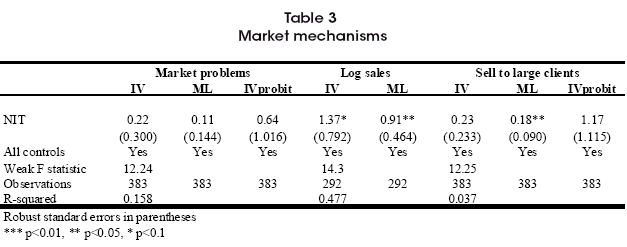
Table 3 features that having a NIT improves the level of sales, but the effect of having a NIT is not significative on the variables working with large clients and market size as a problem for business growth. These results suggest that formality may increase the level of sales but this effect is not big enough as to improve the likelihood of reaching large clients, or to reduce market size problems as an obstacle for the firms' growth. However, unobserved heterogeneity of the firms may induce them to self-select into formality or not based on an analysis of their expected level of sales, or their market problems. Marginal treatment effects (MTE) estimations for these variables show that there is not heterogeneity in the effect of NIT on the sales to large clients, the market size problems (slope close to zero), and the monthly sales. Although the MTE for the variable monthly sales have a behavior similar to that of profits (figure 3), its confidence intervals are ample and include the zero value. Moreover, the test of the linearity of the conditional expectation of Y in terms of the propensity score, E[Y | X, P(Z)], displays no significant coefficients for the polynomials in P(Z).
]]> 5. Conclusions
Firms respond differently to formality. This differential response might be based on unobserved characteristics (unobserved heterogeneity). When the formality choice is based on characteristics that determine this heterogeneity, the so called essential heterogeneity event, some bias might arise in the estimation of the impact of formality. In this paper we illustrate these points through an empirical study of the impact of having the formal status on firm profits in Bolivia, a country with the highest level of informality in Latin America. Recently, McKenzie and Sakho (2010) estimate this effect in Bolivia, they find large effects of registering for taxes on the profits of firms for whom the choice to formalize is affected by their distance to the tax office. They als o suggest that formality improves profits just for the middle-size firms, while it lowers profits for very small firms (who are too small to benefit) and for the larger firms (who are already able to reach a large customer base without formalizing).
In this paper we present new evidence about the effect of formality. Our empirical work finds, i) There is a remarkable heterogeneity in the returns to formality among micro-firms in Bolivia when considering unobservables. The estimated impact varies from around -3% to 6%. ii) Firms self-select into formality based on their idiosyncratic return to their decision. iii) The group of firms with positive marginal effects from formality corresponds to those firms which are most likely to register. For the remaining firms the b enefits are negative (though not significantly different from zero). iv) The characteristics of the firms which likely benefit from having a formal status are those of the firms which work at big scales: large number of paid workers, major capital, larger clients, etc. These results are estimated dealing with observable and unobservable heterogeneous characteristics and cannot be just considered for those firms for whom the choice to formalize is affected by their distance to the tax office (as done in IV).
Artículo recibido: 15 de septiembre de 2011
Manejado por: ABCE y BCDE*
Aceptado: 30 de septiembre de 2011
Notes
• Economics School of Louvain. Center for Research in Economic Development (CRED), University of Namur. Rempart de la Vierge, 8. B-5000 Namur. E-mail: dugarteo@fundp.ac.be.
]]> 1 Bruhn (2011) and Kaplan et al. (2006) in México, and Monterio and Assuncao (2007) in Brazil, have estimated the effect of reforms assigned to encourage formalization, like bureocracy simplification and tax reduction, on firms' registration. The evidence presented by these papers support the argument that these kind of reforms indeed increase the number of registered business.2 We would like to thank Professor Mckenzie for kindly sharing this data with us.
3 After the selection of firms into different formality status the profit profiles for the two categories are: Firm i experiences ln Yi1 = α1+Xi y1+ui1 if NITi = 1 and ln Yi0 = α1+Xi y0+ui0 if NITi = O. The observed outcome thus is:

4 E(vt) = , also (vi  Zi) | Xi i.e. vi is independent of Zi. given Xi, and 1(.) is an indicator function such that NITi = 1 (or =0) in case the firm chooses being formal (being informal), so that its net benefit of having a NIT, NITi* is positive (is negative).
5 The minor changes are as follows: we join the two dummies 5 to 10 workers and more than 10 workers to just one dummy stating more than 5 workers. And we use as age of firms the number of years instead of a dummy less than 3 years. We proceed in this way since these dummies had small number of observations and gave rise to problems in the estimation of the MTEs. These re-categorizations don't change in absolute the results in Mckenzie and Sakho (2010).
6 Columns 2 to 3 correspond to the deciles nine and ten, and account for the following values of the probability of becoming formal: [Prd9 : 0.52 ≤ P(Zi) ≤ 0.78], [Prd10 :0.79 ≤ P(Zi) ≤ 0.99]. Note that these coefficients must be interpreted with respect to the base category (Prd5).
7 Note that 26% of the firms with NIT consider the main benefit from formality as the possibility to attract more customers. Whereas 67% think that the main benefit is to avoid fines, bribes and to comply with law.
* Bolivian Conference on Development Economics.
]]> References
1. Bruhn, M. (2011). "License to sell: the effect of business registration reform on entrepreneurial activity in Mexico". The Review of Economics and Statistics, 93(1):382-386.
2. De Vries Gaaitzen, J. (2010). "Small Retailers in Brazil: Are Formal Firms Really More Productive?". Journal of Development Studies, 46:8,1345-1366
3. Fajnzylber, P., W. E Maloney and G. V. Montes-Rojas. (2009). "Releasing Constraints to Growth or Pushing on a String? Policies and Performance of Mexican Micro-Firms". Journal of Development Studies, 45:7,1027 — 1047
4. Fajnzylber, P., W. E Maloney and G. V. Montes-Rojas. (2011). "Does formality improve micro-firm performance? Evidence from the Brazilian SIMPLES program". Journal of Development Economics, 94,262-276
5. Heckman, J. J., and E. J. Vytlacil (1999). "Local Instrumental Variables and Latent Variable Models for Identifying and Bounding Treatment Effects". Proceedings of the National Academy of Sciences, 96(8): 4730-4734.
6. Heckman, J. J., and E. J. Vytlacil (2001). "Local Instrumental Variables". In: Cheng Hsiao, Kimio Morimune and James L. Powell (eds).: Nonlinear Statistical Modeling: Proceedings of the Thirteenth International Symposium in Economic Theory and Econometrics: Essays in Honor of Takeshi Amemiya. New York:Cambridge University Press, 1-46.
7. Heckman, J. J., and E. J. Vytlacil (2006). "Structural Equations, Treatment Effects and Econometric Policy Evaluation". Econometrica, 73(3): 669-738.
8. Heckman,J. J.,andE.J. Vytlacil (2007)."Econometric Evaluation of Social Programs, Part II: Using the Marginal Treatment Effect to Organize Alternative Economic Estimators to Evaluate Social Programs and to Forecast Their Effects in New Environments". In: J. Heckman and E. Leamer (eds.) Handbook of Econometrics. Vol. 6B, 4875-5144. Amsterdam: Elsevier.
9. Heckman, J. J., S. Urzua, and E.J. Vytlacil (2006). "Understanding Instrumental Variables in Models with Essential Heterogeneity". Review of Economics and Statistics, 88(3): 389-432.
]]> 10. Kaplan, D., E. Piedra and E. Seira (2006). “Are Burden some Registration Procedures an Important Barrier on Firm Creation? Evidence from Mexico". Mimeo. Washington, D.C.: World Bank.11. Loayza, N. (1996). "The economics of the informal sector: a simple model and some evidence from Latin America". Carnegie-Rochester Conference Series on Public Policy 45,129-162.
12. Maloney,W. (2004). "Informality revisited". World Development, 32 (7), 1159-1178.
13. McKenzie, D. and Y. Seynabou Sakho (2010). "Does it pay firms to register for taxes? The impact of formality on firm profitability". Journal of Development Economics, 91: 15-24
14. Monteiro, J. and J. Assuncao (2006). "Outgoing the shadows: estimating the impact of bureaucracy simplification and tax cut on formality and investment". Mimeo. PUC Rio.
15. Perry, G., W. Maloney, O. Arias, P. Fajnzylber, A. Mason and J. Saavedra (2007). "Informality: Exit and Exclusion". World Bank Latin America and Caribbean Studies. World Bank, Washington D.C.
16. Schneider, F. and D. Enste (2000). "Shadow economies: size, causes and consequences". Journal of Economic Literature, 38 (1), 77-114.
17. Stock, J.H. and M. Yogo (2005). "Testing for weak instruments in linear IV regression". In: J.H. Stock and D.W.K. Andrews (eds.): Identification and Inference for Econometric Models: A Festschrift in Honor of Thomas Rothenberg. Cambridge: Cambridge University Press, Chapter 5,80-108.
18. World Bank (2007). Encuestas y Estudios. Informe Estudio Cualitativo: Informalidad y Productividad. (Qualitative Study Report: Informality and Productivity), February, 2007.
19. World Bank (2008). "Increasing Formality and Productivity of Bolivian Firms". Country study, The World Bank.
]]> ]]>