<?xml version="1.0" encoding="ISO-8859-1"?><article xmlns:mml="http://www.w3.org/1998/Math/MathML" xmlns:xlink="http://www.w3.org/1999/xlink" xmlns:xsi="http://www.w3.org/2001/XMLSchema-instance">
<front>
<journal-meta>
<journal-id>2074-4706</journal-id>
<journal-title><![CDATA[Revista Latinoamericana de Desarrollo Económico]]></journal-title>
<abbrev-journal-title><![CDATA[rlde]]></abbrev-journal-title>
<issn>2074-4706</issn>
<publisher>
<publisher-name><![CDATA[Universidad Católica Boliviana "San Pablo"]]></publisher-name>
</publisher>
</journal-meta>
<article-meta>
<article-id>S2074-47062011000200002</article-id>
<title-group>
<article-title xml:lang="en"><![CDATA[Farmers' willingness to adopt irrigation for quinoa in communities of the Central Altiplano of Bolivia]]></article-title>
<article-title xml:lang="es"><![CDATA[Disposición para adoptar tecnología de riego para quinua en comunidades del Altiplano Central de Bolivia]]></article-title>
</title-group>
<contrib-group>
<contrib contrib-type="author">
<name>
<surname><![CDATA[Taboada]]></surname>
<given-names><![CDATA[Cristal]]></given-names>
</name>
</contrib>
<contrib contrib-type="author">
<name>
<surname><![CDATA[Mamani]]></surname>
<given-names><![CDATA[Armando]]></given-names>
</name>
</contrib>
<contrib contrib-type="author">
<name>
<surname><![CDATA[Raes]]></surname>
<given-names><![CDATA[Dirk]]></given-names>
</name>
</contrib>
<contrib contrib-type="author">
<name>
<surname><![CDATA[Mathijs]]></surname>
<given-names><![CDATA[Erik]]></given-names>
</name>
</contrib>
<contrib contrib-type="author">
<name>
<surname><![CDATA[García]]></surname>
<given-names><![CDATA[Magalí]]></given-names>
</name>
</contrib>
<contrib contrib-type="author">
<name>
<surname><![CDATA[Geerts]]></surname>
<given-names><![CDATA[Sam]]></given-names>
</name>
</contrib>
<contrib contrib-type="author">
<name>
<surname><![CDATA[Gilles]]></surname>
<given-names><![CDATA[Jere]]></given-names>
</name>
</contrib>
</contrib-group>
<aff id="A">
<institution><![CDATA[,  ]]></institution>
<addr-line><![CDATA[ ]]></addr-line>
</aff>
<pub-date pub-type="pub">
<day>00</day>
<month>11</month>
<year>2011</year>
</pub-date>
<pub-date pub-type="epub">
<day>00</day>
<month>11</month>
<year>2011</year>
</pub-date>
<numero>16</numero>
<fpage>7</fpage>
<lpage>28</lpage>
<copyright-statement/>
<copyright-year/>
<self-uri xlink:href="http://www.scielo.org.bo/scielo.php?script=sci_arttext&amp;pid=S2074-47062011000200002&amp;lng=en&amp;nrm=iso"></self-uri><self-uri xlink:href="http://www.scielo.org.bo/scielo.php?script=sci_abstract&amp;pid=S2074-47062011000200002&amp;lng=en&amp;nrm=iso"></self-uri><self-uri xlink:href="http://www.scielo.org.bo/scielo.php?script=sci_pdf&amp;pid=S2074-47062011000200002&amp;lng=en&amp;nrm=iso"></self-uri><abstract abstract-type="short" xml:lang="en"><p><![CDATA[Quinoa is considered a strategic crop because it is well adapted to the adverse abiotic conditions of the Bolivian Altiplano; however, the average yield is low. Previous studies have demonstrated that quinoa yield would increase with deficit irrigation technology. Nevertheless, to irrigate quinoa is not a normal practice in the farming systems of the Altiplano. This paper examines the main factors that determine the attitude of farmers towards adopting deficit irrigation using a sample of 137 surveys in seven communities of the Central Altiplano. Statistic analysis demonstrates that the most important factors influencing farmers' willingness for irrigation adoption are the acreage planted with quinoa, quantity of surplus production for trading, and having irrigation experience. Also, the age and education level were important to know willingness to adopt a new technology. Therefore, deficit irrigation is more likely to be performed in areas where farmers own larger fields and where there is already certain type of irrigation.]]></p></abstract>
<abstract abstract-type="short" xml:lang="es"><p><![CDATA[Actualmente, se considera a la quinua como un cultivo estratégico debido a su capacidad de adaptación a las condiciones abióticas adversas que se presentan en el altiplano boliviano. No obstante, el rendimiento promedio es bajo. Estudios previos han demostrado que el rendimiento puede incrementarse haciendo uso de la tecnología de riego deficitario. Sin embargo, el uso de riego en la producción de quinua no es una práctica común entre los productores de la región altiplánica. Este estudio ha examinado los principales factores que determinan la disposición de las unidades productivas para adoptar la tecnología de riego deficitario. Para ello, se ha entrevistado a 137 productores de siete comunidades del altiplano central. Los resultados del análisis estadístico han demostrado que la disposición para adoptar la tecnología de riego deficitario para el cultivo de quinua es mayor en zonas donde los productores poseen mayores superficies de tierra y donde ya existe cierta práctica de riego.]]></p></abstract>
<kwd-group>
<kwd lng="en"><![CDATA[quinoa]]></kwd>
<kwd lng="en"><![CDATA[deficit irrigation]]></kwd>
<kwd lng="en"><![CDATA[willingness for technology adoption]]></kwd>
<kwd lng="es"><![CDATA[quinua]]></kwd>
<kwd lng="es"><![CDATA[riego deficitario]]></kwd>
<kwd lng="es"><![CDATA[adopción de tecnología]]></kwd>
</kwd-group>
</article-meta>
</front><body><![CDATA[ <p align=center>&nbsp;</p>     <p align=center>&nbsp;</p>     <p align=center><font size="4" face="Verdana, Arial, Helvetica, sans-serif"><b>Farmers' willingness to adopt irrigation for   quinoa in communities of the Central Altiplano of Bolivia   <o:p></o:p> </b></font></p>     <p align=center>&nbsp;</p>     <p align=center><b><font size="3" face="Verdana, Arial, Helvetica, sans-serif">Disposici&oacute;n para   adoptar tecnolog&iacute;a de riego para quinua en comunidades del Altiplano Central de   Bolivia</font></b></p>     <p align=center>&nbsp;</p>     <p align=center>&nbsp;</p>     <p align=center><b><font size="2" face="Verdana, Arial, Helvetica, sans-serif">&nbsp;Cristal Taboada <a href="#a">a </a>, Armando Mamani <a href="#b">b </a>, Dirk Raes <a href="#c">c </a>, Erik Mathijs <a href="#d">d </a>,   Magal&iacute; Garc&iacute;a <a href="#e">e </a>, Sam Geerts <a href="#f">f </a>, Jere Gilles <a href="#g">g </a>. </font></b><font size="2" face="Verdana, Arial, Helvetica, sans-serif"></font></p>     <p align=center>&nbsp;</p>     <p align=center>&nbsp;</p> <hr size=2 width="100%" align=center>     ]]></body>
<body><![CDATA[<p><font size="2" face="Verdana, Arial, Helvetica, sans-serif"><b>Abstract</b>       <o:p></o:p> </font></p>     <p align="justify"><font size="2" face="Verdana, Arial, Helvetica, sans-serif">Quinoa is   considered a strategic crop because it is well adapted to the adverse abiotic   conditions of the Bolivian Altiplano; however, the average yield is low.   Previous studies have demonstrated that quinoa yield would increase with deficit   irrigation technology. Nevertheless, to irrigate quinoa is not a normal   practice in the farming systems of the Altiplano. This paper examines the main   factors that determine the attitude of farmers towards adopting deficit   irrigation using a sample of 137 surveys in seven communities of the Central   Altiplano. Statistic analysis demonstrates that the most important factors   influencing farmers' willingness for irrigation adoption are the acreage   planted with quinoa, quantity of surplus production for trading, and having   irrigation experience. Also, the age and education level were important to know   willingness to adopt a new technology. Therefore, deficit irrigation is more   likely to be performed in areas where farmers own larger fields and where there   is already certain type of irrigation.   <o:p></o:p> </font></p>     <p><font size="2" face="Verdana, Arial, Helvetica, sans-serif"><b>Keywords</b>: quinoa, deficit irrigation, willingness for   technology adoption   <o:p></o:p> </font></p> <hr size=2 width="100%" align=center>     <p><font size="2" face="Verdana, Arial, Helvetica, sans-serif"><b>Resumen</b></font></p>     <p align="justify"><font size="2" face="Verdana, Arial, Helvetica, sans-serif">Actualmente, se considera a la quinua como un cultivo   estrat&eacute;gico debido a su capacidad de adaptaci&oacute;n a las condiciones abi&oacute;ticas   adversas que se presentan en el altiplano boliviano. No obstante, el   rendimiento promedio es bajo. Estudios previos han demostrado que el   rendimiento puede incrementarse haciendo uso de la tecnolog&iacute;a de riego   deficitario. Sin embargo, el uso de riego en la producci&oacute;n de quinua no es una   pr&aacute;ctica com&uacute;n entre los productores de la regi&oacute;n altipl&aacute;nica.   Este estudio ha examinado los principales factores que determinan la   disposici&oacute;n de las unidades productivas para adoptar la tecnolog&iacute;a de riego   deficitario. Para ello, se ha entrevistado a 137 productores de siete   comunidades del altiplano central. Los resultados del an&aacute;lisis estad&iacute;stico han   demostrado que la disposici&oacute;n para adoptar la tecnolog&iacute;a de riego deficitario   para el cultivo de quinua es mayor en zonas donde los productores poseen   mayores superficies de tierra y donde ya existe cierta pr&aacute;ctica de riego. </font></p>     <p><font size="2" face="Verdana, Arial, Helvetica, sans-serif"><b>Palabras clave</b>:   quinua, riego deficitario, adopci&oacute;n de tecnolog&iacute;a.</font></p>     <p><font size="2" face="Verdana, Arial, Helvetica, sans-serif"><b>Clasificaci&oacute;n/Classiffication JEL</b>: L00, Q00, Q10   <o:p></o:p> </font></p>     <p><font size="2" face="Verdana, Arial, Helvetica, sans-serif">   <o:p>&nbsp;</o:p> </font></p> <hr size=2 width="100%" align=center>     <p>&nbsp;</p>     <p>&nbsp;</p>     ]]></body>
<body><![CDATA[<p><font size="3" face="Verdana, Arial, Helvetica, sans-serif"><b>1. Introduction</b>       <o:p></o:p> </font></p>     <p align="justify"><font size="2" face="Verdana, Arial, Helvetica, sans-serif">During the   last decade, quinoa (<i>Chenopodium quinoa Willd</i>) has become more and more a cash   export crop, as demonstrated by Bolivian statistics: in 2006, 7,641 tons were   exported with a total value of US$ 8,903,187 mainly to the USA, Japan and   European markets. Moreover, demand for quinoa in developed countries keeps   increasing: many consumers direct their consumption towards more healthy food,   as quinoa is considered one of the best balanced food; it is an excellent   source of protein and slow-releasing carbohydrates (Comai <i>et al</i>., 2007). It can   supply all of the body's requirements: carbohydrates, fats, protein, vitamins,   minerals and fiber. Quinoa is gluten free and considered an ideal food for   those prone to food allergies, making it beneficial for people who cannot   tolerate common grains such as wheat, corn, rye, barley and oats. In addition,   many small producers organized in producer organizations (most of them in the   Southern Altiplano) receive a price premium by selling their quinoa as Fair   Trade and Solidarity Market.   <o:p></o:p> </font></p>     <p align="justify"><font size="2" face="Verdana, Arial, Helvetica, sans-serif">In opposition   to the opening of the international and national demand for quinoa, production   levels in the main exporting countries (Bolivia and Peru) are low and   constrained. Farmers constantly face restrictive production conditions, such as   climatic risks (droughts, frost) (Garc&iacute;a <i>et al</i>., 2004; Geerts <i>et al</i>., 2006),   the presence of only three wet months (December, January and February) and a   very primitive way of farming. Thus, the production level is somewhat larger   than the farmer's family consumption.   <o:p></o:p> </font></p>     <p align="justify"><font size="2" face="Verdana, Arial, Helvetica, sans-serif">In this   context a lot of quinoa is being sold and transported to foreign markets, as a   non- registered product (black market) (FAUTAPO, 2005). However, studies by   international agencies (FAO, 1998; CAF, 2001), found in quinoa one of the   possibilities to improve the overall conditions of poverty in the production   countries and particularly in the most depressed areas of the Bolivian   Altiplano.   <o:p></o:p> </font></p>     <p align="justify"><font size="2" face="Verdana, Arial, Helvetica, sans-serif">From a technical   point of view, previous studies (Garc&iacute;a, 2003; Geerts <i>et al</i>. 2008), have   demonstrated that quinoa yield can be increased by applying only a small amount   of irrigation water during the growing period. It was demonstrated that with   irrigation applications during the critical stages of growth, the yields can be   stabilized around 2,000 kg/ha, which is much larger than the current average   (500 kg/ha). In other words, the application of just a little amount of water   might substantially raise the yield and thus the income of the farmer.   <o:p></o:p> </font></p>     <p align="justify"><font size="2" face="Verdana, Arial, Helvetica, sans-serif">Although the   implementation of irrigation systems for quinoa might help to increase and   stabilize quinoa production levels, it requires additional community   organization, additional investment, changes in farmer's orientation and   technical training which might be difficult to achieve.   <o:p></o:p> </font></p>     <p align="justify"><font size="2" face="Verdana, Arial, Helvetica, sans-serif">The purpose   of this paper is to explore whether Bolivian farmers are willing to irrigate   quinoa and to investigate which factors determine their willingness or lack of   willingness. The remainder of this paper is organised as follows. Section 2   discusses the experiences in Bolivia with quinoa and irrigation. Data and   methodology are provided in section 3. Section 4 provides the results of our   analysis, section 5 is devoted to discussion and section 6 concludes the paper.   <o:p></o:p> </font></p>     <p align="justify">&nbsp;</p>     <p align="justify"><font size="3" face="Verdana, Arial, Helvetica, sans-serif"><b>2. Quinoa in Bolivia   <o:p></o:p> </b></font></p>     <p align="justify"><b><font size="2" face="Verdana, Arial, Helvetica, sans-serif">2.1. The origin of Quinoa   <o:p></o:p> </font></b></p>     ]]></body>
<body><![CDATA[<p align="justify"><font size="2" face="Verdana, Arial, Helvetica, sans-serif">Since   ancestral times, Andean man has consumed quinoa (<i>Chenopodium quinoa W.</i>) and   named it the golden grain of the Incas. Quinoa was domesticated 5000 years B.C.   This is based on the archeological discoveries made in Ayacucho, Peru. Quinoa   production is found throughout the Andean region, i.e. to Bolivia, Peru,   Ecuador, Chile, Argentina and Colombia (NEC, 2006).   <o:p></o:p> </font></p>     <p align="justify"><font size="2" face="Verdana, Arial, Helvetica, sans-serif">Today, quinoa   is cultivated mainly in Bolivia and Peru. However, during the last decade,   Ecuador, Chile, Argentina and Colombia have started many research projects and   studies on quinoa, such as: SICA (Agricultural Census and Information System)   of the Agricultural Ministry of Ecuador; Quinuacoche CANOE program promoted by   the Latin American Foundation in Colombia; Provincial Congress for Quinoa   promoted by the Deputies Chamber of Salta, Argentina; Program of Encouragement   for Business Design and Innovation promoted by the Euro Chile Foundation.   <o:p></o:p> </font></p>     <p align="justify"><font size="2" face="Verdana, Arial, Helvetica, sans-serif">The quinoa   plant represents an enormous biodiversity and its classification is based on   ecotypes recognizing five categories (PROINPA, 2004; CEPROBOL, 2007):   <o:p></o:p> </font></p>     <p align="justify"><font size="2" face="Verdana, Arial, Helvetica, sans-serif">1.&nbsp;&nbsp;&nbsp;&nbsp;&nbsp;   Valley quinoa grows in the Interandean Valleys between 2000 and   <st1:metricconverter ProductID="3000 m" w:st="on">3000 m</st1:metricconverter>   .a.s.l.   <o:p></o:p> </font></p>     <p align="justify"><font size="2" face="Verdana, Arial, Helvetica, sans-serif">2.&nbsp;&nbsp;&nbsp;&nbsp;&nbsp;   Highland quinoa grows in the Central and Northern Altiplano of Bolivia   and Peruvian Altiplano.   <o:p></o:p> </font></p>     <p align="justify"><font size="2" face="Verdana, Arial, Helvetica, sans-serif">3.&nbsp;&nbsp;&nbsp;&nbsp;&nbsp; Salt quinoa, from Potos&iacute;, Bolivia</font></p>     <p align="justify"><font size="2" face="Verdana, Arial, Helvetica, sans-serif">4.&nbsp;&nbsp;&nbsp;&nbsp;&nbsp; Sea level quinoa grows in   Chile   <o:p></o:p> </font></p>     <p align="justify"><font size="2" face="Verdana, Arial, Helvetica, sans-serif">5.&nbsp;&nbsp;&nbsp;&nbsp;&nbsp;   Subtropical quinoa, grows in the Bolivian Interandean Valleys   <o:p></o:p> </font></p>     <p align="justify"><font size="2" face="Verdana, Arial, Helvetica, sans-serif"><b>2.2. Quinoa production system in the Central Altiplano   <o:p></o:p> </b></font></p>     <p align="justify"><font size="2" face="Verdana, Arial, Helvetica, sans-serif">In the   Central Altiplano farming systems are traditional and small. Farmers have   developed mixed systems (agriculture and livestock) in order to diversify their   production as a strategy to reduce production risk (Valdivia and Jete, 1996).   This production system has as main crops: potatoes, quinoa, barley, ca&ntilde;ahua and   vegetables; livestock is composed of dairy production, sheep and lama. Dairy   production has become more important than agriculture because the encouragement   and incentives given to this activity (Camacho, 2001). Crop rotation is one of   the most important activities of crop management. The pattern of rotation is:   potatoes, quinoa, bean and barley (Aliaga, 2006; Mamani, 2007).   <o:p></o:p> </font></p>     ]]></body>
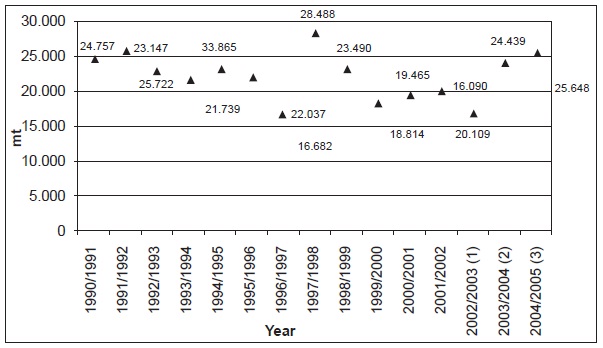
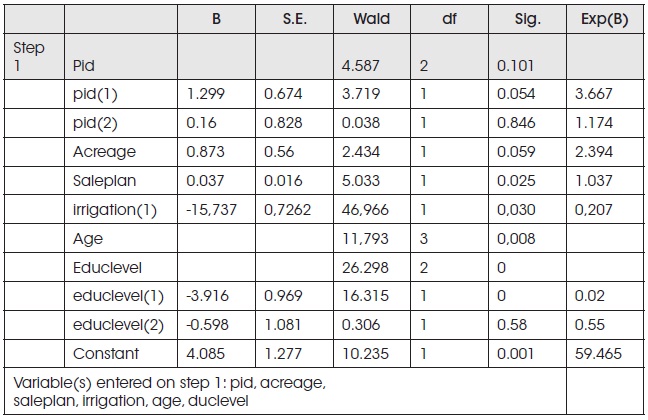
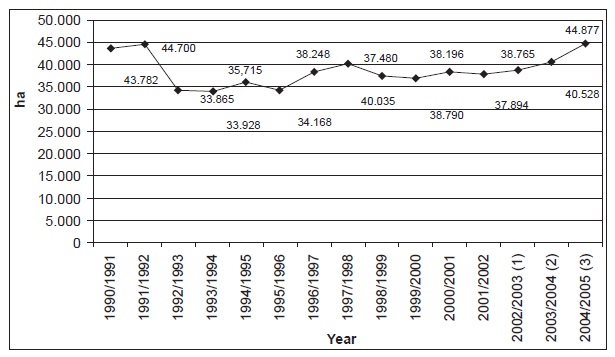
<body><![CDATA[<p align="justify"><font size="2" face="Verdana, Arial, Helvetica, sans-serif">Most of the   farmers in the Central Altiplano cultivate quinoa. Family labour is used   throughout the entire production process (from sowing to harvest) (PROINPA,   2004). PROINPA (2004) calculated that mechanization would be possible on land   areas from 21 to   <st1:metricconverter ProductID="80 hectares" w:st="on">80     hectares</st1:metricconverter>   ; thus increasing the potential of commercializing   quinoa. Quinoa is generally sown in furrows or scattered at random after   potato.   <o:p></o:p> </font></p>     <p align="justify"><font size="2" face="Verdana, Arial, Helvetica, sans-serif">Climate and   pests are the most important limiting factors; drought causes the loss of the   whole quinoa plant. Frost also causes a significant reduction of production.   Under the cited conditions the average yield reported is   <st1:metricconverter ProductID="500 kilogram" w:st="on">500 kilogram</st1:metricconverter>   per   hectare (PROINPA, 2004).   <o:p></o:p> </font></p>     <p align="justify"><font size="2" face="Verdana, Arial, Helvetica, sans-serif"><b>2.3. Quinoa production and trade   <o:p></o:p> </b></font></p>     <p align="justify"><font size="2" face="Verdana, Arial, Helvetica, sans-serif">According to   official information, the sown area of quinoa in Bolivia in 2000 was   <st1:metricconverter ProductID="36,847 ha" w:st="on">36,847 ha</st1:metricconverter>   with a total   production of 23,875 tons (see <a href="#f1">figure 1</a>). However, Crespo <i>et al</i>. (2001) and   Brenes <i>et al</i>. (2001) (as cited by Ton and Bijman, 2006) provide somewhat lower   production figures (21,850 metric tons). According to Ton and Bijman (2006), in   2000 the destination of the marketed surplus of quinoa (estimated at 7,618   metric tons) was as follows: registered exports (1,534 mt or 20%), estimated   non-registered exports (black market) (2,800 mt or 37%) and domestic market   (3,284 mt or 43%). Thus, Ton and Bijman (2006) emphasize that most Bolivian   exports are informal and not registered with destination Peru; the registered   formal exports go to the USA and Europe.   <o:p></o:p> </font></p>     <p align="justify"><a name="f1"></a></p>     <p align=center><font size="2" face="Verdana, Arial, Helvetica, sans-serif"><strong>Figure 1: Quinoa   Area (a) in hectares (ha) and production (b) in metric tones (mt) in Bolivia,   1991-2002</strong>    <br>   <img border=0 width=615 height=357 id="_x0000_i1028" src="/img/revistas/rlde/n16/a01fig01.jpg">   <o:p></o:p> </font></p>     <p align=center><font size="2" face="Verdana, Arial, Helvetica, sans-serif">(a)</font></p>     <p align=center><font size="2" face="Verdana, Arial, Helvetica, sans-serif"><img border=0 width=603 height=348 id="_x0000_i1029" src="/img/revistas/rlde/n16/a01fig02.jpg"></font></p>     <p align=center><font size="2" face="Verdana, Arial, Helvetica, sans-serif"><strong>(b)</strong>    ]]></body>
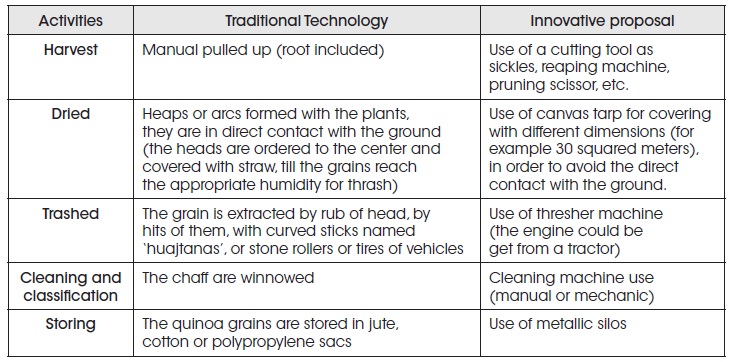
<body><![CDATA[<br>   Source: INE Bolivia, MACA, SEDAG- Oruro, 2002,) (1), (2), Projected   <o:p></o:p> </font></p>     <p align="justify"><font size="2" face="Verdana, Arial, Helvetica, sans-serif">    <br>       <b>2.4. Quinoa technology development         and diffusion         <o:p></o:p>     </b></font></p>     <p align="justify"><font size="2" face="Verdana, Arial, Helvetica, sans-serif">In 1967   Bolivia started, with FAO participation, a programme to study and promote the   quinoa crop. Bolivian Agricultural Technology Institute (IBTA) began research   in the crop cultivation area. As a result, improved varieties   were obtained. Nowadays, farmers are using these varieties. The most important   variety in the Central and Northern Altiplano is the Sajama variety (PROINPA,   2004), which is characterized by a low content of saponine. Therefore, this   variety is called sweet quinoa.   <o:p></o:p> </font></p>     <p align="justify"><font size="2" face="Verdana, Arial, Helvetica, sans-serif">Since the 1990s different institutions -such as the Self-development   Peasant-Oruro Programme (PAC-CORDEOR), the Potos&iacute; Quinoa Programme (PROQUIPO)   and IBTA- focused on improving harvest and post-harvest techniques. They   promoted the use of sickles and reaping machines, as well as threshers. In 1998   the producer organizations ANAPQUI and CECAOT started up a project to solve the   problem of chaff presence in the product. The FAO gave technical support to the   project (Soto <i>et al</i>., 2004).   <o:p></o:p> </font></p>     <p align="justify"><font size="2" face="Verdana, Arial, Helvetica, sans-serif">In the frame work of the project &quot;Sustainable Quinoa   Production&quot; supported by the McKnight Foundation, the PROINPA Foundation   (Research and Promotion of Andean Products) is promoting and diffusing the use   of technologies, such as the use of sickles for harvest, the thresher machine   and the manual or mechanic scent machine. As result of a participatory work,   PROINPA was able to introduce a proposal in harvest and post-harvest activities   for quinoa (see <a href="#t1">Table 1</a>).   <o:p></o:p> </font></p>     <p align="justify"><a name="t1"></a></p>     <p align=center><font size="2" face="Verdana, Arial, Helvetica, sans-serif"><strong>Table 1</strong><b>    <br>         <strong>Characteristics of the traditional           technology and the innovative proposal in harvest and post harvest activities           of quinoa crop (Proposal presented by PROINPA FOUNDATION)</strong></b>    <br>   <img border=0 width=731 height=362 id="_x0000_i1030" src="/img/revistas/rlde/n16/a01tab01.jpg">   <o:p></o:p> </font></p>     ]]></body>
<body><![CDATA[<p align="justify"><font size="2" face="Verdana, Arial, Helvetica, sans-serif">    <br>   Most of the research on quinoa is carried out on breeding,   harvest and post-harvest technology improvement and even food technology.   However, it is very difficult to find studies on irrigation, because quinoa is   growing on marginal conditions of soil, climate and water resources scarcity   (Geerts <i>et al</i>., 2008). Nevertheless, there are a few studies on this topic that   have demonstrated that a low level of supplemental irrigation of quinoa during   flowering might have important effects on final yield, while the vegetative   period is almost unaffected by drought (Garc&iacute;a, 2003; Geerts <i>et al</i>., 2008).   Garc&iacute;a (2003) and Geerts <i>et al</i>. (2008) have demonstrated that by applying   deficit irrigation the production can be stabilized between 1,2 to 2 mt/ha.   Sol&iacute;z <i>et al</i>. (2002) conducted a study to evaluate saponine concentration (which   makes the bitter taste of unprocessed grains) and composition in two quinoa   cultivars 'Sajama' and 'Chucara', during plant development under three soil   water deficit treatments. One of the findings showed that deficit irrigation   reduced the saponin content facilitating the grain for further   industrialization.   <o:p></o:p> </font></p>     <p align="justify"><font size="2" face="Verdana, Arial, Helvetica, sans-serif"><b>2.5. Quinoa production systems</b>       <o:p></o:p> </font></p>     <p align="justify"><font size="2" face="Verdana, Arial, Helvetica, sans-serif">In Bolivia, quinoa production systems could be grouped into two types of   systems according to the growing region and farmer's production goal.   Production systems of Northern and Central Altiplano, where quinoa is dedicated   predominantly for self-consumption and production systems of the Southern   Altiplano, where quinoa is dedicated primarily for commercializing. Communities   settled in the Northern and Central Altiplano have quinoa as one of the basic   components of their food although, potato is the main agricultural crop. In the   South Altiplano quinoa is the only crop that has the capacity to adapt to the   climatic conditions of the zone.   <o:p></o:p> </font></p>     <p align="justify"><font size="2" face="Verdana, Arial, Helvetica, sans-serif">In the three Altiplano regions, quinoa is cultivated from September to   May (austral summer months), nevertheless the production techniques are   different according to the zonal conditions (climate, quinoa acreage, socio   economic and others conditions) (Geerts, <i>et al</i>., 2008b).   <o:p></o:p> </font></p>     <p align="justify"><font size="2" face="Verdana, Arial, Helvetica, sans-serif">According with the mechanizaton, the follow cropping systems are found   in the Northern, Central and Southern Altiplano: traditional, when there is no   mechanization; semimechanized, when agricultural machinery is used at least in   one stage of the production process and mechanized, when agricultural machinery   is used twice or more in the production process.   <o:p></o:p> </font></p>     <p align="justify"><font size="2" face="Verdana, Arial, Helvetica, sans-serif">Agricultural production systems in the Central Altiplano is   characterized generally by multiple cropping system, production at low scale, small   land size and the farmer's family constitutes the main source of labour.   According to the characteristics, these zones have an economic system   denominated farmer economy or &quot;econom&iacute;as campesinas&quot;.   <o:p></o:p> </font></p>     <p align="justify"><font size="2" face="Verdana, Arial, Helvetica, sans-serif"><b>2.6. Technology adoption</b>       <o:p></o:p> </font></p>     <p align="justify"><font size="2" face="Verdana, Arial, Helvetica, sans-serif">Generally, the adoption of an innovation is a process that is influenced   by technological, economic, socio-demographic, and institutional factors (Feder <i>et al</i>., 1985). Previous research related to the adoption of irrigation systems   has highlighted the influence of both external factors such as access to water   and to infrastructure and the availability of technical and financial support   on the one hand and farm-specific factors such as cropping patterns, household   income, farmer education, age and experience, and social status on the other   (Shrestha and Gopalakrishnan, 1993; Chikozho, 2005; Luquet <i>et al</i>., 2005;   Kulecho and Weatherhead, 2006; Blanke <i>et al</i>., 2007; Namara <i>et al</i>., 2007).   <o:p></o:p> </font></p>     <p align="justify"><font size="3" face="Verdana, Arial, Helvetica, sans-serif">    ]]></body>
<body><![CDATA[<br>       <b>3. Methodology</b></font> <font size="3" face="Verdana, Arial, Helvetica, sans-serif">       <o:p></o:p>     </font><font face="Verdana, Arial, Helvetica, sans-serif"> </font></p>     <p align="justify"><font size="2" face="Verdana, Arial, Helvetica, sans-serif">We apply binary logistic regression (LR) to evaluate the influence of a   set of independent variables on the dependent variable. Logistic regression   does not assume a normal distribution of the independent variables. The   relationship between the independent and dependent variables is not a linear   function; instead, the model is represented as follow:   <o:p></o:p> </font></p>     <p align=center><font size="2" face="Verdana, Arial, Helvetica, sans-serif">    <br>       <img border=0 width=437 height=48 id="_x0000_i1031" src="/img/revistas/rlde/n16/a01fig03.jpg"></font></p>     <p align="justify"><font size="2" face="Verdana, Arial, Helvetica, sans-serif">where:   <o:p></o:p> </font></p>     <p align="justify"><font size="2" face="Verdana, Arial, Helvetica, sans-serif">p<sub>i</sub> = Probability of&nbsp; Y = 1   <o:p></o:p> </font></p>     <p align="justify"><font size="2" face="Verdana, Arial, Helvetica, sans-serif">1-p<sub>i</sub>&nbsp;=Probability of Y = 0   <o:p></o:p> </font></p>     <p align="justify"><font size="2" face="Verdana, Arial, Helvetica, sans-serif">The model with the inclusion of more than one explanatory (independent)   variable may be written as follows:   <o:p></o:p> </font></p>     <p align=center><font size="2" face="Verdana, Arial, Helvetica, sans-serif"><img border=0 width=545 height=46 id="_x0000_i1032" src="/img/revistas/rlde/n16/a01fig04.jpg"></font></p>     <p align="justify"><font size="2" face="Verdana, Arial, Helvetica, sans-serif">Where:</font></p>     ]]></body>


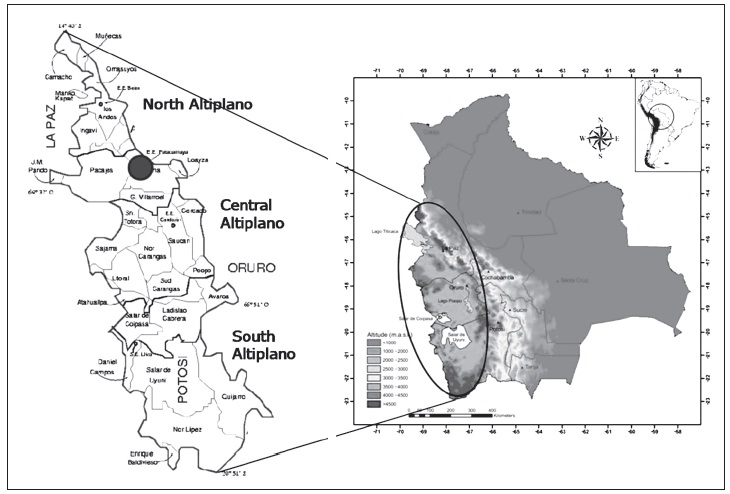
<body><![CDATA[<p align=center><font size="2" face="Verdana, Arial, Helvetica, sans-serif"><img border=0 width=538 height=91 id="_x0000_i1033" src="/img/revistas/rlde/n16/a01fig05.jpg"></font></p>     <p align="justify"><font size="2" face="Verdana, Arial, Helvetica, sans-serif">To test the significance of the coefficients of the model, we applied   the Hosmer and Lemeshow test of goodness of fit <a href="#uno">1</a>and the   iteration history<a href="#dos">2</a>. Also, the omnibus test and the classification   rate<a href="#tres">3</a> were computed.   <o:p></o:p> </font></p>     <p align="justify"><font size="2" face="Verdana, Arial, Helvetica, sans-serif">Willingness to pay a system irrigation maintenance fee was used as   dependent variable in order to evaluate adoption technology willingness. The   independent variables were selected by mean of previous analysis and literature   review. We include five farm specific variables: acreage of quinoa, share of   quinoa production sold, previous irrigation experience, age and education level   of the farmer; and dummy variable for community that captures external factors.   <o:p></o:p> </font></p>     <p align="justify"><font size="2" face="Verdana, Arial, Helvetica, sans-serif"><b>3.1. Data</b>       <o:p></o:p> </font></p>     <p align="justify"><font size="2" face="Verdana, Arial, Helvetica, sans-serif">Primary data were collected in five communities of the municipality of   Patacamaya: Patarani (17&ordm; 15' S, 68&ordm; 21' W), Manzanani (17&ordm; 51' S and 58&ordm; 21'   W), San Martin (17&ordm; 56'S and 68&ordm;42'W), Mantecani (17&deg;06'S and 67&deg;57'W) Toloma   (17&deg;06'S and 68&deg;47'W) and two communities of the municipality of Umala:   I&ntilde;acamaya (17&ordm;20' S and 67&ordm;54'W) and San Jos&eacute; de Llangas (17&ordm;20'S and 67&ordm;45'W)   in the Central Altiplano of Bolivia (<a href="#f2">figure 2</a>).   <o:p></o:p> </font></p>     <p align="justify"><a name="f2"></a></p>     <p align=center><font size="2" face="Verdana, Arial, Helvetica, sans-serif"><b>Figure 2: Location of the   Municipalities of Patacamaya and Umala in the Bolivian Altiplano   <o:p></o:p> </b></font></p>     <p align=center><font size="2" face="Verdana, Arial, Helvetica, sans-serif"><img border=0 width=730 height=494 id="_x0000_i1034" src="/img/revistas/rlde/n16/a01fig06.jpg">    <br>   Source: FDTA- ALTIPLANO (2002)   <o:p></o:p> </font></p>     <p align="justify"><font size="2" face="Verdana, Arial, Helvetica, sans-serif">The selection   criteria to select these communities include:   <o:p></o:p> </font></p>     ]]></body>
<body><![CDATA[<p align="justify"><font size="2" face="Verdana, Arial, Helvetica, sans-serif">1.&nbsp;&nbsp;&nbsp;&nbsp;&nbsp;   There is at least some quinoa production.   <o:p></o:p> </font></p>     <p align="justify"><font size="2" face="Verdana, Arial, Helvetica, sans-serif">2.&nbsp;&nbsp;&nbsp;&nbsp;&nbsp;   There is access to irrigation.   <o:p></o:p> </font></p>     <p align="justify"><font size="2" face="Verdana, Arial, Helvetica, sans-serif">3.&nbsp;&nbsp;&nbsp;&nbsp;&nbsp;   At least some irrigation is applied (to any crop)   <o:p></o:p> </font></p>     <p align="justify"><font size="2" face="Verdana, Arial, Helvetica, sans-serif">4.&nbsp;&nbsp;&nbsp;&nbsp;&nbsp;   The communities agree with the study (the most important factor)   <o:p></o:p> </font></p>     <p align="justify"><font size="2" face="Verdana, Arial, Helvetica, sans-serif">We collected survey and interview data from families with permanent   residence in the community, thus we had 11 families for Manzanani, 20 families   for Patarani , 20 families for San Martin, 30 families for Mantecani, 7   families for Toloma, 30 families for I&ntilde;acamaya and 20 families for San Jos&eacute; de   Llangas. In total 137 farmers have been interviewed.   <o:p></o:p> </font></p>     <p align="justify"><font size="2" face="Verdana, Arial, Helvetica, sans-serif">A questionnaire was designed including the follow topics:   <o:p></o:p> </font></p> <ul type=disc>       <li><font size="2" face="Verdana, Arial, Helvetica, sans-serif">Production. To know the importance of quinoa crop for the farmer;     including variables as: acreage, production, production destination,     reasons for cropping or not. </font><font size="2" face="Verdana, Arial, Helvetica, sans-serif">           <o:p></o:p>         </font></li>       <li><font size="2" face="Verdana, Arial, Helvetica, sans-serif">Social characteristics. To know the farmers' social environment,     including variables as: producer name, family size, age, education level,     migration, main family activities, institutional environment, perception     of development. </font><font size="2" face="Verdana, Arial, Helvetica, sans-serif">         <o:p></o:p>       </font></li>       <li><font size="2" face="Verdana, Arial, Helvetica, sans-serif">Production costs, including variables as: labour for the whole     production process including harvest and post-harvest. </font><font size="2" face="Verdana, Arial, Helvetica, sans-serif">         <o:p></o:p>       </font></li>       <li><font size="2" face="Verdana, Arial, Helvetica, sans-serif">Commercialization costs, including variables as: place of sell,     distance, transport cost, type of buyer and sell price. </font><font size="2" face="Verdana, Arial, Helvetica, sans-serif">         <o:p></o:p>       </font></li>       ]]></body>
<body><![CDATA[<li><font size="2" face="Verdana, Arial, Helvetica, sans-serif">Transformation and consumption. Ways of consumption and     transformation. </font><font size="2" face="Verdana, Arial, Helvetica, sans-serif">         <o:p></o:p>       </font></li>       <li><font size="2" face="Verdana, Arial, Helvetica, sans-serif">Water resource use, including variables as: kind of water source,     irrigation use, irrigation system, farmer's willingness to apply     irrigation for quinoa, reasons to apply or not irrigation for quinoa,     willingness to apply deficit irrigation, willingness to invest for     irrigation system. </font><font size="2" face="Verdana, Arial, Helvetica, sans-serif">         <o:p></o:p>       </font></li>     </ul>     <p align="justify"><font size="2" face="Verdana, Arial, Helvetica, sans-serif">    <br>   Small farmers in developing countries are very distrustful with foreign people   and they frequently do not give all the information to the institutions   (Ramesh, 2000); then it is important to get the farmer's trust. Therefore,   participatory evaluation techniques were applied using an experimental field   where farmers evaluated the crop growing: at initial, flowering and grain settling   (harvest).   <o:p></o:p> </font></p>     <p align="justify"><font size="2" face="Verdana, Arial, Helvetica, sans-serif">Whit   participatory evaluation we were able to explain the research's objectives and   the deficit irrigation technology; thus, they were able to compare yields with   and without irrigation.   <o:p></o:p> </font></p>     <p align="justify"><font size="2" face="Verdana, Arial, Helvetica, sans-serif">While the   dependent variables are dummy variables following a question on the willingness   to irrigate or pay a maintenance fee, the independent variables are defined as   follows:   <o:p></o:p> </font></p> <ul type=disc>       <li><font size="2" face="Verdana, Arial, Helvetica, sans-serif">Acreage of quinoa (continuous variable in hectares) </font><font size="2" face="Verdana, Arial, Helvetica, sans-serif">     <o:p></o:p>   </font></li>       <li><font size="2" face="Verdana, Arial, Helvetica, sans-serif">Share of quinoa production for sale (coded as saleplan continuous     variable in %) </font><font size="2" face="Verdana, Arial, Helvetica, sans-serif">         <o:p></o:p>       </font></li>       <li><font size="2" face="Verdana, Arial, Helvetica, sans-serif">Irrigation experience (coded as irrigation, categorical variable     that is the farmer already applies irrigation to quinoa or another crop,     it takes the value 0 when farmer does not applies irrigation and 1 when     farmer applies irrigation) </font><font size="2" face="Verdana, Arial, Helvetica, sans-serif">         <o:p></o:p>       </font></li>       ]]></body>
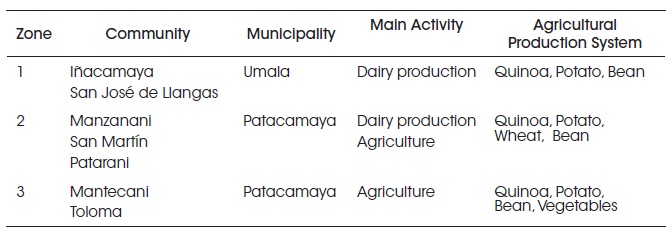
<body><![CDATA[<li><font size="2" face="Verdana, Arial, Helvetica, sans-serif">Age (continuous     variable).</font></li>       <li><font size="2" face="Verdana, Arial, Helvetica, sans-serif">Education level (coded as educlevel, categorical variable grouped     into three categories: 1 = Primary school, 2 = Incomplete secondary     school, and 3 = Bachelor) </font><font size="2" face="Verdana, Arial, Helvetica, sans-serif">         <o:p></o:p>       </font></li>       <li><font size="2" face="Verdana, Arial, Helvetica, sans-serif">Zone (coded as pid; categorical variable grouped into three zones     according of findings of previous analysis of binary logistic regression:     Zone 1 = Patarani, Manzanani and Mantecani; Zone 2 = Toloma, San Mart&iacute;n;     Zone 3 = I&ntilde;acamaya, San Jos&eacute; de Llangas.) </font><font size="2" face="Verdana, Arial, Helvetica, sans-serif">         <o:p></o:p>       </font></li>     </ul>     <p align="justify">&nbsp;</p>     <p align="justify"><font size="3" face="Verdana, Arial, Helvetica, sans-serif"><b>4. Results</b></font><font size="2" face="Verdana, Arial, Helvetica, sans-serif">   <o:p></o:p> </font></p>     <p align="justify"><font size="2" face="Verdana, Arial, Helvetica, sans-serif"><b>4.1. General information</b>       <o:p></o:p> </font></p>     <p align="justify"><font size="2" face="Verdana, Arial, Helvetica, sans-serif">The study   area may be classified into three zones considering the agricultural production   system and the main economic activity. <a href="#t2">Table 2</a> shows the characteristics of   each region.   <o:p></o:p> </font></p>     <p align="justify"><a name="t2"></a></p>     <p align=center><font size="2" face="Verdana, Arial, Helvetica, sans-serif"><b>Table 2</b>    ]]></body>
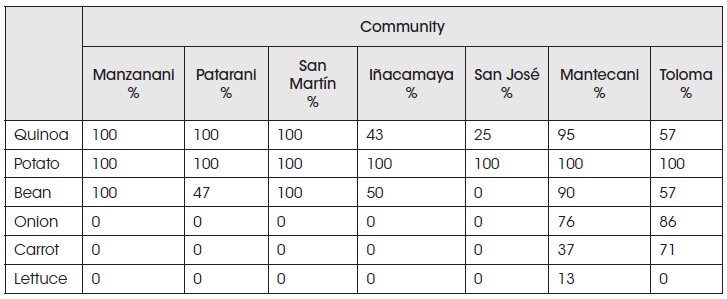
<body><![CDATA[<br>       <b>Characteristics of each zone by main         activity and agricultural production system</b>       <o:p></o:p> </font></p>     <p align=center><font size="2" face="Verdana, Arial, Helvetica, sans-serif"><img border=0 width=672 height=236 id="_x0000_i1035" src="/img/revistas/rlde/n16/a01tab02.jpg"></font></p>     <p align="justify"><font size="2" face="Verdana, Arial, Helvetica, sans-serif">The   communities of I&ntilde;acamaya and San Jos&eacute; de Llangas are located in the   Municipality of Umala. Dairy production is the main economic activity and the   agricultural production system corresponds to the cropping of quinoa, potato   and faba bean. According with the mechanization, less than half of the sampled   farmers in these communities use traditional technology. Irrigation generally   is not used for agricultural production; thus, 70% of the interviewed farmers   use irrigation for forage crops, while only about 20% uses irrigation for   potatoes.   <o:p></o:p> </font></p>     <p align="justify"><font size="2" face="Verdana, Arial, Helvetica, sans-serif">The   communities of Manzanani, San Mart&iacute;n and Patarani are located in the   Municipality of Patacamaya, they have livestock as main economic activity and   crop production as secondary activity. Potato and quinoa are the main crops.   With regard to mechanization, a large share of the sample (80%) practices   traditional technology. Irrigation is not used a lot for agricultural   production: only 40% of the interviewed farmers use irrigation. There are   specifics crops which are irrigated, such as alfalfa, barley, potato and   vegetables (e.g., beans).   <o:p></o:p> </font></p>     <p align="justify"><font size="2" face="Verdana, Arial, Helvetica, sans-serif">The   communities of Mantecani and Toloma are also located in the Municipality of   Patacamaya. The commercialization of onion, carrot and lettuce is the main   economic activity. The agricultural production system is conformed by quinoa,   potato, faba bean and vegetables. Into the three regions, the family labour is   involved in the whole productive process. Nevertheless, in relation with mechanization   use, relatively few farmers (20%) utilize traditional technology. All farmers   interviewed use irrigation for agricultural production. The main crops are   vegetables such as onions, carrots and lettuce. Irrigation is used for these   crops as well as beans and potato.   <o:p></o:p> </font></p>     <p align="justify"><font size="2" face="Verdana, Arial, Helvetica, sans-serif">According to   the results of our survey, potato is the most important crop and quinoa   represents the second most important crop for all farmers of the communities.   All the families interviewed in the communities of I&ntilde;acamaya and San Jos&eacute; de   Llangas produce quinoa at small scale ranging from   <st1:metricconverter ProductID="0.25 ha" w:st="on">0.25 ha</st1:metricconverter>   to more than   <st1:metricconverter ProductID="4 ha" w:st="on">4 ha</st1:metricconverter>   . In the communities of   Manzanani, San Mart&iacute;n and Patarani less than half of the sample produces quinoa   on acreage of 0.25 to   <st1:metricconverter ProductID="1.6 ha" w:st="on">1.6 ha</st1:metricconverter>   .   Over half of the families interviewed in Mantecani and Toloma is cropping   quinoa (<a href="#t3">table 3</a>).   <o:p></o:p> </font></p>     <p align="justify"><a name="t3"></a></p>     <p align=center><font size="2" face="Verdana, Arial, Helvetica, sans-serif"><b>Table 3</b></font>    <br>     <b><font size="2" face="Verdana, Arial, Helvetica, sans-serif">Main agricultural production systems4</font></b></p>     <p align=center><font size="2" face="Verdana, Arial, Helvetica, sans-serif"><img border=0 width=727 height=299 id="_x0000_i1036" src="/img/revistas/rlde/n16/a01tab03.jpg"></font></p>     ]]></body>
<body><![CDATA[<p align="justify"><font size="2" face="Verdana, Arial, Helvetica, sans-serif"><b>2. Willingness to adopt deficit irrigation to quinoa   <o:p></o:p> </b></font></p>     <p align="justify"><font size="2" face="Verdana, Arial, Helvetica, sans-serif">As the aim of   the research was to find the main factors that would influence the adoption of   deficit irrigation technology for quinoa, the present study examined the effect   of independent variables: Acreage of quinoa, share of quinoa production for   selling, irrigation experience, age and education level on dependent variable   willingness to apply irrigation.</font></p>     <p align=center><font size="2" face="Verdana, Arial, Helvetica, sans-serif"><b>Table 4   <o:p></o:p> </b></font></p>     <p align=center><b><font size="2" face="Verdana, Arial, Helvetica, sans-serif">Definition and   summary statistics of independent variables   <o:p></o:p> </font></b></p>     <p align=center><font size="2" face="Verdana, Arial, Helvetica, sans-serif"><b><img border=0 width=677 height=360 id="_x0000_i1037" src="/img/revistas/rlde/n16/a01tab04.jpg"></b></font></p>     <p align="justify"><font size="2" face="Verdana, Arial, Helvetica, sans-serif">    <br>   The survey shows that more than 50% of all farmers are willing to irrigate   quinoa. <a href="#t5">Table 5</a> displays the Wald statistic for each independent variables as   well as dummy variables. Variables with Wald statistic significance less than   0.05 denote that the variable is significant in the model.   <o:p></o:p> </font></p>     <p align="center"><a name="t5"></a></p>     <p align="center"><font size="2" face="Verdana, Arial, Helvetica, sans-serif"><b>Table 5   <o:p></o:p> </b></font></p>     <p align=center><b><font size="2" face="Verdana, Arial, Helvetica, sans-serif">Logit regression   with willingness to pay a maintenance fee for irrigation system as dependent   variable</font></b><font size="2" face="Verdana, Arial, Helvetica, sans-serif"><b>    ]]></body>
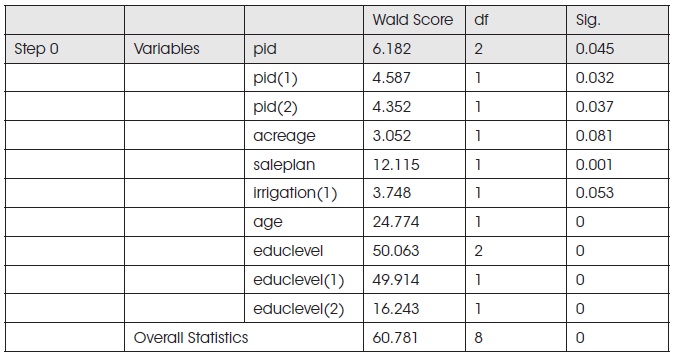
<body><![CDATA[<br>   </b>    <br>   <img border=0 width=648 height=420 id="_x0000_i1038" src="/img/revistas/rlde/n16/a01tab05.jpg">   <o:p></o:p> </font></p>     <p align="justify"><font size="2" face="Verdana, Arial, Helvetica, sans-serif">    <br>   The regression analysis (table 5) shows that acreage of quinoa (acreage),   irrigation experience (irrigation), age, education level (educlevel) and share   of quinoa production for sale (saleplan) are statistically significant in the   model. Despite the variable zone presents a significance value over 0.05, zone   1 composed by the communities San Martin, Patarani and Manzanani displays a   significant value which might be related with quinoa acreage. Variables in the   equation display the sign we expected.   <o:p></o:p> </font></p>     <p align="justify"><font size="2" face="Verdana, Arial, Helvetica, sans-serif">Results   indicate a consistent pattern of adoption technology with other studies (Iqbal,   2007; Mgaba-Semgalawe and Folmer, 2000; Namara <i>et al</i>., 2007).   <o:p></o:p> </font></p>     <p align="justify"><font size="2" face="Verdana, Arial, Helvetica, sans-serif">Variables   included in the model are: acreage or size farm, it was relevant also for Iqbal   (2002) who found that farm size would be a decisive factor to adopt high   yielding wheat varieties and Karami (2006) who classified farmer into small,   medium and large according whit the farm size for adoption irrigation   technology and found the total of farmers classified as large were willing to   adopt an appropriate technology.   <o:p></o:p> </font></p>     <p align="justify"><font size="2" face="Verdana, Arial, Helvetica, sans-serif">Irrigation   experience is also included in the model and it is supported by research of   Cameron (1999); is important to consider also that farmers who use irrigation   have water access. Variables age and education level are consistent with   findings of several researchers like Iqbal (2002) who found that younger   farmers are more willing to adopt high yielding wheat varieties,   Mgaba-Semgalawe (2000) found also that older farmers have negative influence on   perception, adoption and investment for the improving of soil conservation.   <o:p></o:p> </font></p>     <p align="justify">&nbsp;</p>     <p align="justify"><font size="3" face="Verdana, Arial, Helvetica, sans-serif"><b>5. Conclusions</b></font><font size="2" face="Verdana, Arial, Helvetica, sans-serif">   <o:p></o:p> </font></p>     <p align="justify"><font size="2" face="Verdana, Arial, Helvetica, sans-serif">The study   area was classified into three zones considering the agricultural production   system and the main economic activity. The first group, composed by Mantecani,   Manzanani and Patarani, has as main economic activity agriculture and quinoa   acreage larger than the second group that is conformed by Toloma and San   Martin; these communities show small quinoa acreage (less than   <st1:metricconverter ProductID="0.5 hectares" w:st="on">0.5 hectares</st1:metricconverter>   ) and the   third group, composed by I&ntilde;acamaya and San Jos&eacute; de Llangas, has as main   economic activity livestock.   <o:p></o:p> </font></p>     ]]></body>
<body><![CDATA[<p align="justify"><font size="2" face="Verdana, Arial, Helvetica, sans-serif">Nevertheless   these specific characteristics, results of binary logistic regression displayed   that the factor zone is not a decisive factor for adopting deficit irrigation.   <o:p></o:p> </font></p>     <p align="justify"><font size="2" face="Verdana, Arial, Helvetica, sans-serif">The main   findings demonstrate that deficit irrigation technology is more likely to be   picked up in areas where farmers own larger fields where they can obtain   surplus production for sale and where there is already certain type of   irrigation.   <o:p></o:p> </font></p>     <p align="justify"><font size="2" face="Verdana, Arial, Helvetica, sans-serif">On other hand   also social factors should be taking into account because young people is more   willing to adopt new technology than older people as well as people who reaches   a higher education level.Also is important to remark that farmers decide to   plant thinking at first for food for family.   <o:p></o:p> </font></p>     <p align="justify"><font size="2" face="Verdana, Arial, Helvetica, sans-serif">This is the   most important reason for what the destination of the production is mainly self   consumption.   <o:p></o:p> </font></p>     <p align=right><font size="2" face="Verdana, Arial, Helvetica, sans-serif"><i>Art&iacute;culo recibido en:   mayo de 2011 </i></font></p>     <p align=right><i><font size="2" face="Verdana, Arial, Helvetica, sans-serif">Manejado por: ABCE </font></i></p>     <p align=right><i><font size="2" face="Verdana, Arial, Helvetica, sans-serif">Aceptado en: agosto de   2011</font></i></p>     <p align=justify>&nbsp;</p>     <p align="justify"><font size="3" face="Verdana, Arial, Helvetica, sans-serif"><b>References</b> </font></p>     <!-- ref --><p align="justify"><font size="2" face="Verdana, Arial, Helvetica, sans-serif">1.&nbsp;&nbsp;&nbsp;&nbsp;&nbsp; Aguayo, M. (2007). C&oacute;mo hacer una regresi&oacute;n log&iacute;stica con   SPSS &quot;paso a paso&quot;. Fundaci&oacute;n Andaluza Beturia   para   <st1:PersonName ProductID="la Investigaci&oacute;n" w:st="on">la Investigaci&oacute;n</st1:PersonName>   en Salud (FABIS). DOCUWEB FABIS Dot. Num 0702012. Available at: <a href="http://www.fabis.org/html/archivos/ docuweb/Regres_log_1r.pdf" target="_blank">http://www.fabis.org/html/archivos/ docuweb/Regres_log_1r.pdf</a>.   <o:p></o:p> </font>&nbsp;&nbsp;&nbsp;&nbsp;&nbsp;&nbsp;&nbsp;&nbsp;[&#160;<a href="javascript:void(0);" onclick="javascript: window.open('/scielo.php?script=sci_nlinks&ref=511277&pid=S2074-4706201100020000200001&lng=','','width=640,height=500,resizable=yes,scrollbars=1,menubar=yes,');">Links</a>&#160;]<!-- end-ref --><!-- ref --><p align="justify"><font size="2" face="Verdana, Arial, Helvetica, sans-serif">2.&nbsp;&nbsp;&nbsp;&nbsp;&nbsp;   Alderete, A.M. (2006). Fundamentos del an&aacute;lisis de la regresi&oacute;n log&iacute;stica en la investigaci&oacute;n   psicol&oacute;gica. Laboratorio de Evaluaci&oacute;n Psicol&oacute;gica y Educativa. Revista Evaluar   N&deg; 6. 52-67.</font>&nbsp;&nbsp;&nbsp;&nbsp;&nbsp;&nbsp;&nbsp;&nbsp;[&#160;<a href="javascript:void(0);" onclick="javascript: window.open('/scielo.php?script=sci_nlinks&ref=511278&pid=S2074-4706201100020000200002&lng=','','width=640,height=500,resizable=yes,scrollbars=1,menubar=yes,');">Links</a>&#160;]<!-- end-ref --><!-- ref --><p align="justify"><font size="2" face="Verdana, Arial, Helvetica, sans-serif">3.&nbsp;&nbsp;&nbsp;&nbsp;&nbsp; Aliaga, S. (2006). Evaluaci&oacute;n participativa con enfoque de   g&eacute;nero sobre los usos, restricciones y oportunidades de la quinua en seis   comunidades del municipio de Sica Sica.   Facultad de Agronom&iacute;a, Universidad Mayor de San Andr&eacute;s.   <st1:PersonName ProductID="La Paz" w:st="on">La Paz</st1:PersonName>   , Bolivia. 94   pp.   <o:p></o:p> </font>&nbsp;&nbsp;&nbsp;&nbsp;&nbsp;&nbsp;&nbsp;&nbsp;[&#160;<a href="javascript:void(0);" onclick="javascript: window.open('/scielo.php?script=sci_nlinks&ref=511279&pid=S2074-4706201100020000200003&lng=','','width=640,height=500,resizable=yes,scrollbars=1,menubar=yes,');">Links</a>&#160;]<!-- end-ref --><!-- ref --><p align="justify"><font size="2" face="Verdana, Arial, Helvetica, sans-serif">4.&nbsp;&nbsp;&nbsp;&nbsp;&nbsp;   Bewick, V.; Cheek, L.; Ball, J. ( 2005). Statistics review 14: Logistic   regression. Pub Med Central. Published online &nbsp;2005 January 13. doi: 10.1186/cc3045.   Available at: <a href="http://www.pubmedcentral.nih.gov/articlerender.fcgi?artid=1065119" target="_blank">http://www.pubmedcentral.nih.gov/articlerender.fcgi?artid=1065119</a>   <o:p></o:p> </font>&nbsp;&nbsp;&nbsp;&nbsp;&nbsp;&nbsp;&nbsp;&nbsp;[&#160;<a href="javascript:void(0);" onclick="javascript: window.open('/scielo.php?script=sci_nlinks&ref=511280&pid=S2074-4706201100020000200004&lng=','','width=640,height=500,resizable=yes,scrollbars=1,menubar=yes,');">Links</a>&#160;]<!-- end-ref --><!-- ref --><p align="justify"><font size="2" face="Verdana, Arial, Helvetica, sans-serif">5.&nbsp;&nbsp;&nbsp;&nbsp;&nbsp;   Blanke, A.; Rozelle, S.; Lohmar, B.; Wang, J.; Huang, J. (2007). Water   saving technology and saving water in China. Agricultural Water Management &nbsp;87: 139-150.   <o:p></o:p> </font>&nbsp;&nbsp;&nbsp;&nbsp;&nbsp;&nbsp;&nbsp;&nbsp;[&#160;<a href="javascript:void(0);" onclick="javascript: window.open('/scielo.php?script=sci_nlinks&ref=511281&pid=S2074-4706201100020000200005&lng=','','width=640,height=500,resizable=yes,scrollbars=1,menubar=yes,');">Links</a>&#160;]<!-- end-ref --><!-- ref --><p align="justify"><font size="2" face="Verdana, Arial, Helvetica, sans-serif">6.&nbsp;&nbsp;&nbsp;&nbsp;&nbsp;   Brenes, E. R., Madrigal, K. and &nbsp;Crespo,   F. ( 2001a). El   cluster de la soya en Bolivia: diagn&oacute;stico competitivo y recomendaciones   estrat&eacute;gicas. Documentos de Trabajo. Programa de Competitividad, CLACDS-INCAE.</font>&nbsp;&nbsp;&nbsp;&nbsp;&nbsp;&nbsp;&nbsp;&nbsp;[&#160;<a href="javascript:void(0);" onclick="javascript: window.open('/scielo.php?script=sci_nlinks&ref=511282&pid=S2074-4706201100020000200006&lng=','','width=640,height=500,resizable=yes,scrollbars=1,menubar=yes,');">Links</a>&#160;]<!-- end-ref --><!-- ref --><p align="justify"><font size="2" face="Verdana, Arial, Helvetica, sans-serif">7.&nbsp;&nbsp;&nbsp;&nbsp;&nbsp; Camacho, M. (2001). La gesti&oacute;n del espacio y las pr&aacute;cticas   de manejo del suelo en la regi&oacute;n altipl&aacute;nica de   Bolivia: el caso de la comunidad de Patarani en la   provincia Aroma. Tesis de M.Sc. en Ecolog&iacute;a y   Conservaci&oacute;n, Universidad Mayor de San Andr&eacute;s,   <st1:PersonName ProductID="La Paz." w:st="on">La Paz.</st1:PersonName> </font>&nbsp;&nbsp;&nbsp;&nbsp;&nbsp;&nbsp;&nbsp;&nbsp;[&#160;<a href="javascript:void(0);" onclick="javascript: window.open('/scielo.php?script=sci_nlinks&ref=511283&pid=S2074-4706201100020000200007&lng=','','width=640,height=500,resizable=yes,scrollbars=1,menubar=yes,');">Links</a>&#160;]<!-- end-ref --><!-- ref --><p align="justify"><font size="2" face="Verdana, Arial, Helvetica, sans-serif">8.&nbsp;&nbsp;&nbsp;&nbsp;&nbsp;   Cameron, L. (1999). The Importance of Learning in the Adoption of   High-Yielding Variety Seeds. American Journal of Agricultural Economics, 81 (1): 83-94.</font>&nbsp;&nbsp;&nbsp;&nbsp;&nbsp;&nbsp;&nbsp;&nbsp;[&#160;<a href="javascript:void(0);" onclick="javascript: window.open('/scielo.php?script=sci_nlinks&ref=511284&pid=S2074-4706201100020000200008&lng=','','width=640,height=500,resizable=yes,scrollbars=1,menubar=yes,');">Links</a>&#160;]<!-- end-ref --><!-- ref --><p align="justify"><font size="2" face="Verdana, Arial, Helvetica, sans-serif">9.&nbsp;&nbsp;&nbsp;&nbsp;&nbsp; Crespo, F.; Brenes, E.; Madrigal, K. (2001). El cluster de   la quinua en Bolivia: Diagn&oacute;stico competitivo y recomendaciones estrat&eacute;gicas. Proyecto   Andino de Competitividad-CAF. INCAE,   <st1:PersonName ProductID="La Paz" w:st="on">La     Paz</st1:PersonName>   , Bolivia.</font>&nbsp;&nbsp;&nbsp;&nbsp;&nbsp;&nbsp;&nbsp;&nbsp;[&#160;<a href="javascript:void(0);" onclick="javascript: window.open('/scielo.php?script=sci_nlinks&ref=511285&pid=S2074-4706201100020000200009&lng=','','width=640,height=500,resizable=yes,scrollbars=1,menubar=yes,');">Links</a>&#160;]<!-- end-ref --><!-- ref --><p align="justify"><font size="2" face="Verdana, Arial, Helvetica, sans-serif">10.&nbsp; CEPROBOL   (2007). Perfiles sectoriales de productos. Quinua y derivados, perfil sectorial.   Ministerio de Relaciones Exteriores y Cultos. Viceministerio   de Relaciones Econ&oacute;micas y Comercio Exterior. Direcci&oacute;n   de investigaci&oacute;n e informaci&oacute;n.   <o:p></o:p> </font>&nbsp;&nbsp;&nbsp;&nbsp;&nbsp;&nbsp;&nbsp;&nbsp;[&#160;<a href="javascript:void(0);" onclick="javascript: window.open('/scielo.php?script=sci_nlinks&ref=511286&pid=S2074-4706201100020000200010&lng=','','width=640,height=500,resizable=yes,scrollbars=1,menubar=yes,');">Links</a>&#160;]<!-- end-ref --><!-- ref --><p align="justify"><font size="2" face="Verdana, Arial, Helvetica, sans-serif">11.&nbsp; Chikozho,   C. (2005). Policy and institutional dimensions of small-holder farmer   innovations in the Thukela River Basin of South Africa and the Pangani River   Basin of Tanzania: a comparative perspective. Physics and Chemistry of the   Earth &nbsp;30: 913-924.   <o:p></o:p> </font>&nbsp;&nbsp;&nbsp;&nbsp;&nbsp;&nbsp;&nbsp;&nbsp;[&#160;<a href="javascript:void(0);" onclick="javascript: window.open('/scielo.php?script=sci_nlinks&ref=511287&pid=S2074-4706201100020000200011&lng=','','width=640,height=500,resizable=yes,scrollbars=1,menubar=yes,');">Links</a>&#160;]<!-- end-ref --><!-- ref --><p align="justify"><font size="2" face="Verdana, Arial, Helvetica, sans-serif">12.&nbsp; Comai,   S.; Bertazzo, A.; Bailoni, L.; Zancato, M.; Costa, C.V.L.; Allegri, G. ( 2007).   The content of protein and nonproteic (free and proteinbound) tryptophan in   quinoa and cereal flours, Food Chem. 100: 1350-1355.   <o:p></o:p> </font>&nbsp;&nbsp;&nbsp;&nbsp;&nbsp;&nbsp;&nbsp;&nbsp;[&#160;<a href="javascript:void(0);" onclick="javascript: window.open('/scielo.php?script=sci_nlinks&ref=511288&pid=S2074-4706201100020000200012&lng=','','width=640,height=500,resizable=yes,scrollbars=1,menubar=yes,');">Links</a>&#160;]<!-- end-ref --><!-- ref --><p align="justify"><font size="2" face="Verdana, Arial, Helvetica, sans-serif">13.&nbsp; Coorporaci&oacute;n Andina de Fomento (CAF), Centro para el Desarrollo InternacionalUniversidad de Harvard   (CID), Centro Latinoamericano para   <st1:PersonName ProductID="la Competitividad" w:st="on">la Competitividad</st1:PersonName>   y el Desarrollo Sostenible   (CLACDS-INCAE). (2001). Caracterizaci&oacute;n y an&aacute;lisis para la competitividad de la   quinoa en Bolivia. Proyecto   andino de competitividad. Available at: </font><font size="2" face="Verdana, Arial, Helvetica, sans-serif"><a href="http://www.cid.harvard.edu/archive/andes/documents/presentations/analisisdelaquinuaenbolivia.pdf" target="_blank">http://www.cid.harvard.edu/archive/andes/documents/presentations/analisisdelaquinuaenbolivia.pdf</a>.   <o:p></o:p> </font>&nbsp;&nbsp;&nbsp;&nbsp;&nbsp;&nbsp;&nbsp;&nbsp;[&#160;<a href="javascript:void(0);" onclick="javascript: window.open('/scielo.php?script=sci_nlinks&ref=511289&pid=S2074-4706201100020000200013&lng=','','width=640,height=500,resizable=yes,scrollbars=1,menubar=yes,');">Links</a>&#160;]<!-- end-ref --><!-- ref --><p align="justify"><font size="2" face="Verdana, Arial, Helvetica, sans-serif">14.&nbsp; FAO   (Food and Agriculture Organization of the United Nations). (1998). Under-utilized   Andean food crops. Latin America and the Caribbean. Rome, Italy.</font>&nbsp;&nbsp;&nbsp;&nbsp;&nbsp;&nbsp;&nbsp;&nbsp;[&#160;<a href="javascript:void(0);" onclick="javascript: window.open('/scielo.php?script=sci_nlinks&ref=511290&pid=S2074-4706201100020000200014&lng=','','width=640,height=500,resizable=yes,scrollbars=1,menubar=yes,');">Links</a>&#160;]<!-- end-ref --><!-- ref --><p align="justify"><font size="2" face="Verdana, Arial, Helvetica, sans-serif">15.&nbsp; FAUTAPO.   (2005). Estudio l&iacute;nea base 2001-2004. Programa Altiplano Quinua Sur. Bolivia.   pp. 36-37.   <o:p></o:p> </font>&nbsp;&nbsp;&nbsp;&nbsp;&nbsp;&nbsp;&nbsp;&nbsp;[&#160;<a href="javascript:void(0);" onclick="javascript: window.open('/scielo.php?script=sci_nlinks&ref=511291&pid=S2074-4706201100020000200015&lng=','','width=640,height=500,resizable=yes,scrollbars=1,menubar=yes,');">Links</a>&#160;]<!-- end-ref --><!-- ref --><p align="justify"><font size="2" face="Verdana, Arial, Helvetica, sans-serif">16.&nbsp; Feder,   G.; Just, R.; Zilberman, D. (1985). Adoption of agricultural innovations in   developing countries: A survey. Economic Development and Cultural Change, 33 ( 2): 255-298.</font>&nbsp;&nbsp;&nbsp;&nbsp;&nbsp;&nbsp;&nbsp;&nbsp;[&#160;<a href="javascript:void(0);" onclick="javascript: window.open('/scielo.php?script=sci_nlinks&ref=511292&pid=S2074-4706201100020000200016&lng=','','width=640,height=500,resizable=yes,scrollbars=1,menubar=yes,');">Links</a>&#160;]<!-- end-ref --><!-- ref --><p align="justify"><font size="2" face="Verdana, Arial, Helvetica, sans-serif">17.&nbsp; Fundaci&oacute;n   para el Desarrollo Tecnol&oacute;gico del Altiplano. FDTA-ALTIPLANO. (2002). Prospecci&oacute;n   de demandas de La cadena productiva quinua en Bolivia. Available   at: </font><font size="2" face="Verdana, Arial, Helvetica, sans-serif"><a href="http://www.fdta-altiplano.org/quinua%20presen/IndiceGeneral.htm" target="_blank">http://www.fdta-altiplano.org/quinua%20presen/IndiceGeneral.htm</a>   <o:p></o:p> </font>&nbsp;&nbsp;&nbsp;&nbsp;&nbsp;&nbsp;&nbsp;&nbsp;[&#160;<a href="javascript:void(0);" onclick="javascript: window.open('/scielo.php?script=sci_nlinks&ref=511293&pid=S2074-4706201100020000200017&lng=','','width=640,height=500,resizable=yes,scrollbars=1,menubar=yes,');">Links</a>&#160;]<!-- end-ref --><!-- ref --><p align="justify"><font size="2" face="Verdana, Arial, Helvetica, sans-serif">18.&nbsp; Garc&iacute;a,   M. (2003). Agroclimatic study and drought resistance analysis of Quinoa for a   deficit irrigation strategy in the Bolivian Altiplano. Doctoral dissertation, K.U.Leuven   University, Dissertationes de Agricultura, N&ordm; 556.   <o:p></o:p> </font>&nbsp;&nbsp;&nbsp;&nbsp;&nbsp;&nbsp;&nbsp;&nbsp;[&#160;<a href="javascript:void(0);" onclick="javascript: window.open('/scielo.php?script=sci_nlinks&ref=511294&pid=S2074-4706201100020000200018&lng=','','width=640,height=500,resizable=yes,scrollbars=1,menubar=yes,');">Links</a>&#160;]<!-- end-ref --><!-- ref --><p align="justify"><font size="2" face="Verdana, Arial, Helvetica, sans-serif">19.&nbsp; Garc&iacute;a,   M.; Raes, D.; Allen, R.; Herbas, C. (2004). Dynamicsofreferenceevapotranspiration   in the Bolivian Highlands (Altiplano). Agricultural and forest meteorology &nbsp;125 (2004): 67-82.   <o:p></o:p> </font>&nbsp;&nbsp;&nbsp;&nbsp;&nbsp;&nbsp;&nbsp;&nbsp;[&#160;<a href="javascript:void(0);" onclick="javascript: window.open('/scielo.php?script=sci_nlinks&ref=511295&pid=S2074-4706201100020000200019&lng=','','width=640,height=500,resizable=yes,scrollbars=1,menubar=yes,');">Links</a>&#160;]<!-- end-ref --><!-- ref --><p align="justify"><font size="2" face="Verdana, Arial, Helvetica, sans-serif">20.&nbsp; Garson,   D. (1998). Logistic Regression. Copyright 1998. Available at: <a href="http://www2.chass.ncsu.edu/garson/PA765/logistic.htm" target="_blank">http://www2.chass.ncsu.edu/garson/PA765/logistic.htm</a>.   Last update 08/04/08.   <o:p></o:p> </font>&nbsp;&nbsp;&nbsp;&nbsp;&nbsp;&nbsp;&nbsp;&nbsp;[&#160;<a href="javascript:void(0);" onclick="javascript: window.open('/scielo.php?script=sci_nlinks&ref=511296&pid=S2074-4706201100020000200020&lng=','','width=640,height=500,resizable=yes,scrollbars=1,menubar=yes,');">Links</a>&#160;]<!-- end-ref --><!-- ref --><p align="justify"><font size="2" face="Verdana, Arial, Helvetica, sans-serif">21.&nbsp; Geerts, S.;   Raes, D.; Garc&iacute;a, M.; Del Castillo, C.; Buytaert, W. (2006). Agro-climatic   suitability mapping for crop production in the Bolivian Altiplano: A case study   for quinoa. Agricultural and forest meteorology &nbsp;139 (2006): 399-412.   <o:p></o:p> </font>&nbsp;&nbsp;&nbsp;&nbsp;&nbsp;&nbsp;&nbsp;&nbsp;[&#160;<a href="javascript:void(0);" onclick="javascript: window.open('/scielo.php?script=sci_nlinks&ref=511297&pid=S2074-4706201100020000200021&lng=','','width=640,height=500,resizable=yes,scrollbars=1,menubar=yes,');">Links</a>&#160;]<!-- end-ref --><!-- ref --><p align="justify"><font size="2" face="Verdana, Arial, Helvetica, sans-serif">22.&nbsp; Geerts,   S.; Raes, D.; Garc&iacute;a, M.; Vacher, J.; Mamani, R.; Mendoza, J.; Huanca, R.; Morales,   B.; Miranda, R.; Cusicanqui, J.; Taboada, C. (2008). Introducing deficit   irrigation to stabilize yields of quinoa (Chenopodium quinoa Willd.). Europ. J. Agronomy &nbsp;28 ( 2008): 427-436.</font>&nbsp;&nbsp;&nbsp;&nbsp;&nbsp;&nbsp;&nbsp;&nbsp;[&#160;<a href="javascript:void(0);" onclick="javascript: window.open('/scielo.php?script=sci_nlinks&ref=511298&pid=S2074-4706201100020000200022&lng=','','width=640,height=500,resizable=yes,scrollbars=1,menubar=yes,');">Links</a>&#160;]<!-- end-ref --><!-- ref --><p align="justify"><font size="2" face="Verdana, Arial, Helvetica, sans-serif">23.&nbsp; Instituto   Nacional de Estad&iacute;stica (INE), s.d. Available at: <a href="http://www.ine.gov.bo/cgi-bin/Panuario_00xx.exe/CUADRO" target="_blank">http://www.ine.gov.bo/cgi-bin/Panuario_00xx.exe/CUADRO</a>.</font>&nbsp;&nbsp;&nbsp;&nbsp;&nbsp;&nbsp;&nbsp;&nbsp;[&#160;<a href="javascript:void(0);" onclick="javascript: window.open('/scielo.php?script=sci_nlinks&ref=511299&pid=S2074-4706201100020000200023&lng=','','width=640,height=500,resizable=yes,scrollbars=1,menubar=yes,');">Links</a>&#160;]<!-- end-ref --><!-- ref --><p align="justify"><font size="2" face="Verdana, Arial, Helvetica, sans-serif">24.&nbsp; Iqbal,   M.; Azeem, M.; Ahmad, M. (2007). Adoption of Recommended Varieties: A Farm   level Analysis of Wheat Growers in Irrigated Punjab. Pakistan Institute of   Development Economics. Available at: <a href="http://mpra.ub.uni-muenchen.de/2537/01/MPRA_paper_2537.pdf" target="_blank">http://mpra.ub.uni-muenchen.de/2537/01/MPRA_paper_2537.pdf</a>.   <o:p></o:p> </font>&nbsp;&nbsp;&nbsp;&nbsp;&nbsp;&nbsp;&nbsp;&nbsp;[&#160;<a href="javascript:void(0);" onclick="javascript: window.open('/scielo.php?script=sci_nlinks&ref=511300&pid=S2074-4706201100020000200024&lng=','','width=640,height=500,resizable=yes,scrollbars=1,menubar=yes,');">Links</a>&#160;]<!-- end-ref --><!-- ref --><p align="justify"><font size="2" face="Verdana, Arial, Helvetica, sans-serif">25.&nbsp;   Karami, E. ( 2006). Appropriateness of farmers_ adoption of irrigation methods:   The pplication of the AHP model. Agricultural systems &nbsp;87 ( 2006): 101-119.   <o:p></o:p> </font>&nbsp;&nbsp;&nbsp;&nbsp;&nbsp;&nbsp;&nbsp;&nbsp;[&#160;<a href="javascript:void(0);" onclick="javascript: window.open('/scielo.php?script=sci_nlinks&ref=511301&pid=S2074-4706201100020000200025&lng=','','width=640,height=500,resizable=yes,scrollbars=1,menubar=yes,');">Links</a>&#160;]<!-- end-ref --><!-- ref --><p align="justify"><font size="2" face="Verdana, Arial, Helvetica, sans-serif">26.&nbsp; Kulecho,   I.K.; Weatherhead, E.K. (2006). Adoption and experience of low-cost drip   irrigation in Kenya. Irrigation and Drainage, 55 ( 4): 435-444.   <o:p></o:p> </font>&nbsp;&nbsp;&nbsp;&nbsp;&nbsp;&nbsp;&nbsp;&nbsp;[&#160;<a href="javascript:void(0);" onclick="javascript: window.open('/scielo.php?script=sci_nlinks&ref=511302&pid=S2074-4706201100020000200026&lng=','','width=640,height=500,resizable=yes,scrollbars=1,menubar=yes,');">Links</a>&#160;]<!-- end-ref --><!-- ref --><p align="justify"><font size="2" face="Verdana, Arial, Helvetica, sans-serif">27.&nbsp; Luquet,   D.; Vidal, A.; Smith, M.; Dauzat, J. (2005). More crop per drop: How to make it   acceptable for farmers? Agricultural Water Management &nbsp;76: 108-119.   <o:p></o:p> </font>&nbsp;&nbsp;&nbsp;&nbsp;&nbsp;&nbsp;&nbsp;&nbsp;[&#160;<a href="javascript:void(0);" onclick="javascript: window.open('/scielo.php?script=sci_nlinks&ref=511303&pid=S2074-4706201100020000200027&lng=','','width=640,height=500,resizable=yes,scrollbars=1,menubar=yes,');">Links</a>&#160;]<!-- end-ref --><!-- ref --><p align="justify"><font size="2" face="Verdana, Arial, Helvetica, sans-serif">28.&nbsp; Mbaga-Sembalawe,   Z.; Folmer, H. (2000). Household Adoption Behaviour of Improved Soil   Conservation; The case of the North Pare and West Usambara Mountains of   Tanzania. Land Use   Policy &nbsp;17: 321-336.</font>&nbsp;&nbsp;&nbsp;&nbsp;&nbsp;&nbsp;&nbsp;&nbsp;[&#160;<a href="javascript:void(0);" onclick="javascript: window.open('/scielo.php?script=sci_nlinks&ref=511304&pid=S2074-4706201100020000200028&lng=','','width=640,height=500,resizable=yes,scrollbars=1,menubar=yes,');">Links</a>&#160;]<!-- end-ref --><p align="justify"><font size="2" face="Verdana, Arial, Helvetica, sans-serif">29.&nbsp; Mamani, A.   (2007). Evaluaci&oacute;n participativa y socioecon&oacute;mica de la aplicaci&oacute;n de riego    <br>   en el cultivo de quinua en tres comunidades del municipio de Patacamaya. Facultad de Agronom&iacute;a, Universidad Mayor de San   Andr&eacute;s.   <st1:PersonName ProductID="La Paz" w:st="on">La Paz</st1:PersonName>   , Bolivia.</font></p>     <!-- ref --><p align="justify"><font size="2" face="Verdana, Arial, Helvetica, sans-serif">30.&nbsp; Namara, R.;   Nagar, R. K.; Upadhyay, B. (2007). Economics, adoption   determinants, and impacts of micro-irrigation technologies: Empirical results   from India. Irrigation   Science, 25: 283-297.</font>&nbsp;&nbsp;&nbsp;&nbsp;&nbsp;&nbsp;&nbsp;&nbsp;[&#160;<a href="javascript:void(0);" onclick="javascript: window.open('/scielo.php?script=sci_nlinks&ref=511307&pid=S2074-4706201100020000200030&lng=','','width=640,height=500,resizable=yes,scrollbars=1,menubar=yes,');">Links</a>&#160;]<!-- end-ref --><!-- ref --><p align="justify"><font size="2" face="Verdana, Arial, Helvetica, sans-serif">31.&nbsp; NEC. N&uacute;cleo   Ejecutor Central. (2006). Producci&oacute;n y comercializaci&oacute;n de quinua en Tantana Acroco, Ayacucho. Available   at: <a href="http://www.nec-tambillo-acocro.com/quinua/Quinua.htm" target="_blank">http://www.nec-tambillo-acocro.com/quinua/Quinua.htm</a>.   <o:p></o:p> </font>&nbsp;&nbsp;&nbsp;&nbsp;&nbsp;&nbsp;&nbsp;&nbsp;[&#160;<a href="javascript:void(0);" onclick="javascript: window.open('/scielo.php?script=sci_nlinks&ref=511308&pid=S2074-4706201100020000200031&lng=','','width=640,height=500,resizable=yes,scrollbars=1,menubar=yes,');">Links</a>&#160;]<!-- end-ref --><!-- ref --><p align="justify"><font size="2" face="Verdana, Arial, Helvetica, sans-serif">32.&nbsp; PROINPA.   (2004). Estudio de los impactos sociales, ambientales y econ&oacute;micos de la promoci&oacute;n   de la quinua en Bolivia.</font>&nbsp;&nbsp;&nbsp;&nbsp;&nbsp;&nbsp;&nbsp;&nbsp;[&#160;<a href="javascript:void(0);" onclick="javascript: window.open('/scielo.php?script=sci_nlinks&ref=511309&pid=S2074-4706201100020000200032&lng=','','width=640,height=500,resizable=yes,scrollbars=1,menubar=yes,');">Links</a>&#160;]<!-- end-ref --><!-- ref --><p align="justify"><font size="2" face="Verdana, Arial, Helvetica, sans-serif">33.&nbsp; Ramesh   &nbsp;C. (2000). Perspectives for Small   Farmers in Developing Countries: Do They have a Future? Centre for Advanced   Training in Agricultural y Rural Development, Faculty of Agricultural and   Horticultural Sciences, Humboldt University, Berlin, Germany.   <o:p></o:p> </font>&nbsp;&nbsp;&nbsp;&nbsp;&nbsp;&nbsp;&nbsp;&nbsp;[&#160;<a href="javascript:void(0);" onclick="javascript: window.open('/scielo.php?script=sci_nlinks&ref=511310&pid=S2074-4706201100020000200033&lng=','','width=640,height=500,resizable=yes,scrollbars=1,menubar=yes,');">Links</a>&#160;]<!-- end-ref --><!-- ref --><p align="justify"><font size="2" face="Verdana, Arial, Helvetica, sans-serif">34.&nbsp; Shrestha,   R.B. and &nbsp;Gopalakrishnan, C. ( 1993). Adoption   and Diffusion of Drip Irrigation Technology. An Econometric-Analysis. Economic   Development and Cultural Change, 41 (2): 407-418.   <o:p></o:p> </font>&nbsp;&nbsp;&nbsp;&nbsp;&nbsp;&nbsp;&nbsp;&nbsp;[&#160;<a href="javascript:void(0);" onclick="javascript: window.open('/scielo.php?script=sci_nlinks&ref=511311&pid=S2074-4706201100020000200034&lng=','','width=640,height=500,resizable=yes,scrollbars=1,menubar=yes,');">Links</a>&#160;]<!-- end-ref --><!-- ref --><p align="justify"><font size="2" face="Verdana, Arial, Helvetica, sans-serif">35.&nbsp; Sol&iacute;z-Guerrero,   J.; Rodr&iacute;guez, D.; Rodr&iacute;guez-Garc&iacute;a, R.; Angulo-S&aacute;nchez, J.; M&eacute;ndez- Padilla, G.   (2002). Quinoa   Saponins: Concentration and Composition An&aacute;lisis. 110-114.</font>&nbsp;&nbsp;&nbsp;&nbsp;&nbsp;&nbsp;&nbsp;&nbsp;[&#160;<a href="javascript:void(0);" onclick="javascript: window.open('/scielo.php?script=sci_nlinks&ref=511312&pid=S2074-4706201100020000200035&lng=','','width=640,height=500,resizable=yes,scrollbars=1,menubar=yes,');">Links</a>&#160;]<!-- end-ref --><p align="justify"><font size="2" face="Verdana, Arial, Helvetica, sans-serif">36.&nbsp; Soto, J.L.;   Rojas, W.; Saravia, R.; Marconi, J.L. (2004). Experiencias de t&eacute;cnicas de   cosecha y postcosecha en el cultivo de quinua en   Bolivia. Leisa revista de agroecolog&iacute;a,    <br>   20 (3).   <o:p></o:p> </font></p>     <!-- ref --><p align="justify"><font size="2" face="Verdana, Arial, Helvetica, sans-serif">37.&nbsp; Ton,   G. and &nbsp;Bijman, J. (2006). The role of   producer organizations in the process of developing and integrated supply chain;   experiences for quinoa chain development in Bolivia. Available at: <a href="http://www.mst.wur.nl/NR/rdonlyres/0BCD655A-A66C-4BEB-B102-21156DDE7539/34823/Theroleofproducerorganisationsintheprocessofdevelo.pdf" target="_blank">http://www.mst.wur.nl/NR/rdonlyres/0BCD655A-A66C-4BEB-B102-21156DDE7539/34823/Theroleofproducerorganisationsintheprocessofdevelo.pdf   <o:p></o:p> </a></font>&nbsp;&nbsp;&nbsp;&nbsp;&nbsp;&nbsp;&nbsp;&nbsp;[&#160;<a href="javascript:void(0);" onclick="javascript: window.open('/scielo.php?script=sci_nlinks&ref=511315&pid=S2074-4706201100020000200037&lng=','','width=640,height=500,resizable=yes,scrollbars=1,menubar=yes,');">Links</a>&#160;]<!-- end-ref --><!-- ref --><p align="justify"><font size="2" face="Verdana, Arial, Helvetica, sans-serif">38.&nbsp; Valdivia   Score, C. and &nbsp;Jett&eacute;, C. (1996). Peasant   households in semi-arid San Jos&eacute;: confronting risk through diversification   strategies. Serie de   informes t&eacute;cnicos SR-CSRP, IBTA 181/technical   report49/SR-CRSP47.</font>&nbsp;&nbsp;&nbsp;&nbsp;&nbsp;&nbsp;&nbsp;&nbsp;[&#160;<a href="javascript:void(0);" onclick="javascript: window.open('/scielo.php?script=sci_nlinks&ref=511316&pid=S2074-4706201100020000200038&lng=','','width=640,height=500,resizable=yes,scrollbars=1,menubar=yes,');">Links</a>&#160;]<!-- end-ref --><!-- ref --><p align="justify"><font size="2" face="Verdana, Arial, Helvetica, sans-serif">39.&nbsp; Van   Damme, P. (2002). Disponibilidad, uso y calidad de los recursos h&iacute;dricos en   Bolivia. Comisi&oacute;n para   <st1:PersonName ProductID="la Gesti&oacute;n Integral" w:st="on">la     Gesti&oacute;n Integral</st1:PersonName>   del Agua en Bolivia. Cumbre Mundial sobre el   Desarrollo Sostenible, Johannesburgo. Available at: <a href="http://www.zabalketa.org/documentos/tecnicos/recursos_hidricos_boli.pdf" target="_blank">http://www.zabalketa.org/documentos/tecnicos/recursos_hidricos_boli.pdf</a>   <o:p></o:p> </font>&nbsp;&nbsp;&nbsp;&nbsp;&nbsp;&nbsp;&nbsp;&nbsp;[&#160;<a href="javascript:void(0);" onclick="javascript: window.open('/scielo.php?script=sci_nlinks&ref=511317&pid=S2074-4706201100020000200039&lng=','','width=640,height=500,resizable=yes,scrollbars=1,menubar=yes,');">Links</a>&#160;]<!-- end-ref --><!-- ref --><p align="justify"><font size="2" face="Verdana, Arial, Helvetica, sans-serif">40.&nbsp; Viceministerio de Riego &nbsp;(2007). Bolet&iacute;n Riego en Bolivia N&deg;   14.   <st1:PersonName ProductID="La Paz" w:st="on">La Paz</st1:PersonName>   , Bolivia.   Available at: <a href="http://www.riegobolivia.org/boletines/BoletinElectronicoRiegoBolivia4/index.htm" target="_blank">http://www.riegobolivia.org/boletines/BoletinElectronicoRiegoBolivia4/index.htm</a> </font>&nbsp;&nbsp;&nbsp;&nbsp;&nbsp;&nbsp;&nbsp;&nbsp;[&#160;<a href="javascript:void(0);" onclick="javascript: window.open('/scielo.php?script=sci_nlinks&ref=511318&pid=S2074-4706201100020000200040&lng=','','width=640,height=500,resizable=yes,scrollbars=1,menubar=yes,');">Links</a>&#160;]<!-- end-ref --><p align="justify"><font size="2" face="Verdana, Arial, Helvetica, sans-serif">&nbsp;       <o:p></o:p> </font></p>     <p align="justify"><font size="2" face="Verdana, Arial, Helvetica, sans-serif"><a name=uno><b>1</b></a>The Hosmer and Lemeshow test is used to evaluate the   global fit of the model; it is considered more robust than the traditional   chi-square test (Garson, 1998 ; Aguayo, 2007; Alderete, 2006) especially when   the model includes continuous covariates and the size sample is small. The test   divides the observations into deciles and compares the observed probability   with the expected probability for each decil.    <br>   <a name=dos><b>2</b></a> The output shows the coefficients and the   logarithm of the likelihood ratio into each process of iteration.    <br>   <a name=tres><b>3</b></a> For dichotomous dependents variables   Classification tables are 2 x 2 tables. The columns present the predicted   values of the dependent, while the rows are the observed values. A perfect   model, presents all cases on the diagonal and the overall percent correct will   be 100%. If the logistic model has homoscedasticity (this is not a logistic   regression assumption), the percent correct will be approximately the same for   both rows.   <o:p></o:p> </font></p>     <p align="justify"><font size="2" face="Verdana, Arial, Helvetica, sans-serif"><a name=a id=a></a><strong>a</strong>Universidad Mayor de San   Andr&eacute;s (UMSA). Facultad de Agronom&iacute;a. Proyecto QUINAGUA. E- mail address: <a href="mailto:cristal_taboada@hotmail.com">cristal_taboada@hotmail.com</a>    <br>   <a name=b id=b><b>b</b></a> Universidad Mayor de San Andr&eacute;s (UMSA). Facultad   de Agronom&iacute;a. Proyecto QUINAGUA. E- mail address: <a href="mailto:armandomaman@yahoo.es">armandomaman@yahoo.es</a>    <br>   <a name=c id=c><b>c</b></a> K.U. Leuven   University, Division of Soil and   Water Management. E-mail address : <a href="mailto:dirk.raes@fao.org">dirk.raes@fao.org</a>    <br>   <a name=d id=d><b>d</b></a> K.U. Leuven University, Division Agricultural and   Food Economics. E-mail address : <a href="mailto:erik.mathijs@biw.kuleuven.be">erik.mathijs@biw.kuleuven.be</a>    <br>   <a name=e id=e><b>e</b></a> Universidad Mayor de San Andr&eacute;s (UMSA). Facultad   de Agronom&iacute;a. Proyecto QUINAGUA. E- mail address: <a href="mailto:magalygc1@yahoo.es">magalygc1@yahoo.es</a>    ]]></body>
<body><![CDATA[<br>   <a name=f id=f><b>f</b></a> VLIR-UOS, Bolwerksquare   1A 1050 BRUSSEL. E-mail   address: <a href="mailto:sam.geerts@vliruos.be">sam.geerts@vliruos.be</a>    <br>   <a name=g id=g><b>g</b></a> University of Missouri, Department of Rural   Sociology. E-mail address : <a href="mailto:gillesj@missouri.edu">gillesj@missouri.edu</a></font></p>      ]]></body><back>
<ref-list>
<ref id="B1">
<nlm-citation citation-type="book">
<person-group person-group-type="author">
<name>
<surname><![CDATA[Aguayo]]></surname>
<given-names><![CDATA[M.]]></given-names>
</name>
</person-group>
<source><![CDATA[Cómo hacer una regresión logística con SPSS "paso a paso"]]></source>
<year>2007</year>
<publisher-name><![CDATA[Fundación Andaluza Beturia para la Investigación en Salud (FABIS)]]></publisher-name>
</nlm-citation>
</ref>
<ref id="B2">
<nlm-citation citation-type="journal">
<person-group person-group-type="author">
<name>
<surname><![CDATA[Alderete]]></surname>
<given-names><![CDATA[A.M.]]></given-names>
</name>
</person-group>
<source><![CDATA[Revista EvaluarFundamentos del análisis de la regresión logística en la investigación psicológica: Laboratorio de Evaluación Psicológica y Educativa]]></source>
<year>2006</year>
<numero>6</numero>
<issue>6</issue>
<page-range>52-67</page-range></nlm-citation>
</ref>
<ref id="B3">
<nlm-citation citation-type="book">
<person-group person-group-type="author">
<name>
<surname><![CDATA[Aliaga]]></surname>
<given-names><![CDATA[S.]]></given-names>
</name>
</person-group>
<source><![CDATA[Evaluación participativa con enfoque de género sobre los usos, restricciones y oportunidades de la quinua en seis comunidades del municipio de Sica Sica]]></source>
<year>2006</year>
<page-range>94</page-range><publisher-loc><![CDATA[La Paz ]]></publisher-loc>
<publisher-name><![CDATA[Facultad de Agronomía, Universidad Mayor de San Andrés]]></publisher-name>
</nlm-citation>
</ref>
<ref id="B4">
<nlm-citation citation-type="journal">
<person-group person-group-type="author">
<name>
<surname><![CDATA[Bewick]]></surname>
<given-names><![CDATA[V.]]></given-names>
</name>
<name>
<surname><![CDATA[Cheek]]></surname>
<given-names><![CDATA[L.]]></given-names>
</name>
<name>
<surname><![CDATA[Ball]]></surname>
<given-names><![CDATA[J.]]></given-names>
</name>
</person-group>
<source><![CDATA[Statistics review 14: Logistic regression]]></source>
<year>2005</year>
<month>20</month>
<day>05</day>
<publisher-name><![CDATA[Pub Med Central. Published online]]></publisher-name>
</nlm-citation>
</ref>
<ref id="B5">
<nlm-citation citation-type="journal">
<person-group person-group-type="author">
<name>
<surname><![CDATA[Blanke]]></surname>
<given-names><![CDATA[A.]]></given-names>
</name>
<name>
<surname><![CDATA[Rozelle]]></surname>
<given-names><![CDATA[S.]]></given-names>
</name>
<name>
<surname><![CDATA[Lohmar]]></surname>
<given-names><![CDATA[B.]]></given-names>
</name>
<name>
<surname><![CDATA[Wang]]></surname>
<given-names><![CDATA[J.]]></given-names>
</name>
<name>
<surname><![CDATA[Huang]]></surname>
<given-names><![CDATA[J.]]></given-names>
</name>
</person-group>
<source><![CDATA[Agricultural Water ManagementWater saving technology and saving water in China]]></source>
<year>2007</year>
<numero>87</numero>
<issue>87</issue>
<page-range>139-150</page-range></nlm-citation>
</ref>
<ref id="B6">
<nlm-citation citation-type="">
<person-group person-group-type="author">
<name>
<surname><![CDATA[Brenes]]></surname>
<given-names><![CDATA[E. R.]]></given-names>
</name>
<name>
<surname><![CDATA[Madrigal]]></surname>
<given-names><![CDATA[K.]]></given-names>
</name>
<name>
<surname><![CDATA[Crespo]]></surname>
<given-names><![CDATA[F.]]></given-names>
</name>
</person-group>
<source><![CDATA[El cluster de la soya en Bolivia: diagnóstico competitivo y recomendaciones estratégicas]]></source>
<year>2001</year>
</nlm-citation>
</ref>
<ref id="B7">
<nlm-citation citation-type="">
<person-group person-group-type="author">
<name>
<surname><![CDATA[Camacho]]></surname>
<given-names><![CDATA[M.]]></given-names>
</name>
</person-group>
<source><![CDATA[La gestión del espacio y las prácticas de manejo del suelo en la región altiplánica de Bolivia: el caso de la comunidad de Patarani en la provincia Aroma]]></source>
<year>2001</year>
</nlm-citation>
</ref>
<ref id="B8">
<nlm-citation citation-type="journal">
<person-group person-group-type="author">
<name>
<surname><![CDATA[Cameron]]></surname>
<given-names><![CDATA[L.]]></given-names>
</name>
</person-group>
<source><![CDATA[American Journal of Agricultural EconomicsThe Importance of Learning in the Adoption of High-Yielding Variety Seeds]]></source>
<year>1999</year>
<volume>81</volume>
<numero>1</numero>
<issue>1</issue>
<page-range>83-94</page-range></nlm-citation>
</ref>
<ref id="B9">
<nlm-citation citation-type="book">
<person-group person-group-type="author">
<name>
<surname><![CDATA[Crespo]]></surname>
<given-names><![CDATA[F.]]></given-names>
</name>
<name>
<surname><![CDATA[Brenes]]></surname>
<given-names><![CDATA[E.]]></given-names>
</name>
<name>
<surname><![CDATA[Madrigal]]></surname>
<given-names><![CDATA[K.]]></given-names>
</name>
</person-group>
<source><![CDATA[El cluster de la quinua en Bolivia: Diagnóstico competitivo y recomendaciones estratégicas]]></source>
<year>2001</year>
<publisher-loc><![CDATA[La Paz ]]></publisher-loc>
<publisher-name><![CDATA[Proyecto Andino de Competitividad-CAF. INCAE]]></publisher-name>
</nlm-citation>
</ref>
<ref id="B10">
<nlm-citation citation-type="book">
<collab>CEPROBOL</collab>
<source><![CDATA[Perfiles sectoriales de productos. Quinua y derivados, perfil sectorial]]></source>
<year>2007</year>
<publisher-name><![CDATA[Ministerio de Relaciones Exteriores y Cultos]]></publisher-name>
</nlm-citation>
</ref>
<ref id="B11">
<nlm-citation citation-type="journal">
<person-group person-group-type="author">
<name>
<surname><![CDATA[Chikozho]]></surname>
<given-names><![CDATA[C.]]></given-names>
</name>
</person-group>
<source><![CDATA[Physics and Chemistry of the EarthPolicy and institutional dimensions of small-holder farmer innovations in the Thukela River Basin of South Africa and the Pangani River Basin of Tanzania: a comparative perspective]]></source>
<year>2005</year>
<numero>30</numero>
<issue>30</issue>
<page-range>913-924</page-range></nlm-citation>
</ref>
<ref id="B12">
<nlm-citation citation-type="journal">
<person-group person-group-type="author">
<name>
<surname><![CDATA[Comai]]></surname>
<given-names><![CDATA[S.]]></given-names>
</name>
<name>
<surname><![CDATA[Bertazzo]]></surname>
<given-names><![CDATA[A.]]></given-names>
</name>
<name>
<surname><![CDATA[Bailoni]]></surname>
<given-names><![CDATA[L.]]></given-names>
</name>
<name>
<surname><![CDATA[Zancato]]></surname>
<given-names><![CDATA[M.]]></given-names>
</name>
<name>
<surname><![CDATA[Costa]]></surname>
<given-names><![CDATA[C.V.L.]]></given-names>
</name>
<name>
<surname><![CDATA[Allegri]]></surname>
<given-names><![CDATA[G.]]></given-names>
</name>
</person-group>
<source><![CDATA[Food ChemThe content of protein and nonproteic (free and proteinbound) tryptophan in quinoa and cereal flours]]></source>
<year>2007</year>
<numero>100</numero>
<issue>100</issue>
<page-range>1350-1355</page-range></nlm-citation>
</ref>
<ref id="B13">
<nlm-citation citation-type="">
<collab>^dCoorporación Andina de Fomento (CAF)</collab>
<collab>^dCentro para el Desarrollo InternacionalUniversidad de Harvard (CID)</collab>
<collab>^dCentro Latinoamericano para la Competitividad y el Desarrollo Sostenible (CLACDS-INCAE)</collab>
<source><![CDATA[Caracterización y análisis para la competitividad de la quinoa en Bolivia. Proyecto andino de competitividad]]></source>
<year>2001</year>
</nlm-citation>
</ref>
<ref id="B14">
<nlm-citation citation-type="">
<collab>FAO (Food and Agriculture Organization of the United Nations)</collab>
<source><![CDATA[Under-utilized Andean food crops. Latin America and the Caribbean]]></source>
<year>1998</year>
<publisher-loc><![CDATA[Rome ]]></publisher-loc>
</nlm-citation>
</ref>
<ref id="B15">
<nlm-citation citation-type="">
<collab>FAUTAPO</collab>
<source><![CDATA[Estudio línea base 2001-2004. Programa Altiplano Quinua Sur]]></source>
<year>2005</year>
<page-range>36-37</page-range></nlm-citation>
</ref>
<ref id="B16">
<nlm-citation citation-type="journal">
<person-group person-group-type="author">
<name>
<surname><![CDATA[Feder]]></surname>
<given-names><![CDATA[G.]]></given-names>
</name>
<name>
<surname><![CDATA[Just]]></surname>
<given-names><![CDATA[R.]]></given-names>
</name>
<name>
<surname><![CDATA[Zilberman]]></surname>
<given-names><![CDATA[D.]]></given-names>
</name>
</person-group>
<source><![CDATA[Economic Development and Cultural ChangeAdoption of agricultural innovations in developing countries: A survey]]></source>
<year>1985</year>
<volume>33</volume>
<numero>2</numero>
<issue>2</issue>
<page-range>255-298</page-range></nlm-citation>
</ref>
<ref id="B17">
<nlm-citation citation-type="">
<collab>Fundación para el Desarrollo Tecnológico del Altiplano. FDTA-ALTIPLANO</collab>
<source><![CDATA[Prospección de demandas de La cadena productiva quinua en Bolivia]]></source>
<year>2002</year>
</nlm-citation>
</ref>
<ref id="B18">
<nlm-citation citation-type="journal">
<person-group person-group-type="author">
<name>
<surname><![CDATA[García]]></surname>
<given-names><![CDATA[M.]]></given-names>
</name>
</person-group>
<source><![CDATA[Dissertationes de AgriculturaAgroclimatic study and drought resistance analysis of Quinoa for a deficit irrigation strategy in the Bolivian Altiplano]]></source>
<year>2003</year>
<numero>556</numero>
<issue>556</issue>
</nlm-citation>
</ref>
<ref id="B19">
<nlm-citation citation-type="journal">
<person-group person-group-type="author">
<name>
<surname><![CDATA[García]]></surname>
<given-names><![CDATA[M.]]></given-names>
</name>
<name>
<surname><![CDATA[Raes]]></surname>
<given-names><![CDATA[D.]]></given-names>
</name>
<name>
<surname><![CDATA[Allen]]></surname>
<given-names><![CDATA[R.]]></given-names>
</name>
<name>
<surname><![CDATA[Herbas]]></surname>
<given-names><![CDATA[C.]]></given-names>
</name>
</person-group>
<source><![CDATA[Agricultural and forest meteorologyDynamicsofreferenceevapotranspiration in the Bolivian Highlands (Altiplano)]]></source>
<year>2004</year>
<month>20</month>
<day>04</day>
<numero>125</numero>
<issue>125</issue>
<page-range>67-82</page-range></nlm-citation>
</ref>
<ref id="B20">
<nlm-citation citation-type="">
<person-group person-group-type="author">
<name>
<surname><![CDATA[Garson]]></surname>
<given-names><![CDATA[D.]]></given-names>
</name>
</person-group>
<source><![CDATA[Logistic Regression. Copyright 1998]]></source>
<year>1998</year>
</nlm-citation>
</ref>
<ref id="B21">
<nlm-citation citation-type="journal">
<person-group person-group-type="author">
<name>
<surname><![CDATA[Geerts]]></surname>
<given-names><![CDATA[S.]]></given-names>
</name>
<name>
<surname><![CDATA[Raes]]></surname>
<given-names><![CDATA[D.]]></given-names>
</name>
<name>
<surname><![CDATA[García]]></surname>
<given-names><![CDATA[M.]]></given-names>
</name>
<name>
<surname><![CDATA[Del Castillo]]></surname>
<given-names><![CDATA[C.]]></given-names>
</name>
<name>
<surname><![CDATA[Buytaert]]></surname>
<given-names><![CDATA[W.]]></given-names>
</name>
</person-group>
<source><![CDATA[Agricultural and forest meteorologyAgro-climatic suitability mapping for crop production in the Bolivian Altiplano: A case study for quinoa]]></source>
<year>2006</year>
<month>20</month>
<day>06</day>
<numero>139</numero>
<issue>139</issue>
<page-range>399-412</page-range></nlm-citation>
</ref>
<ref id="B22">
<nlm-citation citation-type="journal">
<person-group person-group-type="author">
<name>
<surname><![CDATA[Geerts]]></surname>
<given-names><![CDATA[S.]]></given-names>
</name>
<name>
<surname><![CDATA[Raes]]></surname>
<given-names><![CDATA[D.]]></given-names>
</name>
<name>
<surname><![CDATA[García]]></surname>
<given-names><![CDATA[M.]]></given-names>
</name>
<name>
<surname><![CDATA[Vacher]]></surname>
<given-names><![CDATA[J.]]></given-names>
</name>
<name>
<surname><![CDATA[Mamani]]></surname>
<given-names><![CDATA[R.]]></given-names>
</name>
<name>
<surname><![CDATA[Mendoza]]></surname>
<given-names><![CDATA[J.]]></given-names>
</name>
<name>
<surname><![CDATA[Huanca]]></surname>
<given-names><![CDATA[R.]]></given-names>
</name>
<name>
<surname><![CDATA[Morales]]></surname>
<given-names><![CDATA[B.]]></given-names>
</name>
<name>
<surname><![CDATA[Miranda]]></surname>
<given-names><![CDATA[R.]]></given-names>
</name>
<name>
<surname><![CDATA[Cusicanqui]]></surname>
<given-names><![CDATA[J.]]></given-names>
</name>
<name>
<surname><![CDATA[Taboada]]></surname>
<given-names><![CDATA[C.]]></given-names>
</name>
</person-group>
<source><![CDATA[Europ. J. AgronomyIntroducing deficit irrigation to stabilize yields of quinoa (Chenopodium quinoa Willd.)]]></source>
<year>2008</year>
<month>20</month>
<day>08</day>
<numero>28</numero>
<issue>28</issue>
<page-range>427-436</page-range></nlm-citation>
</ref>
<ref id="B23">
<nlm-citation citation-type="">
<collab>Instituto Nacional de Estadística (INE)</collab>
<source><![CDATA[]]></source>
<year></year>
</nlm-citation>
</ref>
<ref id="B24">
<nlm-citation citation-type="book">
<person-group person-group-type="author">
<name>
<surname><![CDATA[Iqbal]]></surname>
<given-names><![CDATA[M.]]></given-names>
</name>
<name>
<surname><![CDATA[Azeem]]></surname>
<given-names><![CDATA[M.]]></given-names>
</name>
<name>
<surname><![CDATA[Ahmad]]></surname>
<given-names><![CDATA[M.]]></given-names>
</name>
</person-group>
<source><![CDATA[Adoption of Recommended Varieties: A Farm level Analysis of Wheat Growers in Irrigated Punjab]]></source>
<year>2007</year>
<publisher-name><![CDATA[Pakistan Institute of Development Economics]]></publisher-name>
</nlm-citation>
</ref>
<ref id="B25">
<nlm-citation citation-type="journal">
<person-group person-group-type="author">
<name>
<surname><![CDATA[Karami]]></surname>
<given-names><![CDATA[E.]]></given-names>
</name>
</person-group>
<source><![CDATA[Agricultural systemsAppropriateness of farmers_ adoption of irrigation methods: The pplication of the AHP model]]></source>
<year>2006</year>
<month>20</month>
<day>06</day>
<numero>87</numero>
<issue>87</issue>
<page-range>101-119</page-range></nlm-citation>
</ref>
<ref id="B26">
<nlm-citation citation-type="journal">
<person-group person-group-type="author">
<name>
<surname><![CDATA[Kulecho]]></surname>
<given-names><![CDATA[I.K.]]></given-names>
</name>
<name>
<surname><![CDATA[Weatherhead]]></surname>
<given-names><![CDATA[E.K.]]></given-names>
</name>
</person-group>
<source><![CDATA[Irrigation and DrainageAdoption and experience of low-cost drip irrigation in Kenya.]]></source>
<year>2006</year>
<volume>55</volume>
<numero>4</numero>
<issue>4</issue>
<page-range>435-444</page-range></nlm-citation>
</ref>
<ref id="B27">
<nlm-citation citation-type="journal">
<person-group person-group-type="author">
<name>
<surname><![CDATA[Luquet]]></surname>
<given-names><![CDATA[D.]]></given-names>
</name>
<name>
<surname><![CDATA[Vidal]]></surname>
<given-names><![CDATA[A.]]></given-names>
</name>
<name>
<surname><![CDATA[Smith]]></surname>
<given-names><![CDATA[M.]]></given-names>
</name>
<name>
<surname><![CDATA[Dauzat]]></surname>
<given-names><![CDATA[J.]]></given-names>
</name>
</person-group>
<source><![CDATA[Agricultural Water ManagementMore crop per drop: How to make it acceptable for farmers?]]></source>
<year>2005</year>
<numero>76</numero>
<issue>76</issue>
<page-range>108-119</page-range></nlm-citation>
</ref>
<ref id="B28">
<nlm-citation citation-type="journal">
<person-group person-group-type="author">
<name>
<surname><![CDATA[Mbaga-Sembalawe]]></surname>
<given-names><![CDATA[Z.]]></given-names>
</name>
<name>
<surname><![CDATA[Folmer]]></surname>
<given-names><![CDATA[H.]]></given-names>
</name>
</person-group>
<source><![CDATA[Land Use PolicyHousehold Adoption Behaviour of Improved Soil Conservation: The case of the North Pare and West Usambara Mountains of Tanzania]]></source>
<year>2000</year>
<numero>17</numero>
<issue>17</issue>
<page-range>321-336</page-range></nlm-citation>
</ref>
<ref id="B29">
<nlm-citation citation-type="book">
<person-group person-group-type="author">
<name>
<surname><![CDATA[Mamani]]></surname>
<given-names><![CDATA[A.]]></given-names>
</name>
</person-group>
<source><![CDATA[Evaluación participativa y socioeconómica de la aplicación de riego en el cultivo de quinua en tres comunidades del municipio de Patacamaya]]></source>
<year>2007</year>
<publisher-loc><![CDATA[La Paz ]]></publisher-loc>
<publisher-name><![CDATA[Facultad de Agronomía, Universidad Mayor de San Andrés]]></publisher-name>
</nlm-citation>
</ref>
<ref id="B30">
<nlm-citation citation-type="journal">
<person-group person-group-type="author">
<name>
<surname><![CDATA[Namara]]></surname>
<given-names><![CDATA[R.]]></given-names>
</name>
<name>
<surname><![CDATA[Nagar]]></surname>
<given-names><![CDATA[R. K.]]></given-names>
</name>
<name>
<surname><![CDATA[Upadhyay]]></surname>
<given-names><![CDATA[B.]]></given-names>
</name>
</person-group>
<source><![CDATA[Irrigation ScienceEconomics, adoption determinants, and impacts of micro-irrigation technologies: Empirical results from India]]></source>
<year>2007</year>
<numero>25</numero>
<issue>25</issue>
<page-range>283-297</page-range></nlm-citation>
</ref>
<ref id="B31">
<nlm-citation citation-type="">
<collab>NEC. Núcleo Ejecutor Central</collab>
<source><![CDATA[Producción y comercialización de quinua en Tantana Acroco, Ayacucho]]></source>
<year>2006</year>
</nlm-citation>
</ref>
<ref id="B32">
<nlm-citation citation-type="">
<collab>PROINPA</collab>
<source><![CDATA[Estudio de los impactos sociales, ambientales y económicos de la promoción de la quinua en Bolivia]]></source>
<year>2004</year>
</nlm-citation>
</ref>
<ref id="B33">
<nlm-citation citation-type="book">
<person-group person-group-type="author">
<name>
<surname><![CDATA[Ramesh]]></surname>
<given-names><![CDATA[C.]]></given-names>
</name>
</person-group>
<source><![CDATA[Perspectives for Small Farmers in Developing Countries: Do They have a Future? Centre for Advanced Training in Agricultural y Rural Development]]></source>
<year>2000</year>
<publisher-loc><![CDATA[Berlin ]]></publisher-loc>
<publisher-name><![CDATA[Faculty of Agricultural and Horticultural Sciences, Humboldt University]]></publisher-name>
</nlm-citation>
</ref>
<ref id="B34">
<nlm-citation citation-type="journal">
<person-group person-group-type="author">
<name>
<surname><![CDATA[Shrestha]]></surname>
<given-names><![CDATA[R.B.]]></given-names>
</name>
<name>
<surname><![CDATA[Gopalakrishnan]]></surname>
<given-names><![CDATA[C.]]></given-names>
</name>
</person-group>
<source><![CDATA[Economic Development and Cultural ChangeAdoption and Diffusion of Drip Irrigation Technology: An Econometric-Analysis]]></source>
<year>1993</year>
<volume>41</volume>
<numero>2</numero>
<issue>2</issue>
<page-range>407-418</page-range></nlm-citation>
</ref>
<ref id="B35">
<nlm-citation citation-type="">
<person-group person-group-type="author">
<name>
<surname><![CDATA[Solíz-Guerrero]]></surname>
<given-names><![CDATA[J.]]></given-names>
</name>
<name>
<surname><![CDATA[Rodríguez]]></surname>
<given-names><![CDATA[D.]]></given-names>
</name>
<name>
<surname><![CDATA[Rodríguez-García]]></surname>
<given-names><![CDATA[R.]]></given-names>
</name>
<name>
<surname><![CDATA[Angulo-Sánchez]]></surname>
<given-names><![CDATA[J.]]></given-names>
</name>
<name>
<surname><![CDATA[Méndez- Padilla]]></surname>
<given-names><![CDATA[G.]]></given-names>
</name>
</person-group>
<source><![CDATA[Quinoa Saponins: Concentration and Composition Análisis]]></source>
<year>2002</year>
<page-range>110-114</page-range></nlm-citation>
</ref>
<ref id="B36">
<nlm-citation citation-type="journal">
<person-group person-group-type="author">
<name>
<surname><![CDATA[Soto]]></surname>
<given-names><![CDATA[J.L.]]></given-names>
</name>
<name>
<surname><![CDATA[Rojas]]></surname>
<given-names><![CDATA[W.]]></given-names>
</name>
<name>
<surname><![CDATA[Saravia]]></surname>
<given-names><![CDATA[R.]]></given-names>
</name>
<name>
<surname><![CDATA[Marconi]]></surname>
<given-names><![CDATA[J.L.]]></given-names>
</name>
</person-group>
<source><![CDATA[Leisa revista de agroecologíaExperiencias de técnicas de cosecha y postcosecha en el cultivo de quinua en Bolivia]]></source>
<year>2004</year>
<volume>20</volume>
<numero>3</numero>
<issue>3</issue>
</nlm-citation>
</ref>
<ref id="B37">
<nlm-citation citation-type="">
<person-group person-group-type="author">
<name>
<surname><![CDATA[Ton]]></surname>
<given-names><![CDATA[G.]]></given-names>
</name>
<name>
<surname><![CDATA[Bijman]]></surname>
<given-names><![CDATA[J.]]></given-names>
</name>
</person-group>
<source><![CDATA[The role of producer organizations in the process of developing and integrated supply chain: experiences for quinoa chain development in Bolivia]]></source>
<year>2006</year>
</nlm-citation>
</ref>
<ref id="B38">
<nlm-citation citation-type="">
<person-group person-group-type="author">
<name>
<surname><![CDATA[Valdivia Score]]></surname>
<given-names><![CDATA[C.]]></given-names>
</name>
<name>
<surname><![CDATA[Jetté]]></surname>
<given-names><![CDATA[C.]]></given-names>
</name>
</person-group>
<source><![CDATA[Peasant households in semi-arid San José: confronting risk through diversification strategies]]></source>
<year>1996</year>
</nlm-citation>
</ref>
<ref id="B39">
<nlm-citation citation-type="">
<person-group person-group-type="author">
<name>
<surname><![CDATA[Van Damme]]></surname>
<given-names><![CDATA[P.]]></given-names>
</name>
</person-group>
<source><![CDATA[Disponibilidad, uso y calidad de los recursos hídricos en Bolivia]]></source>
<year>2002</year>
</nlm-citation>
</ref>
<ref id="B40">
<nlm-citation citation-type="journal">
<collab>^dViceministerio de Riego</collab>
<source><![CDATA[Boletín Riego en Bolivia]]></source>
<year>2007</year>
<numero>^s14</numero>
<issue>^s14</issue>
<supplement>14</supplement>
<publisher-loc><![CDATA[La Paz ]]></publisher-loc>
</nlm-citation>
</ref>
</ref-list>
</back>
</article>