<?xml version="1.0" encoding="ISO-8859-1"?><article xmlns:mml="http://www.w3.org/1998/Math/MathML" xmlns:xlink="http://www.w3.org/1999/xlink" xmlns:xsi="http://www.w3.org/2001/XMLSchema-instance">
<front>
<journal-meta>
<journal-id>2074-4706</journal-id>
<journal-title><![CDATA[Revista Latinoamericana de Desarrollo Económico]]></journal-title>
<abbrev-journal-title><![CDATA[rlde]]></abbrev-journal-title>
<issn>2074-4706</issn>
<publisher>
<publisher-name><![CDATA[Universidad Católica Boliviana "San Pablo"]]></publisher-name>
</publisher>
</journal-meta>
<article-meta>
<article-id>S2074-47062009000200002</article-id>
<title-group>
<article-title xml:lang="en"><![CDATA[The Climate Change Effects on the Agricultural Sector of Bolivia]]></article-title>
</title-group>
<contrib-group>
<contrib contrib-type="author">
<name>
<surname><![CDATA[Aliaga Lordemann]]></surname>
<given-names><![CDATA[Javier]]></given-names>
</name>
<xref ref-type="aff" rid="A01"/>
</contrib>
<contrib contrib-type="author">
<name>
<surname><![CDATA[Aguilar Salas]]></surname>
<given-names><![CDATA[Tirza J]]></given-names>
</name>
</contrib>
</contrib-group>
<aff id="A01">
<institution><![CDATA[,Universidad Católica Boliviana San Pablo Instituto de investigaciones Socio-economicas ]]></institution>
<addr-line><![CDATA[La Paz ]]></addr-line>
<country>Bolivia</country>
</aff>
<pub-date pub-type="pub">
<day>00</day>
<month>10</month>
<year>2009</year>
</pub-date>
<pub-date pub-type="epub">
<day>00</day>
<month>10</month>
<year>2009</year>
</pub-date>
<numero>12</numero>
<fpage>7</fpage>
<lpage>30</lpage>
<copyright-statement/>
<copyright-year/>
<self-uri xlink:href="http://www.scielo.org.bo/scielo.php?script=sci_arttext&amp;pid=S2074-47062009000200002&amp;lng=en&amp;nrm=iso"></self-uri><self-uri xlink:href="http://www.scielo.org.bo/scielo.php?script=sci_abstract&amp;pid=S2074-47062009000200002&amp;lng=en&amp;nrm=iso"></self-uri><self-uri xlink:href="http://www.scielo.org.bo/scielo.php?script=sci_pdf&amp;pid=S2074-47062009000200002&amp;lng=en&amp;nrm=iso"></self-uri><abstract abstract-type="short" xml:lang="en"><p><![CDATA[Bolivia as many other countries in the world, it is looking for some mechanism that allows to fight against the adverse impacts produced by climate variability. There is consensus that more adaptation and mitigation measures if we want to reduce the adverse effects produced by the climate change - in addition the vulnerability¹ to these phenomena depends also on other stress factors. The aim of our research seeks to evaluate the economic impact of climate change in the agricultural sector of Bolivia with and without mitigation measures. From one hand the work quantify the effect of climate change over the GDP - from the other hand it evaluates the relevance of mitigation measures destined to reduce the risk and vulnerability of climate change. There are many methodologies that evaluate the incidence of climate change, both from economic and technological perspective - the first one in well known as bottom-up schemes - the second one is named top-down schemes. For the purposes of our research we use top-down model, based on Computable General Equilibrium (CGE) techniques.]]></p></abstract>
<kwd-group>
<kwd lng="en"><![CDATA[Climate Change]]></kwd>
<kwd lng="en"><![CDATA[Agricultural Sector]]></kwd>
<kwd lng="en"><![CDATA[General Equilibrium Model]]></kwd>
</kwd-group>
</article-meta>
</front><body><![CDATA[ <p align="right"><font face="Verdana" size="2"><b>ARTICULO    ORIGINAL</b></font></p>     <P align="center">&nbsp;</P>     <P align="center"><font face="Verdana, Arial, Helvetica, sans-serif" size="4"><b>The Climate Change Effects on the  Agricultural Sector of Bolivia </b></font> </P>     <p align="center">&nbsp;</p>     <p align="center">&nbsp;</p>     <P align="center"><font face="Verdana" size="2"><b> Javier Aliaga Lordemann<sup>*</sup> ; Tirza J. Aguilar Salas</b></font><font size="2" face="Verdana, Arial, Helvetica, sans-serif"> </font></P>     <P align="center">&nbsp;</P>     <P align="center">&nbsp;</P> <HR size="1" noshade>     <p><font size="2" face="Verdana, Arial, Helvetica, sans-serif"><b>Abstract</b></font></p>     <P align="justify"><font size="2" face="Verdana, Arial, Helvetica, sans-serif">Bolivia as many other countries in the world, it is looking for some mechanism that allows to fight against the adverse impacts produced by climate variability. There is consensus  that more adaptation and mitigation measures if we want to reduce the adverse effects produced by the climate change - in addition the vulnerability<a href="#nota1"><sup>1</sup></a> to these phenomena depends also on other stress factors.    ]]></body>
<body><![CDATA[<br>       <br>   The aim of our research seeks to evaluate the economic impact of climate change in the agricultural sector of Bolivia with and without mitigation measures.  From one hand the work quantify the effect of climate change over the GDP &ndash; from the other hand it evaluates the relevance of mitigation measures destined to reduce the risk and vulnerability of climate change.    <br>       <br>   There are many methodologies that evaluate the incidence of climate change, both from economic and technological perspective &ndash; the first one in well known as bottom-up schemes &ndash; the second one is named top-down schemes. For the purposes of our research we use top-down model, based on Computable General Equilibrium (CGE) techniques. </font></P>     <P><font size="2" face="Verdana, Arial, Helvetica, sans-serif"><B>Keywords:</B> Climate Change, Agricultural Sector, General Equilibrium Model.    <br><b>Classification JEL:</b> O13, C68  </font> </P>     <P><font size="2" face="Verdana, Arial, Helvetica, sans-serif"><i><b>Direcci&oacute;n de Contacto:</b></i>    <br> Instituto de Investigaciones Socio-econ&oacute;micas, Universidad Cat&oacute;lica Boliviana San Pablo     <br> Av. 14 de Septiembre, La Paz, Bolivia,  Tel: 2784159,<a href="mailto:jaliaga@ucb.edu.bo">jaliaga@ucb.edu.bo</a></font></p>      <p></p> <HR size="1" noshade>     ]]></body>
<body><![CDATA[<p>&nbsp;</p>     <p>&nbsp;</p>     <p><font size="3" face="Verdana, Arial, Helvetica, sans-serif"><b>1. Introduction</b></font></p>     <P align="justify"><font size="2" face="Verdana, Arial, Helvetica, sans-serif"> All the countries in the world are currently searching for mechanisms that allow to fight against the adverse impacts produced by climate variability. It is evident that Bolivia like many other countries require more adaptation<a href="#nota2"><sup>2</sup></a> and mitigation<a href="#nota3"><sup>3</sup></a> measures in order to reduce the effects produced by the climate change<a href="#nota4"><sup>4</sup></a>. In addition, the vulnerability to this phenomenon depends also on other stress factors.    <br>       <br>   Since financial resources are destined to diminish the climate change effects, the subject becomes an important issue for any economy &ndash; specially in sectoral policy design. The analysis seeks to identify the propagation mechanisms, because the relationship between economy and environment does not necessarily have a direct path - it often depends on  indirect effects (e.g. social vulnerability) and the interaction between the economic production functions and environmental constraints helps to identify and quantify the adaptation (mitigation) costs versus non-adaptation (mitigation).     <br>       <br>   With this framework, the aim of our research is to evaluate the economic impact of climate change in the Bolivian agricultural sector with and without mitigation measures.  On the one hand the work quantifies the effect of climate change over the GDP &ndash; on the other hand it evaluates the relevance of mitigation measures destined to reduce the risk and vulnerability of climate change.     <br>       <br>   There are many methodologies which evaluate the incidence of climate change, both  from an economic and a technological perspective &ndash; the first are well known as bottom-up schemes &ndash; the latter are named top-down schemes. For the purposes of our research we use a top-down model, based on Computable General Equilibrium (CGE) techniques.     ]]></body>
<body><![CDATA[<br>       <br>   This kind of models compare two different equilibriums - a base line equilibrium with an ex-post equilibrium produced by an external shock (e.g. change in the scale of agricultural production). With this tool we compared the economic paths in the short and medium term under three different simulation scenarios for the agricultural production (i.e. normal, moderate and pessimistic) and two different closures (i.e mitigation and non-mitigation).    <br>       <br>   The document has the following structure &ndash; in section 2, we describe the economics of the agricultural sector. In the section 3, we describe the Bolivia Agricultural Sector. In section 4, we introduce the theoretical basis of CGE. In section 5, we analyze the results of the model. In section 6, we analyze the results of simulation experiments with mitigation and non-mitigation scenarios. Finally, in section 7, we present our conclusions. </font> </P>     <P align="justify">&nbsp;</P>     <P><font size="3" face="Verdana, Arial, Helvetica, sans-serif"><B> 2. The Economic View of Climate Change: Agricultural Sector </B></font></P>     <P align="justify"><font size="2" face="Verdana, Arial, Helvetica, sans-serif"> Agriculture is an economic activity that is highly dependent upon weather and climate in order to produce the food and fibre necessary to sustain human life. Not surprisingly, agriculture is deemed to be an economic activity that is expected to be vulnerable to climate variability and change. The vulnerability of agriculture to climate variability and change is an issue of major importance to the international scientific community. This concern is reflected in Article 2 of the UNFCCC, which calls for the stabilisation of greenhouse gas concentrations in the atmosphere at a level that would prevent serious anthropogenic interference with the climate system. Such a level should be achieved within a time frame sufficient to: (i) allow ecosystems to adapt naturally to climate change; (ii) ensure that food production is not threatened; and (iii) enable economic development to proceed in a sustainable manner.     <br>       <br>   On a global basis, climate variability and change may have an overall negligible effect on total food production (Parry and Rosenwieg, 1993); however, the regional impacts are likely to be substantial and variable, with some regions benefiting from an altered climate and other regions adversely affected. Generally, food production is likely to decline in most critical regions (e.g. subtropical and tropical areas), whereas agriculture in developed countries may actually benefit as technology is more available and if appropriate adaptive adjustments are employed.     <br>       ]]></body>
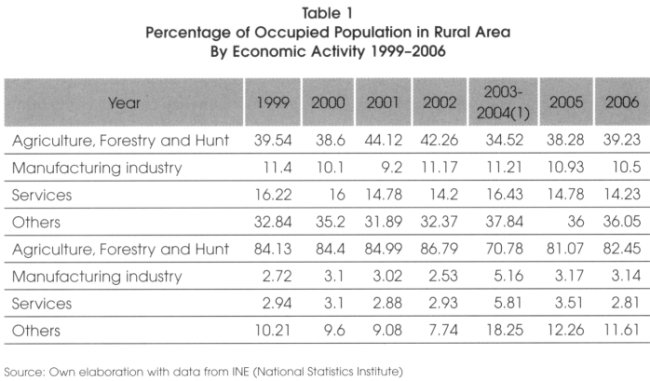
<body><![CDATA[<br>   Agriculture is one of the oldest economic activities. This is because it is the backbone of our food supply and without it the world&rsquo;s population would experience food insecurity. For this reason any effect that climate change has on agriculture will be passed on to society. Since agriculture is also dependent on the natural resource base, changing climate will require the adaptation of agricultural practices that accommodate the new climate while conserving the natural resource base.</font> </P>     <P align="justify">&nbsp;</P>     <p><font size="3" face="Verdana, Arial, Helvetica, sans-serif"><B> 3. The Agricultural Sector of Bolivia </B></font></p>     <P align="justify"><font size="2" face="Verdana, Arial, Helvetica, sans-serif"> The agricultural sector is the second most important economic activity with a growth average of 2.4% &ndash; the share in the GDP reached 15% during the last 25 years, with an incidence of 0.45% (<a href="/img/revistas/rlde/n12/a01fig01.jpg">See Figure 1</a>). In this secction we analyse the industrial and non-industrial agricultural production &ndash; the first one has an average contribution of 2% during the period 1980-2007, the second one is close to 7%.     <BR>   </font></P>     <p align="center"><img src="/img/revistas/rlde/n12/a01fig01.jpg" width="522" height="337"></P>     <P align="justify"><font size="2" face="Verdana, Arial, Helvetica, sans-serif">The country has suffered from many climatologic phenomena (<a href="/img/revistas/rlde/n12/a01fig02.jpg">See Figure 2</a>). Their  incidence over the agricultural GDP is evident &ndash; they lower the production, specially in the  years 1983, 1987, 1993, 1989 and 2007, with strong events like &ldquo;El Ni&ntilde;o&rdquo;<a href="#nota5"><sup>5</sup></a>. Only in 2003  &ldquo;El Ni&ntilde;o&rdquo; was considered weak. We expect more intense chronic and extreme climate    events during the next years, with serious effects on food production and food security, i.e.    through temperature changes and rain precipitation increases (Easterling, et al., 2007, Stern    Review 2007).</font> </P>     <P align="center"><img src="/img/revistas/rlde/n12/a01fig02.jpg" width="414" height="251"></P>     <P><font size="2" face="Verdana, Arial, Helvetica, sans-serif"><B> 3.1.The employment contribution </B></font></P>     <P align="justify"><font size="2" face="Verdana, Arial, Helvetica, sans-serif"> The overall agricultural sector employs on average 39% of the total occupied population, between 1999-2006 the percentage reached 80% in the rural area (<a href="/img/revistas/rlde/n12/a01tab01.jpg">See Table 1</a>). According to UDAPE (2006), the structure and the dynamics of employment have changed due to the sprouting of new enterprise units during the nineties. </font></P>     ]]></body>
<body><![CDATA[<P align="center"><img src="/img/revistas/rlde/n12/a01tab01.jpg" width="650" height="381"></P>     <P><font size="2" face="Verdana, Arial, Helvetica, sans-serif"><B> 3.2.The export contribution </B></font></P>     <P align="justify"><font size="2" face="Verdana, Arial, Helvetica, sans-serif"> The main non-traditional export products during the period 1980 &ndash; 2007 were soy and derivatives, coffee, cacao, sugar, rubber and cotton (<a href="/img/revistas/rlde/n12/a01fig03.jpg">see Figure 3</a>), and their average contribution to total exports reached 16 %. </font></P>     <P align="center"><img src="/img/revistas/rlde/n12/a01fig03.jpg" width="463" height="262"></P>     <P align="center">&nbsp;</P>     <P><font size="3" face="Verdana, Arial, Helvetica, sans-serif"><B> 4. The Bolivian General Equilibrium Model (CGE) </B></font></P>     <P align="justify"><font size="2" face="Verdana, Arial, Helvetica, sans-serif"> The General Equilibrium Model (CGE) is a tool designed to measure and evaluate the  overall economic effects including second order effects &ndash; related to external shock or goverment policy intervention. This scheme aggregates numerically all market equilibrium    conditions, whereby the model captures multiple simultaneous balances for different markets or sectors (e.g. the agricultural sector). Therefore the model surpasses any linear specifications (Shoven &amp; Whalley 1992; Ginsburgh &amp; Keyser 1997; Dixon et al. 1982; and    Horridge, et al. 1993).     <BR>       <BR>   New computacional advances introduced more programming posibilities to reproduce  the economic functioning by simulating partial or general equilibrium. We use in this  research a dynamic third generation CGE model with the purpouse to evaluate  macroeconomic and sectoral effects (agricultural sector) in the short and medium term  (Pereira &amp; Shoven, 1988; Decaluw&eacute; &amp; Martens, 1988).     <BR>       ]]></body>
<body><![CDATA[<BR>   The closures of our model verify the neoclasical macroeconomic restructuring of  portfolio assets, sectoral production changes and income distribution - in different  scenarios, like structural adjustment and policy planning (Bourguignon et al., 1989;  Rosenzweig &amp; Taylor, 1990 &amp; Jemio, 1993, 2001a,b). It also combines the assumption of  optimal consumption and portfolio composition &ndash; following the recommendation of Ag&eacute;nor  et al. (2002); Heathcote (1998) &amp; Silva (2004). </font></P>     <p><font size="2" face="Verdana, Arial, Helvetica, sans-serif"><B> 4.1.The Markets: Goods and Factors </B></font></p>     <P align="justify"><font size="2" face="Verdana, Arial, Helvetica, sans-serif"> These two markets (goods and factors) were modelled following conventional assumptions of the CGE literature. The first one states that capital remains fixed in the short term, the second one assumes that technology has Constant Elasticity of Substitution (CES) for some specific production sectors (i.e. agricultural, petroleum, natural gas, mining and services).     <br>       <br>   The third one is the small country (price taker) assumption for productive sectors (i.e. agricultural, petroleum, natural gas, mining and services). Therefore, any gap between supply and demand adjusts through commercial flows (Armington, 1969). According to the fourth assumption, the CES function also determines the capital demand, the labour and the imported inputs in these sectors.     <br>       <br>   The fifth assumption defines that the market structure for other sectors (i.e. manufacture and construction) is based on oligopolistic rules. The sixth assumption declares the existence of two sectors (i.e. urban and informal services), ruled by mark-up, because of their excess of installed capacity. The seventh assumption states that imports and exports demands are perfectly elastic. Finally, the capital goods are a fix share of the total investment in the base year and the consumer goods imports are determined by a Linear Cost System (LCS). </font></P>     <p><font size="2" face="Verdana, Arial, Helvetica, sans-serif"><B> 4.2.The Financial Sector </B></font></p>     <P align="justify"><font size="2" face="Verdana, Arial, Helvetica, sans-serif"> The model analyses the institutional and distributive relationship in the financial sector. For this purpose nine categories were defined (i.e. households, state companies, private companies, government, external sector, central bank, commercial banks, other financial  institutions and pension funds). Taylor (1990), classify this kind of model as multi-sectorial and multi-institutional general equilibrium scheme of three-gaps.     <BR>       ]]></body>
<body><![CDATA[<BR>   According to the Social Account Matrix (SAM), every balance in the model satisfies the    following relation &ldquo;Total Assets = Total Obligations + Net Wealth&rdquo; (Thiele &amp; Piazolo,    2003). Hence, for each one of these institutions we require to define a portfolio behaviour. We also define five types of assets/obligations, each one of which has a different rate of     return (i.e. physical capital, public assets/obligations, currency money, private    assets/obligations and external assets/obligations).     <BR>       <BR>   Finally, the financial restrictions correspond to the patterns of each institution &ndash; given the  household size the adjustment follows the rule save first &ndash; then invest. The effective level  of investment and financial assets are adjusted to the availability of funds (profitability  criteria).  For private and public companies the rule is the opposite, investment first and  then pays. </font></P>     <P align="justify">&nbsp;</P>     <p><font size="3" face="Verdana, Arial, Helvetica, sans-serif"><B> 5. The Experiment Design </B></font></p>     <P align="justify"><font size="2" face="Verdana, Arial, Helvetica, sans-serif"> The design of any general equilibrium experiment has two main elements. The first one is the base year definition, which shows the economic behaviour over a stable year (without random shocks). The second one is the simulation scenario for one specific context. In this section we present the base year assumptions and the simulation scenarios that will be used to evaluate the effects of climate change (external production shock) in the agricultural sector of Bolivia. </font> </P>     <p><font size="2" face="Verdana, Arial, Helvetica, sans-serif"><B> 5.1.The Base Line </B></font></p>     <P align="justify"><font size="2" face="Verdana, Arial, Helvetica, sans-serif"> The CGE model was built based on the SAM &ndash; 2004, because this is the last matrix constructed in Bolivia. Due to the lapsed time, it is required to validate the structural parameters of the CGE model (with econometric techniques) &ndash; in the rejecting case, it is necessary to calculate an adjustment rate to correct the model outcomes. The procedure concludes that the structural parameters are still valid - we also validate the specific agricultural production function for this experiment.     <br>       <br>   With this analysis, the basis of the experiment is the change in the parameter of the agricultural production function, regarding their sectoral activities (i.e. traditional agriculture, modern agriculture and coca). Concerning the Base Line (BL) scenario, two distortions were introduced &ndash; the first one is a shock in the agriculture production related to climate change effects (e.g. El Ni&ntilde;o), the second one is an increase in the mitigation expenditures destined to reduce the risks and vulnerability of climate change.     ]]></body>
<body><![CDATA[<BR>       <BR>   Since the CGE model was built for macroeconomic analysis, the base year reflects mainly these kinds of trajectories. The base year assumptions are: (1) prices are exogenous for trade commodities, then the terms of trade and interest rates are given by world prices; (2) the Foreign Direct Investment (FDI) is the average behaviour of the last four years; (3) the government expenditures have a growth rate of 2.5% each year; (4) the government investment has a growth rate of 2.7%. </font></P>     <p><font size="2" face="Verdana, Arial, Helvetica, sans-serif"><B> 5.2.The Simulation Scenarios </B></font></p>     <P align="justify"><font size="2" face="Verdana, Arial, Helvetica, sans-serif"> The agriculture in developing countries is the most important and also vulnerable activity affected by climate change. In Bolivia, the sectoral share of agriculture is 10%<a href="#nota6"><sup>6</sup></a> of the GDP, which makes it the third income activity in the country. The current experiments consider the effects of climate change under three scenarios:     <BR>       <BR>   (1) The normal scenario considers the average production in the agricultural sector during the last 19 years (2.46%). With this scenario strong adverse environmental changes are internalised.     <br>   (2) The moderate scenario considers the average production in the agricultural sector during the last five years (2.33%), with non-extreme climate change phenomena.     <br>   (3) The pessimistic scenario considers the average growth rate of the agricultural sector during the years with extreme climate change (-0.28%). The strong Ni&ntilde;o and Ni&ntilde;a correspond to the following years (1989, 1993, 1996, 1998, 2001 and 2007).     <BR>       <BR>   Finally, we carried out one policy closure on each one of the three scenarios &ndash; an increase in the mitigation expenditure of 10% by halves (i.e., Government Expenditures and Direct Investment) destined to reduce the risk and vulnerability to climate change. </font></P>     ]]></body>
<body><![CDATA[<P align="justify">&nbsp;</P>     <p><font size="3" face="Verdana, Arial, Helvetica, sans-serif"><B> 6. The Experiments Results </B></font></p>     <p><font size="3" face="Verdana, Arial, Helvetica, sans-serif"><B> <font size="2">6.1.Compared Scenarios </font></B></font></p>     <p><font size="2" face="Verdana, Arial, Helvetica, sans-serif"><B> 6.1.1. The Scenario without Mitigation </B></font><font size="3" face="Verdana, Arial, Helvetica, sans-serif"><B></B></font></p>     <P align="justify"><font size="2" face="Verdana, Arial, Helvetica, sans-serif"> Within the normal and the moderate scenario, it is observed that Bolivian GDP will grow throughout the next 10 years at a rate superior to 0.5% and 0.35% per year respectively. In the absence of any adverse shocks in the agricultural sector, the pessimistic scenario shows a drop in the growth rate of -0.33% per year (<a href="/img/revistas/rlde/n12/a01fig04.jpg">See, Figure 4</a>). It is evident that any drop in the agricultural production sector is translated mainly in employment reduction with the corresponding decrease in the real GDP. </font></P>     <P align="center"><img src="/img/revistas/rlde/n12/a01fig04.jpg" width="475" height="295"></P>     <P><font size="2" face="Verdana, Arial, Helvetica, sans-serif"><B> 6.1.2. The Scenario with Mitigation </B></font></P>     <P align="justify"><font size="2" face="Verdana, Arial, Helvetica, sans-serif"> In this experiment, given the same three scenarios (i.e., normal, moderate and pessimistic), we simulate an increase in the public investment and in the government expenditures in 0.71% and 0.57% respectively. We consider that these amounts are directed to mitigate the risk of climate change in the agricultural sector. We obtain the following growth rates for each scenario respectively: 0.69%, 0.54% and 0.03 % (<a href="/img/revistas/rlde/n12/a01fig05.jpg">see Figure 5</a>). </font></P>     <P align="center">&nbsp;</P>     <P align="center"><font size="2" face="Verdana, Arial, Helvetica, sans-serif"><img src="/img/revistas/rlde/n12/a01fig05.jpg" width="463" height="272"></font></P>    ]]></body>
<body><![CDATA[<P align="justify"><font size="2" face="Verdana, Arial, Helvetica, sans-serif">   The results show that the resources destined to mitigate the adverse effects in the pessimistic scenario permit to maintain positive growth    rates. This supports the theory that negative climate effects produced strong falls in economic growth, specially in the agricultural sector. The mitigation does not eliminate the effect, but it reduces it in the short run. </font></P>     <p><font size="2" face="Verdana, Arial, Helvetica, sans-serif"><b>  6.2.The Normal Scenario (without Mitigation) </b></font></p>     <P align="justify"><font size="2" face="Verdana, Arial, Helvetica, sans-serif">  In this section we analyse the performance of the three most representative activities of the agricultural sector (i.e., traditional agriculture, modern agriculture and coca) without mitigation. The results show that the traditional agricultural sector has a cointegrated behaviour with the modern agriculture sector. This means that their dynamics move together, although modern agriculture shows an average growth rate of 7.84% throughout the next 10 years forecast and the traditional sector shows a flat growth (<a href="/img/revistas/rlde/n12/a01fig06.jpg">see Figure 6)</a>. Finally, the coca sector is the most affected by climate change; however, this happens because the model was calibrated with data of 2004, when the level of coca production was inferior to the current one, therefore, any decrease affects more. </font></P>     <P align="center"><font size="2" face="Verdana, Arial, Helvetica, sans-serif"><img src="/img/revistas/rlde/n12/a01fig06.jpg" width="463" height="272"></font></P>     <P align="justify"><font size="2" face="Verdana, Arial, Helvetica, sans-serif">    Regarding to the export behaviour, the growth rate is 0.71% without mitigation and 0.75% with mitigation, therefore, both trajectories are overlapped and there is no major effect of mitigation over the export performance. We disaggregate export by activities; in the <a href="/img/revistas/rlde/n12/a01fig07.jpg">Figure 7</a> we observe that the key incidence on agriculture occurs in the non-traditional export products, mainly soy. </font></P>      <P align="center"><font size="2" face="Verdana, Arial, Helvetica, sans-serif"> <img src="/img/revistas/rlde/n12/a01fig07.jpg" width="475" height="275"></font></P>     <P align="justify"><font size="2" face="Verdana, Arial, Helvetica, sans-serif">The average growth rate of Bolivian agricultural imports falls 3.75%. As we can see in <a href="/img/revistas/rlde/n12/a01fig08.jpg">Figure 8</a>, the most important reduction is given in the modern agriculture, because a smaller agricultural production demands less import inputs (e.g. fertilizers). On the other hand, food requirements are associated more with traditional agriculture; therefore the imports diminish only in the very short term.</font></P>     <P align="center"><img src="/img/revistas/rlde/n12/a01fig08.jpg" width="463" height="270"></P>     <P align="justify"><font size="2" face="Verdana, Arial, Helvetica, sans-serif">Even in the absence of negative effects in the agricultural sector (with or without mitigation measures), due to the scarcity of products all domestic prices (i.e. traditional, modern and coca) tend to rise (<a href="/img/revistas/rlde/n12/a01fig09.jpg">see Figure 9</a>). At the same time, since higher prices reduce consumption and given the high degree of labor intensity, the agricultural wages are reduced.</font></P>     <P align="center"><img src="/img/revistas/rlde/n12/a01fig09.jpg" width="463" height="262"></P> <font size="2"> </P> <font face="Verdana, Arial, Helvetica, sans-serif"><b>6.3. The Moderate Scenario (with Mitigation) </b></font></font><font size="3" face="Verdana, Arial, Helvetica, sans-serif"><b></b></font>     ]]></body>
<body><![CDATA[<P align="justify"><font size="2" face="Verdana, Arial, Helvetica, sans-serif"> In this scenario we expect the occurrence of some climatic phenomena, but not the high intense &ldquo;Mega Ni&ntilde;os&rdquo;. With this experiment we seek to evaluate the impact of mitigation measures destined to diminish the risk and vulnerability in the agricultural sector. We conclude that the domestic production shows the same growth rate of 2.25%, both in the traditional and modern activities. This means that mitigation measures have almost no impact when the climatic phenomenon is not extreme. Also, coca production drops 6.2%, because this is clearly not an agro-alimentary sector (<a href="/img/revistas/rlde/n12/a01fig10.jpg">see Figure 10</a>). </font></P>     <P align="center"><img src="/img/revistas/rlde/n12/a01fig10.jpg" width="463" height="269"></P>     <P align="justify"><font size="2" face="Verdana, Arial, Helvetica, sans-serif">    <br>   The mitigation expenditure defined as &ldquo;public investment&rdquo; for climate change risk reduction, has a crowding-in effect, since it increases the exports from -0.39% to -0.34%. At the same time the real exchange rate depreciates, specially in favour of modern agricultural products (<a href="/img/revistas/rlde/n12/a01fig11.jpg">see Figure 11</a>). </font></P>     <P align="center"><img src="/img/revistas/rlde/n12/a01fig11.jpg" width="463" height="270"></P>     <P align="justify"><font size="2" face="Verdana, Arial, Helvetica, sans-serif">    <br>   The growth rate of imports drops -2.4%, with an important reduction in relation to the normal scenario. The imports in the traditional agricultural sector react quickly; because they are more associated with food requirements. The government moreover increases its expenditures toward food imports, specially when traditional agriculture falls lower than modern agriculture (<a href="/img/revistas/rlde/n12/a01fig12.jpg">see Figure 12</a>). </font></P>     <P align="center"><font size="2" face="Verdana, Arial, Helvetica, sans-serif"><img src="/img/revistas/rlde/n12/a01fig12.jpg" width="463" height="272"></font></P>     <P align="justify"><font size="2" face="Verdana, Arial, Helvetica, sans-serif">An increase in the government expenditure destined to mitigate the effect of climate change, on the one hand stabilises agricultural production &ndash; on the other hand, it elevates symmetrically the price level (<a href="/img/revistas/rlde/n12/a01fig13.jpg">see Figure 13</a>) in both activities (i.e. traditional and modern) (<a href="/img/revistas/rlde/n12/a01fig13.jpg">see Figure 13</a>). The net effect in the global consumption price Index (CPI) is no matter of this research.</font></P>     <P align="center"><font size="2" face="Verdana, Arial, Helvetica, sans-serif"><img src="/img/revistas/rlde/n12/a01fig13.jpg" width="463" height="262"></font></P>     ]]></body>
<body><![CDATA[<P><font size="2" face="Verdana, Arial, Helvetica, sans-serif"><b> 6.4. The Pessimistic Scenario </b></font></P>     <P align="justify"><font size="2" face="Verdana, Arial, Helvetica, sans-serif"> The agricultural production depends mainly on environmental conditions like soil quality, temperature, altitude, etc. Unfortunately, this information is expensive and also difficult to introduce into an economic model. Since the CGE model used for this research was designed for macroeconomic and aggregate sectoral analysis, it does not capture the full long term climatic dynamic.     <br>       <br>   When we simulate an extreme shock over the agricultural production due to climate change (pessimistic scenario) we are looking for a long term evaluation related to specific activities (i.e. traditional, modern and coca). In this experiment we assume both possibilities (i.e. with and without mitigation). The results are the expected ones, the exercise shows negative growth rates of -1.32% and -1.2% respectively (<a href="/img/revistas/rlde/n12/a01fig14.jpg">see Figure 14</a>). </font></P>      <P align="center"><font size="2" face="Verdana, Arial, Helvetica, sans-serif"><img src="/img/revistas/rlde/n12/a01fig14.jpg" width="546" height="192"></font></P>      <P align="justify"><font size="2" face="Verdana, Arial, Helvetica, sans-serif">   The exports diminish (<a href="/img/revistas/rlde/n12/a01fig15.jpg">see Figure 15</a>) except in modern agriculture. The behaviour of all activities is the expected one and the trajectories are very similar with and without mitigation, with an average growth rate of -2% and -1.8% respectively. The conclusion is that extreme phenomena overshoot the agricultural production function, thus mitigation expenses do not have a major impact. When successive extreme phenomena occur, the possibility of production shortage in all agricultural areas increases. Therefore, there is a drop in exports with an exchange rate appreciation, mainly in the modern agricultural sector. </font></P>     <P align="center"><img src="/img/revistas/rlde/n12/a01fig15.jpg" width="555" height="192"></P>     <P align="justify"><font size="2" face="Verdana, Arial, Helvetica, sans-serif">   Given the budget constraints, the derived effects from climate change push up the imports of traditional agricultural goods (specially food) and lower the imports of modern agricultural goods. We observe the effect mainly in the mid term (<a href="/img/revistas/rlde/n12/a01fig16.jpg">see Figure 16</a>). It is evident that there is a very slow technological change in the modern agriculture sector and subsistence production in the traditional agriculture sector. </font></P>     <P align="center"><img src="/img/revistas/rlde/n12/a01fig16.jpg" width="555" height="192"></P>     <P align="justify"><font size="2" face="Verdana, Arial, Helvetica, sans-serif">   As a result of extreme or chronic climate change, the price index doubles in relation to the normal scenario. There is a structural broke in the production function in the long term which shows the powerlessness of mitigation measures when these type of events occurs. Thus the demand grows and the production decreases until the nature internalises that event (<a href="/img/revistas/rlde/n12/a01fig17.jpg">see Figure 17</a>). </font> </P>     ]]></body>
<body><![CDATA[<P align="center"><img src="/img/revistas/rlde/n12/a01fig17.jpg" width="546" height="192"></P>     <P>&nbsp;</P>     <P><font size="3" face="Verdana, Arial, Helvetica, sans-serif"><b> 7. Conclusion and recommendations </b></font></P>     <P><font size="2" face="Verdana, Arial, Helvetica, sans-serif">   Agriculture is the most vulnerable activity to extreme climate change. The impact on economic growth is significant, specially in the short and mid term (when production decreases and prices increase). In the case of extreme and chronic climate events the economic effects are not clear, because there is a very slow environmental internalisation  of this type of phenomena.    <br>       <br>   We conclude that there is strong evidence that climate change leaves sequels in the  agricultural production function in the mid term. In all the scenarios climate change affected the trade balance and the terms of trade, with major incidence over the prices in the traditional agriculture in the short term.    <br>       <br>   With more mitigation expenditures destined to reduce risk and vulnerability to climate change, the effects diminish, but in most of the cases marginally. The main conclusion is that mitigation in the best case stabilises the adverse effects of climate change, but it is not enough to substitute the planned adaptation.    <br>       <br>   It is not possible to extract additional information from previous studies. Therefore it is recommended that new research will be undertaken. </font></P> <font size="2" face="Verdana, Arial, Helvetica, sans-serif"><dl>   <DD> &bull; A complete vulnerability analysis should be done for the agricultural sector regarding to the effect of climate change on agriculture and the second round effects on the other sectors of the economy. </DD>   <DD> &bull; It is necessary to build an integrated CGE model with climate change and agricultural models in order to take the dynamic nature of things into account. </DD>   <DD> &bull; Further research is needed to examine the role of climate change variables in land management adaptations. </DD> </dl> Finally, we addressed the following questions, because Bolivia does not have a complete climate change model that allows us to analyse the overall mitigation and adaptation measures. <dl>   <DD> &bull; What are the attributes of climate to which agricultural systems respond? </DD>   <DD> &bull; Where and when mitigation is necessary? </DD>   <DD> &bull; What type of mitigation do we need? </DD>   <DD> &bull; Why do responses differ, and what characteristics make certain types of regions more vulnerable or adaptive than others?      ]]></body>
<body><![CDATA[<br> </DD> </dl> </font> <HR size="1" noshade>     <P>&nbsp;</P>     <P>&nbsp;</P>     <P><font size="3" face="Verdana, Arial, Helvetica, sans-serif"><b>REFERENCES </b></font></P>     <P><font size="2" face="Verdana, Arial, Helvetica, sans-serif">  Ag&eacute;nor, P.R., Izquierdo, A. y Fofack, H. (2002): IMMPA: A Quantitative Macroeconomic Framework for the Analysis of Poverty Reduction Strategies&rdquo;.  The World Bank, Washington, D.C., pp. 3-12.</font></P>     <P><font size="2" face="Verdana, Arial, Helvetica, sans-serif">   Armington, P. (1969): &ldquo;A Theory of Demand for Products Distinguished by Place of Production&rdquo;. Documento de Staff, Fondo Monetario Internacional, Vol XVI, No. 1, pp. 159-178. </font> </P>     <P><font size="2" face="Verdana, Arial, Helvetica, sans-serif">  Bourguignon, F., Branson, W. y De Melo, J. (1989): &ldquo;Adjustment and Income Distribution: A Counterfactual Analysis&rdquo;. Documento de Trabajo No. 2943, National Bureau of Economic Research, Cambridge, MA.</font></P>     <P><font size="2" face="Verdana, Arial, Helvetica, sans-serif">    Decaluw&eacute;, B. y Martens, A. (1988): &ldquo;CGE modeling and developing economies: A concise empirical survey of 73 applications to 26 countries&rdquo;. Journal of Policy Modeling, 10,  pp. 4-12. </font></P>     <P><font size="2" face="Verdana, Arial, Helvetica, sans-serif">   Dixon, P.B., Parmenter, B.R. Sutton, J. y Vincent, D.P. (1982): &ldquo;ORANI: a multi-sectoral model of the Australian Economy&quot;. Documento de Trabajo No 1/06, Universidad de Melbourne. Melbourne. </font></P>     <!-- ref --><P><font size="2" face="Verdana, Arial, Helvetica, sans-serif">   Easterling, W., P. Aggarwal, P. Batima, K. Brander, L. Erda, M. Howden, A. Kirilenko, J. Morton, J.-F. Soussana, S. Schmidhuber, and F. Tubiello. (2007): Food, fibre and forest products. In: M.L. Parry, O.F. Canziani, J.P. Palutikof, P.J. van der Linden, and C.E. Hanson, eds, Climate Change 2007: Impacts, Adaptation and Vulnerability. Contribution of Working Group II to the Fourth Assessment Report of the Intergovernmental Panel on Climate Change. Cambridge University Press, pp. 273-313. </font> &nbsp;&nbsp;&nbsp;&nbsp;&nbsp;&nbsp;&nbsp;&nbsp;[&#160;<a href="javascript:void(0);" onclick="javascript: window.open('/scielo.php?script=sci_nlinks&ref=505271&pid=S2074-4706200900020000200006&lng=','','width=640,height=500,resizable=yes,scrollbars=1,menubar=yes,');">Links</a>&#160;]<!-- end-ref --><!-- ref --><P><font size="2" face="Verdana, Arial, Helvetica, sans-serif">  Ginsburgh, V. y Keyzer, M. (1997): The structure of applied general equilibrium models. The MIT Press, Cambridge, Mass. </font>&nbsp;&nbsp;&nbsp;&nbsp;&nbsp;&nbsp;&nbsp;&nbsp;[&#160;<a href="javascript:void(0);" onclick="javascript: window.open('/scielo.php?script=sci_nlinks&ref=505272&pid=S2074-4706200900020000200007&lng=','','width=640,height=500,resizable=yes,scrollbars=1,menubar=yes,');">Links</a>&#160;]<!-- end-ref --><P><font size="2" face="Verdana, Arial, Helvetica, sans-serif">   Heathcote, J. (1998): &ldquo;Interest Rates in a General Equilibrium Baumol-Tobin Model&rdquo;. Documento de Trabajo, Univeristy of Pennsylvania, Department of Economics, pp. 3-12.      </font></P>     <P><font size="2" face="Verdana, Arial, Helvetica, sans-serif"> Horridge, J.M., Parmenter, B.R. y Pearson K.R. (1993): &ldquo; ORANI-F: A General Equilibrium Model of the Australian Economy&rdquo;. Economic and Financial Computing, 3, pp. 71-140. </font></P>     <!-- ref --><P><font size="2" face="Verdana, Arial, Helvetica, sans-serif">   Jemio, L.C. (1993). Microeconomic and Macroeconomic Adjustment in Bolivia (1970-89). A  Neostructuralist Analysis of External Shocks, Adjustment and Stabilization Policies. Tesis Doctoral, Institute of Social Studies. The Hague. </font>&nbsp;&nbsp;&nbsp;&nbsp;&nbsp;&nbsp;&nbsp;&nbsp;[&#160;<a href="javascript:void(0);" onclick="javascript: window.open('/scielo.php?script=sci_nlinks&ref=505275&pid=S2074-4706200900020000200010&lng=','','width=640,height=500,resizable=yes,scrollbars=1,menubar=yes,');">Links</a>&#160;]<!-- end-ref --><P><font size="2" face="Verdana, Arial, Helvetica, sans-serif">  Jemio, L.C. (2001a): &ldquo;Debt, Crisis and Reform&rdquo;. Biting the Bullet. Basingstoke, Hampshire, pp. 3-5. </font> </P>     <P><font size="2" face="Verdana, Arial, Helvetica, sans-serif">   Jemio, L.C. (2001b). &ldquo;Macroeconomic Adjustment in Bolivia since the 1970s: Adjustment to What, By Whom, and How? Analytical Insights from a SAM Model&rdquo;. Kiel Working Paper 1031, The Kiel Institute of World Economics. Kiel. </font></P>     <!-- ref --><P><font size="2" face="Verdana, Arial, Helvetica, sans-serif"> Parry, Martin L., and Cynthia Rosenzweig. 1993. &quot;Food supply and risk of hunger,&quot; The Lancet, Vol. 342 No. 8883, November 27, pp. 1345-1347 </font>&nbsp;&nbsp;&nbsp;&nbsp;&nbsp;&nbsp;&nbsp;&nbsp;[&#160;<a href="javascript:void(0);" onclick="javascript: window.open('/scielo.php?script=sci_nlinks&ref=505278&pid=S2074-4706200900020000200013&lng=','','width=640,height=500,resizable=yes,scrollbars=1,menubar=yes,');">Links</a>&#160;]<!-- end-ref --><P><font size="2" face="Verdana, Arial, Helvetica, sans-serif"> Pereira, A. y Shoven, J. (1988): &ldquo;Survey of Dynamic Computational General Equilibrium Models for Tax Policy Evaluation&rdquo;. Journal of Policy Modeling, 10, 3. pp. 2-11</font></P>     <!-- ref --><P><font size="2" face="Verdana, Arial, Helvetica, sans-serif">   Rosenzweig, J.A., L. Taylor (1990): Devaluation, Capital Flows, and Crowding-Out: A CGE Model with Portfolio Choice for Thailand. En L. Taylor (ed.), Socially Relevant Policy Analysis. Structuralist Computable General Equilibrium Models for the Developing World. Cambridge, Mass. </font>&nbsp;&nbsp;&nbsp;&nbsp;&nbsp;&nbsp;&nbsp;&nbsp;[&#160;<a href="javascript:void(0);" onclick="javascript: window.open('/scielo.php?script=sci_nlinks&ref=505280&pid=S2074-4706200900020000200015&lng=','','width=640,height=500,resizable=yes,scrollbars=1,menubar=yes,');">Links</a>&#160;]<!-- end-ref --><!-- ref --><P><font size="2" face="Verdana, Arial, Helvetica, sans-serif">   Shoven, J. y Whalley, J. (1992): Applied General equilibrium Analisys. Cambridge: Cambridge University Press. </font>&nbsp;&nbsp;&nbsp;&nbsp;&nbsp;&nbsp;&nbsp;&nbsp;[&#160;<a href="javascript:void(0);" onclick="javascript: window.open('/scielo.php?script=sci_nlinks&ref=505281&pid=S2074-4706200900020000200016&lng=','','width=640,height=500,resizable=yes,scrollbars=1,menubar=yes,');">Links</a>&#160;]<!-- end-ref --><P><font size="2" face="Verdana, Arial, Helvetica, sans-serif">   Silva, A. (2004): &ldquo;Monetary Dynamics in a General Equilibrium Version of the Baumol-Tobin Model&rdquo;. Documento de Trabajo, Universidad de Chicago, pp. 4-11.Chicago.</font></P>     <P><font size="2" face="Verdana, Arial, Helvetica, sans-serif">   Stern; et. al.  (2007). &ldquo;STERN REVIEW: LA ECONOM&Iacute;A DEL CAMBIO CLIM&Aacute;TICO&rdquo;. HM Treasury. Londres, Inglaterra. 1005.</font></P>     <!-- ref --><P><font size="2" face="Verdana, Arial, Helvetica, sans-serif">    Taylor, L. (1990): Structuralist CGE Models. En L. Taylor (ed.), Socially Relevant Policy Analysis. Structuralist Computable General Equilibrium Models for the Developing World. Cambridge, Mass. </font>&nbsp;&nbsp;&nbsp;&nbsp;&nbsp;&nbsp;&nbsp;&nbsp;[&#160;<a href="javascript:void(0);" onclick="javascript: window.open('/scielo.php?script=sci_nlinks&ref=505284&pid=S2074-4706200900020000200019&lng=','','width=640,height=500,resizable=yes,scrollbars=1,menubar=yes,');">Links</a>&#160;]<!-- end-ref --><P><font size="2" face="Verdana, Arial, Helvetica, sans-serif">   Thiele, R. y Piazolo, D. (2003): &ldquo;A Social Accounting Matrix for Bolivia Featuring Formal and Informal Activities&rdquo;. Latin American Journal of Economics, No 40, pp. 1-34. </font></P>     <P><font size="2" face="Verdana, Arial, Helvetica, sans-serif">   UDAPE (2006): &ldquo;Informe de Econom&iacute;a y Pol&iacute;tica Econ&oacute;mica&rdquo;. Ministerio de Hacienda de Bolivia. La Paz. </font> </P>     <p>&nbsp;</p> <font size="2" face="Verdana, Arial, Helvetica, sans-serif"><a name="#notaa"><sup>*</sup></a> Director del Instituto de investigaciones Socio-economicas (IISEC). Universidad Catolica Boliviana. La Paz, Bolivia</font>    <br> <font size="2" face="Verdana, Arial, Helvetica, sans-serif"><a name="#nota1"><sup>1</sup></a> Vulnerability is a function of exposure to climate factors, sensitivity to change and capacity to adapt to that change. </font>    <br> <font size="2" face="Verdana, Arial, Helvetica, sans-serif"><a name="#nota2"><sup>2</sup></a> The Intergovernmental Panel on Climate Change (IPCC 2007), defines adaptation as the "adjustment in natural or human systems in response to actual or expected climate stimuli or their effects, which moderates harm or exploits beneficial opportunities". </font>    <br> <font size="2" face="Verdana, Arial, Helvetica, sans-serif"><a name="#nota3"><sup>3</sup></a> Mitigation is understood as the prevention of carbon emissions promoting the reduction of greenhouse gas emission, efficient use of energy and other resources or politics that norm the ground usage promoting sustainability. </font>    <br> <font size="2" face="Verdana, Arial, Helvetica, sans-serif"><a name="#nota4"><sup>4</sup></a> "Climate Change" means a change of climate conditions, which is attributed directly or indirectly to human activity and alters the composition of the global atmosphere and which occurs in addition to natural climate variability observed over comparable time periods. </font>    ]]></body>
<body><![CDATA[<br> <font size="2" face="Verdana, Arial, Helvetica, sans-serif"><a name="#nota5"><sup>5</sup></a> The Ni&ntilde;o/Ni&ntilde;a phenomena are incidents in which extreme climate variability occurs.</font>    <br> <font size="2" face="Verdana, Arial, Helvetica, sans-serif"><a name="#nota6"><sup>6</sup></a> Annual Statistical review, INE (2007) </font>      ]]></body><back>
<ref-list>
<ref id="B1">
<nlm-citation citation-type="book">
<person-group person-group-type="author">
<name>
<surname><![CDATA[Agénor]]></surname>
<given-names><![CDATA[P.R]]></given-names>
</name>
<name>
<surname><![CDATA[Izquierdo]]></surname>
<given-names><![CDATA[A]]></given-names>
</name>
<name>
<surname><![CDATA[Fofack]]></surname>
<given-names><![CDATA[H]]></given-names>
</name>
</person-group>
<source><![CDATA[IMMPA: A Quantitative Macroeconomic Framework for the Analysis of Poverty Reduction Strategies]]></source>
<year>2002</year>
<page-range>3-12</page-range><publisher-loc><![CDATA[Washington^eD.C. D.C.]]></publisher-loc>
<publisher-name><![CDATA[The World Bank]]></publisher-name>
</nlm-citation>
</ref>
<ref id="B2">
<nlm-citation citation-type="book">
<person-group person-group-type="author">
<name>
<surname><![CDATA[Armington]]></surname>
<given-names><![CDATA[P]]></given-names>
</name>
</person-group>
<source><![CDATA[A Theory of Demand for Products Distinguished by Place of Production]]></source>
<year>1969</year>
<volume>XVI</volume>
<page-range>159-178</page-range><publisher-name><![CDATA[Fondo Monetario Internacional]]></publisher-name>
</nlm-citation>
</ref>
<ref id="B3">
<nlm-citation citation-type="book">
<person-group person-group-type="author">
<name>
<surname><![CDATA[Bourguignon]]></surname>
<given-names><![CDATA[F]]></given-names>
</name>
<name>
<surname><![CDATA[Branson]]></surname>
<given-names><![CDATA[W]]></given-names>
</name>
<name>
<surname><![CDATA[De Melo]]></surname>
<given-names><![CDATA[J]]></given-names>
</name>
</person-group>
<source><![CDATA[Adjustment and Income Distribution: A Counterfactual Analysis]]></source>
<year>1989</year>
<publisher-loc><![CDATA[Cambridge^eMA MA]]></publisher-loc>
<publisher-name><![CDATA[National Bureau of Economic Research]]></publisher-name>
</nlm-citation>
</ref>
<ref id="B4">
<nlm-citation citation-type="journal">
<person-group person-group-type="author">
<name>
<surname><![CDATA[Decaluwé]]></surname>
<given-names><![CDATA[B]]></given-names>
</name>
<name>
<surname><![CDATA[Martens]]></surname>
<given-names><![CDATA[A]]></given-names>
</name>
</person-group>
<article-title xml:lang="en"><![CDATA[CGE modeling and developing economies: A concise empirical survey of 73 applications to 26 countries]]></article-title>
<source><![CDATA[Journal of Policy Modeling]]></source>
<year>1988</year>
<numero>10</numero>
<issue>10</issue>
<page-range>4-12</page-range></nlm-citation>
</ref>
<ref id="B5">
<nlm-citation citation-type="book">
<person-group person-group-type="author">
<name>
<surname><![CDATA[Dixon]]></surname>
<given-names><![CDATA[P.B]]></given-names>
</name>
<name>
<surname><![CDATA[Parmenter]]></surname>
<given-names><![CDATA[B.R]]></given-names>
</name>
<name>
<surname><![CDATA[Sutton]]></surname>
<given-names><![CDATA[J]]></given-names>
</name>
<name>
<surname><![CDATA[Vincent]]></surname>
<given-names><![CDATA[D.P]]></given-names>
</name>
</person-group>
<source><![CDATA[ORANI: a multi-sectoral model of the Australian Economy]]></source>
<year>1982</year>
<publisher-loc><![CDATA[Melbourne ]]></publisher-loc>
<publisher-name><![CDATA[Universidad de Melbourne]]></publisher-name>
</nlm-citation>
</ref>
<ref id="B6">
<nlm-citation citation-type="confpro">
<person-group person-group-type="author">
<name>
<surname><![CDATA[Easterling]]></surname>
<given-names><![CDATA[W]]></given-names>
</name>
<name>
<surname><![CDATA[Aggarwal]]></surname>
<given-names><![CDATA[P]]></given-names>
</name>
<name>
<surname><![CDATA[Batima]]></surname>
<given-names><![CDATA[P]]></given-names>
</name>
<name>
<surname><![CDATA[Brander]]></surname>
<given-names><![CDATA[K]]></given-names>
</name>
<name>
<surname><![CDATA[Erda]]></surname>
<given-names><![CDATA[L]]></given-names>
</name>
<name>
<surname><![CDATA[Howden]]></surname>
<given-names><![CDATA[M]]></given-names>
</name>
<name>
<surname><![CDATA[Kirilenko]]></surname>
<given-names><![CDATA[A]]></given-names>
</name>
<name>
<surname><![CDATA[Morton]]></surname>
<given-names><![CDATA[J]]></given-names>
</name>
<name>
<surname><![CDATA[Soussana]]></surname>
<given-names><![CDATA[J.-F]]></given-names>
</name>
<name>
<surname><![CDATA[Schmidhuber]]></surname>
<given-names><![CDATA[S]]></given-names>
</name>
<name>
<surname><![CDATA[Tubiello]]></surname>
<given-names><![CDATA[F]]></given-names>
</name>
</person-group>
<article-title xml:lang="en"><![CDATA[Food, fibre and forest products]]></article-title>
<person-group person-group-type="editor">
<name>
<surname><![CDATA[Parry]]></surname>
<given-names><![CDATA[M.L]]></given-names>
</name>
<name>
<surname><![CDATA[Canziani]]></surname>
<given-names><![CDATA[O.F]]></given-names>
</name>
<name>
<surname><![CDATA[Palutikof]]></surname>
<given-names><![CDATA[J.P]]></given-names>
</name>
<name>
<surname><![CDATA[van der Linden]]></surname>
<given-names><![CDATA[P.J]]></given-names>
</name>
<name>
<surname><![CDATA[Hanson]]></surname>
<given-names><![CDATA[C.E]]></given-names>
</name>
</person-group>
<source><![CDATA[Climate Change 2007: Impacts, Adaptation and Vulnerability]]></source>
<year>2007</year>
<conf-name><![CDATA[ Fourth Assessment Report of the Intergovernmental Panel on Climate Change]]></conf-name>
<conf-loc> </conf-loc>
<page-range>273-313</page-range><publisher-name><![CDATA[Cambridge University Press]]></publisher-name>
</nlm-citation>
</ref>
<ref id="B7">
<nlm-citation citation-type="book">
<person-group person-group-type="author">
<name>
<surname><![CDATA[Ginsburgh]]></surname>
<given-names><![CDATA[V]]></given-names>
</name>
<name>
<surname><![CDATA[Keyzer]]></surname>
<given-names><![CDATA[M]]></given-names>
</name>
</person-group>
<source><![CDATA[The structure of applied general equilibrium models]]></source>
<year>1997</year>
<publisher-loc><![CDATA[Cambridge^eMass Mass]]></publisher-loc>
<publisher-name><![CDATA[The MIT Press]]></publisher-name>
</nlm-citation>
</ref>
<ref id="B8">
<nlm-citation citation-type="book">
<person-group person-group-type="author">
<name>
<surname><![CDATA[Heathcote]]></surname>
<given-names><![CDATA[J]]></given-names>
</name>
</person-group>
<source><![CDATA[Interest Rates in a General Equilibrium Baumol-Tobin Model]]></source>
<year>1998</year>
<page-range>3-12</page-range><publisher-name><![CDATA[Univeristy of Pennsylvania]]></publisher-name>
</nlm-citation>
</ref>
<ref id="B9">
<nlm-citation citation-type="journal">
<person-group person-group-type="author">
<name>
<surname><![CDATA[Horridge]]></surname>
<given-names><![CDATA[J.M]]></given-names>
</name>
<name>
<surname><![CDATA[Parmenter]]></surname>
<given-names><![CDATA[B.R]]></given-names>
</name>
<name>
<surname><![CDATA[Pearson]]></surname>
<given-names><![CDATA[K.R]]></given-names>
</name>
</person-group>
<article-title xml:lang="en"><![CDATA[ORANI-F: A General Equilibrium Model of the Australian Economy]]></article-title>
<source><![CDATA[Economic and Financial Computing]]></source>
<year>1993</year>
<numero>3</numero>
<issue>3</issue>
<page-range>71-140</page-range></nlm-citation>
</ref>
<ref id="B10">
<nlm-citation citation-type="">
<person-group person-group-type="author">
<name>
<surname><![CDATA[Jemio]]></surname>
<given-names><![CDATA[L.C]]></given-names>
</name>
</person-group>
<source><![CDATA[Microeconomic and Macroeconomic Adjustment in Bolivia (1970-89): A Neostructuralist Analysis of External Shocks, Adjustment and Stabilization Policies]]></source>
<year>1993</year>
</nlm-citation>
</ref>
<ref id="B11">
<nlm-citation citation-type="journal">
<person-group person-group-type="author">
<name>
<surname><![CDATA[Jemio]]></surname>
<given-names><![CDATA[L.C]]></given-names>
</name>
</person-group>
<article-title xml:lang="en"><![CDATA[Debt, Crisis and Reform]]></article-title>
<source><![CDATA[Biting the Bullet]]></source>
<year>2001</year>
<page-range>3-5</page-range><publisher-loc><![CDATA[Basingstoke ]]></publisher-loc>
</nlm-citation>
</ref>
<ref id="B12">
<nlm-citation citation-type="book">
<person-group person-group-type="author">
<name>
<surname><![CDATA[Jemio]]></surname>
<given-names><![CDATA[L.C]]></given-names>
</name>
</person-group>
<source><![CDATA[Macroeconomic Adjustment in Bolivia since the 1970s: Adjustment to What, By Whom, and How? Analytical Insights from a SAM Model]]></source>
<year>2001</year>
<publisher-loc><![CDATA[Kiel ]]></publisher-loc>
<publisher-name><![CDATA[The Kiel Institute of World Economics]]></publisher-name>
</nlm-citation>
</ref>
<ref id="B13">
<nlm-citation citation-type="journal">
<person-group person-group-type="author">
<name>
<surname><![CDATA[Parry]]></surname>
<given-names><![CDATA[Martin L]]></given-names>
</name>
<name>
<surname><![CDATA[Cynthia]]></surname>
<given-names><![CDATA[Rosenzweig]]></given-names>
</name>
</person-group>
<article-title xml:lang="en"><![CDATA[Food supply and risk of hunger]]></article-title>
<source><![CDATA[The Lancet]]></source>
<year>1993</year>
<month>No</month>
<day>ve</day>
<volume>342</volume>
<numero>8883</numero>
<issue>8883</issue>
<page-range>1345-1347</page-range></nlm-citation>
</ref>
<ref id="B14">
<nlm-citation citation-type="journal">
<person-group person-group-type="author">
<name>
<surname><![CDATA[Pereira]]></surname>
<given-names><![CDATA[A]]></given-names>
</name>
<name>
<surname><![CDATA[Shoven]]></surname>
<given-names><![CDATA[J]]></given-names>
</name>
</person-group>
<article-title xml:lang="en"><![CDATA[Survey of Dynamic Computational General Equilibrium Models for Tax Policy Evaluation]]></article-title>
<source><![CDATA[Journal of Policy Modeling]]></source>
<year>1988</year>
<volume>10</volume>
<numero>3</numero>
<issue>3</issue>
<page-range>2-11</page-range></nlm-citation>
</ref>
<ref id="B15">
<nlm-citation citation-type="">
<person-group person-group-type="author">
<name>
<surname><![CDATA[Rosenzweig]]></surname>
<given-names><![CDATA[J.A]]></given-names>
</name>
<name>
<surname><![CDATA[Taylor]]></surname>
<given-names><![CDATA[L]]></given-names>
</name>
</person-group>
<article-title xml:lang="en"><![CDATA[Devaluation, Capital Flows, and Crowding-Out: A CGE Model with Portfolio Choice for Thailand]]></article-title>
<person-group person-group-type="editor">
<name>
<surname><![CDATA[Taylor]]></surname>
<given-names><![CDATA[L]]></given-names>
</name>
</person-group>
<source><![CDATA[Socially Relevant Policy Analysis. Structuralist Computable General Equilibrium Models for the Developing World]]></source>
<year>1990</year>
<publisher-loc><![CDATA[Cambridge^eMass Mass]]></publisher-loc>
</nlm-citation>
</ref>
<ref id="B16">
<nlm-citation citation-type="book">
<person-group person-group-type="author">
<name>
<surname><![CDATA[Shoven]]></surname>
<given-names><![CDATA[J]]></given-names>
</name>
<name>
<surname><![CDATA[Whalley]]></surname>
<given-names><![CDATA[J]]></given-names>
</name>
</person-group>
<source><![CDATA[Applied General equilibrium Analisys]]></source>
<year>1992</year>
<publisher-loc><![CDATA[Cambridge ]]></publisher-loc>
<publisher-name><![CDATA[Cambridge University Press]]></publisher-name>
</nlm-citation>
</ref>
<ref id="B17">
<nlm-citation citation-type="book">
<person-group person-group-type="author">
<name>
<surname><![CDATA[Silva]]></surname>
<given-names><![CDATA[A]]></given-names>
</name>
</person-group>
<source><![CDATA[Monetary Dynamics in a General Equilibrium Version of the Baumol-Tobin Model]]></source>
<year>2004</year>
<page-range>4-11</page-range><publisher-loc><![CDATA[Chicago ]]></publisher-loc>
<publisher-name><![CDATA[Universidad de Chicago]]></publisher-name>
</nlm-citation>
</ref>
<ref id="B18">
<nlm-citation citation-type="book">
<person-group person-group-type="author">
<name>
<surname><![CDATA[Stern]]></surname>
</name>
</person-group>
<source><![CDATA[STERN REVIEW: LA ECONOMÍA DEL CAMBIO CLIMÁTICO]]></source>
<year>2007</year>
<publisher-loc><![CDATA[Londres ]]></publisher-loc>
<publisher-name><![CDATA[HM Treasury]]></publisher-name>
</nlm-citation>
</ref>
<ref id="B19">
<nlm-citation citation-type="">
<person-group person-group-type="author">
<name>
<surname><![CDATA[Taylor]]></surname>
<given-names><![CDATA[L]]></given-names>
</name>
</person-group>
<article-title xml:lang="en"><![CDATA[Structuralist CGE Models]]></article-title>
<person-group person-group-type="editor">
<name>
<surname><![CDATA[Taylor]]></surname>
<given-names><![CDATA[L]]></given-names>
</name>
</person-group>
<source><![CDATA[Socially Relevant Policy Analysis. Structuralist Computable General Equilibrium Models for the Developing World]]></source>
<year>1990</year>
<publisher-loc><![CDATA[Cambridge^eMass Mass]]></publisher-loc>
</nlm-citation>
</ref>
<ref id="B20">
<nlm-citation citation-type="journal">
<person-group person-group-type="author">
<name>
<surname><![CDATA[Thiele]]></surname>
<given-names><![CDATA[R]]></given-names>
</name>
<name>
<surname><![CDATA[Piazolo]]></surname>
<given-names><![CDATA[D]]></given-names>
</name>
</person-group>
<article-title xml:lang="en"><![CDATA[A Social Accounting Matrix for Bolivia Featuring Formal and Informal Activities]]></article-title>
<source><![CDATA[Latin American Journal of Economics]]></source>
<year>2003</year>
<numero>40</numero>
<issue>40</issue>
<page-range>1-34</page-range></nlm-citation>
</ref>
<ref id="B21">
<nlm-citation citation-type="book">
<collab>UDAPE</collab>
<source><![CDATA[Informe de Economía y Política Económica]]></source>
<year>2006</year>
<publisher-loc><![CDATA[La Paz ]]></publisher-loc>
<publisher-name><![CDATA[Ministerio de Hacienda de Bolivia]]></publisher-name>
</nlm-citation>
</ref>
</ref-list>
</back>
</article>