A Supply and Demand approach to the Institutional Performance of Haiti
Andres Marroquin Gramajo*
Summary
The recent political crisis in Haiti, the poorest country in the western hemisphere, has again called the attention of the international community. This paper tries to describe the development path of Haiti, and advances some hypotheses explaining its reasons. Since the traditional explanations proposed by Marxists and neoclassical economists seem to be insufficient, this paper offers an Institutional approach to improve our understanding of the causes of poverty in Haiti and to visualize policy solutions. The claim is that the supply and demand of enforceable institutions had been low, due to suboptimal strategies played by the dictators and the public/army. The suboptimal equilibrium has been predate/disobey the law, and predate/organize a cue. This hypothesis reinforces Douglass North's idea of 'path dependence', and suggests that more education and/or the reduction of the scope of government could be long-term solutions for the repeated political economy problems that Haiti has experienced during the past 200 years.
La reciente crisis política en Haití, el país más pobre en el Hemisferio Occidental, de nuevo ha llamado la atención de la comunidad internacional. Este artículo intenta describir la infortunada trayectoria de desarrollo de Haití, y propone algunas hipótesis explicativas. Debido a que las explicaciones tradicionales de línea Marxista o economía Neoclásica parecen ser insuficientes, este artículo ofrece un enfoque institucional para entender mejor las causas de la pobreza y visualizar soluciones políticas. Se propone que la oferta y demanda de instituciones adecuadas ha sido insuficiente, debido a estrategias suboptimas elegidas por dictadores y el público/ejercito. El equilibrio suboptimo ha sido: adoptar estrategias predatorias/desobedecer la ley y adoptar estrategias predatorias/organizar golpes de estado. Esta hipótesis confirma la idea de "trayectorias de dependencia" -path dependence- propuesta por Douglass North, y sugiere que mas educación y/o la reducción del tamaño del gobierno pueden ser soluciones de largo plazo para los recurrentes problemas que Haiti ha enfrentado durante los ultimos 200 anos.
In the closing decades of the eighteenth century the French colony of Saint Domingue [now Haiti] was the envy of all Europe...
a productivity that surpasses that of the newly formed United States and actually outranked the total annual output of all the Spanish Indies combined...
Wade Davis
The Serpent and the Rainbow
1. Introduction
This paper tries to describe the development path of Haiti, and advances some hypothesis explaining its reasons; however, the endeavor is very modest, and only comprises an attempt to understand the causes of poverty in the poorest country of the western hemisphere.
]]> My first approach to the Haitian people happened indirectly. In the summer of 2003, while doing field research in the Dominican Republic, we visited the market of Dajabon located in the north part of the border between the two countries. This market has a well-known reputation for its economic vibrancy. Once a week, small merchants and entrepreneurs from both countries get together to buy and sell a wide variety of commodities, like foodstuffs, clothes, shoes, etc. Two features of the Haitian merchants were distinctive: 1) they are evidently poorer that their Dominican peers (some of them with very low working capital, in some cases as low as US$ 15); and 2), they had a highly courageous entrepreneurial spirit. Indeed, to reach the market they have to walk very long distances carrying on their backs heavy loads of products under a suffocating hot weather. Once in the market place, in a sort of organized anarchy, Haitians and Dominicans trade without having a formal conversation in the same language. Since Haitians speak Creole (a mixture of French and African languages), and Dominicans speak Spanish, almost all the transactions are completed through combinations of a rudimentary but functional sign language with vocal noises. This is indeed a competitive marketplace; 1 determined with a few questions, for example, that the prices of bananas where almost equal across vendors in the two square miles of the geographic area.Why if Haitians seem to be very entrepreneurially oriented, the country is struggling with poverty and misery? I advance the hypothesis that the amount of adequate enforceable institutions in Haiti is relatively lower compared to developed countries because the supply and demand of institutions is also low. In this environment the emergence of formal entrepreneurship is very difficult and, as a partial consequence, economic growth hasn't taken off.
2. Economic geography and key events in the Haitian History
The Republic of Haiti encompasses the western third of the Caribbean island of Hispaniola, covering an area of approximately 11,000 sq miles, slightly smaller than the state of Maryland. The capital is Port-au-Prince, located in the southeast sector of the country. The population of Haiti, estimated at 7.5 million, is overwhelmingly black, with 95 per cent of Haitians descended from African slaves who worked on French sugar plantations; the remaining 5 per cent are mulatto or of European descent. The official languages are French, spoken by only 10 per cent of Haitians, and, since 1987, Creole, which is spoken universally. Geographically, Haiti is primarily rough and mountainous with only 20 per cent arable land. Deforestation and subsequent soil erosion have plagued the nation further diminishing agricultural productivity. Nearly 75 per cent of the Haitian labor force is engaged in small-scale subsistence farming.
2.1. Brief History
2.1.1 From Discovery (1492) to Independence (1804)
The island of Hispaniola, discovered by Columbus on his first voyage, achieved a modicum of prosperity early in the 16th Century when gold was profitably mined in small quantities and sugar plantations prospered by using Negro slave labor. But with the conquest of the Aztecs by the Spanish, the island became little more than a port of call protected by a small garrison. Many of those living in Hispaniola moved to the Mainland in quest of El Dorado, and some locations were so completely abandoned that even the names of their owners were forgotten and cattle and hogs in great herds ran wild over the island (Crist, 1952: 106).1
The western part of Hispaniola, practically deserted in the 16th Century, began to be occupied by bands of buccaneers, principally French, who, between attacks on the rich Spanish Galleons, put in there for water and fresh meat. The buccaneers acted as a spearhead for Frenchmen desirous of practicing agriculture and were soon engaged in growing sugar, tobacco, coffee, and cacao in plantations where thousands of Negro slaves did the work.
Among all the colonial possessions in the world at that time, Haiti (Saint-Domingue for the French) was the most prosperous. Indeed, at one time England gave serious thought to bartering its thirteen colonies in North America for Haiti! (Kryzanek and Wiarda, 1982: 27) In his classic 1776 publication, The Wealth of Nations, Adam Smith declared Saint-Domingue as "the most important of the sugar colonies of the West Indies."
]]> Simon M. Fass notes that from at least 1492 onward, Haiti was a very productive country. It provided wealth to the buccaneers and the Spanish, and approaching 1804 had the distinction of being France's most prosperous territory. Lauded as the "Pearl of the Antilles," it outranked all colonial possessions in contributing to the economic growth of the mother countries. (Fass, 1988: 299) Indeed, the value of the tropical products exported from Haiti before the French Revolution was many times greater than the combined exports of the thirteen British colonies, which later became the United States of America. But the French Revolution, followed by the revolt of the salves in 1791, spelled disaster for the plantation economy. White planters were killed or driven into exile; the ex-slaves parceled the land among themselves and, in 1805, founded a Negro Republic (the second new nation of the New World, after the USA). (Crist, 1952: 107)2.1.2. From Independence to the Present
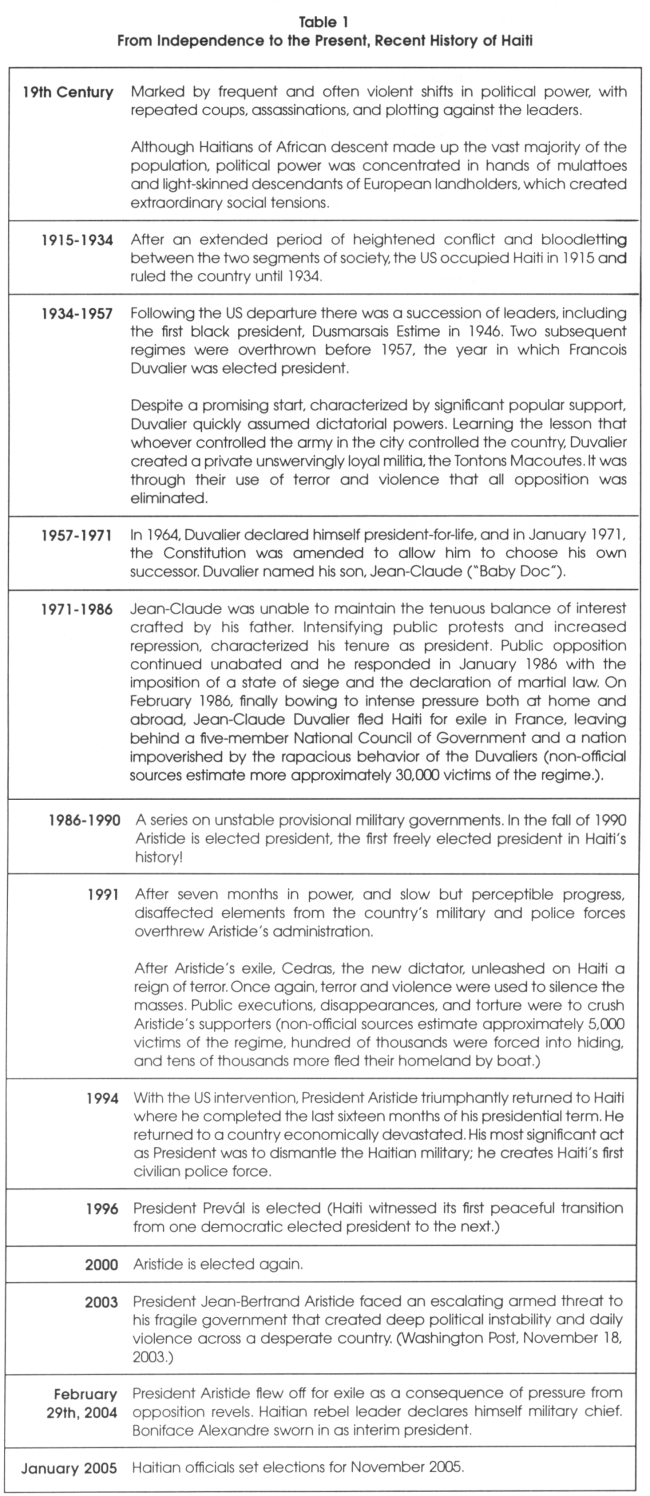
The recent history, from independence to the present, is summarized in table 1.
It is evident that the political economic history of Haiti has been dominated by a sequence of turbulent oscillations, a predatory state after another. The uncertainty that investors and entrepreneurs have confronted hasn't allowed the emergence of sustainable economic growth. In addition, selfish predatory dictators seems to have been the rule since independence, which has been particularly damaging; predatory dictators usually don't have the incentives to promote the emergence of efficient institutions, nor the creation of adequate mechanisms of enforcement. Indeed, the dictator will discretionary determine and modify the law, and will try to impose it to the general public. Dictators, nevertheless, need to have the power and the resources to accomplish this goal. With the exemption of the Duvaliers, Haitian dictators haven't had these recourses and have been taken out of power by recursive coups; as a consequence, despite the effort of international organizations, the level of poverty has increased constantly. The real GNP per capita (at 1954-5 prices) fell from 419 gourdes in 1954/5-1958/9 to 396 gourdes in 1968/9-1971/2.2 During the same period agricultural production per capita fell from 207 gourdes to 192 gourdes. Similar conclusions are obtained for individual crops for the period 1950-1970, (Lundahl, 1983: 25)3
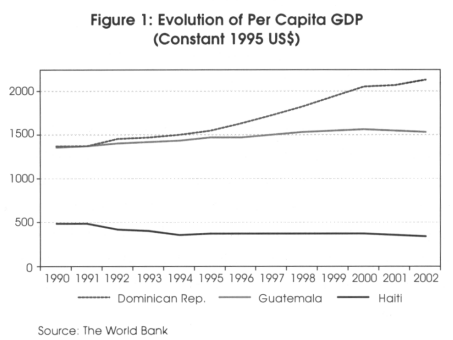
More recent data -figure 1- shows a decrease in the GDP per capita in Haiti during the last ten years, from US$480 in 1990 to US$340 in 2002 (in constant 1995 US$). Following, I present the most popular explanations for the poverty in Haiti.
]]> 3. Brief summary of the explanations of Haitian economic failure
3.1 The neoclassical framework: the economic geography approach and the problem of soil erosion
According to this theory, income has decreased as a consequence of a reduction in productivity of the agricultural sector due to a constant increase in the labor/land ratio, along with a cumulative erosion of the soil. Two forces are at work in this process of deforestation. First, trees are cut in order to provide fuel for cooking. Given the relative prices that prevailed since the 1960s (and probably even earlier), there haven't been alternatives to wood and charcoal for the majority of the Haitian population. Trees are also cut down to make way for the cultivation of crops. As the population expands, the plantations extend further and further up the steep hillsides. Given the prevailing technology, the soil becomes rapidly exhausted and so no longer able to be used for agricultural purposes. (Lundahl, 1983: 27-29)
In addition, this theory suggests that neighboring peasants are trapped in a prisoner's dilemma game where the repetition of the game —contrary to the theoretical prediction— doesn't generate mutual cooperation. Indeed, as Lundahl describes, woodcutting by an individual peasant may have a direct impact on neighbor's crops, since it may give rise to a flow of water down the hillside. It is therefore not altogether certain that the efforts of an individual peasant to try to prevent erosion will necessarily have a positive effect. These effects may be sabotaged by the failure of neighbors to carry out similar measures.
This theory also relays on an atypical peasant with a very high discount rate. Lundahl claims that peasants who have extremely low average incomes tend to have a strong preference for present as opposed to future income. Initial costs of erosion control are high, e.g. terracing, whereas the returns accrue mainly in the long run. Consequently, it is unlikely that the peasants will try to solve their own erosion problems. (Lundahl, 1983: 29)
The reduction in the supply of cultivable land due to erosion has disturbed the relationship between land and labor, with labor-intensive crops once again replacing land-intensive ones, and more land is destroyed at an increasingly rapid rate, leading to a further spiral of the process of erosion. It would be expected that the price of land-intensive crops will increase signaling its relatively scarcity compared with the labor-intensive crops; however, during the 1950's, 1960's, and in recent years this was not the case. The price of coffee is mainly determined by factors outside Haiti, factors that are unaffected by the country's own export production. (Lundahl, 1983: 31) In summary, in a country like Haiti, where the agricultural sector represents 80 per cent of the GDP, the constant erosion of the soil have a big negative impact on the country's productivity and therefore in per capita income.
3.1.1 Public Finance, nepotism and bureaucracy
The neoclassical theory also emphasizes that a large proportion of government expenditure has been absorbed by the payment of salaries and wages, which has limited the resources available for investment. As a result of the extreme use of the spoils system, a change of government leads to a purge of the administration down to the intermediate (and even lower) levels. A new group of people takes over as a reward for political services. Simultaneously, the administration has been expanded far beyond the requirements of actual operation. (Lundahl, 1983: 33)
Another important element of this theory is the lack of credit due to the absence of well-defined property rights that is a big obstacle for investment and the implementation of new technology. Inadequate education, on the other hand, reinforces the barriers for a successful transference of technology. North's idea of 'path dependence' seems to capture neatly the Haitian case: a vicious downward spiral.
3.2. The standard Marxist framework (a dialectic approach)
]]> This framework-proposed by Caprio (1979), and cited by Lundahl (1983)-builds on the notion of vicious circles and leads to the conclusion that the main reason behind the stagnation of Haitian peasant agriculture is lack of capital. The vicious circles manifest in the supply and demand side of the economy. In the supply side, a general lack of capital is translated into low labor productivity and hence also into low incomes. In the demand side, the low real incomes keep aggregate demand low, so that the incentives for producers to invest in increased productive capacity remain weak. (Lundahl, 1983: 41-42)According to Caprio, the roots of the problem of the agricultural sector are to be found in the foreign capitalism penetration of the peasant economy. The 'vicious' circle would disappear if only the dependence on capitalism could be broken and the negative effects of participating in international trade could be overcome. The falling incomes within the peasant sector are a consequence of the operations of capitalism and the integration of peasant agriculture in a system dominated by the industrialized nations, which decide the prices of the agricultural goods exported by Haiti. (Lundahl, 1983: 45)
As Lundahl claims, this argument suffers from a fundamental weakness. In a few words, the international coffee prices are mainly determined by the interplay of demand and supply factors in this market, which is considered competitive. If any single country may be said to hold a decisive influence over international coffee prices, this country is Brazil, which so far belongs to the group of developing countries and not to the industrialized nations referred to by Caprio. (Lundahl, 1983: 46.)
I have briefly summarized the standard approaches that have dominated the literature on the Haitian case. The literature on the underdevelopment of Haiti is relatively short and hasn't incorporated the current contributions of the new institutional economics; Lundahl has done some attempts in modeling a dictators' behavior (Duvalier); nevertheless, a more general framework needs to be developed to analyze the Haitian dilemma.
In what follows I present a new-institutional framework that opens a new window in our attempt to observe and understand the Haitian reality. I considered that this framework fits better the Haitian case given its tumultuous political history.
4. A Supply and Demand approach to the Institutional Performance of Haiti
The correlation between institutions (private property, the rule of law, and economic freedom) with economic growth is widely supported by the available evidence (Holcombe, 2001: 628-645) Institutions are important for at least two reasons: 1) institution constitute constrains to human's natural proclivity to take advantage of power for personal purposes, and 2) institutions provide certainty to human interactions, reducing transaction costs. According to this approach, having the right institutions is a necessary and sufficient condition for growth.
From North and others (1990) we know that institutions could be either inefficient or efficient, and the process in which institutions developed, emerged, and change, is complex and rely on the subjective models of the actors. Under this framework, there are three possible explanations for Haiti's political-economy performance: the country has had the wrong institutions, has had the right institutions with inefficient mechanisms of enforcement, or a combination of both.
4.1. The main institutions in Haiti
]]> A brief analysis of the Haitian constitution reveals two important laws that are at odds with private property and economic freedom: article 248 that establishes that National Institute of Agrarian Reform (whose purpose is to benefit those who actually work the land);4 and article 55-1 that established that aliens residing in Haiti may not own more than one dwelling in the same arrondissement (an arrondissement is an administrative division that may comprise several Communes.) These articles represent negative incentives for foreign investors to bring capital into the country. Unfortunately, we don't have evidence of how damaging the two articles have been in terms of discouraging foreign investment. However, we know that the current constitution is very recent (1987) and therefore, cannot be blame for the poverty that has prevail in the country for the last 200 years. Besides the two articles, we can say—in a broad sense-that the constitution is very similar to the US constitution. For example, the Haitian constitution establishes the separation of powers as a system of checks and balances.The constitution of 1987 is the first out of 23 since 1804 that has been approved in a democratic process. The highly instable formal institutional framework suggests a more deeper problem: dictators have had big incentives to change the constitution to their personal convenience. This fact conduces us in the direction of the economics analysis of dictatorships.
4.2. The economics of Haitian dictators
During the almost 200 years of its existence, the Haitian Republic has witnessed the swearing-in of 42 chiefs of State. Out of these 42, 7 remained in power for more than 10 years, 9 declared themselves presidents for life, 11 remained in power for less than one year, and 29 were either assassinated or forced to seek exile. Paraphrasing Gordon Tullock the relevant question is "why so much instability?" As suggested by Tullock (1974), successions in dictatorial regimes are particularly violent, and this has been the case in Haiti Almost every dictator has been a 'selfish dictator' (including the Duvaliers—'Papa Doc' and 'Baby Doc') all with the purpose of maximizing benefits in the short run paying the cost of less security in the long run.
Microeconomic theory explains the political history of Haiti when we analyze the incentives of the main actors of the Haitian political drama: dictators, interest groups, and the general public. There is not a simple model that captures the instability in Haiti; however, we can borrow some ideas and concepts from the disciplines of Constitutional Political Economy to analyze what I consider the root of the problem: a relative scarce amount of efficient enforceable institutions.
4.3. Are enforceable institutions an economic commodity?5
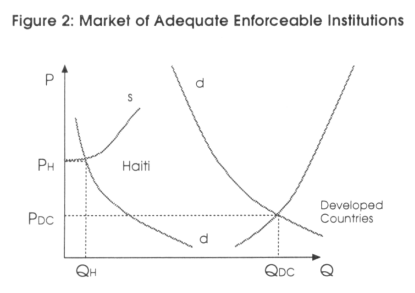
We can extend the supply and demand analysis to determine why "good enforceable institutions" has been relatively scarce in Haiti compared to developed countries (Figure 2)
4.3.1. Determinants of the supply
]]> The supply of well enforceable institutions is determined by:a) The marginal cost of enforcement (MCE).
The MCE is the change in the amount of enforcement due to an additional monetary unit spent in enforcement. The MCE increases with the amount of enforcement supplied, as a result we have an upward sloping supply of enforcement.
Exogenous variables and the supply curve:
What are the determinants of the supply of rule of law, and well enforceable property rights?
1. The incentives of the dictator to enforce the law. An increase in the dictator's willingness to enforce the law will shift the supply curve to the right; a decrease in his willingness will shift the supply curve to the left.
2. External imposition of institutions. Keeping other variables constant, an external imposition of adequate institutions will shift the supply curve to the right. Note that the external imposition is not a sufficient condition to increase the amount of efficient enforceable institutions; this will depend on the elasticity of the demand.6
Why the supply of enforceable institutions is too short in Haiti? Dictators' incentives to enforce the law.7
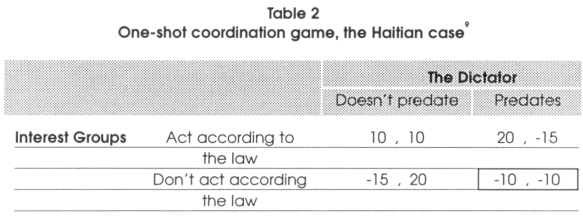
The incentives of the dictator to enforce the law are extremely important. In the case of Haiti and other developing countries the dictators (and the government in general) don't have the incentives to enforce the law. The dictator and the interest groups are trapped in a one shot prisoners' dilemma game, where the Nash equilibrium is [predate, not obey the law]8. A dictators' high discount rate reinforces this outcome:
An example of an external imposition of institutions is the period 1915-1934 when the country experienced a relatively stable political phase, which could be interpreted as an increase in the supply of institutions, in this case "imposed" by the US government.
4.3.2. Determinants of the demand
The demand of adequate enforceable institutions depends on the subjective valuations of the general public. In other terms, how important is for the general public that the law is obeyed and enforced. The public will demand enforcement if they consider it valuable. There is a negative relationship between the price to pay for enforceable institutions and quantity demanded. The quantity demanded is low in the following cases:
1) When the opportunity cost for asking for enforceable institutions is high (high price).
2) When the government (dictator) is repressive and asking for enforcement is so risky that it might imply a high probability of being kidnapped or killed.
Accordingly, there is a negative relationship between the price and the quantity of enforceable institutions demanded.
4.4. Why the demand of enforceable institutions is too short in Haiti? Rational ignorance as exogenous variable
In order to consider if a product is valuable, the public has to know the commodity and has to have accurate expectations about its utility. In the case of Haiti, where the public has had a very limited exposure to good institutions, they are not considered a highly desirable and valuable commodity. In other worlds, a degree of rational ignorance determines the position of the demand for efficient and enforceable institutions. An increase in the degree of rational ignorance shifts the demand curve to the left, and a reduction of it shifts the demand to the right.
]]> This represents an abstract theory of the emergence of institutions, and doesn't really solve the conundrum since the supply of adequate institutions depends on a prisoners' dilemma game, which is an outcome of inadequate institutions that prevent the inception of cooperative behavior. Indeed, this represents a vicious cycle that supports North's idea of path dependence. However, the model represents an insightful analytical tool to think about the Haitian case. Nevertheless, additional research is needed to contrast the model with the evidence.
5. Conclusions
This paper constitutes a brief synthesis of some well-known concepts in the Institutional Economics literature. It combines the institutional framework with microeconomics tools to analyze the political history of Haiti as an alternative to the neoclassical and Marxists schemes. The paper reveals important insights that can be generalized to other dictatorial regimes.
The equilibrium quantity and price of adequate enforceable institutions depends on the interaction of the supply and demand. Developed countries have greater demand and supply of enforceable institutions, which determine a higher equilibrium quantity, and therefore higher rates of growth. In the case of Haiti, a low demand and supply generate a short amount of enforceable institutions, and therefore more instability and poverty.
This framework suggests a concrete (but still broad) way to increase the equilibrium quantity of good institutions, and therefore promote economic growth:
1. In the demand side: A reduction in the degree of rational ignorance (that could be accomplished with a reduction in the amount of public information that the individual needs to know: e.g. a reduction of the government, or with the increase in public and private education).
2. In the supply side: To Break down the inertia of a path dependence scheme (illustrated as a prisoner's dilemma game), derived from the rational maximizing behavior of the dictator and interest groups. The literature suggests that repeated games generate cooperation; this hasn't been the case in the 42 quasi-sequential games in Haiti.
The analysis shows that a dominant strategy were [predate, acting according to the law]—a Pareto superior Nash equilibrium—doesn't guaranty a high amount of good institutions, if the demand for institutions is low. Accordingly, zero rational ignorance (high demand) doesn't guaranty a high degree of good institutions if the interest groups and the dictator are trapped in a Pareto inferior solution of the prisoners' dilemma game (and no change at all when the supply is perfectly inelastic). Therefore, efforts should be made to increase both, the supply and demand curves.
]]>Notas
* Andres Marroquin Gramajo is a Ph.D., student of Economics and a Global Prosperity Initiative (GPI) Fellow at the Mercatus Center. He thanks the Mercatus Center at George Masón University for financial support. The views expressed in this article do not represent those of the Mercatus Center.
1 The native population of the island, the Arawak/Taino, disappeared after Columbus established the first settlements. Besides the big load of work that the Spanish put on them in the mines and fields, the natives were not Immune to European diseases, especially smallpox.
2 From 1919 Haiti had a fixed exchange rate of 5 gourdes = 1 US dollar.
3 Lundahl emphasizes that these figures for agricultural production are likely to be subject to a substantial degree of error. However, they appear to be supported by the findings of a number of studies dealing with rural nutritional standards. (1983, p. 25.)
4 According to Lundahl (1995) the Inequality of land distribution has been overestimated and the available statistics on the Issue are unreliable.
5 We define "good institutions' as well defined property rights, the rule of law, efficient system of check and balances, and economic freedom, among others.
6 An inelastic demand for institutions might explain the failure of the democratic reforms in many African countries.
7 A prisoner's dilemma game captures better the dynamic of the democratic regimes in Latin America, but the coordination game seems to be an adequate description for the dictatorial ones.
]]> 8 North (1990) concisely developed the idea of path dependence.9 One short run prisoners' dilemma game, the Haitian case:
This is a more illustrative prisoners' dilemma game of Haiti political history. Interest groups (e.g., the army) decide wheatear to organize a coup or not.

REFERENCES
Caprio, G. 1979. "Un livre de Mats Lundahl: Les paysans et la pauvrete: Une etude sur Haiti". Le Nouveau Munde. Supplement du Dimanche, 5. [ Links ]
Crist, R. 1952. Cultural Dichotomy in the Island of Hispaniola. Economic Geography. Vol. 28, No. 2: 105-121. [ Links ]
Fass, S. M. 1988. Political Economy in Haiti: The Drama of Survival. New Brunswick, New Jersey: Transaction Inc. [ Links ]
Holcombe, R.G. 2001. "Public Choice and Economic growth". In F. Shughart II and Laura Razzolini (eds). The Elgar Companion to Public Choice. William Massachusetts: Edward Elgar Publishing Inc. [ Links ]
Kryzanek, M. J. and H. J. Wiarda. 1982. The Dominican Republic: A Caribbean Crucible. Boulder, Colorado: Westview Press. [ Links ]
Lundhal, M. 1983. The Haitian Economy: Man, Land and Markets. New York: St. Martin's Press. [ Links ]
— 1996. "Income and Land Distribution in Haiti: Some Remarks on Available Statistics". Journal of Interamerican Studies and World Affairs. Vol. 38, No. 2/3, Special Double Issue: Poverty and Inequality in Latin America, 109-126. [ Links ]
North, D. C. 1990. Institutions, Institutional Change and Economic Performance. New York: Cambridge University Press. [ Links ]
Smith, A. 1904. An Inquiry into the Nature and Causes of the Wealth of Nations. Methuen and Co., Ltd. Edwin Cannan (ed). Library of Economics and Liberty. 18 November 2003. <http://www.econlib.org/library/Smith/smWN17.html > .
Tullock, G. 1974. The Social dilemma: The Economics of War and Revolution. Blacksburg: Center for the Study of Public Choice. [ Links ]
]]>