Selling their Best for Little: The Riddle of Ecuador's Failed Attempt to Assist Communal Farmers
María José Castillo and Richard Beilock
Summary
In the 1980s, Ecuador began an expensive project providing primary irrigation canals to the Santa Elena Peninsula. The intended beneficiaries were the region's communal farmers. Instead, virtually all irrigable lands have been sold to large farmers and land speculators, usually at exceedingly low prices. While political and economic abuses explain some of these sales, introduction into a communal setting of an innovation which improved returns to capital relative to labor made land divestitures almost inevitable. With effectively no access to credit, communal farmers had little ability to invest in secondary irrigation systems. Moreover, because users of irrigable lands did not fully control communal sales decisions, as these lands became attractive to others, dispossession risks rose. The net result was that reservation prices for holding these lands fell among communal farmers at the same time of increased demands for these assets by those outside the comunas. Implications for development strategies are also discussed.
1. Introduction
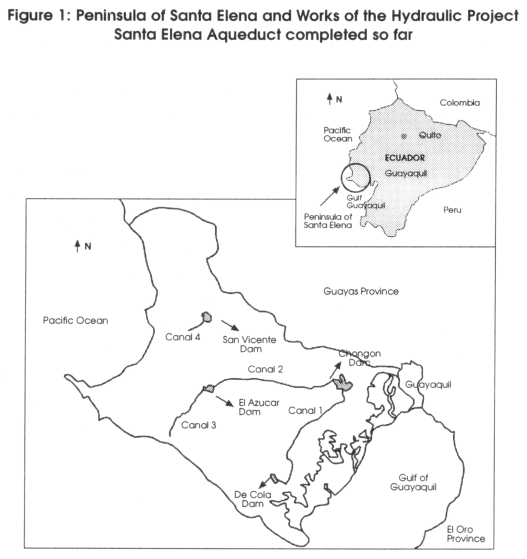
West of Guayaquil, Ecuador is the Santa Elena Peninsula (PSE), an area of 6,050 km2 (see Figure 1). Until the middle of the 20th Century, PSE was a breadbasket, supplying vegetables, animal products, and timber. Due to excessive resource exploitation and climatic changes, the PSE was transformed into an almost treeless, semi-arid landscape. Many migrated from the land to urban areas, primarily Guayaquil (Alvarez, 1999). From a population over a million, only 256,0001 people remain on the Peninsula, with the large majority deriving livelihoods from the tourism (beaches) and the shrimp industry. Until very recently, virtually all agricultural land was organized into communal land holdings, known as comunas. With almost no exceptions, the approximately 70.0002 comuneros in the PSE live in poverty. Per capita consumption by comuneros is $401,3 less than a fourth of that for the country as a whole and barely above the $ 1.00 per day international standard commonly employed as the dividing line between poverty and abject poverty.
With the expressed goals of assisting the comuneros and reviving the productivity of the PSE, in the 1980s the Government of Ecuador began a US$5804 million irrigation project.5 Water would be pumped from two pumping stations (one in the Daule River and the other in the Chongon Reservoir) into a 1 20 kilometer system of primary canals and five reservoirs. It was estimated that, with construction by landowners of secondary systems, 50,000 hectares could be irrigated6. The large majority of the canals (around 100 km) were completed and filled with water as much as a decade ago and the last portions of the system (two more reservoirs and 2 canals) are still being completed. With the works finished so far (see Figure 1), between 20,000 and 30,000 hectares could be irrigated, however only 6,000 hectares are currently under irrigation from the canals7. At least as troubling, virtually all of this production is by large growers who acquired their lands from the comunas. Indeed, the comunas have sold approximately 91 % percent of potentially irrigable lands to such growers and land speculators.8 According to available anecdotal information, these sales were at prices well below the most conservative estimates of the present value of potential production. The majority of the prices for irrigable lands were between US$40 and $400 per hectare (Castillo, 2003b). In other words, the comunas sold their best lands at bargain basement prices.
The goal of the analysis presented in this paper was to investigate what happened. Did the economically powerful use political influence and even armed force to wrest lands from the comuneros? Did comuneros sell their lands due to poor information about market opportunities for the products the canals made possible to produce and, by extension, the fair market value of their lands? Were the comuneros motivated by poverty or hedonism to surrender longer term gains in favor of small, but immediate compensation? Was there corruption? In some instances and to some degree, no doubt all of this happened. But we will argue that the main cause was that the combination of the type of investment made by the Ecuadorian Government and the communal structure of the land holdings increased the valuation (i.e., the reservation price) of the land for those outside the comunas while, at the same time, lowering those valuations for the comuneros. The resulting gap in valuations was greater the more suitable the lands for irrigation. It was this effect, primarily, which led the comuneros to the economically rational, though seemingly perverse, decisions to liquidate their best lands, even at low prices.
Beyond explaining past events, these findings have relevance for the northwestern part of the PSE, where the final phase irrigation project is under construction and, more generally, for development projects worldwide where the intended beneficiaries hold resources communally.
]]> 2. The Analysis
2.1 Overview of Feder and Feeny Model
The point of departure for our analysis is a simple, but rich and flexible model developed by Gershon Feder and David Feeny to explain investment, production, and land acquisition/retention decisions by peasants. Their model depicts a rural economy where there are private land holdings, but land rights are subject to risk. A farmer is assumed to maximize expected utility which is separable in two arguments: current consumption and the next period's wealth. The maximization process involves allocating his/her initial endowment and borrowed funds among three uses: current consumption, land acquisition, and investment in physical capital.
Some of the basic components and assumptions of the model follow:
Notation of the model:
T = quantity demanded of land
P = price of land
k = capital-land ratio
Note: Capital is a numeraire variable. That is, Capital is $1 per unit. As such, k becomes the number of dollars of Capital used per unit of land.
Co = first period consumption
Wo = initial wealth
Φ = probability of ownership and output loss in the second period. ]]> U, U0 = total utility and Period 1 utility, respectively.
y = monetary value of output per unit of land
r = interest rate.
In Period 1, land and capital are obtained (and/or retained) to produce the next period's output. The production function exhibits constant returns to scale in land and capital. The per hectare output is described in Equation 1:
The utility of current consumption is a concave function with decreasing marginal utility, see equation 2:
The amount of credit, S, available to a farmer is limited by the value of his/her land holdings (the only acceptable collateral) and by the degree of risk of losing the land, see equation 3:
]]>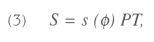
The proportion of land value lending institutions are willing to give as loans is s, 0 < s < 1. As would be expected, s is a function of the risk of land loss with s'< 0 .
The farmer selects Co, T, and k so as to maximize total utility, see equation 4:
{U0(C0)} is the utility of current consumption and {[1-Φ]T[y(k)+P]-[1+r]s(Φ)PT} is the expected terminal wealth, that is, output plus land value times the probability that they will still be possessed at the end of period 2, minus debt repayment10. This maximization is subject to a budget constraint whereby expenditures for land acquisition, capital investment, and current consumption cannot exceed initial wealth plus borrowed funds, see equation 5:
Solving for Co in equation 5 (i.e., Co = Wo + s(Φ)PT - kT - PT) and substituting into the right-hand side of equation 4, the resulting maximization equation is presented in equation 6:
]]>
The solution of the first and second order conditions to solve for the optimum values of T and k is presented in the Appendix. Three important, though unsurprising, results which will be used in the following discussion are that heightened risk of dispossession (0) reduces:
Again, these results apply to an economy where credit is available to everybody using [and owning] land, and credit is related to land value and to security of land rights. We will now present modifications to the theoretical model to capture better conditions on PSE.
For a brief discussion of the implications of the model's simplifying assumptions, see Appendix 2.
2.2 Modifying the Model to Conditions on the Peninsula of Santa Elena
Feder and Feeny modeled a situation in which there were essentially homogeneous agriculturalists determining the amounts of land, capital, and credit they would obtain, all subject to similar levels of risk and operating under similar incentive systems. The situation on PSE was, and remains, quite different. There are two distinct types of land users: the comuneros and the commercial farmers/land speculators or, more generally, non-comuneros.
Comuneros: Traditionally and by Ecuadorian law, virtually all rural land in PSE is held communally. Due to resource degradation and climatic changes resulting in near-desertification of much of the land, as well as the lure of job opportunities in urban areas, many comuneros migrated. For the remaining comuneros, while the land was not very productive, at least it was not in short supply. Indeed, there were areas in many comunas that were either entirely unused or only used sporadically and/or at very low levels of intensity. With effectively a zero shadow price on lands, individual comuneros were virtually assured of secure usage rights on plots previously allocated to them by the comuna.
]]> Credit Market: Because comuneros had usage, but not individual ownership rights, 'their' land could not be employed as collateral." As such, Comuneros had effectively no access to credit.12 In terms of the Feder and Feeny model, s = 0 and hence also S = 0.Land Market: Individual comuneros are not permitted to sell communal lands. This, combined with no access to credit markets, effectively precludes individual comuneros from the land markets. However, acting as a community, usage rights can be altered and comuna lands may be sold to other parties or additional lands purchased.13 Unlike the farmers envisioned by Feder and Feeny, the amount of land, T, is not a decision variable nor is land part of a comunero's wealth, WO, i.e., for the individual comunero TP = 0. As such, the comunero is reduced to one decision variable, k, because he/she has control over land use, but not over decisions to retain or sell the land. Therefore, the comunero faces a maximization problem as follows:
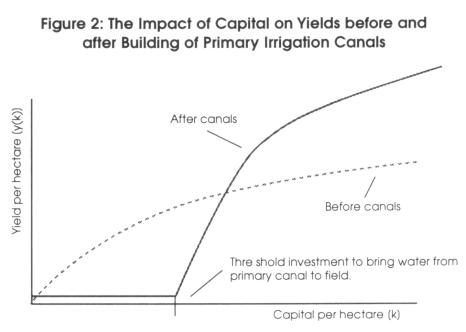
Direct impact of the canals: The primary constraint to increased agricultural productivity on the PSE is the low and irregular availability of water (Alvarez, 1999) The canals were intended to alleviate this problem. However, to utilize this water effectively requires investment in secondary irrigation systems (i.e., pumps, pipes and/or secondary canals, sprinklers, drip irrigation systems, etc.). In terms of the model, the canals increased y'(k), the marginal impact of capital on yields (i.e., the slope of the yields curve), but this increase only applied beyond threshold levels necessary to provide the means for bringing water from the canals to the fields (see Figure 2). With no significant attachable assets, reaching these thresholds was beyond the means of the comuneros and, as such, the canals were of minimal value, at best, for agricultural production.
Non-comuneros: Non-comuneros include those interested in entering the PSE land market either to engage in agricultural production or for speculation. Relative to comuneros, these are individuals with considerable financial means and political influence. Ironically, the Feder and Feeny model presented above, which was intended to describe peasants, can be employed without modification for this group.
Credit Market: This group clearly has access to credit markets both because, in general, these individuals already owned attachable assets not on PSE and could also use lands purchased on PSE for collateral."1 To the extent lands can be used for collateral, non-comuneros would derive a collateral premium15.
Land Markets: Due to tradition and vagaries in Ecuadorian law, there has been some question regarding the legality of individuals purchasing communal lands, even with community approval. Despite of this, since initiation of the irrigation project sales have become common.16 As such, non-comuneros have effective access to land markets in PSE.
]]> Direct impacts of the canals: Unlike the comuneros, the non-comuneros had access to the sufficient capital to use the canals to increase agricultural yields.2.3 Explaining the Sales of Irrigable Lands
As described in the introduction, the building of the canals did not bring an agricultural and economic renaissance to the comunas, but rather the sale of almost all potentially irrigable lands to non-comuneros. These events may be readily explained employing the Feder and Feeny model, with the just-described modifications for the comuneros. A schematic of the following discussion is presented in Figure 3.
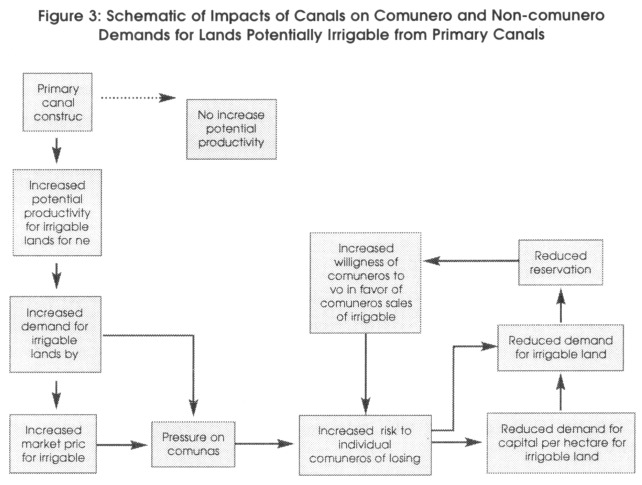
Prior to the development of the canals, non-comuneros had little interest in land held by the comunas, due to its low productivity. Moreover, as there was a large supply relative to the population, individual comuneros had secure usage rights. The primary canals increased the productive potential of the land if and only if sufficient, i.e., threshold level of, capital was applied to facilitate delivery of water from the canals to the fields (see Figure 2). As the land was held communally, regardless of the productive potential of the lands they used, comuneros could not secure sufficient credit to acquire threshold levels of capital needed to exploit the canals. But non-comuneros could. Therefore, due to the enhanced productive potential of the land, the canals precipitated an outward shift of the demand for land, with all of that increase being from the non-comuneros.
Because of the communal nature of the land tenure, non-comuneros had to negotiate with comunas, as a whole, for land parcels, rather than with the individual comuneros who had usage rights to the land. If proper procedures were followed, decisions to sell were based on community-wide voting or objective deliberations by legitimate representatives of the community. If there was corruption, as has been alleged in some cases, individuals holding authority in a community might have approved sales for personal gain, rather than purely from considerations of public welfare. Either way, individual comuneros holding rights over irrigable lands did not fully control the process. As such, these individuals were at risk of dispossession, a risk that effectively did not exist before the canals were built.
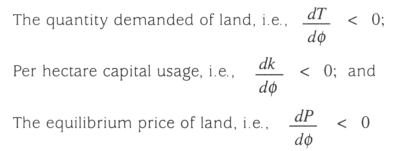
Due to this increased risk of dispossession, incentives to make capital investments over the land were further diminished, i.e., (dk/dΦ) < 0. Comunero demands for these lands would have fallen due to the combination of 1. heightened risk of dispossession, i.e., (dT/dΦ) < 0;17 2. reduced incentives to make land investments, and 3. that property values are not part of the wealth of individual comuneros using the lands, i.e., TP = 0.
With the coming of the canals, the demand for irrigable lands rose for non-comuneros. As the supply of these lands was fixed, the maximum prices they were willing to pay for their purchase rose. At the same time and as a result of this rise in demand on the part of non-comuneros (which increased dispossession risk) demands fell for comuneros, i.e., the minimums they were willing to accept as compensation for losing use of the lands fell. Reservation price gaps developed, with potential buyers willing to pay more than the minimum acceptable to potential sellers. These reservation price gaps would have been wider (and incentives for sales greater) the more suitable the lands for irrigation and the greater the resulting yield enhancements. The expected result of this process is consistent with what actually occurred, systematic selling by comunas of the lands having the greatest potentials through exploitation of the canals.
2.4 Comment on Low Sale Prices
]]> Reservation price gaps between non-comuneros and comuneros explain the land sales, but not sale prices as low as $40.00 per hectare for irrigable lands (see Castillo, 2003b). Why haven't the comuneros been better negotiators? It seems likely that the communal structure of the landownership contributed to this outcome. As the voluminous transactions cost literature attests, negotiating is not free. Any individual comunero devoting resources to negotiate a better price would have shared the fruits of that activity with all comuneros,18 the classic positive externality/free rider problem. Moreover, in most cases only a portion of comuna land was potentially irrigable. Comuneros with usage rights on non-irrigable portions had little or nothing to lose from sales of irrigable lands and, indeed, could only benefit from those lands if there were sales. For these individuals, reservation prices may have been exceedingly low.That the communal structure may have contributed to very poor realized sales terms is only the icing on this dismal cake. The sales were due to the reservation price gaps. The reservation price gaps were due primarily to the enhancement of returns from capital brought about by the canals and comunero credit constraints [as land and any improvements could not be attached] and secondarily to dispossession risk to the users of those lands19. As long as these conditions existed, the sales were probably inevitable.
3. Implications for Development Policy
The analysis of PSE has highlighted three aspects of communal asset ownership systems, that:
• Users of communal assets cannot consider the market value to be part of their own wealth.
• Users of communal assets normally face severe credit constraints as they are unable to employ the assets they use as collateral. As a result, feasible levels of capital improvements tend to be low.
• Sales of portions of communal assets are decided by the entire community, through either direct vote or representatives, and not solely by those individuals using those portions of the assets. As such, when purchase offers are made to the community, individual users are at risk of involuntary dispossession.
In PSE these factors led to near-complete divestiture by the comunas of lands potentially irrigable from the primary canals. The canals enhanced returns from [above threshold] applications of capital on irrigable lands. Because of the canals, those able to acquire capital, i.e., non-comuneros, had an advantage in the use of those lands relative to comuneros. Given this, sales of irrigable lands to non-comuneros were rational.
]]> There are two main implications of this work for development policy. The first is consistent with the broad consensus views of development literature and practitioners, that private ownership is usually superior to communal systems. In the case of PSE, we do not assert that had the land been privately owned there would not have been sales to outsiders. Rather, if the lands had been privately owned, an owner would have had:• Greater scope for exploiting the canals, as he/she could have used the land for collateral.
• More incentives to invest in the land due to lower dispossession risk and the ability to capture the value of improvements (through earnings stream enhancements or higher land values).
• Stronger negotiating positions, as well as greater incentives to secure the best terms, if they elected to sell the land.
As a general rule, communal asset holders should be encouraged to privatize or, at least, develop institutions that facilitate improved management along the lines of cooperative or corporate structures.
The second implication is that when assets are communally held, development programs that can be best exploited by clients through applications of capital may trigger divestiture of those assets. This suggests that a bias in favor of labor-intensive development may be particularly appropriate when there are communal holdings. Alternatively, safeguards may be necessary when interventions favor the use of capital. These may include oversight of asset transfers and/or lending programs to facilitate credit access.
APPENDIX 1:
OPTIMIZATION SOLUTION FOR THE FEDER AND FEENY MODEL
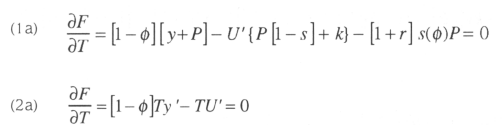
]]> The solution for determining optimum values of k and T, as well as the impacts of changes in selected parameters are presented in this Appendix. Equation 6, from the text, is repeated below.At the optimal values of T and k, the first-order derivatives have to equal zero. The expression above is hereafter referred to as F. For the first order conditions, see equations 1a and 2a:
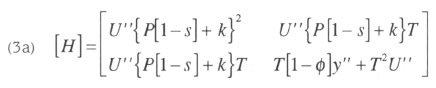
To verify that the choice of T and k maximizes the utility function, the first element (first row, first column) of the Hessian needs to be negative and the determinant of the matrix positive (see equation 3a).
The first element is: U" {P[1-s]+k}2< 0.
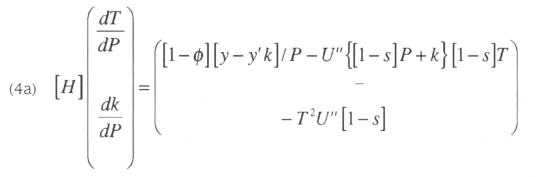
]]> The determinant is: Δ=T[1-Φ]U" {P[1-s]+k}2 y" > 0Once the second-order conditions are satisfied, the model can be used to analyze how the optimal choice functions react to changes in the parameter P. Differentiating the first-order conditions with respect to P and arranging the terms into matrix form, yields equation 4a:
Using Cramers's rule yields equations 5a and 6a:
and (6a)
Equation 5a indicates that the quantity demanded of T is negatively related to price, i.e., a downward sloping demand curve for land. Equation 6a demonstrates that the capital-land ratio, k, is positively related to the price of land as farmers substitute capital for land.
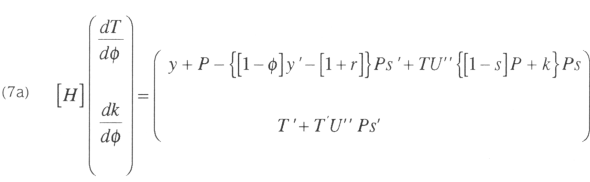
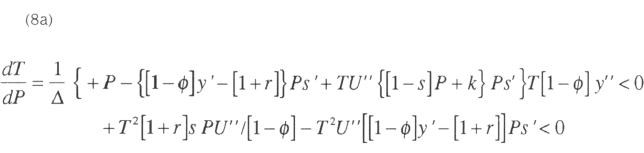
]]> The model can also be employed to show that the optimal choice of T is negatively affected by an increase in the risk to ownership if land prices are held fixed, see equations 7a and 8a:The expression {[1-Φ] y'- [1 + r]} is greater than zero because the credit constraint is assumed to be binding. This means that the expected20 marginal productivity of the land has to be greater than the cost of capital for the individual to be willing to ask for credit.
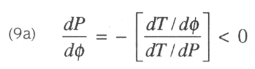
Because the demand for land is downward sloping, and given that the supply of land is fixed21, there is an equilibrium price for land that depends on Φ, the probability of losing land. In other words, if the demand for land is reduced after an increase in Φ, the equilibrium price of land declines, see equation 9a.
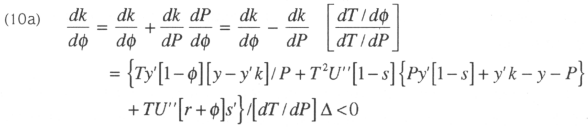
Through its negative effect on the price of land, the capital-land ratio, k, also is negatively affected by an increase in the risk to ownership, see equation 10a.
]]>
COMMENTS ON SIMPLIFYING ASSUMPTIONS IN THE FEDER/FEENY MODEL
Delineating the crucial interrelationships for a study in a setting sufficiently simple to facilitate analysis and prediction is the essence of economic modeling or, indeed, virtually any scientific investigation. To yield fruitful results, the system of interrelationships must be reasonable and, moreover, simplifications made should not compromise the model's real world applicability. In the Feder/Feeny model three simplifying assumptions are made, explicitly or implicitly. None of these jeopardized the validity of the model for our analysts:
Two periods: Two periods are envisioned: an initial period in which consumption occurs, as well as, acquisition decisions to facilitate production in the second and final period. Each period is of indeterminate length. Any real world process — economic, cultural, biological, etc. — might best be portrayed as an infinite series of stages or periods, with each successive stage incorporating and adjusting to events of the previous stage, perhaps a nanosecond before. Regardless of the discipline, modeling real world, infinite stage processes almost invariably involves abstraction to finite stage processes. From the standpoint of our study, a two period model, with the first for planning/preparation of activities in the second period was entirely appropriate. The focus of the work was explaining decisions to retain, sell, or buy land given land tenure regimes, credit constraints, and the presence of primary canals. Those decisions (made in the first period) would be based upon expected returns, dispossession risks, etc. in the second period.
Another potential criticism of a two period model is implication that there is nothing beyond the second period. This could easily be addressed by defining for potential production in the second period goods such as "land or capital for later use by the individual or his/her descendents."
No land in the initial period: Individuals begin with an endowment of wealth, Wo, they employ, along with borrowings, to obtain goods and services for current consumption and both land and capital to facilitate production in the next period. This simplification does not present a problem for two reasons. First, in our analysis we deal with two types of individuals, neither of which initially owns land, though one type has usage rights to land. Second, as the model was structured, landlessness was unnecessary. While Feder and Feeny portrayed individuals as initially being landless, the forms in which Wo was held were not specified. Second, there is no reason why part of Wo could not be land which could be sold for consumption goods or capital. If land is not sold, then, in effect, that initial period asset is being used to 'purchase' land for the second period.
All capital exhausted by the end of the second period: In the model, capital is exhausted by the end of the second period and, as such, does not add to terminal wealth, i.e., the sum of the values of production and land held at the end of the second period. Therefore as used by Feder and Feeny, capital may be thought of as working capital to secure supplies, such as seed and fertilizer, and light machinery which are consumed or worn out during the production process, and not including essentially permanent improvements, such as buildings, retaining walls, and heavy machinery. This is not critical to our use of the model. Moreover, even without altering the model, a more generalized concept of capital can be incorporated. The demand for capital is a derived demand. That is, capital is not acquired for its own sake, but for the production it can facilitate. The value of that additional production which is realized during the second period — tomatoes, livestock, grain, etc. — would appear as part of the terminal wealth. Similarly, at the end of the second period, potential future production from remaining capital could be considered to be a product and its present value added to terminal wealth.
]]> Notes
1 Estimation of Escuela Superior Politécnica del Litoral, 2000. See Sectores poblados y mano de obra/Componente 1 in Escuela Superior Politécnica del Litoral.
2 Ibid.
3 Comunero consumption estimate from Castillo, 2003b. Ecuadorian consumption average from World Bank.
4 See Infraestructura de Riego/lnfraestructura/Componente 1 in Escuela Superior Politécnica del Litoral.
5 Another goal of the project was to supply water for residential and industrial purposes.
6 See Infraestructura de Riego/lnfraestructura/Componente 1 in Escuela Superior Politécnica del Litoral.
7 Ibid.
8 Interview with Jaime Proaño from CEDEGE, 2000. Also Castillo (2003b), studying four comunas where the canals had been built, found that virtually all irrigable lands had been sold, accounting for nearly two thirds of all lands formerly held by these Comunas.
9 In their discussion, Feder and Feeny begin period 1 with the farmer having no land and an initial amount of wealth, WO. However, by a trivial extension of the model, a portion of Wo can be specified as being land.
]]> 10 As an aside, this formulation suggests risk neutrality, that is unless the f assumed by a farmer is biased upwards (risk averseness) or downward (risk loving).11 In addition, as long as the productive potential of the lands was low, their value as collateral would, likewise, have been low or even nil.
12 Through informal channels and some NGOs, comuneros actually have access to credit, but loan amounts are typically very small, see Castillo (2003a). Moreover, the Government did not provide special credit programs to facilitate exploitation of the canals by comuneros.
13 In practice, prior to building the canals, comunas almost never bought or sold land.
14 It should be noted that this group bears a non-zero, though probably small, risk of dispossession (Φ) from potential challenges to the legality of some of the purchases of communal lands.
15 Feder and Feeny define collateral premium as "the result of the owner's ability to obtain additional and cheaper credit by pledging the land as collateral."
16 If and the extent to which this resulted from appropriate and inappropriate uses of political and economic influence remains and open question.
17 This change in Tdue to a higher risk (Φ) applies to the community as a whole as T is not a decision variable for the individual comunero.
18 As that negotiator would have received his/her share of sales revenue.
19 Carter and Salgado (2001) also suggest this result when asserting that "capital-constrained" individuals have a smaller shadow price of the land than unconstrained individuals, which makes their demand for land lower. When high risk of losing land is added, they conclude," "the competitiveness dampening effects of credit constraints are likely to be enhanced." (p256), further reducing demands for land.
]]> 20 By "expected" is meant both the usual meaning of uncertainty regarding actual productivity and/or market conditions and, in addition, accounting for uncertainties regarding risks of dispossession, i.e., Φ,21 The physical supply of land is always fixed. The economic supply of land could increase making available, through irrigation infrastructure for example, some currently unproductive land. In this model, it seems that economic supply of land is at the frontier of possibilities of production, that is, all the land has been transformed to be available for economic use.
REFERENCES
Alvarez S. (1999) De huancavilcas a comuneros. Guayaquil, Ecuador: ESPOL Press. [ Links ]
Carter, M., and R. Salgado (2001) "Land Market Liberalization and the Agrarian Question in Latin America." In: De Janvry A., Gordillo G., Platteau J., and Sadoulet E. Access to land, rural poverty and public action. Oxford University Press. New York. [ Links ]
Castillo, M. (2003a) "Land Privatization and Titling as a Strategy to Diminish Land Loss and Facilitate Access to Credit: The Case of Communal Landowners in the Peninsula of Santa Elena, Ecuador." Thesis (M.S.). University of Florida, Gainesville. [ Links ]
Castillo, M., (2003b) "Survey of Eight Comunas on the Peninsula of Santa Elena." Unpublished survey report. [ Links ]
Escuela Superior Politécnica del Litoral (2002) Estudio del potencial agroindustrial y exportador de la peninsula de Santa Elena y de los recursos necesarios para su implantacion. Guayaquil, Ecuador. [ Links ]
Feder, G., and D. Feeny (1993) "The Theory of Land Tenure and Property Rights." In: Hoff K., Braverman A., and Stiglitz J. The Economics of rural organization: theory, practice, and policy. Oxford University Press. New York. [ Links ]
The World Bank (2000) World Development Indicators. International Bank for Reconstruction and Development. The World Bank, Washington DC, 2000. [ Links ]
]]>