<?xml version="1.0" encoding="ISO-8859-1"?><article xmlns:mml="http://www.w3.org/1998/Math/MathML" xmlns:xlink="http://www.w3.org/1999/xlink" xmlns:xsi="http://www.w3.org/2001/XMLSchema-instance">
<front>
<journal-meta>
<journal-id>1683-0789</journal-id>
<journal-title><![CDATA[Acta Nova]]></journal-title>
<abbrev-journal-title><![CDATA[RevActaNova.]]></abbrev-journal-title>
<issn>1683-0789</issn>
<publisher>
<publisher-name><![CDATA[Universidad Católica Boliviana]]></publisher-name>
</publisher>
</journal-meta>
<article-meta>
<article-id>S1683-07892019000300003</article-id>
<title-group>
<article-title xml:lang="en"><![CDATA[A review of transdisciplinary approaches for the co-creation of food sovereignty]]></article-title>
<article-title xml:lang="es"><![CDATA[Una revisión de los enfoques transdisciplinarios para la co-creación de la soberanía alimentaria]]></article-title>
</title-group>
<contrib-group>
<contrib contrib-type="author">
<name>
<surname><![CDATA[Gruberg Cazón]]></surname>
<given-names><![CDATA[Helga]]></given-names>
</name>
<xref ref-type="aff" rid="A01"/>
</contrib>
</contrib-group>
<aff id="A01">
<institution><![CDATA[,Universidad Católica Boliviana 'San Pablo' Departamento de Ciencias Exactas e Ingenierías ]]></institution>
<addr-line><![CDATA[Cochabamba ]]></addr-line>
<country>Bolivia</country>
</aff>
<pub-date pub-type="pub">
<day>00</day>
<month>11</month>
<year>2019</year>
</pub-date>
<pub-date pub-type="epub">
<day>00</day>
<month>11</month>
<year>2019</year>
</pub-date>
<volume>9</volume>
<numero>3</numero>
<fpage>329</fpage>
<lpage>356</lpage>
<copyright-statement/>
<copyright-year/>
<self-uri xlink:href="http://www.scielo.org.bo/scielo.php?script=sci_arttext&amp;pid=S1683-07892019000300003&amp;lng=en&amp;nrm=iso"></self-uri><self-uri xlink:href="http://www.scielo.org.bo/scielo.php?script=sci_abstract&amp;pid=S1683-07892019000300003&amp;lng=en&amp;nrm=iso"></self-uri><self-uri xlink:href="http://www.scielo.org.bo/scielo.php?script=sci_pdf&amp;pid=S1683-07892019000300003&amp;lng=en&amp;nrm=iso"></self-uri><abstract abstract-type="short" xml:lang="en"><p><![CDATA[Food sovereignty is a complex problem of sustainability, since it requires the active and effective participation of diverse communities of knowledge for the identification and implementation of relevant and sustainable solutions. It is a complex problem that cannot and should not be treated sectorial or unilaterally (e.g. from the academy or from the public sector). Otherwise the proposed solutions would be destined to an imminent failure. Transdisciplinarity is proposed as an approach to successfully deal with complex sustainability problems, since it allows transcending disciplines and sectors. There are few experiences about the co-creation of food sovereignty from a transdisciplinary approach at international and national level. This essay presents a case study in the Municipality of Tiraque about the co-creation of food sovereignty at two scales: municipal and communal level. Although the results are preliminary, there are already lessons from the field. The formation of collaborative and transdisciplinary research teams requires patience and time. Once the teams are formed, interesting dynamics emerge. Preliminary results show the importance of working with young people through agroecological schools and linking them with knowledge transfer networks such as the agroecological committee.]]></p></abstract>
<abstract abstract-type="short" xml:lang="es"><p><![CDATA[La soberanía alimentaria se constituye en un problema complejo de sostenibilidad, ya que requiere de la participación activa y efectiva de diversas comunidades de conocimiento para la identificación e implementación de soluciones pertinentes y sostenibles. La soberanía alimentaria es un problema complejo que no puede y no debe ser tratado de manera sectorial o unilateral (ej. desde la academia o desde el sector público). De lo contrario las soluciones planteadas estarían destinadas al fracaso inminente. La transdisciplina se plantea como un enfoque para lidiar exitosamente con problemas complejos de sostenibilidad, ya que permite trascender disciplinas y sectores. Existen pocas experiencias sobre la co-creación de soberanía alimentaria desde un enfoque transdisciplinario a nivel internacional y nacional. Este ensayo presenta un estudio de caso en el Municipio de Tiraque sobre la co-creación de la soberanía alimentaria a dos escalas: nivel municipal y comunal. Si bien los resultados son preliminares, ya se cuenta con lecciones aprendidas del trabajo de campo. La conformación de equipos colaborativos y transdisciplinarios de investigación requieren de paciencia y tiempo. Una vez conformados los equipos, emergen dinámicas interesantes. Resultados preliminares muestran la importancia de trabajar con la juventud a través de escuelas agroecológicas y vincularlas con redes de transferencia de conocimientos como el comité agroecologico.]]></p></abstract>
<kwd-group>
<kwd lng="en"><![CDATA[Food sovereignty]]></kwd>
<kwd lng="en"><![CDATA[co-creation]]></kwd>
<kwd lng="en"><![CDATA[agroecology]]></kwd>
<kwd lng="en"><![CDATA[transdisciplinarity]]></kwd>
<kwd lng="en"><![CDATA[Bolivia]]></kwd>
<kwd lng="es"><![CDATA[Soberanía alimentaria]]></kwd>
<kwd lng="es"><![CDATA[co-creación]]></kwd>
<kwd lng="es"><![CDATA[agroecología]]></kwd>
<kwd lng="es"><![CDATA[transdisciplina]]></kwd>
<kwd lng="es"><![CDATA[Bolivia]]></kwd>
</kwd-group>
</article-meta>
</front><body><![CDATA[ <p align="right"><font face="Verdana, Arial, Helvetica, sans-serif" size="2"><b>Art&iacute;culo Cient&iacute;fico</b></font></p>     <p align="center">&nbsp;</p>     <p align="center"><font face="Verdana, Arial, Helvetica, sans-serif" size="4"><b>A review of transdisciplinary approaches for the co-creation of food sovereignty</b></font></p>     <p align="center">&nbsp;</p>     <p align="center"><b><font face="Verdana, Arial, Helvetica, sans-serif" size="2"><i><font size="3">Una revisión de los enfoques transdisciplinarios para la co-creación de</font></i></font> <font face="Verdana, Arial, Helvetica, sans-serif" size="3"><i>la soberanía alimentaria</i></font></b></p>     <p align="center">&nbsp;</p>     <p align="center">&nbsp;</p>     <p align="center"><b><font face="Verdana, Arial, Helvetica, sans-serif" size="2">Helga Gruberg Cazón</font></b></p>     <p align="center"><b><font face="Verdana, Arial, Helvetica, sans-serif" size="2"></font></b><font face="Verdana, Arial, Helvetica, sans-serif" size="2">Departamento de Ciencias Exactas e Ingenierías Universidad Católica Boliviana &quot;San Pablo&quot;, Regional Cochabamba, Bolivia</font></p>     <p align="center"><font face="Verdana, Arial, Helvetica, sans-serif" size="2"><a href="mailto:gruberghelga@gmail.com">gruberghelga@gmail.com</a></font></p>     ]]></body>
<body><![CDATA[<p align="center"><font face="Verdana, Arial, Helvetica, sans-serif" size="2">Recibido: 5 de octubre 2019    <br> Aceptado: 11 de noviembre 2019</font></p>     <p align="justify">&nbsp;</p>     <p align="justify">&nbsp;</p> <hr align="JUSTIFY" noshade>     <p align="justify"><font face="Verdana, Arial, Helvetica, sans-serif" size="2"><b>Abstract: </b>Food sovereignty is a complex problem of sustainability, since it requires the active and effective participation of diverse communities of knowledge for the identification and implementation of relevant and sustainable solutions. It is a complex problem that cannot and should not be treated sectorial or unilaterally (e.g. from the academy or from the public sector). Otherwise the proposed solutions would be destined to an imminent failure. Transdisciplinarity is proposed as an approach to successfully deal with complex sustainability problems, since it allows transcending disciplines and sectors. There are few experiences about the co-creation of food sovereignty from a transdisciplinary approach at international and national level. This essay presents a case study in the Municipality of Tiraque about the co-creation of food sovereignty at two scales: municipal and communal level. Although the results are preliminary, there are already lessons from the field. The formation of collaborative and transdisciplinary research teams requires patience and time. Once the teams are formed, interesting dynamics emerge. Preliminary results show the importance of working with young people through agroecological schools and linking them with knowledge transfer networks such as the agroecological committee.</font></p>     <p align="justify"><font face="Verdana, Arial, Helvetica, sans-serif" size="2"><b>Key words: </b>Food sovereignty, co-creation, agroecology, transdisciplinarity, Bolivia</font></p> <hr align="JUSTIFY" noshade>     <p align="justify"><font face="Verdana, Arial, Helvetica, sans-serif" size="2"><b>Resumen: </b>La soberanía alimentaria se constituye en un problema complejo de sostenibilidad, ya que requiere de la participación activa y efectiva de diversas comunidades de conocimiento para la identificación e implementación de soluciones pertinentes y sostenibles. La soberanía alimentaria es un problema complejo que no puede y no debe ser tratado de manera sectorial o unilateral (ej. desde la academia o desde el sector público). De lo contrario las soluciones planteadas estarían destinadas al fracaso inminente. La transdisciplina se plantea como un enfoque para lidiar exitosamente con problemas complejos de sostenibilidad, ya que permite trascender disciplinas y sectores. Existen pocas experiencias sobre la co-creación de soberanía alimentaria desde un enfoque transdisciplinario a nivel internacional y nacional. Este ensayo presenta un estudio de caso en el Municipio de Tiraque sobre la co-creación de la soberanía alimentaria a dos escalas: nivel municipal y comunal. Si bien los resultados son preliminares, ya</font> <font face="Verdana, Arial, Helvetica, sans-serif" size="2">se cuenta con lecciones aprendidas del trabajo de campo. La conformaci&oacute;n de equipos colaborativos y transdisciplinarios de investigaci&oacute;n requieren de paciencia y tiempo. Una vez conformados los equipos, emergen din&aacute;micas interesantes. Resultados preliminares muestran la importancia de trabajar con la juventud a trav&eacute;s de escuelas agroecol&oacute;gicas y vincularlas con redes de transferencia de conocimientos como el comit&eacute; agroecologico.</font></p>     <p align="justify"><font face="Verdana, Arial, Helvetica, sans-serif" size="2"><b>Palabras clave: </b>Soberan&iacute;a alimentaria, co-creaci&oacute;n, agroecolog&iacute;a, transdisciplina, Bolivia</font></p> <hr align="JUSTIFY" noshade>     <p align="justify">&nbsp;</p>     <p align="justify">&nbsp;</p>     ]]></body>
<body><![CDATA[<p align="justify"><font face="Verdana, Arial, Helvetica, sans-serif" size="3"><b>1&nbsp;&nbsp;&nbsp;&nbsp;Introduction - agricultural policy and practice discourses</b></font></p>     <p align="justify"><font face="Verdana, Arial, Helvetica, sans-serif" size="2">People have been working together to address shared problems since the beginning of civilization, and, over time, they have devised many ingenious ways of organizing to accomplish collective endeavors (Emerson &amp; Nabatchi, 2015a, p. 3).</font></p>     <p align="justify"><font face="Verdana, Arial, Helvetica, sans-serif" size="2">Two of the main concerns of humankind are to cover the food necessities of a growing population and to reduce poverty (Atkins &amp; Bowler, 2016). Throughout the post-industrial period two groups of discourses dominated the agricultural policy and practice with the goal of dealing with these concerns: 1. Production innovation/technology; and 2. Economic Growth (Thompson &amp; Scoones, 2009).</font></p>     <p align="justify"><font face="Verdana, Arial, Helvetica, sans-serif" size="2">The production innovation/technology narrative started during the industrial revolution with the aim of dramatically increasing productivity and output by improving agricultural efficiency (Overton, 1996; Thompson &amp; Scoones, 2009). At the beginning, mechanization and fertilization of agriculture was highly promoted, later, in the middle of the 20<sup>th</sup> century, came the Green Revolution (GR) with the development of high yielding crop varieties (Atkins &amp; Bowler, 2016; Thompson &amp; Scoones, 2009). Since the 1990's the GR shifted to a Gene Revolution, based on &quot;molecular science and recombinant DNA&quot; to create Genetically Modified Organisms (GMO) with a primary focus on the private sector (Atkins &amp; Bowler, 2016; Thompson &amp; Scoones, 2009).</font></p>     <p align="justify"><font face="Verdana, Arial, Helvetica, sans-serif" size="2">The GR has increased food production importantly in developing countries. In the early phase of the GR (1961-1980) a 21% growth in production was reported; and in the later phase (1981-2000) a 40% growth in production was reported (Evenson &amp; Gollin, 2003; Thompson &amp; Scoones, 2009). Despite this significant increase, food availability and accessibility is still limited for the poor, while several significant socio-environmental problems have arisen as consequences of the technological packages developed and used by this narrative (i.e. soil fertility loss, agro-biodiversity loss, water pollution, cultural erosion, etc.) (Pielke &amp; Linner, 2019). For their part, GMOs' safety is controversial regarding human health and the environment (Atkins &amp; Bowler, 2016; Ludwig, 2018). Also, high dependency of farmers of a few multinationals has been reported, dominating food production globally.</font></p>     <p align="justify"><font face="Verdana, Arial, Helvetica, sans-serif" size="2">The economic growth narrative has some similarities with the production innovation narrative; however it focuses on the power of agriculture to take a country out of poverty (World Bank, 2005). This narrative aims at moving farmers from subsistence agricultural systems to commercial ones (OECD, 2206; Thompson &amp; Scoones, 2009; World Bank, 2005). In general, it is based in a set of &quot;stages&quot; that need to be accomplished in order to achieve economic growth. It pushes for specialization, commercialization and globalization of agricultural production and marketing; which eventually also pushes for scale economies. To do so, it requires market incentives, institutional instruments and technological innovation. This narrative is promoted by numerous multi-lateral development agencies such as the World Bank and the International Monetary Fund (Thompson &amp; Scoones, 2009). Although it aims at alleviating poverty, it has showed to impact negatively on farmers and their economy, specially, on small scale farmers. For example, they are impacted by heavy taxation policies and low prices for urban citizens (Krueger, 1996). Moreover they have become more vulnerable to price flows because of high levels of specialization (Timmer, 2009).</font></p>     <p align="justify"><font face="Verdana, Arial, Helvetica, sans-serif" size="2">Although both narratives have shown to be able to increase food production, the main two problems of concern remain; poverty and poor's inaccessibility to enough and quality food. In 2016, approximately 804 million people were suffering of chronic hunger in the World, this number increased to 821 million in the year 2017 (1 out of 9 people in the World) (World Health Organization, 2018, p. xiii). According to Thompson and Scoones (2009), both narratives have &quot;failed to provide sustainable outcomes&quot; because &quot;conventional agricultural science [...] is based on a static equilibrium-centered view that provides little insight into the dynamic character of agri-food systems&quot; (Thompson &amp; Scoones, 2009, p. 1).</font></p>     <p align="justify">&nbsp;</p>     <p align="justify"><font face="Verdana, Arial, Helvetica, sans-serif" size="3"><b>2&nbsp;&nbsp;&nbsp;&nbsp;Problem statement — co-creation of food sovereignty</b></font></p>     <p align="justify"><font face="Verdana, Arial, Helvetica, sans-serif" size="2">In the last decades different agricultural alternatives have arisen, aiming at developing more sustainable and equitable food systems such as agroecology, permaculture and eco-functional intensification among others. Such alternatives follow eco-friendly and integral approaches for agro-ecosystems management, food production and commercialization. Agroecology is an alternative that stands out and is catching the attention of practitioners, researchers, politicians and activists because it is a set of practices, a science and a social movement that aims at reaching food sovereignty (Wezel <i>et al., </i>2009). It focuses on the generation, protection and conservation of critical environmental services; and more importantly, it recognizes the dynamic nature of food systems which are deeply rooted in farmers' knowledge and skills, moreover, it recognizes the important role of all types of knowledge (Thompson &amp; Scoones, 2009). Hence agroecology is the main promoter of the co-creation of knowledge, which &quot;at farm-level, this translates into the re-skilling of</font> <font face="Verdana, Arial, Helvetica, sans-serif" size="2">farmers, who not only combine modern  science  and local knowledge, but (re)generate new, situated knowledge&quot; (Coolsaet, 2016, p. 165).</font></p>     ]]></body>
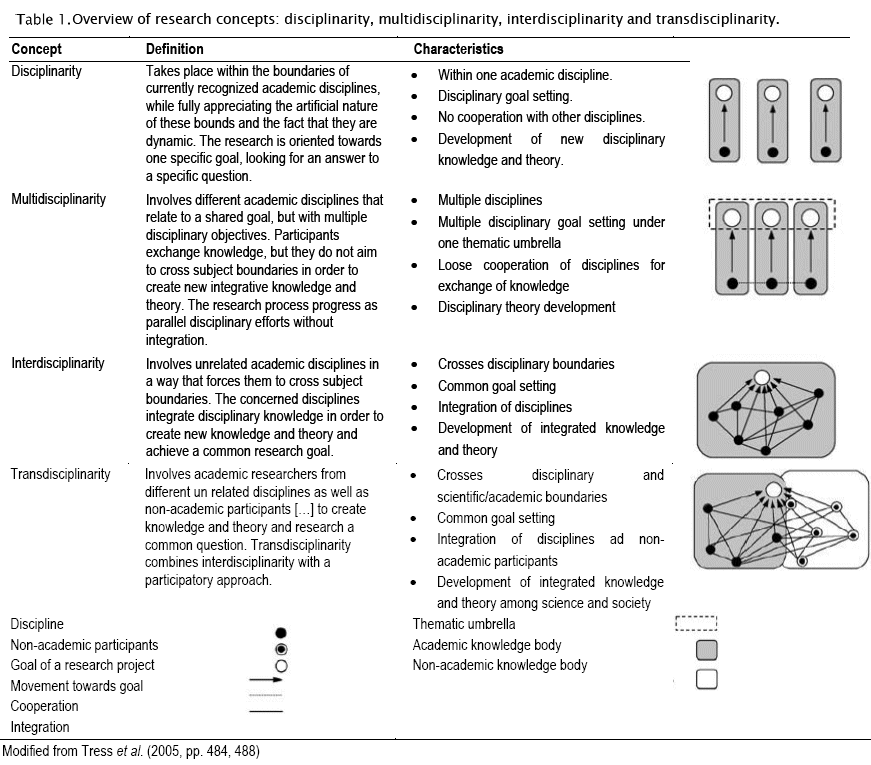
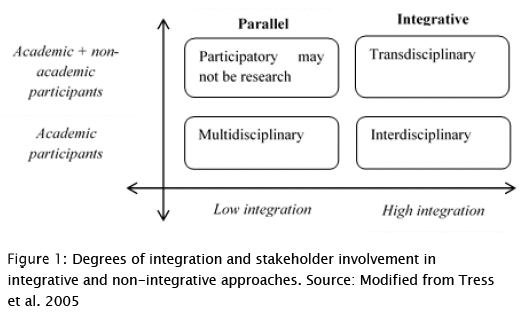
<body><![CDATA[<p align="justify"><font face="Verdana, Arial, Helvetica, sans-serif" size="2">Almost parallel to the rise of these agricultural alternatives, various horizontal and participatory Research and Development (R&amp;D) approaches have arisen as a counterpart to the neo-positivist approaches of a descriptive and instrumental nature (Cuellar-Padilla &amp; Calle-Collado, 2011; Jacobs, 2016). These include Participatory Action Research (PAR), Participatory Rural Appraisal and Farmer-to-Farmer Field Schools among many others (Chambers, 1994; Fliert, 1993; Tapia, 2016). PAR is based on critical theory and constructivism, introducing &quot;an ideal method for researchers who are committed to co-developing research programs with people rather than for people&quot; (Baum, MacDougall, &amp; Smith, 2006; Mclntyre, 2007, p. xii). It is based on the premise that people have the fundamental right to participate meaningfully in defining their own future (Attwood, 1997).</font></p>     <p align="justify"><font face="Verdana, Arial, Helvetica, sans-serif" size="2">Agroecology is characterized by a &quot;transdisciplinary, participatory and action-oriented approach&quot; by engaging different groups of stakeholders throughout a problem-solving process. Agroecology and PAR have common principles, hence they go hand in hand in the development of sustainable food systems (Altieri, 2000).</font></p>     <p align="justify"><font face="Verdana, Arial, Helvetica, sans-serif" size="2">Numerous studies have showed that participatory alternatives do not necessarily fully integrate different stakeholders throughout the whole research and/or development project process (Minkler, 2004; Tress, Tress, &amp; Fry, 2005). <a href="#f1">Figure 1</a> shows the degrees of integration and stakeholders' involvement in integrative and non-integrative approaches developed by Tress <i>et al. </i>(2005). Participatory alternatives show a low integration of academic and non-academic participants in environmental sustainability related processes. In general, especially in Latin America, PAR has been implemented by practitioners and activist without the participation of the academic sector (Agramont, Craps, Balderrama, &amp; Huysmans, 2019). Likewise, multidisciplinary approaches which work only with academic participants (Tress <i>et al., </i>2005).</font></p>     <p align="center"><a name="f1"></a><img src="/img/revistas/ran/v9n3/a03_figura_01.gif" width="528" height="314"></p>     <p align="justify"><font face="Verdana, Arial, Helvetica, sans-serif" size="2">Higher integration is present in interdisciplinary and transdisciplinary approaches. The later includes academic and non-academic participants (i.e. farmers, NGOs, consumers, government workers, etc.). In this sense, transdisciplinarity is seen as a &quot;key condition for societal transformation towards sustainability&quot; (Brink <i>et al., </i>2018, p. 765).</font></p>     <p align="justify"><font face="Verdana, Arial, Helvetica, sans-serif" size="2">Thompson and Scoones (2009) explain that governance<sup>1</sup> issues are absent in the narratives of agricultural development. Food governance dynamics should be an important focus for food systems transformation since they can influence their properties (Thompson &amp; Scoones, 2009). According to Vorley (2002) governance is described by three main institutions: government, private sector and civil society (Vorley, 2002). He argues that a poor distribution of power and interests among these institutions &quot;undermines the health and resilience of rural society, the farm economy and farmland ecology, even when executed in the name of 'sustainable development'&quot; (Vorley, 2002, p. 16). In this sense, the dynamics of power relations among stakeholders may determine who's knowledge is &quot;valid&quot; or &quot;valuable&quot;, hence, appreciating one type of knowledge and undermining another. Rosendhal <i>et al. </i>(2015) argue that such power relations tend to be overpassed by transdisciplinary research. Nevertheless, group empowerment may be achieved by exercising collaborative</font> <font face="Verdana, Arial, Helvetica, sans-serif" size="2">governance (Emerson, Nabatchi, &amp; Balogh, 2011). Likewise, new spaces for agency may be created for stakeholders.</font></p>     <p align="justify"><font face="Verdana, Arial, Helvetica, sans-serif" size="2">Emerson <i>et al. </i>(2011) explain that collaborative governance<sup>2</sup> can be supported by different theories such as co-production or co-creation, collaborative planning and participatory governance among others. Co-production and co-creation have become central for system transformation, since it aims at overcoming &quot;traditional collaboration and participation structures&quot; in order to foster sustainable systems (Emerson <i>et al, </i>2011, p. 149). Moreover, it recognizes transdisciplinarity as an approach that leads to the &quot;effectiveness of science and democracy&quot; (Emerson <i>et al, </i>2011, p. 149). Through collaborative governance, complex sustainable problems that involve different stakeholders from different organizations across scales can be approached with significant impacts that can lead to systems transformation (Emerson &amp; Nabatchi, 2015a). Hence the fusion of collaborative governance and transdisciplinary approach may lead to true co-creation of food sovereignty.</font></p>     <p align="justify"><font face="Verdana, Arial, Helvetica, sans-serif" size="2">Transforming food systems is the major interest of many developing countries; however, they do not necessarily aim at transforming them into sustainable systems, but they tend to follow a new wave of the GR, implementing similar political and technological packages. According to Marin <i>et al </i>(2016) some countries are still subject to processes of path dependency and lock-in, &quot;consequently, attempts to introduce more sustainable practices in one part of an agri-food system are frequently incompatible with, or are undermined by, other incumbent components of the system as a whole&quot; (Marin, Ely, &amp; van Zwanenberg, 2016, p. 3). This means that sustainable transformations to agri-food systems are likely to require strategic, multi-actor, multi-process interventions at different scales.</font></p>     <p align="justify"><font face="Verdana, Arial, Helvetica, sans-serif" size="2">Based on the above mentioned, transdisciplinary processes have the potential to overcome the path dependency and lock-in of agricultural development narratives through the co-design, co-production and co-dissemination of sustainable food systems which foster food sovereignty. Because of this outstanding potential, recently there has been growing interest in the study of transdisciplinarity; however, there still are several knowledge and implementation gaps.</font></p>     <p align="justify"><font face="Verdana, Arial, Helvetica, sans-serif" size="2">For example, there is a study about the process of stakeholder involvement and co-production in the development of municipal adaptation strategies in two municipalities of Germany and Sweden with advanced governance structures, which shows an implementation gap regarding the operationalization of transdisciplinarity (Wamsler, 2017). However, there is a lack of similar studies in developing countries with less advanced governance structures aiming at transforming food systems for food sovereignty.</font></p>     ]]></body>
<body><![CDATA[<p align="justify"><font face="Verdana, Arial, Helvetica, sans-serif" size="2">Although transdisciplinarity is supposed to lead to sustainability, there is a lack of empirical data showing to what extend food sovereignty can be co-created and if such process truly transcends pure interdisciplinary and participatory approaches (Brink <i>et al., </i>2018). Recent work of Emerson <i>et al. </i>(2011) call for the &quot;critical application to cases and examples of collaborative governance&quot; in order to enhance the Integrative Framework for Collaborative Governance (Emerson <i>et al., </i>2011, p. 21). Likewise, they argue that there is a need to &quot;discover which relationships matter in what contexts&quot; in order to achieve collaborative success and to study &quot;how the different components and elements in the framework emerge and how they relate to one another&quot; (Emerson <i>et al., </i>2011, p. 22).</font></p>     <p align="justify"><font face="Verdana, Arial, Helvetica, sans-serif" size="2">Currently the Catholic University of Bolivia in a Joint Research Programme with Ghent University is developing a doctoral research with the goal to contribute to fill these scientific and practical gaps by studying the co-creation of food sovereignty using a transdisciplinarity approach in a case study in Tiraque, Bolivia. The study has a special focus on power relations and empowerment. To do so, the research combines transdisciplinarity and collaborative governance frameworks. The present essay presents the progress made so far in the field.</font></p>     <p align="justify">&nbsp;</p>     <p align="justify"><font face="Verdana, Arial, Helvetica, sans-serif" size="3"><b>3&nbsp;&nbsp;&nbsp;&nbsp;Conceptual and theoretical approach</b></font></p>     <p align="justify"><font face="Verdana, Arial, Helvetica, sans-serif" size="2"><b>3.1     Transdisciplinarity for sustainable transformation</b></font></p>     <p align="justify"><font face="Verdana, Arial, Helvetica, sans-serif" size="2">Integrative approaches emerge around the 1960's as counterpart to &quot;autonomous and elitist approaches of science and higher education&quot; (Tress <i>et al, </i>2005, p. 481). A historic landmark for the development of integrative approaches is the 1970's Organization for Economic Co-operation and Development (OECD) Conference in Paris, where participants layout the incapacity of science to relate with society. As a result, relevant inputs emerged for the development of &quot;disciplinary interactions&quot; concepts (Tress <i>et al., </i>2005, p. 482). Since then the integrative approach reached landscape ecology fields. Later on, due to the growing interest in sustainability a mayor integrative approach is required that includes ecological, social and economic dimensions (Tress <i>et al., </i>2005).</font></p>     <p align="justify"><font face="Verdana, Arial, Helvetica, sans-serif" size="2">According to Tress <i>et al </i>(2005), in general there are four types of disciplinary interactions: 1. Disciplinary; 2. Multidisciplinary, 3. Interdisciplinary; and 4. Transdisciplinary. Although there is a growing interest in these concepts, they are still</font> <font face="Verdana, Arial, Helvetica, sans-serif" size="2">confused between each other and used interchangeably, limiting their applicability and the end results (Tress <i>et al., </i>2005). For example, in a survey to 232 researchers from projects in 28 countries around the World, only in 47% of the projects members had reached a common understanding of these concepts (Tress <i>et al., </i>2005).</font></p>     <p align="justify"><font face="Verdana, Arial, Helvetica, sans-serif" size="2"><a href="#t1">Table 1</a> describes each type of disciplinary interaction. They mainly differ in the &quot;intensity of cooperation and integration of disciplines<sup>3</sup>&quot; and &quot;involvement of non-academic fields&quot;, the latter being a differentiating factor (Brink <i>et al, </i>2018; Tress <i>et al., </i>2005).</font></p>     <p align="center"><a name="t1"></a><img src="/img/revistas/ran/v9n3/a03_tabla_01.gif" width="871" height="765"></p>     <p align="justify"><font face="Verdana, Arial, Helvetica, sans-serif" size="2">Transdisciplinarity transcends academia and integrates different types of knowledge and actors. Mauser <i>et al</i>.(<i>2013</i>) explain that in an integrated research people focus on solving problems in specific contexts rather than in disciplines. From their point of view, soon transdisciplinarity will lead the research World, with the active participation of different stakeholders such as civil society, enterprises, government and others, transforming non-academic actors into active producers of knowledge (Mauser <i>et al., </i>2013). This shift will allow the co-creation of &quot;socially robust&quot; and situated knowledge, validated by its' outcome or impact on the system and by its' legitimacy (Mauser <i>et al., </i>2013; Rosendahl <i>et al., </i>2015, p. 18).</font></p>     ]]></body>
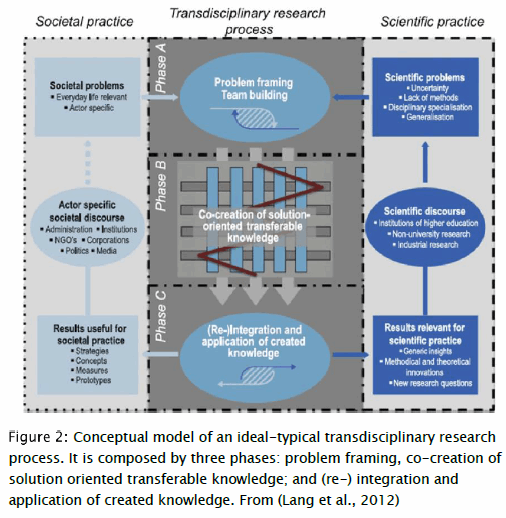
<body><![CDATA[<p align="justify"><font face="Verdana, Arial, Helvetica, sans-serif" size="2">Because of its capacity to deal with socio-ecological challenges from an integration perspective, not only of disciplines but also of knowledge and actors; transdisciplinarity is considered a key approach to transform<sup>4</sup> socio-ecological systems into more sustainable ones (Brink <i>et al., </i>2018; Lang <i>et al., </i>2012; Wamsler, 2017). Complex sustainability problems<sup>5</sup>, such as climate change, require of &quot;constructive input from various communities of knowledge to ensure that the essential knowledge from all disciplines and actor groups related to the problem is incorporated&quot;(Lang <i>et al., </i>2012, p. 26). Moreover, a solution-oriented approach requires the co-production of situated knowledge<sup>6</sup> that involves &quot;goals, norms, and visions&quot; because they will be key assets to guide &quot;transition and intervention strategies&quot; (Lang <i>et al., </i>2012, p. 26). As a result, &quot;win-win&quot; situations can be created for all parties involved while dealing with issues that cannot be solved individually, while creating a sense of ownership, accountability and legitimacy (Lang <i>et al., </i>2012; Rosendahl <i>et al., </i>2015; Wamsler, 2017).</font></p>     <p align="justify"><font face="Verdana, Arial, Helvetica, sans-serif" size="2"><b>3.2     Transdisciplinary Conceptual Model</b></font></p>     <p align="justify"><font face="Verdana, Arial, Helvetica, sans-serif" size="2">Throughout the years, different approaches and conceptual models to transdisciplinary research have been designed. This study uses Land <i>et al. </i>(2012). Conceptual Model of Transdisciplinarity which is based on Jahn (2008) Ideal-typical Conceptual Model. According to this model, transdisciplinarity is an &quot;interface practice&quot;. On the one hand it is triggered by complex sustainable problems. On the other hand, it &quot;relies on mutual and joint learning&quot; between a wide range of stakeholders (academic and non-academic actors) (Lang <i>et al., </i>2012). As a result, there are two pathways to deal with complex sustainable problems: one committed to the exploration of new options for solving societal problems; another committed to the development of interdisciplinary approaches, methods, and general insights related to the problem field.</font></p>     <p align="justify"><font face="Verdana, Arial, Helvetica, sans-serif" size="2">There are three phases in the ideal-typical conceptual model:</font></p>     <blockquote>       <p align="justify"><font face="Verdana, Arial, Helvetica, sans-serif" size="2">A. Collaboratively framing the problem and building a collaborative research team;</font></p>       <p align="justify"><font face="Verdana, Arial, Helvetica, sans-serif" size="2">B.&nbsp;Co-producing  solution-oriented  and  transferable  knowledge  through collaborative research;</font></p>       <p align="justify"><font face="Verdana, Arial, Helvetica, sans-serif" size="2">C.&nbsp;(Re-) integrating and applying the produced knowledge in both scientific and societal practice.</font></p> </blockquote>     <p align="justify"><font face="Verdana, Arial, Helvetica, sans-serif" size="2">The final goal of phase A is to integrate both pathways mentioned before: &quot;problem solution&quot; and &quot;scientific innovation&quot; in order to foster phase B: collaborative research, which is the &quot;integrative pathway&quot; which ends up in situated knowledge that can be (re-) integrated in practice in phase C. See <a href="#f2">figure 2</a> for a detail explanation of the model.</font></p>     <p align="center"><a name="f2"></a><img src="/img/revistas/ran/v9n3/a03_figura_02.gif" width="506" height="518"></p>     ]]></body>
<body><![CDATA[<p align="justify"><font face="Verdana, Arial, Helvetica, sans-serif" size="2">Based on 10 years of transdisciplinary research, Lang <i>et al. </i>(2012) define a set of design principles for transdisciplinary sustainability research for each phase of the process. These design principles are accompanied by a set of guiding questions that </font><font face="Verdana, Arial, Helvetica, sans-serif" size="2">could be used to carry-out assessments: ex-ante, during and after the research. Both the design principles and guiding questions have been applied by different projects in rural an urban context. Their application helps to identify specific aspects for improvement (Brink <i>et al, </i>2018; Lang <i>et al, </i>2012). Hence, they help to generate a feedback loop and reflectivity in the conceptual model that tends to be linear. The guiding questions will be implemented throughout the present study.</font></p>     <p align="justify"><font face="Verdana, Arial, Helvetica, sans-serif" size="2"><b>3.3     Collaborative governance</b></font></p>     <p align="justify"><font face="Verdana, Arial, Helvetica, sans-serif" size="2">According to Emerson <i>et al. </i>(2011) collaborative governance can foster empowerment of different stakeholders. Collaborative governance is linked to transdisciplinarity, co-production of knowledge and system transformation. This study understands collaborative governance as:</font></p>     <p align="justify"><font face="Verdana, Arial, Helvetica, sans-serif" size="2">[...] the processes and structures of public policy decision making and management that engage people constructively across the boundaries of public agencies, levels of government, and/or the public, private and civic spheres in order to carry out a public purpose that could not otherwise be accomplished (Emerson <i>et al.,</i> 2011, p. 2).</font></p>     <p align="justify"><font face="Verdana, Arial, Helvetica, sans-serif" size="2">On the one hand, government officials are relying on collaborative arrangements to achieve public goals. On the other hand, activists and civic reformers want to &quot;increase responsiveness and equity through collaborative governance&quot; (Emerson &amp; Nabatchi, 2015a).</font></p>     <p align="justify"><font face="Verdana, Arial, Helvetica, sans-serif" size="2">There are different perspectives on collaborative governance: as institutional arrangements (new institutionalism), as structural relations (interactions and connections, network theory), as an advocacy coalition (competing coalitions), as a development process (negotiation process); and as a functional performance sequence (instrumental performance). Although these arrangements are useful to explore and explain collaborative governance, according to Emerson &amp; Nabatchi they 'lack generality, therefore they usually cannot be applied &quot;across different settings, sectors, geographic and temporal scales, policy arenas, and process mechanisms&quot;(Emerson &amp; Nabatchi, 2015a, p. 24). In 2011 Emerson <i>et al. </i>tackled these issues by designing Integrative Collaborative Governance Framework.</font></p>     <p align="justify"><font face="Verdana, Arial, Helvetica, sans-serif" size="2">This framework can be applied to explain and assess governance across sectors (Emerson &amp; Nabatchi, 2015a; Emerson <i>et al, </i>2011). It is based on a wide range of concepts and knowledge from different disciplines that can be applied &quot;across sectors, settings, processes, issues, and time&quot; (Emerson <i>et al., </i>2011, p. 2). Later based on feedback from academic and practitioners, they made some modifications to the framework. <a href="#f3">Figure 3</a> is the latest version of the framework. In comparison to other frameworks, it covers a small number of nested dimensions, which have different components that interact with each other producing actions. Those actions lead to</font> <font face="Verdana, Arial, Helvetica, sans-serif" size="2">outcomes, which should lead to adaption, however, in this case they should lead to system transformation.</font></p>     <p align="center"><a name="f3"></a><img src="/img/revistas/ran/v9n3/a03_figura_03.gif" width="509" height="495"></p>     <p align="justify"><font face="Verdana, Arial, Helvetica, sans-serif" size="2">Collaborative Governance Regime<sup>7</sup> (CGR) is a central feature in this framework which is immersed in a specific system context, composed by political, ecological, legal and other &quot;layered and interrelated conditions&quot; that may affect the CGR or may be affected by it (Emerson &amp; Nabatchi, 2015a, p. 39). From the system context essential drivers for collaboration emerge: leadership, consequential incentives, interdependence, and uncertainty. These drivers trigger the CGR. The CGR is shaped by collaborative dynamics among participants: principled engagement, shared motivation, and capacity for joint action). These cyclical collaborative dynamics steer the development of &quot;collective purpose, a set of goals, and a shared theory of change<sup>8 </sup>to accomplish those goals&quot;, which lead to collaborative actions (Emerson &amp; Nabatchi, 2015a, p. 27). Collaborative actions may result in outcomes that may generate impacts internally or externally (Emerson <i>et al., </i>2011, p. 6). Emerson <i>et al. </i>(2011) developed their framework considering components present in other frameworks, however, they argue that their framework &quot;configures them in a way that posits causal relationships among the dimensions and their components and elements&quot;, can be used to asses &quot;intermediate outputs (actions) and end outcomes (impacts and adaptation) and become the basis for case evaluation and performance evaluation for program management&quot; (Emerson <i>et al., </i>2011, p. 22). However, indicators to carry out such evaluations haven't been designed yet.</font></p>     <p align="justify"><font face="Verdana, Arial, Helvetica, sans-serif" size="2">This framework has been operationalized in 2015 by Emerson and Nabatchi, who constructed a multidimensional framework to evaluate the process and productivity of collaborative governance regimes (<a href="#t4">Table 4</a>) (Emerson &amp; Nabatchi, 2015b). The evaluation framework includes indicators to measure the antecedents and the construction of collaborative governance regimes (Emerson &amp; Nabatchi, 2015b).</font></p>     ]]></body>
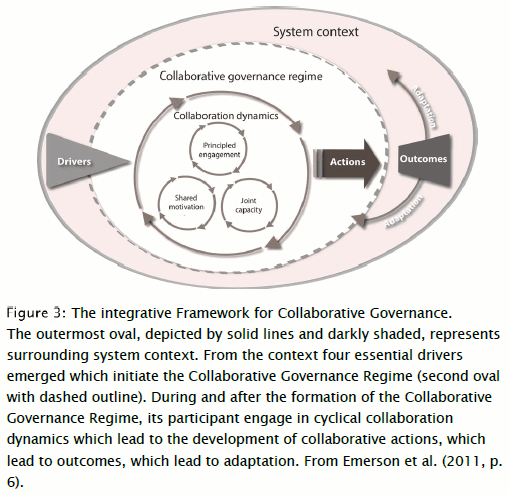
<body><![CDATA[<p align="justify"><font face="Verdana, Arial, Helvetica, sans-serif" size="2"><b>3.4     Transdisciplinary and collaborative governance framework</b></font></p>     <p align="justify"><font face="Verdana, Arial, Helvetica, sans-serif" size="2">The Collaborative Governance Framework and the Transdisciplinary Conceptual Model have many similarities and can be integrated into one framework that allows exploring collaborative governance as a transdisciplinary process. Although, Collaborative Governance's final goal is adaptation through collaboration of different stakeholders across sectors, however, it doesn't assure integration. By integrating transdisciplinarity in the Collaborative Governance Regime, co-creation of knowledge for food sovereignty may be fostered. <a href="#t2">Table 2</a> presents the Collaborative Governance Regime to the right and the transdisciplinary components to the left.</font></p>     <p align="center"><a name="t2"></a><img src="/img/revistas/ran/v9n3/a03_tabla_02.gif" width="551" height="1016"></p>     <p align="justify"><font face="Verdana, Arial, Helvetica, sans-serif" size="2"><b>3.5     Food sovereignty</b></font></p>     <p align="justify"><font face="Verdana, Arial, Helvetica, sans-serif" size="2">At the World Food Summit of 1996, the peasant social movement Via Campina presented the concept of food sovereignty. It is defined as &quot;peoples', Countries' or State Unions' RIGHT to define their agricultural and food policy, without any dumping vis-a-vis third countries&quot; (Via Campesina 2003). According to Via Campesina, food sovereignty is about rights. For example, it is about the right to sustainable access land, seeds and water. It is also about the right to decide as farmers what to produce and of consumers of what to consume among other rights (Via Campesina, 2013). Later, other definitions of food sovereignty were developed, including this definition.</font></p>     <p align="justify"><font face="Verdana, Arial, Helvetica, sans-serif" size="2">In parallel, there is a definition of food security</font></p>     <p align="justify"><font face="Verdana, Arial, Helvetica, sans-serif" size="2">Food security exists when all people, at all times, have physical and economic access to sufficient, safe and nutritious food that meets their dietary needs and food preferences for an active and healthy life (World Food Summit, 1996).</font></p>     <p align="justify"><font face="Verdana, Arial, Helvetica, sans-serif" size="2">This definition is widely accepted and has been operationalized through the measurement of four dimensions: food availability, food access, utilization and stability (FAO, 2006). Although food sovereignty is the focus of this study, the notion of food security is used in order to define the level of insecurity in Tiraque.</font></p>     <p align="justify">&nbsp;</p>     <p align="justify"><font face="Verdana, Arial, Helvetica, sans-serif" size="3"><b>4&nbsp;&nbsp;&nbsp;&nbsp;Context</b></font></p>     ]]></body>
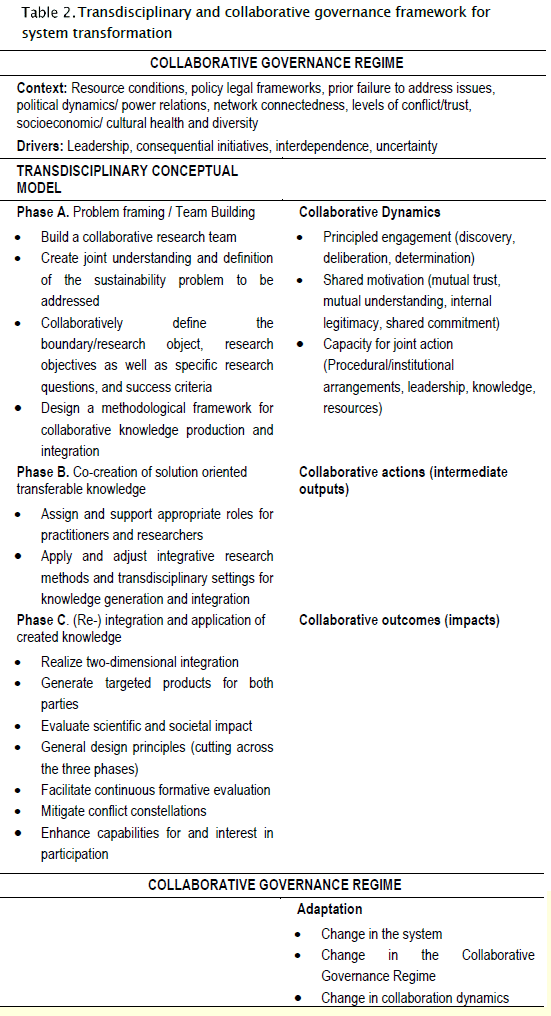
<body><![CDATA[<p align="justify"><font face="Verdana, Arial, Helvetica, sans-serif" size="2"><b>4.1     Inter-university program VLIR-UOS IUC Catholic University of Bolivia</b></font></p>     <p align="justify"><font face="Verdana, Arial, Helvetica, sans-serif" size="2">The present research proposal is framed in the Inter-University Cooperation Program VLIR UOS IUC - Catholic University of Bolivia (UCB). The Program's main objective is &quot;to increase the resilience of vulnerable rural and urban communities so that they can respond to complex local problems related to economic, social and environmental aspects in Bolivia&quot; (UCB 2018 p. 1). In its' first phase (2017-2021) the Program aims at creating Transdisciplinary Learning Communities (TLCs) at UCB's four regional universities (Cochabamba, La Paz, Santa Cruz and Tarija). In order to achieve its' goal, the Program is composed by six projects distributed in two strategies (VLIR-UOS, n.d.):</font></p>     <p align="justify"><font face="Verdana, Arial, Helvetica, sans-serif" size="2">1.&nbsp;Improving and expanding currently developed UCB research in the areas of (a) social development and safety (Projects 1, 4 and 5), (b) environment and natural resources (Project 2), and (c) food sovereignty (Project 3) at the four regional UCB universities; and</font></p>     <p align="justify"><font face="Verdana, Arial, Helvetica, sans-serif" size="2">2.&nbsp; Integrating and transforming the aforementioned UCB's research into a transdisciplinary and collaborative learning community approach (Project 6).</font></p>     <p align="justify"><font face="Verdana, Arial, Helvetica, sans-serif" size="2">Each project has its own set of goals however they are integrated through the TLCs in order to achieve the main goal.</font></p>     <p align="justify"><font face="Verdana, Arial, Helvetica, sans-serif" size="2">This research is part of to the Inter-Project 3 (P3) entitled: Project to promote food sovereignty and nutritional innovation, which has the objective to &quot;identify innovative strategies to promote food production, productivity and resilience, therefore contributing to reduce vulnerability in the communities located in the four eco-regions of Bolivia&quot; (UCB, 2018, p. 3). This project is made up of three research areas: 1) conflicts over natural resources and technology transfer for food production; 2) agricultural production and productivity; and 3) agro-business and nutrition models. Although the present proposal will cover several aspects of the three research areas, it is specifically positioned in the research area 2.</font></p>     <p align="justify"><font face="Verdana, Arial, Helvetica, sans-serif" size="2"><b>4.2     Municipality of Tiraque</b></font></p>     <p align="justify"><font face="Verdana, Arial, Helvetica, sans-serif" size="2">The Program has made significant progress in identifying vulnerable communities in La Paz, Oruro, Cochabamba, Santa Cruz and Tarija. In Cochabamba, communities have been identified based on vulnerability mapping in the municipality of Tiraque and through consensus with the TLC. Likewise, in Tiraque there has been progress in identifying its main problems and possible areas of strategic intervention. Among the main problems identified by the communities and social organizations of these municipalities, is the low production and agricultural productivity linked to ecological, socio-economic and cultural factors<sup>9</sup>.</font></p>     <p align="justify"><font face="Verdana, Arial, Helvetica, sans-serif" size="2">Among the main ecological problems identified are the lack of strategic natural resources such as water and land, soil degradation, high incidence of pests and adverse climatological factors (i.e. frost). Among the most relevant socioeconomic problems are conventional agriculture, based on high use of external inputs, monoculture and the production of only a few varieties. Conventional agriculture has brought with it a series of negative impacts such as the substantial loss of agro-</font><font face="Verdana, Arial, Helvetica, sans-serif" size="2">biodiversity and dependence on external inputs such as pesticides. Other problems identified are the importation of agricultural products with more competitive prices, lack of markets, scarce work alternatives, insufficient income, and lack of productive undertakings and failure of innovations. In the cultural dimension, the following factors linked to the loss local / ancestral knowledge and to nutrition have been identified: bad eating habits linked to the westernization of food and general devaluation of local and traditional food.</font></p>     <p align="justify"><font face="Verdana, Arial, Helvetica, sans-serif" size="2">These factors increase the vulnerability of the communities, risking the food security of the population, in a country where a 21.3% prevalence of undernourishment is reported, ranking among the five most affected countries in Latin America and the Caribbean (FAO, 2014). Therefore, it is of vital importance to promote food sovereignty and rural innovation through the improvement of agricultural production and productivity. Experience has shown that this cannot be achieved by following neo-positivist approaches to rural research and extension, where technological innovation is imposed on communities. Hence, the P3 is following a transdisciplinary, action research approach, focused on agro-ecological innovation.</font></p>     ]]></body>
<body><![CDATA[<p align="justify"><font face="Verdana, Arial, Helvetica, sans-serif" size="2">P3 is working in the Municipality of Tiraque Valle. This municipality is located in the South East of the Department of Cochabamba (17 &deg; 20 'to 17 &deg; 33' LS and 65 &deg; 37 'to 65 &deg; 45' WL) (Candia Consultores, 2003). The annual average temperature is 9.6 &deg;C, with extreme maximum of 26.0 &deg; C and extreme minimum -8.5 &deg; C. The average annual rainfall varies between 300 to 1 500 mm. Approximately 89.4% and 91.2% of rainfall occurs in the wet period, and between 10.6% and 8.8% in the dry period (Candia Consultores, 2003).</font></p>     <p align="justify"><font face="Verdana, Arial, Helvetica, sans-serif" size="2">According to population projections for the year 2017, Tiraque has a population of 21 973 inhabitants (INE, 2017). It has a total of 121 Territorial Base Organizations (OTB's) scattered along four ecological zones. According to the Census results of the year 2012, 81.5% of the population of Tiraque has water coverage, 80.9% of electric power and 48.4% of basic sanitation (INE, 2017).</font></p>     <p align="justify"><font face="Verdana, Arial, Helvetica, sans-serif" size="2">Tiraque is mainly an agricultural municipality. Nearly 9 976 hectares belong to annual crops and fodder, 13 hectares belong to fruit trees and 3 867 hectares are uncultivated (Candia Consultores, 2003). Potato is the major crop, followed by beans, peas, corn, wheat, barley, oats, goose, papalisa and others (INE, 2017). Cattle, sheep, pigs and horses are the main breeding animals in the municipality. Smaller animals such as birds and guinea poultry are breed mainly for family consumption (INE, 2017).</font></p>     <p align="justify">&nbsp;</p>     <p align="justify"><font face="Verdana, Arial, Helvetica, sans-serif" size="3"><b>5&nbsp;&nbsp;&nbsp;&nbsp;Methodology</b></font></p>     <p align="justify"><font face="Verdana, Arial, Helvetica, sans-serif" size="2">On the one hand, a methodology was designed in order to answer each of the research questions of the study and to reach its' main goal of understanding to what extend food sovereignty can be co-produced by using transdisciplinarity in a collaborative governance regime. On the other hand, a methodology was designed in way that it can be easily replicated by similar studies.</font></p>     <p align="justify"><font face="Verdana, Arial, Helvetica, sans-serif" size="2"><b>5.1     Mix methods approach</b></font></p>     <p align="justify"><font face="Verdana, Arial, Helvetica, sans-serif" size="2">The study follows a mix methods approach, in the sense that it combines a series of qualitative and quantitative methods, techniques, tools and activities. A mixed approach was chosen since it provides a deeper understanding of the research questions and corroboration through triangulation (Schoonenboom &amp; Johnson, 2017). Moreover, a mixed methods approach will allow a better understanding of &quot;diversity and the role of power differentials&quot; (Mertens, 2007, p. 224).</font></p>     <p align="justify"><font face="Verdana, Arial, Helvetica, sans-serif" size="2">The study will follow a transformative design because it is embedded in a transformative theoretical framework, therefore the &quot;priority, timing and mixing of qualitative and quantitative methods can change&quot; throughout the study (Schoonenboom &amp; Johnson, 2017, p. 118). According to Creswell (2013) in such design &quot;qualitative findings provide an enhanced understanding of the quantitative results in order to explore inequalities&quot; (Creswell, 2013, p. 52).</font></p>     <p align="justify"><font face="Verdana, Arial, Helvetica, sans-serif" size="2">Under a transformative design, the study will follow a cyclical model of research &quot;that includes the establishment of partnerships between researchers and community members, including the recognition of power differences and building trust through the use of culturally competent practices&quot; (Mertens, 2007, p. 224).</font></p>     ]]></body>
<body><![CDATA[<p align="justify"><font face="Verdana, Arial, Helvetica, sans-serif" size="2">The information necessary for the research is collected from primary and secondary sources. The information from secondary sources will be obtained from an exhaustive bibliographic review on the topics that concern the research.</font></p>     <p align="justify"><font face="Verdana, Arial, Helvetica, sans-serif" size="2">The following methods, tools and activities of oral, written and visual investigation are being implemented:</font></p>     <p align="justify"><font face="Verdana, Arial, Helvetica, sans-serif" size="2"><b>Transects. </b>Communal transects are carried out with key informants at the initial phases of the research, since they allow obtaining preliminary information from the community: relevant agro-ecological characteristics, human activities, housing, etc. (Leeuwis, Leeuwis, &amp; Ban, 2004). As a result, a cross-sectional view of the community is obtained. In general, transects are used as an initial step for other activities such as community maps and timelines (PAR, 2018).</font></p>     <p align="justify"><font face="Verdana, Arial, Helvetica, sans-serif" size="2"><b>Participatory community mapping. </b>This visual technique allows obtaining information &quot;on land use, agro-biodiversity and landscape features&quot; (PAR, 2018, p. 68). In this way, the territory can be contextualized and the interactions of people</font> <font face="Verdana, Arial, Helvetica, sans-serif" size="2">with their environment can be visualized. Community mapping can trigger interesting discussions in the group; it can help people to focus on a theme, etc. (Chambers, 1992; Leeuwis <i>et al, </i>2004).</font></p>     <p align="justify"><font face="Verdana, Arial, Helvetica, sans-serif" size="2"><b>Semi-structured and in-depth interviews. </b>The semi-structured and in-depth interview allows access to the vision and perceptions of groups or individuals (Leeuwis <i>et al., </i>2004). Leeuwis <i>et al. </i>(2004) explains that this type of interviews not only allow to explore <i>what </i>people do, <i>how, where </i>and <i>when </i>they do them, but also allow knowing <i>why </i>they do it. Initially, it is expected to conduct semi-structured and in-depth interviews with key informants (Tapia, 2002).</font></p>     <p align="justify"><font face="Verdana, Arial, Helvetica, sans-serif" size="2"><b>Focus groups. </b>It is a type of group in-depth interview, in which a topic of interest is discussed with key informants. PAR (2018) explains that the focus groups are &quot;particularly useful to find out about diversity distribution, important characteristics, management practices, constraints and opportunities, and any other topic&quot; (PAR, 2018, p. 13). It is expected to conduct several focus groups per community in different phases of the investigation.</font></p>     <p align="justify"><font face="Verdana, Arial, Helvetica, sans-serif" size="2"><b>Surveys. </b>The survey is a quantitative method par excellence that uses a structured questionnaire (PAR, 2018). Surveys will be carried out to obtain diverse socio-economic and agricultural information, with main emphasis on agro-biodiversity and nutrition.</font></p>     <p align="justify"><font face="Verdana, Arial, Helvetica, sans-serif" size="2"><b>Participatory observation. </b>It is one of the main tools for the co creation of knowledge, since it allows the researcher to integrate naturally and actively in day to day routine of the participants of the research process (Delgado, 2010; Tapia, 2002).</font></p>     <p align="justify"><font face="Verdana, Arial, Helvetica, sans-serif" size="2"><b>Farmer to farmer learning. </b>It is a learning approach based on exchange of experiences and participatory learning where farmers learn from other farmers through direct observation, questions and responses from one group to another(Fliert, 1993).</font></p>     <p align="justify"><font face="Verdana, Arial, Helvetica, sans-serif" size="2">Data analysis will be developed as follows:</font></p>     ]]></body>
<body><![CDATA[<p align="justify"><font face="Verdana, Arial, Helvetica, sans-serif" size="2"><b>Discourse analysis. </b>Discourses &quot;are actively produced through the agency of human actors, who by undertaking certain practices, and by describing the world in certain ways, create a discourse&quot;(Keeley &amp; Scoones, 2000, p. 91). The main goal of discourse analysis is to &quot;examine the connection between reality and discourse&quot; and &quot;the means in which social realities are produced&quot; (Liamputtong, 2009, p. 136). This study will follow Gill (2000) steps for discourse analysis: research question, transcription of data or texts, coding and analysis (Gill, 2000).</font></p>     <p align="justify"><font face="Verdana, Arial, Helvetica, sans-serif" size="2"><b>Network analysis. </b>When working with case studies, researchers are dealing with &quot;interconnected interactions among social actors, across time and space&quot;: networks (Leeuwis <i>et al, </i>2004, p. 375). Under the notion of networks, researchers</font> <font face="Verdana, Arial, Helvetica, sans-serif" size="2">deal with social actors rather than individuals, since individuals &quot;are in fact part of, or even constituted by, a wider web of relationships&quot;(Leeuwis <i>et al., </i>2004, p. 375).</font></p>     <p align="justify"><font face="Verdana, Arial, Helvetica, sans-serif" size="2"><b>Power analysis. </b>Tell us who holds the power related to the matter, and what might influence them to change (Green, 2016, p. 38).</font></p>     <p align="justify"><font face="Verdana, Arial, Helvetica, sans-serif" size="2">The study is following the three phases defined for the study's framework in <a href="#t1">Table 1</a></font></p>     <p align="justify">&nbsp;</p>     <p align="justify"><font face="Verdana, Arial, Helvetica, sans-serif" size="3"><b>6&nbsp;&nbsp;&nbsp;&nbsp;Preliminary results</b></font></p>     <p align="justify"><font face="Verdana, Arial, Helvetica, sans-serif" size="2">The present study takes place at two scale levels: Municipality level and Community level. At the municipal level, the study is fostering the co-creation of Public Policy for Food Sovereignty. To do so it is relaying on the previous and recent development of a Public Policy on Water Sources Conservation in the same Municipality. The Project actively participated in the whole process of the development and approval of the Policy. The stakeholders involved are diverse: General Peasant Union, Bartolina Women Peasant Union, Health sector, Education stakeholders, Agroecological Committee, researchers and Environmentalist NGO's.</font></p>     <p align="justify"><font face="Verdana, Arial, Helvetica, sans-serif" size="2">Furthermore, the study started a new collaborative governance regimen with a local school that wants to become and agroecological school. The project was approached by the Director and Teachers who want to improve the diet of their students by producing their own vegetables and fruits. To do so, a series of &quot;farmer to farmer&quot; activities and workshops were developed. Agroecological innovation will come as result of the research team (as defined in transdisciplinarity) and not from traditional scholars.</font></p>     <p align="justify"><font face="Verdana, Arial, Helvetica, sans-serif" size="2">In parallel, the Project was reached by leaders of the Agroecological Committee of Tiraque. They want to create a network of agroecological schools and guarantee to provide their technical support in the process. The Committee is currently working in two collaborative researches with the project: 1. Peasant soil evaluation kit for land management decisions, and 2. Synthesis of the pheromone of the potato moth.</font></p>     <p align="justify">&nbsp;</p>     ]]></body>
<body><![CDATA[<p align="justify"><font face="Verdana, Arial, Helvetica, sans-serif" size="3"><b>7&nbsp;&nbsp;&nbsp;&nbsp;Discussion</b></font></p>     <p align="justify"><font face="Verdana, Arial, Helvetica, sans-serif" size="2">[...]rural youth around the world possess energy, creativity and a desire to positively change their world. What they need is support and opportunities. (FAO, 2018, p. 9)</font></p>     <p align="justify"><font face="Verdana, Arial, Helvetica, sans-serif" size="2">So far, the process of transdisciplinary co-creation of food sovereignty has brought different lessons from the field. One of the main lessons is that the process requires time and patience, since the research group slowly conforms itself since it cannot be steered by the academic researchers. However, once the group is</font> <font face="Verdana, Arial, Helvetica, sans-serif" size="2">conformed interesting dynamics emerge. For instance, at the beginning of the research the agroecological innovation nor the target group was defined. It is an ongoing and surprising process: young participation in agroecological innovation.</font></p>     <p align="justify"><font face="Verdana, Arial, Helvetica, sans-serif" size="2">Because of the lack of economic and resources youth is forced to migrate to urban centers, while traditional agricultural diversity and knowledge is eroding. Hence, working with the youth is highly important in rural communities of Bolivia. In general, young people are excluded from the decision-making process, hence their needs and opinions are marginalized. A study developed in communities near Lake Titicaca, stablished that &quot;outmigration of young people is contributing to an erosion of traditional knowledge on practices for seed selection and cleaning, crop rotation, and traditional food recipes&quot; (Meldrum et al., 2018, p. 724).</font></p>     <p align="justify"><font face="Verdana, Arial, Helvetica, sans-serif" size="2">It has been shown that agroecology as a social movement can a be a space to &quot;project another reality for the youth in rural spaces&quot;(Ariza &amp; Gazzano, 2018). In Uruguay, through agroecology claim access to land and active &quot;participation and incidence in producer networks and local markets&quot;(Ariza &amp; Gazzano, 2018). Moreover, agroecology allows the revalorization and progression of agricultural traditional knowledge (Snipstal, 2015). Moreover, agroecological school gardens can be a spaces for community building and fostering social bonds and values (Gruberg, 2019) .</font></p>     <p align="justify"><font face="Verdana, Arial, Helvetica, sans-serif" size="2">Beyond to their social benefits, school agroecological gardens improve the nutrition of students. For example, in a research about the effects of school garden experiences on middle school-aged students' in the United States of America, &quot;results indicate that school gardening may affect children's vegetable consumption, including improved recognition of, attitudes toward, preferences for, and willingness to taste vegetables&quot; (Ratcliffe, Merrigan, Rogers, &amp; Goldberg, 2011, p. 36).</font></p>     <p align="justify"><font face="Verdana, Arial, Helvetica, sans-serif" size="2">Although the Agroecological Committee is not conformed by young people, their link to them is highly important since they want to transfer their knowledge through the implementation of school agroecological gardens. At the same time, the Committee is part of a collaborative research on soil quality evaluation for land management decisions.</font></p>     <p align="justify">&nbsp;</p>     <p><b><font size="3" face="Verdana, Arial, Helvetica, sans-serif">Notas</font></b></p>     <p align="justify"><font face="Verdana, Arial, Helvetica, sans-serif" size="2"><sup>1</sup> Defined by Lynn <i>et al. </i>(2001) &quot;regimes, laws, rules, judicial decisions, and administrative practices that constrain, prescribe, and enable the provision of publicly supported goals and services&quot; (Lynn Jr, Heinrich, &amp; Hill, 2001 p. 7)</font></p>     ]]></body>
<body><![CDATA[<p align="justify"><font face="Verdana, Arial, Helvetica, sans-serif" size="2"><sup>2</sup> Defined as [...] the processes and structures of public policy decision making and management that engage people constructively across the boundaries of public agencies, levels of government, and/or the public, private and civic spheres in order to carry out a public purpose that could not otherwise be accomplished (<i>Emerson et al., </i>2011, p. 2)</font></p>     <p align="justify"><font face="Verdana, Arial, Helvetica, sans-serif" size="2"><sup>3</sup> Define by Oxford Dictionaries as a &quot;branch of knowledge&quot; (Oxford University Press, 2019). Each discipline &quot;has its own set of tools, methods, procedures and theories&quot; (Tress <i>et al., </i>2005, p. 484)</font></p>     <p align="justify"><font face="Verdana, Arial, Helvetica, sans-serif" size="2"><sup>4</sup>&nbsp;Deliberate process of structural change in a normative direction (Brink <i>et al., </i>2018; Feola, 2015).</font></p>     <p align="justify"><font face="Verdana, Arial, Helvetica, sans-serif" size="2"><sup>5</sup>&nbsp;Societally relevant problem that implies and triggers scientific research questions (Lang <i>et al., </i>2012, p. 29). It involves &quot;multiple stakeholders in multiple organizations across multiple jurisdictions who may understand the problem and solution differently&quot; (Emerson &amp; Nabatchi, 2015a, p. 7).</font></p>     <p align="justify"><font face="Verdana, Arial, Helvetica, sans-serif" size="2"><sup>6</sup>&nbsp;Defined as &quot;knowledge embedded in a physical site or location&quot; (Sole &amp; Edmondson, 2002)</font></p>     <p align="justify"><font face="Verdana, Arial, Helvetica, sans-serif" size="2"><sup>7</sup>&nbsp; &quot;Particular mode of, or system for public decision making in which cross-boundary collaboration represents the prevailing pattern of behavior and activity&quot; (Emerson <i>et al., </i>2011, p. 6)</font></p>     <p align="justify"><font face="Verdana, Arial, Helvetica, sans-serif" size="2"><sup>8</sup>&nbsp;&quot;Strategy developed during collaboration dynamics for achieving the collective purpose and target goals of the collaborative governance regime&quot; (Emerson &amp; Nabatchi, 2015a, p. 232)</font></p>     <p align="justify"><font face="Verdana, Arial, Helvetica, sans-serif" size="2"><sup>9</sup> Information obtained through personal communication with Mauricio Azero - UCB CBA.</font></p>     <p align="justify">&nbsp;</p>     <p align="justify"><font face="Verdana, Arial, Helvetica, sans-serif" size="3"><b>Bibliographic References</b></font></p>     ]]></body>
<body><![CDATA[<!-- ref --><p align="justify"><font size="2" face="Verdana, Arial, Helvetica, sans-serif">[1] Agramont, A., Craps, M., Balderrama, M., &amp; Huysmans, M. (2019).  Transdisciplinary Learning Communities to Involve Vulnerable Social Groups in  Solving Complex Water-Related Problems in Bolivia. <i>Water</i>, <i>11</i>(2),  385. </font>&nbsp;&nbsp;&nbsp;&nbsp;&nbsp;&nbsp;&nbsp;&nbsp;[&#160;<a href="javascript:void(0);" onclick="javascript: window.open('/scielo.php?script=sci_nlinks&ref=802999&pid=S1683-0789201900030000300001&lng=','','width=640,height=500,resizable=yes,scrollbars=1,menubar=yes,');">Links</a>&#160;]<!-- end-ref --><!-- ref --><p align="justify"><font size="2" face="Verdana, Arial, Helvetica, sans-serif">  [2] Altieri, M. A. (2000).  Agroecology: principles and strategies for designing sustainable farming  systems. <i>Agroecology in Action</i>.</font>&nbsp;&nbsp;&nbsp;&nbsp;&nbsp;&nbsp;&nbsp;&nbsp;[&#160;<a href="javascript:void(0);" onclick="javascript: window.open('/scielo.php?script=sci_nlinks&ref=803000&pid=S1683-0789201900030000300002&lng=','','width=640,height=500,resizable=yes,scrollbars=1,menubar=yes,');">Links</a>&#160;]<!-- end-ref --><!-- ref --><p align="justify"><font size="2" face="Verdana, Arial, Helvetica, sans-serif">[3] Ariza, J., &amp; Gazzano, I. (2018). Juventud,  contratendencias y construcci&oacute;n de soberan&iacute;a. <i>Cadernos de Agroecologia</i>, <i>13</i>. </font>&nbsp;&nbsp;&nbsp;&nbsp;&nbsp;&nbsp;&nbsp;&nbsp;[&#160;<a href="javascript:void(0);" onclick="javascript: window.open('/scielo.php?script=sci_nlinks&ref=803001&pid=S1683-0789201900030000300003&lng=','','width=640,height=500,resizable=yes,scrollbars=1,menubar=yes,');">Links</a>&#160;]<!-- end-ref --><p align="justify"><font size="2" face="Verdana, Arial, Helvetica, sans-serif">  [4] Atkins, P., &amp; Bowler, I.  (2016). <i>Food in society: economy, culture, geography</i>. Routledge. </font></p>     <p align="justify"><font size="2" face="Verdana, Arial, Helvetica, sans-serif">  [5] Attwood, H. (1997). An  overview of issues around the use of participatory approaches by post-graduate  students. In <i>IDS, Participatory Research, IDS PRATopic Pack. </i></font></p>     <p align="justify"><font size="2" face="Verdana, Arial, Helvetica, sans-serif">  [6] Baum, F., MacDougall, C., &amp;  Smith, D. (2006). Participatory action research. <i>Journal of Epidemiology and  Community Health</i>, <i>60</i>(10), 854 LP &ndash; 857. <a href="https://doi.org/10.1136/jech.2004.028662" target="_blank">https://doi.org/10.1136/jech.2004.028662</a> </font></p>     <p align="justify"><font size="2" face="Verdana, Arial, Helvetica, sans-serif">  [7] Brink, E., Wamsler, C.,  Adolfsson, M., Axelsson, M., Beery, T., Bj&ouml;rn, H., &hellip; Thiere, G. (2018). On the  road to `research municipalities&rsquo;: analysing transdisciplinarity in municipal  ecosystem services and adaptation planning. <i>Sustainability  Science</i>, <i>13</i>(3), 765&ndash;784. <a href="https://doi.org/10.1007/s11625-017-0499-0" target="_blank">https://doi.org/10.1007/s11625-017-0499-0</a> </font></p>     <p align="justify"><font size="2" face="Verdana, Arial, Helvetica, sans-serif">  [8] Candia Consultores. (2003). <i>Ajuste  al PDM del Municipio Tiraque Valle. Resumen Ejecutivo- 2003-2007</i>. </font></p>     <p align="justify"><font size="2" face="Verdana, Arial, Helvetica, sans-serif">  [9] Chambers, R. (1992). <i>Rural  apprasial: rapid, relaxed and participatory</i>. Institute of Development  Studies (UK). </font></p>     <p align="justify"><font size="2" face="Verdana, Arial, Helvetica, sans-serif">  [10] Chambers, R. (1994). The  origins and practice of participatory rural appraisal. <i>World Development</i>, <i>22</i>(7), 953&ndash;969. <a href="https://doi.org/10.1016/0305-750X(94)90141-4" target="_blank">https://doi.org/10.1016/0305-750X(94)90141-4</a> </font></p>     ]]></body>
<body><![CDATA[<p align="justify"><font size="2" face="Verdana, Arial, Helvetica, sans-serif">  [11] Coolsaet, B. (2016). Towards  an agroecology of knowledges: Recognition, cognitive justice and farmers&rsquo;  autonomy in France. <i>Journal of Rural Studies</i>, <i>47</i>, 165&ndash;171. <a href="https://doi.org/10.1016/J.JRURSTUD.2016.07.012" target="_blank">https://doi.org/10.1016/J.JRURSTUD.2016.07.012</a> </font></p>     <p align="justify"><font size="2" face="Verdana, Arial, Helvetica, sans-serif">  [12] Creswell, J. W. (2013). <i>Steps  in conducting a scholarly mixed methods study</i>. </font></p>     <p align="justify"><font size="2" face="Verdana, Arial, Helvetica, sans-serif">  [13] Cu&eacute;llar-Padilla, M., &amp;  Calle-Collado, &Aacute;. (2011). Can we find solutions with people? Participatory  action research with small organic producers in Andalusia. <i>Journal of Rural  Studies</i>, <i>27</i>(4), 372&ndash;383. <a href="https://doi.org/10.1016/J.JRURSTUD.2011.08.004" target="_blank">https://doi.org/10.1016/J.JRURSTUD.2011.08.004</a> </font></p>     <p align="justify"><font size="2" face="Verdana, Arial, Helvetica, sans-serif">  [14] Delgado, R. (2010). <i>Investigaci&oacute;n  participativa revalorizadora e innovaci&oacute;n tecnol&oacute;gica enfoque transdisciplinar  en la innovaci&oacute;n de saberes agropecuarios, experiencia piloto de producci&oacute;n y  mercadeo de pito de ca&ntilde;ahua y charque de llama en la comunidad  Tallija-Confital. Coc</i>. Cochabamba: AGRUCO. </font></p>     <p align="justify"><font size="2" face="Verdana, Arial, Helvetica, sans-serif">  [15] Emerson, K., &amp; Nabatchi, T. (2015a). <i>Collaborative  governance regimes</i>. Georgetown University Press. </font></p>     <p align="justify"><font size="2" face="Verdana, Arial, Helvetica, sans-serif">[16] Emerson,  K., &amp; Nabatchi, T. (2015b). Evaluating the productivity of collaborative  governance regimes: A performance matrix. <i>Public Performance &amp;  Management Review</i>, <i>38</i>(4), 717&ndash;747. </font></p>     <p align="justify"><font size="2" face="Verdana, Arial, Helvetica, sans-serif">  [17] Emerson, K., Nabatchi, T.,  &amp; Balogh, S. (2011). An Integrative Framework for Collaborative Governance. <i>Journal of Public Administration Research and Theory</i>, <i>22</i>(1),  1&ndash;29. <a href="https://doi.org/10.1093/jopart/mur011" target="_blank">https://doi.org/10.1093/jopart/mur011</a> </font></p>     <p align="justify"><font size="2" face="Verdana, Arial, Helvetica, sans-serif">  [18] Evenson, R. E., &amp;  Gollin, D. (2003). Assessing the Impact of the Green Revolution, 1960 to 2000. <i>Science</i>, <i>300</i>(5620), 758 LP &ndash; 762. <a href="https://doi.org/10.1126/science.1078710" target="_blank">https://doi.org/10.1126/science.1078710</a> </font></p>     <!-- ref --><p align="justify"><font size="2" face="Verdana, Arial, Helvetica, sans-serif">  [19] FAO. <i>Food security.  Policy Brief</i>. , (2006). </font>&nbsp;&nbsp;&nbsp;&nbsp;&nbsp;&nbsp;&nbsp;&nbsp;[&#160;<a href="javascript:void(0);" onclick="javascript: window.open('/scielo.php?script=sci_nlinks&ref=803017&pid=S1683-0789201900030000300019&lng=','','width=640,height=500,resizable=yes,scrollbars=1,menubar=yes,');">Links</a>&#160;]<!-- end-ref --><p align="justify"><font size="2" face="Verdana, Arial, Helvetica, sans-serif">  [20] FAO. (2014). <i>Panorama de la  Seguridad Alimentaria y Nutricional en Am&eacute;rica Latina y el Caribe. Hambre en  Am&eacute;rica Latina y el Caribe: 2013. Acerc&aacute;ndose a los Objetivos del Milenio. </i></font></p>     ]]></body>
<body><![CDATA[<p align="justify"><font size="2" face="Verdana, Arial, Helvetica, sans-serif">  [21] FAO. (2018). <i>THE 10  ELEMENTS OF AGROECOLOGY GUIDING THE TRANSITION TO SUSTAINABLE FOOD AND  AGRICULTURAL SYSTEMS</i>. </font></p>     <p align="justify"><font size="2" face="Verdana, Arial, Helvetica, sans-serif">  [22] Feola, G. (2015). Societal  transformation in response to global environmental change: a review of emerging  concepts. <i>Ambio</i>, <i>44</i>(5), 376&ndash;390. </font></p>     <p align="justify"><font size="2" face="Verdana, Arial, Helvetica, sans-serif">  [23] Fliert, E. van de. (1993). <i>Integrated  pest management: farmer field schools generate sustainable practices: a case  study in Central Java evaluating IPM training </i>(University of Agriculture).  Retrieved from <a href="http://edepot.wur.nl/133364" target="_blank">http://edepot.wur.nl/133364</a> </font></p>     <p align="justify"><font size="2" face="Verdana, Arial, Helvetica, sans-serif">  [24] Gill, R. (2000). Discourse  analysis. In G. G. Bauer MW (Ed.), <i>Qualitative Researching with Text, Image  and Sound. </i>(pp. 172&ndash;190). London: Sage Publications. </font></p>     <p align="justify"><font size="2" face="Verdana, Arial, Helvetica, sans-serif">  [25] Green, D. (2016). <i>How  change happens</i>. Oxford: Oxford University Press. </font></p>     <p align="justify"><font size="2" face="Verdana, Arial, Helvetica, sans-serif">  [26] Gruberg, H. (2019). <i>Sistematizaci&oacute;n  de la experiencia &ldquo;sembrando vida, cosechando conocimiento.&rdquo; </i>Cochabamba:  Fundaci&oacute;n Abril. </font></p>     <p align="justify"><font size="2" face="Verdana, Arial, Helvetica, sans-serif">  [27] INE. (2017). Tiraque: la papa,  principal cultivo de verano. Retrieved from <a href="https://www.ine.gob.bo/index.php/notas-de-prensa-y-monitoreo/itemlist/tag/Tiraque" target="_blank">https://www.ine.gob.bo/index.php/notas-de-prensa-y-monitoreo/itemlist/tag/Tiraque</a> </font></p>     <p align="justify"><font size="2" face="Verdana, Arial, Helvetica, sans-serif">  [28] Jacobs, S. (2016). The Use  of Participatory Action Research within Education--Benefits to Stakeholders. <i>World  Journal of Education</i>, (6(3)), 48&ndash;55. </font></p>     <p align="justify"><font size="2" face="Verdana, Arial, Helvetica, sans-serif">  [29] Jahn, T. (2008). <i>Transdisziplinarit&auml;t in der  Forschungspraxis</i>. na. </font></p>     <p align="justify"><font size="2" face="Verdana, Arial, Helvetica, sans-serif">[30] Keeley,  J., &amp; Scoones, I. (2000). Knowledge, power and politics: the environmental  policy-making process in Ethiopia. <i>The Journal of Modern African Studies</i>, <i>38</i>(1), 89&ndash;120. </font></p>     ]]></body>
<body><![CDATA[<p align="justify"><font size="2" face="Verdana, Arial, Helvetica, sans-serif">  [31] Krueger, A. O. (1996).  Political economy of agricultural policy. <i>Public Choice</i>, <i>87</i>(1&ndash;2),  163&ndash;175. </font></p>     <p align="justify"><font size="2" face="Verdana, Arial, Helvetica, sans-serif">  [32] Lang, D. J., Wiek, A.,  Bergmann, M., Stauffacher, M., Martens, P., Moll, P., &hellip; Thomas, C. J. (2012).  Transdisciplinary research in sustainability science: practice, principles, and  challenges. <i>Sustainability Science</i>, <i>7</i>(1), 25&ndash;43. </font></p>     <p align="justify"><font size="2" face="Verdana, Arial, Helvetica, sans-serif">  [33] Leeuwis, C., Leeuwis, C.,  &amp; Ban, A. (2004). <i>Communication for rural innovation</i>. Wiley Online  Library. </font></p>     <p align="justify"><font size="2" face="Verdana, Arial, Helvetica, sans-serif">  [34] Liamputtong, P. (2009).  Qualitative data analysis: conceptual and practical considerations. <i>Health  Promotion Journal of Australia</i>, <i>20</i>(2), 133&ndash;139. </font></p>     <p align="justify"><font size="2" face="Verdana, Arial, Helvetica, sans-serif">  [35] Ludwig, K. A. (2018). <i>Is  our environment ready for Roundup? Investigation of Genetically Modified  Organisms (GMOs) and their indirect effects on the environment</i>. </font></p>     <p align="justify"><font size="2" face="Verdana, Arial, Helvetica, sans-serif">  [36] Lynn Jr, L. E., Heinrich, C.  J., &amp; Hill, C. J. (2001). <i>Improving governance: A new logic for  empirical research</i>. Georgetown University Press. </font></p>     <p align="justify"><font size="2" face="Verdana, Arial, Helvetica, sans-serif">  [37] Marin, A., Ely, A., &amp;  van Zwanenberg, P. (2016). Co-design with aligned and non-aligned knowledge  partners: implications for research and coproduction of sustainable food  systems. <i>Current Opinion in Environmental Sustainability</i>, <i>20</i>,  93&ndash;98. <a href="https://doi.org/10.1016/J.COSUST.2016.09.003" target="_blank">https://doi.org/10.1016/J.COSUST.2016.09.003</a></font></p>     <p align="justify"><font size="2" face="Verdana, Arial, Helvetica, sans-serif">  [38] Mauser, W., Klepper, G.,  Rice, M., Schmalzbauer, B. S., Hackmann, H., Leemans, R., &amp; Moore, H.  (2013). Transdisciplinary global change research: the co-creation of knowledge  for sustainability. <i>Current Opinion in Environmental Sustainability</i>, <i>5</i>(3&ndash;4),  420&ndash;431. </font></p>     <p align="justify"><font size="2" face="Verdana, Arial, Helvetica, sans-serif">  [39] McIntyre, A. (2007).  Participatory action research. <i>Sage Publications</i>, <i>52</i>. </font></p>     <p align="justify"><font size="2" face="Verdana, Arial, Helvetica, sans-serif">  [40] Meldrum, G., Mijatovi&#263;, D.,  Rojas, W., Flores, J., Pinto, M., Mamani, G., &hellip; Padulosi, S. (2018). Climate  change and crop diversity: farmers&rsquo; perceptions and adaptation on the Bolivian  Altiplano. <i>Environment, Development and Sustainability</i>, <i>20</i>(2),  703&ndash;730. <a href="https://doi.org/10.1007/s10668-016-9906-4" target="_blank">https://doi.org/10.1007/s10668-016-9906-4</a> </font></p>     ]]></body>
<body><![CDATA[<p align="justify"><font size="2" face="Verdana, Arial, Helvetica, sans-serif">  [41] Mertens, D. M. (2007).  Transformative paradigm: Mixed methods and social justice. <i>Journal of Mixed  Methods Research</i>, <i>1</i>(3), 212&ndash;225. </font></p>     <p align="justify"><font size="2" face="Verdana, Arial, Helvetica, sans-serif">  [42] Minkler, M. (2004). Ethical  Challenges for the &ldquo;Outside&rdquo; Researcher in Community-Based Participatory  Research. <i>Health Education &amp; Behavior</i>, <i>31</i>(6), 684&ndash;697. <a href="https://doi.org/10.1177/1090198104269566" target="_blank">https://doi.org/10.1177/1090198104269566</a> </font></p>     <p align="justify"><font size="2" face="Verdana, Arial, Helvetica, sans-serif">  [43] OECD. (2206). <i>Promoting pro-poor growth:  agriculture. DAC Guidelines and Reference Series</i>. Paris: Organization for  Economic Co-operation and Development. </font></p>     <p align="justify"><font size="2" face="Verdana, Arial, Helvetica, sans-serif">  [44] Overton, M. (1996). <i>Agricultural revolution in  England: the transformation of the agrarian economy 1500-1850 </i>(Vol. 23).  Cambridge University Press. </font></p>     <p align="justify"><font size="2" face="Verdana, Arial, Helvetica, sans-serif">  [45] Oxford University Press.  (2019). Oxford Dictionaries. Retrieved from Discipline website: <a href="https://en.oxforddictionaries.com/definition/discipline" target="_blank">https://en.oxforddictionaries.com/definition/discipline</a> </font></p>     <p align="justify"><font size="2" face="Verdana, Arial, Helvetica, sans-serif">  [46] PAR. (2018). <i>Assessing  Agrobiodiversity: A Compendium of Methods. Platform for Agrobiodiversity  Research</i>. Rome. </font></p>     <!-- ref --><p align="justify"><font size="2" face="Verdana, Arial, Helvetica, sans-serif">  [47] Pielke, R., &amp; Linn&eacute;r,  B.-O. (2019). From Green Revolution to Green Evolution: A Critique of the  Political Myth of Averted Famine. <i>Minerva</i>. <a href="https://doi.org/10.1007/s11024-019-09372-7" target="_blank">https://doi.org/10.1007/s11024-019-09372-7</a> </font>&nbsp;&nbsp;&nbsp;&nbsp;&nbsp;&nbsp;&nbsp;&nbsp;[&#160;<a href="javascript:void(0);" onclick="javascript: window.open('/scielo.php?script=sci_nlinks&ref=803045&pid=S1683-0789201900030000300047&lng=','','width=640,height=500,resizable=yes,scrollbars=1,menubar=yes,');">Links</a>&#160;]<!-- end-ref --><p align="justify"><font size="2" face="Verdana, Arial, Helvetica, sans-serif">  [48] Ratcliffe, M. M., Merrigan,  K. A., Rogers, B. L., &amp; Goldberg, J. P. (2011). The effects of school  garden experiences on middle school-aged students&rsquo; knowledge, attitudes, and  behaviors associated with vegetable consumption. <i>Health Promotion Practice</i>, <i>12</i>(1), 36&ndash;43. </font></p>     <p align="justify"><font size="2" face="Verdana, Arial, Helvetica, sans-serif">  [49] Rosendahl, J., Zanella, M.  A., Rist, S., &amp; Weigelt, J. (2015). Scientists&rsquo; situated knowledge: Strong  objectivity in transdisciplinarity. <i>Futures</i>, <i>65</i>, 17&ndash;27. </font></p>     <p align="justify"><font size="2" face="Verdana, Arial, Helvetica, sans-serif">  [50] Schoonenboom, J., &amp;  Johnson, R. B. (2017). How to Construct a Mixed Methods Research Design. <i>Kolner  Zeitschrift Fur Soziologie Und Sozialpsychologie</i>, <i>69</i>(Suppl 2),  107&ndash;131. <a href="https://doi.org/10.1007/s11577-017-0454-1" target="_blank">https://doi.org/10.1007/s11577-017-0454-1</a> </font></p>     ]]></body>
<body><![CDATA[<p align="justify"><font size="2" face="Verdana, Arial, Helvetica, sans-serif">  [51] Snipstal, B. (2015).  Repeasantization, agroecology and the tactics of food sovereignty. <i>Canadian Food Studies/La Revue Canadienne Des &Eacute;tudes  Sur l&rsquo;alimentation</i>, <i>2</i>(2), 164&ndash;173. </font></p>     <p align="justify"><font size="2" face="Verdana, Arial, Helvetica, sans-serif">  [52] Sole, D., &amp; Edmondson,  A. (2002). Situated knowledge and learning in dispersed teams. <i>British Journal of Management</i>, <i>13</i>(S2), S17&ndash;S34. </font></p>     <p align="justify"><font size="2" face="Verdana, Arial, Helvetica, sans-serif">  [53] Tapia, N. (2002). <i>Agroecolog&iacute;a  y agricultura campesina sostenible en los Andes Bolivianos</i>. Cochabamba. </font></p>     <p align="justify"><font size="2" face="Verdana, Arial, Helvetica, sans-serif">  [54] Tapia, N. (2016). El di&aacute;logo de  saberes y la investigaci&oacute;n participativa revalorizadora. <i>Ciencias, Di&aacute;logo  de Saberes y La Transdisciplinariedad</i>, 89&ndash;118. </font></p>     <p align="justify"><font size="2" face="Verdana, Arial, Helvetica, sans-serif">  [55] Thompson, J., &amp; Scoones, I.  (2009). Addressing  the dynamics of agri-food systems: an emerging agenda for social science  research. <i>Environmental Science &amp; Policy</i>, <i>12</i>(4), 386&ndash;397. </font></p>     <!-- ref --><p align="justify"><font size="2" face="Verdana, Arial, Helvetica, sans-serif">  [56] Timmer, C. P. (2009). Do  Supermarkets Change the Food Policy Agenda? <i>World Development</i>. <a href="https://doi.org/10.1016/j.worlddev.2008.08.022" target="_blank">https://doi.org/10.1016/j.worlddev.2008.08.022</a> </font>&nbsp;&nbsp;&nbsp;&nbsp;&nbsp;&nbsp;&nbsp;&nbsp;[&#160;<a href="javascript:void(0);" onclick="javascript: window.open('/scielo.php?script=sci_nlinks&ref=803054&pid=S1683-0789201900030000300056&lng=','','width=640,height=500,resizable=yes,scrollbars=1,menubar=yes,');">Links</a>&#160;]<!-- end-ref --><p align="justify"><font size="2" face="Verdana, Arial, Helvetica, sans-serif">  [57] Tress, G., Tress, B., &amp; Fry, G. (2005). Clarifying  Integrative Research Concepts in Landscape Ecology. <i>Landscape Ecology</i>, <i>20</i>(4), 479&ndash;493. <a href="https://doi.org/10.1007/s10980-004-3290-4">https://doi.org/10.1007/s10980-004-3290-4</a> </font></p>     <p align="justify"><font size="2" face="Verdana, Arial, Helvetica, sans-serif">[58] UCB. (2018). <i>Convocatoria para seleccionar a un@  candidat@ beneficiario de la beca de doctorado en el marco del programa VLIR  UOS</i>. </font></p>     <p align="justify"><font size="2" face="Verdana, Arial, Helvetica, sans-serif">  [59] Via Campesina. (2013). No  Title. </font></p>     <p align="justify"><font size="2" face="Verdana, Arial, Helvetica, sans-serif">  [60] VLIR-UOS. (n.d.). IUC 2017 Phase 1  UCB-B. Retrieved from Projects website: <a href="https://www.vliruos.be/en/projects/project/22?pid=3607" target="_blank">https://www.vliruos.be/en/projects/project/22?pid=3607</a> </font></p>     ]]></body>
<body><![CDATA[<p align="justify"><font size="2" face="Verdana, Arial, Helvetica, sans-serif">  [61] Vorley, B. (2002).  Sustaining agriculture: policy, governance, and the future of family-based  farming. A synthesis report of the collaborative research project &ldquo;policies  that work for sustainable agriculture and regenerating rural livelihoods&rdquo;. In <i>Sustaining  agriculture: policy, governance and the future of family-based farming: a  synthesis report of the collaborative research project &ldquo;policies that work for  sustainable agriculture and regenerating rural livelihoods.&rdquo; </i>London:  International Institute for Environment and Development (IIED). </font></p>     <p align="justify"><font size="2" face="Verdana, Arial, Helvetica, sans-serif">  [62] Wamsler, C. (2017).  Stakeholder involvement in strategic adaptation planning: Transdisciplinarity  and co-production at stake? <i>Environmental Science &amp; Policy</i>, <i>75</i>,  148&ndash;157. <a href="https://doi.org/10.1016/J.ENVSCI.2017.03.016" target="_blank">https://doi.org/10.1016/J.ENVSCI.2017.03.016</a> </font></p>     <p align="justify"><font size="2" face="Verdana, Arial, Helvetica, sans-serif">  [63] Wezel, A., Bellon, S., Dor&eacute;,  T., Francis, C., Vallod, D., &amp; David, C. (2009). Agroecology as a science,  a movement and a practice. A review. <i>Agronomy for Sustainable Development</i>, <i>29</i>(4), 503&ndash;515. <a href="https://doi.org/10.1051/agro/2009004" target="_blank">https://doi.org/10.1051/agro/2009004</a> </font></p>     <p align="justify"><font size="2" face="Verdana, Arial, Helvetica, sans-serif">  [64] World Bank. (2005). <i>Agricultural  Growth and the Poor. An agenda for Development, Directions in Development</i>.  Washington: World Bank. </font></p>     <p align="justify"><font size="2" face="Verdana, Arial, Helvetica, sans-serif">  [65] World Food Summit. (1996). <i>Declaration  on World Food Security</i>. Rome. </font></p>     <p align="justify"><font size="2" face="Verdana, Arial, Helvetica, sans-serif">  [66] World Health Organization. (2018). <i>The state of  food security and nutrition in the world 2018: building climate resilience for  food security and nutrition</i>. Food &amp; Agriculture Org. </font></p>     <p align="justify">&nbsp;</p>      ]]></body><back>
<ref-list>
<ref id="B1">
<label>1</label><nlm-citation citation-type="journal">
<person-group person-group-type="author">
<name>
<surname><![CDATA[Agramont]]></surname>
<given-names><![CDATA[A.]]></given-names>
</name>
<name>
<surname><![CDATA[Craps]]></surname>
<given-names><![CDATA[M.]]></given-names>
</name>
<name>
<surname><![CDATA[Balderrama]]></surname>
<given-names><![CDATA[M.]]></given-names>
</name>
<name>
<surname><![CDATA[Huysmans]]></surname>
<given-names><![CDATA[M.]]></given-names>
</name>
</person-group>
<article-title xml:lang="en"><![CDATA[Transdisciplinary Learning Communities to Involve Vulnerable Social Groups in Solving Complex Water-Related Problems in Bolivia]]></article-title>
<source><![CDATA[Water]]></source>
<year>2019</year>
<volume>11</volume>
<numero>2</numero>
<issue>2</issue>
<page-range>385</page-range></nlm-citation>
</ref>
<ref id="B2">
<label>2</label><nlm-citation citation-type="journal">
<person-group person-group-type="author">
<name>
<surname><![CDATA[Altieri]]></surname>
<given-names><![CDATA[M.A.]]></given-names>
</name>
</person-group>
<article-title xml:lang="en"><![CDATA[Agroecology: principles and strategies for designing sustainable farming systems]]></article-title>
<source><![CDATA[Agroecology in Action]]></source>
<year>2000</year>
</nlm-citation>
</ref>
<ref id="B3">
<label>3</label><nlm-citation citation-type="journal">
<person-group person-group-type="author">
<name>
<surname><![CDATA[Ariza]]></surname>
<given-names><![CDATA[J.]]></given-names>
</name>
<name>
<surname><![CDATA[Gazzano]]></surname>
<given-names><![CDATA[I.]]></given-names>
</name>
</person-group>
<article-title xml:lang="es"><![CDATA[Juventud, contratendencias y construcción de soberanía]]></article-title>
<source><![CDATA[Cadernos de Agroecologia]]></source>
<year>2018</year>
<volume>13</volume>
</nlm-citation>
</ref>
<ref id="B4">
<label>4</label><nlm-citation citation-type="book">
<person-group person-group-type="author">
<name>
<surname><![CDATA[Atkins]]></surname>
<given-names><![CDATA[P.]]></given-names>
</name>
<name>
<surname><![CDATA[Bowler]]></surname>
<given-names><![CDATA[I]]></given-names>
</name>
</person-group>
<source><![CDATA[Food in society: economy, culture, geography]]></source>
<year>2016</year>
<publisher-name><![CDATA[Routledge]]></publisher-name>
</nlm-citation>
</ref>
<ref id="B5">
<label>5</label><nlm-citation citation-type="journal">
<person-group person-group-type="author">
<name>
<surname><![CDATA[Attwood]]></surname>
<given-names><![CDATA[H.]]></given-names>
</name>
</person-group>
<article-title xml:lang="en"><![CDATA[An overview of issues around the use of participatory approaches by post-graduate students]]></article-title>
<source><![CDATA[IDS, Participatory Research, IDS PRATopic Pack]]></source>
<year>1997</year>
</nlm-citation>
</ref>
<ref id="B6">
<label>6</label><nlm-citation citation-type="journal">
<person-group person-group-type="author">
<name>
<surname><![CDATA[Baum]]></surname>
<given-names><![CDATA[F.]]></given-names>
</name>
<name>
<surname><![CDATA[MacDougall]]></surname>
<given-names><![CDATA[C.]]></given-names>
</name>
<name>
<surname><![CDATA[Smith]]></surname>
<given-names><![CDATA[D.]]></given-names>
</name>
</person-group>
<article-title xml:lang="en"><![CDATA[Participatory action research]]></article-title>
<source><![CDATA[Journal of Epidemiology and Community Health]]></source>
<year>2006</year>
<volume>60</volume>
<numero>10</numero>
<issue>10</issue>
<page-range>854 LP - 857</page-range></nlm-citation>
</ref>
<ref id="B7">
<label>7</label><nlm-citation citation-type="journal">
<person-group person-group-type="author">
<name>
<surname><![CDATA[Brink]]></surname>
<given-names><![CDATA[E.]]></given-names>
</name>
<name>
<surname><![CDATA[Wamsler]]></surname>
<given-names><![CDATA[C.]]></given-names>
</name>
<name>
<surname><![CDATA[Adolfsson]]></surname>
<given-names><![CDATA[M.]]></given-names>
</name>
<name>
<surname><![CDATA[Axelsson]]></surname>
<given-names><![CDATA[M.]]></given-names>
</name>
<name>
<surname><![CDATA[Beery]]></surname>
<given-names><![CDATA[T.]]></given-names>
</name>
<name>
<surname><![CDATA[Björn]]></surname>
<given-names><![CDATA[H.]]></given-names>
</name>
<name>
<surname><![CDATA[Thiere]]></surname>
<given-names><![CDATA[G.]]></given-names>
</name>
</person-group>
<article-title xml:lang="en"><![CDATA[On the road to `research municipalities&rsquo;: analysing transdisciplinarity in municipal ecosystem services and adaptation planning]]></article-title>
<source><![CDATA[Sustainability Science]]></source>
<year>2018</year>
<volume>13</volume>
<numero>3</numero>
<issue>3</issue>
<page-range>765-784</page-range></nlm-citation>
</ref>
<ref id="B8">
<label>8</label><nlm-citation citation-type="">
<collab>Candia Consultores</collab>
<source><![CDATA[Ajuste al PDM del Municipio Tiraque Valle. Resumen Ejecutivo- 2003-2007]]></source>
<year>2003</year>
</nlm-citation>
</ref>
<ref id="B9">
<label>9</label><nlm-citation citation-type="book">
<person-group person-group-type="author">
<name>
<surname><![CDATA[Chambers]]></surname>
<given-names><![CDATA[R]]></given-names>
</name>
</person-group>
<source><![CDATA[Rural apprasial: rapid, relaxed and participatory]]></source>
<year>1992</year>
<publisher-loc><![CDATA[UK ]]></publisher-loc>
<publisher-name><![CDATA[Institute of Development Studies]]></publisher-name>
</nlm-citation>
</ref>
<ref id="B10">
<label>10</label><nlm-citation citation-type="journal">
<person-group person-group-type="author">
<name>
<surname><![CDATA[Chambers]]></surname>
<given-names><![CDATA[R.]]></given-names>
</name>
</person-group>
<article-title xml:lang="en"><![CDATA[The origins and practice of participatory rural appraisal]]></article-title>
<source><![CDATA[World Development]]></source>
<year>1994</year>
<volume>22</volume>
<numero>7</numero>
<issue>7</issue>
<page-range>953-969</page-range></nlm-citation>
</ref>
<ref id="B11">
<label>11</label><nlm-citation citation-type="journal">
<person-group person-group-type="author">
<name>
<surname><![CDATA[Coolsaet]]></surname>
<given-names><![CDATA[B.]]></given-names>
</name>
</person-group>
<article-title xml:lang="en"><![CDATA[Towards an agroecology of knowledges: Recognition, cognitive justice and farmers&rsquo; autonomy in France]]></article-title>
<source><![CDATA[Journal of Rural Studies]]></source>
<year>2016</year>
<volume>47</volume>
<page-range>165-171</page-range></nlm-citation>
</ref>
<ref id="B12">
<label>12</label><nlm-citation citation-type="">
<person-group person-group-type="author">
<name>
<surname><![CDATA[Creswell]]></surname>
<given-names><![CDATA[J.W.]]></given-names>
</name>
</person-group>
<source><![CDATA[Steps in conducting a scholarly mixed methods study]]></source>
<year>2013</year>
</nlm-citation>
</ref>
<ref id="B13">
<label>13</label><nlm-citation citation-type="journal">
<person-group person-group-type="author">
<name>
<surname><![CDATA[Cuéllar-Padilla]]></surname>
<given-names><![CDATA[M.]]></given-names>
</name>
<name>
<surname><![CDATA[Calle-Collado]]></surname>
<given-names><![CDATA[Á.]]></given-names>
</name>
</person-group>
<article-title xml:lang="en"><![CDATA[Can we find solutions with people? Participatory action research with small organic producers in Andalusia]]></article-title>
<source><![CDATA[Journal of Rural Studies]]></source>
<year>2011</year>
<volume>27</volume>
<numero>4</numero>
<issue>4</issue>
<page-range>372-383</page-range></nlm-citation>
</ref>
<ref id="B14">
<label>14</label><nlm-citation citation-type="book">
<person-group person-group-type="author">
<name>
<surname><![CDATA[Delgado]]></surname>
<given-names><![CDATA[R]]></given-names>
</name>
</person-group>
<source><![CDATA[Investigación participativa revalorizadora e innovación tecnológica enfoque transdisciplinar en la innovación de saberes agropecuarios, experiencia piloto de producción y mercadeo de pito de cañahua y charque de llama en la comunidad Tallija-Confital]]></source>
<year>2010</year>
<publisher-loc><![CDATA[Cochabamba ]]></publisher-loc>
<publisher-name><![CDATA[AGRUCO]]></publisher-name>
</nlm-citation>
</ref>
<ref id="B15">
<label>15</label><nlm-citation citation-type="book">
<person-group person-group-type="author">
<name>
<surname><![CDATA[Emerson]]></surname>
<given-names><![CDATA[K.]]></given-names>
</name>
<name>
<surname><![CDATA[Nabatchi]]></surname>
<given-names><![CDATA[T]]></given-names>
</name>
</person-group>
<source><![CDATA[Collaborative governance regimes]]></source>
<year>2015</year>
<publisher-name><![CDATA[Georgetown University Press]]></publisher-name>
</nlm-citation>
</ref>
<ref id="B16">
<label>16</label><nlm-citation citation-type="journal">
<person-group person-group-type="author">
<name>
<surname><![CDATA[Emerson]]></surname>
<given-names><![CDATA[K.]]></given-names>
</name>
<name>
<surname><![CDATA[Nabatchi]]></surname>
<given-names><![CDATA[T.]]></given-names>
</name>
</person-group>
<article-title xml:lang="en"><![CDATA[Evaluating the productivity of collaborative governance regimes: A performance matrix]]></article-title>
<source><![CDATA[Public Performance & Management Review]]></source>
<year>2015</year>
<volume>38</volume>
<numero>4</numero>
<issue>4</issue>
<page-range>717-747</page-range></nlm-citation>
</ref>
<ref id="B17">
<label>17</label><nlm-citation citation-type="journal">
<person-group person-group-type="author">
<name>
<surname><![CDATA[Emerson]]></surname>
<given-names><![CDATA[K.]]></given-names>
</name>
<name>
<surname><![CDATA[Nabatchi]]></surname>
<given-names><![CDATA[T.]]></given-names>
</name>
<name>
<surname><![CDATA[Balogh]]></surname>
<given-names><![CDATA[S.]]></given-names>
</name>
</person-group>
<article-title xml:lang="en"><![CDATA[An Integrative Framework for Collaborative Governance]]></article-title>
<source><![CDATA[Journal of Public Administration Research and Theory]]></source>
<year>2011</year>
<volume>22</volume>
<numero>1</numero>
<issue>1</issue>
<page-range>1-29</page-range></nlm-citation>
</ref>
<ref id="B18">
<label>18</label><nlm-citation citation-type="journal">
<person-group person-group-type="author">
<name>
<surname><![CDATA[Evenson]]></surname>
<given-names><![CDATA[R.E.]]></given-names>
</name>
<name>
<surname><![CDATA[Gollin]]></surname>
<given-names><![CDATA[D.]]></given-names>
</name>
</person-group>
<article-title xml:lang="en"><![CDATA[Assessing the Impact of the Green Revolution, 1960 to 2000]]></article-title>
<source><![CDATA[Science]]></source>
<year>2003</year>
<volume>300</volume>
<numero>5620</numero>
<issue>5620</issue>
<page-range>758 LP - 762</page-range></nlm-citation>
</ref>
<ref id="B19">
<label>19</label><nlm-citation citation-type="">
<collab>FAO</collab>
<source><![CDATA[Food security. Policy Brief]]></source>
<year>2006</year>
</nlm-citation>
</ref>
<ref id="B20">
<label>20</label><nlm-citation citation-type="">
<collab>FAO</collab>
<source><![CDATA[Panorama de la Seguridad Alimentaria y Nutricional en América Latina y el Caribe. Hambre en América Latina y el Caribe:pp Acercándose a los Objetivos del Milenio]]></source>
<year>2013</year>
</nlm-citation>
</ref>
<ref id="B21">
<label>21</label><nlm-citation citation-type="">
<collab>FAO</collab>
<source><![CDATA[THE 10 ELEMENTS OF AGROECOLOGY GUIDING THE TRANSITION TO SUSTAINABLE FOOD AND AGRICULTURAL SYSTEMS]]></source>
<year>2018</year>
</nlm-citation>
</ref>
<ref id="B22">
<label>22</label><nlm-citation citation-type="journal">
<person-group person-group-type="author">
<name>
<surname><![CDATA[Feola]]></surname>
<given-names><![CDATA[G.]]></given-names>
</name>
</person-group>
<article-title xml:lang="en"><![CDATA[Societal transformation in response to global environmental change: a review of emerging concepts]]></article-title>
<source><![CDATA[Ambio]]></source>
<year>2015</year>
<volume>44</volume>
<numero>5</numero>
<issue>5</issue>
<page-range>376-390</page-range></nlm-citation>
</ref>
<ref id="B23">
<label>23</label><nlm-citation citation-type="book">
<person-group person-group-type="author">
<name>
<surname><![CDATA[Fliert]]></surname>
<given-names><![CDATA[E. van de]]></given-names>
</name>
</person-group>
<source><![CDATA[Integrated pest management: farmer field schools generate sustainable practices: a case study in Central Java evaluating IPM training]]></source>
<year>1993</year>
<publisher-name><![CDATA[University of Agriculture]]></publisher-name>
</nlm-citation>
</ref>
<ref id="B24">
<label>24</label><nlm-citation citation-type="book">
<person-group person-group-type="author">
<name>
<surname><![CDATA[Gill]]></surname>
<given-names><![CDATA[R]]></given-names>
</name>
</person-group>
<article-title xml:lang="en"><![CDATA[Discourse analysis]]></article-title>
<person-group person-group-type="editor">
<name>
<surname><![CDATA[Bauer MW]]></surname>
<given-names><![CDATA[G.G.]]></given-names>
</name>
</person-group>
<source><![CDATA[Qualitative Researching with Text, Image and Sound]]></source>
<year>2000</year>
<page-range>172-190</page-range><publisher-loc><![CDATA[London ]]></publisher-loc>
<publisher-name><![CDATA[Sage Publications]]></publisher-name>
</nlm-citation>
</ref>
<ref id="B25">
<label>25</label><nlm-citation citation-type="book">
<person-group person-group-type="author">
<name>
<surname><![CDATA[Green]]></surname>
<given-names><![CDATA[D]]></given-names>
</name>
</person-group>
<source><![CDATA[How change happens]]></source>
<year>2016</year>
<publisher-loc><![CDATA[Oxford ]]></publisher-loc>
<publisher-name><![CDATA[Oxford University Press]]></publisher-name>
</nlm-citation>
</ref>
<ref id="B26">
<label>26</label><nlm-citation citation-type="book">
<person-group person-group-type="author">
<name>
<surname><![CDATA[Gruberg]]></surname>
<given-names><![CDATA[H]]></given-names>
</name>
</person-group>
<source><![CDATA[Sistematización de la experiencia &ldquo;sembrando vida, cosechando conocimiento&rdquo;]]></source>
<year>2019</year>
<publisher-loc><![CDATA[Cochabamba ]]></publisher-loc>
<publisher-name><![CDATA[Fundación Abril]]></publisher-name>
</nlm-citation>
</ref>
<ref id="B27">
<label>27</label><nlm-citation citation-type="">
<collab>INE</collab>
<source><![CDATA[Tiraque: la papa, principal cultivo de verano]]></source>
<year>2017</year>
</nlm-citation>
</ref>
<ref id="B28">
<label>28</label><nlm-citation citation-type="journal">
<person-group person-group-type="author">
<name>
<surname><![CDATA[Jacobs]]></surname>
<given-names><![CDATA[S.]]></given-names>
</name>
</person-group>
<article-title xml:lang="en"><![CDATA[The Use of Participatory Action Research within Education--Benefits to Stakeholders]]></article-title>
<source><![CDATA[World Journal of Education]]></source>
<year>2016</year>
<volume>6</volume>
<numero>3</numero>
<issue>3</issue>
<page-range>48-55</page-range></nlm-citation>
</ref>
<ref id="B29">
<label>29</label><nlm-citation citation-type="">
<person-group person-group-type="author">
<name>
<surname><![CDATA[Jahn]]></surname>
<given-names><![CDATA[T]]></given-names>
</name>
</person-group>
<source><![CDATA[Transdisziplinarität in der Forschungspraxis]]></source>
<year>2008</year>
</nlm-citation>
</ref>
<ref id="B30">
<label>30</label><nlm-citation citation-type="journal">
<person-group person-group-type="author">
<name>
<surname><![CDATA[Keeley]]></surname>
<given-names><![CDATA[J.]]></given-names>
</name>
<name>
<surname><![CDATA[Scoones]]></surname>
<given-names><![CDATA[I.]]></given-names>
</name>
</person-group>
<article-title xml:lang="en"><![CDATA[Knowledge, power and politics: the environmental policy-making process in Ethiopia]]></article-title>
<source><![CDATA[The Journal of Modern African Studies]]></source>
<year>2000</year>
<volume>38</volume>
<numero>1</numero>
<issue>1</issue>
<page-range>89-120</page-range></nlm-citation>
</ref>
<ref id="B31">
<label>31</label><nlm-citation citation-type="journal">
<person-group person-group-type="author">
<name>
<surname><![CDATA[Krueger]]></surname>
<given-names><![CDATA[A.O.]]></given-names>
</name>
</person-group>
<article-title xml:lang="en"><![CDATA[Political economy of agricultural policy]]></article-title>
<source><![CDATA[Public Choice]]></source>
<year>1996</year>
<volume>87</volume>
<numero>1-2</numero>
<issue>1-2</issue>
<page-range>163-175</page-range></nlm-citation>
</ref>
<ref id="B32">
<label>32</label><nlm-citation citation-type="journal">
<person-group person-group-type="author">
<name>
<surname><![CDATA[Lang]]></surname>
<given-names><![CDATA[D.J.]]></given-names>
</name>
<name>
<surname><![CDATA[Wiek]]></surname>
<given-names><![CDATA[A.]]></given-names>
</name>
<name>
<surname><![CDATA[Bergmann]]></surname>
<given-names><![CDATA[M.]]></given-names>
</name>
<name>
<surname><![CDATA[Stauffacher]]></surname>
<given-names><![CDATA[M.]]></given-names>
</name>
<name>
<surname><![CDATA[Martens]]></surname>
<given-names><![CDATA[P.]]></given-names>
</name>
<name>
<surname><![CDATA[Moll]]></surname>
<given-names><![CDATA[P.]]></given-names>
</name>
<name>
<surname><![CDATA[Thomas]]></surname>
<given-names><![CDATA[C.J.]]></given-names>
</name>
</person-group>
<article-title xml:lang="en"><![CDATA[Transdisciplinary research in sustainability science: practice, principles, and challenges]]></article-title>
<source><![CDATA[Sustainability Science]]></source>
<year>2012</year>
<volume>7</volume>
<numero>1</numero>
<issue>1</issue>
<page-range>25-43</page-range></nlm-citation>
</ref>
<ref id="B33">
<label>33</label><nlm-citation citation-type="book">
<person-group person-group-type="author">
<name>
<surname><![CDATA[Leeuwis]]></surname>
<given-names><![CDATA[C.]]></given-names>
</name>
<name>
<surname><![CDATA[Leeuwis]]></surname>
<given-names><![CDATA[C.]]></given-names>
</name>
<name>
<surname><![CDATA[Ban]]></surname>
<given-names><![CDATA[A]]></given-names>
</name>
</person-group>
<source><![CDATA[Communication for rural innovation]]></source>
<year>2004</year>
<publisher-name><![CDATA[Wiley Online Library]]></publisher-name>
</nlm-citation>
</ref>
<ref id="B34">
<label>34</label><nlm-citation citation-type="journal">
<person-group person-group-type="author">
<name>
<surname><![CDATA[Liamputtong]]></surname>
<given-names><![CDATA[P.]]></given-names>
</name>
</person-group>
<article-title xml:lang="en"><![CDATA[Qualitative data analysis: conceptual and practical considerations]]></article-title>
<source><![CDATA[Health Promotion Journal of Australia]]></source>
<year>2009</year>
<volume>20</volume>
<numero>2</numero>
<issue>2</issue>
<page-range>133-139</page-range></nlm-citation>
</ref>
<ref id="B35">
<label>35</label><nlm-citation citation-type="">
<person-group person-group-type="author">
<name>
<surname><![CDATA[Ludwig]]></surname>
<given-names><![CDATA[K.A.]]></given-names>
</name>
</person-group>
<source><![CDATA[Is our environment ready for Roundup? Investigation of Genetically Modified Organisms (GMOs) and their indirect effects on the environment]]></source>
<year>2018</year>
</nlm-citation>
</ref>
<ref id="B36">
<label>36</label><nlm-citation citation-type="book">
<person-group person-group-type="author">
<name>
<surname><![CDATA[Lynn Jr]]></surname>
<given-names><![CDATA[L.E.]]></given-names>
</name>
<name>
<surname><![CDATA[Heinrich]]></surname>
<given-names><![CDATA[C.J.]]></given-names>
</name>
<name>
<surname><![CDATA[Hill]]></surname>
<given-names><![CDATA[C.J.]]></given-names>
</name>
</person-group>
<source><![CDATA[Improving governance: A new logic for empirical research]]></source>
<year>2001</year>
<publisher-name><![CDATA[Georgetown University Press]]></publisher-name>
</nlm-citation>
</ref>
<ref id="B37">
<label>37</label><nlm-citation citation-type="journal">
<person-group person-group-type="author">
<name>
<surname><![CDATA[Marin]]></surname>
<given-names><![CDATA[A.]]></given-names>
</name>
<name>
<surname><![CDATA[Ely]]></surname>
<given-names><![CDATA[A.]]></given-names>
</name>
<name>
<surname><![CDATA[van Zwanenberg]]></surname>
<given-names><![CDATA[P.]]></given-names>
</name>
</person-group>
<article-title xml:lang="en"><![CDATA[Co-design with aligned and non-aligned knowledge partners: implications for research and coproduction of sustainable food systems]]></article-title>
<source><![CDATA[Current Opinion in Environmental Sustainability]]></source>
<year>2016</year>
<volume>20</volume>
<page-range>93-98</page-range></nlm-citation>
</ref>
<ref id="B38">
<label>38</label><nlm-citation citation-type="journal">
<person-group person-group-type="author">
<name>
<surname><![CDATA[Mauser]]></surname>
<given-names><![CDATA[W.]]></given-names>
</name>
<name>
<surname><![CDATA[Klepper]]></surname>
<given-names><![CDATA[G.]]></given-names>
</name>
<name>
<surname><![CDATA[Rice]]></surname>
<given-names><![CDATA[M.]]></given-names>
</name>
<name>
<surname><![CDATA[Schmalzbauer]]></surname>
<given-names><![CDATA[B.S.]]></given-names>
</name>
<name>
<surname><![CDATA[Hackmann]]></surname>
<given-names><![CDATA[H.]]></given-names>
</name>
<name>
<surname><![CDATA[Leemans]]></surname>
<given-names><![CDATA[R.]]></given-names>
</name>
<name>
<surname><![CDATA[Moore]]></surname>
<given-names><![CDATA[H.]]></given-names>
</name>
</person-group>
<article-title xml:lang="en"><![CDATA[Transdisciplinary global change research: the co-creation of knowledge for sustainability]]></article-title>
<source><![CDATA[Current Opinion in Environmental Sustainability]]></source>
<year>2013</year>
<volume>5</volume>
<numero>3-4</numero>
<issue>3-4</issue>
<page-range>420-431</page-range></nlm-citation>
</ref>
<ref id="B39">
<label>39</label><nlm-citation citation-type="book">
<person-group person-group-type="author">
<name>
<surname><![CDATA[McIntyre]]></surname>
<given-names><![CDATA[A]]></given-names>
</name>
</person-group>
<source><![CDATA[Participatory action research]]></source>
<year>2007</year>
<page-range>52</page-range><publisher-name><![CDATA[Sage Publications]]></publisher-name>
</nlm-citation>
</ref>
<ref id="B40">
<label>40</label><nlm-citation citation-type="journal">
<person-group person-group-type="author">
<name>
<surname><![CDATA[Meldrum]]></surname>
<given-names><![CDATA[G.]]></given-names>
</name>
<name>
<surname><![CDATA[Mijatovi]]></surname>
<given-names><![CDATA[D.]]></given-names>
</name>
<name>
<surname><![CDATA[Rojas]]></surname>
<given-names><![CDATA[W.]]></given-names>
</name>
<name>
<surname><![CDATA[Flores]]></surname>
<given-names><![CDATA[J.]]></given-names>
</name>
<name>
<surname><![CDATA[Pinto]]></surname>
<given-names><![CDATA[M.]]></given-names>
</name>
<name>
<surname><![CDATA[Mamani]]></surname>
<given-names><![CDATA[G.]]></given-names>
</name>
<name>
<surname><![CDATA[Padulosi]]></surname>
<given-names><![CDATA[S.]]></given-names>
</name>
</person-group>
<article-title xml:lang="en"><![CDATA[Climate change and crop diversity: farmers&rsquo; perceptions and adaptation on the Bolivian Altiplano]]></article-title>
<source><![CDATA[Environment, Development and Sustainability]]></source>
<year>2018</year>
<volume>20</volume>
<numero>2</numero>
<issue>2</issue>
<page-range>703-730</page-range></nlm-citation>
</ref>
<ref id="B41">
<label>41</label><nlm-citation citation-type="journal">
<person-group person-group-type="author">
<name>
<surname><![CDATA[Mertens]]></surname>
<given-names><![CDATA[D.M.]]></given-names>
</name>
</person-group>
<article-title xml:lang="en"><![CDATA[Transformative paradigm: Mixed methods and social justice]]></article-title>
<source><![CDATA[Journal of Mixed Methods Research]]></source>
<year>2007</year>
<volume>1</volume>
<numero>3</numero>
<issue>3</issue>
<page-range>212-225</page-range></nlm-citation>
</ref>
<ref id="B42">
<label>42</label><nlm-citation citation-type="journal">
<person-group person-group-type="author">
<name>
<surname><![CDATA[Minkler]]></surname>
<given-names><![CDATA[M.]]></given-names>
</name>
</person-group>
<article-title xml:lang="en"><![CDATA[Ethical Challenges for the &ldquo;Outside&rdquo; Researcher in Community-Based Participatory Research]]></article-title>
<source><![CDATA[Health Education & Behavior]]></source>
<year>2004</year>
<volume>31</volume>
<numero>6</numero>
<issue>6</issue>
<page-range>684-697</page-range></nlm-citation>
</ref>
<ref id="B43">
<label>43</label><nlm-citation citation-type="book">
<collab>OECD</collab>
<source><![CDATA[Promoting pro-poor growth: agriculture]]></source>
<year>2006</year>
<publisher-loc><![CDATA[Paris ]]></publisher-loc>
<publisher-name><![CDATA[Organization for Economic Co-operation and Development]]></publisher-name>
</nlm-citation>
</ref>
<ref id="B44">
<label>44</label><nlm-citation citation-type="book">
<person-group person-group-type="author">
<name>
<surname><![CDATA[Overton]]></surname>
<given-names><![CDATA[M]]></given-names>
</name>
</person-group>
<source><![CDATA[Agricultural revolution in England: the transformation of the agrarian economy 1500-1850]]></source>
<year>1996</year>
<volume>23</volume>
<publisher-name><![CDATA[Cambridge University Press]]></publisher-name>
</nlm-citation>
</ref>
<ref id="B45">
<label>45</label><nlm-citation citation-type="">
<collab>Oxford University Press</collab>
<source><![CDATA[Oxford Dictionaries]]></source>
<year>2019</year>
</nlm-citation>
</ref>
<ref id="B46">
<label>46</label><nlm-citation citation-type="book">
<collab>PAR</collab>
<source><![CDATA[Assessing Agrobiodiversity: A Compendium of Methods]]></source>
<year>2018</year>
<publisher-loc><![CDATA[Rome ]]></publisher-loc>
<publisher-name><![CDATA[Platform for Agrobiodiversity Research]]></publisher-name>
</nlm-citation>
</ref>
<ref id="B47">
<label>47</label><nlm-citation citation-type="journal">
<person-group person-group-type="author">
<name>
<surname><![CDATA[Pielke]]></surname>
<given-names><![CDATA[R.]]></given-names>
</name>
<name>
<surname><![CDATA[Linnér]]></surname>
<given-names><![CDATA[B.-O.]]></given-names>
</name>
</person-group>
<article-title xml:lang="en"><![CDATA[From Green Revolution to Green Evolution: A Critique of the Political Myth of Averted Famine]]></article-title>
<source><![CDATA[Minerva]]></source>
<year>2019</year>
</nlm-citation>
</ref>
<ref id="B48">
<label>48</label><nlm-citation citation-type="journal">
<person-group person-group-type="author">
<name>
<surname><![CDATA[Ratcliffe]]></surname>
<given-names><![CDATA[M.M.]]></given-names>
</name>
<name>
<surname><![CDATA[Merrigan]]></surname>
<given-names><![CDATA[K.A.]]></given-names>
</name>
<name>
<surname><![CDATA[Rogers]]></surname>
<given-names><![CDATA[B.L.]]></given-names>
</name>
<name>
<surname><![CDATA[Goldberg]]></surname>
<given-names><![CDATA[J.P.]]></given-names>
</name>
</person-group>
<article-title xml:lang="en"><![CDATA[The effects of school garden experiences on middle school-aged students&rsquo; knowledge, attitudes, and behaviors associated with vegetable consumption]]></article-title>
<source><![CDATA[Health Promotion Practice]]></source>
<year>2011</year>
<volume>12</volume>
<numero>1</numero>
<issue>1</issue>
<page-range>36-43</page-range></nlm-citation>
</ref>
<ref id="B49">
<label>49</label><nlm-citation citation-type="journal">
<person-group person-group-type="author">
<name>
<surname><![CDATA[Rosendahl]]></surname>
<given-names><![CDATA[J.]]></given-names>
</name>
<name>
<surname><![CDATA[Zanella]]></surname>
<given-names><![CDATA[M.A.]]></given-names>
</name>
<name>
<surname><![CDATA[Rist]]></surname>
<given-names><![CDATA[S.]]></given-names>
</name>
<name>
<surname><![CDATA[Weigelt]]></surname>
<given-names><![CDATA[J.]]></given-names>
</name>
</person-group>
<article-title xml:lang="en"><![CDATA[Scientists&rsquo; situated knowledge: Strong objectivity in transdisciplinarity]]></article-title>
<source><![CDATA[Futures]]></source>
<year>2015</year>
<volume>65</volume>
<page-range>17-27</page-range></nlm-citation>
</ref>
<ref id="B50">
<label>50</label><nlm-citation citation-type="journal">
<person-group person-group-type="author">
<name>
<surname><![CDATA[Schoonenboom]]></surname>
<given-names><![CDATA[J.]]></given-names>
</name>
<name>
<surname><![CDATA[Johnson]]></surname>
<given-names><![CDATA[R.B.]]></given-names>
</name>
</person-group>
<article-title xml:lang="en"><![CDATA[How to Construct a Mixed Methods Research Design]]></article-title>
<source><![CDATA[Kolner Zeitschrift Fur Soziologie Und Sozialpsychologie]]></source>
<year>2017</year>
<volume>69</volume>
<numero>^s2</numero>
<issue>^s2</issue>
<supplement>2</supplement>
<page-range>107-131</page-range></nlm-citation>
</ref>
<ref id="B51">
<label>51</label><nlm-citation citation-type="journal">
<person-group person-group-type="author">
<name>
<surname><![CDATA[Snipstal]]></surname>
<given-names><![CDATA[B.]]></given-names>
</name>
</person-group>
<article-title xml:lang="en"><![CDATA[Repeasantization, agroecology and the tactics of food sovereignty]]></article-title>
<source><![CDATA[Canadian Food Studies/La Revue Canadienne Des Études Sur l&rsquo;alimentation]]></source>
<year>2015</year>
<volume>2</volume>
<numero>2</numero>
<issue>2</issue>
<page-range>164-173</page-range></nlm-citation>
</ref>
<ref id="B52">
<label>52</label><nlm-citation citation-type="journal">
<person-group person-group-type="author">
<name>
<surname><![CDATA[Sole]]></surname>
<given-names><![CDATA[D.]]></given-names>
</name>
<name>
<surname><![CDATA[Edmondson]]></surname>
<given-names><![CDATA[A.]]></given-names>
</name>
</person-group>
<article-title xml:lang="en"><![CDATA[Situated knowledge and learning in dispersed teams]]></article-title>
<source><![CDATA[British Journal of Management]]></source>
<year>2002</year>
<volume>13</volume>
<numero>S2</numero>
<issue>S2</issue>
<page-range>S17-S34</page-range></nlm-citation>
</ref>
<ref id="B53">
<label>53</label><nlm-citation citation-type="">
<person-group person-group-type="author">
<name>
<surname><![CDATA[Tapia]]></surname>
<given-names><![CDATA[N]]></given-names>
</name>
</person-group>
<source><![CDATA[Agroecología y agricultura campesina sostenible en los Andes Bolivianos]]></source>
<year>2002</year>
<publisher-loc><![CDATA[Cochabamba ]]></publisher-loc>
</nlm-citation>
</ref>
<ref id="B54">
<label>54</label><nlm-citation citation-type="journal">
<person-group person-group-type="author">
<name>
<surname><![CDATA[Tapia]]></surname>
<given-names><![CDATA[N.]]></given-names>
</name>
</person-group>
<article-title xml:lang="es"><![CDATA[El diálogo de saberes y la investigación participativa revalorizadora]]></article-title>
<source><![CDATA[Ciencias, Diálogo de Saberes y La Transdisciplinariedad]]></source>
<year>2016</year>
<page-range>89-118</page-range></nlm-citation>
</ref>
<ref id="B55">
<label>55</label><nlm-citation citation-type="journal">
<person-group person-group-type="author">
<name>
<surname><![CDATA[Thompson]]></surname>
<given-names><![CDATA[J.]]></given-names>
</name>
<name>
<surname><![CDATA[Scoones]]></surname>
<given-names><![CDATA[I.]]></given-names>
</name>
</person-group>
<article-title xml:lang="en"><![CDATA[Addressing the dynamics of agri-food systems: an emerging agenda for social science research]]></article-title>
<source><![CDATA[Environmental Science & Policy]]></source>
<year>2009</year>
<volume>12</volume>
<numero>4</numero>
<issue>4</issue>
<page-range>386-397</page-range></nlm-citation>
</ref>
<ref id="B56">
<label>56</label><nlm-citation citation-type="journal">
<person-group person-group-type="author">
<name>
<surname><![CDATA[Timmer]]></surname>
<given-names><![CDATA[C. P.]]></given-names>
</name>
</person-group>
<article-title xml:lang="en"><![CDATA[Do Supermarkets Change the Food Policy Agenda?]]></article-title>
<source><![CDATA[World Development]]></source>
<year>2009</year>
</nlm-citation>
</ref>
<ref id="B57">
<label>57</label><nlm-citation citation-type="journal">
<person-group person-group-type="author">
<name>
<surname><![CDATA[Tress]]></surname>
<given-names><![CDATA[G.]]></given-names>
</name>
<name>
<surname><![CDATA[Tress]]></surname>
<given-names><![CDATA[B.]]></given-names>
</name>
<name>
<surname><![CDATA[Fry]]></surname>
<given-names><![CDATA[G.]]></given-names>
</name>
</person-group>
<article-title xml:lang="en"><![CDATA[Clarifying Integrative Research Concepts in Landscape Ecology]]></article-title>
<source><![CDATA[Landscape Ecology]]></source>
<year>2005</year>
<volume>20</volume>
<numero>4</numero>
<issue>4</issue>
<page-range>479-493</page-range></nlm-citation>
</ref>
<ref id="B58">
<label>58</label><nlm-citation citation-type="">
<collab>UCB</collab>
<source><![CDATA[Convocatoria para seleccionar a un@ candidat@ beneficiario de la beca de doctorado en el marco del programa VLIR UOS]]></source>
<year></year>
</nlm-citation>
</ref>
<ref id="B59">
<label>59</label><nlm-citation citation-type="">
<collab>Via Campesina</collab>
<source><![CDATA[No Title]]></source>
<year></year>
</nlm-citation>
</ref>
<ref id="B60">
<label>60</label><nlm-citation citation-type="">
<collab>VLIR-UOS</collab>
<source><![CDATA[IUC 2017 Phase 1 UCB-B]]></source>
<year></year>
</nlm-citation>
</ref>
<ref id="B61">
<label>61</label><nlm-citation citation-type="book">
<person-group person-group-type="author">
<name>
<surname><![CDATA[Vorley]]></surname>
<given-names><![CDATA[B.]]></given-names>
</name>
</person-group>
<source><![CDATA[Sustaining agriculture: policy, governance, and the future of family-based farming. A synthesis report of the collaborative research project &ldquo;policies that work for sustainable agriculture and regenerating rural livelihoods&rdquo;]]></source>
<year>2002</year>
<publisher-loc><![CDATA[London ]]></publisher-loc>
<publisher-name><![CDATA[International Institute for Environment and Development (IIED)]]></publisher-name>
</nlm-citation>
</ref>
<ref id="B62">
<label>62</label><nlm-citation citation-type="journal">
<person-group person-group-type="author">
<name>
<surname><![CDATA[Wamsler]]></surname>
<given-names><![CDATA[C.]]></given-names>
</name>
</person-group>
<article-title xml:lang="en"><![CDATA[Stakeholder involvement in strategic adaptation planning: Transdisciplinarity and co-production at stake?]]></article-title>
<source><![CDATA[Environmental Science & Policy]]></source>
<year>2017</year>
<volume>75</volume>
<page-range>148-157</page-range></nlm-citation>
</ref>
<ref id="B63">
<label>63</label><nlm-citation citation-type="journal">
<person-group person-group-type="author">
<name>
<surname><![CDATA[Wezel]]></surname>
<given-names><![CDATA[A.]]></given-names>
</name>
<name>
<surname><![CDATA[Bellon]]></surname>
<given-names><![CDATA[S.]]></given-names>
</name>
<name>
<surname><![CDATA[Doré]]></surname>
<given-names><![CDATA[T.]]></given-names>
</name>
<name>
<surname><![CDATA[Francis]]></surname>
<given-names><![CDATA[C.]]></given-names>
</name>
<name>
<surname><![CDATA[Vallod]]></surname>
<given-names><![CDATA[D.]]></given-names>
</name>
<name>
<surname><![CDATA[David]]></surname>
<given-names><![CDATA[C.]]></given-names>
</name>
</person-group>
<article-title xml:lang="en"><![CDATA[Agroecology as a science, a movement and a practice. A review]]></article-title>
<source><![CDATA[Agronomy for Sustainable Development]]></source>
<year>2009</year>
<volume>29</volume>
<numero>4</numero>
<issue>4</issue>
<page-range>503-515</page-range></nlm-citation>
</ref>
<ref id="B64">
<label>64</label><nlm-citation citation-type="book">
<collab>World Bank</collab>
<source><![CDATA[Agricultural Growth and the Poor. An agenda for Development, Directions in Development]]></source>
<year>2005</year>
<publisher-loc><![CDATA[Washington ]]></publisher-loc>
<publisher-name><![CDATA[World Bank]]></publisher-name>
</nlm-citation>
</ref>
<ref id="B65">
<label>65</label><nlm-citation citation-type="">
<collab>World Food Summit</collab>
<source><![CDATA[Declaration on World Food Security]]></source>
<year></year>
<publisher-loc><![CDATA[Rome ]]></publisher-loc>
</nlm-citation>
</ref>
<ref id="B66">
<label>66</label><nlm-citation citation-type="book">
<collab>World Health Organization</collab>
<source><![CDATA[The state of food security and nutrition in the world 2018: building climate resilience for food security and nutrition]]></source>
<year>2018</year>
<publisher-name><![CDATA[Food & Agriculture Org]]></publisher-name>
</nlm-citation>
</ref>
</ref-list>
</back>
</article>