<?xml version="1.0" encoding="ISO-8859-1"?><article xmlns:mml="http://www.w3.org/1998/Math/MathML" xmlns:xlink="http://www.w3.org/1999/xlink" xmlns:xsi="http://www.w3.org/2001/XMLSchema-instance">
<front>
<journal-meta>
<journal-id>1683-0789</journal-id>
<journal-title><![CDATA[Acta Nova]]></journal-title>
<abbrev-journal-title><![CDATA[RevActaNova.]]></abbrev-journal-title>
<issn>1683-0789</issn>
<publisher>
<publisher-name><![CDATA[Universidad Católica Boliviana]]></publisher-name>
</publisher>
</journal-meta>
<article-meta>
<article-id>S1683-07892019000300002</article-id>
<title-group>
<article-title xml:lang="en"><![CDATA[Exergy analysis of a solar heating and cooling system that uses phase change materials. PCMSOL Project]]></article-title>
<article-title xml:lang="es"><![CDATA[Análisis de exergía de un sistema solar de calentamiento y enfriamiento que utiliza materiales de cambio de fase. Proyecto PCMSOL]]></article-title>
</title-group>
<contrib-group>
<contrib contrib-type="author">
<name>
<surname><![CDATA[Maldonado]]></surname>
<given-names><![CDATA[Diana]]></given-names>
</name>
<xref ref-type="aff" rid="A01"/>
</contrib>
<contrib contrib-type="author">
<name>
<surname><![CDATA[Luján]]></surname>
<given-names><![CDATA[Marcos]]></given-names>
</name>
<xref ref-type="aff" rid="A01"/>
</contrib>
<contrib contrib-type="author">
<name>
<surname><![CDATA[Rosiek]]></surname>
<given-names><![CDATA[Sabina]]></given-names>
</name>
<xref ref-type="aff" rid="A02"/>
</contrib>
<contrib contrib-type="author">
<name>
<surname><![CDATA[Batlles]]></surname>
<given-names><![CDATA[Javier]]></given-names>
</name>
<xref ref-type="aff" rid="A02"/>
</contrib>
<contrib contrib-type="author">
<name>
<surname><![CDATA[Ushak]]></surname>
<given-names><![CDATA[Svetlana]]></given-names>
</name>
<xref ref-type="aff" rid="A03"/>
</contrib>
</contrib-group>
<aff id="A01">
<institution><![CDATA[,Universidad Católica Boliviana San Pablo Departamento de Ciencias Exactas ]]></institution>
<addr-line><![CDATA[Cochabamba ]]></addr-line>
<country>Bolivia</country>
</aff>
<aff id="A02">
<institution><![CDATA[,Universidad de Almería Departamento de Física Aplicada ]]></institution>
<addr-line><![CDATA[Almería ]]></addr-line>
<country>España</country>
</aff>
<aff id="A03">
<institution><![CDATA[,Universidad de Antofagasta Departamento de Ingeniería Química y Procesamiento de minerales ]]></institution>
<addr-line><![CDATA[Antofagasta ]]></addr-line>
<country>Chile</country>
</aff>
<pub-date pub-type="pub">
<day>00</day>
<month>11</month>
<year>2019</year>
</pub-date>
<pub-date pub-type="epub">
<day>00</day>
<month>11</month>
<year>2019</year>
</pub-date>
<volume>9</volume>
<numero>3</numero>
<fpage>299</fpage>
<lpage>328</lpage>
<copyright-statement/>
<copyright-year/>
<self-uri xlink:href="http://www.scielo.org.bo/scielo.php?script=sci_arttext&amp;pid=S1683-07892019000300002&amp;lng=en&amp;nrm=iso"></self-uri><self-uri xlink:href="http://www.scielo.org.bo/scielo.php?script=sci_abstract&amp;pid=S1683-07892019000300002&amp;lng=en&amp;nrm=iso"></self-uri><self-uri xlink:href="http://www.scielo.org.bo/scielo.php?script=sci_pdf&amp;pid=S1683-07892019000300002&amp;lng=en&amp;nrm=iso"></self-uri><abstract abstract-type="short" xml:lang="es"><p><![CDATA[El presente trabajo está basado en la aplicación de un análisis de exergía al sistema de calefacción y refrigeración solar (específicamente en modo de refrigeración) actualmente implementado en el Centro de Investigación de Energía Solar CIESOL de la Universidad de Almería (España), con el fin de poder determinar un sistema más eficiente y evaluar el efecto de la introducción de materiales de cambio de fase (PCMs) al sistema de climatización. El análisis realizado dio como resultado que dicho sistema solar actual alcanza una eficiencia exergética máxima global de tan solo 6.6%, y que la introducción de los PCMs logra aumentar las capacidades de almacenamiento térmico del sistema, sin embargo, provoca una mínima disminución en la eficiencia exergética global a 6.5%. Así también, los resultados mostraron que, a diferencia de lo que refleja un análisis energético, los componentes que mayores irreversibilidades generan son los colectores solares, con casi el 90% de pérdidas del total captado. Consecuentemente, se realizó una propuesta de reducción de las irreversibilidades generadas por los componentes solares del sistema de climatización solar, incorporando el uso de paneles fotovoltaicos en vez de los colectores solares, esto mejora la eficiencia exergética global del sistema.]]></p></abstract>
<abstract abstract-type="short" xml:lang="en"><p><![CDATA[The present work is based on the application of an exergy analysis to the solar-assisted heating and cooling system (specifically in cooling mode) currentiy installed at the CIESOL Solar Energy Research Center of the Armeria University (Spain); in order to determine a more efficient system and to evaluate the effect of the phase change materials (PCMs) introduction into the heating and cooling systems. The analysis shows that the current solar system achieves an overall maximum exergy efficiency of 6.6%. In addition, the introduction of the PCMs manages to increase the thermal storage capacities of the system, however, it causes a slight decrease in the global exergy efficiency to 6.5%. The results also show that, unlike what an energy analysis reflects, the components that generate the greatest irreversibilities are the solar collectors, with almost 90% of the total exergy losses. Consequently, a proposal was made to reduce the irreversibilities generated by the solar thermal components of the system, incorporating the use of photovoltaic panels instead of solar collectors, this improves the overall exergy efficiency.]]></p></abstract>
<kwd-group>
<kwd lng="es"><![CDATA[Sistema de refrigeración]]></kwd>
<kwd lng="es"><![CDATA[Energía solar]]></kwd>
<kwd lng="es"><![CDATA[Análisis de exergía]]></kwd>
<kwd lng="es"><![CDATA[Irreversibilidades]]></kwd>
<kwd lng="es"><![CDATA[almacenamiento térmico]]></kwd>
<kwd lng="es"><![CDATA[materiales de cambio de fase]]></kwd>
<kwd lng="en"><![CDATA[Heating and cooling system]]></kwd>
<kwd lng="en"><![CDATA[solar energy]]></kwd>
<kwd lng="en"><![CDATA[exergy analysis]]></kwd>
<kwd lng="en"><![CDATA[irreversibilities]]></kwd>
<kwd lng="en"><![CDATA[thermal storage]]></kwd>
<kwd lng="en"><![CDATA[phase change materials]]></kwd>
</kwd-group>
</article-meta>
</front><body><![CDATA[ <p align="right"><font face="Verdana, Arial, Helvetica, sans-serif" size="2"><b>Art&iacute;culo Cient&iacute;fico</b></font></p>     <p align="right">&nbsp;</p>     <p align="center"><b><font face="Verdana, Arial, Helvetica, sans-serif" size="4">Exergy analysis of a solar heating and cooling</font> <font face="Verdana, Arial, Helvetica, sans-serif" size="4">system that uses phase change materials.</font> <font face="Verdana, Arial, Helvetica, sans-serif" size="4">PCMSOL Project</font></b></p>     <p align="center">&nbsp;</p>     <p align="center"><b><font face="Verdana, Arial, Helvetica, sans-serif" size="2"><i><font size="3">Análisis de exergía de un sistema solar de calentamiento y</font></i></font> <font face="Verdana, Arial, Helvetica, sans-serif" size="3"><i>enfriamiento que utiliza materiales de cambio de fase.</i></font> <font face="Verdana, Arial, Helvetica, sans-serif" size="3"><i>Proyecto PCMSOL</i></font></b></p>     <p align="center">&nbsp;</p>     <p align="center">&nbsp;</p>     <p align="center"><b><font face="Verdana, Arial, Helvetica, sans-serif" size="2">Diana Maldonado<sup>1</sup>, Marcos Luján<sup>1</sup>, Sabina Rosiek<sup>2</sup>, Javier Batlles<sup>2</sup>, Svetlana</font> <font face="Verdana, Arial, Helvetica, sans-serif" size="2">Ushak<sup>3</sup></font><font face="Verdana, Arial, Helvetica, sans-serif" size="2"></font></b></p>     <p align="center"><font face="Verdana, Arial, Helvetica, sans-serif" size="2"><sup>1</sup>Universidad Católica Boliviana San Pablo, Departamento de Ciencias Exactas,</font> <font face="Verdana, Arial, Helvetica, sans-serif" size="2">c Márquez s/n, Campus Tupuraya, Cochabamba, Bolivia</font>    <br> <font face="Verdana, Arial, Helvetica, sans-serif" size="2"><sup>2</sup>Universidad de Almería, Departamento de Física Aplicada, 04120 Almería, España</font>    ]]></body>
<body><![CDATA[<br> <font face="Verdana, Arial, Helvetica, sans-serif" size="2"><sup>3</sup>Universidad de Antofagasta, Departamento de Ingeniería Química y</font> <font face="Verdana, Arial, Helvetica, sans-serif" size="2">Procesamiento de minerales, Campus Coloso, Antofagasta, Chile</font></p>     <p align="center"><font face="Verdana, Arial, Helvetica, sans-serif" size="2"><a href="mailto:diana.mc.519@gmail.com">diana.mc.519@gmail.com</a></font></p>     <p align="center"><font face="Verdana, Arial, Helvetica, sans-serif" size="2">Recibido: 5 de febrero 2019    <br> Aceptado: 28 de Agosto 2019</font></p>     <p align="center">&nbsp;</p>     <p align="center">&nbsp;</p> <hr align="JUSTIFY" noshade>     <p align="justify"><font face="Verdana, Arial, Helvetica, sans-serif" size="2"><b>Resumen: </b>El presente trabajo está basado en la aplicación de un análisis de exergía al sistema de calefacción y refrigeración solar (específicamente en modo de refrigeración) actualmente implementado en el Centro de Investigación de Energía Solar CIESOL de la Universidad de Almería (España), con el fin de poder determinar un sistema más eficiente y evaluar el efecto de la introducción de materiales de cambio de fase (PCMs) al sistema de climatización. El análisis realizado dio como resultado que dicho sistema solar actual alcanza una eficiencia exergética máxima global de tan solo 6.6%, y que la introducción de los PCMs logra aumentar las capacidades de almacenamiento térmico del sistema, sin embargo, provoca una mínima disminución en la eficiencia exergética global a 6.5%. Así también, los resultados mostraron que, a diferencia de lo que refleja un análisis energético, los componentes que mayores irreversibilidades generan son los colectores solares, con casi el 90% de pérdidas del total captado. Consecuentemente, se realizó una propuesta de reducción de las irreversibilidades generadas por los componentes solares del sistema de climatización solar, incorporando el uso de paneles fotovoltaicos en vez de los colectores solares, esto mejora la eficiencia exergética global del sistema.</font></p>     <p align="justify"><font face="Verdana, Arial, Helvetica, sans-serif" size="2"><b>Palabras clave: </b>Sistema de refrigeración; Energía solar; Análisis de exergía; Irreversibilidades; almacenamiento térmico; materiales de cambio de fase.</font></p> <hr align="JUSTIFY" noshade>     <p align="justify"><font face="Verdana, Arial, Helvetica, sans-serif" size="2"><b>Abstract: </b>The present work is based on the application of an exergy analysis to the solar-assisted heating and cooling system (specifically in cooling mode) currentiy installed at the CIESOL Solar Energy Research Center of the Armeria University (Spain); in order to determine a more efficient system and to evaluate the effect of the phase change materials (PCMs) introduction into the heating and cooling</font> <font face="Verdana, Arial, Helvetica, sans-serif" size="2">systems. The analysis shows that the current solar system achieves an overall maximum exergy efficiency of 6.6%. In addition, the introduction of the PCMs manages to increase the thermal storage capacities of the system, however, it causes a slight decrease in the global exergy efficiency to 6.5%. The results also show that, unlike what an energy analysis reflects, the components that generate the greatest irreversibilities are the solar collectors, with almost 90% of the total exergy losses. Consequently, a proposal was made to reduce the irreversibilities generated by the solar thermal components of the system, incorporating the use of photovoltaic panels instead of solar collectors, this improves the overall exergy efficiency.</font></p>     <p align="justify"><font face="Verdana, Arial, Helvetica, sans-serif" size="2"><b>Key words: </b>Heating and cooling system; solar energy; exergy analysis; irreversibilities; thermal storage; phase change materials</font></p> <hr align="JUSTIFY" noshade>     ]]></body>
<body><![CDATA[<p align="justify">&nbsp;</p>     <p align="justify">&nbsp;</p> <table border="0" align="center" frame="box" rules="all">   <tr>     <td colspan="2">         <p><font face="Verdana, Arial, Helvetica, sans-serif" size="2"><b>Nomenclature</b></font></p></td>     <td>         <p></p></td>     <td>         <p></p></td>   </tr>   <tr>     <td>         <p align="center"><font face="Verdana, Arial, Helvetica, sans-serif" size="2"><b><i>A</i></b></font></p></td>     <td>         <p><font face="Verdana, Arial, Helvetica, sans-serif" size="2">Opening area of solar collectors (m<sup>2</sup>)</font></p></td>     <td>         <p><font face="Verdana, Arial, Helvetica, sans-serif" size="2">0</font></p></td>     <td>         <p><font face="Verdana, Arial, Helvetica, sans-serif" size="2">Ambient, ambient of reference</font></p></td>   </tr>   <tr>     <td>         <p align="center"><font face="Verdana, Arial, Helvetica, sans-serif" size="2"><b><i>Cp</i></b></font></p></td>     <td>         ]]></body>
<body><![CDATA[<p><font face="Verdana, Arial, Helvetica, sans-serif" size="2">Specific heat (kJ&middot;kg<sup>-1</sup>&middot;K<sup>-1</sup>)</font></p></td>     <td>         <p><font face="Verdana, Arial, Helvetica, sans-serif" size="2">1*</font></p></td>     <td>         <p><font face="Verdana, Arial, Helvetica, sans-serif" size="2">Collector output/ initial state</font></p></td>   </tr>   <tr>     <td>         <p align="center"><font face="Verdana, Arial, Helvetica, sans-serif" size="2"><b><i>E</i></b></font></p></td>     <td>         <p><font face="Verdana, Arial, Helvetica, sans-serif" size="2">Energy (kJ)</font></p></td>     <td>         <p><font face="Verdana, Arial, Helvetica, sans-serif" size="2">2*</font></p></td>     <td>         <p><font face="Verdana, Arial, Helvetica, sans-serif" size="2">Hot storage tank output/ final state</font></p></td>   </tr>   <tr>     <td>         <p align="center"><img src="/img/revistas/ran/v9n3/E_punto.gif" width="9" height="12"></p></td>     <td>         <p><font face="Verdana, Arial, Helvetica, sans-serif" size="2">Energetic flux(kJ&middot;s<sup>-1</sup>)</font></p></td>     <td>         <p><font face="Verdana, Arial, Helvetica, sans-serif" size="2">3</font></p></td>     <td>         ]]></body>
<body><![CDATA[<p><font face="Verdana, Arial, Helvetica, sans-serif" size="2">Collector input</font></p></td>   </tr>   <tr>     <td>         <p align="center"><font face="Verdana, Arial, Helvetica, sans-serif" size="2"><b><i>Ex</i></b></font></p></td>     <td>         <p><font face="Verdana, Arial, Helvetica, sans-serif" size="2">Exergy (kJ)</font></p></td>     <td>         <p><font face="Verdana, Arial, Helvetica, sans-serif" size="2">4</font></p></td>     <td>         <p><font face="Verdana, Arial, Helvetica, sans-serif" size="2">Generator input</font></p></td>   </tr>   <tr>     <td>         <p align="center"><font face="Verdana, Arial, Helvetica, sans-serif" size="2"><b><i><img src="/img/revistas/ran/v9n3/E_punto.gif" width="9" height="12">x</i></b></font></p></td>     <td>         <p><font face="Verdana, Arial, Helvetica, sans-serif" size="2">Exergy flux (kJ&middot;s<sup>-1</sup>)</font></p></td>     <td>         <p><font face="Verdana, Arial, Helvetica, sans-serif" size="2">5</font></p></td>     <td>         <p><font face="Verdana, Arial, Helvetica, sans-serif" size="2">Generator output</font></p></td>   </tr>   <tr>     <td>         <p align="center"><font face="Verdana, Arial, Helvetica, sans-serif" size="2"><b><i>H</i></b></font></p></td>     <td>         ]]></body>
<body><![CDATA[<p><font face="Verdana, Arial, Helvetica, sans-serif" size="2">Enthalpy (kJ)</font></p></td>     <td>         <p><font face="Verdana, Arial, Helvetica, sans-serif" size="2">6</font></p></td>     <td>         <p><font face="Verdana, Arial, Helvetica, sans-serif" size="2">Cooling tower output</font></p></td>   </tr>   <tr>     <td>         <p align="center"><font face="Verdana, Arial, Helvetica, sans-serif" size="2"><b>&Delta;<i>H</i></b></font></p></td>     <td>         <p><font face="Verdana, Arial, Helvetica, sans-serif" size="2">Fusión enthalpy (kJ&middot;kg<sup>-1</sup>)</font></p></td>     <td>         <p><font face="Verdana, Arial, Helvetica, sans-serif" size="2">7</font></p></td>     <td>         <p><font face="Verdana, Arial, Helvetica, sans-serif" size="2">Cooling tower conduit</font></p></td>   </tr>   <tr>     <td>         <p align="center"><font face="Verdana, Arial, Helvetica, sans-serif" size="2"><b><i>h</i></b></font></p></td>     <td>         <p><font face="Verdana, Arial, Helvetica, sans-serif" size="2">Specific enthalpy (kJ&middot;kg<sup>-1</sup>)</font></p></td>     <td>         <p><font face="Verdana, Arial, Helvetica, sans-serif" size="2">8</font></p></td>     <td>         ]]></body>
<body><![CDATA[<p><font face="Verdana, Arial, Helvetica, sans-serif" size="2">Cooling tower conduit</font></p></td>   </tr>   <tr>     <td>         <p align="center"><font face="Verdana, Arial, Helvetica, sans-serif" size="2"><b><i>I</i></b></font></p></td>     <td>         <p><font face="Verdana, Arial, Helvetica, sans-serif" size="2">Irreversibilities (kJ)</font></p></td>     <td>         <p><font face="Verdana, Arial, Helvetica, sans-serif" size="2">9</font></p></td>     <td>         <p><font face="Verdana, Arial, Helvetica, sans-serif" size="2">Cooling tower input</font></p></td>   </tr>   <tr>     <td>         <p align="center"><font face="Verdana, Arial, Helvetica, sans-serif" size="2"><b><i><img src="/img/revistas/ran/v9n3/I_punto.gif" width="6" height="12"></i></b></font></p></td>     <td>         <p><font face="Verdana, Arial, Helvetica, sans-serif" size="2">Irreversibilities flux (kJ&middot;s<sup>-1</sup>)</font></p></td>     <td>         <p><font face="Verdana, Arial, Helvetica, sans-serif" size="2">10</font></p></td>     <td>         <p><font face="Verdana, Arial, Helvetica, sans-serif" size="2">Evaporator input</font></p></td>   </tr>   <tr>     <td>         <p align="center"><font face="Verdana, Arial, Helvetica, sans-serif" size="2"><b><i>I</i></b></font><b><i><font size="2" face="Verdana, Arial, Helvetica, sans-serif"><sub>s</sub></font></i></b></p></td>     <td>         ]]></body>
<body><![CDATA[<p><font face="Verdana, Arial, Helvetica, sans-serif" size="2">Solar irradiance (W&middot;m<sup>-2</sup>)</font></p></td>     <td>         <p><font face="Verdana, Arial, Helvetica, sans-serif" size="2">11</font></p></td>     <td>         <p><font face="Verdana, Arial, Helvetica, sans-serif" size="2">Evaporator output</font></p></td>   </tr>   <tr>     <td>         <p align="center"><font face="Verdana, Arial, Helvetica, sans-serif" size="2"><b><i>m</i></b></font></p></td>     <td>         <p><font face="Verdana, Arial, Helvetica, sans-serif" size="2">Mass (kg)</font></p></td>     <td>         <p><font face="Verdana, Arial, Helvetica, sans-serif" size="2">12</font></p></td>     <td>         <p><font face="Verdana, Arial, Helvetica, sans-serif" size="2">Cold storage tank output</font></p></td>   </tr>   <tr>     <td>         <p align="center"><img src="/img/revistas/ran/v9n3/m_punto.gif" width="14" height="10"></p></td>     <td>         <p><font face="Verdana, Arial, Helvetica, sans-serif" size="2">Mass flux(kg&middot;s<sup>-1</sup>)</font></p></td>     <td>         <p><font face="Verdana, Arial, Helvetica, sans-serif" size="2">13</font></p></td>     <td>         ]]></body>
<body><![CDATA[<p><font face="Verdana, Arial, Helvetica, sans-serif" size="2">Chilled water entrance</font></p></td>   </tr>   <tr>     <td>         <p align="center"><font face="Verdana, Arial, Helvetica, sans-serif" size="2"><b><i>P</i></b></font></p></td>     <td>         <p><font face="Verdana, Arial, Helvetica, sans-serif" size="2">Pressure (kPa)</font></p></td>     <td>         <p><font face="Verdana, Arial, Helvetica, sans-serif" size="2">14</font></p></td>     <td>         <p><font face="Verdana, Arial, Helvetica, sans-serif" size="2">Absorber output</font></p></td>   </tr>   <tr>     <td>         <p align="center"><font face="Verdana, Arial, Helvetica, sans-serif" size="2"><b><i>Q</i></b></font></p></td>     <td>         <p><font face="Verdana, Arial, Helvetica, sans-serif" size="2">Heat transfer (kJ)</font></p></td>     <td>         <p><font face="Verdana, Arial, Helvetica, sans-serif" size="2">15</font></p></td>     <td>         <p><font face="Verdana, Arial, Helvetica, sans-serif" size="2">Heat exchanger input</font></p></td>   </tr>   <tr>     <td>         <p align="center"><font face="Verdana, Arial, Helvetica, sans-serif" size="2"><b><i><img src="/img/revistas/ran/v9n3/Q_punto.gif" width="9" height="14"></i></b></font></p></td>     <td>         ]]></body>
<body><![CDATA[<p><font face="Verdana, Arial, Helvetica, sans-serif" size="2">Heat transfer flux(kJ&middot;s<sup>-1</sup>)</font></p></td>     <td>         <p><font face="Verdana, Arial, Helvetica, sans-serif" size="2">16</font></p></td>     <td>         <p><font face="Verdana, Arial, Helvetica, sans-serif" size="2">Generator input</font></p></td>   </tr>   <tr>     <td>         <p align="center"><font face="Verdana, Arial, Helvetica, sans-serif" size="2"><b><i>s</i></b></font></p></td>     <td>         <p><font face="Verdana, Arial, Helvetica, sans-serif" size="2">Specific entropy (kJ&middot;kg<sup>-1</sup>&middot;K<sup>-1</sup>)</font></p></td>     <td>         <p><font face="Verdana, Arial, Helvetica, sans-serif" size="2">17</font></p></td>     <td>         <p><font face="Verdana, Arial, Helvetica, sans-serif" size="2">Generator output</font></p></td>   </tr>   <tr>     <td>         <p align="center"><font face="Verdana, Arial, Helvetica, sans-serif" size="2"><b><i>S</i></b></font></p></td>     <td>         <p><font face="Verdana, Arial, Helvetica, sans-serif" size="2">Entropy(kJ&middot;K<sup>-1</sup>)</font></p></td>     <td>         <p><font face="Verdana, Arial, Helvetica, sans-serif" size="2">18</font></p></td>     <td>         ]]></body>
<body><![CDATA[<p><font face="Verdana, Arial, Helvetica, sans-serif" size="2">Heat exchanger output</font></p></td>   </tr>   <tr>     <td>         <p align="center"><img src="/img/revistas/ran/v9n3/S_punto.gif" width="8" height="12"></p></td>     <td>         <p><font face="Verdana, Arial, Helvetica, sans-serif" size="2">Entropy flux (kJ&middot;s<sup>-1</sup>&middot;K<sup>-1</sup>)</font></p></td>     <td>         <p><font face="Verdana, Arial, Helvetica, sans-serif" size="2">19</font></p></td>     <td>         <p><font face="Verdana, Arial, Helvetica, sans-serif" size="2">Absorber input</font></p></td>   </tr>   <tr>     <td>         <p align="center"><font face="Verdana, Arial, Helvetica, sans-serif" size="2"><b><i>T</i></b></font></p></td>     <td>         <p><font face="Verdana, Arial, Helvetica, sans-serif" size="2">Temperature (&deg;C or K)</font></p></td>     <td>         <p><font face="Verdana, Arial, Helvetica, sans-serif" size="2">20</font></p></td>     <td>         <p><font face="Verdana, Arial, Helvetica, sans-serif" size="2">Condenser input</font></p></td>   </tr>   <tr>     <td>         <p align="center"><font face="Verdana, Arial, Helvetica, sans-serif" size="2"><b><i>UA</i></b></font></p></td>     <td>         ]]></body>
<body><![CDATA[<p><font face="Verdana, Arial, Helvetica, sans-serif" size="2">Heat transfer coefficient (W&middot;&deg;O<sup>-1</sup>)</font></p></td>     <td>         <p><font face="Verdana, Arial, Helvetica, sans-serif" size="2">21</font></p></td>     <td>         <p><font face="Verdana, Arial, Helvetica, sans-serif" size="2">Condenser output</font></p></td>   </tr>   <tr>     <td>         <p align="center"><font face="Verdana, Arial, Helvetica, sans-serif" size="2"><b><i>W</i></b></font></p></td>     <td>         <p><font face="Verdana, Arial, Helvetica, sans-serif" size="2">Work (kJ)</font></p></td>     <td>&nbsp;</td>     <td>&nbsp;</td>   </tr>   <tr>     <td>         <p align="center"><img src="/img/revistas/ran/v9n3/W_punto.gif" width="14" height="12"></p></td>     <td>         <p><font face="Verdana, Arial, Helvetica, sans-serif" size="2">Work flux (kJ&middot;s<sup>-1</sup>)</font></p></td>     <td>&nbsp;</td>     <td>&nbsp;</td>   </tr>   <tr>     <td>         <p align="center"><font face="Verdana, Arial, Helvetica, sans-serif" size="2"><i><b>X</b></i></font></p></td>     <td>         <p><font face="Verdana, Arial, Helvetica, sans-serif" size="2">Mass fraction (dimensionless)</font></p></td>     <td>&nbsp;</td>     <td>&nbsp;</td>	   </tr>   <tr>     <td>         <p align="center"><font face="Verdana, Arial, Helvetica, sans-serif" size="2"><b>&eta;</b></font></p></td>     <td>         ]]></body>
<body><![CDATA[<p><font face="Verdana, Arial, Helvetica, sans-serif" size="2">Energetic performance (Fist Law -dimensionless)</font></p></td>     <td>&nbsp;</td>     <td>&nbsp;</td>	   </tr>   <tr>     <td>         <p align="center"><b><i>&psi;</i></b></p></td>     <td>         <p><font face="Verdana, Arial, Helvetica, sans-serif" size="2">Exergetic availability (kJ&middot;kg<sup>-1</sup>)</font></p></td>     <td>&nbsp;</td>     <td>&nbsp;</td>	   </tr>   <tr>     <td>         <p align="center"><font size="2" face="Verdana, Arial, Helvetica, sans-serif"><i><b>&epsilon;<sub>sun</sub></b></i></font></p></td>     <td>         <p><font face="Verdana, Arial, Helvetica, sans-serif" size="2">Specific exergetic sun availability (kJ&middot;kg<sup>-1</sup></font></p></td>     <td>&nbsp;</td>     <td>&nbsp;</td>	   </tr>   <tr>     <td>         <p align="center"><b>&rho;</b></p></td>     <td>         <p><font face="Verdana, Arial, Helvetica, sans-serif" size="2">Density (kg&middot;m<sup>-3</sup>)</font></p></td>     <td>&nbsp;</td>     <td>&nbsp;</td>	   </tr>   <tr>     <td>         <p align="center">&xi;</p></td>     <td>         <p><font face="Verdana, Arial, Helvetica, sans-serif" size="2">Exergy efficiency (Second Law-dimensionless)</font></p></td>     <td>&nbsp;</td>     <td>&nbsp;</td>	   </tr>   <tr>     <td>         <p align="center"><b><i>&Phi;</i></b></p></td>     <td>         ]]></body>
<body><![CDATA[<p><font face="Verdana, Arial, Helvetica, sans-serif" size="2">Exergetic mass availability (kJ&middot;kg<sup>-1</sup>)</font></p></td>     <td>&nbsp;</td>     <td>&nbsp;</td>	   </tr> </table>     <blockquote>       <p align="justify"><font face="Verdana, Arial, Helvetica, sans-serif" size="2"><b>Main abbreviations</b></font></p>       <p align="justify"><font face="Verdana, Arial, Helvetica, sans-serif" size="2">SHC       Solar Heating and Cooling </font></p>       <p align="justify"><font face="Verdana, Arial, Helvetica, sans-serif" size="2"><i>PCM      </i>Phase Change Material</font></p>       <p align="justify">&nbsp;</p> </blockquote>     <p align="justify"><font face="Verdana, Arial, Helvetica, sans-serif" size="3"><b>1&nbsp;&nbsp;&nbsp;&nbsp;Introduction</b></font></p>     <p align="justify"><font face="Verdana, Arial, Helvetica, sans-serif" size="2">The domestic energy consumption is one of the sectors with the highest energy consumption in the world; therefore, important attention should be given to this area. Ventilation, residential heating, air-conditioning (HVAC) and hot water production accounts for about 60% of the energy consumed in the U.S. homes [1] [2]. These values reflect that, despite the importance given to the electric consumption reduction and the implementation of efficient electrical equipment, there is a great demand for thermal energy. Consequently, the air conditioning area represents a great opportunity to reduce the energy consumption in buildings, to improve energy security and reduce CO<sub>2</sub> emissions [3].</font></p>     <p align="justify"><font face="Verdana, Arial, Helvetica, sans-serif" size="2">In the field of air conditioning, solar energy is used not only to generate heating but also to generate cooling. Two of the most common options in domestic and public applications are solar thermal cooling and solar electric cooling. The first one is based on thermal solar systems that transfer heat in order to operate absorption cooling cycles, which generate cold through the evaporation of the refrigerant at low pressures [4]. In electric refrigeration, photovoltaic panels are commonly used to generate electricity and operate a refrigeration cycle equipment [5]. During the winter or cold season, the heat or electricity produced by the solar thermal collectors or PV panels can be used either to provide hot water or electrical power to a corresponding equipment [4].</font></p>     <p align="justify"><font face="Verdana, Arial, Helvetica, sans-serif" size="2">In terms of systems' analysis, the second law efficiency analysis or the exergy analysis is considered one of the most reliable tools for the analysis of thermodynamic processes [6], where the exergy (or availability) of a closed system in</font> <font face="Verdana, Arial, Helvetica, sans-serif" size="2">a determined state, is defined as the maximum useful work that can be obtained from a system-environment combination. The exergy analysis is used strategically in the design, simulation and performance evaluation of systems and their components [6] [7]. In other words, this second law analysis can determine the quantitative magnitude of exergy losses (or irreversibilities) associated with a system or process. Therefore, it provides a criteria to know the ways in which the performance can be improved and to reduce operating costs of these thermodynamic systems [8].</font></p>     ]]></body>
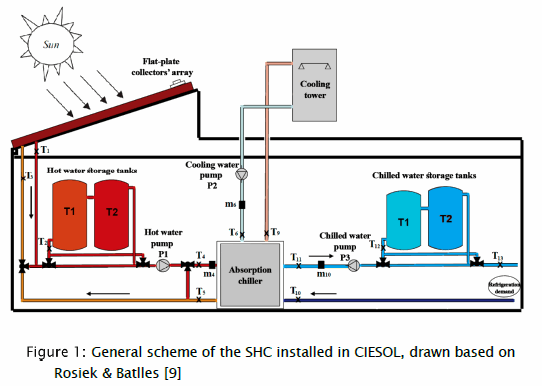
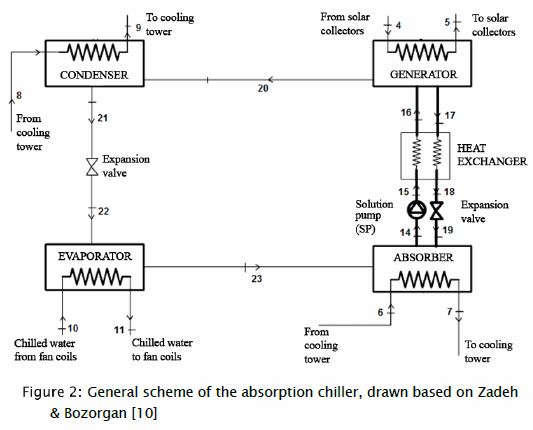
<body><![CDATA[<p align="justify"><font face="Verdana, Arial, Helvetica, sans-serif" size="2">The present work is part of the PCMSOL project, or &quot;Thermal Energy Storage with Phase Change Materials for Solar Cooling and Heating Applications: A technology viability analysis&quot;, led by the Almeria University (UAL) and funded by the ERANeT-LAC. The PCMSOL project approach is to develop and test new phase change materials (PCM) that can be integrated into thermal energy storage units (STES) as part of the solar heating and cooling (SHC) system currently installed in Almeria [8]. Therefore, the overall aim is to search for the best available PCMs locally, compare their performance with current water storage systems, verify the most appropriate STES tank size and mainly determine the current and future efficiency of the SHC system.</font></p>     <p align="justify"><font face="Verdana, Arial, Helvetica, sans-serif" size="2">The scope of this article covers the analysis of the SHC system proposed in the framework of the PMCSOL project in cooling mode, using a basic methodology for the identification of locations with greater losses of exergy, based on the second law of thermodynamics or the generation of entropy and the relationship with its environment. This methodology is adaptable to the thermodynamic analysis of any thermal machine, encompassing air conditioning in general. The resulting exergy efficiency analysis, as well as the identification of irreversibilities of the system, will allow a better use of the energy resources of the system, consequently selecting a more viable proposal in energy terms.</font></p>     <p align="justify">&nbsp;</p>     <p align="justify"><font face="Verdana, Arial, Helvetica, sans-serif" size="3"><b>2&nbsp;&nbsp;&nbsp;&nbsp;Methodology</b></font></p>     <p align="justify"><font face="Verdana, Arial, Helvetica, sans-serif" size="2">A scheme referring to the Solar Heating and Cooling (SHC) system currently installed at the CIESOL center was used (<a href="#f1">Figure 1:</a>), as well as the scheme of the internal components that represents the absorption equipment (<a href="#f2">Figure 2:</a>) used in the generation of cold.</font></p>     <p align="center"><a name="f1"></a><img src="/img/revistas/ran/v9n3/a02_figura_01.gif" width="542" height="386"></p>     <p align="center">&nbsp;</p>     <p align="center"><a name="f2"></a><img src="/img/revistas/ran/v9n3/a02_figura_02.gif" width="533" height="430"></p>     <p align="justify"><font face="Verdana, Arial, Helvetica, sans-serif" size="2">Both diagrams are intended to facilitate the global understanding of the entire SHC system under cooling mode, as well as to determine the thermodynamic states of each input and output flow of all system components. Within the integrated components of the SHC system (<a href="#f1">Figure 1:</a> <a href="#f2">Figure 2:</a>), they were considered as the most representative control volumes of the system, which allowed the global exergy and energy analysis. Moreover, special emphasis was given to the absorption chiller and its internal components: generator, heat exchanger, absorber, evaporator and condenser (<a href="#f2">Figure 2:</a>).</font></p>     <p align="justify"><font face="Verdana, Arial, Helvetica, sans-serif" size="2">In order to identify the operation mode of the equipment and components of the SHC system installed in the CIESOL center, a bibliographic review of all the information published by the researchers of the center was carried out, as well as the revision of the datasheets of each equipment. It was fundamental to have a thorough knowledge of all the equipment and components of the system, considering characteristics such as: size, capacity, optimal temperature ranges of entry and exit, performance, among others.</font></p>     ]]></body>
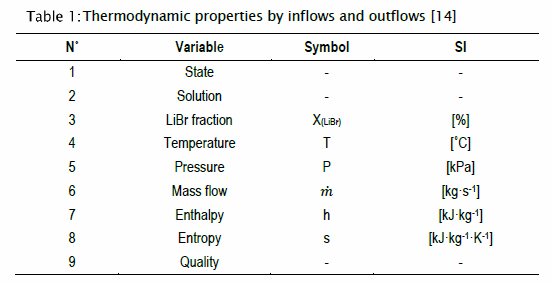
<body><![CDATA[<p align="justify"><font face="Verdana, Arial, Helvetica, sans-serif" size="2">The PVGIS platform or Photovoltaic Geographical Information System was used [11] to determine the solar radiation captured by the solar collectors in the study area. In this section, the total area covered by the collectors was considered (160 m<sup>2</sup>), as well as the inclination value of them (30&deg;), and the data of the months of low, medium and high solar radiation within the summer season were selected. In the case of the reference ambient temperature of the study area, it was obtained through the State Meteorological Agency (AEMet) [12] and the Agroclimatic Information System for Irrigation (SiAR) [13].</font></p>     <p align="justify"><font face="Verdana, Arial, Helvetica, sans-serif" size="2">The identification of the cold demand plays a fundamental role for the analysis of the SHC system, since the functioning and the inputs and outputs flows of the components of the entire system depend on it. In order to execute the analysis under periods of high, medium and low solar radiation, average hourly values were used for the months of May, August and September, based on the data and results available in the CIESOL solar investigation center.</font></p>     <p align="justify"><font face="Verdana, Arial, Helvetica, sans-serif" size="2">Regarding the application of the exergy analysis, the input and output flows determined by each system control volume were used. It must be mentioned that, in order to apply the analysis of second law, the first law corresponding to energy flow balances must first be complied with [14]. Each inflow and outflow were considered a control point; therefore, it was necessary to determine its thermodynamic properties according to the following table.</font></p>     <p align="center"><a name="t1"></a><img src="/img/revistas/ran/v9n3/a02_tabla_01.gif" width="552" height="283"></p>     <p align="justify"><font face="Verdana, Arial, Helvetica, sans-serif" size="2">For the energy balance of the solar collector, a reference was made to Cabrera &amp; Gil [15], who use the following equation for the analysis of flat-plate solar collectors.</font></p>     <p align="center"><img src="/img/revistas/ran/v9n3/a02_ecuacion_01.gif" width="546" height="67"></p>     <p align="justify"><font face="Verdana, Arial, Helvetica, sans-serif" size="2">Where, <i><img src="/img/revistas/ran/v9n3/E_punto.gif" width="9" height="12"><sub>sun</sub> </i>corresponds to the amount of radiant energy received by the solar collectors, <i>I<sub>s</sub></i> to the solar radiation corresponding to the inclination surface and the location, <i>A </i>is the opening area of the solar collectors and finally <i>n<sub>plates</sub> </i>is the number of flat-plates solar collectors installed. The last two variables belong to the physical and installation characteristics of the CIESOL solar collectors. <i><img src="/img/revistas/ran/v9n3/Q_punto.gif" width="9" height="14"><sub>sc </sub></i>represents the amount of energy transferred by the solar collector to the heat transfer fluid circulating through them (in this case water), and finally <i>&#951; </i>corresponds to the design performance of the collectors and is obtained through the following equation [16], where <i>T<sub>m</sub> </i>and <i>T<sub>0</sub></i> are the mean temperature of the fluid and ambient temperature, respectively.</font></p>     <p align="center"><img src="/img/revistas/ran/v9n3/a02_ecuacion_03.gif" width="549" height="70"></p>     <p align="justify"><font face="Verdana, Arial, Helvetica, sans-serif" size="2">In the case of the heat and cold storage tanks, equation 4 was applied, in order to be able to determine the delivery or reserve of thermal energy by them. In this case, the transfer heat to the environment generated by the isolation characteristics of the reserve tanks was taken into account. For both tanks the heat transfer coefficient (UA) was considered as R16, equivalent to 5.7605 [W &ordm;C<sup>-1</sup>].</font></p>     <p align="center"><img src="/img/revistas/ran/v9n3/a02_ecuacion_04.gif" width="547" height="61"></p>     ]]></body>
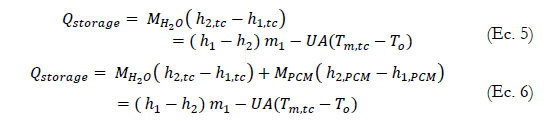
<body><![CDATA[<p align="justify"><font face="Verdana, Arial, Helvetica, sans-serif" size="2">The development of the above equation derives in equations 5 and 6, which refer to the energy stored in the heat and cold reserve system tanks, with (Ec. 6) and without (Ec. 5) the use of phase change materials (PCMs).</font></p>     <p align="center"><img src="/img/revistas/ran/v9n3/a02_ecuacion_05.gif" width="549" height="121"></p>     <p align="justify"><font face="Verdana, Arial, Helvetica, sans-serif" size="2">Now, the most complex case of the system under analysis corresponds to the absorption chiller, which has five internal components: generator, condenser, evaporator, absorber and heat exchanger, and each of them was considered as a single control volume within the whole system.</font></p>     <p align="justify"><font face="Verdana, Arial, Helvetica, sans-serif" size="2">Based on the energy and exergy analyzes for the single-effect LiBr absorption chiller performed by Kalogirou [17] and Zadeh &amp; Bozorgan [10], the following equations were used to determine the energy balances of each absorption chiller's components.</font></p>     <p align="center"><img src="/img/revistas/ran/v9n3/a02_ecuacion_07.gif" width="546" height="107"></p>     <p align="justify"><font face="Verdana, Arial, Helvetica, sans-serif" size="2">For the exergy balances application, it started with the calculation of the exergetic solar radiation available in the study area, using the following equation [18]:</font></p>     <p align="center"><img src="/img/revistas/ran/v9n3/a02_ecuacion_10.gif" width="543" height="69"></p>     <p align="justify"><font face="Verdana, Arial, Helvetica, sans-serif" size="2">Where, <i>T<sub>sr</sub> </i>is equal to the temperature of the sun's surface and corresponds to a fixed value of 6,000 K. The radiant exergy that enters the solar collectors was calculated according to Hepbasli [6], where <i>A </i>corresponds to the opening area of the solar collectors, and <b>&#949;</b><i><sub>sun</sub> </i>reflects the exergetic availability of solar radiation, previously calculated.</font></p>     <p align="center"><img src="/img/revistas/ran/v9n3/a02_ecuacion_11.gif" width="547" height="36"></p>     <p align="justify"><font face="Verdana, Arial, Helvetica, sans-serif" size="2">Now, the application of the exergy balance to a well-defined control volume was made following the Wark &amp; Richards [14] equation:</font></p>     ]]></body>
<body><![CDATA[<p align="center"><img src="/img/revistas/ran/v9n3/a02_ecuacion_12.gif" width="547" height="41"></p>     <p align="justify"><font face="Verdana, Arial, Helvetica, sans-serif" size="2">Where, the <i>W<sub>f,real</sub> </i>corresponds to the real work exchanged with the system, <i>W<sub>f,optimum</sub> </i>is the reversible or optimum work that would be exchanged, <i>I</i> corresponds to the amount of exergy destroyed by the system (<i>Ex<sub>des</sub>,</i>).<i> W<sub>f,optimum</sub> </i>is calculated as follows:</font></p>     <p align="center"><img src="/img/revistas/ran/v9n3/a02_ecuacion_13.gif" width="547" height="86"></p>     <p align="justify"><font face="Verdana, Arial, Helvetica, sans-serif" size="2">or</font></p>     <p align="center"><img src="/img/revistas/ran/v9n3/a02_ecuacion_14.gif" width="544" height="92"></p>     <p align="justify"><font face="Verdana, Arial, Helvetica, sans-serif" size="2">For systems below the ambient temperatures. Where,<i> </i></font><font size="2"><i>&Phi;</i></font><font face="Verdana, Arial, Helvetica, sans-serif" size="2"> refers to the exergetic mass availability, the </font><font size="2"><i>&#968;</i></font><font face="Verdana, Arial, Helvetica, sans-serif" size="2"> to the exergetic availability and <i>Q </i>to the heat transfer.</font></p>     <p align="justify"><font face="Verdana, Arial, Helvetica, sans-serif" size="2">The exergy content is expressed by unit of mass, as follows:</font></p>     <p align="center"><img src="/img/revistas/ran/v9n3/a02_ecuacion_15.gif" width="549" height="49"></p>     <p align="justify"><font face="Verdana, Arial, Helvetica, sans-serif" size="2">Where <i>h </i>is the specific enthalpy, <i>s </i>is the specific entropy, and the zero subscript indicates the properties of the system at strict dead state in equilibrium with the environment. The two last parts of the equations correspond to the specific kinetic and potential energy.</font></p>     <p align="justify"><font face="Verdana, Arial, Helvetica, sans-serif" size="2">For adiabatic systems, the transfer of exergy through heat is equal to zero. In real processes, irreversibilities occur and as a result, there is entropy generation, which results in the destruction of a specific amount of exergy that can be calculated with the Gouy-Stodola equation [6].</font></p>     ]]></body>
<body><![CDATA[<p align="center"><img src="/img/revistas/ran/v9n3/a02_ecuacion_16.gif" width="549" height="32"></p>     <p align="justify"><font face="Verdana, Arial, Helvetica, sans-serif" size="2">According to Wark &amp; Richards [14], the entropy generated by the universe can be found by means of the following equation:</font></p>     <p align="center"><img src="/img/revistas/ran/v9n3/a02_ecuacion_17.gif" width="552" height="102"></p>     <p align="justify"><font face="Verdana, Arial, Helvetica, sans-serif" size="2">The exergy efficiency is defined as the relationship between the total exergy of preserved and the total exergy used in a process:</font></p>     <p align="center"><img src="/img/revistas/ran/v9n3/a02_ecuacion_18.gif" width="547" height="58"></p>     <p align="justify"><font face="Verdana, Arial, Helvetica, sans-serif" size="2">Where &quot;out&quot; is understood by the net output or the &quot;product&quot;, the &quot;desired value&quot; or &quot;benefit&quot;, and the &quot;in&quot; is understood by &quot;given&quot;, &quot;used&quot; or &quot;delivered&quot;.</font></p>     <p align="justify"><font face="Verdana, Arial, Helvetica, sans-serif" size="2">For the purposes of this research, the global exergy efficiency of the system has been defined the total exergy available in the cooling water generation versus the total radiant exergy captured, during a day of operation [6]. In order to analyze the meaning of these values of &quot;efficiency&quot;, we must understand that the term &quot;exergy efficiency&quot; lacks of fixed value ranges that can be used for its interpretation; it means, this method of analysis is comparative, thus the greater the exergy efficiency is achieved, the lower the irreversibilities that are generated by the system and finally, the better the use of the exergy resources being used [14].</font></p>     <p align="justify"><font face="Verdana, Arial, Helvetica, sans-serif" size="2">The percentages of efficiency depend on the initial point of analysis (reference point), therefore, the more specific with the origin of the exergy source or the greater exergy transfers are taken into account in the system, the efficiencies achieved will be lower, reflecting finally the irreversibilities that are generated by each processes or globally. For the exergy analysis presented in this paper, the system is being evaluated from its primary source of exergy (the sun), down to a final exergy output as hot or cold water for heating or cooling applications.</font></p>     <p align="justify"><font face="Verdana, Arial, Helvetica, sans-serif" size="2">In order to evaluate the SHC system in different periods of the year, hours and mainly under the variation of cold demand pertaining to the summer season, a model in steady state was designed to obtain the energy and exergy balances, as well as the irreversibilities and efficiencies per component of the system, and finally the overall efficiency.</font></p>     <p align="justify"><font face="Verdana, Arial, Helvetica, sans-serif" size="2">To determine the variation of the efficiency and the irreversibilities generated in the SHC system, the analysis was divided into two scenarios. These correspond to the operation with storage tanks, without phase change materials; and to the system operation with the storage tanks and the inclusion of phase change materials. Both scenarios correspond to the season that requires a generation of cold by the air conditioning system. These periods are an average day of the months of high, medium and low solar radiation, which were determined through the values previously found for the average amount of radiation received at the study area. In addition, each representative average day of the selected months were evaluated by hours, considering the work periods that the CIESOL has.</font></p>     ]]></body>
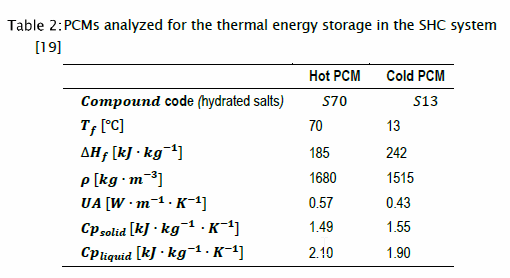
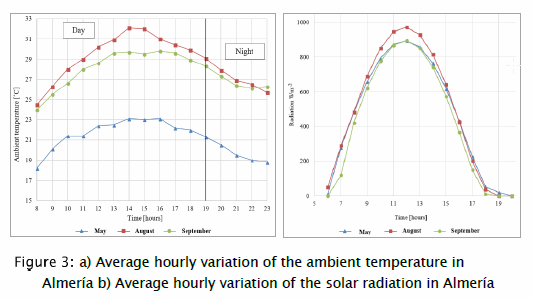
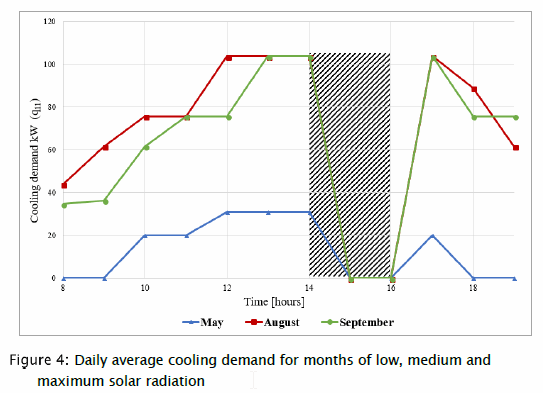
<body><![CDATA[<p align="justify"><font face="Verdana, Arial, Helvetica, sans-serif" size="2">Finally, the phase change materials that corresponds to the second scenario under analysis were selected according to their melting temperatures and the temperature operating range of the cold and hot water storage systems. These correspond to the PCM Products Company [19], which works with hydrated salts in the air conditioning area (<a href="#t2">Table 2:</a>).</font></p>     <p align="center"><a name="t2"></a><img src="/img/revistas/ran/v9n3/a02_tabla_02.gif" width="510" height="278"></p>     <p align="justify">&nbsp;</p>     <p align="justify"><font face="Verdana, Arial, Helvetica, sans-serif" size="2"><b><font size="3">3</font></b></font><font face="Verdana, Arial, Helvetica, sans-serif" size="3"><b>&nbsp;&nbsp;&nbsp;&nbsp;Results</b></font><font face="Verdana, Arial, Helvetica, sans-serif" size="2"><b></b></font></p>     <p align="justify"><font face="Verdana, Arial, Helvetica, sans-serif" size="2">According to the collected information from the climatic characteristics of the Almeria region, the variations in cold demand by CIESOL and, finally, the application of the energy and exergy balances on the system, the following results were obtained.</font></p>     <p align="justify"><font face="Verdana, Arial, Helvetica, sans-serif" size="2"><b>3.1     Reference environment and cooling demand</b></font></p>     <p align="justify"><font face="Verdana, Arial, Helvetica, sans-serif" size="2">The selected months of analysis correspond to May, September and August, as they are periods of low, medium and maximum solar radiation respectively, within the cooling demand season in CIESOL. The hours between 08h00 to 19h00, correspond to the work schedules that were established in the research center and represent the values where there is a cooling demand in the CIESOLs building. Subsequent values after 19h00 correspond to night hours, where the system enters into a storage mode of the accumulated energy during the daytime hours.</font></p>     <p align="justify"><font face="Verdana, Arial, Helvetica, sans-serif" size="2">It can be observed from <a href="#f3">Figure 3</a> that during the summer season, August represents the warmest month with temperatures higher than 31 &deg;C and minimum nights around 25 &deg;C; on the other hand, May reflects minimum values up to 15 &deg;C at the start of the day and maximums of 25 &deg;C. These values determine the demand of cold in the building. Like the temperature data, May corresponds to the lowest</font> <font face="Verdana, Arial, Helvetica, sans-serif" size="2">intensities of solar radiation for the summer time. However, the differences between these months are not broad, which allows an advantage of the use of the solar source. The data shown in <a href="#f3">Figure 3</a>, corresponds to values of direct solar radiation on the inclined plane of 30&deg; of the solar collectors installed [11], these values differ from direct global radiation data on the Almeria location.</font></p>     <p align="center"><a name="f3"></a><img src="/img/revistas/ran/v9n3/a02_figura_03.gif" width="533" height="298"></p>     <p align="justify"><font face="Verdana, Arial, Helvetica, sans-serif" size="2">The cold demand values for the months of May, August and September, correspond to experimental data recorded by the CIESOL center during a period of three years, from 2010 to 2013. These cold demand hour values are the values registered at the output of the absorption chiller and are reflected in <a href="#f4">Figure 4</a>, where the cold demand for an average day of the months under study can be observed. It is clarified that there is a rest period for the workers of the research center, from 14h00 to 16h00 pm, period in which there is still enough radiant useful and usable exergy by the system.</font></p>     ]]></body>
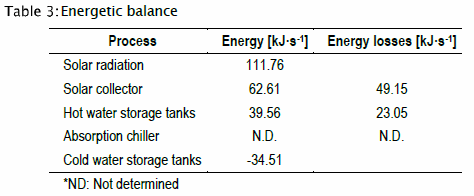
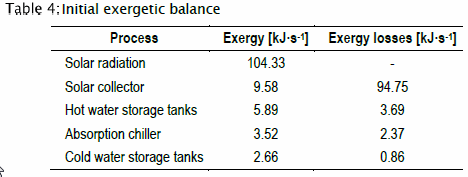
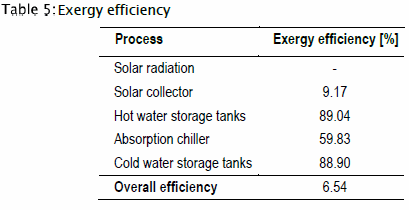
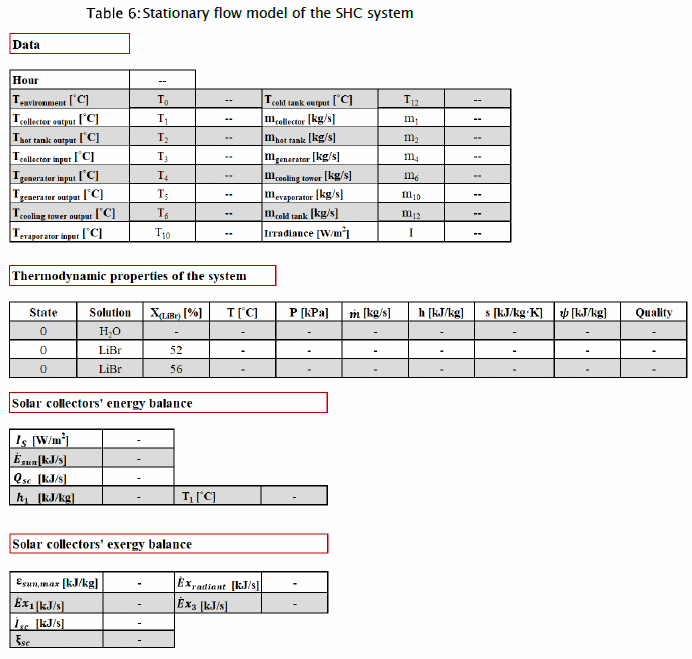
<body><![CDATA[<p align="center"><a name="f4"></a><img src="/img/revistas/ran/v9n3/a02_figura_04.gif" width="543" height="393"></p>     <p align="justify"><font face="Verdana, Arial, Helvetica, sans-serif" size="2"><b>3.2     Efficiency and irreversibilities analysis of the SHC system by operating scenario</b></font></p>     <p align="justify"><font face="Verdana, Arial, Helvetica, sans-serif" size="2">With the one-day operating data of the month of August, the thermodynamic values of each control point defined in the SHC system were calculated, and consequently the energetic and exergetic steady flow balances were made. The execution of these balance revealed the preliminary result of an experimental day, under a maximum operating capacity.</font></p>     <p align="center"><a name="t3"></a><img src="/img/revistas/ran/v9n3/a02_tabla_03.gif" width="474" height="196"></p>     <p align="justify"><font face="Verdana, Arial, Helvetica, sans-serif" size="2">The application of the energy balance reveals an effect of the use of the First Law of Thermodynamics, which is the impossibility to contrast the thermal energy</font> <font face="Verdana, Arial, Helvetica, sans-serif" size="2">generated by the collectors, with the thermal energy absorbed for cooling resulting from the absorption chiller operation (it explains the N.D. marks of <a href="#t3">Table 3</a>). As Asbik <i>et al </i>[20] mention, this law is insufficient to evaluate the energy performance of a thermal machine, because it does not take into account how the quality of the energy degrades (irreversibilities) in each component of the system, therefore it is only able to measure the amount of heat that can be stored or recovered. For this reason, the exergy analysis based on the Second Law of thermodynamics should be used to measure the quality of energy and then justify the thermodynamic imperfection of the real process.</font></p>     <p align="justify"><font face="Verdana, Arial, Helvetica, sans-serif" size="2"><a href="#t4">Table 4:</a> shows the values determined for the evaluation of the exergy transfer, which reflects the exergy availability of each process output and the losses generated in them. The results shown in both tables reveal different values, where the exergy that crosses the system is lower than the calculated energy. It is a characteristic of the exergy evaluation, because it considers the values of energy losses due to the system's components and the environment interaction [14]. Within the exergy balance, it was determined that the major losses are generated in the solar collectors and not in the absorption chiller where the generation of cold water occurs. This loss value corresponds to 94.7 kJ·s<sup>-1</sup> of the 104.3 kJ·s<sup>-1 </sup>that enter to the solar collectors.</font></p>     <p align="center"><a name="t4"></a><img src="/img/revistas/ran/v9n3/a02_tabla_04.gif" width="468" height="177"></p>     <p align="justify"><font face="Verdana, Arial, Helvetica, sans-serif" size="2">The above exergetic balance can be better expressed through the efficiency values of <a href="#t5">Table 5:</a>, where this efficiency was related to the inputs, outputs and recirculation flows of a control volume. The solar collectors' value shows the lowest exergy efficiency compared to the other components, with a percentage of only 9.17%. Another point to consider is the low overall efficiency determined, with a value of 6.54%.</font></p>     <p align="center"><a name="t5"></a><img src="/img/revistas/ran/v9n3/a02_tabla_05.gif" width="409" height="210"></p>     <p align="justify"><font face="Verdana, Arial, Helvetica, sans-serif" size="2">All the previous analysis was translated into a mathematical model, which allows to determine hourly variations contemplated for the months under study and fulfill four fundamentals stages: data entry; construction of the thermodynamic characteristics of the 22 control points, according to the input data; execution of energy and exergy balances by control volume; and finally give the results of these balances (<a href="#t6">Table 6</a>).</font></p>     ]]></body>
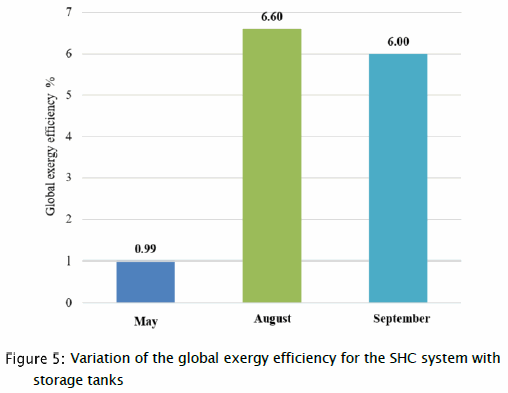
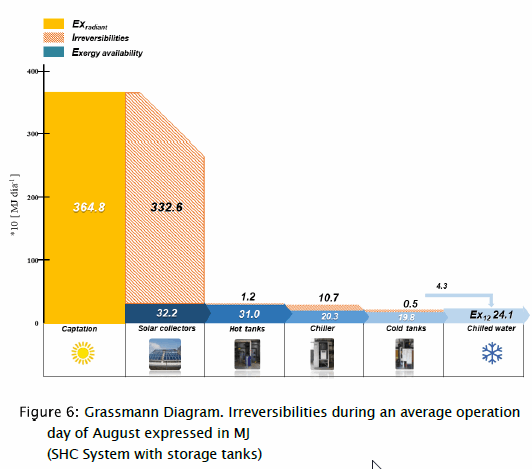
<body><![CDATA[<p align="center"><a name="t6"></a><img src="/img/revistas/ran/v9n3/a02_tabla_06.gif" width="692" height="659"></p>     <p align="justify"><font face="Verdana, Arial, Helvetica, sans-serif" size="2"><b>3.2.1</b>    Scenario A: Solar heating and cooling (SHC) system with storage tanks</font></p>     <p align="justify"><font face="Verdana, Arial, Helvetica, sans-serif" size="2">The application of the exergy balance revealed the global exergetic efficiencies achieved by the system for the three months under study in the storage operation mode (<a href="#f5">Figure 5</a>). According to Hepbasli (2006), the values of the exergetic efficiency serve as a method of comparison between two or more systems, where a greater efficiency percentage results in a more efficient system in terms of management of the available energy resources and of minors irreversibilities generated throughout the transfer processes that are carried out [6].</font></p>     <p align="center"><a name="f5"></a><img src="/img/revistas/ran/v9n3/a02_figura_05.gif" width="508" height="393"></p>     <p align="justify"><font face="Verdana, Arial, Helvetica, sans-serif" size="2">The obtained values correspond to the analysis of an operation day for the indicated months, with hourly intervals. In this sense, throughout the day, all the loading and unloading processes of the system have been considered, as well as the operation of the absorption chiller by the thermal energy storage tank during periods of low solar radiation. As we can see in <a href="#f5">Figure 5</a>, August reached the highest exergy efficiency with a value of 6.60%, following September and May with values of 6.00% and 0.99% respectively.</font></p>     <p align="justify"><font face="Verdana, Arial, Helvetica, sans-serif" size="2">These exergy efficiency values are related to the three main factors: the ambient temperature, the demand of chilled water and the direct solar radiation; since they determine the operation mode of the system itself. May represents the lowest values of ambient temperature and, therefore, the lowest demand for cold throughout a day. This directly affects the operating conditions of the system since it hardly works under optimal conditions, resulting in a low overall exergy efficiency (0.99%). In the other hand, August represents the maximum value reached by the system (6.6%), agreeing with the maximum registered temperatures, maximum solar radiation reached and greater cooling demand.</font></p>     <p align="justify"><font face="Verdana, Arial, Helvetica, sans-serif" size="2">In order to have a better understanding of these results, a Grassmann diagram was made corresponding to an operation day of August, where all the irreversibilities</font> <font face="Verdana, Arial, Helvetica, sans-serif" size="2">generated during the operation of the refrigeration system in CIESOL are reflected (<a href="#f6">Figure 6</a>).</font></p>     <p align="center"><a name="f6"></a><img src="/img/revistas/ran/v9n3/a02_figura_06.gif" width="532" height="469"></p>     <p align="justify"><font face="Verdana, Arial, Helvetica, sans-serif" size="2"><a href="#f6">Figure 6</a> shows that the total radiant exergy captured by the system during an average operation day on August was 3,648.3 MJ, where 3,326.3 MJ (90% of the exergy captured) is destroyed at the solar collectors, and only 322 MJ are transferred to drive the absorption chiller. The next control volume of greater irreversibilities corresponds to the absorption chiller with 107.1 MJ are destroyed. Finally, a useful exergy of 240.8 MJ is obtained as chilled water, representing only 6.6% of all the exergy captured. The <a href="#f6">Figure 6</a> also reflects an exergetic contribution to the generation of cold (42.8 MJ), which is a consequence of the adjacent equipment operation related to the SHC system such as pumps, valves, etc.</font></p>     <p align="justify"><font face="Verdana, Arial, Helvetica, sans-serif" size="2">The fact that the major amount of irreversibilities is generated in solar collectors is an already known reality in the solar research field [21]. Regarding to all the solar potential that can be exploited, more than being an inefficient operation of the system itself, it is a technological inefficiency attributable to solar collectors. Likewise, it must</font> <font face="Verdana, Arial, Helvetica, sans-serif" size="2">be considered that the longer operating hours the system has, the greater are the exergy losses generated throughout the day.</font></p>     ]]></body>
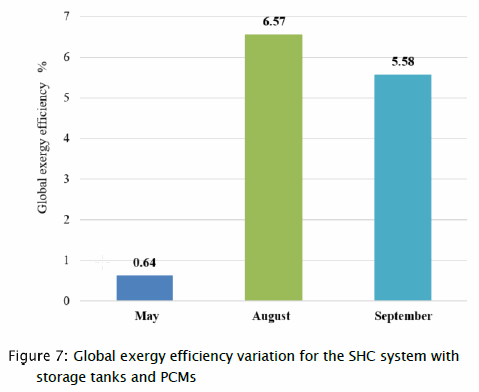
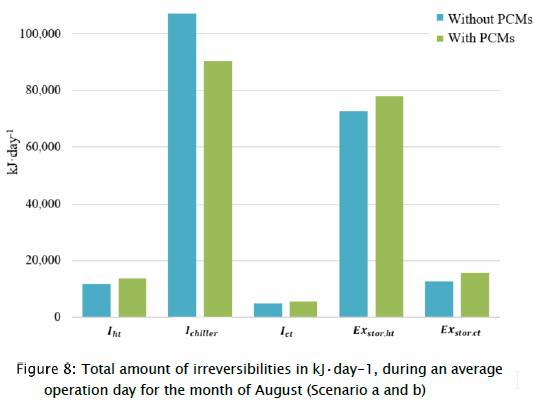
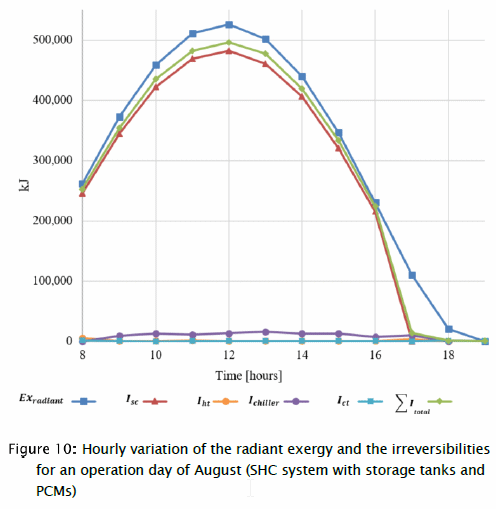
<body><![CDATA[<p align="justify"><font face="Verdana, Arial, Helvetica, sans-serif" size="2">The second component that generates irreversibilities in the SHC system corresponds to the absorption chiller. The studies carried out by Batlles &amp; Rosiek [22] showed that the COP (Coefficient of Performance) of this component obtained by a First Law balance analysis, reached values between 0.33—0.8, that are considered optimal and &quot;efficient&quot; in terms of energy. In comparison, the exergy analysis of a LiBr simple effect absorption chiller [23][10], revealed that despite the relatively high energy performance values achieved by this equipment, they have a low exergy efficiency, where the main reason is the large quantities of mass and heat flow transfers that occur in each component, which affect the overall efficiency of the system.</font></p>     <p align="justify"><font face="Verdana, Arial, Helvetica, sans-serif" size="2">Other studies [10] also highlighted that the component that produced the greatest irreversibilities in the chiller corresponds to the generator, due to the temperature difference of the thermal energy source and the internal working temperature of the system. This same situation was reflected in the exergy analysis of the absorption chiller under study, where the global exergy efficiency values were registered between 20 - 59%, higher than those recorded in the cited study [10]. It is because the entry temperature generated by the solar collectors was lower than that used by the absorption system that works with superheated steam, thus the SHC system's absorption chiller represent a lower temperature difference between the thermal source and the internal working fluid.</font></p>     <p align="justify"><font face="Verdana, Arial, Helvetica, sans-serif" size="2"><b>3.2.2</b>    Scenario B: Solar heating and cooling system (SHC) with storage tanks and phase change materials (PCMs)</font></p>     <p align="justify"><font face="Verdana, Arial, Helvetica, sans-serif" size="2">In this second scenario, <a href="#f7">Figure 7</a> shows the overall exergy efficiency values determined for the months of May, August and September, which were 0.64, 6.57 and 5.58% respectively. Comparing these values of global exergy efficiency with the values obtained in the previous scenario, it can be observed that the global exergetic efficiencies are slightly lower. It does not necessarily mean that the system is acting more inefficiently because of the use of phase change materials in the cold and heat storage tanks, but that there is a greater amount of exergy accumulated in the storage tanks. Therefore, it can be stated that the installation of the phase change materials influences the operation of the SHC heating and cooling system, however, this is minimal.</font></p>     <p align="center"><a name="f7"></a><img src="/img/revistas/ran/v9n3/a02_figura_07.gif" width="479" height="392"></p>     <p align="justify"><font face="Verdana, Arial, Helvetica, sans-serif" size="2">The introduction of the PCMs in the cold and heat reserve tanks, leads to an increase in the thermal capacity of these tanks, thus achieving a greater capacity for accumulation and therefore higher performance [24]. The action mode of these</font> <font face="Verdana, Arial, Helvetica, sans-serif" size="2">PCMs is based on the fact that once their environment reaches the melting temperatures of the materials, they absorb or release latent heat depending on external needs, acting as net reserves of exergy [1].</font></p>     <p align="justify"><font face="Verdana, Arial, Helvetica, sans-serif" size="2">The reason why the exergy efficiency of the system falls in this last scenario is due, on the one hand, to the fact that the introduction of these materials represents a new transfer of heat that occurs inside the storage tanks and, as we have seen before, the more heat transfers a system has, the greater irreversibilities are produced by it [14]. On the other hand, and the main reason for the reduction, is that the system is now producing an increase in the exit temperatures of the tank at the final delivery of the chilled water, resulting in a lower exergy delivered, which in fact has not been lost, but is accumulated in the tanks.</font></p>     <p align="justify"><font face="Verdana, Arial, Helvetica, sans-serif" size="2"><a href="#f8">Figure 8</a> quantitatively reflects the amount of irreversibilities generated by the storage tanks, as well as the increase in the amount of exergy accumulated in them. In this figure, the irreversibilities generated by the solar collectors are not showed, as well as the incoming radiant exergy, in order to better observe the amount of irreversibilities generated in the other system's components. And more importantly, it shows that a lower entry temperature in the absorption chiller produces a lower amount of irreversibilities (a situation that have been previously detailed). Finally, we can observe the strong potential of the PCMs to store exergy for the heat and cold</font> <font face="Verdana, Arial, Helvetica, sans-serif" size="2">reserves, being the heat tanks the site where greater amount of exergy is stored regarding their higher volumetric heat capacity [22].</font></p>     <p align="center"><a name="f8"></a><img src="/img/revistas/ran/v9n3/a02_figura_08.gif" width="541" height="405"></p>     <blockquote>       ]]></body>
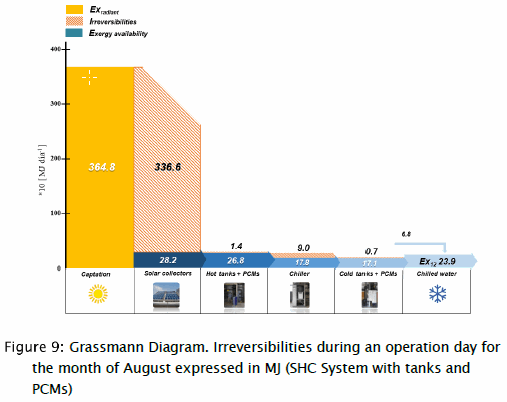
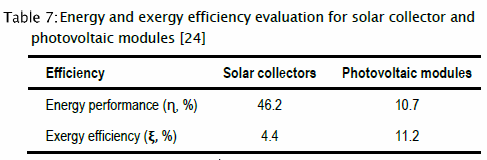
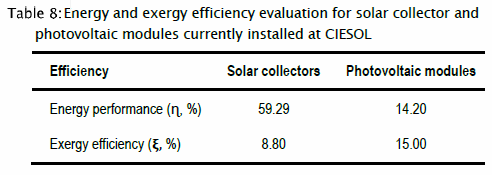
<body><![CDATA[<p align="justify"><font face="Verdana, Arial, Helvetica, sans-serif" size="2"><i>Iht = </i>Heat tanks irreversibilities; <i>Ichiller = </i>Absorption chiller irreversibilities, <i>Ict = </i>Cold tanks irreversibilities; <i>Ex stor,ht = </i>Exergy stored in the heat tanks; <i>Ex stor,ct = </i>Exergy stored in the cold tanks</font></p> </blockquote>     <p align="justify"><font face="Verdana, Arial, Helvetica, sans-serif" size="2"><a href="#f9">Figure 9</a> consists of a Grassmann Diagram, where the irreversibilities of the cold storage tanks, as well as the solar collectors, are greater than those registered in the scenario A, but the irreversibilities of the absorption chiller diminish considerably due to the presence of the phase change materials. Both <a href="#f9">Figures, 9</a> and <a href="#f10">10</a>, demonstrate that, despite the introduction of the PCMs and the increase of the thermal energy capabilities, the irreversibilities of the system increase and therefore decrease the exergy efficiency. This is also because the components with the greater irreversibilities of the system have not been improved, and therefore the objectives of reducing the inefficiencies found in the system are not relevant.</font></p>     <p align="center"><a name="f9"></a><img src="/img/revistas/ran/v9n3/a02_figura_09.gif" width="507" height="402"></p>     <p align="center">&nbsp;</p>     <p align="center"><a name="f10"></a><img src="/img/revistas/ran/v9n3/a02_figura_10.gif" width="496" height="509"></p>     <blockquote>       <p align="justify"><font face="Verdana, Arial, Helvetica, sans-serif" size="2"><i>Ex radiant = </i>Radiant exergy; <i>Isc = </i>Solar collectors irreversibilities; <i>Iht = </i>Hot tanks irreversibilities; <i>lchiller = </i>Chiller irreversibilities, <i>lct = </i>Cold tanks irreversibilities; <i>Itot </i>= Global irreversibilities</font></p> </blockquote>     <p align="justify"><font face="Verdana, Arial, Helvetica, sans-serif" size="2"><b>3.3     Irreversibilities reduction proposal in the SHC system</b></font></p>     <p align="justify"><font face="Verdana, Arial, Helvetica, sans-serif" size="2">As it was shown, the SHC system currently installed at CIESOL has a great potential to satisfy the cooling demand of the building. However, the introduction of the PCMs (one of the main elements of study) does not increase the exergy efficiency of the system but decreases it by storing a greater amount of exergy in the cold tanks. The exergy analysis showed that, regardless of the scenario (A or B), the solar collectors generate the greatest irreversibilities (around 90% of the entire generation) followed by the absorption chiller, the storage tanks and finally the phase change materials. Therefore, the irreversibilities reduction proposal in order to obtain a more exergy efficient system must consider in first place the technology used for collecting the solar exergy.</font></p>     <p align="justify"><font face="Verdana, Arial, Helvetica, sans-serif" size="2">A study conducted by Saitoh <i>et al </i>[25], focused on the energy and exergy efficiency evaluation of solar thermal collectors and photovoltaic panels, revealed that despite the known energy performance of solar collectors, about 46.2% (<a href="#t7">Table 7</a>), the exergy efficiency results reached values of just 4.4% for that type collectors. On the other hand, the photovoltaic panels that usually show 10% energy efficiency, the study showed that its exergy efficiency was higher, reaching a value of 11.2%, higher than the exergetic efficiencies reached by the solar collectors.</font></p>     ]]></body>
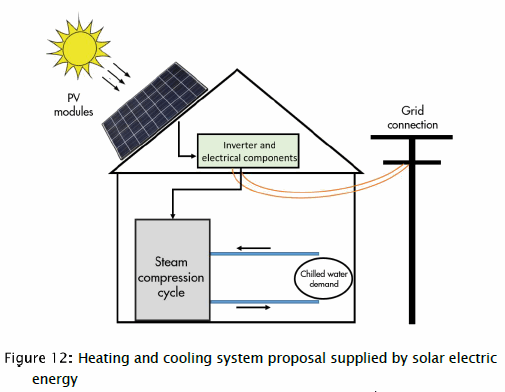
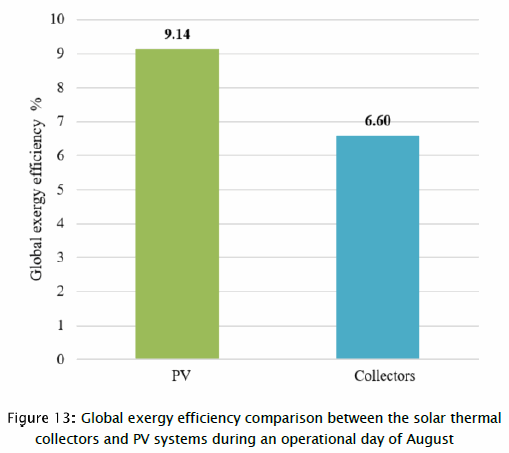
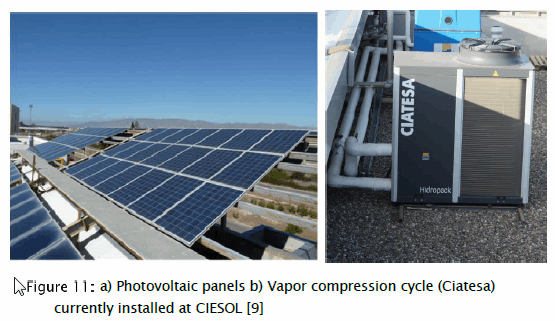
<body><![CDATA[<p align="center"><a name="t7"></a><img src="/img/revistas/ran/v9n3/a02_tabla_07.gif" width="487" height="160"></p>     <p align="justify"><font face="Verdana, Arial, Helvetica, sans-serif" size="2">An energy and exergy evaluation of the solar collectors currently installed at CIESOL showed that the exergy efficiency values reached by them were 8.80% (<a href="#t8">Table 8</a>), and an energy performance of 59.24%, similar values to those cited by Saitoh <i>et al </i>[25]. In contrast, the same energy and exergy analysis was executed for the photovoltaic panels also currently installed at CIESOL, which reached an exergy efficiency of 15%.</font></p>     <p align="center"><a name="t8"></a><img src="/img/revistas/ran/v9n3/a02_tabla_08.gif" width="492" height="175"></p>     <p align="justify"><font face="Verdana, Arial, Helvetica, sans-serif" size="2">Comparing both solar technologies (thermal collectors and PV panels), it can be seen the strong limitation represented by the analysis of the first law of thermodynamics, which analyzes the transformation of energy but fails to measure the amount of exergy that is lost [26]. Therefore, despite the performance values that are usually handled, photovoltaic panels represent a better solar technology than the solar collectors, in exergetic terms, for the purpose presented here. Thus, there is indeed a technological solar option that allows a better use of solar resources.</font></p>     <p align="justify"><font face="Verdana, Arial, Helvetica, sans-serif" size="2">An alternative proposal to the current solar heating and cooling system is presented below, based on the use of photovoltaic modules as the main source of electricity supply, which drives a cooling system to meet the demand of the CIESOL center. This proposed system is based on components currently installed at the building, where the PV panels are used to cover the electrical demand of the center and the vapor compression cycle is used as a back-up refrigeration system in case of failures (<a href="#f11">Figure 11 a and b</a>).</font></p>     <p align="center"><a name="f11"></a><img src="/img/revistas/ran/v9n3/a02_figura_11.gif" width="555" height="321"></p>     <p align="justify"><font face="Verdana, Arial, Helvetica, sans-serif" size="2">The proposed system for the cooling demand of CIESOL consists of 47 Artesa A-222P photovoltaic modules, with an electrical generation capacity of 10.4 kWp and</font> <font face="Verdana, Arial, Helvetica, sans-serif" size="2">an inclination of 22&deg; to the south. This energy is converted through inverters Cycle 3000 and supply the necessary energy to a vapor compression cycle CIATESA WE 360, which uses R-410a as refrigerant and finally covers the cooling demand of the center (<a href="#f12">Figure 12</a>).</font></p>     <p align="center"><a name="f12"></a><img src="/img/revistas/ran/v9n3/a02_figura_12.gif" width="505" height="392"></p>     <p align="justify"><font face="Verdana, Arial, Helvetica, sans-serif" size="2">The first difference between the SHC system based on PV panels and the solar collector system, is the quantity of components necessary for the generation of cold. As shown in <a href="#f1">Figure 1</a>, the amount of principal and complementary components that are needed to meet the current refrigeration demand of the center is greater compared to that shown in <a href="#f13">Figure 13:</a>. This is mainly due to the versatility that represents the electrical energy generation [26], since it is easily consumed, stored in batteries or directly injected to the local electrical connection. The overall exergy efficiency achieved for an average day of August was 9.14%, a value greater than the maximum global exergetic efficiency reached by the solar collector system, with a value of 6.6% for scenario A (<a href="#f5">Figure 5</a>). This represents an increase of 38.5% in the overall efficiency.</font></p>     <p align="center"><a name="f13"></a><img src="/img/revistas/ran/v9n3/a02_figura_13.gif" width="509" height="453"></p>     ]]></body>
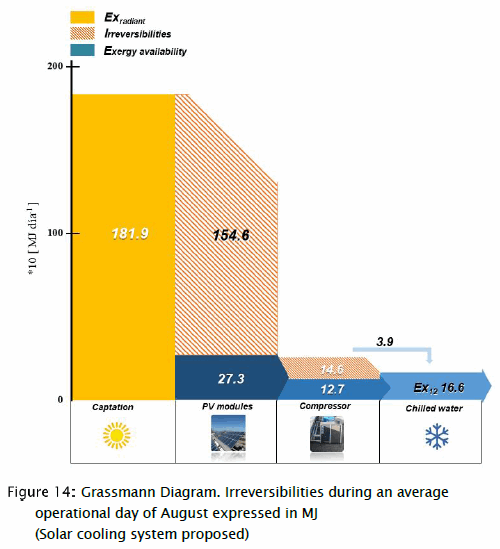
<body><![CDATA[<p align="justify"><font face="Verdana, Arial, Helvetica, sans-serif" size="2">The reduction of irreversibilities is based on two main points: first is related to the greater exergetic efficiency achieved by the PV panels and second to the least amount of exergy losses due to the minor components necessary for the production of cold [14].</font></p>     <p align="justify"><font face="Verdana, Arial, Helvetica, sans-serif" size="2"><a href="#f14">Figure 14</a> shows the corresponding Grassmann Diagram for the proposed solar cooling system. This shows that despite the increase in the exergy efficiency achieved by photovoltaic panels, solar exergy collections remains the highest irreversibility generated in the system, followed by the vapor compression cycle or heat pump. However, the presence of fewer components has a positive effect on the overall exergy efficiency of the system. It can also be seen that there is an important contribution of 39.1 MJ to the system, due to the recirculation of flows and the use of pumps.</font></p>     <p align="center"><a name="f14"></a><img src="/img/revistas/ran/v9n3/a02_figura_14.gif" width="500" height="549"></p>     <p align="justify"><font face="Verdana, Arial, Helvetica, sans-serif" size="2">Regarding the economic investment on both systems, the first one corresponds to the solar collector system, occupies an area of 160 m<sup>2 </sup>and has an investment of € 150,000 with an operation and maintenance costs of € 1,500 per year according to Batlles &amp; Rosiek [21], where the most expensive equipment was the absorption chiller. In contrast, the proposed system powered by photovoltaic panels and using the same economic approaches of the prior system, could use an area of 80 m<sup>2</sup> with € 82,000 investments and an operation and maintenance cost of € 820 per year, demonstrating that the fixed and variable investment of the proposed system is significantly lower than the current solar thermal system.</font></p>     <p align="justify"><font face="Verdana, Arial, Helvetica, sans-serif" size="2">Finally, despite the greater exergy efficiency achieved by the proposed solar heating system (powered by PV energy) and its lower investment cost, a drawback of the use of vapor compression cycles is due to the need of refrigerants, such R-410A, even if it is considered one of the last generation refrigerants because it does not</font> <font face="Verdana, Arial, Helvetica, sans-serif" size="2">contain chlorine and bromine compounds and does not contribute to the reduction of the ozone layer; it is considered a powerful greenhouse gas [27].</font></p>     <p align="justify">&nbsp;</p>     <p align="justify"><font face="Verdana, Arial, Helvetica, sans-serif" size="3"><b>4&nbsp; &nbsp; Conclusions</b></font></p>     <p align="justify"><font face="Verdana, Arial, Helvetica, sans-serif" size="2">A fundamental concept of Efficiency is necessary to properly analyze and optimize any SHC system, due to the limitation of the Fist Law of thermodynamics. This investigation showed that the maximum global exergy efficiency obtained by the solar heating and cooling system currently installed at CIESOL is 6.6 %. It also revealed that most of the solar radiation exergy is lost at the thermal collectors, followed by the absorption chiller. Also, contrary to what was expected, the introduction of the PCMs do not represent a significant improvement in the efficiency of the system. Nevertheless, PCM systems can be used to improve the amount of exergy that can be stored; therefore, it can be used at other moments of the day and can be an alternative to storing the solar exergy into batteries, especially for exergy saved as cold. An analysis should be done if it is convenient to save exergy in cold tanks rather to save exergy in hot tanks as it is done at present at CIESOL.</font></p>     <p align="justify"><font face="Verdana, Arial, Helvetica, sans-serif" size="2">To conclude, a different solar cooling system was proposed in order to reduce the irreversibilities generated by the system. It consists on a photovoltaic system and a vapor compression cycle, where it was found that PV modules are more efficient than the thermal collectors, with a global exergy efficiency of 9.14%, which represents an increase of 38.5% in the overall efficiency. This system could also allow to save exergy directly in cold tanks rather than in hot tanks and improving the global efficiency of the system.</font></p>     <p align="justify">&nbsp;</p>     ]]></body>
<body><![CDATA[<p align="justify"><font face="Verdana, Arial, Helvetica, sans-serif" size="3"><b>5&nbsp; &nbsp; Acknowledgments</b></font></p>     <p align="justify"><font face="Verdana, Arial, Helvetica, sans-serif" size="2">This work was supported by the ERANET-LAC CONICIT/PCI/ELAC2015/T06-0988 project. And the partial support of the CONICYT/FONDAP N&deg;15110019 project in this research.</font></p>     <p align="justify">&nbsp;</p>     <p align="justify"><font face="Verdana, Arial, Helvetica, sans-serif" size="3"><b>Bibliographic References</b></font></p>     <p align="justify"><font size="2" face="Verdana, Arial, Helvetica, sans-serif">[1] H. Shabgard, L. Song y W. Zhu, &laquo;Heat transfer  and exergy analysis of a novel solar-powered integrated,&raquo; Energy Conversion and  Management, n&ordm; Heat transfer and exergy analysis of a novel solar-powered  integrated, pp. 121-131, 2018. </font></p>     <p align="justify"><font size="2" face="Verdana, Arial, Helvetica, sans-serif">  [2] U.S. Energy Information,  &quot;Residential Energy Consumption Survey (RECS) &ndash; Data,&quot; [Online]. Available: <a href="https://www.eia.gov/consumption/residential/data/2009/index.php?view=consumption" target="_blank">https://www.eia.gov/consumption/residential/data/2009/index.php?view=consumption</a>.  [Accessed 2018 December 18]. </font></p>     <!-- ref --><p align="justify"><font size="2" face="Verdana, Arial, Helvetica, sans-serif">  [3] International Energy Agency, &quot;Key  world energy statistics,&quot; 2017. [Online]. Available: <a href="https://www.iea.org/publications/freepublications/publication/KeyWorld2017.pdf" target="_blank">https://www.iea.org/publications/freepublications/publication/KeyWorld2017.pdf</a>. 00[Accessed 18 December 2018]. </font>&nbsp;&nbsp;&nbsp;&nbsp;&nbsp;&nbsp;&nbsp;&nbsp;[&#160;<a href="javascript:void(0);" onclick="javascript: window.open('/scielo.php?script=sci_nlinks&ref=802802&pid=S1683-0789201900030000200003&lng=','','width=640,height=500,resizable=yes,scrollbars=1,menubar=yes,');">Links</a>&#160;]<!-- end-ref --><p align="justify"><font size="2" face="Verdana, Arial, Helvetica, sans-serif">  [4] T. S. Ge, R. Z. Wang, Z. Y. Xu, Q. W. Pan,  S. Du, X. M. Chen, T. Ma, X. N. Wu, X. L. Sun y J. F. Chen, &laquo;Solar heating and  cooling: Present and future development,&raquo; Renewable Energy, vol. Accepted  manuscript, 2017.</font></p>     <p align="justify"><font size="2" face="Verdana, Arial, Helvetica, sans-serif">  [5] F. Esposito , A. Dolci, G. Ferrara, L.  Ferrari y E. A. Carnevale, &laquo;A case study based comparison between solar thermal  and solar electric cooling,&raquo; Energy Procedia 81, pp. 1160-1170, 2015.   </font></p>     <p align="justify"><font size="2" face="Verdana, Arial, Helvetica, sans-serif">[6] A. Hepbasli, &laquo;A key review on exergetic  analysis and assessment of renewable energy resources for a sustainable  future,&raquo; Renewable and Sustainable Energy Reviews, pp. 593-661, 2006. </font></p>     ]]></body>
<body><![CDATA[<p align="justify"><font size="2" face="Verdana, Arial, Helvetica, sans-serif">  [7] A. Bejan, G. Tsatsaronis y M. Moran,  &laquo;Thermal design and optimization,&raquo; New York: Wiley, 1996. </font></p>     <p align="justify"><font size="2" face="Verdana, Arial, Helvetica, sans-serif">  [8] S. Anand y S. K. Tyagi, &laquo;Exergy analysis  and experimental study of a vapor compression refrigeration cycle,&raquo; Journal of  Thermal Analysis and Calorimetry. 110, pp. 961-971, 2012. </font></p>     <p align="justify"><font size="2" face="Verdana, Arial, Helvetica, sans-serif">  [9] S. Rosiek y F. Batlles, &laquo;Performance study  of solar-assisted air-conditioning system provided with storage tanks using  artificial neural networks,&raquo; International Journal of Refrigeration, pp.  1446-1454, 2011. </font></p>     <p align="justify"><font size="2" face="Verdana, Arial, Helvetica, sans-serif">  [10] F. Zadeh y N. Bozorgan, &laquo;The Energy and  Exergy Analysis of Single Effect Absorption Chiller,&raquo; Advanced Design and  Manufacturing Technology , pp. 100-109, 2011. </font></p>     <!-- ref --><p align="justify"><font size="2" face="Verdana, Arial, Helvetica, sans-serif">  [11] PVGIS, &quot;Photovoltaic Geographical  Information System (PVGIS),&quot; [Online]. Available: <a href="http://re.jrc.ec.europa.eu/pvgis/" target="_blank">http://re.jrc.ec.europa.eu/pvgis/</a>. [Accessed 10 February 2018]. </font>&nbsp;&nbsp;&nbsp;&nbsp;&nbsp;&nbsp;&nbsp;&nbsp;[&#160;<a href="javascript:void(0);" onclick="javascript: window.open('/scielo.php?script=sci_nlinks&ref=802810&pid=S1683-0789201900030000200011&lng=','','width=640,height=500,resizable=yes,scrollbars=1,menubar=yes,');">Links</a>&#160;]<!-- end-ref --><!-- ref --><p align="justify"><font size="2" face="Verdana, Arial, Helvetica, sans-serif">  [12] Agencia Estatal de Meteorolog&iacute;a,  AEMET, &quot;AEMET,&quot; [Online]. Available: <a href="http://www.aemet.es/es/portada" target="_blank">http://www.aemet.es/es/portada</a>. [Accessed 16 March 2018]. </font>&nbsp;&nbsp;&nbsp;&nbsp;&nbsp;&nbsp;&nbsp;&nbsp;[&#160;<a href="javascript:void(0);" onclick="javascript: window.open('/scielo.php?script=sci_nlinks&ref=802811&pid=S1683-0789201900030000200012&lng=','','width=640,height=500,resizable=yes,scrollbars=1,menubar=yes,');">Links</a>&#160;]<!-- end-ref --><!-- ref --><p align="justify"><font size="2" face="Verdana, Arial, Helvetica, sans-serif">  [13] SiAR,  &laquo;Sistema de Informaci&oacute;n Agroclim&aacute;tica para el Regad&iacute;o,&raquo; 12 Enero 2017. [En  l&iacute;nea]. Available: <a href="http://eportal.mapama.gob.es/websiar/SeleccionParametrosMap.aspx?dst=1" target="_blank">http://eportal.mapama.gob.es/websiar/SeleccionParametrosMap.aspx?dst=1</a>. </font>&nbsp;&nbsp;&nbsp;&nbsp;&nbsp;&nbsp;&nbsp;&nbsp;[&#160;<a href="javascript:void(0);" onclick="javascript: window.open('/scielo.php?script=sci_nlinks&ref=802812&pid=S1683-0789201900030000200013&lng=','','width=640,height=500,resizable=yes,scrollbars=1,menubar=yes,');">Links</a>&#160;]<!-- end-ref --><p align="justify"><font size="2" face="Verdana, Arial, Helvetica, sans-serif">[14]  K. Wark y D. Richards, Termodin&aacute;mica, Sexta ed., Madrid: McGRAW-HILL,  2001. </font></p>     <p align="justify"><font size="2" face="Verdana, Arial, Helvetica, sans-serif">  [15]  D. Cabrera y J. Gil, Sistemas Solares, para el calentamiento de agua,  Cochabamba, 1996. </font></p>     <!-- ref --><p align="justify"><font size="2" face="Verdana, Arial, Helvetica, sans-serif">  [16]  J. Gonz&aacute;les, Energ&iacute;as renovables, Barcelona: Revert&eacute;, 2009. </font>&nbsp;&nbsp;&nbsp;&nbsp;&nbsp;&nbsp;&nbsp;&nbsp;[&#160;<a href="javascript:void(0);" onclick="javascript: window.open('/scielo.php?script=sci_nlinks&ref=802815&pid=S1683-0789201900030000200016&lng=','','width=640,height=500,resizable=yes,scrollbars=1,menubar=yes,');">Links</a>&#160;]<!-- end-ref --><!-- ref --><p align="justify"><font size="2" face="Verdana, Arial, Helvetica, sans-serif">  [17] S. Kalogirou, Solar Energy Engineering -  Processes and Systems, Academic Press, 2014. </font>&nbsp;&nbsp;&nbsp;&nbsp;&nbsp;&nbsp;&nbsp;&nbsp;[&#160;<a href="javascript:void(0);" onclick="javascript: window.open('/scielo.php?script=sci_nlinks&ref=802816&pid=S1683-0789201900030000200017&lng=','','width=640,height=500,resizable=yes,scrollbars=1,menubar=yes,');">Links</a>&#160;]<!-- end-ref --><p align="justify"><font size="2" face="Verdana, Arial, Helvetica, sans-serif"> [18] R. Petela, &laquo;Energy of heat radiation,&raquo; J.  Heat Transfer, pp. 187-192, 1964. </font></p>     <!-- ref --><p align="justify"><font size="2" face="Verdana, Arial, Helvetica, sans-serif">  [19] Phase Change Material Products Limited,  &quot;Products,&quot; [Online]. Available: <a href="http://www.pcmproducts.net/" target="_blank">http://www.pcmproducts.net/</a>. [Accessed 18 February 2017].</font>&nbsp;&nbsp;&nbsp;&nbsp;&nbsp;&nbsp;&nbsp;&nbsp;[&#160;<a href="javascript:void(0);" onclick="javascript: window.open('/scielo.php?script=sci_nlinks&ref=802818&pid=S1683-0789201900030000200019&lng=','','width=640,height=500,resizable=yes,scrollbars=1,menubar=yes,');">Links</a>&#160;]<!-- end-ref --><p align="justify"><font size="2" face="Verdana, Arial, Helvetica, sans-serif">  [20] M. Asbik, O. Ansari, A. Bah, N. Zari, A.  Mimet y H. El-Ghetany, &laquo;Exergy analysis of solar desalination still combined  with heat storage system using phase change material (PCM),&raquo; Desalination, pp.  26-37, 2015. </font></p>     <p align="justify"><font size="2" face="Verdana, Arial, Helvetica, sans-serif">  [21]  J. M. De Juana, A. De Francisco, J. Fernandez, F. Santos, M. &Aacute;.  Herrero y A. Crespo, Energ&iacute;as Renovables para el Desarrollo, Madrid: Thomson,  2003. </font></p>     <p align="justify"><font size="2" face="Verdana, Arial, Helvetica, sans-serif">  [22] F. Batlles y S. Rosiek, &laquo;Renewable energy  solutions for building cooling, heating and power system installed in an  institutional building: Case study in southern Spain,&raquo; Renewable and  Sustainable Energy Reviews, pp. 147-168, 2013. </font></p>     <p align="justify"><font size="2" face="Verdana, Arial, Helvetica, sans-serif">  [23] M. Azhar y M. Altamush Siddiqui, &laquo;Exergy  analysis of single to triple effect lithium bromide-water vapour,&raquo; Energy  Conversion and Management, n&ordm; 180, pp. 1225-1246, 2019. </font></p>     <p align="justify"><font size="2" face="Verdana, Arial, Helvetica, sans-serif">  [24] G. Lavinia, &laquo;Thermarl Energy Storage with  Phase Change Material,&raquo; pp. 75-98, 2012. </font></p>     <p align="justify"><font size="2" face="Verdana, Arial, Helvetica, sans-serif">  [25] H. Saitoh, Y. Hamada, H. Kubota, M. Nakamura,  K. Ochifuji, S. Yokoyama y K. Nagano, &laquo;Field experiment and analyses on a  hybrid solar colector,&raquo; Applications Thermal Energy, pp. 23-105, 2003. </font></p>     <p align="justify"><font size="2" face="Verdana, Arial, Helvetica, sans-serif">  [26] F. Bayrak, N. Abu-Hamdeh, K. A. Alnefaie y H.  F. Oztop, &laquo;A review on exergy analysis of solar electricity production,&raquo;  Renewable and Sustainable Energy Reviews, pp. 755-770, 2017. </font></p>     ]]></body>
<body><![CDATA[<p align="justify"><font size="2" face="Verdana, Arial, Helvetica, sans-serif">[27] ASHRAE,  &laquo;Heating, Ventilating, and Air-Conditioning Systems and Equipment,&raquo; de ASHRAE  Handbook - Fundamentals, knovel, 2013.</font></p>     <p align="justify">&nbsp;</p>      ]]></body><back>
<ref-list>
<ref id="B1">
<label>1</label><nlm-citation citation-type="journal">
<person-group person-group-type="author">
<name>
<surname><![CDATA[Shabgard]]></surname>
<given-names><![CDATA[H.]]></given-names>
</name>
<name>
<surname><![CDATA[Song]]></surname>
<given-names><![CDATA[L.]]></given-names>
</name>
<name>
<surname><![CDATA[Zhu]]></surname>
<given-names><![CDATA[W.]]></given-names>
</name>
</person-group>
<article-title xml:lang="en"><![CDATA[Heat transfer and exergy analysis of a novel solar-powered integrated]]></article-title>
<source><![CDATA[Energy Conversion and Management]]></source>
<year>2018</year>
<page-range>121-131</page-range></nlm-citation>
</ref>
<ref id="B2">
<label>2</label><nlm-citation citation-type="">
<collab>U.S. Energy Information</collab>
<source><![CDATA[Residential Energy Consumption Survey (RECS) - Data]]></source>
<year></year>
</nlm-citation>
</ref>
<ref id="B3">
<label>3</label><nlm-citation citation-type="">
<collab>International Energy Agency</collab>
<source><![CDATA[Key world energy statistics]]></source>
<year>2017</year>
</nlm-citation>
</ref>
<ref id="B4">
<label>4</label><nlm-citation citation-type="journal">
<person-group person-group-type="author">
<name>
<surname><![CDATA[Ge]]></surname>
<given-names><![CDATA[T.S.]]></given-names>
</name>
<name>
<surname><![CDATA[Wang]]></surname>
<given-names><![CDATA[R.Z.]]></given-names>
</name>
<name>
<surname><![CDATA[Xu]]></surname>
<given-names><![CDATA[Z.Y.]]></given-names>
</name>
<name>
<surname><![CDATA[Pan]]></surname>
<given-names><![CDATA[Q.W.]]></given-names>
</name>
<name>
<surname><![CDATA[Du]]></surname>
<given-names><![CDATA[S.]]></given-names>
</name>
<name>
<surname><![CDATA[Chen]]></surname>
<given-names><![CDATA[X.M.]]></given-names>
</name>
<name>
<surname><![CDATA[Ma]]></surname>
<given-names><![CDATA[T.]]></given-names>
</name>
<name>
<surname><![CDATA[Wu]]></surname>
<given-names><![CDATA[X.N.]]></given-names>
</name>
<name>
<surname><![CDATA[Sun]]></surname>
<given-names><![CDATA[X.L.]]></given-names>
</name>
<name>
<surname><![CDATA[Chen]]></surname>
<given-names><![CDATA[J.F.]]></given-names>
</name>
</person-group>
<article-title xml:lang="en"><![CDATA[Solar heating and cooling: Present and future development]]></article-title>
<source><![CDATA[Renewable Energy]]></source>
<year>2017</year>
</nlm-citation>
</ref>
<ref id="B5">
<label>5</label><nlm-citation citation-type="journal">
<person-group person-group-type="author">
<name>
<surname><![CDATA[Esposito]]></surname>
<given-names><![CDATA[F.]]></given-names>
</name>
<name>
<surname><![CDATA[Dolci]]></surname>
<given-names><![CDATA[A.]]></given-names>
</name>
<name>
<surname><![CDATA[Ferrara]]></surname>
<given-names><![CDATA[G.]]></given-names>
</name>
<name>
<surname><![CDATA[Ferrari]]></surname>
<given-names><![CDATA[L.]]></given-names>
</name>
<name>
<surname><![CDATA[Carnevale]]></surname>
<given-names><![CDATA[E.A.]]></given-names>
</name>
</person-group>
<article-title xml:lang="en"><![CDATA[A case study based comparison between solar thermal and solar electric cooling]]></article-title>
<source><![CDATA[Energy Procedia]]></source>
<year>2015</year>
<volume>81</volume>
<page-range>1160-1170</page-range></nlm-citation>
</ref>
<ref id="B6">
<label>6</label><nlm-citation citation-type="journal">
<person-group person-group-type="author">
<name>
<surname><![CDATA[Hepbasli]]></surname>
<given-names><![CDATA[A.]]></given-names>
</name>
</person-group>
<article-title xml:lang="en"><![CDATA[A key review on exergetic analysis and assessment of renewable energy resources for a sustainable future]]></article-title>
<source><![CDATA[Renewable and Sustainable Energy Reviews]]></source>
<year>2006</year>
<page-range>593-661</page-range></nlm-citation>
</ref>
<ref id="B7">
<label>7</label><nlm-citation citation-type="book">
<person-group person-group-type="author">
<name>
<surname><![CDATA[Bejan]]></surname>
<given-names><![CDATA[A.]]></given-names>
</name>
<name>
<surname><![CDATA[Tsatsaronis]]></surname>
<given-names><![CDATA[G.]]></given-names>
</name>
<name>
<surname><![CDATA[Moran]]></surname>
<given-names><![CDATA[M.]]></given-names>
</name>
</person-group>
<source><![CDATA[Thermal design and optimization]]></source>
<year>1996</year>
<publisher-loc><![CDATA[New York ]]></publisher-loc>
<publisher-name><![CDATA[Wiley]]></publisher-name>
</nlm-citation>
</ref>
<ref id="B8">
<label>8</label><nlm-citation citation-type="journal">
<person-group person-group-type="author">
<name>
<surname><![CDATA[Anand]]></surname>
<given-names><![CDATA[S.]]></given-names>
</name>
<name>
<surname><![CDATA[Tyagi]]></surname>
<given-names><![CDATA[S.K.]]></given-names>
</name>
</person-group>
<article-title xml:lang="en"><![CDATA[Exergy analysis and experimental study of a vapor compression refrigeration cycle]]></article-title>
<source><![CDATA[Journal of Thermal Analysis and Calorimetry]]></source>
<year>2012</year>
<volume>110</volume>
<page-range>961-971</page-range></nlm-citation>
</ref>
<ref id="B9">
<label>9</label><nlm-citation citation-type="journal">
<person-group person-group-type="author">
<name>
<surname><![CDATA[Rosiek]]></surname>
<given-names><![CDATA[S.]]></given-names>
</name>
<name>
<surname><![CDATA[Batlles]]></surname>
<given-names><![CDATA[F.]]></given-names>
</name>
</person-group>
<article-title xml:lang="en"><![CDATA[Performance study of solar-assisted air-conditioning system provided with storage tanks using artificial neural networks]]></article-title>
<source><![CDATA[International Journal of Refrigeration]]></source>
<year>2011</year>
<page-range>1446-1454</page-range></nlm-citation>
</ref>
<ref id="B10">
<label>10</label><nlm-citation citation-type="journal">
<person-group person-group-type="author">
<name>
<surname><![CDATA[Zadeh]]></surname>
<given-names><![CDATA[F.]]></given-names>
</name>
<name>
<surname><![CDATA[Bozorgan]]></surname>
<given-names><![CDATA[N.]]></given-names>
</name>
</person-group>
<article-title xml:lang="en"><![CDATA[The Energy and Exergy Analysis of Single Effect Absorption Chiller]]></article-title>
<source><![CDATA[Advanced Design and Manufacturing Technology]]></source>
<year>2011</year>
<page-range>100-109</page-range></nlm-citation>
</ref>
<ref id="B11">
<label>11</label><nlm-citation citation-type="">
<collab>PVGIS</collab>
<source><![CDATA[Photovoltaic Geographical Information System (PVGIS)]]></source>
<year></year>
</nlm-citation>
</ref>
<ref id="B12">
<label>12</label><nlm-citation citation-type="">
<collab>Agencia Estatal de Meteorología, AEMET</collab>
<source><![CDATA[AEMET]]></source>
<year></year>
</nlm-citation>
</ref>
<ref id="B13">
<label>13</label><nlm-citation citation-type="">
<collab>SiAR</collab>
<source><![CDATA[Sistema de Información Agroclimática para el Regadío]]></source>
<year></year>
</nlm-citation>
</ref>
<ref id="B14">
<label>14</label><nlm-citation citation-type="book">
<person-group person-group-type="author">
<name>
<surname><![CDATA[Wark]]></surname>
<given-names><![CDATA[K.]]></given-names>
</name>
<name>
<surname><![CDATA[Richards]]></surname>
<given-names><![CDATA[D.]]></given-names>
</name>
</person-group>
<source><![CDATA[Termodinámica]]></source>
<year>2001</year>
<publisher-loc><![CDATA[Madrid ]]></publisher-loc>
<publisher-name><![CDATA[McGRAW-HILL]]></publisher-name>
</nlm-citation>
</ref>
<ref id="B15">
<label>15</label><nlm-citation citation-type="">
<person-group person-group-type="author">
<name>
<surname><![CDATA[Cabrera]]></surname>
<given-names><![CDATA[D.]]></given-names>
</name>
<name>
<surname><![CDATA[Gil]]></surname>
<given-names><![CDATA[J.]]></given-names>
</name>
</person-group>
<source><![CDATA[Sistemas Solares, para el calentamiento de agua, Cochabamba]]></source>
<year>1996</year>
</nlm-citation>
</ref>
<ref id="B16">
<label>16</label><nlm-citation citation-type="book">
<person-group person-group-type="author">
<name>
<surname><![CDATA[Gonzáles]]></surname>
<given-names><![CDATA[J.]]></given-names>
</name>
</person-group>
<source><![CDATA[Energías renovables]]></source>
<year>2009</year>
<publisher-loc><![CDATA[Barcelona ]]></publisher-loc>
<publisher-name><![CDATA[Reverté]]></publisher-name>
</nlm-citation>
</ref>
<ref id="B17">
<label>17</label><nlm-citation citation-type="book">
<person-group person-group-type="author">
<name>
<surname><![CDATA[Kalogirou]]></surname>
<given-names><![CDATA[S.]]></given-names>
</name>
</person-group>
<source><![CDATA[Solar Energy Engineering - Processes and Systems]]></source>
<year>2014</year>
<publisher-name><![CDATA[Academic Press]]></publisher-name>
</nlm-citation>
</ref>
<ref id="B18">
<label>18</label><nlm-citation citation-type="journal">
<person-group person-group-type="author">
<name>
<surname><![CDATA[Petela]]></surname>
<given-names><![CDATA[R.]]></given-names>
</name>
</person-group>
<article-title xml:lang="en"><![CDATA[Energy of heat radiation]]></article-title>
<source><![CDATA[J. Heat Transfer]]></source>
<year>1964</year>
<page-range>187-192</page-range></nlm-citation>
</ref>
<ref id="B19">
<label>19</label><nlm-citation citation-type="">
<collab>Phase Change Material Products Limited</collab>
<source><![CDATA[Products]]></source>
<year></year>
</nlm-citation>
</ref>
<ref id="B20">
<label>20</label><nlm-citation citation-type="journal">
<person-group person-group-type="author">
<name>
<surname><![CDATA[Asbik]]></surname>
<given-names><![CDATA[M.]]></given-names>
</name>
<name>
<surname><![CDATA[Ansari]]></surname>
<given-names><![CDATA[O.]]></given-names>
</name>
<name>
<surname><![CDATA[Bah]]></surname>
<given-names><![CDATA[A.]]></given-names>
</name>
<name>
<surname><![CDATA[Zari]]></surname>
<given-names><![CDATA[N.]]></given-names>
</name>
<name>
<surname><![CDATA[Mimet]]></surname>
<given-names><![CDATA[A.]]></given-names>
</name>
<name>
<surname><![CDATA[El-Ghetany]]></surname>
<given-names><![CDATA[H.]]></given-names>
</name>
</person-group>
<article-title xml:lang="en"><![CDATA[Exergy analysis of solar desalination still combined with heat storage system using phase change material (PCM)]]></article-title>
<source><![CDATA[Desalination]]></source>
<year>2015</year>
<page-range>26-37</page-range></nlm-citation>
</ref>
<ref id="B21">
<label>21</label><nlm-citation citation-type="book">
<person-group person-group-type="author">
<name>
<surname><![CDATA[De Juana]]></surname>
<given-names><![CDATA[J.M.]]></given-names>
</name>
<name>
<surname><![CDATA[De Francisco]]></surname>
<given-names><![CDATA[A.]]></given-names>
</name>
<name>
<surname><![CDATA[Fernandez]]></surname>
<given-names><![CDATA[J.]]></given-names>
</name>
<name>
<surname><![CDATA[Santos]]></surname>
<given-names><![CDATA[F.]]></given-names>
</name>
<name>
<surname><![CDATA[Herrero]]></surname>
<given-names><![CDATA[M.Á.]]></given-names>
</name>
<name>
<surname><![CDATA[Crespo]]></surname>
<given-names><![CDATA[A.]]></given-names>
</name>
</person-group>
<source><![CDATA[Energías Renovables para el Desarrollo]]></source>
<year>2003</year>
<publisher-loc><![CDATA[Madrid ]]></publisher-loc>
<publisher-name><![CDATA[Thomson]]></publisher-name>
</nlm-citation>
</ref>
<ref id="B22">
<label>22</label><nlm-citation citation-type="journal">
<person-group person-group-type="author">
<name>
<surname><![CDATA[Batlles]]></surname>
<given-names><![CDATA[F.]]></given-names>
</name>
<name>
<surname><![CDATA[Rosiek]]></surname>
<given-names><![CDATA[S.]]></given-names>
</name>
</person-group>
<article-title xml:lang="en"><![CDATA[Renewable energy solutions for building cooling, heating and power system installed in an institutional building: Case study in southern Spain]]></article-title>
<source><![CDATA[Renewable and Sustainable Energy Reviews]]></source>
<year>2013</year>
<page-range>147-168</page-range></nlm-citation>
</ref>
<ref id="B23">
<label>23</label><nlm-citation citation-type="journal">
<person-group person-group-type="author">
<name>
<surname><![CDATA[Azhar]]></surname>
<given-names><![CDATA[M.]]></given-names>
</name>
<name>
<surname><![CDATA[Altamush Siddiqui]]></surname>
<given-names><![CDATA[M.]]></given-names>
</name>
</person-group>
<article-title xml:lang="en"><![CDATA[Exergy analysis of single to triple effect lithium bromide-water vapour]]></article-title>
<source><![CDATA[Energy Conversion and Management]]></source>
<year>2019</year>
<numero>180</numero>
<issue>180</issue>
<page-range>1225-1246</page-range></nlm-citation>
</ref>
<ref id="B24">
<label>24</label><nlm-citation citation-type="">
<person-group person-group-type="author">
<name>
<surname><![CDATA[Lavinia]]></surname>
<given-names><![CDATA[G.]]></given-names>
</name>
</person-group>
<source><![CDATA[Thermarl Energy Storage with Phase Change Material]]></source>
<year>2012</year>
<page-range>75-98</page-range></nlm-citation>
</ref>
<ref id="B25">
<label>25</label><nlm-citation citation-type="journal">
<person-group person-group-type="author">
<name>
<surname><![CDATA[Saitoh]]></surname>
<given-names><![CDATA[H.]]></given-names>
</name>
<name>
<surname><![CDATA[Hamada]]></surname>
<given-names><![CDATA[Y.]]></given-names>
</name>
<name>
<surname><![CDATA[Kubota]]></surname>
<given-names><![CDATA[H.]]></given-names>
</name>
<name>
<surname><![CDATA[Nakamura]]></surname>
<given-names><![CDATA[M.]]></given-names>
</name>
<name>
<surname><![CDATA[Ochifuji]]></surname>
<given-names><![CDATA[K.]]></given-names>
</name>
<name>
<surname><![CDATA[Yokoyama]]></surname>
<given-names><![CDATA[S.]]></given-names>
</name>
<name>
<surname><![CDATA[Nagano]]></surname>
<given-names><![CDATA[K.]]></given-names>
</name>
</person-group>
<article-title xml:lang="en"><![CDATA[Field experiment and analyses on a hybrid solar coleector]]></article-title>
<source><![CDATA[Applications Thermal Energy]]></source>
<year>2003</year>
<page-range>23-105</page-range></nlm-citation>
</ref>
<ref id="B26">
<label>26</label><nlm-citation citation-type="journal">
<person-group person-group-type="author">
<name>
<surname><![CDATA[Bayrak]]></surname>
<given-names><![CDATA[F.]]></given-names>
</name>
<name>
<surname><![CDATA[Abu-Hamdeh]]></surname>
<given-names><![CDATA[N.]]></given-names>
</name>
<name>
<surname><![CDATA[Alnefaie]]></surname>
<given-names><![CDATA[K.A.]]></given-names>
</name>
<name>
<surname><![CDATA[Oztop]]></surname>
<given-names><![CDATA[H.F.]]></given-names>
</name>
</person-group>
<article-title xml:lang="en"><![CDATA[A review on exergy analysis of solar electricity production]]></article-title>
<source><![CDATA[Renewable and Sustainable Energy Reviews]]></source>
<year>2017</year>
<page-range>755-770</page-range></nlm-citation>
</ref>
<ref id="B27">
<label>27</label><nlm-citation citation-type="book">
<collab>ASHRAE</collab>
<article-title xml:lang="en"><![CDATA[Heating, Ventilating, and Air-Conditioning Systems and Equipment]]></article-title>
<source><![CDATA[ASHRAE Handbook - Fundamentals]]></source>
<year>2013</year>
<publisher-name><![CDATA[knovel]]></publisher-name>
</nlm-citation>
</ref>
</ref-list>
</back>
</article>