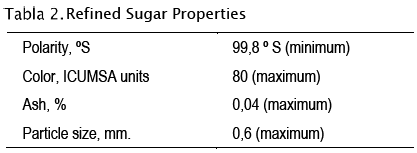
<?xml version="1.0" encoding="ISO-8859-1"?><article xmlns:mml="http://www.w3.org/1998/Math/MathML" xmlns:xlink="http://www.w3.org/1999/xlink" xmlns:xsi="http://www.w3.org/2001/XMLSchema-instance">
<front>
<journal-meta>
<journal-id>1683-0789</journal-id>
<journal-title><![CDATA[Acta Nova]]></journal-title>
<abbrev-journal-title><![CDATA[RevActaNova.]]></abbrev-journal-title>
<issn>1683-0789</issn>
<publisher>
<publisher-name><![CDATA[Universidad Católica Boliviana]]></publisher-name>
</publisher>
</journal-meta>
<article-meta>
<article-id>S1683-07892019000200003</article-id>
<title-group>
<article-title xml:lang="en"><![CDATA[Fine tuning the production of colorless sucrose syrups]]></article-title>
</title-group>
<contrib-group>
<contrib contrib-type="author">
<name>
<surname><![CDATA[Zavaleta Mercado]]></surname>
<given-names><![CDATA[Ronanth]]></given-names>
</name>
<xref ref-type="aff" rid="A01"/>
</contrib>
<contrib contrib-type="author">
<name>
<surname><![CDATA[Losantos Velasco]]></surname>
<given-names><![CDATA[Diana Maria]]></given-names>
</name>
<xref ref-type="aff" rid="A01"/>
</contrib>
</contrib-group>
<aff id="A01">
<institution><![CDATA[,Universidad Católica Boliviana 'San Pablo' Chemical Engineering Department ]]></institution>
<addr-line><![CDATA[La Paz ]]></addr-line>
</aff>
<pub-date pub-type="pub">
<day>00</day>
<month>07</month>
<year>2019</year>
</pub-date>
<pub-date pub-type="epub">
<day>00</day>
<month>07</month>
<year>2019</year>
</pub-date>
<volume>9</volume>
<numero>2</numero>
<fpage>176</fpage>
<lpage>189</lpage>
<copyright-statement/>
<copyright-year/>
<self-uri xlink:href="http://www.scielo.org.bo/scielo.php?script=sci_arttext&amp;pid=S1683-07892019000200003&amp;lng=en&amp;nrm=iso"></self-uri><self-uri xlink:href="http://www.scielo.org.bo/scielo.php?script=sci_abstract&amp;pid=S1683-07892019000200003&amp;lng=en&amp;nrm=iso"></self-uri><self-uri xlink:href="http://www.scielo.org.bo/scielo.php?script=sci_pdf&amp;pid=S1683-07892019000200003&amp;lng=en&amp;nrm=iso"></self-uri><abstract abstract-type="short" xml:lang="en"><p><![CDATA[Sucrose syrup is used worldwide in the food and beverages industry, being produced from high quality sugar and treated water. Even though these high quality raw materials are used, the resulting syrup is very often tinted with an amber color inherited from its constituents and produced during its formulation. This coloration makes it unsuitable for most of its uses, especially for the formulation of colorless products. In order to render a colorless syrup, adsorption with powdered activated carbons is very often used, to effectively remove the color causing agents. The very finely ground carbon is later separated by mechanical means, mainly filtration, sometimes using filtration aids. The problem that arises is that commercial sugar contains variable amounts of color causing agents and, in principle, the ratio activated carbon/sugar needed to obtain an acceptable syrup varies considerably, and should be adjusted to fit the characteristics of the sugar and its processing. This is seldom done, resorting instead to manufacturing "recipes" that could imply the use of excessive amounts of adsorbent. In the present work a quite simple technique is developed that allows the monitoring of the color removal and also the determination of the prevailing technical equilibrium needed for process calculations.]]></p></abstract>
<kwd-group>
<kwd lng="en"><![CDATA[Sucrose syrup]]></kwd>
<kwd lng="en"><![CDATA[colorless sugar syrups]]></kwd>
</kwd-group>
</article-meta>
</front><body><![CDATA[ <p align="right"><font size="2" face="Verdana, Arial, Helvetica, sans-serif"><b> Cientific article</b></font></p>     <p align="right">&nbsp;</p>     <p align="center"><b><font face="Verdana, Arial, Helvetica, sans-serif" size="4">Fine tuning the production of colorless sucrose</font> <font face="Verdana, Arial, Helvetica, sans-serif" size="4">syrups</font></b></p>     <p align="center">&nbsp;</p>     <p align="center">&nbsp;</p>     <p align="center"><b><font face="Verdana, Arial, Helvetica, sans-serif" size="2">Ronanth Zavaleta Mercado &amp; Diana Maria Losantos Velasco</font></b></p>     <p align="center"><font face="Verdana, Arial, Helvetica, sans-serif" size="2">Chemical Engineering Department, Universidad Católica Boliviana &quot;San Pablo&quot; at La Paz</font>    <br> <font face="Verdana, Arial, Helvetica, sans-serif" size="2"><a href="mailto:zavaleta@gmail.com">zavaleta@gmail.com</a></font></p>     <p align="center"><font face="Verdana, Arial, Helvetica, sans-serif" size="2">Recibido: 3 de septiembre 2018    <br> Aceptado: 18 de mayo 2019</font></p>     ]]></body>
<body><![CDATA[<p align="center">&nbsp;</p>     <p align="center">&nbsp;</p> <hr align="JUSTIFY" noshade>     <p align="justify"><font face="Verdana, Arial, Helvetica, sans-serif" size="2"><b>Abstract: </b>Sucrose syrup is used worldwide in the food and beverages industry, being produced from high quality sugar and treated water. Even though these high quality raw materials are used, the resulting syrup is very often tinted with an amber color inherited from its constituents and produced during its formulation. This coloration makes it unsuitable for most of its uses, especially for the formulation of colorless products. In order to render a colorless syrup, adsorption with powdered activated carbons is very often used, to effectively remove the color causing agents. The very finely ground carbon is later separated by mechanical means, mainly filtration, sometimes using filtration aids.</font></p>     <p align="justify"><font face="Verdana, Arial, Helvetica, sans-serif" size="2">The problem that arises is that commercial sugar contains variable amounts of color causing agents and, in principle, the ratio activated carbon/sugar needed to obtain an acceptable syrup varies considerably, and should be adjusted to fit the characteristics of the sugar and its processing. This is seldom done, resorting instead to manufacturing &quot;recipes&quot; that could imply the use of excessive amounts of adsorbent.</font></p>     <p align="justify"><font face="Verdana, Arial, Helvetica, sans-serif" size="2">In the present work a quite simple technique is developed that allows the monitoring of the color removal and also the determination of the prevailing technical equilibrium needed for process calculations.</font></p>     <p align="justify"><font face="Verdana, Arial, Helvetica, sans-serif" size="2"><b>Keywords: </b>Sucrose syrup, colorless sugar syrups.</font></p> <hr align="JUSTIFY" noshade>     <p align="justify">&nbsp;</p>     <p align="justify">&nbsp;</p>     <p align="justify"><font face="Verdana, Arial, Helvetica, sans-serif" size="3"><b>1&nbsp; &nbsp; &nbsp; Introduction</b></font></p>     <p align="justify"><font face="Verdana, Arial, Helvetica, sans-serif" size="2">Sucrose syrups are of importance in the food and beverage industry, not only as sweeteners, but also because of the desirable properties that the syrup confers. Just to give some examples, sucrose syrups are very often used in fruit preparations for flavor enhancing, bitterness reduction in chocolate and coffee products and starch's gelatinization reduction in bakery products. Also, due to its high solubility in water, sugar syrups add weight, volume and texture to the final products. These properties make sucrose syrups a huge business worldwide.</font></p>     ]]></body>
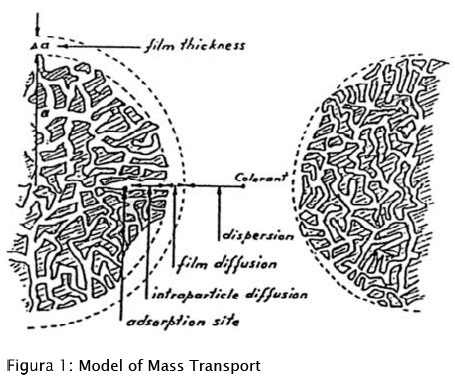
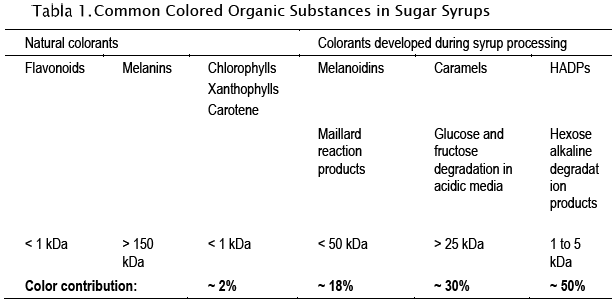
<body><![CDATA[<p align="justify"><font face="Verdana, Arial, Helvetica, sans-serif" size="2">While there is a tendency to use highly refined sugar in syrups preparation, the resulting solutions have a characteristic amber coloration due to the presence of</font> <font face="Verdana, Arial, Helvetica, sans-serif" size="2">colored organic substances that can either result from improper sugar cane harvesting or from inadequate processing methods. The net effect of these compounds is viscosity and turbidity increment. Some of the most common color causing components are presented in <a href="#t1">Table 1</a>.</font></p>     <p align="justify"><font face="Verdana, Arial, Helvetica, sans-serif" size="2">These components can be removed from the syrups through vacuum or pressure filtration, methods that are usually non effective for complete color removal. Flotation and aeration with phosphoric acid and lime can also be used, but are mostly applied in the production of raw sugar syrup before white sugar production. Industrial processes of clarification usually imply the use of adsorbents, like paper pulp on smaller scales, or egg albumin, use that has been decreasing because it can change the syrup's pH considerably. Also, technologies using nanofiltration separations are proposed.</font></p>     <p align="justify"><font face="Verdana, Arial, Helvetica, sans-serif" size="2">Nevertheless, the use of activated carbon as an adsorbing agent for sugar syrups treatment is widespread, because of its <i>&quot;high decolorizing power, high capacity for colloids adsorption, high clarifying power, and good filterability&quot; </i>due to its high porosity and internal surface area.</font></p>     <p align="center"><a name="t1"></a><img src="/img/revistas/ran/v9n2/a02_table_01.gif" width="616" height="303"></p>     <p align="justify"><font face="Verdana, Arial, Helvetica, sans-serif" size="2">These properties are developed during the activating process of carbon that includes the pyrolysis of carbonaceous material at temperatures below 800&ordm; C and its further activation at 1000&ordm;  C. The residual carbon atoms tend to aggregate forming sheets that rearrange in an irregular way with strong links between them, leaving free spaces that are usually filled with some secondary decomposition products that are leached away during the activation process. As a result, activated carbons have a large quantity of randomly distributed pores that confer these materials optimal adsorbing capacities.</font></p>     <p align="justify"><font face="Verdana, Arial, Helvetica, sans-serif" size="2">The activated carbon adsorption process implies the selective mass transfer and retention of impurities, by means of strong physical bonding. This way, colored contaminants are <i>&quot;adsorbed because the attraction of the carbon surface is stronger than the attractive forces that keep them dissolved in solution&quot;. </i>Then, the process depends on both the formation of adequate solid-liquid interphase for mass transfer and the overcoming of the diffusive mass-transfer resistance associated with the boundary layer formed (<a href="#f1">Figure 1</a>).</font></p>     <p align="center"><a name="f1"></a><img src="/img/revistas/ran/v9n2/a02_figure_01.gif" width="455" height="378"></p>     <p align="justify"><font face="Verdana, Arial, Helvetica, sans-serif" size="2">Typically the adsorption process is carried out until an equilibrium condition is reached (when no further variation is presented in the removal of impurities). Isotherms describing the phase equilibrium can then be determined experimentally.</font></p>     <p align="justify">&nbsp;</p>     <p align="justify"><font face="Verdana, Arial, Helvetica, sans-serif" size="3"><b>2&nbsp; &nbsp; &nbsp; Rationale</b></font></p>     ]]></body>
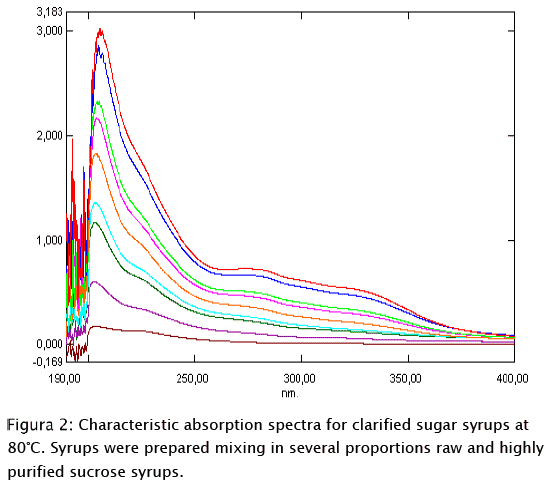
<body><![CDATA[<p align="justify"><font face="Verdana, Arial, Helvetica, sans-serif" size="2">From previous experience it was learned that color causing agents show reproducible absorptions in the UV region, where proportionality to their concentrations was appreciated by the authors. Based on these experiences it was proposed to calibrate a spectrophotometer by preparing different solutions of commercially available sugars obtained from sugar cane, and hopefully to use this calibration to follow the dynamics of the color removal from syrups.</font></p>     <p align="justify"><font face="Verdana, Arial, Helvetica, sans-serif" size="2">Having the quantitative analytical technique available, it may be possible to determine a recommended activated carbon dosage for each syrup based on a simple fast analysis, as well as the adsorption isotherms for commercially available sugar-</font><font face="Verdana, Arial, Helvetica, sans-serif" size="2">activated carbon pairs, making it possible to fine tune the discoloration process by adjusting the corresponding operating parameters.</font></p>     <p align="justify"><font face="Verdana, Arial, Helvetica, sans-serif" size="2">This may also help control the quality of the sugar and the suitability of the commercially available activated carbons for the process to be devoted to obtaining the clarified syrups, with potentially inherent reductions in operating costs.</font></p>     <p align="justify"><font face="Verdana, Arial, Helvetica, sans-serif" size="2">Therefore, if the mentioned developments prove to be possible, the economics of the production of sucrose syrups could be improved, with an important impact if the dimensions of the businesses associated with these syrups are taken into account.</font></p>     <p align="justify">&nbsp;</p>     <p align="justify"><font face="Verdana, Arial, Helvetica, sans-serif" size="3"><b>3&nbsp; &nbsp; &nbsp; Experimental</b></font></p>     <p align="justify"><font face="Verdana, Arial, Helvetica, sans-serif" size="2"><b>3.1&nbsp; &nbsp; &nbsp; Development of a quantitative analytical technique</b></font></p>     <p align="justify"><font face="Verdana, Arial, Helvetica, sans-serif" size="2">Experimental spectrophotometer spectra for sugar syrups are shown in <a href="#f2">Figure 2</a>. The observed behavior seems to be consistent in all of them with peak heights proportional to the color causing agents concentrations. The absorption spectra observed in <a href="#f2">Figure 2</a> show a maxima around 205 nm, probably due to </font><font size="2"><i>&#960;</i></font><font face="Verdana, Arial, Helvetica, sans-serif" size="2"> to </font><font size="2"><i>&#960;</i></font><font face="Verdana, Arial, Helvetica, sans-serif" size="2"><i>* </i>transitions related to electromagnetic radiation by unsaturated double bonds (chromophores going from a ground state to an excited one), since the wavelength corresponding to the maxima observed is associated with energy requirements congruent with such transitions. Also, a small &quot;blue shift&quot; (shifting to shorter wavelengths due to a higher electron solvation) in maxima is observed, which is probably caused by the polar nature of the solvent (water).</font></p>     <p align="justify"><font face="Verdana, Arial, Helvetica, sans-serif" size="2">Several of the known color forming compounds present in the syrup, including flavonoids, melanins, chlorophylls, xanthophylls and carotenes, do contain double bounds in their chemical structure. Since absorbance in liquids around this wavelength is not compound specific, but rather bond-type specific, the observed absorbance spectra are probably due to the mentioned</font><font size="2"><i> &#960;</i></font><font face="Verdana, Arial, Helvetica, sans-serif" size="2"> to </font><font size="2"><i>&#960;</i></font><font face="Verdana, Arial, Helvetica, sans-serif" size="2"><i>* </i>transitions in all double-bond containing compounds. This common characteristic of the chromophores associated with the color causing agents present in the sucrose syrup is probably responsible for the measured absorbance that in a way may be proportional to its total concentration. Therefore, it may be possible to further explore this idea in order to develop a quantitative analytical technique for the determination of the concentration of the color causing compounds in sugar syrups.</font></p>     <p align="justify"><font face="Verdana, Arial, Helvetica, sans-serif" size="2"><b>3.2</b>&nbsp; &nbsp; &nbsp;<b>Instrument calibration</b></font></p>     ]]></body>
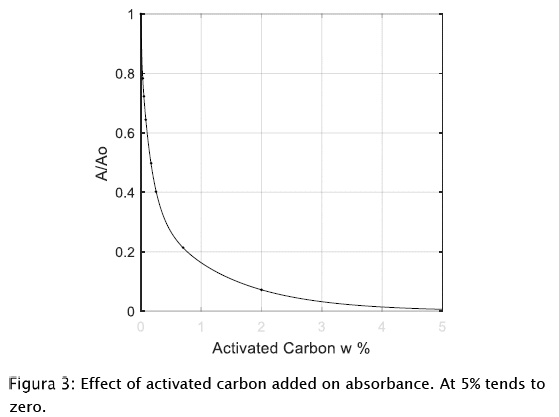
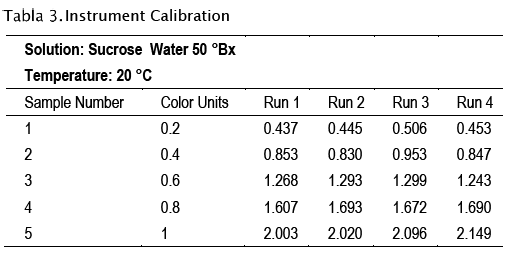
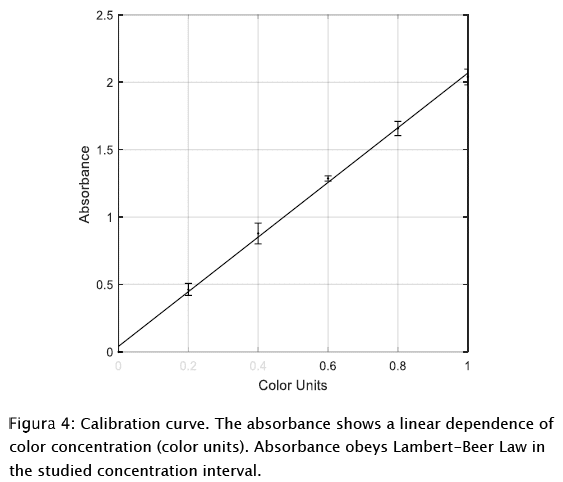
<body><![CDATA[<p align="justify"><font face="Verdana, Arial, Helvetica, sans-serif" size="2">Data for <a href="#f3">Figure 3</a> was obtained by preparing 50 &deg;Bx (50 Brix degrees, or 50 mass %) sucrose solutions of decreasing concentrations of color causing agents, by mixing colorless treated syrups with raw ones, obtained by dissolving commercial refined sugar in deionized water (conductivity under 3 &#956;S/cm). SUCHAR-NFR powdered</font> <font face="Verdana, Arial, Helvetica, sans-serif" size="2">activated carbon was used as adsorbent (Clarimex S.A, Mexico), with a particle size of 325 mesh. As isothermal enclosure for the preparation of samples, a POL-EKO-APARATURA SLN 115 STD drying oven was used. Filtration of the activated carbon treated samples was performed by means of Chm F1001 qualitative filter paper (Chemlab group).</font></p>     <p align="center"><a name="t2"></a><img src="/img/revistas/ran/v9n2/a02_table_02.gif" width="417" height="153"></p>     <p align="justify"><font face="Verdana, Arial, Helvetica, sans-serif" size="2">Spectral absorbance determinations were made by means of a Shimadzu UV-1800 UV-Vis Spectrophotometer (scanning range employed: 190 - 600 nm), using completely colorless syrup treated with 5% activated carbon (See <a href="#f3">Figure 3</a>). A proportional behavior with concentration was observed in <a href="#f2">Figure 2</a>.</font></p>     <p align="center"><a name="f2"></a><img src="/img/revistas/ran/v9n2/a02_figure_02.gif" width="553" height="489"></p>     <p align="center">&nbsp;</p>     <p align="center"><a name="f3"></a><img src="/img/revistas/ran/v9n2/a02_figure_03.gif" width="559" height="417"></p>     <p align="justify"><font face="Verdana, Arial, Helvetica, sans-serif" size="2">Five runs were made with varying ratios of raw syrup/highly purified syrup, as shown in <a href="#t3">Table 3</a>. Four replicates were performed for each run and the confidence intervals were obtained by Student analysis (95% confidence). The raw syrup was assigned an arbitrary color grade of 1 unit (1 color unit), while the highly purified syrup was assigned 0 color units. The mixtures color grades were assigned the corresponding proportional values. The color concentration was assumed to be proportional to the peak height in the 200-205 nm range (maximum of the spectral distribution taking into account the previously observed &quot;blue shift&quot;). No attempt was made to correlate the color concentration to peak subtended areas. The experimental design and results are shown in <a href="#t3">Table 3</a>.</font></p>     <p align="justify"><font face="Verdana, Arial, Helvetica, sans-serif" size="2">The experimental calibration curve for the instrument is depicted in <a href="#f4">Figure 4</a>. The Lambert—Beer law is followed in the experimental range with quite tight confidence intervals for all tested points.</font></p>     <p align="justify"><font face="Verdana, Arial, Helvetica, sans-serif" size="2">Therefore, the experimental analytical technique was deemed suitable for carrying out the color syrup/activated carbon equilibrium determinations.</font></p>     <p align="justify"><font face="Verdana, Arial, Helvetica, sans-serif" size="2"><b>3.3&nbsp; &nbsp; &nbsp; Process dynamics</b></font></p>     ]]></body>
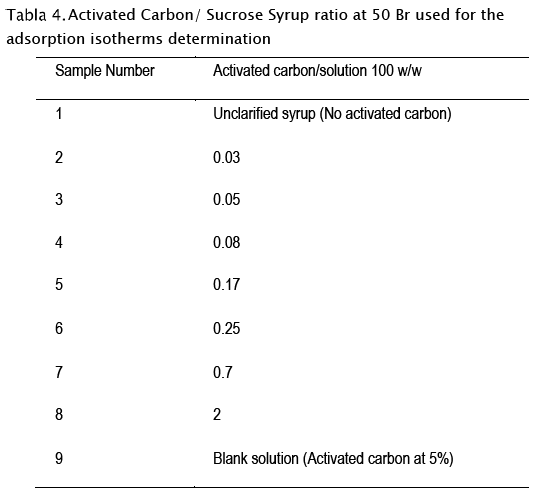
<body><![CDATA[<p align="justify"><font face="Verdana, Arial, Helvetica, sans-serif" size="2">The study of unsteady state mass transfer process from the syrup to the adsorbing activated carbon was beyond the scope of this work. Nevertheless, in order to insure that a technical equilibrium was reached, close monitoring in changes of concentration were performed on the adsorption runs, after an initial thorough</font> <font face="Verdana, Arial, Helvetica, sans-serif" size="2">homogenization of the mixture. It was noted that in general, most of the adsorption process took place during the first 15 minutes. Notwithstanding, much larger contact times were provided to ensure reaching equilibrium states (60 minutes or more). The adsorption process was stopped when no further changes in concentration were observed.</font></p>     <p align="center"><a name="t3"></a><img src="/img/revistas/ran/v9n2/a02_table_03.gif" width="510" height="254"></p>     <p align="center">&nbsp;</p>     <p align="center"><a name="f4"></a><img src="/img/revistas/ran/v9n2/a02_figure_04.gif" width="563" height="482"></p>     <p align="justify"><font face="Verdana, Arial, Helvetica, sans-serif" size="2"><b>3.4     Equilibrium adsorption isotherms determination</b></font></p>     <p align="justify"><font face="Verdana, Arial, Helvetica, sans-serif" size="2">Adsorption isotherms were determined at 40, 60 and 80 &deg; C for several activated carbon/ sucrose solution ratios (w/w) as shown in <a href="#t4">Table 4</a>.</font></p>     <p align="center"><a name="t4"></a><img src="/img/revistas/ran/v9n2/a02_table_04.gif" width="550" height="496"></p>     <p align="justify"><font face="Verdana, Arial, Helvetica, sans-serif" size="2">The procedure, common to all the experimental runs, was quite straightforward. Equal amounts of 50 Br syrup, previously prepared and kept at 5&deg;C in amber bottles, were heated to the required temperature with occasional stirring in a laboratory oven, and activated carbon was added when the desired temperature was reached. The adsorption medium was homogenized by strong stirring and let to reach equilibrium with occasional stirring. Contact time was set to 1 hour for all the runs. At the end of each run, the suspended activated carbon was removed by filtration and the filtrate was analyzed to determine its color content. The runs were replicated three times for each temperature with every activated carbon/untreated syrup ratio in the experimental design. A total of 63 runs were performed.</font></p>     <p align="justify"><font face="Verdana, Arial, Helvetica, sans-serif" size="2">The following experimental variables were determined for data correlation:</font></p>     <p align="center"><img src="/img/revistas/ran/v9n2/a02_ecuation_01.gif" width="468" height="54"></p>     ]]></body>
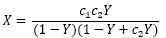
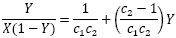
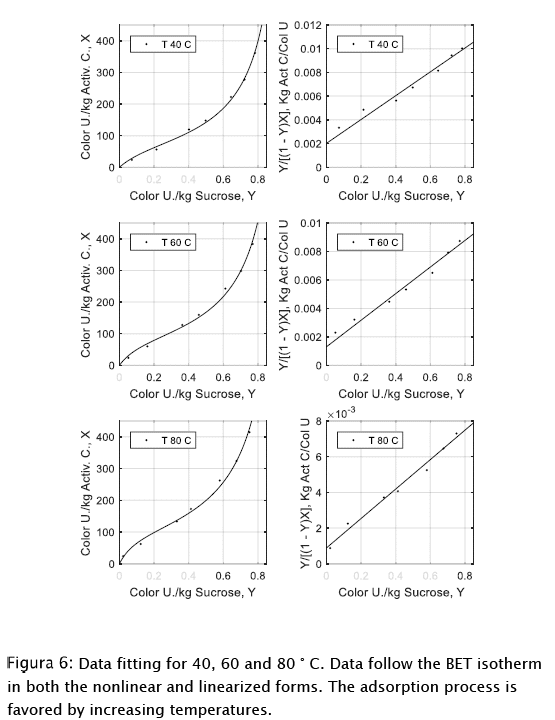
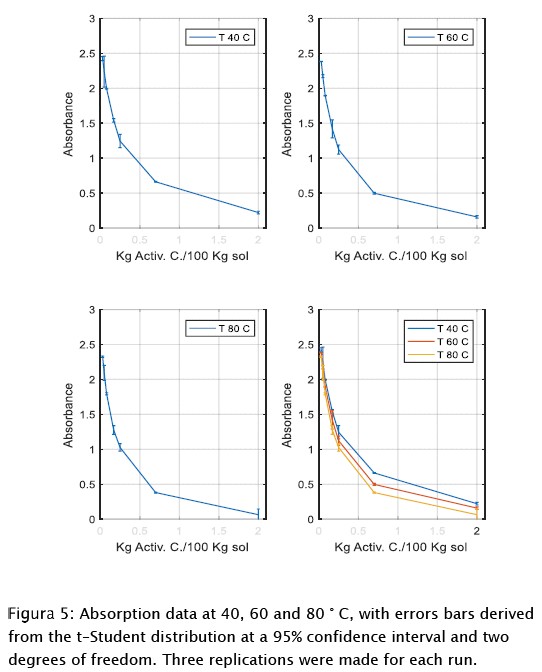
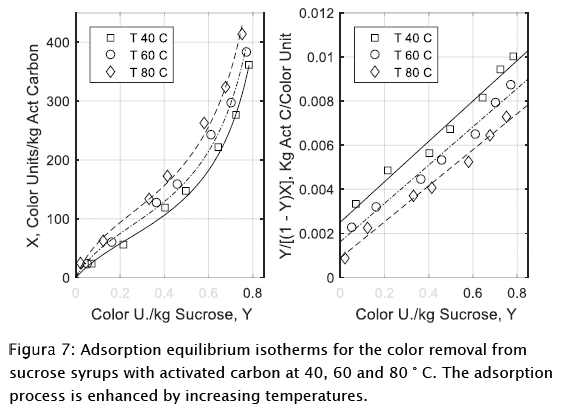
<body><![CDATA[<p align="justify"><font face="Verdana, Arial, Helvetica, sans-serif" size="2">Where Y is the color content in the liquid phase, while X refers to the color concentration in the solid phase, in relevant units. A refers to the absorbance of the treated syrups while A<sub>o</sub> is the absorbance of the untreated one. This syrup was arbitrarily assigned a color concentration of 1 color unit per kg of untreated 50 &deg;Bx syrup, or its equivalent value of 1 color unit per 0.5 kg of sucrose present in the solution at this concentration. Here c is the mass ratio of activated carbon to sucrose syrup.</font></p>     <p align="justify">&nbsp;</p>     <p align="justify"><font face="Verdana, Arial, Helvetica, sans-serif" size="3"><b>4&nbsp; &nbsp; &nbsp; Results and discussion</b></font></p>     <p align="justify"><font face="Verdana, Arial, Helvetica, sans-serif" size="2">The absorbance data for runs at 40, 60 and 80 &deg; C is presented in <a href="#f5">Figure 5</a>, with errors bars derived from the t-Student distribution at a 95% confidence interval and two degrees of freedom. Also, in <a href="#f5">Figure 5</a> this data is fitted to the Brunauer-Emmett-Teller (BET) isotherm, both in linear and nonlinear forms. Numerical methods were employed for the multivariable nonlinear regression analysis including conjugate gradient algorithms, minimizing the standard deviation associated with the absolute total fitting error. In <a href="#f6">Figure 6</a> the isotherms at the chosen temperatures are plotted in the same graphs to show the effect of temperature on the adsorption process.</font></p>     <p align="justify"><font face="Verdana, Arial, Helvetica, sans-serif" size="2">The data is well correlated by the Brunauer-Emmett-Teller (BET) isotherm using the Y - X experimental variables described above and for all the temperatures studied, both in linear and nonlinear forms, as can be seen in <a href="#f6">Figure 6</a>. The BET equations used were the following:</font></p>     <p align="center"><img src="/img/revistas/ran/v9n2/a02_ecuation_02.gif" width="166" height="38"></p>     <p align="justify"><font face="Verdana, Arial, Helvetica, sans-serif" size="2">and</font></p>     <p align="center"><img src="/img/revistas/ran/v9n2/a02_ecuation_03.gif" width="176" height="38"></p>     <p align="center"><a name="f5"></a><img src="/img/revistas/ran/v9n2/a02_figure_05.gif" width="542" height="672"></p>     <p align="justify"><font face="Verdana, Arial, Helvetica, sans-serif" size="2">As can be observed, the adsorption process equilibrium is enhanced by increasing temperatures in the studied temperature range. Higher degrees of color removal are obtained with increasing temperature while keeping the ratio of activated carbon to syrup constant. This observation seems to be further reinforced by the industrial practice that uses in general, temperatures well above the ambient ones, beyond the need to lower the viscosity of the sucrose syrups for manipulation, agitation and required improvements in mass transfer.</font></p>     ]]></body>
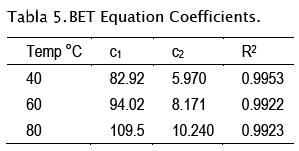
<body><![CDATA[<p align="center"><a name="f6"></a><img src="/img/revistas/ran/v9n2/a02_figure_06.gif" width="555" height="720"></p>     <p align="justify"><font face="Verdana, Arial, Helvetica, sans-serif" size="2">The obtained regression coefficients are given in <a href="#t5">Table 5</a>.</font></p>     <p align="center"><a name="t5"></a><img src="/img/revistas/ran/v9n2/a02_table_05.gif" width="299" height="151"></p>     <p align="justify"><font face="Verdana, Arial, Helvetica, sans-serif" size="2">Both coefficients c<sub>1</sub> and c<sub>2</sub> are temperature dependent and could easily be fitted to simple mathematical expressions to reproduce the experimental data. However, in that case the results interpretation becomes difficult. The first coefficient c<sub>1</sub> is related to the adsorbed quantity when a simple monolayer is formed and such a strong temperature dependence with modest increase in temperature becomes difficult to explain from theoretical grounds.</font></p>     <p align="center"><a name="f7"></a><img src="/img/revistas/ran/v9n2/a02_figure_07.gif" width="562" height="411"></p>     <p align="justify"><font face="Verdana, Arial, Helvetica, sans-serif" size="2">There are also other problems that defy a simple explanation. At the beginning of the work a physical absorption type behavior was expected: not very specific, with modest energy evolutions involved, and possibly, reversible with multilayer deposition. If this would have been the case, then the whole process would have benefitted from lower temperatures. However, this temperature dependence was not observed, as was mentioned before. The increase in some transport properties with temperature, like the mass transfer constant, is irrelevant at equilibrium, since once it is reached, no net mass transfer between the involved phases takes place.</font></p>     <p align="justify"><font face="Verdana, Arial, Helvetica, sans-serif" size="2">Thus, another explanation is needed, one that justifies a favorable equilibrium behavior with increasing temperature, that also implies spontaneity being favored by temperature increments.</font></p>     <p align="justify"><font face="Verdana, Arial, Helvetica, sans-serif" size="2">In this matter, a thermodynamic approach could be explored. By definition:</font></p>     <p align="center"><b><font size="3" face="Verdana, Arial, Helvetica, sans-serif">&Delta;<i>G</i>= &Delta;<i>H</i>&minus;<i>T</i>&Delta;<i>S</i></font></b></p>     <p align="justify"><font face="Verdana, Arial, Helvetica, sans-serif" size="2">At constant pressure, process spontaneity requires that:</font></p>     ]]></body>
<body><![CDATA[<p align="center"><font face="Verdana, Arial, Helvetica, sans-serif" size="3"><b>&#916;<i>G &lt; </i>0</b></font></p>     <p align="justify"><font face="Verdana, Arial, Helvetica, sans-serif" size="2">The liquid solid phase thermodynamic transitions that take place in the adsorption process are exothermic, and therefore &#916;H &lt; 0 and &#916;S &lt; 0. Consequently, for the Gibbs energy to maintain its negative slope it is required that the adsorption enthalpy decreases with temperature. Also it is possible that the phase entropy evolution in the adsorption process follows a similar path, or at least if it increases with temperature, this increment is smaller than the corresponding decrease in enthalpy. In any case it seems that the adsorption process is enthalpy driven and not entropy driven.</font></p>     <p align="justify"><font face="Verdana, Arial, Helvetica, sans-serif" size="2">The decreasing behavior of the adsorption enthalpy was considered previously, especially in the derivation of widely used equilibrium isotherms, such as those due to Freundlich and Temkin. However, in those cases a coverage dependence of the adsorption enthalpy was considered, as opposed to a temperature one postulated here. Also, experimental runs show X values much greater than the c<sub>1</sub> coverage related BET Equation parameter. This seems to indicate that in the color removal process of sucrose solutions, a multilayer adsorption takes place, and therefore the coverage is always 1. The coverage is understood as the fraction of the adsorbent bare surface that is actually covered by adsorbed molecules.</font></p>     <p align="justify"><font face="Verdana, Arial, Helvetica, sans-serif" size="2">An explanation of the above discussed behavior is beyond the scope of this work, but on the light of the discussed results the obtained data and the models fitted should be taken as experimental data valid for design within the domain of the studied parameters.</font></p>     <p align="justify"><font face="Verdana, Arial, Helvetica, sans-serif" size="2">However, it is known that the retention in the solid phase of color causing agents is the consequence of physical adsorption, and that active or polar compounds could establish quasi-steady non-equilibrium local concentration regions that are only very slowly reversible. The increasing temperature facilitates the transport from the liquid to the liquid-solid interphase of color causing molecules giving place to high concentration regions in the vicinity of the solid phase, regions that could be further stabilized by the combined effect of weak potential energy interactions and coulombic attractions, especially in polar molecules.</font></p>     <p align="justify"><font face="Verdana, Arial, Helvetica, sans-serif" size="2">The above possible scenario does not correspond to a state of thermodynamic equilibrium and therefore any further thermodynamics consistency test should not be performed. This, however, does not invalidate the applicability of the derived data, since engineering applications do not need necessarily the equilibrium to be reached.</font></p>     <p align="justify"><font face="Verdana, Arial, Helvetica, sans-serif" size="2">Finally, the used techniques are very simple and can be applied in the adsorption processing of any kind of refined sugar syrups that use activated carbons for this purpose.</font></p>     <p align="justify">&nbsp;</p>     <p align="justify"><font face="Verdana, Arial, Helvetica, sans-serif" size="3"><b>Bibliographic references</b></font></p>     <!-- ref --><p align="justify"><font size="2" face="Verdana, Arial, Helvetica, sans-serif">[1] Sugar, N. (2012). The  Functional Properties of Sugar. </font>&nbsp;&nbsp;&nbsp;&nbsp;&nbsp;&nbsp;&nbsp;&nbsp;[&#160;<a href="javascript:void(0);" onclick="javascript: window.open('/scielo.php?script=sci_nlinks&ref=791396&pid=S1683-0789201900020000300001&lng=','','width=640,height=500,resizable=yes,scrollbars=1,menubar=yes,');">Links</a>&#160;]<!-- end-ref --><p align="justify"><font size="2" face="Verdana, Arial, Helvetica, sans-serif">[2] Sharapin, N. (2000). Fundamentos de tecnolog&iacute;a de productos  fitoterap&eacute;uticos (No. 78). Convenio Andr&eacute;s Bello, 117. </font></p>     <p align="justify"><font size="2" face="Verdana, Arial, Helvetica, sans-serif">[3] Chen, J. C., &amp; Chou,  C. C. (1993). Cane sugar handbook: a manual for cane sugar manufacturers and  their chemists (No. Ed. 12). John Wiley and Sons, Inc., 156-159. </font></p>     <p align="justify"><font size="2" face="Verdana, Arial, Helvetica, sans-serif">[4] Harris, E. W. (1942).  Activated carbon in sugar refining. <i>Industrial &amp; Engineering Chemistry</i>, <i>34</i>(9), 1057-1060. </font></p>     <p align="justify"><font size="2" face="Verdana, Arial, Helvetica, sans-serif">[5] Gula, F., &amp; Paillat,  D. (2005). Discoloration of refinery liquors: a technical and economic  comparison between the different systems using activated carbon or resins.  International sugar journal, 107(1276), 235-240. </font></p>     <!-- ref --><p align="justify"><font size="2" face="Verdana, Arial, Helvetica, sans-serif">[6] Bansal, R. C., &amp;  Goyal, M. (2005). <i>Activated carbon adsorption</i>. CRC press. </font>&nbsp;&nbsp;&nbsp;&nbsp;&nbsp;&nbsp;&nbsp;&nbsp;[&#160;<a href="javascript:void(0);" onclick="javascript: window.open('/scielo.php?script=sci_nlinks&ref=791401&pid=S1683-0789201900020000300006&lng=','','width=640,height=500,resizable=yes,scrollbars=1,menubar=yes,');">Links</a>&#160;]<!-- end-ref --><!-- ref --><p align="justify"><font size="2" face="Verdana, Arial, Helvetica, sans-serif">[7] Roy, G. M. (1994).  Activated carbon applications in the food and pharmaceutical industries. CRC  Press. </font>&nbsp;&nbsp;&nbsp;&nbsp;&nbsp;&nbsp;&nbsp;&nbsp;[&#160;<a href="javascript:void(0);" onclick="javascript: window.open('/scielo.php?script=sci_nlinks&ref=791402&pid=S1683-0789201900020000300007&lng=','','width=640,height=500,resizable=yes,scrollbars=1,menubar=yes,');">Links</a>&#160;]<!-- end-ref --><p align="justify"><font size="2" face="Verdana, Arial, Helvetica, sans-serif">[8] <i>Ibid </i> </font></p>     <p align="justify"><font size="2" face="Verdana, Arial, Helvetica, sans-serif">[9] Skoog, D.A.,&amp; J.J.  Leary, <i>&ldquo;Principles of Instrumental Analysis&rdquo;</i>, 4th Ed., Saunders College Publishing 1992, 152-153 </font></p>     <p align="justify"><font size="2" face="Verdana, Arial, Helvetica, sans-serif">[10] Skoog, D. A., Holler, F.  J., &amp; Nieman, T. A. (1998). Principios de  an&aacute;lisis instrumental. Ed. McGraw Hill, 5ta Edici&oacute;n, 2001, 354-358 </font></p>     <!-- ref --><p align="justify"><font size="2" face="Verdana, Arial, Helvetica, sans-serif">[11] Guabir&aacute; S.A Sugar Cane Mill </font>&nbsp;&nbsp;&nbsp;&nbsp;&nbsp;&nbsp;&nbsp;&nbsp;[&#160;<a href="javascript:void(0);" onclick="javascript: window.open('/scielo.php?script=sci_nlinks&ref=791406&pid=S1683-0789201900020000300010&lng=','','width=640,height=500,resizable=yes,scrollbars=1,menubar=yes,');">Links</a>&#160;]<!-- end-ref --><p align="justify"><font size="2" face="Verdana, Arial, Helvetica, sans-serif">[12] Smith, J.M, <i>&ldquo;Chemical  Engineering Kinetics&rdquo;, </i>McGraw-Hill Book Company, 2nd Edition, pp. 333-334. </font></p>     <p align="justify">&nbsp;</p>      ]]></body><back>
<ref-list>
<ref id="B1">
<label>1</label><nlm-citation citation-type="">
<person-group person-group-type="author">
<name>
<surname><![CDATA[Sugar]]></surname>
<given-names><![CDATA[N.]]></given-names>
</name>
</person-group>
<source><![CDATA[The Functional Properties of Sugar]]></source>
<year>2012</year>
</nlm-citation>
</ref>
<ref id="B2">
<label>2</label><nlm-citation citation-type="book">
<person-group person-group-type="author">
<name>
<surname><![CDATA[Sharapin]]></surname>
<given-names><![CDATA[N.]]></given-names>
</name>
</person-group>
<source><![CDATA[Fundamentos de tecnología de productos fitoterapéuticos]]></source>
<year>2000</year>
<page-range>117</page-range><publisher-name><![CDATA[Convenio Andrés Bello]]></publisher-name>
</nlm-citation>
</ref>
<ref id="B3">
<label>3</label><nlm-citation citation-type="book">
<person-group person-group-type="author">
<name>
<surname><![CDATA[Chen]]></surname>
<given-names><![CDATA[J.C.]]></given-names>
</name>
<name>
<surname><![CDATA[Chou]]></surname>
<given-names><![CDATA[C.C.]]></given-names>
</name>
</person-group>
<source><![CDATA[Cane sugar handbook: a manual for cane sugar manufacturers and their chemists]]></source>
<year>1993</year>
<edition>12</edition>
<page-range>156-159</page-range><publisher-name><![CDATA[John Wiley and Sons, Inc]]></publisher-name>
</nlm-citation>
</ref>
<ref id="B4">
<label>4</label><nlm-citation citation-type="journal">
<person-group person-group-type="author">
<name>
<surname><![CDATA[Harris]]></surname>
<given-names><![CDATA[E.W.]]></given-names>
</name>
</person-group>
<article-title xml:lang="en"><![CDATA[Activated carbon in sugar refining]]></article-title>
<source><![CDATA[Industrial & Engineering Chemistry]]></source>
<year>1942</year>
<volume>34</volume>
<numero>9</numero>
<issue>9</issue>
<page-range>1057-1060</page-range></nlm-citation>
</ref>
<ref id="B5">
<label>5</label><nlm-citation citation-type="journal">
<person-group person-group-type="author">
<name>
<surname><![CDATA[Gula]]></surname>
<given-names><![CDATA[F.]]></given-names>
</name>
<name>
<surname><![CDATA[Paillat]]></surname>
<given-names><![CDATA[D]]></given-names>
</name>
</person-group>
<article-title xml:lang="en"><![CDATA[Discoloration of refinery liquors: a technical and economic comparison between the different systems using activated carbon or resins]]></article-title>
<source><![CDATA[International sugar journal]]></source>
<year>2005</year>
<volume>107</volume>
<numero>1276</numero>
<issue>1276</issue>
<page-range>235-240</page-range></nlm-citation>
</ref>
<ref id="B6">
<label>6</label><nlm-citation citation-type="book">
<person-group person-group-type="author">
<name>
<surname><![CDATA[Bansal]]></surname>
<given-names><![CDATA[R.C.]]></given-names>
</name>
<name>
<surname><![CDATA[Goyal]]></surname>
<given-names><![CDATA[M.]]></given-names>
</name>
</person-group>
<source><![CDATA[Activated carbon adsorption]]></source>
<year>2005</year>
<publisher-name><![CDATA[CRC press]]></publisher-name>
</nlm-citation>
</ref>
<ref id="B7">
<label>7</label><nlm-citation citation-type="book">
<person-group person-group-type="author">
<name>
<surname><![CDATA[Roy]]></surname>
<given-names><![CDATA[G.M.]]></given-names>
</name>
</person-group>
<source><![CDATA[Activated carbon applications in the food and pharmaceutical industries]]></source>
<year>1994</year>
<publisher-name><![CDATA[CRC Press]]></publisher-name>
</nlm-citation>
</ref>
<ref id="B8">
<label>9</label><nlm-citation citation-type="book">
<person-group person-group-type="author">
<name>
<surname><![CDATA[Skoog]]></surname>
<given-names><![CDATA[D.A.]]></given-names>
</name>
<name>
<surname><![CDATA[Leary]]></surname>
<given-names><![CDATA[J.J.]]></given-names>
</name>
</person-group>
<source><![CDATA[“Principles of Instrumental Analysis”]]></source>
<year>1992</year>
<page-range>152-153</page-range><publisher-name><![CDATA[Saunders College Publishing]]></publisher-name>
</nlm-citation>
</ref>
<ref id="B9">
<label>10</label><nlm-citation citation-type="book">
<person-group person-group-type="author">
<name>
<surname><![CDATA[Skoog]]></surname>
<given-names><![CDATA[D.A.]]></given-names>
</name>
<name>
<surname><![CDATA[Holler]]></surname>
<given-names><![CDATA[F.J.]]></given-names>
</name>
<name>
<surname><![CDATA[Nieman]]></surname>
<given-names><![CDATA[T.A.]]></given-names>
</name>
</person-group>
<source><![CDATA[Principios de análisis instrumental]]></source>
<year>1998</year>
<edition>5</edition>
<page-range>354-358</page-range><publisher-name><![CDATA[McGraw Hill]]></publisher-name>
</nlm-citation>
</ref>
<ref id="B10">
<label>11</label><nlm-citation citation-type="">
<collab>Guabirá S.A.</collab>
<source><![CDATA[Sugar Cane Mill]]></source>
<year></year>
</nlm-citation>
</ref>
<ref id="B11">
<label>12</label><nlm-citation citation-type="book">
<person-group person-group-type="author">
<name>
<surname><![CDATA[Smith]]></surname>
<given-names><![CDATA[J.M.]]></given-names>
</name>
</person-group>
<source><![CDATA[Chemical Engineering Kinetics]]></source>
<year></year>
<edition>2</edition>
<page-range>333-334</page-range><publisher-name><![CDATA[McGraw-Hill Book Company]]></publisher-name>
</nlm-citation>
</ref>
</ref-list>
</back>
</article>