<?xml version="1.0" encoding="ISO-8859-1"?><article xmlns:mml="http://www.w3.org/1998/Math/MathML" xmlns:xlink="http://www.w3.org/1999/xlink" xmlns:xsi="http://www.w3.org/2001/XMLSchema-instance">
<front>
<journal-meta>
<journal-id>1683-0789</journal-id>
<journal-title><![CDATA[Acta Nova]]></journal-title>
<abbrev-journal-title><![CDATA[RevActaNova.]]></abbrev-journal-title>
<issn>1683-0789</issn>
<publisher>
<publisher-name><![CDATA[Universidad Católica Boliviana]]></publisher-name>
</publisher>
</journal-meta>
<article-meta>
<article-id>S1683-07892019000100007</article-id>
<title-group>
<article-title xml:lang="es"><![CDATA[Design of an Internet of Things Environment Based on a Photovoltaic Panel Controller for the Massive Use of Solar Electric Energy in Urban Areas]]></article-title>
<article-title xml:lang="en"><![CDATA[Diseño de un entorno de Internet de las cosas basado en un controlador de panel fotovoltaico para el uso masivo de energía eléctrica solar en áreas urbanas]]></article-title>
</title-group>
<contrib-group>
<contrib contrib-type="author">
<name>
<surname><![CDATA[Cruz de la Cruz]]></surname>
<given-names><![CDATA[José Emmanuel]]></given-names>
</name>
<xref ref-type="aff" rid="A01"/>
</contrib>
<contrib contrib-type="author">
<name>
<surname><![CDATA[Romero Goyzueta]]></surname>
<given-names><![CDATA[Christian Augusto]]></given-names>
</name>
<xref ref-type="aff" rid="A01"/>
</contrib>
<contrib contrib-type="author">
<name>
<surname><![CDATA[Cruz Lipe]]></surname>
<given-names><![CDATA[Joel Angel]]></given-names>
</name>
<xref ref-type="aff" rid="A02"/>
</contrib>
</contrib-group>
<aff id="A01">
<institution><![CDATA[,Universidad Nacional del Altiplano  ]]></institution>
<addr-line><![CDATA[Puno ]]></addr-line>
<country>Perú</country>
</aff>
<aff id="A02">
<institution><![CDATA[,Universidad Nacional de San Agustín  ]]></institution>
<addr-line><![CDATA[Cercado Arequipa]]></addr-line>
<country>Perú</country>
</aff>
<pub-date pub-type="pub">
<day>00</day>
<month>03</month>
<year>2019</year>
</pub-date>
<pub-date pub-type="epub">
<day>00</day>
<month>03</month>
<year>2019</year>
</pub-date>
<volume>9</volume>
<numero>1</numero>
<fpage>130</fpage>
<lpage>143</lpage>
<copyright-statement/>
<copyright-year/>
<self-uri xlink:href="http://www.scielo.org.bo/scielo.php?script=sci_arttext&amp;pid=S1683-07892019000100007&amp;lng=en&amp;nrm=iso"></self-uri><self-uri xlink:href="http://www.scielo.org.bo/scielo.php?script=sci_abstract&amp;pid=S1683-07892019000100007&amp;lng=en&amp;nrm=iso"></self-uri><self-uri xlink:href="http://www.scielo.org.bo/scielo.php?script=sci_pdf&amp;pid=S1683-07892019000100007&amp;lng=en&amp;nrm=iso"></self-uri><abstract abstract-type="short" xml:lang="en"><p><![CDATA[A controller of photovoltaic panels was designed to take advantage of solar electric power, facilitate and promote its use in urban areas; the controller connects with a server to send data of its status and also request important information that will help its autonomy and efficiency, the information that server provides is based on a statistical analysis, the variables analyzed are the voltage on the photovoltaic panel that is directly proportional to the radiation of the sun and the battery voltage that is directly proportional to the amount of energy stored; the data is obtained from other controllers who also communicate to server, acting as sample collectors; this is how the Internet of things environment is formed, a large network formed by controllers that collaborate with each other. In the most basic form of the controller, it works by managing the solar electric energy, determines when solar electric power is supplied to the load and when to switch a circuit to provide power from the conventional electric grid.]]></p></abstract>
<abstract abstract-type="short" xml:lang="es"><p><![CDATA[Un controlador de paneles fotovoltaicos fue diseñado para aprovechar la energía eléctrica solar, facilitar y promover su uso en áreas urbanas; el controlador se conecta con un servidor para enviar datos de su estado y también solicita información importante que ayudará a su autonomía y eficiencia, la información que el servidor proporciona se basa en un análisis estadístico, las variables analizadas son el voltaje en el panel fotovoltaico que está directamente proporcional a la radiación del sol y el voltaje de la batería que es directamente proporcional a la cantidad de energía almacenada; los datos se obtienen de otros controladores que también se comunican con el servidor, actuando como recolectores de muestras; así es como se forma el entorno de Internet de las cosas, una gran red formada por controladores que colaboran entre sí. En la forma mas básica del controlador, funciona administrando la energía eléctrica solar, determina cuando se suministra energia electrica solar a la carga y cuando se debe conmutar un circuito para proporcionar energía de la red eléctrica convencional.]]></p></abstract>
<kwd-group>
<kwd lng="en"><![CDATA[photovoltaic panel]]></kwd>
<kwd lng="en"><![CDATA[controller]]></kwd>
<kwd lng="en"><![CDATA[solar electric energy]]></kwd>
<kwd lng="en"><![CDATA[urban areas]]></kwd>
<kwd lng="en"><![CDATA[Internet of Things]]></kwd>
<kwd lng="es"><![CDATA[panel fotovoltaico]]></kwd>
<kwd lng="es"><![CDATA[controlador]]></kwd>
<kwd lng="es"><![CDATA[energía eléctrica solar]]></kwd>
<kwd lng="es"><![CDATA[areas urbanas]]></kwd>
<kwd lng="es"><![CDATA[Internet de las cosas]]></kwd>
</kwd-group>
</article-meta>
</front><body><![CDATA[ <p align="right"><font size="2" face="Verdana, Arial, Helvetica, sans-serif"><b>Art&iacute;culo Cient&iacute;fico</b></font></p>     <p align="right">&nbsp;</p>     <p align="center"><b><font face="Verdana, Arial, Helvetica, sans-serif" size="4">Design of an Internet of Things Environment Based</font> <font face="Verdana, Arial, Helvetica, sans-serif" size="4">on a Photovoltaic Panel Controller for the Massive</font> <font face="Verdana, Arial, Helvetica, sans-serif" size="4">Use of Solar Electric Energy in Urban Areas</font></b></p>     <p align="center">&nbsp;</p>     <p align="center"><b><font face="Verdana, Arial, Helvetica, sans-serif" size="2"><i><font size="3">Diseño de un entorno de Internet de las cosas basado en un</font></i></font> <font face="Verdana, Arial, Helvetica, sans-serif" size="3"><i>controlador de panel fotovoltaico para el uso masivo de energía</i></font> <font face="Verdana, Arial, Helvetica, sans-serif" size="3"><i>eléctrica solar en áreas urbanas</i></font></b></p>     <p align="center">&nbsp;</p>     <p align="center">&nbsp;</p>     <p align="center"><b><font face="Verdana, Arial, Helvetica, sans-serif" size="2">José Emmanuel Cruz de la Cruz<sup>1</sup>, Christian Augusto Romero Goyzueta<sup>1</sup> &amp; Joel</font> <font face="Verdana, Arial, Helvetica, sans-serif" size="2">Angel Cruz Lipe<sup>2</sup></font><font face="Verdana, Arial, Helvetica, sans-serif" size="2"></font></b></p>     <p align="center"><font face="Verdana, Arial, Helvetica, sans-serif" size="2"><sup>1</sup>Universidad Nacional del Altiplano, Av. Floral 1153, Puno, Perú <sup>    <br> 2</sup>Universidad Nacional de San Agustín, Santa Catalina 117 Cercado, Arequipa, Perú</font></p>     ]]></body>
<body><![CDATA[<p align="center"><font face="Verdana, Arial, Helvetica, sans-serif" size="2"><a href="mailto:jeccruz@yahoo.com">jeccruz@yahoo.com</a>, <a href="mailto:romeroc24@gmail.com">romeroc24@gmail.com</a>, <a href="mailto:escorpio_cruz@hotmail.com">escorpio_cruz@hotmail.com</a></font></p>     <p align="center"><font size="2" face="Verdana, Arial, Helvetica, sans-serif"><b>Recibido:</b> 7 de septiembre 2018<b>    <br> Aceptado:</b> 2 de noviembre 2018</font></p>     <p align="center">&nbsp;</p>     <p align="center">&nbsp;</p> <hr align="JUSTIFY" noshade>     <p align="justify"><font face="Verdana, Arial, Helvetica, sans-serif" size="2"><b>Abstract: </b>A controller of photovoltaic panels was designed to take advantage of solar electric power, facilitate and promote its use in urban areas; the controller connects with a server to send data of its status and also request important information that will help its autonomy and efficiency, the information that server provides is based on a statistical analysis, the variables analyzed are the voltage on the photovoltaic panel that is directly proportional to the radiation of the sun and the battery voltage that is directly proportional to the amount of energy stored; the data is obtained from other controllers who also communicate to server, acting as sample collectors; this is how the Internet of things environment is formed, a large network formed by controllers that collaborate with each other. In the most basic form of the controller, it works by managing the solar electric energy, determines when solar electric power is supplied to the load and when to switch a circuit to provide power from the conventional electric grid.</font></p>     <p align="justify"><font face="Verdana, Arial, Helvetica, sans-serif" size="2"><b>Key words: </b>photovoltaic panel, controller, solar electric energy, urban areas, Internet of Things</font></p> <hr align="JUSTIFY" noshade>     <p align="justify"><font face="Verdana, Arial, Helvetica, sans-serif" size="2"><b>Resumen: </b>Un controlador de paneles fotovoltaicos fue diseñado para aprovechar la energía eléctrica solar, facilitar y promover su uso en áreas urbanas; el controlador se conecta con un servidor para enviar datos de su estado y también solicita información importante que ayudará a su autonomía y eficiencia, la información que el servidor proporciona se basa en un análisis estadístico, las variables analizadas son el voltaje en el panel fotovoltaico que está directamente proporcional a la radiación del sol y el voltaje de la batería que es directamente proporcional a la cantidad de energía almacenada; los datos se obtienen de otros controladores que también se comunican con el servidor, actuando como recolectores de muestras; así es como se forma el entorno de Internet de las cosas,</font> <font face="Verdana, Arial, Helvetica, sans-serif" size="2">una gran red formada por controladores que colaboran entre sí. En la forma mas b&aacute;sica del controlador, funciona administrando la energ&iacute;a el&eacute;ctrica solar, determina cuando se suministra energ&iacute;a el&eacute;ctrica solar a la carga y cuando se debe conmutar un circuito para proporcionar energ&iacute;a de la red el&eacute;ctrica convencional.</font></p>     <p align="justify"><font face="Verdana, Arial, Helvetica, sans-serif" size="2"><b>Palabras clave: </b>panel fotovoltaico, controlador, energ&iacute;a el&eacute;ctrica solar, areas urbanas, Internet de las cosas</font></p> <hr align="JUSTIFY" noshade>     <p align="justify">&nbsp;</p>     ]]></body>
<body><![CDATA[<p align="justify">&nbsp;</p>     <p align="justify"><font face="Verdana, Arial, Helvetica, sans-serif" size="3"><b>1&nbsp; &nbsp; INTRODUCTION</b></font></p>     <p align="justify"><font face="Verdana, Arial, Helvetica, sans-serif" size="2">Solar energy is free and is not being used, a device can manage this energy efficiently, can be used easily, maintains its autonomy so that its operation does not depend on the intervention of a human, promote the massive use of solar electric energy in urban areas and cause a great impact on the energy savings of the conventional electricity grid.</font></p>     <p align="justify">&nbsp;</p>     <p align="justify"><font face="Verdana, Arial, Helvetica, sans-serif" size="3"><b>2&nbsp; &nbsp; PROBLEM STATEMENT</b></font></p>     <p align="justify"><font face="Verdana, Arial, Helvetica, sans-serif" size="2">The problem of the research is how to use solar electric energy in a massive way in urban areas to save the electric power consumption of the conventional electric grid, efficiently and automatically, that is, without the intervention or administration of man.</font></p>     <p align="justify">&nbsp;</p>     <p align="justify"><font face="Verdana, Arial, Helvetica, sans-serif" size="3"><b>3&nbsp; &nbsp; OBJECTIVE OF THE INVESTIGATION</b></font></p>     <p align="justify"><font face="Verdana, Arial, Helvetica, sans-serif" size="2">Design an Internet of Things environment based on a photovoltaic panel controller for the massive use of solar electric energy in urban areas.</font></p>     <p align="justify">&nbsp;</p>     ]]></body>
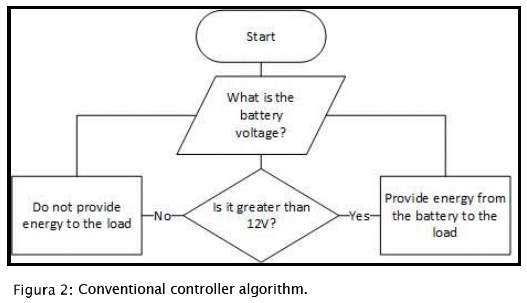
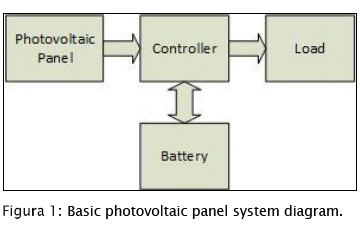
<body><![CDATA[<p align="justify"><font face="Verdana, Arial, Helvetica, sans-serif" size="3"><b>4&nbsp; &nbsp; BASIC PHOTOVOLTAIC PANEL SYSTEM</b></font></p>     <p align="justify"><font face="Verdana, Arial, Helvetica, sans-serif" size="2"><b>4.1     Elements and Functions</b></font></p>     <p align="justify"><font face="Verdana, Arial, Helvetica, sans-serif" size="2">The system consists of a photovoltaic panel to receive solar energy, a battery to store the energy, a controller that manages the energy and the load.</font></p>     <p align="center"><a name="f1"></a><img src="/img/revistas/ran/v9n1/a07_figura_01.gif" width="360" height="225"></p>     <p align="justify"><font face="Verdana, Arial, Helvetica, sans-serif" size="2"><b>4.2     Operation of a Conventional Controller</b></font></p>     <p align="justify"><font face="Verdana, Arial, Helvetica, sans-serif" size="2">A conventional controller has the function of charging the storage battery with solar electric energy obtained from a photovoltaic panel, it also has an output to supply the energy from the battery to the load, when the voltage level in the battery is lower than 12 volts in direct current, the controller stops providing power to the load. The algorithm of the <a href="#f2">Fig. 2</a> is used [1].</font></p>     <p align="center"><a name="f2"></a><img src="/img/revistas/ran/v9n1/a07_figura_02.gif" width="527" height="303"></p>     <p align="justify"><font face="Verdana, Arial, Helvetica, sans-serif" size="3"><b>5&nbsp; &nbsp; METHODOLOGY</b></font></p>     <p align="justify"><font face="Verdana, Arial, Helvetica, sans-serif" size="2"><b>5.1     Data Collection</b></font></p>     <p align="justify"><font face="Verdana, Arial, Helvetica, sans-serif" size="2">The methodology that was used for the data collection was taking quantitative samples of the behavior of the main elements of the controller prototype in a real environment. The samples are taken in a one minute interval for 24 hours, thus having 1440 samples per day, all this to improve and develop the prototype.</font></p>     ]]></body>
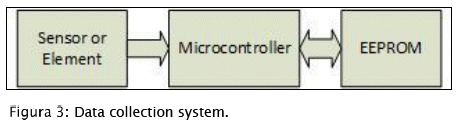
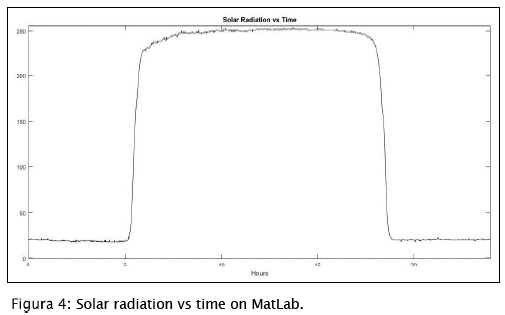
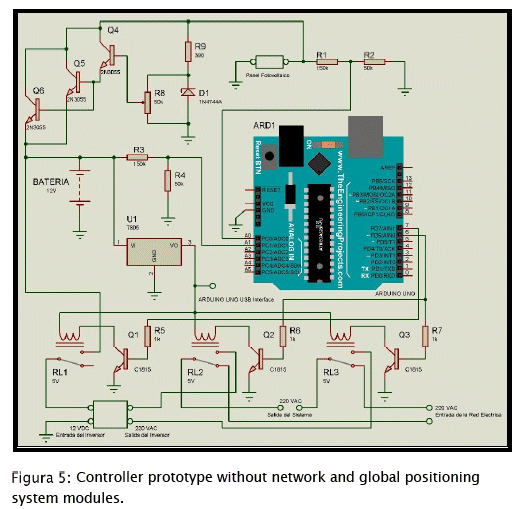
<body><![CDATA[<p align="justify"><font face="Verdana, Arial, Helvetica, sans-serif" size="2"><b>5.2     Instruments</b></font></p>     <p align="justify"><font face="Verdana, Arial, Helvetica, sans-serif" size="2">To collect data, a microcontroller was used to interpret the data that is received in its analog inputs from a sensor or directly from the elements of the system. Then these data are stored in an EEPROM and then transferred to a computer and to be able to develop the new system design [2].</font></p>     <p align="center"><a name="f3"></a><img src="/img/revistas/ran/v9n1/a07_figura_03.gif" width="460" height="127"></p>     <p align="justify"><font face="Verdana, Arial, Helvetica, sans-serif" size="2">The microcontroller used is the ATmega328P included in an Arduino UNO board, the EEPROM used is the 24LC256 and the sensors or elements are specific according to the type of data that you want to obtain. To program the microcontroller, obtain the data from the EEPROM and perform prototype tests; a computer with the Arduino IDE software is used. To make the results graphs and prototype algorithms; MatLab is used [3].</font></p>     <p align="justify"><font face="Verdana, Arial, Helvetica, sans-serif" size="2">To develop the prototype, simulations were made in MatLab until the optimal design was determined, then the Arduino language will be used to implement the design in a microcontroller ATmega328P.</font></p>     <p align="justify"><font face="Verdana, Arial, Helvetica, sans-serif" size="2"><b>5.3     Solar Radiation</b></font></p>     <p align="justify"><font face="Verdana, Arial, Helvetica, sans-serif" size="2">The figure shows the result of taking samples of solar radiation with an LDR sensor.</font></p>     <p align="center"><a name="f4"></a><img src="/img/revistas/ran/v9n1/a07_figura_04.gif" width="505" height="315"></p>     <p align="center">&nbsp;</p>     <p align="justify"><font face="Verdana, Arial, Helvetica, sans-serif" size="3"><b>6&nbsp; &nbsp; DESIGN</b></font></p>     ]]></body>
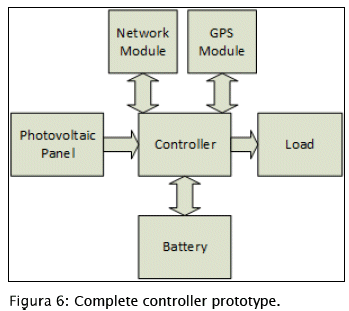
<body><![CDATA[<p align="justify"><font face="Verdana, Arial, Helvetica, sans-serif" size="2"><b>6.1     Prototype</b></font></p>     <p align="justify"><font face="Verdana, Arial, Helvetica, sans-serif" size="2">The ATmega328P microcontroller included in an Arduino UNO board was used, additionally electrical and electronic devices were used to obtain data from the photovoltaic panel and from the battery through the analog inputs A0 and A1 respectively.</font></p>     <p align="center"><a name="f5"></a><img src="/img/revistas/ran/v9n1/a07_figura_05.gif" width="521" height="509"></p>     <p align="justify"><font face="Verdana, Arial, Helvetica, sans-serif" size="2">The relays are controlled by the digital outputs D6 and D7, they fulfill the function of switching a circuit so that the output of the system uses the electrical grid of 220 volts in alternating current or the battery that together with an inverter provides 220 volts in alternating current, according to convenience. The used photovoltaic panel has a power of 60W and provides from 17 to 21 volts in direct current, the used battery is a calcium battery and provides 12 volts in direct current and 60 ampere hour; the inverter used supports a power of 500 watts. The load consumes 30 watts for all tests.</font></p>     <p align="justify"><font face="Verdana, Arial, Helvetica, sans-serif" size="2">The network module is the Ethernet ENC28J60 compatible with Arduino UNO that allows the connection to Internet, and the global positioning system module is the NEO6M that allows to obtain the geographic coordinates. The <a href="#f6">Fig. 6</a>. shows the complete prototype diagram.</font></p>     <p align="center"><a name="f6"></a><img src="/img/revistas/ran/v9n1/a07_figura_06.gif" width="349" height="311"></p>     <p align="justify"><font face="Verdana, Arial, Helvetica, sans-serif" size="2"><b>6.2     Photovoltaic Panel</b></font></p>     <p align="justify"><font face="Verdana, Arial, Helvetica, sans-serif" size="2">The <a href="#f7">Fig. 7</a> shows the result of taking samples of the voltage generated by the photovoltaic panel when exposed to the solar radiation shown in <a href="#f4">Fig. 4</a>.</font></p>     <p align="center"><a name="f7"></a><img src="/img/revistas/ran/v9n1/a07_figura_07.gif" width="507" height="314"></p>     <p align="justify"><font face="Verdana, Arial, Helvetica, sans-serif" size="2">The voltage in the photovoltaic panel is directly proportional to the solar radiation, when using a photovoltaic panel of 17 volts in direct current, the maximum value of almost 20 volts is observed in hours of higher solar radiation and almost 0 volts at night. The signal is not very stable because it is transferring energy to the load, this produces the effect of charging and discharging the battery that consumes photovoltaic panel energy and therefore its voltage goes up and down.</font></p>     ]]></body>
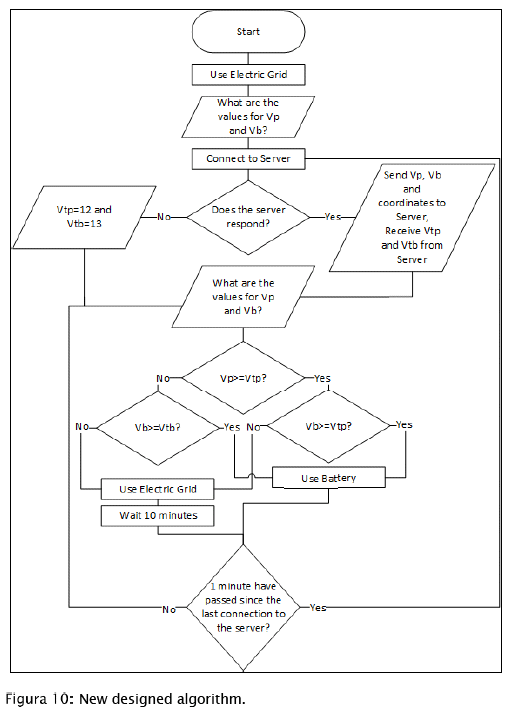
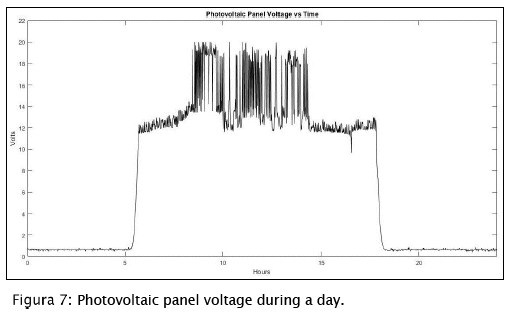
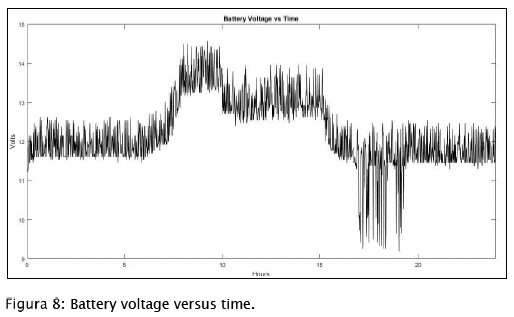
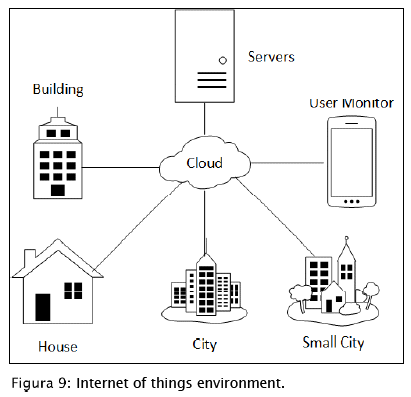
<body><![CDATA[<p align="justify"><font face="Verdana, Arial, Helvetica, sans-serif" size="2"><b>6.3     Battery</b></font></p>     <p align="justify"><font face="Verdana, Arial, Helvetica, sans-serif" size="2">The <a href="#f8">Fig. 8</a> shows the result of taking samples of the voltage in the battery on the same day that the samples were taken from the photovoltaic panel shown in <a href="#f7">Fig. 7</a>. The battery stores the energy, the voltage can reach a level of 12 to 14 volts when it is charged, but at the end of the day a rebound effect occurs between 16 and 20 hours of the day, between those hours the sun goes down, the battery is discharged, it reaches a value below 12 volts, so the controller switches a circuit to not send power from the battery to the load; however, the battery, not being connected to the load, increases the value of its voltage to 12 volts or more, this causes the controller to switch a circuit to again provide power to the load from the battery, as this time the charge on the battery is too low and the voltage on the battery will drop back to a value below 12 volts; this is repeated continuously until taking an action that suppresses this bounce, this will be improved in the new controller design [4].</font></p>     <p align="center"><a name="f8"></a><img src="/img/revistas/ran/v9n1/a07_figura_08.gif" width="514" height="317"></p>     <p align="justify"><font face="Verdana, Arial, Helvetica, sans-serif" size="2"><b>6.4     Internet of Things Environment</b></font></p>     <p align="justify"><font face="Verdana, Arial, Helvetica, sans-serif" size="2">The environment is shown in <a href="#f9">Fig. 9</a> where the server obtains data of the photovoltaic panels voltage and the batteries voltage of the customers, several times a day.</font></p>     <p align="center"><a name="f9"></a><img src="/img/revistas/ran/v9n1/a07_figura_09.gif" width="411" height="397"></p>     <p align="justify"><font face="Verdana, Arial, Helvetica, sans-serif" size="2">The data is processed in the server by finding the median of the photovoltaic panels voltage obtained during the day, greater than 12 volts, and also the median of the batteries voltage obtained in the minimum required load, greater than 12 volts, for example, the median for <a href="#f7">Fig. 7</a> is 13.26 and the median for <a href="#f8">Fig. 8</a> is 12.78, then two new values are found inversely proportional to their respective medians and were called photovoltaic panel's limit voltage and battery's limit voltage; and they are broadcasted to geographically close customers. If the median of the battery voltage of the customers is high, the corresponding limit voltage will decrease to take advantage of the energy stored in the batteries, but it will never be less than 12 volts; if, on the other hand, the median is low, the limit voltage will increase to save energy in the batteries, but it will never be greater than 14 volts. If the median of the photovoltaic panel voltage of the customers is high, the corresponding limit voltage will decrease to take advantage of the energy of the solar radiation, but it will never be less than 12 volts, if, on the other hand, it is low, the limit voltage will increase to save energy in the batteries, but it will never be greater than 16 volts. The client can use a device to monitor the status of the controller and the server statistics; even in future improvements can take actions on the controller [5].</font></p>     <p align="justify">&nbsp;</p>     <p align="justify"><font face="Verdana, Arial, Helvetica, sans-serif" size="3"><b>7</b>&nbsp; &nbsp; <b>New Algorithm</b></font></p>     <p align="justify"><font face="Verdana, Arial, Helvetica, sans-serif" size="2">The &quot;Use Electric Grid&quot; process means that the system is using the conventional electrical grid to provide power to the load, the &quot;Use Battery&quot; process means that the system uses the local battery to provide power to the load.</font></p>     ]]></body>
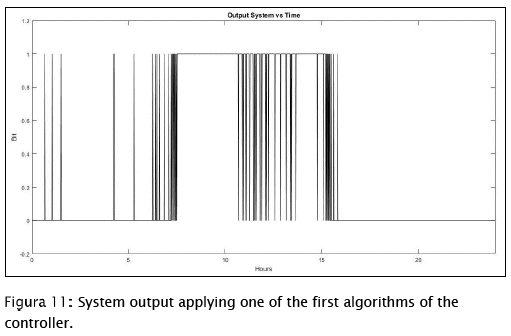
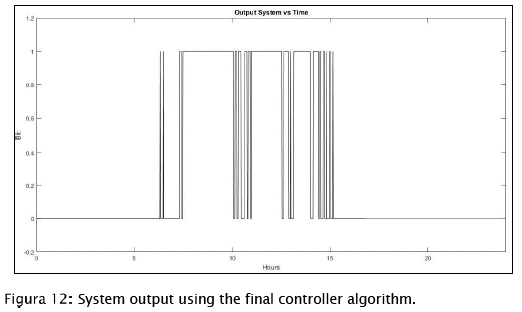
<body><![CDATA[<p align="center"><a name="f10"></a><img src="/img/revistas/ran/v9n1/a07_figura_10.gif" width="508" height="712"></p>     <p align="justify"><font face="Verdana, Arial, Helvetica, sans-serif" size="2">Vp is the variable for the voltage in the local photovoltaic panel and Vb is the variable for the voltage in the local battery, Vtp is the variable for photovoltaic panel's limit voltage and Vtb is variable for battery's limit voltage; Vtp and Vtb are calculated by the server [6]. The &quot;Wait 10 minutes&quot; process eliminates the bounce shown in the <a href="#f8">Fig. 8</a>.</font></p>     <p align="justify">&nbsp;</p>     <p align="justify"><font face="Verdana, Arial, Helvetica, sans-serif" size="3"><b>8&nbsp; &nbsp; RESULTS</b></font></p>     <p align="justify"><font face="Verdana, Arial, Helvetica, sans-serif" size="2"><b>8.1     System performance</b></font></p>     <p align="justify"><font face="Verdana, Arial, Helvetica, sans-serif" size="2">The system output is just where the load is placed, <a href="#f11">Fig. 11</a> shows the result of applying one of the first algorithms of the controller with the signals of <a href="#f7">Fig. 7</a> and <a href="#f8">Fig. 8</a> as inputs.</font></p>     <p align="justify"><font face="Verdana, Arial, Helvetica, sans-serif" size="2"><a href="#f11">Fig. 11</a>. shows the result in the output during a day, where a high logical value means that the system's battery is used to provide power to the load and a low logic value means that the electrical gird is used to provide power to the load. The rebound effect is very frequent especially at dawn, between 6 and 8 hours, and at sunset, between 16 and 20 hours. The rebound is detrimental because the switching of the circuit and the constant phase change can damage the load, generate an instability in the conventional electrical grid and cause a malfunction of the devices on the load.</font></p>     <p align="center"><a name="f11"></a><img src="/img/revistas/ran/v9n1/a07_figura_11.gif" width="511" height="336"></p>     <p align="justify"><font face="Verdana, Arial, Helvetica, sans-serif" size="2"><a href="#f12">Fig. 12</a> shows the result of applying the final algorithm of <a href="#f10">Fig. 10</a> in the new controller prototype, with the signals of <a href="#f7">Fig. 7</a> and <a href="#f8">Fig. 8</a> as inputs. The rebound</font> <font face="Verdana, Arial, Helvetica, sans-serif" size="2">effect decreases considerably, this way it has achieved better performance, better autonomy and efficiency using collaboration in an Internet environment of things.</font></p>     <p align="center"><a name="f12"></a><img src="/img/revistas/ran/v9n1/a07_figura_12.gif" width="522" height="312"></p>     ]]></body>
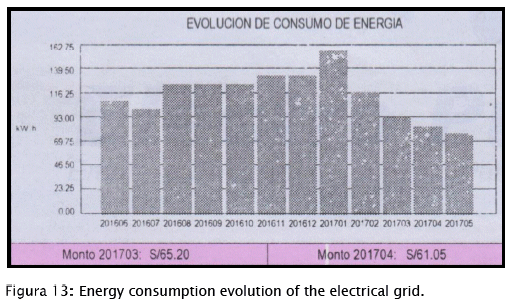
<body><![CDATA[<p align="justify"><font face="Verdana, Arial, Helvetica, sans-serif" size="2"><a href="#f13">Fig. 13</a> shows a receipt of the energy consumption evolution of the conventional electrical grid, the prototype of the system came into operation on February 13, 2017 and showed a very considerable savings.</font></p>     <p align="center"><a name="f13"></a><img src="/img/revistas/ran/v9n1/a07_figura_13.gif" width="513" height="305"></p>     <p align="justify"><font face="Verdana, Arial, Helvetica, sans-serif" size="2"><b>8.2     System cost for a customer</b></font></p>     <p align="justify"><font face="Verdana, Arial, Helvetica, sans-serif" size="2">The time to recover the investment is 2 years, 3 months and 26 days, while the system can continue working for up to 25 years replacing parts with a short useful life.</font></p>     <blockquote>       <p align="justify"><font face="Verdana, Arial, Helvetica, sans-serif" size="2">• Photovoltaic panel (Lifetime of 20 to 25 years) - $109.03 USD</font></p>       <p align="justify"><font face="Verdana, Arial, Helvetica, sans-serif" size="2">• Battery (Life of 4 to 5 years) - $140.19 USD</font></p>       <p align="justify"><font face="Verdana, Arial, Helvetica, sans-serif" size="2">• Controller + Network Module + GPS Module (Lifespan of 5 years) - $45.17 USD</font></p>       <p align="justify"><font face="Verdana, Arial, Helvetica, sans-serif" size="2">• Inverter (Lifetime of 10 years) - $54.52 USD</font></p>       <p align="justify"><font face="Verdana, Arial, Helvetica, sans-serif" size="2">• Total Cost - $348.91 USD</font></p> </blockquote>     ]]></body>
<body><![CDATA[<p align="justify"><font face="Verdana, Arial, Helvetica, sans-serif" size="2"><b>8.3     Savings</b></font></p>     <p align="justify"><font face="Verdana, Arial, Helvetica, sans-serif" size="2">Potentially, the annual energy savings of a small population of 13,000 households with the system is 7.78GWh, enough to provide electricity to 7969 households for a year.</font></p>     <blockquote>       <p align="justify"><font face="Verdana, Arial, Helvetica, sans-serif" size="2">• Average Monthly Savings - $10.96 USD</font></p>       <p align="justify"><font face="Verdana, Arial, Helvetica, sans-serif" size="2">• Average Annual Savings - $131.48 USD</font></p>       <p align="justify"><font face="Verdana, Arial, Helvetica, sans-serif" size="2">• Monthly Energy Savings Average - 49.88KWh</font></p>       <p align="justify"><font face="Verdana, Arial, Helvetica, sans-serif" size="2">• Annual Energy Saving Average - 598.56KWh</font></p>       <p align="justify"><font face="Verdana, Arial, Helvetica, sans-serif" size="2">• Total Cost - $348.91 USD</font></p>       <p align="justify">&nbsp;</p> </blockquote>     <p align="justify"><font face="Verdana, Arial, Helvetica, sans-serif" size="3"><b>ACKNOWLEDGMENT</b></font></p>     ]]></body>
<body><![CDATA[<p align="justify"><font face="Verdana, Arial, Helvetica, sans-serif" size="2">We would like to thank all friends that actively collaborated with this research.</font></p>     <p align="justify">&nbsp;</p>     <p align="justify"><font face="Verdana, Arial, Helvetica, sans-serif" size="3"><b>REFERENCES</b></font></p>     <p align="justify"><font size="2" face="Verdana, Arial, Helvetica, sans-serif">[1] B. Brooks and S. White,  &ldquo;Photovoltaic Systems and the National Electric Code 1st Edition,&rdquo; Routledge.  United States of America, March 2018, pp. 98-99. </font></p>     <p align="justify"><font size="2" face="Verdana, Arial, Helvetica, sans-serif">[2] A. Hemami, &ldquo;Electricity  and Electronics for Renewable Energy Technology: An Introduction (Power  Electronics and Applications Series) 1st Edition&rdquo; CRC Press, United States of  America, September 2017, pp. 620-623. </font></p>     <p align="justify"><font size="2" face="Verdana, Arial, Helvetica, sans-serif">[3] F. Blaabjerg and D.M.  Ionel, &ldquo;Renewable Energy Devices and Systems with Simulations in MATLAB&reg; and  ANSYS&reg; 1st Edition,&rdquo; CRC Press, May 2017, pp. 315-325. </font></p>     <p align="justify"><font size="2" face="Verdana, Arial, Helvetica, sans-serif">[4] M. Cotterell, C. Coonik,  S. Pester and J Williams, &ldquo;Battery Energy Storage Systems with Grid-connected  Solar Photovoltaics: A Technical Guide (BR 514) 1st Edition,&rdquo; IHS BRE Press,  United States of America, September 2017, pp. 25-29. </font></p>     <p align="justify"><font size="2" face="Verdana, Arial, Helvetica, sans-serif">[5] G.N. Tiwari and A.  Tiwari, &ldquo;Hand Book of Solar Energy. Theory, Analysis and Applications,&rdquo;  Springer. Singapore, 2016, pp. 20-21. </font></p>     <p align="justify"><font size="2" face="Verdana, Arial, Helvetica, sans-serif">[6] C. Wang and X. Zhang Bo  Zhao, &ldquo;Grid Integrated and Standalone Photovoltaic Distributed Generation  Systems,&rdquo; Wiley, United States of America, October 2017, pp. 35-45. </font></p>     <p align="justify">&nbsp;</p>     ]]></body>
<body><![CDATA[ ]]></body><back>
<ref-list>
<ref id="B1">
<label>1</label><nlm-citation citation-type="book">
<person-group person-group-type="author">
<name>
<surname><![CDATA[Brooks]]></surname>
<given-names><![CDATA[B.]]></given-names>
</name>
<name>
<surname><![CDATA[White]]></surname>
<given-names><![CDATA[S.]]></given-names>
</name>
</person-group>
<source><![CDATA[Photovoltaic Systems and the National Electric Code]]></source>
<year>Marc</year>
<month>h </month>
<day>20</day>
<edition>1</edition>
<page-range>98-99</page-range><publisher-loc><![CDATA[United States of America ]]></publisher-loc>
<publisher-name><![CDATA[Routledge]]></publisher-name>
</nlm-citation>
</ref>
<ref id="B2">
<label>2</label><nlm-citation citation-type="book">
<person-group person-group-type="author">
<name>
<surname><![CDATA[Hemami]]></surname>
<given-names><![CDATA[A.]]></given-names>
</name>
</person-group>
<source><![CDATA[Electricity and Electronics for Renewable Energy Technology: An Introduction]]></source>
<year>Sept</year>
<month>em</month>
<day>be</day>
<edition>1</edition>
<page-range>620-623</page-range><publisher-loc><![CDATA[United States of America ]]></publisher-loc>
<publisher-name><![CDATA[CRC Press]]></publisher-name>
</nlm-citation>
</ref>
<ref id="B3">
<label>3</label><nlm-citation citation-type="book">
<person-group person-group-type="author">
<name>
<surname><![CDATA[Blaabjerg]]></surname>
<given-names><![CDATA[F.]]></given-names>
</name>
<name>
<surname><![CDATA[Ionel]]></surname>
<given-names><![CDATA[D.M.]]></given-names>
</name>
</person-group>
<source><![CDATA[Renewable Energy Devices and Systems with Simulations in MATLAB® and ANSYS®]]></source>
<year>May </year>
<month>20</month>
<day>17</day>
<edition>1</edition>
<page-range>315-325</page-range><publisher-name><![CDATA[CRC Press]]></publisher-name>
</nlm-citation>
</ref>
<ref id="B4">
<label>4</label><nlm-citation citation-type="book">
<person-group person-group-type="author">
<name>
<surname><![CDATA[Cotterell]]></surname>
<given-names><![CDATA[M.]]></given-names>
</name>
<name>
<surname><![CDATA[Coonik]]></surname>
<given-names><![CDATA[C.]]></given-names>
</name>
<name>
<surname><![CDATA[Pester]]></surname>
<given-names><![CDATA[S.]]></given-names>
</name>
<name>
<surname><![CDATA[Williams]]></surname>
<given-names><![CDATA[J]]></given-names>
</name>
</person-group>
<source><![CDATA[Battery Energy Storage Systems with Grid-connected Solar Photovoltaics: A Technical Guide (BR 514)]]></source>
<year>Sept</year>
<month>em</month>
<day>be</day>
<edition>1</edition>
<page-range>25-29</page-range><publisher-loc><![CDATA[United States of America ]]></publisher-loc>
<publisher-name><![CDATA[IHS BRE Press]]></publisher-name>
</nlm-citation>
</ref>
<ref id="B5">
<label>5</label><nlm-citation citation-type="book">
<person-group person-group-type="author">
<name>
<surname><![CDATA[Tiwari]]></surname>
<given-names><![CDATA[G.N.]]></given-names>
</name>
<name>
<surname><![CDATA[Tiwari]]></surname>
<given-names><![CDATA[A.]]></given-names>
</name>
</person-group>
<source><![CDATA[Hand Book of Solar Energy. Theory, Analysis and Applications]]></source>
<year>2016</year>
<page-range>20-21</page-range><publisher-loc><![CDATA[Singapore ]]></publisher-loc>
<publisher-name><![CDATA[Springer]]></publisher-name>
</nlm-citation>
</ref>
<ref id="B6">
<label>6</label><nlm-citation citation-type="book">
<person-group person-group-type="author">
<name>
<surname><![CDATA[Wang]]></surname>
<given-names><![CDATA[C.]]></given-names>
</name>
<name>
<surname><![CDATA[Zhang]]></surname>
<given-names><![CDATA[X.]]></given-names>
</name>
<name>
<surname><![CDATA[Zhao]]></surname>
<given-names><![CDATA[Bo]]></given-names>
</name>
</person-group>
<source><![CDATA[Grid Integrated and Standalone Photovoltaic Distributed Generation Systems]]></source>
<year>Octo</year>
<month>be</month>
<day>r </day>
<page-range>35-45</page-range><publisher-loc><![CDATA[United States of America ]]></publisher-loc>
<publisher-name><![CDATA[Wiley]]></publisher-name>
</nlm-citation>
</ref>
</ref-list>
</back>
</article>