<?xml version="1.0" encoding="ISO-8859-1"?><article xmlns:mml="http://www.w3.org/1998/Math/MathML" xmlns:xlink="http://www.w3.org/1999/xlink" xmlns:xsi="http://www.w3.org/2001/XMLSchema-instance">
<front>
<journal-meta>
<journal-id>1683-0789</journal-id>
<journal-title><![CDATA[Acta Nova]]></journal-title>
<abbrev-journal-title><![CDATA[RevActaNova.]]></abbrev-journal-title>
<issn>1683-0789</issn>
<publisher>
<publisher-name><![CDATA[Universidad Católica Boliviana]]></publisher-name>
</publisher>
</journal-meta>
<article-meta>
<article-id>S1683-07892016000100002</article-id>
<title-group>
<article-title xml:lang="en"><![CDATA[The semicontinous Reactor: Modeling, Simulation and Control Part II Nonlinear Control]]></article-title>
<article-title xml:lang="es"><![CDATA[El reactor semicontinuo: modelado, simulación y control Parte II Control no lineal]]></article-title>
</title-group>
<contrib-group>
<contrib contrib-type="author">
<name>
<surname><![CDATA[Zavaleta Mercado]]></surname>
<given-names><![CDATA[Rónanth]]></given-names>
</name>
<xref ref-type="aff" rid="A01"/>
</contrib>
</contrib-group>
<aff id="A01">
<institution><![CDATA[,Academy of Sciences of Bolivia  ]]></institution>
<addr-line><![CDATA[La Paz ]]></addr-line>
<country>Bolivia</country>
</aff>
<pub-date pub-type="pub">
<day>00</day>
<month>03</month>
<year>2016</year>
</pub-date>
<pub-date pub-type="epub">
<day>00</day>
<month>03</month>
<year>2016</year>
</pub-date>
<volume>7</volume>
<numero>3</numero>
<fpage>215</fpage>
<lpage>241</lpage>
<copyright-statement/>
<copyright-year/>
<self-uri xlink:href="http://www.scielo.org.bo/scielo.php?script=sci_arttext&amp;pid=S1683-07892016000100002&amp;lng=en&amp;nrm=iso"></self-uri><self-uri xlink:href="http://www.scielo.org.bo/scielo.php?script=sci_abstract&amp;pid=S1683-07892016000100002&amp;lng=en&amp;nrm=iso"></self-uri><self-uri xlink:href="http://www.scielo.org.bo/scielo.php?script=sci_pdf&amp;pid=S1683-07892016000100002&amp;lng=en&amp;nrm=iso"></self-uri><abstract abstract-type="short" xml:lang="en"><p><![CDATA[Conservation equations are applied to the Semicontinuous Reactor, also known as the Semibatch Reactor (SBR) for the isothermal, adiabatic and non-isothermal case, to generate the necessary differential equations for modeling and simulation. The resulting equations, expressed in terms of dimensionless normalized variables, are solved numerically for consistency testing by means of computer algebra software (Mathcad®). The model is also expressed in terms of meaningful dimensionless groups of the Damköhler and Biot type. The consistent model is then simulated for typical combinations of operating parameters in preparation for process control and stability simulation and analysis. The SBR is typically non steady, of relatively high operating costs and low throughputs. However high conversions can be achieved and good temperature control allows for the minimizations of unwanted side reactions by means of maintaining low concentrations of one of the reactants. This reactor is extensively used in the manufacture of high value added chemicals (fine chemicals) and in reactions where a careful control is mandatory, such as in the production of high explosives. It is used in case of multiphase reactions involving gas bubbling such as the production of mono, di and tri chlorobenzene. Part I of this article is devoted to generating a robus t modeling and simulation tool for the SBR, while Part II explores its control and stable behavior.]]></p></abstract>
<abstract abstract-type="short" xml:lang="es"><p><![CDATA[Ecuaciones de conservación se aplican al Reactor Semicontinuo, también conocido como el reactor por lotes Semibatch (SBR) para los casos: isotérmico, adiabático y no isotérmico; para generar las ecuaciones diferenciales necesarias para el modelado y simulación. Las ecuaciones resultantes, expresados en términos de variables normalizadas sin dimensiones, se resuelven numéricamente para las pruebas de consistencia por medio de un software de álgebra computacional (Mathcad®). El modelo también se expresa en términos de grupos adimensionales significativos del tipo Damköhler y Biot. El modelo consistente, se simula para combinaciones típicas de los parámetros de funcionamiento en la preparación para el control de procesos y simulación de estabilidad y análisis. El SBR es típicamente no constante, de relativamente altos costos de operación y bajos rendimientos. Sin embargo altas conversiones pueden alcanzarse y un buen control de temperatura permite la minimización de reacciones secundarias no deseadas por medio del mantenimiento de concentraciones bajas de uno de los reactivos. Este reactor se utiliza ampliamente en la fabricación de productos químicos de alto valor añadido (productos químicos finos) y en las reacciones donde un cuidadoso control es obligatorio, como en la producción de explosivos de alta potencia. Se utiliza en el caso de reacciones de varias fases que implican formación de burbujas de gas tal como la producción de mono, di y tri clorobenceno. La Parte I de este artículo está dedicado a la generación de una herramienta de modelado y simulación robusta para el SBR, mientras que la segunda parte explora su control y el comportamiento estable.]]></p></abstract>
<kwd-group>
<kwd lng="en"><![CDATA[Semicontinuous Reactor]]></kwd>
<kwd lng="en"><![CDATA[Semibatch Reactor]]></kwd>
<kwd lng="en"><![CDATA[SBR control]]></kwd>
<kwd lng="en"><![CDATA[stable behavior of reactors]]></kwd>
<kwd lng="es"><![CDATA[Reactor semi-continuo]]></kwd>
<kwd lng="es"><![CDATA[reactor Semibatch]]></kwd>
<kwd lng="es"><![CDATA[control de SBR]]></kwd>
<kwd lng="es"><![CDATA[comportamiento estable de los reactores]]></kwd>
</kwd-group>
</article-meta>
</front><body><![CDATA[ <p align="right"><font size="2"><b><font face="Verdana, Arial, Helvetica, sans-serif">ART&Iacute;CULO CIENT&Iacute;FICO</font></b></font></p>     <p>&nbsp;</p>     <p align="center"><b><font size="4" face="Verdana, Arial, Helvetica, sans-serif">The semicontinous Reactor: Modeling, Simulation</font></b> <font size="4"><b><font face="Verdana, Arial, Helvetica, sans-serif">and Control    <br> Part II Nonlinear Control</font></b></font></p>     <p align="center">&nbsp;</p>     <p align="center"><b><font face="Verdana, Arial, Helvetica, sans-serif" size="3"><i>El reactor semicontinuo: modelado, simulación y control</i>    <br>     <i>Parte II Control no lineal</i></font></b></p>     <p align="center">&nbsp;</p>     <p align="center">&nbsp;</p>     <p align="center"><font size="3"><b><font face="Verdana, Arial, Helvetica, sans-serif"></font></b></font><b><font face="Verdana, Arial, Helvetica, sans-serif" size="2">Rónanth Zavaleta Mercado</font></b></p>     ]]></body>
<body><![CDATA[<p align="center"><b><font face="Verdana, Arial, Helvetica, sans-serif" size="2"></font></b><font face="Verdana, Arial, Helvetica, sans-serif" size="2">Member of the Academy of Sciences of Bolivia</font>    <br> <font face="Verdana, Arial, Helvetica, sans-serif" size="2">Dean of the School of Engineering, Universidad Católica Boliviana San Pablo at La</font> <font face="Verdana, Arial, Helvetica, sans-serif" size="2">Paz.    <br> <a href="mailto:ronanth.zavaleta@gmail.com">ronanth.zavaleta@gmail.com</a></font></p>     <p align="center"><font face="Verdana" size="2">Recibido: 2 de febrero 2016    <br> Aceptado: 25 de febrero 2016</font></p>     <p align="center">&nbsp;</p>     <p align="center">&nbsp;</p> <hr noshade>     <p align="justify"><font face="Verdana, Arial, Helvetica, sans-serif" size="2"><b>Abstract: </b>Conservation equations are applied to the Semicontinuous Reactor, also known as the Semibatch Reactor (SBR) for the isothermal, adiabatic and non-isothermal case, to generate the necessary differential equations for modeling and simulation. The resulting equations, expressed in terms of dimensionless normalized variables, are solved numerically for consistency testing by means of computer algebra software (Mathcad<sup>&reg;</sup>). The model is also expressed in terms of meaningful dimensionless groups of the Damköhler and Biot type. The consistent model is then simulated for typical combinations of operating parameters in preparation for process control and stability simulation and analysis.</font></p>     <p align="justify"><font face="Verdana, Arial, Helvetica, sans-serif" size="2">The SBR is typically non steady, of relatively high operating costs and low throughputs. However high conversions can be achieved and good temperature control allows for the minimizations of unwanted side reactions by means of maintaining low concentrations of one of the reactants. This reactor is extensively used in the manufacture of high value added chemicals (fine chemicals) and in reactions where a careful control is mandatory, such as in the production of high explosives. It is used in case of multiphase reactions involving gas bubbling such as the production of mono, di and tri chlorobenzene.</font></p>     <p align="justify"><font face="Verdana, Arial, Helvetica, sans-serif" size="2">Part I of this article is devoted to generating a robus t modeling and simulation tool for the SBR, while Part II explores its control and stable behavior.</font></p>     ]]></body>
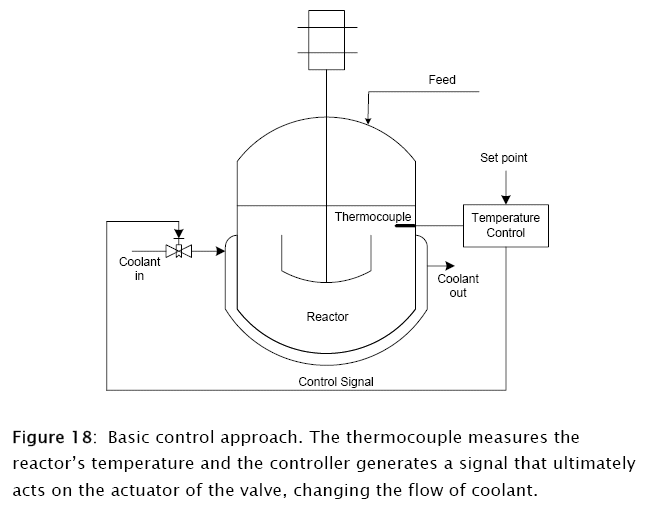
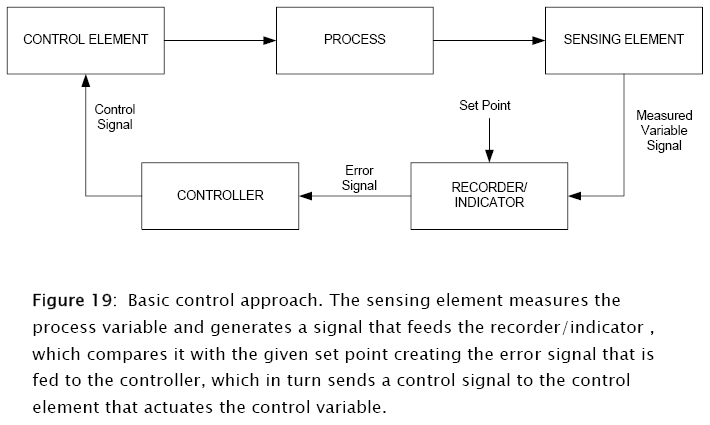
<body><![CDATA[<p align="justify"><font face="Verdana, Arial, Helvetica, sans-serif" size="2"><b>Key words: </b>Semicontinuous Reactor, Semibatch Reactor, SBR control, stable behavior of reactors.</font></p> <hr noshade>     <p align="justify"><font face="Verdana, Arial, Helvetica, sans-serif" size="2"><b>Resumen: </b>Ecuaciones de conservación se aplican al Reactor Semicontinuo, también conocido como el reactor por lotes Semibatch (SBR) para los casos: isotérmico, adiabático y no isotérmico; para generar las ecuaciones diferenciales necesarias para el modelado y simulación. Las ecuaciones resultantes, expresados en términos de variables normalizadas sin dimensiones, se resuelven numéricamente para las pruebas de consistencia por medio de un software de álgebra computacional (Mathcad<sup>&reg;</sup>). El modelo también se expresa en términos de grupos adimensionales significativos del tipo Damk&ouml;hler y Biot. El modelo consistente, se simula para combinaciones típicas de los parámetros de funcionamiento en la preparación para el control de procesos y simulación de estabilidad y análisis.</font></p>     <p align="justify"><font face="Verdana, Arial, Helvetica, sans-serif" size="2">El SBR es típicamente no constante, de relativamente altos costos de operación y bajos rendimientos. Sin embargo altas conversiones pueden alcanzarse y un buen control de temperatura permite la minimización de reacciones secundarias no deseadas por medio del mantenimiento de concentraciones bajas de uno de los reactivos. Este reactor se utiliza ampliamente en la fabricación de productos químicos de alto valor añadido (productos químicos finos) y en las reacciones donde un cuidadoso control es obligatorio, como en la producción de explosivos de alta potencia. Se utiliza en el caso de reacciones de varias fases que implican formación de burbujas de gas tal como la producción de mono, di y tri clorobenceno.</font></p>     <p align="justify"><font face="Verdana, Arial, Helvetica, sans-serif" size="2">La Parte I de este artículo está dedicado a la generación de una herramienta de modelado y simulación robusta para el SBR, mientras que la segunda parte explora su control y el comportamiento estable.</font></p>     <p align="justify"><font face="Verdana, Arial, Helvetica, sans-serif" size="2"><b>Palabras clave: </b>Reactor semi-continuo, reactor Semibatch, control de SBR, comportamiento estable de los reactores.</font></p> <hr noshade>     <p align="justify">&nbsp;</p>     <p align="justify">&nbsp;</p>     <p align="justify"><font face="Verdana, Arial, Helvetica, sans-serif" size="3"><b>1. Basic Control Setup</b></font></p>     <p align="justify"><font face="Verdana, Arial, Helvetica, sans-serif" size="2">A basic traditional feedback configuration is used for the SBR reactor control, as depicted in the following Figure 18, which follows pretty much the approach due to R.G.E. Franks [1]. The sensing element measures the process variable and sends a signal to the recorder/indicator, which compares it with the given set point to generate an error signal that is in turn fed to the controller, which sends a control signal to the control element that in turn acts on the control variable (<a href="#f18">Figure 18:</a>).</font></p>     <p align="justify"><a name="f18"></a></p>     ]]></body>
<body><![CDATA[<p align="center"><img src="/img/revistas/ran/v7n3/a02_figure_18.gif" width="647" height="506"></p>     <p align="justify"><font face="Verdana, Arial, Helvetica, sans-serif" size="2">The control loop then consists of transfer functions, controls logic plus some instrumentation simulation (<a href="#f19">Figure 19:</a>).</font></p>     <p align="justify"><a name="f19"></a></p>     <p align="center"><img src="/img/revistas/ran/v7n3/a02_figure_19.gif" width="710" height="425"></p>     <p align="center">&nbsp;</p>     <p align="justify"><font face="Verdana, Arial, Helvetica, sans-serif" size="3"><b>2.    Modeling, transfer functions, control elements and controllers</b></font></p>     <p align="justify"><font face="Verdana, Arial, Helvetica, sans-serif" size="2">In order to simulate the controlled behavior of the SBR, reactor the control elements must be modeled, including transfer functions for the sensing elements,</font> <font face="Verdana, Arial, Helvetica, sans-serif" size="2">controllers, actuators and valves. The software below simulates first and second order transfer functions, zero, one, two and three mode controllers (on-off, proportional, proportional-integral (PI) and proportional- integral with derivative action (PID)) as well as a generalized function for valve discharge.</font></p>     <p align="justify"><font face="Verdana, Arial, Helvetica, sans-serif" size="2"><b>2.1 Transfer functions</b></font></p>     <p align="justify"><font face="Verdana, Arial, Helvetica, sans-serif" size="2">The first order transfer function is defined by a first order ordinary linear differential equation (ODE) with constant coefficients. In terms of Laplace transform notation</font></p>     <p align="center"><img src="/img/revistas/ran/v7n3/a02_ecuation_65.gif" width="688" height="56"></p>     ]]></body>
<body><![CDATA[<p align="justify"><font face="Verdana, Arial, Helvetica, sans-serif" size="2">where <i>G </i>is the gain factor, &#964; the process time constant, <i>V<sub>0ut</sub> </i>the output variable and <i>V<sub>in</sub> </i>the input variable.</font></p>     <p align="justify"><font face="Verdana, Arial, Helvetica, sans-serif" size="2">The following subprogram written in Mathcad Prime 3 software models the first order transfer function (TF1)</font></p> <table width="444" border="0" align="center">   <tr>     <td valign="top">    <p align="justify"><img src="/img/revistas/ran/v7n3/a02_ecuation_65_1.gif" width="684" height="108"></td>   </tr>   <tr>     <td><font face="Verdana, Arial, Helvetica, sans-serif" size="2"><b>Subprogram 4: </b>First order transfer function modeled as a first order linear ordinary differential equation with constant coefficients.</font></td>   </tr> </table>     <p align="justify"><font face="Verdana, Arial, Helvetica, sans-serif" size="2">The second order transfer function is described by a second order ordinary linear differential equation (ODE) with constant coefficients. In terms of Laplace transform notation</font></p>     <p align="center"><img src="/img/revistas/ran/v7n3/a02_ecuation_66.gif" width="684" height="54"></p>     <p align="justify"><font face="Verdana, Arial, Helvetica, sans-serif" size="2">where <i>&#950;, </i>is the damping ratio. The corresponding subprogram for this second order transfer function (TFN2) is:</font></p> <table width="444" border="0" align="center">   <tr>     <td valign="top">    <p align="justify"><img src="/img/revistas/ran/v7n3/a02_ecuation_66_1.gif" width="686" height="112"></td>   </tr>   <tr>     <td><font face="Verdana, Arial, Helvetica, sans-serif" size="2"><b>Subprogram 5: </b>Second order transfer function modeled as a second order linear ordinary differential equation with constant coefficients. Here dout, the output variable derivative must be provided externally.</font></td>   </tr> </table>     <p align="justify"><font face="Verdana, Arial, Helvetica, sans-serif" size="2"><b>2.2 Control Elements</b></font></p>     <p align="justify"><font face="Verdana, Arial, Helvetica, sans-serif" size="2">The following subprogram generates the normalized error EPC (with a domain from 0 to 100) obtained comparing the measured variable to the set point, and its corresponding limits. The general equation is:</font></p>     <p align="center"><img src="/img/revistas/ran/v7n3/a02_ecuation_67.gif" width="686" height="51"></p>     ]]></body>
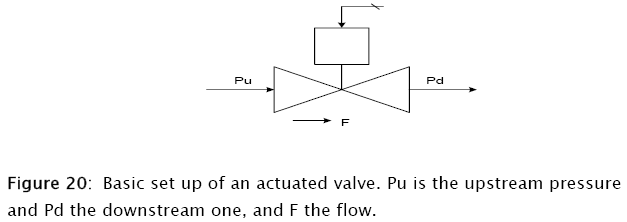
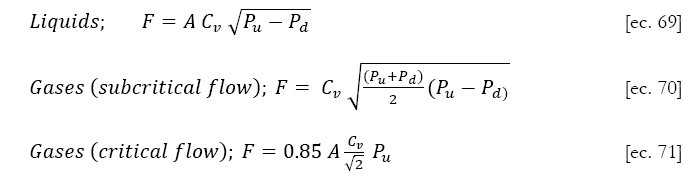
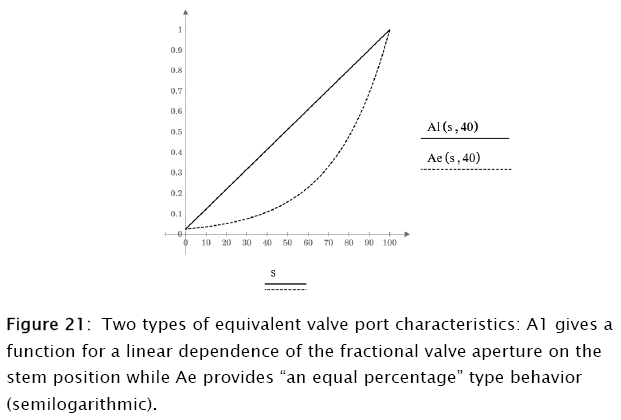
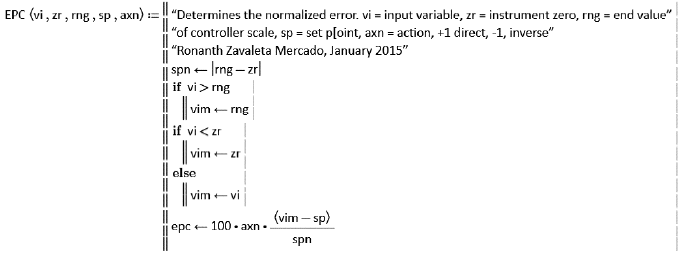
<body><![CDATA[<p align="justify"><font face="Verdana, Arial, Helvetica, sans-serif" size="2">where <i>epc </i>is the normalized percent error, <i>axn </i>the &quot;action&quot;, direct or inverse, <i>vi </i>the measured input variable, <i>sp </i>the set point and <i>spn </i>the instrument span (difference between the range and zero of the instrument). The subprogram is displayed as <a href="#s6">Subprogram 6:</a>.</font></p> <table width="444" border="0" align="center">   <tr>     <td valign="top">    <p align="justify"><img src="/img/revistas/ran/v7n3/a02_ecuation_69_1.gif" width="683" height="256"></td>   </tr>   <tr>     <td><font face="Verdana, Arial, Helvetica, sans-serif" size="2"><b>Subprogram 6: </b>Modeling of the normalized error. The input variable is vi, the set point sp, zr the zero of the instrument and rng its range and axn its &quot;action&quot;, +1 direct, -1 inverse.</font></td>   </tr> </table>     <p align="justify"><font face="Verdana, Arial, Helvetica, sans-serif" size="2">Since the SBR control, requires to modify the flow of coolant, it is necessary to simulate control valves. The most common of these control elements are the diaphragm or motor actuated control ones, that receive a signal coming out of the controller and converts it into a stem position that in turn control the port areas throttling the flow of coolant.</font></p>     <p align="center"><img src="/img/revistas/ran/v7n3/a02_figure_20.gif" width="627" height="222"></p>     <p align="justify"><font face="Verdana, Arial, Helvetica, sans-serif" size="2">The flow of fluids through valves and restrictions is described by the following equation:</font></p>     <p align="center"><img src="/img/revistas/ran/v7n3/a02_ecuation_68.gif" width="684" height="38"></p>     <p align="justify"><font face="Verdana, Arial, Helvetica, sans-serif" size="2">where <i>A </i>is the fractional valve opening, <i>C<sub>v</sub> </i>the valve capacity, a function of the valve size and its service. It normally refers to the case when the valve opening is fully opened (A = 1), and subject to a unity pressure drop (P<sub>u</sub> — P<sub>d</sub> =1)- The pressure function <i>f(P) </i>depends on the phase of the fluid (whether liquid or gas), and sometimes on the flow characteristic (whether critical or subcritical). A typical approach is given below [2]</font></p>     <p align="center"><img src="/img/revistas/ran/v7n3/a02_ecuation_69.gif" width="689" height="180"></p>     <p align="justify"><font face="Verdana, Arial, Helvetica, sans-serif" size="2">Another very important valve characteristic is the dependence of the port area on the stem position. This is a rather complex relationship and depends on the actual valve port characteristics, flow, pressure drop, turbulence and so on. Thus, the port area is expressed as the equivalent flow area rather than the actual geometrical one.</font></p>     <p align="justify"><font face="Verdana, Arial, Helvetica, sans-serif" size="2">Two types of valves have been included in the simulation subprograms, a linear one and an equal percentage one. The first one gives a linear response of the port fractional aperture to changes in the valve stem position, and the second one provides a semilogarithmic one (<a href="#f21">Figure 21</a>). Note the residual fractional port aperture when the valve is fully closed, aperture that corresponds to the &quot;rangeability&quot;, the number of times the minimum residual flow may be increased before reaching the maximum flow. This is due to the fact of fabrication difficulties that make not practical to shut off a valve completely.</font></p>     ]]></body>
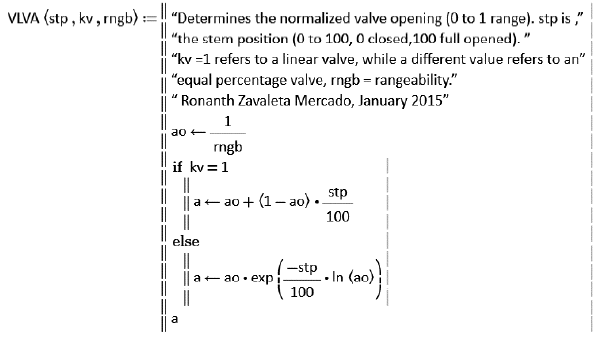
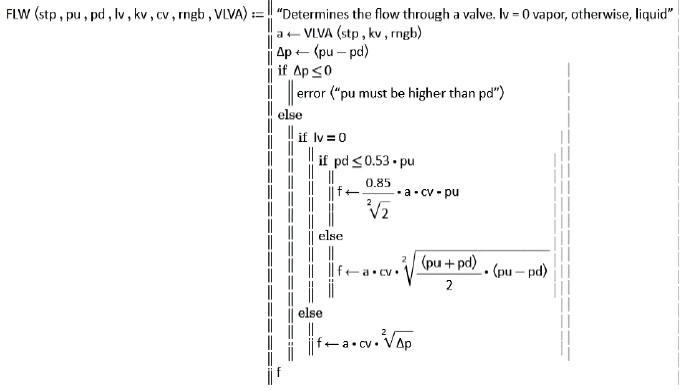
<body><![CDATA[<p align="justify"><a name="f21"></a></p>     <p align="center"><img src="/img/revistas/ran/v7n3/a02_figure_21.gif" width="621" height="420"></p>     <p align="justify"><font face="Verdana, Arial, Helvetica, sans-serif" size="2">The two types of valve fractional aperture behavior are programmed in Subprogram 7:, and the associated flows (equations 69-71) in Subprogram 8.</font></p> <table width="444" border="0" align="center">   <tr>     <td valign="top">    <p align="justify"><img src="/img/revistas/ran/v7n3/a02_figure_21_1.gif" width="603" height="341"></td>   </tr>   <tr>     <td>    <p align="justify"><font face="Verdana, Arial, Helvetica, sans-serif" size="2"><b>Subprogram 7: </b>Modeling linear and equal percentage valves: stp is the normalized stem position, kv an index that defines the port characteristics (1, linear, other, equal percentage) and rngb is the rangeability.</font></p>     </td>   </tr> </table>     <p align="justify">&nbsp;</p> <table width="444" border="0" align="center">   <tr>     <td valign="top">    <p align="justify"><img src="/img/revistas/ran/v7n3/a02_figure_21_2.gif" width="687" height="391"></td>   </tr>   <tr>     <td>    <p align="justify"><font face="Verdana, Arial, Helvetica, sans-serif" size="2"><b>Subprogram 8: </b>Modeling of the flow through the valve: stp is the stem position, pu the upstream pressure, pd the downstream pressure, Iv the phase indicator ( Iv = 0, vapor, other, liquid), kv is the port characteristic selector (kv=1, linear, other, equal percentage), cv is the valve capacity, rngb, the rangeability).</font></p></td>   </tr> </table>     <p align="justify"><font face="Verdana, Arial, Helvetica, sans-serif" size="2"><b>2.3 Controllers</b></font></p>     <p align="justify"><font face="Verdana, Arial, Helvetica, sans-serif" size="2">The four basic industrial controller are modeled and simulated. These controllers include a) on-off b) proportional (P) c) proportional — Integral (PI) and d) proportional integral with derivative action (PID). The PI controller is sometimes referred as proportional with automatic reset, while the PID, proportional, reset with rate action.</font></p>     ]]></body>
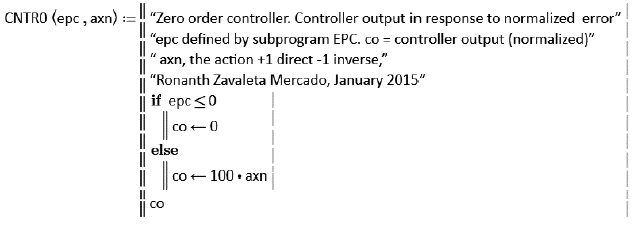
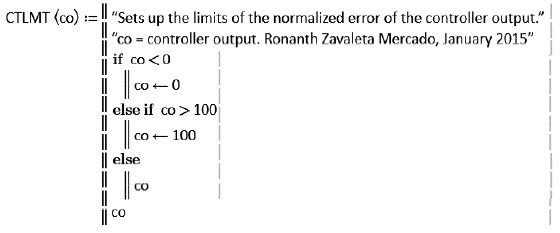
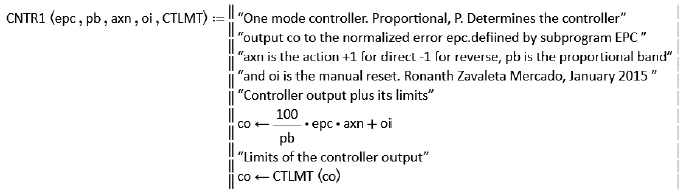
<body><![CDATA[<p align="justify"><font face="Verdana, Arial, Helvetica, sans-serif" size="2">The On-Off controller is the basic form of control. Its logic is quite simple: whenever the controlled variable differs from the set point full action is imposed on the control elements, being this &quot;fully open&quot; or &quot;fully closed&quot; depending on the action of the controller. This controller is referred as being of zero order and is modeled and simulated in Subprogram 9.</font></p> <table width="444" border="0" align="center">   <tr>     <td valign="top">    <p align="justify"><img src="/img/revistas/ran/v7n3/a02_figure_21_3.gif" width="638" height="226"></td>   </tr>   <tr>     <td>    <p align="justify"><font face="Verdana, Arial, Helvetica, sans-serif" size="2"><b>Subprogram 9: </b>Modeling of the zero order controller. Here epc is the normalized error and axn the action. The controller output co is also normalized (domain 0 to 100).</font></p></td>   </tr> </table>     <p align="justify"><font face="Verdana, Arial, Helvetica, sans-serif" size="2">In order to simulate the remaining controllers, a subprogram for limiting the controller output to its domain must be developed. This is done in Subprogram 10 which is going to be called upon by the rest of the controller subprograms.</font></p> <table width="444" border="0" align="center">   <tr>     <td valign="top">    <p align="justify"><img src="/img/revistas/ran/v7n3/a02_figure_21_4.gif" width="560" height="233"></td>   </tr>   <tr>     <td>    <p align="justify"><font face="Verdana, Arial, Helvetica, sans-serif" size="2"><b>Subprogram 10: </b>Limiting to its normalized domain the controller output (domain 0 to 100).</font></p></td>   </tr> </table>     <p align="justify"><font face="Verdana, Arial, Helvetica, sans-serif" size="2">The first order controller (P) is based on the logic that the controller output co must be proportional to the normalized error <i>epc. </i>Therefore</font></p>     <p align="center"><img src="/img/revistas/ran/v7n3/a02_ecuation_72.gif" width="689" height="55"></p>     <p align="justify"><font face="Verdana, Arial, Helvetica, sans-serif" size="2">where <i>pb </i>is the proportional band, <i>axn </i>is the &quot;action&quot; (direct or reverse) and <i>oi </i>is a manual reset, aimed at reducing the steady state offset. Subprogram 11 models this control controller (CONTR1).</font></p> <table width="444" border="0" align="center">   <tr>     <td valign="top">    <p align="justify"><img src="/img/revistas/ran/v7n3/a02_ecuation_73_1.gif" width="688" height="194"></td>   </tr>   <tr>     <td>    ]]></body>
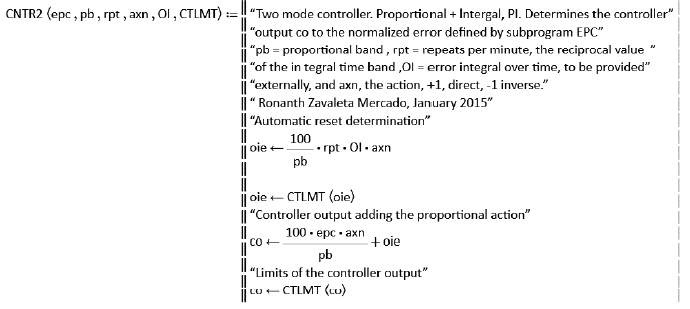
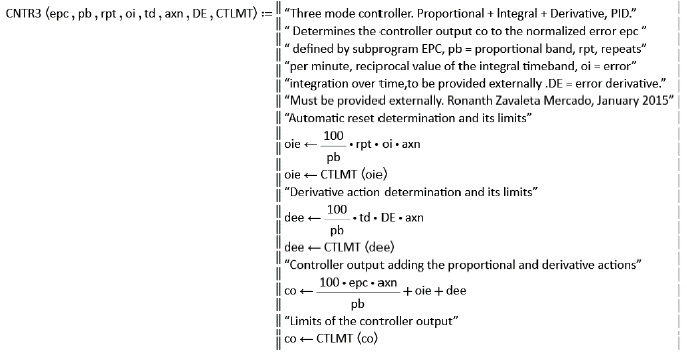
<body><![CDATA[<p align="justify"><font face="Verdana, Arial, Helvetica, sans-serif" size="2"><b>Subprogram 11</b>: Modeling of the first order controller. Here <i>epc</i> is the normalized error and oi the manual reset. The controller output co is also normalized (domain 0 to 100).</font></p></td>   </tr> </table>     <p align="justify"><font face="Verdana, Arial, Helvetica, sans-serif" size="2">The second order controller, the proportional plus automatic reset one (PI) incorporates an additional action that is proportional to the integral of the normalized error, and its net effect is the elimination of the steady offset. It requires though the generation the integral of the error, function of time that has to be provided externally to the function CONTR2 that simulates it (Subprogram 12). The following equation describes this behavior</font></p>     <p align="center"><img src="/img/revistas/ran/v7n3/a02_ecuation_73.gif" width="689" height="55"></p>     <p align="justify"></p>     <p align="justify"><font face="Verdana, Arial, Helvetica, sans-serif" size="2">where <i>rpt is </i>the control setting that usually has units of repeats per minute [3].</font></p> <table width="444" border="0" align="center">   <tr>     <td valign="top">    <p align="justify"><img src="/img/revistas/ran/v7n3/a02_ecuation_73_2.gif" width="690" height="309"></td>   </tr>   <tr>     <td>    <p align="justify"><font face="Verdana, Arial, Helvetica, sans-serif" size="2"><b>Subprogram 12: </b>Modeling of the second order controller (PI). Here <i>epc</i> is the normalized error and OI the integral over time of the error (epc) that has to be provided externally to the function. The controller output is also normalized (domain 0 to 100).</font></p></td>   </tr> </table>     <p align="justify"><font face="Verdana, Arial, Helvetica, sans-serif" size="2">The third order controller (PID) incorporates a rate action to the PI controller already discussed and this way could be considered as some sort of a predictive one, since the rate action allows it to adjust a control variable according to the rate change of the error, before its build up. To model this controller not only the integral of the error has to be provided but also the rate of change of the error, that can be considered to be proportional to the rate of change of the control variable for a fixed set point (no servo control). This function of time has to be provided externally to the function CONTR3 that simulates it (Subprogram 13). The following equation describes this behavior.</font></p> <table width="444" border="0" align="center">   <tr>     <td valign="top">    <p align="justify"><img src="/img/revistas/ran/v7n3/a02_ecuation_73_3.gif" width="687" height="357"></td>   </tr>   <tr>     <td>    <p align="justify"><font face="Verdana, Arial, Helvetica, sans-serif" size="2"><b>Subprogram 13: </b>Modeling of the third order controller (PID). Here <i>epc</i> is the normalized error, oi the integral of the error function epc, and DE the derivative of the control variable that has to be provided externals well. The controller output is also normalized (domain 0 to 100).</font></p></td>   </tr> </table>     ]]></body>
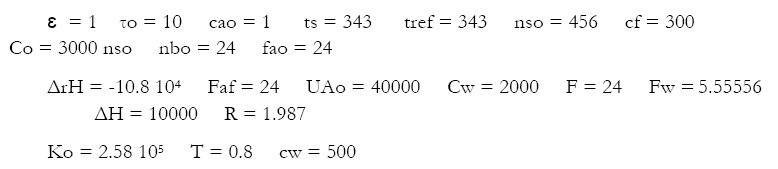
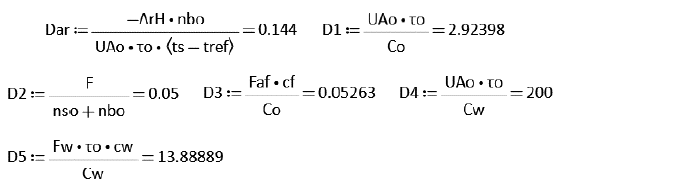
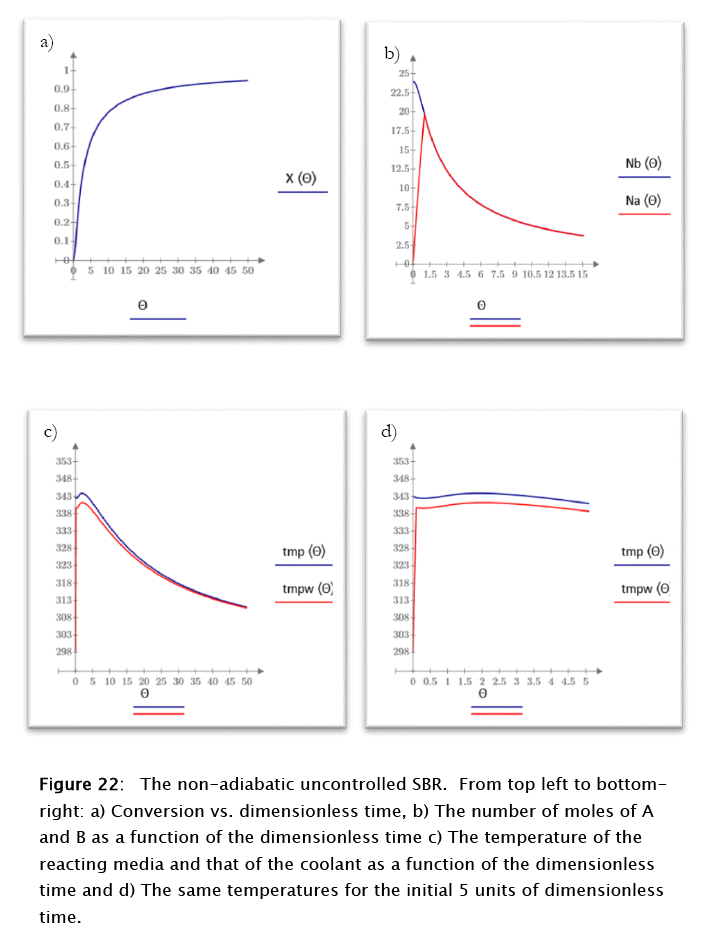
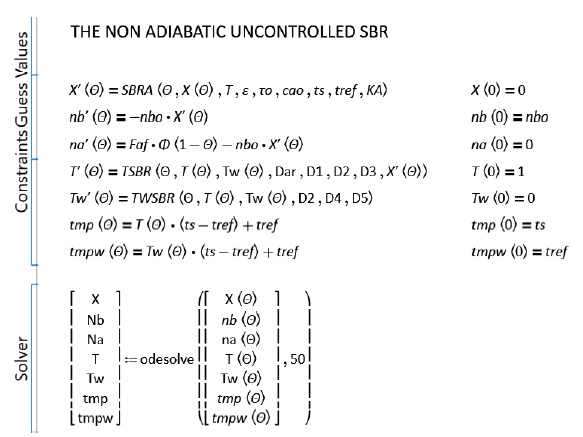
<body><![CDATA[<p align="justify">&nbsp;</p>     <p align="justify"><font face="Verdana, Arial, Helvetica, sans-serif" size="3"><b>3.    The nonlinear controlled SBR</b></font></p>     <p align="justify"><font face="Verdana, Arial, Helvetica, sans-serif" size="2">The previously developed functions allow the simulation of the Semibatch Reactor by means of the mass and energy equations derived in the first part of this article. The case involving a second order elementary reaction is explored using proportional (P), proportional-integral (PI) and proportional-integral-derivative controllers (PID).</font></p>     <p align="justify"><font face="Verdana, Arial, Helvetica, sans-serif" size="2">The following parameters were chosen for the simulation of the Semibatch reactor, and refer to the modeling presented in the first part of this article.</font></p>     <p align="center"><img src="/img/revistas/ran/v7n3/a02_ecuation_73_4.gif" width="778" height="169"></p>     <p align="justify"><font face="Verdana, Arial, Helvetica, sans-serif" size="2">The resulting dimensionless groups for the mass and energy balances are</font></p>     <p align="center"><img src="/img/revistas/ran/v7n3/a02_ecuation_73_5.gif" width="687" height="191"></p>     <p align="center">&nbsp;</p>     <p align="justify"><font face="Verdana, Arial, Helvetica, sans-serif" size="3"><b>4. The non-adiabatic uncontrolled case</b></font></p>     <p align="justify"><font face="Verdana, Arial, Helvetica, sans-serif" size="2">The application of the above parameters to the non-adiabatic uncontrolled SBR modeling (<a href="#s14">Subprogram 14,</a> at the end) renders the results plotted in <a href="#f22">Figure 22</a>. This data is displayed for comparison purposes with the controlled ones that are discussed below.</font></p>     ]]></body>
<body><![CDATA[<p align="justify"><a name="f22"></a></p>     <p align="center"><img src="/img/revistas/ran/v7n3/a02_figure_22.gif" width="716" height="933"></p>     <p align="justify"><font face="Verdana, Arial, Helvetica, sans-serif" size="2">For this case the conversion tends asymptotically to 1 as expected for the irreversible second order elementary chemical reaction used, the number of moles of reactants follow a common monotonically decreasing behavior once the stoichiometric point is reached, also as expected. Both temperatures, reacting media and coolant, also follow this tendency, typical of the uncontrolled stable processes, with the coolant temperature lower than that of the reacting media.</font></p>     <p align="justify">&nbsp;</p>     <p align="justify"><font face="Verdana, Arial, Helvetica, sans-serif" size="3"><b>5. The non-adiabatic controlled (proportional) case.</b></font></p>     <p align="justify"><font face="Verdana, Arial, Helvetica, sans-serif" size="2">The following parameters were used for the proportional controller: </font></p>     <p align="center"><img src="/img/revistas/ran/v7n3/a02_figure_22_1.gif" width="668" height="48"></p>     <p align="center">&nbsp;</p>     <p align="justify"><font face="Verdana, Arial, Helvetica, sans-serif" size="3"><b>6. The non-adiabatic controlled proportional case.</b></font></p>     <p align="justify"><font face="Verdana, Arial, Helvetica, sans-serif" size="2">The following parameters were used for the proportional controller: </font></p>     ]]></body>

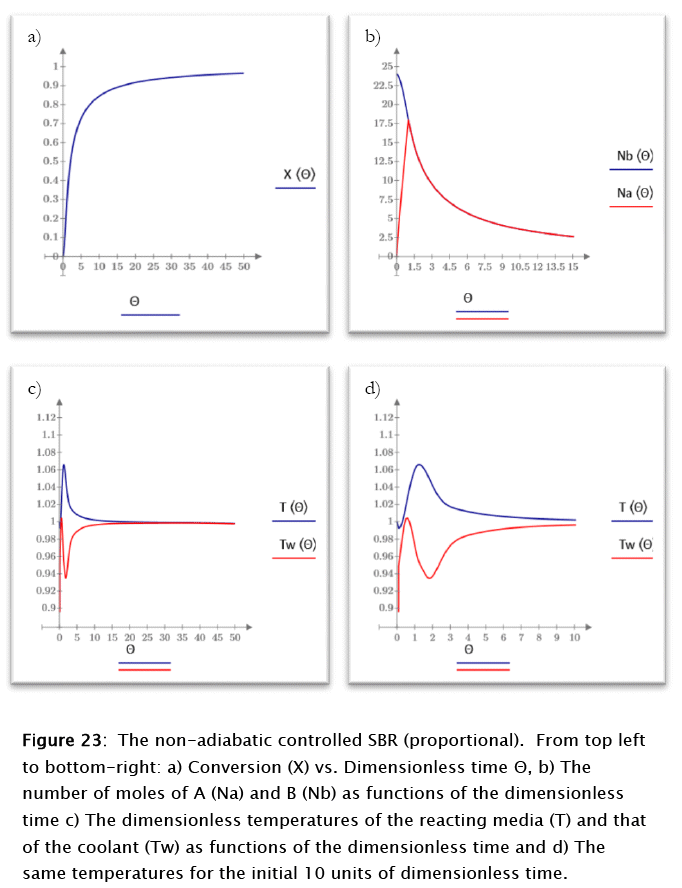
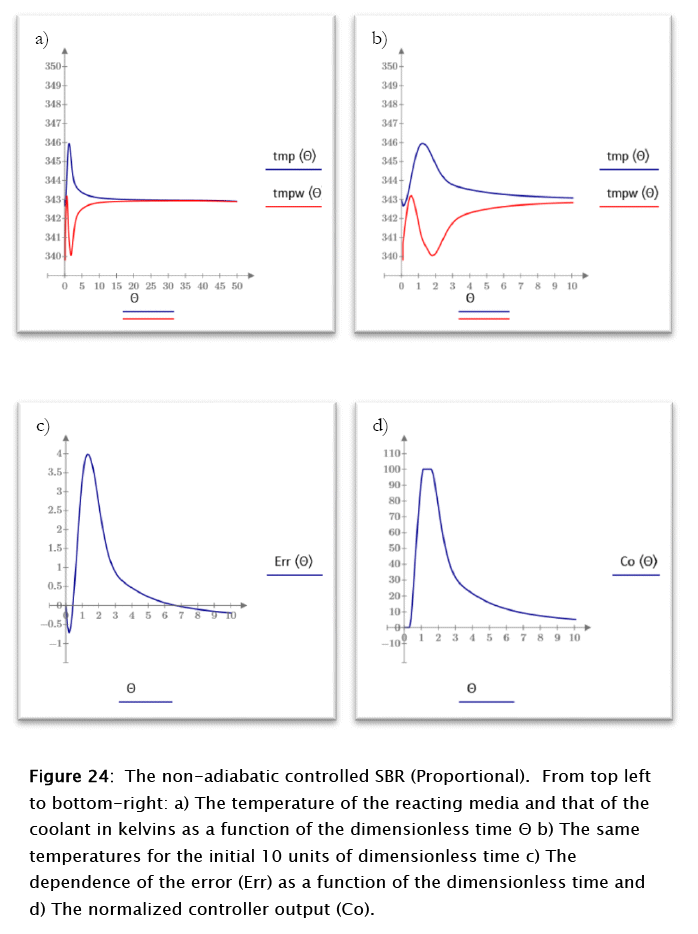
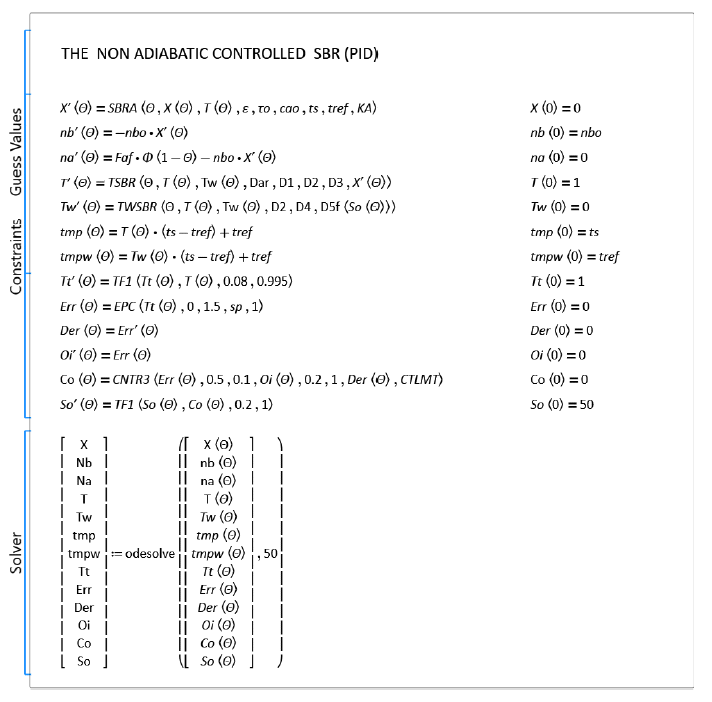
<body><![CDATA[<p align="center"><img src="/img/revistas/ran/v7n3/a02_ecuation_73_6.gif" width="646" height="42"></p>     <p align="justify"><font face="Verdana, Arial, Helvetica, sans-serif" size="2">and also the following function of the flow rate as a function of the port opening (valve area flow as a percentage of the fully opened one) and the corresponding dimensionless group</font></p>     <p align="center"><img src="/img/revistas/ran/v7n3/a02_figure_22_2.gif" width="682" height="47"></p>     <p align="justify"><font face="Verdana, Arial, Helvetica, sans-serif" size="2">The application of the above parameters to the non-adiabatic uncontrolled SBR modeling (<a href="#s15">Subprogram 15</a>) render the results plotted in <a href="#f23">figures 23</a> and <a href="#f24">24</a></font></p>     <p align="justify"><a name="f23"></a></p>     <p align="center"><img src="/img/revistas/ran/v7n3/a02_figure_23.gif" width="682" height="888"></p>     <p align="center">&nbsp;</p>     <p align="center"><a name="f24"></a></p>     <p align="center"><img src="/img/revistas/ran/v7n3/a02_figure_24.gif" width="698" height="934"></p>     <p align="justify"><font face="Verdana, Arial, Helvetica, sans-serif" size="2">For this case the conversion and the number of moles of reactants follow patterns similar to the ones discussed above for the uncontrolled case even though the kinetics is faster, probably because of the temperatures being closer to that of the set point throughout the run, due to the controller activity, but the reacting media and coolant temperatures show a very different behavior. The reacting medium tend to reach the steady state value after an about 3 kelvins overshoot.</font></p>     ]]></body>
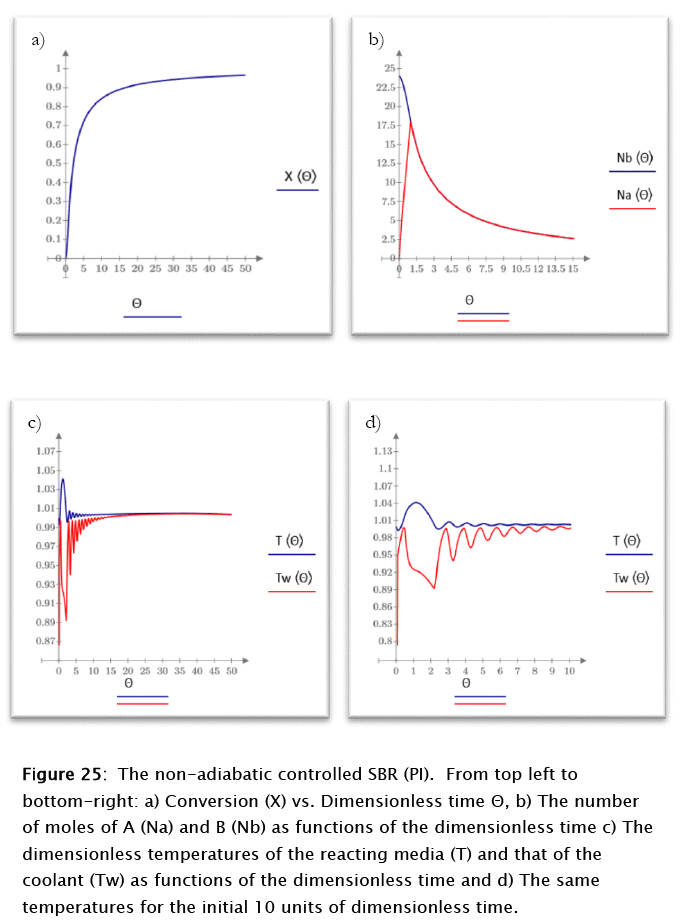
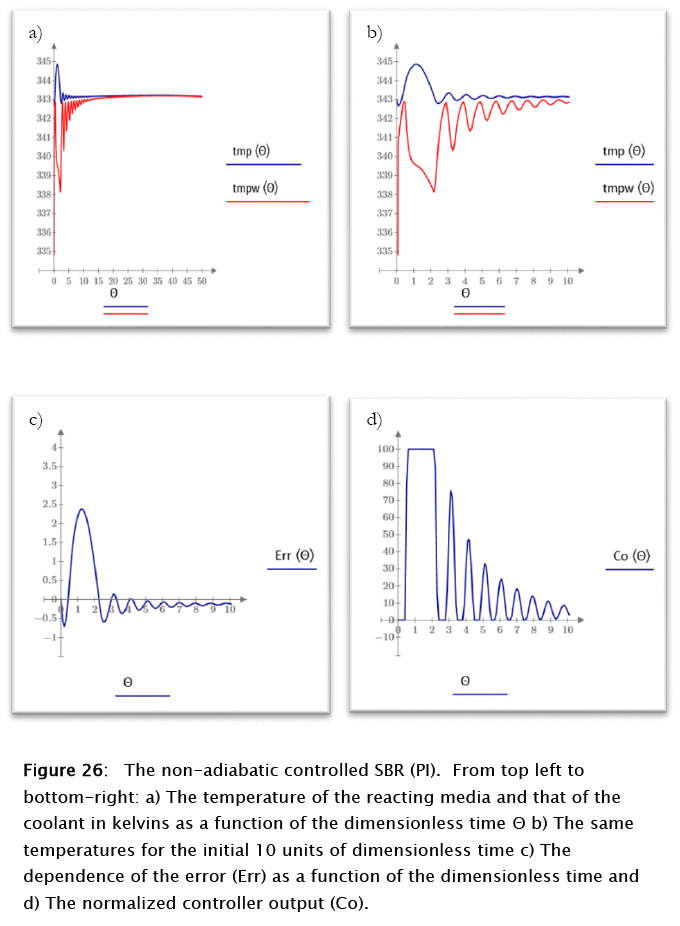
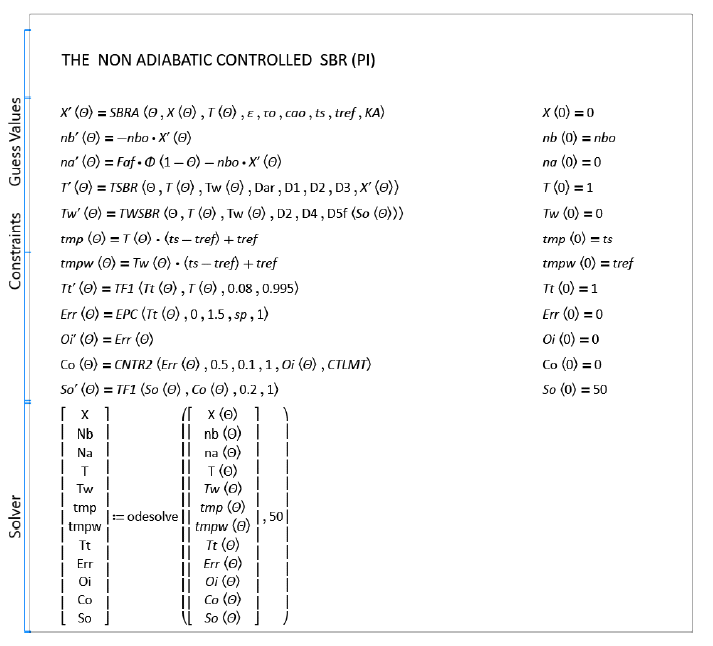
<body><![CDATA[<p align="justify"><font face="Verdana, Arial, Helvetica, sans-serif" size="2">Close to steady state behavior is reached at about 20 dimensionless time units. The normalized error peaks at about 4 units for time 2 (dimensionless), in correspondence to the controller maximum output, as expected from theoretical considerations. A true steady state is never reached due to the residual coolant flow resulting from the valve's rangeability. The slight negative slope of the final reacting media and coolant temperatures results from this fact, as expected also from theoretical considerations.</font></p>     <p align="justify">&nbsp;</p>     <p align="justify"><font face="Verdana, Arial, Helvetica, sans-serif" size="3"><b>7. The non-adiabatic controlled poportional-integral (PI) case.</b></font></p>     <p align="justify"><font face="Verdana, Arial, Helvetica, sans-serif" size="2">The parameters used for this case are the same ones discussed for the proportional controller, with the exception of those related to the settings of the controller itself, which are given as arguments of the function CONTR2 in <a href="#s16">Subprogram 16</a> (integral time and others).</font></p>     <p align="justify"><font face="Verdana, Arial, Helvetica, sans-serif" size="2">The application of the above parameters to the non-adiabatic uncontrolled SBR modeling (<a href="#s16">Subprogram 16</a>) renders the results plotted in <a href="#f25">figures 25</a> and <a href="#f26">26</a></font></p>     <p align="justify"><a name="f25"></a></p>     <p align="center"><img src="/img/revistas/ran/v7n3/a02_figure_25.gif" width="685" height="924"></p>     <p align="center">&nbsp;</p>     <p align="center"><a name="f26"></a></p>     <p align="center"><img src="/img/revistas/ran/v7n3/a02_figure_26.gif" width="680" height="926"></p>     ]]></body>
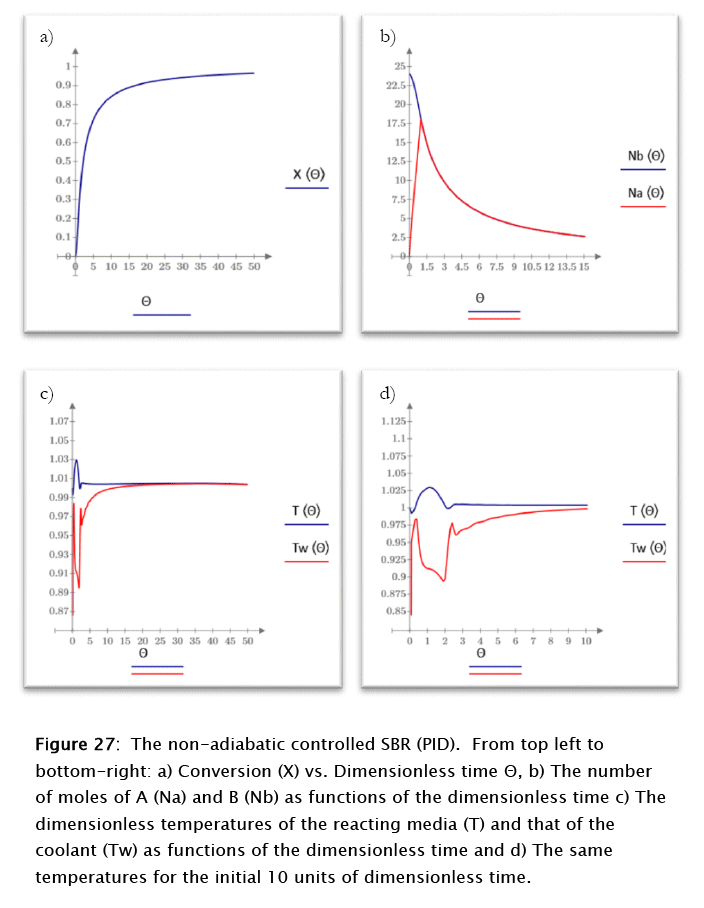
<body><![CDATA[<p align="justify"><font face="Verdana, Arial, Helvetica, sans-serif" size="2">For this case the conversion and the number of moles of reactants follow patterns similar to the ones discussed above for the proportional case, but the reacting media and coolant temperatures show a very different behavior. The reacting medium tend to reach the steady state in time 9 (dimensionless) after an about 2.5 kelvins overshoot. The normalized error peaks at about 2.5 units for time 1.2 (dimensionless), in correspondence to the controller maximum output, as expected from theoretical considerations. A true steady state is never reached due to the residual coolant flow resulting from the valve's rangeability. The slight negative slope of the final reacting media and coolant temperatures results from this fact, as expected also from theoretical considerations.</font></p>     <p align="justify"><font face="Verdana, Arial, Helvetica, sans-serif" size="2">In general the overall control of the process is greatly enhanced by the introduction of the integral effect.</font></p>     <p align="justify">&nbsp;</p>     <p align="justify"><font face="Verdana, Arial, Helvetica, sans-serif" size="3"><b>8. The non-adiabatic controlled proportional-integral-derivative (PID) case.</b></font></p>     <p align="justify"><font face="Verdana, Arial, Helvetica, sans-serif" size="2">The parameters used for this case are the same ones discussed for the proportional controller, with the exception of those related to the settings of the</font> <font face="Verdana, Arial, Helvetica, sans-serif" size="2">controller itself, which are given as arguments of the function CONTR3 in <a href="#s17">Subprogram 17</a> (derivative time and others).</font></p>     <p align="justify"><font face="Verdana, Arial, Helvetica, sans-serif" size="2">The application of the above parameters to the non-adiabatic uncontrolled SBR modeling (<a href="#s17">Subprogram 17</a>) gives the results plotted in <a href="#f27">figures 27</a> and <a href="#f28">28</a></font></p>     <p align="justify"><a name="f27"></a></p>     <p align="center"><img src="/img/revistas/ran/v7n3/a02_figure_27.gif" width="704" height="908"></p>     <p align="center">&nbsp;</p>     <p align="center"><a name="f28"></a></p>     ]]></body>
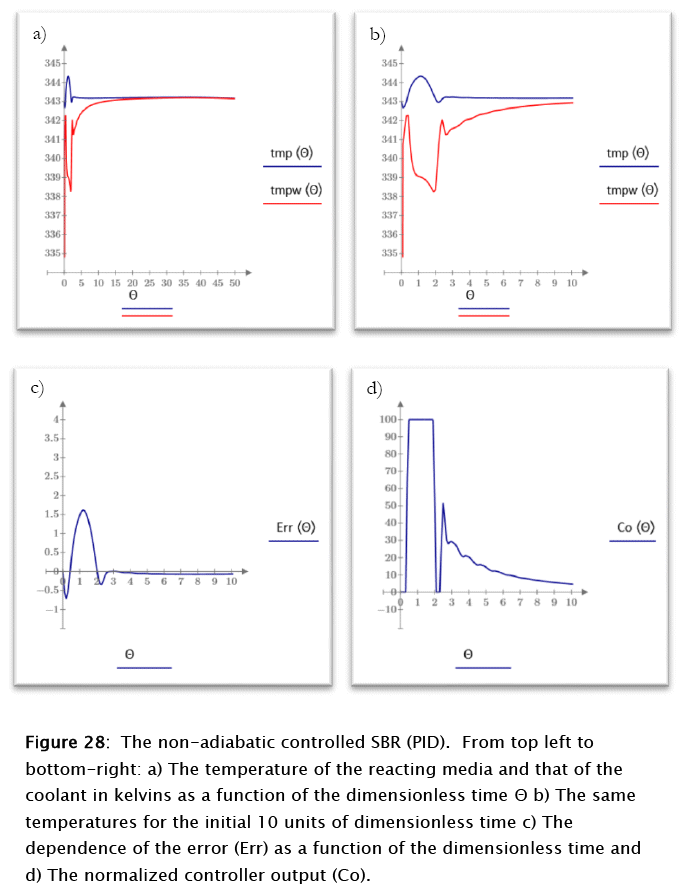
<body><![CDATA[<p align="center"><img src="/img/revistas/ran/v7n3/a02_figure_28.gif" width="693" height="896"></p>     <p align="justify"><font face="Verdana, Arial, Helvetica, sans-serif" size="2">For this case the conversion and the number of moles of reactants follow patterns similar to the ones discussed above for the proportional-integral case, but the reacting media and coolant temperatures show a very different behavior. The reacting medium tend to reach the steady state after about 3 time units, following a 1 kelvin overshoot. The normalized error peaks at about 1.5 units for time 1.2 (dimensionless), in correspondence to the controller maximum output, as expected from theoretical considerations. As before, a true steady state is never reached due to the residual coolant flow resulting from the valve's rangeability. The slight negative slope of the final reacting media and coolant temperatures results from this fact, as expected also from theoretical considerations.</font></p>     <p align="justify"><font face="Verdana, Arial, Helvetica, sans-serif" size="2">In general the control of the process is improved further by the introduction of the derivative effect, which provides a sort of predictive effect to the overall control.</font></p>     <p align="justify">&nbsp;</p>     <p align="justify"><font face="Verdana, Arial, Helvetica, sans-serif" size="3"><b>9.    Conclusions</b></font></p>     <p align="justify"><font face="Verdana, Arial, Helvetica, sans-serif" size="2">The ease and versatility of functions manipulation of the Mead Prime 3 environment makes the control problem simulation studied a good experience. Even though no attempt was made to fine tune the controllers, the potential is there with little additional effort. Theoretical approaches for optimizing the process</font></p>     <p align="justify"><font face="Verdana, Arial, Helvetica, sans-serif" size="2">are also possible employing real settings for the controller and control elements under an heuristic optimizing algorithm. Other more elaborate control schemes are also possible without having to endure complex programming.</font></p>     <p align="justify"><font face="Verdana, Arial, Helvetica, sans-serif" size="2">In general the controllers performed as expected, and the real advantages of superimposing integral and derivative effects to the proportional controller become quite obvious for the case under study.</font></p>     <p align="justify"><a name="s14"></a></p> <table width="444" border="0" align="center">   <tr>     <td valign="top">    <p align="justify"><img src="/img/revistas/ran/v7n3/a02_figure_28_1.gif" width="583" height="437"></td>   </tr>   <tr>     <td>    ]]></body>
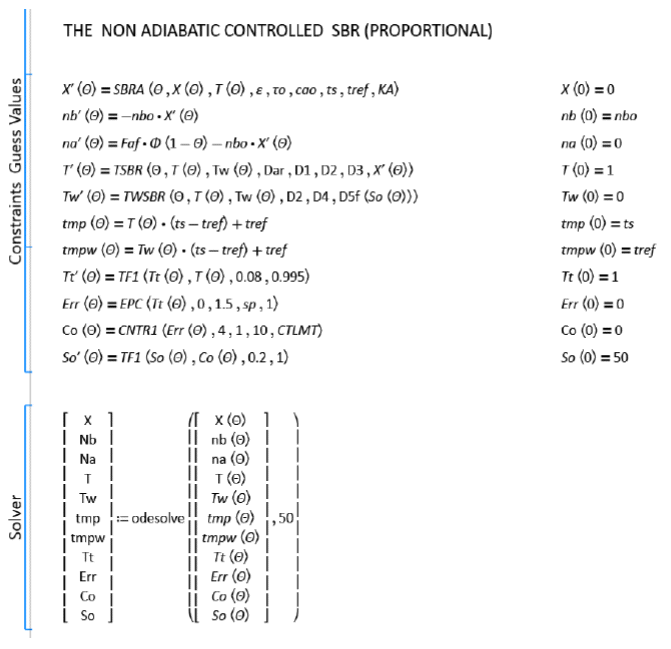
<body><![CDATA[<p align="justify"><font face="Verdana, Arial, Helvetica, sans-serif" size="2"><b>Subprogram 14: </b>Modeling the non-adiabatic uncontrolled SBR. The results up to fifty dimensionless time units are portrayed in <a href="#f22">Figure 22</a>.</font></p></td>   </tr> </table>     <p><a name="s15"></a></p> <table width="444" border="0" align="center">   <tr>     <td valign="top">    <p align="justify"><img src="/img/revistas/ran/v7n3/a02_figure_28_2.gif" width="671" height="649"></td>   </tr>   <tr>     <td>    <p align="justify"><font face="Verdana, Arial, Helvetica, sans-serif" size="2"><b>Subprogram 15: </b>Modeling the non-adiabatic controlled (proportional, P) SBR. The results are portrayed in <a href="#f23">Figure 23</a> and <a href="#f24">24</a>.</font></p></td>   </tr> </table>     <p><a name="s16"></a></p> <table width="444" border="0" align="center">   <tr>     <td valign="top">    <p align="justify"><img src="/img/revistas/ran/v7n3/a02_figure_28_3.gif" width="713" height="646"></td>   </tr>   <tr>     <td>    <p align="justify"><font face="Verdana, Arial, Helvetica, sans-serif" size="2"><b>Subprogram 16: </b>Modeling the non-adiabatic controlled (proportional, P) SBR. The results are portrayed in <a href="#f25">Figure 25</a> and <a href="#f26">26</a>.</font></p></td>   </tr> </table>     <p><a name="s17"></a></p> <table width="444" border="0" align="center">   <tr>     <td valign="top">    <p align="justify"><img src="/img/revistas/ran/v7n3/a02_figure_28_4.gif" width="712" height="702"></td>   </tr>   <tr>     <td>    <p align="justify"><font face="Verdana, Arial, Helvetica, sans-serif" size="2"><b>Subprogram 17: </b>Modeling the non-adiabatic controlled (PID) SBR. The results are portrayed in <a href="#f27">Figure 27</a> and <a href="f28">28</a>.</font></p></td>   </tr> </table>     ]]></body>
<body><![CDATA[<p>&nbsp;</p>     <p align="justify"><font face="Verdana, Arial, Helvetica, sans-serif" size="3"><b>Notation </b></font></p>     <p align="justify"><b><font face="Verdana, Arial, Helvetica, sans-serif" size="2"><i>Variables</i></font></b><font face="Verdana, Arial, Helvetica, sans-serif" size="2"><i></i></font></p>     <blockquote>       <p align="justify"><font face="Verdana, Arial, Helvetica, sans-serif" size="2">A, B, C, D = chemical species A, B, C, D respectively. A refers also to the area available for heat</font> <font face="Verdana, Arial, Helvetica, sans-serif" size="2">transfer.</font></p>       <p align="justify"><font face="Verdana, Arial, Helvetica, sans-serif" size="2">c = specific heat capacity</font></p>       <p align="justify"><font face="Verdana, Arial, Helvetica, sans-serif" size="2">C = Heat capacity of the reactor contents</font></p>       <p align="justify"><font face="Verdana, Arial, Helvetica, sans-serif" size="2">F = reactant feed rate</font></p>       <p align="justify"><font face="Verdana, Arial, Helvetica, sans-serif" size="2">H = Enthalpy</font></p>       <p align="justify"><font face="Verdana, Arial, Helvetica, sans-serif" size="2">n, N = number of moles</font></p>       ]]></body>
<body><![CDATA[<p align="justify"><font face="Verdana, Arial, Helvetica, sans-serif" size="2">k = chemical reaction rate constant</font></p>       <p align="justify"><font face="Verdana, Arial, Helvetica, sans-serif" size="2">r = chemical reaction rate</font></p>       <p align="justify"><font face="Verdana, Arial, Helvetica, sans-serif" size="2">t = time</font></p>       <p align="justify"><font face="Verdana, Arial, Helvetica, sans-serif" size="2">T = Temperature</font></p>       <p align="justify"><font face="Verdana, Arial, Helvetica, sans-serif" size="2">U = Internal energy, also the global heat transfer coefficient</font></p>       <p align="justify"><font face="Verdana, Arial, Helvetica, sans-serif" size="2">V = volume of the chemical reaction media </font></p>       <p align="justify"><font face="Verdana, Arial, Helvetica, sans-serif" size="2">z = factor de compresion</font></p> </blockquote>     <p align="justify"><font face="Verdana, Arial, Helvetica, sans-serif" size="2"><b><i>Parameters</i></b></font></p>     <blockquote>       <p align="justify"><font face="Verdana, Arial, Helvetica, sans-serif" size="2">Da, Da<sub>f</sub> = dimensionless Damkohler type parameters defined by Equation [48]</font></p>       ]]></body>
<body><![CDATA[<p align="justify"><font face="Verdana, Arial, Helvetica, sans-serif" size="2">Da<sub>r</sub> = another Damkohler type parameter defined by Equation [57]</font></p>       <p align="justify"><font face="Verdana, Arial, Helvetica, sans-serif" size="2">D<sub>1</sub>, D<sub>2</sub>, D<sub>3</sub> = parameters for the energy balance defined by Equation [57]</font></p> </blockquote>     <p align="justify"><font face="Verdana, Arial, Helvetica, sans-serif" size="2"><b><i>Greek Letters</i></b></font></p>     <blockquote>       <p align="justify"><font face="Verdana, Arial, Helvetica, sans-serif" size="2">A = incremental operator, when referred to chemical reactions gives the enthalpy or internal energy of</font> <font face="Verdana, Arial, Helvetica, sans-serif" size="2">reaction</font></p>       <p align="justify"><font size="2"><i>&rho;</i></font><font face="Verdana, Arial, Helvetica, sans-serif" size="2"> = density of the chemical reaction medium</font></p>       <p align="justify"><font face="Verdana, Arial, Helvetica, sans-serif" size="2">&#949; = ratio of the stoichiometric initial concentrations of species B in the reactor and A in the feed</font></p>       <p align="justify"><font face="Verdana, Arial, Helvetica, sans-serif" size="2">&#915; = Feed rate of reactant</font></p>       <p align="justify"><font size="2"><i>&#957;</i></font><font face="Verdana, Arial, Helvetica, sans-serif" size="2"> = stoichiometric coefficient of an elementary chemical reaction.</font></p>       <p align="justify"><font size="2">9</font><font face="Verdana, Arial, Helvetica, sans-serif" size="2"> = volumetric feed rate</font></p>       ]]></body>
<body><![CDATA[<p align="justify"><font face="Verdana, Arial, Helvetica, sans-serif" size="2">X = chemical reaction conversion</font></p>       <p align="justify"><font face="Verdana, Arial, Helvetica, sans-serif" size="2">&#920; = dimensionless time</font></p>       <p align="justify"><font face="Verdana, Arial, Helvetica, sans-serif" size="2">t = space time, also a dimensionless temperature</font></p> </blockquote>     <p align="justify"><font face="Verdana, Arial, Helvetica, sans-serif" size="2"><b><i>Subscripts</i></b></font></p>     <blockquote>       <p align="justify"><font face="Verdana, Arial, Helvetica, sans-serif" size="2">A, B, C, D = species A, B, C, D respectively</font></p>       <p align="justify"><font face="Verdana, Arial, Helvetica, sans-serif" size="2">o, 0 = refers to a parameter at the beginning of the run</font></p>       <p align="justify"><font face="Verdana, Arial, Helvetica, sans-serif" size="2">f = refers to a parameter at the end of the run and also to the feed</font></p>       <p align="justify"><font face="Verdana, Arial, Helvetica, sans-serif" size="2">m = molar, specific property</font></p>       <p align="justify"><font face="Verdana, Arial, Helvetica, sans-serif" size="2">ref = reference, used with T refers to a reference temperature</font></p>       ]]></body>
<body><![CDATA[<p align="justify"><font face="Verdana, Arial, Helvetica, sans-serif" size="2">S = refers to the solvent</font></p>       <p align="justify"><font face="Verdana, Arial, Helvetica, sans-serif" size="2">w = refers to the cooling medium</font></p> </blockquote>     <p align="justify">&nbsp;</p>     <p align="justify"><font face="Verdana, Arial, Helvetica, sans-serif" size="3"><b>Bibliography</b></font></p>     <p align="justify"><font face="Verdana, Arial, Helvetica, sans-serif" size="2">[1]     Franks, R. G. E., &quot;Modeling and Simulation in Chemical Engineering&quot;, Wile-Interscience, John Wiley &amp; Sons, 1972</font></p>     <p align="justify"><font face="Verdana, Arial, Helvetica, sans-serif" size="2">[2]     Ibid, pg. 370</font></p>     <p align="justify"><font face="Verdana, Arial, Helvetica, sans-serif" size="2">[3]     Ibid, pg. 363</font></p>     <p align="justify">&nbsp;</p>      ]]></body><back>
<ref-list>
<ref id="B1">
<label>1</label><nlm-citation citation-type="book">
<person-group person-group-type="author">
<name>
<surname><![CDATA[Franks]]></surname>
<given-names><![CDATA[R. G. E.]]></given-names>
</name>
</person-group>
<source><![CDATA[Modeling and Simulation in Chemical Engineering]]></source>
<year>1972</year>
<publisher-name><![CDATA[Wile-Interscience, John Wiley & Sons]]></publisher-name>
</nlm-citation>
</ref>
<ref id="B2">
<label>2</label><nlm-citation citation-type="book">
<person-group person-group-type="author">
<name>
<surname><![CDATA[Franks]]></surname>
<given-names><![CDATA[R. G. E.]]></given-names>
</name>
</person-group>
<source><![CDATA[Modeling and Simulation in Chemical Engineering]]></source>
<year>1972</year>
<page-range>370</page-range><publisher-name><![CDATA[Wile-Interscience, John Wiley & Sons]]></publisher-name>
</nlm-citation>
</ref>
<ref id="B3">
<label>3</label><nlm-citation citation-type="book">
<person-group person-group-type="author">
<name>
<surname><![CDATA[Franks]]></surname>
<given-names><![CDATA[R. G. E.]]></given-names>
</name>
</person-group>
<source><![CDATA[Modeling and Simulation in Chemical Engineering]]></source>
<year>1972</year>
<page-range>363</page-range><publisher-name><![CDATA[Wile-Interscience, John Wiley & Sons]]></publisher-name>
</nlm-citation>
</ref>
</ref-list>
</back>
</article>