<?xml version="1.0" encoding="ISO-8859-1"?><article xmlns:mml="http://www.w3.org/1998/Math/MathML" xmlns:xlink="http://www.w3.org/1999/xlink" xmlns:xsi="http://www.w3.org/2001/XMLSchema-instance">
<front>
<journal-meta>
<journal-id>1683-0789</journal-id>
<journal-title><![CDATA[Acta Nova]]></journal-title>
<abbrev-journal-title><![CDATA[RevActaNova.]]></abbrev-journal-title>
<issn>1683-0789</issn>
<publisher>
<publisher-name><![CDATA[Universidad Católica Boliviana]]></publisher-name>
</publisher>
</journal-meta>
<article-meta>
<article-id>S1683-07892015000200003</article-id>
<title-group>
<article-title xml:lang="en"><![CDATA[On the synonymy of Nitzschia frustulum var. subsalina, N. inconspicua and N. boliviana sensu Trobajo et al. 2013]]></article-title>
<article-title xml:lang="es"><![CDATA[Sobre la sinonimia de Nitzschia frustulum var. subsalina, N. inconspicua and N. boliviana sensu Trobajo et al. 2013]]></article-title>
</title-group>
<contrib-group>
<contrib contrib-type="author">
<name>
<surname><![CDATA[Morales]]></surname>
<given-names><![CDATA[Eduardo A.]]></given-names>
</name>
<xref ref-type="aff" rid="A01"/>
</contrib>
</contrib-group>
<aff id="A01">
<institution><![CDATA[,Universidad Católica Boliviana 'San Pablo' Herbario Criptogámico Universidad Católica Boliviana ]]></institution>
<addr-line><![CDATA[Cochabamba ]]></addr-line>
<country>Bolivia</country>
</aff>
<pub-date pub-type="pub">
<day>00</day>
<month>09</month>
<year>2015</year>
</pub-date>
<pub-date pub-type="epub">
<day>00</day>
<month>09</month>
<year>2015</year>
</pub-date>
<volume>7</volume>
<numero>2</numero>
<fpage>114</fpage>
<lpage>121</lpage>
<copyright-statement/>
<copyright-year/>
<self-uri xlink:href="http://www.scielo.org.bo/scielo.php?script=sci_arttext&amp;pid=S1683-07892015000200003&amp;lng=en&amp;nrm=iso"></self-uri><self-uri xlink:href="http://www.scielo.org.bo/scielo.php?script=sci_abstract&amp;pid=S1683-07892015000200003&amp;lng=en&amp;nrm=iso"></self-uri><self-uri xlink:href="http://www.scielo.org.bo/scielo.php?script=sci_pdf&amp;pid=S1683-07892015000200003&amp;lng=en&amp;nrm=iso"></self-uri></article-meta>
</front><body><![CDATA[ <p align="right"><font face="Verdana" size="2"><b>ART&Iacute;CULO CIENT&Iacute;FICO</b></font></p>     <p align="right">&nbsp;</p>     <p align="center"><b><font size="4" face="Verdana, Arial, Helvetica, sans-serif">On the synonymy of <i>Nitzschia frustulum </i>var.</font></b> <font size="4"><b><font face="Verdana"><i>subsalina, N. inconspicua </i>and <i>N. boliviana sensu</i></font> <font face="Verdana">Trobajo et al. 2013</font></b></font></p>     <p align="center">&nbsp;</p>     <p align="center"><b><font face="Verdana" size="3"><i>Sobre la sinonimia de </i>Nitzschia frustulum <i>var. </i>subsalina, N. inconspicua <i>and </i>N<i>. </i>boliviana sensu <i>Trobajo </i>et al. <i>2013</i></font></b></p>     <p align="center">&nbsp;</p>     <p align="center">&nbsp;</p>     <p align="center"><b><font face="Verdana" size="2">Eduardo A. Morales</font></b></p>     <p align="center"><font face="Verdana" size="2">Herbario Criptogámico Universidad Católica Boliviana &quot;San Pablo&quot;, Carrera de Ingeniería Ambiental. Casilla de Correos 5381, Cochabamba, Bolivia.</font>    <br> <font face="Verdana" size="2"><b>e-mail</b>: <a href="mailto:edu_moral23@outlook.com">edu_moral23@outlook.com</a></font></p>     ]]></body>
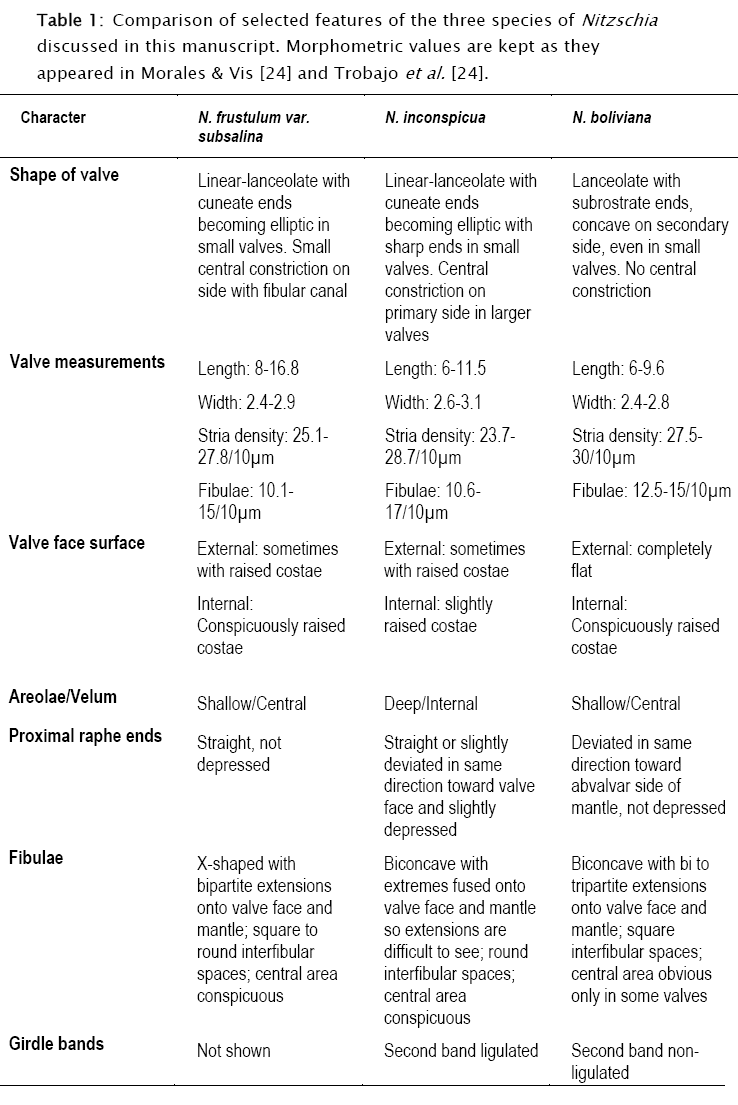
<body><![CDATA[<p align="center"><font size="2" face="Verdana, Arial, Helvetica, sans-serif"><b>Recibido:</b> 17 de noviembre 2015     <br>     <b>Aceptado:</b> 15 de diciembre 2015</font></p>     <p align="center">&nbsp;</p>     <p align="center">&nbsp;</p> <hr noshade>     <p align="justify"><font face="Verdana" size="2">In 2013, Trobajo and collaborators published an important contribution to the clarification of the taxonomy of some taxa of <i>Nitzschia </i>Hassall belonging to the Section Lanceolatae. This constitutes a group of relatively small species and infraspecific taxa that are common in freshwater samples and that are also commonly misidentified in routine ecological and floristic works. The importance of the Trobajo <i>et al. </i>paper is exacerbated by the inclusion of light (LM) and electron microscopy (SEM) data on type material of<i> Nitzschia frustulum </i>var. <i>subsalina </i>Hustedt, <i>N. inconspicua </i>Grunow and <i>N. boliviana </i>E.Morales &amp; Vis (among others). Revision of type material is a necessary step in the clear definition of taxonomic and ecological boundaries, information that can be later used to define, for example, biogeographical distributions and usefulness of taxa in bioindication [11] [14] [15].</font></p>     <p align="justify"><font face="Verdana" size="2">After comparison of LM and SEM images of <i>N. frustulum </i>var. <i>subsalina, N. inconspicua </i>and <i>N. boliviana, </i>Trobajo <i>et al. </i>[23] concluded that the three were conspecific and that they should be put in synonymy under <i>N. inconpicua </i>as the oldest validly published name. There are, however, some differences in the type population of <i>N. boliviana, </i>originally described from the Yungas of La Paz, Bolivia [13], which were not taken into account by Trobajo and collaborators. In the present manuscript, I discuss these differences in support of a separation of <i>N. boliviana </i>from other species in the Section Lanceolatae.</font></p>     <p align="justify"><font face="Verdana" size="2"><a href="#t1">Table 1</a> shows a comparison among the taxa treated here. Data in this table were gathered from, and are circumscribed to, type material presented in Trobajo <i>et al. </i>[23] and Morales &amp; Vis [13]. Before comparisons are made, it is convenient to first delimit well the range of variability of <i>N. boliviana </i>in type material. In plate 2 of</font> <font face="Verdana" size="2">the supplementary information, Trobajo <i>et al. </i>[23] present a size diminution series for <i>N. boliviana </i>from type material that is incorrect. The first and largest valve on the right of the upper row clearly does not belong to <i>N. boliviana </i>and does not appear to have been considered during calculations of size ranges (see their <a href="#t1">table 1</a>). The more acutely-ended apices and the features of the raphe canal and fibulae in this specimen are different from the rest of the members in the mentioned series.</font></p>     <p align="justify"><a name="t1"></a></p>     <p align="center"><img src="/img/revistas/ran/v7n2/a08_tabla_01.gif" width="738" height="1105"></p>     <p align="justify"><font face="Verdana" size="2">All characters considered in <a href="#t1">Table 1</a> are relevant in taxonomic treatments of <i>Nitzschia </i>spp. as shown by Mann [10]. The three taxa cannot be entirely separated based on valve measurements since there are overlaps in ranges for length, width, and density of stria and fibulae. Following Geissler [3] [4], Wendker &amp; Geissler [25], Trobajo <i>et al. </i>[20] and Trobajo &amp; Cox [21], these features are unreliable for defining affinities or taxonomy within <i>Nitzschia </i>since such features vary with environmental conditions such as salinity, turbulence and nutrient concentrations.</font></p>     ]]></body>
<body><![CDATA[<p align="justify"><font face="Verdana" size="2">Looking at other features in <a href="#t1">Table 1</a>, however, it is possible to find differences in <i>N. boliviana </i>when compared with the other two taxa. First, shape of valve is never linear and its apices are characteristically concave on the secondary side of the valve, a feature that is maintained even in small valves (figs 260-264 in Morales &amp; Vis [13]; figs 15-17, and píate 2, figs 2-20 in Trobajo <i>et al. </i>[23]). At the central area of the valve there is no constriction on the primary side, the proximal terminations of the raphe are both deflected towards the abvalvar side of the mantle and there is no external depression (figs 271-276 in Morales &amp; Vis [13]; figs 80-83 and plate 2, figs 21-22 in Trobajo <i>et al. </i>[23]). From the same figures it can be seen that the external surface of the valves is fíat, while in internal view the raised costae are clearly observable. Also, it is observed that the velum is placed in a very shallow position with respect to the valve external surface. The fibulae are biconcave with extensions onto valve face and mantle that can be bi or tripartite. The interfibular spaces are square and the central area is obvious only in some valves (figs 260-264 in Morales &amp; Vis [13]; figs 15-17 and plate 2, figs 2-20 in Trobajo <i>et al. </i>[23]). Finally, the second girdle band does not possess a ligula (fig. 274 in Morales &amp; Vis [13]; fig. 82 in Trobajo <i>et al. </i>[23]).</font></p>     <p align="justify"><font face="Verdana" size="2">Some of the above features are different from those of <i>N. inconspicua </i>or <i>N. frustulum </i>var. <i>subsalina, </i>and some others are different from those in both taxa. From <a href="#t1">Table 1</a>, it is also clear that <i>N. frustulum </i>var. <i>subsalina </i>and <i>N. inconspicua </i>have differences between them, raising questions about their conspecificity.</font></p>     <p align="justify"><font face="Verdana" size="2">The features included in <a href="#t1">Table 1</a> and used to differentiate the three taxa included in this discussion are rather stable as shown by micrographs of the type populations. This stability allows the conclusion that the three populations can indeed be separated into three discriminate sets. In the absence of culturing and molecular data, something can still be said regarding the reliability of these distinguishing features. Some features of the raphe, central nodule, girdle bands, position of velum, shape of fibulae and distance between fibulae at the central area have been used to delimit species boundaries. Shape of valves and constrictions at the central area could be variable, but are often used as support characters to define species.</font></p>     <p align="justify"><font face="Verdana" size="2">Though the distal ends of the raphe in nitzschioids has been shown to vary from valve to valve during formation of the frustule (e.g., Pickett-Heaps [16]), the central raphe endings have been little explored as a contributing feature in species delimitation. Mann [10] argued that presence or absence of a central raphe termination is questionable as a character defining species (see also discussion in Trobajo &amp; Cox, [21]), but the deflection of such terminations (when they exist) and the presence of depressions at the valve central nodule have not been clearly studied in culture or from natural populations. The type materials of <i>N. frustulum </i>var. <i>subsalina, N. inconspicua </i>and <i>Nitzschia boliviana </i>show no variation regarding deflection or lack thereof and presence/absence of depressions. Therefore, until shown otherwise, they should be regarded as differentiating features at the species level. Other authors have made similar observations, though not on type material [5] [9] [6] [25], while Trobajo &amp; Cox [21] suggested that further studies are needed to show variability of these features.</font></p>     <p align="justify"><font face="Verdana" size="2">The position of velum is one of the least discussed features in relation to genetic or environmentally-related variability. However, a review of the type material of several species of the Section Lanceolatae shows that this feature does not vary at the population level (e.g., Trobajo &amp; Cox [21], Tudesque <i>et al. </i>[24] and Trobajo <i>et al. </i>[23]). Alakananda <i>et al. </i>[1] used this feature in combination with others and argued that they are useful to sepárate species within the Section, which is also the case for the three taxa analyzed here. At the moment, it is unclear if the stability in the position of the velum shown in type materials should be extrapolated to all species within the Section. This is because some morphological variants such as &quot;type 2&quot; found in type material of <i>N. abbreviata </i>Hustedt ex Simonsen and <i>N. invisitata </i>Hustedt exhibit a high variability in pore shape, and probably also in velum features and position, though this has not been shown [22] [23].</font></p>     <p align="justify"><font face="Verdana" size="2">The features of girdle bands, except for their closed/open nature, and the occurrence and disposition of perforations, have also been little explored in the literature. Girdle bands of two of the three type populations discussed here were illustrated, and one <i>(N. inconspicua) </i>is shown to have ligulated copulae (fig. 79 in</font> <font face="Verdana" size="2">Trobajo <i>et al. </i>[23]), while <i>N. boliviana </i>lacks this structure. Obviously, observations of girdle elements of one or two specimens are insufficient to derive hard conclusions, yet the difference illustrated by Trobajo <i>et al. </i>[23] is worth exploring further.</font></p>     <p align="justify"><font face="Verdana" size="2">The shape of fibulae and interfibular spaces have been long used as a feature to distinguish species even under LM. As stated by Denys &amp; Lange-Bertalot [2], extensions of fibulae associated to costae and striae can be useful not only for identification, but also for circumscription of morphologically closely related taxa (see also Alakananda <i>et al. </i>[1]). Especially at the LM level, the shape of the fibulae can be a helpful distinguishing character when used in association with other features such as those discussed here [12] [19] and has even been suggested to indícate evolutionary patterns in certain nitzschioid groups [7]. The distance between median fibulae (the ones flanking the central nodule) have been shown not to vary significantly with environmental conditions and are considered stable characters at the population level [20]. In the type materials presented by Trobajo <i>et al. </i>[23], variability in the shape and distance of the fibulae can be seen at the individual level, but at the population level the variability is different for each of the three taxa in question.</font></p>     <p align="justify"><font face="Verdana" size="2">Examination of type material of several infrageneric taxa in <i>Nitzschia, </i>including those in the Section Lanceolatae, showed that valve shape is a reliable character to distinguish taxa at the species level (e.g., Trobajo &amp; Cox [21], Tudesque <i>et al. </i>[24], Hlúbikova [8] and Trobajo <i>et al. </i>[23]). Some variation exists from one individual valve to another, but this is the expected variability found in most diatom populations (Pickett-Heaps <i>et al. </i>[17]). Valve shape in populations of <i>N.frustulum </i>var. <i>subsalina, N. inconspicua </i>and <i>N. boliviana </i>found in type material are rather stable as shown in LM and SEM illustrations presented in Morales &amp; Vis [13] and Trobajo <i>et al. </i>[23], therefore, the comparison shown in Table 1 is reliable and can be used in combination with the other features discussed here to differentiate each of the three discussed taxa.</font></p>     <p align="justify"><font face="Verdana" size="2">Culture experiments have shown that valve shape is variable under different conditions in <i>N. frustulum </i>(Kützing) Grunow, and thus, it is an unreliable feature for identification or species boundary delimitation. A more recent molecular study showed that valve outline could not give a clear differentiation of clades or genotypes in the <i>N. inconspicua </i>complex (Rovira <i>et al. </i>[18]; where -as per the analysis implemented here-, an even wider morphological variability than that presented in Trobajo <i>et al. </i>[23] is shown). Here, I show that valve outline can be used in combination with other features to establish discrete morphological variants, which up to this date, and in the absence of clear genetic information, can be considered as different morphological taxa.</font></p>     <p align="justify"><font face="Verdana" size="2">Mann [10] warned about the cons of a &quot;sparingly-divided classification&quot;. Therefore, until we do not have a clear picture of the limits among taxa at the ecological and molecular level, it is convenient to adopt a splitter approach, especially taking into account that differing morphologies could be indicative of given environmental conditions (i.e., the result of natural selection) and that responses to those conditions might be taxa or even clone-specific [21][18]. Moreover, Rovira <i>et al. </i>[18] argue based <i>rbc</i>L and LSU genetic distances that the <i>N. inconspicua </i>complex could contain several cryptic species. The splitting of apparently cryptic morphologies based on a joint analysis of several qualitative characters, such as the analysis done here, provides a strong hypothesis to be tested in the molecular arena; a hypothesis drawn on morphological characters that go beyond the simple reductionist morphometry.</font></p>     ]]></body>
<body><![CDATA[<p align="justify">&nbsp;</p>     <p align="justify"><font face="Verdana" size="2"><b>Acknowledgements</b></font></p>     <p align="justify"><font face="Verdana" size="2">I thank Sinziana Rivera, University of Geneva, for editing the text and reference checking, and Luc Ector, Luxembourg Institute of Science and Technology, for providing literature. I am indebted to Nora Maidana, University of Buenos Aires; Silvia Sala and Amelia Vouilloud, National University of La Plata, Argentina, for reviewing the text, providing valuable opinions and suggesting changes that improved its content.</font></p>     <p align="justify">&nbsp;</p>     <p align="justify"><font face="Verdana" size="3"><b>References</b></font></p>     <!-- ref --><p align="justify"><font size="2" face="Verdana, Arial, Helvetica, sans-serif">[1] Alakananda, B.; Balasubramanian, K..; Taylor, J.C. &amp; Hamilton,  P.B. 2014. Two new species of <i>Nitzschia </i>(Bacillariophyceae) from  freshwater environs of Lonar Crater Lake, India. Phycological Research  63:29-36. </font>&nbsp;&nbsp;&nbsp;&nbsp;&nbsp;&nbsp;&nbsp;&nbsp;[&#160;<a href="javascript:void(0);" onclick="javascript: window.open('/scielo.php?script=sci_nlinks&ref=778672&pid=S1683-0789201500020000300001&lng=','','width=640,height=500,resizable=yes,scrollbars=1,menubar=yes,');">Links</a>&#160;]<!-- end-ref --><!-- ref --><p align="justify"><font size="2" face="Verdana, Arial, Helvetica, sans-serif">[2] Denys, L. &amp; Lange-Bertalot, H. 1998. Observations on two taxa of  the section Nitzschiae Lanceolatae (Bacillariophyceae): <i>Nitzschia  blankaartensis </i>sp. nov. and <i>N. bulnheimiana</i>. Nova Hedwigia 67:  247-258. </font>&nbsp;&nbsp;&nbsp;&nbsp;&nbsp;&nbsp;&nbsp;&nbsp;[&#160;<a href="javascript:void(0);" onclick="javascript: window.open('/scielo.php?script=sci_nlinks&ref=778673&pid=S1683-0789201500020000300002&lng=','','width=640,height=500,resizable=yes,scrollbars=1,menubar=yes,');">Links</a>&#160;]<!-- end-ref --><!-- ref --><p align="justify"><font size="2" face="Verdana, Arial, Helvetica, sans-serif">[3] Geissler, U. 1970a. Die Variabilit&auml;t der Schalenmerkmale bei den  Diatomeen. Nova Hedwigia 19: 623-773. </font>&nbsp;&nbsp;&nbsp;&nbsp;&nbsp;&nbsp;&nbsp;&nbsp;[&#160;<a href="javascript:void(0);" onclick="javascript: window.open('/scielo.php?script=sci_nlinks&ref=778674&pid=S1683-0789201500020000300003&lng=','','width=640,height=500,resizable=yes,scrollbars=1,menubar=yes,');">Links</a>&#160;]<!-- end-ref --><!-- ref --><p align="justify"><font size="2" face="Verdana, Arial, Helvetica, sans-serif">[4] Geissler, U. 1970b. Die Schalenmerkmale der Diatomeen-Ursachen ihrer  Variabilit&auml;t und Bedeutung f&uuml;r die Taxonomie. Beihefte zur Nova Hedwigia 31:  511-535. </font>&nbsp;&nbsp;&nbsp;&nbsp;&nbsp;&nbsp;&nbsp;&nbsp;[&#160;<a href="javascript:void(0);" onclick="javascript: window.open('/scielo.php?script=sci_nlinks&ref=778675&pid=S1683-0789201500020000300004&lng=','','width=640,height=500,resizable=yes,scrollbars=1,menubar=yes,');">Links</a>&#160;]<!-- end-ref --><!-- ref --><p align="justify"><font size="2" face="Verdana, Arial, Helvetica, sans-serif">[5] Geissler, U. &amp; Gerloff, J. 1963. Elektronenmikroskopische  Beitr&auml;ge zur Phylogenie der Diatomeenraphe. Nova Hedwigia 6: 339-352. </font>&nbsp;&nbsp;&nbsp;&nbsp;&nbsp;&nbsp;&nbsp;&nbsp;[&#160;<a href="javascript:void(0);" onclick="javascript: window.open('/scielo.php?script=sci_nlinks&ref=778676&pid=S1683-0789201500020000300005&lng=','','width=640,height=500,resizable=yes,scrollbars=1,menubar=yes,');">Links</a>&#160;]<!-- end-ref --><p align="justify"><font size="2" face="Verdana, Arial, Helvetica, sans-serif">[6] Kobayasi, H. 1985. Ultrastructural differences in certain  taxonomically difficult species of <i>Nitzschia </i>section Lanceolatae in  Japan. In: Origin and evolution of diversity in plants and plant community  (H.Hara, ed.). Academia, Tokyo. pp.  304-315. </font></p>     <!-- ref --><p align="justify"><font size="2" face="Verdana, Arial, Helvetica, sans-serif">[7] Hamilton, P.B. &amp; Laird, K.R. 2001. <i>Nitzschia pseudosinuata </i>sp.  nov., a new Holocene diatom from the sediment of Moon Lake, North Dakota,  U.S.A. Diatom Research 16: 317-324. </font>&nbsp;&nbsp;&nbsp;&nbsp;&nbsp;&nbsp;&nbsp;&nbsp;[&#160;<a href="javascript:void(0);" onclick="javascript: window.open('/scielo.php?script=sci_nlinks&ref=778678&pid=S1683-0789201500020000300007&lng=','','width=640,height=500,resizable=yes,scrollbars=1,menubar=yes,');">Links</a>&#160;]<!-- end-ref --><!-- ref --><p align="justify"><font size="2" face="Verdana, Arial, Helvetica, sans-serif">[8] Hl&uacute;bikova, D.; Blanco, S.; Falasco, E.; Gom&aacute;, J.; Hoffmann, L. &amp;  Ector, L. 2009. <i>Nitzschia alicae </i>sp. nov. and <i>N. puriformis </i>sp.  nov., new diatoms from European rivers and comparison with the type material of <i>N. sublinearis </i>and <i>N. pura</i>. Journal  of Phycology 45: 742-760. </font>&nbsp;&nbsp;&nbsp;&nbsp;&nbsp;&nbsp;&nbsp;&nbsp;[&#160;<a href="javascript:void(0);" onclick="javascript: window.open('/scielo.php?script=sci_nlinks&ref=778679&pid=S1683-0789201500020000300008&lng=','','width=640,height=500,resizable=yes,scrollbars=1,menubar=yes,');">Links</a>&#160;]<!-- end-ref --><!-- ref --><p align="justify"><font size="2" face="Verdana, Arial, Helvetica, sans-serif">[9] Lange-Bertalot, H. &amp; Simonsen, R. 1978. A taxonomic revision of  the Nitzschiae lanceolatae Grunow. 2. European and related extra-European  freshwater and brackish water taxa. Bacillaria 1: 11-111. </font>&nbsp;&nbsp;&nbsp;&nbsp;&nbsp;&nbsp;&nbsp;&nbsp;[&#160;<a href="javascript:void(0);" onclick="javascript: window.open('/scielo.php?script=sci_nlinks&ref=778680&pid=S1683-0789201500020000300009&lng=','','width=640,height=500,resizable=yes,scrollbars=1,menubar=yes,');">Links</a>&#160;]<!-- end-ref --><!-- ref --><p align="justify"><font size="2" face="Verdana, Arial, Helvetica, sans-serif">[10] Mann, D.G. 1982. The use of the central raphe endings as a  taxonomic character. Plant Systematics and Evolution 141: 143-152. </font>&nbsp;&nbsp;&nbsp;&nbsp;&nbsp;&nbsp;&nbsp;&nbsp;[&#160;<a href="javascript:void(0);" onclick="javascript: window.open('/scielo.php?script=sci_nlinks&ref=778681&pid=S1683-0789201500020000300010&lng=','','width=640,height=500,resizable=yes,scrollbars=1,menubar=yes,');">Links</a>&#160;]<!-- end-ref --><p align="justify"><font size="2" face="Verdana, Arial, Helvetica, sans-serif">[11] Mann D.G. 2010. Discovering diatom species: is a long history of  disagreements about species-level taxonomy now at an end? Plant Ecology and  Evolution 143: 251&ndash;264. </font></p>     <p align="justify"><font size="2" face="Verdana, Arial, Helvetica, sans-serif">[12] Morales, E.A. &amp; Hamilton, P.B. 2002. Seventh NAWQA taxonomy  workshop on harmonization of algal taxonomy. Patrick Center for Environmental  Research. The Academy of Natural Sciences of Philadelphia. Report No. 02-21. 34 pp. </font></p>     <p align="justify"><font size="2" face="Verdana, Arial, Helvetica, sans-serif">[13] Morales E.A. &amp; Vis M.L. 2007. Epilithic diatoms  (Bacillariophyceae) from cloud forest and alpine streams in Bolivia, South  America. Proceedings of the Academy of Natural Sciences of Philadelphia 156:  123&ndash;155. </font></p>     <p align="justify"><font size="2" face="Verdana, Arial, Helvetica, sans-serif">[14] Morales E.A.; Wetzel C.E.; Rivera S.F.; Van De Vijver B. &amp;  Ector L. 2014. Current taxonomic studies on the diatom flora  (Bacillariophyceae) of the Bolivian Altiplano, South America, with possible  consequences for palaeoecological assessments. Journal of Micropalaeontology  33: 121&ndash;129. </font></p>     <!-- ref --><p align="justify"><font size="2" face="Verdana, Arial, Helvetica, sans-serif">[15] Morales E.A.; Wetzel C.E.; Van De Vijver B. &amp; Ector L. 2015.  Morphological studies on type material of widely cited araphid diatoms  (Bacillariophyta). Phycologia 54: 455-470. </font>&nbsp;&nbsp;&nbsp;&nbsp;&nbsp;&nbsp;&nbsp;&nbsp;[&#160;<a href="javascript:void(0);" onclick="javascript: window.open('/scielo.php?script=sci_nlinks&ref=778686&pid=S1683-0789201500020000300015&lng=','','width=640,height=500,resizable=yes,scrollbars=1,menubar=yes,');">Links</a>&#160;]<!-- end-ref --><!-- ref --><p align="justify"><font size="2" face="Verdana, Arial, Helvetica, sans-serif">[16] Pickett-Heaps, J. 1983. Valve morphogenesis and the microtubule  center in three species of the diatom <i>Nitzschia</i>. Journal of Phycology,  19: 269-281. </font>&nbsp;&nbsp;&nbsp;&nbsp;&nbsp;&nbsp;&nbsp;&nbsp;[&#160;<a href="javascript:void(0);" onclick="javascript: window.open('/scielo.php?script=sci_nlinks&ref=778687&pid=S1683-0789201500020000300016&lng=','','width=640,height=500,resizable=yes,scrollbars=1,menubar=yes,');">Links</a>&#160;]<!-- end-ref --><p align="justify"><font size="2" face="Verdana, Arial, Helvetica, sans-serif">[17] Pickett-Heaps, J.; Schmid, A-M.M.; Edgar, L.A. 1990. The cell  biology of diatom valve formation. In Progress in Phycological Research, Vol. 7  (Round F.E, &amp; Chapman, D.J., Eds.). Biopress,  Ltd. 1-168 pp. </font></p>     <!-- ref --><p align="justify"><font size="2" face="Verdana, Arial, Helvetica, sans-serif">[18] Rovira, L.; Trobajo, R.; Sato, S.; Ib&aacute;&ntilde;ez, C. &amp; Mann, D.G.  2015. Genetic and physiological diversity in the diatom <i>Nitzschia  inconspicua</i>. Journal of Eukaryotic Microbiology 52: 815-832. </font>&nbsp;&nbsp;&nbsp;&nbsp;&nbsp;&nbsp;&nbsp;&nbsp;[&#160;<a href="javascript:void(0);" onclick="javascript: window.open('/scielo.php?script=sci_nlinks&ref=778689&pid=S1683-0789201500020000300018&lng=','','width=640,height=500,resizable=yes,scrollbars=1,menubar=yes,');">Links</a>&#160;]<!-- end-ref --><!-- ref --><p align="justify"><font size="2" face="Verdana, Arial, Helvetica, sans-serif">[19] Siver, P.A.; Hamilton, P.B.; Stachura-Suchoples, K. &amp; Kociolek,  J.P. 2005. Diatoms of North America. The freshwater flora of Cape Cod. Iconographia  Diatomologica 14: 1- 463. </font>&nbsp;&nbsp;&nbsp;&nbsp;&nbsp;&nbsp;&nbsp;&nbsp;[&#160;<a href="javascript:void(0);" onclick="javascript: window.open('/scielo.php?script=sci_nlinks&ref=778690&pid=S1683-0789201500020000300019&lng=','','width=640,height=500,resizable=yes,scrollbars=1,menubar=yes,');">Links</a>&#160;]<!-- end-ref --><!-- ref --><p align="justify"><font size="2" face="Verdana, Arial, Helvetica, sans-serif">[20] Trobajo, R.; Cox, E.J. &amp; Quintana, X.D. 2004. The effects of some  environmental variables on the morphology of <i>Nitzschia frustulum </i>(Bacillariophyta),  in relation its use as a bioindicator. Nova Hedwigia 79: 433-445. </font>&nbsp;&nbsp;&nbsp;&nbsp;&nbsp;&nbsp;&nbsp;&nbsp;[&#160;<a href="javascript:void(0);" onclick="javascript: window.open('/scielo.php?script=sci_nlinks&ref=778691&pid=S1683-0789201500020000300020&lng=','','width=640,height=500,resizable=yes,scrollbars=1,menubar=yes,');">Links</a>&#160;]<!-- end-ref --><p align="justify"><font size="2" face="Verdana, Arial, Helvetica, sans-serif">[21] Trobajo, R. &amp; Cox, E.J. 2006. Examination of the type material  of <i>Nitzschia frustulum</i>, <i>N. palea </i>and <i>N. palea </i>var. <i>debilis</i>.  In: Proceedings of the 18th International Diatom Symposium (Ed. by A.  Witkowski). Biopress, Bristol. pp. 431-445. </font></p>     <!-- ref --><p align="justify"><font size="2" face="Verdana, Arial, Helvetica, sans-serif">[22] Trobajo, R.; Mann, D.G. &amp; Cox, E.J. 2012. Studies on the type  material of <i>Nitzschia abbreviata </i>(Bacillariophyta). Nova Hedwigia,  Beiheft 141: 185-199. </font>&nbsp;&nbsp;&nbsp;&nbsp;&nbsp;&nbsp;&nbsp;&nbsp;[&#160;<a href="javascript:void(0);" onclick="javascript: window.open('/scielo.php?script=sci_nlinks&ref=778693&pid=S1683-0789201500020000300022&lng=','','width=640,height=500,resizable=yes,scrollbars=1,menubar=yes,');">Links</a>&#160;]<!-- end-ref --><p align="justify"><font size="2" face="Verdana, Arial, Helvetica, sans-serif">[23] Trobajo R.; Rovira L.; Ector L.; Wetzel C.E.; Kelly M. &amp; Mann  D.G. 2013. Morphology and identity of some ecologically important small <i>Nitzschia </i>species. Diatom Research 28: 37&ndash;59. </font></p>     <!-- ref --><p align="justify"><font size="2" face="Verdana, Arial, Helvetica, sans-serif">[24] Tudesque, L.; Rimet, F. &amp; Ector, L. 2008. A new taxon of the  Section Nitzschiae Lanceolatae Grunow: <i>Nitzschia costei </i>sp.nov. compared  to <i>N. fonticola </i>Grunow, <i>N. macedonica </i>Hustedt and <i>N. tropica </i>Hustedt  and related species. Diatom Research 23: 483-501. </font>&nbsp;&nbsp;&nbsp;&nbsp;&nbsp;&nbsp;&nbsp;&nbsp;[&#160;<a href="javascript:void(0);" onclick="javascript: window.open('/scielo.php?script=sci_nlinks&ref=778695&pid=S1683-0789201500020000300024&lng=','','width=640,height=500,resizable=yes,scrollbars=1,menubar=yes,');">Links</a>&#160;]<!-- end-ref --><p align="justify"><font size="2" face="Verdana, Arial, Helvetica, sans-serif">[25] Wendker, S. &amp; Geissler, U. 1988. Investigations on valve  morphology of two Nitzschiae lanceolatae. In: Proceedings of the 9th International  Diatom Symposium (Ed. by F.E. Round). Biopress,  Bristol and Koeltz Scientific Books, Koenigstein. pp. 469&ndash;480. </font></p>     ]]></body>
<body><![CDATA[<p align="justify">&nbsp;</p>      ]]></body><back>
<ref-list>
<ref id="B1">
<label>1</label><nlm-citation citation-type="journal">
<person-group person-group-type="author">
<name>
<surname><![CDATA[Alakananda]]></surname>
<given-names><![CDATA[B.]]></given-names>
</name>
<name>
<surname><![CDATA[Balasubramanian]]></surname>
<given-names><![CDATA[K.]]></given-names>
</name>
<name>
<surname><![CDATA[Taylor]]></surname>
<given-names><![CDATA[J.C.]]></given-names>
</name>
<name>
<surname><![CDATA[Hamilton]]></surname>
<given-names><![CDATA[P.B.]]></given-names>
</name>
</person-group>
<article-title xml:lang="en"><![CDATA[Two new species of Nitzschia (Bacillariophyceae) from freshwater environs of Lonar Crater Lake, India]]></article-title>
<source><![CDATA[Phycological Research]]></source>
<year>2014</year>
<numero>63</numero>
<issue>63</issue>
<page-range>29-36</page-range></nlm-citation>
</ref>
<ref id="B2">
<label>2</label><nlm-citation citation-type="journal">
<person-group person-group-type="author">
<name>
<surname><![CDATA[Denys]]></surname>
<given-names><![CDATA[L.]]></given-names>
</name>
<name>
<surname><![CDATA[Lange-Bertalot]]></surname>
<given-names><![CDATA[H.]]></given-names>
</name>
</person-group>
<article-title xml:lang="en"><![CDATA[Observations on two taxa of the section Nitzschiae Lanceolatae (Bacillariophyceae): Nitzschia blankaartensis sp. nov. and N. bulnheimiana]]></article-title>
<source><![CDATA[Nova Hedwigia]]></source>
<year>1998</year>
<numero>67</numero>
<issue>67</issue>
<page-range>247-258</page-range></nlm-citation>
</ref>
<ref id="B3">
<label>3</label><nlm-citation citation-type="journal">
<person-group person-group-type="author">
<name>
<surname><![CDATA[Geissler]]></surname>
<given-names><![CDATA[U.]]></given-names>
</name>
</person-group>
<article-title xml:lang="de"><![CDATA[Die Variabilität der Schalenmerkmale bei den Diatomeen]]></article-title>
<source><![CDATA[Nova Hedwigia]]></source>
<year>1970</year>
<month>a</month>
<numero>19</numero>
<issue>19</issue>
<page-range>623-773</page-range></nlm-citation>
</ref>
<ref id="B4">
<label>4</label><nlm-citation citation-type="journal">
<person-group person-group-type="author">
<name>
<surname><![CDATA[Geissler]]></surname>
<given-names><![CDATA[U]]></given-names>
</name>
</person-group>
<article-title xml:lang="de"><![CDATA[Die Schalenmerkmale der Diatomeen-Ursachen ihrer Variabilität und Bedeutung für die Taxonomie]]></article-title>
<source><![CDATA[Beihefte zur Nova Hedwigia]]></source>
<year>1970</year>
<month>b</month>
<numero>31</numero>
<issue>31</issue>
<page-range>511-535</page-range></nlm-citation>
</ref>
<ref id="B5">
<label>5</label><nlm-citation citation-type="journal">
<person-group person-group-type="author">
<name>
<surname><![CDATA[Geissler]]></surname>
<given-names><![CDATA[U.]]></given-names>
</name>
<name>
<surname><![CDATA[Gerloff]]></surname>
<given-names><![CDATA[J.]]></given-names>
</name>
</person-group>
<article-title xml:lang="de"><![CDATA[Elektronenmikroskopische Beiträge zur Phylogenie der Diatomeenraphe]]></article-title>
<source><![CDATA[Nova Hedwigia]]></source>
<year>1963</year>
<numero>6</numero>
<issue>6</issue>
<page-range>339-352</page-range></nlm-citation>
</ref>
<ref id="B6">
<label>6</label><nlm-citation citation-type="book">
<person-group person-group-type="author">
<name>
<surname><![CDATA[Kobayasi]]></surname>
<given-names><![CDATA[H.]]></given-names>
</name>
</person-group>
<article-title xml:lang="en"><![CDATA[Ultrastructural differences in certain taxonomically difficult species of Nitzschia section Lanceolatae in Japan]]></article-title>
<person-group person-group-type="editor">
<name>
<surname><![CDATA[Hara]]></surname>
<given-names><![CDATA[H.]]></given-names>
</name>
</person-group>
<source><![CDATA[Origin and evolution of diversity in plants and plant community]]></source>
<year>1985</year>
<page-range>304-315</page-range><publisher-loc><![CDATA[Tokyo ]]></publisher-loc>
<publisher-name><![CDATA[Academia]]></publisher-name>
</nlm-citation>
</ref>
<ref id="B7">
<label>7</label><nlm-citation citation-type="journal">
<person-group person-group-type="author">
<name>
<surname><![CDATA[Hamilton]]></surname>
<given-names><![CDATA[P.B.]]></given-names>
</name>
<name>
<surname><![CDATA[Laird]]></surname>
<given-names><![CDATA[K.R.]]></given-names>
</name>
</person-group>
<article-title xml:lang="en"><![CDATA[Nitzschia pseudosinuata sp. nov., a new Holocene diatom from the sediment of Moon Lake, North Dakota, U.S.A.]]></article-title>
<source><![CDATA[Diatom Research]]></source>
<year>2001</year>
<numero>16</numero>
<issue>16</issue>
<page-range>317-324</page-range></nlm-citation>
</ref>
<ref id="B8">
<label>8</label><nlm-citation citation-type="journal">
<person-group person-group-type="author">
<name>
<surname><![CDATA[Hlúbikova]]></surname>
<given-names><![CDATA[D.]]></given-names>
</name>
<name>
<surname><![CDATA[Blanco]]></surname>
<given-names><![CDATA[S.]]></given-names>
</name>
<name>
<surname><![CDATA[Falasco]]></surname>
<given-names><![CDATA[E.]]></given-names>
</name>
<name>
<surname><![CDATA[Gomá]]></surname>
<given-names><![CDATA[J.]]></given-names>
</name>
<name>
<surname><![CDATA[Hoffmann]]></surname>
<given-names><![CDATA[L.]]></given-names>
</name>
<name>
<surname><![CDATA[Ector]]></surname>
<given-names><![CDATA[L.]]></given-names>
</name>
</person-group>
<article-title xml:lang="en"><![CDATA[Nitzschia alicae sp. nov. and N. puriformis sp. nov., new diatoms from European rivers and comparison with the type material of N. sublinearis and N. pura]]></article-title>
<source><![CDATA[Journal of Phycology]]></source>
<year>2009</year>
<numero>45</numero>
<issue>45</issue>
<page-range>742-760</page-range></nlm-citation>
</ref>
<ref id="B9">
<label>9</label><nlm-citation citation-type="journal">
<person-group person-group-type="author">
<name>
<surname><![CDATA[Lange-Bertalot]]></surname>
<given-names><![CDATA[H.]]></given-names>
</name>
<name>
<surname><![CDATA[Simonsen]]></surname>
<given-names><![CDATA[R.]]></given-names>
</name>
</person-group>
<article-title xml:lang="en"><![CDATA[A taxonomic revision of the Nitzschiae lanceolatae Grunow. 2. European and related extra-European freshwater and brackish water taxa]]></article-title>
<source><![CDATA[Bacillaria]]></source>
<year>1978</year>
<numero>1</numero>
<issue>1</issue>
<page-range>11-111</page-range></nlm-citation>
</ref>
<ref id="B10">
<label>10</label><nlm-citation citation-type="journal">
<person-group person-group-type="author">
<name>
<surname><![CDATA[Mann]]></surname>
<given-names><![CDATA[D.G.]]></given-names>
</name>
</person-group>
<article-title xml:lang="en"><![CDATA[The use of the central raphe endings as a taxonomic character]]></article-title>
<source><![CDATA[Plant Systematics and Evolution]]></source>
<year>1982</year>
<numero>141</numero>
<issue>141</issue>
<page-range>143-152</page-range></nlm-citation>
</ref>
<ref id="B11">
<label>11</label><nlm-citation citation-type="journal">
<person-group person-group-type="author">
<name>
<surname><![CDATA[Mann]]></surname>
<given-names><![CDATA[D.G.]]></given-names>
</name>
</person-group>
<article-title xml:lang="en"><![CDATA[Discovering diatom species: is a long history of disagreements about species-level taxonomy now at an end?]]></article-title>
<source><![CDATA[Plant Ecology and Evolution]]></source>
<year>2010</year>
<numero>143</numero>
<issue>143</issue>
<page-range>251-264</page-range></nlm-citation>
</ref>
<ref id="B12">
<label>12</label><nlm-citation citation-type="journal">
<person-group person-group-type="author">
<name>
<surname><![CDATA[Morales]]></surname>
<given-names><![CDATA[E.A.]]></given-names>
</name>
<name>
<surname><![CDATA[Hamilton]]></surname>
<given-names><![CDATA[P.B.]]></given-names>
</name>
</person-group>
<article-title xml:lang="en"><![CDATA[Seventh NAWQA taxonomy workshop on harmonization of algal taxonomy]]></article-title>
<source><![CDATA[Report]]></source>
<year>2002</year>
<numero>02-21</numero>
<issue>02-21</issue>
<page-range>34</page-range><publisher-name><![CDATA[Patrick Center for Environmental Research. The Academy of Natural Sciences of Philadelphia]]></publisher-name>
</nlm-citation>
</ref>
<ref id="B13">
<label>13</label><nlm-citation citation-type="journal">
<person-group person-group-type="author">
<name>
<surname><![CDATA[Morales]]></surname>
<given-names><![CDATA[E.A.]]></given-names>
</name>
<name>
<surname><![CDATA[Vis]]></surname>
<given-names><![CDATA[M.L]]></given-names>
</name>
</person-group>
<article-title xml:lang="en"><![CDATA[Epilithic diatoms (Bacillariophyceae) from cloud forest and alpine streams in Bolivia, South America]]></article-title>
<source><![CDATA[Proceedings of the Academy of Natural Sciences of Philadelphia]]></source>
<year>2007</year>
<numero>156</numero>
<issue>156</issue>
<page-range>123-155</page-range></nlm-citation>
</ref>
<ref id="B14">
<label>14</label><nlm-citation citation-type="journal">
<person-group person-group-type="author">
<name>
<surname><![CDATA[Morales]]></surname>
<given-names><![CDATA[E.A.]]></given-names>
</name>
<name>
<surname><![CDATA[Wetzel]]></surname>
<given-names><![CDATA[C.E.]]></given-names>
</name>
<name>
<surname><![CDATA[Rivera]]></surname>
<given-names><![CDATA[S.F.]]></given-names>
</name>
<name>
<surname><![CDATA[Van De Vijver]]></surname>
<given-names><![CDATA[B.]]></given-names>
</name>
<name>
<surname><![CDATA[Ector]]></surname>
<given-names><![CDATA[L.]]></given-names>
</name>
</person-group>
<article-title xml:lang="en"><![CDATA[Current taxonomic studies on the diatom flora (Bacillariophyceae) of the Bolivian Altiplano, South America, with possible consequences for palaeoecological assessments]]></article-title>
<source><![CDATA[Journal of Micropalaeontology]]></source>
<year>2014</year>
<numero>33</numero>
<issue>33</issue>
<page-range>121-129</page-range></nlm-citation>
</ref>
<ref id="B15">
<label>15</label><nlm-citation citation-type="journal">
<person-group person-group-type="author">
<name>
<surname><![CDATA[Morales]]></surname>
<given-names><![CDATA[E.A.]]></given-names>
</name>
<name>
<surname><![CDATA[Wetzel]]></surname>
<given-names><![CDATA[C.E.]]></given-names>
</name>
<name>
<surname><![CDATA[Van De Vijver]]></surname>
<given-names><![CDATA[B.]]></given-names>
</name>
<name>
<surname><![CDATA[Ector]]></surname>
<given-names><![CDATA[L.]]></given-names>
</name>
</person-group>
<article-title xml:lang="en"><![CDATA[Morphological studies on type material of widely cited araphid diatoms (Bacillariophyta)]]></article-title>
<source><![CDATA[Phycologia]]></source>
<year>2015</year>
<numero>54</numero>
<issue>54</issue>
<page-range>455-470</page-range></nlm-citation>
</ref>
<ref id="B16">
<label>16</label><nlm-citation citation-type="journal">
<person-group person-group-type="author">
<name>
<surname><![CDATA[Pickett-Heaps]]></surname>
<given-names><![CDATA[J.]]></given-names>
</name>
</person-group>
<article-title xml:lang="en"><![CDATA[Valve morphogenesis and the microtubule center in three species of the diatom Nitzschia]]></article-title>
<source><![CDATA[Journal of Phycology,]]></source>
<year>1983</year>
<numero>19</numero>
<issue>19</issue>
<page-range>269-281</page-range></nlm-citation>
</ref>
<ref id="B17">
<label>17</label><nlm-citation citation-type="book">
<person-group person-group-type="author">
<name>
<surname><![CDATA[Pickett-Heaps]]></surname>
<given-names><![CDATA[J.]]></given-names>
</name>
<name>
<surname><![CDATA[Schmid]]></surname>
<given-names><![CDATA[A-M.M.]]></given-names>
</name>
<name>
<surname><![CDATA[Edgar]]></surname>
<given-names><![CDATA[L.A.]]></given-names>
</name>
</person-group>
<article-title xml:lang="en"><![CDATA[The cell biology of diatom valve formation]]></article-title>
<person-group person-group-type="editor">
<name>
<surname><![CDATA[Round]]></surname>
<given-names><![CDATA[F.E.]]></given-names>
</name>
<name>
<surname><![CDATA[Chapman]]></surname>
<given-names><![CDATA[D.J]]></given-names>
</name>
</person-group>
<source><![CDATA[Progress in Phycological Research]]></source>
<year>1990</year>
<volume>7</volume>
<page-range>1-168</page-range><publisher-name><![CDATA[Biopress Ltd.]]></publisher-name>
</nlm-citation>
</ref>
<ref id="B18">
<label>18</label><nlm-citation citation-type="journal">
<person-group person-group-type="author">
<name>
<surname><![CDATA[Rovira]]></surname>
<given-names><![CDATA[L.]]></given-names>
</name>
<name>
<surname><![CDATA[Trobajo]]></surname>
<given-names><![CDATA[R.]]></given-names>
</name>
<name>
<surname><![CDATA[Sato]]></surname>
<given-names><![CDATA[S.]]></given-names>
</name>
<name>
<surname><![CDATA[Ibáñez]]></surname>
<given-names><![CDATA[C.]]></given-names>
</name>
<name>
<surname><![CDATA[Mann]]></surname>
<given-names><![CDATA[D.G.]]></given-names>
</name>
</person-group>
<article-title xml:lang="en"><![CDATA[Genetic and physiological diversity in the diatom Nitzschia inconspicua]]></article-title>
<source><![CDATA[Journal of Eukaryotic Microbiology]]></source>
<year>2015</year>
<numero>52</numero>
<issue>52</issue>
<page-range>815-832</page-range></nlm-citation>
</ref>
<ref id="B19">
<label>19</label><nlm-citation citation-type="journal">
<person-group person-group-type="author">
<name>
<surname><![CDATA[Siver]]></surname>
<given-names><![CDATA[P.A.]]></given-names>
</name>
<name>
<surname><![CDATA[Hamilton]]></surname>
<given-names><![CDATA[P.B.]]></given-names>
</name>
<name>
<surname><![CDATA[Stachura-Suchoples]]></surname>
<given-names><![CDATA[K.]]></given-names>
</name>
<name>
<surname><![CDATA[Kociolek]]></surname>
<given-names><![CDATA[J.P.]]></given-names>
</name>
</person-group>
<article-title xml:lang="en"><![CDATA[Diatoms of North America. The freshwater flora of Cape Cod]]></article-title>
<source><![CDATA[Iconographia Diatomologica]]></source>
<year>2005</year>
<numero>14</numero>
<issue>14</issue>
<page-range>1- 463</page-range></nlm-citation>
</ref>
<ref id="B20">
<label>20</label><nlm-citation citation-type="journal">
<person-group person-group-type="author">
<name>
<surname><![CDATA[Trobajo]]></surname>
<given-names><![CDATA[R.]]></given-names>
</name>
<name>
<surname><![CDATA[Cox]]></surname>
<given-names><![CDATA[E.J.]]></given-names>
</name>
<name>
<surname><![CDATA[Quintana]]></surname>
<given-names><![CDATA[X.D.]]></given-names>
</name>
</person-group>
<article-title xml:lang="en"><![CDATA[The effects of some environmental variables on the morphology of Nitzschia frustulum (Bacillariophyta), in relation its use as a bioindicator]]></article-title>
<source><![CDATA[Nova Hedwigia]]></source>
<year>2004</year>
<numero>79</numero>
<issue>79</issue>
<page-range>433-445</page-range></nlm-citation>
</ref>
<ref id="B21">
<label>21</label><nlm-citation citation-type="confpro">
<person-group person-group-type="author">
<name>
<surname><![CDATA[Trobajo]]></surname>
<given-names><![CDATA[R.]]></given-names>
</name>
<name>
<surname><![CDATA[Cox]]></surname>
<given-names><![CDATA[E.J.]]></given-names>
</name>
</person-group>
<article-title xml:lang="en"><![CDATA[Examination of the type material of Nitzschia frustulum, N. palea and N. palea var. debilis.]]></article-title>
<person-group person-group-type="editor">
<name>
<surname><![CDATA[Witkowski]]></surname>
<given-names><![CDATA[A.]]></given-names>
</name>
</person-group>
<source><![CDATA[]]></source>
<year>2006</year>
<conf-name><![CDATA[ 18th International Diatom Symposium Biopress]]></conf-name>
<conf-loc> </conf-loc>
<page-range>431-445</page-range><publisher-loc><![CDATA[Bristol ]]></publisher-loc>
</nlm-citation>
</ref>
<ref id="B22">
<label>22</label><nlm-citation citation-type="journal">
<person-group person-group-type="author">
<name>
<surname><![CDATA[Trobajo]]></surname>
<given-names><![CDATA[R.]]></given-names>
</name>
<name>
<surname><![CDATA[Mann]]></surname>
<given-names><![CDATA[D.G.]]></given-names>
</name>
<name>
<surname><![CDATA[Cox]]></surname>
<given-names><![CDATA[E.J.]]></given-names>
</name>
</person-group>
<article-title xml:lang="en"><![CDATA[Studies on the type material of Nitzschia abbreviata (Bacillariophyta)]]></article-title>
<source><![CDATA[Nova Hedwigia, Beiheft]]></source>
<year>2012</year>
<numero>141</numero>
<issue>141</issue>
<page-range>185-199</page-range></nlm-citation>
</ref>
<ref id="B23">
<label>23</label><nlm-citation citation-type="journal">
<person-group person-group-type="author">
<name>
<surname><![CDATA[Trobajo]]></surname>
<given-names><![CDATA[R.]]></given-names>
</name>
<name>
<surname><![CDATA[Rovira]]></surname>
<given-names><![CDATA[L.]]></given-names>
</name>
<name>
<surname><![CDATA[Ector]]></surname>
<given-names><![CDATA[L.]]></given-names>
</name>
<name>
<surname><![CDATA[Wetzel]]></surname>
<given-names><![CDATA[C.E.]]></given-names>
</name>
<name>
<surname><![CDATA[Kelly]]></surname>
<given-names><![CDATA[M.]]></given-names>
</name>
<name>
<surname><![CDATA[Mann]]></surname>
<given-names><![CDATA[D.G.]]></given-names>
</name>
</person-group>
<article-title xml:lang="en"><![CDATA[Morphology and identity of some ecologically important small Nitzschia species]]></article-title>
<source><![CDATA[Diatom Research]]></source>
<year>2013</year>
<numero>28</numero>
<issue>28</issue>
<page-range>37-59</page-range></nlm-citation>
</ref>
<ref id="B24">
<label>24</label><nlm-citation citation-type="journal">
<person-group person-group-type="author">
<name>
<surname><![CDATA[Tudesque]]></surname>
<given-names><![CDATA[L.]]></given-names>
</name>
<name>
<surname><![CDATA[Rimet]]></surname>
<given-names><![CDATA[F.]]></given-names>
</name>
<name>
<surname><![CDATA[Ector]]></surname>
<given-names><![CDATA[L.]]></given-names>
</name>
</person-group>
<article-title xml:lang="en"><![CDATA[A new taxon of the Section Nitzschiae Lanceolatae Grunow: Nitzschia costei sp.nov. compared to N]]></article-title>
<source><![CDATA[fonticola Grunow, N. macedonica Hustedt and N. tropica Hustedt and related species. Diatom Research]]></source>
<year>2008</year>
<numero>23</numero>
<issue>23</issue>
<page-range>483-501</page-range></nlm-citation>
</ref>
<ref id="B25">
<label>25</label><nlm-citation citation-type="confpro">
<person-group person-group-type="author">
<name>
<surname><![CDATA[Wendker]]></surname>
<given-names><![CDATA[S.]]></given-names>
</name>
<name>
<surname><![CDATA[Geissler]]></surname>
<given-names><![CDATA[U.]]></given-names>
</name>
</person-group>
<source><![CDATA[Investigations on valve morphology of two Nitzschiae lanceolatae]]></source>
<year>1988</year>
<conf-name><![CDATA[ 9th International Diatom Symposium]]></conf-name>
<conf-loc> </conf-loc>
<page-range>469-480</page-range><publisher-loc><![CDATA[Koenigstein ]]></publisher-loc>
<publisher-name><![CDATA[Biopress, Bristol and Koeltz Scientific Books]]></publisher-name>
</nlm-citation>
</ref>
</ref-list>
</back>
</article>
