<?xml version="1.0" encoding="ISO-8859-1"?><article xmlns:mml="http://www.w3.org/1998/Math/MathML" xmlns:xlink="http://www.w3.org/1999/xlink" xmlns:xsi="http://www.w3.org/2001/XMLSchema-instance">
<front>
<journal-meta>
<journal-id>1683-0789</journal-id>
<journal-title><![CDATA[Acta Nova]]></journal-title>
<abbrev-journal-title><![CDATA[RevActaNova.]]></abbrev-journal-title>
<issn>1683-0789</issn>
<publisher>
<publisher-name><![CDATA[Universidad Católica Boliviana]]></publisher-name>
</publisher>
</journal-meta>
<article-meta>
<article-id>S1683-07892015000100001</article-id>
<title-group>
<article-title xml:lang="en"><![CDATA[The Semicontinous Reactor: Modeling, Simulation and Control Part I Modeling and Simulation]]></article-title>
</title-group>
<contrib-group>
<contrib contrib-type="author">
<name>
<surname><![CDATA[Zavaleta Mercado]]></surname>
<given-names><![CDATA[Rónanth]]></given-names>
</name>
<xref ref-type="aff" rid="A01"/>
</contrib>
</contrib-group>
<aff id="A01">
<institution><![CDATA[,Academy of Sciences of Bolivia  ]]></institution>
<addr-line><![CDATA[La Paz ]]></addr-line>
<country>Bolivia</country>
</aff>
<pub-date pub-type="pub">
<day>00</day>
<month>03</month>
<year>2015</year>
</pub-date>
<pub-date pub-type="epub">
<day>00</day>
<month>03</month>
<year>2015</year>
</pub-date>
<volume>7</volume>
<numero>1</numero>
<fpage>3</fpage>
<lpage>27</lpage>
<copyright-statement/>
<copyright-year/>
<self-uri xlink:href="http://www.scielo.org.bo/scielo.php?script=sci_arttext&amp;pid=S1683-07892015000100001&amp;lng=en&amp;nrm=iso"></self-uri><self-uri xlink:href="http://www.scielo.org.bo/scielo.php?script=sci_abstract&amp;pid=S1683-07892015000100001&amp;lng=en&amp;nrm=iso"></self-uri><self-uri xlink:href="http://www.scielo.org.bo/scielo.php?script=sci_pdf&amp;pid=S1683-07892015000100001&amp;lng=en&amp;nrm=iso"></self-uri><abstract abstract-type="short" xml:lang="en"><p><![CDATA[Conservation equations are applied to the Semicontinuous Reactor, also known as the Semibatch Reactor (SBR) for the isothermal, adiabatic and nonisothermal case, to generate the necessary differential equations for modeling and simulation. The resulting equations, expressed in terms of dimensionless normalized variables, are solved numerically for consistency testing by means of computer algebra software (Mathcad®). The model is also expressed in terms of meaningful dimensionless groups of the Damköhler and Biot type. The consistent model is then simulated for typical combinations of operating parameters in preparation for process control and stability simulation and analysis. The SBR is typically non steady, of relatively high operating costs and low throughputs. However high conversions can be achieved and good temperature control allows for the minimizations of unwanted side reactions by means of maintaining low concentrations of one of the reactants. This reactor is extensively used in the manufacture of high value added chemicals (fine chemicals) and in reactions where a careful control is mandatory, such as in the production of high explosives. It is used in case of multiphase reactions involving gas bubbling such as the production of mono, di and tri chlorobenzene. Part I of this article is devoted to generating a robust modeling and simulation tool for the SBR, while Part II explores its control and stable behavior.]]></p></abstract>
<kwd-group>
<kwd lng="en"><![CDATA[Semicontinuous Reactor]]></kwd>
<kwd lng="en"><![CDATA[Semibatch Reactor]]></kwd>
<kwd lng="en"><![CDATA[SBR control]]></kwd>
<kwd lng="en"><![CDATA[stable behavior of reactors]]></kwd>
</kwd-group>
</article-meta>
</front><body><![CDATA[ <p align="right"><b><font size="2" face="Verdana, Arial, Helvetica, sans-serif">ART&Iacute;CULO CIENT&Iacute;FICO</font></b></p>     <p align="right">&nbsp;</p>     <p align="center"><b><font size="4" face="Verdana, Arial, Helvetica, sans-serif">The Semicontinous Reactor: Modeling, Simulation&nbsp;   and&nbsp;Control    Part I  Modeling and&nbsp;Simulation</font></b></p>     <p align="center">&nbsp;</p>     <p align="center">&nbsp;</p>     <P align="center"><b><font size="2" face="Verdana, Arial, Helvetica, sans-serif"> R&oacute;nanth Zavaleta Mercado </font></b></P>     <P align="center"><b><font size="2" face="Verdana, Arial, Helvetica, sans-serif"></font></b><font size="2" face="Verdana, Arial, Helvetica, sans-serif">Member of the Academy of Sciences of Bolivia </font>    <br> <font size="2" face="Verdana, Arial, Helvetica, sans-serif">Dean of the School of Engineering, Universidad Cat&oacute;lica Boliviana San Pablo. 14 de Septiembre N&ordm; 4807, Obrajes, La Paz, Bolivia. </font>    <br> <font size="2" face="Verdana, Arial, Helvetica, sans-serif"><a href="mailto:ronanth.zavaleta@gmail.com">ronanth.zavaleta@gmail.com</a></font></P>     <P align="center"><font size="2" face="Verdana, Arial, Helvetica, sans-serif"><b>Recibido:</b> 1 de septiembre 2013     ]]></body>
<body><![CDATA[<br>     <b>Aceptado:</b> 14 de diciembre 2014</font></P>     <P align="center">&nbsp;</P>     <P align="center">&nbsp;</P> <hr noshade>     <P align="justify"><font size="2" face="Verdana, Arial, Helvetica, sans-serif"> <b>Abstract:</b> </font></P>     <P align="justify"><font size="2" face="Verdana, Arial, Helvetica, sans-serif">Conservation equations are applied to the Semicontinuous Reactor, also known as the Semibatch Reactor (SBR) for the isothermal, adiabatic and nonisothermal case, to generate the necessary differential equations for modeling and simulation. The resulting equations, expressed in terms of dimensionless normalized variables, are solved numerically for consistency testing by means of computer algebra software (Mathcad&reg;). The model is also expressed in terms of meaningful dimensionless groups of the Damk&ouml;hler and Biot type. The consistent model is then simulated for typical combinations of operating parameters in preparation for process control and stability simulation and analysis. </font></P>     <P align="justify"><font size="2" face="Verdana, Arial, Helvetica, sans-serif"> The SBR is typically non steady, of relatively high operating costs and low throughputs. However high conversions can be achieved and good temperature control allows for the minimizations of unwanted side reactions by means of maintaining low concentrations of one of the reactants. This reactor is extensively used in the manufacture of high value added chemicals (fine chemicals) and in reactions where a careful control is mandatory, such as in the production of high explosives. It is used in case of multiphase reactions involving gas bubbling such as the production of mono, di and tri chlorobenzene. </font></P>     <P align="justify"><font size="2" face="Verdana, Arial, Helvetica, sans-serif"> Part I of this article is devoted to generating a robust modeling and simulation tool for the SBR, while Part II explores its control and stable behavior. </font></P>     <P align="justify"><font size="2" face="Verdana, Arial, Helvetica, sans-serif"> <b>Key words:</b> Semicontinuous Reactor, Semibatch Reactor, SBR control, stable behavior of reactors. </font></P> <hr noshade>     <P align="justify">&nbsp;</P>     <P align="justify">&nbsp;</P>     ]]></body>
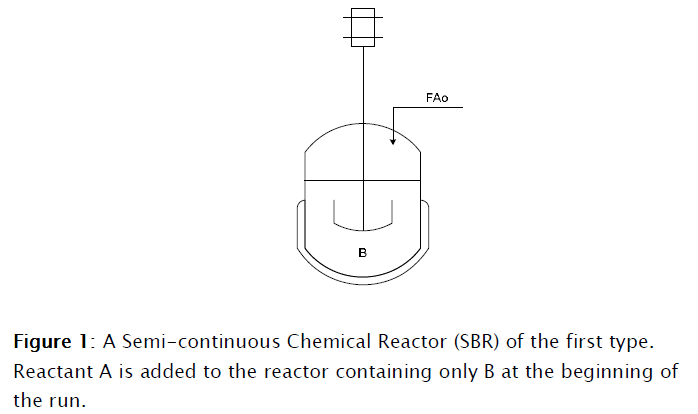
<body><![CDATA[<P align="justify"><font size="3" face="Verdana, Arial, Helvetica, sans-serif"><b>Introduction</b></font></P>     <P align="justify"><font size="2" face="Verdana, Arial, Helvetica, sans-serif"> A Semicontinuous Reactor or also called Semibatch Reactor (SBR) is used for small scale operations, for testing new processes in process development engineering, for the manufacture of expensive products, for processes that are difficult to be converted to continuous operation and for those processes that require a tight control of operating parameters and the minimization of unwanted side reactions by means of reactant concentration manipulation. Thus, it is used to carry out reactions involving explosives and the like. It is also used when multiphase reactions are being carried out, such as the continuous bubbling of a gaseous reactant in a liquid medium.</font></P>     <P align="justify"><font size="2" face="Verdana, Arial, Helvetica, sans-serif">The SBR is inherently unsteady and there are two basic types of SBR operations. In the first one, as shown in <a href="#f1">Figure 1</a>, a reactant (A) is slowly added to a reactor containing another reactant B, loaded prior to the beginning of the reaction run. Several tactics of addition of A can be applied, as well as different set ups. The reactant A can be added continuously at a constant rate as the reaction proceeds, or fed in a varying rate sequence as a function of time. This approach is used mainly when unwanted side reactions are to be avoided, or when the reactions involved are highly exothermic. In some reactions, the reactant A is a gas that is continuously bubbled through liquid B, such as in the cases of reactions involving <i>ammonolysis, chlorination and hydrolysis</i>. In the second type, reactants A and B are charged simultaneously and one of the products is continuously withdrawn in order to shift equilibrium and attaining this way, higher conversions. Also higher concentrations are achieved this way, with a corresponding reduction of purifying costs, increase rate of reaction and reduced reaction times. When one of the reactants is removed from the reactor by vaporization the reaction operation is called <i>reactive distillation</i>, such as the case of <i>acetylation</i> and <i>esterification reactions</i>. One typical example of the later one is the production of <i>ethyl acetate</i> and other aromatic esters, where the reversible reaction equilibrium is shifted to the right increasing the achievable conversion by removal of a volatile byproduct. It is also the case when glycerin is continuously withdrawn in the production of biodiesel, even though for this reaction the byproduct is not vaporized but rather removed as an insoluble dense phase.</font></P>     <P align="justify"><a name="f1"></a></P>     <P align="center"><img src="/img/revistas/ran/v7n1/a01_figure_01.gif" width="698" height="414"></P>     <P align="justify"><font size="2" face="Verdana, Arial, Helvetica, sans-serif"> Only the first type of SBR is considered for the present work. </font></P>      <P align="justify">&nbsp;</P>     <P align="justify"><font size="3" face="Verdana, Arial, Helvetica, sans-serif"><b>1. Conservation of matter applied to SBR: the mathematics. </b></font></P>     <P align="justify"><font size="2" face="Verdana, Arial, Helvetica, sans-serif"><b>1.1 Second order elementary reaction rate: the isothermal case. </b></font></P>     <P align="justify"><font size="2" face="Verdana, Arial, Helvetica, sans-serif"> Consider the following elementary liquid phase reaction </font></P>     ]]></body>
<body><![CDATA[<P align="center"><img src="/img/revistas/ran/v7n1/a01_ecuacion_01.gif" width="770" height="51"></P>     <P align="justify"><font size="2" face="Verdana, Arial, Helvetica, sans-serif">where A is added to a vessel containing pure B, where the chemical reaction takes place. Balances performed on the number of moles of A and B, taking the system as the contents of the reactor, leads to, for A </font></P>     <P align="center"><img src="/img/revistas/ran/v7n1/a01_ecuacion_02.gif" width="762" height="69"></P>     <P align="justify"><font size="2" face="Verdana, Arial, Helvetica, sans-serif">N<sub>A</sub> is the number of moles of A, F<sub>Ao</sub>, the molar feed rate, V the volume of reactants and t, time. For B, </font></P>     <p align="center"><img src="/img/revistas/ran/v7n1/a01_ecuacion_03.gif" width="858" height="78"></p>     <p align="justify"><font size="2" face="Verdana, Arial, Helvetica, sans-serif">For the elementary chemical reaction considered,      <i>r<sub>A</sub></i> /<i> V<sub>A</sub></i> = <i>r<sub>B</sub></i> /<i> V<sub>B</sub></i> ; <i>r<sub>B</sub></i> = <i>r<sub>A</sub></i> (<i>V<sub>B</sub></i> /<i> V<sub>A</sub></i>) . The following equation is derived by elimination  of the chemical reaction rate terms in equations [2] and [3]:</font></p>     <p align="center"><img src="/img/revistas/ran/v7n1/a01_ecuacion_04.gif" width="763" height="75"></p>     <P align="justify"> <font size="2" face="Verdana, Arial, Helvetica, sans-serif">that upon integration renders. </font></P>     <P align="center"><img src="/img/revistas/ran/v7n1/a01_ecuacion_05.gif" width="777" height="85"></P>     <P align="justify"><font size="2" face="Verdana, Arial, Helvetica, sans-serif">This expression for the number of moles of A can be introduced in Equation [3], with the rate expression written in terms of the number of moles</font></P>     ]]></body>


<body><![CDATA[<P align="center"><img src="/img/revistas/ran/v7n1/a01_ecuacion_06.gif" width="826" height="115"></P>     <P align="justify"><font size="2" face="Verdana, Arial, Helvetica, sans-serif">For the simple case for which the feed rate is constant (F<sub>A</sub>)</font></P>     <P align="center"><img src="/img/revistas/ran/v7n1/a01_ecuacion_07.gif" width="803" height="106"></P>     <P align="justify"><font size="2" face="Verdana, Arial, Helvetica, sans-serif">The volume V is a function of time In Equation [7]. Its time dependence can be derived by a global material balance on the reactor contents, </font><font size="2"><i>&rho;</i></font><font size="2" face="Verdana, Arial, Helvetica, sans-serif"> being the density of the reactor contents and </font><font size="2"><i>&rho;<sub>o</sub></i></font><font size="2" face="Verdana, Arial, Helvetica, sans-serif"> that of the feed</font></P>     <P align="center"><img src="/img/revistas/ran/v7n1/a01_ecuacion_08.gif" width="787" height="68"></P>     <P align="justify"><font size="2" face="Verdana, Arial, Helvetica, sans-serif">If the density of the reactors content is the same as the density of the feed</font></P>     <P align="center"><img src="/img/revistas/ran/v7n1/a01_ecuacion_09.gif" width="775" height="74"></P>     <P align="justify"><font size="2" face="Verdana, Arial, Helvetica, sans-serif">that can be integrated to give</font></P>     <P align="center"><img src="/img/revistas/ran/v7n1/a01_ecuacion_10.gif" width="767" height="38"></P>     <P align="justify"><font size="2" face="Verdana, Arial, Helvetica, sans-serif">By substitution in Equation [7]</font></P>     ]]></body>
<body><![CDATA[<P align="center"><img src="/img/revistas/ran/v7n1/a01_ecuacion_11.gif" width="788" height="117"></P>     <P align="justify"><font size="2" face="Verdana, Arial, Helvetica, sans-serif">This equation has the restriction that the feed F<sub>Af</sub> stops when the total number of moles of A, N<sub>Af</sub>, has been added to the system. Therefore a feeding time t<sub>f</sub> is defined by the equation</font></P>     <P align="center"><font size="2" face="Verdana, Arial, Helvetica, sans-serif"><img src="/img/revistas/ran/v7n1/a01_ecuacion_12.gif" width="777" height="58"></font></P>     <P align="justify"> <font size="2" face="Verdana, Arial, Helvetica, sans-serif">For the case of constant feed rate, the feeding time becomes</font></P>     <P align="center"><font size="2" face="Verdana, Arial, Helvetica, sans-serif"><img src="/img/revistas/ran/v7n1/a01_ecuacion_13.gif" width="783" height="73"></font></P>     <P align="justify"><font size="2" face="Verdana, Arial, Helvetica, sans-serif"> </font><font size="2" face="Verdana, Arial, Helvetica, sans-serif">Equation [11] can be converted to a dimensionless form using the following variables, the conversion X of B and the initial spatial time </font><font size="2">&tau;<sub>o</sub></font><font size="2" face="Verdana, Arial, Helvetica, sans-serif"> = V<sub>o</sub>/</font><font size="2">&upsilon;</font><font size="2" face="Verdana, Arial, Helvetica, sans-serif"><sub>o </sub></font></P>     <P align="center"><img src="/img/revistas/ran/v7n1/a01_ecuacion_14.gif" width="781" height="107"></P>     <P align="justify"><font size="2" face="Verdana, Arial, Helvetica, sans-serif">to give the following equation</font></P>     <P align="center"><font size="2" face="Verdana, Arial, Helvetica, sans-serif"><img src="/img/revistas/ran/v7n1/a01_ecuacion_15.gif" width="782" height="72"></font></P>     <P align="justify"><font size="2" face="Verdana, Arial, Helvetica, sans-serif">where <img src="/img/revistas/ran/v7n1/a01_ecuacion_15_1.gif" width="191" height="27" align="absbottom"> the ratio of the stoichiometric initial </font><font size="2" face="Verdana, Arial, Helvetica, sans-serif">concentrations of B in the reactor and A in the feed. The K(T) term is </font><img src="/img/revistas/ran/v7n1/a01_ecuacion_15_2.gif" width="149" height="20" align="absbottom"><font size="2" face="Verdana, Arial, Helvetica, sans-serif">, that can be expressed in in a more convenient form</font></P>     ]]></body>

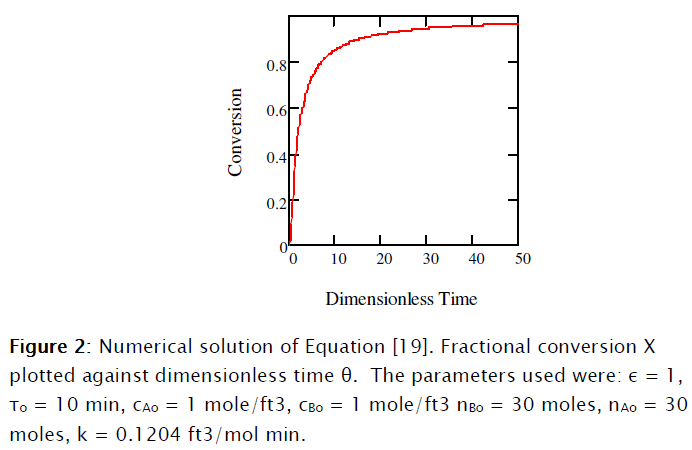
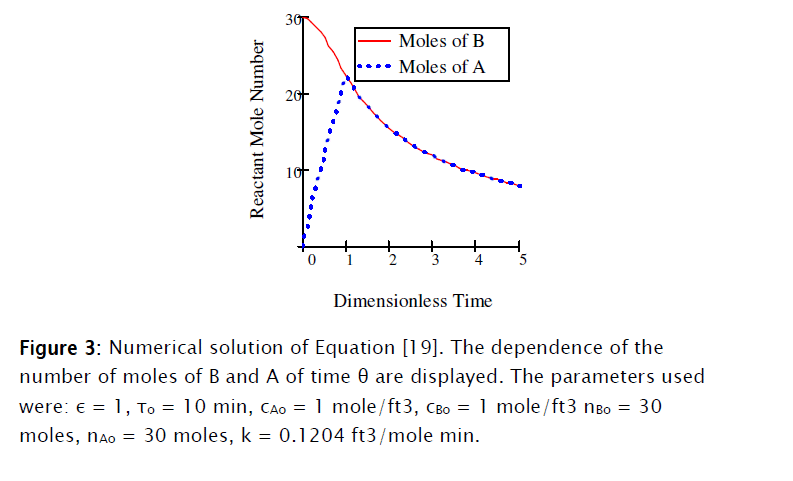
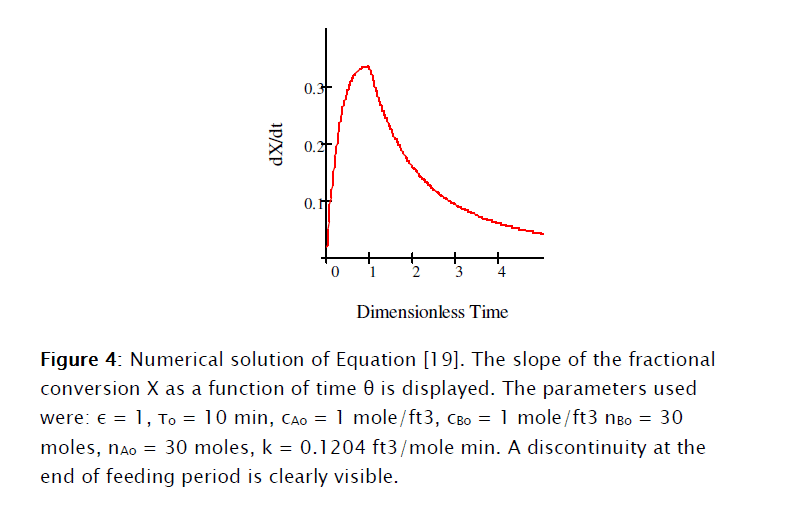
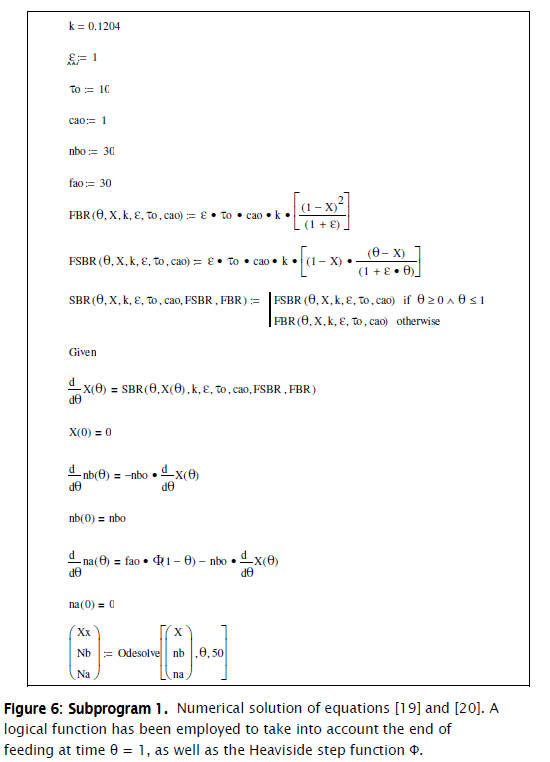
<body><![CDATA[<P align="center"><font size="2" face="Verdana, Arial, Helvetica, sans-serif"><img src="/img/revistas/ran/v7n1/a01_ecuacion_16.gif" width="783" height="79"></font></P>     <P align="justify"><font size="2" face="Verdana, Arial, Helvetica, sans-serif"> </font><font size="2" face="Verdana, Arial, Helvetica, sans-serif">From Equation [14], for a dimensionless final feed time corresponding to </font><font size="2">&theta;</font><font size="2" face="Verdana, Arial, Helvetica, sans-serif"> = 1, </font></P>     <P align="center"><img src="/img/revistas/ran/v7n1/a01_ecuacion_17.gif" width="772" height="80"></P>     <P align="justify"><font size="2" face="Verdana, Arial, Helvetica, sans-serif">Therefore, Equation [16] becomes</font></P>     <P align="center"><font size="2" face="Verdana, Arial, Helvetica, sans-serif"><img src="/img/revistas/ran/v7n1/a01_ecuacion_18.gif" width="774" height="45"></font></P>     <P align="justify"><font size="2" face="Verdana, Arial, Helvetica, sans-serif">And the final equation for the SBR up to the final feed time is</font></P>     <P align="center"><font size="2" face="Verdana, Arial, Helvetica, sans-serif"><img src="/img/revistas/ran/v7n1/a01_ecuacion_19.gif" width="774" height="65"></font></P>     <P align="justify"><font size="2" face="Verdana, Arial, Helvetica, sans-serif"> </font><font size="2" face="Verdana, Arial, Helvetica, sans-serif">For the cases where a stoichiometric amount of A is added to the reaction mixture, the reaction proceeds as if it were taking place in a batch reactor after the addition of the reactant A is terminated, that occurs when </font><font size="2">&theta;</font><font size="2" face="Verdana, Arial, Helvetica, sans-serif"> = 1. Thus, for </font><font size="2">&theta;</font><font size="2" face="Verdana, Arial, Helvetica, sans-serif"> &gt; 1, the equation reduces to </font></P>     <P align="center"><img src="/img/revistas/ran/v7n1/a01_ecuacion_20.gif" width="779" height="72"></P>     <P align="justify"><font size="2" face="Verdana, Arial, Helvetica, sans-serif"> </font><font size="2" face="Verdana, Arial, Helvetica, sans-serif">This equation was solved numerically using Mathcad 15&reg; as shown in Subprogram 1. </font></P>     ]]></body>
<body><![CDATA[<P align="center"><img src="/img/revistas/ran/v7n1/a01_figure_02.gif" width="692" height="450"></P>     <P align="center">&nbsp;</P>     <P align="center"><img src="/img/revistas/ran/v7n1/a01_figure_03.gif" width="793" height="481"></P>     <P align="center">&nbsp;</P>     <P align="center"><img src="/img/revistas/ran/v7n1/a01_figure_04.gif" width="789" height="508"></P>     <P align="center">&nbsp;</P>     <P align="center"><img src="/img/revistas/ran/v7n1/a01_figure_05.gif" width="777" height="434"></P>     <P align="center">&nbsp;</P>     <P align="center"><img src="/img/revistas/ran/v7n1/a01_figure_06.gif" width="550" height="762"></P>     <P align="center">&nbsp;</P>     ]]></body>
<body><![CDATA[<P align="justify"><font size="3" face="Verdana, Arial, Helvetica, sans-serif"><b>2. Second order elementary reaction rate: the adiabatic case.</b></font></P>     <P align="justify"><font size="2" face="Verdana, Arial, Helvetica, sans-serif"> For this case an adiabatic energy balance is required </font></P>     <P align="center"><img src="/img/revistas/ran/v7n1/a01_ecuacion_21.gif" width="799" height="91"></P>     <P align="left"><font size="2" face="Verdana, Arial, Helvetica, sans-serif">or</font></P>     <P align="center"><img src="/img/revistas/ran/v7n1/a01_ecuacion_22.gif" width="806" height="67"></P>     <P align="justify"><font size="2" face="Verdana, Arial, Helvetica, sans-serif">Where n<sub>T</sub> refers to the total number of moles, U<sub>m</sub>, the molar internal energy, H<sub>m,f </sub> the molar enthalpy of the feed stream and F<sub>f</sub>, the molar feed rate. If species A, B, C, D and S (solvent) are the chemical species in the reactor, then </font></P>     <P align="center"><img src="/img/revistas/ran/v7n1/a01_ecuacion_23.gif" width="777" height="80"></P>     <P align="justify"><font size="2" face="Verdana, Arial, Helvetica, sans-serif">Here c<sub>f</sub> is the molar specific heat capacity of the feed, T<sub>f</sub> the feed temperature and T<sub>ref</sub> a reference temperature. Expanding Equation [22] and neglecting the internal energy of mixing </font></P>     <P align="center"><img src="/img/revistas/ran/v7n1/a01_ecuacion_24.gif" width="779" height="162"></P>     <P align="justify"><font size="2" face="Verdana, Arial, Helvetica, sans-serif">If it is assumed that </font><font size="2">&nu;<sub></sub></font><font size="2" face="Verdana, Arial, Helvetica, sans-serif"><sub>A</sub> = </font><font size="2">&nu;</font><font size="2" face="Verdana, Arial, Helvetica, sans-serif"><sub>B</sub> = </font><font size="2">&nu;</font><font size="2" face="Verdana, Arial, Helvetica, sans-serif"><sub>C</sub> = </font><font size="2">&nu;</font><font size="2" face="Verdana, Arial, Helvetica, sans-serif"><sub>D</sub> = 1, applying the extent of reaction definition </font></P>     ]]></body>


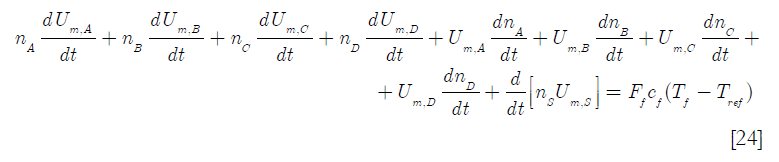
<body><![CDATA[<P align="center"><img src="/img/revistas/ran/v7n1/a01_ecuacion_25.gif" width="784" height="83"></P>     <P align="justify"><font size="2" face="Verdana, Arial, Helvetica, sans-serif">that upon substitution and rearranging in Equation [24] becomes </font></P>     <P align="center"><img src="/img/revistas/ran/v7n1/a01_ecuacion_26.gif" width="776" height="176"></P>     <P align="justify"><font size="2" face="Verdana, Arial, Helvetica, sans-serif"> where n<sub>s</sub> stands for the number of moles of solvent</font></P>     <P align="center"><img src="/img/revistas/ran/v7n1/a01_ecuacion_27.gif" width="780" height="98"></P>     <P align="justify"><font size="2" face="Verdana, Arial, Helvetica, sans-serif">since, by definition</font></P>     <P align="center"><img src="/img/revistas/ran/v7n1/a01_ecuacion_28.gif" width="780" height="64"></P>     <P align="justify"><font size="2" face="Verdana, Arial, Helvetica, sans-serif">A mass balance on the solvent s gives, csf being the molar concentration of solvent in the feed </font></P>     <P align="center"><img src="/img/revistas/ran/v7n1/a01_ecuacion_29.gif" width="769" height="113"></P>     <P align="justify"><font size="2" face="Verdana, Arial, Helvetica, sans-serif">where n<sub>so</sub> is the initial number of moles of solvent in the reactor. By substitution in Equation [27] </font></P>     ]]></body>
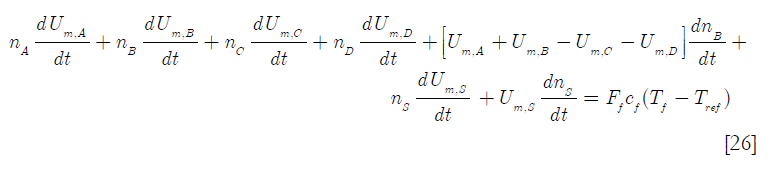

<body><![CDATA[<P align="center"><img src="/img/revistas/ran/v7n1/a01_ecuacion_30.gif" width="765" height="137"></P>     <P align="justify"><font size="2" face="Verdana, Arial, Helvetica, sans-serif">The total number of moles of reactants and solvent present in the reactor at the beginning g of the run, n<sub>to</sub>, are</font></P>     <P align="center"><font size="2" face="Verdana, Arial, Helvetica, sans-serif"><img src="/img/revistas/ran/v7n1/a01_ecuacion_31.gif" width="770" height="50"></font></P>     <P align="justify"><font size="2" face="Verdana, Arial, Helvetica, sans-serif">Since the density and the heat capacity can be considered constant due to the relative low concentration of reactants, then the initial heat capacity of the reactor contents is </font></P>     <P align="center"><img src="/img/revistas/ran/v7n1/a01_ecuacion_32.gif" width="778" height="53"></P>     <P align="justify"><font size="2" face="Verdana, Arial, Helvetica, sans-serif">If the feed of reactant A and the solvent associated with it is taken into account, then a heat capacity of the reactors content, C(t) can be derived, taking into account that the number of moles is constant due to the stoichiometry of the reaction, except for the addition of reactant A and the accompanying solvent </font></P>     <P align="center"><img src="/img/revistas/ran/v7n1/a01_ecuacion_33.gif" width="787" height="52"></P>     <P align="justify"><font size="2" face="Verdana, Arial, Helvetica, sans-serif">Since <i>F<sub>f</sub>tc<sub>f</sub></i> is the heat capacity of the feed. Then Equation [29] becomes, </font><font size="2" face="Verdana, Arial, Helvetica, sans-serif">accepting also that for a diluted liquid reaction <i>U<sub>m</sub></i> &asymp; <i>H<sub>m</sub></i></font></P>     <P align="center"><img src="/img/revistas/ran/v7n1/a01_ecuacion_34.gif" width="785" height="66"></P>     <P align="justify"><font size="2" face="Verdana, Arial, Helvetica, sans-serif">Therefore </font></P>     ]]></body>


<body><![CDATA[<P align="center"><img src="/img/revistas/ran/v7n1/a01_ecuacion_35.gif" width="770" height="91"></P>     <P align="justify"><font size="2" face="Verdana, Arial, Helvetica, sans-serif">And also, assuming that the average specific heat capacity of the feed is about the same as that of A </font></P>     <P align="center"><img src="/img/revistas/ran/v7n1/a01_ecuacion_36.gif" width="792" height="75"></P>     <P align="justify"><font size="2" face="Verdana, Arial, Helvetica, sans-serif">Therefore equation [30] becomes </font></P>     <P align="center"><img src="/img/revistas/ran/v7n1/a01_ecuacion_37.gif" width="784" height="110"></P>     <P align="justify"><font size="2" face="Verdana, Arial, Helvetica, sans-serif">The denominator of this equation is simply the heat capacity of the reactor contents, C = C(t) </font></P>     <P align="center"><img src="/img/revistas/ran/v7n1/a01_ecuacion_38.gif" width="767" height="95"></P>     <P align="justify"><font size="2" face="Verdana, Arial, Helvetica, sans-serif">and for the BR </font></P>     <P align="center"><img src="/img/revistas/ran/v7n1/a01_ecuacion_39.gif" width="778" height="80"></P>     <P align="justify"><font size="2" face="Verdana, Arial, Helvetica, sans-serif">If the reactant feed is fed at the reference temperature, the equations become for the SBR and BR reactors </font></P>     ]]></body>


<body><![CDATA[<P align="center"><img src="/img/revistas/ran/v7n1/a01_ecuacion_40.gif" width="796" height="132"></P>     <P align="justify"><font size="2" face="Verdana, Arial, Helvetica, sans-serif">That can be expressed in dimensionless form by means of the following variables, where T<sub>s</sub> refers to the set point (the desired temperature for the reaction to be carried out at) and T<sub>ref</sub>, a reference temperature, say 298 K) </font></P>     <P align="center"><img src="/img/revistas/ran/v7n1/a01_ecuacion_41.gif" width="796" height="85"></P>     <P align="justify"><font size="2" face="Verdana, Arial, Helvetica, sans-serif">and </font></P>     <P align="center"><img src="/img/revistas/ran/v7n1/a01_ecuacion_42.gif" width="796" height="92"></P>     <P align="justify"><font size="2" face="Verdana, Arial, Helvetica, sans-serif">to give </font></P>     <P align="center"><img src="/img/revistas/ran/v7n1/a01_ecuacion_43.gif" width="776" height="88"></P>     <P align="justify"><font size="2" face="Verdana, Arial, Helvetica, sans-serif"> where &Gamma;<sub><i>A</i></sub> is the A reactant feed in terms of the dimensional time defined </font><font size="2" face="Verdana, Arial, Helvetica, sans-serif">before. For the BR case, after the feed period elapses </font></P>     <P align="center"><img src="/img/revistas/ran/v7n1/a01_ecuacion_44.gif" width="769" height="110"></P>     <P align="justify"><font size="2" face="Verdana, Arial, Helvetica, sans-serif">The equations for the SBRBR reactors become </font></P>     ]]></body>

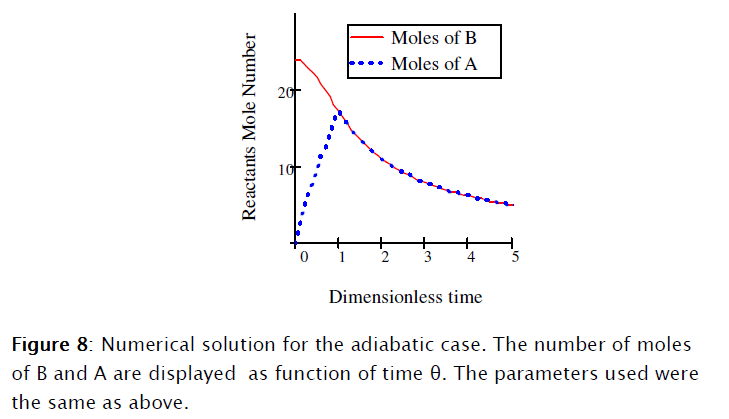
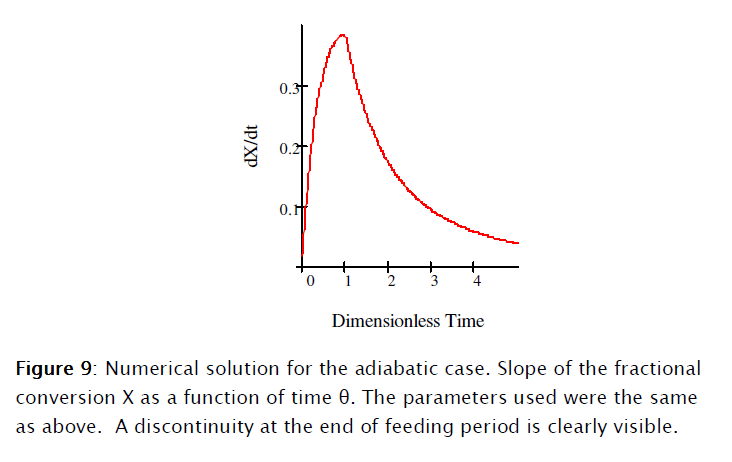
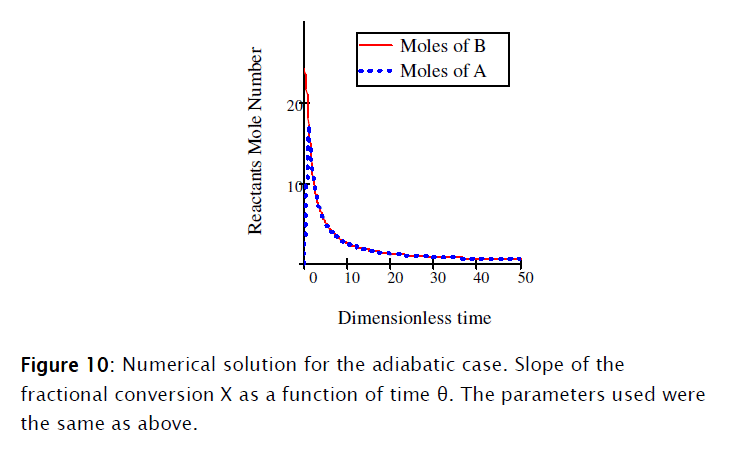
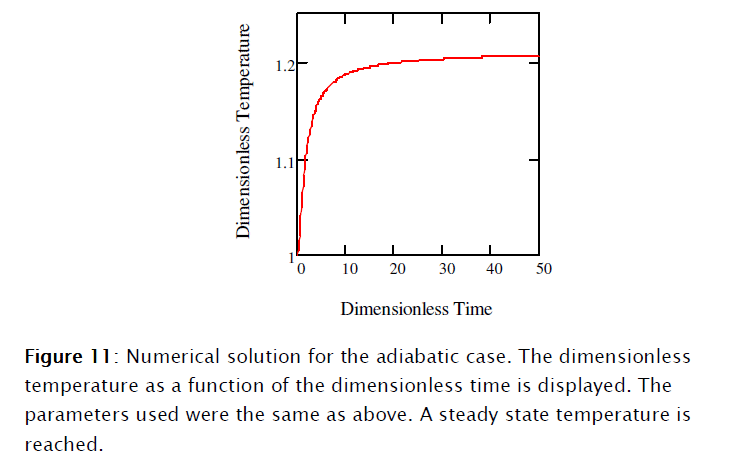
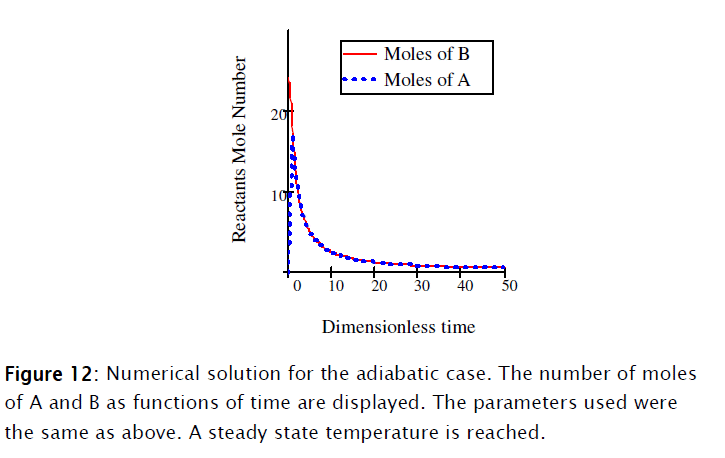
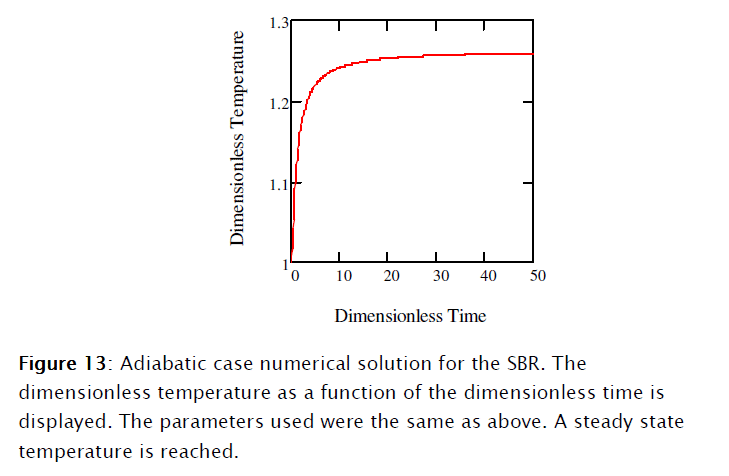
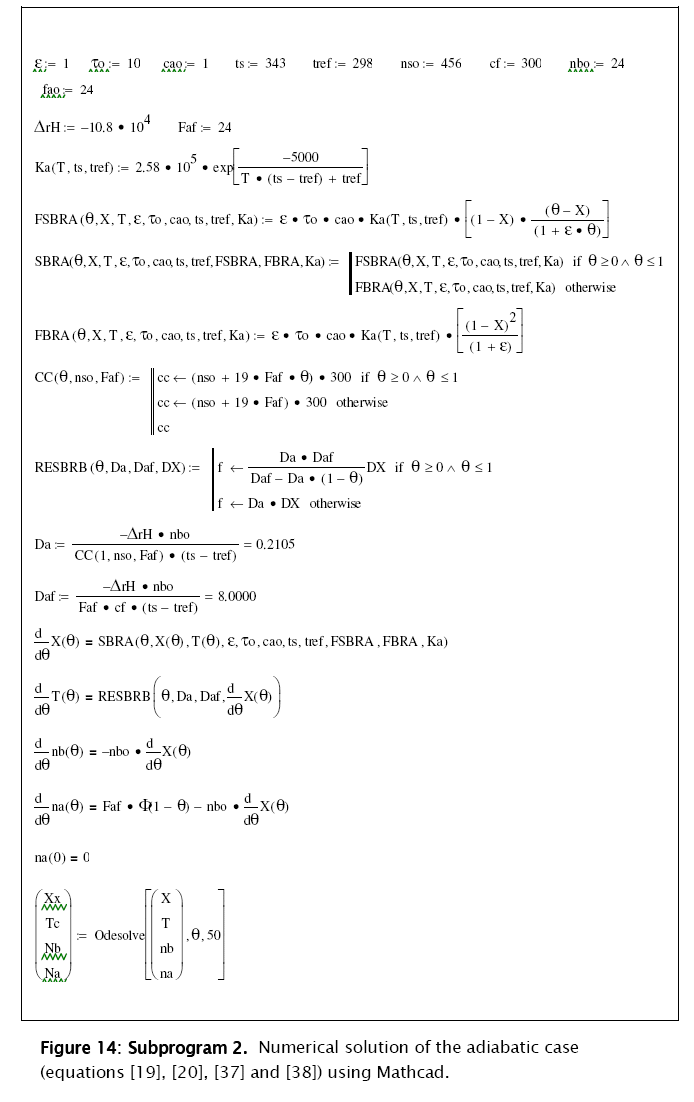
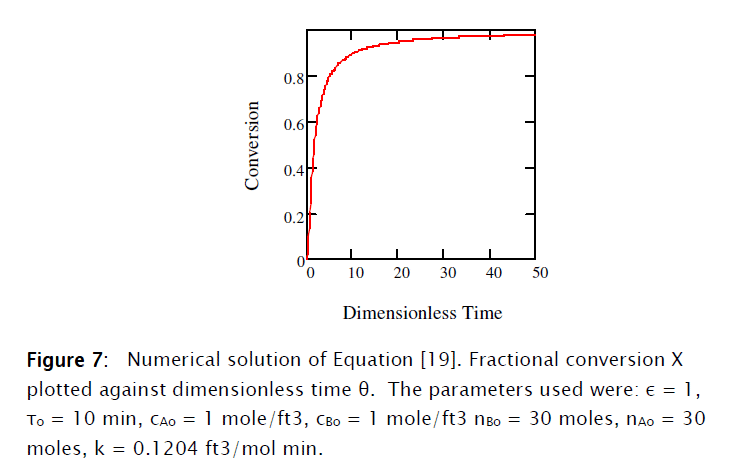
<body><![CDATA[<P align="center"><img src="/img/revistas/ran/v7n1/a01_ecuacion_45.gif" width="788" height="129"></P>     <P align="justify"><font size="2" face="Verdana, Arial, Helvetica, sans-serif">where </font></P>     <P align="center"><img src="/img/revistas/ran/v7n1/a01_ecuacion_46.gif" width="774" height="44"></P>     <P align="justify"><font size="2" face="Verdana, Arial, Helvetica, sans-serif">In this equation, the term &Gamma; <Sub>A </Sub>is the feed rate of reactant A in moles of A for the dimensionless time (the feed ends at &theta; = 1. For the BR reactor, the term <img src="/img/revistas/ran/v7n1/a01_ecuacion_46_1.gif" width="169" height="30" align="absmiddle">  is a Damk&ouml;hler type dimensionless group (Da) that </font><font size="2" face="Verdana, Arial, Helvetica, sans-serif">represents the ratio of heat generated by chemical reaction when the total number of moles of B reacts over the heat capacity of the reactor&rsquo;s content when the feed has been concluded, referred to the set point temperature. Thus </font></P>     <P align="center"><img src="/img/revistas/ran/v7n1/a01_ecuacion_47.gif" width="791" height="116"></P>     <P align="justify"><font size="2" face="Verdana, Arial, Helvetica, sans-serif">Here the Damk&ouml;hler type dimensionless groups are, (including the Damk&ouml;hler group referred to the feed D<sub><i>af</i></sub>) </font></P>     <P align="center"><img src="/img/revistas/ran/v7n1/a01_ecuacion_48.gif" width="802" height="79"></P>     <P align="justify"><font size="2" face="Verdana, Arial, Helvetica, sans-serif">The set of resulting differential equations [19], [20], [37] and [38] I solved using Mathcad 15, as shown in Subprogram 2. </font></P>     <p align="center"><img src="/img/revistas/ran/v7n1/a01_figure_07.gif" width="752" height="472"></p>     <p align="center">&nbsp;</p>     ]]></body>

<body><![CDATA[<p align="center"><img src="/img/revistas/ran/v7n1/a01_figure_08.gif" width="729" height="419"></p>     <p align="center">&nbsp;</p>     <p align="center"><img src="/img/revistas/ran/v7n1/a01_figure_09.gif" width="732" height="462"></p>     <p align="center">&nbsp;</p>     <p align="center"><img src="/img/revistas/ran/v7n1/a01_figure_10.gif" width="735" height="457"></p>     <p align="center">&nbsp;</p>     <p align="center"><img src="/img/revistas/ran/v7n1/a01_figure_11.gif" width="756" height="474"></p>     <p align="center">&nbsp;</p>     <p align="center"><img src="/img/revistas/ran/v7n1/a01_figure_12.gif" width="725" height="458"></p>     <p align="center">&nbsp;</p>     ]]></body>
<body><![CDATA[<p align="center"><img src="/img/revistas/ran/v7n1/a01_figure_13.gif" width="729" height="476"></p>     <p align="center">&nbsp;</p>     <p align="center">&nbsp;</p>     <p align="center"><img src="/img/revistas/ran/v7n1/a01_figure_14.gif" width="694" height="1102"></p>     <p><font size="3" face="Verdana, Arial, Helvetica, sans-serif"><b>3. 	Second order elementary reaction rate: the non adiabatic case</b></font></p>     <P align="justify"><font size="2" face="Verdana, Arial, Helvetica, sans-serif"> For this case the mass balance is, of course, the same as before. The energy balance of Equation [38] becomes </font></P>     <P align="center"><img src="/img/revistas/ran/v7n1/a01_ecuacion_49.gif" width="707" height="97"></P>     <P align="justify"><font size="2" face="Verdana, Arial, Helvetica, sans-serif">where the cooling effect of the water jacket has been added, the heat transfer area A being a function of time. In terms of the dimensionless variables defined before. Tw is the temperature of the cooling jacket water Thus Equation [49] becomes </font></P>     <P align="center"><img src="/img/revistas/ran/v7n1/a01_ecuacion_50.gif" width="714" height="175"></P>     <P align="justify"><font size="2" face="Verdana, Arial, Helvetica, sans-serif">Here the dimensionless temperature </font><font size="2"><i>&tau;<Sub>w</Sub></i></font><font size="2" face="Verdana, Arial, Helvetica, sans-serif"> of the cooling media is </font></P>     ]]></body>

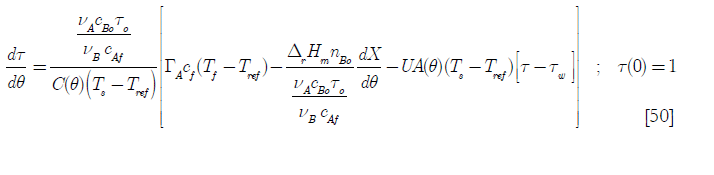
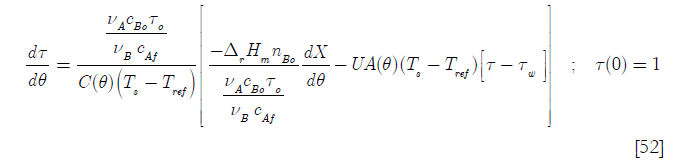
<body><![CDATA[<P align="center"><img src="/img/revistas/ran/v7n1/a01_ecuacion_51.gif" width="717" height="71"></P>     <P align="justify"><font size="2" face="Verdana, Arial, Helvetica, sans-serif">Setting the feed temperature T<sub>f</sub> equal to the reference temperature T<sub>ref</sub> </font></P>     <P align="center"><img src="/img/revistas/ran/v7n1/a01_ecuacion_52.gif" width="681" height="167"></P>     <P align="justify"><font size="2" face="Verdana, Arial, Helvetica, sans-serif">Since the density of the reacting media is supposed constant, as is the specific heat capacity, then the heat transfer area A(t) is proportional to the number of moles of the reactor contents at any time </font></P>     <P align="center"><img src="/img/revistas/ran/v7n1/a01_ecuacion_53.gif" width="698" height="48"></P>     <P align="justify"><font size="2" face="Verdana, Arial, Helvetica, sans-serif">and therefore </font></P>     <P align="center"><img src="/img/revistas/ran/v7n1/a01_ecuacion_54.gif" width="694" height="76"></P>     <P align="justify"><font size="2" face="Verdana, Arial, Helvetica, sans-serif">Rearranging Equation [52] </font></P>     <P align="center"><img src="/img/revistas/ran/v7n1/a01_ecuacion_55.gif" width="704" height="137"></P>     <P align="justify"><font size="2" face="Verdana, Arial, Helvetica, sans-serif">and </font></P>     ]]></body>

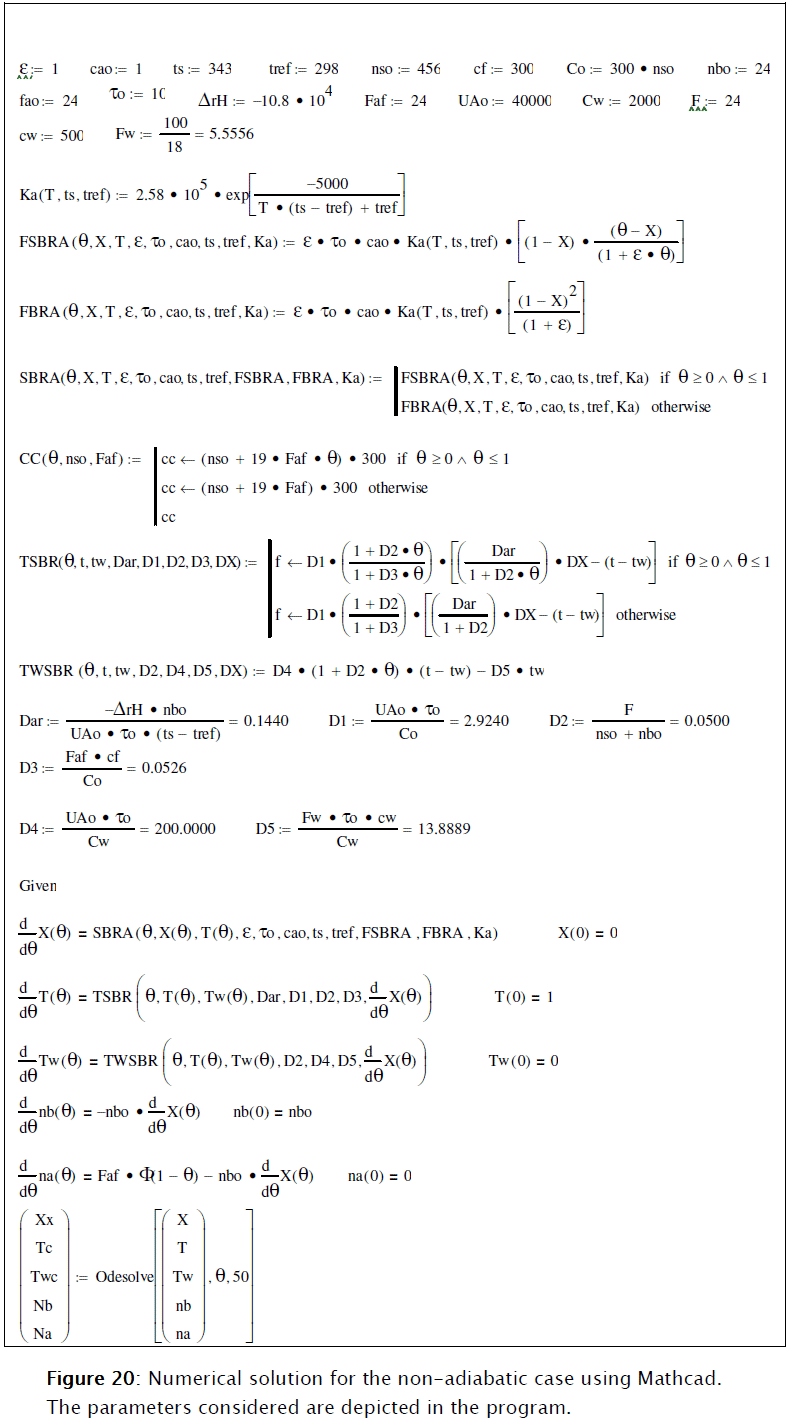
<body><![CDATA[<P align="center"><img src="/img/revistas/ran/v7n1/a01_ecuacion_56.gif" width="768" height="144"></P>     <P align="justify"><font size="2" face="Verdana, Arial, Helvetica, sans-serif">There are some meaningful dimensionless groups in this equation </font></P>     <P align="center"><img src="/img/revistas/ran/v7n1/a01_ecuacion_57.gif" width="792" height="121"></P>     <P align="justify"><font size="2" face="Verdana, Arial, Helvetica, sans-serif">Here the Da<sub>r</sub> group, another Damk&ouml;hler type dimensionless group related to the chemical reaction is the ratio of the total heat generated by it when the total number of moles B have been consumed to the initial heat transfer rate; D<sub>1</sub>, the heat transfer per unit temperature difference taking into account the initial area available for heat transfer over the initial heat capacity; D<sub>2</sub> the ratio of the molar feed over the initial number of moles of reactants and D<sub>3</sub> the ratio of the heat capacity of the feed of reactant A over the initial contents heat capacity of the reactor. </font></P>     <P align="justify"><font size="2" face="Verdana, Arial, Helvetica, sans-serif"> Upon substitution of Equation [57] on Equation [56] for the SBR up to &theta; = 1 </font></P>     <P align="center"><img src="/img/revistas/ran/v7n1/a01_ecuacion_58.gif" width="700" height="90"></P>     <P align="justify"><font size="2" face="Verdana, Arial, Helvetica, sans-serif"> And for the BR behavior (&theta; &gt; 1) </font></P>     <P align="center"><img src="/img/revistas/ran/v7n1/a01_ecuacion_59.gif" width="718" height="77"></P>     <P align="justify"><font size="2" face="Verdana, Arial, Helvetica, sans-serif">Now it is necessary to derive another equation for </font><font size="2"><i>T<Sub>w</Sub></i></font><font size="2" face="Verdana, Arial, Helvetica, sans-serif"> from an energy balance </font><font size="2" face="Verdana, Arial, Helvetica, sans-serif"> on the cooling jacket. </font></P>     <P align="center"><img src="/img/revistas/ran/v7n1/a01_ecuacion_60.gif" width="701" height="87"></P>     ]]></body>

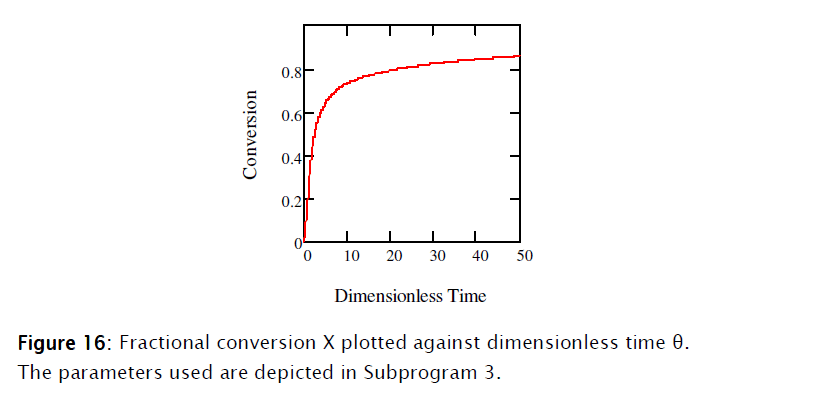
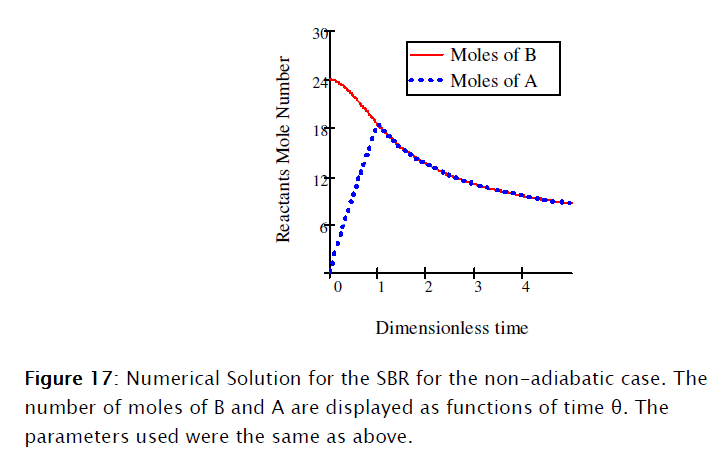
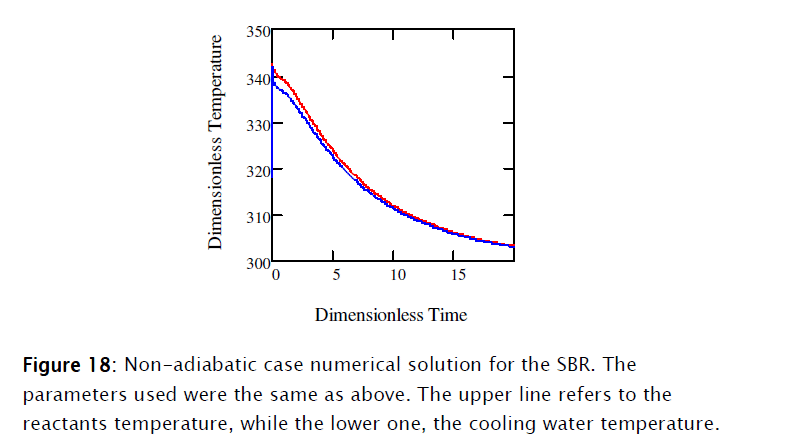
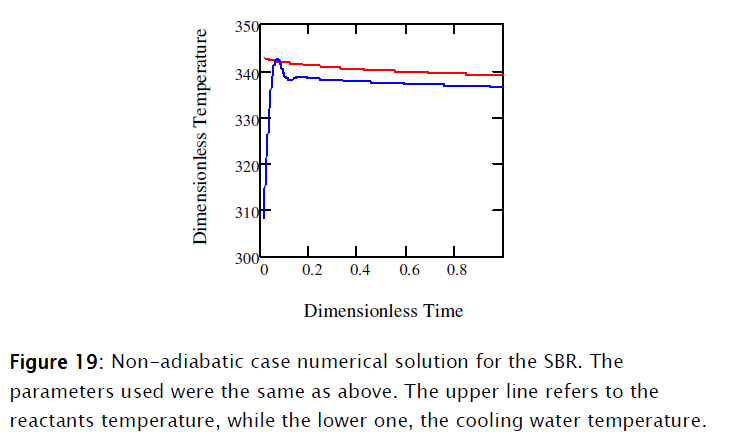
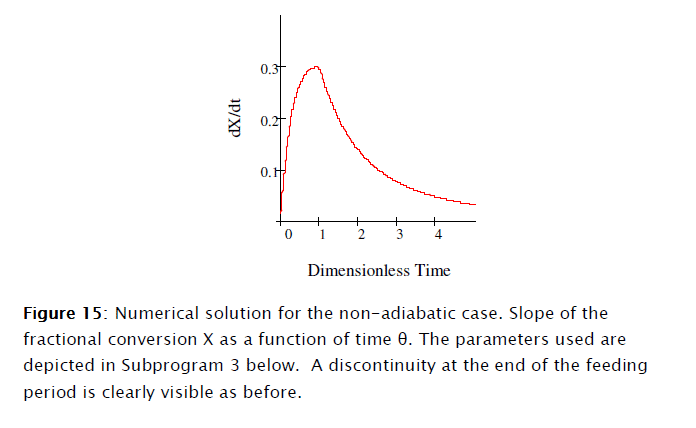
<body><![CDATA[<P align="justify"><font size="2" face="Verdana, Arial, Helvetica, sans-serif">Here T<sub>w</sub> is the temperature, F<sub>w</sub> the flow rate, c<sub>w</sub> the specific heat and C<sub>w</sub> the heat capacity of the coolant. The cooling jacket is represented by a uniform temperature bath with equal inlet and outlet flow rates. In terms of the dimensionless variables defined before </font></P>     <P align="center"><img src="/img/revistas/ran/v7n1/a01_ecuacion_61.gif" width="708" height="106"></P>     <P align="justify"><font size="2" face="Verdana, Arial, Helvetica, sans-serif">or </font></P>     <P align="center"><img src="/img/revistas/ran/v7n1/a01_ecuacion_62.gif" width="712" height="111"></P>     <P align="justify"><font size="2" face="Verdana, Arial, Helvetica, sans-serif">Here again there are some Damk&ouml;hler type dimensionless groups, namely </font></P>     <P align="center"><img src="/img/revistas/ran/v7n1/a01_ecuacion_63.gif" width="693" height="101"></P>     <P align="justify"><font size="2" face="Verdana, Arial, Helvetica, sans-serif">D<sub>4</sub> is the heat transfer per unit temperature difference taking into account the initial area available for heat transfer over the heat capacity of the coolant jacket and its contents; D<sub>2</sub> the ratio of the molar feed over the initial number of moles of reactants and D<sub>5</sub> the ratio of the heat capacity of the feed of reactant A over the heat capacity of the coolant jacket and its contents. Hence </font></P>     <P align="center"><img src="/img/revistas/ran/v7n1/a01_ecuacion_64.gif" width="691" height="78"></P>     <P align="justify"><font size="2" face="Verdana, Arial, Helvetica, sans-serif">Equations [47], [58] and [64] constitute the nonadiabatic second order type one SBR reactor model. The numeric solution obtained using Mathcad is depicted in Subprogram 3, while the data has been plotted in the figures shown below. </font></P>     <P align="center"><img src="/img/revistas/ran/v7n1/a01_figure_15.gif" width="696" height="428"></P>     ]]></body>

<body><![CDATA[<P align="center">&nbsp;</P>     <P align="center"><img src="/img/revistas/ran/v7n1/a01_figure_16.gif" width="826" height="402"></P>     <P align="center">&nbsp;</P>     <P align="center"><img src="/img/revistas/ran/v7n1/a01_figure_17.gif" width="720" height="463"></P>     <P align="center">&nbsp;</P>     <P align="center"><img src="/img/revistas/ran/v7n1/a01_figure_18.gif" width="789" height="437"></P>     <P align="center">&nbsp;</P>     <P align="center"><img src="/img/revistas/ran/v7n1/a01_figure_19.gif" width="739" height="438"></P>     <P align="center">&nbsp;</P>     <P align="center"><img src="/img/revistas/ran/v7n1/a01_figure_20.gif" width="793" height="1425"></P>     ]]></body>
<body><![CDATA[<P align="center">&nbsp;</P>     <P align="justify"><font size="3" face="Verdana, Arial, Helvetica, sans-serif"><b>4. Conclusions </b></font></P>     <P align="justify"><font size="2" face="Verdana, Arial, Helvetica, sans-serif"> A versatile macroscopic model for the SBR reactor has been derived for the isothermal, adiabatic and nonadiabatic cases. A second order elementary reaction was studied. Other kinetics can be studied using the same approach. The model is well suited for its solution utilizing digital computers and modern computer algebra software. The nonadiabatic case is especially interesting since it can be used for modeling nonlinear process control, an area of great interest that is precisely the subject for the next part of this article. </font></P>     <P align="justify">&nbsp;</P>     <P align="justify"><font size="3" face="Verdana, Arial, Helvetica, sans-serif"><b>Notation </b></font></P>     <p align="justify"><b><font size="2" face="Verdana, Arial, Helvetica, sans-serif"><i>Variables</i> </font></b></p>     <blockquote>       <p align="justify"> <font size="2" face="Verdana, Arial, Helvetica, sans-serif">A, B, C, D = chemical species A, B, C, D respectively. A refers also to the area available for heat transfer. </font>    <br>     <font size="2" face="Verdana, Arial, Helvetica, sans-serif">c = specific heat capacity    <br>   </font><font size="2" face="Verdana, Arial, Helvetica, sans-serif">C = Heat capacity of the reactor contents     ]]></body>
<body><![CDATA[<br>     F = reactant feed rate     <br>     H = Enthalpy     <br>     n,       N = number of moles     <br>     k = chemical reaction rate constant     <br>     r = chemical reaction rate     <br>     t = time     <br>     T = Temperature     <br>     U = Internal energy, also the global heat transfer coefficient     <br>     V = volume of the chemical reaction media     <br>     z = factor de compresi&oacute;n </font></p> </blockquote>     ]]></body>
<body><![CDATA[<P align="justify"><font size="2" face="Verdana, Arial, Helvetica, sans-serif"><b><i>Parameters </i></b></font></P>     <blockquote>       <p align="justify"><font size="2" face="Verdana, Arial, Helvetica, sans-serif"> Da, Da<sub>f</sub> = dimensionless Damk&ouml;hler type parameters defined by Equation [48]          <br>     Da<sub>r</sub> = another Damk&ouml;hler type parameter defined by Equation [57]          <br>     D<sub>1</sub>, D<sub>2</sub>2, D<sub>3</sub> = parameters for the energy balance defined by Equation [57] </font></p> </blockquote> <b><i><font size="2" face="Verdana, Arial, Helvetica, sans-serif"> Greek Letters</font></i></b>     <blockquote>       <p align="justify">     <font size="2" face="Verdana, Arial, Helvetica, sans-serif">&Delta; = incremental operator, when referred to chemical reactions gives the enthalpy or internal energy of reaction     <br>     </font><font size="2"> <i>&rho;</i></font><font size="2" face="Verdana, Arial, Helvetica, sans-serif"> = density of the chemical reaction medium     <br>     </font><font size="2"> &epsilon;</font><font size="2" face="Verdana, Arial, Helvetica, sans-serif"> = ratio of the stoichiometric initial concentrations of species B in the reactor and A in the feed     <br>     </font><font size="2"> &Gamma;</font><font size="2" face="Verdana, Arial, Helvetica, sans-serif"> = Feed rate of reactant     ]]></body>
<body><![CDATA[<br>     </font><font size="2"> &nu;</font><font size="2" face="Verdana, Arial, Helvetica, sans-serif"> = stoichiometric coefficient of an elementary chemical reaction.     <br>     &thetasym; = volumetric feed rate     <br>     </font><font size="2"> &Chi;</font><font size="2" face="Verdana, Arial, Helvetica, sans-serif"> = chemical reaction conversion     <br>     </font><font size="2"> &Theta;</font><font size="2" face="Verdana, Arial, Helvetica, sans-serif"> = dimensionless time     <br>     </font><font size="2"> &tau;</font><font size="2" face="Verdana, Arial, Helvetica, sans-serif"> = space time, also a dimensionless temperature </font></p> </blockquote> <b><i><font size="2" face="Verdana, Arial, Helvetica, sans-serif"> Subscripts </font></i></b>     <blockquote>       <p align="justify"><font size="2" face="Verdana, Arial, Helvetica, sans-serif">     A, B, C, D = species A, B, C, D respectively     <br>     o, 0 = refers to a parameter at the beginning of the run     <br>     f = refers to a parameter at the end of the run and also to the feed     <br>     m = molar, specific property     ]]></body>
<body><![CDATA[<br>     ref = reference, used with T refers to a reference temperature     <br>     S = refers to the solvent     <br>     w = refers to the cooling medium</font></p> </blockquote>     <P align="justify">&nbsp;</P>      ]]></body>
</article>