<?xml version="1.0" encoding="ISO-8859-1"?><article xmlns:mml="http://www.w3.org/1998/Math/MathML" xmlns:xlink="http://www.w3.org/1999/xlink" xmlns:xsi="http://www.w3.org/2001/XMLSchema-instance">
<front>
<journal-meta>
<journal-id>1683-0789</journal-id>
<journal-title><![CDATA[Acta Nova]]></journal-title>
<abbrev-journal-title><![CDATA[RevActaNova.]]></abbrev-journal-title>
<issn>1683-0789</issn>
<publisher>
<publisher-name><![CDATA[Universidad Católica Boliviana]]></publisher-name>
</publisher>
</journal-meta>
<article-meta>
<article-id>S1683-07892013000100006</article-id>
<title-group>
<article-title xml:lang="es"><![CDATA[Amscottia mira (Grönblad) Grönblad (Desmidiaceae, Zygnematophyceae) collected 55 years after its original description]]></article-title>
<article-title xml:lang="en"><![CDATA[Amscottia mira (Grönblad) Grönblad (Desmidiaceae, Zygnematophyceae) recolectada 55 ańos después de su descripción original]]></article-title>
</title-group>
<contrib-group>
<contrib contrib-type="author">
<name>
<surname><![CDATA[Bicudo]]></surname>
<given-names><![CDATA[Carlos E. de M.]]></given-names>
</name>
<xref ref-type="aff" rid="A01"/>
</contrib>
<contrib contrib-type="author">
<name>
<surname><![CDATA[Pascoaloto]]></surname>
<given-names><![CDATA[Domitila]]></given-names>
</name>
<xref ref-type="aff" rid="A02"/>
</contrib>
<contrib contrib-type="author">
<name>
<surname><![CDATA[Soares]]></surname>
<given-names><![CDATA[Climéia C.]]></given-names>
</name>
<xref ref-type="aff" rid="A02"/>
</contrib>
</contrib-group>
<aff id="A01">
<institution><![CDATA[,Instituto de Botânica Núcleo de Pesquisa em Ecologia ]]></institution>
<addr-line><![CDATA[Săo Paulo SP]]></addr-line>
<country>Brasil</country>
</aff>
<aff id="A02">
<institution><![CDATA[,Instituto Nacional de Pesquisas da Amazônia  ]]></institution>
<addr-line><![CDATA[Manaus AM]]></addr-line>
<country>Brasil</country>
</aff>
<pub-date pub-type="pub">
<day>00</day>
<month>03</month>
<year>2013</year>
</pub-date>
<pub-date pub-type="epub">
<day>00</day>
<month>03</month>
<year>2013</year>
</pub-date>
<volume>6</volume>
<numero>1-2</numero>
<fpage>64</fpage>
<lpage>69</lpage>
<copyright-statement/>
<copyright-year/>
<self-uri xlink:href="http://www.scielo.org.bo/scielo.php?script=sci_arttext&amp;pid=S1683-07892013000100006&amp;lng=en&amp;nrm=iso"></self-uri><self-uri xlink:href="http://www.scielo.org.bo/scielo.php?script=sci_abstract&amp;pid=S1683-07892013000100006&amp;lng=en&amp;nrm=iso"></self-uri><self-uri xlink:href="http://www.scielo.org.bo/scielo.php?script=sci_pdf&amp;pid=S1683-07892013000100006&amp;lng=en&amp;nrm=iso"></self-uri><abstract abstract-type="short" xml:lang="en"><p><![CDATA[Amscottia mira (Grönblad) Grönblad (Desmidiaceae, Zygnematophyceae) was collected for the second time 55 years after its original description. The present material was collected from the Curicuriari River (sampling site 00ş 12.454' S, 66ş 47.678' W), a black water tributary on the right bank of the Negro River, Amazonas State, northern Brazil. Examined specimens totally agreed in their overall morphology with that of the original illustration and description of the species. The locality from which specimens were gathered is located at 49 m a.s.l. The river water temperature was 26.9ş C, with high acidity (pH 3.7), somewhat low conductivity (24.37 µS cm-1), good amount of dissolved oxygen (6.26 mg L-1) and strong color (256.56 mg Pt-1).]]></p></abstract>
<abstract abstract-type="short" xml:lang="es"><p><![CDATA[Amscottia mira (Grönblad) Grönblad (Desmidiaceae, Zygnematophyceae) fue colectada por segunda vez 55 ańos después de su descripción original. El presente material fue colectado del río Curicuriari (localidad de muestreo 00ş 12,454' S, 66ş 47,678' W), un río de aguas negras tributario de la orilla derecha del río Negro, Estado Amazonas, norte de Brasil. Los especímenes examinados concordaron íntegramente en su morfología general con la ilustración y descripción original de la especie. La localidad en que los especímenes fueron colectados está ubicada a 49 m s.n.m. La temperatura del agua fue de 26,9ş C, elevada acidez (pH 3,7), conductividad relativamente baja (24,37 µS cm-1), buena cantidad de oxígeno disuelto (6,26 mg L-1) y fuerte color (256,56 mg Pt-1).]]></p></abstract>
<kwd-group>
<kwd lng="en"><![CDATA[Asymmetrical desmid]]></kwd>
<kwd lng="en"><![CDATA[Brazil]]></kwd>
<kwd lng="en"><![CDATA[environmental conditions]]></kwd>
<kwd lng="en"><![CDATA[rediscovery]]></kwd>
<kwd lng="en"><![CDATA[South America]]></kwd>
<kwd lng="es"><![CDATA[Brasil]]></kwd>
<kwd lng="es"><![CDATA[condiciones ambientales]]></kwd>
<kwd lng="es"><![CDATA[desmidiácea asimétrica]]></kwd>
<kwd lng="es"><![CDATA[redescubrimiento]]></kwd>
<kwd lng="es"><![CDATA[Sudamérica]]></kwd>
</kwd-group>
</article-meta>
</front><body><![CDATA[ <p align="right"><font size="2"><b><font face="Verdana, Arial, Helvetica, sans-serif">ART&Iacute;CULO CIENT&Iacute;FICO</font></b></font></p>     <p align="justify">&nbsp;</p>     <p align="center"><font size="4" face="Verdana, Arial, Helvetica, sans-serif"><i><b>Amscottia mira</b></i><b> (Grönblad)   Grönblad (Desmidiaceae, Zygnematophyceae) collected 55 years after its original   description </b></font></p>     <p align="center">&nbsp;</p>     <p align="center"><font size="3" face="Verdana, Arial, Helvetica, sans-serif"><b>Amscottia mira (Grönblad) Grönblad (Desmidiaceae, Zygnematophyceae) recolectada 55 ańos después de su descripción original</b></font></p>     <p align="center">&nbsp;</p>     <p align="center">&nbsp;</p>     <p align="center"><font size="2" face="Verdana, Arial, Helvetica, sans-serif"><b>Carlos E. de M. Bicudo<sup>1</sup>, Domitila Pascoaloto<sup>2 </sup>&amp; Climéia C. Soares<sup>2</sup></b><sup></sup></font></p>      <p align="center"><font size="2" face="Verdana, Arial, Helvetica, sans-serif"><sup>1</sup>Núcleo de Pesquisa em Ecologia, Instituto de Botânica. Caixa postal 68041, 04045-972 Săo Paulo, SP, Brasil</font>    <br> <font size="2" face="Verdana, Arial, Helvetica, sans-serif"><sup>2</sup>Instituto Nacional de Pesquisas da Amazônia. Caixa postal 2223, 69080-971 Manaus, AM, Brasil</font></p>      ]]></body>
<body><![CDATA[<p align="center"><font size="2" face="Verdana, Arial, Helvetica, sans-serif"><b>e-mail:</b> <a href="mailto:cbicudo@terra.com.br">cbicudo@terra.com.br</a></font></p>     <p align="center"><font size="2" face="Verdana, Arial, Helvetica, sans-serif"><b>Recibido:</b> 15 de septiembre 2013, <b>Aceptado:</b> 13 de octubre 2013</font></p>     <p align="center">&nbsp;</p>     <p align="center">&nbsp;</p> <hr align="JUSTIFY" noshade>     <p align="justify"><font size="2" face="Verdana, Arial, Helvetica, sans-serif"><b>Abstract: </b><i>Amscottia mira</i> (Grönblad) Grönblad (Desmidiaceae, Zygnematophyceae) was collected for the second time 55 years after its original description. The present material was collected from the Curicuriari River (sampling site 00ş 12.454' S, 66ş 47.678' W), a black water tributary on the right bank of the Negro River, Amazonas State, northern Brazil. Examined specimens totally agreed in their overall morphology with that of the original illustration and description of the species. The locality from which specimens were gathered is located at 49 m a.s.l. The river water temperature was 26.9ş C, with high acidity (pH 3.7), somewhat low conductivity (24.37 µS cm<sup>-1</sup>), good amount of dissolved oxygen (6.26 mg L<sup>-1</sup>) and strong color (256.56 mg Pt<sup>-1</sup>).</font></p>     <p align="justify"><font size="2" face="Verdana, Arial, Helvetica, sans-serif"><b>Key words: </b>Asymmetrical desmid, Brazil, environmental conditions, rediscovery, South America</font></p>  <hr align="JUSTIFY" noshade>     <p align="justify"><font size="2" face="Verdana, Arial, Helvetica, sans-serif"><b>Resumen: </b><i>Amscottia mira</i> (Grönblad) Grönblad (Desmidiaceae, Zygnematophyceae) fue colectada por segunda vez 55 ańos después de su descripción original. El presente material fue colectado del río Curicuriari (localidad de muestreo 00ş 12,454' S, 66ş 47,678' W), un río de aguas negras tributario de la orilla derecha del río Negro, Estado Amazonas, norte de Brasil. Los especímenes examinados concordaron íntegramente en su morfología general con la ilustración y descripción original de la especie. La localidad en que los especímenes fueron colectados está ubicada a 49 m s.n.m. La temperatura del agua fue de 26,9ş C, elevada acidez (pH 3,7), conductividad relativamente baja (24,37 µS cm<sup>-1</sup>), buena cantidad de oxígeno disuelto (6,26 mg L<sup>-1</sup>) y fuerte color (256,56 mg Pt<sup>-1</sup>).</font></p>      <p align="justify"><font size="2" face="Verdana, Arial, Helvetica, sans-serif"><b>Palabras clave: </b>Brasil, condiciones ambientales, desmidiácea asimétrica, redescubrimiento, Sudamérica</font></p> <hr align="JUSTIFY" noshade>     <p align="justify">&nbsp;</p>     <p align="justify">&nbsp;</p>     ]]></body>
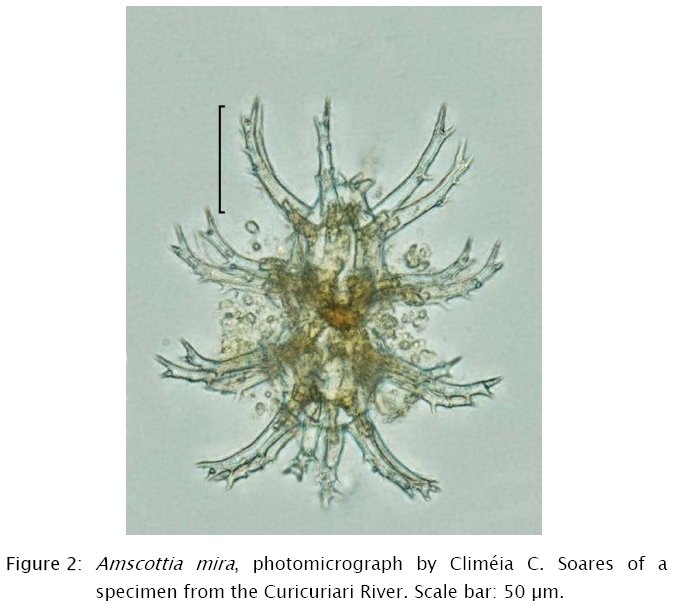
<body><![CDATA[<p align="justify"><font size="3" face="Verdana, Arial, Helvetica, sans-serif"><b>1.   Introduction</b></font></p>     <p align="justify"><font size="2" face="Verdana, Arial, Helvetica, sans-serif"><i>Amscottia</i>, the first ever described bipolar asymmetric desmid genus, was proposed by Grönblad [2] initially as <i>Scottia</i>, based on material collected by Harald Sioli from a lake at the mouth of Igarapé Mentaí (2ş 28' S, 55ş 34' W), located about 50 km in a straight line from Santarém, in the Brazilian northern State of Pará. According to Grönblad [2], the lake water was brownish in color and had a pH of 4.5. Immediately, after realizing that his <i>Scottia</i> was a later homonym of <i>Scottia</i> R. Brown ex W. Aiton &amp; W.T. Aiton [1] a Papilionaceae, Grönblad [3] proposed the new name <i>Amscottia</i> for this desmid, thus maintaining his tribute to Arthur Miller Scott, a North American desmidiologist. <i>Amscottia mira</i> (Grönblad) Grönblad (= <i>Scottia mira </i>Grönblad) was the only species of the genus for 31 years, after which Ling &amp; Tyler [4] proposed a second one, <i>A</i>. <i>gulungulana</i> Ling &amp; Tyler, on the basis of material gathered from the Magela Creek billabongs between Jabiru and the East Alligator River, on the Magela Creek floodplain, ca. 250 km east of Darwin, in the Northern Territory of Australia.</font></p>     <p align="justify">&nbsp;</p>     <p align="justify"><b><font size="3" face="Verdana, Arial, Helvetica, sans-serif">2.   Methods</font></b></p>     <p align="justify"><font size="2" face="Verdana, Arial, Helvetica, sans-serif"><i>Amscottia mira</i> was collected only once, but <i>A</i>. <i>gulungulana</i> was collected from Magela Creek, Mine Valley Billabong, Backflow Billabong, Gulungul Billabong and from a pool near Yirrkalla, all water bodies in the Australian Western Territory. Fifty-five years later, on August 4, 2008, one of us (DP) collected several specimens of <i>A</i>. <i>mira</i>. One single sample was then gathered with a 25 &#956;m mesh plankton net from the Curicuriari river (sampling site 00ş 12.454' S, 66ş 47.678' W), a tributary of the right bank of the Negro River, municipality of Săo Gabriel da Cachoeira, Amazonas State, northern Brazil.</font></p>     <p align="justify">&nbsp;</p>     <p align="justify"><font size="3" face="Verdana, Arial, Helvetica, sans-serif"><b>3.   Results and discussion</b></font></p>     <p align="justify"><b><font size="2" face="Verdana, Arial, Helvetica, sans-serif"><i>Amscottia mira</i> (Grönblad) Grönblad</font></b><font size="2" face="Verdana, Arial, Helvetica, sans-serif"></font></p>     <p align="justify"><font size="2" face="Verdana, Arial, Helvetica, sans-serif">Cells large, at the middle divided in two semicells by means of a widely open, deep constriction. Semicells not alike: the upper one with an apical corona of 8 or 9 teeth, the lower one with a rounded smooth apex (<a href="#f1">Fig. 1A-D</a>, 2). Both semicells are somewhat obovate, with an inflated basis tapering towards the apices; they have a whorl of 6 processes just below the apex, which is strongly protruded in the upper semicell and widely rounded in the lower one. Another whorl of 10 processes is to be found in both semicells near the isthmus, inserted at the most inflated point. In the upper semicell, all processes are strongly curved upwards, but in the lower semicell they are also curved, but not too strongly and towards the upper semicell (“in the wrong direction”). All processes are hollow and furnished with a few acute spines on the outer margin at the region of their greatest curvature, and all of them end in three slightly divergent spines, of which the inner one is twice as long as the other two. Vertical view of semicells is circular, with 10 radiating processes at the outer margin which are denticulate at their ends; inside the margins 6 similar processes and in the central area there are 8 or 9 teeth arranged in a circle (<a href="#f1">Fig. 1F-I</a>); the latter lacking in the vertical view of the lower semicell. Between the processes the cell wall is smooth. The shape of the chloroplasts was never observed as to their exact details, but it seems, according to Grönblad [2], that there are 5 or 6 axial longitudinal “laminae” or “bundles” from which pairs of fine extensions go into the processes of lower whorl, and single extensions into those of the upper whorl. The number of the pyrenoids is not known, but sometimes in vertical view one pyrenoid can be seen in each lamella, the lamellae being not connected at the central longitudinal cell axes.</font></p>     <p align="justify"><a name="f1"></a></p>     ]]></body>
<body><![CDATA[<p align="center"><img src="/img/revistas/ran/v6n1-2/a05_figure_01.gif" width="692" height="1079"></p>     <p align="center"><img src="/img/revistas/ran/v6n1-2/a05_figure_2.jpg" width="674" height="608"></p>     <p align="justify"><font size="2" face="Verdana, Arial, Helvetica, sans-serif">Dimensions of the cell including both Grönblad’s [2] and present specimens: length without processes (87)106-128 µm, maximum length with processes 143-189 µm, width without processes (28.9)38-57 µm, maximum width with processes 125.6-159 µm, isthmus 22-34 µm wide (<a href="#f1">Figs 1A-D</a>, 2).</font></p>      <p align="justify"><font size="2" face="Verdana, Arial, Helvetica, sans-serif">Present specimens were gathered from the Curicuriari River, a tributary of the right side margin of the Negro River, municipality of Săo Gabriel da Cachoeira, Amazonas State, northern Brazil, leg. <i>Domitila Pascoaloto</i> n. 04-VIII-2008 (INPA248640). These specimens are very much similar in their overall cell morphology to those from the original collection in the State of Pará. The only difference lies on the measurements, since the original specimens are a little smaller, a fact somewhat common since they are from different populations gathered from different localities.</font></p>      <p align="justify"><font size="2" face="Verdana, Arial, Helvetica, sans-serif">It is very interesting to note that the cell morphology of the Pará specimens is identical to that of the Amazonas ones, demonstrating that the genus and species diagnostic features are very much stable, notwithstanding the sampling localities and their separation by ca. 1,600 km in a straight line.</font></p>      <p align="justify"><font size="2" face="Verdana, Arial, Helvetica, sans-serif">The place from which the Amazonas’ specimens were collected is located 49 m a.s.l. and at about 1,600 km from the type locality. The water temperature at the moment of collection was 26.9ş C, dissolved oxygen 6.26 mg L<sup>-1</sup>, pH 3.7, conductivity 24.37 µS cm<sup>-1</sup> and color 256.56 mg Pt<sup>-1</sup>. The sample was gathered near the river margin, at a depth of 0.98 m. In other words, the species was collected living in a very acid environment, with somewhat low conductivity, fair amount of dissolved oxygen and dark color. The only reference about the type-locality includes the very acid pH (4.5) and brownish color of the water (no value given in Grönblad [2]). It is also interesting to note that both samples were collected from a very narrow latitude strip (ca. 2ş south of the Equator), but about 11ş longitudinally apart from one another.</font></p>      <p align="justify"><font size="2" face="Verdana, Arial, Helvetica, sans-serif">Regarding <i>A</i>. <i>gulungulana</i>, the Mine Valley Billabong is flooded and flushed, but it may dry up completely and Gulungul becomes very turbid, the water being not distrophic (color &lt; 50 mg Pt L<sup>-1</sup>) and the pH falling to 4.0 or less at the end of the dry season. The season range of the chemical conditions at the Mine Valley Billabong may be pH 3.5-5.5 and total phosphorus 100-400 µm L<sup>-1 </sup>[4]. However, according to the same authors there was no ecological information collected for the Yirrkalla locality at that time other than the water not being dystrophic.</font></p>     <p align="justify">&nbsp;</p>     <p align="justify"><b><font size="3" face="Verdana, Arial, Helvetica, sans-serif">4.   Conclusions</font></b></p>     <p align="justify"><font size="2" face="Verdana, Arial, Helvetica, sans-serif"><i>Amscottia mira</i> was collected just once before this study and the cell morphology of the Pará specimens (original material) is identical to that of the Amazonas ones (present material), notwithstanding the sampling localities and their separation by ca. 1,600 km in a straight line. The only difference resided in their dimensions, the Amazonas material being a little smaller, but with some overlapping occurring between the Amazonas greatest specimens and the Pará smallest ones.</font></p>     ]]></body>
<body><![CDATA[<p align="justify">&nbsp;</p>     <p align="justify"><b><font size="3" face="Verdana, Arial, Helvetica, sans-serif">References</font></b></p>     <p align="justify"><font size="2" face="Verdana, Arial, Helvetica, sans-serif"><a name="_Ref373746740">[1] Aiton W. &amp; Aiton, W.T.1812. </a><i>Hortus Kewensis</i> 4: 268 (2<sup>nd</sup> edition).</font></p>      <p align="justify"><font size="2" face="Verdana, Arial, Helvetica, sans-serif"><a name="_Ref373662490">[2] Grönblad, R. 1954a. <i>Taxonomical notes</i>. In: Grönblad, R. &amp;   Kallio, P. A new genus and a new species among desmids. Botaniska Notiser 1954: 167-171.</a></font></p>      <!-- ref --><p align="justify"><font size="2" face="Verdana, Arial, Helvetica, sans-serif"><a name="_Ref373662509">[3] Grönblad, R. 1954b. <i>Amscottia </i>Grönbl. – nom. nov. Botaniska Tidskrift 1954: 433.</a></font>&nbsp;&nbsp;&nbsp;&nbsp;&nbsp;&nbsp;&nbsp;&nbsp;[&#160;<a href="javascript:void(0);" onclick="javascript: window.open('/scielo.php?script=sci_nlinks&ref=775291&pid=S1683-0789201300010000600003&lng=','','width=640,height=500,resizable=yes,scrollbars=1,menubar=yes,');">Links</a>&#160;]<!-- end-ref --><!-- ref --><p align="justify"><font size="2" face="Verdana, Arial, Helvetica, sans-serif"><a name="_Ref373662524">[4] Ling, H.U. &amp; Tyler, P.A. 1985. <i>Amscottia gulungulana</i> sp. nov. (Desmidiaceae) from Tropical Australia. British Phycological Journal 20: 335-339</a>.</font>&nbsp;&nbsp;&nbsp;&nbsp;&nbsp;&nbsp;&nbsp;&nbsp;[&#160;<a href="javascript:void(0);" onclick="javascript: window.open('/scielo.php?script=sci_nlinks&ref=775292&pid=S1683-0789201300010000600004&lng=','','width=640,height=500,resizable=yes,scrollbars=1,menubar=yes,');">Links</a>&#160;]<!-- end-ref --><p align="justify">&nbsp;</p>      ]]></body><back>
<ref-list>
<ref id="B1">
<label>1</label><nlm-citation citation-type="">
<person-group person-group-type="author">
<name>
<surname><![CDATA[Aiton]]></surname>
<given-names><![CDATA[W.]]></given-names>
</name>
<name>
<surname><![CDATA[Aiton]]></surname>
<given-names><![CDATA[W.T.]]></given-names>
</name>
</person-group>
<source><![CDATA[Hortus Kewensis]]></source>
<year>1812</year>
<edition>2</edition>
<page-range>268</page-range></nlm-citation>
</ref>
<ref id="B2">
<label>2</label><nlm-citation citation-type="journal">
<person-group person-group-type="author">
<name>
<surname><![CDATA[Grönblad]]></surname>
<given-names><![CDATA[R.]]></given-names>
</name>
<name>
<surname><![CDATA[Kallio]]></surname>
<given-names><![CDATA[P.]]></given-names>
</name>
</person-group>
<article-title xml:lang="en"><![CDATA[A new genus and a new species among desmids]]></article-title>
<source><![CDATA[Botaniska Notiser]]></source>
<year>1954</year>
<page-range>167-171</page-range></nlm-citation>
</ref>
<ref id="B3">
<label>3</label><nlm-citation citation-type="journal">
<person-group person-group-type="author">
<name>
<surname><![CDATA[Grönblad]]></surname>
<given-names><![CDATA[R]]></given-names>
</name>
</person-group>
<article-title xml:lang="en"><![CDATA[Amscottia Grönbl. - nom. nov]]></article-title>
<source><![CDATA[Botaniska Tidskrift]]></source>
<year>1954</year>
<month>b</month>
<volume>1954</volume>
<page-range>433</page-range></nlm-citation>
</ref>
<ref id="B4">
<label>4</label><nlm-citation citation-type="journal">
<person-group person-group-type="author">
<name>
<surname><![CDATA[Ling]]></surname>
<given-names><![CDATA[H.U.]]></given-names>
</name>
<name>
<surname><![CDATA[Tyler]]></surname>
<given-names><![CDATA[P.A]]></given-names>
</name>
</person-group>
<article-title xml:lang="en"><![CDATA[Amscottia gulungulana sp. nov. (Desmidiaceae) from Tropical Australia]]></article-title>
<source><![CDATA[British Phycological Journal]]></source>
<year>1985</year>
<volume>20</volume>
<page-range>335-339</page-range></nlm-citation>
</ref>
</ref-list>
</back>
</article>
