<?xml version="1.0" encoding="ISO-8859-1"?><article xmlns:mml="http://www.w3.org/1998/Math/MathML" xmlns:xlink="http://www.w3.org/1999/xlink" xmlns:xsi="http://www.w3.org/2001/XMLSchema-instance">
<front>
<journal-meta>
<journal-id>1683-0789</journal-id>
<journal-title><![CDATA[Acta Nova]]></journal-title>
<abbrev-journal-title><![CDATA[RevActaNova.]]></abbrev-journal-title>
<issn>1683-0789</issn>
<publisher>
<publisher-name><![CDATA[Universidad Católica Boliviana]]></publisher-name>
</publisher>
</journal-meta>
<article-meta>
<article-id>S1683-07892013000100003</article-id>
<title-group>
<article-title xml:lang="en"><![CDATA[Surirella antioquiensis sp. nov. and S. rafaelii sp. nov. (Bacillariophyta) from Colombia]]></article-title>
<article-title xml:lang="es"><![CDATA[Surirella antioquiensis sp. nov. y S. rafaelii sp. nov. (Bacillariophyta) de Colombia]]></article-title>
</title-group>
<contrib-group>
<contrib contrib-type="author">
<name>
<surname><![CDATA[Sala]]></surname>
<given-names><![CDATA[Silvia E.]]></given-names>
</name>
<xref ref-type="aff" rid="A01"/>
</contrib>
<contrib contrib-type="author">
<name>
<surname><![CDATA[Ramírez]]></surname>
<given-names><![CDATA[John J.]]></given-names>
</name>
<xref ref-type="aff" rid="A02"/>
</contrib>
<contrib contrib-type="author">
<name>
<surname><![CDATA[Vouilloud]]></surname>
<given-names><![CDATA[Amelia A.]]></given-names>
</name>
<xref ref-type="aff" rid="A01"/>
</contrib>
<contrib contrib-type="author">
<name>
<surname><![CDATA[Plata-Díaz C.]]></surname>
<given-names><![CDATA[Yasmín]]></given-names>
</name>
<xref ref-type="aff" rid="A03"/>
</contrib>
</contrib-group>
<aff id="A01">
<institution><![CDATA[,Facultad de Ciencias Naturales y Museo División Científica Ficología Dr. Sebastian Guarrera ]]></institution>
<addr-line><![CDATA[La Plata ]]></addr-line>
<country>Argentina</country>
</aff>
<aff id="A02">
<institution><![CDATA[,Universidad de Antioquia Instituto de Biología ]]></institution>
<addr-line><![CDATA[Medellín ]]></addr-line>
<country>Colombia</country>
</aff>
<aff id="A03">
<institution><![CDATA[,Universidad Industrial de Santander Departamento de Biología Grupo de Estudios en Biodiversidad]]></institution>
<addr-line><![CDATA[Bucaramanga ]]></addr-line>
<country>Colombia</country>
</aff>
<pub-date pub-type="pub">
<day>00</day>
<month>03</month>
<year>2013</year>
</pub-date>
<pub-date pub-type="epub">
<day>00</day>
<month>03</month>
<year>2013</year>
</pub-date>
<volume>6</volume>
<numero>1-2</numero>
<fpage>17</fpage>
<lpage>35</lpage>
<copyright-statement/>
<copyright-year/>
<self-uri xlink:href="http://www.scielo.org.bo/scielo.php?script=sci_arttext&amp;pid=S1683-07892013000100003&amp;lng=en&amp;nrm=iso"></self-uri><self-uri xlink:href="http://www.scielo.org.bo/scielo.php?script=sci_abstract&amp;pid=S1683-07892013000100003&amp;lng=en&amp;nrm=iso"></self-uri><self-uri xlink:href="http://www.scielo.org.bo/scielo.php?script=sci_pdf&amp;pid=S1683-07892013000100003&amp;lng=en&amp;nrm=iso"></self-uri><abstract abstract-type="short" xml:lang="en"><p><![CDATA[This article is part of a series of studies to produce and inventory of the diatom flora of Colombia. Two Surirella taxa -S. antioquiensis S.E. Sala, J.J. Ramírez, Plata-Díaz & Vouilloud and S. rafaelii J.J. Ramírez & S.E. Sala- from lotic and lentic aquatic systems in the Department of Antioquia (Colombia) are proposed as new species. Both new species were analyzed with light and scanning electron microscopy. Each taxon is described and illustrated and information about environmental conditions of sampling sites is given.]]></p></abstract>
<abstract abstract-type="short" xml:lang="es"><p><![CDATA[Este artículo forma parte de una serie de estudios que se llevan a cabo para realizar un inventario de la flora diatomológica de Colombia. En él se describen dos especies del género Surirella -S. antioquiensis S.E. Sala, J.J. Ramírez, Plata-Díaz & Vouilloud y S. rafaelii J.J. Ramírez & S.E. Sala- provenientes de sistemas lénticos y lóticos localizados en el Departamento de Antioquia, Colombia. Ambas especies fueron analizadas con microscopio de luz con contraste de fases y microscopio electrónico de barrido. Cada taxón es descrito e ilustrado y se brinda información acerca de las condiciones ambientales de los sitios en que fueron colectados.]]></p></abstract>
<kwd-group>
<kwd lng="en"><![CDATA[Andean region]]></kwd>
<kwd lng="en"><![CDATA[Colombia]]></kwd>
<kwd lng="en"><![CDATA[diatoms]]></kwd>
<kwd lng="en"><![CDATA[lentic systems]]></kwd>
<kwd lng="en"><![CDATA[lotic systems]]></kwd>
<kwd lng="en"><![CDATA[Surirella]]></kwd>
<kwd lng="en"><![CDATA[Tropics]]></kwd>
<kwd lng="es"><![CDATA[Colombia]]></kwd>
<kwd lng="es"><![CDATA[diatomeas]]></kwd>
<kwd lng="es"><![CDATA[región Andina]]></kwd>
<kwd lng="es"><![CDATA[sistemas lénticos]]></kwd>
<kwd lng="es"><![CDATA[sistemas lóticos]]></kwd>
<kwd lng="es"><![CDATA[Surirella]]></kwd>
<kwd lng="es"><![CDATA[trópicos]]></kwd>
</kwd-group>
</article-meta>
</front><body><![CDATA[ <p align="right"><font size="2"><b><font face="Verdana, Arial, Helvetica, sans-serif">ART&Iacute;CULO CIENT&Iacute;FICO</font></b></font></p>     <p align="justify">&nbsp;</p>     <p align="center"><font size="4" face="Verdana, Arial, Helvetica, sans-serif"><i><b>Surirella antioquiensis</b></i><b> sp. nov. and <i>S.</i> <i>rafaelii </i>sp. nov. (Bacillariophyta) from Colombia</b></font></p>     <p align="center">&nbsp;</p>     <p align="center"><b><font size="3" face="Verdana, Arial, Helvetica, sans-serif">Surirella antioquiensis sp. nov. y S. rafaelii sp. nov. (Bacillariophyta) de Colombia</font></b></p>     <p align="center">&nbsp;</p>     <p align="center">&nbsp;</p>     <p align="center"><b><font size="2" face="Verdana, Arial, Helvetica, sans-serif">Silvia E. Sala<sup>1</sup>, John J. Ramírez<sup>2</sup>, Amelia A. Vouilloud<sup>1 </sup>&amp; Yasmín Plata-Díaz C.<sup>3</sup></font></b></p>      <p align="center"><font size="2" face="Verdana, Arial, Helvetica, sans-serif"><sup>1</sup>División Científica Ficología Dr. Sebastian Guarrera, Facultad de Ciencias Naturales y Museo. Paseo del Bosque s/n. 1900 La Plata, Argentina.</font>    <br> <font size="2" face="Verdana, Arial, Helvetica, sans-serif"><sup>2</sup>Instituto de Biología, Universidad de Antioquia. Apartado 1226 Medellín, Colombia. </font>    ]]></body>
<body><![CDATA[<br> <font size="2" face="Verdana, Arial, Helvetica, sans-serif"><sup>3</sup>Grupo de Estudios en Biodiversidad, Departamento de Biología, Universidad Industrial de Santander. Apartado 678 Bucaramanga, Colombia. </font></p>      <p align="center"><font size="2" face="Verdana, Arial, Helvetica, sans-serif"><b>e-mail:</b> <a href="mailto:sesala@museo.fcnym.unlp.edu.ar">sesala@museo.fcnym.unlp.edu.ar</a></font></p>     <p align="center"><font size="2" face="Verdana, Arial, Helvetica, sans-serif"><b>Recibido:</b> 20 de octubre 2013; <b>Aceptado:</b> 7 de diciembre 2013</font></p>     <p align="center">&nbsp;</p>     <p align="center">&nbsp;</p> <hr noshade>     <p align="justify"><font size="2" face="Verdana, Arial, Helvetica, sans-serif"><b>Summary: </b>This article is part of a series of studies to produce and inventory of the diatom flora of Colombia. Two <i>Surirella</i> taxa <i>-S. antioquiensis</i> S.E. Sala, J.J. Ramírez, Plata-Díaz &amp; Vouilloud and <i>S. rafaelii </i>J.J. Ramírez &amp; S.E. Sala<i>-</i> from lotic and lentic aquatic systems in the Department of Antioquia (Colombia) are proposed as new species. Both new species were analyzed with light and scanning electron microscopy. Each taxon is described and illustrated and information about environmental conditions of sampling sites is given. </font></p>     <p align="justify"><font size="2" face="Verdana, Arial, Helvetica, sans-serif"><b>Key Words: </b>Andean region, Colombia, diatoms, lentic systems, lotic systems, <i>Surirella</i>, Tropics</font></p>  <hr noshade>     <p align="justify"><font size="2" face="Verdana, Arial, Helvetica, sans-serif"><b>Resumen</b>: Este artículo forma parte de una serie de estudios que se llevan a cabo para realizar un inventario de la flora diatomológica de Colombia. En él se describen dos especies del género <i>Surirella -S. antioquiensis</i> S.E. Sala, J.J. Ramírez, Plata-Díaz &amp; Vouilloud y <i>S. rafaelii</i> J.J. Ramírez &amp; S.E. Sala<i>-</i> provenientes de sistemas lénticos y lóticos localizados en el Departamento de Antioquia, Colombia. Ambas especies fueron analizadas con microscopio de luz con contraste de fases y microscopio electrónico de barrido. Cada taxón es descrito e ilustrado y se brinda información acerca de las condiciones ambientales de los sitios en que fueron colectados. </font></p>      <p align="justify"><font size="2" face="Verdana, Arial, Helvetica, sans-serif"><b>Palabras clave: </b>Colombia, diatomeas, región Andina, sistemas lénticos, sistemas lóticos, <i>Surirella</i>, trópicos</font></p>  <hr noshade>     <p>&nbsp;</p>     ]]></body>
<body><![CDATA[<p>&nbsp;</p>     <p><font size="3" face="Verdana, Arial, Helvetica, sans-serif"><b>1. Introduction</b></font></p>     <p align="justify"><font size="2" face="Verdana, Arial, Helvetica, sans-serif">Although it is widely assumed that microalgae are ubiquous and cosmopolitan, there are evidences that this is an erroneous assumption especially in tropical and subtropical areas. One of the most consulted diatom references around the world is the <i>Sü&#946;wasserflora von Mitteleuropa</i> [25][27][28][29], but as Metzeltin &amp; García-Rodríguez [36] pointed out, it should be used only in Central Europe and with caution in other zones. This limitation owes to the fact that the species of Central Europe could be quite similar to those of other regions, but they are not always the same from other latitudes [1][12][13][14][34][35][39], especially those from the circumtropical areas. We are convinced that researchers of these latitudes must invest a great effort to generate their own information. The present study is part of a series of investigations carried out in order to inventory the diatom flora of Colombia.</font></p>      <p align="justify"><font size="2" face="Verdana, Arial, Helvetica, sans-serif">The genus <i>Surirella </i>Turpin is the founding member of the family Surirellaceae, established by Kützing [30]. According to Fourtanier &amp; Kociolek [20], <i>Surirella</i> comprises around 1,700 species. Peragallo &amp; Peragallo [41], divided the genus in three subgenera groupings <i>-</i>Fastuosae, Robustae and Pinnatae<i>-</i> which differ in the morphology of the keel and associated supporting structures [6]. Ruck &amp; Kociolek [47] held a preliminary analysis of the phylogeny of the Family Surirellaceae and found that <i>Surirella</i> is not a monophyletic group, but until more studies are held it is useful to follow the classic system of clustering. </font></p>      <p align="justify"><font size="2" face="Verdana, Arial, Helvetica, sans-serif">While most representatives of the Fastuosae group live in marine and brackish habitats, have keels directly attached to the valve, opening internally through portulae, the Robustae group lives predominantly in freshwaters and the major part of the species have keels and wings connected to the valve by alar canals separated by fenestrae. The Pinnatae group can be separated into two subgroups, one comprising the big forms with morphology similar to <i>S. ovalis </i>Bréb.; and the second group <i>-</i>conformed around <i>S. minuta </i>Bréb. ex Kütz.<i>-</i> that comprises more delicate forms [26]. The species of the Pinnatae group do not have wings or alar canals, but have costate fibulae and portulae that connect the raphe canal with the inner part of the valve. The costae are transverse and the striae are generally multiseriate; both interrupted at valve centre by a hyaline area. The frustule is heavily silicified, isopolar or heteropolar, sometimes twisted. The valves are linear, elliptic or ovate, plane or concave. </font></p>      <p align="justify"><font size="2" face="Verdana, Arial, Helvetica, sans-serif">Most <i>Surirella</i> species have a subcosmopolitan distribution <i>-</i>defined by O´Sullivan &amp; Reynolds [40], as “species that occur throughout the world, but always in specialized environments”<i>-</i> and a highest species richness in circumtropical environments. According to Karthick <i>et al.</i> [24], <i>Surirella </i>species from tropical freshwaters have received much attention due to the high percentage of endemisms reported across different continents. Many <i>Surirella </i>species from tropical regions were described during the 19<sup>th</sup> and early 20<sup>th </sup>centuries by Ehrenberg, Müller and West [12][14]. Karthick <i>et al.</i> [24] pointed out that Ehrenberg [19], reported the &#64257;rst <i>Surirella</i> species from the Indian subcontinent and was followed by Dickie [16], and West &amp; West [59], among others. Cocquyt &amp; Jahn [9][11][12][13] considered that <i>Surirella</i> species are typical components of the diatom flora of the African Great Lakes (Malawi, Nyassa, Tanganika and Victoria), with nearly 50 taxa, several of them endemic from Eastern and Central Africa. In the Malili Lakes located in the Sulawesi Island in Indonesia, Hustedt (in Huber-Pestalozzi [21]) identified 46 taxa of <i>Surirella</i>, many of them endemic, and later Bramburger <i>et al. </i>[6] studied 35 species from the same lakes, eleven of which were new to science. According to these latter authors, the high number of <i>Surirella</i> species found in the lakes of Malili put these sites at the top as the world hotspot of diversity for this genus. Cocquyt [8] found 36 <i>Surirella</i> taxa in the northern basin of Lake Tanganyika. In Papua New Guinea, Vyverman [56] registered 17 taxa and many unknown taxa. These findings place these zones as areas with a diversity comparable to that of the Malili Lakes. In the tropics of America, Krasske described <i>S. arctissima</i> var. <i>muscicola</i> Krasske from Brazil and <i>S. columbiensis</i> Krasske from Colombia and Brazil [31]. More recently, Metzeltin &amp; Lange-Bertalot [34] reported <i>S. citrus</i> Metzeltin &amp; Lange-Bert. from Kaiereteur Falls, Potaro River (Guyana), <i>S. rotti</i> Metzeltin &amp; Lange-Bert. from Iguassu River (Brazil), <i>S. rumrichorum</i> Metzeltin &amp; Lange-Bert. from Laguna Negra (Venezuela), <i>S. tenerisilex</i> Metzeltin &amp; Lange-Bert. from Essequibo River (Guyana) and <i>S. susanae</i> Metzeltin &amp; Lange-Bert. from Laguna Agua Azul (México). Wydrzycka &amp; Lange-Bertalot [58] registered <i>S. bryophila</i> Lange-Bert., Wydrzycka &amp; Metzeltin from the Agrio River in Costa Rica, while Blanco <i>et al.</i> [5] described <i>S. moralesii</i> S. Blanco, Álvarez-Blanco &amp; Cejudo-Figueiras from Lake Honda in Bolivia. </font></p>      <p align="justify"><font size="2" face="Verdana, Arial, Helvetica, sans-serif">Due to their large and heavy frustules, <i>Surirella</i> species are rarely euplanktonic and live in littoral habitats, being part of the phycoperiphyton, the metaphyton, the episammon or the epilithon [6]. Besides, <i>Surirella</i> species are sometimes common in acid waters in high-altitude lakes and peats and they develop in waters moderately rich in organic matter, but they are more common in waters with high temperatures, alkaline pH values, and relatively high conductivity [6].</font></p>      <p align="justify"><font size="2" face="Verdana, Arial, Helvetica, sans-serif">In Colombia, although there are numerous records of diatoms in studies on periphyton ecology [15][18][33][38][45][60], paleoecological investigations [32], and studies on phytoplankton ecology [3][42][43][44], among other fields, the knowledge on taxonomy of freshwater algae in general <i>-</i>and particularly for the diatoms<i>-</i> is scarce. Identifications are mostly made by ecologists, with the consequent burden of mistakes that this practice generates. In the majority of the mentioned papers, <i>Surirella</i> taxa were identified up to the genus level and the only reports at the species level are <i>S. columbiensis</i> Krasske [17] and <i>S. guatimalensis</i> Ehrenb. [37].</font></p>      <p align="justify"><font size="2" face="Verdana, Arial, Helvetica, sans-serif">In a preliminary study held in lentic and lotic systems from the Antioquia Department, almost 90 diatom taxa were identified (unpublished data). Approximately 30% of them could not be assigned to recognized taxonomic entities, so they are presumably new for science. In this article, we describe two <i>Surirella</i> taxa found in this Colombian region.</font></p>     <p align="justify">&nbsp;</p>     ]]></body>
<body><![CDATA[<p align="justify"><font size="3" face="Verdana, Arial, Helvetica, sans-serif"><b>2.   Methodology</b></font></p>     <p align="justify"><font size="2" face="Verdana, Arial, Helvetica, sans-serif">Samples containing the two new species described here were collected from lotic and lentic environments in the Department of Antioquia (05º 26' 20'' N, 08º 52' 23'' N and 73º 53' 11'' W, 77º 07' 16'' W), which is located in the Andean mountainous system in Colombia.</font></p>      <p align="justify"><font size="2" face="Verdana, Arial, Helvetica, sans-serif">Epilithon samples from La Vega Stream (San José del Nus Municipality) were collected between August, 2001 and April, 2002 at three sampling places. The sample from El Carmen de Viboral was collected squeezing plants of <i>Nymphoides</i> sp., the dominant macrophyte of a small pond in November, 2003. </font></p>      <p align="justify"><font size="2" face="Verdana, Arial, Helvetica, sans-serif">Samples were fixed with 10% Lugol or 6-8% formaline and were treated to eliminate organic matter following the method described in CENT 230 [7]. Samples for light microscopy (LM) were mounted in Naphrax ®; and for scanning electron microscopy (SEM) they were mounted on glass stubs and coated with gold-palladium in a Jeol FINE COAT ION SPUTTER JFC-1100. Observations were conducted with a Wild M20 LM and a Leica equipped with DM 2500 phase contrast for LM and a Jeol JSM-T100 for SEM at the Servicio de Microscopía Electrónica del Museo de La Plata.</font></p>      <p align="justify"><font size="2" face="Verdana, Arial, Helvetica, sans-serif">The terminology used is that suggested in Anonymous [2], Barber &amp; Harworth [4], Ross <i>et al.</i> [46] and Ruck &amp; Kociolek [47].</font></p>      <p align="justify"><font size="2" face="Verdana, Arial, Helvetica, sans-serif">Type material, holotypes and isotypes are deposited in the Herbario, Departamento Científico, Ficología, Museo de Ciencias Naturales de La Plata, Argentina (LPC). Although we analyzed several samples from Antioquia, we mention only those containing the new species:</font></p>      <blockquote>       <p align="justify"><font size="2" face="Verdana, Arial, Helvetica, sans-serif">-     <i>LPC10003</i>: La Vega Stream, San José del Nus Municipality, Department of Antioquia, Colombia. April,     2002. Collector: Esnedy Hernández.</font></p>       <p align="justify"><font size="2" face="Verdana, Arial, Helvetica, sans-serif">-     <i>LPC10011</i>: El Carmen de Viboral Municipality,     Department of Antioquia, Colombia. November, 2003. Collector: Yimmy Montoya.</font></p>       <p align="justify">&nbsp;</p> </blockquote>     ]]></body>
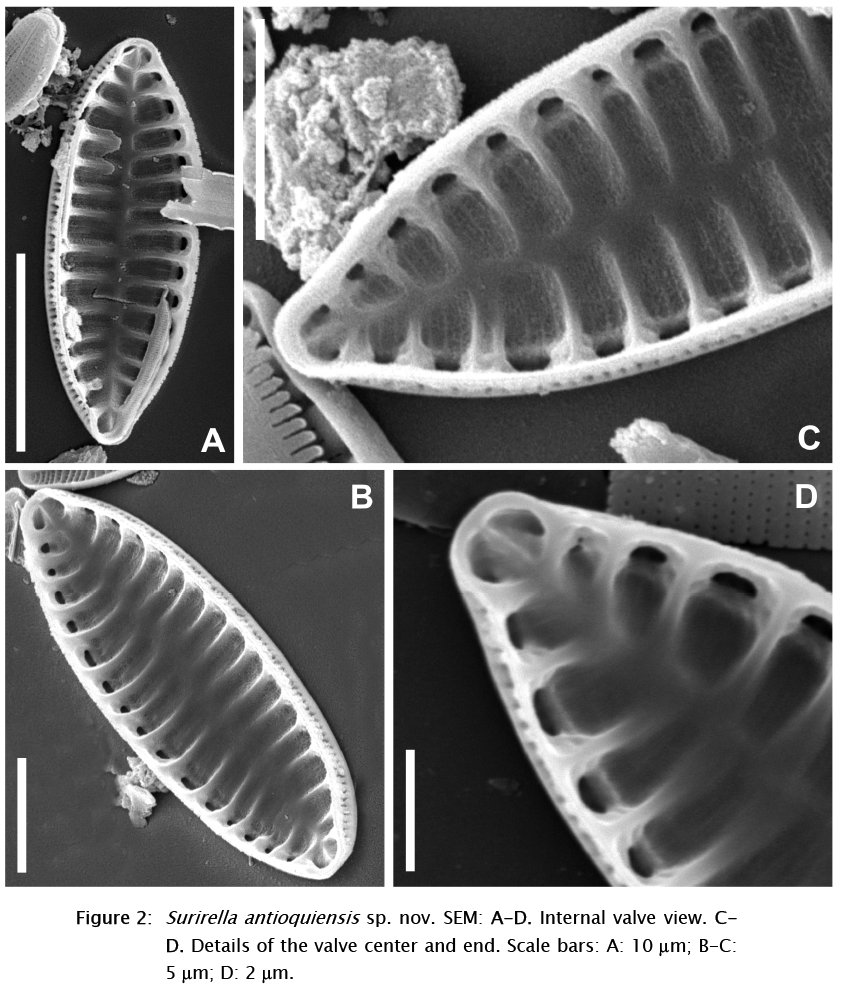
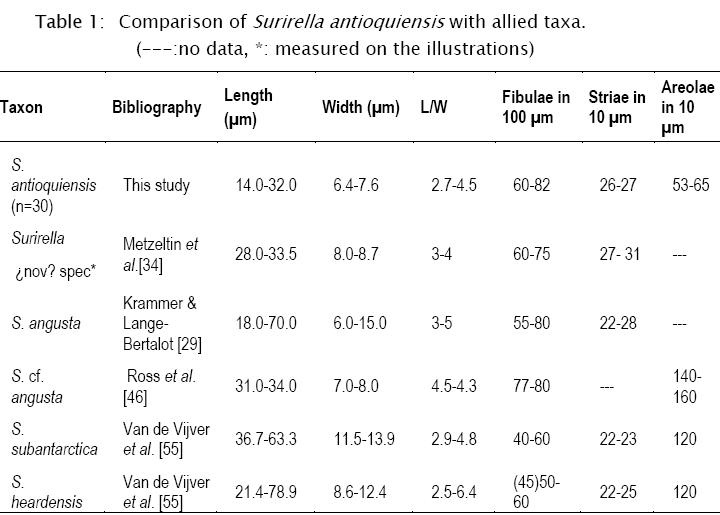
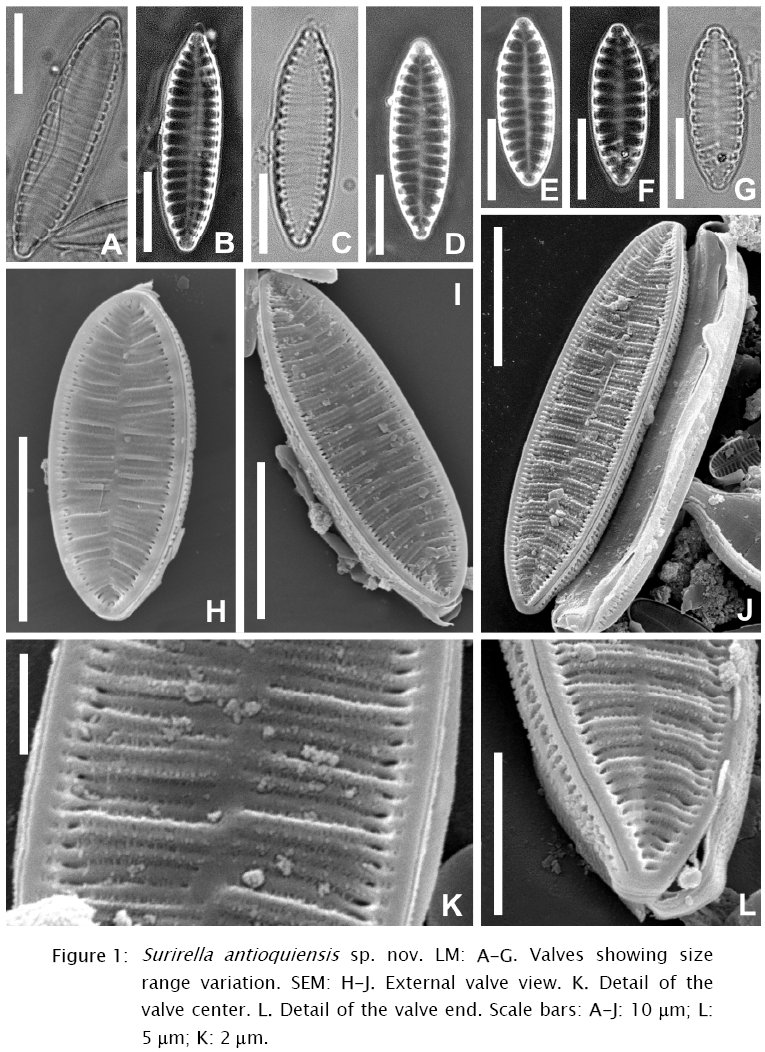
<body><![CDATA[<p align="justify"><b><font size="3" face="Verdana, Arial, Helvetica, sans-serif">3.   Results and Discussion</font></b></p> <h3 align="justify"><font size="2" face="Verdana, Arial, Helvetica, sans-serif">3.1. <i>Surirella antioquiensis</i> S.E. Sala, J.J. Ramírez, Plata-Díaz &amp; Vouilloud <i>sp. nov.</i> (<a href="#f12">Figs 1-2</a>) </font></h3>      <p align="justify"><font size="2" face="Verdana, Arial, Helvetica, sans-serif"><i>Holotype: </i>Designated here: LPC 10011 (Slide1, Finder: P 34-2). El Carmen de Viboral Municipality, November, 2003. Collector: Yimmy Montoya. The valve representing the holotype is illustrated in Figs 1B-C.</font></p>      <p align="justify"><font size="2" face="Verdana, Arial, Helvetica, sans-serif"><i>Type locality:</i> El Carmen de Viboral Municipality, Department of Antioquia, Colombia (6° 05' 09'' N, 75° 20' 19'' W). </font></p>      <p align="justify"><font size="2" face="Verdana, Arial, Helvetica, sans-serif"><i>Etymology: </i>the specific epithet <i>antioquiensis</i> refers to the Department of Antioquia, the geographic region where the type locality is located.</font></p>      <p align="justify"><font size="2" face="Verdana, Arial, Helvetica, sans-serif"><i>Description. Light Microscope.</i> Cells isopolar, lanceolate with cuneate poles; the longer specimens with a more or less linear outline. Valve face without concentric undulations, transapical costae strongly visible reaching the conspicuous axial area, parallel at valve center radial to the poles (<a href="#f12">Figs 1A-G</a>). </font></p>      <p align="justify"><font size="2" face="Verdana, Arial, Helvetica, sans-serif"><i>Scanning Electron Microscope</i><b>.</b> Valves slightly curved towards the girdle at the poles. Valve face in external view slightly transapically undulated due to the distinct and irregular groupings of striae and Type II costae separated by 1-2 small sunken costae that extend out to the axial area, a straight hyaline line (<a href="#f12">Figs 1H-L</a>). Each ‘group’ has 3-4 uniseriate striae composed of circular areolae exceptionally transapically elongated (<a href="#f12">Fig. 1K</a>). Striae and costae are radial towards the poles and parallel at the valve center (<a href="#f12">Figs 1H-J</a>). The mantle is shallow with the same height alongside and the same structure of the valve face (<a href="#f12">Figs 1J, L</a>). </font></p>     <p align="justify"><a name="f12"></a></p>     <p align="center"><img src="/img/revistas/ran/v6n1-2/a02_figure_1.jpg" width="765" height="1052"></p>     <p align="justify"><font size="2" face="Verdana, Arial, Helvetica, sans-serif">In internal valve view, fibulae and portulae are evenly spaced (<a href="#f2">Figs 2A-D</a>). Fibulae type III, reaching the sternum, are robust and broaden at the basis. The interfibular spaces present one elliptical portula. The fibulae correspond to the externally sunken costae (<a href="#f2">Figs 2C-D</a>). Raphe canal smooth only slightly elevated above the valve surface. Raphe interrupted at both poles externally, with straight and distant ends without terminal pores (<a href="#f12">Fig. 1L</a>). </font></p>     <p align="justify"><a name="f2"></a></p>     ]]></body>
<body><![CDATA[<p align="center"><img src="/img/revistas/ran/v6n1-2/a02_figure_2.jpg" width="844" height="987"></p>     <p align="justify"><font size="2" face="Verdana, Arial, Helvetica, sans-serif"><i>Morphometric data (n=30):</i> length: 14-32 µm, width: 6.4-7.6 &#956;m, L/W: 2.7-4.5, striae: 26-27 in 10 &#956;m: fibulae: 60-82 in 100 &#956;m, areolae: 53-65 in 10 &#956;m. </font></p>      <p align="justify"><font size="2" face="Verdana, Arial, Helvetica, sans-serif"><i>Ecological data:</i> epiphythic taxon on     <i>Nymphoides</i> sp. plants in a small pond located at 2,200 m a.s.l. This species is abundant and coexists with small diatoms of the genera <i>Gomphonema</i> Ehrenb., <i>Achnanthidium </i>Kütz., <i>Planothidium</i> Round &amp; Bukhtiyarova and <i>Nitzschia </i>Hassall.</font></p>      <p align=justify><font size="2" face="Verdana, Arial, Helvetica, sans-serif"><i>Distribution:</i> This species is only known from a small pond at El Carmen de Viboral Municipality.</font></p>      <p align="justify"><font size="2" face="Verdana, Arial, Helvetica, sans-serif"><i>Remarks:</i> the studied material belongs to the Pinnatae group; it is similar in size and structure to <i>S. minuta</i>, but clearly differs in the isopolar valve outline. <i>Surirella angusta </i>Kütz., a small isopolar species, is the closest described taxon. Information about the valve morphology of this widely distributed species is scarce, so comparisons were done against the type material photographed with LM in Krammer &amp; Lange-Bertalot [29]. Our material differs from <i>S. angusta</i> in its smaller size and also in valve outline, lanceolate in <i>S. antioquiensis </i>and with parallel margins in <i>S. angusta</i> (<a href="#t1">Table 1</a>)<i>.</i> </font></p>     <p align="justify"><a name="t1"></a></p>     <p align="center"><img src="/img/revistas/ran/v6n1-2/a02_table_01.gif" width="720" height="515"></p>     <p align="justify"><font size="2" face="Verdana, Arial, Helvetica, sans-serif">The studied material is also similar to materials from Crater Lake, Oregon (CAS 622015) designated as <i>S.</i> cf. <i>angusta </i>in [47]. LM photographs [47] show that this taxon has straight margins in valve view, slightly constricted at midvalve, and parallel costa alongside. Besides, under SEM, they differ in striae structure, multiseriate in <i>S.</i> cf. <i>angusta </i>and uniseriate in <i>S. antioquiensis</i>. The lower costae are connected to the grouped costa, by few and fine siliceous elements in <i>S. antioquiensis </i>(<a href="#f1">Fig. 1K</a>), while in <i>S. </i>cf. <i>angusta</i> these elements are numerous and conspicuous [47]. The studied material differs also in valve structure with the North American valves in their wider axial area and the parallel and short costae all alongside [47]. These two taxa also differ in fibulae and areolae density (<a href="#t1">Table 1</a>). Although, in external view these taxa can be confused, differences in internal view are conspicuous as the valves in <i>S.</i> cf. <i>angusta</i> are more robust, fibulae are short and thick and interfibular spaces are triangular.</font></p>      <p align="justify"><font size="2" face="Verdana, Arial, Helvetica, sans-serif">The specimens described in [34] from Brazil, Iguazú Falls and Río Tec (Venezuela) as “<i>Surirella</i> (nov?) spec.” coincide with <i>S. antioquiensis</i> in dimensions, general LM and SEM appearance, and South American tropical distribution, but other details of this taxon are insufficient to be sure if they are conspecific (<a href="#t1">Table 1</a>).</font></p>        <p align="justify"><font size="2" face="Verdana, Arial, Helvetica, sans-serif">Other taxa with similar valve morphology are <i>S. subantarctica</i> Van de Vijver &amp; Cocquyt and <i>S. heardensis</i> Van de Vijver &amp; Cocquyt [55]. These taxa differ from the studied material in dimensions (<a href="#t1">Table 1</a>), but also in the multiseriate structure of the striae, the number of portulae: a large one with two small ones on each side, among other morphological details.</font></p>     ]]></body>
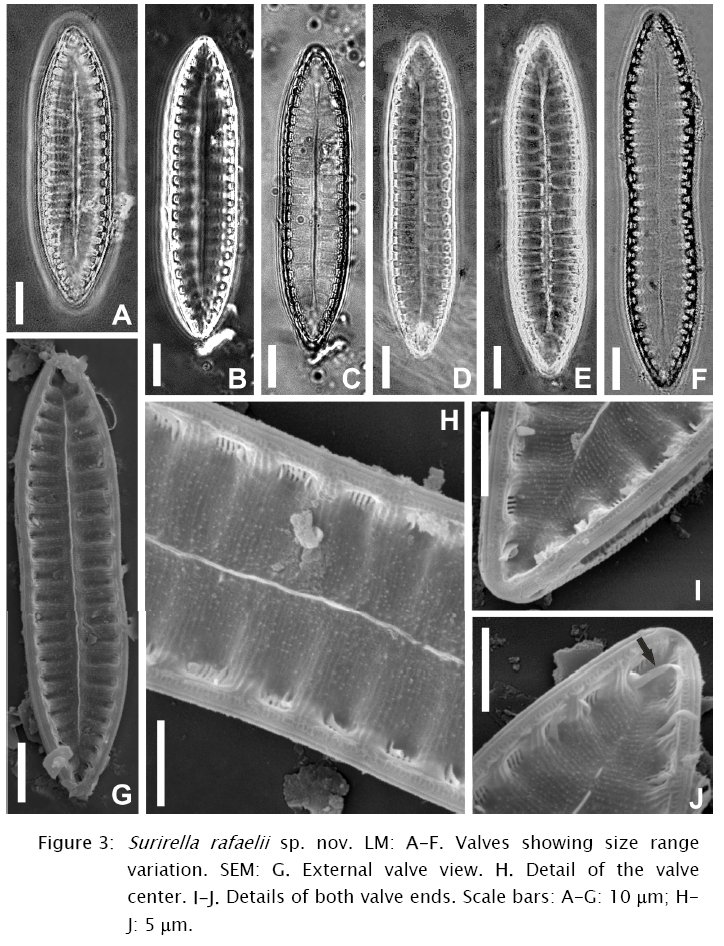
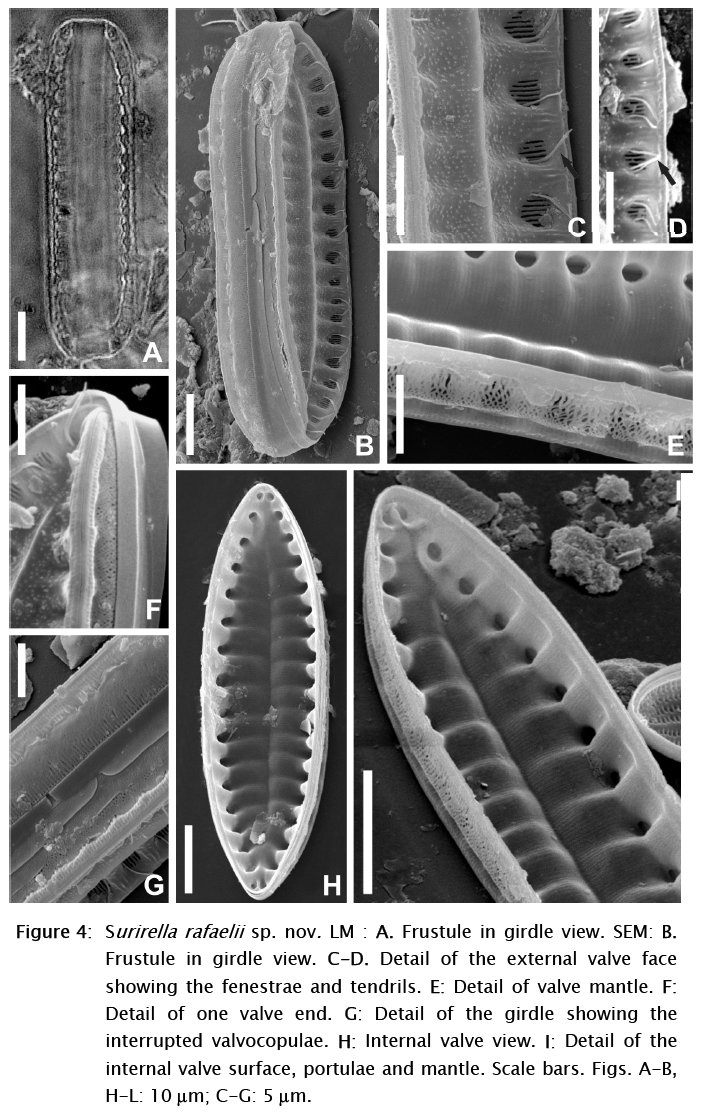
<body><![CDATA[<p align="justify">&nbsp;</p>     <p align="justify"><b><font size="2" face="Verdana, Arial, Helvetica, sans-serif"><i>Surirella   rafaelii </i>J.J. Ramírez &amp; S.E. Sala<i> sp. nov. </i>(<a href="#f34">Figs   3-4</a>) </font></b></p>     <p align="justify"><font size="2" face="Verdana, Arial, Helvetica, sans-serif"><i>Holotype</i>: Designated here: LPC 10003 (slide 1, Finder: O28-4). La Vega Stream, Municipality of San José del Nus, April, 2002. Collector: Esnedy Hernández. The valve representing the holotype is illustrated in <a href="#f34">Figs 3B-C</a>.</font></p>      <p align="justify"><font size="2" face="Verdana, Arial, Helvetica, sans-serif"><i>Type locality</i><b>:</b> Municipality of San José del Nus, Department of Antioquia, Colombia. (6° 29' 30'' N, 74° 49' 30'' W). </font></p>      <p align="justify"><font size="2" face="Verdana, Arial, Helvetica, sans-serif"><i>Etymology: </i>the specific epithet <i>rafaelii</i> refers to the Zoologist Rafael Urrejola, Universidad Nacional de La Plata, Buenos Aires, Argentina.</font></p>      <p align="justify"><font size="2" face="Verdana, Arial, Helvetica, sans-serif"><i>Description. Light Microscope</i><b>. </b>Frustules isopolar in valve and girdle view (<a href="#f34">Figs 3A-F, 4A</a>). Valves parallel with a short pervalvar axis (<a href="#f4">Fig. 4A</a>). Valves linear-lanceolate with parallel margins in the smaller specimens (<a href="#f34">Figs 3A-B</a>) and slightly constricted at midvalve in larger specimens (<a href="#f34">Figs 3 C-F</a>), apices bluntly cuneate. Valve face strongly transpically undulated, axial area straight slightly elevated with a conspicuous median ridge not reaching the apices (<a href="#f34">Figs 3 A-F</a>).</font></p>      <p align="justify"><font size="2" face="Verdana, Arial, Helvetica, sans-serif"><b> </b><i>Scanning Electron Microscope.</i> Valve face regularly corrugated; axial area sligthly elevated in external view with a thin irregular ridge not reaching the valve apices (<a href="#f34">Figs 3G-H</a>). The entire valve face is transapically striated. Striae are uniseriate with circular areolae difficult to see even with SEM (<a href="#f34">Figs 3H-J</a>). In external view, the interstriae are covered with small granules arranged in transapical rows, more densely disposed near the central keel (<a href="#f34">Fig. 3H</a>). Alar canals slightly wider than the fenestrae (<a href="#f34">Fig. 3G</a>). Wings well developed (<a href="#f4">Fig. 4B</a>), fenestrae short with 3-6 fenestral bars (<a href="#f34">Figs 3H</a>, J, <a href="#f34">4 B-D</a>). Tendrils solitary or eventually grouped (2-3), ribbon-like with sharp ends placed at the base of the fenestrae (<a href="#f34">Figs 3J</a>, <a href="#f34">4B-D, F</a>). Raphe canal with transversal ribs (<a href="#f34">Fig. 3H-J</a>), raphe externally interrupted at both ends, curved towards the mantle and with terminal small pores (<a href="#f34">Figs 3 I-J</a>, <a href="#f34">4F</a>). Mantle completely perforated with areolae irregularly arranged (<a href="#f4">Fig. 4E</a>). Girdle with few broad bands, valvocopula interrupted near midvalve (<a href="#f4">Figs 4B, G</a>). Internally, the alar canals open in simple portulae (<a href="#f4">Figs 4 E, H-I</a>) and the mantle and the valve face have the same structure (<a href="#f4">Figs 4I</a>). </font></p>     <p align="justify"><a name="f34"></a></p>     <p align="center"><img src="/img/revistas/ran/v6n1-2/a02_figure_3.jpg" width="724" height="946"></p>     <p align="center">&nbsp;</p>     ]]></body>
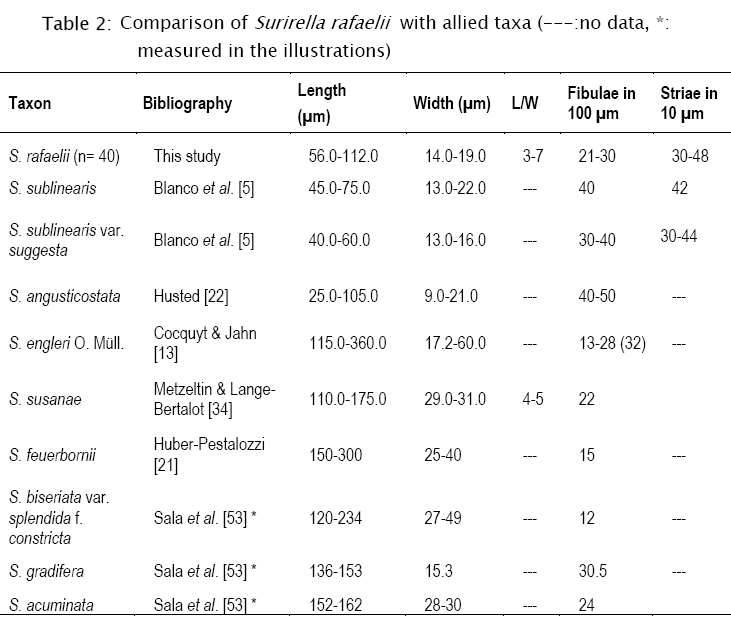
<body><![CDATA[<p align="center"><a name="f4"></a></p>     <p align="center"><img src="/img/revistas/ran/v6n1-2/a02_figure_4.jpg" width="705" height="1112"></p>     <p align="justify"><font size="2" face="Verdana, Arial, Helvetica, sans-serif"><i>Morphometric data</i> <i>(n=40)<b>:</b></i> length: 56-112 µm, width: 14-19 µm, L/W: 3-7, pervalvar axis: 15.7-17.8 µm, alar canals: 21-30/100 µm, striae in 10 µm: 30-48, areolae in 10 µm: approximately 60.</font></p>      <p align="justify"><font size="2" face="Verdana, Arial, Helvetica, sans-serif"><i>Ecological data:</i> elevation: 651 m a.s.l., water temperature: 21.4-26.3º C, pH: 6.64-7.90, dissolved oxygen: 6.9-8.0 mg L-1. In the study area this species is rare and coexists with diatoms of the genera <i>Cocconeis </i>Ehrenb., <i>Navicula</i> Bory and other small naviculoids.</font></p>      <p align="justify"><font size="2" face="Verdana, Arial, Helvetica, sans-serif"><i>Distribution:</i> this species is only known from a stream at San Jose del Nus Municipality. </font></p>      <p align="justify"><font size="2" face="Verdana, Arial, Helvetica, sans-serif"><i>Remarks</i>: this taxon belongs to the Robustae group and was compared with isopolar taxa with median ridge as <i>Surirella engleri</i> O. Müll., <i>S. sublinearis</i> Hust., <i>S. sublinearis</i> var. <i>suggesta</i> Bramburger &amp; P.B. Hamilton, <i>S. angusticostata </i>Hust., <i>S. susanae</i> Metzeltin &amp; Lange-Bert.,<i> S. feuerborni</i> Hust.,<i> S. biseriata</i> var. s<i>plendida</i> f. <i>constricta </i>Hust.,<i> S. gradifera </i>Hust. and <i>S. acuminata </i>Hust. (<a href="#t2">Table 2</a>). <i>Surirella engleri, S. susanae</i>,<i> S. feuerbornii</i>,<i> S. biseriata</i> var. s<i>plendida</i> f. <i>constricta </i>and<i> S. gradifera </i>differ from the studied material in dimensions and/or alar canal densities. </font></p>      <p align="justify"><a name="t2"></a></p>     <p align="center"><img src="/img/revistas/ran/v6n1-2/a02_table_02.gif" width="731" height="624"></p>     <p align="justify"><font size="2" face="Verdana, Arial, Helvetica, sans-serif">Besides, <i>S. rafaelii</i> resembles <i>S. engleri</i> in the valve outline and the axial area, but the type material studied by Cocquyt &amp; Jahn [13] differs from our material in the siliceous granules only distributed on the depressions of the valve face, the elongated fenestrae, the absence of tendrils and the raphe channel with longitudinal costae. The studied material differs from <i>S. sublinearis</i> and <i>S. sublinearis</i> var. <i>suggesta</i> [6] in the numerous alar canals (see <a href="#t2">Table 2</a>), in the absence of a silica ridge or keel along the axial area, and the long and grouped filiform tendrils. Besides, it differs from var. <i>suggesta</i> in the spinules arranged in parallel rows across the valve face becoming irregular dispersed in the central area and also in the raphe endings. All of these species were described from tropical areas, but only <i>S. susanae</i> from South America.</font></p>     <p align="justify">&nbsp;</p>     ]]></body>
<body><![CDATA[<p align="justify"><font size="3" face="Verdana, Arial, Helvetica, sans-serif"><b>4.   Conclusions</b></font></p>     <p align="justify"><font size="2" face="Verdana, Arial, Helvetica, sans-serif">This study was held within the framework of a research project to produce an inventory of the Colombian diatom flora. The research is carried out in different regions of the country such as Antioquia, Santander, Chocó, Córdoba and Amazonia, as well as low and high-altitude waterbodies. While the genus <i>Surirella</i> is highly diversified in tropical zones of Africa and Asia, few species have been described from the neotropics until now. In the Colombian regions studied thus far, the genus was poorly represented both from qualitative and quantitative points of view. The species analyzed here were only found in Antioquia, a Department that belongs to the Antioquian Mountain subregion located in the Andean region. These aquatic systems are located in sites with different elevation. While La Vega stream is placed between 1,250 and 790 m a.s.l. in the subtropical level, El Carmen de Viboral is located between 3,340 and 800 m a.s.l. in the mesothermic or temperate level. </font></p>      <p align="justify"><font size="2" face="Verdana, Arial, Helvetica, sans-serif"><i>Surirella antioquiensis</i> is close to <i>S. angusta </i>and <i>S. </i>cf. <i>angusta </i>in Ruck &amp; Kociolek [47] and “<i>Surirella</i> (¿nov?) spec.” in Meltzeltin &amp; Lange-Bertalot [34]. The latter species, collected in Brazil and Venezuela, is similar in external valve morphology to the studied material, but data given by the authors are insufficient to establish if they are conspecific.</font></p>      <p align="justify"><font size="2" face="Verdana, Arial, Helvetica, sans-serif"><i>Surirella rafaelii</i>, an isopolar species, was compared with related taxa with prominent median ridge that belongs to the Robustae group. Although there are several species that can be confused under LM, details of the valve morphology allow its distinction from other species. Filiform tendrils are present in other <i>Surirella </i>species [6], but ribbon like tendrils have not been described for any species in the genus up to this date.</font></p>      <p align="justify"><font size="2" face="Verdana, Arial, Helvetica, sans-serif">The results of this study are consistent with those obtained in previous studies about the genera <i>Brachysira</i> Kütz.,<i> Cyclotella </i>Kütz. ex Bréb., <i>Encyonema </i>Kütz., <i>Urosolenia </i>Round &amp; R.M. Crawford, from continental water bodies of Colombia, where near one third of the taxa could not be assigned to known entities [48][49][50][51][52][53][57]. This situation allows us to conclude that Colombia has a richer diatom flora than presumed to date, and that it is necessary to generate literature for identification of local taxa, especially if the intention is to apply this information to bioindication, paleoecology, and/or limnology.</font></p>     <p align="justify">&nbsp;</p>     <p align="justify"><b><font size="2" face="Verdana, Arial, Helvetica, sans-serif">Acknowledgments</font></b></p>     <p align="justify"><font size="2" face="Verdana, Arial, Helvetica, sans-serif">We thank the Institute of Biología of Universidad de Antioquia, Colciencias, and the Red Latinomericana de Botánica (RLB) for the fellowships given to Yasmin Plata Díaz.</font></p>     <p align="justify">&nbsp;</p>     <p align="justify"><b><font size="3" face="Verdana, Arial, Helvetica, sans-serif">References</font></b></p>     ]]></body>
<body><![CDATA[<!-- ref --><p align="justify"><font size="2" face="Verdana, Arial, Helvetica, sans-serif"><a name="_Ref373702164">[1] Álvarez-Blanco, I.; Cejudo-Figueiras, C.; de Godos I.; Muñoz, R. &amp; Blanco, S. </a>2011. <i>Las diatomeas de los salares del Altiplano boliviano: singularidades florísticas.</i> Boletín De la Real Sociedad Española de  Historia Natural Sección Biología 105: 67-82.</font>&nbsp;&nbsp;&nbsp;&nbsp;&nbsp;&nbsp;&nbsp;&nbsp;[&#160;<a href="javascript:void(0);" onclick="javascript: window.open('/scielo.php?script=sci_nlinks&ref=774859&pid=S1683-0789201300010000300001&lng=','','width=640,height=500,resizable=yes,scrollbars=1,menubar=yes,');">Links</a>&#160;]<!-- end-ref --><!-- ref --><p align="justify"><font size="2" face="Verdana, Arial, Helvetica, sans-serif"><a name="_Ref373703752">[2] Anonymous. 1975. <i>Proposals for standardization of diatom terminology and diagnoses</i>. Nova Hedwigia 53: 232-354.</a></font>&nbsp;&nbsp;&nbsp;&nbsp;&nbsp;&nbsp;&nbsp;&nbsp;[&#160;<a href="javascript:void(0);" onclick="javascript: window.open('/scielo.php?script=sci_nlinks&ref=774860&pid=S1683-0789201300010000300002&lng=','','width=640,height=500,resizable=yes,scrollbars=1,menubar=yes,');">Links</a>&#160;]<!-- end-ref --><!-- ref --><p align="justify"><font size="2" face="Verdana, Arial, Helvetica, sans-serif"><a name="_Ref373703678">[3] Asprilla, S.; Ramírez, J.J. &amp; Roldán, G. 1998. </a><i>Caracterización limnológica de la ciénaga de Joutaudó (Chocó, Colombia)</i>. Actualidades en Biología 20: 87-107.</font>&nbsp;&nbsp;&nbsp;&nbsp;&nbsp;&nbsp;&nbsp;&nbsp;[&#160;<a href="javascript:void(0);" onclick="javascript: window.open('/scielo.php?script=sci_nlinks&ref=774861&pid=S1683-0789201300010000300003&lng=','','width=640,height=500,resizable=yes,scrollbars=1,menubar=yes,');">Links</a>&#160;]<!-- end-ref --><!-- ref --><p align="justify"><font size="2" face="Verdana, Arial, Helvetica, sans-serif"><a name="_Ref373703754">[4] Barber, H.G. &amp; Haworth, E.Y. </a>1981. <i>A guide to the morphology of the diatom frustule</i>. Freshwater Biological Association 44, Ambleside, 112 pp. </font>&nbsp;&nbsp;&nbsp;&nbsp;&nbsp;&nbsp;&nbsp;&nbsp;[&#160;<a href="javascript:void(0);" onclick="javascript: window.open('/scielo.php?script=sci_nlinks&ref=774862&pid=S1683-0789201300010000300004&lng=','','width=640,height=500,resizable=yes,scrollbars=1,menubar=yes,');">Links</a>&#160;]<!-- end-ref --><!-- ref --><p align="justify"><font size="2" face="Verdana, Arial, Helvetica, sans-serif"><a name="_Ref373702496">[5] Blanco, S.; Álvarez-Blanco, I.; Cejudo-Figueiras, C.; de Godos, I.; Bécares, E.; Muñoz, R.; Guzmán, H.O.; Vargas, V.A. &amp; Soto, R. 2013. </a><i>New diatom taxa from high-altitude Andean saline lakes</i>. Diatom Research 28: 13-27.</font>&nbsp;&nbsp;&nbsp;&nbsp;&nbsp;&nbsp;&nbsp;&nbsp;[&#160;<a href="javascript:void(0);" onclick="javascript: window.open('/scielo.php?script=sci_nlinks&ref=774863&pid=S1683-0789201300010000300005&lng=','','width=640,height=500,resizable=yes,scrollbars=1,menubar=yes,');">Links</a>&#160;]<!-- end-ref --><!-- ref --><p align="justify"><font size="2" face="Verdana, Arial, Helvetica, sans-serif"><a name="_Ref373702293">[6] Bramburger, J.; Haffner, G.D.; Hamilton, P.B.; Finz, H. &amp;   Hehanussa, P.E. 2006. <i>An examination of species within the genus </i>Surirella<i> from the Malili lakes, Sulawesi Island, Indonesia, with descriptions of 11 new taxa</i>. Diatom Research 21: 1-56.</a></font>&nbsp;&nbsp;&nbsp;&nbsp;&nbsp;&nbsp;&nbsp;&nbsp;[&#160;<a href="javascript:void(0);" onclick="javascript: window.open('/scielo.php?script=sci_nlinks&ref=774864&pid=S1683-0789201300010000300006&lng=','','width=640,height=500,resizable=yes,scrollbars=1,menubar=yes,');">Links</a>&#160;]<!-- end-ref --><p align="justify"><font size="2" face="Verdana, Arial, Helvetica, sans-serif"><a name="_Ref373703737">[7] CEN/TC 230, prEN 13946. 2002. <i>Water quality-Guidance standard for the routine sampling and pretreatment of benthic diatoms from rivers.</i></a>14 pp. </font></p>      <!-- ref --><p align="justify"><font size="2" face="Verdana, Arial, Helvetica, sans-serif"><a name="_Ref373702454">[8] Cocquyt, C. 1998.</a> <i>Diatoms from the Northern Basin of Lake Tanganyika</i>. Bibliotheca Diatomologica 39: 1-275</font>&nbsp;&nbsp;&nbsp;&nbsp;&nbsp;&nbsp;&nbsp;&nbsp;[&#160;<a href="javascript:void(0);" onclick="javascript: window.open('/scielo.php?script=sci_nlinks&ref=774866&pid=S1683-0789201300010000300008&lng=','','width=640,height=500,resizable=yes,scrollbars=1,menubar=yes,');">Links</a>&#160;]<!-- end-ref --><!-- ref --><p align="justify"><font size="2" face="Verdana, Arial, Helvetica, sans-serif"><a name="_Ref373702405">[9] Cocquyt, C. &amp; Jahn, R. 2005a. </a><i>Rare </i>Surirella<i> taxa (Bacillariophyta) from East Africa described by Otto Müller: typifications, recombinations, new names, annotations and distributions</i>. Willdenovia 35: 359-371.</font>&nbsp;&nbsp;&nbsp;&nbsp;&nbsp;&nbsp;&nbsp;&nbsp;[&#160;<a href="javascript:void(0);" onclick="javascript: window.open('/scielo.php?script=sci_nlinks&ref=774867&pid=S1683-0789201300010000300009&lng=','','width=640,height=500,resizable=yes,scrollbars=1,menubar=yes,');">Links</a>&#160;]<!-- end-ref --><!-- ref --><p align="justify"><font size="2" face="Verdana, Arial, Helvetica, sans-serif">[10] Cocquyt, C. &amp; Jahn,R. 2005b. Surirella capensis <i>Ehrenberg ex Cocquyt et R. Jhan sp. nov., a rare and historical diatom species from South Africa.</i> Crytogamie Algologie 26: 149-153. </font>&nbsp;&nbsp;&nbsp;&nbsp;&nbsp;&nbsp;&nbsp;&nbsp;[&#160;<a href="javascript:void(0);" onclick="javascript: window.open('/scielo.php?script=sci_nlinks&ref=774868&pid=S1683-0789201300010000300010&lng=','','width=640,height=500,resizable=yes,scrollbars=1,menubar=yes,');">Links</a>&#160;]<!-- end-ref --><!-- ref --><p align="justify"><font size="2" face="Verdana, Arial, Helvetica, sans-serif"><a name="_Ref373702414">[11] Cocquyt, C. &amp; Jahn,R. 2007a. Surirella nyassae<i> O. Müller, </i>S. malombae<i> O. Müller and </i>S. chepurnovii<i> Cocquyt &amp; R. Jahn sp. nov. </i></a><i>(Bacillariophyta) – typification and variability of three closely related East African diatoms</i>. Nova Hedwigia 84: 529-548.</font>&nbsp;&nbsp;&nbsp;&nbsp;&nbsp;&nbsp;&nbsp;&nbsp;[&#160;<a href="javascript:void(0);" onclick="javascript: window.open('/scielo.php?script=sci_nlinks&ref=774869&pid=S1683-0789201300010000300011&lng=','','width=640,height=500,resizable=yes,scrollbars=1,menubar=yes,');">Links</a>&#160;]<!-- end-ref --><!-- ref --><p align="justify"><font size="2" face="Verdana, Arial, Helvetica, sans-serif"><a name="_Ref373702168">[12] Cocquyt, C. &amp; Jahn,R. 2007b. </a><i>Taxa related to </i>Surirella ovalis<i> from Tanzania, East Africa: typification of O. Müller’s taxa and description of a new species.</i> Crytogamie Algologie 28: 107-116.</font>&nbsp;&nbsp;&nbsp;&nbsp;&nbsp;&nbsp;&nbsp;&nbsp;[&#160;<a href="javascript:void(0);" onclick="javascript: window.open('/scielo.php?script=sci_nlinks&ref=774870&pid=S1683-0789201300010000300012&lng=','','width=640,height=500,resizable=yes,scrollbars=1,menubar=yes,');">Links</a>&#160;]<!-- end-ref --><!-- ref --><p align="justify"><font size="2" face="Verdana, Arial, Helvetica, sans-serif"><a name="_Ref373702171">[13] Cocquyt, C. &amp; Jahn,R. 2007c. </a>Surirella engleri<i> O. Muller – a study of its original infraspecific types, variability and distribution</i>. Diatom Research 22: 1-16.</font>&nbsp;&nbsp;&nbsp;&nbsp;&nbsp;&nbsp;&nbsp;&nbsp;[&#160;<a href="javascript:void(0);" onclick="javascript: window.open('/scielo.php?script=sci_nlinks&ref=774871&pid=S1683-0789201300010000300013&lng=','','width=640,height=500,resizable=yes,scrollbars=1,menubar=yes,');">Links</a>&#160;]<!-- end-ref --><!-- ref --><p align="justify"><font size="2" face="Verdana, Arial, Helvetica, sans-serif"><a name="_Ref373702174">[14] Cocquyt, C. &amp; Kusber, W.H. 2010. </a><i>Reinvestigation of West African Surirellaceae (Bacillariophyta) described by Foged from Ghana</i>. Nova Hedwigia 91: 111–136. </font>&nbsp;&nbsp;&nbsp;&nbsp;&nbsp;&nbsp;&nbsp;&nbsp;[&#160;<a href="javascript:void(0);" onclick="javascript: window.open('/scielo.php?script=sci_nlinks&ref=774872&pid=S1683-0789201300010000300014&lng=','','width=640,height=500,resizable=yes,scrollbars=1,menubar=yes,');">Links</a>&#160;]<!-- end-ref --><!-- ref --><p align="justify"><font size="2" face="Verdana, Arial, Helvetica, sans-serif"><a name="_Ref373702527">[15] Díaz, C.A. &amp; Rivera, C. 2004. </a><i>Diatomeas de pequeños ríos andinos y su utilización como indicadoras de condiciones ambientales.</i> Caldasia 26: 381-394.</font>&nbsp;&nbsp;&nbsp;&nbsp;&nbsp;&nbsp;&nbsp;&nbsp;[&#160;<a href="javascript:void(0);" onclick="javascript: window.open('/scielo.php?script=sci_nlinks&ref=774873&pid=S1683-0789201300010000300015&lng=','','width=640,height=500,resizable=yes,scrollbars=1,menubar=yes,');">Links</a>&#160;]<!-- end-ref --><!-- ref --><p align="justify"><font size="2" face="Verdana, Arial, Helvetica, sans-serif"><a name="_Ref373702382">[16] Dickie, G. 1882. <i>Notes on algae from the Himalayas</i>. Journal of Linnean Society (Botany) 19: </a>230. </font>&nbsp;&nbsp;&nbsp;&nbsp;&nbsp;&nbsp;&nbsp;&nbsp;[&#160;<a href="javascript:void(0);" onclick="javascript: window.open('/scielo.php?script=sci_nlinks&ref=774874&pid=S1683-0789201300010000300016&lng=','','width=640,height=500,resizable=yes,scrollbars=1,menubar=yes,');">Links</a>&#160;]<!-- end-ref --><!-- ref --><p align="justify"><font size="2" face="Verdana, Arial, Helvetica, sans-serif"><a name="_Ref373703711">[17] Donato, J.C. 2010. <i>Phytoplankton of Andean Lakes in northern </i></a><i>South America (Colombia). Composition and environment distribution factors</i>. In: Witkowski A. (Ed.). Diatom Monographs. Gantner Verlag, Germany. 188 pp. </font>&nbsp;&nbsp;&nbsp;&nbsp;&nbsp;&nbsp;&nbsp;&nbsp;[&#160;<a href="javascript:void(0);" onclick="javascript: window.open('/scielo.php?script=sci_nlinks&ref=774875&pid=S1683-0789201300010000300017&lng=','','width=640,height=500,resizable=yes,scrollbars=1,menubar=yes,');">Links</a>&#160;]<!-- end-ref --><p align="justify"><font size="2" face="Verdana, Arial, Helvetica, sans-serif"><a name="_Ref373702530">[18] Donato, J.C.; González, L.E. &amp; Rodríguez, C.L. 1996. <i>Ecología de dos sistemas acuáticos de Páramo</i>. Academia Colombiana de Ciencias Exactas Físicas y Naturales, Colección Javier Álvarez Lleras 9, Bogotá.</a>164 pp</font></p>      <p align="justify"><font size="2" face="Verdana, Arial, Helvetica, sans-serif"><a name="_Ref373702374">[19] Ehrenberg, C.G. 1845. <i>Novorum Generum et Specierum brevis de</i></a><i>&#64257;nitio. Zusätze zu seinen letzten Mit-theilung über die mikroskopischen Lebensformen von Portugall und Spanien, Süd-Afrika, Hinter-Indien,Japan und Kurdistan, und legte die folgenden Diagnosen u.s.w.</i> Bericht über die zur Bekanntmachung geeigneten Verhandlungen der Königlich-Preussischen Akademie der Wissenschaften zu Berlin 1845: 357– 377.</font></p>      <p align="justify"><font size="2" face="Verdana, Arial, Helvetica, sans-serif"><a name="_Ref373702266">[20] Fourtanier, E. &amp; Kociolek, J.P. 2011. </a>Catalogue of Diatom Names. Available online at <a href="http://research.calacademy.org/research/diatoms/names/index.asp" target="_blank">http://research.calacademy.org/research/diatoms/names/index.asp</a></font></p>      ]]></body>
<body><![CDATA[<!-- ref --><p align="justify"><font size="2" face="Verdana, Arial, Helvetica, sans-serif"><a name="_Ref373702434">[21] Huber- Pestalozzi, G. 1942. <i>Das Phytoplankton des Susswassers; Systematik und Biologie.</i> In: Thienemann, A. (Ed.). Die Binnengewasser. 2 Teil. 2 Halfte. Diatomeen. Stuttgart, E. Schweizerbartsche Verlagsbuchhandlung. pp 367-549.</a></font>&nbsp;&nbsp;&nbsp;&nbsp;&nbsp;&nbsp;&nbsp;&nbsp;[&#160;<a href="javascript:void(0);" onclick="javascript: window.open('/scielo.php?script=sci_nlinks&ref=774879&pid=S1683-0789201300010000300021&lng=','','width=640,height=500,resizable=yes,scrollbars=1,menubar=yes,');">Links</a>&#160;]<!-- end-ref --><p align="justify"><font size="2" face="Verdana, Arial, Helvetica, sans-serif"><a name="_Ref373783732">[22] Hustedt, F. 1935. <i>Die fossile diatomeenflora in den Ablagerungen des Tobasees auf </i></a>Sumatra. Archiv für Hydrobiologie, Supplement 14: 143-192.</font></p>      <p align="justify"><font size="2" face="Verdana, Arial, Helvetica, sans-serif">[23] Hustedt, F. 1938. <i>Systematische und ökologische Untersuchungen über die Diatomeen flora von Java, Bali und Sumatra nach </i>dem<i> Material der Deutschen Limnologischen Sunda_Expedition. Teil I.</i> Archiv für Hydrobiologie, Supplement 15, 393-506.</font></p>      <!-- ref --><p align="justify"><font size="2" face="Verdana, Arial, Helvetica, sans-serif"><a name="_Ref373702365">[24] Karthick, </a>B.; Hamilton, P.B. &amp; Kociolek, J.P. 2012. <i>Taxonomy and biogeography of some </i>Surirella Turpin<i>   (Bacillariophyceae) taxa from Peninsular India.</i> Nova Hedwigia, Beiheft 141: 81–116.</font>&nbsp;&nbsp;&nbsp;&nbsp;&nbsp;&nbsp;&nbsp;&nbsp;[&#160;<a href="javascript:void(0);" onclick="javascript: window.open('/scielo.php?script=sci_nlinks&ref=774882&pid=S1683-0789201300010000300024&lng=','','width=640,height=500,resizable=yes,scrollbars=1,menubar=yes,');">Links</a>&#160;]<!-- end-ref --><p align="justify"><font size="2" face="Verdana, Arial, Helvetica, sans-serif"><a name="_Ref373701510">[25] Krammer, K. &amp; Lange-Bertalot, H. 1986. <i>Bacillariophyceae. </i></a>In: Süsswasserflora von Mittleuropa. Band 2, Teil 1. Naviculaceae. Gustav Fisher, Jena. 876 pp.</font></p>      <!-- ref --><p align="justify"><font size="2" face="Verdana, Arial, Helvetica, sans-serif"><a name="_Ref373702319">[26] Krammer, K. &amp; Lange-Bertalot, H. 1987. </a><i>Morphology and taxonomy of </i>Surirella ovalis<i> and related taxa</i>. Diatom Research 2: 77-95.</font>&nbsp;&nbsp;&nbsp;&nbsp;&nbsp;&nbsp;&nbsp;&nbsp;[&#160;<a href="javascript:void(0);" onclick="javascript: window.open('/scielo.php?script=sci_nlinks&ref=774884&pid=S1683-0789201300010000300026&lng=','','width=640,height=500,resizable=yes,scrollbars=1,menubar=yes,');">Links</a>&#160;]<!-- end-ref --><!-- ref --><p align="justify"><font size="2" face="Verdana, Arial, Helvetica, sans-serif"><a name="_Ref373701521">[27] Krammer, K. &amp; Lange-Bertalot, H. 1991a. <i>Bacillariophyceae. 3. Teil: Centrales, Fragilariaceae, Eunotiaceae. </i>In: Ettl, H.; Gerloff, J.; Heynig, H. &amp; D. Mollenhauer (Eds). </a>Süsswasserflora von Mitteleuropa, Band 2/3. Gustav Fischer Verlag, Jena. 576 pp. </font>&nbsp;&nbsp;&nbsp;&nbsp;&nbsp;&nbsp;&nbsp;&nbsp;[&#160;<a href="javascript:void(0);" onclick="javascript: window.open('/scielo.php?script=sci_nlinks&ref=774885&pid=S1683-0789201300010000300027&lng=','','width=640,height=500,resizable=yes,scrollbars=1,menubar=yes,');">Links</a>&#160;]<!-- end-ref --><p align="justify"><font size="2" face="Verdana, Arial, Helvetica, sans-serif"><a name="_Ref373702141">[28] Krammer, K. &amp; Lange-Bertalot, H. 1991b. <i>Bacillariophyceae. </i></a><i>4. Teil: Achnanthaceae, Kritische Ergänzungen zu </i>Navicula<i> (Lineolatae) und </i>Gomphonema<i>.</i> In: Ettl, H.; Gerloff, J.; Heynig, H. &amp; D. Mollenhauer (Eds). Süsswasserflora von Mitteleuropa, Band 2/4. Gustav Fischer Verlag, Stuttgart, Jena. 437 pp.</font></p>      <p align="justify"><font size="2" face="Verdana, Arial, Helvetica, sans-serif"><a name="_Ref373702143">[29] Krammer, K. &amp; Lange-Bertalot, H. 1997. <i>Bacillariophyceae. 2. Teil: Bacillariaceae, Epithemiaceae, Surirellaceae. </i>In: Ettl, H.; Gerloff, J.; Heynig, H. &amp; D. Mollenhauer (Eds). Süsswasserflora von Mitteleuropa, Band 2/2. </a>Gustav Fischer, Jena. 611 pp.</font></p>      <!-- ref --><p align="justify"><font size="2" face="Verdana, Arial, Helvetica, sans-serif">[30] Kutzing, F.T. 1844. <i>Die Kieselschaligen bacillarien oder Diatomeen.</i> Nordhausen, 152 pp.</font>&nbsp;&nbsp;&nbsp;&nbsp;&nbsp;&nbsp;&nbsp;&nbsp;[&#160;<a href="javascript:void(0);" onclick="javascript: window.open('/scielo.php?script=sci_nlinks&ref=774888&pid=S1683-0789201300010000300030&lng=','','width=640,height=500,resizable=yes,scrollbars=1,menubar=yes,');">Links</a>&#160;]<!-- end-ref --><!-- ref --><p align="justify"><font size="2" face="Verdana, Arial, Helvetica, sans-serif"><a name="_Ref373764861">[31] Lange-Bertalot, H.; Külbs, K.; Lauser, T.; Nörpel-Schempp, M. &amp; Willman, M. 1996. </a><i>Diatom taxa introduced by Georg Krasske Documentation and Revision.</i> Iconographia Diatomologica. Annotated Diatom Micrographs. Volume 3. Koeltz Scientific Books, Königstein. 358 pp. </font>&nbsp;&nbsp;&nbsp;&nbsp;&nbsp;&nbsp;&nbsp;&nbsp;[&#160;<a href="javascript:void(0);" onclick="javascript: window.open('/scielo.php?script=sci_nlinks&ref=774889&pid=S1683-0789201300010000300031&lng=','','width=640,height=500,resizable=yes,scrollbars=1,menubar=yes,');">Links</a>&#160;]<!-- end-ref --><!-- ref --><p align="justify"><font size="2" face="Verdana, Arial, Helvetica, sans-serif"><a name="_Ref373703668">[32] Lozano, C.G.; Parra, L.N.; Moro, R.S. &amp; Ramírez, J.J. 1999. </a><i>Inferencias paleolimnológicas del Holoceno con base en diatomeas en la laguna Puente Largo, Páramo de Frontino, Antioquia, </i>p.57-116<i>. </i>En: M.T. Flórez &amp; C.G. Lozano (Eds) Silicofósiles altoandinos. Colciencias, Universidad Nacional de Medellín, Comité de Investigaciones Universidad de Antioquia, Medellín. 116 pp.</font>&nbsp;&nbsp;&nbsp;&nbsp;&nbsp;&nbsp;&nbsp;&nbsp;[&#160;<a href="javascript:void(0);" onclick="javascript: window.open('/scielo.php?script=sci_nlinks&ref=774890&pid=S1683-0789201300010000300032&lng=','','width=640,height=500,resizable=yes,scrollbars=1,menubar=yes,');">Links</a>&#160;]<!-- end-ref --><!-- ref --><p align="justify"><font size="2" face="Verdana, Arial, Helvetica, sans-serif"><a name="_Ref373702534">[33] Martínez, E.L. &amp; Donato, J.C. 2003. <i>Efectos del caudal sobre la colonización de algas en un río de alta montaña tropical (Boyacá, Colombia)</i>. Caldasia 25: 337-354.</a></font>&nbsp;&nbsp;&nbsp;&nbsp;&nbsp;&nbsp;&nbsp;&nbsp;[&#160;<a href="javascript:void(0);" onclick="javascript: window.open('/scielo.php?script=sci_nlinks&ref=774891&pid=S1683-0789201300010000300033&lng=','','width=640,height=500,resizable=yes,scrollbars=1,menubar=yes,');">Links</a>&#160;]<!-- end-ref --><!-- ref --><p align="justify"><font size="2" face="Verdana, Arial, Helvetica, sans-serif"><a name="_Ref373702202">[34] Metzeltin, D. &amp; Lange-Bertalot, H. 1998. </a><i>Tropical Diatoms of South America I.</i> Koeltz Scientific Books, Germany. 695 pp.</font>&nbsp;&nbsp;&nbsp;&nbsp;&nbsp;&nbsp;&nbsp;&nbsp;[&#160;<a href="javascript:void(0);" onclick="javascript: window.open('/scielo.php?script=sci_nlinks&ref=774892&pid=S1683-0789201300010000300034&lng=','','width=640,height=500,resizable=yes,scrollbars=1,menubar=yes,');">Links</a>&#160;]<!-- end-ref --><!-- ref --><p align="justify"><font size="2" face="Verdana, Arial, Helvetica, sans-serif"><a name="_Ref373702204">[35] Metzeltin, D. &amp; Lange-Bertalot, H. 2002. </a><i>Diatoms of the island continent Madagascar.</i> In: Lange-Bertalot, H. (Ed.). Iconographia Diatomologica. Vol. 11. Koeltz Scientific Books, Koenigstein. 877 pp.</font>&nbsp;&nbsp;&nbsp;&nbsp;&nbsp;&nbsp;&nbsp;&nbsp;[&#160;<a href="javascript:void(0);" onclick="javascript: window.open('/scielo.php?script=sci_nlinks&ref=774893&pid=S1683-0789201300010000300035&lng=','','width=640,height=500,resizable=yes,scrollbars=1,menubar=yes,');">Links</a>&#160;]<!-- end-ref --><!-- ref --><p align="justify"><font size="2" face="Verdana, Arial, Helvetica, sans-serif"><a name="_Ref373702154">[36] Metzeltin, D. &amp; García-Rodríguez, F. 2003. <i>Las Diatomeas Uruguayas</i>. D.I.R.A.C. Facultad de Ciencias, Montevideo.</a> 208 pp.</font>&nbsp;&nbsp;&nbsp;&nbsp;&nbsp;&nbsp;&nbsp;&nbsp;[&#160;<a href="javascript:void(0);" onclick="javascript: window.open('/scielo.php?script=sci_nlinks&ref=774894&pid=S1683-0789201300010000300036&lng=','','width=640,height=500,resizable=yes,scrollbars=1,menubar=yes,');">Links</a>&#160;]<!-- end-ref --><!-- ref --><p align="justify"><font size="2" face="Verdana, Arial, Helvetica, sans-serif"><a name="_Ref373703720">[37] Modesto-Iregui, M.; Guillot, G.; Donato, J.C. &amp; Obregón, M.T. 2002. </a><i>Dimensión fractal y relación área superficial/volumen de algas del fitoplancton de lagos colombianos.</i> Caldasia 24: 121-134.</font>&nbsp;&nbsp;&nbsp;&nbsp;&nbsp;&nbsp;&nbsp;&nbsp;[&#160;<a href="javascript:void(0);" onclick="javascript: window.open('/scielo.php?script=sci_nlinks&ref=774895&pid=S1683-0789201300010000300037&lng=','','width=640,height=500,resizable=yes,scrollbars=1,menubar=yes,');">Links</a>&#160;]<!-- end-ref --><!-- ref --><p align="justify"><font size="2" face="Verdana, Arial, Helvetica, sans-serif"><a name="_Ref373702537">[38] Montoya-M, y.; Ramírez-Restrepo, J.J. &amp; Segecin-Moro, R. 2008. <i>Diatomeas perifíticas de la zona de ritral del río Medellín (Antioquia) Colombia</i>. Actualidades  Biológicas 30: 181-192<b>.</b></a></font>&nbsp;&nbsp;&nbsp;&nbsp;&nbsp;&nbsp;&nbsp;&nbsp;[&#160;<a href="javascript:void(0);" onclick="javascript: window.open('/scielo.php?script=sci_nlinks&ref=774896&pid=S1683-0789201300010000300038&lng=','','width=640,height=500,resizable=yes,scrollbars=1,menubar=yes,');">Links</a>&#160;]<!-- end-ref --><!-- ref --><p align="justify"><font size="2" face="Verdana, Arial, Helvetica, sans-serif"><a name="_Ref373702211">[39] Morales, E.A.; Fernández, E. &amp; </a><a href="http://www.cabdirect.org/search.html?q=au%3A"Kociolek,+P.+J."" target="_blank">Kociolek</a>, P.J. 2009. <i>Epilithic diatoms (Bacillariophyta) from cloud forest and alpine streams in Bolivia, South America 3: diatoms from Sehuencas, Carrasco National Park, Department of Cochabamba</i>. Acta Botanica Croatica 68: 263-283. </font>&nbsp;&nbsp;&nbsp;&nbsp;&nbsp;&nbsp;&nbsp;&nbsp;[&#160;<a href="javascript:void(0);" onclick="javascript: window.open('/scielo.php?script=sci_nlinks&ref=774897&pid=S1683-0789201300010000300039&lng=','','width=640,height=500,resizable=yes,scrollbars=1,menubar=yes,');">Links</a>&#160;]<!-- end-ref --><p align="justify"><font size="2" face="Verdana, Arial, Helvetica, sans-serif"><a name="_Ref373702330">[40] O’Sullivan, P.E. &amp; Reynolds C.S. (Eds). </a>2004. <i>The Lakes Handbook. Vol.1. Limnology and limnetic ecology</i>. Blackwell Science Ltd., Oxford. 699 pp</font></p>      ]]></body>
<body><![CDATA[<!-- ref --><p align="justify"><font size="2" face="Verdana, Arial, Helvetica, sans-serif"><a name="_Ref373702282">[41] Peragallo, H. &amp; Peragallo, M. 1897-1908. <i>Diatomées marines de France et des districts maritime	s voisins.</i> Grez-sur-Loing, Paris.</a> 492 pp.</font>&nbsp;&nbsp;&nbsp;&nbsp;&nbsp;&nbsp;&nbsp;&nbsp;[&#160;<a href="javascript:void(0);" onclick="javascript: window.open('/scielo.php?script=sci_nlinks&ref=774899&pid=S1683-0789201300010000300041&lng=','','width=640,height=500,resizable=yes,scrollbars=1,menubar=yes,');">Links</a>&#160;]<!-- end-ref --><!-- ref --><p align="justify"><font size="2" face="Verdana, Arial, Helvetica, sans-serif"><a name="_Ref373703692">[42] Plata, Y. 2000. <i>Distribución horizontal, biomasa y productividad primaria de la comunidad fitoplantónica de la ciénaga de Chucurí (Santander, Colombia).</i> </a>Trabajo de grado. Universidad Industrial de Santander, Bucaramanga. 125 pp.</font>&nbsp;&nbsp;&nbsp;&nbsp;&nbsp;&nbsp;&nbsp;&nbsp;[&#160;<a href="javascript:void(0);" onclick="javascript: window.open('/scielo.php?script=sci_nlinks&ref=774900&pid=S1683-0789201300010000300042&lng=','','width=640,height=500,resizable=yes,scrollbars=1,menubar=yes,');">Links</a>&#160;]<!-- end-ref --><!-- ref --><p align="justify"><font size="2" face="Verdana, Arial, Helvetica, sans-serif"><a name="_Ref373703695">[43] Ramírez, J.J. &amp; Díaz, A. 1994. </a><i>Caracterización limnológica y estructura de la comunidad fitoplanctónica en la laguna del Parque Norte, Medellín, Colombia</i>. Hoehnea 21: 7-28.</font>&nbsp;&nbsp;&nbsp;&nbsp;&nbsp;&nbsp;&nbsp;&nbsp;[&#160;<a href="javascript:void(0);" onclick="javascript: window.open('/scielo.php?script=sci_nlinks&ref=774901&pid=S1683-0789201300010000300043&lng=','','width=640,height=500,resizable=yes,scrollbars=1,menubar=yes,');">Links</a>&#160;]<!-- end-ref --><!-- ref --><p align="justify"><font size="2" face="Verdana, Arial, Helvetica, sans-serif"><a name="_Ref373703697">[44] Ramírez, J.J.; Bicudo, C.E.; Roldán, G. &amp; García, L.C. 2000. </a><i>Temporal and vertical variations on </i>the<i> phytoplankton community structure and its relation with some morphometric factors in four Colombian reservoirs.</i> Caldasia 22: 108-126.</font>&nbsp;&nbsp;&nbsp;&nbsp;&nbsp;&nbsp;&nbsp;&nbsp;[&#160;<a href="javascript:void(0);" onclick="javascript: window.open('/scielo.php?script=sci_nlinks&ref=774902&pid=S1683-0789201300010000300044&lng=','','width=640,height=500,resizable=yes,scrollbars=1,menubar=yes,');">Links</a>&#160;]<!-- end-ref --><!-- ref --><p align="justify"><font size="2" face="Verdana, Arial, Helvetica, sans-serif"><a name="_Ref373702555">[45] Ramírez, A.M. &amp; Plata-Díaz, Y. 2008. <i>Diatomeas perifíticas en diferentes tramos de dos sistemas lóticos de alta montaña (Páramo de Santurbán, Norte de Santander, Colombia) y </i>su<i> relación con las variables ambientales</i>. </a>Acta Biológica Colombiana 13: 199-216.</font>&nbsp;&nbsp;&nbsp;&nbsp;&nbsp;&nbsp;&nbsp;&nbsp;[&#160;<a href="javascript:void(0);" onclick="javascript: window.open('/scielo.php?script=sci_nlinks&ref=774903&pid=S1683-0789201300010000300045&lng=','','width=640,height=500,resizable=yes,scrollbars=1,menubar=yes,');">Links</a>&#160;]<!-- end-ref --><!-- ref --><p align="justify"><font size="2" face="Verdana, Arial, Helvetica, sans-serif"><a name="_Ref373703760">[46] Ross, R.; Cox, E.J.; Karayeva, D.G.; Mann, D.G.; Padock, T.B.; Simonsen,  R. &amp; Sims, P.A. 1979. </a><i>An emended terminology for the siliceous components of the diatom cell.</i> Nova Hedwigia 64: 513-533.</font>&nbsp;&nbsp;&nbsp;&nbsp;&nbsp;&nbsp;&nbsp;&nbsp;[&#160;<a href="javascript:void(0);" onclick="javascript: window.open('/scielo.php?script=sci_nlinks&ref=774904&pid=S1683-0789201300010000300046&lng=','','width=640,height=500,resizable=yes,scrollbars=1,menubar=yes,');">Links</a>&#160;]<!-- end-ref --><!-- ref --><p align="justify"><font size="2" face="Verdana, Arial, Helvetica, sans-serif"><a name="_Ref373702302">[47] Ruck, E.C. &amp; Kociolek, J.P. 2004. <i>Preliminary phylogeny of the Family Surirellaceae (Bacillariophyta)</i>. </a>J. Cramer, Berlin. 236 pp.</font>&nbsp;&nbsp;&nbsp;&nbsp;&nbsp;&nbsp;&nbsp;&nbsp;[&#160;<a href="javascript:void(0);" onclick="javascript: window.open('/scielo.php?script=sci_nlinks&ref=774905&pid=S1683-0789201300010000300047&lng=','','width=640,height=500,resizable=yes,scrollbars=1,menubar=yes,');">Links</a>&#160;]<!-- end-ref --><!-- ref --><p align="justify"><font size="2" face="Verdana, Arial, Helvetica, sans-serif"><a name="_Ref373703936">[48] S</a>ala, s.E.; Duque, S.R.; Núñez-Avellaneda, M. &amp; Lamaro, A.A. 1999. <i>Nuevos registros de diatomeas (Bacillariophyceae) de la Amazonía Colombiana. Caldasia 21: 26-37.</i></font>&nbsp;&nbsp;&nbsp;&nbsp;&nbsp;&nbsp;&nbsp;&nbsp;[&#160;<a href="javascript:void(0);" onclick="javascript: window.open('/scielo.php?script=sci_nlinks&ref=774906&pid=S1683-0789201300010000300048&lng=','','width=640,height=500,resizable=yes,scrollbars=1,menubar=yes,');">Links</a>&#160;]<!-- end-ref --><!-- ref --><p align="justify"><font size="2" face="Verdana, Arial, Helvetica, sans-serif"><a name="_Ref373703938">[49] Sala, S.E.; Duque, S.R.; Núñez-Avellaneda, M. &amp; Lamaro, A.A. 2002a. <i>Diatoms from the Colombian Amazonia. </i>Cryptogamie Algologie. 23: 75-99.</a></font>&nbsp;&nbsp;&nbsp;&nbsp;&nbsp;&nbsp;&nbsp;&nbsp;[&#160;<a href="javascript:void(0);" onclick="javascript: window.open('/scielo.php?script=sci_nlinks&ref=774907&pid=S1683-0789201300010000300049&lng=','','width=640,height=500,resizable=yes,scrollbars=1,menubar=yes,');">Links</a>&#160;]<!-- end-ref --><!-- ref --><p align="justify"><font size="2" face="Verdana, Arial, Helvetica, sans-serif"><a name="_Ref373703945">[50] Sala, S.E.; Duque, S.R.; Núñez-Avellaneda, M. &amp; Lamaro, A.A. 2002b. </a><i>Diatoms from the Colombian Amazon: some species of the genus </i>Eunotia <i>(Bacillariophyceae).</i> Acta Amazonica 32: 589-603.</font>&nbsp;&nbsp;&nbsp;&nbsp;&nbsp;&nbsp;&nbsp;&nbsp;[&#160;<a href="javascript:void(0);" onclick="javascript: window.open('/scielo.php?script=sci_nlinks&ref=774908&pid=S1683-0789201300010000300050&lng=','','width=640,height=500,resizable=yes,scrollbars=1,menubar=yes,');">Links</a>&#160;]<!-- end-ref --><!-- ref --><p align="justify"><font size="2" face="Verdana, Arial, Helvetica, sans-serif"><a name="_Ref373703947">[51] Sala, S.E. &amp; Ramírez, J.J. 2008. <i>Cyclotella katiana nov. sp. (Bacillariophyceae) from </i></a><i> La Reina Swamp, Parque Nacional Natural Los Katíos, Colombia</i>. Diatom Research 23: 147-157.</font>&nbsp;&nbsp;&nbsp;&nbsp;&nbsp;&nbsp;&nbsp;&nbsp;[&#160;<a href="javascript:void(0);" onclick="javascript: window.open('/scielo.php?script=sci_nlinks&ref=774909&pid=S1683-0789201300010000300051&lng=','','width=640,height=500,resizable=yes,scrollbars=1,menubar=yes,');">Links</a>&#160;]<!-- end-ref --><!-- ref --><p align="justify"><font size="2" face="Verdana, Arial, Helvetica, sans-serif"><a name="_Ref373703948">[52] Sala, S.E.; Núñez –Avellaneda, M. &amp; </a>Vouilloud, A.A. 2008a. <i>Ultrastructure of the frustule of </i>Urosolenia<i> species from the Colombian and Peruvian Amazon: </i>U. delicatissima<i> spec. nov., </i>U. amazonica<i> spec. nov. and </i>U. braunii<i> (Hustedt) Rott &amp; Kling</i>. Diatom Research 23: 159-169.</font>&nbsp;&nbsp;&nbsp;&nbsp;&nbsp;&nbsp;&nbsp;&nbsp;[&#160;<a href="javascript:void(0);" onclick="javascript: window.open('/scielo.php?script=sci_nlinks&ref=774910&pid=S1683-0789201300010000300052&lng=','','width=640,height=500,resizable=yes,scrollbars=1,menubar=yes,');">Links</a>&#160;]<!-- end-ref --><!-- ref --><p align="justify"><font size="2" face="Verdana, Arial, Helvetica, sans-serif"><a name="_Ref373703950">[53] Sala, S.E.; Ramírez, J.J. &amp; Plata, Y. 2008b. </a><i>Diatoms from lentic and lotic systems in Antioquia, Chocó and Santander Departments in Colombia</i>. Revista de Biología Tropical (International Journal of Tropical Biology) 56: 1159-1178.</font>&nbsp;&nbsp;&nbsp;&nbsp;&nbsp;&nbsp;&nbsp;&nbsp;[&#160;<a href="javascript:void(0);" onclick="javascript: window.open('/scielo.php?script=sci_nlinks&ref=774911&pid=S1683-0789201300010000300053&lng=','','width=640,height=500,resizable=yes,scrollbars=1,menubar=yes,');">Links</a>&#160;]<!-- end-ref --><p align="justify"><font size="2" face="Verdana, Arial, Helvetica, sans-serif">[54] Simonsen, R. 1987. <i>Atlas and catalogue of the diatoms types of Friedrich Hustedt.</i> Vol. I: Catalogue. 525 pp. Vol 2: Atlas, Taf. 1-395. Vol. 3: Atlas, Taf. 396-772. J. <i>Cramer</i>, Berlin.</font></p>      <!-- ref --><p align="justify"><font size="2" face="Verdana, Arial, Helvetica, sans-serif"><a name="_Ref373703863">[55] Van de Vijver, B.; Cocquyt, C.; De Haan, M.; Kopalová, K. &amp;   Zidarova, R. </a><i>The genus</i> Surirella<i> (Bacillariophyta) in the sub-Antartic and maritime Antartic region</i>. Diatom research 28: 93-108.</font>&nbsp;&nbsp;&nbsp;&nbsp;&nbsp;&nbsp;&nbsp;&nbsp;[&#160;<a href="javascript:void(0);" onclick="javascript: window.open('/scielo.php?script=sci_nlinks&ref=774913&pid=S1683-0789201300010000300055&lng=','','width=640,height=500,resizable=yes,scrollbars=1,menubar=yes,');">Links</a>&#160;]<!-- end-ref --><!-- ref --><p align="justify"><font size="2" face="Verdana, Arial, Helvetica, sans-serif"><a name="_Ref373702462">[56] Vyverman</a>, W. 1991. <i>Diatoms of Papua Guinea</i>. Bibliotheca Diatomologica 22: 1-224</font>&nbsp;&nbsp;&nbsp;&nbsp;&nbsp;&nbsp;&nbsp;&nbsp;[&#160;<a href="javascript:void(0);" onclick="javascript: window.open('/scielo.php?script=sci_nlinks&ref=774914&pid=S1683-0789201300010000300056&lng=','','width=640,height=500,resizable=yes,scrollbars=1,menubar=yes,');">Links</a>&#160;]<!-- end-ref --><!-- ref --><p align="justify"><font size="2" face="Verdana, Arial, Helvetica, sans-serif"><a name="_Ref373703952">[57] V</a>ouilloud, A.A.; Sala, S.E.; Núñez-Avellaneda, M. &amp; Duque, S.R. 2010. <i>Diatoms from the Colombian and Peruvian Amazon: the Genera </i>Encyonema<i>, </i>Encyonopsis<i> and </i>Gomphonema<i>. </i>Revista de Biología Tropical (International Journal of Tropical Biology) 58: 45-62.</font>&nbsp;&nbsp;&nbsp;&nbsp;&nbsp;&nbsp;&nbsp;&nbsp;[&#160;<a href="javascript:void(0);" onclick="javascript: window.open('/scielo.php?script=sci_nlinks&ref=774915&pid=S1683-0789201300010000300057&lng=','','width=640,height=500,resizable=yes,scrollbars=1,menubar=yes,');">Links</a>&#160;]<!-- end-ref --><!-- ref --><p align="justify"><font size="2" face="Verdana, Arial, Helvetica, sans-serif"><a name="_Ref373702486">[58] Wydrzycka, U. &amp; Lange-Bertalot, H. 2001. </a><i>Las diatomeas (Bacillariophyceae) acidófilas del río Agrio y sitios vinculados con su cuenca, Volcán Poás, Costa Rica.</i> Brenesia 55-56: 1-68.</font>&nbsp;&nbsp;&nbsp;&nbsp;&nbsp;&nbsp;&nbsp;&nbsp;[&#160;<a href="javascript:void(0);" onclick="javascript: window.open('/scielo.php?script=sci_nlinks&ref=774916&pid=S1683-0789201300010000300058&lng=','','width=640,height=500,resizable=yes,scrollbars=1,menubar=yes,');">Links</a>&#160;]<!-- end-ref --><!-- ref --><p align="justify"><font size="2" face="Verdana, Arial, Helvetica, sans-serif"><a name="_Ref373702394">[59] West, W. &amp; West, G.S. 1907. <i>Fresh-water algae from Burma including a few from </i></a><i>Bengal and Madras.</i> Annals of the Royal Botanic Gardens, Calcutta 6 (2): 175-260.</font>&nbsp;&nbsp;&nbsp;&nbsp;&nbsp;&nbsp;&nbsp;&nbsp;[&#160;<a href="javascript:void(0);" onclick="javascript: window.open('/scielo.php?script=sci_nlinks&ref=774917&pid=S1683-0789201300010000300059&lng=','','width=640,height=500,resizable=yes,scrollbars=1,menubar=yes,');">Links</a>&#160;]<!-- end-ref --><!-- ref --><p align="justify"><font size="2" face="Verdana, Arial, Helvetica, sans-serif"><a name="_Ref373702620">[60] Zapata, A.M. &amp; Donato, J.C. 2005. </a><i>Cambios diarios de las algas perifíticas y su relación </i>con<i> la velocidad de corriente en un río tropical de montaña (Río Tota - Colombia).</i> Limnetica 24: 327-338.</font>&nbsp;&nbsp;&nbsp;&nbsp;&nbsp;&nbsp;&nbsp;&nbsp;[&#160;<a href="javascript:void(0);" onclick="javascript: window.open('/scielo.php?script=sci_nlinks&ref=774918&pid=S1683-0789201300010000300060&lng=','','width=640,height=500,resizable=yes,scrollbars=1,menubar=yes,');">Links</a>&#160;]<!-- end-ref --><p align="justify">&nbsp;</p>      ]]></body><back>
<ref-list>
<ref id="B1">
<label>1</label><nlm-citation citation-type="journal">
<person-group person-group-type="author">
<name>
<surname><![CDATA[Álvarez-Blanco]]></surname>
<given-names><![CDATA[I.]]></given-names>
</name>
<name>
<surname><![CDATA[Cejudo-Figueiras]]></surname>
<given-names><![CDATA[C.]]></given-names>
</name>
<name>
<surname><![CDATA[de Godos]]></surname>
<given-names><![CDATA[I.]]></given-names>
</name>
<name>
<surname><![CDATA[Muñoz]]></surname>
<given-names><![CDATA[R.]]></given-names>
</name>
<name>
<surname><![CDATA[Blanco]]></surname>
<given-names><![CDATA[S]]></given-names>
</name>
</person-group>
<article-title xml:lang="es"><![CDATA[Las diatomeas de los salares del Altiplano boliviano: singularidades florísticas]]></article-title>
<source><![CDATA[Boletín De la Real Sociedad Española de Historia Natural Sección Biología]]></source>
<year>2011</year>
<volume>105</volume>
<page-range>67-82</page-range></nlm-citation>
</ref>
<ref id="B2">
<label>2</label><nlm-citation citation-type="journal">
<person-group person-group-type="author">
<name>
</name>
<name>
</name>
</person-group>
<article-title xml:lang="en"><![CDATA[Proposals for standardization of diatom terminology and diagnoses]]></article-title>
<source><![CDATA[Nova Hedwigia]]></source>
<year>1975</year>
<volume>53</volume>
<page-range>232-354</page-range></nlm-citation>
</ref>
<ref id="B3">
<label>3</label><nlm-citation citation-type="journal">
<person-group person-group-type="author">
<name>
<surname><![CDATA[Asprilla]]></surname>
<given-names><![CDATA[S.]]></given-names>
</name>
<name>
<surname><![CDATA[Ramírez]]></surname>
<given-names><![CDATA[J.J.]]></given-names>
</name>
<name>
<surname><![CDATA[Roldán]]></surname>
<given-names><![CDATA[G]]></given-names>
</name>
</person-group>
<article-title xml:lang="es"><![CDATA[Caracterización limnológica de la ciénaga de Joutaudó (Chocó, Colombia)]]></article-title>
<source><![CDATA[Actualidades en Biología]]></source>
<year>1998</year>
<volume>20</volume>
<page-range>87-107</page-range></nlm-citation>
</ref>
<ref id="B4">
<label>4</label><nlm-citation citation-type="book">
<person-group person-group-type="author">
<name>
<surname><![CDATA[Barber]]></surname>
<given-names><![CDATA[H.G.]]></given-names>
</name>
<name>
<surname><![CDATA[Haworth]]></surname>
<given-names><![CDATA[E.Y.]]></given-names>
</name>
</person-group>
<source><![CDATA[A guide to the morphology of the diatom frustule]]></source>
<year>1981</year>
<page-range>112</page-range><publisher-loc><![CDATA[Ambleside ]]></publisher-loc>
<publisher-name><![CDATA[Freshwater Biological Association 44]]></publisher-name>
</nlm-citation>
</ref>
<ref id="B5">
<label>5</label><nlm-citation citation-type="journal">
<person-group person-group-type="author">
<name>
<surname><![CDATA[Blanco]]></surname>
<given-names><![CDATA[S.]]></given-names>
</name>
<name>
<surname><![CDATA[Álvarez-Blanco]]></surname>
<given-names><![CDATA[I.]]></given-names>
</name>
<name>
<surname><![CDATA[Cejudo-Figueiras]]></surname>
<given-names><![CDATA[C.]]></given-names>
</name>
<name>
<surname><![CDATA[de Godos]]></surname>
<given-names><![CDATA[I.]]></given-names>
</name>
<name>
<surname><![CDATA[Bécares]]></surname>
<given-names><![CDATA[E.]]></given-names>
</name>
<name>
<surname><![CDATA[Muñoz]]></surname>
<given-names><![CDATA[R.]]></given-names>
</name>
<name>
<surname><![CDATA[Guzmán]]></surname>
<given-names><![CDATA[H.O.]]></given-names>
</name>
<name>
<surname><![CDATA[Vargas]]></surname>
<given-names><![CDATA[V.A.]]></given-names>
</name>
<name>
<surname><![CDATA[Soto]]></surname>
<given-names><![CDATA[R.]]></given-names>
</name>
</person-group>
<article-title xml:lang="en"><![CDATA[New diatom taxa from high-altitude Andean saline lakes]]></article-title>
<source><![CDATA[Diatom Research]]></source>
<year>2013</year>
<numero>28</numero>
<issue>28</issue>
<page-range>13-27</page-range></nlm-citation>
</ref>
<ref id="B6">
<label>6</label><nlm-citation citation-type="journal">
<person-group person-group-type="author">
<name>
<surname><![CDATA[Bramburger]]></surname>
<given-names><![CDATA[J.]]></given-names>
</name>
<name>
<surname><![CDATA[Haffner]]></surname>
<given-names><![CDATA[G.D.]]></given-names>
</name>
<name>
<surname><![CDATA[Hamilton]]></surname>
<given-names><![CDATA[P.B.]]></given-names>
</name>
<name>
<surname><![CDATA[Finz]]></surname>
<given-names><![CDATA[H.]]></given-names>
</name>
<name>
<surname><![CDATA[Hehanussa]]></surname>
<given-names><![CDATA[P.E]]></given-names>
</name>
</person-group>
<article-title xml:lang="en"><![CDATA[An examination of species within the genus Surirella from the Malili lakes, Sulawesi Island, Indonesia, with descriptions of 11 new taxa]]></article-title>
<source><![CDATA[Diatom Research]]></source>
<year>2006</year>
<volume>21</volume>
<page-range>1-56</page-range></nlm-citation>
</ref>
<ref id="B7">
<label>7</label><nlm-citation citation-type="">
<collab>CEN/TC 230, prEN 13946</collab>
<source><![CDATA[Water quality-Guidance standard for the routine sampling and pretreatment of benthic diatoms from rivers]]></source>
<year>2002</year>
<publisher-loc><![CDATA[x ]]></publisher-loc>
</nlm-citation>
</ref>
<ref id="B8">
<label>8</label><nlm-citation citation-type="journal">
<person-group person-group-type="author">
<name>
<surname><![CDATA[Cocquyt]]></surname>
<given-names><![CDATA[C]]></given-names>
</name>
</person-group>
<article-title xml:lang="en"><![CDATA[Diatoms from the Northern Basin of Lake Tanganyika]]></article-title>
<source><![CDATA[Bibliotheca Diatomologica]]></source>
<year>1998</year>
<volume>39</volume>
<page-range>1-275</page-range></nlm-citation>
</ref>
<ref id="B9">
<label>9</label><nlm-citation citation-type="journal">
<person-group person-group-type="author">
<name>
<surname><![CDATA[Cocquyt]]></surname>
<given-names><![CDATA[C.]]></given-names>
</name>
<name>
<surname><![CDATA[Jahn]]></surname>
<given-names><![CDATA[R]]></given-names>
</name>
</person-group>
<article-title xml:lang="en"><![CDATA[Rare Surirella taxa (Bacillariophyta) from East Africa described by Otto Müller: typifications, recombinations, new names, annotations and distributions]]></article-title>
<source><![CDATA[Willdenovia]]></source>
<year>2005</year>
<month>a</month>
<volume>35</volume>
<page-range>359-371</page-range></nlm-citation>
</ref>
<ref id="B10">
<label>10</label><nlm-citation citation-type="journal">
<person-group person-group-type="author">
<name>
<surname><![CDATA[Cocquyt]]></surname>
<given-names><![CDATA[C.]]></given-names>
</name>
<name>
<surname><![CDATA[Jahn]]></surname>
<given-names><![CDATA[R]]></given-names>
</name>
</person-group>
<article-title xml:lang="en"><![CDATA[Surirella capensis Ehrenberg ex Cocquyt et R. Jhan sp. nov., a rare and historical diatom species from South Africa]]></article-title>
<source><![CDATA[Crytogamie Algologie]]></source>
<year>2005</year>
<month>b</month>
<volume>26</volume>
<page-range>149-153</page-range></nlm-citation>
</ref>
<ref id="B11">
<label>11</label><nlm-citation citation-type="journal">
<person-group person-group-type="author">
<name>
<surname><![CDATA[Cocquyt]]></surname>
<given-names><![CDATA[C.]]></given-names>
</name>
<name>
<surname><![CDATA[Jahn]]></surname>
<given-names><![CDATA[R]]></given-names>
</name>
</person-group>
<article-title xml:lang="en"><![CDATA[Surirella nyassae O. Müller, S. malombae O. Müller and S. chepurnovii Cocquyt & R. Jahn sp. nov. (Bacillariophyta) - typification and variability of three closely related East African diatoms]]></article-title>
<source><![CDATA[Nova Hedwigia]]></source>
<year>2007</year>
<month>a</month>
<volume>84</volume>
<page-range>529-548</page-range></nlm-citation>
</ref>
<ref id="B12">
<label>12</label><nlm-citation citation-type="journal">
<person-group person-group-type="author">
<name>
<surname><![CDATA[Cocquyt]]></surname>
<given-names><![CDATA[C.]]></given-names>
</name>
<name>
<surname><![CDATA[Jahn]]></surname>
<given-names><![CDATA[R]]></given-names>
</name>
</person-group>
<article-title xml:lang="en"><![CDATA[Taxa related to Surirella ovalis from Tanzania, East Africa: typification of O. Müller’s taxa and description of a new species]]></article-title>
<source><![CDATA[Crytogamie Algologie]]></source>
<year>2007</year>
<month>b</month>
<volume>28</volume>
<page-range>107-116</page-range></nlm-citation>
</ref>
<ref id="B13">
<label>13</label><nlm-citation citation-type="journal">
<person-group person-group-type="author">
<name>
<surname><![CDATA[Cocquyt]]></surname>
<given-names><![CDATA[C.]]></given-names>
</name>
<name>
<surname><![CDATA[Jahn]]></surname>
<given-names><![CDATA[R]]></given-names>
</name>
</person-group>
<article-title xml:lang="en"><![CDATA[Surirella engleri O. Muller - a study of its original infraspecific types, variability and distribution]]></article-title>
<source><![CDATA[Diatom Research]]></source>
<year>2007</year>
<month>c</month>
<volume>22</volume>
<page-range>1-16</page-range></nlm-citation>
</ref>
<ref id="B14">
<label>14</label><nlm-citation citation-type="journal">
<person-group person-group-type="author">
<name>
<surname><![CDATA[Cocquyt]]></surname>
<given-names><![CDATA[C.]]></given-names>
</name>
<name>
<surname><![CDATA[Kusber]]></surname>
<given-names><![CDATA[W.H]]></given-names>
</name>
</person-group>
<article-title xml:lang="en"><![CDATA[Reinvestigation of West African Surirellaceae (Bacillariophyta) described by Foged from Ghana]]></article-title>
<source><![CDATA[Nova Hedwigia]]></source>
<year>2010</year>
<volume>91</volume>
<page-range>111-136</page-range></nlm-citation>
</ref>
<ref id="B15">
<label>15</label><nlm-citation citation-type="journal">
<person-group person-group-type="author">
<name>
<surname><![CDATA[Díaz]]></surname>
<given-names><![CDATA[C.A.]]></given-names>
</name>
<name>
<surname><![CDATA[Rivera]]></surname>
<given-names><![CDATA[C]]></given-names>
</name>
</person-group>
<article-title xml:lang="es"><![CDATA[Diatomeas de pequeños ríos andinos y su utilización como indicadoras de condiciones ambientales]]></article-title>
<source><![CDATA[Caldasia]]></source>
<year>2004</year>
<volume>26</volume>
<page-range>381-394</page-range></nlm-citation>
</ref>
<ref id="B16">
<label>16</label><nlm-citation citation-type="journal">
<person-group person-group-type="author">
<name>
<surname><![CDATA[Dickie]]></surname>
<given-names><![CDATA[G]]></given-names>
</name>
</person-group>
<article-title xml:lang="en"><![CDATA[Notes on algae from the Himalayas]]></article-title>
<source><![CDATA[Journal of Linnean Society (Botany)]]></source>
<year>1882</year>
<volume>19</volume>
<page-range>230</page-range></nlm-citation>
</ref>
<ref id="B17">
<label>17</label><nlm-citation citation-type="book">
<person-group person-group-type="author">
<name>
<surname><![CDATA[Donato]]></surname>
<given-names><![CDATA[J.C.]]></given-names>
</name>
</person-group>
<article-title xml:lang="en"><![CDATA[Phytoplankton of Andean Lakes in northern South America (Colombia). Composition and environment distribution factors]]></article-title>
<person-group person-group-type="editor">
<name>
<surname><![CDATA[Witkowski]]></surname>
<given-names><![CDATA[A.]]></given-names>
</name>
</person-group>
<source><![CDATA[Diatom Monographs]]></source>
<year>2010</year>
<page-range>188</page-range><publisher-name><![CDATA[Gantner Verlag]]></publisher-name>
</nlm-citation>
</ref>
<ref id="B18">
<label>18</label><nlm-citation citation-type="book">
<person-group person-group-type="author">
<name>
<surname><![CDATA[Donato]]></surname>
<given-names><![CDATA[J.C.]]></given-names>
</name>
<name>
<surname><![CDATA[González]]></surname>
<given-names><![CDATA[L.E.]]></given-names>
</name>
<name>
<surname><![CDATA[Rodríguez]]></surname>
<given-names><![CDATA[C.L.]]></given-names>
</name>
</person-group>
<source><![CDATA[Ecología de dos sistemas acuáticos de Páramo]]></source>
<year>1996</year>
<page-range>164</page-range><publisher-loc><![CDATA[Bogotá ]]></publisher-loc>
<publisher-name><![CDATA[Academia Colombiana de Ciencias Exactas Físicas y Naturales]]></publisher-name>
</nlm-citation>
</ref>
<ref id="B19">
<label>19</label><nlm-citation citation-type="book">
<person-group person-group-type="author">
<name>
<surname><![CDATA[Ehrenberg]]></surname>
<given-names><![CDATA[C.G.]]></given-names>
</name>
</person-group>
<source><![CDATA[Novorum Generum et Specierum brevis de&#64257;nitio. Zusätze zu seinen letzten Mit-theilung über die mikroskopischen Lebensformen von Portugall und Spanien, Süd-Afrika, Hinter-Indien,Japan und Kurdistan, und legte die folgenden Diagnosen u.s.w.]]></source>
<year>1845</year>
<page-range>357- 377</page-range><publisher-loc><![CDATA[Berlin ]]></publisher-loc>
<publisher-name><![CDATA[Bericht über die zur Bekanntmachung geeigneten Verhandlungen der Königlich-Preussischen Akademie der Wissenschaften zu Berlin]]></publisher-name>
</nlm-citation>
</ref>
<ref id="B20">
<label>20</label><nlm-citation citation-type="">
<person-group person-group-type="author">
<name>
<surname><![CDATA[Fourtanier]]></surname>
<given-names><![CDATA[E.]]></given-names>
</name>
<name>
<surname><![CDATA[Kociolek]]></surname>
<given-names><![CDATA[J.P.]]></given-names>
</name>
</person-group>
<source><![CDATA[Catalogue of Diatom Names]]></source>
<year>2011</year>
<page-range>x</page-range><publisher-loc><![CDATA[x ]]></publisher-loc>
</nlm-citation>
</ref>
<ref id="B21">
<label>21</label><nlm-citation citation-type="book">
<person-group person-group-type="author">
<name>
<surname><![CDATA[Huber- Pestalozzi]]></surname>
<given-names><![CDATA[G.]]></given-names>
</name>
</person-group>
<article-title xml:lang="de"><![CDATA[Das Phytoplankton des Susswassers; Systematik und Biologie]]></article-title>
<person-group person-group-type="editor">
<name>
<surname><![CDATA[Thienemann]]></surname>
<given-names><![CDATA[A.]]></given-names>
</name>
</person-group>
<source><![CDATA[Die Binnengewasser. 2 Teil. 2 Halfte. Diatomeen]]></source>
<year>1942</year>
<page-range>367-549</page-range><publisher-loc><![CDATA[Stuttgart ]]></publisher-loc>
<publisher-name><![CDATA[E. Schweizerbartsche Verlagsbuchhandlung]]></publisher-name>
</nlm-citation>
</ref>
<ref id="B22">
<label>22</label><nlm-citation citation-type="journal">
<person-group person-group-type="author">
<name>
<surname><![CDATA[Hustedt]]></surname>
<given-names><![CDATA[F]]></given-names>
</name>
</person-group>
<article-title xml:lang="de"><![CDATA[Die fossile diatomeenflora in den Ablagerungen des Tobasees auf Sumatra]]></article-title>
<source><![CDATA[Archiv für Hydrobiologie]]></source>
<year>1935</year>
<numero>^s14</numero>
<issue>^s14</issue>
<supplement>14</supplement>
<page-range>143-192</page-range></nlm-citation>
</ref>
<ref id="B23">
<label>23</label><nlm-citation citation-type="journal">
<person-group person-group-type="author">
<name>
<surname><![CDATA[Hustedt]]></surname>
<given-names><![CDATA[F]]></given-names>
</name>
</person-group>
<article-title xml:lang="de"><![CDATA[Systematische und ökologische Untersuchungen über die Diatomeen flora von Java, Bali und Sumatra nach dem Material der Deutschen Limnologischen Sunda xpedition. Teil I]]></article-title>
<source><![CDATA[Archiv für Hydrobiologie]]></source>
<year>1938</year>
<numero>^s15</numero>
<issue>^s15</issue>
<supplement>15</supplement>
<page-range>393-506</page-range></nlm-citation>
</ref>
<ref id="B24">
<label>24</label><nlm-citation citation-type="journal">
<person-group person-group-type="author">
<name>
<surname><![CDATA[Karthick]]></surname>
<given-names><![CDATA[B.]]></given-names>
</name>
<name>
<surname><![CDATA[Hamilton]]></surname>
<given-names><![CDATA[P.B.]]></given-names>
</name>
<name>
<surname><![CDATA[Kociolek]]></surname>
<given-names><![CDATA[J.P]]></given-names>
</name>
</person-group>
<article-title xml:lang="en"><![CDATA[Taxonomy and biogeography of some Surirella Turpin (Bacillariophyceae) taxa from Peninsular India]]></article-title>
<source><![CDATA[Nova Hedwigia, Beiheft]]></source>
<year>2012</year>
<volume>141</volume>
<page-range>81-116</page-range></nlm-citation>
</ref>
<ref id="B25">
<label>25</label><nlm-citation citation-type="journal">
<person-group person-group-type="author">
<name>
<surname><![CDATA[Krammer]]></surname>
<given-names><![CDATA[K.]]></given-names>
</name>
<name>
<surname><![CDATA[Lange-Bertalot]]></surname>
<given-names><![CDATA[H]]></given-names>
</name>
</person-group>
<article-title xml:lang="en"><![CDATA[Bacillariophyceae]]></article-title>
<source><![CDATA[Süsswasserflora von Mittleuropa.]]></source>
<year>1986</year>
<volume>2</volume>
<numero>1</numero>
<issue>1</issue>
<page-range>876</page-range></nlm-citation>
</ref>
<ref id="B26">
<label>26</label><nlm-citation citation-type="journal">
<person-group person-group-type="author">
<name>
<surname><![CDATA[Krammer]]></surname>
<given-names><![CDATA[K.]]></given-names>
</name>
<name>
<surname><![CDATA[Lange-Bertalot]]></surname>
<given-names><![CDATA[H]]></given-names>
</name>
</person-group>
<article-title xml:lang="en"><![CDATA[Morphology and taxonomy of Surirella ovalis and related taxa]]></article-title>
<source><![CDATA[Diatom Research]]></source>
<year>1987</year>
<volume>2</volume>
<page-range>77-95</page-range></nlm-citation>
</ref>
<ref id="B27">
<label>27</label><nlm-citation citation-type="book">
<person-group person-group-type="author">
<name>
<surname><![CDATA[Krammer]]></surname>
<given-names><![CDATA[K.]]></given-names>
</name>
<name>
<surname><![CDATA[Lange-Bertalot]]></surname>
<given-names><![CDATA[H.]]></given-names>
</name>
</person-group>
<article-title xml:lang="en"><![CDATA[Bacillariophyceae. 3. Teil: Centrales, Fragilariaceae, Eunotiaceae]]></article-title>
<person-group person-group-type="editor">
<name>
<surname><![CDATA[Ettl]]></surname>
<given-names><![CDATA[H.]]></given-names>
</name>
<name>
<surname><![CDATA[Gerloff]]></surname>
<given-names><![CDATA[J.]]></given-names>
</name>
<name>
<surname><![CDATA[Heynig]]></surname>
<given-names><![CDATA[H.]]></given-names>
</name>
<name>
<surname><![CDATA[Mollenhauer]]></surname>
<given-names><![CDATA[D.]]></given-names>
</name>
</person-group>
<source><![CDATA[Süsswasserflora von Mitteleuropa]]></source>
<year>1991</year>
<month>a</month>
<volume>Band 2/3</volume>
<page-range>576</page-range><publisher-loc><![CDATA[Jena ]]></publisher-loc>
<publisher-name><![CDATA[Gustav Fischer Verlag]]></publisher-name>
</nlm-citation>
</ref>
<ref id="B28">
<label>28</label><nlm-citation citation-type="book">
<person-group person-group-type="author">
<name>
<surname><![CDATA[Krammer]]></surname>
<given-names><![CDATA[K.]]></given-names>
</name>
<name>
<surname><![CDATA[Lange-Bertalot]]></surname>
<given-names><![CDATA[H.]]></given-names>
</name>
</person-group>
<article-title xml:lang="en"><![CDATA[Bacillariophyceae. 4. Teil: Achnanthaceae, Kritische Ergänzungen zu Navicula (Lineolatae) und Gomphonema]]></article-title>
<person-group person-group-type="editor">
<name>
<surname><![CDATA[Ettl]]></surname>
<given-names><![CDATA[H.]]></given-names>
</name>
<name>
<surname><![CDATA[Gerloff]]></surname>
<given-names><![CDATA[J.]]></given-names>
</name>
<name>
<surname><![CDATA[Heynig]]></surname>
<given-names><![CDATA[H.]]></given-names>
</name>
<name>
<surname><![CDATA[Mollenhauer]]></surname>
<given-names><![CDATA[D.]]></given-names>
</name>
</person-group>
<source><![CDATA[Süsswasserflora von Mitteleuropa]]></source>
<year>1991</year>
<month>b</month>
<volume>Band 2/4</volume>
<page-range>436</page-range><publisher-loc><![CDATA[Stuttgart, Jena ]]></publisher-loc>
<publisher-name><![CDATA[Gustav Fischer Verlag]]></publisher-name>
</nlm-citation>
</ref>
<ref id="B29">
<label>29</label><nlm-citation citation-type="book">
<person-group person-group-type="author">
<name>
<surname><![CDATA[Krammer]]></surname>
<given-names><![CDATA[K.]]></given-names>
</name>
<name>
<surname><![CDATA[Lange-Bertalot]]></surname>
<given-names><![CDATA[H.]]></given-names>
</name>
</person-group>
<article-title xml:lang="en"><![CDATA[Bacillariophyceae. 2. Teil: Bacillariaceae, Epithemiaceae, Surirellaceae]]></article-title>
<person-group person-group-type="editor">
<name>
<surname><![CDATA[Ettl]]></surname>
<given-names><![CDATA[H.]]></given-names>
</name>
<name>
<surname><![CDATA[Gerloff]]></surname>
<given-names><![CDATA[J.]]></given-names>
</name>
<name>
<surname><![CDATA[Heynig]]></surname>
<given-names><![CDATA[H.]]></given-names>
</name>
<name>
<surname><![CDATA[Mollenhauer]]></surname>
<given-names><![CDATA[D.]]></given-names>
</name>
</person-group>
<source><![CDATA[Süsswasserflora von Mitteleuropa]]></source>
<year>1991</year>
<month>b</month>
<volume>Band 2/2</volume>
<page-range>611</page-range><publisher-loc><![CDATA[Jena ]]></publisher-loc>
<publisher-name><![CDATA[Gustav Fischer Verlag]]></publisher-name>
</nlm-citation>
</ref>
<ref id="B30">
<label>30</label><nlm-citation citation-type="">
<person-group person-group-type="author">
<name>
<surname><![CDATA[Kutzing]]></surname>
<given-names><![CDATA[F.T.]]></given-names>
</name>
</person-group>
<source><![CDATA[Die Kieselschaligen bacillarien oder Diatomeen]]></source>
<year>1844</year>
<page-range>152</page-range><publisher-loc><![CDATA[Nordhausen ]]></publisher-loc>
</nlm-citation>
</ref>
<ref id="B31">
<label>31</label><nlm-citation citation-type="book">
<person-group person-group-type="author">
<name>
<surname><![CDATA[Lange-Bertalot]]></surname>
<given-names><![CDATA[H.]]></given-names>
</name>
<name>
<surname><![CDATA[Külbs]]></surname>
<given-names><![CDATA[K.]]></given-names>
</name>
<name>
<surname><![CDATA[Lauser]]></surname>
<given-names><![CDATA[T.]]></given-names>
</name>
<name>
<surname><![CDATA[Nörpel-Schempp]]></surname>
<given-names><![CDATA[M.]]></given-names>
</name>
<name>
<surname><![CDATA[Willman]]></surname>
<given-names><![CDATA[M.]]></given-names>
</name>
</person-group>
<source><![CDATA[Diatom taxa introduced by Georg Krasske Documentation and Revision - Iconographia Diatomologica]]></source>
<year>1996</year>
<volume>3</volume>
<page-range>358</page-range><publisher-loc><![CDATA[Königstein ]]></publisher-loc>
<publisher-name><![CDATA[Koeltz Scientific Books]]></publisher-name>
</nlm-citation>
</ref>
<ref id="B32">
<label>32</label><nlm-citation citation-type="book">
<person-group person-group-type="author">
<name>
<surname><![CDATA[Lozano]]></surname>
<given-names><![CDATA[C.G.]]></given-names>
</name>
<name>
<surname><![CDATA[Parra]]></surname>
<given-names><![CDATA[L.N.]]></given-names>
</name>
<name>
<surname><![CDATA[Moro]]></surname>
<given-names><![CDATA[R.S.]]></given-names>
</name>
<name>
<surname><![CDATA[Ramírez]]></surname>
<given-names><![CDATA[J.J.]]></given-names>
</name>
</person-group>
<article-title xml:lang="es"><![CDATA[Inferencias paleolimnológicas del Holoceno con base en diatomeas en la laguna Puente Largo, Páramo de Frontino, Antioquia]]></article-title>
<person-group person-group-type="editor">
<name>
<surname><![CDATA[Flórez]]></surname>
<given-names><![CDATA[M.T.]]></given-names>
</name>
<name>
<surname><![CDATA[Lozano]]></surname>
<given-names><![CDATA[C.G.]]></given-names>
</name>
</person-group>
<source><![CDATA[Silicofósiles altoandinos]]></source>
<year>1999</year>
<page-range>57-116</page-range><page-range>116</page-range><publisher-loc><![CDATA[Medellín ]]></publisher-loc>
<publisher-name><![CDATA[Colciencias, Universidad Nacional de Medellín, Comité de Investigaciones Universidad de Antioquia]]></publisher-name>
</nlm-citation>
</ref>
<ref id="B33">
<label>33</label><nlm-citation citation-type="journal">
<person-group person-group-type="author">
<name>
<surname><![CDATA[Martínez]]></surname>
<given-names><![CDATA[E.L.]]></given-names>
</name>
<name>
<surname><![CDATA[Donato]]></surname>
<given-names><![CDATA[J.C]]></given-names>
</name>
</person-group>
<article-title xml:lang="es"><![CDATA[Efectos del caudal sobre la colonización de algas en un río de alta montaña tropical (Boyacá, Colombia)]]></article-title>
<source><![CDATA[Caldasia]]></source>
<year>2003</year>
<volume>25</volume>
<page-range>337-354</page-range></nlm-citation>
</ref>
<ref id="B34">
<label>34</label><nlm-citation citation-type="book">
<person-group person-group-type="author">
<name>
<surname><![CDATA[Metzeltin]]></surname>
<given-names><![CDATA[D.]]></given-names>
</name>
<name>
<surname><![CDATA[Lange-Bertalot]]></surname>
<given-names><![CDATA[H.]]></given-names>
</name>
</person-group>
<source><![CDATA[Tropical Diatoms of South America I]]></source>
<year>1998</year>
<page-range>695</page-range><publisher-loc><![CDATA[Germany ]]></publisher-loc>
<publisher-name><![CDATA[Koeltz Scientific Books]]></publisher-name>
</nlm-citation>
</ref>
<ref id="B35">
<label>35</label><nlm-citation citation-type="book">
<person-group person-group-type="author">
<name>
<surname><![CDATA[Metzeltin]]></surname>
<given-names><![CDATA[D.]]></given-names>
</name>
<name>
<surname><![CDATA[Lange-Bertalot]]></surname>
<given-names><![CDATA[H.]]></given-names>
</name>
</person-group>
<article-title xml:lang="en"><![CDATA[Diatoms of the island continent Madagascar]]></article-title>
<person-group person-group-type="editor">
<name>
<surname><![CDATA[Lange-Bertalot]]></surname>
<given-names><![CDATA[H.]]></given-names>
</name>
</person-group>
<source><![CDATA[Iconographia Diatomologica]]></source>
<year>2002</year>
<volume>11</volume>
<page-range>877</page-range><publisher-loc><![CDATA[Koenigstein ]]></publisher-loc>
<publisher-name><![CDATA[Koeltz Scientific Books]]></publisher-name>
</nlm-citation>
</ref>
<ref id="B36">
<label>36</label><nlm-citation citation-type="book">
<person-group person-group-type="author">
<name>
<surname><![CDATA[Metzeltin]]></surname>
<given-names><![CDATA[D.]]></given-names>
</name>
<name>
<surname><![CDATA[García-Rodríguez]]></surname>
<given-names><![CDATA[F.]]></given-names>
</name>
</person-group>
<source><![CDATA[Las Diatomeas Uruguayas]]></source>
<year>2003</year>
<page-range>208</page-range><publisher-loc><![CDATA[Montevideo ]]></publisher-loc>
<publisher-name><![CDATA[D.I.R.A.C. Facultad de Ciencias]]></publisher-name>
</nlm-citation>
</ref>
<ref id="B37">
<label>37</label><nlm-citation citation-type="journal">
<person-group person-group-type="author">
<name>
<surname><![CDATA[Modesto-Iregui]]></surname>
<given-names><![CDATA[M.]]></given-names>
</name>
<name>
<surname><![CDATA[Guillot]]></surname>
<given-names><![CDATA[G.]]></given-names>
</name>
<name>
<surname><![CDATA[Donato]]></surname>
<given-names><![CDATA[J.C.]]></given-names>
</name>
<name>
<surname><![CDATA[Obregón]]></surname>
<given-names><![CDATA[M.T]]></given-names>
</name>
</person-group>
<article-title xml:lang="es"><![CDATA[Dimensión fractal y relación área superficial/volumen de algas del fitoplancton de lagos colombianos]]></article-title>
<source><![CDATA[Caldasia]]></source>
<year>2002</year>
<volume>24</volume>
<page-range>121-134</page-range></nlm-citation>
</ref>
<ref id="B38">
<label>38</label><nlm-citation citation-type="journal">
<person-group person-group-type="author">
<name>
<surname><![CDATA[Montoya-M]]></surname>
<given-names><![CDATA[Y.]]></given-names>
</name>
<name>
<surname><![CDATA[Ramírez-Restrepo]]></surname>
<given-names><![CDATA[J.J.]]></given-names>
</name>
<name>
<surname><![CDATA[Segecin-Moro]]></surname>
<given-names><![CDATA[R]]></given-names>
</name>
</person-group>
<article-title xml:lang="es"><![CDATA[Diatomeas perifíticas de la zona de ritral del río Medellín (Antioquia) Colombia]]></article-title>
<source><![CDATA[Actualidades Biológicas]]></source>
<year>2008</year>
<volume>30</volume>
<page-range>181-192</page-range></nlm-citation>
</ref>
<ref id="B39">
<label>39</label><nlm-citation citation-type="journal">
<person-group person-group-type="author">
<name>
<surname><![CDATA[Morales]]></surname>
<given-names><![CDATA[E.A.]]></given-names>
</name>
<name>
<surname><![CDATA[Fernández]]></surname>
<given-names><![CDATA[E.]]></given-names>
</name>
<name>
<surname><![CDATA[Kociolek]]></surname>
<given-names><![CDATA[P.J]]></given-names>
</name>
</person-group>
<article-title xml:lang="en"><![CDATA[Epilithic diatoms (Bacillariophyta) from cloud forest and alpine streams in Bolivia, South America 3: diatoms from Sehuencas, Carrasco National Park, Department of Cochabamba]]></article-title>
<source><![CDATA[Acta Botanica Croatica]]></source>
<year>2009</year>
<volume>68</volume>
<page-range>263-283</page-range></nlm-citation>
</ref>
<ref id="B40">
<label>40</label><nlm-citation citation-type="book">
<person-group person-group-type="author">
<name>
<surname><![CDATA[O’Sullivan]]></surname>
<given-names><![CDATA[P.E.]]></given-names>
</name>
<name>
<surname><![CDATA[Reynolds]]></surname>
<given-names><![CDATA[C.S.]]></given-names>
</name>
</person-group>
<source><![CDATA[The Lakes Handbook]]></source>
<year>2004</year>
<volume>1</volume>
<page-range>699</page-range><publisher-loc><![CDATA[Oxford ]]></publisher-loc>
<publisher-name><![CDATA[Blackwell Science Ltd.]]></publisher-name>
</nlm-citation>
</ref>
<ref id="B41">
<label>41</label><nlm-citation citation-type="book">
<person-group person-group-type="author">
<name>
<surname><![CDATA[Peragallo]]></surname>
<given-names><![CDATA[H.]]></given-names>
</name>
<name>
<surname><![CDATA[Peragallo]]></surname>
<given-names><![CDATA[M.]]></given-names>
</name>
</person-group>
<source><![CDATA[Diatomées marines de France et des districts maritimes voisins]]></source>
<year>1897</year>
<month>-1</month>
<day>90</day>
<page-range>492</page-range><publisher-loc><![CDATA[Paris ]]></publisher-loc>
<publisher-name><![CDATA[Grez-sur-Loing]]></publisher-name>
</nlm-citation>
</ref>
<ref id="B42">
<label>42</label><nlm-citation citation-type="">
<person-group person-group-type="author">
<name>
<surname><![CDATA[Plata]]></surname>
<given-names><![CDATA[Y.]]></given-names>
</name>
</person-group>
<source><![CDATA[Distribución horizontal, biomasa y productividad primaria de la comunidad fitoplantónica de la ciénaga de Chucurí (Santander, Colombia)]]></source>
<year>2000</year>
<page-range>125</page-range><publisher-loc><![CDATA[Bucaramanga ]]></publisher-loc>
</nlm-citation>
</ref>
<ref id="B43">
<label>43</label><nlm-citation citation-type="journal">
<person-group person-group-type="author">
<name>
<surname><![CDATA[Ramírez]]></surname>
<given-names><![CDATA[J.J.]]></given-names>
</name>
<name>
<surname><![CDATA[Díaz]]></surname>
<given-names><![CDATA[A]]></given-names>
</name>
</person-group>
<article-title xml:lang="es"><![CDATA[Caracterización limnológica y estructura de la comunidad fitoplanctónica en la laguna del Parque Norte, Medellín, Colombia]]></article-title>
<source><![CDATA[Hoehnea]]></source>
<year>1994</year>
<volume>21</volume>
<page-range>7-28</page-range></nlm-citation>
</ref>
<ref id="B44">
<label>44</label><nlm-citation citation-type="journal">
<person-group person-group-type="author">
<name>
<surname><![CDATA[Ramírez]]></surname>
<given-names><![CDATA[J.J.]]></given-names>
</name>
<name>
<surname><![CDATA[Bicudo]]></surname>
<given-names><![CDATA[C.E.]]></given-names>
</name>
<name>
<surname><![CDATA[Roldán]]></surname>
<given-names><![CDATA[G.]]></given-names>
</name>
<name>
<surname><![CDATA[García]]></surname>
<given-names><![CDATA[L.C]]></given-names>
</name>
</person-group>
<article-title xml:lang="en"><![CDATA[Temporal and vertical variations on the phytoplankton community structure and its relation with some morphometric factors in four Colombian reservoirs]]></article-title>
<source><![CDATA[Caldasia]]></source>
<year>2000</year>
<volume>22</volume>
<page-range>108-126</page-range></nlm-citation>
</ref>
<ref id="B45">
<label>45</label><nlm-citation citation-type="journal">
<person-group person-group-type="author">
<name>
<surname><![CDATA[Ramírez]]></surname>
<given-names><![CDATA[A.M.]]></given-names>
</name>
<name>
<surname><![CDATA[Plata-Díaz]]></surname>
<given-names><![CDATA[Y]]></given-names>
</name>
</person-group>
<article-title xml:lang="es"><![CDATA[Diatomeas perifíticas en diferentes tramos de dos sistemas lóticos de alta montaña (Páramo de Santurbán, Norte de Santander, Colombia) y su relación con las variables ambientales]]></article-title>
<source><![CDATA[Acta Biológica Colombiana]]></source>
<year>2008</year>
<volume>13</volume>
<page-range>199-216</page-range></nlm-citation>
</ref>
<ref id="B46">
<label>46</label><nlm-citation citation-type="journal">
<person-group person-group-type="author">
<name>
<surname><![CDATA[Ross]]></surname>
<given-names><![CDATA[R.]]></given-names>
</name>
<name>
<surname><![CDATA[Cox]]></surname>
<given-names><![CDATA[E.J.]]></given-names>
</name>
<name>
<surname><![CDATA[Karayeva]]></surname>
<given-names><![CDATA[D.G.]]></given-names>
</name>
<name>
<surname><![CDATA[Mann]]></surname>
<given-names><![CDATA[D.G.]]></given-names>
</name>
<name>
<surname><![CDATA[Padock]]></surname>
<given-names><![CDATA[T.B.]]></given-names>
</name>
<name>
<surname><![CDATA[Simonsen]]></surname>
<given-names><![CDATA[R.]]></given-names>
</name>
<name>
<surname><![CDATA[Sims]]></surname>
<given-names><![CDATA[P.A]]></given-names>
</name>
</person-group>
<article-title xml:lang="en"><![CDATA[An emended terminology for the siliceous components of the diatom cell]]></article-title>
<source><![CDATA[Nova Hedwigia]]></source>
<year>1979</year>
<volume>64</volume>
<page-range>513-533</page-range></nlm-citation>
</ref>
<ref id="B47">
<label>47</label><nlm-citation citation-type="book">
<person-group person-group-type="author">
<name>
<surname><![CDATA[Ruck]]></surname>
<given-names><![CDATA[E.C.]]></given-names>
</name>
<name>
<surname><![CDATA[Kociolek]]></surname>
<given-names><![CDATA[J.P.]]></given-names>
</name>
</person-group>
<source><![CDATA[Preliminary phylogeny of the Family Surirellaceae (Bacillariophyta)]]></source>
<year>2004</year>
<page-range>236</page-range><publisher-loc><![CDATA[Berlin ]]></publisher-loc>
<publisher-name><![CDATA[J. Cramer]]></publisher-name>
</nlm-citation>
</ref>
<ref id="B48">
<label>48</label><nlm-citation citation-type="journal">
<person-group person-group-type="author">
<name>
<surname><![CDATA[Sala]]></surname>
<given-names><![CDATA[S.E.]]></given-names>
</name>
<name>
<surname><![CDATA[Duque]]></surname>
<given-names><![CDATA[S.R.]]></given-names>
</name>
<name>
<surname><![CDATA[Núñez-Avellaneda]]></surname>
<given-names><![CDATA[M.]]></given-names>
</name>
<name>
<surname><![CDATA[Lamaro]]></surname>
<given-names><![CDATA[A.A]]></given-names>
</name>
</person-group>
<article-title xml:lang="es"><![CDATA[Nuevos registros de diatomeas (Bacillariophyceae) de la Amazonía Colombiana]]></article-title>
<source><![CDATA[Caldasia]]></source>
<year>1999</year>
<volume>21</volume>
<page-range>26-37</page-range></nlm-citation>
</ref>
<ref id="B49">
<label>49</label><nlm-citation citation-type="journal">
<person-group person-group-type="author">
<name>
<surname><![CDATA[Sala]]></surname>
<given-names><![CDATA[S.E.]]></given-names>
</name>
<name>
<surname><![CDATA[Duque]]></surname>
<given-names><![CDATA[S.R.]]></given-names>
</name>
<name>
<surname><![CDATA[Núñez-Avellaneda]]></surname>
<given-names><![CDATA[M.]]></given-names>
</name>
<name>
<surname><![CDATA[Lamaro]]></surname>
<given-names><![CDATA[A.A]]></given-names>
</name>
</person-group>
<article-title xml:lang="en"><![CDATA[Diatoms from the Colombian Amazonia]]></article-title>
<source><![CDATA[Cryptogamie Algologie.]]></source>
<year>2002</year>
<month>a</month>
<volume>23</volume>
<page-range>75-99</page-range></nlm-citation>
</ref>
<ref id="B50">
<label>50</label><nlm-citation citation-type="journal">
<person-group person-group-type="author">
<name>
<surname><![CDATA[Sala]]></surname>
<given-names><![CDATA[S.E.]]></given-names>
</name>
<name>
<surname><![CDATA[Duque]]></surname>
<given-names><![CDATA[S.R.]]></given-names>
</name>
<name>
<surname><![CDATA[Núñez-Avellaneda]]></surname>
<given-names><![CDATA[M.]]></given-names>
</name>
<name>
<surname><![CDATA[Lamaro]]></surname>
<given-names><![CDATA[A.A]]></given-names>
</name>
</person-group>
<article-title xml:lang="en"><![CDATA[Diatoms from the Colombian Amazon: some species of the genus Eunotia (Bacillariophyceae)]]></article-title>
<source><![CDATA[Acta Amazonica]]></source>
<year>2002</year>
<month>b</month>
<volume>32</volume>
<page-range>589-603</page-range></nlm-citation>
</ref>
<ref id="B51">
<label>51</label><nlm-citation citation-type="journal">
<person-group person-group-type="author">
<name>
<surname><![CDATA[Sala]]></surname>
<given-names><![CDATA[S.E.]]></given-names>
</name>
<name>
<surname><![CDATA[Ramírez]]></surname>
<given-names><![CDATA[J.J]]></given-names>
</name>
</person-group>
<article-title xml:lang="en"><![CDATA[Cyclotella katiana nov. sp. (Bacillariophyceae) from La Reina Swamp, Parque Nacional Natural Los Katíos, Colombia]]></article-title>
<source><![CDATA[Diatom Research]]></source>
<year>2008</year>
<volume>23</volume>
<page-range>147-157</page-range></nlm-citation>
</ref>
<ref id="B52">
<label>52</label><nlm-citation citation-type="journal">
<person-group person-group-type="author">
<name>
<surname><![CDATA[Sala]]></surname>
<given-names><![CDATA[S.E.]]></given-names>
</name>
<name>
<surname><![CDATA[Núñez -Avellaneda]]></surname>
<given-names><![CDATA[M.]]></given-names>
</name>
<name>
<surname><![CDATA[Vouilloud]]></surname>
<given-names><![CDATA[A.A]]></given-names>
</name>
</person-group>
<article-title xml:lang="en"><![CDATA[Ultrastructure of the frustule of Urosolenia species from the Colombian and Peruvian Amazon: U. delicatissima spec. nov., U. amazonica spec. nov. and U. braunii (Hustedt) Rott & Kling]]></article-title>
<source><![CDATA[Diatom Research]]></source>
<year>2008</year>
<month>a</month>
<volume>23</volume>
<page-range>159-169</page-range></nlm-citation>
</ref>
<ref id="B53">
<label>53</label><nlm-citation citation-type="journal">
<person-group person-group-type="author">
<name>
<surname><![CDATA[Sala]]></surname>
<given-names><![CDATA[S.E.]]></given-names>
</name>
<name>
<surname><![CDATA[Ramírez]]></surname>
<given-names><![CDATA[J.J.]]></given-names>
</name>
<name>
<surname><![CDATA[Plata]]></surname>
<given-names><![CDATA[Y]]></given-names>
</name>
</person-group>
<article-title xml:lang="en"><![CDATA[Diatoms from lentic and lotic systems in Antioquia, Chocó and Santander Departments in Colombia]]></article-title>
<source><![CDATA[Revista de Biología Tropical (International Journal of Tropical Biology)]]></source>
<year>2008</year>
<month>b</month>
<volume>56</volume>
<page-range>1159-1178</page-range></nlm-citation>
</ref>
<ref id="B54">
<label>54</label><nlm-citation citation-type="book">
<person-group person-group-type="author">
<name>
<surname><![CDATA[Simonsen]]></surname>
<given-names><![CDATA[R.]]></given-names>
</name>
</person-group>
<source><![CDATA[Atlas and catalogue of the diatoms types of Friedrich Hustedt]]></source>
<year>1987</year>
<page-range>Vol. I: Catalogue. 525 pp. Vol 2: Atlas, Taf. 1-395. Vol. 3: Atlas, Taf. 396-772</page-range><publisher-loc><![CDATA[Berlin ]]></publisher-loc>
<publisher-name><![CDATA[J. Cramer]]></publisher-name>
</nlm-citation>
</ref>
<ref id="B55">
<label>55</label><nlm-citation citation-type="journal">
<person-group person-group-type="author">
<name>
<surname><![CDATA[Van de Vijver]]></surname>
<given-names><![CDATA[B.]]></given-names>
</name>
<name>
<surname><![CDATA[Cocquyt]]></surname>
<given-names><![CDATA[C.]]></given-names>
</name>
<name>
<surname><![CDATA[De Haan]]></surname>
<given-names><![CDATA[M.]]></given-names>
</name>
<name>
<surname><![CDATA[Kopalová]]></surname>
<given-names><![CDATA[K.]]></given-names>
</name>
<name>
<surname><![CDATA[Zidarova]]></surname>
<given-names><![CDATA[R]]></given-names>
</name>
</person-group>
<article-title xml:lang="en"><![CDATA[The genus Surirella (Bacillariophyta) in the sub-Antartic and maritime Antartic region]]></article-title>
<source><![CDATA[Diatom research]]></source>
<year></year>
<volume>28</volume>
<page-range>93-108</page-range></nlm-citation>
</ref>
<ref id="B56">
<label>56</label><nlm-citation citation-type="journal">
<person-group person-group-type="author">
<name>
<surname><![CDATA[Vyverman]]></surname>
<given-names><![CDATA[W]]></given-names>
</name>
</person-group>
<article-title xml:lang="en"><![CDATA[Diatoms of Papua Guinea]]></article-title>
<source><![CDATA[Bibliotheca Diatomologica]]></source>
<year>1991</year>
<volume>22</volume>
<page-range>1-224</page-range></nlm-citation>
</ref>
<ref id="B57">
<label>57</label><nlm-citation citation-type="journal">
<person-group person-group-type="author">
<name>
<surname><![CDATA[Vouilloud]]></surname>
<given-names><![CDATA[A.A.]]></given-names>
</name>
<name>
<surname><![CDATA[Sala]]></surname>
<given-names><![CDATA[S.E.]]></given-names>
</name>
<name>
<surname><![CDATA[Núñez-Avellaneda]]></surname>
<given-names><![CDATA[M.]]></given-names>
</name>
<name>
<surname><![CDATA[Duque]]></surname>
<given-names><![CDATA[S.R]]></given-names>
</name>
</person-group>
<article-title xml:lang="en"><![CDATA[Diatoms from the Colombian and Peruvian Amazon: the Genera Encyonema, Encyonopsis and Gomphonema]]></article-title>
<source><![CDATA[Revista de Biología Tropical (International Journal of Tropical Biology)]]></source>
<year>2010</year>
<volume>58</volume>
<page-range>45-62</page-range></nlm-citation>
</ref>
<ref id="B58">
<label>58</label><nlm-citation citation-type="journal">
<person-group person-group-type="author">
<name>
<surname><![CDATA[Wydrzycka]]></surname>
<given-names><![CDATA[U.]]></given-names>
</name>
<name>
<surname><![CDATA[Lange-Bertalot]]></surname>
<given-names><![CDATA[H]]></given-names>
</name>
</person-group>
<article-title xml:lang="es"><![CDATA[Las diatomeas (Bacillariophyceae) acidófilas del río Agrio y sitios vinculados con su cuenca, Volcán Poás, Costa Rica]]></article-title>
<source><![CDATA[Brenesia]]></source>
<year>2001</year>
<volume>55-56</volume>
<page-range>1-68</page-range></nlm-citation>
</ref>
<ref id="B59">
<label>59</label><nlm-citation citation-type="journal">
<person-group person-group-type="author">
<name>
<surname><![CDATA[West]]></surname>
<given-names><![CDATA[W.]]></given-names>
</name>
<name>
<surname><![CDATA[West]]></surname>
<given-names><![CDATA[G.S]]></given-names>
</name>
</person-group>
<article-title xml:lang="en"><![CDATA[Fresh-water algae from Burma including a few from Bengal and Madras]]></article-title>
<source><![CDATA[Annals of the Royal Botanic Gardens, Calcutta]]></source>
<year>1907</year>
<volume>6</volume>
<numero>2</numero>
<issue>2</issue>
<page-range>175-260</page-range></nlm-citation>
</ref>
<ref id="B60">
<label>60</label><nlm-citation citation-type="journal">
<person-group person-group-type="author">
<name>
<surname><![CDATA[Zapata]]></surname>
<given-names><![CDATA[A.M.]]></given-names>
</name>
<name>
<surname><![CDATA[Donato]]></surname>
<given-names><![CDATA[J.C]]></given-names>
</name>
</person-group>
<article-title xml:lang="es"><![CDATA[Cambios diarios de las algas perifíticas y su relación con la velocidad de corriente en un río tropical de montaña (Río Tota - Colombia)]]></article-title>
<source><![CDATA[Limnetica]]></source>
<year>2005</year>
<volume>24</volume>
<page-range>327-338</page-range></nlm-citation>
</ref>
</ref-list>
</back>
</article>