<?xml version="1.0" encoding="ISO-8859-1"?><article xmlns:mml="http://www.w3.org/1998/Math/MathML" xmlns:xlink="http://www.w3.org/1999/xlink" xmlns:xsi="http://www.w3.org/2001/XMLSchema-instance">
<front>
<journal-meta>
<journal-id>1683-0789</journal-id>
<journal-title><![CDATA[Acta Nova]]></journal-title>
<abbrev-journal-title><![CDATA[RevActaNova.]]></abbrev-journal-title>
<issn>1683-0789</issn>
<publisher>
<publisher-name><![CDATA[Universidad Católica Boliviana]]></publisher-name>
</publisher>
</journal-meta>
<article-meta>
<article-id>S1683-07892013000100002</article-id>
<title-group>
<article-title xml:lang="en"><![CDATA[Three new species of Dictyonema (lichenized Basidiomycota: Hygrophoraceae) from Bolivia]]></article-title>
<article-title xml:lang="es"><![CDATA[Tres nuevas especies de Dictyonema (Basidiomycota liquenizados: Hygrophoraceae) de Bolivia]]></article-title>
</title-group>
<contrib-group>
<contrib contrib-type="author">
<name>
<surname><![CDATA[Lücking]]></surname>
<given-names><![CDATA[Robert]]></given-names>
</name>
<xref ref-type="aff" rid="A01"/>
</contrib>
<contrib contrib-type="author">
<name>
<surname><![CDATA[Dal-Forno]]></surname>
<given-names><![CDATA[Manuela]]></given-names>
</name>
<xref ref-type="aff" rid="A02"/>
</contrib>
<contrib contrib-type="author">
<name>
<surname><![CDATA[Wilk]]></surname>
<given-names><![CDATA[Karina]]></given-names>
</name>
<xref ref-type="aff" rid="A03"/>
</contrib>
<contrib contrib-type="author">
<name>
<surname><![CDATA[Lawrey]]></surname>
<given-names><![CDATA[James D.]]></given-names>
</name>
<xref ref-type="aff" rid="A02"/>
</contrib>
</contrib-group>
<aff id="A01">
<institution><![CDATA[,The Field Museum Integrative Research and Collections (Botany) Science and Education]]></institution>
<addr-line><![CDATA[Chicago Illinois]]></addr-line>
<country>U.S.A.</country>
</aff>
<aff id="A02">
<institution><![CDATA[,George Mason University Department of Environmental Science and Policy ]]></institution>
<addr-line><![CDATA[Fairfax VA]]></addr-line>
<country>U.S.A.</country>
</aff>
<aff id="A03">
<institution><![CDATA[,W. Szafer Institute of Botany Laboratory of Lichenology ]]></institution>
<addr-line><![CDATA[Kraków ]]></addr-line>
<country>Poland</country>
</aff>
<pub-date pub-type="pub">
<day>00</day>
<month>03</month>
<year>2013</year>
</pub-date>
<pub-date pub-type="epub">
<day>00</day>
<month>03</month>
<year>2013</year>
</pub-date>
<volume>6</volume>
<numero>1-2</numero>
<fpage>4</fpage>
<lpage>16</lpage>
<copyright-statement/>
<copyright-year/>
<self-uri xlink:href="http://www.scielo.org.bo/scielo.php?script=sci_arttext&amp;pid=S1683-07892013000100002&amp;lng=en&amp;nrm=iso"></self-uri><self-uri xlink:href="http://www.scielo.org.bo/scielo.php?script=sci_abstract&amp;pid=S1683-07892013000100002&amp;lng=en&amp;nrm=iso"></self-uri><self-uri xlink:href="http://www.scielo.org.bo/scielo.php?script=sci_pdf&amp;pid=S1683-07892013000100002&amp;lng=en&amp;nrm=iso"></self-uri><abstract abstract-type="short" xml:lang="en"><p><![CDATA[Based on molecular phylogenetic studies and morphological revision, three new species of Dictyonema are described from Bolivia. Dictyonema applanatum Lücking, Dal-Forno & Wilk is characterized by an appressed filamentous thallus in which the fibrils are completely horizontally oriented and partially embedded in a gelatinous matrix formed by the thick generative hyphae of the mycobiont. Dictyonema hapteriferum Lücking, Dal-Forno & Wilk, also known from Peru, is a shelf-like species similar in growth to D. sericeum and characterized by loosely horizontally arranged fibrils and small hymenophores on the underside that resemble hapteres found in some lichens. Dictyonema discocarpum Lücking, Dal-Forno & Wilk also resembles D. sericeum in the shelf-like growth and produces more or less disc-shaped hymenophores with crisp margins.]]></p></abstract>
<abstract abstract-type="short" xml:lang="es"><p><![CDATA[Sobre la base de estudios filogenéticos moleculares y revisión morfológica, se describen tres nuevas especies de Dictyonema de Bolivia. Dictyonema applanatum Lücking, Dal-Forno & Wilk se caracteriza por el talo apresado, filamentoso con las fibrilas completamente horizontales y parcialmente inmersas en una matriz gelatinosa formada por las hifas generativas del micobionte. Dictyonema hapteriferum Lücking, Dal-Forno & Wilk, también encontrada en el Perú, es una especie con crecimiento semicircular semejante a D. sericeum y caracterizada por las fibrilas laxamente arregladas y los parches pequeńos del himenóforo en el lado inferior, que se parecen a los hapteres encontrados en algunas especies de líquenes. Dictyonema discocarpum Lücking, Dal-Forno & Wilk también se asemeja a D. sericeum por el crecimiento semicircular y la producción de parches del himenóforo más o menos en forma de disco, con el margen crispo.]]></p></abstract>
<kwd-group>
<kwd lng="en"><![CDATA[Cora]]></kwd>
<kwd lng="en"><![CDATA[ITS barcoding gene]]></kwd>
<kwd lng="en"><![CDATA[species delimitation]]></kwd>
<kwd lng="es"><![CDATA[Cora]]></kwd>
<kwd lng="es"><![CDATA[delimitación de especies]]></kwd>
<kwd lng="es"><![CDATA[gen de código de barras ITS]]></kwd>
</kwd-group>
</article-meta>
</front><body><![CDATA[ <p align="right"><font size="2"><b><font face="Verdana, Arial, Helvetica, sans-serif">ART&Iacute;CULO CIENT&Iacute;FICO</font></b></font></p>     <p align="justify">&nbsp;</p>     <p align="center"><font size="4" face="Verdana, Arial, Helvetica, sans-serif"><b>Three new species of <i>Dictyonema</i> (lichenized   Basidiomycota: Hygrophoraceae) from Bolivia</b></font></p>     <p align="center">&nbsp;</p>     <p align="center"><b><font size="3" face="Verdana, Arial, Helvetica, sans-serif">Tres nuevas especies de Dictyonema (Basidiomycota liquenizados: Hygrophoraceae) de Bolivia</font></b></p>     <p align="center">&nbsp;</p>     <p align="center">&nbsp;</p>     <p align="center"><b><font size="2" face="Verdana, Arial, Helvetica, sans-serif">Robert Lücking<sup>1</sup>, Manuela Dal-Forno<sup>2</sup>, Karina Wilk<sup>3</sup> &amp;</font></b><b><font size="2" face="Verdana, Arial, Helvetica, sans-serif"> James D. Lawrey<sup>2</sup> </font></b></p>      <p align="center"><font size="2" face="Verdana, Arial, Helvetica, sans-serif"><sup>1 </sup>Science and Education, Integrative Research and Collections (Botany), The Field Museum.  1400 South Lake Shore Drive, Chicago, Illinois 60605, U.S.A.</font>    <br>  <font size="2" face="Verdana, Arial, Helvetica, sans-serif"><sup>2 </sup>Department of Environmental Science and Policy, George Mason University. </font><font size="2" face="Verdana, Arial, Helvetica, sans-serif">4400 University Drive, Fairfax, VA 22030-4444, U.S.A.</font>    ]]></body>
<body><![CDATA[<br> <font size="2" face="Verdana, Arial, Helvetica, sans-serif"><sup>3 </sup>Laboratory of Lichenology, W. Szafer Institute of Botany, Polish Academy of Sciences. Lubicz 46, PL-31-512 Kraków, Poland</font></p>      <p align="center"><font size="2" face="Verdana, Arial, Helvetica, sans-serif"><b>e-mail:</b> <a href="mailto:rlucking@fieldmuseum.org">rlucking@fieldmuseum.org</a></font></p>     <p align="center"><font size="2" face="Verdana, Arial, Helvetica, sans-serif"><b>Recibido:</b> 19 de septiembre 2013; <b>Aceptado:</b> 10 de octubre 2013</font></p>     <p align="center">&nbsp;</p>     <p align="center">&nbsp;</p> <hr noshade>     <p align="justify"><font size="2" face="Verdana, Arial, Helvetica, sans-serif"><b>Summary:</b> Based on molecular phylogenetic studies and morphological revision, three new species of <i>Dictyonema</i> are described from Bolivia. <i>Dictyonema applanatum</i> Lücking, Dal-Forno &amp; Wilk is characterized by an appressed filamentous thallus in which the fibrils are completely horizontally oriented and partially embedded in a gelatinous matrix formed by the thick generative hyphae of the mycobiont. <i>Dictyonema hapteriferum</i> Lücking, Dal-Forno &amp; Wilk, also known from Peru, is a shelf-like species similar in growth to <i>D. sericeum</i> and characterized by loosely horizontally arranged fibrils and small hymenophores on the underside that resemble hapteres found in some lichens. <i>Dictyonema discocarpum</i> Lücking, Dal-Forno &amp; Wilk also resembles <i>D. sericeum</i> in the shelf-like growth and produces more or less disc-shaped hymenophores with crisp margins.</font></p>      <p align="justify"><font size="2" face="Verdana, Arial, Helvetica, sans-serif"><b>Keywords: </b>Cora, ITS barcoding gene, species delimitation  </font></p>  <hr noshade>     <p align="justify"><font size="2" face="Verdana, Arial, Helvetica, sans-serif"><b>Resumen:</b> Sobre la base de estudios filogenéticos moleculares y revisión morfológica, se describen tres nuevas especies de <i>Dictyonema</i> de Bolivia. <i>Dictyonema applanatum</i> Lücking, Dal-Forno &amp; Wilk se caracteriza por el talo apresado, filamentoso con las fibrilas completamente horizontales y parcialmente inmersas en una matriz gelatinosa formada por las hifas generativas del micobionte. <i>Dictyonema hapteriferum</i> Lücking, Dal-Forno &amp; Wilk, también encontrada en el Perú, es una especie con crecimiento semicircular semejante a <i>D. sericeum</i> y caracterizada por las fibrilas laxamente arregladas y los parches pequeńos del himenóforo en el lado inferior, que se parecen a los hapteres encontrados en algunas especies de líquenes. <i>Dictyonema discocarpum</i> Lücking, Dal-Forno &amp; Wilk también se asemeja a <i>D. sericeum</i> por el crecimiento semicircular y la producción de parches del himenóforo más o menos en forma de disco, con el margen crispo.</font></p>      <p align="justify"><font size="2" face="Verdana, Arial, Helvetica, sans-serif"><b> Palabras clave: </b>Cora, delimitación de especies, gen de código de barras ITS</font></p>  <hr noshade>     <p>&nbsp;</p>     ]]></body>
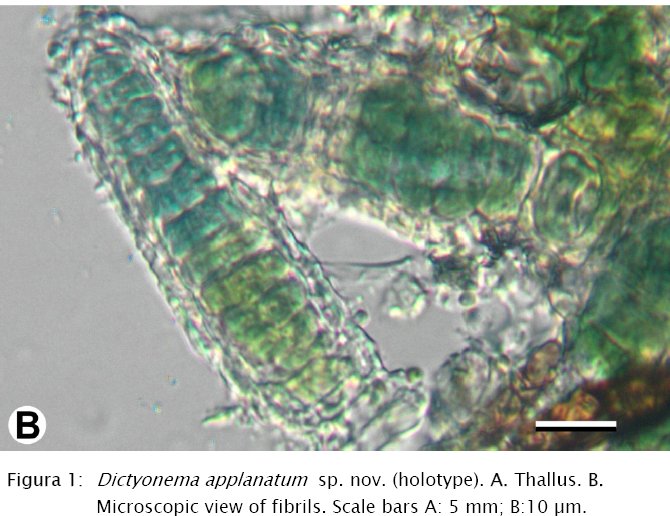
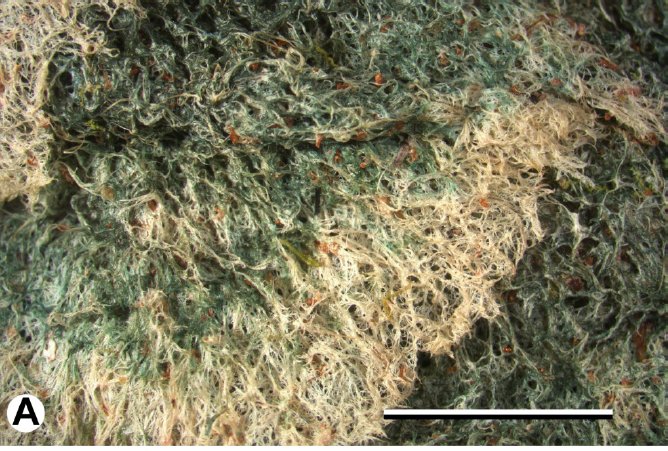
<body><![CDATA[<p>&nbsp;</p>     <p><font size="3" face="Verdana, Arial, Helvetica, sans-serif"><b>1. Introduction</b></font></p>     <p align="justify"><font size="2" face="Verdana, Arial, Helvetica, sans-serif">  Although the Basidiomycota comprise close to 40,000 known species, very few of them are lichenized [6][8]. Most of these belong in the family Hygrophoraceae in the order Agaricales [3], with the two groups comprising <i>Lichenomphalia s. lat.</i> and <i>Dictyonema s. lat.</i> In his world monograph, Parmasto [10] accepted five species in a single genus, <i>Dictyonema</i> C. Agardh ex Kunth, including two supposedly common and widespread tropical montane species, the foliose <i>D. glabratum</i> (Spreng.) D. Hawksw. and the filamentous <i>D. sericeum</i> (Sw.) Berk. However, taxonomic and phylogenetic studies suggest that both names comprise a number of different species [1][2][4][5][9][12]. Molecular analyses also show that <i>Dictyonema</i> <i>s. lat.</i> can be divided into five genera, <i>Cyphellostereum</i> D.A. Reid, <i>Dictyonema</i> <i>s. str.</i>, <i>Acantholichen</i> P.M. Jřrg., <i>Cora</i> Fr., and <i>Corella</i> [2], which are well-distinguished morphologically and anatomically [7][8].</font></p>      <p align="justify"><font size="2" face="Verdana, Arial, Helvetica, sans-serif">  As part of our ongoing phylogenetic revision of <i>Dictyonema s. lat.</i> [2][3], with previous introductions of ten new species [5], here we describe three additional  species as new to science, all based on material from Bolivia, but with one species also found in Peru. This raises the number of species in this clade known from Bolivia to six, including also the ones described herein: <i>Cora arachnoidea</i> J.E. Hern. &amp; Lücking, <i>C. aspera</i> Wilk, Lücking &amp; E. Morales, and <i>C. squamiformis</i> Wilk, Lücking &amp; Yánez-Ayabaca [5]. In contrast, <i>Cora glabrata</i> (Spreng.) Fr. <i>s. str.</i> and <i>Dictyonema sericeum</i> <i>s. str</i>. are not known from Bolivia, with previous reports [11] corresponding to misidentifications of other taxa.</font></p>     <p align="justify">&nbsp;</p>     <p align="justify"><b><font size="3" face="Verdana, Arial, Helvetica, sans-serif">2.   Methodology</font></b></p>     <p align="justify"><font size="2" face="Verdana, Arial, Helvetica, sans-serif">  Material for this study was collected during field work in Bolivia and Peru between 2002 and 2009. In addition, we examined historical type material from BM, F, G, H, PC, TUR, UPS, and W. Most specimens were studied at The Field Museum using standard techniques of light microscopy and thin-layer chromatography [9]. We used a standardized protocol for morphological, anatomical, and chemical characters to describe each specimen. For each species, we also cite the ITS barcode sequence.</font></p>     <p align="justify">&nbsp;</p>     <p align="justify"><b><font size="3" face="Verdana, Arial, Helvetica, sans-serif">3. Results and Discussion</font></b></p>     <p align="justify"><b><font size="2" face="Verdana, Arial, Helvetica, sans-serif"><i>Dictyonema applanatum</i> Lücking, Dal-Forno   &amp; Wilk <i>sp. nov. </i>(<a href="#f1">Fig. 1</a>)</font></b></p>     ]]></body>
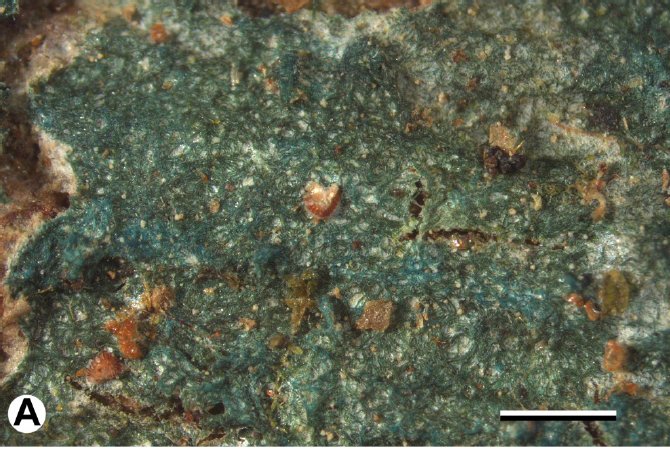
<body><![CDATA[<p align="justify"><a name="f1"></a></p>     <p align="center"><img src="/img/revistas/ran/v6n1-2/a01_figure_1a.jpg" width="670" height="450">    <br> </p>     <p align="center"><img src="/img/revistas/ran/v6n1-2/a01_figure_1b.jpg" width="670" height="516"></p>     <p align="justify"><font size="2" face="Verdana, Arial, Helvetica, sans-serif">  <i>Diagnosis: </i>Differing from <i>Dictyonema metallicum</i> in the lighter, aeruginous fibrils and the slightly less compact thallus lacking a distinct metallic shimmer.</font></p>     <p align="justify"><font size="2" face="Verdana, Arial, Helvetica, sans-serif"><i>  Type:</i> BOLIVIA, La Paz: Franz Tamayo, Madidi National Park, area of Tokoaque between Keara and Mojos; 14° 37' S, 68° 57' W, 2,177 m a.s.l.; humid montane forest, on liana; 26 October, 2007, <i>Wilk 8982</i> (KRAM; isotypes: F, LPB).</font></p>      <p align="justify"><font size="2" face="Verdana, Arial, Helvetica, sans-serif">  <i>Mycobank Number<b>:</b></i> 805543.</font></p>      <p align="justify"><font size="2" face="Verdana, Arial, Helvetica, sans-serif">  <i>ITS barcoding sequence:</i> KF664176.</font></p>      <p align="justify"><font size="2" face="Verdana, Arial, Helvetica, sans-serif">  <i>Description:</i> Thallus epiphytic on bark of branches and lianas, also overgrowing nearby bryophytes, appressed filamentous, more or less continuous or marginally in dispersed patches, up to 10 cm across, forming a strongly compressed mat of horizontal, loosely interwoven, aeruginous fibrils embedded in a gelatinous, white, slightly shiny prothallus. Thallus in section 30–50 µm thick, composed of an irregular photobiont layer, but lacking a discernible medulla; photobiont layer composed of numerous cyanobacterial filaments wrapped in a closed hyphal sheath formed by jigsaw puzzle-shaped cells; cyano­bacterial filaments composed of 10–12 µm wide and 5–7 µm high, aeruginous blue cells penetrated by tubular fungal hyphae; heterocytes sparse, hyaline, 8–12 µm wide and 4–6 µm high; cells of hyphal sheath wavy in lateral outline, 3–4 µm thick; hyphae associated with hyphal sheath straight, hyaline, 4–6 µm thick, lacking clamp connections; compacted prothallus mostly formed by densely arranged empty hyphal sheaths admixed with straight hyphae. Hymenophore not observed. Chemistry: no substances detected by TLC.</font></p>      <p align="justify"><font size="2" face="Verdana, Arial, Helvetica, sans-serif">  <i>Remarks:</i> This new species is morphologically similar to the recently described <i>Dictyonema metallicum</i> Lücking, Dal-Forno &amp; Lawrey from Ecuador [5]. Although differing in subtle details, such as the lighter, aeruginous color of the fibrils and the less compacted thallus lacking a strong metallic shimmer, the two species are not closely related phylo­genetically, suggesting that this phenotype evolved separately.</font></p>     ]]></body>
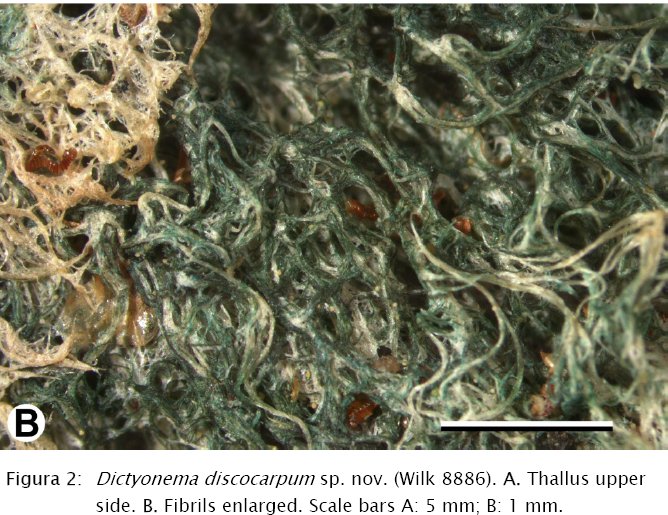
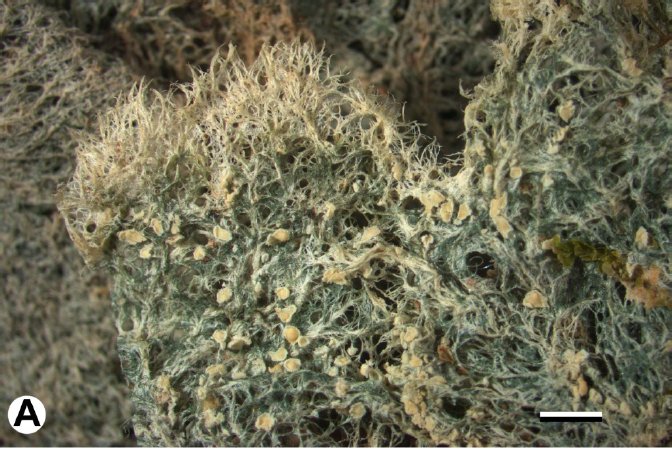
<body><![CDATA[<p align="justify">&nbsp;</p>     <p align=justify><b><font size="2" face="Verdana, Arial, Helvetica, sans-serif"><i>Dictyonema discocarpum</i> Lücking, Dal-Forno &amp; Wilk <i>sp. nov </i>(<a href="#f24">Figs 2-4</a>)</font></b></p>     <p align=justify><a name="f24"></a></p>     <p align=center><img src="/img/revistas/ran/v6n1-2/a01_figure_2a.jpg" width="668" height="451"></p>     <p align=center><img src="/img/revistas/ran/v6n1-2/a01_figure_2B.jpg" width="668" height="515"></p>     <p align=center>&nbsp;</p>     <p align=center><img src="/img/revistas/ran/v6n1-2/a01_figure_3a.jpg" width="672" height="449"></p>     <p align=center><img src="/img/revistas/ran/v6n1-2/a01_figure_3B.jpg" width="672" height="547"></p>     <p align=center>&nbsp;</p>     <p align=center><img src="/img/revistas/ran/v6n1-2/a01_figure_4a.jpg" width="672" height="450"></p>     ]]></body>
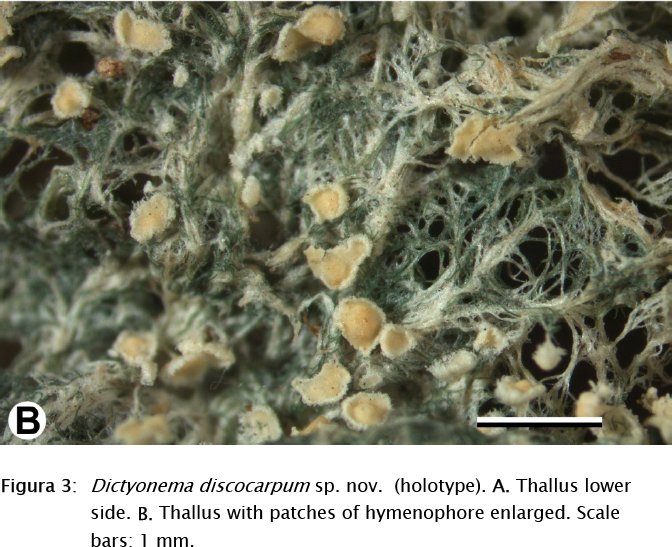
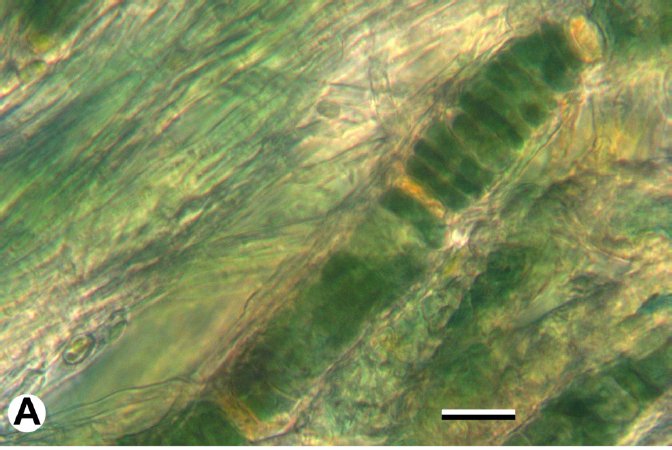
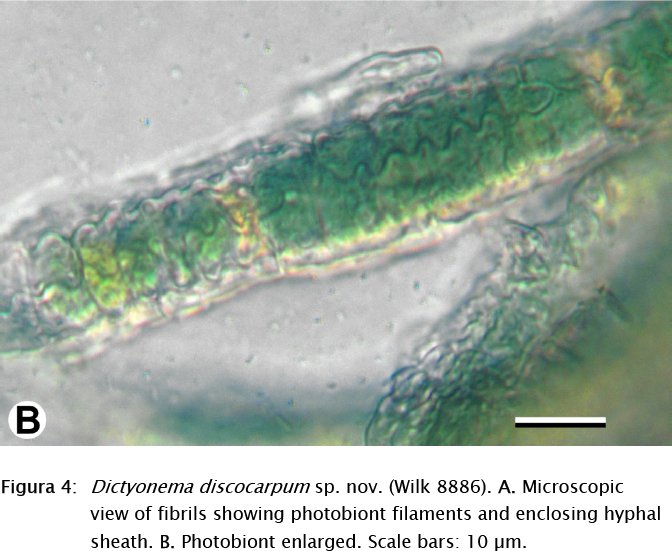
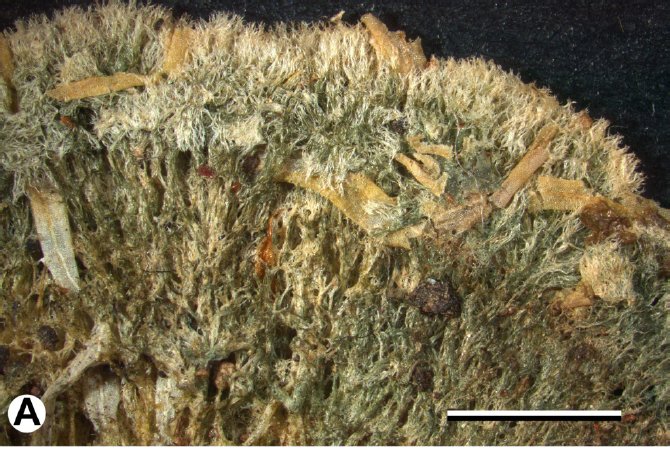
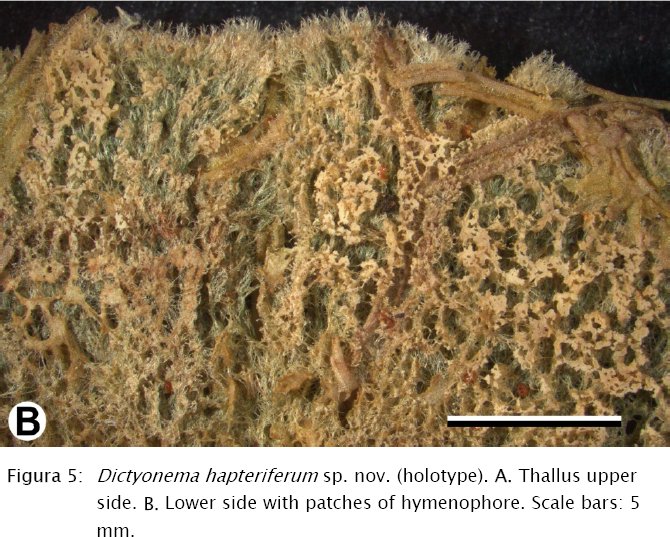
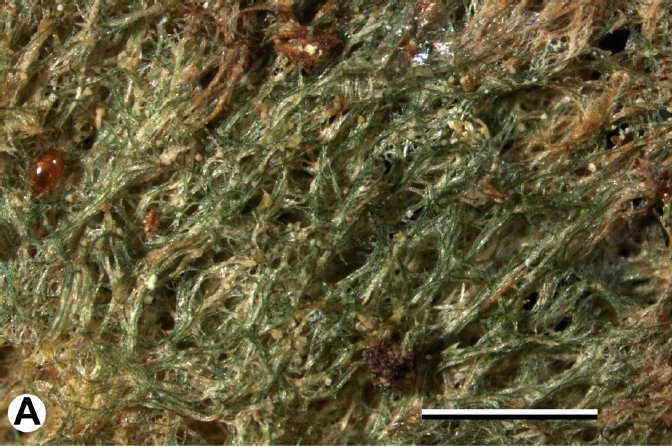
<body><![CDATA[<p align=center><img src="/img/revistas/ran/v6n1-2/a01_figure_4b.jpg" width="672" height="551"></p>     <p align="justify"><font size="2" face="Verdana, Arial, Helvetica, sans-serif">  <i>Diagnosis:</i> Characterized by semicircular, shelf-like, filamentous lobes similar to <i>Dictyonema sericeum</i>, but forming small, disciform hymenophores.</font></p>      <p align="justify"><font size="2" face="Verdana, Arial, Helvetica, sans-serif">  <i>Type:</i> BOLIVIA, La Paz: Franz Tamayo, Madidi National Park, area of Camp. Fuertecillo between Tokoaque and Mojos; 14° 35' S, 68° 55' W, 1,701 m a.s.l.; seasonal montane forest; 29 October, 2007, <i>Wilk 9327</i> (KRAM; isotypes: F, LPB).</font></p>      <p align="justify"><font size="2" face="Verdana, Arial, Helvetica, sans-serif">  <i>Mycobank Number:</i> 805544.</font></p>      <p align="justify"><font size="2" face="Verdana, Arial, Helvetica, sans-serif">  <i>ITS barcoding sequence:</i> KF664175.</font></p>      <p align="justify"><font size="2" face="Verdana, Arial, Helvetica, sans-serif">  <i>Description:</i> Thallus epiphytic on bark of branches, shelf-like filamentous, up to 10 cm across, with single lobes up to 4 cm wide, composed of loosely interwoven, more or less horizontally arranged, dark aeruginous fibrils leaving interspaces and bordered by a broad, byssoid, irregularly interwoven, white margin. Thallus in section 1–1.5 mm thick, composed of an irregular photobiont layer and a thin medulla forming a white hypothallus; photobiont layer composed of numerous cyanobacterial filaments wrapped in a closed hyphal sheath formed by jigsaw puzzle-shaped cells; cyanobacterial filaments composed of 10–13 µm wide and 5–7 µm high, aeruginous green cells penetrated by tubular fungal hyphae; heterocytes sparse, hyaline to yellowish, 8–10 µm wide and 4–6 µm high; cells of hyphal sheath wavy in lateral outline, 3–4 µm thick, at the tips of the fibrils verrucose-papillose; hyphae associated with hyphal sheath straight, hyaline, 4–6 µm thick, lacking clamp connections; hypothallus and white, byssoid margin (prothallus) formed by interwoven, strongly agglutinate, generative hyphae. Hymenophore developed as small, rounded to irregular, resupinate patches dispersed on the underside and resembling apothecial discs, patches 0.3–0.5 mm diam., with pale yellowish, smooth surface and yellowish white, minutely tomentose-fuzzy margins; hymenophore in section 70–120 µm thick, composed of a paraplectenchymatous layer resting on strongly agglutinated, 4–6 µm thick, generative hyphae emerging from the supporting thallus; hymenium composed of numerous, palisade-like basidioles and scattered basidia; basidioles 25–35 x 5–6 µm; basidia 30–40 x 5–7 µm, 4-sterigmate; basidiospores (only a few seen) ellipsoid to narrowly drop-shaped, non-septate, hyaline, 7–8 x 3–4 µm. Chemistry: no substances detected by TLC.</font></p>      <p align="justify"><font size="2" face="Verdana, Arial, Helvetica, sans-serif">  <i>Remarks:</i> In their treatment of <i>Dictyonema</i>   <i>s. lat</i>., Lücking <i>et al</i>. [5] indicated that the phenotype usually identified with the name <i>D. sericeum</i> is a complex of several, phylogenetically distinct species, differing morphologically in the orientation and arrangement of the fibrils and in the morphology of the hymenophore. Thus, <i>D. discocarpum</i> is characterized by more or less horizontally oriented, loosely woven fibrils leaving interspaces and a broad, white prothallus composed of strongly agglutinated hyphae. Its hymenophore is composed of disc-shaped patches resembling the apothecia of a <i>Coenogonium</i> species. Unfortunately, the type of <i>Hydnum sericeum</i> Sw. from Jamaica is sterile, so the morphology of the hymenophore cannot be assessed, but the thallus is much more compacted than any of the species collected in South America, indicating, along with the geographic range, that <i>D. sericeum</i> is a distinct taxon possibly restricted to the Caribbean.</font></p>      <p align=justify><font size="2" face="Verdana, Arial, Helvetica, sans-serif"><i>Additional specimens examined:</i> BOLIVIA, La Paz: Franz Tamayo, Madidi National Park, area of Tokoaque between Keara and Mojos; 14° 37' S, 68° 57' W, 2,177 m a.s.l.; humid montane forest, on branch; 26 October, 2007, <i>Wilk 8886</i> (KRAM; isotypes: F, LPB). Franz Tamayo, Chiriuno, creek 30 km in straight line E of Apolo, via road to San José; 14° 30' S, 68° 14' W, 1,850 m a.s.l.; seasonal humid forest with <i>Podocarpus oleifolius</i>, Melastomataceae, Rubiaceae, and Lauraceae; 1–12 July, 2002, <i>Fuentes 4788</i> (KRAM; isotypes: F, MO, LPB).</font></p>     <p align=justify>&nbsp;</p>     <p align="justify"><font size="2" face="Verdana, Arial, Helvetica, sans-serif"><i><b>Dictyonema hapteriferum</b></i><b> Lücking, Dal-Forno &amp; Wilk <i>sp. nov. </i>(<a href="#f56">Figs 5-6</a>)</b></font></p>     ]]></body>
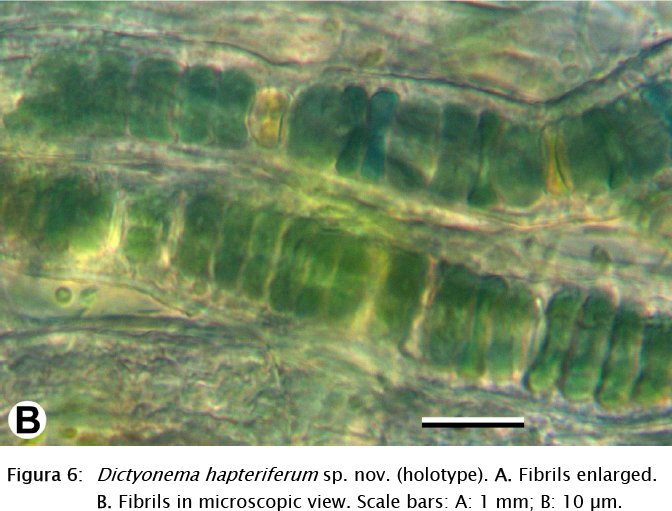
<body><![CDATA[<p align="justify"><font size="2" face="Verdana, Arial, Helvetica, sans-serif"></font></p>     <p align=center><img src="/img/revistas/ran/v6n1-2/a01_figure_5a.jpg" width="670" height="450"></p>     <p align=center><img src="/img/revistas/ran/v6n1-2/a01_figure_5b.jpg" width="670" height="537"></p>     <p align=center>&nbsp;</p>     <p align=center><img src="/img/revistas/ran/v6n1-2/a01_figure_6a.jpg" width="672" height="447"></p>     <p align=center><img src="/img/revistas/ran/v6n1-2/a01_figure_6b.jpg" width="672" height="511"></p>     <p align="justify"><font size="2" face="Verdana, Arial, Helvetica, sans-serif"><i>  Diagnosis:</i> Characterized by semicircular, shelf-like, filamentous lobes similar to <i>Dictyo­nema sericeum</i>, but forming small, hapteriform hymenophores.</font></p>      <p align="justify"><font size="2" face="Verdana, Arial, Helvetica, sans-serif">  <i>Type:</i> BOLIVIA, La Paz: Franz Tamayo, Madidi National Park, area of Tokoaque between Keara and Mojos; 14° 37' S, 68° 57' W, 2,177 m a.s.l.; humid montane forest, on branch; 26 October, 2007, <i>Wilk 8868</i> (KRAM; isotypes: F, LPB).</font></p>      <p align="justify"><font size="2" face="Verdana, Arial, Helvetica, sans-serif">  <i>Mycobank Number:</i> 805545.</font></p>      <p align="justify"><font size="2" face="Verdana, Arial, Helvetica, sans-serif"><i>  ITS barcoding sequence:</i> KF664177.</font></p>      ]]></body>
<body><![CDATA[<p align="justify"><font size="2" face="Verdana, Arial, Helvetica, sans-serif">  <i>Description:</i> Thallus epiphytic on bark of branches, shelf-like filamentous, up to 7 cm across, composed of loosely interwoven but compacted, more or less horizontally arranged, aeruginous fibrils bordered by a narrow, byssoid, white margin. Thallus in section 0.5–1 mm thick, composed of an irregular photobiont layer and a thin medulla forming a white hypothallus; photobiont layer composed of numerous cyanobacterial filaments wrapped in a closed hyphal sheath formed by jigsaw puzzle-shaped cells; cyano­bacterial filaments composed of 10–12 µm wide and 5–6 µm high, aeruginous green cells penetrated by tubular fungal hyphae; heterocytes sparse, hyaline to yellowish, 8–10 µm wide and 4–6 µm high; cells of hyphal sheath wavy in lateral outline, 3–4 µm thick, at the tips of the fibrils distinctly verrucose-papillose; hyphae associated with hyphal sheath straight, hyaline, 4–6 µm thick, lacking clamp connections; hypothallus and white, byssoid margin (prothallus) formed by radially projecting, separate, straight generative hyphae. Hymenophore developed as small, angular to elongate, resupinate patches dispersed on the underside and resembling attachment hapteres, patches 0.5–2 mm long and 0.5–1 mm wide, with beige, smooth surface and entire to slightly fissured margins; hymenophore in section 50–100 µm thick, composed of a paraplectenchymatous layer resting on loose, 4–6µm thick, generative hyphae emerging from the supporting thallus; hymenium composed of numerous, palisade-like basidioles and scattered basidia; basidioles 20–30 ´ 5–6µm; basidia 25–35 ´ 5–7 µm, 4-sterigmate; basidiospores not observed. Chemistry: no substances detected by TLC.</font></p>      <p align="justify"><font size="2" face="Verdana, Arial, Helvetica, sans-serif">  <i>Remarks:</i> <i>Dictyonema</i> <i>hapteriferum</i> is characterized by more or less horizontally oriented, loosely woven fibrils and small, thin, hapteriform hymenophore patches. It has a more compacted thallus than <i>D. discocarpum</i> but not nearly as compact as <i>D. sericeum</i>. Also, the hymenophore is morphologically distinct. In addition, while the hypo- and prothallus is composed of strongly agglutinated hyphae in <i>D. discocarpum</i>, in <i>D. hapteriferum</i> the hyphae are mostly free and separate.</font></p>      <p align=justify><font size="2" face="Verdana, Arial, Helvetica, sans-serif"><i> Additional specimen examined:</i> PERU, Cuzco: Aguas Calientes, near Machu Picchu; August, 2009, Vera<i> s. n.</i> (F).</font></p>     <p align=justify>&nbsp;</p>     <p align=justify><font size="3" face="Verdana, Arial, Helvetica, sans-serif"><b>4.   Conclusions</b></font></p>     <p align="justify"><font size="2" face="Verdana, Arial, Helvetica, sans-serif">Contrary to the only available monographic treatment of <i>Dictyonema</i>, which applies a very broad taxonomic concept and accepts only five species, the diversity in this genus is extraordinarily high, with many species remaining to be discovered in tropical regions. Thus, the description of three additional species is merely a small contribution to closing the gap in our knowledge of this enigmatic genus. It also demonstrates that many lichen species remain to be discovered in Bolivia.</font></p>     <p align="justify">&nbsp;</p>     <p align="justify"><font size="2" face="Verdana, Arial, Helvetica, sans-serif"><b>Acknowledgements</b></font></p>     <p align="justify"><font size="2" face="Verdana, Arial, Helvetica, sans-serif">This study was supported by a grant from the National Science Foundation: <i>Phylogenetic diversity and phenotype evolution in Dictyonema, with emphasis on the Neotropics and the Galápagos Islands</i> (DEB 0841405 to George Mason University; PI J. Lawrey; Co-PIs: R. Lücking, P. Gillevet). Research by K. Wilk was funded by the W. Szafer Institute of Botany, Polish Academy of Sciences through a statutory fund. Herbarium curators, in particular Harrie Sipman (B), Holger Thüs (BM), Philippe Clerc (G), Soili Stenroos (H), Bruno Dennetičre (PC), Marianne Hamnede and Anders Tehler (S), Roland Moberg (UPS), Gregory McKee and Rusty Russell (US), and Anton Igersheim (W), were extremely helpful in providing access to type material and other relevant collections.</font></p>     <p align="justify">&nbsp;</p>     ]]></body>
<body><![CDATA[<p align="justify"><font size="3" face="Verdana, Arial, Helvetica, sans-serif"><b>References</b></font></p>     <!-- ref --><p align="justify"><font size="2" face="Verdana, Arial, Helvetica, sans-serif"><a name="_Ref373659356">[1] Chaves, J.L.; Lücking, R.; Sipman, H.J.M.; Umańa, L. &amp; Navarro, E. </a>2004. <i>A first assessment of the ticolichen biodiversity inventory in Costa Rica: the genus Dictyonema (Polyporales: Atheliaceae)</i>. The Bryologist 107: 242-249.</font>&nbsp;&nbsp;&nbsp;&nbsp;&nbsp;&nbsp;&nbsp;&nbsp;[&#160;<a href="javascript:void(0);" onclick="javascript: window.open('/scielo.php?script=sci_nlinks&ref=774185&pid=S1683-0789201300010000200001&lng=','','width=640,height=500,resizable=yes,scrollbars=1,menubar=yes,');">Links</a>&#160;]<!-- end-ref --><!-- ref --><p align="justify"><font size="2" face="Verdana, Arial, Helvetica, sans-serif"><a name="_Ref373659359">[2] Dal-Forno, M.; Lawrey, J.D.; Sikaroodi, M.; Bhattarai, S.; Gillevet, P.M.; Sulzbacher, M. &amp; Lücking, R. 2013. <i>Starting from scratch: evolution of the lichen thallus in the basidiolichen Dictyonema (Agaricales: Hygrophoraceae)</i>. Fungal Biology 117: 584-598.</a></font>&nbsp;&nbsp;&nbsp;&nbsp;&nbsp;&nbsp;&nbsp;&nbsp;[&#160;<a href="javascript:void(0);" onclick="javascript: window.open('/scielo.php?script=sci_nlinks&ref=774186&pid=S1683-0789201300010000200002&lng=','','width=640,height=500,resizable=yes,scrollbars=1,menubar=yes,');">Links</a>&#160;]<!-- end-ref --><!-- ref --><p align="justify"><font size="2" face="Verdana, Arial, Helvetica, sans-serif"><a name="_Ref373659337">[3] Lawrey, J.D.; Lücking, R.; Sipman, H.J.M.; Chaves, J.L.; Redhead, S.A.; Bungartz, F.; Sikaroodi, M. &amp; Gillevet, P.M. 2009. <i>High concentration of basidiolichens in a single family of agaricoid mushrooms (Basidiomycota: Agaricales: Hygrophoraceae)</i>. Mycological Research 113: 1154-1171.</a></font>&nbsp;&nbsp;&nbsp;&nbsp;&nbsp;&nbsp;&nbsp;&nbsp;[&#160;<a href="javascript:void(0);" onclick="javascript: window.open('/scielo.php?script=sci_nlinks&ref=774187&pid=S1683-0789201300010000200003&lng=','','width=640,height=500,resizable=yes,scrollbars=1,menubar=yes,');">Links</a>&#160;]<!-- end-ref --><!-- ref --><p align="justify"><font size="2" face="Verdana, Arial, Helvetica, sans-serif"><a name="_Ref373659362">[4] Lücking, R. 2008. <i>Foliicolous lichenized fungi</i>. </a>Flora Neotropica Monograph 103: 1-866.</font>&nbsp;&nbsp;&nbsp;&nbsp;&nbsp;&nbsp;&nbsp;&nbsp;[&#160;<a href="javascript:void(0);" onclick="javascript: window.open('/scielo.php?script=sci_nlinks&ref=774188&pid=S1683-0789201300010000200004&lng=','','width=640,height=500,resizable=yes,scrollbars=1,menubar=yes,');">Links</a>&#160;]<!-- end-ref --><!-- ref --><p align="justify"><font size="2" face="Verdana, Arial, Helvetica, sans-serif"><a name="_Ref373659365">[5] Lücking, R.; Dal-Forno, M.; Lawrey, J.D.; Bungartz, F.; Holgado Rojas, M.E.;  Hernández M., J.E.; Marcelli, M.P.; Moncada, B.; Morales, E.A.; Nelsen, M.P.; Paz, E.; Salcedo, L.; Spielmann, A.A.; Wilk, K.; Will-Wolf, S. &amp; Yánez, A. 2013. </a><i>Ten new species of lichenized Basidiomycota in the genera </i>Dictyonema <i>and </i>Cora<i> (Agaricales: Hygrophoraceae), with a key to all accepted genera and species in the </i>Dictyonema<i> clade</i>. Phytotaxa 139: 1-38.</font>&nbsp;&nbsp;&nbsp;&nbsp;&nbsp;&nbsp;&nbsp;&nbsp;[&#160;<a href="javascript:void(0);" onclick="javascript: window.open('/scielo.php?script=sci_nlinks&ref=774189&pid=S1683-0789201300010000200005&lng=','','width=640,height=500,resizable=yes,scrollbars=1,menubar=yes,');">Links</a>&#160;]<!-- end-ref --><!-- ref --><p align="justify"><font size="2" face="Verdana, Arial, Helvetica, sans-serif"><a name="_Ref373659323">[6] Oberwinkler, F. 1970. <i>Die Gattungen der Basidiolichenen</i>. Vorträge aus dem Gesamtgebiet der Botanik, N.F. 4: 139-169.</a></font>&nbsp;&nbsp;&nbsp;&nbsp;&nbsp;&nbsp;&nbsp;&nbsp;[&#160;<a href="javascript:void(0);" onclick="javascript: window.open('/scielo.php?script=sci_nlinks&ref=774190&pid=S1683-0789201300010000200006&lng=','','width=640,height=500,resizable=yes,scrollbars=1,menubar=yes,');">Links</a>&#160;]<!-- end-ref --><!-- ref --><p align="justify"><font size="2" face="Verdana, Arial, Helvetica, sans-serif"><a name="_Ref373659387">[7] Oberwinkler, F. 1984. <i>Fungus-alga interactions in basidiolichens</i>. Beiheft zur Nova Hedwigia 79: 739-774.</a></font>&nbsp;&nbsp;&nbsp;&nbsp;&nbsp;&nbsp;&nbsp;&nbsp;[&#160;<a href="javascript:void(0);" onclick="javascript: window.open('/scielo.php?script=sci_nlinks&ref=774191&pid=S1683-0789201300010000200007&lng=','','width=640,height=500,resizable=yes,scrollbars=1,menubar=yes,');">Links</a>&#160;]<!-- end-ref --><p align="justify"><font size="2" face="Verdana, Arial, Helvetica, sans-serif"><a name="_Ref373659327">[8] Oberwinkler, F. 2012. <i>Basidiolichens</i>. In: Hock, B. (Ed.). </a>The Mycota, Second Edition, Vol. IX. Fungal Associations. pp 341-362. Springer, Berlin, Heidelberg, New York.</font></p>      <!-- ref --><p align="justify"><font size="2" face="Verdana, Arial, Helvetica, sans-serif"><a name="_Ref373659367">[9] </a>Orange, A.; James, P.W. &amp; White, F.J. 2010. <i>Microchemical Methods for the Identification of Lichens</i>. 2nd Ed. British Lichen Society, London. 101 pp.</font>&nbsp;&nbsp;&nbsp;&nbsp;&nbsp;&nbsp;&nbsp;&nbsp;[&#160;<a href="javascript:void(0);" onclick="javascript: window.open('/scielo.php?script=sci_nlinks&ref=774193&pid=S1683-0789201300010000200009&lng=','','width=640,height=500,resizable=yes,scrollbars=1,menubar=yes,');">Links</a>&#160;]<!-- end-ref --><!-- ref --><p align="justify"><font size="2" face="Verdana, Arial, Helvetica, sans-serif"><a name="_Ref373659346">[10] Parmasto, E. 1978. <i>The genus </i>Dictyonema<i> ('Thelephorolichenes')</i>. Nova Hedwigia 29: 99-144.</a></font>&nbsp;&nbsp;&nbsp;&nbsp;&nbsp;&nbsp;&nbsp;&nbsp;[&#160;<a href="javascript:void(0);" onclick="javascript: window.open('/scielo.php?script=sci_nlinks&ref=774194&pid=S1683-0789201300010000200010&lng=','','width=640,height=500,resizable=yes,scrollbars=1,menubar=yes,');">Links</a>&#160;]<!-- end-ref --><p align="justify"><font size="2" face="Verdana, Arial, Helvetica, sans-serif"><a name="_Ref373659412">[11] Rodriguez, P.; Flakus, A.; Kukwa, M.; Lücking, R.; Meneses, R.I.; Rivas Plata, E.; Stanton, D.; Truong, C. &amp; Vargas, R. 2010. </a><i>Preliminary catalogue of lichens and lichenicolous fungi from Bolivia</i>. W. Szafer Institute of Botany PAS, Krakow. [Version 1.1, September 2010]. <a href="http://botan.botany.pl/lichens-bolivia." target="_blank">http://botan.botany.pl/lichens-bolivia.</a></font></p>      <!-- ref --><p align="justify"><font size="2" face="Verdana, Arial, Helvetica, sans-serif"><a name="_Ref377636967">[12] Yánez, A.; Dal-Forno, M.; Bungartz, F.; Lücking, R. &amp; Lawrey, J.D. </a>2012. <i>A first assessment of Galapagos basidiolichens</i>. Fungal Diversity 52: 225-244. </font>&nbsp;&nbsp;&nbsp;&nbsp;&nbsp;&nbsp;&nbsp;&nbsp;[&#160;<a href="javascript:void(0);" onclick="javascript: window.open('/scielo.php?script=sci_nlinks&ref=774196&pid=S1683-0789201300010000200012&lng=','','width=640,height=500,resizable=yes,scrollbars=1,menubar=yes,');">Links</a>&#160;]<!-- end-ref --><p align="justify">&nbsp;</p>      ]]></body><back>
<ref-list>
<ref id="B1">
<label>1</label><nlm-citation citation-type="journal">
<person-group person-group-type="author">
<name>
<surname><![CDATA[Chaves]]></surname>
<given-names><![CDATA[J.L.]]></given-names>
</name>
<name>
<surname><![CDATA[Lücking]]></surname>
<given-names><![CDATA[R.]]></given-names>
</name>
<name>
<surname><![CDATA[Sipman]]></surname>
<given-names><![CDATA[H.J.M.]]></given-names>
</name>
<name>
<surname><![CDATA[Umańa]]></surname>
<given-names><![CDATA[L.]]></given-names>
</name>
<name>
<surname><![CDATA[Navarro]]></surname>
<given-names><![CDATA[E]]></given-names>
</name>
</person-group>
<article-title xml:lang="en"><![CDATA[A first assessment of the ticolichen biodiversity inventory in Costa Rica: the genus Dictyonema (Polyporales: Atheliaceae)]]></article-title>
<source><![CDATA[The Bryologist]]></source>
<year>2004</year>
<volume>107</volume>
<page-range>242-249</page-range></nlm-citation>
</ref>
<ref id="B2">
<label>2</label><nlm-citation citation-type="journal">
<person-group person-group-type="author">
<name>
<surname><![CDATA[Dal-Forno]]></surname>
<given-names><![CDATA[M.]]></given-names>
</name>
<name>
<surname><![CDATA[Lawrey]]></surname>
<given-names><![CDATA[J.D.]]></given-names>
</name>
<name>
<surname><![CDATA[Sikaroodi]]></surname>
<given-names><![CDATA[M.]]></given-names>
</name>
<name>
<surname><![CDATA[Bhattarai]]></surname>
<given-names><![CDATA[S.]]></given-names>
</name>
<name>
<surname><![CDATA[Gillevet]]></surname>
<given-names><![CDATA[P.M.]]></given-names>
</name>
<name>
<surname><![CDATA[Sulzbacher]]></surname>
<given-names><![CDATA[M.]]></given-names>
</name>
<name>
<surname><![CDATA[Lücking]]></surname>
<given-names><![CDATA[R]]></given-names>
</name>
</person-group>
<article-title xml:lang="en"><![CDATA[Starting from scratch: evolution of the lichen thallus in the basidiolichen Dictyonema (Agaricales: Hygrophoraceae)]]></article-title>
<source><![CDATA[Fungal Biology]]></source>
<year>2013</year>
<volume>117</volume>
<page-range>584-598</page-range></nlm-citation>
</ref>
<ref id="B3">
<label>3</label><nlm-citation citation-type="journal">
<person-group person-group-type="author">
<name>
<surname><![CDATA[Lawrey]]></surname>
<given-names><![CDATA[J.D.]]></given-names>
</name>
<name>
<surname><![CDATA[Lücking]]></surname>
<given-names><![CDATA[R.]]></given-names>
</name>
<name>
<surname><![CDATA[Sipman]]></surname>
<given-names><![CDATA[H.J.M.]]></given-names>
</name>
<name>
<surname><![CDATA[Chaves]]></surname>
<given-names><![CDATA[J.L.]]></given-names>
</name>
<name>
<surname><![CDATA[Redhead]]></surname>
<given-names><![CDATA[S.A.]]></given-names>
</name>
<name>
<surname><![CDATA[Bungartz]]></surname>
<given-names><![CDATA[F.]]></given-names>
</name>
<name>
<surname><![CDATA[Sikaroodi]]></surname>
<given-names><![CDATA[M.]]></given-names>
</name>
<name>
<surname><![CDATA[Gillevet]]></surname>
<given-names><![CDATA[P.M]]></given-names>
</name>
</person-group>
<article-title xml:lang="en"><![CDATA[High concentration of basidiolichens in a single family of agaricoid mushrooms (Basidiomycota: Agaricales: Hygrophoraceae)]]></article-title>
<source><![CDATA[Mycological Research]]></source>
<year>2009</year>
<volume>113</volume>
<page-range>1154-1171</page-range></nlm-citation>
</ref>
<ref id="B4">
<label>4</label><nlm-citation citation-type="journal">
<person-group person-group-type="author">
<name>
<surname><![CDATA[Lücking]]></surname>
<given-names><![CDATA[R]]></given-names>
</name>
</person-group>
<article-title xml:lang="en"><![CDATA[Foliicolous lichenized fungi]]></article-title>
<source><![CDATA[Flora Neotropica Monograph]]></source>
<year>2008</year>
<volume>103</volume>
<page-range>1-866</page-range></nlm-citation>
</ref>
<ref id="B5">
<label>5</label><nlm-citation citation-type="journal">
<person-group person-group-type="author">
<name>
<surname><![CDATA[Lücking]]></surname>
<given-names><![CDATA[R.]]></given-names>
</name>
<name>
<surname><![CDATA[Dal-Forno]]></surname>
<given-names><![CDATA[M.]]></given-names>
</name>
<name>
<surname><![CDATA[Lawrey]]></surname>
<given-names><![CDATA[J.D.]]></given-names>
</name>
<name>
<surname><![CDATA[Bungartz]]></surname>
<given-names><![CDATA[F.]]></given-names>
</name>
<name>
<surname><![CDATA[Holgado Rojas]]></surname>
<given-names><![CDATA[M.E.]]></given-names>
</name>
<name>
<surname><![CDATA[Hernández M.]]></surname>
<given-names><![CDATA[J.E.]]></given-names>
</name>
<name>
<surname><![CDATA[Marcelli]]></surname>
<given-names><![CDATA[M.P.]]></given-names>
</name>
<name>
<surname><![CDATA[Moncada]]></surname>
<given-names><![CDATA[B.]]></given-names>
</name>
<name>
<surname><![CDATA[Morales]]></surname>
<given-names><![CDATA[E.A.]]></given-names>
</name>
<name>
<surname><![CDATA[Nelsen]]></surname>
<given-names><![CDATA[M.P.]]></given-names>
</name>
<name>
<surname><![CDATA[Paz]]></surname>
<given-names><![CDATA[E.]]></given-names>
</name>
<name>
<surname><![CDATA[Salcedo]]></surname>
<given-names><![CDATA[L.]]></given-names>
</name>
<name>
<surname><![CDATA[Spielmann]]></surname>
<given-names><![CDATA[A.A.]]></given-names>
</name>
<name>
<surname><![CDATA[Wilk]]></surname>
<given-names><![CDATA[K.]]></given-names>
</name>
<name>
<surname><![CDATA[Will-Wolf]]></surname>
<given-names><![CDATA[S.]]></given-names>
</name>
<name>
<surname><![CDATA[Yánez]]></surname>
<given-names><![CDATA[A]]></given-names>
</name>
</person-group>
<article-title xml:lang="en"><![CDATA[Ten new species of lichenized Basidiomycota in the genera Dictyonema and Cora (Agaricales: Hygrophoraceae), with a key to all accepted genera and species in the Dictyonema clade]]></article-title>
<source><![CDATA[Phytotaxa]]></source>
<year>2013</year>
<volume>139</volume>
<page-range>1-38</page-range></nlm-citation>
</ref>
<ref id="B6">
<label>6</label><nlm-citation citation-type="journal">
<person-group person-group-type="author">
<name>
<surname><![CDATA[Oberwinkler]]></surname>
<given-names><![CDATA[F]]></given-names>
</name>
</person-group>
<article-title xml:lang="de"><![CDATA[Die Gattungen der Basidiolichenen]]></article-title>
<source><![CDATA[Vorträge aus dem Gesamtgebiet der Botanik, N.F.]]></source>
<year>1970</year>
<volume>4</volume>
<page-range>139-169</page-range></nlm-citation>
</ref>
<ref id="B7">
<label>7</label><nlm-citation citation-type="journal">
<person-group person-group-type="author">
<name>
<surname><![CDATA[Oberwinkler]]></surname>
<given-names><![CDATA[F]]></given-names>
</name>
</person-group>
<article-title xml:lang="en"><![CDATA[Fungus-alga interactions in basidiolichens]]></article-title>
<source><![CDATA[Beiheft zur Nova Hedwigia]]></source>
<year>1984</year>
<volume>79</volume>
<page-range>739-774</page-range></nlm-citation>
</ref>
<ref id="B8">
<label>8</label><nlm-citation citation-type="book">
<person-group person-group-type="author">
<name>
<surname><![CDATA[Oberwinkler]]></surname>
<given-names><![CDATA[F.]]></given-names>
</name>
</person-group>
<article-title xml:lang="en"><![CDATA[Basidiolichens]]></article-title>
<person-group person-group-type="editor">
<name>
<surname><![CDATA[Hock]]></surname>
<given-names><![CDATA[B.]]></given-names>
</name>
</person-group>
<source><![CDATA[The Mycota]]></source>
<year>2012</year>
<volume>IX</volume>
<edition>2</edition>
<page-range>341-362</page-range><publisher-loc><![CDATA[Springer, Berlin, Heidelberg, New York ]]></publisher-loc>
<publisher-name><![CDATA[Fungal Associations]]></publisher-name>
</nlm-citation>
</ref>
<ref id="B9">
<label>9</label><nlm-citation citation-type="book">
<person-group person-group-type="author">
<name>
<surname><![CDATA[Orange]]></surname>
<given-names><![CDATA[A.]]></given-names>
</name>
<name>
<surname><![CDATA[James]]></surname>
<given-names><![CDATA[P.W.]]></given-names>
</name>
<name>
<surname><![CDATA[White]]></surname>
<given-names><![CDATA[F.J.]]></given-names>
</name>
</person-group>
<source><![CDATA[Microchemical Methods for the Identification of Lichens]]></source>
<year>2010</year>
<edition>2</edition>
<page-range>101</page-range><publisher-loc><![CDATA[London ]]></publisher-loc>
<publisher-name><![CDATA[British Lichen Society]]></publisher-name>
</nlm-citation>
</ref>
<ref id="B10">
<label>10</label><nlm-citation citation-type="journal">
<person-group person-group-type="author">
<name>
<surname><![CDATA[Parmasto]]></surname>
<given-names><![CDATA[E]]></given-names>
</name>
</person-group>
<article-title xml:lang="en"><![CDATA[The genus Dictyonema ('Thelephorolichenes')]]></article-title>
<source><![CDATA[Nova Hedwigia]]></source>
<year>1978</year>
<volume>29</volume>
<page-range>99-144</page-range></nlm-citation>
</ref>
<ref id="B11">
<label>11</label><nlm-citation citation-type="book">
<person-group person-group-type="author">
<name>
<surname><![CDATA[Rodriguez]]></surname>
<given-names><![CDATA[P.]]></given-names>
</name>
<name>
<surname><![CDATA[Flakus]]></surname>
<given-names><![CDATA[A.]]></given-names>
</name>
<name>
<surname><![CDATA[Kukwa]]></surname>
<given-names><![CDATA[M.]]></given-names>
</name>
<name>
<surname><![CDATA[Lücking]]></surname>
<given-names><![CDATA[R.]]></given-names>
</name>
<name>
<surname><![CDATA[Meneses]]></surname>
<given-names><![CDATA[R.I.]]></given-names>
</name>
<name>
<surname><![CDATA[Rivas Plata]]></surname>
<given-names><![CDATA[E.]]></given-names>
</name>
<name>
<surname><![CDATA[Stanton]]></surname>
<given-names><![CDATA[D.]]></given-names>
</name>
<name>
<surname><![CDATA[Truong]]></surname>
<given-names><![CDATA[C.]]></given-names>
</name>
<name>
<surname><![CDATA[Vargas]]></surname>
<given-names><![CDATA[R.]]></given-names>
</name>
</person-group>
<source><![CDATA[Preliminary catalogue of lichens and lichenicolous fungi from Bolivia]]></source>
<year>2010</year>
<publisher-loc><![CDATA[Krakow ]]></publisher-loc>
<publisher-name><![CDATA[W_p Szafer Institute of Botany PAS]]></publisher-name>
</nlm-citation>
</ref>
<ref id="B12">
<label>12</label><nlm-citation citation-type="journal">
<person-group person-group-type="author">
<name>
<surname><![CDATA[Yánez]]></surname>
<given-names><![CDATA[A.]]></given-names>
</name>
<name>
<surname><![CDATA[Dal-Forno]]></surname>
<given-names><![CDATA[M.]]></given-names>
</name>
<name>
<surname><![CDATA[Bungartz]]></surname>
<given-names><![CDATA[F.]]></given-names>
</name>
<name>
<surname><![CDATA[Lücking]]></surname>
<given-names><![CDATA[R.]]></given-names>
</name>
<name>
<surname><![CDATA[Lawrey]]></surname>
<given-names><![CDATA[J.D.]]></given-names>
</name>
</person-group>
<article-title xml:lang="en"><![CDATA[A first assessment of Galapagos basidiolichens]]></article-title>
<source><![CDATA[Fungal Diversity]]></source>
<year>2012</year>
<volume>52</volume>
<page-range>225-244</page-range></nlm-citation>
</ref>
</ref-list>
</back>
</article>