<?xml version="1.0" encoding="ISO-8859-1"?><article xmlns:mml="http://www.w3.org/1998/Math/MathML" xmlns:xlink="http://www.w3.org/1999/xlink" xmlns:xsi="http://www.w3.org/2001/XMLSchema-instance">
<front>
<journal-meta>
<journal-id>1683-0789</journal-id>
<journal-title><![CDATA[Acta Nova]]></journal-title>
<abbrev-journal-title><![CDATA[RevActaNova.]]></abbrev-journal-title>
<issn>1683-0789</issn>
<publisher>
<publisher-name><![CDATA[Universidad Católica Boliviana]]></publisher-name>
</publisher>
</journal-meta>
<article-meta>
<article-id>S1683-07892011000100001</article-id>
<title-group>
<article-title xml:lang="en"><![CDATA[Low molecular weight fatty acids removal from Cocoa butter]]></article-title>
</title-group>
<contrib-group>
<contrib contrib-type="author">
<name>
<surname><![CDATA[Taboada Serrano]]></surname>
<given-names><![CDATA[Patricia]]></given-names>
</name>
<xref ref-type="aff" rid="A01"/>
</contrib>
<contrib contrib-type="author">
<name>
<surname><![CDATA[Zavaleta Mercado]]></surname>
<given-names><![CDATA[Ronanth]]></given-names>
</name>
<xref ref-type="aff" rid="A01"/>
</contrib>
</contrib-group>
<aff id="A01">
<institution><![CDATA[,Universidad Católica Boliviana Departamento de Ingeniería Industrial La Paz]]></institution>
<addr-line><![CDATA[ ]]></addr-line>
</aff>
<pub-date pub-type="pub">
<day>00</day>
<month>03</month>
<year>2011</year>
</pub-date>
<pub-date pub-type="epub">
<day>00</day>
<month>03</month>
<year>2011</year>
</pub-date>
<volume>5</volume>
<numero>1</numero>
<fpage>3</fpage>
<lpage>31</lpage>
<copyright-statement/>
<copyright-year/>
<self-uri xlink:href="http://www.scielo.org.bo/scielo.php?script=sci_arttext&amp;pid=S1683-07892011000100001&amp;lng=en&amp;nrm=iso"></self-uri><self-uri xlink:href="http://www.scielo.org.bo/scielo.php?script=sci_abstract&amp;pid=S1683-07892011000100001&amp;lng=en&amp;nrm=iso"></self-uri><self-uri xlink:href="http://www.scielo.org.bo/scielo.php?script=sci_pdf&amp;pid=S1683-07892011000100001&amp;lng=en&amp;nrm=iso"></self-uri><abstract abstract-type="short" xml:lang="en"><p><![CDATA[Bolivian cocoa beans butter has had problems of sour flavor and smell that inhibited its possibilities of being sold in international markets. An hypothesis following a Strecker type kinetics was postulated for the formation of low molecular weight fatty acids which were deemed responsible for these unwanted properties. Since the formation of these organic acids has probably an origin in the improper handling of the beans by the farmers, and since no alternative source of raw materials was available, a process modification was proposed to deal with these problems. An acid base neutralization reaction using concentrated solutions of potassium carbonate involving several mass transfer steps is proposed as a mechanism for a process developed to remove low molecular fatty acids from cocoa beans butter. The removal of these acids greatly improved the product’s flavor and its physical properties including a narrowing of the band of melting points. The experimental data was well correlated only after the consideration of dead zones in the model proposed. The process modification including a steam jacketed reactor devoted to the neutralization reactor is under way.]]></p></abstract>
<abstract abstract-type="short" xml:lang="es"><p><![CDATA[La manteca de cacao boliviana ha tenido problemas de sabor amargo y olor que inhibe sus posibilidades de ser vendido en los mercados internacionales. Una hipótesis siguiendo una cinética de tipo Strecker se postuló para la formación de ácidos grasos de bajo peso molecular que se considera responsable de estas propiedades no deseadas. Dado que la formación de estos ácidos orgánicos tiene probablemente un origen en el mal manejo de los granos por parte de los agricultores, y puesto que no hay ninguna fuente alternativa de materia prima disponible, una modificación del proceso fue propuesto para hacer frente a estos problemas. Una base de ácido reacción de neutralización usando soluciones concentradas de carbonato de potasio que implican varios pasos de transferencia de masa se propone como un mecanismo para un proceso desarrollado para eliminar los ácidos moleculares bajos grasos a partir de granos de cacao mantequilla. La eliminación de estos ácidos grasos mejoró en gran medida el sabor del producto y sus propiedades físicas, incluyendo un estrechamiento de la banda de puntos de fusión. Los datos experimentales se correlacionaron bien sólo después de la consideración de zonas muertas en el modelo propuesto. La modificación del proceso que incluye un reactor con camisa de vapor dedicado al reactor de neutralización está en marcha.]]></p></abstract>
<kwd-group>
<kwd lng="en"><![CDATA[cocoa beans]]></kwd>
<kwd lng="en"><![CDATA[fatty acids removal]]></kwd>
<kwd lng="en"><![CDATA[sour flavor]]></kwd>
<kwd lng="es"><![CDATA[granos de cacao]]></kwd>
<kwd lng="es"><![CDATA[eliminación de los ácidos grasos]]></kwd>
<kwd lng="es"><![CDATA[el sabor agrio]]></kwd>
</kwd-group>
</article-meta>
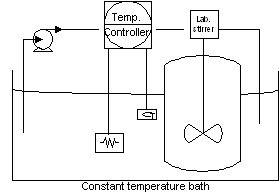
</front><body><![CDATA[  <h1 align="center"><font size="4" face="Verdana">Low molecular weight fatty acids    removal from Cocoa butter</font></h1>     <p align="center">&nbsp;</p>     <p align="center">&nbsp;</p>     <p align="center"><font size="2" face="Verdana"><b>Patricia Taboada Serrano, Ronanth    Zavaleta Mercado</b></font></p>     <p align="center"><font size="2" face="Verdana">Departamento de Ingeniería Industrial,    Universidad Católica Boliviana, La Paz Bolivia</font></p>     <p align="center"><a href="mailto:ronanth_zavaleta@hotmail.com">ronanth_zavaleta@hotmail.com</a></p>     <p align="center">&nbsp;</p>     <p align="center">&nbsp;</p> <hr align="center" noshade>     <p align="justify"><font size="2" face="Verdana"><b>Abstract: </b>Bolivian cocoa    beans butter has had problems of sour flavor and smell that inhibited its possibilities    of being sold in international markets.  An hypothesis following a Strecker    type kinetics was postulated for the formation of low molecular weight fatty    acids which were deemed responsible for these unwanted properties. Since the    formation of these organic acids has probably an origin in the improper handling    of the beans by the farmers, and since no alternative source of raw materials    was available, a process modification was proposed to deal with these problems.     An acid base neutralization reaction using concentrated solutions of potassium    carbonate involving several mass transfer steps is proposed as a mechanism for    a process developed to remove low molecular fatty acids from cocoa beans butter.     The removal of these acids greatly improved the product&#8217;s flavor and its physical    properties including a narrowing of the band of melting points.  The experimental    data was well correlated only after the consideration of dead zones in the model    proposed. The process modification including a steam jacketed reactor devoted    to the neutralization reactor is under way.</font></p>     <p align="justify"><font size="2" face="Verdana"><b>Key words</b>: cocoa beans,    fatty acids removal, sour flavor</font></p>     ]]></body>
<body><![CDATA[<p align="justify"><font size="2" face="Verdana"><b>Resumen</b>: La manteca de    cacao boliviana ha tenido problemas de sabor amargo y olor que inhibe sus posibilidades    de ser vendido en los mercados internacionales. Una hipótesis siguiendo una    cinética de tipo Strecker se postuló para la formación de ácidos grasos de bajo    peso molecular que se considera responsable de estas propiedades no deseadas.    Dado que la formación de estos ácidos orgánicos tiene probablemente un origen    en el mal manejo de los granos por parte de los agricultores, y puesto que no    hay ninguna fuente alternativa de materia prima disponible, una modificación    del proceso fue propuesto para hacer frente a estos problemas. Una base de ácido    reacción de neutralización usando soluciones concentradas de carbonato de potasio    que implican varios pasos de transferencia de masa se propone como un mecanismo    para un proceso desarrollado para eliminar los ácidos moleculares bajos grasos    a partir de granos de cacao mantequilla. La eliminación de estos ácidos grasos    mejoró en gran medida el sabor del producto y sus propiedades físicas, incluyendo    un estrechamiento de la banda de puntos de fusión. Los datos experimentales    se correlacionaron bien sólo después de la consideración de zonas muertas en    el modelo propuesto. La modificación del proceso que incluye un reactor con    camisa de vapor dedicado al reactor de neutralización está en marcha.</font></p>     <p align="justify"><font size="2" face="Verdana"><b>Palabras clave</b>: granos    de cacao, eliminación de los ácidos grasos, el sabor agrio</font></p>   <hr align="center" noshade>     <p align="justify">&nbsp;</p>     <p align="justify">&nbsp;</p> <h2 align="justify"><font size="3" face="Verdana"><b>1&nbsp;&nbsp; Introduction</b></font></h2>     <p align="justify"><font size="2" face="Verdana">Certain amounts of large and    low molecular weight fatty acids are produced during cacao beans fermentation    and drying processes.   This quantity depends on conditions such as temperature,    drying rate, humidity, oxygen availability and other factors, which have to    be controlled carefully during the initial treatment processes [1][2].  Improper    practices applied at this stage result in high contents of fatty acids that    have strong bitter taste and smell.  This mechanism has been studied and involves    several steps as postulated by Strecker et al. [2].  </font></p>     <p align="justify"><font size="2" face="Verdana">Bolivian cacao beans are produced    in small quantities by farmers that do not have the technology to control the    fermentation and drying processes. Thus, each lot of cacao has its own degree    of fermentation, quality and characteristics.  Therefore the butter obtained    by the chocolate manufacturers is sour and its flavor does not improve during    the conventional elaboration process. The influence of the bitter flavor is    remarkably harsh on white chocolate, because it acquires a sour flavor that    grows worse during the manufacturing process. </font></p>     <p align="justify"><font size="2" face="Verdana">The cocoa butter produced from    this raw material has an amount of fatty acids that exceeds the allowed levels    (1.7 to 1.9 % measured on basis of oleic acid compared to the 0.8 % recommended    by Minifie regarding the recommendations European Chocolate Manufacturers [3]).     The percentage of free fatty acids present in Bolivian cocoa butter increases    if it is calculated on a butyric acid basis, one of the low molecular fatty    acids produced during bad practices of fermentation processes.  The cocoa butter    also presents a lower melting point range (30 to 32 °C compared to 32 to 35    °C of normal cocoa butter [3]), probably due to the presence of low melting    point substances (fatty acids). </font></p>     <p align="justify"><font size="2" face="Verdana">This paper presents the results    of a study about a process modification of fatty acids removal based on the    hypothesis that low molecular weight fatty acids intensify the sour flavor.     </font></p> <h2 align="justify">&nbsp;</h2> <h2 align="justify">&nbsp;</h2> <h2 align="justify"><font size="3" face="Verdana"><b>2&nbsp;&nbsp; Process rationale</b></font></h2>     <p align="justify"><font size="2" face="Verdana">Some facts had to be taken into    account in order to design a process of removal of fatty acids:</font></p>     <p align="justify"><font size="2" face="Verdana">·&nbsp;&nbsp;&nbsp;&nbsp;&nbsp;&nbsp;&nbsp;&nbsp;    Fatty acids are partially soluble in both, polar and non-polar solvents such    as butter or water.</font></p>     ]]></body>
<body><![CDATA[<p align="justify"><font size="2" face="Verdana">·&nbsp;&nbsp;&nbsp;&nbsp;&nbsp;&nbsp;&nbsp;&nbsp;    Although the fatty acids melting point is lower than that of butter, their high    solubility in butter and fat disqualifies a phase separation process.</font></p>     <p align="justify"><font size="2" face="Verdana">·&nbsp;&nbsp;&nbsp;&nbsp;&nbsp;&nbsp;&nbsp;&nbsp;    When alkalis (sodium or potassium hydroxide, sodium or potassium carbonate,    etc.) are added to fatty acids, organic salts, insoluble in lipids, are produced.     These salts are soluble in polar solvents (water).</font></p>     <p align="justify"><font size="2" face="Verdana">The food industry made the removal    of fatty acids subject of much research and development [4] [5] [6] [6] [7]    [8] [35].  Methods such as continuous neutralization with sodium hydroxide,    deodorization and others are widespread.  However, these methods are suitable    for large scale production of fat (plants with productions up to 500 tons per    day).  The production of the largest chocolate manufacturer in Bolivia does    not reach 100 tons per week.  Thus, in general, the methods usually applied    in industry are not useful for Bolivian chocolate manufacturers because of economies    of scale.  Therefore, a batch process had to be designed in order to deal with    small amounts of cocoa butter production and moderate investment budgets.</font></p> <h2 align="justify">&nbsp;</h2> <h2 align="justify">&nbsp;</h2> <h2 align="justify"><font size="3" face="Verdana"><b>3&nbsp;&nbsp; Process design</b></font></h2>     <p align="justify"><font size="2" face="Verdana">The process modification proposed    for the removal of fatty acids consists of an heterogeneous reaction of neutralization    by means of an alkali.</font></p>     <p align="justify"><font size="2" face="Verdana">·&nbsp;&nbsp;&nbsp;&nbsp;&nbsp;&nbsp;&nbsp;&nbsp;    The process is carried out in a stirred tank batch reactor where the melted    cocoa butter is placed.</font></p>     <p align="justify"><font size="2" face="Verdana">·&nbsp;&nbsp;&nbsp;&nbsp;&nbsp;&nbsp;&nbsp;&nbsp;    The alkali used is a saturated aqueous solution of potassium carbonate.  </font></p>     <p align="justify"><font size="2" face="Verdana">·&nbsp;&nbsp;&nbsp;&nbsp;&nbsp;&nbsp;&nbsp;&nbsp;    Potassium carbonate is used because of its high solubility in water, that permits    the reduction of the amount of solution introduced into the reactor (no more    than 1% of the total reaction mass).  The use of a solution rather than the    pure salt, proved indispensable, suggesting a mechanism involving potassium    ions.  On the other hand, it is desirable to keep water to a minimum in order    to avoid fat or oil hydrolysis [4][6].</font></p>     <p align="justify"><font size="2" face="Verdana">·&nbsp;&nbsp;&nbsp;&nbsp;&nbsp;&nbsp;&nbsp;&nbsp;    Agitation produces the dispersion of water in cocoa butter.</font></p>     <p align="justify"><font size="2" face="Verdana">·&nbsp;&nbsp;&nbsp;&nbsp;&nbsp;&nbsp;&nbsp;&nbsp;    Due to the small amount of water in the reactor, fatty acids salts form an insoluble    phase.</font></p>     <p align="justify"><font size="2" face="Verdana">·&nbsp;&nbsp;&nbsp;&nbsp;&nbsp;&nbsp;&nbsp;&nbsp;    During the process, carbon dioxide is produced promoting the fatty acids flocculation    and floatation.  This phase can be easily removed by skimming.  Mounts and Khym    [4] reported that fatty acids salts act as coagulants for other particles such    as water.  </font></p>     ]]></body>
<body><![CDATA[<p align="justify"><font size="2" face="Verdana">·&nbsp;&nbsp;&nbsp;&nbsp;&nbsp;&nbsp;&nbsp;&nbsp;    Water is also removed during the operation.</font></p>     <p align="justify"><font size="2" face="Verdana">Preliminary laboratory experiments    were carried out in order to get acquainted with the behavior of the proposed    process and through these initial experiments, some facts presented above were    established, leading to a possible reaction mechanism.  Detailed experimental    work was carried out based on a proposed mechanism.</font></p> <h2 align="justify">&nbsp;</h2> <h2 align="justify">&nbsp;</h2> <h2 align="justify"><font size="3" face="Verdana"><b>4&nbsp;&nbsp;  Experimental</b></font></h2>     <p align="justify"><font size="2" face="Verdana">In order to study the process    modification proposed, two sets of experiments were performed. The first one    was aimed to studying the physical equilibrium.  Potassium carbonate solutions    (20 ml) of seven different concentrations were added to 20 g samples of melted    butter.  The temperature range chosen was 40 °, 50 ° and 60 °C.  The samples    were placed in a Baxter DX 31 drying oven during 24 hrs.   Then, the two phases    of each sample were analyzed.  The free fatty acids content was determined in    the lipoid phase and the free potassium content in the aqueous phase.  Only    those data from the samples that had zero content of free fatty acids in the    lipoid phase were considered in the physical equilibrium study.</font></p>     <p align="justify"><font size="2" face="Verdana">The second set of experiments    was aimed to study the reaction kinetics.  For this purpose, 400 g of cocoa    fat was introduced in a 600 ml Pyrex glass container used as a reactor.  This    reactor was placed inside a constant temperature water bath 20 minutes before    the experiment in order to allow the butter to reach the steady state reaction    temperature.  Once the reaction temperature was reached, potassium carbonate    was introduced into the reactor as a concentrated water solution.  The mass    of the solution introduced was approximately 1 % of the fat mass.   The free    fatty acids concentration was determined at different reaction times and at    40 °, 50 ° and 60 °C.  Samples of 2 g of fat were taken from the reactor and    immediately placed on ice in order to freeze the chemical reaction taking place.     An schematic drawing of the equipment used is presented below:</font></p>     <p align=center><font size="2" face="Verdana"><img width=267 height=191 id="Imagen 1" src="/img/revistas/ran/v5n1/v5n1a01-01.gif"></font></p>     <p align="center"><font size="2" face="Verdana"><b>Figura 1:&nbsp;&nbsp; </b>Acid    base neutralization reactor.</font></p>     <p align="justify"><font size="2" face="Verdana">A Cole-Palmer electric bath temperature    controller was used to keep the reactor temperature at the chosen level.  The    controlled temperature fell in a range of ±1 °C.  The controller also included    a peristaltic pump to allow the temperature to remain constant.  A T-line laboratory    stirrer of 1/18 HP was used to keep the reactor content uniform.  The variable    speed stirrer could be regulated in a range of 75 to 7500 rpm, and had a propeller    type stirrer of 5 cm of diameter.</font></p>     <p align="justify"><font size="2" face="Verdana">The fatty acids concentration    was determined by an analytical technique employed in industrial practice that    is based on titration of fatty acids in an alcoholic solution [23].  The alcoholic    solution is neutralized with a sodium hydroxide solution.  The indicator employed    is an alcoholic phenolphthalein solution.  It is important to carefully register    the strength of the violet color obtained in the alcoholic solution, because    it must be reproduced during the titration of the fatty acids.  After the alcoholic    solution had been neutralized, 5 g of fat are dissolved in 50 ml of the neutralized    alcohol at 50 °C.  After the fat melts down, a colloidal solution is obtained    by strong stirring.  A measured volume of a sodium hydroxide solution is added    to the fat solution using phenolphthalein as indicator until the desired violet    color is obtained.  Usually, in industrial practice, sodium hydroxide solutions    of 0.1 N are employed, but in this work solutions of 0.01 N were used in order    to increase the method&#8217;s sensitivity.  The method was repeatedly tested and    the statistical inference analysis was carried out.</font></p>     <p align="justify"><font size="2" face="Verdana">Potassium concentration is indirectly    determined by a spectrophotometric analytical technique based on the quantification    of the excess of sodium cobalt nitrite salt [21].  The aqueous phase containing    potassium is centrifuged during five minutes in order to separate the fatty    acids salts formed and determine the amount of free potassium.  The sample size    depends on the initial concentration of potassium carbonate used for the equilibrium    test. A volume of 10 ml, 5 ml, 2 ml or 1 ml of sample is separated for analysis.     Each sample is diluted to 20 ml.  Then 0.5 g of sodium cobalt nitrite salt is    added along with 5 ml of water.  The solution is then placed to rest for an    hour to enable the insoluble potassium salt to precipitate.  A sample of 10    ml is taken from the liquid phase and it is centrifuged during 5 min, in order    to separate any fatty acid potassium salt that could remain suspended.  From    the centrifuged liquid, 1 ml is sampled and it is diluted to 50 ml with distilled    water.  The absorbance of this solution is finally measured in the spectrophotometer.     The lecture of absorbance indicates the amount of sodium cobalt nitrite that    did not react with potassium.  By means of a material balance, the initial concentration    of potassium present in the sample is thus obtained.</font></p>     <p align="justify"><font size="2" face="Verdana">Simultaneously, a set of three    laboratory experiments were performed in order to establish whether the removal    of fatty acids from cocoa butter improved its flavour, diminished its bitterness    and improved the overall quality of the white chocolate. Thus, three batches    of white chocolate were prepared using butter free of fatty acids. The cocoa    butter obtained after the neutralization process did not present the sour flavour    and smell previously detected on non-treated products and furthermore, a sweet    aromatic flavour with no signs of bitterness was characteristic of the white    chocolate prepared.  This product was considered of high quality by the costumer,    a chocolate manufacturer. This initial experimental work gave strong indication    that the removal of fatty acids was essential to the production of high quality    white chocolate.</font></p> <h2 align="justify">&nbsp;</h2> <h2 align="justify">&nbsp;</h2> <h2 align="justify"><font size="3" face="Verdana"><b>5&nbsp;&nbsp; Modeling</b></font></h2>     ]]></body>
<body><![CDATA[<p align="justify"><font size="2" face="Verdana">In order to study the fatty acids    removal and gain some insight on the process parameters, the following mechanism    was proposed for the neutralization reaction between the fatty acids and the    alkali, that includes the following steps: </font></p>     <p align="justify"><font size="2" face="Verdana">·&nbsp;&nbsp;&nbsp;&nbsp;&nbsp;&nbsp;&nbsp;&nbsp;    Ionic potassium transfer from the aqueous phase to the interface.</font></p>     <p align="justify"><font size="2" face="Verdana">·&nbsp;&nbsp;&nbsp;&nbsp;&nbsp;&nbsp;&nbsp;&nbsp;    Interface chemical reaction.</font></p>     <p align="justify"><font size="2" face="Verdana">·&nbsp;&nbsp;&nbsp;&nbsp;&nbsp;&nbsp;&nbsp;&nbsp;    Remaining ionic potassium transfer from the interface to the lipoid phase.</font></p>     <p align="justify"><font size="2" face="Verdana">·&nbsp;&nbsp;&nbsp;&nbsp;&nbsp;&nbsp;&nbsp;&nbsp;    Simultaneous chemical reaction in the lipoid phase.</font></p>     <p align="justify"><font size="2" face="Verdana">·&nbsp;&nbsp;&nbsp;&nbsp;&nbsp;&nbsp;&nbsp;&nbsp;    Fatty acids transfer from the lipoid phase to the interface.</font></p>     <p align="justify"><font size="2" face="Verdana">A model based on the proposed    mechanism was set up including mass balances for key components and chemical    reaction taking place at the interface and at the lipoid phase.  As a first    approach a uniform macroscopic model was accepted.  </font></p> <h3 align="justify">&nbsp;</h3> <h3 align="justify"><font size="3" face="Verdana"><b>5.1&nbsp;&nbsp;&nbsp;&nbsp;    Uniform Model</b></font></h3>     <p align="justify"><font size="2" face="Verdana">The uniform model was developed    on the basis of the following assumptions: </font></p>     <p align="justify"><font size="2" face="Verdana">·&nbsp;&nbsp;&nbsp;&nbsp;&nbsp;&nbsp;&nbsp;&nbsp;    Each phase is uniform. </font></p>     <p align="justify"><font size="2" face="Verdana">·&nbsp;&nbsp;&nbsp;&nbsp;&nbsp;&nbsp;&nbsp;&nbsp;    The interface does not accumulate material. </font></p>     ]]></body>
<body><![CDATA[<p align="justify"><font size="2" face="Verdana">·&nbsp;&nbsp;&nbsp;&nbsp;&nbsp;&nbsp;&nbsp;&nbsp;    The process is controlled by mass transfer. </font></p>     <p align="justify"><font size="2" face="Verdana">·&nbsp;&nbsp;&nbsp;&nbsp;&nbsp;&nbsp;&nbsp;&nbsp;    Equilibrium is established at the interface.</font></p>     <p align="justify"><font size="2" face="Verdana">The model includes five partial    material balances:</font></p>     <p align="justify"><font size="2" face="Verdana">·&nbsp;&nbsp;&nbsp;&nbsp;&nbsp;&nbsp;&nbsp;&nbsp;    Two balances for ionic potassium in both phases and one balance in the interface.</font></p>     <p align="justify"><font size="2" face="Verdana">·&nbsp;&nbsp;&nbsp;&nbsp;&nbsp;&nbsp;&nbsp;&nbsp;    One balance for fatty acids in the lipoid phase and another at the interface.</font></p>     <p align="justify"><font size="2" face="Verdana">·&nbsp;&nbsp;&nbsp;&nbsp;&nbsp;&nbsp;&nbsp;&nbsp;    An empirical mathematical equation for the ionic potassium equilibrium (based    on analysis of experimental data).</font></p>     <p align="justify"><font size="2" face="Verdana">Five equations are obtained (the    equilibrium relation has to be included) in terms of dimensionless variables:</font></p>     <p align="center"><font size="2" face="Verdana"><img width=250 height=126 src="/img/revistas/ran/v5n1/v5n1a01-02.gif"></font></p>     <p align="justify"><font size="2" face="Verdana">This model has two controlling    parameters, the Sherwood number and Th, a number that relates the kinetic constant    with some physical properties as described in the nomenclature. All the other    parameters are also defined in the nomenclature and  relate aqueous and cocoa    butter physical properties.  Thus, the experimental design includes mainly these    two numbers (Sh and Th).</font></p>     <p align="justify"><font size="2" face="Verdana"> The Sherwood number in stirred    tanks is a function of  the Reynolds, Froude and Schmidt numbers.  Taking into    account the size of the laboratory reactor (400 ml), the influence of gravitation    forces (represented in Fr) was disregarded in favour of the inertial forces    (Re) and the properties of the fluids (Sc).  Therefore, the Re and Sc numbers    were considered in the experimental design.</font></p>     ]]></body>
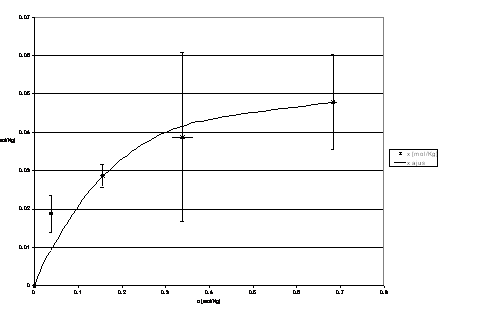
<body><![CDATA[<p align="justify"><font size="2" face="Verdana">The Th number is basically a    function of temperature at constant pressure. </font></p> <h2 align="justify">&nbsp;</h2> <h2 align="justify">&nbsp;</h2> <h2 align="justify"><font size="3" face="Verdana"><b>6&nbsp;&nbsp; Results and    Discussion</b></font></h2>     <p align="justify"><font size="2" face="Verdana">The model was adjusted to the    experimental data by means of a restricted non-linear minimization algorithm    (the complex method of Box) driving a set of sub-routines for solving the set    of differential equations based on the Runge-Kutta-Fehlberg algorithm. The objective    function was the accumulative absolute error.  </font></p> <h3 align="justify">&nbsp;</h3> <h3 align="justify"><font size="3" face="Verdana"><b>6.1&nbsp;&nbsp;&nbsp;&nbsp;    Potassium equilibrium</b></font></h3>     <p align="justify"><font size="2" face="Verdana">The figures 1, 2 and 3 show equilibrium    experimental data and curve fitting. </font></p>     <p align=center><font size="2" face="Verdana"><img width=358 height=281 src="/img/revistas/ran/v5n1/v5n1a01-03.gif"></font></p>     <p align="center"><font size="2" face="Verdana"><b>Figura 2:&nbsp;&nbsp; </b>Ionic    potassium equilibrium at 40 ° C.</font></p>     <p align=center><font size="2" face="Verdana"><img width=480 height=315 id="Imagen 4" src="/img/revistas/ran/v5n1/v5n1a01-04.gif"></font></p>     <p align="center"><font size="2" face="Verdana"><b>Figura 3:&nbsp;&nbsp; </b>Ionic    potassium equilibrium at 50 ° C.</font></p>     <p align=center><font size="2" face="Verdana"><img width=454 height=316 id="Imagen 5" src="/img/revistas/ran/v5n1/v5n1a01-05.gif"></font></p>     <p align="center"><font size="2" face="Verdana"><b>Figura 4:&nbsp;&nbsp; </b>Ionic    potassium equilibrium at 60 ° C.</font></p>     <p align="justify"><font size="2" face="Verdana">The empirical relation obtained    is:</font></p>     ]]></body>
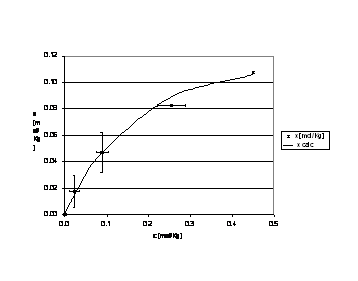
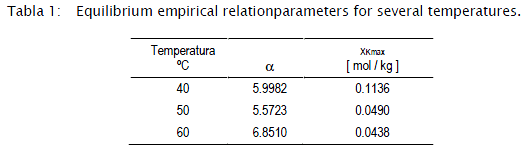
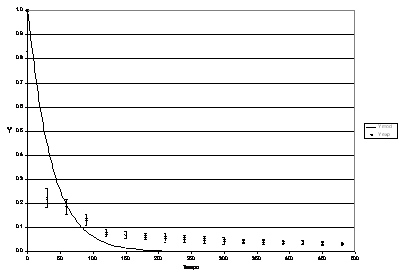
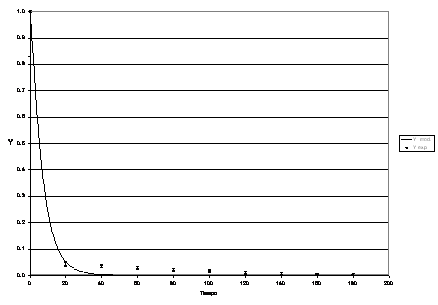
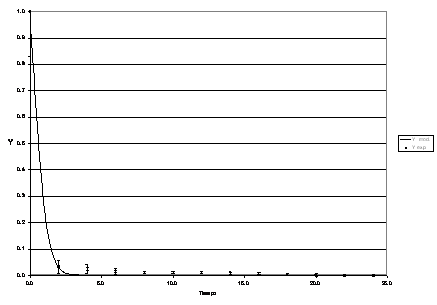
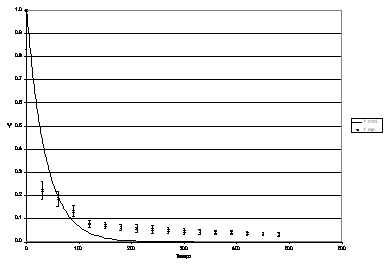
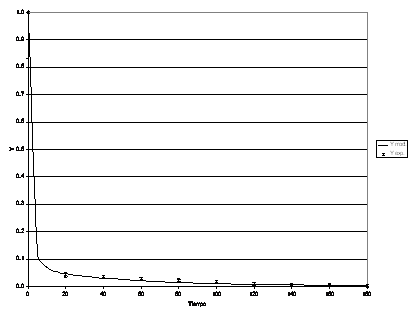
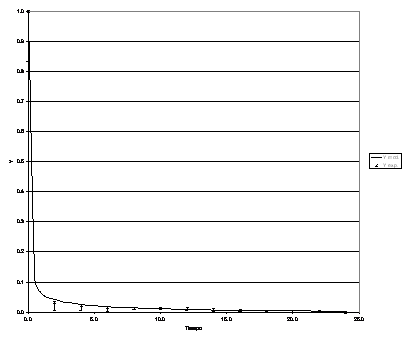
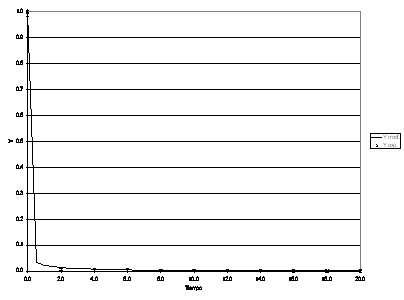
<body><![CDATA[<p align="center"><font size="2" face="Verdana"><img width=205 height=25 src="/img/revistas/ran/v5n1/v5n1a01-06.gif"></font></p>     <p align="justify"><font size="2" face="Verdana">The parameters for each temperature    considered in the equilibrium analysis are schematized as follows:</font></p>     <p align="center"><img src="/img/revistas/ran/v5n1/v5n1a10-27.gif" width="523" height="151"></p> <h3 align="justify">&nbsp;</h3> <h3 align="justify"><font size="3" face="Verdana"><b>6.2&nbsp;&nbsp;&nbsp; Process    Dynamics</b></font></h3>     <p align="justify"><font size="2" face="Verdana">Figures 4, 5, 6, 7 and 8 present    the experimental dynamic behaviour of the process together with that of the    proposed model.   As can be seen the product Reb has been used as an adjusting    parameter.</font></p>     <p align=center><font size="2" face="Verdana"><img width=400 height=279 id="Imagen 7" src="/img/revistas/ran/v5n1/v5n1a01-07.gif"></font></p>     <p align="center"><font size="2" face="Verdana"><b>Figura 5:&nbsp;&nbsp; </b>Process    dynamic behaviour for Re b = 106. </font></p>     <p align="center"><font size="2" face="Verdana"><img width=433 height=302 id="Imagen 8" src="/img/revistas/ran/v5n1/v5n1a01-08.gif"></font></p>     <p align="center"><font size="2" face="Verdana"><b>Figura 6:&nbsp;&nbsp; </b>Process    dynamic behaviour for Re b = 152.</font></p>     <p align="center"><font size="2" face="Verdana"><img width=438 height=305 id="Imagen 9" src="/img/revistas/ran/v5n1/v5n1a01-09.gif"></font></p>     <p align="center"><font size="2" face="Verdana"><b>Figura 7:&nbsp;&nbsp; </b>Process    dynamic behaviour for Re b = 213.</font></p>     ]]></body>
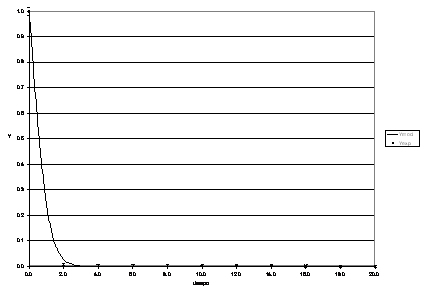
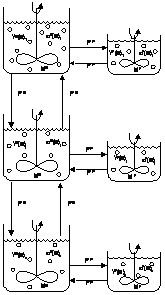
<body><![CDATA[<p align="center"><font size="2" face="Verdana"><img width=437 height=305 id="Imagen 10" src="/img/revistas/ran/v5n1/v5n1a01-10.gif"></font></p>     <p align="center"><font size="2" face="Verdana"><b>Figura 8:&nbsp;&nbsp; </b>Process    dynamic behaviour for Re b = 437.</font></p>     <p align=center><font size="2" face="Verdana"><img width=423 height=295 id="Imagen 11" src="/img/revistas/ran/v5n1/v5n1a01-11.gif"></font></p>     <p align="center"><font size="2" face="Verdana"><b>Figura 9:&nbsp;&nbsp; </b>Process    dynamic behaviour for Re b = 640.</font></p>     <p align="justify"><font size="2" face="Verdana">The analysis of the behaviour    of the experimental and the comparison with those predicted by the uniform model    results lead to state some facts:</font></p>     <p align="justify"><font size="2" face="Verdana">·&nbsp;&nbsp;&nbsp;&nbsp;&nbsp;&nbsp;&nbsp;&nbsp;    The model proposed does not correlate the experimental data.  A pronounced tailing    is present in the experimental data that the model cannot predict.  Also, there    is a characteristic behaviour that strongly deviates from the data (Figure 4).</font></p>     <p align="justify"><font size="2" face="Verdana">·&nbsp;&nbsp;&nbsp;&nbsp;&nbsp;&nbsp;&nbsp;&nbsp;    This behaviour is typical of reactors that show segregation, and therefore a    model including some degree of deviation of ideal behaviour had to be considered.</font></p> <h3 align="justify">&nbsp;</h3> <h3 align="justify"><font size="3" face="Verdana"><b>6.3&nbsp;&nbsp;&nbsp; Partially    segregated model</b></font></h3>     <p align="justify"><font size="2" face="Verdana">In order to consider the above,    the following partially segregated model was proposed based on the series of    CSTR&#8217;s model:</font></p>     <p align=center><font size="2" face="Verdana"><img width=66 height=188 id="Imagen 12" src="/img/revistas/ran/v5n1/v5n1a01-12.gif"></font></p>     <p align="center"><font size="2" face="Verdana"><b>Figura 10:&nbsp;&nbsp;&nbsp;    </b>Partially segregated model.</font></p>     ]]></body>
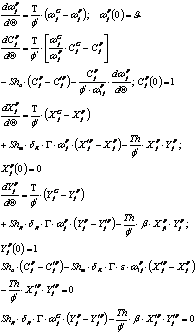
<body><![CDATA[<p align="justify"><font size="2" face="Verdana">This model is described by the    following equations:</font></p>     <p align="justify"><font size="2" face="Verdana"> First stirred tank reactor (1<sup>st</sup>    tank)</font></p>     <p align="center"><font size="2" face="Verdana"><img width=242 height=368 src="/img/revistas/ran/v5n1/v5n1a01-13.gif"></font></p>     <p align="justify"><font size="2" face="Verdana">Intermediate stirred tank reactor    (j tank)</font></p>     <p align="center"><font size="2" face="Verdana"><img width=240 height=349 src="/img/revistas/ran/v5n1/v5n1a01-14.gif"></font></p>     <p align="justify"><font size="2" face="Verdana">Last stirred tank reactor (n    tank):</font></p>     <p align="center"><font size="2" face="Verdana"><img width=237 height=333 src="/img/revistas/ran/v5n1/v5n1a01-15.gif"></font></p>     <p align="justify"><font size="2" face="Verdana">Since a concentration profile    is obtained for each reactor, a mean concentration is obtained applying the    mean value theorem. The results for a typical run (Re b = 106): are plotted    in Figure 10.</font></p>     <p align=center><font size="2" face="Verdana"><img width=385 height=268 id="Imagen 16" src="/img/revistas/ran/v5n1/v5n1a01-16.gif"></font></p>     <p align="center"><font size="2" face="Verdana"><b>Figura 11:</b>Process dynamic    behaviour at Re b = 106.</font></p>     ]]></body>
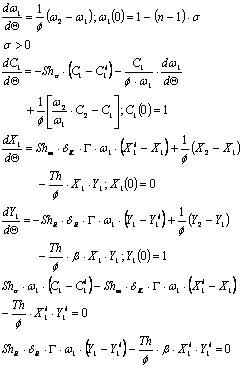
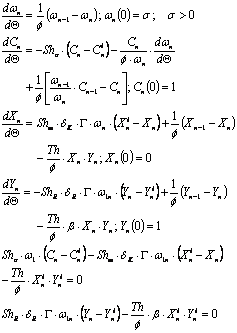
<body><![CDATA[<p align="justify"><font size="2" face="Verdana">As can be seen this model fails    also to correlate the experimental data, even though the absolute error is diminished    somewhat.  The persistence of the tailing effect suggested that dead zones could    be present.  Therefore, a model including dead zones was set up as an attempt    to correlate the data.</font></p> <h3 align="justify">&nbsp;</h3> <h3 align="justify"><font size="3" face="Verdana"><b>6.4&nbsp;&nbsp;&nbsp; Partially    segregated model including dead zones </b></font></h3>     <p align="justify"><font size="2" face="Verdana">This model is described below    and is a derivation of the CSTR&#8217;s in series model:</font></p>     <p align=center><font size="2" face="Verdana"><img width=165 height=295 id="Imagen 17" src="/img/revistas/ran/v5n1/v5n1a01-17.gif"></font></p>     <p align="center"><font size="2" face="Verdana"><b>Figura 12:&nbsp;&nbsp;&nbsp;    </b>Micro-mixture with segregation and stanched zones model representation.</font></p>     <p align="justify"><font size="2" face="Verdana">The corresponding mass balances    to the following sets of equations in terms of dimensionless variables:</font></p>     <p align="justify"><font size="2" face="Verdana">First stirred tank reactor (1):</font></p>     <p align="center"><font size="2" face="Verdana"><img width=187 height=311 src="/img/revistas/ran/v5n1/v5n1a01-18.gif"></font></p>     <p align="justify"><font size="2" face="Verdana">For any intermediate stirred    tank reactor (j tank):</font></p>     <p align="center"><font size="2" face="Verdana"><img width=268 height=345 src="/img/revistas/ran/v5n1/v5n1a01-19.gif"></font></p>     <p align="justify"><font size="2" face="Verdana">Last stirred reactor tank (n    tank):</font></p>     ]]></body>
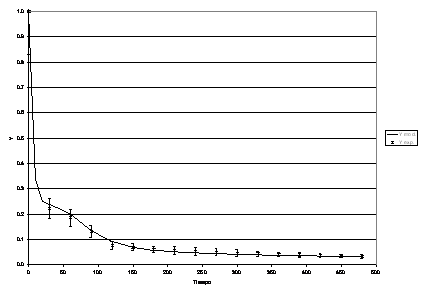
<body><![CDATA[<p align="center"><font size="2" face="Verdana"><img width=197 height=332 src="/img/revistas/ran/v5n1/v5n1a01-20.gif"></font></p>     <p align="justify"><font size="2" face="Verdana">And for any dead zone:</font></p>     <p align="center"><font size="2" face="Verdana"><img width=196 height=334 src="/img/revistas/ran/v5n1/v5n1a01-21.gif"></font></p>     <p align="justify"><font size="2" face="Verdana">As before a mean concentration    was obtained for the whole set by application of the mean value theorem.</font></p>     <p align=center><font size="2" face="Verdana"><img width=421 height=293 id="Imagen 22" src="/img/revistas/ran/v5n1/v5n1a01-22.gif"></font></p>     <p align="center"><font size="2" face="Verdana"><b>Figura 13:&nbsp;&nbsp;&nbsp;    </b>Process dynamic behaviour for Re b = 106. </font></p>     <p align=center><font size="2" face="Verdana"><img width=443 height=308 id="Imagen 23" src="/img/revistas/ran/v5n1/v5n1a01-23.gif"></font></p>     <p align="center"><font size="2" face="Verdana"><b>Figura 14:&nbsp;&nbsp;&nbsp;    </b>Process dynamic behavior for Re b = 152.</font></p>     <p align=center><font size="2" face="Verdana"><img width=411 height=317 id="Imagen 24" src="/img/revistas/ran/v5n1/v5n1a01-24.gif"></font></p>     <p align="center"><font size="2" face="Verdana"><b>Figura 15:&nbsp;&nbsp;&nbsp;    </b>Process dynamic behavior for Re b = 213.</font></p>     ]]></body>
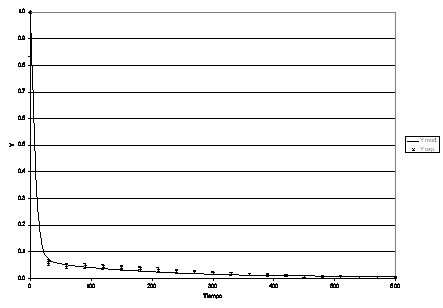
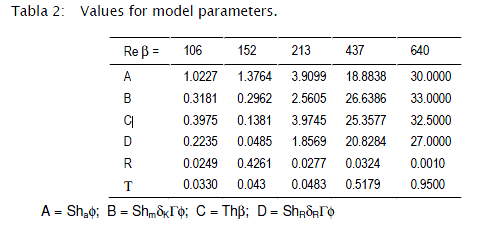
<body><![CDATA[<p align=center><font size="2" face="Verdana"><img width=405 height=340 id="Imagen 25" src="/img/revistas/ran/v5n1/v5n1a01-25.gif"></font></p>     <p align="center"><font size="2" face="Verdana"><b>Figura 16:&nbsp;&nbsp;&nbsp;    </b>Process dynamic behaviour for Re b = 437.</font></p>     <p align=center><font size="2" face="Verdana"><img width=404 height=300 id="Imagen 26" src="/img/revistas/ran/v5n1/v5n1a01-26.gif"></font></p>     <p align="center"><font size="2" face="Verdana"><b>Figura 17:&nbsp;&nbsp;&nbsp;    </b>Process dynamic behaviour for Re b = 640.</font></p>     <p align="justify"><font size="2" face="Verdana">The model was fitted to the experimental    data again by running the restrictive non-linear algorithm driving the Runge-Kutta-Fehlberg    subroutines.  In this case, since no analytical solution was available for the    set of equations, the minimization process included the integration of the mathematical    model for each set of parameters tested.  In this case, in addition to the Sh    in both phases, Th, f, some other parameters were taken into account, such as    R, T, the mass ratio of the dead zone reactor to the main reactor and the space    time ratio respectively.  (See Table 2).</font></p>     <p align="center"><img src="/img/revistas/ran/v5n1/v5n1a10-28.gif" width="484" height="226"></p>     <p align="justify"><font size="2" face="Verdana">The values of the parameters    that best fit the model  to the experimental data are presented in Table 2.</font></p>     <p align="justify"><font size="2" face="Verdana">The proposed model fits the experimental    data and therefore some conclusions can be drawn up:</font></p>     <p align="justify"><font size="2" face="Verdana">·&nbsp;&nbsp;&nbsp;&nbsp;&nbsp;&nbsp;&nbsp;&nbsp;    The proposed basic mechanism describes adequately the process.</font></p>     <p align="justify"><font size="2" face="Verdana">·&nbsp;&nbsp;&nbsp;&nbsp;&nbsp;&nbsp;&nbsp;&nbsp;    The process is strongly affected by mixing and the dynamic behaviour could only    be explained by the inclusion of dead zones.</font></p>     ]]></body>
<body><![CDATA[<p align="justify"><font size="2" face="Verdana">·&nbsp;&nbsp;&nbsp;&nbsp;&nbsp;&nbsp;&nbsp;&nbsp;    The determinant parameter is Reb suggesting that, in addition to recognizing    the effect of stirring in the process as a means of attaining a higher degree    of mixing, the amount of ionic potassium available in the lipoid phase is also    of importance, implying that the mechanism is dependent on mass transfer of    potassium ions from the aqueous phase into the lipoid phase.</font></p>     <p align="justify"><font size="2" face="Verdana">·&nbsp;&nbsp;&nbsp;&nbsp;&nbsp;&nbsp;&nbsp;&nbsp;    The experimental data were well correlated using three CSTR&#8217;s in series each    provided the corresponding dead zone (side reactor) for selected values of Reb    and mass ratios of main and subsidiary reactor (parameters R and T).</font></p>     <p align="justify"><font size="2" face="Verdana">·&nbsp;&nbsp;&nbsp;&nbsp;&nbsp;&nbsp;&nbsp;&nbsp;    The b parameter is strongly dependent on temperature in the range of interest.</font></p>     <p align="justify"><font size="2" face="Verdana">·&nbsp;&nbsp;&nbsp;&nbsp;&nbsp;&nbsp;&nbsp;&nbsp;    It appears that the experimental data validates the model and therefore a suitable    model has been set up for further work regarding scale up and optimization of    process oriented at eliminating the low molecular weight fatty acids.  In addition    to this, it has been demonstrated that the elimination of these acids strongly    enhances the flavour and smell of cocoa butter and in general the quality of    white chocolate.</font></p> <h3 align="justify"><font size="2" face="Verdana">Notation</font></h3>      <p align="justify"><font size="2" face="Verdana"><img width=32 height=19 src="/img/revistas/ran/v5n1/v5n1a01-27.gif">Water concentration [Kg water / Kg butter]</font></p>     <p align="justify"><font size="2" face="Verdana"><img width=25 height=15 src="/img/revistas/ran/v5n1/v5n1a01-28.gif">Ionic potassium concentration in aqueous phase [mol    K<sup>+</sup> / Kg water]</font></p>     <p align="justify"><font size="2" face="Verdana"><img width=25 height=15 src="/img/revistas/ran/v5n1/v5n1a01-29.gif"> Ionic potassium concentration in lipoid phase [mol    K<sup>+</sup> / Kg butter]</font></p>     <p align="justify"><font size="2" face="Verdana"><img width=27 height=17 src="/img/revistas/ran/v5n1/v5n1a01-30.gif">Free fatty acids concentration in lipoid phase [mol    fat. a. / Kg water]</font></p>     <p align="justify"><font size="2" face="Verdana"><img width=36 height=24 src="/img/revistas/ran/v5n1/v5n1a01-31.gif">Water concentration introduced into the experimental    reactor tank [Kg water/ Kg butter]</font></p>     <p align="justify"><font size="2" face="Verdana"><img width=32 height=24 src="/img/revistas/ran/v5n1/v5n1a01-32.gif">Ionic potassium concentration of the aqueous solution    introduced into the experimental reactor tank [mol K<sup>+</sup> / Kg water]</font></p>     ]]></body>
<body><![CDATA[<p align="justify"><font size="2" face="Verdana"><img width=51 height=24 src="/img/revistas/ran/v5n1/v5n1a01-33.gif">Maximum solubility of ionic potassium in lipoid phase    [mol K<sup>+</sup> / Kg butter]</font></p>     <p align="justify"><font size="2" face="Verdana"><img width=35 height=24 src="/img/revistas/ran/v5n1/v5n1a01-34.gif">Initial concentration of fatty acids inside the laboratory    reactor tank [mol fat. a. / Kg butter]</font></p>     <p align="justify"><font size="2" face="Verdana"><img width=27 height=19 src="/img/revistas/ran/v5n1/v5n1a01-35.gif">Time [s]</font></p>     <p align="justify"><font size="2" face="Verdana"><img width=76 height=36 src="/img/revistas/ran/v5n1/v5n1a01-36.gif">Dimensionless H<sub>2</sub>O concentration [0,1]</font></p>     <p align="justify"><font size="2" face="Verdana"><img width=73 height=36 src="/img/revistas/ran/v5n1/v5n1a01-37.gif">Dimensionless ionic K concentration in aqueous phase    [0,1]</font></p>     <p align="justify"><font size="2" face="Verdana"><img width=95 height=36 src="/img/revistas/ran/v5n1/v5n1a01-38.gif">Dimensionless ionic K concentration in lipoid phase    [0,1]</font></p>     <p align="justify"><font size="2" face="Verdana"><img width=73 height=39 src="/img/revistas/ran/v5n1/v5n1a01-39.gif">Dimensionless fatty acids concentration in lipoid    phase [0,1]</font></p>     <p align="justify"><font size="2" face="Verdana"><img width=29 height=19 src="/img/revistas/ran/v5n1/v5n1a01-40.gif">Dimensionless time</font></p>     <p align="justify"><font size="2" face="Verdana"><img width=27 height=19 src="/img/revistas/ran/v5n1/v5n1a01-41.gif"> paddle diameter [m]</font></p>     <p align="justify"><font size="2" face="Verdana"><img width=32 height=24 src="/img/revistas/ran/v5n1/v5n1a01-42.gif">Interfacial area  [m<sup>2</sup>/Kg water]</font></p>     ]]></body>
<body><![CDATA[<p align="justify"><font size="2" face="Verdana"><img width=33 height=24 src="/img/revistas/ran/v5n1/v5n1a01-43.gif">Global mass transfer coefficient of ionic potassium    in aqueous phase <img width=125 height=41 src="/img/revistas/ran/v5n1/v5n1a01-44.gif"></font></p>     <p align="justify"><font size="2" face="Verdana"><img width=36 height=24 src="/img/revistas/ran/v5n1/v5n1a01-45.gif"> Global mass transfer coefficient of ionic potassium    in lipoid phase <img width=127 height=41 src="/img/revistas/ran/v5n1/v5n1a01-46.gif"></font></p>     <p align="justify"><font size="2" face="Verdana"><img width=35 height=23 src="/img/revistas/ran/v5n1/v5n1a01-47.gif"> Global mass transfer coefficient of fatty acids in    lipoid phase <img width=127 height=41 src="/img/revistas/ran/v5n1/v5n1a01-46.gif"></font></p>     <p align="justify"><font size="2" face="Verdana"><img width=37 height=24 src="/img/revistas/ran/v5n1/v5n1a01-48.gif">Kinetic constant <img width=95 height=18 src="/img/revistas/ran/v5n1/v5n1a01-49.gif"></font></p>     <p align="justify"><font size="2" face="Verdana">r<sub>a</sub> º water density    [Kg / m<sup>3</sup>]</font></p>     <p align="justify"><font size="2" face="Verdana">r<sub>m</sub> º butter density    [Kg / m<sup>3</sup>]</font></p>     <p align="justify"><font size="2" face="Verdana">D<sub>Ka</sub> º Diffusion coefficient    of ionic potassium in water [m<sup>2</sup> / s]</font></p>     <p align="justify"><font size="2" face="Verdana">D<sub>Km</sub> º Diffusion coefficient    of ionic potassium in cocoa butter [m<sup>2</sup> / s]</font></p>     <p align="justify"><font size="2" face="Verdana">D<sub>R</sub> º Diffusion coefficient    of fatty acids in cocoa butter [m<sup>2</sup> / s]</font></p>     <p align="justify"><font size="2" face="Verdana">M º Mass of butter in the reactor    tank [Kg]</font></p>     ]]></body>


<body><![CDATA[<p align="justify"><font size="2" face="Verdana">F º Mass flux between stirred    tanks  [kg / s]</font></p>     <p align="justify"><font size="2" face="Verdana"><img width=25 height=15 src="/img/revistas/ran/v5n1/v5n1a01-50.gif">Number of stirred tanks and stanched zones.</font></p>     <p align="justify"><font size="2" face="Verdana"><img width=25 height=15 src="/img/revistas/ran/v5n1/v5n1a01-51.gif">Residence time [1/s]</font></p>     <p align="justify"><font size="2" face="Verdana"><img width=28 height=15 src="/img/revistas/ran/v5n1/v5n1a01-52.gif">Equilibrium constant.</font></p>     <p align="justify"><font size="2" face="Verdana">R = Ratio of butter mass in a    stanched zone and butter mass in a stirred tank.</font></p>     <p align="justify"><font size="2" face="Verdana">T = Ratio of the residence time    of a stanched zone and the residence time of a stirred tank.</font></p>     <p align="justify"><font size="2" face="Verdana"><img width=73 height=48 src="/img/revistas/ran/v5n1/v5n1a01-53.gif"></font></p>     <p align="justify"><font size="2" face="Verdana"><img width=73 height=47 src="/img/revistas/ran/v5n1/v5n1a01-54.gif"></font></p>     <p align="justify"><font size="2" face="Verdana"><img width=71 height=47 src="/img/revistas/ran/v5n1/v5n1a01-55.gif"></font></p>     <p align="justify"><font size="2" face="Verdana"><img width=71 height=47 src="/img/revistas/ran/v5n1/v5n1a01-56.gif"></font></p>     ]]></body>
<body><![CDATA[<p align="justify"><font size="2" face="Verdana"><img width=80 height=47 src="/img/revistas/ran/v5n1/v5n1a01-57.gif"></font></p>     <p align="justify"><font size="2" face="Verdana"><img width=108 height=43 src="/img/revistas/ran/v5n1/v5n1a01-58.gif"></font></p>     <p align="justify"><font size="2" face="Verdana"><img width=112 height=47 src="/img/revistas/ran/v5n1/v5n1a01-59.gif"></font></p>     <p align="justify"><font size="2" face="Verdana">Re  = <img width=75 height=48 src="/img/revistas/ran/v5n1/v5n1a01-60.gif"></font></p>     <p align="justify"><font size="2" face="Verdana"><img width=116 height=47 src="/img/revistas/ran/v5n1/v5n1a01-61.gif"></font></p>     <p align="justify"><font size="2" face="Verdana"><img width=101 height=47 src="/img/revistas/ran/v5n1/v5n1a01-62.gif"></font></p>     <p align="justify"><font size="2" face="Verdana"><img width=107 height=47 src="/img/revistas/ran/v5n1/v5n1a01-63.gif"></font></p>     <p align="justify"><font size="2" face="Verdana"><img width=99 height=47 src="/img/revistas/ran/v5n1/v5n1a01-64.gif"></font></p>     <p align="justify"><font size="2" face="Verdana">Dimensionless time:</font></p>     <p align="justify"><font size="2" face="Verdana"><img width=128 height=43 src="/img/revistas/ran/v5n1/v5n1a01-65.gif"> </font></p>     ]]></body>
<body><![CDATA[<p align="justify"><font size="2" face="Verdana">Subscripts and Superscripts</font></p>     <p align="justify"><font size="2" face="Verdana"><img width=23 height=17 src="/img/revistas/ran/v5n1/v5n1a01-66.gif">Interface</font></p>     <p align="justify"><font size="2" face="Verdana"><img width=25 height=20 src="/img/revistas/ran/v5n1/v5n1a01-67.gif">Segregation Number stanched zone stirred tank.</font></p>     <p align="justify"><font size="2" face="Verdana">G = Stirred tank in the third    model.</font></p>     <p align="justify"><font size="2" face="Verdana">P = Stanched zone in the third    model.</font></p>     <p>&nbsp;</p>     <p><font size="2" face="Verdana"><b>   </b> </font><font face="Verdana"></font><font face="Verdana"> </font></p>   <hr align="center" noshade> <font face="Verdana"> <h2 align="justify"><font size="3"><b>Literature</b></font></h2>     <!-- ref --><p align="justify"><font size="2">[1]&nbsp;&nbsp;&nbsp;&nbsp;&nbsp; URGUHART,    D.H., <i>Cacao</i> La Habana, Editorial Revolucionaria &#8211; Instituto del Libro    de la Habana, 322 p., 1963.</font>&nbsp;&nbsp;&nbsp;&nbsp;&nbsp;&nbsp;&nbsp;&nbsp;[&#160;<a href="javascript:void(0);" onclick="javascript: window.open('/scielo.php?script=sci_nlinks&ref=769206&pid=S1683-0789201100010000100001&lng=','','width=640,height=500,resizable=yes,scrollbars=1,menubar=yes,');">Links</a>&#160;]<!-- end-ref --><!-- ref --><p align="justify"><font size="2">[2]&nbsp;&nbsp;&nbsp;&nbsp;&nbsp; BECKETT, S.    T., <i>Fabricación y Utilización Industrial del Chocolate</i>, Editorial Acribia    S.A., 422 p., 1988.</font>&nbsp;&nbsp;&nbsp;&nbsp;&nbsp;&nbsp;&nbsp;&nbsp;[&#160;<a href="javascript:void(0);" onclick="javascript: window.open('/scielo.php?script=sci_nlinks&ref=769207&pid=S1683-0789201100010000100002&lng=','','width=640,height=500,resizable=yes,scrollbars=1,menubar=yes,');">Links</a>&#160;]<!-- end-ref --><!-- ref --><p align="justify"><font size="2">[3]&nbsp;&nbsp;&nbsp;&nbsp;&nbsp; MENIFIE, Bernard    W., <i>Chocolate, Cocoa and Confectionary:  Science and Technology</i>, Editorial    Putnan Russ, 625 p., 1970.</font>&nbsp;&nbsp;&nbsp;&nbsp;&nbsp;&nbsp;&nbsp;&nbsp;[&#160;<a href="javascript:void(0);" onclick="javascript: window.open('/scielo.php?script=sci_nlinks&ref=769208&pid=S1683-0789201100010000100003&lng=','','width=640,height=500,resizable=yes,scrollbars=1,menubar=yes,');">Links</a>&#160;]<!-- end-ref --><p align="justify"><font size="2">[4]&nbsp;&nbsp;&nbsp;&nbsp;&nbsp; ASOCIACION    AMERICANA DE SOYA, <i>Manual de Procesamiento y Utilización de Aceite de Soya</i>,     Editorial Propia, 400 p., 1988.</font></p>     <p align="justify"><font size="2">[5]&nbsp;&nbsp;&nbsp;&nbsp;&nbsp; OSTROVSKI,    A. Y COLABORADORES, <i>Fundamentos de la Tecnología de los Productos Alimenticios</i>,    Editorial Mir, 322 p., 1980.</font></p>     <p align="justify"><font size="2">[6]&nbsp;&nbsp;&nbsp;&nbsp;&nbsp; KIRSCHENBAUER,    H. G., <i>Grasas y Aceites:  Química y Tecnología</i>, Compañía Editorial Continental    S.A., 310 p., 1964.</font></p>     <p align="justify"><font size="2">[7]&nbsp;&nbsp;&nbsp;&nbsp;&nbsp; ANDERSEN,    A. J. C., <i>Refinación de Aceites Comestibles</i>.</font></p>     <p align="justify"><font size="2">[8]&nbsp;&nbsp;&nbsp;&nbsp;&nbsp; BERNARDINI,    E. , <i>Tecnología de Aceites y Grasas.</i></font></p>     <p align="justify"><font size="2">[9]&nbsp;&nbsp;&nbsp;&nbsp;&nbsp; MORRISON,    R. T., BOYD, R. N., <i>Química Orgánica</i>, Editorial Addison Wesley Iberoamericana,    1990.</font></p>     <p align="justify"><font size="2">[10]&nbsp; LEVENSPIEL, Octave, <i>Ingeniería    de las Reacciones Químicas</i>, Editorial Reverté, 637 p., 1976.</font></p>     <p align="justify"><font size="2">[11]&nbsp; FROMENT, Gilbert F., BISCHOFF, Keneth    B., <i>Chemical Reactor Analysis and Design</i>, Editorial John Wiley and Sons,    664 p., 1990.</font></p>     <p align="justify"><font size="2">[12]&nbsp; SMITH, J. M., <i>Ingeniería de la    Cinética Química</i>, Compañía Editorial Continental, 774 p., 1986.</font></p>     <p align="justify"><font size="2">[13]&nbsp; CHEMICAL ENGINEERING JOURNAL, <i>Chemical    Engineering:  Liquid Agitation</i>,  Re-impresión de los artículos de los años    1975 &#8211; 1976, 1996.</font></p>     ]]></body>
<body><![CDATA[<p align="justify"><font size="2">[14]&nbsp; ALPER, Erdogan, &#8220;Mass Transfer with    Chemical Reaction in Multiphase Systems&#8221;, en <i>Vol I:  Two Phase Systems</i>,     Editorial Martins Nijhoff Publishers, 1983, págs. 577 &#8211; 635.</font></p>     <p align="justify"><font size="2">[15]&nbsp; CALO, Joseph M., RODRIGUEZ, Alicio    R., SWEED, Norman H., &#8220;Multiphase Chemical Reactors&#8221; en <i>Vol I:  Reactor Fundamentals</i>,    Ecitorial Martins Nihoff and Noordhoff, 1981, págs. 133 &#8211; 223.</font></p>     <p align="justify"><font size="2">[16]&nbsp; SHAH, Kamlesh J., VENKATESAN, T.    K., &#8220;Aqueous Isopropyl Alcohol for Extraction of Free Fatty Acids from Oils&#8221;,    <i>Journal of the American Oil Chemists Society</i>, Boston, Vol. 66, No 6,    1989.</font></p>     <p align="justify"><font size="2">[17]&nbsp; GORE, W. L., <i>Métodos Estadísticos    para Experimentación Química y Tecnología</i>,  Editorial Tecnos S.A., 174 p.,    1990.</font></p>     <p align="justify"><font size="2">[18]&nbsp; MILLER, J. C., MILLER, J. N., <i>Estadística    para Química Analítica</i>, Editorial Addison &#8211; Wesley Iberoamericana, 211 p.,    1993.</font></p>     <p align="justify"><font size="2">[19]&nbsp; VOGEL, Arthur, <i>Química Analítica    Cuantitativa</i>, Editorial Kapelusz, 1960, págs. 537 &#8211; 680.</font></p>     <p align="justify"><font size="2">[20]&nbsp; COMISION VENEZOLANA DE NORMAS INDUSTRIALES,    <i>Cacao y Preparaciones de Cacao</i>, Compendio de Norma Venezolana, Caracas.     (Normas proporcionadas y utilizadas por IBNORCA, sin fecha de impresión).</font></p>     <p align="justify"><font size="2">[21]&nbsp; BERL, LUNGE, D´ANS, <i>Métodos de    Análisis Químico Industrial</i>, Tomo II, 2da Parte, Editorial Labor S.A., 1945,    págs. 895-907.</font></p>     <p align="justify"><font size="2">[22]&nbsp; RODIER, J., <i>Análisis de las Aguas</i>,    Editorial Omega S.A., 1989, págs. 228-230.</font></p>     <p align="justify"><font size="2">[23]&nbsp; ASOCIACION AMERICANA DE PRODUCTORES    DE OLEAGINOSAS Y ACEITE DE SOYA, <i>Analisis de grasas y aceites</i>, 623 p.,    1980.</font></p>     ]]></body>
<body><![CDATA[<p align="justify"><font size="2">[24]&nbsp; SANDLER, S. I., <i>Chemical and Engineering    Thermodynamics</i>, 2da Ed., New York, Wiley Series for Chemical Engineering,    1989.</font></p>     <p align="justify"><font size="2">[25]&nbsp; BALZHISER, Richard E., SAMUELS, Michael    R., ELIASSEN, John D., <i>Termodinámica Química para Ingenieros</i>, Editorial    Prentice Hall Internacional, 733 p., 1974.</font></p>     <p align="justify"><font size="2">[26]&nbsp; CHAISERI, Siree, DIMICK, Paul S.    &#8220;Lipid Hardness Characteristics of Cocoa Butters from Different Geographic Regions&#8221;,    <i>Journal of the American Oil Chemists Society</i>, Vol. 66, No 11, 1989, págs.    1771-1776.</font></p>     <p align="justify"><font size="2">[27]&nbsp; PERRY, Robert H. &amp; Green, Don,    <i>Perry´s Chemical Engineers´ Handbook</i>, 6ta Ed., Editorial McGraw Hill,    1984.</font></p>     <p align="justify"><font size="2">[28]&nbsp; BIRD, R. B., STEWART, W. E., LIGHTFOOT,    E. N., <i>Fenómenos de Transporte</i>, Editorial Reverté, 1982.</font></p>     <p align="justify"><font size="2">[29]&nbsp; FRANKS, Rober G. E., <i>Modeling    and Simulation in Chemical Engineering</i>, Editorial John Wiley and Sons, 411    p., 1972.</font></p>     <p align="justify"><font size="2">[30]&nbsp; JOURNAL BOLIVIANO DE CIENCIAS, Vol.    I, No 1, Editorial UNIVALLE, 1998.</font></p>     <p align="justify"><font size="2">[31]&nbsp; TABOADA, Patricia, <i>Informe de    Práctica Industrial</i>, Carrera de Ingeniería Química, Universidad Mayor de    San Andrés, 1995.</font></p>     <p align="justify"><font size="2">[32]&nbsp; DUHNE, Carlos, &#8220;Viscosity &#8211; temperature    correlations for liquids&#8221;, <i>Chemical Engineering Journal (Reprint)</i>, Editorial    McGraw-Hill, julio de 1979.</font></p>     <p align="justify"><font size="2">[33]&nbsp; DIMICK, Paul S., MANNING, Douglas    M., &#8220;Thermal and Compositional Properties of Cocoa Butter&#8221;, <i>Journal of the    American Oil Chemists Society</i>, Vol. 64, No 12,  1987, págs. 1663 &#8211; 1667.</font></p>     ]]></body>
<body><![CDATA[<p align="justify"><font size="2">[34]&nbsp; BERGMAN, T. J., NAUMAN, E. B., &#8220;The    Flash Devolatization of Cocoa Butter&#8221;, <i>Journal of the American Oil Chemists    Society</i>, Vol. 63, No 11, 1976, págs. 1469 &#8211; 1473.</font></p>     <p align="justify"><font size="2"><a>[35]&nbsp; CERVO A. L., BERVIAN, P. A., <i>Metodología    Científica</i>, Editorial McGraw &#8211; Hill, Sao Paulo, 1980.</a></font></p> </font>      <p align="justify">&nbsp;</p>       ]]></body><back>
<ref-list>
<ref id="B1">
<nlm-citation citation-type="">
<person-group person-group-type="author">
<name>
<surname><![CDATA[URGUHART]]></surname>
<given-names><![CDATA[D.H.]]></given-names>
</name>
</person-group>
<source><![CDATA[Cacao La Habana, Editorial Revolucionaria - Instituto del Libro de la Habana]]></source>
<year></year>
</nlm-citation>
</ref>
<ref id="B2">
<nlm-citation citation-type="">
<person-group person-group-type="author">
<name>
<surname><![CDATA[BECKETT]]></surname>
<given-names><![CDATA[S. T.]]></given-names>
</name>
</person-group>
<source><![CDATA[Fabricación y Utilización Industrial del Chocolate, Editorial Acribia S.A.]]></source>
<year></year>
</nlm-citation>
</ref>
<ref id="B3">
<nlm-citation citation-type="">
<person-group person-group-type="author">
<name>
<surname><![CDATA[MENIFIE]]></surname>
<given-names><![CDATA[Bernard W.]]></given-names>
</name>
</person-group>
<source><![CDATA[Chocolate, Cocoa and Confectionary: Science and Technology, Editorial Putnan Russ]]></source>
<year></year>
</nlm-citation>
</ref>
</ref-list>
</back>
</article>