<?xml version="1.0" encoding="ISO-8859-1"?><article xmlns:mml="http://www.w3.org/1998/Math/MathML" xmlns:xlink="http://www.w3.org/1999/xlink" xmlns:xsi="http://www.w3.org/2001/XMLSchema-instance">
<front>
<journal-meta>
<journal-id>1683-0789</journal-id>
<journal-title><![CDATA[Acta Nova]]></journal-title>
<abbrev-journal-title><![CDATA[RevActaNova.]]></abbrev-journal-title>
<issn>1683-0789</issn>
<publisher>
<publisher-name><![CDATA[Universidad Católica Boliviana]]></publisher-name>
</publisher>
</journal-meta>
<article-meta>
<article-id>S1683-07892005000100008</article-id>
<title-group>
<article-title xml:lang="en"><![CDATA[Nd3+ and Er3+ in morphous silicon compounds for photonics]]></article-title>
</title-group>
<contrib-group>
<contrib contrib-type="author">
<name>
<surname><![CDATA[Biggemann]]></surname>
<given-names><![CDATA[Daniel]]></given-names>
</name>
<xref ref-type="aff" rid="A01"/>
</contrib>
</contrib-group>
<aff id="A01">
<institution><![CDATA[,UNICAMP Instituto de Física 'Gleb Wataghin' ]]></institution>
<addr-line><![CDATA[Campinas SP]]></addr-line>
<country>Brazil</country>
</aff>
<pub-date pub-type="pub">
<day>00</day>
<month>12</month>
<year>2005</year>
</pub-date>
<pub-date pub-type="epub">
<day>00</day>
<month>12</month>
<year>2005</year>
</pub-date>
<volume>3</volume>
<numero>1</numero>
<fpage>79</fpage>
<lpage>82</lpage>
<copyright-statement/>
<copyright-year/>
<self-uri xlink:href="http://www.scielo.org.bo/scielo.php?script=sci_arttext&amp;pid=S1683-07892005000100008&amp;lng=en&amp;nrm=iso"></self-uri><self-uri xlink:href="http://www.scielo.org.bo/scielo.php?script=sci_abstract&amp;pid=S1683-07892005000100008&amp;lng=en&amp;nrm=iso"></self-uri><self-uri xlink:href="http://www.scielo.org.bo/scielo.php?script=sci_pdf&amp;pid=S1683-07892005000100008&amp;lng=en&amp;nrm=iso"></self-uri><abstract abstract-type="short" xml:lang="en"><p><![CDATA[This work presents a study of the photoluminescence (PL) of Nd and Er-doped hydrogenated amorphous silicon compounds. Thin films were deposited by rf sputtering a silicon target partially covered by small metallic Nd or Er platelets in a H2 + N2 + Ar or H2 + O2 + Ar atmosphere, respectively. PL measurements on waveguide geometry were performed. The experimental results indicate a super linear behavior of the PL with excitation power for both materials at 10 K. There were found cavity modes indicating a interference process inside the waveguide. The results suggest the presence of stimulated emission process and the power of the materials to be used for photonic purposes.]]></p></abstract>
<kwd-group>
<kwd lng="en"><![CDATA[Neodymium]]></kwd>
<kwd lng="en"><![CDATA[erbium]]></kwd>
<kwd lng="en"><![CDATA[amorphous silicon]]></kwd>
<kwd lng="en"><![CDATA[photoluminescence]]></kwd>
<kwd lng="en"><![CDATA[photonics]]></kwd>
</kwd-group>
</article-meta>
</front><body><![CDATA[ <p align="right"><b><font face="Verdana, Arial, Helvetica, sans-serif" size="2">Art&iacute;culo Cient&iacute;fico</font></b></p>     <p align="right">&nbsp;</p>     <p align="center"><b><font face="Verdana, Arial, Helvetica, sans-serif" size="4">Nd<sup>3+</sup> and Er<sup>3+</sup> in morphous silicon compounds for photonics</font></b></p>     <p align="center">&nbsp;</p>     <p align="center">&nbsp;</p>     <p align="center"><b><font face="Verdana, Arial, Helvetica, sans-serif" size="2">Daniel Biggemann</font></b></p>     <p align="center"><font face="Verdana, Arial, Helvetica, sans-serif" size="2">Instituto de Física &quot;Gleb Wataghin&quot;, UNICAMP, 13083-970 Campinas, SP, Brazil</font>    <br> <font face="Verdana, Arial, Helvetica, sans-serif" size="2">Telefono: +55 19 3788 5396</font>    <br> <font face="Verdana, Arial, Helvetica, sans-serif" size="2">Fax: +55 19 3788 5376     <br> Email: <a href="mailto:bigge@ifi.unicamp.br">bigge@ifi.unicamp.br</a></font></p>     ]]></body>
<body><![CDATA[<p align="center">&nbsp;</p>     <p align="center">&nbsp;</p> <hr align="JUSTIFY" noshade>     <p align="justify"><font face="Verdana, Arial, Helvetica, sans-serif" size="2"><b>Abstract</b></font></p>     <p align="justify"><font face="Verdana, Arial, Helvetica, sans-serif" size="2">This work presents a study of the photoluminescence (PL) of <i>Nd </i>and <i>Er-</i>doped hydrogenated amorphous silicon compounds. Thin films were deposited by rf sputtering a silicon target partially covered by small metallic <i>Nd </i>or <i>Er </i>platelets in a <i>H<sub>2</sub> </i>+ <i>N<sub>2</sub></i> + <i>Ar </i>or <i>H<sub>2</sub> </i>+ <i>O<sub>2</sub> </i>+ <i>Ar </i>atmosphere, respectively. PL measurements on waveguide geometry were performed. The experimental results indicate a super linear behavior of the <i>PL </i>with excitation power for both materials at 10 <i>K. </i>There were found cavity modes indicating a interference process inside the waveguide. The results suggest the presence of stimulated emission process and the power of the materials to be used for photonic purposes.</font></p>     <p align="justify"><font face="Verdana, Arial, Helvetica, sans-serif" size="2"><b>Key Words:   </b>Neodymium, erbium, amorphous silicon, photoluminescence, photonics.</font></p> <hr align="JUSTIFY" noshade>     <p align="justify">&nbsp;</p>     <p align="justify">&nbsp;</p>     <p align="justify"><font face="Verdana, Arial, Helvetica, sans-serif" size="2">The high demand for speed of high quantity information transfer requires nowadays faster devices. Changing electrons by photons and copper wires by optical fibers the challenges are easier to be reached. Optical fibers offer the possibility to transmit information through a wide band with multiple signals without interference. Nevertheless the microelectronics world, where all the information is need to be processed, is constructed on silicon-based technology. Unfortunately all the present photonic devices are developed with materials such as <i>InP </i>or <i>GaAs </i>because the silicon's indirect bandgap turns it a bad light emitter. This fact has motivated a lot of research in new silicon-based materials as efficient light sources [2, 6].</font></p>     <p align="justify"><font face="Verdana, Arial, Helvetica, sans-serif" size="2">An interesting way to circumvent this lack of silicon as light emitter without breaking the microelectronics compatibility is using rare earth (<i>RE</i>) ions as dopants in different silicon-based materials.</font></p>     <p align="justify"><font face="Verdana, Arial, Helvetica, sans-serif" size="2">These ions are characteristic to emit light due to internal electronic transitions between incomplete 4<i>f</i> states. These transitions are electric dipole forbidden but they become to be allowed when the RE ions occupy non center-symmetric sites inside the</font> <font face="Verdana, Arial, Helvetica, sans-serif" size="2">host. [4, 3] That is why, for example, <i>Er<sup>3+</sup> </i>ions have stronger luminescence in amorphous rather than in crystalline silicon. Two <i>REs </i>ions particularly interesting are <i>Er<sup>3+ </sup></i>and <i>Nd<sup>3+</sup>. </i>The <i>Er<sup>3+</sup> </i>luminescence in the near infrared region at ~ 1.54 <i>&#956;m </i>due to <sup>4</sup>I<sub>13/2</sub></font><font size="2">&rarr;</font><font size="2" face="Verdana, Arial, Helvetica, sans-serif"> <i><sup>4</sup>I</i><sub>15/2</sub> transition coincides with the lowest absorption region of commercial silica-based optical fibers.[8] Although the <i>Nd<sup>3+</sup> </i>emission does not coincide with any of optical fibers' low absorption window, this ion is the most popular <i>RE </i>ion used for solid state lasers as active medium. [7] The luminescence lines of <i>Nd<sup>3+</sup> </i>ions lie in the near infrared region at ~ 890, ~ 1100 and ~ 1370 <i>nm, </i>which are due to transitions <sup>4</sup><i>I</i><sub>3/2</sub></font><font size="2"> &rarr; </font><font size="2" face="Verdana, Arial, Helvetica, sans-serif"><sup> 4</sup><i>I</i><sub>9/2</sub><i> , </i><sup>4</sup><i>I</i><sub>3/2</sub></font><font size="2"> &rarr;</font><font size="2" face="Verdana, Arial, Helvetica, sans-serif"> <sup>4</sup><i>I</i><sub>11/2</sub> and <sup>4</sup><i>I</i><sub>3/2</sub></font><font size="2"> &rarr;</font><font size="2" face="Verdana, Arial, Helvetica, sans-serif"><sup> 4</sup><i>I</i><sub>13/2</sub><i>, </i>respectively.</font></p>     ]]></body>
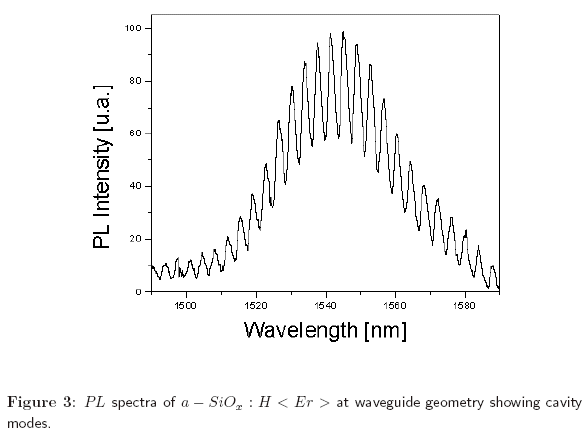
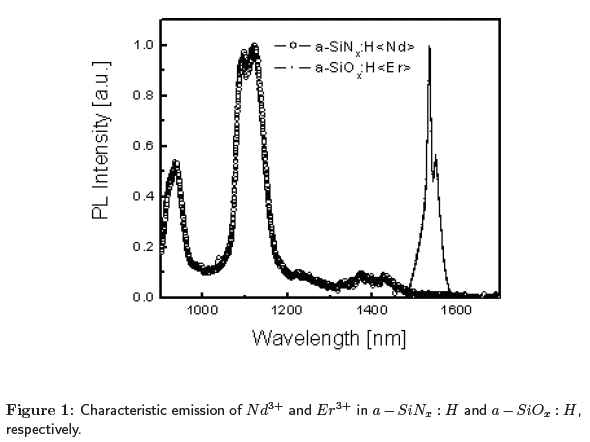
<body><![CDATA[<p align="justify"><font face="Verdana, Arial, Helvetica, sans-serif" size="2">An interesting way to study silicon based materials doped with <i>Er </i>or <i>Nd </i>are amorphous silicon (a<i>-Si</i>) thin films. This amorphous material allows higher <i>REs' </i>concentrations than its crystalline counterpart. During the preparation the samples can be alloyed with other element such as <i>O, N </i>or <i>C </i>which are used to modify the optical parameters. These optical parameters (index of refraction and optical bandgap) are controlled in order to enhance the <i>RE </i>luminescence. In this paper is reported a study of the photoluminescence (<i>PL</i>) of hydrogenated amorphous silicon sub-nitrides (a — <i>SiN<sub>x</sub> </i>: <i>H) </i>and sub-oxides (<i>a-SiO<sub>x</sub> : H</i>) doped with <i>Nd </i>and <i>Er, </i>respectively. ~ 0.5 um thick films were deposited on Si &lt;100&gt; 89 <i>&#956;m</i> thick substrates by <i>rf </i>co-sputtering technique from a 99.999% purity Si target partially covered by 99.9% pure small metallic <i>RE </i>platelets. Depending on the <i>RE, </i>an high purity <i>H<sub>2</sub> + N<sub>2</sub> + Ar </i>(for <i>Nd</i>) or <i>H<sub>2</sub> + O<sub>2</sub> + Ar </i>(for <i>Er) </i>gas mixture was added during the deposition.</font></p>     <p align="justify"><font face="Verdana, Arial, Helvetica, sans-serif" size="2">There were performed <i>PL </i>measurements exciting the samples with all lines of a <i>CW Ar+ </i>laser at different excitation intensities. <i>PL </i>spectra were acquired at different temperatures (from 10 to 300 <i>K). </i>The signal was dispersed by a 30 cm spectrograph and detected by a thermo-electrically cooled 512 element <i>InGaAs </i>diode array. Typical <i>PL </i>spectra of <i>a </i>— <i>SiN<sub>x</sub> </i>: <i>H &lt; Nd </i>&gt; and <i>a </i>— <i>SiO<sub>x</sub> </i>: <i>H &lt; Er </i>&gt; are shown in <a href="#f1">Figure 1</a>.</font></p>     <p align="center"><a name="f1"></a><img src="/img/revistas/ran/v3n1/a07_figure_01.gif" width="590" height="442"></p>     <p align="justify"><font face="Verdana, Arial, Helvetica, sans-serif" size="2">There were performed lifetime measurements and <i>PL </i>emission intensity as a function of excitation power in samples with waveguide geometry;[9] i.e. detecting the signal at a cleaved face of the substrate. <i>PL </i>measurements at 10 <i>K </i>as a function of power excitation in waveguide geometry are shown in <a href="#f2">Figure 2</a>. These spectra show a super linear growth of <i>PL.</i></font></p>     <p align="center"><a name="f2"></a><img src="/img/revistas/ran/v3n1/a07_figure_02.gif" width="590" height="445"></p>     <p align="justify"><font face="Verdana, Arial, Helvetica, sans-serif" size="2">The behavior of the <i>PL </i>intensity with the excitation power suggest for both materials that more than one photon is emitted by excited ion. On the other hand, lifetime measurements in <i>a — SiN<sub>x</sub> </i>: <i>H &lt; Nd &gt; </i>(not shown) show a diminution of lifetime when the excitation power increases. This decrease is characteristic of the onset of stimulated emission. Cavity modes (see <a href="#f3">Figure 3</a>) were also found in <i>a — SiO<sub>x</sub> </i>: <i>H &lt; Er &gt; </i>emission.</font></p>     <p align="center"><a name="f3"></a><img src="/img/revistas/ran/v3n1/a07_figure_03.gif" width="588" height="435"></p>     <p align="justify"><font face="Verdana, Arial, Helvetica, sans-serif" size="2">All of these results strongly suggest the power of </font><font size="2"><i>a</i></font><font face="Verdana, Arial, Helvetica, sans-serif" size="2"><i> — SiN<sub>x</sub> : H &lt; Nd </i>&gt; and </font><font size="2"><i>a</i></font><font face="Verdana, Arial, Helvetica, sans-serif" size="2"><i> — SiO<sub>x</sub> </i>: <i>H &lt; Er &gt; </i>for photonic purposes as integrated-compatible optical amplifiers.</font></p>     <p align="justify"><font face="Verdana, Arial, Helvetica, sans-serif" size="2">The main challenge is to optimize the materials to have all these characteristics present at 10 <i>K </i>at room temperature too.</font></p>     <p align="justify"><font face="Verdana, Arial, Helvetica, sans-serif" size="2">The author acknowledges the Brazilian agencies FAPESP and CAPES for financial</font> <font face="Verdana, Arial, Helvetica, sans-serif" size="2">support and Prof. L. Tessler for important discussions.</font></p>     ]]></body>
<body><![CDATA[<p align="justify">&nbsp;</p>     <p align="justify"><font face="Verdana, Arial, Helvetica, sans-serif" size="3"><b>References</b></font></p>     <p align="justify"><font face="Verdana, Arial, Helvetica, sans-serif" size="2">[1] D. Biggemann and L. R. Tessler. <i>Sci. Eng. B. </i>2003, 105, 188-190. [2] Canham. <i>L. Nature 2000. </i>408, 411-412.</font></p>     <!-- ref --><p align="justify"><font face="Verdana, Arial, Helvetica, sans-serif" size="2">[3] S. Hüfner. <i>Optical Spectra of Transparent Rare Earth Compounds. </i>Academic Press, New York, 1978.</font>&nbsp;&nbsp;&nbsp;&nbsp;&nbsp;&nbsp;&nbsp;&nbsp;[&#160;<a href="javascript:void(0);" onclick="javascript: window.open('/scielo.php?script=sci_nlinks&ref=796714&pid=S1683-0789200500010000800003&lng=','','width=640,height=500,resizable=yes,scrollbars=1,menubar=yes,');">Links</a>&#160;]<!-- end-ref --><p align="justify"><font face="Verdana, Arial, Helvetica, sans-serif" size="2">[4] B. R. Judd. <i>Phys. Rev. </i>1962, 127, 750-761.</font></p>     <p align="justify"><font face="Verdana, Arial, Helvetica, sans-serif" size="2">[5] M.Castagna ;S.Coffa ; M.Monaco ; A.Muscara ;L. Caristia ;S. Lorenti and Messina. <i>A. Mater. Sci. and Eng. </i>B 2003, 105, 83-90.</font></p>     <p align="justify"><font face="Verdana, Arial, Helvetica, sans-serif" size="2">[6] Opt. Mater. <i>Si-based Photonics: Towards True Monolithic Integration. </i>2005, 27.</font></p>     <!-- ref --><p align="justify"><font face="Verdana, Arial, Helvetica, sans-serif" size="2">[7] Millenia.  <i>of Spectra Physics (10 W CW at 532 nm) and Verdi, of Coherent (10W CW at 532 nm).</i></font>&nbsp;&nbsp;&nbsp;&nbsp;&nbsp;&nbsp;&nbsp;&nbsp;[&#160;<a href="javascript:void(0);" onclick="javascript: window.open('/scielo.php?script=sci_nlinks&ref=796718&pid=S1683-0789200500010000800007&lng=','','width=640,height=500,resizable=yes,scrollbars=1,menubar=yes,');">Links</a>&#160;]<!-- end-ref --><!-- ref --><p align="justify"><font face="Verdana, Arial, Helvetica, sans-serif" size="2">[8] S. M. Sze.  <i>Physics of Semiconductor Devices.  </i>John Wiley and Sons, New York, 1981.</font>&nbsp;&nbsp;&nbsp;&nbsp;&nbsp;&nbsp;&nbsp;&nbsp;[&#160;<a href="javascript:void(0);" onclick="javascript: window.open('/scielo.php?script=sci_nlinks&ref=796719&pid=S1683-0789200500010000800008&lng=','','width=640,height=500,resizable=yes,scrollbars=1,menubar=yes,');">Links</a>&#160;]<!-- end-ref --><p align="justify"><font face="Verdana, Arial, Helvetica, sans-serif" size="2">[9] L. R. Tessler and D. Biggemann. <i>Opt. Mater. </i>2005, 27, 773-775.</font></p>     ]]></body>
<body><![CDATA[<p align="justify">&nbsp;</p>      ]]></body><back>
<ref-list>
<ref id="B1">
<label>1</label><nlm-citation citation-type="journal">
<person-group person-group-type="author">
<name>
<surname><![CDATA[Biggemann]]></surname>
<given-names><![CDATA[D.]]></given-names>
</name>
<name>
<surname><![CDATA[Tessler]]></surname>
<given-names><![CDATA[L.R.]]></given-names>
</name>
</person-group>
<article-title xml:lang="es"><![CDATA[X]]></article-title>
<source><![CDATA[Sci. Eng. B.]]></source>
<year>2003</year>
<volume>105</volume>
<page-range>188-190</page-range></nlm-citation>
</ref>
<ref id="B2">
<label>2</label><nlm-citation citation-type="journal">
<person-group person-group-type="author">
<name>
<surname><![CDATA[L]]></surname>
<given-names><![CDATA[Canham]]></given-names>
</name>
</person-group>
<article-title xml:lang="es"><![CDATA[x]]></article-title>
<source><![CDATA[Nature]]></source>
<year>2000</year>
<volume>408</volume>
<page-range>411-412</page-range></nlm-citation>
</ref>
<ref id="B3">
<label>3</label><nlm-citation citation-type="book">
<person-group person-group-type="author">
<name>
<surname><![CDATA[Hüfner]]></surname>
<given-names><![CDATA[S.]]></given-names>
</name>
</person-group>
<source><![CDATA[Optical Spectra of Transparent Rare Earth Compounds]]></source>
<year>1978</year>
<publisher-loc><![CDATA[New York ]]></publisher-loc>
<publisher-name><![CDATA[Academic Press]]></publisher-name>
</nlm-citation>
</ref>
<ref id="B4">
<label>4</label><nlm-citation citation-type="journal">
<person-group person-group-type="author">
<name>
<surname><![CDATA[Judd]]></surname>
<given-names><![CDATA[B.R.]]></given-names>
</name>
</person-group>
<article-title xml:lang="es"><![CDATA[X]]></article-title>
<source><![CDATA[Phys. Rev.]]></source>
<year>1962</year>
<volume>127</volume>
<page-range>750-761</page-range></nlm-citation>
</ref>
<ref id="B5">
<label>5</label><nlm-citation citation-type="journal">
<person-group person-group-type="author">
<name>
<surname><![CDATA[Castagna]]></surname>
<given-names><![CDATA[M.]]></given-names>
</name>
<name>
<surname><![CDATA[Coffa]]></surname>
<given-names><![CDATA[S.]]></given-names>
</name>
<name>
<surname><![CDATA[Monaco]]></surname>
<given-names><![CDATA[M.]]></given-names>
</name>
<name>
<surname><![CDATA[Muscara]]></surname>
<given-names><![CDATA[A.]]></given-names>
</name>
<name>
<surname><![CDATA[Caristia]]></surname>
<given-names><![CDATA[L.]]></given-names>
</name>
<name>
<surname><![CDATA[Lorenti]]></surname>
<given-names><![CDATA[S.]]></given-names>
</name>
</person-group>
<article-title xml:lang="es"><![CDATA[Mater]]></article-title>
<source><![CDATA[Sci. and Eng. B]]></source>
<year>2003</year>
<volume>105</volume>
<page-range>83-90</page-range></nlm-citation>
</ref>
<ref id="B6">
<label>6</label><nlm-citation citation-type="journal">
<collab>Opt. Mater</collab>
<article-title xml:lang="en"><![CDATA[Si-based Photonics: Towards True Monolithic Integration]]></article-title>
<source><![CDATA[Opt. Mater]]></source>
<year>2005</year>
<volume>27</volume>
</nlm-citation>
</ref>
<ref id="B7">
<label>7</label><nlm-citation citation-type="">
<collab>Millenia</collab>
<source><![CDATA[of Spectra Physics (10 W CW at 532 nm) and Verdi, of Coherent (10W CW at 532 nm)]]></source>
<year></year>
</nlm-citation>
</ref>
<ref id="B8">
<label>8</label><nlm-citation citation-type="book">
<person-group person-group-type="author">
<name>
<surname><![CDATA[Sze]]></surname>
<given-names><![CDATA[S.M.]]></given-names>
</name>
</person-group>
<source><![CDATA[Physics of Semiconductor Devices]]></source>
<year>1981</year>
<publisher-loc><![CDATA[New York ]]></publisher-loc>
<publisher-name><![CDATA[John Wiley and Sons]]></publisher-name>
</nlm-citation>
</ref>
<ref id="B9">
<label>9</label><nlm-citation citation-type="journal">
<person-group person-group-type="author">
<name>
<surname><![CDATA[Tessler]]></surname>
<given-names><![CDATA[L.R.]]></given-names>
</name>
<name>
<surname><![CDATA[Biggemann]]></surname>
<given-names><![CDATA[D.]]></given-names>
</name>
</person-group>
<article-title xml:lang="en"><![CDATA[X]]></article-title>
<source><![CDATA[Opt. Mater]]></source>
<year>2005</year>
<volume>27</volume>
<page-range>773-775</page-range></nlm-citation>
</ref>
</ref-list>
</back>
</article>