<?xml version="1.0" encoding="ISO-8859-1"?><article xmlns:mml="http://www.w3.org/1998/Math/MathML" xmlns:xlink="http://www.w3.org/1999/xlink" xmlns:xsi="http://www.w3.org/2001/XMLSchema-instance">
<front>
<journal-meta>
<journal-id>1605-2528</journal-id>
<journal-title><![CDATA[Ecología en Bolivia]]></journal-title>
<abbrev-journal-title><![CDATA[Ecología en Bolivia]]></abbrev-journal-title>
<issn>1605-2528</issn>
<publisher>
<publisher-name><![CDATA[Plural Editores ]]></publisher-name>
</publisher>
</journal-meta>
<article-meta>
<article-id>S1605-25282021000100005</article-id>
<title-group>
<article-title xml:lang="en"><![CDATA[Ecomorphological variations of Orestias sp. (gr agassizii, Cyprinodontiformes, Cyprinodontidae) from Eastern slope of the Andes]]></article-title>
<article-title xml:lang="es"><![CDATA[Variaciones ecomorfológicas de Orestias sp. (gr agassizii, Cyprinodontiformes, Cyprinodontidae) de la Vertiente Oriental de los Andes]]></article-title>
</title-group>
<contrib-group>
<contrib contrib-type="author">
<name>
<surname><![CDATA[Loayza]]></surname>
<given-names><![CDATA[Erick]]></given-names>
</name>
<xref ref-type="aff" rid="A01"/>
</contrib>
<contrib contrib-type="author">
<name>
<surname><![CDATA[Alvestegui]]></surname>
<given-names><![CDATA[Débora]]></given-names>
</name>
<xref ref-type="aff" rid="A01"/>
</contrib>
<contrib contrib-type="author">
<name>
<surname><![CDATA[Herbas]]></surname>
<given-names><![CDATA[Kelvin]]></given-names>
</name>
<xref ref-type="aff" rid="A01"/>
</contrib>
<contrib contrib-type="author">
<name>
<surname><![CDATA[Ibañez]]></surname>
<given-names><![CDATA[Carla]]></given-names>
</name>
<xref ref-type="aff" rid="A01"/>
</contrib>
<contrib contrib-type="author">
<name>
<surname><![CDATA[Zepita]]></surname>
<given-names><![CDATA[Claudia]]></given-names>
</name>
<xref ref-type="aff" rid="A01"/>
</contrib>
<contrib contrib-type="author">
<name>
<surname><![CDATA[Miranda-Chumacero]]></surname>
<given-names><![CDATA[Guido]]></given-names>
</name>
<xref ref-type="aff" rid="A01"/>
</contrib>
</contrib-group>
<aff id="A01">
<institution><![CDATA[,Universidad Mayor de San Andrés Facultad de Ciencias Puras y Naturales Instituto de Ecología]]></institution>
<addr-line><![CDATA[La Paz ]]></addr-line>
<country>Bolivia</country>
</aff>
<pub-date pub-type="pub">
<day>00</day>
<month>04</month>
<year>2021</year>
</pub-date>
<pub-date pub-type="epub">
<day>00</day>
<month>04</month>
<year>2021</year>
</pub-date>
<volume>56</volume>
<numero>1</numero>
<fpage>36</fpage>
<lpage>41</lpage>
<copyright-statement/>
<copyright-year/>
<self-uri xlink:href="http://www.scielo.org.bo/scielo.php?script=sci_arttext&amp;pid=S1605-25282021000100005&amp;lng=en&amp;nrm=iso"></self-uri><self-uri xlink:href="http://www.scielo.org.bo/scielo.php?script=sci_abstract&amp;pid=S1605-25282021000100005&amp;lng=en&amp;nrm=iso"></self-uri><self-uri xlink:href="http://www.scielo.org.bo/scielo.php?script=sci_pdf&amp;pid=S1605-25282021000100005&amp;lng=en&amp;nrm=iso"></self-uri></article-meta>
</front><body><![CDATA[ <p align="right"><b><font face="Verdana, Arial, Helvetica, sans-serif" size="2">Nota</font></b></p>     <p align="right">&nbsp;</p>     <p align="center"><b><font face="Verdana, Arial, Helvetica, sans-serif" size="4">Ecomorphological variations of <i>Orestias </i>sp. (<i>gr agassizii, </i>Cyprinodontiformes, Cyprinodontidae) from Eastern slope of the Andes</font></b></p>     <p align="center">&nbsp;</p>     <p align="center"><b><font face="Verdana, Arial, Helvetica, sans-serif" size="3">Variaciones ecomorfológicas de <i>Orestias </i>sp. (<i>gr agassizii, </i>Cyprinodontiformes, Cyprinodontidae) de la Vertiente Oriental de los Andes</font></b></p>     <p align="center">&nbsp;</p>     <p align="center">&nbsp;</p>     <p align="center"><b><font face="Verdana, Arial, Helvetica, sans-serif" size="2">Erick Loayza<sup>1</sup>*<i>, </i>Débora Alvestegui<sup>1</sup>, Kelvin Herbas<sup>1</sup>, Carla Ibañez<sup>1</sup>, Claudia Zepita<sup>1</sup> &amp; Guido Miranda-Chumacero<sup>1,2</sup></font></b></p>     <p align="center"><font face="Verdana, Arial, Helvetica, sans-serif" size="2"><sup>1</sup>Unidad de Ecología Acuática, Instituto de Ecología, Facultad de Ciencias Puras y Naturales, Universidad</font> <font face="Verdana, Arial, Helvetica, sans-serif" size="2">Mayor de San Andrés, c/27, Cota Cota s/n Campus Universitario, La Paz, Bolivia</font>    <br> <font face="Verdana, Arial, Helvetica, sans-serif" size="2"><sup>2</sup>Wildlife Conservation Society — Bolivia (WCS), Calle Gabino Villanueva#340, entre las calles 24 y 25 de</font> <font face="Verdana, Arial, Helvetica, sans-serif" size="2">Calacoto, La Paz, Bolivia</font></p>     ]]></body>
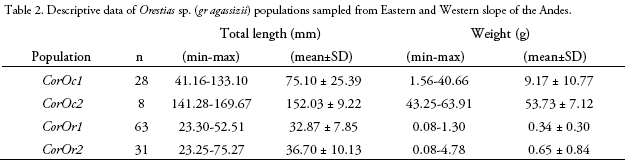
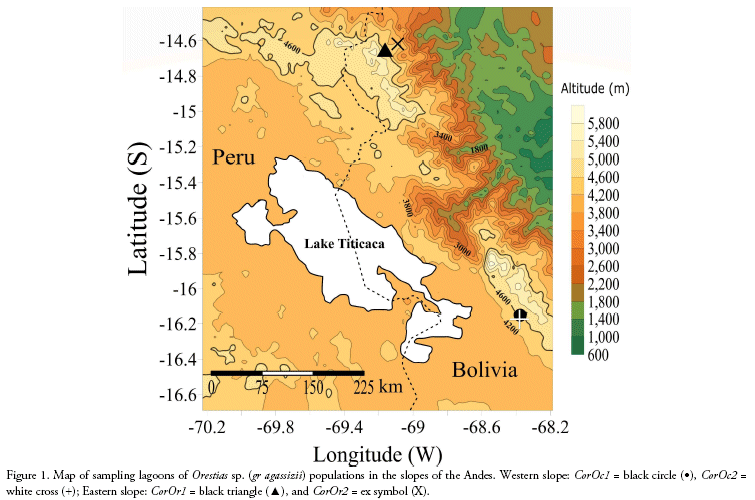
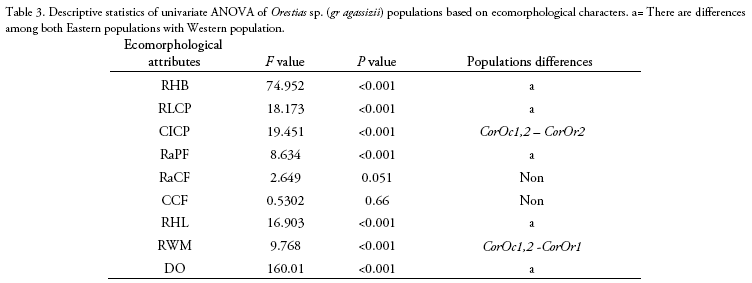
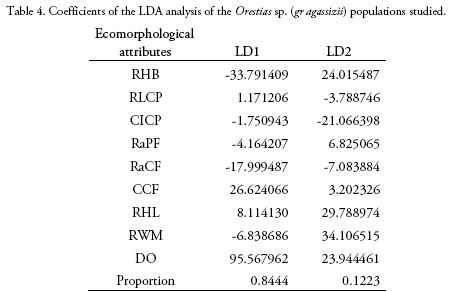
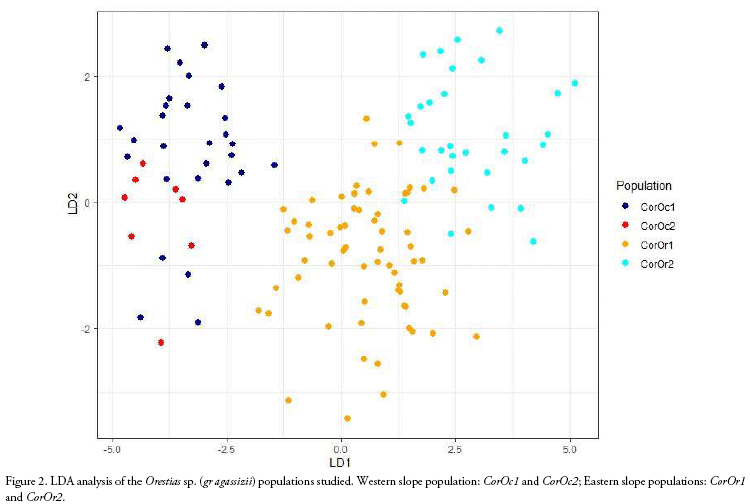
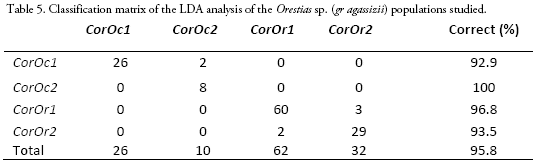
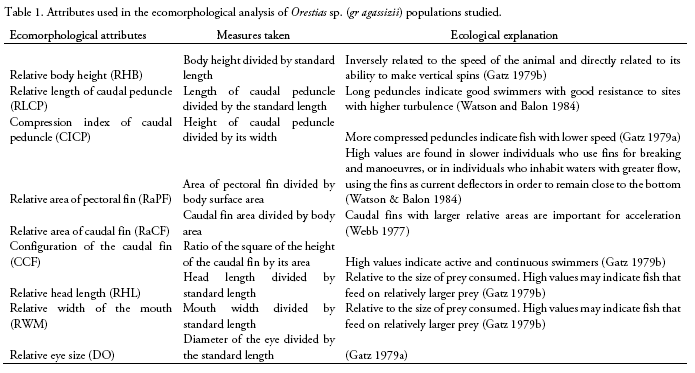
<body><![CDATA[<p align="center"><font face="Verdana, Arial, Helvetica, sans-serif" size="2"><b>*Autor de correspondencia: </b><a href="mailto:erickz.loayzatorrico@gmail.com">erickz.loayzatorrico@gmail.com</a></font></p>     <p align="center"><font face="Verdana, Arial, Helvetica, sans-serif" size="2"><b>Recibido: </b>.16.06.20, <b>Aceptado: </b>12.12.20.</font></p>     <p align="center">&nbsp;</p>     <p align="center">&nbsp;</p> <hr align="JUSTIFY" noshade>     <p align="justify"><font face="Verdana, Arial, Helvetica, sans-serif" size="2">Andes mountains in Bolivia are a water divider that gives rise to the Amazon basin in the Eastern and the Altiplano basin in the Western slope. <i>Orestias </i>(Cuvier &amp; Valenciennes 1846) is one of three native genera of endemic teleost fish of the Altiplano (Parenti 1984, Villwock 1986, Vila <i>et al. </i>2007) and is distributed from southern Perú, western Bolivia and northeast Chile, with Lake Titicaca as its main distribution area (Parenti 1984, Guerlesquin 1992, Lauzanne 1992). More than 40 species were described in the Altiplano (Parenti 1984, Vila <i>et al. </i>2007, Sarmiento <i>et al. </i>2014), although there is some divergence on species validity based on genetic traits (Lüssen <i>et al. </i>2003, Vila <i>et al. </i>2007, Garrigos <i>et al. </i>2013, Ibañez <i>et al. </i>2014, Takahashi &amp; Moreno 2015). The distribution of this native genus has been a consequence of geological events that occurred during the Holocene and late Pleistocene, which have developed small disconnected basins along the Altiplano in the Western slope, where <i>Orestias </i>maintains small populations that have remained isolated in an arid and extreme climate (Parker &amp; Kornfield 1995, Vila <i>et al. </i>2010, 2013). The wide variety of ecological conditions in the distribution area has led to morphological differences with local adaptations and a particular phenotypic expression (Lauzanne 1982, Maldonado <i>et al. </i>2009). For instance, <i>Orestias agassizii, </i>the species with the largest distribution of the genus, inhabits different aquatic ecosystems from the north to the south of the Altiplano, and shows high intra-specific variation (Arratia 1982, De la Barra <i>et al. </i>2009, Flores 2013, Takahashi &amp; Moreno 2015).</font></p>     <p align="justify"><font face="Verdana, Arial, Helvetica, sans-serif" size="2">Although <i>Orestias </i>species has been described only for Western slope,  there are small little-known and well</font> <font face="Verdana, Arial, Helvetica, sans-serif" size="2">stablished populations of these fish in the headwaters from Eastern slope (Sarmiento &amp; Barrera 1997, Identidad Madidi &amp; SERNAP 2017), characterized by an abrupt relieve with pronounced slopes, deep and enclosed alluvial valleys, that provide new geomorphologic and ecological conditions to which this native fish could adapt (e.g. increased turbidity and water flow). <i>Orestias </i>populations of agassizii group reported for the Puina Valley, at the headwaters of the Tuichi River on the Eastern slope were introduced about 30 to 40 years ago. They are nowadays well established and correspond to the same group, although their identity is still unknown (Identidad Madidi &amp; SERNAP 2017). The aim of this study was to analyse and compare the ecomorphological variation among the <i>Orestias </i>sp. (gr agassizii) populations from the Puina Valley on the Eastern slope and from Western slopes of the Andes mountains.</font></p>     <p align="justify"><font face="Verdana, Arial, Helvetica, sans-serif" size="2">We compared ecomorphological measurements of 130 specimens corresponding to four <i>Orestias </i>sp. (gr agassizii) populations. Western slope populations were collected from Hichu Kotha (<i>CorOc1: </i>28 specimens, -68.380019&deg;; -16.174192&deg;; 4,350 m), and Kara Kotha (<i>CorOc2: </i>8 specimens, -68. 376306&deg;; -16.150344&deg;; 4,450 m) lagoons from Hichu Khota Valley, northwest of La Paz city, in the &quot;glacial cordillera&quot; hydro-ecoregion (Wasson <i>et al. </i>2002). Eastern slope populations were collected from Celeste (<i>CorOr1: </i>63 specimens, -69.163199&deg;; -14.650412&deg;; 4,200 m), and &quot;Siembra&quot; (<i>CorOr2: </i>31 specimens, -69.089377&deg;; -14.617934&deg;; 4,300 m, <a href="#f1">Figure 1</a>) lagoons in Puina Valley. Nine ecomorphological attributes were evaluated (<a href="#t1">Table 1</a>). Measurements were made to the nearest 0.1 mm using digital   calliper   (absolute   digimatic   digital   callipers,</font> <font face="Verdana, Arial, Helvetica, sans-serif" size="2">Mitutoyo, Japan). A one-way MAN OVA analysis (Willks lambda test) was performed to determine the significant differences on ecomorphological attributes among populations (p &lt; 0.05). When MANO VA was significant, corresponding one-way ANOVAs followed of Dunnett's test     were     subsequently     performed     for      each</font> <font face="Verdana, Arial, Helvetica, sans-serif" size="2">ecomorphological character to evalúate its potential contribution to differences among the populations. A Linear Discriminant Analysis (LDA) was carried out using R (package MASS; Ripley <i>et al. </i>2020) to determine how accurately the morphology of specimens corresponded to their respective populations.</font></p>     <p align="center"><a name="t1"></a><img src="/img/revistas/reb/v56n1/a05_table_01.gif" width="695" height="373"></p>     <p align="center"><a name="f1"></a><img src="/img/revistas/reb/v56n1/a05_figure_01.gif" width="755" height="500"></p>     <p align="justify"><font face="Verdana, Arial, Helvetica, sans-serif" size="2">Length and weight data including ranges and means are shown in <a href="#t2">Table 2</a>. The MANOVA revealed that studied populations showed globally significant ecomorphological differences (F=31.4, Wilk's <i>&#955; </i>= 0.08, p &lt; 0.001). Most ecomorphological attributes differentiated the populations from each mountain slope, with the exception of the caudal fin configuration (CCF, <a href="#t3">Table 3</a>). Indeed, LDA analysis showed that the three populations were correctly discriminated according to their ecomorphological attributes (&gt;95% of correct classification, <a href="#f2">Fig. 2</a>, <a href="#t4">Table 4</a> and <a href="#t5">5</a>). The linear discriminant coefficients revealed that the first function (explaining 84.44% of the variation) differentiated populations principally according to eye size (DO)  and relative body height (RHB). The second</font> <font face="Verdana, Arial, Helvetica, sans-serif" size="2">function (12.23% of the variation) differentiated populations according to relative width of the mouth (RWM) and the compression index of caudal peduncle (CICP).</font></p>     ]]></body>
<body><![CDATA[<p align="center"><a name="t2"></a><img src="/img/revistas/reb/v56n1/a05_table_02.gif" width="631" height="163"></p>     <p align="center">&nbsp;</p>     <p align="center"><a name="t3"></a><img src="/img/revistas/reb/v56n1/a05_table_03.gif" width="752" height="283"></p>     <p align="center">&nbsp;</p>     <p align="center"><a name="t4"></a><img src="/img/revistas/reb/v56n1/a05_table_04.gif" width="452" height="292"></p>     <p align="center">&nbsp;</p>     <p align="center"><a name="f2"></a><img src="/img/revistas/reb/v56n1/a05_figure_02.gif" width="750" height="504"></p>     <p align="center">&nbsp;</p>     <p align="center"><a name="t5"></a><img src="/img/revistas/reb/v56n1/a05_table_05.gif" width="533" height="167"></p>     <p align="justify"><font face="Verdana, Arial, Helvetica, sans-serif" size="2">Living conditions in high altitude lagoons (&gt; 3,500 m) are extreme, with high exposure to solar radiation, which can even be up to 20% higher than that recorded at sea level at the same latitude (Aceituno 1997). Moreover, the valleys located on both sides of the Andes slopes are exposed to intense climate warming caused by the combined effects of tropical location (16&deg;S) and altitude, projecting twice the planet average warming towards 2100 (Bradley 2006, Valdivia <i>et al. </i>2013, Rangecroft <i>et al </i>2016).</font></p>     ]]></body>
<body><![CDATA[<p align="justify"><font face="Verdana, Arial, Helvetica, sans-serif" size="2">The formation of diese lagoons on the western slope corresponds to the evaporation of large paleo-lakes (Keller &amp; Soto 1998, Placzek <i>et al. </i>2006), unlike the lagoons on the Eastern slope, which have a glacial origin. The retreat of the waters of paleo-lakes caused a fragmentation, leaving small lagoons scattered in the Altiplano, many of them without any connection between them.</font></p>     <p align="justify"><font face="Verdana, Arial, Helvetica, sans-serif" size="2">Although, the Hichu Khota and Puina Valleys are located in the &quot;glacial cordillera&quot; hydro-ecoregion on the humid mountains region (Wasson <i>et al. </i>2002), they have some differences, caused by the geography of each slope. The waters that flow into the Hichu Khota Valley come from melting glaciers that run through a series of low-slope moraine hills (7-10%), that arrives to a fiuvio-glacial foothill, to finally cross the Altiplano and end up in the Lake Titicaca (Marín 1989). In contrast, the waters that</font> <font face="Verdana, Arial, Helvetica, sans-serif" size="2">run through the Puina Valley, on the Eastern slope, flow on steep slopes (&gt; 20%), descending rapidly on sedimentary rock and presenting high turbidity values caused by the natural instability of the substrate (Identidad Madidi &amp; SERNAP 2017), finally flowing into the Tuichi River in the ANMI-Madidi in the Amazon basin.</font></p>     <p align="justify"><font face="Verdana, Arial, Helvetica, sans-serif" size="2">Indeed, morphological variations can be influenced by the habitat, the search for food resource or environmental stress conditions (Webb 1984, Parsons &amp; Robinson 2007). Environmental differences between both slopes of the Andes could influence the body shape of the <i>Orestias </i>populations studied, as for example the length of the peduncle (RLCP), adapting to a greater water flow in the Eastern slope. Likewise, this change in water flow could also influence the macroinvertebrates composition, the main food resource of <i>Orestias, </i>which could explain the</font> <font face="Verdana, Arial, Helvetica, sans-serif" size="2">differences found related to the head shape (head size, mouth width and eye diameter).</font></p>     <p align="justify"><font face="Verdana, Arial, Helvetica, sans-serif" size="2">It is evident that the presence of <i>Orestias </i>in the Eastern slope was not entirely natural (Identidad Madidi &amp; SERNAP 2017), despite the presence of aquatic environments with similar characteristics to those inhabited by <i>Orestias </i>(De la Barra <i>et al. </i>2009). Conversely, the wide distribution of <i>Orestias </i>in the Altiplano is attributed to a very extensive hypothetical ancestral distribution (Lüssen <i>et al. </i>2003), which accompanied the evaporation processes of the paleo-lakes. This fragmentation caused changes to accumulate separately, and evolve into different species that diversified through allopathic speciation (Northcote 2000). This process was observed in <i>Orestias </i>from north of Chile (Vila <i>et al. </i>2013), even going so far as to describe a new genre (Arratia <i>et al. </i>2017).</font></p>     <p align="justify"><font face="Verdana, Arial, Helvetica, sans-serif" size="2">The presence of <i>Orestias </i>in the Eastern slope of the Andes is not well documented (Sarmiento &amp; Barrera 1997). Furthermore, many aspects of the hydrology (e.g. water quality, flow characteristics) of the headwaters from Amazon basin remain unknown. In conclusion, significant differences between <i>Orestias </i>populations from each Andean slope were found, based on peduncle length, head size, width mouth and eye diameter. These results highlighted the need for further studies in order to identify these &quot;Eastern <i>Orestias&quot;, </i>applying genetic analysis or DNA barcodes, which would allow us to confirm or exclude the hypothesis that these Eastern populations would be geographical variations of a single species.</font></p>     <p align="justify">&nbsp;</p>     <p align="justify"><font face="Verdana, Arial, Helvetica, sans-serif" size="3"><b>Acknowledgments</b></font></p>     <p align="justify"><font face="Verdana, Arial, Helvetica, sans-serif" size="2">The authors would like to acknowledge to the Research Institute for Development (IRD), for allowing us to use the samples from FISHLOSS project. Also would like to acknowledge to the Wildlife Conservation Society (WCS-Bolivia) and the Puina field guides for their cooperation and logistical support in the framework of the Identidad Madidi expedition.</font></p>     <p align="justify">&nbsp;</p>     <p align="justify"><font face="Verdana, Arial, Helvetica, sans-serif" size="3"><b>References</b></font></p>     ]]></body>
<body><![CDATA[<p align="justify"><font size="2" face="Verdana, Arial, Helvetica, sans-serif">Aceituno, P. 1997. Aspectos generales del  clima en el Altiplano Sudamericano. pp 63&ndash;69. En: Charrier, R (ed.) El  Altiplano, Ciencia y Conciencia de los Andes. Santiago de Chile.    <br> Arratia, G. 1982. Peces del Altiplano de Chile.  El hombre y los ecosistemas 1:93&ndash;133.</font></p>     <p align="justify"><font size="2" face="Verdana, Arial, Helvetica, sans-serif">  Arratia, G., I. Vila, N. Lam, C.J. Guerrero  &amp; C. Quezada-Romegialli. 2017. Morphological and taxonomic descriptions  of a new genus and species of killifishes (Teleostei: Cyprinodontiformes) from  the high Andes of northern Chile. PLOS ONE 12: e0181989.</font></p>     <p align="justify"><font size="2" face="Verdana, Arial, Helvetica, sans-serif">  Bradley,  R.S. 2006. Climate Change: Threats to Water Supplies in the Tropical Andes. Science 312:1755&ndash;1756.</font></p>     <p align="justify"><font size="2" face="Verdana, Arial, Helvetica, sans-serif">  Cuvier, G.L. &amp; A. Valenciennes. 1846. Des Orestias. pp 221&ndash;244. En: Cuvier, G. L., &amp; A. Valenciennes (eds.). Histoire  naturelle des poissons. Paris.</font></p>     <p align="justify"><font size="2" face="Verdana, Arial, Helvetica, sans-serif">  De la Barra, E., E. Maldonado, F. Carvajal  &amp; J. Coronel. 2009. The killifish Orestias in  the Bolivian Puna. Rev.  Bol. Ecol. Y Cons. Amb. 26:1-7.</font></p>     <!-- ref --><p align="justify"><font size="2" face="Verdana, Arial, Helvetica, sans-serif">  Flores, A. 2013. Ecomorfolog&iacute;a y ecolog&iacute;a  alimentaria del g&eacute;nero Orestias  (Pisces Cyprinodontiformes)  en la puna xerof&iacute;tica de la provincia de Sud L&iacute;pez, Potos&iacute; Bolivia. Tesis de  licenciatura en biolog&iacute;a, Universidad Mayor de San Andr&eacute;s, La Paz. 80 p.</font>&nbsp;&nbsp;&nbsp;&nbsp;&nbsp;&nbsp;&nbsp;&nbsp;[&#160;<a href="javascript:void(0);" onclick="javascript: window.open('/scielo.php?script=sci_nlinks&ref=037697&pid=S1605-2528202100010000500007&lng=','','width=640,height=500,resizable=yes,scrollbars=1,menubar=yes,');">Links</a>&#160;]<!-- end-ref --><p align="justify"><font size="2" face="Verdana, Arial, Helvetica, sans-serif">  Garrigos, Y.E., B. Hugueny, K. Koerner, C. Iba&ntilde;ez,  C. Bonillo, P. Pruvost, R. Causse, C. Cruaud &amp; P. Gaubert. 2013.  Non-invasive ancient DNA protocol for fluid-preserved specimens and  phylogenetic systematics of the genus Orestias (Teleostei:  Cyprinodontidae). Zootaxa  3640:373&ndash;394.</font></p>     <p align="justify"><font size="2" face="Verdana, Arial, Helvetica, sans-serif">  Gatz, A. 1979a. Ecological morphology  of freshwater stream, fishes. Tulane studies in zoology and botany 21:91&ndash;119.</font></p>     <p align="justify"><font size="2" face="Verdana, Arial, Helvetica, sans-serif">  Gatz,  A.J. 1979b. Community Organization in Fishes as Indicated by Morphological  Features. Ecology 60:711&ndash;718.</font></p>     ]]></body>
<body><![CDATA[<p align="justify"><font size="2" face="Verdana, Arial, Helvetica, sans-serif">  Guerlesquin, M. 1992. Charophythes. pp 232&ndash;240.  En: Dejoux, C. &amp; A. Iltis (eds.) Lake Titicaca: A  synthesis of limnological knowledge. Springer Netherlands, Dordrecht.</font></p>     <p align="justify"><font size="2" face="Verdana, Arial, Helvetica, sans-serif">  Iba&ntilde;ez, C., B. Hugueny, Y. Esquer-Garrigos, C.  Zepita &amp; R. Gutierrez. 2014. Biodiversidad &iacute;ctica en el Lago Titicaca. pp  134&ndash;153. En: Pouilly, M., X., Lazzaro, D. Point &amp; M. Aguirre (eds.) L&iacute;nea  base de conocimientos sobre los recursos hidrol&oacute;gicos en el Sistema TDPS con  enfoque en la cuenca del Lago Titicaca. IRD-UICN, Quito.</font></p>     <!-- ref --><p align="justify"><font size="2" face="Verdana, Arial, Helvetica, sans-serif">  Identidad Madidi &amp; SERNAP (Servicio  Nacional de &Aacute;reas Protegidas). 2017. Informe Cient&iacute;fico 2015. Relevamientos de  biodiversidad en el Parque Nacional y &Aacute;rea Natural de Manejo Integrado Madidi.  La Paz. 184 p.</font>&nbsp;&nbsp;&nbsp;&nbsp;&nbsp;&nbsp;&nbsp;&nbsp;[&#160;<a href="javascript:void(0);" onclick="javascript: window.open('/scielo.php?script=sci_nlinks&ref=037703&pid=S1605-2528202100010000500013&lng=','','width=640,height=500,resizable=yes,scrollbars=1,menubar=yes,');">Links</a>&#160;]<!-- end-ref --><p align="justify"><font size="2" face="Verdana, Arial, Helvetica, sans-serif">  Keller, B. &amp; D. Soto. 1998. Hydrogeologic  influences on the preservation of Orestias ascotanensis  (Teleostei: Cyprinodontidae), in Salar de Ascot&aacute;n, northern Chile. Revista Chilena de Historia Natural 71:147&ndash;156.</font></p>     <p align="justify"><font size="2" face="Verdana, Arial, Helvetica, sans-serif">  Lauzanne, L. 1982. Les Orestias (Pisces, Cyprinodontidae) du Petit Lac Titicaca. Revue d&rsquo;Hydrobiologie  Tropicale. 15:39&ndash;70.</font></p>     <p align="justify"><font size="2" face="Verdana, Arial, Helvetica, sans-serif">  Lauzanne,  L. 1992. Native species the Orestias. pp 405&ndash;419. En:  Dejoux, C. &amp; A. Iltis (eds) Lake Titicaca: A synthesis of limnological  knowledge. Springer Netherlands, Dordrecht.    <br>   L&oacute;pez, R.P. 2000. La prepuna boliviana. Ecolog&iacute;a  en Bolivia 34:45&ndash;65.</font></p>     <p align="justify"><font size="2" face="Verdana, Arial, Helvetica, sans-serif">  L&uuml;ssen, A., T. M. Falk &amp; W. Villwock. 2003.  Phylogenetic patterns in populations of Chilean species of the genus Orestias  (Teleostei: Cyprinodontidae): results of mitochondrial  DNA analysis. Molecular Phylogenetics and Evolution 29:151&ndash;160.</font></p>     <p align="justify"><font size="2" face="Verdana, Arial, Helvetica, sans-serif">  Maldonado,  E., N. Hubert, P. Sagnes &amp; B. De Merona. 2009. Morphology-diet relationships  in four killifishes (Teleostei, Cyprinodontidae, Orestias) from  Lake Titicaca. Journal of Fish Biology 74:502&ndash;520.</font></p>     <!-- ref --><p align="justify"><font size="2" face="Verdana, Arial, Helvetica, sans-serif">  Mar&iacute;n, R. 1989. Elementos para la tipolog&iacute;a de  los r&iacute;os de altura de la regi&oacute;n de La Paz: Caracter&iacute;sticas biol&oacute;gicas y  potencialidades pisc&iacute;colas. Tesis de licenciatura en biolog&iacute;a, Universidad  Mayor de San Andr&eacute;s, La Paz.</font>&nbsp;&nbsp;&nbsp;&nbsp;&nbsp;&nbsp;&nbsp;&nbsp;[&#160;<a href="javascript:void(0);" onclick="javascript: window.open('/scielo.php?script=sci_nlinks&ref=037710&pid=S1605-2528202100010000500020&lng=','','width=640,height=500,resizable=yes,scrollbars=1,menubar=yes,');">Links</a>&#160;]<!-- end-ref --><p align="justify"><font size="2" face="Verdana, Arial, Helvetica, sans-serif">  Northcote, T.G. 2000. Ecological  interactions among an Orestiid (Pisces: Cyprinodontidae) species flock in the  littoral zone of Lake Titicaca. Advances in   Ecological  Research 31:399&ndash;420.</font></p>     <p align="justify"><font size="2" face="Verdana, Arial, Helvetica, sans-serif">  Parenti,  L.R. 1984. A taxonomic revision of the Andean killifish genus Orestias  (Cyprinodontiformes, Cyprinodontidae). American museum  of natural history. Bulletin of the American Museum of Natural History 178(2):  1-214.</font></p>     <p align="justify"><font size="2" face="Verdana, Arial, Helvetica, sans-serif">  Parker,  A. &amp; I. Kornfield. 1995. Molecular Perspective on Evolution and  Zoogeography of Cyprinodontid Killifishes (Teleostei; Atherinomorpha). Copeia 1995(1):  8-21.</font></p>     <p align="justify"><font size="2" face="Verdana, Arial, Helvetica, sans-serif">  Parsons,  K.J. &amp; B.W. Robinson. 2007. Foraging performance of diet&#8208;induced morphotypes in pumpkinseed sunfish  (Lepomis gibbosus) favours resource  polymorphism. Journal of evolutionary biology 20:673&ndash;684.</font></p>     <p align="justify"><font size="2" face="Verdana, Arial, Helvetica, sans-serif">  Placzek,  C., J. Quade &amp; P.J. Patchett. 2006. Geochronology and stratigraphy of late  Pleistocene lake cycles on the southern Bolivian Altiplano: Implications for  causes of tropical climate change. Geological Society of America Bulletin 118:  515&ndash;532.</font></p>     <p align="justify"><font size="2" face="Verdana, Arial, Helvetica, sans-serif">  Rangecroft,  S., A. J. Suggitt, K. Anderson &amp; S. Harrison. 2016. Future climate warming  and changes to mountain permafrost in the Bolivian Andes. Climatic Change 137:  231&ndash;243.</font></p>     <p align="justify"><font size="2" face="Verdana, Arial, Helvetica, sans-serif">  Ripley,  B., B. Venables, D.M. Bates, K. Hornik, P. Albrecht &amp; D. Firth. 2020. MASS:  Support functions and datasets for Venables and Ripley&rsquo;s MASS. (4th ed).  R-Packages.</font></p>     <p align="justify"><font size="2" face="Verdana, Arial, Helvetica, sans-serif">  Sarmiento,  J. &amp; S. Barrera. 1997. Observaciones  preliminares sobre la ictiofauna de la vertiente oriental andina de Bolivia.  Revista Boliviana de Ecolog&iacute;a y Medio Ambiente 2: 77&ndash;99.</font></p>     <p align="justify"><font size="2" face="Verdana, Arial, Helvetica, sans-serif">  Sarmiento, J., R. Bigorne, Carvajal-Vallejos,  M. Maldonado, E. Leciak &amp; T. Oberdorff. 2014. Peces de Bolivia. Plural, La  Paz.</font></p>     <p align="justify"><font size="2" face="Verdana, Arial, Helvetica, sans-serif">  Takahashi, T. &amp; E. Moreno. 2015. A  RAD-based phylogenetics for Orestias fishes from Lake  Titicaca. Molecular Phylogenetics and Evolution 93: 307&ndash;317.</font></p>     ]]></body>
<body><![CDATA[<p align="justify"><font size="2" face="Verdana, Arial, Helvetica, sans-serif">  Valdivia,  C., J. Thibeault, J.L. Gilles, M. Garc&iacute;a &amp; A. Seth. 2013. Climate trends  and projections for the Andean Altiplano and strategies for adaptation.  Advances in Geosciences 33: 69&ndash;77.</font></p>     <p align="justify"><font size="2" face="Verdana, Arial, Helvetica, sans-serif">  Vila,  I., P. Morales, S. Scott, E. Poulin, D. V&eacute;liz, C. Harrod &amp; M.A. M&eacute;ndez.  2013. Phylogenetic and phylogeographic analysis of the genus Orestias  (Teleostei: Cyprinodontidae) in the southern Chilean  Altiplano: the relevance of ancient and recent divergence processes in  speciation: phylogeny of Chilean Orestias. Journal of Fish  Biology 82: 927&ndash;943.</font></p>     <p align="justify"><font size="2" face="Verdana, Arial, Helvetica, sans-serif">  Vila,  I., R. Pardo &amp; S. Scott. 2007. Freshwater fishes of the Altiplano. Aquatic  Ecosystem Health &amp; Management 10: 201&ndash;211.</font></p>     <p align="justify"><font size="2" face="Verdana, Arial, Helvetica, sans-serif">  Vila,  I., S. Scott, N. Lam, P. Iturra &amp; M.A. Mendez. 2010. Karyological and  morphological analysis of divergence among species of the killifish genus Orestias  (Teleostei: Cyprinodontidae) from the southern  Altiplano. pp 471&ndash;480. En: Nelson, J.S., S. Hans &amp; M.V.H. Wilson (eds.)  Origin and Phylogenetic Interrelationships of Teleosts, Verlag Dr. Friedrich  Pfeil, Munich.</font></p>     <p align="justify"><font size="2" face="Verdana, Arial, Helvetica, sans-serif">  Villwock,  W. 1986. Speciation and adaptive radiation in Andean Orestias fishes.  pp 387&ndash;403. En: Vuilleumier, F. &amp; M. Monasterio (eds.) High Altitude  Tropical Biogeography, Oxford University</font><font size="2" face="Verdana, Arial, Helvetica, sans-serif"> Press:  American Museum of Natural History, Nueva York.</font></p>     <p align="justify"><font size="2" face="Verdana, Arial, Helvetica, sans-serif">  Wasson,  J.-G., S. Barrera, B. Barr&egrave;re, D. Binet, D. Collomb, I. Gonzales, F. Gourdin,  J.-L. Guyot &amp; G. Rocabado. 2002. Hydro-ecoregions of the Bolivian Amazon: A  geographical framework for the functioning of river ecosystems. pp 69&ndash;91. En: McClain,  M.E. (ed.) The Ecohydrology of South American Rivers and Wetlands.  International Association of Hydrological Sciences, Wallingford.</font></p>     <p align="justify"><font size="2" face="Verdana, Arial, Helvetica, sans-serif">  Watson,  D.J. &amp; E.K. Balon. 1984. Ecomorphological analysis of fish taxocenes in  rainforest streams of northern Borneo. Journal of Fish Biology 25: 371&ndash;384.</font></p>     <p align="justify"><font size="2" face="Verdana, Arial, Helvetica, sans-serif">  Webb,  P.W. 1984. Body form, locomotion and foraging in aquatic vertebrates. American  Zoologist 24: 107&ndash;120. </font></p>     <p align="justify">&nbsp;</p>      ]]></body><back>
<ref-list>
<ref id="B1">
<nlm-citation citation-type="">
<person-group person-group-type="author">
<name>
<surname><![CDATA[Aceituno]]></surname>
<given-names><![CDATA[P.]]></given-names>
</name>
</person-group>
<article-title xml:lang="es"><![CDATA[Aspectos generales del clima en el Altiplano Sudamericano]]></article-title>
<person-group person-group-type="editor">
<name>
<surname><![CDATA[Charrier]]></surname>
<given-names><![CDATA[R.]]></given-names>
</name>
</person-group>
<source><![CDATA[El Altiplano, Ciencia y Conciencia de los Andes]]></source>
<year>1997</year>
<page-range>63-69</page-range><publisher-loc><![CDATA[Santiago de Chile ]]></publisher-loc>
</nlm-citation>
</ref>
<ref id="B2">
<nlm-citation citation-type="journal">
<person-group person-group-type="author">
<name>
<surname><![CDATA[Arratia]]></surname>
<given-names><![CDATA[G]]></given-names>
</name>
</person-group>
<article-title xml:lang="es"><![CDATA[Peces del Altiplano de Chile]]></article-title>
<source><![CDATA[El hombre y los ecosistemas]]></source>
<year>1982</year>
<volume>1</volume>
<page-range>93-133</page-range></nlm-citation>
</ref>
<ref id="B3">
<nlm-citation citation-type="journal">
<person-group person-group-type="author">
<name>
<surname><![CDATA[Arratia]]></surname>
<given-names><![CDATA[G.]]></given-names>
</name>
<name>
<surname><![CDATA[Vila]]></surname>
<given-names><![CDATA[I.]]></given-names>
</name>
<name>
<surname><![CDATA[Lam]]></surname>
<given-names><![CDATA[N.]]></given-names>
</name>
<name>
<surname><![CDATA[Guerrero]]></surname>
<given-names><![CDATA[C.J.]]></given-names>
</name>
<name>
<surname><![CDATA[Quezada-Romegialli]]></surname>
<given-names><![CDATA[C.]]></given-names>
</name>
</person-group>
<article-title xml:lang="en"><![CDATA[Morphological and taxonomic descriptions of a new genus and species of killifishes (Teleostei: Cyprinodontiformes) from the high Andes of northern Chile]]></article-title>
<source><![CDATA[PLOS ONE]]></source>
<year>2017</year>
<volume>12</volume>
<page-range>e0181989</page-range></nlm-citation>
</ref>
<ref id="B4">
<nlm-citation citation-type="journal">
<person-group person-group-type="author">
<name>
<surname><![CDATA[Bradley]]></surname>
<given-names><![CDATA[R.S]]></given-names>
</name>
</person-group>
<article-title xml:lang="en"><![CDATA[Climate Change: Threats to Water Supplies in the Tropical Andes]]></article-title>
<source><![CDATA[Science]]></source>
<year>2006</year>
<volume>312</volume>
<page-range>1755-1756</page-range></nlm-citation>
</ref>
<ref id="B5">
<nlm-citation citation-type="">
<person-group person-group-type="author">
<name>
<surname><![CDATA[Cuvier]]></surname>
<given-names><![CDATA[G.L.]]></given-names>
</name>
<name>
<surname><![CDATA[Valenciennes]]></surname>
<given-names><![CDATA[A.]]></given-names>
</name>
</person-group>
<article-title xml:lang="fr"><![CDATA[Des Orestias]]></article-title>
<person-group person-group-type="editor">
<name>
<surname><![CDATA[Cuvier]]></surname>
<given-names><![CDATA[G.L.]]></given-names>
</name>
<name>
<surname><![CDATA[Valenciennes]]></surname>
<given-names><![CDATA[A.]]></given-names>
</name>
</person-group>
<source><![CDATA[Histoire naturelle des poissons]]></source>
<year>1846</year>
<page-range>221-244</page-range><publisher-loc><![CDATA[Paris ]]></publisher-loc>
</nlm-citation>
</ref>
<ref id="B6">
<nlm-citation citation-type="journal">
<person-group person-group-type="author">
<name>
<surname><![CDATA[De la Barra]]></surname>
<given-names><![CDATA[E.]]></given-names>
</name>
<name>
<surname><![CDATA[Maldonado]]></surname>
<given-names><![CDATA[E.]]></given-names>
</name>
<name>
<surname><![CDATA[Carvajal]]></surname>
<given-names><![CDATA[F.]]></given-names>
</name>
<name>
<surname><![CDATA[Coronel]]></surname>
<given-names><![CDATA[J.]]></given-names>
</name>
</person-group>
<article-title xml:lang="en"><![CDATA[The killifish Orestias in the Bolivian Puna]]></article-title>
<source><![CDATA[Rev. Bol. Ecol. Y Cons. Amb.]]></source>
<year>2009</year>
<volume>26</volume>
<page-range>1-7</page-range></nlm-citation>
</ref>
<ref id="B7">
<nlm-citation citation-type="">
<person-group person-group-type="author">
<name>
<surname><![CDATA[Flores]]></surname>
<given-names><![CDATA[A.]]></given-names>
</name>
</person-group>
<source><![CDATA[Ecomorfología y ecología alimentaria del género Orestias (Pisces Cyprinodontiformes) en la puna xerofítica de la provincia de Sud Lípez, Potosí Bolivia]]></source>
<year>2013</year>
<page-range>80</page-range></nlm-citation>
</ref>
<ref id="B8">
<nlm-citation citation-type="journal">
<person-group person-group-type="author">
<name>
<surname><![CDATA[Garrigos]]></surname>
<given-names><![CDATA[Y.E.]]></given-names>
</name>
<name>
<surname><![CDATA[Hugueny]]></surname>
<given-names><![CDATA[B.]]></given-names>
</name>
<name>
<surname><![CDATA[Koerner]]></surname>
<given-names><![CDATA[K.]]></given-names>
</name>
<name>
<surname><![CDATA[Ibañez]]></surname>
<given-names><![CDATA[C.]]></given-names>
</name>
<name>
<surname><![CDATA[Bonillo]]></surname>
<given-names><![CDATA[C.]]></given-names>
</name>
<name>
<surname><![CDATA[Pruvost]]></surname>
<given-names><![CDATA[P.]]></given-names>
</name>
<name>
<surname><![CDATA[Causse]]></surname>
<given-names><![CDATA[R.]]></given-names>
</name>
<name>
<surname><![CDATA[Cruaud]]></surname>
<given-names><![CDATA[C.]]></given-names>
</name>
<name>
<surname><![CDATA[Gaubert]]></surname>
<given-names><![CDATA[P.]]></given-names>
</name>
</person-group>
<article-title xml:lang="en"><![CDATA[Non-invasive ancient DNA protocol for fluid-preserved specimens and phylogenetic systematics of the genus Orestias (Teleostei: Cyprinodontidae)]]></article-title>
<source><![CDATA[Zootaxa]]></source>
<year>2013</year>
<volume>3640</volume>
<page-range>373-394</page-range></nlm-citation>
</ref>
<ref id="B9">
<nlm-citation citation-type="journal">
<person-group person-group-type="author">
<name>
<surname><![CDATA[Gatz]]></surname>
<given-names><![CDATA[A]]></given-names>
</name>
</person-group>
<article-title xml:lang="en"><![CDATA[Ecological morphology of freshwater stream, fishes]]></article-title>
<source><![CDATA[Tulane studies in zoology and botany]]></source>
<year>1979</year>
<volume>21</volume>
<page-range>91-119</page-range></nlm-citation>
</ref>
<ref id="B10">
<nlm-citation citation-type="journal">
<person-group person-group-type="author">
<name>
<surname><![CDATA[Gatz]]></surname>
<given-names><![CDATA[A.J.]]></given-names>
</name>
</person-group>
<article-title xml:lang="en"><![CDATA[Community Organization in Fishes as Indicated by Morphological Features]]></article-title>
<source><![CDATA[Ecology]]></source>
<year>1979</year>
<volume>60</volume>
<page-range>711-718</page-range></nlm-citation>
</ref>
<ref id="B11">
<nlm-citation citation-type="book">
<person-group person-group-type="author">
<name>
<surname><![CDATA[Guerlesquin]]></surname>
<given-names><![CDATA[M.]]></given-names>
</name>
</person-group>
<article-title xml:lang="en"><![CDATA[Charophythes]]></article-title>
<person-group person-group-type="editor">
<name>
<surname><![CDATA[Dejoux]]></surname>
<given-names><![CDATA[C.]]></given-names>
</name>
<name>
<surname><![CDATA[Iltis]]></surname>
<given-names><![CDATA[A.]]></given-names>
</name>
</person-group>
<source><![CDATA[Lake Titicaca: A synthesis of limnological knowledge]]></source>
<year>1992</year>
<page-range>232-240</page-range><publisher-loc><![CDATA[Dordrecht ]]></publisher-loc>
<publisher-name><![CDATA[Springer Netherlands]]></publisher-name>
</nlm-citation>
</ref>
<ref id="B12">
<nlm-citation citation-type="book">
<person-group person-group-type="author">
<name>
<surname><![CDATA[Ibañez]]></surname>
<given-names><![CDATA[C.]]></given-names>
</name>
<name>
<surname><![CDATA[Hugueny]]></surname>
<given-names><![CDATA[B.]]></given-names>
</name>
<name>
<surname><![CDATA[Esquer-Garrigos]]></surname>
<given-names><![CDATA[Y.]]></given-names>
</name>
<name>
<surname><![CDATA[Zepita]]></surname>
<given-names><![CDATA[C.]]></given-names>
</name>
<name>
<surname><![CDATA[Gutierrez]]></surname>
<given-names><![CDATA[R.]]></given-names>
</name>
</person-group>
<article-title xml:lang="es"><![CDATA[Biodiversidad íctica en el Lago Titicaca]]></article-title>
<person-group person-group-type="editor">
<name>
<surname><![CDATA[Pouilly]]></surname>
<given-names><![CDATA[M.]]></given-names>
</name>
<name>
<surname><![CDATA[Lazzaro]]></surname>
<given-names><![CDATA[X.,]]></given-names>
</name>
<name>
<surname><![CDATA[Point]]></surname>
<given-names><![CDATA[D.]]></given-names>
</name>
<name>
<surname><![CDATA[Aguirre]]></surname>
<given-names><![CDATA[M.]]></given-names>
</name>
</person-group>
<source><![CDATA[Línea base de conocimientos sobre los recursos hidrológicos en el Sistema TDPS con enfoque en la cuenca del Lago Titicaca]]></source>
<year>2014</year>
<page-range>134-153</page-range><publisher-loc><![CDATA[Quito ]]></publisher-loc>
<publisher-name><![CDATA[IRD-UICN]]></publisher-name>
</nlm-citation>
</ref>
<ref id="B13">
<nlm-citation citation-type="">
<collab>Identidad Madidi</collab>
<collab>SERNAP (Servicio Nacional de Áreas Protegidas)</collab>
<source><![CDATA[Informe Científico 2015. Relevamientos de biodiversidad en el Parque Nacional y Área Natural de Manejo Integrado Madidi]]></source>
<year>2017</year>
<page-range>184</page-range><publisher-loc><![CDATA[La Paz ]]></publisher-loc>
</nlm-citation>
</ref>
<ref id="B14">
<nlm-citation citation-type="journal">
<person-group person-group-type="author">
<name>
<surname><![CDATA[Keller]]></surname>
<given-names><![CDATA[B.]]></given-names>
</name>
<name>
<surname><![CDATA[D.]]></surname>
<given-names><![CDATA[Soto]]></given-names>
</name>
</person-group>
<article-title xml:lang="en"><![CDATA[Hydrogeologic influences on the preservation of Orestias ascotanensis (Teleostei: Cyprinodontidae), in Salar de Ascotán, northern Chile]]></article-title>
<source><![CDATA[Revista Chilena de Historia Natural]]></source>
<year>1998</year>
<volume>71</volume>
<page-range>147-156</page-range></nlm-citation>
</ref>
<ref id="B15">
<nlm-citation citation-type="journal">
<person-group person-group-type="author">
<name>
<surname><![CDATA[Lauzanne]]></surname>
<given-names><![CDATA[L.]]></given-names>
</name>
</person-group>
<article-title xml:lang="fr"><![CDATA[Les Orestias (Pisces, Cyprinodontidae) du Petit Lac Titicaca]]></article-title>
<source><![CDATA[Revue d’Hydrobiologie Tropicale.]]></source>
<year>1982</year>
<volume>15</volume>
<page-range>39-70</page-range></nlm-citation>
</ref>
<ref id="B16">
<nlm-citation citation-type="book">
<person-group person-group-type="author">
<name>
<surname><![CDATA[Lauzanne]]></surname>
<given-names><![CDATA[L.]]></given-names>
</name>
</person-group>
<article-title xml:lang="en"><![CDATA[Native species the Orestias]]></article-title>
<person-group person-group-type="editor">
<name>
<surname><![CDATA[Dejoux]]></surname>
<given-names><![CDATA[C.]]></given-names>
</name>
<name>
<surname><![CDATA[Iltis]]></surname>
<given-names><![CDATA[A.]]></given-names>
</name>
</person-group>
<source><![CDATA[Lake Titicaca: A synthesis of limnological knowledge]]></source>
<year>1992</year>
<page-range>405-419</page-range><publisher-loc><![CDATA[Dordrecht ]]></publisher-loc>
<publisher-name><![CDATA[Springer Netherlands]]></publisher-name>
</nlm-citation>
</ref>
<ref id="B17">
<nlm-citation citation-type="journal">
<person-group person-group-type="author">
<name>
<surname><![CDATA[López]]></surname>
<given-names><![CDATA[R.P]]></given-names>
</name>
</person-group>
<article-title xml:lang="es"><![CDATA[La prepuna boliviana]]></article-title>
<source><![CDATA[Ecología en Bolivia]]></source>
<year>2000</year>
<volume>34</volume>
<page-range>45-65</page-range></nlm-citation>
</ref>
<ref id="B18">
<nlm-citation citation-type="journal">
<person-group person-group-type="author">
<name>
<surname><![CDATA[Lüssen]]></surname>
<given-names><![CDATA[A.]]></given-names>
</name>
<name>
<surname><![CDATA[Falk]]></surname>
<given-names><![CDATA[T.M.]]></given-names>
</name>
<name>
<surname><![CDATA[Villwock]]></surname>
<given-names><![CDATA[W.]]></given-names>
</name>
</person-group>
<article-title xml:lang="en"><![CDATA[Phylogenetic patterns in populations of Chilean species of the genus Orestias (Teleostei: Cyprinodontidae): results of mitochondrial DNA analysis]]></article-title>
<source><![CDATA[Molecular Phylogenetics and Evolution]]></source>
<year>2003</year>
<volume>29</volume>
<page-range>151-160</page-range></nlm-citation>
</ref>
<ref id="B19">
<nlm-citation citation-type="journal">
<person-group person-group-type="author">
<name>
<surname><![CDATA[Maldonado]]></surname>
<given-names><![CDATA[E.]]></given-names>
</name>
<name>
<surname><![CDATA[Hubert]]></surname>
<given-names><![CDATA[N.]]></given-names>
</name>
<name>
<surname><![CDATA[Sagnes]]></surname>
<given-names><![CDATA[P.]]></given-names>
</name>
<name>
<surname><![CDATA[De Merona]]></surname>
<given-names><![CDATA[B.]]></given-names>
</name>
</person-group>
<article-title xml:lang="en"><![CDATA[Morphology-diet relationships in four killifishes (Teleostei, Cyprinodontidae, Orestias) from Lake Titicaca]]></article-title>
<source><![CDATA[Journal of Fish Biology]]></source>
<year>2009</year>
<volume>74</volume>
<page-range>502-520</page-range></nlm-citation>
</ref>
<ref id="B20">
<nlm-citation citation-type="">
<person-group person-group-type="author">
<name>
<surname><![CDATA[Marín]]></surname>
<given-names><![CDATA[R]]></given-names>
</name>
</person-group>
<source><![CDATA[Elementos para la tipología de los ríos de altura de la región de La Paz: Características biológicas y potencialidades piscícolas]]></source>
<year>1989</year>
</nlm-citation>
</ref>
<ref id="B21">
<nlm-citation citation-type="journal">
<person-group person-group-type="author">
<name>
<surname><![CDATA[Northcote]]></surname>
<given-names><![CDATA[T.G]]></given-names>
</name>
</person-group>
<article-title xml:lang="en"><![CDATA[Ecological interactions among an Orestiid (Pisces: Cyprinodontidae) species flock in the littoral zone of Lake Titicaca]]></article-title>
<source><![CDATA[Advances in Ecological Research]]></source>
<year>2000</year>
<volume>31</volume>
<page-range>399-420</page-range></nlm-citation>
</ref>
<ref id="B22">
<nlm-citation citation-type="journal">
<person-group person-group-type="author">
<name>
<surname><![CDATA[Parenti]]></surname>
<given-names><![CDATA[L.R]]></given-names>
</name>
</person-group>
<article-title xml:lang="en"><![CDATA[A taxonomic revision of the Andean killifish genus Orestias (Cyprinodontiformes, Cyprinodontidae)]]></article-title>
<source><![CDATA[Bulletin of the American Museum of Natural History]]></source>
<year>1984</year>
<volume>178</volume>
<numero>2</numero>
<issue>2</issue>
<page-range>1-214</page-range><publisher-name><![CDATA[American museum of natural history]]></publisher-name>
</nlm-citation>
</ref>
<ref id="B23">
<nlm-citation citation-type="journal">
<person-group person-group-type="author">
<name>
<surname><![CDATA[Parker]]></surname>
<given-names><![CDATA[A.]]></given-names>
</name>
<name>
<surname><![CDATA[Kornfield]]></surname>
<given-names><![CDATA[I.]]></given-names>
</name>
</person-group>
<article-title xml:lang="en"><![CDATA[Molecular Perspective on Evolution and Zoogeography of Cyprinodontid Killifishes (Teleostei; Atherinomorpha)]]></article-title>
<source><![CDATA[Copeia]]></source>
<year>1995</year>
<volume>1995</volume>
<numero>1</numero>
<issue>1</issue>
<page-range>8-21</page-range></nlm-citation>
</ref>
<ref id="B24">
<nlm-citation citation-type="journal">
<person-group person-group-type="author">
<name>
<surname><![CDATA[Parsons]]></surname>
<given-names><![CDATA[K.J.]]></given-names>
</name>
<name>
<surname><![CDATA[Robinson]]></surname>
<given-names><![CDATA[B.W.]]></given-names>
</name>
</person-group>
<article-title xml:lang="en"><![CDATA[Foraging performance of diet&#8208;induced morphotypes in pumpkinseed sunfish (Lepomis gibbosus) favours resource polymorphism]]></article-title>
<source><![CDATA[Journal of evolutionary biology]]></source>
<year>2007</year>
<volume>20</volume>
<page-range>673-684</page-range></nlm-citation>
</ref>
<ref id="B25">
<nlm-citation citation-type="journal">
<person-group person-group-type="author">
<name>
<surname><![CDATA[Placzek]]></surname>
<given-names><![CDATA[C.]]></given-names>
</name>
<name>
<surname><![CDATA[Quade]]></surname>
<given-names><![CDATA[J.]]></given-names>
</name>
<name>
<surname><![CDATA[Patchett]]></surname>
<given-names><![CDATA[P.J.]]></given-names>
</name>
</person-group>
<article-title xml:lang="en"><![CDATA[Geochronology and stratigraphy of late Pleistocene lake cycles on the southern Bolivian Altiplano: Implications for causes of tropical climate change]]></article-title>
<source><![CDATA[Geological Society of America Bulletin]]></source>
<year>2006</year>
<volume>118</volume>
<page-range>515-532</page-range></nlm-citation>
</ref>
<ref id="B26">
<nlm-citation citation-type="journal">
<person-group person-group-type="author">
<name>
<surname><![CDATA[Rangecroft]]></surname>
<given-names><![CDATA[S.]]></given-names>
</name>
<name>
<surname><![CDATA[Suggitt]]></surname>
<given-names><![CDATA[A.J.]]></given-names>
</name>
<name>
<surname><![CDATA[Anderson]]></surname>
<given-names><![CDATA[K.]]></given-names>
</name>
<name>
<surname><![CDATA[Harrison]]></surname>
<given-names><![CDATA[S.]]></given-names>
</name>
</person-group>
<article-title xml:lang="en"><![CDATA[Future climate warming and changes to mountain permafrost in the Bolivian Andes]]></article-title>
<source><![CDATA[Climatic Change]]></source>
<year>2016</year>
<volume>137</volume>
<page-range>231-243</page-range></nlm-citation>
</ref>
<ref id="B27">
<nlm-citation citation-type="book">
<person-group person-group-type="author">
<name>
<surname><![CDATA[Ripley]]></surname>
<given-names><![CDATA[B.]]></given-names>
</name>
<name>
<surname><![CDATA[Venables]]></surname>
<given-names><![CDATA[B.]]></given-names>
</name>
<name>
<surname><![CDATA[Bates]]></surname>
<given-names><![CDATA[D.M.]]></given-names>
</name>
<name>
<surname><![CDATA[Hornik]]></surname>
<given-names><![CDATA[K.]]></given-names>
</name>
<name>
<surname><![CDATA[Albrecht]]></surname>
<given-names><![CDATA[P.]]></given-names>
</name>
<name>
<surname><![CDATA[Firth]]></surname>
<given-names><![CDATA[D.]]></given-names>
</name>
</person-group>
<source><![CDATA[MASS: Support functions and datasets for Venables and Ripley’s MASS]]></source>
<year>2020</year>
<edition>4</edition>
<publisher-name><![CDATA[R-Packages]]></publisher-name>
</nlm-citation>
</ref>
<ref id="B28">
<nlm-citation citation-type="journal">
<person-group person-group-type="author">
<name>
<surname><![CDATA[Sarmiento]]></surname>
<given-names><![CDATA[J.]]></given-names>
</name>
<name>
<surname><![CDATA[Barrera]]></surname>
<given-names><![CDATA[S.]]></given-names>
</name>
</person-group>
<article-title xml:lang="es"><![CDATA[Observaciones preliminares sobre la ictiofauna de la vertiente oriental andina de Bolivia]]></article-title>
<source><![CDATA[Revista Boliviana de Ecología y Medio Ambiente]]></source>
<year>1997</year>
<volume>2</volume>
<page-range>77-99</page-range></nlm-citation>
</ref>
<ref id="B29">
<nlm-citation citation-type="book">
<person-group person-group-type="author">
<name>
<surname><![CDATA[Sarmiento]]></surname>
<given-names><![CDATA[J.]]></given-names>
</name>
<name>
<surname><![CDATA[Bigorne]]></surname>
<given-names><![CDATA[R.]]></given-names>
</name>
<name>
<surname><![CDATA[Carvajal-Vallejos]]></surname>
<given-names><![CDATA[M.]]></given-names>
</name>
<name>
<surname><![CDATA[Maldonado]]></surname>
<given-names><![CDATA[E.]]></given-names>
</name>
<name>
<surname><![CDATA[Oberdorff]]></surname>
<given-names><![CDATA[T.]]></given-names>
</name>
</person-group>
<source><![CDATA[Peces de Bolivia]]></source>
<year>2014</year>
<publisher-loc><![CDATA[La Paz ]]></publisher-loc>
<publisher-name><![CDATA[Plural]]></publisher-name>
</nlm-citation>
</ref>
<ref id="B30">
<nlm-citation citation-type="journal">
<person-group person-group-type="author">
<name>
<surname><![CDATA[Takahashi]]></surname>
<given-names><![CDATA[T.]]></given-names>
</name>
<name>
<surname><![CDATA[Moreno]]></surname>
<given-names><![CDATA[E.]]></given-names>
</name>
</person-group>
<article-title xml:lang="en"><![CDATA[A RAD-based phylogenetics for Orestias fishes from Lake Titicaca]]></article-title>
<source><![CDATA[Molecular Phylogenetics and Evolution]]></source>
<year>2015</year>
<volume>93</volume>
<page-range>307-317</page-range></nlm-citation>
</ref>
<ref id="B31">
<nlm-citation citation-type="journal">
<person-group person-group-type="author">
<name>
<surname><![CDATA[Valdivia]]></surname>
<given-names><![CDATA[C.]]></given-names>
</name>
<name>
<surname><![CDATA[Thibeault]]></surname>
<given-names><![CDATA[J.]]></given-names>
</name>
<name>
<surname><![CDATA[Gilles]]></surname>
<given-names><![CDATA[J.L.]]></given-names>
</name>
<name>
<surname><![CDATA[García]]></surname>
<given-names><![CDATA[M.]]></given-names>
</name>
<name>
<surname><![CDATA[Seth]]></surname>
<given-names><![CDATA[A.]]></given-names>
</name>
</person-group>
<article-title xml:lang="en"><![CDATA[Climate trends and projections for the Andean Altiplano and strategies for adaptation]]></article-title>
<source><![CDATA[Advances in Geosciences]]></source>
<year>2013</year>
<volume>33</volume>
<page-range>69-77</page-range></nlm-citation>
</ref>
<ref id="B32">
<nlm-citation citation-type="journal">
<person-group person-group-type="author">
<name>
<surname><![CDATA[Vila]]></surname>
<given-names><![CDATA[I.]]></given-names>
</name>
<name>
<surname><![CDATA[Morales]]></surname>
<given-names><![CDATA[P.]]></given-names>
</name>
<name>
<surname><![CDATA[Scott]]></surname>
<given-names><![CDATA[S.]]></given-names>
</name>
<name>
<surname><![CDATA[Poulin]]></surname>
<given-names><![CDATA[E.]]></given-names>
</name>
<name>
<surname><![CDATA[Véliz]]></surname>
<given-names><![CDATA[D.]]></given-names>
</name>
<name>
<surname><![CDATA[Harrod]]></surname>
<given-names><![CDATA[C.]]></given-names>
</name>
<name>
<surname><![CDATA[Méndez]]></surname>
<given-names><![CDATA[M.A.]]></given-names>
</name>
</person-group>
<article-title xml:lang="en"><![CDATA[Phylogenetic and phylogeographic analysis of the genus Orestias (Teleostei: Cyprinodontidae) in the southern Chilean Altiplano: the relevance of ancient and recent divergence processes in speciation: phylogeny of Chilean Orestias]]></article-title>
<source><![CDATA[Journal of Fish Biology]]></source>
<year>2013</year>
<volume>82</volume>
<page-range>927-943</page-range></nlm-citation>
</ref>
<ref id="B33">
<nlm-citation citation-type="journal">
<person-group person-group-type="author">
<name>
<surname><![CDATA[Vila]]></surname>
<given-names><![CDATA[I.]]></given-names>
</name>
<name>
<surname><![CDATA[Pardo]]></surname>
<given-names><![CDATA[R.]]></given-names>
</name>
<name>
<surname><![CDATA[Scott]]></surname>
<given-names><![CDATA[S.]]></given-names>
</name>
</person-group>
<article-title xml:lang="en"><![CDATA[Freshwater fishes of the Altiplano]]></article-title>
<source><![CDATA[Aquatic Ecosystem Health & Management]]></source>
<year>2007</year>
<volume>10</volume>
<page-range>201-211</page-range></nlm-citation>
</ref>
<ref id="B34">
<nlm-citation citation-type="book">
<person-group person-group-type="author">
<name>
<surname><![CDATA[Vila]]></surname>
<given-names><![CDATA[I.]]></given-names>
</name>
<name>
<surname><![CDATA[Scott]]></surname>
<given-names><![CDATA[S.]]></given-names>
</name>
<name>
<surname><![CDATA[Lam]]></surname>
<given-names><![CDATA[N.]]></given-names>
</name>
<name>
<surname><![CDATA[Iturra]]></surname>
<given-names><![CDATA[P.]]></given-names>
</name>
<name>
<surname><![CDATA[Mendez]]></surname>
<given-names><![CDATA[M.A.]]></given-names>
</name>
</person-group>
<article-title xml:lang="en"><![CDATA[Karyological and morphological analysis of divergence among species of the killifish genus Orestias (Teleostei: Cyprinodontidae) from the southern Altiplano]]></article-title>
<person-group person-group-type="editor">
<name>
<surname><![CDATA[Nelson]]></surname>
<given-names><![CDATA[J.S.]]></given-names>
</name>
<name>
<surname><![CDATA[Hans]]></surname>
<given-names><![CDATA[S.]]></given-names>
</name>
<name>
<surname><![CDATA[Wilson]]></surname>
<given-names><![CDATA[M.V.H.]]></given-names>
</name>
</person-group>
<source><![CDATA[Origin and Phylogenetic Interrelationships of Teleosts]]></source>
<year>2010</year>
<page-range>471-480</page-range><publisher-loc><![CDATA[Munich ]]></publisher-loc>
<publisher-name><![CDATA[Verlag Dr. Friedrich Pfeil]]></publisher-name>
</nlm-citation>
</ref>
<ref id="B35">
<nlm-citation citation-type="book">
<person-group person-group-type="author">
<name>
<surname><![CDATA[Villwock]]></surname>
<given-names><![CDATA[W.]]></given-names>
</name>
</person-group>
<article-title xml:lang="en"><![CDATA[Speciation and adaptive radiation in Andean Orestias fishes]]></article-title>
<person-group person-group-type="editor">
<name>
<surname><![CDATA[Vuilleumier]]></surname>
<given-names><![CDATA[F.]]></given-names>
</name>
<name>
<surname><![CDATA[Monasterio]]></surname>
<given-names><![CDATA[M.]]></given-names>
</name>
</person-group>
<source><![CDATA[High Altitude Tropical Biogeography]]></source>
<year>1986</year>
<page-range>387-403</page-range><publisher-loc><![CDATA[Nueva York ]]></publisher-loc>
<publisher-name><![CDATA[Oxford University Press: American Museum of Natural History]]></publisher-name>
</nlm-citation>
</ref>
<ref id="B36">
<nlm-citation citation-type="book">
<person-group person-group-type="author">
<name>
<surname><![CDATA[Wasson]]></surname>
<given-names><![CDATA[J.-G.]]></given-names>
</name>
<name>
<surname><![CDATA[Barrera]]></surname>
<given-names><![CDATA[S.]]></given-names>
</name>
<name>
<surname><![CDATA[Barrère]]></surname>
<given-names><![CDATA[B.]]></given-names>
</name>
<name>
<surname><![CDATA[Binet]]></surname>
<given-names><![CDATA[D.]]></given-names>
</name>
<name>
<surname><![CDATA[Collomb]]></surname>
<given-names><![CDATA[D.]]></given-names>
</name>
<name>
<surname><![CDATA[Gonzales]]></surname>
<given-names><![CDATA[I.]]></given-names>
</name>
<name>
<surname><![CDATA[Gourdin]]></surname>
<given-names><![CDATA[F.]]></given-names>
</name>
<name>
<surname><![CDATA[Guyot]]></surname>
<given-names><![CDATA[J.-L.]]></given-names>
</name>
<name>
<surname><![CDATA[Rocabado]]></surname>
<given-names><![CDATA[G.]]></given-names>
</name>
</person-group>
<article-title xml:lang="en"><![CDATA[Hydro-ecoregions of the Bolivian Amazon: A geographical framework for the functioning of river ecosystems]]></article-title>
<person-group person-group-type="editor">
<name>
<surname><![CDATA[McClain]]></surname>
<given-names><![CDATA[M.E.]]></given-names>
</name>
</person-group>
<source><![CDATA[The Ecohydrology of South American Rivers and Wetlands]]></source>
<year>2002</year>
<page-range>69-91</page-range><publisher-loc><![CDATA[Wallingford ]]></publisher-loc>
<publisher-name><![CDATA[International Association of Hydrological Sciences]]></publisher-name>
</nlm-citation>
</ref>
<ref id="B37">
<nlm-citation citation-type="journal">
<person-group person-group-type="author">
<name>
<surname><![CDATA[Watson]]></surname>
<given-names><![CDATA[D.J.]]></given-names>
</name>
<name>
<surname><![CDATA[Balon]]></surname>
<given-names><![CDATA[E.K.]]></given-names>
</name>
</person-group>
<article-title xml:lang="en"><![CDATA[Ecomorphological analysis of fish taxocenes in rainforest streams of northern Borneo]]></article-title>
<source><![CDATA[Journal of Fish Biology]]></source>
<year>1984</year>
<volume>25</volume>
<page-range>371-384</page-range></nlm-citation>
</ref>
<ref id="B38">
<nlm-citation citation-type="journal">
<person-group person-group-type="author">
<name>
<surname><![CDATA[Webb]]></surname>
<given-names><![CDATA[P.W]]></given-names>
</name>
</person-group>
<article-title xml:lang="en"><![CDATA[Body form, locomotion and foraging in aquatic vertebrates]]></article-title>
<source><![CDATA[American Zoologist]]></source>
<year>1984</year>
<volume>24</volume>
<page-range>107-120</page-range></nlm-citation>
</ref>
</ref-list>
</back>
</article>