<?xml version="1.0" encoding="ISO-8859-1"?><article xmlns:mml="http://www.w3.org/1998/Math/MathML" xmlns:xlink="http://www.w3.org/1999/xlink" xmlns:xsi="http://www.w3.org/2001/XMLSchema-instance">
<front>
<journal-meta>
<journal-id>1605-2528</journal-id>
<journal-title><![CDATA[Ecología en Bolivia]]></journal-title>
<abbrev-journal-title><![CDATA[Ecología en Bolivia]]></abbrev-journal-title>
<issn>1605-2528</issn>
<publisher>
<publisher-name><![CDATA[Plural Editores ]]></publisher-name>
</publisher>
</journal-meta>
<article-meta>
<article-id>S1605-25282020000100005</article-id>
<title-group>
<article-title xml:lang="en"><![CDATA[Floral ecology and floral visitors of Puya atra (Bromeliaceae), a Bolivian endemic plant]]></article-title>
<article-title xml:lang="es"><![CDATA[Ecología floral y visitantes florales de Puya atra (Bromeliaceae), una planta endémica boliviana]]></article-title>
</title-group>
<contrib-group>
<contrib contrib-type="author">
<name>
<surname><![CDATA[Velásquez-Noriega]]></surname>
<given-names><![CDATA[Paola]]></given-names>
</name>
<xref ref-type="aff" rid="A01"/>
</contrib>
<contrib contrib-type="author">
<name>
<surname><![CDATA[Mayta]]></surname>
<given-names><![CDATA[César]]></given-names>
</name>
<xref ref-type="aff" rid="A02"/>
</contrib>
<contrib contrib-type="author">
<name>
<surname><![CDATA[Cuba]]></surname>
<given-names><![CDATA[Elmer]]></given-names>
</name>
<xref ref-type="aff" rid="A03"/>
</contrib>
<contrib contrib-type="author">
<name>
<surname><![CDATA[García E.]]></surname>
<given-names><![CDATA[Emilia]]></given-names>
</name>
<xref ref-type="aff" rid="A01"/>
</contrib>
<contrib contrib-type="author">
<name>
<surname><![CDATA[Montaño-Centellas]]></surname>
<given-names><![CDATA[Flavia]]></given-names>
</name>
<xref ref-type="aff" rid="A04"/>
</contrib>
<contrib contrib-type="author">
<name>
<surname><![CDATA[Krömer]]></surname>
<given-names><![CDATA[Thorsten]]></given-names>
</name>
<xref ref-type="aff" rid="A05"/>
</contrib>
</contrib-group>
<aff id="A01">
<institution><![CDATA[,Universidad Mayor de San Andrés Instituto de Ecología Herbario Nacional de Bolivia]]></institution>
<addr-line><![CDATA[La Paz ]]></addr-line>
<country>Bolivia</country>
</aff>
<aff id="A02">
<institution><![CDATA[,Universidad de La Serena Departamento de Biología ]]></institution>
<addr-line><![CDATA[La Serena ]]></addr-line>
<country>Chile</country>
</aff>
<aff id="A03">
<institution><![CDATA[,Simbiosis srl.  ]]></institution>
<addr-line><![CDATA[La Paz ]]></addr-line>
<country>Bolivia</country>
</aff>
<aff id="A04">
<institution><![CDATA[,University of Florida Department of Wildlife Ecology and Conservation ]]></institution>
<addr-line><![CDATA[Gainesville Florida]]></addr-line>
<country>USA</country>
</aff>
<aff id="A05">
<institution><![CDATA[,Universidad Veracruzana Centro de Investigaciones Tropicales (CITRO) ]]></institution>
<addr-line><![CDATA[Xalapa Veracruz]]></addr-line>
<country>Mexico</country>
</aff>
<pub-date pub-type="pub">
<day>00</day>
<month>04</month>
<year>2020</year>
</pub-date>
<pub-date pub-type="epub">
<day>00</day>
<month>04</month>
<year>2020</year>
</pub-date>
<volume>55</volume>
<numero>1</numero>
<fpage>36</fpage>
<lpage>45</lpage>
<copyright-statement/>
<copyright-year/>
<self-uri xlink:href="http://www.scielo.org.bo/scielo.php?script=sci_arttext&amp;pid=S1605-25282020000100005&amp;lng=en&amp;nrm=iso"></self-uri><self-uri xlink:href="http://www.scielo.org.bo/scielo.php?script=sci_abstract&amp;pid=S1605-25282020000100005&amp;lng=en&amp;nrm=iso"></self-uri><self-uri xlink:href="http://www.scielo.org.bo/scielo.php?script=sci_pdf&amp;pid=S1605-25282020000100005&amp;lng=en&amp;nrm=iso"></self-uri><abstract abstract-type="short" xml:lang="en"><p><![CDATA[Hummingbirds and bromeliad species of the genus Puya occur exclusively in the Neotropics. Their interaction is important for the reproduction and genetic variability of these plants. To understand this relationship, it is important to study the phenology of Puya species, their floral characteristics, and their floral visitors. In this work, we studied the floral ecology of the Bolivian endemic Puya atra, which grows in the montane cloud forests of the Yungas. We made monthly visits to the study area for two years to record phenology data, to collect nectar samples, and to make direct observations of floral visitors (539 observation hours) during its three-months of flowering. In this period, P. atra produced 8.09 ± 1.59 &#956;L of nectar per flower, which contains fructose and glucose. We confirmed that P. atra is visited by two species of longed-bill hummingbirds: Coeligena violifer and Pterophanes cyanopterus, being males of both species the main visitors. The morphology of both visitors allows contact with the reproductive parts of its flowers and the transfer of pollen, while the plant rewards hummingbirds with nectar. It seems that P. cyanopterus showed a tight synchronisation with the plant's phenology and visited more frequently with a greater abundance of flowers, showing a positive interaction with P. atra. However, it is necessary to continue with different studies on the breeding system and sugar production throughout the day of this Puya species as well as the behavioural response of these hummingbirds in its presence.]]></p></abstract>
<abstract abstract-type="short" xml:lang="es"><p><![CDATA[Los colibríes y especies de bromeliáceas del género Puya se distribuyen exclusivamente en el Neotrópico. Su interacción es importante para la reproducción y la variabilidad genética de dichas plantas. Para comprender esta relación, es importante estudiar la fenología de las especies de Puya, sus características y visitantes florales. En este estudio analizamos la ecología floral de la especie endémica boliviana Puya atra, que crece en el bosque nublado montano de los Yungas. Visitamos el área de estudio mensualmente durante dos años para registrar datos de fenología, colectar muestras de néctar y hacer observaciones directas de visitantes florales (539 horas de observación) durante tres meses de su floración. En este periodo, P. atra produjo 8.09± 1.59 &#956;L de néctar por flor, el cual contenía fructuosa y glucosa. Confirmamos que P. atra es visitada por dos especies de colibríes de pico largo: Coeligena violifer y Pterophanes cyanopterus, siendo los machos los principales visitantes para ambas especies. La morfología de ambos visitantes permite el contacto con las partes reproductivas de las flores y la transferencia de polen, mientras que la planta ofrece a los colibríes néctar. Al parecer P. cyanopterus mostró una estrecha sincronización con la fenología de la planta y la visitó con mayor frecuencia cuando hay mayor abundancia de flores, mostrando una interacción positiva con P. atra. Sin embargo, es necesario continuar con diferentes estudios sobre su sistema de reproducción y la producción de azúcar a lo largo del día de esta especie de Puya, así como la respuesta comportamental de estos colibríes en su presencia.]]></p></abstract>
<kwd-group>
<kwd lng="en"><![CDATA[Bolivia]]></kwd>
<kwd lng="en"><![CDATA[Montane cloud forest]]></kwd>
<kwd lng="en"><![CDATA[Ornithophily]]></kwd>
<kwd lng="en"><![CDATA[Phenology]]></kwd>
<kwd lng="en"><![CDATA[Trochilidae]]></kwd>
<kwd lng="es"><![CDATA[Bolivia]]></kwd>
<kwd lng="es"><![CDATA[Bosque nublado montano]]></kwd>
<kwd lng="es"><![CDATA[Fenología]]></kwd>
<kwd lng="es"><![CDATA[Ornitofilia]]></kwd>
<kwd lng="es"><![CDATA[Trochilidae]]></kwd>
</kwd-group>
</article-meta>
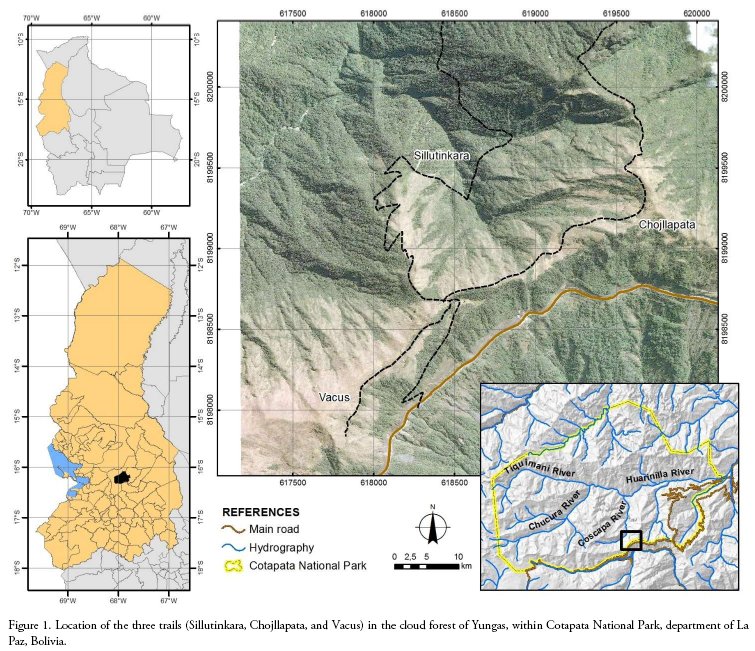
</front><body><![CDATA[ <p align="right"><b><font face="Verdana, Arial, Helvetica, sans-serif" size="2">Art&iacute;culo</font></b></p>     <p align="right">&nbsp;</p>     <p align="center"><b><font face="Verdana, Arial, Helvetica, sans-serif" size="4">Floral ecology and floral visitors of <i>Puya atra </i>(Bromeliaceae), a Bolivian endemic plant</font></b></p>     <p align="center">&nbsp;</p>     <p align="center"><b><font face="Verdana, Arial, Helvetica, sans-serif" size="3">Ecología floral y visitantes florales de <i>Puya atra </i>(Bromeliaceae), una planta endémica boliviana</font></b></p>     <p align="center">&nbsp;</p>     <p align="center">&nbsp;</p>     <p align="center"><b><font face="Verdana, Arial, Helvetica, sans-serif" size="2">Paola Velásquez-Noriega<sup>1</sup>*, César Mayta<sup>2</sup>, Elmer Cuba<sup>3</sup>, Emilia García E.<sup>1</sup>, Flavia Montaño-Centellas<sup>4</sup> &amp; Thorsten Krömer<sup>5</sup></font></b></p>     <p align="center"><b><font face="Verdana, Arial, Helvetica, sans-serif" size="2"><sup></sup></font></b><font face="Verdana, Arial, Helvetica, sans-serif" size="2"><sup>1</sup>Herbario Nacional de Bolivia, Instituto de Ecología, Universidad Mayor de San Andrés, c/27 Cota Cota, Campus</font> <font face="Verdana, Arial, Helvetica, sans-serif" size="2">Universitario, Casilla 1007 - Correo Central, La Paz, Bolivia.</font>    <br>   <font face="Verdana, Arial, Helvetica, sans-serif" size="2"><sup>2</sup>Departamento de Biología, Universidad de La Serena, Benavente 980, Casilla 554, La Serena, Chile.</font>     ]]></body>
<body><![CDATA[<br> <font face="Verdana, Arial, Helvetica, sans-serif" size="2"><sup>3</sup>Simbiosis srl., Av. Arce 2105, edif Venus, 3A, La Paz, Bolivia.</font>    <br> <font face="Verdana, Arial, Helvetica, sans-serif" size="2"><sup>4</sup>Department of Wildlife Ecology and Conservation, University of Florida, Gainesville, Florida 32611, USA.</font>    <br> <font face="Verdana, Arial, Helvetica, sans-serif" size="2"><sup>4</sup>Centro de Investigaciones Tropicales (CITRO), Universidad Veracruzana, José María Morelos 44-46, CP 9100,</font> <font face="Verdana, Arial, Helvetica, sans-serif" size="2">Xalapa, Veracruz, Mexico.</font></p>     <p align="center"><font face="Verdana, Arial, Helvetica, sans-serif" size="2">*Autora de correspondencia: <a href="mailto:paola.vn19@gmail.com">paola.vn19@gmail.com</a></font></p>     <p align="center"><font face="Verdana, Arial, Helvetica, sans-serif" size="2"><b>Recibido:</b> 07.11.19, <b>Aceptado:</b> 12.01.20.</font></p>     <p align="center">&nbsp;</p>     <p align="center">&nbsp;</p> <hr align="JUSTIFY" noshade>     <p align="justify"><font face="Verdana, Arial, Helvetica, sans-serif" size="2"><b>Abstract</b></font></p>     <p align="justify"><font face="Verdana, Arial, Helvetica, sans-serif" size="2">Hummingbirds and bromeliad species of the genus <i>Puya </i>occur exclusively in the Neotropics. Their interaction is important for the reproduction and genetic variability of these plants. To understand this relationship, it is important to study the phenology of<i> Puya </i>species, their floral characteristics, and their floral visitors. In this work, we studied the floral ecology of the Bolivian endemic <i>Puya atra, </i>which grows in the montane cloud forests of the Yungas. We made monthly visits to the study area for two years to record phenology data, to collect nectar samples, and to make direct observations of floral visitors (539 observation hours) during its three-months of flowering. In this period, <i>P. atra </i>produced 8.09 &plusmn; 1.59 &#956;L of nectar per flower, which contains fructose and glucose. We confirmed that <i>P. atra </i>is visited by two species of longed-bill hummingbirds: <i>Coeligena violifer </i>and <i>Pterophanes cyanopterus, </i>being males of both species the main visitors. The morphology of both visitors allows contact with the reproductive parts of its flowers and the transfer of pollen, while the plant rewards hummingbirds with nectar. It seems that <i>P. cyanopterus </i>showed a tight synchronisation with the plant's phenology and visited more frequently with a greater abundance of flowers, showing a positive interaction with <i>P. atra. </i>However, it is necessary to continue with different studies on the breeding system and sugar production throughout the day of this <i>Puya </i>species as well as the behavioural response of these hummingbirds in its presence. </font></p>     <p align="justify"><font face="Verdana, Arial, Helvetica, sans-serif" size="2"><b>Key words</b>: Bolivia, Montane cloud forest, Ornithophily, Phenology, Trochilidae.</font></p> <hr align="JUSTIFY" noshade>     ]]></body>
<body><![CDATA[<p align="justify"><font face="Verdana, Arial, Helvetica, sans-serif" size="2"><b>Resumen</b></font></p>     <p align="justify"><font face="Verdana, Arial, Helvetica, sans-serif" size="2">Los colibríes y especies de bromeliáceas del género <i>Puya </i>se distribuyen exclusivamente en el Neotrópico. Su interacción es importante para la reproducción y la variabilidad genética de dichas plantas. Para comprender esta relación, es importante estudiar la fenología de las especies de <i>Puya, </i>sus características y visitantes florales. En este estudio analizamos la ecología floral de la especie endémica boliviana <i>Puya atra, </i>que crece en el bosque nublado montano de los Yungas. Visitamos el área de estudio mensualmente durante dos años para registrar datos de fenología, colectar muestras de néctar y hacer observaciones directas de visitantes florales (539 horas de observación) durante tres meses de su floración. En este periodo, <i>P. atra </i>produjo 8.09&plusmn; 1.59 &#956;L de néctar por flor, el cual contenía fructuosa y glucosa. Confirmamos que <i>P. atra </i>es visitada por dos especies de colibríes de pico largo: <i>Coeligena violifer </i>y <i>Pterophanes cyanopterus, </i>siendo los machos los principales visitantes para ambas especies. La morfología de ambos visitantes permite el contacto con las partes reproductivas de las flores y la transferencia de polen, mientras que la planta ofrece a los colibríes néctar. Al parecer <i>P. cyanopterus </i>mostró una estrecha sincronización con la fenología de la planta y la visitó con mayor frecuencia cuando hay mayor abundancia de flores, mostrando una interacción positiva con <i>P. atra. </i>Sin embargo, es necesario continuar con diferentes estudios sobre su sistema de reproducción y la producción de azúcar a lo largo del día de esta especie de <i>Puya, </i>así como la respuesta comportamental de estos colibríes en su presencia. </font></p>     <p align="justify"><font face="Verdana, Arial, Helvetica, sans-serif" size="2"><b>Palabras clave </b>: Bolivia, Bosque nublado montano, Fenología, Ornitofilia, Trochilidae.</font></p> <hr align="JUSTIFY" noshade>     <p align="justify">&nbsp;</p>     <p align="justify">&nbsp;</p>     <p align="justify"><font size="2"><b><font size="3" face="Verdana, Arial, Helvetica, sans-serif">Introduction</font></b></font></p>     <p align="justify"><font face="Verdana, Arial, Helvetica, sans-serif" size="2">Angiosperms have developed several mechanisms to ensure the arrival of pollen to the stigma of the flower and the consequent fertilisation, which in many cases occurs with the participation of pollinating organisms (Dafni 1992). There are several examples of how plants attract pollinators and ways in which interspecific relationships are established (Faegri &amp; Van der Pijl 1979). Thus, co-adaptation between pairs or groups of species is partially explained by mutualistic interactions (Jordano 1987, Thompson 2005, Bascompte &amp; Jordano 2007). This kind of relationships occur between birds and several angiosperms, since many bird species are effective pollinators, and most plants offer nectar as the main reward for this service (Snow 1981, Proctor <i>et al. </i>1996).</font></p>     <p align="justify"><font face="Verdana, Arial, Helvetica, sans-serif" size="2">Bromeliaceae is a widely distributed Neotropical family with about 3600 species in 75 genera (Gouda <i>et al. </i>2019). These plants are characterised by forming rosettes and having inflorescences with showy bracts and flowers in many of the species (Varadarajan &amp; Brown 1988, Benzing 2000). Of the 321 species of Bromeliaceae in Bolivia distributed from the Andean paramo to the tropical lowlands, there are 146 endemics (Krömer <i>et al. </i>2014). One example is <i>Puya atra </i>L.B. Sm., which grows in rocky areas and humid montane forests of the Yungas in the departments of La Paz, Cochabamba, and Santa Cruz between 2,500-3,500 m (Kr&ouml;mer <i>et al. </i>1999, 2014). This terrestrial or saxicolous plant can form thick patches or grow as isolated individuals. According to the morphological characteristics of its flowers, and considering other similar <i>Puya </i>species, ornithophily by hummingbirds (Trochilidae) has been deduced as the main pollination mode for this species (Kr&ouml;mer <i>et al. </i>2006).</font></p>     <p align="justify"><font face="Verdana, Arial, Helvetica, sans-serif" size="2">Ornithophily has been reported to be the most common pollination syndrome for the family (Benzing 2000, Kessler &amp; Kr&ouml;mer 2000, Kr&ouml;mer <i>et al. </i>2008), and hummingbirds are their main visitors and pollen vectors (Canela &amp; Sazima 2005, Kr&ouml;mer <i>et al. </i>2006, Kessler <i>et al. </i>2020). Their interaction originated in the early Tertiary period, and apparently, a (diffuse) co-adaptation between both families has occurred since then (Buzato <i>et al. </i>2000, Givnish <i>et al. </i>2014). This system of mutualistic interaction between bromeliads and hummingbirds is quite particular, given the endemic nature of both families in the Neo tropics.</font></p>     <p align="justify"><font face="Verdana, Arial, Helvetica, sans-serif" size="2">Nectar is the most common reward that animal-pollinated plants offer to their mutualists (Proctor 1996). Glucose, fructose, and sucrose are the main components of nectar sugars, which also represent the largest amount of energy for consumers (Stiles &amp; Freeman 1993, Baker <i>et al. </i>1998, Petanidou <i>et al. </i>2006). Hummingbirds are the most</font> <font face="Verdana, Arial, Helvetica, sans-serif" size="2">important group of nectarivore birds in the Neotropics (Schuchmann 1999). Also, the primary visitors of bromeliad species whose nectar is usually sucrose rich, while bromeliads pollinated by bats or passerine birds tent to secrete hexose rich nectars composed mainly of sucrose (Scogin &amp; Freeman 1984, Baker <i>et al. </i>1998, Galetto &amp; Bernardello 2003, Krömer <i>et al. </i>2008, Gottlinger <i>et al. </i>2019).</font></p>     ]]></body>
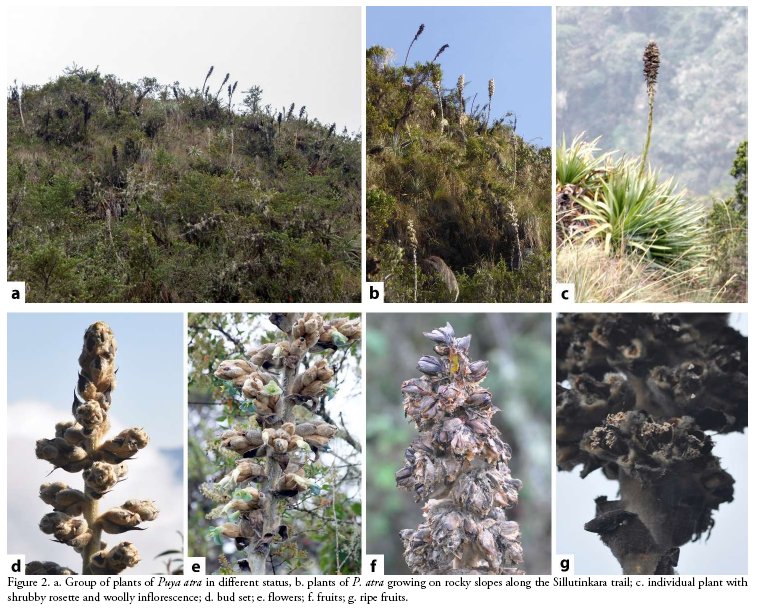
<body><![CDATA[<p align="justify"><font face="Verdana, Arial, Helvetica, sans-serif" size="2">Characterising the reproductive phenology of plants is very important in mutualistic interactions, because it is fundamental to understand the dynamics of the community (Williams <i>et al. </i>1999). The time, duration and degree of synchrony of the different phenological phases have important implications for the quantity and quality of resources available to consumers (Williams <i>et al. </i>1999, Bascompte &amp; Jordano 2007, Elmendorf <i>et al. </i>2016).</font></p>     <p align="justify"><font face="Verdana, Arial, Helvetica, sans-serif" size="2">Due to the sessile nature of plants, pollination and seed dispersal are the most important processes to ensure gene flow among plant communities (Barrett &amp; Harder 1996). Identification of key biotic dispersal agents is essential to conserve communities and ecosystems, especially for those families with many endemic species such as Bromeliaceae. In this sense, the present study aims to examine the floral ecology of the endemic bromeliad <i>P. atra, </i>in a cloud forest of the Cotapata National Park, La Paz, Bolivia. Specifically, we want to describe the phenology of this species, the nectar production and composition, and determine their floral visitors.</font></p>     <p align="justify">&nbsp;</p>     <p align="justify"><font face="Verdana, Arial, Helvetica, sans-serif" size="3"><b>Methods</b></font></p>     <p align="justify"><font face="Verdana, Arial, Helvetica, sans-serif" size="2"><b>Study area</b></font></p>     <p align="justify"><font face="Verdana, Arial, Helvetica, sans-serif" size="2">The study was conducted in Cotapata National Park and Natural Area of Integrated Management located in La Paz, Bolivia, where <i>P. atra </i>populations were recorded along three transects, each one along the main trails of the protected area (Sillutinkara, Chojllapata and Vacus; 67&deg;53'28,848&quot;W, 16&deg;17 23,573&quot;S, 3,000-3,500 m (<a href="#f1">Fig. 1</a>). The park is located about 30 km NE from La Paz city. It occupies the Yungas ecoregion (Ibisch 1998), characterised by the orographic influence of winds laden with high atmospheric moisture, which causes almost permanent fog, low temperatures (between 10—12&deg;C approximately) and high levels of precipitation (more than 2500 mm). The vegetation is arboreal and shrubby, with twisted trunks and coriaceous leaves, and occurs in crests, tops and slopes of very steep mountains (Ribera 1995). This montane cloud forest has a vertical structure of three or four strata, with a continuous canopy that reaches up to 10 meters high (Meneses <i>et al. </i>2004).</font></p>     <p align="center"><a name="f1"></a><img src="/img/revistas/reb/v55n1/a05_figure_01.jpg" width="755" height="651"></p>     <p align="justify"><font face="Verdana, Arial, Helvetica, sans-serif" size="2"><b>Species of study</b></font></p>     <p align="justify"><font face="Verdana, Arial, Helvetica, sans-serif" size="2">In the study area, <i>P. atra </i>occurs on rocky slopes between 2,500 and 3,500 m (Kr&ouml;mer 2000). This endemic species consists of a shrubby rosette of 1 m in diameter and its inflorescence with scape up to 2 m high (<a href="#f2">Fig. 2a-c</a>). Leaves are abundant, triangular and spiny. The inflorescence is large, cylindrical, woolly pubescent, and densely branched, with green to blue-green tubular flowers about 16-25 mm long (Smith &amp; Downs 1974).</font></p>     <p align="center"><a name="f2"></a><img src="/img/revistas/reb/v55n1/a05_figure_02.jpg" width="757" height="610"></p>     ]]></body>
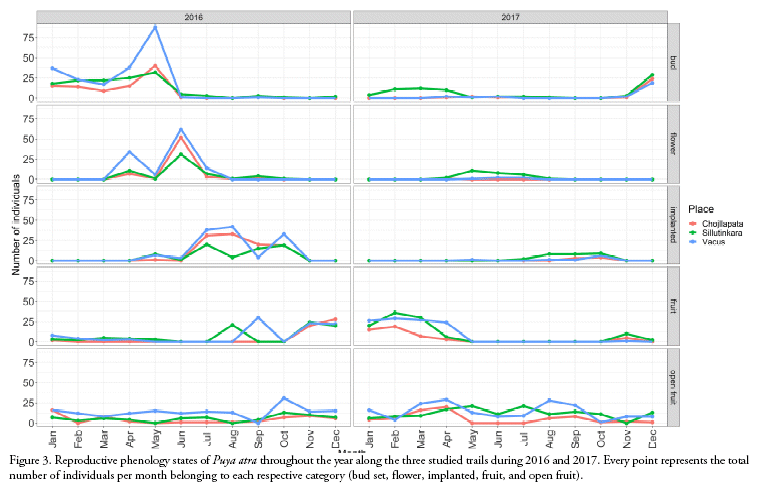
<body><![CDATA[<p align="justify"><font face="Verdana, Arial, Helvetica, sans-serif" size="2"><b>Plant reproductive phenology</b></font></p>     <p align="justify"><font face="Verdana, Arial, Helvetica, sans-serif" size="2">The three transects were visited monthly from January 2016 to December 2017 to record data on the reproductive phenology of the species. The phenophase of an average of 182 individuals unevenly distributed on rocks and steep slopes across the whole three transects was recorded in the same order during each visit. Though these individuals were not marked due to difficult accessibility (<a href="#f2">Fig. 2a</a>), they were easily identifiable and distinguishable by observation with the naked eye or use of binoculars from the transects.</font></p>     <p align="justify"><font face="Verdana, Arial, Helvetica, sans-serif" size="2">We described the phenophase as the following (<a href="#f2">Fig. 2d-g</a>): (1) <i>bud set, </i>from the first appearance of the young inflorescence within the rosette, with about 13 cm until it reaches a height of 100 cm or more with scape, bracts and buds separated; (2) <i>flowers, </i>from the moment the first corolla leaves appear in the inflorescence, with light green or bluish-green colours; (3) <i>flowers implanted, </i>when all corollas have formed spirals, the stem and the petals acquire a yellow colour because they begin to wilt; (4) <i>fruits, </i>when the immature fruits develop; and (5) <i>open fruits, </i>when the dehiscent capsules have opened and they release the seeds in different periods without a particular sequence. At this time, the whole plant turns brown. With all these data, a diagram of plant phenology was elaborated (<a href="#f3">Fig. 3</a>).</font></p>     <p align="center"><a name="f3"></a><img src="/img/revistas/reb/v55n1/a05_figure_03.gif" width="757" height="484"></p>     <p align="justify"><font face="Verdana, Arial, Helvetica, sans-serif" size="2"><b>Nectar composition</b></font></p>     <p align="justify"><font face="Verdana, Arial, Helvetica, sans-serif" size="2">Due to their easier accessibility fifteen selected inflorescences were covered with tulle bags to prevent the visitors' entry. The total volume of nectar present in each</font> <font face="Verdana, Arial, Helvetica, sans-serif" size="2">flower was harvested as soon as the flower opened between 6:30-7:00 h by inserting micro capillaries of 80 &#956;l (Scogin &amp; Freeman 1984). The flower was extracted from an inflorescence in order to obtain each sample of nectar, and thus we were only able to measure each flower once. To estimate the volume of nectar produced by plants, 75 nectar samples from individual flowers of these fifteen</font> <font face="Verdana, Arial, Helvetica, sans-serif" size="2">inflorescences were measured with micro capillaries. Then, the volume values of those were averaged (García &amp; Hoc 1998). The sugar composition was measured in nectar samples of 18 flowers from these inflorescences by Nuclear Magnetic Resonance (NMR) spectroscopy in the Laboratorio de Biorganica of the Instituto de Investigaciones Químicas (at UMSA).</font></p>     <p align="justify"><font face="Verdana, Arial, Helvetica, sans-serif" size="2"><b>Floral visitors</b></font></p>     <p align="justify"><font face="Verdana, Arial, Helvetica, sans-serif" size="2">Previous direct observations during five consecutive days and nights allowed us to determine that the only visitors of <i>P. atra </i>at our study area were hummingbirds, while no other diurnal or nocturnal animals such as insects or bats have been noticed. Thus, our observation was conducted without pause from 8:00-19:00 h; the duration was adjusted according to light availability and bird activity (Canela &amp; Sazima 2005) for a total of 539 hours (49 days in total, for both years).</font></p>     <p align="justify"><font face="Verdana, Arial, Helvetica, sans-serif" size="2">Before collecting the data of interactions, we identified observation areas (three at Vacus, four at Chojllapata and five at Sillutinkara). We considered an observation area of a half circle with a 20 m radius, from a point on the trail</font> <font face="Verdana, Arial, Helvetica, sans-serif" size="2">and looking to one side of the trail (i.e., left or right due to visibility). This method allowed us for an accurate identification of visitors (Ortiz-Pulido <i>et al. </i>2012). Each observation area included more than two individual plants with available flowers grouped in clusters. The edges of the observation areas were at least 100 m apart from each other (Gonzalez &amp; Loiselle 2016).</font></p>     <p align="justify"><font face="Verdana, Arial, Helvetica, sans-serif" size="2">To analyse the activity of hummingbirds throughout the day, we divided the observation time in 11 one-hour intervals, in which we observed the frequency of visits for a whole hour each in the same <i>Puya </i>individuals (Woods &amp; Ramsay 2001). This interval assignment allowed us to compare the daily activity patterns between hummingbird species   and <i>P.   atra.   </i>Fifty-seven   inflorescences   were</font> <font face="Verdana, Arial, Helvetica, sans-serif" size="2">observed during 2016 (Sillutinkara: 35, Chojllapata: 10 and Vacus: 12), while only four inflorescences were observed along the Sillutinkara trail in 2017. We calculated the frequency of visits for each species, considering a visit</font> <font face="Verdana, Arial, Helvetica, sans-serif" size="2">as each event in which a hummingbird individual sipped nectar from a plant by inserting its bill into a flower within a one-hour interval (Vázquez <i>et al. </i>2005).</font></p>     ]]></body>
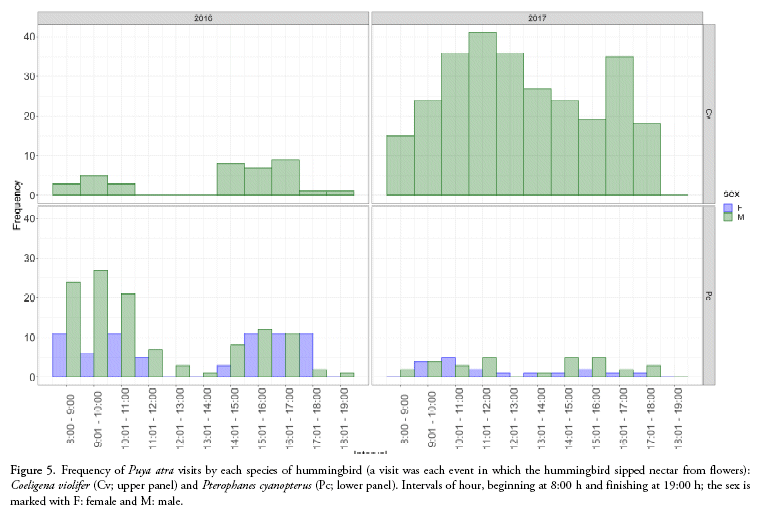
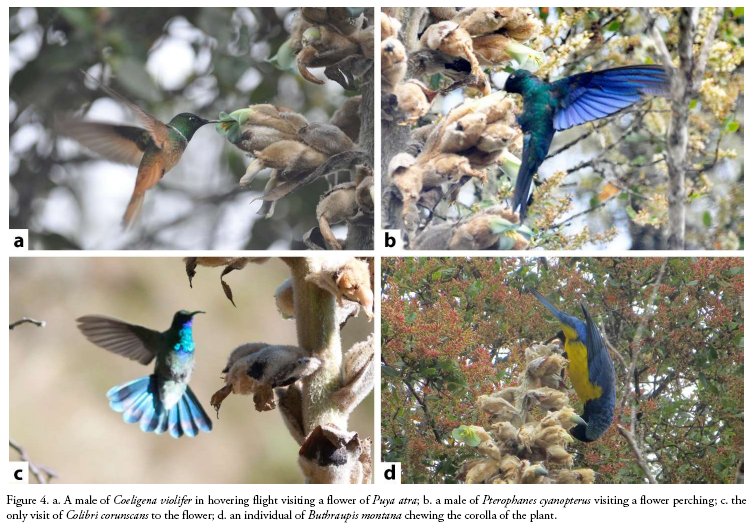
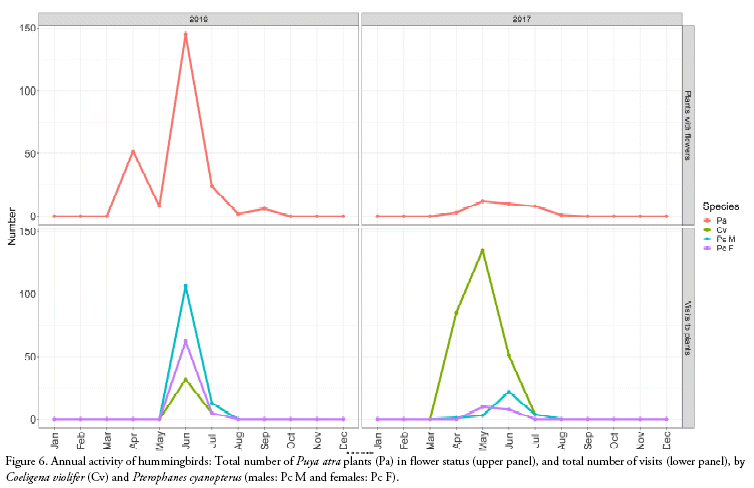
<body><![CDATA[<p align="justify">&nbsp;</p>     <p align="justify"><font face="Verdana, Arial, Helvetica, sans-serif" size="3"><b>Results</b></font></p>     <p align="justify"><font face="Verdana, Arial, Helvetica, sans-serif" size="2">Two species of hummingbirds (<i>Coeligena violifer </i>Gould 1846, only males and <i>Pterophanes cyanopterus </i>Fraser 1839, both sexes) were recorded visiting 61 individuals of <i>P. atra </i>(<a href="#f4">Fig. 4a-b</a>). In addition, there was a single event in which <i>Colibri coruscans </i>Gould 1846 sipped nectar from a single individual plant (<a href="#f4">Fig. 4c</a>), and the passerine birds <i>Cacicus chrysonotus </i>d'Orbigny and Lafresnaye 1838 and <i>Buthraupis montana </i>d'Orbigny and Lafresnaye 1837 chewing the corolla of one plant each (<a href="#f4">Fig. 4d</a>).</font></p>     <p align="center"><a name="f4"></a><img src="/img/revistas/reb/v55n1/a05_figure_04.jpg" width="753" height="531"></p>     <p align="justify"><font face="Verdana, Arial, Helvetica, sans-serif" size="2"><b>Reproductive phenology</b></font></p>     <p align="justify"><font face="Verdana, Arial, Helvetica, sans-serif" size="2">We observed around 182 individuals along the three trails (Sillutinkara: 75&plusmn;26, Chojllapata: 50&plusmn;16, and Vacus: 57&plusmn;20). The inflorescences of <i>P. atra </i>had an average of 19 &plusmn; 9.72 open flowers (CV: 87.64%; range: 1-35 flowers, n = 211) over its flowering period of three months, producing 7 flowers every 4 &plusmn; 1 days. The flowers of <i>P.</i> <i>atra </i>open early in the morning (&#8776; 6:00 am) and remain open for three days and nights. The different phenological states and durations were the following: bud set developed for about five months, from January to May; flowers were available from March to June, the implanted state lasted for six months (May to October), while the fruits lasted</font> <font face="Verdana, Arial, Helvetica, sans-serif" size="2">around nine months (August to April); and open fruits were recorded throughout the year (<a href="#f3">Fig. 3</a>).</font></p>     <p align="justify"><font face="Verdana, Arial, Helvetica, sans-serif" size="2"><b>Nectar composition</b></font></p>     <p align="justify"><font face="Verdana, Arial, Helvetica, sans-serif" size="2">Mean total nectar volume during anthesis was 61.78 &plusmn; 13.87 &#956;L per inflorescence per day (n = 75 flowers from 15 individuals). Individuals produced 8.09 &plusmn; 1.59 &#956;L of nectar per flower. According to the NMR results, it was determined that the major compounds in the nectar and their respective concentrations were the following: 3% &#946;-fructofuranose, 18% &#946; -fructopyranose, 11% &#946;-glucopyranose and 6% </font><font size="2">&#945;</font><font face="Verdana, Arial, Helvetica, sans-serif" size="2">-glucopyranose, as well as traces of sucrose and 62% of water.</font></p>     <p align="justify"><font face="Verdana, Arial, Helvetica, sans-serif" size="2"><b>Floral visitors</b></font></p>     <p align="justify"><font face="Verdana, Arial, Helvetica, sans-serif" size="2">The frequency of activity for the two identified floral visitors of <i>P.</i> <i>atra </i>during the two years of sampling showed that <i>C. violifer </i>had a higher activity during the second year: the highest peak of activity changed from one year to another (<a href="#f5">Fig. 5</a>). For <i>P. cyanopterus, </i>the levels of activity were different between males and females, and there was a higher activity in general during the first year. Males were more active in the morning hours at 8:00-11:00 h, especially during the first year. Females showed roughly the same frequency of visits throughout the day (<a href="#f5">Fig. 5</a>) with slightly more activity at 8:00-11:00 h and 15:01-18:00 h.</font></p>     ]]></body>
<body><![CDATA[<p align="center"><a name="f5"></a><img src="/img/revistas/reb/v55n1/a05_figure_05.gif" width="759" height="512"></p>     <p align="justify"><font face="Verdana, Arial, Helvetica, sans-serif" size="2">During the two years, the main flowering period was around June, but the numbers of inflorescences were highly variable in these two years (<a href="#f3">Fig. 3</a>). However, during both years the plants received the same visitors, although in the first year the principal visitors were males of <i>P. cyanopterus </i>and in the second year males of <i>C. violifer </i>(<a href="#f6">Fig. 6</a>).</font></p>     <p align="center"><a name="f6"></a><img src="/img/revistas/reb/v55n1/a05_figure_06.gif" width="754" height="488"></p>     <p align="center">&nbsp;</p>     <p align="justify"><font face="Verdana, Arial, Helvetica, sans-serif" size="3"><b>Discussion</b></font></p>     <p align="justify"><font face="Verdana, Arial, Helvetica, sans-serif" size="2"><b>Reproductive phenology</b></font></p>     <p align="justify"><font face="Verdana, Arial, Helvetica, sans-serif" size="2">Our results suggest that the reproductive cycle of <i>P. atra </i>is annual; the flowering period occurs once a year, similar to</font> <font face="Verdana, Arial, Helvetica, sans-serif" size="2">most other species of Bromeliaceae (Benzing 2000, Machado &amp; Semir 2006, Wendt <i>et al. </i>2008). During the two years of study <i>P. atra </i>had a well-delimited period of flowering from March to June, which is consistent with the dry season in the Yungas area (April to September). During this period, other plant species with flowers are scarce in the same area, which makes <i>P. atra </i>an important food resource for hummingbirds. This close relationship has also been reported in other studies on <i>Puya </i>species at high elevations in Peru (Salinas <i>et al. </i>2007, Hornung-Leoni <i>et al. </i>2013).</font></p>     <p align="justify"><font face="Verdana, Arial, Helvetica, sans-serif" size="2"><b><i>Nectar composition</i></b></font></p>     <p align="justify"><font face="Verdana, Arial, Helvetica, sans-serif" size="2">Within the nectar composition, we detected sugars of fructose and glucose in their different cyclic forms. These sugars, along with sucrose, have been reported for other species of <i>Puya, </i>although their respective proportions changed according to the group of visitors (i.e. high sucrose content in the nectars of hummingbird flowers vs. low sucrose content in perching bird flowers) (Scogin &amp; Freeman 1984, Baker <i>et al. </i>1998). A comprehensive study of nectar composition in different genera of Bromeliaceae showed that the nectar always contained glucose, fructose and sucrose (Kr&ouml;mer <i>et al. </i>2008), and according to the floral syndrome, nectars of bromeliad species pollinated by hummingbirds are generally sucrose-rich (Galetto &amp; Bernardello 2003, Kr&ouml;mer <i>et al. </i>2008, Gottlinger <i>et al.</i></font> <font face="Verdana, Arial, Helvetica, sans-serif" size="2">2019). However, the NMR, which detects cyclical structures of sugars more accurately, only detected trace amounts of sucrose and only found glucose and fructose in cyclical forms in the nectar of <i>P. atra, </i>which in our study area is only visited by hummingbirds. Thus, this species of Bromeliaceae is not sucrose-rich, but shows a predominance of hexoses as other <i>Puya </i>species pollinated by passerine birds (Scogin &amp; Freeman 1984, Baker <i>et al. </i>1998). Nevertheless, hummingbirds are able to digest fructose and glucose equally and use them as a source of energy (Chen &amp; Welch 2014).</font></p>     <p align="justify"><font face="Verdana, Arial, Helvetica, sans-serif" size="2"><b><i>Floral visitors</i></b></font></p>     ]]></body>
<body><![CDATA[<p align="justify"><font face="Verdana, Arial, Helvetica, sans-serif" size="2">The results obtained in this study showed that <i>P. atra </i>is a species visited almost exclusively by two species of long-</font><font face="Verdana, Arial, Helvetica, sans-serif" size="2">billed hummingbirds, consistent with its flower morphology (tubular corolla), an thesis (opens early in the morning), phenology and nectar characteristics (diluted with 62% of water and 38% of sugars). This is similar to other studies on mainly hummingbird-visited <i>Puya </i>species in the Colombian and Peruvian Andes, such as <i>P. rauhii </i>L.B. Sm., <i>P. alpestris </i>Poepp. Gay, <i>P. coerulea </i>Miers, <i>P. raimondii </i>Harms, <i>P. venusta </i>Phil., <i>P. nitida </i>Mez. and <i>P. trianae </i>Baker (Hornung-Leoni &amp; Sosa 2005, Salinas <i>et al. </i>2007, Hornung-Leoni <i>et al. </i>2013, Restrepo-Chica &amp; Bonilla-Gómez 2017), supporting a co-adaptation between species of both families, Bromeliaceae and Trochilidae. However, passerine birds from different families (Emberizidae, Thraupidae, Mimidae, Tyrannidae and Icteridae) have also been observed visiting some of these <i>Puya </i>species, whereas bat-pollination has been recorded for two other <i>Puya </i>species (Aguilar-Rodríguez <i>et al. </i>2019). The passerine birds <i>C. chrysonotus </i>and <i>B. montana </i>that visited <i>P. atra </i>chewed the plant's corolla, which has also been reported for <i>Zonotrichia capensis </i>Statius Müller 1776, <i>Geospizopsis plebejus </i>Tschudi 1844, <i>G. unicolor </i>d'Orbigny and Lafresnaye 1837, and <i>Phrygilus punensis </i>Ridway 1887 in <i>P. raimondii </i>(Salinas <i>et al. </i>2007).</font></p>     <p align="justify"><font face="Verdana, Arial, Helvetica, sans-serif" size="2">The flowers of <i>P.</i> <i>atra </i>remain open throughout three days and nights, when the reproductive organs of the plant remain accesible to visitors (anthesis). However, we did not observe other diurnal or nocturnal visitors such as insects or bats, only hummingbirds. This may be explained by the high elevation of 3,500 m in which the species grows, where the activity of bats and insects is very low, especially at night and early in the morning due to the low temperatures (Kessler &amp; Kr&ouml;mer 2000, Kr&ouml;mer <i>et al. </i>2006). A probable reason for the predominance of hummingbirds as pollinators in cold and humid montane habitats is that they are the best-adapted major biotic pollinator group under these conditions, whereas insects and bats are physiologically limited (Givnish <i>et al. </i>2014, Kessler <i>et al. </i>2020). As endothermic organisms, hummingbirds can function even at low temperatures, and their ability to fall into torpor at night is highly energy-efficient (Proctor <i>et al. </i>1996, Abrahamczyk &amp; Kessler 2015).</font></p>     <p align="justify"><font face="Verdana, Arial, Helvetica, sans-serif" size="2"><i>Pterophanes cyanopterus </i>seems to be the main visitor of <i>P. atra, </i>whose plants are synchronising their flowering state with the visits of this hummingbird species. When the number of plants with flowers was high in the first year, the number of visits by <i>P. cyanopterus </i>was also high, and in the second year when the abundance of flowering plants decreased the number of visits was low as well. Although <i>P. atra </i>showed a high inter-annual variation, it seems that there is a specialisation with this hummingbird even though long-bill hummingbirds have been considered unspecialised (Cotton 1998) and it has been suggested that hummingbirds at high elevations can be flexible consumers</font> <font face="Verdana, Arial, Helvetica, sans-serif" size="2">and less dependent on particular sources of nectar compared to low elevation hummingbirds (Woods &amp; Ramsay 2001). This contrasts to what was found in <i>P. raimondii </i>where the inter-annual variation does not permit a specialisation with its visitors (Salinas <i>et al. </i>2007).</font></p>     <p align="justify"><font face="Verdana, Arial, Helvetica, sans-serif" size="2"><i>Pterophanes cyanopterus </i>showed greater activity in the morning during the first year, whereas during the second year, it had a more constant activity throughout the day. This may be a result of the possible synchronisation between the plant and hummingbird mutualism. It is possible that <i>P. cyanopterus </i>may have learned about the plant reward availability; and the plant, in turn, might replenish its nectar after visitor removal as has been shown for other bromeliad species (Nepi <i>et al. </i>2001, Ordano &amp; Ornelas 2004). Whereas <i>C. violifer </i>showed greater activity during the afternoon in the first year, and in the second year it showed activity throughout the day. This is in contrast to the results obtained for <i>P. hamata </i>L.B. Smith where the highest activity for feeding of hummingbirds was between 14:00-15:00 h (Woods &amp; Ramsay 2001).</font></p>     <p align="justify">&nbsp;</p>     <p align="justify"><font face="Verdana, Arial, Helvetica, sans-serif" size="3"><b>Conclusions</b></font></p>     <p align="justify"><font face="Verdana, Arial, Helvetica, sans-serif" size="2">This study showed that <i>P. cyanopterus </i>and <i>C. violifer </i>are the primary visitors of <i>P. atra, </i>which is an important resource of nectar since there are not many other plants in bloom during the dry season in the montane cloud forest. <i>Puya atra </i>had a well-delimited period of flowering from March to June, which is consistent with the dry season in the Yungas area. Additionally, it seems that <i>P. cyanopterus </i>has a synchronisation with the plant and that it is more sensitive to temporal and spatial resource variation at high-altitudes where climatic conditions become difficult (Woods &amp; Ramsay 2012). <i>Pterophanes cyanopterus </i>is not only the main floral visitor of <i>P. atra </i>but also probably its main pollinator, as its morphology benefits the interaction between them. By having a larger body and bill size, this hummingbird usually made contact with the stigma and stamens when visiting the plant, which allows for transporting the pollen on the forehead. However, future studies about the breeding system and nectar production throughout the day would provide important information to better understand the dependence of cloud forest bromeliads to pollinators.</font></p>     <p align="justify">&nbsp;</p>     <p align="justify"><font face="Verdana, Arial, Helvetica, sans-serif" size="3"><b>Acknowledgments</b></font></p>     <p align="justify"><font face="Verdana, Arial, Helvetica, sans-serif" size="2">We would like to thank the Fondos de investigacion Erika Geyger for financing the research work. To Optics for the Tropics and Idea Wild for their support with equipment. To ANMI Cotapata for allowing us to enter the study area and DGBAP for the permissions. To Christian Ramos for help with graphics and suggestions. To Yonny Flores for processing the nectar samples. To Mariana Villegas, Isabel Gomez, Daniel Larrea, Sissi Lozada, Luis Pacheco and Leila Porter for commenting on the manuscript.</font></p>     ]]></body>
<body><![CDATA[<p align="justify">&nbsp;</p>     <p align="justify"><font face="Verdana, Arial, Helvetica, sans-serif" size="3"><b>References</b></font></p>     <p align="justify"><font size="2" face="Verdana, Arial, Helvetica, sans-serif">Abrahamczyk, S. &amp; M. Kessler. 2015. Morphological and behavioural  adaptations to feed on nectar: how feeding ecology determines the diversity and  composition of hummingbird assemblages. Journal of Ornithology 156(2): 333-347.</font></p>     <p align="justify"><font size="2" face="Verdana, Arial, Helvetica, sans-serif">Aguilar-Rodr&iacute;guez, P.A., T. Kr&ouml;mer, M. Tschapka, J.G. Garc&iacute;a-Franco  &amp; M.C. MacSwiney. 2019. Bat pollination in Bromeliaceae. Plant Ecology  &amp; Diversity 12(1): 1&ndash;19.</font></p>     <p align="justify"><font size="2" face="Verdana, Arial, Helvetica, sans-serif">Baker, H.G., I. Baker &amp; S.A. Hodges. 1998. Sugar composition of nectars  and fruits consumed by birds and bats in the tropics and subtropics. Biotropica 30(4): 559-586.</font></p>     <p align="justify"><font size="2" face="Verdana, Arial, Helvetica, sans-serif">Barrett, S.C. &amp; L.D. Harder. 1996. Ecology and evolution of plant mating. Trends in Ecology &amp;  Evolution 11(2): 73-79.</font></p>     <p align="justify"><font size="2" face="Verdana, Arial, Helvetica, sans-serif">Bascompte, J. &amp; P. Jordano. 2007. Plant-animal mutualistic networks:  the architecture of biodiversity. Annual Review of Ecology, Evolution and  Systematic 38: 567-593.</font></p>     <!-- ref --><p align="justify"><font size="2" face="Verdana, Arial, Helvetica, sans-serif">Benzing, D. H. 2000. Bromeliaceae: profile of an adaptive radiation.  Cambridge University Press. </font>&nbsp;&nbsp;&nbsp;&nbsp;&nbsp;&nbsp;&nbsp;&nbsp;[&#160;<a href="javascript:void(0);" onclick="javascript: window.open('/scielo.php?script=sci_nlinks&ref=034464&pid=S1605-2528202000010000500006&lng=','','width=640,height=500,resizable=yes,scrollbars=1,menubar=yes,');">Links</a>&#160;]<!-- end-ref --><p align="justify"><font size="2" face="Verdana, Arial, Helvetica, sans-serif">Buzato, S., M. Sazima &amp; I. Sazima. 2000.  Hummingbirdpollinated floras at three Atlantic forest sites. Biotropica 32(4b):  824-841.</font></p>     <p align="justify"><font size="2" face="Verdana, Arial, Helvetica, sans-serif">Canela, M.B.F. &amp; M. Sazima. 2005. The pollination of <i>Bromelia antiacantha</i> (Bromeliaceae)  in southeastern Brazil: ornithophilous versus melittophilous features. Plant  Biology 7(04): 411-416.</font></p>     ]]></body>
<body><![CDATA[<p align="justify"><font size="2" face="Verdana, Arial, Helvetica, sans-serif">Chen, C.C.W. &amp; K.C. Welch Jr. 2014. Hummingbirds can fuel expensive  hovering flight completely with either exogenous glucose or fructose.  Functional Ecology 28(3): 589-600.</font></p>     <!-- ref --><p align="justify"><font size="2" face="Verdana, Arial, Helvetica, sans-serif">Cotton, P.A. 1998. Coevolution in an Amazonian hummingbird&#8208;plant  community. Ibis 140(4): 639-646.</font>&nbsp;&nbsp;&nbsp;&nbsp;&nbsp;&nbsp;&nbsp;&nbsp;[&#160;<a href="javascript:void(0);" onclick="javascript: window.open('/scielo.php?script=sci_nlinks&ref=034468&pid=S1605-2528202000010000500010&lng=','','width=640,height=500,resizable=yes,scrollbars=1,menubar=yes,');">Links</a>&#160;]<!-- end-ref --><!-- ref --><p align="justify"><font size="2" face="Verdana, Arial, Helvetica, sans-serif">Dafni, A. 1992. Pollination ecology: a practical approach. Oxford  University Press, Oxford.</font>&nbsp;&nbsp;&nbsp;&nbsp;&nbsp;&nbsp;&nbsp;&nbsp;[&#160;<a href="javascript:void(0);" onclick="javascript: window.open('/scielo.php?script=sci_nlinks&ref=034469&pid=S1605-2528202000010000500011&lng=','','width=640,height=500,resizable=yes,scrollbars=1,menubar=yes,');">Links</a>&#160;]<!-- end-ref --><p align="justify"><font size="2" face="Verdana, Arial, Helvetica, sans-serif">Faegri, K. &amp; L. Van der Pijl. 1979. Principles of pollination  ecology. Pergamon Press, Toronto. </font></p>     <p align="justify"><font size="2" face="Verdana, Arial, Helvetica, sans-serif">Elmendorf, S.C., K.D. Jones, B.I. Cook, J.M. Diez, C.A. Enquist, R.A.  Hufft &amp; M.D. Schwartz. 2016. The plant phenology monitoring design for the  National Ecological Observatory Network. Ecosphere 7(4): e01303.</font></p>     <p align="justify"><font size="2" face="Verdana, Arial, Helvetica, sans-serif">Galetto, L. &amp; G. Bernardello.  2003. Nectar sugar composition in angiosperms  from Chaco and Patagonia (Argentina): an animal visitor's matter? Plant  Systematics and Evolution 238(1-4): 69-86.</font></p>     <p align="justify"><font size="2" face="Verdana, Arial, Helvetica, sans-serif">Garc&iacute;a, M.T.A. &amp; P.S. Hoc. 1998. Biolog&iacute;a floral de <i>Passiflora  foetida</i> (Passifloraceae). Revista de Biolog&iacute;a Tropical 46(2): 191-202.</font></p>     <p align="justify"><font size="2" face="Verdana, Arial, Helvetica, sans-serif">Givnish, T.J., M.H. Barfuss, B.  Van Ee, R. Riina, K. Schulte, R. Horres, P.A. Gonsiska, R.S. Jabaily, M.C. Darren,  J.A.C. Smith, K. Winter, G.K. Brown, M.E. Timothy, B.K. Holst, B.K., H.E.  Luther, W. Till, G. Zizka, P.E. Berry &amp; K.J. Sytsma. 2014. Adaptive radiation, correlated and contingent evolution, and net  species diversification in Bromeliaceae. Molecular Phylogenetics and Evolution  71: 55-78.</font></p>     <p align="justify"><font size="2" face="Verdana, Arial, Helvetica, sans-serif">Gonzalez, O. &amp; B.A. Loiselle. 2016. Species interactions in an  Andean bird&ndash;flowering plant network: phenology is more important than abundance  or morphology. PeerJ 4, e2789.</font></p>     <p align="justify"><font size="2" face="Verdana, Arial, Helvetica, sans-serif">G&ouml;ttlinger, T., M. Schwerdtfeger, K. Tiedge &amp; G. Lohaus. 2019. What  do nectarivorous bats like? Nectar composition in Bromeliaceae with special  emphasis on bat-pollinated species. Frontiers in Plant Science 10: 205.</font></p>     ]]></body>
<body><![CDATA[<p align="justify"><font size="2" face="Verdana, Arial, Helvetica, sans-serif">Gouda, E.J., D. Butcher &amp; C.S. Gouda. 2019. Encyclopaedia of  Bromeliads, Version 4. <a href="http://bromeliad.nl/encyclopedia/" target="_blank">http://bromeliad.nl/encyclopedia/</a> University Botanic Gardens, Utrecht (accessed: 22.04.2019).</font></p>     <p align="justify"><font size="2" face="Verdana, Arial, Helvetica, sans-serif">Hornung-Leoni, C. &amp; V. Sosa.  .2005. Morphological variation in <i>Puya</i> (Bromeliaceae): an allometric study. Plant  Systematics and Evolution 256(1-4): 35-53.</font></p>     <p align="justify"><font size="2" face="Verdana, Arial, Helvetica, sans-serif">Hornung-Leoni, C.T., P.L. Gonz&aacute;lez-G&oacute;mez  &amp; A.J. Troncoso. 2013. Morphology, nectar  characteristics and avian pollinators in five Andean <i>Puya</i> species (Bromeliaceae). Acta Oecologica 51: 54-61.</font></p>     <p align="justify"><font size="2" face="Verdana, Arial, Helvetica, sans-serif">Ibisch, P.L. 1998. Bolivia is a megadiversity country and a developing country. pp.  213-241. In: Barthlott, W. &amp; M Winiger (eds.) Biodiversity &ndash; A Challenge  for Development Research and Policy. Springer, Heidelberg.</font></p>     <!-- ref --><p align="justify"><font size="2" face="Verdana, Arial, Helvetica, sans-serif">Jordano, P. 1987. Patterns of mutualistic interactions in pollination  and seed dispersal: connectance, dependence asymmetries, and coevolution. The American  Naturalist 129(5): 657-677.</font>&nbsp;&nbsp;&nbsp;&nbsp;&nbsp;&nbsp;&nbsp;&nbsp;[&#160;<a href="javascript:void(0);" onclick="javascript: window.open('/scielo.php?script=sci_nlinks&ref=034481&pid=S1605-2528202000010000500023&lng=','','width=640,height=500,resizable=yes,scrollbars=1,menubar=yes,');">Links</a>&#160;]<!-- end-ref --><p align="justify"><font size="2" face="Verdana, Arial, Helvetica, sans-serif">Kessler, M. &amp; T. Kr&ouml;mer. 2000. Patterns and ecological correlates of  pollination modes among bromeliad communities of Andean forests in Bolivia.  Plant Biology 2(6): 659-669.</font></p>     <p align="justify"><font size="2" face="Verdana, Arial, Helvetica, sans-serif">Kessler, M., S. Abrahamczyk &amp; T. Kr&ouml;mer. 2020. The role of  hummingbirds in the evolution and diversification of bromeliads: unsupported  claims and untested hypotheses. Botanical Journal of the Linnean Society 192(4):  592-608.</font></p>     <p align="justify"><font size="2" face="Verdana, Arial, Helvetica, sans-serif">Kr&ouml;mer, T., M. Kessler, B.K. Holst., H.E. Luther, E.J. Gouda, P.L.  Ibisch, W. Till &amp; R. V&aacute;squez. 1999. Checklist of Bolivian Bromeliaceae with  notes on species distribution and levels of endemism. Selbyana 201-223.</font></p>     <!-- ref --><p align="justify"><font size="2" face="Verdana, Arial, Helvetica, sans-serif">Kr&ouml;mer, T. 2000. Distribution of terrestrial bromeliads along the La Paz  to Caranavi road in Bolivia. Journal of the Bromeliad Society 50: 158-164.</font>&nbsp;&nbsp;&nbsp;&nbsp;&nbsp;&nbsp;&nbsp;&nbsp;[&#160;<a href="javascript:void(0);" onclick="javascript: window.open('/scielo.php?script=sci_nlinks&ref=034485&pid=S1605-2528202000010000500027&lng=','','width=640,height=500,resizable=yes,scrollbars=1,menubar=yes,');">Links</a>&#160;]<!-- end-ref --><p align="justify"><font size="2" face="Verdana, Arial, Helvetica, sans-serif">Kr&ouml;mer, T., M. Kessler &amp; S.K. Herzog. 2006. Distribution and  flowering ecology of bromeliads along two climatically contrasting elevational  transects in the Bolivian Andes. Biotropica 38(2): 183-195.</font></p>     ]]></body>
<body><![CDATA[<p align="justify"><font size="2" face="Verdana, Arial, Helvetica, sans-serif">Kr&ouml;mer, T., M. Kessler, G. Lohaus &amp; A.N. Schmidt&#8208;Lebuhn.  2008. Nectar sugar composition and concentration in relation to pollination  syndromes in Bromeliaceae. Plant Biology 10(4): 502-511.</font></p>     <p align="justify"><font size="2" face="Verdana, Arial, Helvetica, sans-serif">Kr&ouml;mer, T., P.L. Ibisch, R. V&aacute;squez, M. Kessler, B. Holst &amp; H.E.  Luther. 2014. Bromeliaceae. Pp. 418-439. In: J&oslash;rgensen, P. M., Nee, M. H., S.  G. Beck, Arr&aacute;zola, S. &amp; M. Saldias (eds.) Cat&aacute;logo de las Plantas Vasculares  de Bolivia. Missouri Botanical Garden Press, St. Louis.</font></p>     <p align="justify"><font size="2" face="Verdana, Arial, Helvetica, sans-serif">Machado, C.G. &amp; J. Semir.  2006. Fenologia da flora&ccedil;&atilde;o e biologia floral de bromeli&aacute;ceas ornit&oacute;filas de  uma &aacute;rea da Mata Atl&acirc;ntica do Sudeste brasileiro. Brazilian  Journal of Botany 29(1): 1163-174.</font></p>     <p align="justify"><font size="2" face="Verdana, Arial, Helvetica, sans-serif">Meneses, R.I., S.G. Beck, E. Garc&iacute;a &amp; H. Aranibar. 2004. An&aacute;lisis del estado actual  del conocimiento sobre la flora y vegetaci&oacute;n del PN-ANMI Cotapata. Herbario Nacional  de Bolivia-Programa BIAP-SERNAP, La Paz.</font></p>     <p align="justify"><font size="2" face="Verdana, Arial, Helvetica, sans-serif">Nepi, M., M. Guarnieri &amp; E.  Pacini. 2001. Nectar secretion, reabsorption, and  sugar composition in male and female flowers of <i>Cucurbita pepo</i>. International  Journal of Plant Sciences 162(2): 353-358.</font></p>     <p align="justify"><font size="2" face="Verdana, Arial, Helvetica, sans-serif">Ordano, M. &amp; J.F. Ornelas. 2004. Generous-like flowers: nectar production in two epiphytic  bromeliads and a meta-analysis of removal effects. Oecologia 140(3): 495-505.</font></p>     <p align="justify"><font size="2" face="Verdana, Arial, Helvetica, sans-serif">Ortiz-Pulido, R., S.A. D&iacute;az. O.I.  Valle-D&iacute;az &amp; A.D. Fisher. 2012. Hummingbirds and the  plants they visit in the Tehuac&aacute;n-Cuicatl&aacute;n Biosphere Reserve, Mexico. Revista Mexicana de Biodiversidad  83(1): 152-163.</font></p>     <p align="justify"><font size="2" face="Verdana, Arial, Helvetica, sans-serif">Petanidou, T., A.N. Van Laere, W.  Ellis &amp; E. Smets. 2006. What shapes amino acid  and sugar composition in Mediterranean floral nectars? Oikos 115(1): 155-169.</font></p>     <p align="justify"><font size="2" face="Verdana, Arial, Helvetica, sans-serif">Proctor, M., P. Yeo &amp; A. Lack. 1996. The natural history of  pollination. Timber Press: Portland, Oregon. </font></p>     <p align="justify"><font size="2" face="Verdana, Arial, Helvetica, sans-serif">Restrepo-Chica, M. &amp; M.A.  Bonilla-G&oacute;mez. 2017. Din&aacute;mica de la fenolog&iacute;a y visitantes florales de dos bromelias  terrestres de un p&aacute;ramo de Colombia. Revista Mexicana de Biodiversidad 88(3): 636-645.</font></p>     ]]></body>
<body><![CDATA[<p align="justify"><font size="2" face="Verdana, Arial, Helvetica, sans-serif">Ribera, M.O. 1995. Aspectos ecol&oacute;gicos,  del uso de la tierra y conservaci&oacute;n en el Parque Nacional y &Aacute;rea Natural de  Manejo Integrado Cotapata. pp. 1-84. In: Morales, C. (ed.) Caminos de Cotapata,  Artes Gr&aacute;ficas Latina, La Paz.</font></p>     <p align="justify"><font size="2" face="Verdana, Arial, Helvetica, sans-serif">Salinas, L., C. Arana &amp; M.  Suni. 2007. El n&eacute;ctar de especies de <i>Puya</i> como recurso para picaflores Altoandinos  de Ancash, Per&uacute;. Revista Peruana de Biolog&iacute;a  14(1): 129-134.</font></p>     <!-- ref --><p align="justify"><font size="2" face="Verdana, Arial, Helvetica, sans-serif">Schuchmann, K.L. 1999. Family Trochilidae (hummingbirds). Handbook of  the birds of the world 5: 468-680.</font>&nbsp;&nbsp;&nbsp;&nbsp;&nbsp;&nbsp;&nbsp;&nbsp;[&#160;<a href="javascript:void(0);" onclick="javascript: window.open('/scielo.php?script=sci_nlinks&ref=034499&pid=S1605-2528202000010000500041&lng=','','width=640,height=500,resizable=yes,scrollbars=1,menubar=yes,');">Links</a>&#160;]<!-- end-ref --><p align="justify"><font size="2" face="Verdana, Arial, Helvetica, sans-serif">Scogin, R. &amp; C.E. Freeman. 1984. Floral pigments and nectar  constituents in the genus <i>Puya</i> (Bromeliaceae).  Aliso: A Journal of Systematic and Evolutionary Botany 10(4): 617-619.</font></p>     <p align="justify"><font size="2" face="Verdana, Arial, Helvetica, sans-serif">Smith, L.B. &amp; R.J. Downs. 1974. Pitcairnioideae (Bromeliaceae). Flora Neotropica.  Monograph No. 14, Part 1. Hafner Press, New York.</font></p>     <p align="justify"><font size="2" face="Verdana, Arial, Helvetica, sans-serif">Snow, D.W. 1981. Coevolution of birds and plants. Pp. 169-178. In:  Forey, P.L. (ed.) The Evolving Biosphere. Part II. Coexistence and Coevolution,  Cambridge University Press, Cambridge.</font></p>     <p align="justify"><font size="2" face="Verdana, Arial, Helvetica, sans-serif">Stiles, F.G. &amp; C.E. Freeman. 1993. Patterns in floral nectar  characteristics of some bird-visited plant species from Costa Rica. Biotropica 25:191-205.</font></p>     <!-- ref --><p align="justify"><font size="2" face="Verdana, Arial, Helvetica, sans-serif">Thompson, J.N. 2005. The geographic mosaic of coevolution. The  University of Chicago Press, Chicago.</font>&nbsp;&nbsp;&nbsp;&nbsp;&nbsp;&nbsp;&nbsp;&nbsp;[&#160;<a href="javascript:void(0);" onclick="javascript: window.open('/scielo.php?script=sci_nlinks&ref=034504&pid=S1605-2528202000010000500046&lng=','','width=640,height=500,resizable=yes,scrollbars=1,menubar=yes,');">Links</a>&#160;]<!-- end-ref --><p align="justify"><font size="2" face="Verdana, Arial, Helvetica, sans-serif">Varadarajan, G.S. &amp; G.K. Brown. 1988. Morphological variation of  some floral features of the subfamily Pitcairnioideae (Bromeliaceae) and their  significance in pollination biology. Botanical Gazette 149(1): 82-91.</font></p>     <p align="justify"><font size="2" face="Verdana, Arial, Helvetica, sans-serif">V&aacute;zquez, D.P., W.F. Morris &amp;  P. Jordano. 2005. Interaction frequency as a surrogate  for the total effect of animal mutualists on plants. Ecology Letters (10):  1088-1094.</font></p>     ]]></body>
<body><![CDATA[<p align="justify"><font size="2" face="Verdana, Arial, Helvetica, sans-serif">Wendt, T., T.S. Coser, G.  Matallana &amp; F.A.G. Guilherme. 2008. An  apparent lack of prezygotic reproductive isolation among 42 sympatric species  of Bromeliaceae in southeastern Brazil. Plant Systematics and Evolution  275(1-2): 31-41.</font></p>     <p align="justify"><font size="2" face="Verdana, Arial, Helvetica, sans-serif">Williams, R.J., B.A. Myers, D. Eamus &amp; G.A. Duff. 1999. Reproductive  phenology of woody species in a North Australian tropical savanna. Biotropica  31(4): 626-636.</font></p>     <p align="justify"><font size="2" face="Verdana, Arial, Helvetica, sans-serif">Woods, S. &amp; P.M. Ramsay. 2001. Variability in nectar supply:  implications for high-altitude hummingbirds. Pp. 209-217. In: Ramsey, P.M.  (ed.) The Ecology of Volc&aacute;n Chiles: High-Altitude Ecosystems on the  Ecuador-Colombia Border, Pebble and Shell, Plymouth. </font></p>     <p align="justify">&nbsp;</p>      ]]></body><back>
<ref-list>
<ref id="B1">
<nlm-citation citation-type="journal">
<person-group person-group-type="author">
<name>
<surname><![CDATA[Abrahamczyk]]></surname>
<given-names><![CDATA[S.]]></given-names>
</name>
<name>
<surname><![CDATA[Kessler]]></surname>
<given-names><![CDATA[M.]]></given-names>
</name>
</person-group>
<article-title xml:lang="en"><![CDATA[Morphological and behavioural adaptations to feed on nectar. how feeding ecology determines the diversity and composition of hummingbird assemblages]]></article-title>
<source><![CDATA[Journal of Ornithology]]></source>
<year>2015</year>
<volume>156</volume>
<numero>2</numero>
<issue>2</issue>
<page-range>333-347</page-range></nlm-citation>
</ref>
<ref id="B2">
<nlm-citation citation-type="journal">
<person-group person-group-type="author">
<name>
<surname><![CDATA[P.A.]]></surname>
<given-names><![CDATA[Aguilar-Rodríguez]]></given-names>
</name>
<name>
<surname><![CDATA[Krömer]]></surname>
<given-names><![CDATA[T.]]></given-names>
</name>
<name>
<surname><![CDATA[Tschapka]]></surname>
<given-names><![CDATA[M.]]></given-names>
</name>
<name>
<surname><![CDATA[García-Franco]]></surname>
<given-names><![CDATA[J.G.]]></given-names>
</name>
<name>
<surname><![CDATA[MacSwiney]]></surname>
<given-names><![CDATA[M.C.]]></given-names>
</name>
</person-group>
<article-title xml:lang="en"><![CDATA[Bat pollination in Bromeliaceae]]></article-title>
<source><![CDATA[Plant Ecology & Diversity]]></source>
<year>2019</year>
<volume>12</volume>
<numero>1</numero>
<issue>1</issue>
<page-range>1-19</page-range></nlm-citation>
</ref>
<ref id="B3">
<nlm-citation citation-type="journal">
<person-group person-group-type="author">
<name>
<surname><![CDATA[Baker]]></surname>
<given-names><![CDATA[H.G.]]></given-names>
</name>
<name>
<surname><![CDATA[Baker]]></surname>
<given-names><![CDATA[I.]]></given-names>
</name>
<name>
<surname><![CDATA[Hodges]]></surname>
<given-names><![CDATA[S.A.]]></given-names>
</name>
</person-group>
<article-title xml:lang="en"><![CDATA[Sugar composition of nectars and fruits consumed by birds and bats in the tropics and subtropics]]></article-title>
<source><![CDATA[Biotropica]]></source>
<year>1998</year>
<volume>30</volume>
<numero>4</numero>
<issue>4</issue>
<page-range>559-586</page-range></nlm-citation>
</ref>
<ref id="B4">
<nlm-citation citation-type="journal">
<person-group person-group-type="author">
<name>
<surname><![CDATA[Barrett]]></surname>
<given-names><![CDATA[S.C.]]></given-names>
</name>
<name>
<surname><![CDATA[Harder]]></surname>
<given-names><![CDATA[L.D.]]></given-names>
</name>
</person-group>
<article-title xml:lang="en"><![CDATA[Ecology and evolution of plant mating]]></article-title>
<source><![CDATA[Trends in Ecology & Evolution]]></source>
<year>1996</year>
<volume>11</volume>
<numero>2</numero>
<issue>2</issue>
<page-range>73-79</page-range></nlm-citation>
</ref>
<ref id="B5">
<nlm-citation citation-type="journal">
<person-group person-group-type="author">
<name>
<surname><![CDATA[Bascompte]]></surname>
<given-names><![CDATA[J.]]></given-names>
</name>
<name>
<surname><![CDATA[Jordano]]></surname>
<given-names><![CDATA[P.]]></given-names>
</name>
</person-group>
<article-title xml:lang="en"><![CDATA[Plant-animal mutualistic networks: the architecture of biodiversity]]></article-title>
<source><![CDATA[Annual Review of Ecology, Evolution and Systematic]]></source>
<year>2007</year>
<numero>38</numero>
<issue>38</issue>
<page-range>567-593</page-range></nlm-citation>
</ref>
<ref id="B6">
<nlm-citation citation-type="book">
<person-group person-group-type="author">
<name>
<surname><![CDATA[Benzing]]></surname>
<given-names><![CDATA[D.H.]]></given-names>
</name>
</person-group>
<source><![CDATA[Bromeliaceae: profile of an adaptive radiation]]></source>
<year>2000</year>
<publisher-name><![CDATA[Cambridge University Press]]></publisher-name>
</nlm-citation>
</ref>
<ref id="B7">
<nlm-citation citation-type="journal">
<person-group person-group-type="author">
<name>
<surname><![CDATA[Buzato]]></surname>
<given-names><![CDATA[S.]]></given-names>
</name>
<name>
<surname><![CDATA[Sazima]]></surname>
<given-names><![CDATA[M.]]></given-names>
</name>
<name>
<surname><![CDATA[Sazima]]></surname>
<given-names><![CDATA[I.]]></given-names>
</name>
</person-group>
<article-title xml:lang="en"><![CDATA[Hummingbirdpollinated floras at three Atlantic forest sites]]></article-title>
<source><![CDATA[Biotropica]]></source>
<year>2000</year>
<volume>32</volume>
<numero>4b</numero>
<issue>4b</issue>
<page-range>824-841</page-range></nlm-citation>
</ref>
<ref id="B8">
<nlm-citation citation-type="journal">
<person-group person-group-type="author">
<name>
<surname><![CDATA[Canela]]></surname>
<given-names><![CDATA[M.B.F.]]></given-names>
</name>
<name>
<surname><![CDATA[Sazima]]></surname>
<given-names><![CDATA[M.]]></given-names>
</name>
</person-group>
<article-title xml:lang="en"><![CDATA[The pollination of Bromelia antiacantha (Bromeliaceae) in southeastern Brazil: ornithophilous versus melittophilous features]]></article-title>
<source><![CDATA[Plant Biology]]></source>
<year>2005</year>
<volume>7</volume>
<numero>04</numero>
<issue>04</issue>
<page-range>411-416</page-range></nlm-citation>
</ref>
<ref id="B9">
<nlm-citation citation-type="journal">
<person-group person-group-type="author">
<name>
<surname><![CDATA[Chen]]></surname>
<given-names><![CDATA[C.C.W.]]></given-names>
</name>
<name>
<surname><![CDATA[Welch Jr]]></surname>
<given-names><![CDATA[K.C.]]></given-names>
</name>
</person-group>
<article-title xml:lang="en"><![CDATA[Hummingbirds can fuel expensive hovering flight completely with either exogenous glucose or fructose]]></article-title>
<source><![CDATA[Functional Ecology]]></source>
<year>2014</year>
<volume>28</volume>
<numero>3</numero>
<issue>3</issue>
<page-range>589-600</page-range></nlm-citation>
</ref>
<ref id="B10">
<nlm-citation citation-type="journal">
<person-group person-group-type="author">
<name>
<surname><![CDATA[Cotton]]></surname>
<given-names><![CDATA[P.A.]]></given-names>
</name>
</person-group>
<article-title xml:lang="en"><![CDATA[Coevolution in an Amazonian hummingbird&#8208;plant community]]></article-title>
<source><![CDATA[Ibis]]></source>
<year>1998</year>
<volume>140</volume>
<numero>4</numero>
<issue>4</issue>
<page-range>639-646</page-range></nlm-citation>
</ref>
<ref id="B11">
<nlm-citation citation-type="book">
<person-group person-group-type="author">
<name>
<surname><![CDATA[Dafni]]></surname>
<given-names><![CDATA[A.]]></given-names>
</name>
</person-group>
<source><![CDATA[Pollination ecology: a practical approach]]></source>
<year>1992</year>
<publisher-loc><![CDATA[Oxford ]]></publisher-loc>
<publisher-name><![CDATA[Oxford University Press]]></publisher-name>
</nlm-citation>
</ref>
<ref id="B12">
<nlm-citation citation-type="book">
<person-group person-group-type="author">
<name>
<surname><![CDATA[Faegri]]></surname>
<given-names><![CDATA[K.]]></given-names>
</name>
<name>
<surname><![CDATA[Van der Pijl]]></surname>
<given-names><![CDATA[L.]]></given-names>
</name>
</person-group>
<source><![CDATA[Principles of pollination ecology]]></source>
<year>1979</year>
<publisher-loc><![CDATA[Toronto ]]></publisher-loc>
<publisher-name><![CDATA[Pergamon Press]]></publisher-name>
</nlm-citation>
</ref>
<ref id="B13">
<nlm-citation citation-type="journal">
<person-group person-group-type="author">
<name>
<surname><![CDATA[Elmendorf]]></surname>
<given-names><![CDATA[S.C.]]></given-names>
</name>
<name>
<surname><![CDATA[Jones]]></surname>
<given-names><![CDATA[K.D.]]></given-names>
</name>
<name>
<surname><![CDATA[Cook]]></surname>
<given-names><![CDATA[B.I.]]></given-names>
</name>
<name>
<surname><![CDATA[Diez]]></surname>
<given-names><![CDATA[J.M.]]></given-names>
</name>
<name>
<surname><![CDATA[Enquist]]></surname>
<given-names><![CDATA[C.A.]]></given-names>
</name>
<name>
<surname><![CDATA[Hufft]]></surname>
<given-names><![CDATA[R.A.]]></given-names>
</name>
<name>
<surname><![CDATA[Schwartz]]></surname>
<given-names><![CDATA[M.D.]]></given-names>
</name>
</person-group>
<article-title xml:lang="en"><![CDATA[The plant phenology monitoring design for the National Ecological Observatory Network]]></article-title>
<source><![CDATA[Ecosphere]]></source>
<year>2016</year>
<volume>7</volume>
<numero>4</numero>
<issue>4</issue>
<page-range>e01303</page-range></nlm-citation>
</ref>
<ref id="B14">
<nlm-citation citation-type="journal">
<person-group person-group-type="author">
<name>
<surname><![CDATA[Galetto]]></surname>
<given-names><![CDATA[L.]]></given-names>
</name>
<name>
<surname><![CDATA[Bernardello]]></surname>
<given-names><![CDATA[G.]]></given-names>
</name>
</person-group>
<article-title xml:lang="en"><![CDATA[Nectar sugar composition in angiosperms from Chaco and Patagonia (Argentina): an animal visitor's matter?]]></article-title>
<source><![CDATA[Plant Systematics and Evolution]]></source>
<year>2003</year>
<volume>238</volume>
<numero>1-4</numero>
<issue>1-4</issue>
<page-range>69-86</page-range></nlm-citation>
</ref>
<ref id="B15">
<nlm-citation citation-type="journal">
<person-group person-group-type="author">
<name>
<surname><![CDATA[García]]></surname>
<given-names><![CDATA[M.T.A.]]></given-names>
</name>
<name>
<surname><![CDATA[Hoc]]></surname>
<given-names><![CDATA[P.S.]]></given-names>
</name>
</person-group>
<article-title xml:lang="es"><![CDATA[Biología floral de Passiflora foetida (Passifloraceae)]]></article-title>
<source><![CDATA[Revista de Biología Tropical]]></source>
<year>1998</year>
<volume>46</volume>
<numero>2</numero>
<issue>2</issue>
<page-range>191-202</page-range></nlm-citation>
</ref>
<ref id="B16">
<nlm-citation citation-type="journal">
<person-group person-group-type="author">
<name>
<surname><![CDATA[Givnish]]></surname>
<given-names><![CDATA[T.J.]]></given-names>
</name>
<name>
<surname><![CDATA[Barfuss]]></surname>
<given-names><![CDATA[M.H.]]></given-names>
</name>
<name>
<surname><![CDATA[Van Ee]]></surname>
<given-names><![CDATA[B.]]></given-names>
</name>
<name>
<surname><![CDATA[Riina]]></surname>
<given-names><![CDATA[R.]]></given-names>
</name>
<name>
<surname><![CDATA[Schulte]]></surname>
<given-names><![CDATA[K.]]></given-names>
</name>
<name>
<surname><![CDATA[Horres]]></surname>
<given-names><![CDATA[R.]]></given-names>
</name>
<name>
<surname><![CDATA[Gonsiska]]></surname>
<given-names><![CDATA[P.A.]]></given-names>
</name>
<name>
<surname><![CDATA[Jabaily]]></surname>
<given-names><![CDATA[R.S.]]></given-names>
</name>
<name>
<surname><![CDATA[Darren]]></surname>
<given-names><![CDATA[M.C.]]></given-names>
</name>
<name>
<surname><![CDATA[Smith]]></surname>
<given-names><![CDATA[J.A.C.]]></given-names>
</name>
<name>
<surname><![CDATA[Winter]]></surname>
<given-names><![CDATA[K.]]></given-names>
</name>
<name>
<surname><![CDATA[Brown]]></surname>
<given-names><![CDATA[G.K.]]></given-names>
</name>
<name>
<surname><![CDATA[Timothy]]></surname>
<given-names><![CDATA[M.E.]]></given-names>
</name>
<name>
<surname><![CDATA[Holst]]></surname>
<given-names><![CDATA[B.K.]]></given-names>
</name>
<name>
<surname><![CDATA[H.E. Luther]]></surname>
<given-names><![CDATA[B.K.,]]></given-names>
</name>
<name>
<surname><![CDATA[Till]]></surname>
<given-names><![CDATA[W.]]></given-names>
</name>
<name>
<surname><![CDATA[Zizka]]></surname>
<given-names><![CDATA[G.]]></given-names>
</name>
<name>
<surname><![CDATA[Berry]]></surname>
<given-names><![CDATA[P.E.]]></given-names>
</name>
<name>
<surname><![CDATA[Sytsma]]></surname>
<given-names><![CDATA[K.J.]]></given-names>
</name>
</person-group>
<article-title xml:lang="en"><![CDATA[Adaptive radiation, correlated and contingent evolution, and net species diversification in Bromeliaceae]]></article-title>
<source><![CDATA[Molecular Phylogenetics and Evolution]]></source>
<year>2014</year>
<numero>71</numero>
<issue>71</issue>
<page-range>55-78</page-range></nlm-citation>
</ref>
<ref id="B17">
<nlm-citation citation-type="journal">
<person-group person-group-type="author">
<name>
<surname><![CDATA[Gonzalez]]></surname>
<given-names><![CDATA[O.]]></given-names>
</name>
<name>
<surname><![CDATA[Loiselle]]></surname>
<given-names><![CDATA[B.A.]]></given-names>
</name>
</person-group>
<article-title xml:lang="en"><![CDATA[Species interactions in an Andean bird-flowering plant network: phenology is more important than abundance or morphology]]></article-title>
<source><![CDATA[PeerJ]]></source>
<year>2016</year>
<numero>4</numero>
<issue>4</issue>
<page-range>e2789</page-range></nlm-citation>
</ref>
<ref id="B18">
<nlm-citation citation-type="journal">
<person-group person-group-type="author">
<name>
<surname><![CDATA[Göttlinger]]></surname>
<given-names><![CDATA[T.]]></given-names>
</name>
<name>
<surname><![CDATA[Schwerdtfeger]]></surname>
<given-names><![CDATA[M.]]></given-names>
</name>
<name>
<surname><![CDATA[Tiedge]]></surname>
<given-names><![CDATA[K.]]></given-names>
</name>
<name>
<surname><![CDATA[Lohaus]]></surname>
<given-names><![CDATA[G.]]></given-names>
</name>
</person-group>
<article-title xml:lang="en"><![CDATA[What do nectarivorous bats like? Nectar composition in Bromeliaceae with special emphasis on bat-pollinated species]]></article-title>
<source><![CDATA[Frontiers in Plant Science]]></source>
<year>2019</year>
<numero>10</numero>
<issue>10</issue>
<page-range>205</page-range></nlm-citation>
</ref>
<ref id="B19">
<nlm-citation citation-type="book">
<person-group person-group-type="author">
<name>
<surname><![CDATA[Gouda]]></surname>
<given-names><![CDATA[E.J.]]></given-names>
</name>
<name>
<surname><![CDATA[Butcher]]></surname>
<given-names><![CDATA[D.]]></given-names>
</name>
<name>
<surname><![CDATA[Gouda]]></surname>
<given-names><![CDATA[C.S.]]></given-names>
</name>
</person-group>
<source><![CDATA[Encyclopaedia of Bromeliads, Version 4]]></source>
<year>2019</year>
<publisher-loc><![CDATA[Utrecht ]]></publisher-loc>
<publisher-name><![CDATA[University Botanic Gardens]]></publisher-name>
</nlm-citation>
</ref>
<ref id="B20">
<nlm-citation citation-type="journal">
<person-group person-group-type="author">
<name>
<surname><![CDATA[Hornung-Leoni]]></surname>
<given-names><![CDATA[C.]]></given-names>
</name>
<name>
<surname><![CDATA[Sosa]]></surname>
<given-names><![CDATA[V.]]></given-names>
</name>
</person-group>
<article-title xml:lang="en"><![CDATA[Morphological variation in Puya (Bromeliaceae): an allometric study]]></article-title>
<source><![CDATA[Plant Systematics and Evolution]]></source>
<year>2005</year>
<volume>256</volume>
<numero>1-4</numero>
<issue>1-4</issue>
<page-range>35-53</page-range></nlm-citation>
</ref>
<ref id="B21">
<nlm-citation citation-type="journal">
<person-group person-group-type="author">
<name>
<surname><![CDATA[Hornung-Leoni]]></surname>
<given-names><![CDATA[C.T.]]></given-names>
</name>
<name>
<surname><![CDATA[González-Gómez]]></surname>
<given-names><![CDATA[P.L.]]></given-names>
</name>
<name>
<surname><![CDATA[Troncoso]]></surname>
<given-names><![CDATA[A.J.]]></given-names>
</name>
</person-group>
<article-title xml:lang="en"><![CDATA[Morphology, nectar characteristics and avian pollinators in five Andean Puya species (Bromeliaceae)]]></article-title>
<source><![CDATA[Acta Oecologica]]></source>
<year>2013</year>
<numero>51</numero>
<issue>51</issue>
<page-range>54-61</page-range></nlm-citation>
</ref>
<ref id="B22">
<nlm-citation citation-type="book">
<person-group person-group-type="author">
<name>
<surname><![CDATA[Ibisch]]></surname>
<given-names><![CDATA[P.L.]]></given-names>
</name>
</person-group>
<article-title xml:lang="en"><![CDATA[Bolivia is a megadiversity country and a developing country]]></article-title>
<person-group person-group-type="editor">
<name>
<surname><![CDATA[Barthlott]]></surname>
<given-names><![CDATA[W.]]></given-names>
</name>
<name>
<surname><![CDATA[Winiger]]></surname>
<given-names><![CDATA[M.]]></given-names>
</name>
</person-group>
<source><![CDATA[Biodiversity - A Challenge for Development Research and Policy]]></source>
<year>1998</year>
<month>19</month>
<day>98</day>
<page-range>213-241</page-range><publisher-loc><![CDATA[Heidelberg ]]></publisher-loc>
<publisher-name><![CDATA[Springer]]></publisher-name>
</nlm-citation>
</ref>
<ref id="B23">
<nlm-citation citation-type="journal">
<person-group person-group-type="author">
<name>
<surname><![CDATA[Jordano]]></surname>
<given-names><![CDATA[P.]]></given-names>
</name>
</person-group>
<article-title xml:lang="en"><![CDATA[Patterns of mutualistic interactions in pollination and seed dispersal: connectance, dependence asymmetries, and coevolution]]></article-title>
<source><![CDATA[The American Naturalist]]></source>
<year>1987</year>
<volume>129</volume>
<numero>5</numero>
<issue>5</issue>
<page-range>657-677</page-range></nlm-citation>
</ref>
<ref id="B24">
<nlm-citation citation-type="journal">
<person-group person-group-type="author">
<name>
<surname><![CDATA[Kessler]]></surname>
<given-names><![CDATA[M.]]></given-names>
</name>
<name>
<surname><![CDATA[Krömer]]></surname>
<given-names><![CDATA[T.]]></given-names>
</name>
</person-group>
<article-title xml:lang="en"><![CDATA[Patterns and ecological correlates of pollination modes among bromeliad communities of Andean forests in Bolivia]]></article-title>
<source><![CDATA[Plant Biology]]></source>
<year>2000</year>
<volume>2</volume>
<numero>6</numero>
<issue>6</issue>
<page-range>659-669</page-range></nlm-citation>
</ref>
<ref id="B25">
<nlm-citation citation-type="journal">
<person-group person-group-type="author">
<name>
<surname><![CDATA[Kessler]]></surname>
<given-names><![CDATA[M.]]></given-names>
</name>
<name>
<surname><![CDATA[Abrahamczyk]]></surname>
<given-names><![CDATA[S.]]></given-names>
</name>
<name>
<surname><![CDATA[Krömer]]></surname>
<given-names><![CDATA[T.]]></given-names>
</name>
</person-group>
<article-title xml:lang="en"><![CDATA[The role of hummingbirds in the evolution and diversification of bromeliads: unsupported claims and untested hypotheses]]></article-title>
<source><![CDATA[Botanical Journal of the Linnean Society]]></source>
<year>2020</year>
<volume>192</volume>
<numero>4</numero>
<issue>4</issue>
<page-range>592-608</page-range></nlm-citation>
</ref>
<ref id="B26">
<nlm-citation citation-type="journal">
<person-group person-group-type="author">
<name>
<surname><![CDATA[Krömer]]></surname>
<given-names><![CDATA[T.]]></given-names>
</name>
<name>
<surname><![CDATA[Kessler]]></surname>
<given-names><![CDATA[M.]]></given-names>
</name>
<name>
<surname><![CDATA[Holst.]]></surname>
<given-names><![CDATA[B.K.]]></given-names>
</name>
<name>
<surname><![CDATA[Luther]]></surname>
<given-names><![CDATA[H.E.]]></given-names>
</name>
<name>
<surname><![CDATA[Gouda]]></surname>
<given-names><![CDATA[E.J.]]></given-names>
</name>
<name>
<surname><![CDATA[Ibisch]]></surname>
<given-names><![CDATA[P.L.]]></given-names>
</name>
<name>
<surname><![CDATA[Till]]></surname>
<given-names><![CDATA[W.]]></given-names>
</name>
<name>
<surname><![CDATA[Vásquez]]></surname>
<given-names><![CDATA[R.]]></given-names>
</name>
</person-group>
<article-title xml:lang="en"><![CDATA[Checklist of Bolivian Bromeliaceae with notes on species distribution and levels of endemism]]></article-title>
<source><![CDATA[Selbyana]]></source>
<year>1999</year>
<page-range>201-223</page-range></nlm-citation>
</ref>
<ref id="B27">
<nlm-citation citation-type="journal">
<person-group person-group-type="author">
<name>
<surname><![CDATA[Krömer]]></surname>
<given-names><![CDATA[T.]]></given-names>
</name>
</person-group>
<article-title xml:lang="en"><![CDATA[Distribution of terrestrial bromeliads along the La Paz to Caranavi road in Bolivia]]></article-title>
<source><![CDATA[Journal of the Bromeliad Society]]></source>
<year>2000</year>
<numero>50</numero>
<issue>50</issue>
<page-range>158-164</page-range></nlm-citation>
</ref>
<ref id="B28">
<nlm-citation citation-type="journal">
<person-group person-group-type="author">
<name>
<surname><![CDATA[Krömer]]></surname>
<given-names><![CDATA[T.]]></given-names>
</name>
<name>
<surname><![CDATA[Kessler]]></surname>
<given-names><![CDATA[M.]]></given-names>
</name>
<name>
<surname><![CDATA[Herzog]]></surname>
<given-names><![CDATA[S.K.]]></given-names>
</name>
</person-group>
<article-title xml:lang="en"><![CDATA[Distribution and flowering ecology of bromeliads along two climatically contrasting elevational transects in the Bolivian Andes]]></article-title>
<source><![CDATA[Biotropica]]></source>
<year>2006</year>
<volume>38</volume>
<numero>2</numero>
<issue>2</issue>
<page-range>183-195</page-range></nlm-citation>
</ref>
<ref id="B29">
<nlm-citation citation-type="journal">
<person-group person-group-type="author">
<name>
<surname><![CDATA[Krömer]]></surname>
<given-names><![CDATA[T.]]></given-names>
</name>
<name>
<surname><![CDATA[Kessler]]></surname>
<given-names><![CDATA[M.]]></given-names>
</name>
<name>
<surname><![CDATA[Lohaus]]></surname>
<given-names><![CDATA[G.]]></given-names>
</name>
<name>
<surname><![CDATA[SchmidtLebuhn]]></surname>
<given-names><![CDATA[A.N.]]></given-names>
</name>
</person-group>
<article-title xml:lang="en"><![CDATA[Nectar sugar composition and concentration in relation to pollination syndromes in Bromeliaceae]]></article-title>
<source><![CDATA[Plant Biology]]></source>
<year>2008</year>
<volume>10</volume>
<numero>4</numero>
<issue>4</issue>
<page-range>502-511</page-range></nlm-citation>
</ref>
<ref id="B30">
<nlm-citation citation-type="book">
<person-group person-group-type="author">
<name>
<surname><![CDATA[Krömer]]></surname>
<given-names><![CDATA[T.]]></given-names>
</name>
<name>
<surname><![CDATA[Ibisch]]></surname>
<given-names><![CDATA[P.L.]]></given-names>
</name>
<name>
<surname><![CDATA[Vásquez]]></surname>
<given-names><![CDATA[R.]]></given-names>
</name>
<name>
<surname><![CDATA[Kessler]]></surname>
<given-names><![CDATA[M.]]></given-names>
</name>
<name>
<surname><![CDATA[Holst]]></surname>
<given-names><![CDATA[B.]]></given-names>
</name>
<name>
<surname><![CDATA[Luther]]></surname>
<given-names><![CDATA[H.E.]]></given-names>
</name>
</person-group>
<article-title xml:lang="es"><![CDATA[Bromeliaceae]]></article-title>
<person-group person-group-type="editor">
<name>
<surname><![CDATA[Jørgensen]]></surname>
<given-names><![CDATA[P.M.]]></given-names>
</name>
<name>
<surname><![CDATA[Nee]]></surname>
<given-names><![CDATA[M.H.]]></given-names>
</name>
<name>
<surname><![CDATA[Beck]]></surname>
<given-names><![CDATA[S.G.]]></given-names>
</name>
<name>
<surname><![CDATA[Arrázola]]></surname>
<given-names><![CDATA[S.]]></given-names>
</name>
<name>
<surname><![CDATA[Saldias]]></surname>
<given-names><![CDATA[M.]]></given-names>
</name>
</person-group>
<source><![CDATA[Catálogo de las Plantas Vasculares de Bolivia]]></source>
<year>2014</year>
<month>20</month>
<day>14</day>
<page-range>418-439</page-range><publisher-loc><![CDATA[St. Louis ]]></publisher-loc>
<publisher-name><![CDATA[Missouri Botanical Garden Press]]></publisher-name>
</nlm-citation>
</ref>
<ref id="B31">
<nlm-citation citation-type="journal">
<person-group person-group-type="author">
<name>
<surname><![CDATA[Machado]]></surname>
<given-names><![CDATA[C.G.]]></given-names>
</name>
<name>
<surname><![CDATA[Semir]]></surname>
<given-names><![CDATA[J.]]></given-names>
</name>
</person-group>
<article-title xml:lang="pt"><![CDATA[Fenologia da floração e biologia floral de bromeliáceas ornitófilas de uma área da Mata Atlântica do Sudeste brasileiro]]></article-title>
<source><![CDATA[Brazilian Journal of Botany]]></source>
<year>2006</year>
<volume>29</volume>
<numero>1</numero>
<issue>1</issue>
<page-range>1163-174</page-range></nlm-citation>
</ref>
<ref id="B32">
<nlm-citation citation-type="book">
<person-group person-group-type="author">
<name>
<surname><![CDATA[Meneses]]></surname>
<given-names><![CDATA[R.I.]]></given-names>
</name>
<name>
<surname><![CDATA[Beck]]></surname>
<given-names><![CDATA[S.G.]]></given-names>
</name>
<name>
<surname><![CDATA[García]]></surname>
<given-names><![CDATA[E.]]></given-names>
</name>
<name>
<surname><![CDATA[Aranibar]]></surname>
<given-names><![CDATA[H.]]></given-names>
</name>
</person-group>
<source><![CDATA[Análisis del estado actual del conocimiento sobre la flora y vegetación del PN-ANMI Cotapata]]></source>
<year>2004</year>
<publisher-loc><![CDATA[La Paz ]]></publisher-loc>
<publisher-name><![CDATA[Herbario Nacional de Bolivia-Programa BIAP-SERNAP]]></publisher-name>
</nlm-citation>
</ref>
<ref id="B33">
<nlm-citation citation-type="journal">
<person-group person-group-type="author">
<name>
<surname><![CDATA[Nepi]]></surname>
<given-names><![CDATA[M.]]></given-names>
</name>
<name>
<surname><![CDATA[Guarnieri]]></surname>
<given-names><![CDATA[M.]]></given-names>
</name>
<name>
<surname><![CDATA[Pacini]]></surname>
<given-names><![CDATA[E.]]></given-names>
</name>
</person-group>
<article-title xml:lang="en"><![CDATA[Nectar secretion, reabsorption, and sugar composition in male and female flowers of Cucurbita pepo]]></article-title>
<source><![CDATA[International Journal of Plant Sciences]]></source>
<year>2001</year>
<volume>162</volume>
<numero>2</numero>
<issue>2</issue>
<page-range>353-358</page-range></nlm-citation>
</ref>
<ref id="B34">
<nlm-citation citation-type="journal">
<person-group person-group-type="author">
<name>
<surname><![CDATA[Ordano]]></surname>
<given-names><![CDATA[M.]]></given-names>
</name>
<name>
<surname><![CDATA[Ornelas]]></surname>
<given-names><![CDATA[J.F.]]></given-names>
</name>
</person-group>
<article-title xml:lang="en"><![CDATA[Generous-like flowers: nectar production in two epiphytic bromeliads and a meta-analysis of removal effects]]></article-title>
<source><![CDATA[Oecologia]]></source>
<year>2004</year>
<volume>140</volume>
<numero>3</numero>
<issue>3</issue>
<page-range>495-505</page-range></nlm-citation>
</ref>
<ref id="B35">
<nlm-citation citation-type="journal">
<person-group person-group-type="author">
<name>
<surname><![CDATA[Ortiz-Pulido]]></surname>
<given-names><![CDATA[R.]]></given-names>
</name>
<name>
<surname><![CDATA[Díaz. O.I. Valle-Díaz]]></surname>
<given-names><![CDATA[S.A.]]></given-names>
</name>
<name>
<surname><![CDATA[Fisher]]></surname>
<given-names><![CDATA[A.D.]]></given-names>
</name>
</person-group>
<article-title xml:lang="en"><![CDATA[Hummingbirds and the plants they visit in the Tehuacán-Cuicatlán Biosphere Reserve, Mexico]]></article-title>
<source><![CDATA[Revista Mexicana de Biodiversidad]]></source>
<year>2012</year>
<volume>83</volume>
<numero>1</numero>
<issue>1</issue>
<page-range>152-163</page-range></nlm-citation>
</ref>
<ref id="B36">
<nlm-citation citation-type="journal">
<person-group person-group-type="author">
<name>
<surname><![CDATA[Petanidou]]></surname>
<given-names><![CDATA[T.]]></given-names>
</name>
<name>
<surname><![CDATA[Van Laere]]></surname>
<given-names><![CDATA[A.N.]]></given-names>
</name>
<name>
<surname><![CDATA[Ellis]]></surname>
<given-names><![CDATA[W.]]></given-names>
</name>
<name>
<surname><![CDATA[Smets]]></surname>
<given-names><![CDATA[E.]]></given-names>
</name>
</person-group>
<article-title xml:lang="en"><![CDATA[What shapes amino acid and sugar composition in Mediterranean floral nectars?]]></article-title>
<source><![CDATA[Oikos]]></source>
<year>2006</year>
<volume>115</volume>
<numero>1</numero>
<issue>1</issue>
<page-range>155-169</page-range></nlm-citation>
</ref>
<ref id="B37">
<nlm-citation citation-type="book">
<person-group person-group-type="author">
<name>
<surname><![CDATA[Proctor]]></surname>
<given-names><![CDATA[M.]]></given-names>
</name>
<name>
<surname><![CDATA[Yeo]]></surname>
<given-names><![CDATA[P.]]></given-names>
</name>
<name>
<surname><![CDATA[Lack]]></surname>
<given-names><![CDATA[A.]]></given-names>
</name>
</person-group>
<source><![CDATA[The natural history of pollination]]></source>
<year>1996</year>
<publisher-loc><![CDATA[Portland, Oregon ]]></publisher-loc>
<publisher-name><![CDATA[Timber Press]]></publisher-name>
</nlm-citation>
</ref>
<ref id="B38">
<nlm-citation citation-type="journal">
<person-group person-group-type="author">
<name>
<surname><![CDATA[Restrepo-Chica]]></surname>
<given-names><![CDATA[M.]]></given-names>
</name>
<name>
<surname><![CDATA[Bonilla-Gómez]]></surname>
<given-names><![CDATA[M.A.]]></given-names>
</name>
</person-group>
<article-title xml:lang="es"><![CDATA[Dinámica de la fenología y visitantes florales de dos bromelias terrestres de un páramo de Colombia]]></article-title>
<source><![CDATA[Revista Mexicana de Biodiversidad]]></source>
<year>2017</year>
<volume>88</volume>
<numero>3</numero>
<issue>3</issue>
<page-range>636-645</page-range></nlm-citation>
</ref>
<ref id="B39">
<nlm-citation citation-type="book">
<person-group person-group-type="author">
<name>
<surname><![CDATA[Ribera]]></surname>
<given-names><![CDATA[M.O.]]></given-names>
</name>
</person-group>
<article-title xml:lang="es"><![CDATA[Aspectos ecológicos, del uso de la tierra y conservación en el Parque Nacional y Área Natural de Manejo Integrado Cotapata]]></article-title>
<person-group person-group-type="editor">
<name>
<surname><![CDATA[Morales]]></surname>
<given-names><![CDATA[C.]]></given-names>
</name>
</person-group>
<source><![CDATA[Caminos de Cotapata]]></source>
<year>1995</year>
<month>19</month>
<day>95</day>
<page-range>1-84</page-range><publisher-loc><![CDATA[La Paz ]]></publisher-loc>
<publisher-name><![CDATA[Artes Gráficas Latina]]></publisher-name>
</nlm-citation>
</ref>
<ref id="B40">
<nlm-citation citation-type="journal">
<person-group person-group-type="author">
<name>
<surname><![CDATA[Salinas]]></surname>
<given-names><![CDATA[L.]]></given-names>
</name>
<name>
<surname><![CDATA[Arana]]></surname>
<given-names><![CDATA[C.]]></given-names>
</name>
<name>
<surname><![CDATA[Suni]]></surname>
<given-names><![CDATA[M.]]></given-names>
</name>
</person-group>
<article-title xml:lang="es"><![CDATA[El néctar de especies de Puya como recurso para picaflores Altoandinos de Ancash, Perú]]></article-title>
<source><![CDATA[Revista Peruana de Biología]]></source>
<year>2007</year>
<volume>14</volume>
<numero>1</numero>
<issue>1</issue>
<page-range>129-134</page-range></nlm-citation>
</ref>
<ref id="B41">
<nlm-citation citation-type="journal">
<person-group person-group-type="author">
<name>
<surname><![CDATA[Schuchmann]]></surname>
<given-names><![CDATA[K.L.]]></given-names>
</name>
</person-group>
<article-title xml:lang="en"><![CDATA[Family Trochilidae (hummingbirds)]]></article-title>
<source><![CDATA[Handbook of the birds of the world]]></source>
<year>1999</year>
<numero>5</numero>
<issue>5</issue>
<page-range>468-680</page-range></nlm-citation>
</ref>
<ref id="B42">
<nlm-citation citation-type="journal">
<person-group person-group-type="author">
<name>
<surname><![CDATA[Scogin]]></surname>
<given-names><![CDATA[R.]]></given-names>
</name>
<name>
<surname><![CDATA[Freeman]]></surname>
<given-names><![CDATA[C.E.]]></given-names>
</name>
</person-group>
<article-title xml:lang="en"><![CDATA[Floral pigments and nectar constituents in the genus Puya (Bromeliaceae)]]></article-title>
<source><![CDATA[Aliso: A Journal of Systematic and Evolutionary Botany]]></source>
<year>1984</year>
<volume>10</volume>
<numero>4</numero>
<issue>4</issue>
<page-range>617-619</page-range></nlm-citation>
</ref>
<ref id="B43">
<nlm-citation citation-type="journal">
<person-group person-group-type="author">
<name>
<surname><![CDATA[Smith]]></surname>
<given-names><![CDATA[L.B.]]></given-names>
</name>
<name>
<surname><![CDATA[Downs]]></surname>
<given-names><![CDATA[R.J.]]></given-names>
</name>
</person-group>
<article-title xml:lang="en"><![CDATA[Pitcairnioideae (Bromeliaceae)]]></article-title>
<source><![CDATA[Flora Neotropica. Monograph]]></source>
<year>1974</year>
<numero>14</numero>
<issue>14</issue>
<publisher-loc><![CDATA[New York ]]></publisher-loc>
<publisher-name><![CDATA[Hafner Press]]></publisher-name>
</nlm-citation>
</ref>
<ref id="B44">
<nlm-citation citation-type="book">
<person-group person-group-type="author">
<name>
<surname><![CDATA[Snow]]></surname>
<given-names><![CDATA[D.W.]]></given-names>
</name>
</person-group>
<article-title xml:lang="en"><![CDATA[Coevolution of birds and plants]]></article-title>
<person-group person-group-type="editor">
<name>
<surname><![CDATA[Forey]]></surname>
<given-names><![CDATA[P.L.]]></given-names>
</name>
</person-group>
<source><![CDATA[The Evolving Biosphere. Part II. Coexistence and Coevolution]]></source>
<year>1981</year>
<month>19</month>
<day>81</day>
<page-range>169-178</page-range><publisher-loc><![CDATA[Cambridge ]]></publisher-loc>
<publisher-name><![CDATA[Cambridge University Press]]></publisher-name>
</nlm-citation>
</ref>
<ref id="B45">
<nlm-citation citation-type="journal">
<person-group person-group-type="author">
<name>
<surname><![CDATA[Stiles]]></surname>
<given-names><![CDATA[F.G.]]></given-names>
</name>
<name>
<surname><![CDATA[Freeman]]></surname>
<given-names><![CDATA[C.E.]]></given-names>
</name>
</person-group>
<article-title xml:lang="en"><![CDATA[Patterns in floral nectar characteristics of some bird-visited plant species from Costa Rica]]></article-title>
<source><![CDATA[Biotropica]]></source>
<year>1993</year>
<numero>25</numero>
<issue>25</issue>
<page-range>191-205</page-range></nlm-citation>
</ref>
<ref id="B46">
<nlm-citation citation-type="book">
<person-group person-group-type="author">
<name>
<surname><![CDATA[Thompson]]></surname>
<given-names><![CDATA[J.N.]]></given-names>
</name>
</person-group>
<source><![CDATA[The geographic mosaic of coevolution]]></source>
<year>2005</year>
<publisher-loc><![CDATA[Chicago ]]></publisher-loc>
<publisher-name><![CDATA[The University of Chicago Press]]></publisher-name>
</nlm-citation>
</ref>
<ref id="B47">
<nlm-citation citation-type="journal">
<person-group person-group-type="author">
<name>
<surname><![CDATA[Varadarajan]]></surname>
<given-names><![CDATA[G.S.]]></given-names>
</name>
<name>
<surname><![CDATA[Brown]]></surname>
<given-names><![CDATA[G.K.]]></given-names>
</name>
</person-group>
<article-title xml:lang="en"><![CDATA[Morphological variation of some floral features of the subfamily Pitcairnioideae (Bromeliaceae) and their significance in pollination biology]]></article-title>
<source><![CDATA[Botanical Gazette]]></source>
<year>1988</year>
<volume>149</volume>
<numero>1</numero>
<issue>1</issue>
<page-range>82-91</page-range></nlm-citation>
</ref>
<ref id="B48">
<nlm-citation citation-type="journal">
<person-group person-group-type="author">
<name>
<surname><![CDATA[Vázquez]]></surname>
<given-names><![CDATA[D.P.]]></given-names>
</name>
<name>
<surname><![CDATA[Morris]]></surname>
<given-names><![CDATA[W.F.]]></given-names>
</name>
<name>
<surname><![CDATA[Jordano]]></surname>
<given-names><![CDATA[P.]]></given-names>
</name>
</person-group>
<article-title xml:lang="en"><![CDATA[Interaction frequency as a surrogate for the total effect of animal mutualists on plants]]></article-title>
<source><![CDATA[Ecology Letters]]></source>
<year>2005</year>
<numero>10</numero>
<issue>10</issue>
<page-range>1088-1094</page-range></nlm-citation>
</ref>
<ref id="B49">
<nlm-citation citation-type="journal">
<person-group person-group-type="author">
<name>
<surname><![CDATA[Wendt]]></surname>
<given-names><![CDATA[T.]]></given-names>
</name>
<name>
<surname><![CDATA[Coser]]></surname>
<given-names><![CDATA[T.S.]]></given-names>
</name>
<name>
<surname><![CDATA[Matallana]]></surname>
<given-names><![CDATA[G.]]></given-names>
</name>
<name>
<surname><![CDATA[Guilherme]]></surname>
<given-names><![CDATA[F.A.G.]]></given-names>
</name>
</person-group>
<article-title xml:lang="en"><![CDATA[An apparent lack of prezygotic reproductive isolation among 42 sympatric species of Bromeliaceae in southeastern Brazil]]></article-title>
<source><![CDATA[Plant Systematics and Evolution]]></source>
<year>2008</year>
<volume>275</volume>
<numero>1-2</numero>
<issue>1-2</issue>
<page-range>31-41</page-range></nlm-citation>
</ref>
<ref id="B50">
<nlm-citation citation-type="journal">
<person-group person-group-type="author">
<name>
<surname><![CDATA[Williams]]></surname>
<given-names><![CDATA[R.J.]]></given-names>
</name>
<name>
<surname><![CDATA[Myers]]></surname>
<given-names><![CDATA[B.A.]]></given-names>
</name>
<name>
<surname><![CDATA[Eamus]]></surname>
<given-names><![CDATA[D.]]></given-names>
</name>
<name>
<surname><![CDATA[Duff]]></surname>
<given-names><![CDATA[G.A.]]></given-names>
</name>
</person-group>
<article-title xml:lang="en"><![CDATA[Reproductive phenology of woody species in a North Australian tropical savanna]]></article-title>
<source><![CDATA[Biotropica]]></source>
<year>1999</year>
<volume>31</volume>
<numero>4</numero>
<issue>4</issue>
<page-range>626-636</page-range></nlm-citation>
</ref>
<ref id="B51">
<nlm-citation citation-type="book">
<person-group person-group-type="author">
<name>
<surname><![CDATA[Woods]]></surname>
<given-names><![CDATA[S.]]></given-names>
</name>
<name>
<surname><![CDATA[Ramsay]]></surname>
<given-names><![CDATA[P.M.]]></given-names>
</name>
</person-group>
<article-title xml:lang="en"><![CDATA[Variability in nectar supply: implications for high-altitude hummingbirds]]></article-title>
<person-group person-group-type="editor">
<name>
<surname><![CDATA[Ramsey]]></surname>
<given-names><![CDATA[P.M.]]></given-names>
</name>
</person-group>
<source><![CDATA[The Ecology of Volcán Chiles: High-Altitude Ecosystems on the Ecuador-Colombia Border]]></source>
<year>2001</year>
<month>20</month>
<day>01</day>
<page-range>209-217</page-range><publisher-loc><![CDATA[Plymouth ]]></publisher-loc>
<publisher-name><![CDATA[Pebble and Shell]]></publisher-name>
</nlm-citation>
</ref>
</ref-list>
</back>
</article>