<?xml version="1.0" encoding="ISO-8859-1"?><article xmlns:mml="http://www.w3.org/1998/Math/MathML" xmlns:xlink="http://www.w3.org/1999/xlink" xmlns:xsi="http://www.w3.org/2001/XMLSchema-instance">
<front>
<journal-meta>
<journal-id>1605-2528</journal-id>
<journal-title><![CDATA[Ecología en Bolivia]]></journal-title>
<abbrev-journal-title><![CDATA[Ecología en Bolivia]]></abbrev-journal-title>
<issn>1605-2528</issn>
<publisher>
<publisher-name><![CDATA[Plural Editores ]]></publisher-name>
</publisher>
</journal-meta>
<article-meta>
<article-id>S1605-25282020000100003</article-id>
<title-group>
<article-title xml:lang="en"><![CDATA[Community structure and abundance of small rodents at the wave front of agroforestry and forest in Alto Beni, Bolivia]]></article-title>
<article-title xml:lang="es"><![CDATA[Estructura de la comunidad y abundancia de pequeños roedores frente al inicio de cultivos agroforestales y en bosque en Alto Beni, Bolivia]]></article-title>
</title-group>
<contrib-group>
<contrib contrib-type="author">
<name>
<surname><![CDATA[Revollo-Cadima]]></surname>
<given-names><![CDATA[Susana G.]]></given-names>
</name>
<xref ref-type="aff" rid="A01"/>
</contrib>
<contrib contrib-type="author">
<name>
<surname><![CDATA[Rico C.]]></surname>
<given-names><![CDATA[Adriana]]></given-names>
</name>
<xref ref-type="aff" rid="A01"/>
</contrib>
<contrib contrib-type="author">
<name>
<surname><![CDATA[Pacheco]]></surname>
<given-names><![CDATA[Luis F.]]></given-names>
</name>
<xref ref-type="aff" rid="A01"/>
</contrib>
<contrib contrib-type="author">
<name>
<surname><![CDATA[Salazar-Bravo]]></surname>
<given-names><![CDATA[Jorge]]></given-names>
</name>
<xref ref-type="aff" rid="A01"/>
</contrib>
</contrib-group>
<aff id="A01">
<institution><![CDATA[,Universidad Mayor de San Andrés Instituto de Ecología, Colección Boliviana de Fauna ]]></institution>
<addr-line><![CDATA[La Paz ]]></addr-line>
<country>Bolivia</country>
</aff>
<aff id="A02">
<institution><![CDATA[,Global Change Research Institute  ]]></institution>
<addr-line><![CDATA[Blidla ]]></addr-line>
<country>Czech Republic</country>
</aff>
<pub-date pub-type="pub">
<day>00</day>
<month>04</month>
<year>2020</year>
</pub-date>
<pub-date pub-type="epub">
<day>00</day>
<month>04</month>
<year>2020</year>
</pub-date>
<volume>55</volume>
<numero>1</numero>
<fpage>16</fpage>
<lpage>25</lpage>
<copyright-statement/>
<copyright-year/>
<self-uri xlink:href="http://www.scielo.org.bo/scielo.php?script=sci_arttext&amp;pid=S1605-25282020000100003&amp;lng=en&amp;nrm=iso"></self-uri><self-uri xlink:href="http://www.scielo.org.bo/scielo.php?script=sci_abstract&amp;pid=S1605-25282020000100003&amp;lng=en&amp;nrm=iso"></self-uri><self-uri xlink:href="http://www.scielo.org.bo/scielo.php?script=sci_pdf&amp;pid=S1605-25282020000100003&amp;lng=en&amp;nrm=iso"></self-uri><abstract abstract-type="short" xml:lang="en"><p><![CDATA[Studies on the distribution of species and community structure are essential to understand the effects that environmental change may have on them, regardless of whether it was climatic or human-induced. These studies are particularly important in the case of rodent communities, as they are highly diverse and can often serve as biodiversity indicators. The study area, Union Ipiri (La Paz, Bolivia) is a representative of several communities at the front end of human disturbance. The objective of the study was to determine the composition and diversity of rodent communities in two types of habitats, native forest and agroforestry crop, the latter as an anthropogenic disturbed habitat, during the dry season of 2014. We collected 256 individuals, belonging to 10 species of rodents and three species of marsupials. The most abundant species were Oligoryzomys microtis chaparensis, Oligoryzomys sp., Euryoryzomys nitidus and Akodon dayi. Both the richness and diversity showed no significant differences between the two habitats, while the abundance of rodents was higher in the agroforestry crops. Oligoryzomys sp. was the species with the highest proportion of males. And all the above-mentioned four species showed more adults individuals, as expected for the sampled season.]]></p></abstract>
<abstract abstract-type="short" xml:lang="es"><p><![CDATA[Los estudios sobre la distribución de las especies y la estructura de la comunidad son esenciales para comprender los efectos que el cambio ambiental puede producir en ellos, independientemente de si fue climático o inducido por el hombre. Estos estudios son particularmente importantes en el caso de las comunidades de roedores, ya que son muy diversas y a menudo pueden servir como indicadores de biodiversidad. El área de estudio, Unión Ipiri (La Paz, Bolivia) es un representante de varias comunidades frente al inicio de la perturbación humana. El objetivo del estudio fue determinar la composición y diversidad de las comunidades de roedores en dos tipos de hábitats, los bosques y los cultivos agroforestales como hábitat antropogénico perturbado, durante la estación seca de 2014. Se recolectaron 256 individuos, pertenecientes a 10 especies de roedores y tres especies de marsupiales. Las especies más abundantes fueron Oligoryzomys microtis chaparensis, Oligoryzomys sp. 1, Euryoryzomys nitidus y Akodon dayi. Tanto la riqueza como la diversidad no mostraron diferencias significativas entre los dos tipos de hábitat, mientras que la abundancia de roedores fue mayor en los cultivos agroforestales. Oligoryzomys sp. fue la única especie con la mayor proporción de machos. Y todas las cuatro especies mencionadas mostraron más individuos adultos, como se esperaba para la temporada que muestreamos.]]></p></abstract>
<kwd-group>
<kwd lng="en"><![CDATA[Abundance]]></kwd>
<kwd lng="en"><![CDATA[Community]]></kwd>
<kwd lng="en"><![CDATA[Crops]]></kwd>
<kwd lng="en"><![CDATA[Diversity Índex]]></kwd>
<kwd lng="en"><![CDATA[Forest]]></kwd>
<kwd lng="es"><![CDATA[Abundancia]]></kwd>
<kwd lng="es"><![CDATA[Bosque]]></kwd>
<kwd lng="es"><![CDATA[Comunidad]]></kwd>
<kwd lng="es"><![CDATA[Cultivos]]></kwd>
<kwd lng="es"><![CDATA[Índice de diversidad]]></kwd>
</kwd-group>
</article-meta>
</front><body><![CDATA[ <p align="right"><font face="Verdana, Arial, Helvetica, sans-serif" size="2"><b>Art&iacute;culo</b></font></p>     <p align="right">&nbsp;</p>     <p align="center"><font face="Verdana, Arial, Helvetica, sans-serif" size="4"><b>Community structure and abundance of small rodents at the wave front of agroforestry and forest in Alto Beni, Bolivia</b></font></p>     <p align="center">&nbsp;</p>     <p align="center"><font face="Verdana, Arial, Helvetica, sans-serif" size="3"><b>Estructura de la comunidad y abundancia de pequeños roedores frente al inicio de cultivos agroforestales y en bosque en Alto Beni, Bolivia</b></font></p>     <p align="center">&nbsp;</p>     <p align="center">&nbsp;</p>     <p align="center"><b><font face="Verdana, Arial, Helvetica, sans-serif" size="2">Susana G. Revollo-Cadima<sup>1</sup>*, Adriana Rico C.<sup>1,2</sup>, Luis F. Pacheco<sup>1</sup><i> &amp; </i>Jorge Salazar-Bravo<sup>1,3</sup></font></b></p>     <p align="center"><font face="Verdana, Arial, Helvetica, sans-serif" size="2"><sup>1</sup>Instituto de Ecología, Colección Boliviana de Fauna, Universidad Mayor de San Andrés, Campus Universitario, Calle 27</font> <font face="Verdana, Arial, Helvetica, sans-serif" size="2">Cota Cota, Casilla 10077-Correo Central, La Paz, Bolivia</font>    <br> <font face="Verdana, Arial, Helvetica, sans-serif" size="2"><sup>2</sup>Global Change Research Institute B&#283;lidla 986/4a 603 00 Brno, Czech Republic</font>    ]]></body>
<body><![CDATA[<br> <font face="Verdana, Arial, Helvetica, sans-serif" size="2"><sup>3</sup>Texas Tech University, Department of Biological Sciences, Lubbock, TX 79409-3131, USA</font></p>     <p align="center"><font face="Verdana, Arial, Helvetica, sans-serif" size="2">*Autora de correspondencia: <a href="mailto:sussygab@gmail.com">sussygab@gmail.com</a></font></p>     <p align="center"><font face="Verdana, Arial, Helvetica, sans-serif" size="2"><b>Recibido:</b> 23.09.19, <b>Aceptado:</b> 03.12.19.</font></p>     <p align="center">&nbsp;</p>     <p align="center">&nbsp;</p> <hr align="JUSTIFY" noshade>     <p align="justify"><font face="Verdana, Arial, Helvetica, sans-serif" size="2"><b>Abstract</b></font></p>     <p align="justify"><font face="Verdana, Arial, Helvetica, sans-serif" size="2">Studies on the distribution of species and community structure are essential to understand the effects that environmental change may have on them, regardless of whether it was climatic or human-induced. These studies are particularly important in the case of rodent communities, as they are highly diverse and can often serve as biodiversity indicators. The study area, Union Ipiri (La Paz, Bolivia) is a representative of several communities at the front end of human disturbance. The objective of the study was to determine the composition and diversity of rodent communities in two types of habitats, native forest and agroforestry crop, the latter as an anthropogenic disturbed habitat, during the dry season of 2014. We collected 256 individuals, belonging to 10 species of rodents and three species of marsupials. The most abundant species were <i>Oligoryzomys microtis chaparensis, Oligoryzomys </i>sp., <i>Euryoryzomys nitidus </i>and <i>Akodon dayi. </i>Both the richness and diversity showed no significant differences between the two habitats, while the abundance of rodents was higher in the agroforestry crops. <i>Oligoryzomys </i>sp. was the species with the highest proportion of males. And all the above-mentioned four species showed more adults individuals, as expected for the sampled season. </font></p>     <p align="justify"><font face="Verdana, Arial, Helvetica, sans-serif" size="2"><b>Key words</b>: Abundance, Community, Crops, Diversity Índex, Forest.</font></p> <hr align="JUSTIFY" noshade>     <p align="justify"><font face="Verdana, Arial, Helvetica, sans-serif" size="2"><b>Resumen</b></font></p>     <p align="justify"><font face="Verdana, Arial, Helvetica, sans-serif" size="2">Los estudios sobre la distribución de las especies y la estructura de la comunidad son esenciales para comprender los efectos que el cambio ambiental puede producir en ellos, independientemente de si fue climático o inducido por el hombre. Estos estudios son particularmente importantes en el caso de las comunidades de roedores, ya que son muy diversas y a menudo pueden servir como indicadores de biodiversidad. El área de estudio, Unión Ipiri (La Paz, Bolivia) es un representante de varias comunidades frente al inicio de la perturbación humana. El objetivo del estudio fue determinar la composición y diversidad de las comunidades de roedores en dos tipos de hábitats, los bosques y los cultivos agroforestales como hábitat antropogénico perturbado, durante la estación seca de 2014. Se recolectaron 256 individuos, pertenecientes a 10 especies de roedores y tres especies de marsupiales. Las especies más abundantes fueron <i>Oligoryzomys microtis chaparensis, Oligoryzomys </i>sp. 1, <i>Euryoryzomys nitidus y Akodon dayi. </i>Tanto la riqueza como la diversidad no mostraron diferencias significativas entre los dos tipos de hábitat, mientras que la abundancia de roedores fue mayor en los cultivos agroforestales. <i>Oligoryzomys </i>sp. fue la única especie con la mayor proporción de machos. Y todas las cuatro especies mencionadas mostraron más individuos adultos, como se esperaba para la temporada que muestreamos. </font></p>     ]]></body>
<body><![CDATA[<p align="justify"><font face="Verdana, Arial, Helvetica, sans-serif" size="2"><b>Palabras clave </b>: Abundancia, Bosque, Comunidad, Cultivos, Índice de diversidad.</font></p> <hr align="JUSTIFY" noshade>     <p align="justify">&nbsp;</p>     <p align="justify">&nbsp;</p>     <p align="justify"><font face="Verdana, Arial, Helvetica, sans-serif" size="3"><b>Introduction</b></font></p>     <p align="justify"><font face="Verdana, Arial, Helvetica, sans-serif" size="2">Research on natural history, systematics, and community ecology provide the necessary baseline to understand ecosystem changes following anthropogenic perturbations (Altrichter <i>et al. </i>2004, Kufner <i>et al. </i>2004). However, studies on the basic biology of rodents are scarce for most remote regions of world, where ecosystems are undergoing</font> <font face="Verdana, Arial, Helvetica, sans-serif" size="2">the most rapid changes. This is even worse for Neo tropical piedmont habitats (Landres <i>et al. </i>1988, Hudson <i>et al. </i>2016).</font></p>     <p align="justify"><font face="Verdana, Arial, Helvetica, sans-serif" size="2">Rodents can serve as biodiversity indicators (Ostfeld <i>et al. </i>1994, Kalcounis-Ruppell <i>et al. </i>2002, Deitloff <i>et al. </i>2010),</font> <font face="Verdana, Arial, Helvetica, sans-serif" size="2">and commonly constitute a large portion of ecosystems' food chains. Diversity of food resources is generally positively associated with richer assemblage of rodents (Meserve 1981, Simonetti 1989, Windberg 1998, Cruz <i>et al. </i>2010). A higher structural habitat complexity may also lead to coexistence of a larger number of species (MacArthur &amp; MacArthur 1961, Brown <i>&amp; </i>Munger 1985, Stevens &amp; Tello 2011). Therefore, richness and diversity of rodents will vary according to habitat characteristics and within same type of environment will depend on local levels of disturbance (Marconi &amp; Kravetz 1986, Brehme <i>et al. </i>2011, Stevens &amp; Tello 2011).</font></p>     <p align="justify"><font face="Verdana, Arial, Helvetica, sans-serif" size="2">Most environmental changes are accompanied by fluctuations in biodiversity, which in turn lead to alterations in the ecological organization of mammal communities (Luevano <i>et al, </i>2008, Bledsoe <i>et al. </i>2010, Cruz <i>et al. </i>2010, Brehme <i>et al. </i>2011). Most rodent species have several young per litter, which tends to favor their resilience to environmental changes (Aplin <i>et al. </i>2003). Thence, in disturbed habitats (i.e. agroforestry systems) it may be reasonable to expect that the rodent community will be a subsample of that present in surrounding forests (Garcia-Estrada <i>et al. </i>2002). Likewise, it is expected that some species, in particular generalist species, will be more abundant in crops than in undisturbed forests.</font></p>     <p align="justify"><font face="Verdana, Arial, Helvetica, sans-serif" size="2">Changes in tropical forest due to agricultural activities reduce tree density and lower canopy height, which may in turn lead to an increase in understory vegetation cover (Assenaar <i>et al. </i>2005, Luevano <i>et al. </i>2008, Bledsoe <i>et al. </i>2010, Brehme <i>et al. </i>2011). Responses of rodent communities to these kinds of environmental disturbances may also include changes in sex ratio and age structure. In undisturbed environments, a 1:1 sex ratio is expected, assuming that parents were investing equally in average offspring of either sex (García-Estrada <i>et al. </i>2002, Leturque &amp; Rouset 2003, Santos <i>et al. </i>2007, Fonturbel 2012). Changes in sex ratio may be due to changes in nutrients assimilation by females due to environmental variation (Cockburn <i>et al. </i>2002), and thus, a biased sex ratio may be an indicator of population stress brought about by habitat disturbance. Age structure is another population parameter potentially regulated by factors such as habitat type, resource availability, amount of carbohydrates in food, and predation pressure (Rosi <i>et al. </i>1992, Rosenfeld <i>et al. </i>2003, Cameron <i>et al. </i>2008). In tropical regions, where there is no marked seasonality, reproduction of rodents is more opportunistic, and strongly influenced by nutrients availability, allowing for a larger number of annual reproductive events. This might indicate that reproductive output, characterized by a juvenile-biased structure, is a result of changes in distribution and supply of food resources (Bomford 1987, Kemp 2001, Hoehn <i>et al </i>2009, Hirsch <i>et al. </i>2012).</font></p>     <p align="justify"><font face="Verdana, Arial, Helvetica, sans-serif" size="2">Under this framework, the main objective of our study was to compare the composition and diversity of rodent assemblages in two habitats with different degrees of human disturbance. As a secondary objective, we wanted to establish a baseline of the rodent community from a previously poorly known region of Bolivia recently colonized by a peasant community, as a tool for future comparisons.</font></p>     <p align="justify">&nbsp;</p>     ]]></body>
<body><![CDATA[<p align="justify"><font face="Verdana, Arial, Helvetica, sans-serif" size="3"><b>Study site</b></font></p>     <p align="justify"><font face="Verdana, Arial, Helvetica, sans-serif" size="2">Research was conducted at Union Ipiri (Ipiri for short), located in the municipality of Palos Blancos, La Paz Department, Bolivia (15&deg; 46 '00.01 &quot;S - 66&deg;52 '59.88 &quot;W). Ipiri is within the biogeographic province of southwestern Amazonian, in a zone of Yungas, and characterized by its high precipitation (2,000-3,000 mm/year) with diverse vegetation (Navarro &amp; Maldonado 2002, Paniagua <i>et al. </i>2003). The sampling sites were restricted to an elevation range of 830-1,000 m.</font></p>     <p align="justify"><font face="Verdana, Arial, Helvetica, sans-serif" size="2">Ipiri was established in 2009 and is owned by 80 peasant families, which live in nearby (10 to 30 km straight line) towns. Every family owns 35 to 50 ha, of which 1- 2 ha were cultivated during the study, while most of the area was still primary forest. Canopy height is &gt; 20 m with 3-4 canopy strata and a ground cover &lt; 10%. Agriculture is mainly agroforestry including products like cacao, coffee, bananas, orange, coca, rice or corn. Crops are placed alongside the single dirt access road and were established 3-4 years before this study began. Trees at crop areas are all &lt; 3 m in height. The main economic activity in rest of the region is selective logging. People visited their fields for about 4-10 days per month. In most fields, only bananas were actively harvested.</font></p>     <p align="justify">&nbsp;</p>     <p align="justify"><font face="Verdana, Arial, Helvetica, sans-serif" size="3"><b>Methods</b></font></p>     <p align="justify"><font face="Verdana, Arial, Helvetica, sans-serif" size="2"><b>Sampling: </b>Sampling was carried out during the dry season (July to August 2013), including agroforestry systems (crops) and primary forest. The sampling consisted of 12 plots, each plot had one grid placed on a crop field and another in the adjacent primary forest; four plots were sampled for five consecutive nights (based in Cardenas <i>et al. </i>2006). Sampling procedure was repeated to complete 12 plots.</font></p>     <p align="justify"><font face="Verdana, Arial, Helvetica, sans-serif" size="2">Each sampled plot was chosen at random, but ensuring a minimum distance of 500 m between pairs. Each grid was composed of 6 lines and 10 columns, spaced about every 10 m (Monge-Meza 2011). At each sampling point (within each line), also separated by 10 m, we placed one Sherman trap and at points 3, 6 and 9 one additional Museum Special trap, making a total of 13 traps per sampling line (78 traps per plot). Total sampling effort was 312 traps / night per plot. Traps were baited with a mixture of tuna, oats, and vanilla essence (Santos <i>et al. </i>2007, Luevano <i>et al. </i>2008, Cruz <i>et al </i>2010).</font></p>     <p align="justify"><font face="Verdana, Arial, Helvetica, sans-serif" size="2">Captured individuals were preliminarily identified, with standard body measurements, body weight, sex, and reproductive condition obtained in the field (Santos <i>et al. </i>2007). All specimens were preserved in alcohol 96% and stored at Coleccion Boliviana de Fauna (CBF) in order to corroborate their identifications at the laboratory. For their identification, we extracted the skull and compare it with literature and voucher specimens of CBF. Later, with a stereomicroscope the age was assessed by the degree of molar wear according to five age-classes (Myers &amp; Carleton 1981, Myers and Patton 1989, Myers <i>et al. </i>1990); however, those age categories were later grouped into two age classes: the first three age categories were classified as juveniles, and the last two as adults.</font></p>     <p align="justify"><font face="Verdana, Arial, Helvetica, sans-serif" size="2"><b>Analyses: </b>We used species accumulation curves (Chao 1 and Chao 2) to determine representativeness of sampling for both habitat types (crops and forest). Chao 1 estimator considers the abundance, whereas the second estimator (Chao 2) is based on species incidences (Escalante 2003).</font></p>     <p align="justify"><font face="Verdana, Arial, Helvetica, sans-serif" size="2">We estimated species richness (species number for habitat type) and relative abundance (number of individuals per species). Diversity and evenness were estimated by the Inverse Simpson index (Moreno 2001) using R2.15.1. We also draw abundance range curves to determine if there are differences in abundance of species at each site of study. Species richness and relative abundances were compared between forests and crops using Mann-Whitney U tests, using SPSS19. For species with &gt; 10 individuals, we estimated sex ratios and tested whether their differed from a hypothetical 1:1 using a Chi-square goodness of fit test (Lahoz-Beltrá <i>et al. </i>1994). We only carried out qualitative comparisons for age structure between crops and forest, because of small sample sizes.</font></p>     ]]></body>
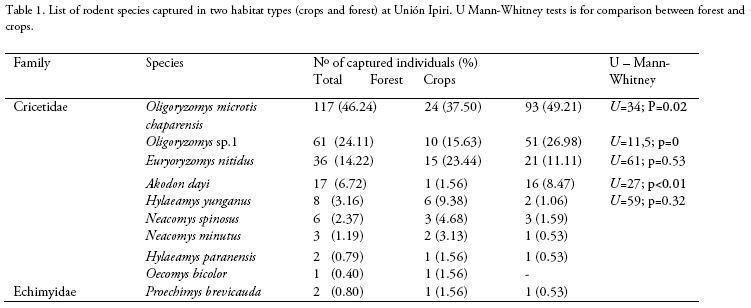
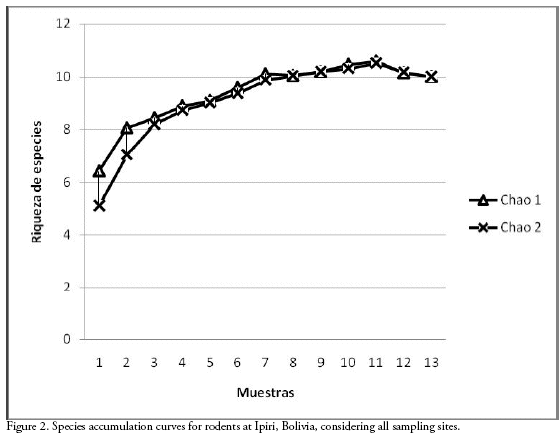
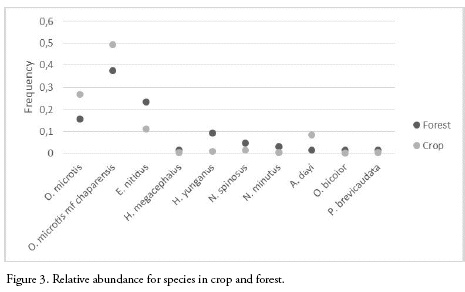
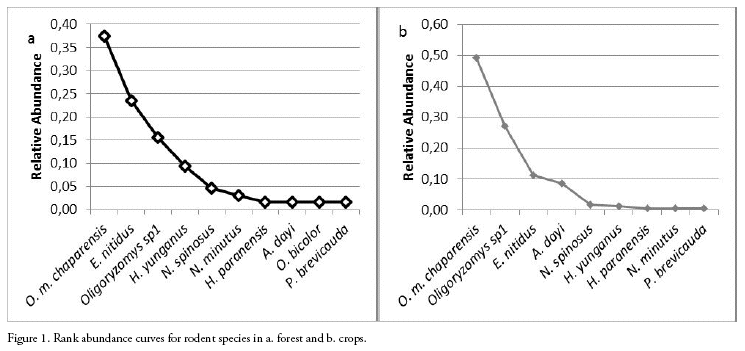
<body><![CDATA[<p align="justify">&nbsp;</p>     <p align="justify"><font face="Verdana, Arial, Helvetica, sans-serif" size="3"><b>Results</b></font></p>     <p align="justify"><font face="Verdana, Arial, Helvetica, sans-serif" size="2">Trapping effort was 4368 trap-nights and resulted in 256 captures, 253 rodents and three marsupials. We captured 2.95 as many individuals in crops as in the forest, representing trapping success rates of 8.65% and 2.93%, respectively (<a href="#f1">Fig. 1</a>).</font></p>     <p align="center"><a name="f1"></a><img src="/img/revistas/reb/v55n1/a03_figure_01.gif" width="745" height="351"></p>     <p align="justify"><font face="Verdana, Arial, Helvetica, sans-serif" size="2">Only three captures were non-rodent species: one <i>Marmosops noctivagus </i>and one <i>Monodelphis glirina </i>in forest, and one <i>Monodelphis peruviana </i>in crops. The remaining captures included 10 rodent species; nine were Cricetidae (99.2 % of individuals) and one Echimyidae (<a href="#t1">Table 1</a>). All analyzes were performed only for rodents. The two most abundant species were <i>Oligoryzomys microtis chaparensis </i>and <i>Oligoryzomys </i>sp., while <i>Oecomys bicolor </i>represented the least common species (<a href="#t1">Table 1</a>), with only one specimen collected in the forest area. All nine species found in crops were also found in forest, but species richness was slightly higher in forest (S=10), than in crops (S=9), however this difference was not significant (U = 43,</font> <font face="Verdana, Arial, Helvetica, sans-serif" size="2">N = 12, p = 0.084); the same result was found at each plot. A plot of a cumulative number of species vs. sample size suggested an adequate sampling effort (<a href="#f2">Fig. 2</a>). The estimated number of species in Ipiri, according to Chao 1 and 2 estimators, is about 13 species in forest and 12 in crops.</font></p>     <p align="center"><a name="t1"></a><img src="/img/revistas/reb/v55n1/a03_table_01.gif" width="751" height="308"></p>     <p align="center">&nbsp;</p>     <p align="center"><a name="f2"></a><img src="/img/revistas/reb/v55n1/a03_figure_02.gif" width="560" height="441"></p>     <p align="justify"><font face="Verdana, Arial, Helvetica, sans-serif" size="2">The most abundant species for both habitats belong to genera <i>Oligoryzomys </i>and <i>Euryoryzomys </i>(<a href="#t1">Table 1</a>, <a href="#f3">Fig. 3</a>), with <i>Oligoryzomys </i>sp. being slightly more abundant than <i>Euryoryzomys nitidus </i>(<a href="#f3">Fig. 3</a>) in crop areas. Only for the two species of <i>Oligoryzomys </i>there was a significant difference between habitats (<a href="#t1">Table 1</a>)</font><font face="Verdana, Arial, Helvetica, sans-serif" size="2">.</font></p>     <p align="center"><a name="f3"></a><img src="/img/revistas/reb/v55n1/a03_figure_03.gif" width="465" height="292"></p>     ]]></body>
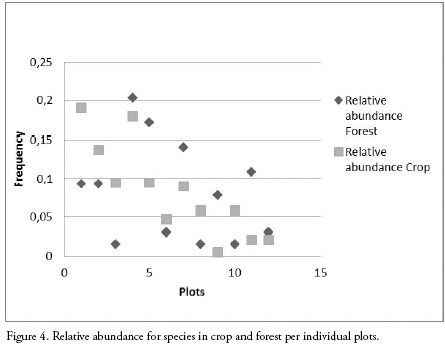
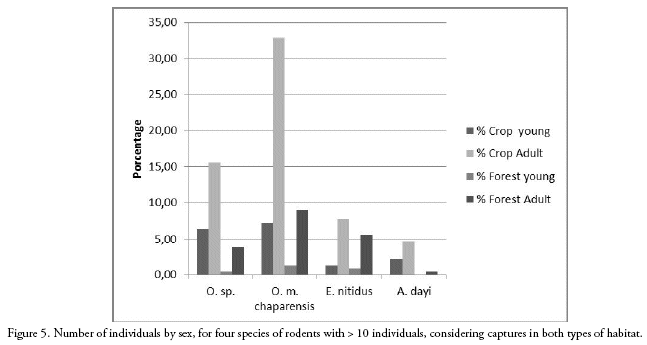
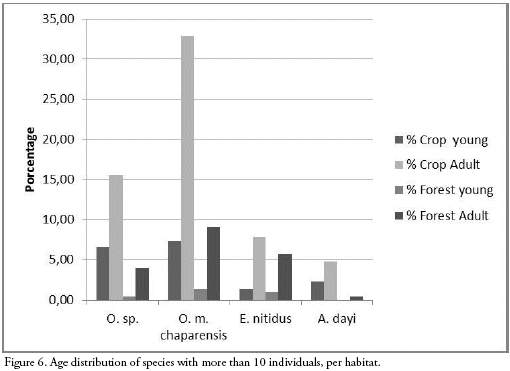
<body><![CDATA[<p align="justify"><font face="Verdana, Arial, Helvetica, sans-serif" size="2">Relative abundances were higher in crops (median =14 individuals, range 1-36) than in adjacent forest (median = 5.5 individuals; range 1-13; U = 30, N = 12, p = 0.015). We found same results when we carried out the analysis on a per plot basis (<a href="#f4">Fig. 4</a>).</font></p>     <p align="center"><a name="f4"></a><img src="/img/revistas/reb/v55n1/a03_figure_04.gif" width="445" height="344"></p>     <p align="justify"><font face="Verdana, Arial, Helvetica, sans-serif" size="2">Abundances of <i>Oligoryzomys microtis chaparensis, Oligoryzomys </i>sp. and <i>Akodon dayi </i>were significantly higher in crops (<a href="#t1">Table 1</a>). Forest's species diversity (D<sub>inv</sub> = 4.29) was not significantly different from that in crops (D<sub>inv</sub> = 2.99) (U = 0.00, N = 12, p = 0.317). A similar trend was found for evenness, which was 0.43 in forest, and 0.33 in crops (U = 0.00, N = 12, p = 0.317).</font></p>     <p align="justify"><font face="Verdana, Arial, Helvetica, sans-serif" size="2">Four species (<i>Oligoryzomys </i>sp., <i>O. microtis chaparensis, Euryoryzomys nitidus, </i>and <i>Akodon dayi</i>) with more than 10 individuals in total (crops plus forests) were taken into account to analyze sex ratio (<a href="#t1">Table 1</a>). Only for <i>Oligoryzomys </i>sp. the sex ratio deviated significantly from 1:1, in crops (</font><font size="2">&#967;</font><font face="Verdana, Arial, Helvetica, sans-serif" size="2"><sup>2</sup> = 5.667, df. = 1, p = 0.017) but not in forest (</font><font size="2">&#967;</font><font face="Verdana, Arial, Helvetica, sans-serif" size="2"><sup></sup></font><font face="Verdana, Arial, Helvetica, sans-serif" size="2"><sup>2</sup> = 0.4, df. = 1, p = 0.527; <a href="#f5">Fig. 5</a>).</font></p>     <p align="center"><a name="f5"></a><img src="/img/revistas/reb/v55n1/a03_figure_05.gif" width="647" height="345"></p>     <p align="justify"><font face="Verdana, Arial, Helvetica, sans-serif" size="2">Most of individuals collected for the four species with more than 10 captures were adults. However, both species of <i>Oligoryzomys </i>showed a high proportion of juveniles in crops (6.49 % and 7.36 %) than in forest (0.43 % and 1.3 %), and also in comparison with the other species (<a href="#f6">Fig. 6</a>).</font></p>     <p align="center"><a name="f6"></a><img src="/img/revistas/reb/v55n1/a03_figure_06.gif" width="510" height="371"></p>     <p align="center">&nbsp;</p>     <p align="justify"><font face="Verdana, Arial, Helvetica, sans-serif" size="3"><b>Discussion</b></font></p>     <p align="justify"><font face="Verdana, Arial, Helvetica, sans-serif" size="2">We carried out the first comparison of composition, abundance, and population characteristics of rodent communities in two habitats with different disturbance degree. Our results suggest that rodent assemblages in crops do not differ from those in adjacent forests, except in the abundance of some of the species. Sex ratio deviated from hypothetical 1:1 only for <i>Oligoryzomys </i>sp. Finally, for the four most abundant species, the majority of individuals trapped were adults.</font></p>     ]]></body>
<body><![CDATA[<p align="justify"><font face="Verdana, Arial, Helvetica, sans-serif" size="2">Capture success (crop: 8.65%, forest: 2.93%) was similar to other studies of rodents in tropical forests (0.97% in Ramirez &amp; Pérez 2007, 1.5% to 7.4 % in Ferro &amp; Barquez 2008, 2 % to 36 % in Mulungu <i>et al. </i>2008, 3,19 % in Ashton <i>et al. </i>2000) and species accumulation curves suggested a good sampling effort for both habitat types in our study area. It is important to notice that occurrence of species at any particular location can be biased due to unequal species detectability (Boulinier <i>et al. </i>1998, Pollock <i>et al. </i>2002, Kéry &amp; Royle 2008); however, our results showed a similarity in species detectability.</font></p>     <p align="justify"><font face="Verdana, Arial, Helvetica, sans-serif" size="2">Species richness is one of the most extensively used measures for biodiversity monitoring, because it can be related to environmental factors, like climate change, or environmental degradation (Yoccoz <i>et al. </i>2001, Pollock <i>et al. </i>2002). One likely explanation for the lack of differences in species diversity between crops and forests at our study site may be that agricultural activities had only begun 3-4 years before our study started. This fact suggests that the degree of disturbance in crops may have not reached levels that were detectable by the approach and methods we used, or may not be not large enough for rodents. Effect of time since  disturbance  and  vegetation  heterogeneity  is   of</font> <font face="Verdana, Arial, Helvetica, sans-serif" size="2">primary importance in determining community composition and population structure in small mammals. For example, Malcolm (1988) showed that small mammal communities in patches of different size and distinct times since disturbance were significantly different, particularly for generalist species. Likewise, in a study in eastern Paraguay, de la Sancha (2014) found that 40 years of deforestation events had changed the community structure, and this was because medium-sized forest remnants had highest species diversity; most likely because of a proportionally larger contribution of the border effect.</font></p>     <p align="justify"><font face="Verdana, Arial, Helvetica, sans-serif" size="2">However, it may also be possible that crops and forest habitats at out study site offer the same quality of resources for rodents that could produce the similarity between the two habitats types, as reported by Cruz et al. (2010) in Chiapas — Mexico. This result could be explained by the fact that Ipiri is a very recently established community, plus the less labors in the settlement could not produce a change in the community structure of rodents. Another important characteristic of these habitats is that the proximity of forests to agroforestry crop systems (all crops had more than two species) may allow free movement from one type of habitat to the other, which could explain the lack of differences in species richness (Moguel &amp; Toledo 1999, Rice &amp; Greenberg 2002, Faria <i>et al. </i>2006). Thus, the particular features of Ipiri agroforestry crops could be responsible for the similarities in richness. The increase of diversity in crops may be due to the increasing abundance of individuals in the crops, like some studies (for several groups birds, bats, and rodents) have also reported in other agroforestry systems, where cacao (<i>Theobroma cacao</i>) was one of main crops (Ashton <i>et al. </i>2000, Cassano <i>et al. </i>2009).</font></p>     <p align="justify"><font face="Verdana, Arial, Helvetica, sans-serif" size="2">The absolute differences in diversity were higher, but were not statistically significant; the opposite was true for abundances, which were found to be higher in crops. A simple explanation for this result may be that crops contain a greater abundance of food resources, but only for some species (granivorous and omnivorous). Supporting this idea, three species that were significantly more abundant in crops (<i>O. m. chaparensis, Oligoryzomys </i>sp., and <i>Akodon dayi</i>) are omnivorous (Bergallo &amp; Magnusson 1999, Veloso <i>et al. </i>2004, Santos <i>et al. </i>2007). It is reasonable to think that these species can make better use of abundant resources in crop areas, which would allow them to increase their reproductive output. This may result also from their capacity to take advantage of changes in their environment. Their demographic flexibility (Santos <i>et al. </i>2007) might make those species more resistant to habitat changes (Veloso <i>et al. </i>2004). On the other hand, other species in the study (i.e.: <i>Neacomys spinosus, O. bicolor</i>) that were less abundant could be more sensitive to the changes in the environment. In summary, crop areas at Ipiri might be offering more food resources than the adjacent primary forest for some species of rodents.</font></p>     <p align="justify"><font face="Verdana, Arial, Helvetica, sans-serif" size="2">It has been reported that some rodent populations concentrate reproduction during the wet season, in response to a greater abundance of resources (Jackson &amp; Van Aarde 2004, Santos <i>et al. </i>2007). Because our sampling was carried out only during the dry season, we expected a larger number of adults at Ipiri. Our results agreed with expectations in the forest but results for crops were different. By providing more food resources crops, could support higher natality rates than forest; supporting the relationship between reproduction and abundance of resources (Spotorno <i>et al. </i>2000). However, to fully test this hypothesis it is necessary to capture the whole seasonal variation, probably for several years. Another likely explanation to our findings could be that the area under crops is smaller than that covered by forest, which may positively affect the catchability of juveniles.</font></p>     <p align="justify"><font face="Verdana, Arial, Helvetica, sans-serif" size="2">It has been suggested that females of some species tend to change their parental care efforts, in response to resource scarcity, particularly for mammals and birds, where females increase the parental care for their male offspring (Cockburn <i>et al. </i>1985, Cockburn <i>et al. </i>2002). Our findings of a higher abundance of <i>Oligoryzomys </i>sp., and positive sex bias towards males, may be a result of an inter-seasonal dynamics, sex differences in behavior and a seasonal variation in habitat availability, which may affect population structure, species composition, sex differences in mobility, among others (Zenuto <i>et al. </i>2002). Only a more intense sampling may clarify this possibility.</font></p>     <p align="justify">&nbsp;</p>     <p align="justify"><font face="Verdana, Arial, Helvetica, sans-serif" size="3"><b>Conclusions</b></font></p>     <p align="justify"><font face="Verdana, Arial, Helvetica, sans-serif" size="2">We did not find differences in rodent species diversity between    agroforestry    crops     and    nearby    forests.</font></p>     <p align="justify"><font face="Verdana, Arial, Helvetica, sans-serif" size="2">Additionally, small differences in abundance, sex ratios and proportion of juveniles were evident only in 20 — 40% of species. The main factors potentially explaining our results are related to the fact that the disturbance (crops) are very recent and affecting a small proportion of the study area. Although it is tempting to suggest that our study provides a window into the early effects of human-induced disturbance on the community and composition of rodent assemblages, our conclusions are tempered by the need of further, more extensive sampling with the incorporation of additional trap types.</font></p>     ]]></body>
<body><![CDATA[<p align="justify">&nbsp;</p>     <p align="justify"><font face="Verdana, Arial, Helvetica, sans-serif" size="3"><b>Acknowledgments</b></font></p>     <p align="justify"><font face="Verdana, Arial, Helvetica, sans-serif" size="2">This manuscript improved thanks to the critical review of Noe de la Sancha. This research was supported by funds from the John D. and Catherine T. MacArthur Foundation to Instituto de Ecolog&iacute;a de la Universidad Mayor de San Andres (Grant 74031) and Grants 14-36098G of the GA CR and LO1415 from the MSMT. The present work has the endorsement of the Committee of Ethics of the Investigation of Universidad Mayor de San Andres. In addition, the Bolivian General Direction of Biodiversity of the Ministry of Environment and Water approved the work and research conducted at Ipiri. Two anonymous reviewers contributed to clarify an earlier version of this manuscript.</font></p>     <p align="justify">&nbsp;</p>     <p align="justify"><font face="Verdana, Arial, Helvetica, sans-serif" size="3"><b>References</b></font></p>     <p align="justify"><font size="2" face="Verdana, Arial, Helvetica, sans-serif">Altrichter, M., M. Kufner, L.  Giraudo, G. Gavier, D. Tamburini, M. Sironi &amp; L. Arguello. 2004. Comunidades  de micromam&iacute;feros de bosque serrano y pastizal de altura en la Sierra Chica, C&oacute;rdoba,  Argentina. Ecolog&iacute;a Aplicada 3: 122&ndash;127.</font></p>     <p align="justify"><font size="2" face="Verdana, Arial, Helvetica, sans-serif">Aplin, K.P., P.R. Brown, J. Jacob, C. Krebs &amp; G.R. Singleton. 2003.  Field methods for rodent studies in Asia and the Indo-Pacific. Australian  Centre for International Agricultural Research Monograph 10: 61&ndash;65.</font></p>     <p align="justify"><font size="2" face="Verdana, Arial, Helvetica, sans-serif">Ashton, A., N. Read, J. Scurlock, C. Low, H. Norris &amp; R. Shapley.  2000. Ecology of rodent communities in agricultural habitats in eastern Sierra  Leone: Cocoa groves as forest refugia. Tropical Ecology 41: 127&ndash;142.</font></p>     <p align="justify"><font size="2" face="Verdana, Arial, Helvetica, sans-serif">Assenaar, T.D.W., R.J. Van Aarde, S.L. Pimm &amp; S.M. Ferreira. 2005.  Community convergence in disturbed subtropical dune forests. Ecology 86: 655&ndash;666.</font></p>     <p align="justify"><font size="2" face="Verdana, Arial, Helvetica, sans-serif">Bergallo, H.G. &amp; W.E. Magnusson. 1999. Effects of climate and food  availability on four rodent species in southeastern Brazil. Journal of  Mammalogy 80: 472&ndash;486.</font></p>     ]]></body>
<body><![CDATA[<p align="justify"><font size="2" face="Verdana, Arial, Helvetica, sans-serif">Bledsoe, L., L. Davis, A Degrassi, J. Edwards, P. Gonzales, S. Hauser,  L. Herington, B. Kronenfeld, J. Lee, C. Mirzaian, T. Oberg, E. Hauser, L.  Herington, E. Peralta, T. Sterner, T. Treybig &amp; P. Stapp. 2010. Rodent  community structure and microhabitat associations at the Bernard Field Station,  Claremont, California. Final Report prepared for BIOL478. Mammalogy California  State University, Fullerton.</font></p>     <p align="justify"><font size="2" face="Verdana, Arial, Helvetica, sans-serif">Bomford, M. 1987. Food and reproduction of wild house mice diet and  breeding seasons in various habitats on irrigated cereal farms in New South  Wales Australia. Wildlife Research 125: 183&ndash;196.</font></p>     <p align="justify"><font size="2" face="Verdana, Arial, Helvetica, sans-serif">Boulinier, T., J.D. Nichols, J.R. Sauer, J.E. Hines &amp; K.H. Pollock.  1998. Estimating species richness: the importance of heterogeneity in species  detectability. Ecology 79: 1018&ndash;1028.</font></p>     <p align="justify"><font size="2" face="Verdana, Arial, Helvetica, sans-serif">Brehme, C.S., D.R. Clark, C.J. Rochester &amp; R.N. Ficher. 2011.  Wildfires alter rodent community structure across four vegetation types in  Southern California, USA. Fire Ecology 7: 81&ndash;98.</font></p>     <p align="justify"><font size="2" face="Verdana, Arial, Helvetica, sans-serif">Brown, J.H. &amp; J.C. Munger. 1985. Experimental manipulation of a  desert rodent community: food addition and species removal. Ecology 66: 1545&ndash;1563.</font></p>     <p align="justify"><font size="2" face="Verdana, Arial, Helvetica, sans-serif">Cameron, E.Z., P.R. Lemons, P.W. Bateman &amp; N.C. Bennett. 2008.  Experimental alteration of litter sex ratios in a mammal. Proceedings of the  Royal Society B: Biological Sciences 275: 323&ndash;327.</font></p>     <p align="justify"><font size="2" face="Verdana, Arial, Helvetica, sans-serif">C&aacute;rdenas, A., J.A. Calles &amp; D.  Salvador. 2006. Dise&ntilde;o metodol&oacute;gico para la Evaluaci&oacute;n y Monitoreo de la Biodiversidad  en las microcuencas hidrogr&aacute;ficas de los r&iacute;os Illangama y Alumbre de la  provincia de Bol&iacute;var. Proyecto watershed-based  natural resource management in small-scale agriculture: sloped areas of the  Andean region. Ecociencia, USAID y SANREM CRSP, Bol&iacute;var.</font></p>     <p align="justify"><font size="2" face="Verdana, Arial, Helvetica, sans-serif">Cassano, C.R., G. Schroth, D. Faria, J.H.C. Delabie &amp; L. Bede. 2009.  Landscape and farm scale management to enhance biodiversity conservation in the  cocoa producing region of southern Bahia, Brazil. Biodiversity and Conservation  18: 577&ndash;603.</font></p>     <p align="justify"><font size="2" face="Verdana, Arial, Helvetica, sans-serif">Cockburn, A., M.P. Scott &amp; C.R. Dickman. 1985. Sex ratio and  intrasexual Kin competition in mammals. Oecologia 66: 427&ndash;429.</font></p>     <p align="justify"><font size="2" face="Verdana, Arial, Helvetica, sans-serif">Cockburn, A., S. Legge &amp; M.C. Double. 2002. Sex ratios in birds and  mammals: can the hypotheses be disentangled. Pp. 267&ndash;286. In: Hardy, I.C.W.  (ed.) Sex Ratios: Concepts and Research Methods. Cambridge University Press,  Cambridge.</font></p>     ]]></body>
<body><![CDATA[<p align="justify"><font size="2" face="Verdana, Arial, Helvetica, sans-serif">Cruz, L.E., C. Lorenzo, O.G.  Retana &amp; E.C. S&aacute;ntiz. 2010. Interspecific variability  in the abundance of small rodents in the highlands of Chiapas, Mexico. Therya 1: 129&ndash;136.</font></p>     <p align="justify"><font size="2" face="Verdana, Arial, Helvetica, sans-serif">De la Sancha, N. 2014. Patterns of small mammal diversity in fragments of subtropical Interior  Atlantic Forest in eastern Paraguay. Mammalia 78: 437&ndash;449.</font></p>     <p align="justify"><font size="2" face="Verdana, Arial, Helvetica, sans-serif">Deitloff, J., M.R. Falcy, J.D. Krenz &amp; B.R. McMillan. 2010.  Correlating small mammal abundance to climatic variation over twenty years.  Journal of Mammalogy 91: 193&ndash;199.</font></p>     <p align="justify"><font size="2" face="Verdana, Arial, Helvetica, sans-serif">Escalante, E.T. 2003. &iquest;Cu&aacute;ntas especies hay? Los estimadores no param&eacute;tricos de Chao.  Benem&eacute;rita Universidad Aut&oacute;noma de Puebla Elementos: ciencia y cultura 52: 53&ndash;56.</font></p>     <p align="justify"><font size="2" face="Verdana, Arial, Helvetica, sans-serif">Faria, D., R.R. Laps, J.  Baumgarten &amp; M. Cetra. 2006. Bat and bird assemblages  from forests and shade cacao plantations in two contrasting landscapes in the Atlantic  Forest of southern Bahia, Brazil. Biodiversity and Conservation 15: 587&ndash;612.</font></p>     <p align="justify"><font size="2" face="Verdana, Arial, Helvetica, sans-serif">Ferro, L.I. &amp; R.M. Barquez. 2008.  Comentarios sobre la distribuci&oacute;n de <i>Abrothrix  andinus</i> y <i>Calomys lepidus</i> (Rodentia: Cricetidae) en la  provincia de Tucum&aacute;n, Argentina. Mastozoolog&iacute;a Neotropical 15: 197&ndash;201.</font></p>     <p align="justify"><font size="2" face="Verdana, Arial, Helvetica, sans-serif">Font&uacute;rbel, F.E. 2012. Does habitat degradation cause changes in the composition of arboreal  small mammals? A small-scale assessment in Patagonian temperate rainforest  fragments Latin American. Journal of Conservation 2&ndash;3: 68&ndash;72.</font></p>     <p align="justify"><font size="2" face="Verdana, Arial, Helvetica, sans-serif">Garc&iacute;a-Estrada, C., M.L. Romero-  Almaraz &amp; C. S&aacute;nchez-Hern&aacute;ndez. 2002.  Comparison of rodent communities in sites with different degrees of disturbance  in deciduous forest of Southeastern Morelos, M&eacute;xico. Acta Zool&oacute;gica Mexicana 85: 153&ndash;168.</font></p>     <p align="justify"><font size="2" face="Verdana, Arial, Helvetica, sans-serif">Hice, C.L. &amp; P.M. Velazco. 2013. Relative effectiveness of several bait and trap types for  assessing small mammal communities in Neotropical rainforest. Occasional Papers,  Museum of Texas Tech University 316: 1&ndash;15.</font></p>     <p align="justify"><font size="2" face="Verdana, Arial, Helvetica, sans-serif">Hirsch, B.T., R. Kays &amp; P.A. Jansen. 2012. A telemetric thread tag  for tracking seed dispersal by scatterhoarding rodent. Plant Ecology 213: 933&ndash;943.</font></p>     ]]></body>
<body><![CDATA[<p align="justify"><font size="2" face="Verdana, Arial, Helvetica, sans-serif">Hoehn, P., I. Steffan-Dewenter, D. Buchori &amp; T. Tscharntke. 2009.  Spatiotemporal density patterns of the pest predator <i>Rhynchium haemorrhoidale</i> (F.) along a land-use gradient in cacao  agroforestry systems. Agroforest System 76: 163&ndash;171.</font></p>     <p align="justify"><font size="2" face="Verdana, Arial, Helvetica, sans-serif">Hudson, L.N., et al. (511 authors). 2016. The database of the PREDICTS (Projecting Responses  of Ecological Diversity in Changing Terrestrial Systems) Project. Ecology and  Evolution 7(1): 145-188. doi:<a href="http://doi.org/10.1002/ece3.2579" target="_blank">10.1002/ece3.2579</a>.</font></p>     <p align="justify"><font size="2" face="Verdana, Arial, Helvetica, sans-serif">Jackson, T.P. &amp; R.J Van Aarde.  2004. Diet quality differentially affects  breeding effort of <i>Mastomys coucha</i> and M. natalensis: Implications for Rodent Pests. Journal  of Experimental Zoology 301: 97&ndash;108.</font></p>     <p align="justify"><font size="2" face="Verdana, Arial, Helvetica, sans-serif">Kalcounis-Rueppell, M.C., J.S. Millar &amp; E.J. Herdman. 2002. Beating  the odds: effects of weather on a shortseason population of deer mice. Canadian  Journal of Zoology 80: 1594&ndash;1601.</font></p>     <p align="justify"><font size="2" face="Verdana, Arial, Helvetica, sans-serif">Kemp, D.J. 2001. Reproductive seasonality in the tropical butterfly. <i>Hypolimnas bolina</i> (Lepidoptera: Nymphalidae) in northern  Australia. Journal of Tropical Ecology 7: 483&ndash;494.</font></p>     <p align="justify"><font size="2" face="Verdana, Arial, Helvetica, sans-serif">K&eacute;ry, M. &amp; J.A. Royle. 2008. Hierarchical bayes estimation of  species richness and occupancy in spatially replicates surveys. Journal of  Applied Ecology 45: 589&ndash;598.</font></p>     <p align="justify"><font size="2" face="Verdana, Arial, Helvetica, sans-serif">Kufner, M.B., G. Gavier &amp; D.  Tamburini. 2004. Comunidades de roedores de pampas de altura en las Sierras  Grandes en C&oacute;rdoba, Argentina. Ecolog&iacute;a Aplicada 3: 118&ndash;121.</font></p>     <p align="justify"><font size="2" face="Verdana, Arial, Helvetica, sans-serif">Lahoz-Beltr&aacute;, R., J. Ortega &amp;  C. Fern&aacute;ndez-Montraveta. 1994. M&eacute;todos estad&iacute;sticos en biolog&iacute;a del comportamiento  Secci&oacute;n: Ciencias del Comportamiento. Editorial Complutense, Madrid.</font></p>     <p align="justify"><font size="2" face="Verdana, Arial, Helvetica, sans-serif">Landres, P., J. Verner &amp; J.W.  Thomas. 1988. Ecological uses of vertebrate indicator  species: A Critique. Conservation Biology 2: 316&ndash;328.</font></p>     <p align="justify"><font size="2" face="Verdana, Arial, Helvetica, sans-serif">Leturque, H. &amp; F. Rouset. 2003. Joint evolution of sex and dispersal:  conditions for higher dispersal rates from good habitats. Evolutionary Ecology  17: 67&ndash;84.</font></p>     ]]></body>
<body><![CDATA[<p align="justify"><font size="2" face="Verdana, Arial, Helvetica, sans-serif">Lu&eacute;vano, J., E. Mellink, M.E.  Riojas- L&oacute;pez &amp; J.L. Flores-Flores. 2008. Comunidad de roedores nocturnos  en un ecotono de matorrales micr&oacute;filos y zacatal gips&oacute;filo en San Luis Potos&iacute;,  M&eacute;xico. Revista Mexicana de Biodiversidad 79: 197&ndash;203.</font></p>     <p align="justify"><font size="2" face="Verdana, Arial, Helvetica, sans-serif">MacArthur, R.H. &amp; J.W. MacArthur. 1961 On bird    species diversity Ecology 42: 594&ndash;598. </font></p>     <p align="justify"><font size="2" face="Verdana, Arial, Helvetica, sans-serif">Malcolm  J.R.1988. Small mammal abundances in isolated and non-isolated primary forest  reserves near Manaus, Brazil. Acta Amaz&oacute;nica 18: 67&ndash;83.</font></p>     <p align="justify"><font size="2" face="Verdana, Arial, Helvetica, sans-serif">Marconi, P.N. &amp; F.O. Kravetz.  1986. Comunidad de roedores del parque Nacional El Palmar (Entre R&iacute;os, Argentina)  seg&uacute;n la historia del fuego. Revista Chilena de Historia Natural 59: 47&ndash;57.</font></p>     <p align="justify"><font size="2" face="Verdana, Arial, Helvetica, sans-serif">Meserve P.L. 1981 Resource partitioning in a Chilean semi-arid small  mammal community. Journal of Animal Ecology 50: 745&ndash;757.</font></p>     <p align="justify"><font size="2" face="Verdana, Arial, Helvetica, sans-serif">Moguel, P. &amp; Toledo VM. 1999. Biodiversity conservation in  traditional coffee systems of M&eacute;xico. Conservation Biology 13: 11&ndash;21.</font></p>     <p align="justify"><font size="2" face="Verdana, Arial, Helvetica, sans-serif">Monge-Meza, J. 2011. An&aacute;lisis y Comentarios El impacto de las taltuzas en el cultivo de  banano. Agronom&iacute;a mesoamericana 22: 167&ndash;174.</font></p>     <p align="justify"><font size="2" face="Verdana, Arial, Helvetica, sans-serif">Moreno, C.E. 2001. M&eacute;todos para  medir la biodiversidad. M&amp;T&ndash;Manuales y Tesis SEA, Zaragoza.</font></p>     <p align="justify"><font size="2" face="Verdana, Arial, Helvetica, sans-serif">Mulungu, L.S., R.H. Makundi, A.W.  Massawe, R.S. Machang &amp; N.E. Mbije. 2008.  Diversity and distribution of rodent and shrew species associated with  variation in altitude on Mount Kilimanjaro, Tanzania. Mammalia 72: 178&ndash;185.</font></p>     <p align="justify"><font size="2" face="Verdana, Arial, Helvetica, sans-serif">Myers, P. &amp; M.D. Carleton. 1981. The Species of <i>Oryzomys</i> (<i>Oligoryzomys</i>) in  Paraguay and the identity of Azara's &quot;Rat sixiemeou Rat a Tarse Noir&quot;.  Miscellaneous Publications, Museum of Zoology, University of Michigan 161:  1-41.</font></p>     ]]></body>
<body><![CDATA[<p align="justify"><font size="2" face="Verdana, Arial, Helvetica, sans-serif">Myers, P. &amp; L. Patton. 1989. A new species of <i>Akodon </i>from the cloud forests of eastern Cochabamba Department, Bolivia  (Rodentia: Sigmodontinae). Occasional Papers of the Museum of Zoology, University  of Michigan 72: 1&ndash;28.</font></p>     <p align="justify"><font size="2" face="Verdana, Arial, Helvetica, sans-serif">Myers, P., J.L. Patton &amp; M.F. Smith. 1990. A review of the  bolviensis group of <i>Akodon</i> (Muridae: Sigmodontinae),  with emphasis on Peru and Bolivia Miscellaneous Publications Museum of Zoology,  University of Michigan 177: 1-104.</font></p>     <p align="justify"><font size="2" face="Verdana, Arial, Helvetica, sans-serif">Navarro, G. &amp; M. Maldonado.  2002. Geograf&iacute;a ecol&oacute;gica de Bolivia: Vegetaci&oacute;n y ambientes acu&aacute;ticos Centro de  Ecolog&iacute;a Sim&oacute;n I. Pati&ntilde;o, Santa Cruz.</font></p>     <p align="justify"><font size="2" face="Verdana, Arial, Helvetica, sans-serif">Ostfeld, R.S., N. Lewin, J. Schnurr, S.T.A. Pickett &amp; C.D. Canham.  1994. The role of a small rodent in creating patchy environments. Polish  Ecological Studies 20: 265&ndash;276.</font></p>     <p align="justify"><font size="2" face="Verdana, Arial, Helvetica, sans-serif">Paniagua-Zambrana, N., C.  Maldonado-Goyzueta &amp; C. Chumacero-Moscoso. 2003. Mapa de vegetaci&oacute;n de los  alrededores de la Estaci&oacute;n Biol&oacute;gica de Tunquini, Bolivia. Ecolog&iacute;a en Bolivia  38: 15&ndash;26.</font></p>     <p align="justify"><font size="2" face="Verdana, Arial, Helvetica, sans-serif">Pollock, K.H., J.D. Nichols, T.R. Simons, G.L. Farnsworth, L.L. Bailey  &amp; J.R. Sauer. 2002. Large scale wildlife monitoring studies: statistical  methods for design and analysis. Environmetrics 13: 105&ndash;109.</font></p>     <p align="justify"><font size="2" face="Verdana, Arial, Helvetica, sans-serif">Ramirez, H. &amp; W.A. P&eacute;rez. 2007.  Mam&iacute;feros de un fragmento de bosque de roble en el departamento del Cauca,  Colombia. Bolet&iacute;n Cient&iacute;fico &ndash; Centro de Museos &ndash; Museo de Historia Natural 11:  65-79.</font></p>     <p align="justify"><font size="2" face="Verdana, Arial, Helvetica, sans-serif">Rice, R.A. &amp; R. Greenberg. 2002. Cacao cultivation and the  conservation of biological diversity. Ambio 29: 167&ndash;173.</font></p>     <p align="justify"><font size="2" face="Verdana, Arial, Helvetica, sans-serif">Rosenfeld, C.S., K.M. Grimm, K.A. Livingston, A.M. Brokman, W.E.  Lamberson &amp; R.M. Roberts. 2003. Striking variation in the sex ratio of pups  born to mice according to whether maternal diet is high in fat or carbohydrate.  Department of Animal Sciences, University of Missouri, Columbia 100: 4628&ndash;4632.</font></p>     <p align="justify"><font size="2" face="Verdana, Arial, Helvetica, sans-serif">Rosi, M.I., S. Puig, F. Videla, L.  Madoery &amp; V.G. Roig. 1992. Estudio ecol&oacute;gico del roedor subterr&aacute;neo <i>Ctenomys mendocinus</i> en la precordillera de Mendoza, Argentina: Ciclo reproductivo y  estructura etaria. Revista Chilena de Historia Natural 65: 221&ndash;233.</font></p>     ]]></body>
<body><![CDATA[<p align="justify"><font size="2" face="Verdana, Arial, Helvetica, sans-serif">Santos, A., M.A. Briones &amp; R.  L&oacute;pez. 2007. Diferencias en algunos par&aacute;metros demogr&aacute;ficos de <i>Oryzomys chapmani</i> (Rodentia: Muridae) asociadas a tres estados sucesionales de  bosque mes&oacute;filo de monta&ntilde;as en Oaxaca, M&eacute;xico. Acta Zool&oacute;gica Mexicana 23: 123&ndash;137.</font></p>     <p align="justify"><font size="2" face="Verdana, Arial, Helvetica, sans-serif">Simonetti, J.A. 1989. Microhabitat use by small mammals in central  Chile. Oikos 56: 309&ndash;318.</font></p>     <p align="justify"><font size="2" face="Verdana, Arial, Helvetica, sans-serif">Spotorno, A.E., R.E.Palma V. &amp;  J.P. Valladares F. 2000. Biolog&iacute;a de los roedores reservorios de <i>hantavirus</i> en Chile. Revista Chilena de Infectolog&iacute;a 17(3): 197&ndash;210.</font></p>     <p align="justify"><font size="2" face="Verdana, Arial, Helvetica, sans-serif">Stevens R. &amp; S. Tello. 2011. Diversity begets diversity: relative  roles of structural and resource heterogeneity in determining rodent community  structure. Journal of Mammalogy 92: 387&ndash;395.</font></p>     <p align="justify"><font size="2" face="Verdana, Arial, Helvetica, sans-serif">Veloso, C., R.A. V&aacute;squez &amp; L.A. Ebensperger. 2004. Antecedentes sobre biolog&iacute;a  reproductiva de los roedores silvestres chilenos In: Iriarte A., Tala S., Gonz&aacute;lez  B., Zapata B., Gonz&aacute;lez G., Maino M. Cr&iacute;a en Cautividad de Fauna Chilena. Pp. 375&ndash;383.</font></p>     <p align="justify"><font size="2" face="Verdana, Arial, Helvetica, sans-serif">Voss R.S. &amp; L.H. Emmons. 1996. Mammalian diversity in Neotropical  lowland rainforests: a preliminary assessment. Bulletin of the American Museum  of Natural History 230: 1-115.</font></p>     <p align="justify"><font size="2" face="Verdana, Arial, Helvetica, sans-serif">Windberg, L.A. 1998 Population trends and habitat association of Rodents  in Southern Texas. The American Midland Naturalist Journal 140: 153&ndash;160.</font></p>     <p align="justify"><font size="2" face="Verdana, Arial, Helvetica, sans-serif">Yoccoz, N.G., J.D. Nichols &amp; T. Boulinier. 2001. Monitoring of  biological diversity in space and time. Trends in Ecology and Evolution 16: 446&ndash;453.</font></p>     <p align="justify"><font size="2" face="Verdana, Arial, Helvetica, sans-serif">Zenuto, R.R., A.I. Vassallo &amp;  C. Busch. 2002. Comportamiento social y reproductivo del roedor subterr&aacute;neo  solitario <i>Ctenomys talarum</i> (Rodentia: Ctenomyidae) en  condiciones de semicautiverio. Revista Chilena de Historia Natural 75: 165&ndash;177. </font></p>     <p align="justify">&nbsp;</p>     ]]></body>
<body><![CDATA[ ]]></body><back>
<ref-list>
<ref id="B1">
<nlm-citation citation-type="journal">
<person-group person-group-type="author">
<name>
<surname><![CDATA[Altrichter]]></surname>
<given-names><![CDATA[M.]]></given-names>
</name>
<name>
<surname><![CDATA[Kufner]]></surname>
<given-names><![CDATA[M.]]></given-names>
</name>
<name>
<surname><![CDATA[Giraudo]]></surname>
<given-names><![CDATA[L.]]></given-names>
</name>
<name>
<surname><![CDATA[Gavier]]></surname>
<given-names><![CDATA[G.]]></given-names>
</name>
<name>
<surname><![CDATA[Tamburini]]></surname>
<given-names><![CDATA[D.]]></given-names>
</name>
<name>
<surname><![CDATA[Sironi]]></surname>
<given-names><![CDATA[M.]]></given-names>
</name>
<name>
<surname><![CDATA[Arguello]]></surname>
<given-names><![CDATA[L.]]></given-names>
</name>
</person-group>
<article-title xml:lang="es"><![CDATA[Comunidades de micromamíferos de bosque serrano y pastizal de altura en la Sierra Chica, Córdoba, Argentina]]></article-title>
<source><![CDATA[Ecología Aplicada]]></source>
<year>2004</year>
<numero>3</numero>
<issue>3</issue>
<page-range>122-127</page-range></nlm-citation>
</ref>
<ref id="B2">
<nlm-citation citation-type="journal">
<person-group person-group-type="author">
<name>
<surname><![CDATA[Aplin]]></surname>
<given-names><![CDATA[K.P.]]></given-names>
</name>
<name>
<surname><![CDATA[Brown]]></surname>
<given-names><![CDATA[P.R.]]></given-names>
</name>
<name>
<surname><![CDATA[Jacob]]></surname>
<given-names><![CDATA[J.]]></given-names>
</name>
<name>
<surname><![CDATA[Krebs]]></surname>
<given-names><![CDATA[C.]]></given-names>
</name>
<name>
<surname><![CDATA[Singleton]]></surname>
<given-names><![CDATA[G.R.]]></given-names>
</name>
</person-group>
<article-title xml:lang="en"><![CDATA[Field methods for rodent studies in Asia and the Indo-Pacific]]></article-title>
<source><![CDATA[Australian Centre for International Agricultural Research Monograph]]></source>
<year>2003</year>
<numero>10</numero>
<issue>10</issue>
<page-range>61-65</page-range></nlm-citation>
</ref>
<ref id="B3">
<nlm-citation citation-type="journal">
<person-group person-group-type="author">
<name>
<surname><![CDATA[Ashton]]></surname>
<given-names><![CDATA[A.]]></given-names>
</name>
<name>
<surname><![CDATA[Read]]></surname>
<given-names><![CDATA[N.]]></given-names>
</name>
<name>
<surname><![CDATA[Scurlock]]></surname>
<given-names><![CDATA[J.]]></given-names>
</name>
<name>
<surname><![CDATA[Low]]></surname>
<given-names><![CDATA[C.]]></given-names>
</name>
<name>
<surname><![CDATA[Norris]]></surname>
<given-names><![CDATA[H.]]></given-names>
</name>
<name>
<surname><![CDATA[Shapley]]></surname>
<given-names><![CDATA[R.]]></given-names>
</name>
</person-group>
<article-title xml:lang="en"><![CDATA[Ecology of rodent communities in agricultural habitats in eastern Sierra Leone: Cocoa groves as forest refugia]]></article-title>
<source><![CDATA[Tropical Ecology]]></source>
<year>2000</year>
<numero>41</numero>
<issue>41</issue>
<page-range>127-142</page-range></nlm-citation>
</ref>
<ref id="B4">
<nlm-citation citation-type="journal">
<person-group person-group-type="author">
<name>
<surname><![CDATA[Assenaar]]></surname>
<given-names><![CDATA[T.D.W.]]></given-names>
</name>
<name>
<surname><![CDATA[Van Aarde]]></surname>
<given-names><![CDATA[R.J.]]></given-names>
</name>
<name>
<surname><![CDATA[Pimm]]></surname>
<given-names><![CDATA[S.L.]]></given-names>
</name>
<name>
<surname><![CDATA[Ferreira]]></surname>
<given-names><![CDATA[S.M.]]></given-names>
</name>
</person-group>
<article-title xml:lang="en"><![CDATA[Community convergence in disturbed subtropical dune forests]]></article-title>
<source><![CDATA[Ecology]]></source>
<year>2005</year>
<numero>86</numero>
<issue>86</issue>
<page-range>655-666</page-range></nlm-citation>
</ref>
<ref id="B5">
<nlm-citation citation-type="journal">
<person-group person-group-type="author">
<name>
<surname><![CDATA[Bergallo]]></surname>
<given-names><![CDATA[H.G.]]></given-names>
</name>
<name>
<surname><![CDATA[Magnusson]]></surname>
<given-names><![CDATA[W.E.]]></given-names>
</name>
</person-group>
<article-title xml:lang="en"><![CDATA[Effects of climate and food availability on four rodent species in southeastern Brazil]]></article-title>
<source><![CDATA[Journal of Mammalogy]]></source>
<year>1999</year>
<numero>80</numero>
<issue>80</issue>
<page-range>472-486</page-range></nlm-citation>
</ref>
<ref id="B6">
<nlm-citation citation-type="book">
<person-group person-group-type="author">
<name>
<surname><![CDATA[Bledsoe]]></surname>
<given-names><![CDATA[L.]]></given-names>
</name>
<name>
<surname><![CDATA[Davis]]></surname>
<given-names><![CDATA[L.]]></given-names>
</name>
<name>
<surname><![CDATA[Degrassi]]></surname>
<given-names><![CDATA[A]]></given-names>
</name>
<name>
<surname><![CDATA[Edwards]]></surname>
<given-names><![CDATA[J.]]></given-names>
</name>
<name>
<surname><![CDATA[Gonzales]]></surname>
<given-names><![CDATA[P.]]></given-names>
</name>
<name>
<surname><![CDATA[Hauser]]></surname>
<given-names><![CDATA[S.]]></given-names>
</name>
<name>
<surname><![CDATA[Herington]]></surname>
<given-names><![CDATA[L.]]></given-names>
</name>
<name>
<surname><![CDATA[Kronenfeld]]></surname>
<given-names><![CDATA[B.]]></given-names>
</name>
<name>
<surname><![CDATA[Lee]]></surname>
<given-names><![CDATA[J.]]></given-names>
</name>
<name>
<surname><![CDATA[Mirzaian]]></surname>
<given-names><![CDATA[C.]]></given-names>
</name>
<name>
<surname><![CDATA[Oberg]]></surname>
<given-names><![CDATA[T.]]></given-names>
</name>
<name>
<surname><![CDATA[Hauser]]></surname>
<given-names><![CDATA[E.]]></given-names>
</name>
<name>
<surname><![CDATA[Herington]]></surname>
<given-names><![CDATA[L.]]></given-names>
</name>
<name>
<surname><![CDATA[Peralta]]></surname>
<given-names><![CDATA[E.]]></given-names>
</name>
<name>
<surname><![CDATA[Sterner]]></surname>
<given-names><![CDATA[T.]]></given-names>
</name>
<name>
<surname><![CDATA[Treybig]]></surname>
<given-names><![CDATA[T.]]></given-names>
</name>
<name>
<surname><![CDATA[Stapp]]></surname>
<given-names><![CDATA[P.]]></given-names>
</name>
</person-group>
<source><![CDATA[Rodent community structure and microhabitat associations at the Bernard Field Station, Claremont, California]]></source>
<year>2010</year>
<publisher-loc><![CDATA[Fullerton ]]></publisher-loc>
<publisher-name><![CDATA[Mammalogy California State University]]></publisher-name>
</nlm-citation>
</ref>
<ref id="B7">
<nlm-citation citation-type="journal">
<person-group person-group-type="author">
<name>
<surname><![CDATA[Bomford]]></surname>
<given-names><![CDATA[M.]]></given-names>
</name>
</person-group>
<article-title xml:lang="en"><![CDATA[Food and reproduction of wild house mice diet and breeding seasons in various habitats on irrigated cereal farms in New South Wales Australia]]></article-title>
<source><![CDATA[Wildlife Research]]></source>
<year>1987</year>
<numero>125</numero>
<issue>125</issue>
<page-range>183-196</page-range></nlm-citation>
</ref>
<ref id="B8">
<nlm-citation citation-type="journal">
<person-group person-group-type="author">
<name>
<surname><![CDATA[Boulinier]]></surname>
<given-names><![CDATA[T.]]></given-names>
</name>
<name>
<surname><![CDATA[Nichols]]></surname>
<given-names><![CDATA[J.D.]]></given-names>
</name>
<name>
<surname><![CDATA[Sauer]]></surname>
<given-names><![CDATA[J.R.]]></given-names>
</name>
<name>
<surname><![CDATA[Hines]]></surname>
<given-names><![CDATA[J.E.]]></given-names>
</name>
<name>
<surname><![CDATA[Pollock]]></surname>
<given-names><![CDATA[K.H.]]></given-names>
</name>
</person-group>
<article-title xml:lang="en"><![CDATA[Estimating species richness: the importance of heterogeneity in species detectability]]></article-title>
<source><![CDATA[Ecology]]></source>
<year>1998</year>
<numero>79</numero>
<issue>79</issue>
<page-range>1018-1028</page-range></nlm-citation>
</ref>
<ref id="B9">
<nlm-citation citation-type="journal">
<person-group person-group-type="author">
<name>
<surname><![CDATA[Brehme]]></surname>
<given-names><![CDATA[C.S.]]></given-names>
</name>
<name>
<surname><![CDATA[Clark]]></surname>
<given-names><![CDATA[D.R.]]></given-names>
</name>
<name>
<surname><![CDATA[Rochester]]></surname>
<given-names><![CDATA[C.J.]]></given-names>
</name>
<name>
<surname><![CDATA[Ficher]]></surname>
<given-names><![CDATA[R.N.]]></given-names>
</name>
</person-group>
<article-title xml:lang="en"><![CDATA[Wildfires alter rodent community structure across four vegetation types in Southern California, USA]]></article-title>
<source><![CDATA[Fire Ecology]]></source>
<year>2011</year>
<numero>7</numero>
<issue>7</issue>
<page-range>81-98</page-range></nlm-citation>
</ref>
<ref id="B10">
<nlm-citation citation-type="journal">
<person-group person-group-type="author">
<name>
<surname><![CDATA[Brown]]></surname>
<given-names><![CDATA[J.H.]]></given-names>
</name>
<name>
<surname><![CDATA[Munger]]></surname>
<given-names><![CDATA[J.C.]]></given-names>
</name>
</person-group>
<article-title xml:lang="en"><![CDATA[Experimental manipulation of a desert rodent community: food addition and species removal]]></article-title>
<source><![CDATA[Ecology]]></source>
<year>1985</year>
<numero>66</numero>
<issue>66</issue>
<page-range>1545-1563</page-range></nlm-citation>
</ref>
<ref id="B11">
<nlm-citation citation-type="journal">
<person-group person-group-type="author">
<name>
<surname><![CDATA[Cameron]]></surname>
<given-names><![CDATA[E.Z.]]></given-names>
</name>
<name>
<surname><![CDATA[Lemons]]></surname>
<given-names><![CDATA[P.R.]]></given-names>
</name>
<name>
<surname><![CDATA[Bateman]]></surname>
<given-names><![CDATA[P.W.]]></given-names>
</name>
<name>
<surname><![CDATA[Bennett]]></surname>
<given-names><![CDATA[N.C.]]></given-names>
</name>
</person-group>
<article-title xml:lang="en"><![CDATA[Experimental alteration of litter sex ratios in a mammal]]></article-title>
<source><![CDATA[Proceedings of the Royal Society B: Biological Sciences]]></source>
<year>2008</year>
<numero>275</numero>
<issue>275</issue>
<page-range>323-327</page-range></nlm-citation>
</ref>
<ref id="B12">
<nlm-citation citation-type="book">
<person-group person-group-type="author">
<name>
<surname><![CDATA[Cárdenas]]></surname>
<given-names><![CDATA[A.]]></given-names>
</name>
<name>
<surname><![CDATA[Calles]]></surname>
<given-names><![CDATA[J.A.]]></given-names>
</name>
<name>
<surname><![CDATA[Salvador]]></surname>
<given-names><![CDATA[D.]]></given-names>
</name>
</person-group>
<source><![CDATA[Diseño metodológico para la Evaluación y Monitoreo de la Biodiversidad en las microcuencas hidrográficas de los ríos Illangama y Alumbre de la provincia de Bolívar. Proyecto watershed-based natural resource management in small-scale agriculture: sloped areas of the Andean region]]></source>
<year>2006</year>
<publisher-loc><![CDATA[Bolívar ]]></publisher-loc>
<publisher-name><![CDATA[Ecociencia, USAID y SANREM CRSP]]></publisher-name>
</nlm-citation>
</ref>
<ref id="B13">
<nlm-citation citation-type="journal">
<person-group person-group-type="author">
<name>
<surname><![CDATA[Cassano]]></surname>
<given-names><![CDATA[C.R.]]></given-names>
</name>
<name>
<surname><![CDATA[Schroth]]></surname>
<given-names><![CDATA[G.]]></given-names>
</name>
<name>
<surname><![CDATA[Faria]]></surname>
<given-names><![CDATA[D.]]></given-names>
</name>
<name>
<surname><![CDATA[Delabie]]></surname>
<given-names><![CDATA[J.H.C.]]></given-names>
</name>
<name>
<surname><![CDATA[Bede]]></surname>
<given-names><![CDATA[L.]]></given-names>
</name>
</person-group>
<article-title xml:lang="en"><![CDATA[Landscape and farm scale management to enhance biodiversity conservation in the cocoa producing region of southern Bahia, Brazil]]></article-title>
<source><![CDATA[Biodiversity and Conservation]]></source>
<year>2009</year>
<numero>18</numero>
<issue>18</issue>
<page-range>577-603</page-range></nlm-citation>
</ref>
<ref id="B14">
<nlm-citation citation-type="journal">
<person-group person-group-type="author">
<name>
<surname><![CDATA[Cockburn]]></surname>
<given-names><![CDATA[A.]]></given-names>
</name>
<name>
<surname><![CDATA[Scott]]></surname>
<given-names><![CDATA[M.P.]]></given-names>
</name>
<name>
<surname><![CDATA[Dickman]]></surname>
<given-names><![CDATA[C.R.]]></given-names>
</name>
</person-group>
<article-title xml:lang="en"><![CDATA[Sex ratio and intrasexual Kin competition in mammals]]></article-title>
<source><![CDATA[Oecologia]]></source>
<year>1985</year>
<numero>66</numero>
<issue>66</issue>
<page-range>427-429</page-range></nlm-citation>
</ref>
<ref id="B15">
<nlm-citation citation-type="book">
<person-group person-group-type="author">
<name>
<surname><![CDATA[Cockburn]]></surname>
<given-names><![CDATA[A.]]></given-names>
</name>
<name>
<surname><![CDATA[Legge]]></surname>
<given-names><![CDATA[S.]]></given-names>
</name>
<name>
<surname><![CDATA[Double]]></surname>
<given-names><![CDATA[M.C.]]></given-names>
</name>
</person-group>
<article-title xml:lang="en"><![CDATA[Sex ratios in birds and mammals: can the hypotheses be disentangled]]></article-title>
<person-group person-group-type="editor">
<name>
<surname><![CDATA[Hardy]]></surname>
<given-names><![CDATA[I.C.W.]]></given-names>
</name>
</person-group>
<source><![CDATA[Sex Ratios: Concepts and Research Methods]]></source>
<year>2002</year>
<month>20</month>
<day>02</day>
<page-range>267-286</page-range><publisher-loc><![CDATA[Cambridge ]]></publisher-loc>
<publisher-name><![CDATA[Cambridge University Press]]></publisher-name>
</nlm-citation>
</ref>
<ref id="B16">
<nlm-citation citation-type="journal">
<person-group person-group-type="author">
<name>
<surname><![CDATA[Cruz]]></surname>
<given-names><![CDATA[L.E.]]></given-names>
</name>
<name>
<surname><![CDATA[Lorenzo]]></surname>
<given-names><![CDATA[C.]]></given-names>
</name>
<name>
<surname><![CDATA[Retana]]></surname>
<given-names><![CDATA[O.G.]]></given-names>
</name>
<name>
<surname><![CDATA[Sántiz]]></surname>
<given-names><![CDATA[E.C.]]></given-names>
</name>
</person-group>
<article-title xml:lang="en"><![CDATA[Interspecific variability in the abundance of small rodents in the highlands of Chiapas, Mexico]]></article-title>
<source><![CDATA[Therya]]></source>
<year>2010</year>
<numero>1</numero>
<issue>1</issue>
<page-range>129-136</page-range></nlm-citation>
</ref>
<ref id="B17">
<nlm-citation citation-type="journal">
<person-group person-group-type="author">
<name>
<surname><![CDATA[De la Sancha]]></surname>
<given-names><![CDATA[N.]]></given-names>
</name>
</person-group>
<article-title xml:lang="en"><![CDATA[Patterns of small mammal diversity in fragments of subtropical Interior Atlantic Forest in eastern Paraguay]]></article-title>
<source><![CDATA[Mammalia]]></source>
<year>2014</year>
<numero>78</numero>
<issue>78</issue>
<page-range>437-449</page-range></nlm-citation>
</ref>
<ref id="B18">
<nlm-citation citation-type="journal">
<person-group person-group-type="author">
<name>
<surname><![CDATA[Deitloff]]></surname>
<given-names><![CDATA[J.]]></given-names>
</name>
<name>
<surname><![CDATA[Falcy]]></surname>
<given-names><![CDATA[M.R.]]></given-names>
</name>
<name>
<surname><![CDATA[Krenz]]></surname>
<given-names><![CDATA[J.D.]]></given-names>
</name>
<name>
<surname><![CDATA[McMillan]]></surname>
<given-names><![CDATA[B.R.]]></given-names>
</name>
</person-group>
<article-title xml:lang="en"><![CDATA[Correlating small mammal abundance to climatic variation over twenty years]]></article-title>
<source><![CDATA[Journal of Mammalogy]]></source>
<year>2010</year>
<numero>91</numero>
<issue>91</issue>
<page-range>193-199</page-range></nlm-citation>
</ref>
<ref id="B19">
<nlm-citation citation-type="journal">
<person-group person-group-type="author">
<name>
<surname><![CDATA[Escalante]]></surname>
<given-names><![CDATA[E.T.]]></given-names>
</name>
</person-group>
<article-title xml:lang="es"><![CDATA[¿Cuántas especies hay? Los estimadores no paramétricos de Chao]]></article-title>
<source><![CDATA[Benemérita Universidad Autónoma de Puebla Elementos: ciencia y cultura]]></source>
<year>2003</year>
<numero>52</numero>
<issue>52</issue>
<page-range>53-56</page-range></nlm-citation>
</ref>
<ref id="B20">
<nlm-citation citation-type="journal">
<person-group person-group-type="author">
<name>
<surname><![CDATA[Faria]]></surname>
<given-names><![CDATA[D.]]></given-names>
</name>
<name>
<surname><![CDATA[Laps]]></surname>
<given-names><![CDATA[R.R.]]></given-names>
</name>
<name>
<surname><![CDATA[Baumgarten]]></surname>
<given-names><![CDATA[J.]]></given-names>
</name>
<name>
<surname><![CDATA[Cetra]]></surname>
<given-names><![CDATA[M.]]></given-names>
</name>
</person-group>
<article-title xml:lang="en"><![CDATA[Bat and bird assemblages from forests and shade cacao plantations in two contrasting landscapes in the Atlantic Forest of southern Bahia, Brazil]]></article-title>
<source><![CDATA[Biodiversity and Conservation]]></source>
<year>2006</year>
<numero>15</numero>
<issue>15</issue>
<page-range>587-612</page-range></nlm-citation>
</ref>
<ref id="B21">
<nlm-citation citation-type="journal">
<person-group person-group-type="author">
<name>
<surname><![CDATA[Ferro]]></surname>
<given-names><![CDATA[L.I.]]></given-names>
</name>
<name>
<surname><![CDATA[Barquez]]></surname>
<given-names><![CDATA[R.M.]]></given-names>
</name>
</person-group>
<article-title xml:lang="es"><![CDATA[Comentarios sobre la distribución de Abrothrix andinus y Calomys lepidus (Rodentia: Cricetidae) en la provincia de Tucumán, Argentina]]></article-title>
<source><![CDATA[Mastozoología Neotropical]]></source>
<year>2008</year>
<numero>15</numero>
<issue>15</issue>
<page-range>197-201</page-range></nlm-citation>
</ref>
<ref id="B22">
<nlm-citation citation-type="journal">
<person-group person-group-type="author">
<name>
<surname><![CDATA[Fontúrbel]]></surname>
<given-names><![CDATA[F.E.]]></given-names>
</name>
</person-group>
<article-title xml:lang="en"><![CDATA[Does habitat degradation cause changes in the composition of arboreal small mammals? A small-scale assessment in Patagonian temperate rainforest fragments Latin American]]></article-title>
<source><![CDATA[Journal of Conservation]]></source>
<year>2012</year>
<numero>2-3</numero>
<issue>2-3</issue>
<page-range>68-72</page-range></nlm-citation>
</ref>
<ref id="B23">
<nlm-citation citation-type="journal">
<person-group person-group-type="author">
<name>
<surname><![CDATA[García-Estrada]]></surname>
<given-names><![CDATA[C.]]></given-names>
</name>
<name>
<surname><![CDATA[Romero- Almaraz]]></surname>
<given-names><![CDATA[M.L.]]></given-names>
</name>
<name>
<surname><![CDATA[Sánchez-Hernández]]></surname>
<given-names><![CDATA[C.]]></given-names>
</name>
</person-group>
<article-title xml:lang="en"><![CDATA[Comparison of rodent communities in sites with different degrees of disturbance in deciduous forest of Southeastern Morelos, México]]></article-title>
<source><![CDATA[Acta Zoológica Mexicana]]></source>
<year>2002</year>
<numero>85</numero>
<issue>85</issue>
<page-range>153-168</page-range></nlm-citation>
</ref>
<ref id="B24">
<nlm-citation citation-type="journal">
<person-group person-group-type="author">
<name>
<surname><![CDATA[Hice]]></surname>
<given-names><![CDATA[C.L.]]></given-names>
</name>
<name>
<surname><![CDATA[Velazco]]></surname>
<given-names><![CDATA[P.M.]]></given-names>
</name>
</person-group>
<article-title xml:lang="en"><![CDATA[Relative effectiveness of several bait and trap types for assessing small mammal communities in Neotropical rainforest]]></article-title>
<source><![CDATA[Occasional Papers, Museum of Texas Tech University]]></source>
<year>2013</year>
<numero>316</numero>
<issue>316</issue>
<page-range>1-15</page-range></nlm-citation>
</ref>
<ref id="B25">
<nlm-citation citation-type="journal">
<person-group person-group-type="author">
<name>
<surname><![CDATA[Hirsch]]></surname>
<given-names><![CDATA[B.T.]]></given-names>
</name>
<name>
<surname><![CDATA[Kays]]></surname>
<given-names><![CDATA[R.]]></given-names>
</name>
<name>
<surname><![CDATA[Jansen]]></surname>
<given-names><![CDATA[P.A.]]></given-names>
</name>
</person-group>
<article-title xml:lang="en"><![CDATA[A telemetric thread tag for tracking seed dispersal by scatterhoarding rodent]]></article-title>
<source><![CDATA[Plant Ecology]]></source>
<year>2012</year>
<numero>213</numero>
<issue>213</issue>
<page-range>933-943</page-range></nlm-citation>
</ref>
<ref id="B26">
<nlm-citation citation-type="journal">
<person-group person-group-type="author">
<name>
<surname><![CDATA[Hoehn]]></surname>
<given-names><![CDATA[P.]]></given-names>
</name>
<name>
<surname><![CDATA[Steffan-Dewenter]]></surname>
<given-names><![CDATA[I.]]></given-names>
</name>
<name>
<surname><![CDATA[Buchori]]></surname>
<given-names><![CDATA[D.]]></given-names>
</name>
<name>
<surname><![CDATA[Tscharntke]]></surname>
<given-names><![CDATA[T.]]></given-names>
</name>
</person-group>
<article-title xml:lang="en"><![CDATA[Spatiotemporal density patterns of the pest predator Rhynchium haemorrhoidale (F.) along a land-use gradient in cacao agroforestry systems]]></article-title>
<source><![CDATA[Agroforest System]]></source>
<year>2009</year>
<numero>76</numero>
<issue>76</issue>
<page-range>163-171</page-range></nlm-citation>
</ref>
<ref id="B27">
<nlm-citation citation-type="journal">
<person-group person-group-type="author">
<name>
<surname><![CDATA[Hudson]]></surname>
<given-names><![CDATA[L.N.]]></given-names>
</name>
</person-group>
<article-title xml:lang="en"><![CDATA[The database of the PREDICTS (Projecting Responses of Ecological Diversity in Changing Terrestrial Systems) Project]]></article-title>
<source><![CDATA[Ecology and Evolution]]></source>
<year>2016</year>
<volume>7</volume>
<numero>1</numero>
<issue>1</issue>
<page-range>145-188</page-range></nlm-citation>
</ref>
<ref id="B28">
<nlm-citation citation-type="journal">
<person-group person-group-type="author">
<name>
<surname><![CDATA[Jackson]]></surname>
<given-names><![CDATA[T.P.]]></given-names>
</name>
<name>
<surname><![CDATA[Van Aarde]]></surname>
<given-names><![CDATA[R.J.]]></given-names>
</name>
</person-group>
<article-title xml:lang="en"><![CDATA[Diet quality differentially affects breeding effort of Mastomys coucha and M. natalensis: Implications for Rodent Pests]]></article-title>
<source><![CDATA[Journal of Experimental Zoology]]></source>
<year>2004</year>
<numero>301</numero>
<issue>301</issue>
<page-range>97-108</page-range></nlm-citation>
</ref>
<ref id="B29">
<nlm-citation citation-type="journal">
<person-group person-group-type="author">
<name>
<surname><![CDATA[Kalcounis-Rueppell]]></surname>
<given-names><![CDATA[M.C.]]></given-names>
</name>
<name>
<surname><![CDATA[Millar]]></surname>
<given-names><![CDATA[J.S.]]></given-names>
</name>
<name>
<surname><![CDATA[Herdman]]></surname>
<given-names><![CDATA[E.J.]]></given-names>
</name>
</person-group>
<article-title xml:lang="en"><![CDATA[Beating the odds: effects of weather on a shortseason population of deer mice]]></article-title>
<source><![CDATA[Canadian Journal of Zoology]]></source>
<year>2002</year>
<numero>80</numero>
<issue>80</issue>
<page-range>1594-1601</page-range></nlm-citation>
</ref>
<ref id="B30">
<nlm-citation citation-type="journal">
<person-group person-group-type="author">
<name>
<surname><![CDATA[Kemp]]></surname>
<given-names><![CDATA[D.J.]]></given-names>
</name>
</person-group>
<article-title xml:lang="en"><![CDATA[Reproductive seasonality in the tropical butterfly. Hypolimnas bolina (Lepidoptera: Nymphalidae) in northern Australia]]></article-title>
<source><![CDATA[Journal of Tropical Ecology]]></source>
<year>2001</year>
<numero>7</numero>
<issue>7</issue>
<page-range>483-494</page-range></nlm-citation>
</ref>
<ref id="B31">
<nlm-citation citation-type="journal">
<person-group person-group-type="author">
<name>
<surname><![CDATA[Kéry]]></surname>
<given-names><![CDATA[M.]]></given-names>
</name>
<name>
<surname><![CDATA[Royle]]></surname>
<given-names><![CDATA[J.A.]]></given-names>
</name>
</person-group>
<article-title xml:lang="en"><![CDATA[Hierarchical bayes estimation of species richness and occupancy in spatially replicates surveys]]></article-title>
<source><![CDATA[Journal of Applied Ecology]]></source>
<year>2008</year>
<numero>45</numero>
<issue>45</issue>
<page-range>589-598</page-range></nlm-citation>
</ref>
<ref id="B32">
<nlm-citation citation-type="journal">
<person-group person-group-type="author">
<name>
<surname><![CDATA[Kufner]]></surname>
<given-names><![CDATA[M.B.]]></given-names>
</name>
<name>
<surname><![CDATA[Gavier]]></surname>
<given-names><![CDATA[G.]]></given-names>
</name>
<name>
<surname><![CDATA[Tamburini]]></surname>
<given-names><![CDATA[D.]]></given-names>
</name>
</person-group>
<article-title xml:lang="es"><![CDATA[Comunidades de roedores de pampas de altura en las Sierras Grandes en Córdoba, Argentina]]></article-title>
<source><![CDATA[Ecología Aplicada]]></source>
<year>2004</year>
<numero>3</numero>
<issue>3</issue>
<page-range>118-121</page-range></nlm-citation>
</ref>
<ref id="B33">
<nlm-citation citation-type="book">
<person-group person-group-type="author">
<name>
<surname><![CDATA[Lahoz-Beltrá]]></surname>
<given-names><![CDATA[R.]]></given-names>
</name>
<name>
<surname><![CDATA[Ortega]]></surname>
<given-names><![CDATA[J.]]></given-names>
</name>
<name>
<surname><![CDATA[Fernández-Montraveta]]></surname>
<given-names><![CDATA[C.]]></given-names>
</name>
</person-group>
<source><![CDATA[Métodos estadísticos en biología del comportamiento Sección: Ciencias del Comportamiento]]></source>
<year>1994</year>
<publisher-loc><![CDATA[Madrid ]]></publisher-loc>
<publisher-name><![CDATA[Editorial Complutense]]></publisher-name>
</nlm-citation>
</ref>
<ref id="B34">
<nlm-citation citation-type="journal">
<person-group person-group-type="author">
<name>
<surname><![CDATA[Landres]]></surname>
<given-names><![CDATA[P.]]></given-names>
</name>
<name>
<surname><![CDATA[Verner]]></surname>
<given-names><![CDATA[J.]]></given-names>
</name>
<name>
<surname><![CDATA[Thomas]]></surname>
<given-names><![CDATA[J.W.]]></given-names>
</name>
</person-group>
<article-title xml:lang="en"><![CDATA[Ecological uses of vertebrate indicator species: A Critique]]></article-title>
<source><![CDATA[Conservation Biology]]></source>
<year>1988</year>
<numero>2</numero>
<issue>2</issue>
<page-range>316-328</page-range></nlm-citation>
</ref>
<ref id="B35">
<nlm-citation citation-type="journal">
<person-group person-group-type="author">
<name>
<surname><![CDATA[Leturque]]></surname>
<given-names><![CDATA[H.]]></given-names>
</name>
<name>
<surname><![CDATA[Rouset]]></surname>
<given-names><![CDATA[F.]]></given-names>
</name>
</person-group>
<article-title xml:lang="en"><![CDATA[Joint evolution of sex and dispersal: conditions for higher dispersal rates from good habitats]]></article-title>
<source><![CDATA[Evolutionary Ecology]]></source>
<year>2003</year>
<numero>17</numero>
<issue>17</issue>
<page-range>67-84</page-range></nlm-citation>
</ref>
<ref id="B36">
<nlm-citation citation-type="journal">
<person-group person-group-type="author">
<name>
<surname><![CDATA[Luévano]]></surname>
<given-names><![CDATA[J.]]></given-names>
</name>
<name>
<surname><![CDATA[Mellink]]></surname>
<given-names><![CDATA[E.]]></given-names>
</name>
<name>
<surname><![CDATA[Riojas- López]]></surname>
<given-names><![CDATA[M.E.]]></given-names>
</name>
<name>
<surname><![CDATA[Flores-Flores]]></surname>
<given-names><![CDATA[J.L.]]></given-names>
</name>
</person-group>
<article-title xml:lang="es"><![CDATA[Comunidad de roedores nocturnos en un ecotono de matorrales micrófilos y zacatal gipsófilo en San Luis Potosí, México]]></article-title>
<source><![CDATA[Revista Mexicana de Biodiversidad]]></source>
<year>2008</year>
<numero>79</numero>
<issue>79</issue>
<page-range>197-203</page-range></nlm-citation>
</ref>
<ref id="B37">
<nlm-citation citation-type="journal">
<person-group person-group-type="author">
<name>
<surname><![CDATA[MacArthur]]></surname>
<given-names><![CDATA[R.H.]]></given-names>
</name>
<name>
<surname><![CDATA[MacArthur]]></surname>
<given-names><![CDATA[J.W.]]></given-names>
</name>
</person-group>
<article-title xml:lang="en"><![CDATA[On bird species diversity]]></article-title>
<source><![CDATA[Ecology]]></source>
<year>1961</year>
<numero>42</numero>
<issue>42</issue>
<page-range>594-598</page-range></nlm-citation>
</ref>
<ref id="B38">
<nlm-citation citation-type="journal">
<person-group person-group-type="author">
<name>
<surname><![CDATA[Malcolm]]></surname>
<given-names><![CDATA[J.R.]]></given-names>
</name>
</person-group>
<article-title xml:lang="en"><![CDATA[Small mammal abundances in isolated and non-isolated primary forest reserves near Manaus, Brazil]]></article-title>
<source><![CDATA[Acta Amazónica]]></source>
<year>1988</year>
<numero>18</numero>
<issue>18</issue>
<page-range>67-83</page-range></nlm-citation>
</ref>
<ref id="B39">
<nlm-citation citation-type="journal">
<person-group person-group-type="author">
<name>
<surname><![CDATA[Marconi]]></surname>
<given-names><![CDATA[P.N.]]></given-names>
</name>
<name>
<surname><![CDATA[Kravetz]]></surname>
<given-names><![CDATA[F.O.]]></given-names>
</name>
</person-group>
<article-title xml:lang="es"><![CDATA[Comunidad de roedores del parque Nacional El Palmar (Entre Ríos, Argentina) según la historia del fuego]]></article-title>
<source><![CDATA[Revista Chilena de Historia Natural]]></source>
<year>1986</year>
<numero>59</numero>
<issue>59</issue>
<page-range>47-57</page-range></nlm-citation>
</ref>
<ref id="B40">
<nlm-citation citation-type="journal">
<person-group person-group-type="author">
<name>
<surname><![CDATA[Meserve]]></surname>
<given-names><![CDATA[P.L.]]></given-names>
</name>
</person-group>
<article-title xml:lang="en"><![CDATA[Resource partitioning in a Chilean semi-arid small mammal community]]></article-title>
<source><![CDATA[Journal of Animal Ecology]]></source>
<year>1981</year>
<numero>50</numero>
<issue>50</issue>
<page-range>745-757</page-range></nlm-citation>
</ref>
<ref id="B41">
<nlm-citation citation-type="journal">
<person-group person-group-type="author">
<name>
<surname><![CDATA[Moguel]]></surname>
<given-names><![CDATA[P.]]></given-names>
</name>
<name>
<surname><![CDATA[Toledo]]></surname>
<given-names><![CDATA[M.]]></given-names>
</name>
</person-group>
<article-title xml:lang="en"><![CDATA[Biodiversity conservation in traditional coffee systems of México]]></article-title>
<source><![CDATA[Conservation Biology]]></source>
<year>1999</year>
<numero>13</numero>
<issue>13</issue>
<page-range>11-21</page-range></nlm-citation>
</ref>
<ref id="B42">
<nlm-citation citation-type="journal">
<person-group person-group-type="author">
<name>
<surname><![CDATA[Monge-Meza]]></surname>
<given-names><![CDATA[J.]]></given-names>
</name>
</person-group>
<article-title xml:lang="es"><![CDATA[Análisis y Comentarios El impacto de las taltuzas en el cultivo de banano]]></article-title>
<source><![CDATA[Agronomía mesoamericana]]></source>
<year>2011</year>
<numero>22</numero>
<issue>22</issue>
<page-range>167-174</page-range></nlm-citation>
</ref>
<ref id="B43">
<nlm-citation citation-type="book">
<person-group person-group-type="author">
<name>
<surname><![CDATA[Moreno]]></surname>
<given-names><![CDATA[C.E.]]></given-names>
</name>
</person-group>
<source><![CDATA[Métodos para medir la biodiversidad]]></source>
<year>2001</year>
<publisher-loc><![CDATA[Zaragoza ]]></publisher-loc>
<publisher-name><![CDATA[M & T-Manuales y Tesis SEA]]></publisher-name>
</nlm-citation>
</ref>
<ref id="B44">
<nlm-citation citation-type="journal">
<person-group person-group-type="author">
<name>
<surname><![CDATA[Mulungu]]></surname>
<given-names><![CDATA[L.S.]]></given-names>
</name>
<name>
<surname><![CDATA[Makundi]]></surname>
<given-names><![CDATA[R.H.]]></given-names>
</name>
<name>
<surname><![CDATA[Massawe]]></surname>
<given-names><![CDATA[A.W.]]></given-names>
</name>
<name>
<surname><![CDATA[Machang]]></surname>
<given-names><![CDATA[R.S.]]></given-names>
</name>
<name>
<surname><![CDATA[Mbije]]></surname>
<given-names><![CDATA[N.E.]]></given-names>
</name>
</person-group>
<article-title xml:lang="en"><![CDATA[Diversity and distribution of rodent and shrew species associated with variation in altitude on Mount Kilimanjaro, Tanzania]]></article-title>
<source><![CDATA[Mammalia]]></source>
<year>2008</year>
<numero>72</numero>
<issue>72</issue>
<page-range>178-185</page-range></nlm-citation>
</ref>
<ref id="B45">
<nlm-citation citation-type="journal">
<person-group person-group-type="author">
<name>
<surname><![CDATA[Myers]]></surname>
<given-names><![CDATA[P.]]></given-names>
</name>
<name>
<surname><![CDATA[Carleton]]></surname>
<given-names><![CDATA[M.D.]]></given-names>
</name>
</person-group>
<article-title xml:lang="en"><![CDATA[The Species of Oryzomys (Oligoryzomys) in Paraguay and the identity of Azara's "Rat sixiemeou Rat a Tarse Noir"]]></article-title>
<source><![CDATA[Miscellaneous Publications, Museum of Zoology, University of Michigan]]></source>
<year>1981</year>
<numero>161</numero>
<issue>161</issue>
<page-range>1-41</page-range></nlm-citation>
</ref>
<ref id="B46">
<nlm-citation citation-type="journal">
<person-group person-group-type="author">
<name>
<surname><![CDATA[Myers]]></surname>
<given-names><![CDATA[P.]]></given-names>
</name>
<name>
<surname><![CDATA[Patton]]></surname>
<given-names><![CDATA[L.]]></given-names>
</name>
</person-group>
<article-title xml:lang="en"><![CDATA[A new species of Akodon from the cloud forests of eastern Cochabamba Department, Bolivia (Rodentia: Sigmodontinae)]]></article-title>
<source><![CDATA[Occasional Papers of the Museum of Zoology, University of Michigan]]></source>
<year>1989</year>
<numero>72</numero>
<issue>72</issue>
<page-range>1-28</page-range></nlm-citation>
</ref>
<ref id="B47">
<nlm-citation citation-type="journal">
<person-group person-group-type="author">
<name>
<surname><![CDATA[Myers]]></surname>
<given-names><![CDATA[P.]]></given-names>
</name>
<name>
<surname><![CDATA[Patton]]></surname>
<given-names><![CDATA[J.L.]]></given-names>
</name>
<name>
<surname><![CDATA[Smith]]></surname>
<given-names><![CDATA[M.F.]]></given-names>
</name>
</person-group>
<article-title xml:lang="en"><![CDATA[A review of the bolviensis group of Akodon (Muridae: Sigmodontinae), with emphasis on Peru and Bolivia]]></article-title>
<source><![CDATA[Miscellaneous Publications Museum of Zoology, University of Michigan]]></source>
<year>1990</year>
<numero>177</numero>
<issue>177</issue>
<page-range>1-104</page-range></nlm-citation>
</ref>
<ref id="B48">
<nlm-citation citation-type="book">
<person-group person-group-type="author">
<name>
<surname><![CDATA[Navarro]]></surname>
<given-names><![CDATA[G.]]></given-names>
</name>
<name>
<surname><![CDATA[Maldonado]]></surname>
<given-names><![CDATA[M.]]></given-names>
</name>
</person-group>
<source><![CDATA[Geografía ecológica de Bolivia: Vegetación y ambientes acuáticos]]></source>
<year>2002</year>
<publisher-loc><![CDATA[Santa Cruz ]]></publisher-loc>
<publisher-name><![CDATA[Centro de Ecología Simón I. Patiño]]></publisher-name>
</nlm-citation>
</ref>
<ref id="B49">
<nlm-citation citation-type="journal">
<person-group person-group-type="author">
<name>
<surname><![CDATA[Ostfeld]]></surname>
<given-names><![CDATA[R.S.]]></given-names>
</name>
<name>
<surname><![CDATA[Lewin]]></surname>
<given-names><![CDATA[N.]]></given-names>
</name>
<name>
<surname><![CDATA[Schnurr]]></surname>
<given-names><![CDATA[J.]]></given-names>
</name>
<name>
<surname><![CDATA[Pickett]]></surname>
<given-names><![CDATA[S.T.A.]]></given-names>
</name>
<name>
<surname><![CDATA[Canham]]></surname>
<given-names><![CDATA[C.D.]]></given-names>
</name>
</person-group>
<article-title xml:lang="en"><![CDATA[The role of a small rodent in creating patchy environments]]></article-title>
<source><![CDATA[Polish Ecological Studies]]></source>
<year>1994</year>
<numero>20</numero>
<issue>20</issue>
<page-range>265-276</page-range></nlm-citation>
</ref>
<ref id="B50">
<nlm-citation citation-type="journal">
<person-group person-group-type="author">
<name>
<surname><![CDATA[Paniagua-Zambrana]]></surname>
<given-names><![CDATA[N.]]></given-names>
</name>
<name>
<surname><![CDATA[Maldonado-Goyzueta]]></surname>
<given-names><![CDATA[C.]]></given-names>
</name>
<name>
<surname><![CDATA[Chumacero-Moscoso]]></surname>
<given-names><![CDATA[C.]]></given-names>
</name>
</person-group>
<article-title xml:lang="es"><![CDATA[Mapa de vegetación de los alrededores de la Estación Biológica de Tunquini, Bolivia]]></article-title>
<source><![CDATA[Ecología en Bolivia]]></source>
<year>2003</year>
<numero>38</numero>
<issue>38</issue>
<page-range>15-26</page-range></nlm-citation>
</ref>
<ref id="B51">
<nlm-citation citation-type="journal">
<person-group person-group-type="author">
<name>
<surname><![CDATA[Pollock]]></surname>
<given-names><![CDATA[K.H.]]></given-names>
</name>
<name>
<surname><![CDATA[Nichols]]></surname>
<given-names><![CDATA[J.D.]]></given-names>
</name>
<name>
<surname><![CDATA[Simons]]></surname>
<given-names><![CDATA[T.R.]]></given-names>
</name>
<name>
<surname><![CDATA[Farnsworth]]></surname>
<given-names><![CDATA[G.L.]]></given-names>
</name>
<name>
<surname><![CDATA[Bailey]]></surname>
<given-names><![CDATA[L.L.]]></given-names>
</name>
<name>
<surname><![CDATA[Sauer]]></surname>
<given-names><![CDATA[J.R.]]></given-names>
</name>
</person-group>
<article-title xml:lang="en"><![CDATA[Large scale wildlife monitoring studies: statistical methods for design and analysis]]></article-title>
<source><![CDATA[Environmetrics]]></source>
<year>2002</year>
<numero>13</numero>
<issue>13</issue>
<page-range>105-109</page-range></nlm-citation>
</ref>
<ref id="B52">
<nlm-citation citation-type="journal">
<person-group person-group-type="author">
<name>
<surname><![CDATA[Ramirez]]></surname>
<given-names><![CDATA[H.]]></given-names>
</name>
<name>
<surname><![CDATA[Pérez]]></surname>
<given-names><![CDATA[W.A.]]></given-names>
</name>
</person-group>
<article-title xml:lang="es"><![CDATA[Mamíferos de un fragmento de bosque de roble en el departamento del Cauca, Colombia]]></article-title>
<source><![CDATA[Boletín Científico - Centro de Museos - Museo de Historia Natural]]></source>
<year>2007</year>
<numero>11</numero>
<issue>11</issue>
<page-range>65-79</page-range></nlm-citation>
</ref>
<ref id="B53">
<nlm-citation citation-type="journal">
<person-group person-group-type="author">
<name>
<surname><![CDATA[Rice]]></surname>
<given-names><![CDATA[R.A.]]></given-names>
</name>
<name>
<surname><![CDATA[Greenberg]]></surname>
<given-names><![CDATA[R.]]></given-names>
</name>
</person-group>
<article-title xml:lang="en"><![CDATA[Cacao cultivation and the conservation of biological diversity]]></article-title>
<source><![CDATA[Ambio]]></source>
<year>2002</year>
<numero>29</numero>
<issue>29</issue>
<page-range>167-173</page-range></nlm-citation>
</ref>
<ref id="B54">
<nlm-citation citation-type="journal">
<person-group person-group-type="author">
<name>
<surname><![CDATA[Rosenfeld]]></surname>
<given-names><![CDATA[C.S.]]></given-names>
</name>
<name>
<surname><![CDATA[Grimm]]></surname>
<given-names><![CDATA[K.M.]]></given-names>
</name>
<name>
<surname><![CDATA[Livingston]]></surname>
<given-names><![CDATA[K.A.]]></given-names>
</name>
<name>
<surname><![CDATA[Brokman]]></surname>
<given-names><![CDATA[A.M.]]></given-names>
</name>
<name>
<surname><![CDATA[Lamberson]]></surname>
<given-names><![CDATA[W.E.]]></given-names>
</name>
<name>
<surname><![CDATA[Roberts]]></surname>
<given-names><![CDATA[R.M.]]></given-names>
</name>
</person-group>
<article-title xml:lang="en"><![CDATA[Striking variation in the sex ratio of pups born to mice according to whether maternal diet is high in fat or carbohydrate]]></article-title>
<source><![CDATA[Department of Animal Sciences, University of Missouri, Columbia]]></source>
<year>2003</year>
<numero>100</numero>
<issue>100</issue>
<page-range>4628-4632</page-range></nlm-citation>
</ref>
<ref id="B55">
<nlm-citation citation-type="journal">
<person-group person-group-type="author">
<name>
<surname><![CDATA[Rosi]]></surname>
<given-names><![CDATA[M.I.]]></given-names>
</name>
<name>
<surname><![CDATA[Puig]]></surname>
<given-names><![CDATA[S.]]></given-names>
</name>
<name>
<surname><![CDATA[Videla]]></surname>
<given-names><![CDATA[F.]]></given-names>
</name>
<name>
<surname><![CDATA[Madoery]]></surname>
<given-names><![CDATA[L.]]></given-names>
</name>
<name>
<surname><![CDATA[Roig]]></surname>
<given-names><![CDATA[V.G.]]></given-names>
</name>
</person-group>
<article-title xml:lang="es"><![CDATA[Estudio ecológico del roedor subterráneo Ctenomys mendocinus en la precordillera de Mendoza, Argentina: Ciclo reproductivo y estructura etaria]]></article-title>
<source><![CDATA[Revista Chilena de Historia Natural]]></source>
<year>1992</year>
<numero>65</numero>
<issue>65</issue>
<page-range>221-233</page-range></nlm-citation>
</ref>
<ref id="B56">
<nlm-citation citation-type="journal">
<person-group person-group-type="author">
<name>
<surname><![CDATA[Santos]]></surname>
<given-names><![CDATA[A.]]></given-names>
</name>
<name>
<surname><![CDATA[Briones]]></surname>
<given-names><![CDATA[M.A.]]></given-names>
</name>
<name>
<surname><![CDATA[López]]></surname>
<given-names><![CDATA[R.]]></given-names>
</name>
</person-group>
<article-title xml:lang="es"><![CDATA[Diferencias en algunos parámetros demográficos de Oryzomys chapmani (Rodentia: Muridae) asociadas a tres estados sucesionales de bosque mesófilo de montañas en Oaxaca, México]]></article-title>
<source><![CDATA[Acta Zoológica Mexicana]]></source>
<year>2007</year>
<numero>23</numero>
<issue>23</issue>
<page-range>123-137</page-range></nlm-citation>
</ref>
<ref id="B57">
<nlm-citation citation-type="journal">
<person-group person-group-type="author">
<name>
<surname><![CDATA[Simonetti]]></surname>
<given-names><![CDATA[J.A.]]></given-names>
</name>
</person-group>
<article-title xml:lang="en"><![CDATA[Microhabitat use by small mammals in central Chile]]></article-title>
<source><![CDATA[Oikos]]></source>
<year>1989</year>
<numero>56</numero>
<issue>56</issue>
<page-range>309-318</page-range></nlm-citation>
</ref>
<ref id="B58">
<nlm-citation citation-type="journal">
<person-group person-group-type="author">
<name>
<surname><![CDATA[Spotorno]]></surname>
<given-names><![CDATA[A.E.]]></given-names>
</name>
<name>
<surname><![CDATA[Palma V.]]></surname>
<given-names><![CDATA[R.E.]]></given-names>
</name>
<name>
<surname><![CDATA[Valladares F]]></surname>
<given-names><![CDATA[J.P.]]></given-names>
</name>
</person-group>
<article-title xml:lang="es"><![CDATA[Biología de los roedores reservorios de hantavirus en Chile]]></article-title>
<source><![CDATA[Revista Chilena de Infectología]]></source>
<year>2000</year>
<volume>17</volume>
<numero>3</numero>
<issue>3</issue>
<page-range>197-210</page-range></nlm-citation>
</ref>
<ref id="B59">
<nlm-citation citation-type="journal">
<person-group person-group-type="author">
<name>
<surname><![CDATA[Stevens]]></surname>
<given-names><![CDATA[R.]]></given-names>
</name>
<name>
<surname><![CDATA[Tello]]></surname>
<given-names><![CDATA[S.]]></given-names>
</name>
</person-group>
<article-title xml:lang="en"><![CDATA[Diversity begets diversity: relative roles of structural and resource heterogeneity in determining rodent community structure]]></article-title>
<source><![CDATA[Journal of Mammalogy]]></source>
<year>2011</year>
<numero>92</numero>
<issue>92</issue>
<page-range>387-395</page-range></nlm-citation>
</ref>
<ref id="B60">
<nlm-citation citation-type="">
<person-group person-group-type="author">
<name>
<surname><![CDATA[Veloso]]></surname>
<given-names><![CDATA[C.]]></given-names>
</name>
<name>
<surname><![CDATA[Vásquez]]></surname>
<given-names><![CDATA[R.A.]]></given-names>
</name>
<name>
<surname><![CDATA[Ebensperger]]></surname>
<given-names><![CDATA[L.A.]]></given-names>
</name>
</person-group>
<article-title xml:lang="es"><![CDATA[Antecedentes sobre biología reproductiva de los roedores silvestres chilenos]]></article-title>
<source><![CDATA[]]></source>
<year>2004</year>
</nlm-citation>
</ref>
<ref id="B61">
<nlm-citation citation-type="">
<person-group person-group-type="author">
<name>
<surname><![CDATA[Iriarte]]></surname>
<given-names><![CDATA[A.]]></given-names>
</name>
<name>
<surname><![CDATA[Tala]]></surname>
<given-names><![CDATA[S.]]></given-names>
</name>
<name>
<surname><![CDATA[González]]></surname>
<given-names><![CDATA[B.]]></given-names>
</name>
<name>
<surname><![CDATA[Zapata]]></surname>
<given-names><![CDATA[B.]]></given-names>
</name>
<name>
<surname><![CDATA[González]]></surname>
<given-names><![CDATA[G.]]></given-names>
</name>
<name>
<surname><![CDATA[Maino]]></surname>
<given-names><![CDATA[M.]]></given-names>
</name>
</person-group>
<source><![CDATA[Cría en Cautividad de Fauna Chilena]]></source>
<year>2004</year>
<page-range>375-383</page-range></nlm-citation>
</ref>
<ref id="B62">
<nlm-citation citation-type="journal">
<person-group person-group-type="author">
<name>
<surname><![CDATA[Voss]]></surname>
<given-names><![CDATA[R.S.]]></given-names>
</name>
<name>
<surname><![CDATA[Emmons]]></surname>
<given-names><![CDATA[L.H.]]></given-names>
</name>
</person-group>
<article-title xml:lang="en"><![CDATA[Mammalian diversity in Neotropical lowland rainforests: a preliminary assessment]]></article-title>
<source><![CDATA[Bulletin of the American Museum of Natural History]]></source>
<year>1996</year>
<numero>230</numero>
<issue>230</issue>
<page-range>1-115</page-range></nlm-citation>
</ref>
<ref id="B63">
<nlm-citation citation-type="journal">
<person-group person-group-type="author">
<name>
<surname><![CDATA[Windberg]]></surname>
<given-names><![CDATA[L.A.]]></given-names>
</name>
</person-group>
<article-title xml:lang="en"><![CDATA[Population trends and habitat association of Rodents in Southern Texas]]></article-title>
<source><![CDATA[The American Midland Naturalist Journal]]></source>
<year>1998</year>
<numero>140</numero>
<issue>140</issue>
<page-range>153-160</page-range></nlm-citation>
</ref>
<ref id="B64">
<nlm-citation citation-type="journal">
<person-group person-group-type="author">
<name>
<surname><![CDATA[Yoccoz]]></surname>
<given-names><![CDATA[N.G.]]></given-names>
</name>
<name>
<surname><![CDATA[Nichols]]></surname>
<given-names><![CDATA[J.D.]]></given-names>
</name>
<name>
<surname><![CDATA[Boulinier]]></surname>
<given-names><![CDATA[T.]]></given-names>
</name>
</person-group>
<article-title xml:lang="en"><![CDATA[Monitoring of biological diversity in space and time]]></article-title>
<source><![CDATA[Trends in Ecology and Evolution]]></source>
<year>2001</year>
<numero>16</numero>
<issue>16</issue>
<page-range>446-453</page-range></nlm-citation>
</ref>
<ref id="B65">
<nlm-citation citation-type="journal">
<person-group person-group-type="author">
<name>
<surname><![CDATA[Zenuto]]></surname>
<given-names><![CDATA[R.R.]]></given-names>
</name>
<name>
<surname><![CDATA[Vassallo]]></surname>
<given-names><![CDATA[A.I.]]></given-names>
</name>
<name>
<surname><![CDATA[Busch]]></surname>
<given-names><![CDATA[C.]]></given-names>
</name>
</person-group>
<article-title xml:lang="es"><![CDATA[Comportamiento social y reproductivo del roedor subterráneo solitario Ctenomys talarum (Rodentia: Ctenomyidae) en condiciones de semicautiverio]]></article-title>
<source><![CDATA[Revista Chilena de Historia Natural]]></source>
<year>2002</year>
<numero>75</numero>
<issue>75</issue>
<page-range>165-177</page-range></nlm-citation>
</ref>
</ref-list>
</back>
</article>