<?xml version="1.0" encoding="ISO-8859-1"?><article xmlns:mml="http://www.w3.org/1998/Math/MathML" xmlns:xlink="http://www.w3.org/1999/xlink" xmlns:xsi="http://www.w3.org/2001/XMLSchema-instance">
<front>
<journal-meta>
<journal-id>1605-2528</journal-id>
<journal-title><![CDATA[Ecología en Bolivia]]></journal-title>
<abbrev-journal-title><![CDATA[Ecología en Bolivia]]></abbrev-journal-title>
<issn>1605-2528</issn>
<publisher>
<publisher-name><![CDATA[Plural Editores ]]></publisher-name>
</publisher>
</journal-meta>
<article-meta>
<article-id>S1605-25282017000100003</article-id>
<title-group>
<article-title xml:lang="es"><![CDATA[New insights on Bidens herzogii (Coreopsideae, Asteraceae), an endemic species from the Cerrado biogeographic province in Bolivia]]></article-title>
<article-title xml:lang="en"><![CDATA[Novedades en el conocimiento de Bidens herzogii (Coreopsideae, Asteraceae), una especie endémica de la provincia biogeográfica del Cerrado en Bolivia]]></article-title>
</title-group>
<contrib-group>
<contrib contrib-type="author">
<name>
<surname><![CDATA[Castro-Castro]]></surname>
<given-names><![CDATA[Arturo]]></given-names>
</name>
<xref ref-type="aff" rid="A01"/>
</contrib>
<contrib contrib-type="author">
<name>
<surname><![CDATA[Vargas-Amado]]></surname>
<given-names><![CDATA[Georgina]]></given-names>
</name>
<xref ref-type="aff" rid="A02"/>
</contrib>
<contrib contrib-type="author">
<name>
<surname><![CDATA[Castañeda-Nava]]></surname>
<given-names><![CDATA[José J.]]></given-names>
</name>
<xref ref-type="aff" rid="A03"/>
</contrib>
<contrib contrib-type="author">
<name>
<surname><![CDATA[Harker]]></surname>
<given-names><![CDATA[Mollie]]></given-names>
</name>
<xref ref-type="aff" rid="A01"/>
</contrib>
<contrib contrib-type="author">
<name>
<surname><![CDATA[Santacruz-Ruvalcaba]]></surname>
<given-names><![CDATA[Fernando]]></given-names>
</name>
<xref ref-type="aff" rid="A03"/>
</contrib>
<contrib contrib-type="author">
<name>
<surname><![CDATA[Rodríguez]]></surname>
<given-names><![CDATA[Aarón]]></given-names>
</name>
<xref ref-type="aff" rid="A02"/>
</contrib>
</contrib-group>
<aff id="A01">
<institution><![CDATA[,Centro Interdisciplinario de Investigación para el Desarrollo Integral Regional Unidad Durango (CIIDIR-Durango) Instituto Politécnico Nacional]]></institution>
<addr-line><![CDATA[ ]]></addr-line>
</aff>
<aff id="A02">
<institution><![CDATA[,Universidad de Guadalajara Departamento de Botánica y Zoología Instituto de Botánica]]></institution>
<addr-line><![CDATA[Jalisco ]]></addr-line>
<country>México</country>
</aff>
<aff id="A03">
<institution><![CDATA[,Universidad de Guadalajara Departamento de Producción Agrícola Laboratorio de Cultivo de Tejidos]]></institution>
<addr-line><![CDATA[Jalisco ]]></addr-line>
<country>México</country>
</aff>
<pub-date pub-type="pub">
<day>00</day>
<month>05</month>
<year>2017</year>
</pub-date>
<pub-date pub-type="epub">
<day>00</day>
<month>05</month>
<year>2017</year>
</pub-date>
<volume>52</volume>
<numero>1</numero>
<fpage>21</fpage>
<lpage>32</lpage>
<copyright-statement/>
<copyright-year/>
<self-uri xlink:href="http://www.scielo.org.bo/scielo.php?script=sci_arttext&amp;pid=S1605-25282017000100003&amp;lng=en&amp;nrm=iso"></self-uri><self-uri xlink:href="http://www.scielo.org.bo/scielo.php?script=sci_abstract&amp;pid=S1605-25282017000100003&amp;lng=en&amp;nrm=iso"></self-uri><self-uri xlink:href="http://www.scielo.org.bo/scielo.php?script=sci_pdf&amp;pid=S1605-25282017000100003&amp;lng=en&amp;nrm=iso"></self-uri><abstract abstract-type="short" xml:lang="en"><p><![CDATA[The morphological limits among some Coreopsideae genera in the Asteraceae family are complex. An example is Bidens herzogii, a taxon first described as a member of the genus Cosmos, but recently transferred to Bidens. The species is endemic to Eastern Bolivia and it grows on the Cerrado biogeographic province. Recently collected specimens, analysis of herbarium specimens, and revisions of literature lead us to propose new data on morphological description and a chromosome counts for the species, a tetraploid, where x = 12, 2n = 48. Lastly, we provide data on geographic distribution and niche modeling of B. herzogii to predict areas of endemism in Eastern Bolivia. This area is already known for this pattern of endemism, and the evidence generated can be used to direct conservation efforts.]]></p></abstract>
<abstract abstract-type="short" xml:lang="es"><p><![CDATA[Los límites morfológicos entre algunos géneros de la familia Asteraceae tribu Coropsideae son complejos. Un ejemplo es Bidens herzogii, especie descrita en principio como Cosmos herzogii, pero recientemente transferida al género Bidens. La especie es endémica del este de Bolivia, en la provincia biogeográfica del Cerrado. Colecciones recientes, análisis de ejemplares de herbario y la revisión de literatura, nos llevan a la necesidad dar a conocer nuevos datos sobre la descripción morfológica de B. herzogii y un conteo cromosómico para la especie, un tetraploide, donde x = 12, 2n = 48. Por último, a partir de datos sobre su distribución geográfica y un modelo de su nicho ecológico es posible predecir áreas de endemismo en el este de Bolivia. Esta región del país es reconocida por este patrón y la evidencia aquí generada puede ser útil para dirigir esfuerzos de conservación.]]></p></abstract>
<kwd-group>
<kwd lng="es"><![CDATA[Bolivian Chiquitanía]]></kwd>
<kwd lng="es"><![CDATA[Niche modeling]]></kwd>
<kwd lng="es"><![CDATA[Western Cerrado]]></kwd>
<kwd lng="es"><![CDATA[Cerrado Occidental]]></kwd>
<kwd lng="es"><![CDATA[Chiquitanía boliviana]]></kwd>
<kwd lng="es"><![CDATA[Modelación de nicho]]></kwd>
</kwd-group>
</article-meta>
</front><body><![CDATA[ <p align="right"><font face="Verdana" size="2"><b>Art&iacute;culo</b></font></p>     <p align="right">&nbsp;</p>     <p align="center"><b><font size="4" face="Verdana, Arial, Helvetica, sans-serif">New insights on <i>Bidens herzogii </i>(Coreopsideae, Asteraceae), an endemic species from the Cerrado biogeographic province in</font></b> <font size="4"><b><font face="Verdana">Bolivia</font></b></font></p>     <p align="center">&nbsp;</p>     <p align="center"><b><font face="Verdana" size="3">Novedades en el conocimiento de <i>Bidens herzogii </i>(Coreopsideae, Asteraceae), una especie endémica de la provincia biogeográfica del Cerrado en Bolivia</font></b></p>     <p align="center">&nbsp;</p>     <p align="center">&nbsp;</p>     <p align="center"><font face="Verdana" size="2"><b>Arturo Castro-Castro<sup>1</sup>, Georgina Vargas-Amado<sup>2</sup>, José J. Castañeda-Nava<sup>3</sup>, Mollie Harker<sup>1</sup>, Fernando Santacruz-Ruvalcaba<sup>3</sup> &amp; Aarón Rodríguez<sup>2,</sup>*</b></font></p>     <p align="center"><font face="Verdana" size="2"><sup>1</sup> Cátedras CONACYT - Centro Interdisciplinario de Investigación para el Desarrollo Integral Regional,</font> <font face="Verdana" size="2">Unidad Durango (CIIDIR-Durango), Instituto Politécnico Nacional.</font>    <br> <font face="Verdana" size="2"><sup>2</sup> Herbario Luz María Villarreal de Puga (IBUG), Instituto de Botánica, Departamento de Botánica y Zoología, Universidad de Guadalajara. Apartado postal 1-139, Zapopan 45101, Jalisco, México. *Author</font> <font face="Verdana" size="2">for correspondence: <a href="mailto:aaron.rodriguez@cucba.udg.mx">aaron.rodriguez@cucba.udg.mx</a></font>    ]]></body>
<body><![CDATA[<br> <font face="Verdana" size="2"><sup>3</sup>Laboratorio de Cultivo de Tejidos, Departamento de Producción Agrícola, Universidad de Guadalajara. Apartado postal 1-139, Zapopan 45101, Jalisco, México.</font></p>     <p align="center">&nbsp;</p>     <p align="center">&nbsp;</p> <hr noshade>     <p align="center"><font face="Verdana" size="2"><b>Abstract</b></font></p>     <p align="justify"><font face="Verdana" size="2">The morphological limits among some Coreopsideae genera in the Asteraceae family are complex. An example is <i>Bidens herzogii, </i>a taxon first described as a member of the genus <i>Cosmos, </i>but recently transferred to <i>Bidens. </i>The species is endemic to Eastern Bolivia and it grows on the Cerrado biogeographic province. Recently collected specimens, analysis of herbarium specimens, and revisions of literature lead us to propose new data on morphological description and a chromosome counts for the species, a tetraploid, where <i>x = </i>12, 2<i>n = </i>48. Lastly, we provide data on geographic distribution and niche modeling of <i>B. herzogii </i>to predict areas of endemism in Eastern Bolivia. This area is already known for this pattern of endemism, and the evidence generated can be used to direct conservation efforts.</font></p>     <p><font face="Verdana" size="2"><b>Key words:</b> Bolivian Chiquitanía, Niche modeling, Western Cerrado.</font></p> <hr noshade>     <p align="center"><font face="Verdana" size="2"><b>Resumen</b></font></p>     <p align="justify"><font face="Verdana" size="2">Los límites morfológicos entre algunos géneros de la familia Asteraceae tribu Coropsideae son complejos. Un ejemplo es <i>Bidens herzogii, </i>especie descrita en principio como <i>Cosmos herzogii, </i>pero recientemente transferida al género <i>Bidens. </i>La especie es endémica del este de Bolivia, en la provincia biogeográfica del Cerrado. Colecciones recientes, análisis de ejemplares de herbario y la revisión de literatura, nos llevan a la necesidad dar a conocer nuevos datos sobre la descripción morfológica de <i>B. herzogii </i>y un conteo cromosómico para la especie, un tetraploide, donde <i>x = </i>12, 2<i>n</i> = 48. Por último, a partir de datos sobre su distribución geográfica y un modelo de su nicho ecológico es posible predecir áreas de endemismo en el este de Bolivia. Esta región del país es reconocida por este patrón y la evidencia aquí generada puede ser útil para dirigir esfuerzos de conservación.</font></p>     <p><font face="Verdana" size="2"><b>Palabras clave: </b>Cerrado Occidental, Chiquitanía boliviana, Modelación de nicho.</font></p> <hr noshade>     <p>&nbsp;</p>     ]]></body>
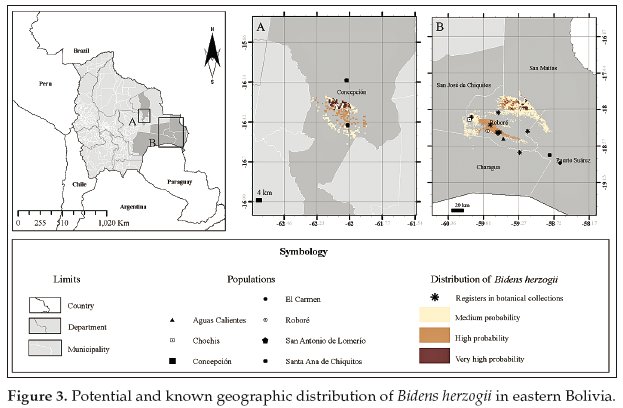
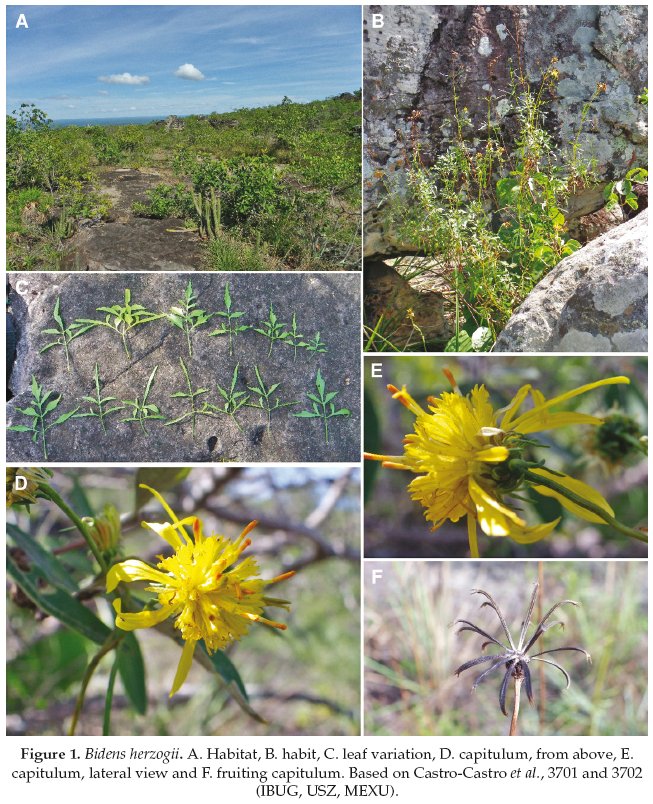
<body><![CDATA[<p>&nbsp;</p>     <p align="center"><font face="Verdana" size="3"><b>Introduction</b></font></p>     <p align="justify"><font face="Verdana" size="2">The tribe Coreopsideae, Asteraceae, is a monophyletic lineage with 24 genera and 600 species (Panero &amp; Funk 2002, Panero 2007, Crawford <i>et al. </i>2009). The tribe has a cosmopolitan distribution, although its greatest diversity is found in the Americas. Two diverse genera of Coreopsideae are <i>Bidens </i>L. and <i>Cosmos </i>Cav. which are frequently confused, and as a consequence several synonymies exist between them (e.g. Hemsley 1881, Sherff 1929, 1932, Melchert 1975, 1990, 2010a-b, Melchert &amp; Turner 1990). A recent case is the proposal of Hind (2013) to transfer <i>Cosmos herzogii </i>Sherff to <i>Bidens. </i>Based on this work and on a recent systematic study of <i>Cosmos </i>(Vargas-Amado <i>et al. </i>2013; Castro-Castro <i>et al. </i>2014, Castro-Castro 2015) and field work we support this last decision. <i>Bidens herzogii, </i>the new combination, is endemic to Eastern Bolivia and it grows on the Cerrado or Cerradense Occidental biogeographic provinces (Morrone 2001 and Navarro &amp; Ferreira 2009, respectively). This region is distinguished by its unique flora, singular abiotic characteristics, and several biological endemisms (Suárez 2000, Wood <i>et al. </i>2011, Pozo <i>et al. </i>2013, <a href="#f1">Fig. 1A</a>).</font></p>     <p align="justify"><a name="f1"></a></p>     <p align="center"><img src="/img/revistas/reb/v52n1/a03_figura_01.jpg" width="653" height="804"></p>     <p align="justify"><font face="Verdana" size="2">Nevertheless, after a revision of herbarium material and live plants in the field, and confronting our observations with previous analyses of <i>Bidens herzogii </i>(Sherff 1934, Hind 2013), we note important morphological variations and measurement ranges of stems, roots, inflorescences, heads, florets, and achenes, that here we would like to provide. At the same time, we discuss on morphological boundaries between <i>Cosmos </i>and <i>Bidens </i>and the infrageneric taxonomic relationship of <i>B. herzogii </i>based on morphology and the first chromosome count for the species. Finally, based on our biogeographic work, we detect that potential geographical distribution of <i>Bidens herzogii </i>could predict key similar areas</font> <font face="Verdana" size="2">for potential conservation and reveal patterns of endemism and species richness in the Bolivian Cerrado.</font></p>     <p align="justify">&nbsp;</p>     <p align="center"><font face="Verdana" size="3"><b>Methods</b></font></p>     <p align="justify"><font face="Verdana" size="2"><i>Bidens herzogii </i>was collected in the type locality and other sites nearby. Extensive sampling captured much of its morphological, ecological, and geographic variation. Vouchers were deposited at USZ, IBUG and MEXU. The morphological data was complemented with the revision of specimens at BOLV, G, IBUG, MEXU, and USZ (herbarium acronyms following Thiers 2013).</font></p>     <p align="justify"><font face="Verdana" size="2">For chromosome counts, mitotic metaphase cells from root tips were observed. The root tips were obtained from three individuals obtained from the type locality and cultivated under greenhouse conditions (see in specimens examined for analyzed material). Root tips were pretreated with 0.002 M 8-hydroxyquinoline for 5 h at 5-10&deg;C. Then, the material was hydrolyzed in 5 N HCl at room temperature for 25 min and washed in distilled water. The root-tips were squashed and stored at -20&deg;C for 3 days. The slides were subsequently dried at room temperature and then stained with 1% acetorcein. Mitotic metaphase figures were photographed with a Zeiss Axiostar microscope and AxioCam ICc1 digital camera equipped with Axiovision 4.8 software.</font></p>     ]]></body>
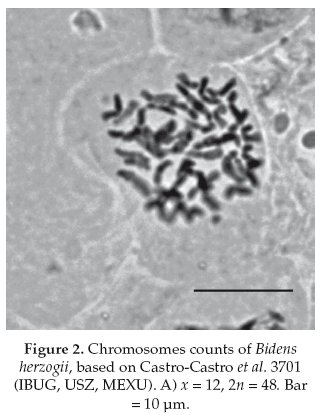
<body><![CDATA[<p align="justify"><font face="Verdana" size="2">Geographic information attached to herbarium specimens and the localities obtained from the field work were used for niche modeling, implemented in MaxEnt (Phillips <i>et al. </i>2006) and following the protocols described by Cruz-Cárdenas <i>et al. </i>(2012). We used 19 climatic variables from WorldClim dataset (Hijmans <i>et al. </i>2005) and eight occurrence points of <i>Bidens herzogii. </i>There are various regionalization proposals for Bolivia (Olson <i>et al. </i>2001, Morrone 2004, Flores-Baltazar 2013, Ledezma-Kravarovic 2013). According to Flores-Baltazar (2013),</font> <font face="Verdana" size="2">the Chaco and the Chiquitania are two different biogeographic provinces and <i>Bidens herzogii </i>has been collected in both of them. Unfortunately, the author did not offer a digital mask. Alternatively, Morrone (2004) recognized only the Chaco biogeographic province and provided a mask. All points of occurrence are located at the Chaco province (Morrone 2004). In order to define the potential range of <i>B. herzogii, </i>we employed the maximum sensitivity test plus specificity suggested by Liu <i>et al. </i>(2005). According to this criterion, greater probability values represent the potential area of the species. The area obtained was divided into three categories, based on areas of potential distribution with medium, high and very high occurrence probabilities. This procedure was achieved dividing by three the range of probability values of the species (J.L. Villaseñor-Ríos, pers. com., 2013).</font></p>     <p align="justify">&nbsp;</p>     <p align="center"><font face="Verdana" size="3"><b>Results</b></font></p>     <p align="center"><font face="Verdana" size="2"><b>Notes on morphological description and chromosome count</b></font></p>     <p align="justify"><font face="Verdana" size="2"><i>Bidens herzogii </i>(Sherff) D.J.N. Hind, Kew Bulletin:68. 2013. <a href="#f1">Fig. 1</a>.</font></p>     <p align="justify"><font face="Verdana" size="2">Suffrutescent herb, (30-)50-130 cm (<a href="#f1">Fig. 1B</a>), xylopodium 7.5-15 cm long, 3.5-7 cm wide, with rhizome extending horizontally and connecting nearby subterranean branches. Stems erect, terete, glabrous, 0.3-2 cm wide, with marked nodes on more mature branches, internodes 1-2 cm. Petiole 2-5.5 cm long. Leaves opposite, 1-3 pinnatisect, membranaceous, light green, concolorous, glabrous, ovate to deltoid in general outline, (4-)7.5-13.5 cm long, (3.5-)5-7.5 cm wide. Primary segments opposite, entire, deeply and irregularly lobate or serrate, lanceolate to ovate, attenuate, acuminate, (0.7-)1-5.5 cm long, 0.3-1.8 cm wide; margins entire or 1-9 dentate, teeth 1-2 mm (<a href="#f1">Fig. 1C</a>). Inflorescence corymbiform, (1-)2-5(-9) heads. Peduncles</font> <font face="Verdana" size="2">thin, glabrous, 2.5-8(-15) cm long. Capitula radiate, (2.5-)3-4.5 cm wide across extended rays (<a href="#f1">Fig. 1D</a>). Involucre campanulate, 0.3-0.6 mm wide. Phyllaries biseriate; outer series (8-)14-22, green, foliaceous, (4-)5-7.5 mm long, 0.5-0.8 mm wide, linear, sigmoid, extended or reflexed, glabrous, lustrous, with 1(-3) inconspicuous resiniferous ducts on abaxial face, obtuse; inner series 12-22, scarious, membranaceous, translucent, pale yellow, hyaline margins, with 5-8 fine resiniferous and conspicuous ducts on abaxial face, 8-10 mm long, 2-2.2 mm wide, lanceolate, acute (<a href="#f1">Fig. 1E</a>). Receptacle flat, convex when dry, palaceous, 2-4 mm diameter. Paleae translucent yellow, 8-10 mm long, 1-2 mm wide, persistent, resembling inner phyllaries. Ray florets 6-12 (frequently deciduous), uniseriate, sterile, yellow (brown when dry), lanceolate limb, obtuse, entire or 2-lobulate, (1.3-)2.3-2.8 cm long, 0.3-0.8(-1) cm wide, with 3-8 conspicuous ribs, glabrous, tube 3 mm long, 0.5 mm wide, glabrous. Disk florets (16-)26-32, hermaphrodite, yellow; corollas tubular, occasionally urceolate in peripheral florets in material from Santiago [<i>Castro-Castro et al. 3701 </i>(USZ, IBUG, MEXU)], 0.8-11 mm long, 1.5-2.2 mm wide, glabrous, 5-lobed; lobes triangular, erect, acute, glabrous, 1.5 mm long, 1 mm wide. Frequently, outer disk florets tend to a ray form, anthers are reduced or absent and gynoecium is normal (<a href="#f1">Fig. 1E</a>). Anthers 5, brownish yellow, 2.5-3 mm, sagittate, appendices acute; filaments laminar, glabrous. Pollen orange. Style 1.2-1.5 cm, brownish yellow; style branches 1.8-2.1 mm, penicillate, papillose. Achenes tetragonal to flattened, fusiform, falcate, 4 thick ribs alternating with 4 thin ribs, (9-)1.2-1.8 cm long, 1.6-1.8 mm wide, greenish brown to black at maturity, glabrous, muricate; carpopodium annular; pappus awns 2-3, 2-2.2 mm, each awn with 6-8 retrorse barbs, persistent (<a href="#f1">Fig. 1F</a>). Chromosome number <i>2n = </i>48 (<a href="#f2">Fig. 2</a>).</font></p>     <p align="justify"><a name="f2"></a></p>     <p align="center"><img src="/img/revistas/reb/v52n1/a03_figura_02.jpg" width="320" height="415"></p>     <p align="justify"></p>     <p align="center"><font face="Verdana" size="2"><b>Specimens examined</b></font></p>     ]]></body>
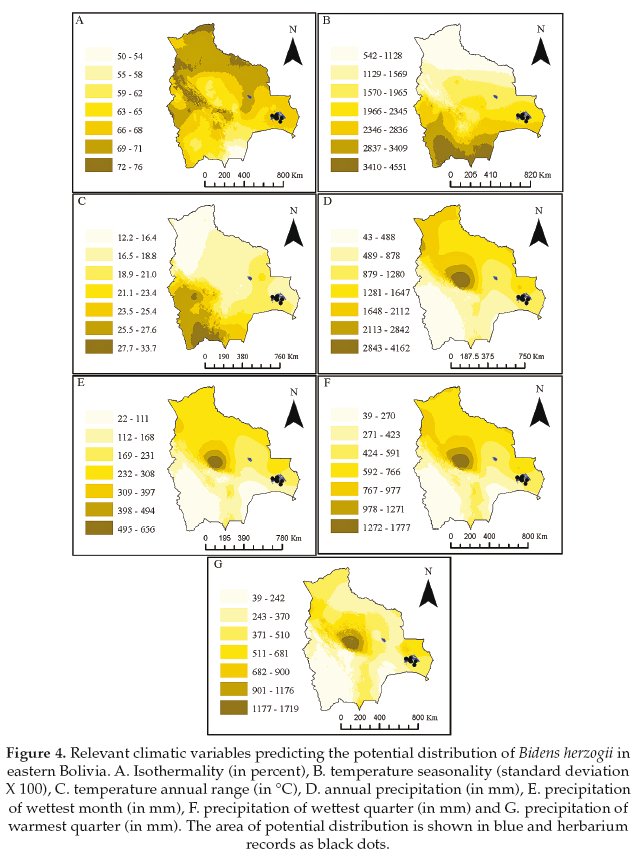
<body><![CDATA[<p align="justify"><font face="Verdana" size="2">BOLIVIA. <b>Santa Cruz. </b>Prov. Chiquitos, NO de Roboré, 18º14'14'S, 59º42'18&quot;W, 1,053 m, 3-May-2008 (fl, fr), <i>Wood et al. 24685 </i>(K, USZ!). Santiago de Chiquitos. Chochis, zone of pass across Chochis range climbing up from Chochis-Matacuzal trail, 18º03'S, 59º34'48&quot;W, 18-March-2005 (fl, fr), <i>Wood et al. 21908 </i>(BOLV!, K, LPB!, USZ!); Cerro Chochis, on the meseta at the summit, 18º07'S, 60º00'W, 1,200 m, 22-February-2006 (fl, fr), <i>Wood 22243 </i>(K, USZ!); Cerca de La Antena, 3-4 km de Santiago de Chiquitos, arriba de San Juanama, 18º20'5'S, 59º07'42&quot;W, 697 m, 9-April-2008 (fl, fr), <i>Wood et al. 24315 </i>(K, USZ!); Camino de Santiago de Chiquitos a Soledad-Aguas Calientes, poco antes de llegar a Soledad, 18º21'S, 59º36'W, 3-December-2003 (fl, fr), <i>Wood et al. 20152 </i>(BOLV!, K, LPB!, USZ!); Serranía de Santiago, camino a La Cueva y a la altura de El Arco, 18º40'S, 59º15'W, 800 m, 13-November-1997 (fl, fr), <i>Mamani &amp; Jardim 1288 </i>(USZ!); Sendero</font></p>     <p align="justify"><font face="Verdana" size="2">El Arco-Las Cuevas de Juan Miserandino, Cerro San Miserato, 18º20'54.9&quot;S, 59º33'30&quot;W, 820 m, 12-May-2013 (fl, fr), <i>Castro-Castro et al. 3701 </i>(USZ!, IBUG!, MEXU!; material used for chromosomal counts); Sendero Soledad, camino entre El Arco de Soledad y el Río Soledad, alrededores de las rocas El Búho y La Tortuga, 18º22'll'S, 59º35'16.8'W, 574 m, 13-May-2013 (fl, fr), <i>Castro-Castro et al. 3702 </i>(USZ!, IBUG!, MEXU!); summit of Cerro San Miserate, Chiquitos, 900 m, May-1907 (fl), <i>Herzog 496 </i>(G!).</font></p>     <p align="center"><font face="Verdana" size="2"><b>Potential geographical distribution</b></font> <font face="Verdana" size="2"><b>of <i>Bidens herzogii</i></b></font></p>     <p align="justify"><font face="Verdana" size="2"><i>Bidens herzogii </i>is endemic to the Cerrado biogeographic province, in Eastern Bolivia. Its geographic range is restricted to the central part of Santa Cruz de la Sierra Department (<a href="#f3">Fig. 3</a>). It grows on rocky fields with thin alluvial soils accumulated in the rock crevices. The area is dominated by xeric scrubs and were evident <i>Astrocaryum arenarium </i>Barb. Rodr., <i>Cleistocactus samaipatanus </i>(Cárdenas) D.R. Hunt, <i>Deuterocohnia longipetala </i>(Baker) Mez, <i>Echinopsis calochlora </i>K. Schum., <i>Hippeastrum </i>spp., <i>Mimosa auriculata </i>Benth., <i>Paepalanthus chiquitensis </i>Herzog, <i>Pitcairnia chiquitana </i>R. Vásquez &amp; Ibish, <i>Smilax campestris </i>Griseb., <i>Vellozia variabilis </i>Mart. ex Schult. f., and several species of Poaceae (<a href="#f1">Fig. 1a</a>).</font></p>     <p align="justify"><font face="Verdana" size="2">The herbarium vouchers analyzed and the field observations were recorded from the Chiquitos and Cordillera provinces. But the modeling analysis extended its potential distribution to the José Miguel de Velasco and Ñuflo de Chávez provinces (<a href="#f3">Fig. 3</a>). The area comprised 2,805 km<sup>2</sup> with occurrence values of 44.8-62.5%, 62.6-80.2% and 80.3-100%, for median, high and very high probabilities, respectively. The median probability area included 1,693 km<sup>2</sup>, of which 60% was located at Puerto Suárez and a significant part of San Matías municipalities (<a href="#f3">Fig. 3B</a>). Meanwhile, the high probability area extended across 882</font> <font face="Verdana" size="2">km<sup>2</sup>, with 32% of its area located at the Roboré municipality. This area harbored the majority of herbarium records. Finally, the very high probability covered 229 km<sup>2</sup> and 8% of them belonged to the Concepción and San Matías municipalities (<a href="#f3">Fig. 3A</a>).</font></p>     <p align="justify"><a name="f3"></a></p>     <p align="center"><img src="/img/revistas/reb/v52n1/a03_figura_03.jpg" width="623" height="408"></p>     <p align="justify"><font face="Verdana" size="2">First, we used the 19 climatic variables of WorldClim to create a potential distribution model of <i>Bidens herzogii. </i>However, only seven climatic variables were employed in the final analysis after the mean test. These variables were isothermality, temperature seasonality, temperature annual range, annual precipitation, precipitation of wettest month, precipitation of wettest quarter and precipitation of warmest quarter (<a href="#f4">Fig. 4</a>). Thus, only seven climatic variables predicted the presence of <i>Bidens herzogii.</i></font></p>     <p align="justify"><a name="f4"></a></p>     <p align="center"><img src="/img/revistas/reb/v52n1/a03_figura_04.jpg" width="636" height="859"></p>     ]]></body>
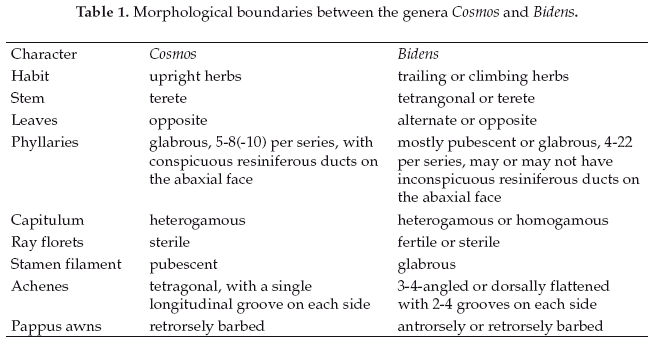
<body><![CDATA[<p align="justify"><font face="Verdana" size="2">Usually, <i>Bidens herzogii </i>grows on sites with media isothermality (67 and 68%, <a href="#f4">Fig. 4A</a>), some seasonal temperature (<a href="#f4">Fig. 4B</a>), and relatively lower temperatures than the rest of Eastern Bolivia (18.5&deg;C and 19.4&deg;C, <a href="#f4">Fig. 4C</a>). In addition,</font> <font face="Verdana" size="2">annual precipitation varies between 1,069-1,201 mm (<a href="#f4">Fig. 4D-G</a>). According to Navarro (2011), these climatic conditions persist throughout the Chiquitanía region, where the climate is markedly seasonal, with a time of intense rainfall, and mostly humid the rest of the year.</font></p>     <p align="justify">&nbsp;</p>     <p align="center"><font face="Verdana" size="3"><b>Discussion</b></font></p>     <p align="center"><font face="Verdana" size="2"><b>Morphological boundaries between <i>Cosmos</i></b></font> <b><font face="Verdana" size="2">and <i>Bidens </i>and the infrageneric taxonomic</font> <font face="Verdana" size="2">relationship of <i>B. herzogii</i></font></b></p>     <p align="justify"><font face="Verdana" size="2">The boundaries between <i>Bidens </i>and <i>Cosmos </i>are complex in some cases and their separation requires a combination of characters. A reliable character to separate both genera is the filament indument of the stamens. In <i>Cosmos, </i>the filaments are pubescent whereas these are glabrous in all known taxa of <i>Bidens. </i>Other useful morphological characters identified by Castro-Castro <i>et al. </i>(2014) are indicated in the <a href="#t1">Table 1</a>.</font></p>     <p align="justify"><a name="t1"></a></p>     <p align="center"><img src="/img/revistas/reb/v52n1/a03_tabla_01.gif" width="652" height="344"></p>     <p align="justify"><font face="Verdana" size="2">Many chromosomal changes are common evolutionary processes in Coreopsideae (Crawford <i>et al. </i>2009, Watanabe 2014). The basic chromosome number in the tribe is <i>x = </i>12-14, but Crawford <i>et al. </i>(2009) considered <i>x = </i>16 with an important chromosome reduction to <i>x = </i>12 in three clades. One clade groups the genera <i>Chrysanthellum </i>Richard, two lineages of <i>Coreopsis </i>L., <i>Glossocardia </i>Cass., <i>Isostigma </i>Less., <i>Henricksonia </i>B.L. Turner and <i>Heterosperma </i>Cav. A second clade includes the genera <i>Fitchia </i>Hook, <i>Narvalina </i>Cass., <i>Oparanthus </i>Sherff, <i>Petrobium </i>R. Br. and <i>Selleophytum </i>Urb. The third clade comprises <i>Bidens, Coreocarpus </i>Benth., two lineages of <i>Coreopsis, Cosmos </i>and <i>Thelesperma </i>Less.</font></p>     <p align="justify"><font face="Verdana" size="2">Around 60% of <i>Bidens </i>species, for which the chromosomal numbers are known, have <i>x = </i>12 or multiples, but deviations from this value exist <i>(x = </i>10, 11, 17, 18; Watanabe 2014). On this basis, it is possible to hypothesize that <i>x = </i>12 is the basic number for the genus. A similar scenario occurred in <i>Cosmos, </i>in which both dysploidy and polyploidy has been associated with its evolution and diversification.   Melchert   (1968)   found   a</font> <font face="Verdana" size="2">correlation between morphological and chromosomal data and identified three main species complexes within the genus. A major evolutionary dichotomy occurred with the ancestor that gave rise to the two perennial complexes. In the suffruticose species of <i>Cosmos </i>sect. <i>Mesinenia </i>Sherff, <i>x = </i>11 (n = 11, 22, 33). In contrast, all other perennials in <i>Cosmos </i>sect. <i>Discopoda </i>(DC.) Sherff, <i>x = </i>12 (n = 12, 24, 36). In annual species of <i>Cosmos </i>sect. <i>Cosmos, x = </i>12 (n = 12, 24).</font></p>     <p align="justify"><font face="Verdana" size="2">In <i>Bidens, </i>there also exists a wide chromosome series <i>2n = </i>20, 22, 24, 34, 36, 48, 96 (Panero 2007, Watanabe 2014). <i>Bidens herzogii </i>is a tetraploid, as the somatic chromosome number was <i>2n = </i>48 (<a href="#f2">Fig. 2</a>). The chromosomal counts agreed with other data for <i>Bidens </i>species from South America (Solbrig <i>et al. </i>1972, Powell <i>et al. </i>1974, Turner <i>et al. </i>1979, Keil <i>et al. </i>1988, Grombone-Guaratini <i>et al. </i>2006, Crawford <i>et al. </i>2009, Watanabe 2014).</font></p>     ]]></body>
<body><![CDATA[<p align="justify"><font face="Verdana" size="2">Based on infrageneric classification proposed by de Candolle (1836) and Sherff (1937), <i>Bidens herzogii </i>can be included in <i>Bidens </i>section <i>Psilocarpaea </i>DC. It is the largest section</font> <font face="Verdana" size="2">of <i>Bidens, </i>comprises much of the American species, and includes annual and perennial herbs and shrubs, with simple or segmented leaves, discoid or radiate heads, tetragonal and aristate achenes. Sherff (1937) and Kim <i>et al. </i>(1999) argued that this section does not represent a natural lineage and future studies may indicate the advisability of splitting this section into several smaller groups.</font></p>     <p align="center"><font face="Verdana" size="2"><b>Potential distribution of <i>Bidens herzogii </i>and its implications for the conservation</b></font></p>     <p align="justify"><font face="Verdana" size="2">The herbarium records and potential projected distribution of <i>Bidens herzogii </i>coincided in the Chiquitanía region, in the plains identified as Occidental Cerradense by Navarro &amp; Ferreira (2009). Navarro (2011) remarked that La Chiquitanía constitutes a natural region in Southeastern Bolivia, and extends into northern Paraguay and Western Brazil at the boundaries of the Amazon River and La Plata River basins. The region is part of the Brazilian Precambric Shield, also known as the &quot;Cratón de Guaporé&quot; (Suarez 2000, Montes de Oca 2001) and it is distinguished by its unique flora, singular abiotic characteristics, and several biological endemism (Suarez 2000, Wood <i>et al. </i>2011, Pozo <i>et al. </i>2013).</font></p>     <p align="justify">&nbsp;</p>     <p align="center"><font face="Verdana" size="3"><b>Conclusions</b></font></p>     <p align="justify"><font face="Verdana" size="2">We propose that the potential geographical distribution of <i>B. herzogii </i>(<a href="#f2">Figs. 2</a>-<a href="#f3">3</a>), could predict key areas for others restricted plants and indicate potential areas for conservation. Species distribution models estimates the spatial distributions of species requiring attention, due to its rarity or limited known occurrences. According to Hernández <i>et al. </i>(2006), out of four modeling methods, Maxent was the best in producing useful results with sample sizes as small as 5, 10 and 25 occurrences. The accuracy of models is greater for species with small geographic ranges and limited environmental tolerance.</font></p>     <p align="justify"><font face="Verdana" size="2">Our results indicate that reasonable models can be generated for some rare species like <i>Bidens herzogii </i>and it should encourage conservationists to add distribution modeling tools to their research programs.</font></p>     <p align="justify"><font face="Verdana" size="2">For example, the Noel Kempff National Park and the Tucavaca Natural Protected Area, in Santa Cruz department (SERNAP 2013, Robinson <i>et al. </i>2002), could direct their efforts in order to protect new areas or extend their geographic limits, considering the potential distribution of <i>B. herzogii </i>and by modeling the distribution of other associated species restricted to the region based on methods used in our work. This proposal coincides with Pozo <i>et al. </i>(2013) in the identification of conservation hotspots areas in Eastern Bolivia, containing high environmental heterogeneity, high plant diversity and endemism. Finally, we recommend its application for defining conservation priorities in Eastern Bolivia.</font></p>     <p align="justify">&nbsp;</p>     <p align="center"><font face="Verdana" size="3"><b>Acknowledgments</b></font></p>     ]]></body>
<body><![CDATA[<p align="justify"><font face="Verdana" size="2">We are grateful to curators and staff of the following herbaria: B, G, IBUG, JUA, LIL, LP, LPB, MCNS, MEXU, and USZ. The authors thank Laurent Gautier and Venera Fonjallaz, of the Conservatoire et Jardin Botaniques de la Ville de Genève, for providing the type material image of <i>Bidens herzogii. </i>We thank Roxana Ledezma-Vargas, Thamara Chuvirú-Castro, Tatiana Martínez e Iván Linneo-Foronda from the USZ Herbarium for their help during field work of ACC in Bolivia. To Denice Azunta Fernández-Cabello and Osvair Palacios-Torrico, from the Tucavaca Natural Protected Area in Santiago de Chiquitos, Roboré, Bolivia, they are great young field guides; for their support, enthusiasm and discipline, thank you.</font></p>     <p align="justify">&nbsp;</p>     <p align="center"><font face="Verdana" size="3"><b>References</b></font></p>     <p align="justify"><font face="Verdana" size="2">Castro-Castro, A. 2015. Filogenia y evolución del género Cosmos(Asteraceae,Coreopsideae).</font> <font face="Verdana" size="2">Tesis de doctorado, Universidad de Guadalajara, Guadalajara. 209 p.</font></p>     <p align="justify"><font face="Verdana" size="2">Castro-Castro, A., M. Harker, G. Vargas-Amado &amp; A. Rodríguez. 2014. Análisis macromorfológico y citogenético del género <i>Cosmos </i>(Asteraceae, Coreopsideae), con una clave para su identificación. Botanical Sciences 92(3): 363-388.</font></p>     <p align="justify"><font face="Verdana" size="2">Crawford, D.J., M. Tadesse, M.E. Mort, R.T. Kimball &amp; C.P. Randle. 2009. <i>Coreopsideaepp. </i>713-730. In: Funk, V.A., A. Susanna, T.F. Stuessy &amp; R.J. Bayer (eds.) Systematics, evolution and biogeography of Compositae. International Association for Plant Taxonomy, Vienna.</font></p>     <p align="justify"><font face="Verdana" size="2">Cruz-Cárdenas, G., J.L. Villaseñor, L. López-Mata &amp; E. Ortíz. 2012. Potential distribution of humid mountain forest in Mexico. Botanical Sciences 90(3): 331-340.</font></p>     <!-- ref --><p align="justify"><font face="Verdana" size="2">de Candolle, A.P. 1836. Prodromus Systematis Naturalis Regni Vegetabilis Pars V. Paris. 706 p.    &nbsp;&nbsp;&nbsp;&nbsp;&nbsp;&nbsp;&nbsp;&nbsp;[&#160;<a href="javascript:void(0);" onclick="javascript: window.open('/scielo.php?script=sci_nlinks&ref=027216&pid=S1605-2528201700010000300005&lng=','','width=640,height=500,resizable=yes,scrollbars=1,menubar=yes,');">Links</a>&#160;]<!-- end-ref --></font></p>     <!-- ref --><p align="justify"><font face="Verdana" size="2">Flores-Baltazar, E. 2013. Mapa de ecorregiones de Bolivia - WWF 2001. GeoBolivia.</font> <font face="Verdana" size="2">La Paz. Fecha de consulta: 27 de</font> <font face="Verdana" size="2">marzo de 2017. [<a href="https://geo.gob.bo/ download/?w=otros&l=Ecoregiones_ WWF" target="_blank">https://geo.gob.bo/ download/?w=otros&amp;l=Ecoregiones_ WWF</a>].    &nbsp;&nbsp;&nbsp;&nbsp;&nbsp;&nbsp;&nbsp;&nbsp;[&#160;<a href="javascript:void(0);" onclick="javascript: window.open('/scielo.php?script=sci_nlinks&ref=027218&pid=S1605-2528201700010000300006&lng=','','width=640,height=500,resizable=yes,scrollbars=1,menubar=yes,');">Links</a>&#160;]<!-- end-ref --></font></p>     <p align="justify"><font size="2" face="Verdana, Arial, Helvetica, sans-serif">Grombone-Guaratini, M.A., M. Esteves-Mansanares, J. Semir &amp; V. Nisaka-Solferini. 2006. Chromosomal studies of   three species of Bidens (L.) (Asteraceae).  Caryologia 59(1): 14-18.</font></p>     <p align="justify"><font face="Verdana" size="2">Hemsley, W.B. 1881. Compositae. Pp. 69-263. In: Godman, F.D. &amp; O. Salvin (eds.) Biologia Centrali-Americana; or Contributions to the Knowledge of the Fauna and Flora of Mexico and Central America. Porter and Dulau &amp; Co., London.</font></p>     <p align="justify"><font face="Verdana" size="2">Hernandez, P.A., C.H. Graham, L.L. Master &amp; D.L. Albert. 2006. The effect of sample size and species characteristics on performance of different species distribution modeling methods. Ecography 29: 773-785.</font></p>     <p align="justify"><font face="Verdana" size="2">Hijmans, R.J., S.E. Cameron, J.L. Parra, P.G. Jones &amp; A. Jarvis. 2005. Very high resolution interpolated climate surfaces for global land areas. International Journal of Climatology 25(15): 1965-1978.</font></p>     <!-- ref --><p align="justify"><font face="Verdana" size="2">Hind, D.J.N. 2013. The identity of <i>Cosmos herzogii </i>(Compositae: Heliantheae: Coreopsidinae) from Santa Cruz, Eastern Bolivia. Kew Bulletin 68(3): 505-510.    &nbsp;&nbsp;&nbsp;&nbsp;&nbsp;&nbsp;&nbsp;&nbsp;[&#160;<a href="javascript:void(0);" onclick="javascript: window.open('/scielo.php?script=sci_nlinks&ref=027224&pid=S1605-2528201700010000300011&lng=','','width=640,height=500,resizable=yes,scrollbars=1,menubar=yes,');">Links</a>&#160;]<!-- end-ref --></font></p>     <p align="justify"><font face="Verdana" size="2">Keil, D.J., M.A. Luckow &amp; D.J. Pinkava. 1988. Chromosome studies in Asteraceae from the United States, Mexico, the West Indies, and South America. American Journal of Botany 75(5): 652-668.</font></p>     <p align="justify"><font face="Verdana" size="2">Kim, S., D.J. Crawford, M. Tadesse, M. Berbee, F.R. Ganders, M. Pirsedeyi &amp; E.J. Esselman .1999. ITS sequences and phylogenetic relationships in <i>Bidens </i>and <i>Coreopsis </i>(Asteraceae). Systematic Botany 24(3): 480-493.</font></p>     <p align="justify"><font face="Verdana" size="2">Liu, C., P.M. Berry, T.P. Dawson &amp; R.G. Pearson. 2005. Selecting thresholds of occurrence in the prediction of species distributions. Ecography 28(3): 385-393.</font></p>     ]]></body>
<body><![CDATA[<!-- ref --><p align="justify"><font face="Verdana" size="2">Ledezma-Kravarovic, S.M. 2013. Mapa de bosques de Bolivia. Viceministerio de Medio Ambiente, Biodiversidad, Cambios Climáticos y de Gestión y Desarrollo Forestal. La Paz Fecha de consulta: 27 de marzo de 2017. [<a href="https://geo.gob.bo/download/?w=mdmaya&l=bosque2013_wgs84" target="_blank">https://geo.gob.bo/download/?w=mdmaya&amp;l=bosque2013_wgs84</a>].    &nbsp;&nbsp;&nbsp;&nbsp;&nbsp;&nbsp;&nbsp;&nbsp;[&#160;<a href="javascript:void(0);" onclick="javascript: window.open('/scielo.php?script=sci_nlinks&ref=027229&pid=S1605-2528201700010000300015&lng=','','width=640,height=500,resizable=yes,scrollbars=1,menubar=yes,');">Links</a>&#160;]<!-- end-ref --></font></p>     <!-- ref --><p align="justify"><font face="Verdana" size="2">Löwenberg-Neto, P. 2014. Neotropical region: a shapefile of Morrone's (2014) biogeographical regionalisation. Zootaxa 3802(2): 300.    &nbsp;&nbsp;&nbsp;&nbsp;&nbsp;&nbsp;&nbsp;&nbsp;[&#160;<a href="javascript:void(0);" onclick="javascript: window.open('/scielo.php?script=sci_nlinks&ref=027231&pid=S1605-2528201700010000300016&lng=','','width=640,height=500,resizable=yes,scrollbars=1,menubar=yes,');">Links</a>&#160;]<!-- end-ref --></font></p>     <!-- ref --><p align="justify"><font face="Verdana" size="2">Melchert, T.E. 1968. Systematic studies in the Coreopsidinae: cytotaxonomy of Mexican and Guatemalan <i>Cosmos. </i>American Journal of Botany 55(3): 345-353.    &nbsp;&nbsp;&nbsp;&nbsp;&nbsp;&nbsp;&nbsp;&nbsp;[&#160;<a href="javascript:void(0);" onclick="javascript: window.open('/scielo.php?script=sci_nlinks&ref=027233&pid=S1605-2528201700010000300017&lng=','','width=640,height=500,resizable=yes,scrollbars=1,menubar=yes,');">Links</a>&#160;]<!-- end-ref --></font></p>     <!-- ref --><p align="justify"><font face="Verdana" size="2">Melchert, T.E. 1975. New combinations in the Coreopsidinae. Phytologia 32(4): 291-298.    &nbsp;&nbsp;&nbsp;&nbsp;&nbsp;&nbsp;&nbsp;&nbsp;[&#160;<a href="javascript:void(0);" onclick="javascript: window.open('/scielo.php?script=sci_nlinks&ref=027235&pid=S1605-2528201700010000300018&lng=','','width=640,height=500,resizable=yes,scrollbars=1,menubar=yes,');">Links</a>&#160;]<!-- end-ref --></font></p>     <!-- ref --><p align="justify"><font face="Verdana" size="2">Melchert, T.E. 1990. <i>Cosmos ocellatus </i>a <i>Bidens </i>(Asteraceae, Coreopsideae). Phytologia 69(6): 436-444.    &nbsp;&nbsp;&nbsp;&nbsp;&nbsp;&nbsp;&nbsp;&nbsp;[&#160;<a href="javascript:void(0);" onclick="javascript: window.open('/scielo.php?script=sci_nlinks&ref=027237&pid=S1605-2528201700010000300019&lng=','','width=640,height=500,resizable=yes,scrollbars=1,menubar=yes,');">Links</a>&#160;]<!-- end-ref --></font></p>     ]]></body>
<body><![CDATA[<p align="justify"><font face="Verdana" size="2">Melchert, T.E. 2010a. <i>Bidens. </i>In: Turner, B. L. (ed.) The Comps of Mexico, a systematic account of the family Asteraceae (Chapter 10: subfamily Coreopsideae). Phytologia Memoirs 15: 3-56.</font></p>     <p align="justify"><font face="Verdana" size="2">Melchert, T.E. 2010b. <i>Cosmos. </i>In: Turner, B. L. (ed.) The Comps of Mexico, a systematic account of the family Asteraceae (Chapter 10: subfamily Coreopsideae). Phytologia Memoirs 15: 82-105.</font></p>     <p align="justify"><font face="Verdana" size="2">Melchert, T.E. &amp; B.L. Turner. 1990. New species, names, and combinations in Mexican <i>Bidens </i>(Asteraceae: Coreopsideae). Phytologia 68(6): 20-31.</font></p>     <!-- ref --><p align="justify"><font face="Verdana" size="2">Montes de Oca, I. 2001. Enciclopedia geográfica de Bolivia. Editora Atenea srl., La Paz. 872 p.    &nbsp;&nbsp;&nbsp;&nbsp;&nbsp;&nbsp;&nbsp;&nbsp;[&#160;<a href="javascript:void(0);" onclick="javascript: window.open('/scielo.php?script=sci_nlinks&ref=027242&pid=S1605-2528201700010000300023&lng=','','width=640,height=500,resizable=yes,scrollbars=1,menubar=yes,');">Links</a>&#160;]<!-- end-ref --></font></p>     <p align="justify"><font face="Verdana" size="2">Morrone, J.J. 2001. Biogeografía de América Latina y el Caribe. Manuales y Tesis 3. SEA. Zaragoza. 148 p.</font></p>     <!-- ref --><p align="justify"><font face="Verdana" size="2">Morrone, J.J. 2004. Panbiogeografía, componentes bióticos y zonas de transición. Revista Brasileira de Entomologia 48(2): 149-162.    &nbsp;&nbsp;&nbsp;&nbsp;&nbsp;&nbsp;&nbsp;&nbsp;[&#160;<a href="javascript:void(0);" onclick="javascript: window.open('/scielo.php?script=sci_nlinks&ref=027245&pid=S1605-2528201700010000300025&lng=','','width=640,height=500,resizable=yes,scrollbars=1,menubar=yes,');">Links</a>&#160;]<!-- end-ref --></font></p>     <!-- ref --><p align="justify"><font face="Verdana" size="2">Morrone, J.J. 2014. Biogeographical regionalisation of the Neotropical region. Zootaxa 3782(1): 1-110.    &nbsp;&nbsp;&nbsp;&nbsp;&nbsp;&nbsp;&nbsp;&nbsp;[&#160;<a href="javascript:void(0);" onclick="javascript: window.open('/scielo.php?script=sci_nlinks&ref=027247&pid=S1605-2528201700010000300026&lng=','','width=640,height=500,resizable=yes,scrollbars=1,menubar=yes,');">Links</a>&#160;]<!-- end-ref --></font></p>     ]]></body>
<body><![CDATA[<!-- ref --><p align="justify"><font face="Verdana" size="2">Navarro, G. 2011. Clasificación de la vegetación de Bolivia. Centro de Ecología y Difusión Simón I. Patiño, Santa Cruz. 713 p.    &nbsp;&nbsp;&nbsp;&nbsp;&nbsp;&nbsp;&nbsp;&nbsp;[&#160;<a href="javascript:void(0);" onclick="javascript: window.open('/scielo.php?script=sci_nlinks&ref=027249&pid=S1605-2528201700010000300027&lng=','','width=640,height=500,resizable=yes,scrollbars=1,menubar=yes,');">Links</a>&#160;]<!-- end-ref --></font></p>     <p align="justify"><font face="Verdana" size="2">Navarro, G. &amp; W. Ferreira. 2009. Biogeografía de Bolivia. pp. 23-39. In: VMABCC (Viceministerio de Medio Ambiente, Bosques y Cambio Climático)-BIOVERSITY. Libro Rojo de Parientes Silvestres de Cultivos de Bolivia. Plural editores, La Paz.</font></p>     <p align="justify"><font face="Verdana" size="2">Olson, D.M., E. Dinerstein,E .D. Wikramanayake, N.D. Burgess, G.V.N. Powell, E.C. Underwood, J.A. D'Amico, I. Itoua, H.E. Strand, J.C. Morrison, C.J. Loucks, T.F. Allnutt, T.H. Ricketts, Y. Kura, J.F. Lamoreux, W.W. Wettengel, P. Hedao &amp; K.R. Kassem. 2001. Terrestrial ecoregions of the world: a new map of life on Earth. BioScience 51(11): 933-938.</font></p>     <p align="justify"><font face="Verdana" size="2">Panero, J.L. 2007. Tribe Coreopsideae. pp. 406-417. In: Kubitzki, K. (ser. ed.), Kaderit, J. W. &amp; C. Jeffrey (vol. eds.) The Families and Genera of Vascular Plants Vol. VIII. Flowering Plants, Eudicots, Asterales. Springer-Verlag, Berlin.</font></p>     <p align="justify"><font face="Verdana" size="2">Panero, J.L. &amp; V.A. Funk. 2002. Toward a phylogenetic subfamilial classification for the Compositae (Asteraceae). Proceedings of the Biological Society of Washington 115(4): 909-922.</font></p>     <p align="justify"><font face="Verdana" size="2">Phillips, S.J., R.P. Anderson &amp; R.E. Schapire. 2006. Maximum entropy modeling of species geographic distributions. Ecological Modelling 190(3-4): 231-259.</font></p>     <p align="justify"><font face="Verdana" size="2">Powell, A.M., W. Kyhos &amp; P.H. Raven. 1974. Chromosome numbers in Compositae. X. American Journal of Botany 61(8): 909-913.</font></p>     <p align="justify"><font face="Verdana" size="2">Pozo, P., J. Wood, D. Soto &amp; S. Beck. 2013. Plantas endémicas de afloramientos rocosos en las serranías de Roboré y Concepción: implicaciones para su conservación. Revista de la Sociedad Boliviana de Botánica 7(1): 73-81.</font></p>     <p align="justify"><font face="Verdana" size="2">Robinson, D., H. Salas, K. Linzer., R. Sucedo &amp; K. Balcazar. 2002. Plan de manejo de la Reserva Municipal del Valle de Tucabaca. Fundación Amigos de la Naturaleza, Santa Cruz. 128 p.</font></p>     ]]></body>
<body><![CDATA[<!-- ref --><p align="justify"><font face="Verdana" size="2">SERNAP (Servicio Nacional de Áreas Protegidas, Bolivia). 2013. Parque Nacional Noel Kempff Mercado. Available from: <a href="http://www.sernap.gob.bo/images/descargas/ areas/parque%20nacional%20noel%20 kempff%20mercado.pdf" target="_blank">http://www.sernap.gob.bo/images/descargas/ areas/parque%20nacional%20noel%20 kempff%20mercado.pdf</a></font>&nbsp;&nbsp;&nbsp;&nbsp;&nbsp;&nbsp;&nbsp;&nbsp;[&#160;<a href="javascript:void(0);" onclick="javascript: window.open('/scielo.php?script=sci_nlinks&ref=027259&pid=S1605-2528201700010000300036&lng=','','width=640,height=500,resizable=yes,scrollbars=1,menubar=yes,');">Links</a>&#160;]<!-- end-ref --><!-- ref --><p align="justify"><font face="Verdana" size="2">Sherff, E .E. 1929. New or otherwise noteworthy Compositae, III. Botanical Gazette 88(3): 285-309.    &nbsp;&nbsp;&nbsp;&nbsp;&nbsp;&nbsp;&nbsp;&nbsp;[&#160;<a href="javascript:void(0);" onclick="javascript: window.open('/scielo.php?script=sci_nlinks&ref=027260&pid=S1605-2528201700010000300037&lng=','','width=640,height=500,resizable=yes,scrollbars=1,menubar=yes,');">Links</a>&#160;]<!-- end-ref --></font></p>     <!-- ref --><p align="justify"><font face="Verdana" size="2">Sherff, E.E. 1932. Revision of the genus <i>Cosmos. </i>Field Museum of Natural History, Botanical Series 8(6): 401-447.    &nbsp;&nbsp;&nbsp;&nbsp;&nbsp;&nbsp;&nbsp;&nbsp;[&#160;<a href="javascript:void(0);" onclick="javascript: window.open('/scielo.php?script=sci_nlinks&ref=027262&pid=S1605-2528201700010000300038&lng=','','width=640,height=500,resizable=yes,scrollbars=1,menubar=yes,');">Links</a>&#160;]<!-- end-ref --></font></p>     <!-- ref --><p align="justify"><font face="Verdana" size="2">Sherff, E.E. 1934. Some new or otherwise noteworthy members of the families Labiatae and Compositae. Botanical Gazette 96(1): 136-153.    &nbsp;&nbsp;&nbsp;&nbsp;&nbsp;&nbsp;&nbsp;&nbsp;[&#160;<a href="javascript:void(0);" onclick="javascript: window.open('/scielo.php?script=sci_nlinks&ref=027264&pid=S1605-2528201700010000300039&lng=','','width=640,height=500,resizable=yes,scrollbars=1,menubar=yes,');">Links</a>&#160;]<!-- end-ref --></font></p>     <!-- ref --><p align="justify"><font face="Verdana" size="2">Sherff, E.E. 1937. The genus <i>Bidens. </i>Field Museum of Natural History, Botanical Series 16(1): 1-709.    &nbsp;&nbsp;&nbsp;&nbsp;&nbsp;&nbsp;&nbsp;&nbsp;[&#160;<a href="javascript:void(0);" onclick="javascript: window.open('/scielo.php?script=sci_nlinks&ref=027266&pid=S1605-2528201700010000300040&lng=','','width=640,height=500,resizable=yes,scrollbars=1,menubar=yes,');">Links</a>&#160;]<!-- end-ref --></font></p>     <p align="justify"><font face="Verdana" size="2">Solbrig, O.T, D.W. Kyhos, M. Powell &amp; P.H. Raven. 1972. Chromosome numbers in Compositae VIII: Heliantheae. American Journal of Botany 59(8): 869-878.</font></p>     ]]></body>
<body><![CDATA[<!-- ref --><p align="justify"><font face="Verdana" size="2">Suárez, R. 2000. Compendio de geología de Bolivia. Revista Técnica de Yacimientos Petrolíferos Fiscales Bolivianos 18(1-2): 214.    &nbsp;&nbsp;&nbsp;&nbsp;&nbsp;&nbsp;&nbsp;&nbsp;[&#160;<a href="javascript:void(0);" onclick="javascript: window.open('/scielo.php?script=sci_nlinks&ref=027269&pid=S1605-2528201700010000300042&lng=','','width=640,height=500,resizable=yes,scrollbars=1,menubar=yes,');">Links</a>&#160;]<!-- end-ref --></font></p>     <!-- ref --><p align="justify"><font face="Verdana" size="2">Thiers, B. 2013. Index herbariorum: a global directory of public herbaria and associated staff. New York Botanical Garden's Virtual Herbarium. Available from: <a href="http://sweetgum.nybg.org/ih/" target="_blank">http://sweetgum.nybg.org/ih/</a></A></font>&nbsp;&nbsp;&nbsp;&nbsp;&nbsp;&nbsp;&nbsp;&nbsp;[&#160;<a href="javascript:void(0);" onclick="javascript: window.open('/scielo.php?script=sci_nlinks&ref=027271&pid=S1605-2528201700010000300043&lng=','','width=640,height=500,resizable=yes,scrollbars=1,menubar=yes,');">Links</a>&#160;]<!-- end-ref --><p align="justify"><font face="Verdana" size="2">Turner, B.L., J. Bacon, L. Urbatsch &amp; B. Simpson. 1979. Chromosome numbers in South American Compositae. American Journal of Botany 66(2): 173-178.</font></p>     <p align="justify"><font face="Verdana" size="2">Vargas-Amado, G., A. Castro-Castro, M. Harker, J.L. Villaseñor, E. Ortiz &amp; A. Rodríguez. 2013. Distribución geográfica y riqueza del género <i>Cosmos </i>(Asteraceae, Coreopsideae). Revista Mexicana de Biodiversidad 84(2): 122-155.</font></p>     <!-- ref --><p align="justify"><font face="Verdana" size="2">Watanabe, K. 2014. Index to Chromosome Numbers in Asteraceae. Available from: <a href="http://www.lib.kobe-u.ac.jp/infolib/meta_pub/G0000003asteraceae" target="_blank">http://www.lib.kobe-u.ac.jp/infolib/meta_pub/G0000003asteraceae</a></font>&nbsp;&nbsp;&nbsp;&nbsp;&nbsp;&nbsp;&nbsp;&nbsp;[&#160;<a href="javascript:void(0);" onclick="javascript: window.open('/scielo.php?script=sci_nlinks&ref=027274&pid=S1605-2528201700010000300046&lng=','','width=640,height=500,resizable=yes,scrollbars=1,menubar=yes,');">Links</a>&#160;]<!-- end-ref --><p align="justify"><font face="Verdana" size="2">Wood, J.R.I., F. Mamani, P. Pozo, D. Soto &amp; D. Villarroel. 2011. Guía Darwin de las plantas de los cerrados de La Chiquitania. Museo de Historia Natural Noel Kempff Mercado, Santa Cruz. 212 p.</font></p>     <p align="justify">&nbsp;</p>     <p align="justify"><font face="Verdana" size="2">Artículo recibido en: 12 de enero de 2017     <br> Manejado por: Ramiro Pablo López     ]]></body>
<body><![CDATA[<br> Aceptado en: 18 de abril de 2017</font></p>     <p align="justify">&nbsp;</p>      ]]></body><back>
<ref-list>
<ref id="B1">
<nlm-citation citation-type="">
<person-group person-group-type="author">
<name>
<surname><![CDATA[Castro-Castro]]></surname>
<given-names><![CDATA[A.]]></given-names>
</name>
</person-group>
<source><![CDATA[Filogenia y evolución del género Cosmos(Asteraceae,Coreopsideae)]]></source>
<year>2015</year>
<page-range>209</page-range><publisher-loc><![CDATA[Guadalajara ]]></publisher-loc>
</nlm-citation>
</ref>
<ref id="B2">
<nlm-citation citation-type="journal">
<person-group person-group-type="author">
<name>
<surname><![CDATA[Castro-Castro]]></surname>
<given-names><![CDATA[A.]]></given-names>
</name>
<name>
<surname><![CDATA[Harker]]></surname>
<given-names><![CDATA[M.]]></given-names>
</name>
<name>
<surname><![CDATA[Vargas-Amado]]></surname>
<given-names><![CDATA[G.]]></given-names>
</name>
<name>
<surname><![CDATA[Rodríguez]]></surname>
<given-names><![CDATA[A.]]></given-names>
</name>
</person-group>
<article-title xml:lang="es"><![CDATA[Análisis macromorfológico y citogenético del género Cosmos (Asteraceae, Coreopsideae), con una clave para su identificación]]></article-title>
<source><![CDATA[Botanical Sciences]]></source>
<year>2014</year>
<volume>92</volume>
<numero>3</numero>
<issue>3</issue>
<page-range>363-388</page-range></nlm-citation>
</ref>
<ref id="B3">
<nlm-citation citation-type="book">
<person-group person-group-type="author">
<name>
<surname><![CDATA[Crawford]]></surname>
<given-names><![CDATA[D.J.]]></given-names>
</name>
<name>
<surname><![CDATA[Tadesse]]></surname>
<given-names><![CDATA[M.]]></given-names>
</name>
<name>
<surname><![CDATA[Mort]]></surname>
<given-names><![CDATA[M.E.]]></given-names>
</name>
<name>
<surname><![CDATA[Kimball]]></surname>
<given-names><![CDATA[R.T.]]></given-names>
</name>
<name>
<surname><![CDATA[Randle]]></surname>
<given-names><![CDATA[C.P.]]></given-names>
</name>
</person-group>
<article-title xml:lang="en"><![CDATA[Coreopsideaepp]]></article-title>
<person-group person-group-type="editor">
<name>
<surname><![CDATA[Funk]]></surname>
<given-names><![CDATA[V.A.]]></given-names>
</name>
<name>
<surname><![CDATA[Susanna]]></surname>
<given-names><![CDATA[A.]]></given-names>
</name>
<name>
<surname><![CDATA[Stuessy]]></surname>
<given-names><![CDATA[T.F.]]></given-names>
</name>
<name>
<surname><![CDATA[Bayer]]></surname>
<given-names><![CDATA[R.J.]]></given-names>
</name>
</person-group>
<source><![CDATA[Systematics, evolution and biogeography of Compositae]]></source>
<year>2009</year>
<month>20</month>
<day>09</day>
<page-range>713-730</page-range><publisher-loc><![CDATA[Vienna ]]></publisher-loc>
<publisher-name><![CDATA[International Association for Plant Taxonomy]]></publisher-name>
</nlm-citation>
</ref>
<ref id="B4">
<nlm-citation citation-type="journal">
<person-group person-group-type="author">
<name>
<surname><![CDATA[Cruz-Cárdenas]]></surname>
<given-names><![CDATA[G.]]></given-names>
</name>
<name>
<surname><![CDATA[Villaseñor]]></surname>
<given-names><![CDATA[J.L.]]></given-names>
</name>
<name>
<surname><![CDATA[López-Mata]]></surname>
<given-names><![CDATA[L.]]></given-names>
</name>
<name>
<surname><![CDATA[Ortíz.]]></surname>
<given-names><![CDATA[E.]]></given-names>
</name>
</person-group>
<article-title xml:lang="en"><![CDATA[Potential distribution of humid mountain forest in Mexico]]></article-title>
<source><![CDATA[Botanical Sciences]]></source>
<year>2012</year>
<volume>90</volume>
<numero>3</numero>
<issue>3</issue>
<page-range>331-340</page-range></nlm-citation>
</ref>
<ref id="B5">
<nlm-citation citation-type="">
<person-group person-group-type="author">
<name>
<surname><![CDATA[de Candolle]]></surname>
<given-names><![CDATA[A.P.]]></given-names>
</name>
</person-group>
<source><![CDATA[Prodromus Systematis Naturalis Regni Vegetabilis Pars V]]></source>
<year>1836</year>
<page-range>706</page-range><publisher-loc><![CDATA[Paris ]]></publisher-loc>
</nlm-citation>
</ref>
<ref id="B6">
<nlm-citation citation-type="book">
<person-group person-group-type="author">
<name>
<surname><![CDATA[Flores-Baltazar]]></surname>
<given-names><![CDATA[E]]></given-names>
</name>
</person-group>
<source><![CDATA[Mapa de ecorregiones de Bolivia - WWF 2001]]></source>
<year>2013</year>
<publisher-loc><![CDATA[La Paz ]]></publisher-loc>
<publisher-name><![CDATA[GeoBolivia]]></publisher-name>
</nlm-citation>
</ref>
<ref id="B7">
<nlm-citation citation-type="journal">
<person-group person-group-type="author">
<name>
<surname><![CDATA[Grombone-Guaratini]]></surname>
<given-names><![CDATA[M.A.]]></given-names>
</name>
<name>
<surname><![CDATA[Esteves-Mansanares]]></surname>
<given-names><![CDATA[M.]]></given-names>
</name>
<name>
<surname><![CDATA[Semir]]></surname>
<given-names><![CDATA[J.]]></given-names>
</name>
<name>
<surname><![CDATA[Nisaka-Solferini.]]></surname>
<given-names><![CDATA[V.]]></given-names>
</name>
</person-group>
<article-title xml:lang="en"><![CDATA[Chromosomal studies of three species of Bidens (L.) (Asteraceae)]]></article-title>
<source><![CDATA[Caryologia]]></source>
<year>2006</year>
<volume>59</volume>
<numero>1</numero>
<issue>1</issue>
<page-range>14-18</page-range></nlm-citation>
</ref>
<ref id="B8">
<nlm-citation citation-type="book">
<person-group person-group-type="author">
<name>
<surname><![CDATA[Hemsley]]></surname>
<given-names><![CDATA[W.B.]]></given-names>
</name>
</person-group>
<article-title xml:lang="en"><![CDATA[Compositae]]></article-title>
<person-group person-group-type="editor">
<name>
<surname><![CDATA[Godman]]></surname>
<given-names><![CDATA[F.D.]]></given-names>
</name>
<name>
<surname><![CDATA[Salvin]]></surname>
<given-names><![CDATA[O]]></given-names>
</name>
</person-group>
<source><![CDATA[Biologia Centrali-Americana; or Contributions to the Knowledge of the Fauna and Flora of Mexico and Central America]]></source>
<year>1881</year>
<month>18</month>
<day>81</day>
<page-range>69-263</page-range><publisher-loc><![CDATA[London ]]></publisher-loc>
<publisher-name><![CDATA[Porter and Dulau & Co.]]></publisher-name>
</nlm-citation>
</ref>
<ref id="B9">
<nlm-citation citation-type="journal">
<person-group person-group-type="author">
<name>
<surname><![CDATA[Hernandez]]></surname>
<given-names><![CDATA[P.A.]]></given-names>
</name>
<name>
<surname><![CDATA[Graham]]></surname>
<given-names><![CDATA[C.H.]]></given-names>
</name>
<name>
<surname><![CDATA[Master]]></surname>
<given-names><![CDATA[L.L.]]></given-names>
</name>
<name>
<surname><![CDATA[Albert.]]></surname>
<given-names><![CDATA[D.L.]]></given-names>
</name>
</person-group>
<article-title xml:lang="en"><![CDATA[The effect of sample size and species characteristics on performance of different species distribution modeling methods]]></article-title>
<source><![CDATA[Ecography]]></source>
<year>2006</year>
<numero>29</numero>
<issue>29</issue>
<page-range>773-785</page-range></nlm-citation>
</ref>
<ref id="B10">
<nlm-citation citation-type="journal">
<person-group person-group-type="author">
<name>
<surname><![CDATA[Hijmans]]></surname>
<given-names><![CDATA[R.J.]]></given-names>
</name>
<name>
<surname><![CDATA[Cameron]]></surname>
<given-names><![CDATA[S.E.]]></given-names>
</name>
<name>
<surname><![CDATA[Parra]]></surname>
<given-names><![CDATA[J.L.]]></given-names>
</name>
<name>
<surname><![CDATA[Jones]]></surname>
<given-names><![CDATA[P.G.]]></given-names>
</name>
<name>
<surname><![CDATA[Jarvis]]></surname>
<given-names><![CDATA[A.]]></given-names>
</name>
</person-group>
<article-title xml:lang="en"><![CDATA[Very high resolution interpolated climate surfaces for global land areas]]></article-title>
<source><![CDATA[International Journal of Climatology]]></source>
<year>2005</year>
<volume>25</volume>
<numero>15</numero>
<issue>15</issue>
<page-range>1965-1978</page-range></nlm-citation>
</ref>
<ref id="B11">
<nlm-citation citation-type="journal">
<person-group person-group-type="author">
<name>
<surname><![CDATA[Hind]]></surname>
<given-names><![CDATA[D.J.N.]]></given-names>
</name>
</person-group>
<article-title xml:lang="en"><![CDATA[The identity of Cosmos herzogii (Compositae: Heliantheae: Coreopsidinae) from Santa Cruz, Eastern Bolivia]]></article-title>
<source><![CDATA[Kew Bulletin]]></source>
<year>2013</year>
<volume>68</volume>
<numero>3</numero>
<issue>3</issue>
<page-range>505-510</page-range></nlm-citation>
</ref>
<ref id="B12">
<nlm-citation citation-type="journal">
<person-group person-group-type="author">
<name>
<surname><![CDATA[Keil]]></surname>
<given-names><![CDATA[D.J.]]></given-names>
</name>
<name>
<surname><![CDATA[Luckow]]></surname>
<given-names><![CDATA[M.A.]]></given-names>
</name>
<name>
<surname><![CDATA[Pinkava]]></surname>
<given-names><![CDATA[D.J.]]></given-names>
</name>
</person-group>
<article-title xml:lang="en"><![CDATA[Chromosome studies in Asteraceae from the United States, Mexico, the West Indies, and South America]]></article-title>
<source><![CDATA[American Journal of Botany]]></source>
<year>1988</year>
<volume>75</volume>
<numero>5</numero>
<issue>5</issue>
<page-range>652-668</page-range></nlm-citation>
</ref>
<ref id="B13">
<nlm-citation citation-type="journal">
<person-group person-group-type="author">
<name>
<surname><![CDATA[Kim]]></surname>
<given-names><![CDATA[S.]]></given-names>
</name>
<name>
<surname><![CDATA[Crawford]]></surname>
<given-names><![CDATA[D.J.]]></given-names>
</name>
<name>
<surname><![CDATA[Tadesse]]></surname>
<given-names><![CDATA[M.]]></given-names>
</name>
<name>
<surname><![CDATA[Berbee]]></surname>
<given-names><![CDATA[M.]]></given-names>
</name>
<name>
<surname><![CDATA[Ganders]]></surname>
<given-names><![CDATA[F.R.]]></given-names>
</name>
<name>
<surname><![CDATA[Pirsedeyi]]></surname>
<given-names><![CDATA[M.]]></given-names>
</name>
<name>
<surname><![CDATA[Esselman]]></surname>
<given-names><![CDATA[E.J.]]></given-names>
</name>
</person-group>
<article-title xml:lang="en"><![CDATA[ITS sequences and phylogenetic relationships in Bidens and Coreopsis (Asteraceae)]]></article-title>
<source><![CDATA[Systematic Botany]]></source>
<year>1999</year>
<volume>24</volume>
<numero>3</numero>
<issue>3</issue>
<page-range>480-493</page-range></nlm-citation>
</ref>
<ref id="B14">
<nlm-citation citation-type="journal">
<person-group person-group-type="author">
<name>
<surname><![CDATA[Liu]]></surname>
<given-names><![CDATA[C.]]></given-names>
</name>
<name>
<surname><![CDATA[Berry]]></surname>
<given-names><![CDATA[P.M.]]></given-names>
</name>
<name>
<surname><![CDATA[Dawson]]></surname>
<given-names><![CDATA[T.P.]]></given-names>
</name>
<name>
<surname><![CDATA[Pearson]]></surname>
<given-names><![CDATA[R.G.]]></given-names>
</name>
</person-group>
<article-title xml:lang="en"><![CDATA[Selecting thresholds of occurrence in the prediction of species distributions]]></article-title>
<source><![CDATA[Ecography]]></source>
<year>2005</year>
<volume>28</volume>
<numero>3</numero>
<issue>3</issue>
<page-range>385-393</page-range></nlm-citation>
</ref>
<ref id="B15">
<nlm-citation citation-type="book">
<person-group person-group-type="author">
<name>
<surname><![CDATA[Ledezma-Kravarovic]]></surname>
<given-names><![CDATA[S.M]]></given-names>
</name>
</person-group>
<source><![CDATA[Mapa de bosques de Bolivia]]></source>
<year>2013</year>
<publisher-loc><![CDATA[La Paz ]]></publisher-loc>
<publisher-name><![CDATA[Viceministerio de Medio Ambiente, Biodiversidad, Cambios Climáticos y de Gestión y Desarrollo Forestal]]></publisher-name>
</nlm-citation>
</ref>
<ref id="B16">
<nlm-citation citation-type="journal">
<person-group person-group-type="author">
<name>
<surname><![CDATA[Löwenberg-Neto]]></surname>
<given-names><![CDATA[P.]]></given-names>
</name>
</person-group>
<article-title xml:lang="en"><![CDATA[Neotropical region: a shapefile of Morrone's (2014) biogeographical regionalisation]]></article-title>
<source><![CDATA[Zootaxa]]></source>
<year>2014</year>
<volume>3802</volume>
<numero>2</numero>
<issue>2</issue>
<page-range>300</page-range></nlm-citation>
</ref>
<ref id="B17">
<nlm-citation citation-type="journal">
<person-group person-group-type="author">
<name>
<surname><![CDATA[Melchert]]></surname>
<given-names><![CDATA[T.E]]></given-names>
</name>
</person-group>
<article-title xml:lang="en"><![CDATA[Systematic studies in the Coreopsidinae: cytotaxonomy of Mexican and Guatemalan Cosmos]]></article-title>
<source><![CDATA[American Journal of Botany]]></source>
<year>1968</year>
<volume>55</volume>
<numero>3</numero>
<issue>3</issue>
<page-range>345-353</page-range></nlm-citation>
</ref>
<ref id="B18">
<nlm-citation citation-type="journal">
<person-group person-group-type="author">
<name>
<surname><![CDATA[Melchert]]></surname>
<given-names><![CDATA[T.E]]></given-names>
</name>
</person-group>
<article-title xml:lang="en"><![CDATA[New combinations in the Coreopsidinae]]></article-title>
<source><![CDATA[Phytologia]]></source>
<year>1975</year>
<volume>32</volume>
<numero>4</numero>
<issue>4</issue>
<page-range>291-298</page-range></nlm-citation>
</ref>
<ref id="B19">
<nlm-citation citation-type="journal">
<person-group person-group-type="author">
<name>
<surname><![CDATA[Melchert]]></surname>
<given-names><![CDATA[T.E.]]></given-names>
</name>
</person-group>
<article-title xml:lang="en"><![CDATA[Cosmos ocellatus a Bidens (Asteraceae, Coreopsideae)]]></article-title>
<source><![CDATA[Phytologia]]></source>
<year>1990</year>
<volume>69</volume>
<numero>6</numero>
<issue>6</issue>
<page-range>436-444</page-range></nlm-citation>
</ref>
<ref id="B20">
<nlm-citation citation-type="">
<person-group person-group-type="author">
<name>
<surname><![CDATA[Melchert]]></surname>
<given-names><![CDATA[T.E.]]></given-names>
</name>
</person-group>
<article-title xml:lang="en"><![CDATA[Bidens]]></article-title>
<person-group person-group-type="editor">
<name>
<surname><![CDATA[Turner]]></surname>
<given-names><![CDATA[B.L]]></given-names>
</name>
</person-group>
<source><![CDATA[The Comps of Mexico, a systematic account of the family Asteraceae (Chapter 10: subfamily Coreopsideae)]]></source>
<year>2010</year>
<month>a2</month>
<day>01</day>
<volume>15</volume>
<page-range>3-56</page-range></nlm-citation>
</ref>
<ref id="B21">
<nlm-citation citation-type="">
<person-group person-group-type="author">
<name>
<surname><![CDATA[Melchert]]></surname>
<given-names><![CDATA[T.E.]]></given-names>
</name>
</person-group>
<article-title xml:lang="en"><![CDATA[Cosmos]]></article-title>
<person-group person-group-type="editor">
<name>
<surname><![CDATA[Turner]]></surname>
<given-names><![CDATA[B.L.]]></given-names>
</name>
</person-group>
<source><![CDATA[The Comps of Mexico, a systematic account of the family Asteraceae (Chapter 10: subfamily Coreopsideae)]]></source>
<year>2010</year>
<month>b2</month>
<day>01</day>
<volume>15</volume>
<page-range>82-105</page-range></nlm-citation>
</ref>
<ref id="B22">
<nlm-citation citation-type="journal">
<person-group person-group-type="author">
<name>
<surname><![CDATA[Melchert]]></surname>
<given-names><![CDATA[T.E.]]></given-names>
</name>
<name>
<surname><![CDATA[Turner]]></surname>
<given-names><![CDATA[B.L.]]></given-names>
</name>
</person-group>
<article-title xml:lang="en"><![CDATA[New species, names, and combinations in Mexican Bidens (Asteraceae: Coreopsideae)]]></article-title>
<source><![CDATA[Phytologia]]></source>
<year>1990</year>
<volume>68</volume>
<numero>6</numero>
<issue>6</issue>
<page-range>20-31</page-range></nlm-citation>
</ref>
<ref id="B23">
<nlm-citation citation-type="book">
<person-group person-group-type="author">
<name>
<surname><![CDATA[Montes de Oca]]></surname>
<given-names><![CDATA[I.]]></given-names>
</name>
</person-group>
<source><![CDATA[Enciclopedia geográfica de Bolivia]]></source>
<year>2001</year>
<page-range>872</page-range><publisher-loc><![CDATA[La Paz ]]></publisher-loc>
<publisher-name><![CDATA[Editora Atenea srl.]]></publisher-name>
</nlm-citation>
</ref>
<ref id="B24">
<nlm-citation citation-type="book">
<person-group person-group-type="author">
<name>
<surname><![CDATA[Morrone]]></surname>
<given-names><![CDATA[J.J.]]></given-names>
</name>
</person-group>
<source><![CDATA[Biogeografía de América Latina y el Caribe]]></source>
<year>2001</year>
<page-range>148</page-range><publisher-loc><![CDATA[Zaragoza ]]></publisher-loc>
<publisher-name><![CDATA[SEA]]></publisher-name>
</nlm-citation>
</ref>
<ref id="B25">
<nlm-citation citation-type="journal">
<person-group person-group-type="author">
<name>
<surname><![CDATA[Morrone]]></surname>
<given-names><![CDATA[J.J.]]></given-names>
</name>
</person-group>
<article-title xml:lang="es"><![CDATA[Panbiogeografía, componentes bióticos y zonas de transición]]></article-title>
<source><![CDATA[Revista Brasileira de Entomologia]]></source>
<year>2004</year>
<volume>48</volume>
<numero>2</numero>
<issue>2</issue>
<page-range>149-162</page-range></nlm-citation>
</ref>
<ref id="B26">
<nlm-citation citation-type="journal">
<person-group person-group-type="author">
<name>
<surname><![CDATA[Morrone]]></surname>
<given-names><![CDATA[J.J.]]></given-names>
</name>
</person-group>
<article-title xml:lang="en"><![CDATA[Biogeographical regionalisation of the Neotropical region]]></article-title>
<source><![CDATA[Zootaxa]]></source>
<year>2014</year>
<volume>3782</volume>
<numero>1</numero>
<issue>1</issue>
<page-range>1-110</page-range></nlm-citation>
</ref>
<ref id="B27">
<nlm-citation citation-type="book">
<person-group person-group-type="author">
<name>
<surname><![CDATA[Navarro]]></surname>
<given-names><![CDATA[G.]]></given-names>
</name>
</person-group>
<source><![CDATA[Clasificación de la vegetación de Bolivia]]></source>
<year>2011</year>
<page-range>713</page-range><publisher-loc><![CDATA[Santa Cruz ]]></publisher-loc>
<publisher-name><![CDATA[Centro de Ecología y Difusión Simón I. Patiño]]></publisher-name>
</nlm-citation>
</ref>
<ref id="B28">
<nlm-citation citation-type="book">
<person-group person-group-type="author">
<name>
<surname><![CDATA[Navarro]]></surname>
<given-names><![CDATA[G.]]></given-names>
</name>
<name>
<surname><![CDATA[Ferreira]]></surname>
<given-names><![CDATA[W.]]></given-names>
</name>
</person-group>
<article-title xml:lang="es"><![CDATA[Biogeografía de Bolivia]]></article-title>
<collab>VMABCC (Viceministerio de Medio Ambiente, Bosques y Cambio Climático)-BIOVERSITY</collab>
<source><![CDATA[Libro Rojo de Parientes Silvestres de Cultivos de Bolivia]]></source>
<year>2009</year>
<page-range>23-39</page-range><publisher-loc><![CDATA[La Paz ]]></publisher-loc>
<publisher-name><![CDATA[Plural editores]]></publisher-name>
</nlm-citation>
</ref>
<ref id="B29">
<nlm-citation citation-type="journal">
<person-group person-group-type="author">
<name>
<surname><![CDATA[Olson]]></surname>
<given-names><![CDATA[D.M.]]></given-names>
</name>
<name>
<surname><![CDATA[Dinerstein]]></surname>
<given-names><![CDATA[E.]]></given-names>
</name>
<name>
<surname><![CDATA[Wikramanayake]]></surname>
<given-names><![CDATA[E.D.]]></given-names>
</name>
<name>
<surname><![CDATA[Burgess]]></surname>
<given-names><![CDATA[N.D.]]></given-names>
</name>
<name>
<surname><![CDATA[Powell]]></surname>
<given-names><![CDATA[G.V.N.]]></given-names>
</name>
<name>
<surname><![CDATA[Underwood]]></surname>
<given-names><![CDATA[E.C.]]></given-names>
</name>
<name>
<surname><![CDATA[D'Amico]]></surname>
<given-names><![CDATA[J.A.]]></given-names>
</name>
<name>
<surname><![CDATA[Itoua]]></surname>
<given-names><![CDATA[I.]]></given-names>
</name>
<name>
<surname><![CDATA[Strand]]></surname>
<given-names><![CDATA[H.E.]]></given-names>
</name>
<name>
<surname><![CDATA[Morrison]]></surname>
<given-names><![CDATA[J.C.]]></given-names>
</name>
<name>
<surname><![CDATA[Loucks]]></surname>
<given-names><![CDATA[C.J.]]></given-names>
</name>
<name>
<surname><![CDATA[Allnutt]]></surname>
<given-names><![CDATA[T.F.]]></given-names>
</name>
<name>
<surname><![CDATA[Ricketts]]></surname>
<given-names><![CDATA[T.H.]]></given-names>
</name>
<name>
<surname><![CDATA[Kura]]></surname>
<given-names><![CDATA[Y.]]></given-names>
</name>
<name>
<surname><![CDATA[Lamoreux]]></surname>
<given-names><![CDATA[J.F.]]></given-names>
</name>
<name>
<surname><![CDATA[Wettengel]]></surname>
<given-names><![CDATA[W.W.]]></given-names>
</name>
<name>
<surname><![CDATA[Hedao]]></surname>
<given-names><![CDATA[P.]]></given-names>
</name>
<name>
<surname><![CDATA[Kassem]]></surname>
<given-names><![CDATA[K.R.]]></given-names>
</name>
</person-group>
<article-title xml:lang="en"><![CDATA[Terrestrial ecoregions of the world: a new map of life on Earth]]></article-title>
<source><![CDATA[BioScience]]></source>
<year>2001</year>
<volume>51</volume>
<numero>11</numero>
<issue>11</issue>
<page-range>933-938</page-range></nlm-citation>
</ref>
<ref id="B30">
<nlm-citation citation-type="book">
<person-group person-group-type="author">
<name>
<surname><![CDATA[Panero]]></surname>
<given-names><![CDATA[J.L.]]></given-names>
</name>
</person-group>
<article-title xml:lang="en"><![CDATA[Tribe Coreopsideae]]></article-title>
<person-group person-group-type="editor">
<name>
<surname><![CDATA[Kubitzki]]></surname>
<given-names><![CDATA[K.]]></given-names>
</name>
<name>
<surname><![CDATA[Kaderit]]></surname>
<given-names><![CDATA[J.W.]]></given-names>
</name>
<name>
<surname><![CDATA[Jeffrey]]></surname>
<given-names><![CDATA[C]]></given-names>
</name>
</person-group>
<source><![CDATA[The Families and Genera of Vascular Plants]]></source>
<year>2007</year>
<month>20</month>
<day>07</day>
<volume>VIII</volume>
<page-range>406-417</page-range><publisher-loc><![CDATA[Berlin ]]></publisher-loc>
<publisher-name><![CDATA[Springer-Verlag]]></publisher-name>
</nlm-citation>
</ref>
<ref id="B31">
<nlm-citation citation-type="journal">
<person-group person-group-type="author">
<name>
<surname><![CDATA[Panero]]></surname>
<given-names><![CDATA[J.L.]]></given-names>
</name>
<name>
<surname><![CDATA[Funk]]></surname>
<given-names><![CDATA[V.A.]]></given-names>
</name>
</person-group>
<article-title xml:lang="en"><![CDATA[Toward a phylogenetic subfamilial classification for the Compositae (Asteraceae)]]></article-title>
<source><![CDATA[Proceedings of the Biological Society of Washington]]></source>
<year>2002</year>
<volume>115</volume>
<numero>4</numero>
<issue>4</issue>
<page-range>909-922</page-range></nlm-citation>
</ref>
<ref id="B32">
<nlm-citation citation-type="journal">
<person-group person-group-type="author">
<name>
<surname><![CDATA[Phillips]]></surname>
<given-names><![CDATA[S.J.]]></given-names>
</name>
<name>
<surname><![CDATA[Anderson]]></surname>
<given-names><![CDATA[R.P.]]></given-names>
</name>
<name>
<surname><![CDATA[Schapire]]></surname>
<given-names><![CDATA[R.E.]]></given-names>
</name>
</person-group>
<article-title xml:lang="en"><![CDATA[Maximum entropy modeling of species geographic distributions]]></article-title>
<source><![CDATA[Ecological Modelling]]></source>
<year>2006</year>
<volume>190</volume>
<numero>3-4</numero>
<issue>3-4</issue>
<page-range>231-259</page-range></nlm-citation>
</ref>
<ref id="B33">
<nlm-citation citation-type="journal">
<person-group person-group-type="author">
<name>
<surname><![CDATA[Powell]]></surname>
<given-names><![CDATA[A.M.]]></given-names>
</name>
<name>
<surname><![CDATA[Kyhos]]></surname>
<given-names><![CDATA[W.]]></given-names>
</name>
<name>
<surname><![CDATA[Raven]]></surname>
<given-names><![CDATA[P.H.]]></given-names>
</name>
</person-group>
<article-title xml:lang="en"><![CDATA[Chromosome numbers in Compositae]]></article-title>
<source><![CDATA[American Journal of Botany]]></source>
<year>1974</year>
<volume>61</volume>
<numero>8</numero>
<issue>8</issue>
<page-range>909-913</page-range></nlm-citation>
</ref>
<ref id="B34">
<nlm-citation citation-type="journal">
<person-group person-group-type="author">
<name>
<surname><![CDATA[Pozo]]></surname>
<given-names><![CDATA[P.]]></given-names>
</name>
<name>
<surname><![CDATA[Wood]]></surname>
<given-names><![CDATA[J.]]></given-names>
</name>
<name>
<surname><![CDATA[Soto]]></surname>
<given-names><![CDATA[D.]]></given-names>
</name>
<name>
<surname><![CDATA[Beck]]></surname>
<given-names><![CDATA[S.]]></given-names>
</name>
</person-group>
<article-title xml:lang="es"><![CDATA[Plantas endémicas de afloramientos rocosos en las serranías de Roboré y Concepción: implicaciones para su conservación]]></article-title>
<source><![CDATA[Revista de la Sociedad Boliviana de Botánica]]></source>
<year>2013</year>
<volume>7</volume>
<numero>1</numero>
<issue>1</issue>
<page-range>73-81</page-range></nlm-citation>
</ref>
<ref id="B35">
<nlm-citation citation-type="book">
<person-group person-group-type="author">
<name>
<surname><![CDATA[Robinson]]></surname>
<given-names><![CDATA[D.]]></given-names>
</name>
<name>
<surname><![CDATA[Salas]]></surname>
<given-names><![CDATA[H.]]></given-names>
</name>
<name>
<surname><![CDATA[Linzer.]]></surname>
<given-names><![CDATA[K.]]></given-names>
</name>
<name>
<surname><![CDATA[Sucedo]]></surname>
<given-names><![CDATA[R.]]></given-names>
</name>
<name>
<surname><![CDATA[Balcazar]]></surname>
<given-names><![CDATA[K.]]></given-names>
</name>
</person-group>
<source><![CDATA[Plan de manejo de la Reserva Municipal del Valle de Tucabaca]]></source>
<year>2002</year>
<page-range>128</page-range><publisher-loc><![CDATA[Santa Cruz ]]></publisher-loc>
<publisher-name><![CDATA[Fundación Amigos de la Naturaleza]]></publisher-name>
</nlm-citation>
</ref>
<ref id="B36">
<nlm-citation citation-type="">
<collab>SERNAP (Servicio Nacional de Áreas Protegidas, Bolivia)</collab>
<source><![CDATA[Parque Nacional Noel Kempff Mercado]]></source>
<year>2013</year>
</nlm-citation>
</ref>
<ref id="B37">
<nlm-citation citation-type="journal">
<person-group person-group-type="author">
<name>
<surname><![CDATA[Sherff]]></surname>
<given-names><![CDATA[E.E.]]></given-names>
</name>
</person-group>
<article-title xml:lang="en"><![CDATA[New or otherwise noteworthy Compositae, III]]></article-title>
<source><![CDATA[Botanical Gazette]]></source>
<year>1929</year>
<volume>88</volume>
<numero>3</numero>
<issue>3</issue>
<page-range>285-309</page-range></nlm-citation>
</ref>
<ref id="B38">
<nlm-citation citation-type="journal">
<person-group person-group-type="author">
<name>
<surname><![CDATA[Sherff]]></surname>
<given-names><![CDATA[E.E.]]></given-names>
</name>
</person-group>
<article-title xml:lang="en"><![CDATA[Revision of the genus Cosmos]]></article-title>
<source><![CDATA[Field Museum of Natural History, Botanical Series]]></source>
<year>1932</year>
<volume>8</volume>
<numero>6</numero>
<issue>6</issue>
<page-range>401-447</page-range></nlm-citation>
</ref>
<ref id="B39">
<nlm-citation citation-type="journal">
<person-group person-group-type="author">
<name>
<surname><![CDATA[Sherff]]></surname>
<given-names><![CDATA[E.E.]]></given-names>
</name>
</person-group>
<article-title xml:lang="en"><![CDATA[Some new or otherwise noteworthy members of the families Labiatae and Compositae]]></article-title>
<source><![CDATA[Botanical Gazette]]></source>
<year>1934</year>
<volume>96</volume>
<numero>1</numero>
<issue>1</issue>
<page-range>136-153</page-range></nlm-citation>
</ref>
<ref id="B40">
<nlm-citation citation-type="journal">
<person-group person-group-type="author">
<name>
<surname><![CDATA[Sherff]]></surname>
<given-names><![CDATA[E.E.]]></given-names>
</name>
</person-group>
<article-title xml:lang="en"><![CDATA[The genus Bidens]]></article-title>
<source><![CDATA[Field Museum of Natural History, Botanical Series]]></source>
<year>1937</year>
<volume>16</volume>
<numero>1</numero>
<issue>1</issue>
<page-range>1-709</page-range></nlm-citation>
</ref>
<ref id="B41">
<nlm-citation citation-type="journal">
<person-group person-group-type="author">
<name>
<surname><![CDATA[Solbrig]]></surname>
<given-names><![CDATA[O.T.]]></given-names>
</name>
<name>
<surname><![CDATA[Kyhos]]></surname>
<given-names><![CDATA[D.W.]]></given-names>
</name>
<name>
<surname><![CDATA[Powell]]></surname>
<given-names><![CDATA[M.]]></given-names>
</name>
<name>
<surname><![CDATA[Raven]]></surname>
<given-names><![CDATA[P.H.]]></given-names>
</name>
</person-group>
<article-title xml:lang="es"><![CDATA[Chromosome numbers in Compositae VIII: Heliantheae]]></article-title>
<source><![CDATA[American Journal of Botany]]></source>
<year>1972</year>
<volume>59</volume>
<numero>8</numero>
<issue>8</issue>
<page-range>869-878</page-range></nlm-citation>
</ref>
<ref id="B42">
<nlm-citation citation-type="journal">
<person-group person-group-type="author">
<name>
<surname><![CDATA[Suárez]]></surname>
<given-names><![CDATA[R.]]></given-names>
</name>
</person-group>
<article-title xml:lang="es"><![CDATA[Compendio de geología de Bolivia]]></article-title>
<source><![CDATA[Revista Técnica de Yacimientos Petrolíferos Fiscales Bolivianos]]></source>
<year>2000</year>
<volume>18</volume>
<numero>1-2</numero>
<issue>1-2</issue>
<page-range>214</page-range></nlm-citation>
</ref>
<ref id="B43">
<nlm-citation citation-type="book">
<person-group person-group-type="author">
<name>
<surname><![CDATA[Thiers]]></surname>
<given-names><![CDATA[B]]></given-names>
</name>
</person-group>
<source><![CDATA[Index herbariorum: a global directory of public herbaria and associated staff]]></source>
<year>2013</year>
<publisher-name><![CDATA[New York Botanical Garden's Virtual Herbarium]]></publisher-name>
</nlm-citation>
</ref>
<ref id="B44">
<nlm-citation citation-type="journal">
<person-group person-group-type="author">
<name>
<surname><![CDATA[Turner]]></surname>
<given-names><![CDATA[B.L.]]></given-names>
</name>
<name>
<surname><![CDATA[Bacon]]></surname>
<given-names><![CDATA[J.]]></given-names>
</name>
<name>
<surname><![CDATA[Urbatsch]]></surname>
<given-names><![CDATA[L.]]></given-names>
</name>
<name>
<surname><![CDATA[Simpson]]></surname>
<given-names><![CDATA[B.]]></given-names>
</name>
</person-group>
<article-title xml:lang="en"><![CDATA[Chromosome numbers in South American Compositae]]></article-title>
<source><![CDATA[American Journal of Botany]]></source>
<year>1979</year>
<volume>66</volume>
<numero>2</numero>
<issue>2</issue>
<page-range>173-178</page-range></nlm-citation>
</ref>
<ref id="B45">
<nlm-citation citation-type="journal">
<person-group person-group-type="author">
<name>
<surname><![CDATA[Vargas-Amado]]></surname>
<given-names><![CDATA[G.]]></given-names>
</name>
<name>
<surname><![CDATA[Castro-Castro]]></surname>
<given-names><![CDATA[A.]]></given-names>
</name>
<name>
<surname><![CDATA[Harker]]></surname>
<given-names><![CDATA[M.]]></given-names>
</name>
<name>
<surname><![CDATA[Villaseñor]]></surname>
<given-names><![CDATA[J.L.]]></given-names>
</name>
<name>
<surname><![CDATA[Ortiz]]></surname>
<given-names><![CDATA[E.]]></given-names>
</name>
<name>
<surname><![CDATA[Rodríguez]]></surname>
<given-names><![CDATA[A.]]></given-names>
</name>
</person-group>
<article-title xml:lang="es"><![CDATA[Distribución geográfica y riqueza del género Cosmos (Asteraceae, Coreopsideae)]]></article-title>
<source><![CDATA[Revista Mexicana de Biodiversidad]]></source>
<year>2013</year>
<volume>84</volume>
<numero>2</numero>
<issue>2</issue>
<page-range>122-155</page-range></nlm-citation>
</ref>
<ref id="B46">
<nlm-citation citation-type="">
<person-group person-group-type="author">
<name>
<surname><![CDATA[Watanabe]]></surname>
<given-names><![CDATA[K.]]></given-names>
</name>
</person-group>
<source><![CDATA[Index to Chromosome Numbers in Asteraceae]]></source>
<year>2014</year>
</nlm-citation>
</ref>
<ref id="B47">
<nlm-citation citation-type="book">
<person-group person-group-type="author">
<name>
<surname><![CDATA[Wood]]></surname>
<given-names><![CDATA[J.R.I.]]></given-names>
</name>
<name>
<surname><![CDATA[Mamani]]></surname>
<given-names><![CDATA[F.]]></given-names>
</name>
<name>
<surname><![CDATA[Pozo]]></surname>
<given-names><![CDATA[P.]]></given-names>
</name>
<name>
<surname><![CDATA[Soto]]></surname>
<given-names><![CDATA[D.]]></given-names>
</name>
<name>
<surname><![CDATA[Villarroel]]></surname>
<given-names><![CDATA[D.]]></given-names>
</name>
</person-group>
<source><![CDATA[Guía Darwin de las plantas de los cerrados de La Chiquitania]]></source>
<year>2011</year>
<page-range>212</page-range><publisher-loc><![CDATA[Santa Cruz ]]></publisher-loc>
<publisher-name><![CDATA[Museo de Historia Natural Noel Kempff Mercado]]></publisher-name>
</nlm-citation>
</ref>
</ref-list>
</back>
</article>